Revision guide by The Full Marks
Area and perimeter: what you need to know Perimeter is the distance round the outside of a shape; area is the space inside it. These questions turn up on every paper, often dressed up as a real job like painting a floor or buying turf, with a cost at the end.
Key facts Rectangle: A = l × w A = l \times w A = l × w A = 1 2 b h A = \frac{1}{2}bh A = 2 1 bh Parallelogram: A = b h A = bh A = bh Trapezium: A = 1 2 ( a + b ) h A = \frac{1}{2}(a + b)h A = 2 1 ( a + b ) h a a a b b b Circle: area π r 2 \pi r^2 π r 2 2 π r 2\pi r 2 π r π d \pi d π d Area is in square units (cm2 ^2 2 2 ^2 2 1 1 1 2 = 100 × 100 = 10 000 ^2 = 100 \times 100 = 10\,000 2 = 100 × 100 = 10 000 2 ^2 2 100 100 100 2 ^2 2 Composite shapes Split the shape into rectangles, triangles, trapezia or parts of circles. Work out any missing lengths from the ones you are given. Find each area and add them (or subtract a cut-out piece). For perimeter, go round the outside edge only, and don't count the lines you drew to split it. Real-life area problems Find the total area. Divide by the coverage of one tin, bag or roll. Round up to a whole number of tins, then work out the cost. Worked examples Example 1 Foundation · grade 3
A trapezium has parallel sides of 7 7 7 11 11 11 5 5 5
Show the solution A = 1 2 ( a + b ) h A = \frac{1}{2}(a + b)h A = 2 1 ( a + b ) h = 1 2 × ( 7 + 11 ) × 5 = \frac{1}{2} \times (7 + 11) \times 5 = 2 1 × ( 7 + 11 ) × 5 = 1 2 × 18 × 5 = 45 = \frac{1}{2} \times 18 \times 5 = 45 = 2 1 × 18 × 5 = 45 2 ^2 2
Example 2 Foundation · grade 5
Priya's lawn is a rectangle 12 12 12 8 8 8 8 8 8
Show the solution Rectangle: 12 × 8 = 96 12 \times 8 = 96 12 × 8 = 96 2 ^2 2 8 8 8 r = 4 r = 4 r = 4 = 1 2 × π × 4 2 = 25.13 … = \frac{1}{2} \times \pi \times 4^2 = 25.13\ldots = 2 1 × π × 4 2 = 25.13 … 2 ^2 2 = 121.1 = 121.1 = 121.1 2 ^2 2 1 2 × π × 8 = 12.57 … \frac{1}{2} \times \pi \times 8 = 12.57\ldots 2 1 × π × 8 = 12.57 … 12 + 12 + 8 = 32 12 + 12 + 8 = 32 12 + 12 + 8 = 32 = 44.6 = 44.6 = 44.6
Common mistakes Using the sloping side of a parallelogram or triangle instead of the perpendicular height. Forgetting the 1 2 \frac{1}{2} 2 1 Rounding down the number of tins or bags: 9.1 9.1 9.1 10 10 10 Adding both perimeters when two shapes are joined. The shared edge is inside the new shape, so leave it out. Exam tips In money problems, marks go for a clear conclusion: say 'Yes, she has enough because…' with the figures. Write down the formula, then show your substitution; correct working can earn method marks even if the arithmetic slips. Questions people ask What is the difference between area and perimeter? Perimeter is the total length of the edges around a shape, measured in cm or m. Area is the amount of flat space inside, measured in square units such as cm2 ^2 2
How do you find the area of a trapezium? Add the two parallel sides, halve the total, then multiply by the perpendicular height: A = 1 2 ( a + b ) h A = \frac{1}{2}(a+b)h A = 2 1 ( a + b ) h
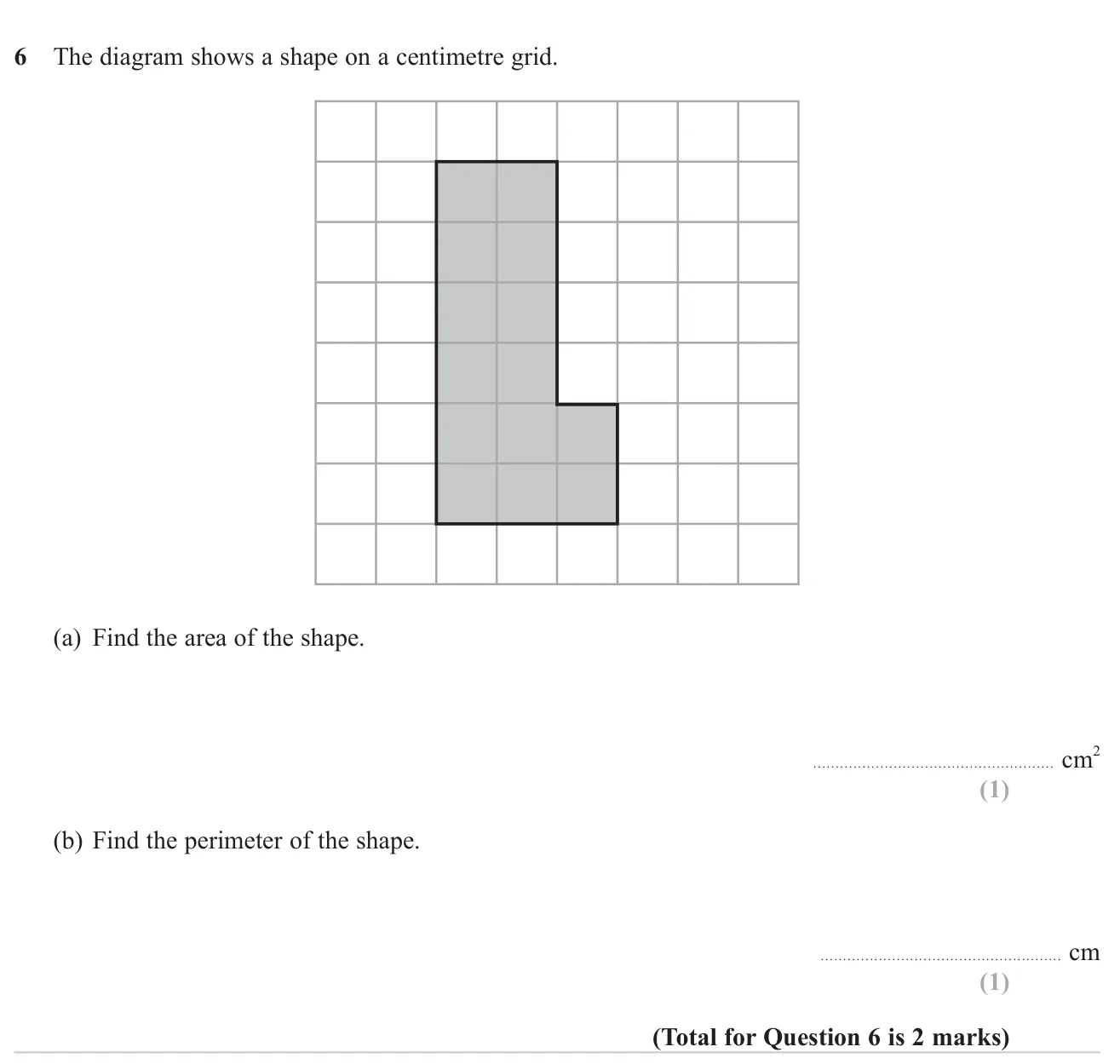
Exam questions: Area and perimeter (29, easiest first) © Pearson Education Ltd. June 2023 Paper 3 (Foundation, calculator), question 6.
Worked solution Checked against the mark scheme
(a) Count the squares: a 2 by 6 block (12) plus a 1 by 2 block (2), so 12 + 2 = 14 12 + 2 = 14 12 + 2 = 14
(b) Go round the edge: 2 + 6 + 3 + 2 + 1 + 4 = 18 2 + 6 + 3 + 2 + 1 + 4 = 18 2 + 6 + 3 + 2 + 1 + 4 = 18
Watch out: Mixing up area and perimeter, or missing an edge at the step.
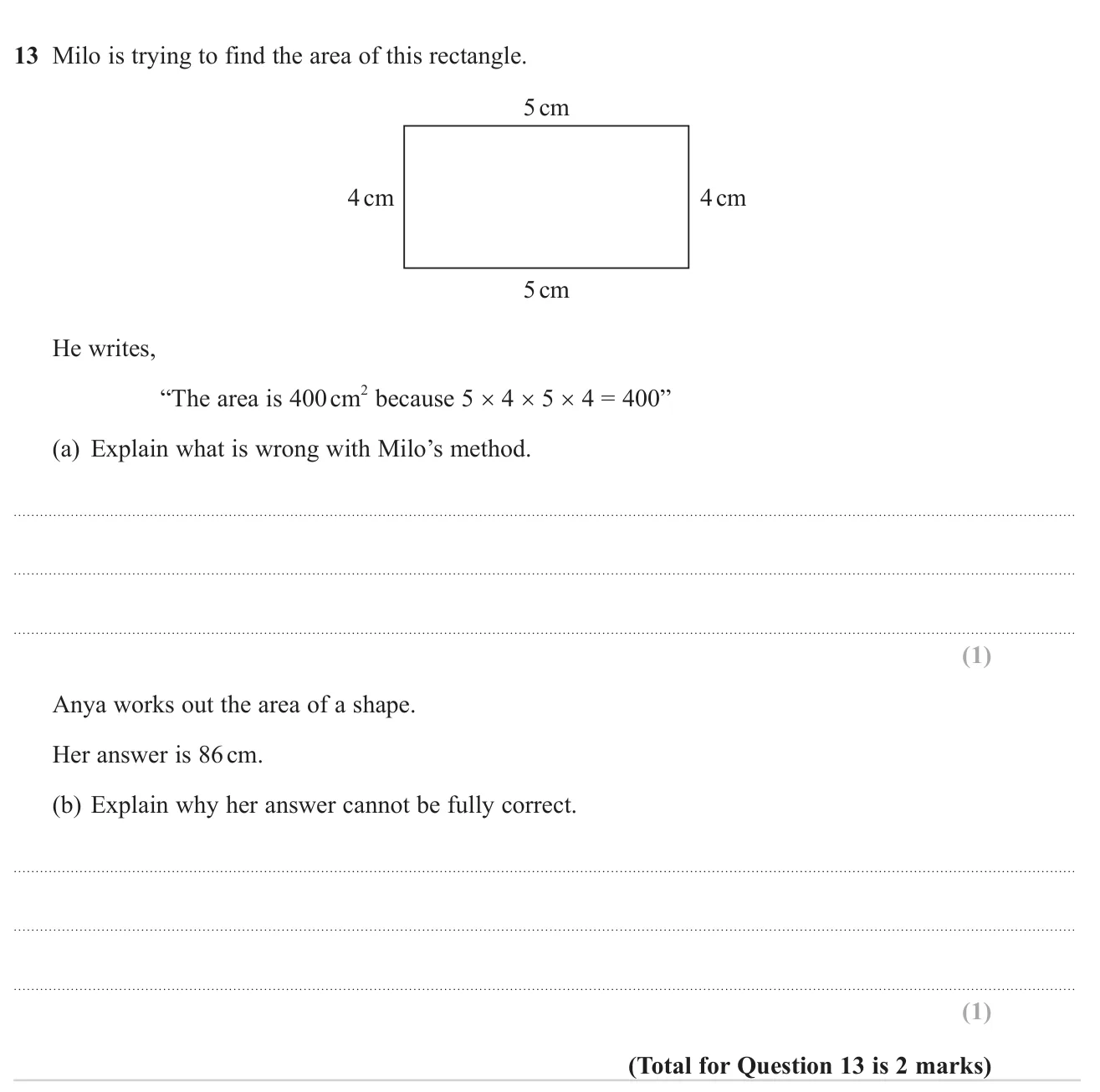
© Pearson Education Ltd. November 2023 Paper 2 (Foundation, calculator), question 13.
(a) He should only multiply length by width once: 5 × 4 = 20 cm 2 5 \times 4 = 20\text{ cm}^2 5 × 4 = 20 cm 2 1 mark (b) Area must be in square units, e.g. cm², not cm 1 mark
Worked solution Checked against the mark scheme
(a) Area of a rectangle = = = × \times × = 5 × 4 = 20 cm 2 = 5 \times 4 = 20\text{ cm}^2 = 5 × 4 = 20 cm 2
(b) Area is measured in square units. An answer in cm is a length, so it should be in cm 2 \text{cm}^2 cm 2
Watch out: In (a), saying he should have added the sides, which gives the perimeter, not the area.
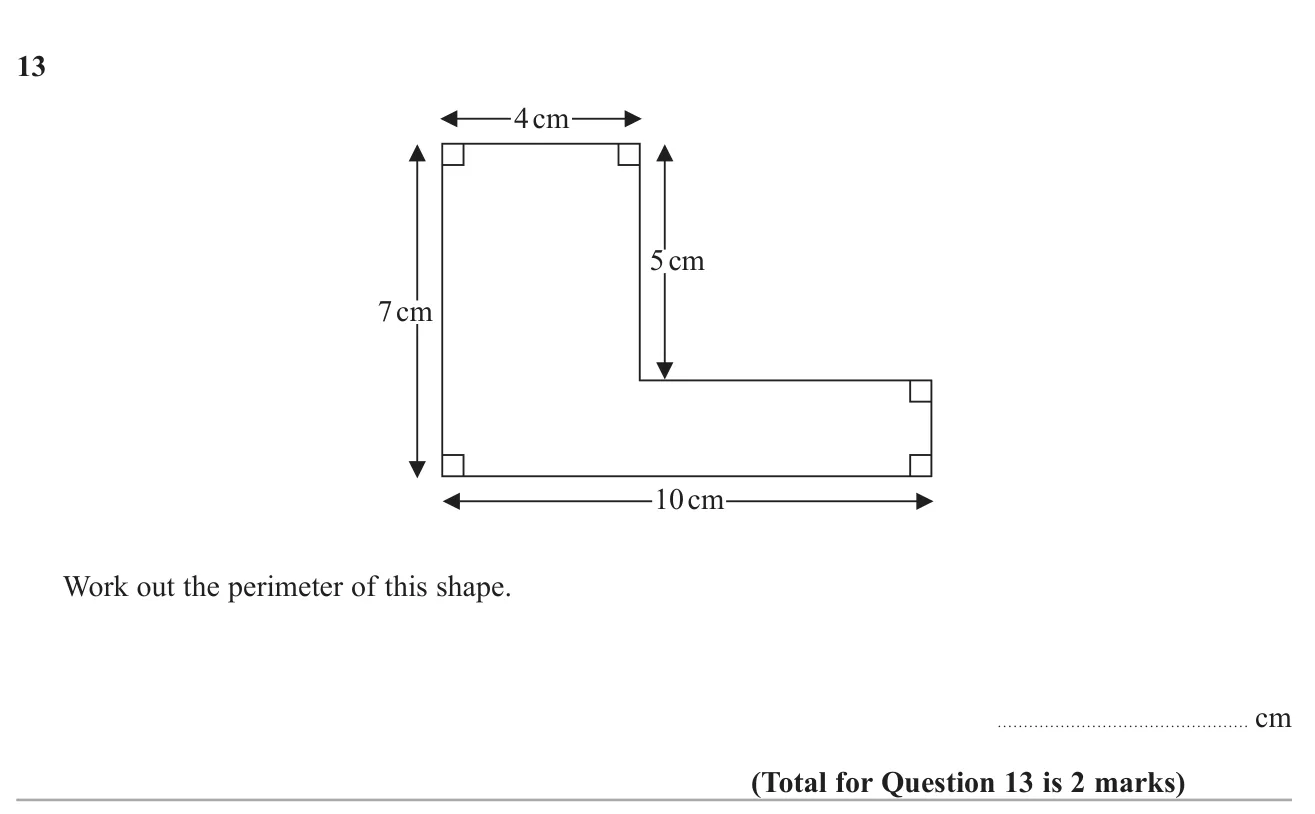
© Pearson Education Ltd. November 2020 Paper 3 (Foundation, calculator), question 13.
Worked solution Checked against the mark scheme
Missing sides: 10 − 4 = 6 10 - 4 = 6 10 − 4 = 6 7 − 5 = 2 7 - 5 = 2 7 − 5 = 2
Perimeter: 4 + 5 + 6 + 2 + 10 + 7 = 34 4 + 5 + 6 + 2 + 10 + 7 = 34 4 + 5 + 6 + 2 + 10 + 7 = 34
Watch out: Adding only the four labelled sides to get 26.
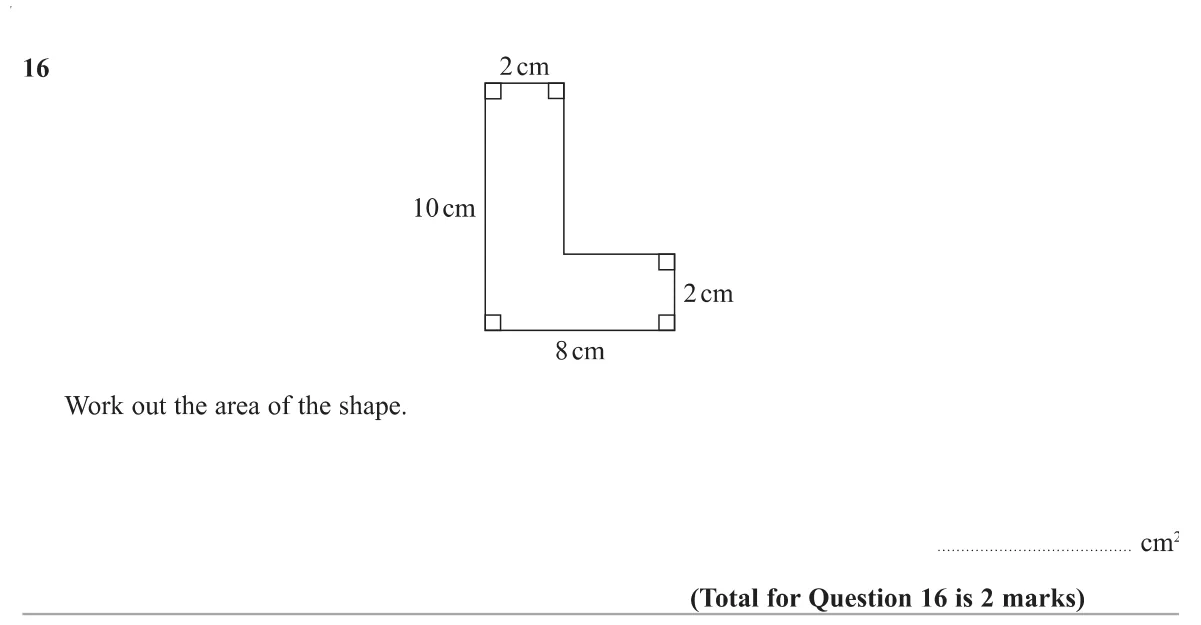
© Pearson Education Ltd. Specimen Paper 1 (Foundation, non-calculator), question 16.
Worked solution Checked against the mark scheme
Split it into two rectangles.
Tall part: 10 × 2 = 20 10 \times 2 = 20 10 × 2 = 20
Bottom right part: ( 8 − 2 ) × 2 = 12 (8 - 2) \times 2 = 12 ( 8 − 2 ) × 2 = 12
Total = 20 + 12 = 32 = 20 + 12 = 32 = 20 + 12 = 32
Watch out: Using 8 × 2 for the bottom part as well as 10 × 2, counting the corner twice (36).
© Pearson Education Ltd. November 2024 Paper 2 (Foundation, calculator), question 10.
Worked solution Checked against the mark scheme
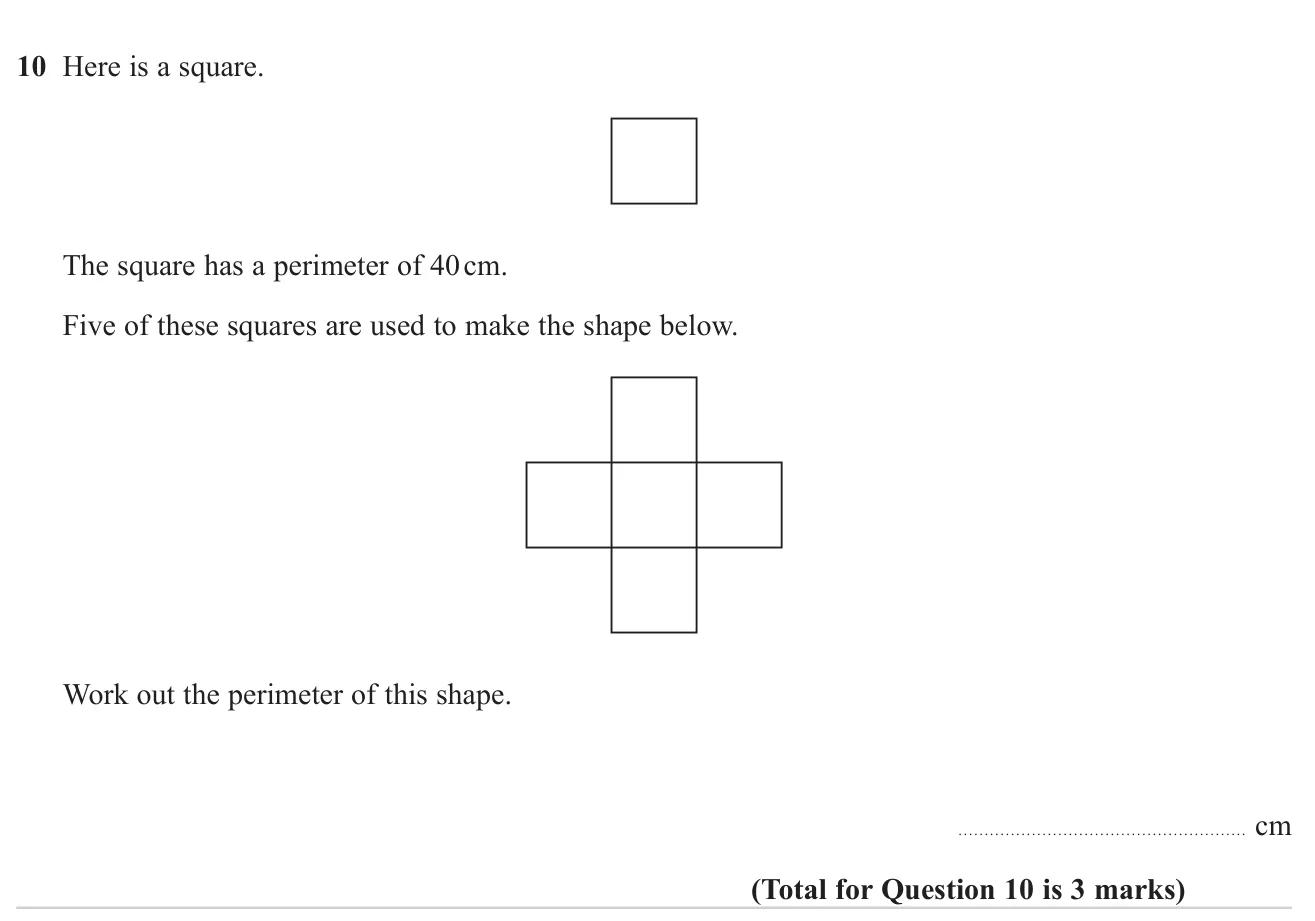
One side of a square is 40 ÷ 4 = 10 40 \div 4 = 10 40 ÷ 4 = 10
The cross has 12 outside edges.
Perimeter = 12 × 10 = 120 = 12 \times 10 = 120 = 12 × 10 = 120
Watch out: Multiplying 40 by 5 to get 200, which counts the inside edges too.
© Pearson Education Ltd. November 2019 Paper 3 (Foundation, calculator), question 14.
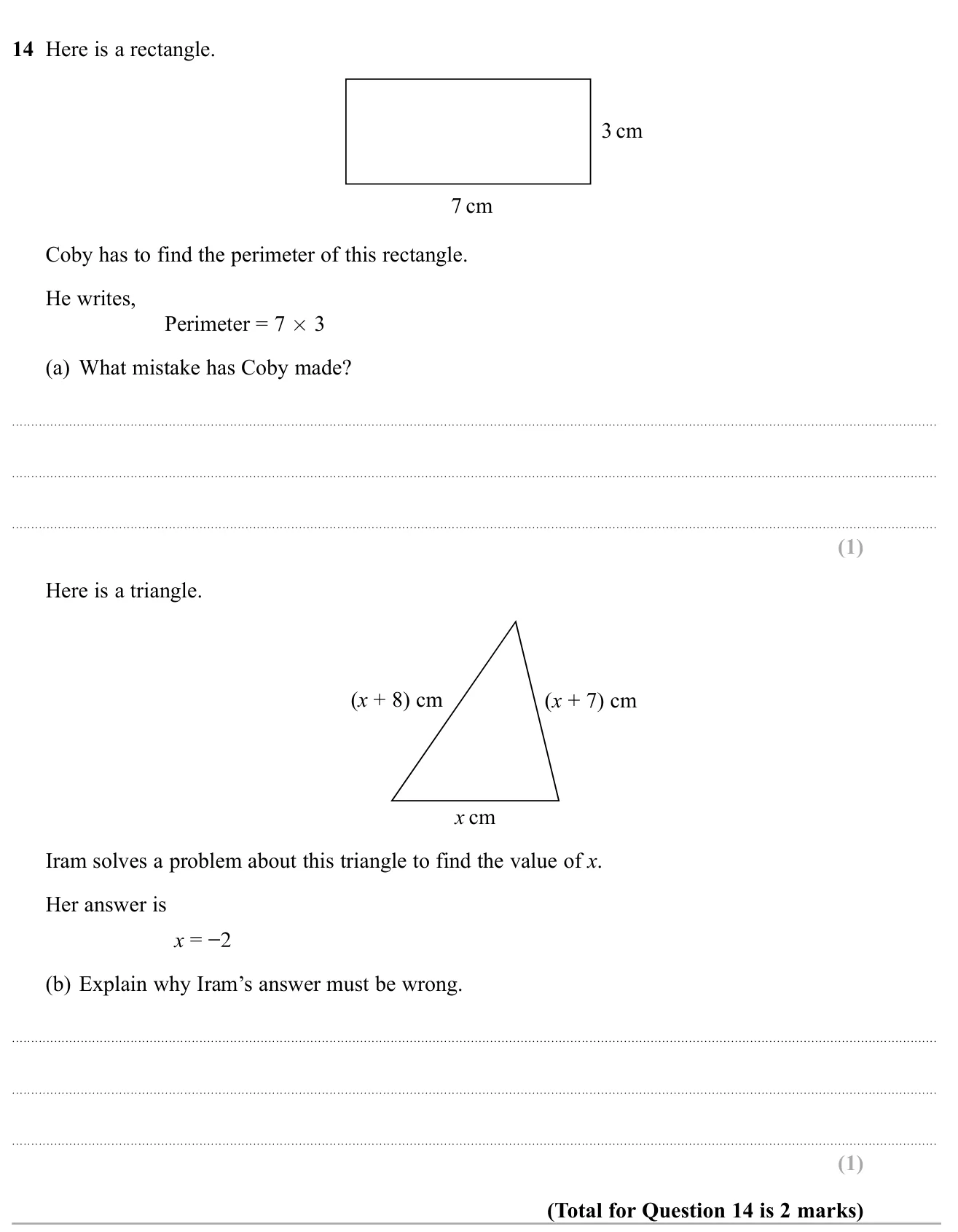
(a) He multiplied, which gives the area; the perimeter is 7 + 3 + 7 + 3 = 20 7 + 3 + 7 + 3 = 20 7 + 3 + 7 + 3 = 20 1 mark (b) A length cannot be negative, so x = − 2 x = -2 x = − 2 1 mark
Worked solution Checked against the mark scheme
(a) 7 × 3 7 \times 3 7 × 3 7 + 3 + 7 + 3 = 20 7 + 3 + 7 + 3 = 20 7 + 3 + 7 + 3 = 20
(b) One side is x x x x = − 2 x = -2 x = − 2 − 2 -2 − 2
Watch out: In (b), talking about angles adding to 180° instead of the length being negative.
© Pearson Education Ltd. June 2019 Paper 3 (Foundation, calculator), question 16.
Worked solution Checked against the mark scheme
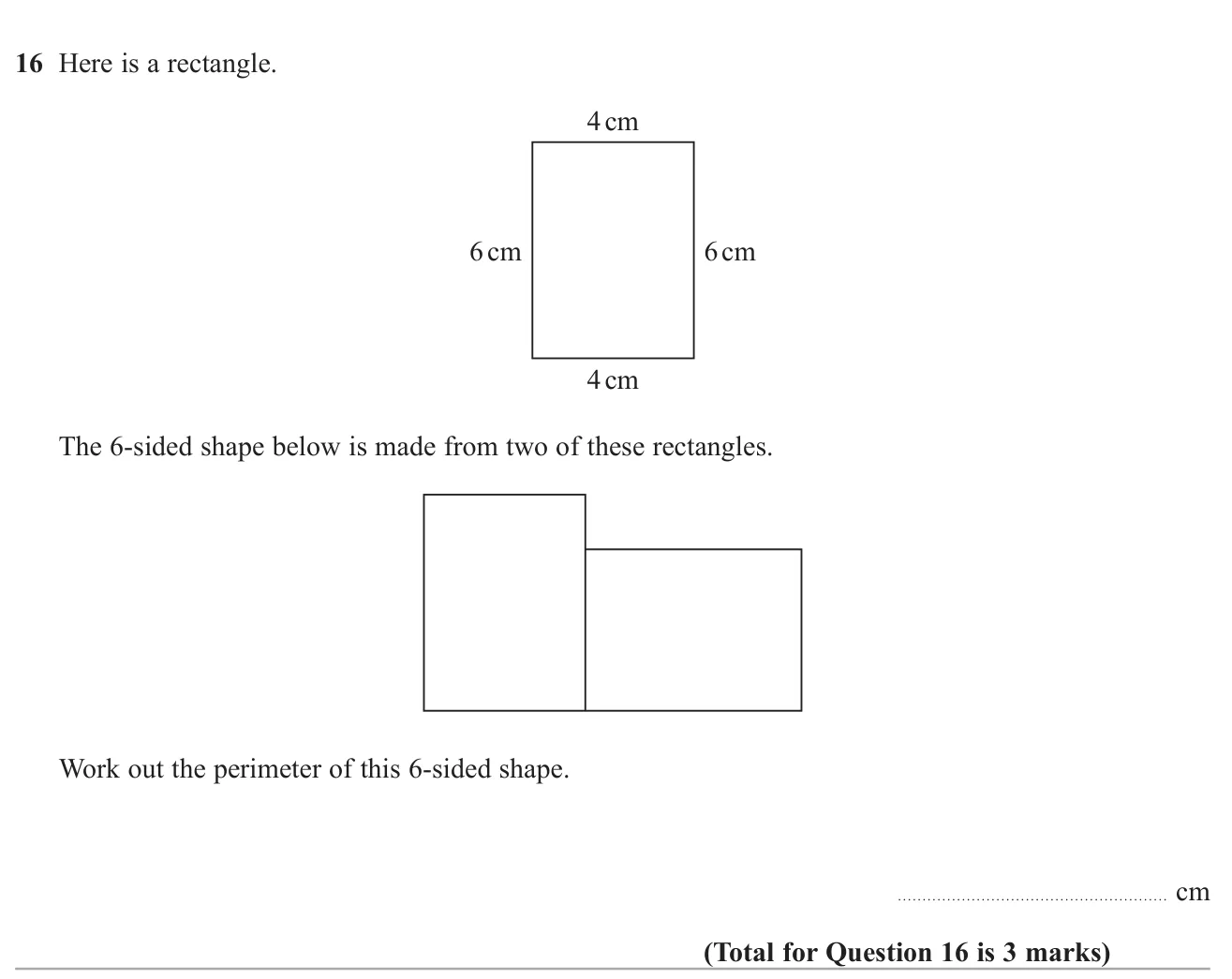
One rectangle stands upright (4 by 6), the other lies flat (6 by 4) beside it.
The step on top is 6 − 4 = 2 6 - 4 = 2 6 − 4 = 2
Perimeter: 4 + 2 + 6 + 4 + 6 + 4 + 6 = 32 4 + 2 + 6 + 4 + 6 + 4 + 6 = 32 4 + 2 + 6 + 4 + 6 + 4 + 6 = 32
Or: 20 + 20 − 2 × 4 = 32 20 + 20 - 2 \times 4 = 32 20 + 20 − 2 × 4 = 32
Watch out: Adding both perimeters to get 40, forgetting the shared edge.
© Pearson Education Ltd. June 2024 Paper 1 (Foundation, non-calculator), question 12.
Worked solution Checked against the mark scheme
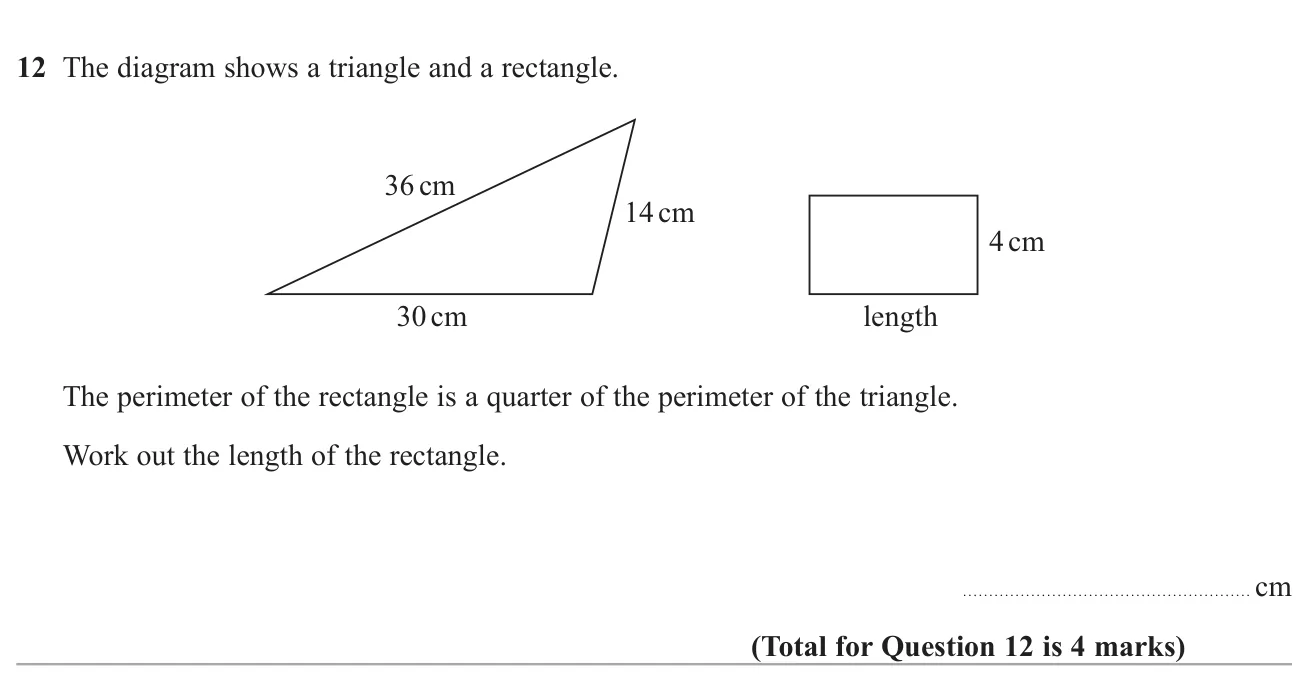
Triangle perimeter: 30 + 36 + 14 = 80 30 + 36 + 14 = 80 30 + 36 + 14 = 80
Rectangle perimeter: 80 ÷ 4 = 20 80 \div 4 = 20 80 ÷ 4 = 20
Two widths: 2 × 4 = 8 2 \times 4 = 8 2 × 4 = 8 = 12 = 12 = 12
Length = 12 ÷ 2 = 6 = 12 \div 2 = 6 = 12 ÷ 2 = 6
Watch out: Subtracting only one width of 4 cm (giving 16 ÷ 2 = 8).
© Pearson Education Ltd. June 2024 Paper 1 (Foundation, non-calculator), question 22.
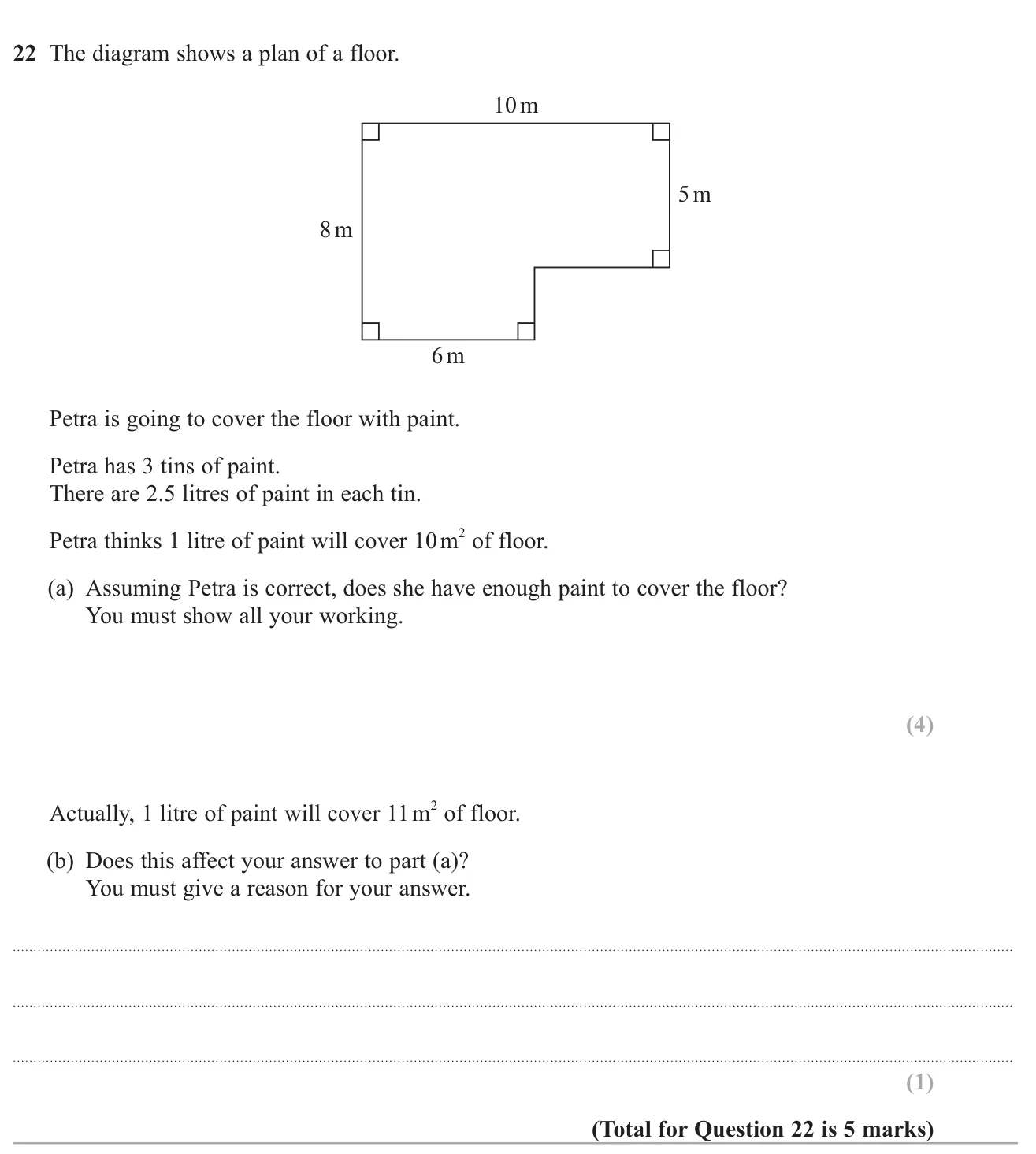
(a) Yes: area 68 m 2 68\text{ m}^2 68 m 2 75 m 2 75\text{ m}^2 75 m 2 4 marks (b) No effect: each litre covers more, so she still has enough 1 mark
Worked solution Checked against the mark scheme
(a) Area = 10 × 8 − 4 × 3 = 80 − 12 = 68 m 2 = 10 \times 8 - 4 \times 3 = 80 - 12 = 68\text{ m}^2 = 10 × 8 − 4 × 3 = 80 − 12 = 68 m 2
Paint: 3 × 2.5 = 7.5 3 \times 2.5 = 7.5 3 × 2.5 = 7.5 7.5 × 10 = 75 m 2 7.5 \times 10 = 75\text{ m}^2 7.5 × 10 = 75 m 2
75 > 68 75 > 68 75 > 68 yes , she has enough.
(b) With 11 m² per litre it covers 82.5 m 2 82.5\text{ m}^2 82.5 m 2
Watch out: Multiplying 10 × 8 and forgetting to remove the cut-out corner.
© Pearson Education Ltd. November 2023 Paper 3 (Foundation, calculator), question 18.
Worked solution Checked against the mark scheme
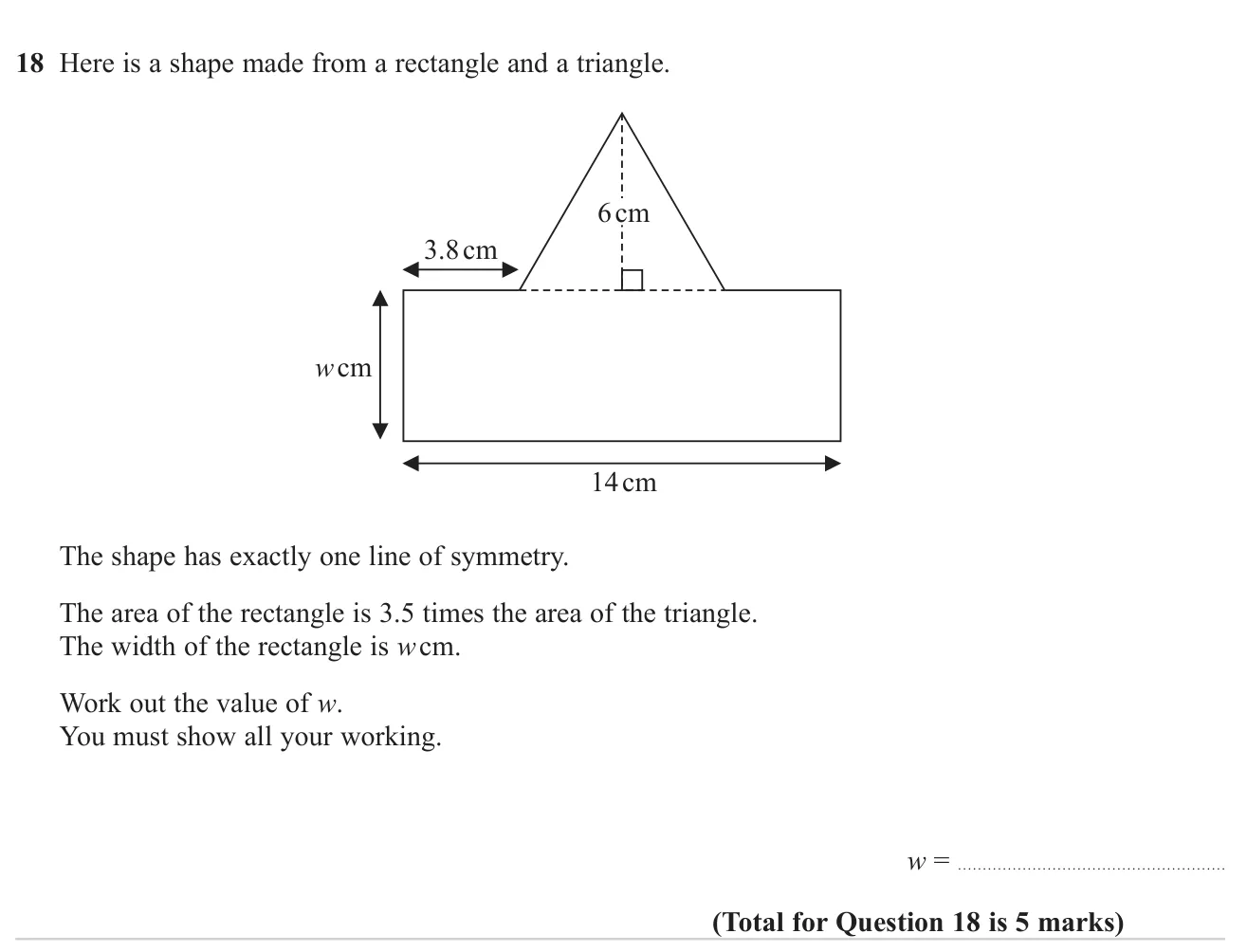
The shape is symmetrical, so the triangle's base = 14 − 3.8 − 3.8 = 6.4 = 14 - 3.8 - 3.8 = 6.4 = 14 − 3.8 − 3.8 = 6.4
Triangle area = 1 2 × 6.4 × 6 = 19.2 = \frac{1}{2} \times 6.4 \times 6 = 19.2 = 2 1 × 6.4 × 6 = 19.2
Rectangle area = 3.5 × 19.2 = 67.2 = 3.5 \times 19.2 = 67.2 = 3.5 × 19.2 = 67.2
14 w = 67.2 14w = 67.2 14 w = 67.2 w = 67.2 ÷ 14 = 4.8 w = 67.2 \div 14 = 4.8 w = 67.2 ÷ 14 = 4.8
Watch out: Subtracting 3.8 only once, giving a base of 10.2 cm.
© Pearson Education Ltd. June 2022 Paper 3 (Foundation, calculator), question 16.
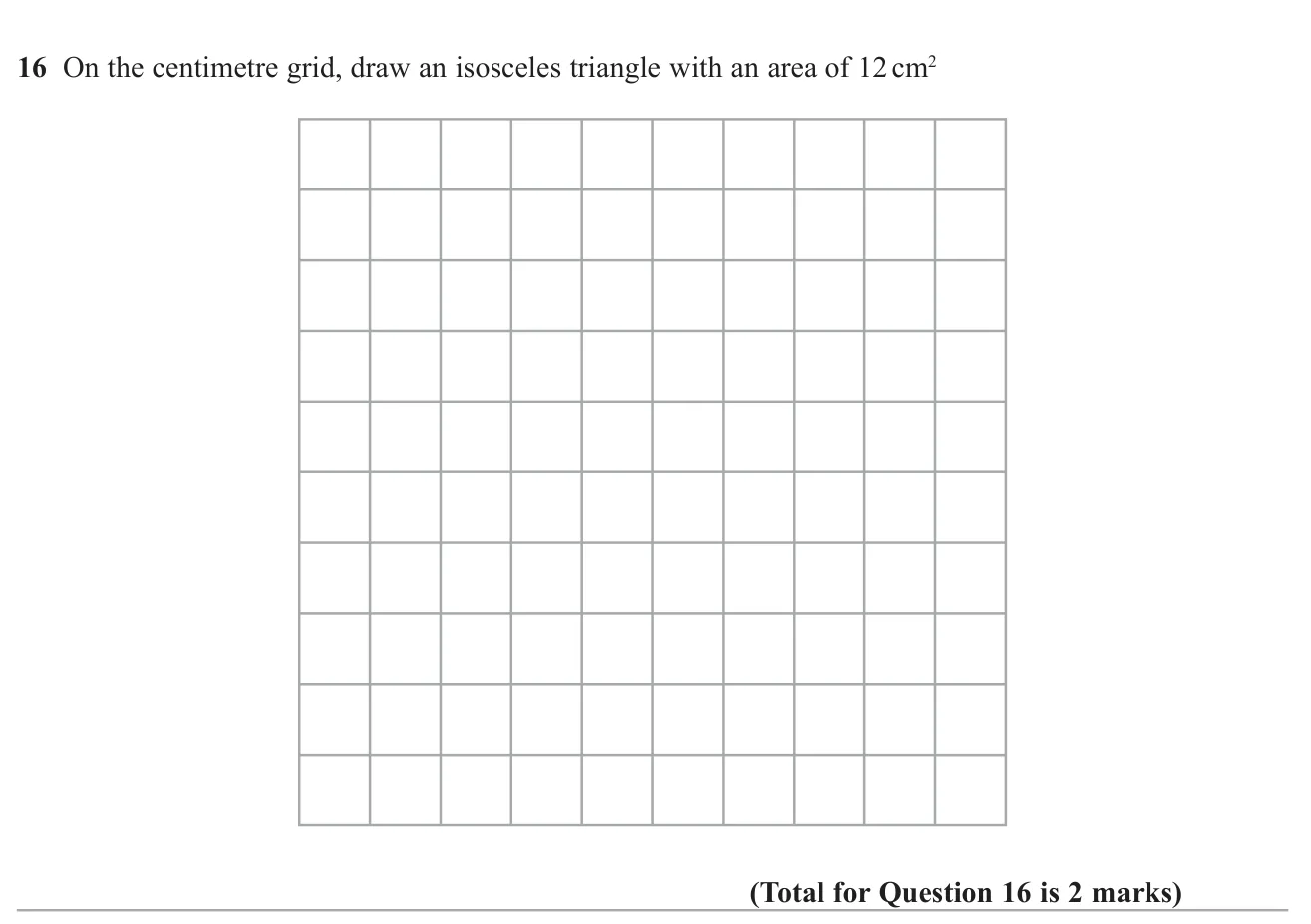
Answer Any isosceles triangle with base × height = 24, e.g. base 6 cm and height 4 cm 2 marks
Worked solution Checked against the mark scheme
Area of a triangle is 1 2 × b × h \frac{1}{2} \times b \times h 2 1 × b × h b × h = 24 b \times h = 24 b × h = 24
Choose base 6 cm and height 4 cm.
Put the top vertex directly above the middle of the base (3 cm along), so the two slanted sides are equal.
Watch out: Using base × height = 12, which gives an area of 6.
© Pearson Education Ltd. June 2019 Paper 1 (Foundation, non-calculator), question 18.
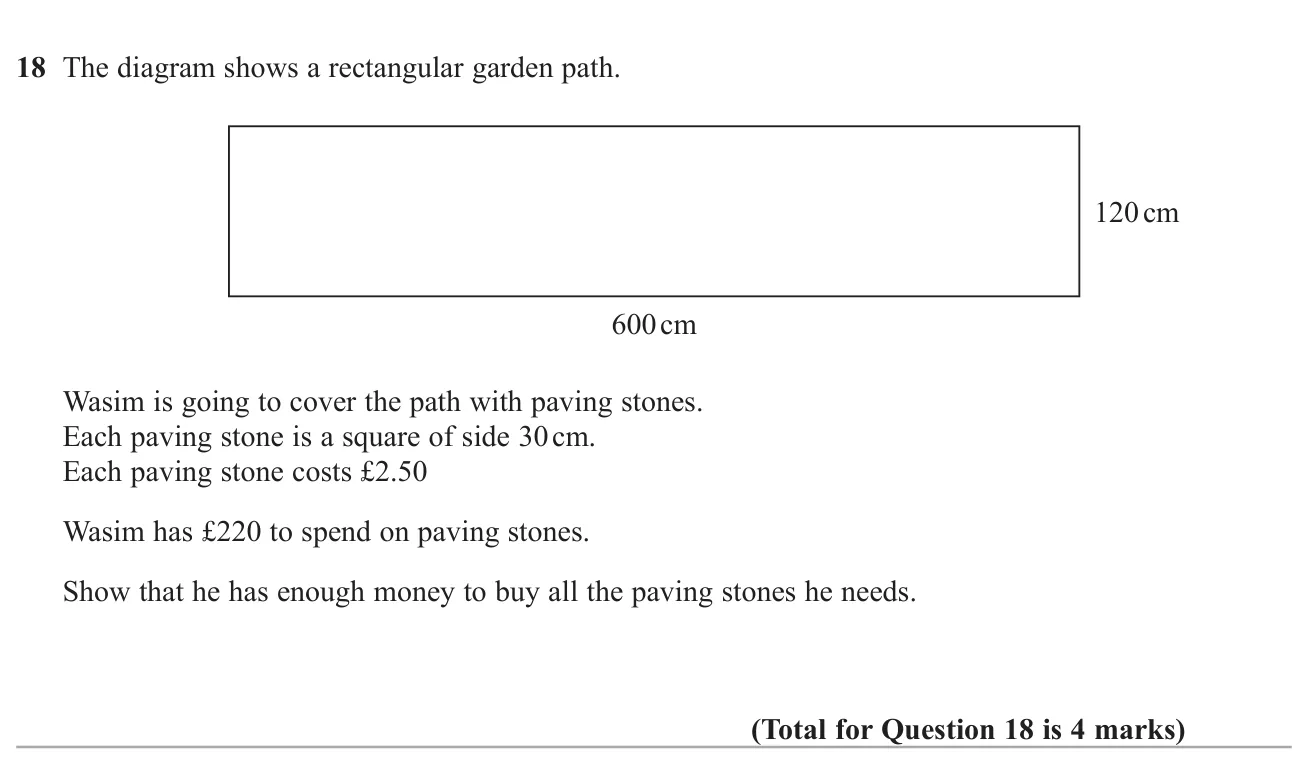
Answer 80 stones cost £200, which is less than £220 (or 88 stones affordable against 80 needed) 4 marks
Worked solution Checked against the mark scheme
Along the length: 600 ÷ 30 = 20 600 \div 30 = 20 600 ÷ 30 = 20
Across the width: 120 ÷ 30 = 4 120 \div 30 = 4 120 ÷ 30 = 4
Number needed: 20 × 4 = 80 20 \times 4 = 80 20 × 4 = 80
Cost: 80 × £ 2.50 = £ 200 80 \times £2.50 = £200 80 × £2.50 = £200
£ 200 < £ 220 £200 < £220 £200 < £220
Watch out: Using the perimeter of the path instead of its area.
© Pearson Education Ltd. November 2018 Paper 2 (Foundation, calculator), question 13.
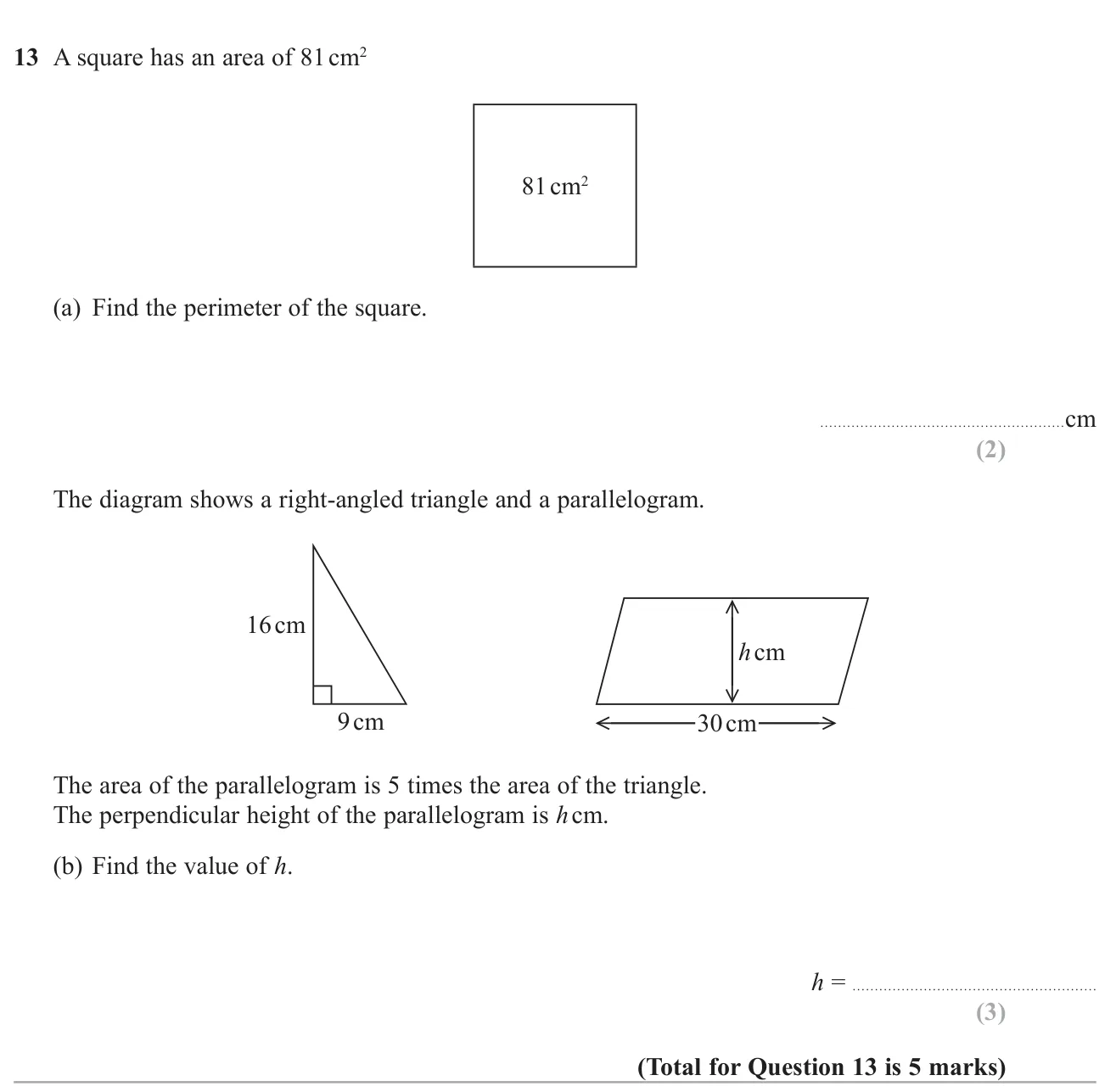
(a) 36 cm 2 marks (b) 12 3 marks
Worked solution Checked against the mark scheme
(a) Side = 81 = 9 = \sqrt{81} = 9 = 81 = 9 = 4 × 9 = 36 = 4 \times 9 = 36 = 4 × 9 = 36
(b) Triangle: 1 2 × 16 × 9 = 72 \frac{1}{2} \times 16 \times 9 = 72 2 1 × 16 × 9 = 72
Parallelogram: 5 × 72 = 360 5 \times 72 = 360 5 × 72 = 360
30 h = 360 30h = 360 30 h = 360 h = 12 h = 12 h = 12
Watch out: In (a), dividing 81 by 4; in (b), forgetting to halve for the triangle.
© Pearson Education Ltd. June 2018 Paper 3 (Foundation, calculator), question 21.
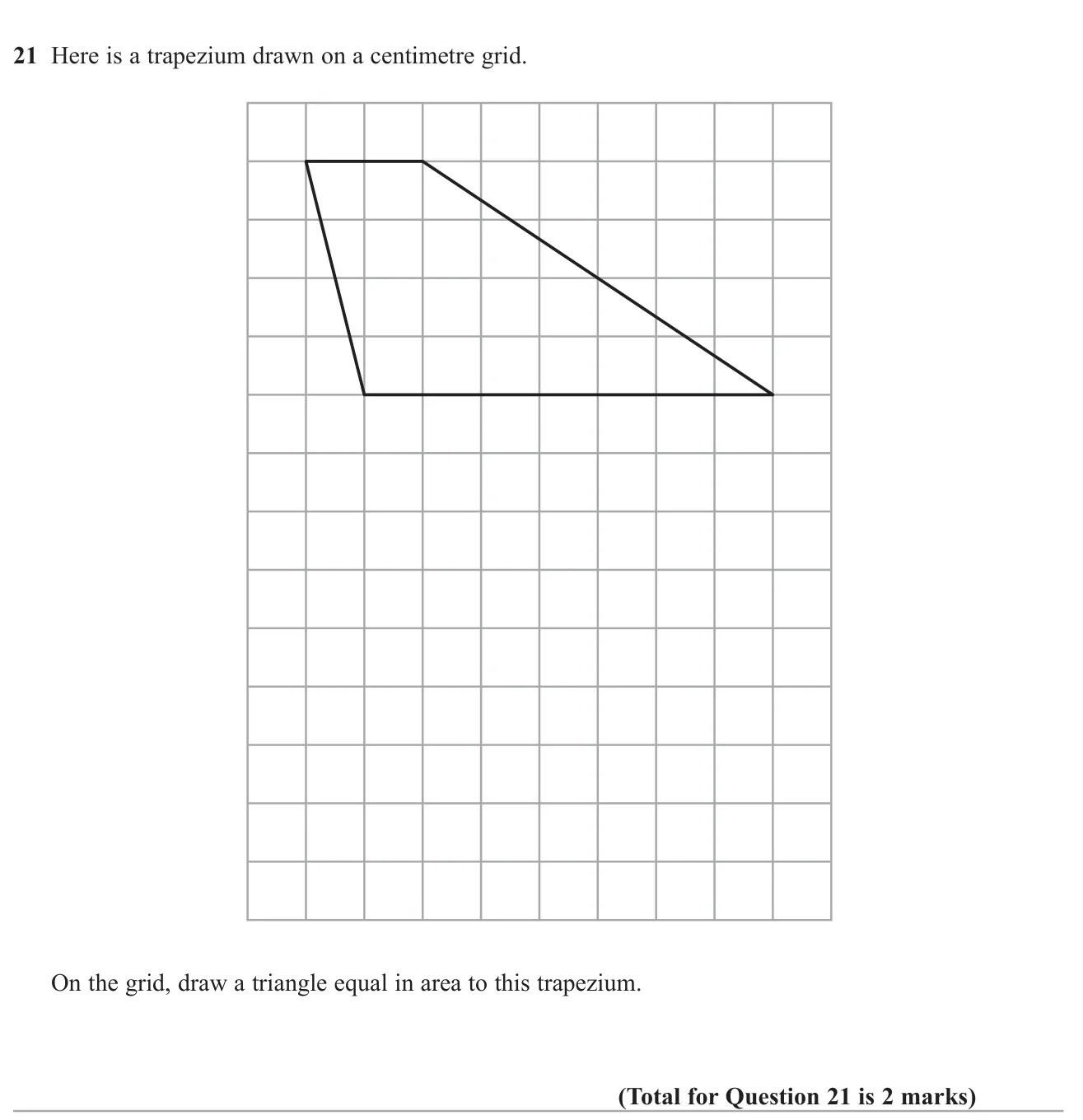
Answer Any triangle of area 18 cm², e.g. base 6 cm and height 6 cm, or base 9 cm and height 4 cm 2 marks
Worked solution Checked against the mark scheme
The parallel sides are 2 cm and 7 cm, and the height is 4 cm.
Area = 1 2 ( 2 + 7 ) × 4 = 18 = \frac{1}{2}(2 + 7) \times 4 = 18 = 2 1 ( 2 + 7 ) × 4 = 18
A triangle needs 1 2 × b × h = 18 \frac{1}{2} \times b \times h = 18 2 1 × b × h = 18 b × h = 36 b \times h = 36 b × h = 36
Watch out: Drawing a triangle with base × height = 18, giving area 9.
© Pearson Education Ltd. Specimen Paper 1 (Foundation, non-calculator), question 23.
Worked solution Checked against the mark scheme
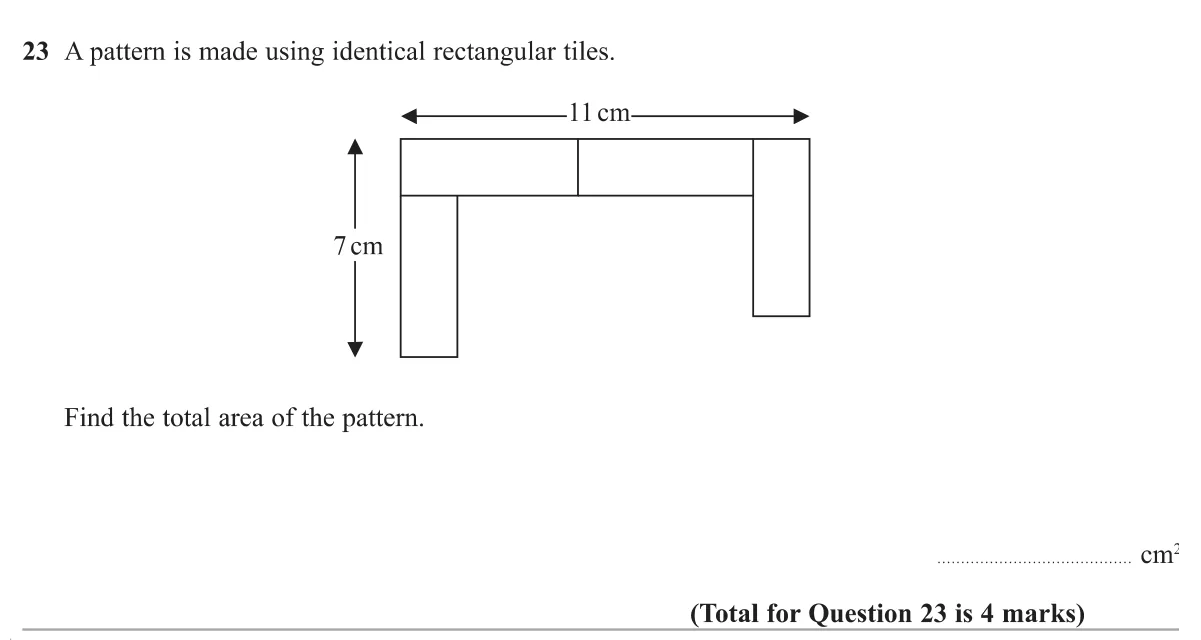
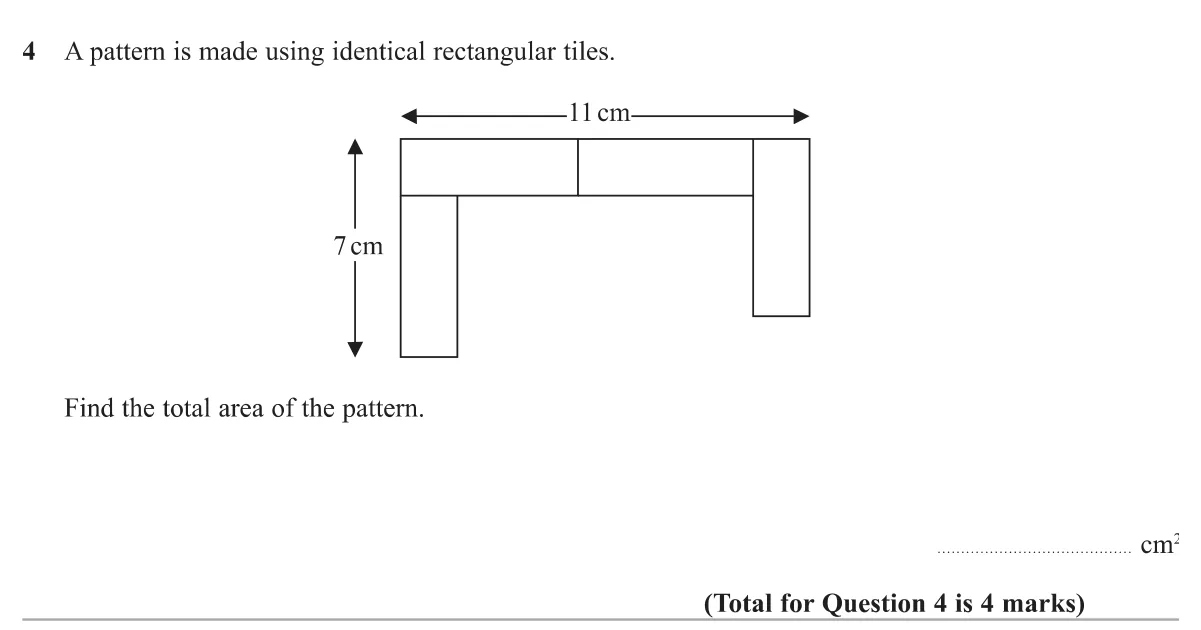
Let each tile be l l l w w w
Across the top: 2 l + w = 11 2l + w = 11 2 l + w = 11 l + w = 7 l + w = 7 l + w = 7
Subtracting: l = 4 l = 4 l = 4 w = 3 w = 3 w = 3
One tile = 4 × 3 = 12 = 4 \times 3 = 12 = 4 × 3 = 12 4 × 12 = 48 4 \times 12 = 48 4 × 12 = 48
Watch out: Multiplying 11 × 7 to get 77, treating the pattern as a full rectangle.
© Pearson Education Ltd. November 2022 Paper 2 (Foundation, calculator), question 21.
Worked solution Checked against the mark scheme
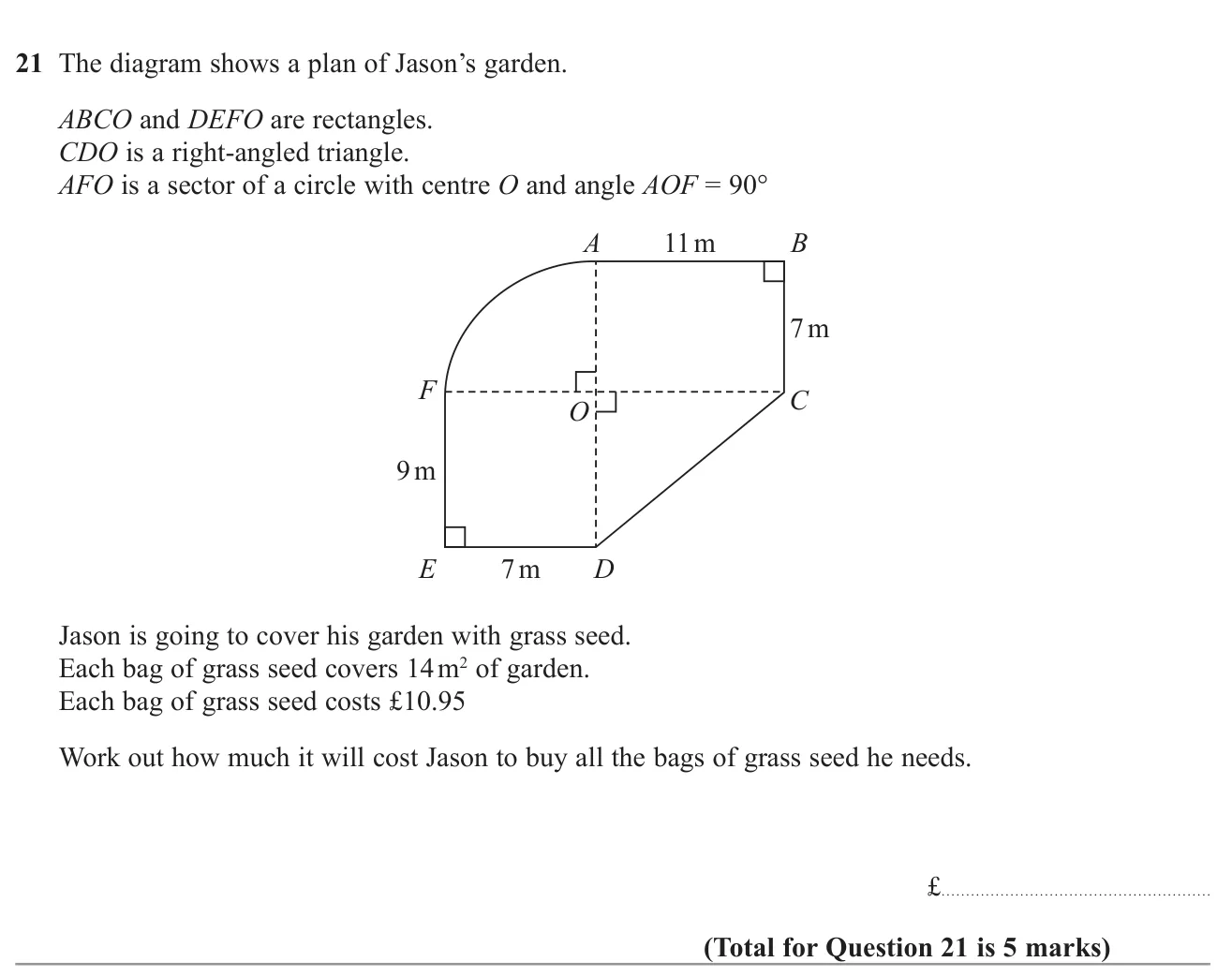
Rectangle ABCO: 11 × 7 = 77 11 \times 7 = 77 11 × 7 = 77
Rectangle DEFO: 7 × 9 = 63 7 \times 9 = 63 7 × 9 = 63
Triangle CDO: 1 2 × 11 × 9 = 49.5 \frac12 \times 11 \times 9 = 49.5 2 1 × 11 × 9 = 49.5
Quarter circle: 1 4 × π × 7 2 = 38.48... \frac14 \times \pi \times 7^2 = 38.48... 4 1 × π × 7 2 = 38.48...
Total = 227.98... m 2 = 227.98...\text{ m}^2 = 227.98... m 2 227.98 ÷ 14 = 16.28... 227.98 \div 14 = 16.28... 227.98 ÷ 14 = 16.28...
17 × 10.95 = £ 186.15 17 \times 10.95 = £186.15 17 × 10.95 = £186.15
Watch out: Rounding 16.28 bags down to 16.
© Pearson Education Ltd. June 2022 Paper 3 (Foundation, calculator), question 28.
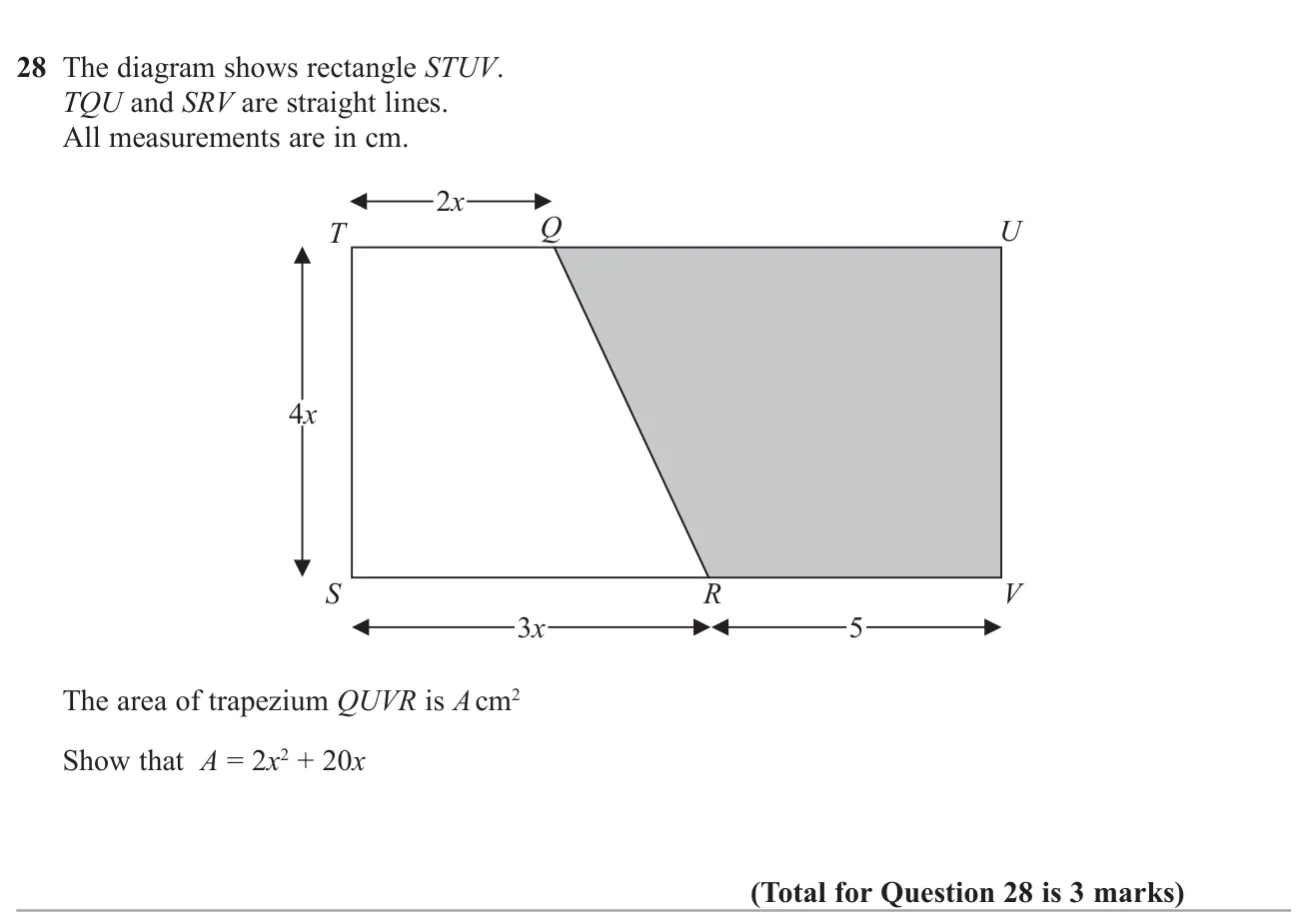
Answer A = 2 x 2 + 20 x A = 2x^2 + 20x A = 2 x 2 + 20 x 3 marks
Worked solution Checked against the mark scheme
Q U = ( 3 x + 5 ) − 2 x = x + 5 QU = (3x + 5) - 2x = x + 5 Q U = ( 3 x + 5 ) − 2 x = x + 5 R V = 5 RV = 5 R V = 5 4 x 4x 4 x
A = 1 2 ( Q U + R V ) × 4 x = 1 2 ( x + 10 ) × 4 x A = \frac{1}{2}(QU + RV) \times 4x = \frac{1}{2}(x + 10) \times 4x A = 2 1 ( Q U + R V ) × 4 x = 2 1 ( x + 10 ) × 4 x
A = 2 x ( x + 10 ) = 2 x 2 + 20 x A = 2x(x + 10) = 2x^2 + 20x A = 2 x ( x + 10 ) = 2 x 2 + 20 x
Watch out: Using 3 x + 5 3x + 5 3 x + 5 x + 5 x + 5 x + 5
© Pearson Education Ltd. November 2021 Paper 3 (Foundation, calculator), question 19.
Worked solution Checked against the mark scheme
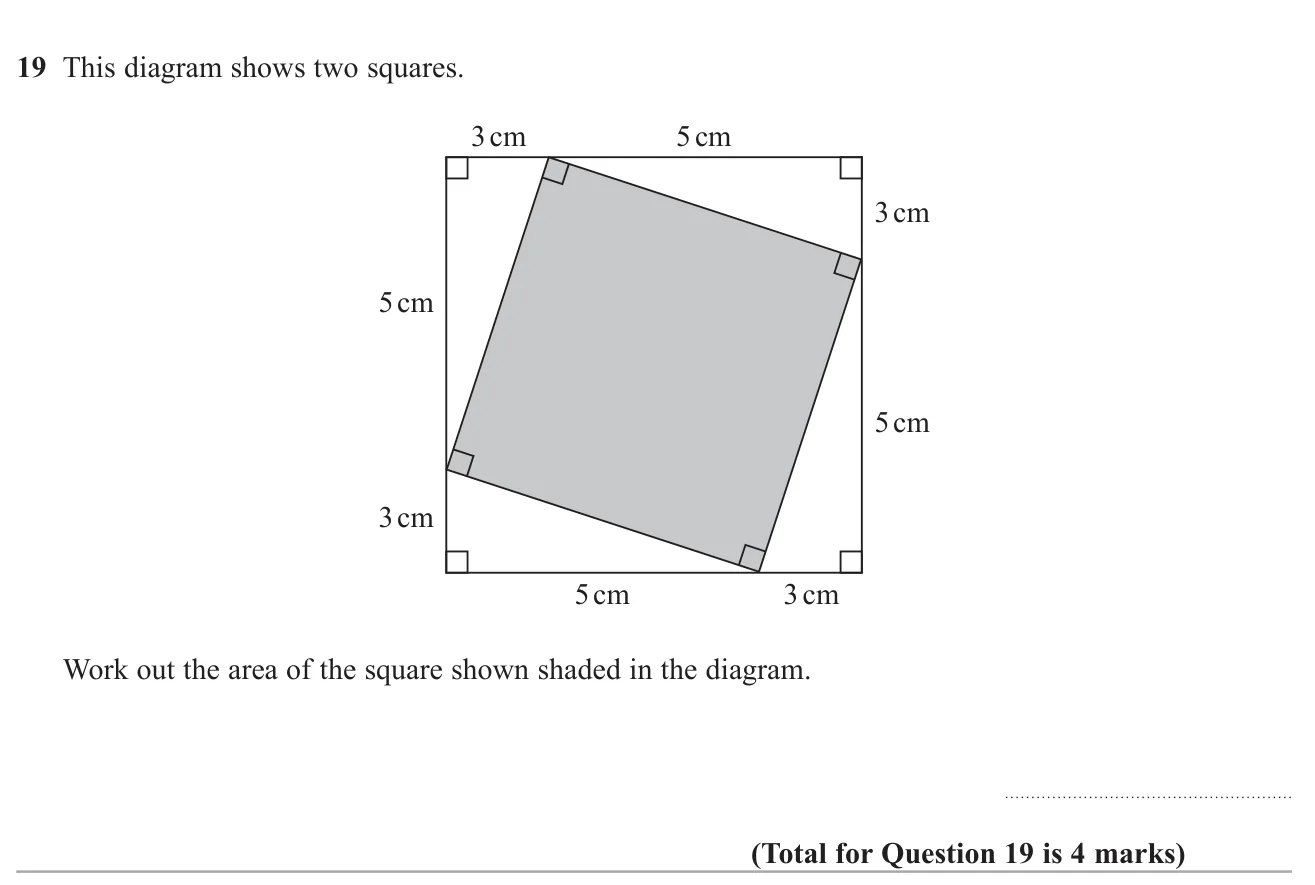
The big square has side 3 + 5 = 8 3 + 5 = 8 3 + 5 = 8 64 64 64
Each corner triangle has area 1 2 × 3 × 5 = 7.5 \frac{1}{2} \times 3 \times 5 = 7.5 2 1 × 3 × 5 = 7.5
Shaded area = 64 − 4 × 7.5 = 34 = 64 - 4 \times 7.5 = 34 = 64 − 4 × 7.5 = 34
(Or: side2 = 3 2 + 5 2 = 34 ^2 = 3^2 + 5^2 = 34 2 = 3 2 + 5 2 = 34
Watch out: Taking the shaded side as 5 cm or 8 cm and squaring it.
© Pearson Education Ltd. November 2020 Paper 2 (Foundation, calculator), question 27.
Worked solution Checked against the mark scheme
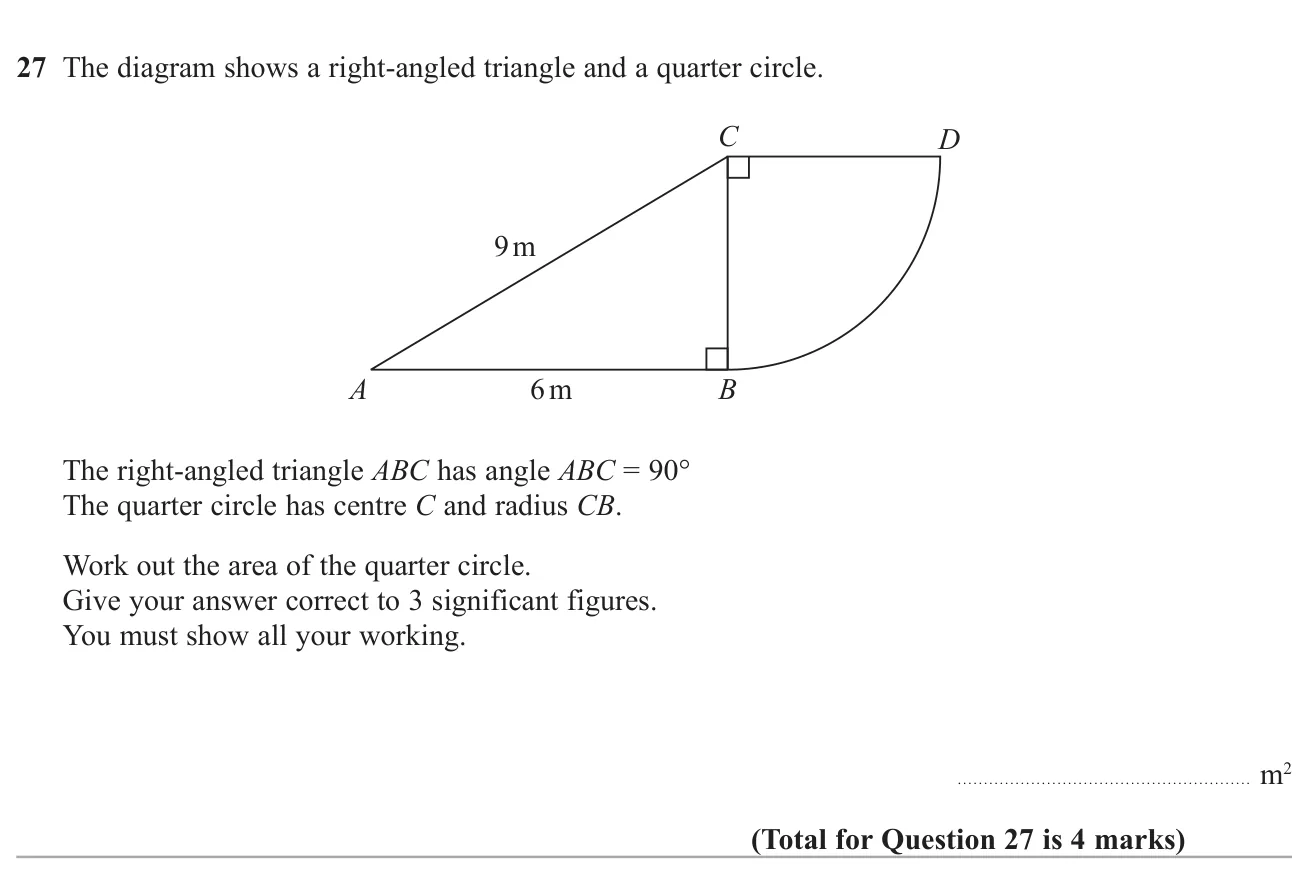
C B 2 = 9 2 − 6 2 = 81 − 36 = 45 CB^2 = 9^2 - 6^2 = 81 - 36 = 45 C B 2 = 9 2 − 6 2 = 81 − 36 = 45 C B = 45 CB = \sqrt{45} C B = 45
Quarter circle area = 1 4 π r 2 = 1 4 × π × 45 = 35.34 … = \frac{1}{4} \pi r^2 = \frac{1}{4} \times \pi \times 45 = 35.34\ldots = 4 1 π r 2 = 4 1 × π × 45 = 35.34 …
= 35.3 m 2 = 35.3\text{ m}^2 = 35.3 m 2
Watch out: Adding the squares (9 2 + 6 2 9^2 + 6^2 9 2 + 6 2
© Pearson Education Ltd. June 2019 Paper 1 (Foundation, non-calculator), question 28.
Worked solution Checked against the mark scheme
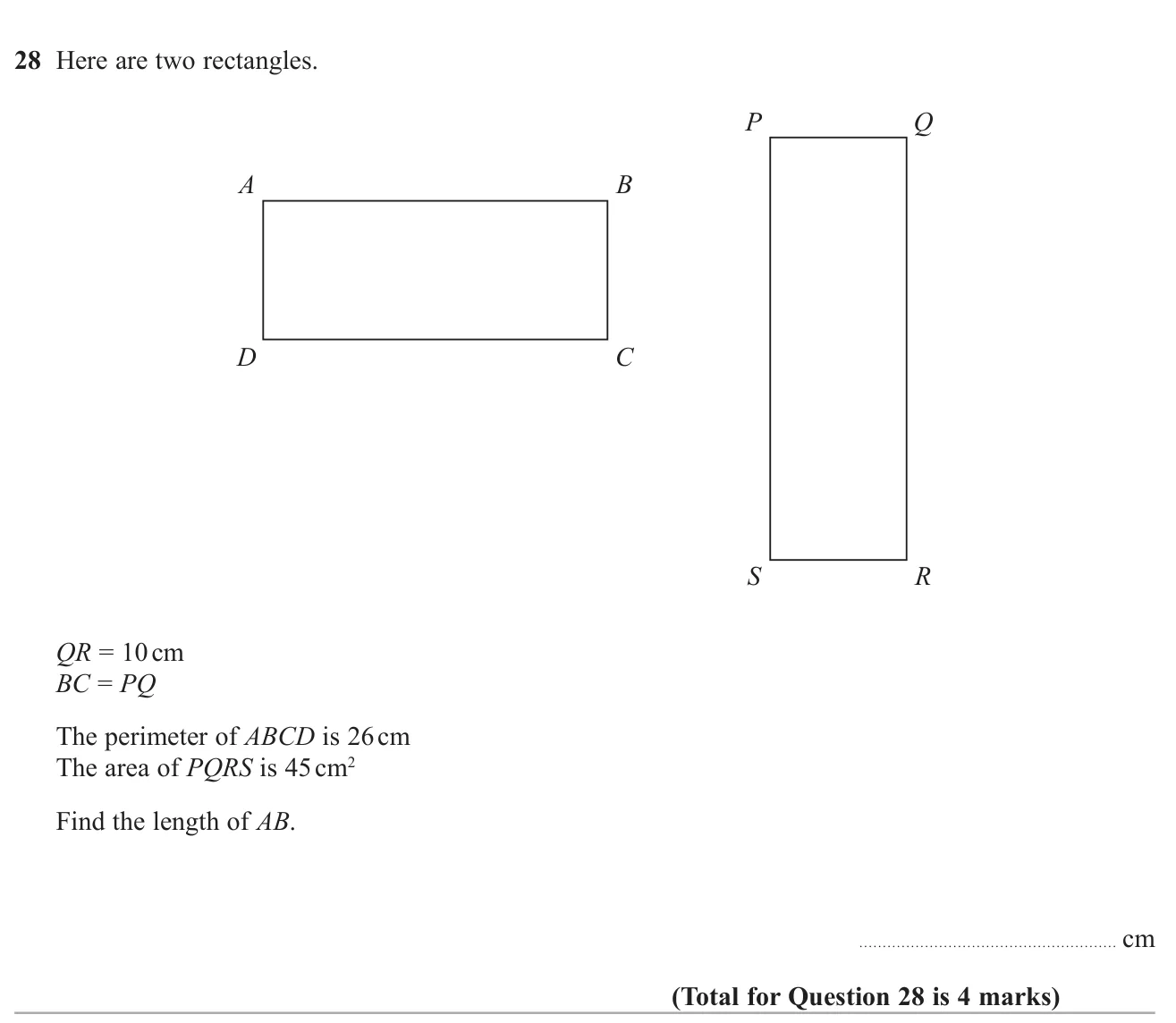
Area of PQRS: P Q × 10 = 45 PQ \times 10 = 45 P Q × 10 = 45 P Q = 4.5 PQ = 4.5 P Q = 4.5 B C = 4.5 BC = 4.5 B C = 4.5
Perimeter of ABCD: 2 × A B + 2 × 4.5 = 26 2 \times AB + 2 \times 4.5 = 26 2 × A B + 2 × 4.5 = 26
2 × A B = 17 2 \times AB = 17 2 × A B = 17 A B = 8.5 AB = 8.5 A B = 8.5
Watch out: Subtracting only one 4.5 from 26, or forgetting to halve.
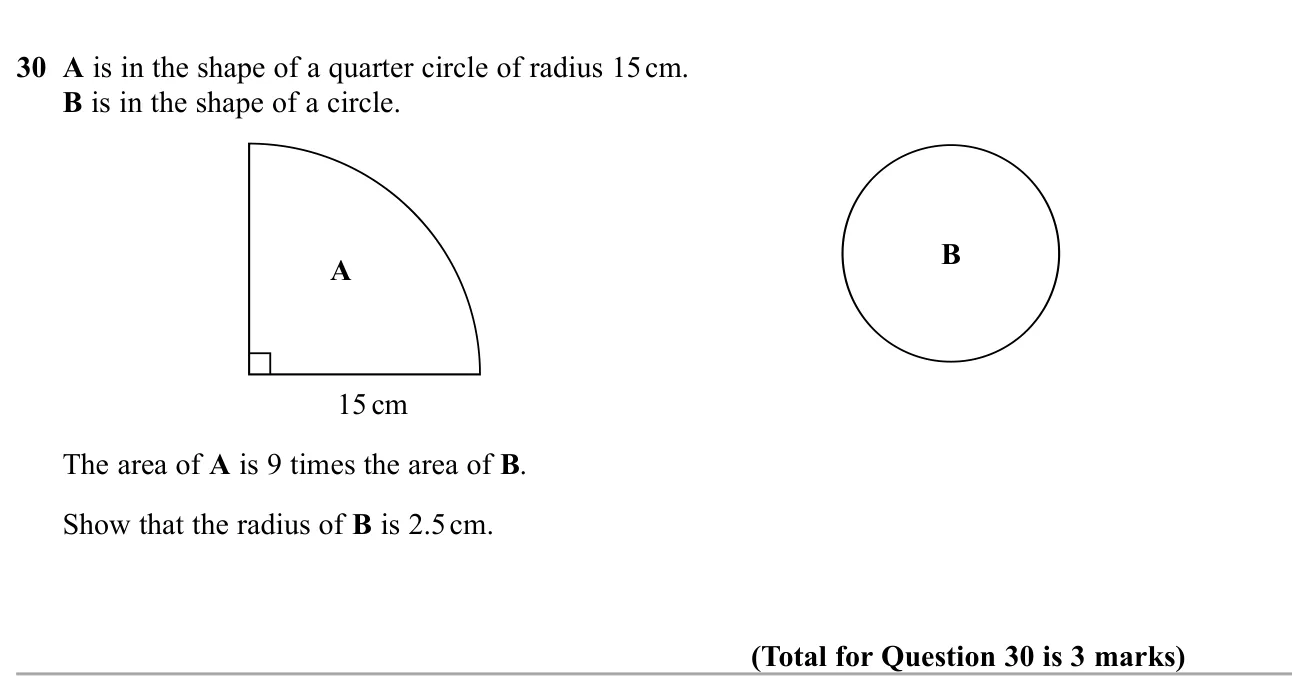
© Pearson Education Ltd. November 2019 Paper 3 (Foundation, calculator), question 30.
Answer Radius of B = 2.5 B = 2.5 B = 2.5 3 marks
Worked solution Checked against the mark scheme
Area of A = 1 4 × π × 15 2 = 56.25 π = \frac{1}{4} \times \pi \times 15^2 = 56.25\pi = 4 1 × π × 1 5 2 = 56.25 π
Area of B = 56.25 π ÷ 9 = 6.25 π = 56.25\pi \div 9 = 6.25\pi = 56.25 π ÷ 9 = 6.25 π
π r 2 = 6.25 π \pi r^2 = 6.25\pi π r 2 = 6.25 π r 2 = 6.25 r^2 = 6.25 r 2 = 6.25 r = 6.25 = 2.5 r = \sqrt{6.25} = 2.5 r = 6.25 = 2.5
Watch out: Forgetting to divide by 4 for the quarter circle.
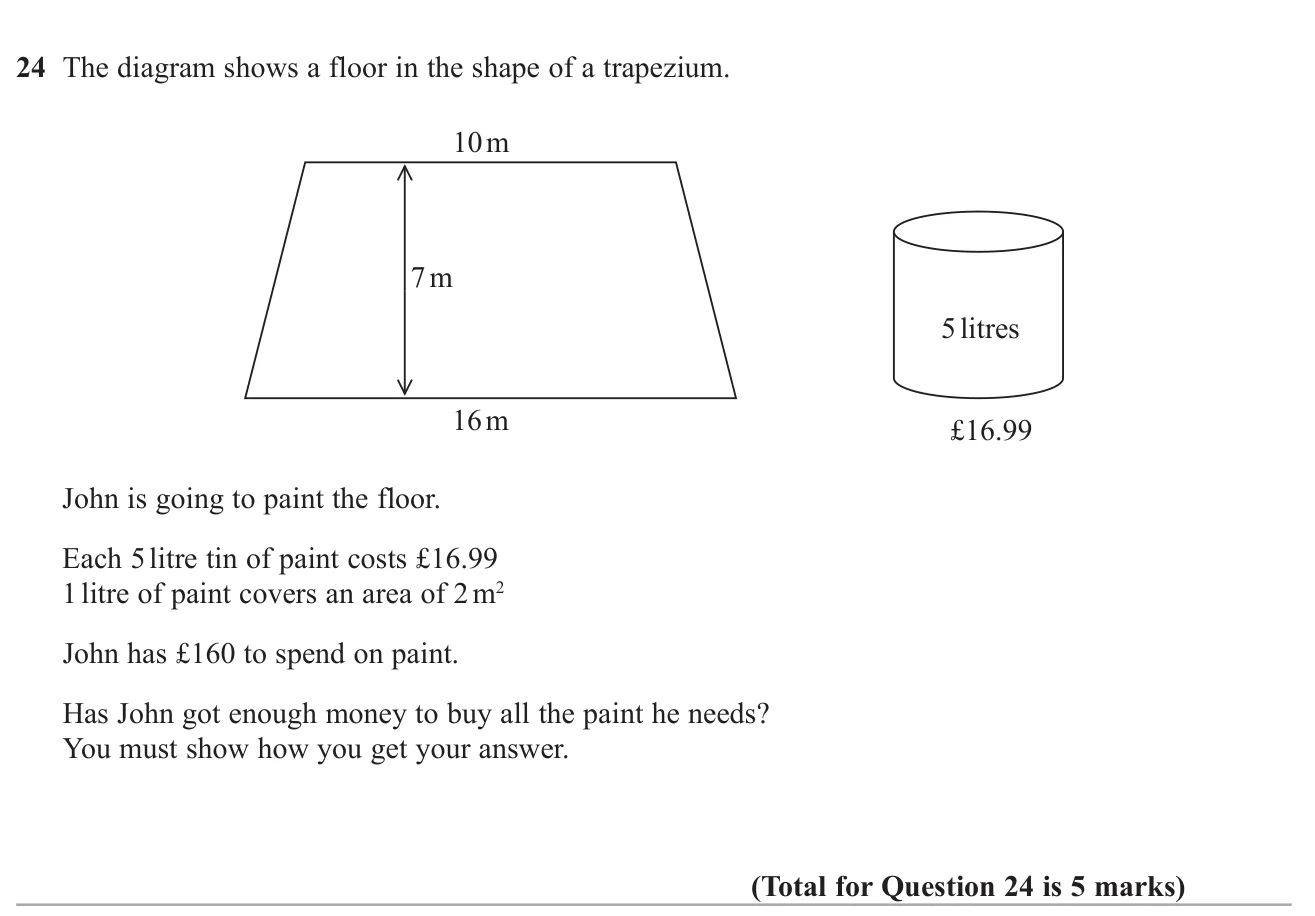
© Pearson Education Ltd. November 2018 Paper 2 (Foundation, calculator), question 24.
Answer No: he needs 10 tins costing £169.90 5 marks
Worked solution Checked against the mark scheme
Area = 1 2 ( 10 + 16 ) × 7 = 91 = \frac{1}{2}(10 + 16) \times 7 = 91 = 2 1 ( 10 + 16 ) × 7 = 91
Paint = 91 ÷ 2 = 45.5 = 91 \div 2 = 45.5 = 91 ÷ 2 = 45.5
Tins = 45.5 ÷ 5 = 9.1 = 45.5 \div 5 = 9.1 = 45.5 ÷ 5 = 9.1
Cost = 10 × 16.99 = £ 169.90 > £ 160 = 10 \times 16.99 = £169.90 > £160 = 10 × 16.99 = £169.90 > £160 No .
Watch out: Rounding 9.1 down to 9 tins.
© Pearson Education Ltd. Specimen Paper 1 (Higher, non-calculator), question 4.
Worked solution Checked against the mark scheme
Let each tile be l l l w w w
Across the top: 2 l + w = 11 2l + w = 11 2 l + w = 11 l + w = 7 l + w = 7 l + w = 7
Subtracting gives l = 4 l = 4 l = 4 w = 3 w = 3 w = 3
There are 4 tiles, each 4 × 3 = 12 4 \times 3 = 12 4 × 3 = 12 4 × 12 = 48 4 \times 12 = 48 4 × 12 = 48
Watch out: Multiplying 11 by 7 to get 77 as if the pattern were a full rectangle.
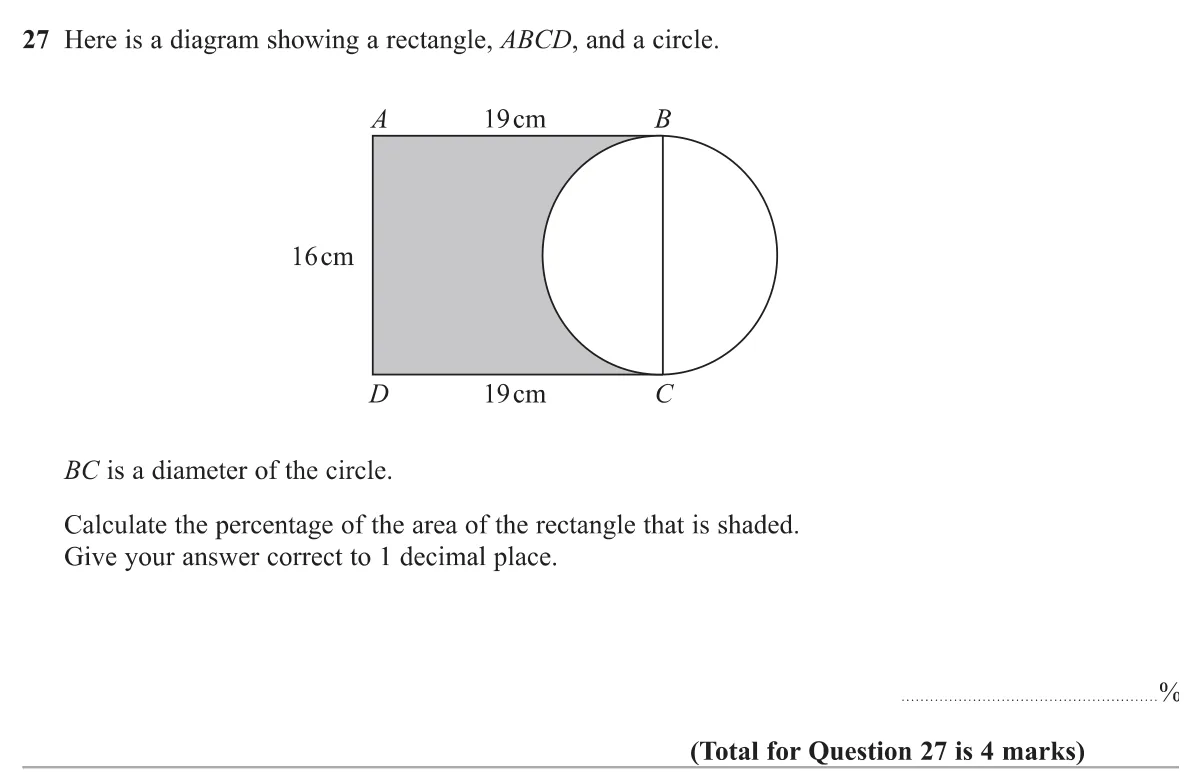
© Pearson Education Ltd. Specimen Paper 2 (Foundation, calculator), question 27.
Worked solution Checked against the mark scheme
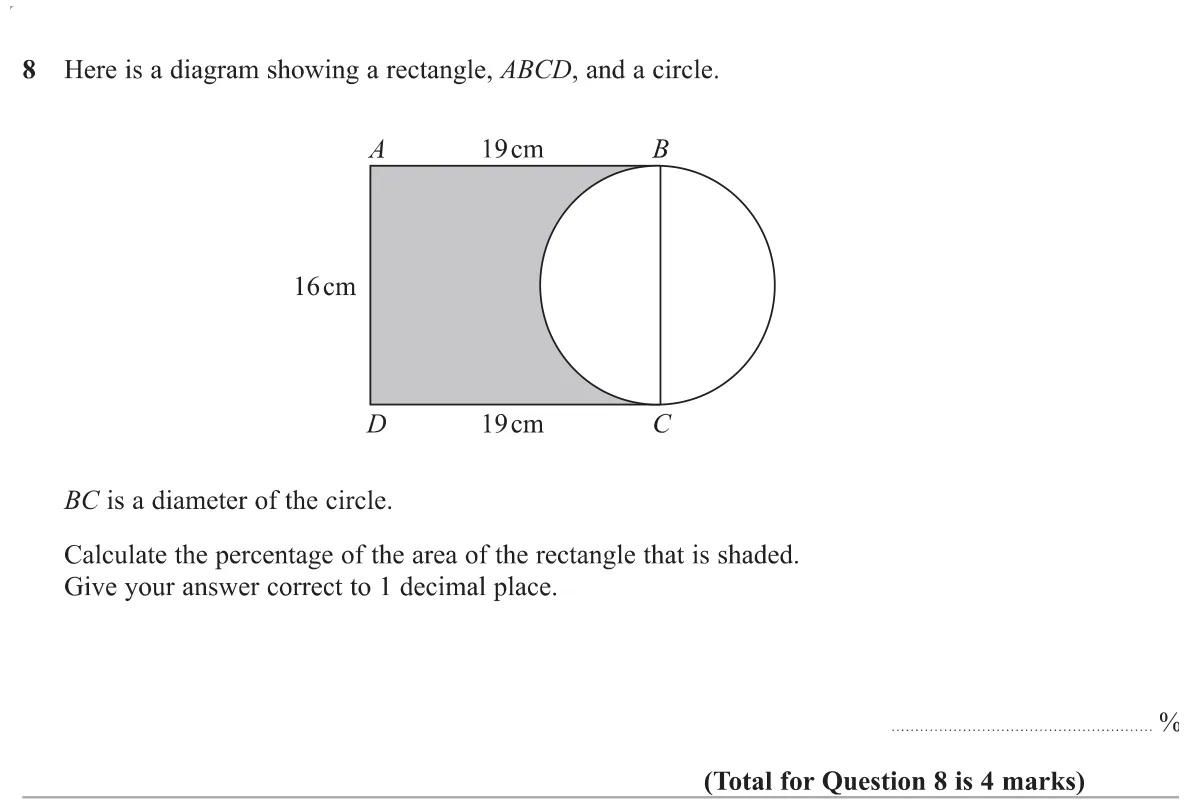
Rectangle: 19 × 16 = 304 19 \times 16 = 304 19 × 16 = 304
Circle radius 8: half-circle area = 1 2 π × 8 2 = 100.53 = \frac{1}{2} \pi \times 8^2 = 100.53 = 2 1 π × 8 2 = 100.53
Shaded: 304 − 100.53 = 203.47 304 - 100.53 = 203.47 304 − 100.53 = 203.47
203.47 304 × 100 = 66.9 % \frac{203.47}{304} \times 100 = 66.9\% 304 203.47 × 100 = 66.9%
Watch out: Taking away the whole circle instead of half.
© Pearson Education Ltd. Specimen Paper 2 (Higher, calculator), question 8.
Worked solution Checked against the mark scheme
Rectangle: 19 × 16 = 304 19 \times 16 = 304 19 × 16 = 304
Radius = 8 = 8 = 8 = 1 2 π × 8 2 = 100.53 = \frac{1}{2} \pi \times 8^2 = 100.53 = 2 1 π × 8 2 = 100.53
Shaded = 304 − 100.53 = 203.47 = 304 - 100.53 = 203.47 = 304 − 100.53 = 203.47
203.47 304 × 100 = 66.9 % \frac{203.47}{304} \times 100 = 66.9\% 304 203.47 × 100 = 66.9%
Watch out: Taking away the whole circle instead of only the half inside the rectangle.
© Pearson Education Ltd. Specimen Paper 3 (Foundation, calculator), question 16.
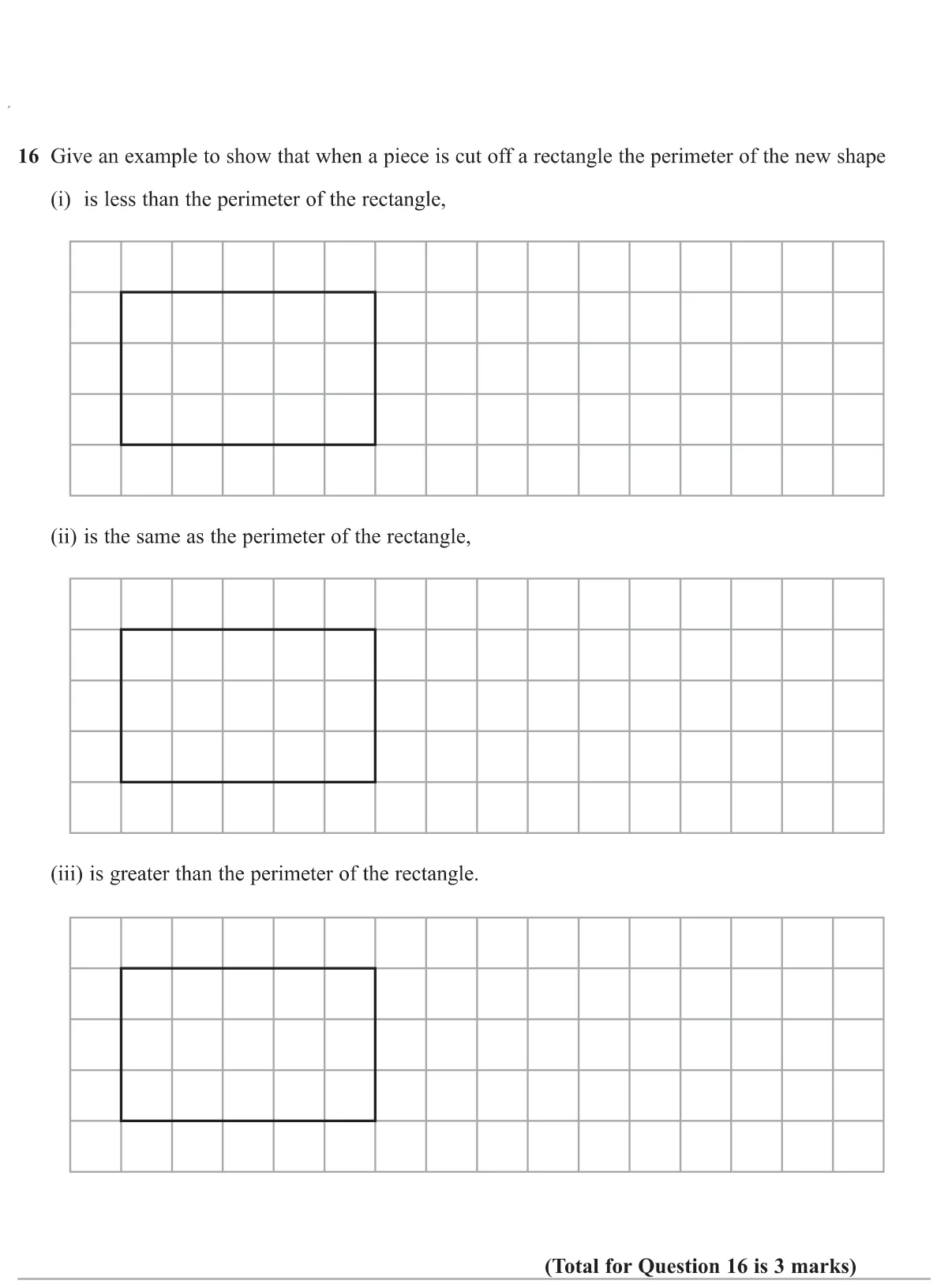
((i)) e.g. cut a triangle off one corner 1 mark ((ii)) e.g. cut a square out of one corner 1 mark ((iii)) e.g. cut a notch out of the middle of one side 1 mark
Worked solution Checked against the mark scheme
The rectangle is 5 by 3, so its perimeter is 16.
(i) Cut a triangle off a corner: the slanted cut is shorter than the two edges it replaces, so the perimeter drops.
(ii) Cut a 1 by 1 square from a corner: two edges of 1 are removed and two new edges of 1 appear, so the perimeter stays 16.
(iii) Cut a 1 by 1 notch from the middle of a side: 1 unit of edge goes but 3 units appear, so the perimeter becomes 18.
Watch out: Thinking that removing area must always reduce the perimeter.
© Pearson Education Ltd. Specimen Paper 3 (Foundation, calculator), question 25.
(a) 18 packs 5 marks (b) No: 10% more tiles is 176 tiles, needing 20 packs, which is 2 more packs (more than 10% of 18) 2 marks
Worked solution Checked against the mark scheme
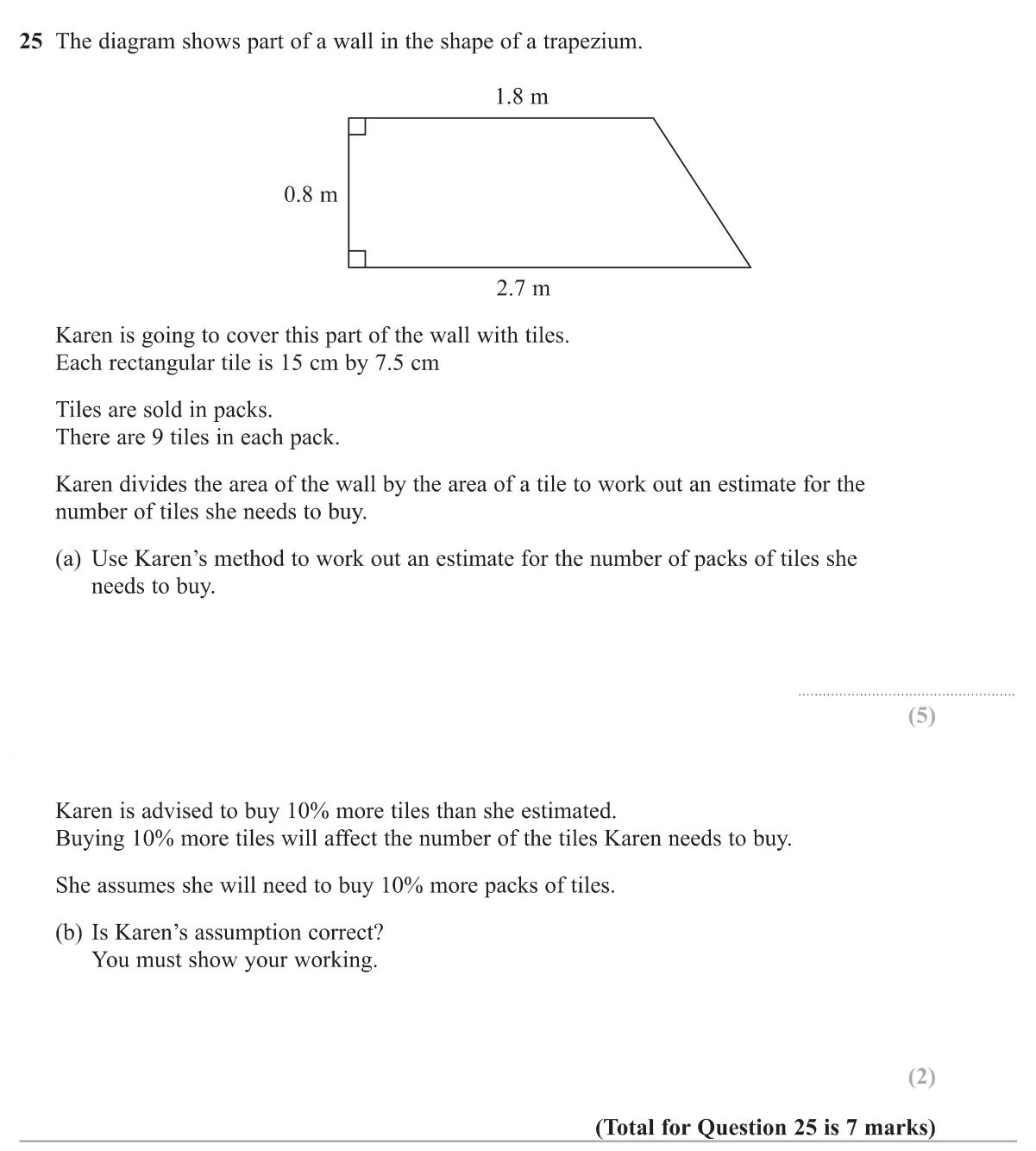
(a) Wall area = 1.8 + 2.7 2 × 0.8 = 1.8 m 2 = 18000 cm 2 = \frac{1.8 + 2.7}{2} \times 0.8 = 1.8\text{ m}^2 = 18000\text{ cm}^2 = 2 1.8 + 2.7 × 0.8 = 1.8 m 2 = 18000 cm 2
Tile area = 15 × 7.5 = 112.5 cm 2 = 15 \times 7.5 = 112.5\text{ cm}^2 = 15 × 7.5 = 112.5 cm 2
Tiles: 18000 ÷ 112.5 = 160 18000 \div 112.5 = 160 18000 ÷ 112.5 = 160 160 ÷ 9 = 17.8 160 \div 9 = 17.8 160 ÷ 9 = 17.8 18 .
(b) 160 × 1.1 = 176 160 \times 1.1 = 176 160 × 1.1 = 176 176 ÷ 9 = 19.6 176 \div 9 = 19.6 176 ÷ 9 = 19.6
That is 2 more packs, but 10% of 18 is only 1.8, so the assumption is not correct.
Watch out: Using 1 m² = 100 cm² when converting, or rounding 17.8 packs down.
© Pearson Education Ltd. Specimen Paper 3 (Higher, calculator), question 5.
(a) 18 packs 5 marks (b) No: 176 tiles need 20 packs, which is 2 more packs (about 11% more), not 10% more 2 marks
Worked solution Checked against the mark scheme
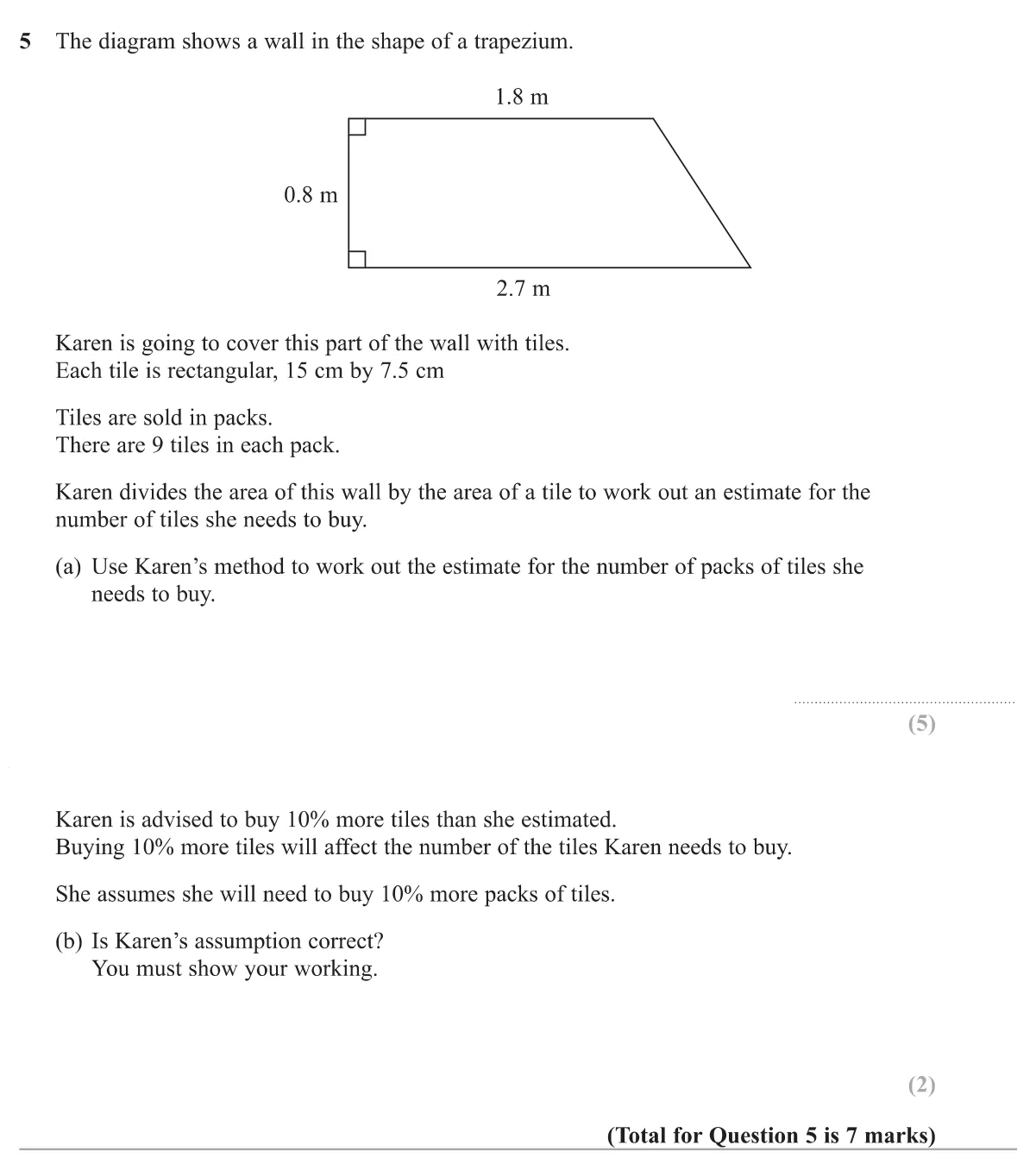
(a) Area of wall = 1.8 + 2.7 2 × 0.8 = 1.8 m 2 = 18 000 cm 2 = \frac{1.8 + 2.7}{2} \times 0.8 = 1.8\text{ m}^2 = 18\,000\text{ cm}^2 = 2 1.8 + 2.7 × 0.8 = 1.8 m 2 = 18 000 cm 2
Area of a tile = 15 × 7.5 = 112.5 cm 2 = 15 \times 7.5 = 112.5\text{ cm}^2 = 15 × 7.5 = 112.5 cm 2
Tiles = 18 000 ÷ 112.5 = 160 = 18\,000 \div 112.5 = 160 = 18 000 ÷ 112.5 = 160 = 160 ÷ 9 = 17.8 = 160 \div 9 = 17.8 = 160 ÷ 9 = 17.8 18 packs .
(b) 160 × 1.1 = 176 160 \times 1.1 = 176 160 × 1.1 = 176 176 ÷ 9 = 19.6 176 \div 9 = 19.6 176 ÷ 9 = 19.6
10% more packs would be 18 × 1.1 = 19.8 18 \times 1.1 = 19.8 18 × 1.1 = 19.8
Watch out: Converting 1.8 m² to 180 cm² instead of 18 000 cm².
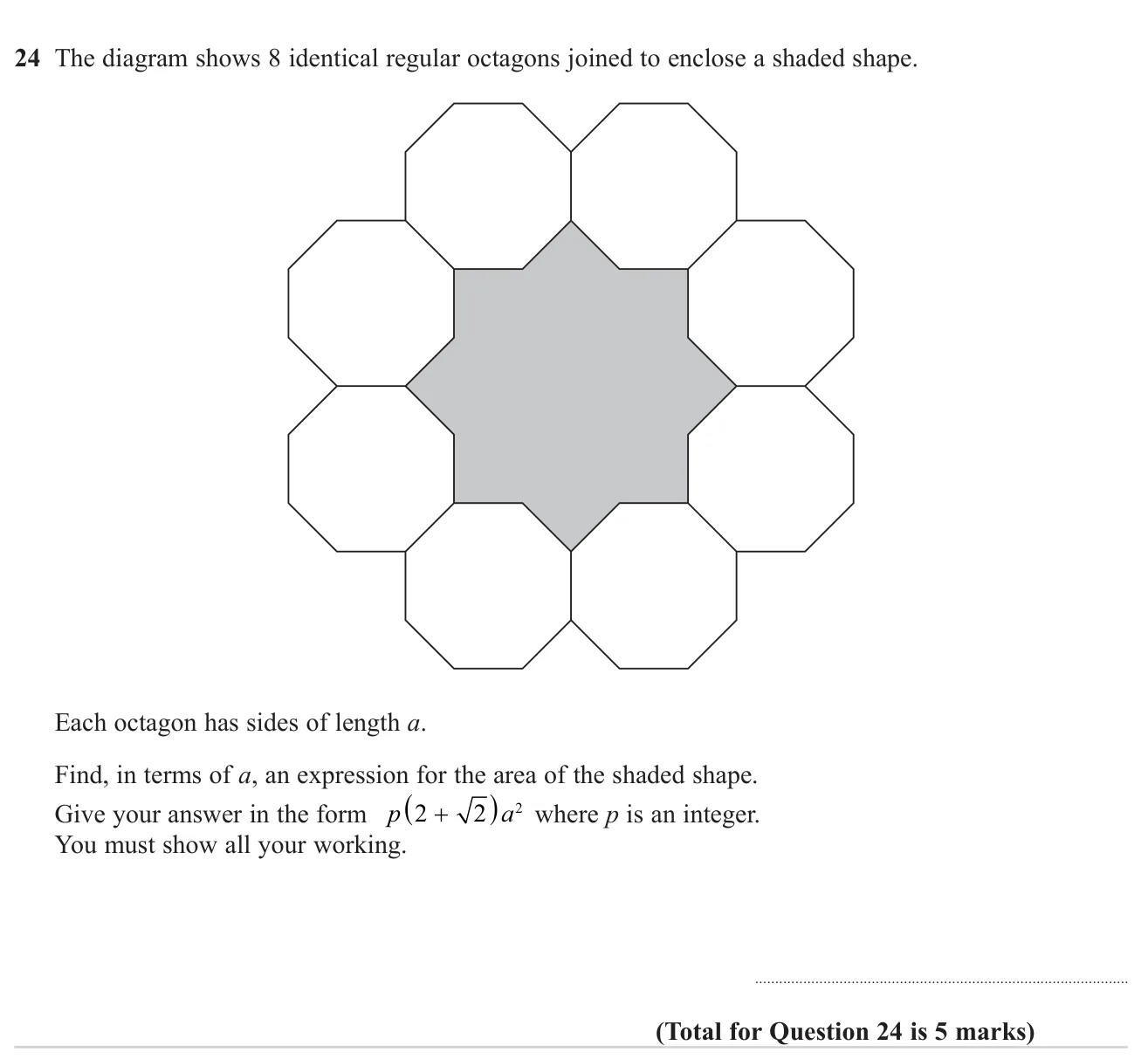
© Pearson Education Ltd. June 2023 Paper 2 (Higher, calculator), question 24.
Answer 4 ( 2 + 2 ) a 2 4(2 + \sqrt{2})a^2 4 ( 2 + 2 ) a 2 5 marks
Worked solution Checked against the mark scheme
Each octagon angle is 135°, so where two octagons meet at a point the gap is 360 − 2 × 135 = 90 ° 360 - 2 \times 135 = 90° 360 − 2 × 135 = 90°
Each point of the star is a right-angled triangle with legs a a a 1 2 a 2 \frac{1}{2}a^2 2 1 a 2 a 2 a\sqrt{2} a 2
Each side of the central square is an octagon side, a triangle base and another octagon side: a + a 2 + a = ( 2 + 2 ) a a + a\sqrt{2} + a = (2 + \sqrt{2})a a + a 2 + a = ( 2 + 2 ) a
Area = ( 2 + 2 ) 2 a 2 + 4 × 1 2 a 2 = ( 6 + 4 2 ) a 2 + 2 a 2 = ( 8 + 4 2 ) a 2 = 4 ( 2 + 2 ) a 2 = (2+\sqrt{2})^2a^2 + 4 \times \frac{1}{2}a^2 = (6 + 4\sqrt{2})a^2 + 2a^2 = (8 + 4\sqrt{2})a^2 = 4(2+\sqrt{2})a^2 = ( 2 + 2 ) 2 a 2 + 4 × 2 1 a 2 = ( 6 + 4 2 ) a 2 + 2 a 2 = ( 8 + 4 2 ) a 2 = 4 ( 2 + 2 ) a 2
Watch out: Using the exterior angle 45° where the interior angle 135° is needed.
Also tested in these questions Their main topic is different, but part of each one tests this topic.
November 2024 · Paper 2 Higher · Q12 : Equate the masses of a steel cylinder and a brass cube using densities to find the cube's side length.November 2024 · Paper 2 Foundation · Q26 : Use equal sides and a perimeter to find the side lengths of an isosceles triangle, then its area.November 2024 · Paper 2 Foundation · Q28 : Find the density of a solid cylinder from its dimensions and mass.November 2024 · Paper 3 Higher · Q13 : Use similar triangles to find a missing length and then the area of a trapezium.June 2024 · Paper 2 Higher · Q8 : Use a scale drawing's area and one real side of a right-angled triangle to find another real side.November 2023 · Paper 3 Foundation · Q19 : Draw the plan view of a cuboid from its front elevation and its volume.November 2023 · Paper 3 Foundation · Q27 : Use pressure, force and area to show a cube's surface area is under a given value.November 2023 · Paper 3 Foundation · Q29 : Find the circumference of the circle through the corners of a square.June 2023 · Paper 1 Higher · Q16 : Given a fraction of a sphere's surface area, find its diameter as a simplified surd.June 2023 · Paper 1 Foundation · Q22 : Use a cube's surface area to find its volume.June 2023 · Paper 1 Foundation · Q27 : Find the pressure a cylinder exerts using its volume, height and force.June 2023 · Paper 2 Foundation · Q24 : Form and solve an equation using the areas of a triangle and a rectangle with algebraic sides.November 2022 · Paper 1 Foundation · Q16 : Form and solve an equation from the perimeter of a quadrilateral with algebraic sides, then find one side.June 2022 · Paper 1 Higher · Q9 : Find the total surface area of a solid made by standing a cube on a cuboid.June 2022 · Paper 1 Foundation · Q22 : Read a cylinder's radius and height from a plan and front elevation, then find its volume in terms of pi.June 2022 · Paper 1 Foundation · Q29 : Find the densities of two cubes from their side lengths and masses and write them as a simplified ratio.November 2021 · Paper 1 Higher · Q14 : Split an L-shape with algebraic side lengths into rectangles and show its area gives a given quadratic.November 2021 · Paper 1 Higher · Q18 : Use trigonometry to find the height of a trapezium, then use its area and the ratio of its parallel sides to find the shorter side.November 2021 · Paper 3 Foundation · Q27 : Find the area of a segment cut off a quarter circle by a chord.November 2020 · Paper 1 Foundation · Q27 : Find the base area of a prism from its volume and height, then use the pressure formula to find the force.November 2020 · Paper 3 Foundation · Q29 : Find the mass of a triangular prism from its dimensions and density.November 2019 · Paper 1 Higher · Q14 : Form and solve a quadratic from the area of a right-angled triangle to find its shortest side.November 2019 · Paper 3 Higher · Q13 : Find the mass of a cylinder filled with two liquids mixed in a ratio, using their densities.November 2019 · Paper 3 Higher · Q23 : Find the reflex angle of a sector that folds into a cone of given volume and height.June 2019 · Paper 1 Foundation · Q20 : Find what percentage of a larger square's area is taken up by half of a smaller square with half its side length.June 2019 · Paper 2 Foundation · Q15 : Find the grass area of a rectangular garden when a percentage of it is flowers.November 2018 · Paper 1 Foundation · Q26 : Show that a shaded region between a quarter circle and a semicircle is π/8 of a square.November 2018 · Paper 3 Foundation · Q17 : Form an equation for the perimeter of a symmetrical pentagon with algebraic sides, then solve it.June 2018 · Paper 1 Higher · Q5 : Draw the front elevation of a square-based pyramid and work out its total surface area.June 2018 · Paper 1 Higher · Q8 : Share a triangle's perimeter in the ratio 3 : 4 : 5 and find its area.June 2018 · Paper 1 Foundation · Q23 : Draw the front elevation of a square-based pyramid and find its total surface area.June 2018 · Paper 3 Foundation · Q17 : Form and solve an equation from the area of a right-angled isosceles triangle with sides in terms of x.Specimen · Paper 1 Foundation · Q15 : Use a scale plan to find the real size of a floor and decide whether 150 boards are enough to cover it.Specimen · Paper 2 Foundation · Q28 : Use Pythagoras to find a slanted side of a trapezium, then find the area of a square with the same perimeter.Specimen · Paper 3 Higher · Q12 : Use the space diagonal of a cuboid with 3D Pythagoras to find the missing edge, then the volume.