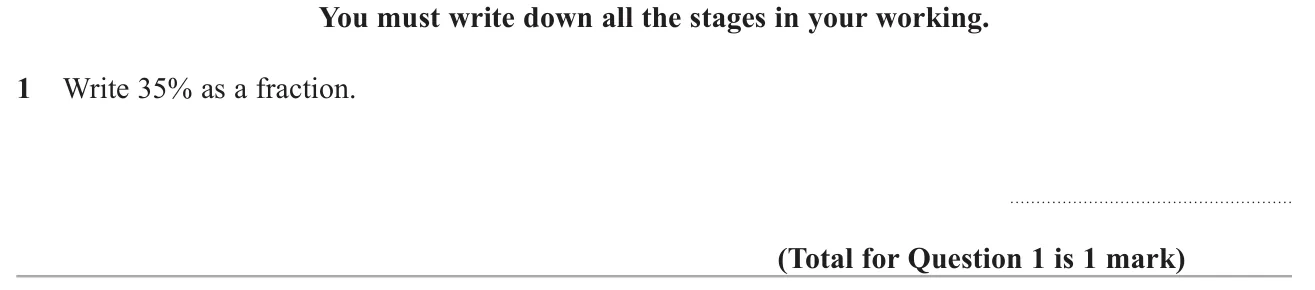
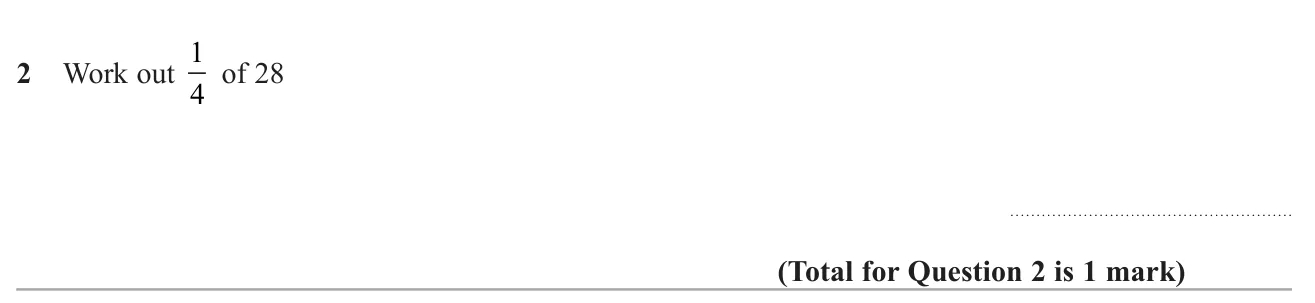
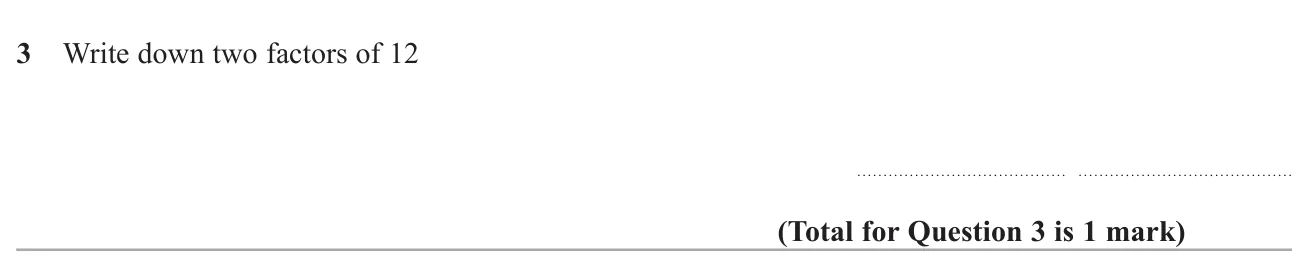
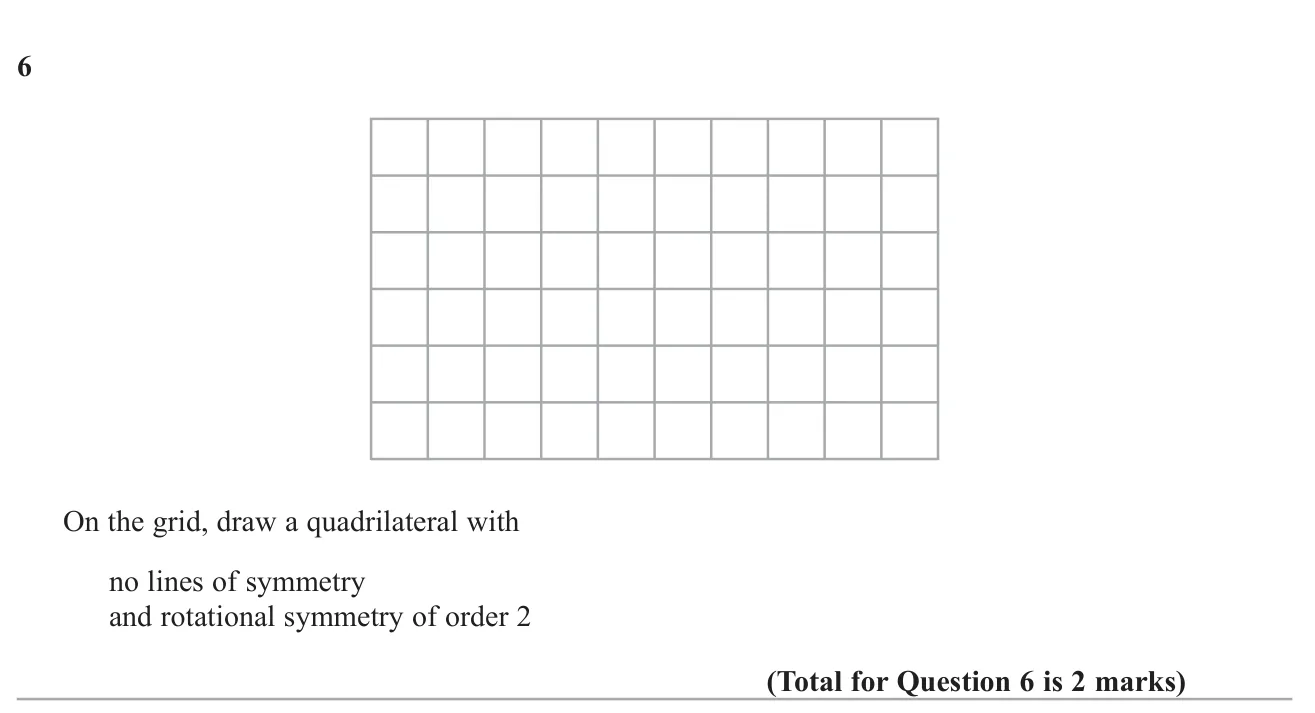
© Pearson Education Ltd. June 2022 Paper 3 (Foundation, calculator), question 1.
Show answer
| Answer | 10035 (or 207) | 1 mark |
|---|
Worked solution Checked against the mark scheme
Per cent means out of 100, so 35%=10035.
This simplifies to 207 by dividing top and bottom by 5.
Watch out: Writing 351 or 1035.
© Pearson Education Ltd. June 2022 Paper 3 (Foundation, calculator), question 2.
Show answer
Worked solution Checked against the mark scheme
To find 41 of an amount, divide by 4.
28÷4=7
Watch out: Multiplying 28 by 4 instead of dividing.
© Pearson Education Ltd. June 2022 Paper 3 (Foundation, calculator), question 3.
Show answer
| Answer | Any two of 1, 2, 3, 4, 6, 12 | 1 mark |
|---|
Worked solution Checked against the mark scheme
Factors of 12 are the numbers that divide into it with no remainder: 1, 2, 3, 4, 6 and 12.
Any two of these, for example 3 and 4, are correct.
Watch out: Giving multiples of 12, such as 24.
© Pearson Education Ltd. June 2022 Paper 3 (Foundation, calculator), question 4.
Show answer
Worked solution Checked against the mark scheme
Multiply the numbers: 2×3=6, and keep the letter.
2m×3=6m
Watch out: Writing 5m by adding instead of multiplying.
© Pearson Education Ltd. June 2022 Paper 3 (Foundation, calculator), question 5.
Show answer
Worked solution Checked against the mark scheme
Look for a number that multiplies by itself to give 1.69.
1.3×1.3=1.69, so 1.69=1.3
Watch out: Halving 1.69 instead of square rooting.
© Pearson Education Ltd. June 2022 Paper 3 (Foundation, calculator), question 6.
Show answer
| Answer | A parallelogram that is not a rectangle or rhombus | 2 marks |
|---|
Worked solution Checked against the mark scheme
A rectangle and a rhombus have order 2 but also have lines of symmetry, so avoid them.
A general parallelogram (slanted, with unequal adjacent sides) has order 2 and no lines of symmetry. Draw one on the grid.
Watch out: Drawing a rectangle, which has two lines of symmetry.
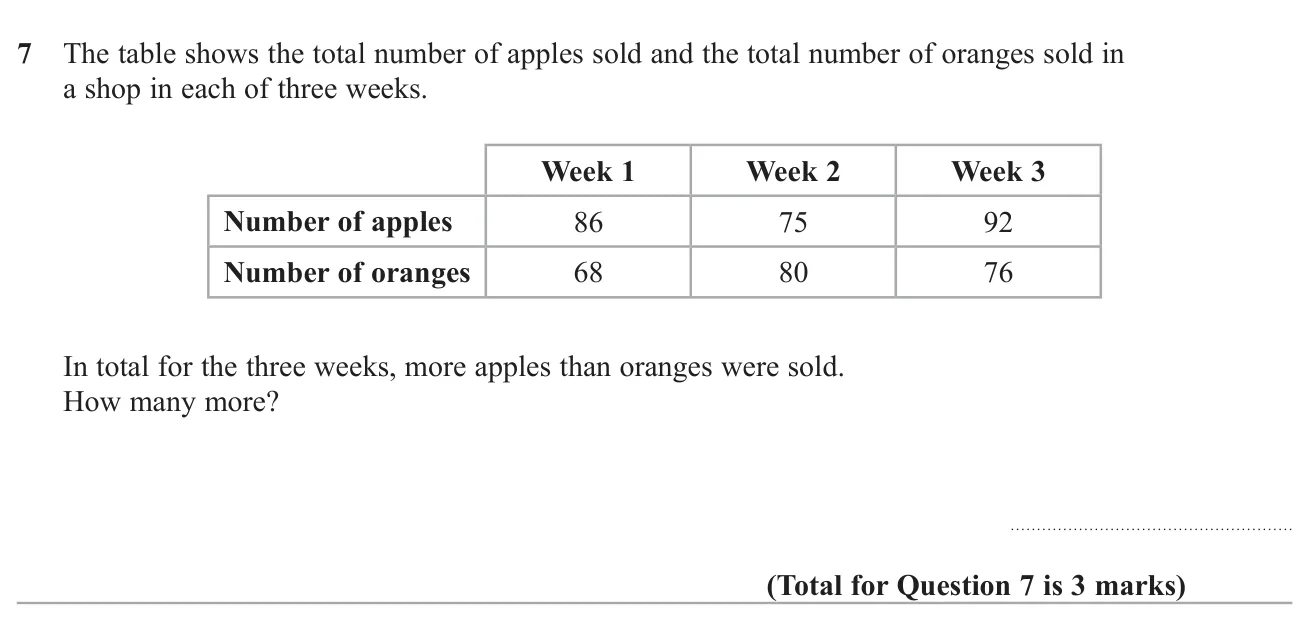
© Pearson Education Ltd. June 2022 Paper 3 (Foundation, calculator), question 7.
Show answer
Worked solution Checked against the mark scheme
Apples: 86+75+92=253
Oranges: 68+80+76=224
Difference: 253−224=29
Watch out: Adding the numbers wrongly, or subtracting only one week.
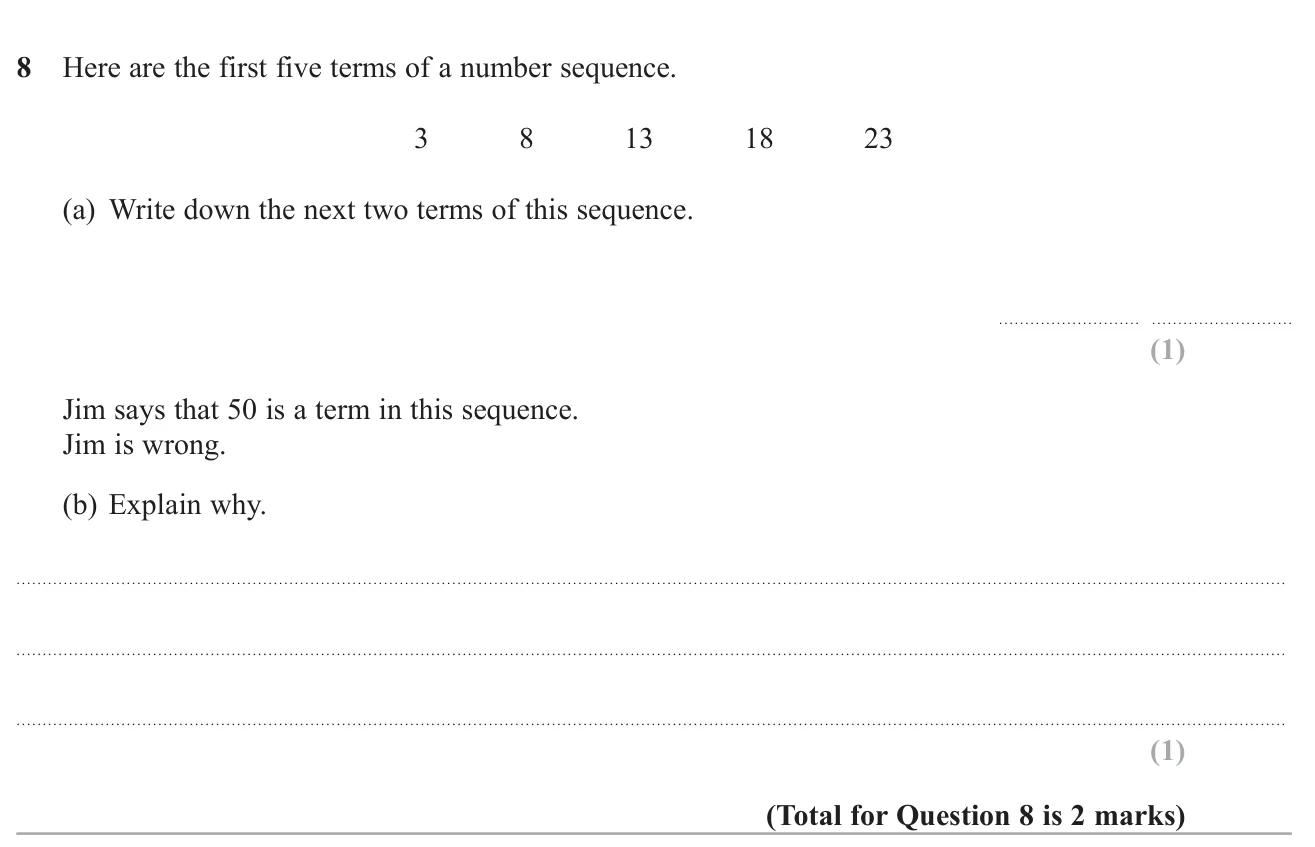
© Pearson Education Ltd. June 2022 Paper 3 (Foundation, calculator), question 8.
Show answer
| (a) | 28 and 33 | 1 mark |
|---|
| (b) | All terms end in 3 or 8, so 50 cannot be a term | 1 mark |
|---|
Worked solution Checked against the mark scheme
(a) The terms go up by 5: 23+5=28, 28+5=33
(b) The terms go 3, 8, 13, 18, ... so every term ends in 3 or 8.
50 ends in 0, so it is not a term (48 and 53 are consecutive terms).
Watch out: Saying only that the sequence goes past 50, which is not a reason.
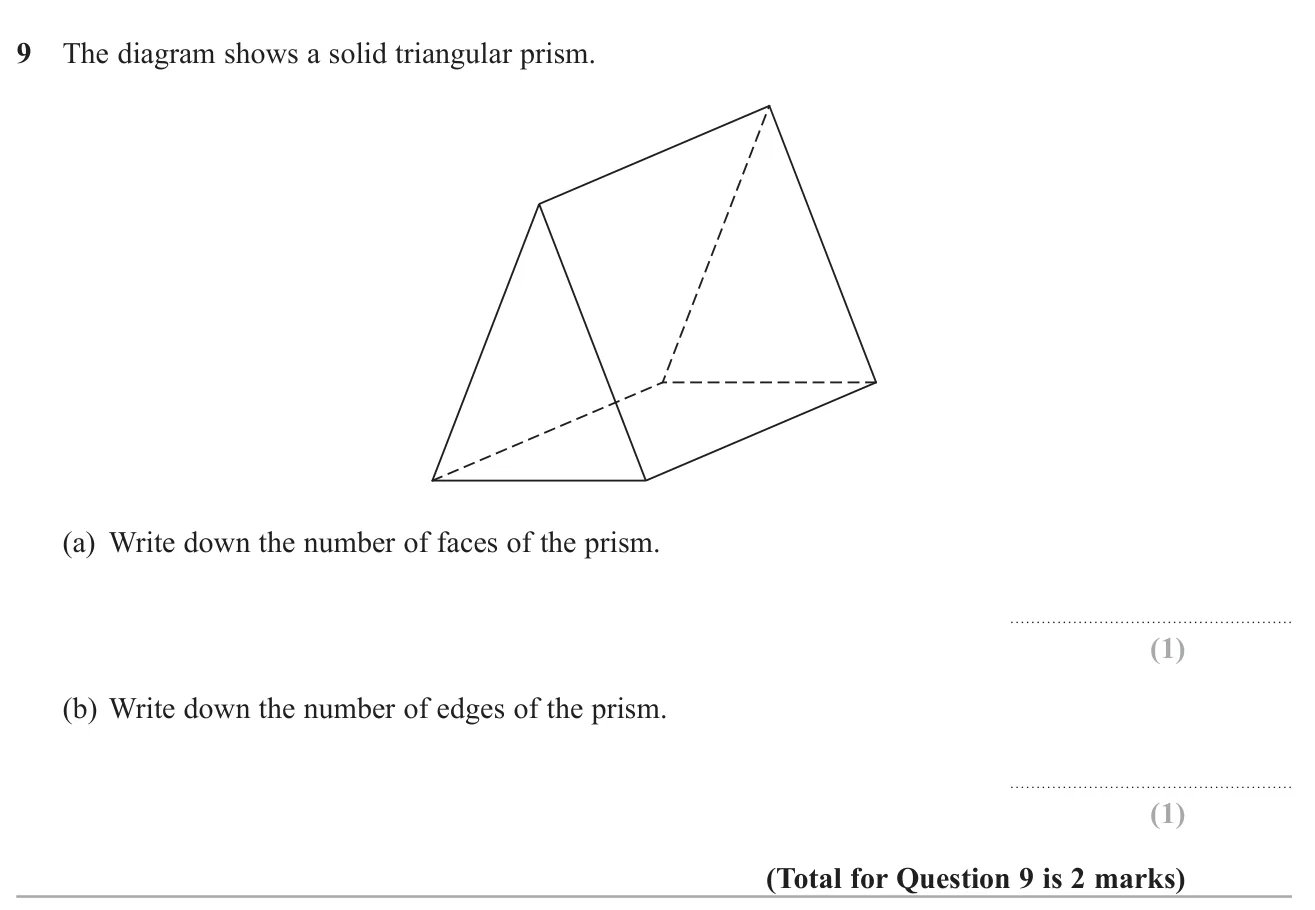
© Pearson Education Ltd. June 2022 Paper 3 (Foundation, calculator), question 9.
Show answer
Worked solution Checked against the mark scheme
(a) Two triangular ends plus three rectangular sides: 2+3=5 faces.
(b) Each triangle has 3 edges and three more join the triangles: 3+3+3=9 edges.
Watch out: Counting vertices (6) instead of edges.
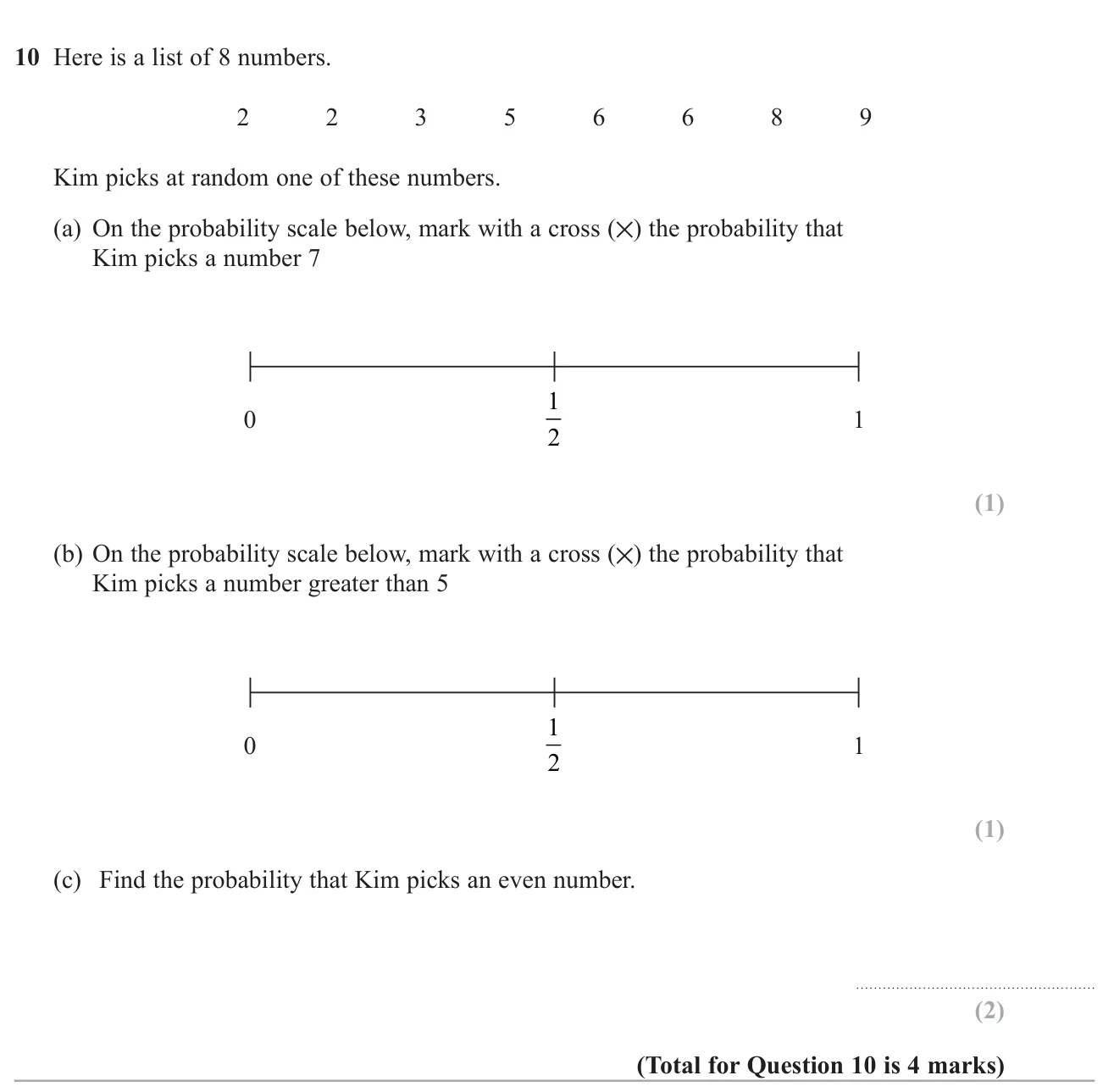
© Pearson Education Ltd. June 2022 Paper 3 (Foundation, calculator), question 10.
Show answer
| (a) | Cross at 0 | 1 mark |
|---|
| (b) | Cross at 21 | 1 mark |
|---|
| (c) | 85 | 2 marks |
|---|
Worked solution Checked against the mark scheme
(a) There is no 7 in the list, so it is impossible: probability 0.
(b) 6, 6, 8, 9 are greater than 5: 84=21
(c) Even numbers: 2, 2, 6, 6, 8, which is 5 out of 8, so 85
Watch out: In (c) counting 2 and 6 only once each and getting 83.
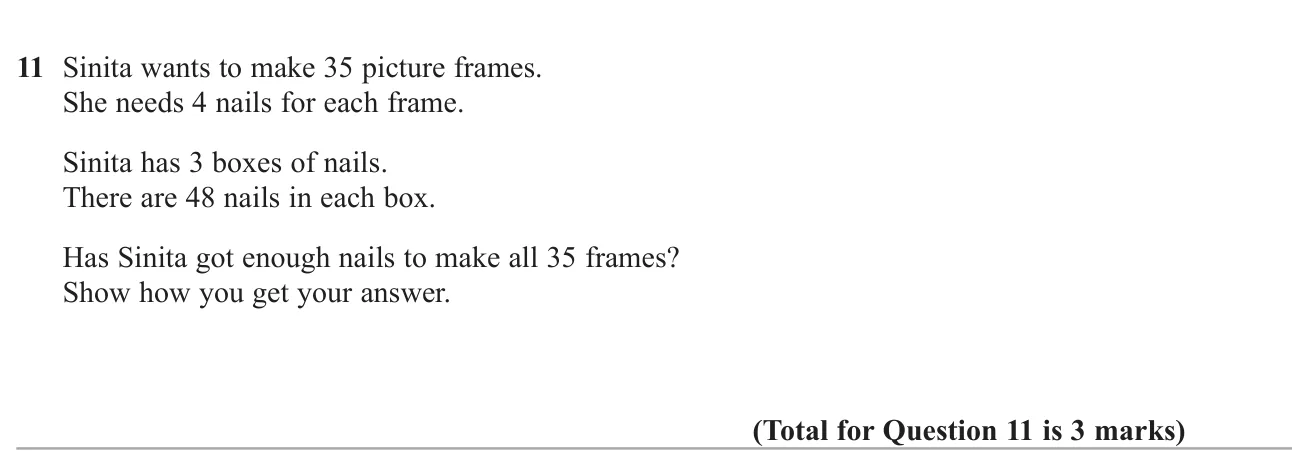
© Pearson Education Ltd. June 2022 Paper 3 (Foundation, calculator), question 11.
Show answer
| Answer | Yes: 144 nails available and 140 needed | 3 marks |
|---|
Worked solution Checked against the mark scheme
Nails needed: 35×4=140
Nails available: 3×48=144
144>140, so yes, she has enough (4 to spare).
Watch out: Saying yes without showing both totals.
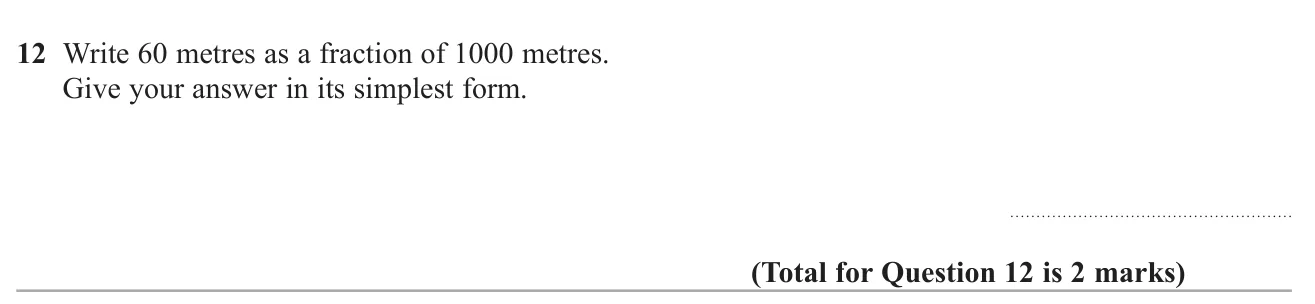
© Pearson Education Ltd. June 2022 Paper 3 (Foundation, calculator), question 12.
Show answer
| Answer | 503 | 2 marks |
|---|
Worked solution Checked against the mark scheme
Write it as a fraction: 100060
Divide top and bottom by 20: 503
Watch out: Stopping at 1006 without fully simplifying.
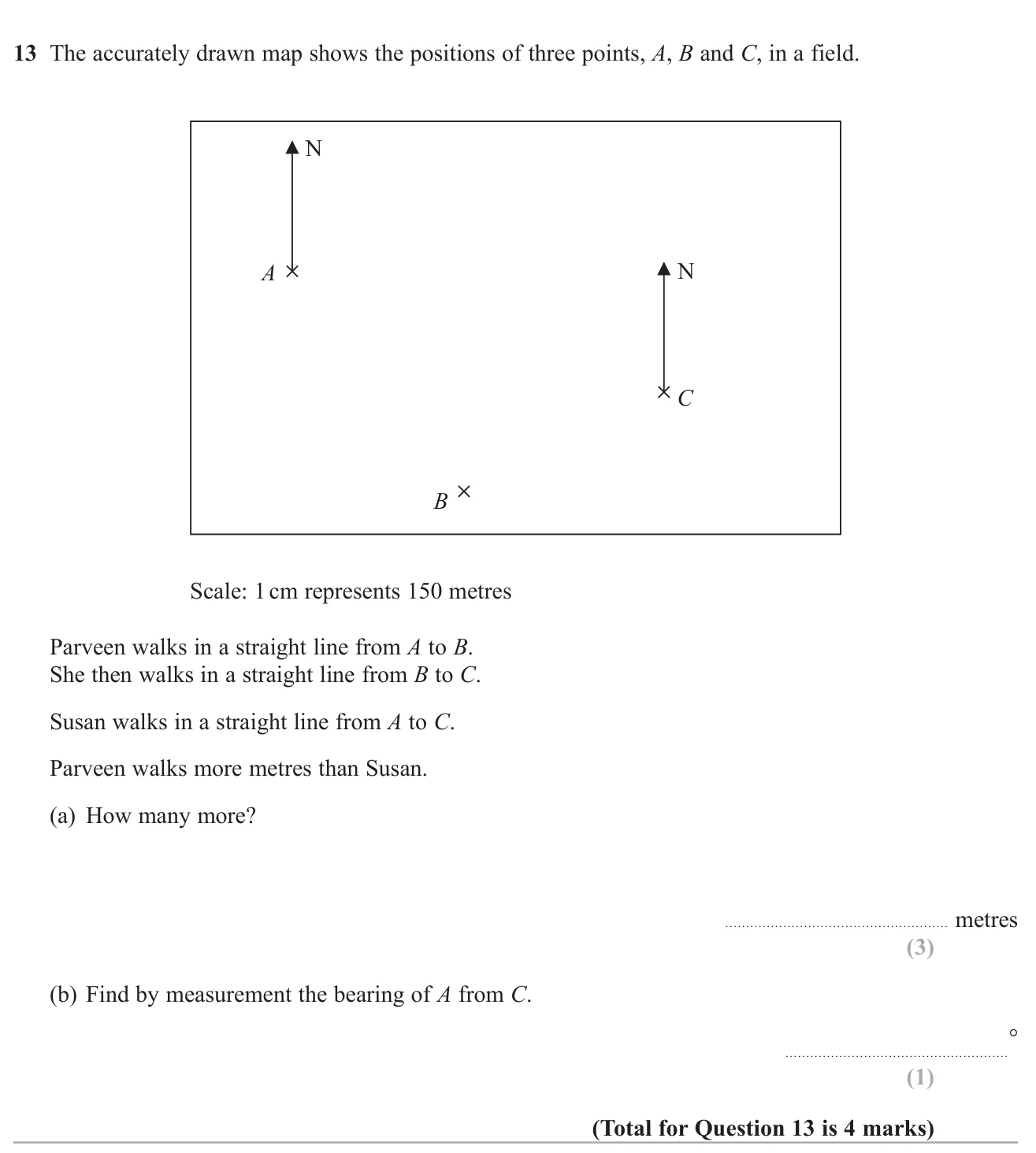
© Pearson Education Ltd. June 2022 Paper 3 (Foundation, calculator), question 13.
Show answer
| (a) | 300 metres (210 to 390 accepted) | 3 marks |
|---|
| (b) | 288° (286 to 290 accepted) | 1 mark |
|---|
Worked solution Checked against the mark scheme
(a) Measure: AB ≈ 5 cm, BC ≈ 4 cm, AC ≈ 7 cm.
Parveen: 5+4=9 cm, Susan: 7 cm, so a difference of 2 cm.
2×150=300 metres
(b) At C, measure clockwise from North round to the line CA: about 288°.
Watch out: Measuring the bearing anticlockwise, or from A instead of C.
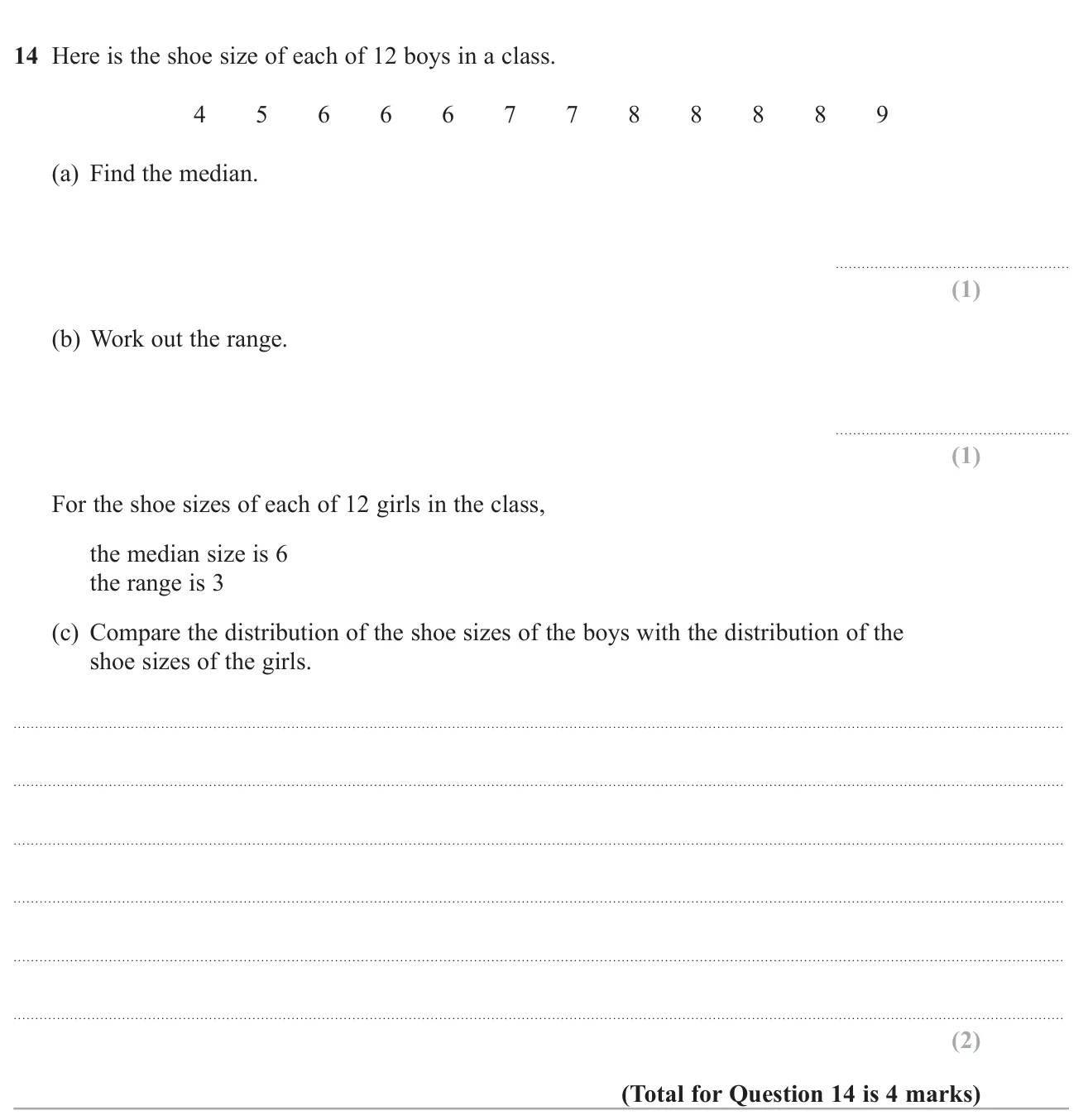
© Pearson Education Ltd. June 2022 Paper 3 (Foundation, calculator), question 14.
Show answer
| (a) | 7 | 1 mark |
|---|
| (b) | 5 | 1 mark |
|---|
| (c) | Boys have a bigger median, so larger feet on average; boys have a bigger range, so their sizes are more varied | 2 marks |
|---|
Worked solution Checked against the mark scheme
(a) 12 values, so the median is halfway between the 6th and 7th: both are 7, so median = 7
(b) 9−4=5
(c) Boys' median 7 > girls' 6, so boys' shoe sizes are larger on average.
Boys' range 5 > girls' 3, so boys' sizes are more spread out.
Watch out: In (c) just quoting the numbers without saying which is bigger and what that means.
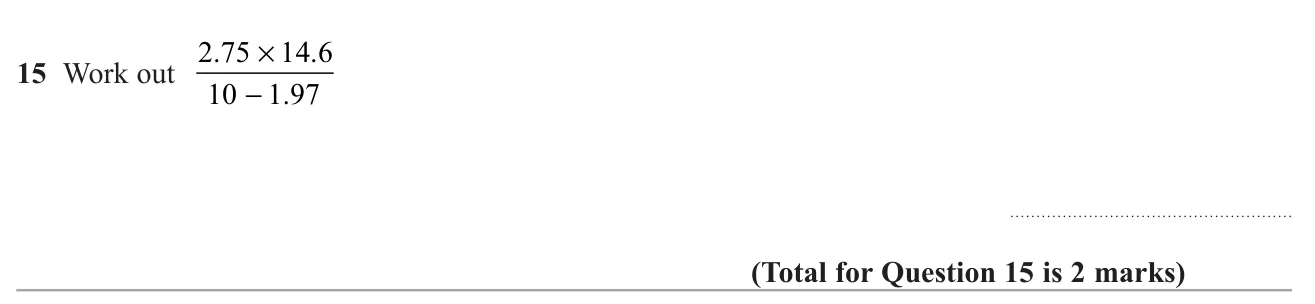
© Pearson Education Ltd. June 2022 Paper 3 (Foundation, calculator), question 15.
Show answer
Worked solution Checked against the mark scheme
Top: 2.75×14.6=40.15
Bottom: 10−1.97=8.03
40.15÷8.03=5
Watch out: Typing it in without brackets, so only 14.6 is divided by 10.
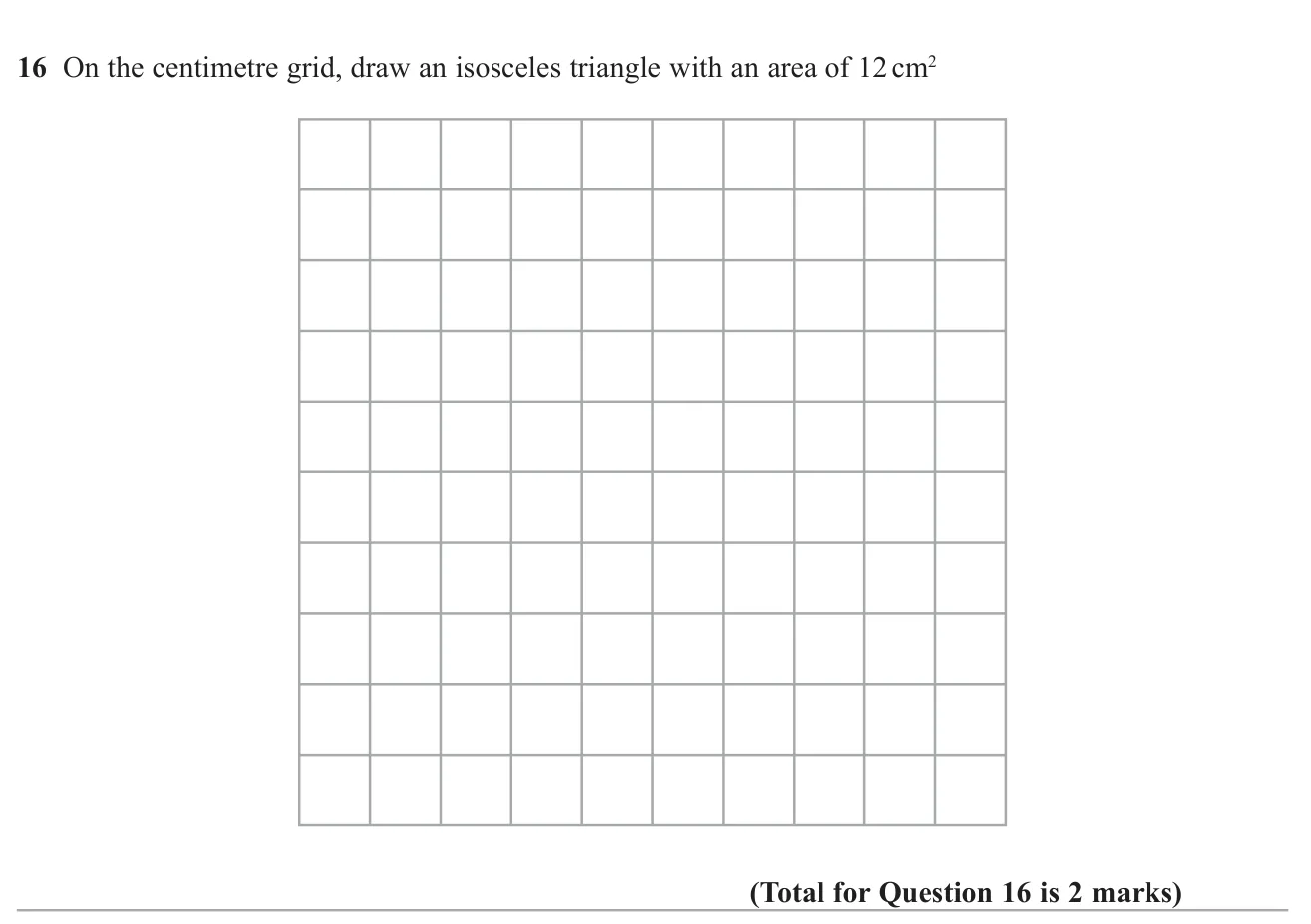
© Pearson Education Ltd. June 2022 Paper 3 (Foundation, calculator), question 16.
Show answer
| Answer | Any isosceles triangle with base × height = 24, e.g. base 6 cm and height 4 cm | 2 marks |
|---|
Worked solution Checked against the mark scheme
Area of a triangle is 21×b×h, so b×h=24.
Choose base 6 cm and height 4 cm.
Put the top vertex directly above the middle of the base (3 cm along), so the two slanted sides are equal.
Watch out: Using base × height = 12, which gives an area of 6.
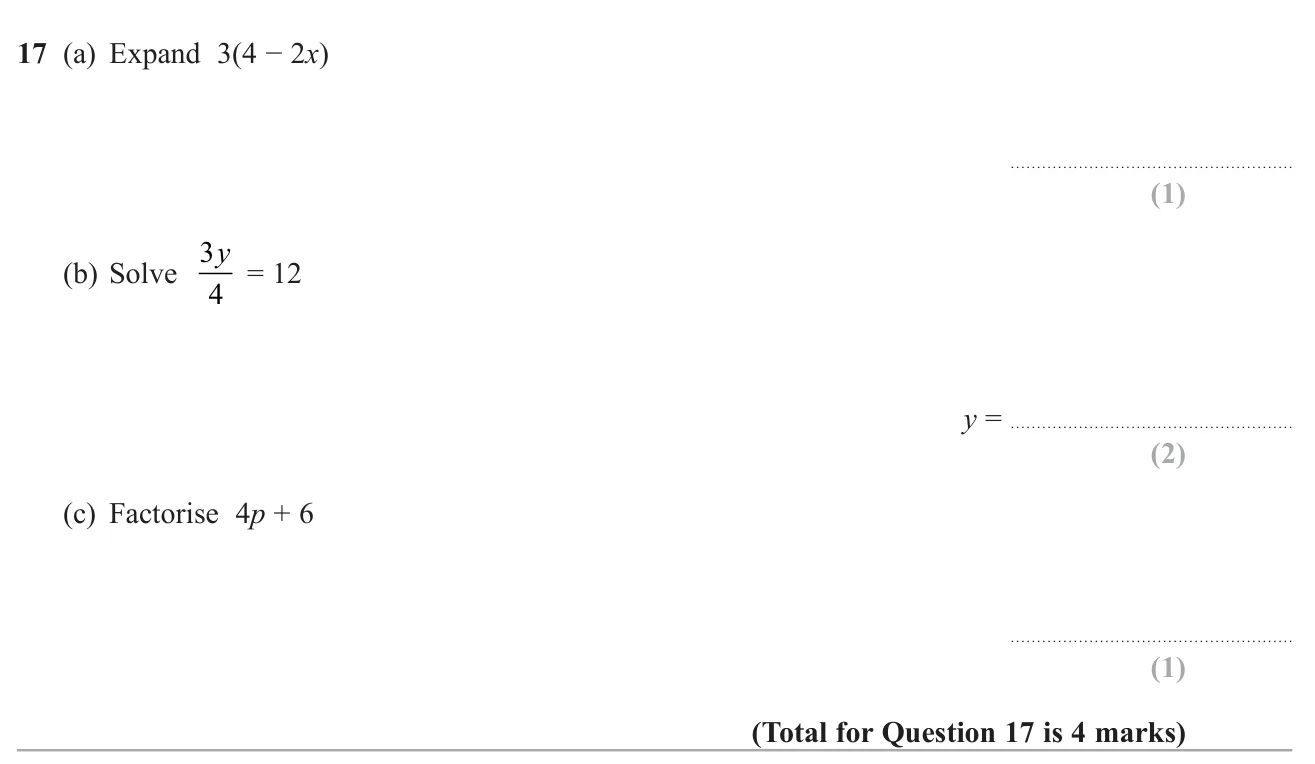
© Pearson Education Ltd. June 2022 Paper 3 (Foundation, calculator), question 17.
Show answer
| (a) | 12−6x | 1 mark |
|---|
| (b) | y=16 | 2 marks |
|---|
| (c) | 2(2p+3) | 1 mark |
|---|
Worked solution Checked against the mark scheme
(a) 3×4=12 and 3×−2x=−6x, giving 12−6x
(b) 43y=12, so 3y=48 and y=16
(c) The highest common factor of 4 and 6 is 2: 4p+6=2(2p+3)
Watch out: In (a) writing 12−2x by only multiplying the first term.
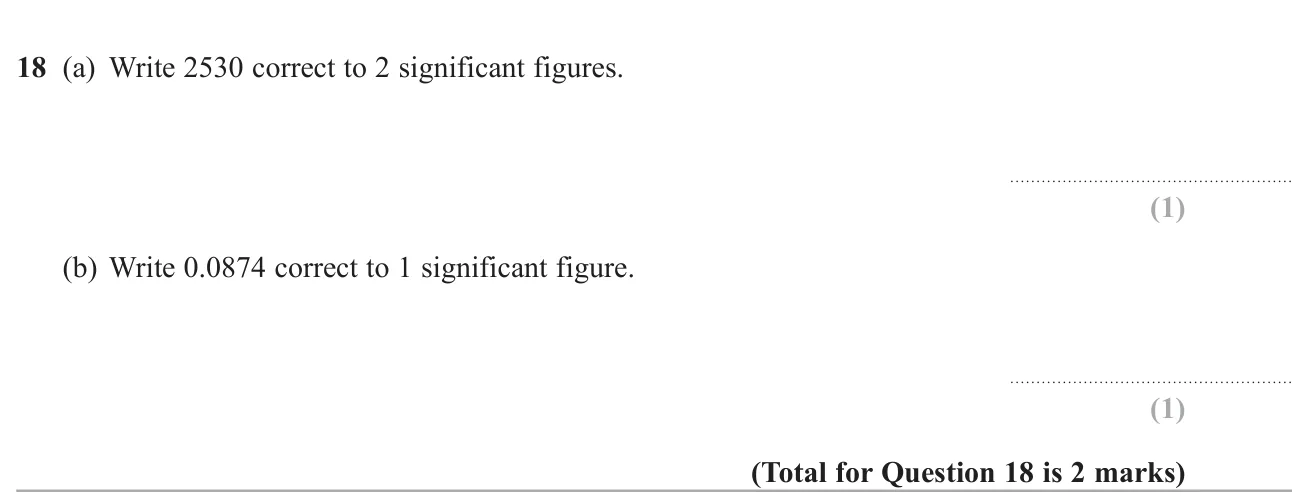
© Pearson Education Ltd. June 2022 Paper 3 (Foundation, calculator), question 18.
Show answer
| (a) | 2500 | 1 mark |
|---|
| (b) | 0.09 | 1 mark |
|---|
Worked solution Checked against the mark scheme
(a) The first two significant figures are 2 and 5; the next digit 3 rounds down: 2500
(b) The first significant figure is 8 (hundredths); the next digit 7 rounds up: 0.09
Watch out: Writing 25 instead of 2500, or 0.1 for part (b).
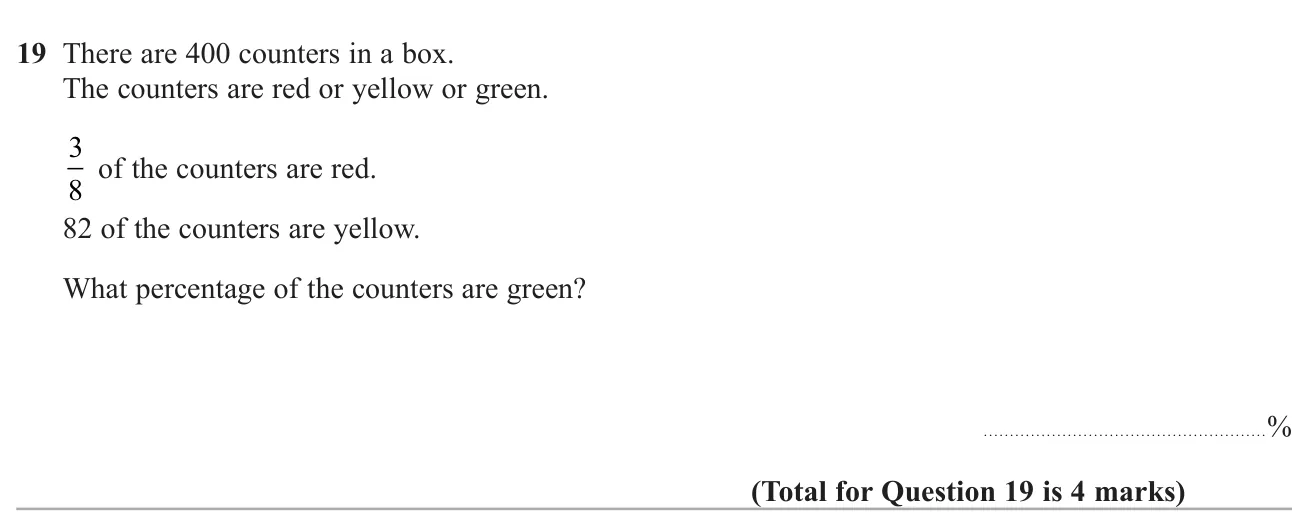
© Pearson Education Ltd. June 2022 Paper 3 (Foundation, calculator), question 19.
Show answer
Worked solution Checked against the mark scheme
Red: 83×400=150
Green: 400−150−82=168
Percentage: 400168×100=42%
Watch out: Giving 168 (the number of green counters) as the answer.
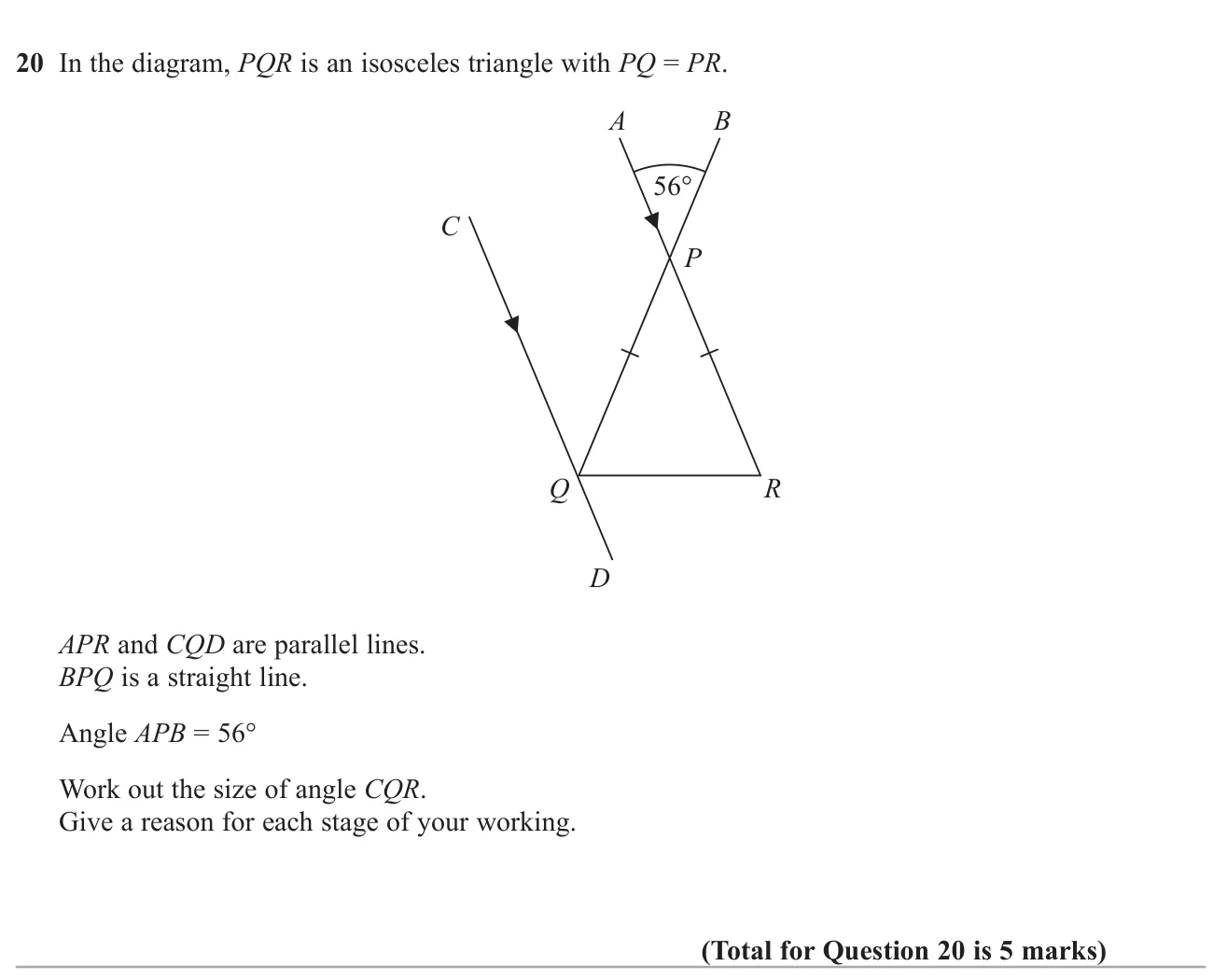
© Pearson Education Ltd. June 2022 Paper 3 (Foundation, calculator), question 20.
Show answer
| Answer | 118° with reasons | 5 marks |
|---|
Worked solution Checked against the mark scheme
Angle QPR=56° (vertically opposite angles are equal).
Angle PQR=(180−56)÷2=62° (base angles of an isosceles triangle are equal; angles in a triangle add to 180°).
Angle PRQ=62°, and CQD∥APR, so angle CQR=180−62=118° (co-interior angles add to 180°).
Watch out: Leaving out reasons, or naming a reason (e.g. 'Z angles') without the correct words.
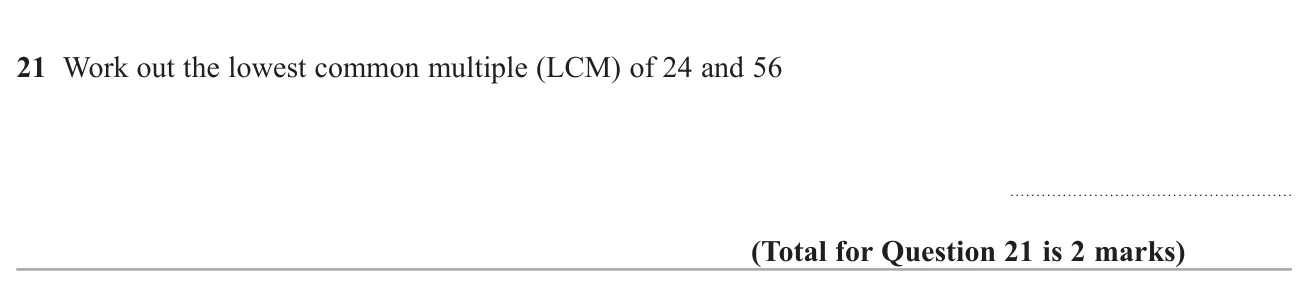
© Pearson Education Ltd. June 2022 Paper 3 (Foundation, calculator), question 21.
Show answer
Worked solution Checked against the mark scheme
24=23×3 and 56=23×7
LCM =23×3×7=168
(Check: multiples of 56 are 56, 112, 168, and 168=7×24.)
Watch out: Multiplying the numbers to get 1344, or giving the HCF (8).
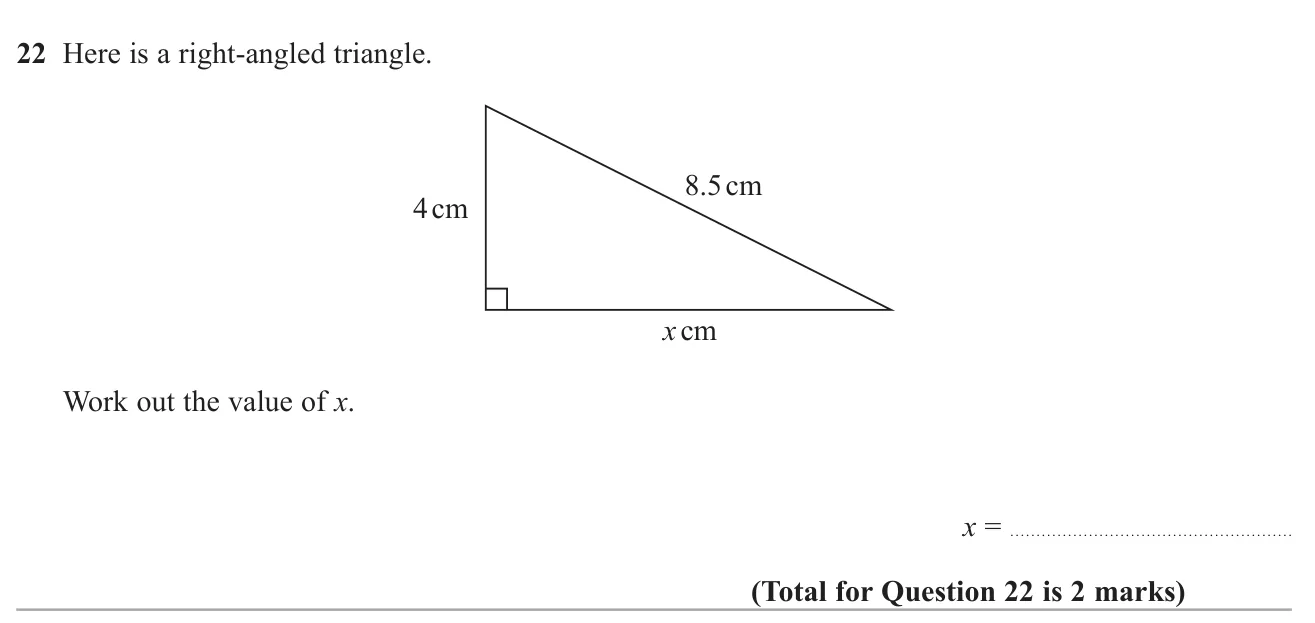
© Pearson Education Ltd. June 2022 Paper 3 (Foundation, calculator), question 22.
Show answer
Worked solution Checked against the mark scheme
The hypotenuse is 8.5 cm.
x2=8.52−42=72.25−16=56.25
x=56.25=7.5
Watch out: Adding the squares instead of subtracting, giving about 9.39.
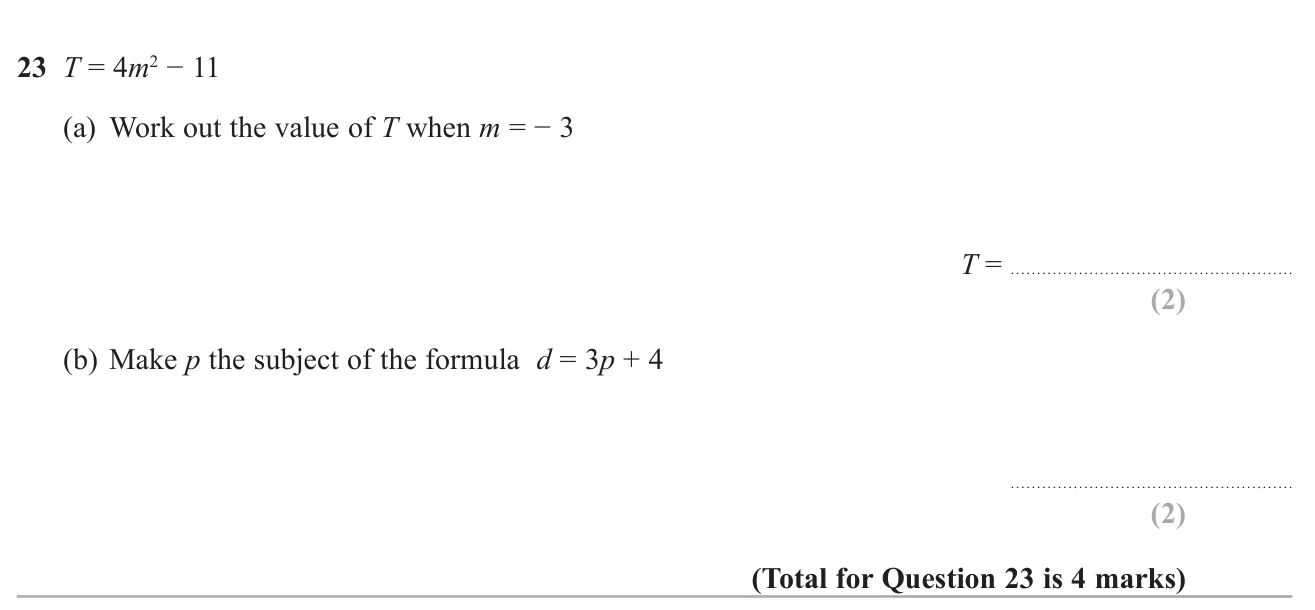
© Pearson Education Ltd. June 2022 Paper 3 (Foundation, calculator), question 23.
Show answer
| (a) | T=25 | 2 marks |
|---|
| (b) | p=3d−4 | 2 marks |
|---|
Worked solution Checked against the mark scheme
(a) (−3)2=9, so T=4×9−11=36−11=25
(b) d=3p+4
Subtract 4: d−4=3p
Divide by 3: p=3d−4
Watch out: In (a) squaring 4×−3 to get 144, or using −9 for (−3)2.
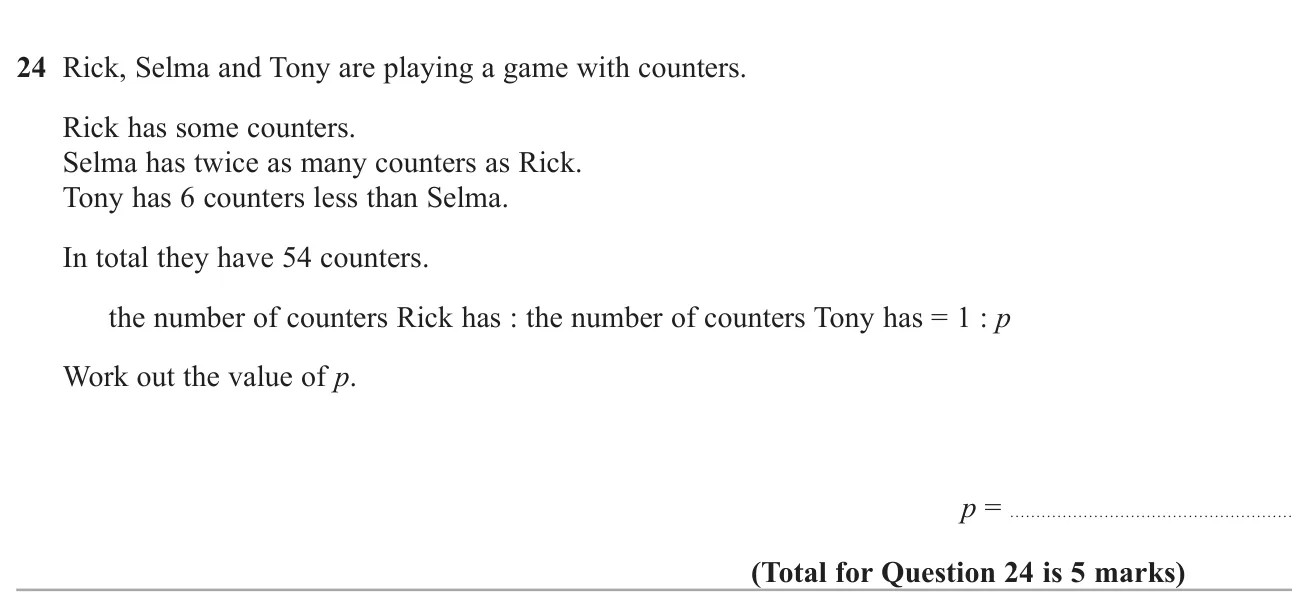
Question 24
Ratio5 marksGrade 5CalculatorOn both tiers © Pearson Education Ltd. June 2022 Paper 3 (Foundation, calculator), question 24.
Show answer
Worked solution Checked against the mark scheme
Let Rick have n. Selma has 2n, Tony has 2n−6.
n+2n+2n−6=54⇒5n=60⇒n=12
Tony has 24−6=18
12:18=1:1.5, so p=1.5
Watch out: Using Selma's counters instead of Tony's in the ratio.
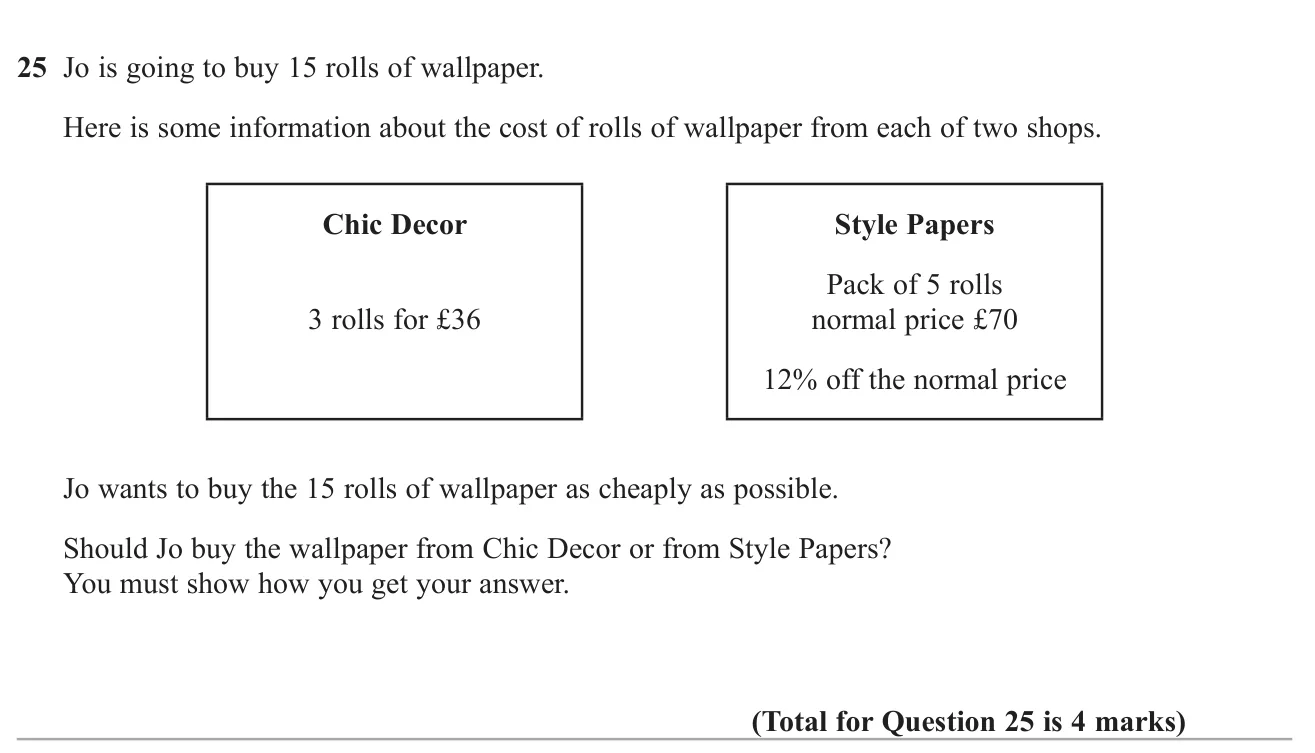
© Pearson Education Ltd. June 2022 Paper 3 (Foundation, calculator), question 25.
Show answer
| Answer | Chic Decor (£180 compared with £184.80) | 4 marks |
|---|
Worked solution Checked against the mark scheme
Chic Decor: 15÷3=5 lots of £36, so 5×36=£180
Style Papers: 3×70=£210, then 210×0.88=£184.80
£180 < £184.80, so buy from Chic Decor.
Watch out: Taking 12% off only one pack, or finding 12% but not subtracting it.
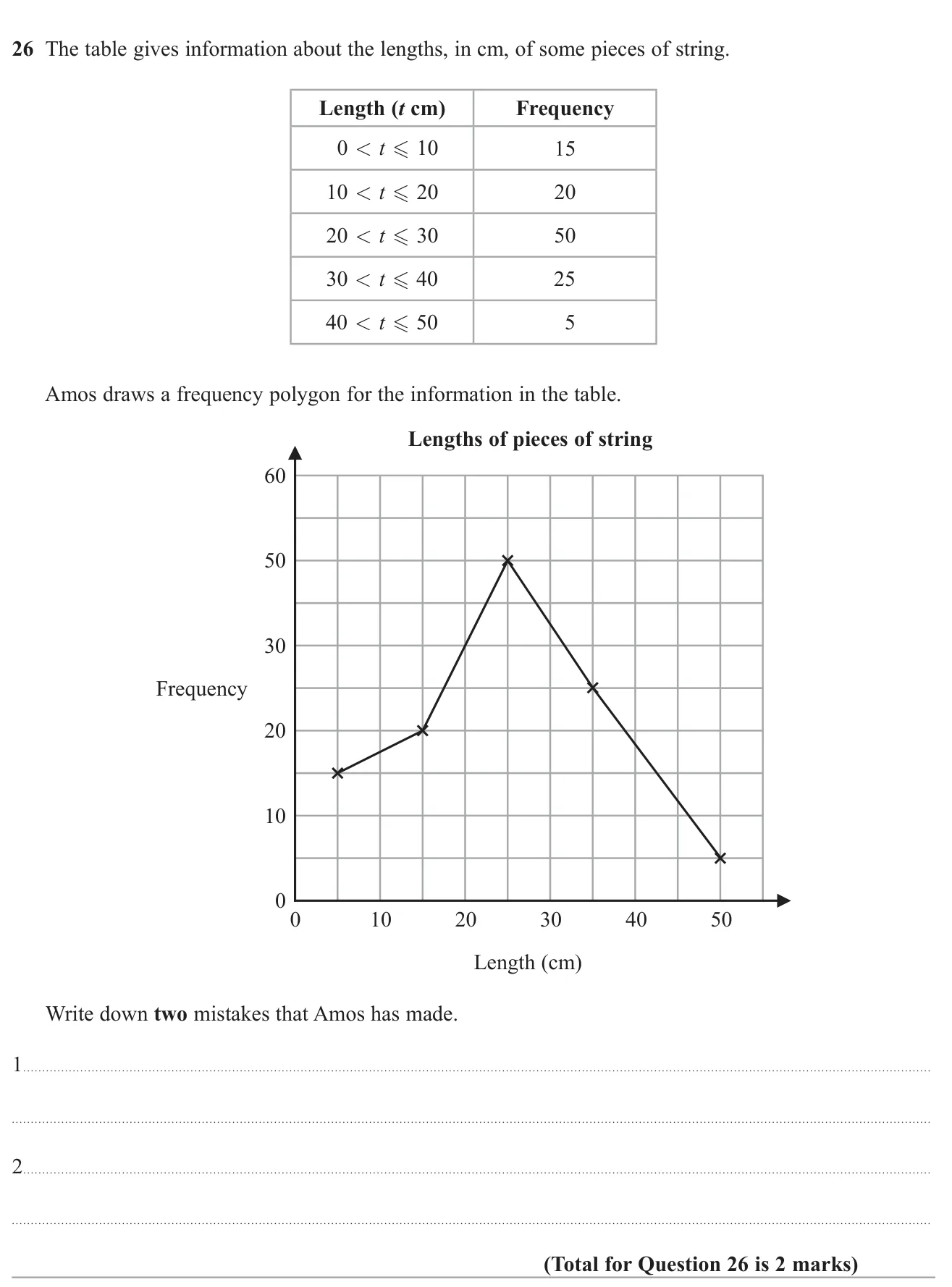
© Pearson Education Ltd. June 2022 Paper 3 (Foundation, calculator), question 26.
Show answer
| Answer | The vertical scale misses 40 (not evenly spaced); the last point is plotted at 50 instead of the midpoint 45 | 2 marks |
|---|
Worked solution Checked against the mark scheme
Look at the frequency axis: it goes 30 then 50, so 40 is missing and the scale is not even.
Points should be at class midpoints (5, 15, 25, 35, 45). The last point is at (50, 5) but should be at (45, 5).
Watch out: Saying the polygon should start at the origin, which is not a mistake.
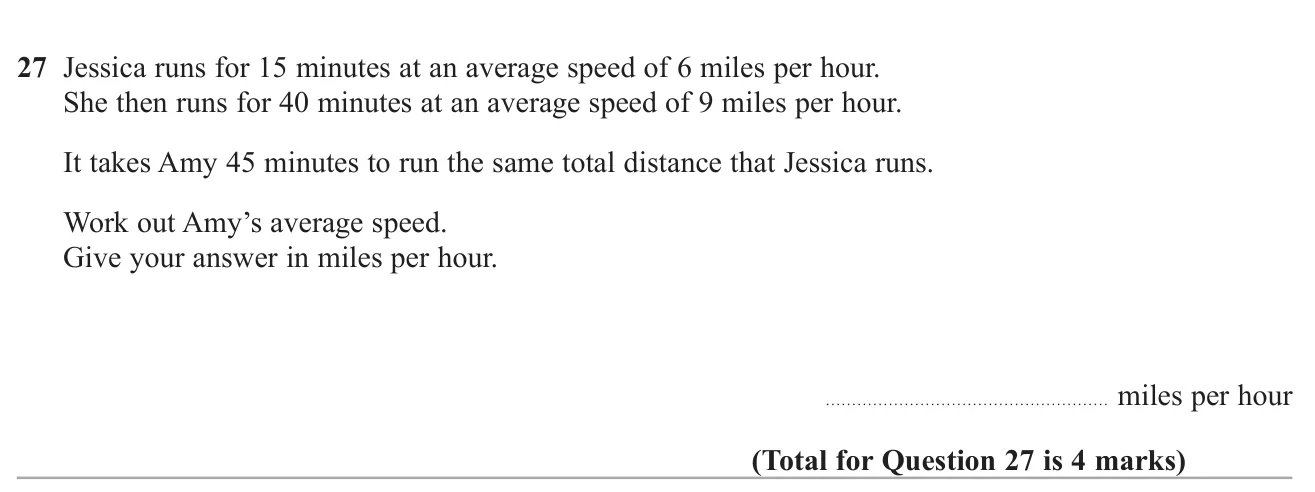
© Pearson Education Ltd. June 2022 Paper 3 (Foundation, calculator), question 27.
Show answer
Worked solution Checked against the mark scheme
Stage 1: 6×6015=1.5 miles
Stage 2: 9×6040=6 miles
Total = 7.5 miles
Amy: 7.5÷0.75=10 mph
Watch out: Using 45 hours instead of 0.75 hours, or averaging the two speeds.
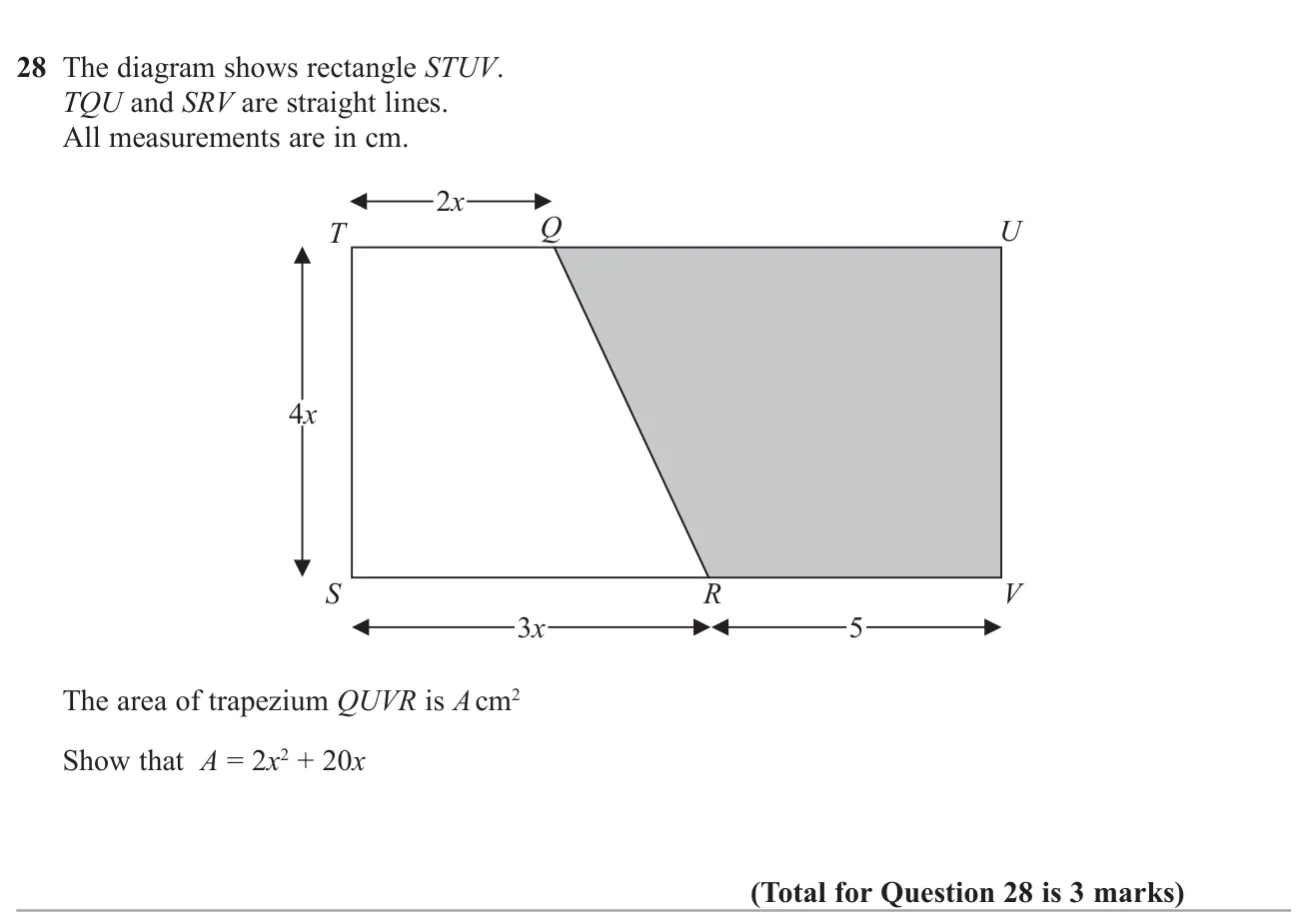
© Pearson Education Ltd. June 2022 Paper 3 (Foundation, calculator), question 28.
Show answer
| Answer | A=2x2+20x shown | 3 marks |
|---|
Worked solution Checked against the mark scheme
QU=(3x+5)−2x=x+5 and RV=5; the height is 4x.
A=21(QU+RV)×4x=21(x+10)×4x
A=2x(x+10)=2x2+20x
Watch out: Using 3x+5 for the top side QU instead of x+5.
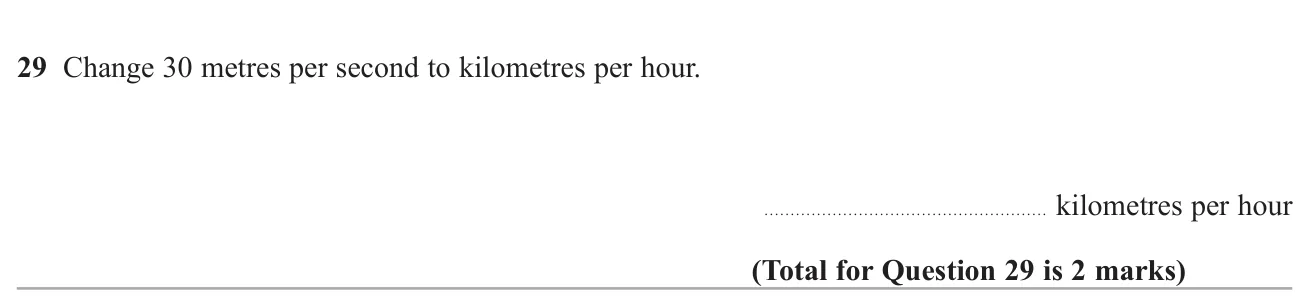
© Pearson Education Ltd. June 2022 Paper 3 (Foundation, calculator), question 29.
Show answer
Worked solution Checked against the mark scheme
In one hour: 30×3600=108000 metres
108000÷1000=108 km/h
Watch out: Multiplying by 60 only once, giving 1.8 km/h.
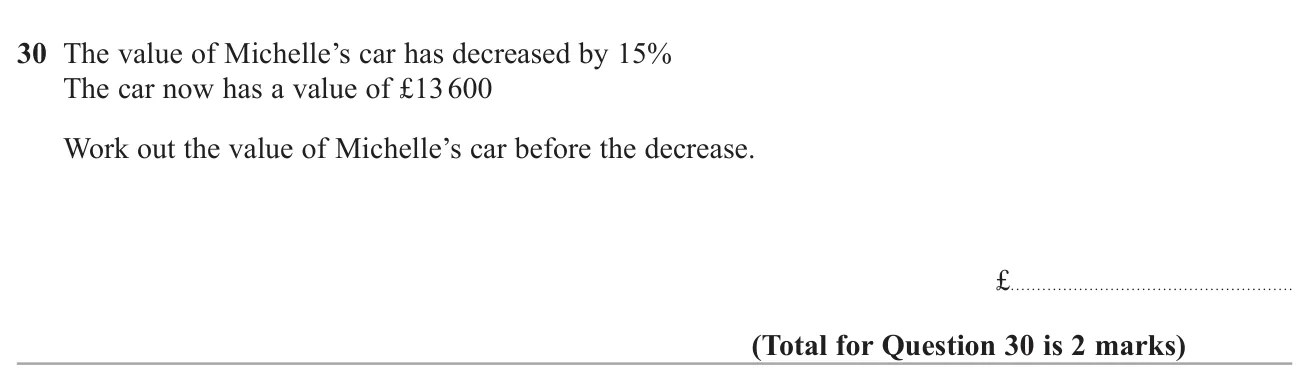
© Pearson Education Ltd. June 2022 Paper 3 (Foundation, calculator), question 30.
Show answer
Worked solution Checked against the mark scheme
After a 15% decrease the car is worth 85% of the original.
0.85×original=13600
Original =13600÷0.85=£16000
Watch out: Adding 15% of £13 600 to get £15 640.
Finished the paper?
Add up your marks for all three papers and see what grade that would have been.