Question 1
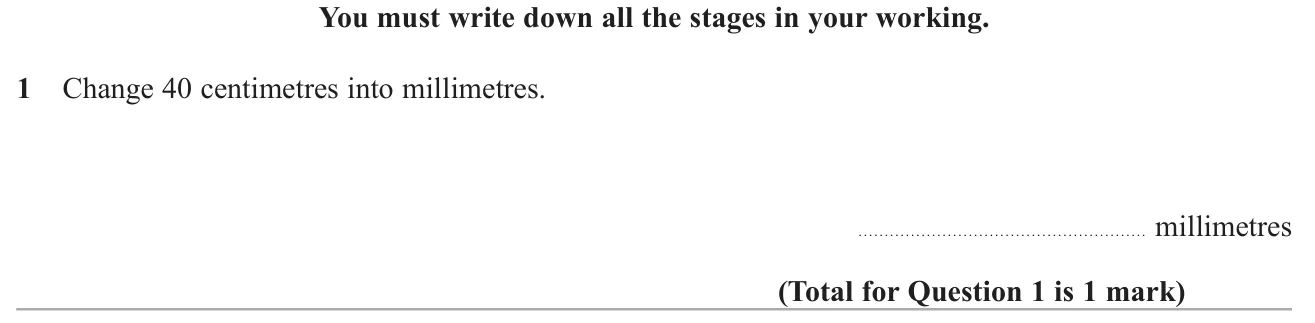
© Pearson Education Ltd. June 2022 Paper 1 (Foundation, non-calculator), question 1.
Show answer
| Answer | 400 | 1 mark |
|---|
Worked solution Checked against the mark scheme
There are 10 mm in 1 cm.
mm
Watch out: Dividing by 10 to get 4.
Edexcel GCSE Maths · 1MA1
Non-calculator · 30 questions · 80 marks · 1 hour 30 minutes. Try each question on paper, then press "Show answer".
© Pearson Education Ltd. June 2022 Paper 1 (Foundation, non-calculator), question 1.
| Answer | 400 | 1 mark |
|---|
Worked solution Checked against the mark scheme
There are 10 mm in 1 cm.
mm
Watch out: Dividing by 10 to get 4.
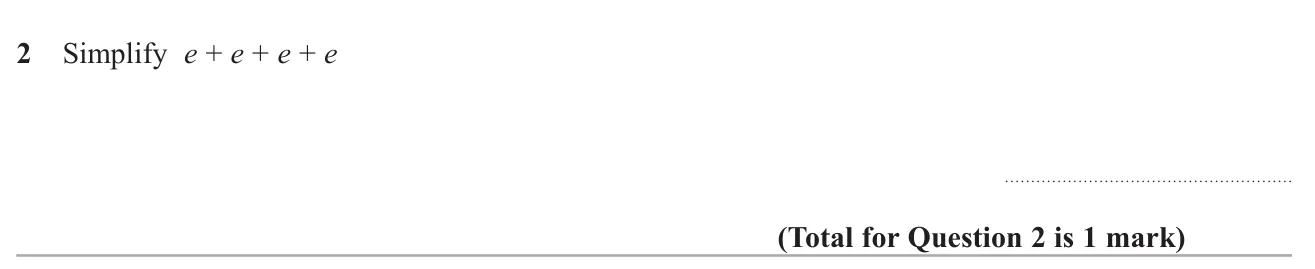
© Pearson Education Ltd. June 2022 Paper 1 (Foundation, non-calculator), question 2.
| Answer | 1 mark |
|---|
Worked solution Checked against the mark scheme
Adding the same term four times gives four lots of it:
Watch out: Writing , which means multiplying, not adding.
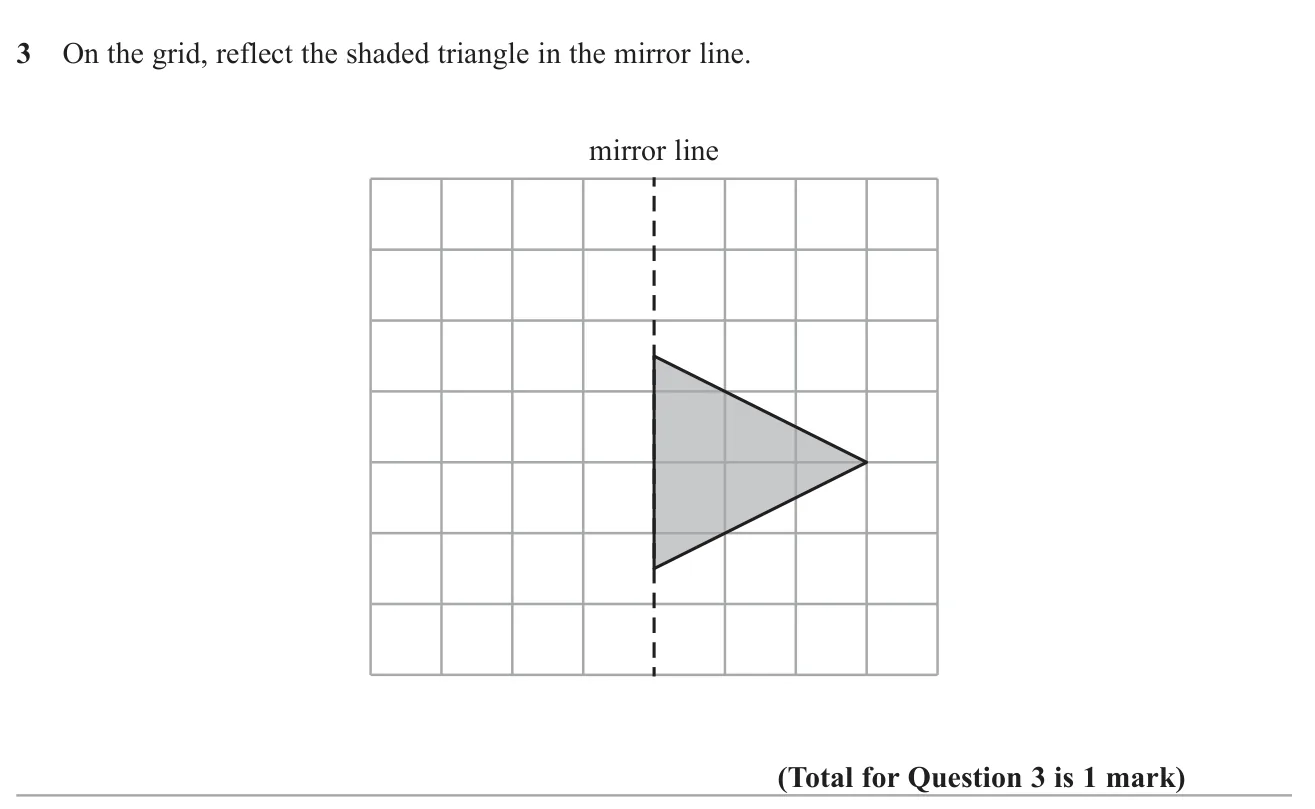
© Pearson Education Ltd. June 2022 Paper 1 (Foundation, non-calculator), question 3.
| Answer | Correct reflection drawn | 1 mark |
|---|
Worked solution Checked against the mark scheme
Take each corner of the triangle in turn.
Count how many squares it is from the mirror line, then plot the new corner the same distance on the other side.
Join the new corners to make the image.
Watch out: Translating the triangle across instead of flipping it.
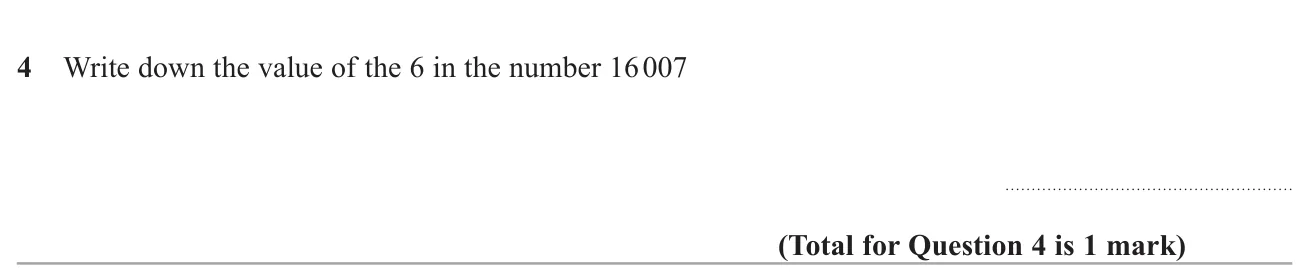
© Pearson Education Ltd. June 2022 Paper 1 (Foundation, non-calculator), question 4.
| Answer | 6000 | 1 mark |
|---|
Worked solution Checked against the mark scheme
16 007 has 1 ten-thousand, 6 thousands, 0 hundreds, 0 tens and 7 ones.
So the 6 is worth .
Watch out: Writing just 6, the digit, instead of the value it stands for.
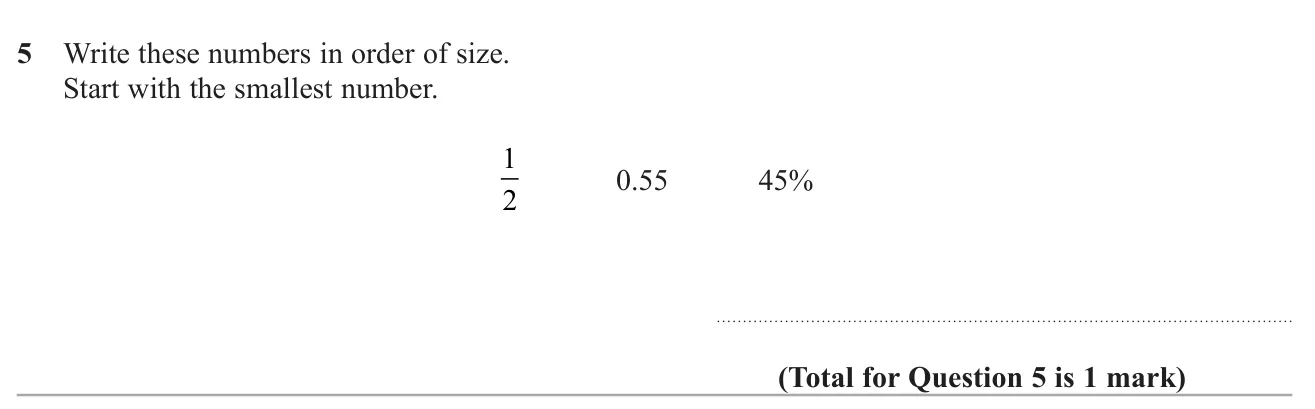
© Pearson Education Ltd. June 2022 Paper 1 (Foundation, non-calculator), question 5.
| Answer | 45%, , 0.55 | 1 mark |
|---|
Worked solution Checked against the mark scheme
Write each as a decimal: , ,
Smallest to largest:
So: 45%, , 0.55
Watch out: Thinking 45% is bigger than 0.55 because 45 > 0.55.
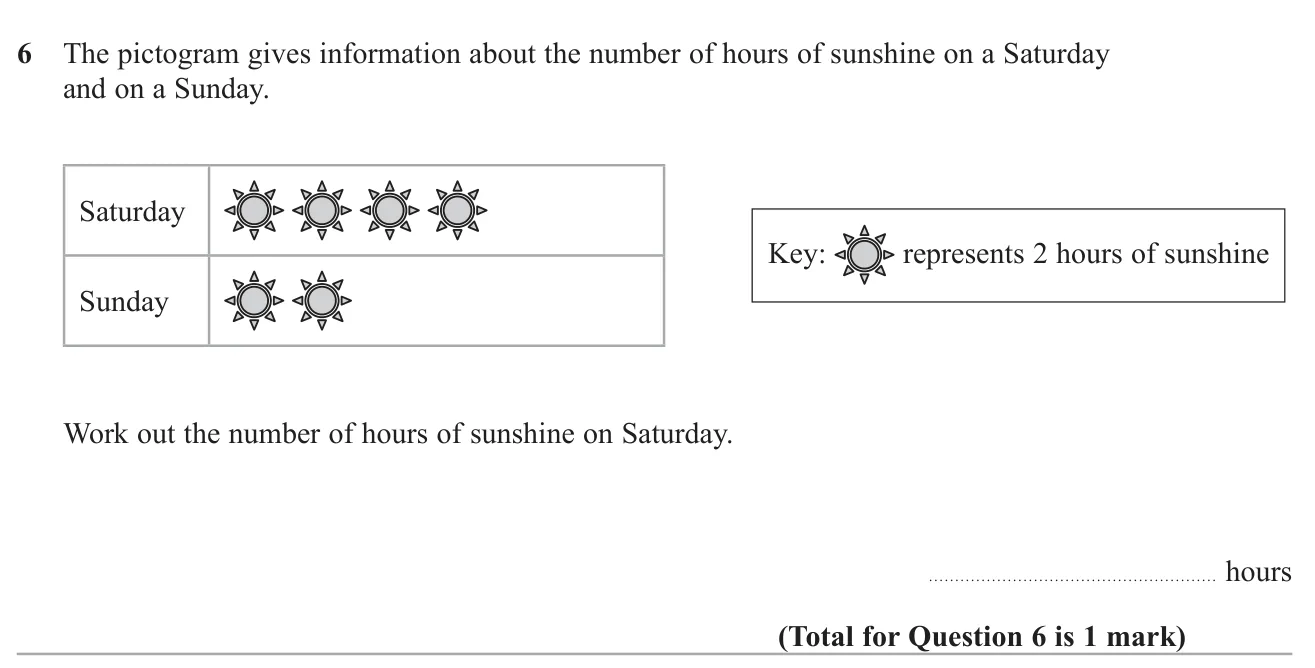
© Pearson Education Ltd. June 2022 Paper 1 (Foundation, non-calculator), question 6.
| Answer | 8 | 1 mark |
|---|
Worked solution Checked against the mark scheme
Saturday has 4 symbols and each symbol stands for 2 hours.
hours
Watch out: Counting the symbols (4) and forgetting the key.
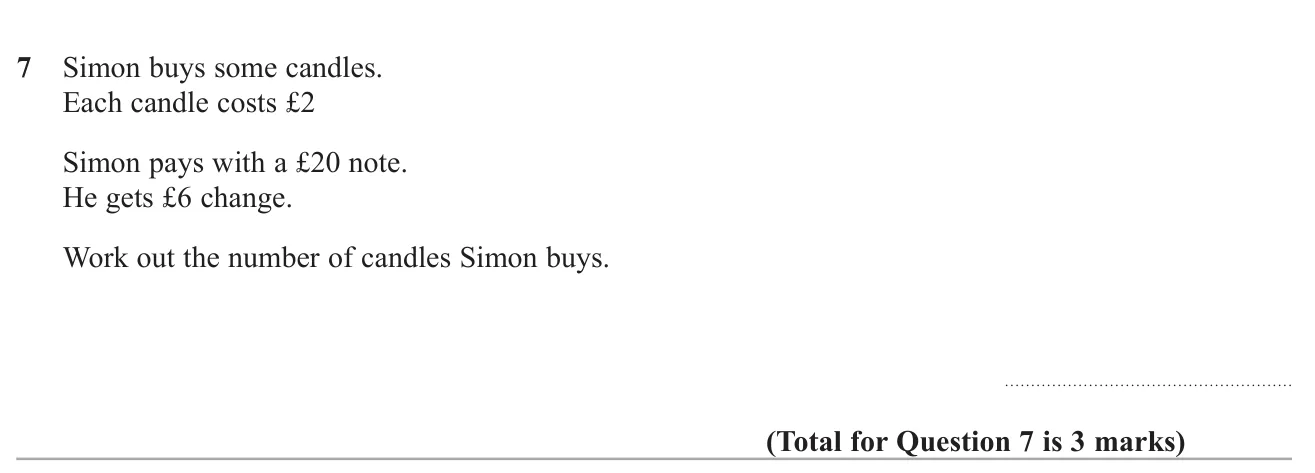
© Pearson Education Ltd. June 2022 Paper 1 (Foundation, non-calculator), question 7.
| Answer | 7 | 3 marks |
|---|
Worked solution Checked against the mark scheme
Amount spent: pounds
Each candle costs £2:
Simon buys 7 candles.
Watch out: Dividing 20 by 2 and forgetting to take off the change.
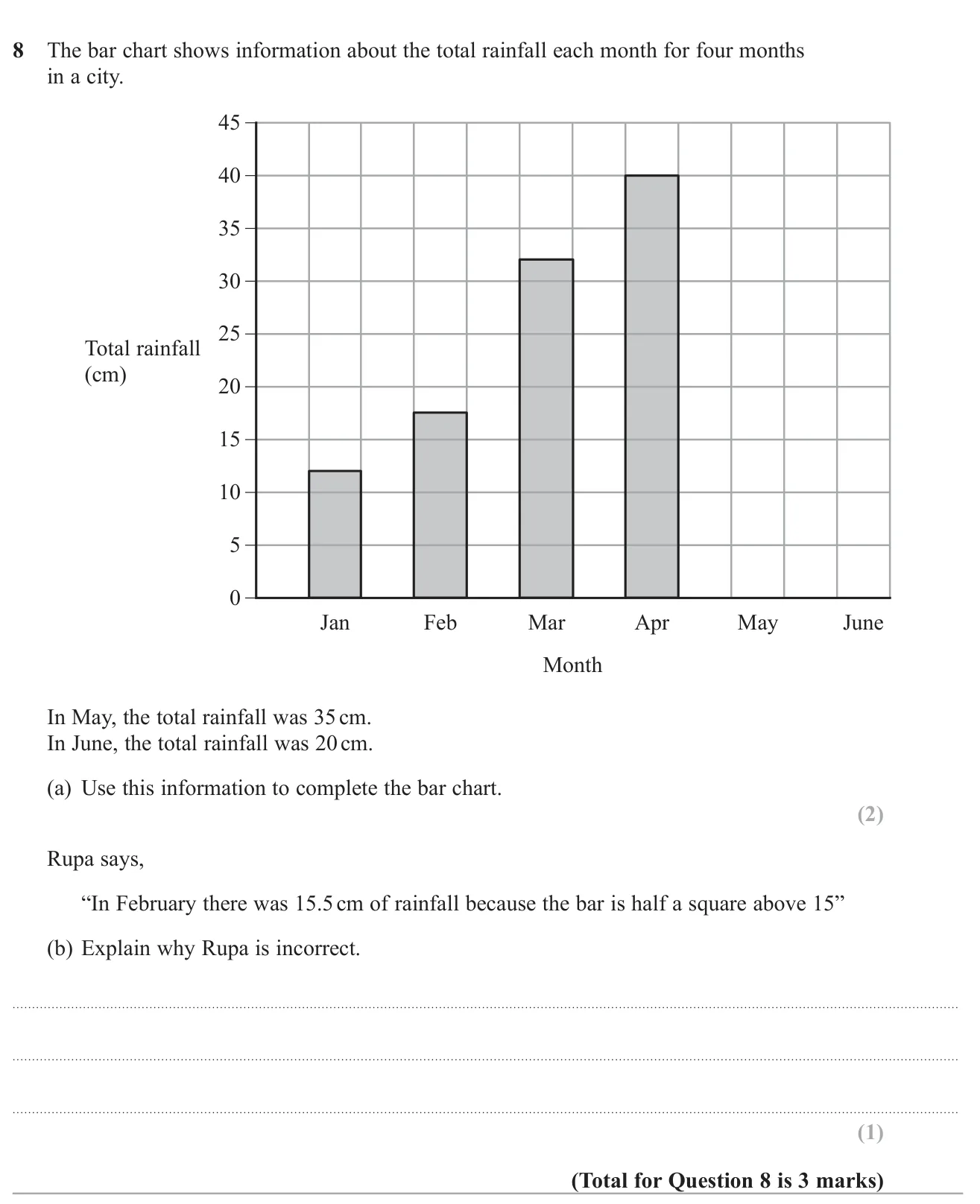
© Pearson Education Ltd. June 2022 Paper 1 (Foundation, non-calculator), question 8.
| (a) | Bars drawn to 35 for May and 20 for June | 2 marks |
|---|---|---|
| (b) | Each square is worth 5 cm, so half a square is 2.5 cm and the bar shows 17.5 cm | 1 mark |
Worked solution Checked against the mark scheme
(a) Draw a bar up to 35 above May and a bar up to 20 above June, the same width as the others.
(b) The vertical scale goes up 5 cm per square, so half a square is cm.
February's bar is at cm, not 15.5 cm.
Watch out: Assuming each square is worth 1 unit.
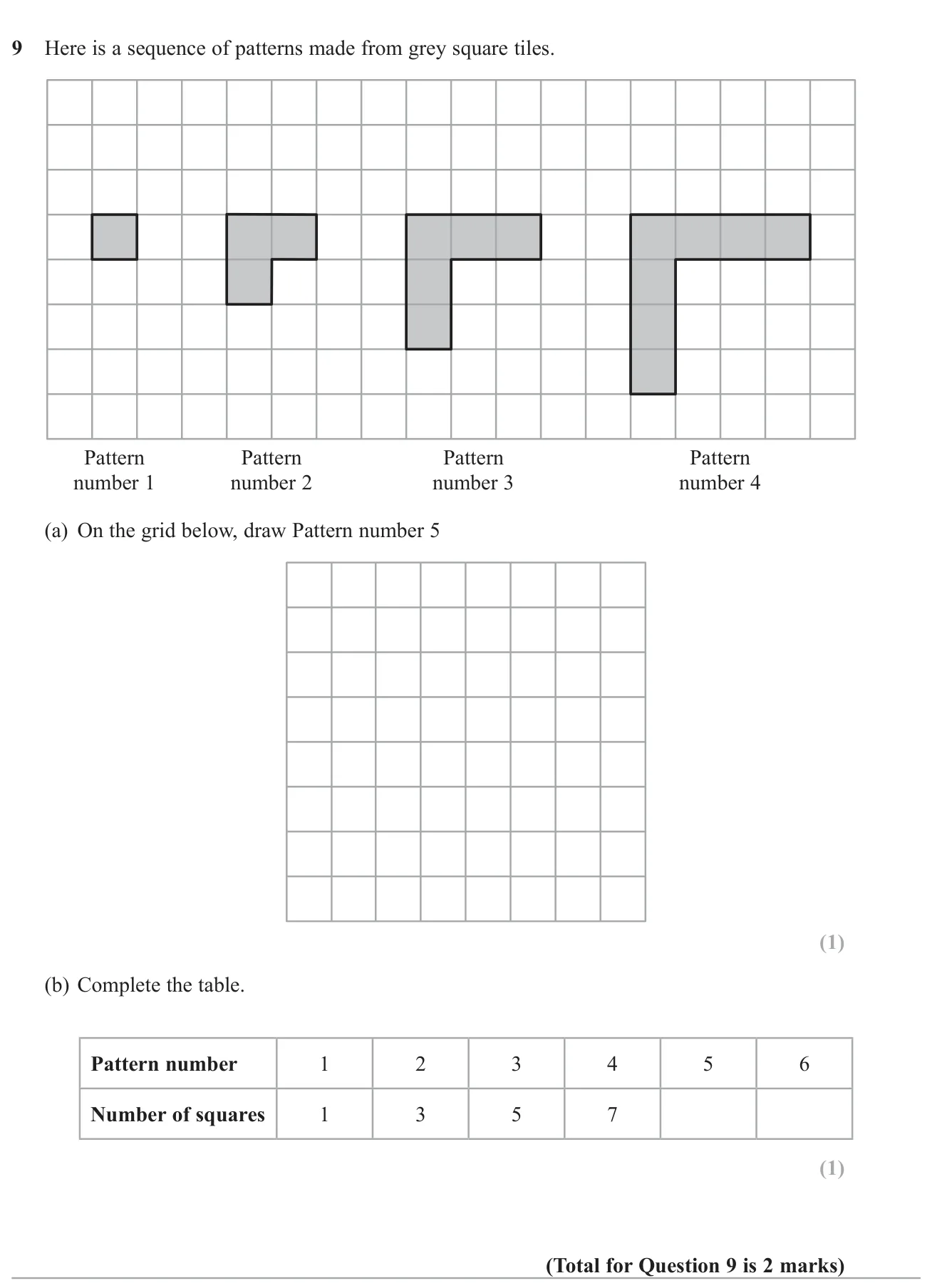
© Pearson Education Ltd. June 2022 Paper 1 (Foundation, non-calculator), question 9.
| (a) | L-shape with 5 squares down and 5 across sharing a corner (9 squares) | 1 mark |
|---|---|---|
| (b) | 9 and 11 | 1 mark |
Worked solution Checked against the mark scheme
(a) Each new pattern adds one square to each arm. Pattern 5 has arms 5 squares long, sharing the corner square: 9 squares.
(b) The numbers go up by 2 each time: 1, 3, 5, 7, 9, 11
Watch out: Drawing arms of 4 squares, copying Pattern 4.
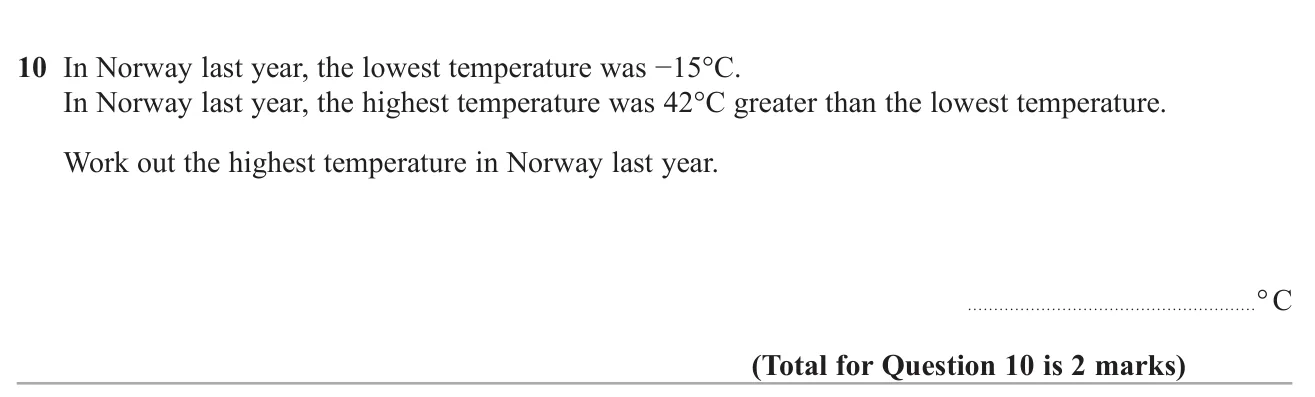
© Pearson Education Ltd. June 2022 Paper 1 (Foundation, non-calculator), question 10.
| Answer | 27 | 2 marks |
|---|
Worked solution Checked against the mark scheme
Start at and go up 42 degrees.
Highest temperature: C
Watch out: Getting 57 by adding 15 and 42.
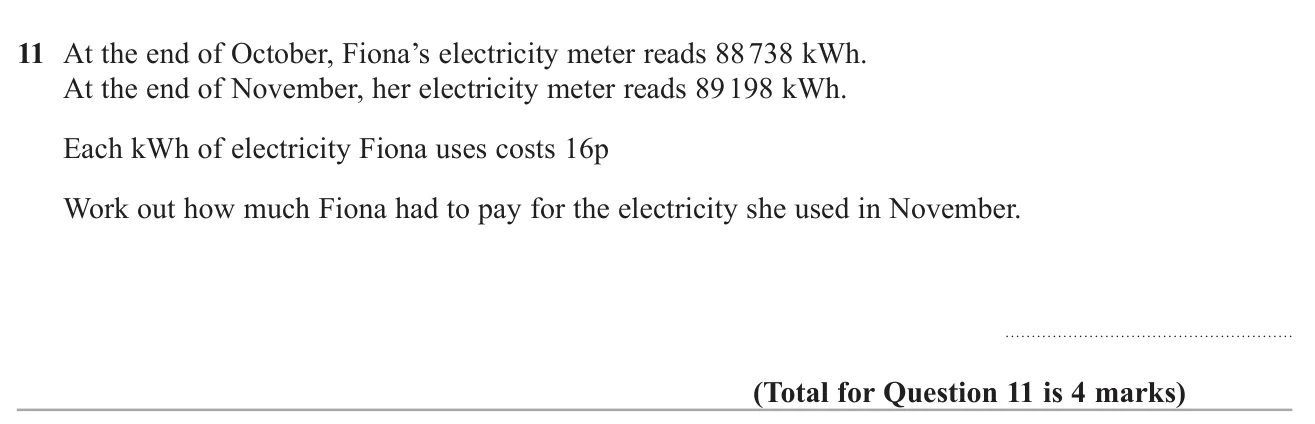
© Pearson Education Ltd. June 2022 Paper 1 (Foundation, non-calculator), question 11.
| Answer | £73.60 (or 7360p) | 4 marks |
|---|
Worked solution Checked against the mark scheme
Units used: kWh
Cost: p
Watch out: Leaving the answer as £7360 by forgetting to convert pence to pounds.
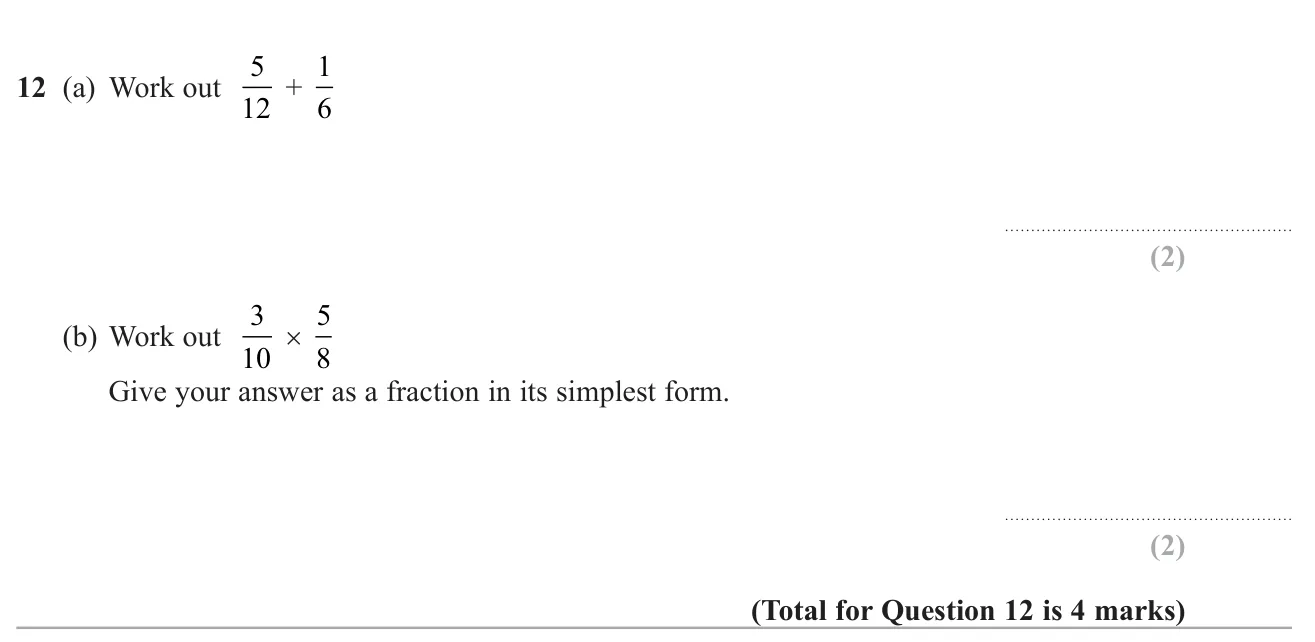
© Pearson Education Ltd. June 2022 Paper 1 (Foundation, non-calculator), question 12.
| (a) | 2 marks | |
|---|---|---|
| (b) | 2 marks |
Worked solution Checked against the mark scheme
(a) , so
(b)
Divide top and bottom by 5:
Watch out: Adding the denominators in (a) to get 6/18.
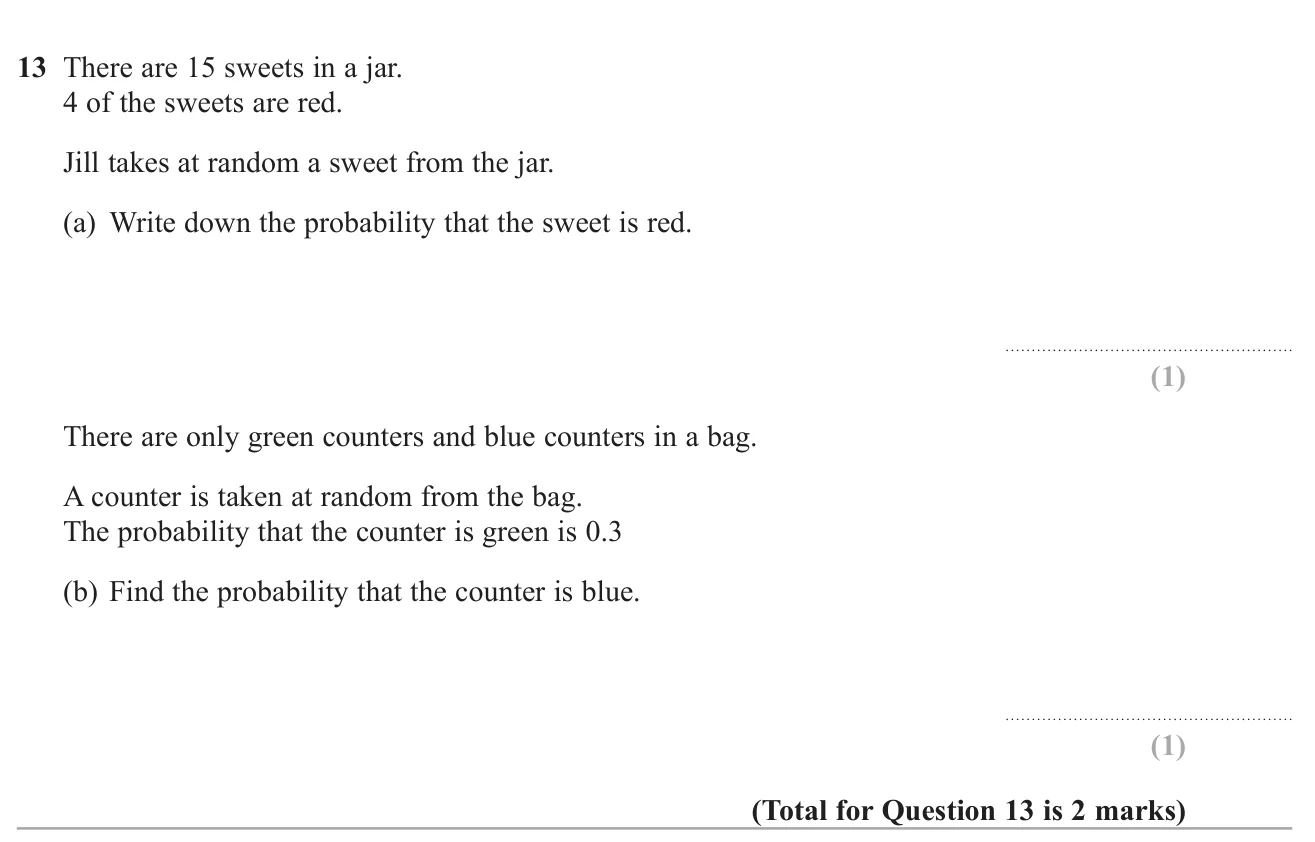
© Pearson Education Ltd. June 2022 Paper 1 (Foundation, non-calculator), question 13.
| (a) | 1 mark | |
|---|---|---|
| (b) | 0.7 | 1 mark |
Worked solution Checked against the mark scheme
(a) 4 red out of 15 sweets:
(b) Probabilities add to 1:
Watch out: Writing the probability as a ratio, 4 : 15.
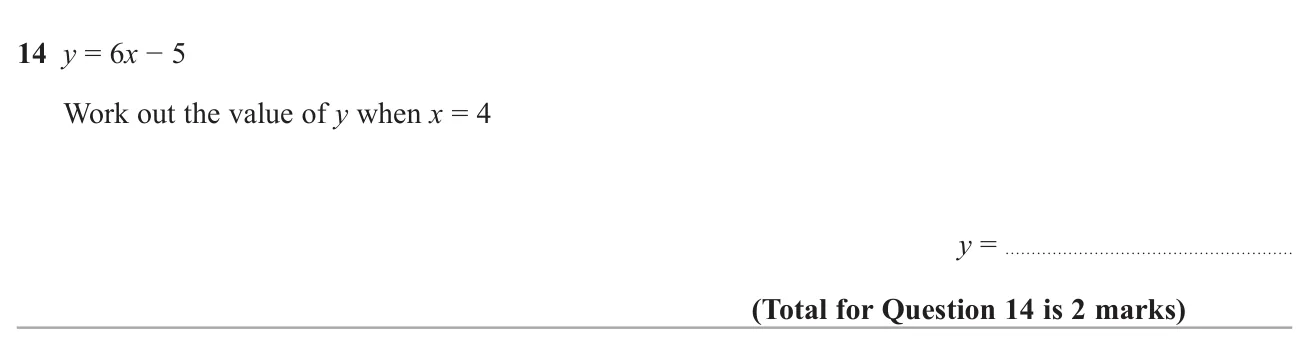
© Pearson Education Ltd. June 2022 Paper 1 (Foundation, non-calculator), question 14.
| Answer | 19 | 2 marks |
|---|
Worked solution Checked against the mark scheme
Watch out: Reading 6x as 64 when x = 4.
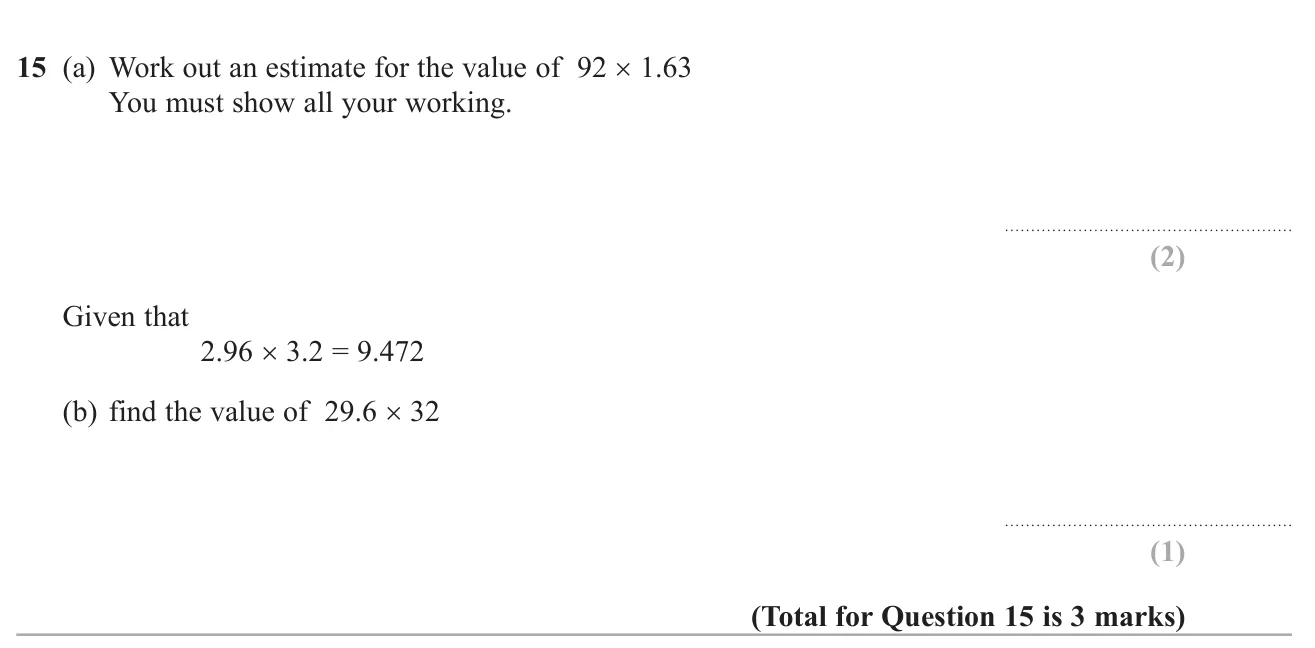
© Pearson Education Ltd. June 2022 Paper 1 (Foundation, non-calculator), question 15.
| (a) | 180 (from ) | 2 marks |
|---|---|---|
| (b) | 947.2 | 1 mark |
Worked solution Checked against the mark scheme
(a) Round each number: and
(b) is and is , so the answer is
Watch out: Working out the exact answer (149.96) instead of estimating.
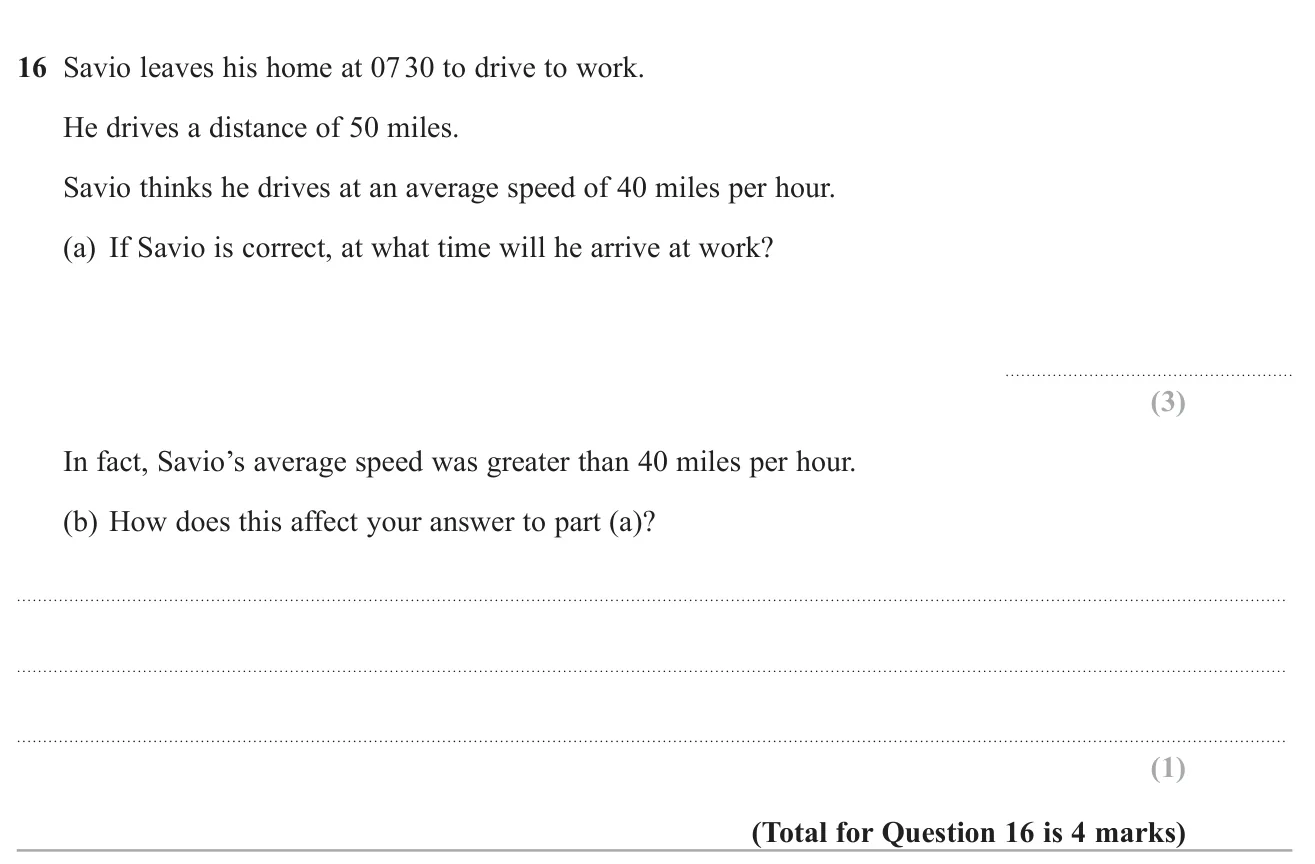
© Pearson Education Ltd. June 2022 Paper 1 (Foundation, non-calculator), question 16.
| (a) | 08 45 | 3 marks |
|---|---|---|
| (b) | He will arrive earlier | 1 mark |
Worked solution Checked against the mark scheme
(a) Time hours
, so 1 hour 15 minutes.
07 30 + 1 h 15 min = 08 45
(b) Going faster over the same distance takes less time, so he arrives earlier.
Watch out: Treating 1.25 hours as 1 hour 25 minutes, giving 08 55.
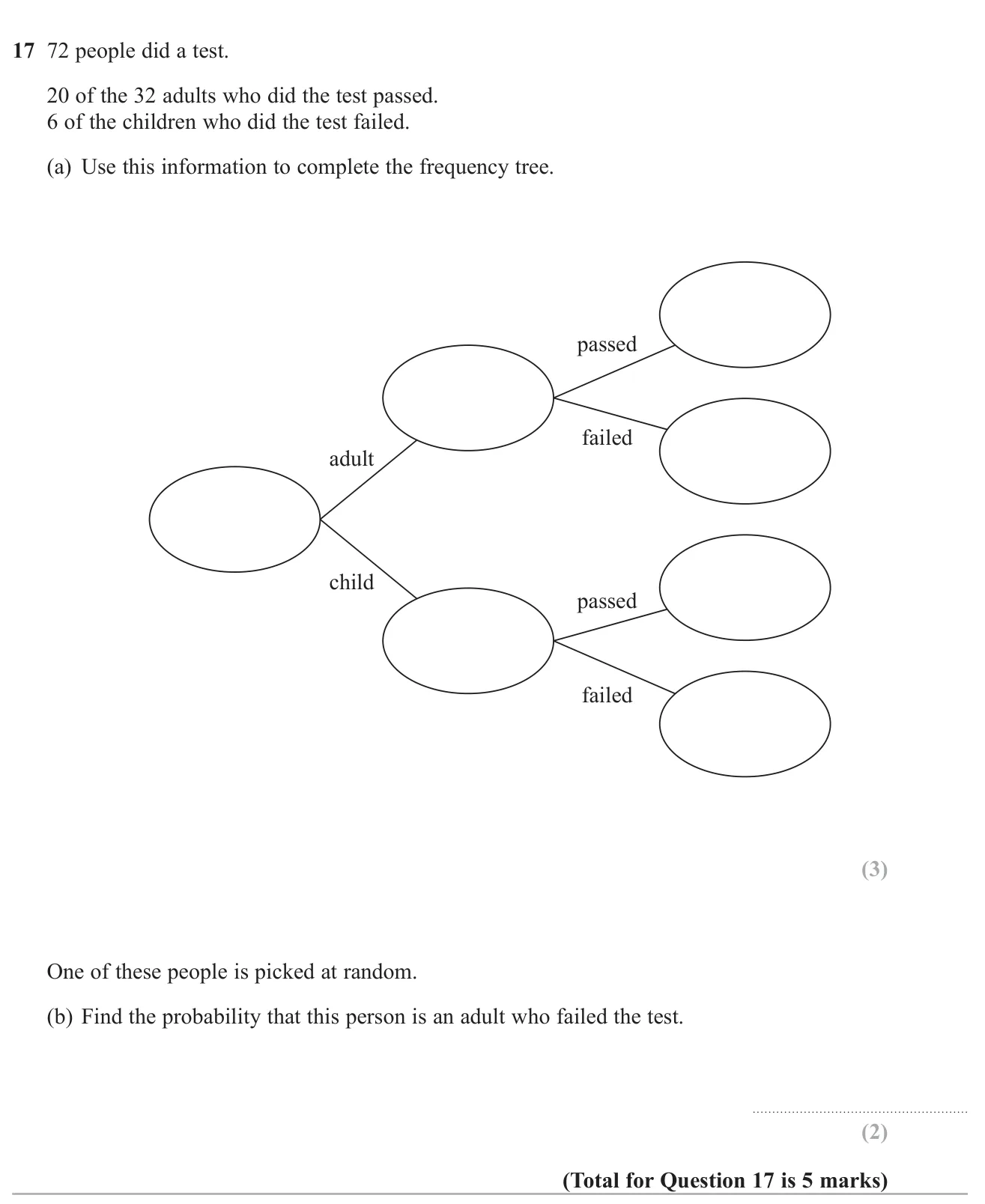
© Pearson Education Ltd. June 2022 Paper 1 (Foundation, non-calculator), question 17.
| (a) | Adult 32 (passed 20, failed 12); child 40 (passed 34, failed 6) | 3 marks |
|---|---|---|
| (b) | 2 marks |
Worked solution Checked against the mark scheme
(a) Adults: 32, so children:
Adults failed:
Children passed:
(b) 12 adults failed out of 72 people:
Watch out: Giving 12/32 by using only the adults as the total.
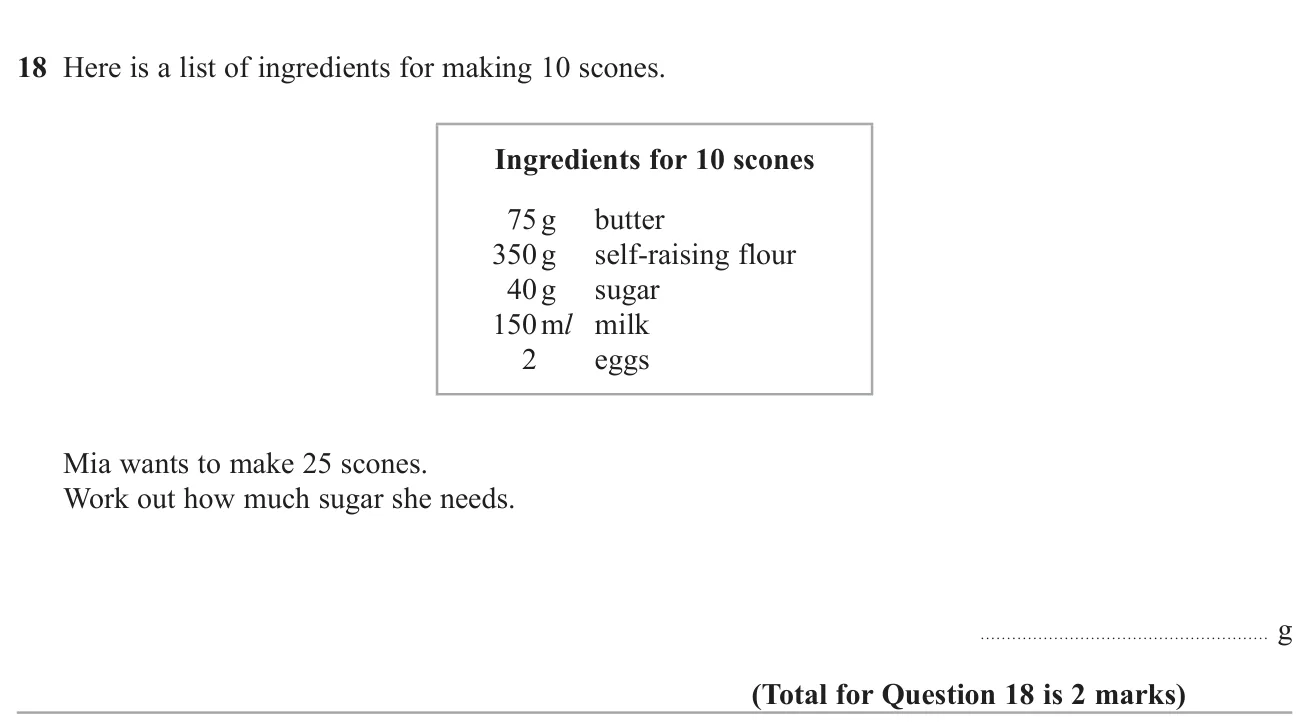
© Pearson Education Ltd. June 2022 Paper 1 (Foundation, non-calculator), question 18.
| Answer | 100 | 2 marks |
|---|
Worked solution Checked against the mark scheme
25 scones is times the recipe.
g of sugar
Watch out: Adding 15 g because 25 is 15 more than 10.
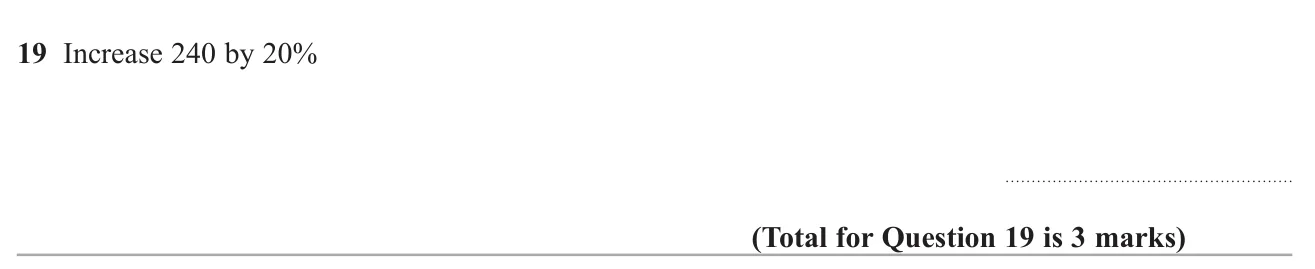
© Pearson Education Ltd. June 2022 Paper 1 (Foundation, non-calculator), question 19.
| Answer | 288 | 3 marks |
|---|
Worked solution Checked against the mark scheme
of 240 is 24, so is
Watch out: Giving just 48, the increase, as the answer.
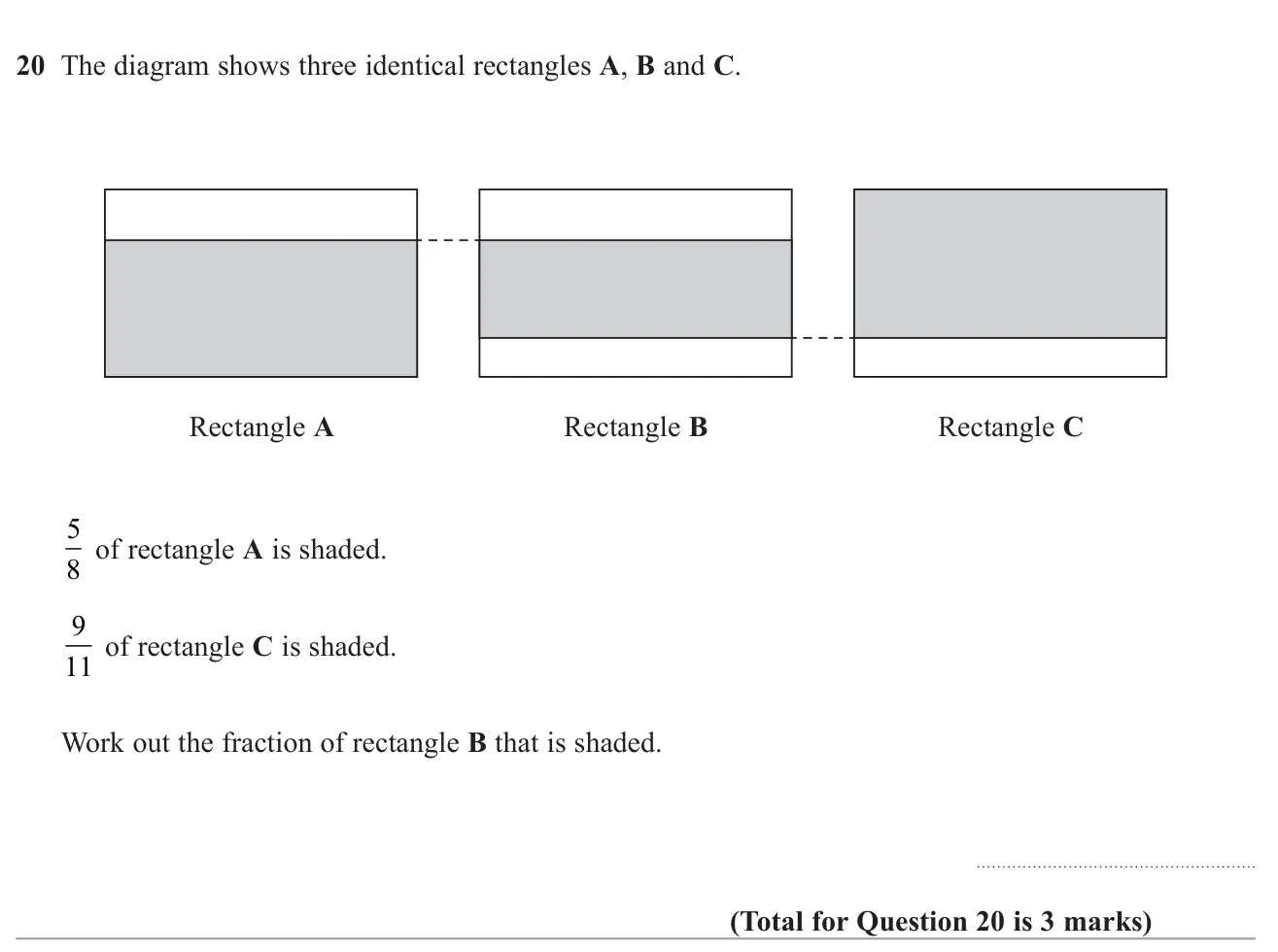
© Pearson Education Ltd. June 2022 Paper 1 (Foundation, non-calculator), question 20.
| Answer | 3 marks |
|---|
Worked solution Checked against the mark scheme
The top strip of B matches the unshaded part of A:
The bottom strip of B matches the unshaded part of C:
Shaded part of B:
Watch out: Subtracting 5/8 from 9/11 without thinking about which strips match.
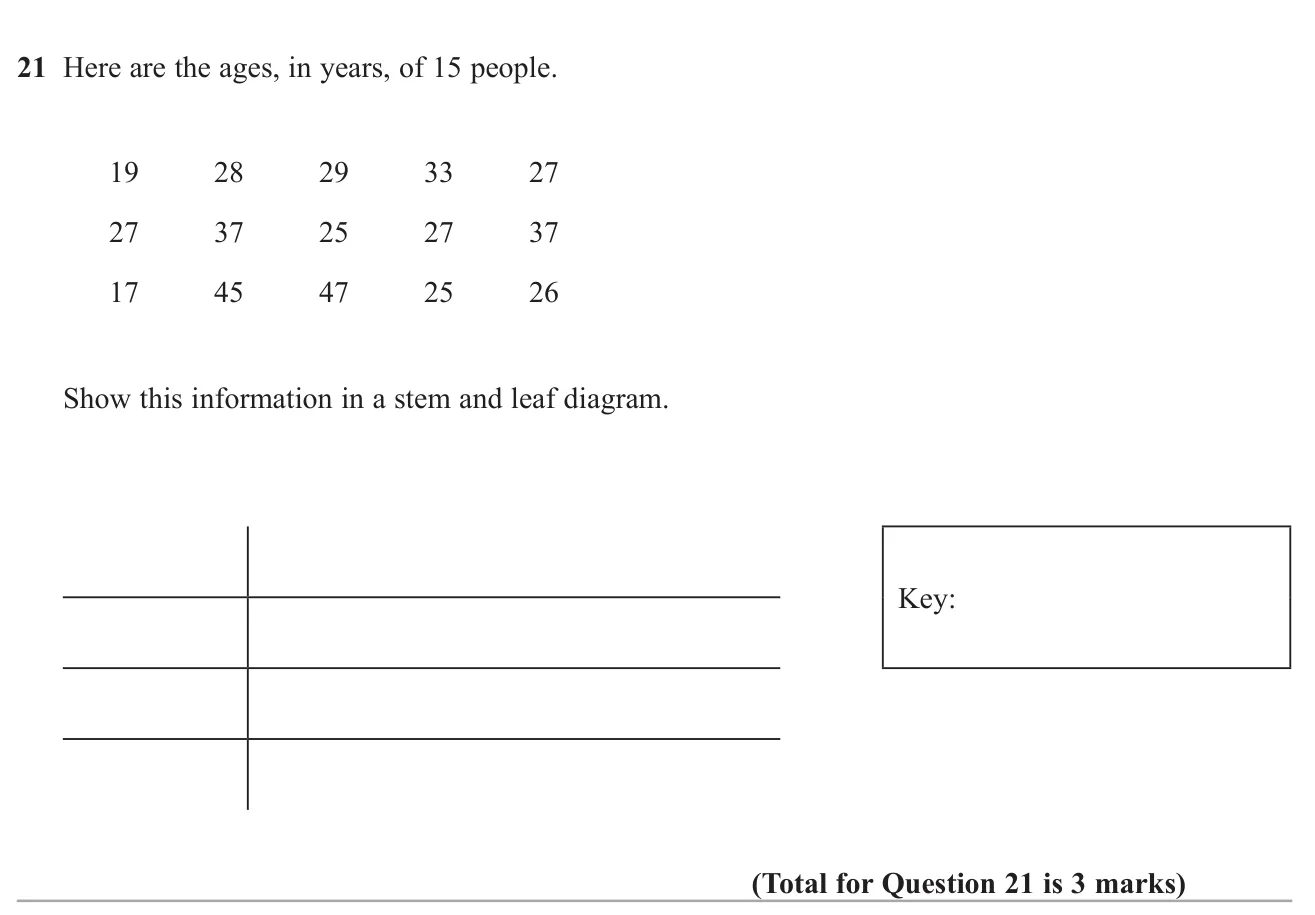
© Pearson Education Ltd. June 2022 Paper 1 (Foundation, non-calculator), question 21.
| Answer | 1 | 7 9; 2 | 5 5 6 7 7 7 8 9; 3 | 3 7 7; 4 | 5 7, with key such as 2 | 5 = 25 years | 3 marks |
|---|
Worked solution Checked against the mark scheme
Use the tens digit as the stem and the units digit as the leaf, then put the leaves in order:
1 | 7 9
2 | 5 5 6 7 7 7 8 9
3 | 3 7 7
4 | 5 7
Key: 2 | 5 means 25 years
Watch out: Forgetting the key or leaving the leaves unordered.
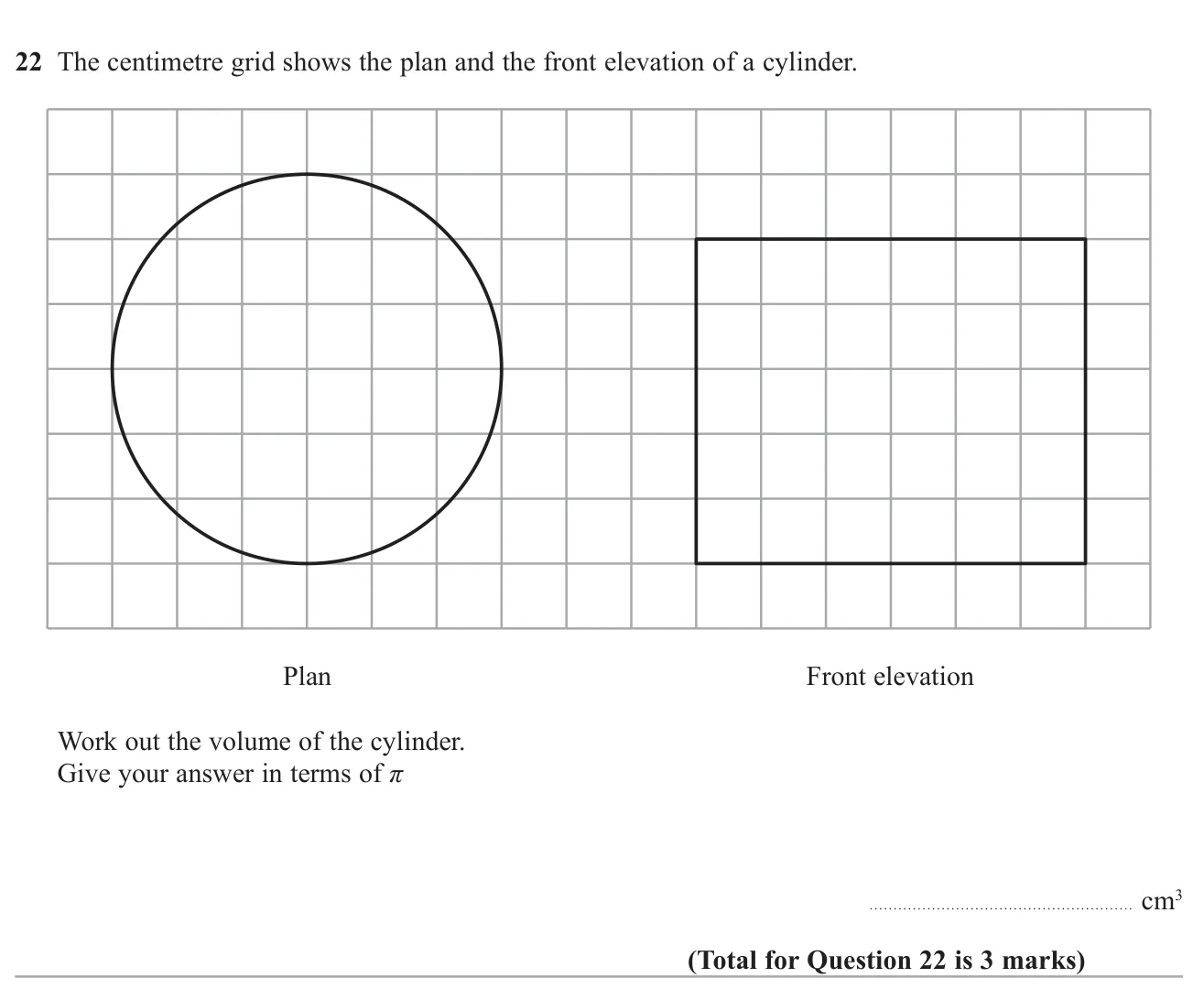
© Pearson Education Ltd. June 2022 Paper 1 (Foundation, non-calculator), question 22.
| Answer | 3 marks |
|---|
Worked solution Checked against the mark scheme
The plan is a circle 6 cm across, so the radius is 3 cm.
The front elevation is 5 cm tall, so the height is 5 cm.
cm³
Watch out: Using the diameter 6 as the radius, giving 180π.
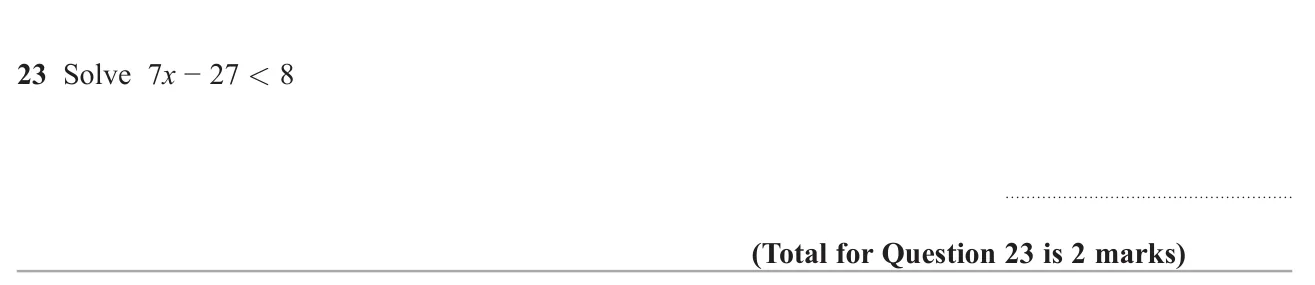
© Pearson Education Ltd. June 2022 Paper 1 (Foundation, non-calculator), question 23.
| Answer | 2 marks |
|---|
Worked solution Checked against the mark scheme
Add 27:
Divide by 7:
Watch out: Writing x = 5 instead of an inequality.
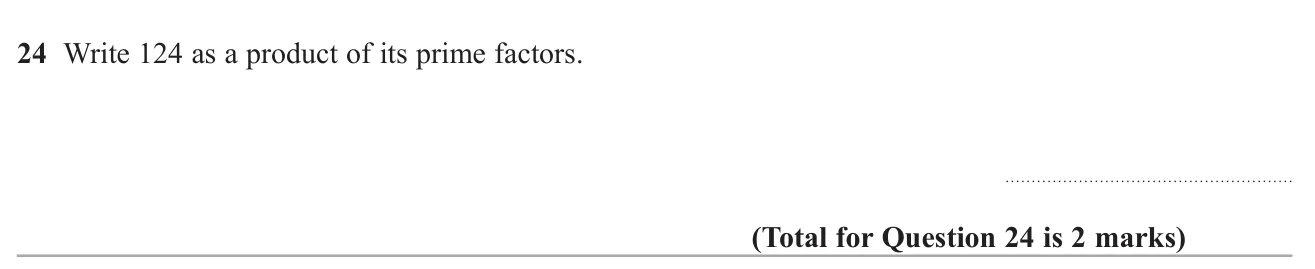
© Pearson Education Ltd. June 2022 Paper 1 (Foundation, non-calculator), question 24.
| Answer | 2 marks |
|---|
Worked solution Checked against the mark scheme
, and 31 is prime.
So
Watch out: Stopping at 2 × 62 or 4 × 31.
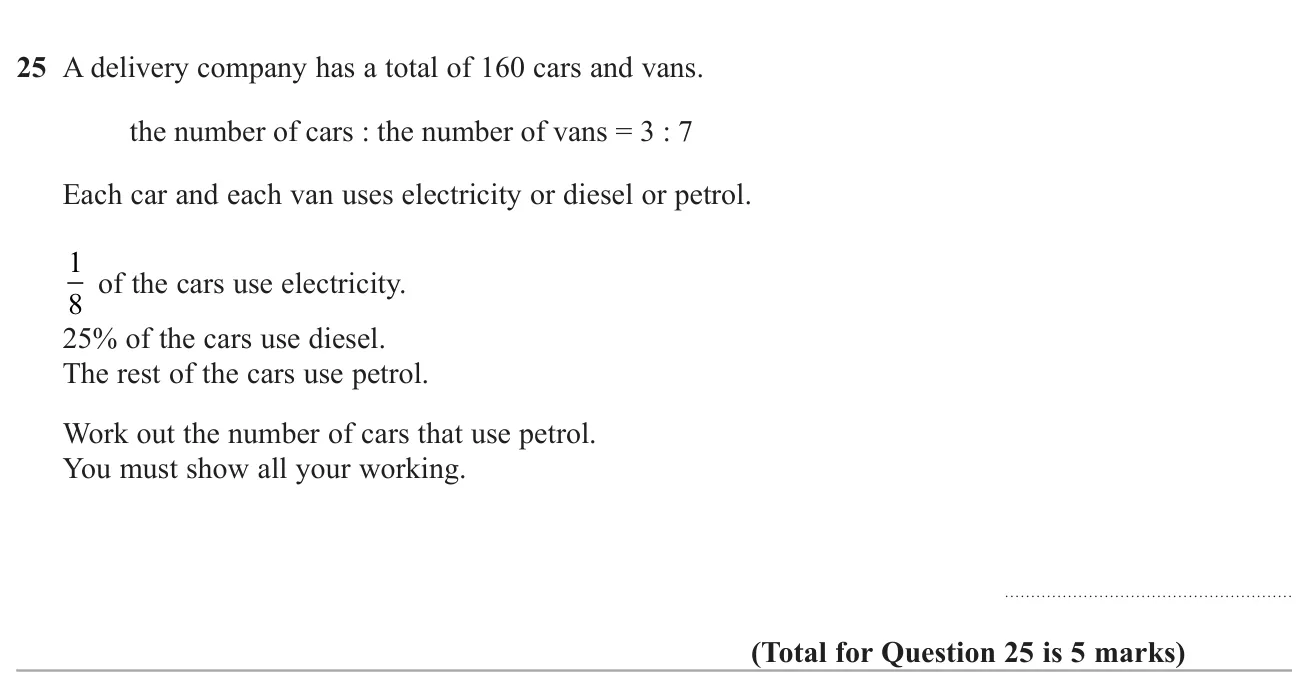
© Pearson Education Ltd. June 2022 Paper 1 (Foundation, non-calculator), question 25.
| Answer | 30 | 5 marks |
|---|
Worked solution Checked against the mark scheme
Cars: ,
Electric:
Diesel: of 48
Petrol:
Watch out: Using all 160 vehicles instead of just the 48 cars (giving 100).
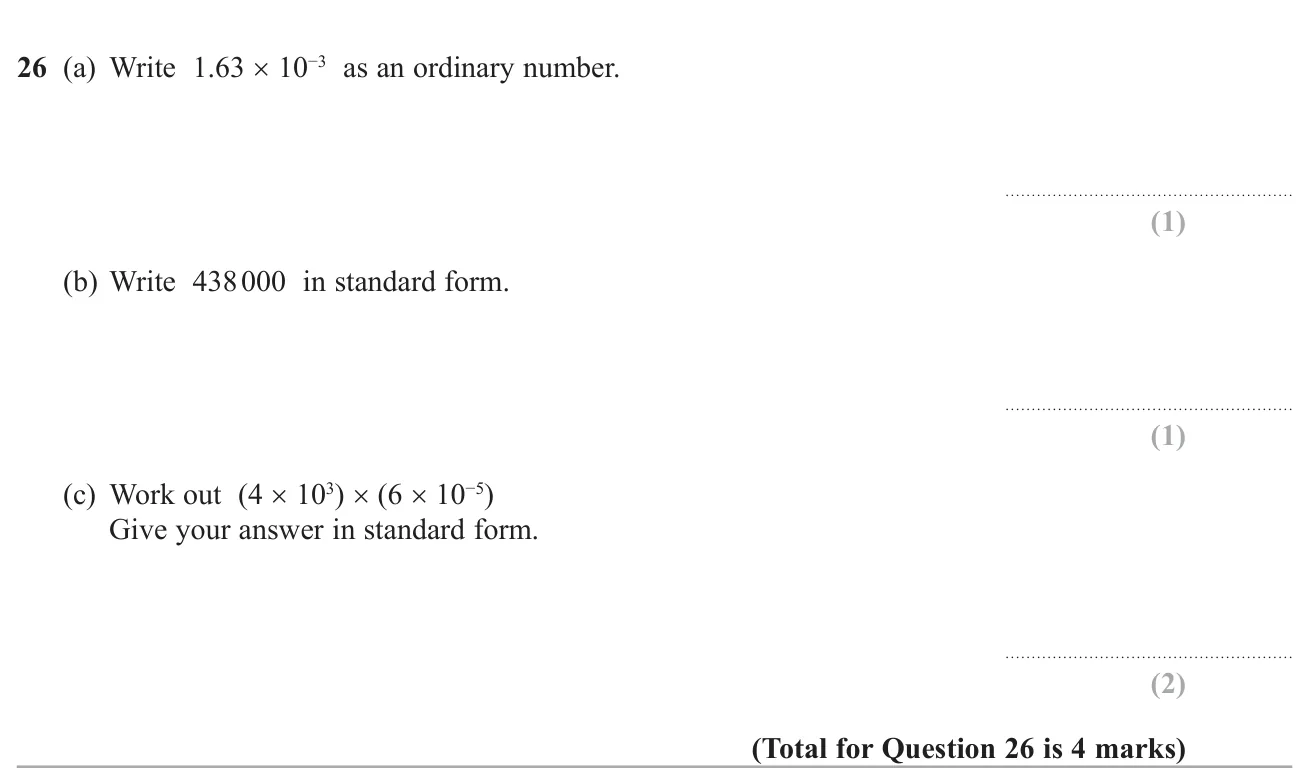
© Pearson Education Ltd. June 2022 Paper 1 (Foundation, non-calculator), question 26.
| (a) | 0.00163 | 1 mark |
|---|---|---|
| (b) | 1 mark | |
| (c) | 2 marks |
Worked solution Checked against the mark scheme
(a) Move the decimal point 3 places left:
(b)
(c) and
Watch out: Leaving (c) as 24 × 10⁻², which is not in standard form.
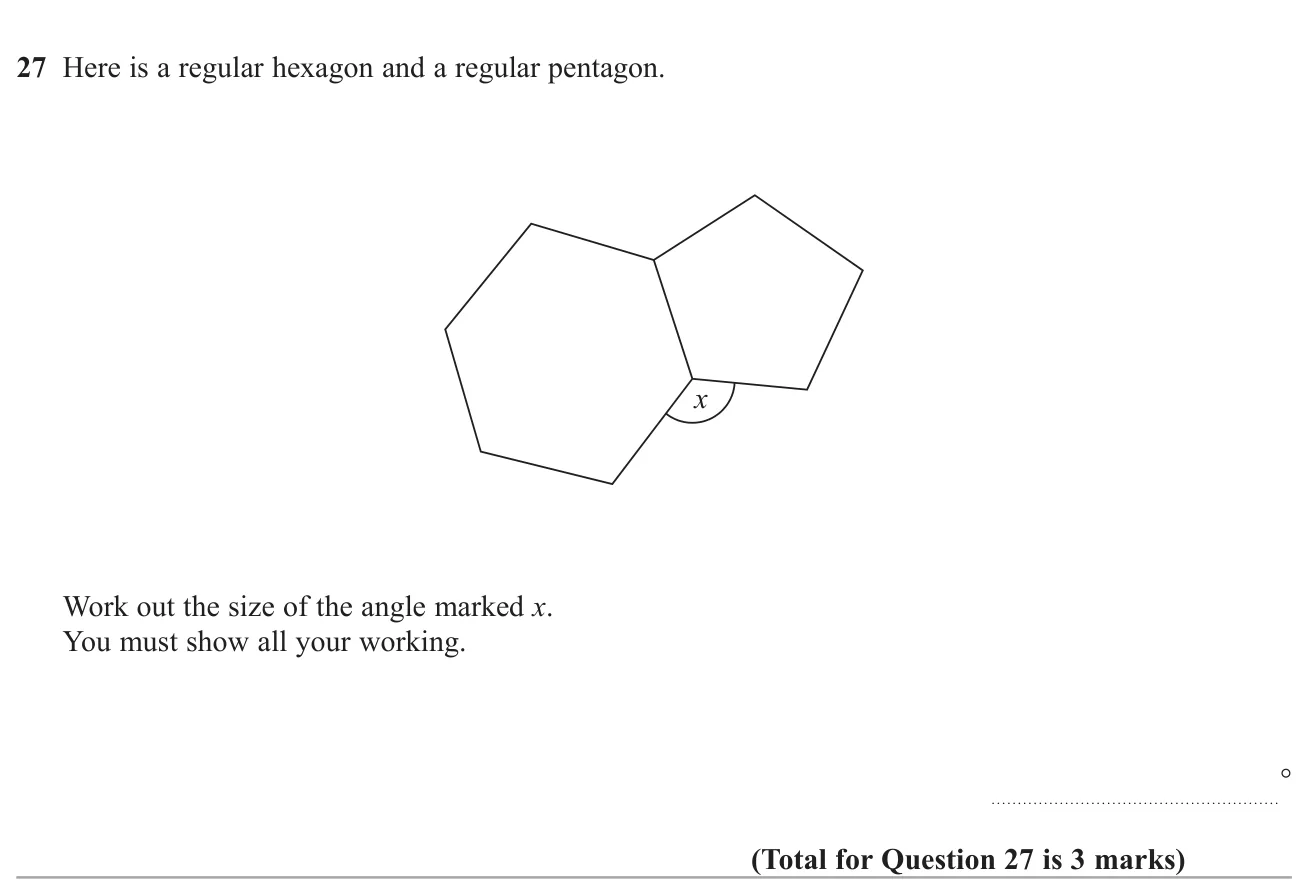
© Pearson Education Ltd. June 2022 Paper 1 (Foundation, non-calculator), question 27.
| Answer | 132 | 3 marks |
|---|
Worked solution Checked against the mark scheme
Hexagon interior angle:
Pentagon interior angle:
Angles round a point add to :
Watch out: Using exterior angles in place of interior ones and getting 228.
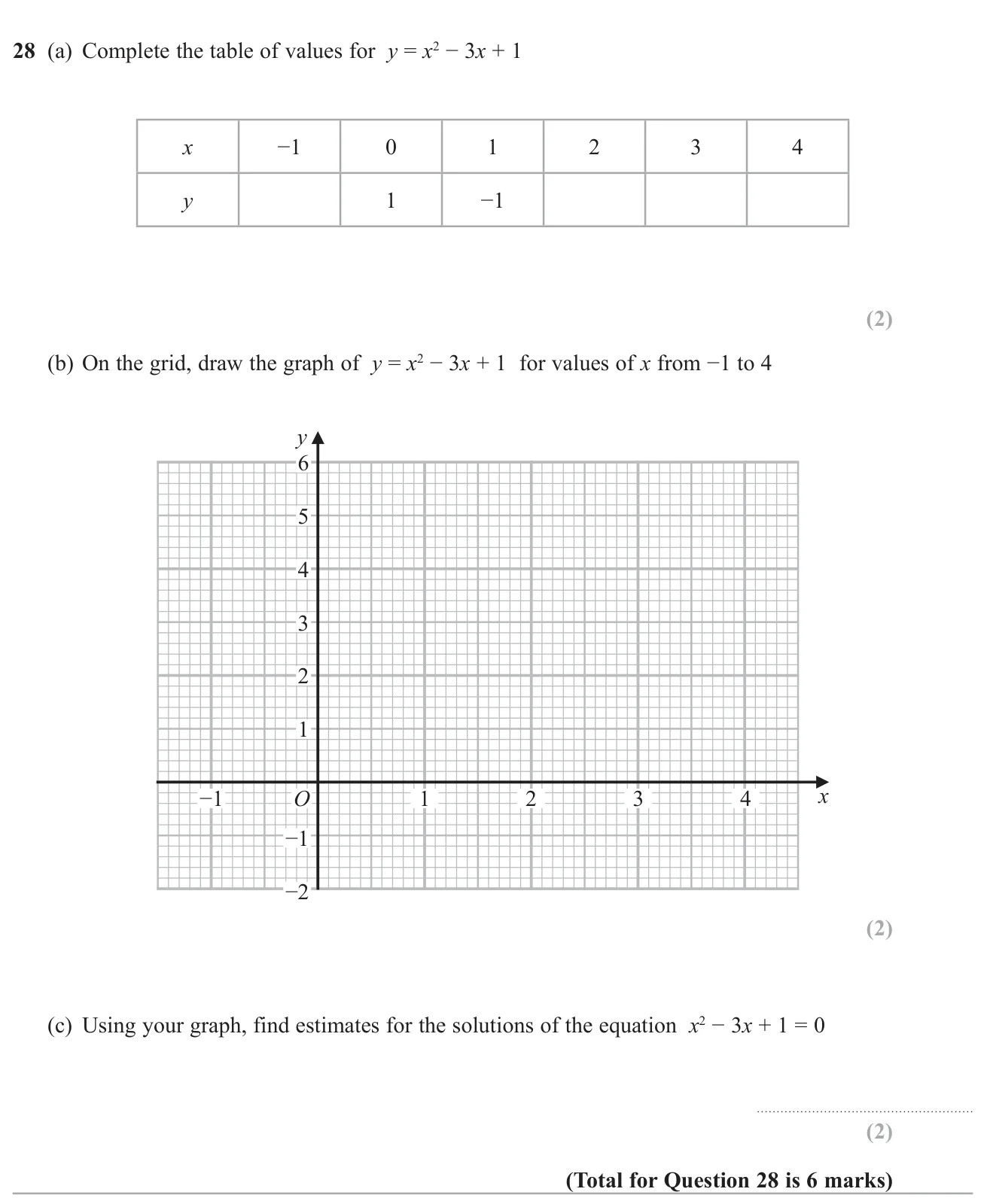
© Pearson Education Ltd. June 2022 Paper 1 (Foundation, non-calculator), question 28.
| (a) | 5, −1, 1, 5 (for x = −1, 2, 3, 4) | 2 marks |
|---|---|---|
| (b) | Smooth U-shaped curve through the plotted points | 2 marks |
| (c) | and | 2 marks |
Worked solution Checked against the mark scheme
(a) : ; : ; : ; :
(b) Plot and join with a smooth curve.
(c) The curve crosses at about and
Watch out: Working out as , giving the wrong value at x = −1.
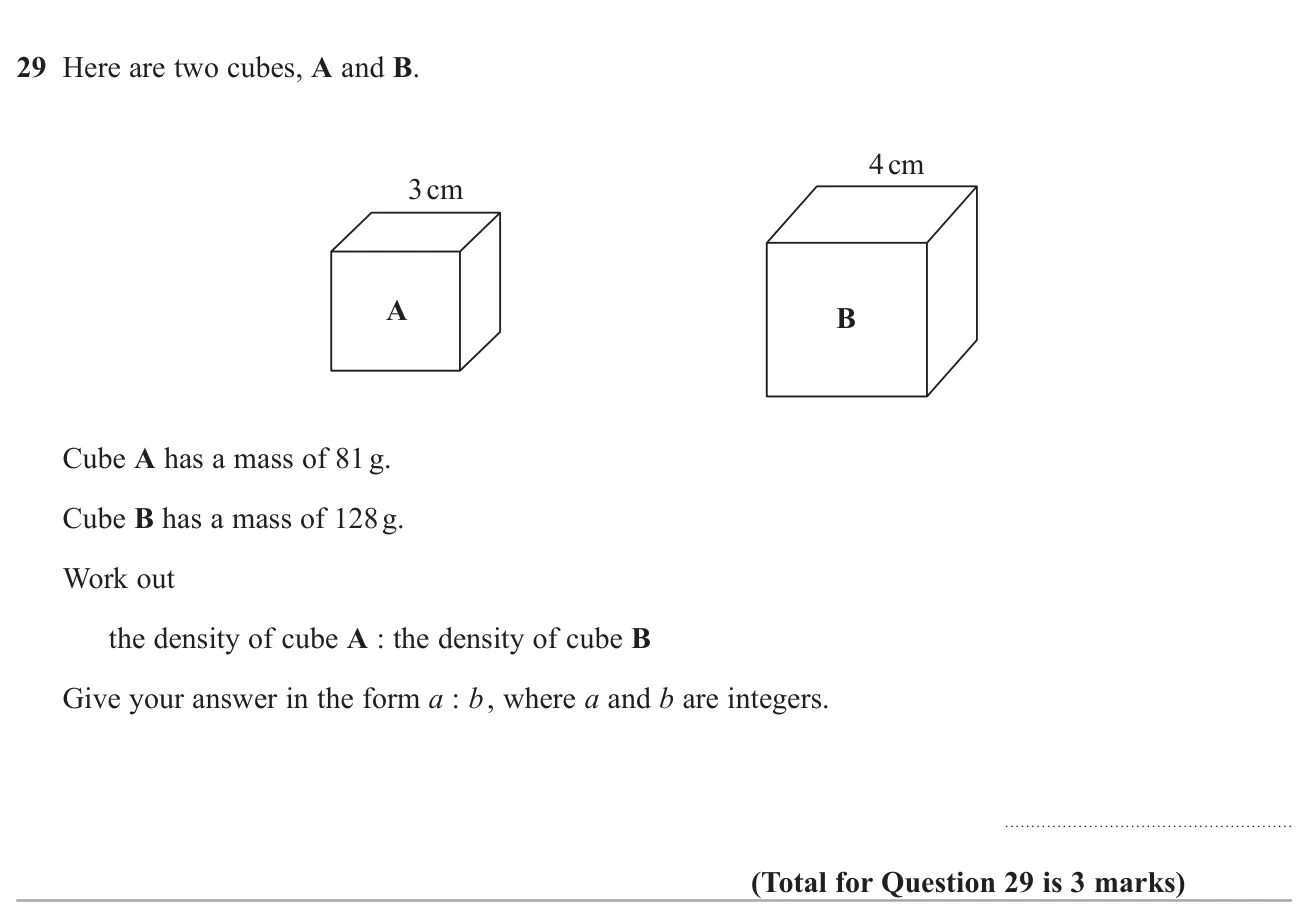
© Pearson Education Ltd. June 2022 Paper 1 (Foundation, non-calculator), question 29.
| Answer | 3 : 2 | 3 marks |
|---|
Worked solution Checked against the mark scheme
Volumes: cm³ and cm³
Densities: g/cm³ and g/cm³
Ratio:
Watch out: Using side length times 6 or squaring instead of cubing.
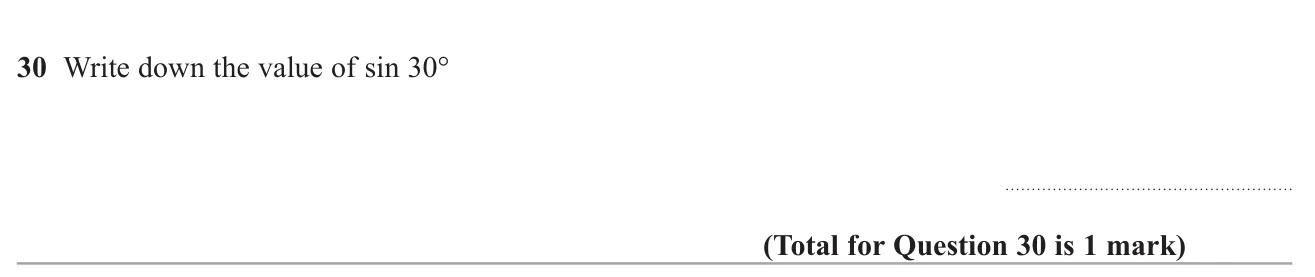
© Pearson Education Ltd. June 2022 Paper 1 (Foundation, non-calculator), question 30.
| Answer | 0.5 | 1 mark |
|---|
Worked solution Checked against the mark scheme
This is one of the exact trig values to learn:
Watch out: Mixing it up with cos 30°.
Add up your marks for all three papers and see what grade that would have been.