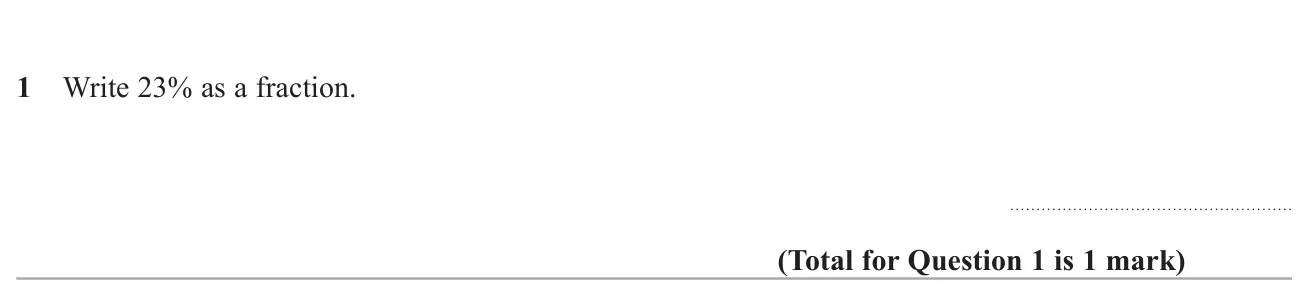
© Pearson Education Ltd. June 2024 Paper 3 (Foundation, calculator), question 1.
Answer 23 100 \frac{23}{100} 100 23 1 mark
Worked solution Checked against the mark scheme
Per cent means 'out of 100', so 23 % = 23 100 23\% = \frac{23}{100} 23% = 100 23
Watch out: Writing 0.23 or 23/10 instead of a fraction out of 100.
© Pearson Education Ltd. June 2024 Paper 3 (Foundation, calculator), question 2.
Worked solution Checked against the mark scheme
There are 100 cm in 1 m.
800 ÷ 100 = 8 800 \div 100 = 8 800 ÷ 100 = 8
Watch out: Multiplying by 100 to get 80 000.
© Pearson Education Ltd. June 2024 Paper 3 (Foundation, calculator), question 3.
Answer tens (or 30 30 30 1 mark
Worked solution Checked against the mark scheme
In 62 837 the digits are: 6 ten-thousands, 2 thousands, 8 hundreds, 3 tens, 7 units.
So the 3 is worth 3 tens, i.e. 30 30 30
Watch out: Answering 3, or saying hundreds.
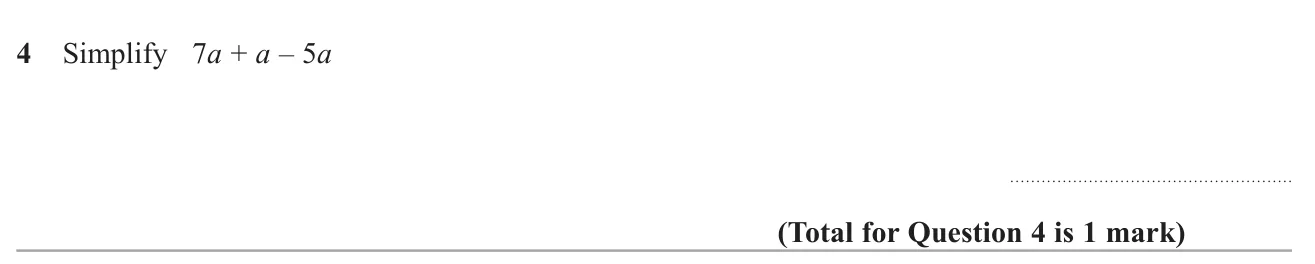
© Pearson Education Ltd. June 2024 Paper 3 (Foundation, calculator), question 4.
Worked solution Checked against the mark scheme
7 a + a = 8 a 7a + a = 8a 7 a + a = 8 a
8 a − 5 a = 3 a 8a - 5a = 3a 8 a − 5 a = 3 a
Watch out: Forgetting that a a a 1 a 1a 1 a 2 a 2a 2 a
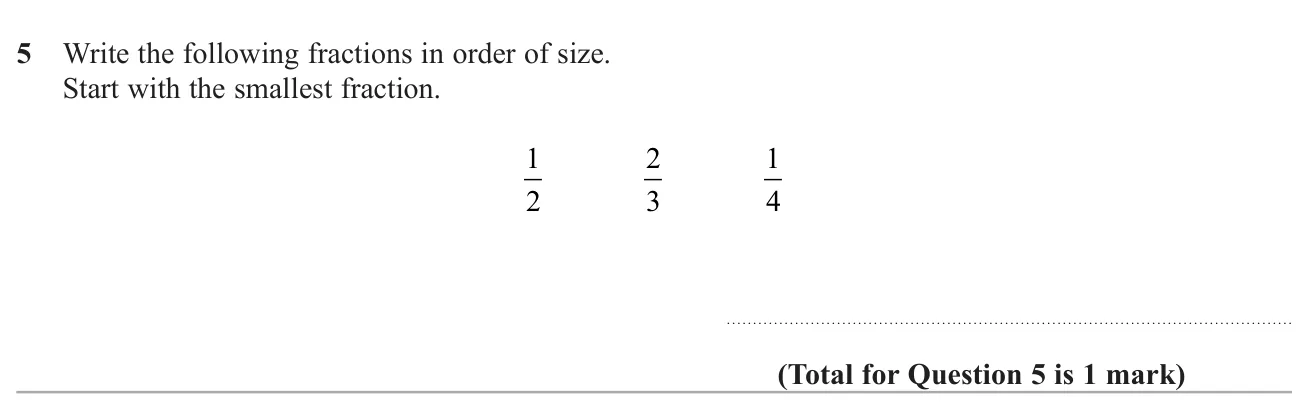
© Pearson Education Ltd. June 2024 Paper 3 (Foundation, calculator), question 5.
Answer 1 4 , 1 2 , 2 3 \frac14,\ \frac12,\ \frac23 4 1 , 2 1 , 3 2 1 mark
Worked solution Checked against the mark scheme
Convert to decimals: 1 2 = 0.5 \frac12 = 0.5 2 1 = 0.5 2 3 ≈ 0.67 \frac23 \approx 0.67 3 2 ≈ 0.67 1 4 = 0.25 \frac14 = 0.25 4 1 = 0.25
Smallest first: 1 4 , 1 2 , 2 3 \frac14,\ \frac12,\ \frac23 4 1 , 2 1 , 3 2
Watch out: Thinking a bigger denominator means a bigger fraction, so putting 1 4 \frac14 4 1
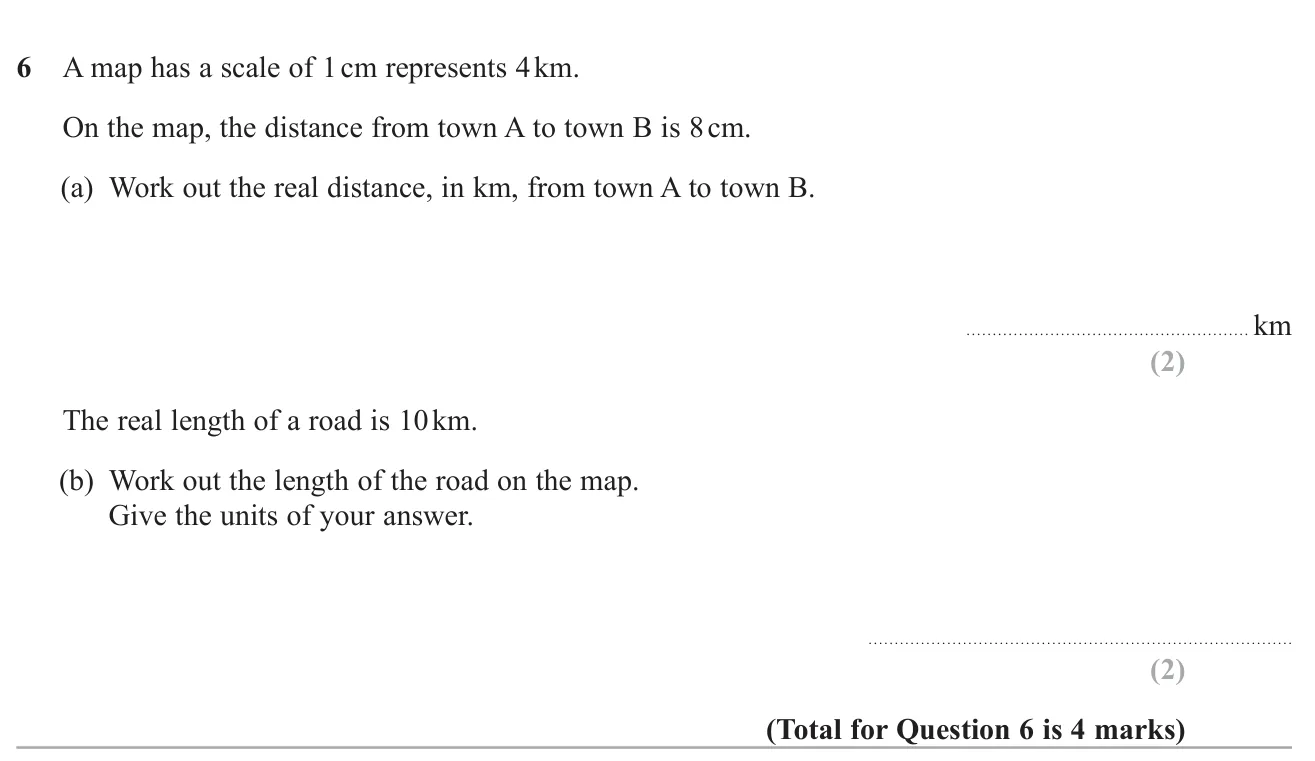
© Pearson Education Ltd. June 2024 Paper 3 (Foundation, calculator), question 6.
(a) 32 32 32 2 marks (b) 2.5 2.5 2.5 2 marks
Worked solution Checked against the mark scheme
(a) Each 1 cm is 4 km, so 8 × 4 = 32 8 \times 4 = 32 8 × 4 = 32
(b) 10 ÷ 4 = 2.5 10 \div 4 = 2.5 10 ÷ 4 = 2.5 2.5 2.5 2.5
Watch out: Leaving off the units in (b), which loses the accuracy mark.
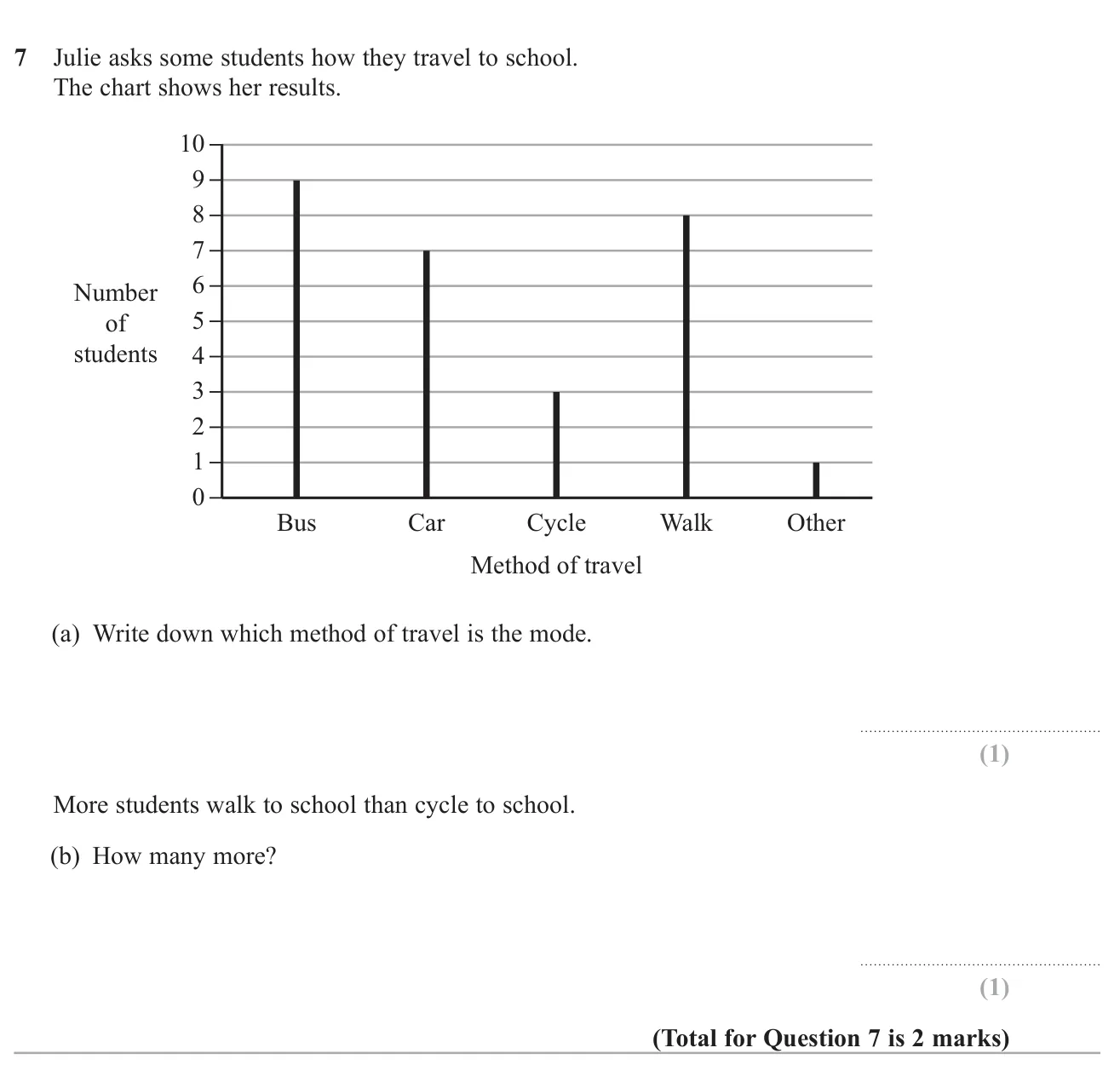
© Pearson Education Ltd. June 2024 Paper 3 (Foundation, calculator), question 7.
Worked solution Checked against the mark scheme
(a) The tallest bar is Bus (9 students), so the mode is Bus.
(b) Walk = 8, Cycle = 3, so 8 − 3 = 5 8 - 3 = 5 8 − 3 = 5
Watch out: Giving the frequency 9 instead of the category for the mode.
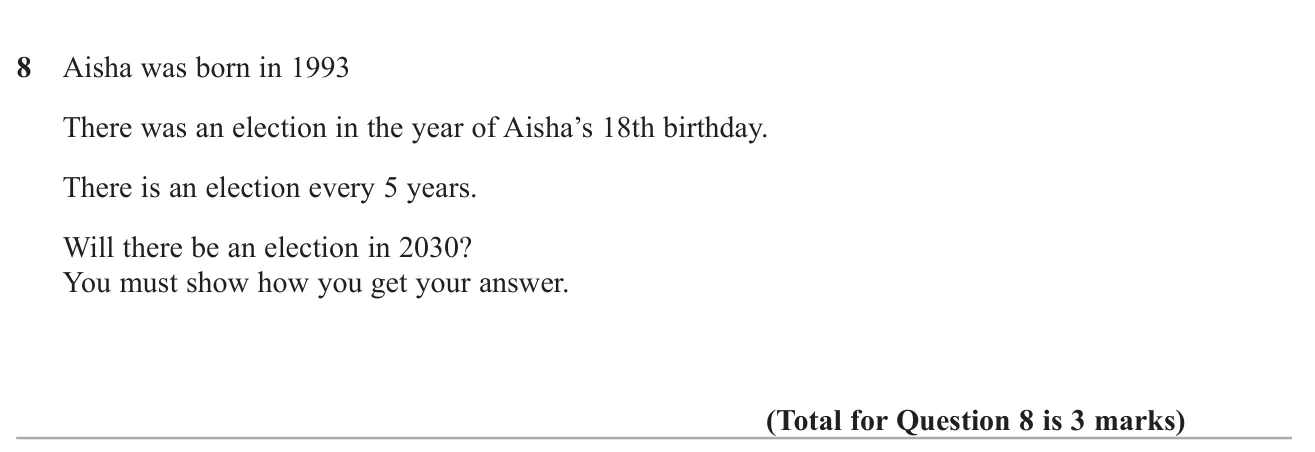
© Pearson Education Ltd. June 2024 Paper 3 (Foundation, calculator), question 8.
Answer No, with correct figures (elections in 2011, 2016, 2021, 2026, 2031) 3 marks
Worked solution Checked against the mark scheme
Aisha's 18th birthday: 1993 + 18 = 2011 1993 + 18 = 2011 1993 + 18 = 2011
Elections every 5 years: 2011, 2016, 2021, 2026, 2031.
2030 is not in the list, so No , there will not be an election in 2030.
Watch out: Counting 5-year steps from 1993 instead of from 2011.
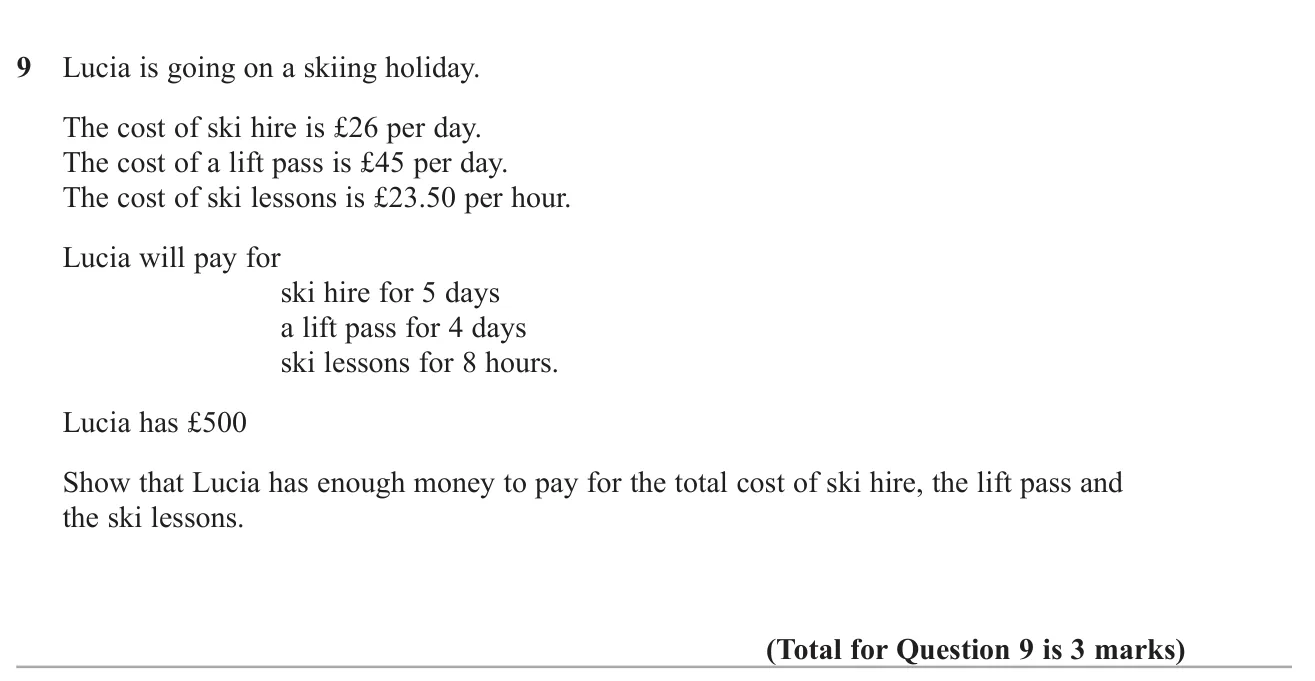
© Pearson Education Ltd. June 2024 Paper 3 (Foundation, calculator), question 9.
Answer Total is £498, which is less than £500, so she has enough 3 marks
Worked solution Checked against the mark scheme
Ski hire: 5 × 26 = £ 130 5 \times 26 = £130 5 × 26 = £130
Lift pass: 4 × 45 = £ 180 4 \times 45 = £180 4 × 45 = £180
Lessons: 8 × 23.50 = £ 188 8 \times 23.50 = £188 8 × 23.50 = £188
Total: 130 + 180 + 188 = £ 498 130 + 180 + 188 = £498 130 + 180 + 188 = £498 498 < 500 498 < 500 498 < 500
Watch out: Using the same number of days for every item.
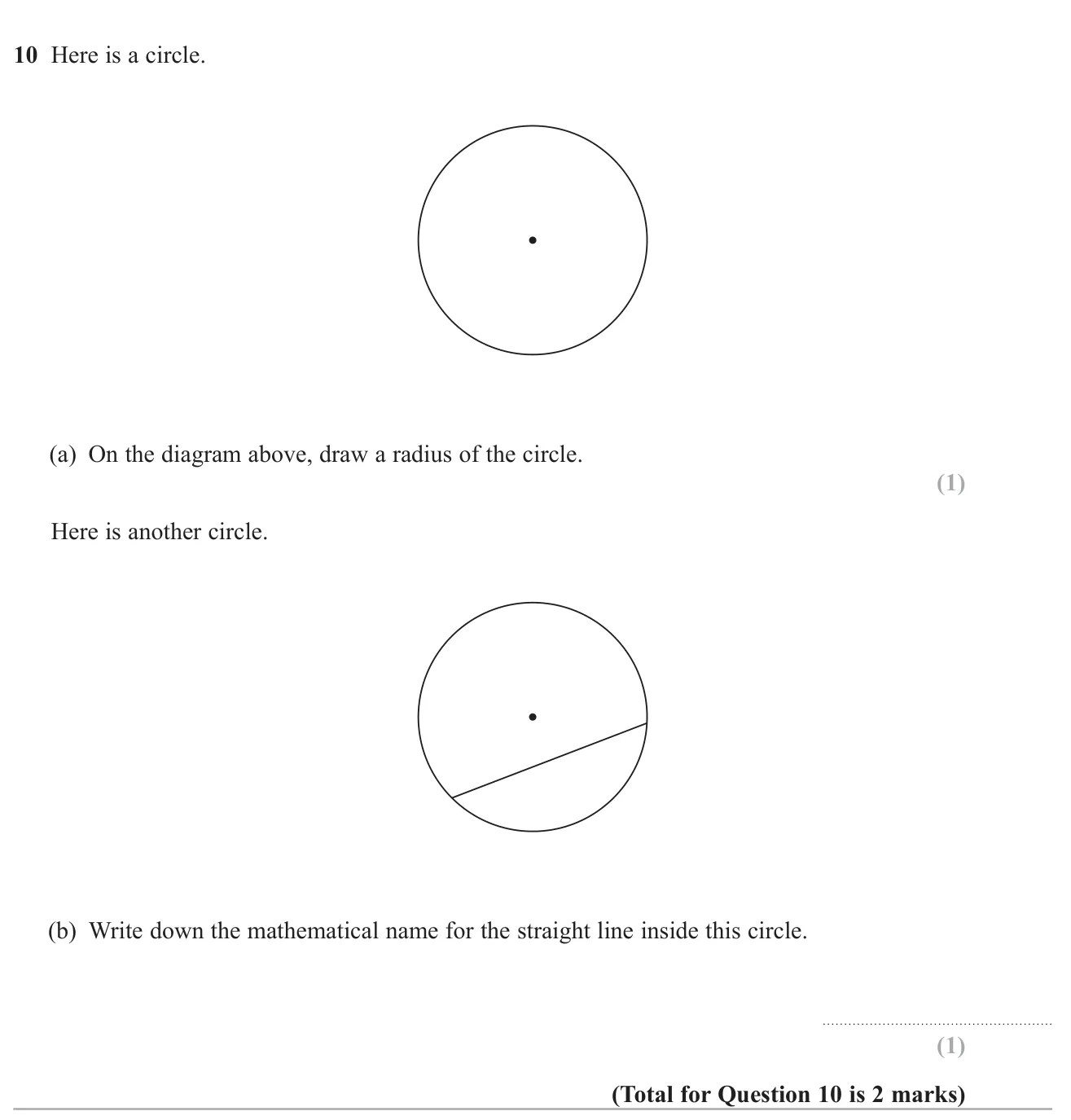
© Pearson Education Ltd. June 2024 Paper 3 (Foundation, calculator), question 10.
(a) A straight line from the centre to the circumference 1 mark (b) chord 1 mark
Worked solution Checked against the mark scheme
(a) A radius joins the centre of the circle to any point on the edge.
(b) A straight line joining two points on the circumference (not through the centre) is a chord .
Watch out: Drawing a diameter instead of a radius, or calling the line a diameter.
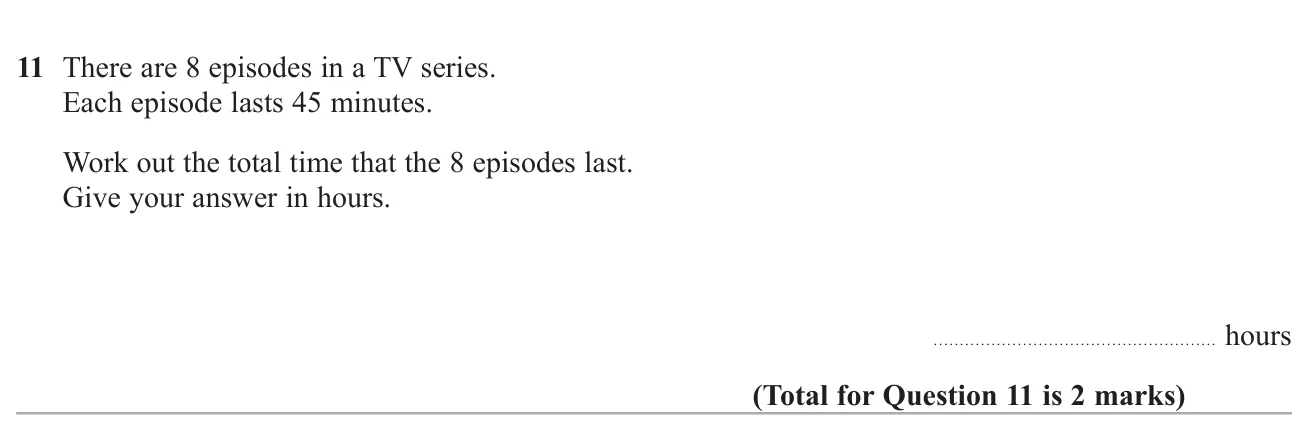
© Pearson Education Ltd. June 2024 Paper 3 (Foundation, calculator), question 11.
Worked solution Checked against the mark scheme
8 × 45 = 360 8 \times 45 = 360 8 × 45 = 360
360 ÷ 60 = 6 360 \div 60 = 6 360 ÷ 60 = 6
Watch out: Dividing by 100 instead of 60, giving 3.6 hours.
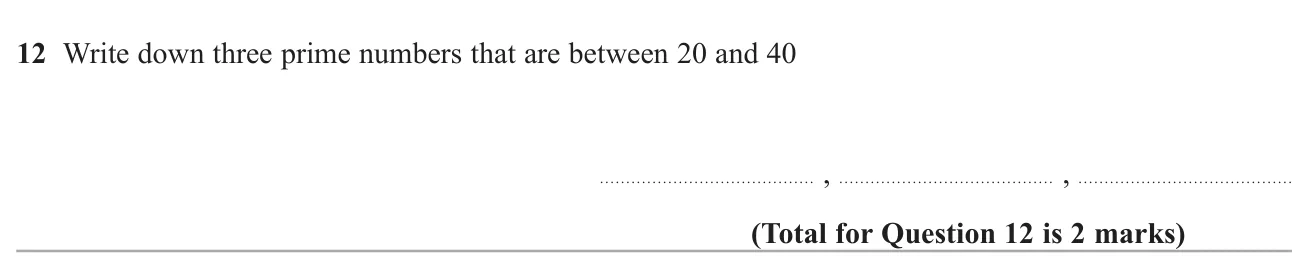
© Pearson Education Ltd. June 2024 Paper 3 (Foundation, calculator), question 12.
Answer Any three of 23 , 29 , 31 , 37 23, 29, 31, 37 23 , 29 , 31 , 37 2 marks
Worked solution Checked against the mark scheme
Check each odd number from 21 to 39 for factors:
21, 25, 27, 33, 35, 39 all have factors other than 1 and themselves.
The primes are 23 , 29 , 31 , 37 23, 29, 31, 37 23 , 29 , 31 , 37
Watch out: Including 27 or 39, which are multiples of 3.
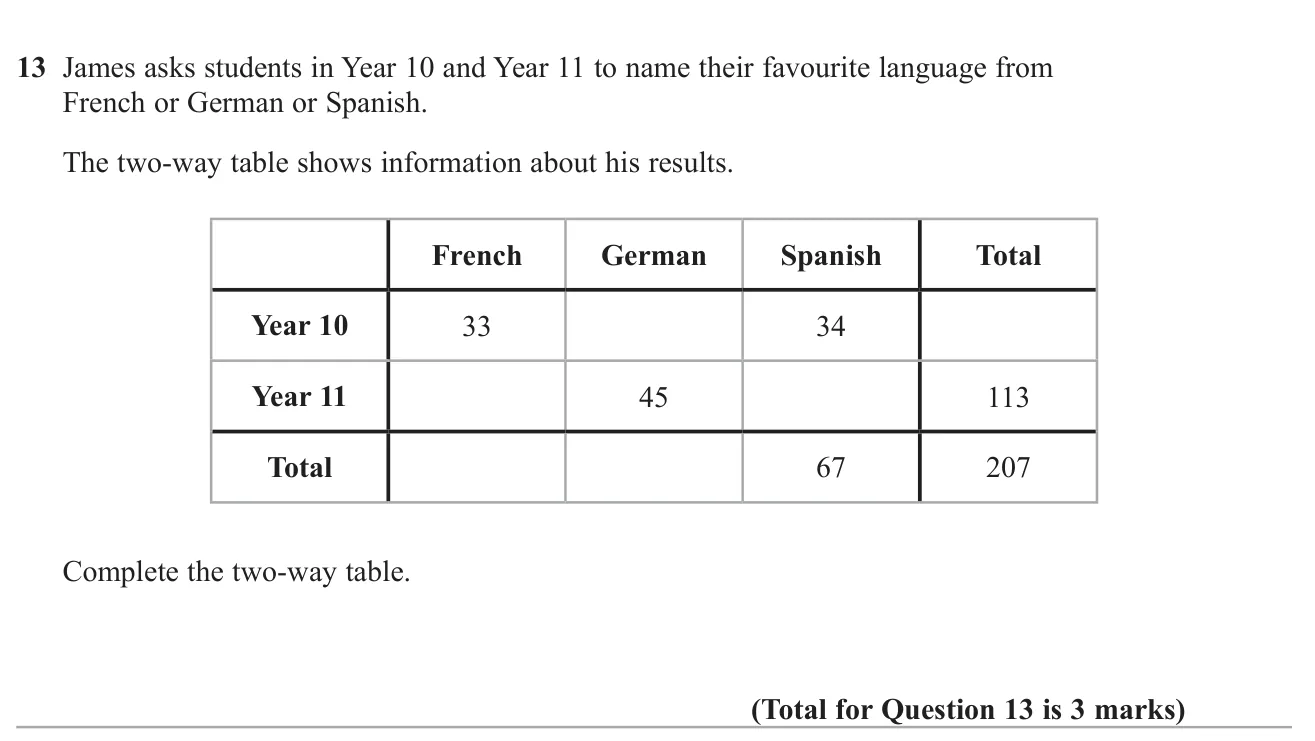
© Pearson Education Ltd. June 2024 Paper 3 (Foundation, calculator), question 13.
Answer Year 10: French 33, German 27, Spanish 34, Total 94; Year 11: French 35, German 45, Spanish 33, Total 113; Totals: 68, 72, 67, 207 3 marks
Worked solution Checked against the mark scheme
Spanish Year 11: 67 − 34 = 33 67 - 34 = 33 67 − 34 = 33
French Year 11: 113 − 45 − 33 = 35 113 - 45 - 33 = 35 113 − 45 − 33 = 35
Year 10 total: 207 − 113 = 94 207 - 113 = 94 207 − 113 = 94
German Year 10: 94 − 33 − 34 = 27 94 - 33 - 34 = 27 94 − 33 − 34 = 27
French total: 33 + 35 = 68 33 + 35 = 68 33 + 35 = 68 27 + 45 = 72 27 + 45 = 72 27 + 45 = 72 68 + 72 + 67 = 207 68 + 72 + 67 = 207 68 + 72 + 67 = 207
Watch out: Filling a cell before enough information is known and then not checking the totals.
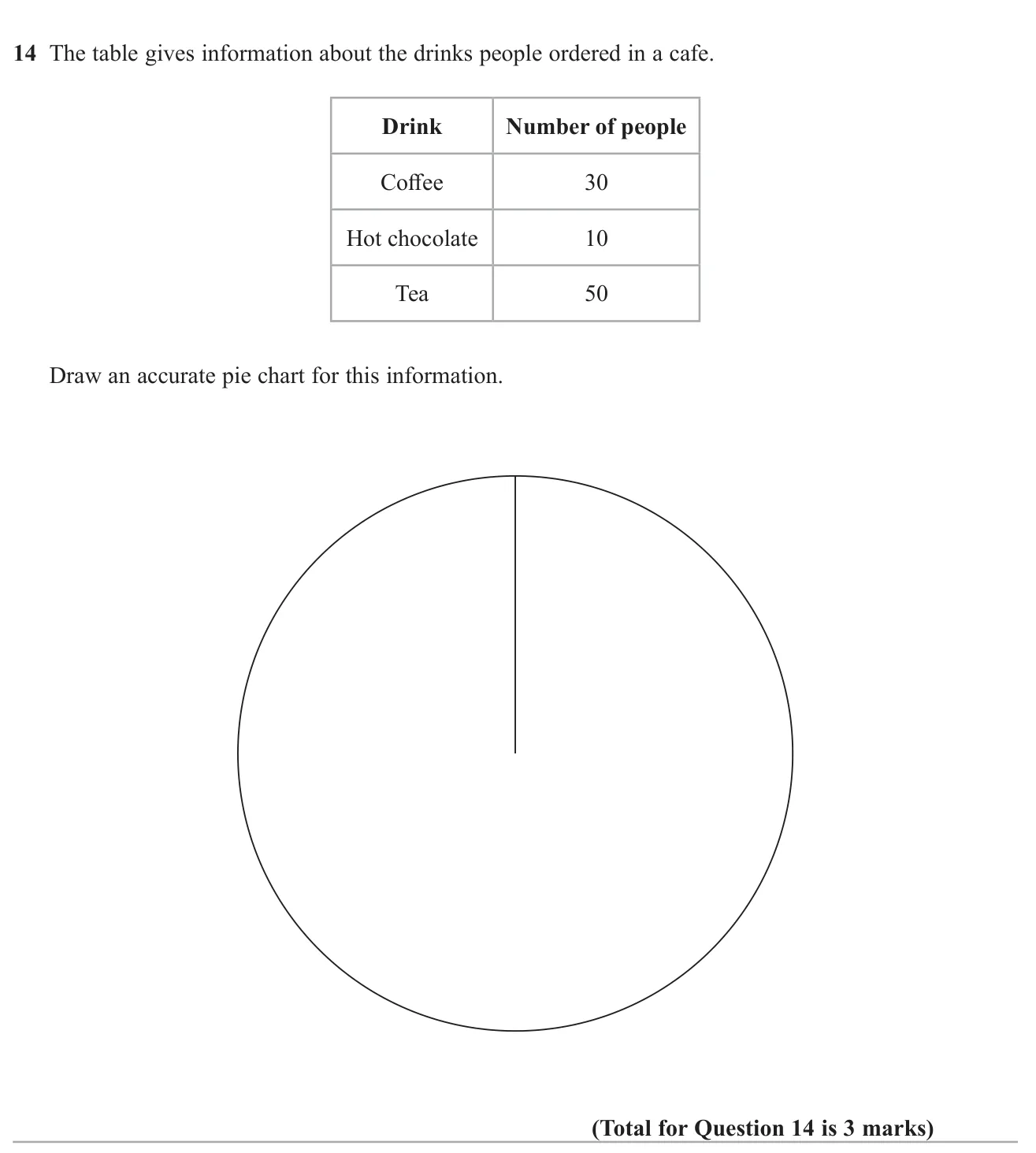
© Pearson Education Ltd. June 2024 Paper 3 (Foundation, calculator), question 14.
Answer Pie chart with Coffee 120 ° 120° 120° 40 ° 40° 40° 200 ° 200° 200° 3 marks
Worked solution Checked against the mark scheme
Total people: 30 + 10 + 50 = 90 30 + 10 + 50 = 90 30 + 10 + 50 = 90
Each person: 360 ÷ 90 = 4 ° 360 \div 90 = 4° 360 ÷ 90 = 4°
Coffee 30 × 4 = 120 ° 30 \times 4 = 120° 30 × 4 = 120° 10 × 4 = 40 ° 10 \times 4 = 40° 10 × 4 = 40° 50 × 4 = 200 ° 50 \times 4 = 200° 50 × 4 = 200°
Draw each angle with a protractor and label each sector with the drink.
Watch out: Labelling sectors with angles instead of drink names.
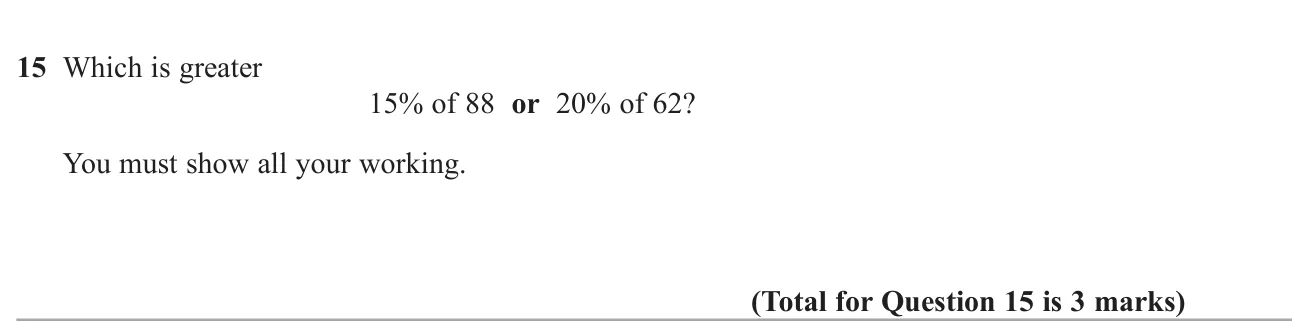
© Pearson Education Ltd. June 2024 Paper 3 (Foundation, calculator), question 15.
Answer 15% of 88, since 13.2 > 12.4 13.2 > 12.4 13.2 > 12.4 3 marks
Worked solution Checked against the mark scheme
15 % 15\% 15% 88 = 0.15 × 88 = 13.2 88 = 0.15 \times 88 = 13.2 88 = 0.15 × 88 = 13.2
20 % 20\% 20% 62 = 0.2 × 62 = 12.4 62 = 0.2 \times 62 = 12.4 62 = 0.2 × 62 = 12.4
13.2 > 12.4 13.2 > 12.4 13.2 > 12.4 15% of 88 is greater.
Watch out: Assuming 20% must give the bigger answer without calculating.
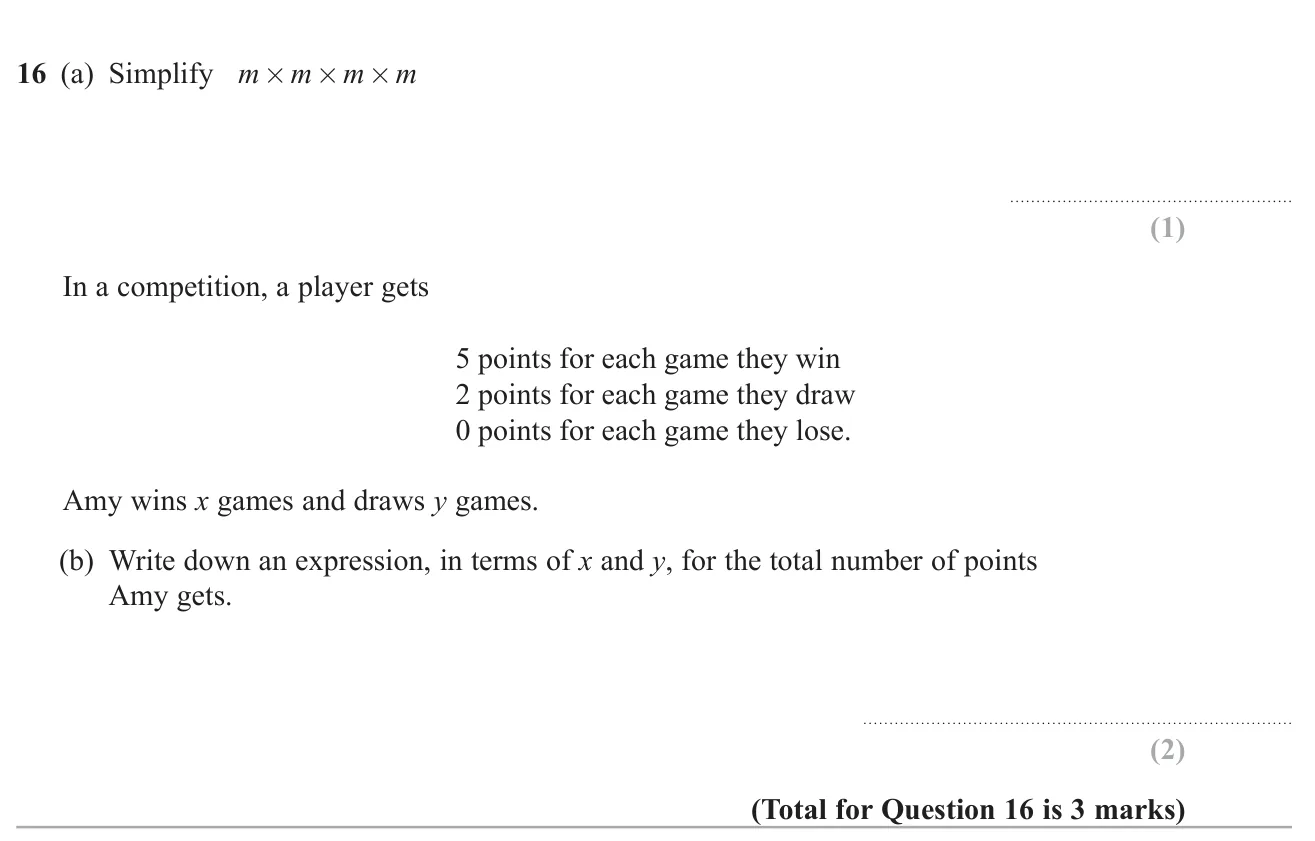
© Pearson Education Ltd. June 2024 Paper 3 (Foundation, calculator), question 16.
(a) m 4 m^4 m 4 1 mark (b) 5 x + 2 y 5x + 2y 5 x + 2 y 2 marks
Worked solution Checked against the mark scheme
(a) m m m m 4 m^4 m 4
(b) Wins score 5 × x = 5 x 5 \times x = 5x 5 × x = 5 x 2 × y = 2 y 2 \times y = 2y 2 × y = 2 y
Total: 5 x + 2 y 5x + 2y 5 x + 2 y
Watch out: Writing 4 m 4m 4 m 7 x y 7xy 7 x y
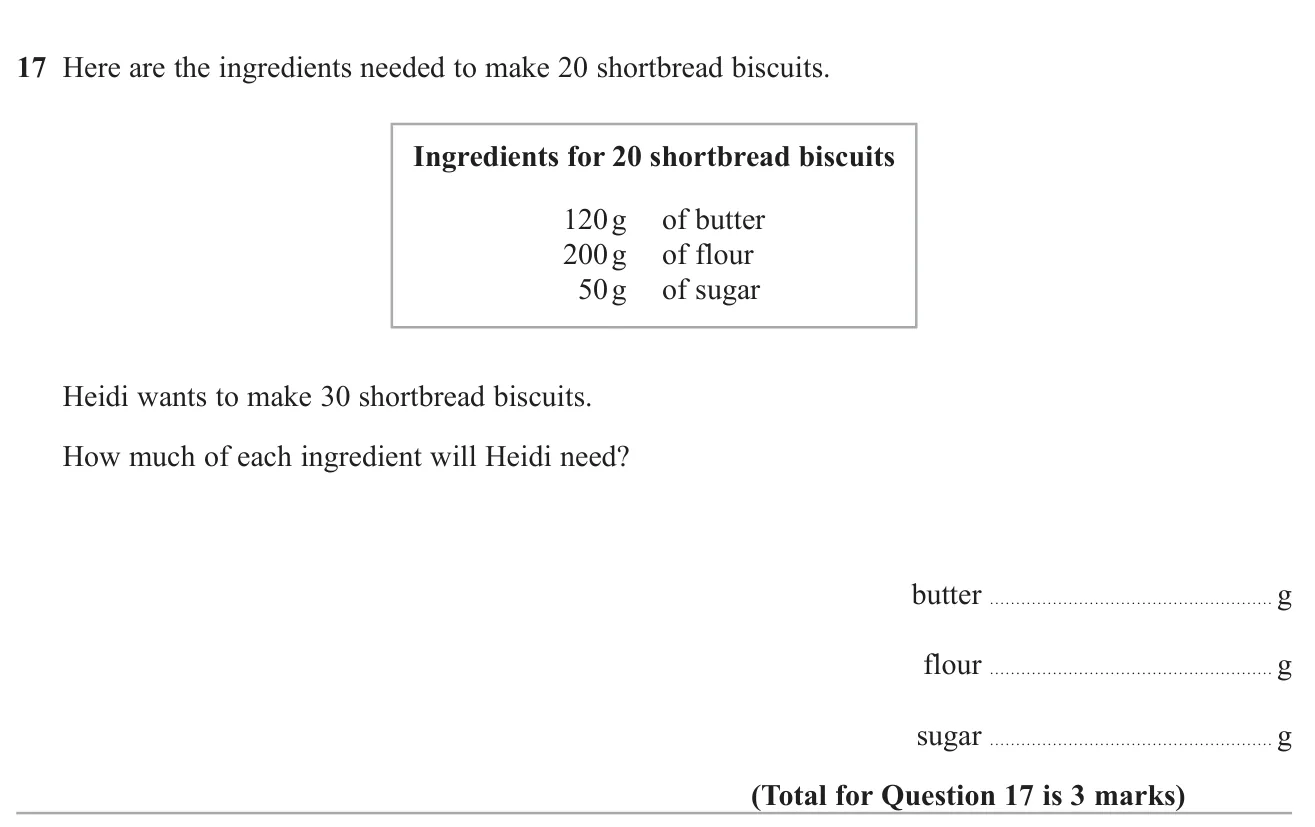
© Pearson Education Ltd. June 2024 Paper 3 (Foundation, calculator), question 17.
Answer butter 180 180 180 300 300 300 75 75 75 3 marks
Worked solution Checked against the mark scheme
Scale factor: 30 ÷ 20 = 1.5 30 \div 20 = 1.5 30 ÷ 20 = 1.5
Butter: 120 × 1.5 = 180 120 \times 1.5 = 180 120 × 1.5 = 180
Flour: 200 × 1.5 = 300 200 \times 1.5 = 300 200 × 1.5 = 300
Sugar: 50 × 1.5 = 75 50 \times 1.5 = 75 50 × 1.5 = 75
Watch out: Adding 10 g to each amount instead of multiplying.
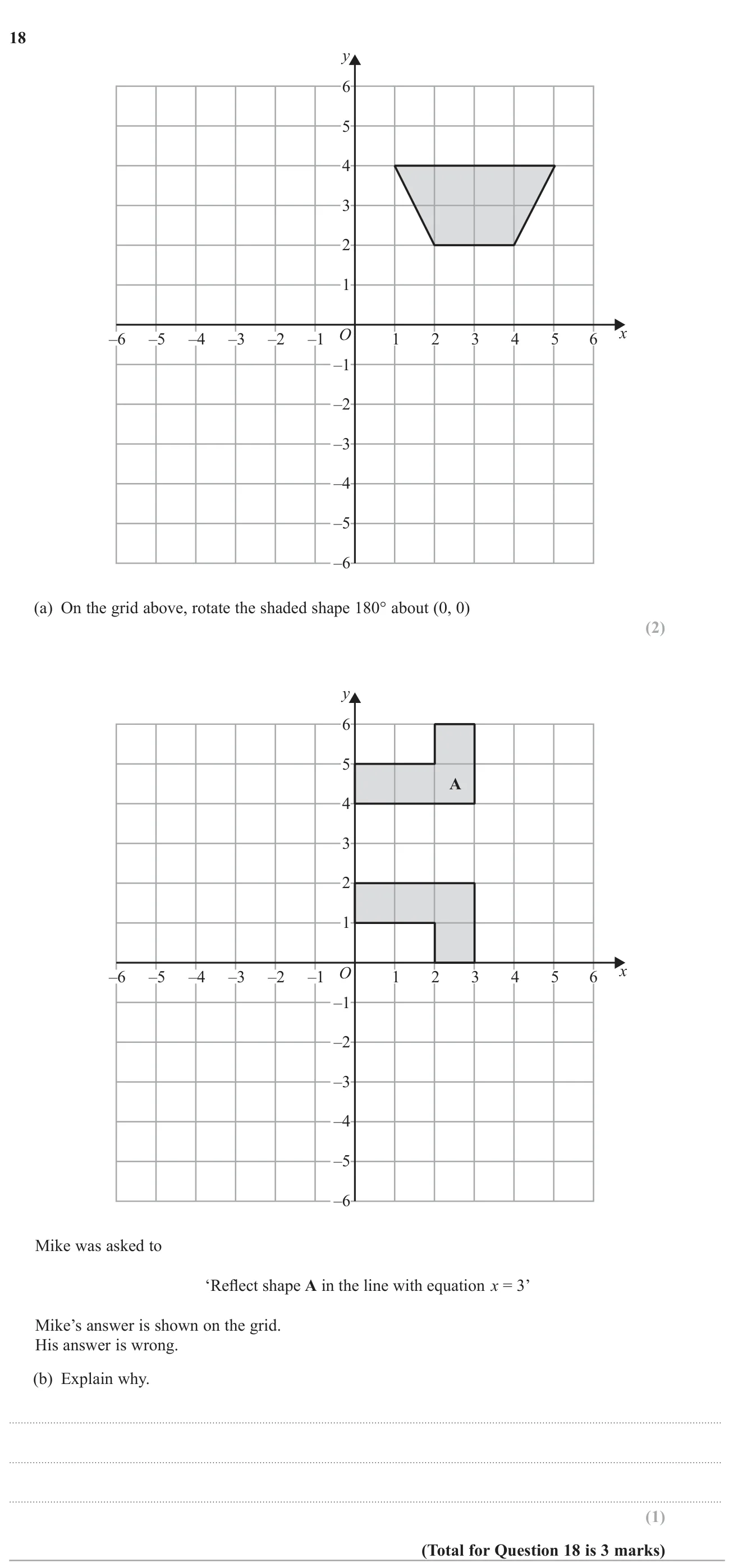
© Pearson Education Ltd. June 2024 Paper 3 (Foundation, calculator), question 18.
(a) Trapezium with vertices ( − 4 , − 2 ) , ( − 2 , − 2 ) , ( − 1 , − 4 ) , ( − 5 , − 4 ) (-4,-2), (-2,-2), (-1,-4), (-5,-4) ( − 4 , − 2 ) , ( − 2 , − 2 ) , ( − 1 , − 4 ) , ( − 5 , − 4 ) 2 marks (b) He reflected in the line y = 3 y = 3 y = 3 x = 3 x = 3 x = 3 x = 3 x = 3 x = 3 1 mark
Worked solution Checked against the mark scheme
(a) A 180° rotation about ( 0 , 0 ) (0,0) ( 0 , 0 ) ( x , y ) (x, y) ( x , y ) ( − x , − y ) (-x, -y) ( − x , − y )
( 1 , 4 ) → ( − 1 , − 4 ) (1,4)\to(-1,-4) ( 1 , 4 ) → ( − 1 , − 4 ) ( 5 , 4 ) → ( − 5 , − 4 ) (5,4)\to(-5,-4) ( 5 , 4 ) → ( − 5 , − 4 ) ( 4 , 2 ) → ( − 4 , − 2 ) (4,2)\to(-4,-2) ( 4 , 2 ) → ( − 4 , − 2 ) ( 2 , 2 ) → ( − 2 , − 2 ) (2,2)\to(-2,-2) ( 2 , 2 ) → ( − 2 , − 2 )
(b) x = 3 x = 3 x = 3 x x x y = 3 y = 3 y = 3
Watch out: Confusing x = 3 x = 3 x = 3 y = 3 y = 3 y = 3
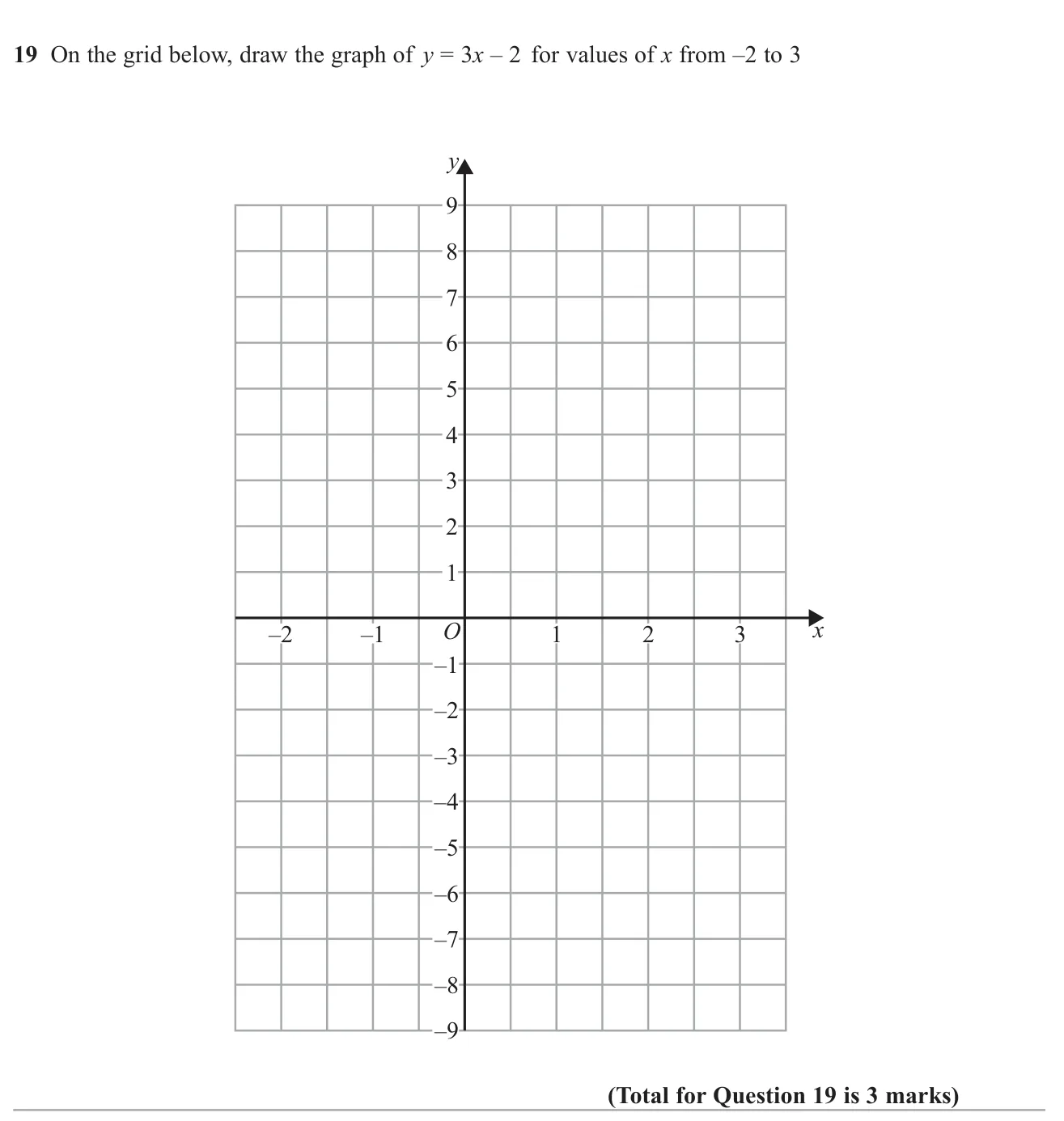
© Pearson Education Ltd. June 2024 Paper 3 (Foundation, calculator), question 19.
Answer Straight line through ( − 2 , − 8 ) , ( − 1 , − 5 ) , ( 0 , − 2 ) , ( 1 , 1 ) , ( 2 , 4 ) , ( 3 , 7 ) (-2,-8), (-1,-5), (0,-2), (1,1), (2,4), (3,7) ( − 2 , − 8 ) , ( − 1 , − 5 ) , ( 0 , − 2 ) , ( 1 , 1 ) , ( 2 , 4 ) , ( 3 , 7 ) 3 marks
Worked solution Checked against the mark scheme
Make a table using y = 3 x − 2 y = 3x - 2 y = 3 x − 2
| x x x y y y
Plot the points and join them with a ruler from x = − 2 x = -2 x = − 2 x = 3 x = 3 x = 3
Watch out: Working out 3 × ( − 2 ) 3 \times (-2) 3 × ( − 2 ) + 6 +6 + 6
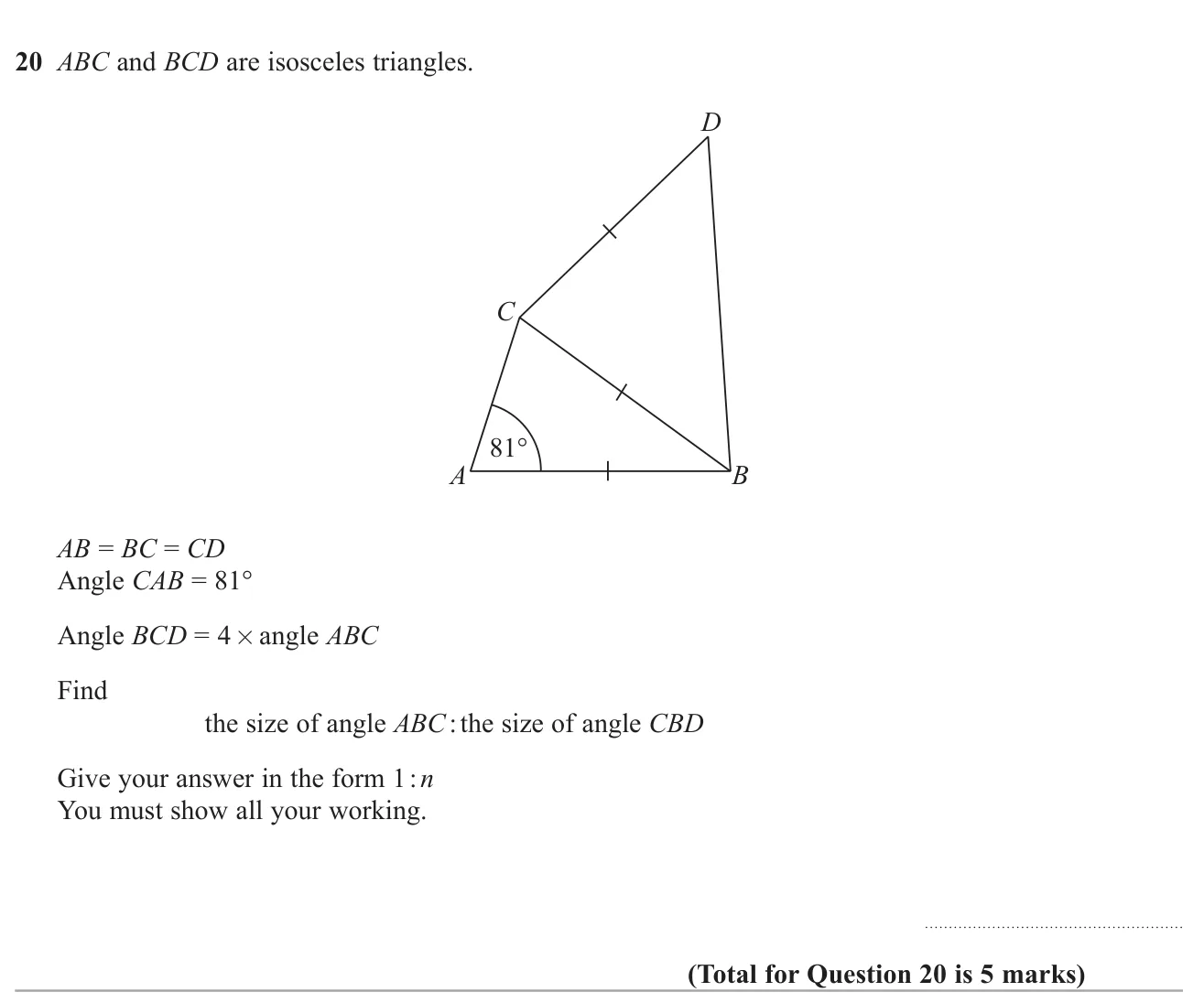
© Pearson Education Ltd. June 2024 Paper 3 (Foundation, calculator), question 20.
Worked solution Checked against the mark scheme
In triangle ABC, A B = B C AB = BC A B = B C 81 ° 81° 81°
Angle ABC = 180 − 2 × 81 = 18 ° = 180 - 2 \times 81 = 18° = 180 − 2 × 81 = 18°
Angle BCD = 4 × 18 = 72 ° = 4 \times 18 = 72° = 4 × 18 = 72°
In triangle BCD, B C = C D BC = CD B C = C D = ( 180 − 72 ) ÷ 2 = 54 ° = (180 - 72) \div 2 = 54° = ( 180 − 72 ) ÷ 2 = 54°
18 : 54 = 1 : 3 18 : 54 = 1 : 3 18 : 54 = 1 : 3
Watch out: Putting the equal angles in the wrong place in triangle BCD (they are opposite the equal sides BC and CD).
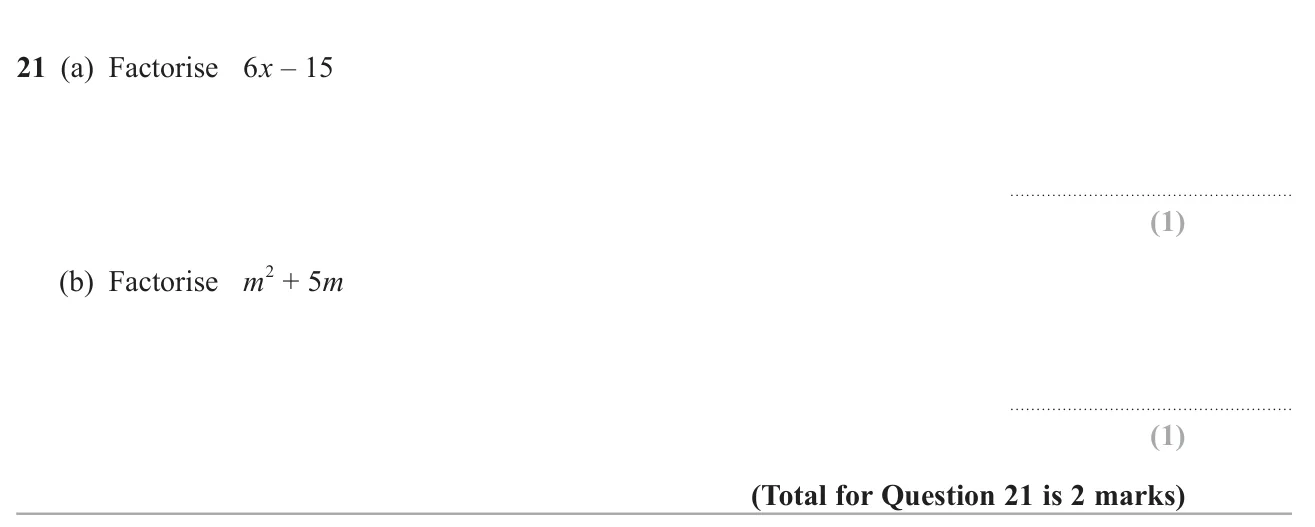
© Pearson Education Ltd. June 2024 Paper 3 (Foundation, calculator), question 21.
(a) 3 ( 2 x − 5 ) 3(2x - 5) 3 ( 2 x − 5 ) 1 mark (b) m ( m + 5 ) m(m + 5) m ( m + 5 ) 1 mark
Worked solution Checked against the mark scheme
(a) The HCF of 6 and 15 is 3: 6 x − 15 = 3 ( 2 x − 5 ) 6x - 15 = 3(2x - 5) 6 x − 15 = 3 ( 2 x − 5 )
(b) Both terms contain m m m m 2 + 5 m = m ( m + 5 ) m^2 + 5m = m(m + 5) m 2 + 5 m = m ( m + 5 )
Watch out: Only partly factorising, or writing m ( m + 5 m ) m(m + 5m) m ( m + 5 m )
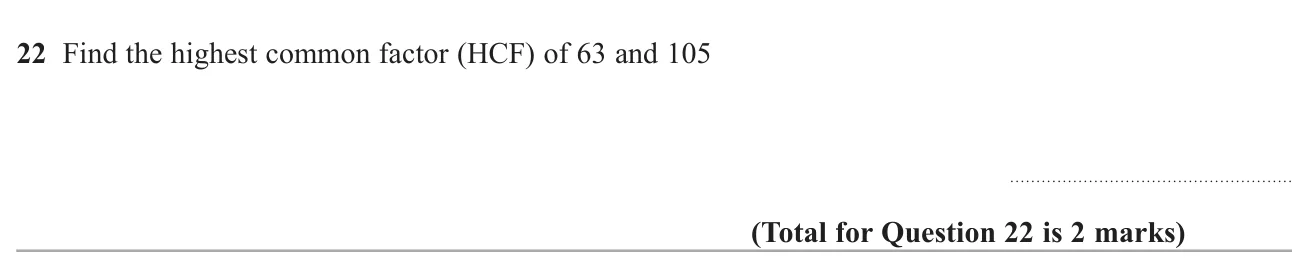
© Pearson Education Ltd. June 2024 Paper 3 (Foundation, calculator), question 22.
Worked solution Checked against the mark scheme
63 = 3 × 3 × 7 63 = 3 \times 3 \times 7 63 = 3 × 3 × 7
105 = 3 × 5 × 7 105 = 3 \times 5 \times 7 105 = 3 × 5 × 7
Common prime factors: 3 × 7 = 21 3 \times 7 = 21 3 × 7 = 21
Watch out: Giving just one common prime factor (3 or 7), or finding the LCM.
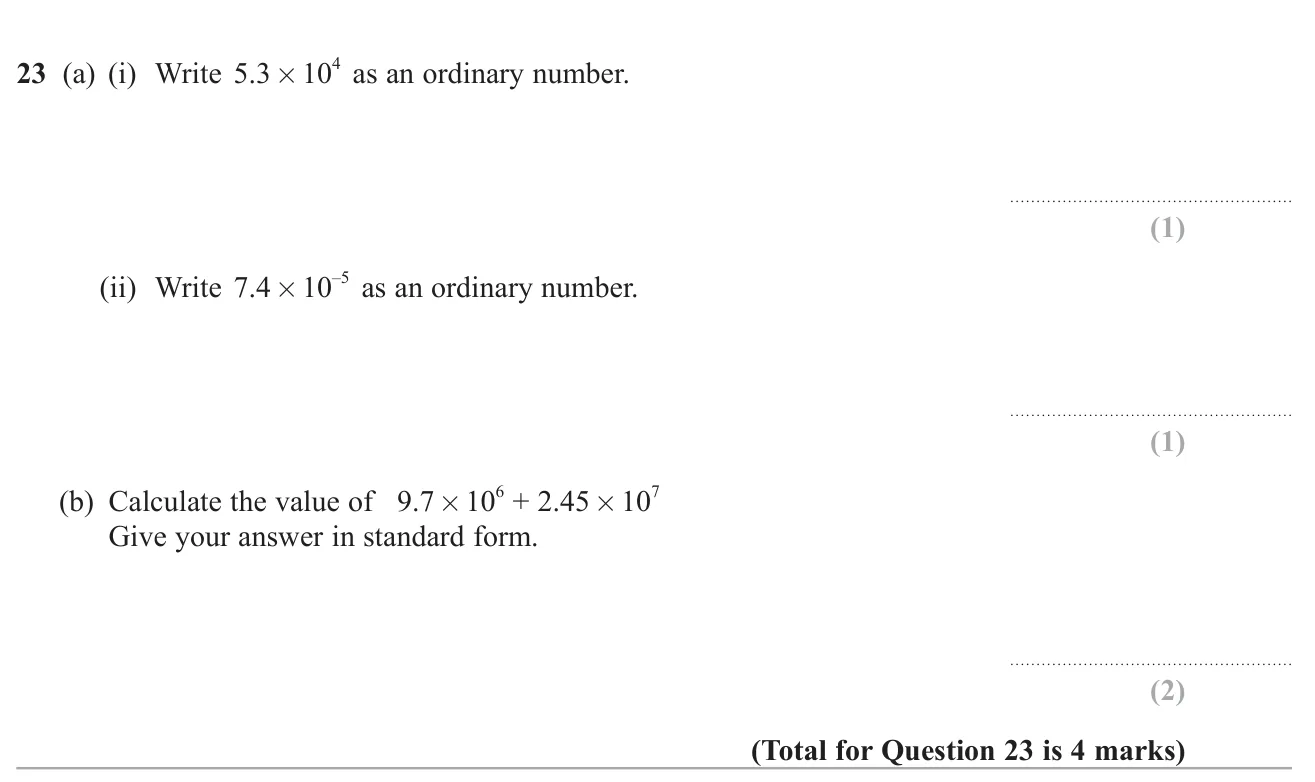
© Pearson Education Ltd. June 2024 Paper 3 (Foundation, calculator), question 23.
(a(i)) 53 000 53\,000 53 000 1 mark (a(ii)) 0.000 074 0.000\,074 0.000 074 1 mark (b) 3.42 × 10 7 3.42 \times 10^7 3.42 × 1 0 7 2 marks
Worked solution Checked against the mark scheme
(a)(i) Move the decimal point 4 places right: 53 000 53\,000 53 000
(a)(ii) Move the decimal point 5 places left: 0.000 074 0.000\,074 0.000 074
(b) 9 700 000 + 24 500 000 = 34 200 000 = 3.42 × 10 7 9\,700\,000 + 24\,500\,000 = 34\,200\,000 = 3.42 \times 10^7 9 700 000 + 24 500 000 = 34 200 000 = 3.42 × 1 0 7
Watch out: Adding the numbers in front and the powers separately, e.g. 12.15 × 10 13 12.15 \times 10^{13} 12.15 × 1 0 13
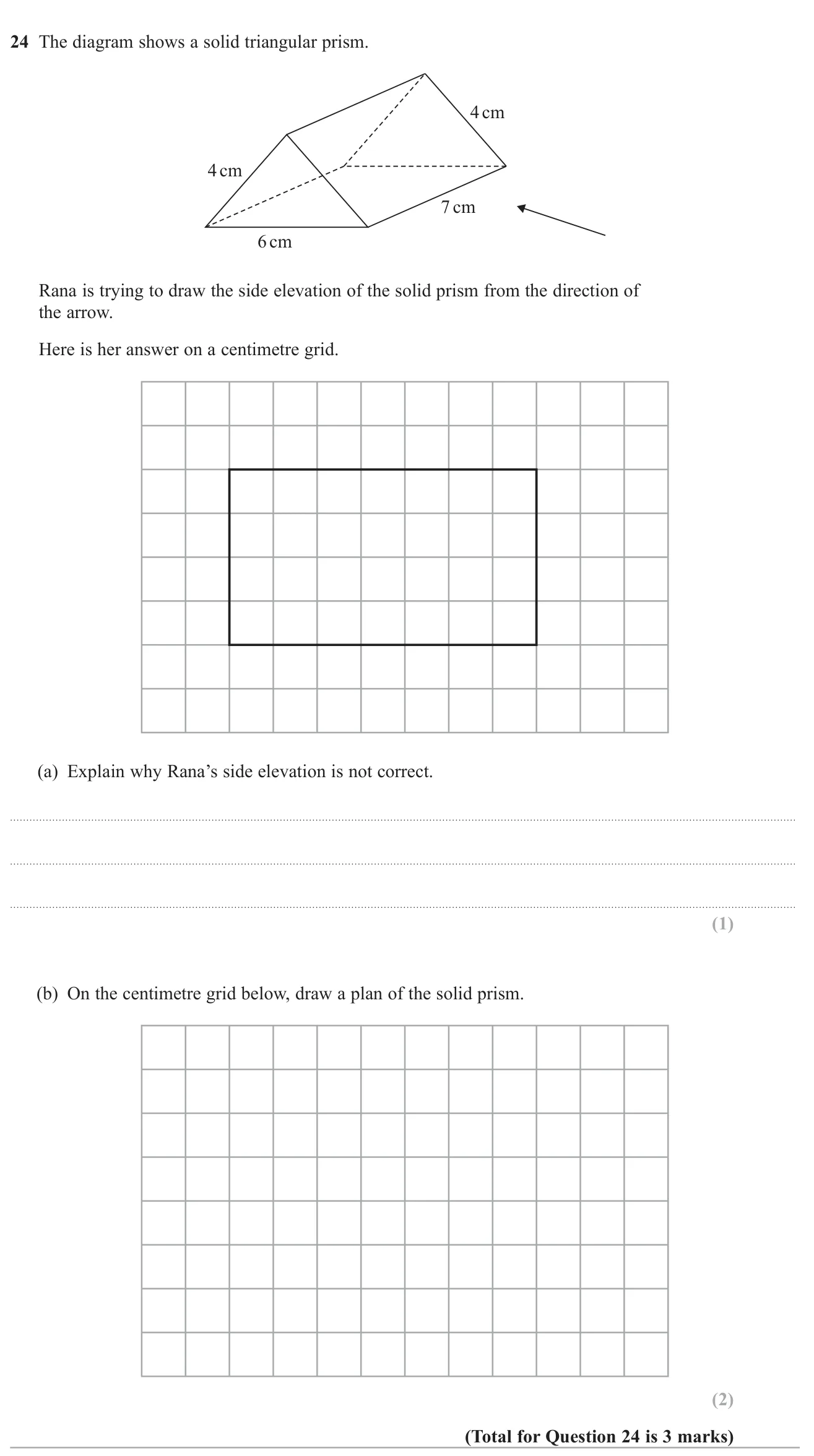
© Pearson Education Ltd. June 2024 Paper 3 (Foundation, calculator), question 24.
(a) The height should be less than 4 cm (the perpendicular height, 7 ≈ 2.6 \sqrt7 \approx 2.6 7 ≈ 2.6 1 mark (b) A 7 cm by 6 cm rectangle with a line parallel to the 7 cm sides through the middle (3 cm from each side) 2 marks
Worked solution Checked against the mark scheme
(a) Rana drew a 7 cm by 4 cm rectangle. The 4 cm sides of the triangle slope, so the prism is not 4 cm tall. Its height is 4 2 − 3 2 = 7 ≈ 2.6 \sqrt{4^2 - 3^2} = \sqrt7 \approx 2.6 4 2 − 3 2 = 7 ≈ 2.6
(b) From above you see the 6 cm by 7 cm base. The top edge (ridge) is above the middle of the 6 cm side, so draw a 7 cm by 6 cm rectangle with a line along its length 3 cm from each long side.
Watch out: Leaving out the ridge line in the plan.
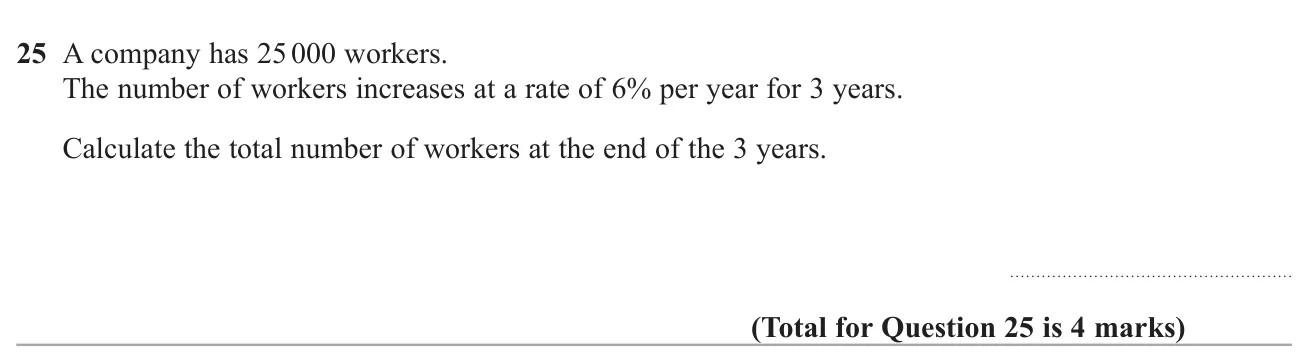
© Pearson Education Ltd. June 2024 Paper 3 (Foundation, calculator), question 25.
Answer 29 775 29\,775 29 775 29 776 29\,776 29 776 29 780 29\,780 29 780 29 800 29\,800 29 800 4 marks
Worked solution Checked against the mark scheme
Multiplier for a 6% increase: 1.06 1.06 1.06
25 000 × 1.06 3 = 29 775.4 25\,000 \times 1.06^3 = 29\,775.4 25 000 × 1.0 6 3 = 29 775.4
So about 29 775 29\,775 29 775
Watch out: Using simple interest: 25 000 + 3 × 1500 = 29 500 25\,000 + 3 \times 1500 = 29\,500 25 000 + 3 × 1500 = 29 500
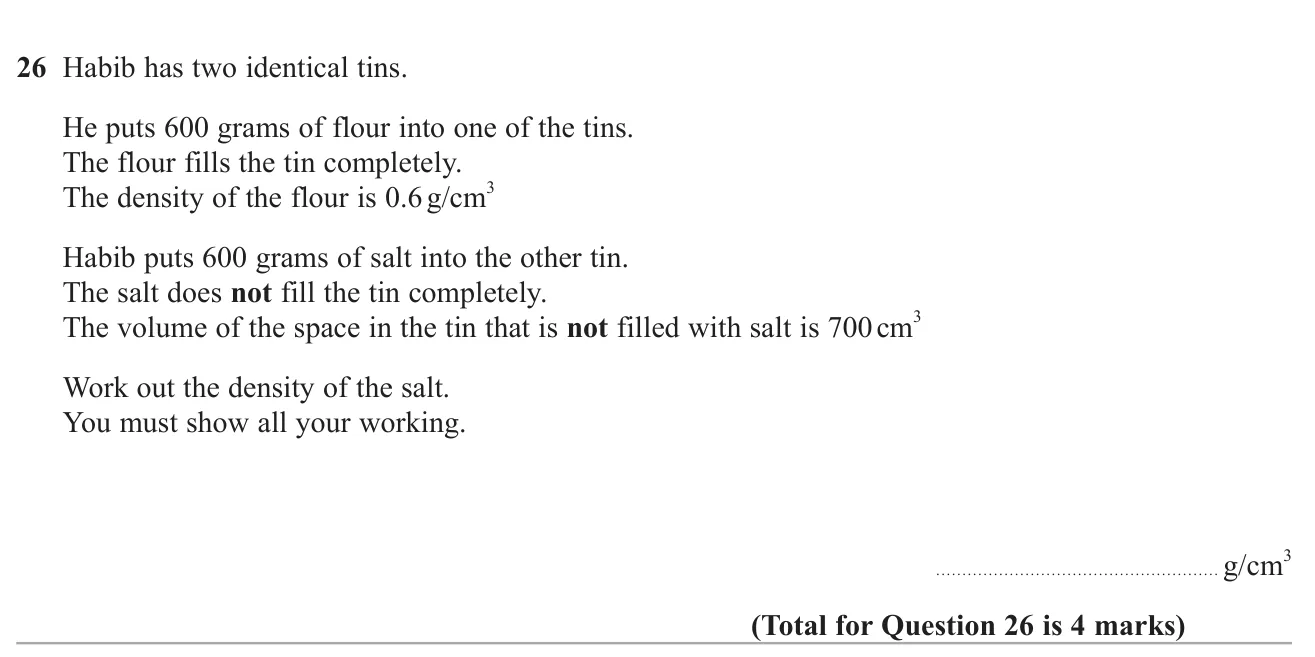
© Pearson Education Ltd. June 2024 Paper 3 (Foundation, calculator), question 26.
Worked solution Checked against the mark scheme
Volume of tin = mass density = 600 ÷ 0.6 = 1000 = \frac{\text{mass}}{\text{density}} = 600 \div 0.6 = 1000 = density mass = 600 ÷ 0.6 = 1000
Volume of salt = 1000 − 700 = 300 = 1000 - 700 = 300 = 1000 − 700 = 300
Density of salt = 600 ÷ 300 = 2 = 600 \div 300 = 2 = 600 ÷ 300 = 2
Watch out: Using 700 cm³ as the volume of salt.
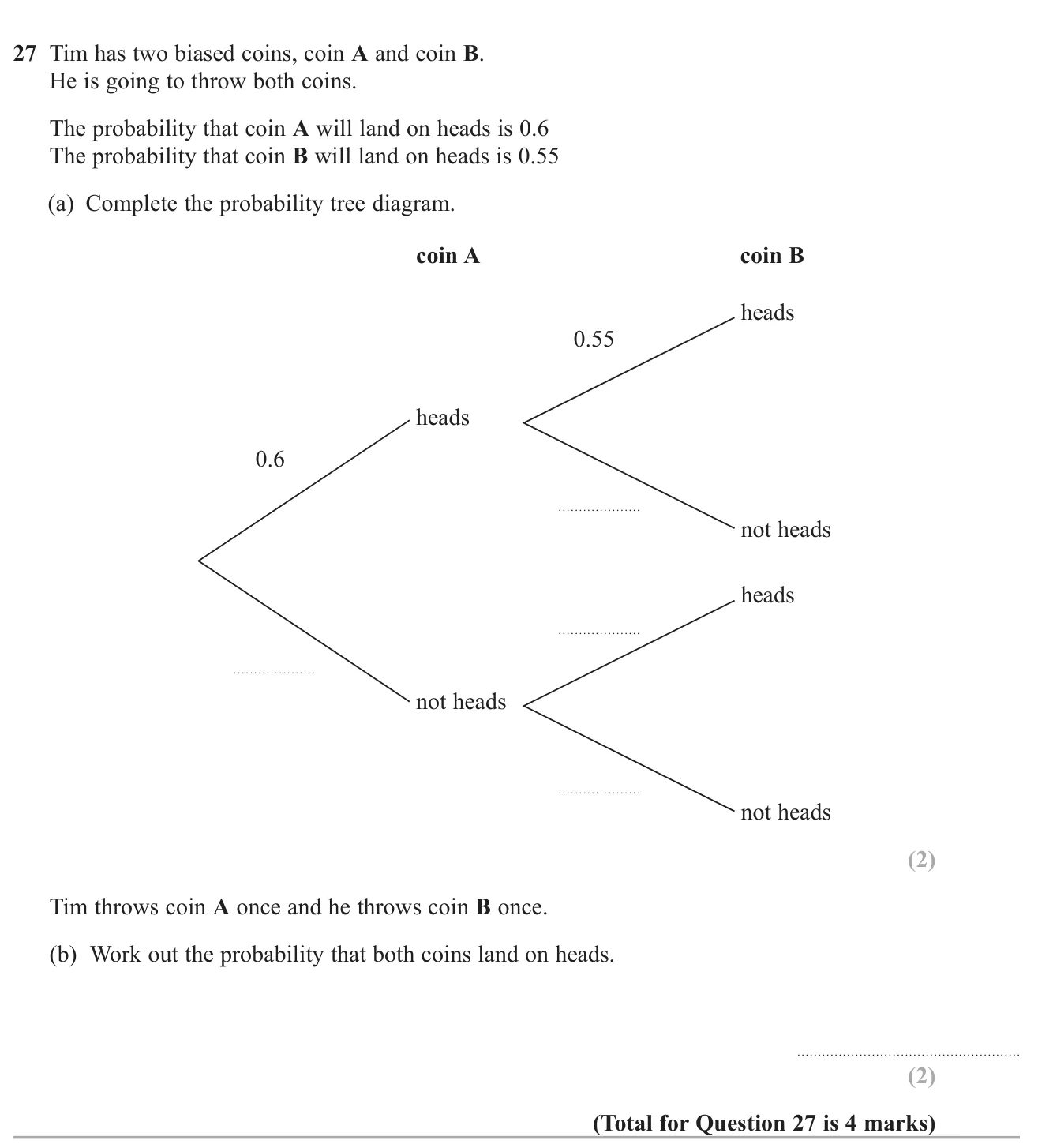
© Pearson Education Ltd. June 2024 Paper 3 (Foundation, calculator), question 27.
(a) Coin A not heads 0.4 0.4 0.4 0.45 0.45 0.45 0.55 0.55 0.55 0.45 0.45 0.45 2 marks (b) 0.33 0.33 0.33 2 marks
Worked solution Checked against the mark scheme
(a) 1 − 0.6 = 0.4 1 - 0.6 = 0.4 1 − 0.6 = 0.4 1 − 0.55 = 0.45 1 - 0.55 = 0.45 1 − 0.55 = 0.45 0.55 0.55 0.55 0.45 0.45 0.45
(b) P ( both heads ) = 0.6 × 0.55 = 0.33 P(\text{both heads}) = 0.6 \times 0.55 = 0.33 P ( both heads ) = 0.6 × 0.55 = 0.33
Watch out: Adding the probabilities (0.6 + 0.55 0.6 + 0.55 0.6 + 0.55
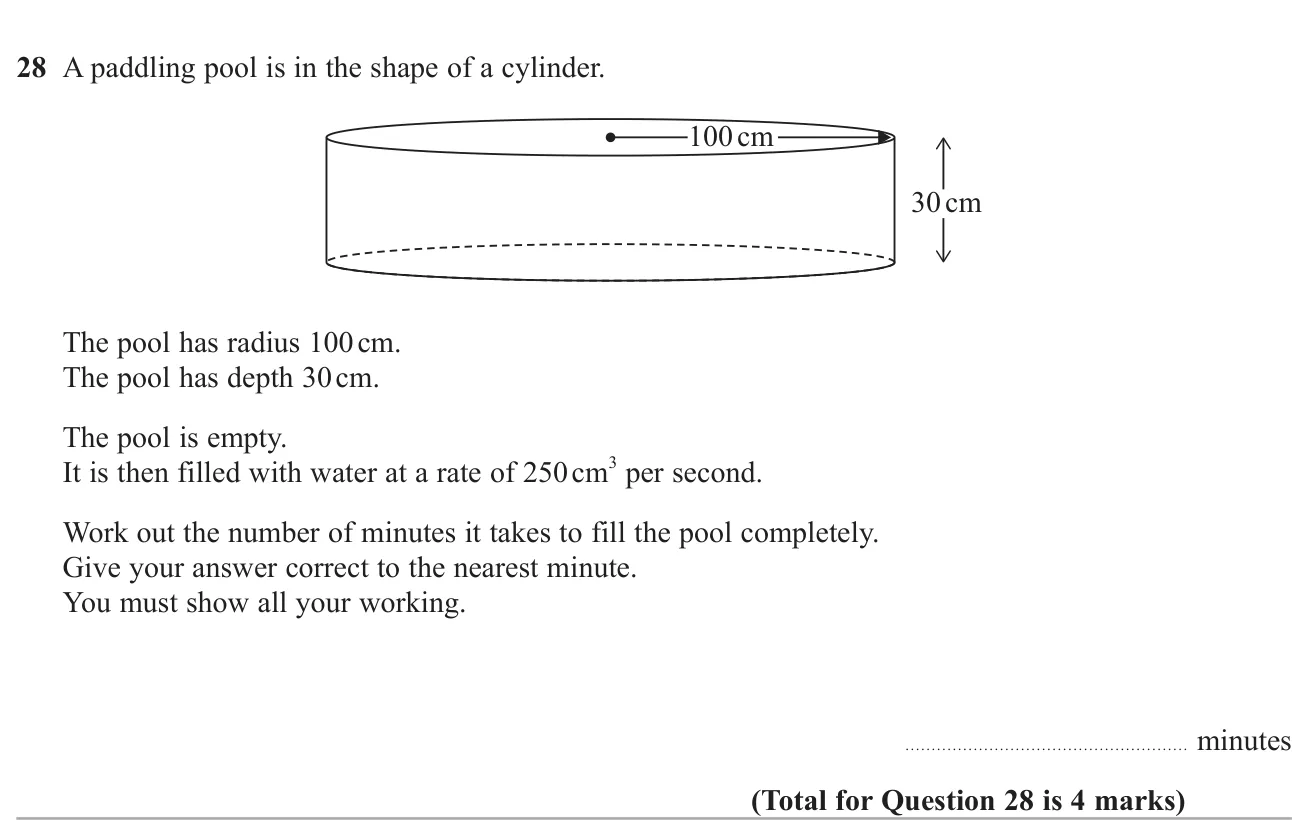
© Pearson Education Ltd. June 2024 Paper 3 (Foundation, calculator), question 28.
Answer 63 63 63 4 marks
Worked solution Checked against the mark scheme
Volume = π r 2 h = π × 100 2 × 30 = 942 478 = \pi r^2 h = \pi \times 100^2 \times 30 = 942\,478 = π r 2 h = π × 10 0 2 × 30 = 942 478
Time = 942 478 ÷ 250 = 3769.9 = 942\,478 \div 250 = 3769.9 = 942 478 ÷ 250 = 3769.9
3769.9 ÷ 60 = 62.8 3769.9 \div 60 = 62.8 3769.9 ÷ 60 = 62.8 63 63 63
Watch out: Using the diameter or forgetting to square the radius; or giving the time in seconds.
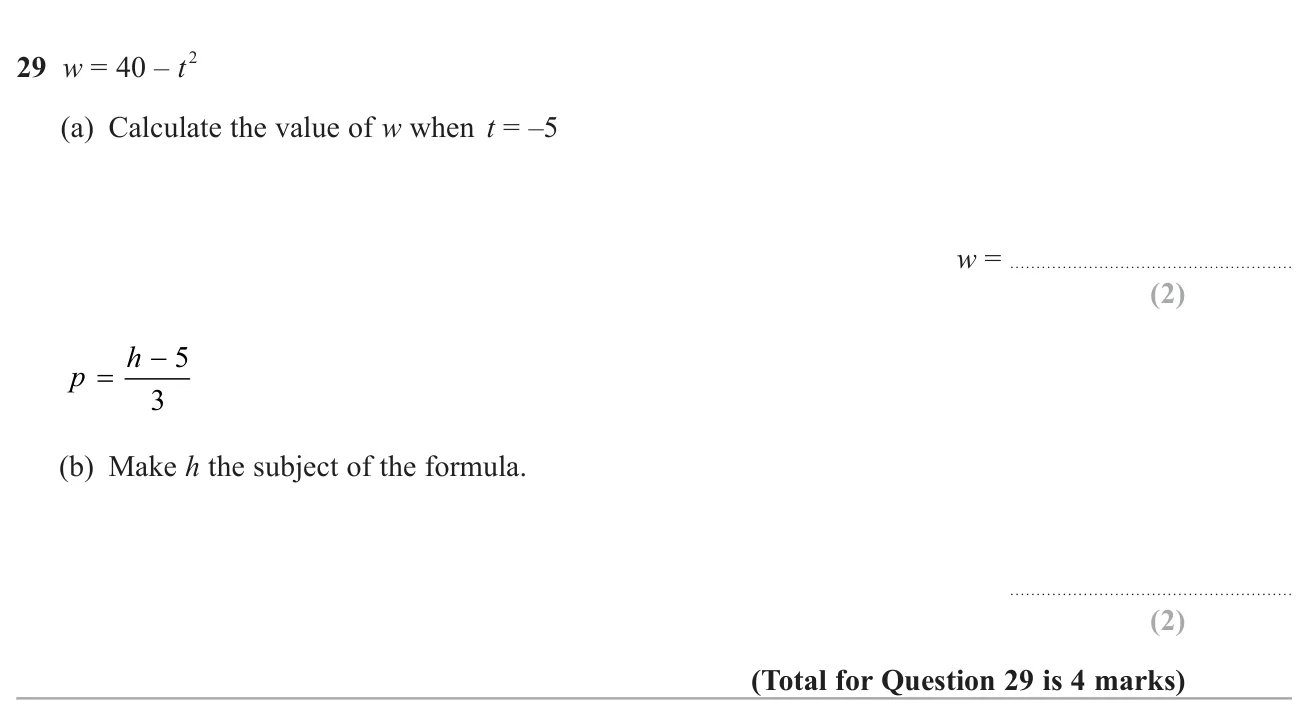
© Pearson Education Ltd. June 2024 Paper 3 (Foundation, calculator), question 29.
(a) w = 15 w = 15 w = 15 2 marks (b) h = 3 p + 5 h = 3p + 5 h = 3 p + 5 2 marks
Worked solution Checked against the mark scheme
(a) w = 40 − ( − 5 ) 2 = 40 − 25 = 15 w = 40 - (-5)^2 = 40 - 25 = 15 w = 40 − ( − 5 ) 2 = 40 − 25 = 15
(b) p = h − 5 3 p = \frac{h - 5}{3} p = 3 h − 5
Multiply by 3: 3 p = h − 5 3p = h - 5 3 p = h − 5
Add 5: h = 3 p + 5 h = 3p + 5 h = 3 p + 5
Watch out: In (a), working out − 5 2 -5^2 − 5 2 − 25 -25 − 25 65 65 65
Finished the paper? Add up your marks for all three papers and see what grade that would have been.