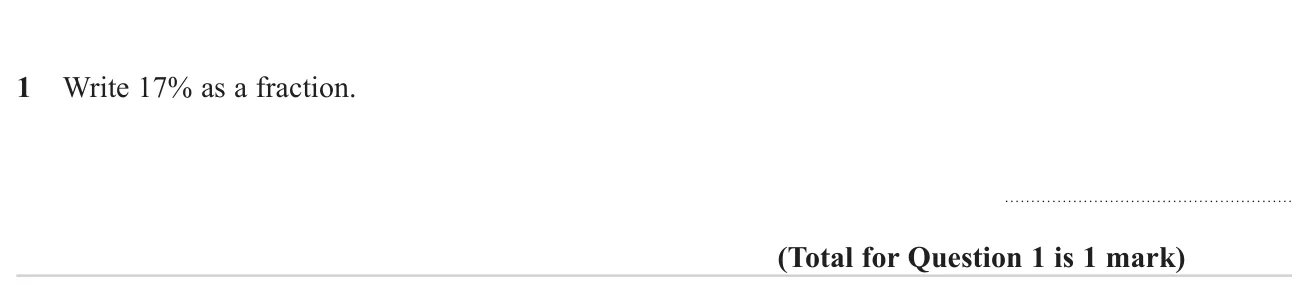
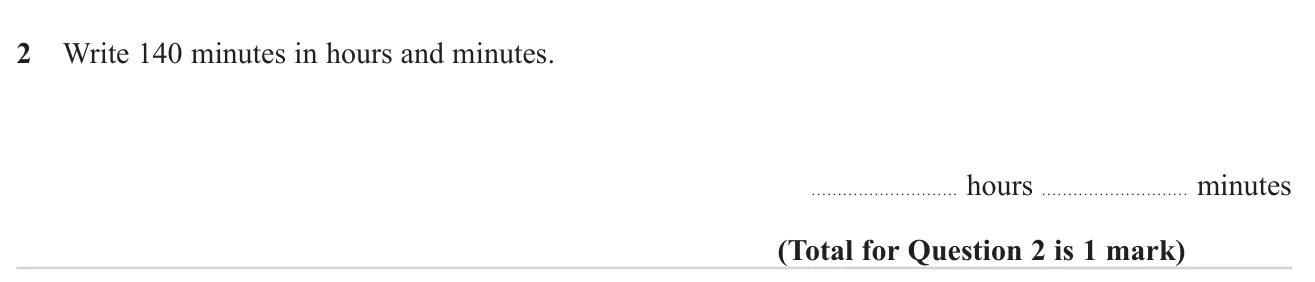
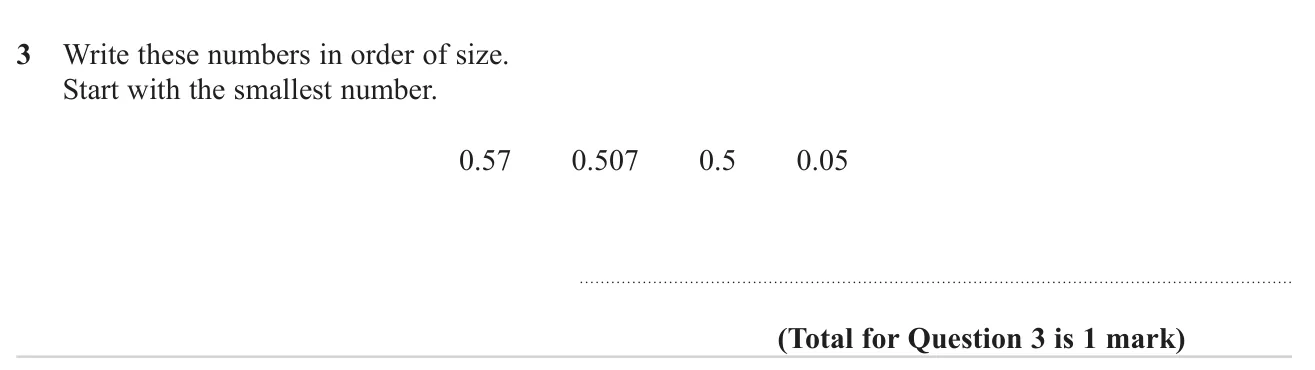
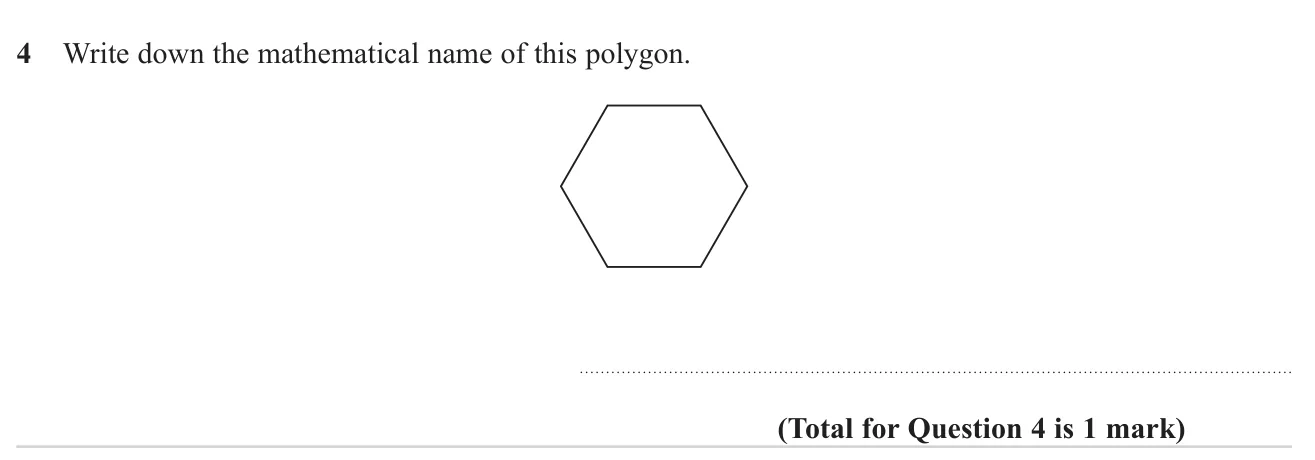
© Pearson Education Ltd. November 2024 Paper 2 (Foundation, calculator), question 1.
Show answer
| Answer | 10017 | 1 mark |
|---|
Worked solution Checked against the mark scheme
Per cent means out of 100, so 17%=10017.
Watch out: Writing 171 or 0.17 instead of a fraction.
© Pearson Education Ltd. November 2024 Paper 2 (Foundation, calculator), question 2.
Show answer
| Answer | 2 hours 20 minutes | 1 mark |
|---|
Worked solution Checked against the mark scheme
There are 60 minutes in an hour.
140=60+60+20, so it is 2 hours 20 minutes.
Watch out: Using 100 minutes in an hour and writing 1 hour 40 minutes.
© Pearson Education Ltd. November 2024 Paper 2 (Foundation, calculator), question 3.
Show answer
| Answer | 0.05, 0.5, 0.507, 0.57 | 1 mark |
|---|
Worked solution Checked against the mark scheme
Give each number three decimal places: 0.570, 0.507, 0.500, 0.050.
Smallest first: 0.05, 0.5, 0.507, 0.57
Watch out: Thinking 0.507 is bigger than 0.57 because it has more digits.
© Pearson Education Ltd. November 2024 Paper 2 (Foundation, calculator), question 4.
Show answer
Worked solution Checked against the mark scheme
Count the sides: there are 6.
A polygon with 6 sides is a hexagon.
Watch out: Confusing hexagon (6 sides) with pentagon or octagon.
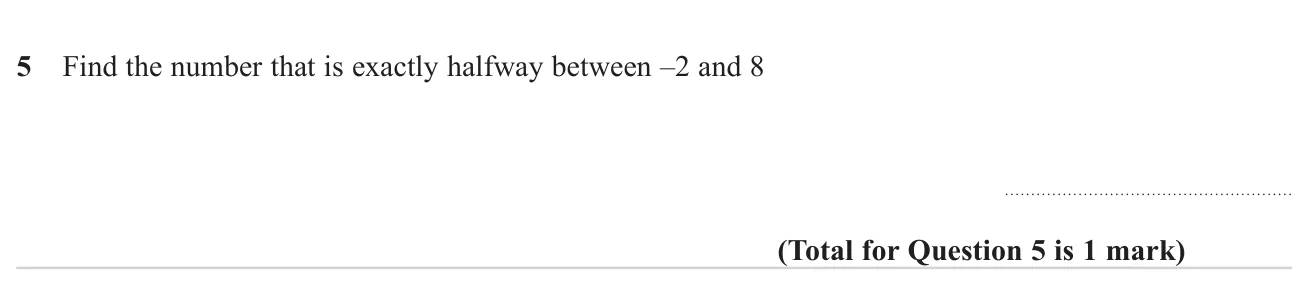
© Pearson Education Ltd. November 2024 Paper 2 (Foundation, calculator), question 5.
Show answer
Worked solution Checked against the mark scheme
Add the two numbers and halve: 2−2+8=26=3
Watch out: Giving 5 by halving 10, the distance between them, and not adding to −2.
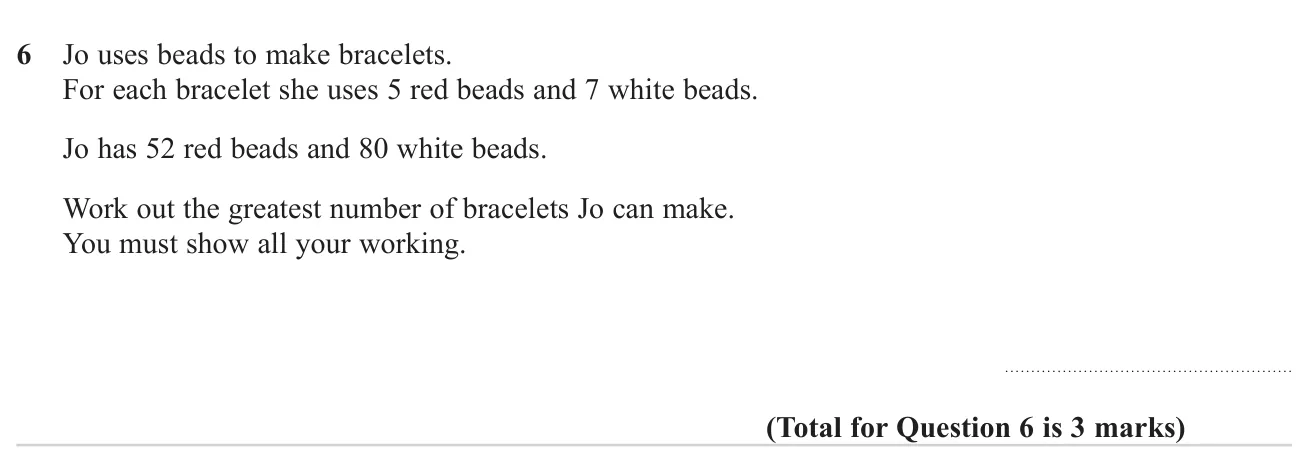
© Pearson Education Ltd. November 2024 Paper 2 (Foundation, calculator), question 6.
Show answer
Worked solution Checked against the mark scheme
Red: 52÷5=10.4, so enough for 10 bracelets.
White: 80÷7=11.4..., so enough for 11.
The red beads run out first, so the greatest number is 10.
Watch out: Rounding 10.4 or 11.4 up, or choosing the larger number 11.
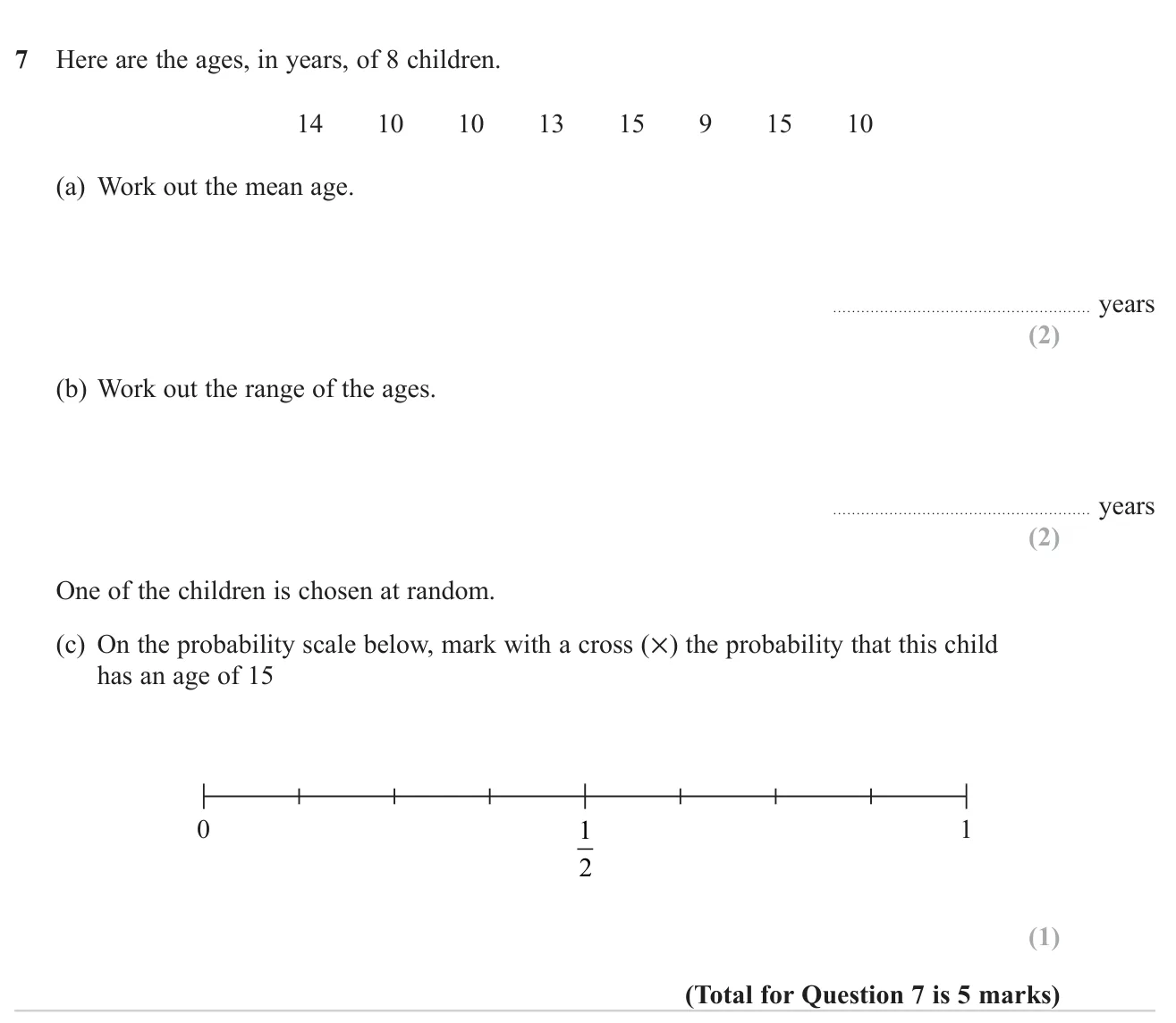
© Pearson Education Ltd. November 2024 Paper 2 (Foundation, calculator), question 7.
Show answer
| (a) | 12 | 2 marks |
|---|
| (b) | 6 | 2 marks |
|---|
| (c) | Cross at 41 | 1 mark |
|---|
Worked solution Checked against the mark scheme
(a) Total =14+10+10+13+15+9+15+10=96; mean =96÷8=12 years.
(b) Range =15−9=6 years.
(c) Two of the 8 children are 15, so P=82=41: mark halfway between 0 and 21.
Watch out: Giving the range as '9 to 15' or dividing the total by 7.
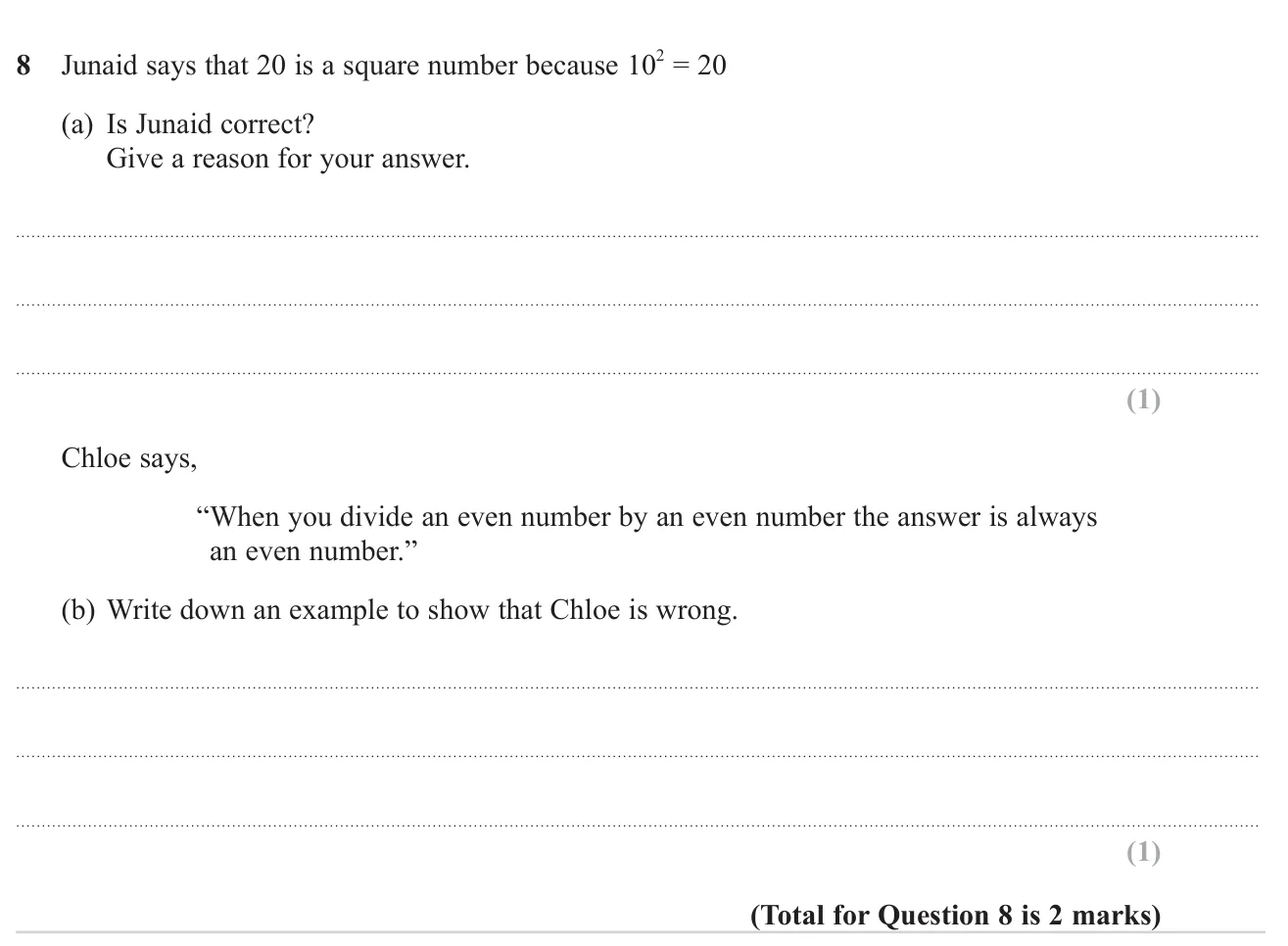
© Pearson Education Ltd. November 2024 Paper 2 (Foundation, calculator), question 8.
Show answer
| (a) | No, because 102=100 (20 is not a square number) | 1 mark |
|---|
| (b) | e.g. 12÷4=3, which is odd | 1 mark |
|---|
Worked solution Checked against the mark scheme
(a) No. 102=10×10=100, not 20. He has worked out 10×2. The squares near 20 are 16 and 25.
(b) 12÷4=3, and 3 is odd, so the claim is false.
Watch out: In (a), just saying '20 is not a square number' without a reason.
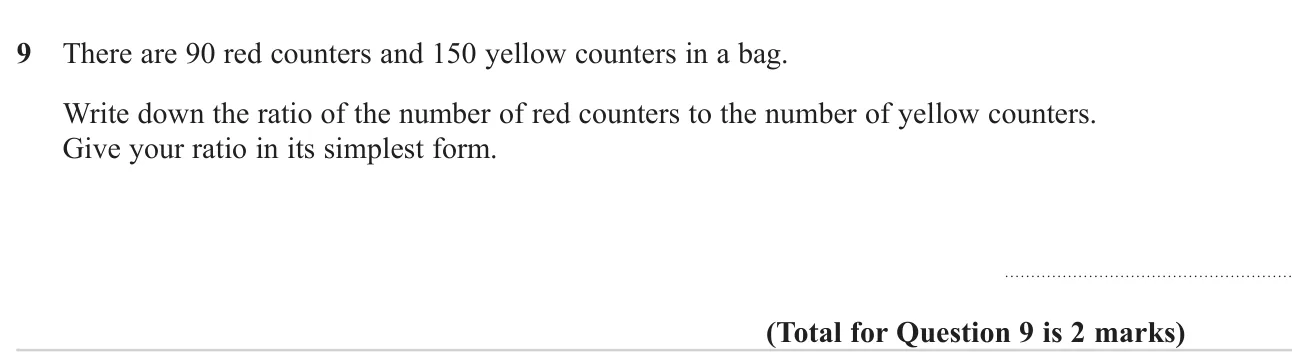
Question 9
Ratio2 marksGrade 3Calculator © Pearson Education Ltd. November 2024 Paper 2 (Foundation, calculator), question 9.
Show answer
Worked solution Checked against the mark scheme
Red : yellow =90:150.
Divide both by 30 (their HCF): 3:5.
Watch out: Writing the ratio the wrong way round as 5 : 3.
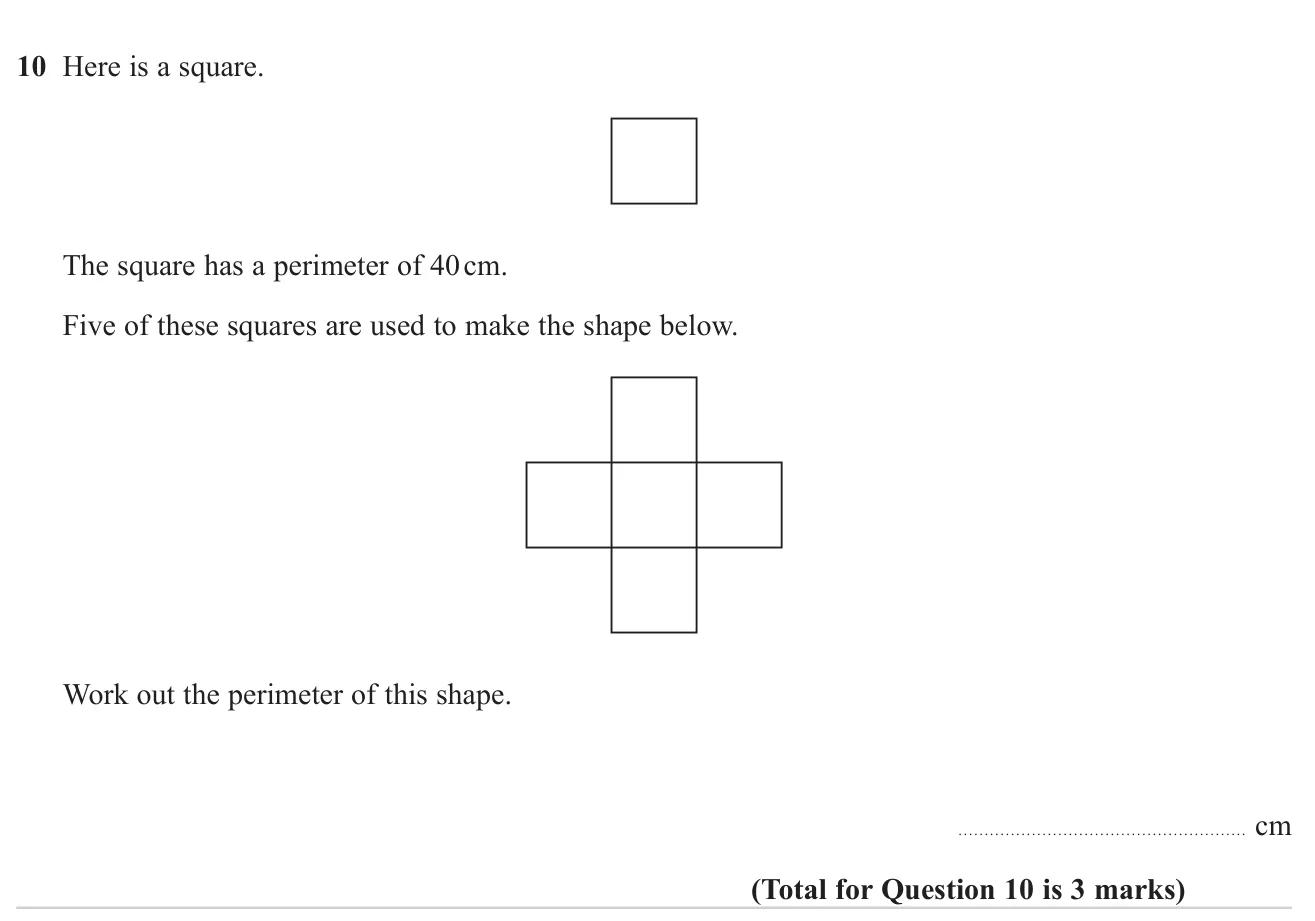
© Pearson Education Ltd. November 2024 Paper 2 (Foundation, calculator), question 10.
Show answer
Worked solution Checked against the mark scheme
One side of a square is 40÷4=10 cm.
The cross has 12 outside edges.
Perimeter =12×10=120 cm.
Watch out: Multiplying 40 by 5 to get 200, which counts the inside edges too.
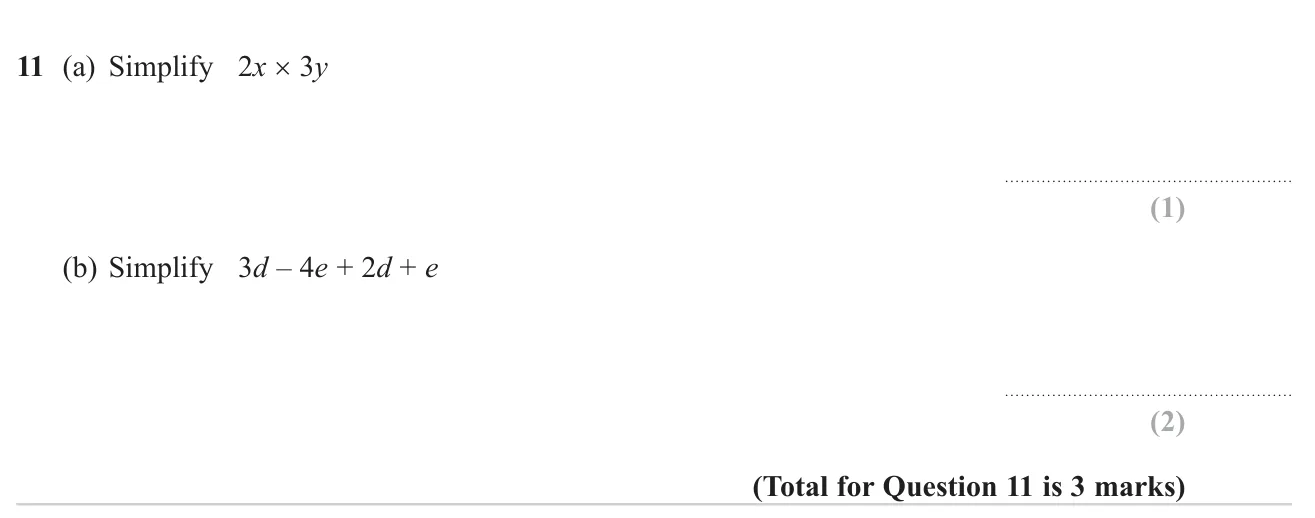
© Pearson Education Ltd. November 2024 Paper 2 (Foundation, calculator), question 11.
Show answer
| (a) | 6xy | 1 mark |
|---|
| (b) | 5d−3e | 2 marks |
|---|
Worked solution Checked against the mark scheme
(a) 2×3=6 and x×y=xy, giving 6xy.
(b) 3d+2d=5d and −4e+e=−3e, so 5d−3e.
Watch out: In (b), writing −5e by treating e as −e.
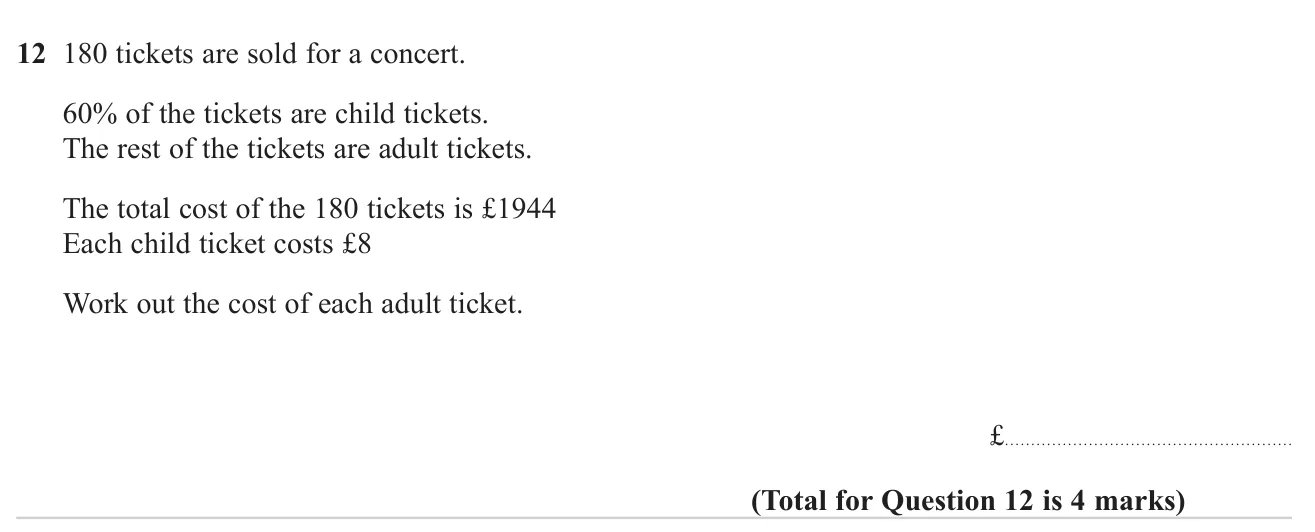
© Pearson Education Ltd. November 2024 Paper 2 (Foundation, calculator), question 12.
Show answer
Worked solution Checked against the mark scheme
Child tickets: 60% of 180=108.
Child income: 108×8=£864.
Adult tickets: 180−108=72; adult income: 1944−864=£1080.
Each adult ticket: 1080÷72=£15
Watch out: Dividing £1080 by 180 instead of by the 72 adult tickets.
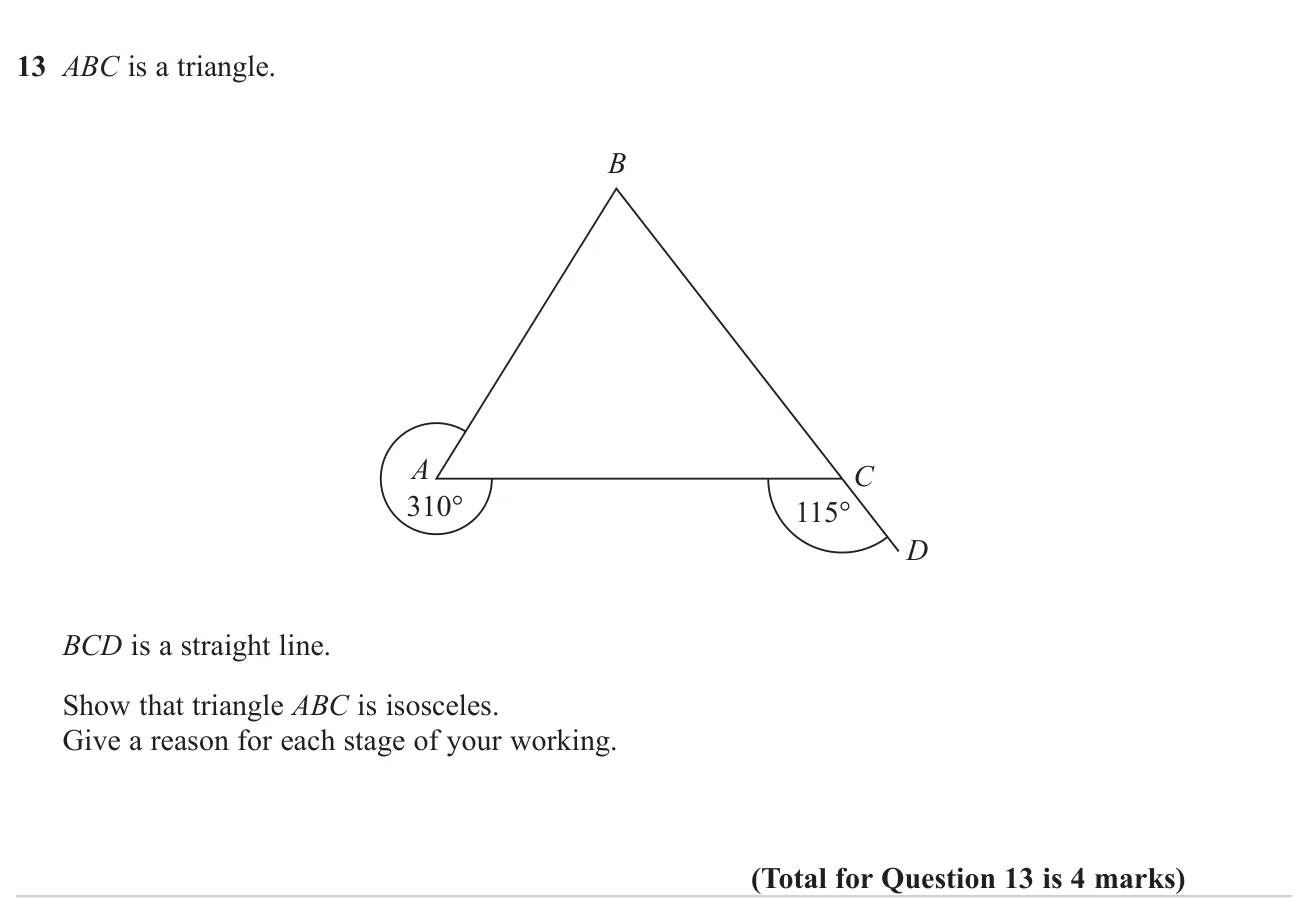
© Pearson Education Ltd. November 2024 Paper 2 (Foundation, calculator), question 13.
Show answer
| Answer | Angles are 50∘, 65∘, 65∘, so two are equal and the triangle is isosceles | 4 marks |
|---|
Worked solution Checked against the mark scheme
Angle BAC=360−310=50∘ (angles around a point add to 360∘).
Angle ACB=180−115=65∘ (angles on a straight line add to 180∘).
Angle ABC=180−50−65=65∘ (angles in a triangle add to 180∘).
Angles ACB and ABC are both 65∘, so the triangle is isosceles.
Watch out: Leaving out the reasons, or not stating that two angles are equal.
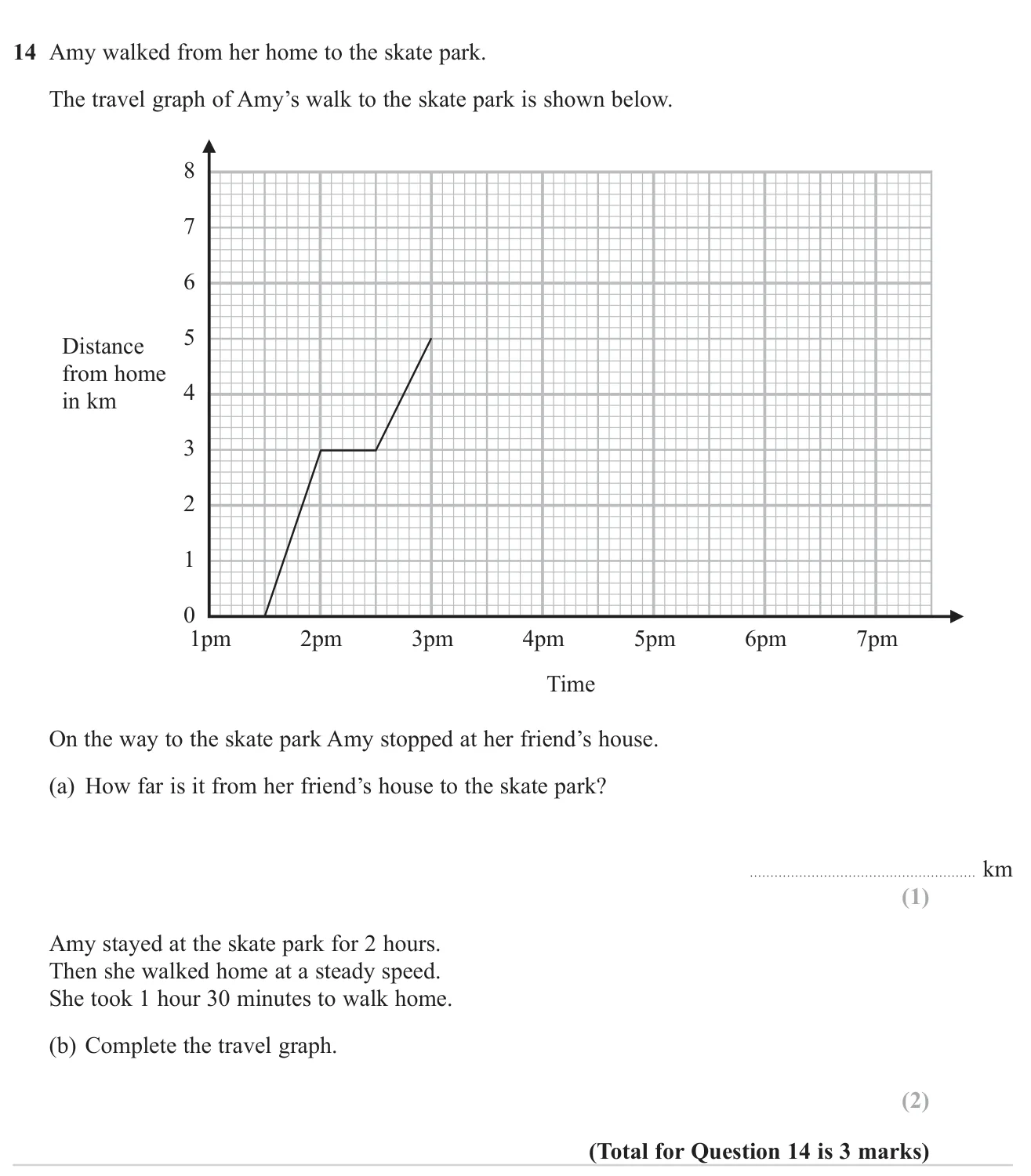
© Pearson Education Ltd. November 2024 Paper 2 (Foundation, calculator), question 14.
Show answer
| (a) | 2 km | 1 mark |
|---|
| (b) | Horizontal line from (3pm, 5) to (5pm, 5), then a straight line down to (6:30pm, 0) | 2 marks |
|---|
Worked solution Checked against the mark scheme
(a) The friend's house is the first flat part at 3 km; the skate park is at 5 km. 5−3=2 km.
(b) She arrives at 3pm, stays 2 hours: flat line at 5 km until 5pm.
She then walks home in 121 hours: straight line from 5 km at 5pm to 0 km at 6:30pm.
Watch out: Treating 1 hour 30 minutes as 1.3 hours when reading the time axis.
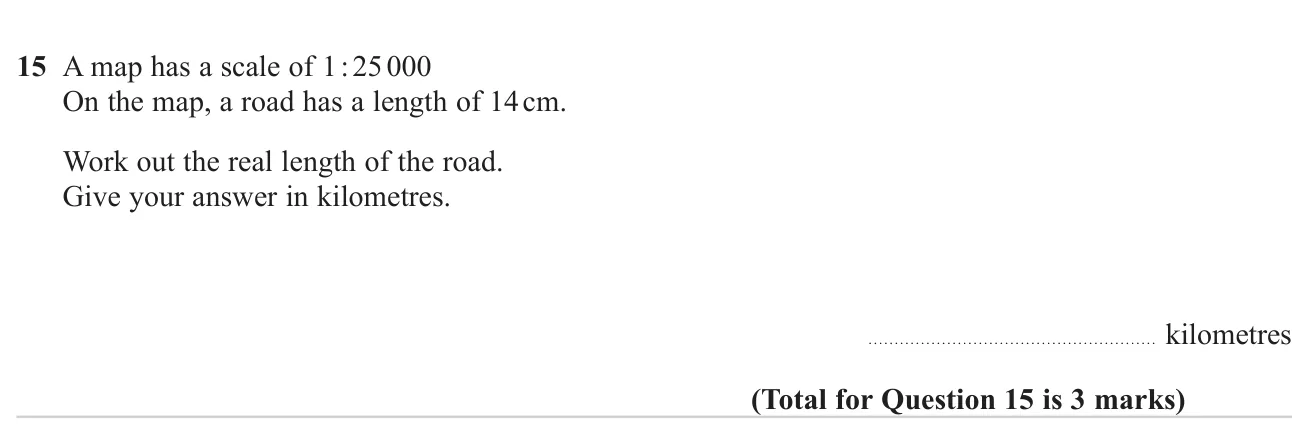
© Pearson Education Ltd. November 2024 Paper 2 (Foundation, calculator), question 15.
Show answer
Worked solution Checked against the mark scheme
Real length =14×25000=350000 cm.
There are 100000 cm in 1 km, so 350000÷100000=3.5 km.
Watch out: Dividing by 1000 as if converting metres to kilometres.
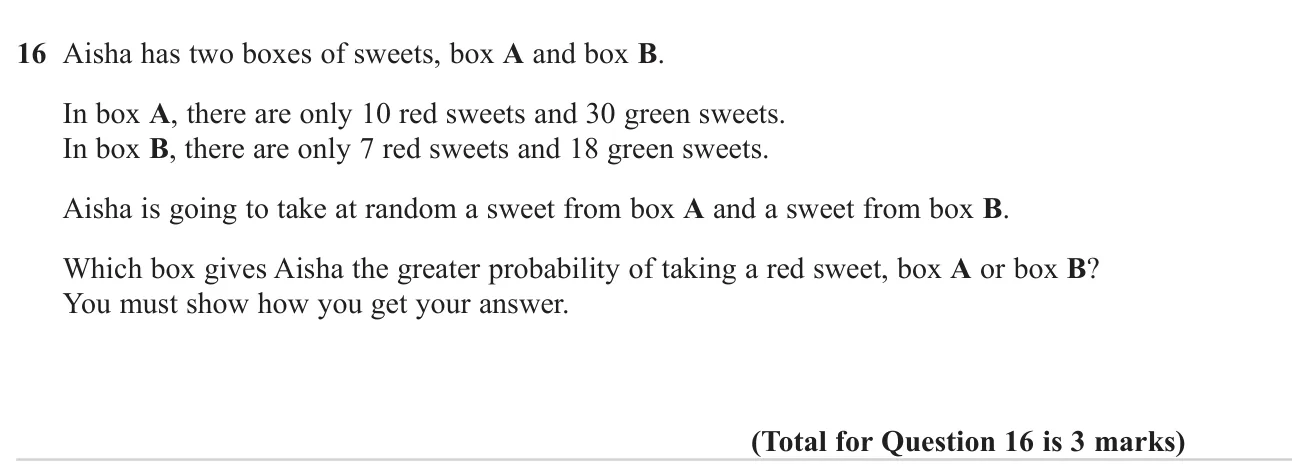
© Pearson Education Ltd. November 2024 Paper 2 (Foundation, calculator), question 16.
Show answer
| Answer | Box B (0.28>0.25) | 3 marks |
|---|
Worked solution Checked against the mark scheme
Box A: P(red)=4010=0.25
Box B: P(red)=257=0.28
0.28>0.25, so box B gives the greater chance.
Watch out: Using red : green (3010) instead of red out of the total.
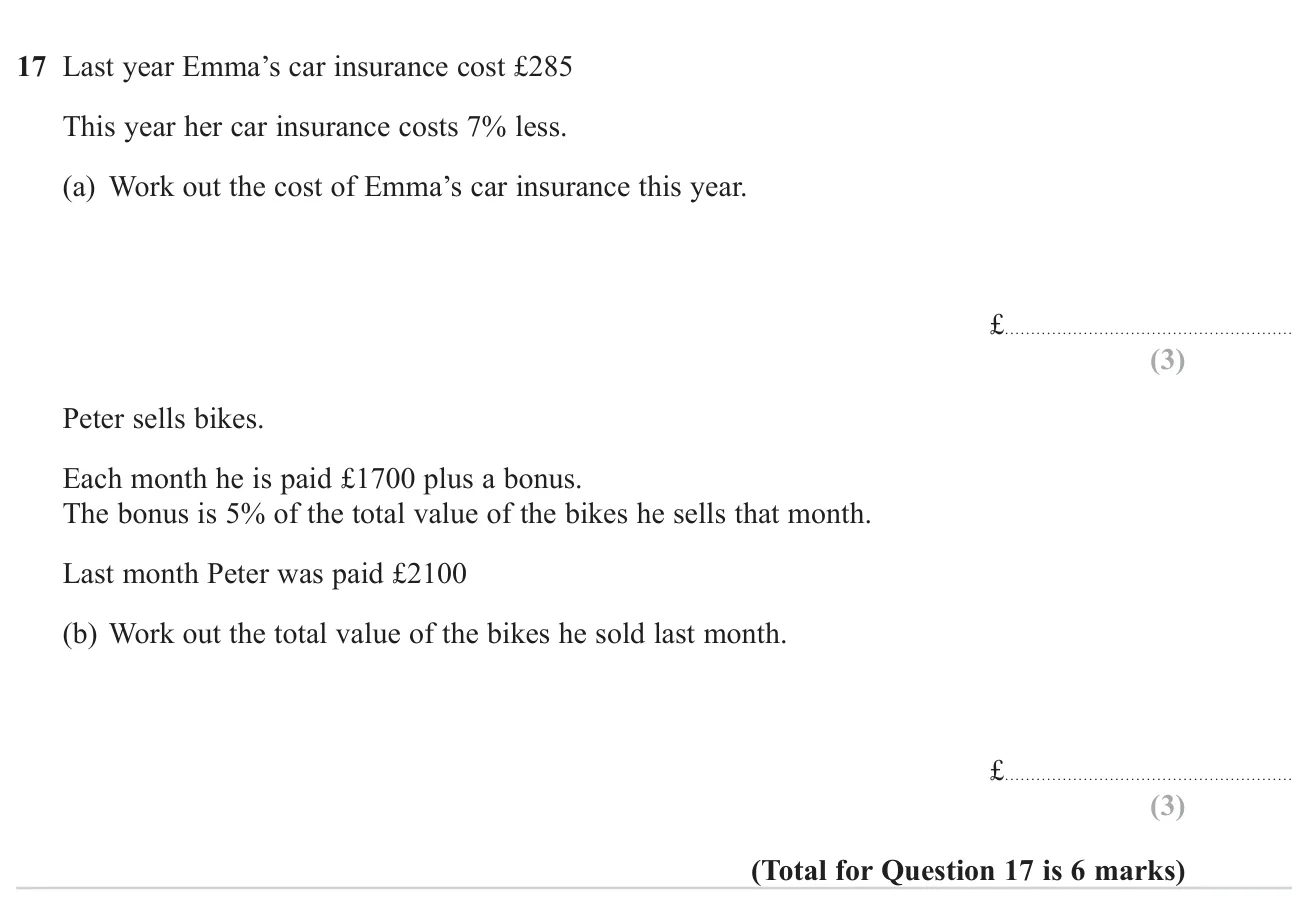
© Pearson Education Ltd. November 2024 Paper 2 (Foundation, calculator), question 17.
Show answer
| (a) | £265.05 | 3 marks |
|---|
| (b) | £8000 | 3 marks |
|---|
Worked solution Checked against the mark scheme
(a) 285×0.93=£265.05
(b) The bonus is 2100−1700=£400.
5%=400, so 1%=80 and 100%=80×100=£8000.
Watch out: In (b), finding 5% of 2100 instead of treating £400 as the 5%.
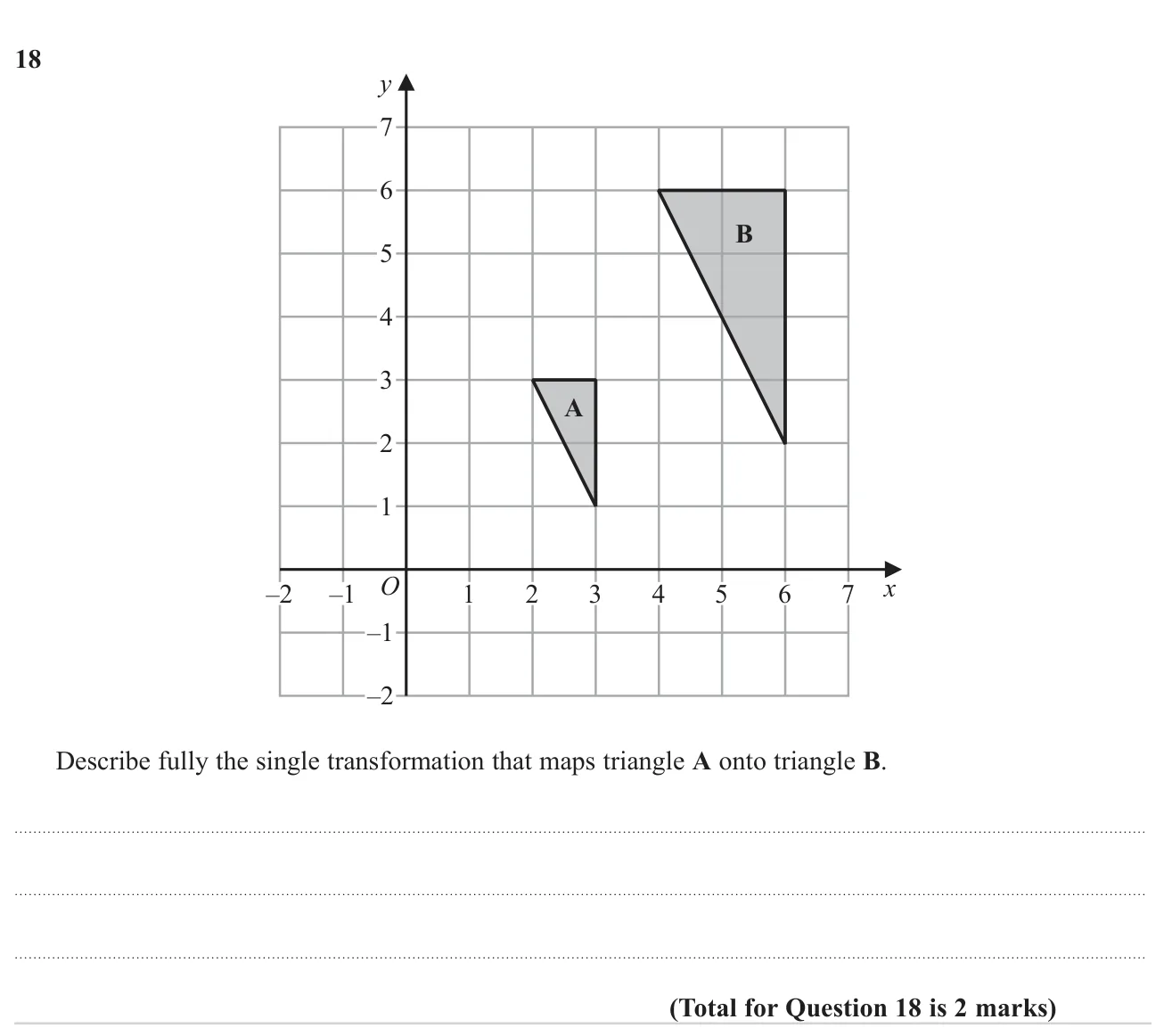
© Pearson Education Ltd. November 2024 Paper 2 (Foundation, calculator), question 18.
Show answer
| Answer | Enlargement, scale factor 2, centre (0,0) | 2 marks |
|---|
Worked solution Checked against the mark scheme
The triangle is bigger, so it is an enlargement.
Sides of A double in B (e.g. height 2 becomes 4), so the scale factor is 2.
Lines through matching corners, e.g. (3,1) to (6,2), meet at the origin, so the centre is (0,0).
Watch out: Leaving out the centre of enlargement.
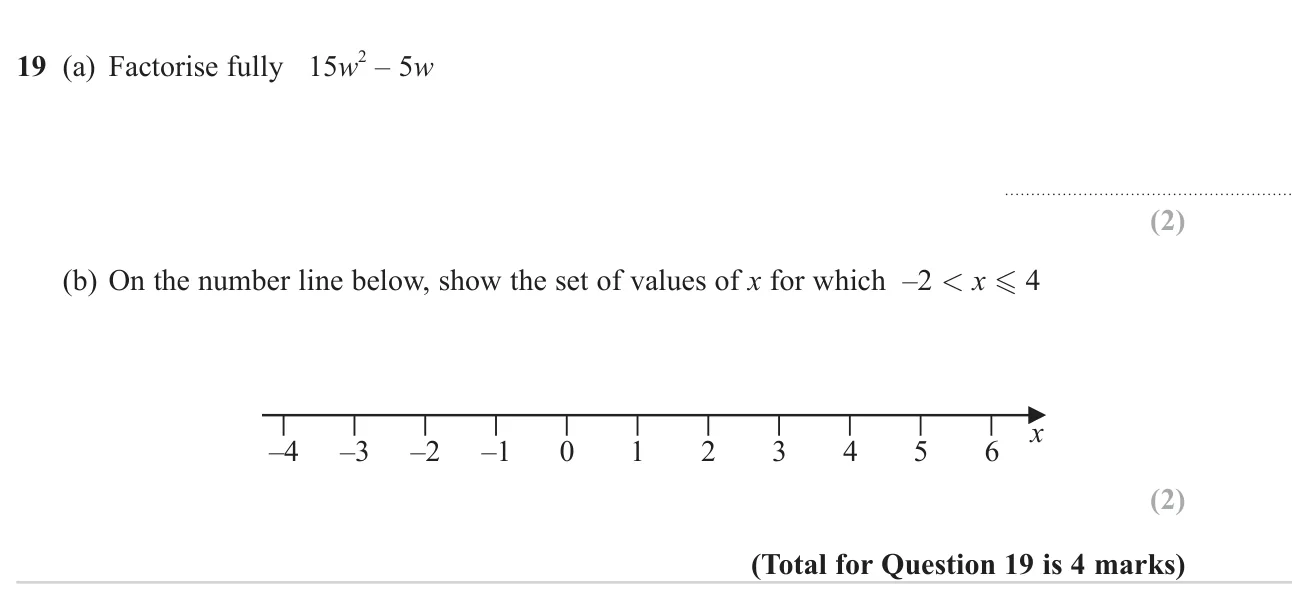
© Pearson Education Ltd. November 2024 Paper 2 (Foundation, calculator), question 19.
Show answer
| (a) | 5w(3w−1) | 2 marks |
|---|
| (b) | Open circle at −2, closed circle at 4, joined by a line | 2 marks |
|---|
Worked solution Checked against the mark scheme
(a) The HCF of 15w2 and 5w is 5w.
15w2−5w=5w(3w−1)
(b) −2 is not included: open circle. 4 is included: filled circle. Join them with a line.
Watch out: In (a), taking out only 5 or only w, which is not fully factorised.
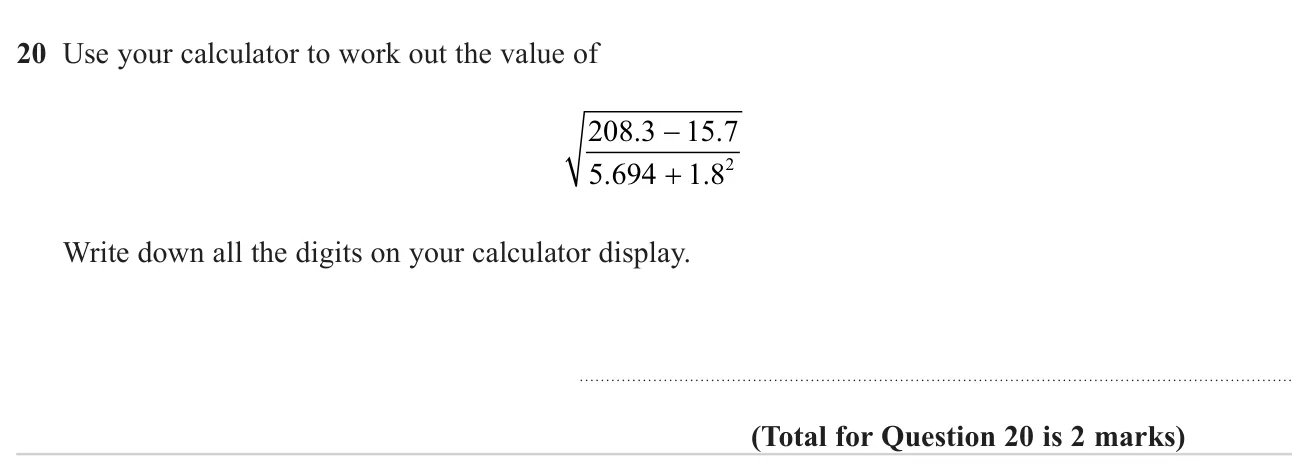
© Pearson Education Ltd. November 2024 Paper 2 (Foundation, calculator), question 20.
Show answer
Worked solution Checked against the mark scheme
Top: 208.3−15.7=192.6
Bottom: 5.694+1.82=5.694+3.24=8.934
192.6÷8.934=21.558...=4.643069317...
Watch out: Only square-rooting the top of the fraction, or not using brackets on the calculator.
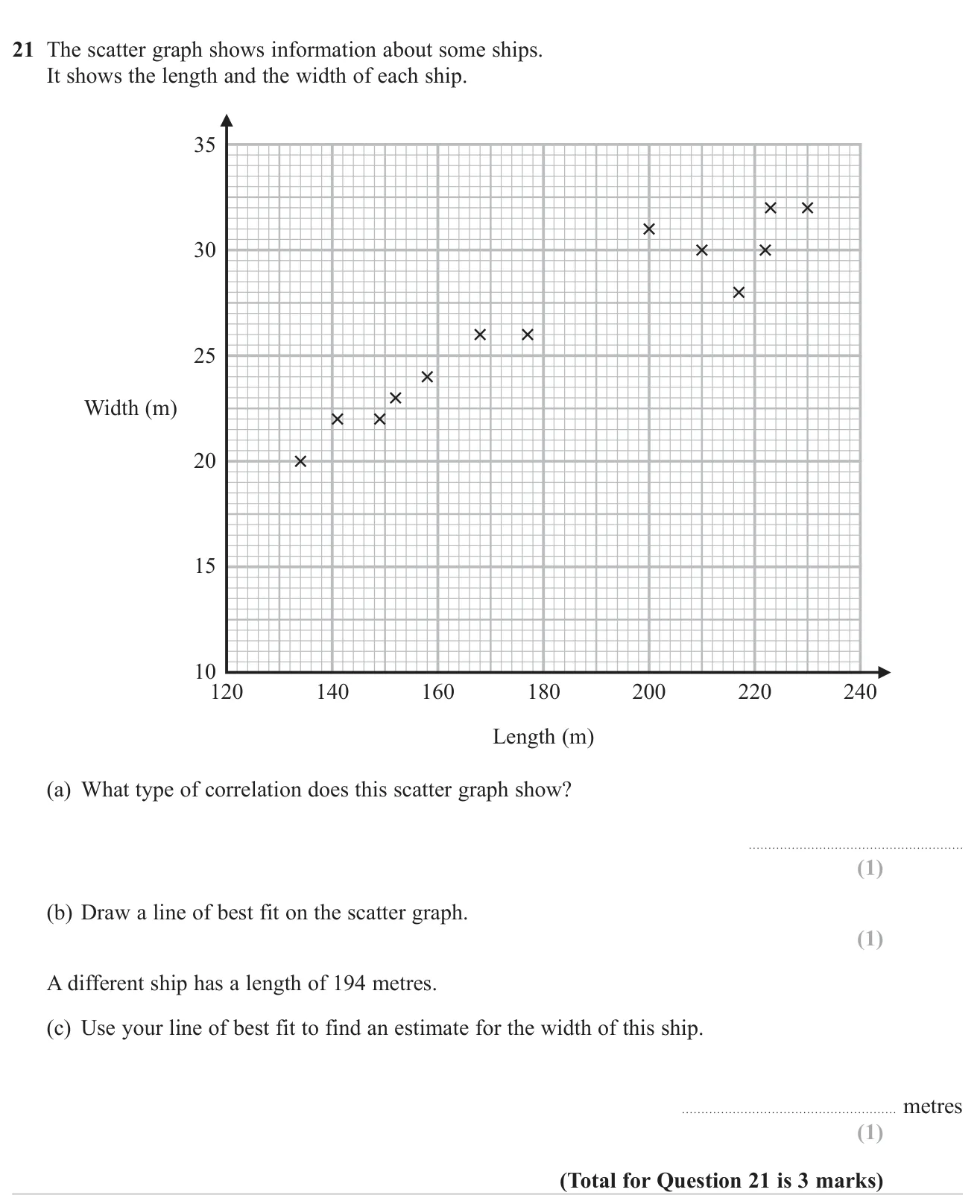
© Pearson Education Ltd. November 2024 Paper 2 (Foundation, calculator), question 21.
Show answer
| (a) | Positive | 1 mark |
|---|
| (b) | Line of best fit drawn | 1 mark |
|---|
| (c) | About 28 m (26.5 to 29.5) | 1 mark |
|---|
Worked solution Checked against the mark scheme
(a) Longer ships tend to be wider, so the correlation is positive.
(b) Draw one straight line through the middle of the crosses, with roughly as many points above as below.
(c) Go up from 194 m on the length axis to the line, then across: about 28 m.
Watch out: Joining the points dot to dot instead of drawing one straight line.
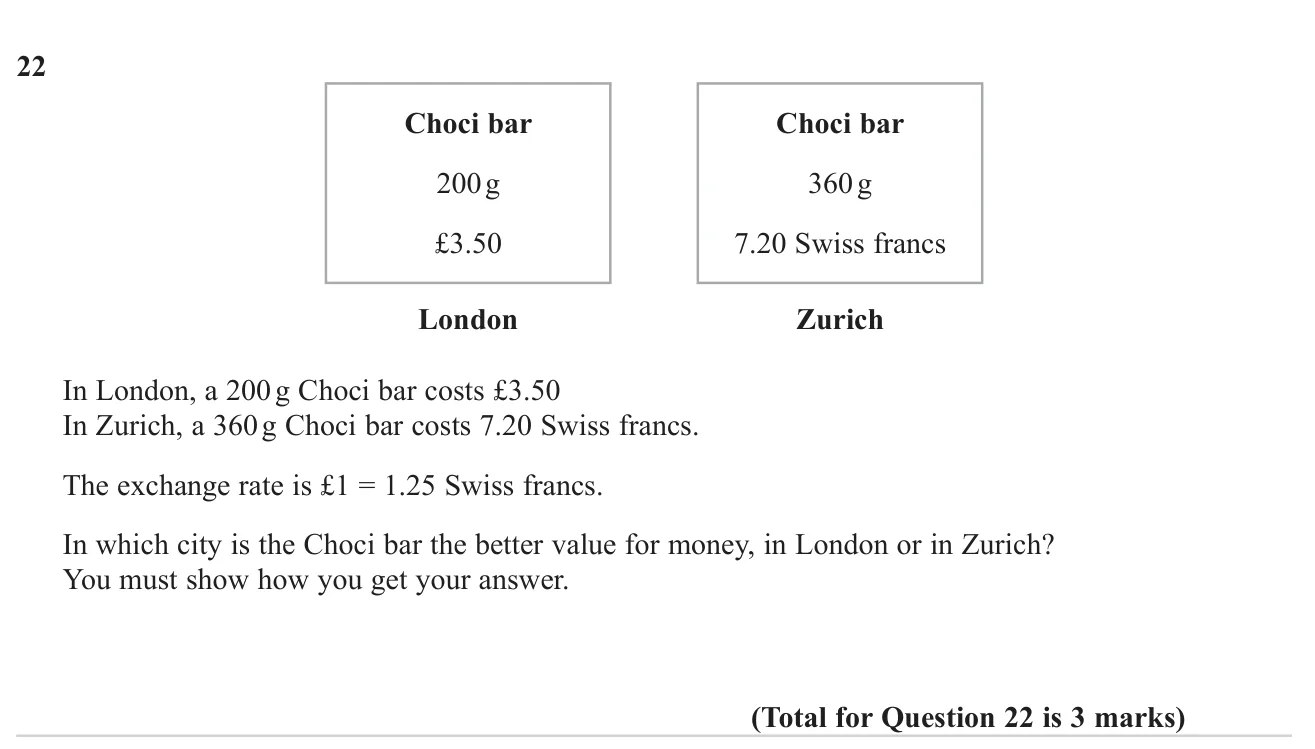
© Pearson Education Ltd. November 2024 Paper 2 (Foundation, calculator), question 22.
Show answer
| Answer | Zurich (e.g. 200 g costs 4.00 francs in Zurich against 4.375 francs in London) | 3 marks |
|---|
Worked solution Checked against the mark scheme
Change the London price to francs: 3.50×1.25=4.375 francs for 200 g.
Zurich price for 200 g: 7.20÷360×200=4.00 francs.
4.00<4.375, so Zurich is better value.
Watch out: Dividing by 1.25 when changing pounds to francs.
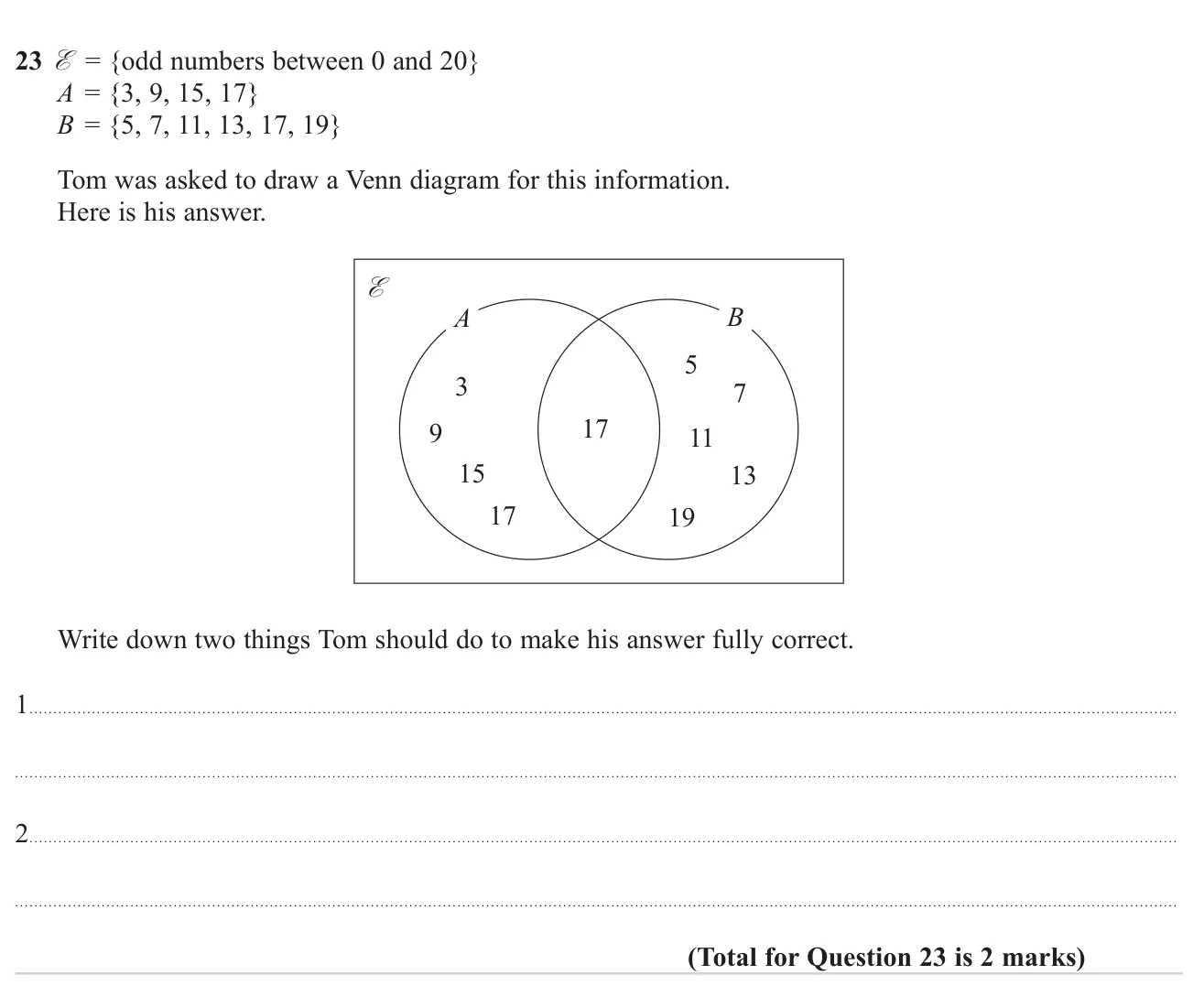
© Pearson Education Ltd. November 2024 Paper 2 (Foundation, calculator), question 23.
Show answer
| Answer | Remove the 17 from 'A only' so it is only in the overlap; put 1 in the region outside both circles | 2 marks |
|---|
Worked solution Checked against the mark scheme
The universal set is 1, 3, 5, ..., 19.
17 is in both A and B, so it belongs only in the overlap; Tom also wrote it in A only.
1 is odd but in neither A nor B, so it must go inside the rectangle, outside both circles.
Watch out: Forgetting that 1 is an odd number between 0 and 20.
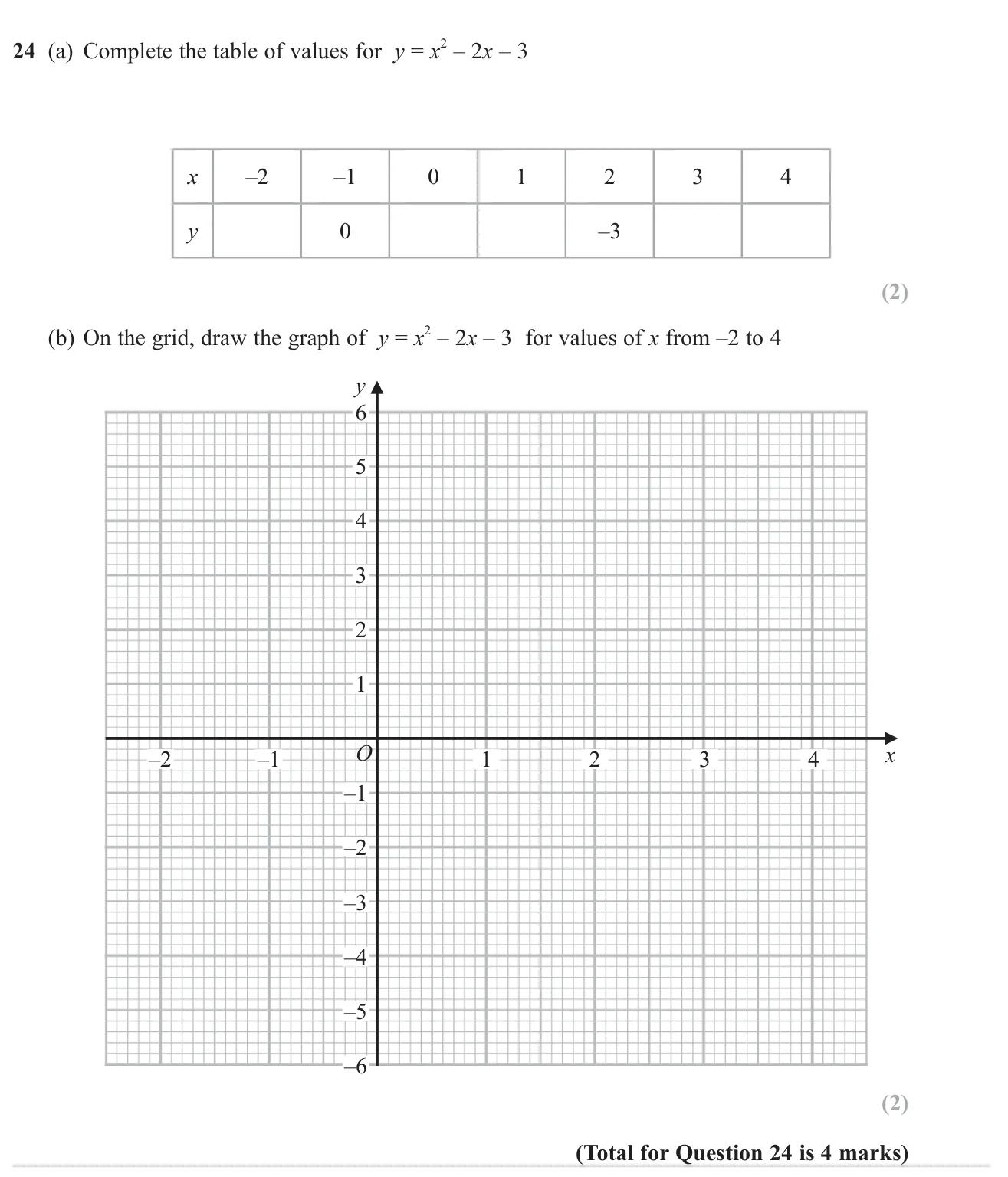
© Pearson Education Ltd. November 2024 Paper 2 (Foundation, calculator), question 24.
Show answer
| (a) | 5,−3,−4,0,5 (for x=−2,0,1,3,4) | 2 marks |
|---|
| (b) | Smooth U-shaped curve through the points | 2 marks |
|---|
Worked solution Checked against the mark scheme
(a) x=−2: 4+4−3=5; x=0: −3; x=1: 1−2−3=−4; x=3: 9−6−3=0; x=4: 16−8−3=5.
(b) Plot (−2,5),(−1,0),(0,−3),(1,−4),(2,−3),(3,0),(4,5) and join them with a smooth curve.
Watch out: Working out (−2)2 as −4, or joining the points with straight lines.
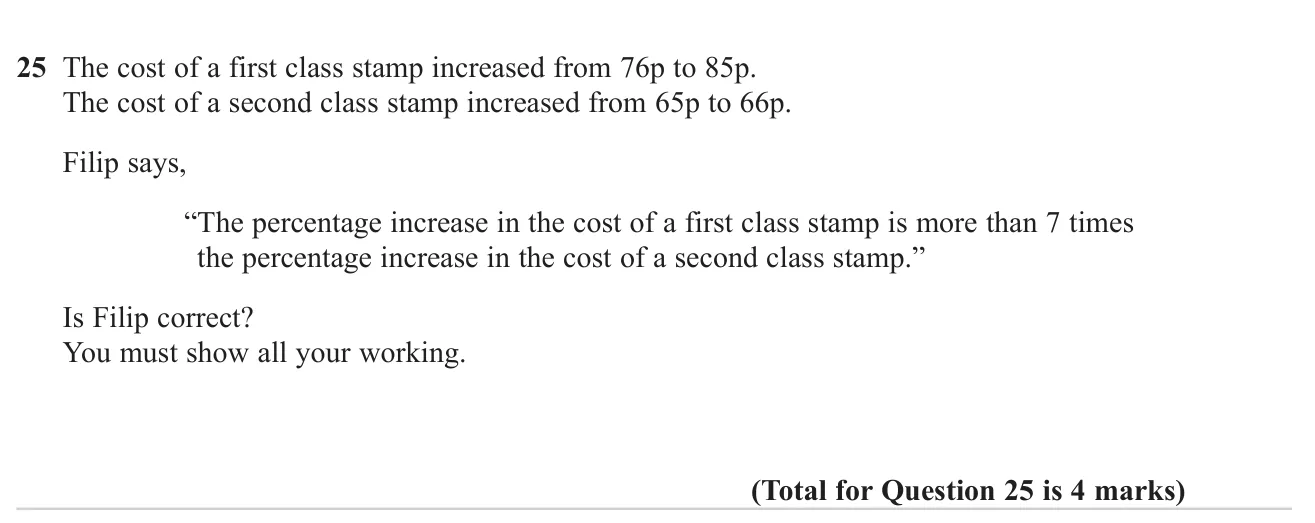
© Pearson Education Ltd. November 2024 Paper 2 (Foundation, calculator), question 25.
Show answer
| Answer | Yes: 11.8% is more than 7×1.54%=10.8% | 4 marks |
|---|
Worked solution Checked against the mark scheme
First class: 7685−76×100=11.84%
Second class: 6566−65×100=1.54%
7×1.54=10.77%, and 11.84>10.77, so Filip is correct.
Watch out: Comparing the actual increases (9p and 1p) instead of percentages.
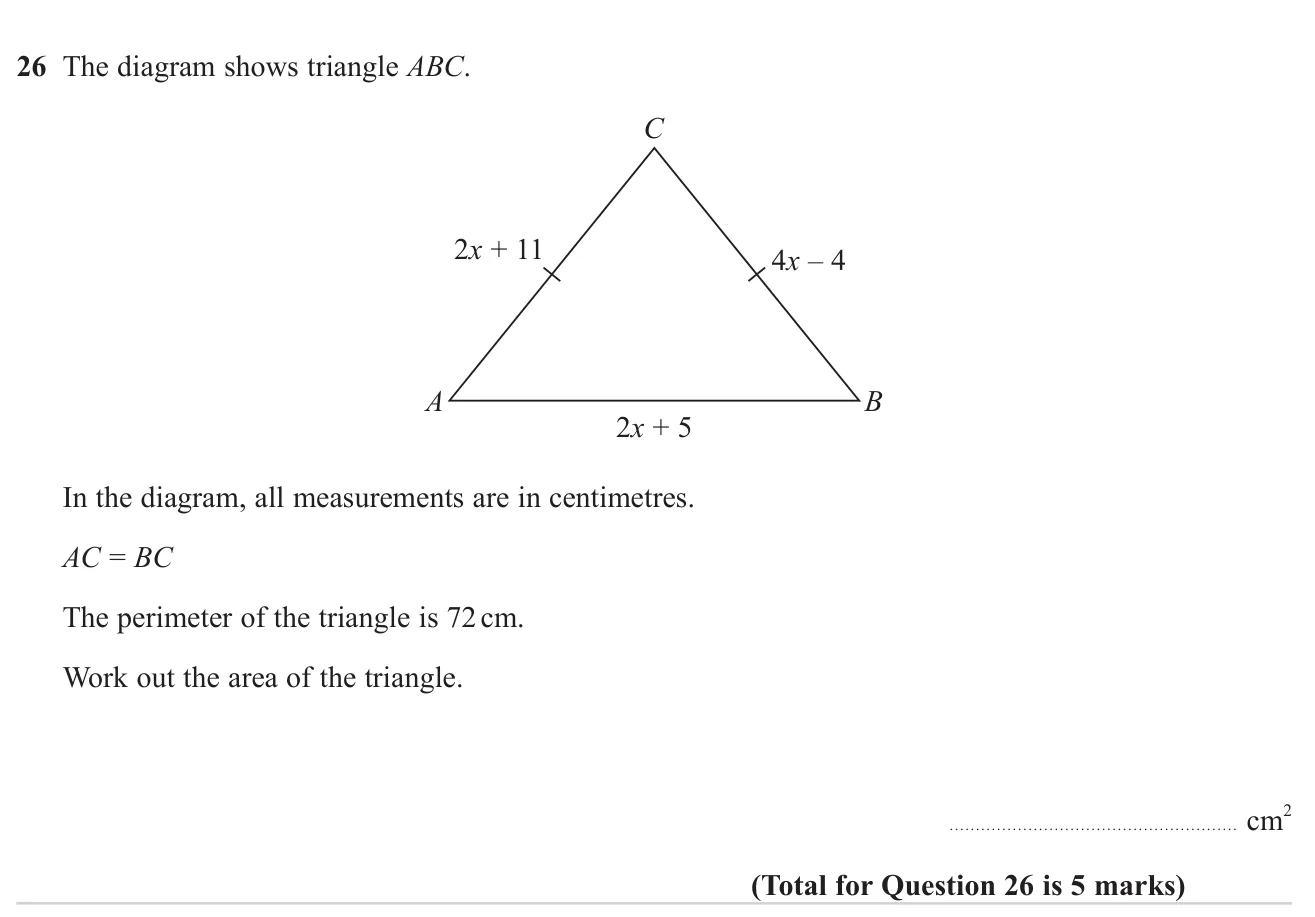
© Pearson Education Ltd. November 2024 Paper 2 (Foundation, calculator), question 26.
Show answer
Worked solution Checked against the mark scheme
AC=BC: 2x+11=4x−4, so 2x=15 and x=7.5.
Sides: AC=BC=26, AB=20 (perimeter 72 ✓).
Height from C to the midpoint of AB: 262−102=576=24.
Area =21×20×24=240 cm2
Watch out: Using 26 as the height instead of finding the perpendicular height.
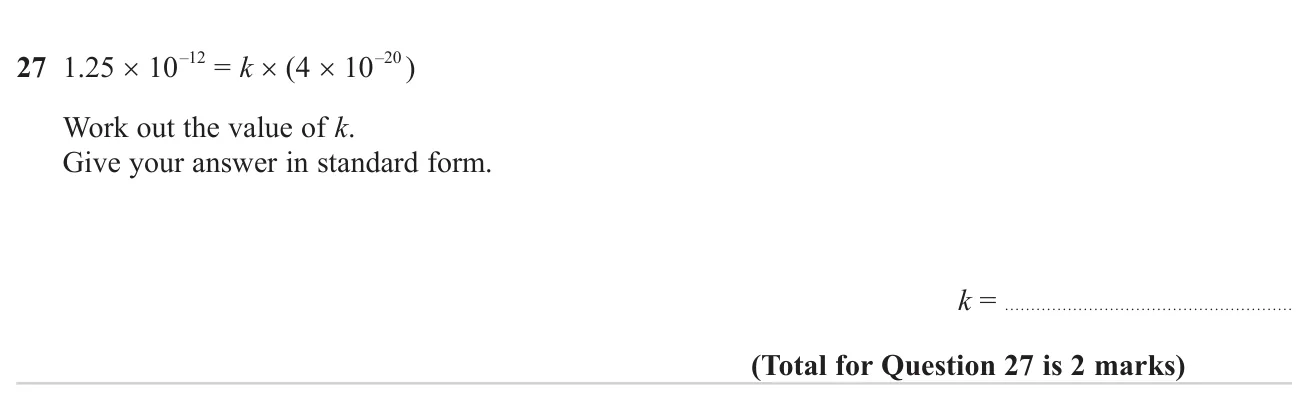
© Pearson Education Ltd. November 2024 Paper 2 (Foundation, calculator), question 27.
Show answer
| Answer | 3.125×10⁷ | 2 marks |
|---|
Worked solution Checked against the mark scheme
k=4×10−201.25×10⁻¹²
1.25÷4=0.3125 and 10−12÷10−20=108
k=0.3125×108=3.125×10⁷
Watch out: Subtracting the powers the wrong way to get 10−32 or 10−8.
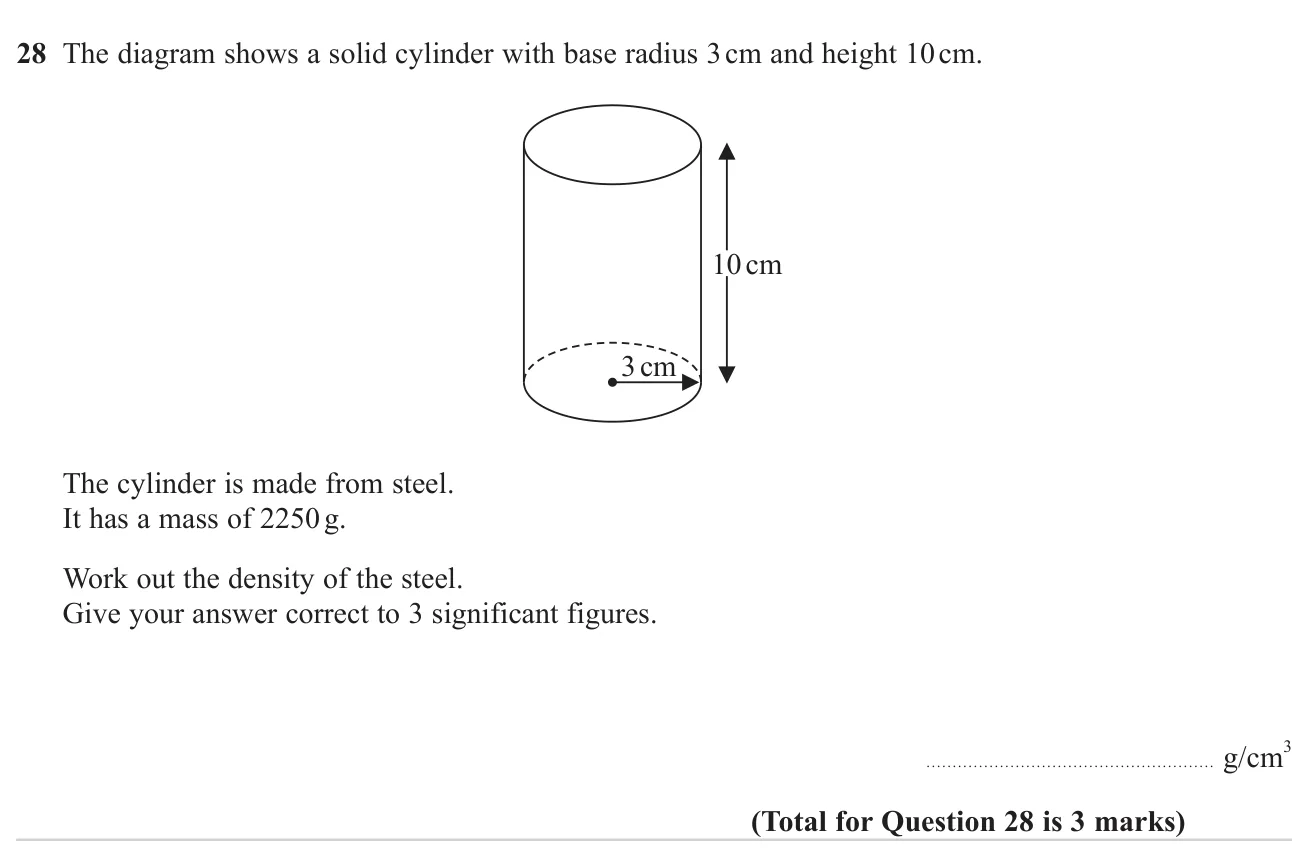
© Pearson Education Ltd. November 2024 Paper 2 (Foundation, calculator), question 28.
Show answer
Worked solution Checked against the mark scheme
Volume =π×32×10=90π=282.74... cm3
Density =2250÷282.74...=7.957...
=7.96 g/cm3 (3 s.f.)
Watch out: Using π×3×10 or diameter instead of radius squared.
Finished the paper?
Add up your marks for all three papers and see what grade that would have been.