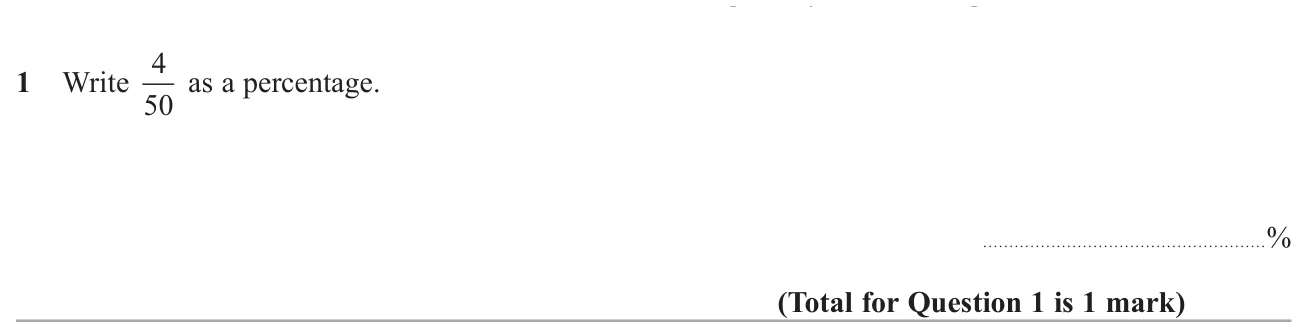
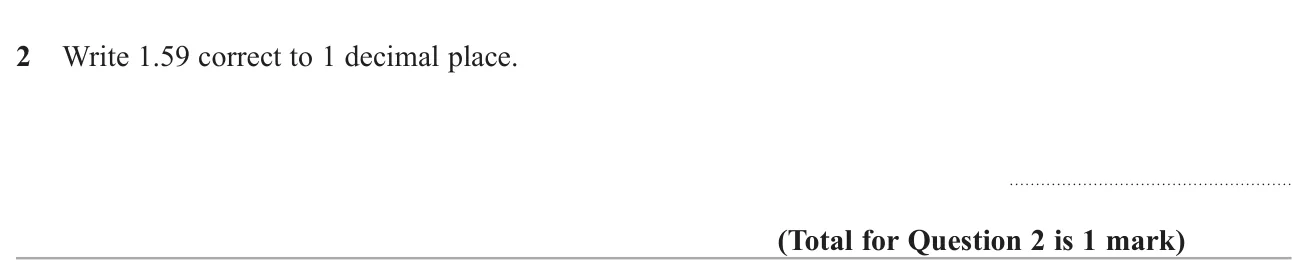
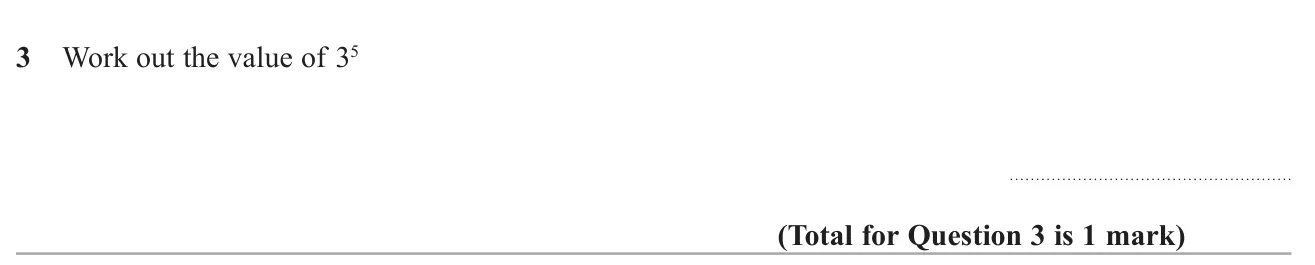
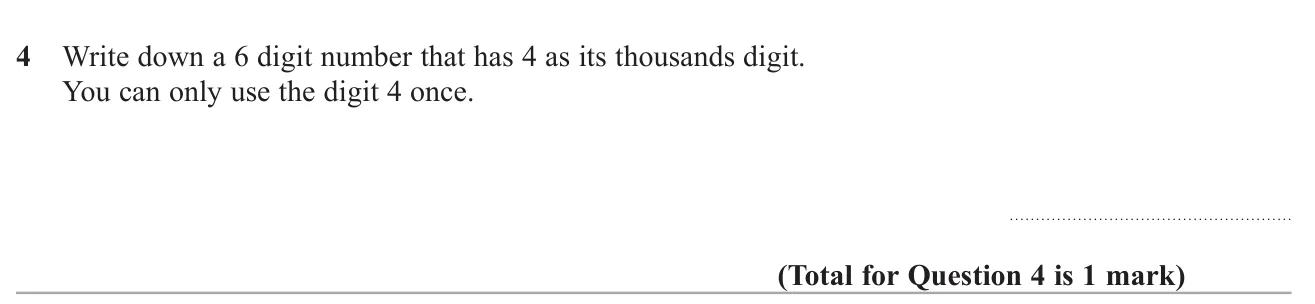
© Pearson Education Ltd. June 2018 Paper 2 (Foundation, calculator), question 1.
Show answer
Worked solution Checked against the mark scheme
Multiply top and bottom by 2 to get a denominator of 100:
504=1008=8%
Watch out: Writing 4% or 0.08.
© Pearson Education Ltd. June 2018 Paper 2 (Foundation, calculator), question 2.
Show answer
Worked solution Checked against the mark scheme
Look at the second decimal place: it is 9, which is 5 or more, so round the 5 up.
1.59≈1.6
Watch out: Truncating to 1.5.
© Pearson Education Ltd. June 2018 Paper 2 (Foundation, calculator), question 3.
Show answer
Worked solution Checked against the mark scheme
35=3×3×3×3×3=243
Watch out: Working out 3×5=15.
© Pearson Education Ltd. June 2018 Paper 2 (Foundation, calculator), question 4.
Show answer
| Answer | Any suitable number, e.g. 564000 | 1 mark |
|---|
Worked solution Checked against the mark scheme
The thousands digit is the fourth digit from the right in a whole number.
For example, 564000: the digits are 5 (hundred thousands), 6 (ten thousands), 4 (thousands), then zeros.
Watch out: Putting the 4 in the ten thousands or hundreds place.
© Pearson Education Ltd. June 2018 Paper 2 (Foundation, calculator), question 5.
Show answer
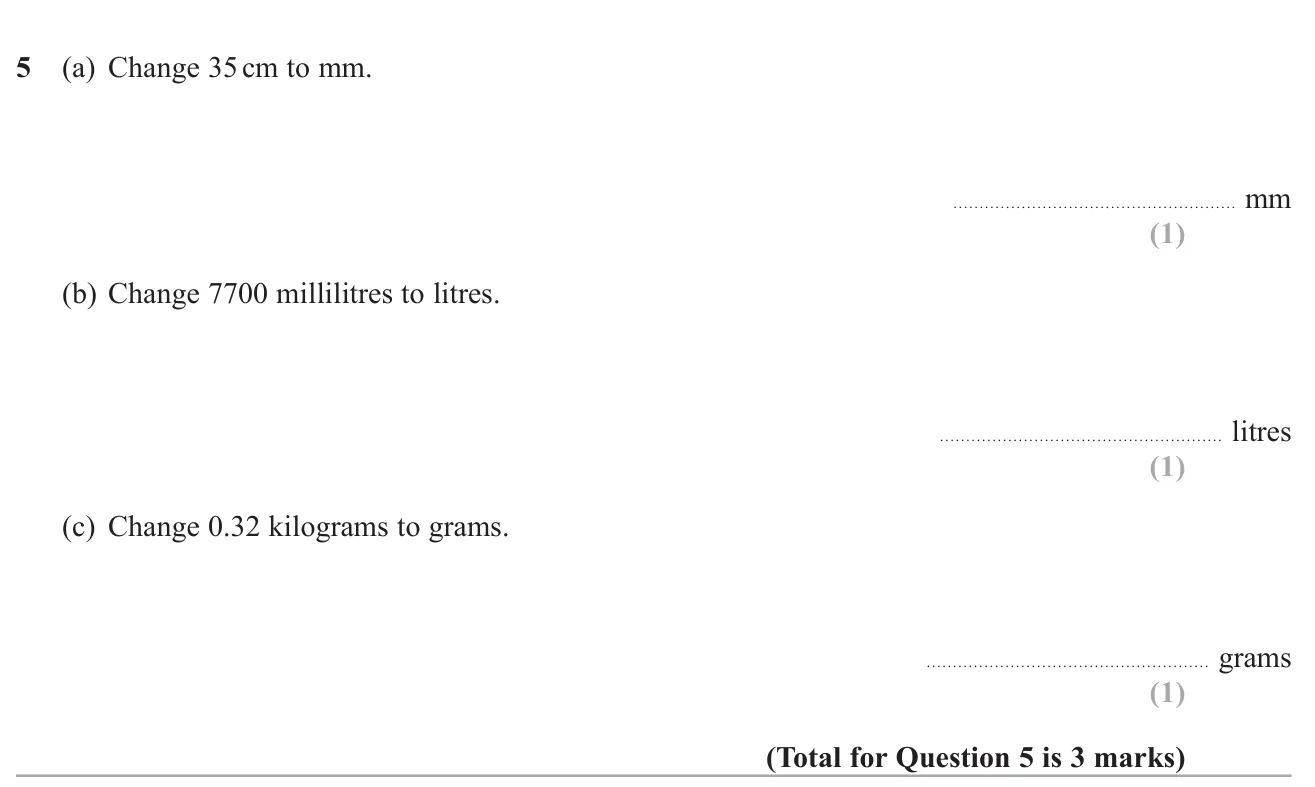
| (a) | 350 mm | 1 mark |
|---|
| (b) | 7.7 litres | 1 mark |
|---|
| (c) | 320 grams | 1 mark |
|---|
Worked solution Checked against the mark scheme
(a) 1 cm = 10 mm, so 35×10=350 mm
(b) 1 litre = 1000 ml, so 7700÷1000=7.7 litres
(c) 1 kg = 1000 g, so 0.32×1000=320 g
Watch out: Multiplying by 100 instead of 10 when changing cm to mm.
© Pearson Education Ltd. June 2018 Paper 2 (Foundation, calculator), question 6.
Show answer
Worked solution Checked against the mark scheme
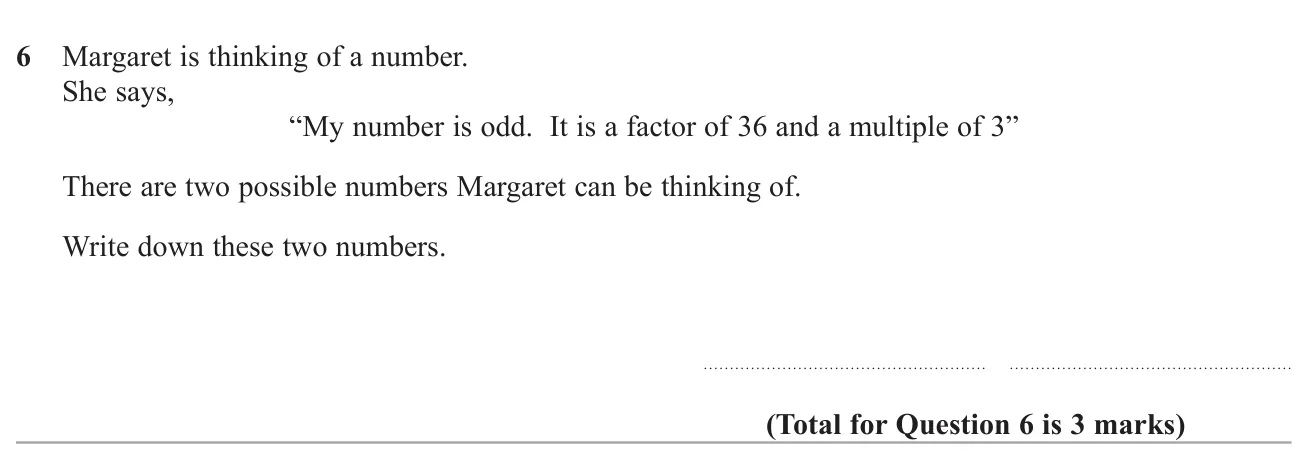
Factors of 36: 1, 2, 3, 4, 6, 9, 12, 18, 36
The odd ones are 1, 3 and 9. Of these, 3 and 9 are multiples of 3.
So the numbers are 3 and 9.
Watch out: Including 1, which is not a multiple of 3.
© Pearson Education Ltd. June 2018 Paper 2 (Foundation, calculator), question 7.
Show answer
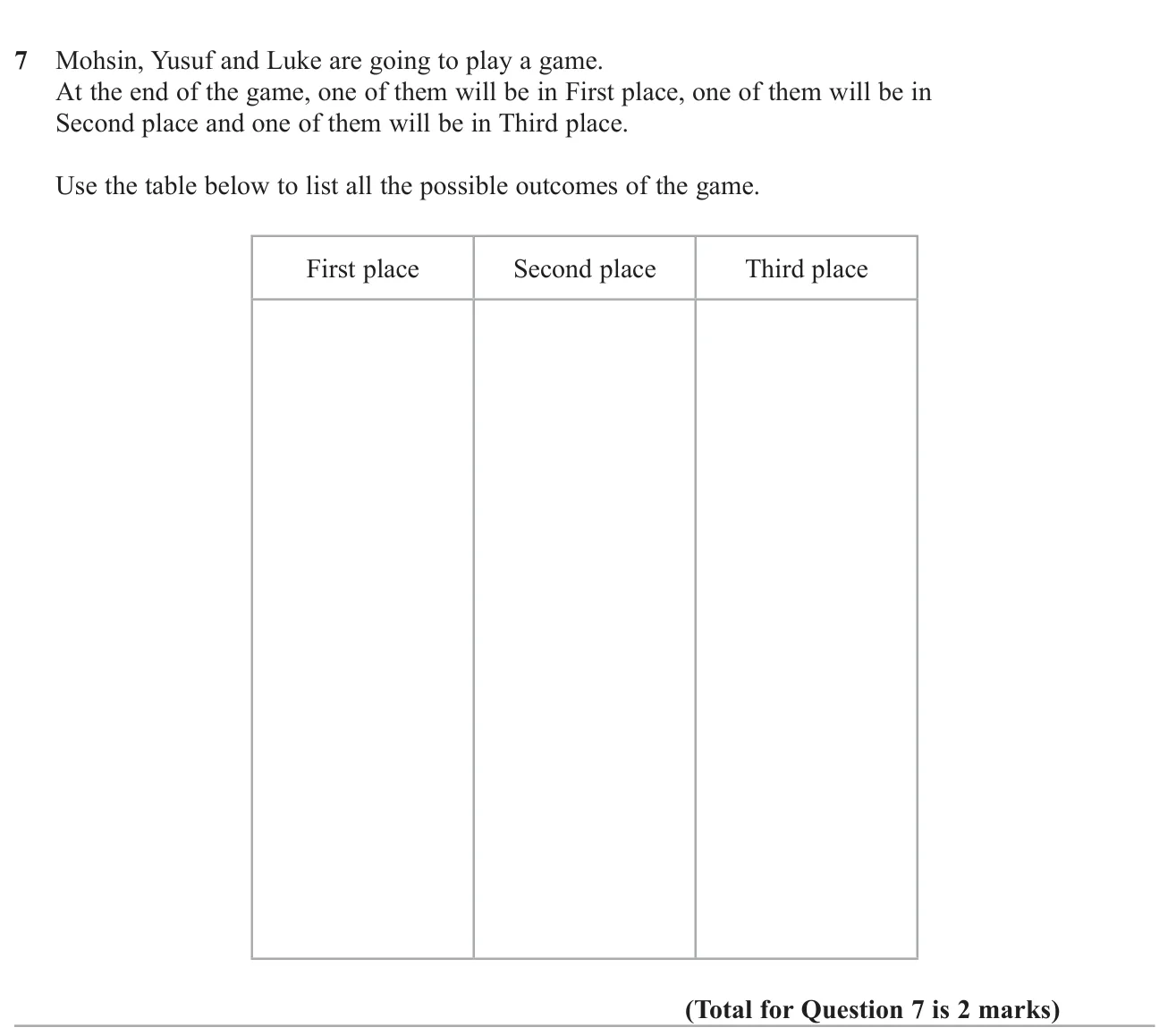
| Answer | MYL, MLY, YML, YLM, LMY, LYM | 2 marks |
|---|
Worked solution Checked against the mark scheme
Fix who comes first, then swap the other two.
Mohsin first: MYL, MLY
Yusuf first: YML, YLM
Luke first: LMY, LYM
That gives 3×2=6 outcomes.
Watch out: Missing some orders by not working systematically.
© Pearson Education Ltd. June 2018 Paper 2 (Foundation, calculator), question 8.
Show answer
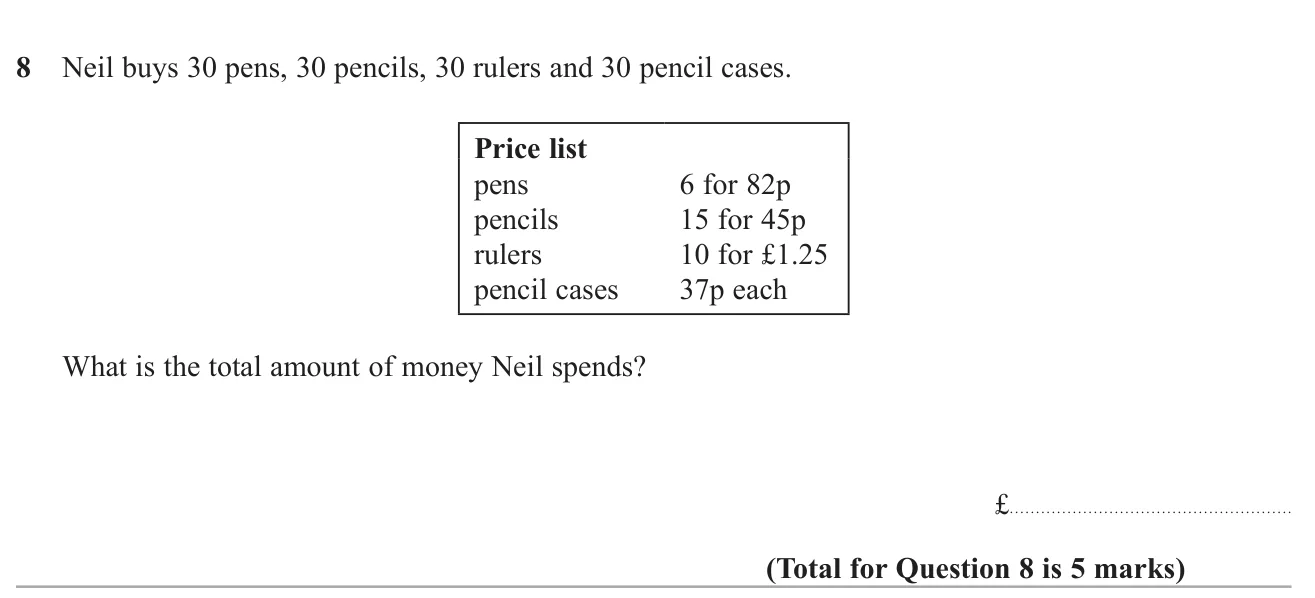
| Answer | £19.85 | 5 marks |
|---|
Worked solution Checked against the mark scheme
Pens: 30÷6=5 packs, 5×82=410p
Pencils: 30÷15=2 packs, 2×45=90p
Rulers: 30÷10=3 packs, 3×£1.25=£3.75
Pencil cases: 30×37=1110p
Total: £4.10+£0.90+£3.75+£11.10=£19.85
Watch out: Mixing pence and pounds when adding.
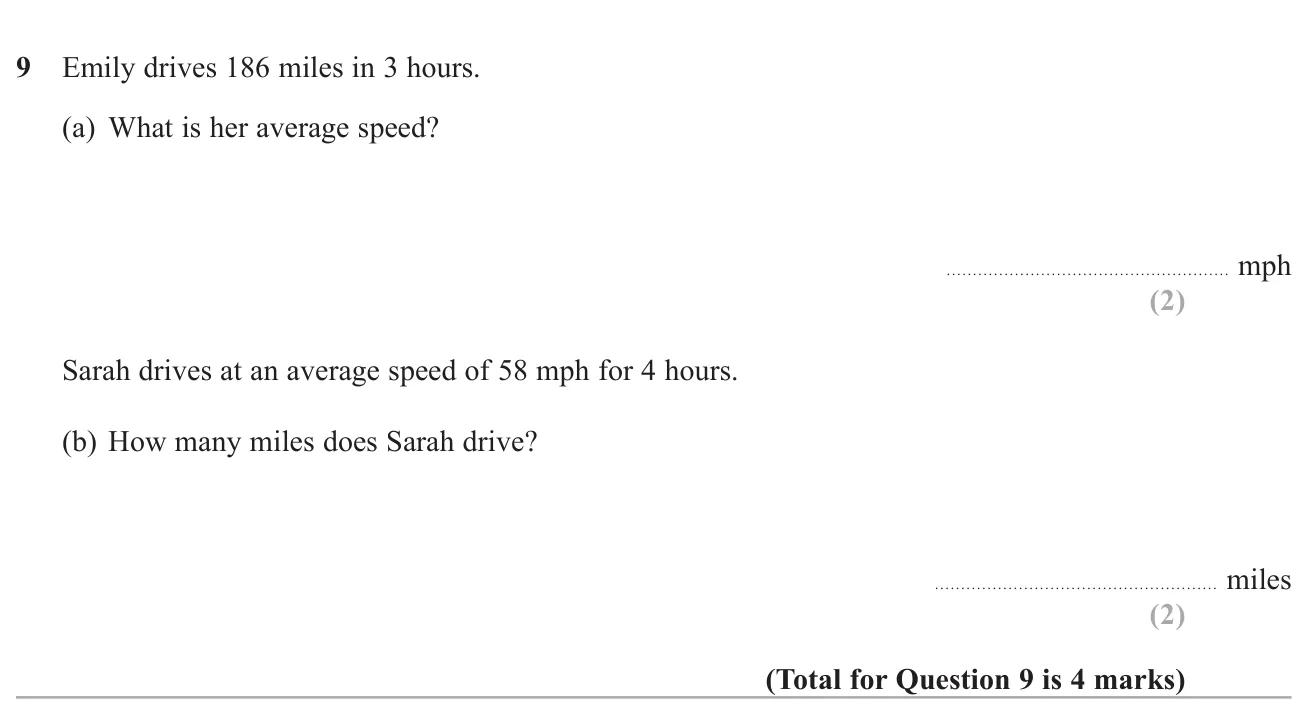
© Pearson Education Ltd. June 2018 Paper 2 (Foundation, calculator), question 9.
Show answer
| (a) | 62 mph | 2 marks |
|---|
| (b) | 232 miles | 2 marks |
|---|
Worked solution Checked against the mark scheme
(a) Speed =timedistance=186÷3=62 mph
(b) Distance = speed × time =58×4=232 miles
Watch out: Multiplying instead of dividing in (a).
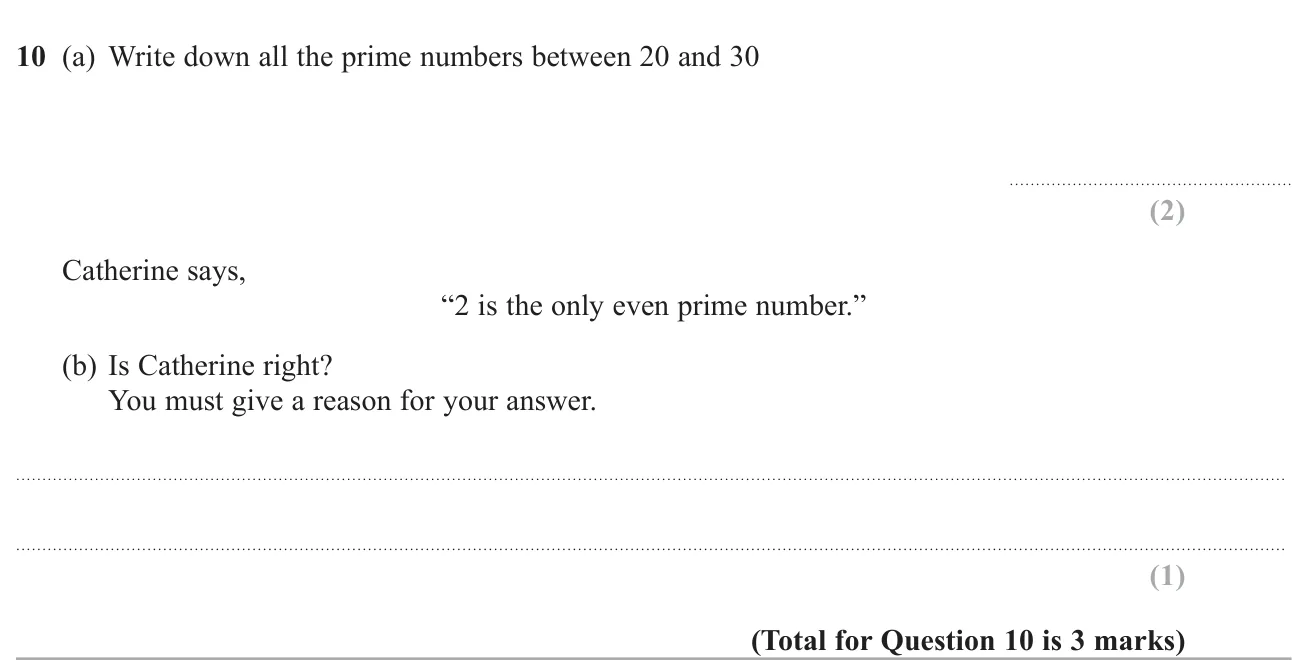
© Pearson Education Ltd. June 2018 Paper 2 (Foundation, calculator), question 10.
Show answer
| (a) | 23,29 | 2 marks |
|---|
| (b) | Yes: every other even number has 2 as a factor, so it has more than two factors | 1 mark |
|---|
Worked solution Checked against the mark scheme
(a) Check 21 to 29: 21=3×7, 25=5×5, 27=3×9, and the even ones divide by 2. Only 23 and 29 are prime.
(b) Yes. Any even number bigger than 2 can be divided by 2, so it has at least three factors and cannot be prime.
Watch out: Including 21 or 27 as primes.
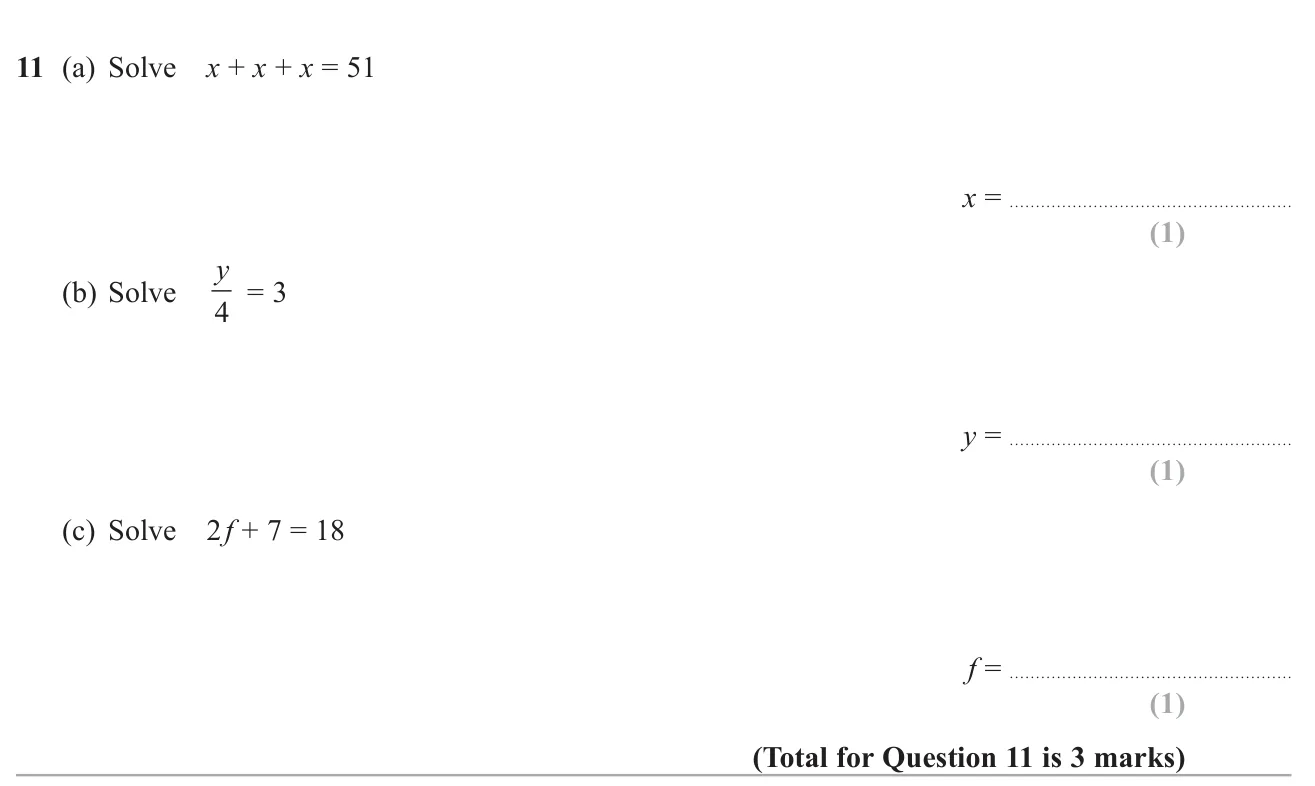
© Pearson Education Ltd. June 2018 Paper 2 (Foundation, calculator), question 11.
Show answer
| (a) | x=17 | 1 mark |
|---|
| (b) | y=12 | 1 mark |
|---|
| (c) | f=5.5 | 1 mark |
|---|
Worked solution Checked against the mark scheme
(a) 3x=51, so x=51÷3=17
(b) 4y=3, so y=3×4=12
(c) 2f+7=18⇒2f=11⇒f=5.5
Watch out: In (b), dividing 3 by 4 instead of multiplying.
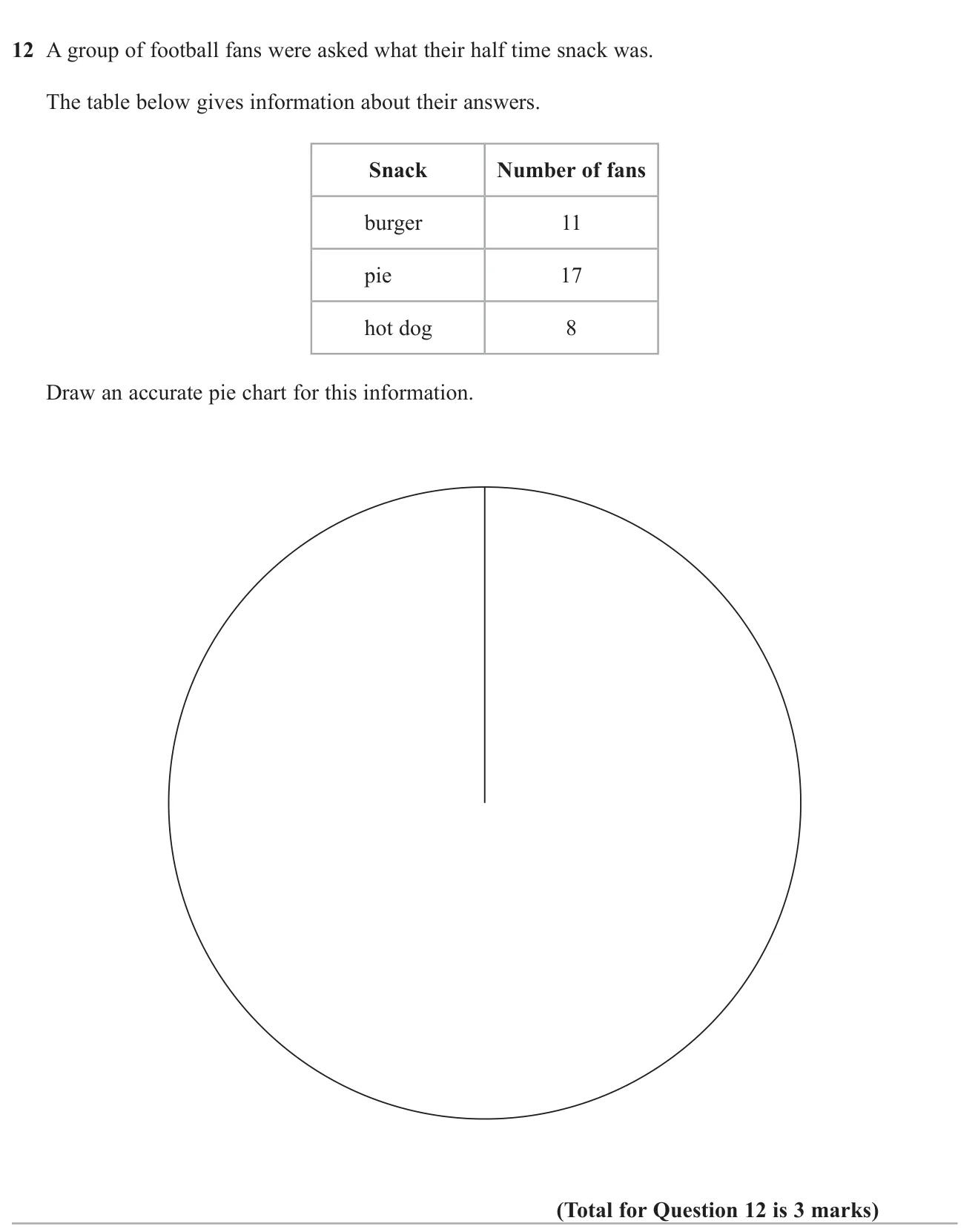
© Pearson Education Ltd. June 2018 Paper 2 (Foundation, calculator), question 12.
Show answer
| Answer | Pie chart with angles burger 110°, pie 170°, hot dog 80°, labelled | 3 marks |
|---|
Worked solution Checked against the mark scheme
Total fans: 11+17+8=36
Each fan is 360°÷36=10°
Burger 11×10=110°, pie 17×10=170°, hot dog 8×10=80°
Check: 110+170+80=360°. Draw each sector with a protractor and label it.
Watch out: Using the frequencies as the angles.
© Pearson Education Ltd. June 2018 Paper 2 (Foundation, calculator), question 13.
Show answer
| Answer | 350338 | 2 marks |
|---|
Worked solution Checked against the mark scheme
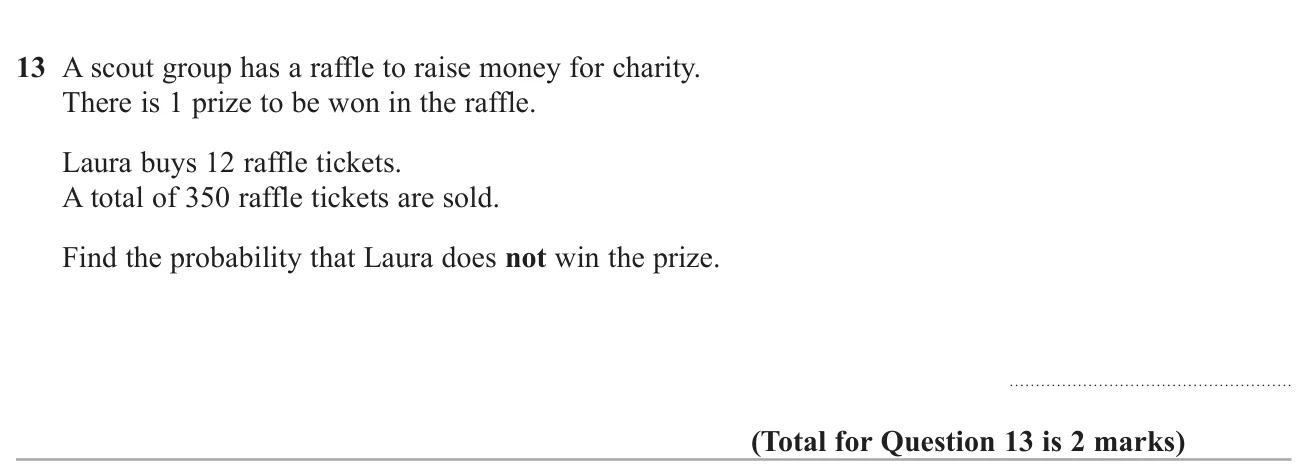
Tickets that are not Laura's: 350−12=338
P(not win)=350338=175169
Watch out: Giving 12/350, the probability that she does win.
© Pearson Education Ltd. June 2018 Paper 2 (Foundation, calculator), question 14.
Show answer
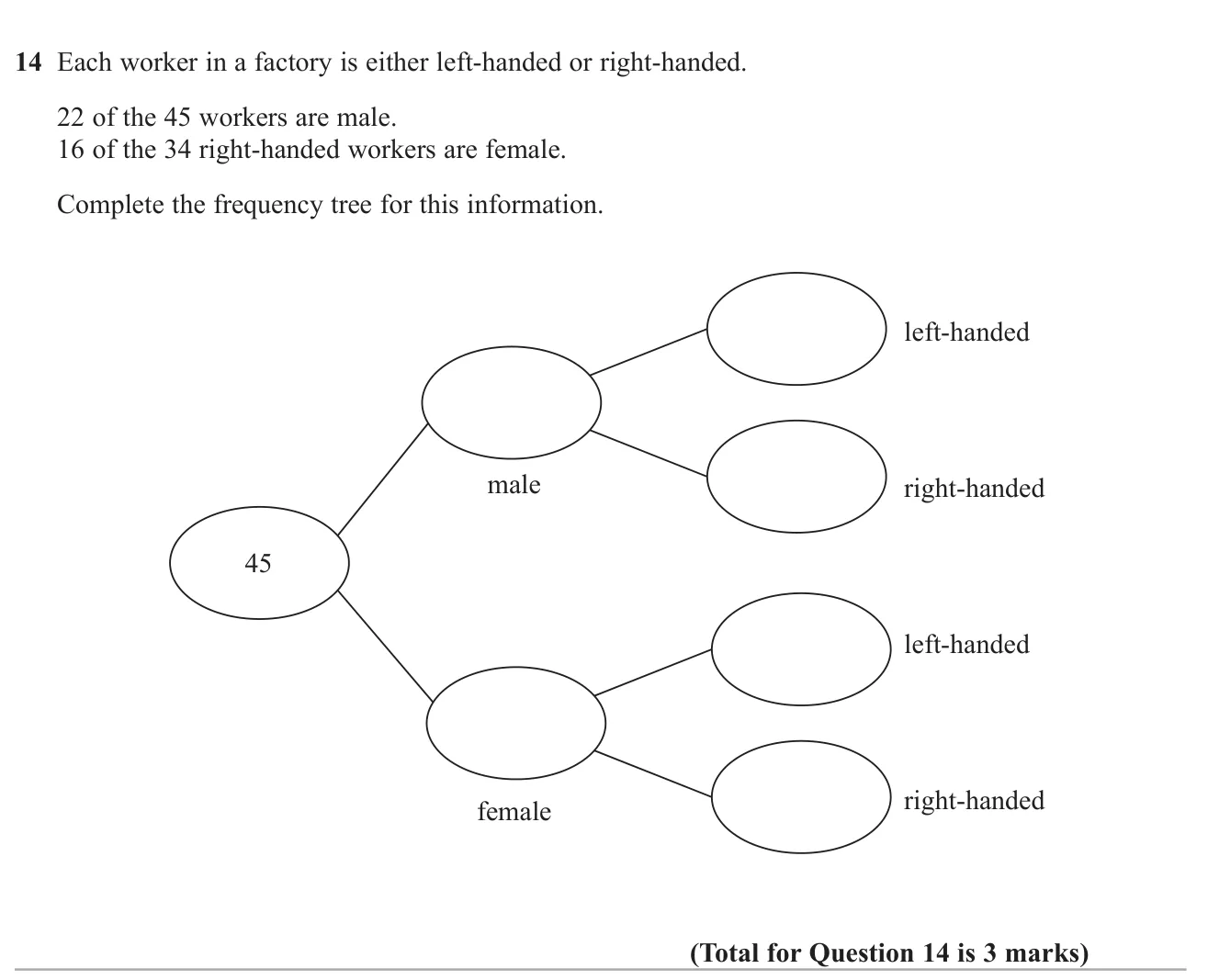
| Answer | Male 22 (left 4, right 18); female 23 (left 7, right 16) | 3 marks |
|---|
Worked solution Checked against the mark scheme
Female: 45−22=23
Male right-handed: 34−16=18
Male left-handed: 22−18=4
Female left-handed: 23−16=7
Check: left-handed total 4+7=11=45−34
Watch out: Putting 16 on the male branch.
© Pearson Education Ltd. June 2018 Paper 2 (Foundation, calculator), question 15.
Show answer
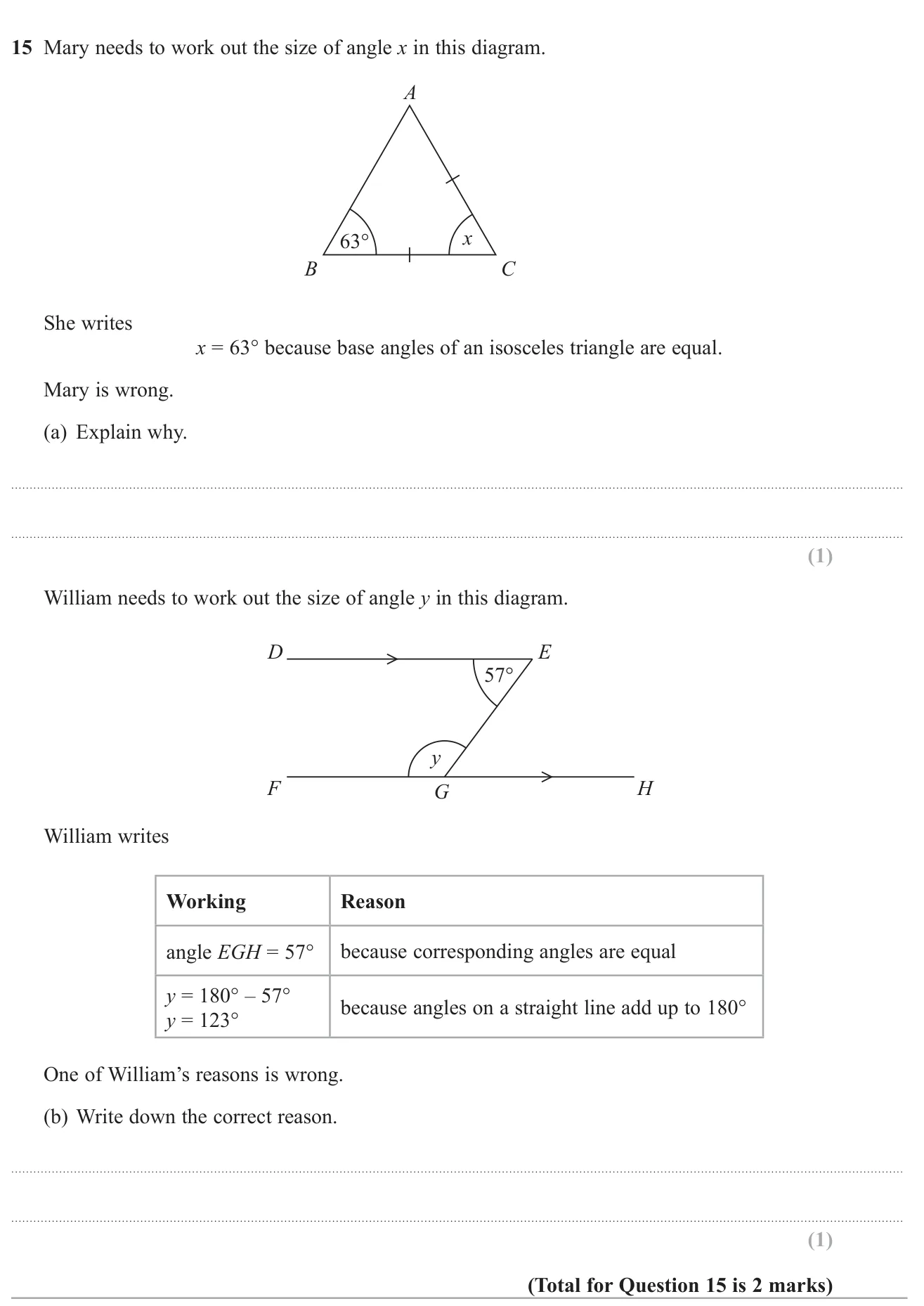
| (a) | The equal sides are AC and BC, so the equal angles are at A and B, not C; x=54° | 1 mark |
|---|
| (b) | Angle EGH = 57° because alternate angles are equal | 1 mark |
|---|
Worked solution Checked against the mark scheme
(a) The marked equal sides meet at C, so the base angles are at A and B. Angle A =63°, so x=180−63−63=54°.
(b) The 57° angle and angle EGH lie on opposite sides of the line EG, between the parallel lines. That makes them alternate angles, not corresponding.
Watch out: Assuming the two bottom angles are always the base angles.
© Pearson Education Ltd. June 2018 Paper 2 (Foundation, calculator), question 16.
Show answer
Worked solution Checked against the mark scheme
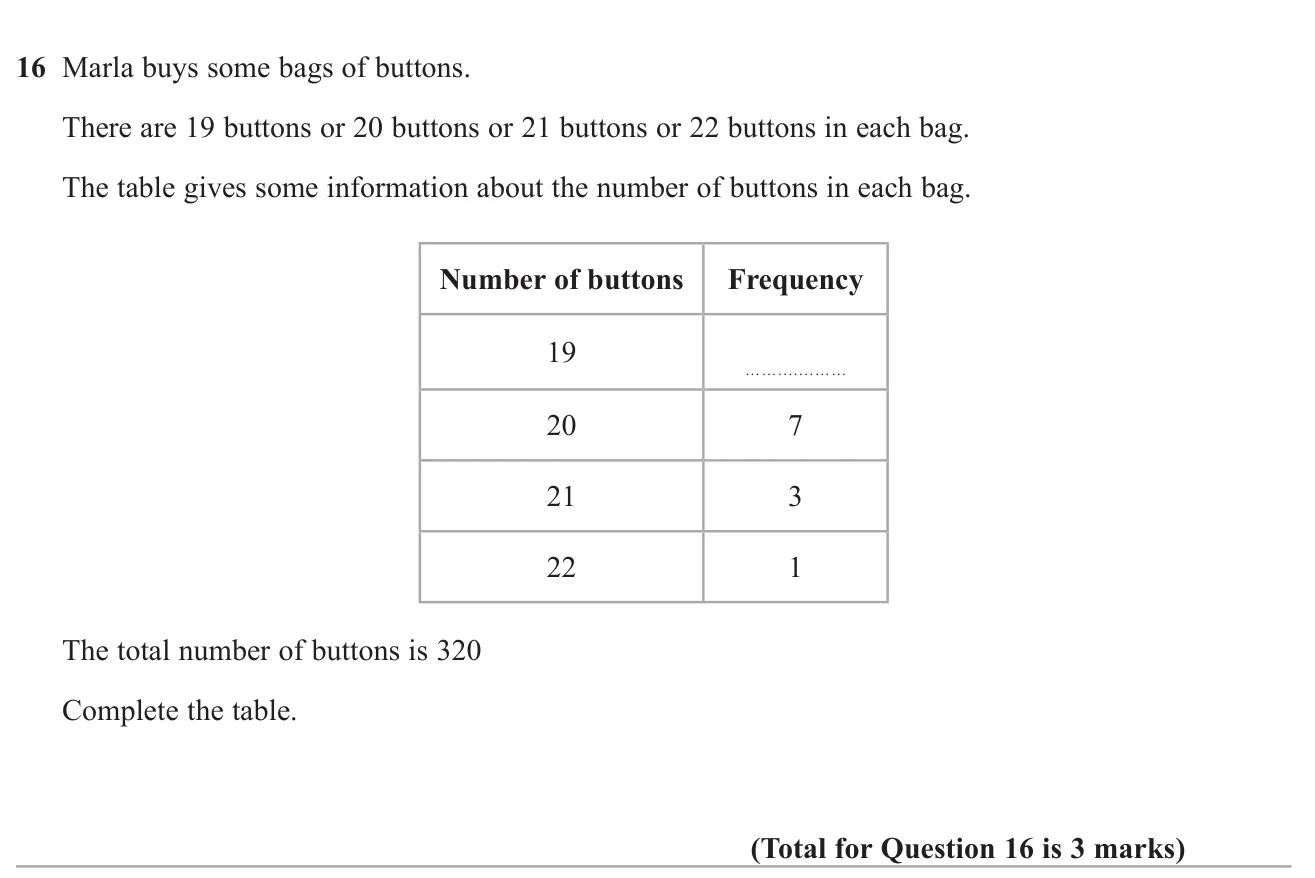
Buttons already accounted for: 20×7+21×3+22×1=140+63+22=225
Buttons left: 320−225=95
Bags of 19: 95÷19=5
Watch out: Adding the frequencies instead of the buttons.
© Pearson Education Ltd. June 2018 Paper 2 (Foundation, calculator), question 17.
Show answer
Worked solution Checked against the mark scheme
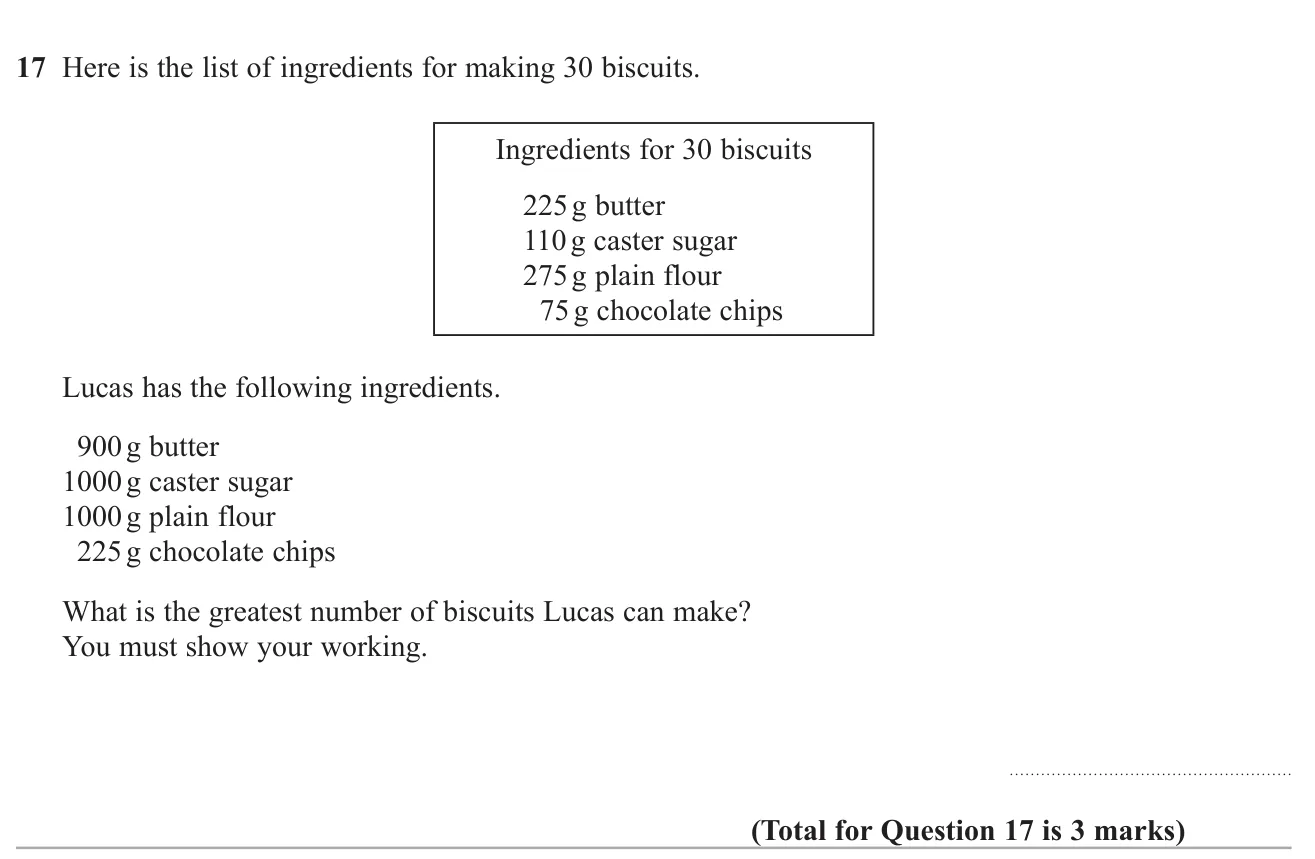
Batches each ingredient allows:
Butter 900÷225=4; sugar 1000÷110≈9.1; flour 1000÷275≈3.6; chocolate 225÷75=3
Chocolate runs out first, after 3 batches.
3×30=90 biscuits
Watch out: Using the ingredient with the most batches, or forgetting to multiply by 30.
© Pearson Education Ltd. June 2018 Paper 2 (Foundation, calculator), question 18.
Show answer
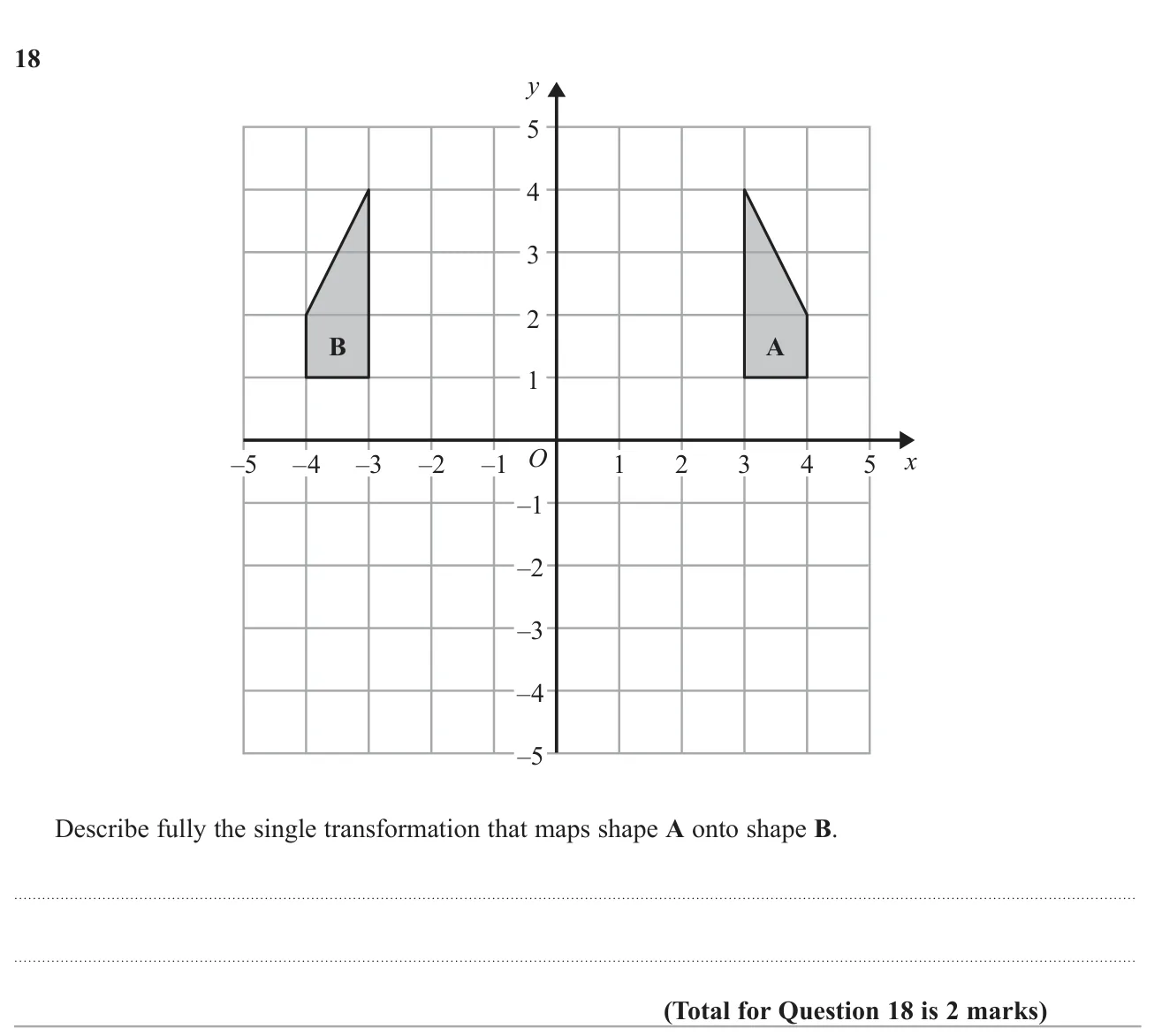
| Answer | Reflection in the y-axis | 2 marks |
|---|
Worked solution Checked against the mark scheme
Shape B is a mirror image of A, the same distance from the y-axis on the other side.
So it is a reflection in the y-axis (x=0).
Watch out: Saying translation, or naming the x-axis as the mirror line.
© Pearson Education Ltd. June 2018 Paper 2 (Foundation, calculator), question 19.
Show answer
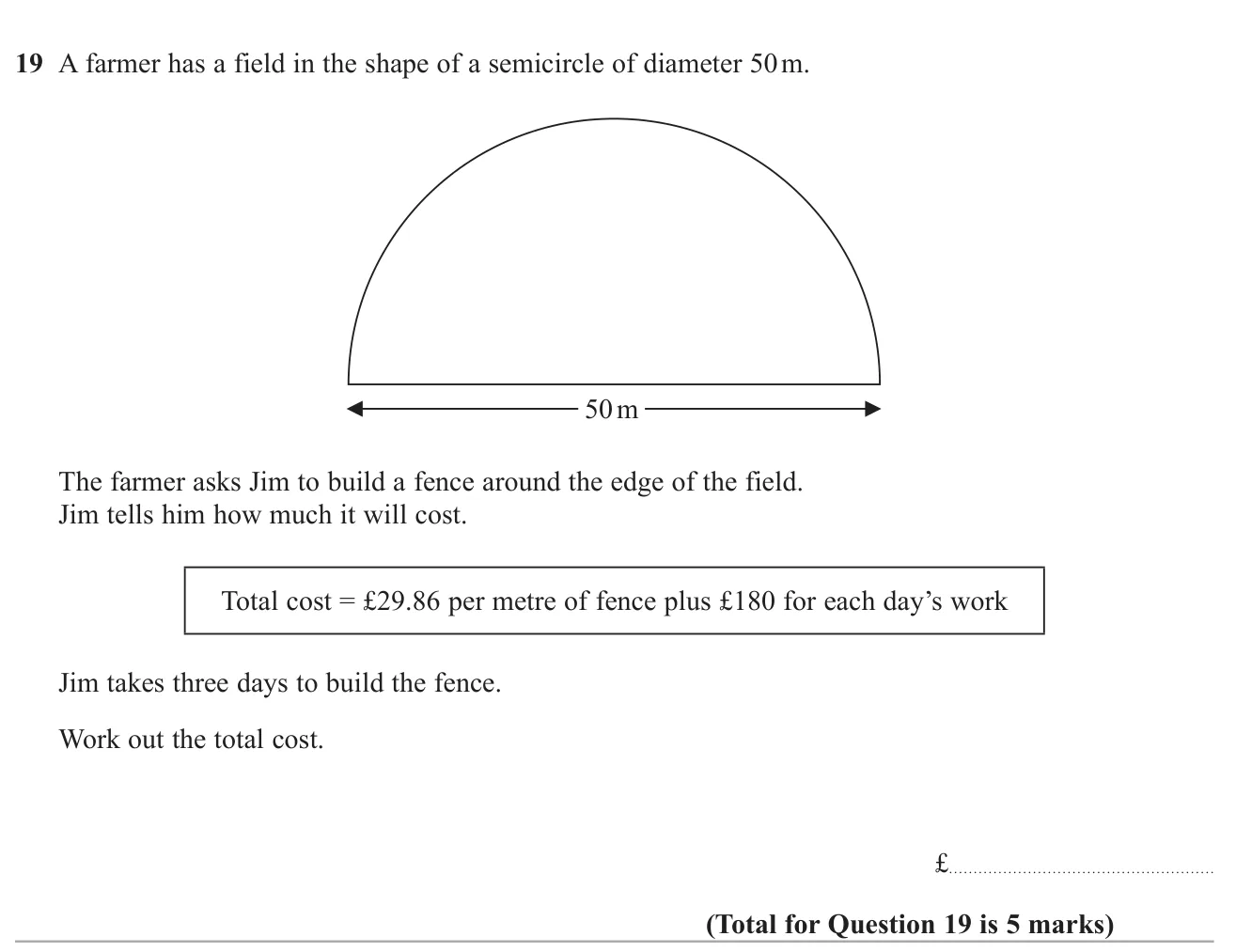
| Answer | £4378.20 | 5 marks |
|---|
Worked solution Checked against the mark scheme
Curved edge: 21×π×50=78.54 m
Perimeter: 78.54+50=128.54 m
Fence: 128.54×29.86=£3838.20
Labour: 3×180=£540
Total: 3838.20+540=£4378.20
Watch out: Forgetting the straight edge (the diameter).
© Pearson Education Ltd. June 2018 Paper 2 (Foundation, calculator), question 20.
Show answer
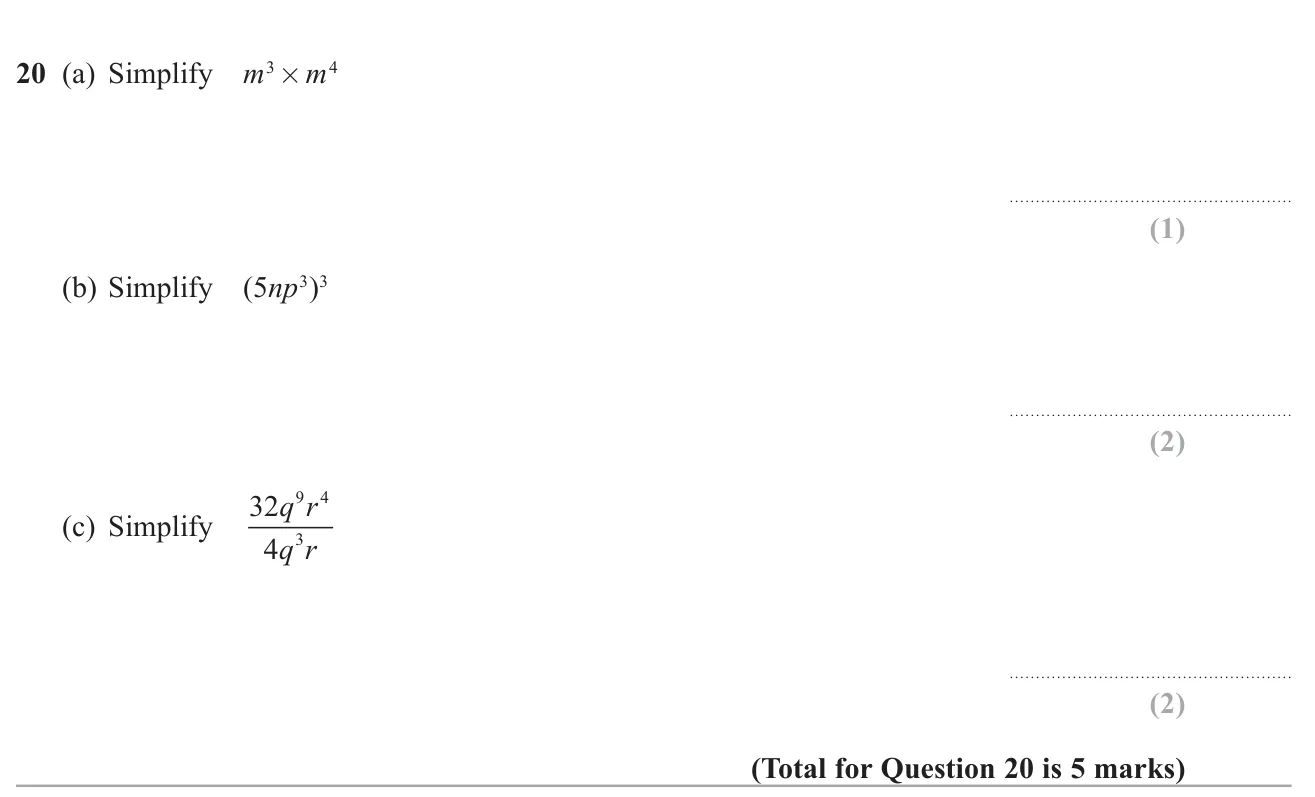
| (a) | m7 | 1 mark |
|---|
| (b) | 125n3p9 | 2 marks |
|---|
| (c) | 8q6r3 | 2 marks |
|---|
Worked solution Checked against the mark scheme
(a) Add the powers: m3+4=m7
(b) Cube each part: 53×n3×(p3)3=125n3p9
(c) Divide the numbers and subtract the powers: 432=8, q9−3=q6, r4−1=r3, giving 8q6r3
Watch out: In (b), writing 15np9 or p6.
© Pearson Education Ltd. June 2018 Paper 2 (Foundation, calculator), question 21.
Show answer
| (a) | 280 | 2 marks |
|---|
| (b) | 60 | 1 mark |
|---|
Worked solution Checked against the mark scheme
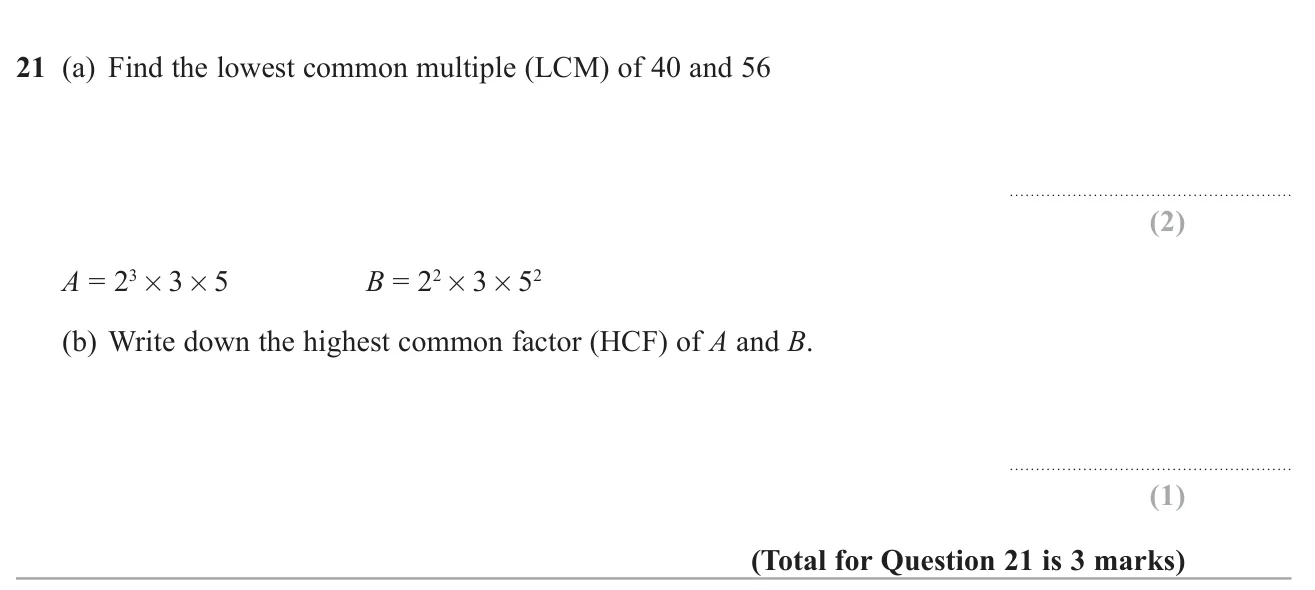
(a) 40=23×5 and 56=23×7
LCM =23×5×7=280
(b) Take the lowest power of each shared prime: 22×3×5=60
Watch out: Multiplying 40 by 56 for the LCM.
© Pearson Education Ltd. June 2018 Paper 2 (Foundation, calculator), question 22.
Show answer
| Answer | y=3x−6 | 3 marks |
|---|
Worked solution Checked against the mark scheme
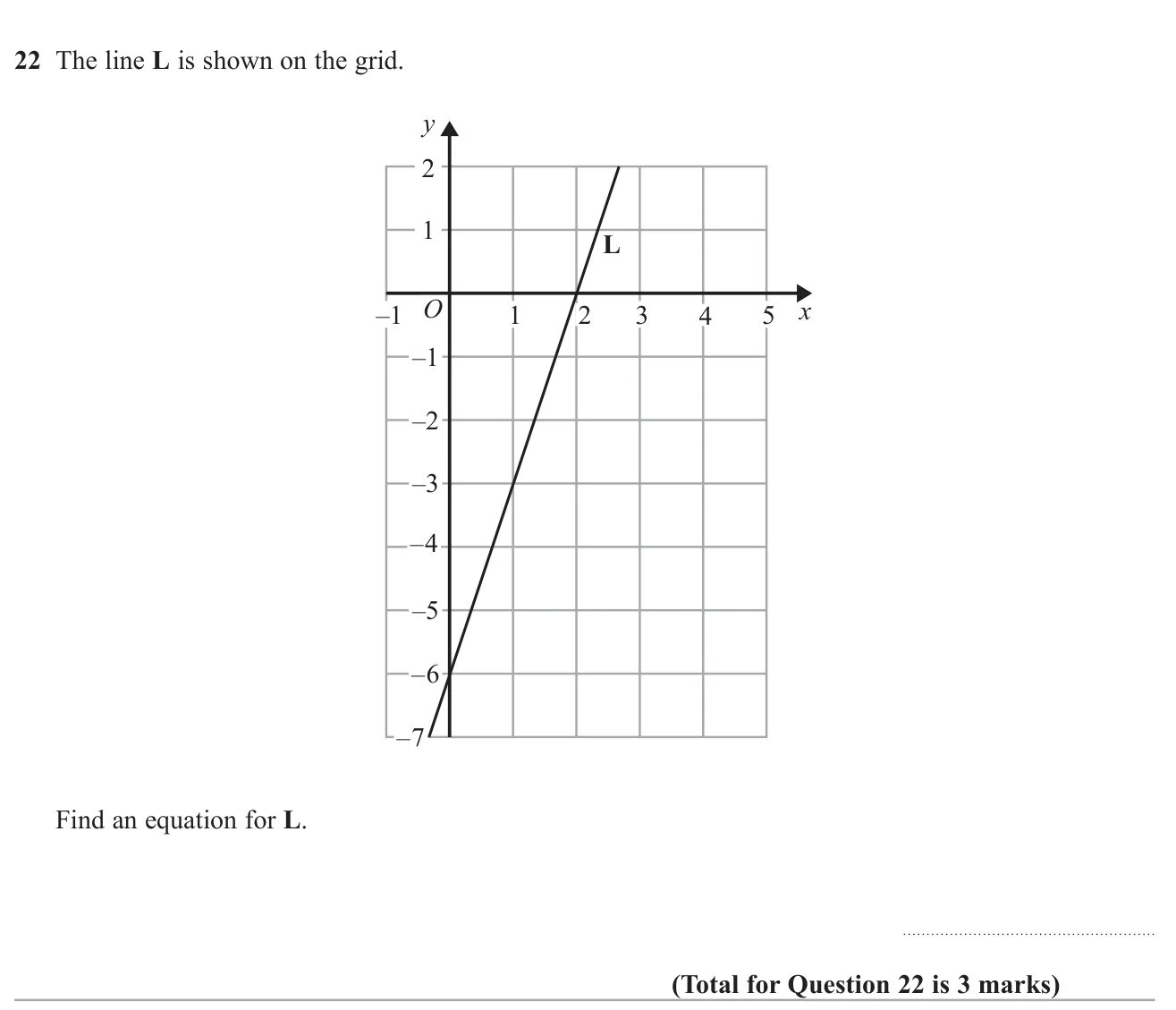
The line crosses the y-axis at −6, so c=−6.
From (0,−6) to (2,0): up 6, across 2, so gradient =6÷2=3.
y=3x−6
Watch out: Working out the gradient as across over up, giving 1/3.
Question 23
Ratio5 marksGrade 5CalculatorOn both tiers © Pearson Education Ltd. June 2018 Paper 2 (Foundation, calculator), question 23.
Show answer
Worked solution Checked against the mark scheme
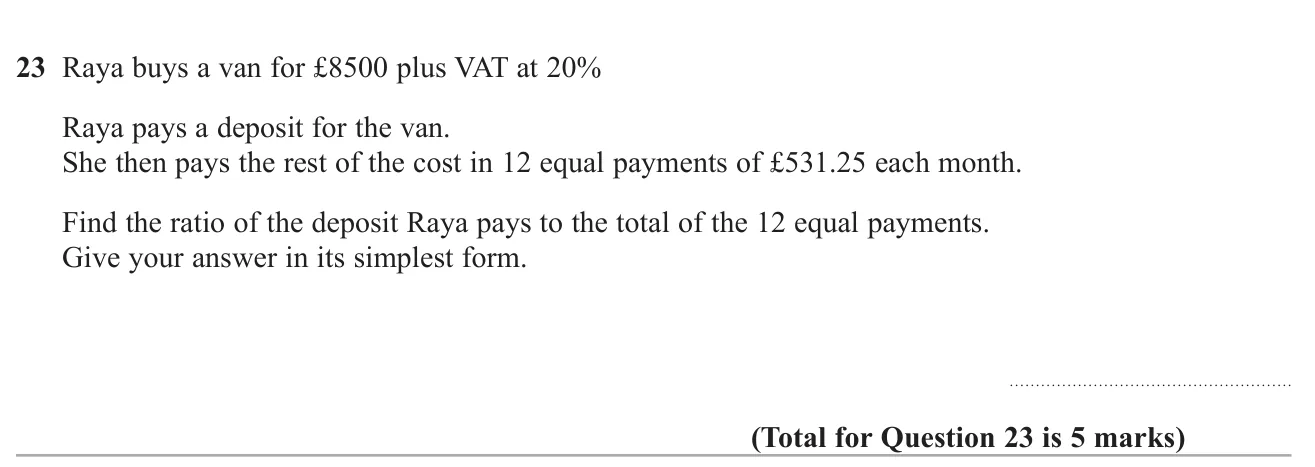
Price with VAT: 8500×1.2=£10200
Monthly payments: 12×531.25=£6375
Deposit: 10200−6375=£3825
Ratio: 3825:6375. Divide both by 1275: 3:5
Watch out: Giving the ratio the wrong way round (5 : 3).
© Pearson Education Ltd. June 2018 Paper 2 (Foundation, calculator), question 24.
Show answer
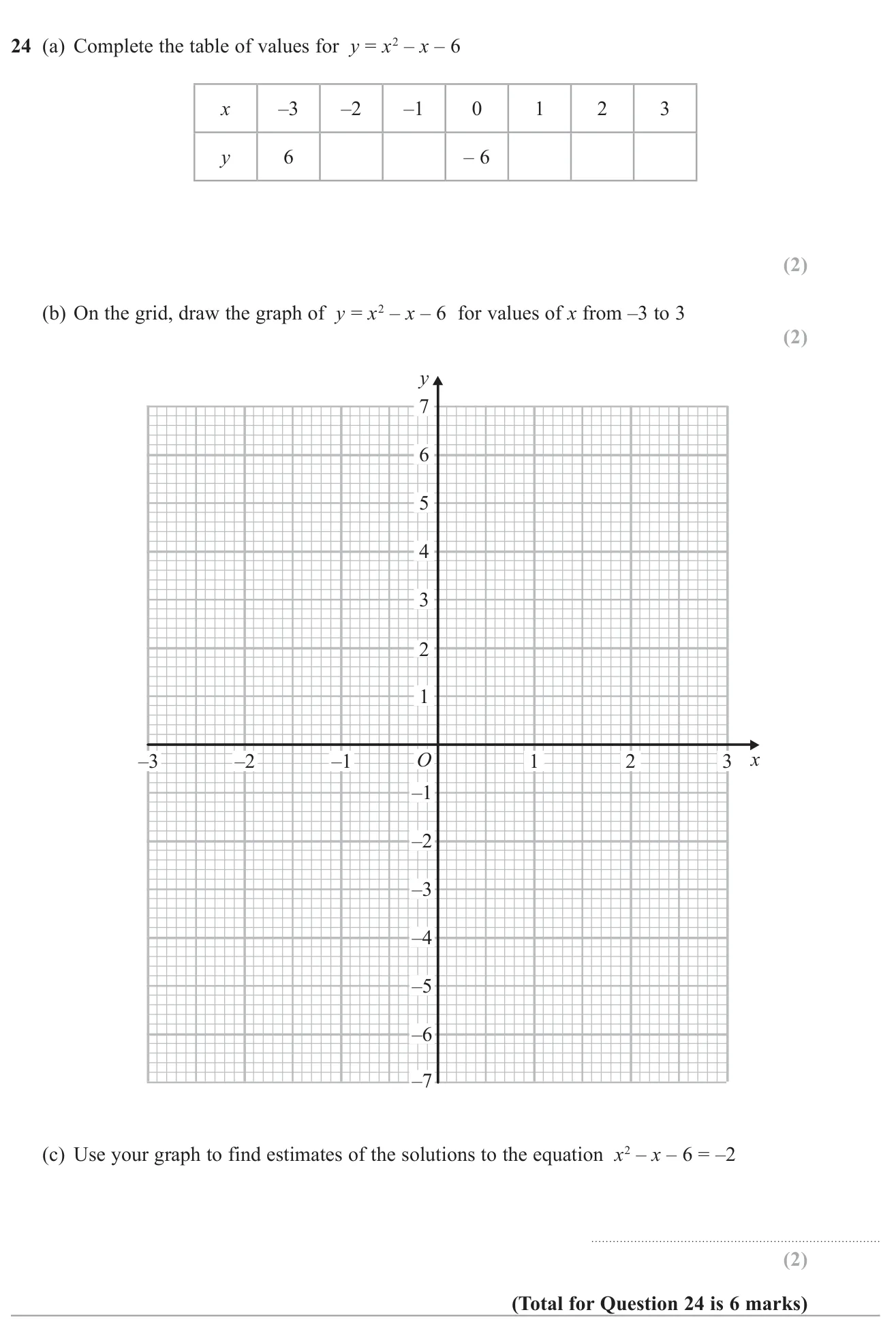
| (a) | 0,−4,−6,−4,0 (for x=−2,−1,1,2,3) | 2 marks |
|---|
| (b) | Smooth U-shaped curve through the points | 2 marks |
|---|
| (c) | x≈2.6 and x≈−1.6 | 2 marks |
|---|
Worked solution Checked against the mark scheme
(a) e.g. x=−2: 4+2−6=0; x=1: 1−1−6=−6; x=2: 4−2−6=−4
(b) Plot (−3,6),(−2,0),(−1,−4),(0,−6),(1,−6),(2,−4),(3,0) and join with a smooth curve.
(c) Draw the line y=−2 and read off where it crosses the curve: x≈2.6 and x≈−1.6
Watch out: In (a), working out −x wrongly for negative x, e.g. (−2)2−(−2)=2.
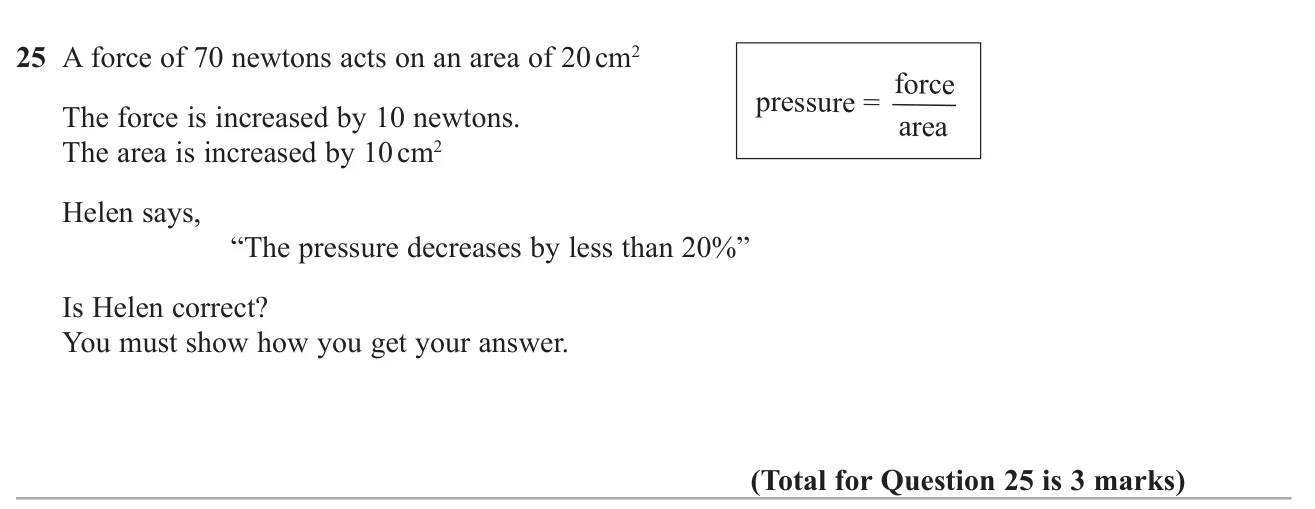
© Pearson Education Ltd. June 2018 Paper 2 (Foundation, calculator), question 25.
Show answer
| Answer | No: pressure falls from 3.5 to 2.67 N/cm², a decrease of about 24% | 3 marks |
|---|
Worked solution Checked against the mark scheme
Original pressure: 70÷20=3.5 N/cm²
New pressure: 80÷30=2.67 N/cm²
Decrease: 3.5−2.67=0.83
Percentage decrease: 3.50.83×100≈24%
This is more than 20%, so Helen is wrong.
Watch out: Comparing the 10 N and 10 cm² increases directly without working out pressures.
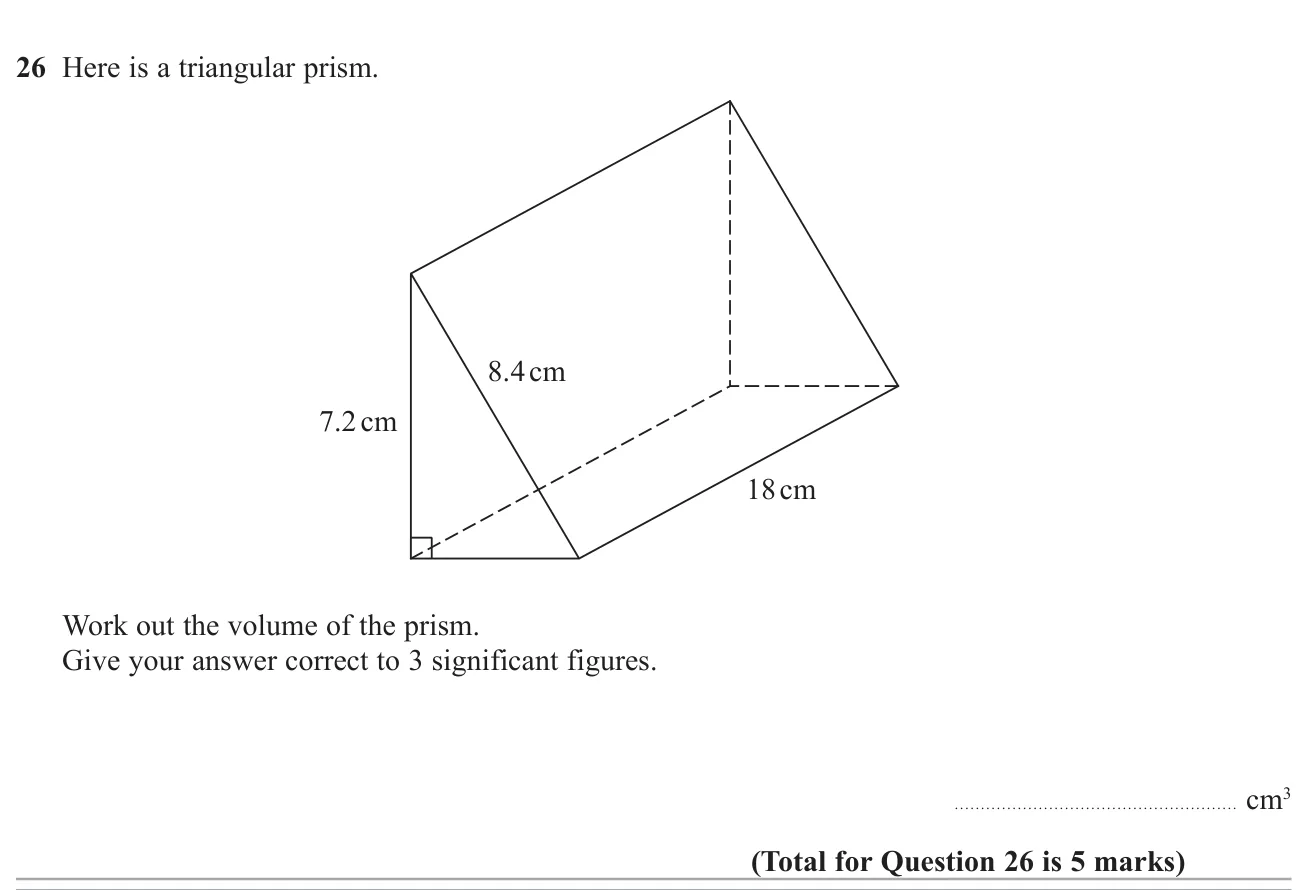
© Pearson Education Ltd. June 2018 Paper 2 (Foundation, calculator), question 26.
Show answer
| Answer | 280 cm³ | 5 marks |
|---|
Worked solution Checked against the mark scheme
Base of triangle: 8.42−7.22=18.72=4.327 cm
Triangle area: 21×4.327×7.2=15.58 cm²
Volume: 15.58×18=280.4≈280 cm³
Watch out: Adding the squares instead of subtracting, or forgetting to halve.
Finished the paper?
Add up your marks for all three papers and see what grade that would have been.