Revision guide by The Full Marks
Coordinates and straight-line graphs: what you need to know Straight-line graphs link algebra and coordinates. You need to plot lines, read coordinates in all four quadrants and find the equation of a line from its gradient and intercept. It is one of the most common topics across both tiers.
Both tiers need coordinates, gradients, intercepts and parallel lines; perpendicular lines are Higher only.
Key facts A straight line has equation y = m x + c y = mx + c y = m x + c m m m c c c y y y x x x y = 3 + 2 x y = 3 + 2x y = 3 + 2 x y = 5 − x y = 5 - x y = 5 − x − 1 -1 − 1 Gradient = change in y change in x = \frac{\text{change in } y}{\text{change in } x} = change in x change in y Parallel lines have the same gradient. Higher: perpendicular gradients multiply to − 1 -1 − 1 m m m − 1 m -\frac{1}{m} − m 1 x = a x = a x = a y = b y = b y = b Midpoint of ( x 1 , y 1 ) (x_1, y_1) ( x 1 , y 1 ) ( x 2 , y 2 ) (x_2, y_2) ( x 2 , y 2 ) ( x 1 + x 2 2 , y 1 + y 2 2 ) \left(\frac{x_1 + x_2}{2}, \frac{y_1 + y_2}{2}\right) ( 2 x 1 + x 2 , 2 y 1 + y 2 ) Drawing a straight-line graph Make a table of values using every x x x x = − 2 x = -2 x = − 2 4 4 4 Substitute carefully, especially negative x x x y = 1 − 2 x y = 1 - 2x y = 1 − 2 x x = − 3 x = -3 x = − 3 y = 1 − ( − 6 ) = 7 y = 1 - (-6) = 7 y = 1 − ( − 6 ) = 7 Plot the points, check they lie in a straight line, then rule one line through them covering the whole range. Equation of a line through two points Find the gradient: change in y y y x x x Substitute one point into y = m x + c y = mx + c y = m x + c c c c Write the answer as y = m x + c y = mx + c y = m x + c Line perpendicular to a given line (Higher) Rearrange the given line into y = m x + c y = mx + c y = m x + c m m m Use gradient − 1 m -\frac{1}{m} − m 1 c c c Worked examples Example 1 Foundation · grade 5
Find the equation of the straight line through ( 1 , 4 ) (1, 4) ( 1 , 4 ) ( 3 , 10 ) (3, 10) ( 3 , 10 )
Show the solution Gradient = 10 − 4 3 − 1 = 6 2 = 3 = \frac{10 - 4}{3 - 1} = \frac{6}{2} = 3 = 3 − 1 10 − 4 = 2 6 = 3 ( 1 , 4 ) (1, 4) ( 1 , 4 ) y = 3 x + c y = 3x + c y = 3 x + c 4 = 3 + c 4 = 3 + c 4 = 3 + c c = 1 c = 1 c = 1 y = 3 x + 1 y = 3x + 1 y = 3 x + 1
Example 2 Higher · grade 7
Line L L L ( 4 , 1 ) (4, 1) ( 4 , 1 ) 2 x + 3 y = 12 2x + 3y = 12 2 x + 3 y = 12 L L L
Show the solution Rearrange: 3 y = − 2 x + 12 3y = -2x + 12 3 y = − 2 x + 12 y = − 2 3 x + 4 y = -\frac{2}{3}x + 4 y = − 3 2 x + 4 − 2 3 -\frac{2}{3} − 3 2 = 3 2 = \frac{3}{2} = 2 3 ( 4 , 1 ) (4, 1) ( 4 , 1 ) 1 = 3 2 × 4 + c = 6 + c 1 = \frac{3}{2} \times 4 + c = 6 + c 1 = 2 3 × 4 + c = 6 + c c = − 5 c = -5 c = − 5 y = 3 2 x − 5 y = \frac{3}{2}x - 5 y = 2 3 x − 5
Common mistakes Working out the gradient as change in x x x y y y Missing the sign: a line going down from left to right has a negative gradient. Reading the gradient straight off 2 x + 3 y = 12 2x + 3y = 12 2 x + 3 y = 12 y = m x + c y = mx + c y = m x + c Mixing up x = − 3 x = -3 x = − 3 y = − 3 y = -3 y = − 3 Making sign errors when substituting negative x x x Exam tips Write your final answer as a full equation, y = … y = \ldots y = … m m m c c c To show two lines are parallel, rearrange each into y = m x + c y = mx + c y = m x + c − 1 -1 − 1 Questions people ask How do you find the gradient of a line? Pick two points on the line and divide the change in y y y x x x
How do you know if two lines are parallel? Write both in the form y = m x + c y = mx + c y = m x + c m m m
What is the gradient of a perpendicular line? Take the negative reciprocal: flip the fraction and change the sign. For a gradient of 4, the perpendicular gradient is − 1 4 -\frac{1}{4} − 4 1
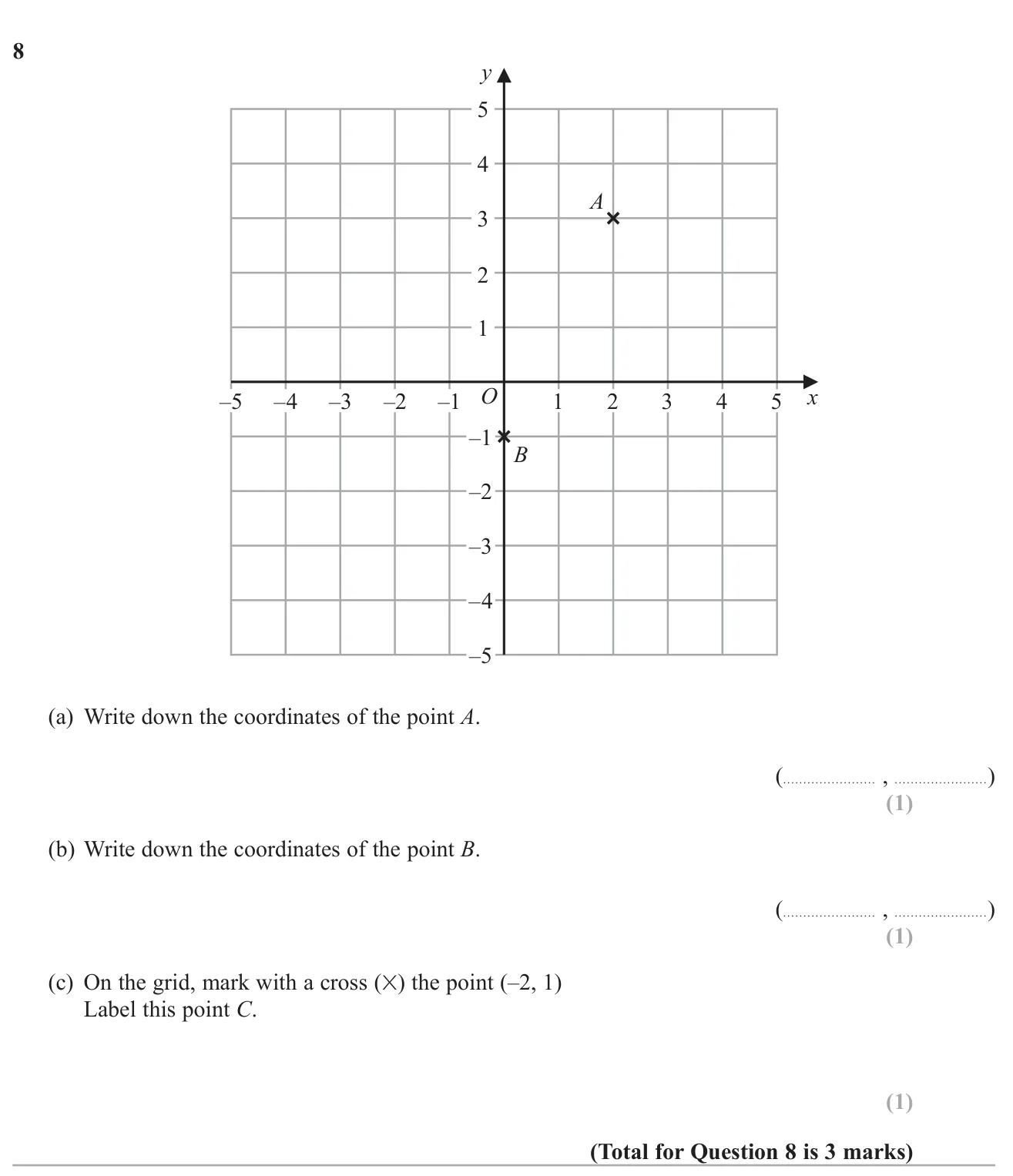
Exam questions: Coordinates and straight-line graphs (43, easiest first) © Pearson Education Ltd. November 2020 Paper 1 (Foundation, non-calculator), question 8.
(a) ( 2 , 3 ) (2, 3) ( 2 , 3 ) 1 mark (b) ( 0 , − 1 ) (0, -1) ( 0 , − 1 ) 1 mark (c) Cross at ( − 2 , 1 ) (-2, 1) ( − 2 , 1 ) 1 mark
Worked solution Checked against the mark scheme
(a) A is 2 across and 3 up: ( 2 , 3 ) (2, 3) ( 2 , 3 )
(b) B is on the y-axis, 1 below the origin: ( 0 , − 1 ) (0, -1) ( 0 , − 1 )
(c) Go 2 left, then 1 up, and mark C there.
Watch out: Swapping the order and writing ( 3 , 2 ) (3, 2) ( 3 , 2 ) ( − 1 , 0 ) (-1, 0) ( − 1 , 0 )
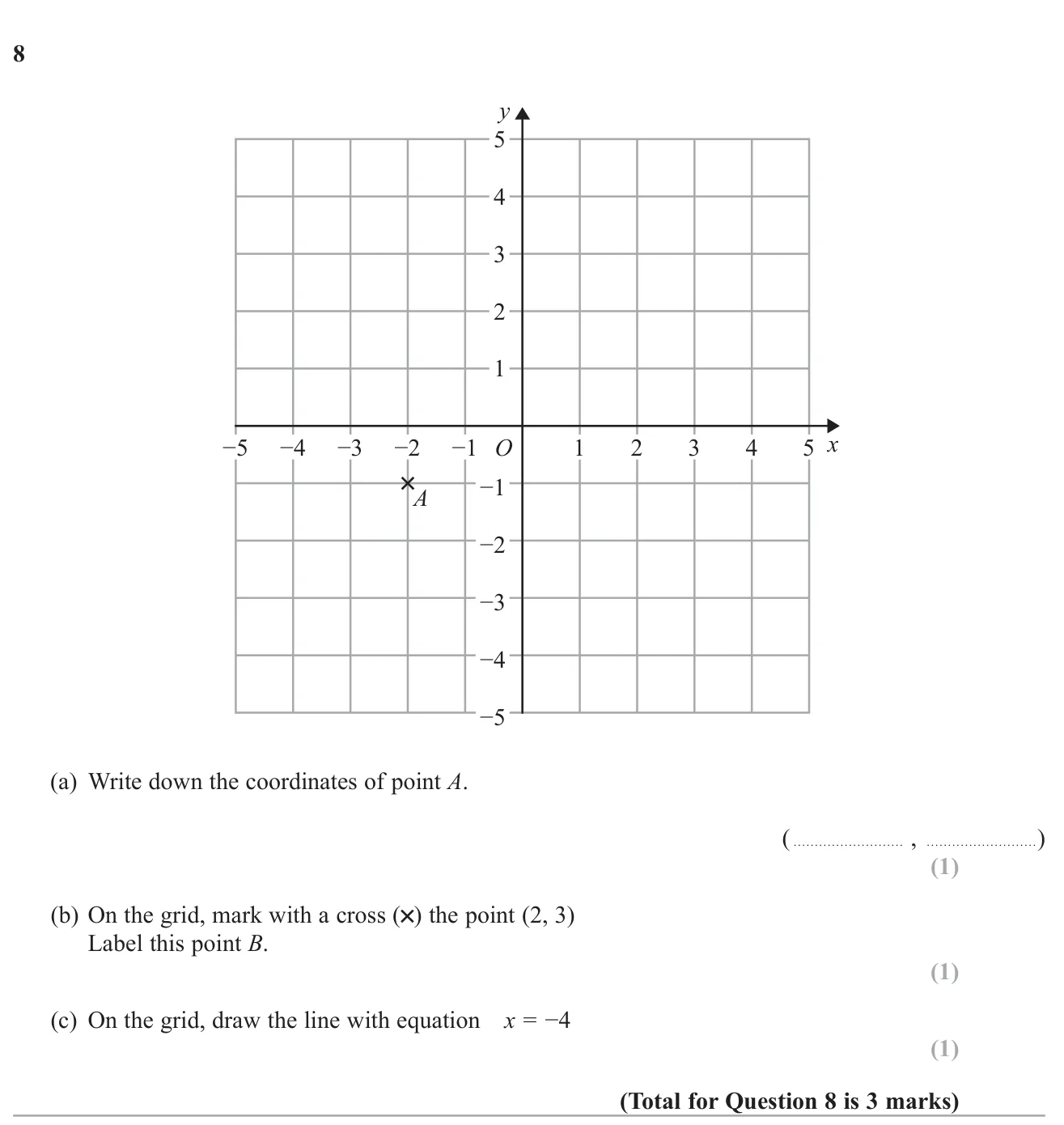
© Pearson Education Ltd. November 2018 Paper 1 (Foundation, non-calculator), question 8.
(a) ( − 2 , − 1 ) (-2, -1) ( − 2 , − 1 ) 1 mark (b) Cross at ( 2 , 3 ) (2, 3) ( 2 , 3 ) 1 mark (c) Vertical line through x = − 4 x = -4 x = − 4 1 mark
Worked solution Checked against the mark scheme
(a) Go across to − 2 -2 − 2 − 1 -1 − 1 ( − 2 , − 1 ) (-2, -1) ( − 2 , − 1 )
(b) Go 2 right and 3 up and mark B.
(c) Every point on x = − 4 x = -4 x = − 4 x x x − 4 -4 − 4 − 4 -4 − 4 x x x
Watch out: Drawing a horizontal line for x = − 4 x = -4 x = − 4
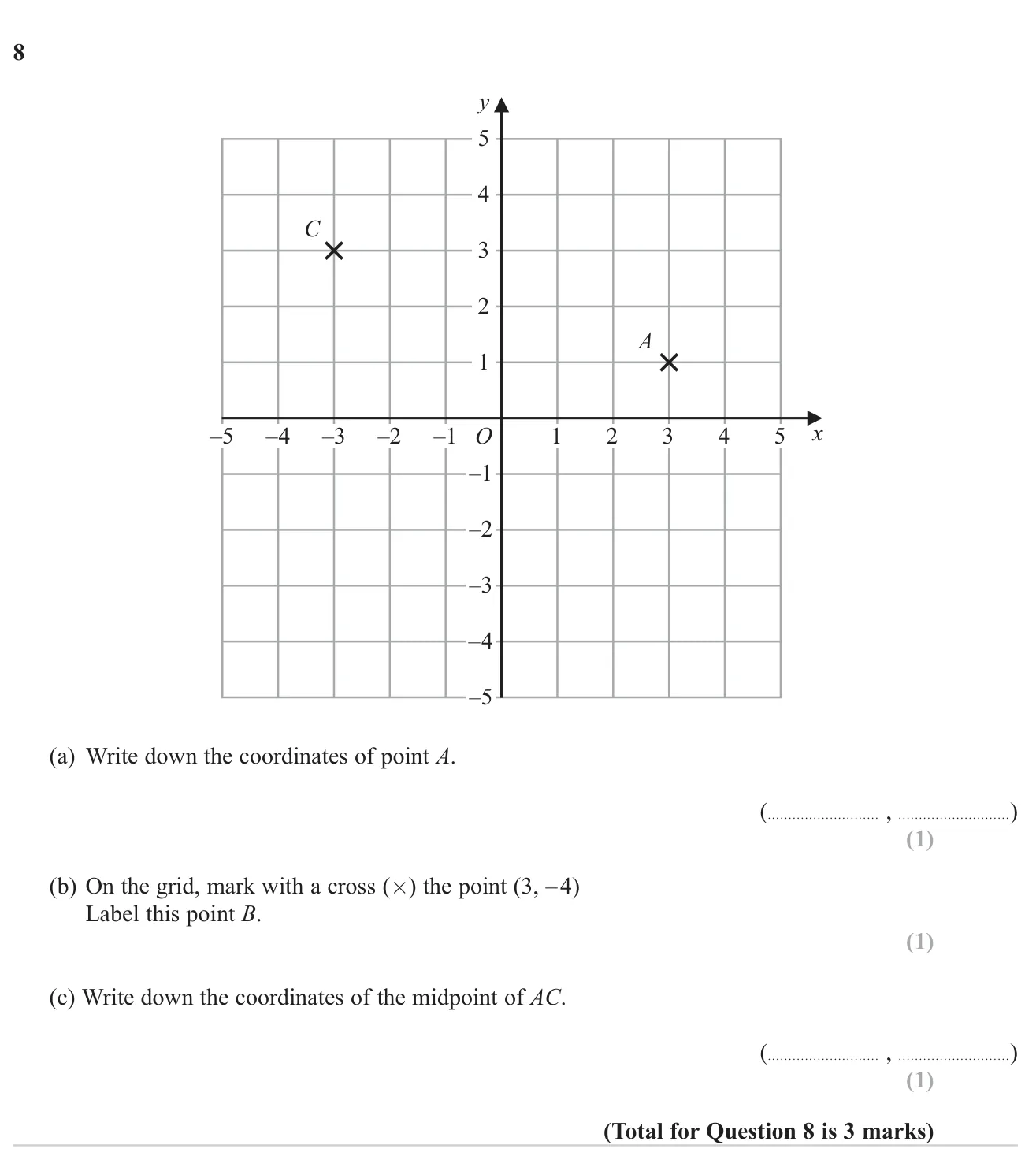
© Pearson Education Ltd. November 2024 Paper 1 (Foundation, non-calculator), question 8.
(a) ( 3 , 1 ) (3, 1) ( 3 , 1 ) 1 mark (b) Cross at ( 3 , − 4 ) (3, -4) ( 3 , − 4 ) 1 mark (c) ( 0 , 2 ) (0, 2) ( 0 , 2 ) 1 mark
Worked solution Checked against the mark scheme
(a) A is 3 right and 1 up: ( 3 , 1 ) (3, 1) ( 3 , 1 )
(b) Go 3 right and 4 down and mark B there.
(c) C is ( − 3 , 3 ) (-3, 3) ( − 3 , 3 ) = ( 3 + ( − 3 ) 2 , 1 + 3 2 ) = ( 0 , 2 ) = \left(\frac{3 + (-3)}{2}, \frac{1 + 3}{2}\right) = (0, 2) = ( 2 3 + ( − 3 ) , 2 1 + 3 ) = ( 0 , 2 )
Watch out: Writing coordinates the wrong way round, e.g. (1, 3).
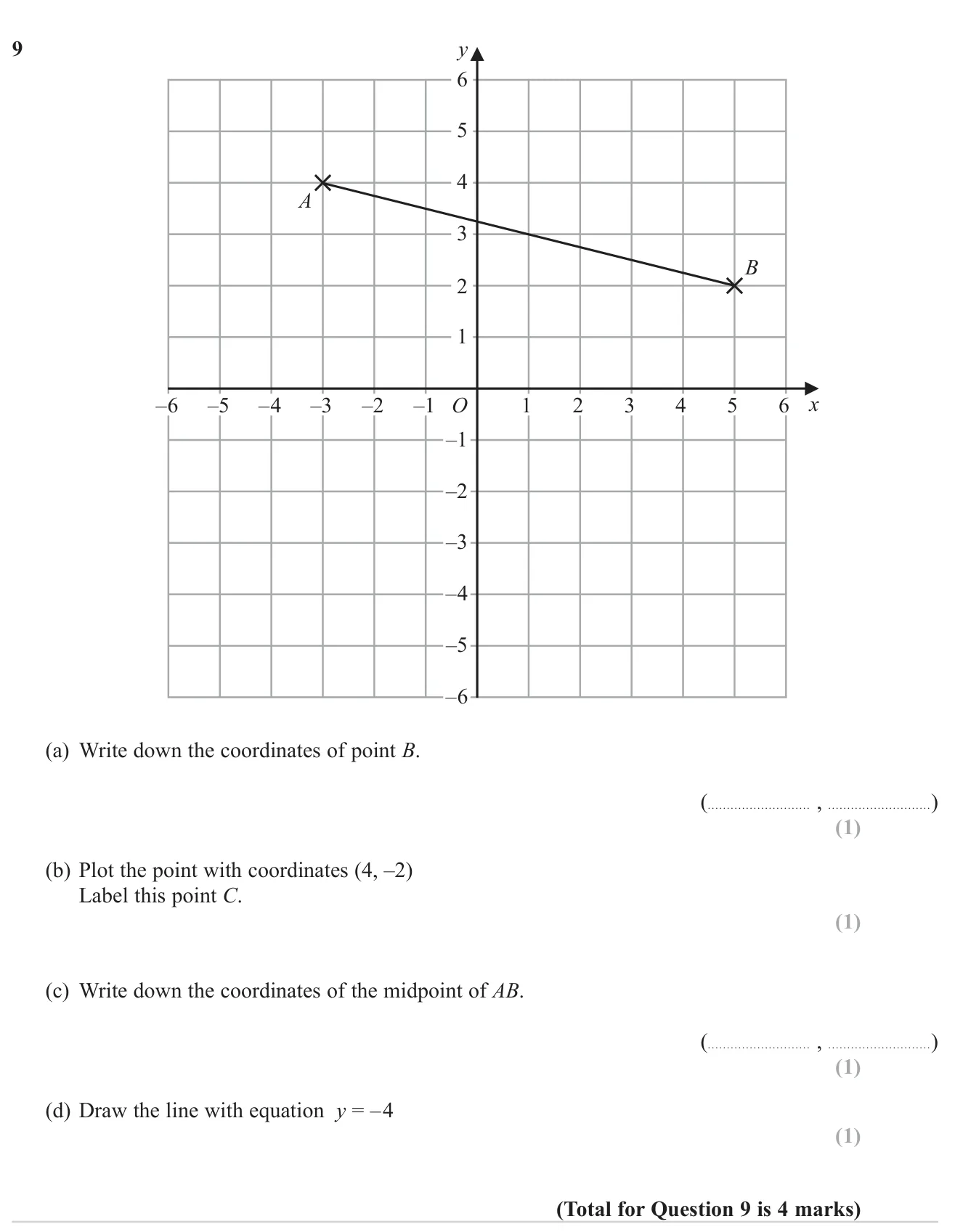
© Pearson Education Ltd. June 2023 Paper 1 (Foundation, non-calculator), question 9.
(a) ( 5 , 2 ) (5, 2) ( 5 , 2 ) 1 mark (b) Point C C C ( 4 , − 2 ) (4, -2) ( 4 , − 2 ) 1 mark (c) ( 1 , 3 ) (1, 3) ( 1 , 3 ) 1 mark (d) Horizontal line through y = − 4 y = -4 y = − 4 1 mark
Worked solution Checked against the mark scheme
(a) B B B ( 5 , 2 ) (5, 2) ( 5 , 2 )
(b) Go 4 right and 2 down, and mark C C C
(c) A = ( − 3 , 4 ) A = (-3, 4) A = ( − 3 , 4 ) = ( − 3 + 5 2 , 4 + 2 2 ) = ( 1 , 3 ) = \left(\frac{-3+5}{2}, \frac{4+2}{2}\right) = (1, 3) = ( 2 − 3 + 5 , 2 4 + 2 ) = ( 1 , 3 )
(d) y = − 4 y = -4 y = − 4 y y y − 4 -4 − 4
Watch out: Drawing a vertical line x = −4 in (d).
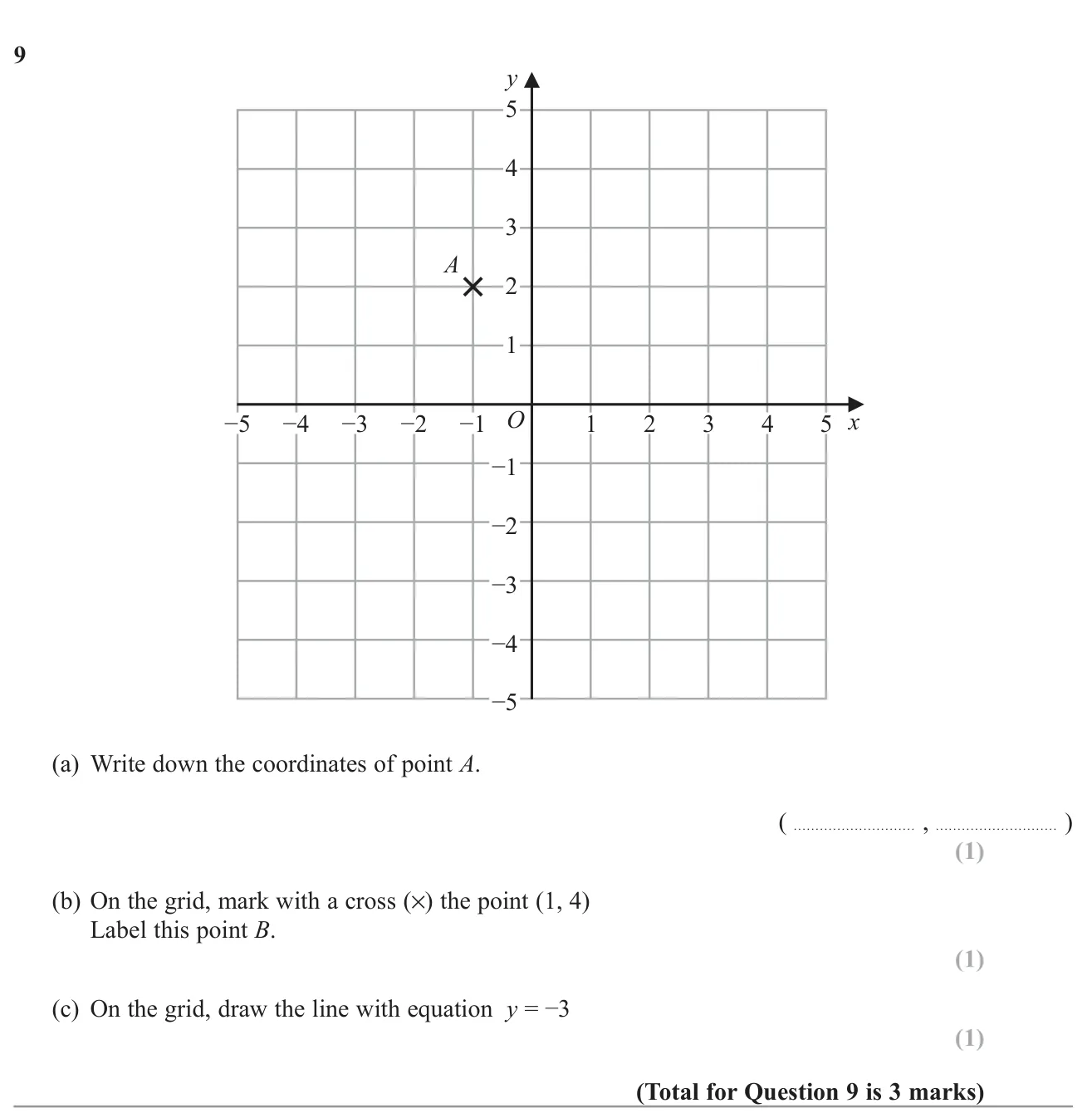
© Pearson Education Ltd. November 2022 Paper 3 (Foundation, calculator), question 9.
(a) ( − 1 , 2 ) (-1, 2) ( − 1 , 2 ) 1 mark (b) Point B plotted at ( 1 , 4 ) (1, 4) ( 1 , 4 ) 1 mark (c) Horizontal line through y = − 3 y = -3 y = − 3 1 mark
Worked solution Checked against the mark scheme
(a) A is 1 left of O and 2 up, so A is ( − 1 , 2 ) (-1, 2) ( − 1 , 2 )
(b) Go 1 right, then 4 up, and mark B.
(c) y = − 3 y = -3 y = − 3
Watch out: Drawing a vertical line through x = −3 for y = −3.
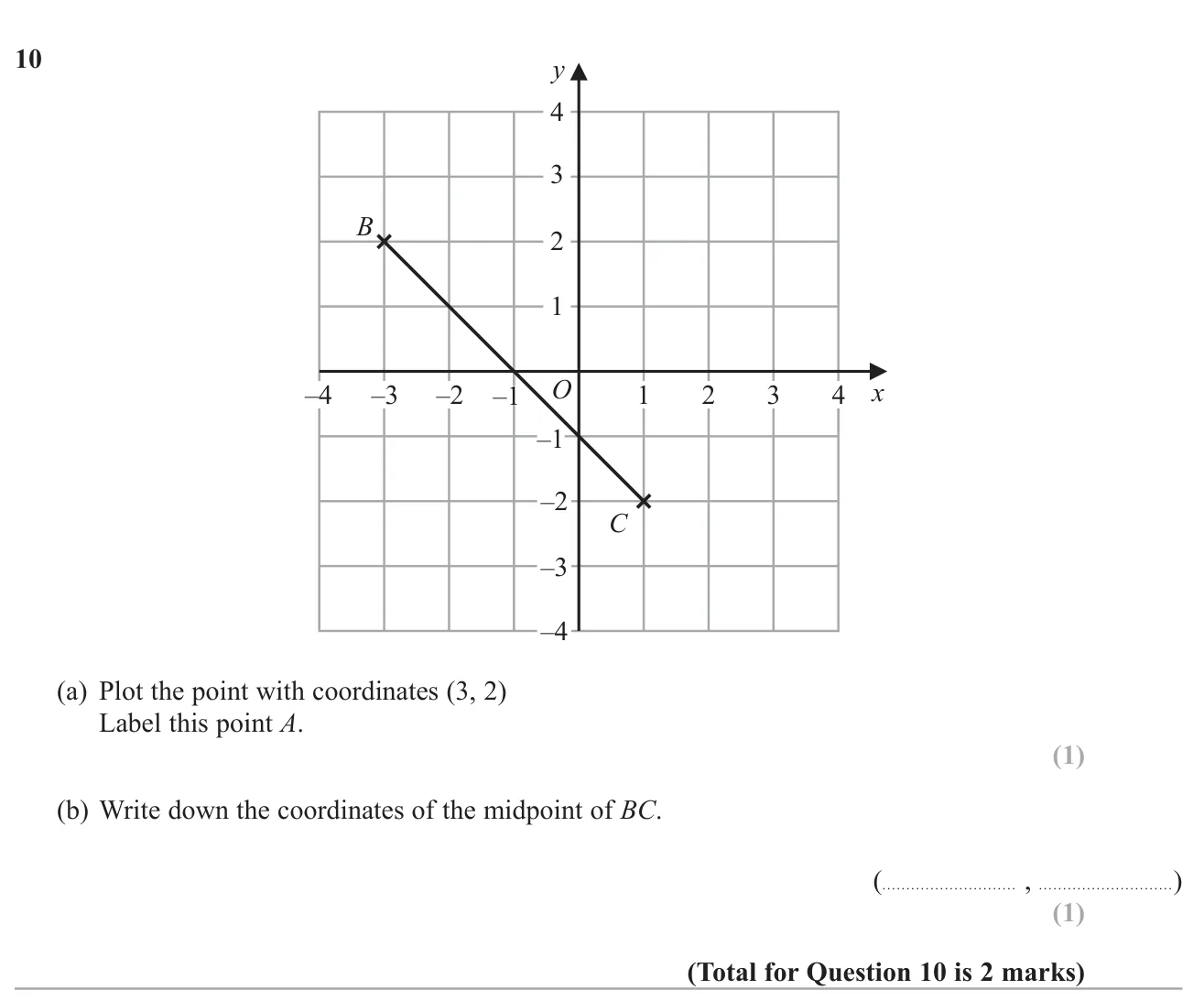
© Pearson Education Ltd. November 2019 Paper 1 (Foundation, non-calculator), question 10.
(a) Point A A A ( 3 , 2 ) (3, 2) ( 3 , 2 ) 1 mark (b) ( − 1 , 0 ) (-1, 0) ( − 1 , 0 ) 1 mark
Worked solution Checked against the mark scheme
(a) Go 3 right from O O O A A A
(b) B = ( − 3 , 2 ) B = (-3, 2) B = ( − 3 , 2 ) C = ( 1 , − 2 ) C = (1, -2) C = ( 1 , − 2 )
Midpoint = ( − 3 + 1 2 , 2 + ( − 2 ) 2 ) = ( − 1 , 0 ) = \left(\frac{-3 + 1}{2}, \frac{2 + (-2)}{2}\right) = (-1, 0) = ( 2 − 3 + 1 , 2 2 + ( − 2 ) ) = ( − 1 , 0 )
Watch out: Plotting (2, 3) instead of (3, 2).
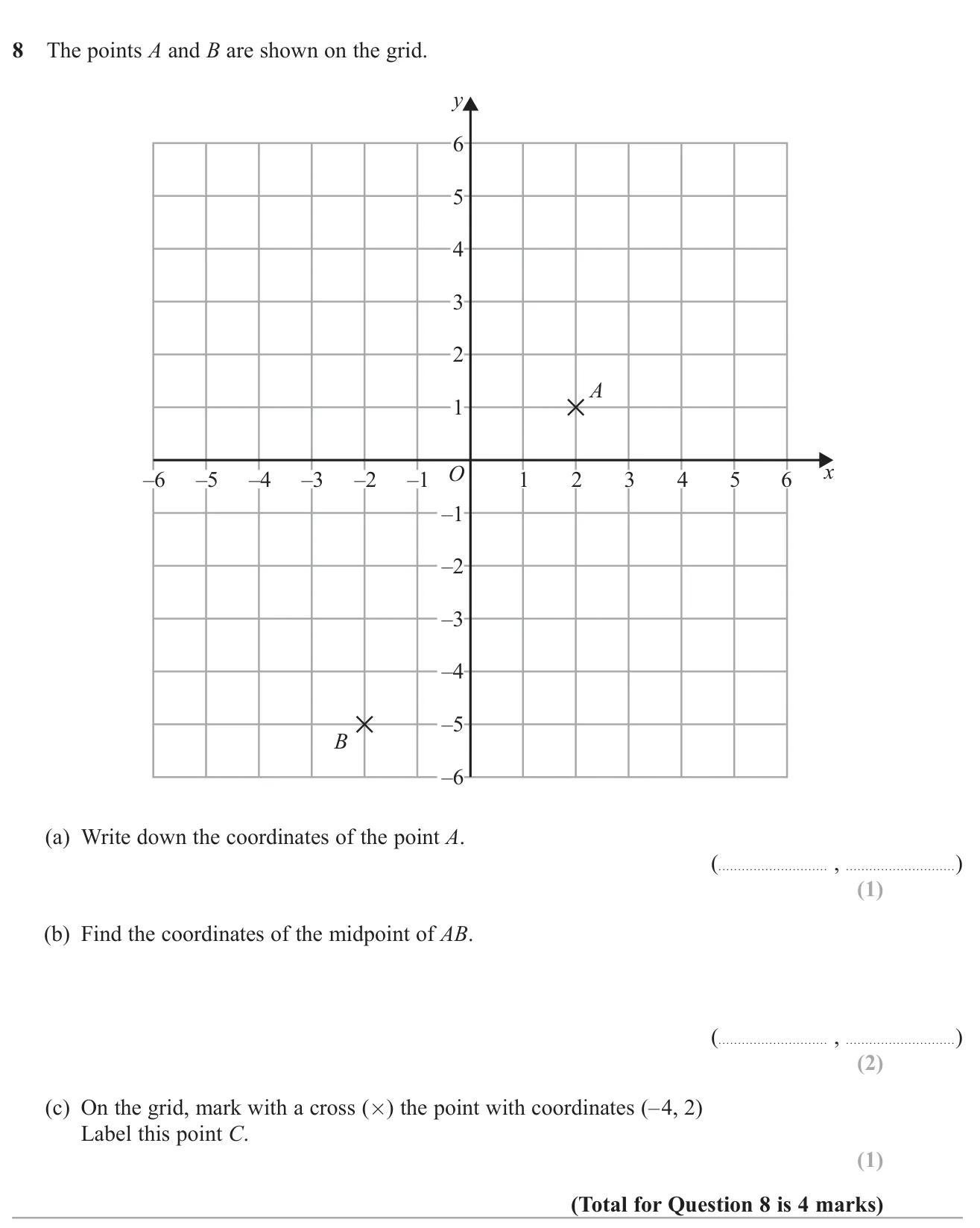
© Pearson Education Ltd. June 2024 Paper 2 (Foundation, calculator), question 8.
(a) ( 2 , 1 ) (2,\ 1) ( 2 , 1 ) 1 mark (b) ( 0 , − 2 ) (0,\ -2) ( 0 , − 2 ) 2 marks (c) Cross at ( − 4 , 2 ) (-4,\ 2) ( − 4 , 2 ) 1 mark
Worked solution Checked against the mark scheme
(a) A is 2 across and 1 up: ( 2 , 1 ) (2, 1) ( 2 , 1 )
(b) B is ( − 2 , − 5 ) (-2, -5) ( − 2 , − 5 ) = ( 2 + ( − 2 ) 2 , 1 + ( − 5 ) 2 ) = ( 0 , − 2 ) = \left(\frac{2 + (-2)}{2}, \frac{1 + (-5)}{2}\right) = (0, -2) = ( 2 2 + ( − 2 ) , 2 1 + ( − 5 ) ) = ( 0 , − 2 )
(c) Go 4 left from O O O
Watch out: Writing coordinates the wrong way round, e.g. (1, 2).
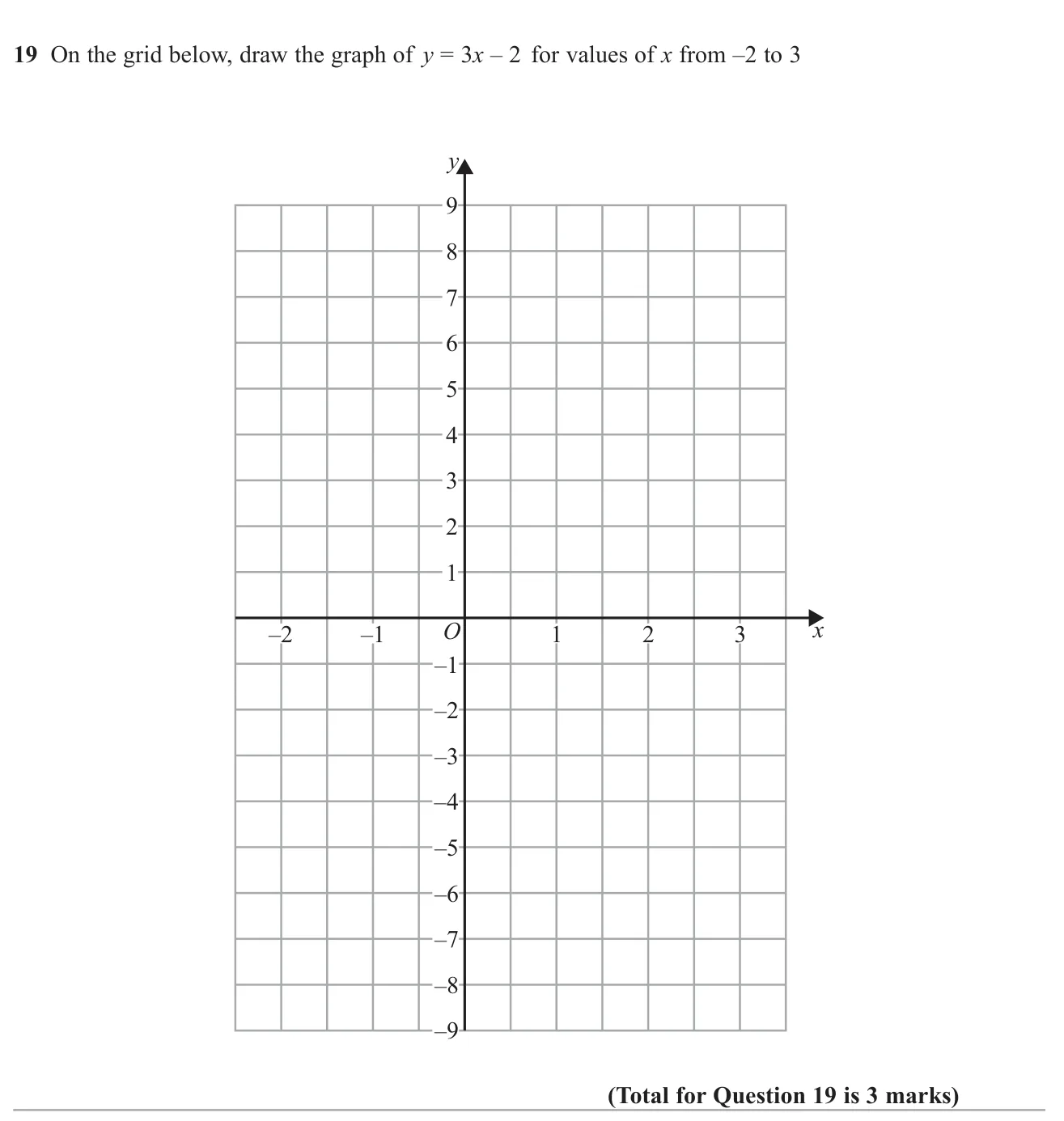
© Pearson Education Ltd. June 2024 Paper 3 (Foundation, calculator), question 19.
Answer Straight line through ( − 2 , − 8 ) , ( − 1 , − 5 ) , ( 0 , − 2 ) , ( 1 , 1 ) , ( 2 , 4 ) , ( 3 , 7 ) (-2,-8), (-1,-5), (0,-2), (1,1), (2,4), (3,7) ( − 2 , − 8 ) , ( − 1 , − 5 ) , ( 0 , − 2 ) , ( 1 , 1 ) , ( 2 , 4 ) , ( 3 , 7 ) 3 marks
Worked solution Checked against the mark scheme
Make a table using y = 3 x − 2 y = 3x - 2 y = 3 x − 2
| x x x y y y
Plot the points and join them with a ruler from x = − 2 x = -2 x = − 2 x = 3 x = 3 x = 3
Watch out: Working out 3 × ( − 2 ) 3 \times (-2) 3 × ( − 2 ) + 6 +6 + 6
© Pearson Education Ltd. November 2022 Paper 1 (Foundation, non-calculator), question 15.
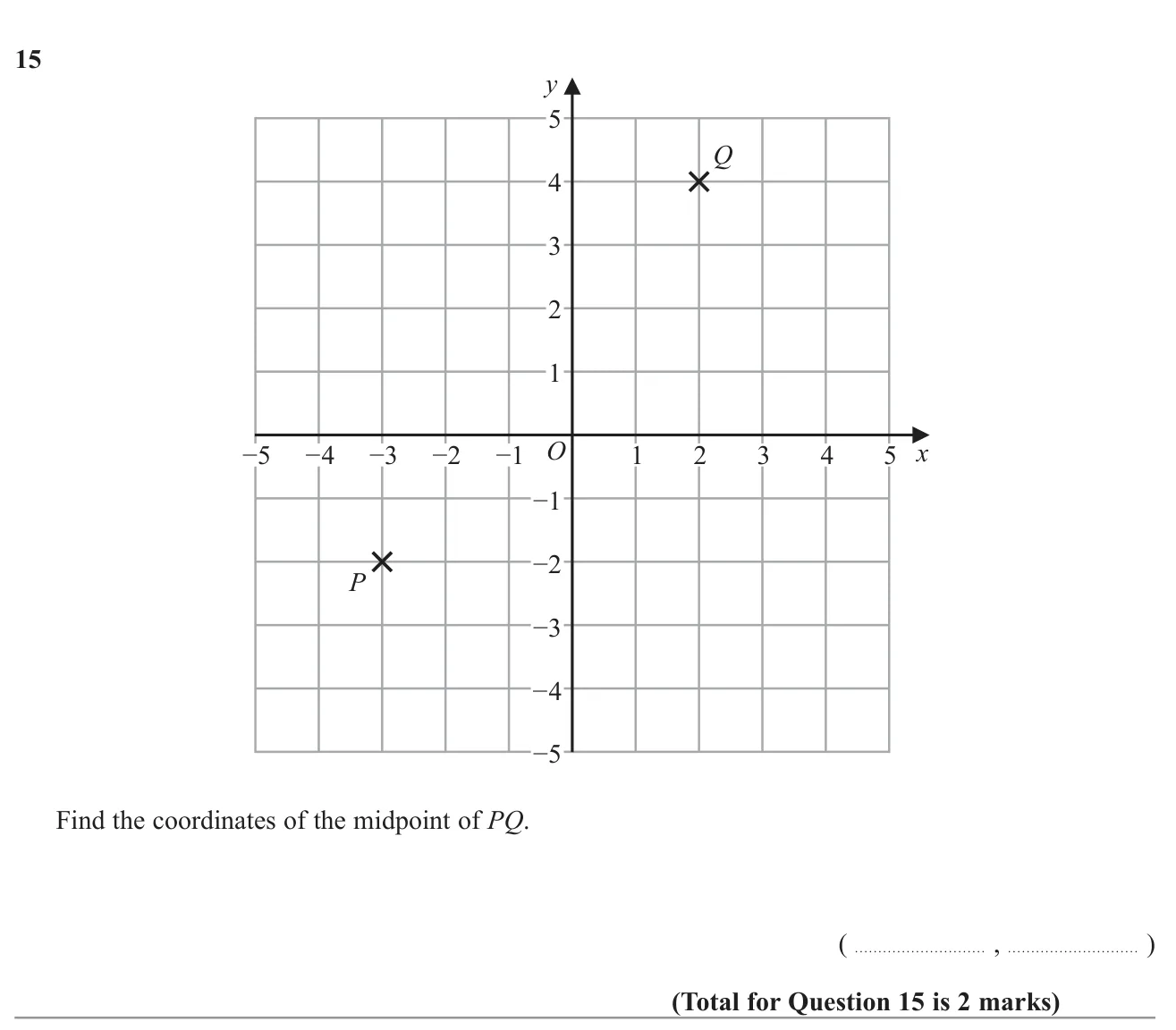
Answer ( − 0.5 , 1 ) (-0.5, 1) ( − 0.5 , 1 ) 2 marks
Worked solution Checked against the mark scheme
P = ( − 3 , − 2 ) P = (-3, -2) P = ( − 3 , − 2 ) Q = ( 2 , 4 ) Q = (2, 4) Q = ( 2 , 4 )
x x x − 3 + 2 2 = − 0.5 \frac{-3 + 2}{2} = -0.5 2 − 3 + 2 = − 0.5
y y y − 2 + 4 2 = 1 \frac{-2 + 4}{2} = 1 2 − 2 + 4 = 1
Midpoint ( − 0.5 , 1 ) (-0.5, 1) ( − 0.5 , 1 )
Watch out: Subtracting the coordinates instead of adding them.
© Pearson Education Ltd. June 2022 Paper 2 (Foundation, calculator), question 17.
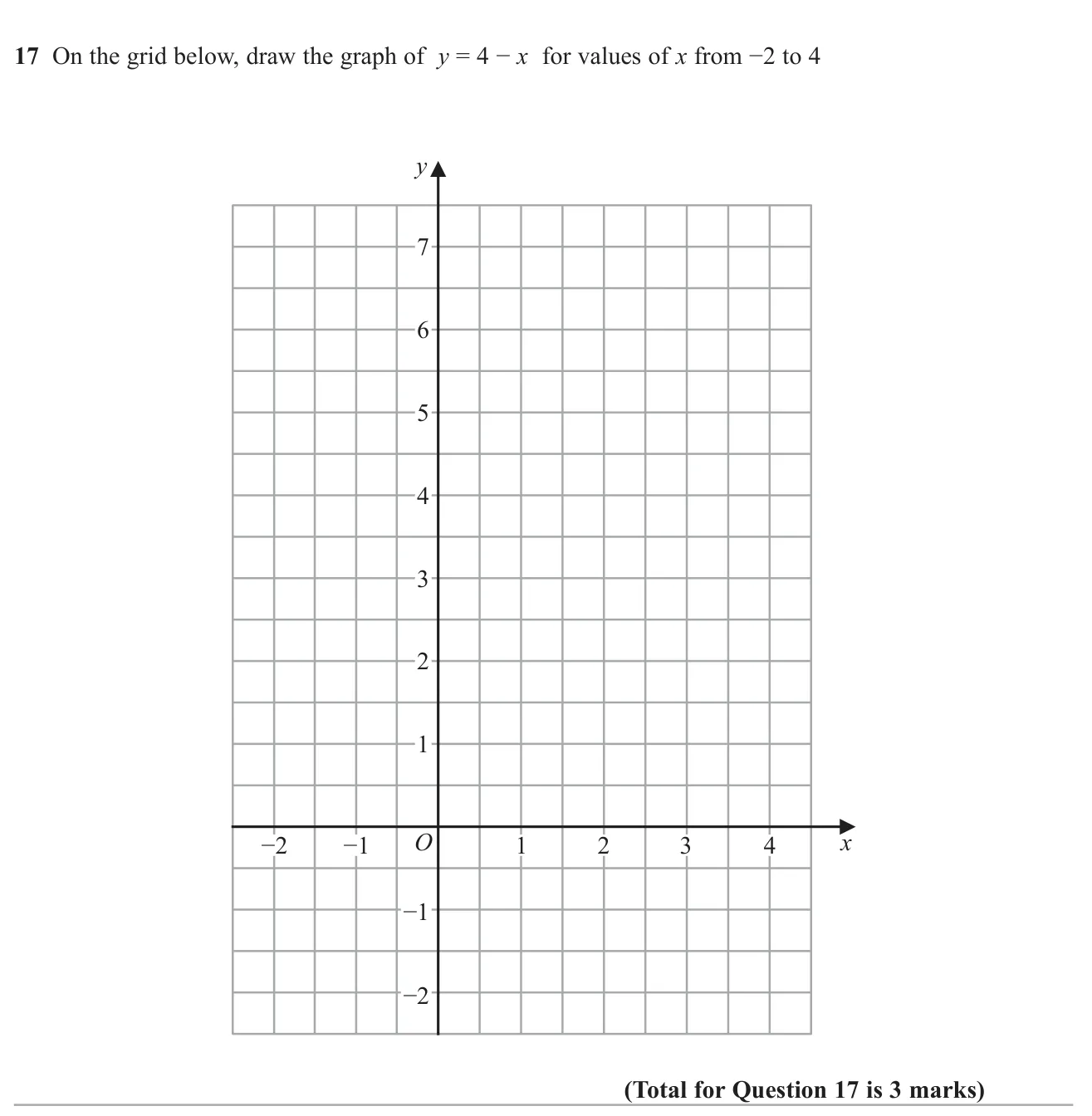
Answer Straight line from ( − 2 , 6 ) (-2, 6) ( − 2 , 6 ) ( 4 , 0 ) (4, 0) ( 4 , 0 ) 3 marks
Worked solution Checked against the mark scheme
Make a table of values using y = 4 − x y = 4 - x y = 4 − x
x x x − 2 , − 1 , 0 , 1 , 2 , 3 , 4 -2, -1, 0, 1, 2, 3, 4 − 2 , − 1 , 0 , 1 , 2 , 3 , 4
y y y 6 , 5 , 4 , 3 , 2 , 1 , 0 6, 5, 4, 3, 2, 1, 0 6 , 5 , 4 , 3 , 2 , 1 , 0
Plot the points and join them with a ruler from ( − 2 , 6 ) (-2, 6) ( − 2 , 6 ) ( 4 , 0 ) (4, 0) ( 4 , 0 )
Watch out: Getting y y y x x x 4 − ( − 2 ) = 2 4 - (-2) = 2 4 − ( − 2 ) = 2
© Pearson Education Ltd. November 2019 Paper 3 (Foundation, calculator), question 17.
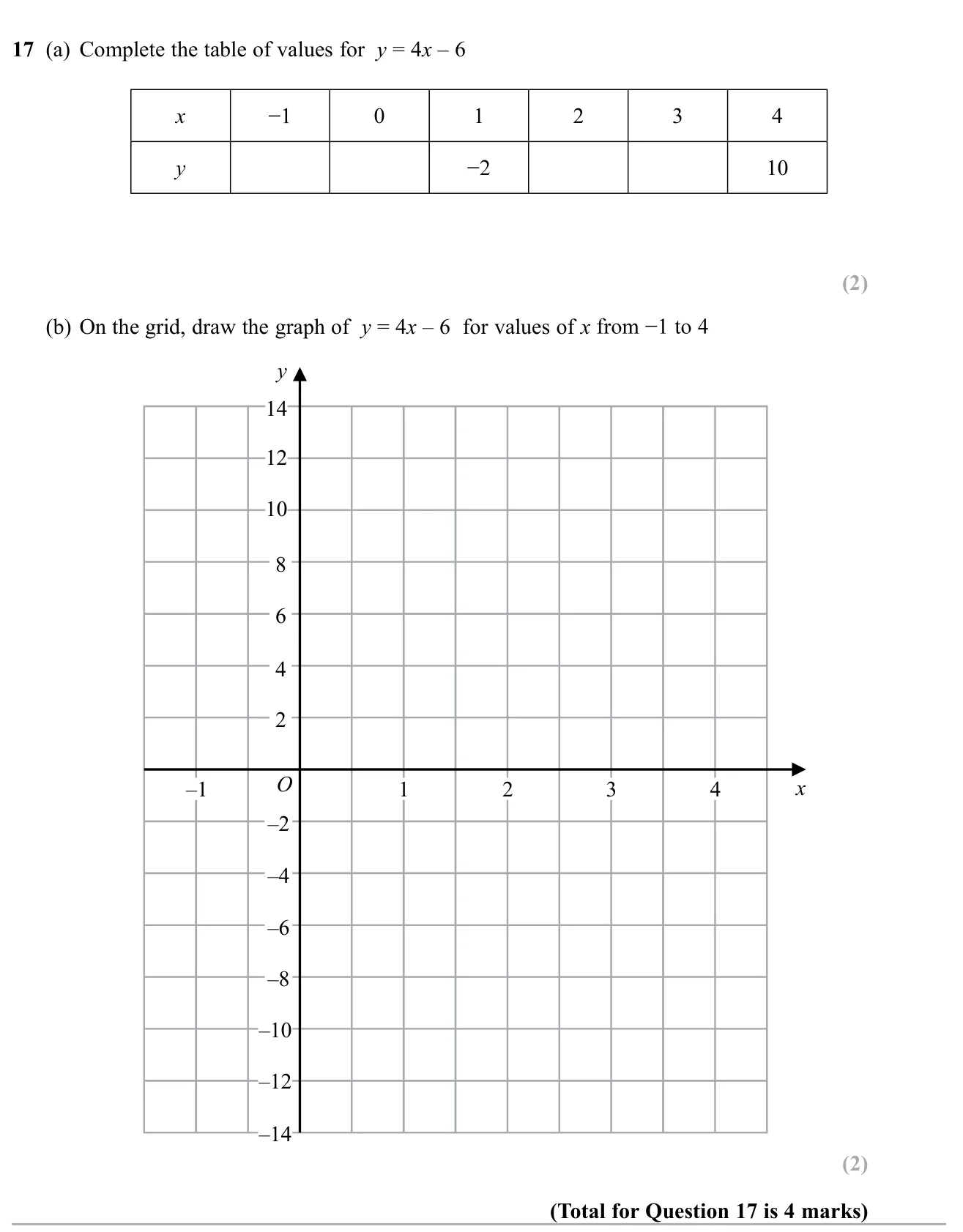
(a) − 10 , − 6 , 2 , 6 -10, -6, 2, 6 − 10 , − 6 , 2 , 6 2 marks (b) Straight line through ( − 1 , − 10 ) (-1, -10) ( − 1 , − 10 ) ( 4 , 10 ) (4, 10) ( 4 , 10 ) 2 marks
Worked solution Checked against the mark scheme
(a) Put each x x x 4 x − 6 4x - 6 4 x − 6
x = − 1 x=-1 x = − 1 − 4 − 6 = − 10 -4-6=-10 − 4 − 6 = − 10 x = 0 x=0 x = 0 − 6 -6 − 6 x = 2 x=2 x = 2 2 2 2 x = 3 x=3 x = 3 6 6 6
(b) Plot the six points from ( − 1 , − 10 ) (-1,-10) ( − 1 , − 10 ) ( 4 , 10 ) (4,10) ( 4 , 10 )
Watch out: Getting 4 × ( − 1 ) − 6 = − 2 4\times(-1) - 6 = -2 4 × ( − 1 ) − 6 = − 2
© Pearson Education Ltd. Specimen Paper 2 (Foundation, calculator), question 14.
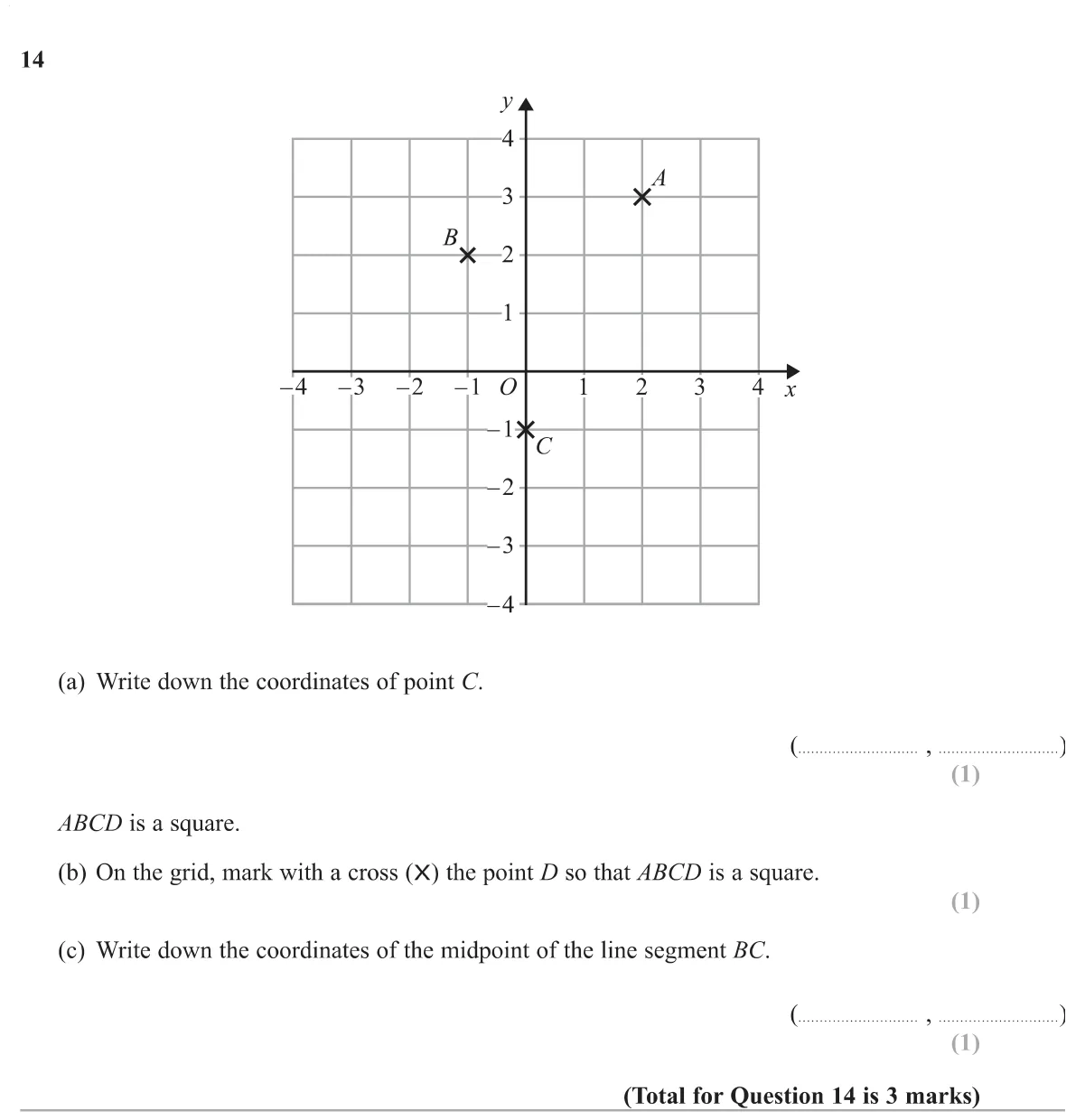
(a) ( 0 , − 1 ) (0, -1) ( 0 , − 1 ) 1 mark (b) Cross at ( 3 , 0 ) (3, 0) ( 3 , 0 ) 1 mark (c) ( − 0.5 , 0.5 ) (-0.5, 0.5) ( − 0.5 , 0.5 ) 1 mark
Worked solution Checked against the mark scheme
(a) C is on the y y y − 1 -1 − 1 ( 0 , − 1 ) (0, -1) ( 0 , − 1 )
(b) From B to A is 3 right, 1 up. Do the same from C: D is at ( 3 , 0 ) (3, 0) ( 3 , 0 )
(c) Midpoint of B( − 1 , 2 ) (-1, 2) ( − 1 , 2 ) ( 0 , − 1 ) (0, -1) ( 0 , − 1 ) ( − 1 + 0 2 , 2 + ( − 1 ) 2 ) = ( − 0.5 , 0.5 ) \left(\frac{-1+0}{2}, \frac{2+(-1)}{2}\right) = (-0.5, 0.5) ( 2 − 1 + 0 , 2 2 + ( − 1 ) ) = ( − 0.5 , 0.5 )
Watch out: Writing coordinates the wrong way round, e.g. ( − 1 , 0 ) (-1, 0) ( − 1 , 0 )
© Pearson Education Ltd. November 2023 Paper 1 (Foundation, non-calculator), question 14.
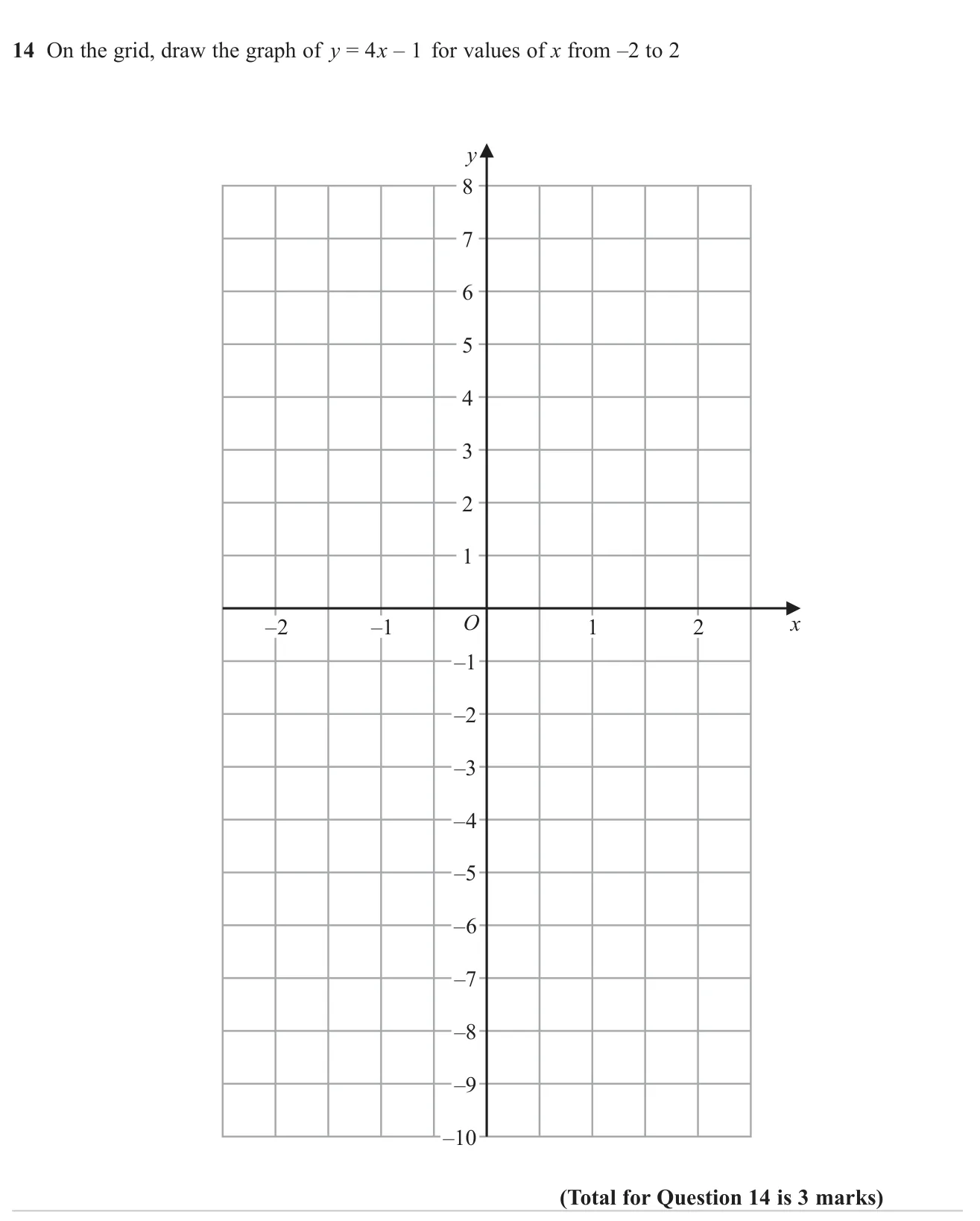
Answer Straight line through ( − 2 , − 9 ) (-2,-9) ( − 2 , − 9 ) ( − 1 , − 5 ) (-1,-5) ( − 1 , − 5 ) ( 0 , − 1 ) (0,-1) ( 0 , − 1 ) ( 1 , 3 ) (1,3) ( 1 , 3 ) ( 2 , 7 ) (2,7) ( 2 , 7 ) 3 marks
Worked solution Checked against the mark scheme
Make a table of values using y = 4 x − 1 y = 4x - 1 y = 4 x − 1
| x x x y y y
Plot the points and join them with one straight ruled line from x = − 2 x = -2 x = − 2 x = 2 x = 2 x = 2
Watch out: Working out 4 × ( − 2 ) − 1 4 \times (-2) - 1 4 × ( − 2 ) − 1
© Pearson Education Ltd. November 2021 Paper 1 (Foundation, non-calculator), question 18.
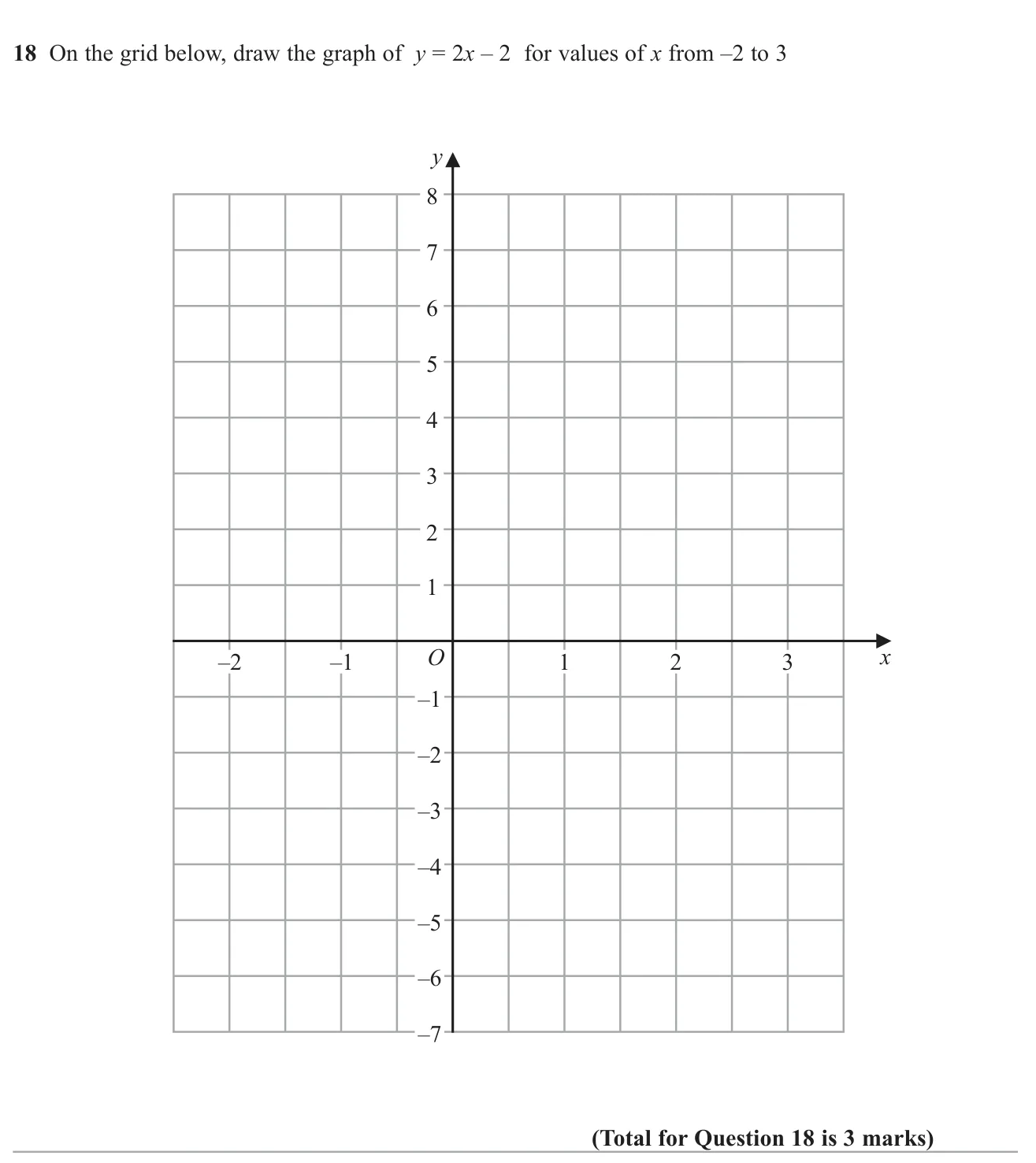
Answer Straight line through ( − 2 , − 6 ) (-2, -6) ( − 2 , − 6 ) ( 3 , 4 ) (3, 4) ( 3 , 4 ) 3 marks
Worked solution Checked against the mark scheme
Make a table using y = 2 x − 2 y = 2x - 2 y = 2 x − 2
| x x x y y y
Plot the points and join them with a ruler from x = − 2 x = -2 x = − 2 x = 3 x = 3 x = 3
Watch out: Working out 2 x − 2 2x - 2 2 x − 2
© Pearson Education Ltd. November 2021 Paper 1 (Foundation, non-calculator), question 28.
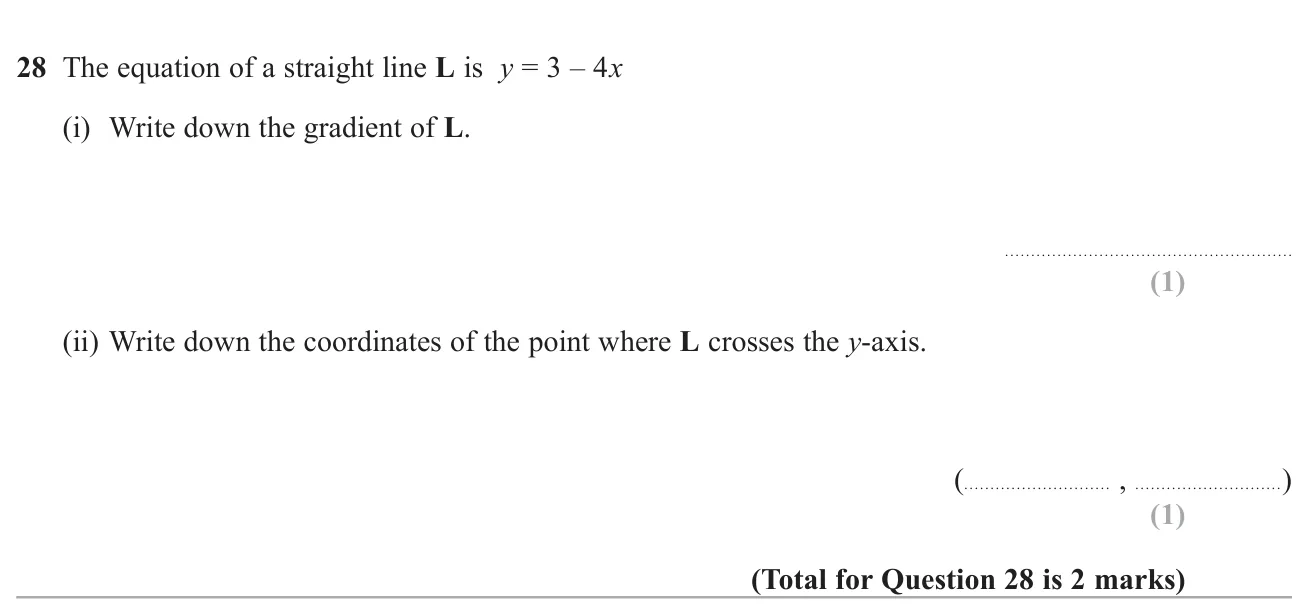
(i) − 4 -4 − 4 1 mark (ii) ( 0 , 3 ) (0, 3) ( 0 , 3 ) 1 mark
Worked solution Checked against the mark scheme
Rewrite as y = − 4 x + 3 y = -4x + 3 y = − 4 x + 3 y = m x + c y = mx + c y = m x + c
(i) Gradient m = − 4 m = -4 m = − 4
(ii) The intercept c = 3 c = 3 c = 3 ( 0 , 3 ) (0, 3) ( 0 , 3 )
Watch out: Giving the gradient as 3 because it comes first.
© Pearson Education Ltd. November 2020 Paper 2 (Foundation, calculator), question 29.
Worked solution Checked against the mark scheme
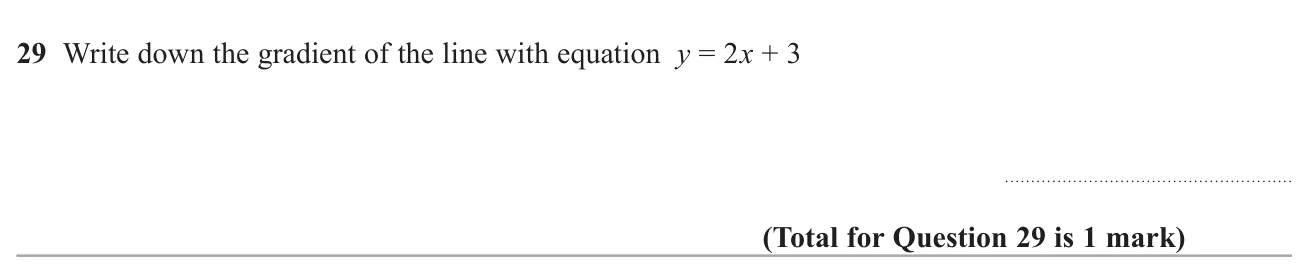
In y = m x + c y = mx + c y = m x + c m m m
For y = 2 x + 3 y = 2x + 3 y = 2 x + 3
Watch out: Giving 3, the y-intercept.
© Pearson Education Ltd. June 2019 Paper 2 (Foundation, calculator), question 21.
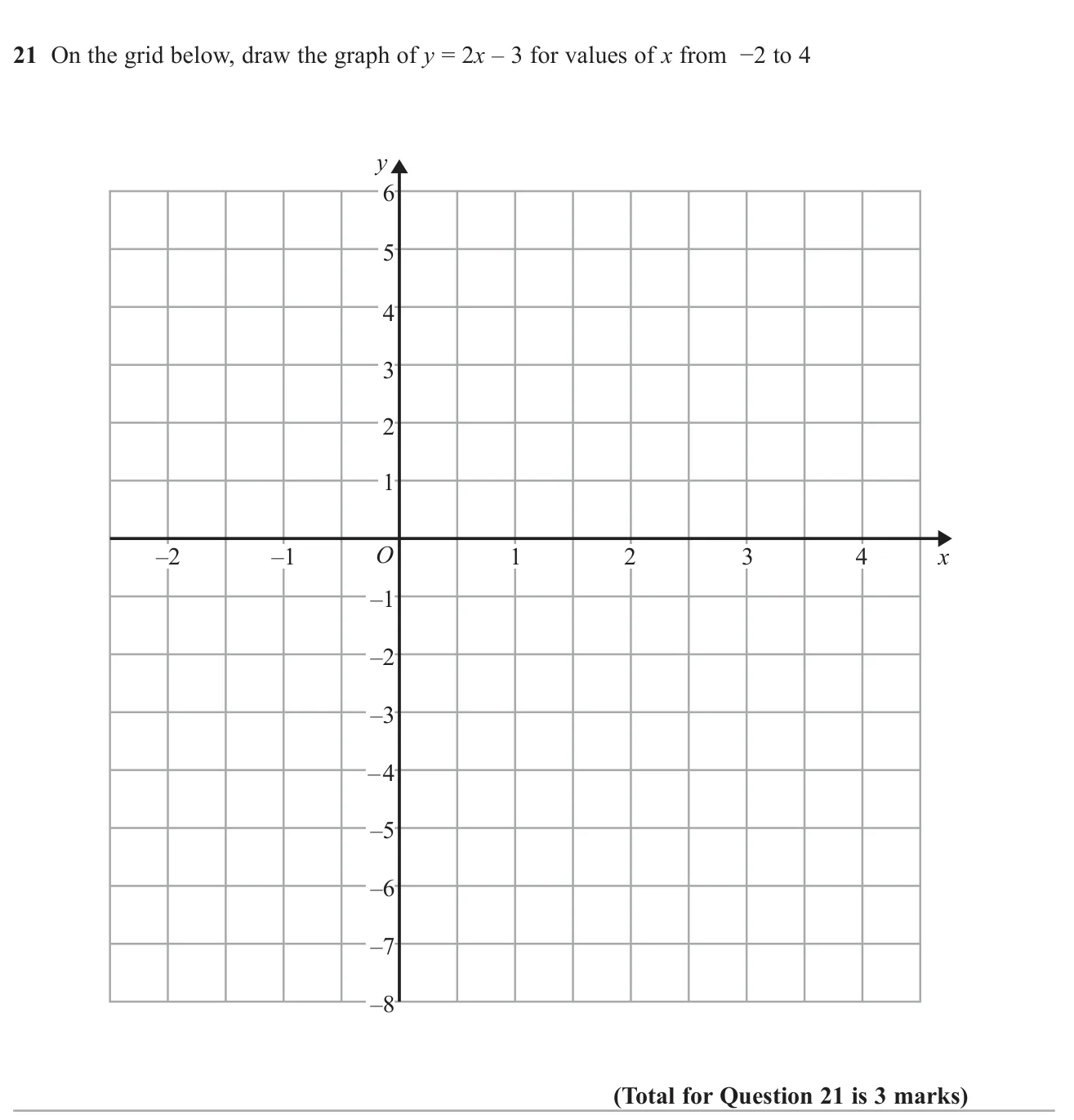
Answer Straight line through ( − 2 , − 7 ) (-2,-7) ( − 2 , − 7 ) ( 4 , 5 ) (4,5) ( 4 , 5 ) 3 marks
Worked solution Checked against the mark scheme
Make a table of values using y = 2 x − 3 y = 2x - 3 y = 2 x − 3
| x x x y y y
Plot the points and join them with a single ruled line from ( − 2 , − 7 ) (-2,-7) ( − 2 , − 7 ) ( 4 , 5 ) (4,5) ( 4 , 5 )
Watch out: Stopping the line short of x = −2 or x = 4.
© Pearson Education Ltd. June 2018 Paper 1 (Foundation, non-calculator), question 25.
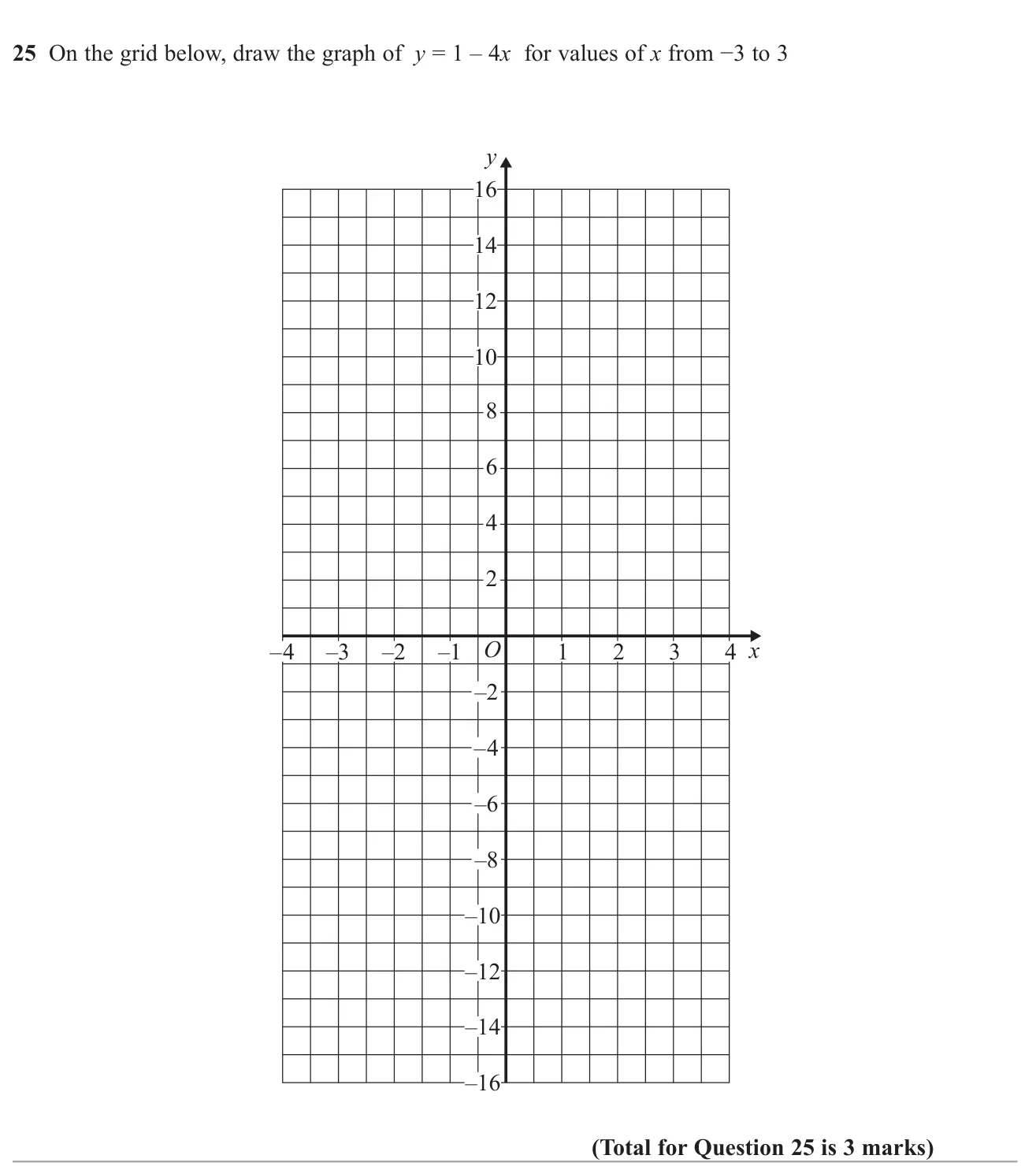
Answer Straight line from ( − 3 , 13 ) (-3, 13) ( − 3 , 13 ) ( 3 , − 11 ) (3, -11) ( 3 , − 11 ) 3 marks
Worked solution Checked against the mark scheme
Make a table with y = 1 − 4 x y = 1 - 4x y = 1 − 4 x
x x x
y y y
Plot the points and join them with a ruler.
Watch out: Working out 1 − 4 × ( − 3 ) 1 - 4 \times (-3) 1 − 4 × ( − 3 ) − 11 -11 − 11
© Pearson Education Ltd. June 2018 Paper 3 (Foundation, calculator), question 13.
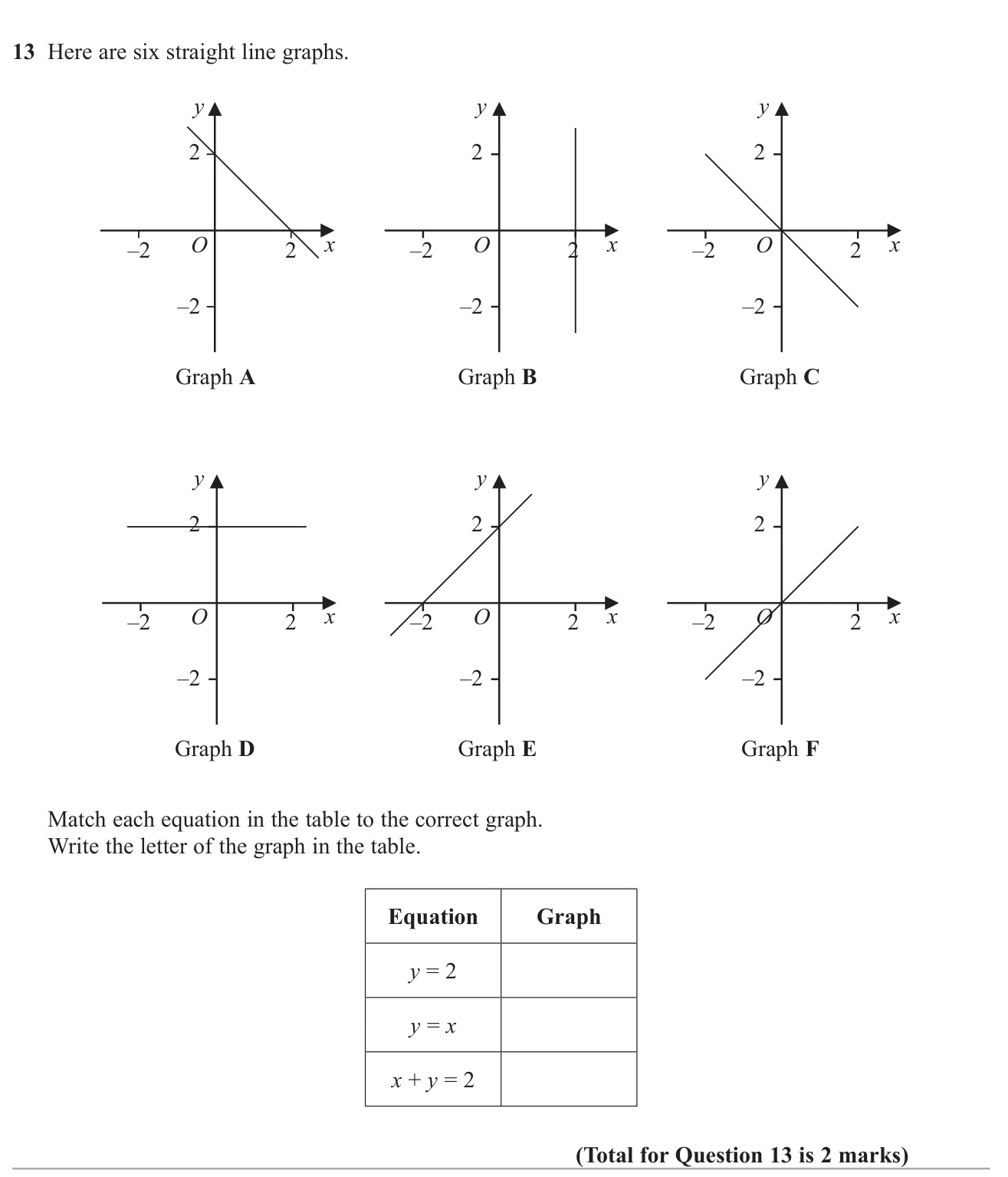
Answer y = 2 y = 2 y = 2 y = x y = x y = x x + y = 2 x + y = 2 x + y = 2 2 marks
Worked solution Checked against the mark scheme
y = 2 y = 2 y = 2 y y y
y = x y = x y = x
x + y = 2 x + y = 2 x + y = 2 y = 2 − x y = 2 - x y = 2 − x
Watch out: Choosing graph B (x = 2) for y = 2.
© Pearson Education Ltd. Specimen Paper 3 (Higher, calculator), question 3.
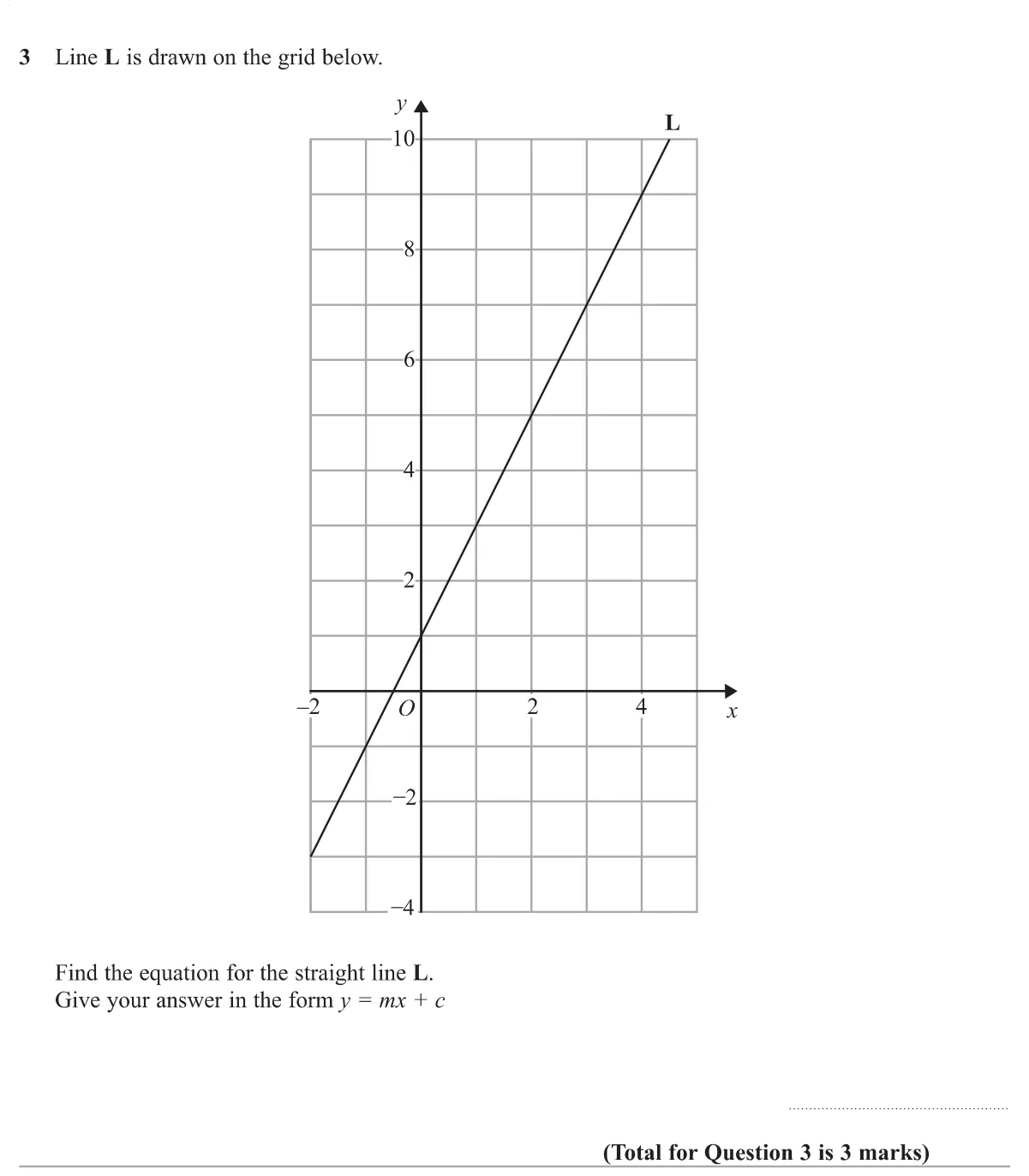
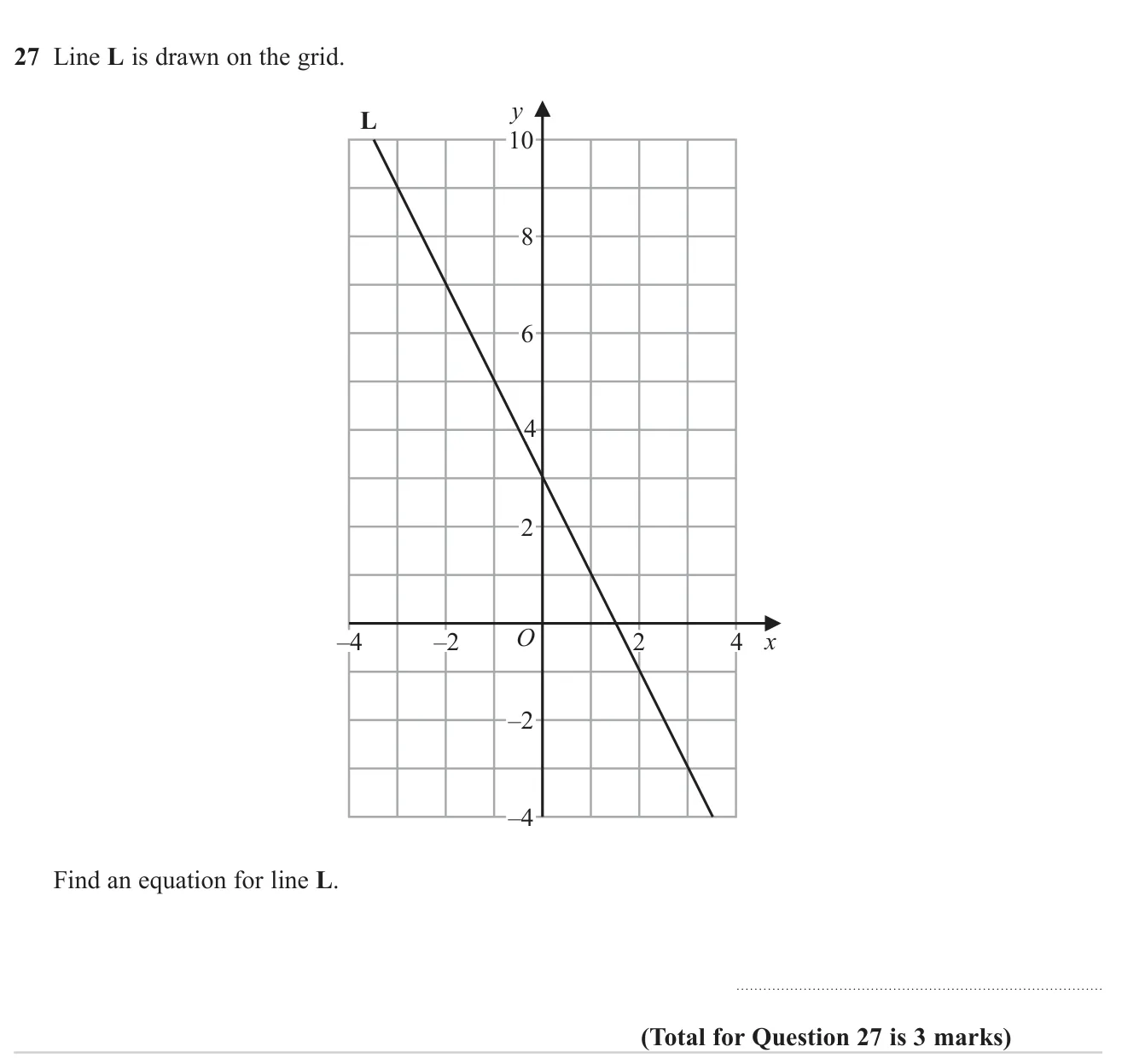
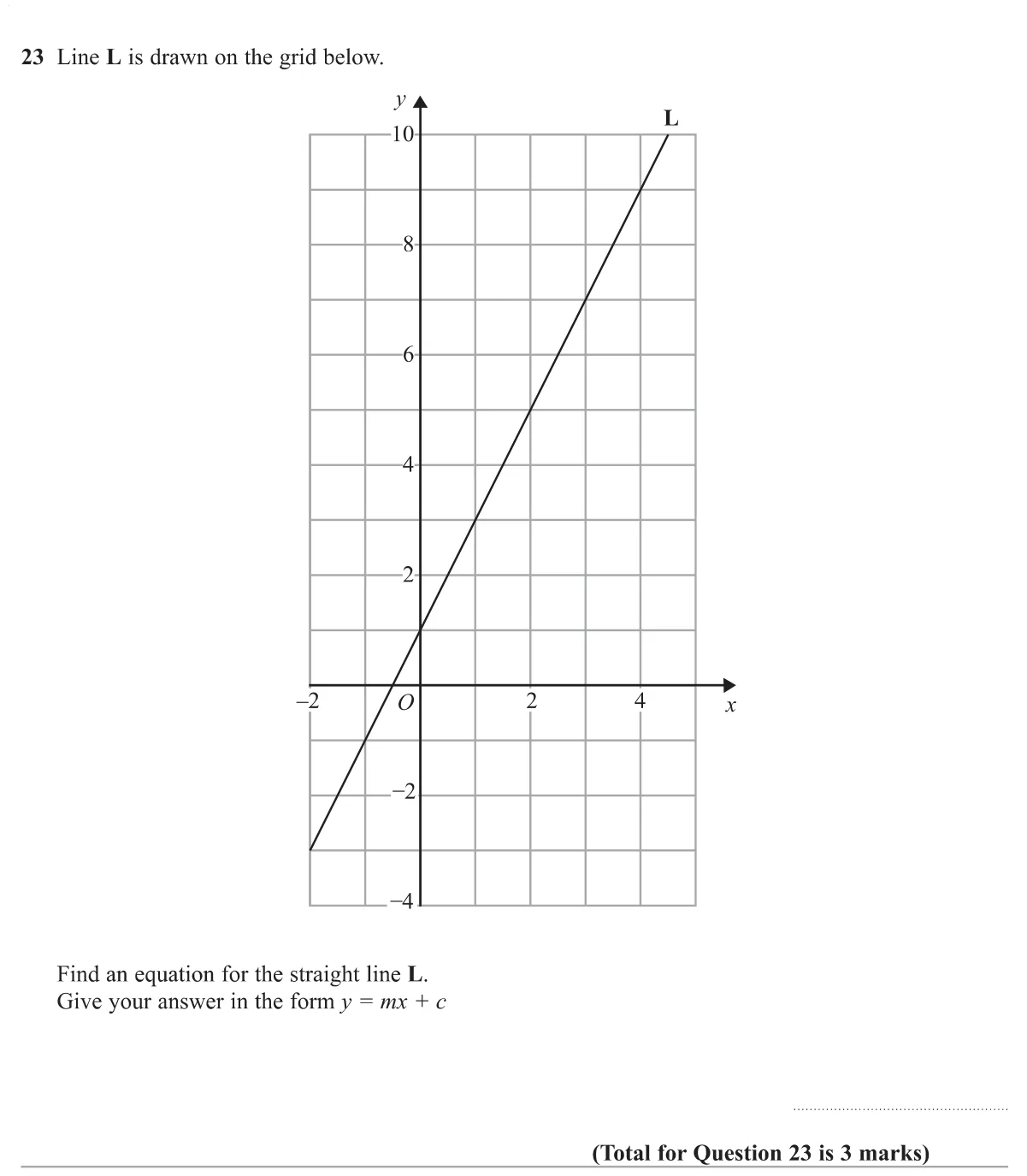
Answer y = 2 x + 1 y = 2x + 1 y = 2 x + 1 3 marks
Worked solution Checked against the mark scheme
The line crosses the y y y ( 0 , 1 ) (0, 1) ( 0 , 1 ) c = 1 c = 1 c = 1
It also passes through ( 2 , 5 ) (2, 5) ( 2 , 5 ) = 5 − 1 2 − 0 = 2 = \frac{5 - 1}{2 - 0} = 2 = 2 − 0 5 − 1 = 2
So y = 2 x + 1 y = 2x + 1 y = 2 x + 1
Watch out: Working out the gradient as run over rise, giving 1/2.
© Pearson Education Ltd. November 2024 Paper 3 (Foundation, calculator), question 27.
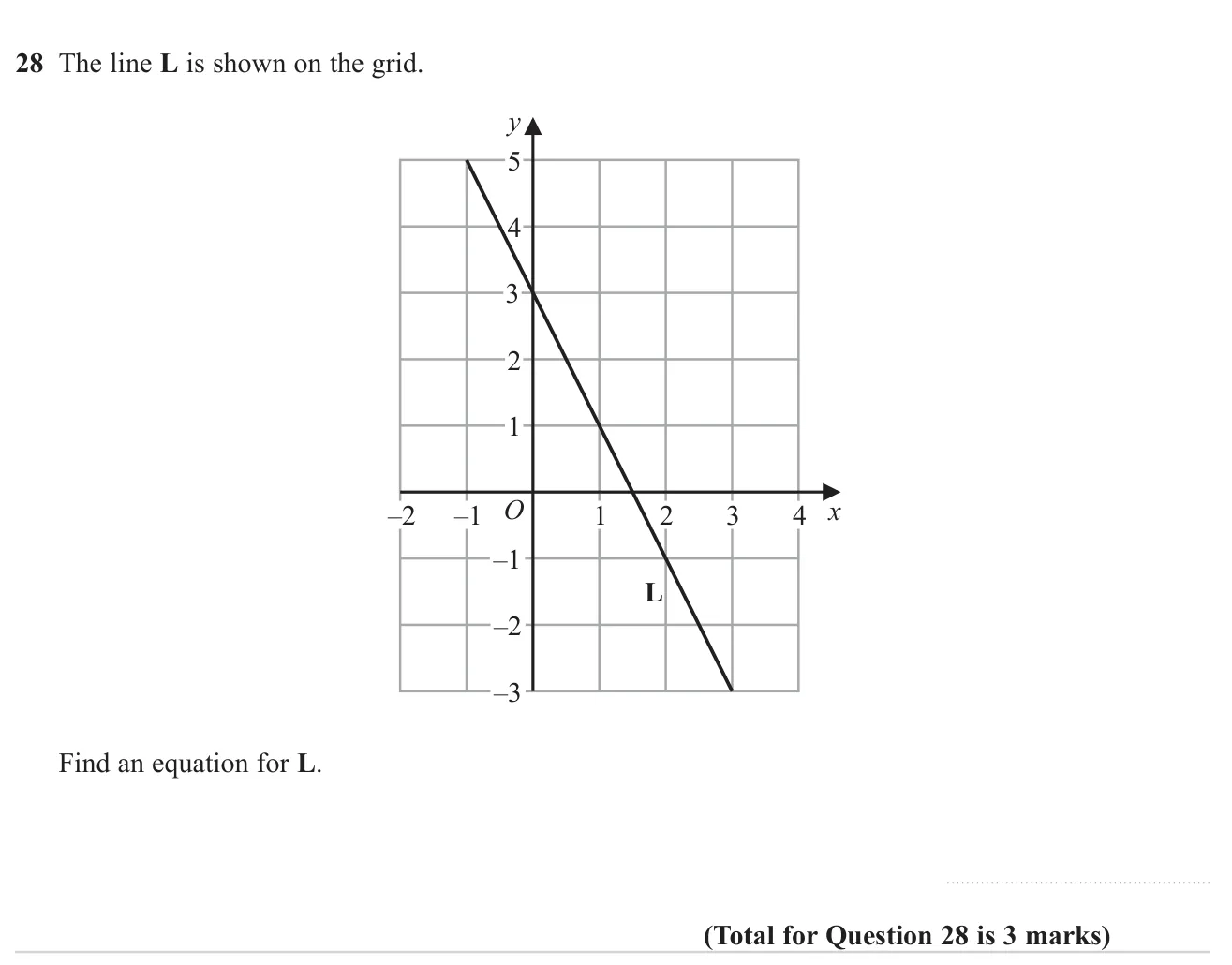
Answer y = − 2 x + 3 y = -2x + 3 y = − 2 x + 3 3 marks
Worked solution Checked against the mark scheme
The line crosses the y y y c = 3 c = 3 c = 3
It passes through ( 0 , 3 ) (0, 3) ( 0 , 3 ) ( 1 , 1 ) (1, 1) ( 1 , 1 ) y y y m = − 2 m = -2 m = − 2
y = − 2 x + 3 y = -2x + 3 y = − 2 x + 3
Watch out: Getting the gradient as + 2 +2 + 2 − 1 2 -\frac{1}{2} − 2 1
© Pearson Education Ltd. November 2023 Paper 3 (Foundation, calculator), question 28.
Answer y = − 2 x + 3 y = -2x + 3 y = − 2 x + 3 3 marks
Worked solution Checked against the mark scheme
The line crosses the y y y c = 3 c = 3 c = 3
From (0, 3) to (1, 1): down 2 for every 1 across, so gradient = − 2 = -2 = − 2
Equation: y = − 2 x + 3 y = -2x + 3 y = − 2 x + 3
Watch out: Getting the gradient as +2 because the sign is missed.
© Pearson Education Ltd. June 2022 Paper 2 (Higher, calculator), question 12.
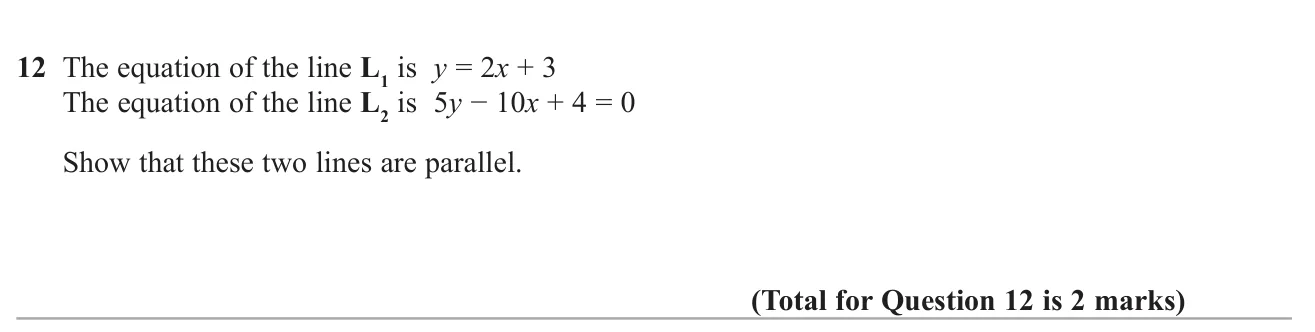
Answer L 2 L_2 L 2 y = 2 x − 4 5 y = 2x - \frac{4}{5} y = 2 x − 5 4 2 marks
Worked solution Checked against the mark scheme
Rearrange L 2 L_2 L 2 5 y = 10 x − 4 5y = 10x - 4 5 y = 10 x − 4 y = 2 x − 4 5 y = 2x - \frac{4}{5} y = 2 x − 5 4
L 1 L_1 L 1 y = 2 x + 3 y = 2x + 3 y = 2 x + 3 L 2 L_2 L 2
Equal gradients, so the lines are parallel.
Watch out: Forgetting to divide every term by 5 and saying the gradient is 10.
© Pearson Education Ltd. November 2022 Paper 2 (Higher, calculator), question 9.
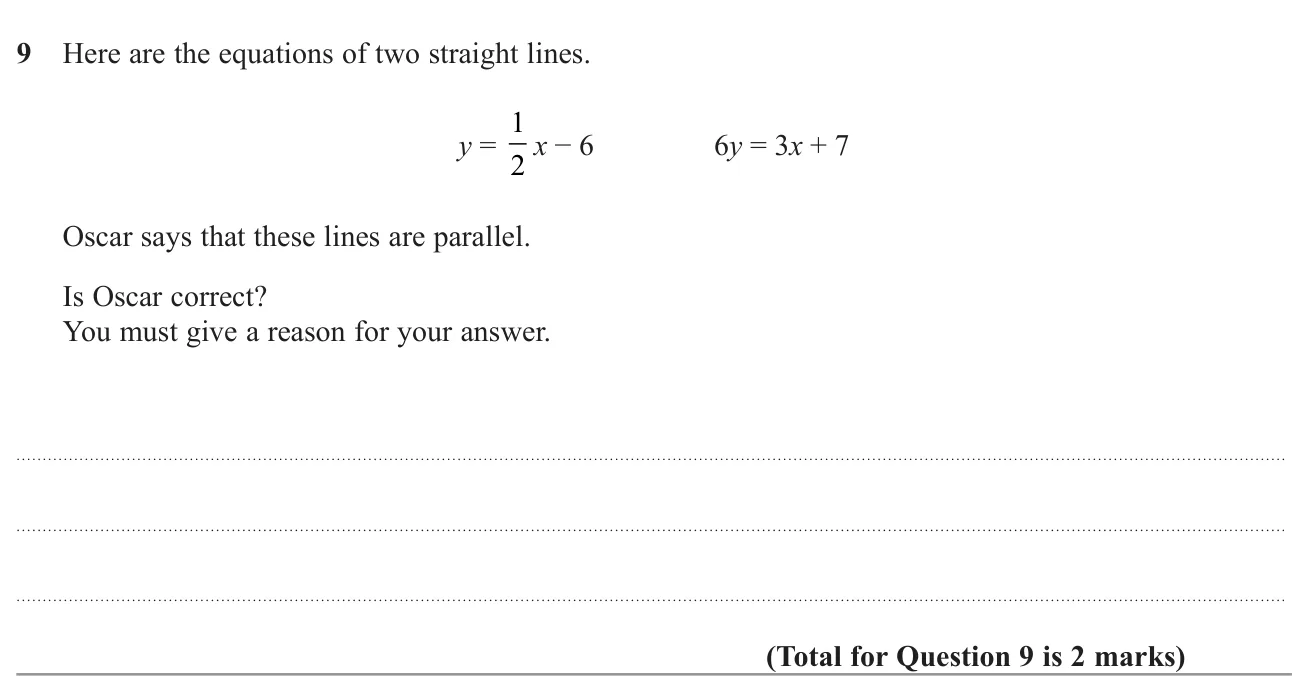
Answer Yes: both lines have gradient 1 2 \frac{1}{2} 2 1 2 marks
Worked solution Checked against the mark scheme
Divide 6 y = 3 x + 7 6y = 3x + 7 6 y = 3 x + 7 y = 1 2 x + 7 6 y = \frac{1}{2}x + \frac{7}{6} y = 2 1 x + 6 7
The first line is y = 1 2 x − 6 y = \frac{1}{2}x - 6 y = 2 1 x − 6
Both gradients are 1 2 \frac{1}{2} 2 1
Watch out: Reading the gradient of the second line as 3 without dividing by 6.
© Pearson Education Ltd. June 2018 Paper 1 (Foundation, non-calculator), question 24.
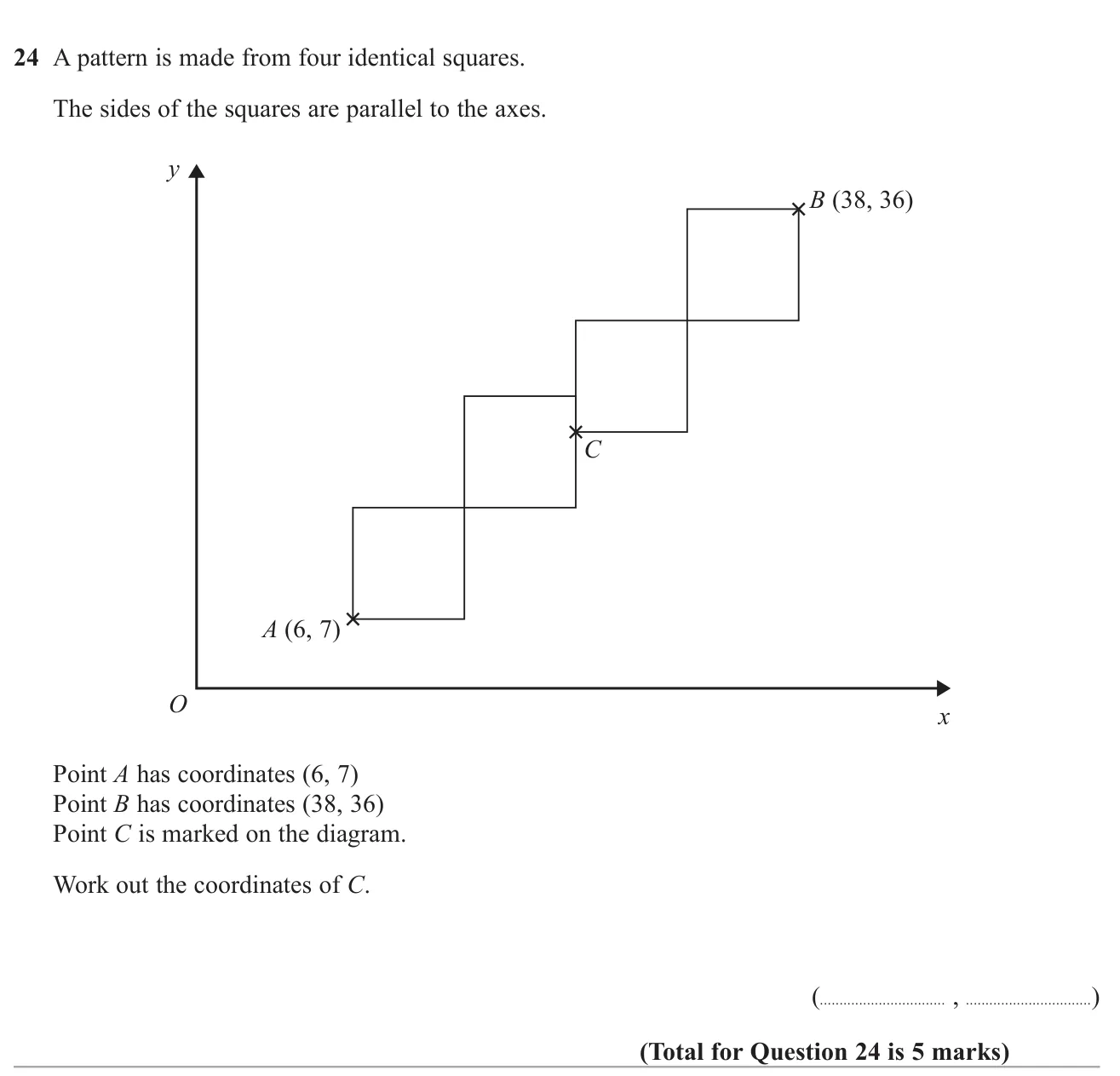
Answer ( 22 , 20 ) (22, 20) ( 22 , 20 ) 5 marks
Worked solution Checked against the mark scheme
Width = 38 − 6 = 32 = 38 - 6 = 32 = 38 − 6 = 32 32 ÷ 4 = 8 32 \div 4 = 8 32 ÷ 4 = 8
C is two sides right of A: x = 6 + 2 × 8 = 22 x = 6 + 2 \times 8 = 22 x = 6 + 2 × 8 = 22
C is two sides below B: y = 36 − 2 × 8 = 20 y = 36 - 2 \times 8 = 20 y = 36 − 2 × 8 = 20
So C = ( 22 , 20 ) C = (22, 20) C = ( 22 , 20 )
Watch out: Assuming the height 29 is also four sides, because the squares overlap vertically.
© Pearson Education Ltd. June 2018 Paper 1 (Higher, non-calculator), question 6.
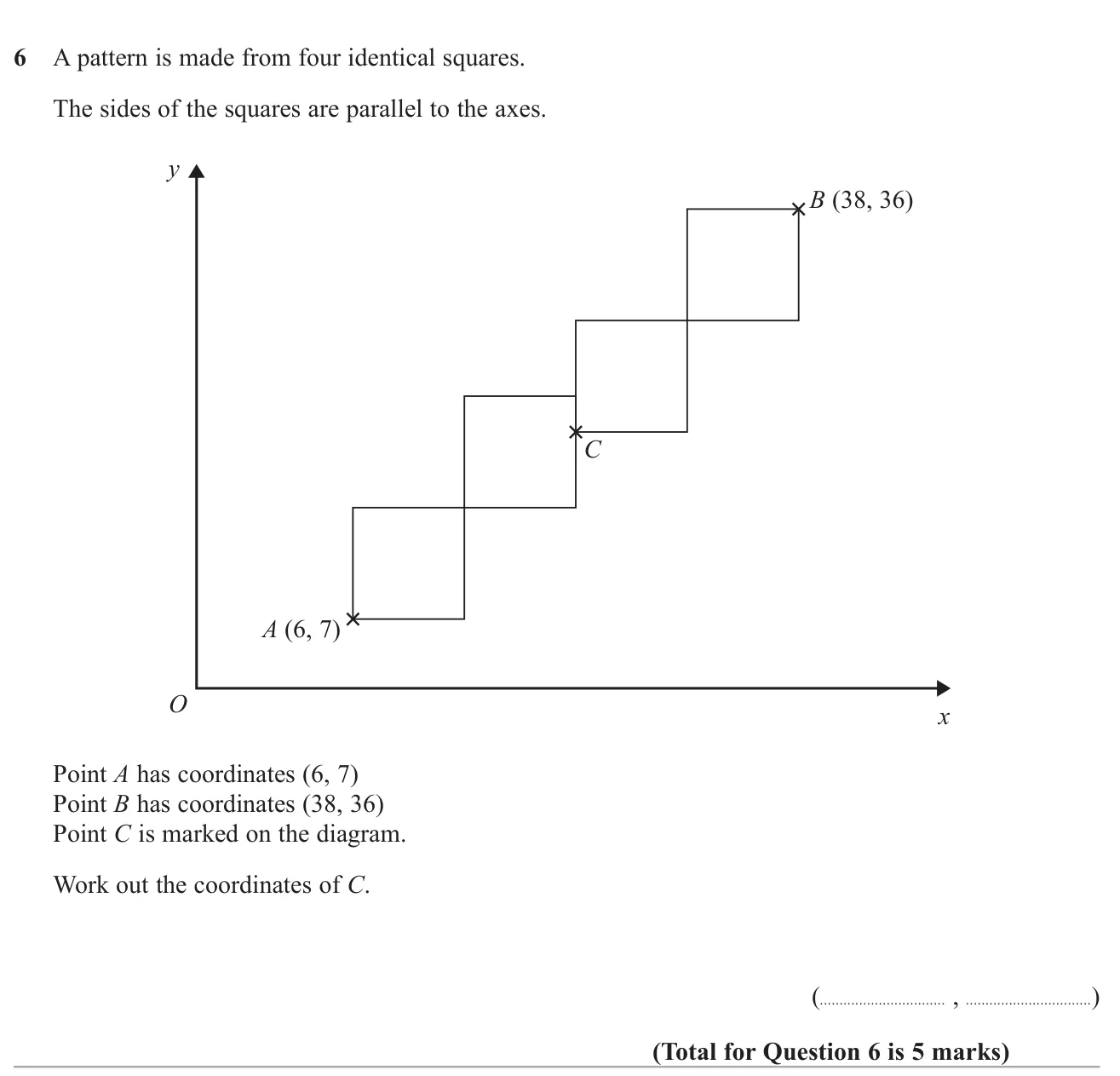
Answer ( 22 , 20 ) (22, 20) ( 22 , 20 ) 5 marks
Worked solution Checked against the mark scheme
Total width = 38 − 6 = 32 = 38 - 6 = 32 = 38 − 6 = 32 32 ÷ 4 = 8 32 \div 4 = 8 32 ÷ 4 = 8
C is two squares to the right of A: x = 6 + 2 × 8 = 22 x = 6 + 2 \times 8 = 22 x = 6 + 2 × 8 = 22
C is two squares below the top of B: y = 36 − 2 × 8 = 20 y = 36 - 2 \times 8 = 20 y = 36 − 2 × 8 = 20
So C is ( 22 , 20 ) (22, 20) ( 22 , 20 )
Watch out: Dividing the height 29 by 4, but the squares overlap vertically so that does not give the side length.
© Pearson Education Ltd. November 2018 Paper 2 (Foundation, calculator), question 25.
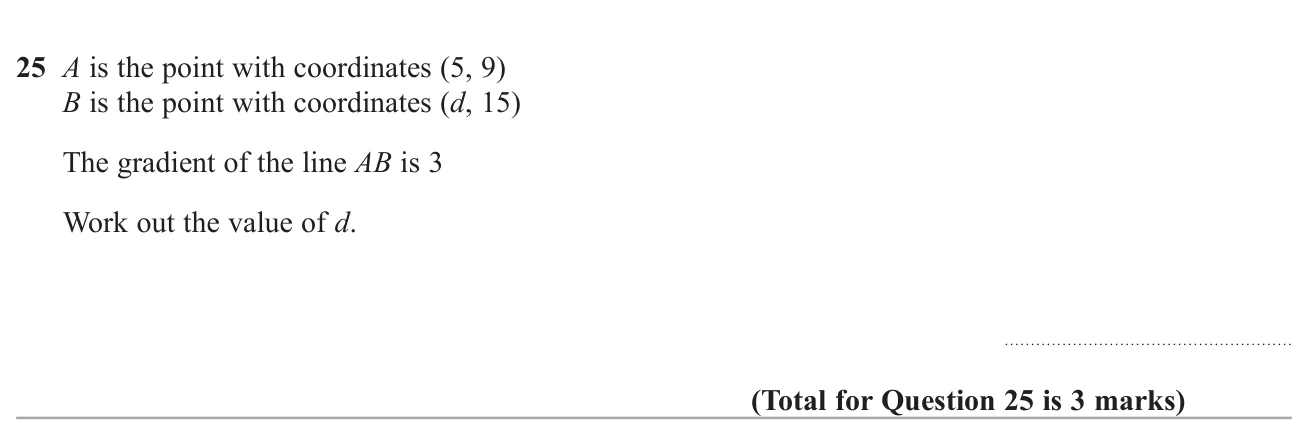
Worked solution Checked against the mark scheme
Gradient = change in y change in x = \frac{\text{change in } y}{\text{change in } x} = change in x change in y
Change in y = 15 − 9 = 6 y = 15 - 9 = 6 y = 15 − 9 = 6 x = 6 ÷ 3 = 2 x = 6 \div 3 = 2 x = 6 ÷ 3 = 2
d = 5 + 2 = 7 d = 5 + 2 = 7 d = 5 + 2 = 7
Watch out: Using change in x over change in y, giving 23.
© Pearson Education Ltd. June 2018 Paper 2 (Foundation, calculator), question 22.
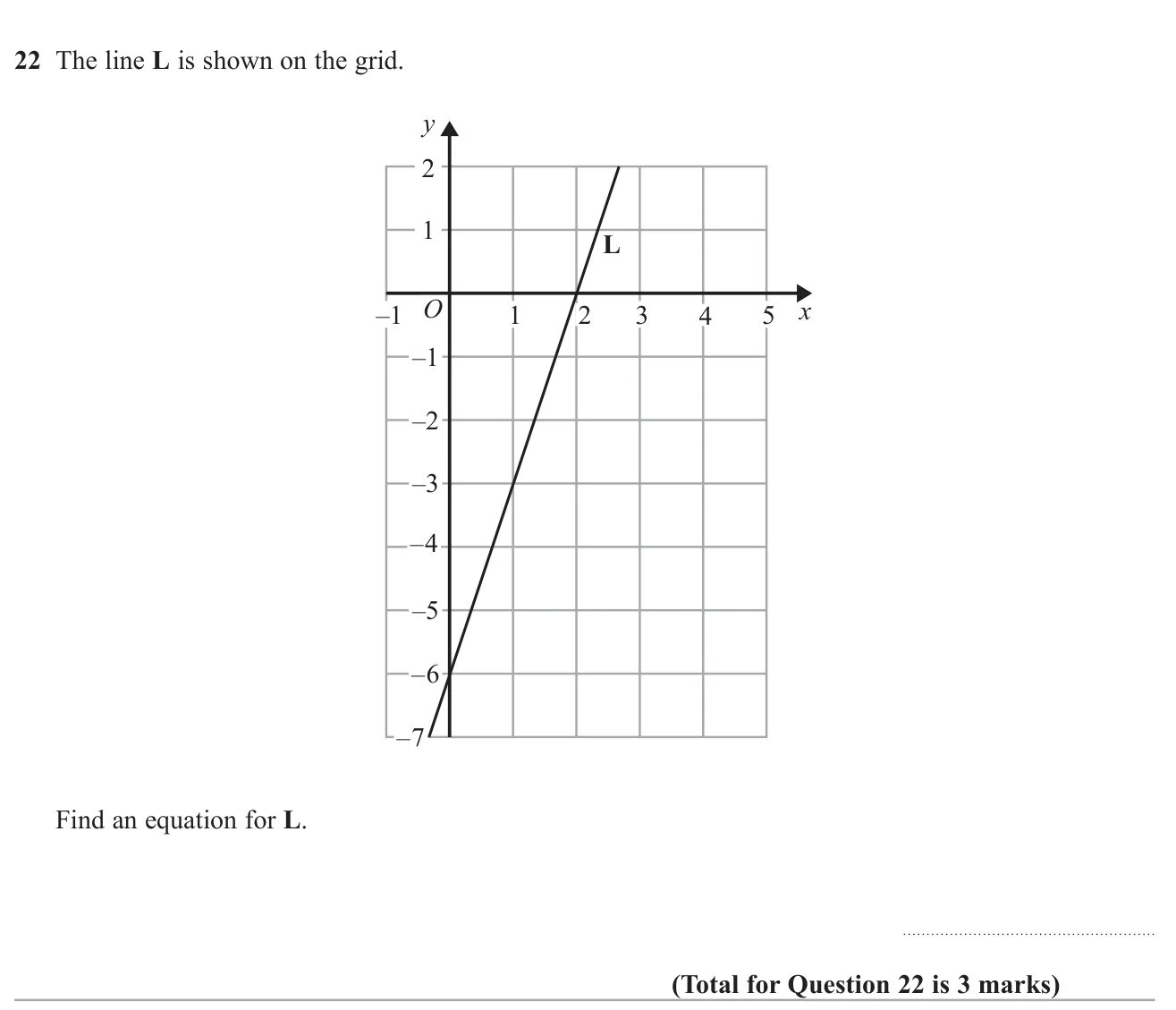
Answer y = 3 x − 6 y = 3x - 6 y = 3 x − 6 3 marks
Worked solution Checked against the mark scheme
The line crosses the y y y − 6 -6 − 6 c = − 6 c = -6 c = − 6
From ( 0 , − 6 ) (0, -6) ( 0 , − 6 ) ( 2 , 0 ) (2, 0) ( 2 , 0 ) = 6 ÷ 2 = 3 = 6 \div 2 = 3 = 6 ÷ 2 = 3
y = 3 x − 6 y = 3x - 6 y = 3 x − 6
Watch out: Working out the gradient as across over up, giving 1/3.
© Pearson Education Ltd. Specimen Paper 3 (Foundation, calculator), question 23.
Answer y = 2 x + 1 y = 2x + 1 y = 2 x + 1 3 marks
Worked solution Checked against the mark scheme
The line crosses the y-axis at 1, so c = 1 c = 1 c = 1
It passes through (0, 1) and (2, 5): up 4 for 2 across, so the gradient is 4 ÷ 2 = 2 4 \div 2 = 2 4 ÷ 2 = 2
y = 2 x + 1 y = 2x + 1 y = 2 x + 1
Watch out: Getting the gradient upside down (1 2 \frac{1}{2} 2 1
© Pearson Education Ltd. Specimen Paper 3 (Foundation, calculator), question 27.
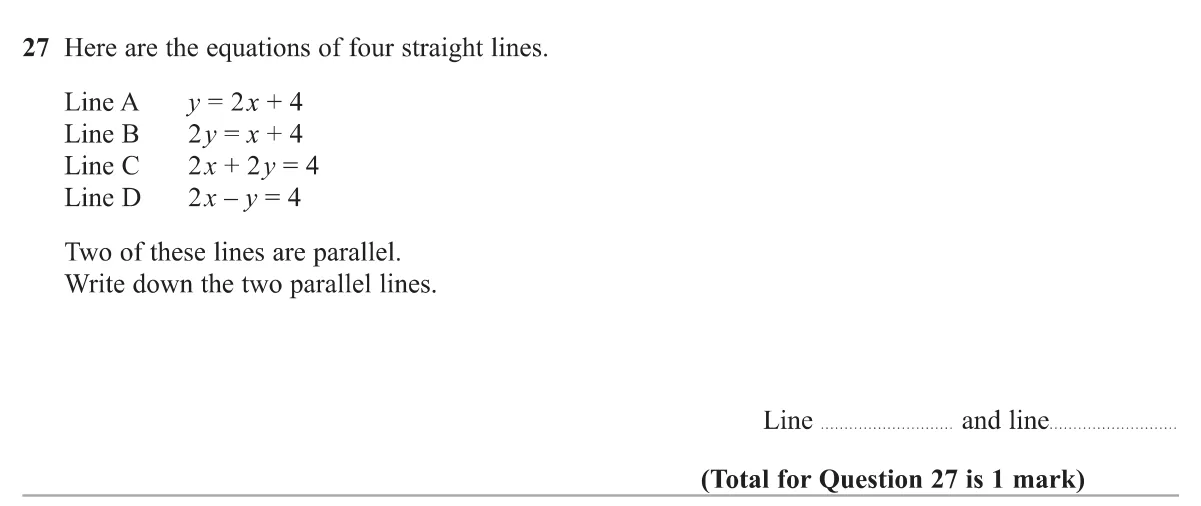
Answer Lines A and D 1 mark
Worked solution Checked against the mark scheme
Rearrange each into y = m x + c y = mx + c y = m x + c
A: y = 2 x + 4 y = 2x + 4 y = 2 x + 4
B: y = 1 2 x + 2 y = \frac{1}{2}x + 2 y = 2 1 x + 2 1 2 \frac{1}{2} 2 1
C: y = − x + 2 y = -x + 2 y = − x + 2
D: y = 2 x − 4 y = 2x - 4 y = 2 x − 4
A and D have the same gradient, so they are parallel.
Watch out: Reading the coefficient of x without first making y the subject.
© Pearson Education Ltd. Specimen Paper 3 (Higher, calculator), question 7.
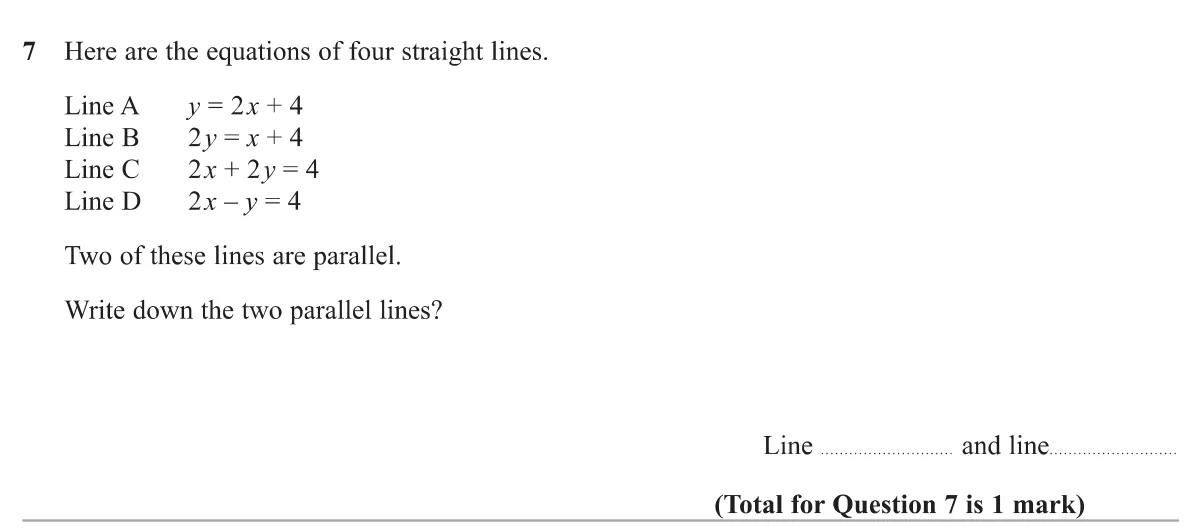
Answer Line A and line D 1 mark
Worked solution Checked against the mark scheme
Rewrite each line as y = m x + c y = mx + c y = m x + c
A: y = 2 x + 4 y = 2x + 4 y = 2 x + 4
B: y = 1 2 x + 2 y = \frac{1}{2}x + 2 y = 2 1 x + 2 1 2 \frac{1}{2} 2 1
C: y = − x + 2 y = -x + 2 y = − x + 2 − 1 -1 − 1
D: y = 2 x − 4 y = 2x - 4 y = 2 x − 4
Parallel lines have equal gradients, so A and D .
Watch out: Reading the gradient of 2x − y = 4 as −2 without rearranging.
© Pearson Education Ltd. June 2024 Paper 1 (Foundation, non-calculator), question 25.
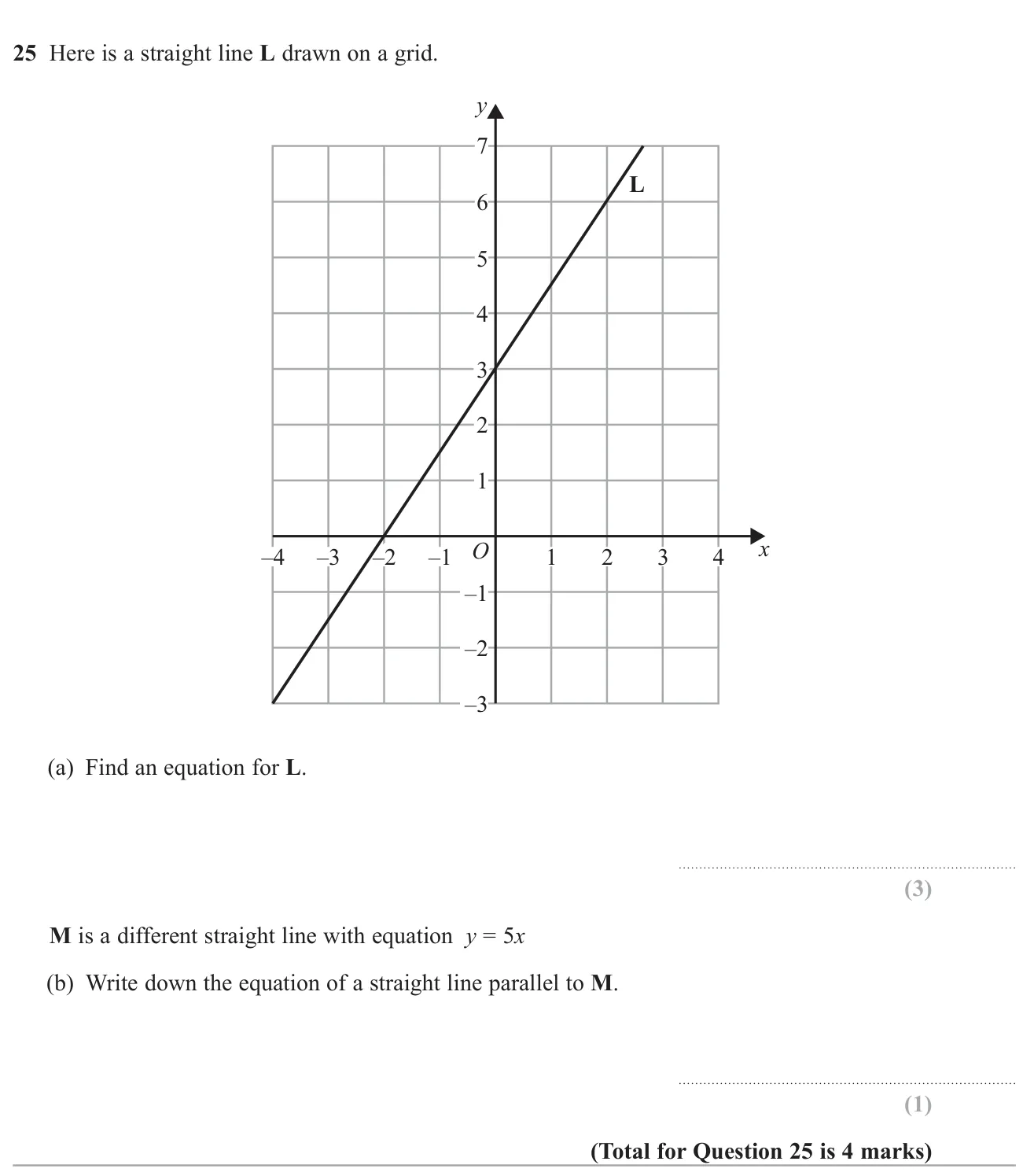
(a) y = 3 2 x + 3 y = \frac{3}{2}x + 3 y = 2 3 x + 3 3 marks (b) e.g. y = 5 x + 1 y = 5x + 1 y = 5 x + 1 1 mark
Worked solution Checked against the mark scheme
(a) The line crosses the y y y
From ( 0 , 3 ) (0, 3) ( 0 , 3 ) ( 2 , 6 ) (2, 6) ( 2 , 6 ) = 6 − 3 2 − 0 = 3 2 = \frac{6-3}{2-0} = \frac{3}{2} = 2 − 0 6 − 3 = 2 3
y = 3 2 x + 3 y = \frac{3}{2}x + 3 y = 2 3 x + 3
(b) Parallel lines have the same gradient, e.g. y = 5 x + 1 y = 5x + 1 y = 5 x + 1
Watch out: Working out the gradient as change in x over change in y (2/3).
© Pearson Education Ltd. November 2023 Paper 1 (Higher, non-calculator), question 12.
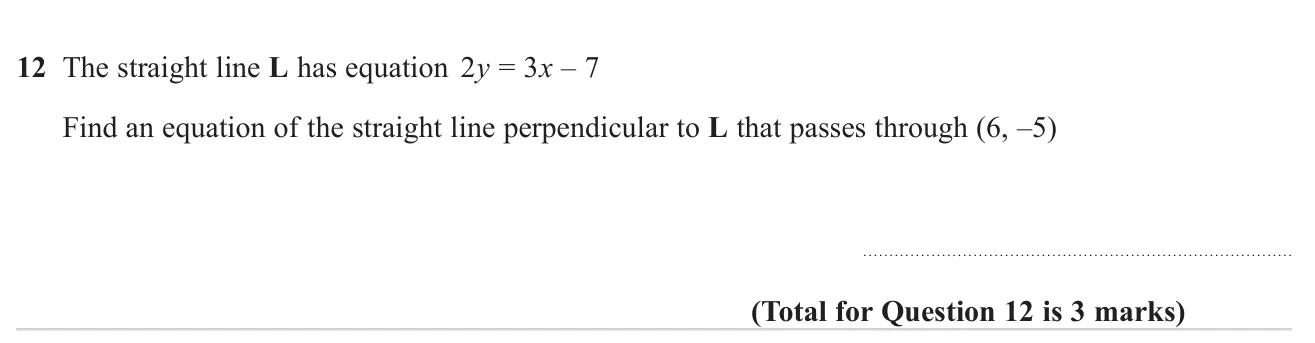
Answer y = − 2 3 x − 1 y = -\frac{2}{3}x - 1 y = − 3 2 x − 1 3 marks
Worked solution Checked against the mark scheme
Rearrange: y = 3 2 x − 7 2 y = \frac{3}{2}x - \frac{7}{2} y = 2 3 x − 2 7 L L L 3 2 \frac{3}{2} 2 3
Perpendicular gradient: − 2 3 -\frac{2}{3} − 3 2
− 5 = − 2 3 × 6 + c = − 4 + c -5 = -\frac{2}{3} \times 6 + c = -4 + c − 5 = − 3 2 × 6 + c = − 4 + c c = − 1 c = -1 c = − 1
y = − 2 3 x − 1 y = -\frac{2}{3}x - 1 y = − 3 2 x − 1
Watch out: Taking the gradient as 3 without dividing by 2 first.
© Pearson Education Ltd. November 2020 Paper 1 (Higher, non-calculator), question 15.
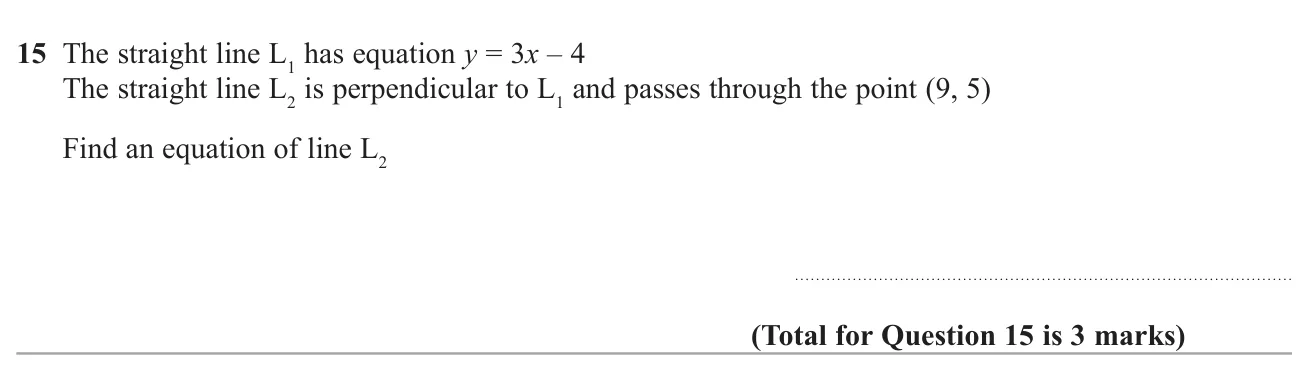
Answer y = − 1 3 x + 8 y = -\frac{1}{3}x + 8 y = − 3 1 x + 8 3 marks
Worked solution Checked against the mark scheme
Gradient of L 1 L_1 L 1 − 1 3 -\frac{1}{3} − 3 1
y = − 1 3 x + c y = -\frac{1}{3}x + c y = − 3 1 x + c ( 9 , 5 ) (9, 5) ( 9 , 5 ) 5 = − 3 + c 5 = -3 + c 5 = − 3 + c c = 8 c = 8 c = 8
L 2 L_2 L 2 y = − 1 3 x + 8 y = -\frac{1}{3}x + 8 y = − 3 1 x + 8
Watch out: Using − 3 -3 − 3 1 3 \frac{1}{3} 3 1
© Pearson Education Ltd. June 2019 Paper 2 (Higher, calculator), question 16.
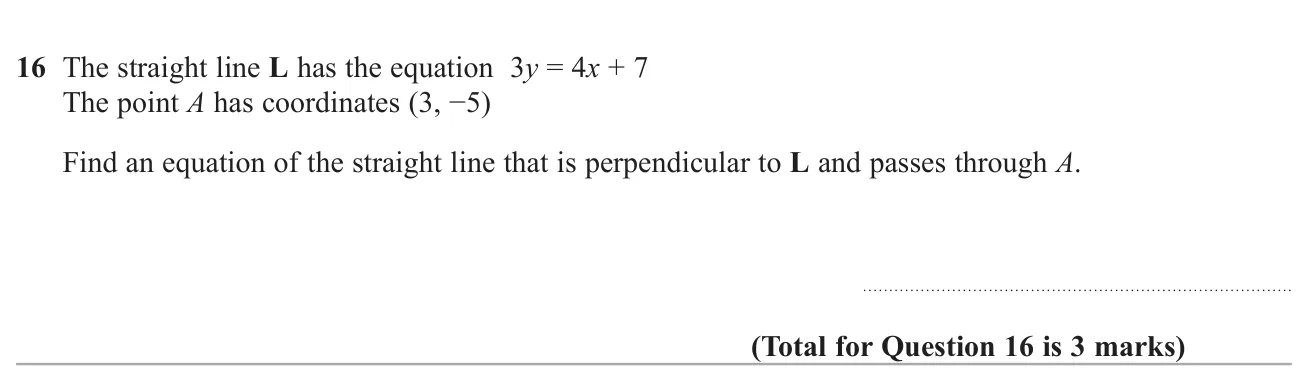
Answer y = − 3 4 x − 11 4 y = -\frac{3}{4}x - \frac{11}{4} y = − 4 3 x − 4 11 3 marks
Worked solution Checked against the mark scheme
3 y = 4 x + 7 3y = 4x + 7 3 y = 4 x + 7 y = 4 3 x + 7 3 y = \frac{4}{3}x + \frac{7}{3} y = 3 4 x + 3 7 4 3 \frac{4}{3} 3 4
Perpendicular gradient = − 3 4 = -\frac{3}{4} = − 4 3
Through ( 3 , − 5 ) (3, -5) ( 3 , − 5 ) − 5 = − 3 4 ( 3 ) + c -5 = -\frac{3}{4}(3) + c − 5 = − 4 3 ( 3 ) + c c = − 5 + 9 4 = − 11 4 c = -5 + \frac{9}{4} = -\frac{11}{4} c = − 5 + 4 9 = − 4 11
y = − 3 4 x − 11 4 y = -\frac{3}{4}x - \frac{11}{4} y = − 4 3 x − 4 11
Watch out: Using 4 as the gradient without dividing by 3 first.
© Pearson Education Ltd. June 2023 Paper 1 (Higher, non-calculator), question 15.
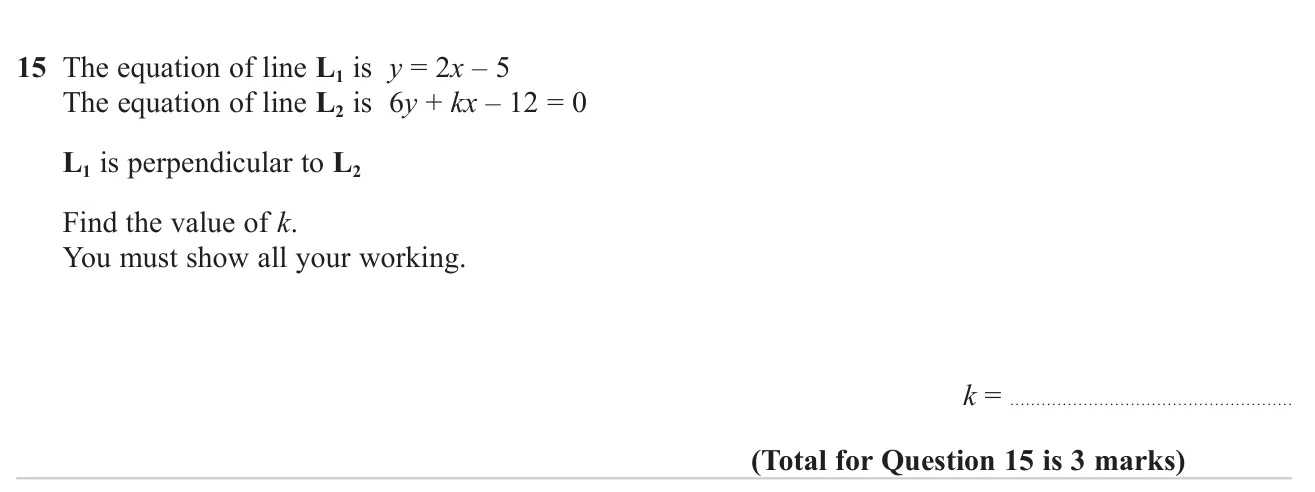
Worked solution Checked against the mark scheme
L 1 L_1 L 1 − 1 2 -\frac{1}{2} − 2 1
Rearrange L 2 L_2 L 2 6 y = 12 − k x 6y = 12 - kx 6 y = 12 − k x y = 2 − k 6 x y = 2 - \frac{k}{6}x y = 2 − 6 k x − k 6 -\frac{k}{6} − 6 k
− k 6 = − 1 2 -\frac{k}{6} = -\frac{1}{2} − 6 k = − 2 1 k = 3 k = 3 k = 3
Watch out: Using the gradient of L 2 L_2 L 2 − k -k − k 1 2 \frac{1}{2} 2 1 − 1 2 -\frac{1}{2} − 2 1
© Pearson Education Ltd. November 2021 Paper 2 (Higher, calculator), question 11.
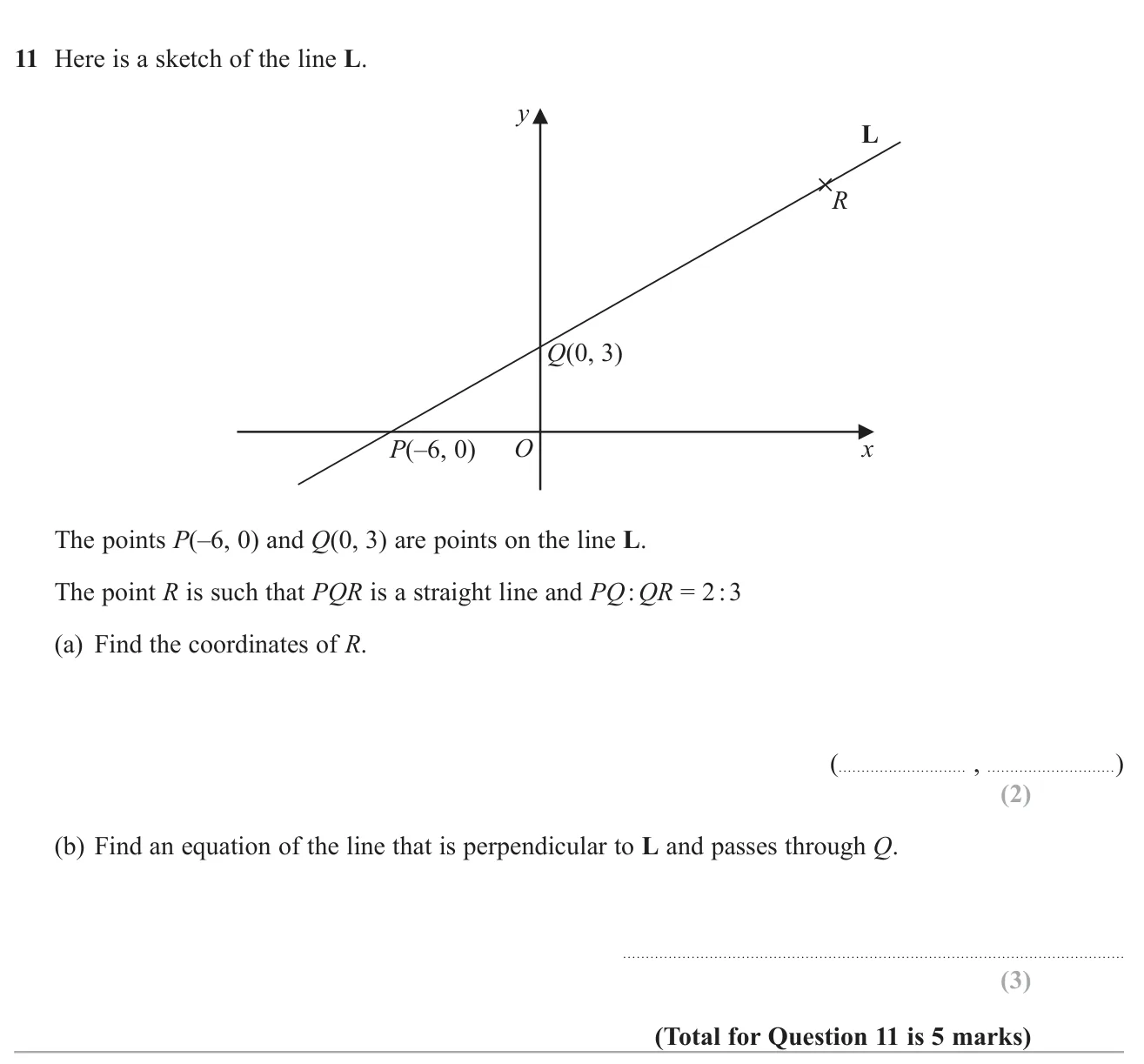
(a) ( 9 , 7.5 ) (9, 7.5) ( 9 , 7.5 ) 2 marks (b) y = − 2 x + 3 y = -2x + 3 y = − 2 x + 3 3 marks
Worked solution Checked against the mark scheme
(a) From P to Q you go 6 right and 3 up. QR is 3 2 \frac{3}{2} 2 3 9 9 9 4.5 4.5 4.5
R = ( 0 + 9 , 3 + 4.5 ) = ( 9 , 7.5 ) R = (0 + 9, 3 + 4.5) = (9, 7.5) R = ( 0 + 9 , 3 + 4.5 ) = ( 9 , 7.5 )
(b) Gradient of L = 3 6 = 1 2 = \frac{3}{6} = \frac{1}{2} = 6 3 = 2 1 = − 2 = -2 = − 2
The line passes through ( 0 , 3 ) (0, 3) ( 0 , 3 ) y = − 2 x + 3 y = -2x + 3 y = − 2 x + 3
Watch out: Using the ratio 2 : 3 to split PQ itself rather than extending beyond Q.
© Pearson Education Ltd. November 2018 Paper 2 (Higher, calculator), question 18.
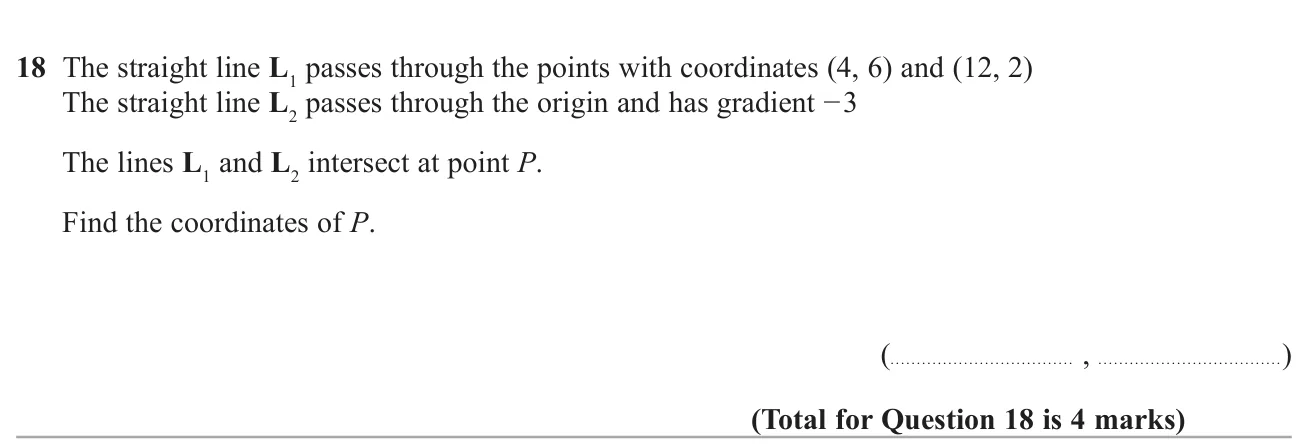
Answer ( − 16 5 , 48 5 ) \left(-\frac{16}{5}, \frac{48}{5}\right) ( − 5 16 , 5 48 ) 4 marks
Worked solution Checked against the mark scheme
Gradient of L1 = 2 − 6 12 − 4 = − 1 2 = \frac{2 - 6}{12 - 4} = -\frac{1}{2} = 12 − 4 2 − 6 = − 2 1
6 = − 1 2 ( 4 ) + c 6 = -\frac{1}{2}(4) + c 6 = − 2 1 ( 4 ) + c c = 8 c = 8 c = 8 y = − 1 2 x + 8 y = -\frac{1}{2}x + 8 y = − 2 1 x + 8
L2 is y = − 3 x y = -3x y = − 3 x
− 1 2 x + 8 = − 3 x ⇒ 2.5 x = − 8 ⇒ x = − 3.2 -\frac{1}{2}x + 8 = -3x \Rightarrow 2.5x = -8 \Rightarrow x = -3.2 − 2 1 x + 8 = − 3 x ⇒ 2.5 x = − 8 ⇒ x = − 3.2 y = 9.6 y = 9.6 y = 9.6
P = ( − 3.2 , 9.6 ) P = (-3.2, 9.6) P = ( − 3.2 , 9.6 )
Watch out: Getting the gradient sign wrong for L1.
© Pearson Education Ltd. November 2024 Paper 3 (Higher, calculator), question 16.
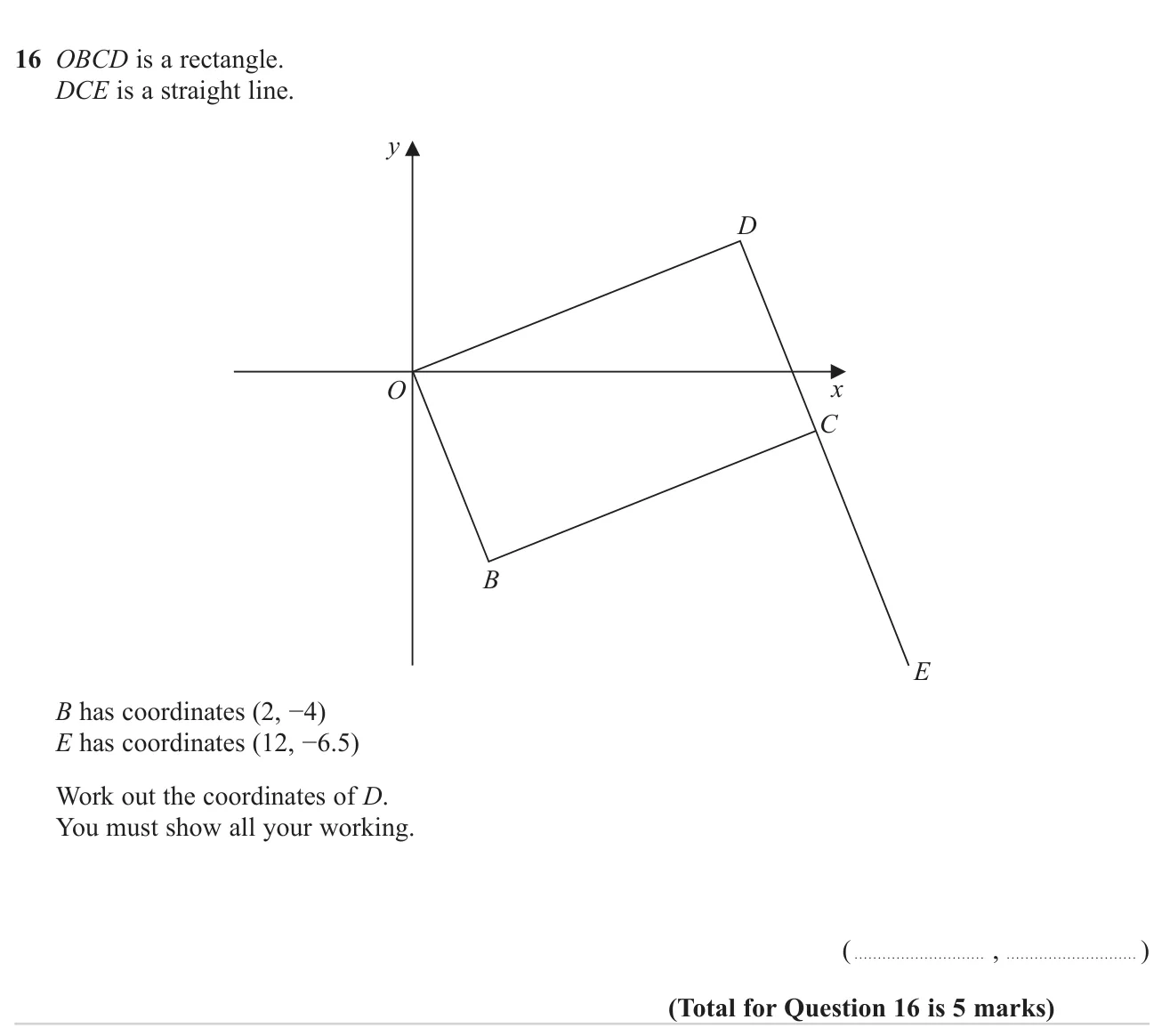
Answer ( 7 , 3.5 ) (7,\ 3.5) ( 7 , 3.5 ) 5 marks
Worked solution Checked against the mark scheme
Gradient of OB = − 4 2 = − 2 = \frac{-4}{2} = -2 = 2 − 4 = − 2
DE is parallel to OB through ( 12 , − 6.5 ) (12, -6.5) ( 12 , − 6.5 ) y = − 2 x + c y = -2x + c y = − 2 x + c − 6.5 = − 24 + c -6.5 = -24 + c − 6.5 = − 24 + c y = − 2 x + 17.5 y = -2x + 17.5 y = − 2 x + 17.5
OD is perpendicular to OB through O: gradient 1 2 \frac{1}{2} 2 1 y = 1 2 x y = \frac{1}{2}x y = 2 1 x
1 2 x = − 2 x + 17.5 ⇒ 2.5 x = 17.5 ⇒ x = 7 \frac{1}{2}x = -2x + 17.5 \Rightarrow 2.5x = 17.5 \Rightarrow x = 7 2 1 x = − 2 x + 17.5 ⇒ 2.5 x = 17.5 ⇒ x = 7 y = 3.5 y = 3.5 y = 3.5
D = ( 7 , 3.5 ) D = (7, 3.5) D = ( 7 , 3.5 )
Watch out: Using gradient −½ (the negative, not the negative reciprocal) for the perpendicular line.
© Pearson Education Ltd. November 2019 Paper 2 (Higher, calculator), question 25.
Worked solution Checked against the mark scheme
L: 2 y = 17 − 3 x 2y = 17 - 3x 2 y = 17 − 3 x y = 8.5 − 1.5 x y = 8.5 - 1.5x y = 8.5 − 1.5 x − 3 2 -\frac{3}{2} − 2 3 B = ( 0 , 8.5 ) B = (0, 8.5) B = ( 0 , 8.5 )
M has gradient 2 3 \frac{2}{3} 3 2 ( 0 , 2 ) (0, 2) ( 0 , 2 ) y = 2 3 x + 2 y = \frac{2}{3}x + 2 y = 3 2 x + 2
Solve: 2 3 x + 2 = 8.5 − 1.5 x ⇒ 13 6 x = 6.5 ⇒ x = 3 \frac{2}{3}x + 2 = 8.5 - 1.5x \Rightarrow \frac{13}{6}x = 6.5 \Rightarrow x = 3 3 2 x + 2 = 8.5 − 1.5 x ⇒ 6 13 x = 6.5 ⇒ x = 3 C = ( 3 , 4 ) C = (3, 4) C = ( 3 , 4 )
Base A B = 8.5 − 2 = 6.5 AB = 8.5 - 2 = 6.5 A B = 8.5 − 2 = 6.5
Area = 1 2 × 6.5 × 3 = 9.75 = \frac{1}{2} \times 6.5 \times 3 = 9.75 = 2 1 × 6.5 × 3 = 9.75
Watch out: Using gradient 3 2 \frac{3}{2} 2 3
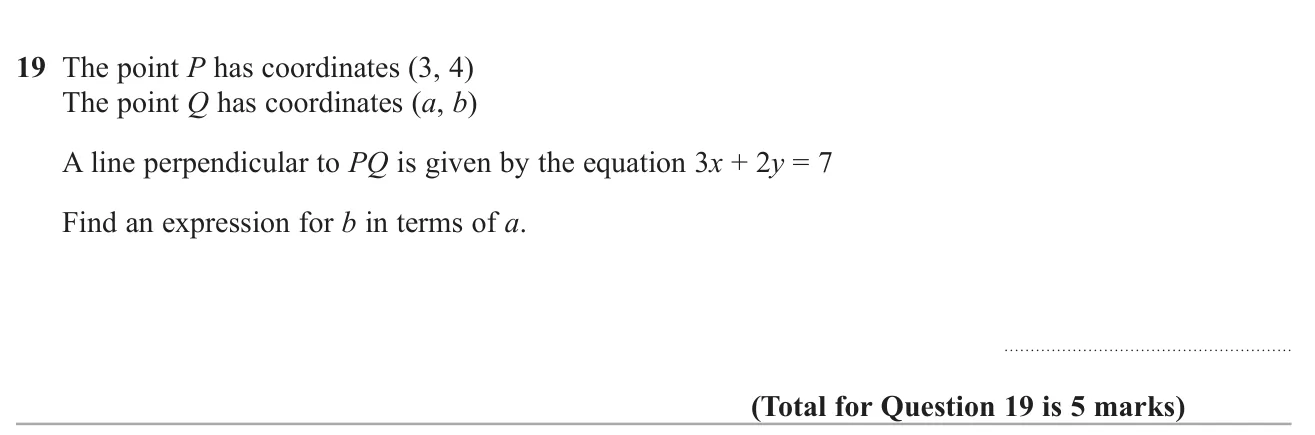
© Pearson Education Ltd. June 2018 Paper 1 (Higher, non-calculator), question 19.
Answer b = 2 3 a + 2 b = \frac{2}{3}a + 2 b = 3 2 a + 2 5 marks
Worked solution Checked against the mark scheme
3 x + 2 y = 7 ⇒ y = − 3 2 x + 7 2 3x + 2y = 7 \Rightarrow y = -\frac{3}{2}x + \frac{7}{2} 3 x + 2 y = 7 ⇒ y = − 2 3 x + 2 7 − 3 2 -\frac{3}{2} − 2 3
PQ is perpendicular, so its gradient is 2 3 \frac{2}{3} 3 2
b − 4 a − 3 = 2 3 ⇒ b − 4 = 2 3 ( a − 3 ) = 2 3 a − 2 \frac{b - 4}{a - 3} = \frac{2}{3} \Rightarrow b - 4 = \frac{2}{3}(a - 3) = \frac{2}{3}a - 2 a − 3 b − 4 = 3 2 ⇒ b − 4 = 3 2 ( a − 3 ) = 3 2 a − 2
b = 2 3 a + 2 b = \frac{2}{3}a + 2 b = 3 2 a + 2
Watch out: Taking the gradient as 3 (reading the x coefficient) instead of rearranging for y.
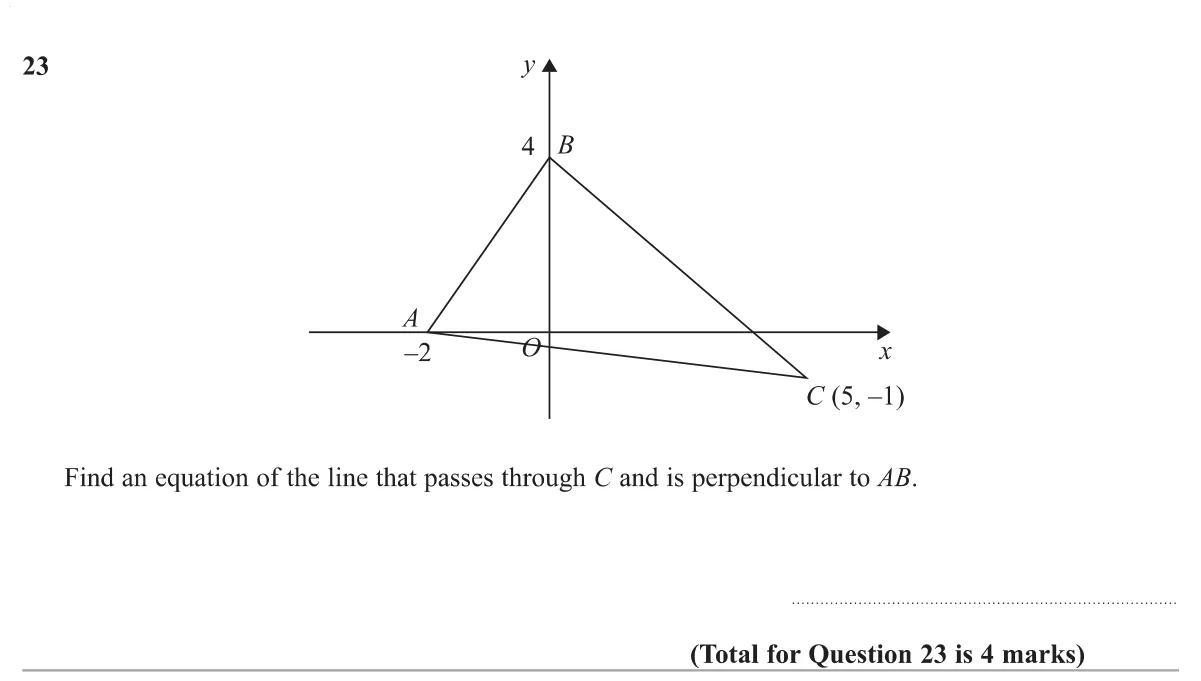
© Pearson Education Ltd. Specimen Paper 1 (Higher, non-calculator), question 23.
Answer y = − 1 2 x + 3 2 y = -\frac{1}{2}x + \frac{3}{2} y = − 2 1 x + 2 3 4 marks
Worked solution Checked against the mark scheme
A A A ( − 2 , 0 ) (-2, 0) ( − 2 , 0 ) B B B ( 0 , 4 ) (0, 4) ( 0 , 4 ) A B = 4 2 = 2 AB = \frac{4}{2} = 2 A B = 2 4 = 2
Perpendicular gradient = − 1 2 = -\frac{1}{2} = − 2 1
Through C ( 5 , − 1 ) C(5, -1) C ( 5 , − 1 ) − 1 = − 1 2 ( 5 ) + c -1 = -\frac{1}{2}(5) + c − 1 = − 2 1 ( 5 ) + c c = 3 2 c = \frac{3}{2} c = 2 3
y = − 1 2 x + 3 2 y = -\frac{1}{2}x + \frac{3}{2} y = − 2 1 x + 2 3
Watch out: Using gradient 1 2 \frac{1}{2} 2 1 − 2 -2 − 2
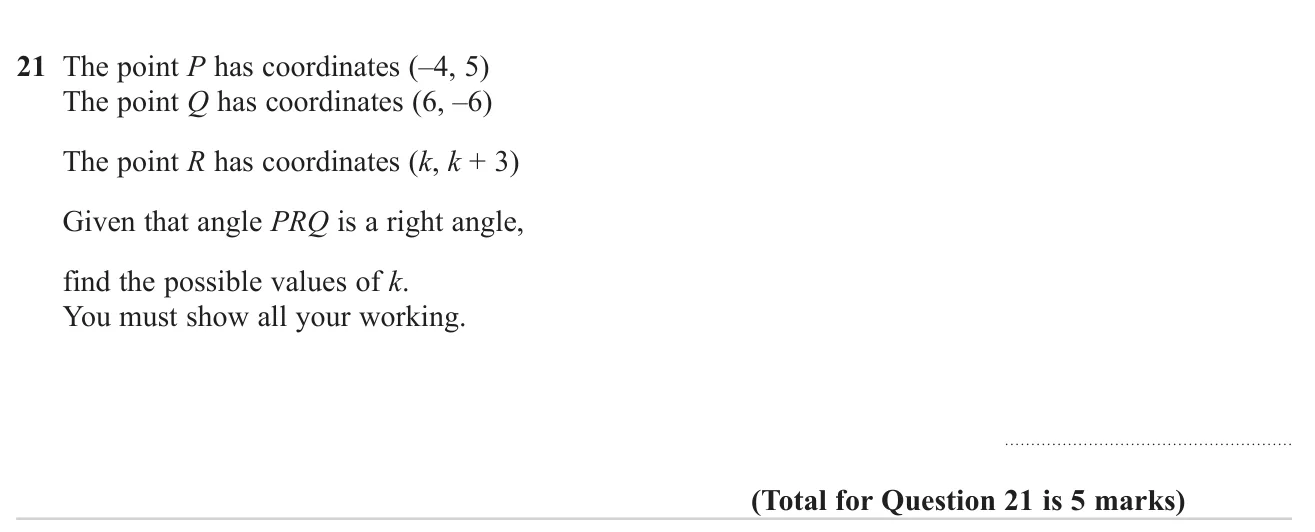
© Pearson Education Ltd. November 2024 Paper 2 (Higher, calculator), question 21.
Answer k = − 6 k = -6 k = − 6 k = 3.5 k = 3.5 k = 3.5 5 marks
Worked solution Checked against the mark scheme
Gradient P R = k − 2 k + 4 PR = \frac{k - 2}{k + 4} P R = k + 4 k − 2 Q R = k + 9 k − 6 QR = \frac{k + 9}{k - 6} QR = k − 6 k + 9
Perpendicular: k − 2 k + 4 × k + 9 k − 6 = − 1 \frac{k-2}{k+4} \times \frac{k+9}{k-6} = -1 k + 4 k − 2 × k − 6 k + 9 = − 1
( k − 2 ) ( k + 9 ) = − ( k + 4 ) ( k − 6 ) (k-2)(k+9) = -(k+4)(k-6) ( k − 2 ) ( k + 9 ) = − ( k + 4 ) ( k − 6 )
k 2 + 7 k − 18 = − k 2 + 2 k + 24 ⇒ 2 k 2 + 5 k − 42 = 0 k^2 + 7k - 18 = -k^2 + 2k + 24 \Rightarrow 2k^2 + 5k - 42 = 0 k 2 + 7 k − 18 = − k 2 + 2 k + 24 ⇒ 2 k 2 + 5 k − 42 = 0
( k + 6 ) ( 2 k − 7 ) = 0 (k + 6)(2k - 7) = 0 ( k + 6 ) ( 2 k − 7 ) = 0 k = − 6 k = -6 k = − 6 k = 3.5 k = 3.5 k = 3.5
Watch out: Setting the gradients equal (parallel) instead of making their product −1.
Also tested in these questions Their main topic is different, but part of each one tests this topic.