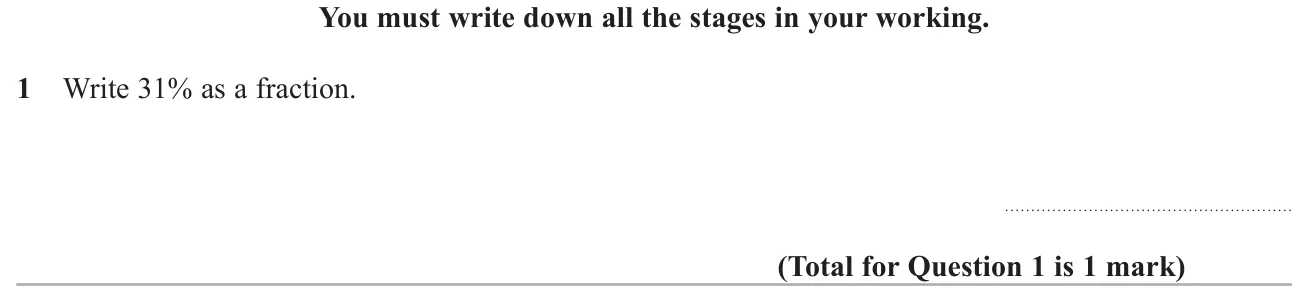
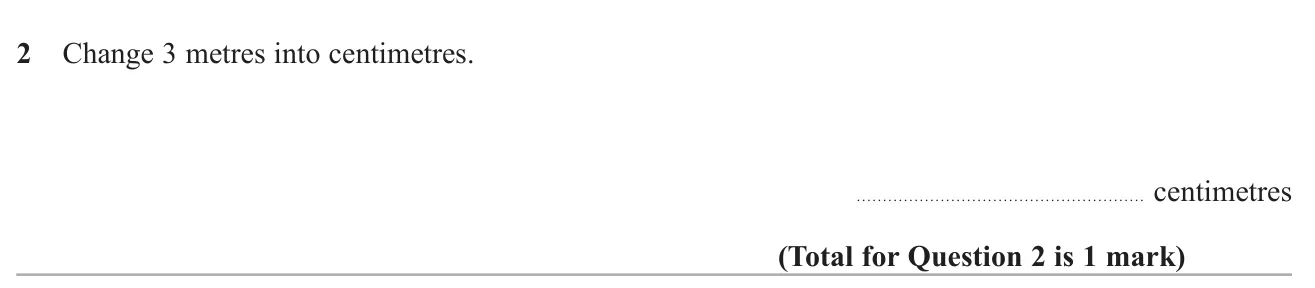
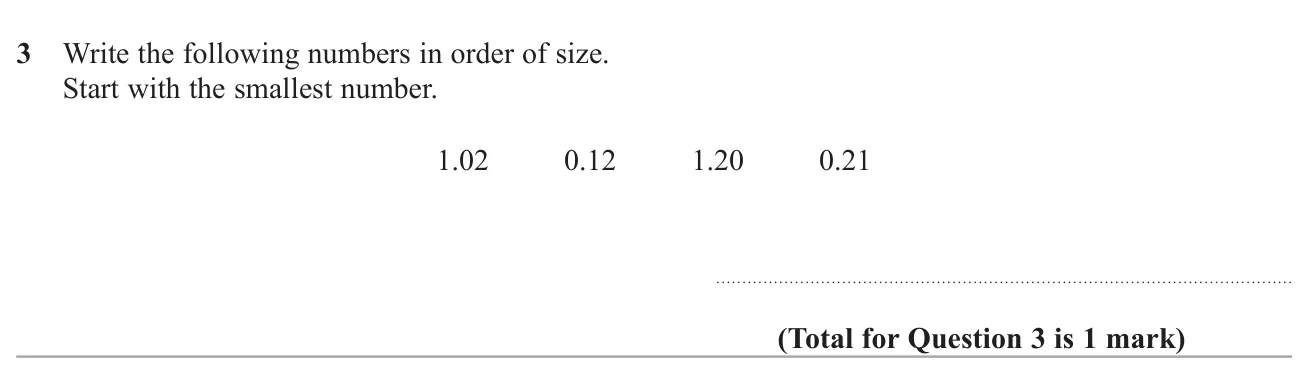
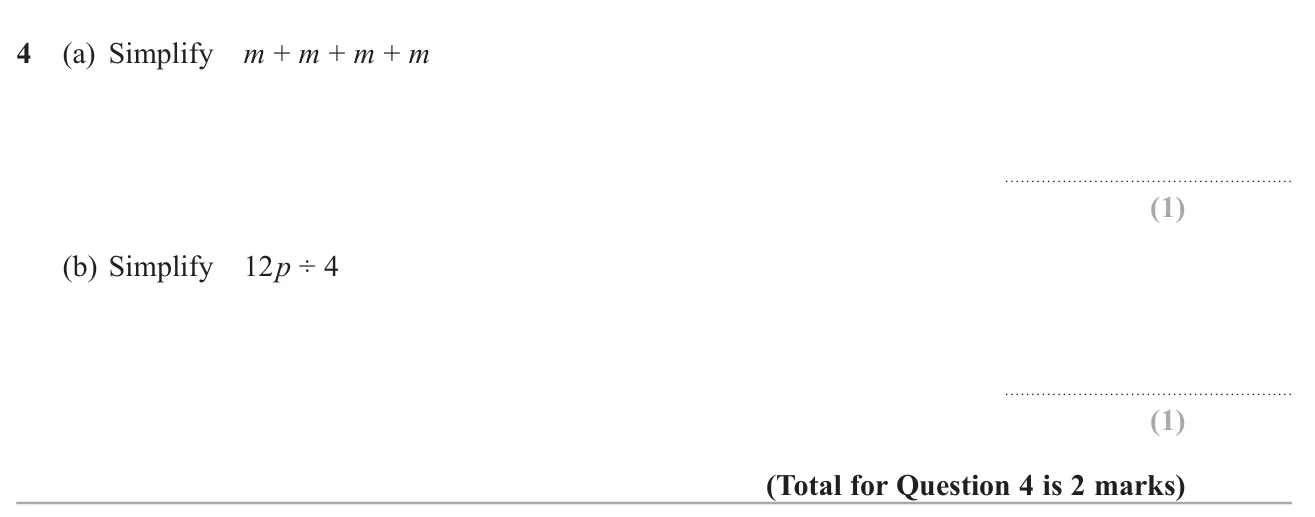
© Pearson Education Ltd. November 2021 Paper 2 (Foundation, calculator), question 1.
Show answer
| Answer | 10031 | 1 mark |
|---|
Worked solution Checked against the mark scheme
Per cent means out of 100, so 31%=10031.
Watch out: Writing 0.31 or 31/10 instead of a fraction out of 100.
© Pearson Education Ltd. November 2021 Paper 2 (Foundation, calculator), question 2.
Show answer
Worked solution Checked against the mark scheme
There are 100 cm in 1 m, so 3×100=300 cm.
Watch out: Multiplying by 10 or 1000 instead of 100.
© Pearson Education Ltd. November 2021 Paper 2 (Foundation, calculator), question 3.
Show answer
| Answer | 0.12, 0.21, 1.02, 1.20 | 1 mark |
|---|
Worked solution Checked against the mark scheme
Compare whole-number parts first: 0.12 and 0.21 are less than 1.
Then compare tenths: 0.12<0.21 and 1.02<1.20.
Order: 0.12, 0.21, 1.02, 1.20
Watch out: Thinking 1.02 is bigger than 1.20 because 2 is in a later place.
© Pearson Education Ltd. November 2021 Paper 2 (Foundation, calculator), question 4.
Show answer
| (a) | 4m | 1 mark |
|---|
| (b) | 3p | 1 mark |
|---|
Worked solution Checked against the mark scheme
(a) Four lots of m make 4m.
(b) 12p÷4=3p because 12÷4=3.
Watch out: Writing m4 in part (a).
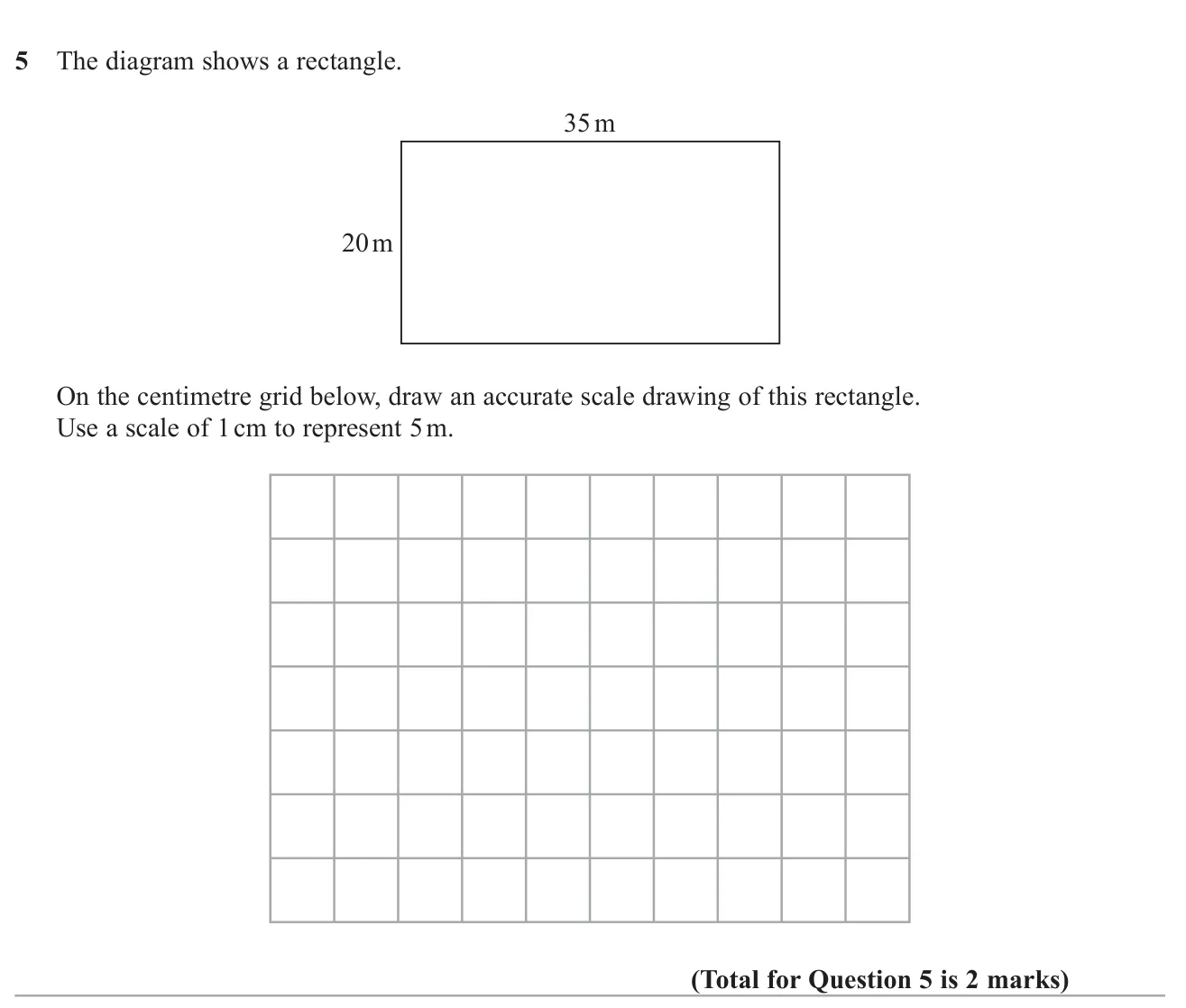
© Pearson Education Ltd. November 2021 Paper 2 (Foundation, calculator), question 5.
Show answer
| Answer | A rectangle 7 cm by 4 cm drawn on the grid | 2 marks |
|---|
Worked solution Checked against the mark scheme
Each 5 m becomes 1 cm.
35÷5=7 cm and 20÷5=4 cm.
Draw a rectangle 7 cm long and 4 cm wide.
Watch out: Multiplying by 5 instead of dividing.
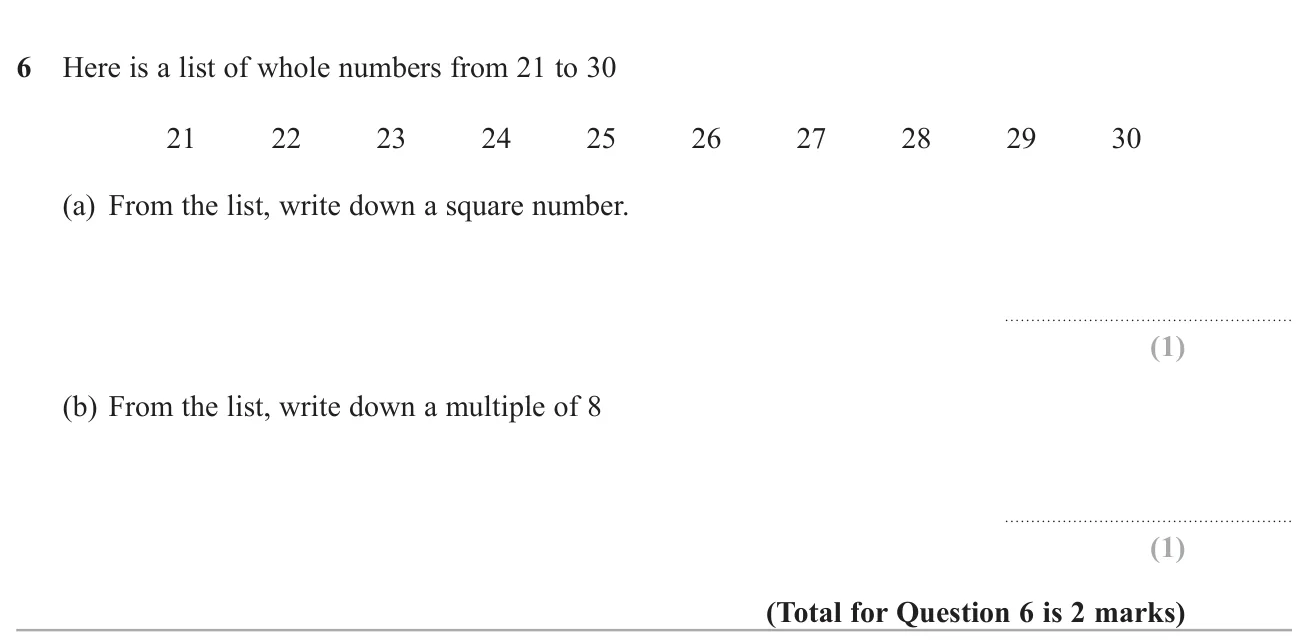
© Pearson Education Ltd. November 2021 Paper 2 (Foundation, calculator), question 6.
Show answer
Worked solution Checked against the mark scheme
(a) 5×5=25, so 25 is square.
(b) 8×3=24, so 24 is a multiple of 8.
Watch out: Choosing 28 in part (b), which is a multiple of 4 but not 8.
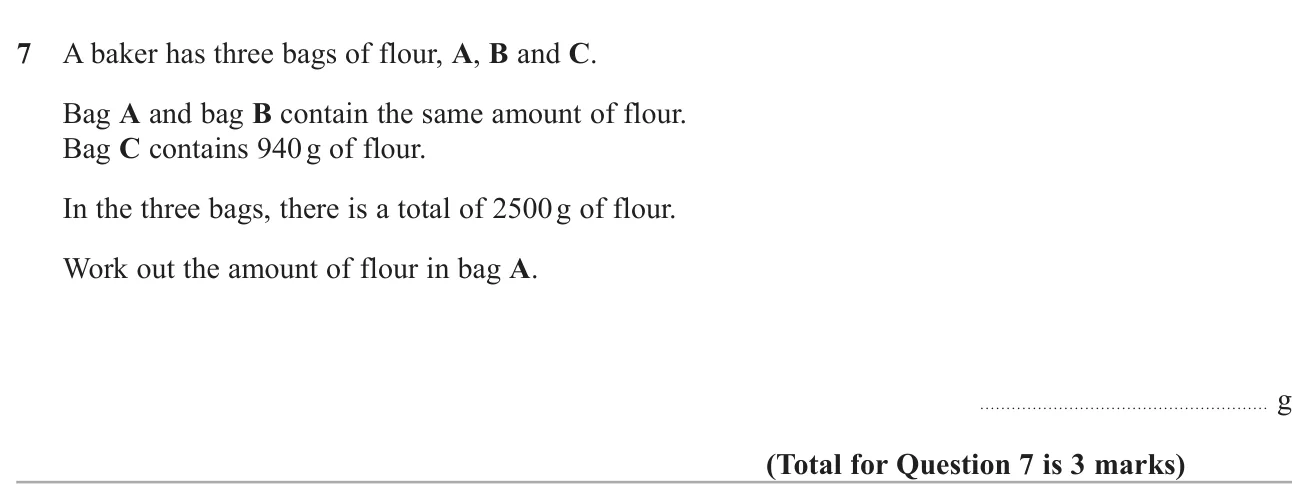
© Pearson Education Ltd. November 2021 Paper 2 (Foundation, calculator), question 7.
Show answer
Worked solution Checked against the mark scheme
Flour in A and B together: 2500−940=1560 g.
They are equal, so bag A has 1560÷2=780 g.
Watch out: Dividing 2500 by 3.
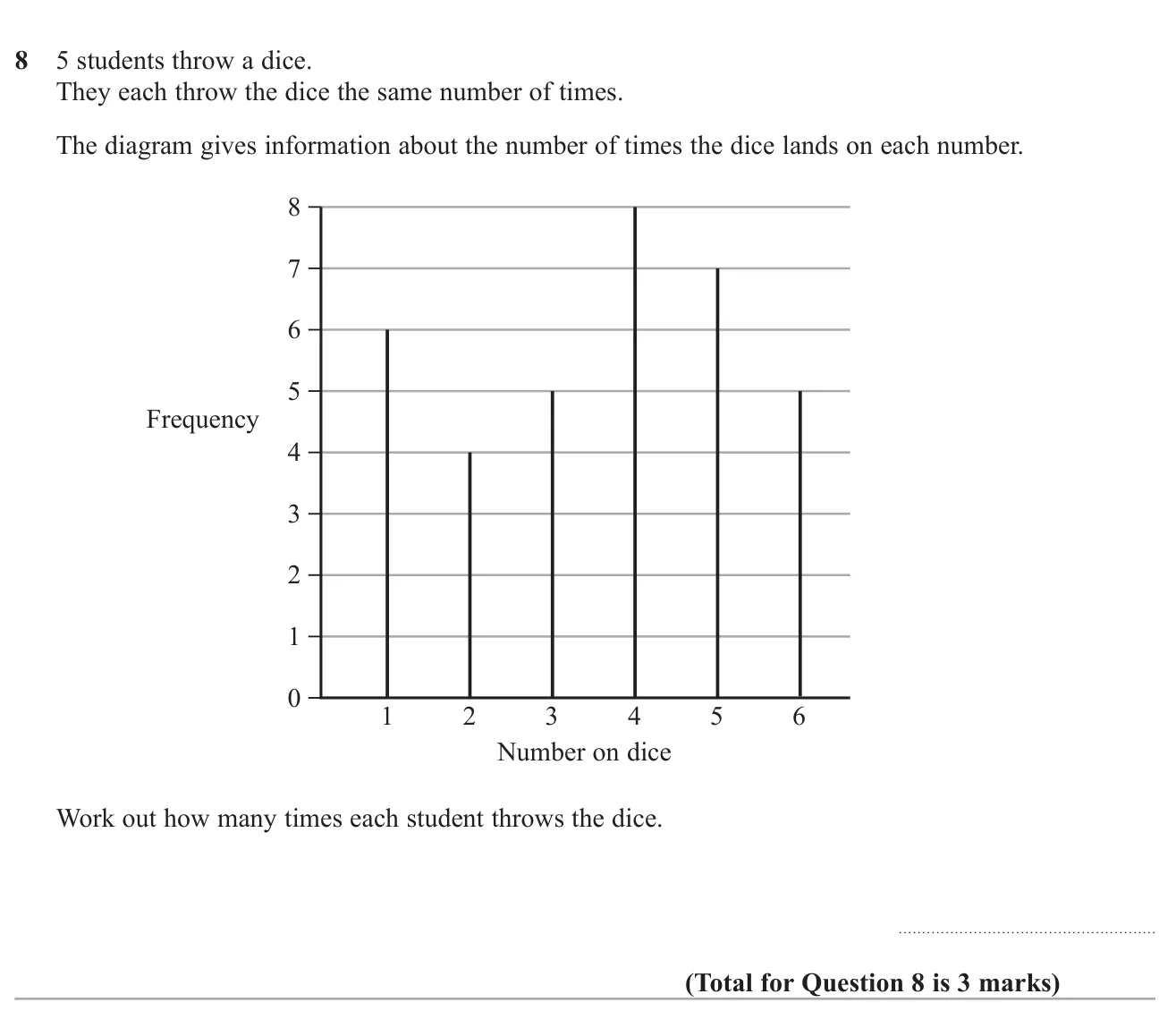
© Pearson Education Ltd. November 2021 Paper 2 (Foundation, calculator), question 8.
Show answer
Worked solution Checked against the mark scheme
Frequencies read from the chart: 6, 4, 5, 8, 7, 5.
Total throws: 6+4+5+8+7+5=35.
Each student: 35÷5=7 throws.
Watch out: Adding the dice numbers 1 to 6 instead of the frequencies.
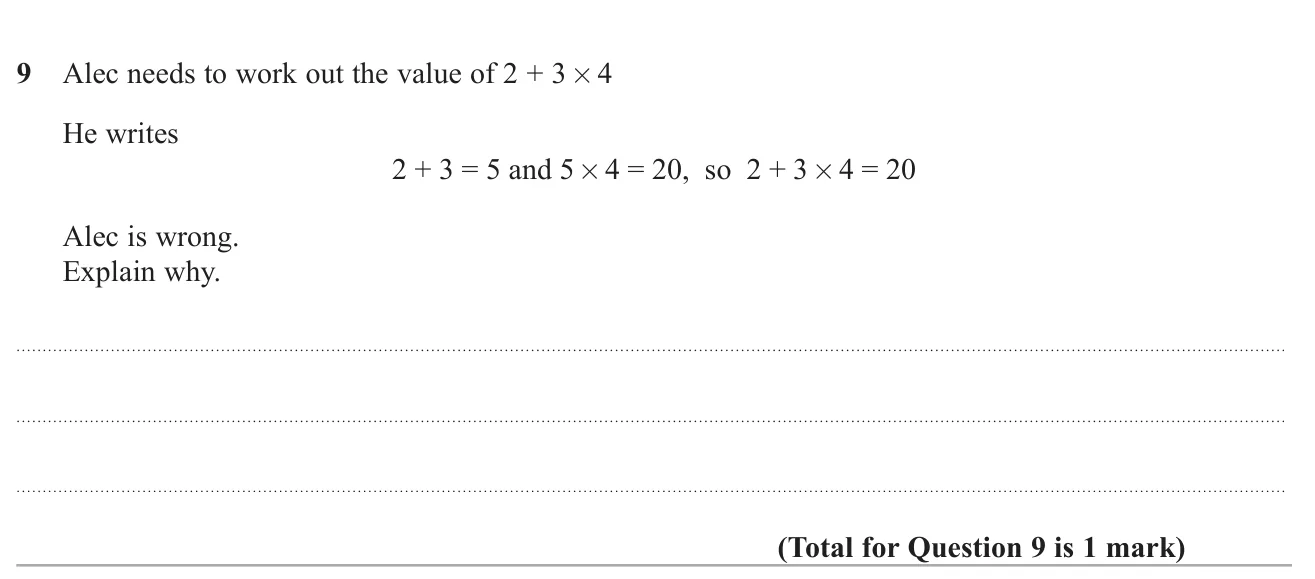
© Pearson Education Ltd. November 2021 Paper 2 (Foundation, calculator), question 9.
Show answer
| Answer | Multiplication must be done before addition, so the answer is 14 | 1 mark |
|---|
Worked solution Checked against the mark scheme
Multiplication comes before addition (BIDMAS).
3×4=12, then 2+12=14, not 20.
Watch out: Saying only that the answer is wrong without giving a reason.
© Pearson Education Ltd. November 2021 Paper 2 (Foundation, calculator), question 10.
Show answer
| Answer | 3017 | 1 mark |
|---|
Worked solution Checked against the mark scheme
The part goes on top and the whole on the bottom: 3017.
Watch out: Writing 1730.
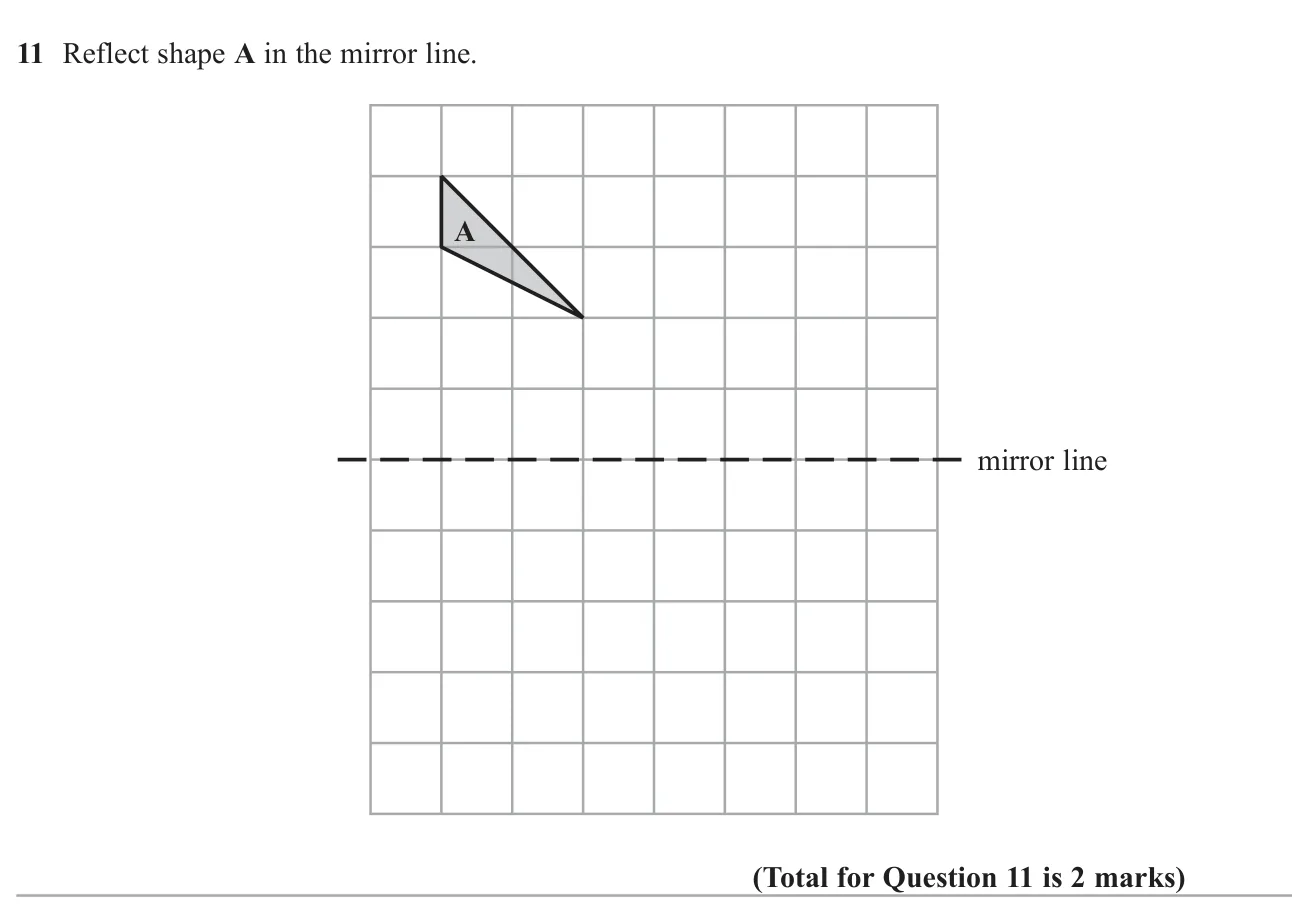
© Pearson Education Ltd. November 2021 Paper 2 (Foundation, calculator), question 11.
Show answer
| Answer | Correct reflection of shape A in the mirror line | 2 marks |
|---|
Worked solution Checked against the mark scheme
Take each corner of A and count its distance to the mirror line.
Plot the image point the same distance on the other side, then join the points.
Watch out: Translating the shape across the line instead of flipping it.
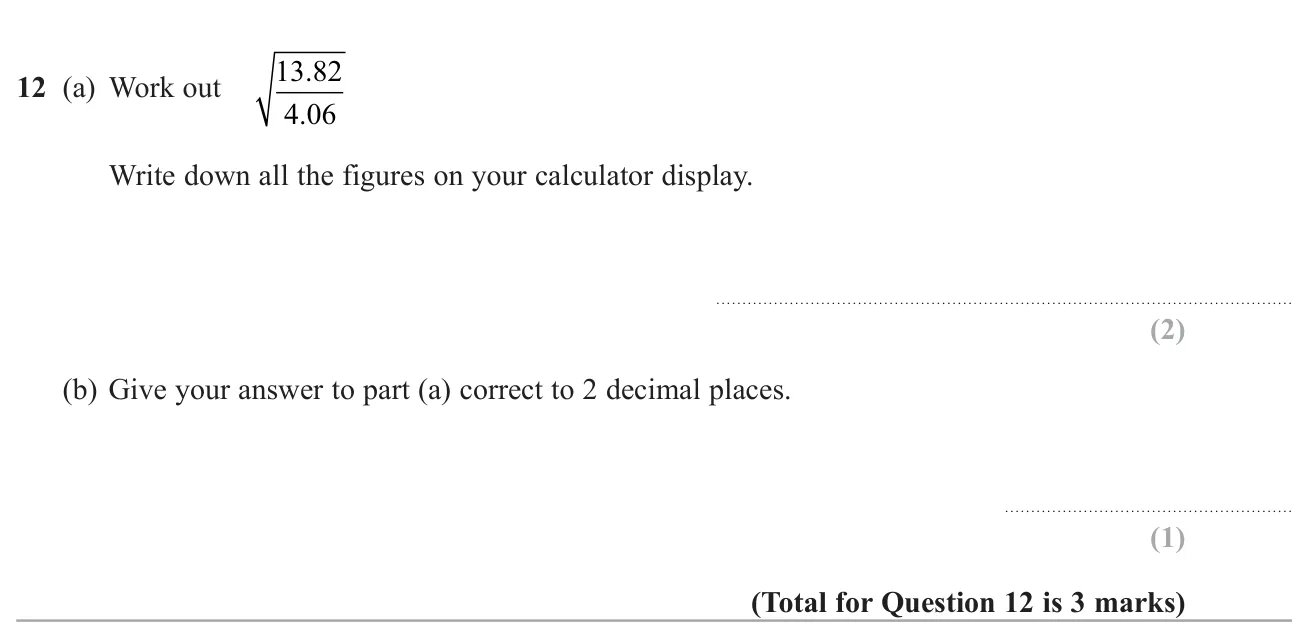
© Pearson Education Ltd. November 2021 Paper 2 (Foundation, calculator), question 12.
Show answer
| (a) | 1.844977205… | 2 marks |
|---|
| (b) | 1.84 | 1 mark |
|---|
Worked solution Checked against the mark scheme
(a) 13.82÷4.06=3.40394…
3.40394…=1.844977205…
(b) The third decimal is 4, so round down: 1.84
Watch out: Square-rooting only the top number before dividing.
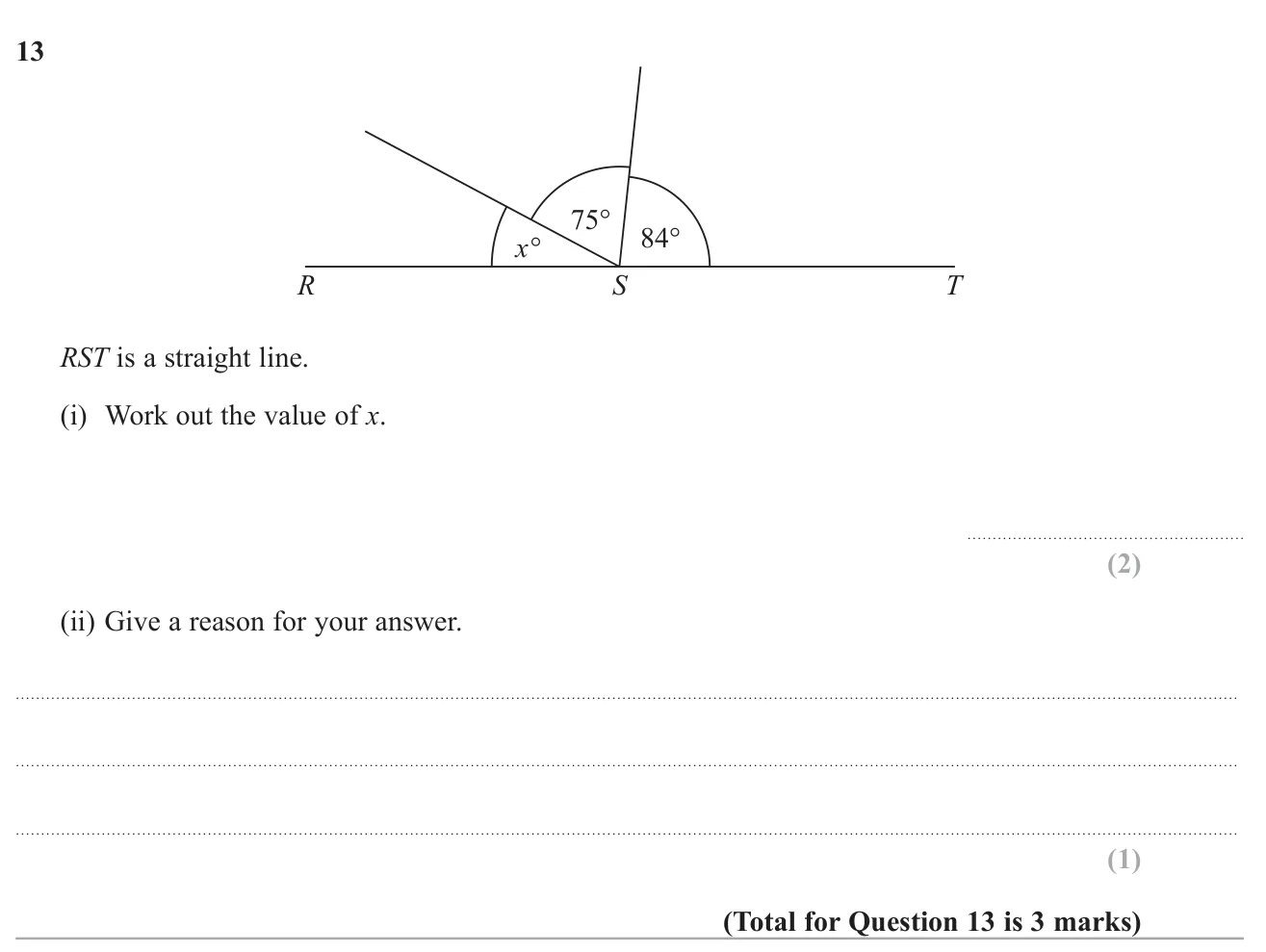
© Pearson Education Ltd. November 2021 Paper 2 (Foundation, calculator), question 13.
Show answer
| (i) | 21 | 2 marks |
|---|
| (ii) | Angles on a straight line add up to 180∘ | 1 mark |
|---|
Worked solution Checked against the mark scheme
(i) Angles on a straight line total 180∘.
x=180−75−84=21
(ii) Angles on a straight line add up to 180∘.
Watch out: Using 360 instead of 180.
© Pearson Education Ltd. November 2021 Paper 2 (Foundation, calculator), question 14.
Show answer
| (a) | £15 | 1 mark |
|---|
| (b) | £540 | 2 marks |
|---|
Worked solution Checked against the mark scheme
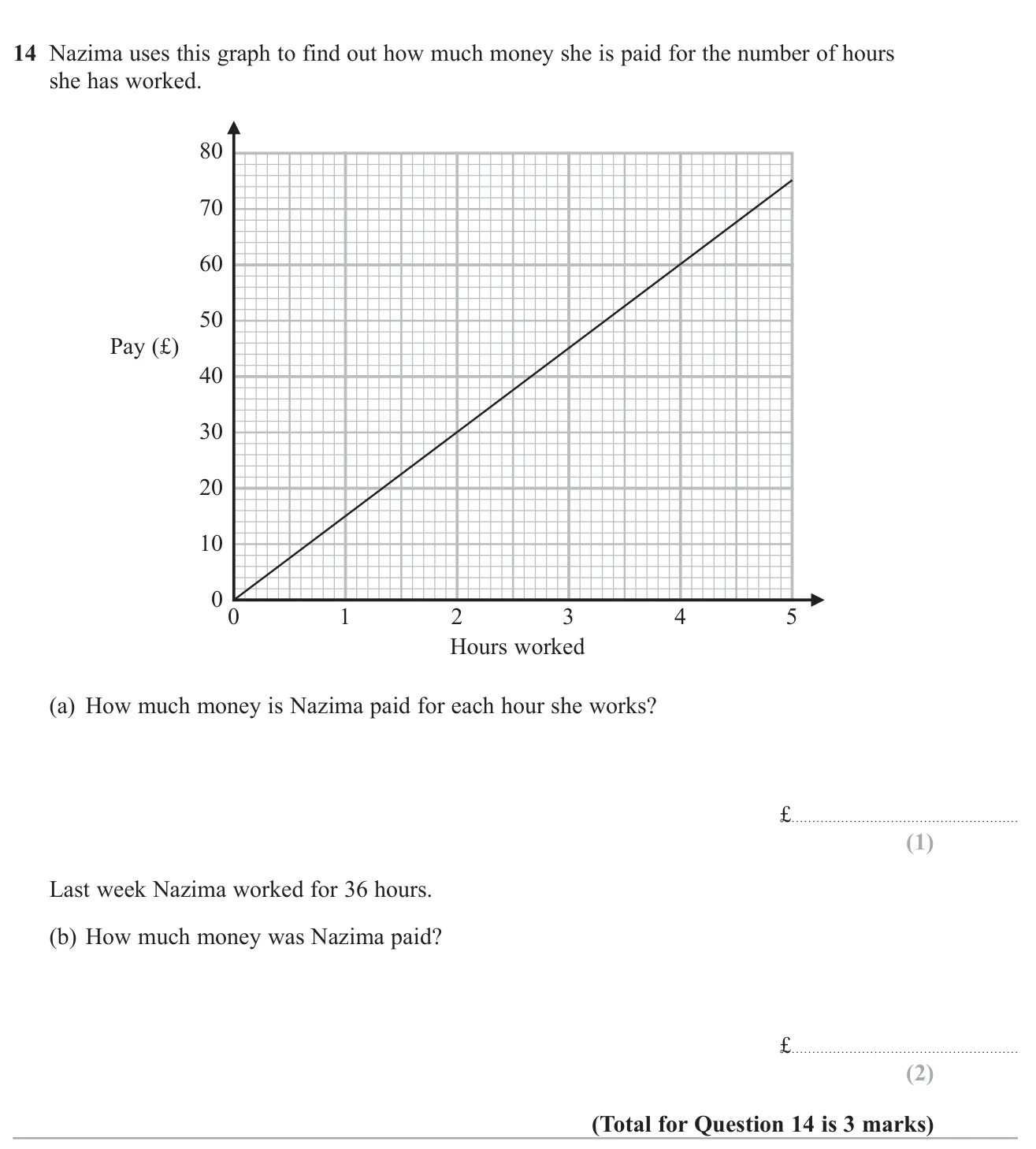
(a) At 2 hours the pay is £30, so 30÷2=£15 per hour.
(b) 15×36=£540
Watch out: Reading the graph at 36 on the wrong axis or using an incorrect hourly rate.
© Pearson Education Ltd. November 2021 Paper 2 (Foundation, calculator), question 15.
Show answer
| Answer | 94,53,85,32 | 2 marks |
|---|
Worked solution Checked against the mark scheme
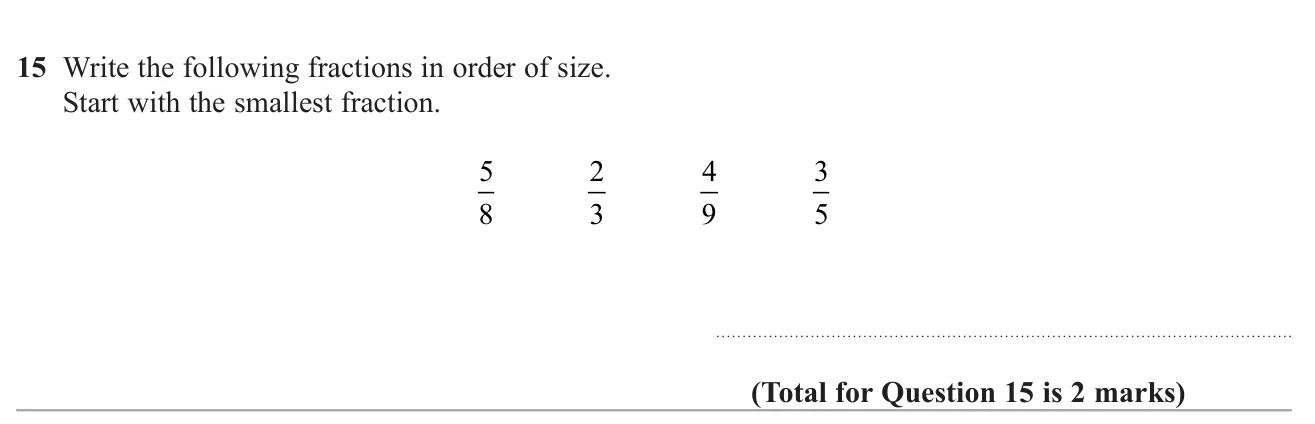
Convert to decimals:
85=0.625, 32=0.667, 94=0.444, 53=0.6
Order: 94,53,85,32
Watch out: Ordering by the size of the denominators.
© Pearson Education Ltd. November 2021 Paper 2 (Foundation, calculator), question 16.
Show answer
| (a) | 120 | 3 marks |
|---|
| (b) | 54050=545 | 2 marks |
|---|
Worked solution Checked against the mark scheme
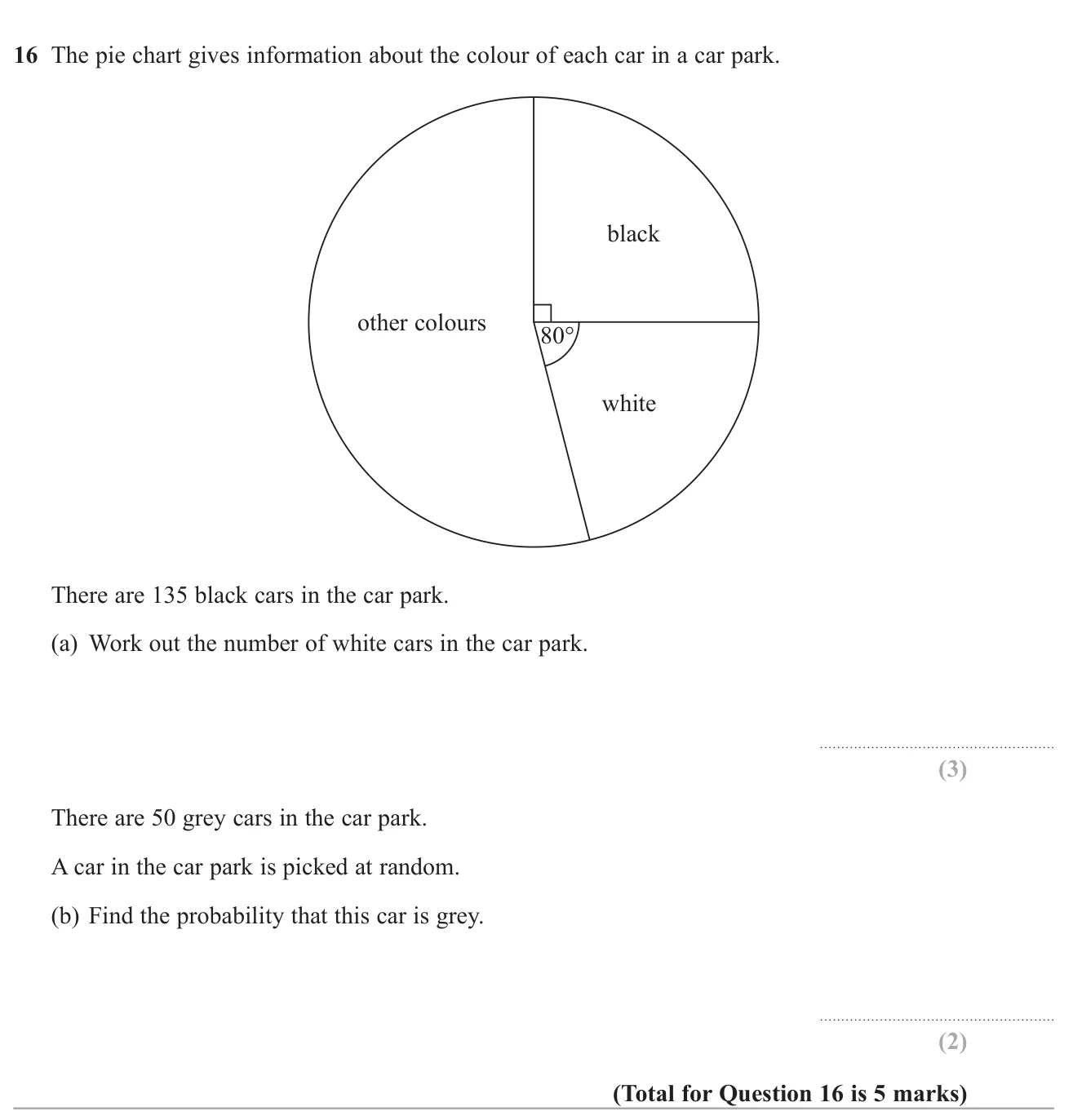
(a) Black is a right angle, 90∘, for 135 cars, so 1∘ is 135÷90=1.5 cars.
White: 80×1.5=120 cars.
(b) Total cars: 360×1.5=540
P(grey)=54050=545
Watch out: Not spotting that the black sector is a right angle.
© Pearson Education Ltd. November 2021 Paper 2 (Foundation, calculator), question 17.
Show answer
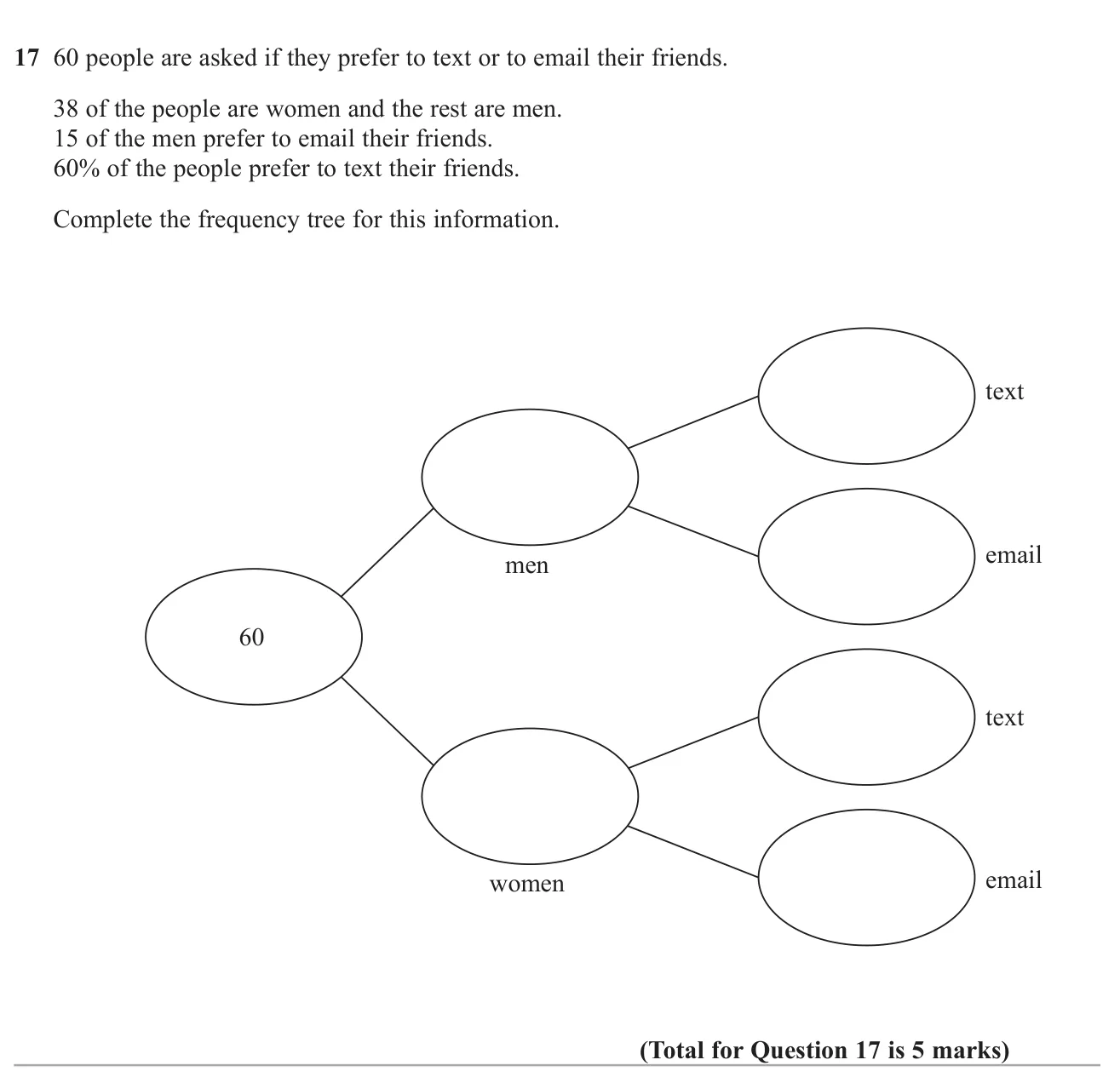
| Answer | Women 38: text 29, email 9; men 22: text 7, email 15 | 5 marks |
|---|
Worked solution Checked against the mark scheme
Men: 60−38=22. Men who text: 22−15=7.
Text in total: 0.6×60=36.
Women who text: 36−7=29. Women who email: 38−29=9.
Watch out: Taking 60% of the 38 women instead of 60% of all 60 people.
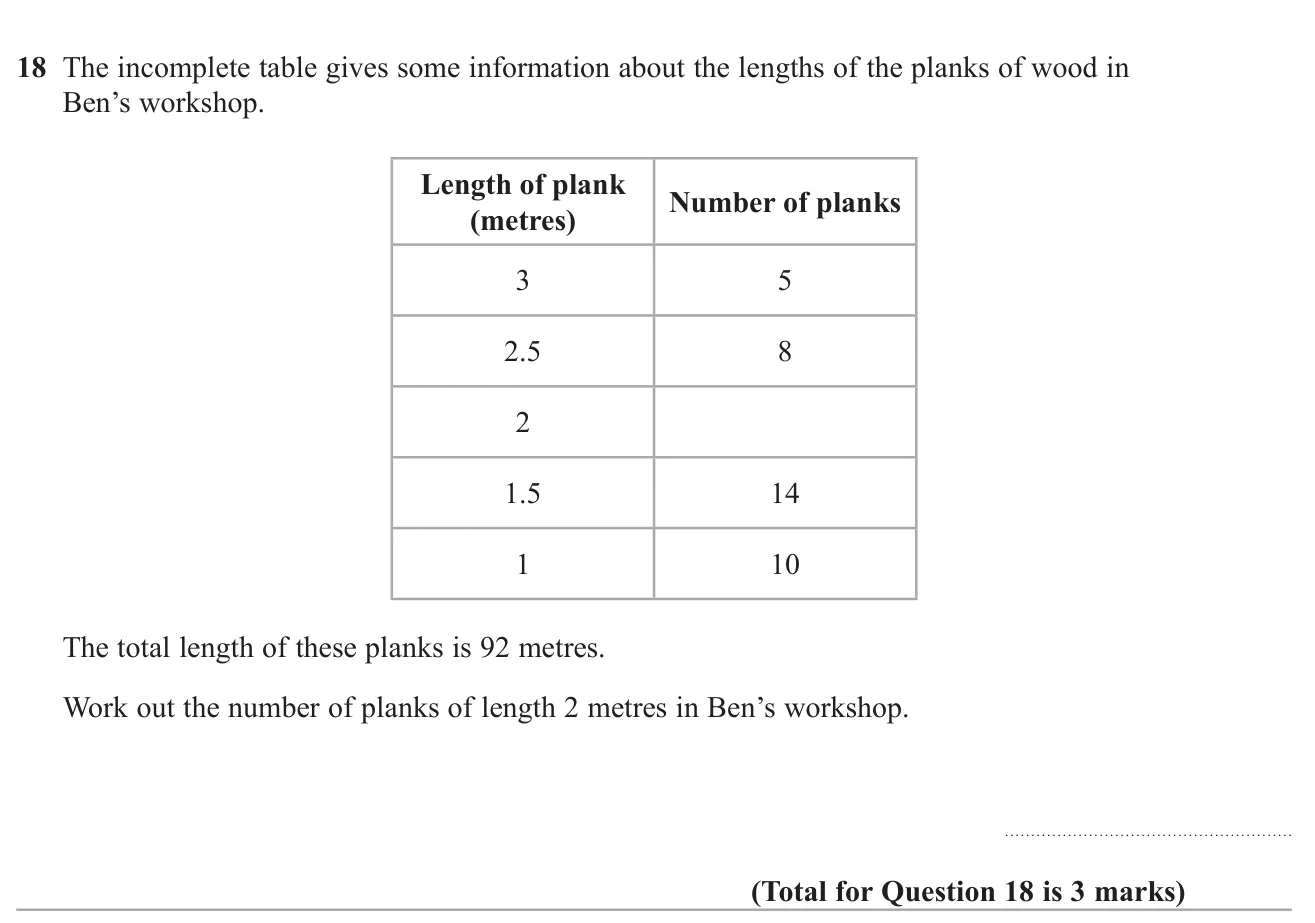
© Pearson Education Ltd. November 2021 Paper 2 (Foundation, calculator), question 18.
Show answer
Worked solution Checked against the mark scheme
Known lengths: 3×5+2.5×8+1.5×14+1×10=15+20+21+10=66 m.
Left for 2 m planks: 92−66=26 m.
Number of planks: 26÷2=13.
Watch out: Adding the numbers of planks instead of multiplying by the lengths.
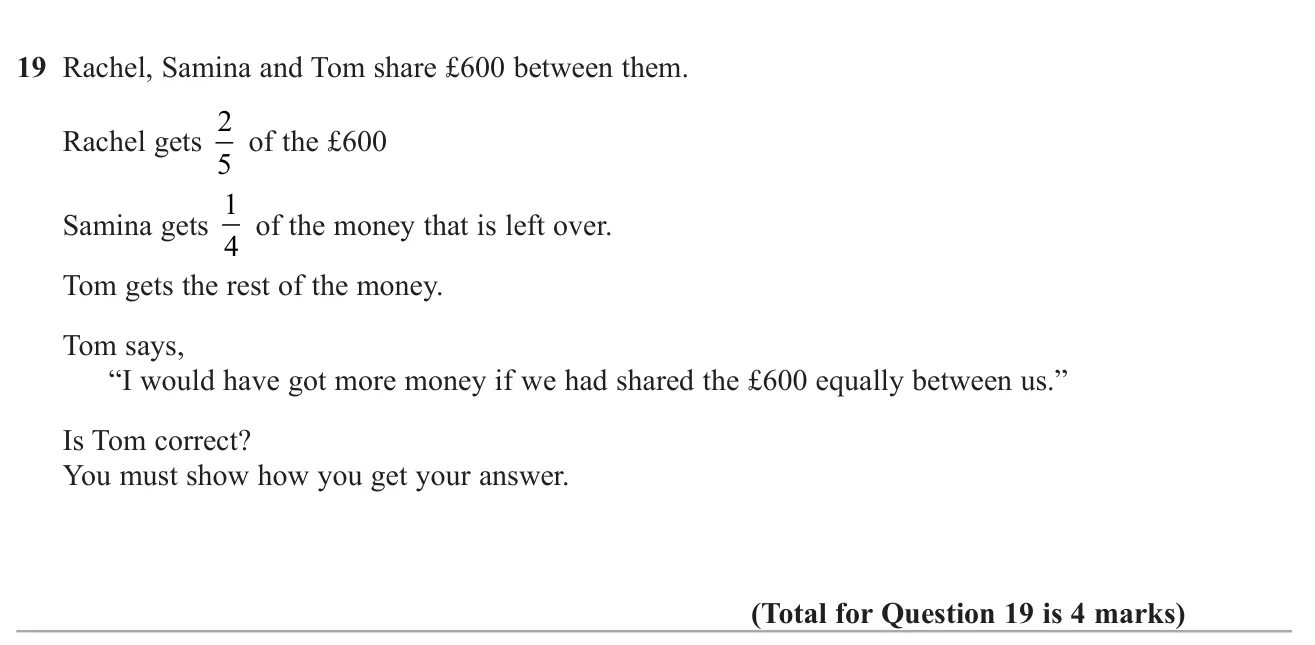
© Pearson Education Ltd. November 2021 Paper 2 (Foundation, calculator), question 19.
Show answer
| Answer | No: Tom gets £270, which is more than the £200 from an equal share | 4 marks |
|---|
Worked solution Checked against the mark scheme
Rachel: 52×600=£240. Left: 600−240=£360.
Samina: 41×360=£90.
Tom: 360−90=£270.
Equal share: 600÷3=£200. Tom already gets more, so he is not correct.
Watch out: Finding Samina's share as a quarter of £600 rather than of the amount left.
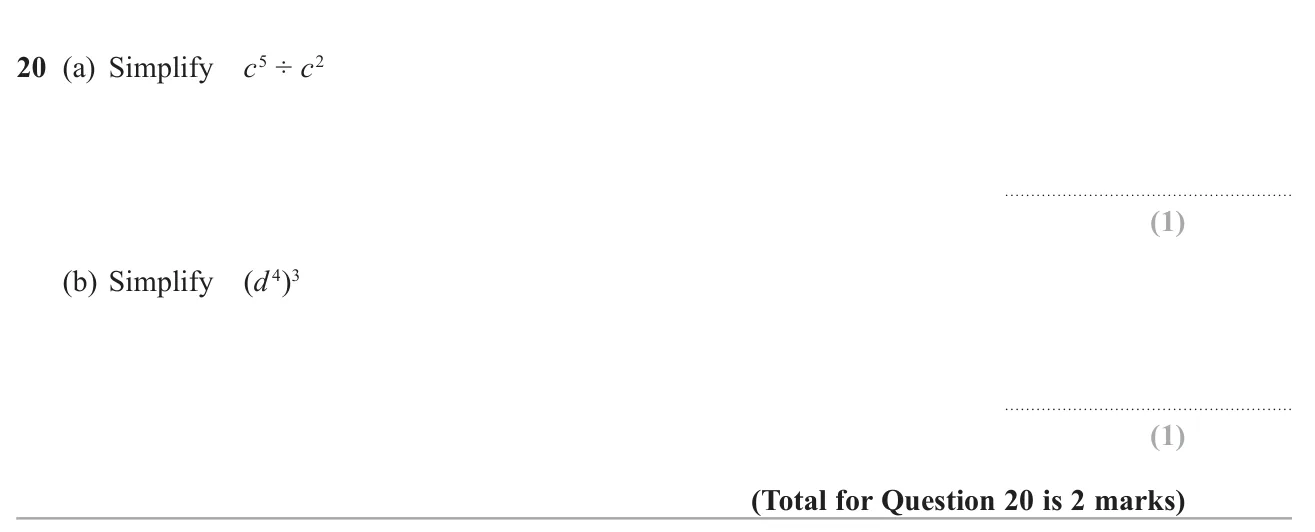
© Pearson Education Ltd. November 2021 Paper 2 (Foundation, calculator), question 20.
Show answer
| (a) | c3 | 1 mark |
|---|
| (b) | d12 | 1 mark |
|---|
Worked solution Checked against the mark scheme
(a) Dividing: subtract the powers, 5−2=3, giving c3.
(b) Power of a power: multiply, 4×3=12, giving d12.
Watch out: Adding the powers in part (b) to get d7.
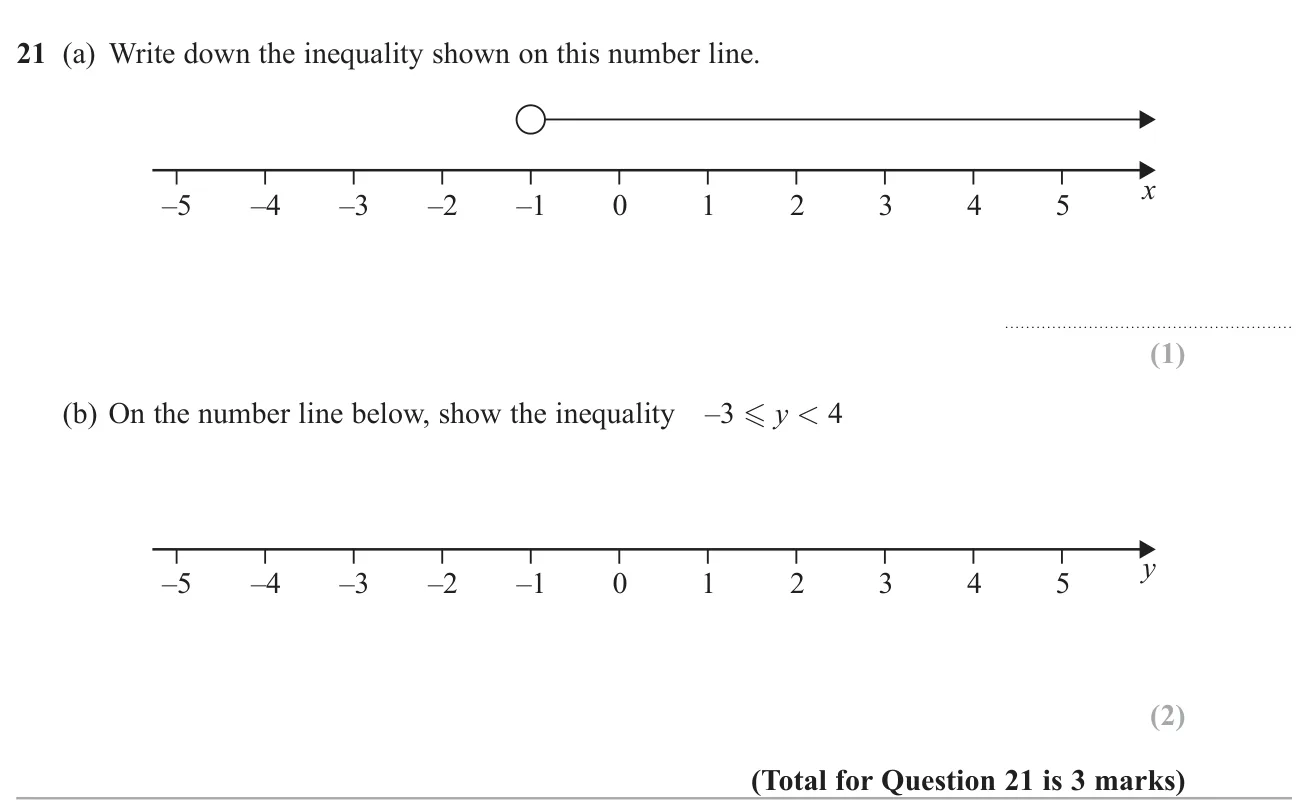
© Pearson Education Ltd. November 2021 Paper 2 (Foundation, calculator), question 21.
Show answer
| (a) | x>−1 | 1 mark |
|---|
| (b) | Closed circle at −3, open circle at 4, joined by a line | 2 marks |
|---|
Worked solution Checked against the mark scheme
(a) The open circle at −1 means −1 is not included, and the arrow points right: x>−1.
(b) Filled circle at −3 (included) and open circle at 4 (not included), with a line joining them.
Watch out: Using the wrong type of circle at an end point.
© Pearson Education Ltd. November 2021 Paper 2 (Foundation, calculator), question 22.
Show answer
| (a) | 12 | 2 marks |
|---|
| (b) | 120 | 2 marks |
|---|
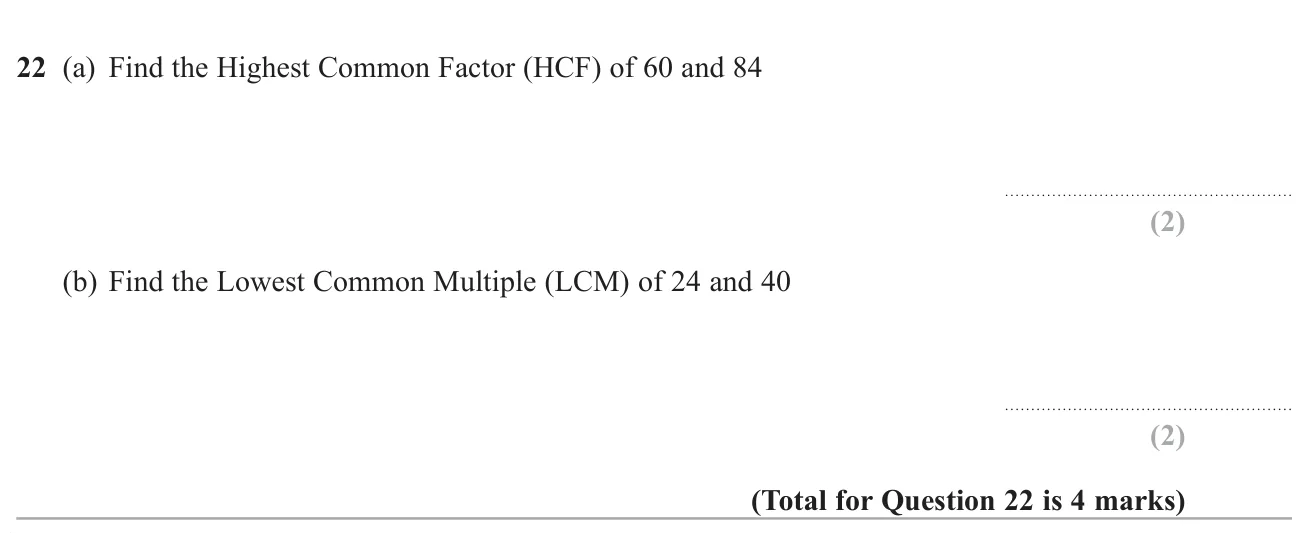
Worked solution Checked against the mark scheme
(a) 60=22×3×5 and 84=22×3×7.
HCF =22×3=12.
(b) 24=23×3 and 40=23×5.
LCM =23×3×5=120.
Watch out: Mixing up HCF and LCM.
© Pearson Education Ltd. November 2021 Paper 2 (Foundation, calculator), question 23.
Show answer
| (a) | 80 | 2 marks |
|---|
| (b) | Horizontal line from (10 15, 20) to (10 25, 20), then a straight line to (10 45, 45) | 3 marks |
|---|
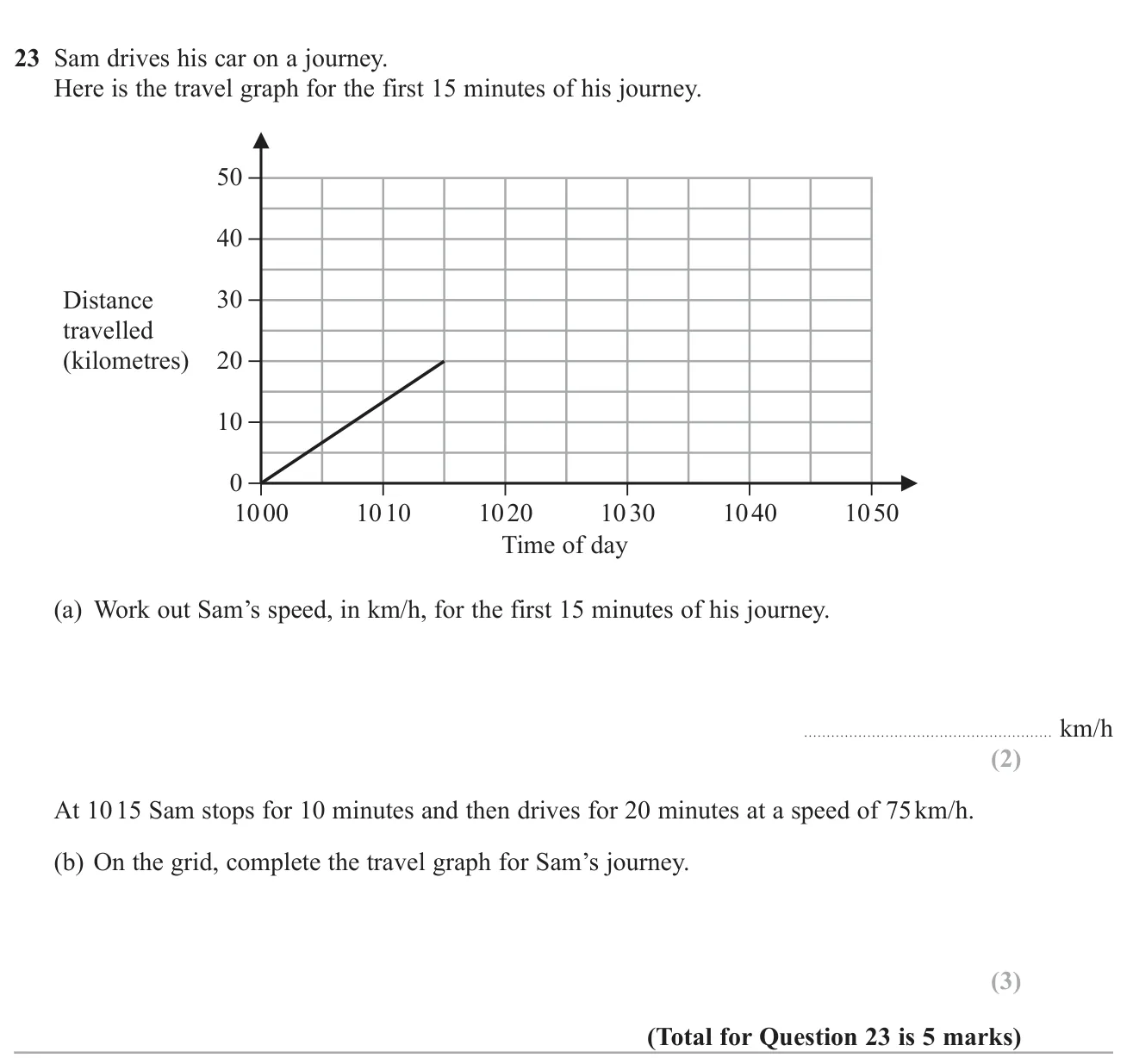
Worked solution Checked against the mark scheme
(a) 20 km in 15 minutes. There are four lots of 15 minutes in an hour, so 20×4=80 km/h.
(b) Stop: flat line at 20 km from 10 15 to 10 25.
In 20 minutes at 75 km/h: 75×6020=25 km.
Draw a line from (10 25, 20) to (10 45, 45).
Watch out: Using 20 minutes as 0.2 hours.
© Pearson Education Ltd. November 2021 Paper 2 (Foundation, calculator), question 24.
Show answer
| (a) | 5, 1, 2, 10 | 2 marks |
|---|
| (b) | A smooth curve through the plotted points | 2 marks |
|---|
| (c) | x≈−0.7 and x≈2.7 | 2 marks |
|---|
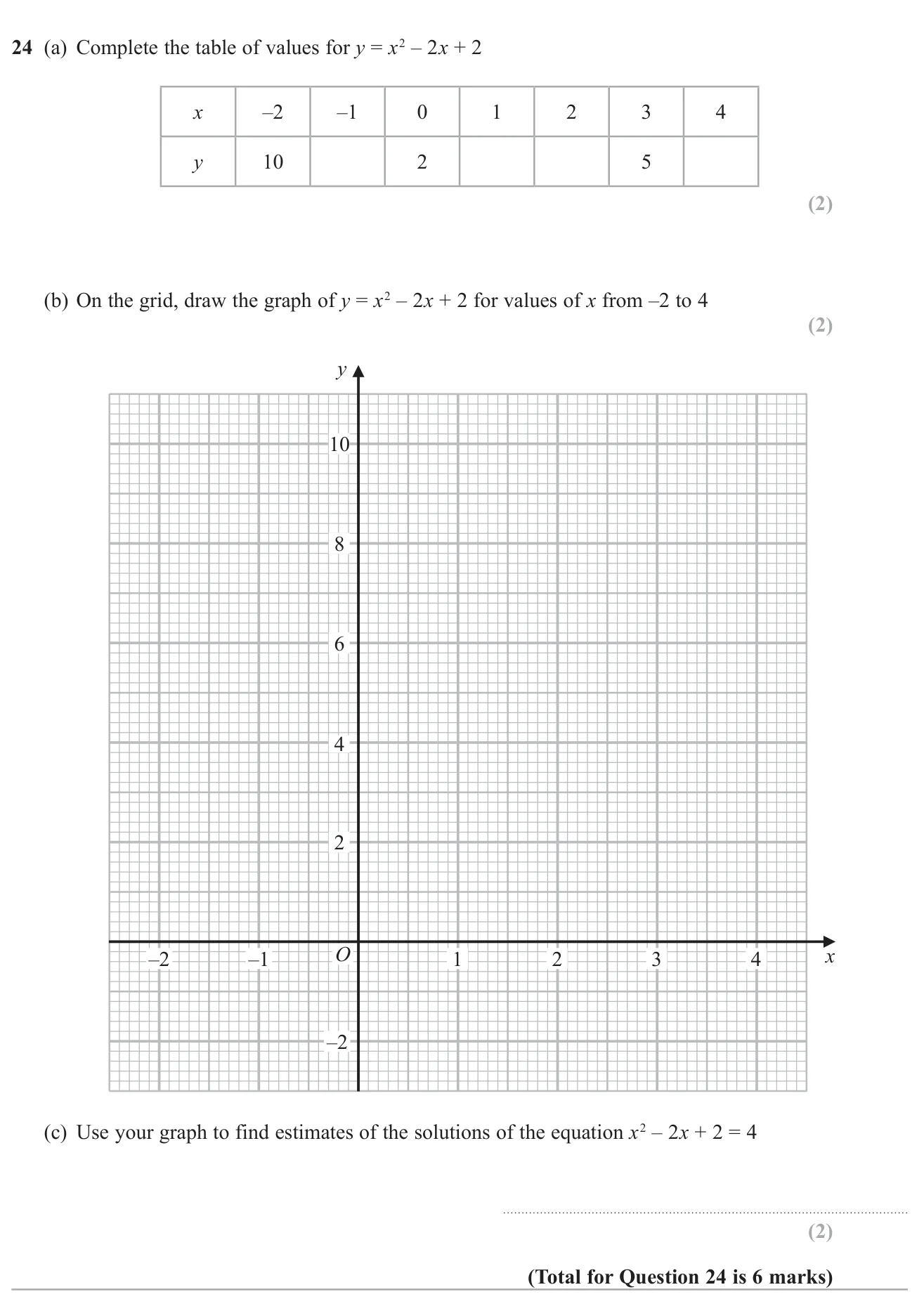
Worked solution Checked against the mark scheme
(a) x=−1: 1+2+2=5. x=1: 1−2+2=1. x=2: 4−4+2=2. x=4: 16−8+2=10.
(b) Plot (−2,10),(−1,5),(0,2),(1,1),(2,2),(3,5),(4,10) and join with a smooth curve.
(c) Draw the line y=4. It crosses the curve at about x=−0.7 and x=2.7.
Watch out: Working out (−1)2 as −1.
© Pearson Education Ltd. November 2021 Paper 2 (Foundation, calculator), question 25.
Show answer
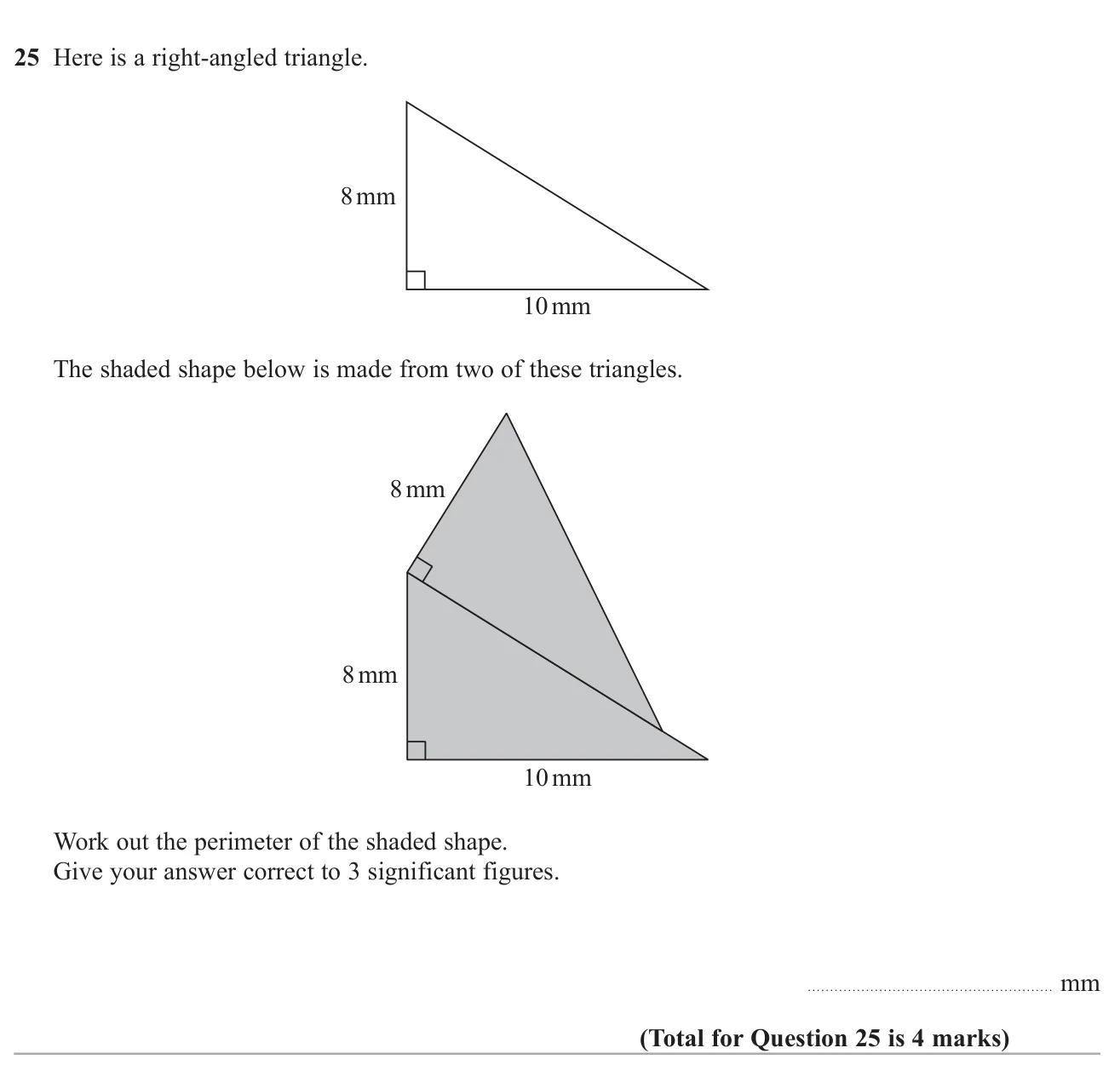
Worked solution Checked against the mark scheme
Hypotenuse: 82+102=164=12.806… mm.
Outer edges: 8, 10, part of the first hypotenuse (12.806−10=2.806), the second hypotenuse 12.806, and 8.
Perimeter =8+10+2.806+12.806+8=41.6 mm (3 s.f.)
Watch out: Including the full length of the inner hypotenuse, which is not on the outside of the shape.
© Pearson Education Ltd. November 2021 Paper 2 (Foundation, calculator), question 26.
Show answer
| (a) | 17.8 | 2 marks |
|---|
| (b) | 33.6 | 2 marks |
|---|
Worked solution Checked against the mark scheme
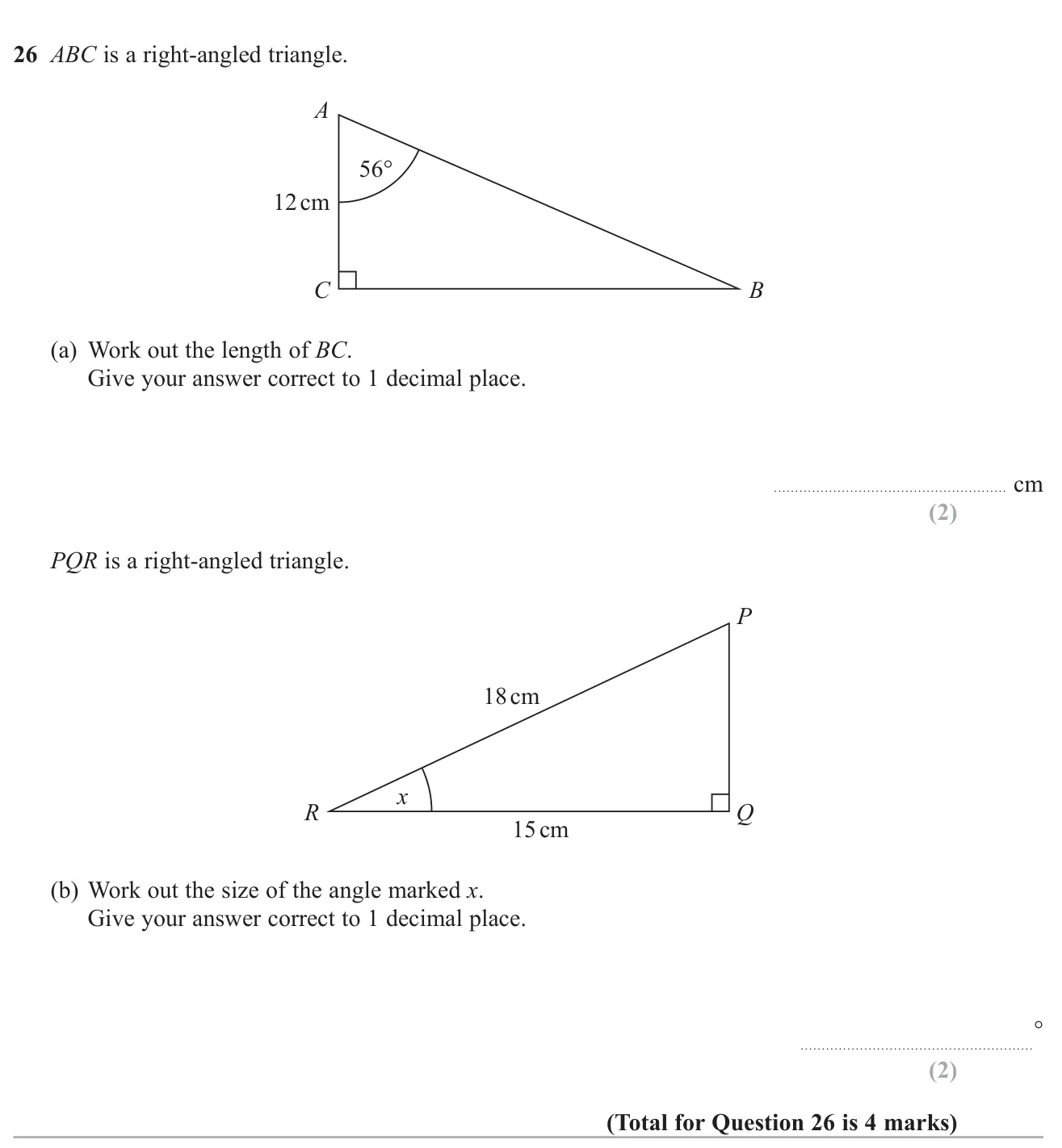
(a) BC is opposite 56∘ and 12 is adjacent, so use tan.
BC=12tan56∘=17.79…=17.8 cm
(b) 15 is adjacent and 18 is the hypotenuse, so use cos.
x=cos−1(1815)=33.557…=33.6∘
Watch out: Choosing the wrong ratio, for example sin instead of tan.
© Pearson Education Ltd. November 2021 Paper 2 (Foundation, calculator), question 27.
Show answer
| Answer | x=−2 or x=9 | 3 marks |
|---|
Worked solution Checked against the mark scheme
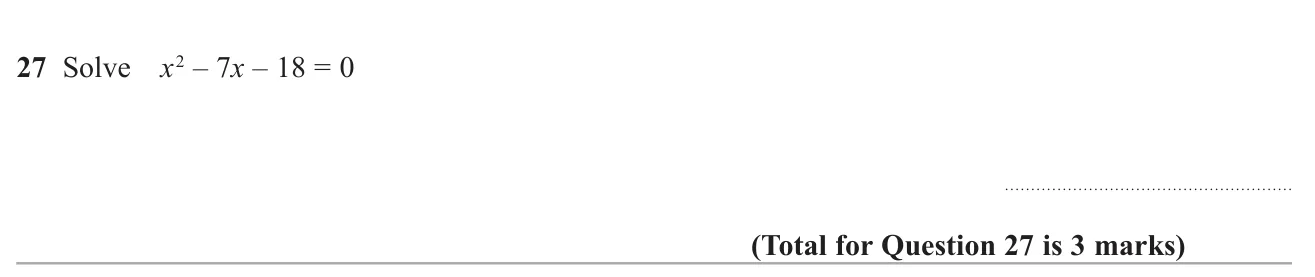
Find two numbers that multiply to −18 and add to −7: +2 and −9.
(x+2)(x−9)=0
x=−2 or x=9
Watch out: Getting the signs the wrong way round: x=2 and x=−9.
© Pearson Education Ltd. November 2021 Paper 2 (Foundation, calculator), question 28.
Show answer
Worked solution Checked against the mark scheme
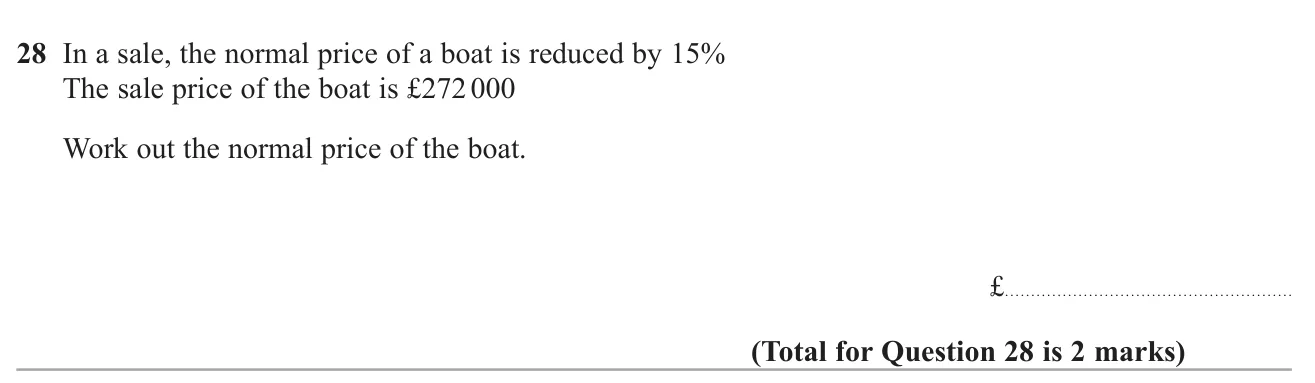
The sale price is 100%−15%=85% of the normal price.
272000÷0.85=£320000
Watch out: Adding 15% of £272 000 to get £312 800.
Finished the paper?
Add up your marks for all three papers and see what grade that would have been.