Algebra

Graph transformations

13 past-paper questions, easiest first. Try each one, then reveal the answer.

Higher only

Revision guide by The Full Marks

Graph transformations: what you need to know

Graph transformations move or flip a curve by changing its equation. You need to know which change to y=f(x)y = f(x) gives which movement, and apply it to a sketch or a single point.

Key facts

  • y=f(x)+ay = f(x) + a: translate up by aa (vector (0a)\binom{0}{a}).
  • y=f(x+a)y = f(x + a): translate LEFT by aa (vector (−a0)\binom{-a}{0}). y=f(x−a)y = f(x - a) moves right.
  • y=−f(x)y = -f(x): reflect in the xx-axis, so (x,y)→(x,−y)(x, y) \to (x, -y).
  • y=f(−x)y = f(-x): reflect in the yy-axis, so (x,y)→(−x,y)(x, y) \to (-x, y).
  • Combined changes: do the inside change (to xx) and the outside change (to yy) separately. On y=f(−x)+2y = f(-x) + 2, the point (x,y)(x, y) goes to (−x,y+2)(-x, y + 2).
  • The same rules work for trig graphs, in degrees: y=sin⁡(x+90)y = \sin(x + 90) is y=sin⁡xy = \sin x moved 9090 to the left.

Transforming a point or a sketch

  1. Decide if the change is outside the bracket (affects yy, vertical) or inside (affects xx, horizontal).
  2. Inside changes do the opposite of what they look like: +3+3 inside means left 3.
  3. Move a few key points (turning points, crossings) and redraw the same shape through them.

Worked examples

Example 1 Higher · grade 7

The point (3,5)(3, 5) lies on y=f(x)y = f(x). Write down its image on (a) y=f(x−2)y = f(x - 2), (b) y=−f(x)y = -f(x), (c) y=f(−x)y = f(-x).

Show the solution

(a) Inside the bracket, −2-2 means right 2: (5,5)(5, 5).
(b) Reflect in the xx-axis, so yy changes sign: (3,−5)(3, -5).
(c) Reflect in the yy-axis, so xx changes sign: (−3,5)(-3, 5).

Example 2 Higher · grade 8

The curve y=x2y = x^2 is translated by the vector (3−4)\binom{3}{-4}. Find the equation of the new curve in the form y=x2+bx+cy = x^2 + bx + c and its turning point.

Show the solution

Right 3 means replace xx with x−3x - 3. Down 4 means subtract 4.
y=(x−3)2−4y = (x - 3)^2 - 4
=x2−6x+9−4= x^2 - 6x + 9 - 4
=x2−6x+5= x^2 - 6x + 5
The turning point moves from (0,0)(0, 0) to (3,−4)(3, -4).

Example 3 Higher · grade 8

The point (0,1)(0, 1) is a maximum point on the graph of y=cos⁡xy = \cos x. Write down the coordinates of its image on the graph of y=cos⁡(x−90)−2y = \cos(x - 90) - 2.

Show the solution

Inside the bracket, −90-90 means right 90: x=0+90=90x = 0 + 90 = 90.
Outside, −2-2 means down 2: y=1−2=−1y = 1 - 2 = -1.
Image: (90,−1)(90, -1)

Common mistakes

  • Moving right for f(x+a)f(x + a). A plus inside the bracket moves the graph left.
  • Mixing up −f(x)-f(x) and f(−x)f(-x). The minus outside flips top to bottom; inside flips left to right.
  • Moving a graph sideways for f(x)+af(x) + a. A number added outside moves it up or down only.

Exam tips

  • When sketching, mark where the key points end up, such as the new turning point or axis crossings. Those points usually carry the marks.
  • If you are asked for the equation of a transformed graph, write it in full, e.g. y=f(x−3)y = f(x - 3) or y=−sin⁡xy = -\sin x, not just f(x−3)f(x - 3).

Questions people ask

Why does f(x + 2) move the graph left?

The new graph reaches each yy value 2 earlier: at x=−2x = -2 it gives f(0)f(0), which the old graph gave at x=0x = 0. So every point shifts 2 to the left.

What is the difference between -f(x) and f(-x)?

−f(x)-f(x) reflects the graph in the xx-axis. f(−x)f(-x) reflects it in the yy-axis.

Exam questions: Graph transformations (13, easiest first)

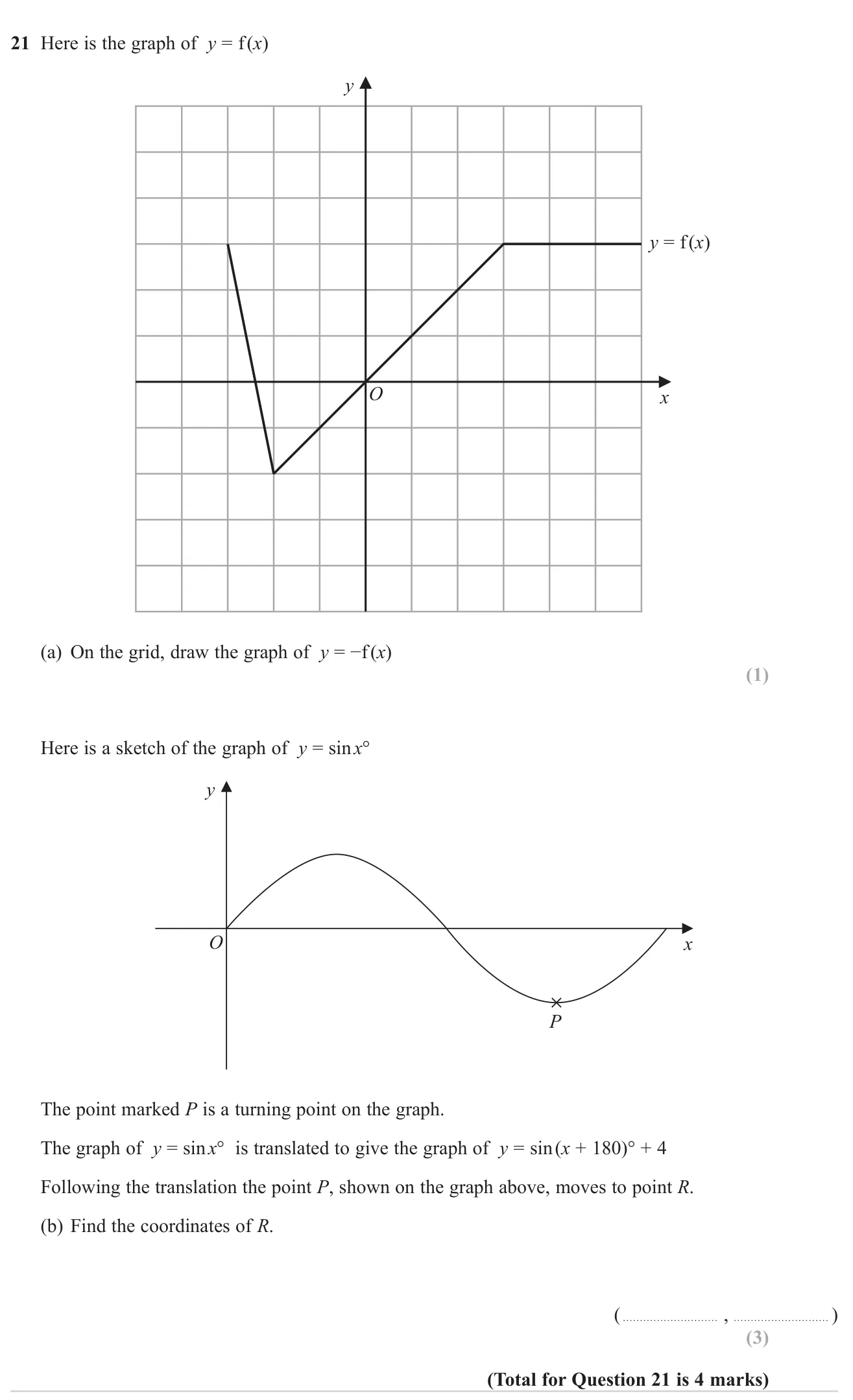
Graph transformations4 marksGrade 7CalculatorHigher
November 2024 · Paper 3 Higher · Q21
Reflect a graph in the x-axis, then find where a turning point of y = sin x moves under a translation.

© Pearson Education Ltd. November 2024 Paper 3 (Higher, calculator), question 21.

Show answer
(a)Graph of y=−f(x)y = -f(x): the given graph reflected in the x-axis1 mark
(b)(90, 3)(90,\ 3)3 marks

Worked solution Checked against the mark scheme

(a) Each point (x,y)(x, y) moves to (x,−y)(x, -y): reflect the graph in the x-axis.

(b) P is the minimum of sin⁡x\sin x at (270,−1)(270, -1).

sin⁡(x+180)+4\sin(x + 180) + 4 moves the graph 180 left and 4 up.

R=(270−180, −1+4)=(90,3)R = (270 - 180,\ -1 + 4) = (90, 3)

Watch out: Moving the graph 180 to the right instead of the left.
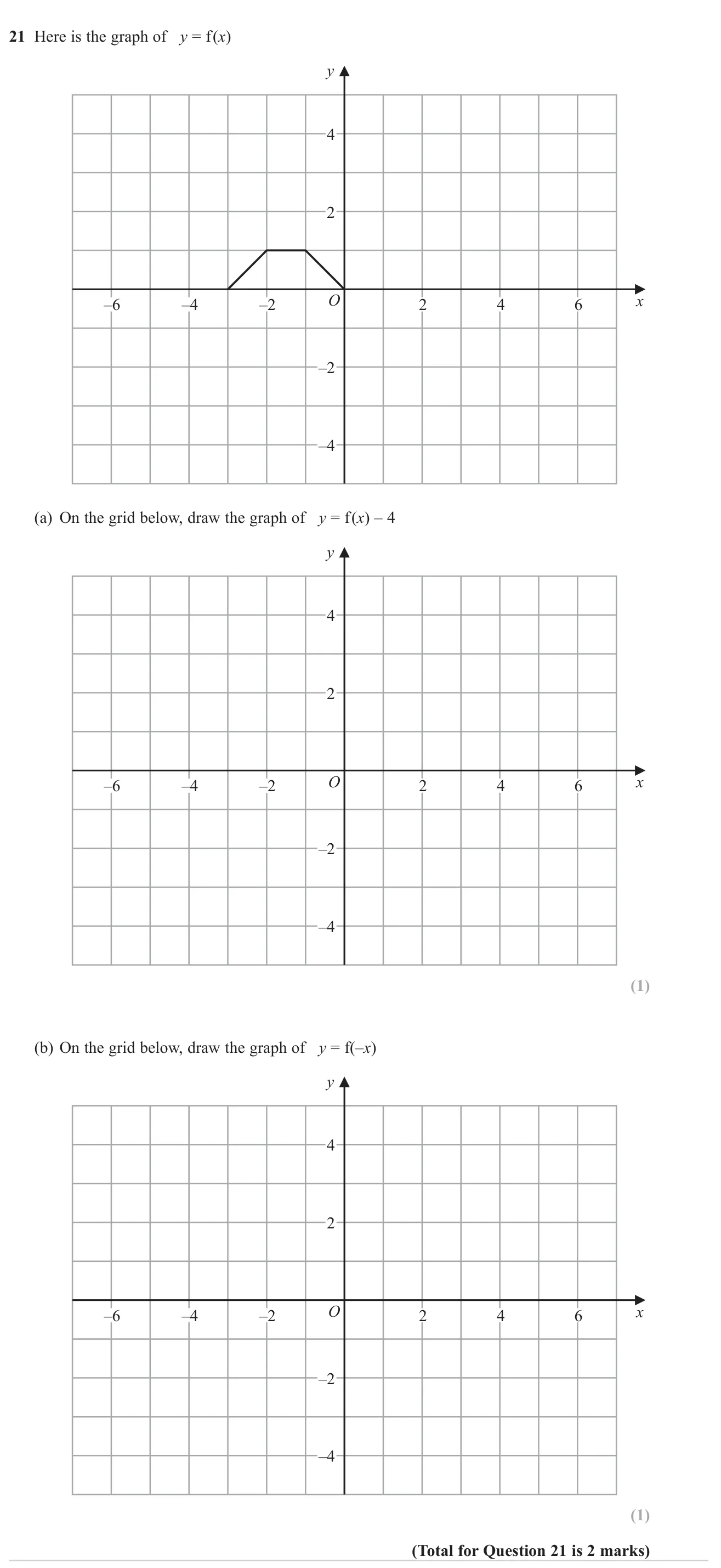
Graph transformations2 marksGrade 7CalculatorHigher
June 2023 · Paper 2 Higher · Q21
Draw a translated graph and a reflected graph of a given piecewise function.

© Pearson Education Ltd. June 2023 Paper 2 (Higher, calculator), question 21.

Show answer
(a)Shape moved down 4: through (−3,−4)(-3,-4), (−2,−3)(-2,-3), (−1,−3)(-1,-3), (0,−4)(0,-4)1 mark
(b)Shape reflected in the yy-axis: through (0,0)(0,0), (1,1)(1,1), (2,1)(2,1), (3,0)(3,0)1 mark

Worked solution Checked against the mark scheme

(a) f(x)−4f(x) - 4 moves every point down 4: (−3,0)→(−3,−4)(-3,0) \to (-3,-4), (−2,1)→(−2,−3)(-2,1) \to (-2,-3), (−1,1)→(−1,−3)(-1,1) \to (-1,-3), (0,0)→(0,−4)(0,0) \to (0,-4).

(b) f(−x)f(-x) reflects in the yy-axis: change the sign of each xx: (3,0)(3,0), (2,1)(2,1), (1,1)(1,1), (0,0)(0,0).

Watch out: Reflecting in the x-axis for f(−x), which is the rule for −f(x).

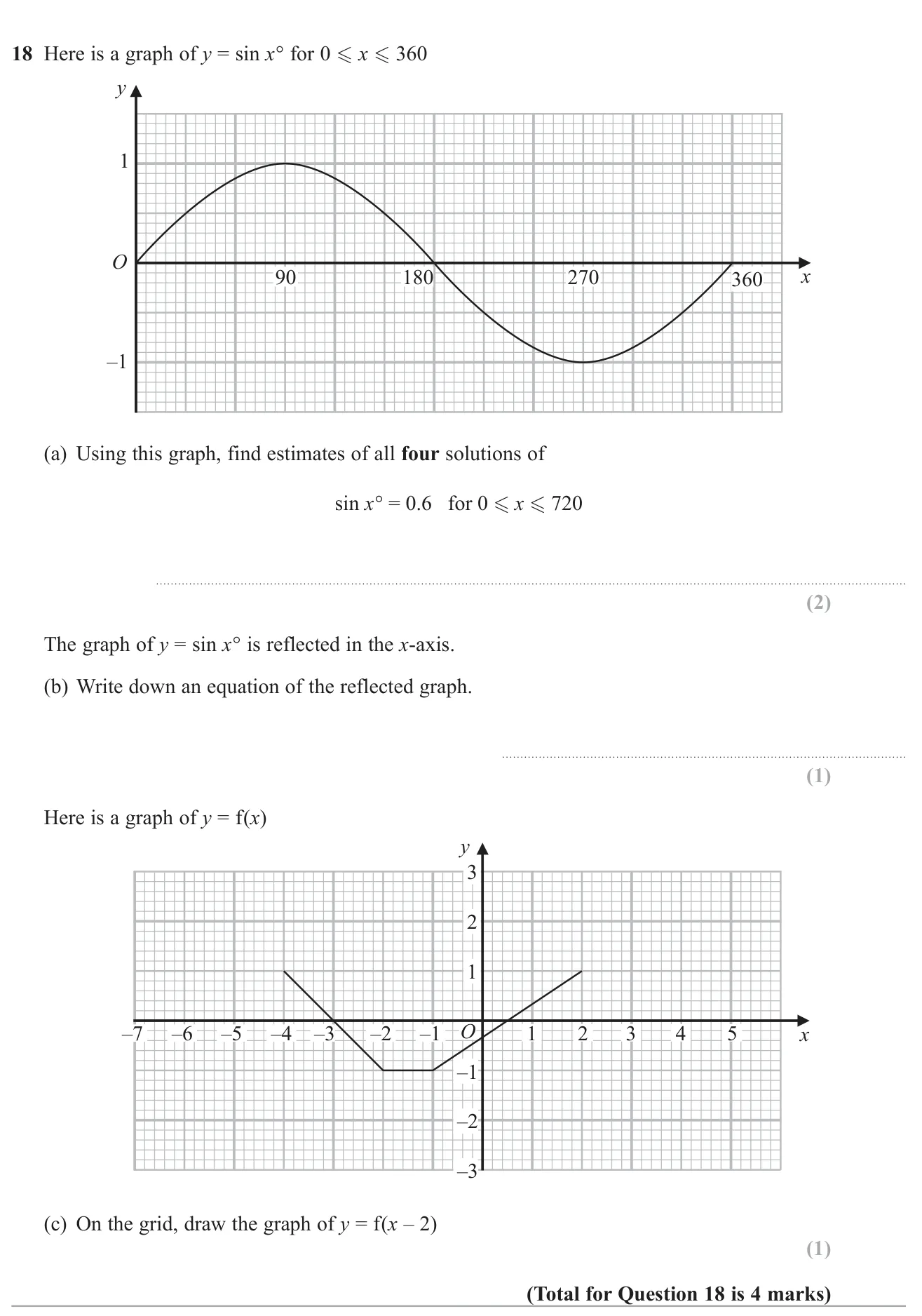
Graph transformations4 marksGrade 7CalculatorHigher
November 2021 · Paper 2 Higher · Q18
Use a sine graph to solve an equation over two cycles, write the equation of its reflection and translate another graph.

© Pearson Education Ltd. November 2021 Paper 2 (Higher, calculator), question 18.

Show answer
(a)37°,143°,397°,503°37°, 143°, 397°, 503°2 marks
(b)y=−sin⁡x°y = -\sin x°1 mark
(c)The curve moved 2 units to the right1 mark

Worked solution Checked against the mark scheme

(a) Draw y=0.6y = 0.6 across the graph: it meets the curve at about 37°37° and 180−37=143°180 - 37 = 143°.

The graph repeats every 360°, so also 37+360=397°37 + 360 = 397° and 143+360=503°143 + 360 = 503°.

(b) Reflecting in the xx-axis makes every yy negative: y=−sin⁡x°y = -\sin x°.

(c) f(x−2)f(x - 2) shifts every point 2 to the right, e.g. a point at x=1x = 1 moves to x=3x = 3.

Watch out: Moving the graph 2 to the left for f(x − 2).

Graph transformations2 marksGrade 7CalculatorHigher
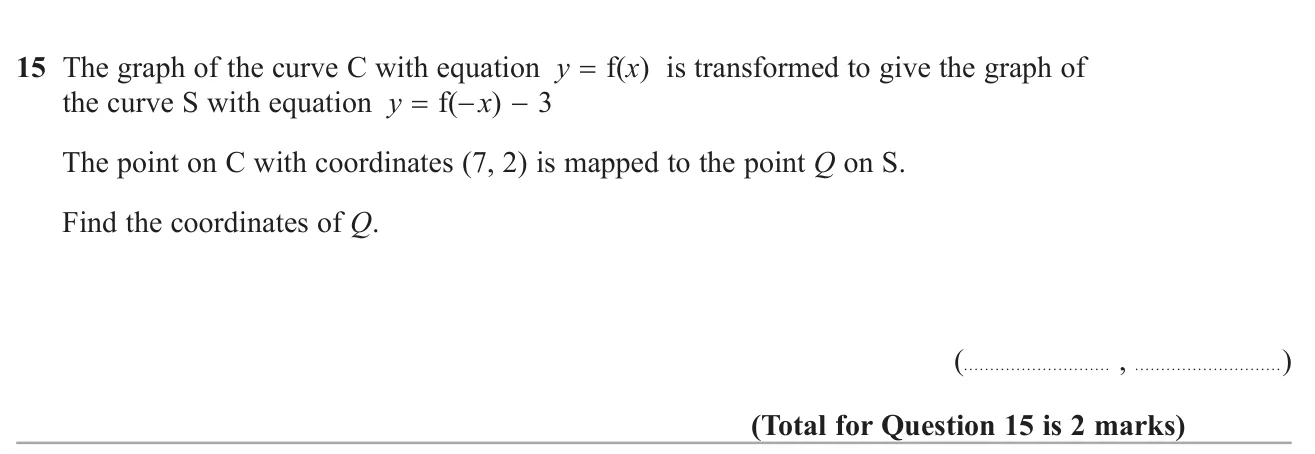
June 2019 · Paper 3 Higher · Q15
Find where a point moves under the graph transformation y = f(−x) − 3.

© Pearson Education Ltd. June 2019 Paper 3 (Higher, calculator), question 15.

Show answer
Answer(−7,−1)(-7, -1)2 marks

Worked solution Checked against the mark scheme

f(−x)f(-x) reflects in the yy-axis: (7,2)→(−7,2)(7, 2) \to (-7, 2)

−3-3 moves it 3 down: (−7,2)→(−7,−1)(-7, 2) \to (-7, -1)

Watch out: Reflecting in the x-axis instead, giving (7, −5).

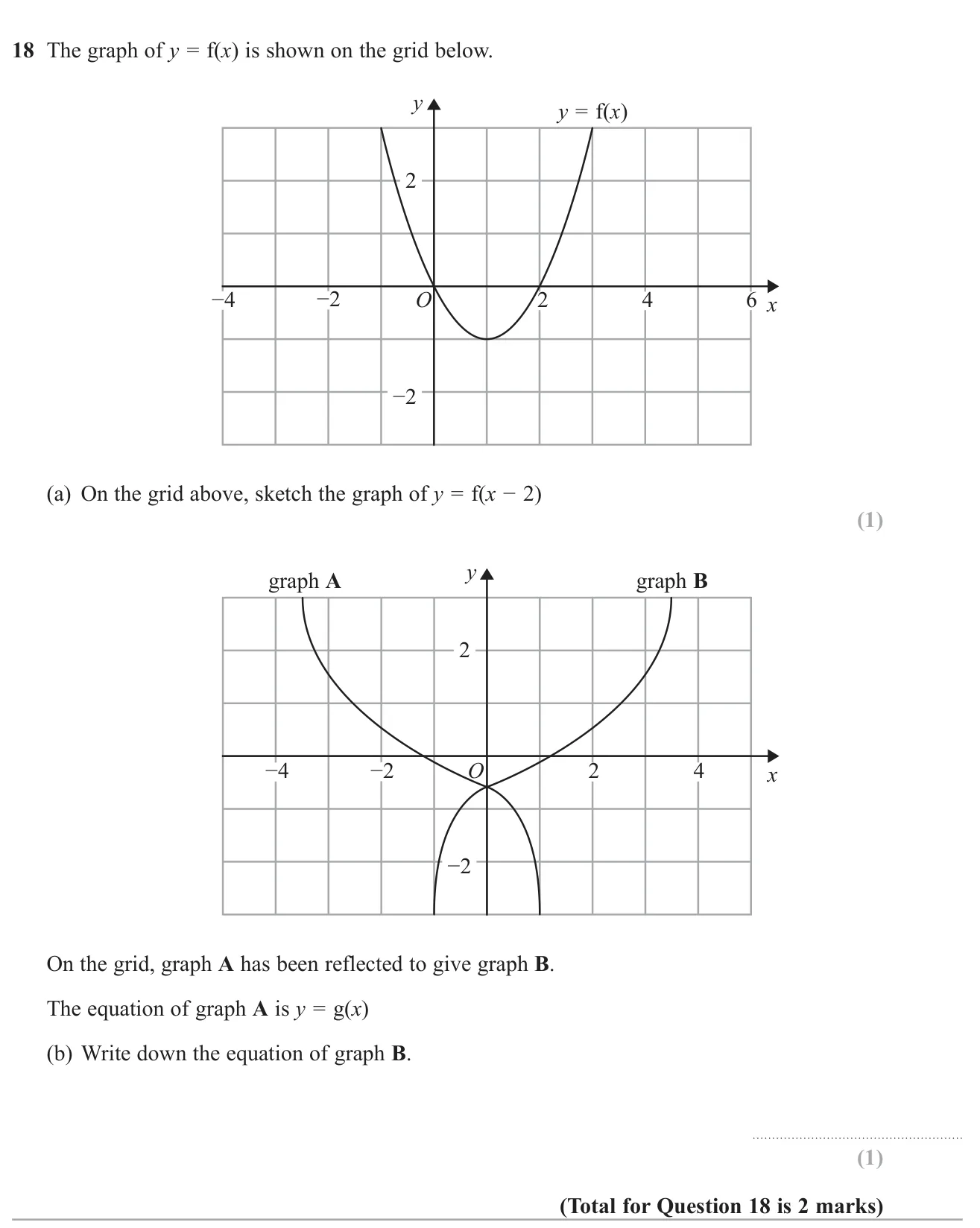
Graph transformations2 marksGrade 7No calculatorHigher
November 2018 · Paper 1 Higher · Q18
Sketch a horizontal translation of a graph and write the equation of a graph reflected in the y-axis.

© Pearson Education Ltd. November 2018 Paper 1 (Higher, non-calculator), question 18.

Show answer
(a)The curve moved 2 units right: crosses the x-axis at (2, 0) and (4, 0), minimum at (3, −1)1 mark
(b)y=g(−x)y = g(-x)1 mark

Worked solution Checked against the mark scheme

(a) f(x−2)f(x - 2) moves the graph 2 units to the right. The roots 0 and 2 become 2 and 4, and the minimum (1,−1)(1, -1) becomes (3,−1)(3, -1).

(b) Graph B is graph A reflected in the y-axis, so its equation is y=g(−x)y = g(-x).

Watch out: Moving the graph 2 units left for f(x−2)f(x - 2).

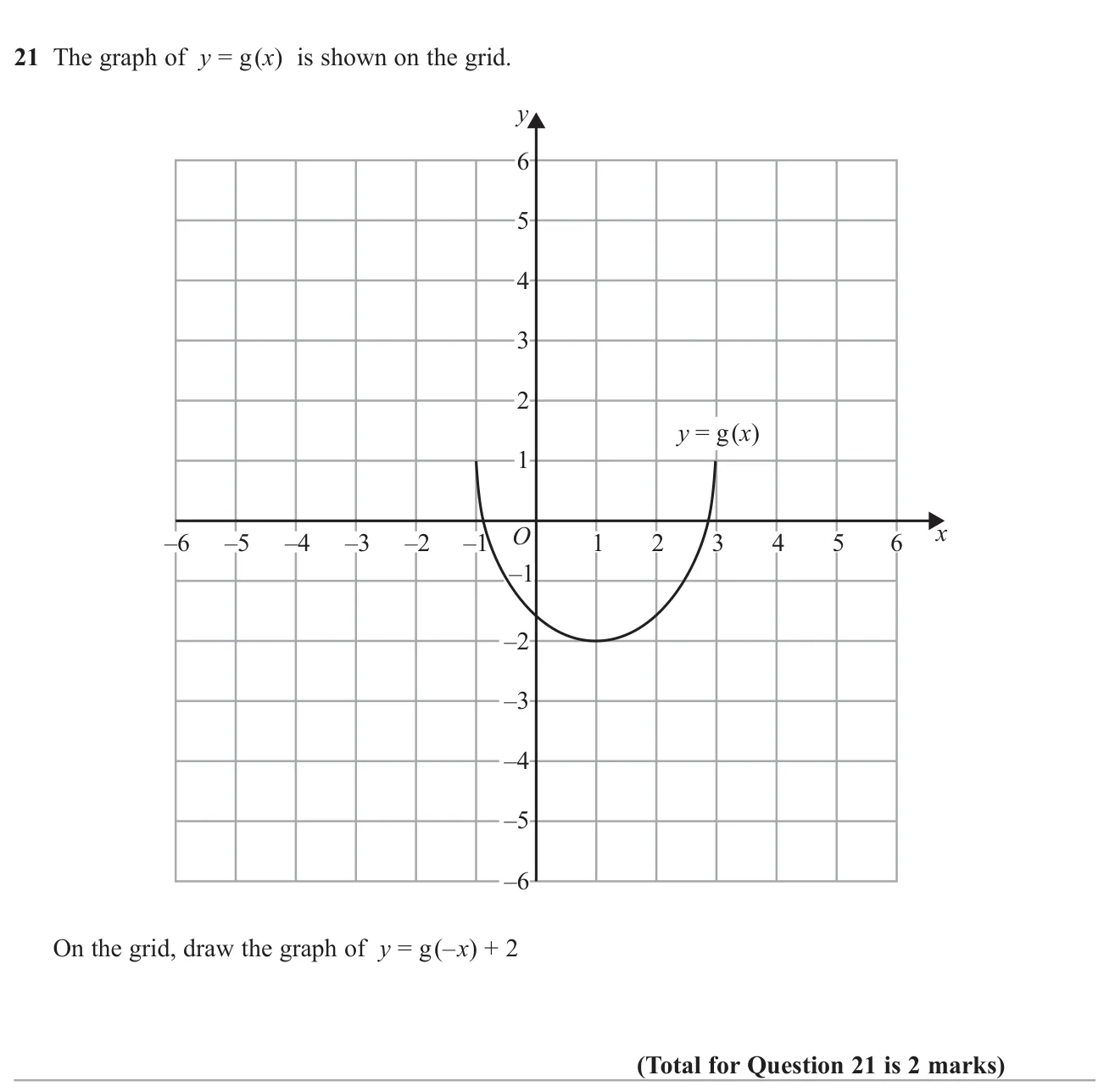
Graph transformations2 marksGrade 8CalculatorHigher
June 2024 · Paper 2 Higher · Q21
Draw the graph of g(-x) + 2 from a given curve y = g(x).

© Pearson Education Ltd. June 2024 Paper 2 (Higher, calculator), question 21.

Show answer
AnswerThe curve reflected in the yy-axis and moved up 2: through (1,3)(1,3), (−1,0)(-1,0) and (−3,3)(-3,3)2 marks

Worked solution Checked against the mark scheme

g(−x)g(-x) reflects the curve in the yy-axis; +2+2 then moves it up 2 units.

Key points: (−1,1)→(1,3)(-1,1) \to (1,3), (1,−2)→(−1,0)(1,-2) \to (-1,0), (3,1)→(−3,3)(3,1) \to (-3,3).

Draw the U-shaped curve through these points, minimum at (−1,0)(-1, 0).

Watch out: Reflecting in the xx-axis instead of the yy-axis, or moving 2 units horizontally.

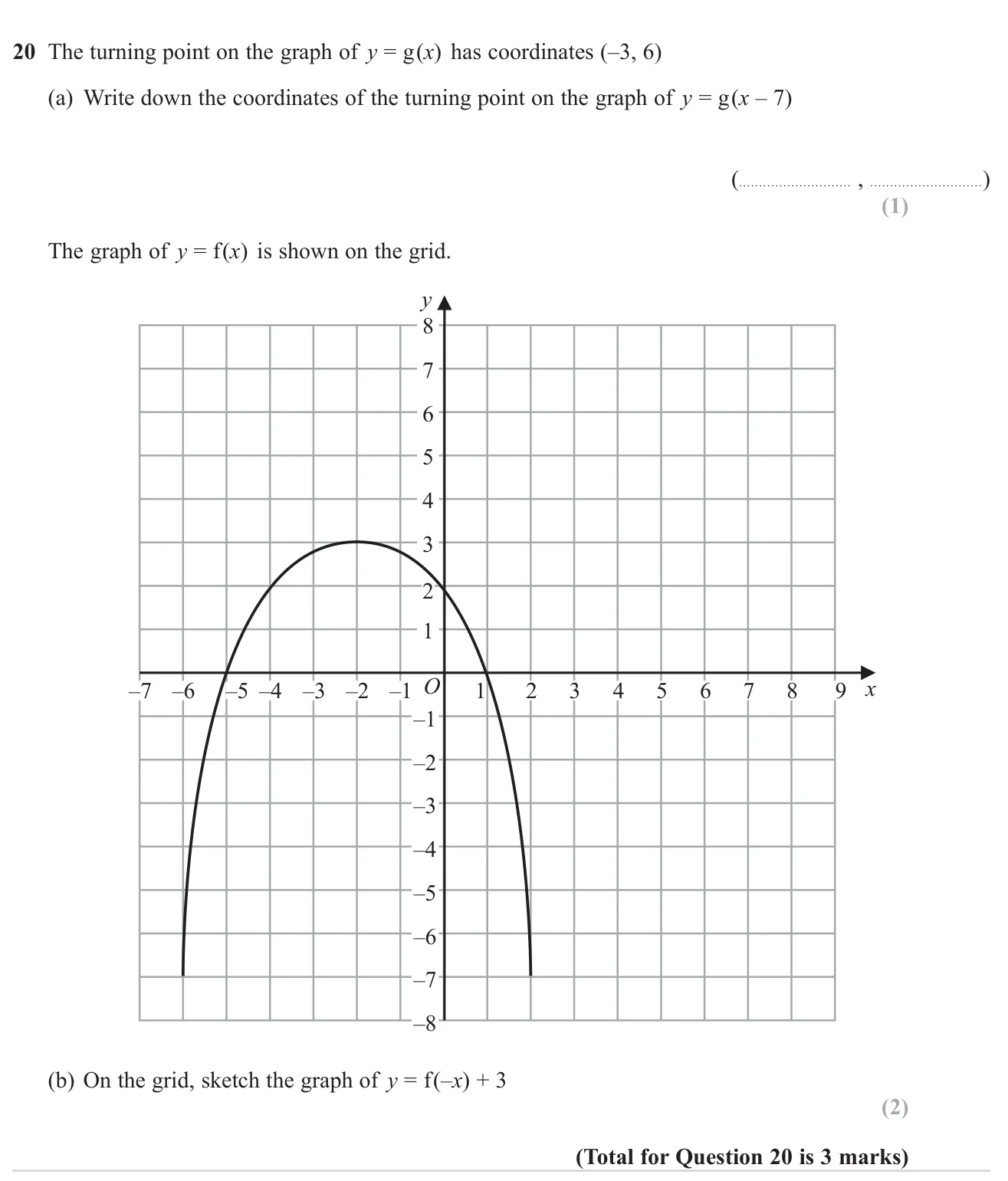
Graph transformations3 marksGrade 8CalculatorHigher
November 2023 · Paper 3 Higher · Q20
Give the turning point after a horizontal translation of a graph, and sketch a reflected and shifted version of a curve.

© Pearson Education Ltd. November 2023 Paper 3 (Higher, calculator), question 20.

Show answer
(a)(4,6)(4, 6)1 mark
(b)Curve with maximum (2,6)(2, 6) and end points (−2,−4)(-2, -4) and (6,−4)(6, -4)2 marks

Worked solution Checked against the mark scheme

(a) g(x−7)g(x - 7) moves the graph 7 to the right: (−3+7,6)=(4,6)(-3 + 7, 6) = (4, 6).

(b) f(−x)f(-x) reflects the curve in the yy-axis: maximum (−2,3)→(2,3)(-2, 3) \to (2, 3), ends (−6,−7)→(6,−7)(-6, -7) \to (6, -7) and (2,−7)→(−2,−7)(2, -7) \to (-2, -7).

+3+3 moves it up 3: maximum (2,6)(2, 6), ends (6,−4)(6, -4) and (−2,−4)(-2, -4).

Watch out: In (a), moving the turning point 7 to the left, giving (−10, 6).

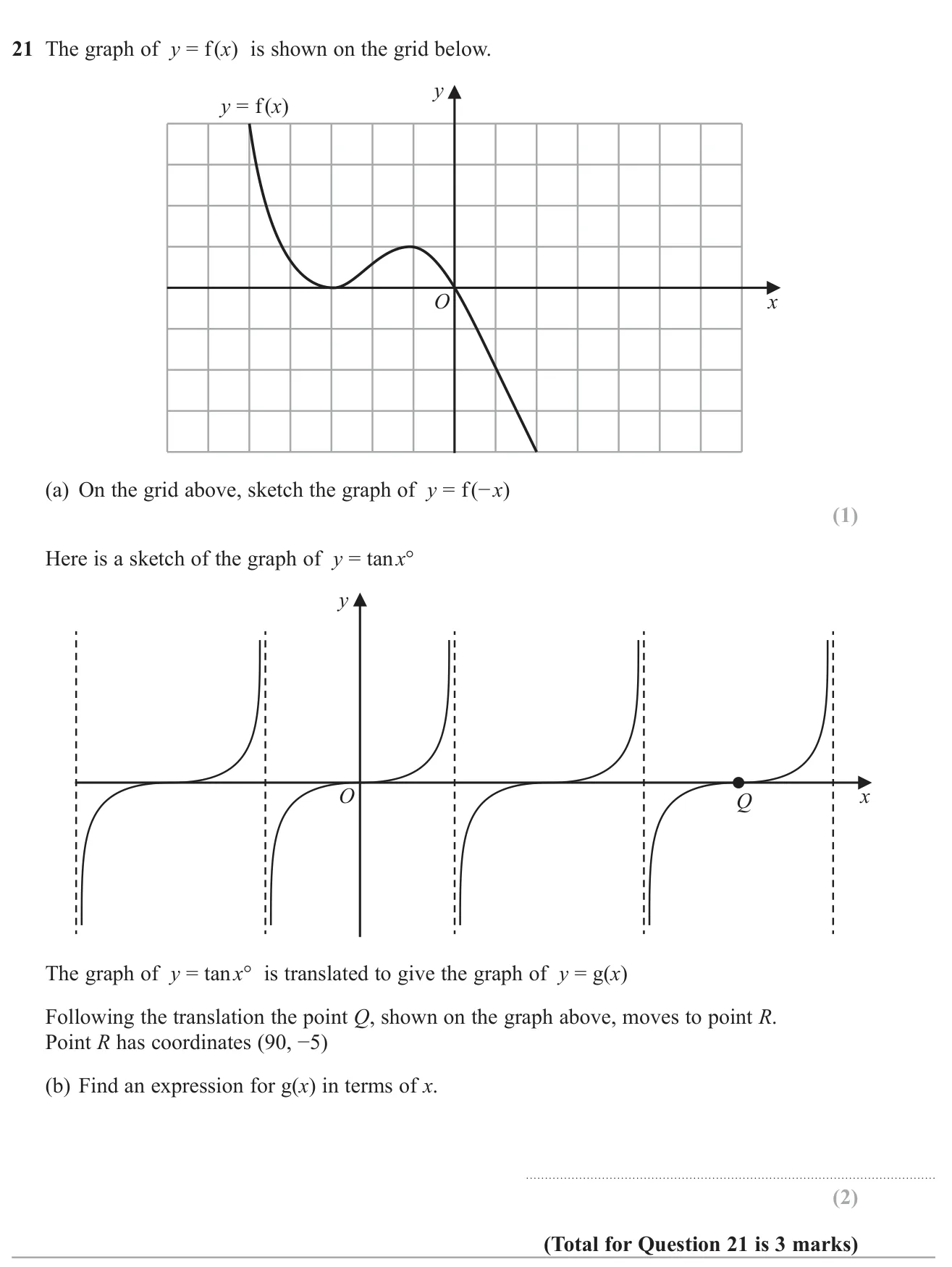
Graph transformations3 marksGrade 8CalculatorHigher
June 2022 · Paper 2 Higher · Q21
Sketch a reflection of a curve in the y-axis, then find the equation of a translated tan graph from where one point moves.

© Pearson Education Ltd. June 2022 Paper 2 (Higher, calculator), question 21.

Show answer
(a)The curve reflected in the yy-axis1 mark
(b)g(x)=tan⁡(x+270)∘−5g(x) = \tan(x + 270)^\circ - 52 marks

Worked solution Checked against the mark scheme

(a) f(−x)f(-x) swaps left and right: reflect every point of the curve in the yy-axis.

(b) Q is at (360,0)(360, 0) and R is at (90,−5)(90, -5).

The graph moves 270 left and 5 down, i.e. by (−270−5)\begin{pmatrix}-270\\-5\end{pmatrix}

Moving left by 270 means replacing xx with x+270x + 270; moving down 5 means subtracting 5:

g(x)=tan⁡(x+270)∘−5g(x) = \tan(x + 270)^\circ - 5

Watch out: Writing tan(x − 270) because the graph moves to the left.

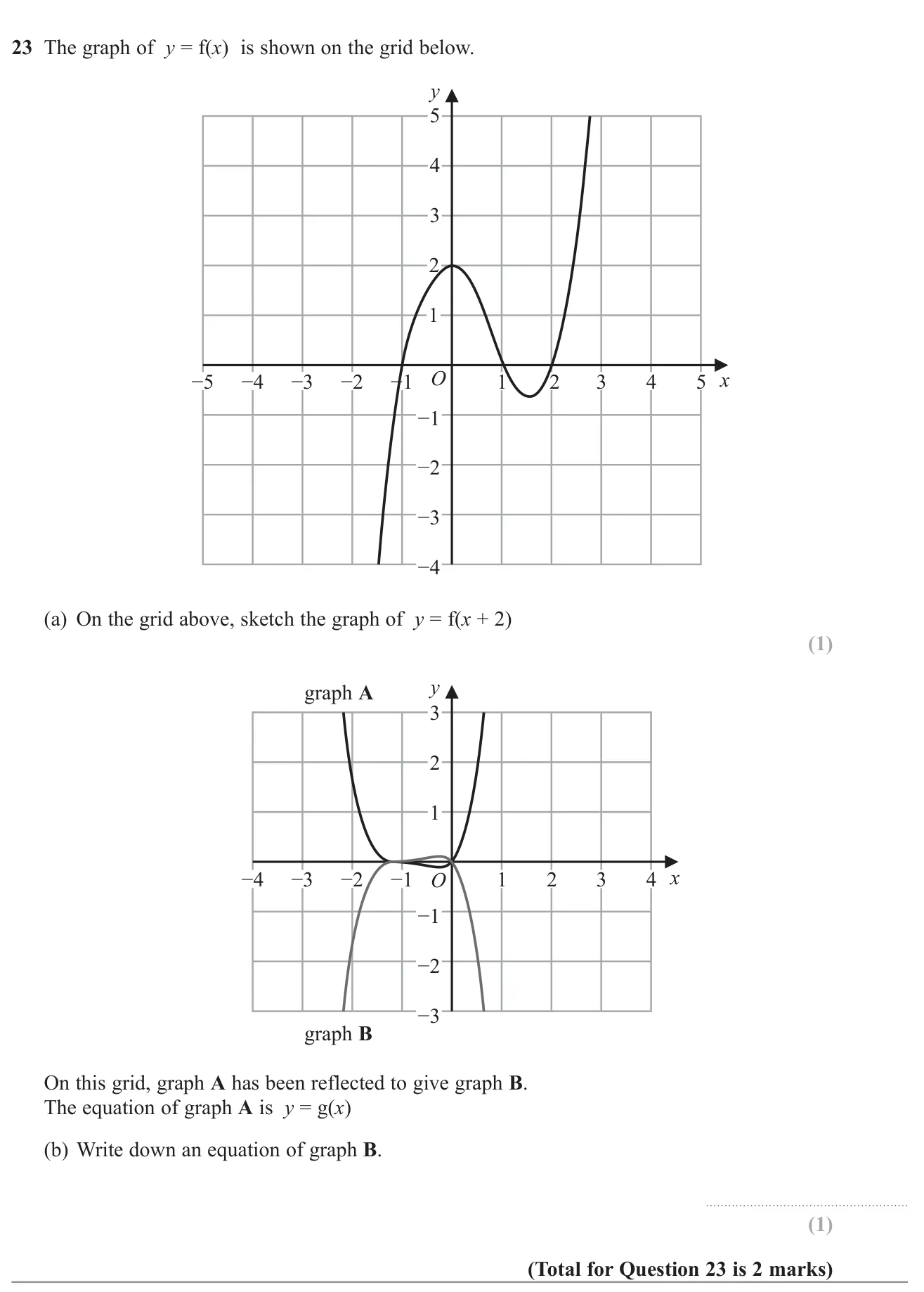
Graph transformations2 marksGrade 8CalculatorHigher
November 2022 · Paper 3 Higher · Q23
Sketch a horizontal translation of a cubic graph and write the equation of a reflected graph.

© Pearson Education Ltd. November 2022 Paper 3 (Higher, calculator), question 23.

Show answer
(a)The curve moved 2 units left: crossing the x-axis at −3-3, −1-1 and 00, with a maximum at (−2,2)(-2, 2)1 mark
(b)y=−g(x)y = -g(x)1 mark

Worked solution Checked against the mark scheme

(a) f(x+2)f(x + 2) moves the graph 2 units to the left. The roots −1,1,2-1, 1, 2 become −3,−1,0-3, -1, 0 and the peak at (0,2)(0, 2) moves to (−2,2)(-2, 2).

(b) Graph B is graph A flipped in the x-axis, so each y-value changes sign: y=−g(x)y = -g(x)

Watch out: In (a), moving the graph 2 units to the right.

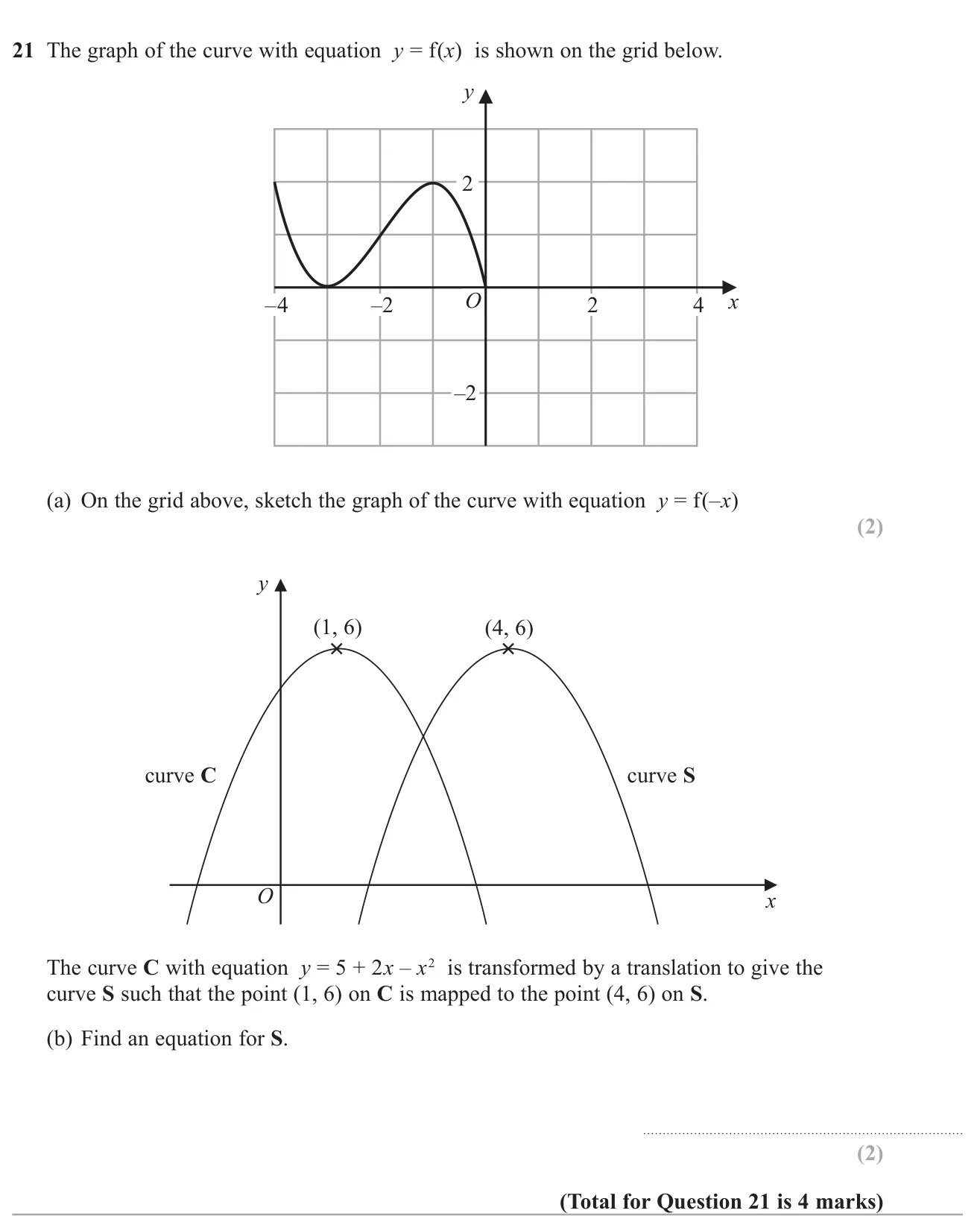
Graph transformations4 marksGrade 8CalculatorHigher
November 2020 · Paper 2 Higher · Q21
Sketch the reflection of a curve in the y-axis, then find the equation of a translated quadratic curve.

© Pearson Education Ltd. November 2020 Paper 2 (Higher, calculator), question 21.

Show answer
(a)The curve reflected in the yy-axis, through (0,0)(0, 0), (1,2)(1, 2), (2,1)(2, 1), (3,0)(3, 0), (4,2)(4, 2)2 marks
(b)y=5+2(x−3)−(x−3)2y = 5 + 2(x - 3) - (x - 3)^22 marks

Worked solution Checked against the mark scheme

(a) f(−x)f(-x) reflects the curve in the yy-axis: each point (a,b)(a, b) moves to (−a,b)(-a, b). So (−4,2)(-4, 2), (−3,0)(-3, 0), (−1,2)(-1, 2), (0,0)(0, 0) become (4,2)(4, 2), (3,0)(3, 0), (1,2)(1, 2), (0,0)(0, 0).

(b) The curve moves 3 to the right, so replace xx with x−3x - 3:

y=5+2(x−3)−(x−3)2y = 5 + 2(x - 3) - (x - 3)^2

which simplifies to y=−x2+8x−10y = -x^2 + 8x - 10.

Watch out: Replacing xx with x+3x + 3 for a shift to the right.

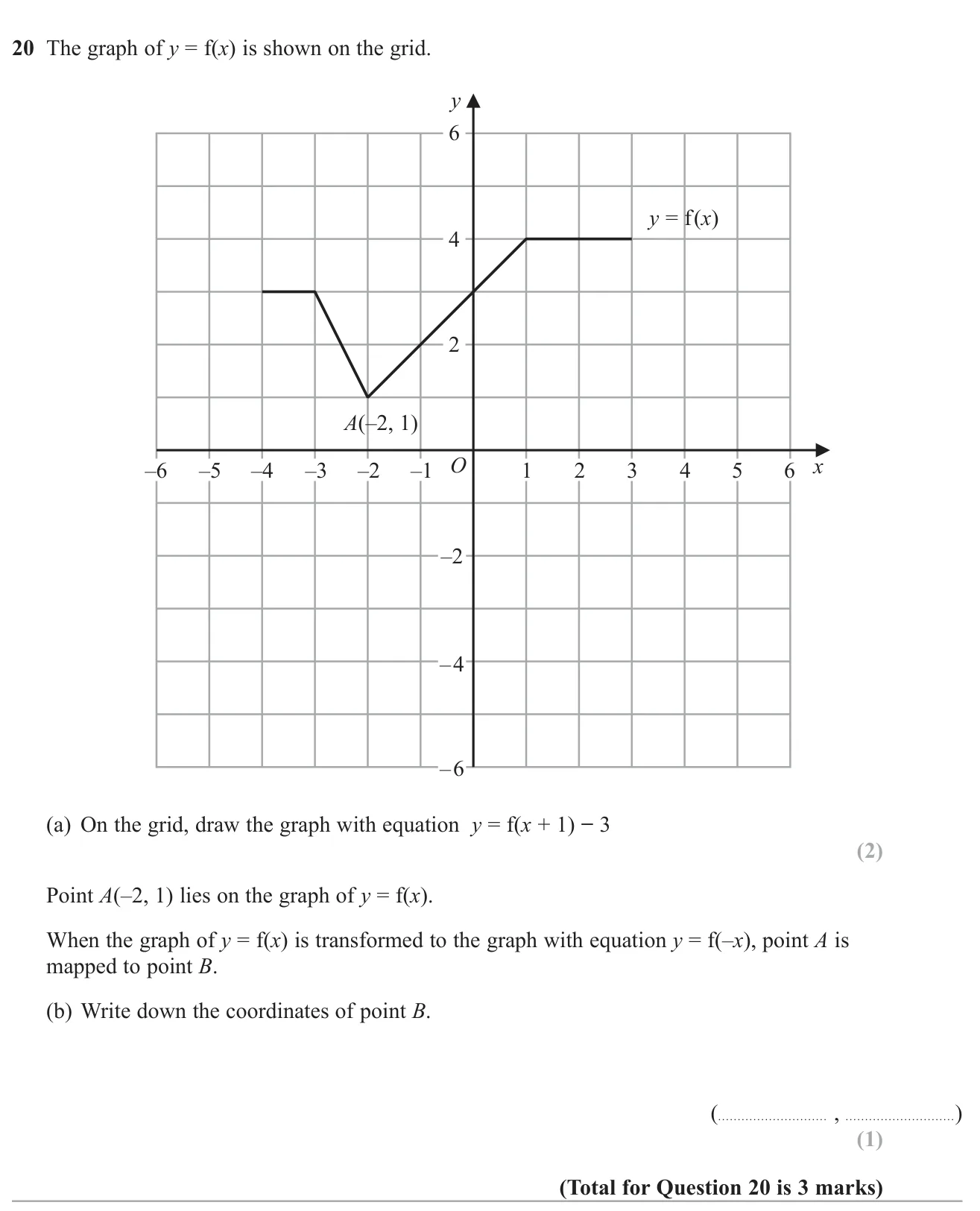
Graph transformations3 marksGrade 8No calculatorHigher
November 2019 · Paper 1 Higher · Q20
Draw a translated graph and find where a point moves under a reflection in the y-axis.

© Pearson Education Ltd. November 2019 Paper 1 (Higher, non-calculator), question 20.

Show answer
(a)The graph moved 1 left and 3 down2 marks
(b)(2,1)(2, 1)1 mark

Worked solution Checked against the mark scheme

(a) f(x+1)f(x+1) moves the graph 1 unit left; −3-3 moves it 3 units down.

So each corner moves by (−1−3)\begin{pmatrix}-1\\-3\end{pmatrix}, for example (−2,1)→(−3,−2)(-2, 1) \to (-3, -2) and (1,4)→(0,1)(1, 4) \to (0, 1).

(b) f(−x)f(-x) reflects in the yy-axis, so xx changes sign: B=(2,1)B = (2, 1)

Watch out: Moving the graph 1 unit right for f(x + 1).

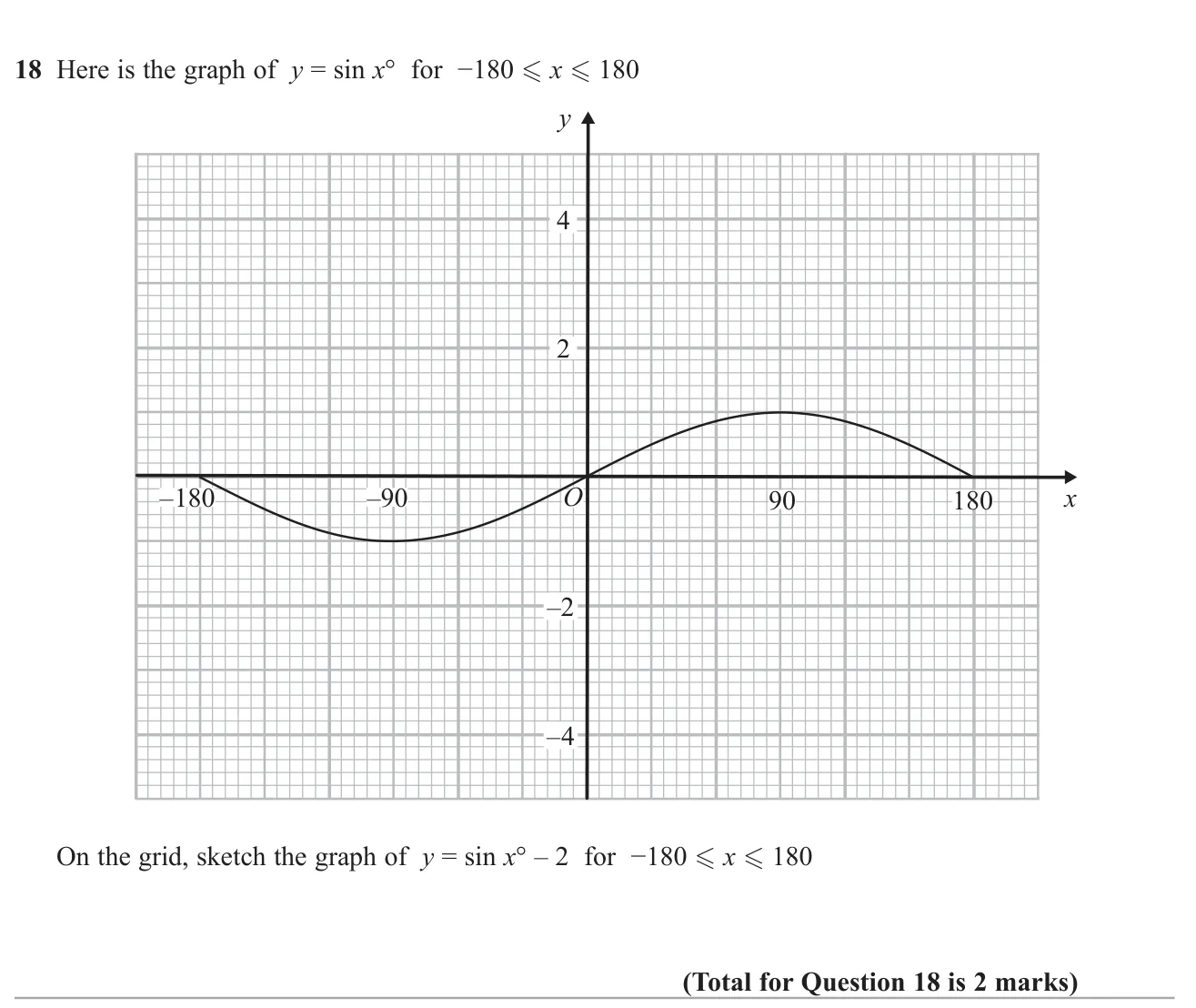
Graph transformations2 marksGrade 8No calculatorHigher
June 2018 · Paper 1 Higher · Q18
Sketch a sine graph translated down by 2 on the given axes.

© Pearson Education Ltd. June 2018 Paper 1 (Higher, non-calculator), question 18.

Show answer
AnswerThe sine curve moved down 2, through (−180,−2)(-180,-2), (−90,−3)(-90,-3), (0,−2)(0,-2), (90,−1)(90,-1), (180,−2)(180,-2)2 marks

Worked solution Checked against the mark scheme

Subtracting 2 moves every point of y=sin⁡xy = \sin x down by 2.

Key points: (−180,−2)(-180, -2), (−90,−3)(-90, -3), (0,−2)(0, -2), (90,−1)(90, -1), (180,−2)(180, -2)

Join them with a smooth wave.

Watch out: Moving the graph 2 to the left or right instead of down.

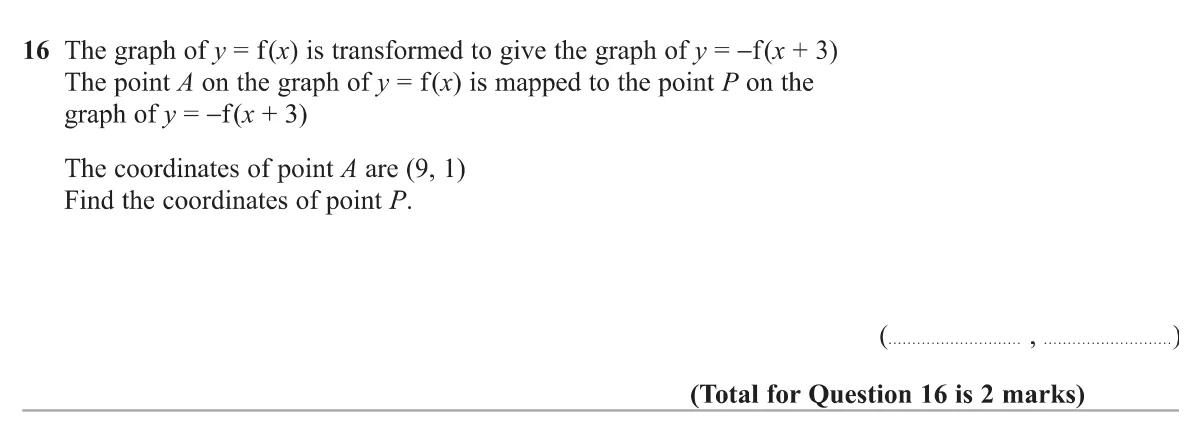
Graph transformations2 marksGrade 8CalculatorHigher
Specimen · Paper 3 Higher · Q16
Find where a point moves under a combined graph transformation (a horizontal translation and a reflection in the x-axis).

© Pearson Education Ltd. Specimen Paper 3 (Higher, calculator), question 16.

Show answer
Answer(6,−1)(6, -1)2 marks

Worked solution Checked against the mark scheme

f(x+3)f(x + 3) shifts the graph 3 units left: (9,1)→(6,1)(9, 1) \to (6, 1)

−f(…)-f(\ldots) reflects in the xx-axis: (6,1)→(6,−1)(6, 1) \to (6, -1)

So P=(6,−1)P = (6, -1)

Watch out: Moving the point 3 units right instead of left, giving (12, −1).