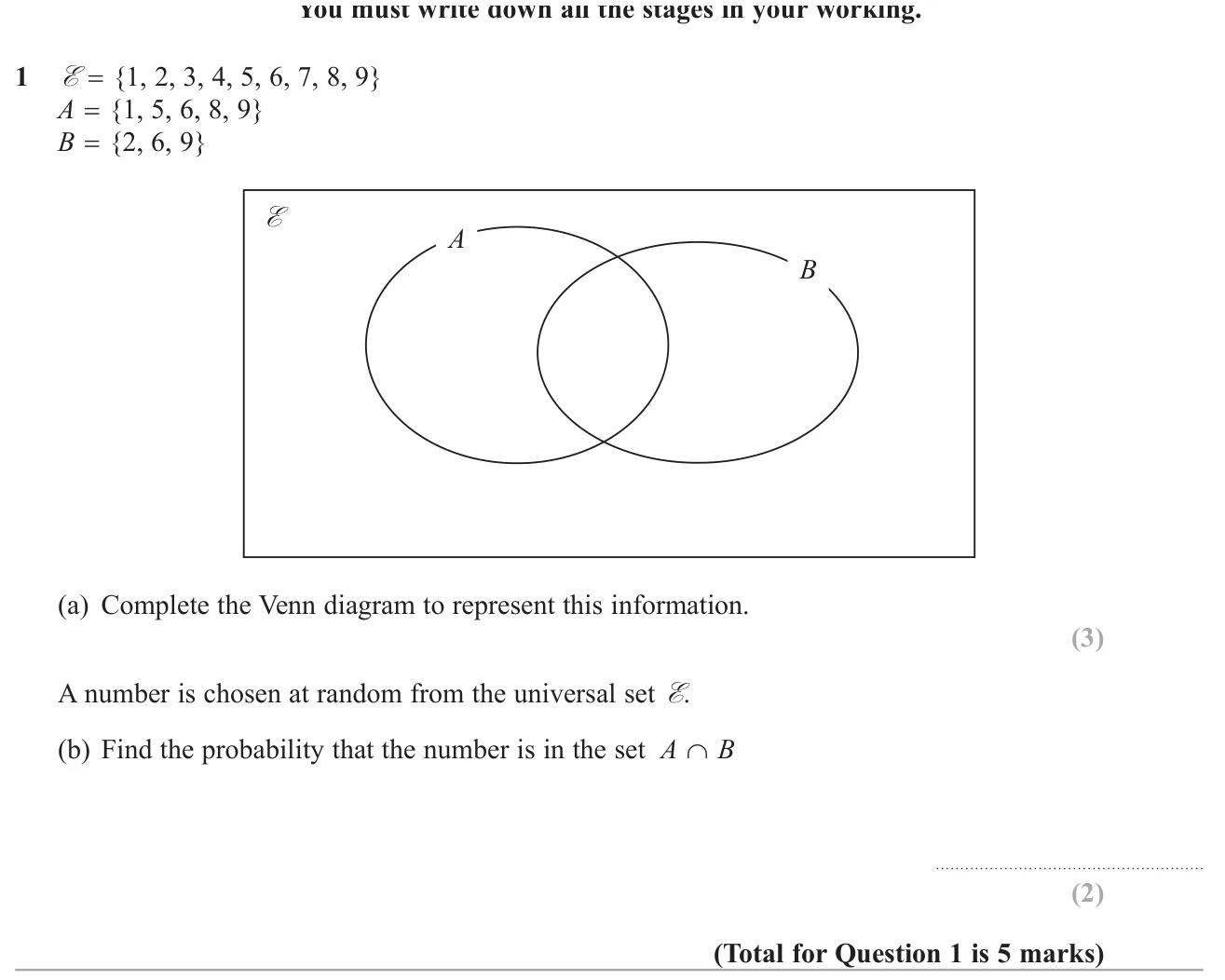
© Pearson Education Ltd. June 2019 Paper 3 (Higher, calculator), question 1.
(a) Intersection: 6, 9; A only: 1, 5, 8; B only: 2; outside: 3, 4, 7 3 marks (b) 2 9 \frac{2}{9} 9 2 2 marks
Worked solution Checked against the mark scheme
(a) In both A and B: 6, 9
A only: 1, 5, 8. B only: 2. Neither: 3, 4, 7.
(b) A ∩ B = { 6 , 9 } A \cap B = \{6, 9\} A ∩ B = { 6 , 9 }
P = 2 9 P = \frac{2}{9} P = 9 2
Watch out: Forgetting to place 3, 4 and 7 outside both circles.
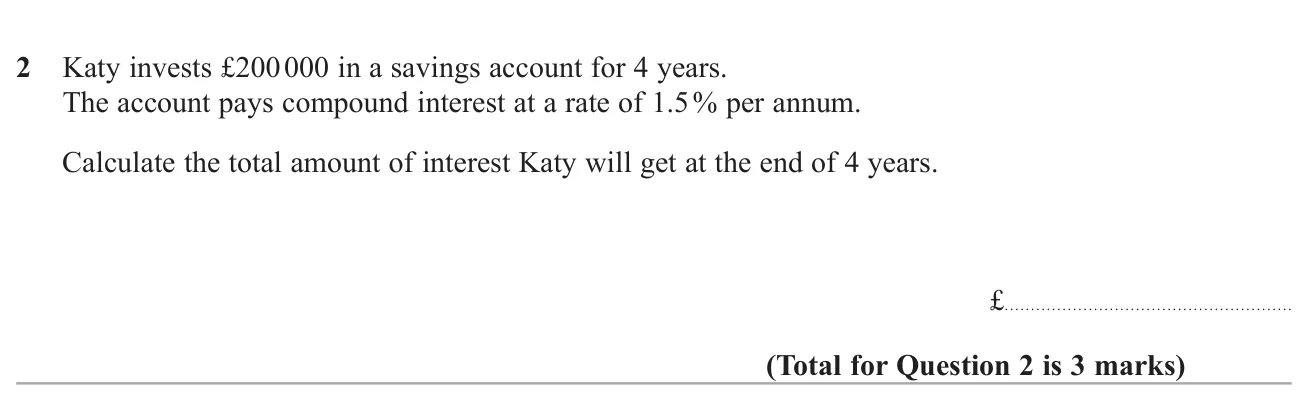
© Pearson Education Ltd. June 2019 Paper 3 (Higher, calculator), question 2.
Worked solution Checked against the mark scheme
Multiplier for 1.5% interest: 1.015
200 000 × 1.015 4 = 212 272.71 200\,000 \times 1.015^4 = 212\,272.71 200 000 × 1.01 5 4 = 212 272.71
Interest: 212 272.71 − 200 000 = £ 12 272.71 212\,272.71 - 200\,000 = £12\,272.71 212 272.71 − 200 000 = £12 272.71
Watch out: Using simple interest: 4 × 3000 = £12 000.
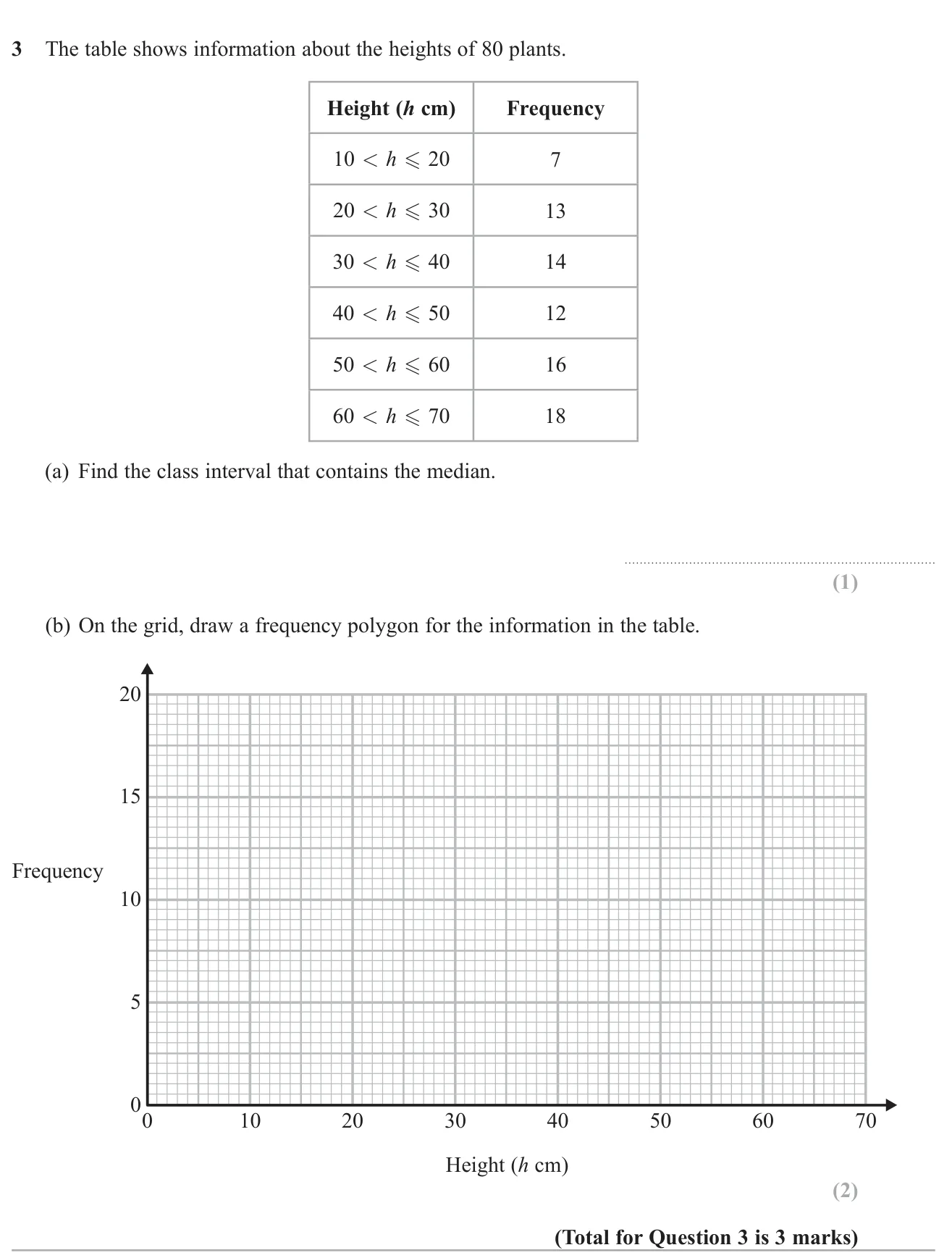
© Pearson Education Ltd. June 2019 Paper 3 (Higher, calculator), question 3.
(a) 40 < h ≤ 50 40 < h \le 50 40 < h ≤ 50 1 mark (b) Points at (15, 7), (25, 13), (35, 14), (45, 12), (55, 16), (65, 18) joined with straight lines 2 marks
Worked solution Checked against the mark scheme
(a) 80 plants, so the median is about the 40th–41st value.
Running totals: 7, 20, 34, 46, ... The 40th value is in 40 < h ≤ 50 40 < h \le 50 40 < h ≤ 50
(b) Plot each frequency at the middle of its class: (15, 7), (25, 13), (35, 14), (45, 12), (55, 16), (65, 18). Join with straight lines.
Watch out: In (b), plotting at the class ends (10, 20, ...) instead of the midpoints.
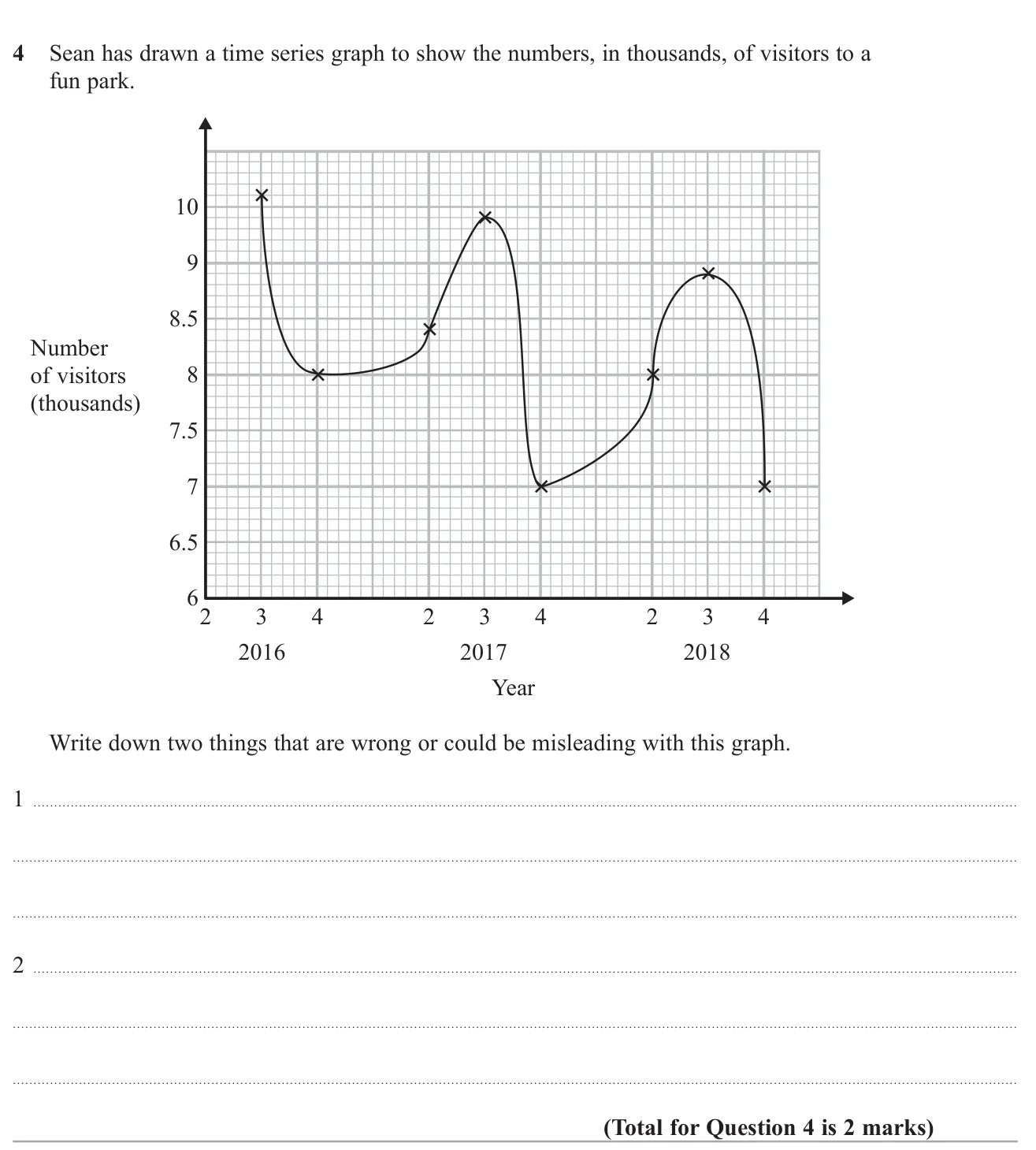
© Pearson Education Ltd. June 2019 Paper 3 (Higher, calculator), question 4.
Answer Any two, e.g. points joined with curves not straight lines; the vertical axis starts at 6 not 0; quarter 1 is missing; the 2, 3, 4 labels are unclear 2 marks
Worked solution Checked against the mark scheme
Things wrong with the graph:
1. The points are joined with curves; a time series should use straight lines.
Other valid points: the first quarter of each year is missing, and it is not clear what 2, 3, 4 on the horizontal axis mean.
Watch out: Saying 'there is no title', which does not score.
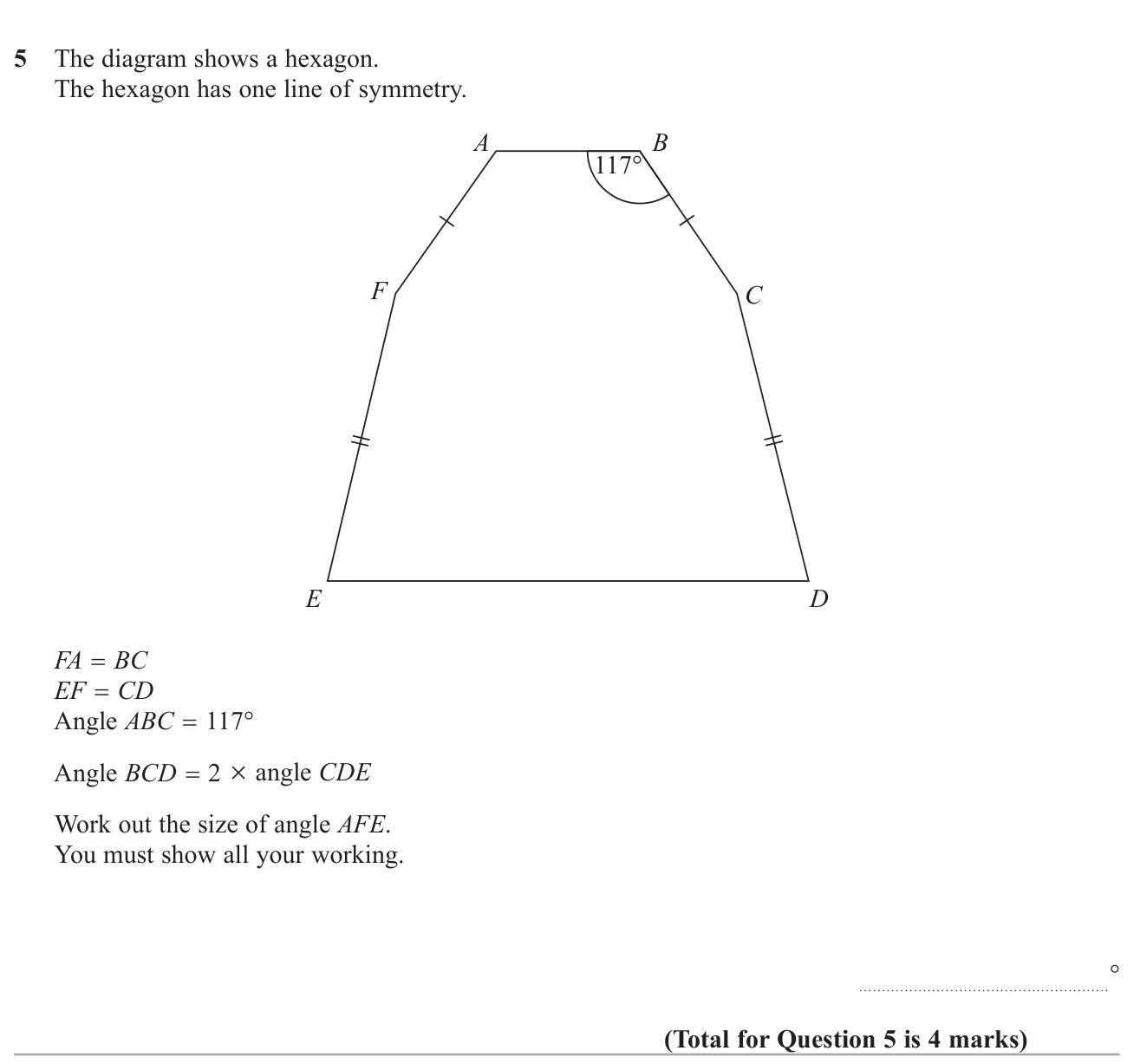
© Pearson Education Ltd. June 2019 Paper 3 (Higher, calculator), question 5.
Worked solution Checked against the mark scheme
Interior angles of a hexagon: ( 6 − 2 ) × 180 = 720 ∘ (6 - 2) \times 180 = 720^\circ ( 6 − 2 ) × 180 = 72 0 ∘
By symmetry A = B = 117 ∘ A = B = 117^\circ A = B = 11 7 ∘ D = E = x D = E = x D = E = x C = F = 2 x C = F = 2x C = F = 2 x
117 + 117 + 2 x + 2 x + x + x = 720 117 + 117 + 2x + 2x + x + x = 720 117 + 117 + 2 x + 2 x + x + x = 720 6 x = 486 6x = 486 6 x = 486 x = 81 x = 81 x = 81
Angle A F E = 2 × 81 = 162 ∘ AFE = 2 \times 81 = 162^\circ A F E = 2 × 81 = 16 2 ∘
Watch out: Giving 81°, the value of angle CDE, as the answer.
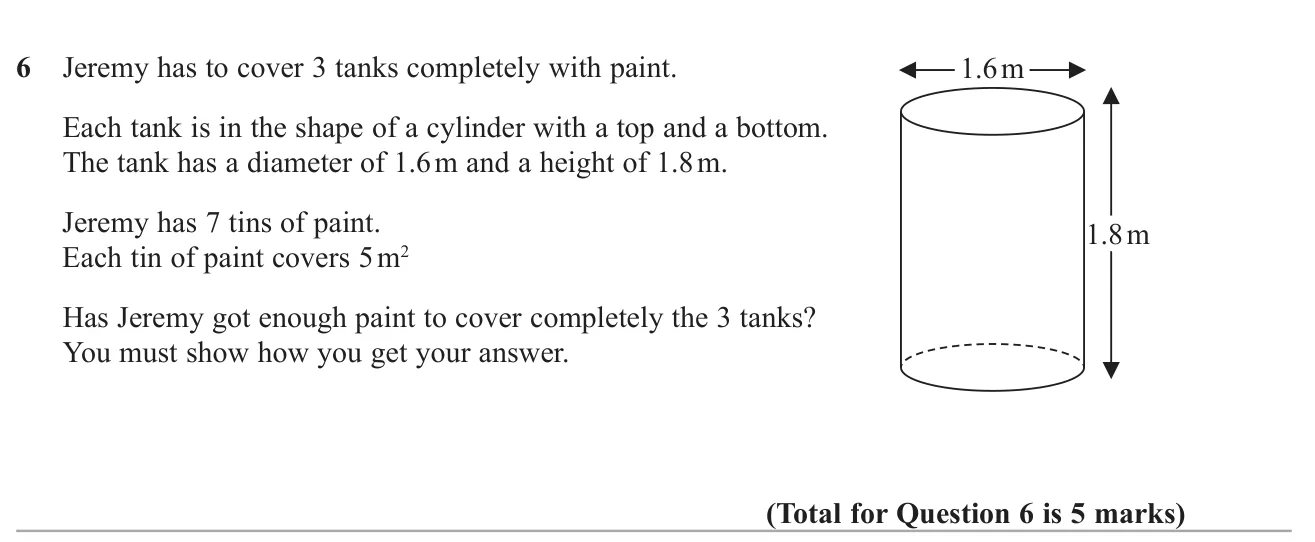
© Pearson Education Ltd. June 2019 Paper 3 (Higher, calculator), question 6.
Answer No: total area about 39.2 m 2 39.2\text{ m}^2 39.2 m 2 35 m 2 35\text{ m}^2 35 m 2 5 marks
Worked solution Checked against the mark scheme
Radius = 0.8 = 0.8 = 0.8
Top and bottom: 2 × π × 0.8 2 = 4.021... 2 \times \pi \times 0.8^2 = 4.021... 2 × π × 0. 8 2 = 4.021...
Curved surface: 2 × π × 0.8 × 1.8 = 9.047... 2 \times \pi \times 0.8 \times 1.8 = 9.047... 2 × π × 0.8 × 1.8 = 9.047...
One tank: 13.069... 13.069... 13.069... 39.21 39.21 39.21
Paint covers 7 × 5 = 35 7 \times 5 = 35 7 × 5 = 35 < 39.21 < 39.21 < 39.21 No , he does not have enough.
Watch out: Using the diameter 1.6 as the radius, or leaving out the top or bottom.
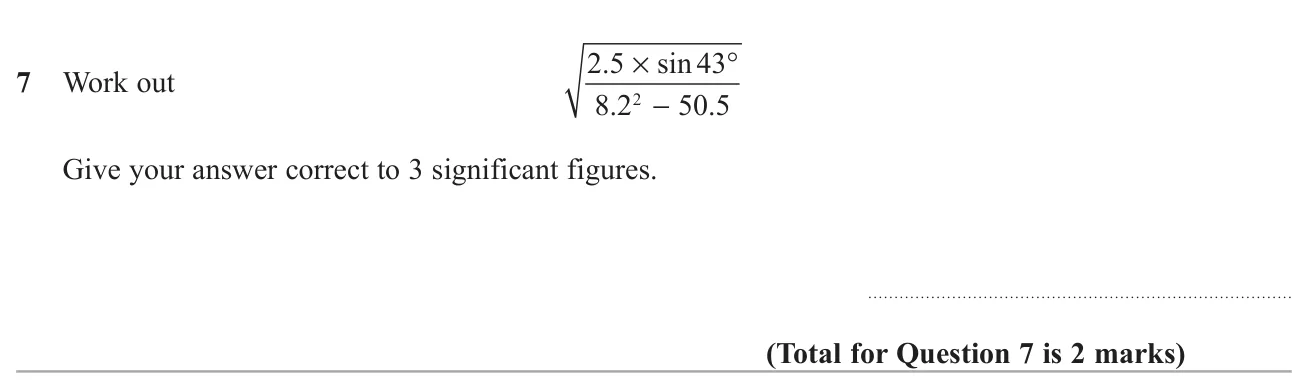
© Pearson Education Ltd. June 2019 Paper 3 (Higher, calculator), question 7.
Answer 0.319 0.319 0.319 2 marks
Worked solution Checked against the mark scheme
Numerator: 2.5 × sin 43 ° = 1.70499 2.5 \times \sin 43° = 1.70499 2.5 × sin 43° = 1.70499
Denominator: 8.2 2 − 50.5 = 67.24 − 50.5 = 16.74 8.2^2 - 50.5 = 67.24 - 50.5 = 16.74 8. 2 2 − 50.5 = 67.24 − 50.5 = 16.74
1.70499 ÷ 16.74 = 0.10185 = 0.3191... \sqrt{1.70499 \div 16.74} = \sqrt{0.10185} = 0.3191... 1.70499 ÷ 16.74 = 0.10185 = 0.3191...
Answer: 0.319 0.319 0.319
Watch out: Calculator in radians mode, or not putting brackets round the denominator.
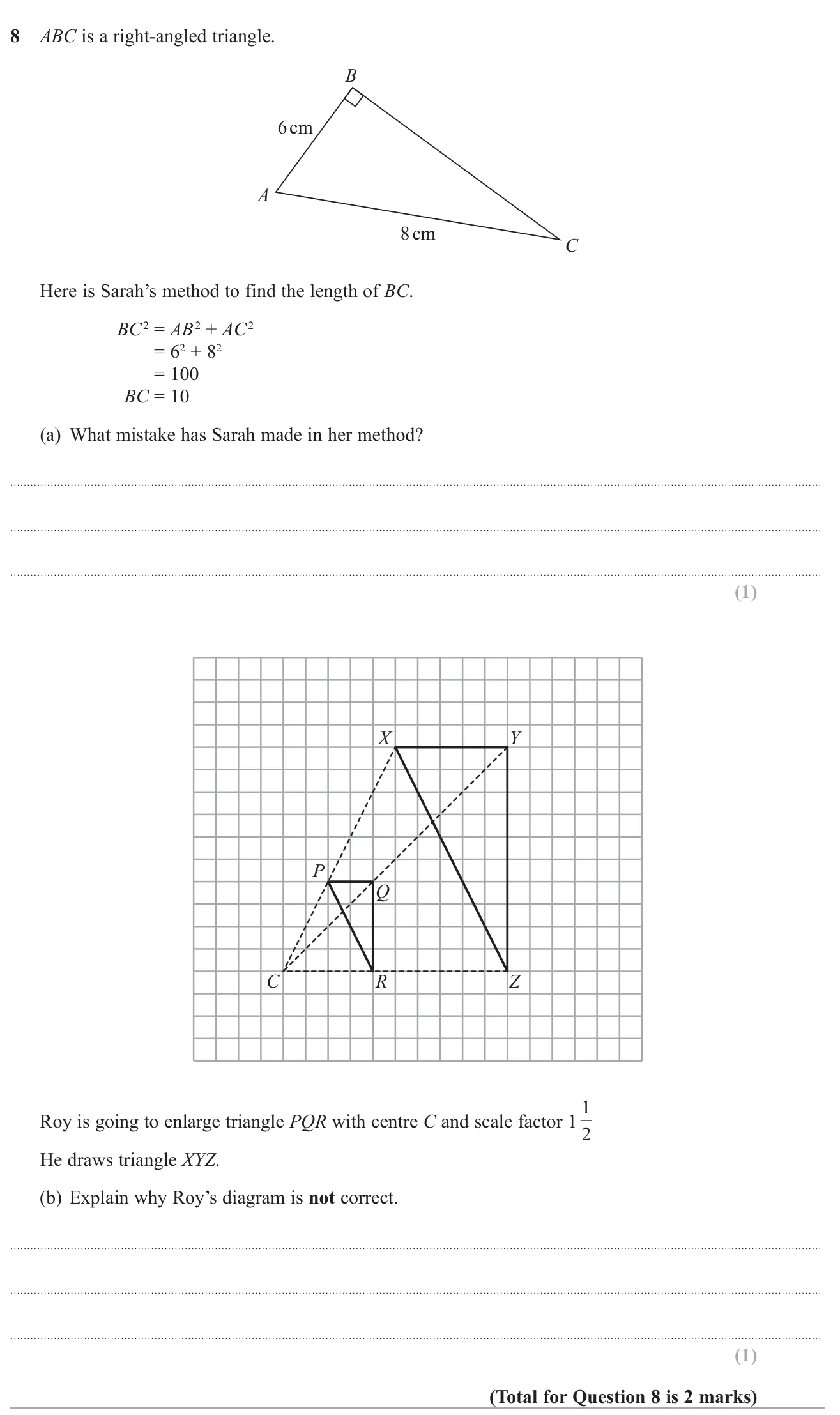
© Pearson Education Ltd. June 2019 Paper 3 (Higher, calculator), question 8.
(a) AC (8 cm) is the hypotenuse, so she should subtract: B C 2 = A C 2 − A B 2 = 8 2 − 6 2 BC^2 = AC^2 - AB^2 = 8^2 - 6^2 B C 2 = A C 2 − A B 2 = 8 2 − 6 2 1 mark (b) The scale factor used is 2.5, not 1.5 (e.g. C Z CZ C Z C R CR C R 1 mark
Worked solution Checked against the mark scheme
(a) The right angle is at B B B A C AC A C B C BC B C B C 2 = 8 2 − 6 2 = 28 BC^2 = 8^2 - 6^2 = 28 B C 2 = 8 2 − 6 2 = 28 B C = 5.29 BC = 5.29 B C = 5.29
(b) Count squares from C C C C R = 4 CR = 4 C R = 4 C Z = 10 CZ = 10 C Z = 10 10 ÷ 4 = 2.5 10 \div 4 = 2.5 10 ÷ 4 = 2.5 1 1 2 1\frac{1}{2} 1 2 1
Watch out: Saying 'she used Pythagoras wrong' without saying what the error is.
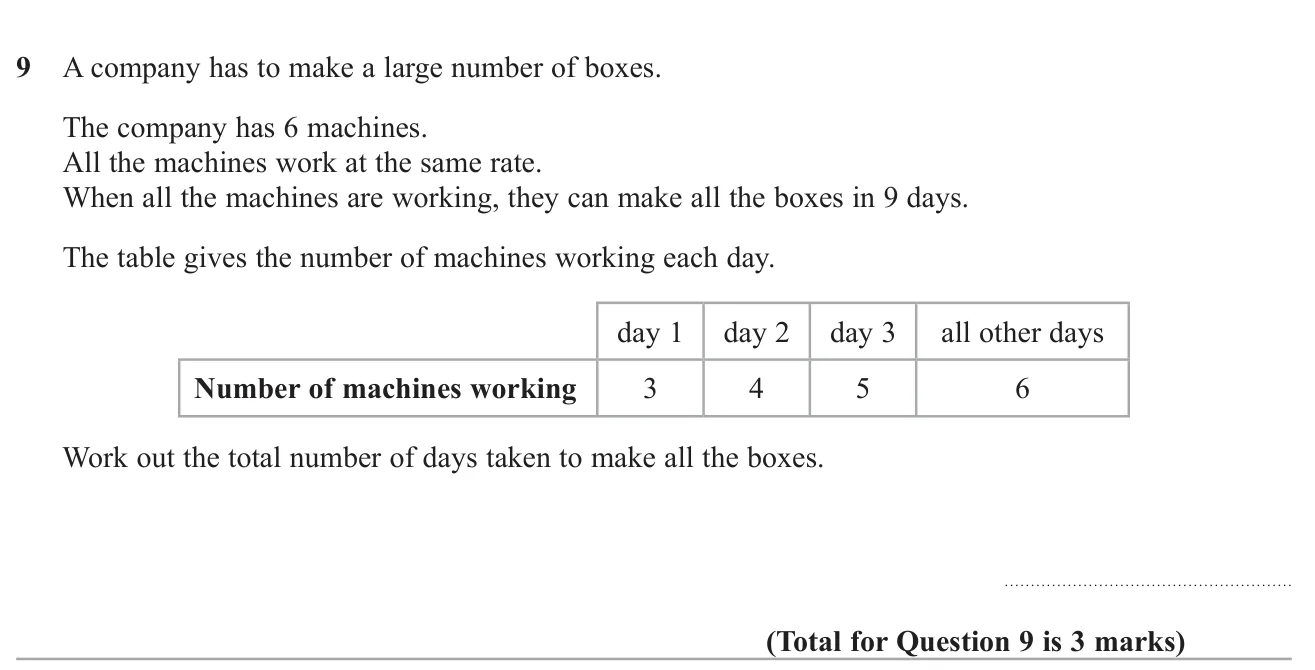
© Pearson Education Ltd. June 2019 Paper 3 (Higher, calculator), question 9.
Worked solution Checked against the mark scheme
Total work: 6 × 9 = 54 6 \times 9 = 54 6 × 9 = 54
First 3 days: 3 + 4 + 5 = 12 3 + 4 + 5 = 12 3 + 4 + 5 = 12
Left: 54 − 12 = 42 54 - 12 = 42 54 − 12 = 42 42 ÷ 6 = 7 42 \div 6 = 7 42 ÷ 6 = 7
Total: 3 + 7 = 10 3 + 7 = 10 3 + 7 = 10
Watch out: Answering 7, forgetting to add the first 3 days.
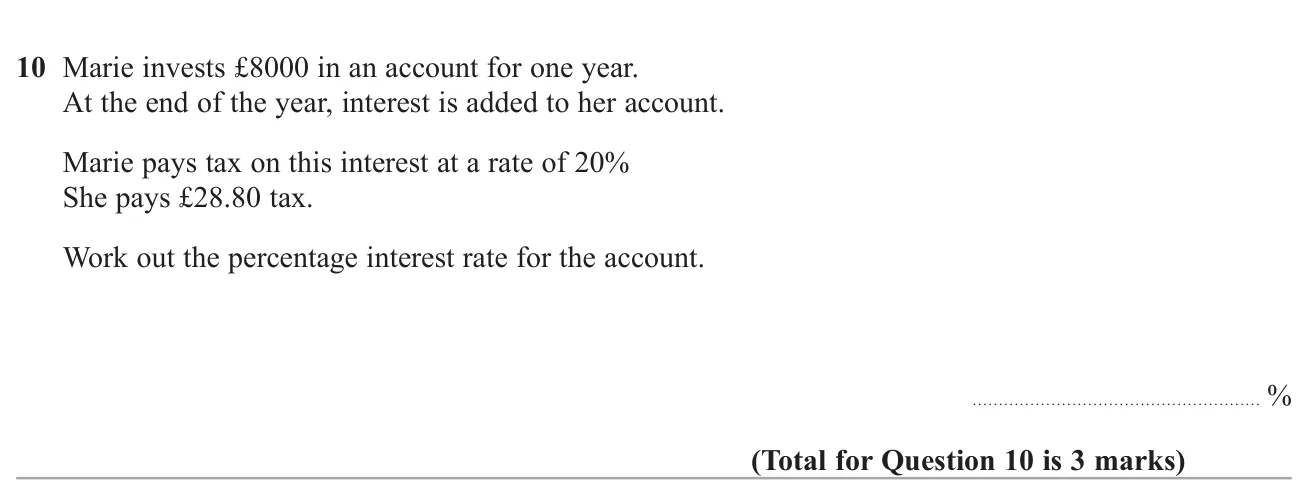
© Pearson Education Ltd. June 2019 Paper 3 (Higher, calculator), question 10.
Worked solution Checked against the mark scheme
Tax is 20% of the interest, so interest = 28.80 ÷ 0.2 = £ 144 = 28.80 \div 0.2 = £144 = 28.80 ÷ 0.2 = £144
Rate = 144 8000 × 100 = 1.8 % = \frac{144}{8000} \times 100 = 1.8\% = 8000 144 × 100 = 1.8%
Watch out: Using £28.80 as the interest, giving 0.36%.
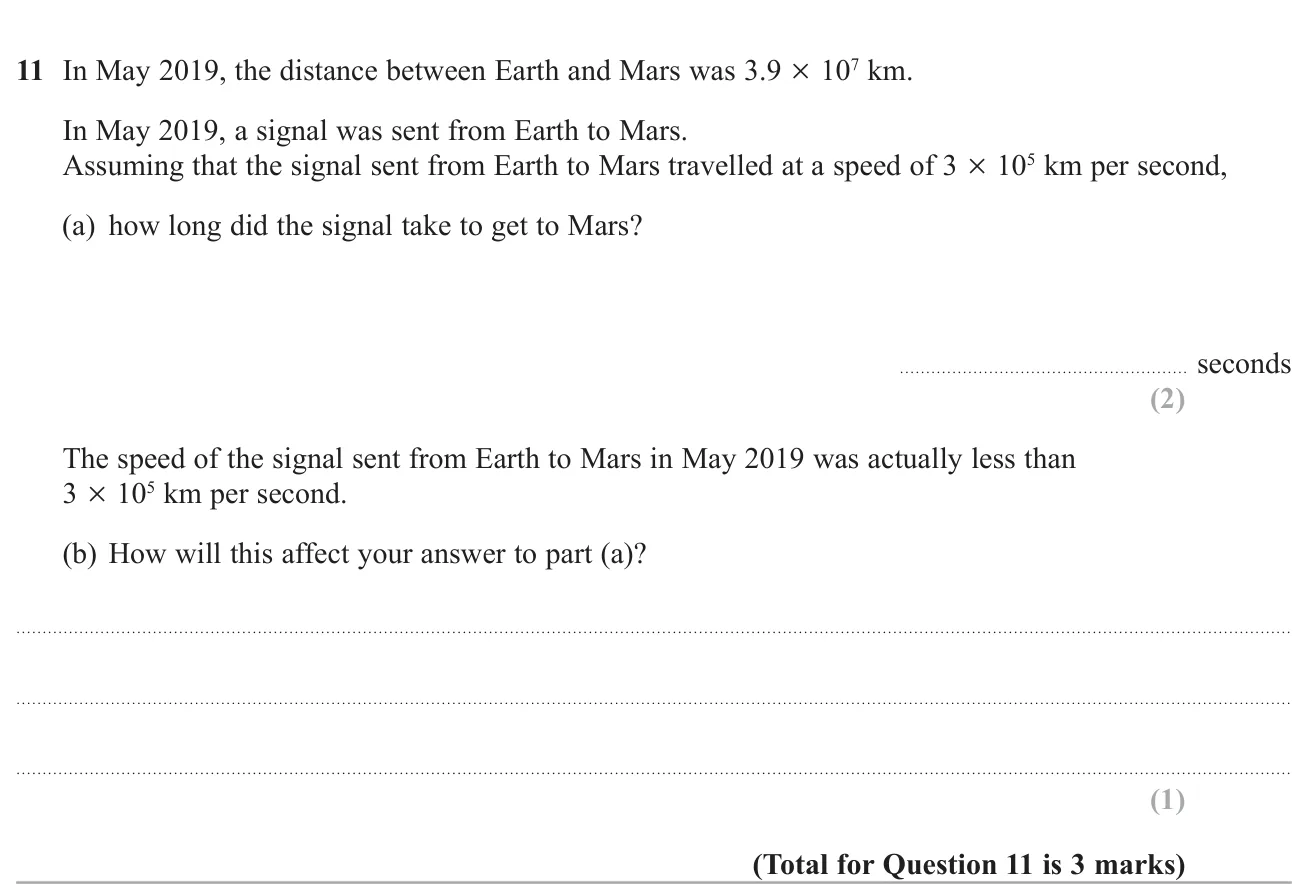
© Pearson Education Ltd. June 2019 Paper 3 (Higher, calculator), question 11.
(a) 130 seconds 2 marks (b) The signal would take longer, so the time is an underestimate 1 mark
Worked solution Checked against the mark scheme
(a) Time = 3.9 × 10 7 3 × 10 5 = 1.3 × 10 2 = 130 = \frac{3.9 \times 10^7}{3 \times 10^5} = 1.3 \times 10^2 = 130 = 3 × 1 0 5 3.9 × 1 0 7 = 1.3 × 1 0 2 = 130
(b) A lower speed over the same distance means more time, so the real time is longer than 130 s.
Watch out: In (b), saying only that the answer would be 'wrong' or 'different'.
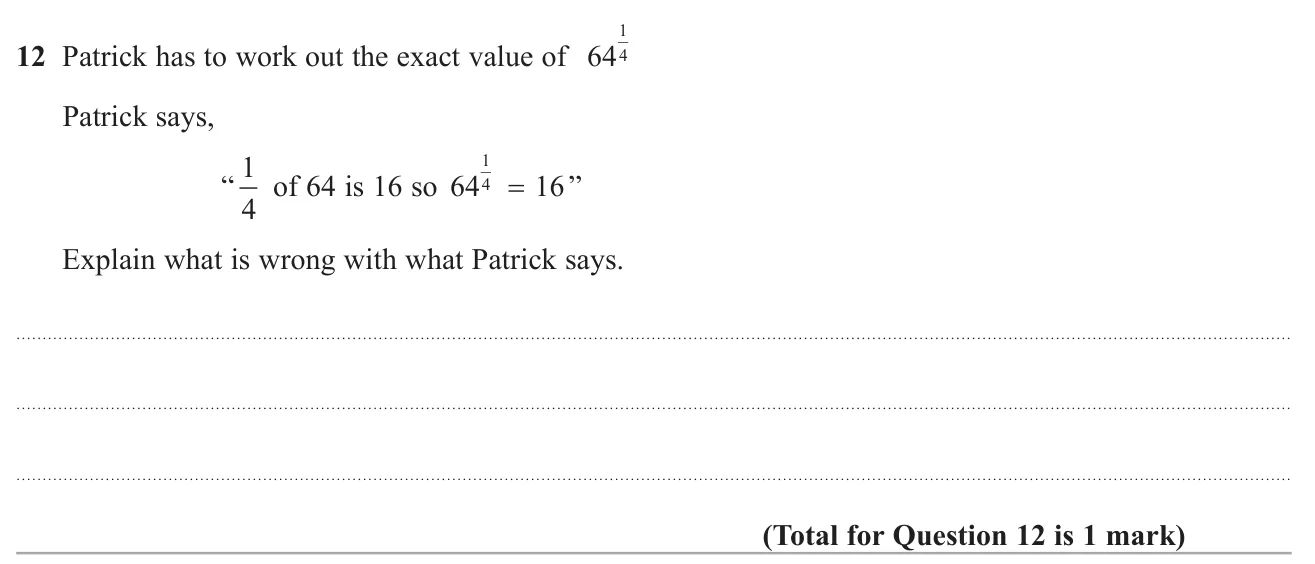
© Pearson Education Ltd. June 2019 Paper 3 (Higher, calculator), question 12.
Answer 64 1 / 4 64^{1/4} 6 4 1/4 1 mark
Worked solution Checked against the mark scheme
A power of 1 4 \frac{1}{4} 4 1
64 1 4 = 64 4 = 64 = 8 = 2 2 ≈ 2.83 64^{\frac{1}{4}} = \sqrt[4]{64} = \sqrt{\sqrt{64}} = \sqrt{8} = 2\sqrt{2} \approx 2.83 6 4 4 1 = 4 64 = 64 = 8 = 2 2 ≈ 2.83
Watch out: Thinking the answer is 2, or 4.
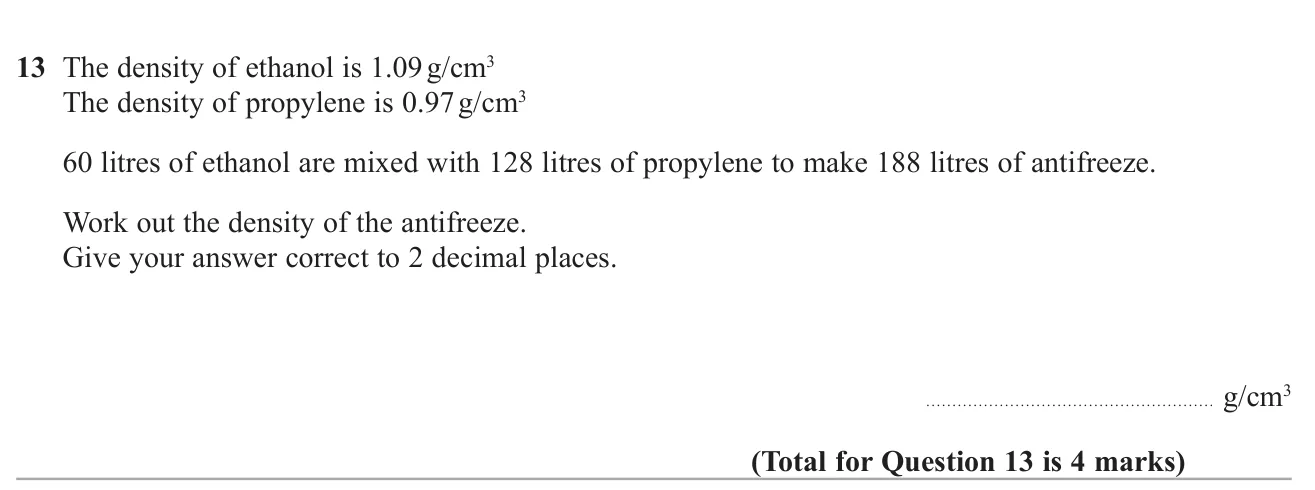
© Pearson Education Ltd. June 2019 Paper 3 (Higher, calculator), question 13.
Answer 1.01 1.01 1.01 4 marks
Worked solution Checked against the mark scheme
Work per cm³ scaled by litres (the conversion factor cancels):
Ethanol: 1.09 × 60 = 65.4 1.09 \times 60 = 65.4 1.09 × 60 = 65.4
Propylene: 0.97 × 128 = 124.16 0.97 \times 128 = 124.16 0.97 × 128 = 124.16
Density = 65.4 + 124.16 188 = 189.56 188 = 1.008... ≈ 1.01 = \frac{65.4 + 124.16}{188} = \frac{189.56}{188} = 1.008... \approx 1.01 = 188 65.4 + 124.16 = 188 189.56 = 1.008... ≈ 1.01
Watch out: Averaging the two densities (1.03) without weighting by volume.
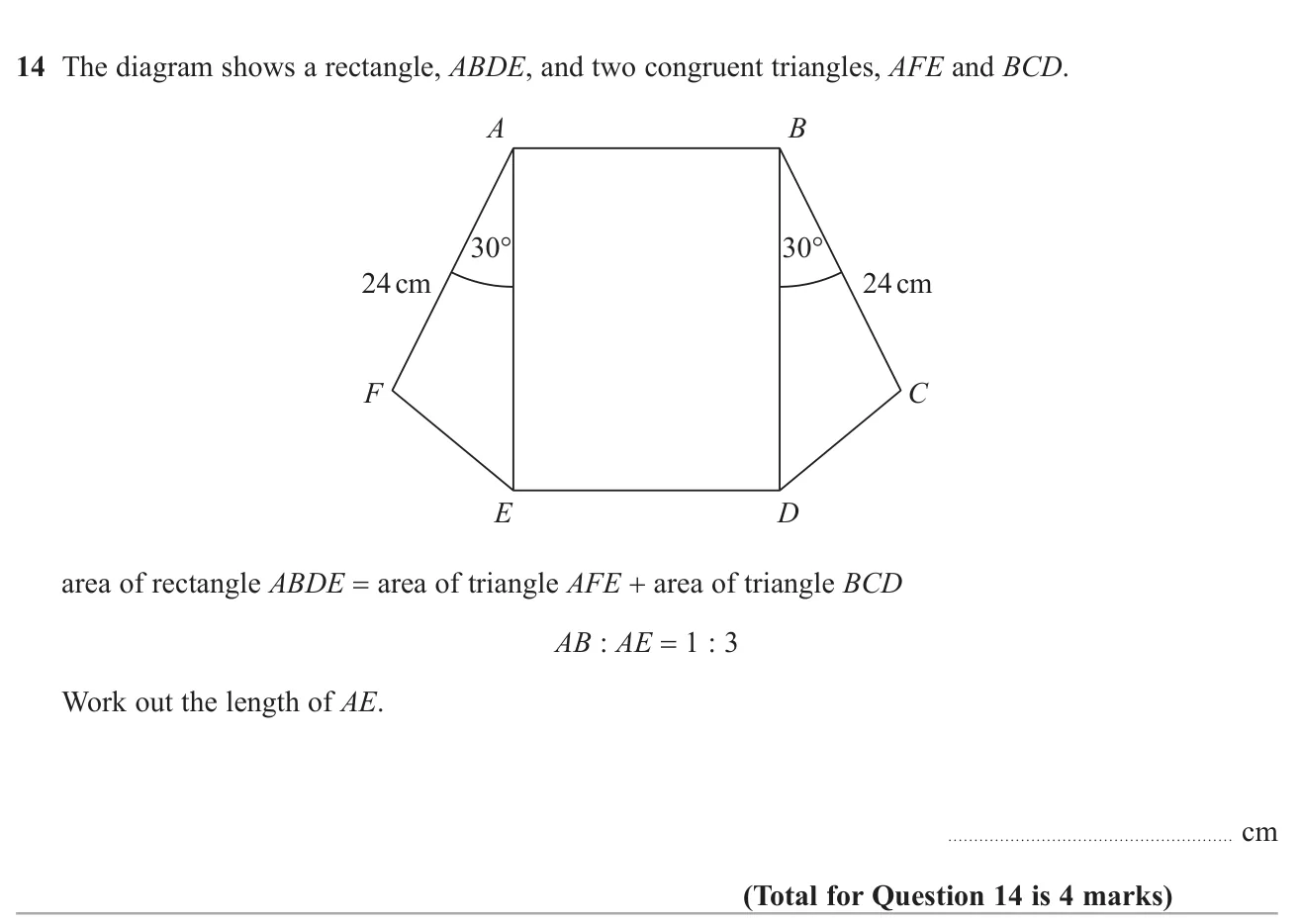
© Pearson Education Ltd. June 2019 Paper 3 (Higher, calculator), question 14.
Worked solution Checked against the mark scheme
Area of triangle A F E = 1 2 × 24 × A E × sin 30 ° = 6 A E AFE = \frac{1}{2} \times 24 \times AE \times \sin 30° = 6\,AE A F E = 2 1 × 24 × A E × sin 30° = 6 A E
Two triangles: 12 A E 12\,AE 12 A E
Rectangle: A B × A E = 12 A E AB \times AE = 12\,AE A B × A E = 12 A E A B = 12 AB = 12 A B = 12
A E = 3 × A B = 36 AE = 3 \times AB = 36 A E = 3 × A B = 36
Watch out: Using ½ × base × height with 24 as the height.
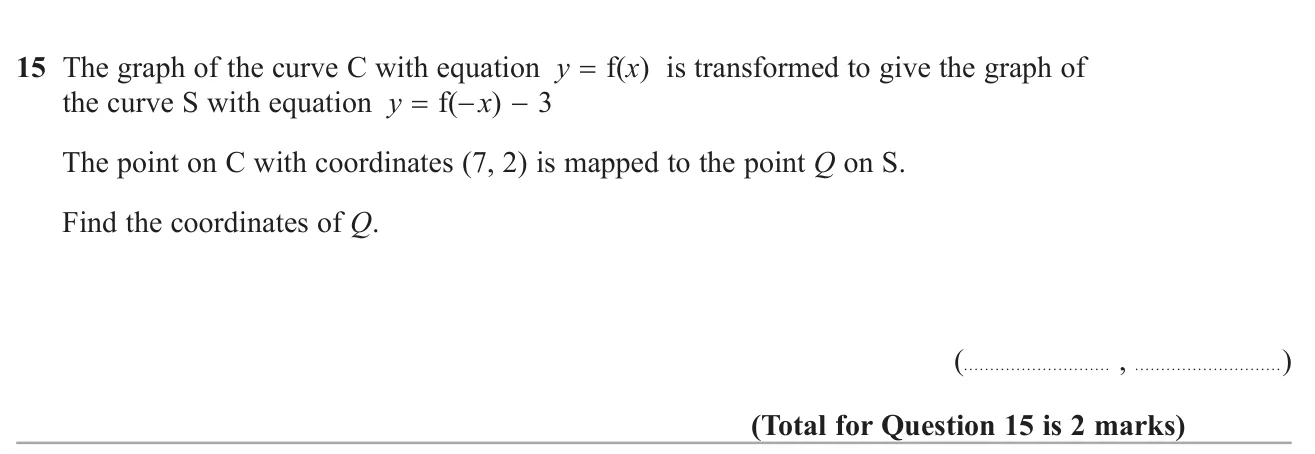
© Pearson Education Ltd. June 2019 Paper 3 (Higher, calculator), question 15.
Answer ( − 7 , − 1 ) (-7, -1) ( − 7 , − 1 ) 2 marks
Worked solution Checked against the mark scheme
f ( − x ) f(-x) f ( − x ) y y y ( 7 , 2 ) → ( − 7 , 2 ) (7, 2) \to (-7, 2) ( 7 , 2 ) → ( − 7 , 2 )
− 3 -3 − 3 ( − 7 , 2 ) → ( − 7 , − 1 ) (-7, 2) \to (-7, -1) ( − 7 , 2 ) → ( − 7 , − 1 )
Watch out: Reflecting in the x-axis instead, giving (7, −5).
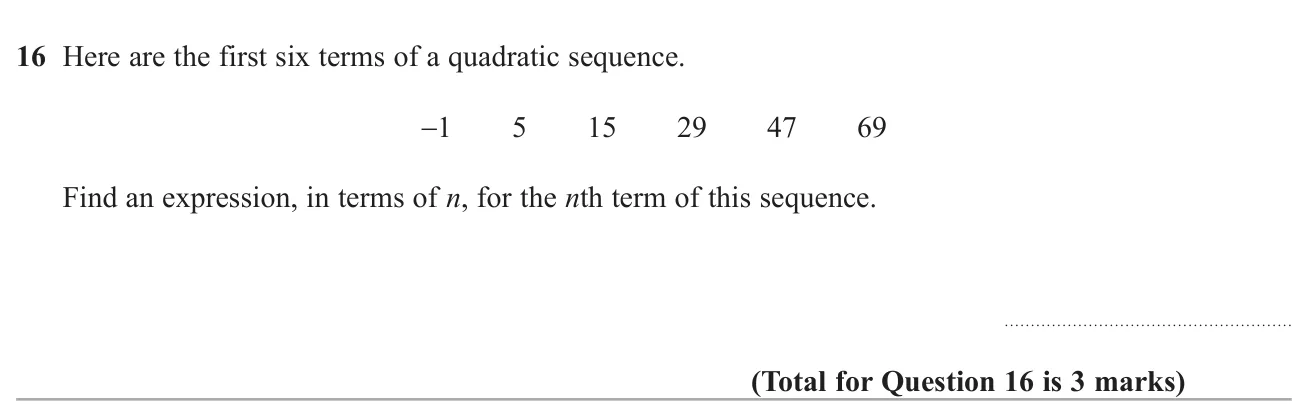
© Pearson Education Ltd. June 2019 Paper 3 (Higher, calculator), question 16.
Answer 2 n 2 − 3 2n^2 - 3 2 n 2 − 3 3 marks
Worked solution Checked against the mark scheme
First differences: 6, 10, 14, 18, 22. Second differences: 4, so the sequence starts 2 n 2 2n^2 2 n 2
2 n 2 2n^2 2 n 2
Sequence minus 2 n 2 2n^2 2 n 2 2 n 2 − 3 2n^2 - 3 2 n 2 − 3
Watch out: Using the second difference (4) as the coefficient, giving 4n².
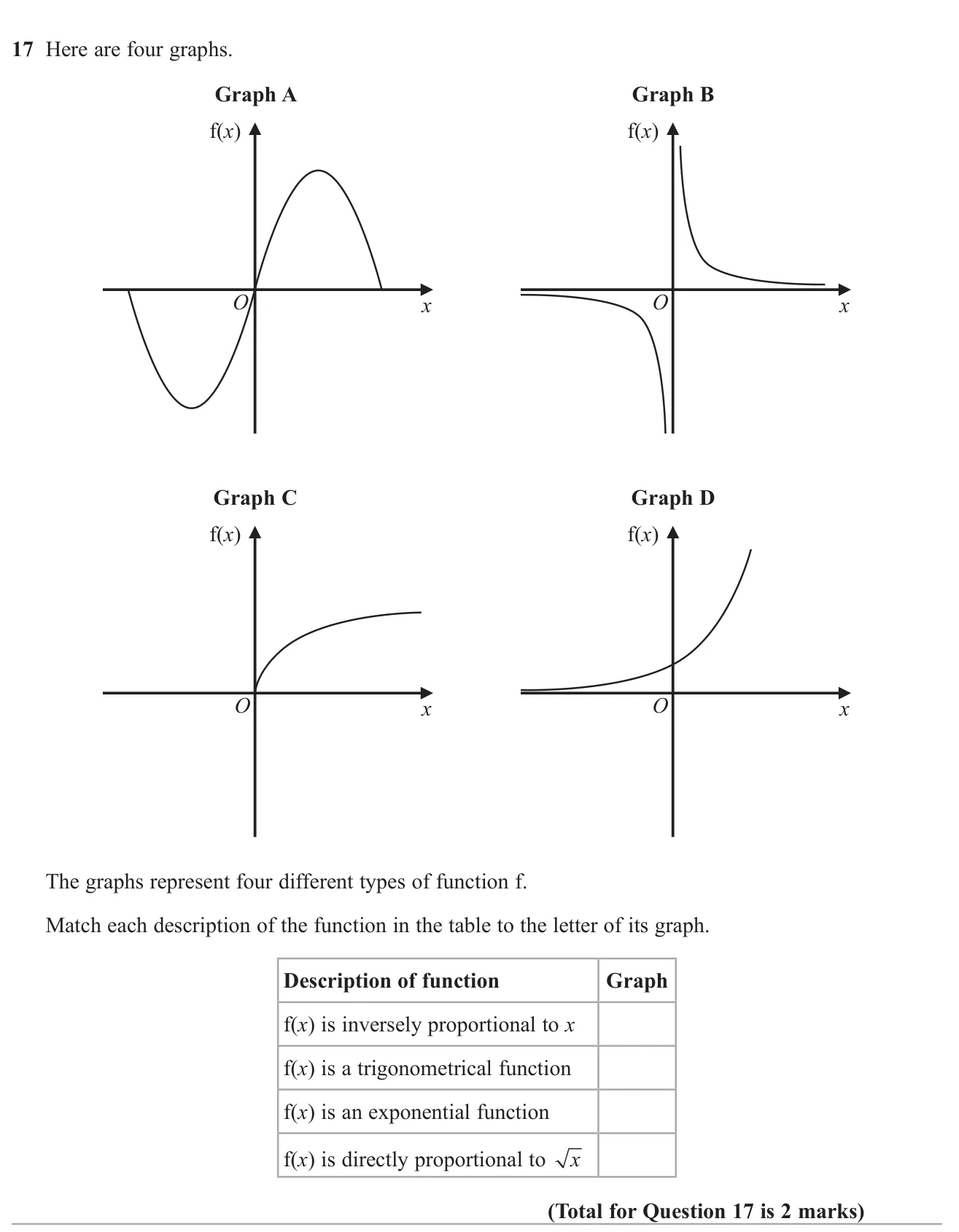
© Pearson Education Ltd. June 2019 Paper 3 (Higher, calculator), question 17.
Answer Inverse: B; trigonometric: A; exponential: D; proportional to x \sqrt{x} x 2 marks
Worked solution Checked against the mark scheme
- f ( x ) ∝ 1 x f(x) \propto \frac{1}{x} f ( x ) ∝ x 1 B .O O O A .y y y D .f ( x ) ∝ x f(x) \propto \sqrt{x} f ( x ) ∝ x O O O C .
Watch out: Swapping C and D, as both curves rise.
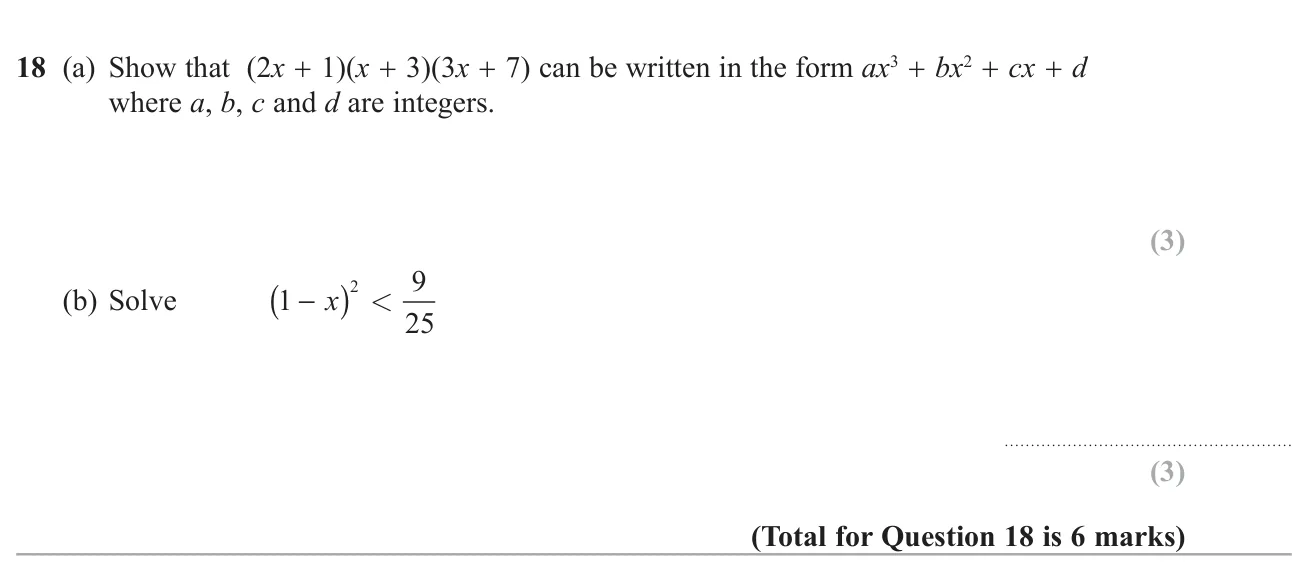
© Pearson Education Ltd. June 2019 Paper 3 (Higher, calculator), question 18.
(a) 6 x 3 + 35 x 2 + 58 x + 21 6x^3 + 35x^2 + 58x + 21 6 x 3 + 35 x 2 + 58 x + 21 3 marks (b) 2 5 < x < 8 5 \frac{2}{5} < x < \frac{8}{5} 5 2 < x < 5 8 3 marks
Worked solution Checked against the mark scheme
(a) ( 2 x + 1 ) ( x + 3 ) = 2 x 2 + 7 x + 3 (2x+1)(x+3) = 2x^2 + 7x + 3 ( 2 x + 1 ) ( x + 3 ) = 2 x 2 + 7 x + 3
( 2 x 2 + 7 x + 3 ) ( 3 x + 7 ) = 6 x 3 + 14 x 2 + 21 x 2 + 49 x + 9 x + 21 = 6 x 3 + 35 x 2 + 58 x + 21 (2x^2 + 7x + 3)(3x + 7) = 6x^3 + 14x^2 + 21x^2 + 49x + 9x + 21 = 6x^3 + 35x^2 + 58x + 21 ( 2 x 2 + 7 x + 3 ) ( 3 x + 7 ) = 6 x 3 + 14 x 2 + 21 x 2 + 49 x + 9 x + 21 = 6 x 3 + 35 x 2 + 58 x + 21
So a = 6 , b = 35 , c = 58 , d = 21 a = 6, b = 35, c = 58, d = 21 a = 6 , b = 35 , c = 58 , d = 21
(b) − 3 5 < 1 − x < 3 5 -\frac{3}{5} < 1 - x < \frac{3}{5} − 5 3 < 1 − x < 5 3
2 5 < x < 8 5 \frac{2}{5} < x < \frac{8}{5} 5 2 < x < 5 8
Watch out: In (b), only taking the positive square root and giving x > 2/5.
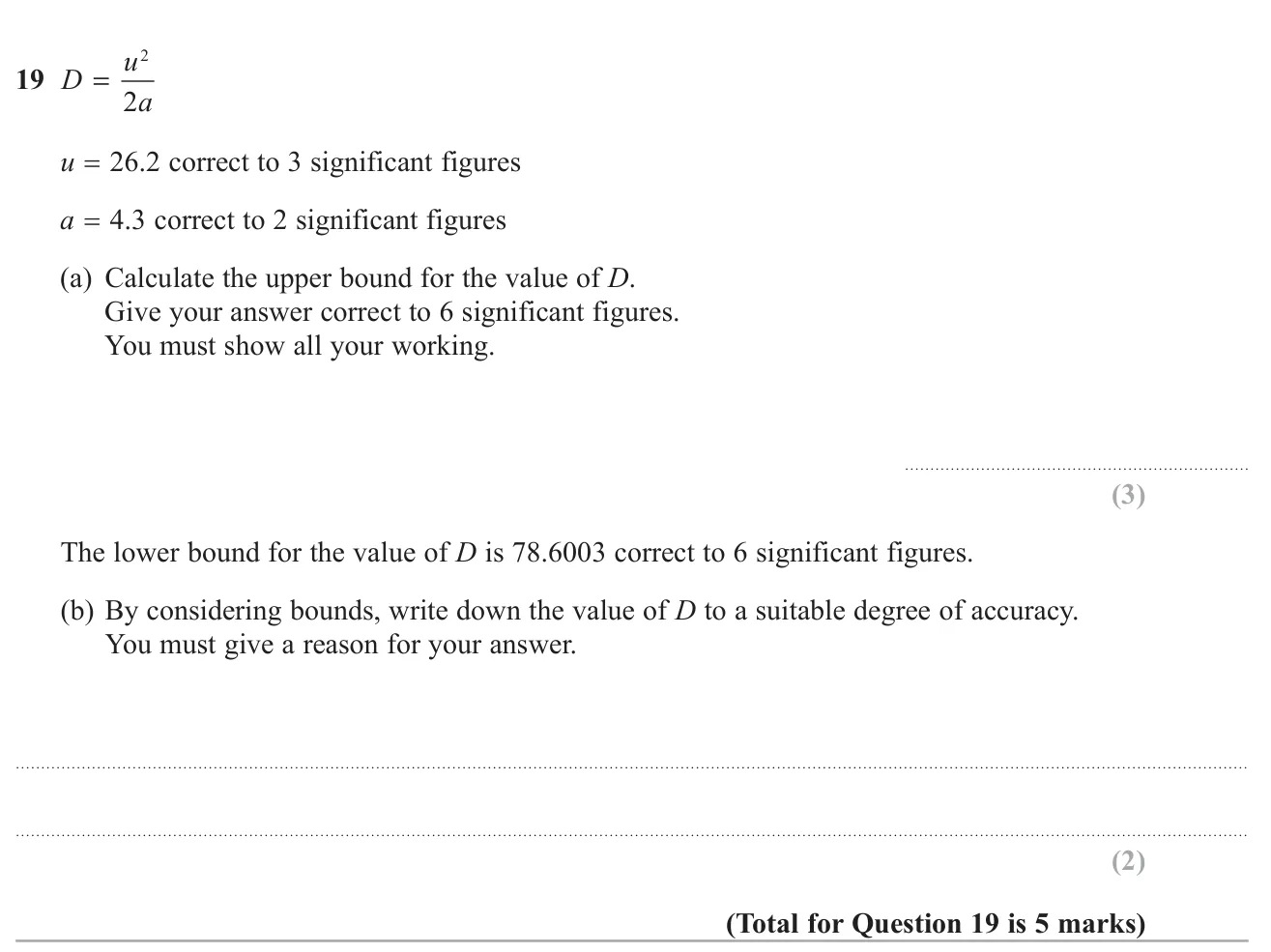
© Pearson Education Ltd. June 2019 Paper 3 (Higher, calculator), question 19.
(a) 81.0662 81.0662 81.0662 3 marks (b) 80, because both bounds round to 80 to the nearest 10 2 marks
Worked solution Checked against the mark scheme
(a) u u u a a a
Largest D D D
D m a x = 26.25 2 2 × 4.25 = 689.0625 8.5 = 81.0662 D_{max} = \frac{26.25^2}{2 \times 4.25} = \frac{689.0625}{8.5} = 81.0662 D ma x = 2 × 4.25 26.2 5 2 = 8.5 689.0625 = 81.0662
(b) Lower bound 78.6003, upper bound 81.0662. They differ at 1 s.f. in the units but both round to 80 to the nearest 10, so D = 80 D = 80 D = 80
Watch out: Using the upper bound of a in the denominator.
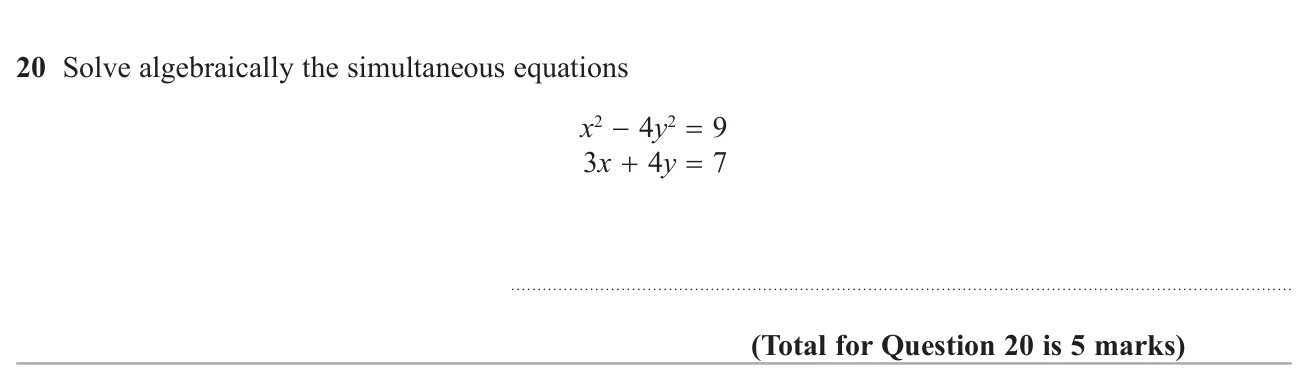
© Pearson Education Ltd. June 2019 Paper 3 (Higher, calculator), question 20.
Answer x = 5 , y = − 2 x = 5, y = -2 x = 5 , y = − 2 x = 17 5 , y = − 4 5 x = \frac{17}{5}, y = -\frac{4}{5} x = 5 17 , y = − 5 4 5 marks
Worked solution Checked against the mark scheme
From 3 x + 4 y = 7 3x + 4y = 7 3 x + 4 y = 7 4 y = 7 − 3 x 4y = 7 - 3x 4 y = 7 − 3 x 4 y 2 = ( 7 − 3 x ) 2 4 4y^2 = \frac{(7-3x)^2}{4} 4 y 2 = 4 ( 7 − 3 x ) 2
x 2 − 49 − 42 x + 9 x 2 4 = 9 ⇒ 4 x 2 − 49 + 42 x − 9 x 2 = 36 x^2 - \frac{49 - 42x + 9x^2}{4} = 9 \Rightarrow 4x^2 - 49 + 42x - 9x^2 = 36 x 2 − 4 49 − 42 x + 9 x 2 = 9 ⇒ 4 x 2 − 49 + 42 x − 9 x 2 = 36
5 x 2 − 42 x + 85 = 0 ⇒ ( 5 x − 17 ) ( x − 5 ) = 0 5x^2 - 42x + 85 = 0 \Rightarrow (5x - 17)(x - 5) = 0 5 x 2 − 42 x + 85 = 0 ⇒ ( 5 x − 17 ) ( x − 5 ) = 0
x = 5 ⇒ y = 7 − 15 4 = − 2 x = 5 \Rightarrow y = \frac{7 - 15}{4} = -2 x = 5 ⇒ y = 4 7 − 15 = − 2
x = 17 5 ⇒ y = 7 − 10.2 4 = − 4 5 x = \frac{17}{5} \Rightarrow y = \frac{7 - 10.2}{4} = -\frac{4}{5} x = 5 17 ⇒ y = 4 7 − 10.2 = − 5 4
Watch out: Squaring 4y as 4y² instead of 16y² when substituting.
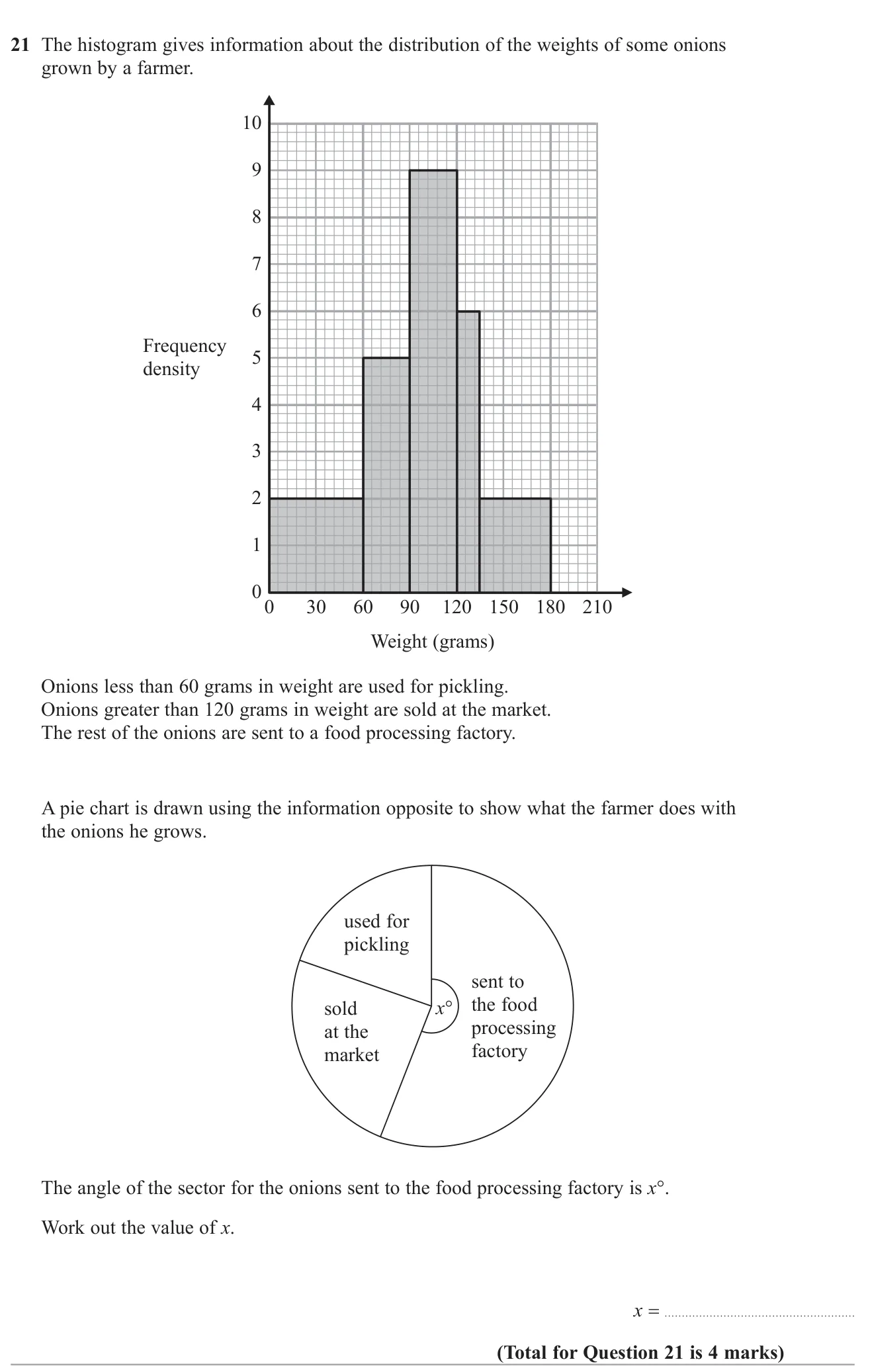
© Pearson Education Ltd. June 2019 Paper 3 (Higher, calculator), question 21.
Answer x = 210 x = 210 x = 210 4 marks
Worked solution Checked against the mark scheme
Frequency = frequency density × width:
0–60: 2 × 60 = 120 2 \times 60 = 120 2 × 60 = 120 5 × 30 = 150 5 \times 30 = 150 5 × 30 = 150 9 × 30 = 270 9 \times 30 = 270 9 × 30 = 270 6 × 15 = 90 6 \times 15 = 90 6 × 15 = 90 2 × 45 = 90 2 \times 45 = 90 2 × 45 = 90
Total = 720 = 720 = 720 150 + 270 = 420 150 + 270 = 420 150 + 270 = 420
x = 420 720 × 360 = 210 x = \frac{420}{720} \times 360 = 210 x = 720 420 × 360 = 210
Watch out: Using the bar heights as frequencies.
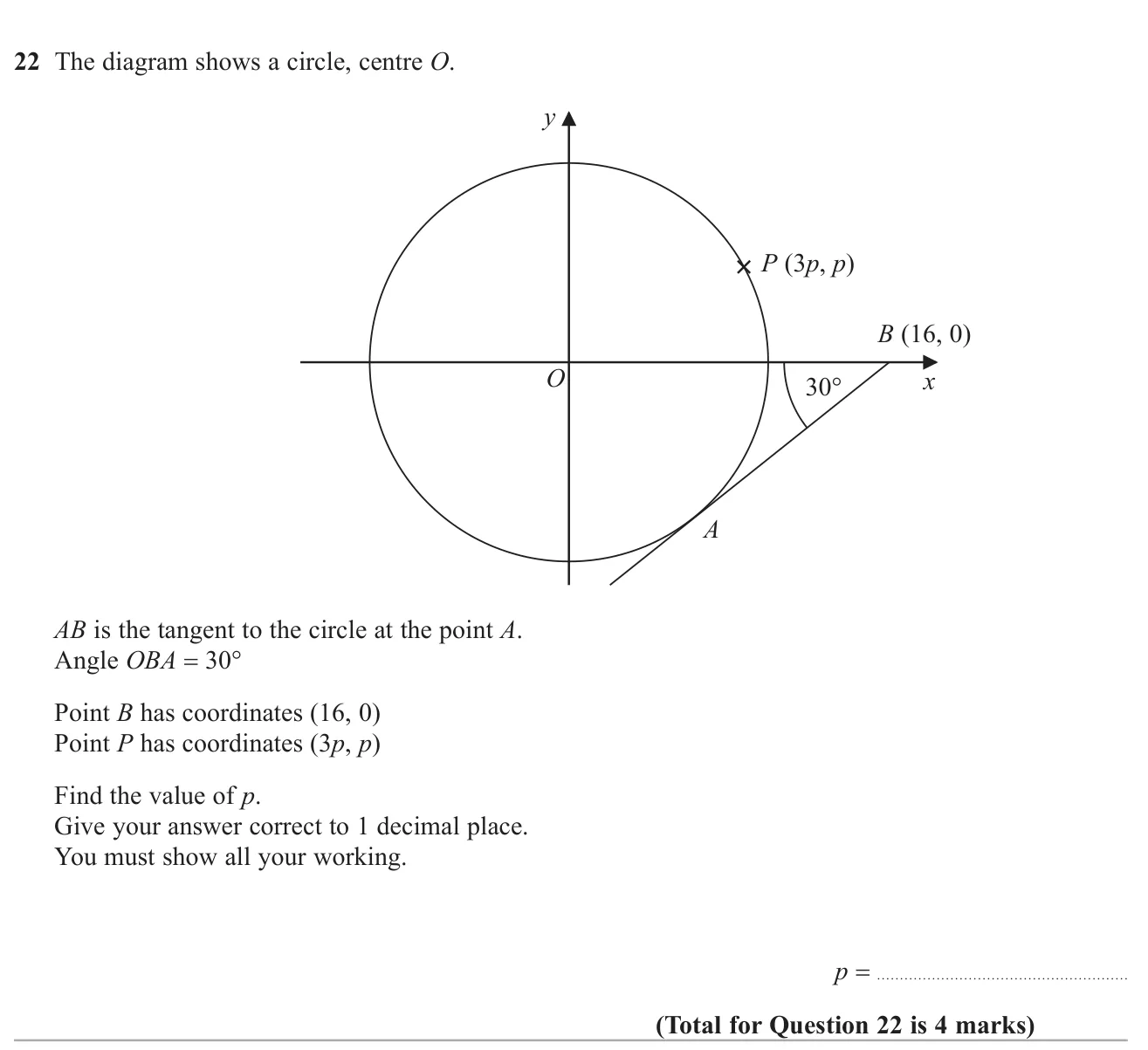
© Pearson Education Ltd. June 2019 Paper 3 (Higher, calculator), question 22.
Answer p = 2.5 p = 2.5 p = 2.5 4 marks
Worked solution Checked against the mark scheme
Tangent meets radius at 90°, so triangle O A B OAB O A B A A A
O A = 16 sin 30 ° = 8 OA = 16 \sin 30° = 8 O A = 16 sin 30° = 8 x 2 + y 2 = 64 x^2 + y^2 = 64 x 2 + y 2 = 64
( 3 p ) 2 + p 2 = 64 ⇒ 10 p 2 = 64 ⇒ p 2 = 6.4 (3p)^2 + p^2 = 64 \Rightarrow 10p^2 = 64 \Rightarrow p^2 = 6.4 ( 3 p ) 2 + p 2 = 64 ⇒ 10 p 2 = 64 ⇒ p 2 = 6.4
p = 2.529... = 2.5 p = 2.529... = 2.5 p = 2.529... = 2.5
Watch out: Writing 3p² instead of (3p)², giving 4p² = 64.
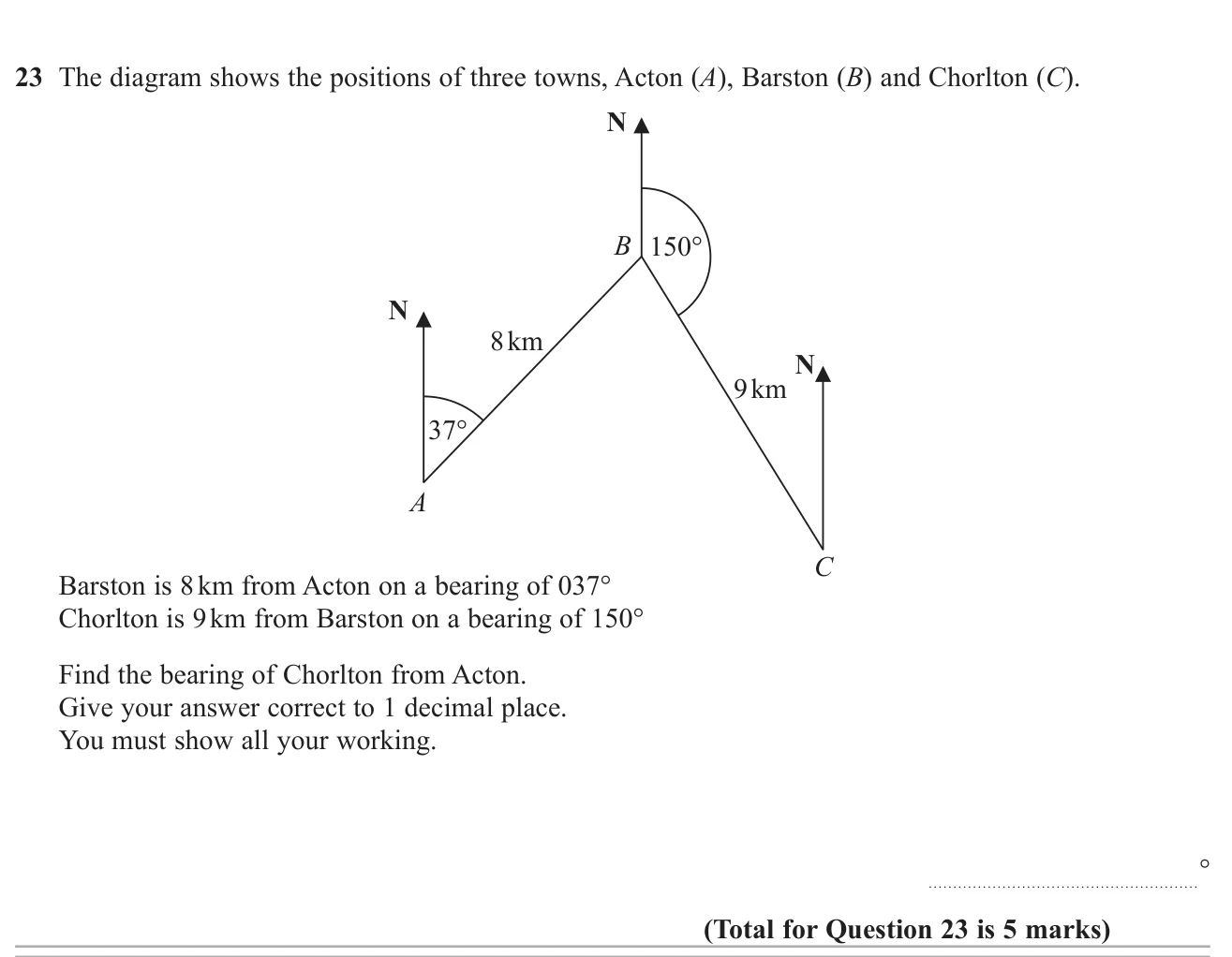
© Pearson Education Ltd. June 2019 Paper 3 (Higher, calculator), question 23.
Answer 098.6 ° 098.6° 098.6° 5 marks
Worked solution Checked against the mark scheme
The back-bearing of A A A B B B 217 ° 217° 217° A B C = 217 − 150 = 67 ° ABC = 217 - 150 = 67° A B C = 217 − 150 = 67°
A C 2 = 8 2 + 9 2 − 2 × 8 × 9 cos 67 ° = 88.73 AC^2 = 8^2 + 9^2 - 2 \times 8 \times 9 \cos 67° = 88.73 A C 2 = 8 2 + 9 2 − 2 × 8 × 9 cos 67° = 88.73 A C = 9.420 AC = 9.420 A C = 9.420
sin B A C = 9 sin 67 ° 9.420 ⇒ B A C = 61.58 ° \sin BAC = \frac{9 \sin 67°}{9.420} \Rightarrow BAC = 61.58° sin B A C = 9.420 9 s i n 67° ⇒ B A C = 61.58°
Bearing = 37 + 61.58 = 098.6 ° = 37 + 61.58 = 098.6° = 37 + 61.58 = 098.6°
Watch out: Using 150° − 37° = 113° as angle ABC.
Finished the paper? Add up your marks for all three papers and see what grade that would have been.