Geometry and measures

Bearings and scale drawings

9 past-paper questions, easiest first. Try each one, then reveal the answer.

Foundation & Higher8 of 9 from Foundation papers

Revision guide by The Full Marks

Bearings and scale drawings: what you need to know

Bearings describe direction as an angle from north, and scale drawings let you turn measurements on a map into real distances. These questions test careful measuring with a ruler and protractor, so accuracy is everything.

Key facts

  • A bearing is measured from north, clockwise, and written with three figures: 045∘045^\circ, not 45∘45^\circ.
  • 'The bearing of BB from AA' means stand at AA, face north, and turn clockwise to face BB.
  • Back bearing: add 180∘180^\circ if the bearing is under 180∘180^\circ, otherwise subtract 180∘180^\circ.
  • A scale of 1:50 0001 : 50\,000 means 11 cm on the map is 50 00050\,000 cm in real life. A scale like '11 cm represents 22 km' works the same way: multiply map cm by 22 to get km, or divide km by 22 to get map cm.
  • 100100 cm =1= 1 m, and 100 000100\,000 cm =1= 1 km.

Measuring or drawing a bearing

  1. Draw a north line at the point you are measuring from.
  2. Put the protractor's centre on that point with 0∘0^\circ on the north line.
  3. Measure clockwise. If the angle is more than 180∘180^\circ, measure the anticlockwise angle and subtract it from 360∘360^\circ.
  4. Write the answer with three figures.

Using a map scale

  1. Measure the length on the map in cm.
  2. Multiply by the scale number to get the real length in cm.
  3. Convert to m or km.
  4. To plot a point instead, work backwards: convert the real distance to map cm, draw the bearing from the north line, and mark the point that distance along it.

Worked examples

Example 1 Foundation · grade 3

A map of the Lake District has a scale of 1:50 0001 : 50\,000. Two villages are 6.46.4 cm apart on the map. How far apart are they in real life, in km?

Show the solution

Real distance =6.4×50 000=320 000= 6.4 \times 50\,000 = 320\,000 cm
320 000÷100 000=3.2320\,000 \div 100\,000 = 3.2 km

Example 2 Foundation · grade 5

The bearing of a lighthouse LL from a harbour HH is 070∘070^\circ. Work out the bearing of HH from LL.

Show the solution

The two north lines are parallel, so the angle turns round by 180∘180^\circ.
070+180=250070 + 180 = 250
The bearing of HH from LL is 250∘250^\circ.

Common mistakes

  • Measuring anticlockwise, or from the wrong point. Read 'from' carefully: that is where the north line goes.
  • Reading the wrong scale on the protractor. Ask yourself: is the angle acute or obtuse?
  • Converting cm to km by dividing by 10001000 instead of 100 000100\,000.

Exam tips

  • Answers are only accepted within a small tolerance, so measure carefully with a sharp pencil.
  • Leave your north lines and construction marks on the diagram; they can earn method marks.
  • Some bearing questions are worked out, not measured. North lines are parallel, so use alternate angles or co-interior angles (adding to 180∘180^\circ) with the other angle facts in the diagram.

Questions people ask

How do you measure a bearing?

Draw a north line at the starting point, then measure the angle clockwise from north to the line joining the two points. Always give three figures, such as 075∘075^\circ.

Why are bearings written with three figures?

So they can't be misread: 045∘045^\circ makes it clear the angle is under 100∘100^\circ. It is the standard way navigators write directions.

Exam questions: Bearings and scale drawings (9, easiest first)

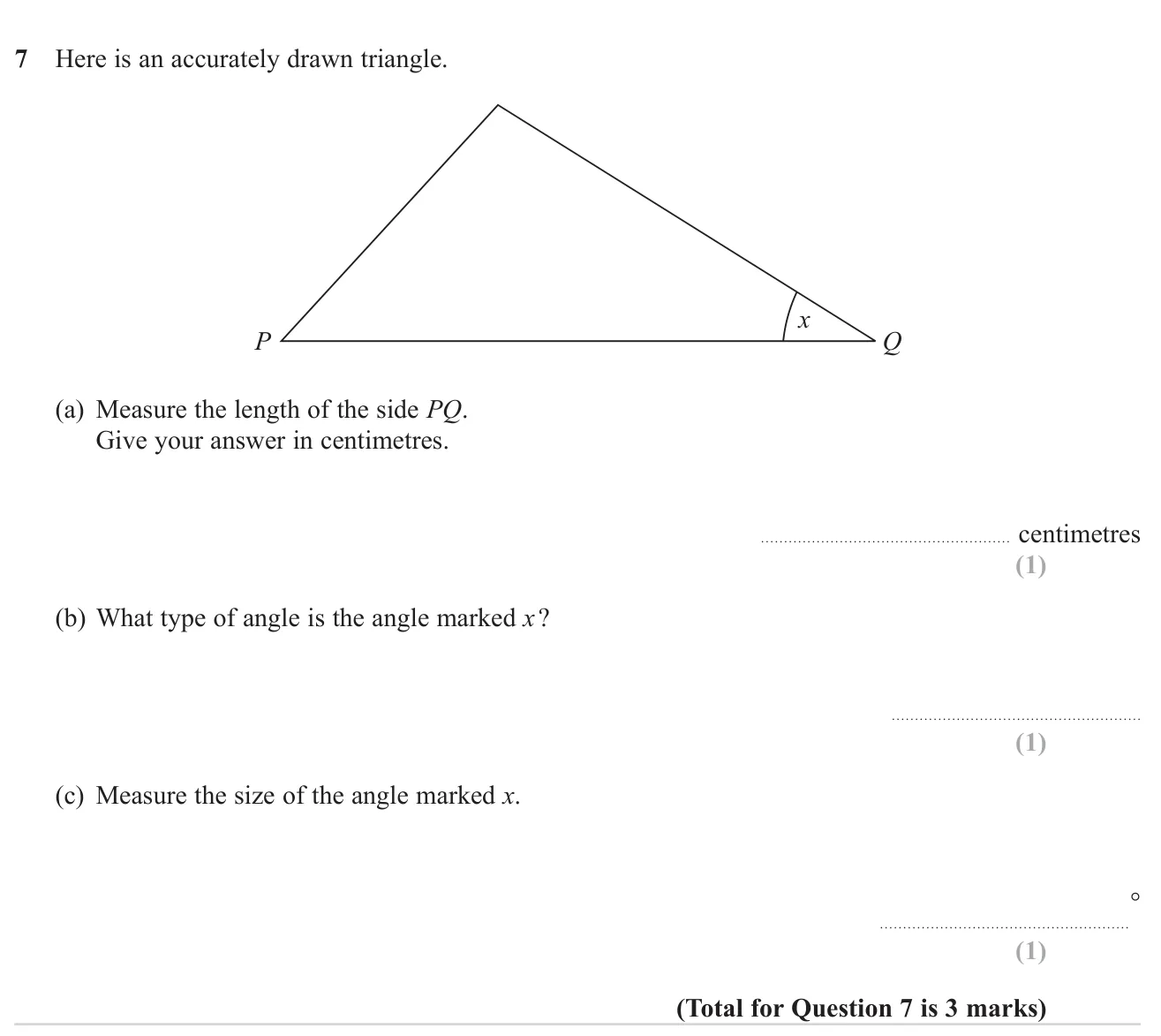
Bearings and scale drawings3 marksGrade 1No calculatorFoundation
November 2024 · Paper 1 Foundation · Q7
Measure a side and an angle of an accurately drawn triangle and name the angle type.

© Pearson Education Ltd. November 2024 Paper 1 (Foundation, non-calculator), question 7.

Show answer
(a)9.59.5 cm (9.3 to 9.7)1 mark
(b)acute1 mark
(c)32°32° (30 to 34)1 mark

Worked solution Checked against the mark scheme

(a) Place the ruler's zero on P and read off at Q: about 9.59.5 cm.

(b) The angle is smaller than 90°90°, so it is acute.

(c) Put the protractor's centre on the vertex and read from the zero line: about 32°32°.

Watch out: Reading the wrong scale on the protractor and giving 148°.
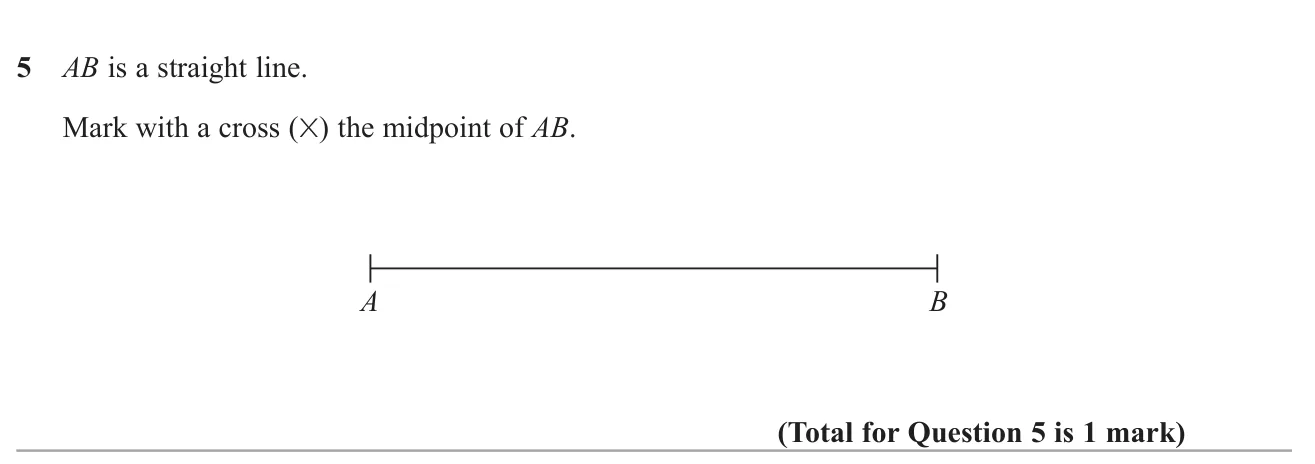
Bearings and scale drawings1 markGrade 1CalculatorFoundation
November 2021 · Paper 3 Foundation · Q5
Mark the point halfway along a given line segment.

© Pearson Education Ltd. November 2021 Paper 3 (Foundation, calculator), question 5.

Show answer
AnswerA cross at the midpoint of AB1 mark

Worked solution Checked against the mark scheme

Measure the length of AB with a ruler.

Halve that length, measure that far from A along the line, and mark a cross there.

Watch out: Estimating by eye instead of measuring.

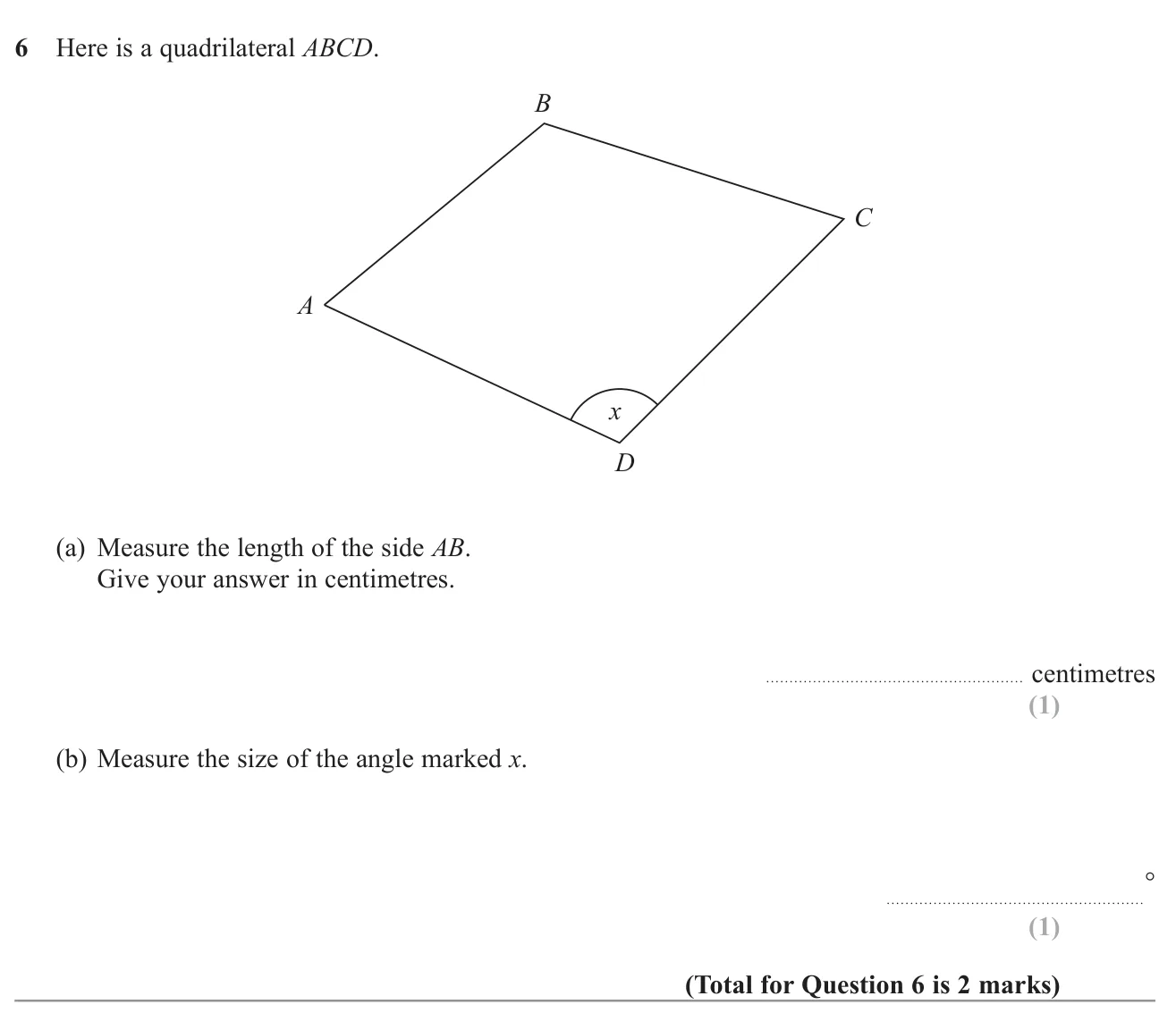
Bearings and scale drawings2 marksGrade 2CalculatorFoundation
November 2022 · Paper 2 Foundation · Q6
Use a ruler and protractor to measure one side and one angle of a drawn quadrilateral.

© Pearson Education Ltd. November 2022 Paper 2 (Foundation, calculator), question 6.

Show answer
(a)4.5 cm (4.3 to 4.7)1 mark
(b)110°110° (108 to 112)1 mark

Worked solution Checked against the mark scheme

(a) Line the zero of the ruler up with A and read off at B: about 4.5 cm.

(b) The angle is obtuse, so read the larger scale on the protractor: about 110°110°.

Watch out: Reading the wrong scale on the protractor and giving about 70°70°.

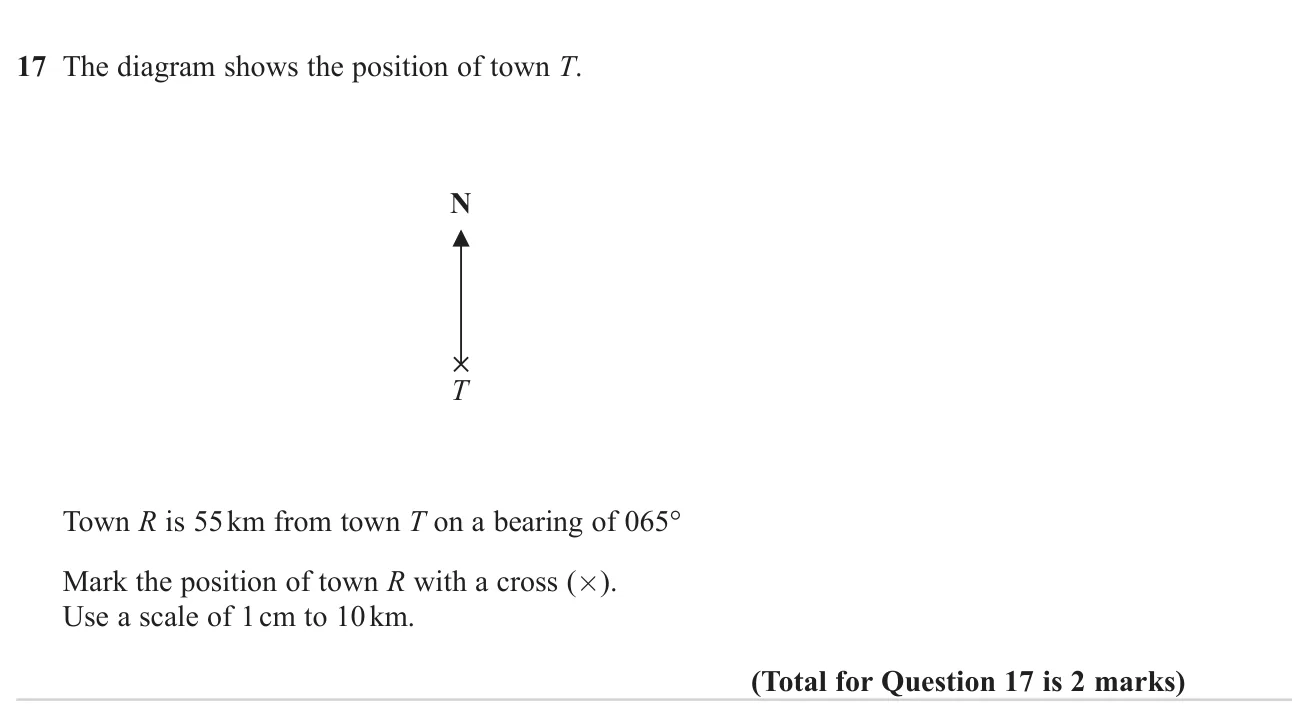
Bearings and scale drawings2 marksGrade 3CalculatorFoundation
June 2023 · Paper 3 Foundation · Q17
Plot a point from a bearing and a distance using a map scale.

© Pearson Education Ltd. June 2023 Paper 3 (Foundation, calculator), question 17.

Show answer
AnswerCross 5.5 cm from T on a bearing of 065°2 marks

Worked solution Checked against the mark scheme

Scale: 55 km ÷\div 10 = 5.5 cm.

Put the protractor on T, measure 65° clockwise from North, and mark a cross 5.5 cm from T along that line.

Watch out: Measuring the angle anticlockwise from North.

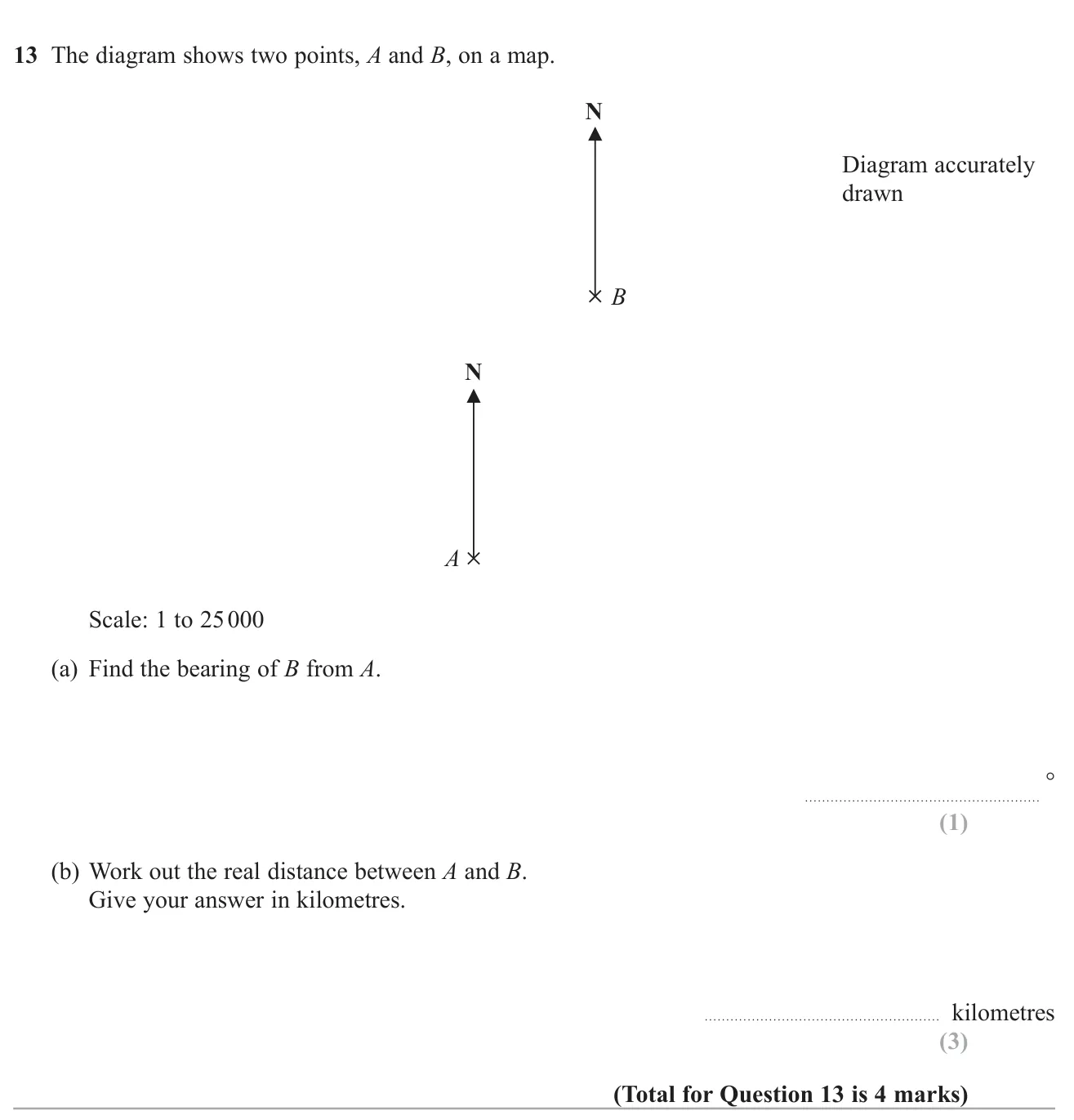
Bearings and scale drawings4 marksGrade 3No calculatorFoundation
November 2020 · Paper 1 Foundation · Q13
Measure a bearing between two points on an accurate map, then use a map ratio to find the real distance in kilometres.

© Pearson Education Ltd. November 2020 Paper 1 (Foundation, non-calculator), question 13.

Show answer
(a)025°025° (accept 23 to 27)1 mark
(b)1.25 km (accept 1.2 to 1.3)3 marks

Worked solution Checked against the mark scheme

(a) Put the protractor on the north line at A and measure clockwise to the line AB: about 25°25°, written 025°025°.

(b) AB measures about 5 cm on the map.

Real distance =5×25 000=125 000= 5 \times 25\,000 = 125\,000 cm =1250= 1250 m =1.25= 1.25 km.

Watch out: Converting cm straight to km by dividing by 1000 instead of 100 000.

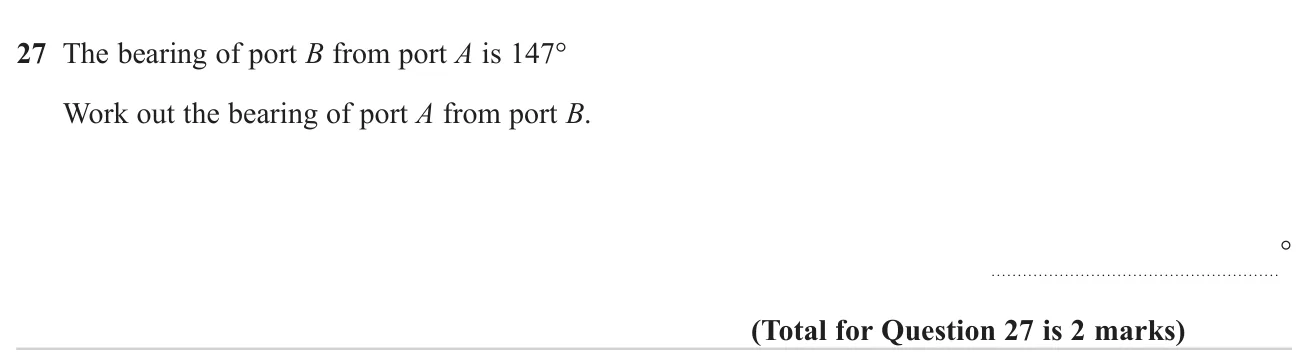
Bearings and scale drawings2 marksGrade 4CalculatorOn both tiers
November 2023 · Paper 2 Foundation · Q27
Find a back bearing from a given bearing.

© Pearson Education Ltd. November 2023 Paper 2 (Foundation, calculator), question 27.

Show answer
Answer327°2 marks

Worked solution Checked against the mark scheme

The return bearing differs by 180°180°.

147+180=327°147 + 180 = 327°

Watch out: Subtracting from 360 to give 213°.

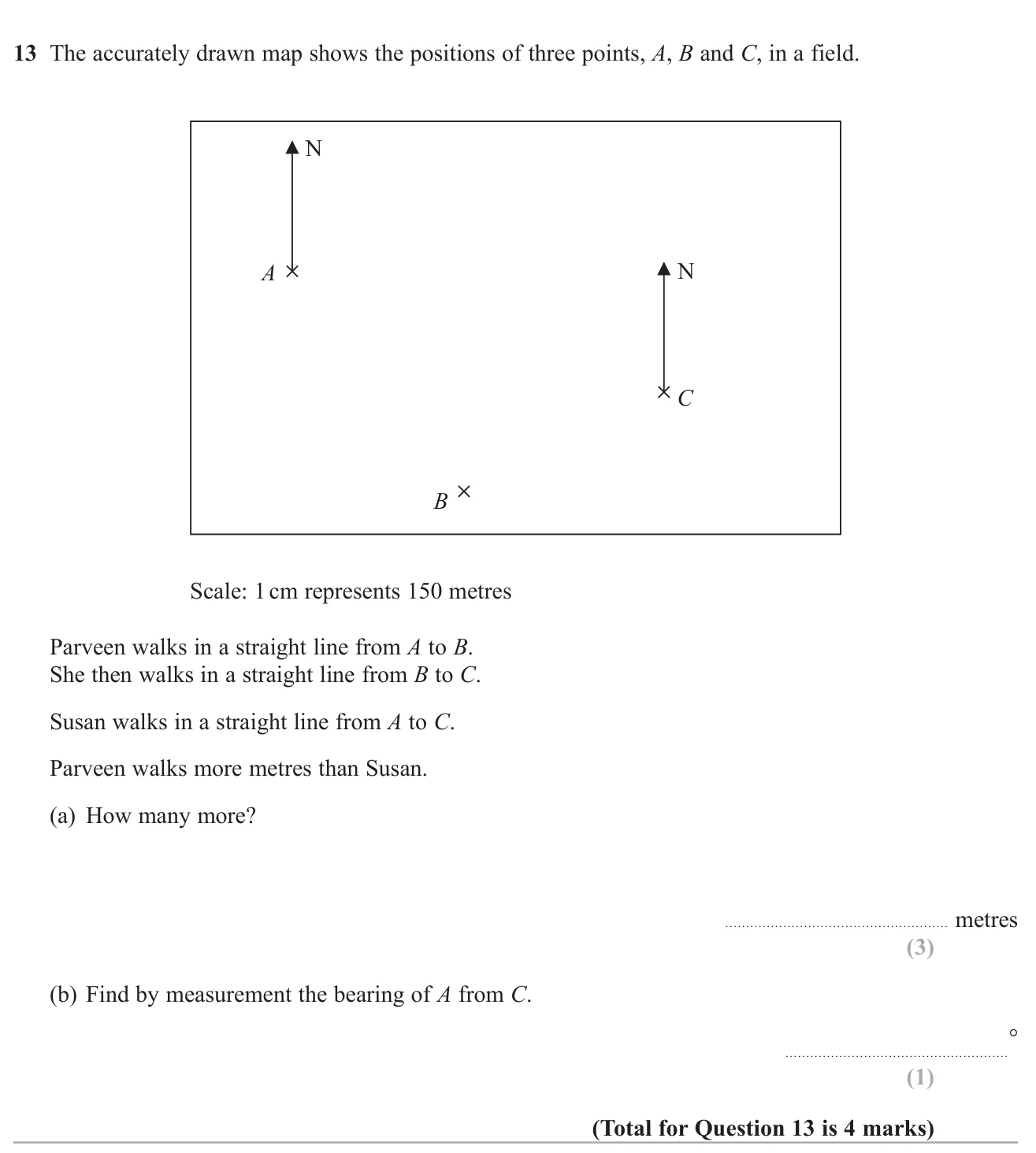
Bearings and scale drawings4 marksGrade 4CalculatorFoundation
June 2022 · Paper 3 Foundation · Q13
Measure distances on a scale map to compare two routes, then measure a bearing.

© Pearson Education Ltd. June 2022 Paper 3 (Foundation, calculator), question 13.

Show answer
(a)300 metres (210 to 390 accepted)3 marks
(b)288° (286 to 290 accepted)1 mark

Worked solution Checked against the mark scheme

(a) Measure: AB ≈ 5 cm, BC ≈ 4 cm, AC ≈ 7 cm.

Parveen: 5+4=95 + 4 = 9 cm, Susan: 7 cm, so a difference of 2 cm.

2×150=3002 \times 150 = 300 metres

(b) At C, measure clockwise from North round to the line CA: about 288°288°.

Watch out: Measuring the bearing anticlockwise, or from A instead of C.

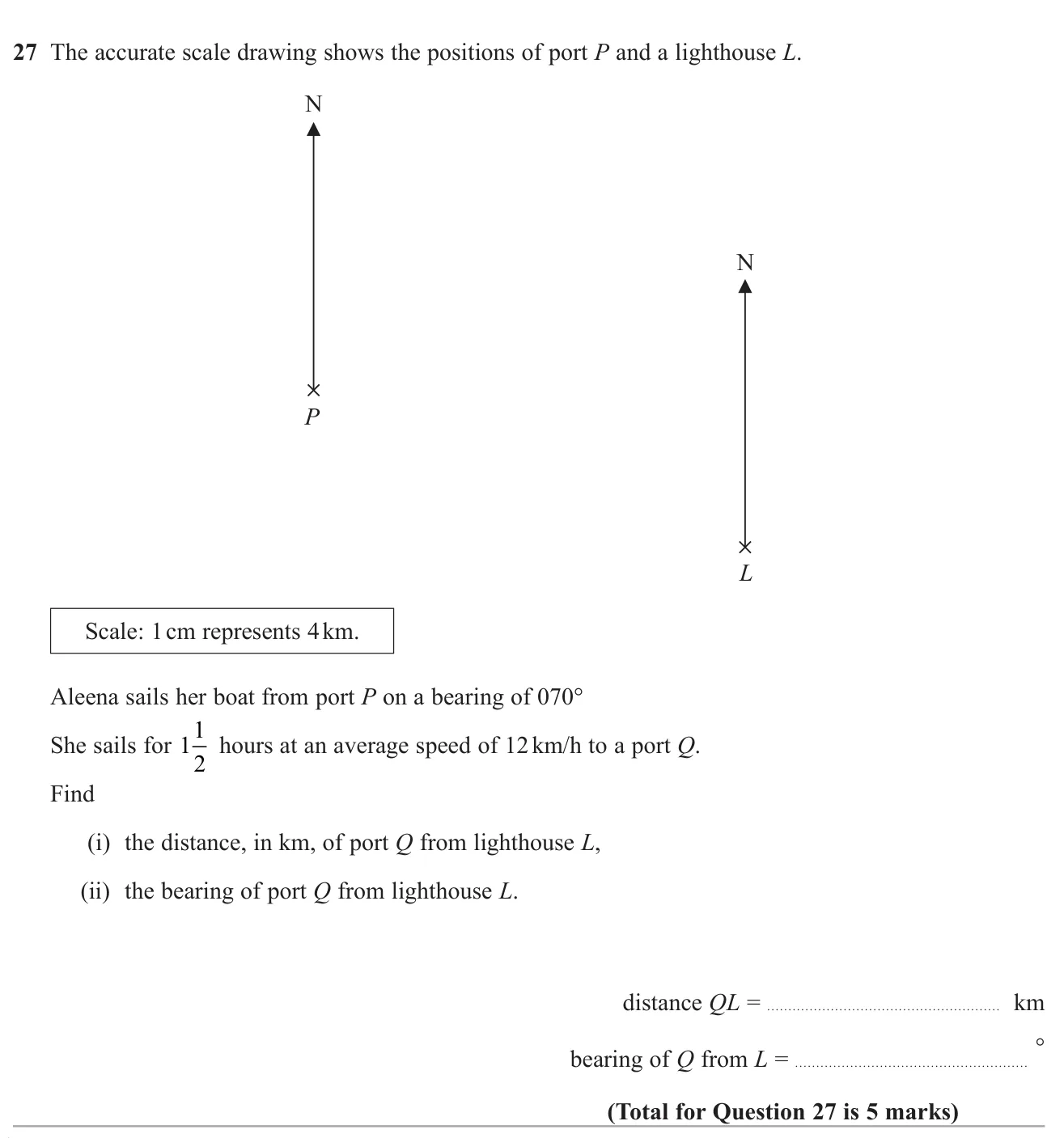
Bearings and scale drawings5 marksGrade 5No calculatorOn both tiers
November 2019 · Paper 1 Foundation · Q27
On a scale drawing, plot a boat's position from a bearing, speed and time, then measure its distance and bearing from a lighthouse.

© Pearson Education Ltd. November 2019 Paper 1 (Foundation, non-calculator), question 27.

Show answer
((i))Distance in the range 2020 to 2323 km4 marks
((ii))Bearing in the range 317°317° to 330°330°1 mark

Worked solution Checked against the mark scheme

Distance PQ=12×1.5=18PQ = 12 \times 1.5 = 18 km

On the drawing: 18÷4=4.518 \div 4 = 4.5 cm

From PP, measure 70°70° clockwise from north and mark QQ 4.5 cm along that line.

(i) Measure QLQL in cm and multiply by 4 (about 20 to 23 km).

(ii) At LL, measure clockwise from north round to QQ: about 317°317° to 330°330°.

Watch out: Measuring the bearing anticlockwise from north.

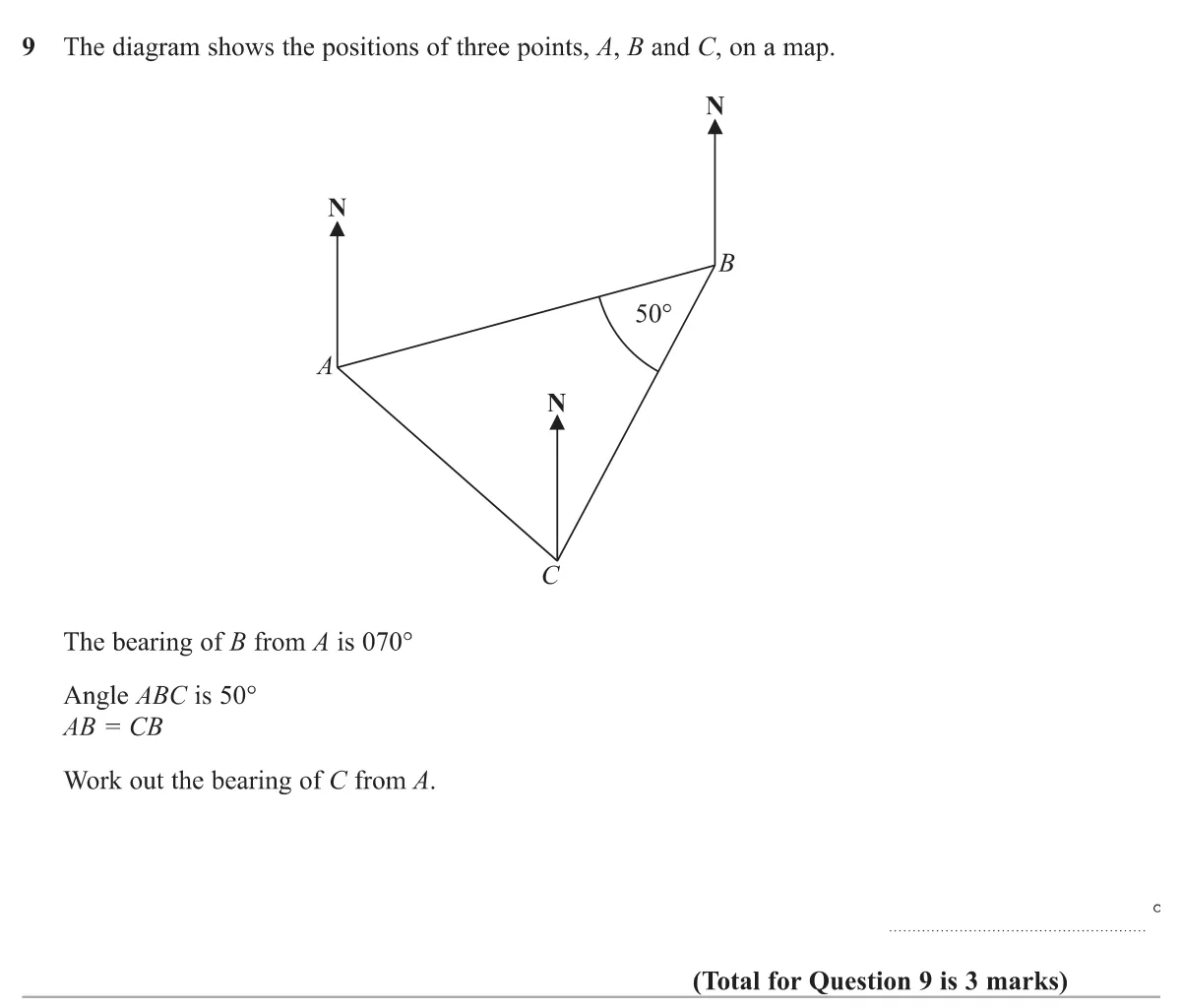
Bearings and scale drawings3 marksGrade 5CalculatorHigher
Specimen · Paper 2 Higher · Q9
Use an isosceles triangle and a given bearing to find the bearing of one point from another.

© Pearson Education Ltd. Specimen Paper 2 (Higher, calculator), question 9.

Show answer
Answer135°3 marks

Worked solution Checked against the mark scheme

Triangle ABCABC is isosceles with AB=CBAB = CB, so angles at AA and CC are equal.

∠BAC=(180−50)÷2=65°\angle BAC = (180 - 50) \div 2 = 65°

Bearing of CC from AA =70+65=135°= 70 + 65 = 135°

Watch out: Taking 65° as the bearing, forgetting to add the 70°.

Also tested in these questions

Their main topic is different, but part of each one tests this topic.