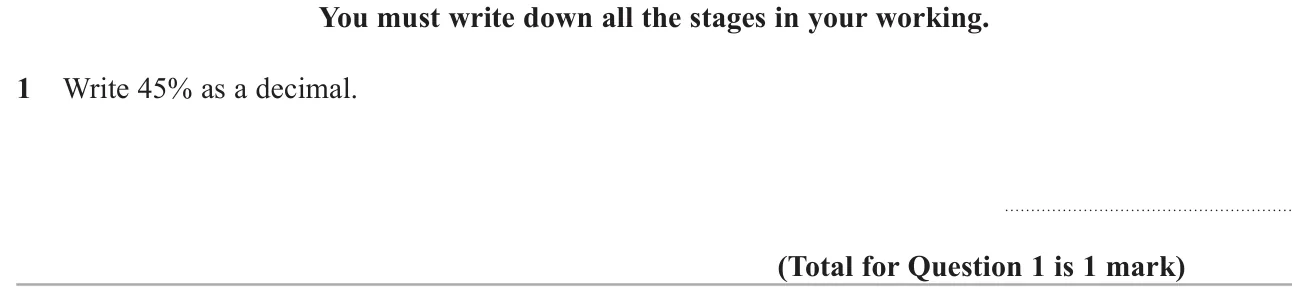
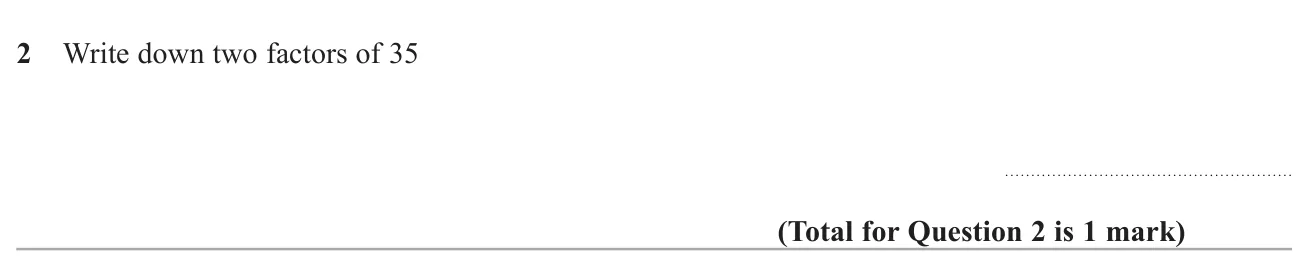
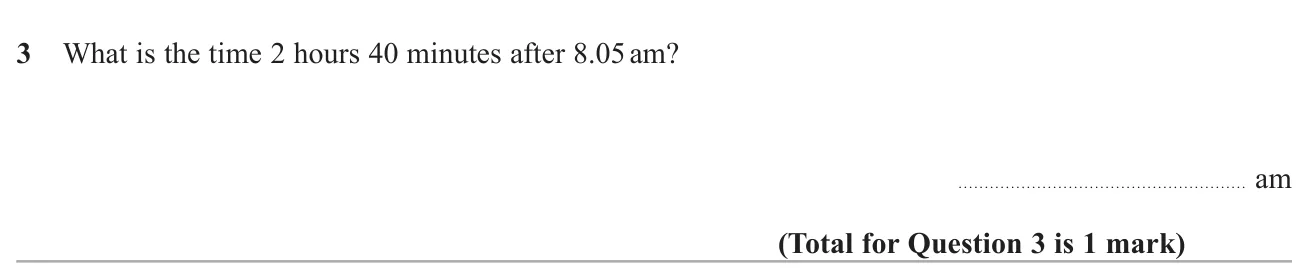
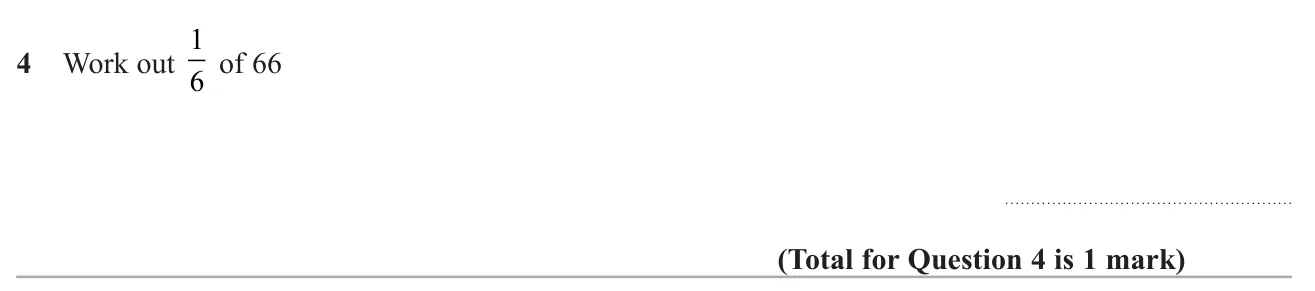
© Pearson Education Ltd. November 2021 Paper 3 (Foundation, calculator), question 1.
Show answer
Worked solution Checked against the mark scheme
Per cent means out of 100, so divide by 100.
45÷100=0.45
Watch out: Writing 4.5 or 0.045 by moving the decimal point the wrong number of places.
© Pearson Education Ltd. November 2021 Paper 3 (Foundation, calculator), question 2.
Show answer
| Answer | Any two of 1, 5, 7, 35 | 1 mark |
|---|
Worked solution Checked against the mark scheme
Find pairs that multiply to 35: 1×35 and 5×7.
So the factors are 1, 5, 7 and 35. Any two of these will do, e.g. 5 and 7.
Watch out: Giving multiples of 35 (such as 70) instead of factors.
© Pearson Education Ltd. November 2021 Paper 3 (Foundation, calculator), question 3.
Show answer
Worked solution Checked against the mark scheme
Add the 2 hours first: 8.05 am → 10.05 am.
Then add 40 minutes: 10.05 am → 10.45 am.
Watch out: Treating time as decimal and getting a wrong carry, e.g. 10.85.
© Pearson Education Ltd. November 2021 Paper 3 (Foundation, calculator), question 4.
Show answer
Worked solution Checked against the mark scheme
To find 61 of an amount, divide by 6.
66÷6=11
Watch out: Multiplying by 6 instead of dividing.
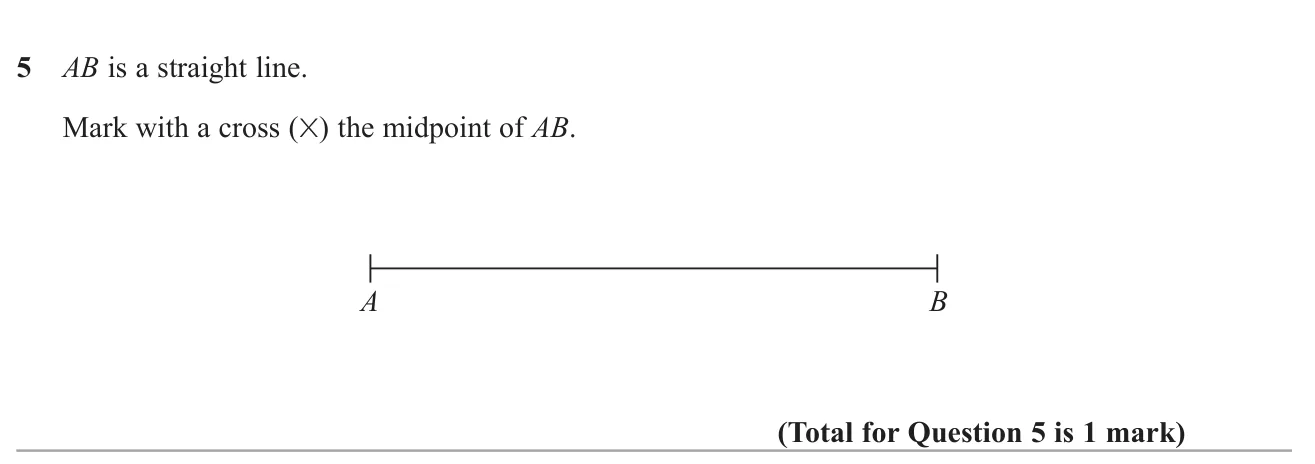
© Pearson Education Ltd. November 2021 Paper 3 (Foundation, calculator), question 5.
Show answer
| Answer | A cross at the midpoint of AB | 1 mark |
|---|
Worked solution Checked against the mark scheme
Measure the length of AB with a ruler.
Halve that length, measure that far from A along the line, and mark a cross there.
Watch out: Estimating by eye instead of measuring.
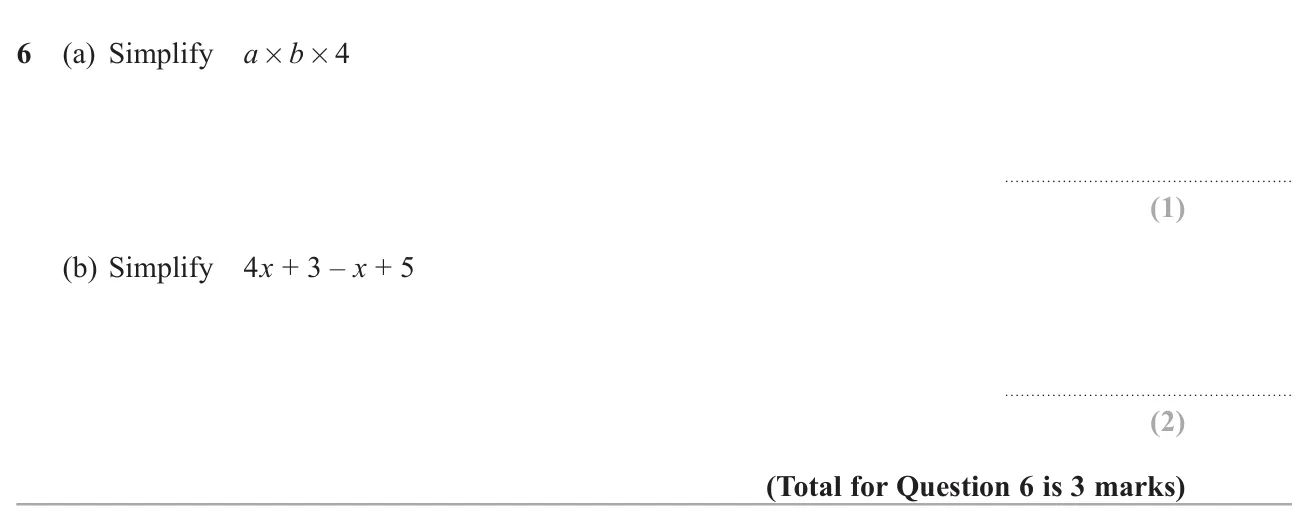
© Pearson Education Ltd. November 2021 Paper 3 (Foundation, calculator), question 6.
Show answer
| (a) | 4ab | 1 mark |
|---|
| (b) | 3x+8 | 2 marks |
|---|
Worked solution Checked against the mark scheme
(a) Write the number first and drop the multiplication signs: 4ab.
(b) Collect the x terms: 4x−x=3x.
Collect the numbers: 3+5=8.
So the answer is 3x+8.
Watch out: In (b), treating −x as −1 or getting 5x by adding instead of subtracting.
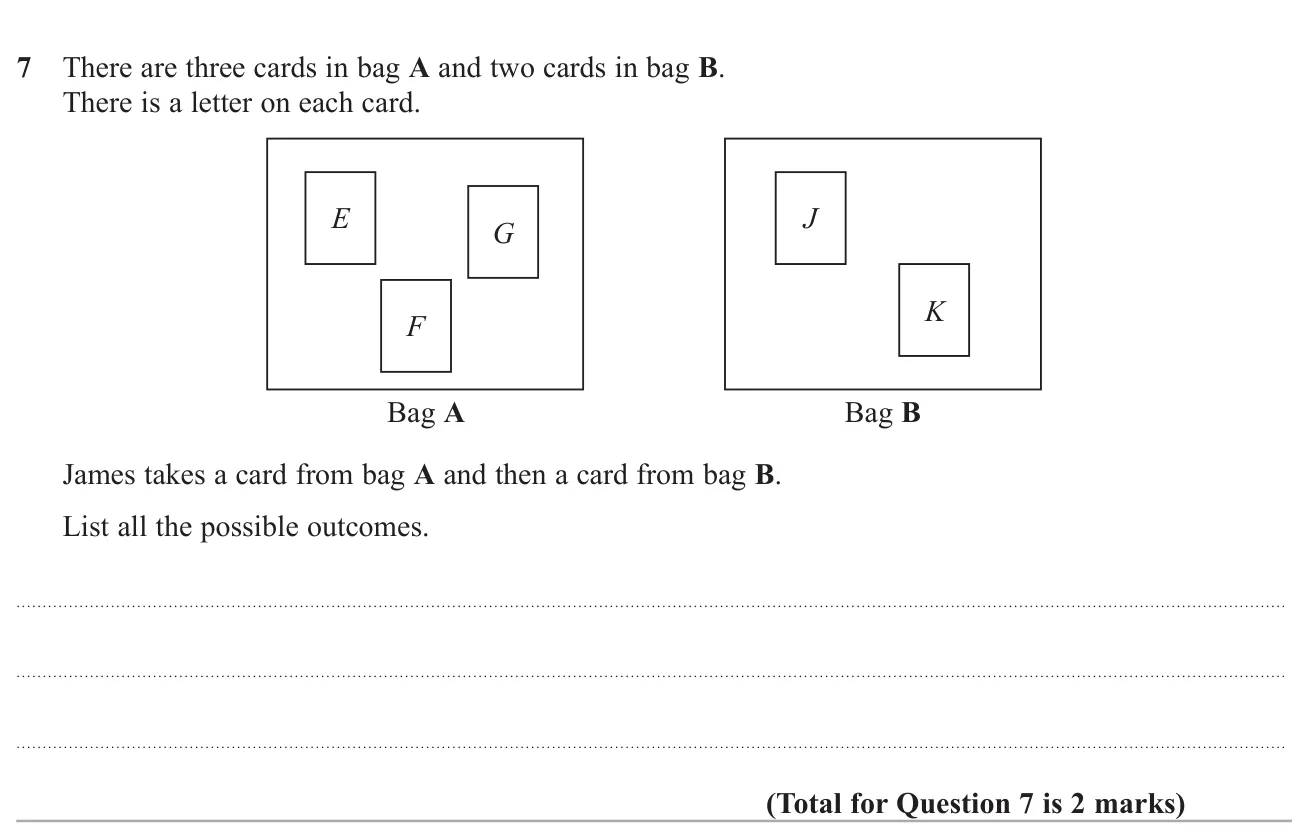
© Pearson Education Ltd. November 2021 Paper 3 (Foundation, calculator), question 7.
Show answer
| Answer | EJ, EK, FJ, FK, GJ, GK | 2 marks |
|---|
Worked solution Checked against the mark scheme
Work systematically: take each letter from bag A in turn and pair it with each letter from bag B.
E: EJ, EK
F: FJ, FK
G: GJ, GK
That gives 3×2=6 outcomes.
Watch out: Missing an outcome or listing the same pair twice.
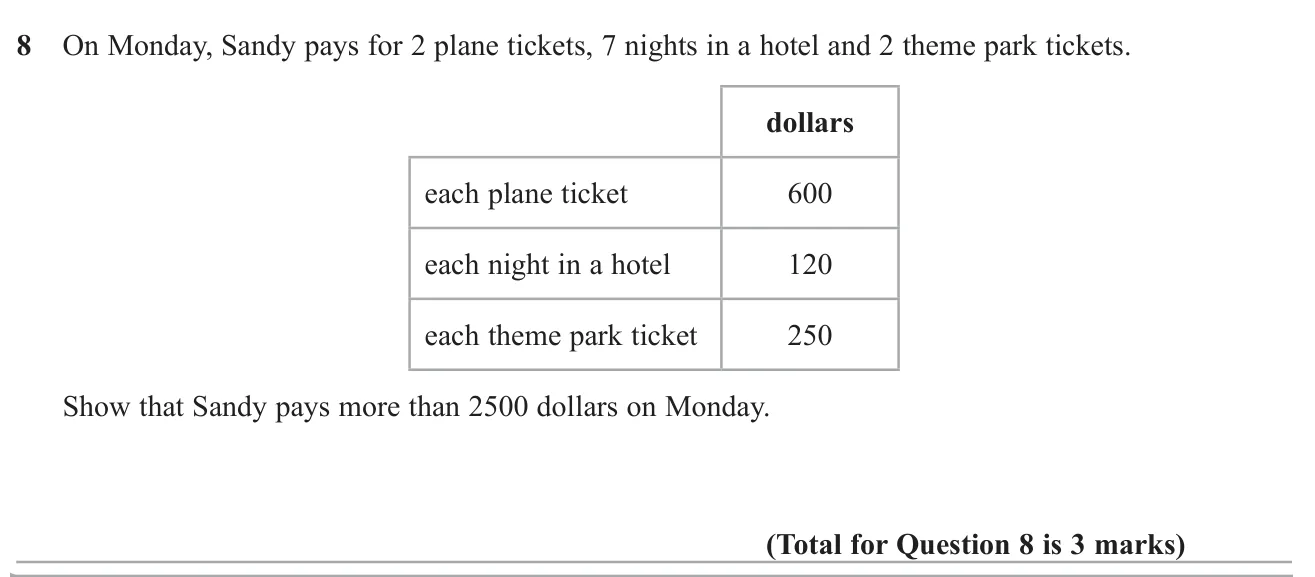
© Pearson Education Ltd. November 2021 Paper 3 (Foundation, calculator), question 8.
Show answer
| Answer | Total is 2540 dollars, which is more than 2500 | 3 marks |
|---|
Worked solution Checked against the mark scheme
Planes: 2×600=1200
Hotel: 7×120=840
Theme park: 2×250=500
Total: 1200+840+500=2540 dollars, and 2540>2500.
Watch out: Forgetting to multiply the hotel cost by the number of nights.
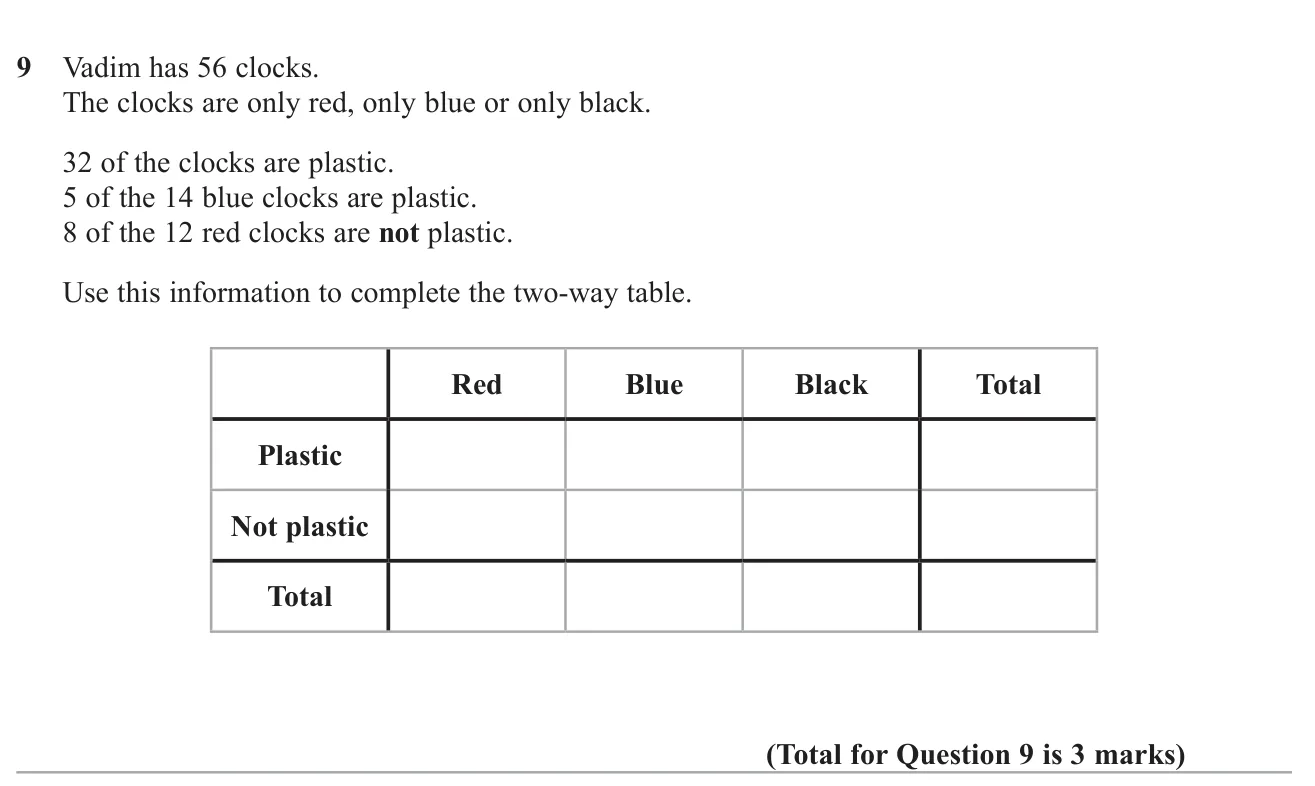
© Pearson Education Ltd. November 2021 Paper 3 (Foundation, calculator), question 9.
Show answer
| Answer | Plastic: 4, 5, 23, 32; Not plastic: 8, 9, 7, 24; Totals: 12, 14, 30, 56 | 3 marks |
|---|
Worked solution Checked against the mark scheme
Put in the given values: total 56, plastic total 32, blue total 14, blue plastic 5, red not plastic 8, red total 12.
Red plastic: 12−8=4. Blue not plastic: 14−5=9.
Black total: 56−12−14=30. Black plastic: 32−4−5=23.
Black not plastic: 30−23=7. Not plastic total: 56−32=24.
Watch out: Putting the given numbers in the wrong row, e.g. writing 8 as red plastic.
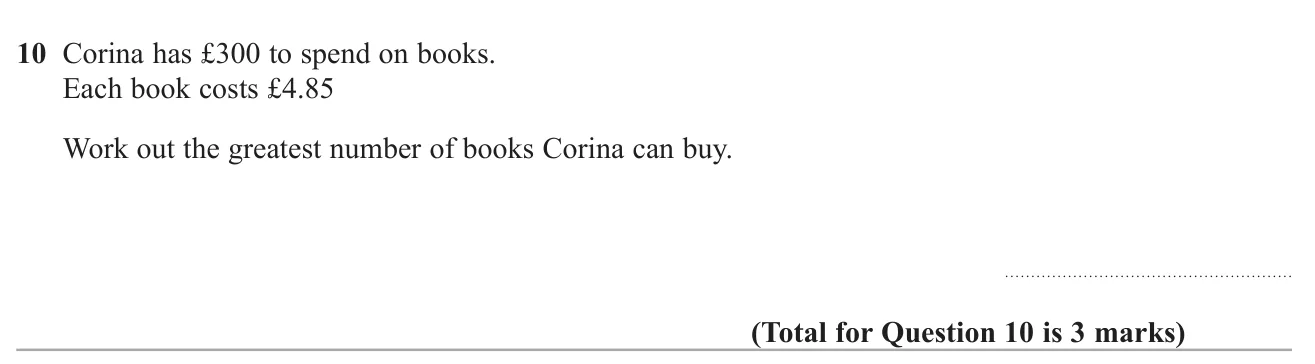
© Pearson Education Ltd. November 2021 Paper 3 (Foundation, calculator), question 10.
Show answer
Worked solution Checked against the mark scheme
300÷4.85=61.85...
She cannot buy part of a book, and 62 books would cost more than £300, so round down.
She can buy 61 books.
Watch out: Rounding 61.85 up to 62.
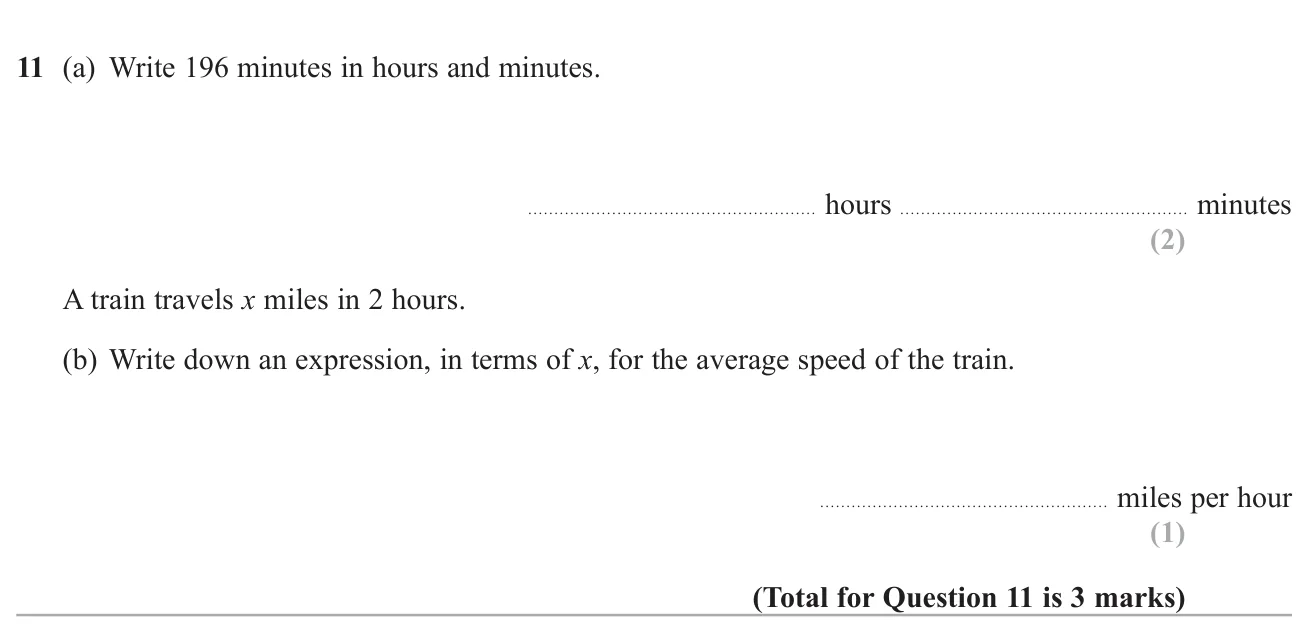
© Pearson Education Ltd. November 2021 Paper 3 (Foundation, calculator), question 11.
Show answer
| (a) | 3 hours 16 minutes | 2 marks |
|---|
| (b) | 2x | 1 mark |
|---|
Worked solution Checked against the mark scheme
(a) 3×60=180 minutes, and 196−180=16.
So 196 minutes is 3 hours 16 minutes.
(b) Speed = distance ÷ time, so the speed is 2x miles per hour.
Watch out: In (a), writing 3.26 hours as 3 hours 26 minutes.
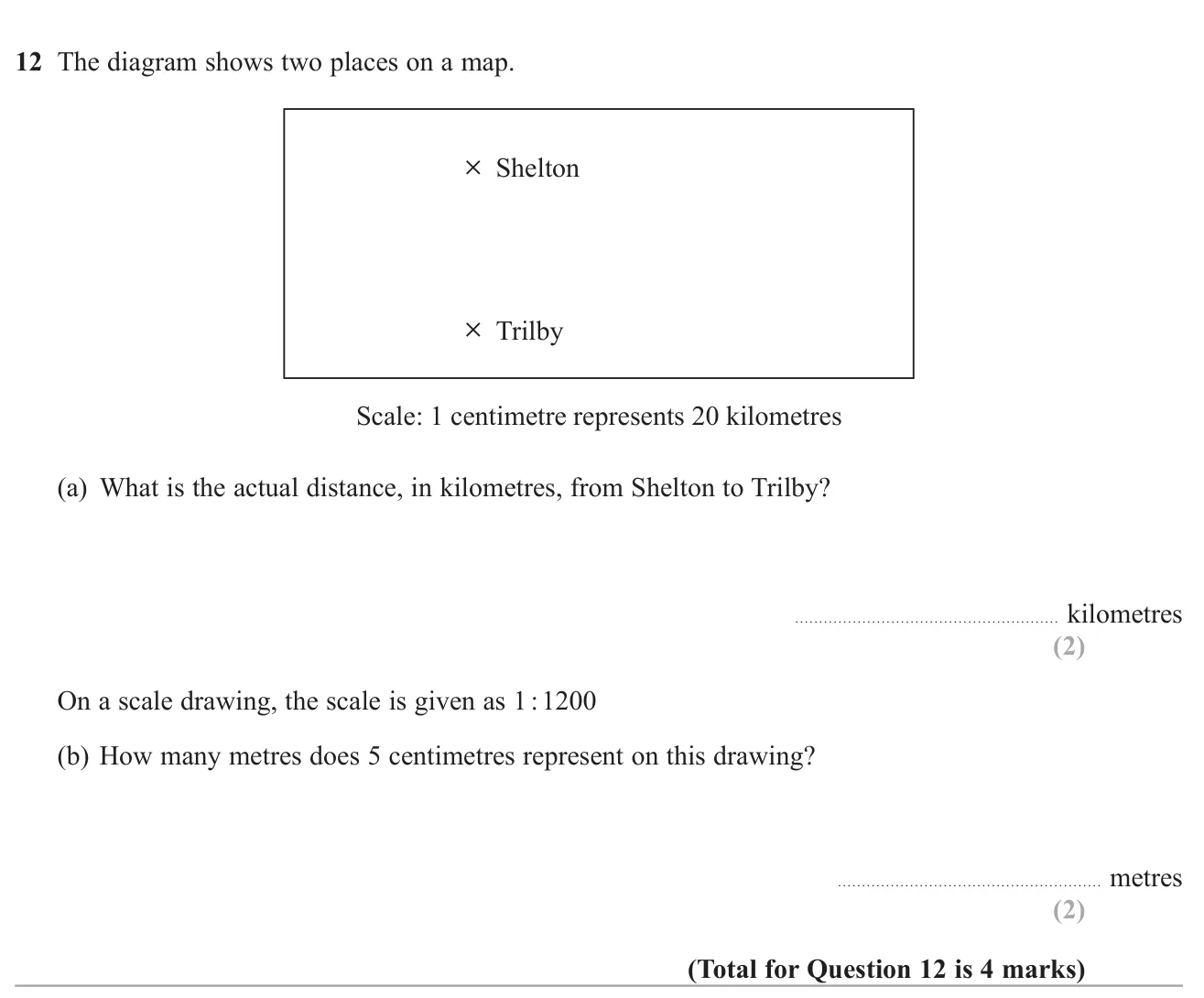
© Pearson Education Ltd. November 2021 Paper 3 (Foundation, calculator), question 12.
Show answer
| (a) | 50 km | 2 marks |
|---|
| (b) | 60 m | 2 marks |
|---|
Worked solution Checked against the mark scheme
(a) Measure the distance on the map: about 2.5 cm.
2.5×20=50 km
(b) 5×1200=6000 cm on the ground.
6000÷100=60 m
Watch out: In (b), giving 6000 without converting centimetres to metres.
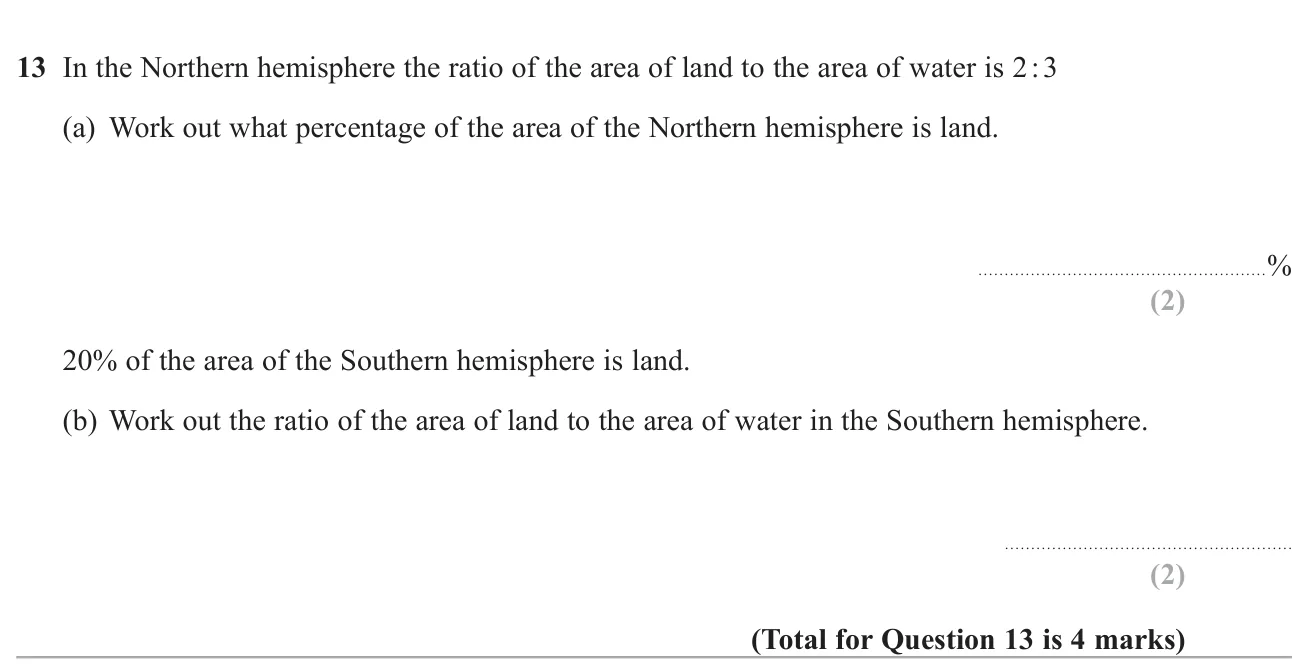
Question 13
Ratio4 marksGrade 3Calculator © Pearson Education Ltd. November 2021 Paper 3 (Foundation, calculator), question 13.
Show answer
| (a) | 40% | 2 marks |
|---|
| (b) | 20 : 80 | 2 marks |
|---|
Worked solution Checked against the mark scheme
(a) There are 2+3=5 parts, and land is 2 of them.
52×100=40%
(b) Water is 100−20=80%.
Land : water =20:80=1:4
Watch out: In (a), using 32 instead of 52.
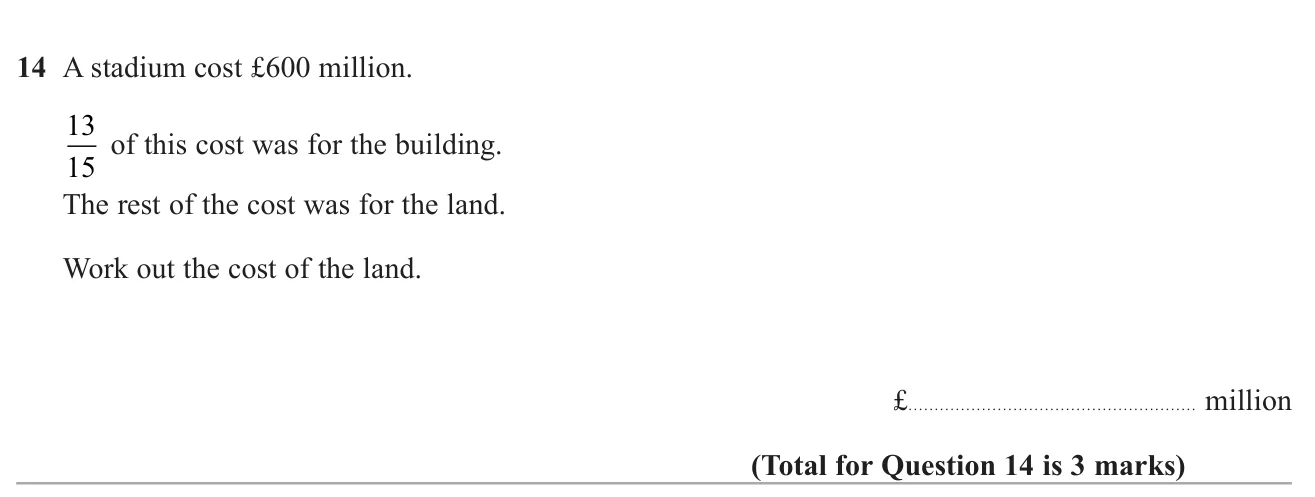
© Pearson Education Ltd. November 2021 Paper 3 (Foundation, calculator), question 14.
Show answer
Worked solution Checked against the mark scheme
The land is 1−1513=152 of the cost.
600÷15=40
40×2=80, so the land cost £80 million.
Watch out: Giving the building cost (£520 million) instead of the land cost.
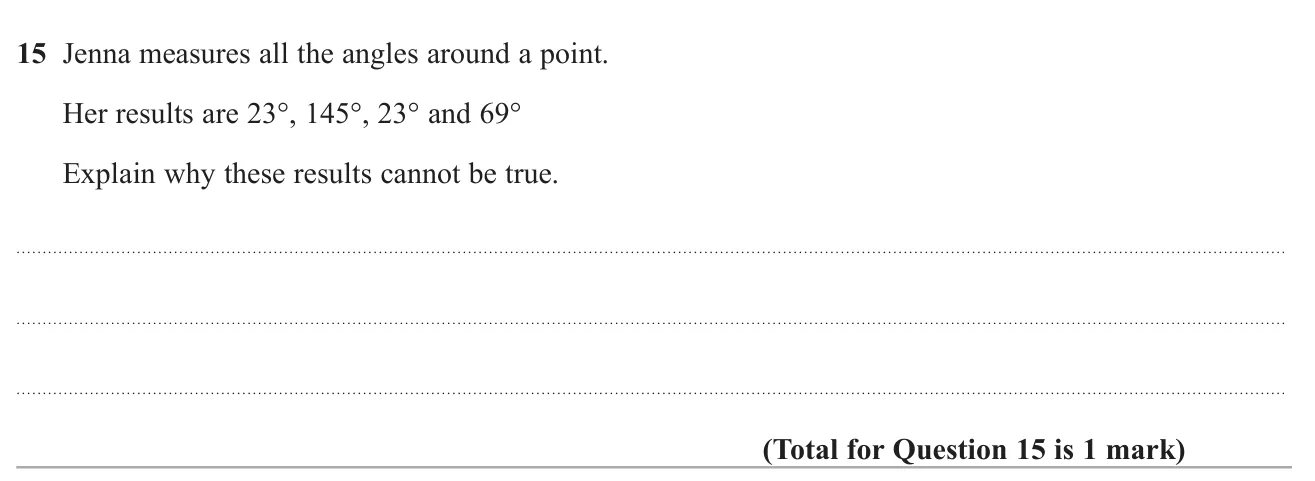
© Pearson Education Ltd. November 2021 Paper 3 (Foundation, calculator), question 15.
Show answer
| Answer | The angles only add up to 260°, but angles around a point add up to 360° | 1 mark |
|---|
Worked solution Checked against the mark scheme
Add the angles: 23+145+23+69=260°.
Angles around a point must add up to 360°, so these results cannot be right.
Watch out: Just stating the total (260°) without saying it should be 360°.
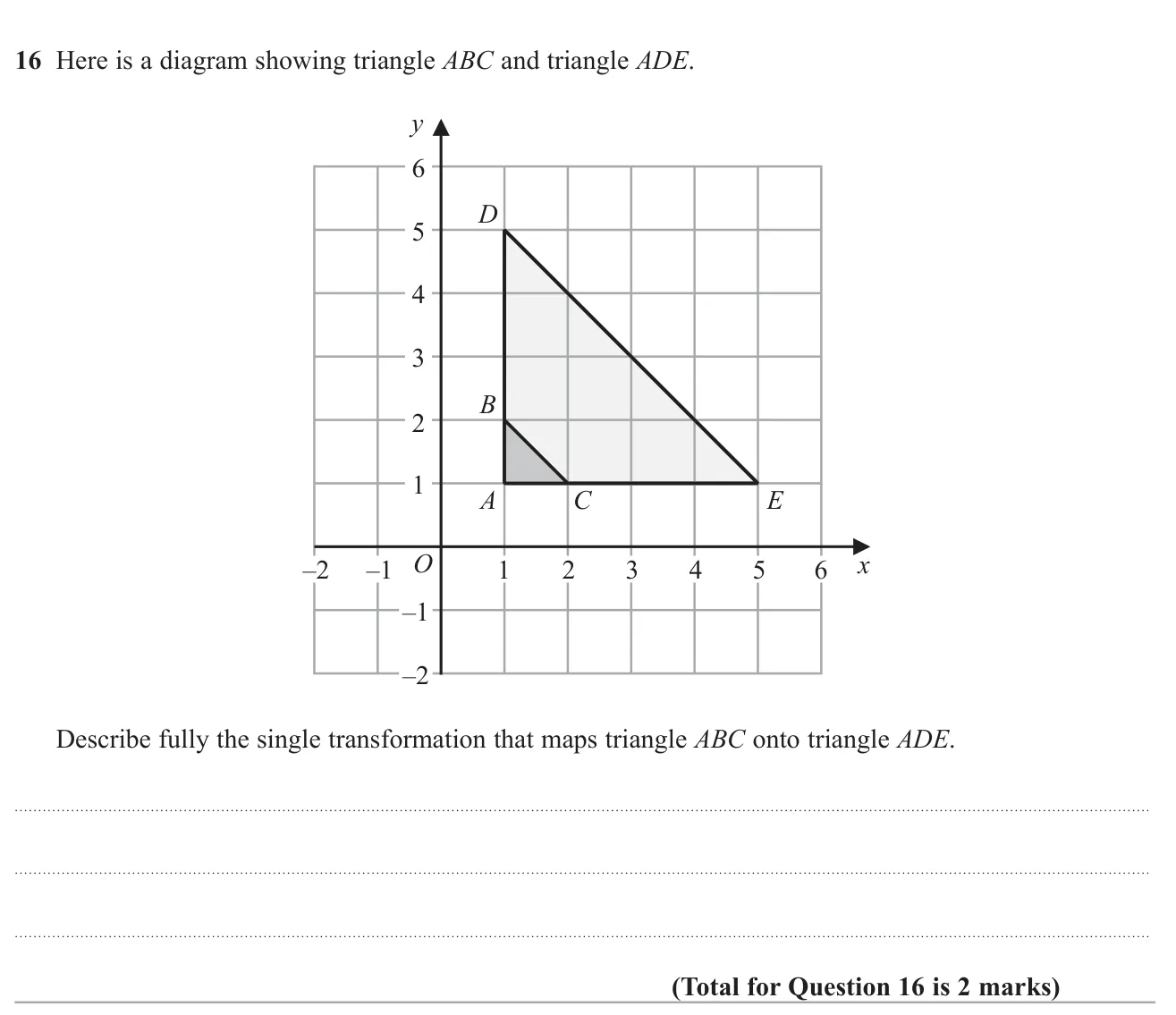
© Pearson Education Ltd. November 2021 Paper 3 (Foundation, calculator), question 16.
Show answer
| Answer | Enlargement, scale factor 4, centre (1, 1) | 2 marks |
|---|
Worked solution Checked against the mark scheme
The shape keeps the same angles but gets bigger, so it is an enlargement.
AB is 1 unit and AD is 4 units, so the scale factor is 4.
Point A stays still at (1,1), so that is the centre.
Enlargement, scale factor 4, centre (1,1).
Watch out: Leaving out the centre of enlargement, or mentioning a second transformation.
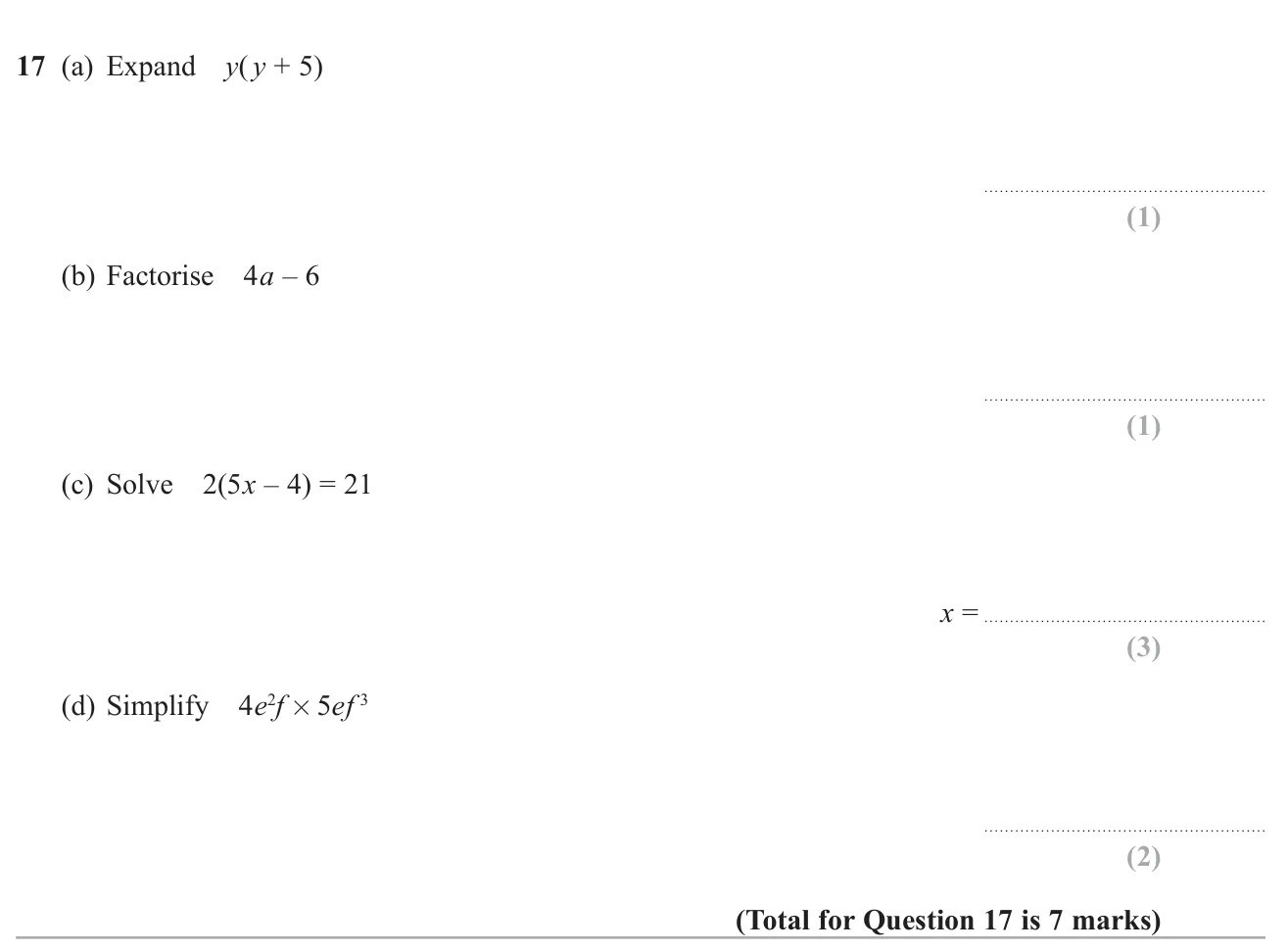
© Pearson Education Ltd. November 2021 Paper 3 (Foundation, calculator), question 17.
Show answer
| (a) | y2+5y | 1 mark |
|---|
| (b) | 2(2a−3) | 1 mark |
|---|
| (c) | x=2.9 | 3 marks |
|---|
| (d) | 20e3f4 | 2 marks |
|---|
Worked solution Checked against the mark scheme
(a) y×y+y×5=y2+5y
(b) The highest common factor of 4 and 6 is 2: 2(2a−3)
(c) 10x−8=21, so 10x=29 and x=2.9
(d) 4×5=20, e2×e=e3, f×f3=f4, giving 20e3f4
Watch out: In (d), multiplying the powers instead of adding them, e.g. e2.
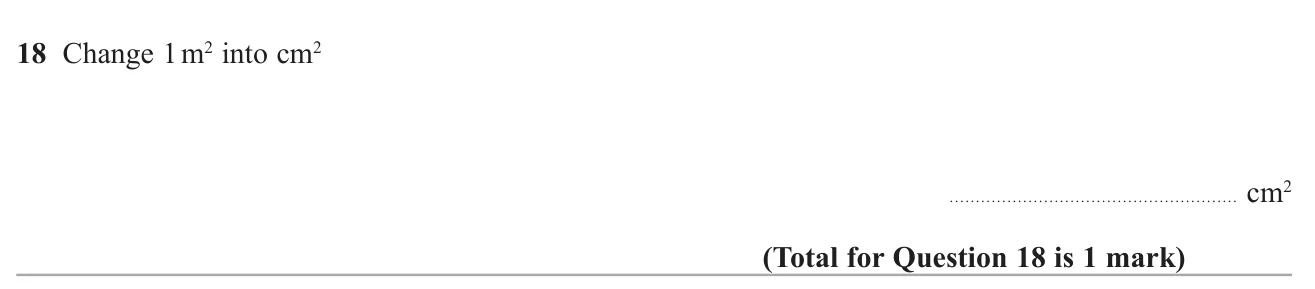
© Pearson Education Ltd. November 2021 Paper 3 (Foundation, calculator), question 18.
Show answer
Worked solution Checked against the mark scheme
1 m = 100 cm, so a 1 m by 1 m square is 100 cm by 100 cm.
100×100=10000 cm²
Watch out: Giving 100, forgetting that area uses two dimensions.
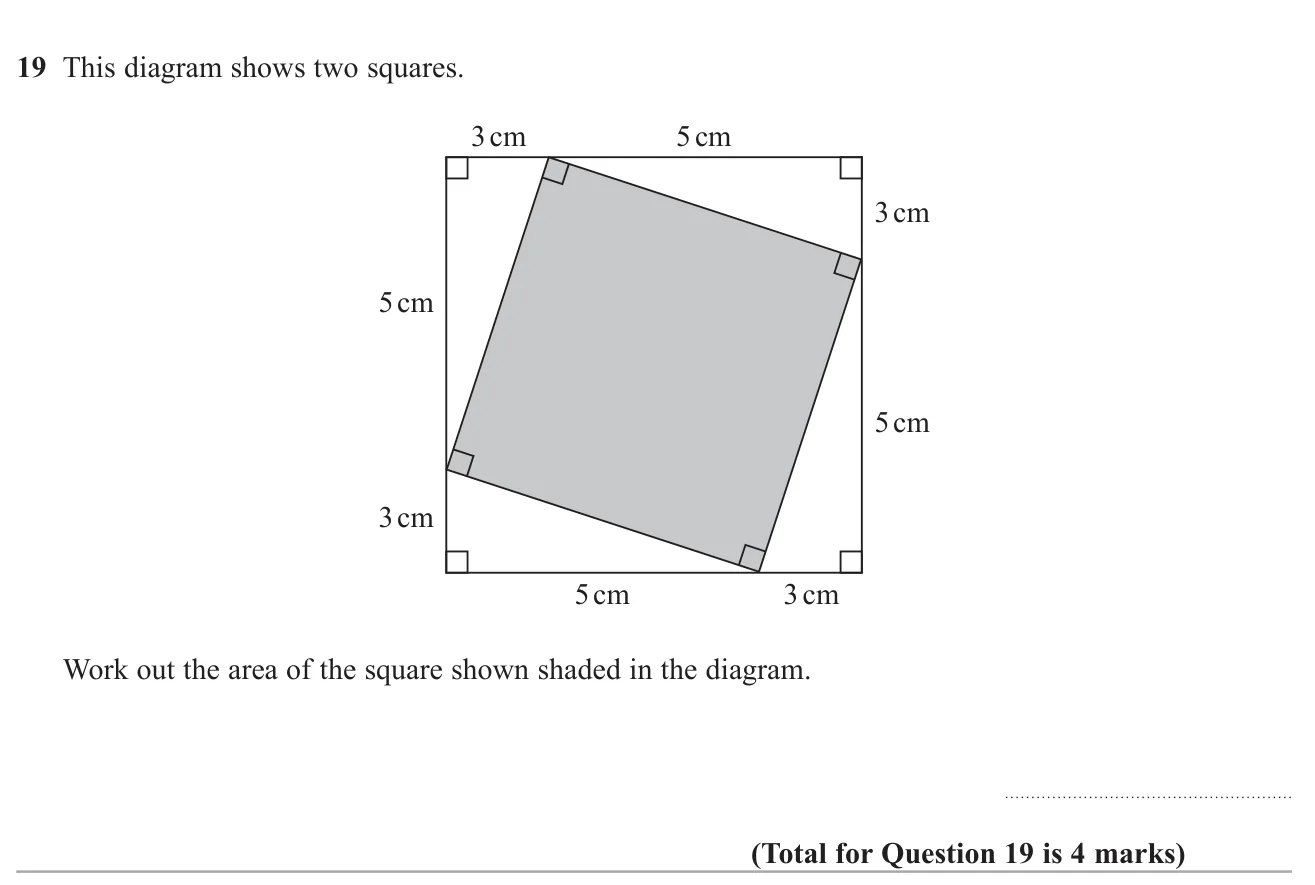
© Pearson Education Ltd. November 2021 Paper 3 (Foundation, calculator), question 19.
Show answer
Worked solution Checked against the mark scheme
The big square has side 3+5=8 cm, so its area is 64 cm².
Each corner triangle has area 21×3×5=7.5 cm².
Shaded area =64−4×7.5=34 cm².
(Or: side2=32+52=34.)
Watch out: Taking the shaded side as 5 cm or 8 cm and squaring it.
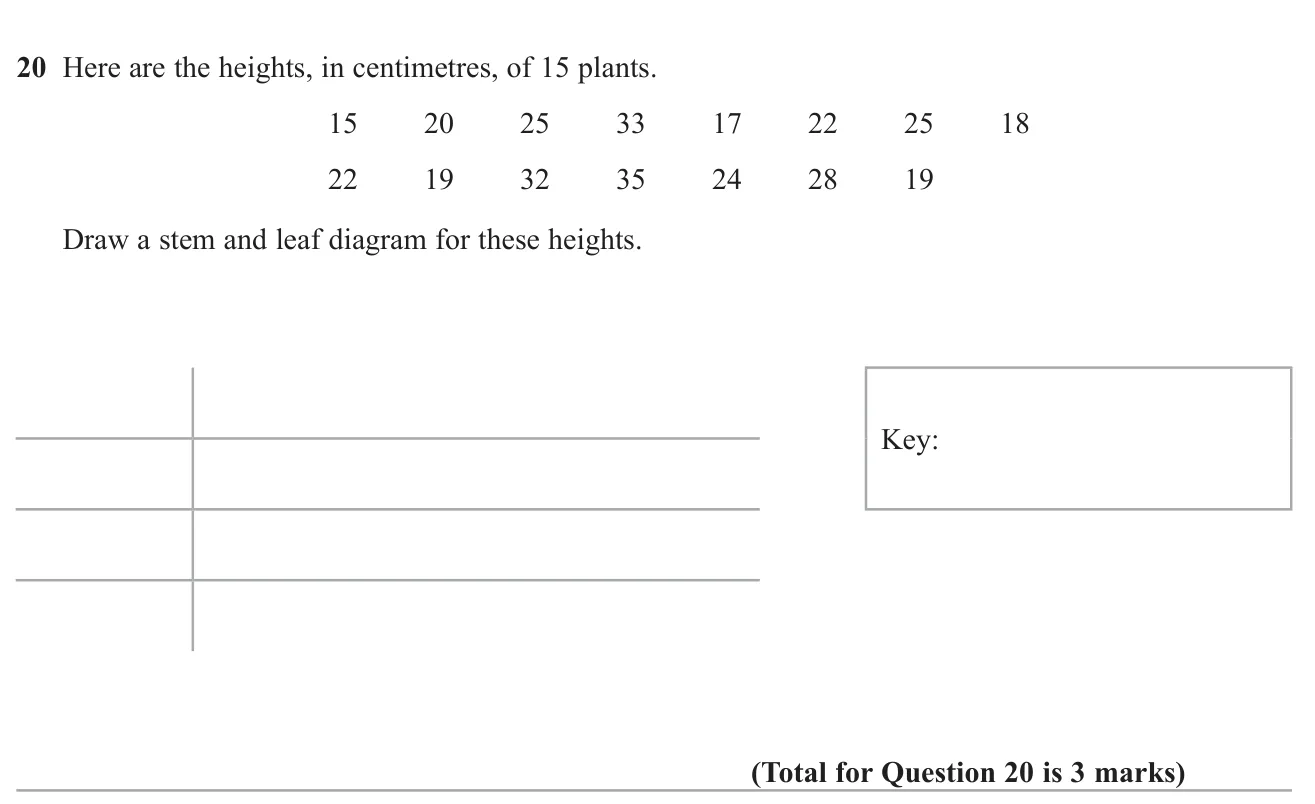
© Pearson Education Ltd. November 2021 Paper 3 (Foundation, calculator), question 20.
Show answer
| Answer | 1 | 5 7 8 9 9; 2 | 0 2 2 4 5 5 8; 3 | 2 3 5 with key e.g. 2 | 5 means 25 cm | 3 marks |
|---|
Worked solution Checked against the mark scheme
Use the tens digit as the stem and the units digit as the leaf.
Put the leaves in order:
1 | 5 7 8 9 9
2 | 0 2 2 4 5 5 8
3 | 2 3 5
Key: 2 | 5 means 25 cm. Check there are 15 leaves.
Watch out: Forgetting the key or leaving the leaves unordered.
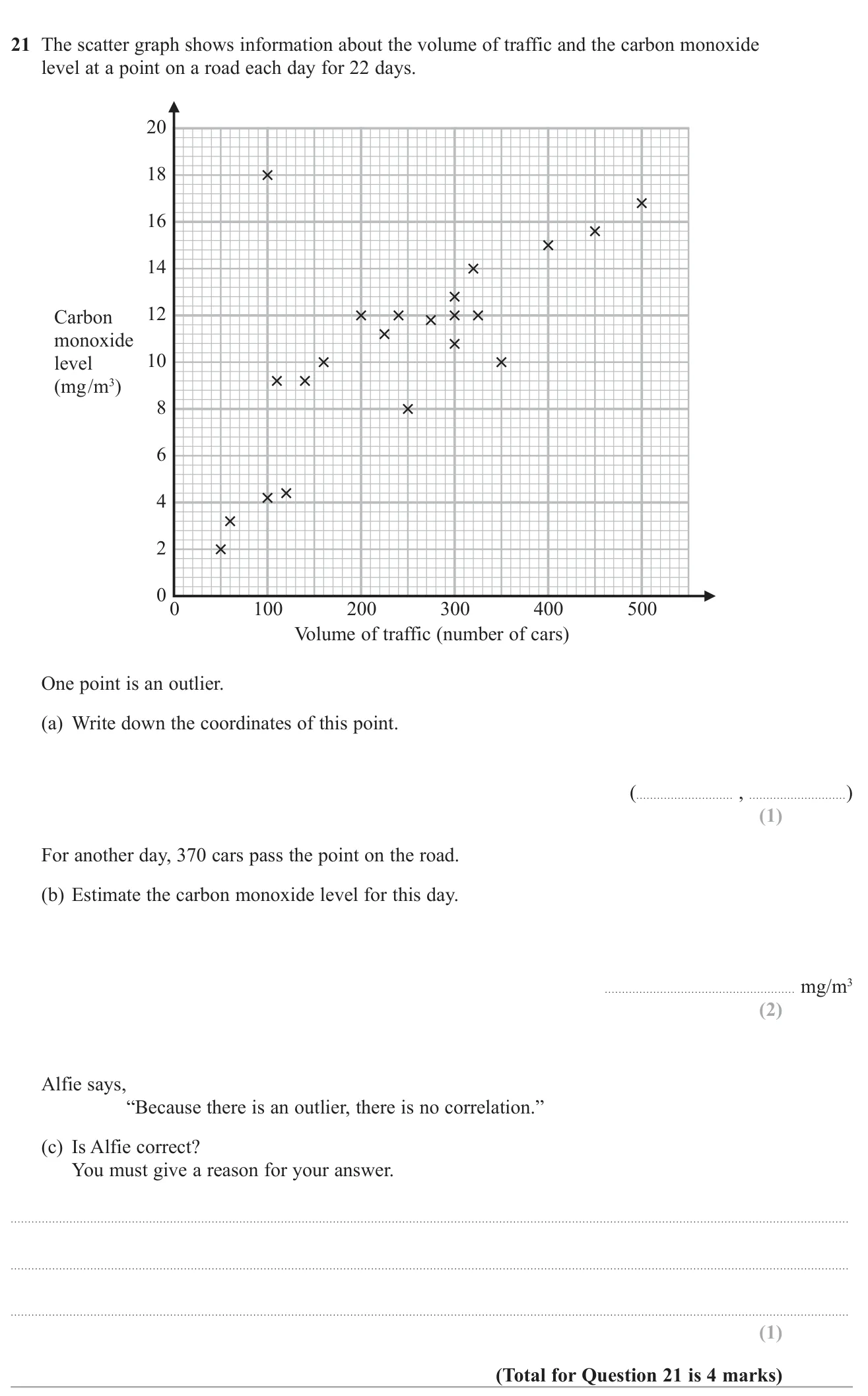
© Pearson Education Ltd. November 2021 Paper 3 (Foundation, calculator), question 21.
Show answer
| (a) | (100, 18) | 1 mark |
|---|
| (b) | About 13.8 mg/m³ (12.8 to 14.8) | 2 marks |
|---|
| (c) | No, the rest of the points still show positive correlation | 1 mark |
|---|
Worked solution Checked against the mark scheme
(a) The point far from the others is at (100,18).
(b) Draw a line of best fit through the main trend and read up from 370: about 13.8 mg/m³.
(c) No. One outlier does not remove the pattern; the other points still show positive correlation.
Watch out: In (c), agreeing with Alfie or saying 'yes'.
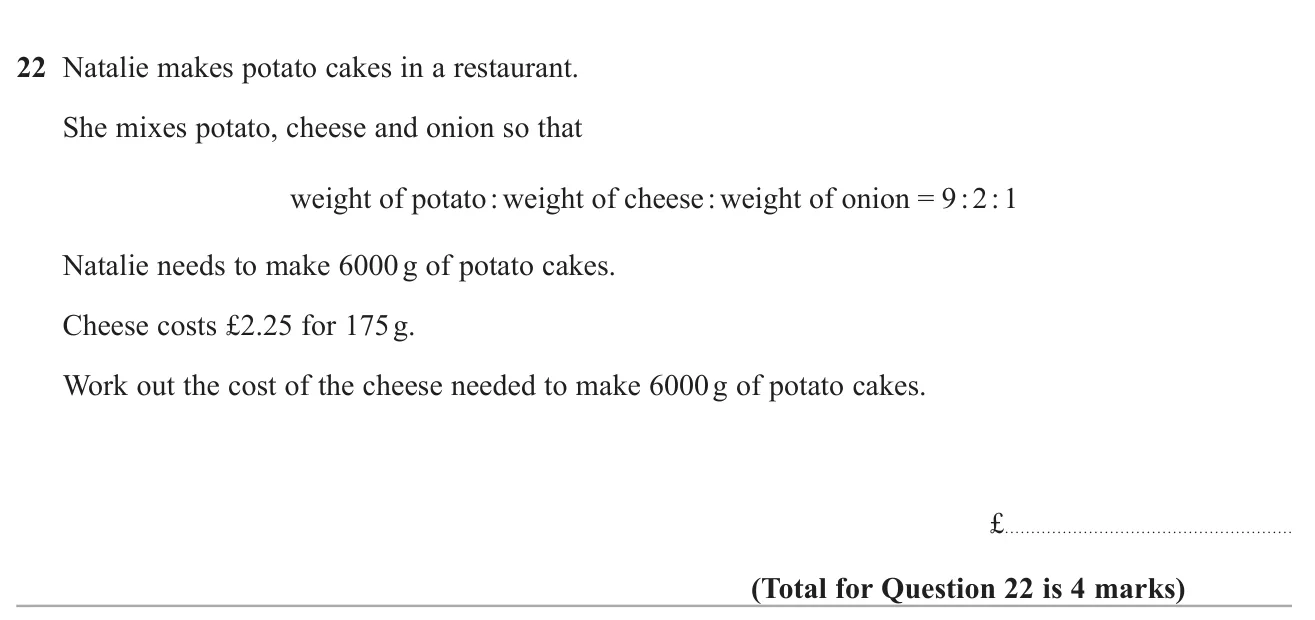
© Pearson Education Ltd. November 2021 Paper 3 (Foundation, calculator), question 22.
Show answer
| Answer | £12.86 (or £13.50 if whole packs are bought) | 4 marks |
|---|
Worked solution Checked against the mark scheme
Total parts: 9+2+1=12
Cheese: 6000÷12×2=1000 g
1000÷175=5.714... lots of 175 g
5.714...×2.25=£12.857..., so about £12.86
Watch out: Using 2 out of 3 parts instead of 2 out of 12.
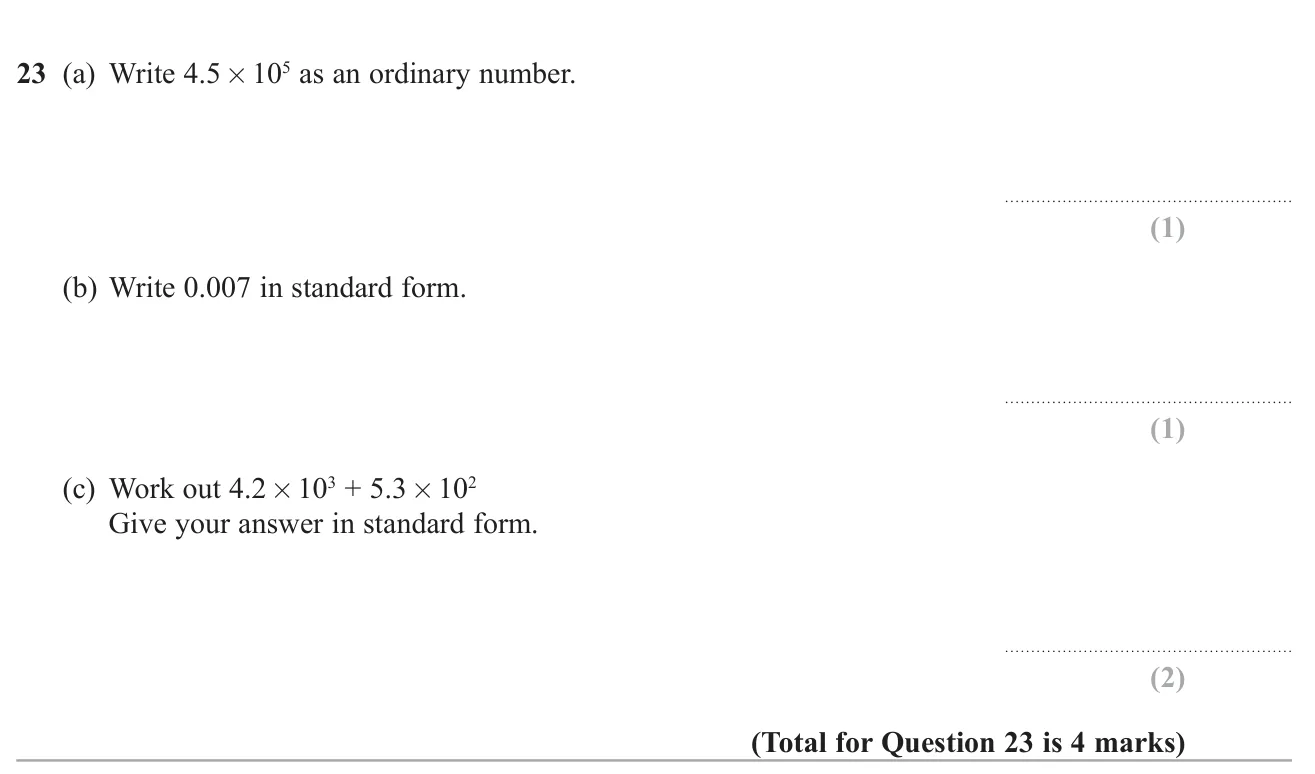
© Pearson Education Ltd. November 2021 Paper 3 (Foundation, calculator), question 23.
Show answer
| (a) | 450 000 | 1 mark |
|---|
| (b) | 7×10⁻³ | 1 mark |
|---|
| (c) | 4.73×10³ | 2 marks |
|---|
Worked solution Checked against the mark scheme
(a) Move the digits 5 places: 4.5×105=450000
(b) 0.007=7×10⁻³
(c) 4200+530=4730=4.73×10³
Watch out: In (c), adding the numbers and powers separately to get 9.5×10⁵.
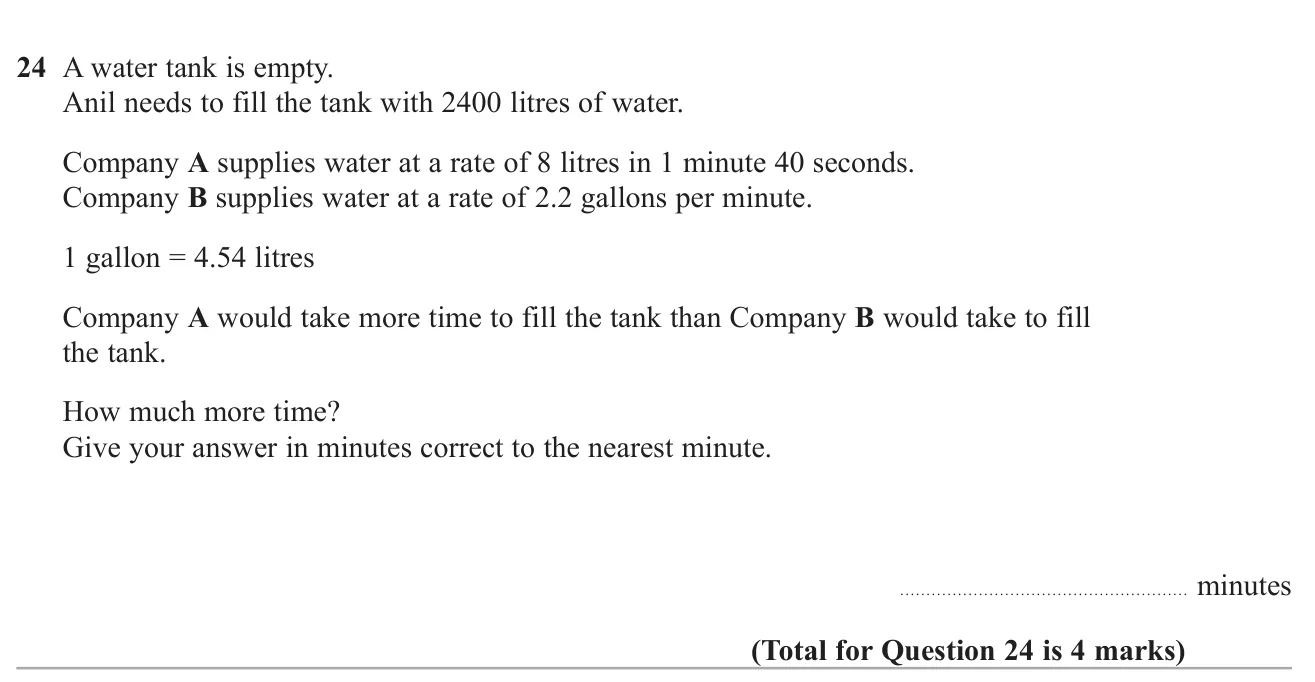
© Pearson Education Ltd. November 2021 Paper 3 (Foundation, calculator), question 24.
Show answer
Worked solution Checked against the mark scheme
Company A: 1 min 40 s =35 min, so the rate is 8÷35=4.8 litres per minute.
Time A =2400÷4.8=500 min.
Company B: 2.2×4.54=9.988 litres per minute.
Time B =2400÷9.988=240.29 min.
Difference =500−240.29=259.7, about 260 minutes.
Watch out: Treating 1 minute 40 seconds as 1.4 minutes.
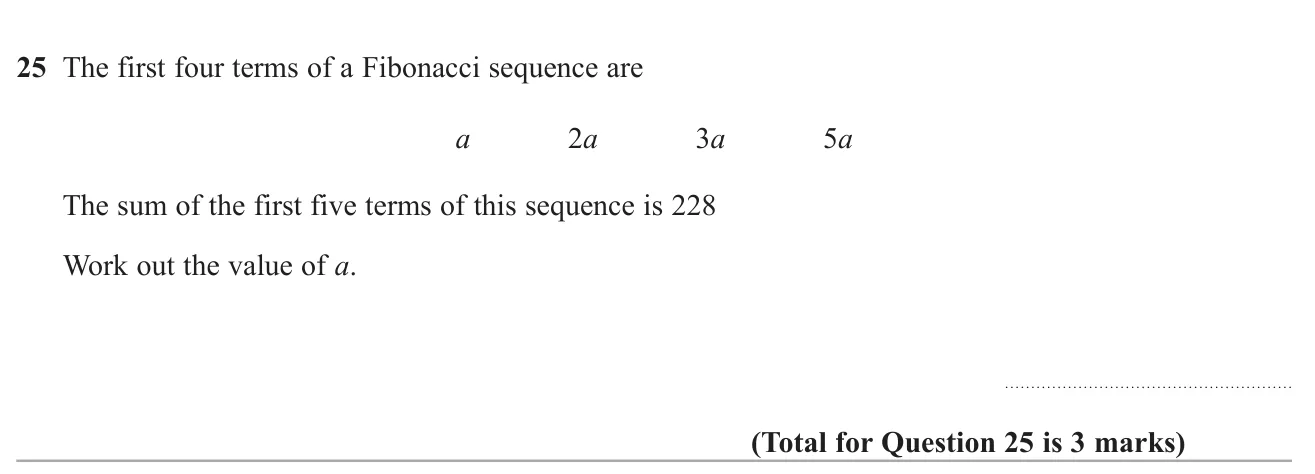
© Pearson Education Ltd. November 2021 Paper 3 (Foundation, calculator), question 25.
Show answer
Worked solution Checked against the mark scheme
Each term is the sum of the two before, so the fifth term is 3a+5a=8a.
a+2a+3a+5a+8a=19a
19a=228, so a=12.
Watch out: Summing only the four given terms, giving 11a=228.
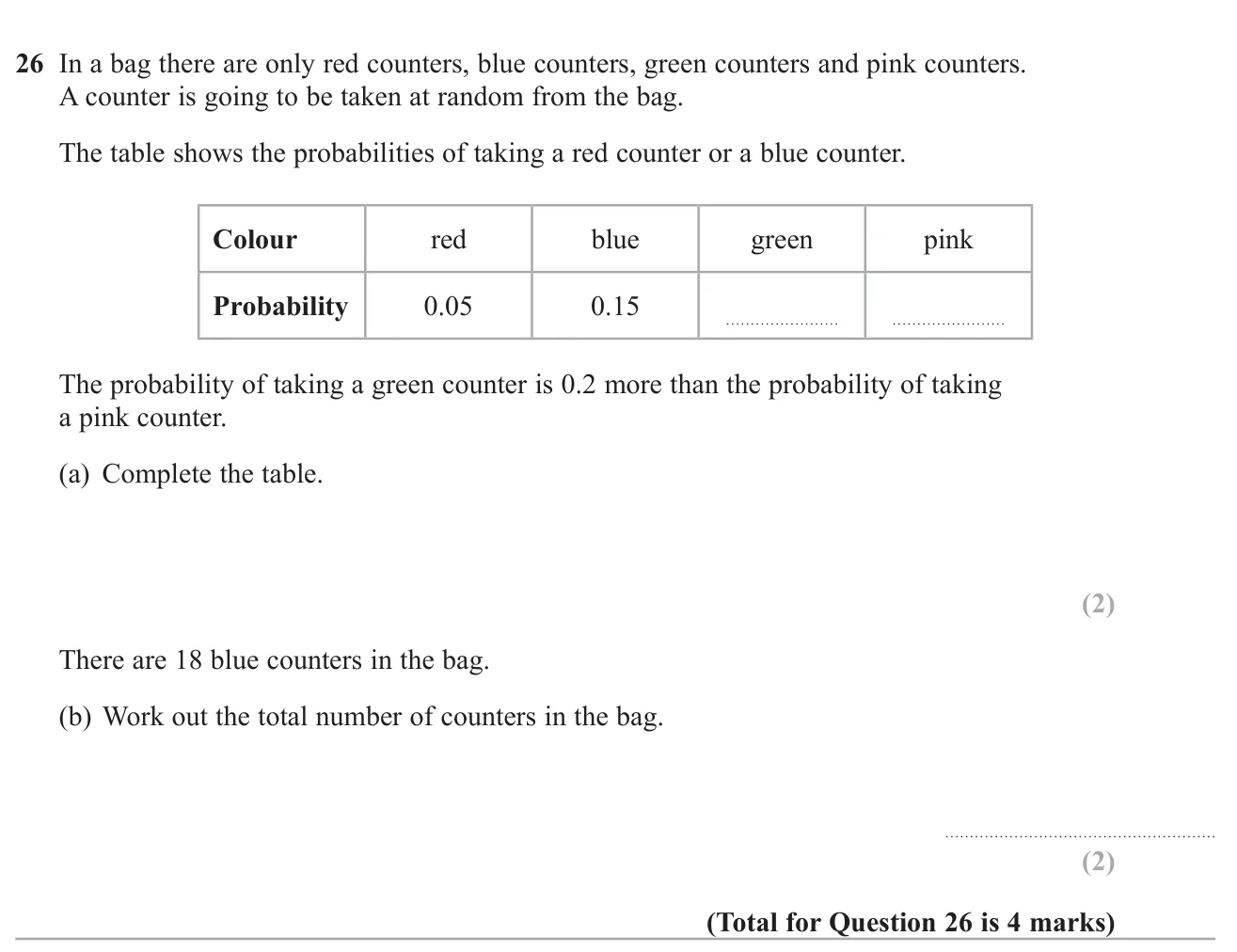
© Pearson Education Ltd. November 2021 Paper 3 (Foundation, calculator), question 26.
Show answer
| (a) | green 0.5, pink 0.3 | 2 marks |
|---|
| (b) | 120 | 2 marks |
|---|
Worked solution Checked against the mark scheme
(a) The probabilities add to 1: 1−0.05−0.15=0.8 for green and pink together.
Green is 0.2 more than pink: 2p+0.2=0.8, so pink =0.3 and green =0.5.
(b) 0.15 of the counters are blue: 18÷0.15=120.
Watch out: In (a), splitting 0.8 equally as 0.4 and 0.4.
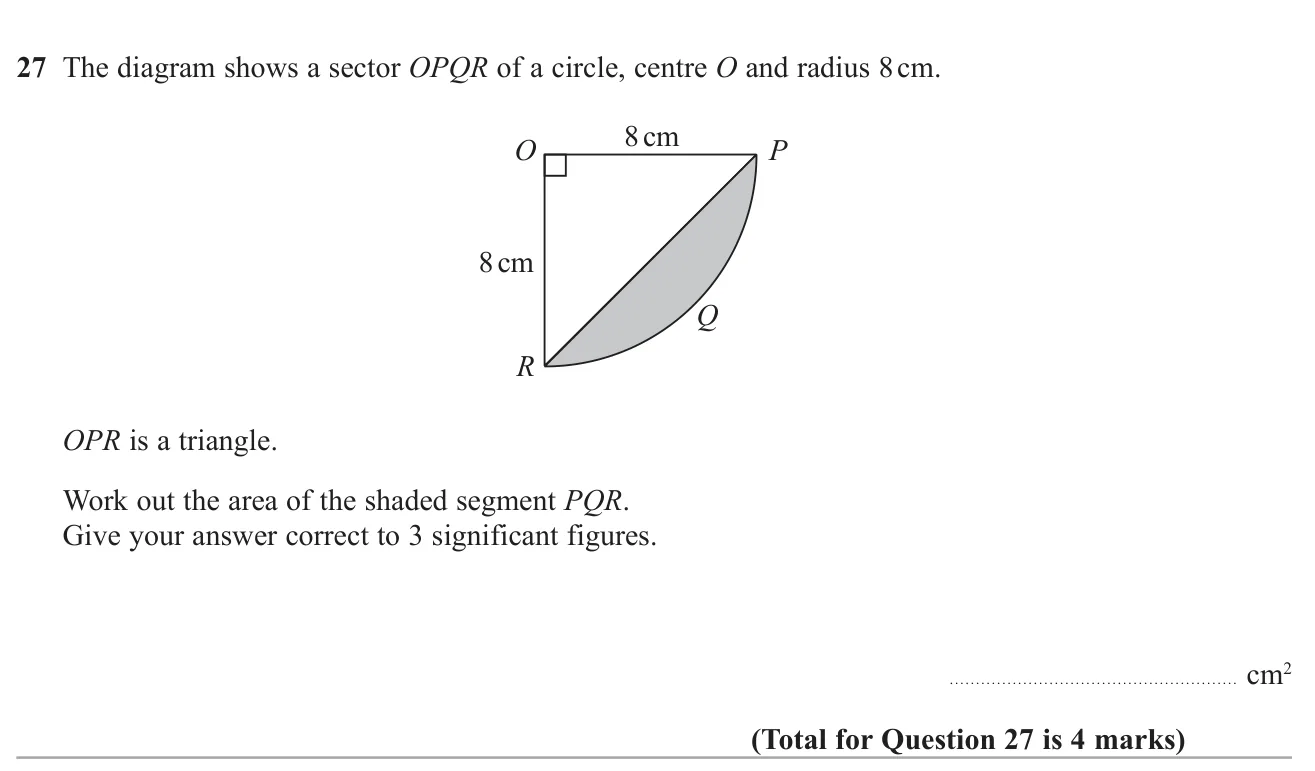
© Pearson Education Ltd. November 2021 Paper 3 (Foundation, calculator), question 27.
Show answer
Worked solution Checked against the mark scheme
Quarter circle: 41×π×82=50.265... cm²
Triangle OPR: 21×8×8=32 cm²
Segment =50.265...−32=18.265...
So the area is 18.3 cm² (3 s.f.).
Watch out: Using 2πr (circumference) instead of πr2.
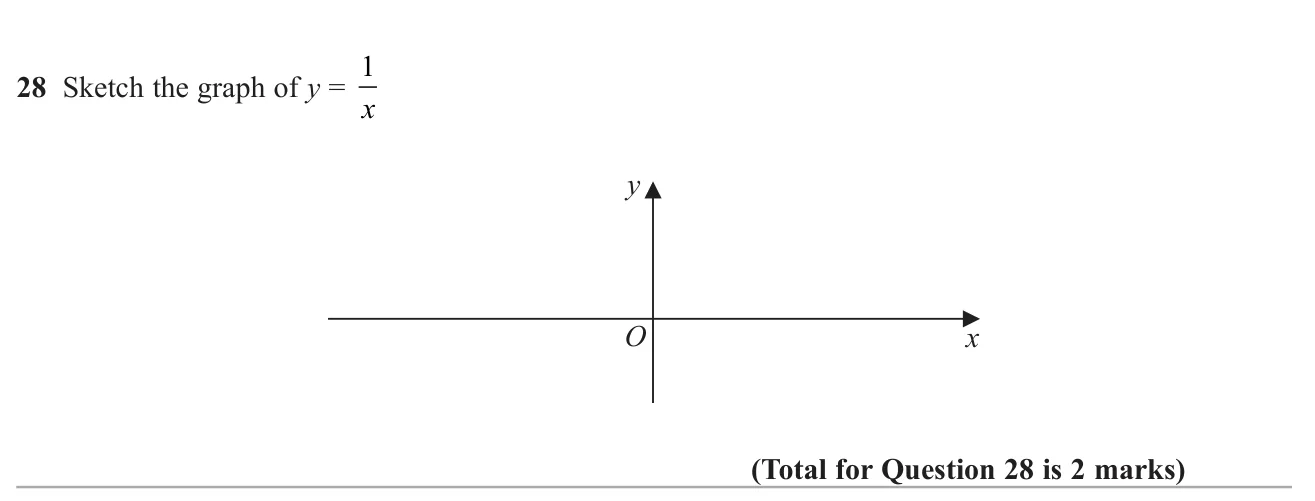
© Pearson Education Ltd. November 2021 Paper 3 (Foundation, calculator), question 28.
Show answer
| Answer | Two curves, one in the first quadrant and one in the third, each approaching both axes without touching | 2 marks |
|---|
Worked solution Checked against the mark scheme
For positive x, y is positive and gets smaller as x grows, so draw a curve in the top-right quadrant.
For negative x, y is negative, so draw the matching curve in the bottom-left quadrant.
The curves get close to the axes but never touch them, and there is no point at x=0.
Watch out: Drawing a straight line, or letting the curves cross the axes.
Finished the paper?
Add up your marks for all three papers and see what grade that would have been.