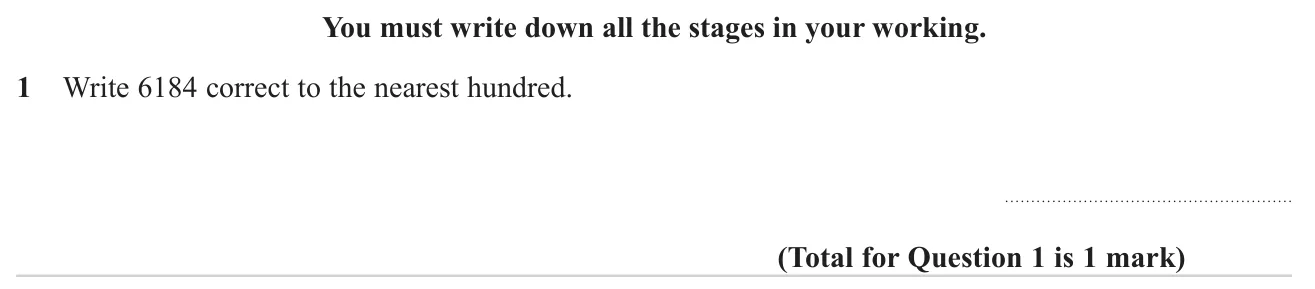
© Pearson Education Ltd. June 2023 Paper 2 (Foundation, calculator), question 1.
Worked solution Checked against the mark scheme
The hundreds digit is 1 and the next digit is 8, which is 5 or more, so round up.
6184 → 6200 6184 \to 6200 6184 → 6200
Watch out: Writing 6100 by rounding down.
© Pearson Education Ltd. June 2023 Paper 2 (Foundation, calculator), question 2.
Answer 7 10 \frac{7}{10} 10 7 1 mark
Worked solution Checked against the mark scheme
The 7 is in the tenths column, so 0.7 = 7 10 0.7 = \frac{7}{10} 0.7 = 10 7
Watch out: Writing 7 100 \frac{7}{100} 100 7 1 7 \frac{1}{7} 7 1
© Pearson Education Ltd. June 2023 Paper 2 (Foundation, calculator), question 3.
Worked solution Checked against the mark scheme
There are 100 cm in 1 m, so 9 × 100 = 900 9 \times 100 = 900 9 × 100 = 900
Watch out: Multiplying by 10 or 1000 instead of 100.
© Pearson Education Ltd. June 2023 Paper 2 (Foundation, calculator), question 4.
Worked solution Checked against the mark scheme
Multiply the numbers: 3 × 4 = 12 3 \times 4 = 12 3 × 4 = 12
3 × 4 t = 12 t 3 \times 4t = 12t 3 × 4 t = 12 t
Watch out: Writing 7 t 7t 7 t
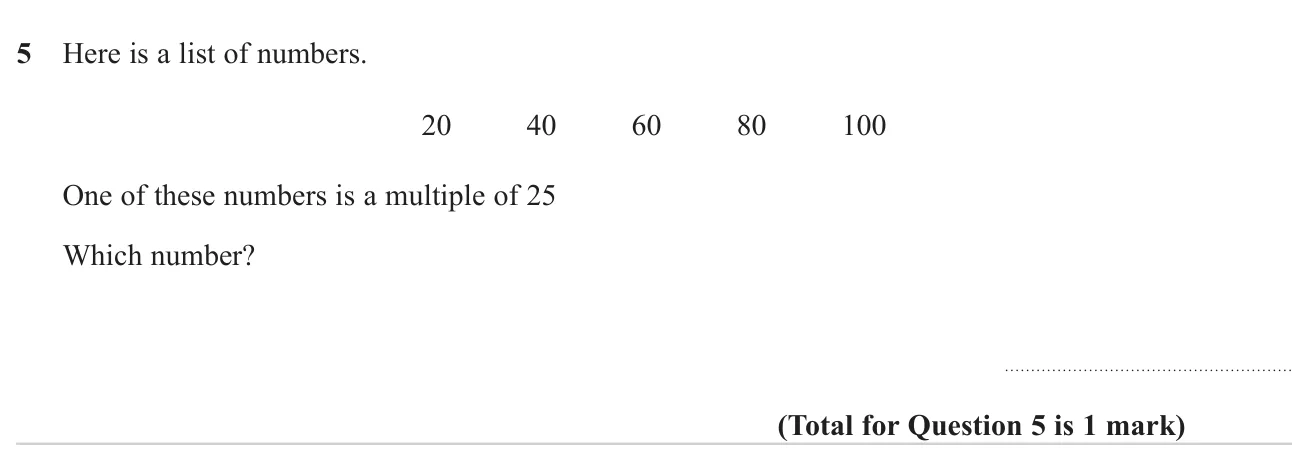
© Pearson Education Ltd. June 2023 Paper 2 (Foundation, calculator), question 5.
Worked solution Checked against the mark scheme
Multiples of 25 are 25, 50, 75, 100, ...
Only 100 is in the list (25 × 4 = 100 25 \times 4 = 100 25 × 4 = 100
Watch out: Choosing 20 or 40 because they are multiples of 5 or 10.
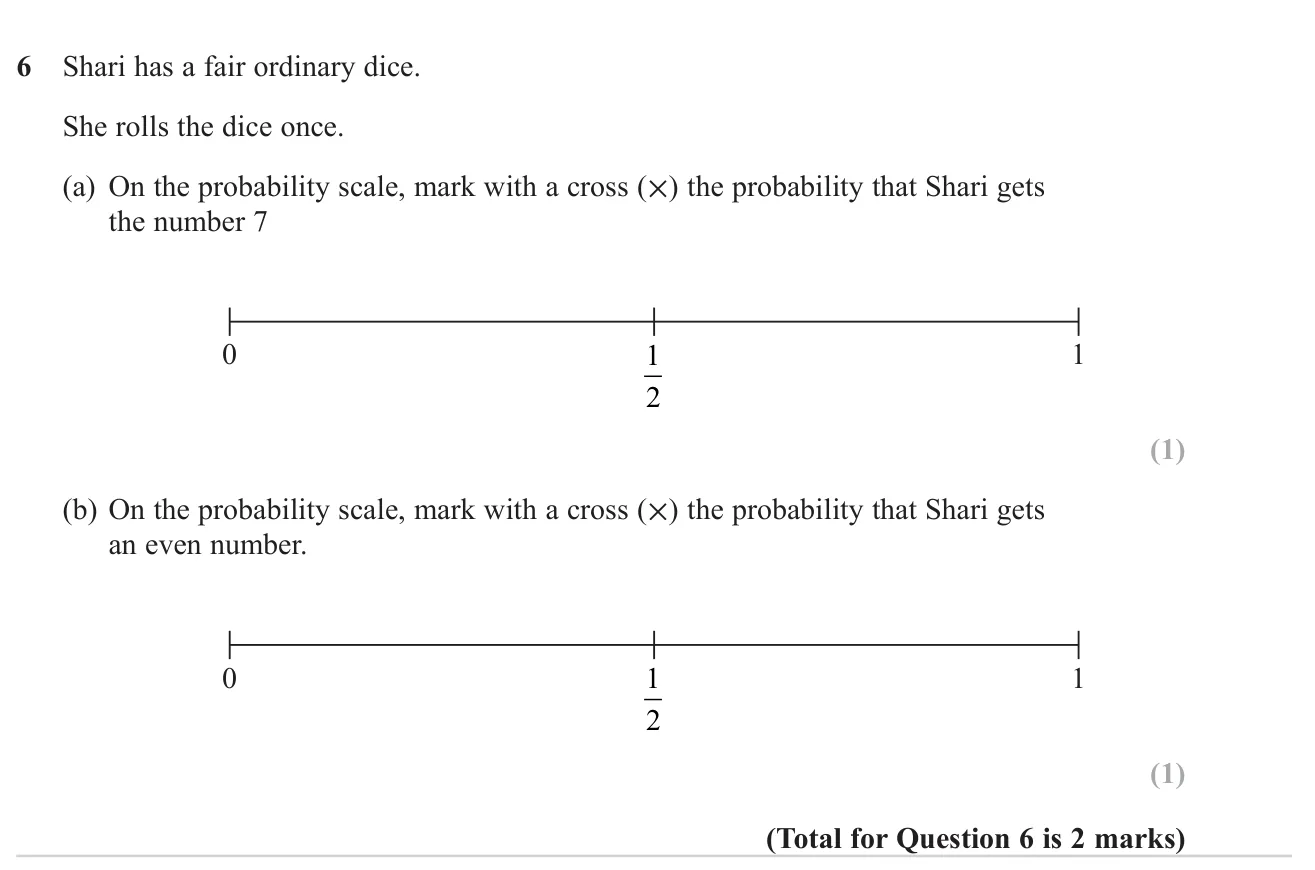
© Pearson Education Ltd. June 2023 Paper 2 (Foundation, calculator), question 6.
(a) Cross at 0 1 mark (b) Cross at 1 2 \frac{1}{2} 2 1 1 mark
Worked solution Checked against the mark scheme
(a) A normal dice has no 7, so rolling a 7 is impossible: probability 0 0 0
(b) Even numbers are 2, 4 and 6, so the probability is 3 6 = 1 2 \frac{3}{6} = \frac{1}{2} 6 3 = 2 1
Watch out: Marking 'even number' at 1 6 \frac{1}{6} 6 1 3 6 \frac{3}{6} 6 3
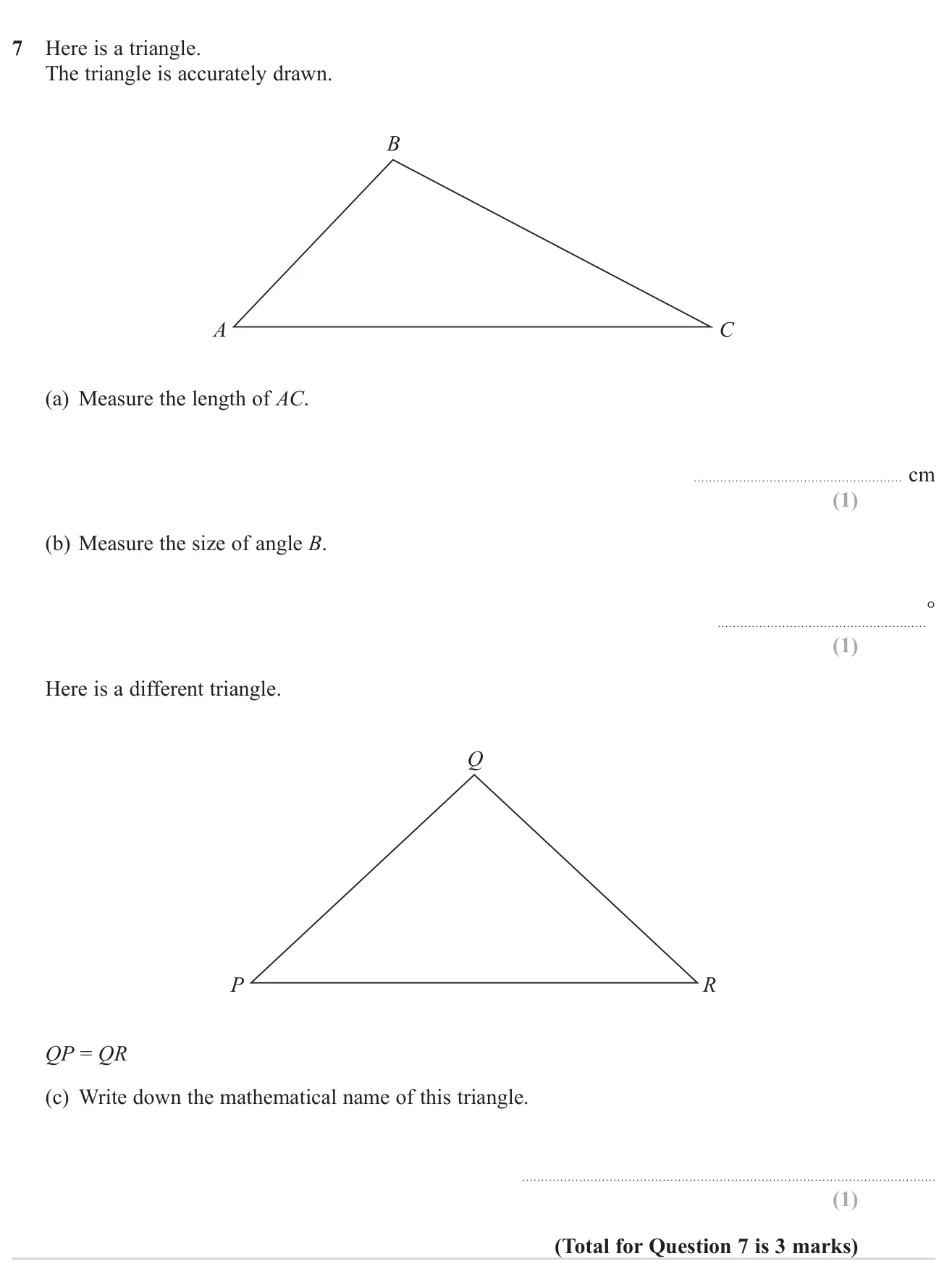
© Pearson Education Ltd. June 2023 Paper 2 (Foundation, calculator), question 7.
(a) 9.3 cm (9.1 to 9.5 accepted) 1 mark (b) 106 ∘ 106^\circ 10 6 ∘ 1 mark (c) Isosceles 1 mark
Worked solution Checked against the mark scheme
(a) Put the ruler's 0 on A and read off at C: about 9.3 9.3 9.3
(b) Place the protractor's centre on B, line up one side with 0 and read the scale that starts at 0: about 106 ∘ 106^\circ 10 6 ∘ 90 ∘ 90^\circ 9 0 ∘
(c) Two equal sides (Q P = Q R QP = QR QP = QR
Watch out: Reading the wrong protractor scale and giving about 74 ∘ 74^\circ 7 4 ∘
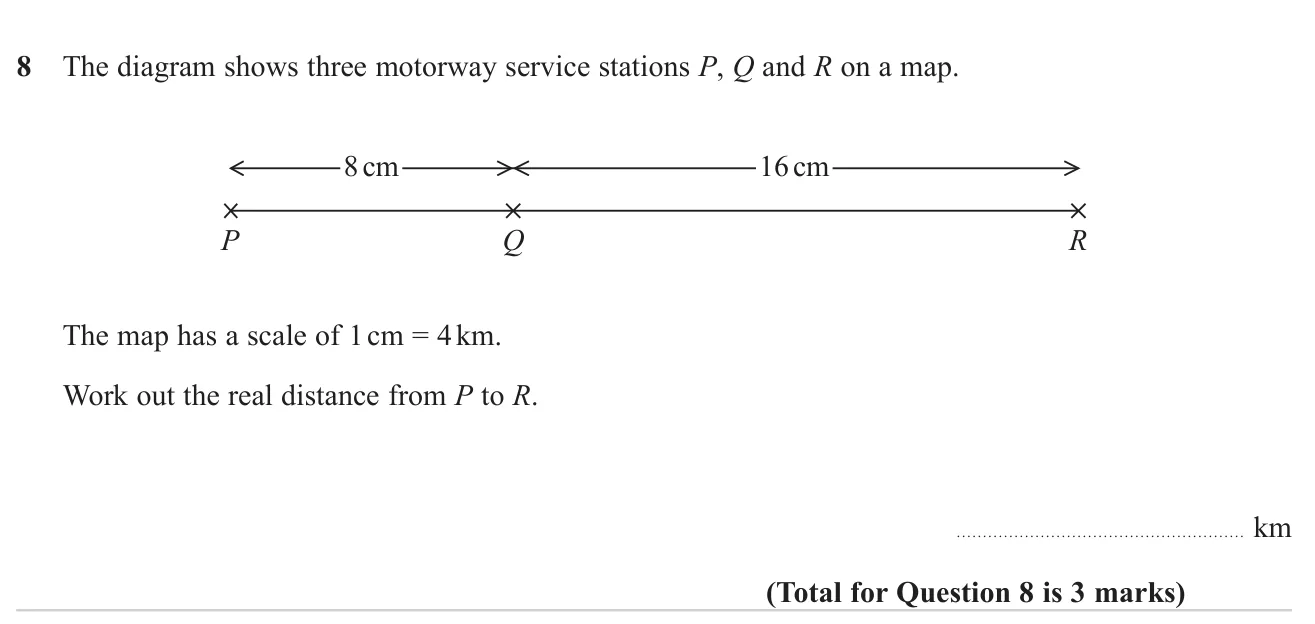
© Pearson Education Ltd. June 2023 Paper 2 (Foundation, calculator), question 8.
Worked solution Checked against the mark scheme
Total map distance: 8 + 16 = 24 8 + 16 = 24 8 + 16 = 24
Each cm is 4 km: 24 × 4 = 96 24 \times 4 = 96 24 × 4 = 96
Watch out: Only converting one leg of the journey, e.g. 16 × 4 = 64 16 \times 4 = 64 16 × 4 = 64
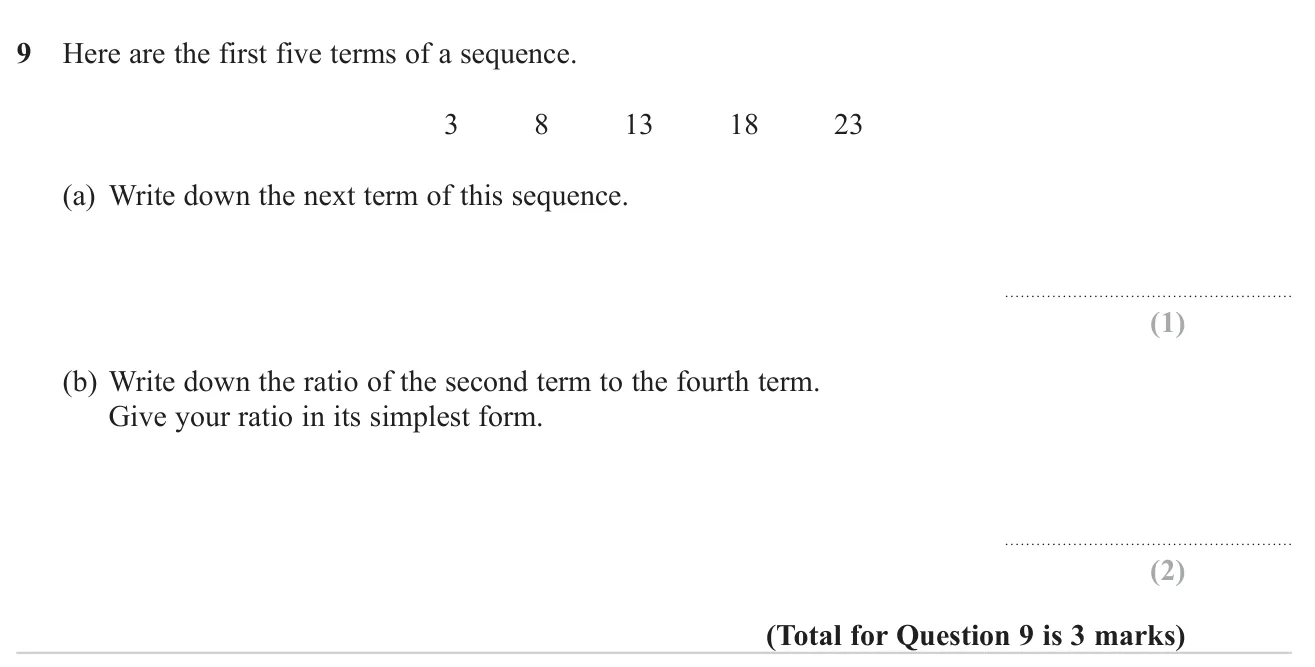
© Pearson Education Ltd. June 2023 Paper 2 (Foundation, calculator), question 9.
(a) 28 1 mark (b) 4 : 9 4 : 9 4 : 9 2 marks
Worked solution Checked against the mark scheme
(a) The terms go up by 5, so the next term is 23 + 5 = 28 23 + 5 = 28 23 + 5 = 28
(b) The second term is 8 and the fourth is 18.
8 : 18 8 : 18 8 : 18 4 : 9 4 : 9 4 : 9
Watch out: Writing the ratio the wrong way round as 9 : 4 9 : 4 9 : 4
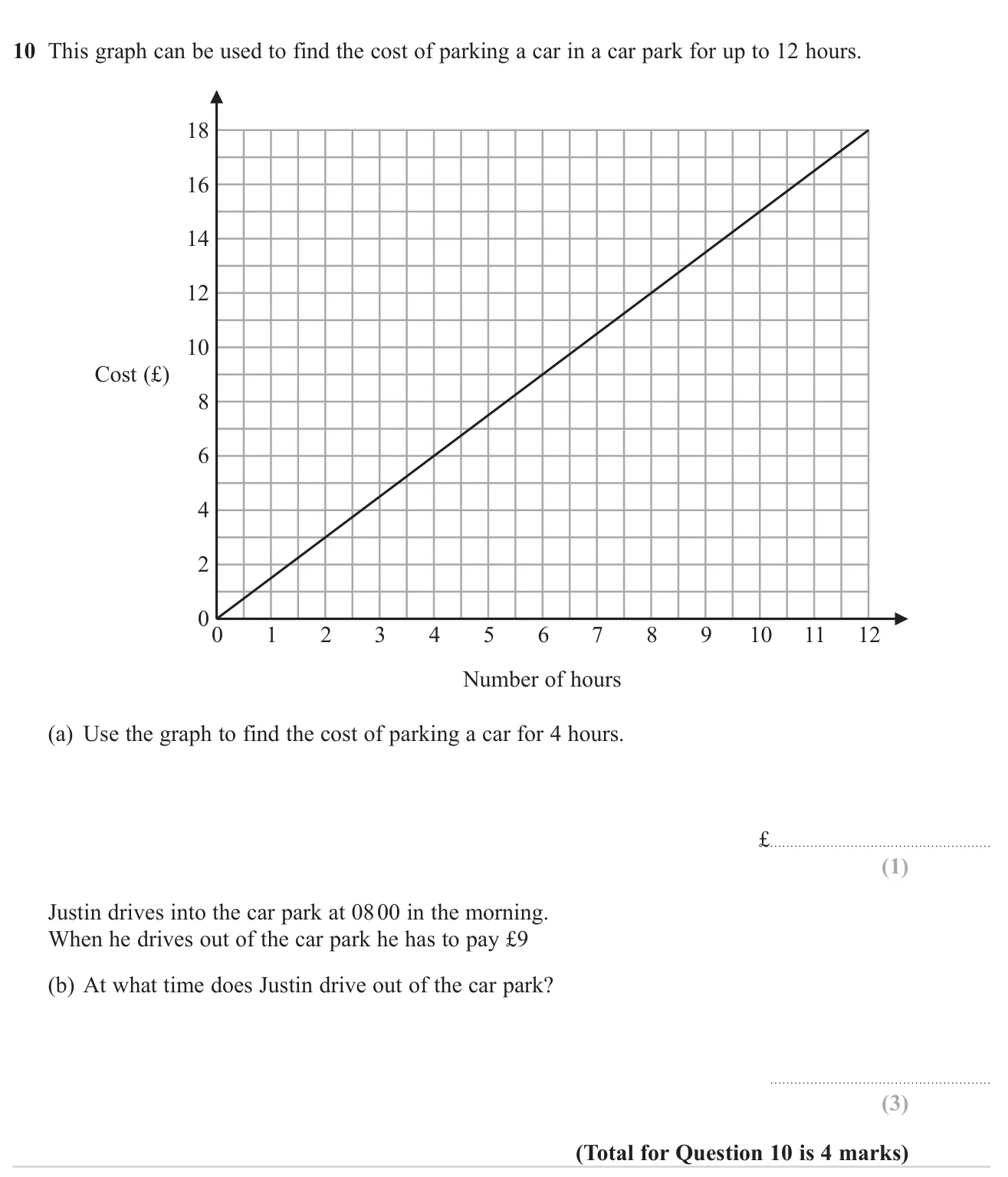
© Pearson Education Ltd. June 2023 Paper 2 (Foundation, calculator), question 10.
(a) £6 1 mark (b) 14 00 (2 pm) 3 marks
Worked solution Checked against the mark scheme
(a) Go up from 4 hours to the line and across: £6.
(b) Go across from £9 to the line and down: 6 hours.
08 00 + 6 08\,00 + 6 08 00 + 6 = 14 00 = 14\,00 = 14 00
Watch out: Writing the time as 14 pm or giving just '6'.
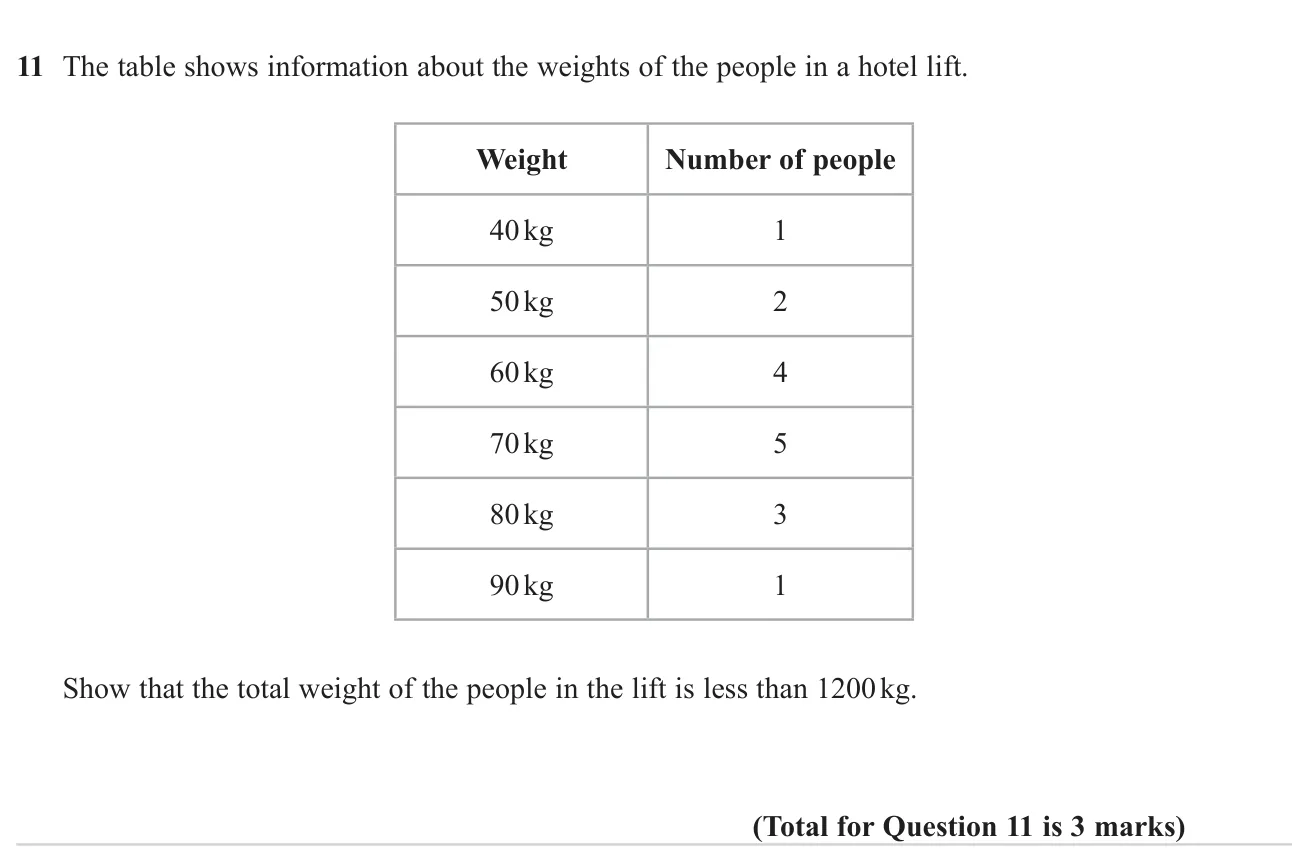
© Pearson Education Ltd. June 2023 Paper 2 (Foundation, calculator), question 11.
Answer Total is 1060 kg, which is less than 1200 kg 3 marks
Worked solution Checked against the mark scheme
Multiply each weight by how many people have it:
40 + 100 + 240 + 350 + 240 + 90 = 1060 40 + 100 + 240 + 350 + 240 + 90 = 1060 40 + 100 + 240 + 350 + 240 + 90 = 1060
1060 < 1200 1060 < 1200 1060 < 1200
Watch out: Adding the weights without multiplying by the number of people.
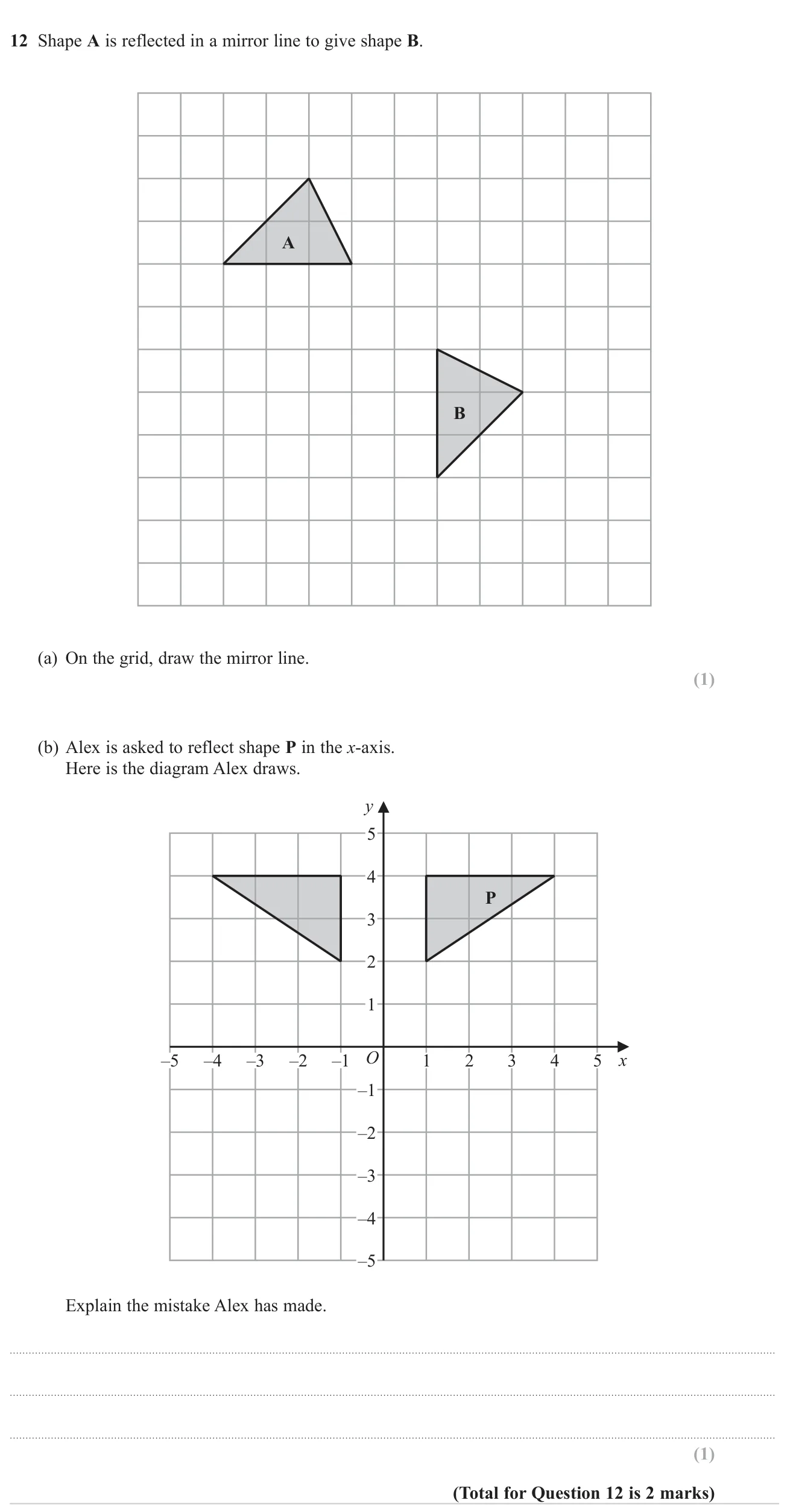
© Pearson Education Ltd. June 2023 Paper 2 (Foundation, calculator), question 12.
(a) The diagonal mirror line exactly halfway between A and B (sloping up to the right) 1 mark (b) Alex reflected in the y y y x x x 1 mark
Worked solution Checked against the mark scheme
(a) The horizontal edge of A becomes the vertical edge of B, so the mirror line is diagonal. Draw the line that is the same distance from each corner of A as from the matching corner of B.
(b) Reflecting in the x x x x x x y = − 2 y = -2 y = − 2 y = − 4 y = -4 y = − 4 y y y
Watch out: In (b), just saying 'it is the wrong way round' without naming the axis.
© Pearson Education Ltd. June 2023 Paper 2 (Foundation, calculator), question 13.
Worked solution Checked against the mark scheme
50 is 1 16 \frac{1}{16} 16 1
16 × 50 = 800 16 \times 50 = 800 16 × 50 = 800
Watch out: Dividing 50 by 16 to get 3.125.
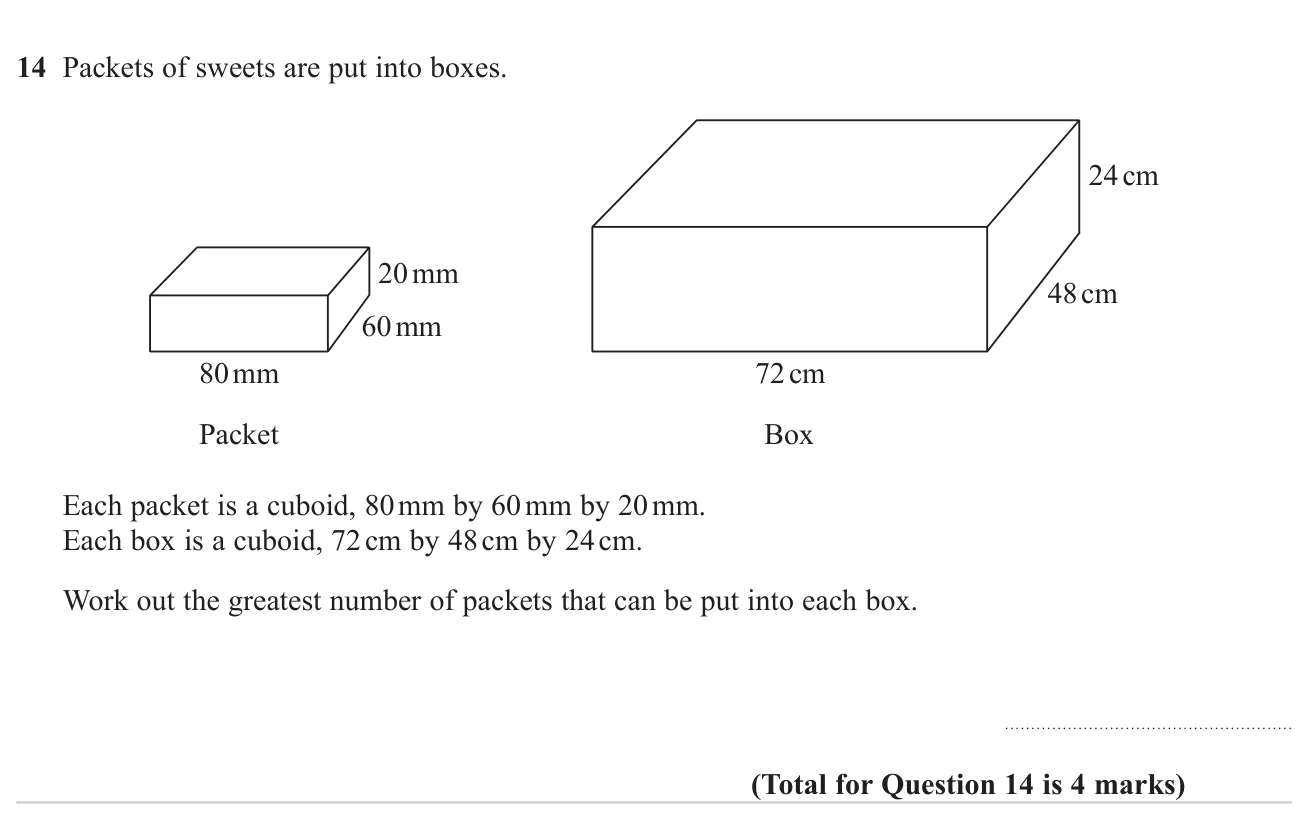
© Pearson Education Ltd. June 2023 Paper 2 (Foundation, calculator), question 14.
Worked solution Checked against the mark scheme
Change the packet to cm: 8 cm by 6 cm by 2 cm.
Along each edge: 72 ÷ 8 = 9 72 \div 8 = 9 72 ÷ 8 = 9 48 ÷ 6 = 8 48 \div 6 = 8 48 ÷ 6 = 8 24 ÷ 2 = 12 24 \div 2 = 12 24 ÷ 2 = 12
9 × 8 × 12 = 864 9 \times 8 \times 12 = 864 9 × 8 × 12 = 864
(Check: 82944 ÷ 96 = 864 82944 \div 96 = 864 82944 ÷ 96 = 864
Watch out: Not converting mm to cm, or mixing units in the division.
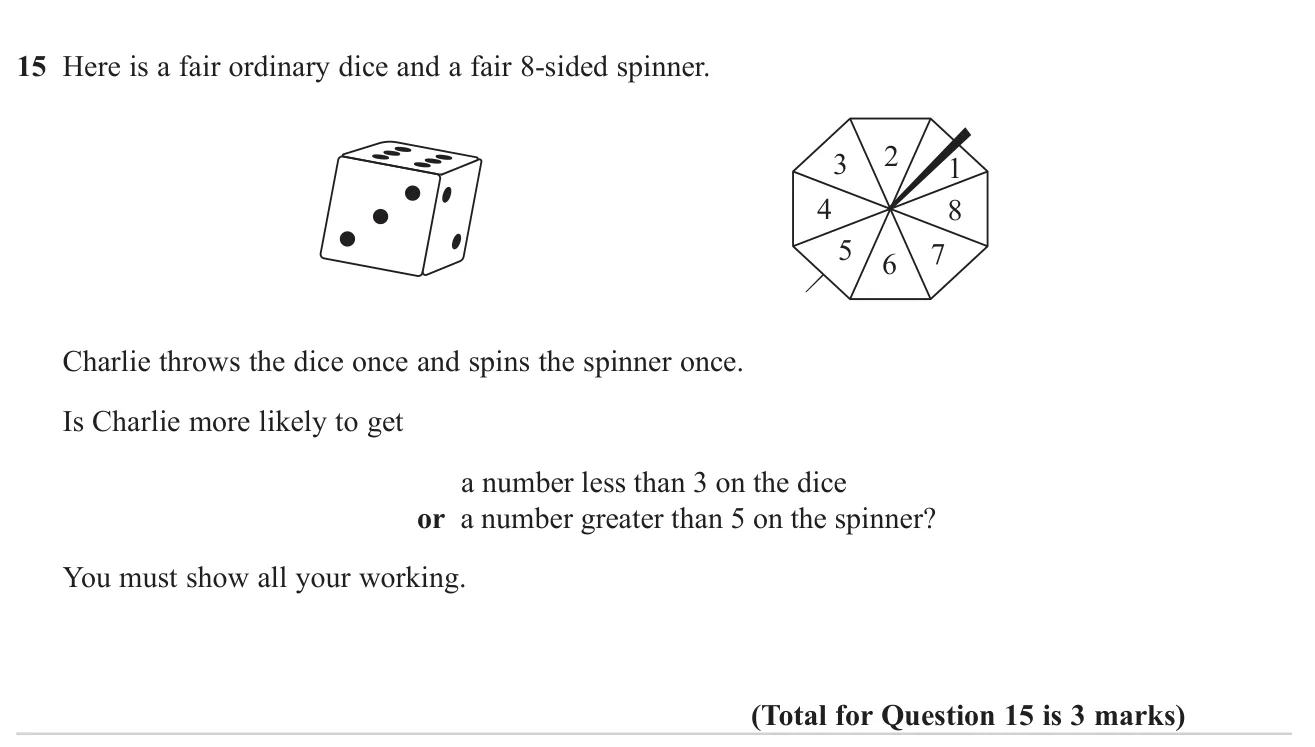
© Pearson Education Ltd. June 2023 Paper 2 (Foundation, calculator), question 15.
Answer The spinner: 3 8 = 0.375 \frac{3}{8} = 0.375 8 3 = 0.375 2 6 ≈ 0.333 \frac{2}{6} \approx 0.333 6 2 ≈ 0.333 3 marks
Worked solution Checked against the mark scheme
Dice, less than 3: scores 1 and 2, so 2 6 = 8 24 \frac{2}{6} = \frac{8}{24} 6 2 = 24 8
Spinner, greater than 5: 6, 7 and 8, so 3 8 = 9 24 \frac{3}{8} = \frac{9}{24} 8 3 = 24 9
9 24 > 8 24 \frac{9}{24} > \frac{8}{24} 24 9 > 24 8
Watch out: Counting 3 as less than 3, or 5 as greater than 5.
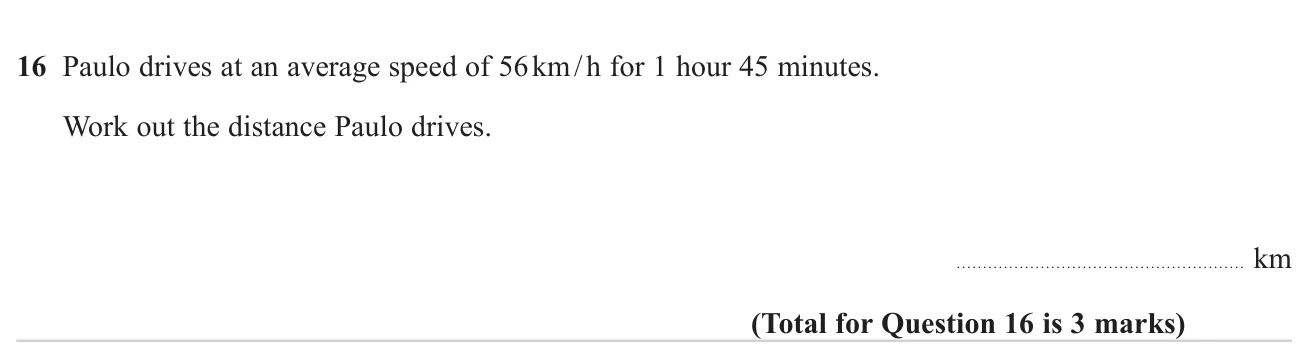
© Pearson Education Ltd. June 2023 Paper 2 (Foundation, calculator), question 16.
Worked solution Checked against the mark scheme
45 minutes = 45 60 = 0.75 = \frac{45}{60} = 0.75 = 60 45 = 0.75 1.75 1.75 1.75
Distance = speed × time = 56 × 1.75 = 98 = 56 \times 1.75 = 98 = 56 × 1.75 = 98
Watch out: Using 1.45 hours for 1 hour 45 minutes.
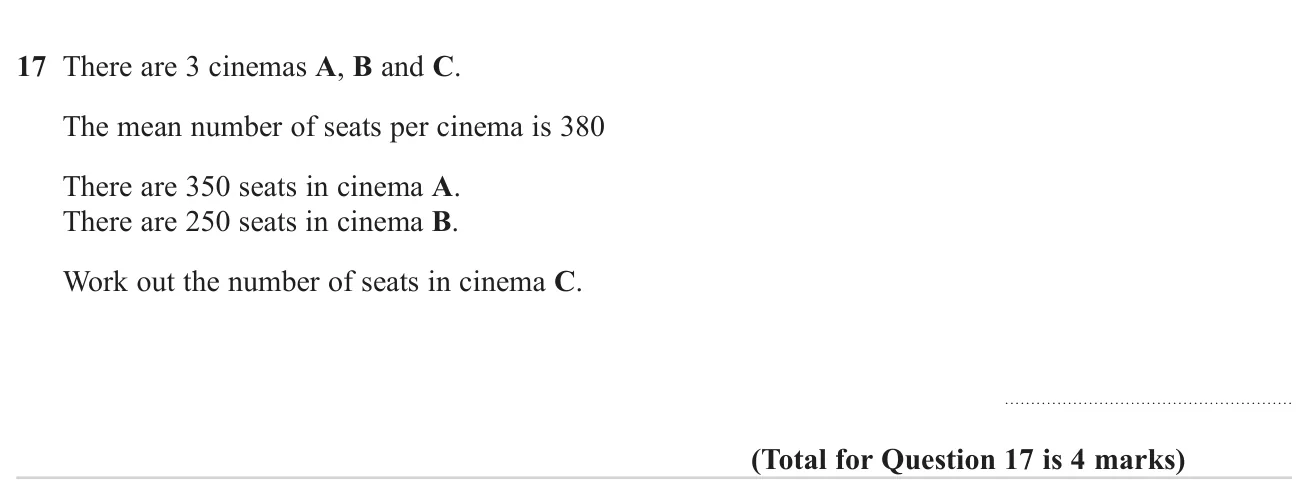
© Pearson Education Ltd. June 2023 Paper 2 (Foundation, calculator), question 17.
Worked solution Checked against the mark scheme
Total seats = 3 × 380 = 1140 = 3 \times 380 = 1140 = 3 × 380 = 1140
A and B together: 350 + 250 = 600 350 + 250 = 600 350 + 250 = 600
Cinema C: 1140 − 600 = 540 1140 - 600 = 540 1140 − 600 = 540
Watch out: Dividing by 3 again or averaging the two known values.
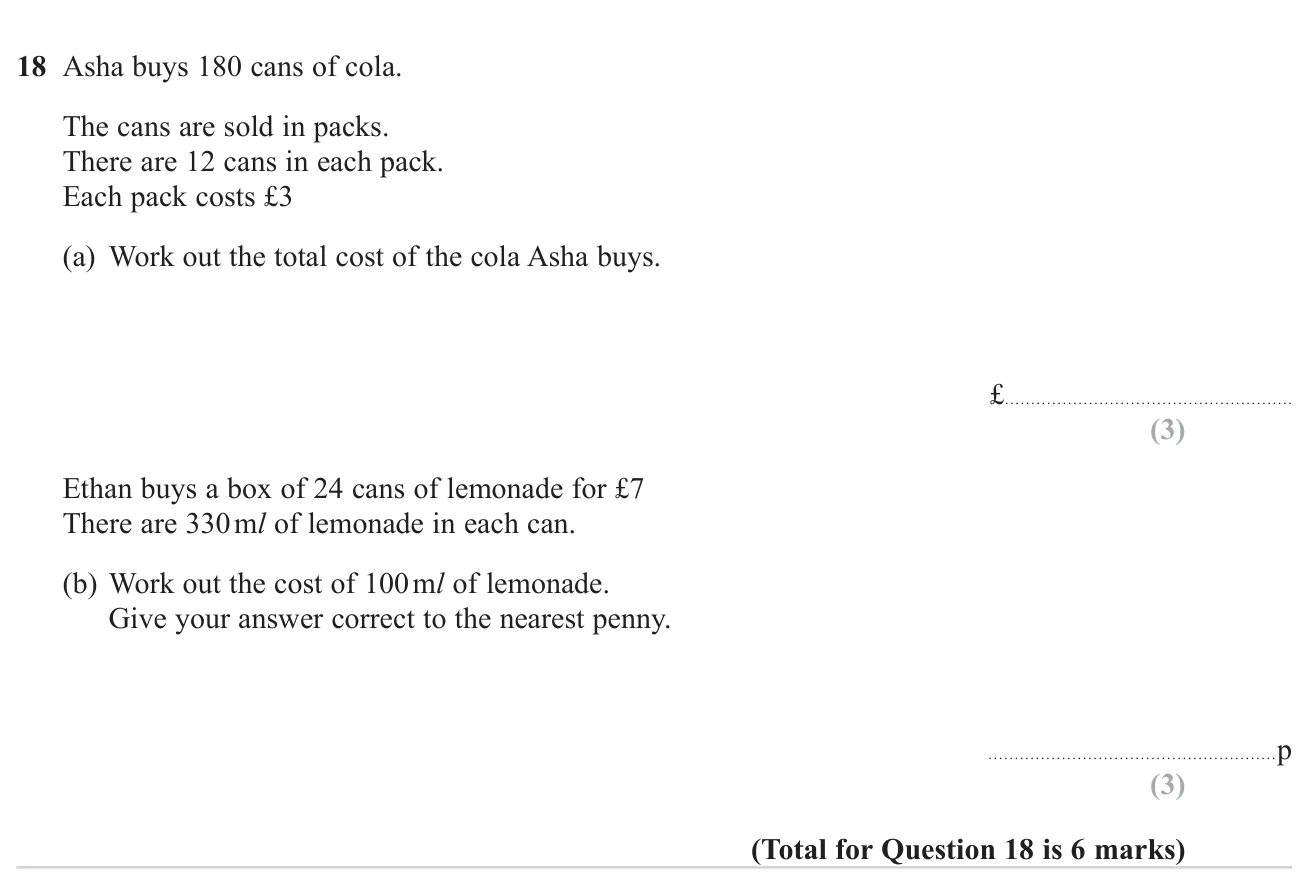
© Pearson Education Ltd. June 2023 Paper 2 (Foundation, calculator), question 18.
(a) £45 3 marks (b) 9p 3 marks
Worked solution Checked against the mark scheme
(a) Packs: 180 ÷ 12 = 15 180 \div 12 = 15 180 ÷ 12 = 15 15 × £ 3 = £ 45 15 \times £3 = £45 15 × £3 = £45
(b) Total volume: 24 × 330 = 7920 24 \times 330 = 7920 24 × 330 = 7920
Cost of 1 ml: 700 ÷ 7920 = 0.0884 700 \div 7920 = 0.0884 700 ÷ 7920 = 0.0884 8.84 8.84 8.84
To the nearest penny: 9p
Watch out: In (a), multiplying 180 by £3.
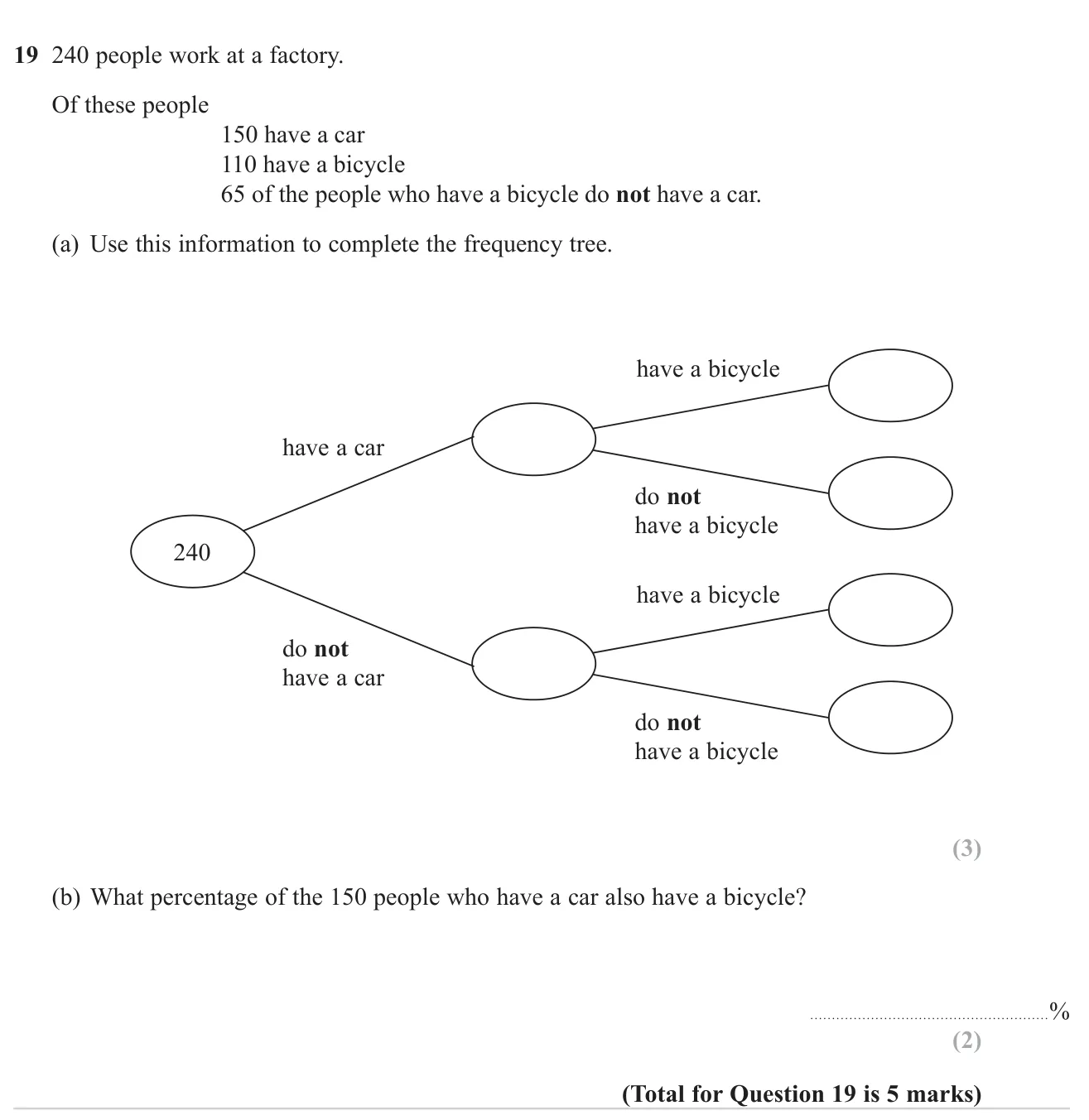
© Pearson Education Ltd. June 2023 Paper 2 (Foundation, calculator), question 19.
(a) Car 150 (bicycle 45, no bicycle 105); no car 90 (bicycle 65, no bicycle 25) 3 marks (b) 30% 2 marks
Worked solution Checked against the mark scheme
(a) No car: 240 − 150 = 90 240 - 150 = 90 240 − 150 = 90 90 − 65 = 25 90 - 65 = 25 90 − 65 = 25
Car owners with a bicycle: 110 − 65 = 45 110 - 65 = 45 110 − 65 = 45 150 − 45 = 105 150 - 45 = 105 150 − 45 = 105
(b) 45 150 × 100 = 30 % \frac{45}{150} \times 100 = 30\% 150 45 × 100 = 30%
Watch out: Putting 110 on the 'car and bicycle' branch.
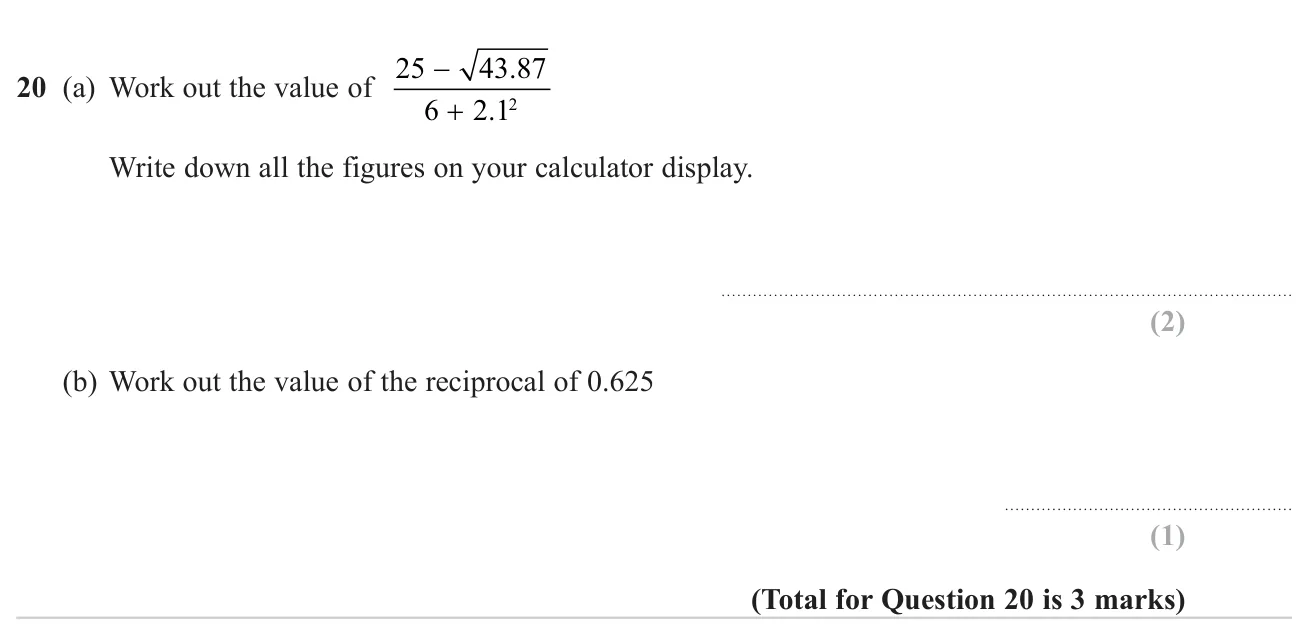
© Pearson Education Ltd. June 2023 Paper 2 (Foundation, calculator), question 20.
(a) 1.765279230... 2 marks (b) 1.6 1 mark
Worked solution Checked against the mark scheme
(a) Top: 25 − 43.87 = 18.3765... 25 - \sqrt{43.87} = 18.3765... 25 − 43.87 = 18.3765...
Bottom: 6 + 2.1 2 = 10.41 6 + 2.1^2 = 10.41 6 + 2. 1 2 = 10.41
18.3765... ÷ 10.41 = 1.765279230... 18.3765... \div 10.41 = 1.765279230... 18.3765... ÷ 10.41 = 1.765279230...
(b) Reciprocal = 1 ÷ 0.625 = 1.6 = 1 \div 0.625 = 1.6 = 1 ÷ 0.625 = 1.6
Watch out: Typing it without brackets so only part of the top is divided.
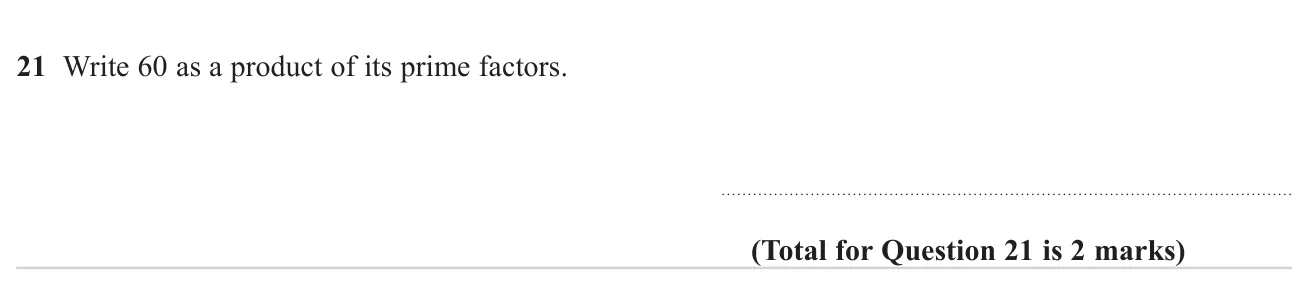
© Pearson Education Ltd. June 2023 Paper 2 (Foundation, calculator), question 21.
Answer 2 × 2 × 3 × 5 2 \times 2 \times 3 \times 5 2 × 2 × 3 × 5 2 marks
Worked solution Checked against the mark scheme
60 = 2 × 30 = 2 × 2 × 15 = 2 × 2 × 3 × 5 60 = 2 \times 30 = 2 \times 2 \times 15 = 2 \times 2 \times 3 \times 5 60 = 2 × 30 = 2 × 2 × 15 = 2 × 2 × 3 × 5
So 60 = 2 2 × 3 × 5 60 = 2^2 \times 3 \times 5 60 = 2 2 × 3 × 5
Watch out: Listing the factors 2, 2, 3, 5 without multiplication signs, or including 1.
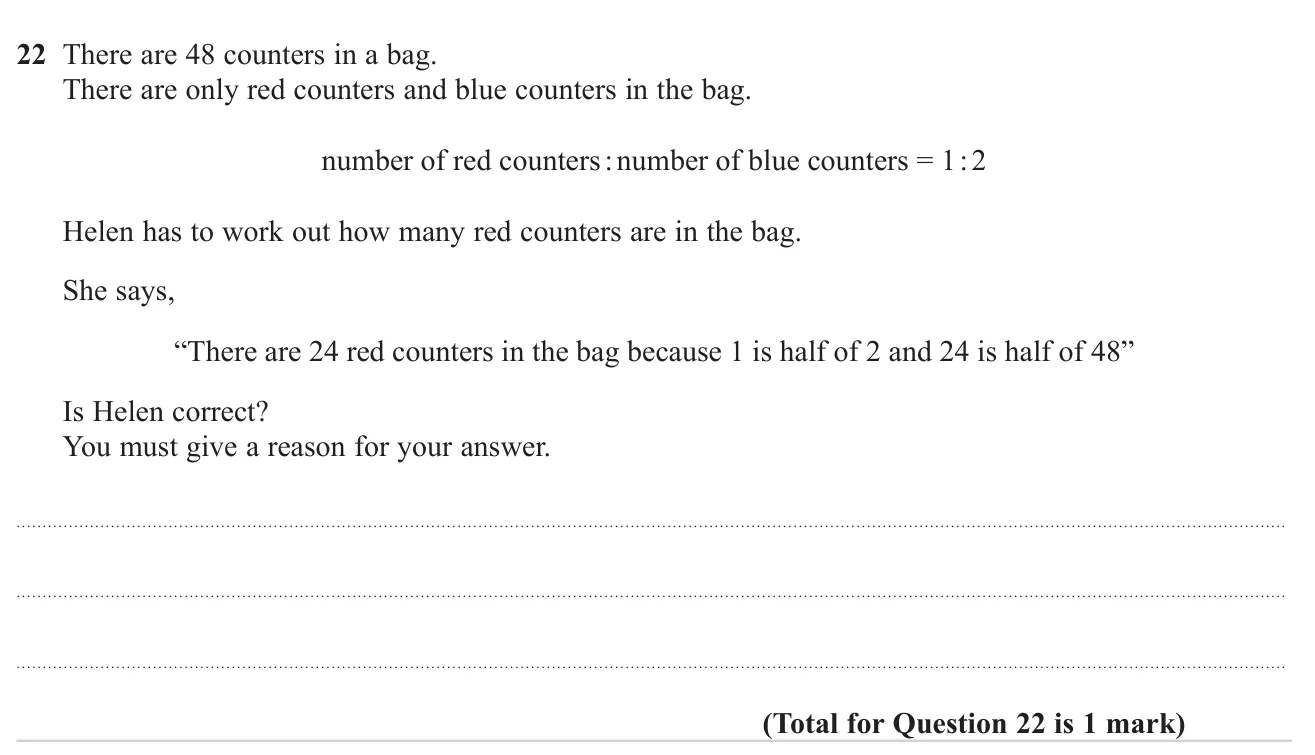
© Pearson Education Ltd. June 2023 Paper 2 (Foundation, calculator), question 22.
Answer No: red is 1 3 \frac{1}{3} 3 1 1 mark
Worked solution Checked against the mark scheme
The ratio 1 : 2 1 : 2 1 : 2 1 + 2 = 3 1 + 2 = 3 1 + 2 = 3
48 ÷ 3 = 16 48 \div 3 = 16 48 ÷ 3 = 16
Helen is wrong: 24 red would be half, which is a 1 : 1 1 : 1 1 : 1
Watch out: Agreeing with Helen because 1 is half of 2.
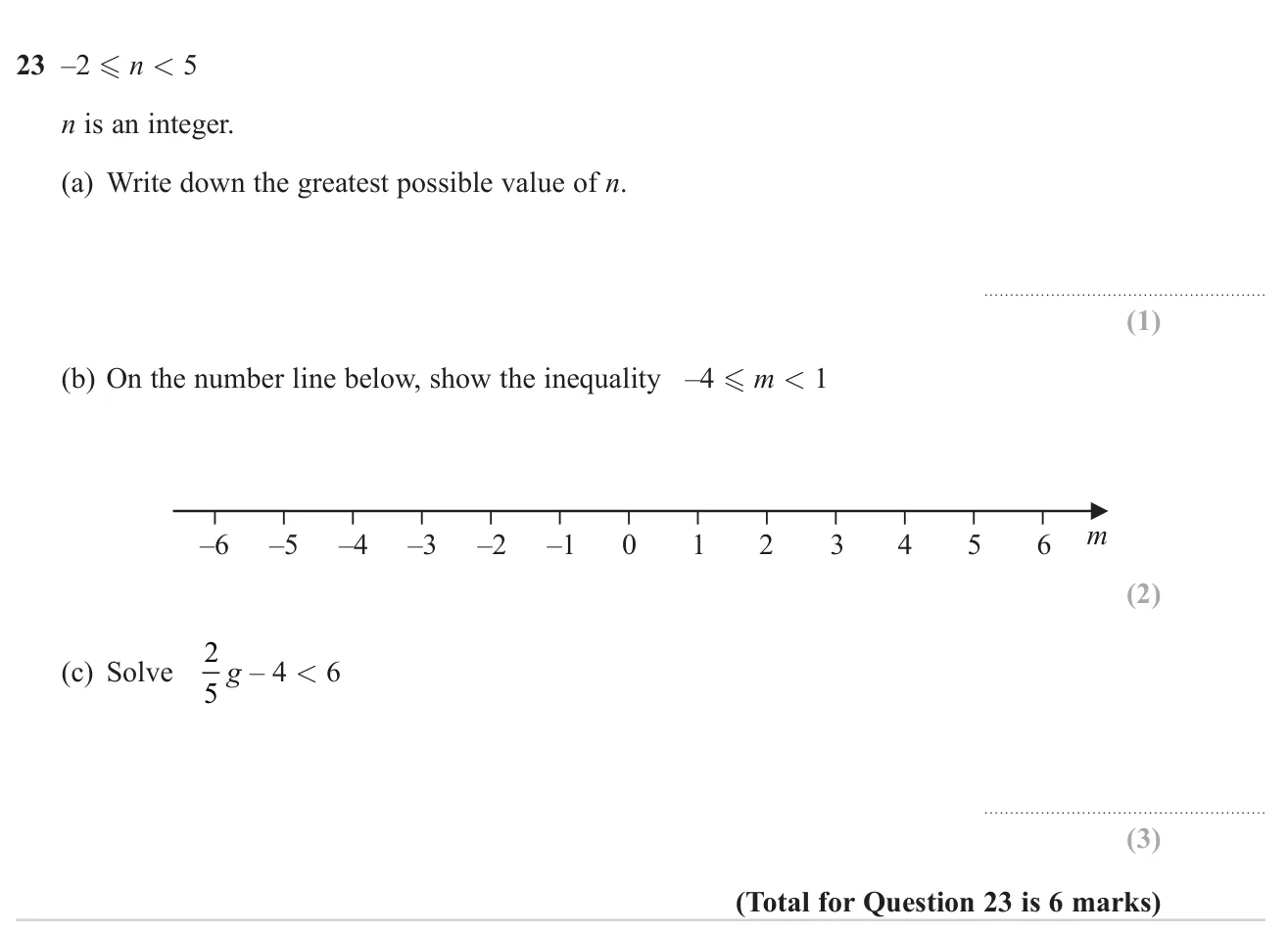
© Pearson Education Ltd. June 2023 Paper 2 (Foundation, calculator), question 23.
(a) 4 1 mark (b) Closed circle at − 4 -4 − 4 1 1 1 2 marks (c) g < 25 g < 25 g < 25 3 marks
Worked solution Checked against the mark scheme
(a) n n n 4 4 4
(b) Filled circle at − 4 -4 − 4 1 1 1
(c) 2 5 g − 4 < 6 \frac{2}{5}g - 4 < 6 5 2 g − 4 < 6
2 5 g < 10 \frac{2}{5}g < 10 5 2 g < 10
2 g < 50 2g < 50 2 g < 50
g < 25 g < 25 g < 25
Watch out: In (a), giving 5 even though the sign is strict.
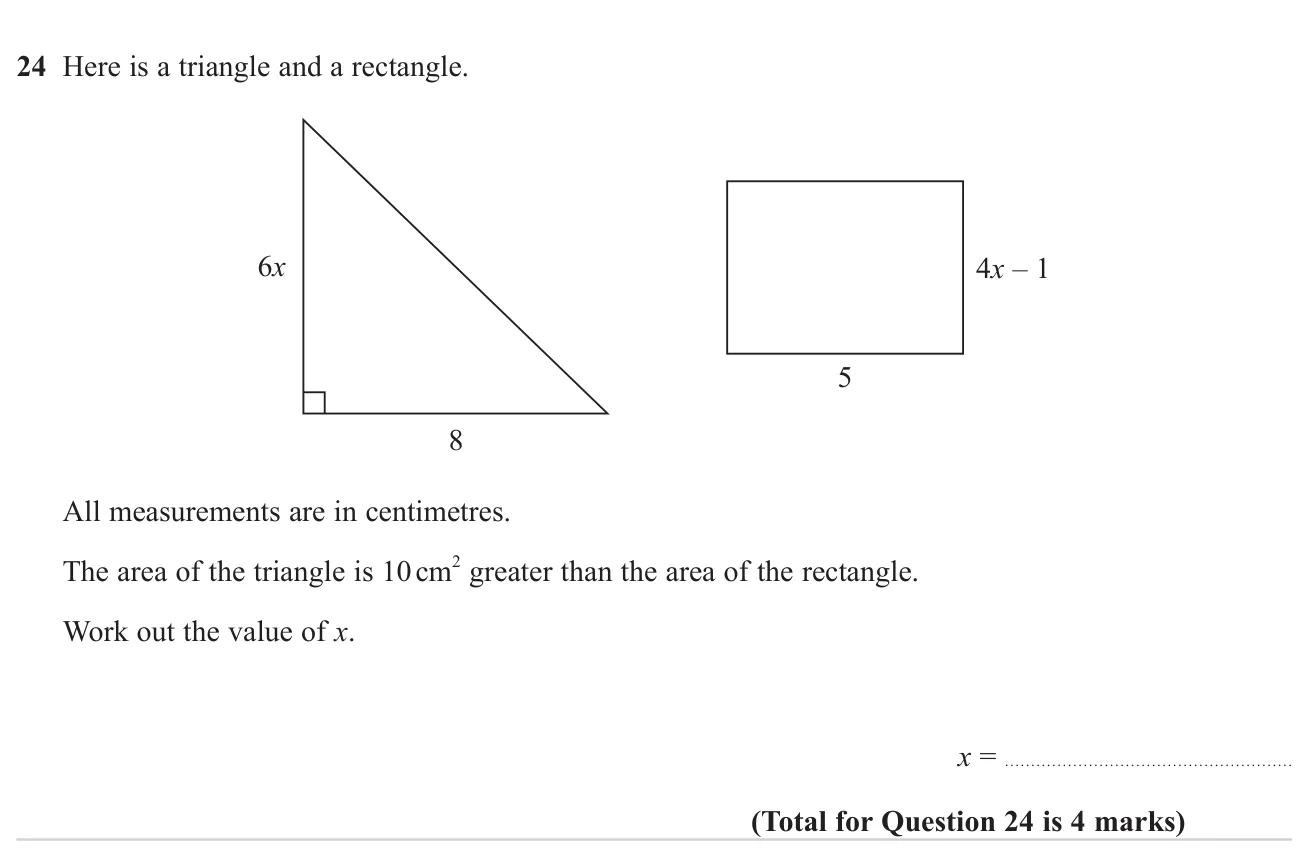
© Pearson Education Ltd. June 2023 Paper 2 (Foundation, calculator), question 24.
Answer x = 1.25 x = 1.25 x = 1.25 4 marks
Worked solution Checked against the mark scheme
Triangle: 1 2 × 8 × 6 x = 24 x \frac{1}{2} \times 8 \times 6x = 24x 2 1 × 8 × 6 x = 24 x
Rectangle: 5 ( 4 x − 1 ) = 20 x − 5 5(4x - 1) = 20x - 5 5 ( 4 x − 1 ) = 20 x − 5
24 x = 20 x − 5 + 10 24x = 20x - 5 + 10 24 x = 20 x − 5 + 10
4 x = 5 4x = 5 4 x = 5 x = 1.25 x = 1.25 x = 1.25
(Check: triangle 30, rectangle 20.)
Watch out: Forgetting to halve for the triangle, or adding the 10 to the wrong side.
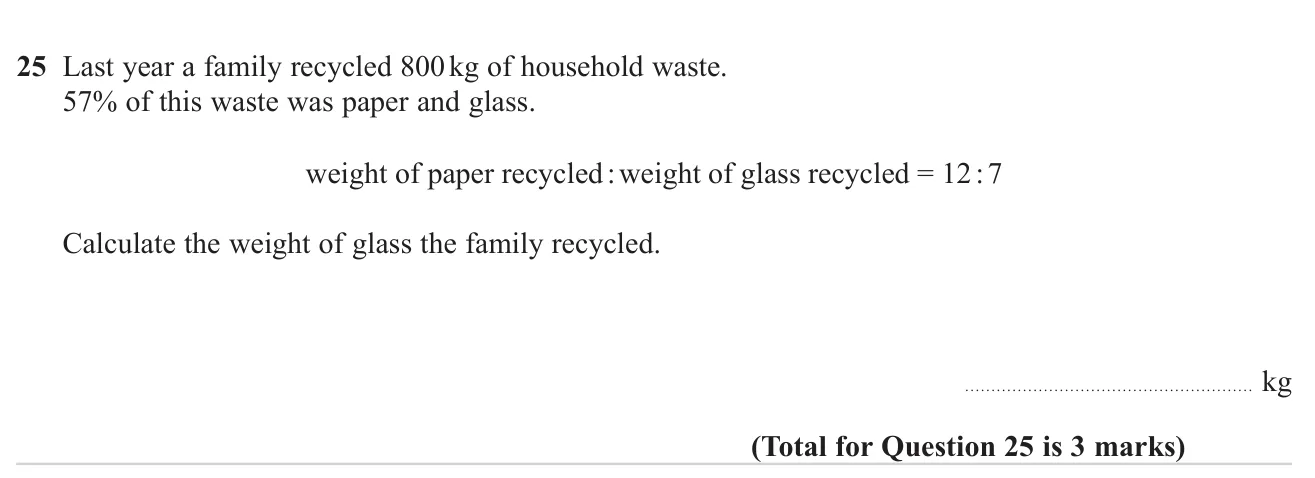
© Pearson Education Ltd. June 2023 Paper 2 (Foundation, calculator), question 25.
Worked solution Checked against the mark scheme
Paper and glass: 0.57 × 800 = 456 0.57 \times 800 = 456 0.57 × 800 = 456
Ratio 12 : 7 12 : 7 12 : 7 456 ÷ 19 = 24 456 \div 19 = 24 456 ÷ 19 = 24
Glass: 7 × 24 = 168 7 \times 24 = 168 7 × 24 = 168
Watch out: Sharing all 800 kg in the ratio instead of the 57%.
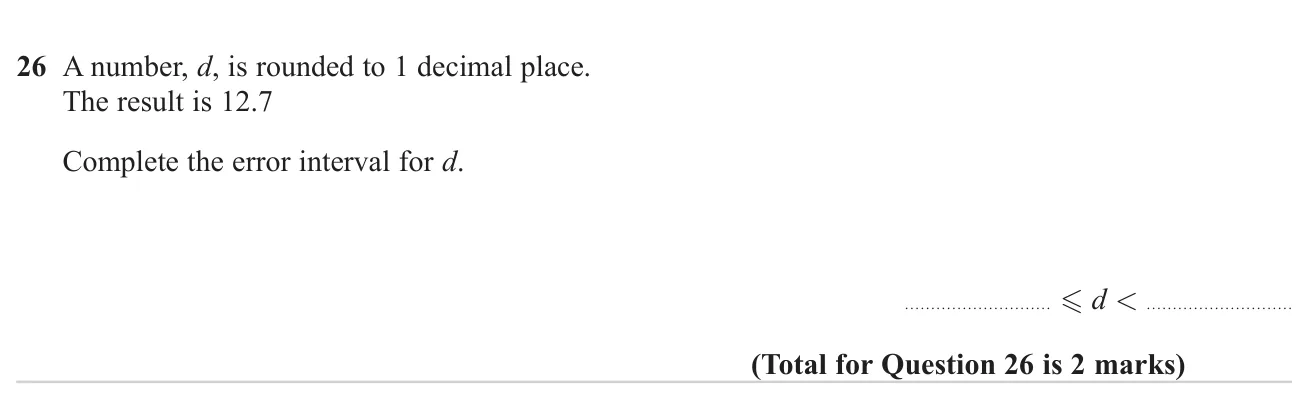
© Pearson Education Ltd. June 2023 Paper 2 (Foundation, calculator), question 26.
Answer 12.65 ≤ d < 12.75 12.65 \le d < 12.75 12.65 ≤ d < 12.75 2 marks
Worked solution Checked against the mark scheme
Rounding to 1 d.p. means the value is within 0.05 0.05 0.05 12.7 12.7 12.7
Lower bound: 12.7 − 0.05 = 12.65 12.7 - 0.05 = 12.65 12.7 − 0.05 = 12.65
Upper bound: 12.7 + 0.05 = 12.75 12.7 + 0.05 = 12.75 12.7 + 0.05 = 12.75
12.65 ≤ d < 12.75 12.65 \le d < 12.75 12.65 ≤ d < 12.75
Watch out: Using 12.6 and 12.8, or 12.749 as the upper bound.
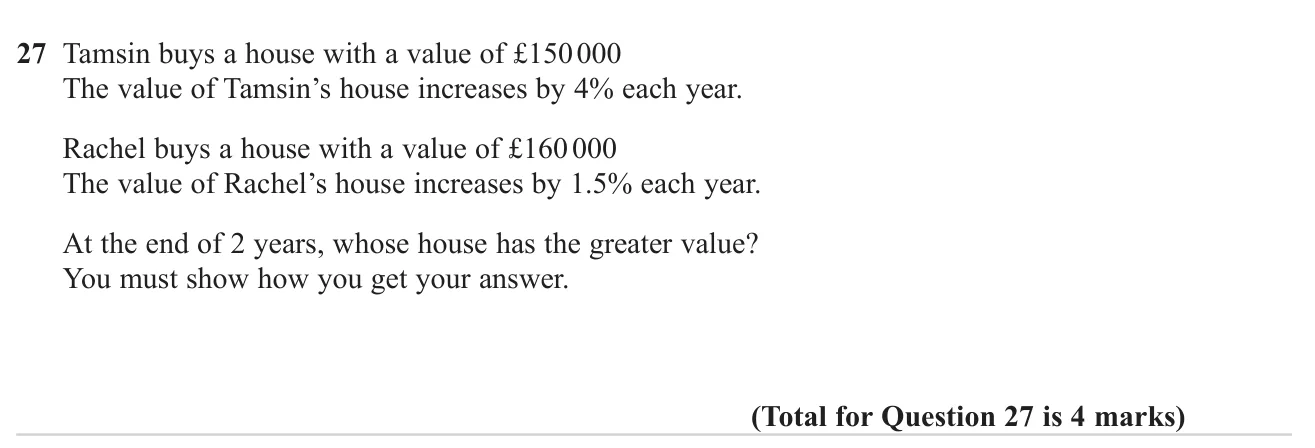
© Pearson Education Ltd. June 2023 Paper 2 (Foundation, calculator), question 27.
Answer Rachel's: £164 836 compared with Tamsin's £162 240 4 marks
Worked solution Checked against the mark scheme
Tamsin: 150 000 × 1.04 2 = £ 162 240 150\,000 \times 1.04^2 = £162\,240 150 000 × 1.0 4 2 = £162 240
Rachel: 160 000 × 1.015 2 = £ 164 836 160\,000 \times 1.015^2 = £164\,836 160 000 × 1.01 5 2 = £164 836
164 836 > 162 240 164\,836 > 162\,240 164 836 > 162 240
Watch out: Using simple interest (adding the same increase twice).
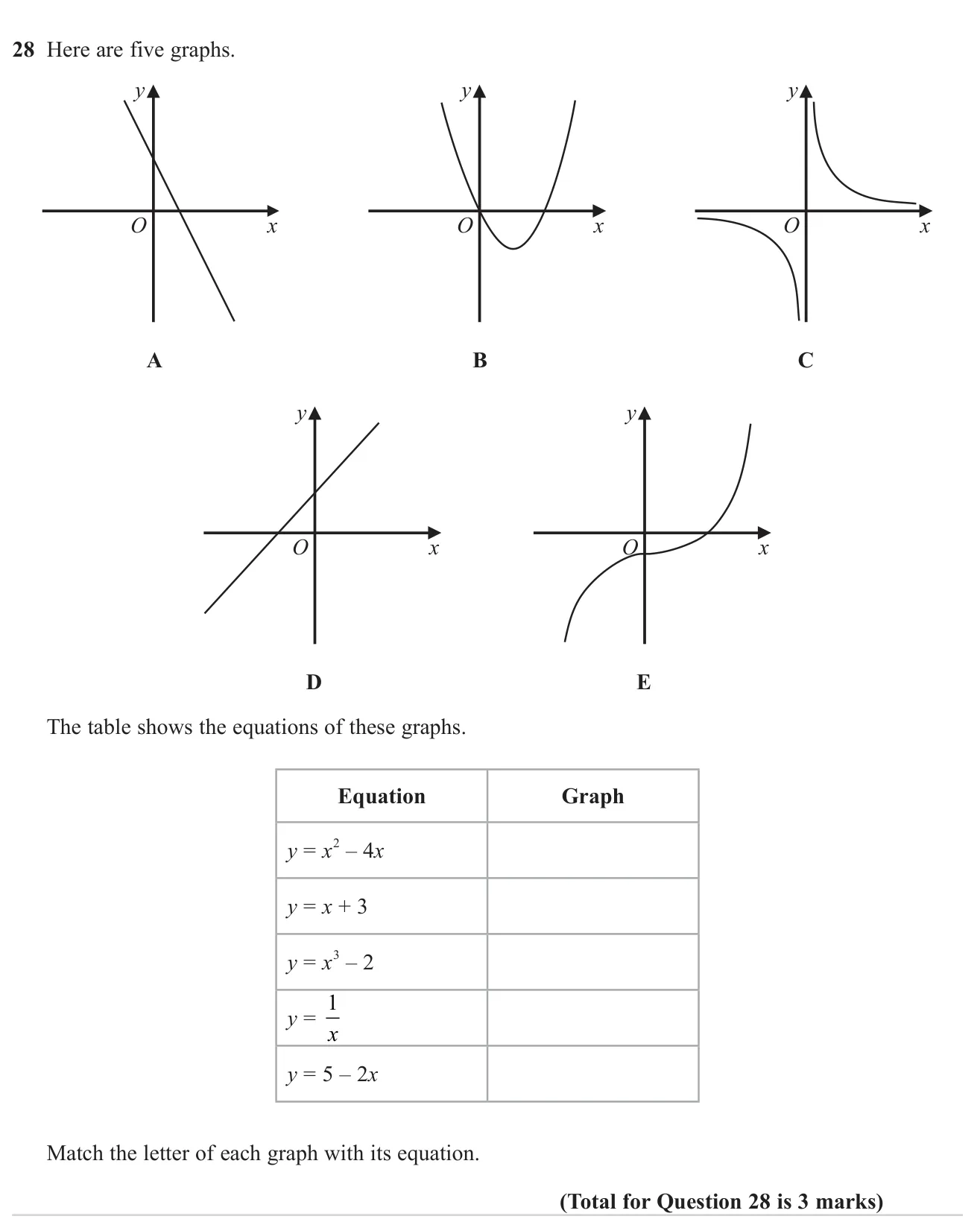
© Pearson Education Ltd. June 2023 Paper 2 (Foundation, calculator), question 28.
Answer y = x 2 − 4 x y = x^2 - 4x y = x 2 − 4 x y = x + 3 y = x + 3 y = x + 3 y = x 3 − 2 y = x^3 - 2 y = x 3 − 2 y = 1 x y = \frac{1}{x} y = x 1 y = 5 − 2 x y = 5 - 2x y = 5 − 2 x 3 marks
Worked solution Checked against the mark scheme
y = x 2 − 4 x y = x^2 - 4x y = x 2 − 4 x B
y = x + 3 y = x + 3 y = x + 3 y y y D
y = x 3 − 2 y = x^3 - 2 y = x 3 − 2 E
y = 1 x y = \frac{1}{x} y = x 1 C
y = 5 − 2 x y = 5 - 2x y = 5 − 2 x A
Watch out: Mixing up the two straight lines by ignoring the sign of the gradient.
Finished the paper? Add up your marks for all three papers and see what grade that would have been.