© Pearson Education Ltd. November 2024 Paper 1 (Foundation, non-calculator), question 1.
Show answer
Worked solution Checked against the mark scheme
Per cent means out of 100, so divide by 100.
25÷100=0.25
Watch out: Writing 2.5 or 25.0.
© Pearson Education Ltd. November 2024 Paper 1 (Foundation, non-calculator), question 2.
Show answer
Worked solution Checked against the mark scheme
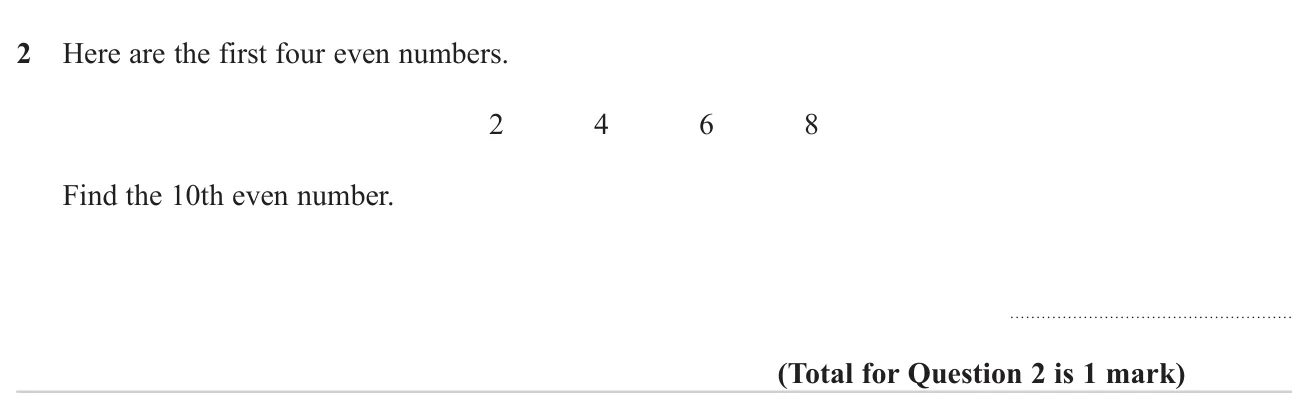
The even numbers are the 2 times table.
The 10th one is 2×10=20.
Watch out: Giving 18 by counting from the wrong starting term.
© Pearson Education Ltd. November 2024 Paper 1 (Foundation, non-calculator), question 3.
Show answer
Worked solution Checked against the mark scheme
There are 10 mm in 1 cm.
15×10=150 mm
Watch out: Dividing by 10 to get 1.5.
© Pearson Education Ltd. November 2024 Paper 1 (Foundation, non-calculator), question 4.
Show answer
Worked solution Checked against the mark scheme
Multiples of 9: 9, 18, 27, 36, …
The only one between 20 and 30 is 27.
Watch out: Confusing multiples with factors.
© Pearson Education Ltd. November 2024 Paper 1 (Foundation, non-calculator), question 5.
Show answer
Worked solution Checked against the mark scheme
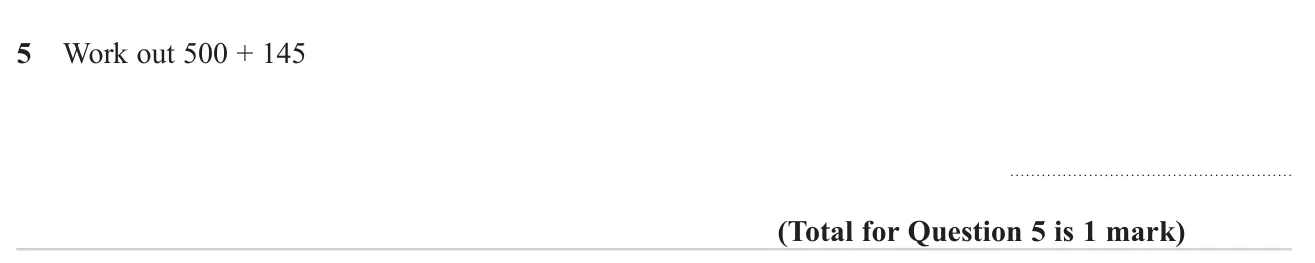
500+145=645
Watch out: Lining up digits wrongly.
© Pearson Education Ltd. November 2024 Paper 1 (Foundation, non-calculator), question 6.
Show answer
Worked solution Checked against the mark scheme
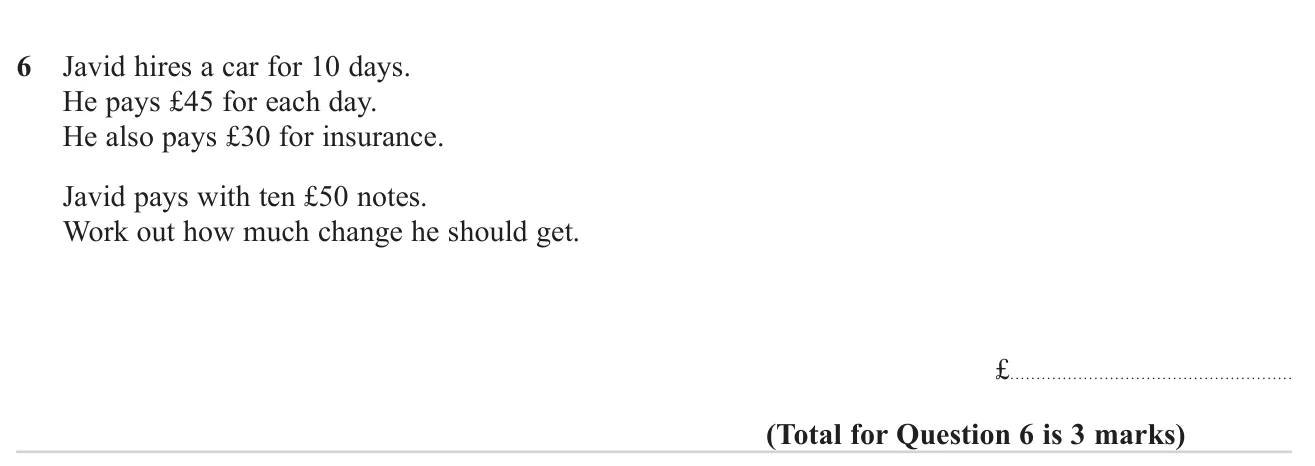
Hire: 10×£45=£450
Total cost: £450+£30=£480
Paid: 10×£50=£500
Change: £500−£480=£20
Watch out: Forgetting the insurance and getting £50.
© Pearson Education Ltd. November 2024 Paper 1 (Foundation, non-calculator), question 7.
Show answer
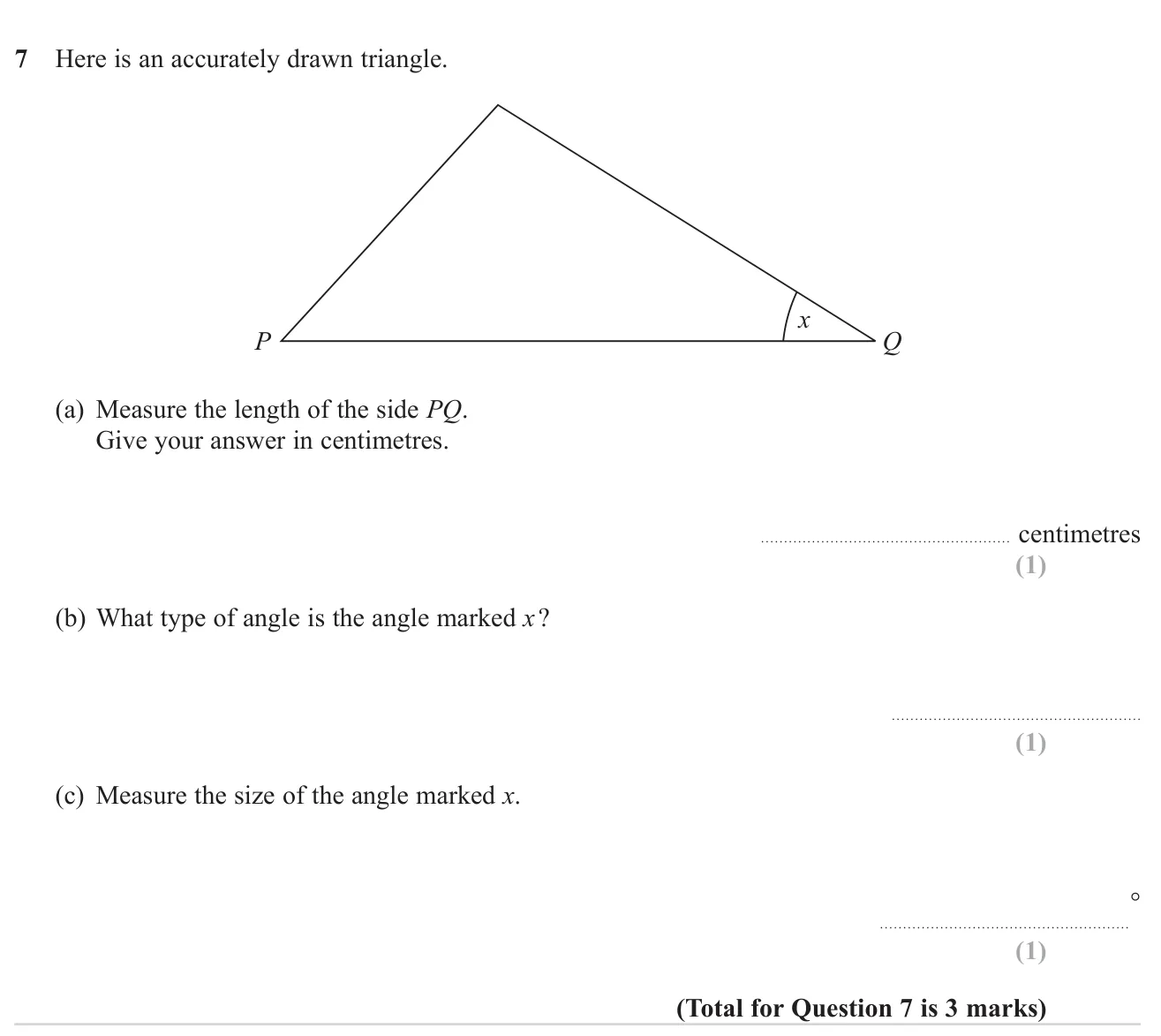
| (a) | 9.5 cm (9.3 to 9.7) | 1 mark |
|---|
| (b) | acute | 1 mark |
|---|
| (c) | 32° (30 to 34) | 1 mark |
|---|
Worked solution Checked against the mark scheme
(a) Place the ruler's zero on P and read off at Q: about 9.5 cm.
(b) The angle is smaller than 90°, so it is acute.
(c) Put the protractor's centre on the vertex and read from the zero line: about 32°.
Watch out: Reading the wrong scale on the protractor and giving 148°.
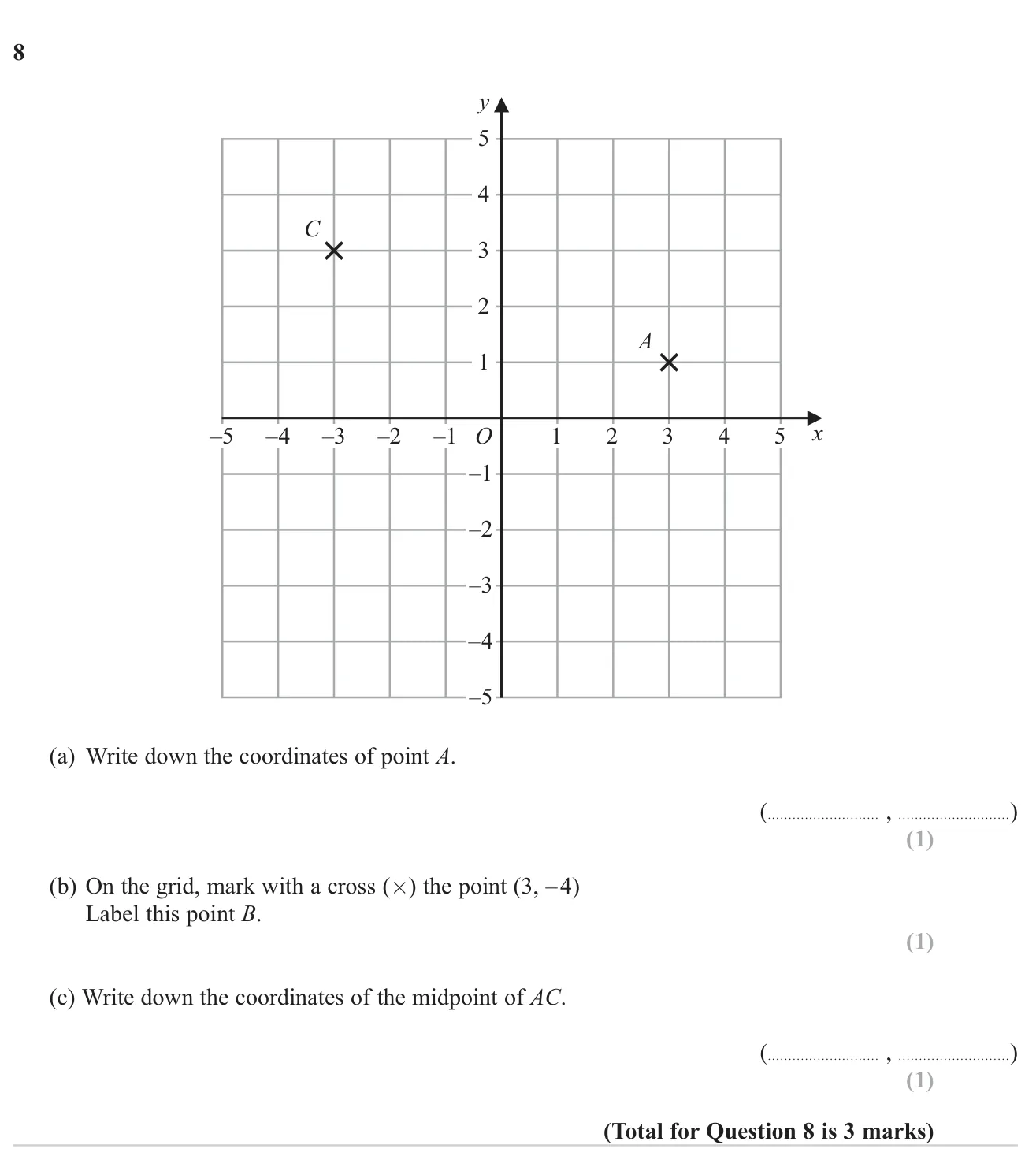
© Pearson Education Ltd. November 2024 Paper 1 (Foundation, non-calculator), question 8.
Show answer
| (a) | (3,1) | 1 mark |
|---|
| (b) | Cross at (3,−4) labelled B | 1 mark |
|---|
| (c) | (0,2) | 1 mark |
|---|
Worked solution Checked against the mark scheme
(a) A is 3 right and 1 up: (3,1).
(b) Go 3 right and 4 down and mark B there.
(c) C is (−3,3). Midpoint =(23+(−3),21+3)=(0,2)
Watch out: Writing coordinates the wrong way round, e.g. (1, 3).
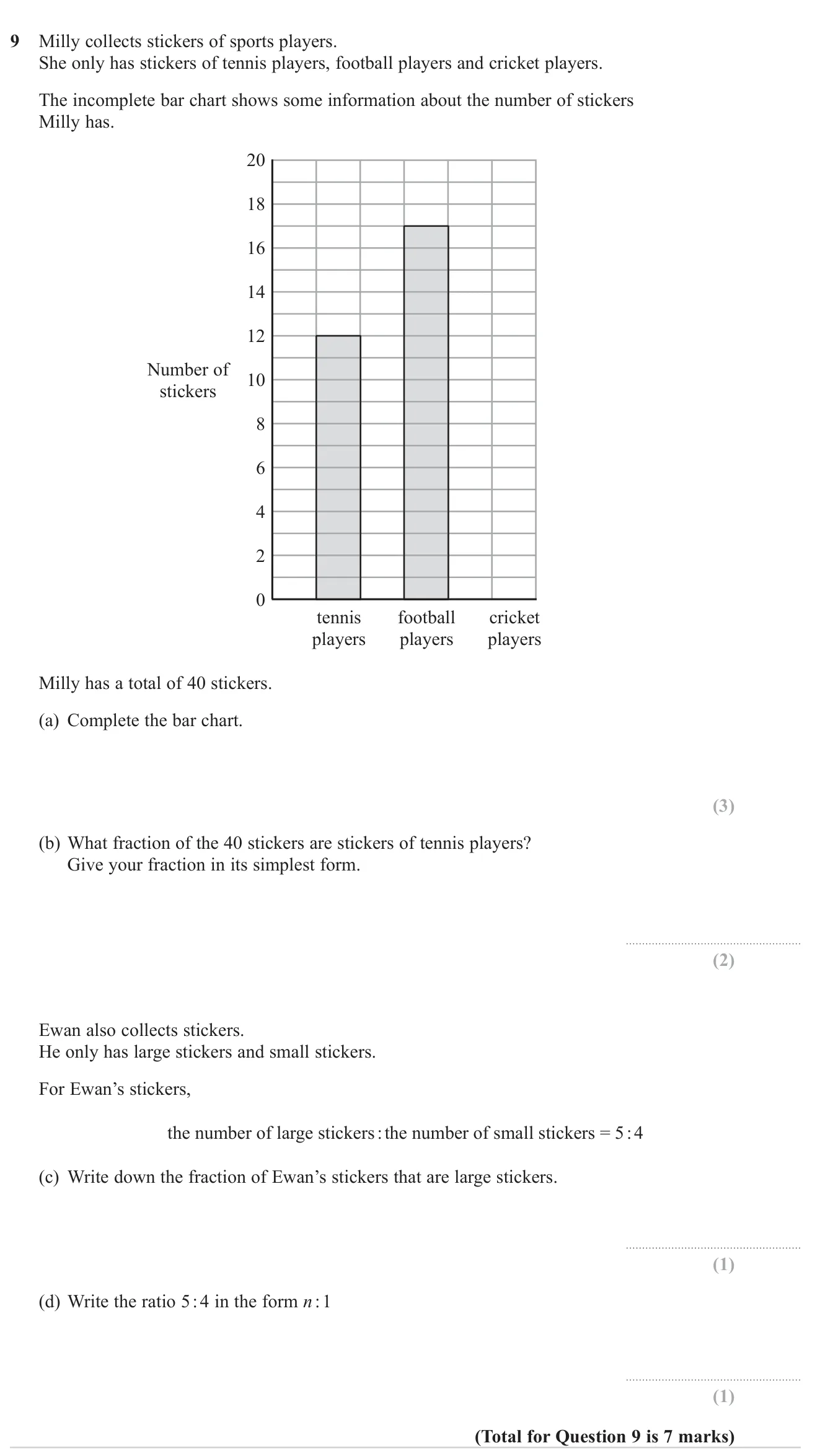
© Pearson Education Ltd. November 2024 Paper 1 (Foundation, non-calculator), question 9.
Show answer
| (a) | Cricket bar drawn to height 11 | 3 marks |
|---|
| (b) | 103 | 2 marks |
|---|
| (c) | 95 | 1 mark |
|---|
| (d) | 1.25:1 | 1 mark |
|---|
Worked solution Checked against the mark scheme
(a) Tennis is 12 and football is 17. Cricket =40−12−17=11, so draw the bar up to 11.
(b) 4012=103
(c) There are 5+4=9 parts and 5 are large: 95
(d) Divide both sides by 4: 5÷4=1.25, so 1.25:1
Watch out: In (c), giving 5/4 instead of 5/9.
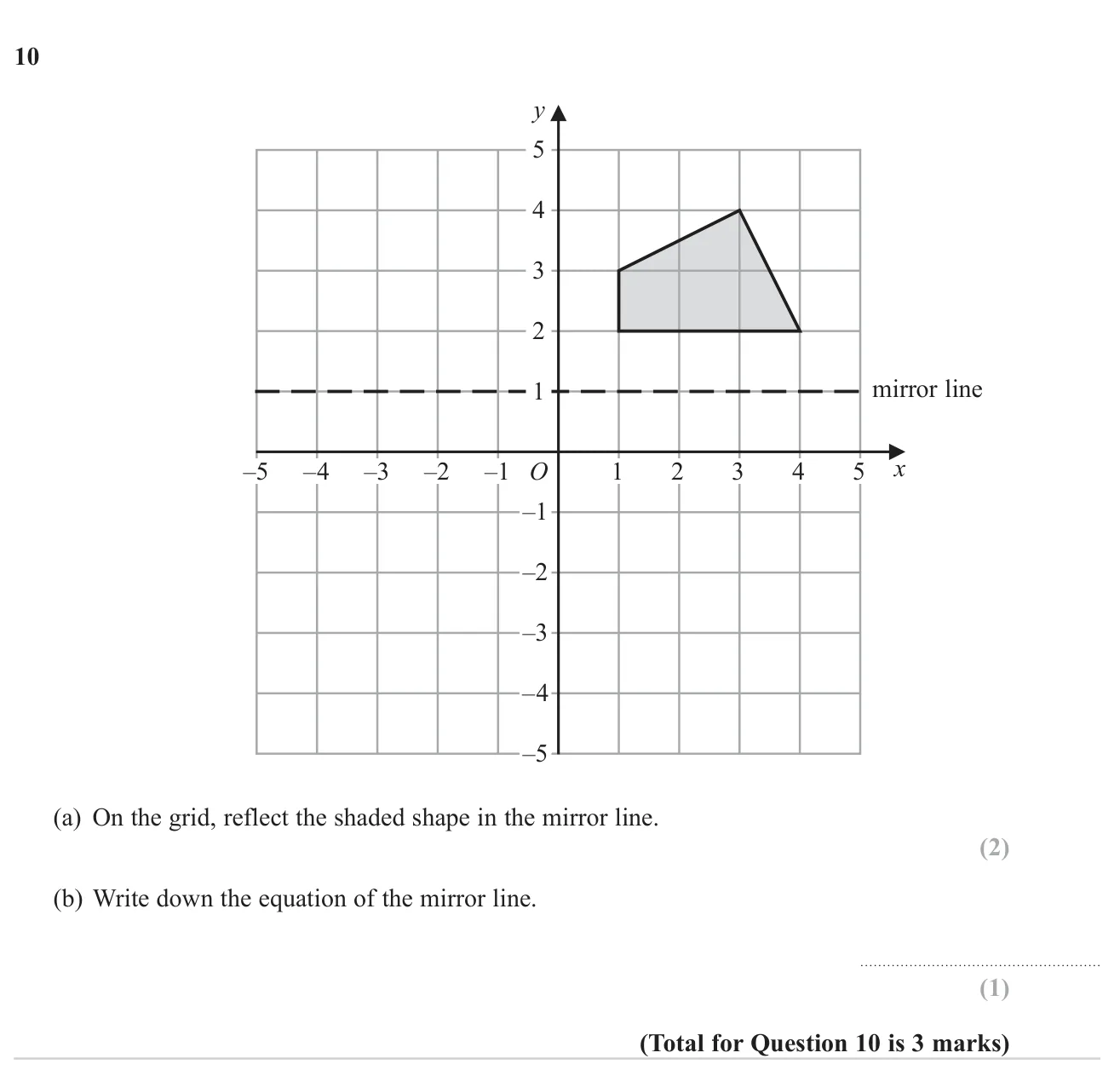
© Pearson Education Ltd. November 2024 Paper 1 (Foundation, non-calculator), question 10.
Show answer
| (a) | Image with vertices (1,0), (1,−1), (3,−2), (4,0) | 2 marks |
|---|
| (b) | y=1 | 1 mark |
|---|
Worked solution Checked against the mark scheme
(a) Each vertex keeps its x value and moves to the same distance on the other side of y=1:
(1,2)→(1,0), (1,3)→(1,−1), (3,4)→(3,−2), (4,2)→(4,0)
(b) Every point on the line has y-coordinate 1, so it is y=1.
Watch out: Writing x = 1 for a horizontal line.
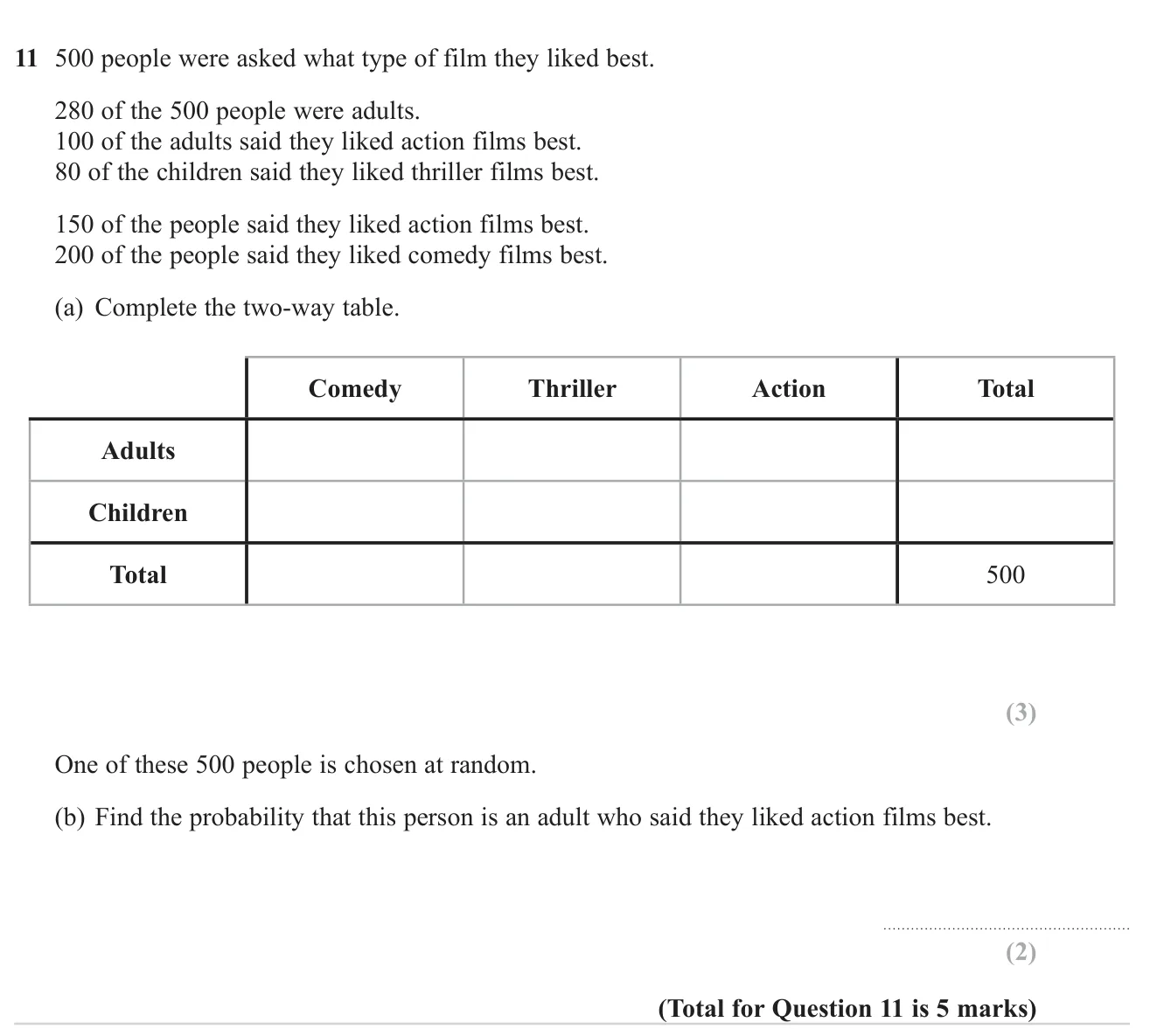
© Pearson Education Ltd. November 2024 Paper 1 (Foundation, non-calculator), question 11.
Show answer
| (a) | Adults: 110, 70, 100, 280; Children: 90, 80, 50, 220; Totals: 200, 150, 150, 500 | 3 marks |
|---|
| (b) | 500100 | 2 marks |
|---|
Worked solution Checked against the mark scheme
(a) Children =500−280=220. Children action =150−100=50.
Thriller total =500−200−150=150, so adult thriller =150−80=70.
Adult comedy =280−70−100=110, child comedy =200−110=90.
(b) 100 of the 500 people are adults who like action: 500100=51
Watch out: In (b), using 100/280 (only the adults).
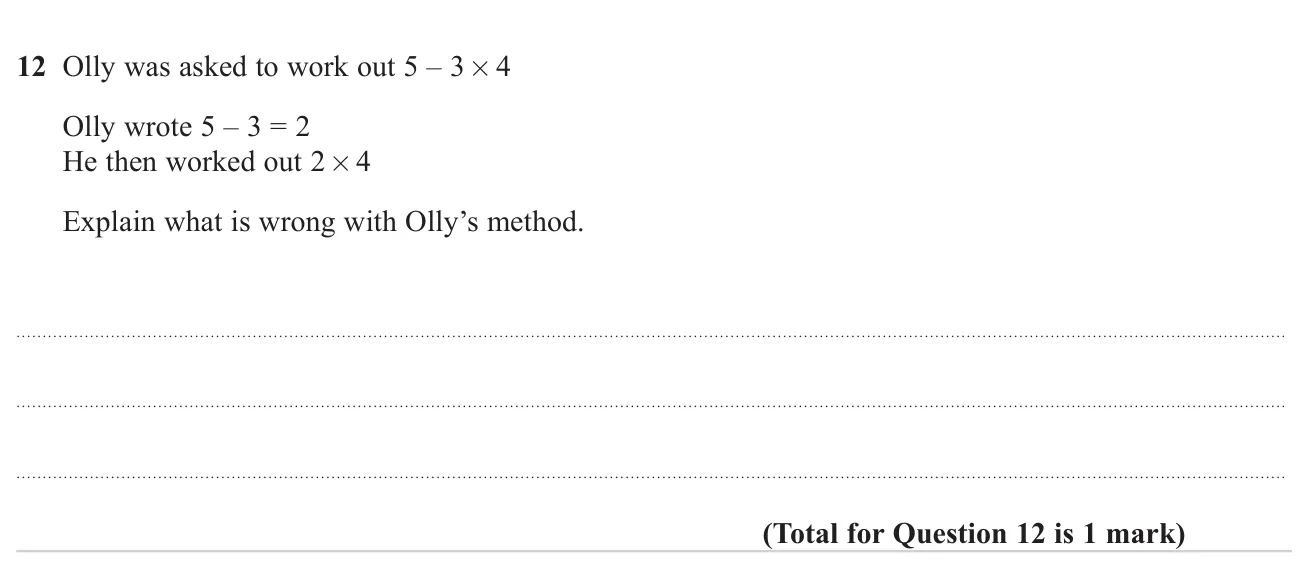
© Pearson Education Ltd. November 2024 Paper 1 (Foundation, non-calculator), question 12.
Show answer
| Answer | He should multiply 3×4 before subtracting | 1 mark |
|---|
Worked solution Checked against the mark scheme
Multiplication comes before subtraction (BIDMAS).
So 5−3×4=5−12=−7, not 2×4=8.
Watch out: Just saying the answer is wrong without explaining why.
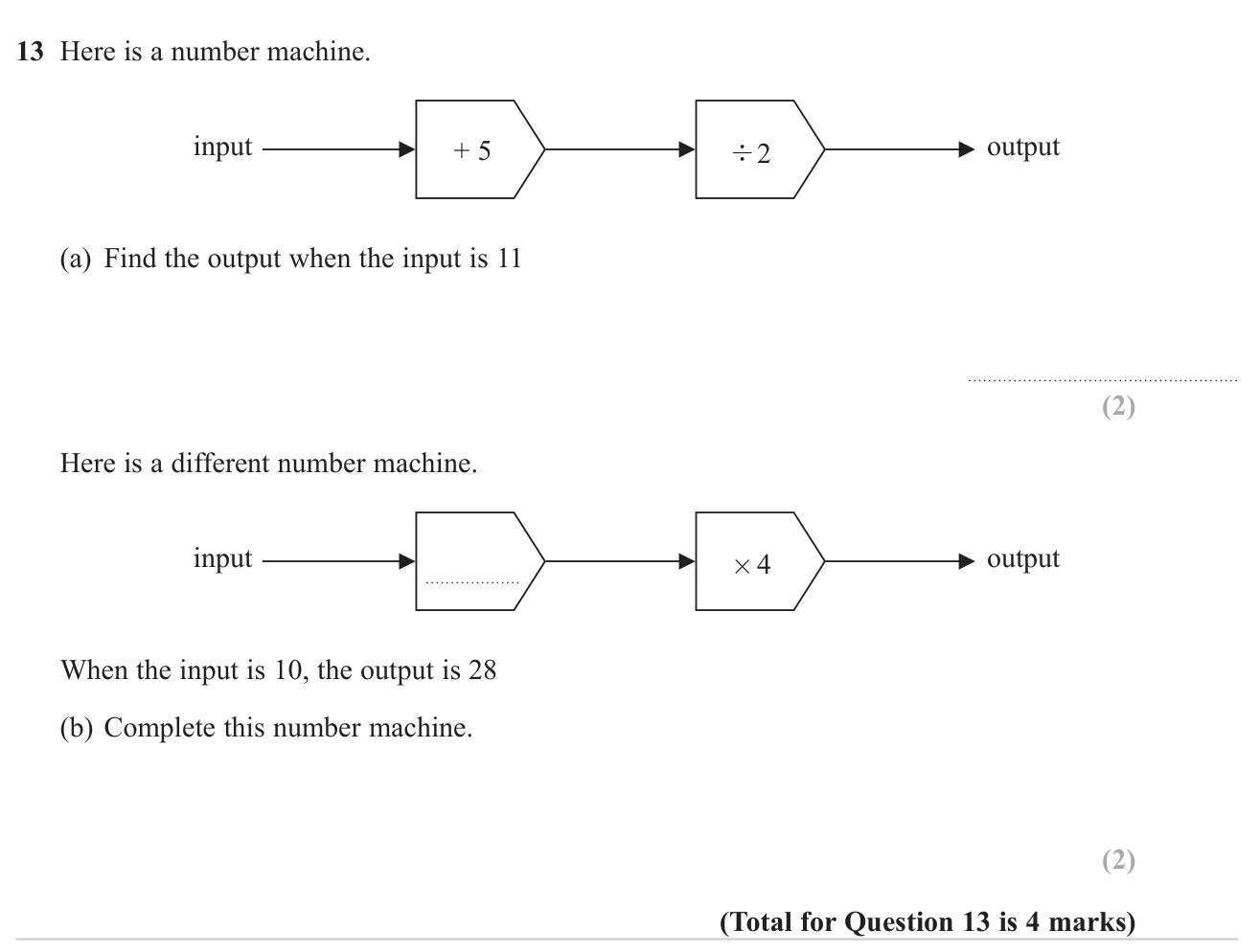
© Pearson Education Ltd. November 2024 Paper 1 (Foundation, non-calculator), question 13.
Show answer
| (a) | 8 | 2 marks |
|---|
| (b) | −3 (or ×0.7) | 2 marks |
|---|
Worked solution Checked against the mark scheme
(a) 11+5=16, then 16÷2=8
(b) Work backwards from the output: 28÷4=7
The first box turns 10 into 7, so it is −3 (or ×0.7).
Watch out: In (b), writing −12 by applying ×4 first.
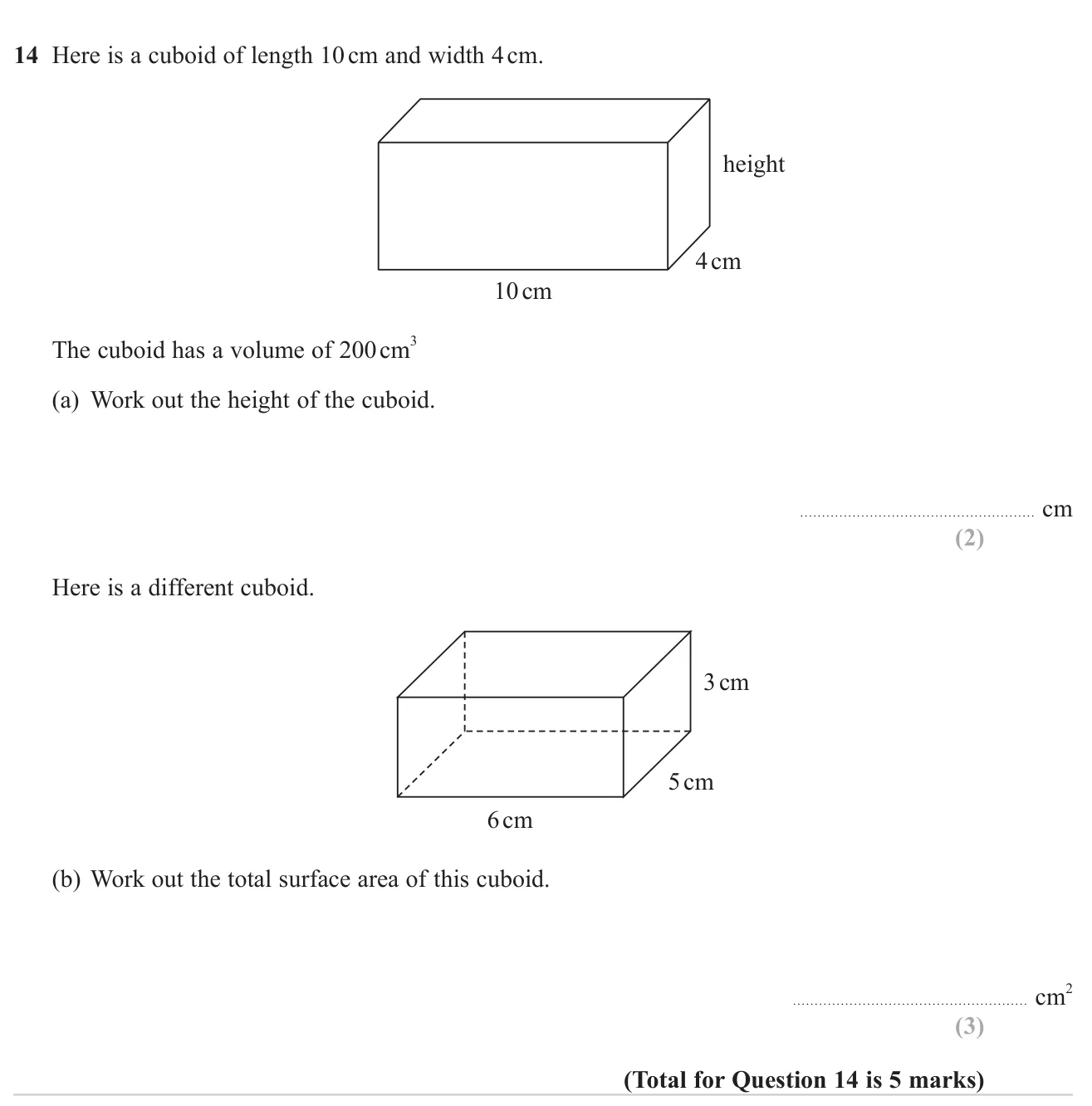
© Pearson Education Ltd. November 2024 Paper 1 (Foundation, non-calculator), question 14.
Show answer
| (a) | 5 | 2 marks |
|---|
| (b) | 126 | 3 marks |
|---|
Worked solution Checked against the mark scheme
(a) Base area =10×4=40 cm², so height =200÷40=5 cm
(b) Faces: 6×5=30, 6×3=18, 5×3=15
Each appears twice: 2(30+18+15)=126 cm²
Watch out: In (b), working out the volume (90) instead.
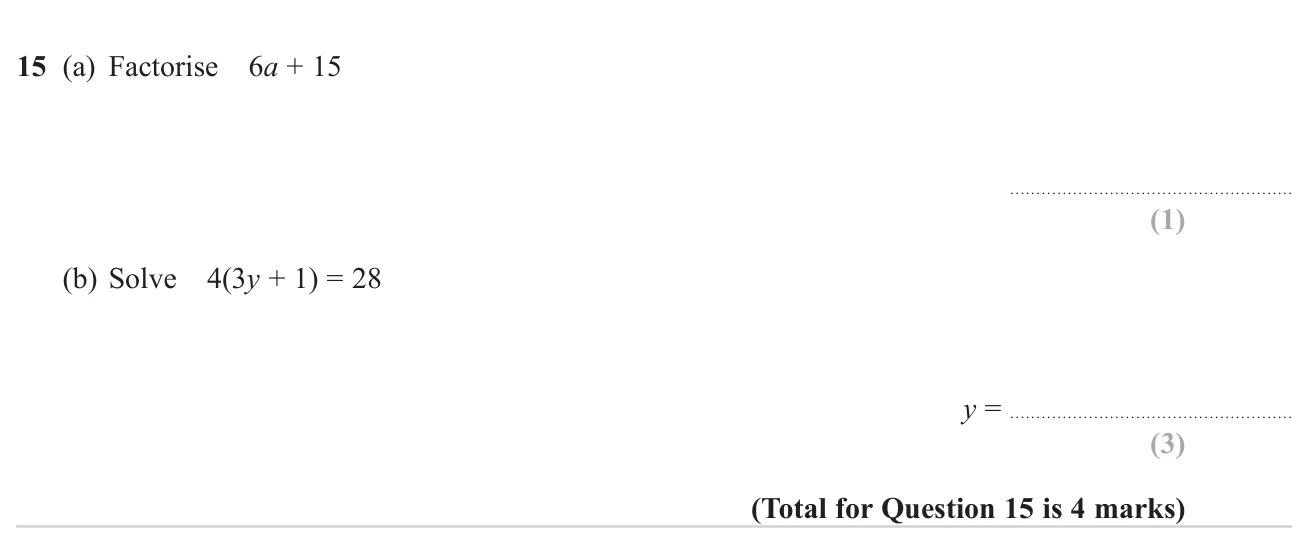
© Pearson Education Ltd. November 2024 Paper 1 (Foundation, non-calculator), question 15.
Show answer
| (a) | 3(2a+5) | 1 mark |
|---|
| (b) | y=2 | 3 marks |
|---|
Worked solution Checked against the mark scheme
(a) The highest common factor of 6 and 15 is 3: 3(2a+5)
(b) 4(3y+1)=28
3y+1=7
3y=6, so y=2
Watch out: In (b), expanding as 12y + 1.
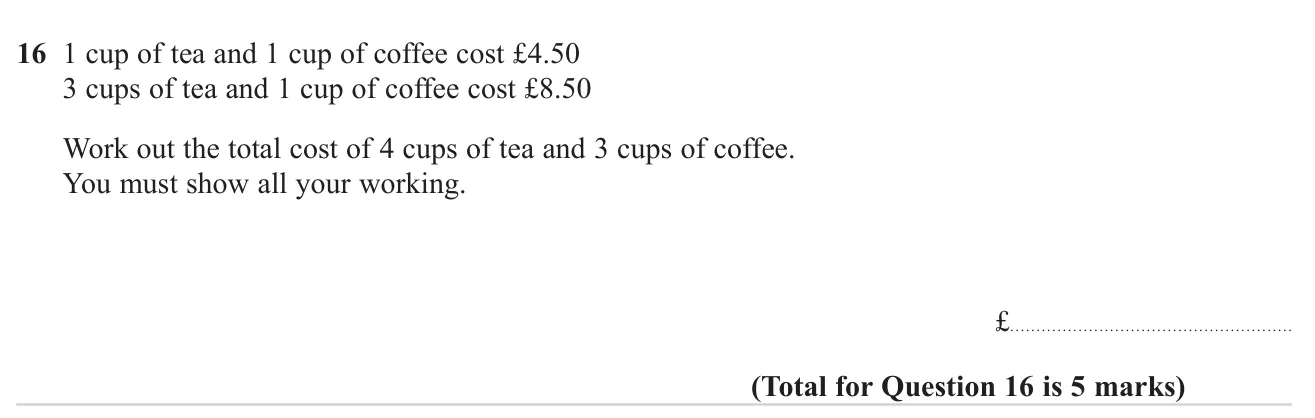
© Pearson Education Ltd. November 2024 Paper 1 (Foundation, non-calculator), question 16.
Show answer
| Answer | £15.50 | 5 marks |
|---|
Worked solution Checked against the mark scheme
The difference is 2 teas: 8.50−4.50=£4, so 1 tea costs £2.
1 coffee =4.50−2=£2.50
4×2+3×2.50=8+7.50=£15.50
Watch out: Dividing £4.50 equally between tea and coffee.
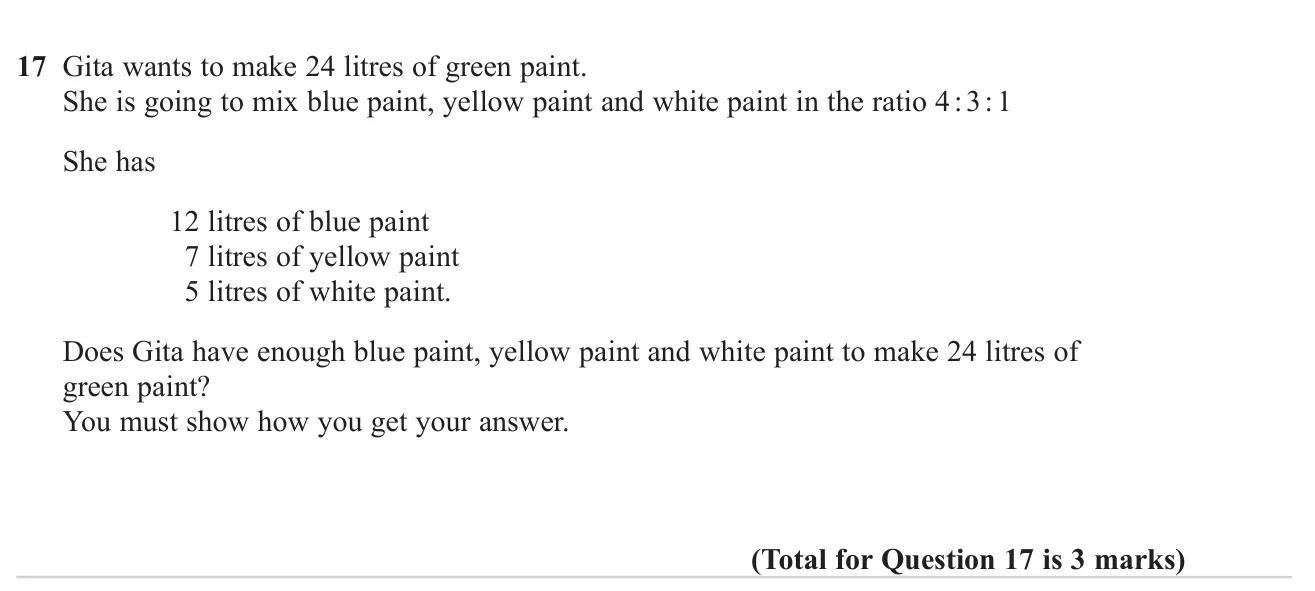
© Pearson Education Ltd. November 2024 Paper 1 (Foundation, non-calculator), question 17.
Show answer
| Answer | No: she needs 12 l blue, 9 l yellow, 3 l white but has only 7 l yellow | 3 marks |
|---|
Worked solution Checked against the mark scheme
Total parts =4+3+1=8, so one part =24÷8=3 litres.
Blue =12, yellow =9, white =3.
She has only 7 litres of yellow, so no, she does not have enough.
Watch out: Dividing 24 by 3 (the number of colours) instead of 8.
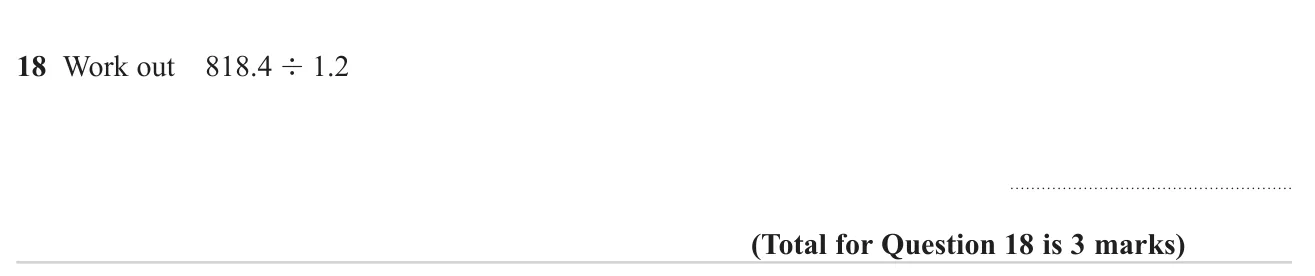
© Pearson Education Ltd. November 2024 Paper 1 (Foundation, non-calculator), question 18.
Show answer
Worked solution Checked against the mark scheme
Multiply both numbers by 10: 8184÷12
81÷12=6 r 9, 98÷12=8 r 2, 24÷12=2
So the answer is 682.
Watch out: Giving 68.2 after misplacing the decimal point.
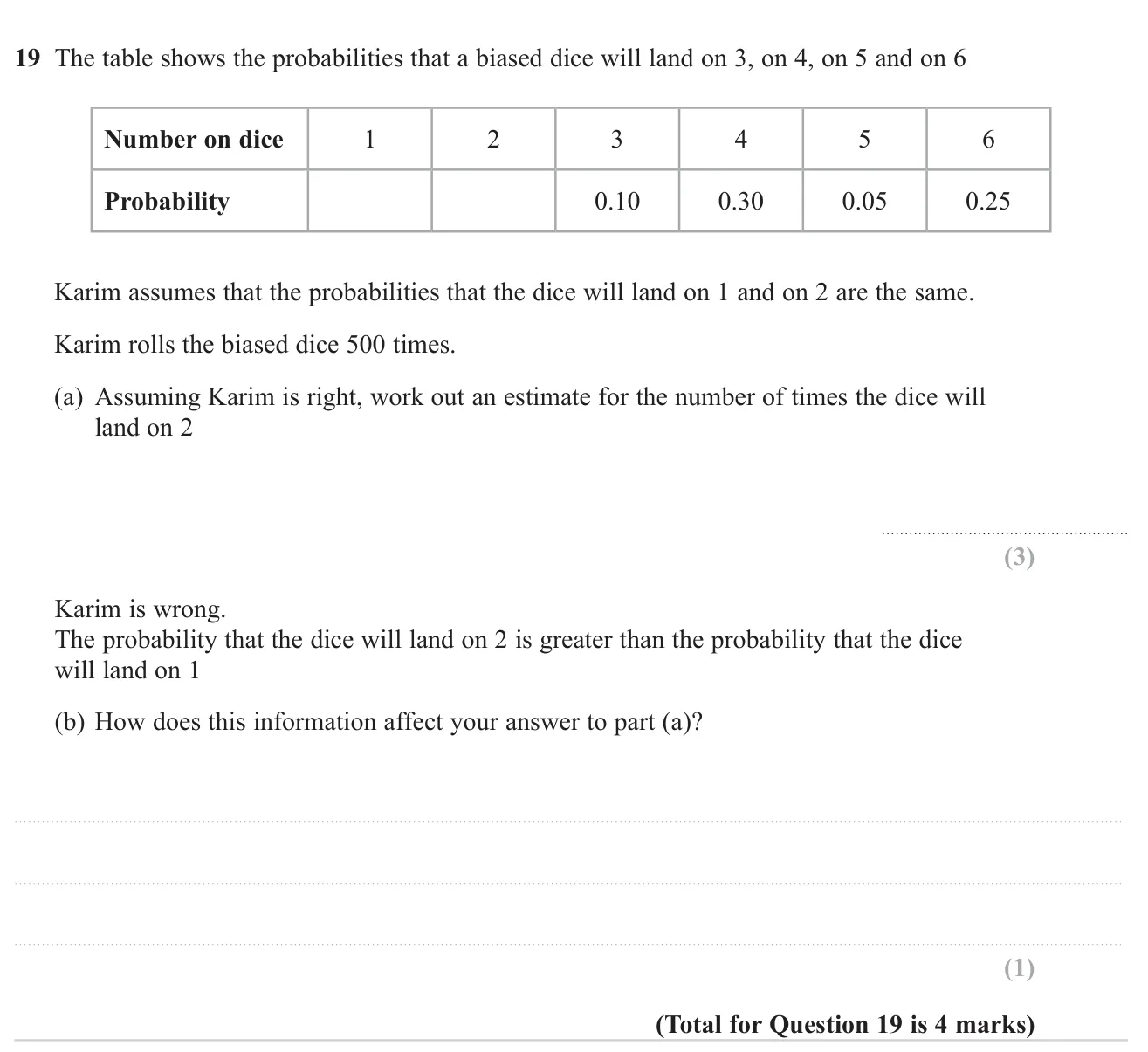
© Pearson Education Ltd. November 2024 Paper 1 (Foundation, non-calculator), question 19.
Show answer
| (a) | 75 | 3 marks |
|---|
| (b) | The estimate would be greater than 75 | 1 mark |
|---|
Worked solution Checked against the mark scheme
(a) 0.10+0.30+0.05+0.25=0.70, so P(1)+P(2)=0.30
P(2)=0.30÷2=0.15
Estimate =0.15×500=75
(b) P(2) is really more than 0.15, so the number of 2s would be more than 75.
Watch out: In (a), forgetting to halve 0.3 and getting 150.
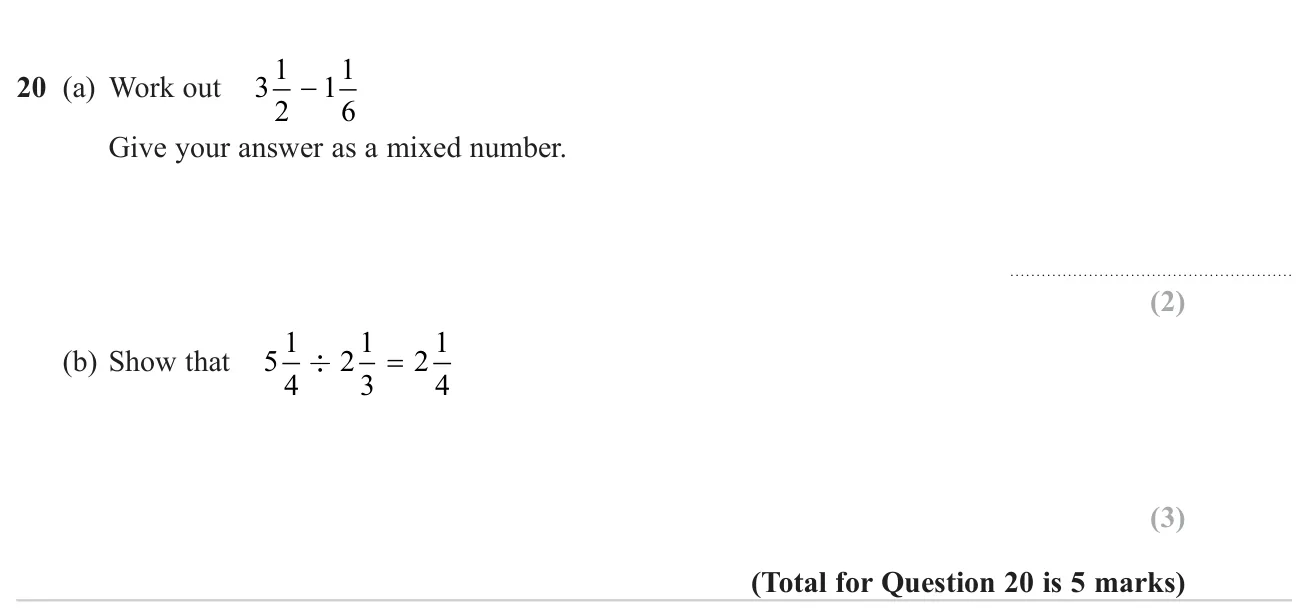
Question 20
Fractions5 marksGrade 4No calculatorOn both tiers © Pearson Education Ltd. November 2024 Paper 1 (Foundation, non-calculator), question 20.
Show answer
| (a) | 231 | 2 marks |
|---|
| (b) | Shown: 421×73=2863=49=241 | 3 marks |
|---|
Worked solution Checked against the mark scheme
(a) 321−161=363−161=262=231
(b) 541=421 and 231=37
421÷37=421×73=2863=49=241
Watch out: In (b), dividing the whole numbers and fractions separately.
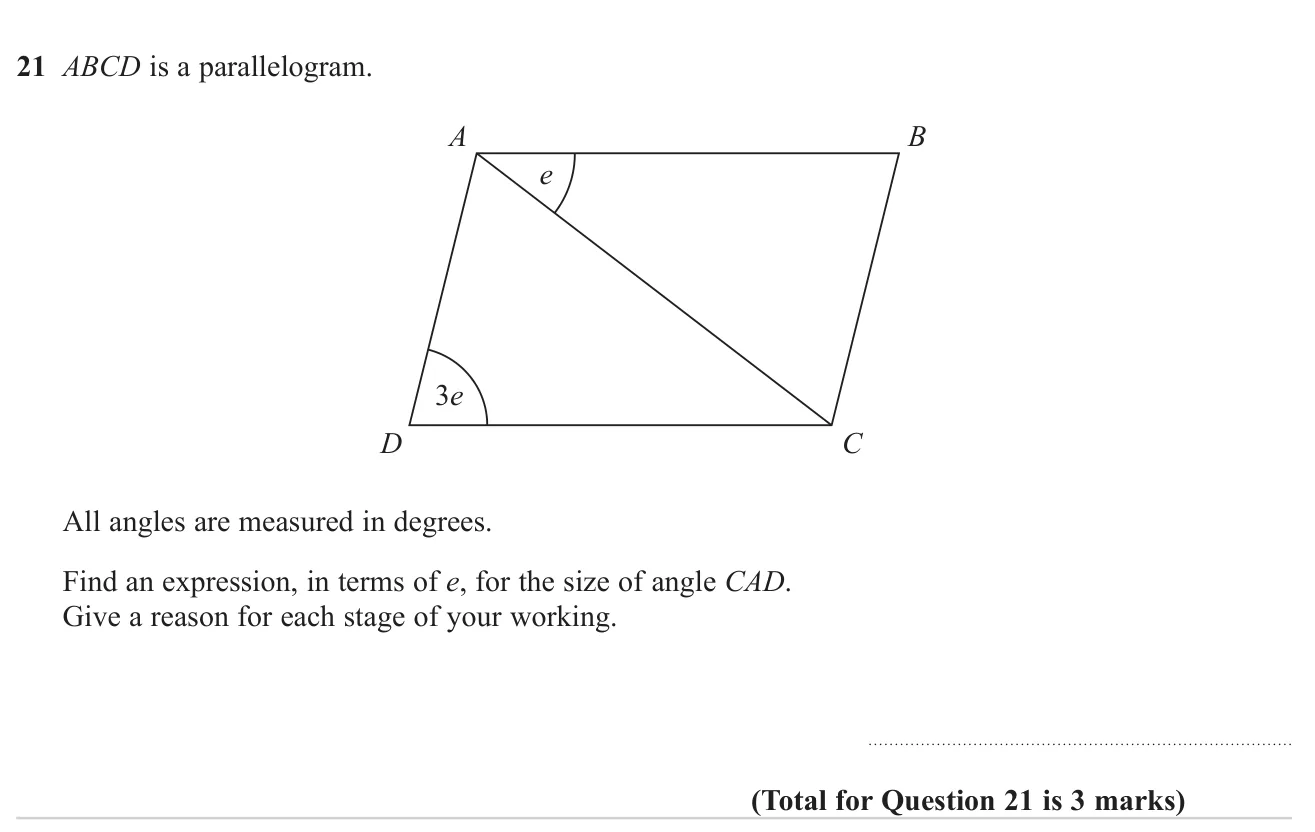
© Pearson Education Ltd. November 2024 Paper 1 (Foundation, non-calculator), question 21.
Show answer
| Answer | 180−4e with reasons | 3 marks |
|---|
Worked solution Checked against the mark scheme
AB is parallel to DC, so angle ACD=e (alternate angles are equal).
Angles in triangle ACD add up to 180°:
angle CAD=180−3e−e=180−4e
Watch out: Giving the reason as 'Z angles' instead of alternate angles.
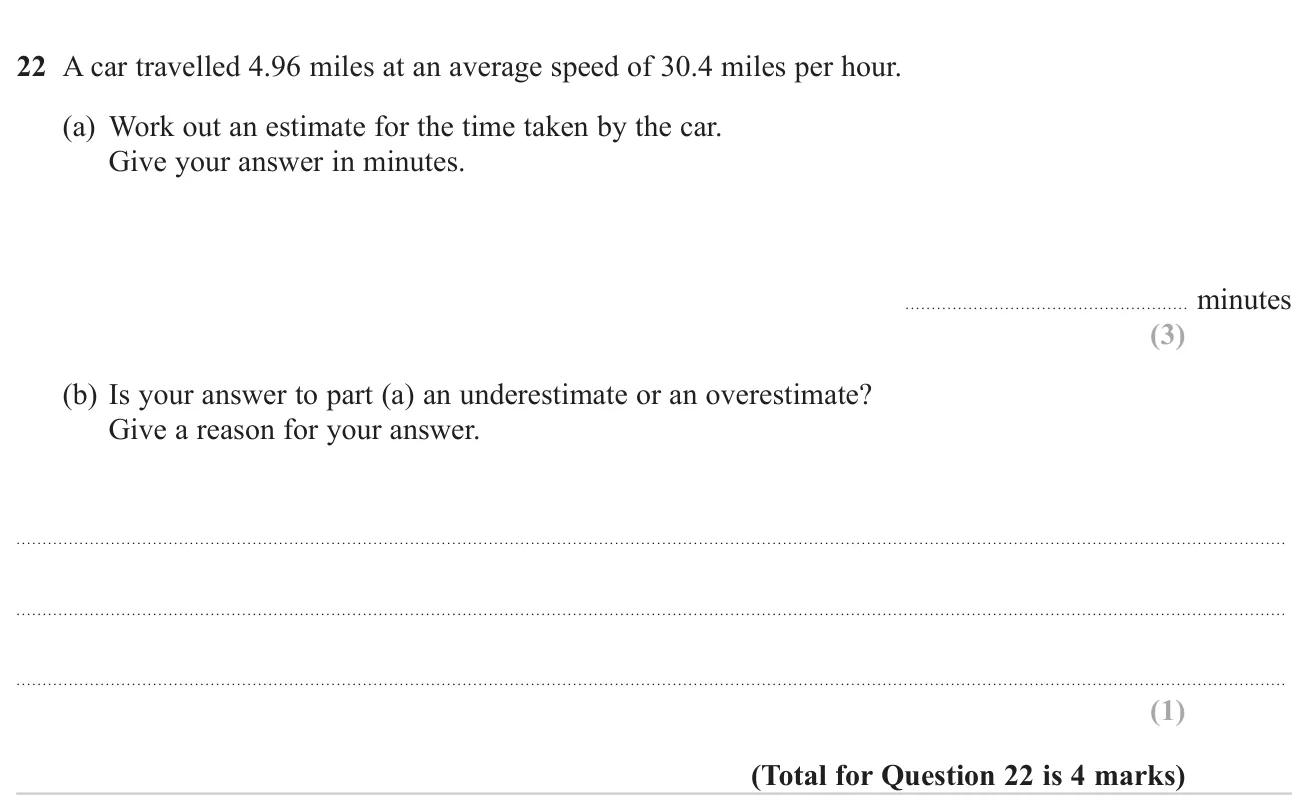
© Pearson Education Ltd. November 2024 Paper 1 (Foundation, non-calculator), question 22.
Show answer
| (a) | 10 minutes | 3 marks |
|---|
| (b) | Overestimate: distance rounded up and speed rounded down | 1 mark |
|---|
Worked solution Checked against the mark scheme
(a) Round: 4.96≈5 miles, 30.4≈30 mph
Time =5÷30=61 hour =10 minutes
(b) The distance was rounded up and the speed rounded down, so the estimate is too big: an overestimate.
Watch out: In (a), leaving the answer as 0.17 hours or 1/6.
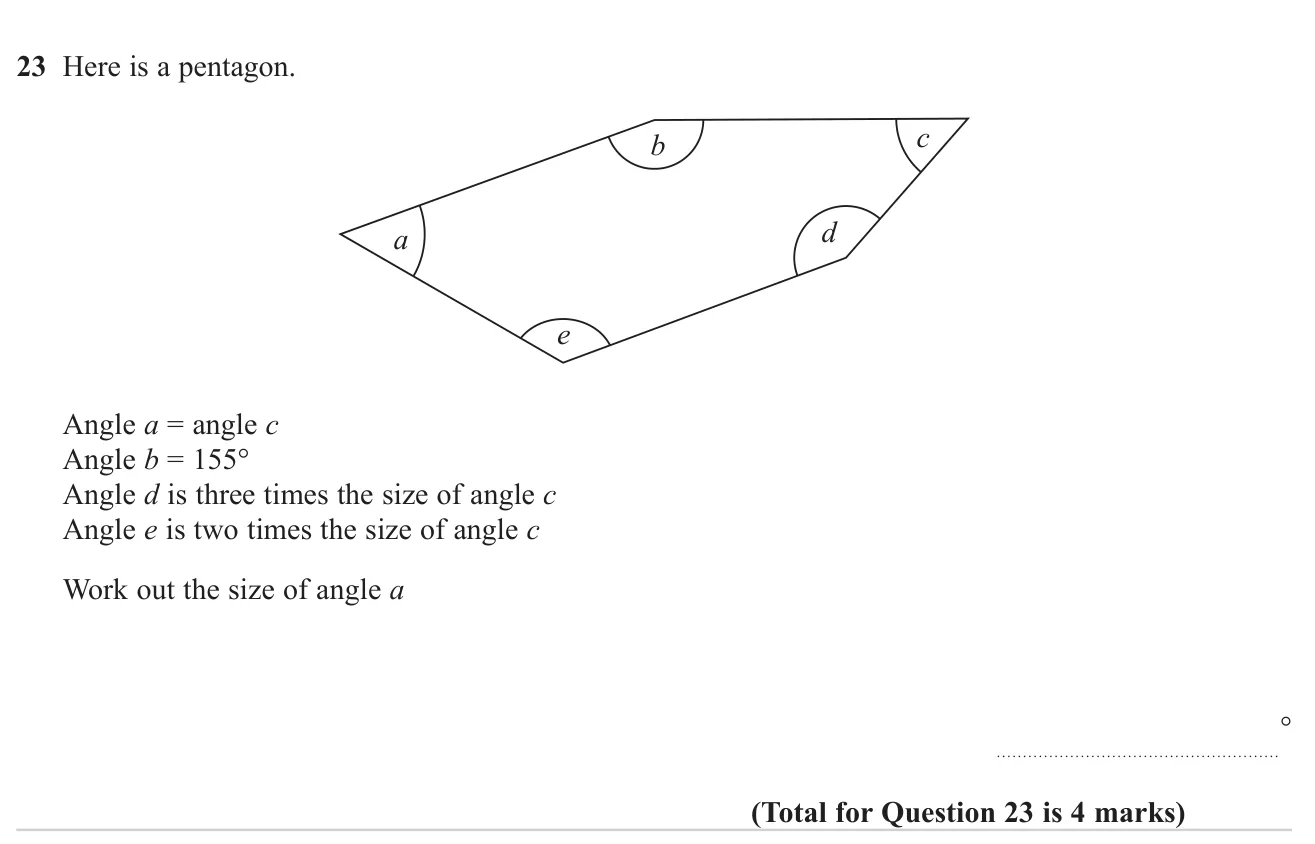
© Pearson Education Ltd. November 2024 Paper 1 (Foundation, non-calculator), question 23.
Show answer
Worked solution Checked against the mark scheme
Angle sum =(5−2)×180=540°
c+155+c+3c+2c=540
7c=385, so c=55
Angle a=55°
Watch out: Using 360° as the angle sum.
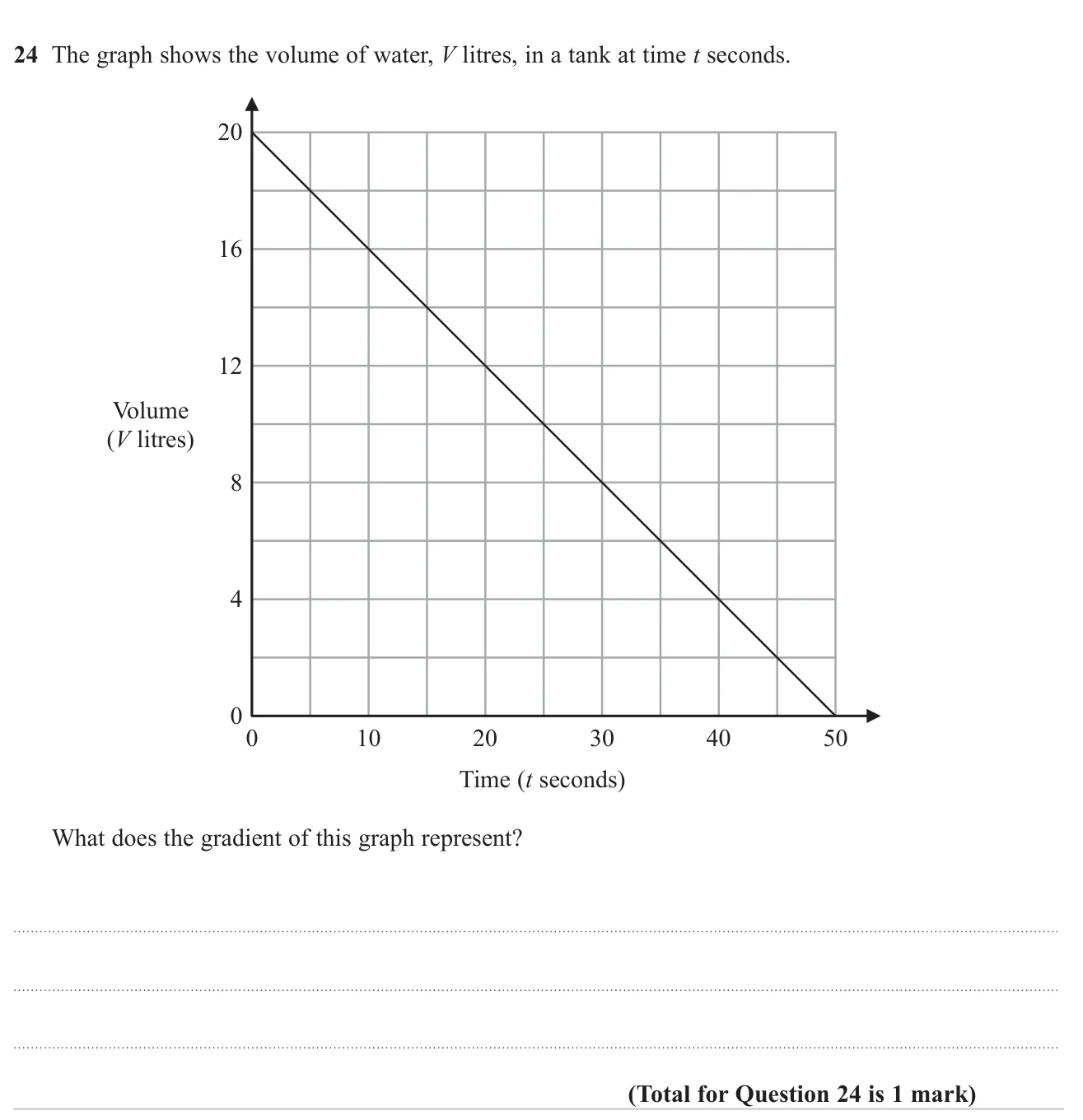
© Pearson Education Ltd. November 2024 Paper 1 (Foundation, non-calculator), question 24.
Show answer
| Answer | The rate at which the volume of water changes (litres leaving per second) | 1 mark |
|---|
Worked solution Checked against the mark scheme
The gradient is change in volume ÷ change in time.
Here −20÷50=−0.4, so water leaves the tank at 0.4 litres per second: the rate of change of volume.
Watch out: Saying 'negative correlation' or just 'the volume goes down'.
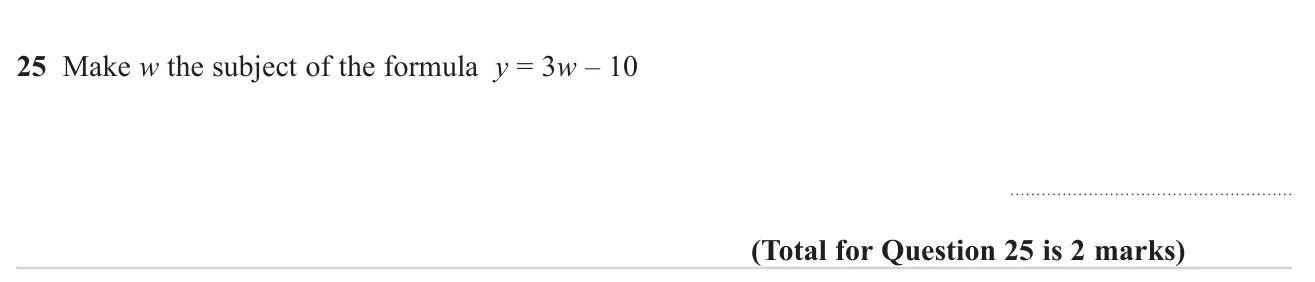
© Pearson Education Ltd. November 2024 Paper 1 (Foundation, non-calculator), question 25.
Show answer
| Answer | w=3y+10 | 2 marks |
|---|
Worked solution Checked against the mark scheme
y=3w−10
Add 10: y+10=3w
Divide by 3: w=3y+10
Watch out: Writing w = y/3 + 10 (dividing only one term).
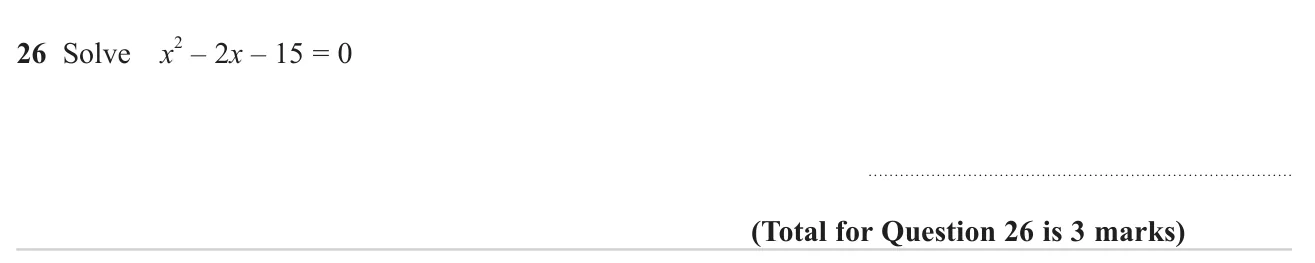
© Pearson Education Ltd. November 2024 Paper 1 (Foundation, non-calculator), question 26.
Show answer
| Answer | x=5, x=−3 | 3 marks |
|---|
Worked solution Checked against the mark scheme
Find two numbers that multiply to −15 and add to −2: −5 and 3.
(x−5)(x+3)=0
x=5 or x=−3
Watch out: Getting the signs the wrong way round: x = −5 and x = 3.
Finished the paper?
Add up your marks for all three papers and see what grade that would have been.