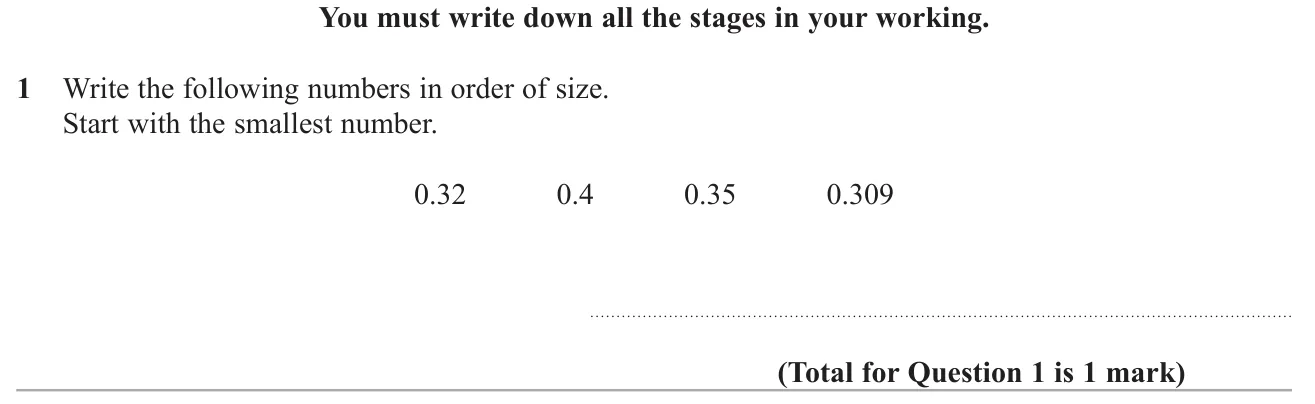
© Pearson Education Ltd. November 2020 Paper 1 (Foundation, non-calculator), question 1.
Show answer
| Answer | 0.309, 0.32, 0.35, 0.4 | 1 mark |
|---|
Worked solution Checked against the mark scheme
Give every number three decimal places: 0.320, 0.400, 0.350, 0.309.
Now compare: 0.309 < 0.320 < 0.350 < 0.400, so the order is 0.309, 0.32, 0.35, 0.4.
Watch out: Thinking 0.309 is biggest because it has the most digits.
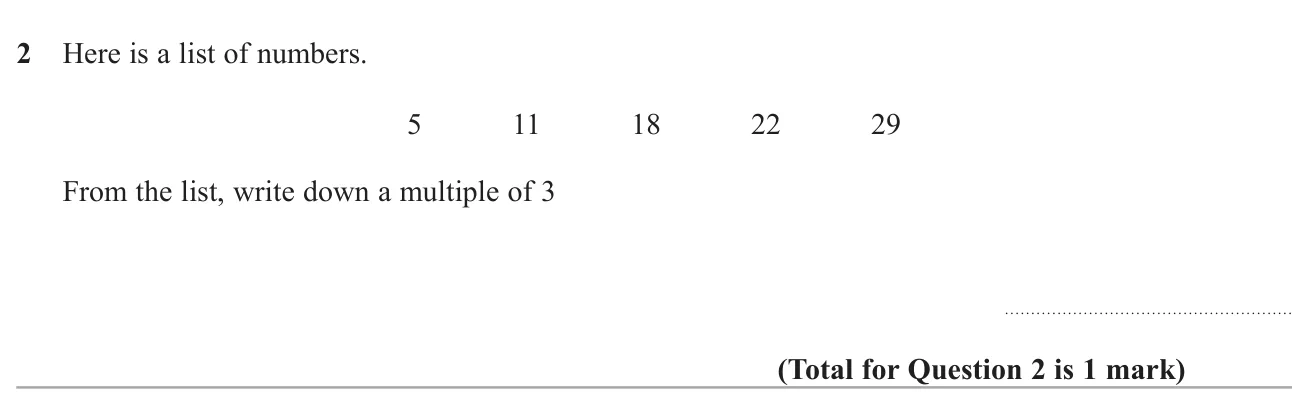
© Pearson Education Ltd. November 2020 Paper 1 (Foundation, non-calculator), question 2.
Show answer
Worked solution Checked against the mark scheme
Check each number: 18=3×6. None of 5, 11, 22 or 29 divides exactly by 3.
So the multiple of 3 is 18.
Watch out: Choosing 29 or 22 by mistaking digit patterns for divisibility.
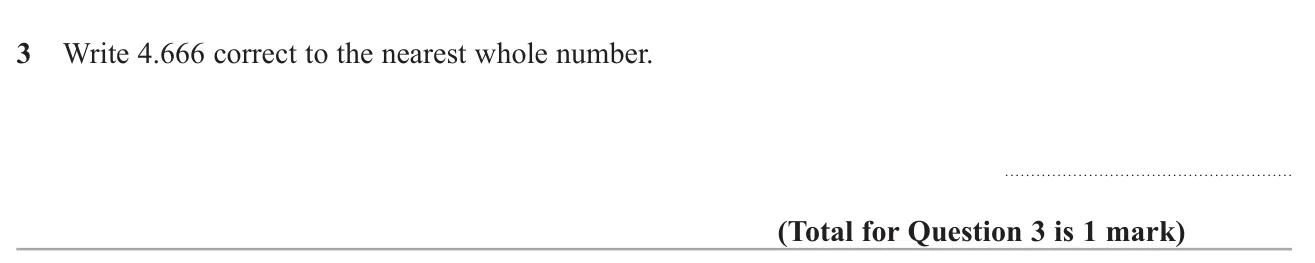
© Pearson Education Ltd. November 2020 Paper 1 (Foundation, non-calculator), question 3.
Show answer
Worked solution Checked against the mark scheme
Look at the first decimal digit: 6, which is 5 or more.
So round up: 4.666 becomes 5.
Watch out: Truncating to 4.
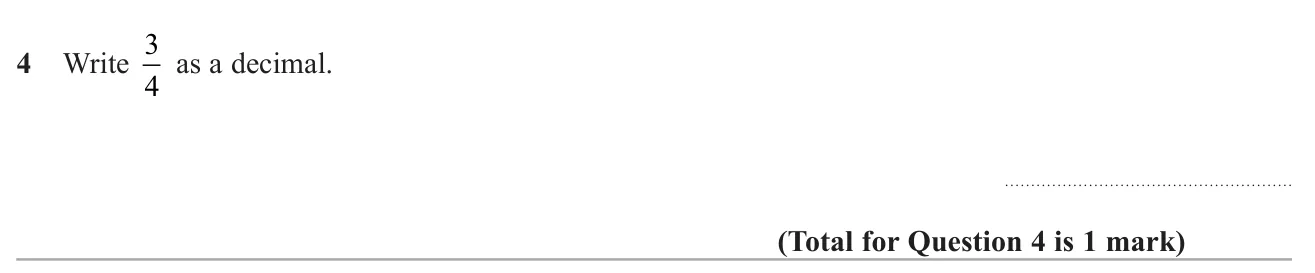
© Pearson Education Ltd. November 2020 Paper 1 (Foundation, non-calculator), question 4.
Show answer
Worked solution Checked against the mark scheme
43=3÷4=0.75
(One quarter is 0.25, so three quarters is 3×0.25=0.75.)
Watch out: Writing 3.4 or 0.34.
© Pearson Education Ltd. November 2020 Paper 1 (Foundation, non-calculator), question 5.
Show answer
Worked solution Checked against the mark scheme
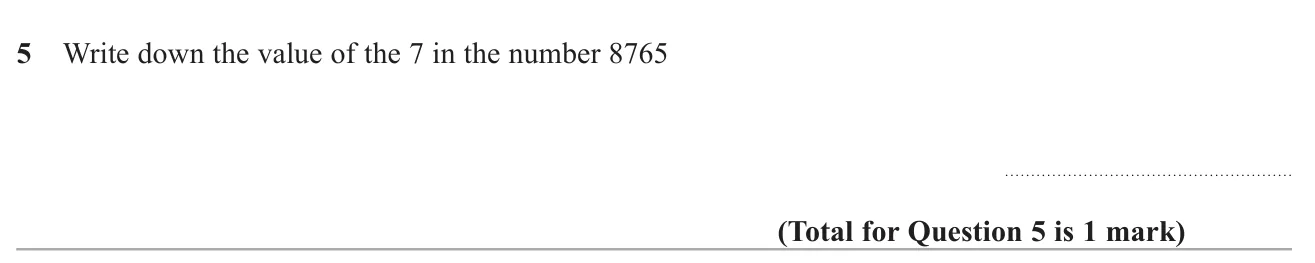
In 8765 the digits are 8 thousands, 7 hundreds, 6 tens and 5 ones.
So the 7 is worth 700.
Watch out: Answering 7 or 70.
© Pearson Education Ltd. November 2020 Paper 1 (Foundation, non-calculator), question 6.
Show answer
| (a) | Cross at 21 | 1 mark |
|---|
| (b) | Cross at 0 | 1 mark |
|---|
Worked solution Checked against the mark scheme
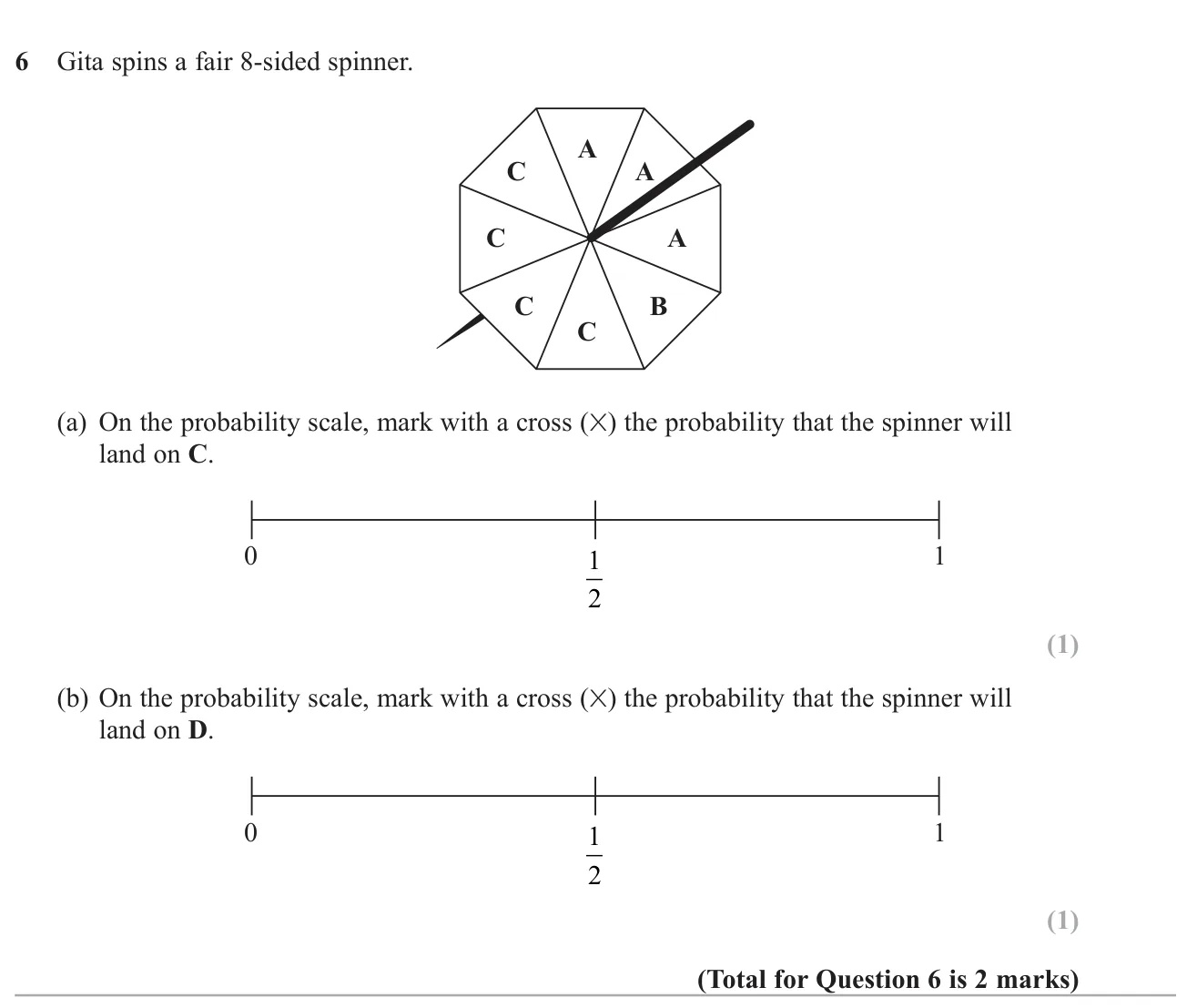
(a) 4 of the 8 equal sections are C, so P(C)=84=21. Put the cross in the middle of the scale.
(b) No section shows D, so it is impossible: put the cross at 0.
Watch out: Putting the cross for D at 1 or leaving it off the scale.
© Pearson Education Ltd. November 2020 Paper 1 (Foundation, non-calculator), question 7.
Show answer
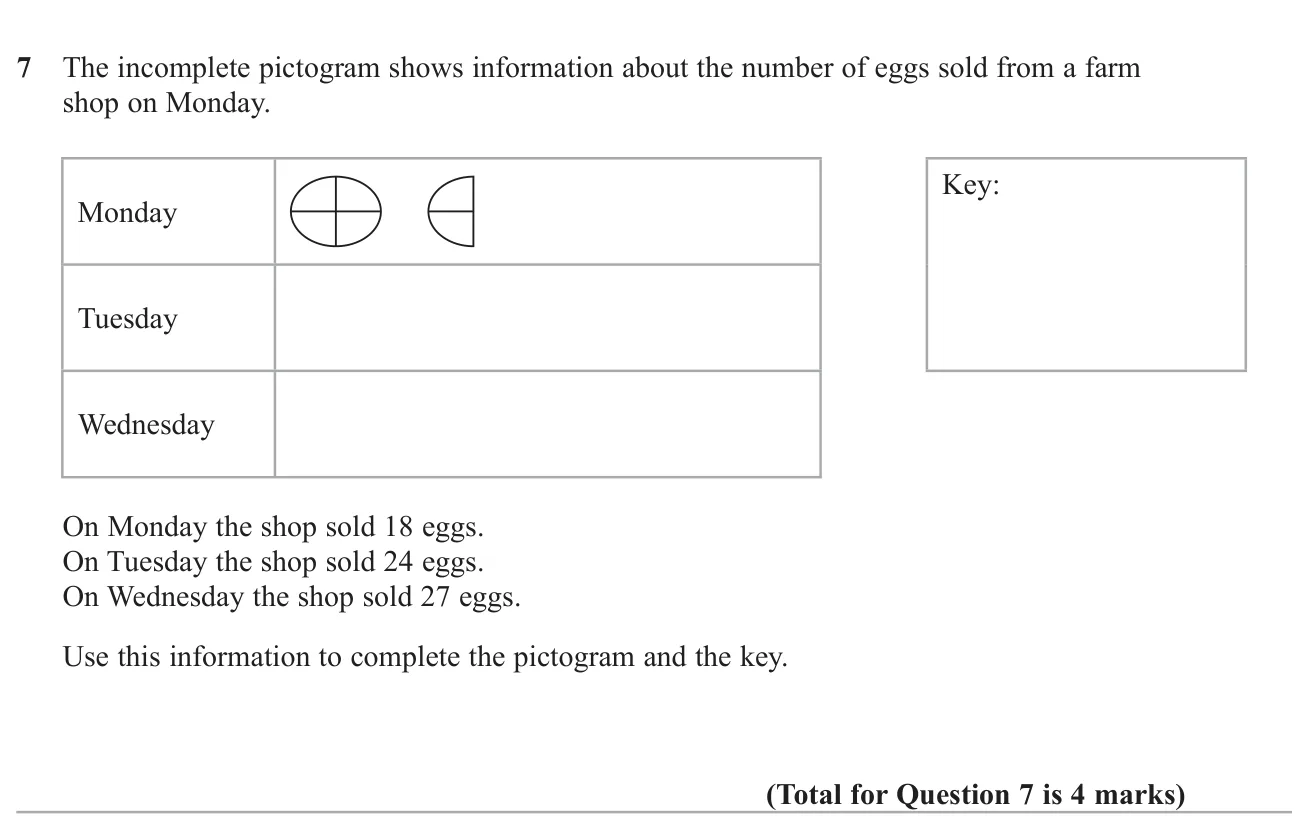
| Answer | Key: one oval = 12 eggs; Tuesday 2 ovals; Wednesday 241 ovals | 4 marks |
|---|
Worked solution Checked against the mark scheme
Monday shows 121 ovals for 18 eggs, so one oval is 18÷1.5=12 eggs.
Tuesday: 24÷12=2 ovals.
Wednesday: 27÷12=241 ovals (two whole ovals and a quarter).
Key: one oval represents 12 eggs.
Watch out: Taking one oval as 18 eggs because of Monday's total.
© Pearson Education Ltd. November 2020 Paper 1 (Foundation, non-calculator), question 8.
Show answer
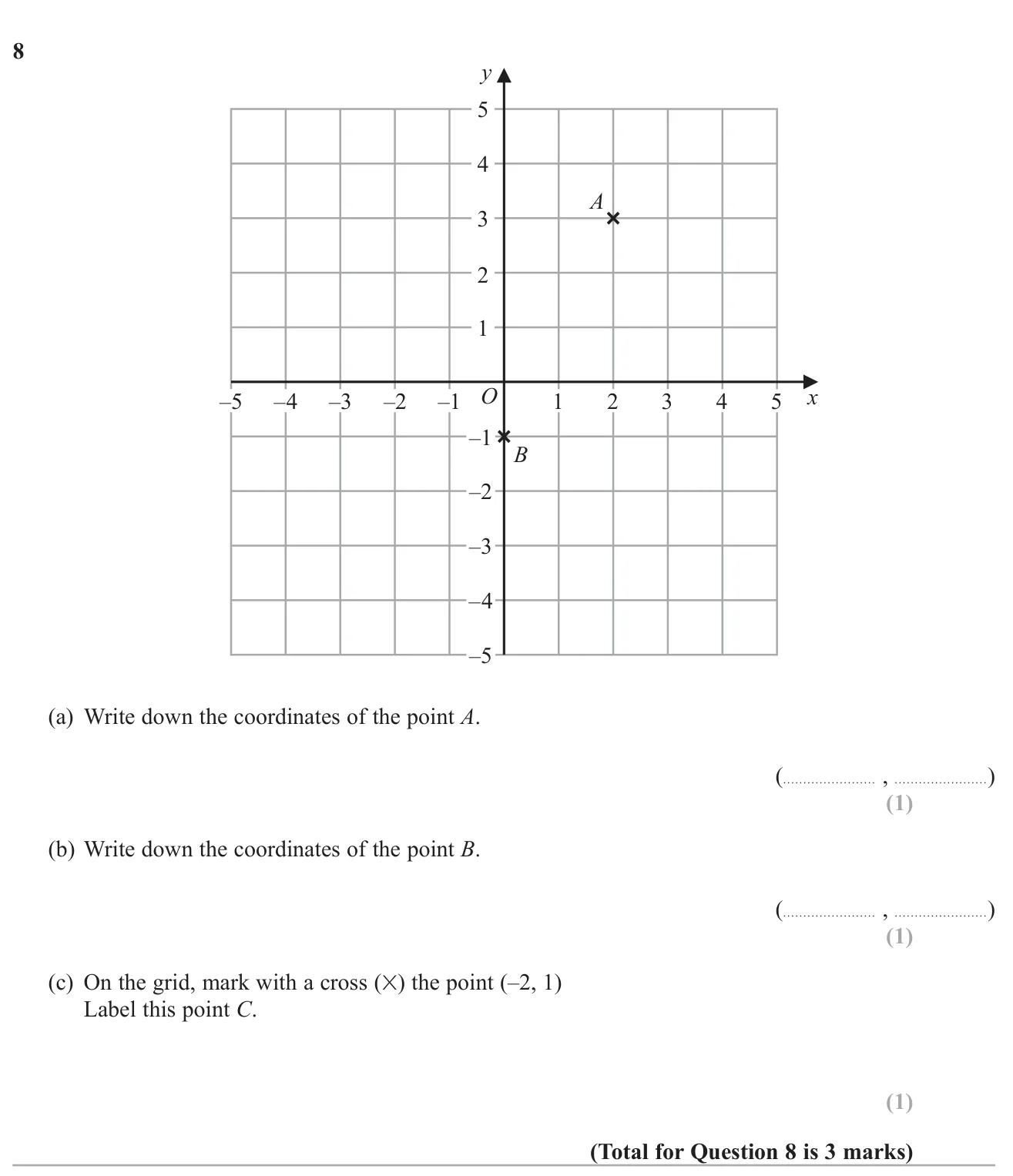
| (a) | (2,3) | 1 mark |
|---|
| (b) | (0,−1) | 1 mark |
|---|
| (c) | Cross at (−2,1) labelled C | 1 mark |
|---|
Worked solution Checked against the mark scheme
(a) A is 2 across and 3 up: (2,3).
(b) B is on the y-axis, 1 below the origin: (0,−1).
(c) Go 2 left, then 1 up, and mark C there.
Watch out: Swapping the order and writing (3,2) or (−1,0).
Question 9
Ratio3 marksGrade 3No calculator © Pearson Education Ltd. November 2020 Paper 1 (Foundation, non-calculator), question 9.
Show answer
| (a) | 73 | 1 mark |
|---|
| (b) | 1:2.5 | 2 marks |
|---|
Worked solution Checked against the mark scheme
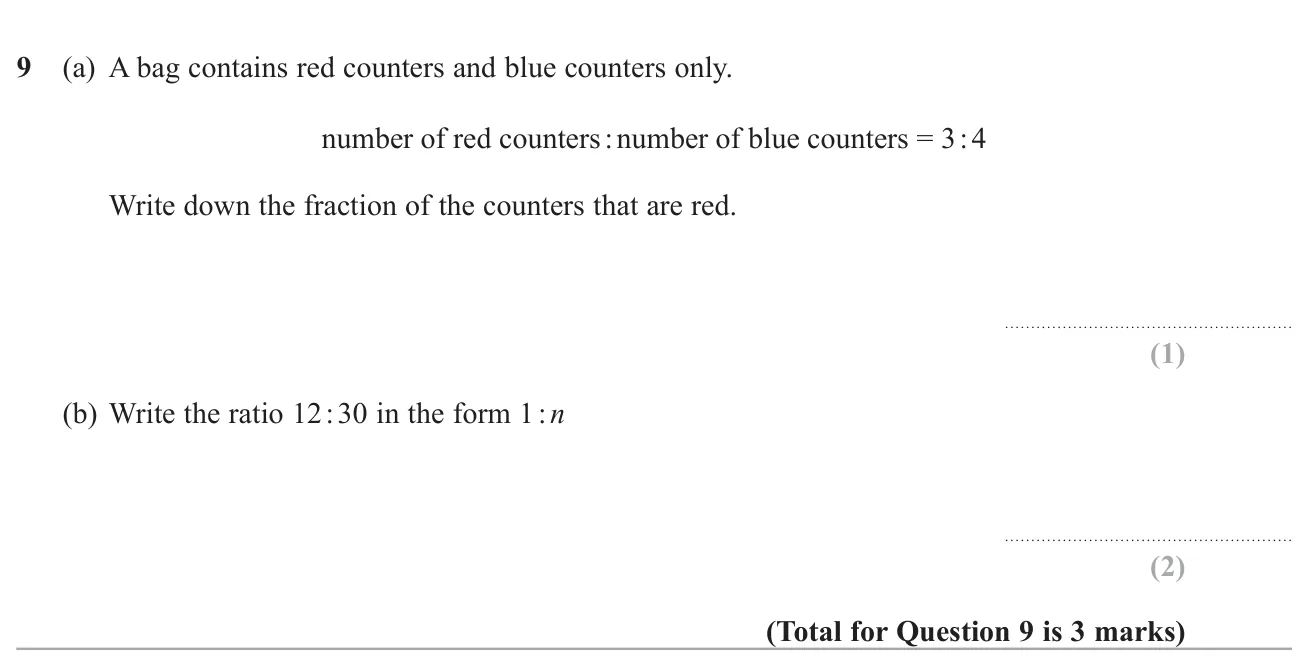
(a) There are 3+4=7 parts and 3 are red, so the fraction is 73.
(b) Divide both sides by 12: 12÷12=1, 30÷12=2.5.
So the ratio is 1:2.5.
Watch out: In (a) writing 43 from the ratio numbers.
© Pearson Education Ltd. November 2020 Paper 1 (Foundation, non-calculator), question 10.
Show answer
Worked solution Checked against the mark scheme
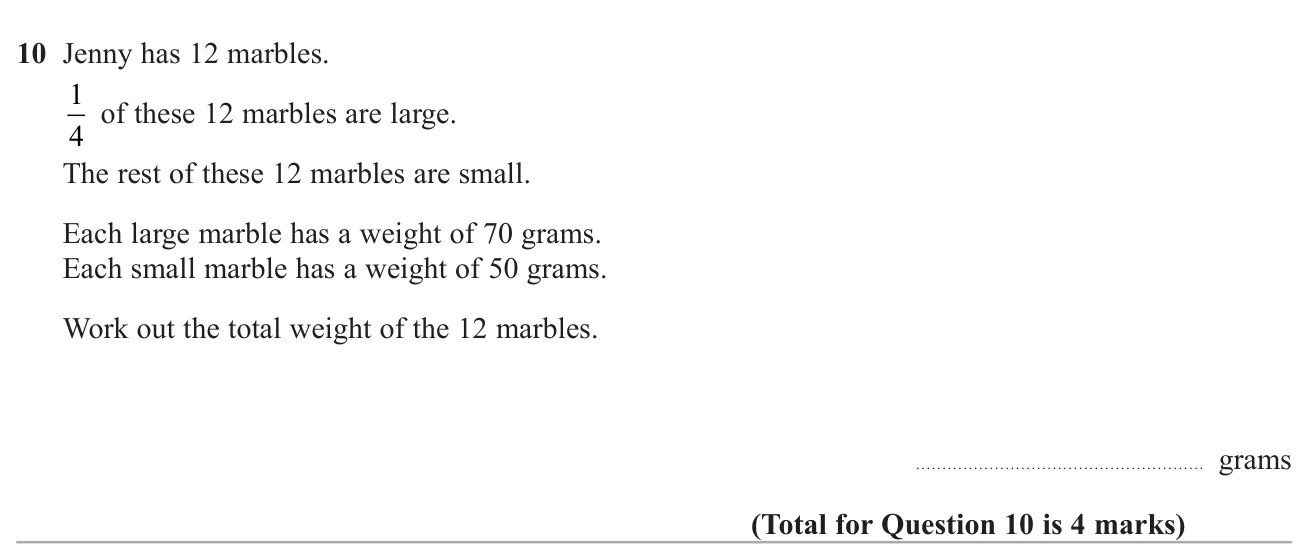
Large: 41 of 12 = 3, so small = 12−3=9.
Large weight: 3×70=210 g. Small weight: 9×50=450 g.
Total: 210+450=660 grams.
Watch out: Treating all 12 marbles as one weight, or stopping at 210 or 450.
© Pearson Education Ltd. November 2020 Paper 1 (Foundation, non-calculator), question 11.
Show answer
| Answer | Correct reflection on the left of the mirror line | 2 marks |
|---|
Worked solution Checked against the mark scheme
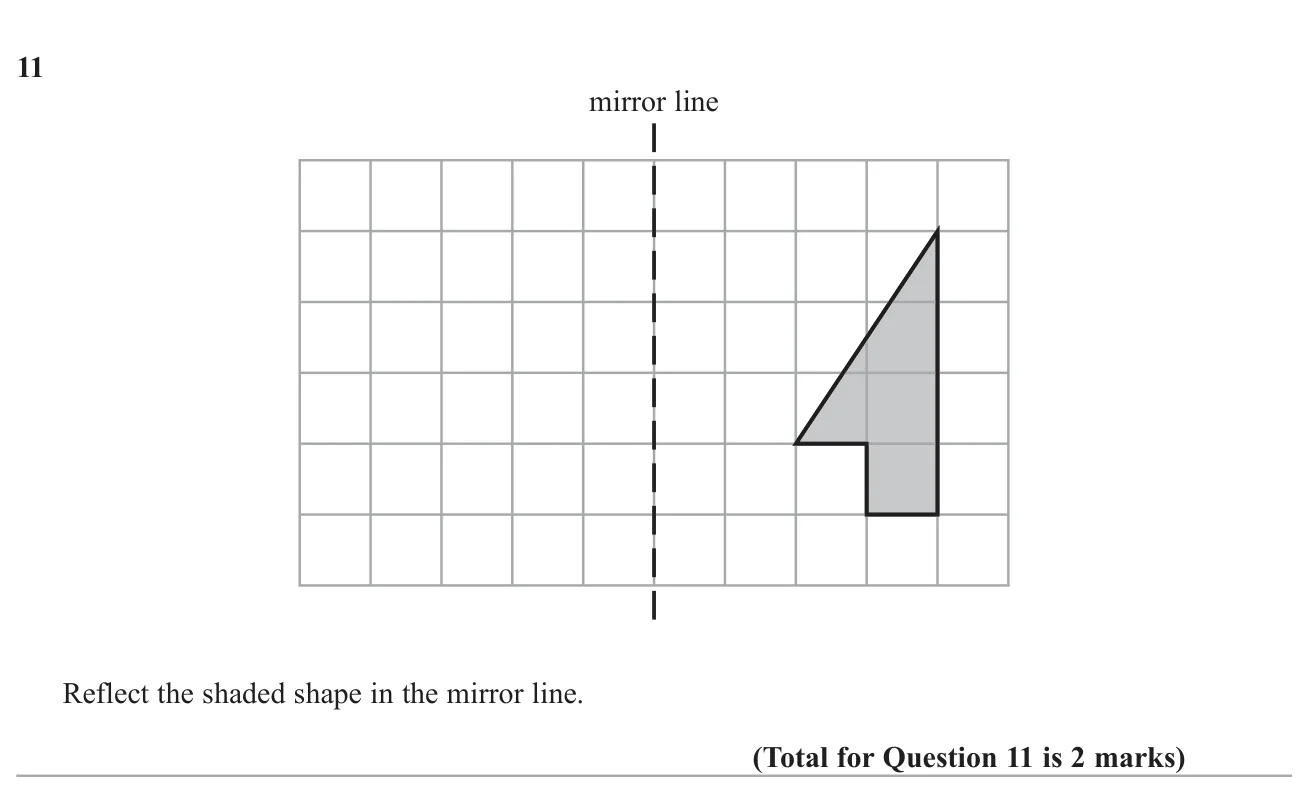
Take each corner in turn. Count how many squares it is from the mirror line, then plot the image the same distance on the other side.
The corner nearest the line (2 squares away) stays 2 squares away; the far edge (4 squares away) goes 4 squares to the left. Join the new corners.
Watch out: Sliding the shape across instead of flipping it, so it faces the wrong way.
© Pearson Education Ltd. November 2020 Paper 1 (Foundation, non-calculator), question 12.
Show answer
Worked solution Checked against the mark scheme
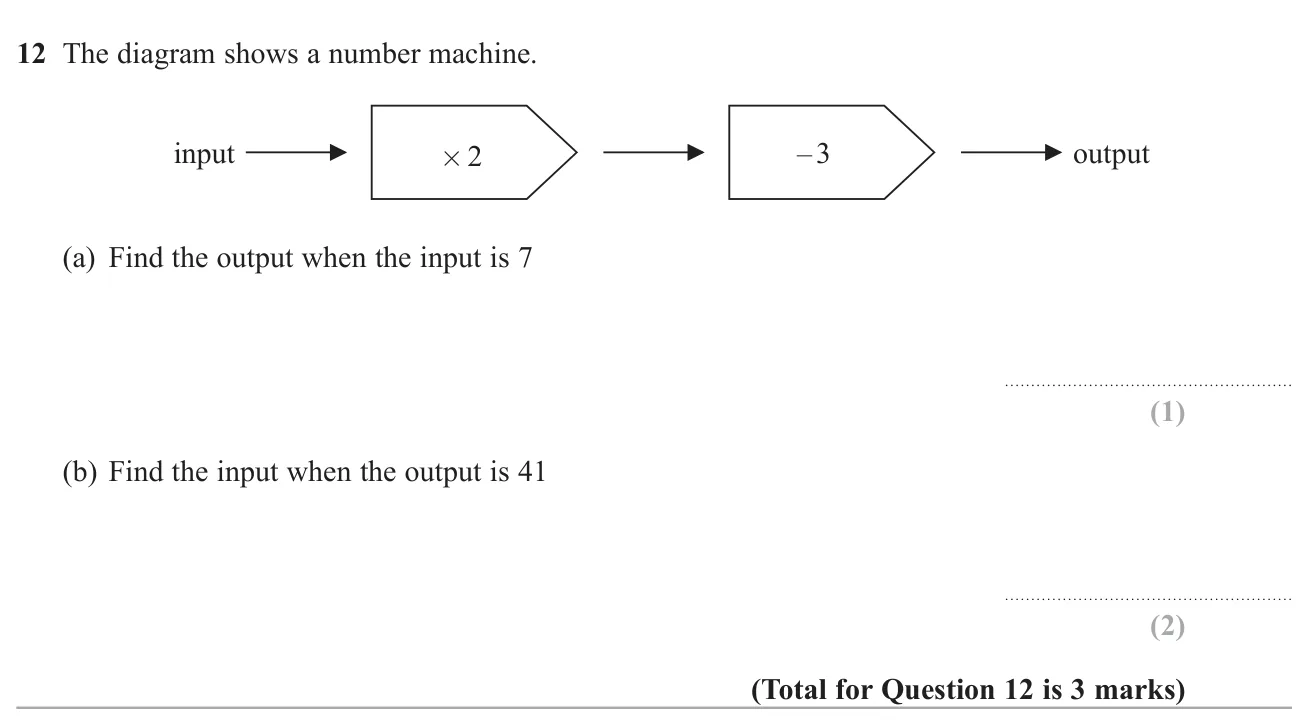
(a) 7×2=14, then 14−3=11.
(b) Work backwards with inverses: 41+3=44, then 44÷2=22.
Watch out: In (b) doing the inverses in the wrong order: 41÷2+3.
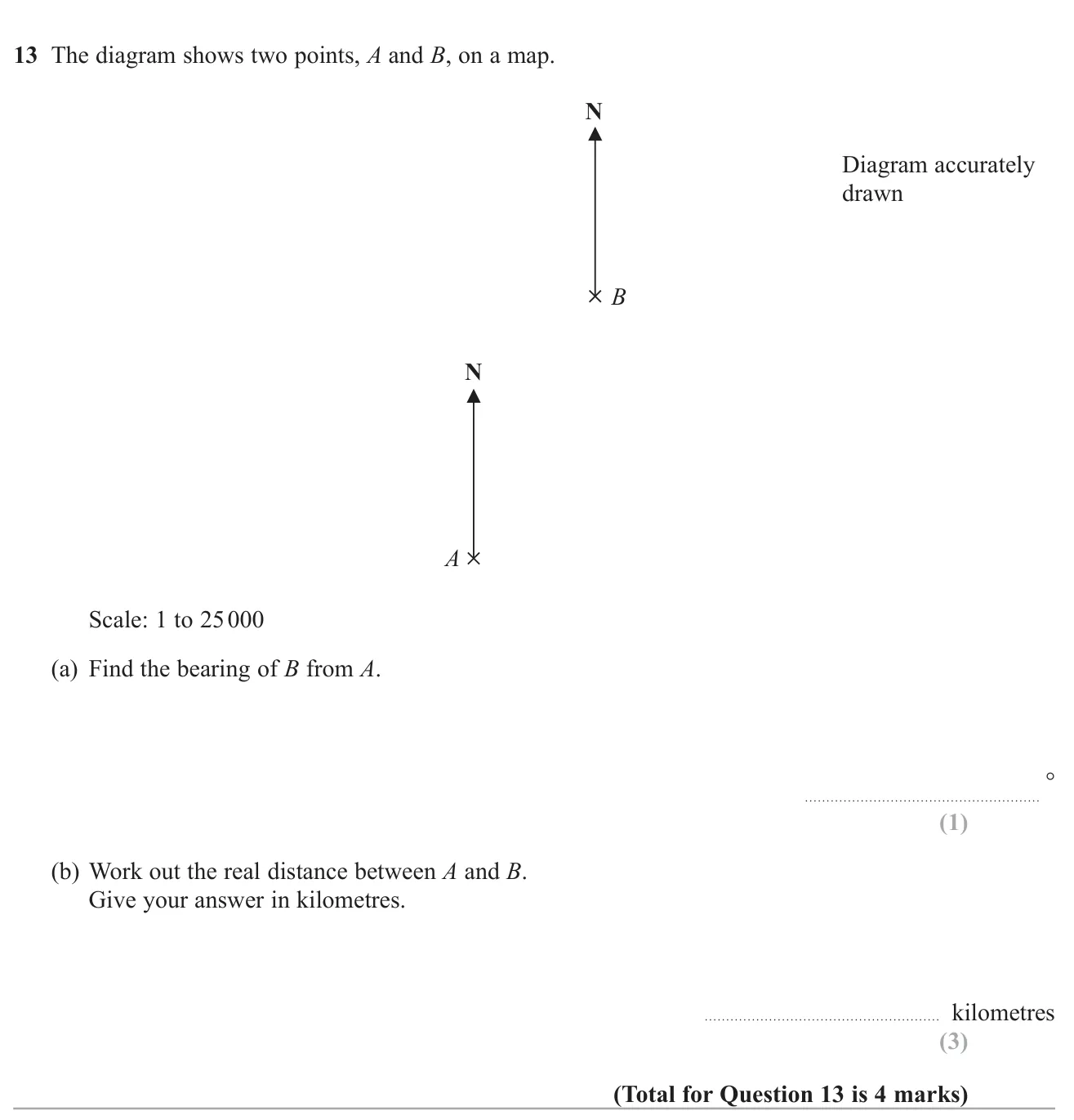
© Pearson Education Ltd. November 2020 Paper 1 (Foundation, non-calculator), question 13.
Show answer
| (a) | 025° (accept 23 to 27) | 1 mark |
|---|
| (b) | 1.25 km (accept 1.2 to 1.3) | 3 marks |
|---|
Worked solution Checked against the mark scheme
(a) Put the protractor on the north line at A and measure clockwise to the line AB: about 25°, written 025°.
(b) AB measures about 5 cm on the map.
Real distance =5×25000=125000 cm =1250 m =1.25 km.
Watch out: Converting cm straight to km by dividing by 1000 instead of 100 000.
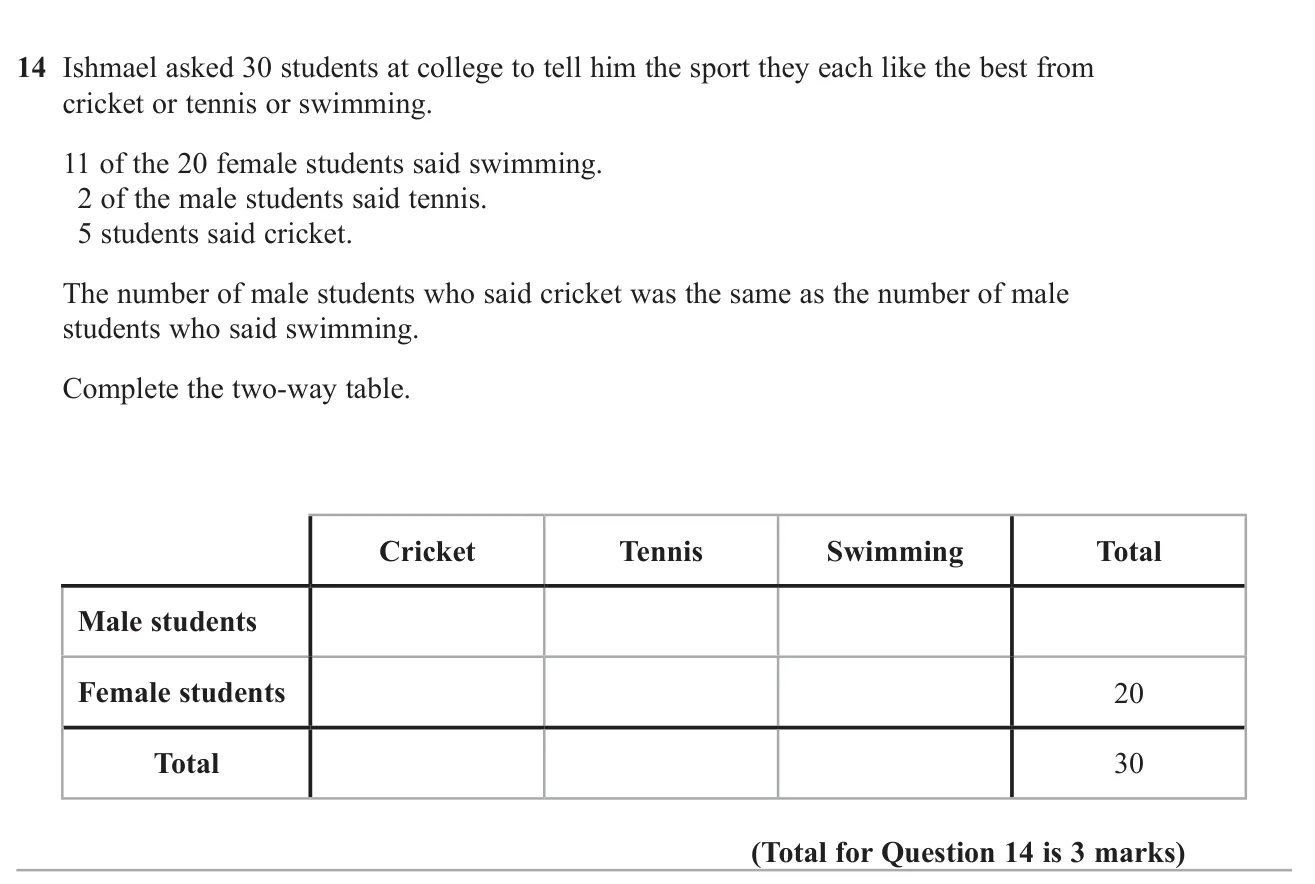
© Pearson Education Ltd. November 2020 Paper 1 (Foundation, non-calculator), question 14.
Show answer
| Answer | Male: 4, 2, 4 (10); Female: 1, 8, 11 (20); Totals: 5, 10, 15 (30) | 3 marks |
|---|
Worked solution Checked against the mark scheme
Males: 30−20=10. Two chose tennis, leaving 8 split equally: 4 cricket, 4 swimming.
Females: cricket 5−4=1, swimming 11, so tennis 20−1−11=8.
Totals: cricket 5, tennis 2+8=10, swimming 4+11=15 (sum 30).
Watch out: Putting all 5 cricket players in the male row.
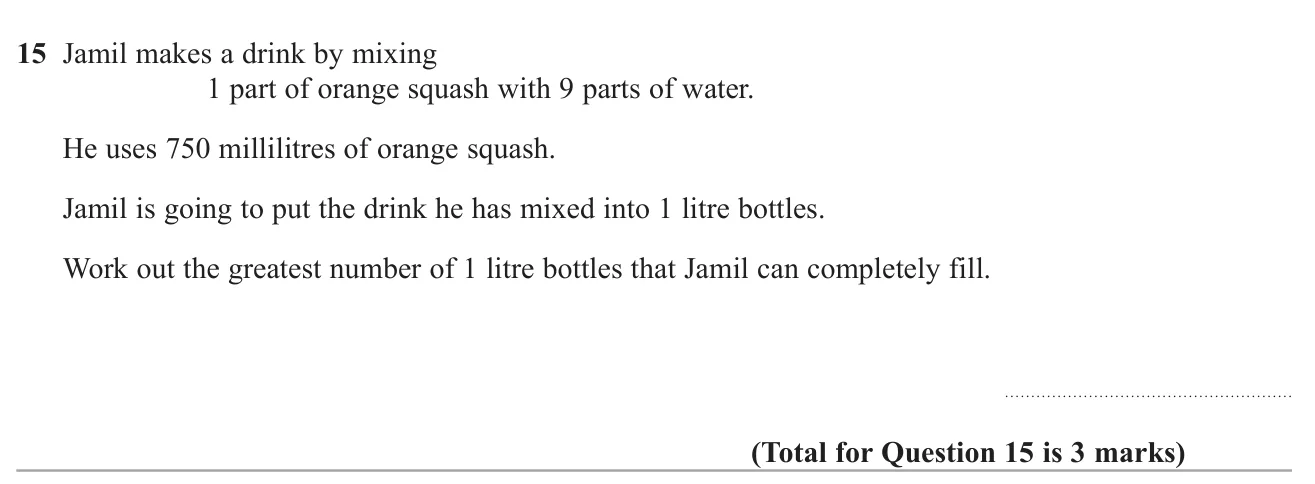
© Pearson Education Ltd. November 2020 Paper 1 (Foundation, non-calculator), question 15.
Show answer
Worked solution Checked against the mark scheme
Water: 750×9=6750 ml.
Total drink: 750+6750=7500 ml =7.5 litres.
Only whole bottles count, so he can fill 7 bottles.
Watch out: Rounding 7.5 up to 8, or forgetting to add the squash itself.
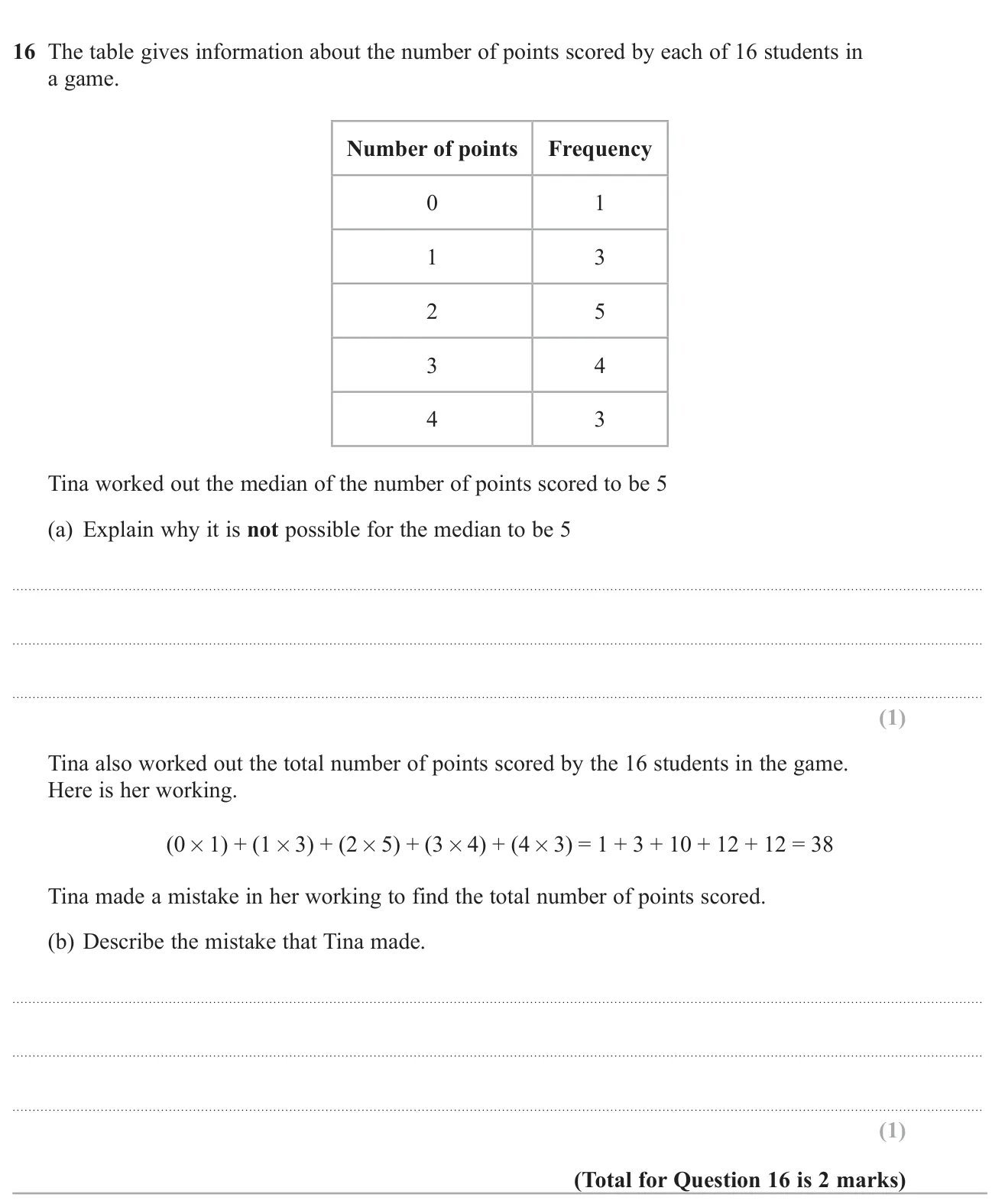
© Pearson Education Ltd. November 2020 Paper 1 (Foundation, non-calculator), question 16.
Show answer
| (a) | The highest score is 4, so the median cannot be 5 (it is actually 2) | 1 mark |
|---|
| (b) | She wrote 0×1=1; it should be 0 | 1 mark |
|---|
Worked solution Checked against the mark scheme
(a) Nobody scored more than 4 points, so the middle value cannot be 5. The 8th and 9th scores are both 2, so the median is 2.
(b) 0×1=0, not 1. The correct total is 0+3+10+12+12=37.
Watch out: Finding the middle of the frequency column instead of the points.
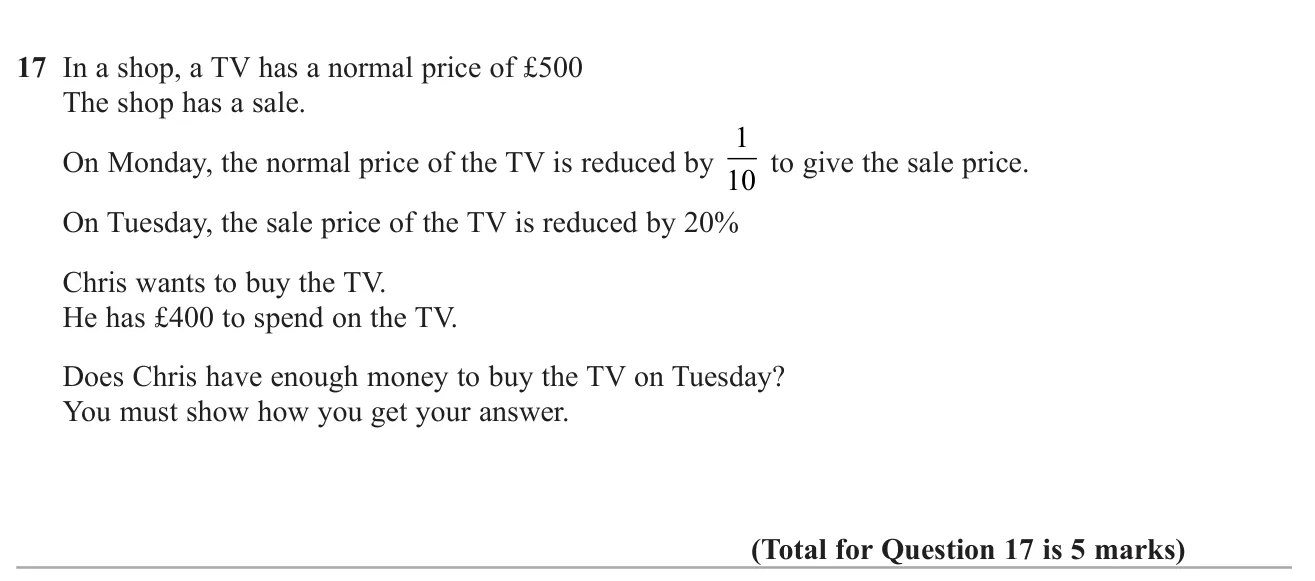
© Pearson Education Ltd. November 2020 Paper 1 (Foundation, non-calculator), question 17.
Show answer
| Answer | Yes: the Tuesday price is £360 | 5 marks |
|---|
Worked solution Checked against the mark scheme
Monday: 101 of £500 is £50, so the price is 500−50=£450.
Tuesday: 20% of £450 is 0.2×450=£90, so the price is 450−90=£360.
£360 is less than £400, so yes, Chris can buy it.
Watch out: Taking 20% off the original £500 instead of off the Monday sale price.
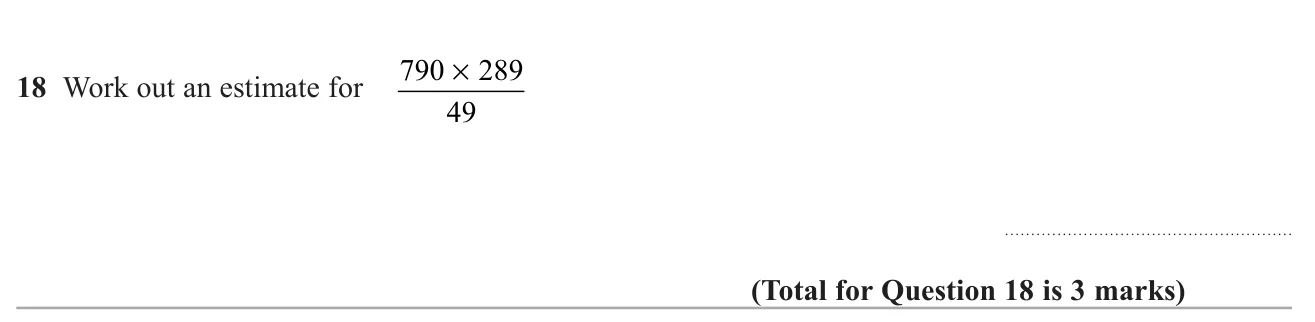
© Pearson Education Ltd. November 2020 Paper 1 (Foundation, non-calculator), question 18.
Show answer
| Answer | About 4800 (accept 4550 to 4800) | 3 marks |
|---|
Worked solution Checked against the mark scheme
Round to 1 significant figure: 790≈800, 289≈300, 49≈50.
50800×300=50240000=4800
Watch out: Working out the exact value first, which earns nothing.
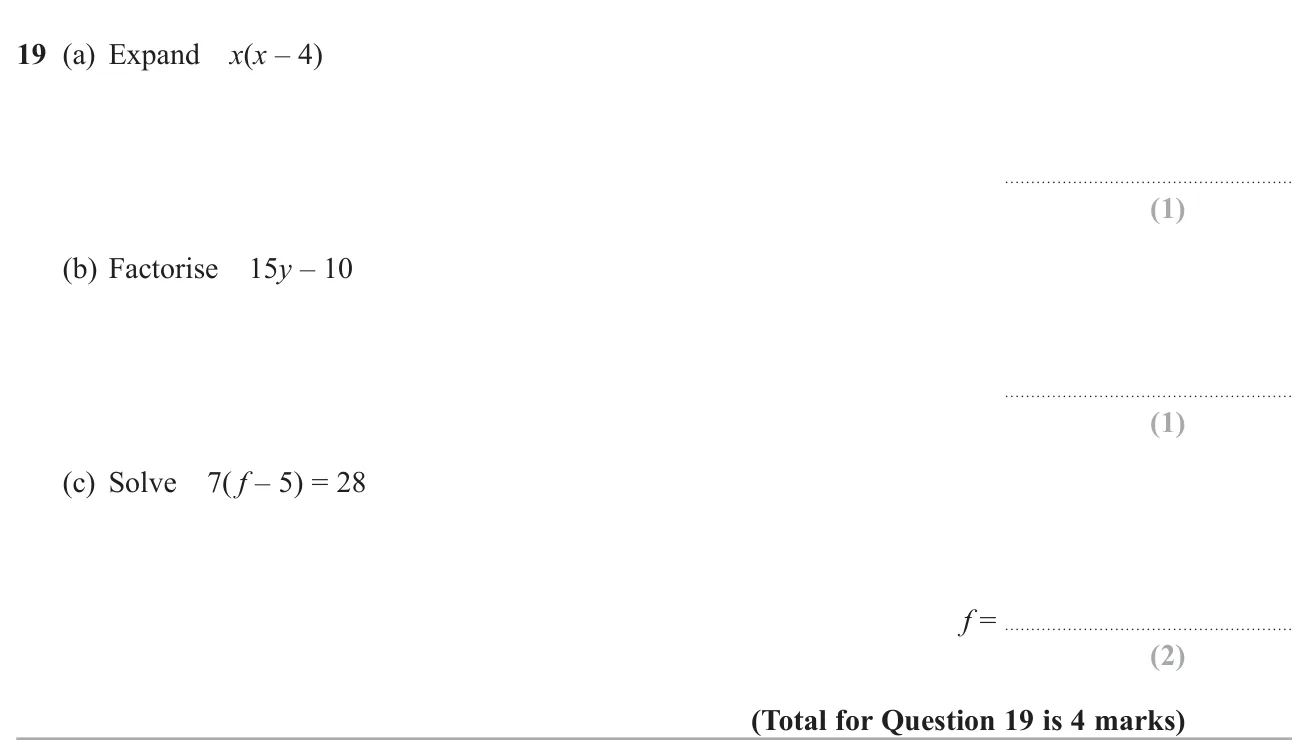
© Pearson Education Ltd. November 2020 Paper 1 (Foundation, non-calculator), question 19.
Show answer
| (a) | x2−4x | 1 mark |
|---|
| (b) | 5(3y−2) | 1 mark |
|---|
| (c) | f=9 | 2 marks |
|---|
Worked solution Checked against the mark scheme
(a) x×x−x×4=x2−4x
(b) The highest common factor of 15 and 10 is 5: 5(3y−2).
(c) Divide by 7: f−5=4, so f=9.
Watch out: In (c) expanding to 7f−5=28.
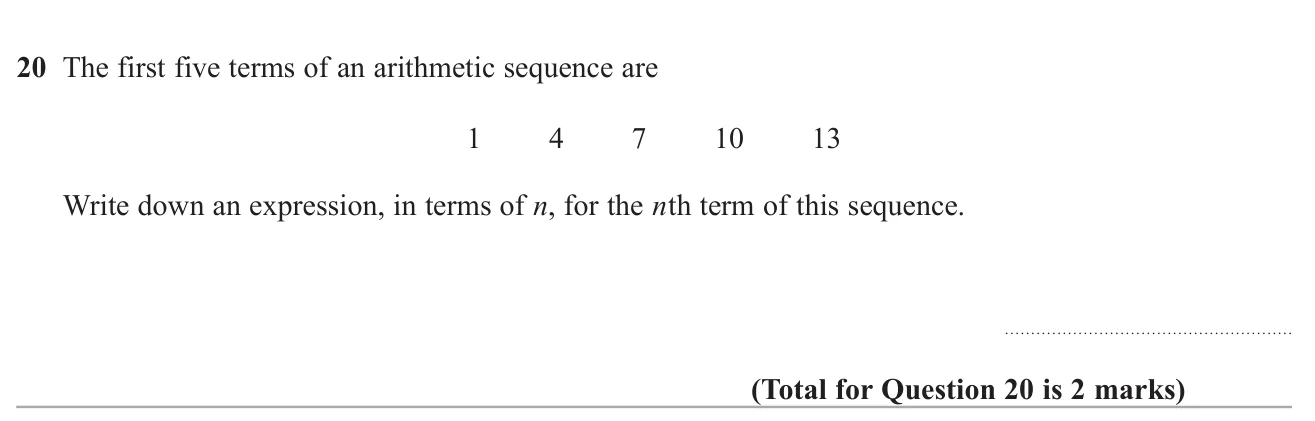
© Pearson Education Ltd. November 2020 Paper 1 (Foundation, non-calculator), question 20.
Show answer
| Answer | 3n−2 | 2 marks |
|---|
Worked solution Checked against the mark scheme
The terms go up by 3, so start with 3n: 3, 6, 9, ...
Each term is 2 less than that, so the nth term is 3n−2.
Watch out: Writing n+3.
Question 21
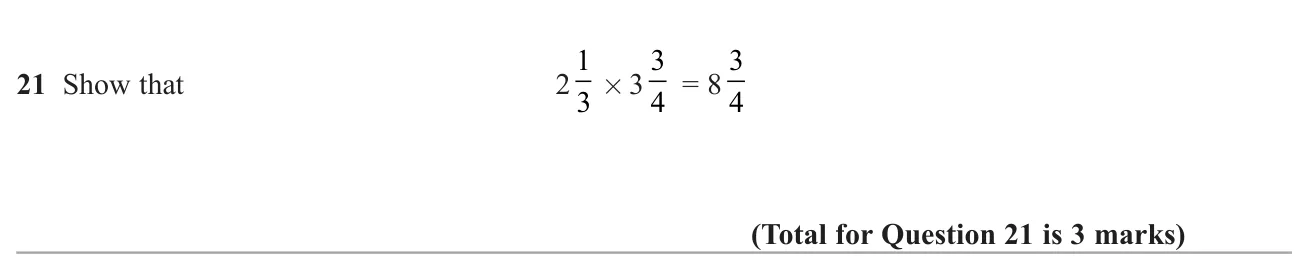
Fractions3 marksGrade 4No calculatorOn both tiers © Pearson Education Ltd. November 2020 Paper 1 (Foundation, non-calculator), question 21.
Show answer
| Answer | 37×415=12105=435=843 | 3 marks |
|---|
Worked solution Checked against the mark scheme
Change to improper fractions: 231=37 and 343=415.
Multiply: 3×47×15=12105=435.
35÷4=8 remainder 3, so 435=843.
Watch out: Multiplying whole numbers and fractions separately: 2×3+31×43.
© Pearson Education Ltd. November 2020 Paper 1 (Foundation, non-calculator), question 22.
Show answer
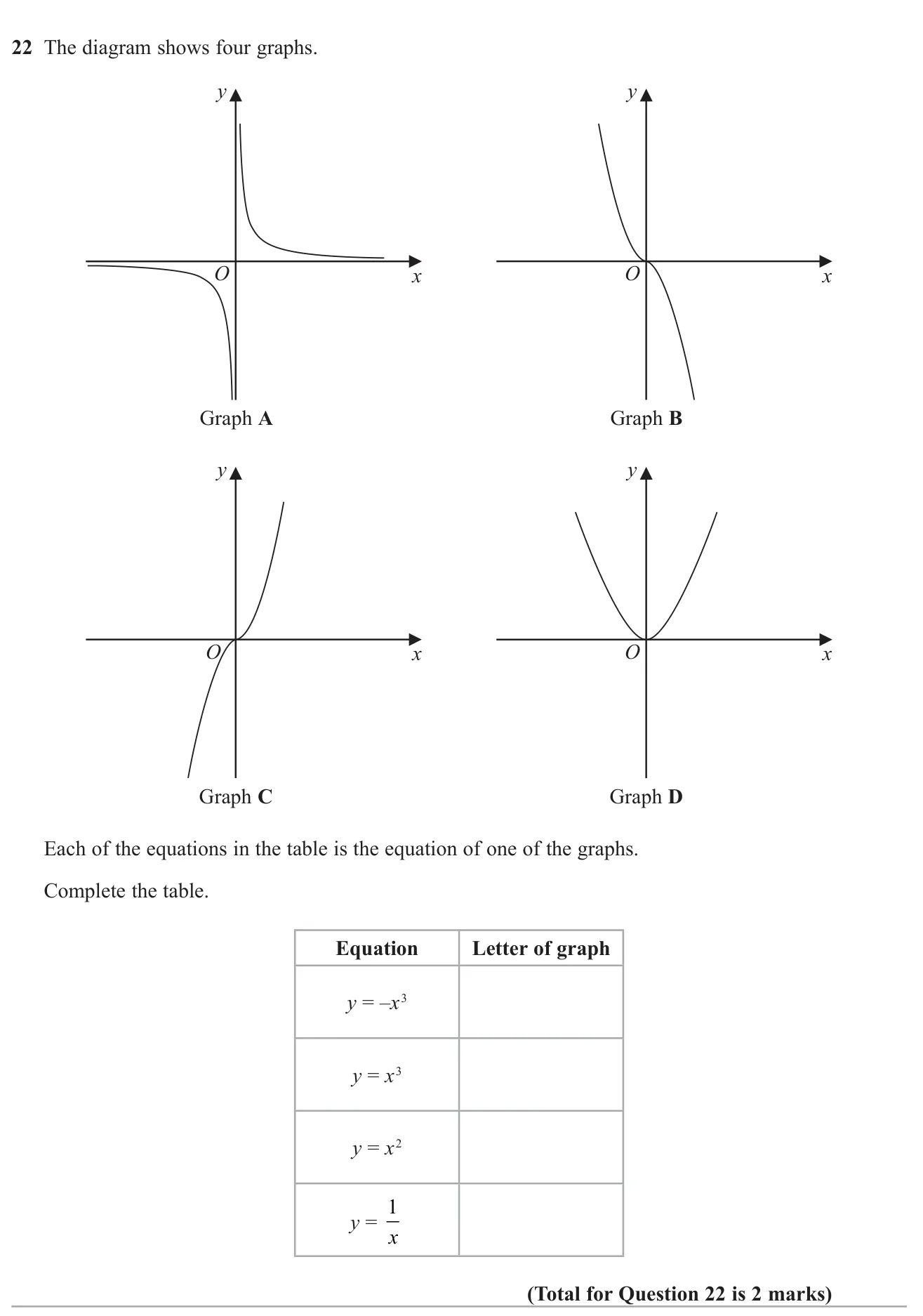
| Answer | y=−x3: B; y=x3: C; y=x2: D; y=x1: A | 2 marks |
|---|
Worked solution Checked against the mark scheme
y=x2 is the U shape: D.
y=x1 has two separate branches and never touches the axes: A.
y=x3 rises from bottom left to top right: C.
y=−x3 is its reflection, falling from top left: B.
Watch out: Mixing up y=x3 and y=−x3.
© Pearson Education Ltd. November 2020 Paper 1 (Foundation, non-calculator), question 23.
Show answer
Worked solution Checked against the mark scheme
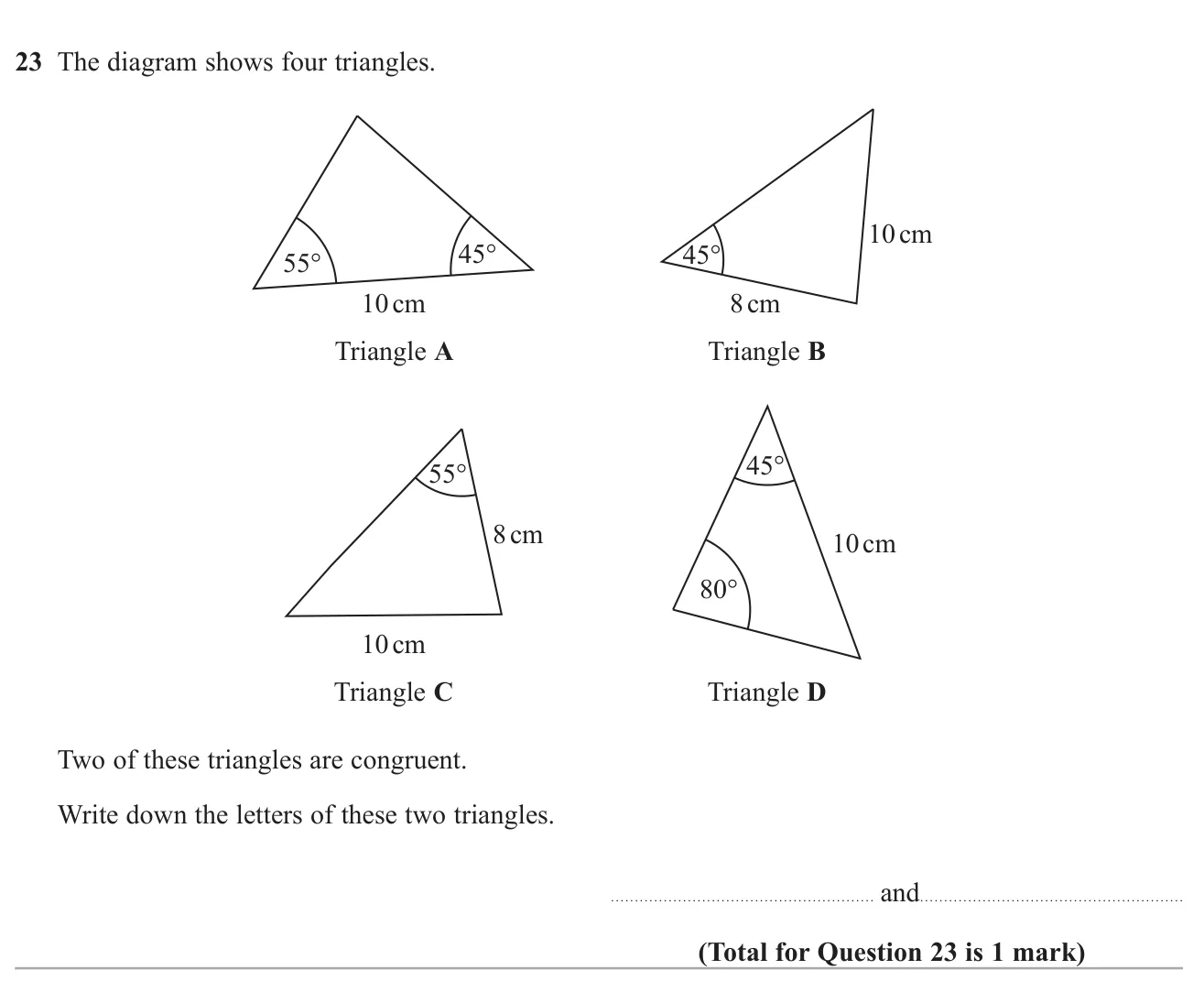
Triangle D has angles 80° and 45°, so its third angle is 180−80−45=55°.
In D the 10 cm side lies between the 45° and 55° angles, just as in A. Same two angles and the side between them (ASA), so A and D are congruent.
Watch out: Choosing B and C because both show 8 cm and 10 cm.
© Pearson Education Ltd. November 2020 Paper 1 (Foundation, non-calculator), question 24.
Show answer
Worked solution Checked against the mark scheme
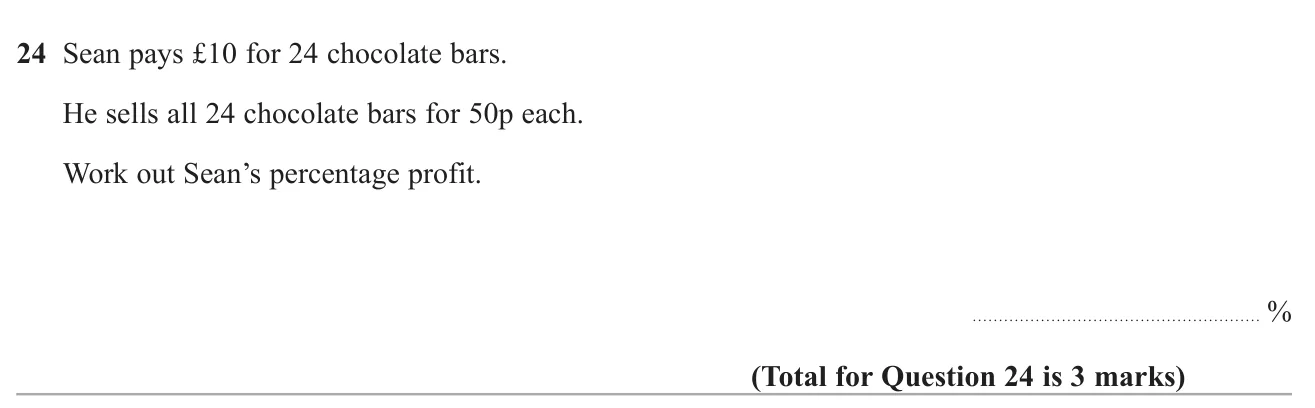
Selling price: 24×50p =1200p =£12.
Profit: 12−10=£2.
Percentage profit: 102×100=20%.
Watch out: Dividing the profit by the selling price to get about 16.7%.
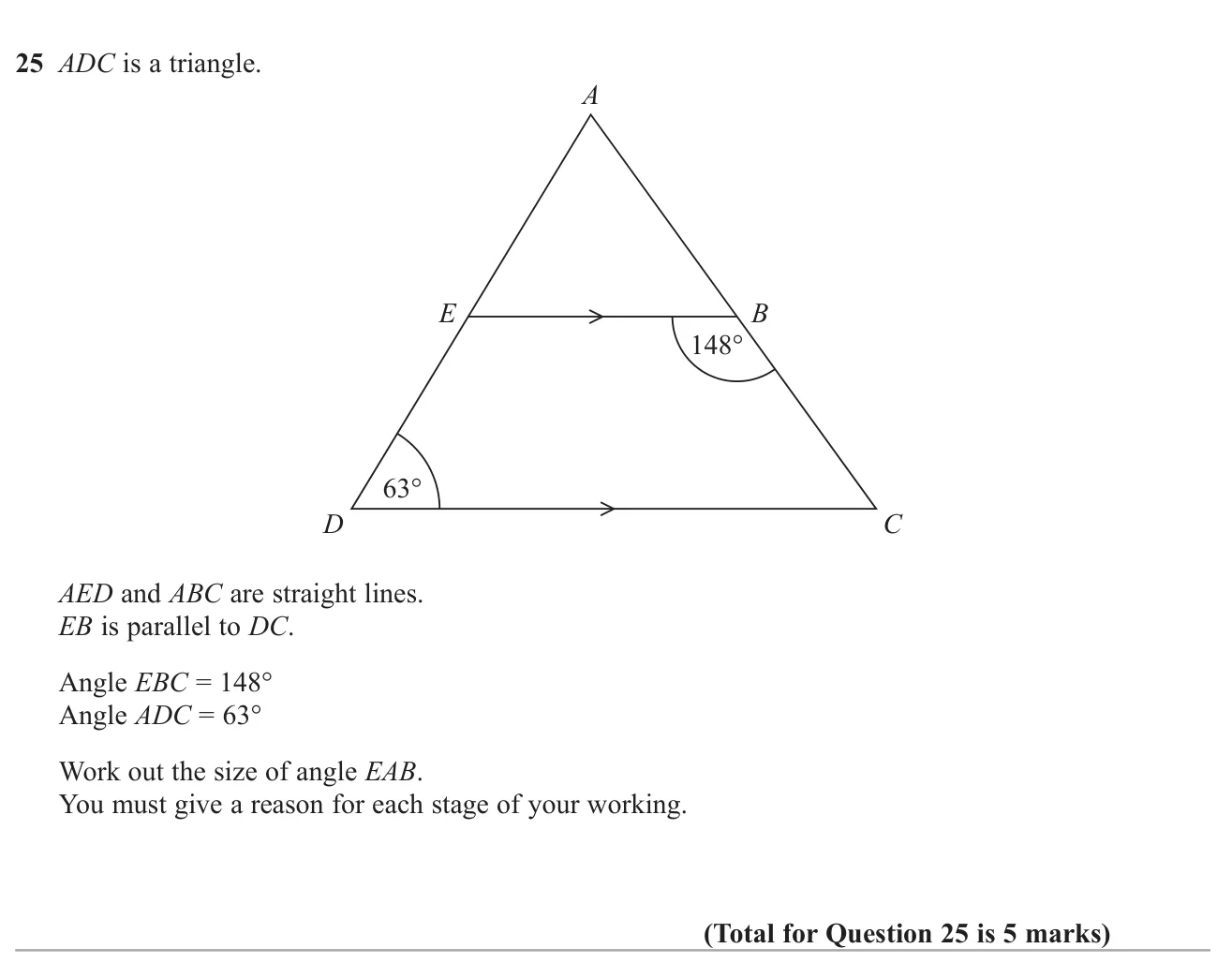
© Pearson Education Ltd. November 2020 Paper 1 (Foundation, non-calculator), question 25.
Show answer
| Answer | 85° with reasons | 5 marks |
|---|
Worked solution Checked against the mark scheme
Angle AEB=63° (corresponding angles are equal).
Angle ABE=180−148=32° (angles on a straight line add up to 180°).
Angle EAB=180−63−32=85° (angles in a triangle add up to 180°).
Watch out: Writing 'F angles' or 'Z angles' instead of the proper names of the reasons.
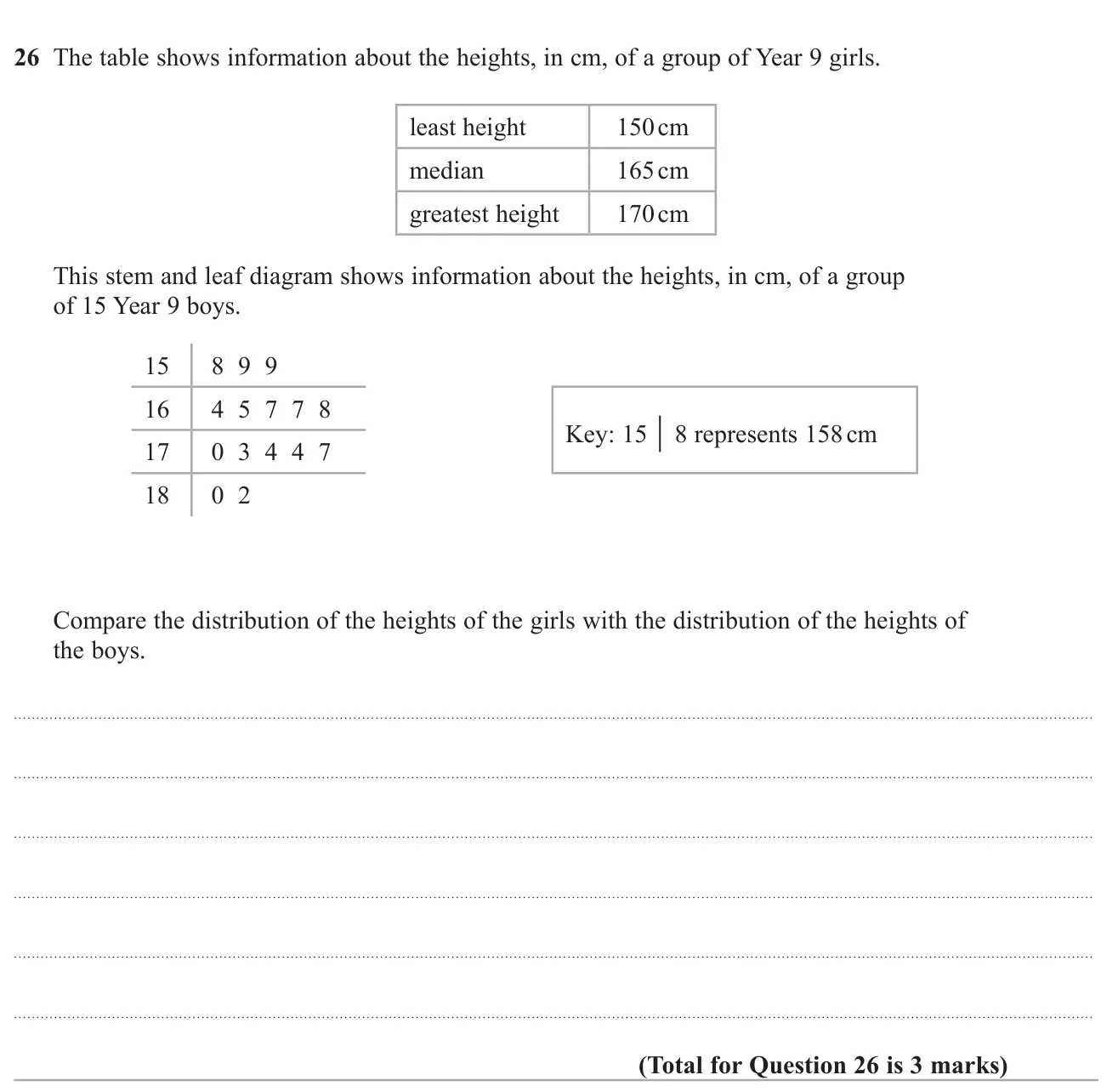
© Pearson Education Ltd. November 2020 Paper 1 (Foundation, non-calculator), question 26.
Show answer
| Answer | Boys' median (168 cm) is higher than girls' (165 cm); boys' range (24 cm) is larger than girls' (20 cm) | 3 marks |
|---|
Worked solution Checked against the mark scheme
Girls: median 165 cm, range 170−150=20 cm.
Boys: 15 values, so the median is the 8th: 168 cm. Range 182−158=24 cm.
On average the boys are taller (168 > 165), and their heights are more spread out (24 > 20).
Watch out: Quoting the figures without actually comparing them.
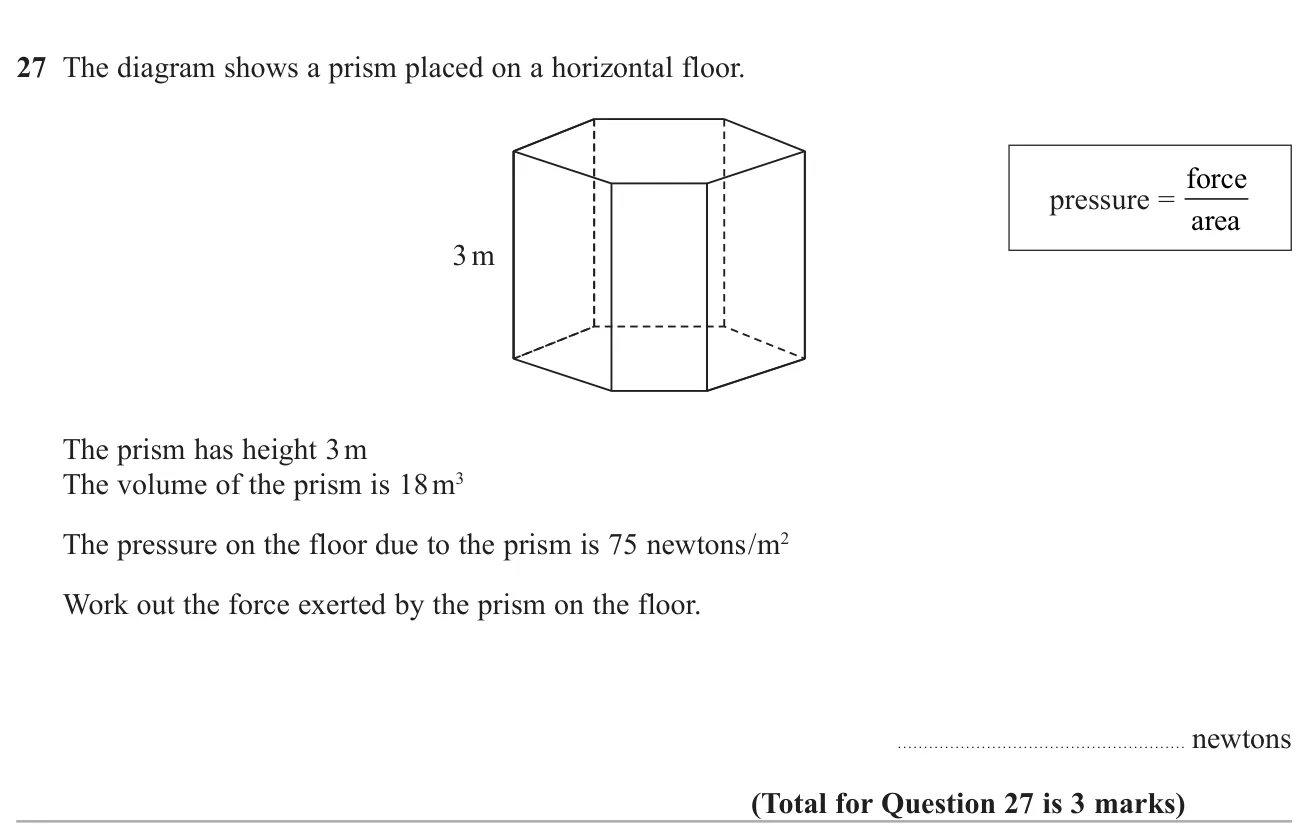
© Pearson Education Ltd. November 2020 Paper 1 (Foundation, non-calculator), question 27.
Show answer
Worked solution Checked against the mark scheme
Base area =318=6 m2.
Force = pressure × area =75×6=450 N.
Watch out: Using the volume in place of the area: 75×18.
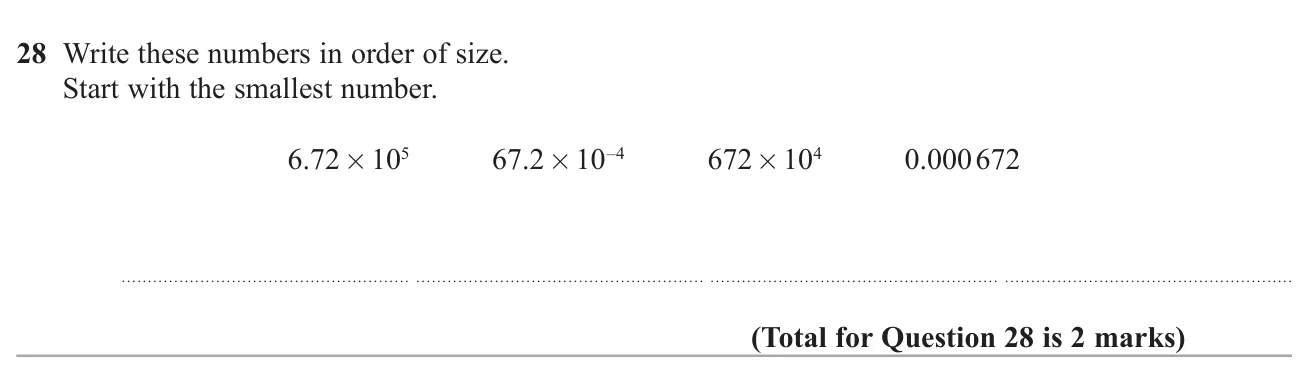
© Pearson Education Ltd. November 2020 Paper 1 (Foundation, non-calculator), question 28.
Show answer
| Answer | 0.000672, 67.2×10⁻⁴, 6.72×10⁵, 672×104 | 2 marks |
|---|
Worked solution Checked against the mark scheme
Write each as an ordinary number:
67.2×10−4=0.00672, 6.72×105=672000, 672×104=6720000.
So: 0.000672, 67.2×10⁻⁴, 6.72×10⁵, 672×104.
Watch out: Ordering by the powers of 10 alone and ignoring that 67.2 and 672 are not in standard form.
Question 29
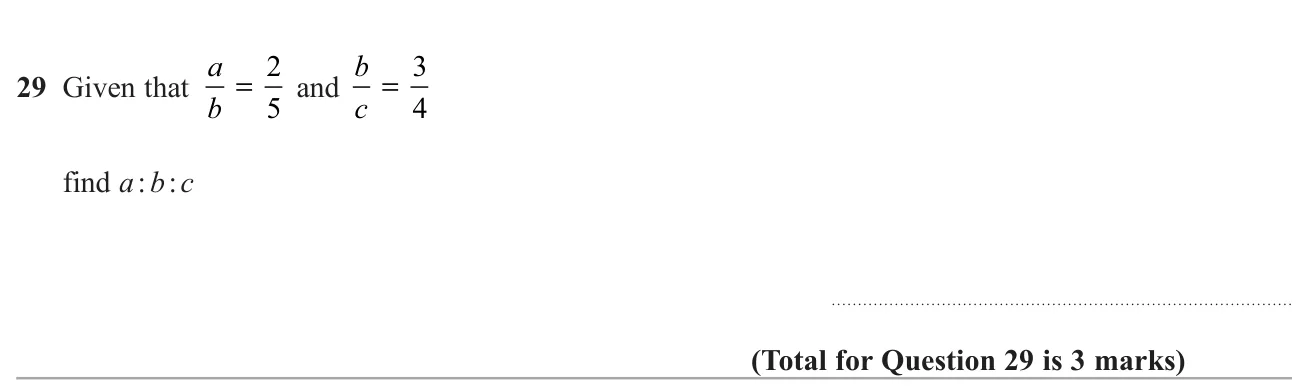
Ratio3 marksGrade 5No calculatorOn both tiers © Pearson Education Ltd. November 2020 Paper 1 (Foundation, non-calculator), question 29.
Show answer
| Answer | 6:15:20 | 3 marks |
|---|
Worked solution Checked against the mark scheme
ba=52 gives a:b=2:5, and cb=43 gives b:c=3:4.
Make b the same in both (15): a:b=6:15 and b:c=15:20.
So a:b:c=6:15:20.
Watch out: Joining them directly as 2:5:4 without matching b.
© Pearson Education Ltd. November 2020 Paper 1 (Foundation, non-calculator), question 30.
Show answer
| (a) | q=6p−7 | 2 marks |
|---|
| (b) | m6 | 1 mark |
|---|
Worked solution Checked against the mark scheme
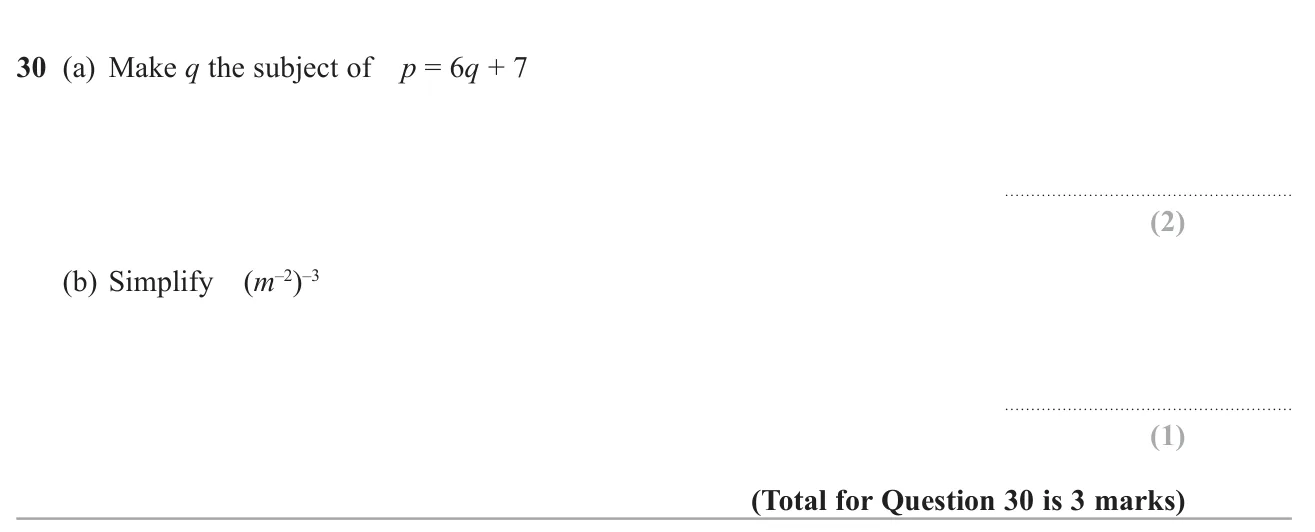
(a) p=6q+7. Subtract 7: p−7=6q. Divide by 6: q=6p−7.
(b) Multiply the powers: (−2)×(−3)=6, so (m−2)−3=m6.
Watch out: In (b) adding the powers to get m−5.
Finished the paper?
Add up your marks for all three papers and see what grade that would have been.