Revision guide by The Full Marks
Pythagoras and trigonometry: what you need to know Pythagoras' theorem finds a missing side of a right-angled triangle from the other two sides; trigonometry (SOHCAHTOA) links the sides to the angles. They are among the most common topics on both tiers, and Higher papers extend them to 3D shapes.
Foundation students need Pythagoras, SOHCAHTOA in 2D and the exact values; using them in 3D shapes is Higher only.
Key facts Pythagoras: a 2 + b 2 = c 2 a^2 + b^2 = c^2 a 2 + b 2 = c 2 c c c sin θ = O H \sin \theta = \frac{O}{H} sin θ = H O cos θ = A H \cos \theta = \frac{A}{H} cos θ = H A tan θ = O A \tan \theta = \frac{O}{A} tan θ = A O Exact values: sin 30 ∘ = cos 60 ∘ = 1 2 \sin 30^\circ = \cos 60^\circ = \frac{1}{2} sin 3 0 ∘ = cos 6 0 ∘ = 2 1 sin 45 ∘ = cos 45 ∘ = 2 2 \sin 45^\circ = \cos 45^\circ = \frac{\sqrt{2}}{2} sin 4 5 ∘ = cos 4 5 ∘ = 2 2 sin 60 ∘ = cos 30 ∘ = 3 2 \sin 60^\circ = \cos 30^\circ = \frac{\sqrt{3}}{2} sin 6 0 ∘ = cos 3 0 ∘ = 2 3 tan 30 ∘ = 3 3 \tan 30^\circ = \frac{\sqrt{3}}{3} tan 3 0 ∘ = 3 3 tan 45 ∘ = 1 \tan 45^\circ = 1 tan 4 5 ∘ = 1 tan 60 ∘ = 3 \tan 60^\circ = \sqrt{3} tan 6 0 ∘ = 3 sin 0 ∘ = cos 90 ∘ = tan 0 ∘ = 0 \sin 0^\circ = \cos 90^\circ = \tan 0^\circ = 0 sin 0 ∘ = cos 9 0 ∘ = tan 0 ∘ = 0 sin 90 ∘ = cos 0 ∘ = 1 \sin 90^\circ = \cos 0^\circ = 1 sin 9 0 ∘ = cos 0 ∘ = 1 Pythagoras Identify the hypotenuse first: the longest side, opposite the right angle. Finding the hypotenuse: square the two shorter sides, add, then square root. Finding a shorter side: square both sides, subtract (hypotenuse2 ^2 2 Distance between two points: sketch a right-angled triangle, find the horizontal and vertical differences, then use Pythagoras. Trigonometry Label the sides O, A and H from the angle you are using. Pick the ratio that uses the two sides involved (the one you know and the one you want). For a side: rearrange, e.g. O = H sin θ O = H \sin \theta O = H sin θ θ = tan − 1 ( O A ) \theta = \tan^{-1}\left(\frac{O}{A}\right) θ = tan − 1 ( A O ) 3D problems (Higher) Find a right-angled triangle that contains the length or angle you want. Use Pythagoras on the base first to find any missing side of that triangle, then solve it. Keep full calculator values between steps and round only at the end. Worked examples Example 1 Foundation · grade 4
A ladder 5.2 5.2 5.2 1.4 1.4 1.4
Show the solution The ladder is the hypotenuse, so subtract.h 2 = 5.2 2 − 1.4 2 = 27.04 − 1.96 = 25.08 h^2 = 5.2^2 - 1.4^2 = 27.04 - 1.96 = 25.08 h 2 = 5. 2 2 − 1. 4 2 = 27.04 − 1.96 = 25.08 h = 25.08 = 5.0079 … h = \sqrt{25.08} = 5.0079\ldots h = 25.08 = 5.0079 … h = 5.01 h = 5.01 h = 5.01
Example 2 Foundation · grade 5
(a) Triangle P Q R PQR P QR Q Q Q P R = 12 PR = 12 P R = 12 Q P R = 35 ∘ QPR = 35^\circ QP R = 3 5 ∘ Q R QR QR 7 7 7 9 9 9 7 7 7
Show the solution (a) From angle P P P Q R QR QR P R PR P R sin 35 ∘ = Q R 12 \sin 35^\circ = \frac{QR}{12} sin 3 5 ∘ = 12 QR Q R = 12 sin 35 ∘ = 6.8829 … QR = 12 \sin 35^\circ = 6.8829\ldots QR = 12 sin 3 5 ∘ = 6.8829 … Q R = 6.9 QR = 6.9 QR = 6.9 = 7 = 7 = 7 = 9 = 9 = 9 θ = tan − 1 ( 7 9 ) = 37.874 … \theta = \tan^{-1}\left(\frac{7}{9}\right) = 37.874\ldots θ = tan − 1 ( 9 7 ) = 37.874 … θ = 37.9 ∘ \theta = 37.9^\circ θ = 37. 9 ∘
Example 3 Higher · grade 7
A cuboid measures 8 8 8 6 6 6 5 5 5
Show the solution Diagonal of the base: 8 2 + 6 2 = 100 = 10 \sqrt{8^2 + 6^2} = \sqrt{100} = 10 8 2 + 6 2 = 100 = 10 5 5 5 = 5 = 5 = 5 = 10 = 10 = 10 θ = tan − 1 ( 5 10 ) = 26.565 … \theta = \tan^{-1}\left(\frac{5}{10}\right) = 26.565\ldots θ = tan − 1 ( 10 5 ) = 26.565 … θ = 26.6 ∘ \theta = 26.6^\circ θ = 26. 6 ∘
Common mistakes Adding the squares when you need a shorter side. If you know the hypotenuse, subtract. Choosing the wrong ratio because the sides were labelled from the wrong angle. Calculator in radians mode: check that sin 30 \sin 30 sin 30 0.5 0.5 0.5 Rounding part-way through a two-triangle or 3D question, so the final answer drifts outside the accepted range. Keep the full value on your calculator. Exam tips Write the formula with numbers in before using your calculator; that line alone often gets a method mark. Exact-value questions have to be answered without a calculator, so learn the table. Questions people ask How do you know when to use Pythagoras or trigonometry? If the question only involves sides (two known, one to find), use Pythagoras. If an angle is given or asked for, use trigonometry.
What does SOHCAHTOA stand for? Sin = Opposite ÷ Hypotenuse, Cos = Adjacent ÷ Hypotenuse, Tan = Opposite ÷ Adjacent. It helps you remember the three trig ratios.
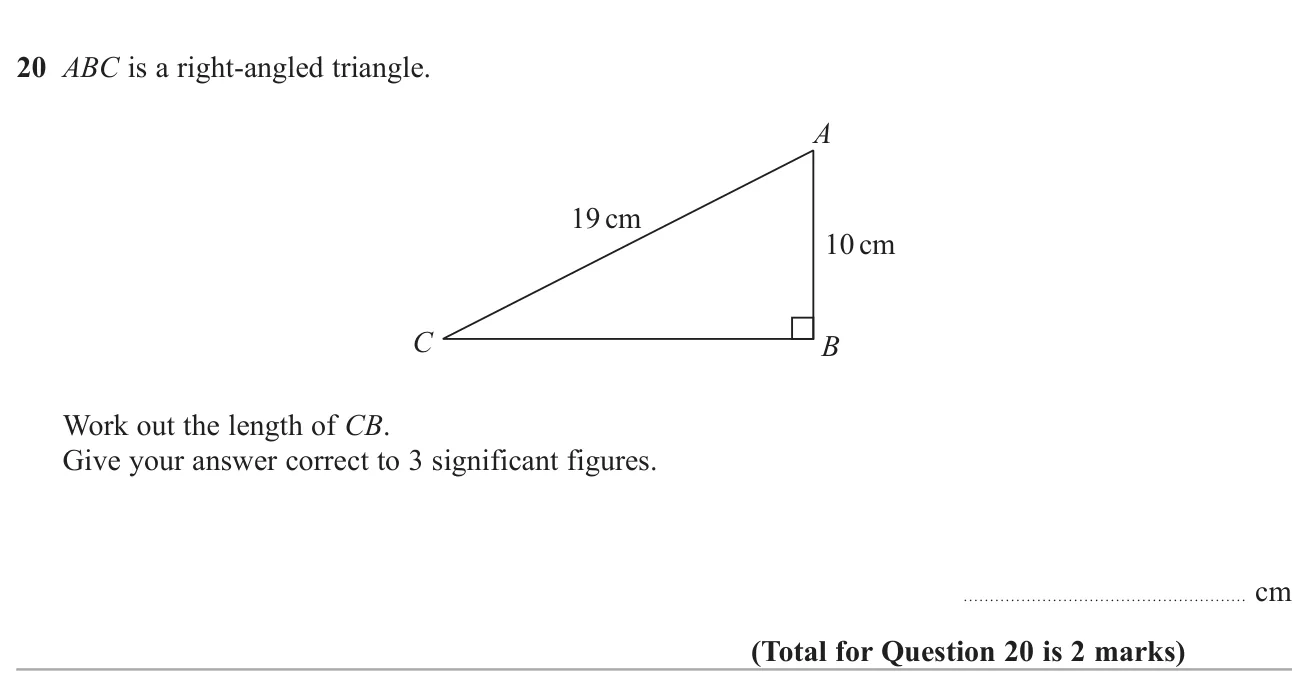
Exam questions: Pythagoras and trigonometry (39, easiest first) © Pearson Education Ltd. June 2024 Paper 2 (Foundation, calculator), question 20.
Answer 16.2 16.2 16.2 2 marks
Worked solution Checked against the mark scheme
19 cm is the hypotenuse.
C B 2 = 19 2 − 10 2 = 361 − 100 = 261 CB^2 = 19^2 - 10^2 = 361 - 100 = 261 C B 2 = 1 9 2 − 1 0 2 = 361 − 100 = 261
C B = 261 = 16.155 … ≈ 16.2 CB = \sqrt{261} = 16.155\ldots \approx 16.2 C B = 261 = 16.155 … ≈ 16.2
Watch out: Adding the squares (461 = 21.5 \sqrt{461} = 21.5 461 = 21.5
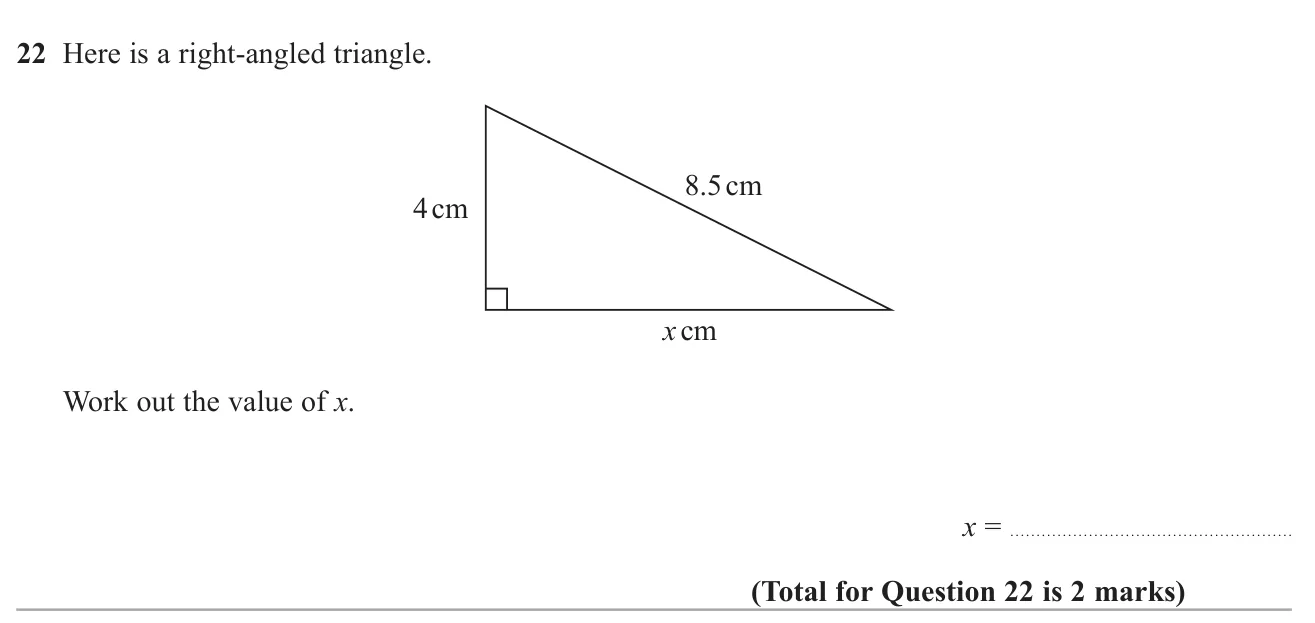
© Pearson Education Ltd. June 2022 Paper 3 (Foundation, calculator), question 22.
Worked solution Checked against the mark scheme
The hypotenuse is 8.5 cm.
x 2 = 8.5 2 − 4 2 = 72.25 − 16 = 56.25 x^2 = 8.5^2 - 4^2 = 72.25 - 16 = 56.25 x 2 = 8. 5 2 − 4 2 = 72.25 − 16 = 56.25
x = 56.25 = 7.5 x = \sqrt{56.25} = 7.5 x = 56.25 = 7.5
Watch out: Adding the squares instead of subtracting, giving about 9.39.
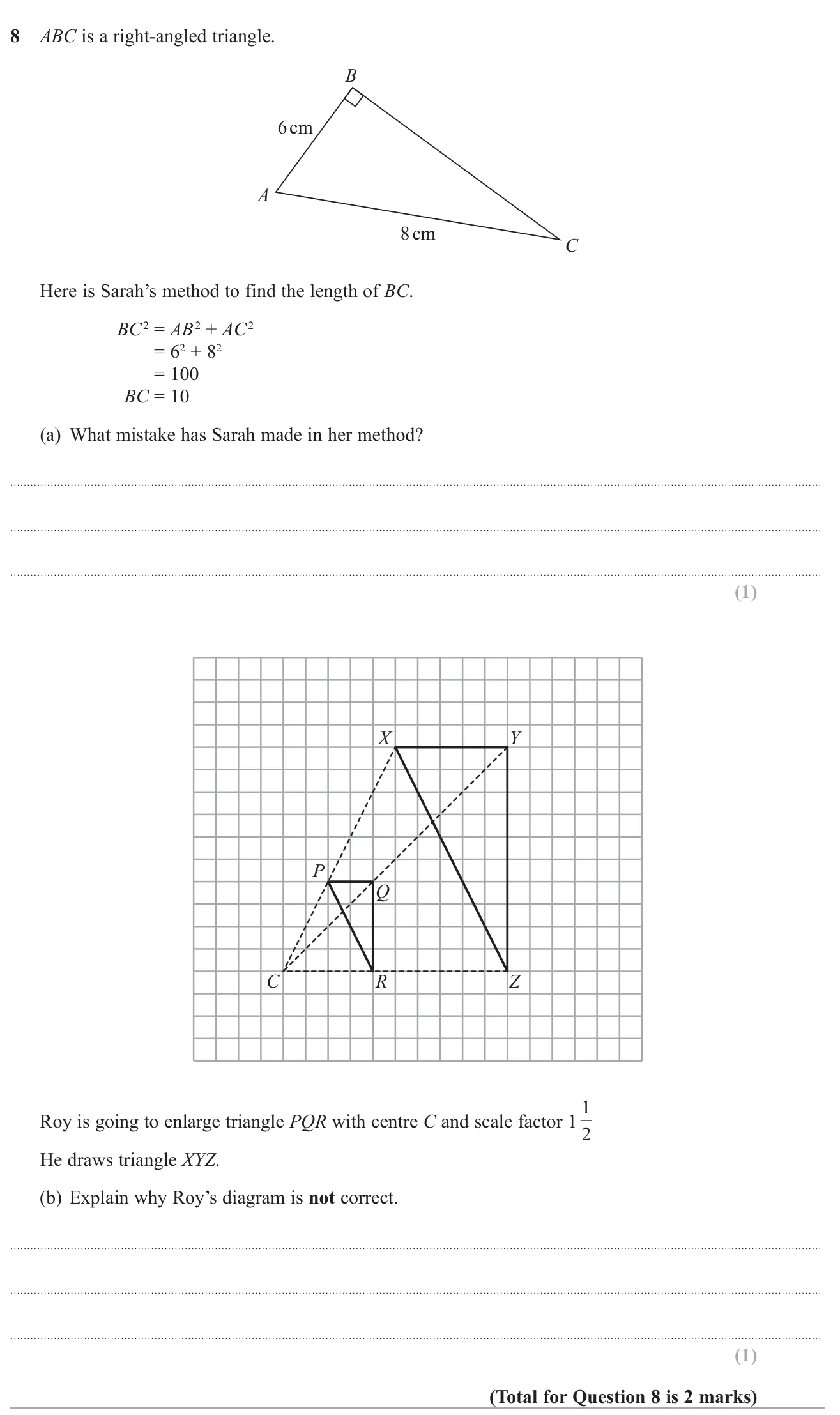
© Pearson Education Ltd. June 2019 Paper 3 (Higher, calculator), question 8.
(a) AC (8 cm) is the hypotenuse, so she should subtract: B C 2 = A C 2 − A B 2 = 8 2 − 6 2 BC^2 = AC^2 - AB^2 = 8^2 - 6^2 B C 2 = A C 2 − A B 2 = 8 2 − 6 2 1 mark (b) The scale factor used is 2.5, not 1.5 (e.g. C Z CZ C Z C R CR C R 1 mark
Worked solution Checked against the mark scheme
(a) The right angle is at B B B A C AC A C B C BC B C B C 2 = 8 2 − 6 2 = 28 BC^2 = 8^2 - 6^2 = 28 B C 2 = 8 2 − 6 2 = 28 B C = 5.29 BC = 5.29 B C = 5.29
(b) Count squares from C C C C R = 4 CR = 4 C R = 4 C Z = 10 CZ = 10 C Z = 10 10 ÷ 4 = 2.5 10 \div 4 = 2.5 10 ÷ 4 = 2.5 1 1 2 1\frac{1}{2} 1 2 1
Watch out: Saying 'she used Pythagoras wrong' without saying what the error is.
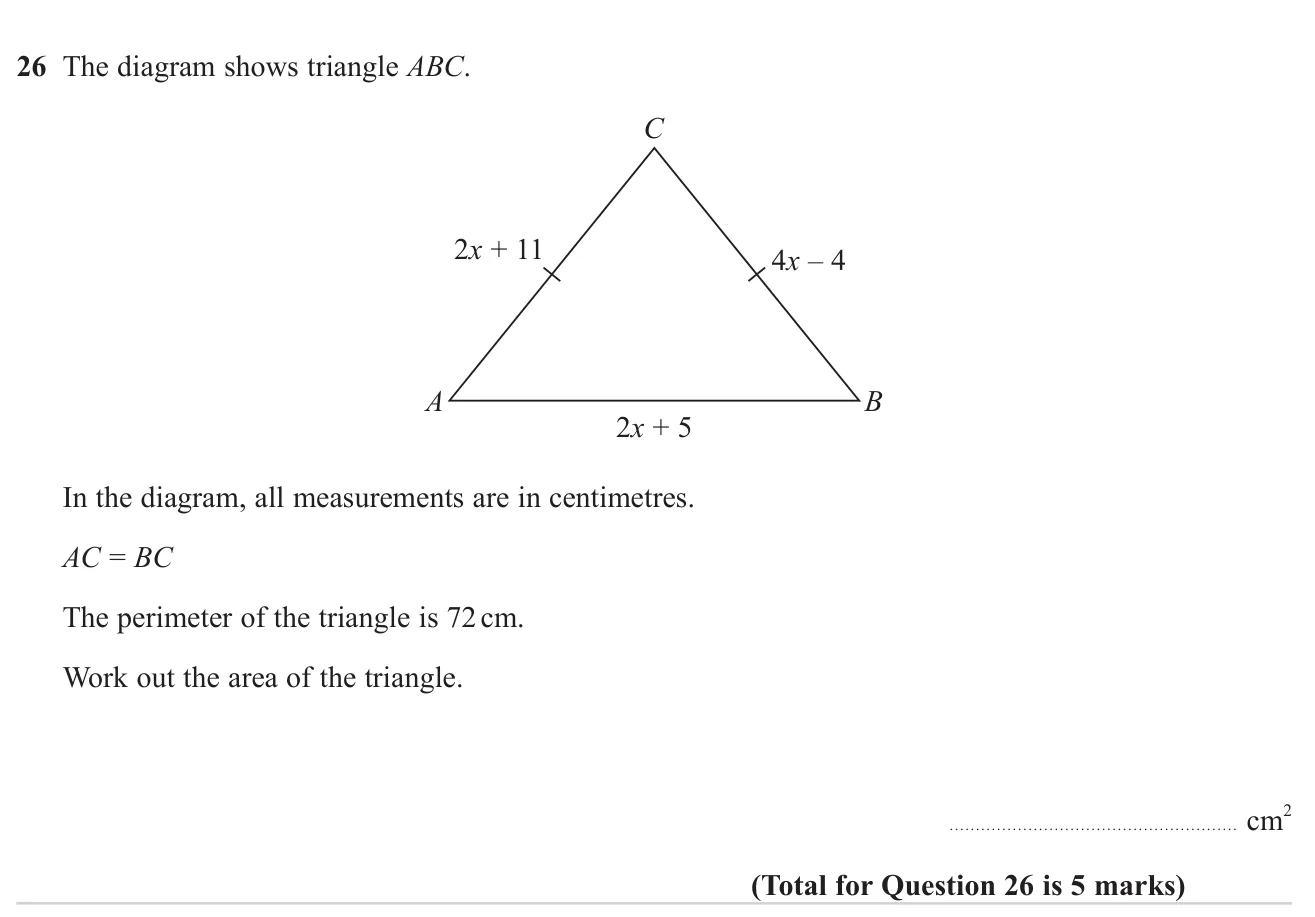
© Pearson Education Ltd. November 2024 Paper 2 (Foundation, calculator), question 26.
Worked solution Checked against the mark scheme
A C = B C AC = BC A C = B C 2 x + 11 = 4 x − 4 2x + 11 = 4x - 4 2 x + 11 = 4 x − 4 2 x = 15 2x = 15 2 x = 15 x = 7.5 x = 7.5 x = 7.5
Sides: A C = B C = 26 AC = BC = 26 A C = B C = 26 A B = 20 AB = 20 A B = 20 72 72 72
Height from C C C A B AB A B 26 2 − 10 2 = 576 = 24 \sqrt{26^2 - 10^2} = \sqrt{576} = 24 2 6 2 − 1 0 2 = 576 = 24
Area = 1 2 × 20 × 24 = 240 cm 2 = \frac{1}{2} \times 20 \times 24 = 240\text{ cm}^2 = 2 1 × 20 × 24 = 240 cm 2
Watch out: Using 26 as the height instead of finding the perpendicular height.
© Pearson Education Ltd. November 2024 Paper 3 (Foundation, calculator), question 24.
Answer 14.3 14.3 14.3 2 marks
Worked solution Checked against the mark scheme
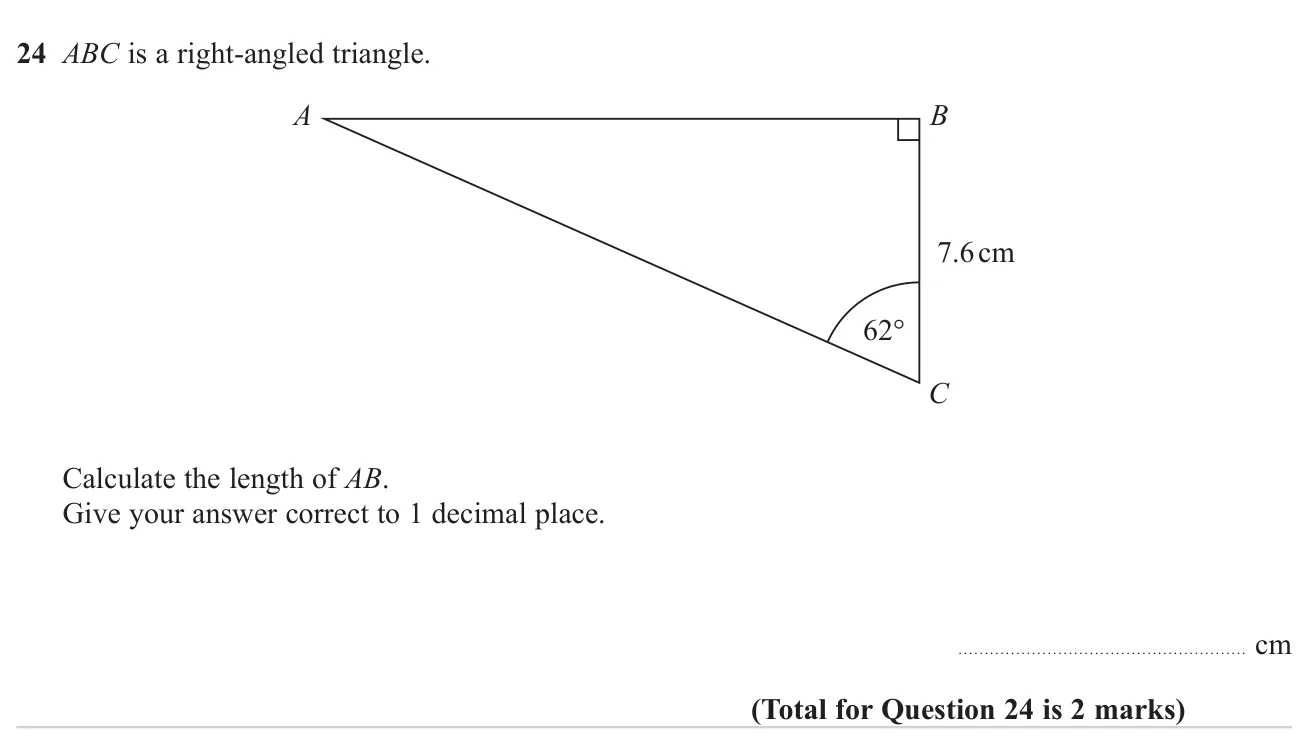
AB is opposite the 62 ° 62° 62°
tan 62 ° = A B 7.6 \tan 62° = \frac{AB}{7.6} tan 62° = 7.6 A B
A B = 7.6 × tan 62 ° = 14.29... ≈ 14.3 AB = 7.6 \times \tan 62° = 14.29... \approx 14.3 A B = 7.6 × tan 62° = 14.29... ≈ 14.3
Watch out: Using sin or cos instead of tan.
© Pearson Education Ltd. June 2023 Paper 1 (Foundation, non-calculator), question 30.
Answer 1 2 \frac{1}{2} 2 1 1 mark
Worked solution Checked against the mark scheme
This is one of the exact trig values to learn.
cos 60 ∘ = 1 2 \cos 60^\circ = \frac{1}{2} cos 6 0 ∘ = 2 1
Watch out: Confusing with sin 60°, giving √3/2.
© Pearson Education Ltd. November 2023 Paper 2 (Foundation, calculator), question 29.
Worked solution Checked against the mark scheme
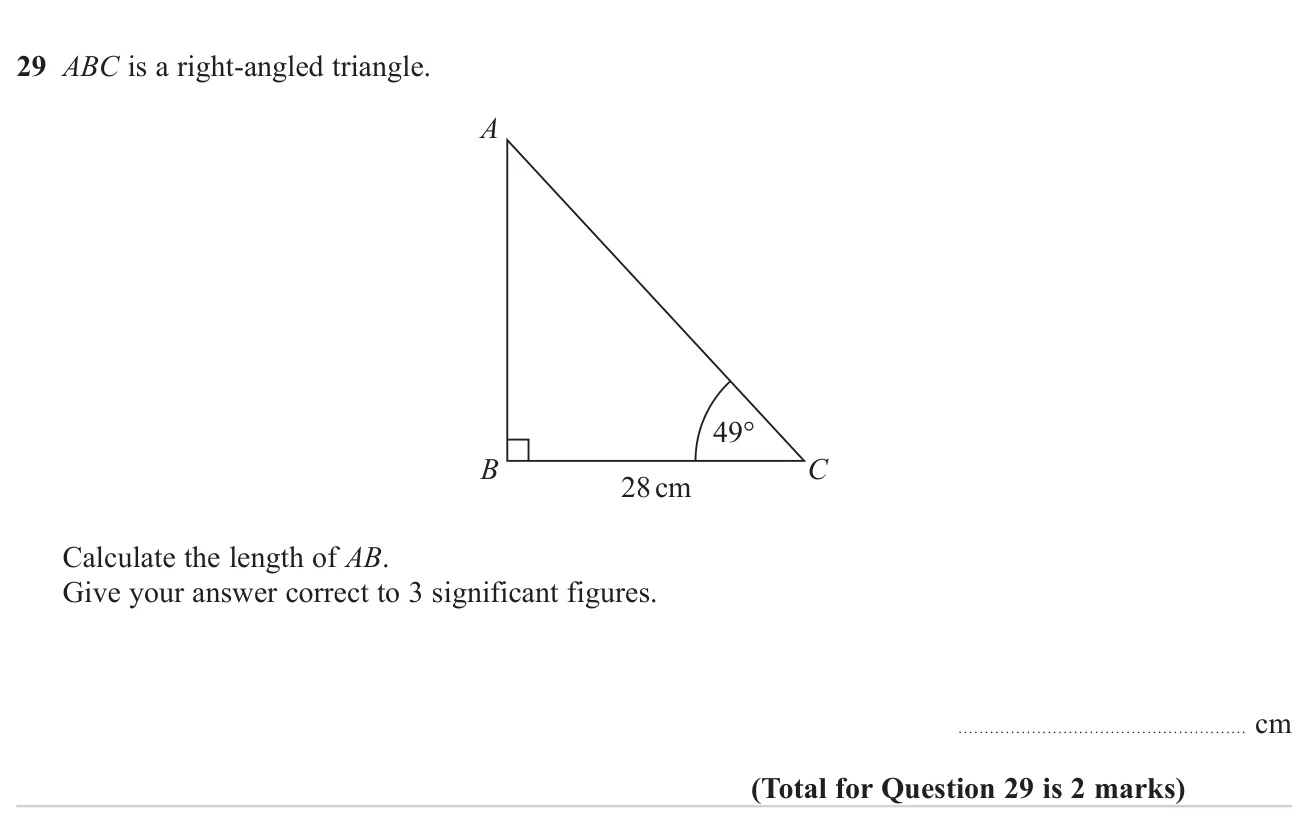
AB is opposite the 49 ° 49° 49°
A B = 28 × tan 49 ° = 32.21 … AB = 28 \times \tan 49° = 32.21\ldots A B = 28 × tan 49° = 32.21 …
So A B = 32.2 AB = 32.2 A B = 32.2
Watch out: Using sin or cos instead of tan.
© Pearson Education Ltd. November 2023 Paper 3 (Foundation, calculator), question 29.
Worked solution Checked against the mark scheme
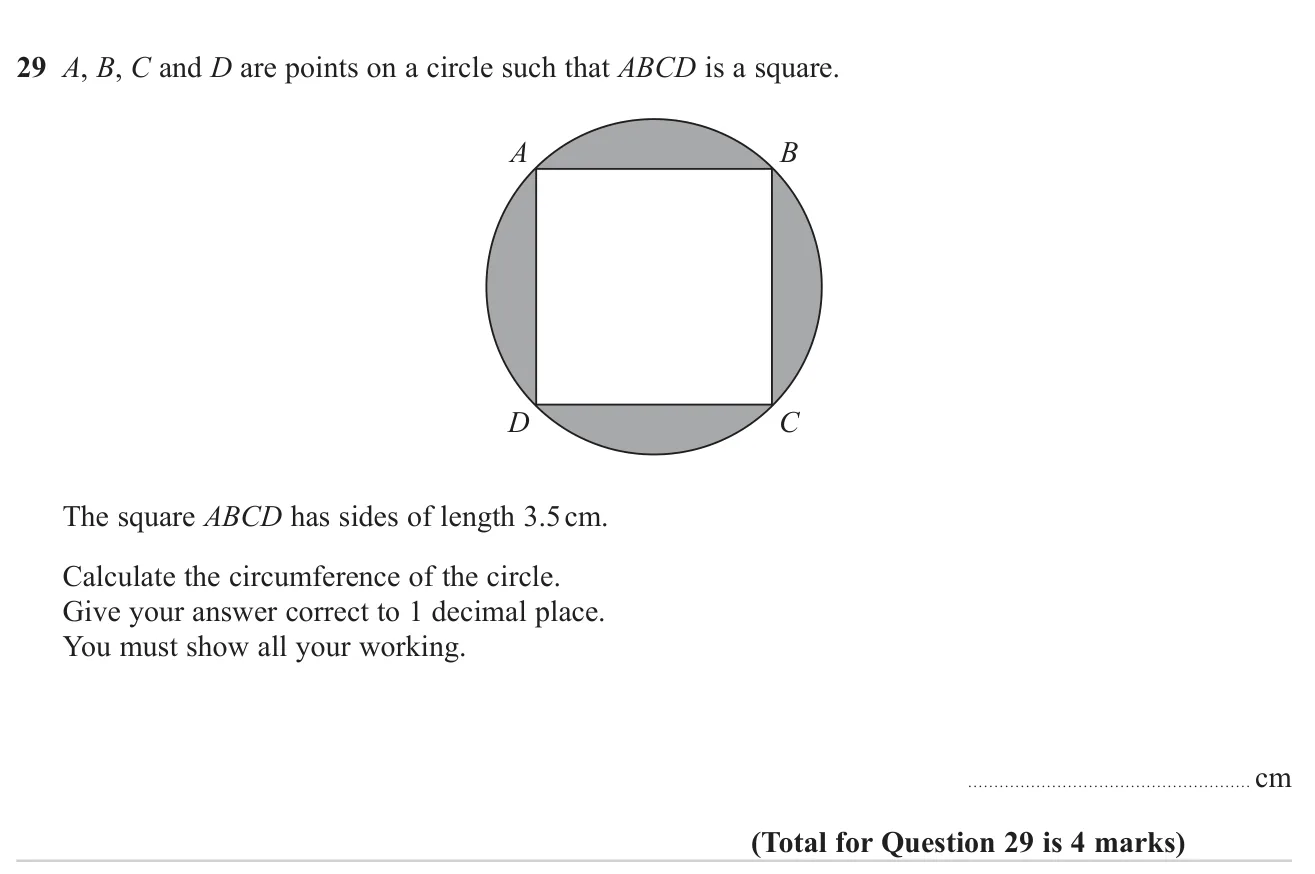
The diagonal of the square is a diameter of the circle.
d = 3.5 2 + 3.5 2 = 24.5 = 4.949... d = \sqrt{3.5^2 + 3.5^2} = \sqrt{24.5} = 4.949... d = 3. 5 2 + 3. 5 2 = 24.5 = 4.949...
Circumference = π d = π × 4.949... = 15.55... ≈ 15.6 = \pi d = \pi \times 4.949... = 15.55... \approx 15.6 = π d = π × 4.949... = 15.55... ≈ 15.6
Watch out: Using the side 3.5 cm as the diameter, giving 11.0 cm.
© Pearson Education Ltd. June 2022 Paper 1 (Foundation, non-calculator), question 30.
Worked solution Checked against the mark scheme
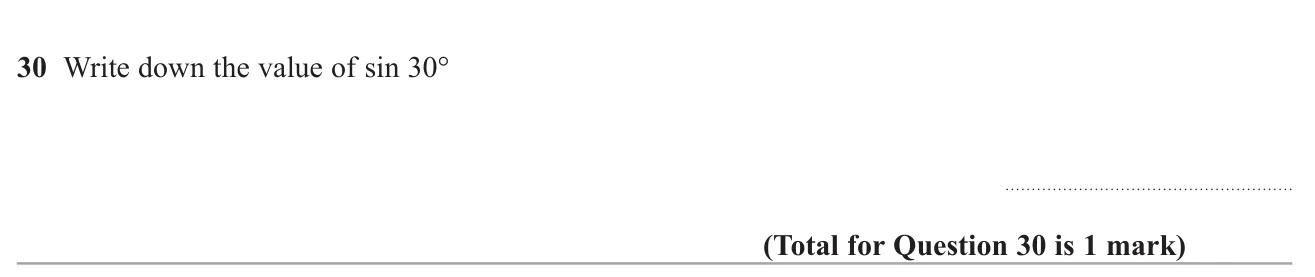
This is one of the exact trig values to learn: sin 30 ∘ = 1 2 = 0.5 \sin 30^\circ = \frac{1}{2} = 0.5 sin 3 0 ∘ = 2 1 = 0.5
Watch out: Mixing it up with cos 30°.
© Pearson Education Ltd. November 2022 Paper 2 (Foundation, calculator), question 22.
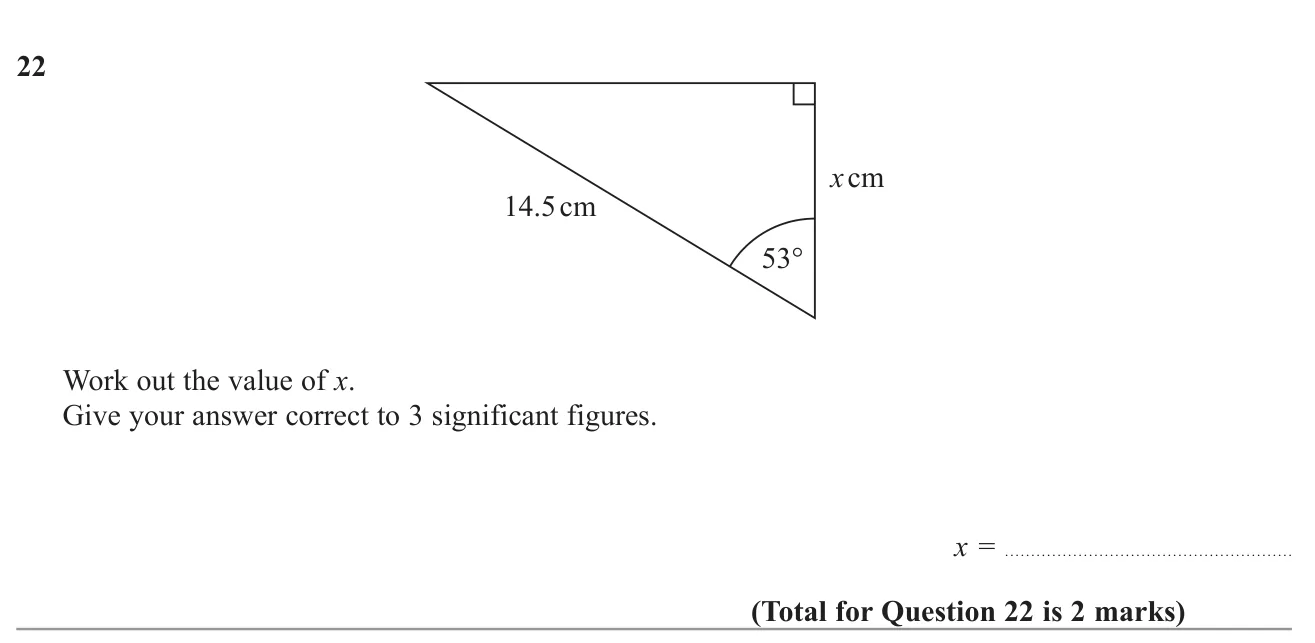
Worked solution Checked against the mark scheme
x x x 53 ° 53° 53°
x = 14.5 cos 53 ° = 8.726... x = 14.5 \cos 53° = 8.726... x = 14.5 cos 53° = 8.726...
x = 8.73 x = 8.73 x = 8.73
Watch out: Using sine instead of cosine.
© Pearson Education Ltd. November 2021 Paper 2 (Foundation, calculator), question 25.
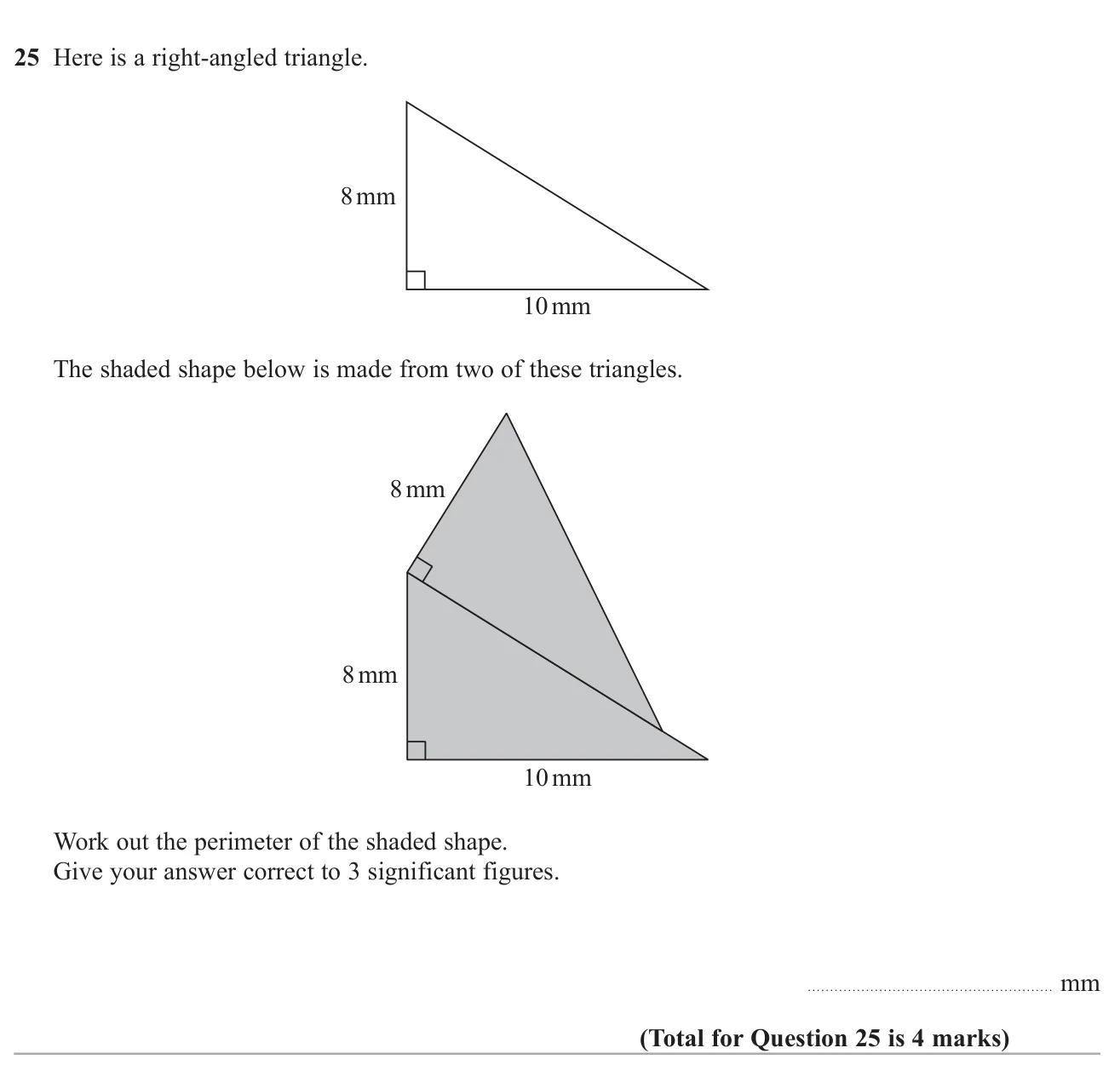
Worked solution Checked against the mark scheme
Hypotenuse: 8 2 + 10 2 = 164 = 12.806 … \sqrt{8^2 + 10^2} = \sqrt{164} = 12.806\ldots 8 2 + 1 0 2 = 164 = 12.806 …
Outer edges: 8, 10, part of the first hypotenuse (12.806 − 10 = 2.806 12.806 - 10 = 2.806 12.806 − 10 = 2.806 12.806 12.806 12.806
Perimeter = 8 + 10 + 2.806 + 12.806 + 8 = 41.6 = 8 + 10 + 2.806 + 12.806 + 8 = 41.6 = 8 + 10 + 2.806 + 12.806 + 8 = 41.6
Watch out: Including the full length of the inner hypotenuse, which is not on the outside of the shape.
© Pearson Education Ltd. November 2021 Paper 2 (Foundation, calculator), question 26.
(a) 17.8 2 marks (b) 33.6 2 marks
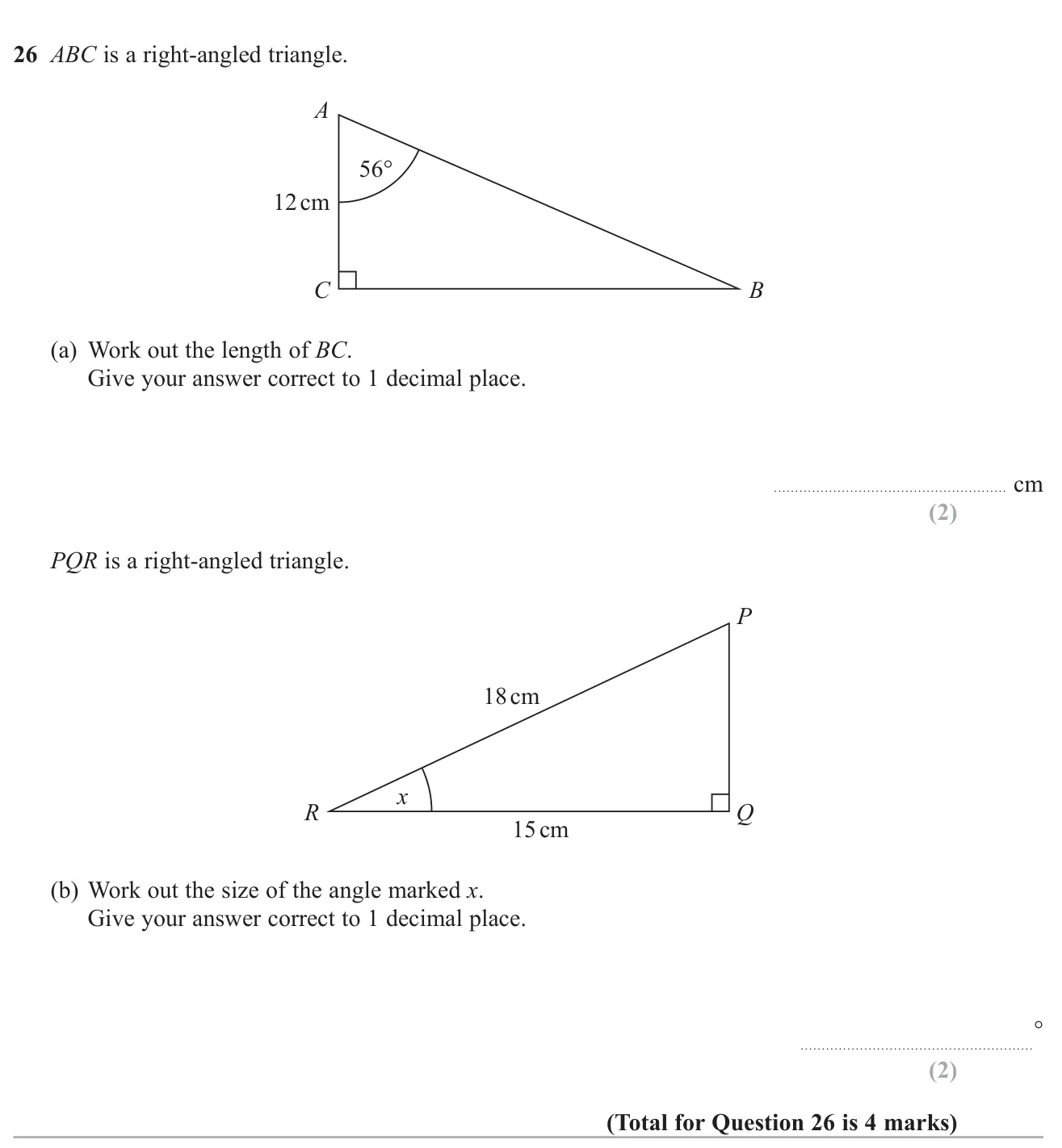
Worked solution Checked against the mark scheme
(a) B C BC B C 56 ∘ 56^\circ 5 6 ∘
B C = 12 tan 56 ∘ = 17.79 … = 17.8 BC = 12 \tan 56^\circ = 17.79\ldots = 17.8 B C = 12 tan 5 6 ∘ = 17.79 … = 17.8
(b) 15 is adjacent and 18 is the hypotenuse, so use cos.
x = cos − 1 ( 15 18 ) = 33.557 … = 33.6 ∘ x = \cos^{-1}\left(\frac{15}{18}\right) = 33.557\ldots = 33.6^\circ x = cos − 1 ( 18 15 ) = 33.557 … = 33. 6 ∘
Watch out: Choosing the wrong ratio, for example sin instead of tan.
© Pearson Education Ltd. November 2020 Paper 2 (Foundation, calculator), question 25.
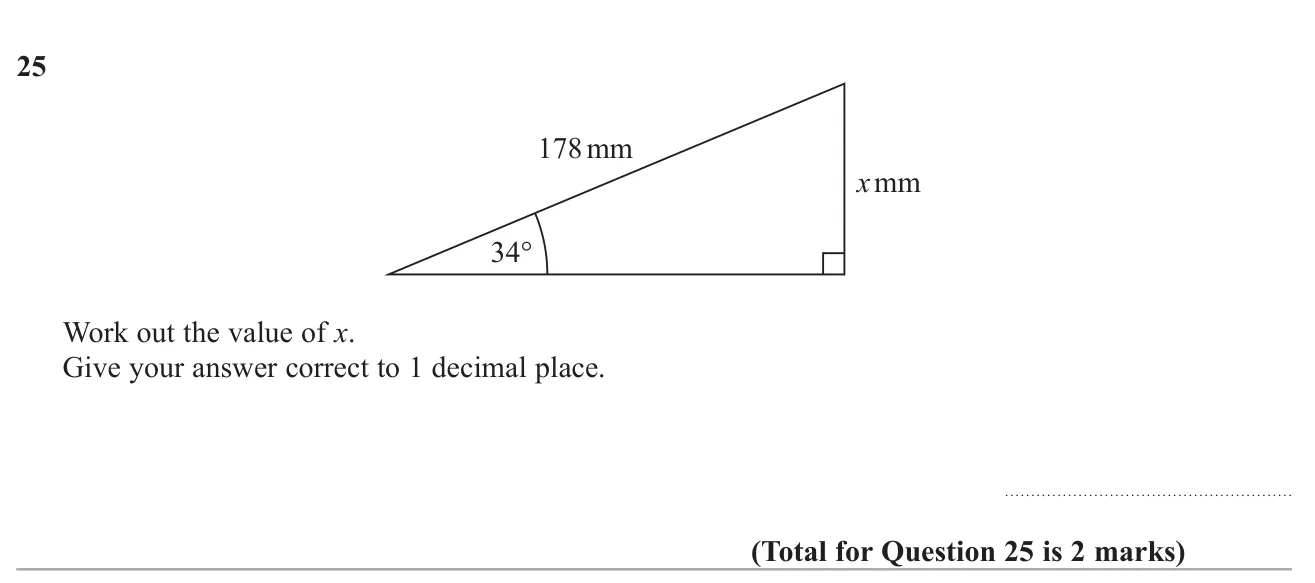
Worked solution Checked against the mark scheme
x x x 34 ∘ 34^\circ 3 4 ∘
x = 178 × sin 34 ∘ = 99.536 … x = 178 \times \sin 34^\circ = 99.536\ldots x = 178 × sin 3 4 ∘ = 99.536 …
x = 99.5 x = 99.5 x = 99.5
Watch out: Using cosine and getting 147.6.
© Pearson Education Ltd. June 2019 Paper 2 (Foundation, calculator), question 24.
Answer 9.85 9.85 9.85 2 marks
Worked solution Checked against the mark scheme
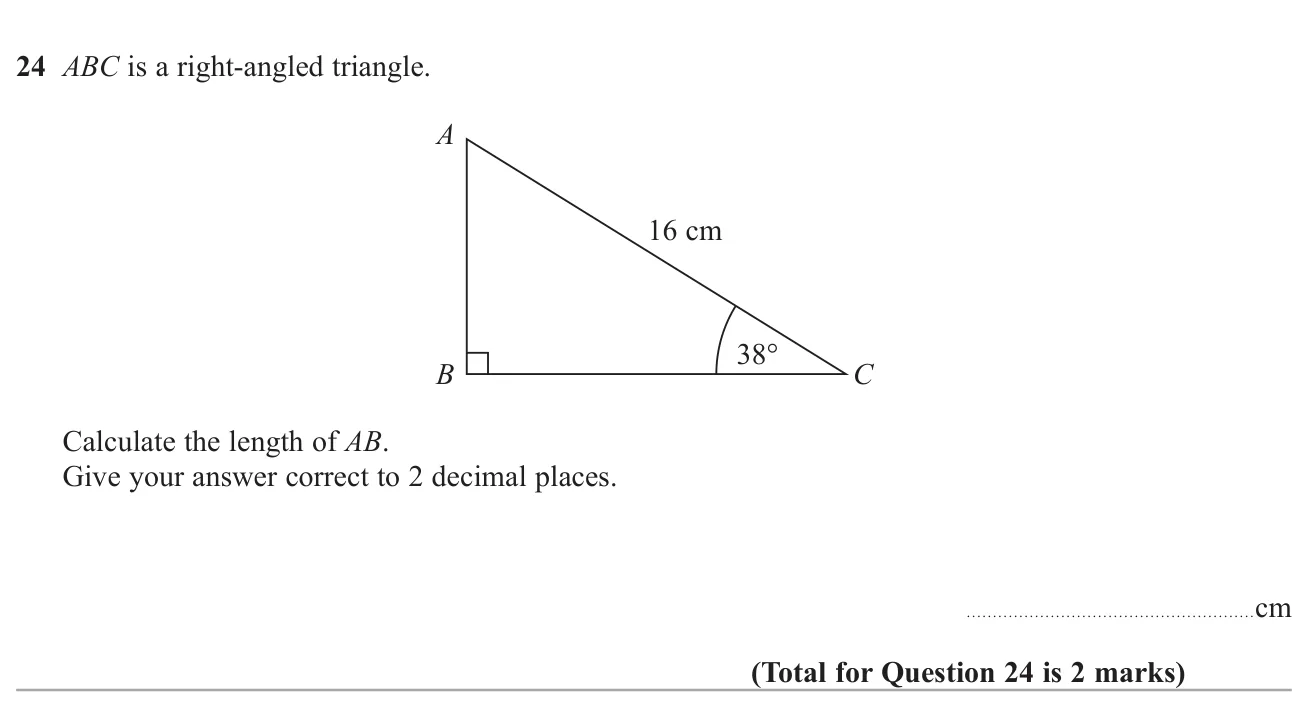
AC is the hypotenuse (16 cm) and AB is opposite the 38° angle.
sin 38 ∘ = A B 16 \sin 38^\circ = \frac{AB}{16} sin 3 8 ∘ = 16 A B
A B = 16 sin 38 ∘ = 9.850... = 9.85 cm AB = 16 \sin 38^\circ = 9.850... = 9.85\text{ cm} A B = 16 sin 3 8 ∘ = 9.850... = 9.85 cm
Watch out: Using cos instead of sin.
© Pearson Education Ltd. November 2018 Paper 1 (Higher, non-calculator), question 8.
(a) 1 1 1 1 mark (b) 8 8 8 2 marks
Worked solution Checked against the mark scheme
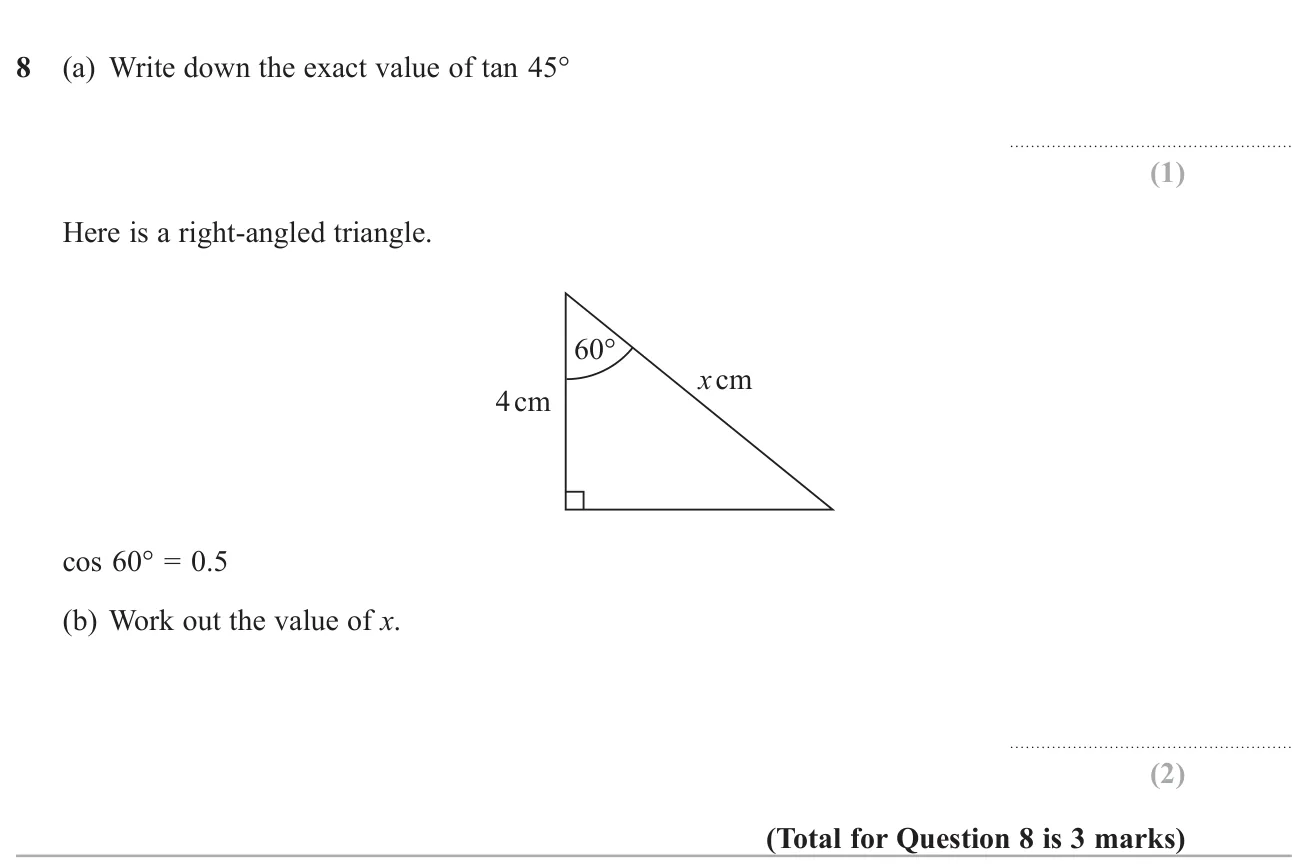
(a) tan 45 ° = 1 \tan 45° = 1 tan 45° = 1
(b) The 4 cm side is next to the 60° angle and x x x
cos 60 ° = 4 x \cos 60° = \frac{4}{x} cos 60° = x 4 0.5 = 4 x 0.5 = \frac{4}{x} 0.5 = x 4
x = 4 ÷ 0.5 = 8 x = 4 \div 0.5 = 8 x = 4 ÷ 0.5 = 8
Watch out: Writing cos 60 ° = x 4 \cos 60° = \frac{x}{4} cos 60° = 4 x
© Pearson Education Ltd. November 2018 Paper 3 (Foundation, calculator), question 25.
Answer 17.3 17.3 17.3 4 marks
Worked solution Checked against the mark scheme
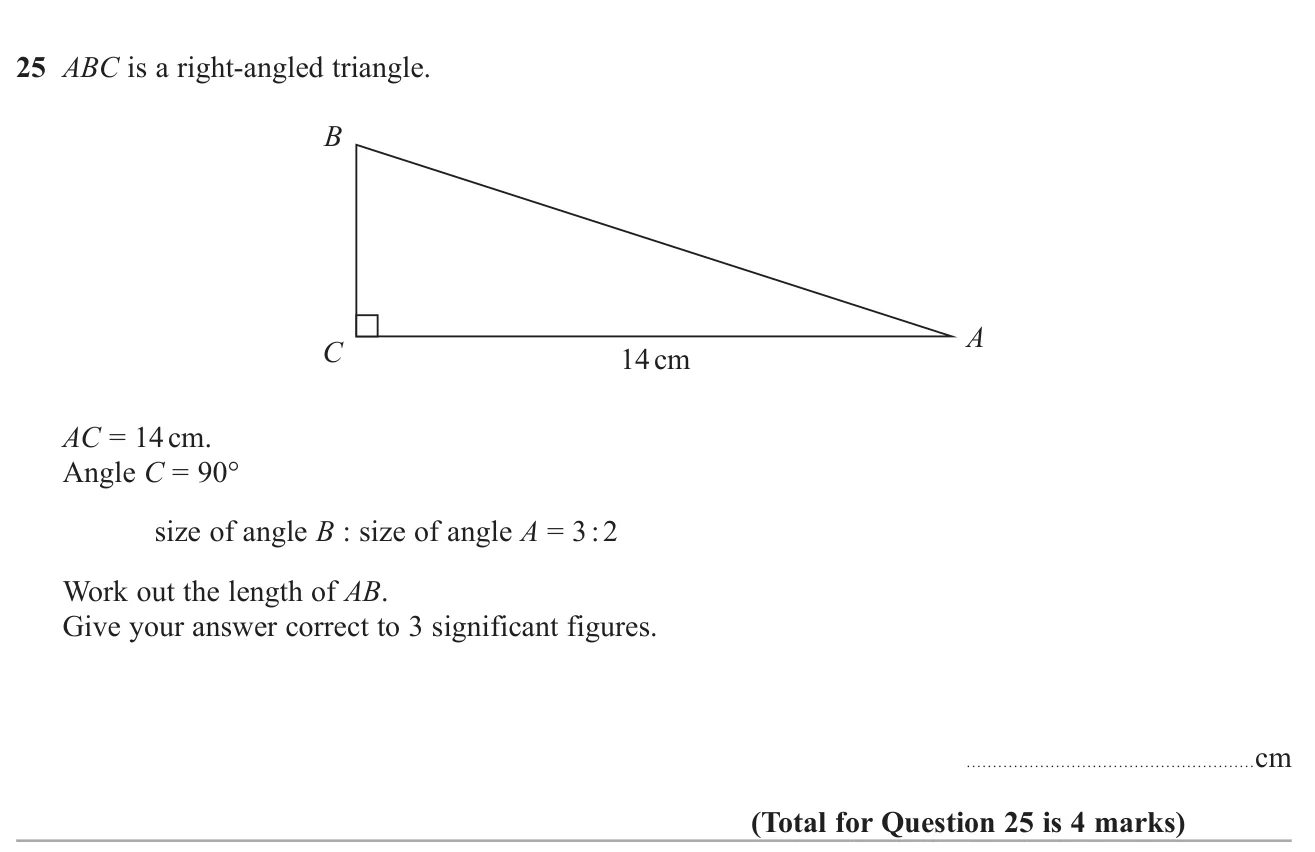
Angles A and B share 180 − 90 = 90 ° 180 - 90 = 90° 180 − 90 = 90° 3 : 2 3 : 2 3 : 2
One part = 90 ÷ 5 = 18 ° = 90 \div 5 = 18° = 90 ÷ 5 = 18° A = 36 ° A = 36° A = 36° B = 54 ° B = 54° B = 54°
AC is next to angle A and AB is the hypotenuse: cos 36 ° = 14 A B \cos 36° = \frac{14}{AB} cos 36° = A B 14
A B = 14 cos 36 ° = 17.3 AB = \frac{14}{\cos 36°} = 17.3 A B = c o s 36° 14 = 17.3
Watch out: Giving A the larger angle, 54°, and getting 24.1 cm.
© Pearson Education Ltd. June 2018 Paper 3 (Foundation, calculator), question 23.
(a) 50.5 ∘ 50.5^\circ 50. 5 ∘ 2 marks (b) Increase, because 7 10 > 7 11 \frac{7}{10} > \frac{7}{11} 10 7 > 11 7 1 mark
Worked solution Checked against the mark scheme
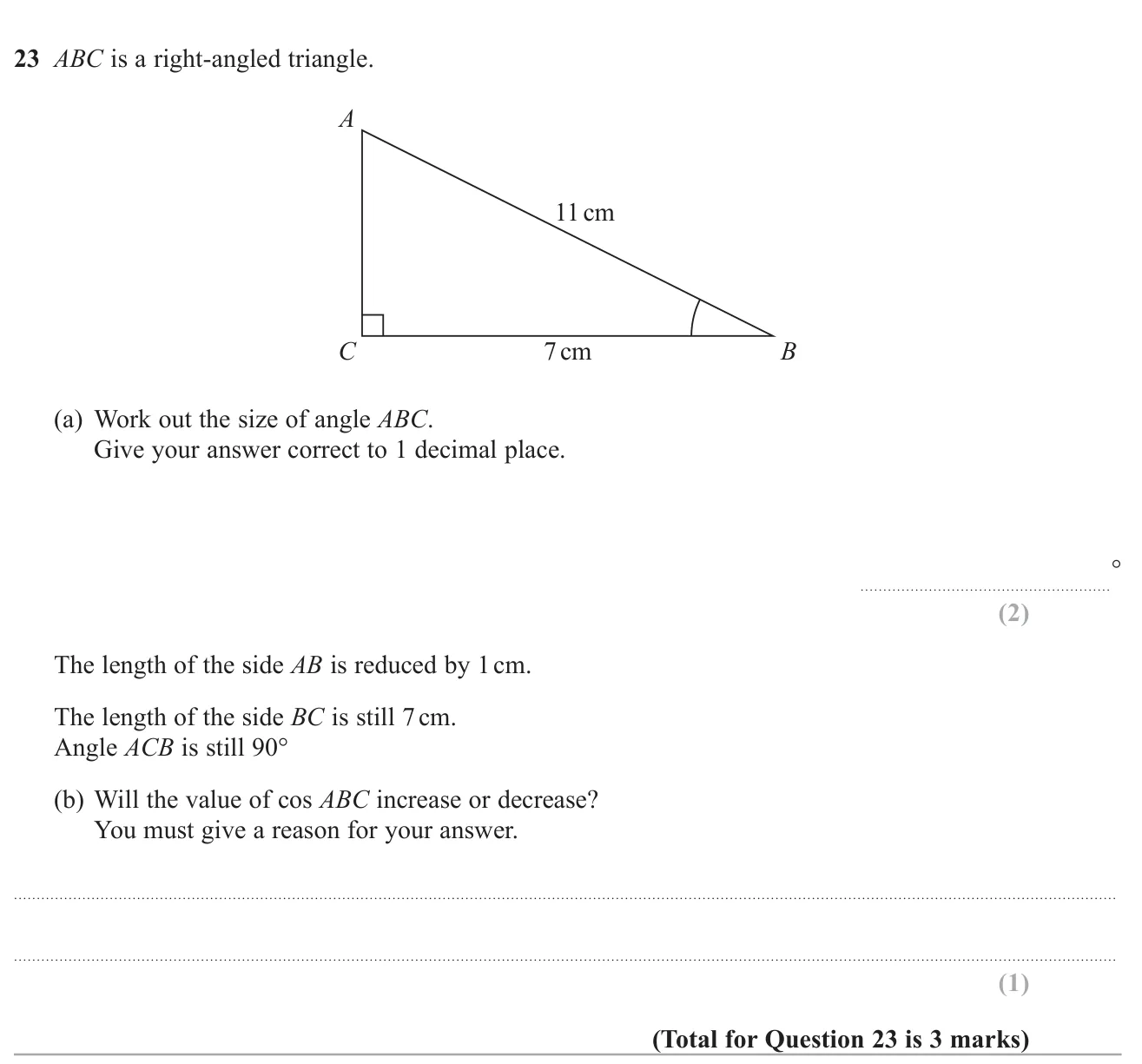
(a) A B AB A B B C BC B C A B C ABC A B C
cos A B C = 7 11 \cos ABC = \frac{7}{11} cos A B C = 11 7 A B C = cos − 1 ( 7 11 ) = 50.5 ∘ ABC = \cos^{-1}(\frac{7}{11}) = 50.5^\circ A B C = cos − 1 ( 11 7 ) = 50. 5 ∘
(b) New cos A B C = 7 10 = 0.7 \cos ABC = \frac{7}{10} = 0.7 cos A B C = 10 7 = 0.7 7 11 ≈ 0.636 \frac{7}{11} \approx 0.636 11 7 ≈ 0.636
Watch out: Using sin or tan instead of cos.
© Pearson Education Ltd. Specimen Paper 1 (Foundation, non-calculator), question 26.
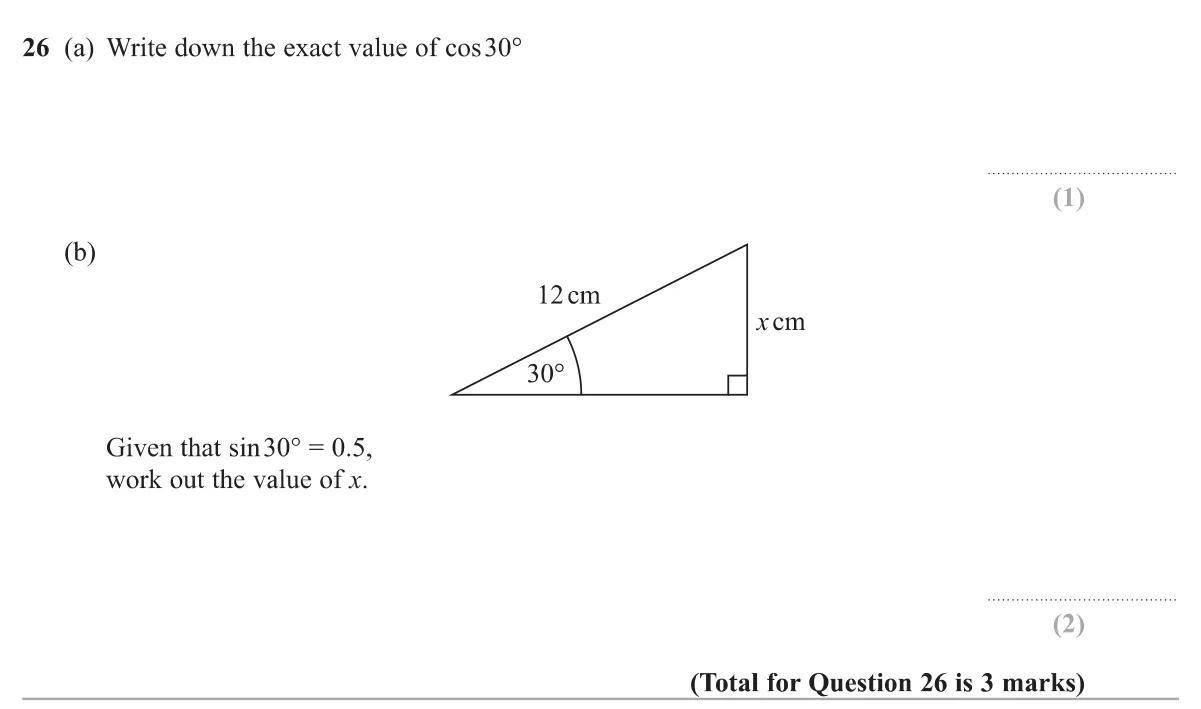
(a) 3 2 \frac{\sqrt3}{2} 2 3 1 mark (b) 6 6 6 2 marks
Worked solution Checked against the mark scheme
(a) cos 30 ° = 3 2 \cos 30° = \frac{\sqrt3}{2} cos 30° = 2 3
(b) x x x 30 ° 30° 30°
sin 30 ° = x 12 \sin 30° = \frac{x}{12} sin 30° = 12 x
x = 12 × 0.5 = 6 x = 12 \times 0.5 = 6 x = 12 × 0.5 = 6
Watch out: Using cos instead of sin in (b).
© Pearson Education Ltd. Specimen Paper 2 (Foundation, calculator), question 28.
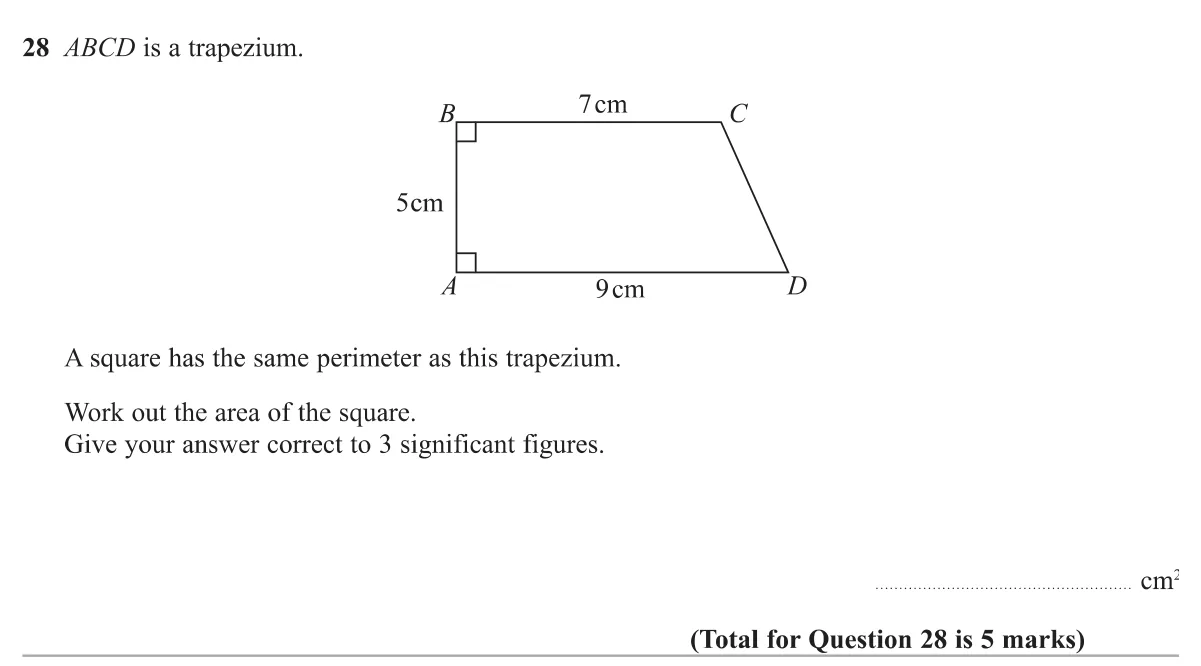
Worked solution Checked against the mark scheme
Draw a right-angled triangle: across 9 − 7 = 2 9 - 7 = 2 9 − 7 = 2
C D = 5 2 + 2 2 = 29 = 5.385 CD = \sqrt{5^2 + 2^2} = \sqrt{29} = 5.385 C D = 5 2 + 2 2 = 29 = 5.385
Perimeter = 9 + 7 + 5 + 5.385 = 26.385 = 9 + 7 + 5 + 5.385 = 26.385 = 9 + 7 + 5 + 5.385 = 26.385
Side of square = 26.385 ÷ 4 = 6.596 = 26.385 \div 4 = 6.596 = 26.385 ÷ 4 = 6.596
Area = 6.596 2 = 43.5 = 6.596^2 = 43.5 = 6.59 6 2 = 43.5
Watch out: Squaring the whole perimeter instead of a quarter of it.
© Pearson Education Ltd. June 2024 Paper 2 (Higher, calculator), question 10.
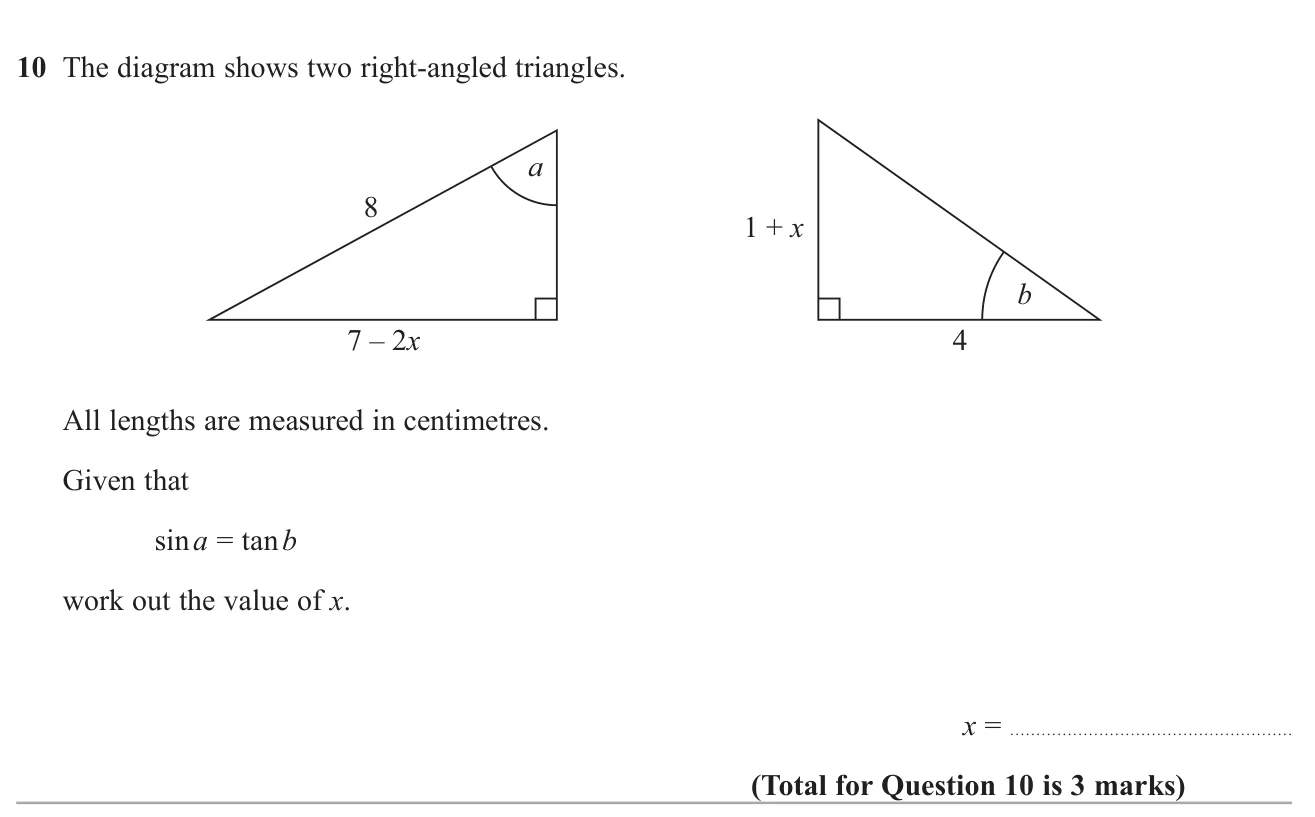
Answer x = 1.25 x = 1.25 x = 1.25 3 marks
Worked solution Checked against the mark scheme
sin a = opp hyp = 7 − 2 x 8 \sin a = \dfrac{\text{opp}}{\text{hyp}} = \dfrac{7-2x}{8} sin a = hyp opp = 8 7 − 2 x tan b = opp adj = 1 + x 4 \tan b = \dfrac{\text{opp}}{\text{adj}} = \dfrac{1+x}{4} tan b = adj opp = 4 1 + x
7 − 2 x 8 = 1 + x 4 ⇒ 7 − 2 x = 2 + 2 x ⇒ 4 x = 5 ⇒ x = 1.25 \dfrac{7-2x}{8} = \dfrac{1+x}{4} \Rightarrow 7-2x = 2+2x \Rightarrow 4x = 5 \Rightarrow x = 1.25 8 7 − 2 x = 4 1 + x ⇒ 7 − 2 x = 2 + 2 x ⇒ 4 x = 5 ⇒ x = 1.25
Watch out: Using the wrong side for opposite in either triangle.
© Pearson Education Ltd. November 2023 Paper 2 (Higher, calculator), question 12.
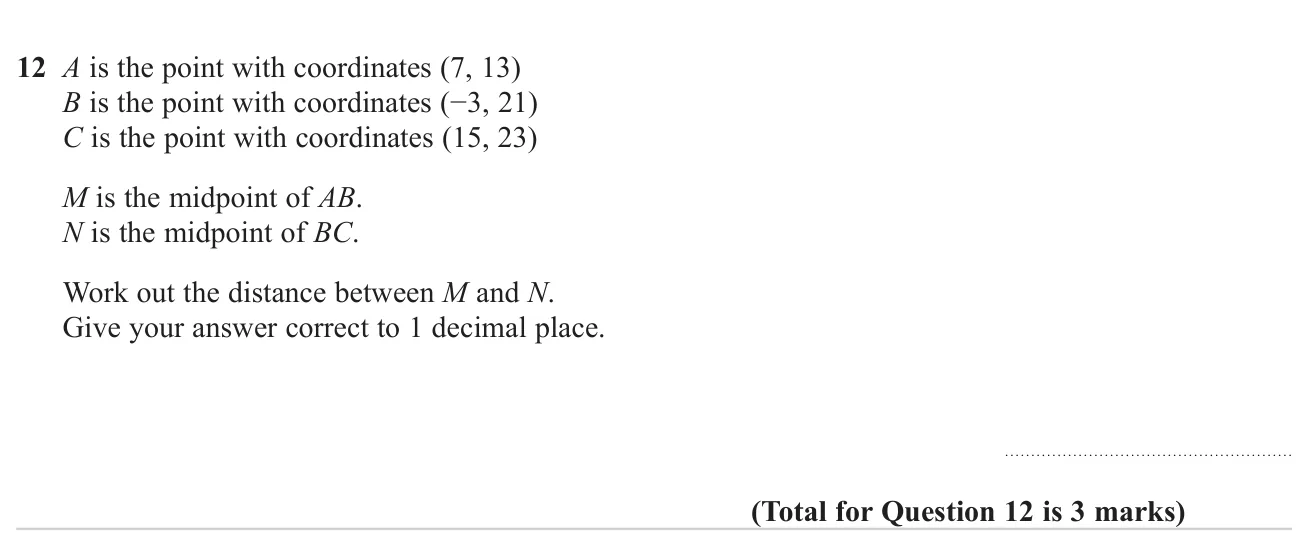
Worked solution Checked against the mark scheme
M = ( 7 + ( − 3 ) 2 , 13 + 21 2 ) = ( 2 , 17 ) M = \left(\frac{7 + (-3)}{2}, \frac{13 + 21}{2}\right) = (2, 17) M = ( 2 7 + ( − 3 ) , 2 13 + 21 ) = ( 2 , 17 )
N = ( − 3 + 15 2 , 21 + 23 2 ) = ( 6 , 22 ) N = \left(\frac{-3 + 15}{2}, \frac{21 + 23}{2}\right) = (6, 22) N = ( 2 − 3 + 15 , 2 21 + 23 ) = ( 6 , 22 )
M N = 4 2 + 5 2 = 41 = 6.403... ≈ 6.4 MN = \sqrt{4^2 + 5^2} = \sqrt{41} = 6.403... \approx 6.4 M N = 4 2 + 5 2 = 41 = 6.403... ≈ 6.4
Watch out: Subtracting coordinates instead of adding them when finding a midpoint.
© Pearson Education Ltd. June 2023 Paper 3 (Higher, calculator), question 10.
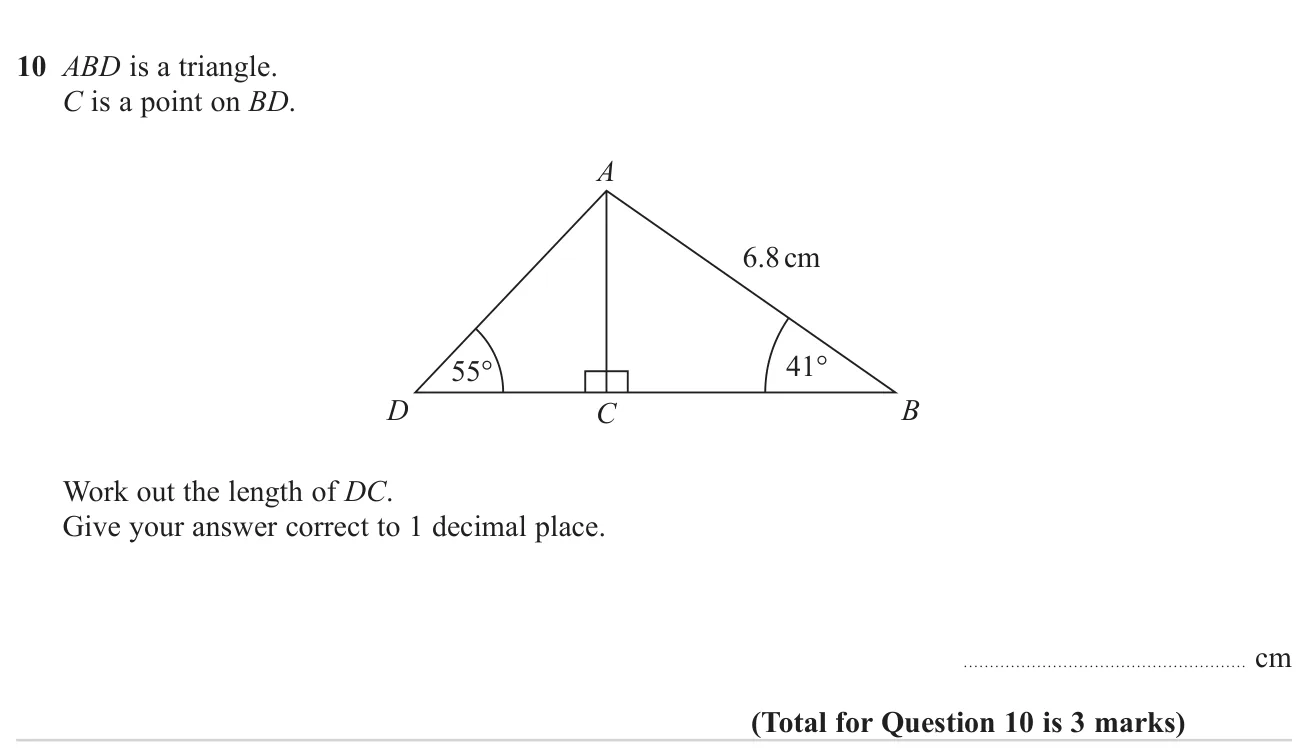
Worked solution Checked against the mark scheme
In triangle A B C ABC A B C A C = 6.8 sin 41 ° = 4.461... AC = 6.8 \sin 41° = 4.461... A C = 6.8 sin 41° = 4.461...
In triangle A C D ACD A C D tan 55 ° = A C D C \tan 55° = \dfrac{AC}{DC} tan 55° = D C A C
D C = 4.461... tan 55 ° = 3.12... DC = \dfrac{4.461...}{\tan 55°} = 3.12... D C = tan 55° 4.461... = 3.12... D C = 3.1 DC = 3.1 D C = 3.1
Watch out: Using cos 41° instead of sin 41° to find the vertical height AC.
© Pearson Education Ltd. November 2022 Paper 2 (Higher, calculator), question 13.
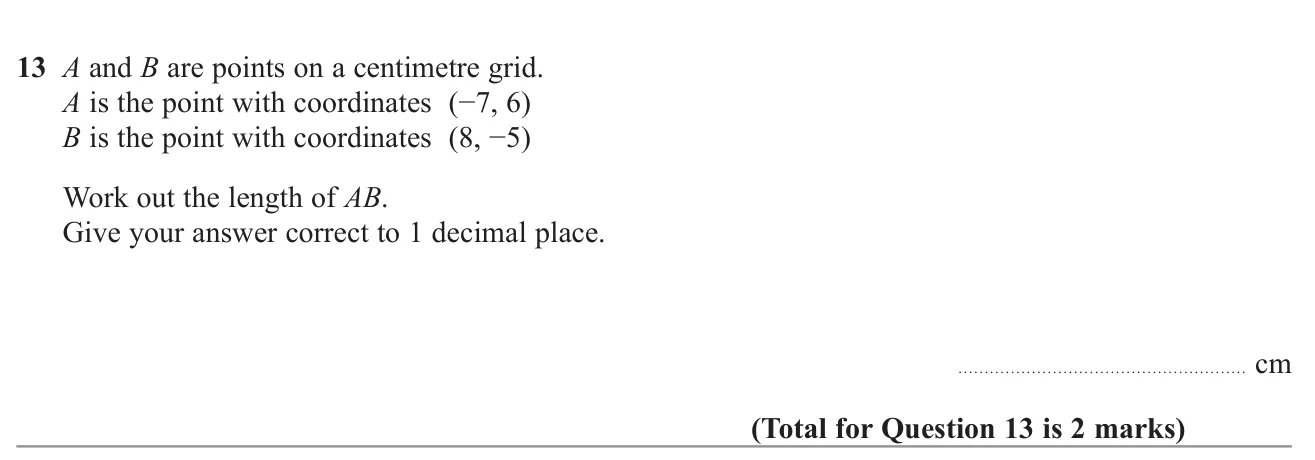
Answer 18.6 18.6 18.6 2 marks
Worked solution Checked against the mark scheme
Horizontal difference: 8 − ( − 7 ) = 15 8 - (-7) = 15 8 − ( − 7 ) = 15
Vertical difference: 6 − ( − 5 ) = 11 6 - (-5) = 11 6 − ( − 5 ) = 11
A B = 15 2 + 11 2 = 346 = 18.60... AB = \sqrt{15^2 + 11^2} = \sqrt{346} = 18.60... A B = 1 5 2 + 1 1 2 = 346 = 18.60...
A B = 18.6 AB = 18.6 A B = 18.6
Watch out: Mixing up the signs, e.g. using 8 − 7 = 1.
© Pearson Education Ltd. June 2022 Paper 3 (Higher, calculator), question 12.
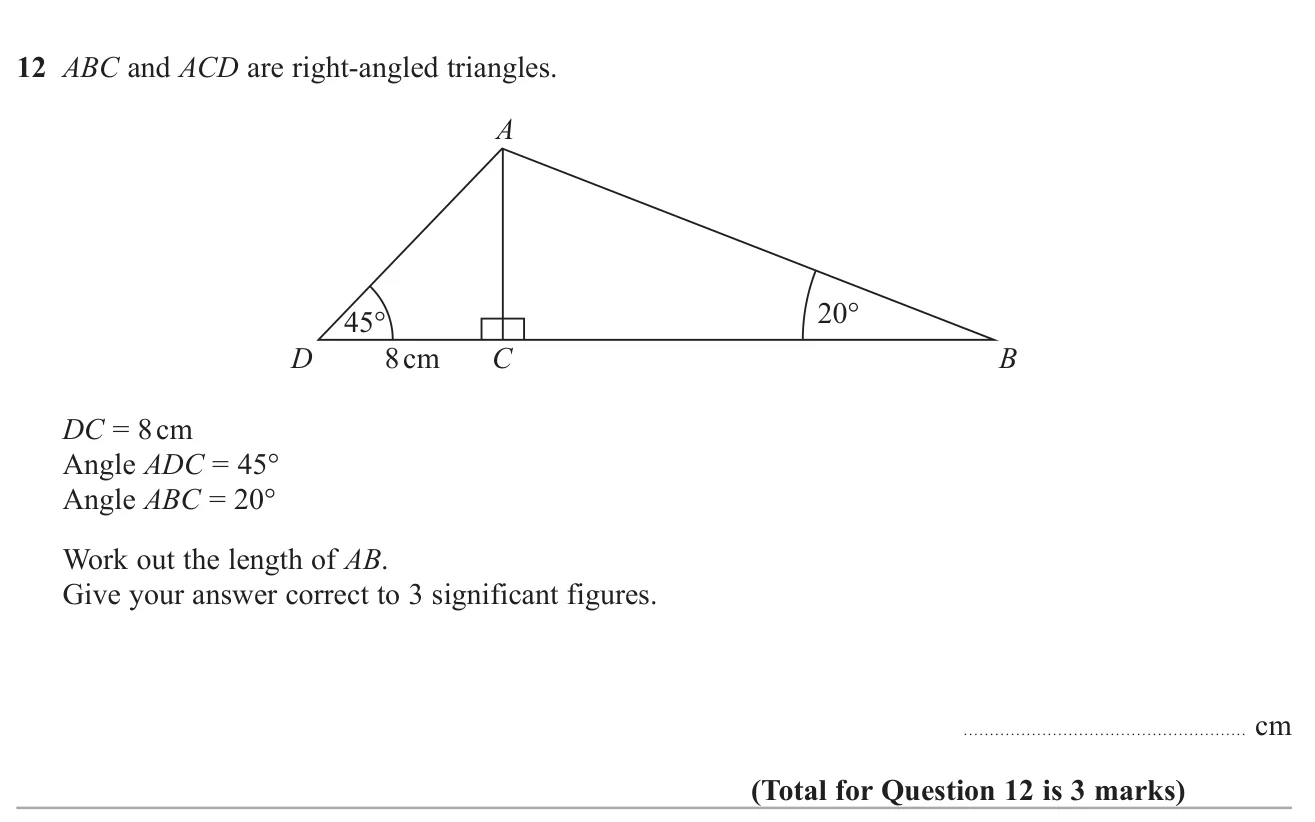
Answer 23.4 23.4 23.4 3 marks
Worked solution Checked against the mark scheme
In triangle ACD, tan 45 ∘ = A C 8 \tan 45^\circ = \frac{AC}{8} tan 4 5 ∘ = 8 A C A C = 8 AC = 8 A C = 8
In triangle ABC, A C AC A C 20 ∘ 20^\circ 2 0 ∘ A B AB A B
A B = 8 sin 20 ∘ = 23.39 … ≈ 23.4 AB = \frac{8}{\sin 20^\circ} = 23.39\ldots \approx 23.4 A B = s i n 2 0 ∘ 8 = 23.39 … ≈ 23.4
Watch out: Using tan 20° instead of sin 20°, which finds BC rather than AB.
© Pearson Education Ltd. June 2019 Paper 1 (Higher, non-calculator), question 14.
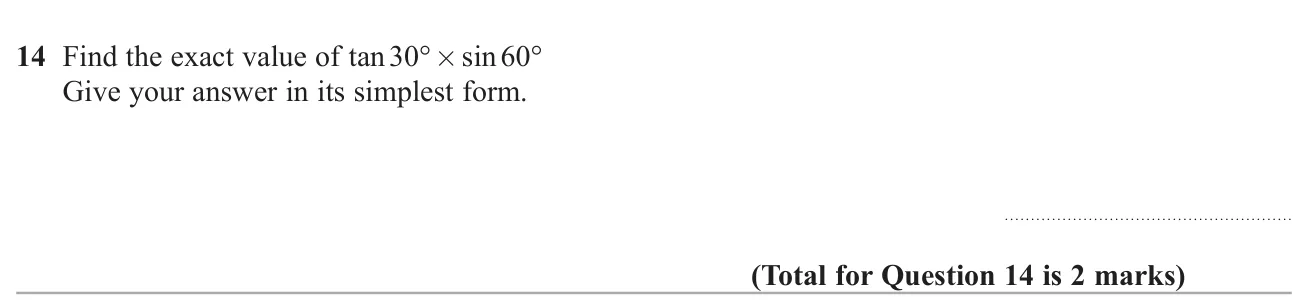
Answer 1 2 \frac{1}{2} 2 1 2 marks
Worked solution Checked against the mark scheme
tan 30 ∘ = 1 3 \tan 30^\circ = \frac{1}{\sqrt{3}} tan 3 0 ∘ = 3 1 sin 60 ∘ = 3 2 \sin 60^\circ = \frac{\sqrt{3}}{2} sin 6 0 ∘ = 2 3
1 3 × 3 2 = 1 2 \frac{1}{\sqrt{3}} \times \frac{\sqrt{3}}{2} = \frac{1}{2} 3 1 × 2 3 = 2 1
Watch out: Using tan 30 ∘ = 3 \tan 30^\circ = \sqrt{3} tan 3 0 ∘ = 3
© Pearson Education Ltd. November 2019 Paper 2 (Higher, calculator), question 12.
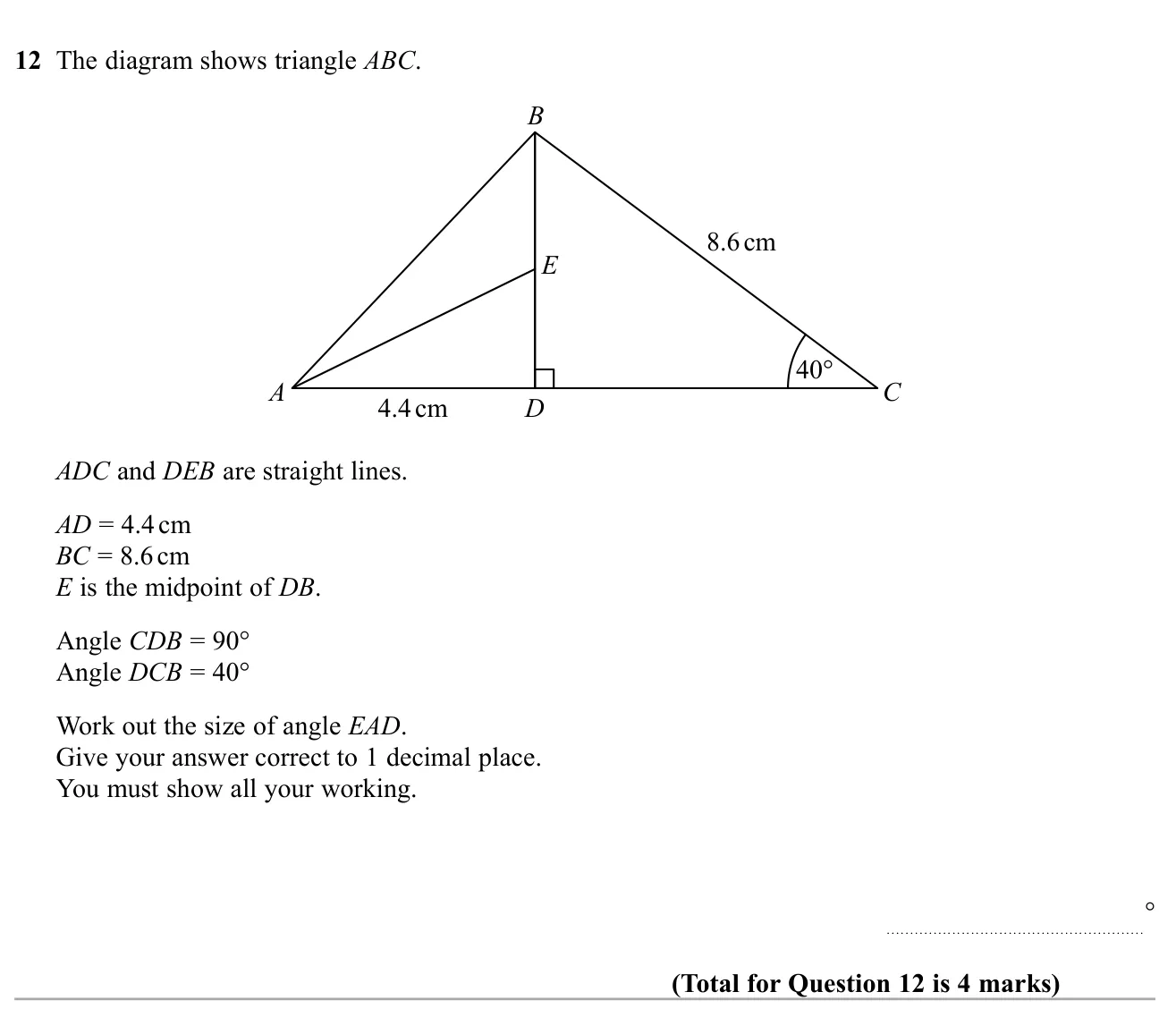
Answer 32.1 ° 32.1° 32.1° 4 marks
Worked solution Checked against the mark scheme
In triangle BDC: B D = 8.6 sin 40 ° = 5.528 BD = 8.6 \sin 40° = 5.528 B D = 8.6 sin 40° = 5.528
E is the midpoint, so E D = 5.528 ÷ 2 = 2.764 ED = 5.528 \div 2 = 2.764 E D = 5.528 ÷ 2 = 2.764
In triangle EAD: tan ( E A D ) = 2.764 4.4 \tan(EAD) = \frac{2.764}{4.4} tan ( E A D ) = 4.4 2.764
E A D = tan − 1 ( 0.6282 ) = 32.1 ° EAD = \tan^{-1}(0.6282) = 32.1° E A D = tan − 1 ( 0.6282 ) = 32.1°
Watch out: Using cos 40 instead of sin 40 to find BD.
© Pearson Education Ltd. Specimen Paper 1 (Higher, non-calculator), question 7.
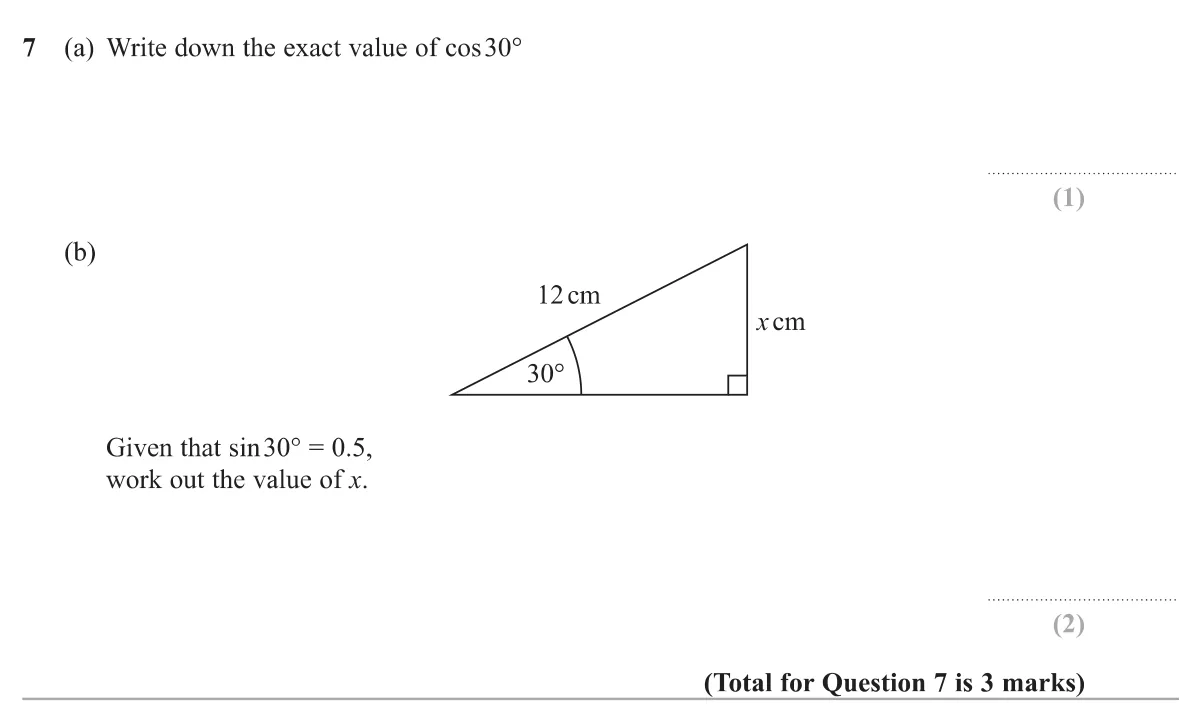
(a) 3 2 \frac{\sqrt{3}}{2} 2 3 1 mark (b) 6 6 6 2 marks
Worked solution Checked against the mark scheme
(a) cos 30 ° = 3 2 \cos 30° = \frac{\sqrt{3}}{2} cos 30° = 2 3
(b) x x x 30 ° 30° 30°
sin 30 ° = x 12 \sin 30° = \frac{x}{12} sin 30° = 12 x x = 12 × 0.5 = 6 x = 12 \times 0.5 = 6 x = 12 × 0.5 = 6
Watch out: Using cos instead of sin in (b), or writing 1 2 \frac{1}{2} 2 1
© Pearson Education Ltd. Specimen Paper 3 (Higher, calculator), question 9.
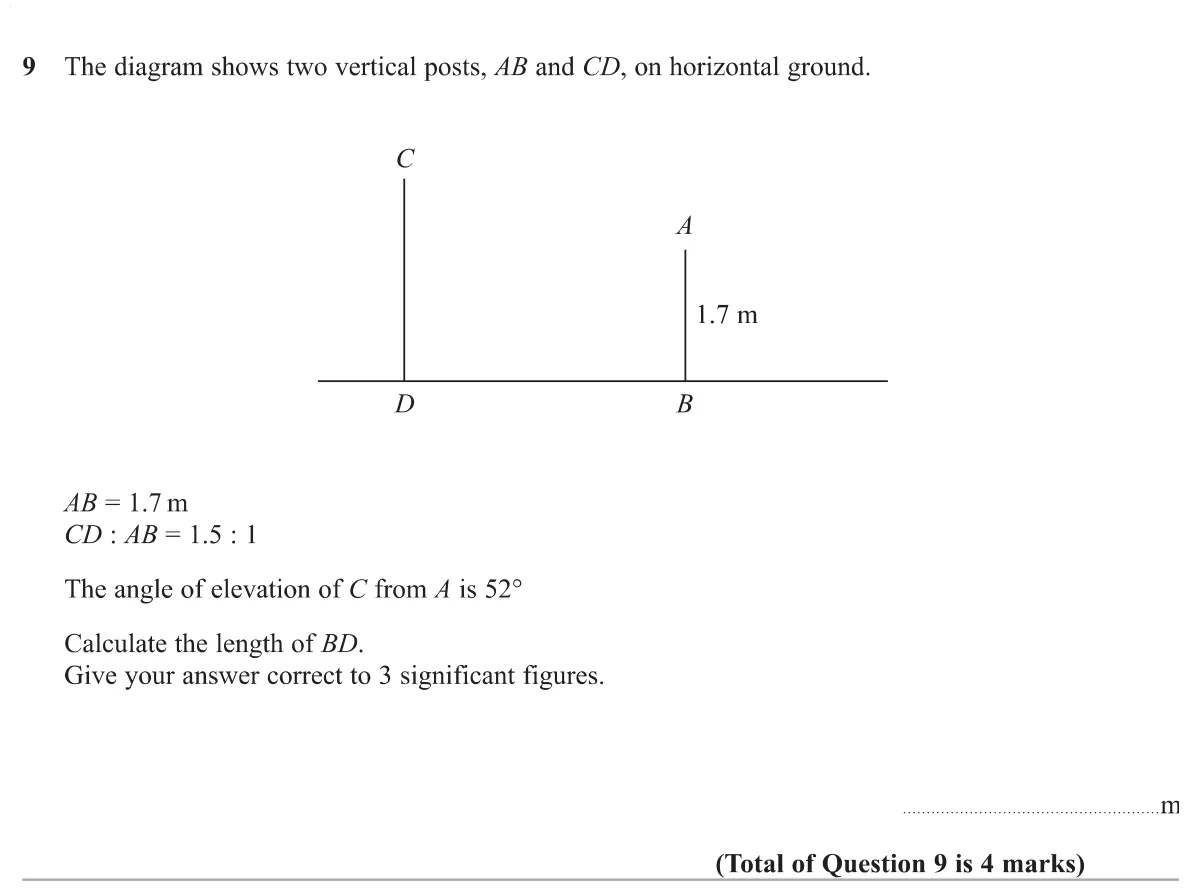
Answer 0.664 0.664 0.664 4 marks
Worked solution Checked against the mark scheme
C D = 1.5 × 1.7 = 2.55 CD = 1.5 \times 1.7 = 2.55 C D = 1.5 × 1.7 = 2.55 C C C 2.55 − 1.7 = 0.85 2.55 - 1.7 = 0.85 2.55 − 1.7 = 0.85 A A A
In the right-angled triangle from A A A C C C tan 52 ∘ = 0.85 B D \tan 52^\circ = \frac{0.85}{BD} tan 5 2 ∘ = B D 0.85
B D = 0.85 tan 52 ∘ = 0.6640... = 0.664 BD = \frac{0.85}{\tan 52^\circ} = 0.6640... = 0.664 B D = t a n 5 2 ∘ 0.85 = 0.6640... = 0.664
Watch out: Using the full height 2.55 m instead of the difference 0.85 m.
© Pearson Education Ltd. June 2024 Paper 1 (Higher, non-calculator), question 22.
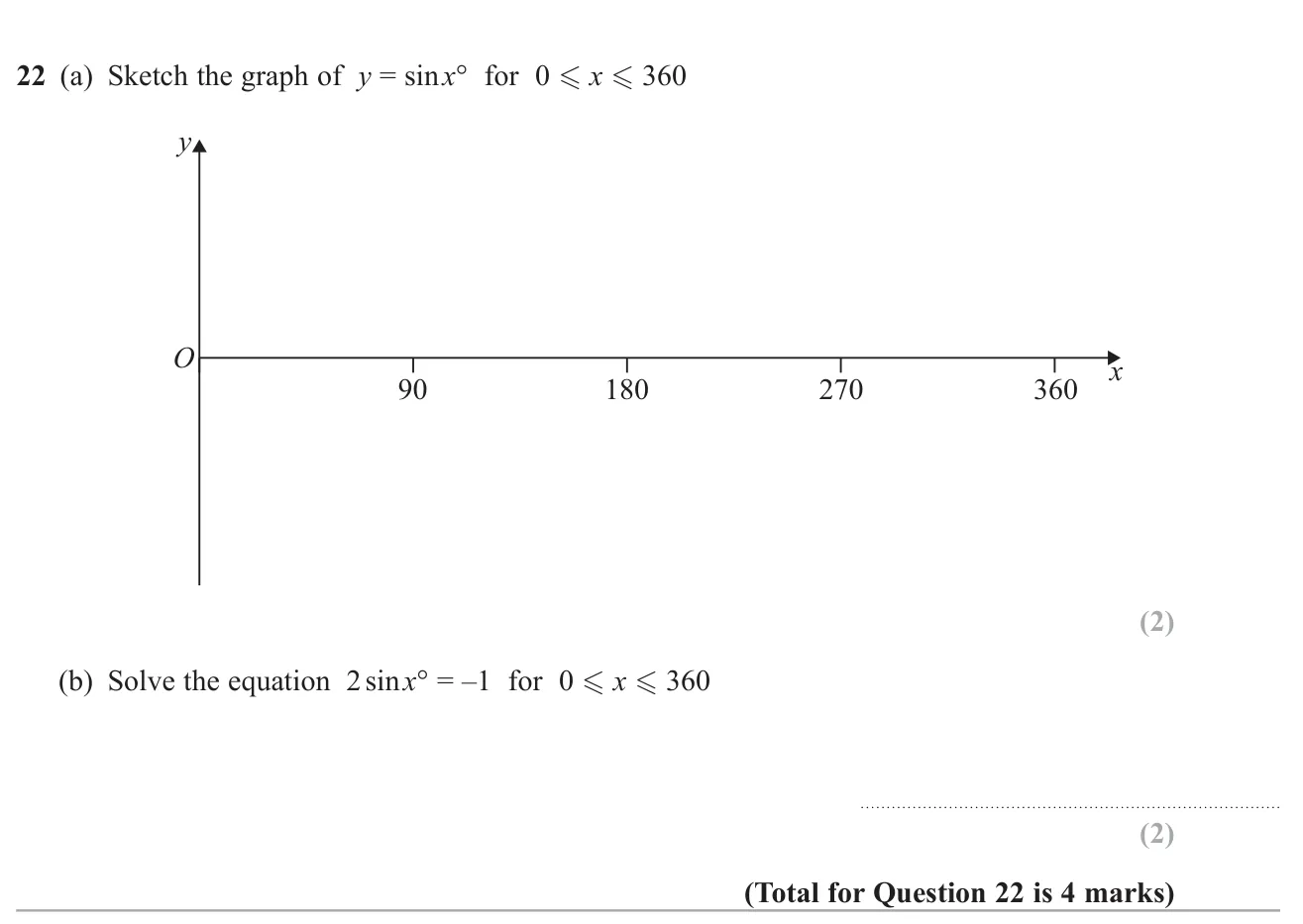
(a) Sketch of y = sin x y = \sin x y = sin x ( 0 , 0 ) , ( 90 , 1 ) , ( 180 , 0 ) , ( 270 , − 1 ) , ( 360 , 0 ) (0,0), (90,1), (180,0), (270,-1), (360,0) ( 0 , 0 ) , ( 90 , 1 ) , ( 180 , 0 ) , ( 270 , − 1 ) , ( 360 , 0 ) 2 marks (b) x = 210 , 330 x = 210,\ 330 x = 210 , 330 2 marks
Worked solution Checked against the mark scheme
(a) Start at 0, rise to a maximum of 1 at 90 ∘ 90^\circ 9 0 ∘ 180 ∘ 180^\circ 18 0 ∘ − 1 -1 − 1 270 ∘ 270^\circ 27 0 ∘ 360 ∘ 360^\circ 36 0 ∘
(b) sin x = − 1 2 \sin x = -\frac{1}{2} sin x = − 2 1 sin 30 ∘ = 1 2 \sin 30^\circ = \frac{1}{2} sin 3 0 ∘ = 2 1
x = 180 + 30 = 210 x = 180 + 30 = 210 x = 180 + 30 = 210 x = 360 − 30 = 330 x = 360 - 30 = 330 x = 360 − 30 = 330
Watch out: Giving x = − 30 x = -30 x = − 30
© Pearson Education Ltd. June 2023 Paper 1 (Higher, non-calculator), question 22.
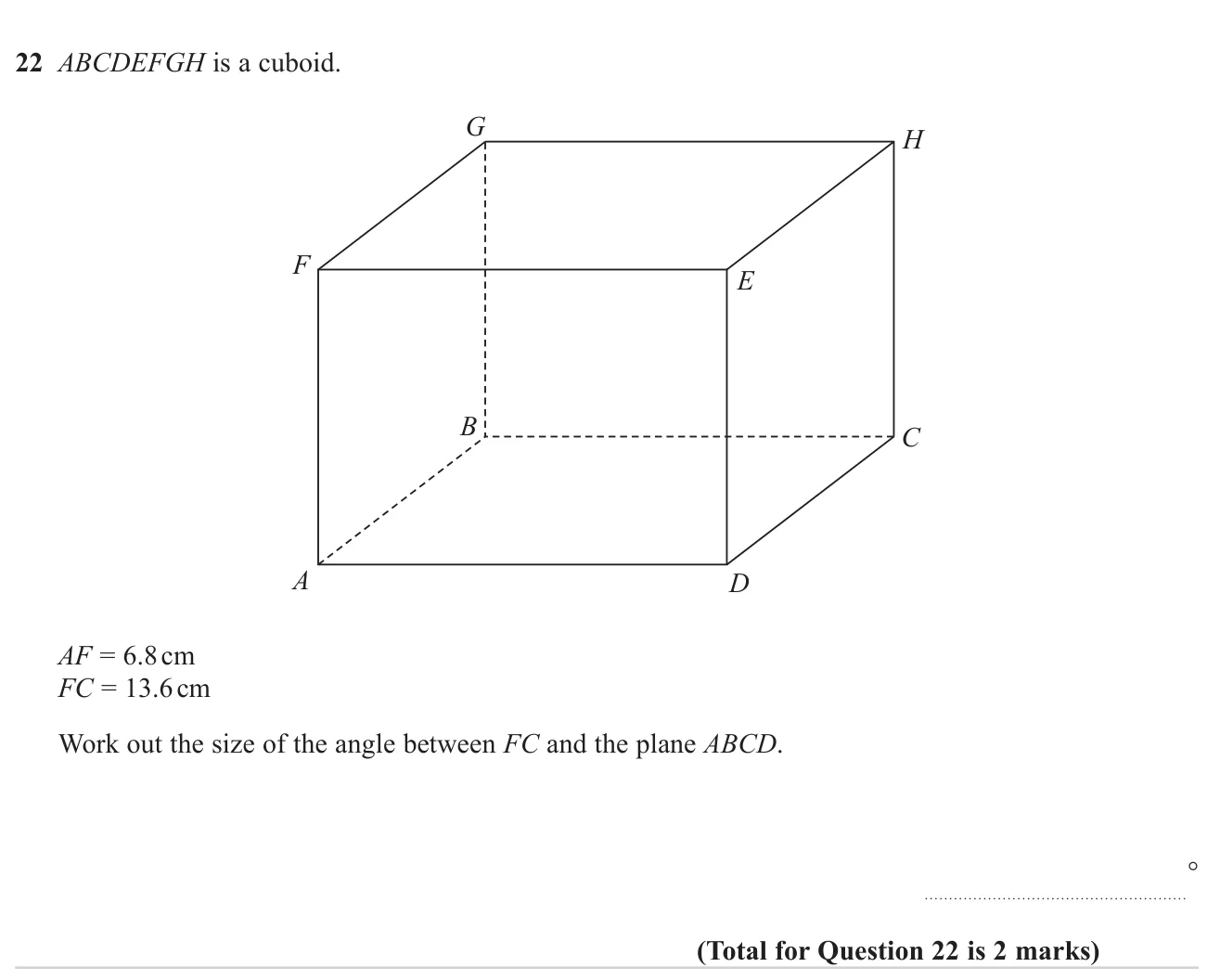
Answer 30 ∘ 30^\circ 3 0 ∘ 2 marks
Worked solution Checked against the mark scheme
The angle is F C A FCA F C A F A C FAC F A C A A A
sin x = opp hyp = 6.8 13.6 = 1 2 \sin x = \frac{\text{opp}}{\text{hyp}} = \frac{6.8}{13.6} = \frac{1}{2} sin x = hyp opp = 13.6 6.8 = 2 1
So x = 30 ∘ x = 30^\circ x = 3 0 ∘
Watch out: Using cos or tan with the wrong sides, or finding the angle with a vertical edge instead of the base.
© Pearson Education Ltd. November 2021 Paper 1 (Higher, non-calculator), question 18.
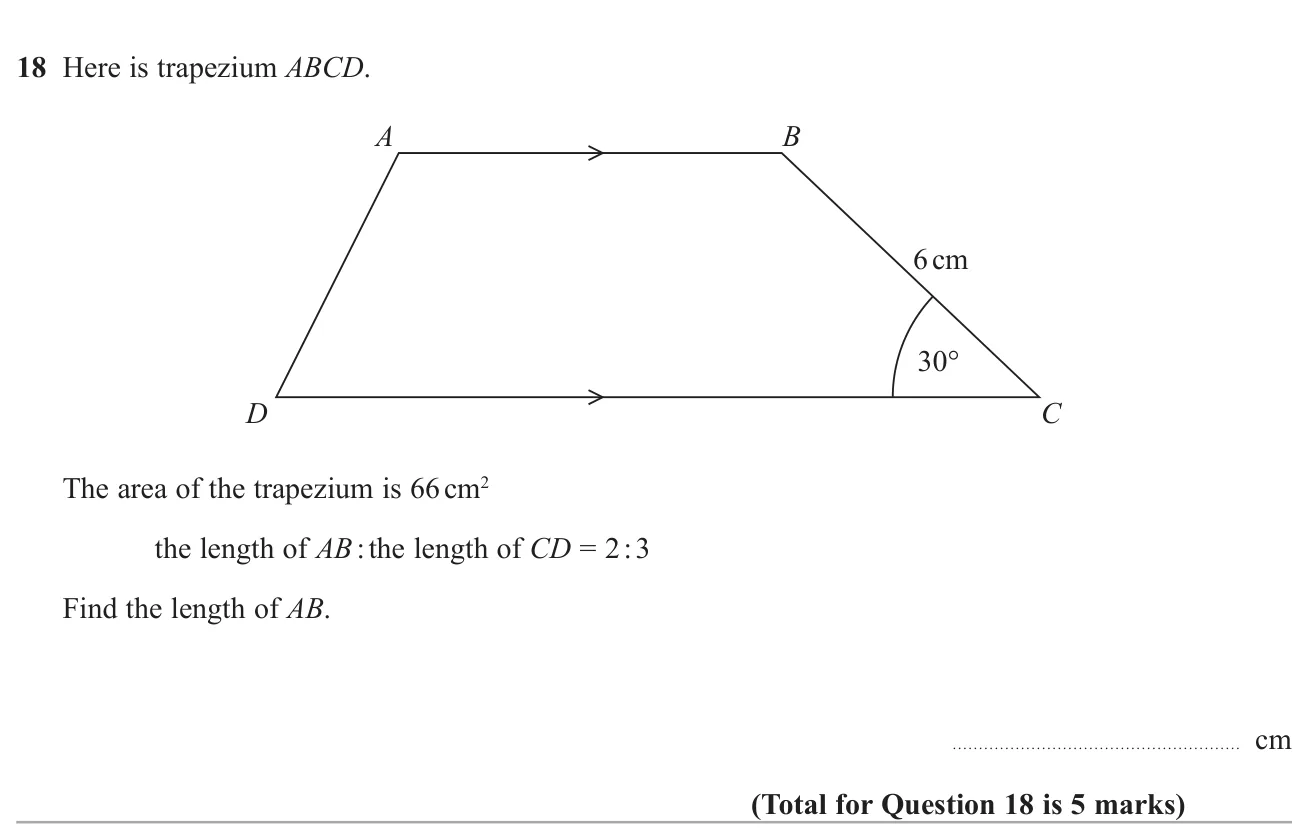
Answer 17.6 17.6 17.6 5 marks
Worked solution Checked against the mark scheme
Height = 6 sin 30 ∘ = 6 × 1 2 = 3 = 6 \sin 30^\circ = 6 \times \frac{1}{2} = 3 = 6 sin 3 0 ∘ = 6 × 2 1 = 3
Area: 1 2 ( A B + C D ) × 3 = 66 \frac{1}{2}(AB + CD) \times 3 = 66 2 1 ( A B + C D ) × 3 = 66 A B + C D = 44 AB + CD = 44 A B + C D = 44
A B : C D = 2 : 3 AB : CD = 2 : 3 A B : C D = 2 : 3 A B = 2 5 × 44 = 17.6 AB = \frac{2}{5} \times 44 = 17.6 A B = 5 2 × 44 = 17.6
Watch out: Using 6 cm as the height instead of finding the perpendicular height.
© Pearson Education Ltd. November 2018 Paper 3 (Higher, calculator), question 12.
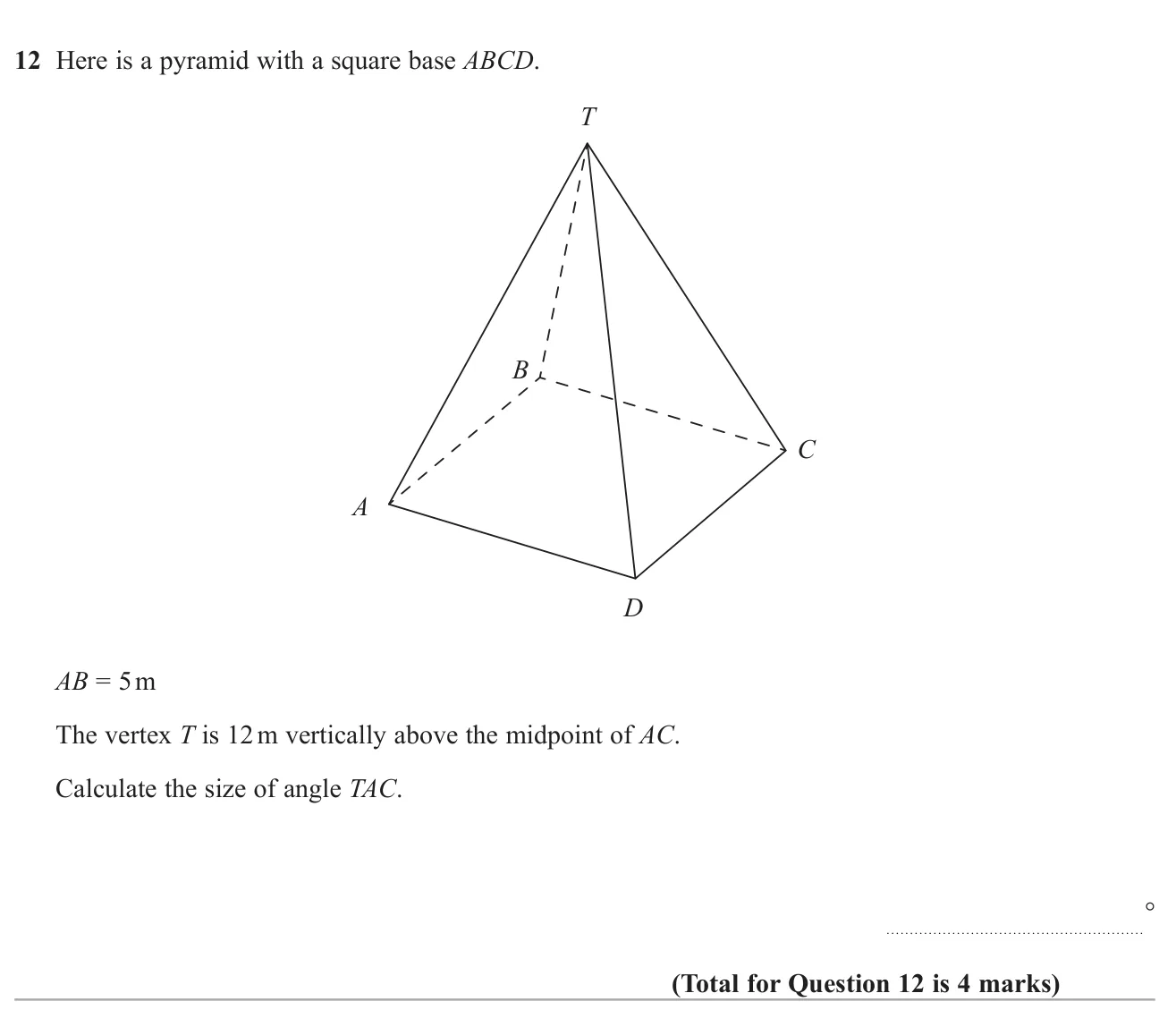
Answer 73.6 ° 73.6° 73.6° 4 marks
Worked solution Checked against the mark scheme
Diagonal A C = 5 2 + 5 2 = 50 = 7.071 AC = \sqrt{5^2 + 5^2} = \sqrt{50} = 7.071 A C = 5 2 + 5 2 = 50 = 7.071 3.536 3.536 3.536
The triangle from A to the centre to T is right-angled:
tan T A C = 12 3.536 \tan TAC = \frac{12}{3.536} tan T A C = 3.536 12
T A C = tan − 1 ( 3.394 ) = 73.6 ° TAC = \tan^{-1}(3.394) = 73.6° T A C = tan − 1 ( 3.394 ) = 73.6°
Watch out: Using the full diagonal (7.07 m) instead of half of it.
© Pearson Education Ltd. Specimen Paper 3 (Higher, calculator), question 12.
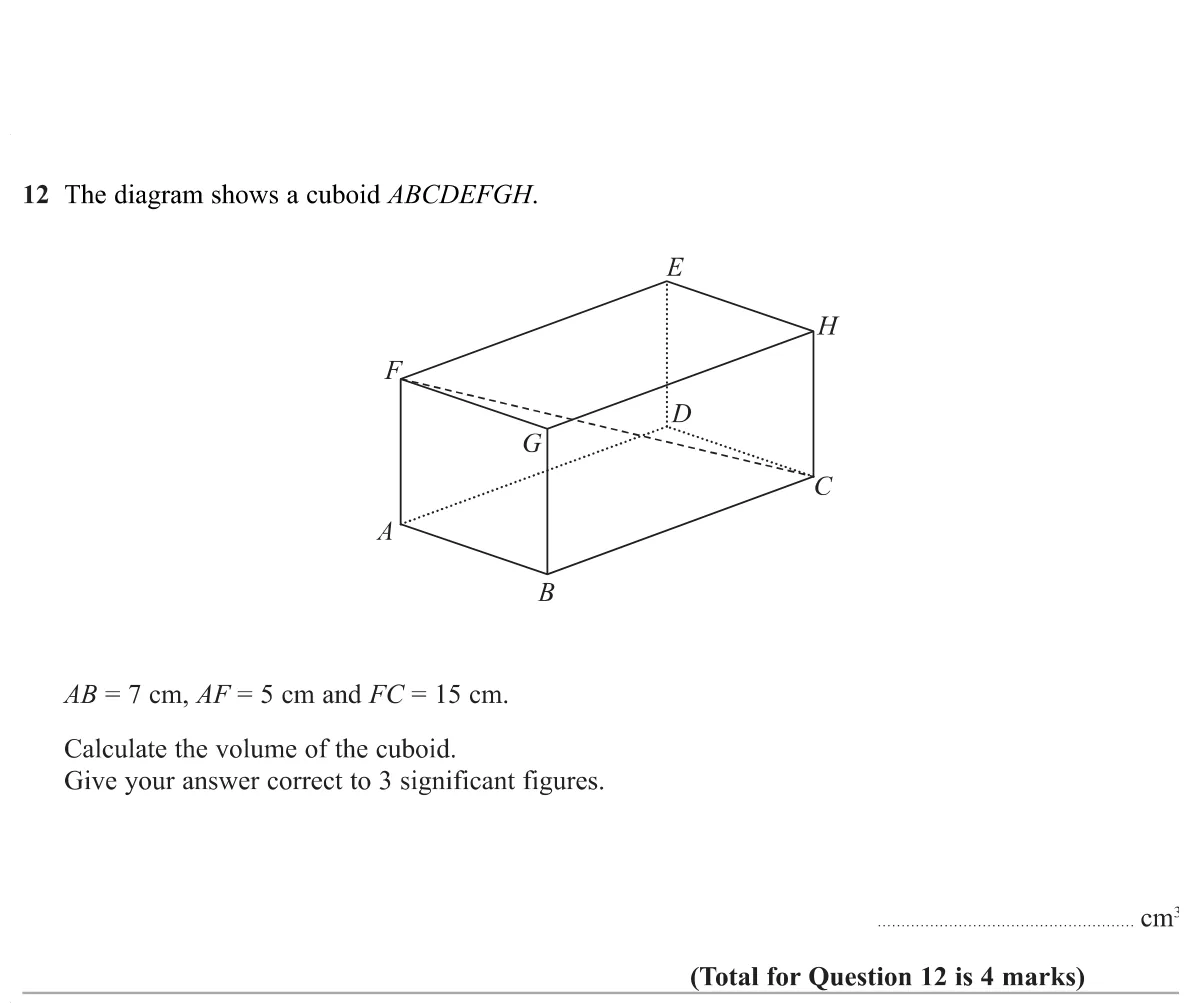
Answer 430 cm 3 430\text{ cm}^3 430 cm 3 4 marks
Worked solution Checked against the mark scheme
Let the unknown edge be d d d 7 2 + 5 2 + d 2 = 15 2 7^2 + 5^2 + d^2 = 15^2 7 2 + 5 2 + d 2 = 1 5 2
d 2 = 225 − 49 − 25 = 151 d^2 = 225 - 49 - 25 = 151 d 2 = 225 − 49 − 25 = 151 d = 151 = 12.288... d = \sqrt{151} = 12.288... d = 151 = 12.288...
Volume = 7 × 5 × 12.288... = 430.09... = 430 cm 3 = 7 \times 5 \times 12.288... = 430.09... = 430\text{ cm}^3 = 7 × 5 × 12.288... = 430.09... = 430 cm 3
Watch out: Treating FC as the diagonal of one face and using only two lengths in Pythagoras.
© Pearson Education Ltd. November 2024 Paper 2 (Higher, calculator), question 20.
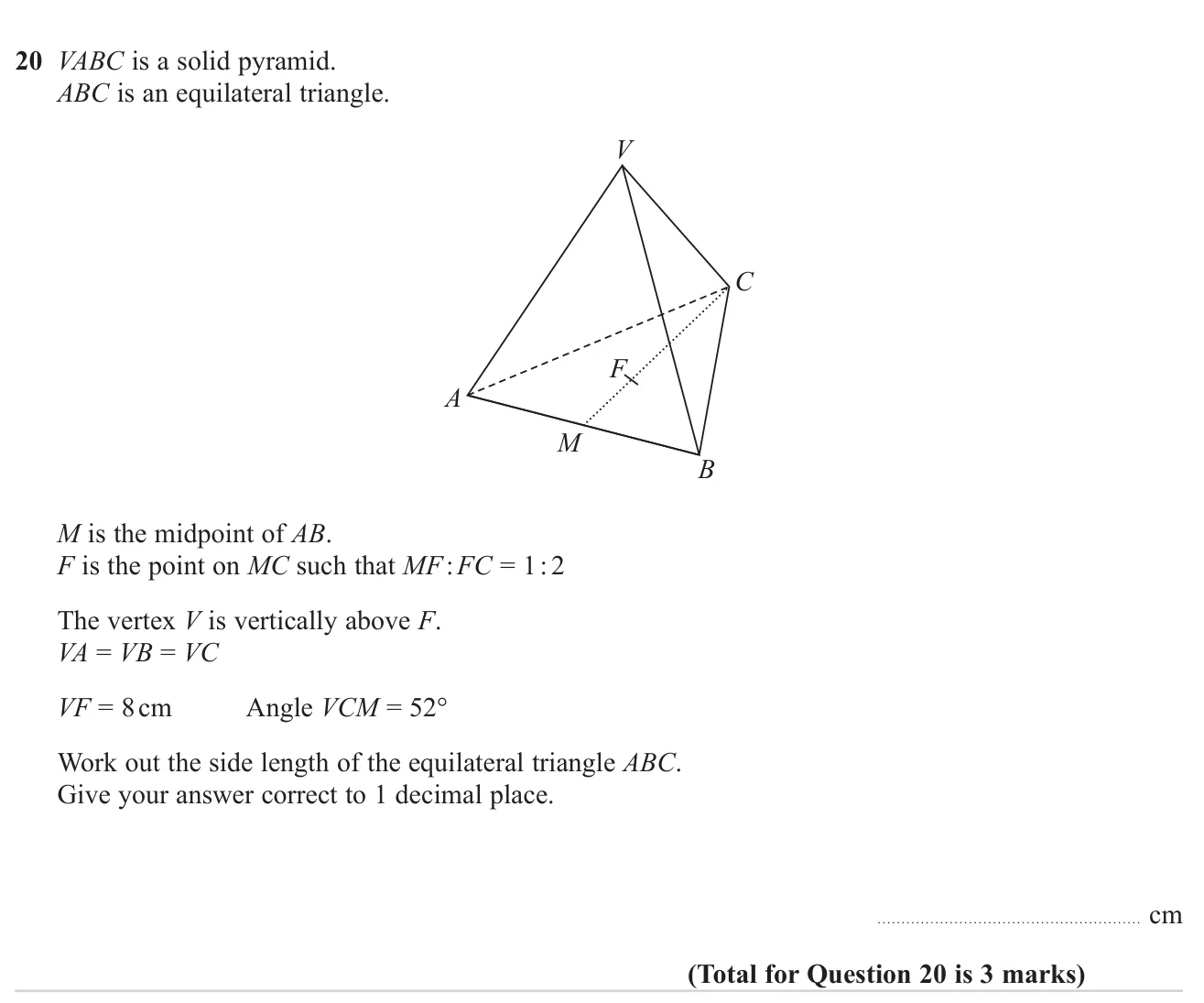
Answer 10.8 10.8 10.8 3 marks
Worked solution Checked against the mark scheme
In triangle V F C VFC V F C F C = 8 tan 52 ° = 6.250 … FC = \frac{8}{\tan 52°} = 6.250… F C = t a n 52° 8 = 6.250 …
M F : F C = 1 : 2 MF : FC = 1 : 2 M F : F C = 1 : 2 M C = 1.5 × 6.250 … = 9.375 … MC = 1.5 \times 6.250… = 9.375… M C = 1.5 × 6.250 … = 9.375 …
M C MC M C = 9.375 … sin 60 ° = 10.8 = \frac{9.375…}{\sin 60°} = 10.8 = s i n 60° 9.375 … = 10.8
Watch out: Taking FC as the full height MC of the triangle.
© Pearson Education Ltd. November 2023 Paper 3 (Higher, calculator), question 24.
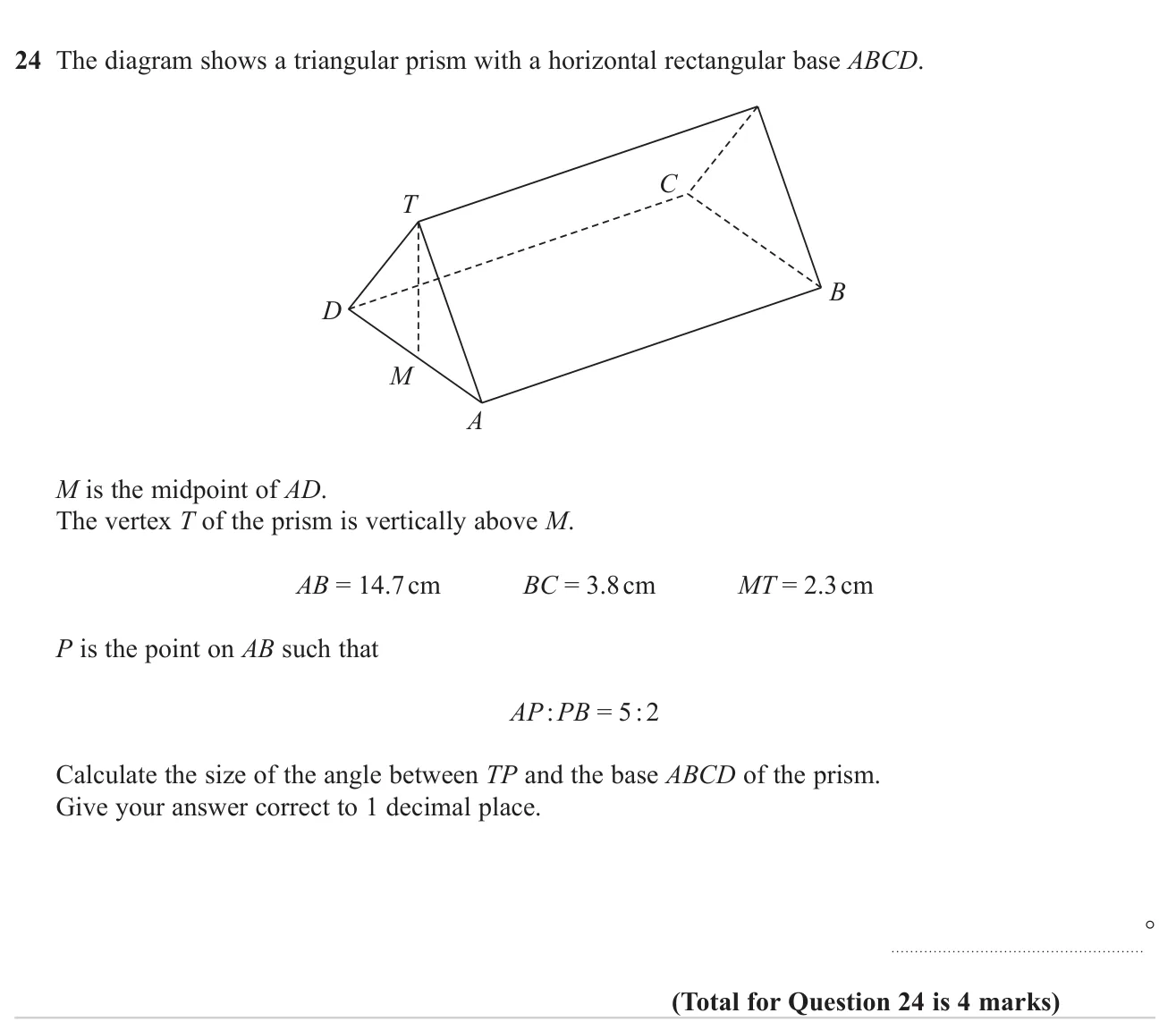
Answer 12.2 ° 12.2° 12.2° 4 marks
Worked solution Checked against the mark scheme
A P = 5 7 × 14.7 = 10.5 AP = \frac{5}{7} \times 14.7 = 10.5 A P = 7 5 × 14.7 = 10.5 A M = 3.8 ÷ 2 = 1.9 AM = 3.8 \div 2 = 1.9 A M = 3.8 ÷ 2 = 1.9
Angle M A P = 90 ° MAP = 90° M A P = 90° M P = 10.5 2 + 1.9 2 = 10.67... MP = \sqrt{10.5^2 + 1.9^2} = 10.67... M P = 10. 5 2 + 1. 9 2 = 10.67...
T is above M, so the angle is T P M TPM T P M
tan T P M = 2.3 10.67... \tan TPM = \dfrac{2.3}{10.67...} tan T P M = 10.67... 2.3 = 12.16... ° ≈ 12.2 ° = 12.16...° \approx 12.2° = 12.16...° ≈ 12.2°
Watch out: Using AP instead of MP as the horizontal side of the right-angled triangle.
© Pearson Education Ltd. November 2022 Paper 2 (Higher, calculator), question 20.
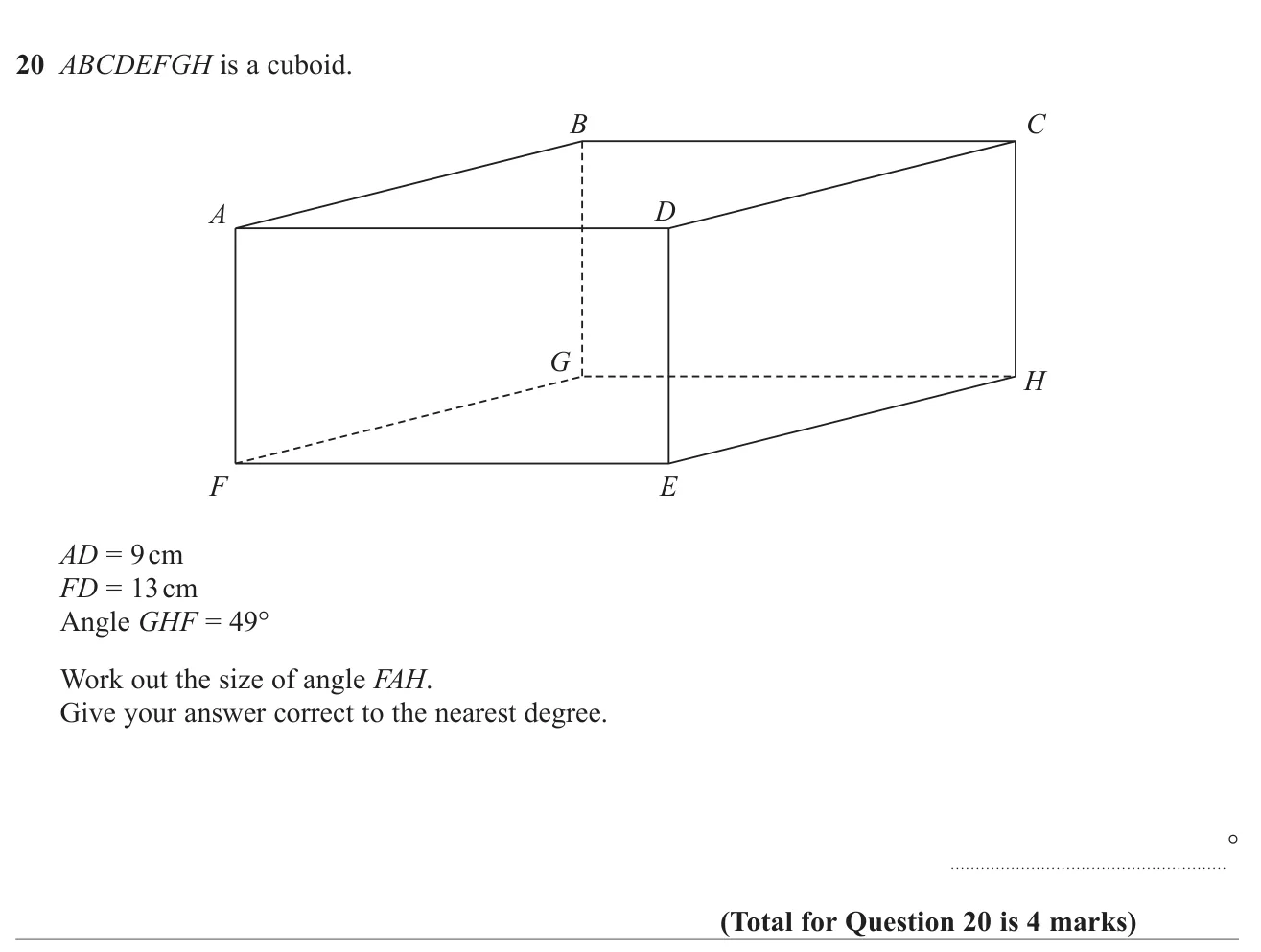
Worked solution Checked against the mark scheme
Front face: A F = 13 2 − 9 2 = 88 = 9.380... AF = \sqrt{13^2 - 9^2} = \sqrt{88} = 9.380... A F = 1 3 2 − 9 2 = 88 = 9.380...
Base: G H = 9 GH = 9 G H = 9 F H = 9 cos 49 ° = 13.71... FH = \frac{9}{\cos 49°} = 13.71... F H = c o s 49° 9 = 13.71...
Triangle F A H FAH F A H F F F tan F A H = 13.71... 9.380... \tan FAH = \frac{13.71...}{9.380...} tan F A H = 9.380... 13.71...
Angle F A H = 55.6... ≈ 56 ° FAH = 55.6... \approx 56° F A H = 55.6... ≈ 56°
Watch out: Assuming FH is the same as FD (13 cm).
© Pearson Education Ltd. June 2022 Paper 3 (Higher, calculator), question 18.
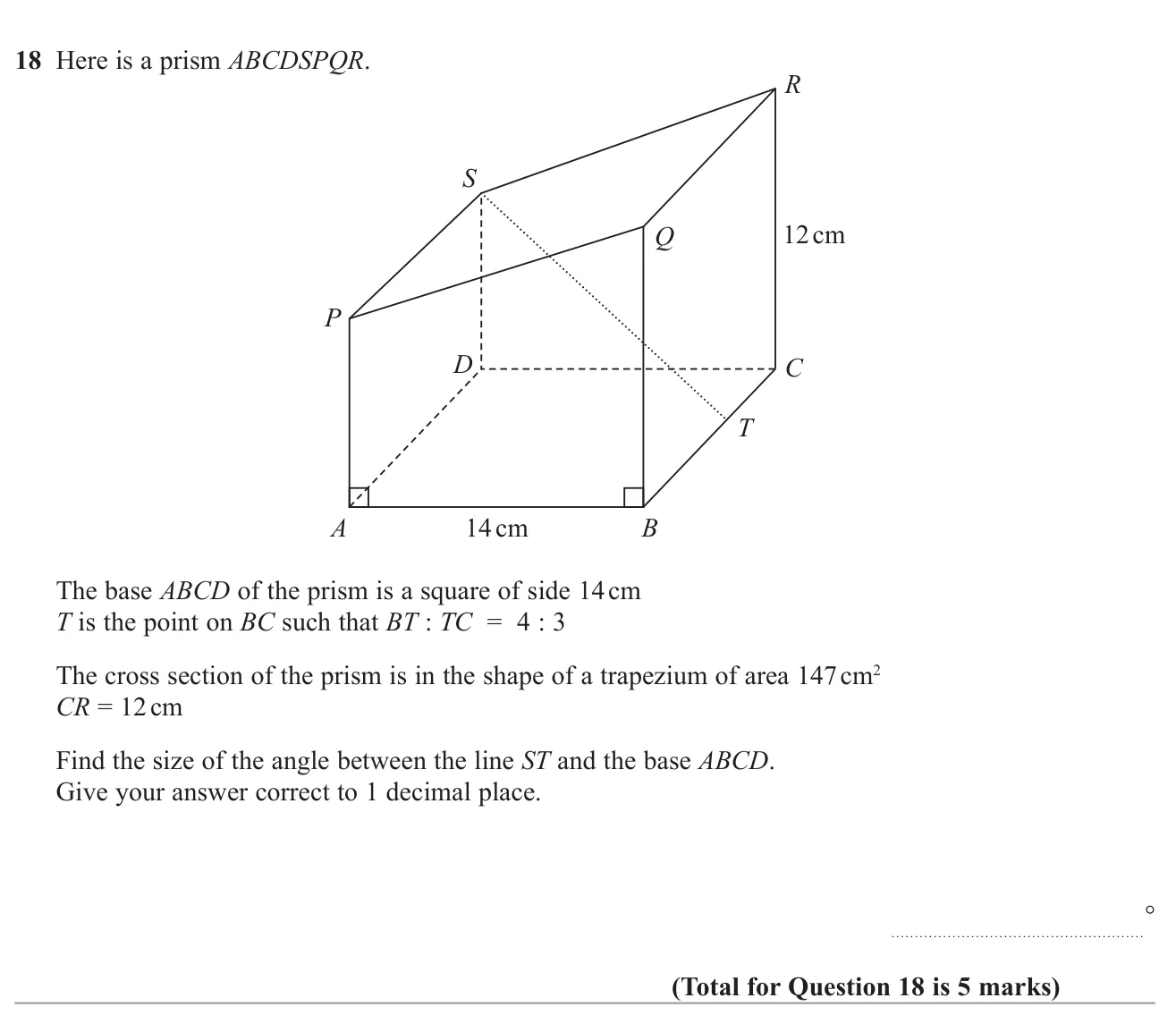
Answer 30.6 ∘ 30.6^\circ 30. 6 ∘ 5 marks
Worked solution Checked against the mark scheme
T C = 14 × 3 7 = 6 TC = 14 \times \frac{3}{7} = 6 T C = 14 × 7 3 = 6
T D = 14 2 + 6 2 = 232 = 15.23 … TD = \sqrt{14^2 + 6^2} = \sqrt{232} = 15.23\ldots T D = 1 4 2 + 6 2 = 232 = 15.23 …
Trapezium: 1 2 ( S D + 12 ) × 14 = 147 ⇒ S D = 9 \frac{1}{2}(SD + 12)\times14 = 147 \Rightarrow SD = 9 2 1 ( S D + 12 ) × 14 = 147 ⇒ S D = 9
Angle = tan − 1 ( 9 15.23 … ) = 30.6 ∘ = \tan^{-1}\left(\frac{9}{15.23\ldots}\right) = 30.6^\circ = tan − 1 ( 15.23 … 9 ) = 30. 6 ∘
Watch out: Using TC or BT alone as the horizontal distance instead of TD.
© Pearson Education Ltd. June 2019 Paper 2 (Higher, calculator), question 19.
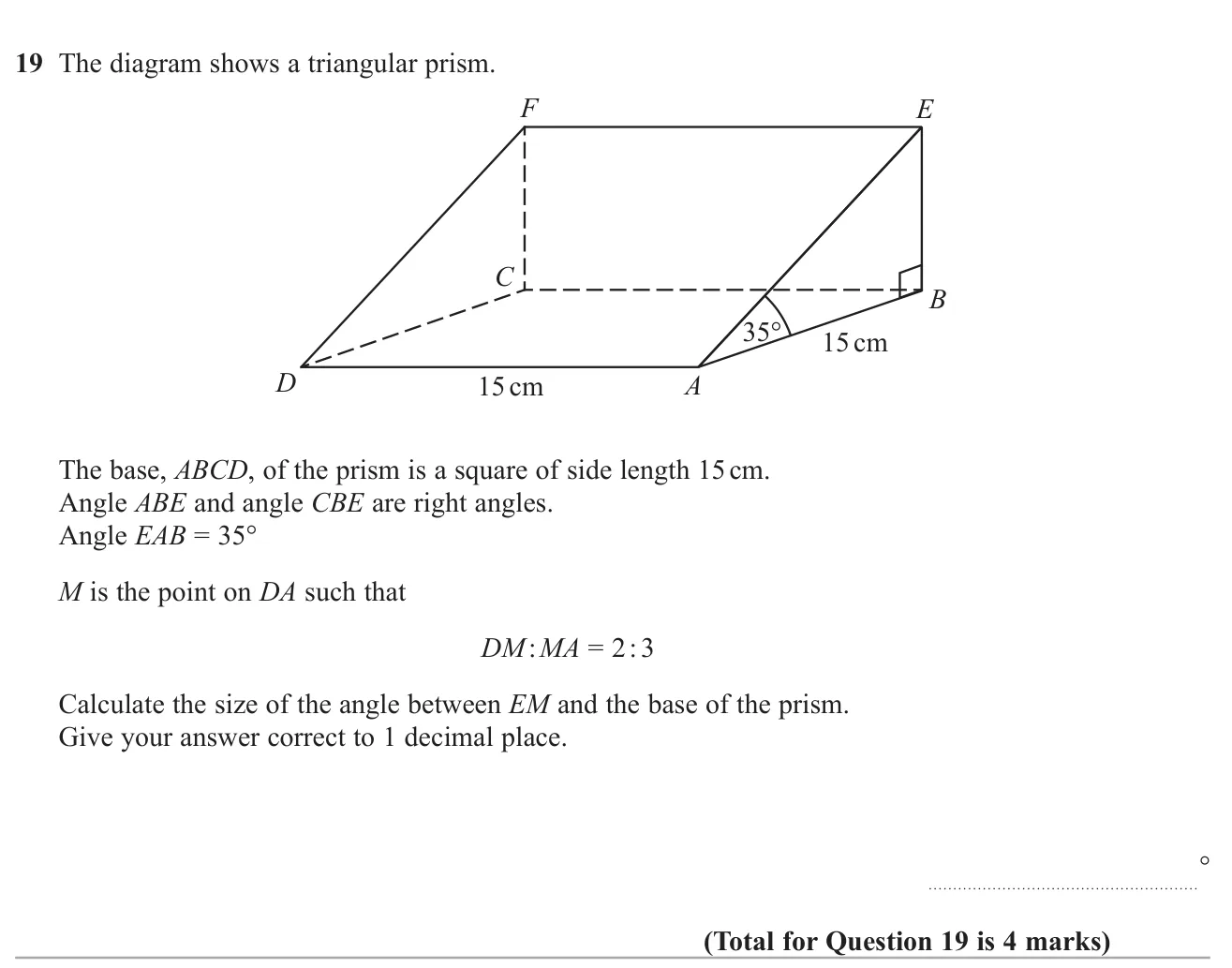
Answer 31.0 ∘ 31.0^\circ 31. 0 ∘ 4 marks
Worked solution Checked against the mark scheme
B E = 15 tan 35 ∘ = 10.50 BE = 15 \tan 35^\circ = 10.50 B E = 15 tan 3 5 ∘ = 10.50
M A = 3 5 × 15 = 9 MA = \frac{3}{5} \times 15 = 9 M A = 5 3 × 15 = 9 M B = 9 2 + 15 2 = 306 = 17.49 MB = \sqrt{9^2 + 15^2} = \sqrt{306} = 17.49 M B = 9 2 + 1 5 2 = 306 = 17.49
The angle is at M in triangle EMB, right-angled at B:
tan θ = 10.50 17.49 \tan \theta = \frac{10.50}{17.49} tan θ = 17.49 10.50 θ = 30.98... = 31.0 ∘ \theta = 30.98... = 31.0^\circ θ = 30.98... = 31. 0 ∘
Watch out: Using MA = 6 instead of 9.
© Pearson Education Ltd. June 2018 Paper 2 (Higher, calculator), question 18.
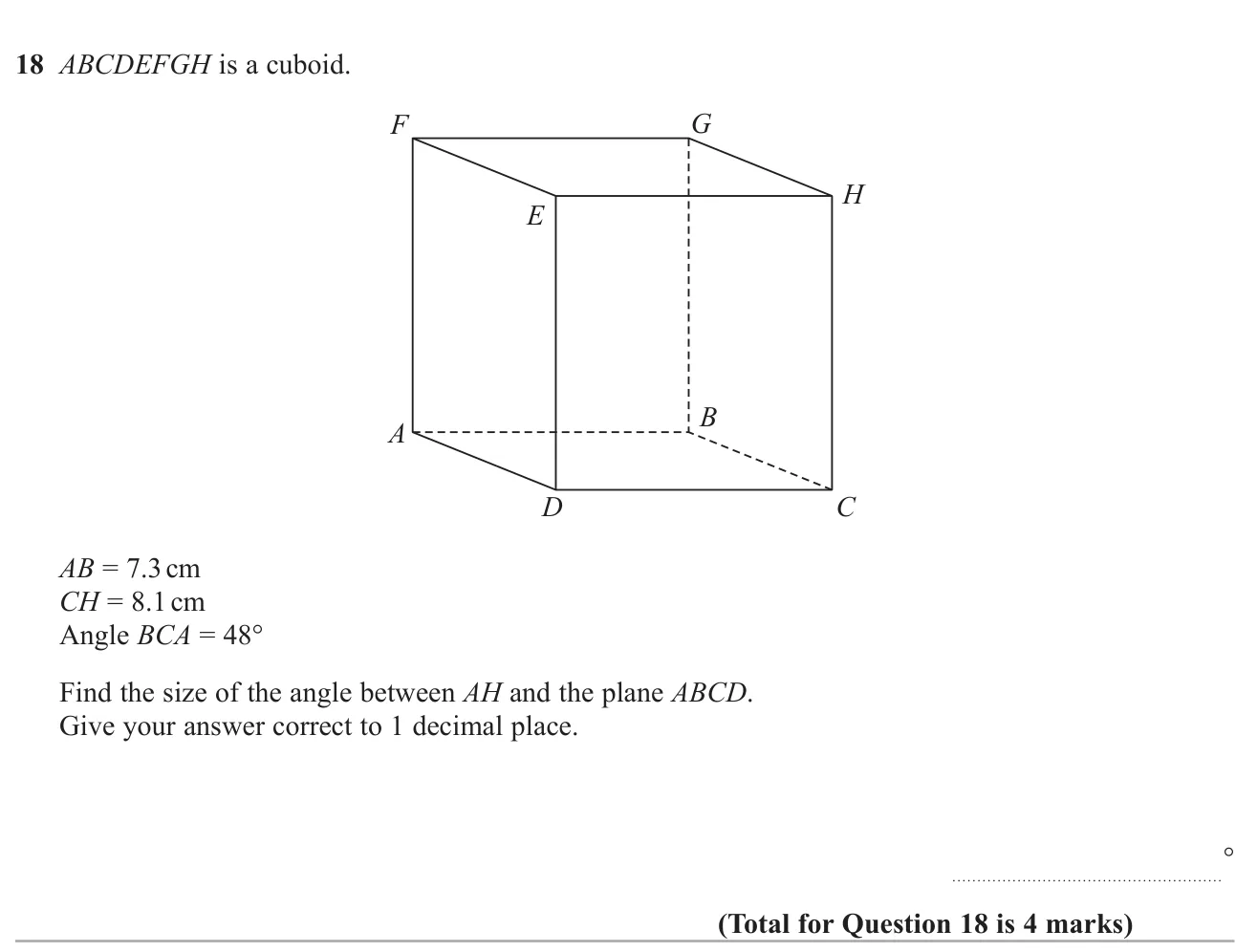
Answer 39.5 ° 39.5° 39.5° 4 marks
Worked solution Checked against the mark scheme
In right-angled triangle A B C ABC A B C A C = 7.3 sin 48 ° = 9.823 AC = \frac{7.3}{\sin 48°} = 9.823 A C = s i n 48° 7.3 = 9.823
In right-angled triangle A C H ACH A C H tan ( C A H ) = 8.1 9.823 \tan(CAH) = \frac{8.1}{9.823} tan ( C A H ) = 9.823 8.1
Angle = tan − 1 ( 0.8246 ) = 39.5 ° = \tan^{-1}(0.8246) = 39.5° = tan − 1 ( 0.8246 ) = 39.5°
Watch out: Using A B AB A B A C H ACH A C H A C AC A C
Also tested in these questions Their main topic is different, but part of each one tests this topic.