Question 1
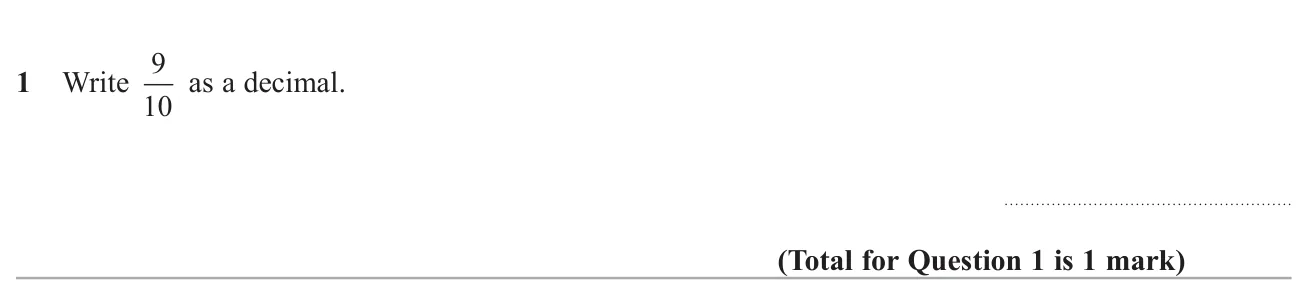
© Pearson Education Ltd. June 2018 Paper 3 (Foundation, calculator), question 1.
Show answer
| Answer | 1 mark |
|---|
Worked solution Checked against the mark scheme
means 9 tenths.
Nine tenths is written .
Watch out: Writing 9.10 or 0.09.
Edexcel GCSE Maths · 1MA1
Calculator · 28 questions · 80 marks · 1 hour 30 minutes. Try each question on paper, then press "Show answer".
© Pearson Education Ltd. June 2018 Paper 3 (Foundation, calculator), question 1.
| Answer | 1 mark |
|---|
Worked solution Checked against the mark scheme
means 9 tenths.
Nine tenths is written .
Watch out: Writing 9.10 or 0.09.

© Pearson Education Ltd. June 2018 Paper 3 (Foundation, calculator), question 2.
| Answer | 1 mark |
|---|
Worked solution Checked against the mark scheme
To change a decimal to a percentage, multiply by 100.
, so the answer is .
Watch out: Writing 3%.
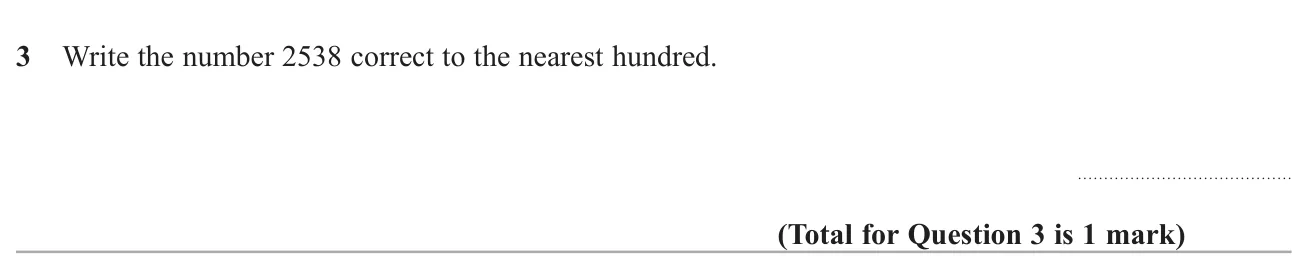
© Pearson Education Ltd. June 2018 Paper 3 (Foundation, calculator), question 3.
| Answer | 1 mark |
|---|
Worked solution Checked against the mark scheme
2538 lies between 2500 and 2600.
The tens digit is 3, which is less than 5, so round down to .
Watch out: Writing 25 or rounding up to 2600.
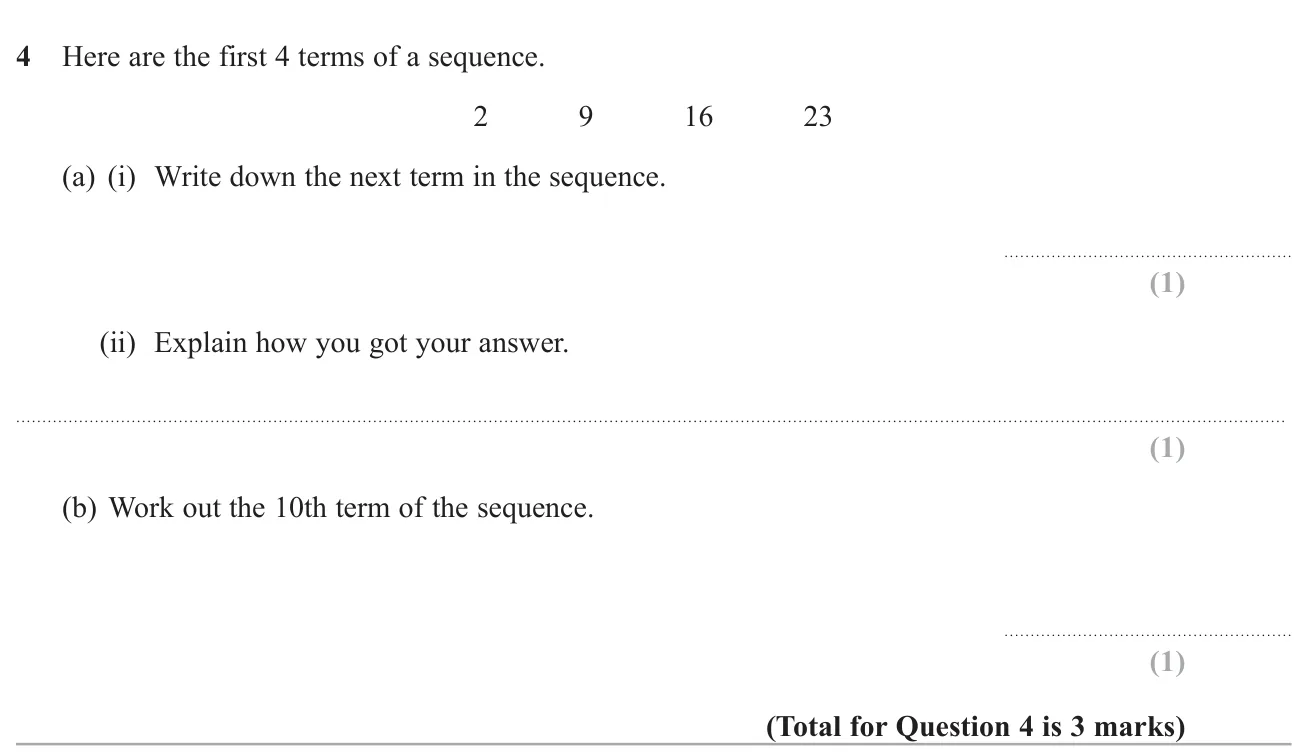
© Pearson Education Ltd. June 2018 Paper 3 (Foundation, calculator), question 4.
| (a(i)) | 1 mark | |
|---|---|---|
| (a(ii)) | The terms go up by 7 each time | 1 mark |
| (b) | 1 mark |
Worked solution Checked against the mark scheme
Each term is 7 more than the one before, so the next term is .
The nth term is .
10th term: .
Watch out: Adding 7 six times from 23 but miscounting the terms.
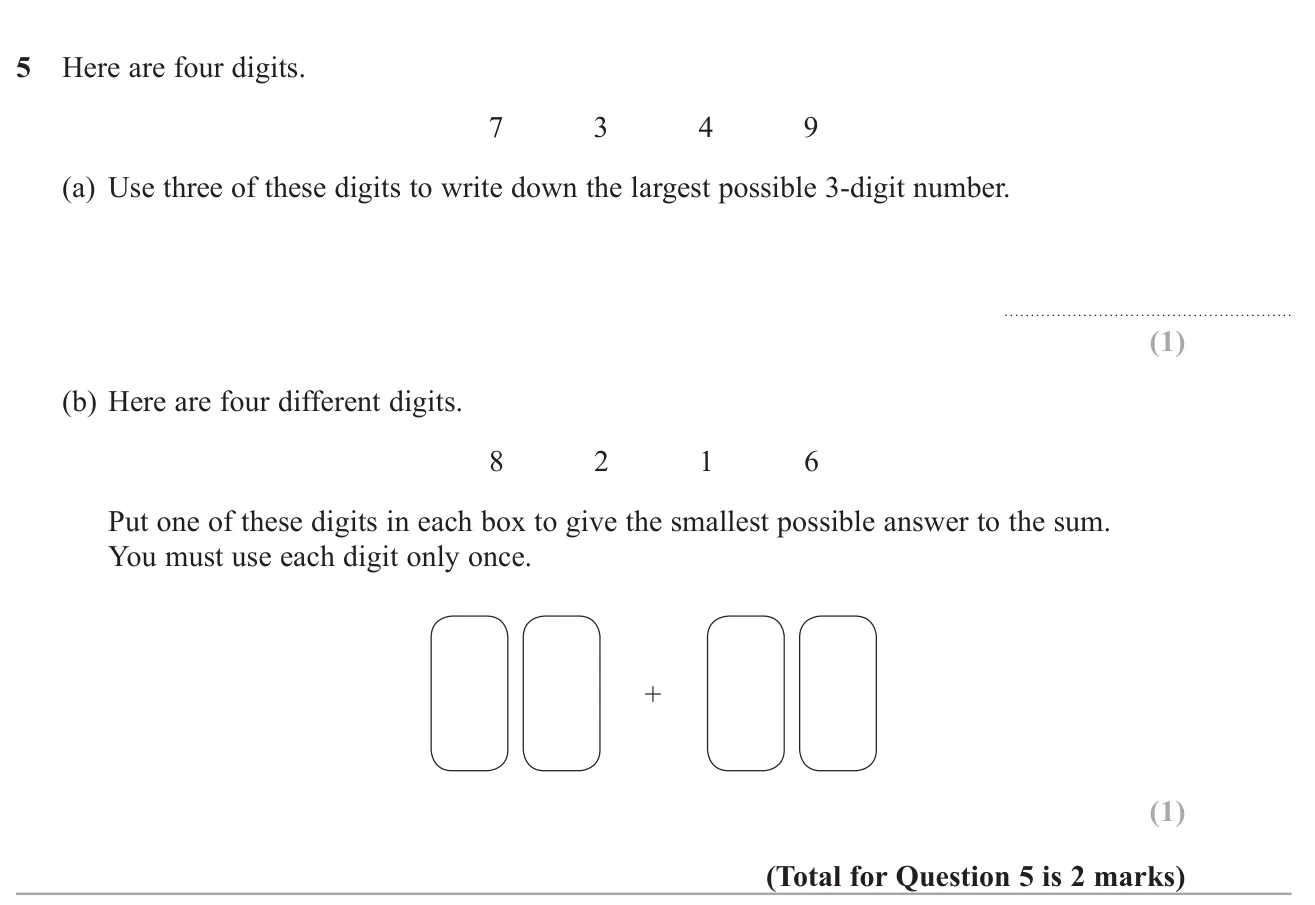
© Pearson Education Ltd. June 2018 Paper 3 (Foundation, calculator), question 5.
| (a) | 1 mark | |
|---|---|---|
| (b) | or (total 44) | 1 mark |
Worked solution Checked against the mark scheme
(a) Use the three largest digits, biggest first: .
(b) Put the two smallest digits, 1 and 2, in the tens places. Put 6 and 8 in the units places.
(or ), the smallest possible total.
Watch out: Putting the small digits in the units places instead of the tens places.
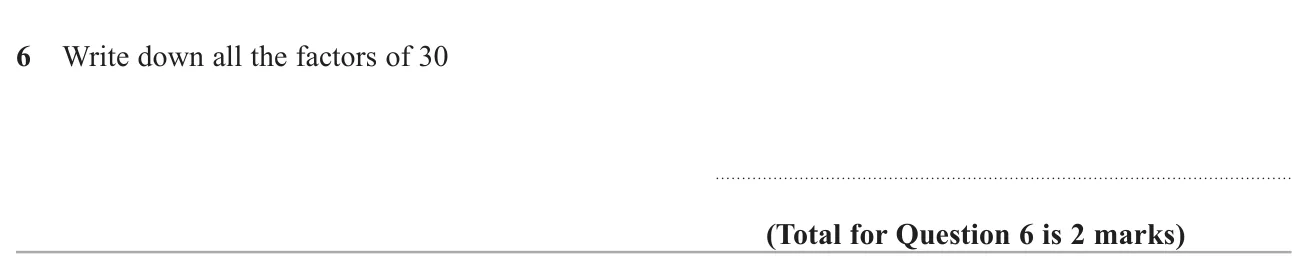
© Pearson Education Ltd. June 2018 Paper 3 (Foundation, calculator), question 6.
| Answer | 2 marks |
|---|
Worked solution Checked against the mark scheme
Find the factor pairs of 30:
, , , .
So the factors are .
Watch out: Missing 1 and 30, or including multiples such as 60.
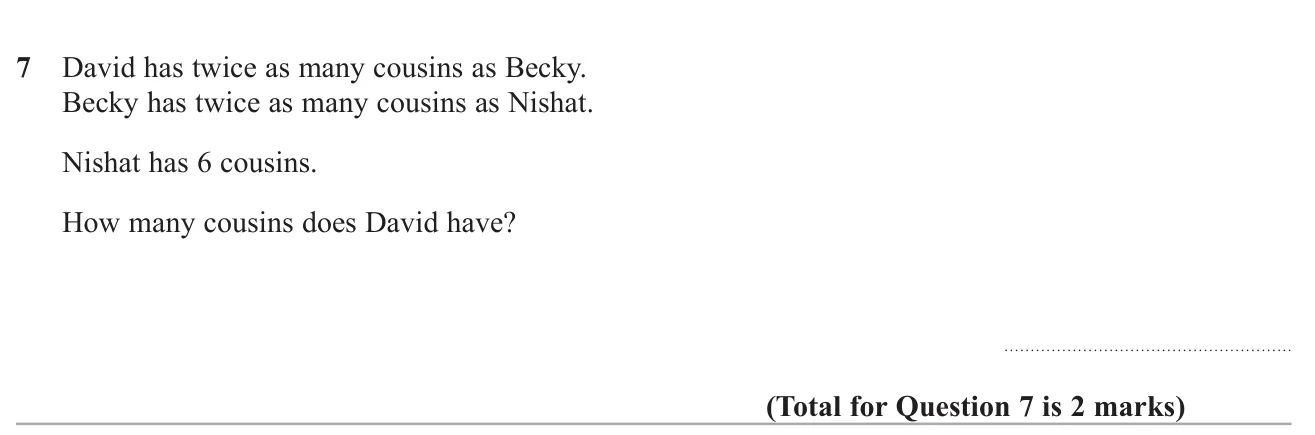
© Pearson Education Ltd. June 2018 Paper 3 (Foundation, calculator), question 7.
| Answer | 2 marks |
|---|
Worked solution Checked against the mark scheme
Becky has cousins.
David has cousins.
Watch out: Halving instead of doubling, giving 1.5.
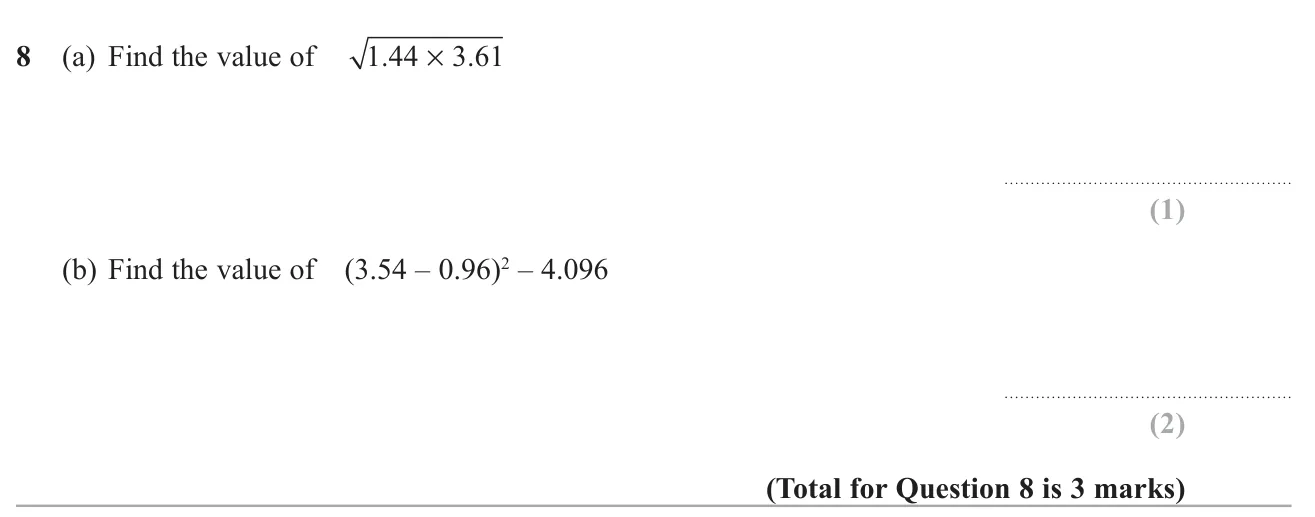
© Pearson Education Ltd. June 2018 Paper 3 (Foundation, calculator), question 8.
| (a) | 1 mark | |
|---|---|---|
| (b) | 2 marks |
Worked solution Checked against the mark scheme
(a) and .
(b)
Watch out: Forgetting to square the bracket before subtracting.
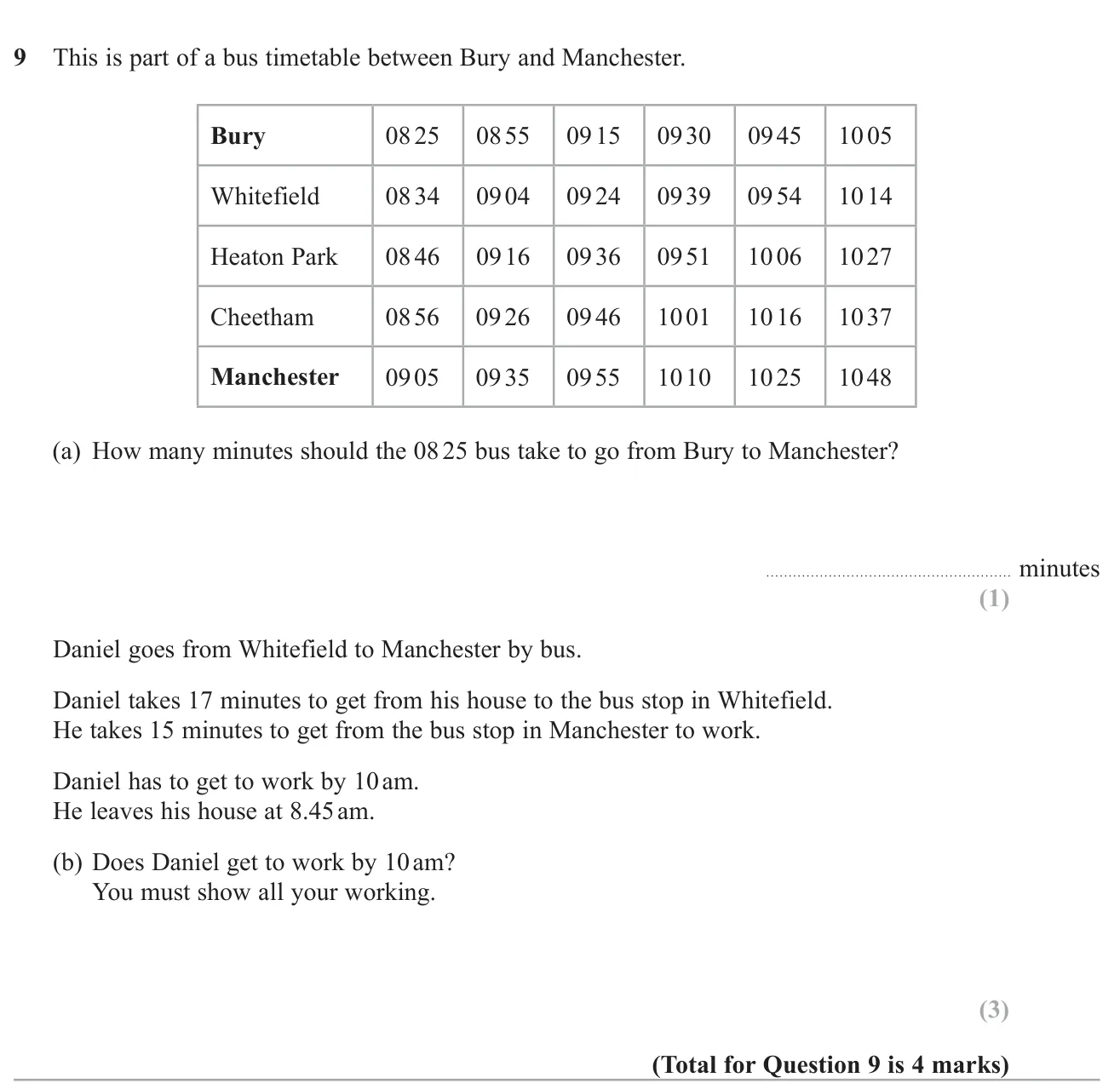
© Pearson Education Ltd. June 2018 Paper 3 (Foundation, calculator), question 9.
| (a) | minutes | 1 mark |
|---|---|---|
| (b) | Yes: he arrives at about 9:50 am | 3 marks |
Worked solution Checked against the mark scheme
(a) 08 25 to 09 05 is minutes.
(b) He reaches the Whitefield stop at 8:45 + 17 min = 9:02.
The next bus leaves Whitefield at 09 04 and reaches Manchester at 09 35.
9:35 + 15 min = 9:50, which is before 10 am, so yes.
Watch out: Treating times as decimals, e.g. 8.45 + 0.17 = 8.62.
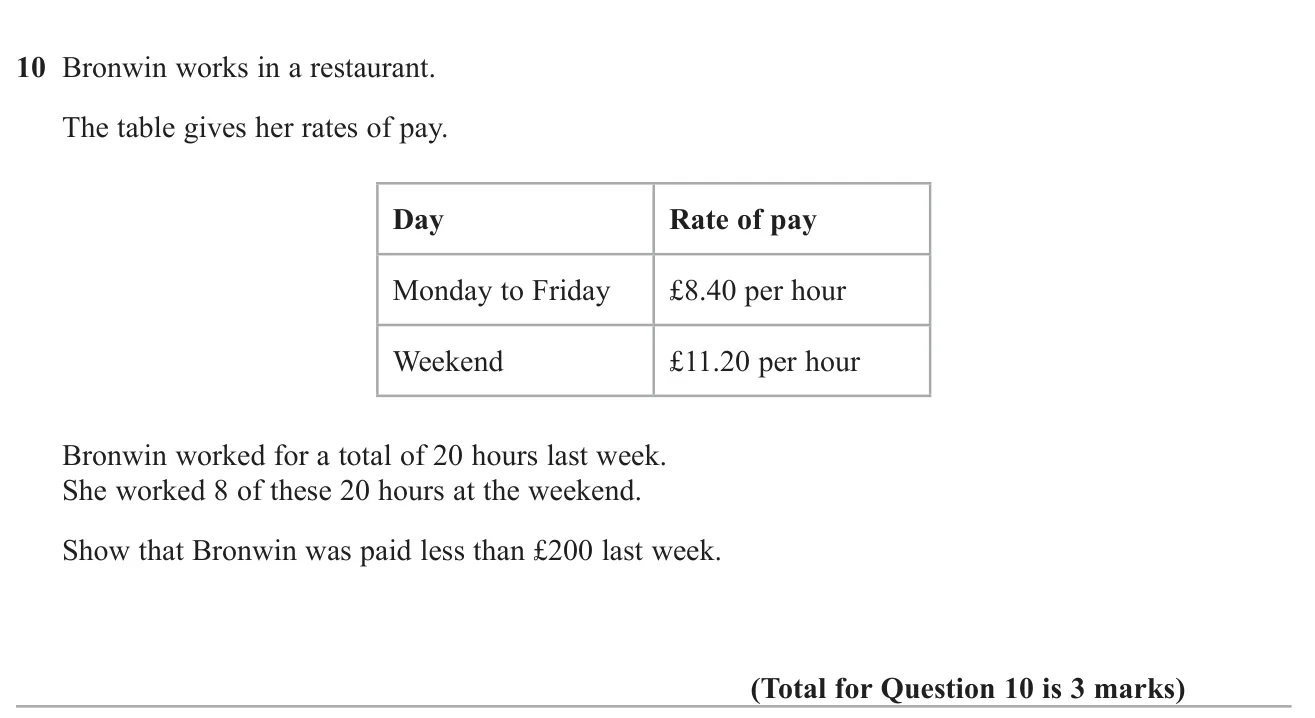
© Pearson Education Ltd. June 2018 Paper 3 (Foundation, calculator), question 10.
| Answer | , which is less than | 3 marks |
|---|
Worked solution Checked against the mark scheme
Weekday hours: .
Weekday pay: .
Weekend pay: .
Total: , which is less than £200.
Watch out: Paying all 20 hours at one rate.
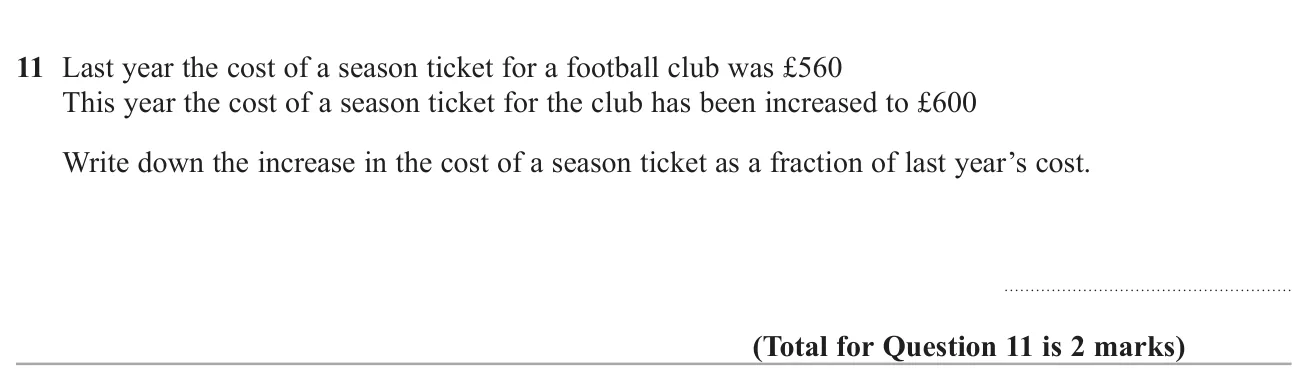
© Pearson Education Ltd. June 2018 Paper 3 (Foundation, calculator), question 11.
| Answer | 2 marks |
|---|
Worked solution Checked against the mark scheme
Increase: .
As a fraction of last year's cost: .
Watch out: Dividing by the new price, giving 40/600.
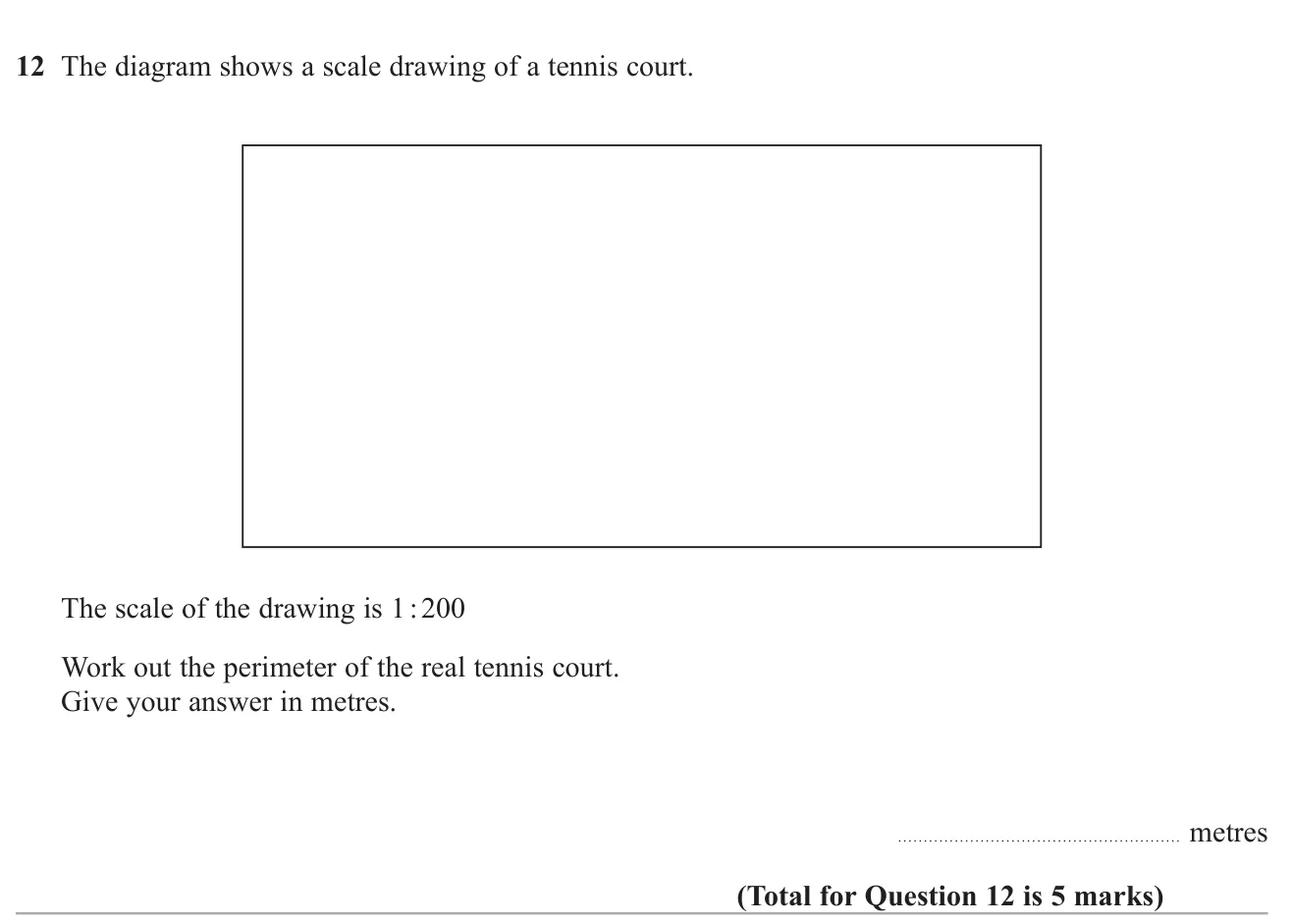
© Pearson Education Ltd. June 2018 Paper 3 (Foundation, calculator), question 12.
| Answer | m (accept 67.6 to 70.8) | 5 marks |
|---|
Worked solution Checked against the mark scheme
Measure the drawing: length about 11.5 cm, width about 5.8 cm.
Real length: cm m.
Real width: cm m.
Perimeter: m.
Watch out: Forgetting to convert from centimetres to metres.
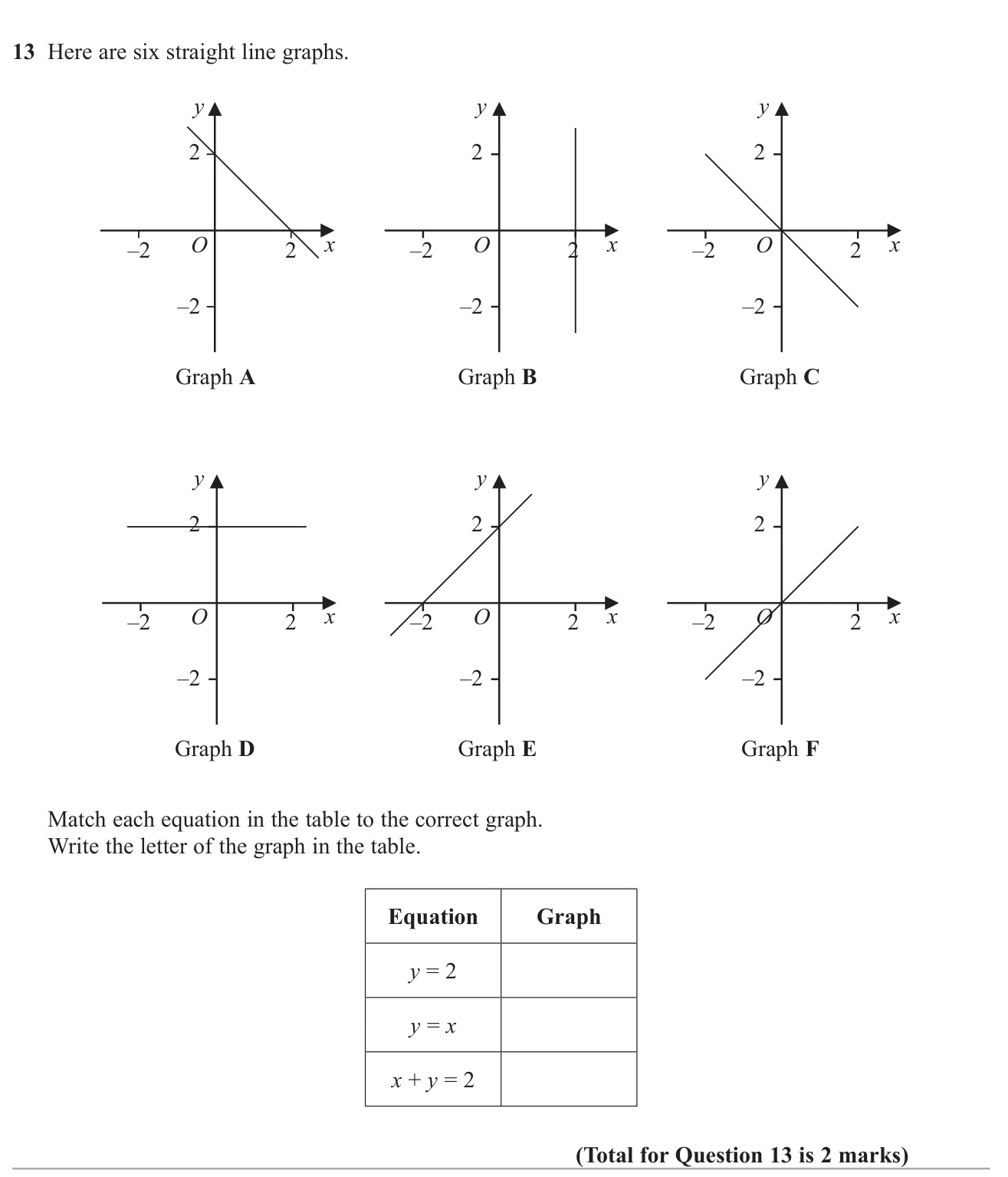
© Pearson Education Ltd. June 2018 Paper 3 (Foundation, calculator), question 13.
| Answer | : D; : F; : A | 2 marks |
|---|
Worked solution Checked against the mark scheme
is a horizontal line through 2 on the -axis: graph D.
goes through the origin sloping upwards: graph F.
gives , crossing both axes at 2 and sloping down: graph A.
Watch out: Choosing graph B (x = 2) for y = 2.
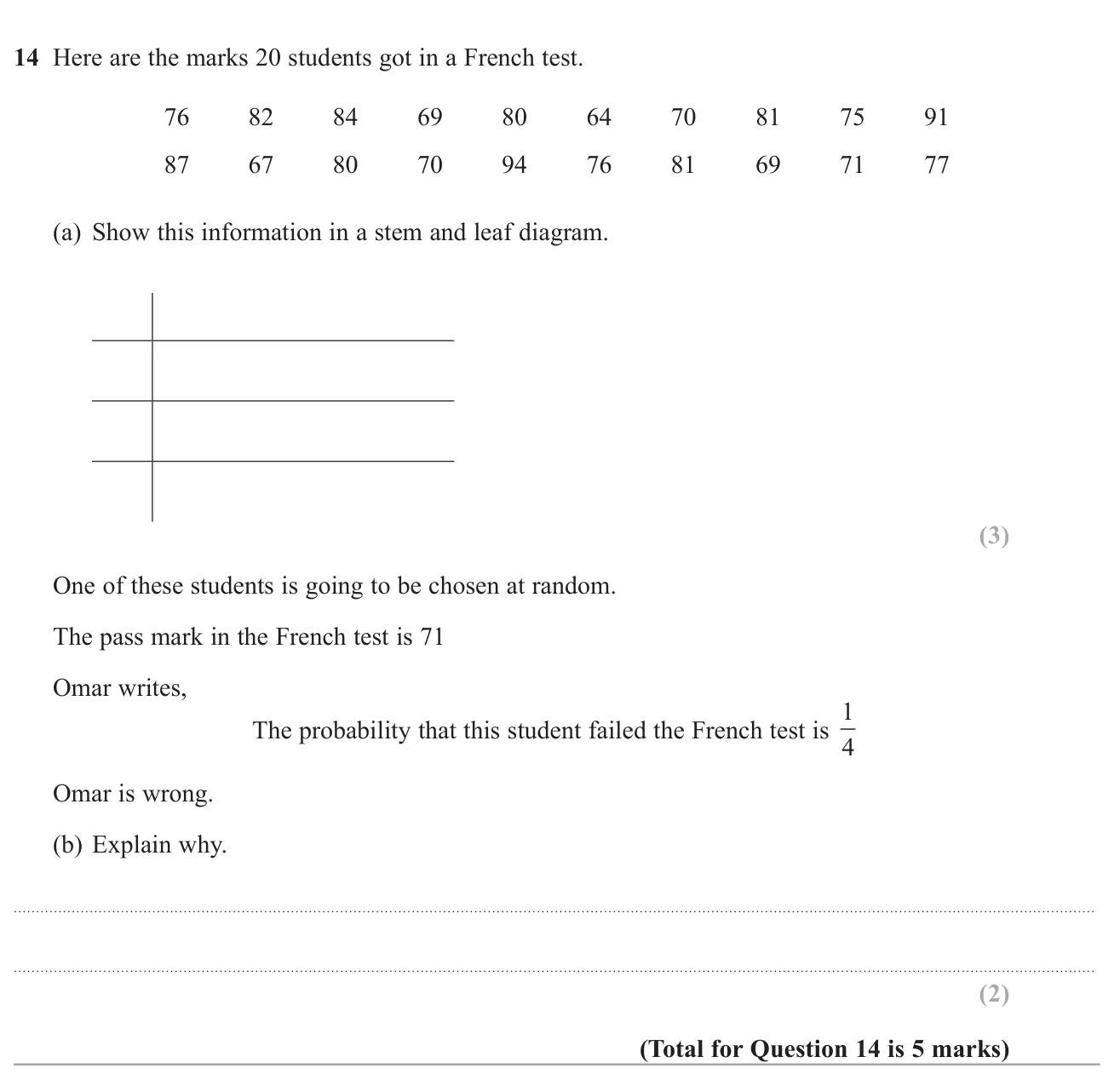
© Pearson Education Ltd. June 2018 Paper 3 (Foundation, calculator), question 14.
| (a) | Stems 6 to 9 with ordered leaves: 6 | 4 7 9 9; 7 | 0 0 1 5 6 6 7; 8 | 0 0 1 1 2 4 7; 9 | 1 4; key 6 | 4 = 64 | 3 marks |
|---|---|---|
| (b) | 6 of the 20 students failed, so the probability is , not | 2 marks |
Worked solution Checked against the mark scheme
(a) Put the tens digits as stems and the units in order as leaves:
6 | 4 7 9 9
7 | 0 0 1 5 6 6 7
8 | 0 0 1 1 2 4 7
9 | 1 4
Key: 6 | 4 means 64 marks.
(b) Marks below 71: 64, 67, 69, 69, 70, 70, so 6 students failed.
, but , so Omar is wrong.
Watch out: Leaving out the key, or counting 71 as a fail.
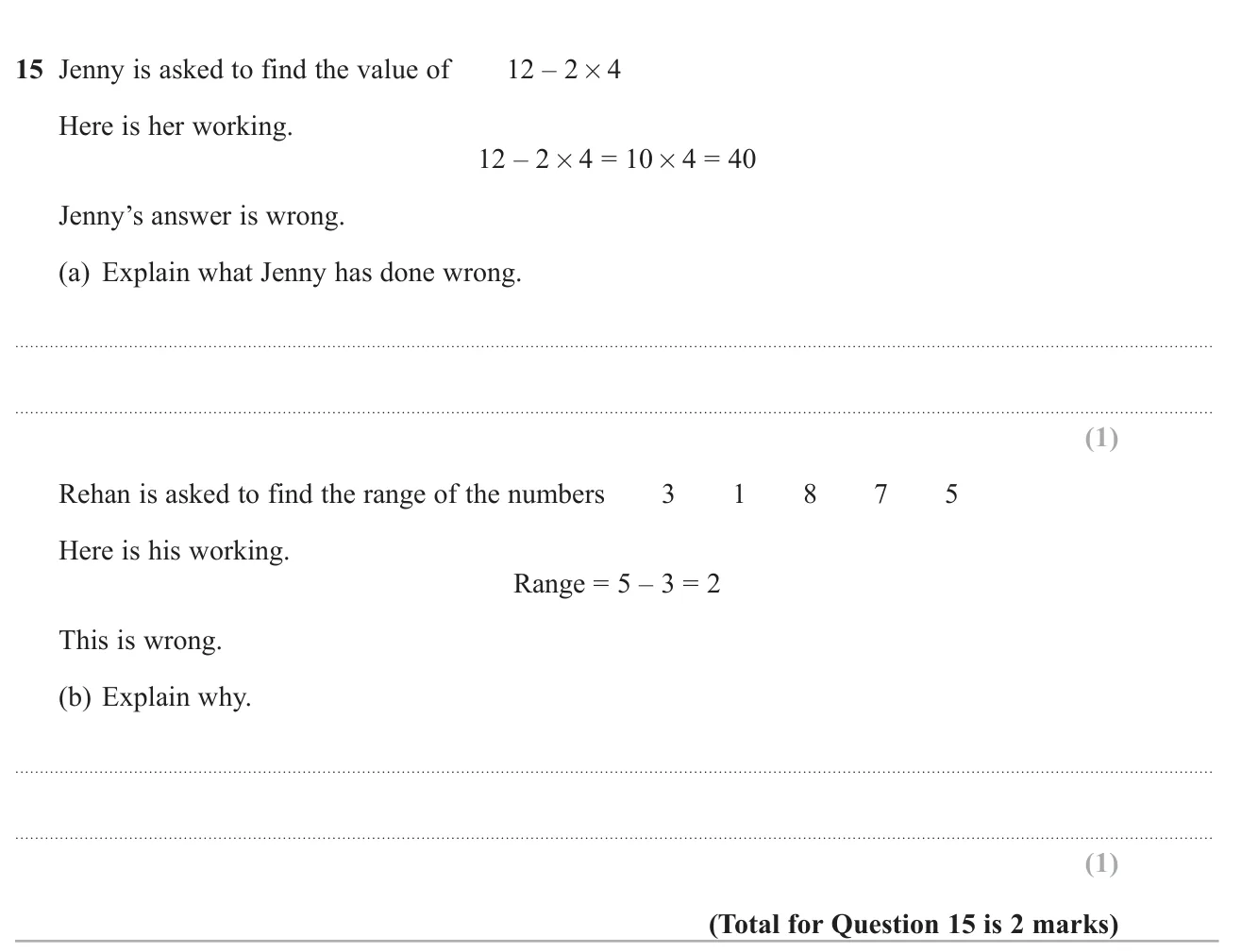
© Pearson Education Ltd. June 2018 Paper 3 (Foundation, calculator), question 15.
| (a) | She subtracted before multiplying; multiplication should be done first | 1 mark |
|---|---|---|
| (b) | The range is largest minus smallest: | 1 mark |
Worked solution Checked against the mark scheme
(a) Multiplication comes before subtraction: . Jenny subtracted first.
(b) The range is the largest value minus the smallest: . Rehan used the last and first numbers in the list.
Watch out: Just giving the correct answer to (a) without saying what went wrong.
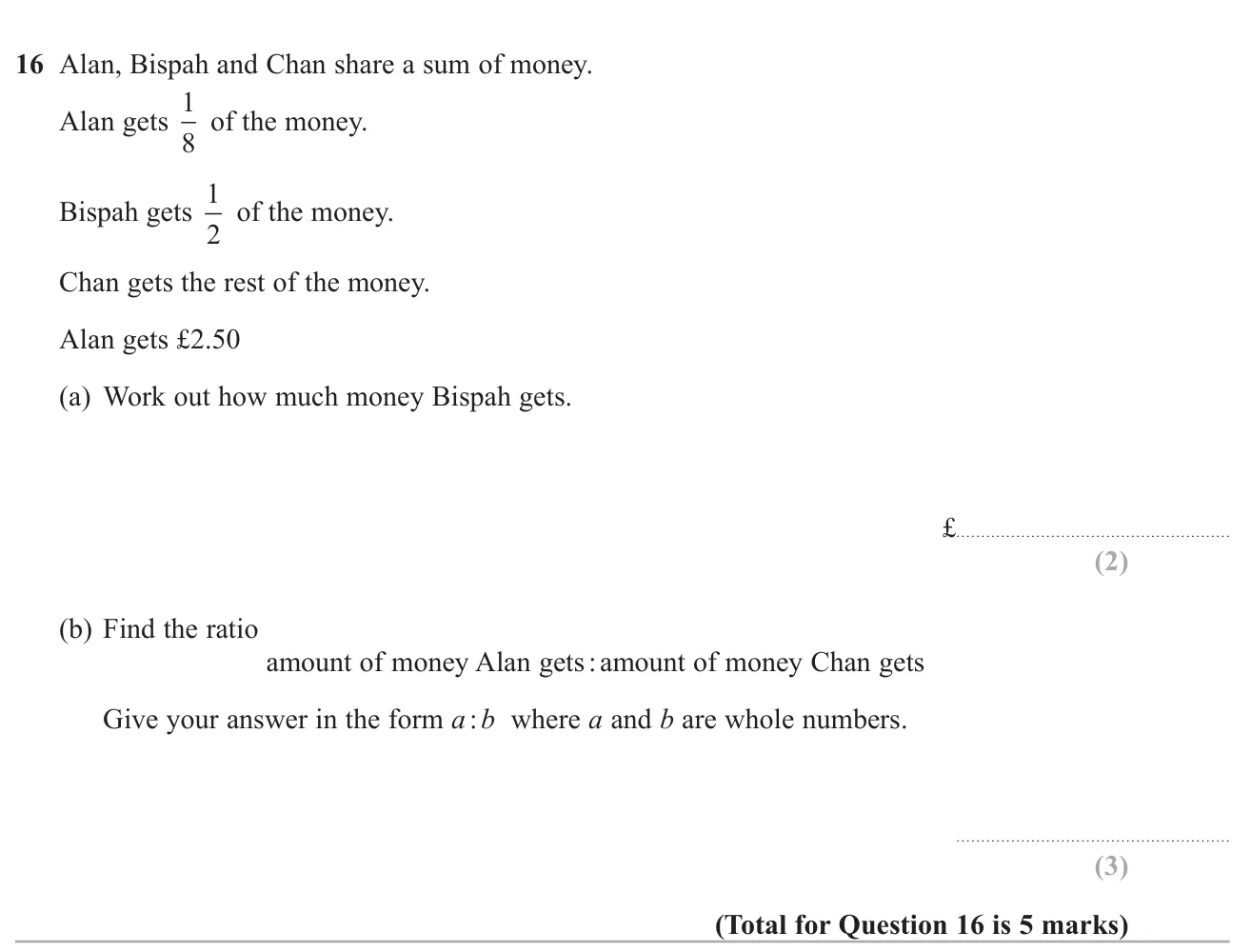
© Pearson Education Ltd. June 2018 Paper 3 (Foundation, calculator), question 16.
| (a) | 2 marks | |
|---|---|---|
| (b) | 3 marks |
Worked solution Checked against the mark scheme
(a) Alan's £2.50 is , so the total is .
Bispah gets .
(b) Chan gets .
Alan : Chan .
Watch out: Writing the ratio the wrong way round as 3 : 1.
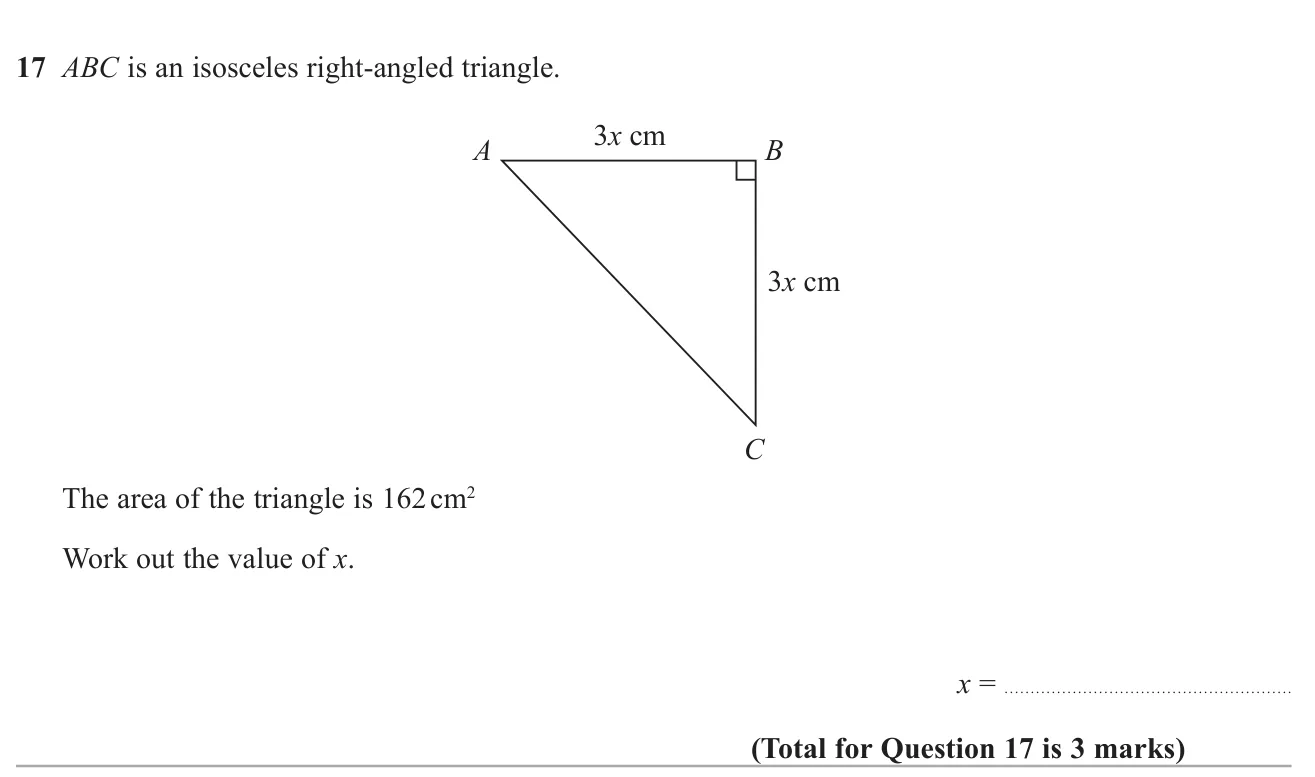
© Pearson Education Ltd. June 2018 Paper 3 (Foundation, calculator), question 17.
| Answer | 3 marks |
|---|
Worked solution Checked against the mark scheme
Area .
, so and .
.
Watch out: Forgetting the half, giving x² = 18.
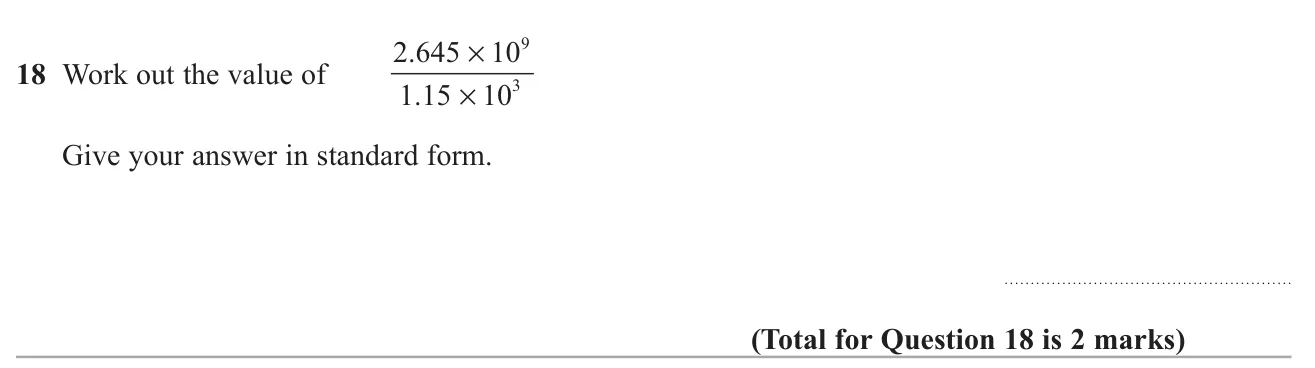
© Pearson Education Ltd. June 2018 Paper 3 (Foundation, calculator), question 18.
| Answer | 2 marks |
|---|
Worked solution Checked against the mark scheme
Divide the numbers: .
Subtract the powers: .
Answer: .
Watch out: Leaving the answer as 2 300 000, not in standard form.
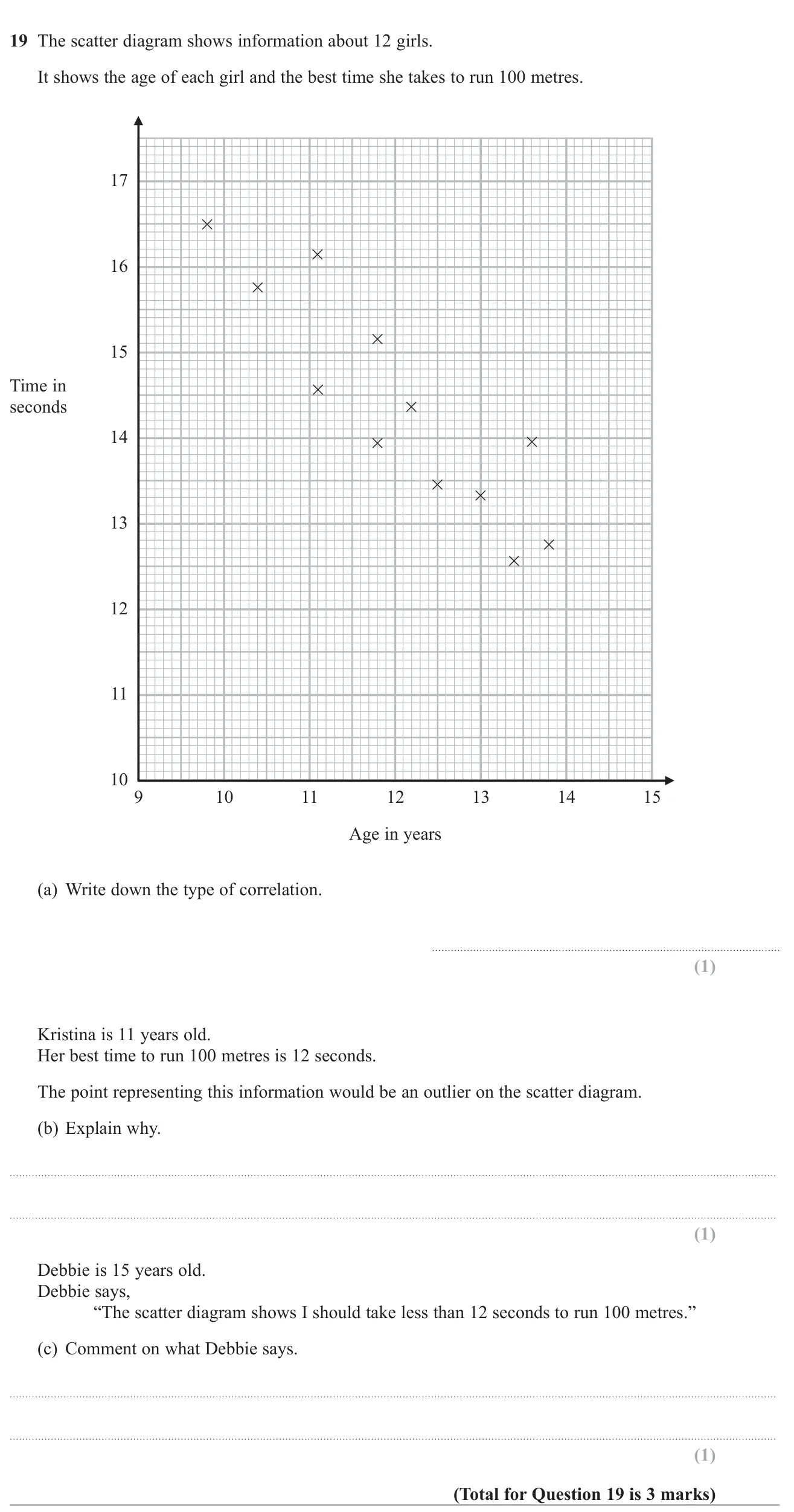
© Pearson Education Ltd. June 2018 Paper 3 (Foundation, calculator), question 19.
| (a) | Negative | 1 mark |
|---|---|---|
| (b) | It does not follow the trend; it is far from the other points | 1 mark |
| (c) | Age 15 is outside the range of the data, so the graph cannot be used to predict her time | 1 mark |
Worked solution Checked against the mark scheme
(a) As age increases, time decreases, so the correlation is negative.
(b) An 11-year-old's times on the graph are about 14.5 to 16 seconds; 12 seconds is far faster than the trend suggests.
(c) The oldest girl on the graph is under 14, so predicting for 15 means going beyond the data, which is unreliable.
Watch out: Saying 'positive' because the numbers on both axes go up.
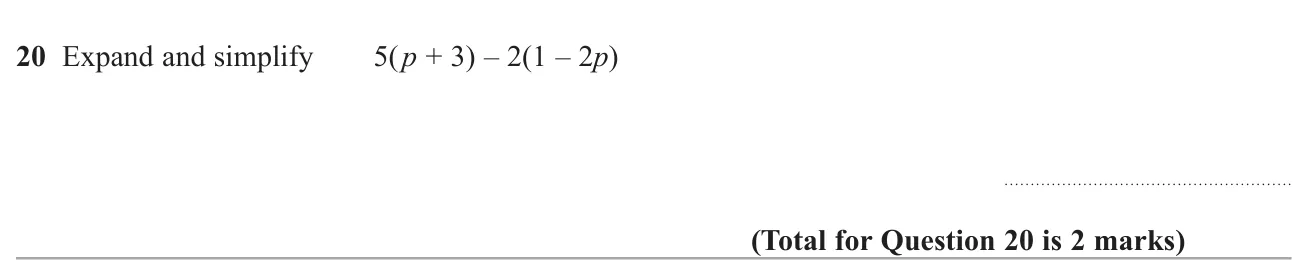
© Pearson Education Ltd. June 2018 Paper 3 (Foundation, calculator), question 20.
| Answer | 2 marks |
|---|
Worked solution Checked against the mark scheme
Watch out: Writing −2 × −2p as −4p, giving p + 13.
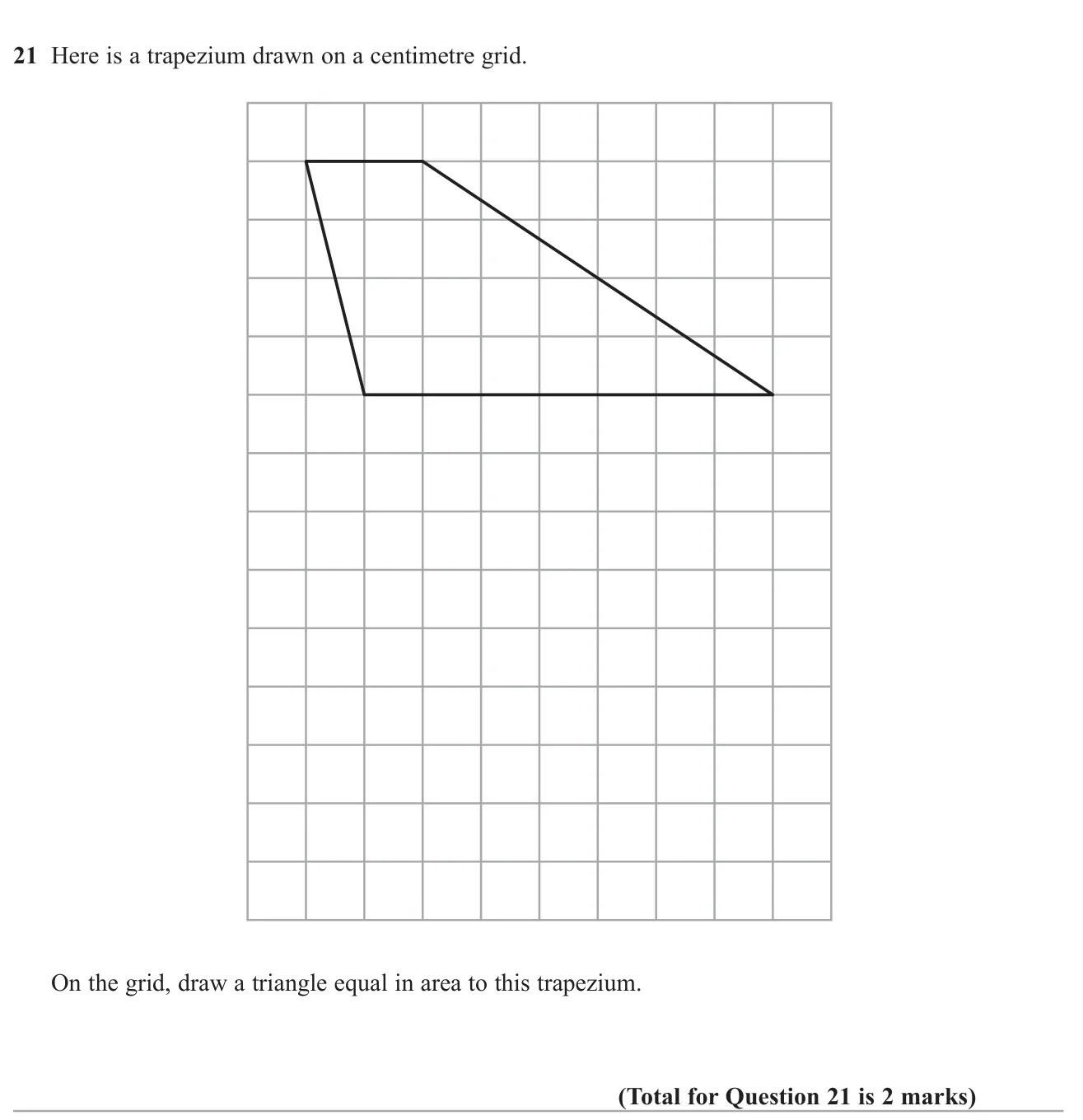
© Pearson Education Ltd. June 2018 Paper 3 (Foundation, calculator), question 21.
| Answer | Any triangle of area 18 cm², e.g. base 6 cm and height 6 cm, or base 9 cm and height 4 cm | 2 marks |
|---|
Worked solution Checked against the mark scheme
The parallel sides are 2 cm and 7 cm, and the height is 4 cm.
Area cm².
A triangle needs , so , e.g. base 9 cm, height 4 cm.
Watch out: Drawing a triangle with base × height = 18, giving area 9.
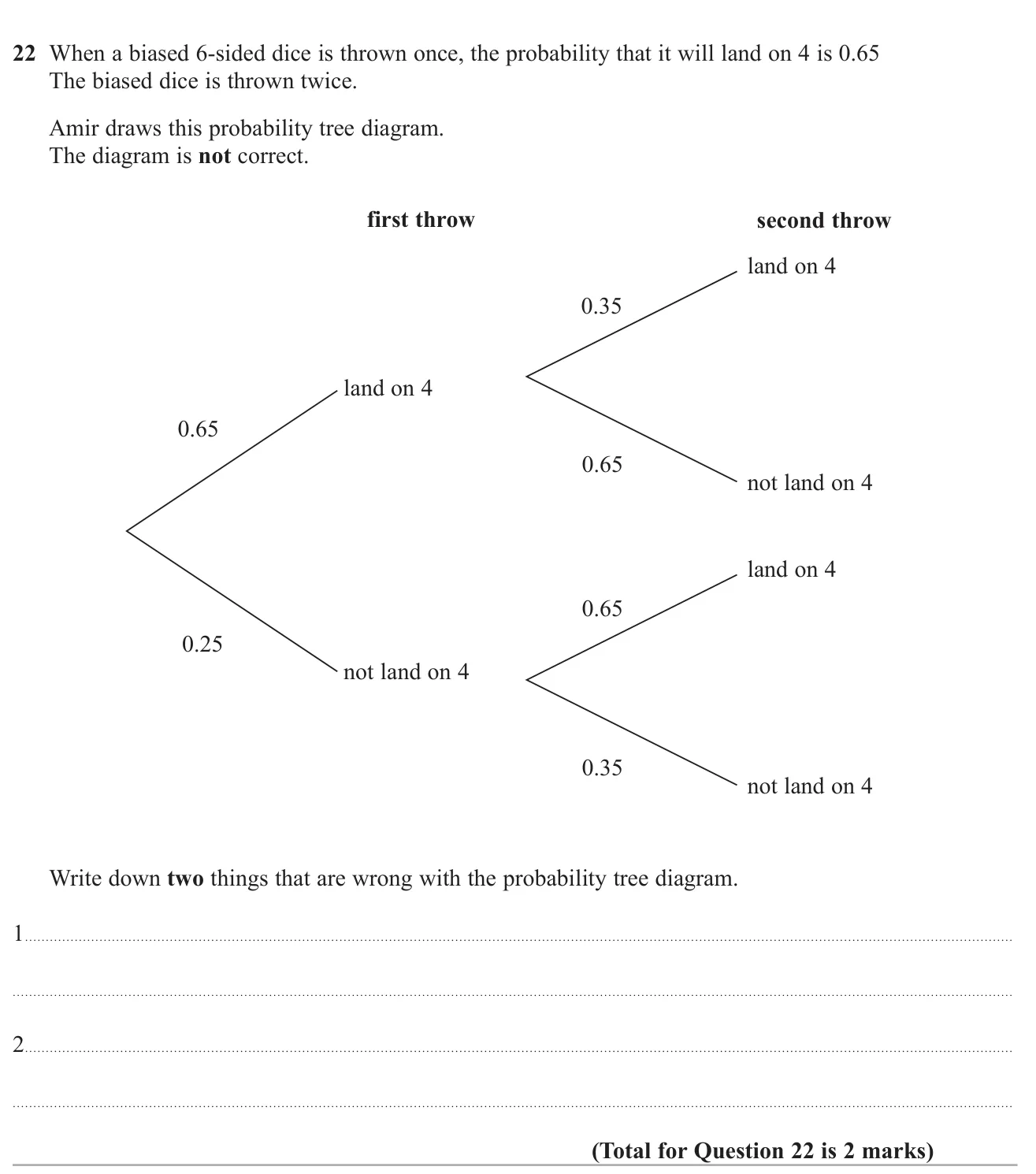
© Pearson Education Ltd. June 2018 Paper 3 (Foundation, calculator), question 22.
| Answer | The pair 0.65 and 0.25 does not add to 1 (0.25 should be 0.35); on the upper second-throw branches, 0.35 and 0.65 are the wrong way round | 2 marks |
|---|
Worked solution Checked against the mark scheme
The probability of landing on 4 is 0.65 on every throw, so the probability of not landing on 4 is .
1. On the first throw, : the 'not land on 4' branch should be 0.35, not 0.25.
2. On the second throw after landing on 4, 'land on 4' is labelled 0.35 and 'not land on 4' 0.65; these are the wrong way round.
Watch out: Thinking the second throw should have different probabilities from the first.
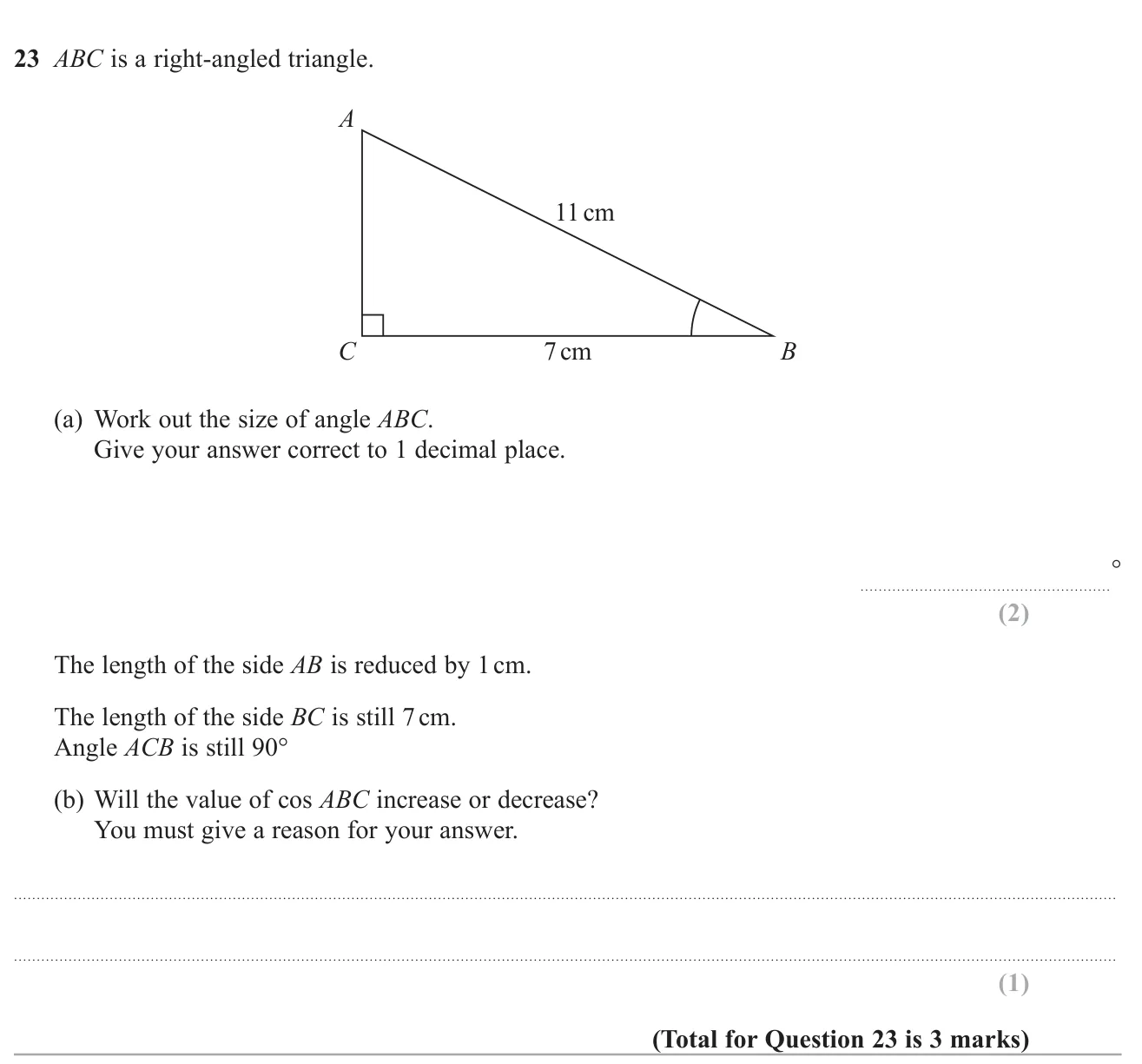
© Pearson Education Ltd. June 2018 Paper 3 (Foundation, calculator), question 23.
| (a) | 2 marks | |
|---|---|---|
| (b) | Increase, because | 1 mark |
Worked solution Checked against the mark scheme
(a) is the hypotenuse and is adjacent to angle .
, so .
(b) New , which is more than , so it increases.
Watch out: Using sin or tan instead of cos.
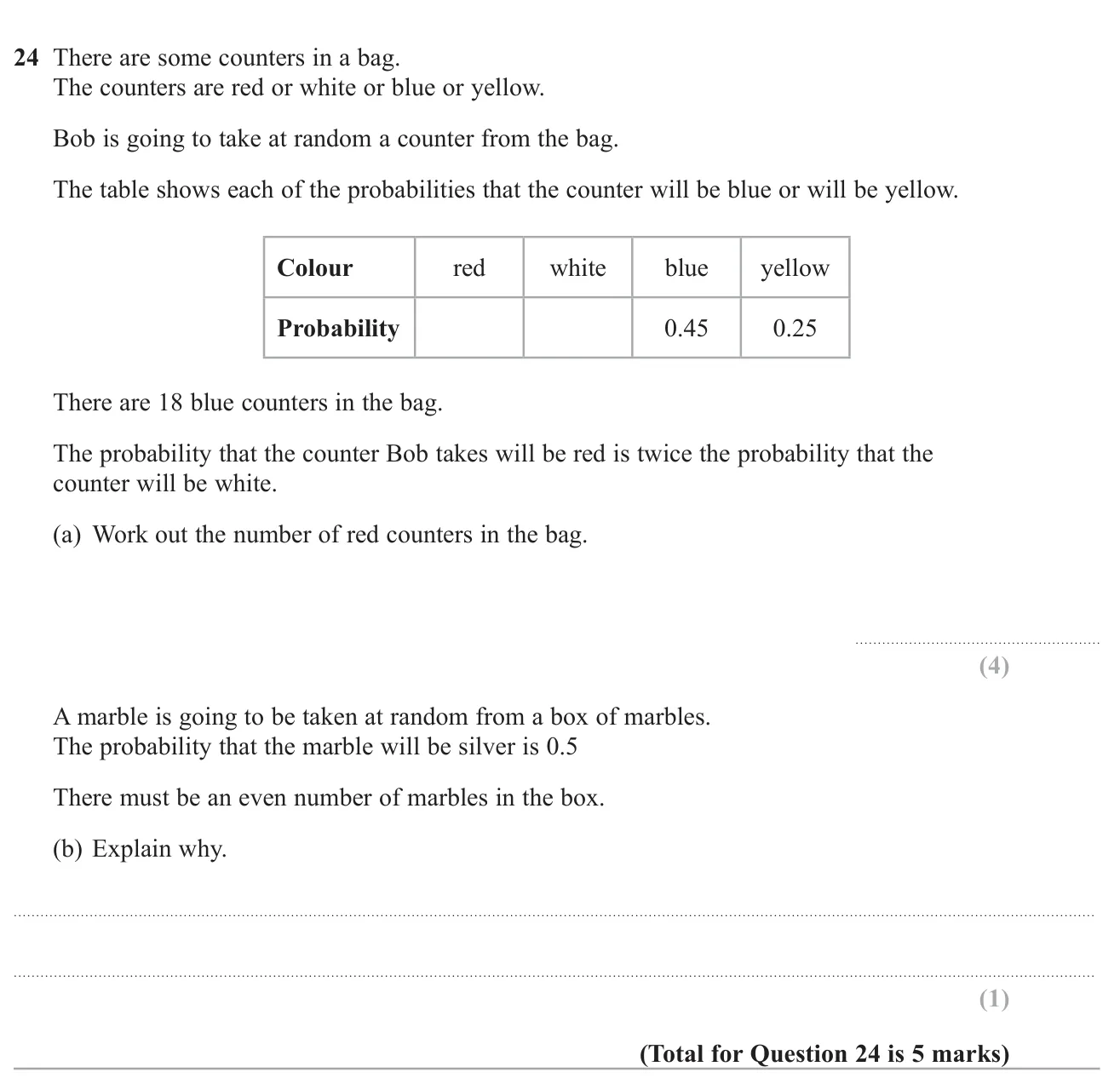
© Pearson Education Ltd. June 2018 Paper 3 (Foundation, calculator), question 24.
| (a) | 4 marks | |
|---|---|---|
| (b) | Half the marbles are silver, and half of an odd number is not a whole number | 1 mark |
Worked solution Checked against the mark scheme
(a) Total counters: .
Red and white together: .
Red is twice white, so and .
Red counters: .
(b) The number of silver marbles is the total. That is only a whole number if the total is even.
Watch out: Splitting 0.3 equally between red and white.
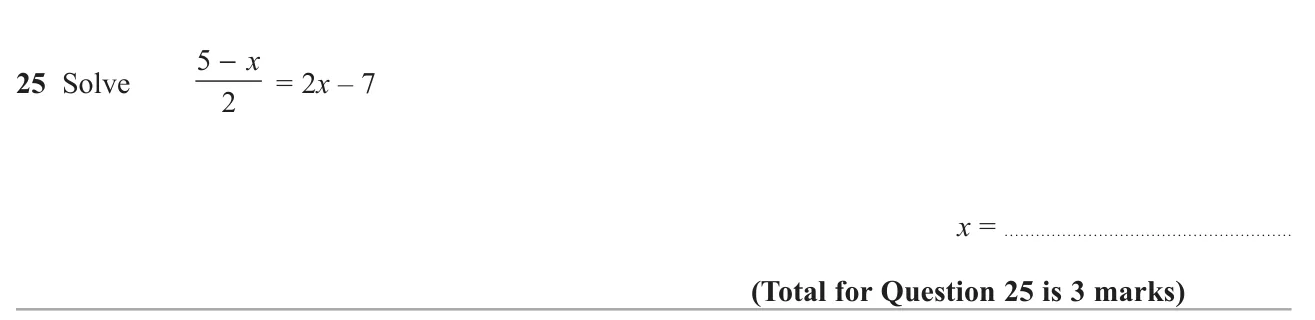
© Pearson Education Ltd. June 2018 Paper 3 (Foundation, calculator), question 25.
| Answer | 3 marks |
|---|
Worked solution Checked against the mark scheme
Multiply both sides by 2: .
Add and 14 to both sides: .
Watch out: Multiplying only 2x by 2, not the −7.
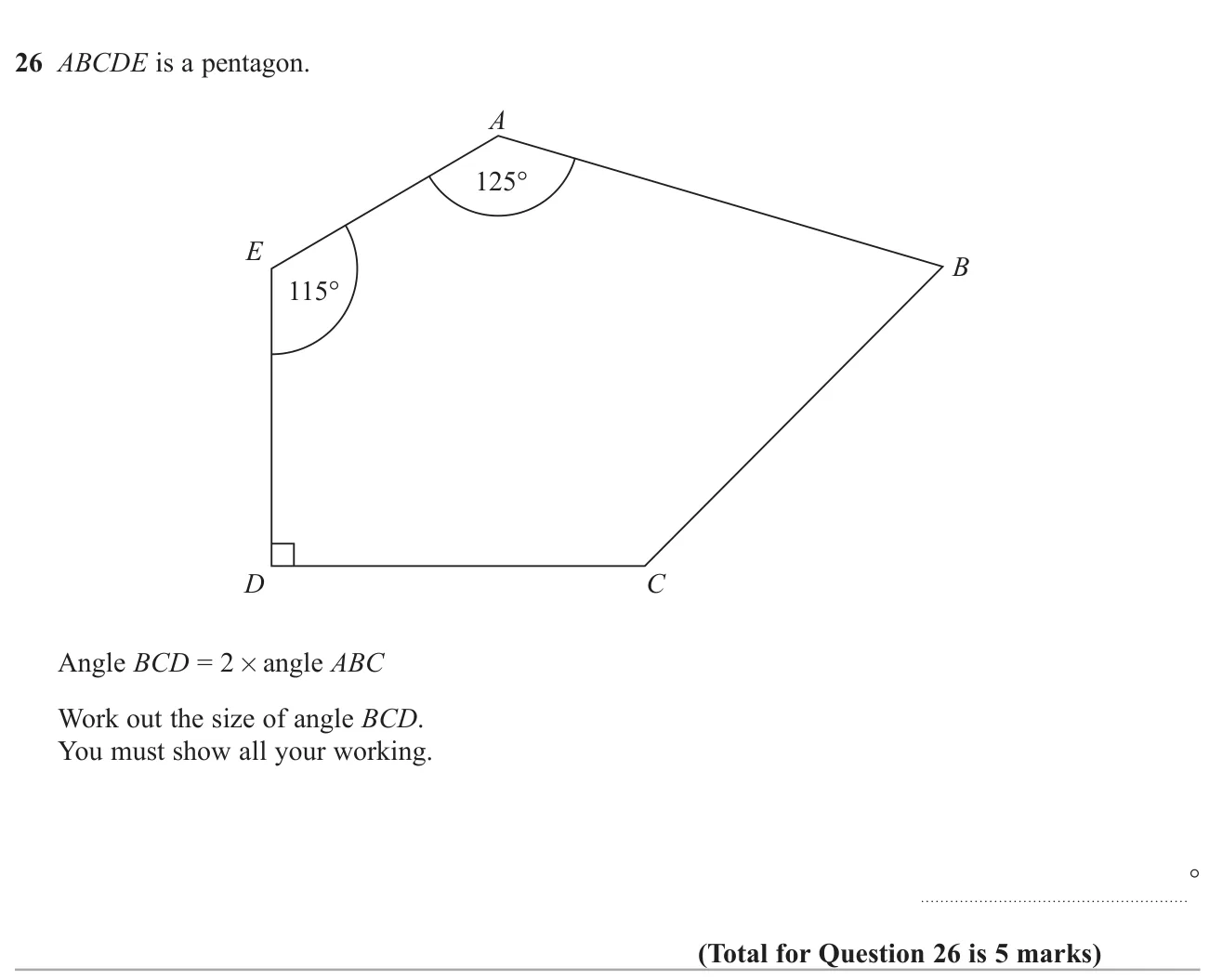
© Pearson Education Ltd. June 2018 Paper 3 (Foundation, calculator), question 26.
| Answer | 5 marks |
|---|
Worked solution Checked against the mark scheme
Angle sum of a pentagon: .
Known angles: , so remains.
If , then , so .
.
Watch out: Forgetting the right angle at D.
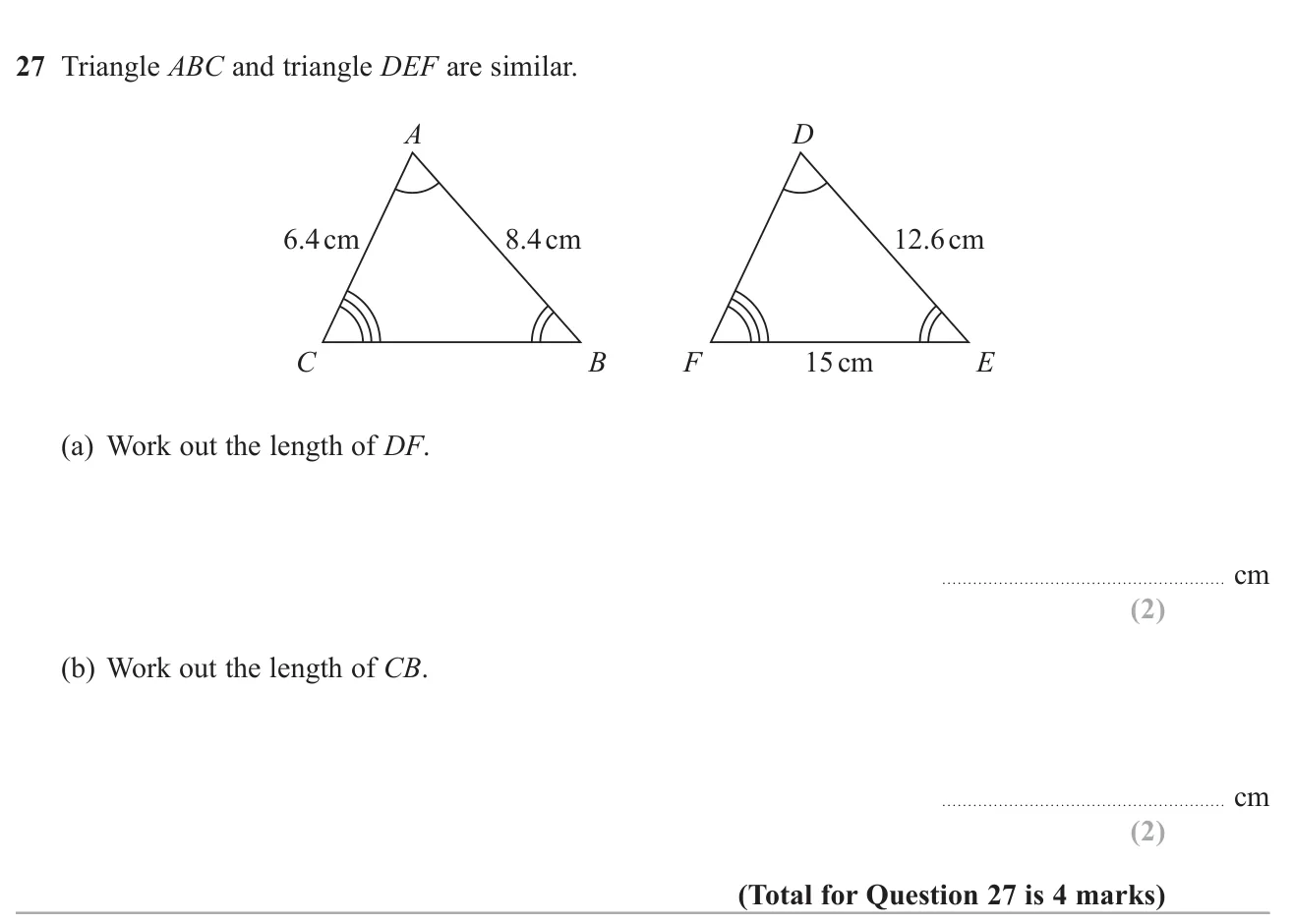
© Pearson Education Ltd. June 2018 Paper 3 (Foundation, calculator), question 27.
| (a) | cm | 2 marks |
|---|---|---|
| (b) | cm | 2 marks |
Worked solution Checked against the mark scheme
matches .
Scale factor: .
(a) cm.
(b) cm.
Watch out: Adding 4.2 instead of multiplying by the scale factor.
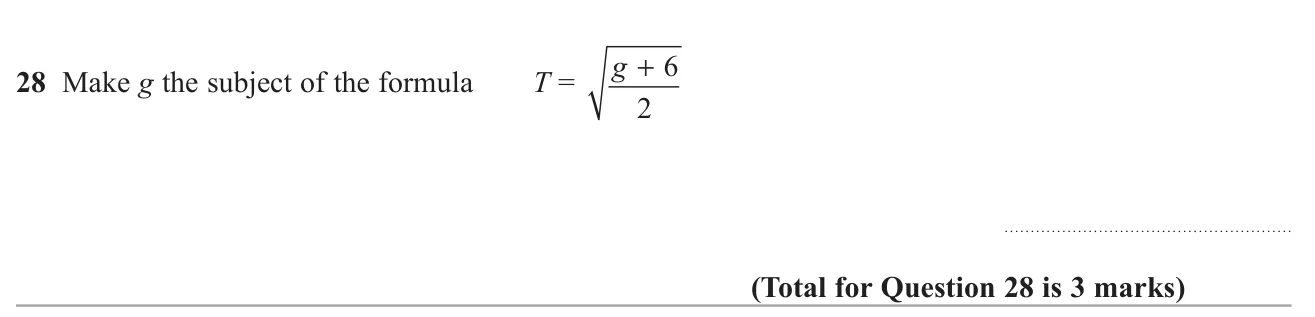
© Pearson Education Ltd. June 2018 Paper 3 (Foundation, calculator), question 28.
| Answer | 3 marks |
|---|
Worked solution Checked against the mark scheme
Square both sides: .
Multiply by 2: .
Subtract 6: .
Watch out: Subtracting 6 before multiplying by 2, giving 2(T² − 6).
Add up your marks for all three papers and see what grade that would have been.