Probability

Listing outcomes and sample spaces

5 past-paper questions, easiest first. Try each one, then reveal the answer.

Foundation & HigherAll 5 from Foundation papers

Revision guide by The Full Marks

Listing outcomes and sample spaces: what you need to know

A sample space is a full list of every possible outcome, often set out as a list, table or grid. Once you have it, finding a probability is just counting.

Key facts

  • List outcomes systematically so you do not miss or repeat any: fix the first item and run through all options for the second.
  • For two events, the number of outcomes = (outcomes for first) ×\times (outcomes for second).
  • A sample space diagram is a grid with one event along the top and the other down the side.
  • If all outcomes are equally likely, P(event)=outcomes in the eventtotal outcomesP(\text{event}) = \frac{\text{outcomes in the event}}{\text{total outcomes}}.
  • Two-way tables sort data by two features at once; the row and column totals must match the grand total.

Using a sample space grid

  1. Write the outcomes of the first event across the top.
  2. Write the outcomes of the second event down the side.
  3. Fill each cell (for example with the total or the pair).
  4. Count the cells you want and divide by the number of cells.

Worked examples

Example 1 Foundation · grade 2

A coin is flipped and a fair dice is rolled. (a) List all the possible outcomes. (b) Find the probability of a head and an even number.

Show the solution

(a) H1, H2, H3, H4, H5, H6, T1, T2, T3, T4, T5, T6 (that is 2×6=122 \times 6 = 12 outcomes)
(b) Wanted: H2, H4, H6, which is 3 outcomes
P=312=14P = \frac{3}{12} = \frac{1}{4}

Example 2 Foundation · grade 5

Spinner A is numbered 1 to 4 and spinner B is numbered 1 to 3. Both are fair. They are spun and the scores are added. Find the probability the total is a prime number.

Show the solution

Grid of totals (A across, B down):
B = 1: 2, 3, 4, 5
B = 2: 3, 4, 5, 6
B = 3: 4, 5, 6, 7
There are 4×3=124 \times 3 = 12 outcomes.
Prime totals: 2, 3, 3, 5, 5, 5, 7, which is 7 outcomes
P(prime)=712P(\text{prime}) = \frac{7}{12}

Example 3 Foundation · grade 4

60 students either walk or take the bus to school. 32 are girls. 18 of the boys walk and 14 of the girls take the bus. (a) Complete a two-way table. (b) A student is chosen at random. Find the probability they walk. (c) A girl is chosen at random. Find the probability she walks.

Show the solution

(a) Boys: 60−32=2860 - 32 = 28, so boys who take the bus =28−18=10= 28 - 18 = 10
Girls who walk =32−14=18= 32 - 14 = 18
Walk total =18+18=36= 18 + 18 = 36, bus total =10+14=24= 10 + 14 = 24 (check: 36+24=6036 + 24 = 60)
(b) P(walks)=3660=35P(\text{walks}) = \frac{36}{60} = \frac{3}{5}
(c) Only the 32 girls count: P=1832=916P = \frac{18}{32} = \frac{9}{16}

Common mistakes

  • Missing outcomes or listing the same one twice. Work in a fixed order.
  • Forgetting that 1 is not prime and 2 is prime when counting totals.
  • Taking the denominator from one row of a two-way table when the question is about everyone.
  • Adding probabilities instead of multiplying for two independent events: P(head and 6) =12×16=112= \frac{1}{2} \times \frac{1}{6} = \frac{1}{12}, or count it in the list.

Exam tips

  • A method mark is often given for a correct, complete list or grid, even if the final probability is wrong, so always show it.
  • Read two-way table questions carefully: 'a student is chosen at random; find the probability they are a girl who walks' divides by the grand total, but 'a girl is chosen at random; find the probability she walks' divides by the number of girls.

Questions people ask

What is a sample space diagram?

A grid or table showing every possible outcome of two events, such as rolling two dice. You count cells to find probabilities.

How do you list outcomes systematically?

Keep the first choice fixed and go through every option for the second, then move to the next first choice. That way you never miss one.

Exam questions: Listing outcomes and sample spaces (5, easiest first)

Listing outcomes and sample spaces2 marksGrade 2CalculatorFoundation
November 2021 · Paper 3 Foundation · Q7
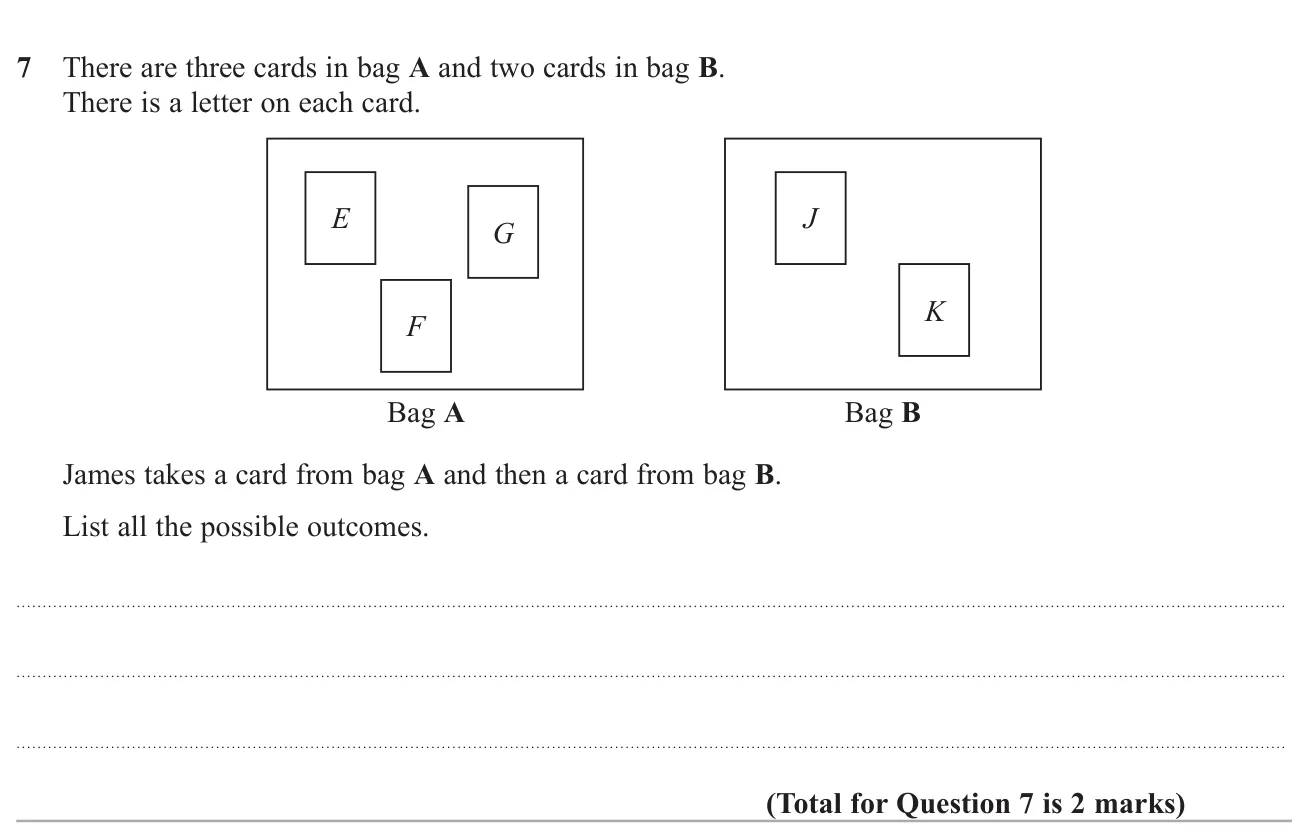
List every possible pair when one card is taken from each of two bags.

© Pearson Education Ltd. November 2021 Paper 3 (Foundation, calculator), question 7.

Show answer
AnswerEJ, EK, FJ, FK, GJ, GK2 marks

Worked solution Checked against the mark scheme

Work systematically: take each letter from bag A in turn and pair it with each letter from bag B.

E: EJ, EK

F: FJ, FK

G: GJ, GK

That gives 3×2=63 \times 2 = 6 outcomes.

Watch out: Missing an outcome or listing the same pair twice.
Listing outcomes and sample spaces3 marksGrade 2No calculatorFoundation
Specimen · Paper 1 Foundation · Q11
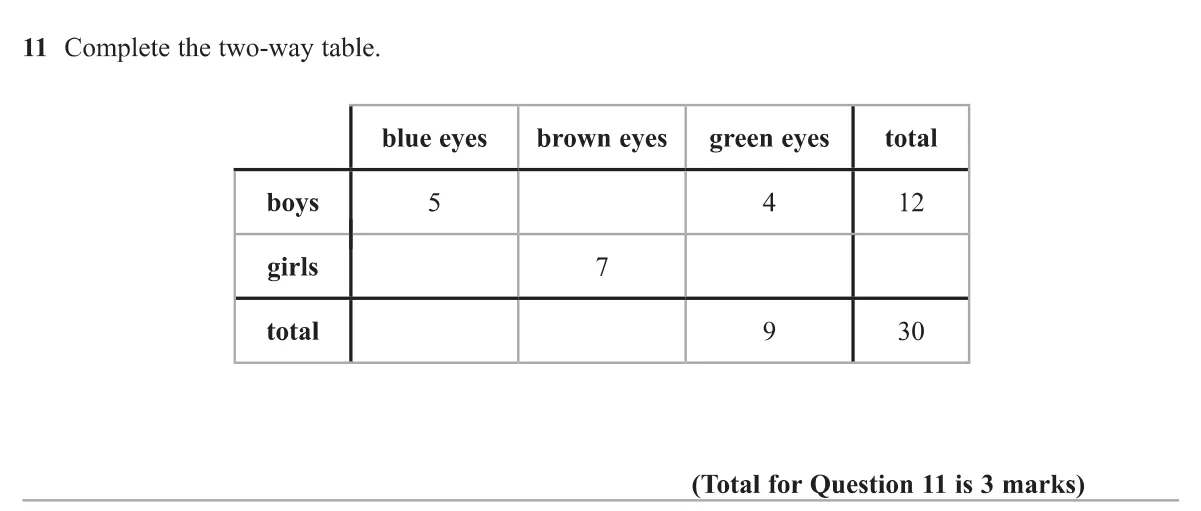
Fill in the missing values in a two-way table of eye colour for boys and girls.

© Pearson Education Ltd. Specimen Paper 1 (Foundation, non-calculator), question 11.

Show answer
AnswerBoys: 5, 3, 4, 12. Girls: 6, 7, 5, 18. Totals: 11, 10, 9, 303 marks

Worked solution Checked against the mark scheme

Boys brown: 12−5−4=312 - 5 - 4 = 3

Girls total: 30−12=1830 - 12 = 18

Girls green: 9−4=59 - 4 = 5

Girls blue: 18−7−5=618 - 7 - 5 = 6

Column totals: blue 5+6=115 + 6 = 11, brown 3+7=103 + 7 = 10 (check: 11+10+9=3011 + 10 + 9 = 30).

Watch out: Adding along a row when the missing value is in a column total.

Listing outcomes and sample spaces5 marksGrade 3No calculatorFoundation
November 2024 · Paper 1 Foundation · Q11
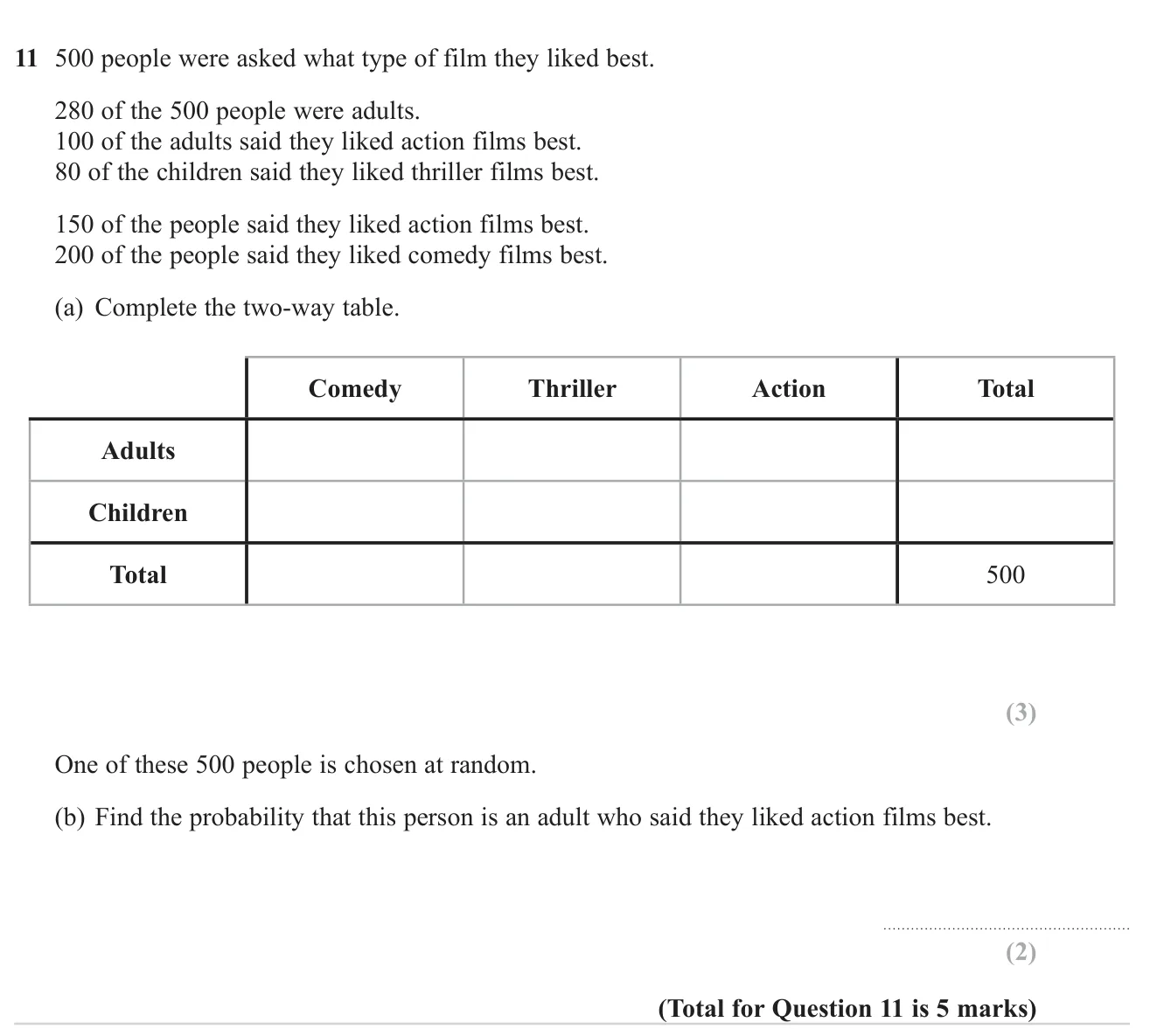
Fill in a two-way table about favourite film types and find a probability from it.

© Pearson Education Ltd. November 2024 Paper 1 (Foundation, non-calculator), question 11.

Show answer
(a)Adults: 110, 70, 100, 280; Children: 90, 80, 50, 220; Totals: 200, 150, 150, 5003 marks
(b)100500\frac{100}{500}2 marks

Worked solution Checked against the mark scheme

(a) Children =500−280=220= 500 - 280 = 220. Children action =150−100=50= 150 - 100 = 50.

Thriller total =500−200−150=150= 500 - 200 - 150 = 150, so adult thriller =150−80=70= 150 - 80 = 70.

Adult comedy =280−70−100=110= 280 - 70 - 100 = 110, child comedy =200−110=90= 200 - 110 = 90.

(b) 100 of the 500 people are adults who like action: 100500=15\frac{100}{500} = \frac{1}{5}

Watch out: In (b), using 100/280 (only the adults).

Listing outcomes and sample spaces4 marksGrade 3CalculatorFoundation
November 2018 · Paper 2 Foundation · Q14
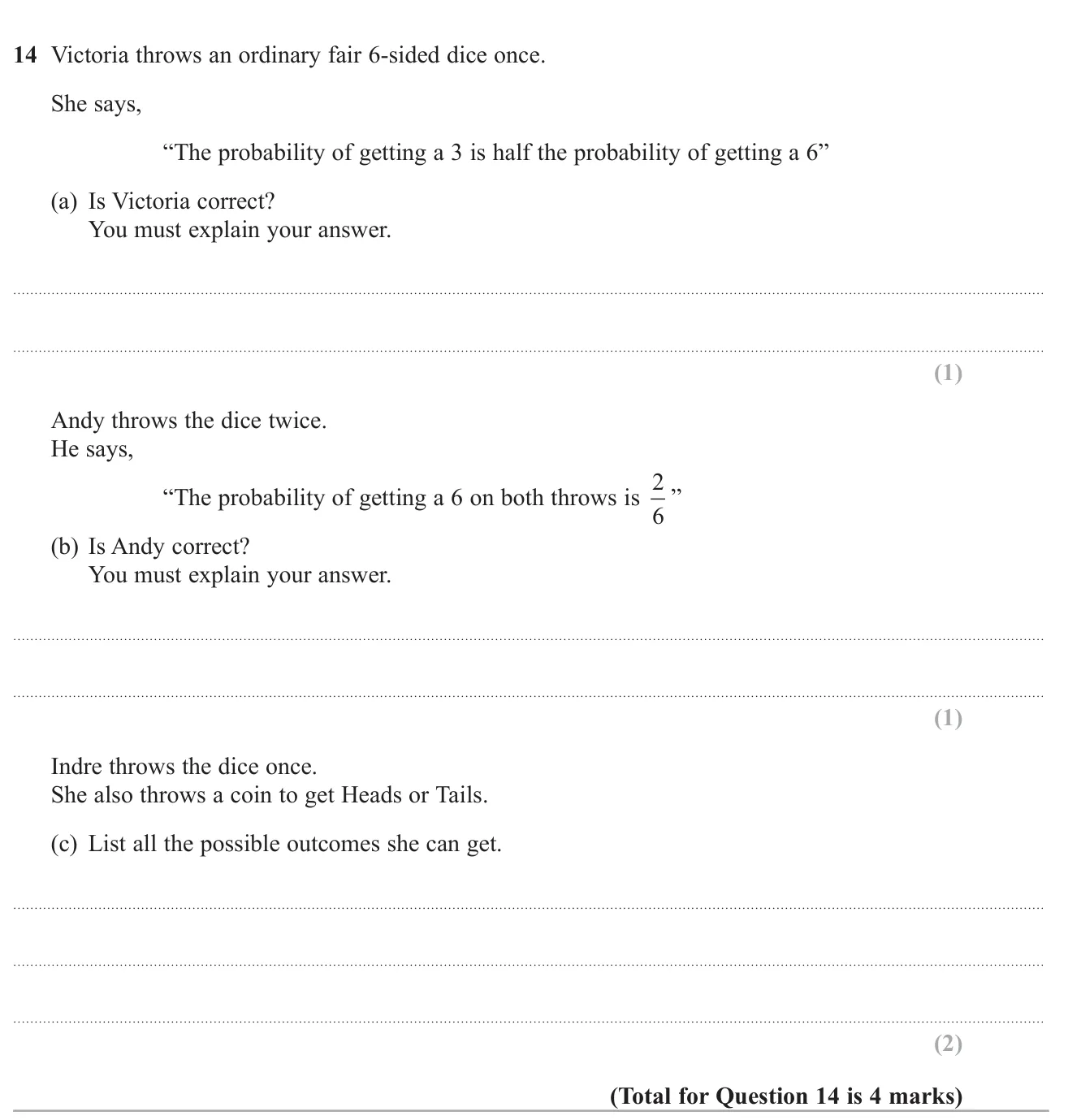
Judge two probability claims about a fair dice and list the outcomes of a dice and a coin.

© Pearson Education Ltd. November 2018 Paper 2 (Foundation, calculator), question 14.

Show answer
(a)No: both have probability 16\frac{1}{6}1 mark
(b)No: it is 16×16=136\frac{1}{6} \times \frac{1}{6} = \frac{1}{36}1 mark
(c)1H, 2H, 3H, 4H, 5H, 6H, 1T, 2T, 3T, 4T, 5T, 6T2 marks

Worked solution Checked against the mark scheme

(a) A fair dice gives each number a 16\frac{1}{6} chance, so 3 and 6 are equally likely.

(b) Two sixes: 16×16=136\frac{1}{6} \times \frac{1}{6} = \frac{1}{36}, not 26\frac{2}{6}.

(c) Each of 6 numbers pairs with H or T: 6×2=126 \times 2 = 12 outcomes, 1H to 6H and 1T to 6T.

Watch out: In (b), adding the probabilities instead of multiplying.

Listing outcomes and sample spaces5 marksGrade 4CalculatorFoundation
November 2021 · Paper 2 Foundation · Q17
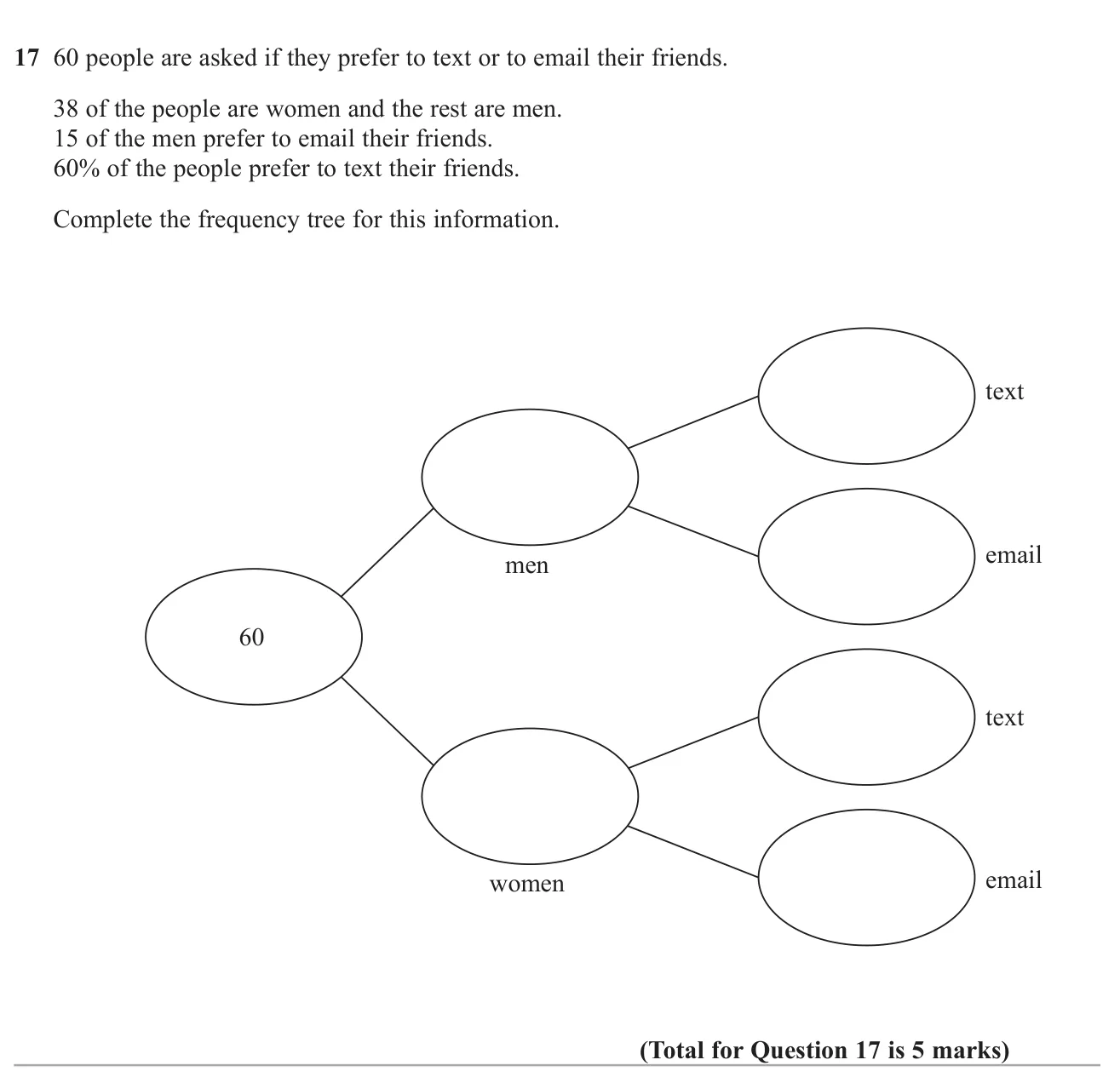
Fill in a frequency tree from information about gender, a count and a percentage.

© Pearson Education Ltd. November 2021 Paper 2 (Foundation, calculator), question 17.

Show answer
AnswerWomen 38: text 29, email 9; men 22: text 7, email 155 marks

Worked solution Checked against the mark scheme

Men: 60−38=2260 - 38 = 22. Men who text: 22−15=722 - 15 = 7.

Text in total: 0.6×60=360.6 \times 60 = 36.

Women who text: 36−7=2936 - 7 = 29. Women who email: 38−29=938 - 29 = 9.

Watch out: Taking 60% of the 38 women instead of 60% of all 60 people.

Also tested in these questions

Their main topic is different, but part of each one tests this topic.