© Pearson Education Ltd. November 2021 Paper 3 (Higher, calculator), question 1.
Show answer
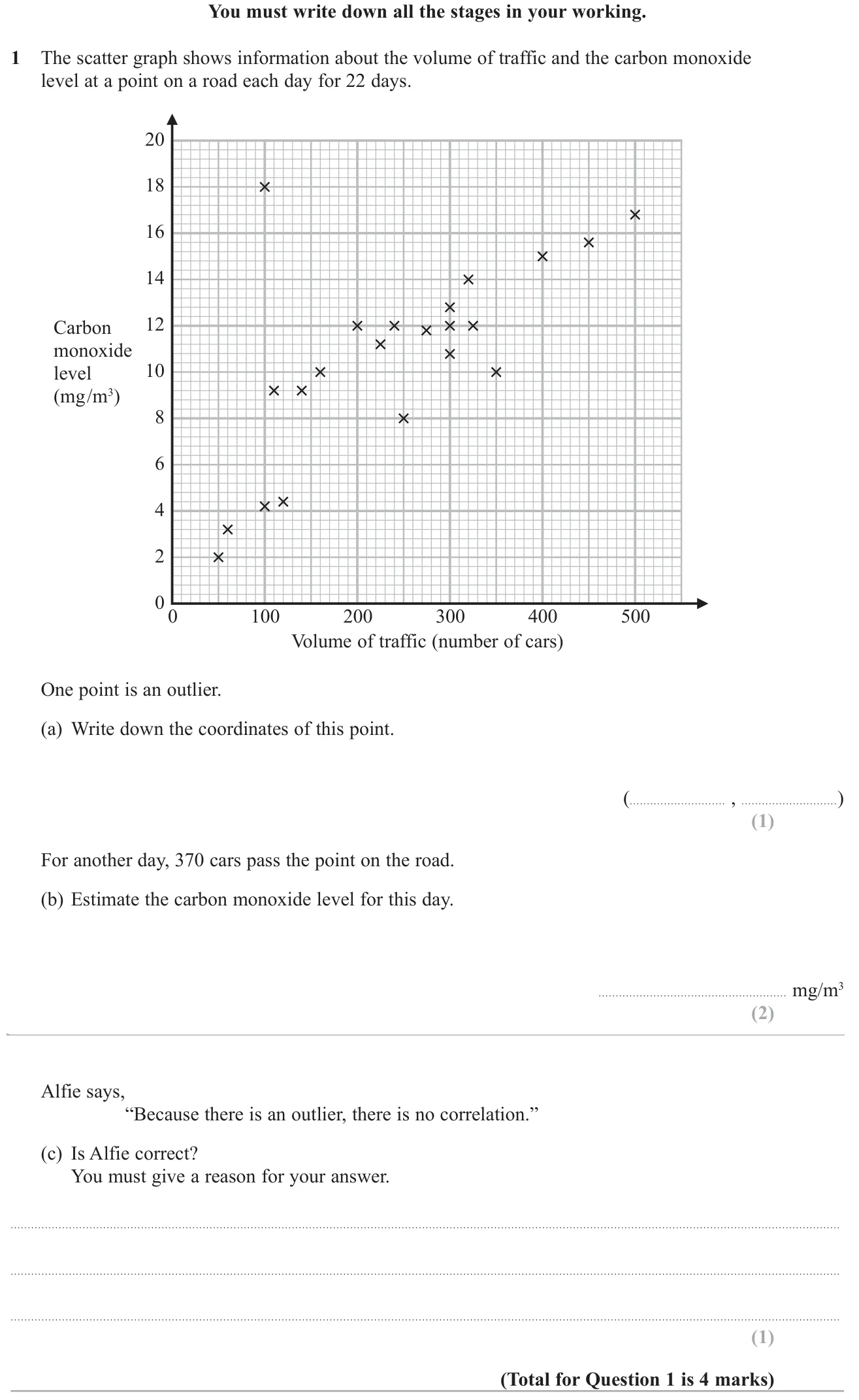
| (a) | (100, 18) | 1 mark |
|---|
| (b) | About 13.8 mg/m³ (12.8 to 14.8) | 2 marks |
|---|
| (c) | No, the rest of the points still show positive correlation | 1 mark |
|---|
Worked solution Checked against the mark scheme
(a) The point far from the others is at (100,18).
(b) Draw a line of best fit through the main trend and read up from 370: about 13.8 mg/m³.
(c) No. One outlier does not remove the pattern; the other points still show positive correlation.
Watch out: In (c), agreeing with Alfie or saying 'yes'.
© Pearson Education Ltd. November 2021 Paper 3 (Higher, calculator), question 2.
Show answer
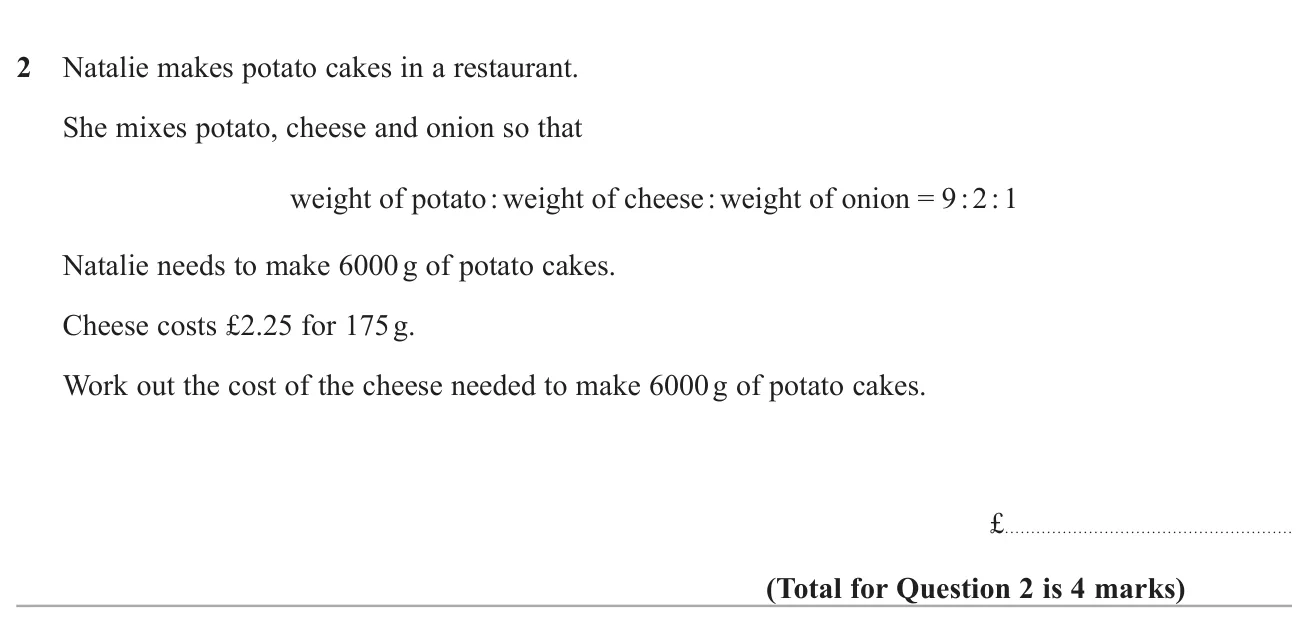
| Answer | £12.86 (or £13.50 if whole packs are bought) | 4 marks |
|---|
Worked solution Checked against the mark scheme
Total parts: 9+2+1=12
Cheese: 6000÷12×2=1000 g
1000÷175=5.714... lots of 175 g
5.714...×2.25=£12.857..., so about £12.86
Watch out: Using 2 out of 3 parts instead of 2 out of 12.
© Pearson Education Ltd. November 2021 Paper 3 (Higher, calculator), question 3.
Show answer
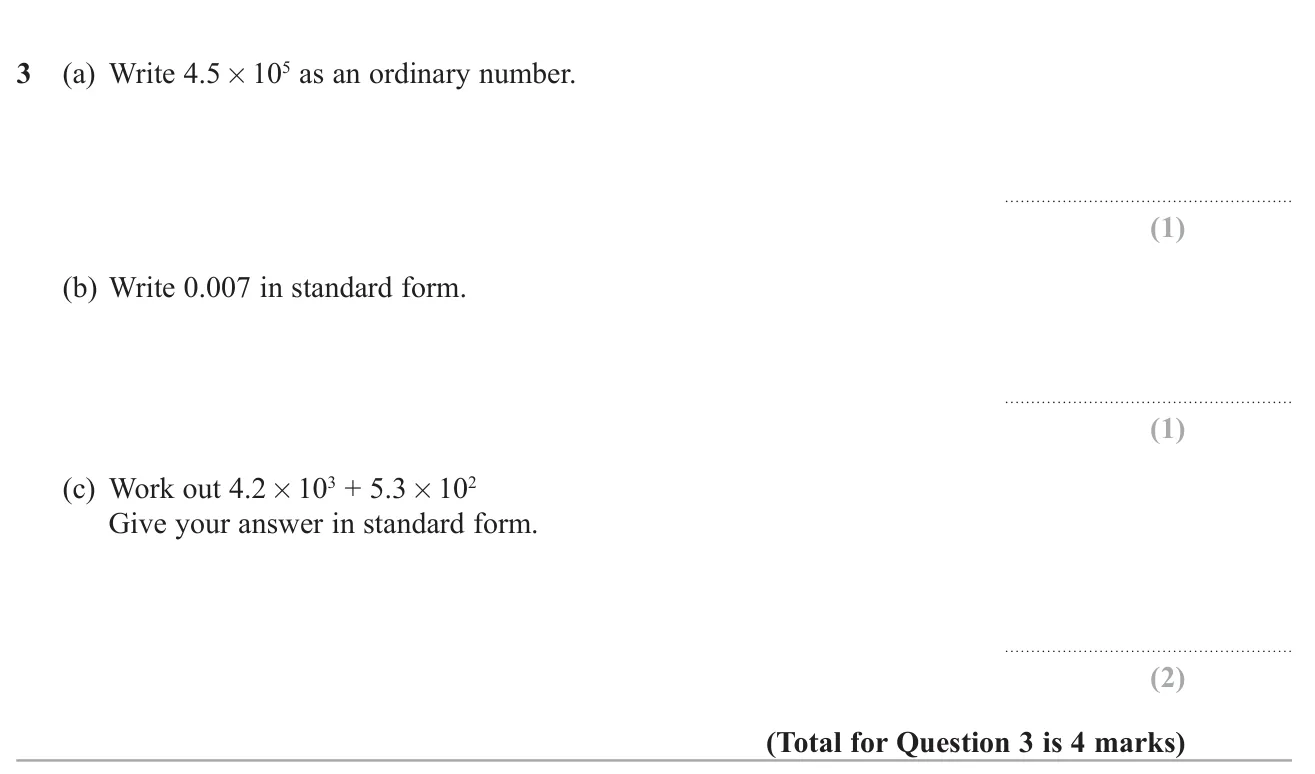
| (a) | 450 000 | 1 mark |
|---|
| (b) | 7×10⁻³ | 1 mark |
|---|
| (c) | 4.73×10³ | 2 marks |
|---|
Worked solution Checked against the mark scheme
(a) Move the digits 5 places: 4.5×105=450000
(b) 0.007=7×10⁻³
(c) 4200+530=4730=4.73×10³
Watch out: In (c), adding the numbers and powers separately to get 9.5×10⁵.
© Pearson Education Ltd. November 2021 Paper 3 (Higher, calculator), question 4.
Show answer
Worked solution Checked against the mark scheme
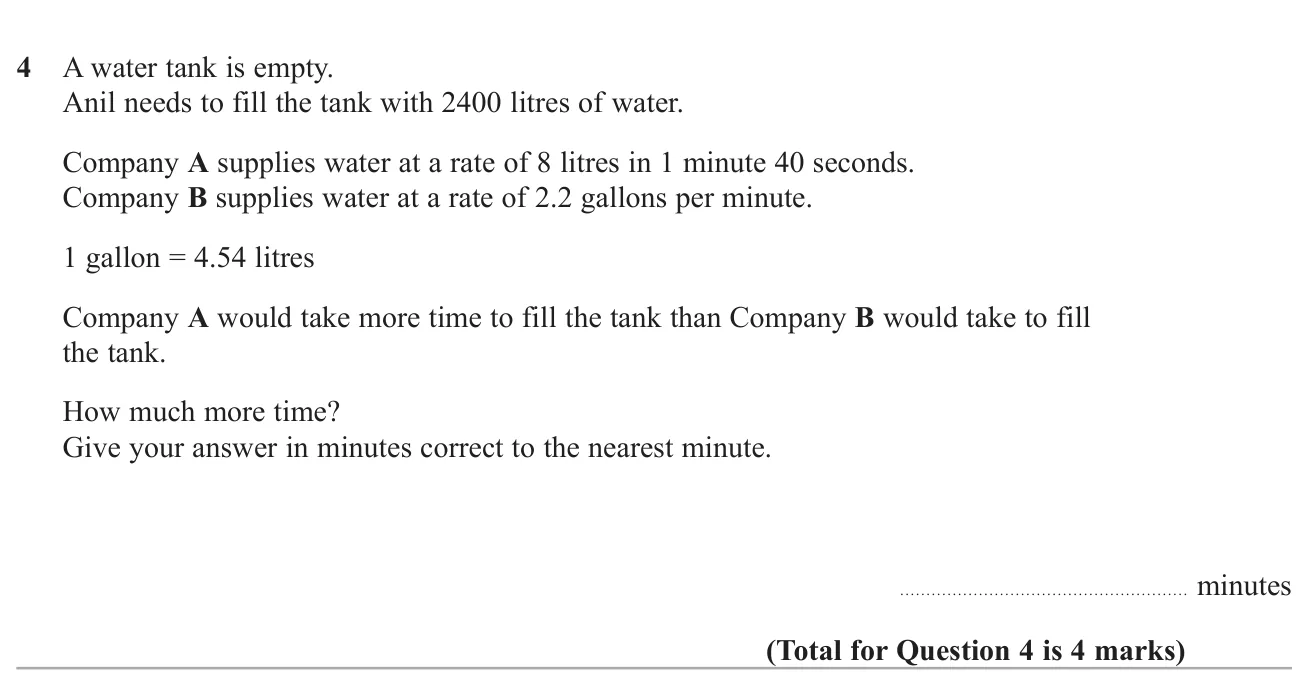
Company A: 1 min 40 s =35 min, so the rate is 8÷35=4.8 litres per minute.
Time A =2400÷4.8=500 min.
Company B: 2.2×4.54=9.988 litres per minute.
Time B =2400÷9.988=240.29 min.
Difference =500−240.29=259.7, about 260 minutes.
Watch out: Treating 1 minute 40 seconds as 1.4 minutes.
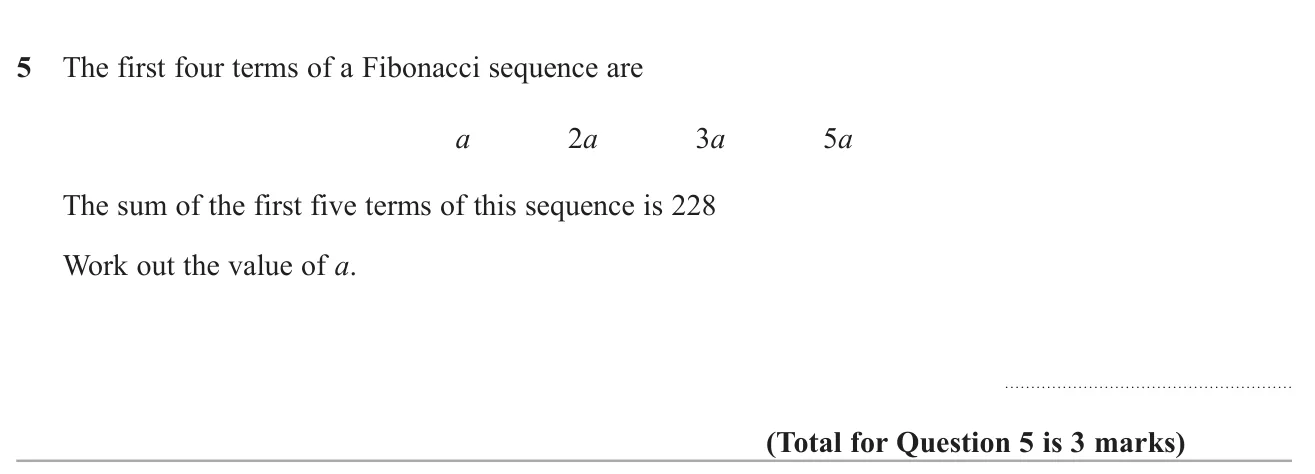
© Pearson Education Ltd. November 2021 Paper 3 (Higher, calculator), question 5.
Show answer
Worked solution Checked against the mark scheme
Each term is the sum of the two before, so the fifth term is 3a+5a=8a.
a+2a+3a+5a+8a=19a
19a=228, so a=12.
Watch out: Summing only the four given terms, giving 11a=228.
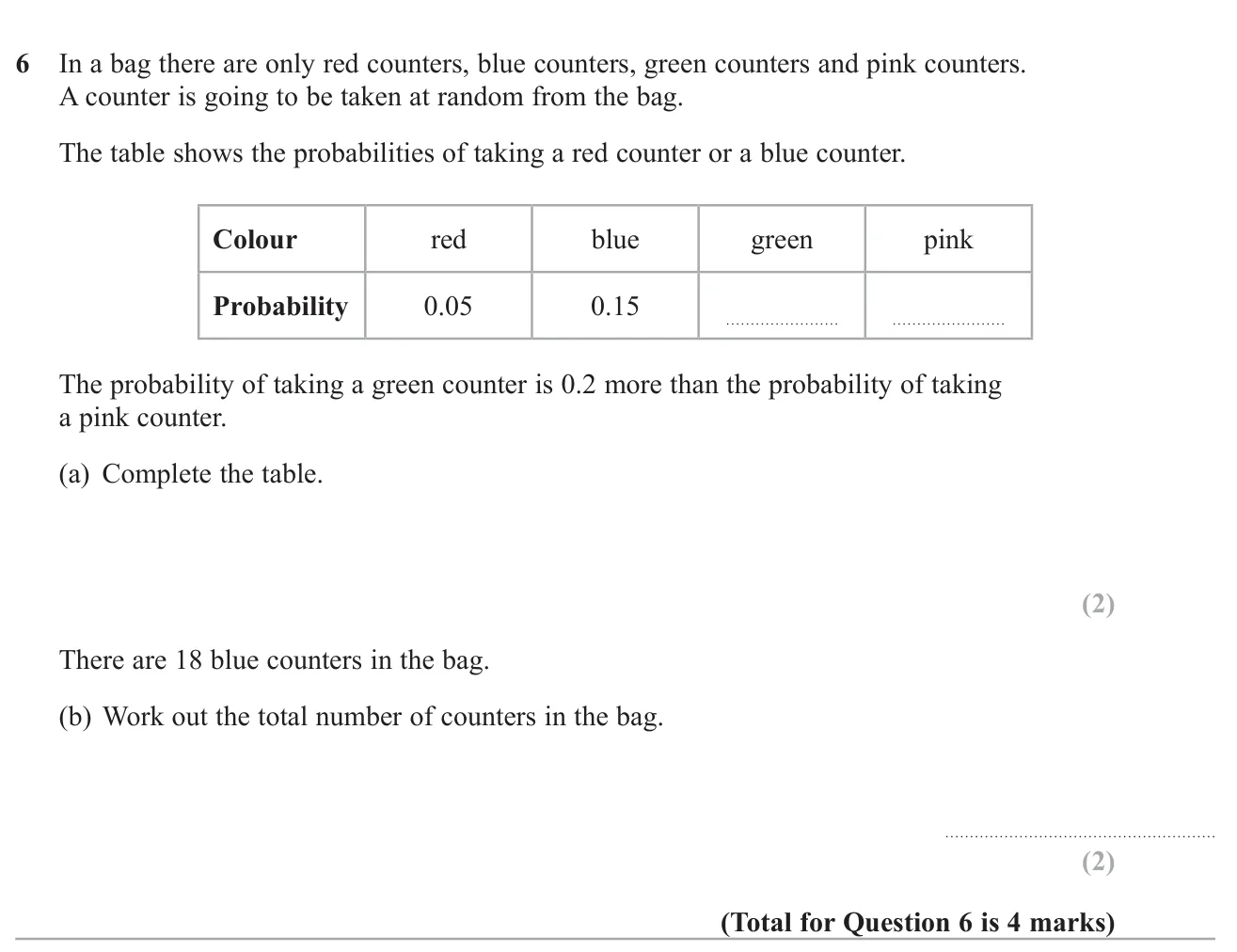
© Pearson Education Ltd. November 2021 Paper 3 (Higher, calculator), question 6.
Show answer
| (a) | green 0.5, pink 0.3 | 2 marks |
|---|
| (b) | 120 | 2 marks |
|---|
Worked solution Checked against the mark scheme
(a) The probabilities add to 1: 1−0.05−0.15=0.8 for green and pink together.
Green is 0.2 more than pink: 2p+0.2=0.8, so pink =0.3 and green =0.5.
(b) 0.15 of the counters are blue: 18÷0.15=120.
Watch out: In (a), splitting 0.8 equally as 0.4 and 0.4.
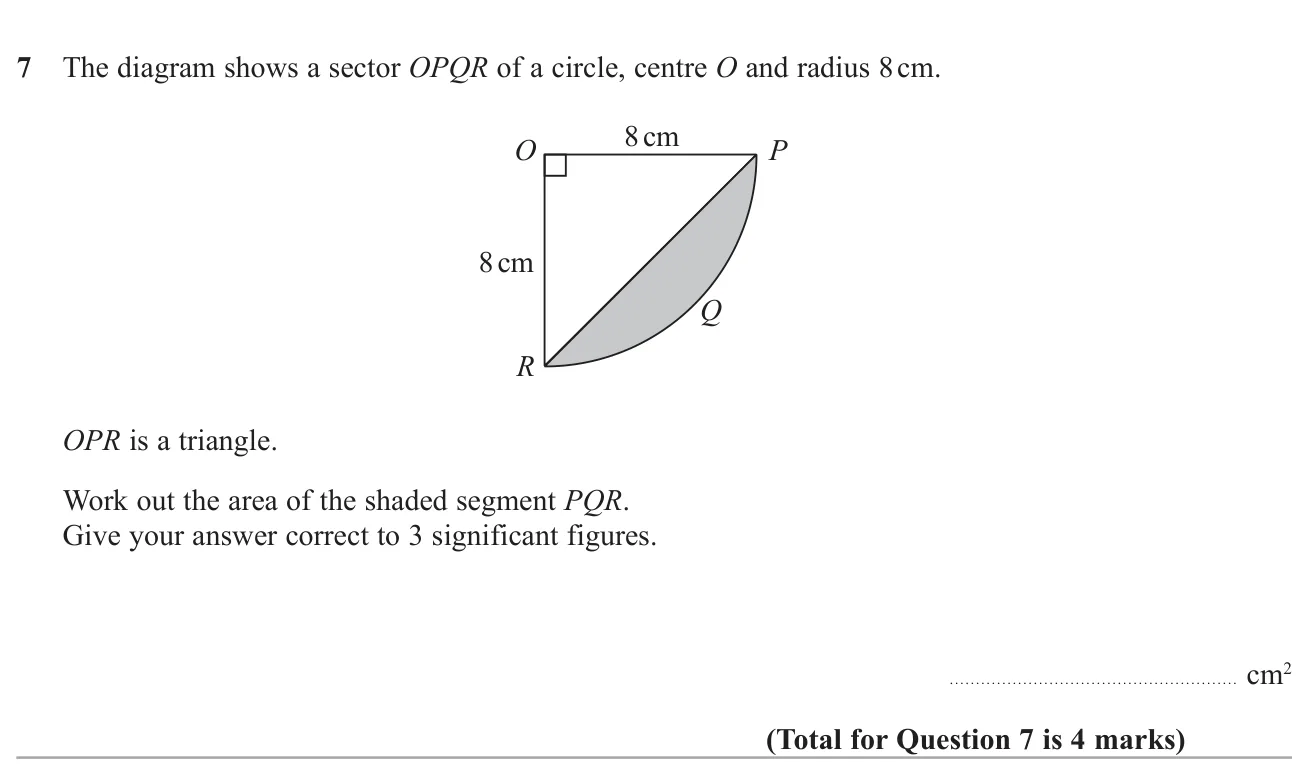
© Pearson Education Ltd. November 2021 Paper 3 (Higher, calculator), question 7.
Show answer
Worked solution Checked against the mark scheme
Quarter circle: 41×π×82=50.265... cm²
Triangle OPR: 21×8×8=32 cm²
Segment =50.265...−32=18.265...
So the area is 18.3 cm² (3 s.f.).
Watch out: Using 2πr (circumference) instead of πr2.
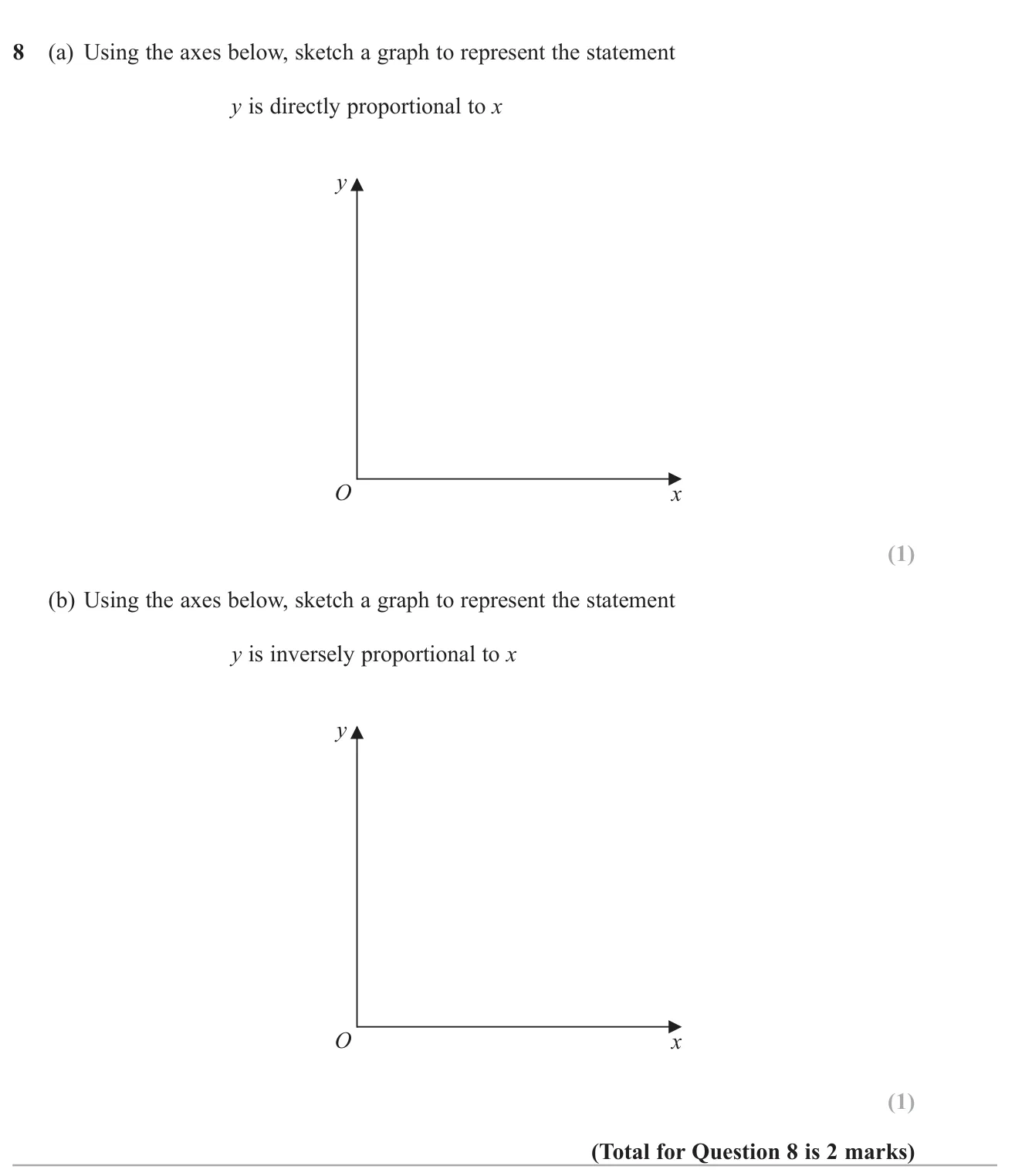
© Pearson Education Ltd. November 2021 Paper 3 (Higher, calculator), question 8.
Show answer
| (a) | A straight line through the origin with positive gradient | 1 mark |
|---|
| (b) | A curve in the first quadrant that falls as x increases, approaching both axes without touching them | 1 mark |
|---|
Worked solution Checked against the mark scheme
(a) y=kx: a straight line starting at the origin and going up to the right.
(b) y=xk: a curve that is high near the y-axis, falls as x grows and gets closer to the x-axis, never touching either axis.
Watch out: In (a), drawing a line that does not pass through the origin; in (b), drawing a straight line sloping down.
© Pearson Education Ltd. November 2021 Paper 3 (Higher, calculator), question 9.
Show answer
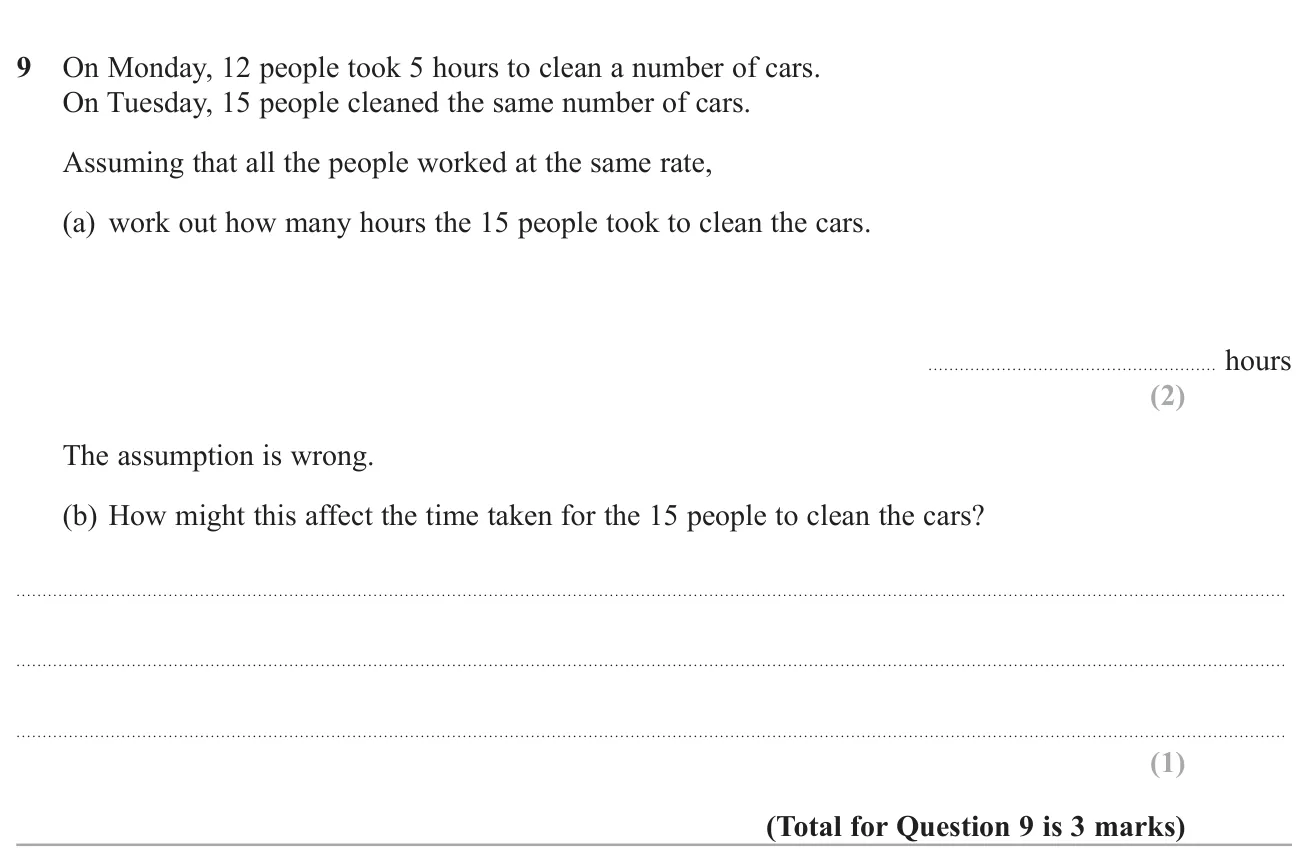
| (a) | 4 hours | 2 marks |
|---|
| (b) | The time could be longer or shorter, depending on whether they work slower or faster | 1 mark |
|---|
Worked solution Checked against the mark scheme
(a) Total work =12×5=60 person-hours. 60÷15=4 hours.
(b) If the people work at different rates, it could take longer (if some are slower) or less time (if some are faster).
Watch out: In (a), using direct proportion: 5×15÷12=6.25 hours.
© Pearson Education Ltd. November 2021 Paper 3 (Higher, calculator), question 10.
Show answer
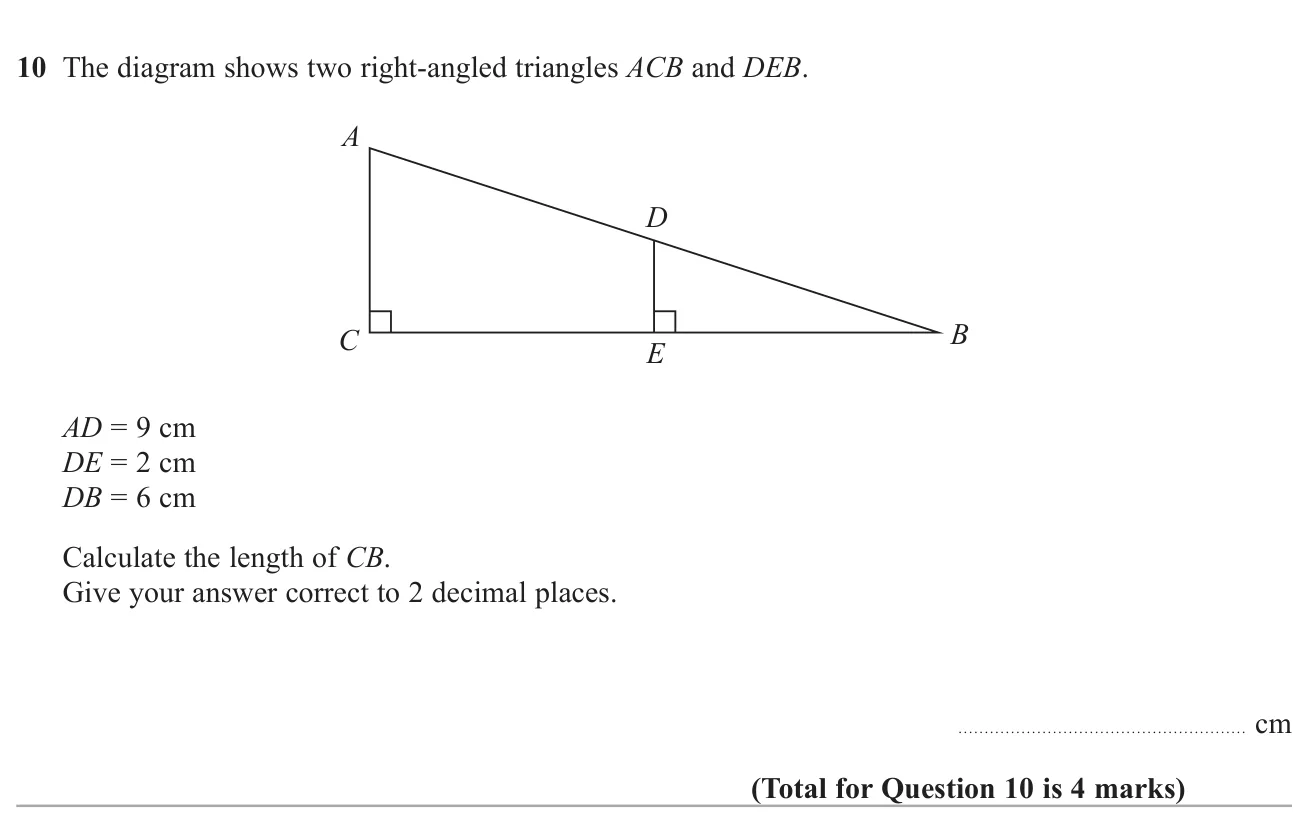
| Answer | 14.14 cm | 4 marks |
|---|
Worked solution Checked against the mark scheme
EB=62−22=32=5.656...
Triangles DEB and ACB are similar with scale factor DBAB=69+6=2.5
CB=2.5×32=14.142..., so 14.14 cm
Watch out: Using 9 ÷ 6 = 1.5 as the scale factor instead of 15 ÷ 6.
© Pearson Education Ltd. November 2021 Paper 3 (Higher, calculator), question 11.
Show answer
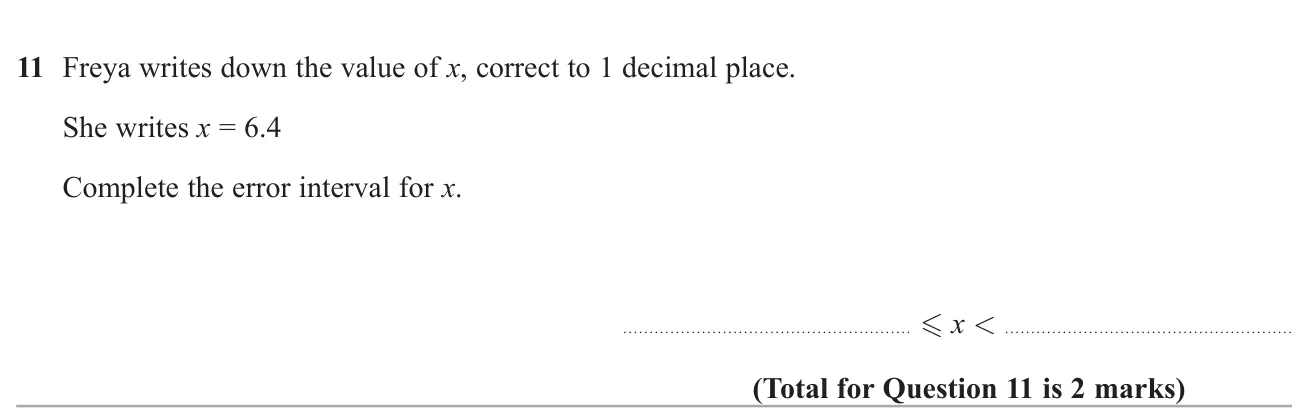
| Answer | 6.35≤x<6.45 | 2 marks |
|---|
Worked solution Checked against the mark scheme
Rounding to 1 decimal place means x is within 0.05 of 6.4.
Lower bound =6.4−0.05=6.35, upper bound =6.4+0.05=6.45
6.35≤x<6.45
Watch out: Using 6.44 or 6.449 as the upper limit.
© Pearson Education Ltd. November 2021 Paper 3 (Higher, calculator), question 12.
Show answer
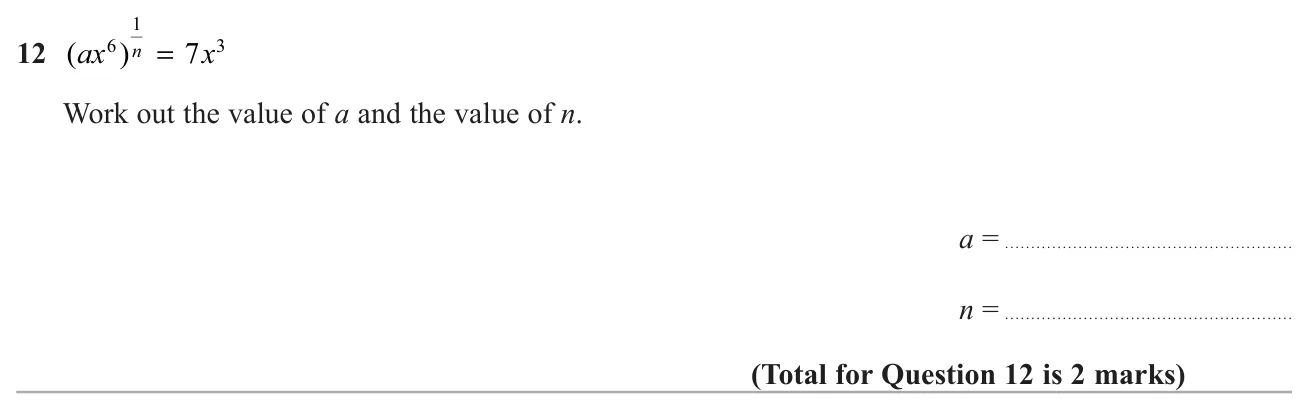
| Answer | a=49, n=2 | 2 marks |
|---|
Worked solution Checked against the mark scheme
Powers of x: x6×n1=x3, so n6=3 and n=2.
Numbers: a21=7, so a=72=49.
Watch out: Giving a=7 or a=7.
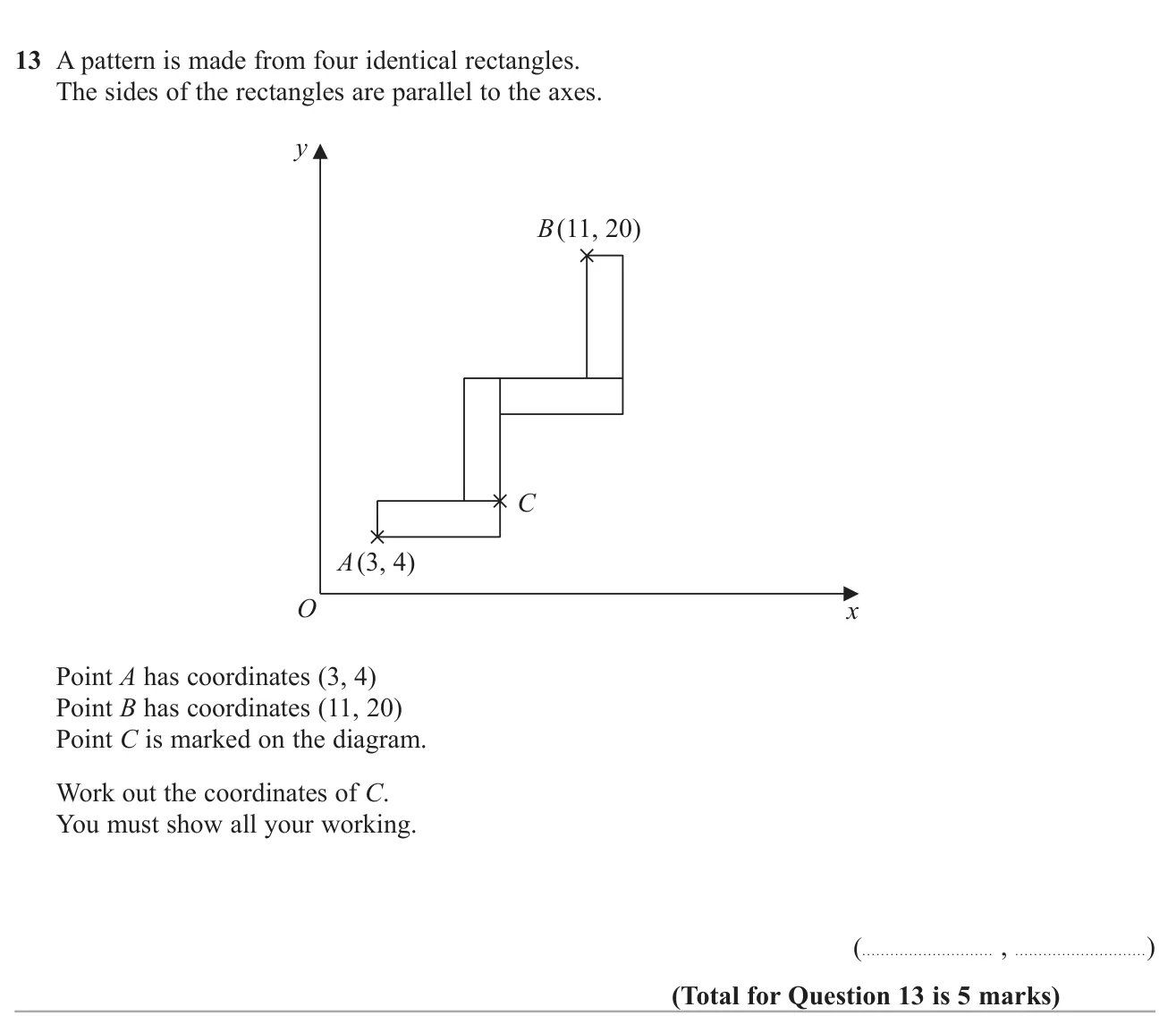
© Pearson Education Ltd. November 2021 Paper 3 (Higher, calculator), question 13.
Show answer
| Answer | (9,8) | 5 marks |
|---|
Worked solution Checked against the mark scheme
Let each rectangle be l long and w wide.
Across from A to B: 11−3=8, so 2l−w=8
Up from A to B: 20−4=16, so 2l+w=16
Adding: 4l=24, l=6, then w=4.
C is one length right and one width up from A: (3+6,4+4)=(9,8)
Watch out: Assuming the rectangles are twice as long as they are wide without checking.
Question 14
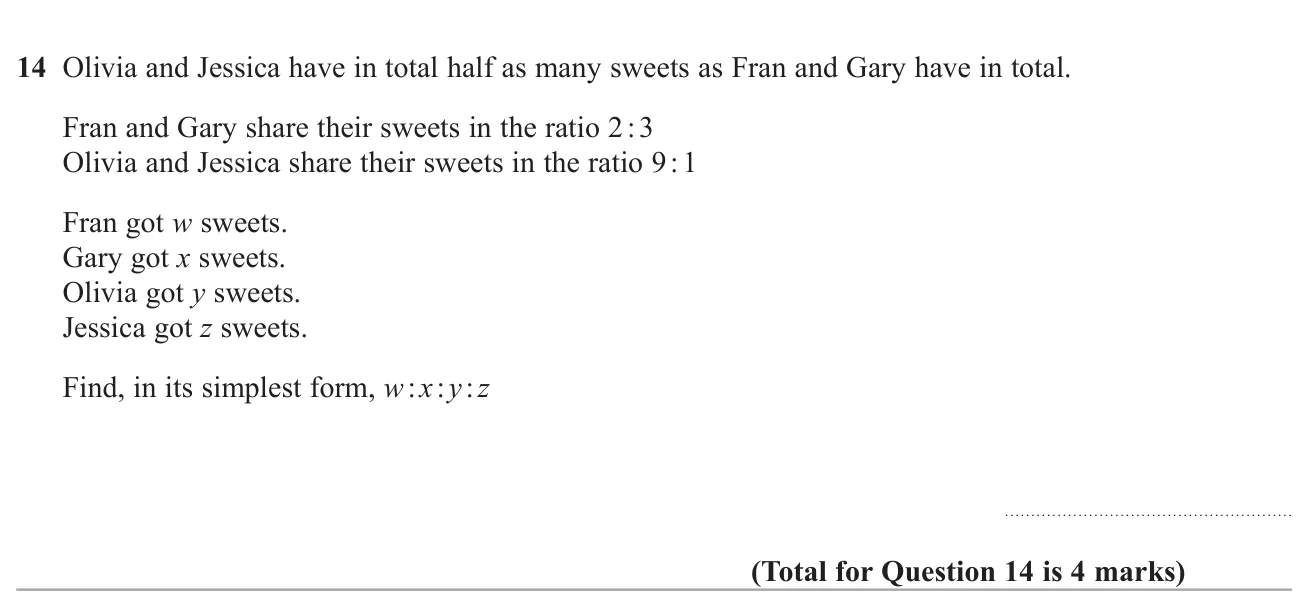
Ratio4 marksGrade 6Calculator © Pearson Education Ltd. November 2021 Paper 3 (Higher, calculator), question 14.
Show answer
| Answer | 8:12:9:1 | 4 marks |
|---|
Worked solution Checked against the mark scheme
Fran and Gary share 5 parts; Olivia and Jessica share 10 parts.
Olivia and Jessica have half as many, so Fran and Gary's total must be 20 parts: multiply 2:3 by 4 to get 8:12.
Olivia and Jessica: 9:1 (total 10, which is half of 20).
w:x:y:z=8:12:9:1
Watch out: Writing 2 : 3 : 9 : 1 without matching the totals.
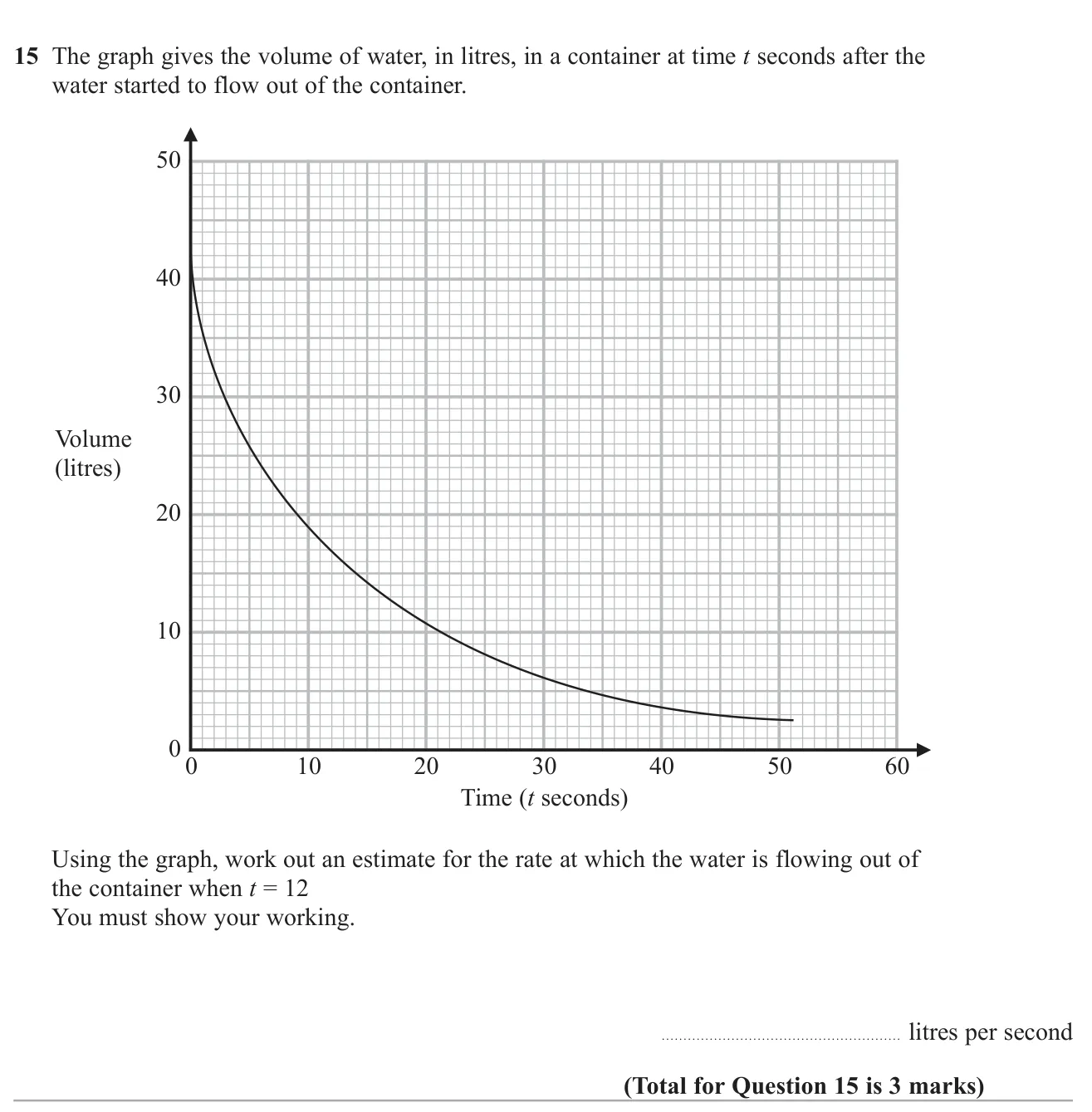
© Pearson Education Ltd. November 2021 Paper 3 (Higher, calculator), question 15.
Show answer
| Answer | About 0.9 litres per second (accept 0.7 to 1.1) | 3 marks |
|---|
Worked solution Checked against the mark scheme
Draw a tangent to the curve at t=12 (where the volume is about 17 litres).
Pick two points far apart on the tangent, e.g. the tangent drops about 28 litres over 30 seconds.
Gradient ≈28÷30≈0.93, so water flows out at about 0.9 litres per second.
Watch out: Dividing the volume at t = 12 by 12 (an average rate) instead of drawing a tangent.
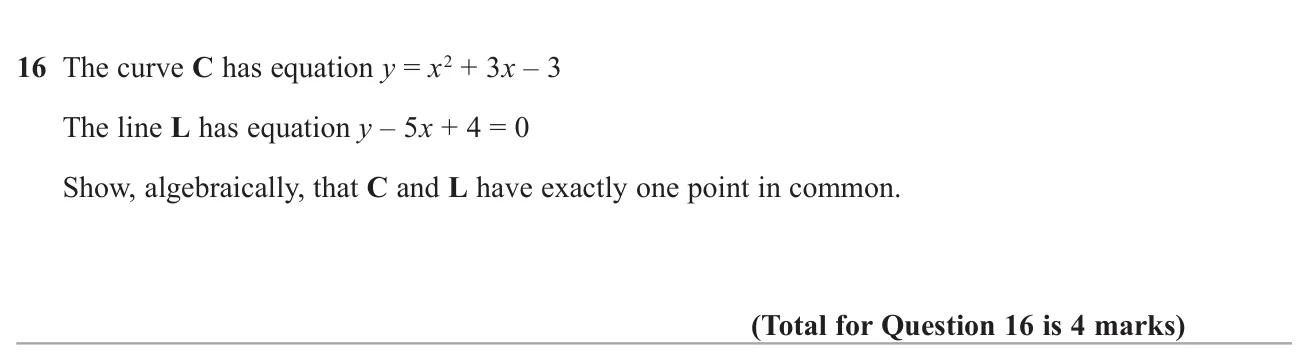
© Pearson Education Ltd. November 2021 Paper 3 (Higher, calculator), question 16.
Show answer
| Answer | x2−2x+1=0 gives (x−1)2=0, a single root, so one point in common | 4 marks |
|---|
Worked solution Checked against the mark scheme
From the line: y=5x−4
Set equal: x2+3x−3=5x−4
x2−2x+1=0
(x−1)2=0, so x=1 is the only solution.
One value of x means only one point in common, (1,1).
Watch out: Solving correctly but not writing a statement explaining why this means one point.
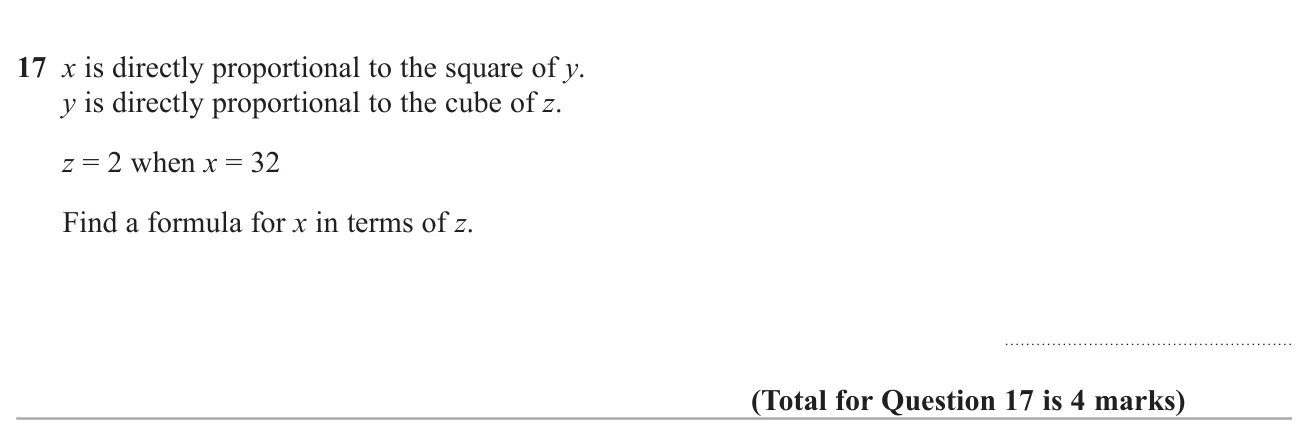
© Pearson Education Ltd. November 2021 Paper 3 (Higher, calculator), question 17.
Show answer
| Answer | x=21z6 | 4 marks |
|---|
Worked solution Checked against the mark scheme
x=ky2 and y=cz3, so x=k(cz3)2=mz6
Substitute z=2, x=32: 32=m×64, so m=21
x=21z6
Watch out: Writing x=mz5 by adding the powers instead of multiplying.
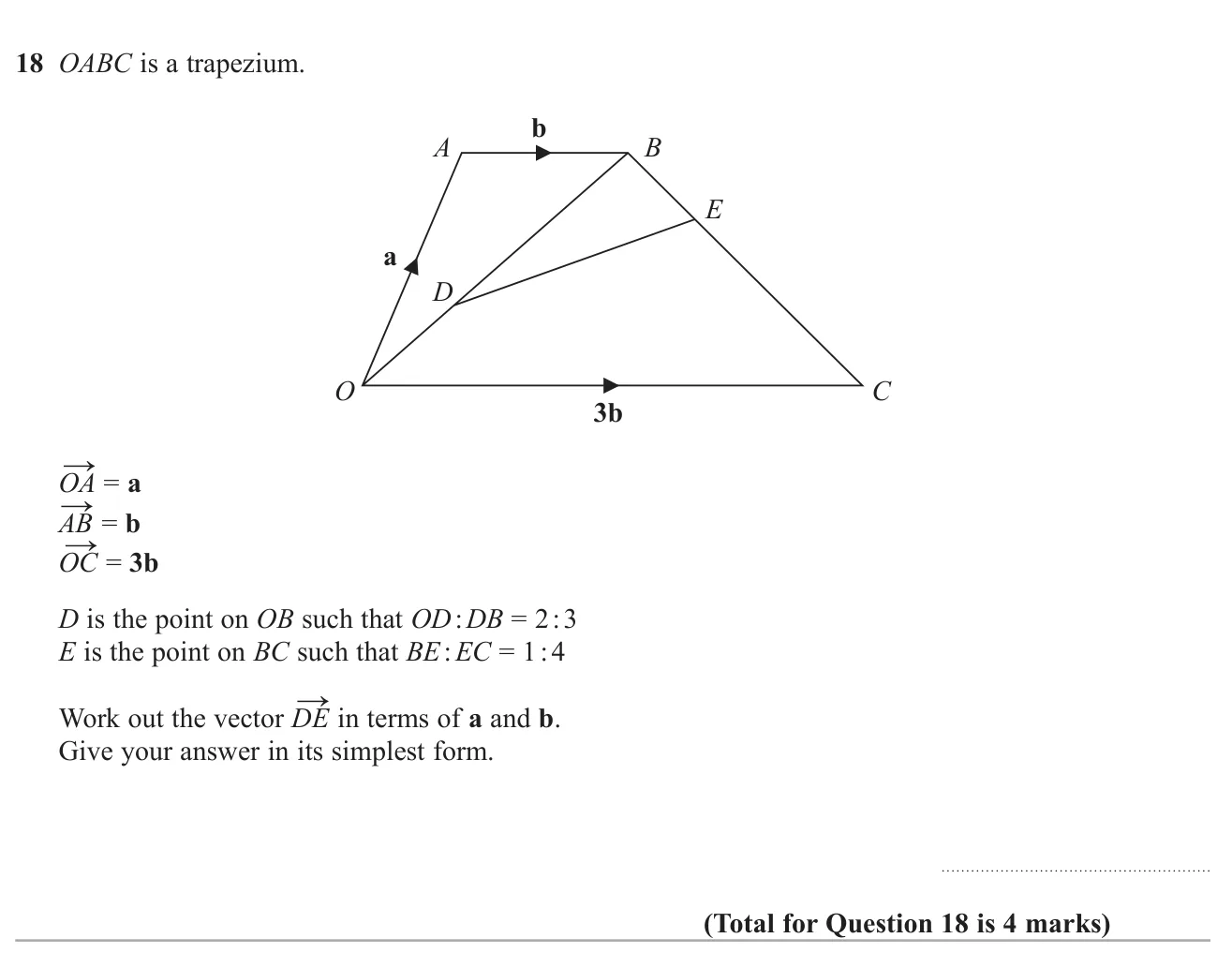
© Pearson Education Ltd. November 2021 Paper 3 (Higher, calculator), question 18.
Show answer
| Answer | 52a+b | 4 marks |
|---|
Worked solution Checked against the mark scheme
OB=a+b, so DB=53(a+b)
BC=−b−a+3b=2b−a, so BE=51(2b−a)
DE=53a+53b+52b−51a=52a+b
Watch out: Using 32 instead of 53 for DB (confusing a ratio with a fraction).
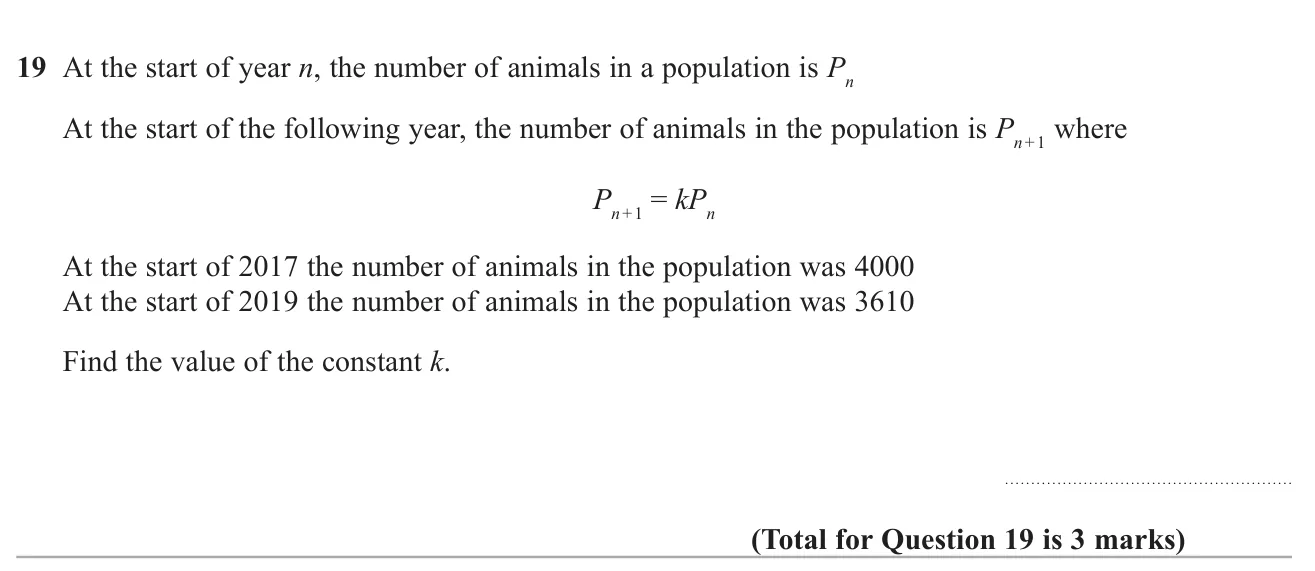
© Pearson Education Ltd. November 2021 Paper 3 (Higher, calculator), question 19.
Show answer
| Answer | k=0.95 | 3 marks |
|---|
Worked solution Checked against the mark scheme
2017 to 2019 is two years, so P2019=k2P2017.
3610=4000k2
k2=0.9025, so k=0.9025=0.95
Watch out: Using k=3610÷4000=0.9025 (only one year of change).
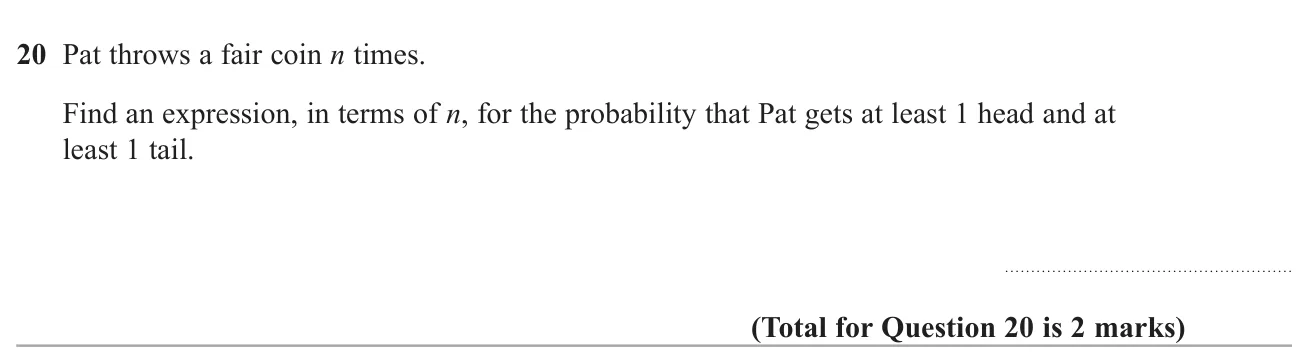
© Pearson Education Ltd. November 2021 Paper 3 (Higher, calculator), question 20.
Show answer
| Answer | 1−2(21)n=1−(21)n−1 | 2 marks |
|---|
Worked solution Checked against the mark scheme
The only outcomes that fail are all heads or all tails.
P(all heads)=(21)n and P(all tails)=(21)n
So the probability =1−2(21)n=1−(21)n−1
Watch out: Subtracting only one of the all-heads or all-tails cases.
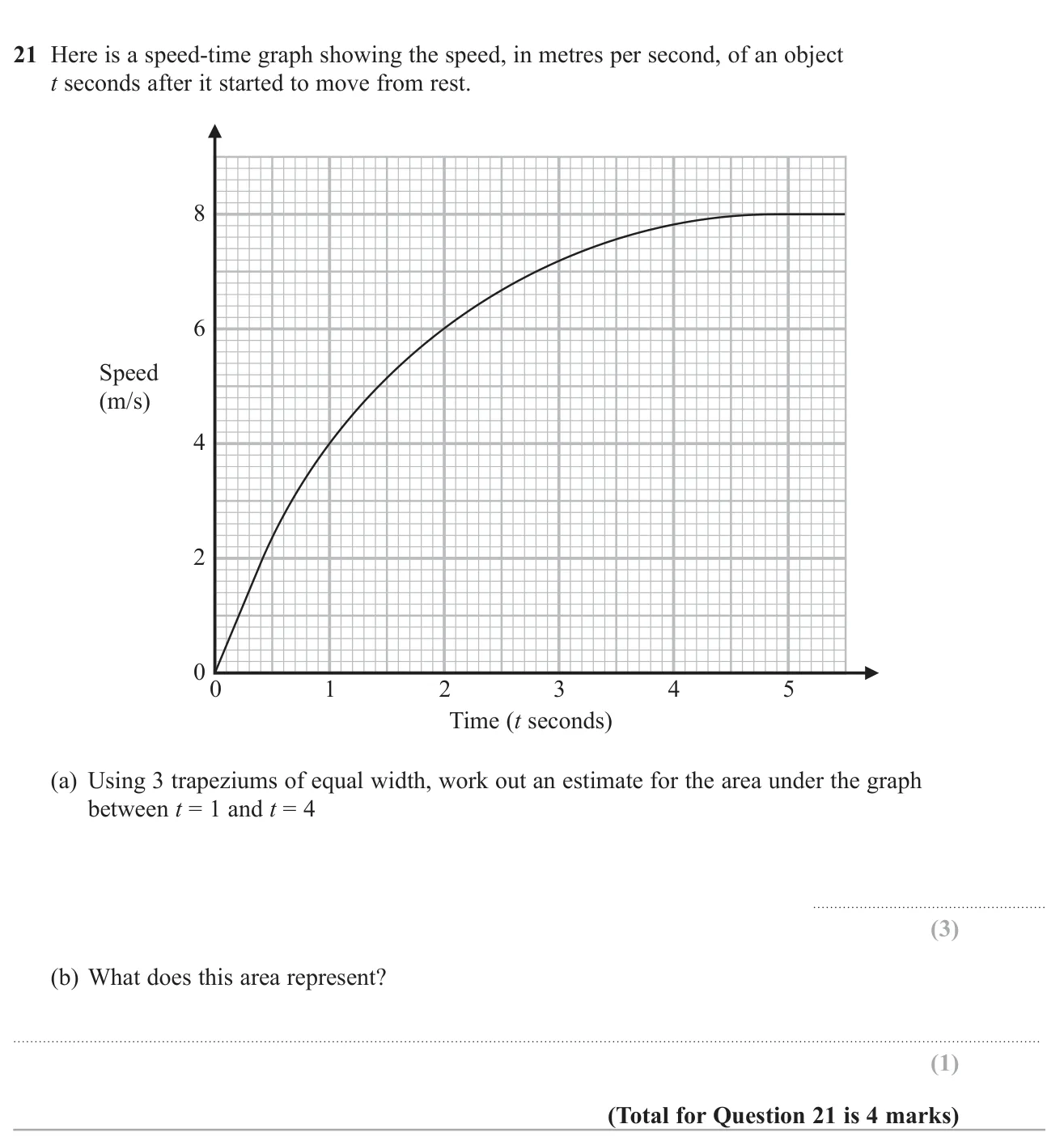
© Pearson Education Ltd. November 2021 Paper 3 (Higher, calculator), question 21.
Show answer
| (a) | 19.1 | 3 marks |
|---|
| (b) | The distance travelled (in metres) between t=1 and t=4 | 1 mark |
|---|
Worked solution Checked against the mark scheme
(a) Read the speeds: at t=1,2,3,4 they are 4,6,7.2,7.8.
21(4+6)+21(6+7.2)+21(7.2+7.8)=5+6.6+7.5=19.1
(b) Area under a speed–time graph is the distance travelled, so this is the distance in metres between 1 and 4 seconds.
Watch out: Using widths starting from t = 0 or reading 7.2 as 7.
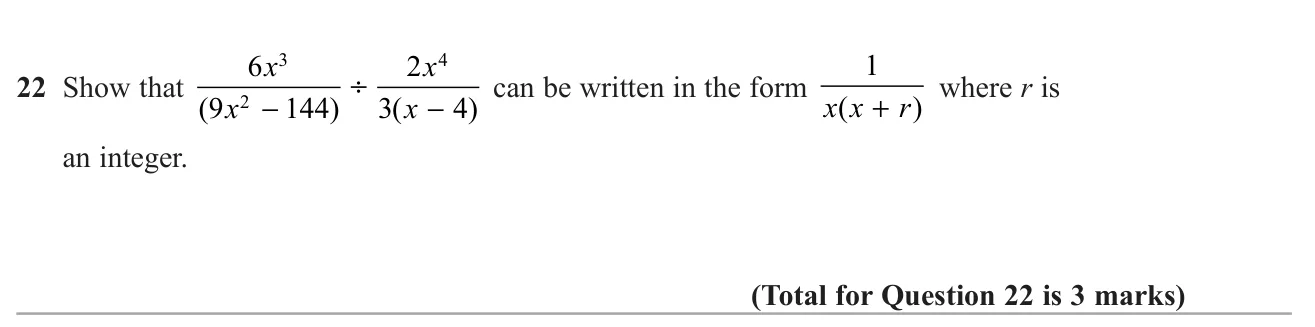
© Pearson Education Ltd. November 2021 Paper 3 (Higher, calculator), question 22.
Show answer
| Answer | x(x+4)1, so r=4 | 3 marks |
|---|
Worked solution Checked against the mark scheme
9x2−1446x3×2x43(x−4)
9x2−144=9(x−4)(x+4)
=18x4(x−4)(x+4)18x3(x−4)=x(x+4)1, so r=4
Watch out: Factorising 9x2−144 as (3x−12)2.
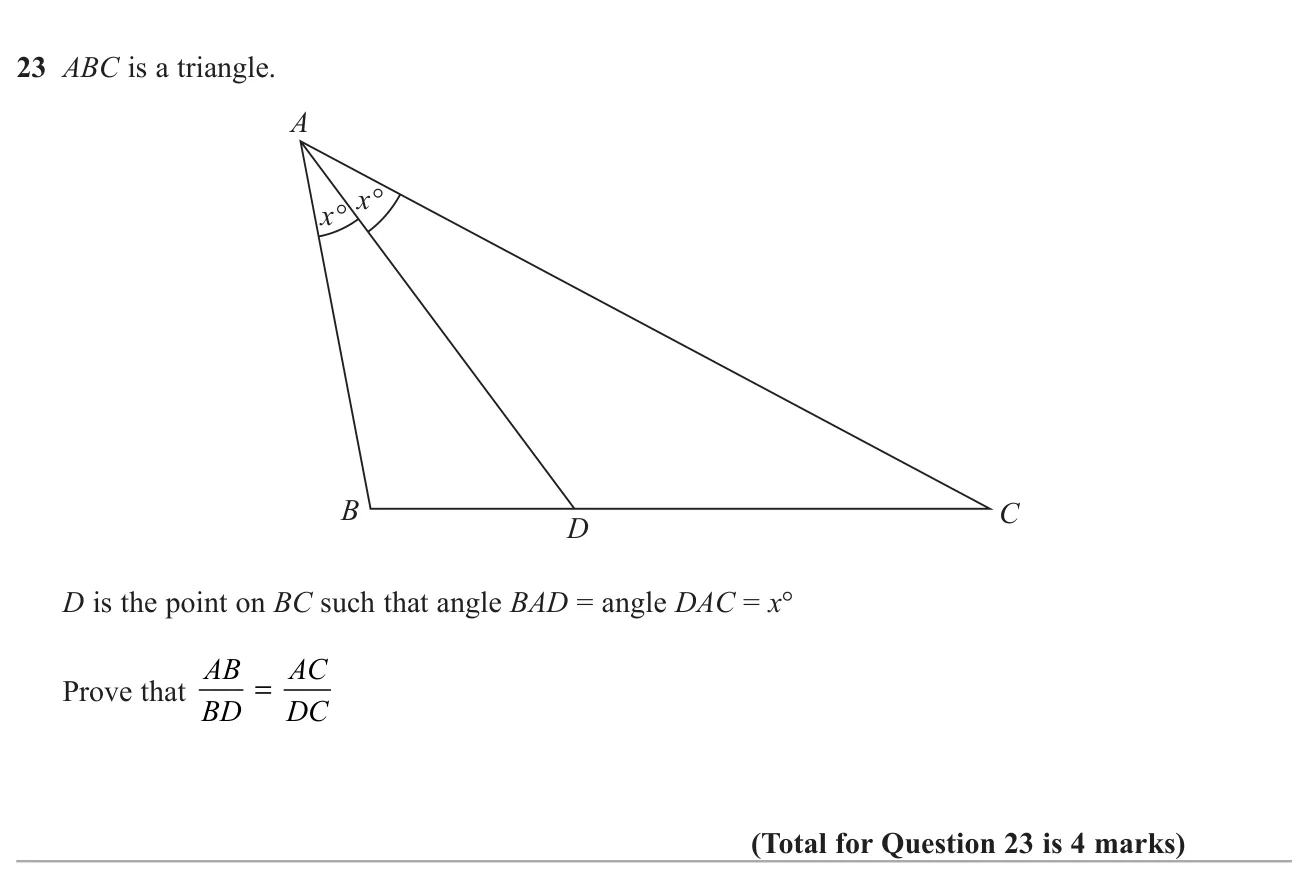
© Pearson Education Ltd. November 2021 Paper 3 (Higher, calculator), question 23.
Show answer
| Answer | Proof using the sine rule in both small triangles and sin(180∘−y)=siny | 4 marks |
|---|
Worked solution Checked against the mark scheme
Let angle ADB=y, so angle ADC=180∘−y.
Sine rule in ABD: sinyAB=sinxBD, so BDAB=sinxsiny
Sine rule in ADC: DCAC=sinxsin(180∘−y)
Since sin(180∘−y)=siny, both ratios equal sinxsiny, so BDAB=DCAC.
Watch out: Not justifying why the sines of the two angles at D are equal.
Finished the paper?
Add up your marks for all three papers and see what grade that would have been.