© Pearson Education Ltd. November 2018 Paper 1 (Foundation, non-calculator), question 1.
Show answer
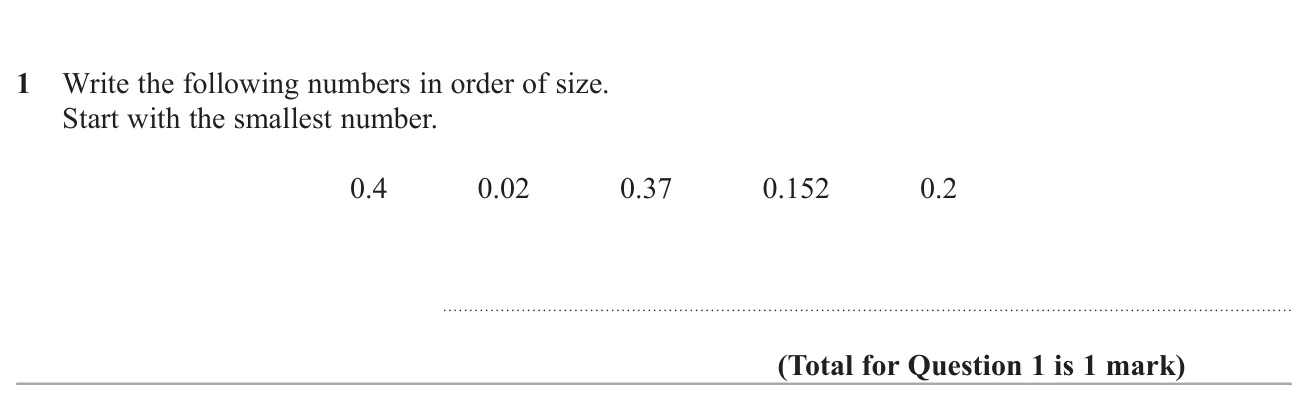
| Answer | 0.02, 0.152, 0.2, 0.37, 0.4 | 1 mark |
|---|
Worked solution Checked against the mark scheme
Compare the tenths digit first: 0.02, 0.152, 0.2, 0.37, 0.4
So the order is 0.02, 0.152, 0.2, 0.37, 0.4
Watch out: Thinking 0.152 is biggest because it has the most digits.
© Pearson Education Ltd. November 2018 Paper 1 (Foundation, non-calculator), question 2.
Show answer
Worked solution Checked against the mark scheme
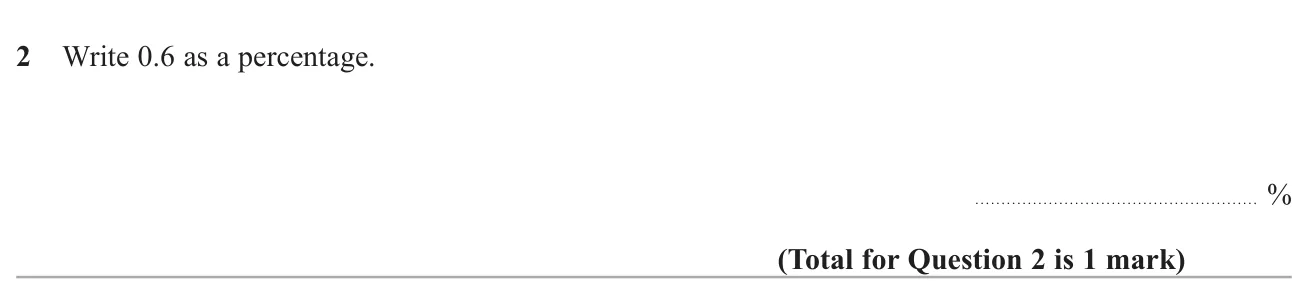
Multiply by 100: 0.6×100=60, so it is 60%.
Watch out: Writing 6%.
© Pearson Education Ltd. November 2018 Paper 1 (Foundation, non-calculator), question 3.
Show answer
Worked solution Checked against the mark scheme
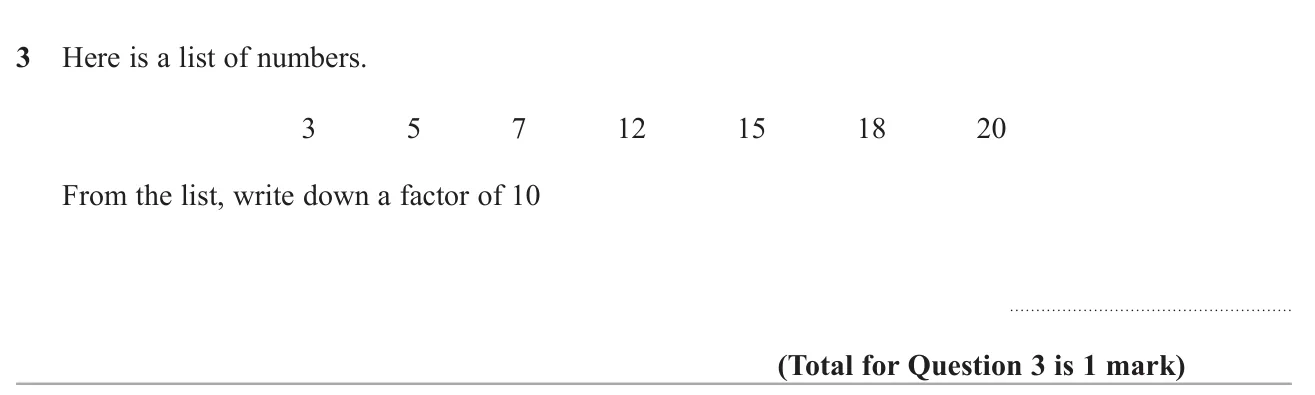
The factors of 10 are 1, 2, 5 and 10.
The only one in the list is 5.
Watch out: Choosing 20, which is a multiple of 10, not a factor.
© Pearson Education Ltd. November 2018 Paper 1 (Foundation, non-calculator), question 4.
Show answer
Worked solution Checked against the mark scheme
7829 lies between 7000 and 8000.
The hundreds digit is 8, which is 5 or more, so round up to 8000.
Watch out: Writing 7000 or 7800.
© Pearson Education Ltd. November 2018 Paper 1 (Foundation, non-calculator), question 5.
Show answer
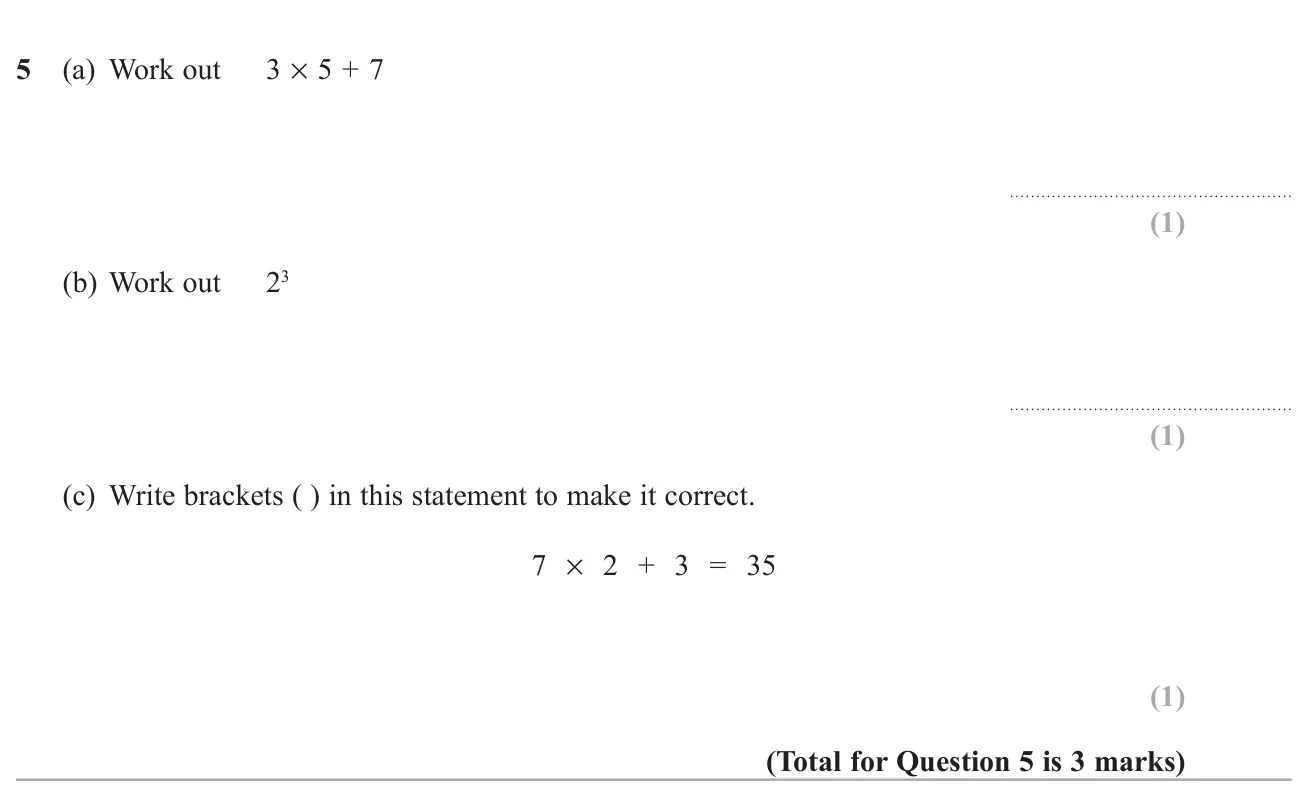
| (a) | 22 | 1 mark |
|---|
| (b) | 8 | 1 mark |
|---|
| (c) | 7×(2+3)=35 | 1 mark |
|---|
Worked solution Checked against the mark scheme
(a) Multiply first: 3×5=15, then 15+7=22
(b) 23=2×2×2=8
(c) 35=7×5 and 2+3=5, so 7×(2+3)=35
Watch out: In (b), working out 2×3=6.
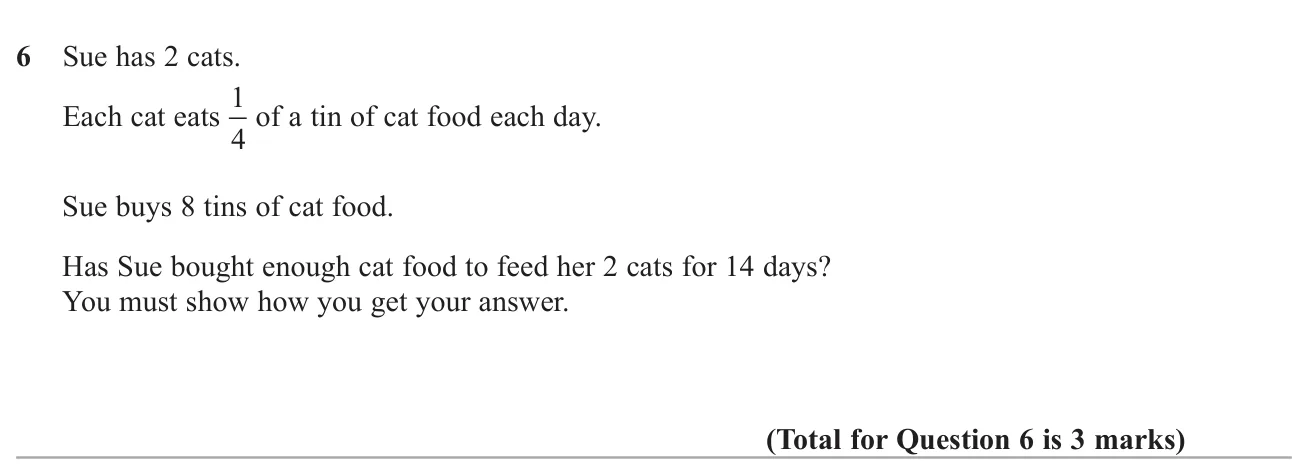
© Pearson Education Ltd. November 2018 Paper 1 (Foundation, non-calculator), question 6.
Show answer
| Answer | Yes: only 7 tins are needed | 3 marks |
|---|
Worked solution Checked against the mark scheme
Both cats together eat 2×41=21 tin a day.
For 14 days: 14×21=7 tins.
7<8, so yes, Sue has bought enough.
Watch out: Forgetting there are two cats and working out 14×41 only.
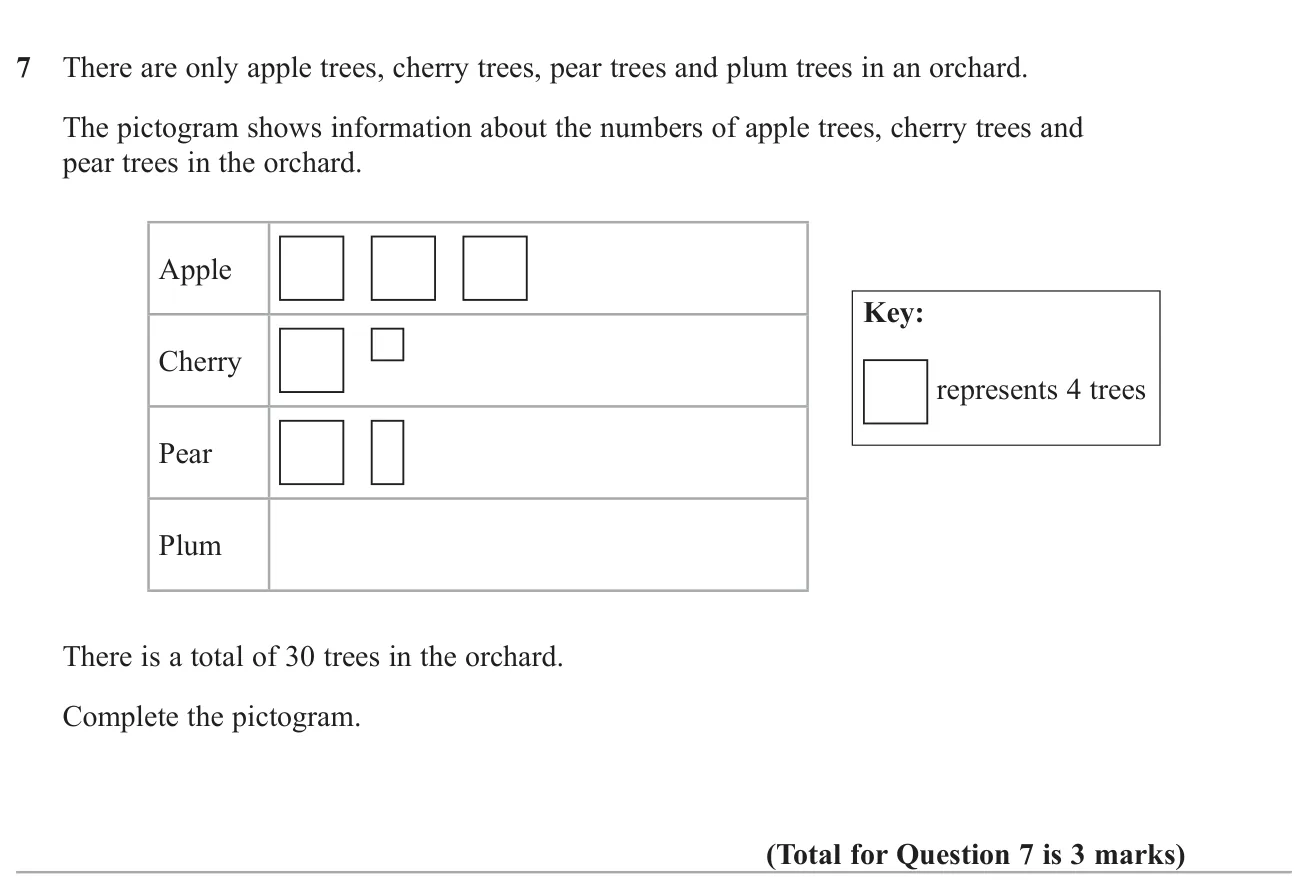
© Pearson Education Ltd. November 2018 Paper 1 (Foundation, non-calculator), question 7.
Show answer
| Answer | Plum = 7 trees: one full square and three quarters of a square | 3 marks |
|---|
Worked solution Checked against the mark scheme
Key: one square = 4 trees.
Apple 3 squares = 12, cherry 141 squares = 5, pear 121 squares = 6.
Plum =30−(12+5+6)=7 trees.
7÷4=143, so draw one full square and three quarters of a square.
Watch out: Reading the small cherry square as a half (2 trees) rather than a quarter (1 tree).
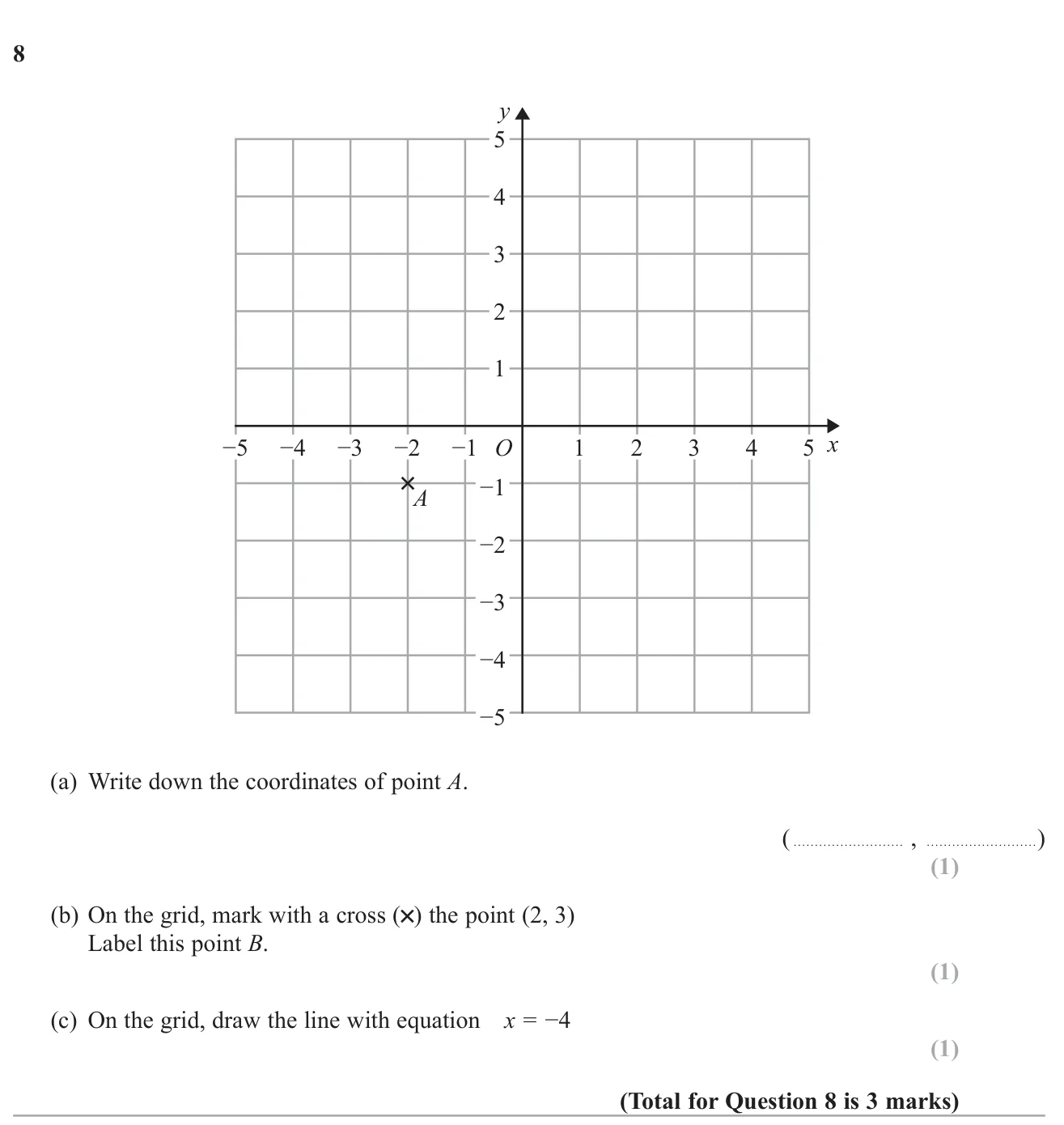
© Pearson Education Ltd. November 2018 Paper 1 (Foundation, non-calculator), question 8.
Show answer
| (a) | (−2,−1) | 1 mark |
|---|
| (b) | Cross at (2,3) | 1 mark |
|---|
| (c) | Vertical line through x=−4 | 1 mark |
|---|
Worked solution Checked against the mark scheme
(a) Go across to −2, then down to −1: (−2,−1)
(b) Go 2 right and 3 up and mark B.
(c) Every point on x=−4 has x-coordinate −4, so draw the vertical line through −4 on the x-axis.
Watch out: Drawing a horizontal line for x=−4.
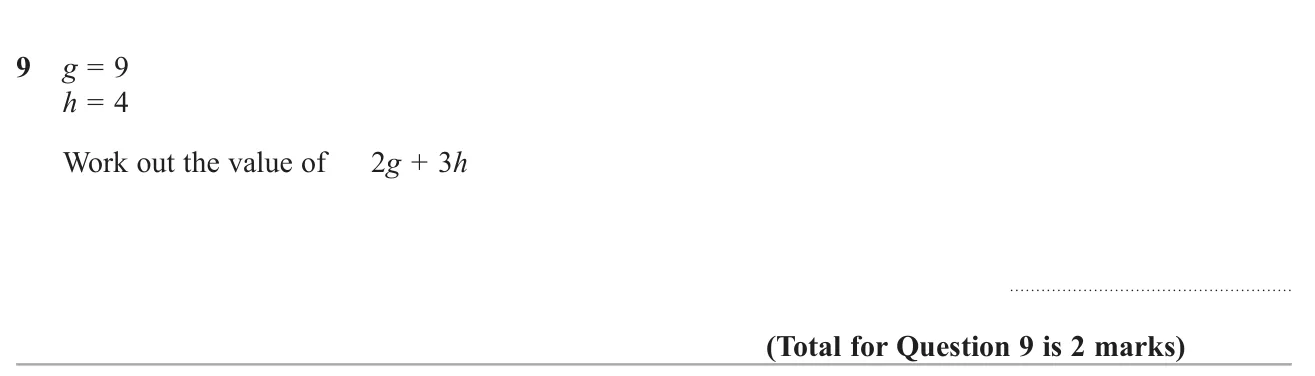
© Pearson Education Ltd. November 2018 Paper 1 (Foundation, non-calculator), question 9.
Show answer
Worked solution Checked against the mark scheme
2g=2×9=18
3h=3×4=12
18+12=30
Watch out: Writing 29 + 34 by treating 2g as 29.
© Pearson Education Ltd. November 2018 Paper 1 (Foundation, non-calculator), question 10.
Show answer
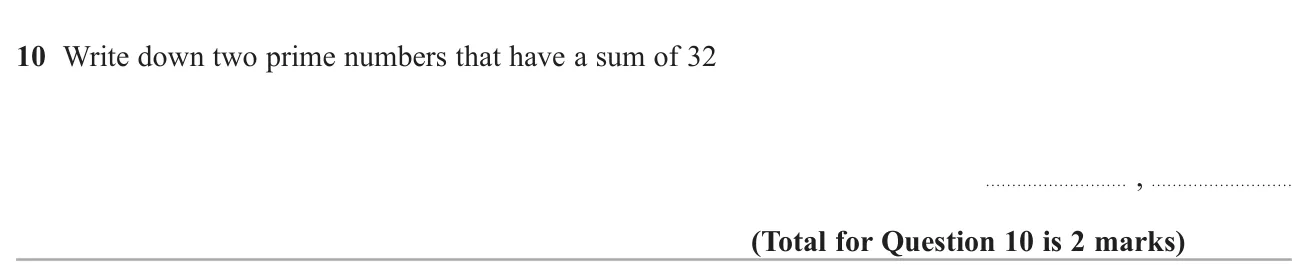
| Answer | 3 and 29, or 13 and 19 | 2 marks |
|---|
Worked solution Checked against the mark scheme
Try primes p and check whether 32−p is prime:
32−3=29 (prime) ✓
32−13=19 (prime) ✓
So 3 and 29 (or 13 and 19).
Watch out: Using 1 and 31, but 1 is not prime.
© Pearson Education Ltd. November 2018 Paper 1 (Foundation, non-calculator), question 11.
Show answer
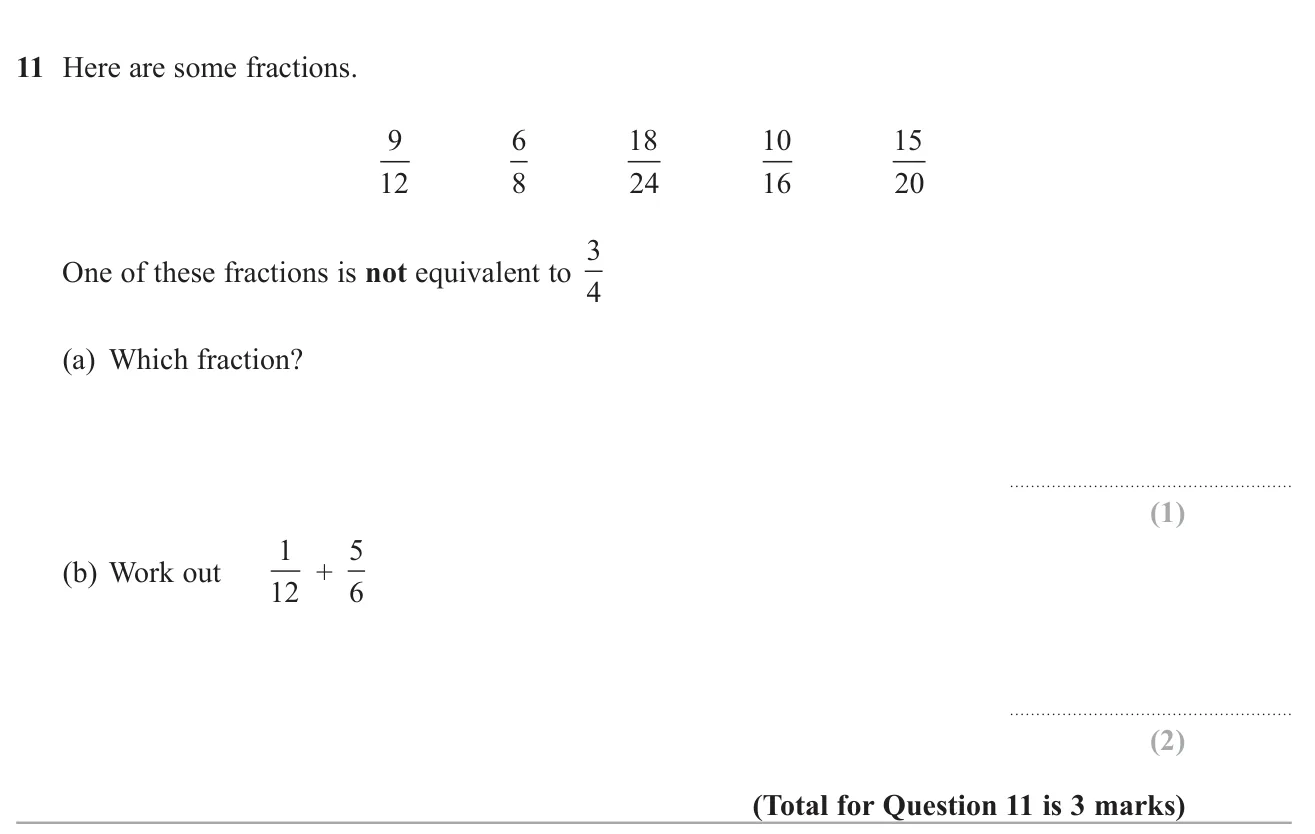
| (a) | 1610 | 1 mark |
|---|
| (b) | 1211 | 2 marks |
|---|
Worked solution Checked against the mark scheme
(a) 1610=85, not 43. The others all simplify to 43.
(b) 65=1210
121+1210=1211
Watch out: Adding tops and bottoms to get 186.
© Pearson Education Ltd. November 2018 Paper 1 (Foundation, non-calculator), question 12.
Show answer
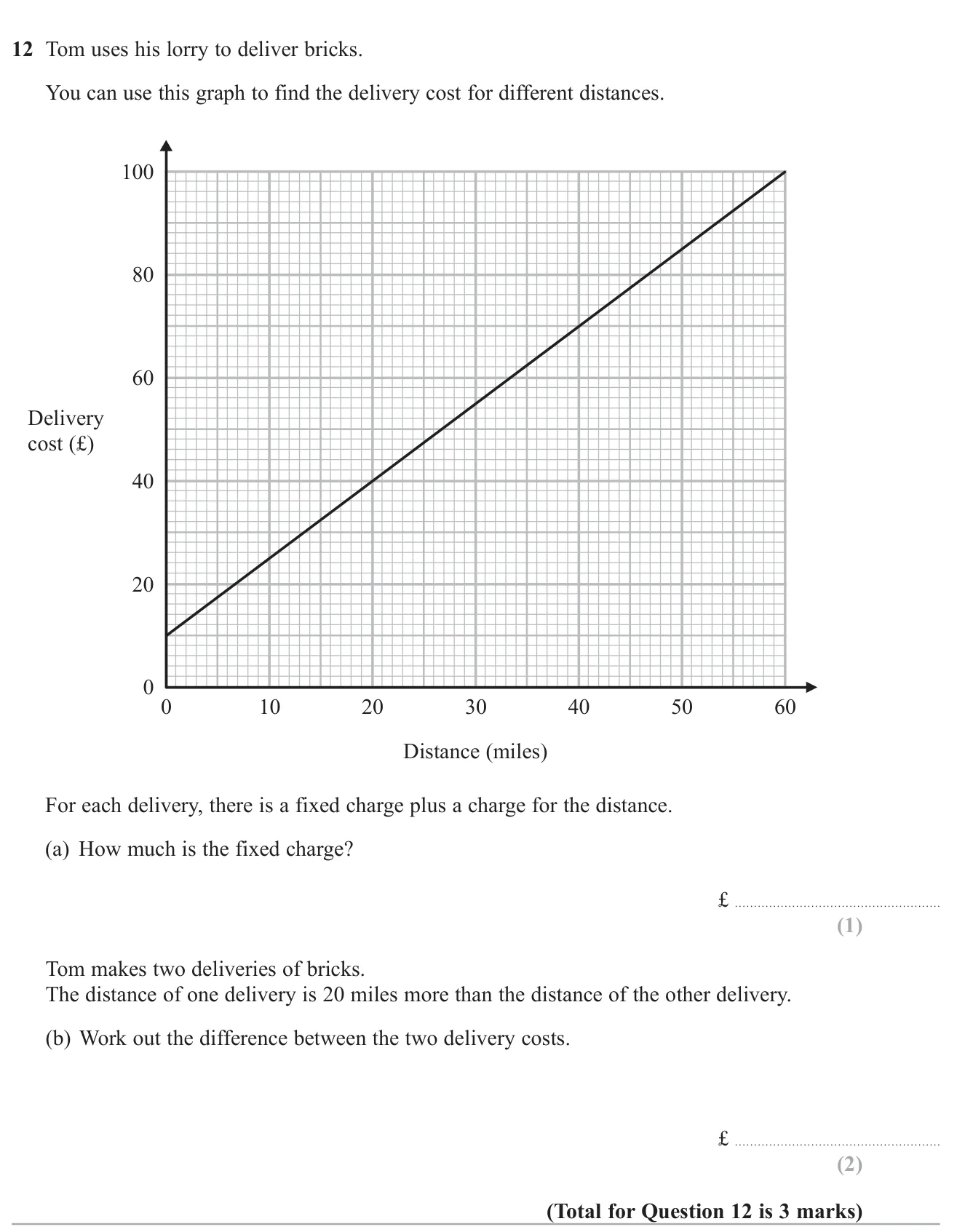
| (a) | £10 | 1 mark |
|---|
| (b) | £30 | 2 marks |
|---|
Worked solution Checked against the mark scheme
(a) At 0 miles the line starts at £10, so the fixed charge is £10.
(b) The line rises from £10 to £100 over 60 miles, which is £1.50 per mile.
20 miles more costs 20×1.5=£30 more (e.g. 20 miles £40, 40 miles £70).
Watch out: Giving the cost of a 20-mile delivery (£40) instead of the difference.
Question 13
Ratio2 marksGrade 3No calculator © Pearson Education Ltd. November 2018 Paper 1 (Foundation, non-calculator), question 13.
Show answer
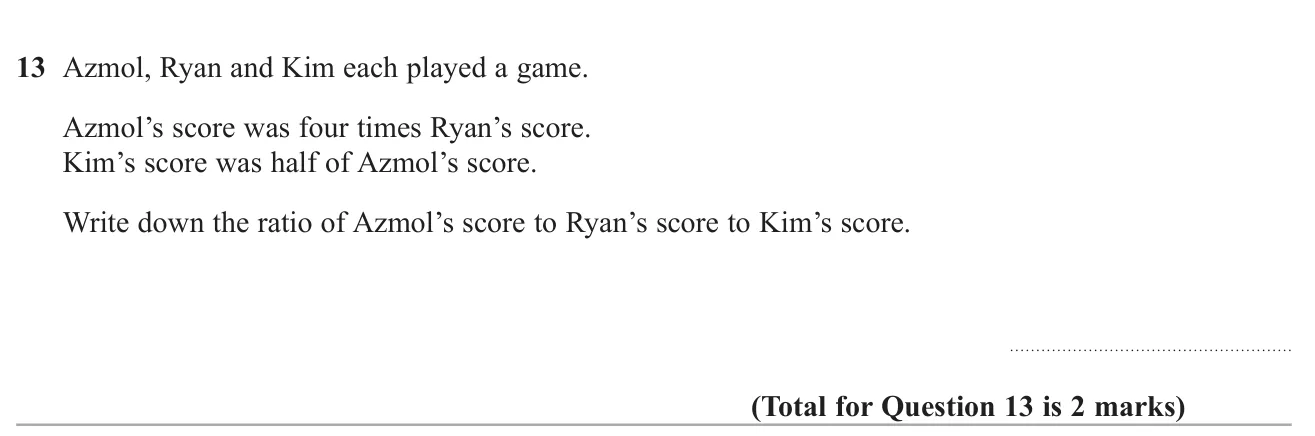
| Answer | 4:1:2 | 2 marks |
|---|
Worked solution Checked against the mark scheme
Let Ryan's score be 1.
Azmol =4×1=4, Kim =4÷2=2.
Azmol : Ryan : Kim =4:1:2
Watch out: Writing the ratio in the wrong order, e.g. 1 : 4 : 2.
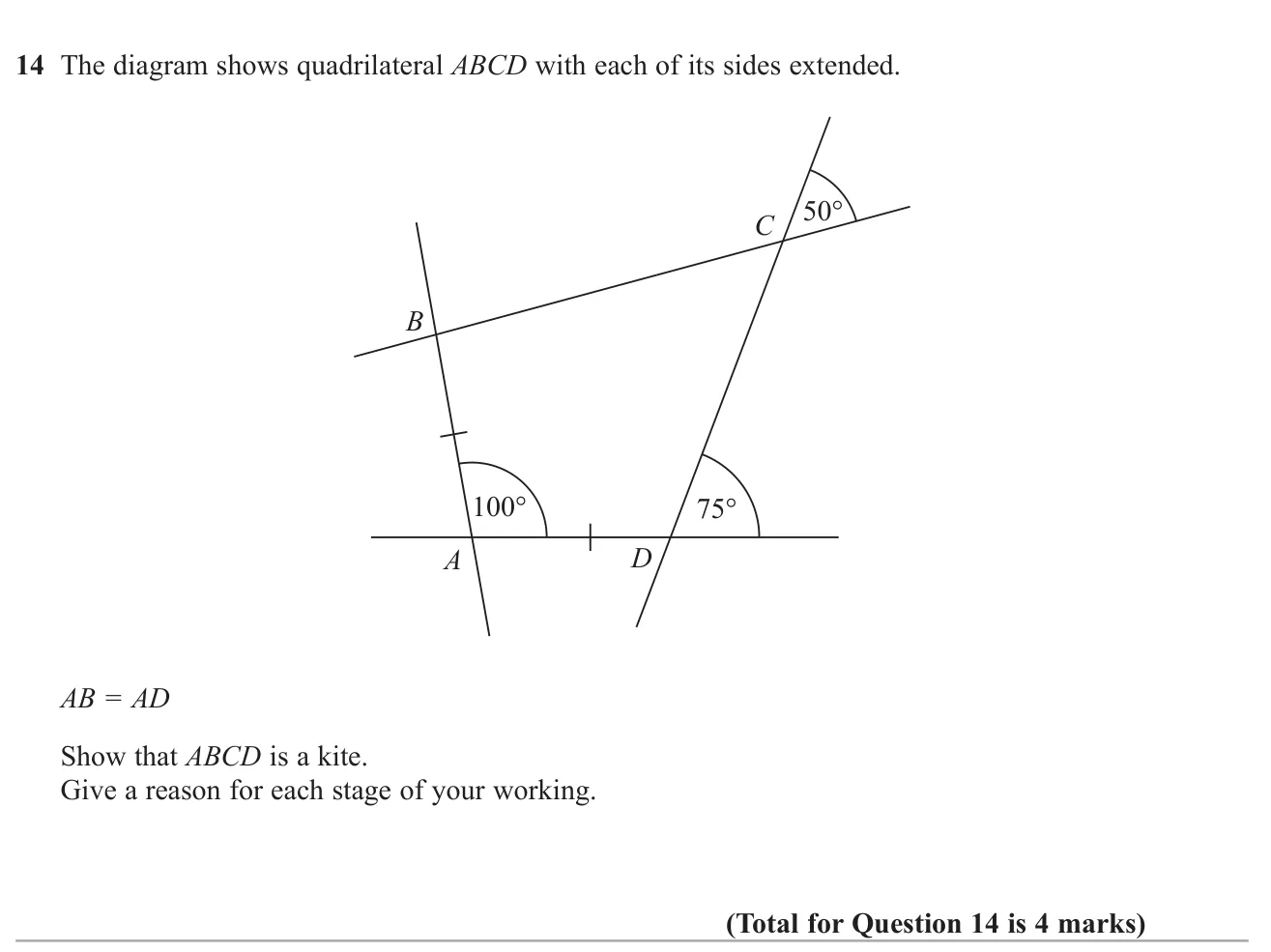
© Pearson Education Ltd. November 2018 Paper 1 (Foundation, non-calculator), question 14.
Show answer
| Answer | Angle ADC=105° and angle ABC=105°, with AB=AD, so ABCD is a kite | 4 marks |
|---|
Worked solution Checked against the mark scheme
Angle BAD=100° (marked on the diagram).
Angle ADC=180−75=105° (angles on a straight line add up to 180°).
Angle BCD=50° (vertically opposite angles are equal).
Angle ABC=360−100−50−105=105° (angles in a quadrilateral add up to 360°).
AB=AD, so triangle ABD is isosceles and angles ABD and ADB are equal. Since angle ABC = angle ADC, angles CBD and CDB are also equal, so CB=CD.
Two pairs of equal adjacent sides, so ABCD is a kite.
Watch out: Finding the angles but not giving a reason for each step.
Question 15
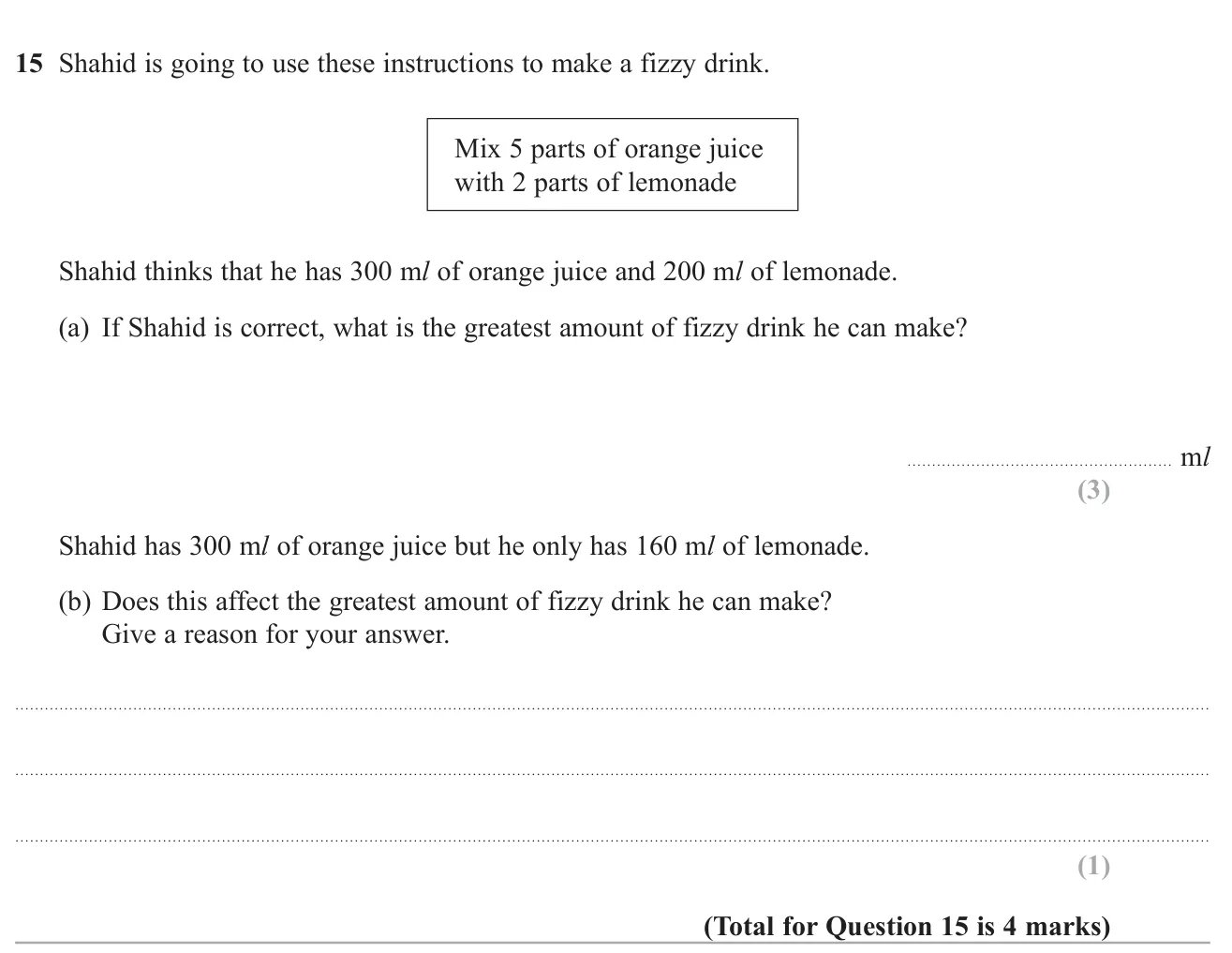
Ratio4 marksGrade 4No calculator © Pearson Education Ltd. November 2018 Paper 1 (Foundation, non-calculator), question 15.
Show answer
| (a) | 420 ml | 3 marks |
|---|
| (b) | No effect: he only needs 120 ml of lemonade | 1 mark |
|---|
Worked solution Checked against the mark scheme
(a) Orange juice limits it: 300÷5=60 ml per part.
Lemonade needed =2×60=120 ml (he has 200 ml, so enough).
Total =7×60=420 ml.
(b) No: he still only needs 120 ml of lemonade, and 160 ml is enough.
Watch out: Using all 500 ml of liquid and ignoring the ratio.
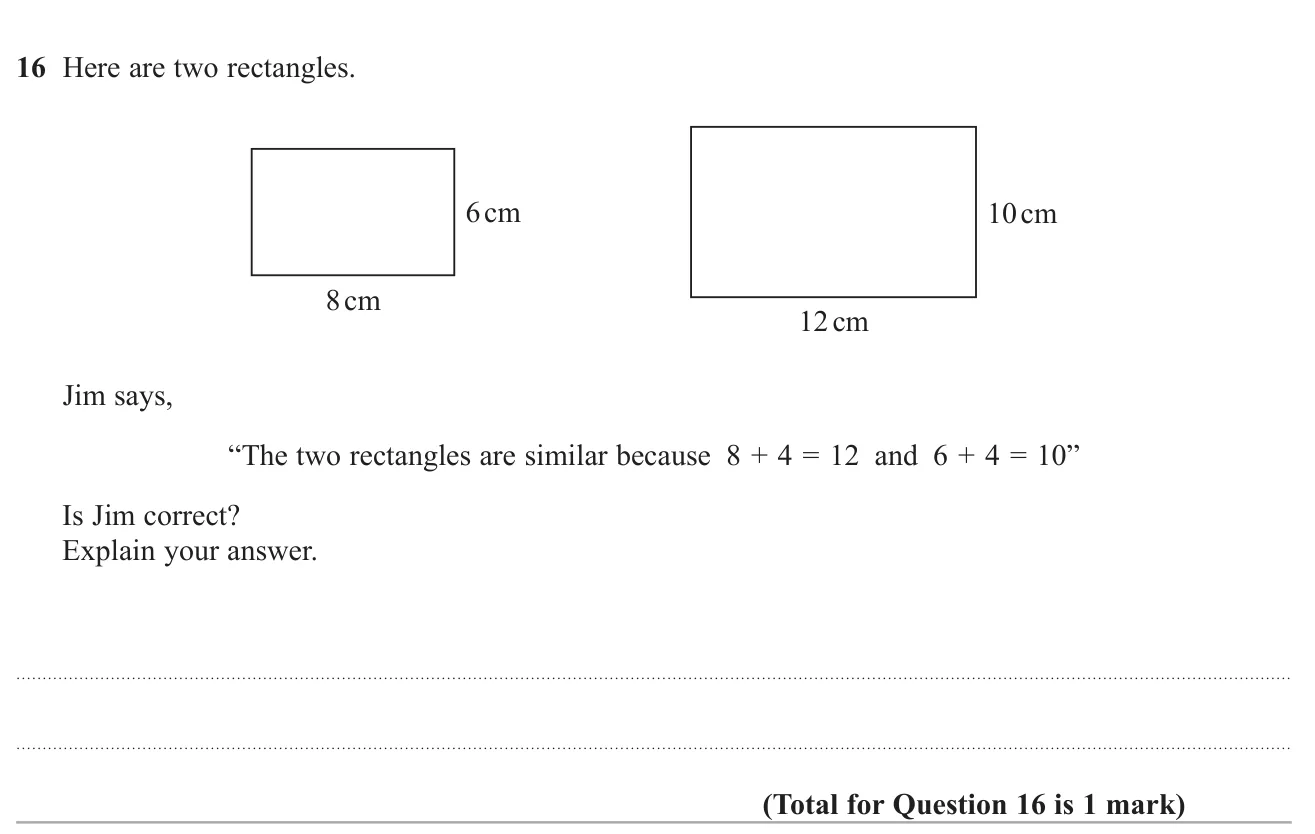
© Pearson Education Ltd. November 2018 Paper 1 (Foundation, non-calculator), question 16.
Show answer
| Answer | No: similar shapes need sides multiplied by the same scale factor, not added to | 1 mark |
|---|
Worked solution Checked against the mark scheme
For similar shapes every length is multiplied by the same scale factor.
12÷8=1.5 but 10÷6=1.67, so the rectangles are not similar. Jim is wrong.
Watch out: Agreeing with Jim because both sides grow by 4.
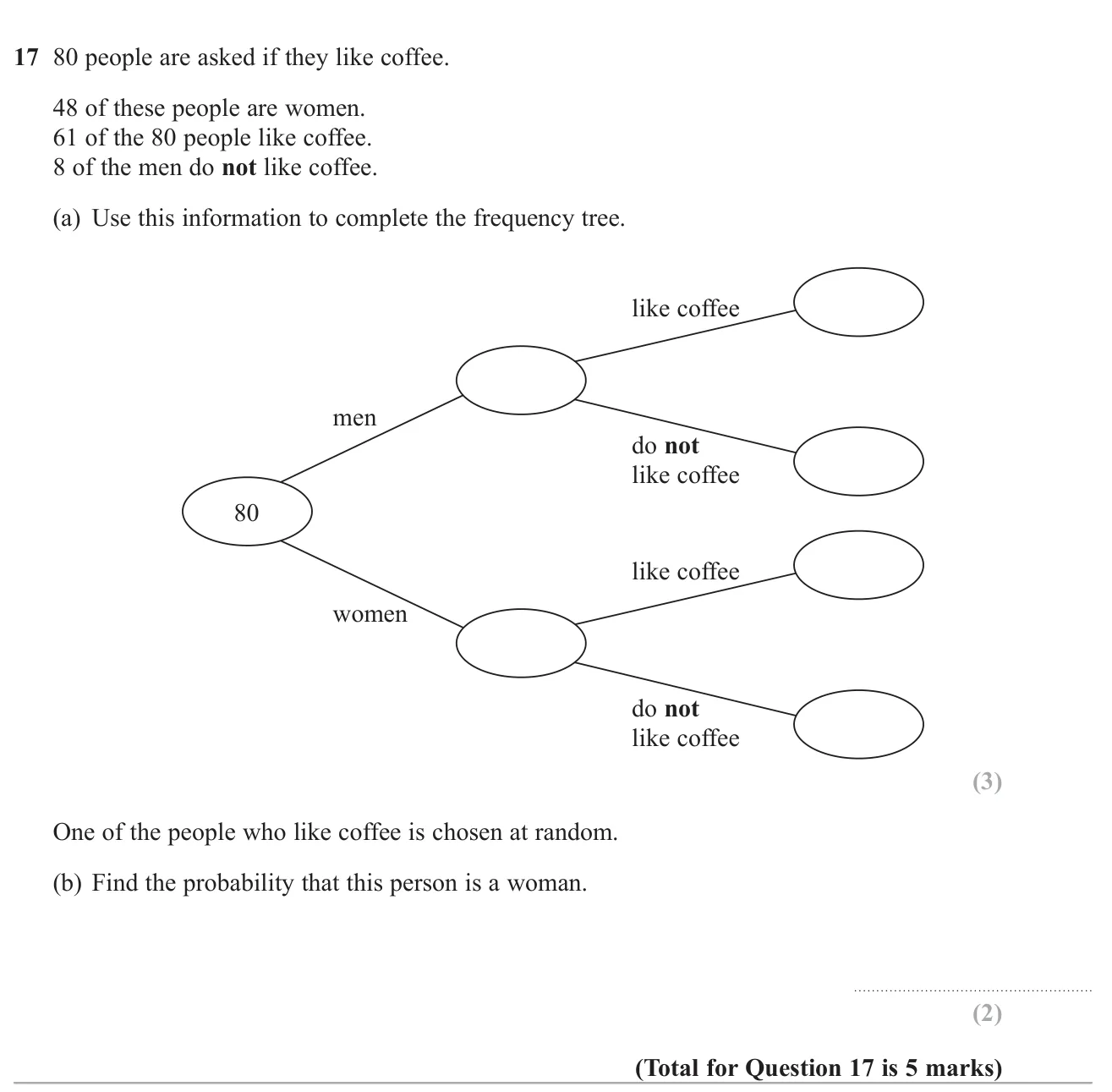
© Pearson Education Ltd. November 2018 Paper 1 (Foundation, non-calculator), question 17.
Show answer
| (a) | Men 32, women 48; men like 24, men do not 8; women like 37, women do not 11 | 3 marks |
|---|
| (b) | 6137 | 2 marks |
|---|
Worked solution Checked against the mark scheme
(a) Men =80−48=32. Men who like coffee =32−8=24.
Women who like coffee =61−24=37. Women who do not =48−37=11.
(b) 61 people like coffee and 37 of them are women: 6137
Watch out: In (b), dividing by 80 instead of 61.
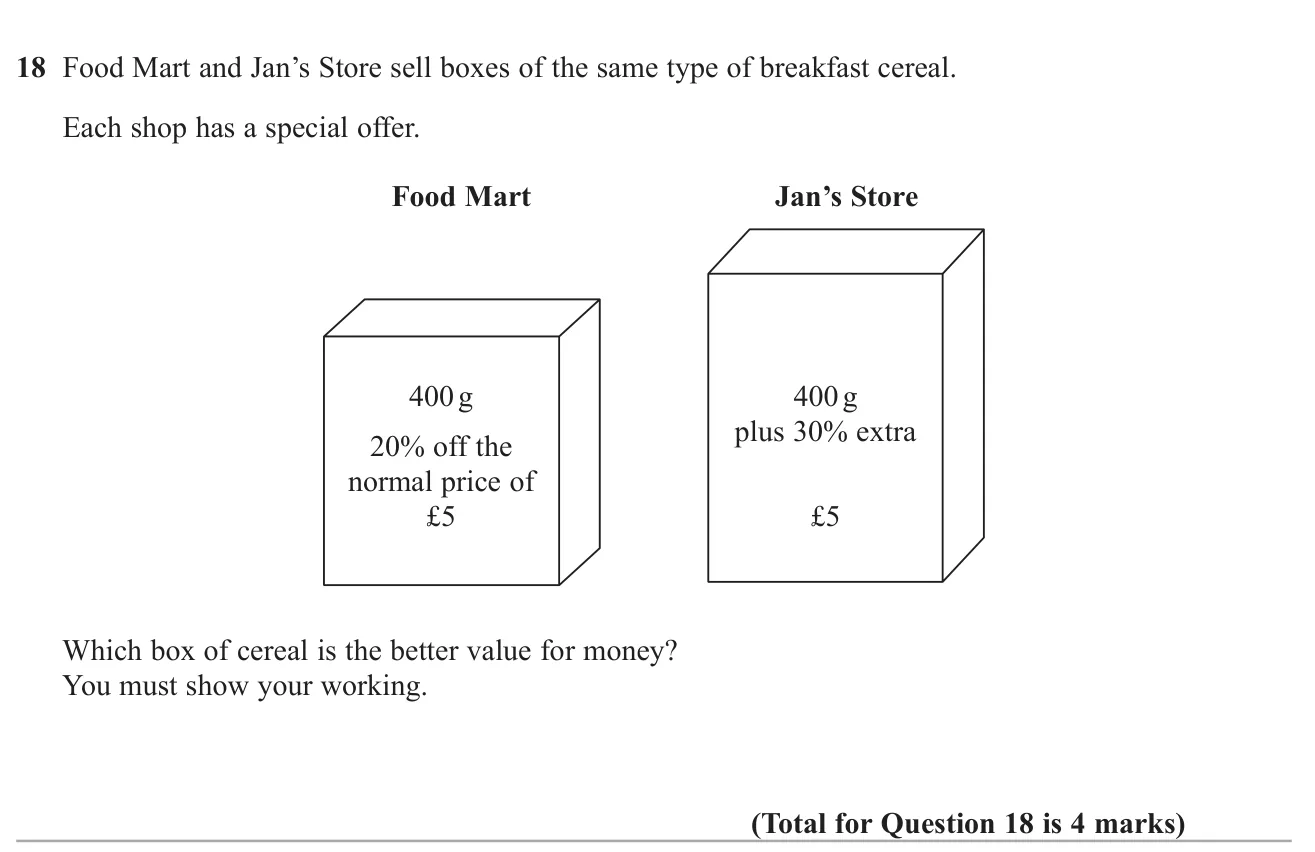
© Pearson Education Ltd. November 2018 Paper 1 (Foundation, non-calculator), question 18.
Show answer
| Answer | Jan's Store: 104 g per £1 against 100 g per £1 | 4 marks |
|---|
Worked solution Checked against the mark scheme
Food Mart: £5×0.8=£4 for 400 g, so 400÷4=100 g per £1.
Jan's Store: 400×1.3=520 g for £5, so 520÷5=104 g per £1.
104 > 100, so Jan's Store is better value.
Watch out: Assuming 20% off and 30% extra can be compared directly without calculating.
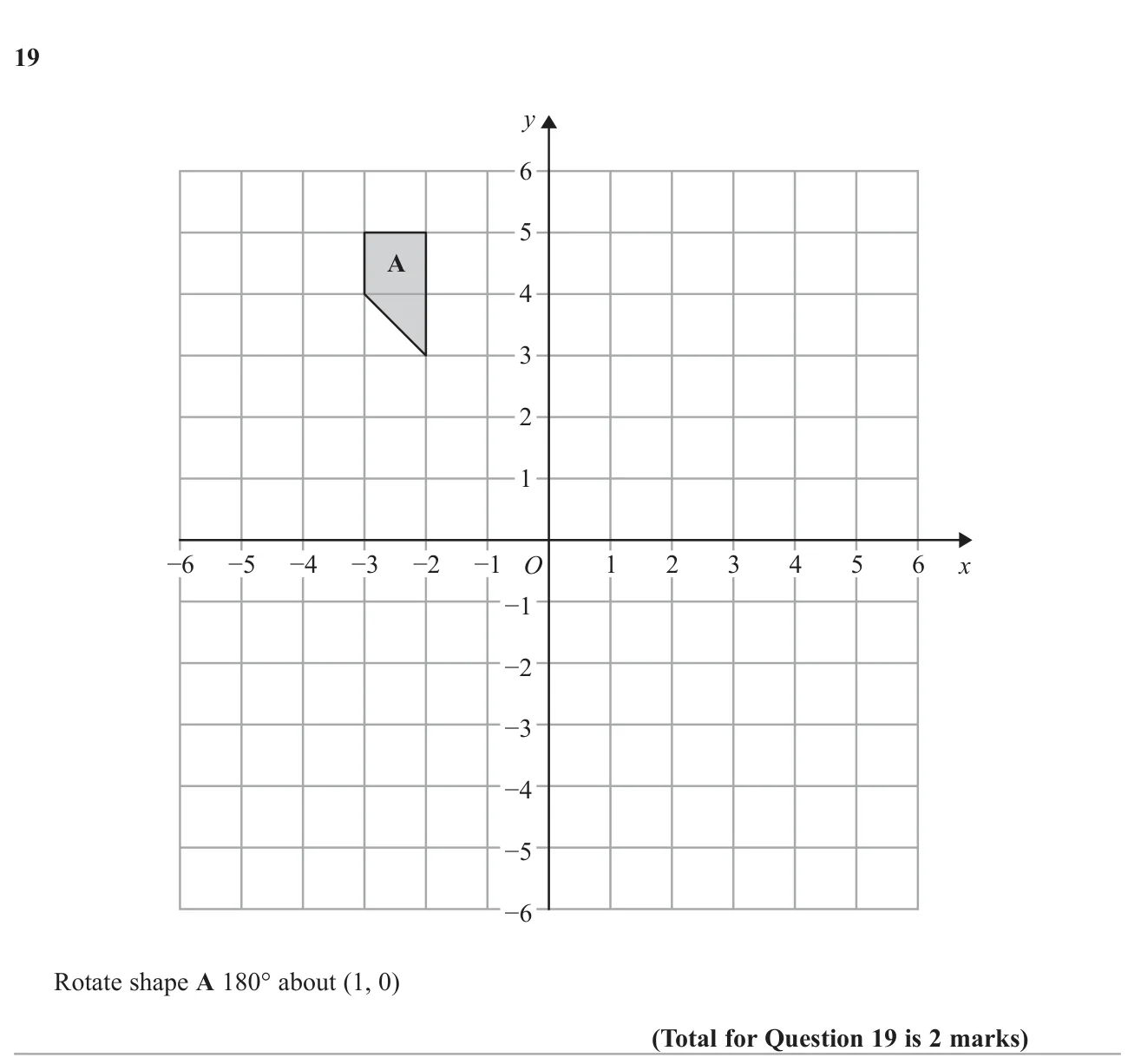
© Pearson Education Ltd. November 2018 Paper 1 (Foundation, non-calculator), question 19.
Show answer
| Answer | Shape with vertices (4,−3), (5,−4), (5,−5), (4,−5) | 2 marks |
|---|
Worked solution Checked against the mark scheme
A 180° turn about (1,0) sends (x,y) to (2−x,−y).
(−3,5)→(5,−5), (−2,5)→(4,−5), (−2,3)→(4,−3), (−3,4)→(5,−4)
Plot and join these points.
Watch out: Rotating about the origin instead of (1,0).
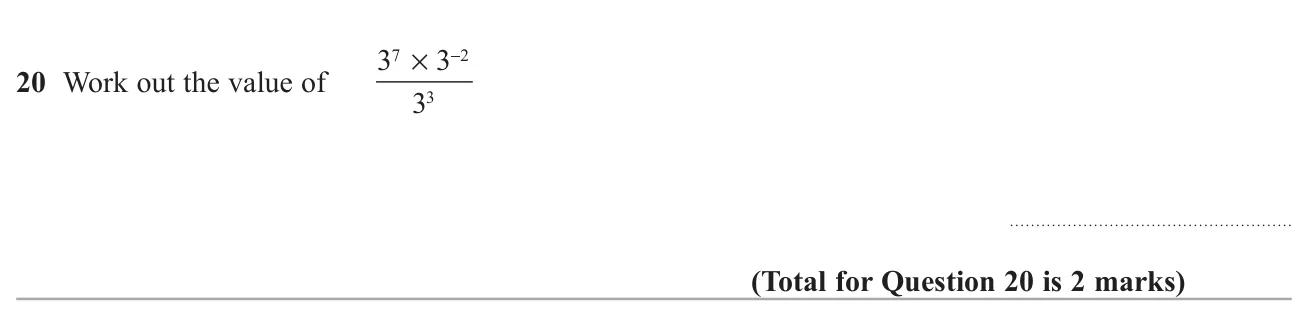
© Pearson Education Ltd. November 2018 Paper 1 (Foundation, non-calculator), question 20.
Show answer
Worked solution Checked against the mark scheme
37×3−2=37+(−2)=35
35÷33=35−3=32=9
Watch out: Stopping at 32, or multiplying indices instead of adding.
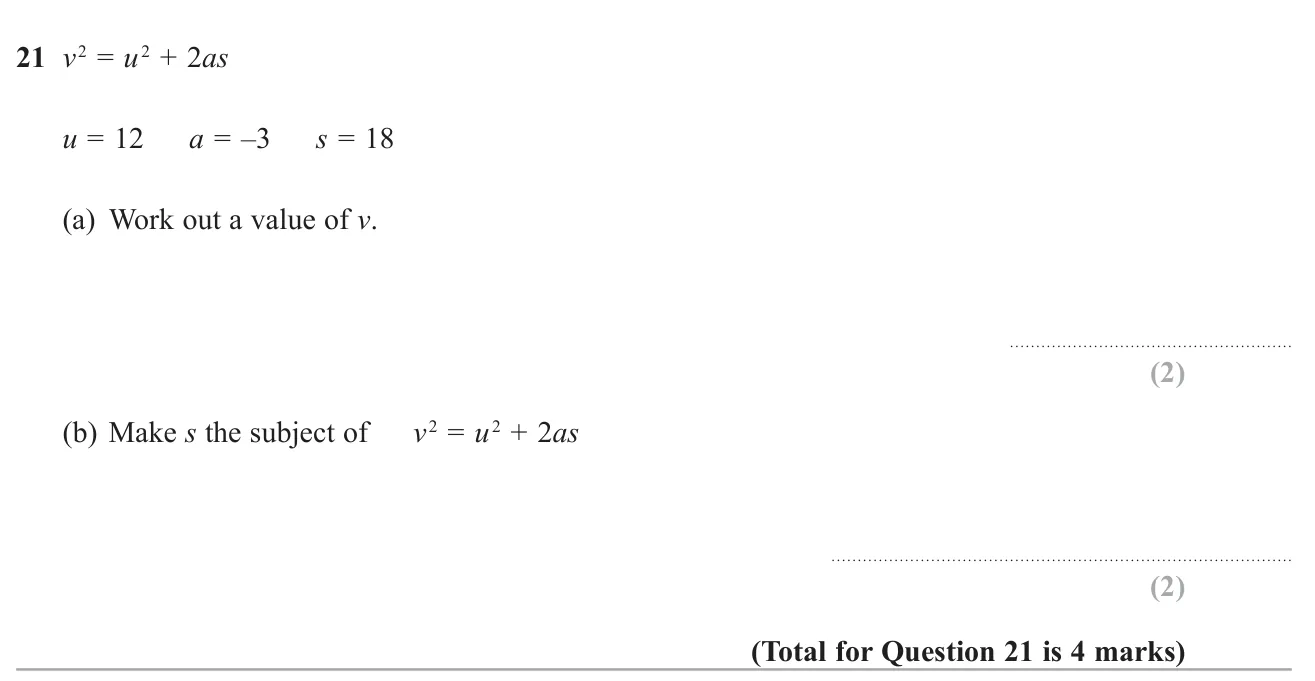
© Pearson Education Ltd. November 2018 Paper 1 (Foundation, non-calculator), question 21.
Show answer
| (a) | 6 (or −6) | 2 marks |
|---|
| (b) | s=2av2−u2 | 2 marks |
|---|
Worked solution Checked against the mark scheme
(a) v2=122+2×(−3)×18=144−108=36
v=36=6
(b) v2−u2=2as
s=2av2−u2
Watch out: In (a), forgetting the negative sign on a and getting v2=252.
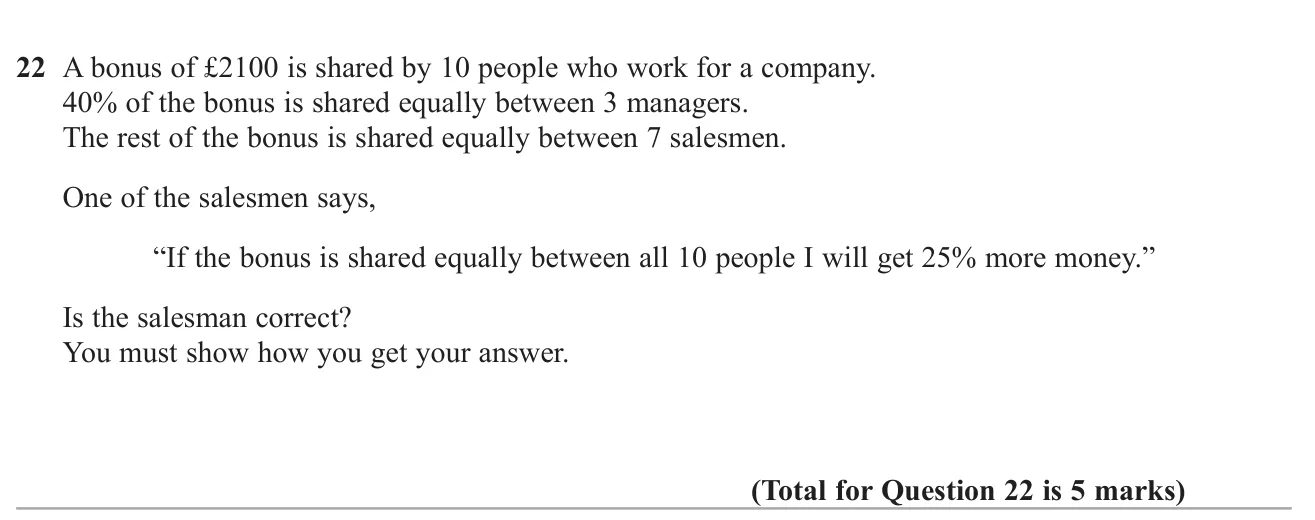
© Pearson Education Ltd. November 2018 Paper 1 (Foundation, non-calculator), question 22.
Show answer
| Answer | No: he would get £210 instead of £180, only about 16.7% more (25% more would be £225) | 5 marks |
|---|
Worked solution Checked against the mark scheme
Managers get 0.4×2100=£840, so salesmen get 2100−840=£1260.
Each salesman: 1260÷7=£180.
Shared equally: 2100÷10=£210.
25% more than £180 is 180×1.25=£225.
£210=£225, so the salesman is wrong (it is only about 16.7% more).
Watch out: Working out 25% of the whole bonus rather than of one salesman's share.
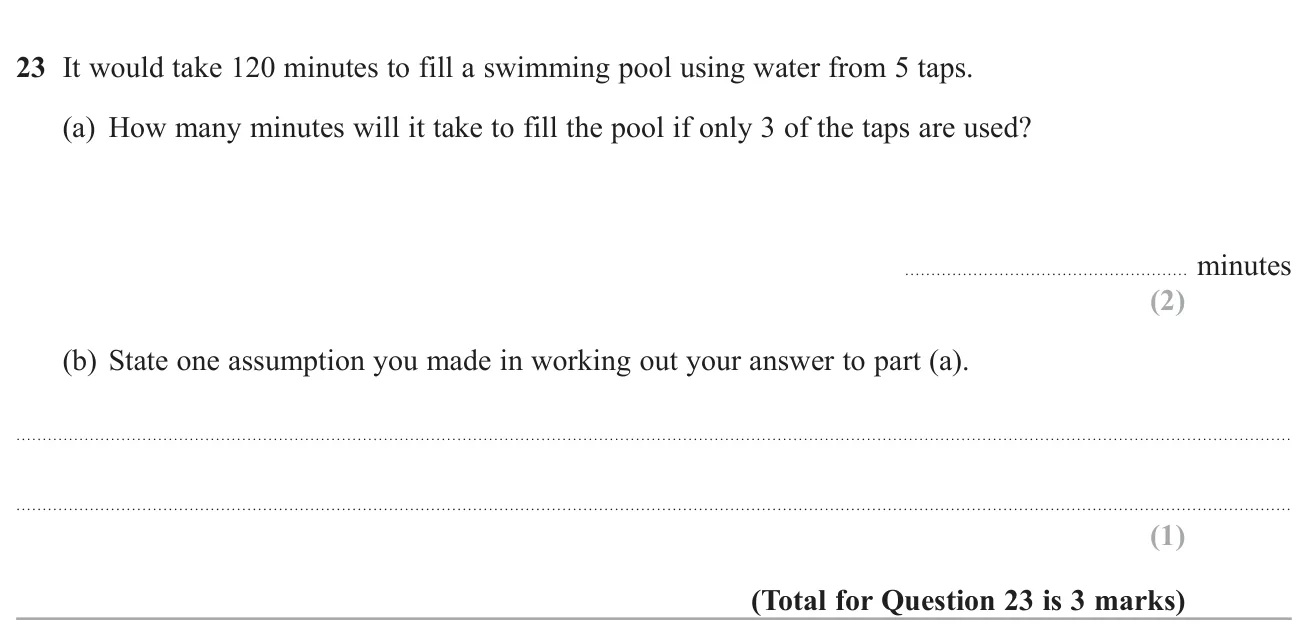
© Pearson Education Ltd. November 2018 Paper 1 (Foundation, non-calculator), question 23.
Show answer
| (a) | 200 minutes | 2 marks |
|---|
| (b) | Every tap lets water out at the same, constant rate | 1 mark |
|---|
Worked solution Checked against the mark scheme
(a) One tap alone would take 120×5=600 minutes.
Three taps: 600÷3=200 minutes.
(b) Assume each tap gives water at the same rate, and that rate stays constant.
Watch out: Treating it as direct proportion and getting 72 minutes.
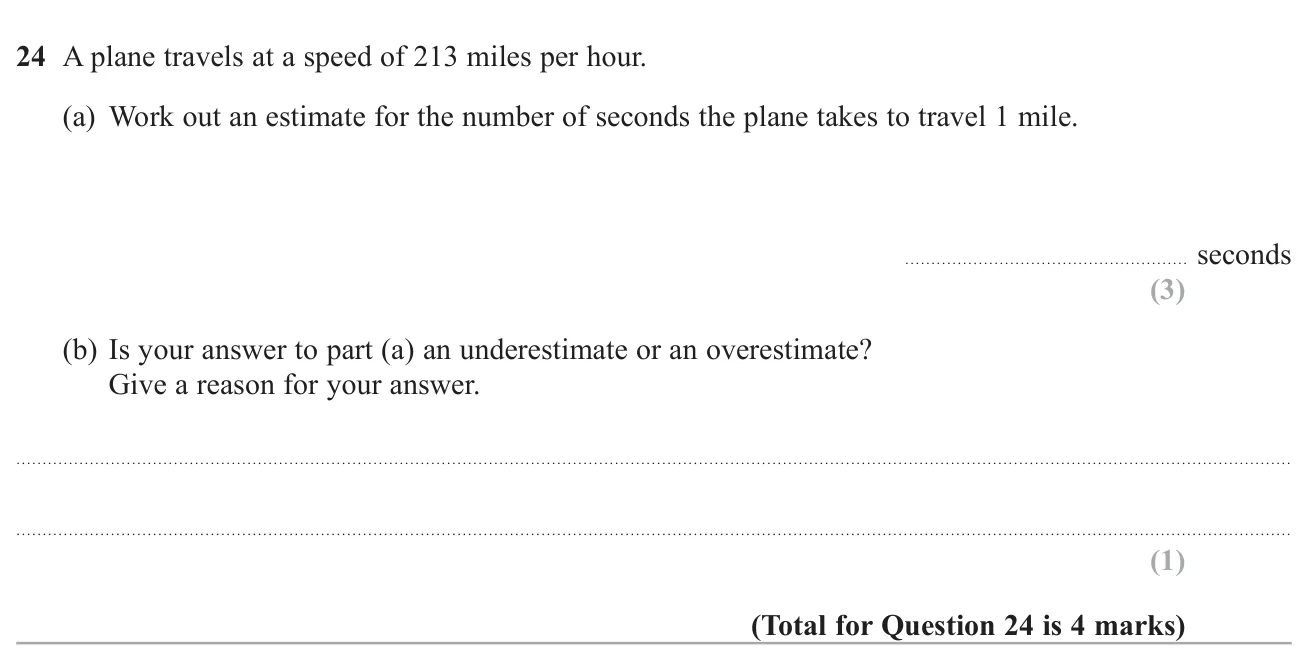
© Pearson Education Ltd. November 2018 Paper 1 (Foundation, non-calculator), question 24.
Show answer
| (a) | 18 seconds (accept 16 to 20) | 3 marks |
|---|
| (b) | Overestimate: the speed was rounded down, so the time comes out longer | 1 mark |
|---|
Worked solution Checked against the mark scheme
(a) Round 213 to 200 mph.
1 hour =60×60=3600 seconds.
Time for 1 mile =3600÷200=18 seconds.
(b) Overestimate: 200 is slower than the real speed, so the real time is shorter.
Watch out: Dividing 200 by 3600 instead of 3600 by 200.
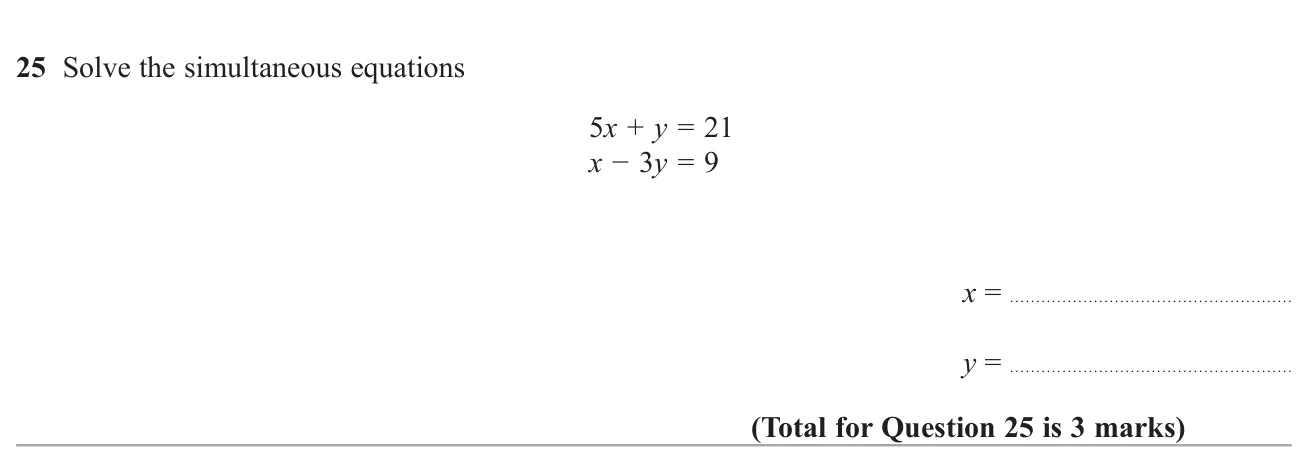
© Pearson Education Ltd. November 2018 Paper 1 (Foundation, non-calculator), question 25.
Show answer
| Answer | x=4.5, y=−1.5 | 3 marks |
|---|
Worked solution Checked against the mark scheme
Multiply the first equation by 3: 15x+3y=63
Add x−3y=9: 16x=72, so x=4.5
5(4.5)+y=21⇒y=21−22.5=−1.5
Check: 4.5−3(−1.5)=9 ✓
Watch out: Sign error when eliminating y, e.g. subtracting instead of adding.
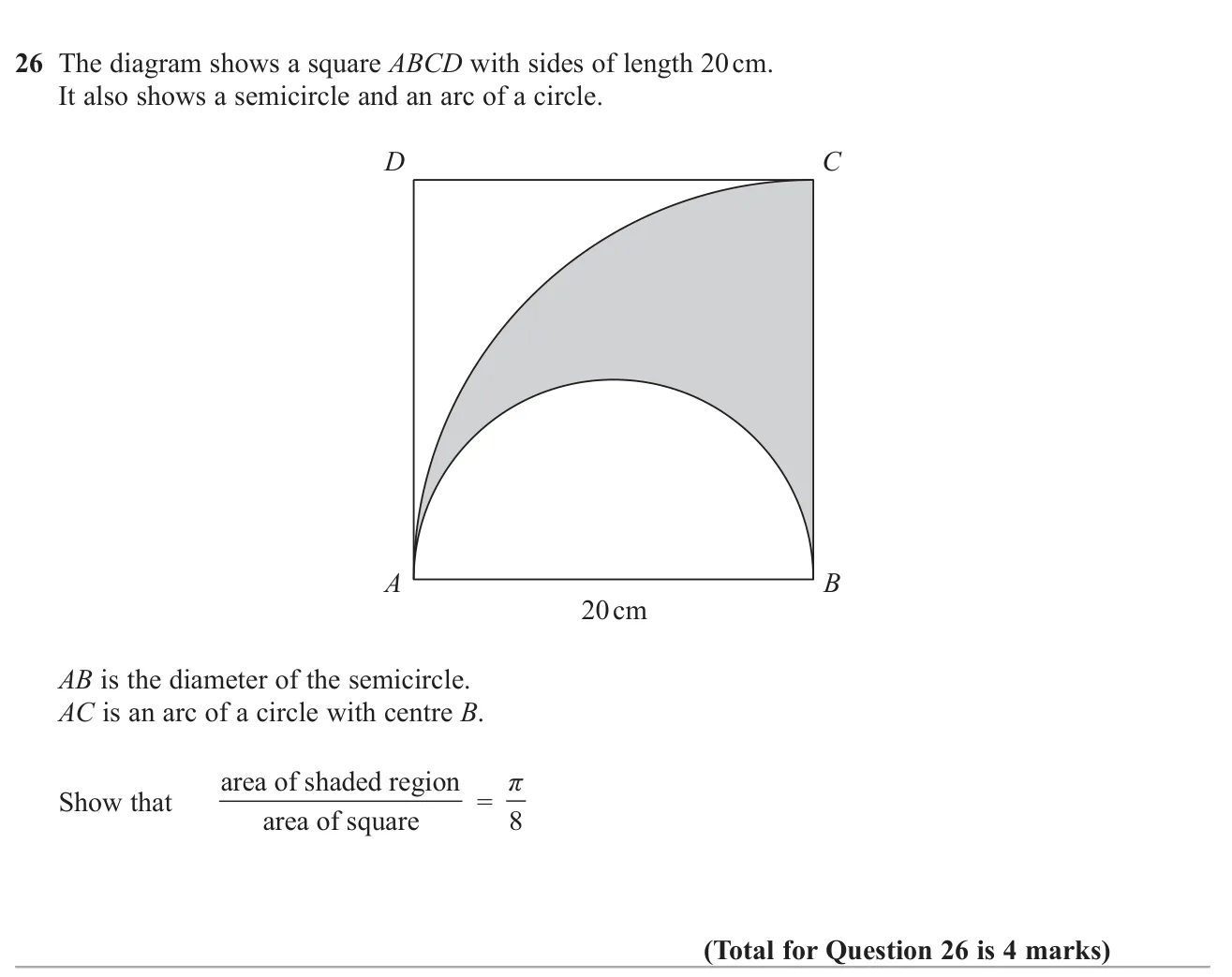
© Pearson Education Ltd. November 2018 Paper 1 (Foundation, non-calculator), question 26.
Show answer
| Answer | 400100π−50π=8π | 4 marks |
|---|
Worked solution Checked against the mark scheme
Quarter circle, radius 20: 41π×202=100π
Semicircle, radius 10: 21π×102=50π
Shaded =100π−50π=50π
Square =20×20=400
40050π=8π
Watch out: Using 20 as the radius of the semicircle.
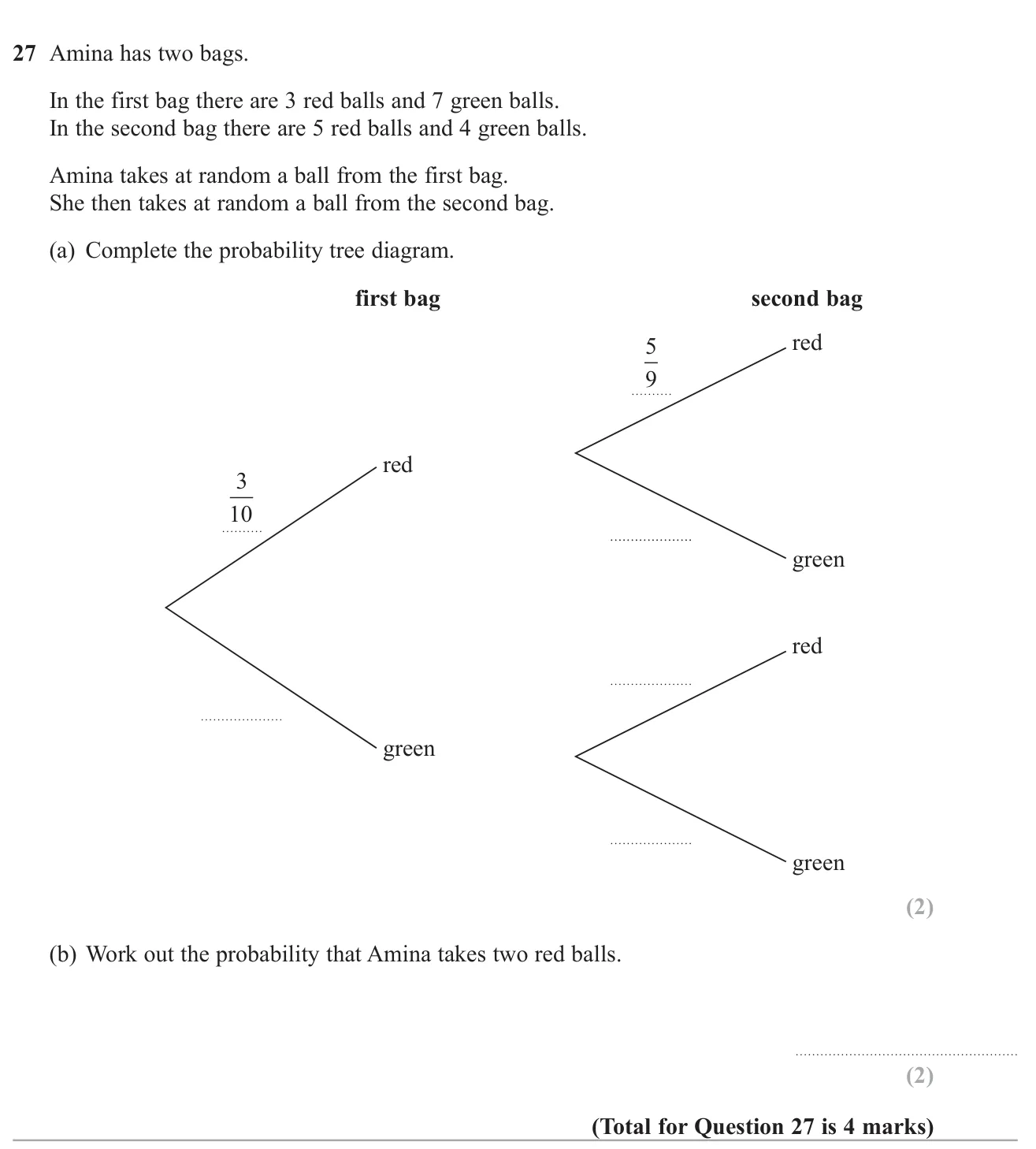
© Pearson Education Ltd. November 2018 Paper 1 (Foundation, non-calculator), question 27.
Show answer
| (a) | First bag green 107; second bag green 94 on both branches, red 95 | 2 marks |
|---|
| (b) | 9015 | 2 marks |
|---|
Worked solution Checked against the mark scheme
(a) First bag: green =1−103=107
Second bag (independent of the first): red 95, green 94 on both branches.
(b) 103×95=9015=61
Watch out: Adding the probabilities instead of multiplying along the branches.
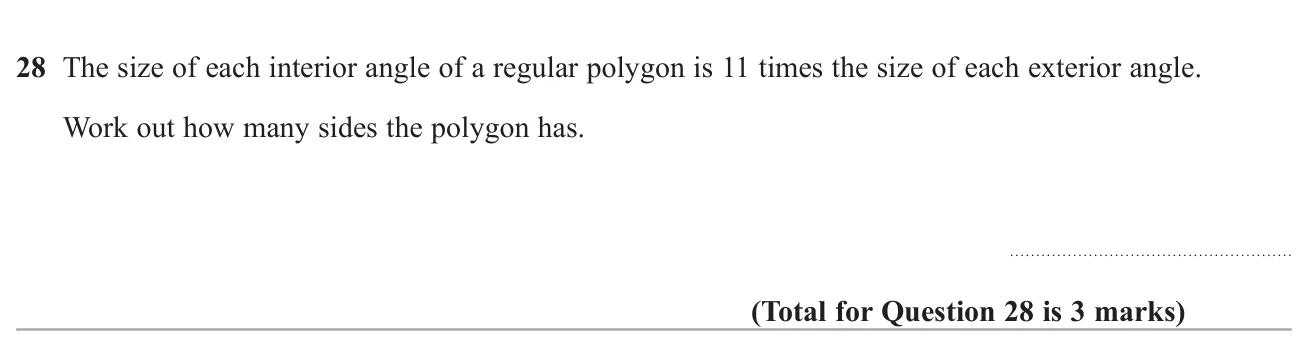
© Pearson Education Ltd. November 2018 Paper 1 (Foundation, non-calculator), question 28.
Show answer
Worked solution Checked against the mark scheme
Interior + exterior = 180°, so x+11x=180.
12x=180⇒x=15° (exterior angle)
Number of sides =360÷15=24
Watch out: Dividing 360 by the interior angle.
Finished the paper?
Add up your marks for all three papers and see what grade that would have been.