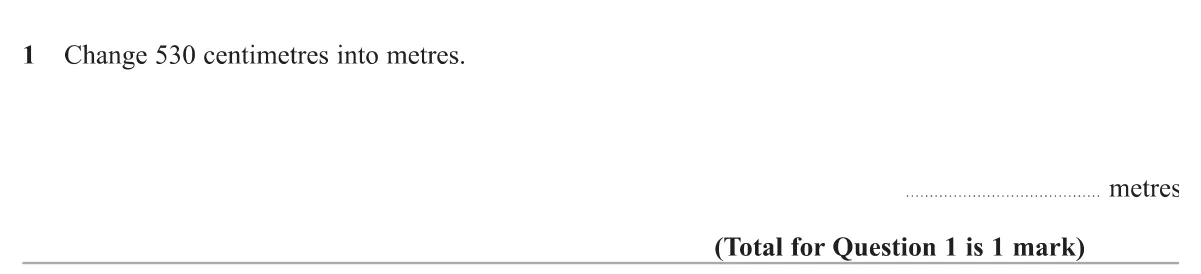
© Pearson Education Ltd. Specimen Paper 1 (Foundation, non-calculator), question 1.
Worked solution Checked against the mark scheme
There are 100 cm in 1 m, so divide by 100.
530 ÷ 100 = 5.3 530 \div 100 = 5.3 530 ÷ 100 = 5.3
Watch out: Dividing by 10 to get 53.
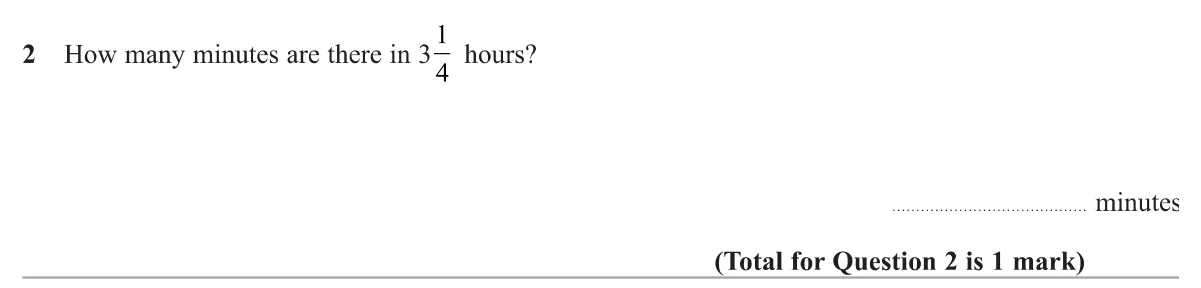
© Pearson Education Ltd. Specimen Paper 1 (Foundation, non-calculator), question 2.
Worked solution Checked against the mark scheme
3 hours is 3 × 60 = 180 3 \times 60 = 180 3 × 60 = 180
1 4 \frac14 4 1 15 15 15
180 + 15 = 195 180 + 15 = 195 180 + 15 = 195
Watch out: Treating a quarter of an hour as 25 minutes, giving 205.
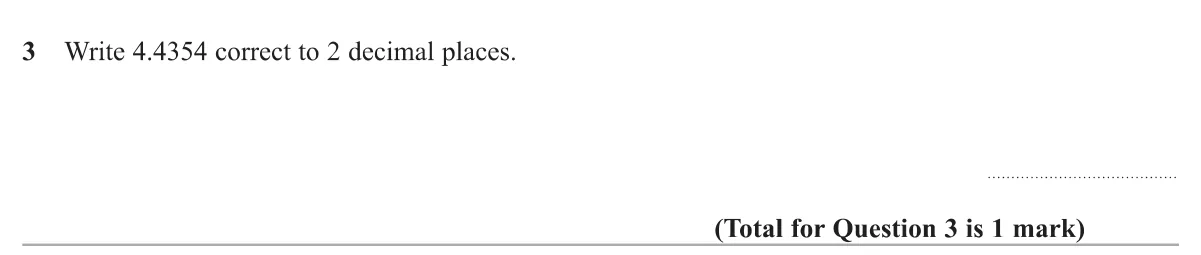
© Pearson Education Ltd. Specimen Paper 1 (Foundation, non-calculator), question 3.
Worked solution Checked against the mark scheme
Look at the third decimal place: it is 5.
5 or more rounds up, so 4.43 ∣ 54 4.43|54 4.43∣54 4.44 4.44 4.44
Watch out: Truncating to 4.43.
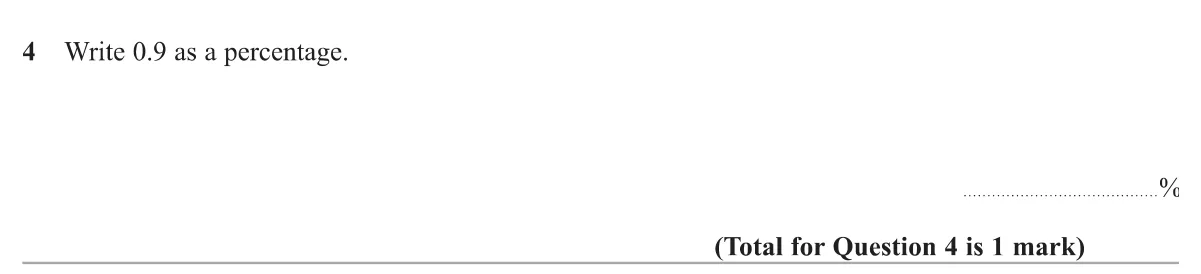
© Pearson Education Ltd. Specimen Paper 1 (Foundation, non-calculator), question 4.
Worked solution Checked against the mark scheme
Multiply by 100 to change a decimal to a percentage.
0.9 × 100 = 90 0.9 \times 100 = 90 0.9 × 100 = 90
Watch out: Writing 9%.
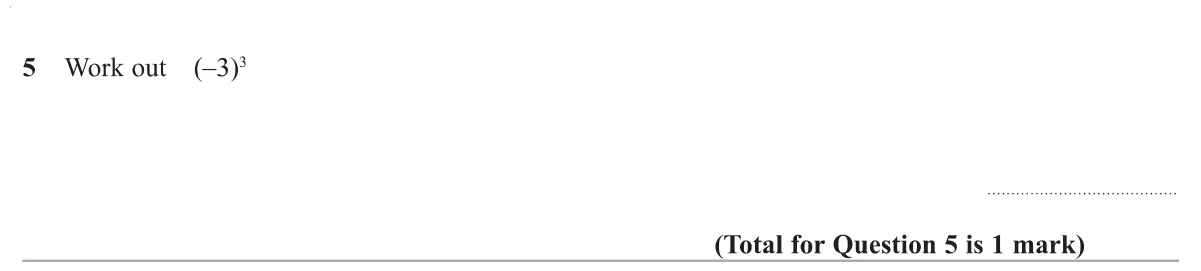
© Pearson Education Ltd. Specimen Paper 1 (Foundation, non-calculator), question 5.
Worked solution Checked against the mark scheme
( − 3 ) 3 = ( − 3 ) × ( − 3 ) × ( − 3 ) (-3)^3 = (-3) \times (-3) \times (-3) ( − 3 ) 3 = ( − 3 ) × ( − 3 ) × ( − 3 )
( − 3 ) × ( − 3 ) = 9 (-3) \times (-3) = 9 ( − 3 ) × ( − 3 ) = 9 9 × ( − 3 ) = − 27 9 \times (-3) = -27 9 × ( − 3 ) = − 27
Watch out: Giving 27 (losing the sign) or −9 (multiplying by 3).
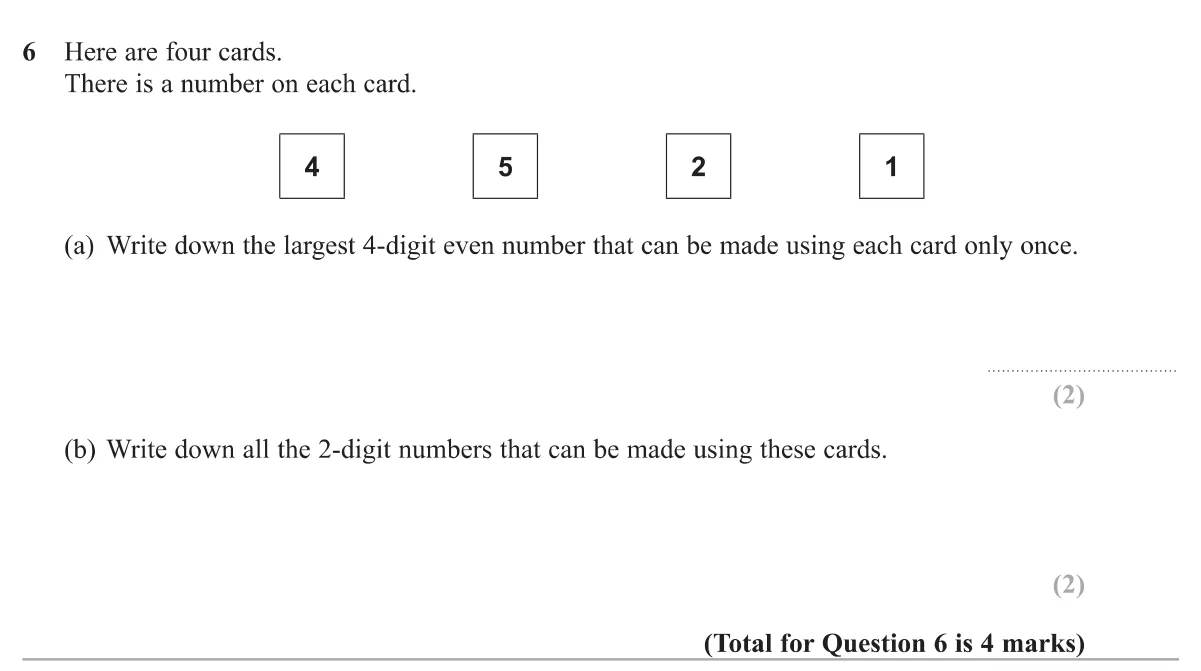
© Pearson Education Ltd. Specimen Paper 1 (Foundation, non-calculator), question 6.
(a) 5412 5412 5412 2 marks (b) 12, 14, 15, 21, 24, 25, 41, 42, 45, 51, 52, 54 2 marks
Worked solution Checked against the mark scheme
(a) An even number must end in 2 or 4. Put the biggest digits first and keep an even digit for the end: 5412 5412 5412
(b) Take each first digit in turn and pair it with the other three:
1: 12, 14, 15; 2: 21, 24, 25; 4: 41, 42, 45; 5: 51, 52, 54 (12 numbers).
Watch out: In (a), writing 5421, which is odd.
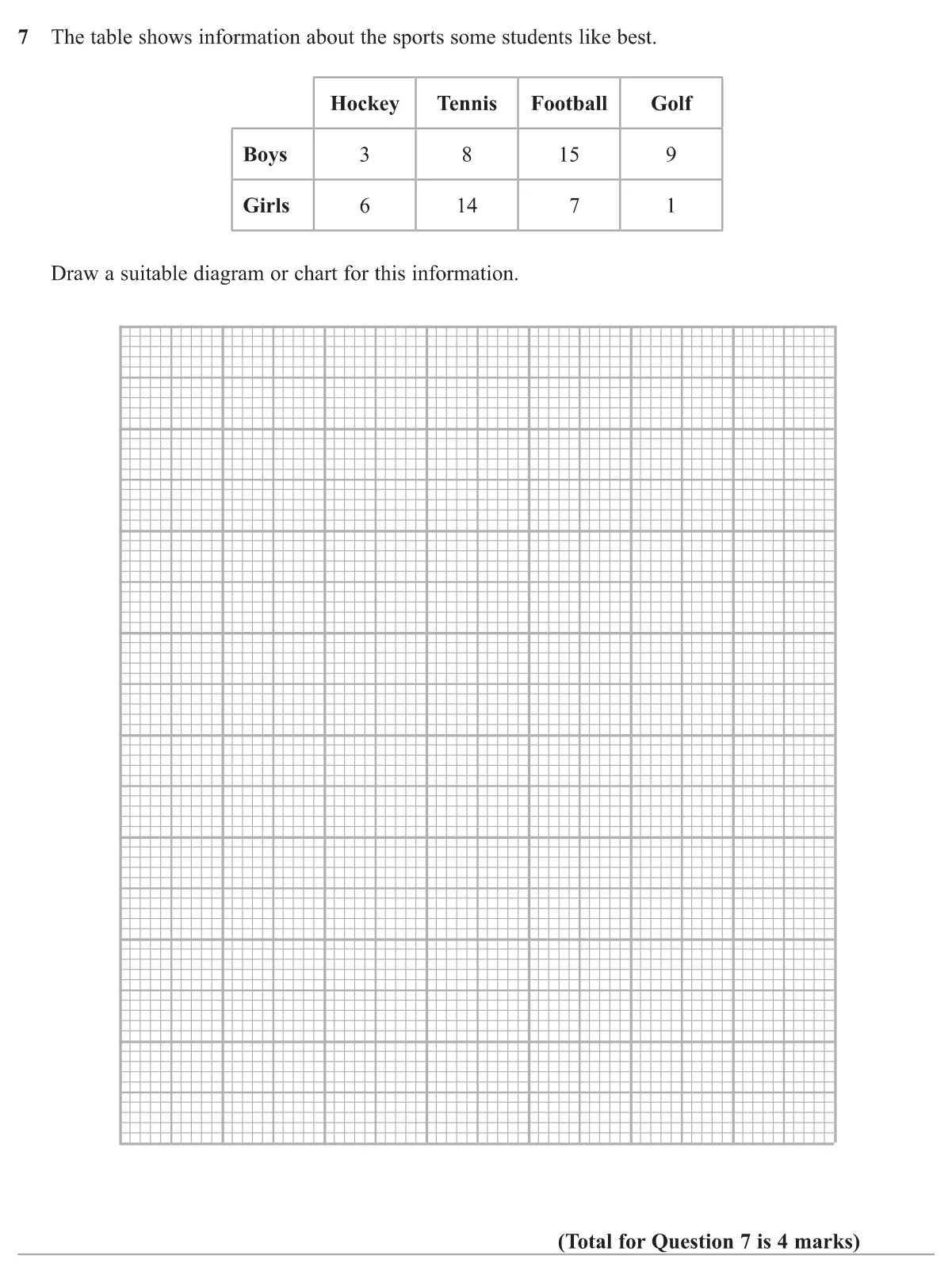
© Pearson Education Ltd. Specimen Paper 1 (Foundation, non-calculator), question 7.
Answer A dual (or composite) bar chart, or two separate bar charts, with labelled axes, a key and a linear scale 4 marks
Worked solution Checked against the mark scheme
A dual bar chart works well.
- Put the four sports along the horizontal axis.
Watch out: Forgetting the key, or using an uneven scale on the frequency axis.
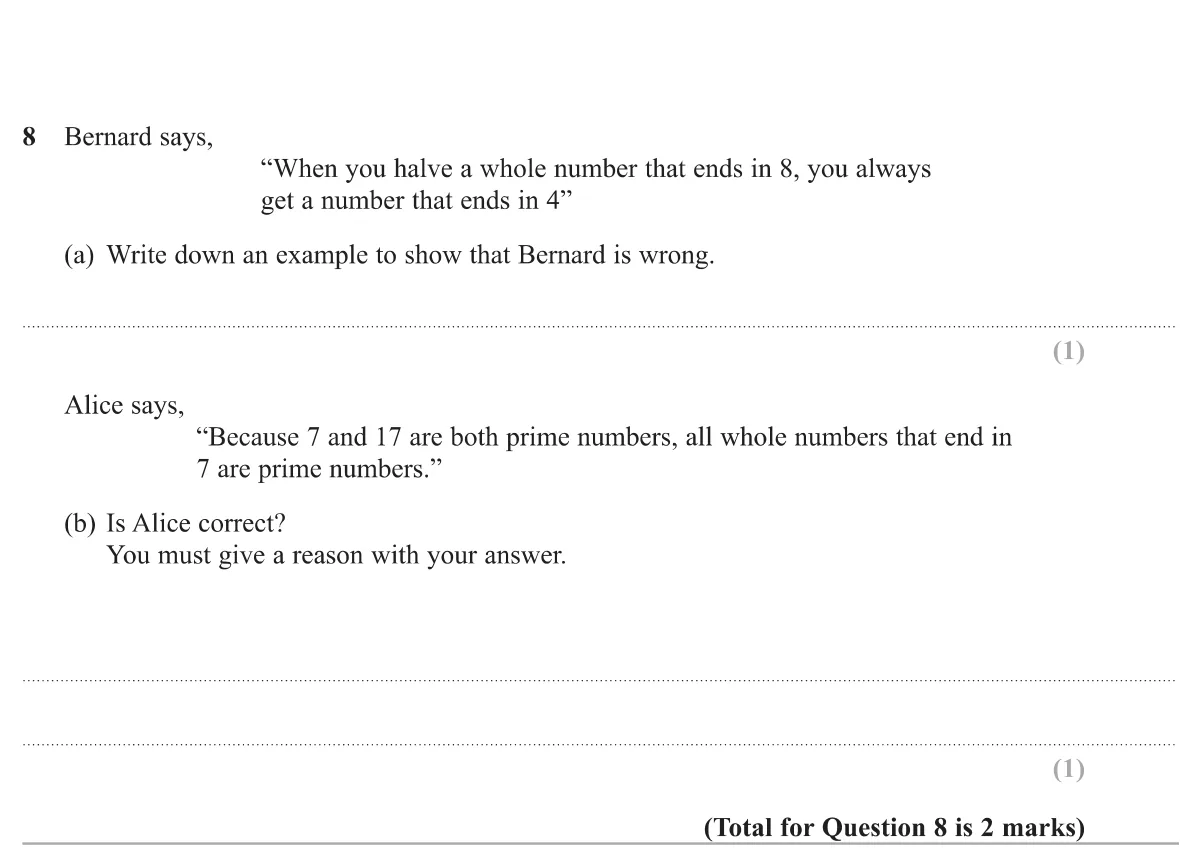
© Pearson Education Ltd. Specimen Paper 1 (Foundation, non-calculator), question 8.
(a) e.g. 18 ÷ 2 = 9 18 \div 2 = 9 18 ÷ 2 = 9 1 mark (b) No: e.g. 27 = 3 × 9 27 = 3 \times 9 27 = 3 × 9 1 mark
Worked solution Checked against the mark scheme
(a) Try 18: 18 ÷ 2 = 9 18 \div 2 = 9 18 ÷ 2 = 9
(b) Alice is wrong. 27 ends in 7 but 27 = 3 × 9 27 = 3 \times 9 27 = 3 × 9
Watch out: In (b), saying 'no' without giving a non-prime example.
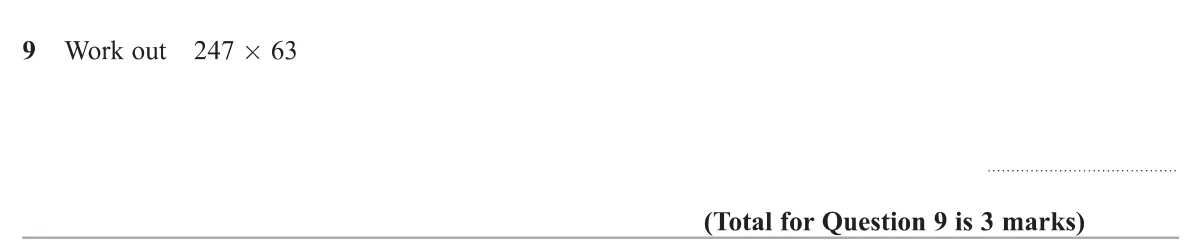
© Pearson Education Ltd. Specimen Paper 1 (Foundation, non-calculator), question 9.
Answer 15561 15561 15561 3 marks
Worked solution Checked against the mark scheme
Split 63 into 60 and 3.
247 × 60 = 14820 247 \times 60 = 14820 247 × 60 = 14820
247 × 3 = 741 247 \times 3 = 741 247 × 3 = 741
14820 + 741 = 15561 14820 + 741 = 15561 14820 + 741 = 15561
Watch out: Forgetting the place-value zero when multiplying by the 6 tens.
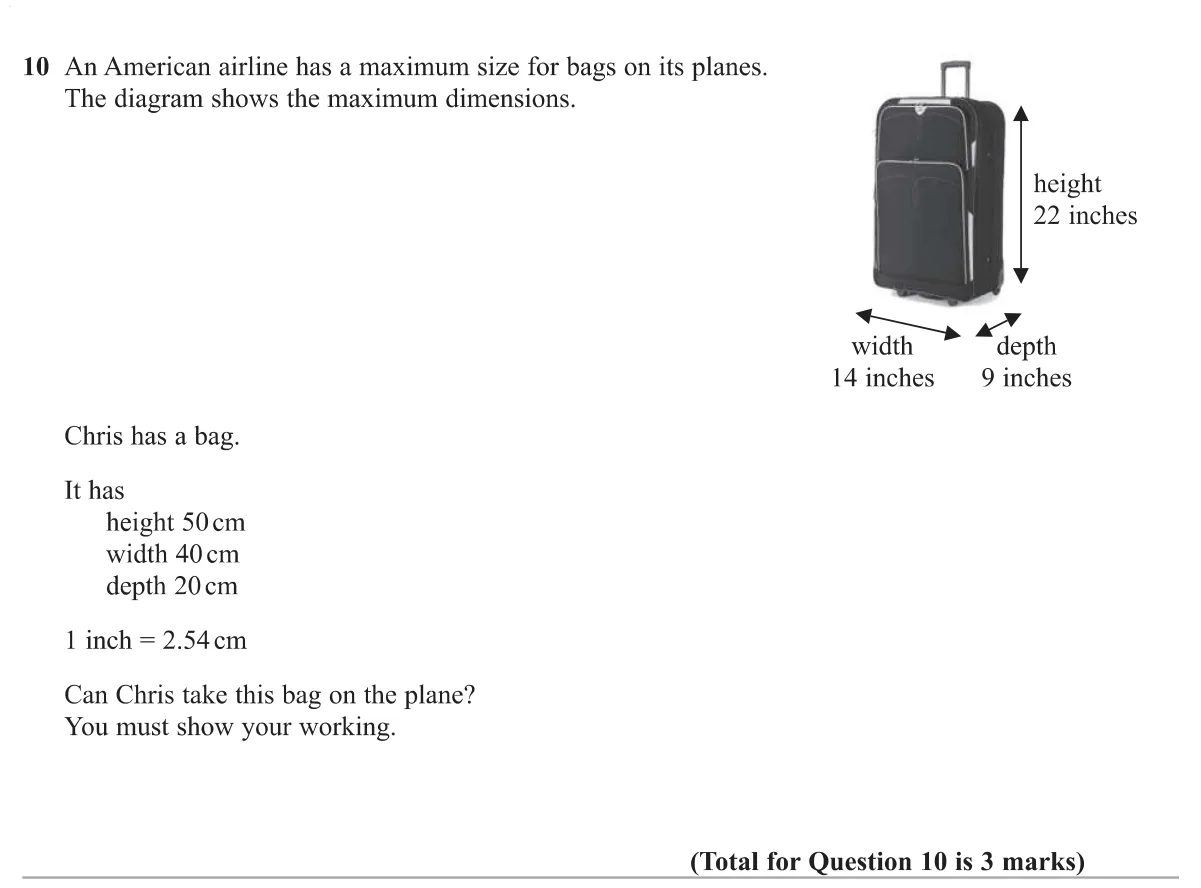
© Pearson Education Ltd. Specimen Paper 1 (Foundation, non-calculator), question 10.
Answer No: the width limit is 14 × 2.54 = 35.56 14 \times 2.54 = 35.56 14 × 2.54 = 35.56 3 marks
Worked solution Checked against the mark scheme
Convert each limit to cm (× 2.54 \times 2.54 × 2.54
- height: 22 × 2.54 = 55.88 22 \times 2.54 = 55.88 22 × 2.54 = 55.88 14 × 2.54 = 35.56 14 \times 2.54 = 35.56 14 × 2.54 = 35.56 9 × 2.54 = 22.86 9 \times 2.54 = 22.86 9 × 2.54 = 22.86
The bag is too wide, so Chris cannot take it.
Watch out: Dividing by 2.54 instead of multiplying, or only checking the height.
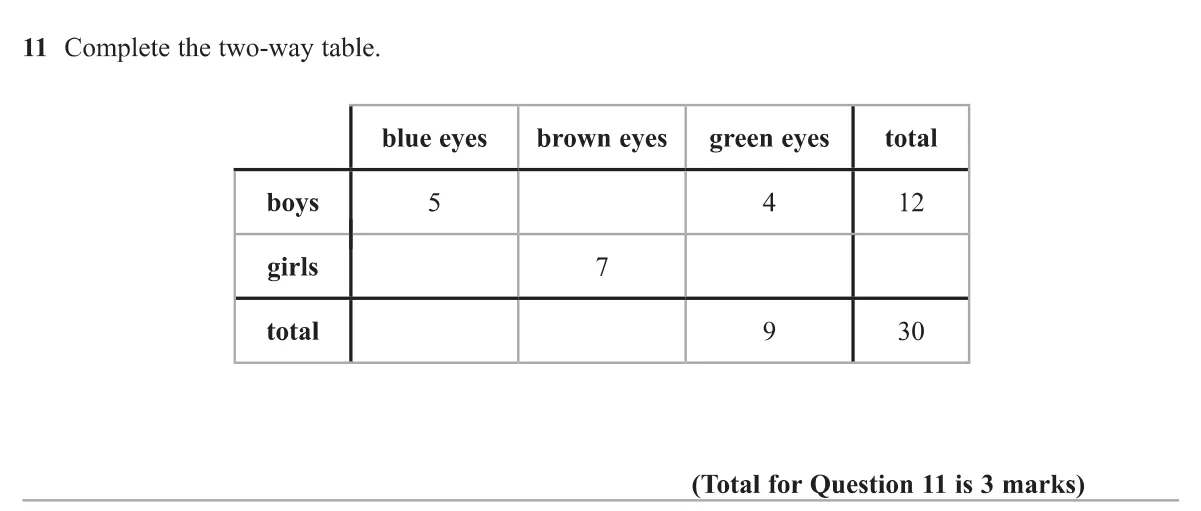
© Pearson Education Ltd. Specimen Paper 1 (Foundation, non-calculator), question 11.
Answer Boys: 5, 3, 4, 12. Girls: 6, 7, 5, 18. Totals: 11, 10, 9, 30 3 marks
Worked solution Checked against the mark scheme
Boys brown: 12 − 5 − 4 = 3 12 - 5 - 4 = 3 12 − 5 − 4 = 3
Girls total: 30 − 12 = 18 30 - 12 = 18 30 − 12 = 18
Girls green: 9 − 4 = 5 9 - 4 = 5 9 − 4 = 5
Girls blue: 18 − 7 − 5 = 6 18 - 7 - 5 = 6 18 − 7 − 5 = 6
Column totals: blue 5 + 6 = 11 5 + 6 = 11 5 + 6 = 11 3 + 7 = 10 3 + 7 = 10 3 + 7 = 10 11 + 10 + 9 = 30 11 + 10 + 9 = 30 11 + 10 + 9 = 30
Watch out: Adding along a row when the missing value is in a column total.
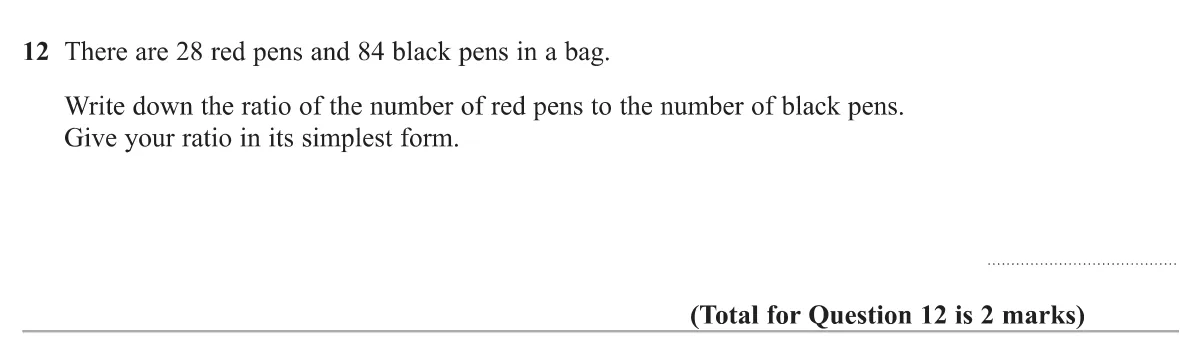
Question 12 Ratio 2 marks Grade 3 No calculator © Pearson Education Ltd. Specimen Paper 1 (Foundation, non-calculator), question 12.
Worked solution Checked against the mark scheme
Red : black = 28 : 84 = 28 : 84 = 28 : 84
The HCF of 28 and 84 is 28, so divide both by 28:
28 : 84 = 1 : 3 28 : 84 = 1 : 3 28 : 84 = 1 : 3
Watch out: Writing the ratio the wrong way round, 3 : 1.
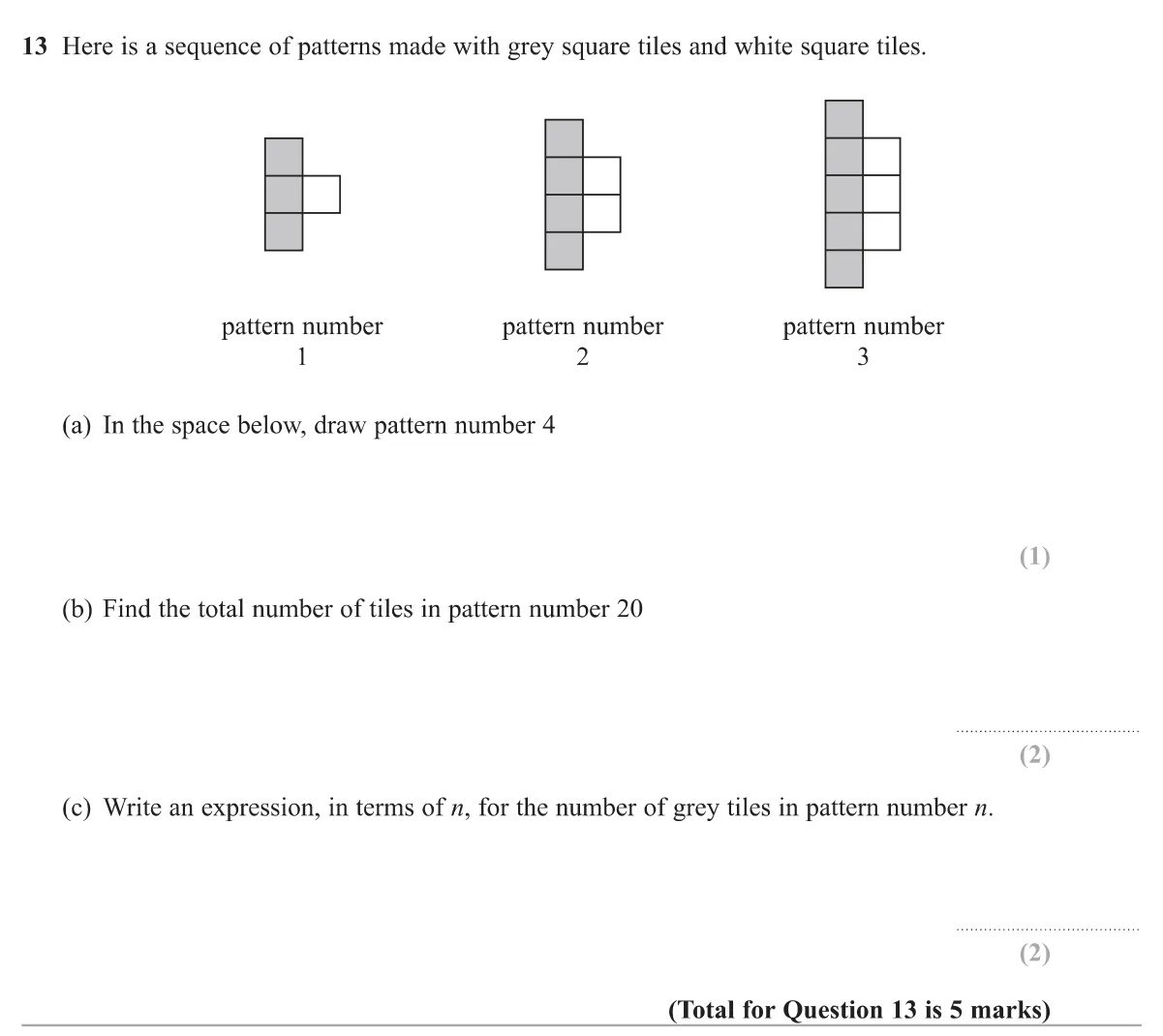
© Pearson Education Ltd. Specimen Paper 1 (Foundation, non-calculator), question 13.
(a) A column of 6 grey tiles with 4 white tiles beside the middle four 1 mark (b) 42 42 42 2 marks (c) n + 2 n + 2 n + 2 2 marks
Worked solution Checked against the mark scheme
Pattern n n n n + 2 n + 2 n + 2 n n n
(a) Pattern 4: 6 grey tiles in a column, 4 white tiles next to the middle ones.
(b) Total tiles = ( n + 2 ) + n = 2 n + 2 = (n + 2) + n = 2n + 2 = ( n + 2 ) + n = 2 n + 2 n = 20 n = 20 n = 20 2 × 20 + 2 = 42 2 \times 20 + 2 = 42 2 × 20 + 2 = 42
(c) Grey tiles go 3, 4, 5, ... so the expression is n + 2 n + 2 n + 2
Watch out: In (c), writing n + 1 because the sequence goes up by 1.
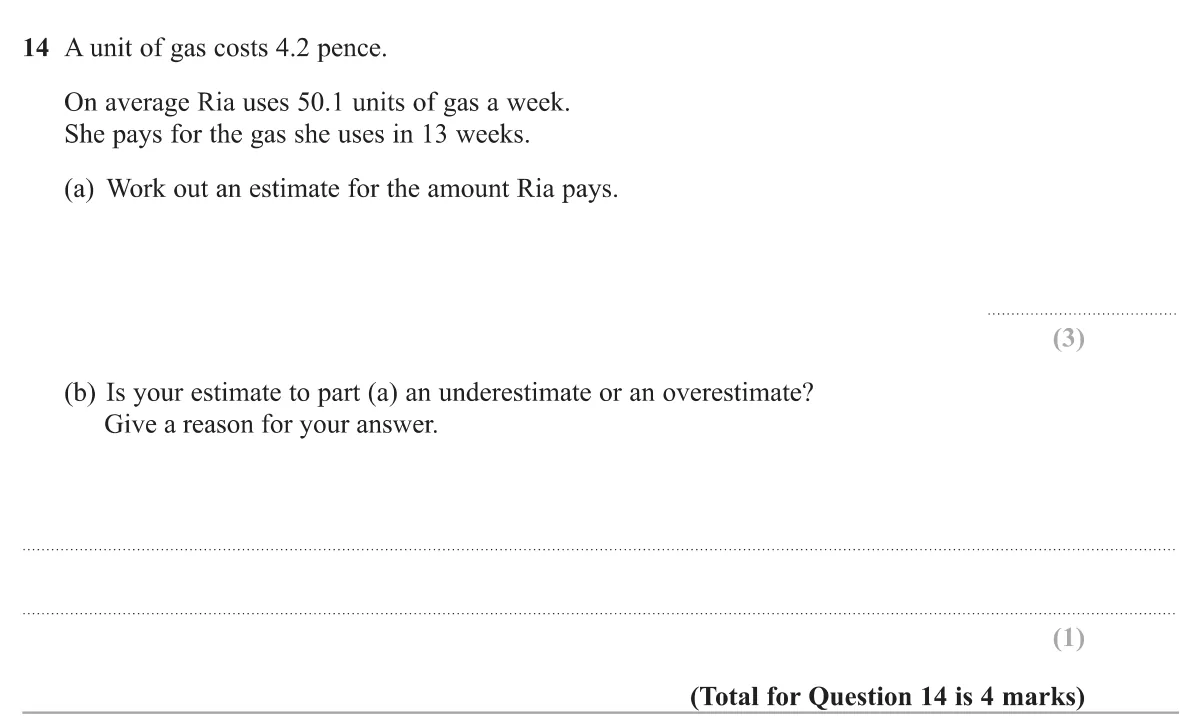
© Pearson Education Ltd. Specimen Paper 1 (Foundation, non-calculator), question 14.
(a) Between 2000p and 2600p (£20 to £26), e.g. 4 × 50 × 13 = 2600 4 \times 50 \times 13 = 2600 4 × 50 × 13 = 2600 3 marks (b) Underestimate, because the values were rounded down 1 mark
Worked solution Checked against the mark scheme
(a) Round: 4.2 → 4 4.2 \to 4 4.2 → 4 50.1 → 50 50.1 \to 50 50.1 → 50
4 × 50 = 200 4 \times 50 = 200 4 × 50 = 200 200 × 13 = 2600 200 \times 13 = 2600 200 × 13 = 2600 = £ 26 = £26 = £26
(b) Both 4.2 and 50.1 were rounded down, so the estimate is an underestimate. (The exact cost is about £27.35.)
Watch out: Rounding 13 to 10 and then calling the estimate an overestimate.
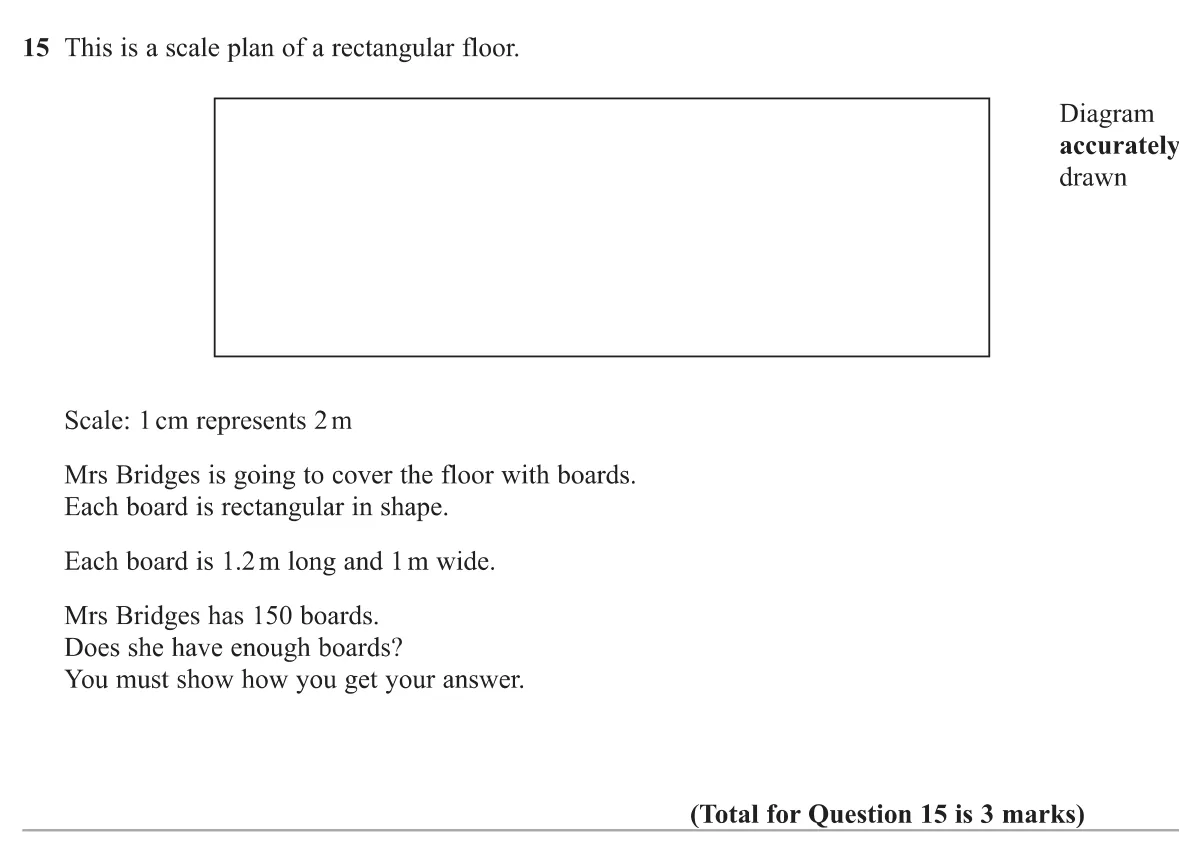
© Pearson Education Ltd. Specimen Paper 1 (Foundation, non-calculator), question 15.
Answer No: the floor is 24 m by 8 m, so 160 boards are needed 3 marks
Worked solution Checked against the mark scheme
Measure the plan: about 12 cm by 4 cm.
Scale 1 cm : 2 m, so the floor is 24 24 24 8 8 8
Area = 24 × 8 = 192 = 24 \times 8 = 192 = 24 × 8 = 192 1.2 × 1 = 1.2 1.2 \times 1 = 1.2 1.2 × 1 = 1.2
192 ÷ 1.2 = 160 192 \div 1.2 = 160 192 ÷ 1.2 = 160 20 20 20 × \times × 8 8 8
Watch out: Forgetting to apply the scale to both lengths, or dividing by the scale instead of multiplying.
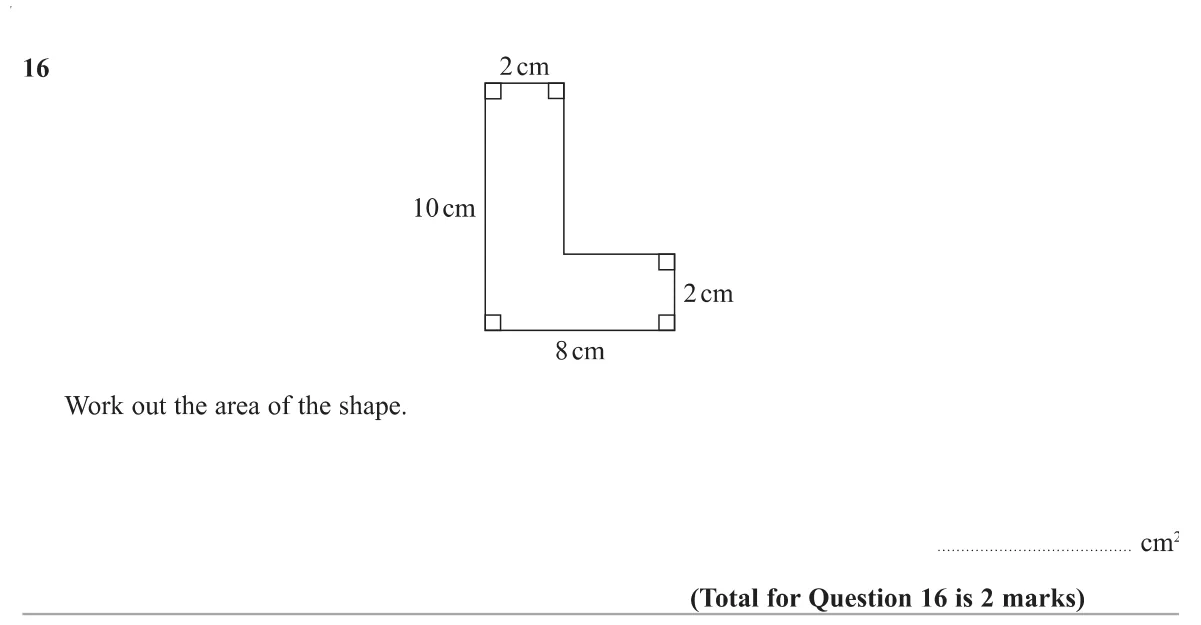
© Pearson Education Ltd. Specimen Paper 1 (Foundation, non-calculator), question 16.
Worked solution Checked against the mark scheme
Split it into two rectangles.
Tall part: 10 × 2 = 20 10 \times 2 = 20 10 × 2 = 20
Bottom right part: ( 8 − 2 ) × 2 = 12 (8 - 2) \times 2 = 12 ( 8 − 2 ) × 2 = 12
Total = 20 + 12 = 32 = 20 + 12 = 32 = 20 + 12 = 32
Watch out: Using 8 × 2 for the bottom part as well as 10 × 2, counting the corner twice (36).
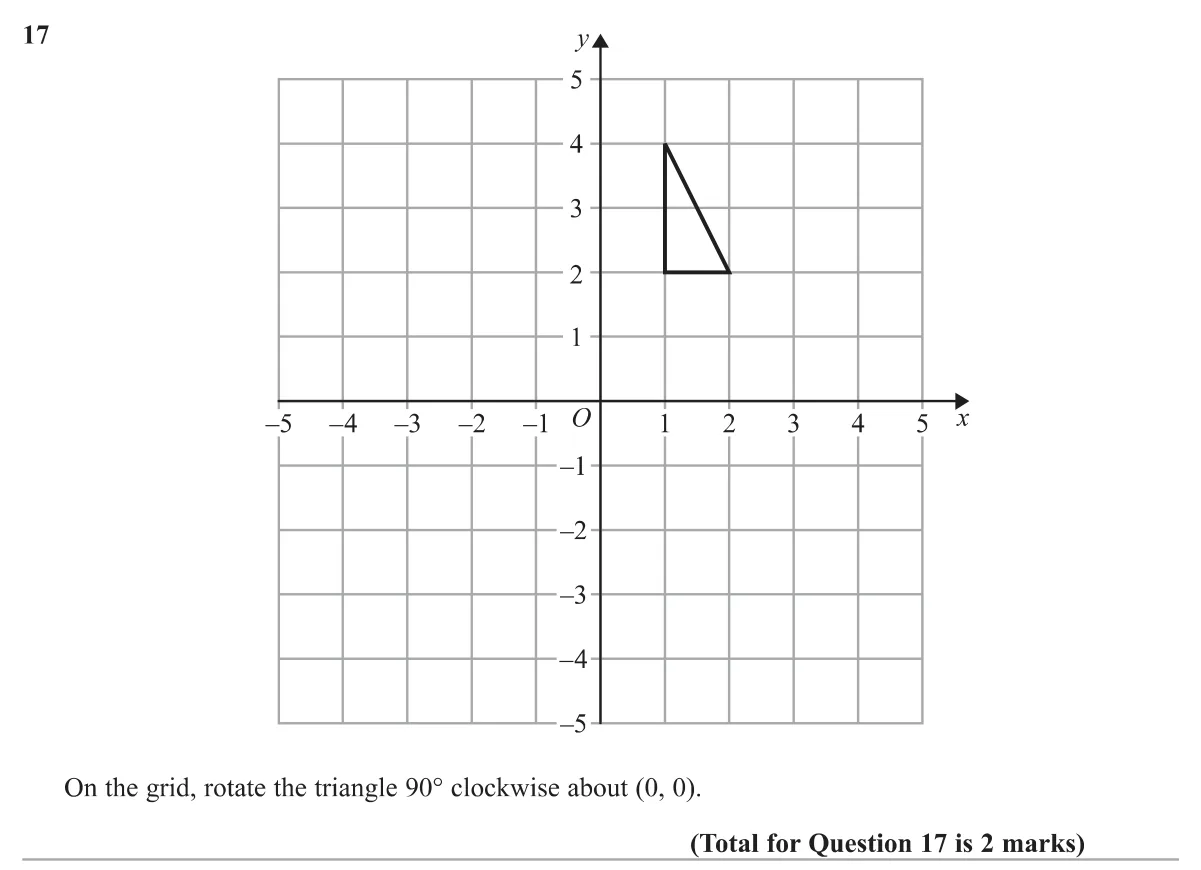
© Pearson Education Ltd. Specimen Paper 1 (Foundation, non-calculator), question 17.
Answer Triangle with vertices ( 2 , − 1 ) (2,-1) ( 2 , − 1 ) ( 4 , − 1 ) (4,-1) ( 4 , − 1 ) ( 2 , − 2 ) (2,-2) ( 2 , − 2 ) 2 marks
Worked solution Checked against the mark scheme
Rotating 90° clockwise about ( 0 , 0 ) (0,0) ( 0 , 0 ) ( x , y ) (x, y) ( x , y ) ( y , − x ) (y, -x) ( y , − x )
( 1 , 2 ) → ( 2 , − 1 ) (1,2) \to (2,-1) ( 1 , 2 ) → ( 2 , − 1 )
( 1 , 4 ) → ( 4 , − 1 ) (1,4) \to (4,-1) ( 1 , 4 ) → ( 4 , − 1 )
( 2 , 2 ) → ( 2 , − 2 ) (2,2) \to (2,-2) ( 2 , 2 ) → ( 2 , − 2 )
Plot and join these three points.
Watch out: Rotating anticlockwise instead of clockwise.
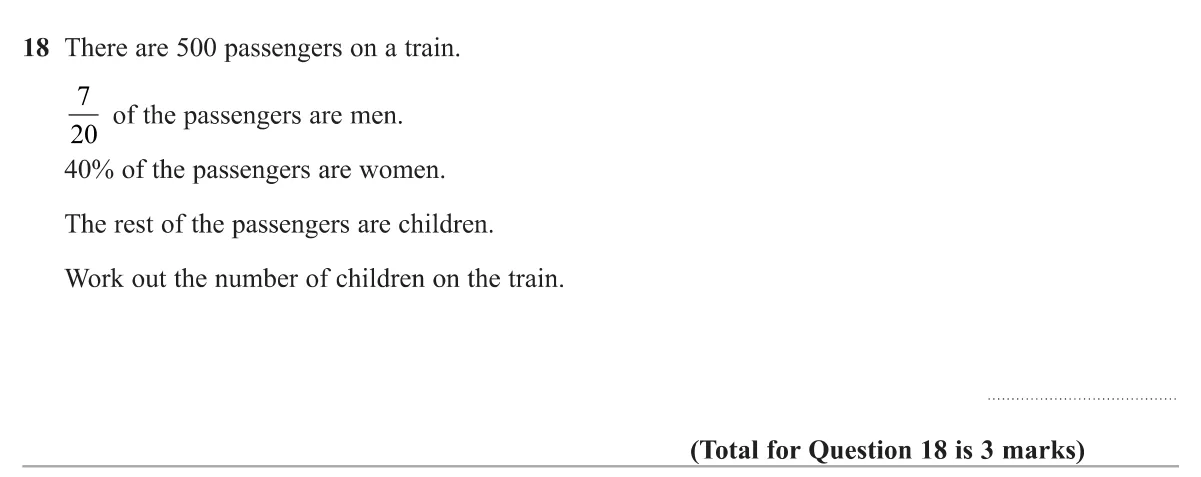
© Pearson Education Ltd. Specimen Paper 1 (Foundation, non-calculator), question 18.
Worked solution Checked against the mark scheme
Men: 7 20 × 500 = 175 \frac{7}{20} \times 500 = 175 20 7 × 500 = 175
Women: 40 % × 500 = 200 40\% \times 500 = 200 40% × 500 = 200
Children: 500 − 175 − 200 = 125 500 - 175 - 200 = 125 500 − 175 − 200 = 125
Watch out: Stopping after one step and giving 175 or 200.
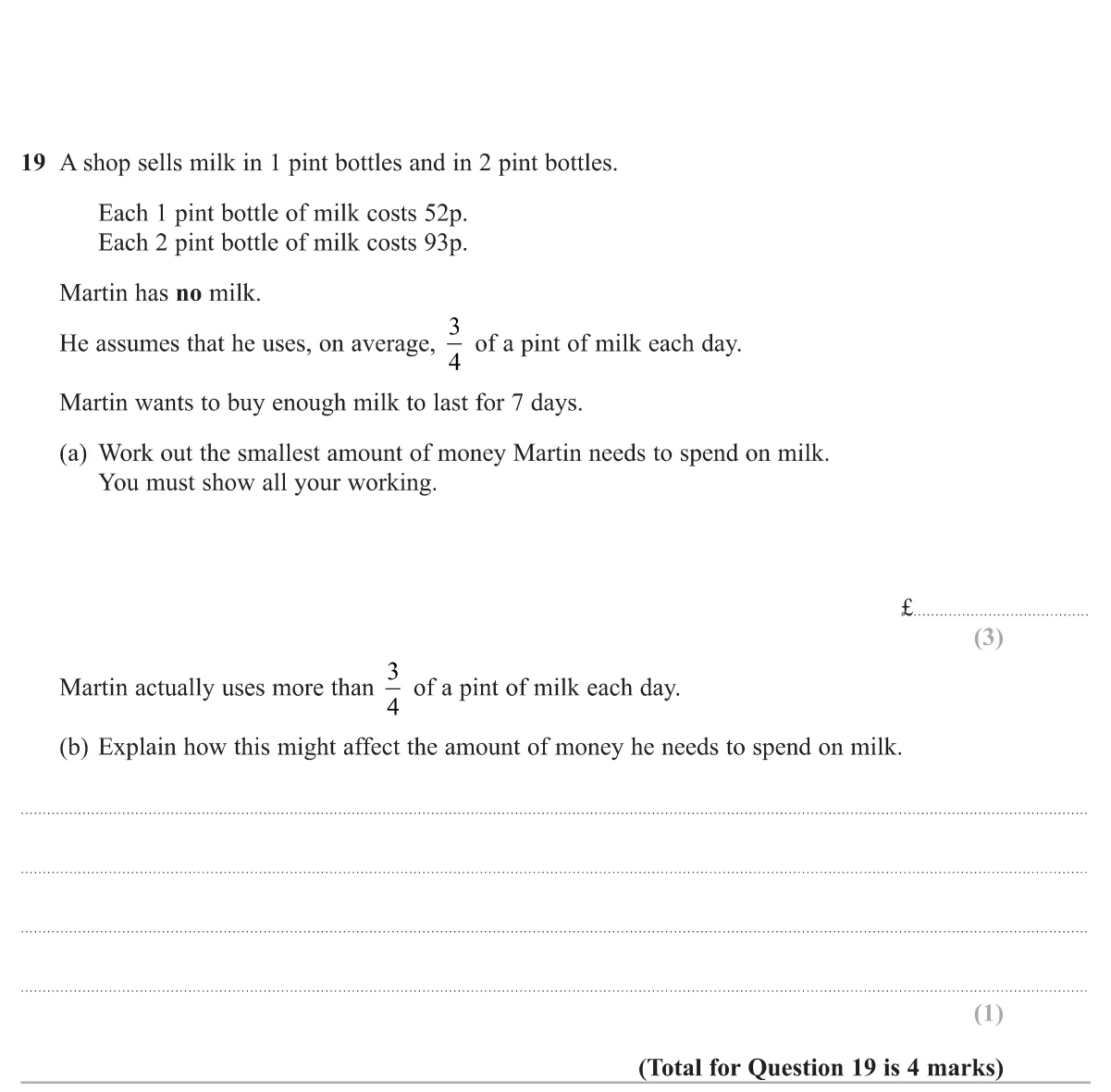
© Pearson Education Ltd. Specimen Paper 1 (Foundation, non-calculator), question 19.
(a) £ 2.79 £2.79 £2.79 3 marks (b) He might have to spend more (if he uses more than 6 pints in the week) 1 mark
Worked solution Checked against the mark scheme
(a) Milk needed: 7 × 3 4 = 5.25 7 \times \frac34 = 5.25 7 × 4 3 = 5.25
3 two-pint bottles: 3 × 93 = 279 3 \times 93 = 279 3 × 93 = 279 = £ 2.79 = £2.79 = £2.79
(2 two-pint + 2 one-pint = 290 = 290 = 290
(b) 6 pints lasts 7 days only if he uses up to 6 ÷ 7 ≈ 0.857 6 \div 7 \approx 0.857 6 ÷ 7 ≈ 0.857
Watch out: Buying exactly 5 pints (2 × 2 pint + 1 pint = £2.38), which is not enough.
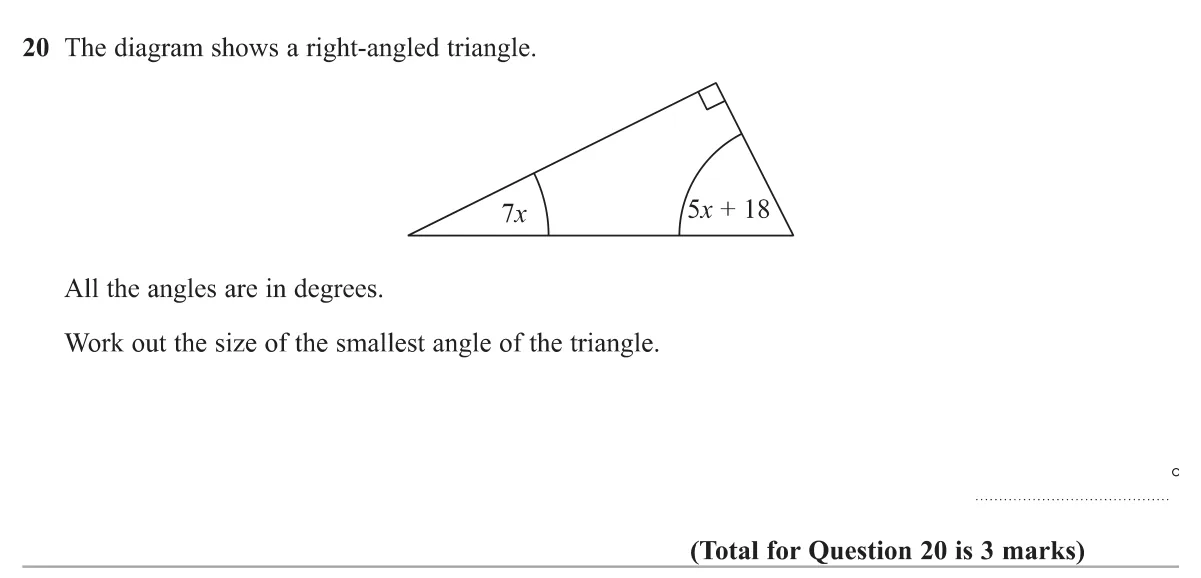
© Pearson Education Ltd. Specimen Paper 1 (Foundation, non-calculator), question 20.
Worked solution Checked against the mark scheme
The two unknown angles add to 90 ° 90° 90°
7 x + 5 x + 18 = 90 7x + 5x + 18 = 90 7 x + 5 x + 18 = 90
12 x = 72 12x = 72 12 x = 72 x = 6 x = 6 x = 6
Angles: 7 × 6 = 42 ° 7 \times 6 = 42° 7 × 6 = 42° 5 × 6 + 18 = 48 ° 5 \times 6 + 18 = 48° 5 × 6 + 18 = 48° 42 ° 42° 42°
Watch out: Stopping at x = 6 and giving that as the angle.
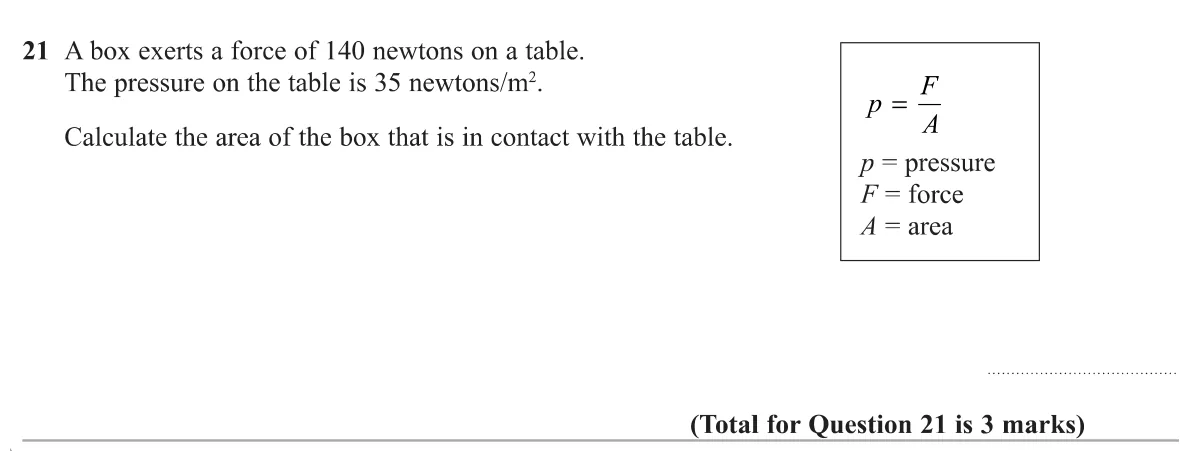
© Pearson Education Ltd. Specimen Paper 1 (Foundation, non-calculator), question 21.
Worked solution Checked against the mark scheme
p = F A p = \frac{F}{A} p = A F A = F p A = \frac{F}{p} A = p F
A = 140 35 = 4 A = \frac{140}{35} = 4 A = 35 140 = 4
Watch out: Multiplying 140 × 35 instead of dividing.
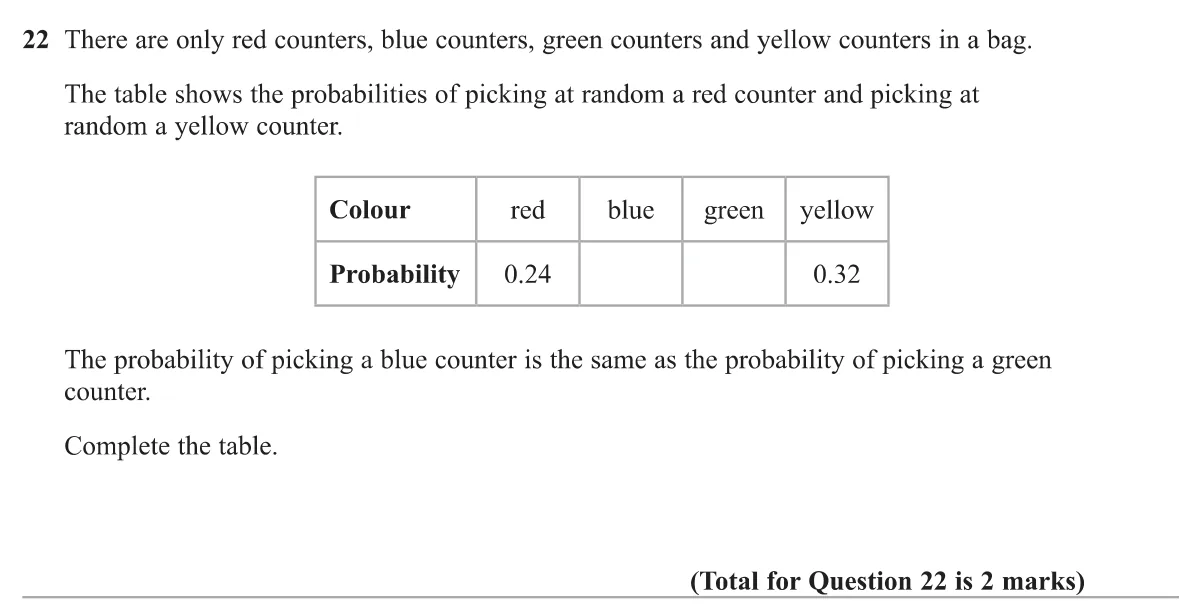
© Pearson Education Ltd. Specimen Paper 1 (Foundation, non-calculator), question 22.
Answer blue 0.22 0.22 0.22 0.22 0.22 0.22 2 marks
Worked solution Checked against the mark scheme
The probabilities add up to 1.
1 − 0.24 − 0.32 = 0.44 1 - 0.24 - 0.32 = 0.44 1 − 0.24 − 0.32 = 0.44
Blue and green are equal, so each is 0.44 ÷ 2 = 0.22 0.44 \div 2 = 0.22 0.44 ÷ 2 = 0.22
Watch out: Putting 0.44 in each box instead of sharing it between them.
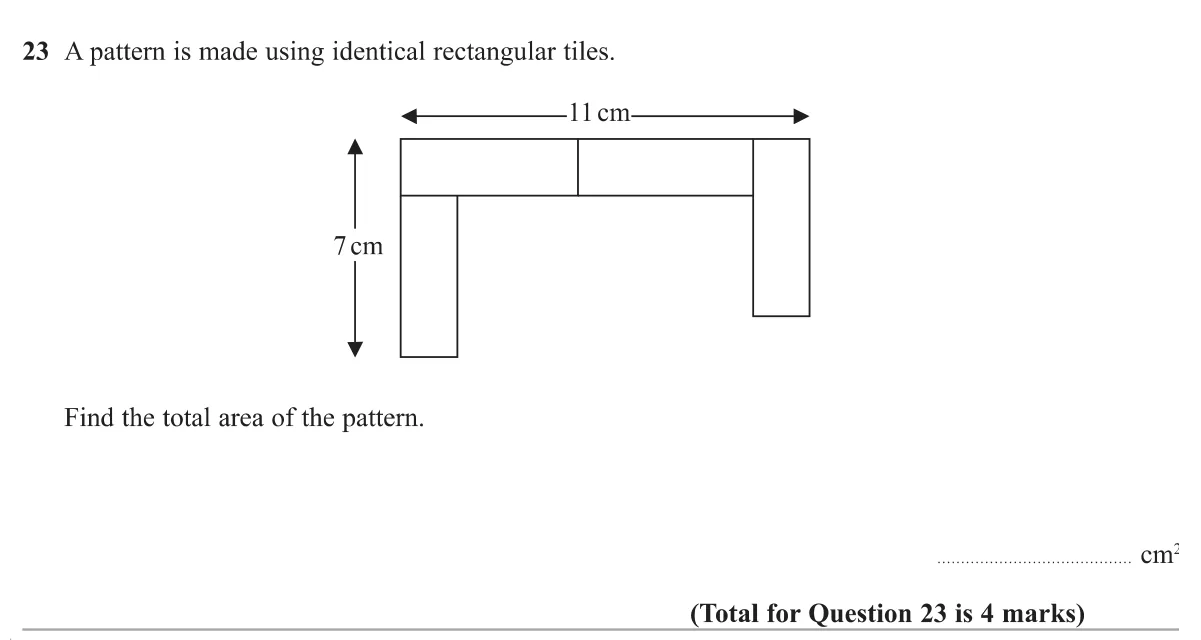
© Pearson Education Ltd. Specimen Paper 1 (Foundation, non-calculator), question 23.
Worked solution Checked against the mark scheme
Let each tile be l l l w w w
Across the top: 2 l + w = 11 2l + w = 11 2 l + w = 11 l + w = 7 l + w = 7 l + w = 7
Subtracting: l = 4 l = 4 l = 4 w = 3 w = 3 w = 3
One tile = 4 × 3 = 12 = 4 \times 3 = 12 = 4 × 3 = 12 4 × 12 = 48 4 \times 12 = 48 4 × 12 = 48
Watch out: Multiplying 11 × 7 to get 77, treating the pattern as a full rectangle.
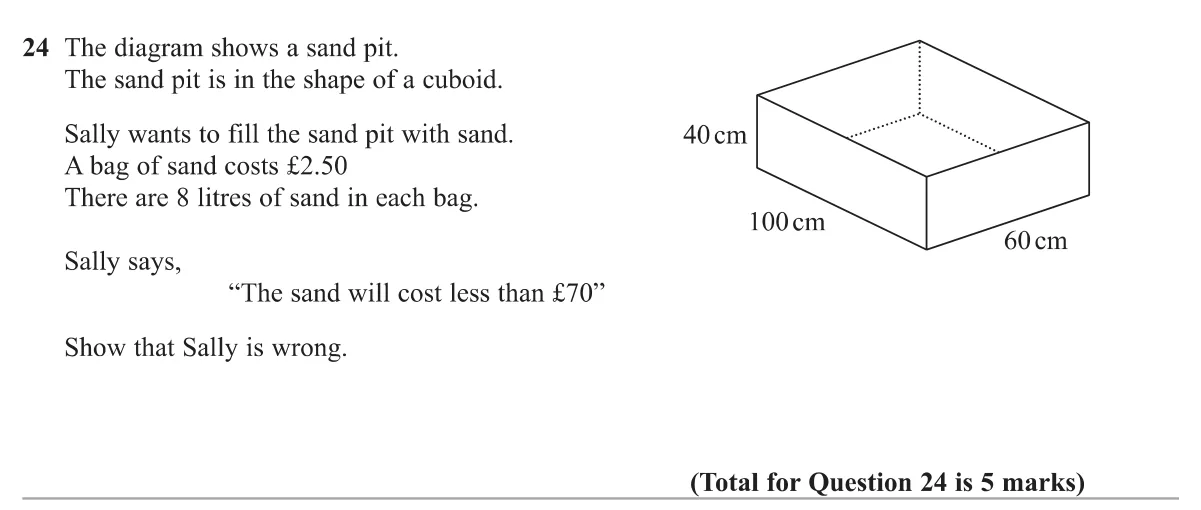
© Pearson Education Ltd. Specimen Paper 1 (Foundation, non-calculator), question 24.
Answer Volume 240000 240000 240000 = 240 = 240 = 240 £ 75 £75 £75 5 marks
Worked solution Checked against the mark scheme
Volume = 100 × 60 × 40 = 240000 = 100 \times 60 \times 40 = 240000 = 100 × 60 × 40 = 240000
1 1 1 = 1000 = 1000 = 1000 240 240 240
Bags: 240 ÷ 8 = 30 240 \div 8 = 30 240 ÷ 8 = 30
Cost: 30 × £ 2.50 = £ 75 30 \times £2.50 = £75 30 × £2.50 = £75
Watch out: Using 1 litre = 100 cm³, or adding the dimensions instead of multiplying.
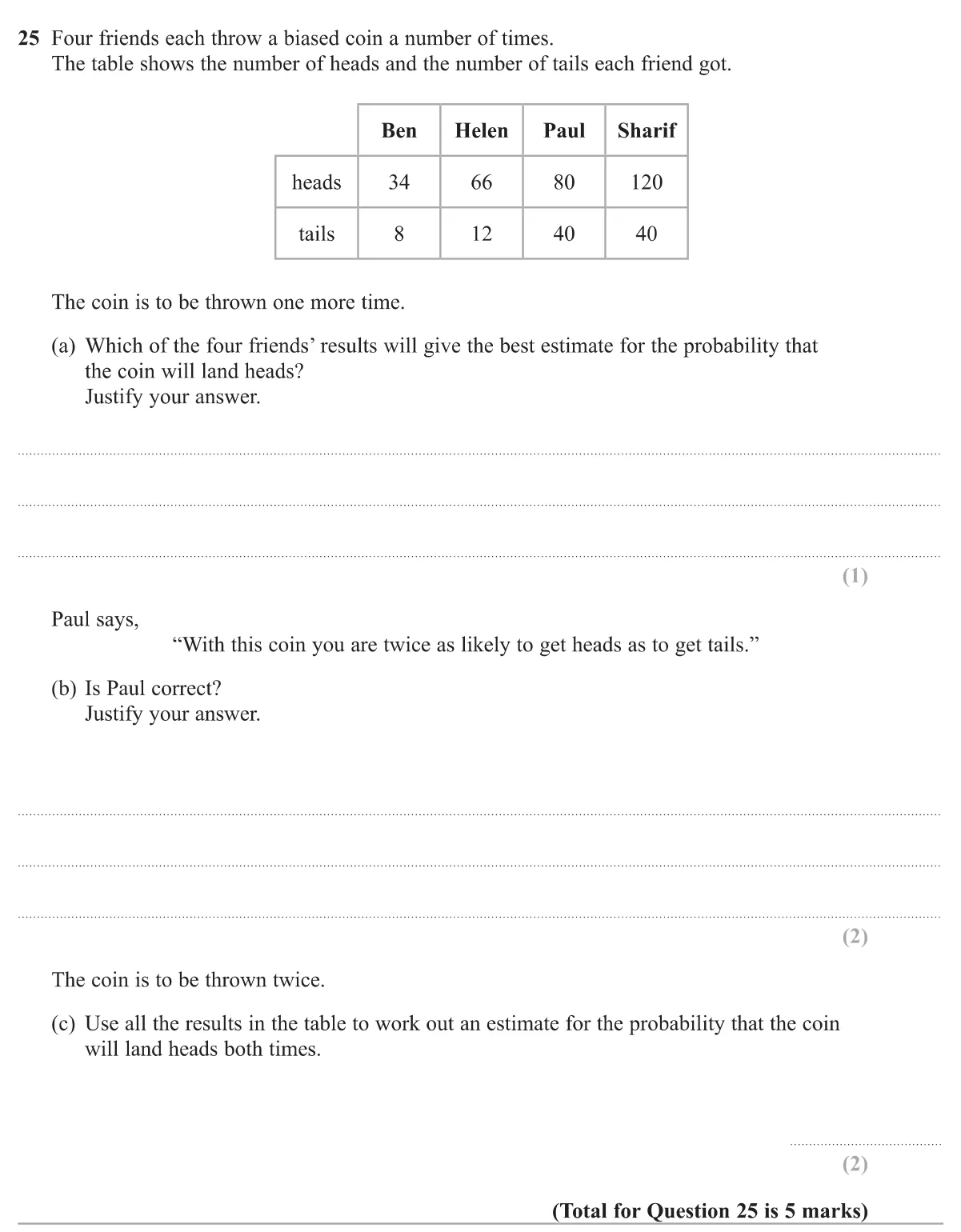
© Pearson Education Ltd. Specimen Paper 1 (Foundation, non-calculator), question 25.
(a) Sharif, because he threw the coin the most times 1 mark (b) No: Paul's own results give heads twice as often, but overall 300 heads to 100 tails is three times as likely 2 marks (c) 9 16 \frac{9}{16} 16 9 2 marks
Worked solution Checked against the mark scheme
(a) Sharif threw 160 times, more than anyone else, so his results are the most reliable.
(b) Paul got 80 : 40 = 2 : 1 80 : 40 = 2 : 1 80 : 40 = 2 : 1 300 300 300 100 100 100 3 : 1 3 : 1 3 : 1
(c) P(heads) ≈ 300 400 = 3 4 \approx \frac{300}{400} = \frac34 ≈ 400 300 = 4 3
P(two heads) = 3 4 × 3 4 = 9 16 = \frac34 \times \frac34 = \frac{9}{16} = 4 3 × 4 3 = 16 9
Watch out: In (c), adding 3/4 + 3/4 instead of multiplying.
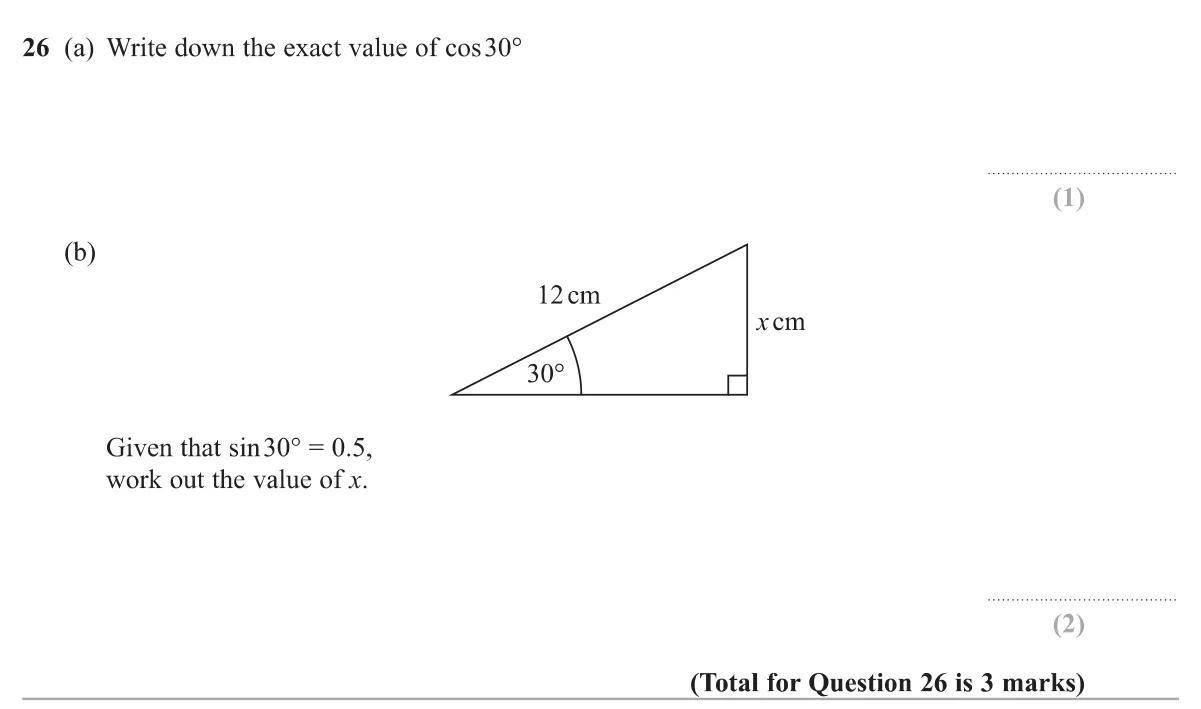
© Pearson Education Ltd. Specimen Paper 1 (Foundation, non-calculator), question 26.
(a) 3 2 \frac{\sqrt3}{2} 2 3 1 mark (b) 6 6 6 2 marks
Worked solution Checked against the mark scheme
(a) cos 30 ° = 3 2 \cos 30° = \frac{\sqrt3}{2} cos 30° = 2 3
(b) x x x 30 ° 30° 30°
sin 30 ° = x 12 \sin 30° = \frac{x}{12} sin 30° = 12 x
x = 12 × 0.5 = 6 x = 12 \times 0.5 = 6 x = 12 × 0.5 = 6
Watch out: Using cos instead of sin in (b).
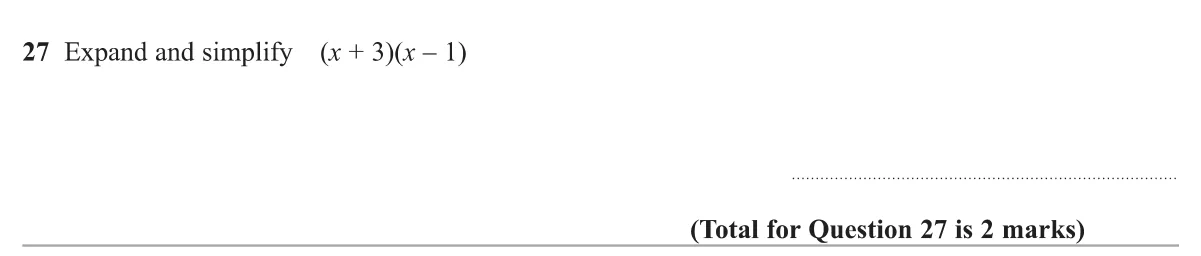
© Pearson Education Ltd. Specimen Paper 1 (Foundation, non-calculator), question 27.
Answer x 2 + 2 x − 3 x^2 + 2x - 3 x 2 + 2 x − 3 2 marks
Worked solution Checked against the mark scheme
Multiply each term in the first bracket by each term in the second:
x × x = x 2 x \times x = x^2 x × x = x 2 x × ( − 1 ) = − x x \times (-1) = -x x × ( − 1 ) = − x 3 × x = 3 x 3 \times x = 3x 3 × x = 3 x 3 × ( − 1 ) = − 3 3 \times (-1) = -3 3 × ( − 1 ) = − 3
x 2 − x + 3 x − 3 = x 2 + 2 x − 3 x^2 - x + 3x - 3 = x^2 + 2x - 3 x 2 − x + 3 x − 3 = x 2 + 2 x − 3
Watch out: Getting the sign of the constant wrong (+3).
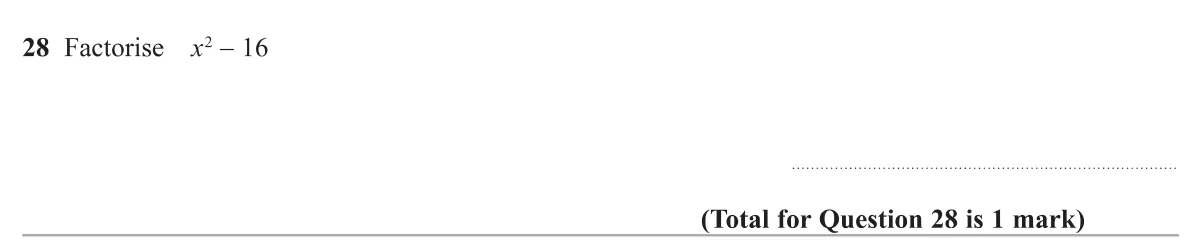
© Pearson Education Ltd. Specimen Paper 1 (Foundation, non-calculator), question 28.
Answer ( x + 4 ) ( x − 4 ) (x + 4)(x - 4) ( x + 4 ) ( x − 4 ) 1 mark
Worked solution Checked against the mark scheme
x 2 − 16 = x 2 − 4 2 x^2 - 16 = x^2 - 4^2 x 2 − 16 = x 2 − 4 2
So x 2 − 16 = ( x + 4 ) ( x − 4 ) x^2 - 16 = (x + 4)(x - 4) x 2 − 16 = ( x + 4 ) ( x − 4 )
Watch out: Writing (x − 4)(x − 4) or (x − 8)(x + 8).
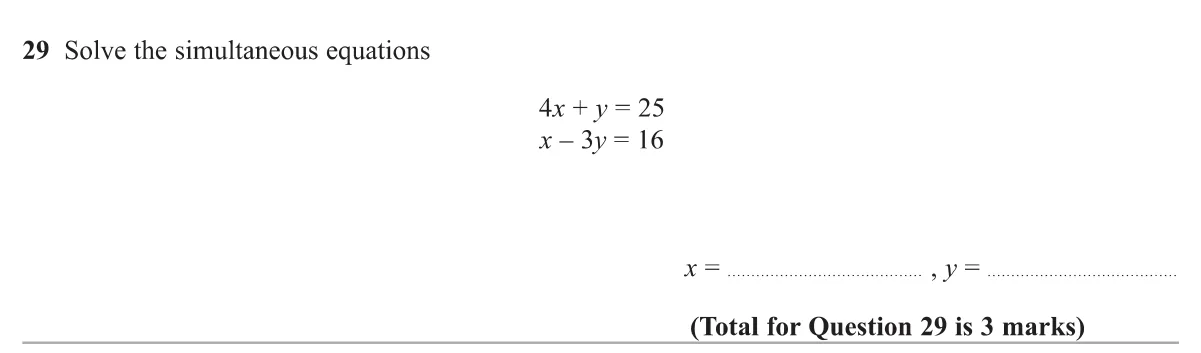
© Pearson Education Ltd. Specimen Paper 1 (Foundation, non-calculator), question 29.
Answer x = 7 x = 7 x = 7 y = − 3 y = -3 y = − 3 3 marks
Worked solution Checked against the mark scheme
Multiply the first equation by 3: 12 x + 3 y = 75 12x + 3y = 75 12 x + 3 y = 75
Add the second: 12 x + 3 y + x − 3 y = 75 + 16 12x + 3y + x - 3y = 75 + 16 12 x + 3 y + x − 3 y = 75 + 16 13 x = 91 13x = 91 13 x = 91 x = 7 x = 7 x = 7
Substitute: 4 ( 7 ) + y = 25 4(7) + y = 25 4 ( 7 ) + y = 25 y = − 3 y = -3 y = − 3
Check: 7 − 3 ( − 3 ) = 16 7 - 3(-3) = 16 7 − 3 ( − 3 ) = 16
Watch out: Subtracting the equations when the y terms have opposite signs.
Finished the paper? Add up your marks for all three papers. Specimen papers were never sat, so they have no grade boundaries of their own, but the grade calculator shows what the same total earned in recent real exams, as a rough guide.