Probability

Venn diagrams and sets

12 past-paper questions, easiest first. Try each one, then reveal the answer.

Foundation & Higher10 of 12 from Foundation papers

Revision guide by The Full Marks

Venn diagrams and sets: what you need to know

Venn diagrams sort things into overlapping circles so you can see which belong to one set, both sets or neither. GCSE questions ask you to fill one in and then find probabilities from it.

Both tiers need two- and three-set Venn diagrams and set notation; 'given that' (conditional) probabilities from a Venn diagram are Higher only.

Key facts

  • ξ\xi is the universal set: everything in the question, including items outside the circles.
  • A∩BA \cap B (intersection) means in A and B: the overlap.
  • A∪BA \cup B (union) means in A or B or both: everything inside either circle.
  • A′A' (complement) means not in A.
  • Always fill in the overlap first, then the rest of each circle, then the outside.

Completing a Venn diagram from totals

  1. Put the number in both sets in the overlap (work it out if needed).
  2. Circle A only = total in A − overlap. Do the same for B.
  3. Outside = overall total − everything inside the circles.
  4. Check all regions add up to the overall total.

Worked examples

Example 1 Foundation · grade 4

ξ={1,2,3,…,12}\xi = \{1, 2, 3, \ldots, 12\}, A = multiples of 3, B = even numbers. A number is chosen at random. Find P(A∩B)P(A \cap B) and P(A∪B)P(A \cup B).

Show the solution

A = {3, 6, 9, 12}, B = {2, 4, 6, 8, 10, 12}
1, 5, 7 and 11 are in neither set, so they go outside both circles.
A∩B={6,12}A \cap B = \{6, 12\}, so P(A∩B)=212=16P(A \cap B) = \frac{2}{12} = \frac{1}{6}
A∪B={2,3,4,6,8,9,10,12}A \cup B = \{2, 3, 4, 6, 8, 9, 10, 12\}, 8 numbers
P(A∪B)=812=23P(A \cup B) = \frac{8}{12} = \frac{2}{3}

Example 2 Higher · grade 6

In a group of 60 students, 35 study French, 28 study Spanish and 9 study neither. (a) How many study both? (b) Find the probability a student studies French only. (c) A student who studies Spanish is chosen. Find the probability they also study French.

Show the solution

(a) 35+28+9=7235 + 28 + 9 = 72, but there are only 60 students. The extra 72−60=1272 - 60 = 12 were counted twice, so 12 study both.
(b) French only =35−12=23= 35 - 12 = 23, so P=2360P = \frac{23}{60}
(c) Only look at the 28 Spanish students; 12 of them study French.
P=1228=37P = \frac{12}{28} = \frac{3}{7}

Common mistakes

  • Putting the total for A in the circle and forgetting to subtract the overlap.
  • Forgetting the items that belong to neither set: they go inside the rectangle, outside the circles.
  • In 'given that' questions, dividing by the overall total instead of the number in the given set.
  • Missing edge cases when sorting numbers: 1 is a square number, an odd number and a factor of every number.

Exam tips

  • Check your diagram: all the regions must add up to the total in the question.
  • Three-circle Venn diagrams can appear on both tiers. Start with the centre, where all three overlap, and work outwards.

Questions people ask

What does the upside-down U mean in a Venn diagram?

A∩BA \cap B means the intersection: things in both A and B. The U shape, A∪BA \cup B, means the union: things in A or B or both.

How do you find probability from a Venn diagram?

Add the numbers in the regions you want and divide by the total of all the numbers, including those outside the circles.

Exam questions: Venn diagrams and sets (12, easiest first)

Venn diagrams and sets3 marksGrade 3No calculatorOn both tiers
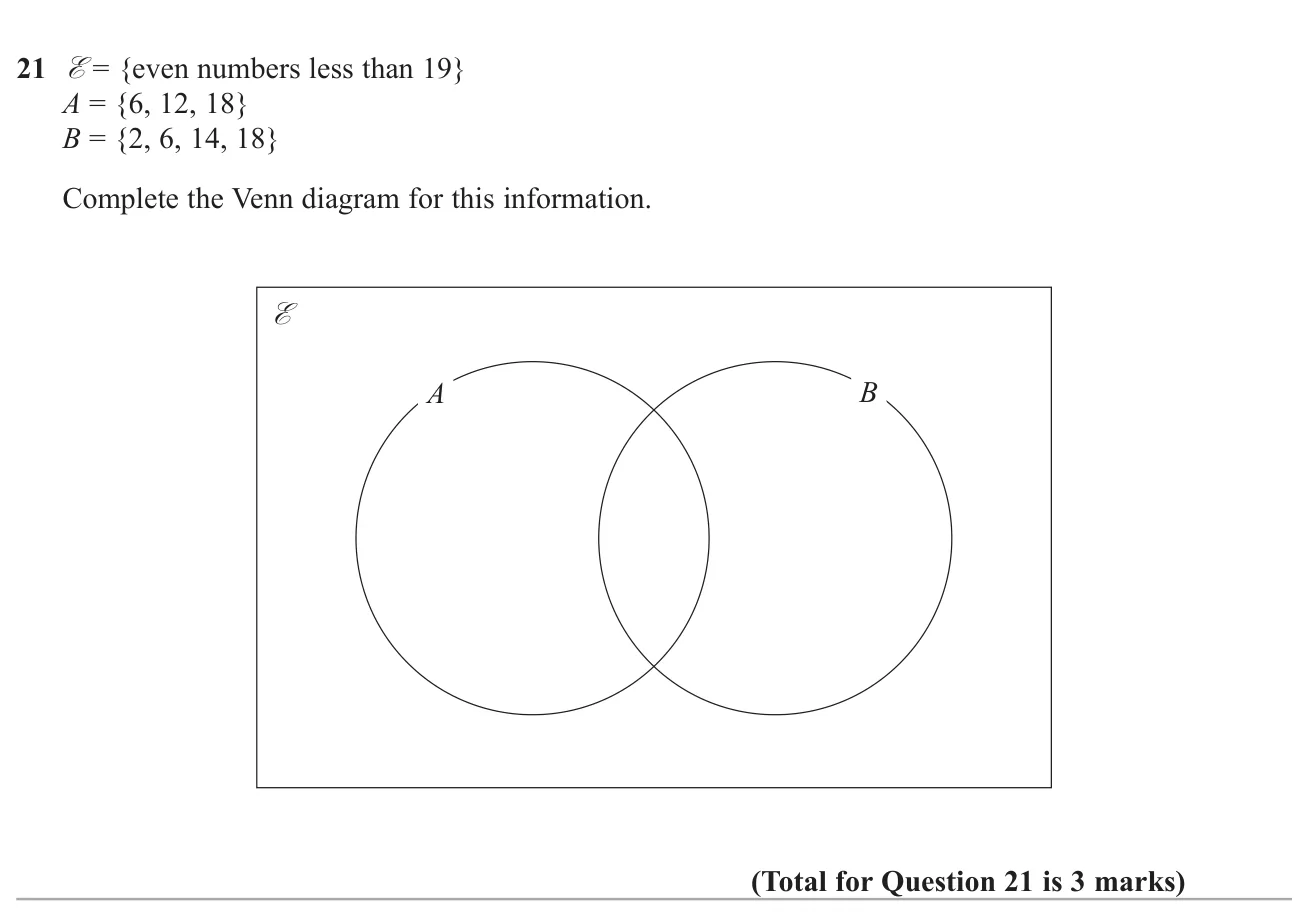
November 2021 · Paper 1 Foundation · Q21
Place even numbers into a two-set Venn diagram from set lists.

© Pearson Education Ltd. November 2021 Paper 1 (Foundation, non-calculator), question 21.

Show answer
AnswerOverlap: 6, 18; A only: 12; B only: 2, 14; outside: 4, 8, 10, 163 marks

Worked solution Checked against the mark scheme

E={2,4,6,8,10,12,14,16,18}\mathcal{E} = \{2, 4, 6, 8, 10, 12, 14, 16, 18\}

In both A and B: 6, 18

A only: 12. B only: 2, 14

In neither: 4, 8, 10, 16

Watch out: Leaving out the numbers outside both circles, or including 0 or 20.
Venn diagrams and sets3 marksGrade 4No calculatorOn both tiers
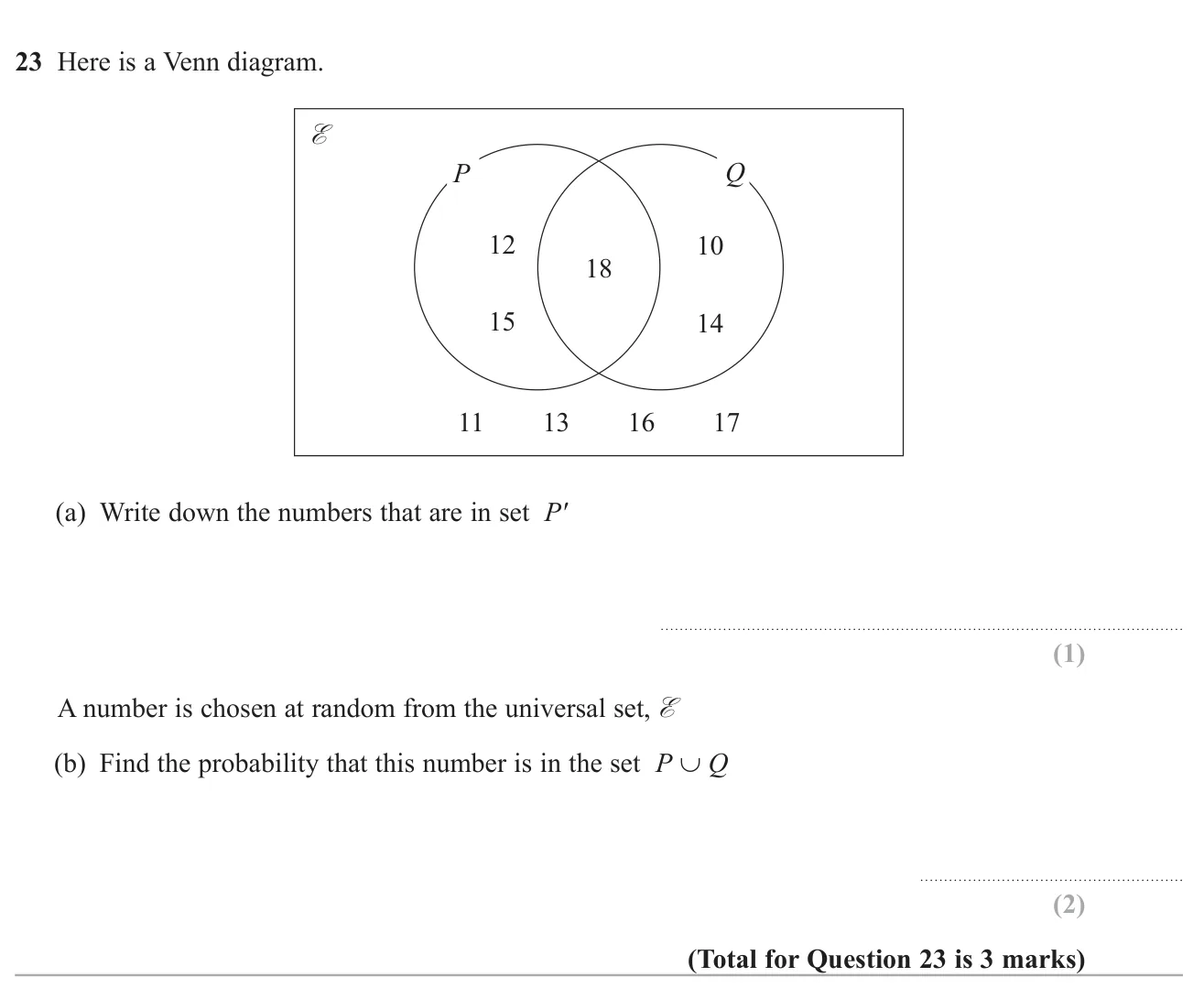
June 2024 · Paper 1 Foundation · Q23
Read a set complement from a Venn diagram and find the probability of the union of two sets.

© Pearson Education Ltd. June 2024 Paper 1 (Foundation, non-calculator), question 23.

Show answer
(a)10,11,13,14,16,1710, 11, 13, 14, 16, 171 mark
(b)59\frac{5}{9}2 marks

Worked solution Checked against the mark scheme

(a) P′P' is everything not in PP: 10,11,13,14,16,1710, 11, 13, 14, 16, 17

(b) P∪Q={10,12,14,15,18}P \cup Q = \{10, 12, 14, 15, 18\}, which is 5 of the 9 numbers.

Probability =59= \frac{5}{9}

Watch out: Leaving out the numbers outside both circles in (a), or only counting the overlap in (b).

Venn diagrams and sets2 marksGrade 4CalculatorOn both tiers
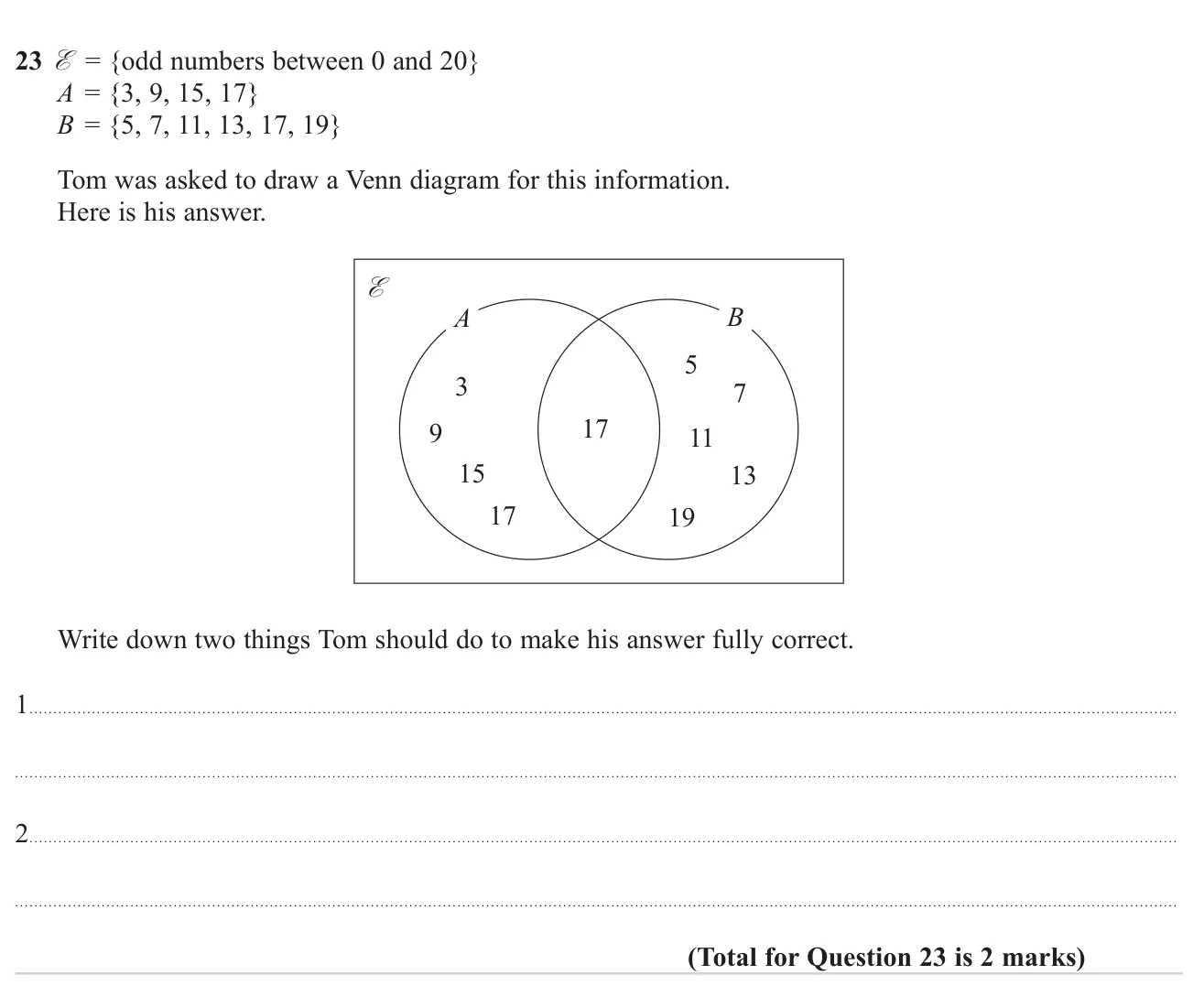
November 2024 · Paper 2 Foundation · Q23
Spot the two errors in a Venn diagram drawn from given sets.

© Pearson Education Ltd. November 2024 Paper 2 (Foundation, calculator), question 23.

Show answer
AnswerRemove the 17 from 'A only' so it is only in the overlap; put 1 in the region outside both circles2 marks

Worked solution Checked against the mark scheme

The universal set is 1, 3, 5, ..., 19.

17 is in both A and B, so it belongs only in the overlap; Tom also wrote it in A only.

1 is odd but in neither A nor B, so it must go inside the rectangle, outside both circles.

Watch out: Forgetting that 1 is an odd number between 0 and 20.

Venn diagrams and sets5 marksGrade 4No calculatorOn both tiers
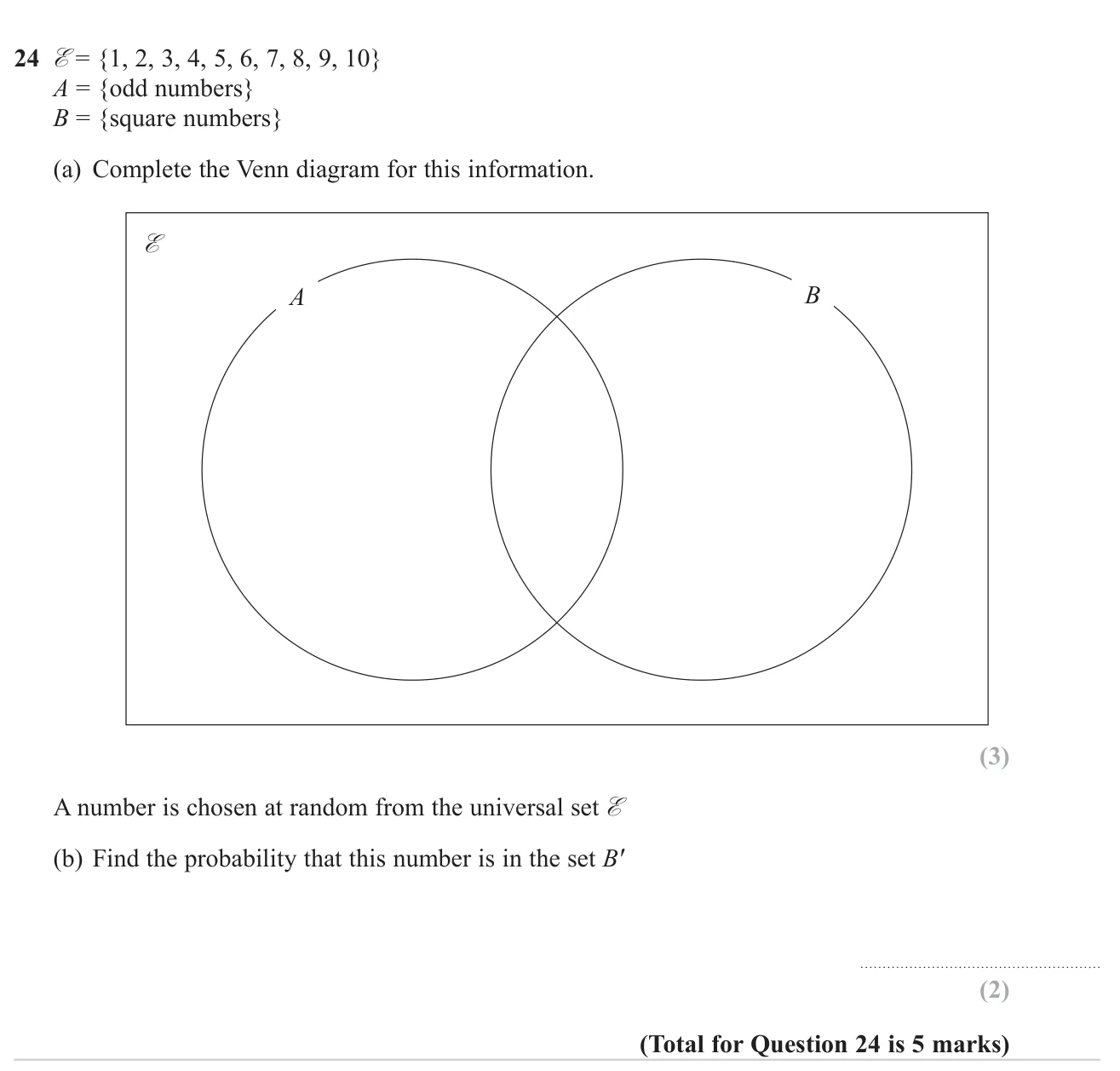
June 2023 · Paper 1 Foundation · Q24
Fill in a Venn diagram for odd and square numbers up to 10, then find the probability of not being square.

© Pearson Education Ltd. June 2023 Paper 1 (Foundation, non-calculator), question 24.

Show answer
(a)AA only: 3, 5, 7; both: 1, 9; BB only: 4; outside: 2, 6, 8, 103 marks
(b)710\frac{7}{10}2 marks

Worked solution Checked against the mark scheme

(a) Odd: 1, 3, 5, 7, 9. Square: 1, 4, 9.

In both: 1, 9. Odd only: 3, 5, 7. Square only: 4. Neither: 2, 6, 8, 10.

(b) B′B' means not square: 10−3=710 - 3 = 7 numbers, so P=710P = \frac{7}{10}

Watch out: Forgetting that 1 is a square number.

Venn diagrams and sets5 marksGrade 4CalculatorOn both tiers
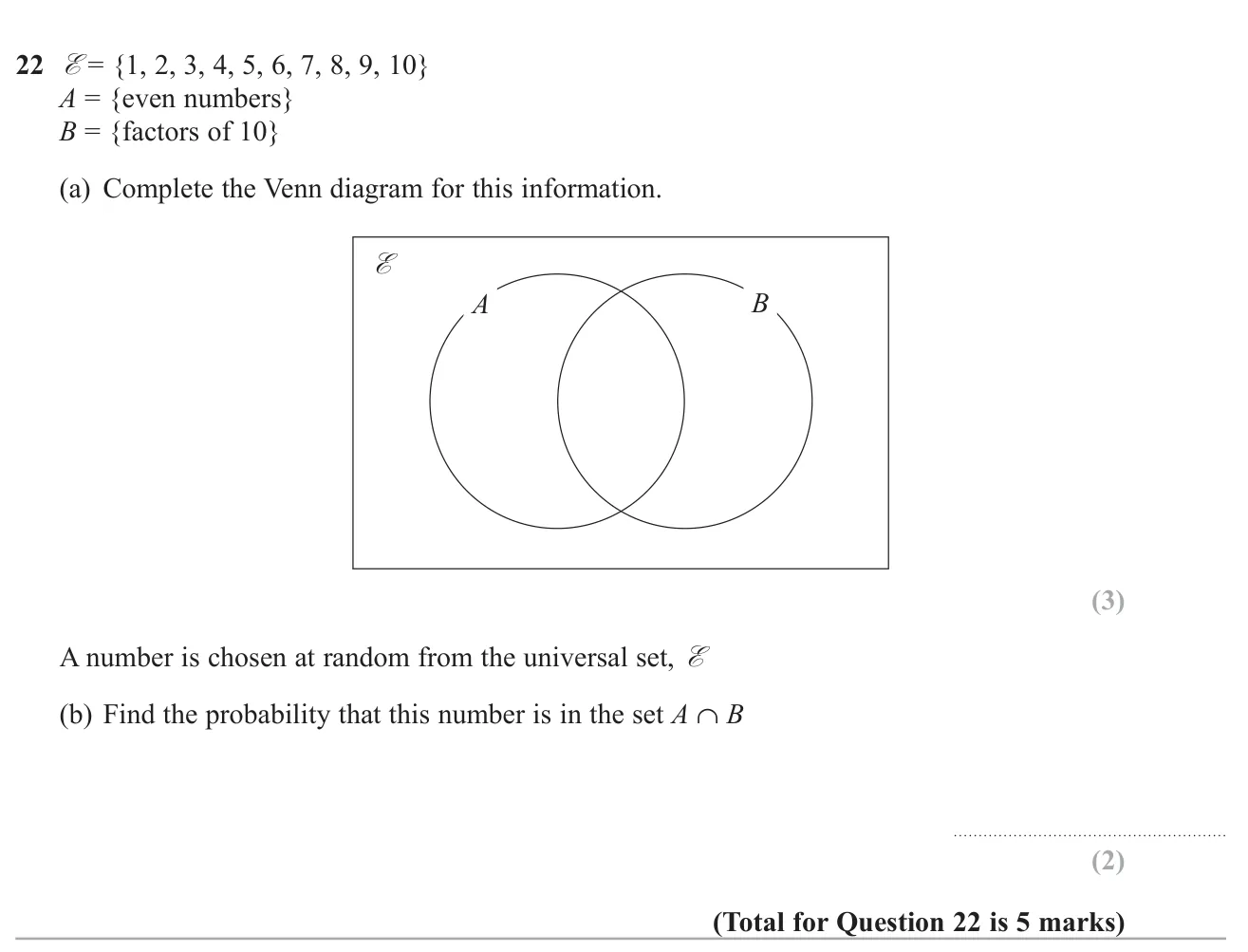
November 2020 · Paper 2 Foundation · Q22
Sort the numbers 1 to 10 into a Venn diagram of even numbers and factors of 10, then find a probability for the intersection.

© Pearson Education Ltd. November 2020 Paper 2 (Foundation, calculator), question 22.

Show answer
(a)AA only: 4, 6, 8; A∩BA \cap B: 2, 10; BB only: 1, 5; outside: 3, 7, 93 marks
(b)210\frac{2}{10}2 marks

Worked solution Checked against the mark scheme

(a) Even: 2, 4, 6, 8, 10. Factors of 10: 1, 2, 5, 10.

Both: 2, 10. Only AA: 4, 6, 8. Only BB: 1, 5. Neither: 3, 7, 9.

(b) A∩BA \cap B has 2 of the 10 numbers, so the probability is 210=15\frac{2}{10} = \frac{1}{5}.

Watch out: Forgetting that 1 and 10 are factors of 10.

Venn diagrams and sets4 marksGrade 4CalculatorFoundation
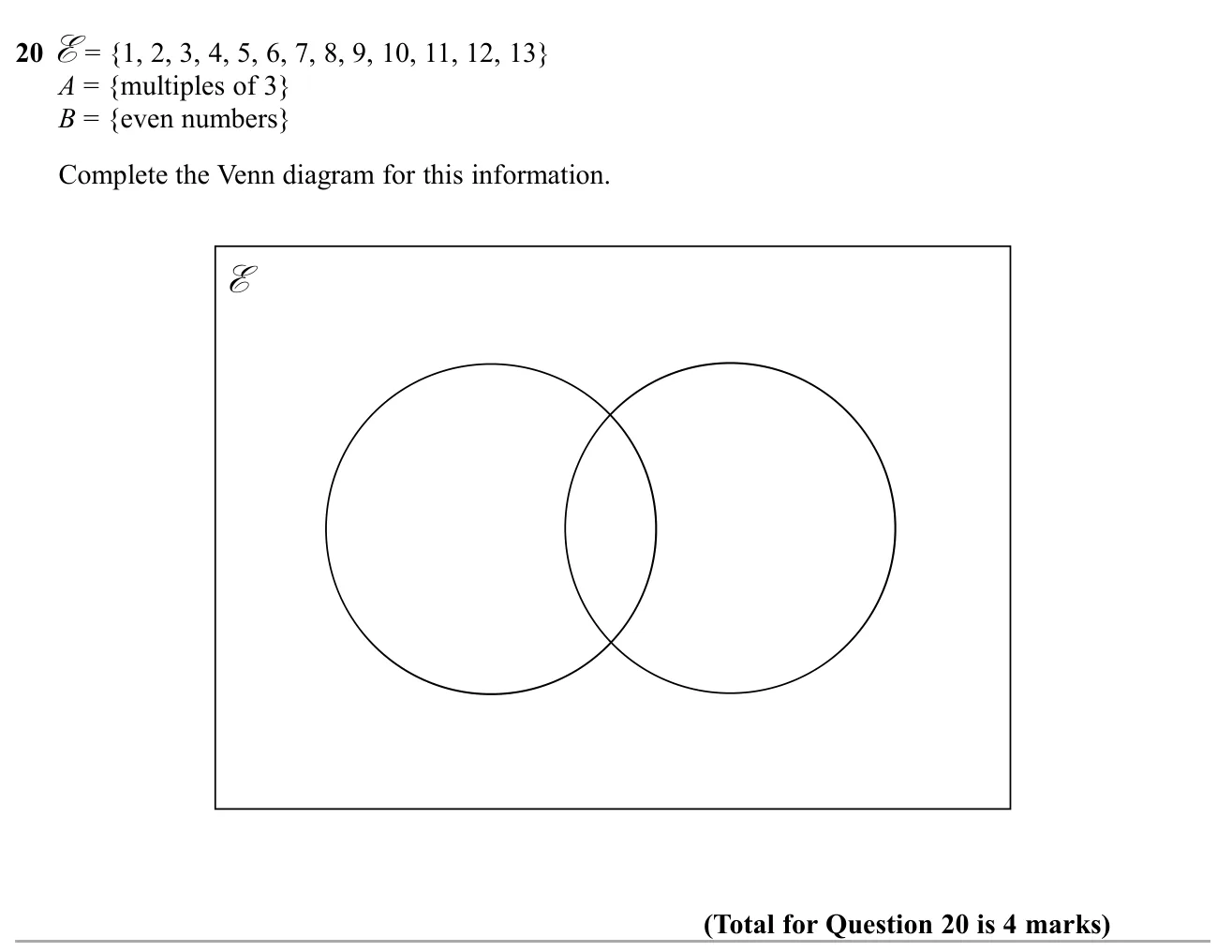
November 2019 · Paper 3 Foundation · Q20
Place the numbers 1 to 13 in a two-set Venn diagram for multiples of 3 and even numbers.

© Pearson Education Ltd. November 2019 Paper 3 (Foundation, calculator), question 20.

Show answer
AnswerBoth: 6, 12. Multiples of 3 only: 3, 9. Even only: 2, 4, 8, 10. Outside: 1, 5, 7, 11, 134 marks

Worked solution Checked against the mark scheme

Multiples of 3: 3, 6, 9, 12. Even: 2, 4, 6, 8, 10, 12.

In both (overlap): 6, 12

Multiples of 3 only: 3, 9. Even only: 2, 4, 8, 10

Outside both circles: 1, 5, 7, 11, 13

Watch out: Putting 6 and 12 in both circles separately rather than in the overlap.

Venn diagrams and sets5 marksGrade 4CalculatorOn both tiers
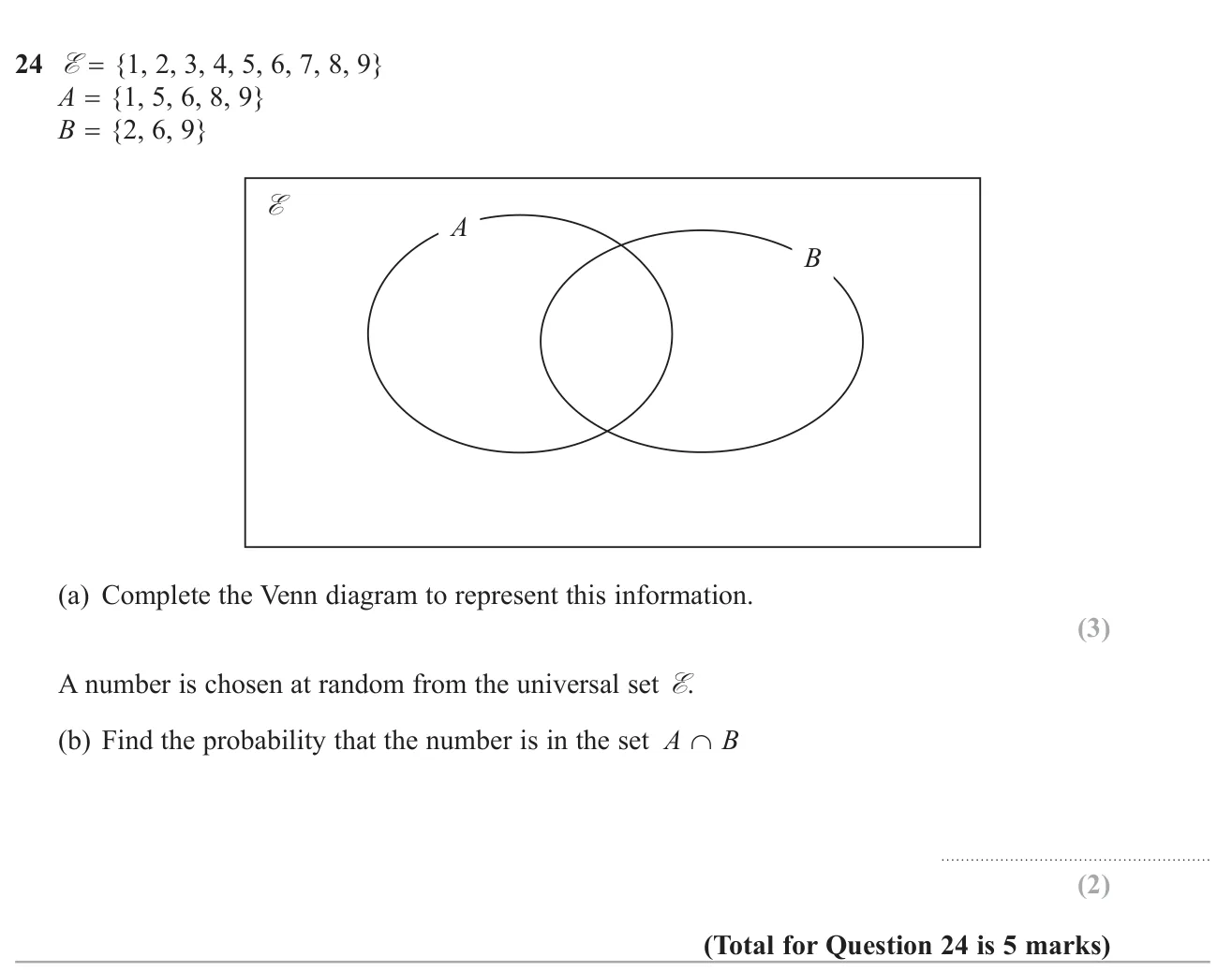
June 2019 · Paper 3 Foundation · Q24
Fill in a Venn diagram from set lists, then find the probability a random number is in both sets.

© Pearson Education Ltd. June 2019 Paper 3 (Foundation, calculator), question 24.

Show answer
(a)Intersection: 6, 9; A only: 1, 5, 8; B only: 2; outside: 3, 4, 73 marks
(b)29\frac{2}{9}2 marks

Worked solution Checked against the mark scheme

(a) In both A and B: 6, 9

A only: 1, 5, 8. B only: 2. Neither: 3, 4, 7.

(b) A∩B={6,9}A \cap B = \{6, 9\}, 2 numbers out of 9.

P=29P = \frac{2}{9}

Watch out: Forgetting to place 3, 4 and 7 outside both circles.

Venn diagrams and sets3 marksGrade 4No calculatorFoundation
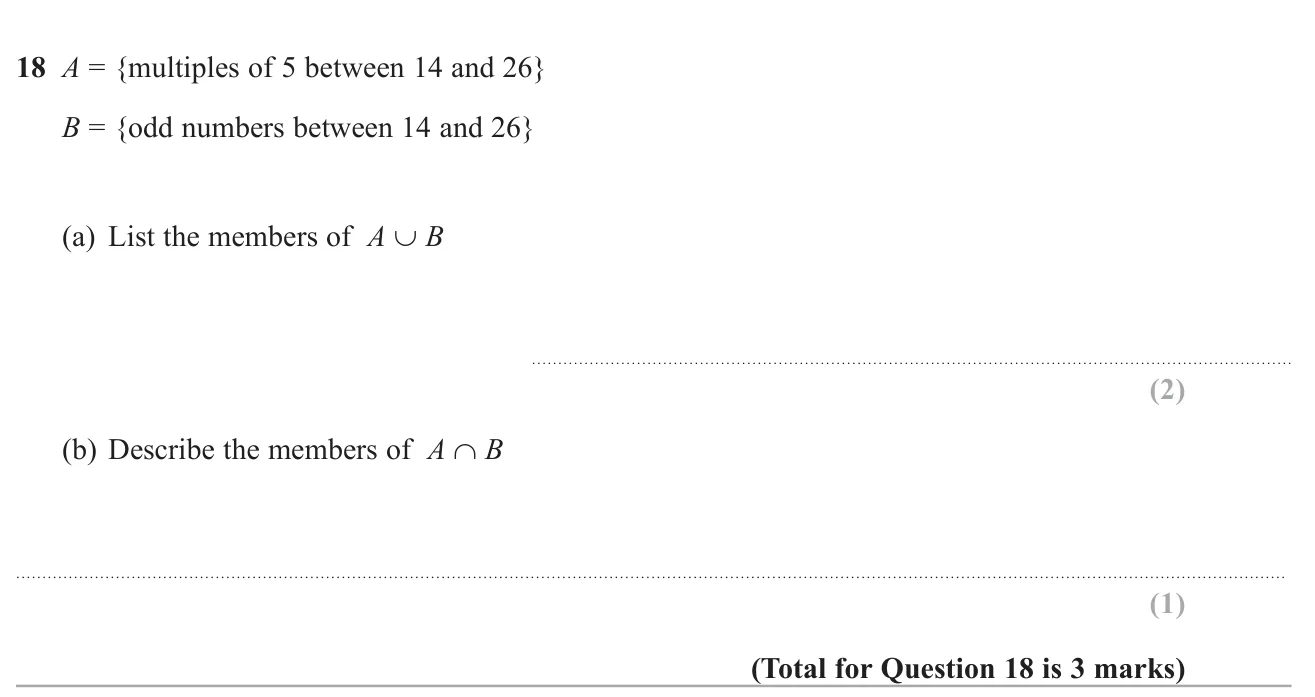
June 2018 · Paper 1 Foundation · Q18
List the union of two sets of numbers and describe their intersection.

© Pearson Education Ltd. June 2018 Paper 1 (Foundation, non-calculator), question 18.

Show answer
(a)15,17,19,20,21,23,2515, 17, 19, 20, 21, 23, 252 marks
(b)Odd multiples of 5 (15 and 25)1 mark

Worked solution Checked against the mark scheme

A={15,20,25}A = \{15, 20, 25\}, B={15,17,19,21,23,25}B = \{15, 17, 19, 21, 23, 25\}

(a) Union is everything in either: 15, 17, 19, 20, 21, 23, 25

(b) Intersection is in both: 15 and 25, the odd multiples of 5.

Watch out: Mixing up union and intersection.

Venn diagrams and sets6 marksGrade 4CalculatorOn both tiers
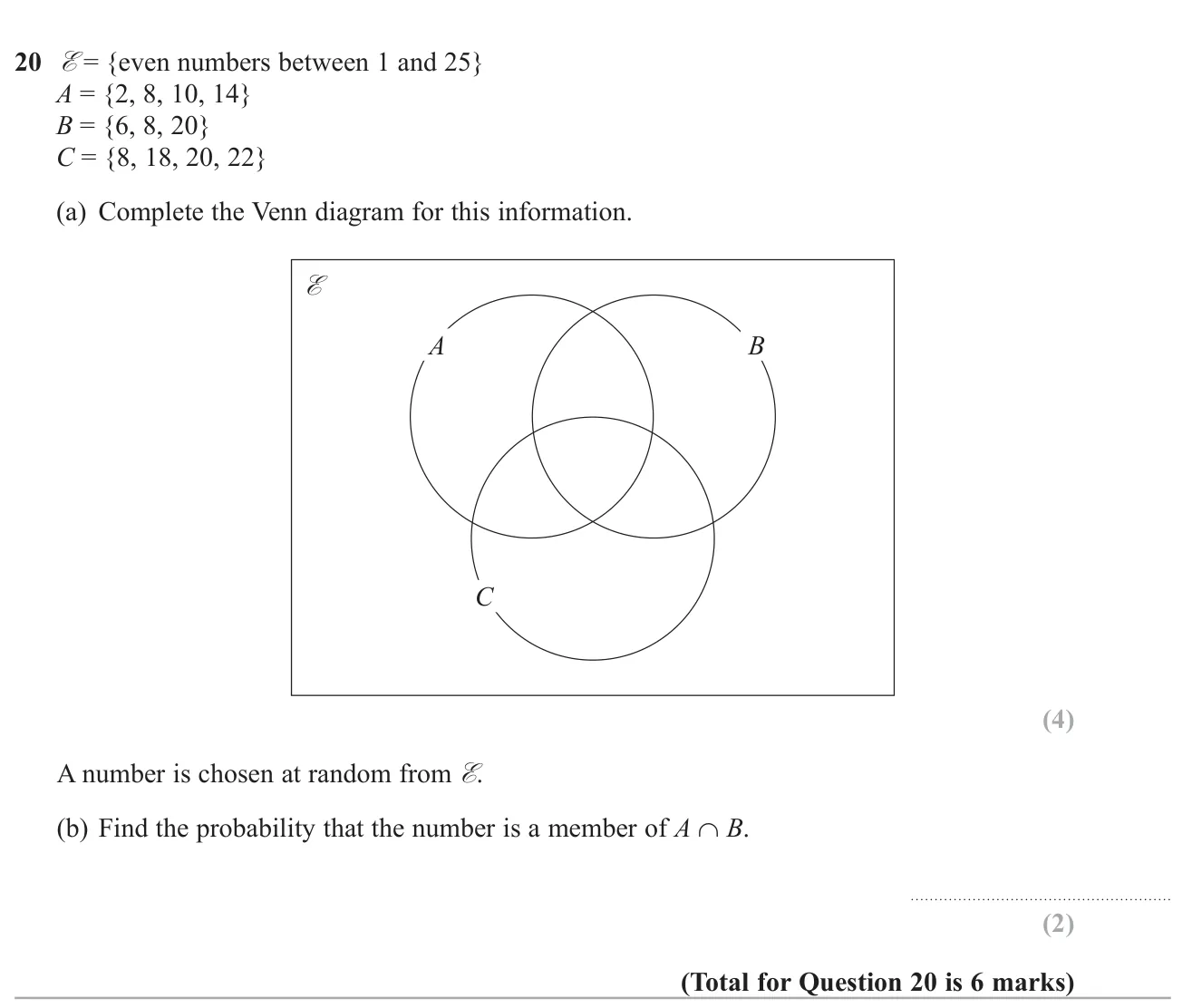
November 2018 · Paper 2 Foundation · Q20
Place set elements in a three-set Venn diagram, then find a probability for an intersection.

© Pearson Education Ltd. November 2018 Paper 2 (Foundation, calculator), question 20.

Show answer
(a)A only: 2, 10, 14; A∩B∩C: 8; B only: 6; B∩C only: 20; C only: 18, 22; outside: 4, 12, 16, 244 marks
(b)112\frac{1}{12}2 marks

Worked solution Checked against the mark scheme

(a) E={2,4,6,...,24}\mathcal{E} = \{2, 4, 6, ..., 24\}, 12 numbers.

8 is in all three sets. 20 is in B and C only. 6 is B only; 2, 10, 14 are A only; 18, 22 are C only.

4, 12, 16, 24 go outside the circles.

(b) A∩B={8}A \cap B = \{8\}, so P =112= \frac{1}{12}

Watch out: Forgetting to place the numbers that are in no set.

Venn diagrams and sets4 marksGrade 5CalculatorFoundation
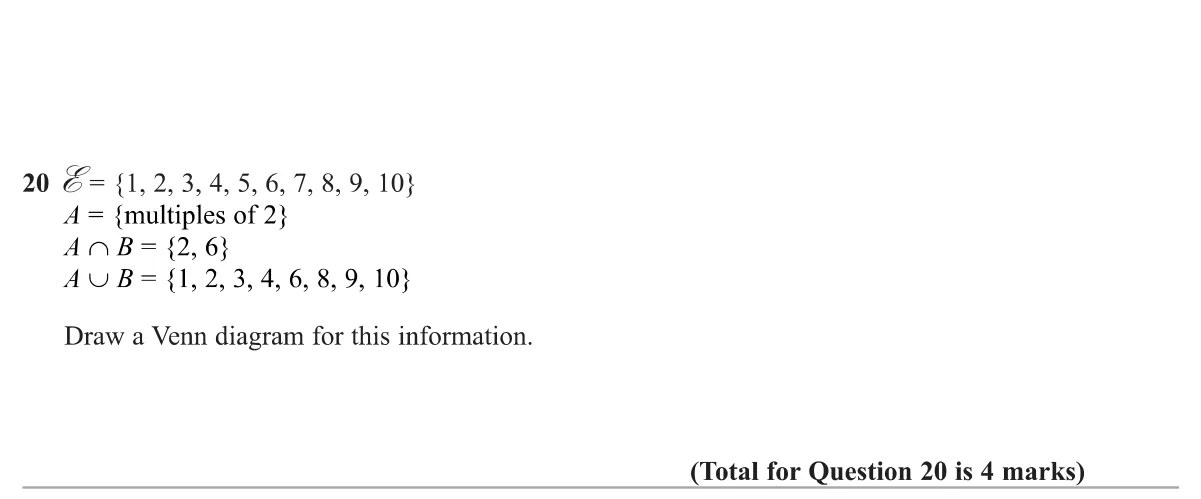
Specimen · Paper 3 Foundation · Q20
Draw a Venn diagram from set notation for a universal set, set A, their intersection and union.

© Pearson Education Ltd. Specimen Paper 3 (Foundation, calculator), question 20.

Show answer
AnswerA only: 4, 8, 10; A ∩ B: 2, 6; B only: 1, 3, 9; outside both: 5, 74 marks

Worked solution Checked against the mark scheme

A (even numbers) = {2, 4, 6, 8, 10}.

Overlap: 2 and 6. So A only: 4, 8, 10.

A∪BA \cup B adds 1, 3, 9, which must be in B only.

Numbers in neither set: 5 and 7, written outside the ovals but inside the rectangle.

Watch out: Leaving 5 and 7 off the diagram, or putting 2 and 6 in A only as well.

Venn diagrams and sets6 marksGrade 6CalculatorHigher
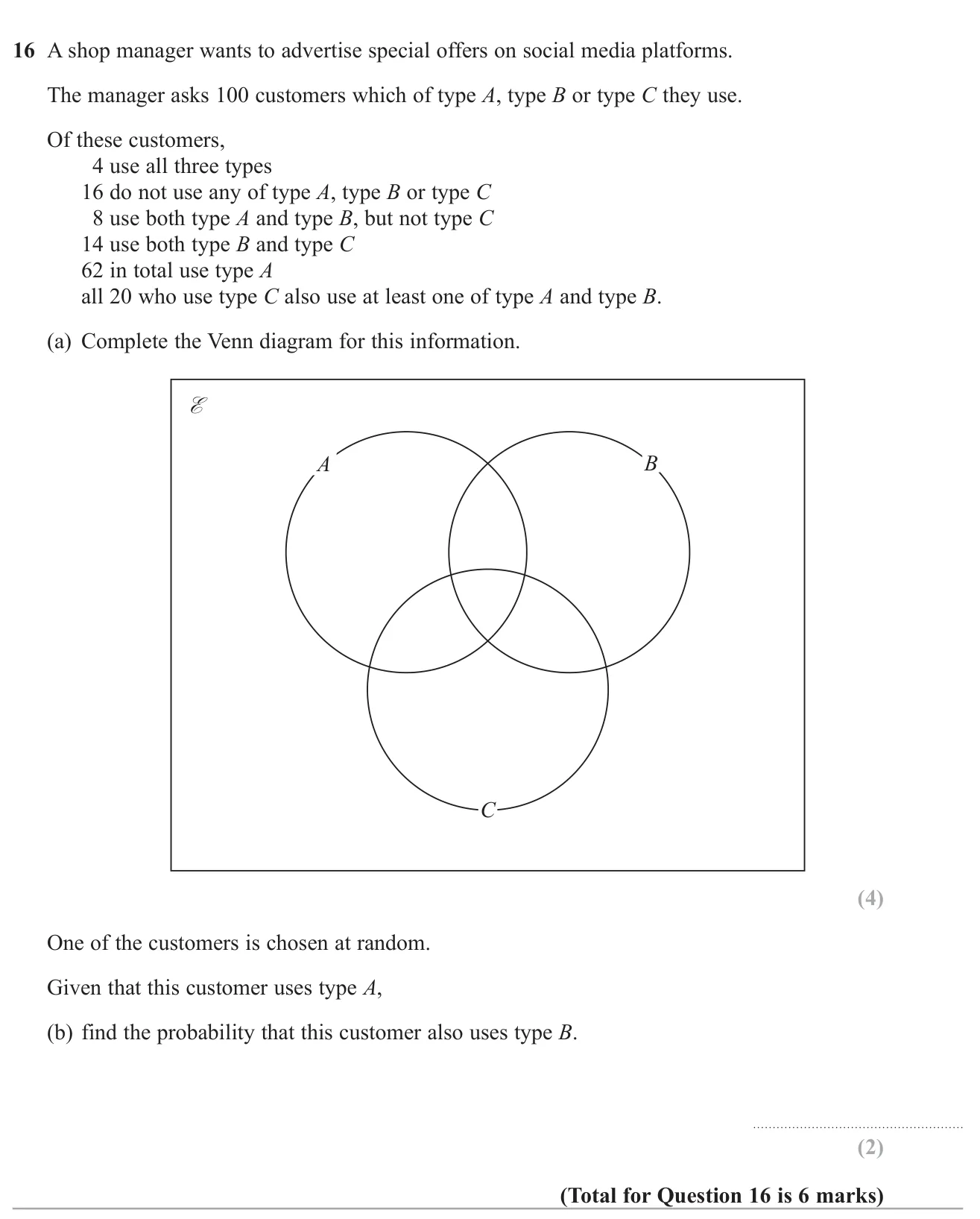
June 2022 · Paper 2 Higher · Q16
Fill in a three-set Venn diagram from given facts, then find a conditional probability from it.

© Pearson Education Ltd. June 2022 Paper 2 (Higher, calculator), question 16.

Show answer
(a)A only 44, A∩B only 8, A∩C only 6, all three 4, B only 12, B∩C only 10, C only 0, outside 164 marks
(b)1262\frac{12}{62}2 marks

Worked solution Checked against the mark scheme

(a) All three: 4. A and B only: 8. B and C total 14, so B and C only =14−4=10= 14 - 4 = 10.

Nobody uses C alone, so A and C only =20−4−10−0=6= 20 - 4 - 10 - 0 = 6.

A only =62−8−4−6=44= 62 - 8 - 4 - 6 = 44. Outside: 16.

B only =100−16−44−8−4−6−10=12= 100 - 16 - 44 - 8 - 4 - 6 - 10 = 12

(b) Among the 62 A users, 8+4=128 + 4 = 12 also use B: P=1262=631P = \frac{12}{62} = \frac{6}{31}

Watch out: In (b), dividing by 100 instead of the 62 people who use A.

Venn diagrams and sets5 marksGrade 8CalculatorHigher
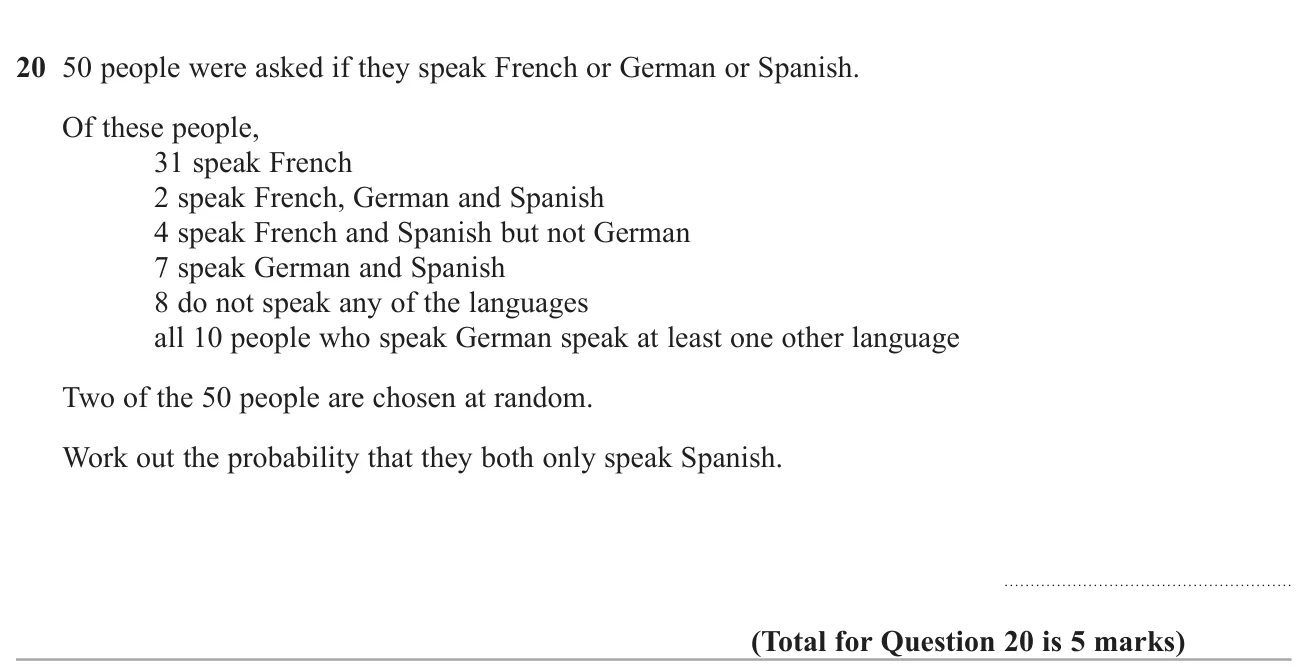
June 2018 · Paper 3 Higher · Q20
Complete a three-set Venn diagram from language information, then find the probability that two people chosen without replacement both speak only Spanish.

© Pearson Education Ltd. June 2018 Paper 3 (Higher, calculator), question 20.

Show answer
Answer6490\frac{6}{490}5 marks

Worked solution Checked against the mark scheme

Fill the Venn diagram from the centre out:

All three: 2. French and Spanish only: 4. German and Spanish only: 7−2=57 - 2 = 5.

German only: 0 (all German speakers speak another). French and German only: 10−2−5=310 - 2 - 5 = 3. French only: 31−2−4−3=2231 - 2 - 4 - 3 = 22.

Spanish only: 50−8−22−3−2−4−5=650 - 8 - 22 - 3 - 2 - 4 - 5 = 6

P(both) =650×549=302450=6490= \frac{6}{50} \times \frac{5}{49} = \frac{30}{2450} = \frac{6}{490}

Watch out: Treating the choices as with replacement (650×650\frac{6}{50} \times \frac{6}{50}).

Also tested in these questions

Their main topic is different, but part of each one tests this topic.