© Pearson Education Ltd. November 2018 Paper 2 (Foundation, calculator), question 1.
Show answer
Worked solution Checked against the mark scheme
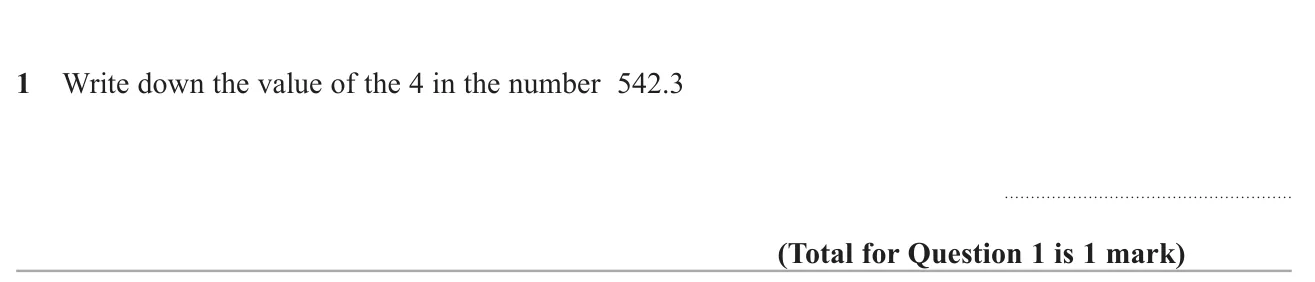
In 542.3 the digits are 5 hundreds, 4 tens, 2 ones and 3 tenths.
So the 4 is worth 40.
Watch out: Writing 4 instead of 40.
© Pearson Education Ltd. November 2018 Paper 2 (Foundation, calculator), question 2.
Show answer
| Answer | Any odd square number, e.g. 9 | 1 mark |
|---|
Worked solution Checked against the mark scheme
Square numbers: 1, 4, 9, 16, 25, ...
The odd ones are 1, 9, 25, 49, ... so, for example, 9 works (32=9).
Watch out: Giving an odd number that is not square, such as 3.
© Pearson Education Ltd. November 2018 Paper 2 (Foundation, calculator), question 3.
Show answer
| (a) | 4.56 | 1 mark |
|---|
| (b) | 7300 | 1 mark |
|---|
Worked solution Checked against the mark scheme
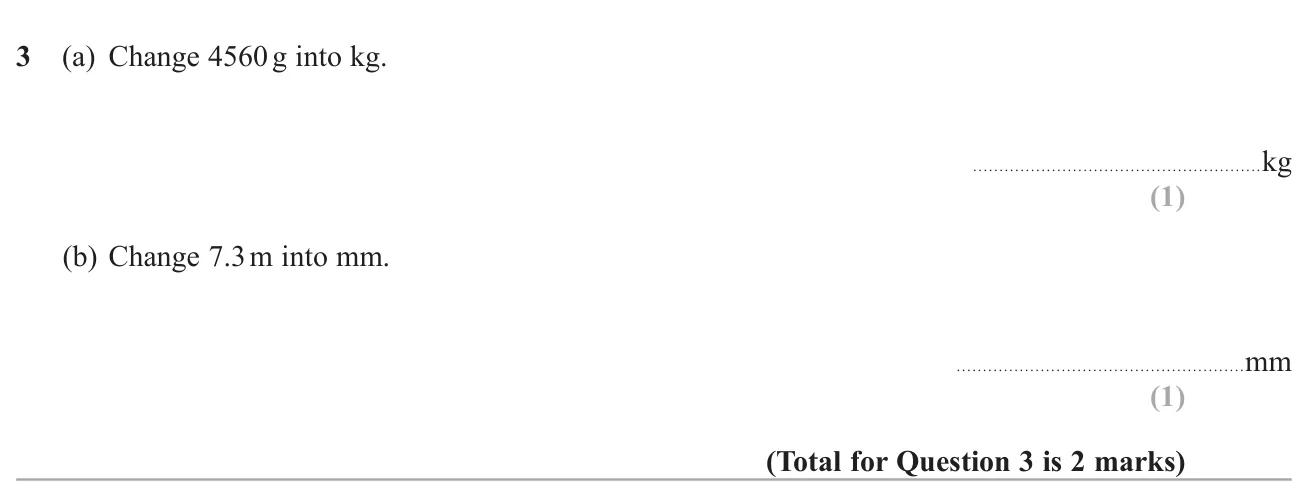
(a) 1 kg = 1000 g, so 4560÷1000=4.56 kg.
(b) 1 m = 1000 mm, so 7.3×1000=7300 mm.
Watch out: Using 100 instead of 1000 in (b), giving 730.
© Pearson Education Ltd. November 2018 Paper 2 (Foundation, calculator), question 4.
Show answer
Worked solution Checked against the mark scheme
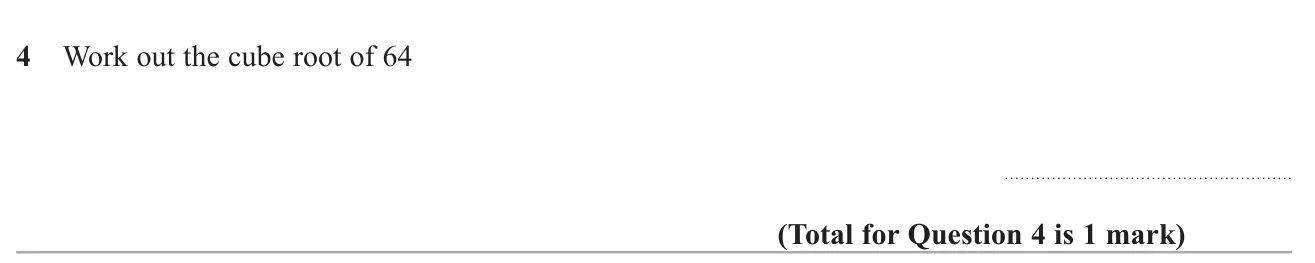
4×4×4=64, so 364=4.
Watch out: Dividing by 3 instead of finding the cube root.
© Pearson Education Ltd. November 2018 Paper 2 (Foundation, calculator), question 5.
Show answer
| Answer | 10031 | 1 mark |
|---|
Worked solution Checked against the mark scheme
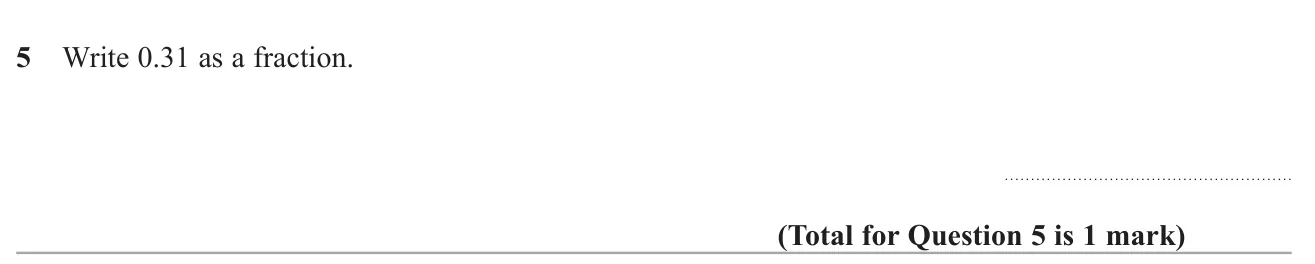
0.31 is 31 hundredths, so 0.31=10031.
Watch out: Writing 1031.
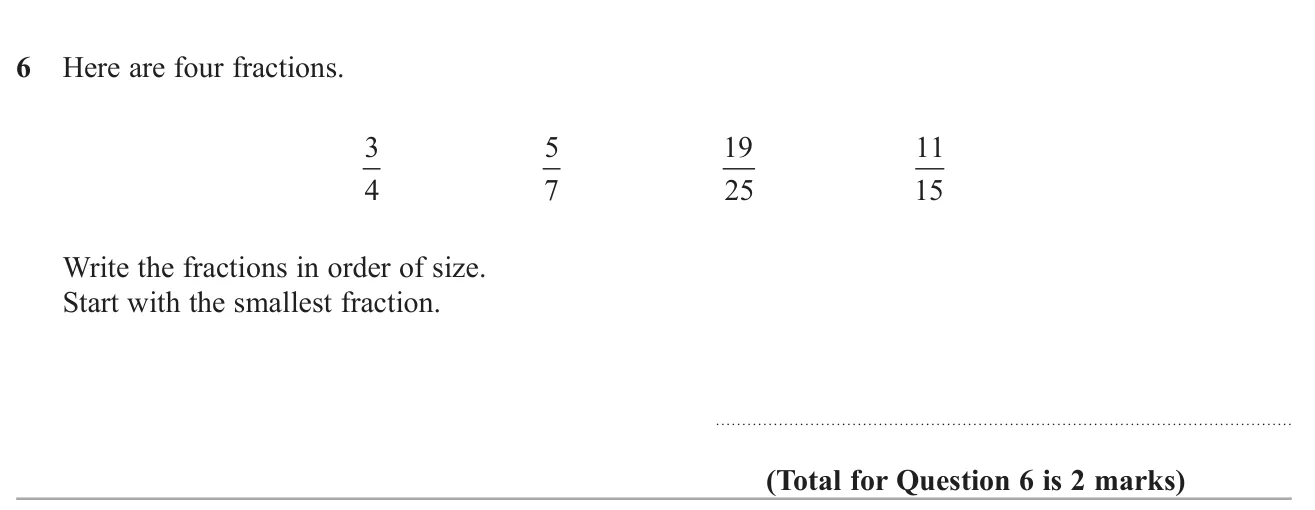
© Pearson Education Ltd. November 2018 Paper 2 (Foundation, calculator), question 6.
Show answer
| Answer | 75,1511,43,2519 | 2 marks |
|---|
Worked solution Checked against the mark scheme
Change each to a decimal:
43=0.75, 75=0.714..., 2519=0.76, 1511=0.733...
Smallest first: 75,1511,43,2519
Watch out: Ordering by the size of the denominators.
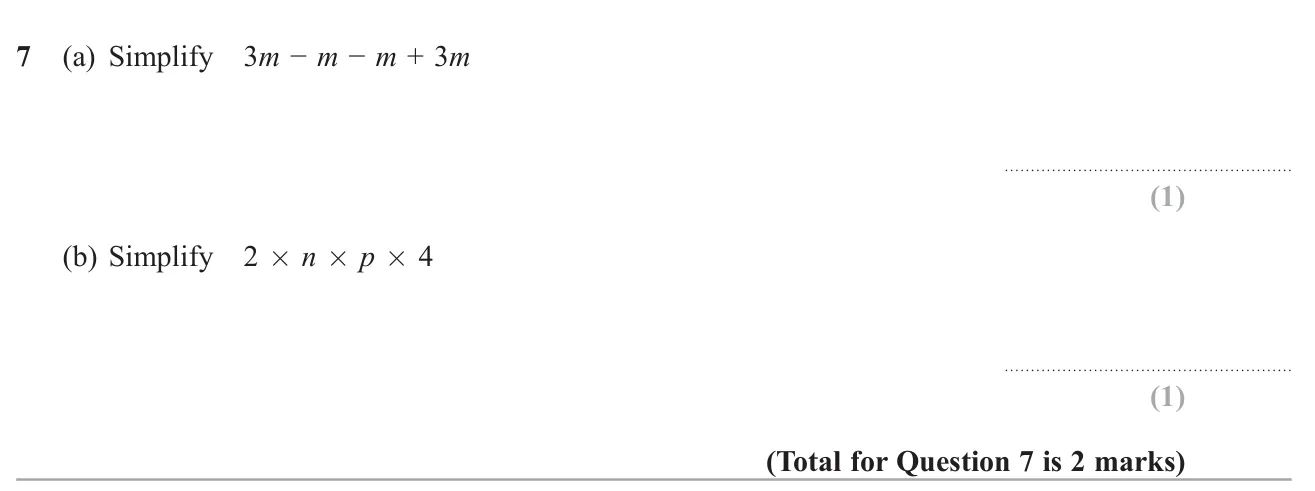
© Pearson Education Ltd. November 2018 Paper 2 (Foundation, calculator), question 7.
Show answer
| (a) | 4m | 1 mark |
|---|
| (b) | 8np | 1 mark |
|---|
Worked solution Checked against the mark scheme
(a) 3m−m−m+3m=(3−1−1+3)m=4m
(b) Multiply the numbers: 2×4=8, then write the letters: 8np.
Watch out: In (a), getting 2m by treating the signs wrongly; in (b), writing 6np.
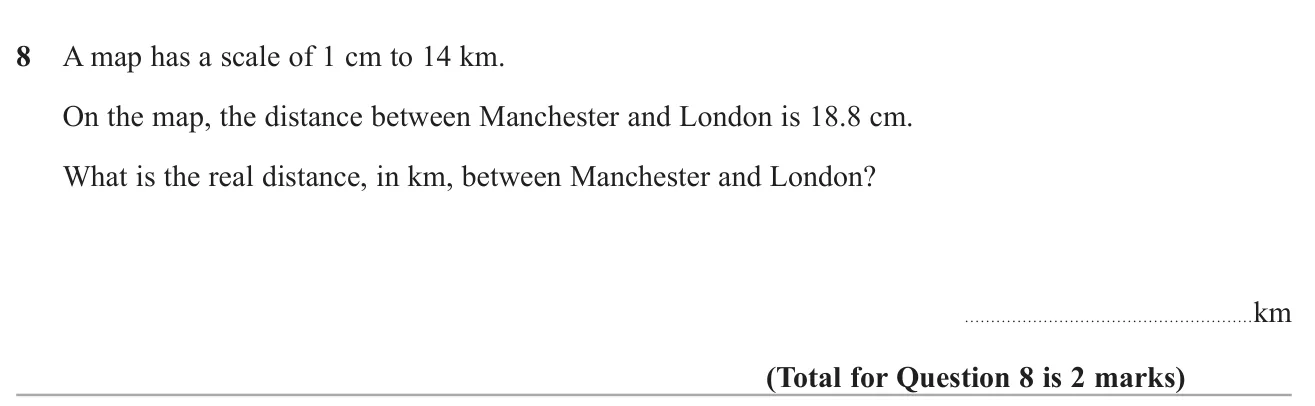
© Pearson Education Ltd. November 2018 Paper 2 (Foundation, calculator), question 8.
Show answer
Worked solution Checked against the mark scheme
Each 1 cm stands for 14 km.
18.8×14=263.2 km
Watch out: Dividing 18.8 by 14.
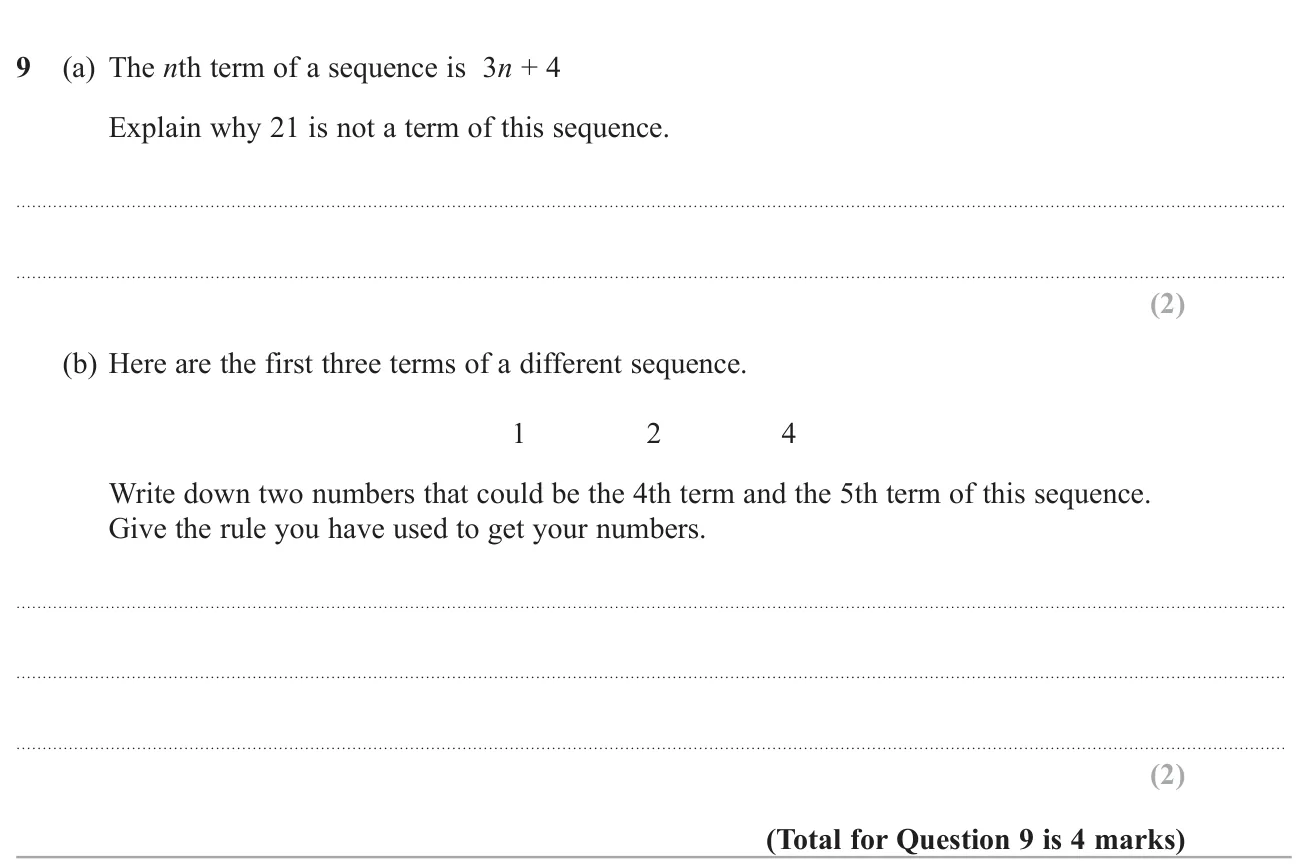
© Pearson Education Ltd. November 2018 Paper 2 (Foundation, calculator), question 9.
Show answer
| (a) | 3n+4=21 gives n=317, not a whole number (the terms go 19, 22, so 21 is skipped) | 2 marks |
|---|
| (b) | e.g. 7, 11 (add 1, 2, 3, 4, ...) or 8, 16 (double each time) | 2 marks |
|---|
Worked solution Checked against the mark scheme
(a) Terms: 7, 10, 13, 16, 19, 22, ... It jumps from 19 to 22, so 21 is missed.
Or: 3n+4=21⇒3n=17⇒n=5.67, not a whole number.
(b) Doubling: 1, 2, 4, 8, 16. Or the gaps grow by 1: 1, 2, 4, 7, 11.
Watch out: In (b), saying 'goes up by 1 each time', which does not fit the terms.
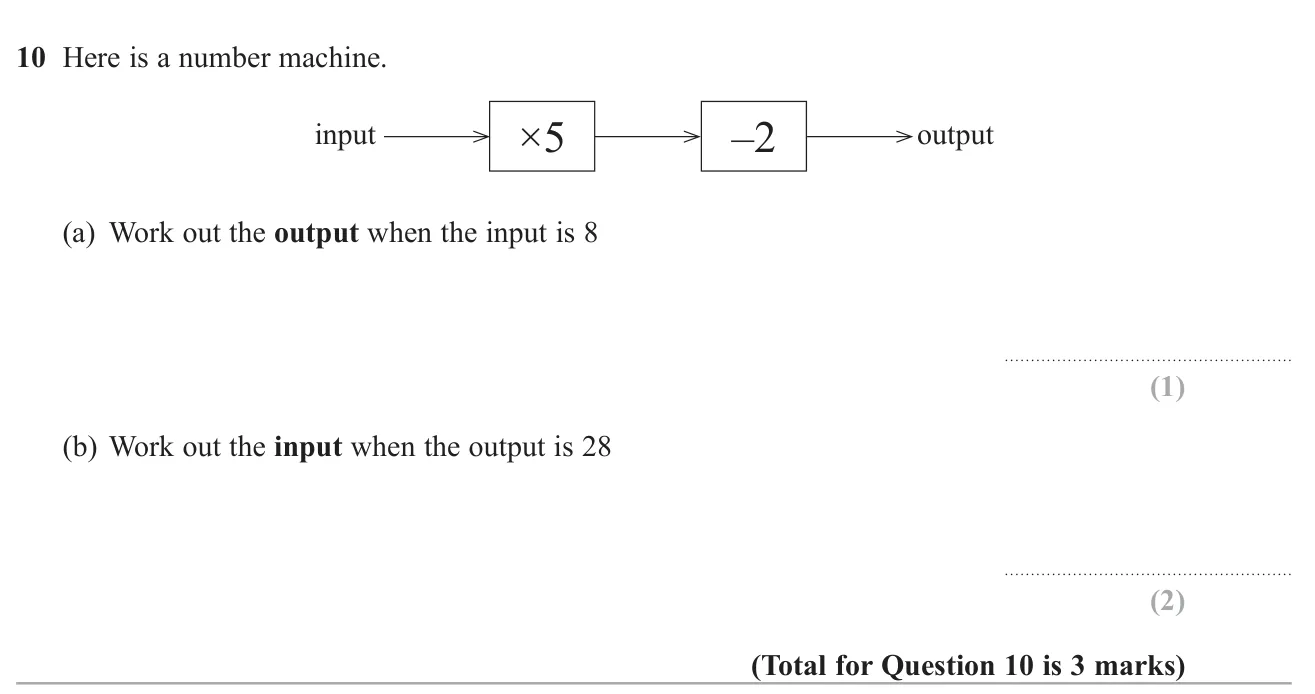
© Pearson Education Ltd. November 2018 Paper 2 (Foundation, calculator), question 10.
Show answer
Worked solution Checked against the mark scheme
(a) 8×5=40, 40−2=38
(b) Work backwards: 28+2=30, 30÷5=6
Watch out: In (b), doing the inverses in the wrong order.
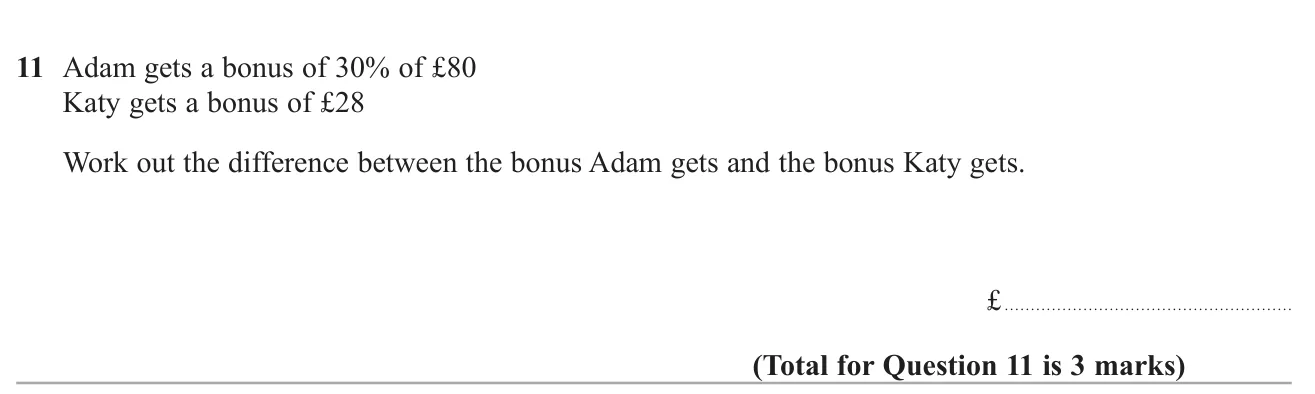
© Pearson Education Ltd. November 2018 Paper 2 (Foundation, calculator), question 11.
Show answer
Worked solution Checked against the mark scheme
Adam: 0.3×80=£24
Difference: 28−24=£4
Watch out: Taking 30% as £30 or adding the two bonuses.
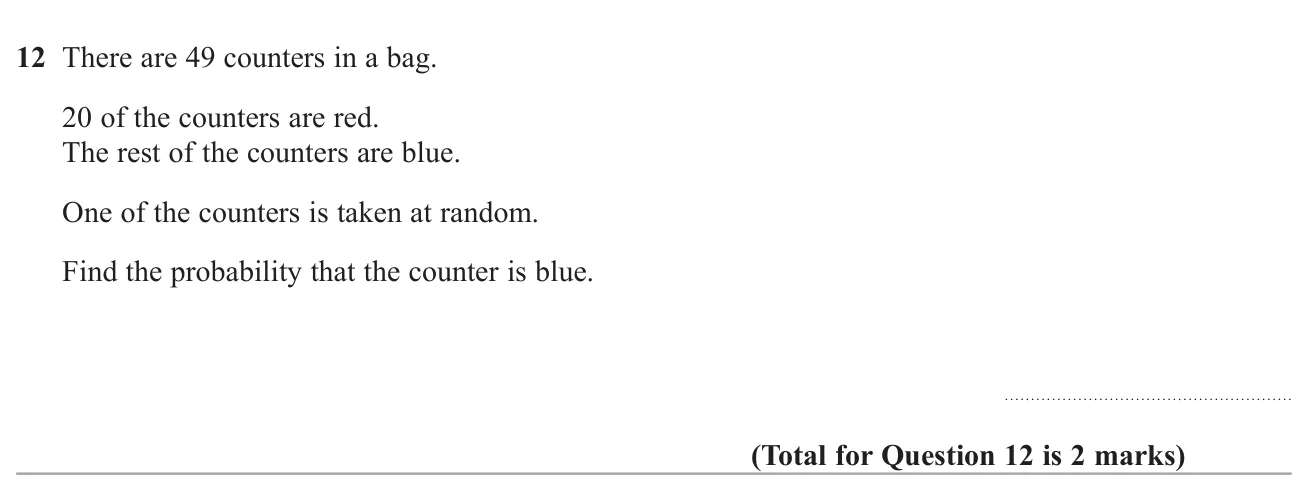
© Pearson Education Ltd. November 2018 Paper 2 (Foundation, calculator), question 12.
Show answer
| Answer | 4929 | 2 marks |
|---|
Worked solution Checked against the mark scheme
Blue counters: 49−20=29
P(blue) =4929
Watch out: Giving the probability of red, 4920.
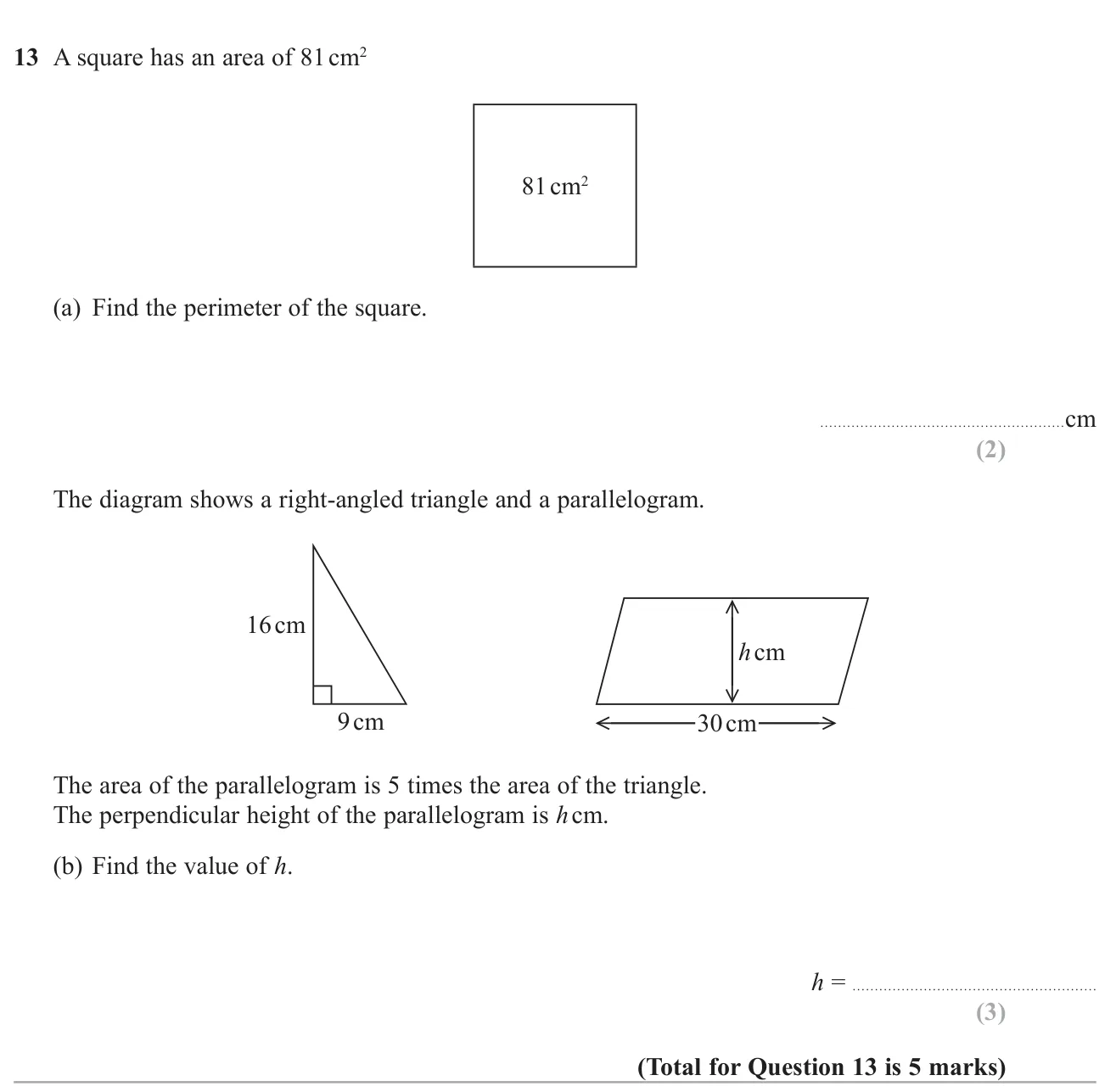
© Pearson Education Ltd. November 2018 Paper 2 (Foundation, calculator), question 13.
Show answer
| (a) | 36 cm | 2 marks |
|---|
| (b) | 12 | 3 marks |
|---|
Worked solution Checked against the mark scheme
(a) Side =81=9 cm, so perimeter =4×9=36 cm.
(b) Triangle: 21×16×9=72 cm²
Parallelogram: 5×72=360 cm²
30h=360, so h=12
Watch out: In (a), dividing 81 by 4; in (b), forgetting to halve for the triangle.
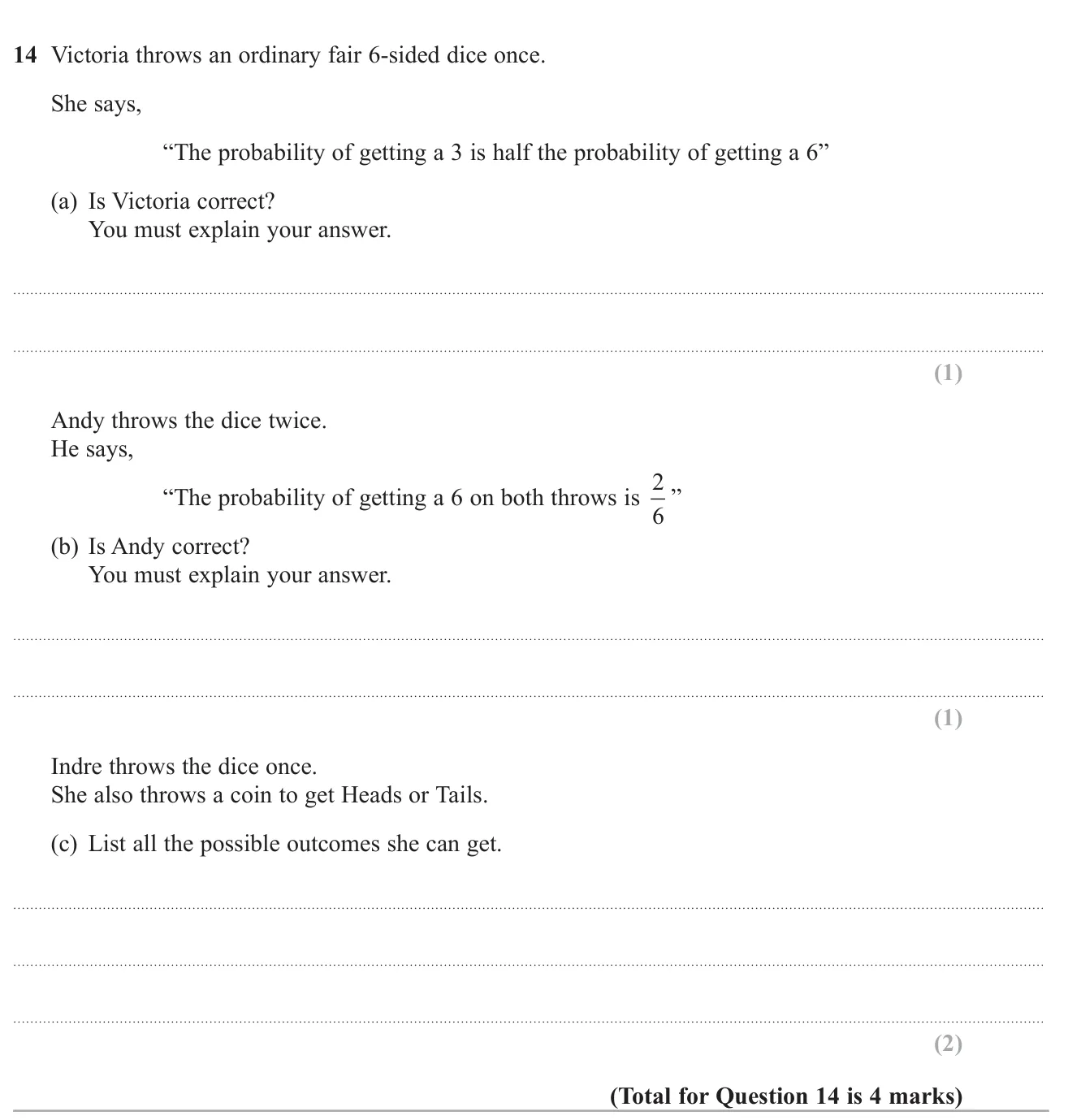
© Pearson Education Ltd. November 2018 Paper 2 (Foundation, calculator), question 14.
Show answer
| (a) | No: both have probability 61 | 1 mark |
|---|
| (b) | No: it is 61×61=361 | 1 mark |
|---|
| (c) | 1H, 2H, 3H, 4H, 5H, 6H, 1T, 2T, 3T, 4T, 5T, 6T | 2 marks |
|---|
Worked solution Checked against the mark scheme
(a) A fair dice gives each number a 61 chance, so 3 and 6 are equally likely.
(b) Two sixes: 61×61=361, not 62.
(c) Each of 6 numbers pairs with H or T: 6×2=12 outcomes, 1H to 6H and 1T to 6T.
Watch out: In (b), adding the probabilities instead of multiplying.
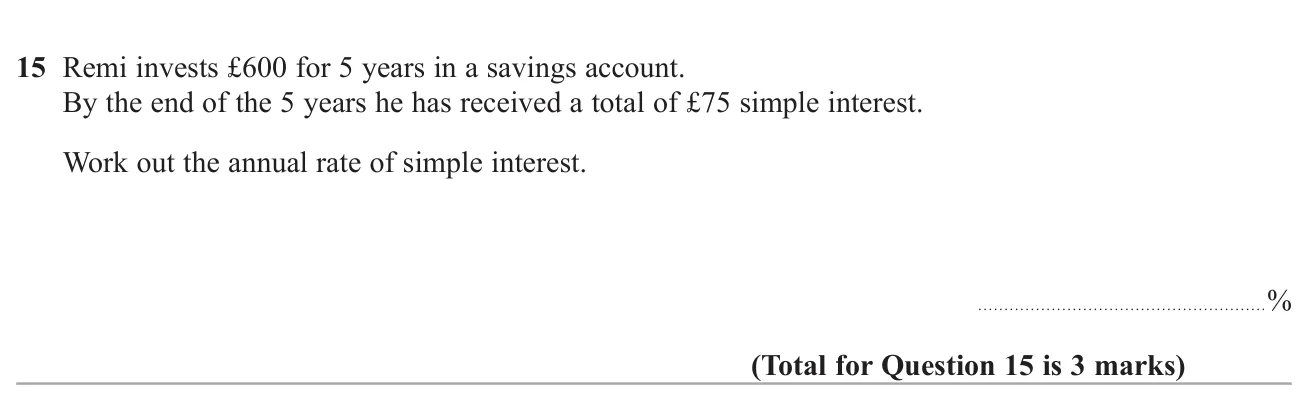
© Pearson Education Ltd. November 2018 Paper 2 (Foundation, calculator), question 15.
Show answer
Worked solution Checked against the mark scheme
Interest each year: 75÷5=£15
Rate: 60015×100=2.5%
Watch out: Giving 12.5%, the total over 5 years.
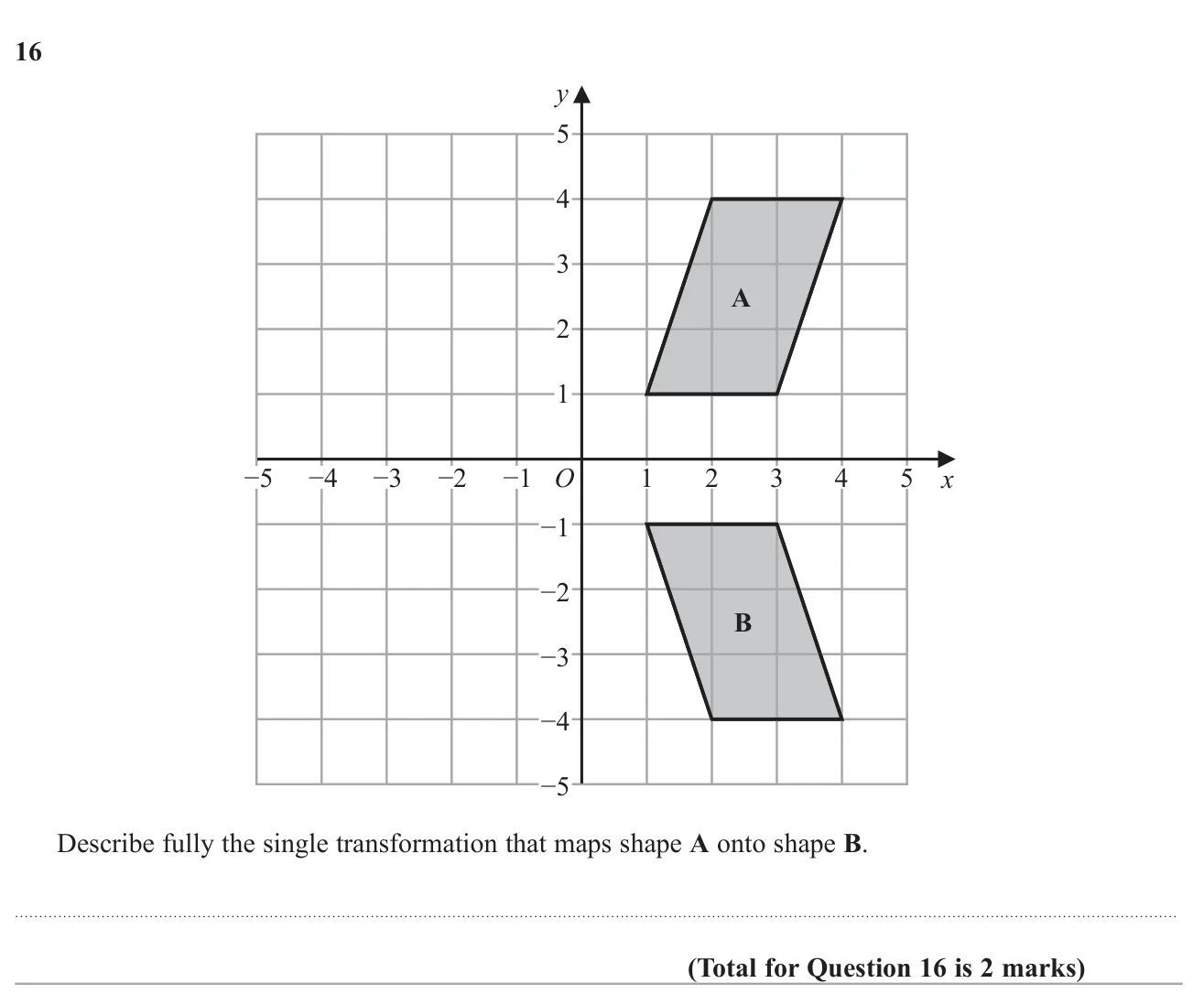
© Pearson Education Ltd. November 2018 Paper 2 (Foundation, calculator), question 16.
Show answer
| Answer | Reflection in the x-axis (y=0) | 2 marks |
|---|
Worked solution Checked against the mark scheme
Each point of A has the same x-coordinate in B, with the y-coordinate's sign changed, e.g. (1,1)→(1,−1).
So it is a **reflection in the x-axis**.
Watch out: Saying 'in the y-axis', or naming a rotation.
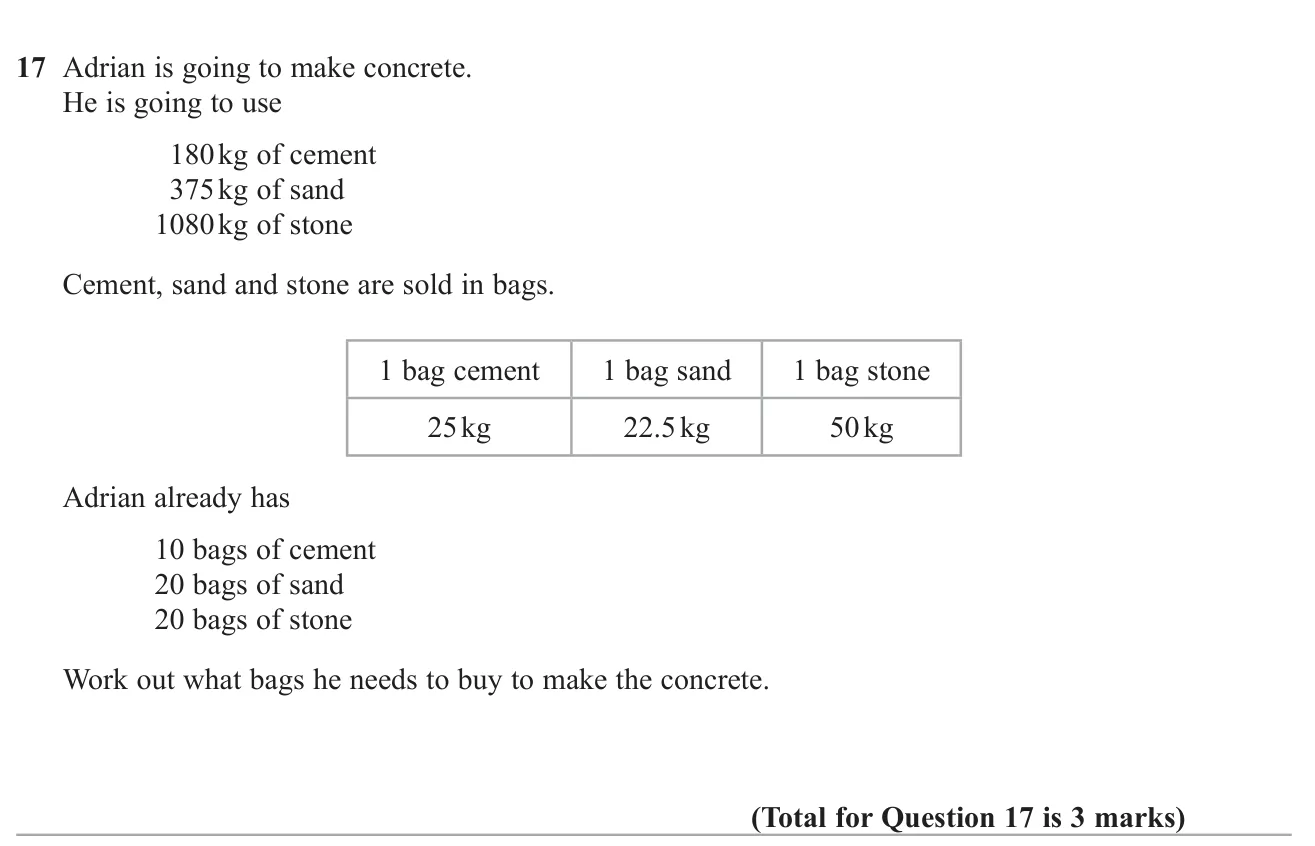
© Pearson Education Ltd. November 2018 Paper 2 (Foundation, calculator), question 17.
Show answer
| Answer | 2 bags of stone | 3 marks |
|---|
Worked solution Checked against the mark scheme
Bags needed (round up):
Cement: 180÷25=7.2→8 (has 10)
Sand: 375÷22.5=16.7→17 (has 20)
Stone: 1080÷50=21.6→22 (has 20)
He only needs to buy 2 bags of stone.
Watch out: Rounding down, so thinking 21 bags of stone is enough.
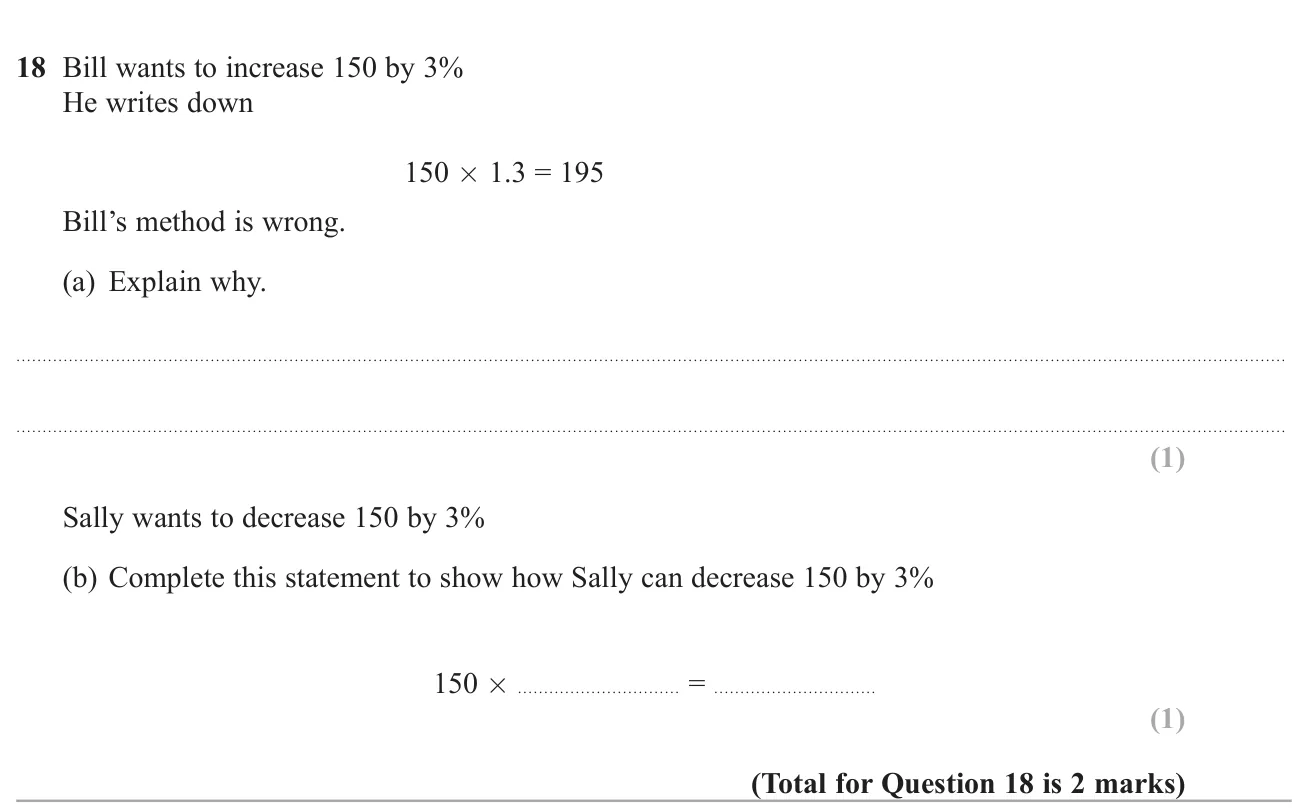
© Pearson Education Ltd. November 2018 Paper 2 (Foundation, calculator), question 18.
Show answer
| (a) | 1.3 is a 30% increase; for 3% he needs 1.03 | 1 mark |
|---|
| (b) | 150×0.97=145.5 | 1 mark |
|---|
Worked solution Checked against the mark scheme
(a) 1.3=130%, which adds 30%. A 3% increase uses 1.03: 150×1.03=154.5.
(b) Decrease by 3%: 100%−3%=97%=0.97
150×0.97=145.5
Watch out: Using 0.7 for a 3% decrease.
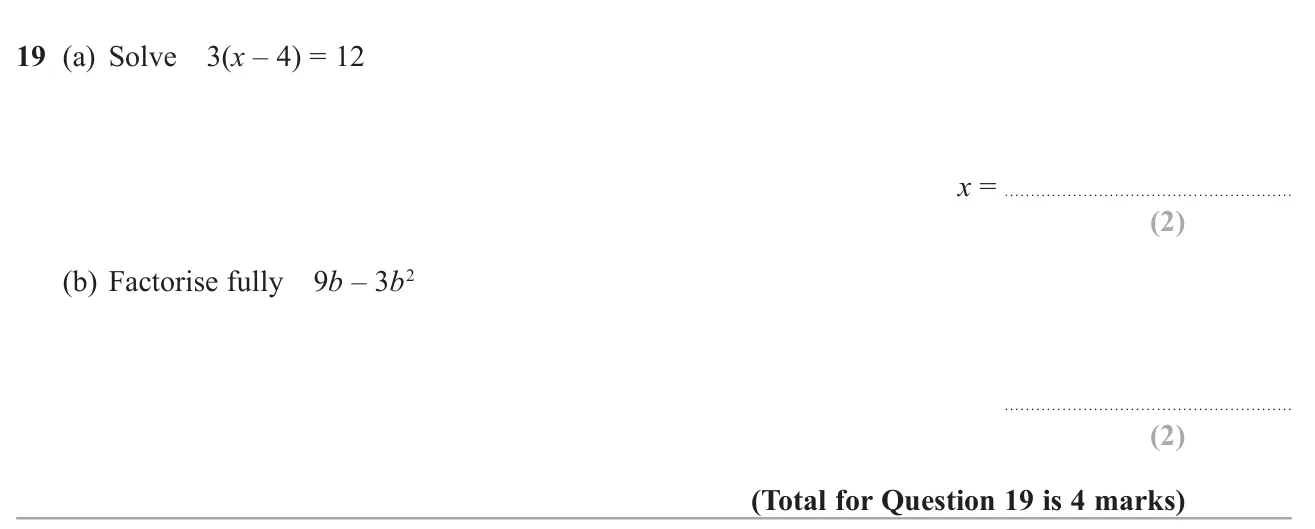
© Pearson Education Ltd. November 2018 Paper 2 (Foundation, calculator), question 19.
Show answer
| (a) | x=8 | 2 marks |
|---|
| (b) | 3b(3−b) | 2 marks |
|---|
Worked solution Checked against the mark scheme
(a) 3(x−4)=12⇒x−4=4⇒x=8
(b) The highest common factor of 9b and 3b2 is 3b.
9b−3b2=3b(3−b)
Watch out: In (b), taking out only 3 or only b.
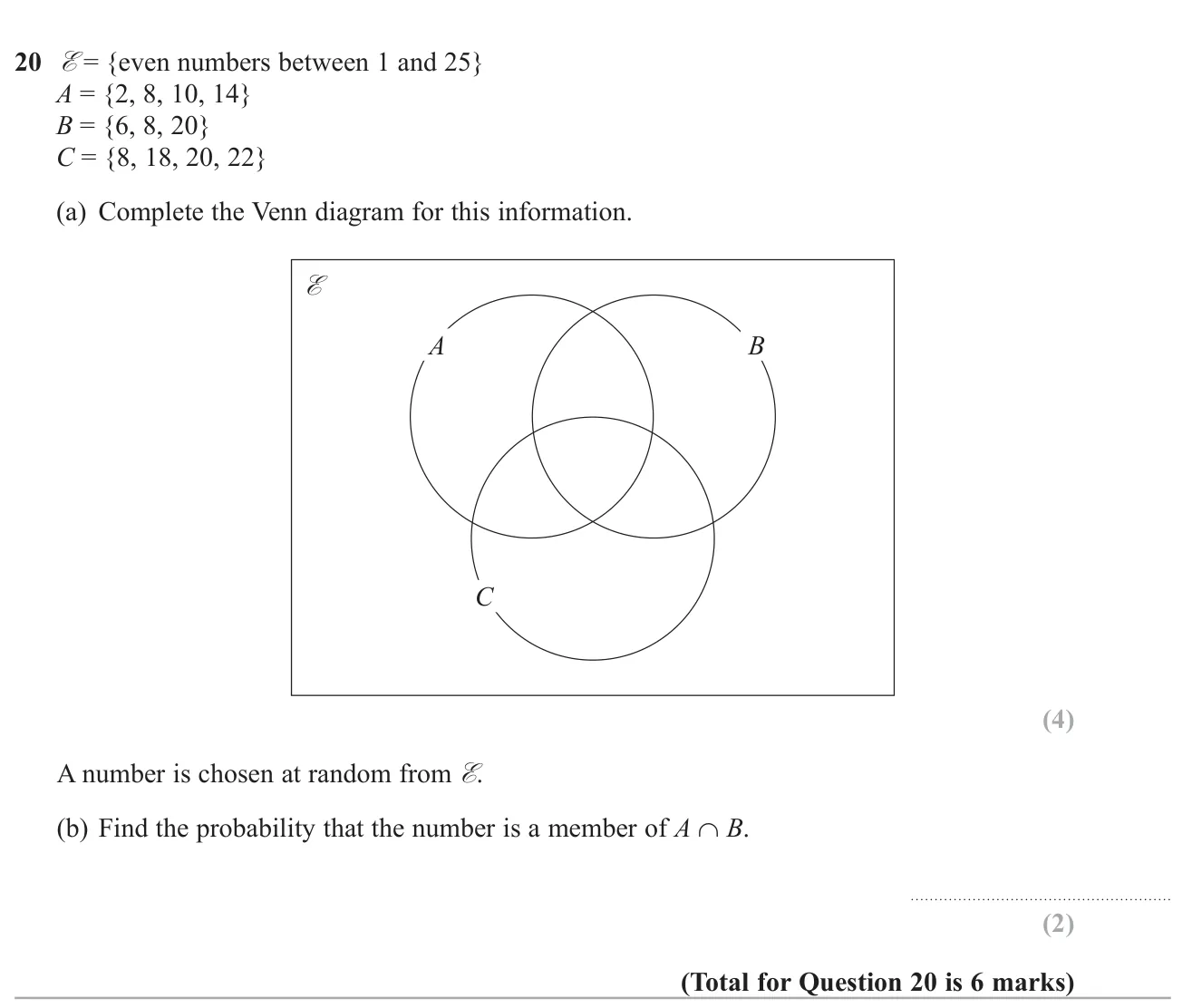
© Pearson Education Ltd. November 2018 Paper 2 (Foundation, calculator), question 20.
Show answer
| (a) | A only: 2, 10, 14; A∩B∩C: 8; B only: 6; B∩C only: 20; C only: 18, 22; outside: 4, 12, 16, 24 | 4 marks |
|---|
| (b) | 121 | 2 marks |
|---|
Worked solution Checked against the mark scheme
(a) E={2,4,6,...,24}, 12 numbers.
8 is in all three sets. 20 is in B and C only. 6 is B only; 2, 10, 14 are A only; 18, 22 are C only.
4, 12, 16, 24 go outside the circles.
(b) A∩B={8}, so P =121
Watch out: Forgetting to place the numbers that are in no set.
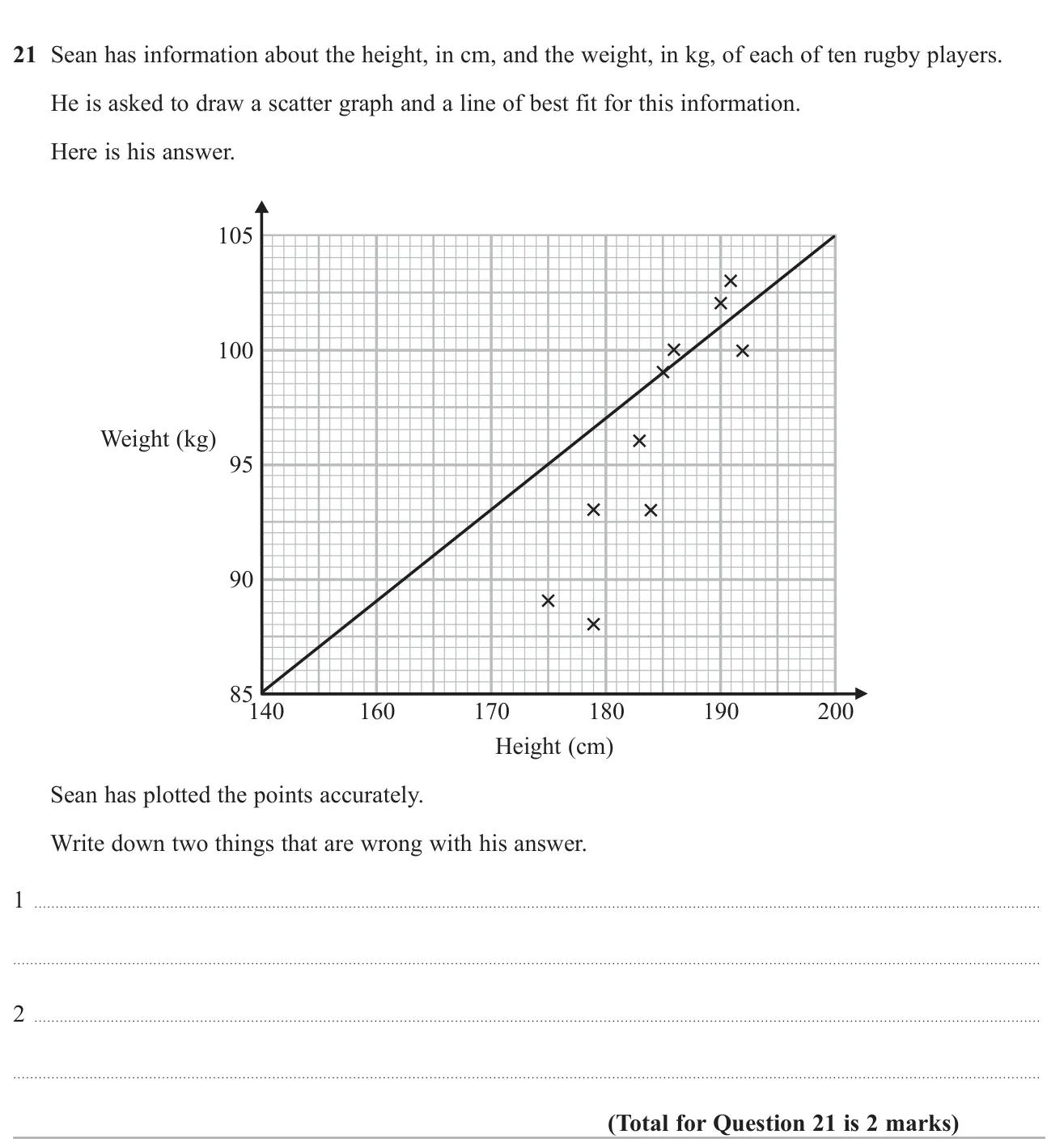
© Pearson Education Ltd. November 2018 Paper 2 (Foundation, calculator), question 21.
Show answer
| Answer | The line of best fit is wrong (it does not follow the points); the height scale is not evenly spaced (150 is missing) | 2 marks |
|---|
Worked solution Checked against the mark scheme
Check the line: it should pass through the middle of the crosses with roughly equal numbers either side, which Sean's does not.
Check the axes: the height axis jumps from 140 to 160 in the same space as 160 to 170, so the scale is uneven.
Watch out: Saying there is no title or the axis should start at 0.
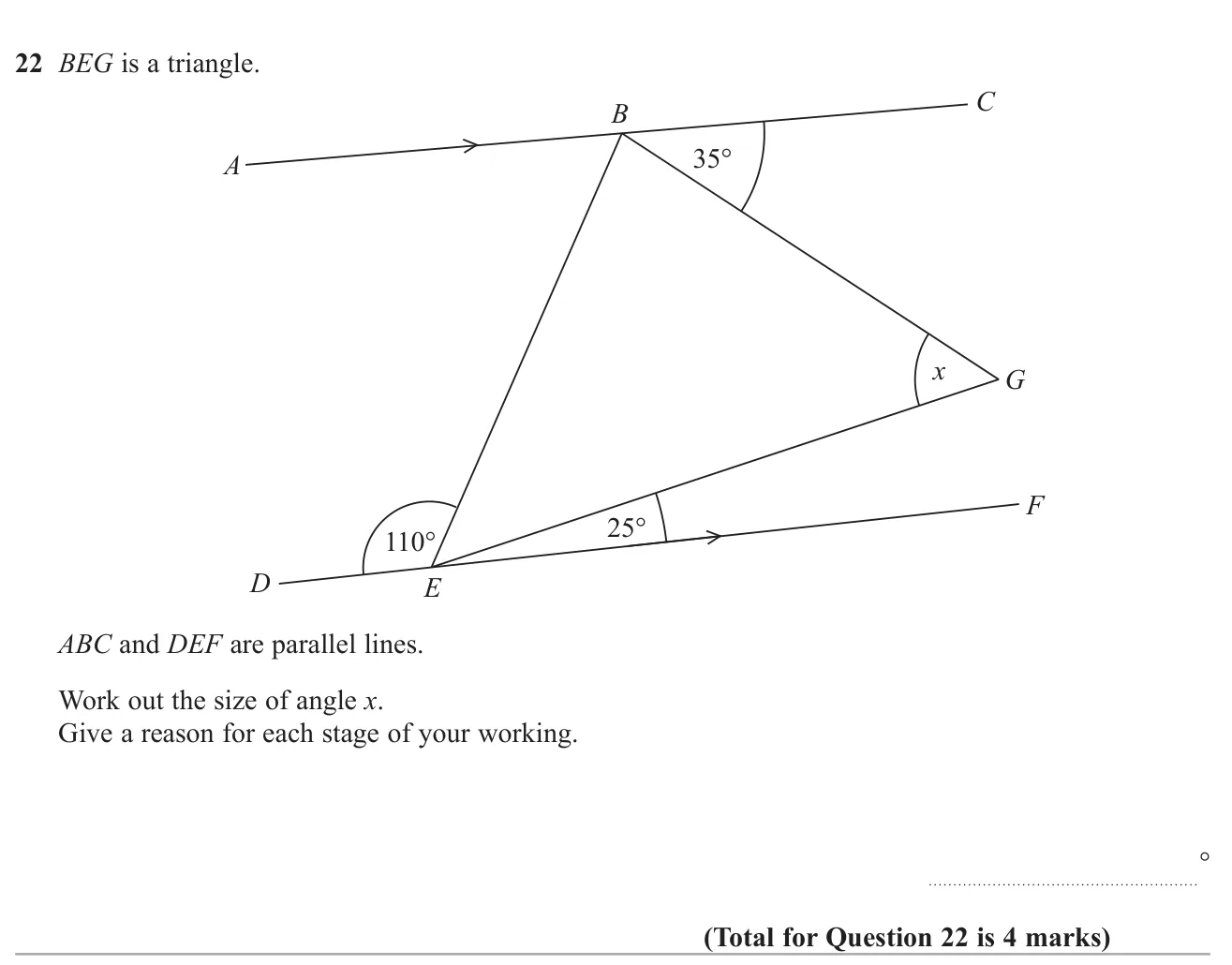
© Pearson Education Ltd. November 2018 Paper 2 (Foundation, calculator), question 22.
Show answer
Worked solution Checked against the mark scheme
Angle ABE=180−110=70° (co-interior angles add up to 180°)
Angle EBG=180−70−35=75° (angles on a straight line add up to 180°)
Angle BEG=180−110−25=45° (angles on a straight line)
x=180−75−45=60° (angles in a triangle add up to 180°)
Watch out: Giving no reasons, or naming corresponding angles when they are alternate.
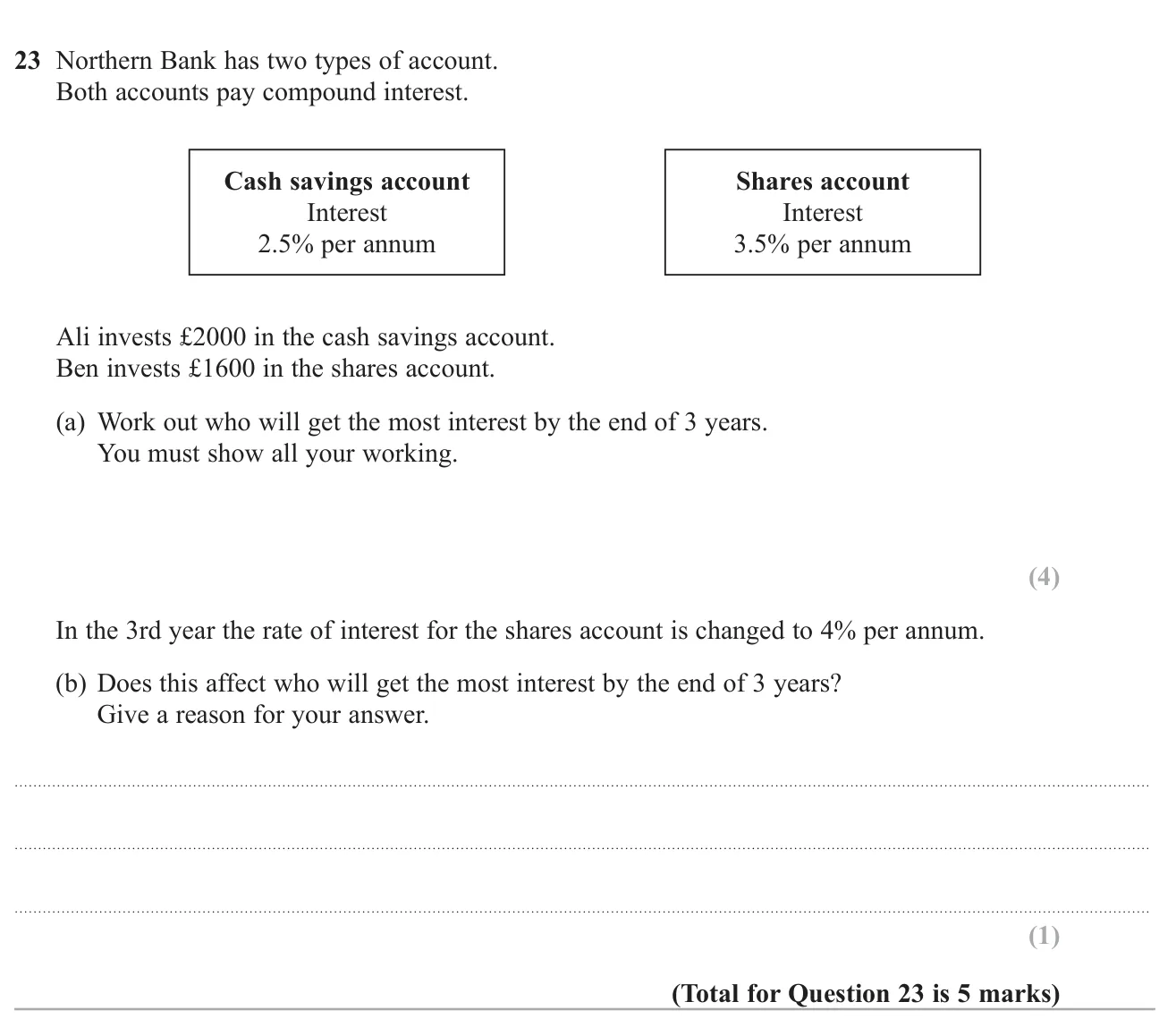
© Pearson Education Ltd. November 2018 Paper 2 (Foundation, calculator), question 23.
Show answer
| (a) | Ben: £173.95 interest against Ali's £153.78 | 4 marks |
|---|
| (b) | No: Ben now gets about £182.52, still more than Ali | 1 mark |
|---|
Worked solution Checked against the mark scheme
(a) Ali: 2000×1.0253=£2153.78, interest £153.78
Ben: 1600×1.0353=£1773.95, interest £173.95
Ben gets more.
(b) Ben: 1600×1.0352×1.04=£1782.52, interest £182.52. Still Ben, so no change.
Watch out: Using simple interest, or comparing final totals instead of interest.
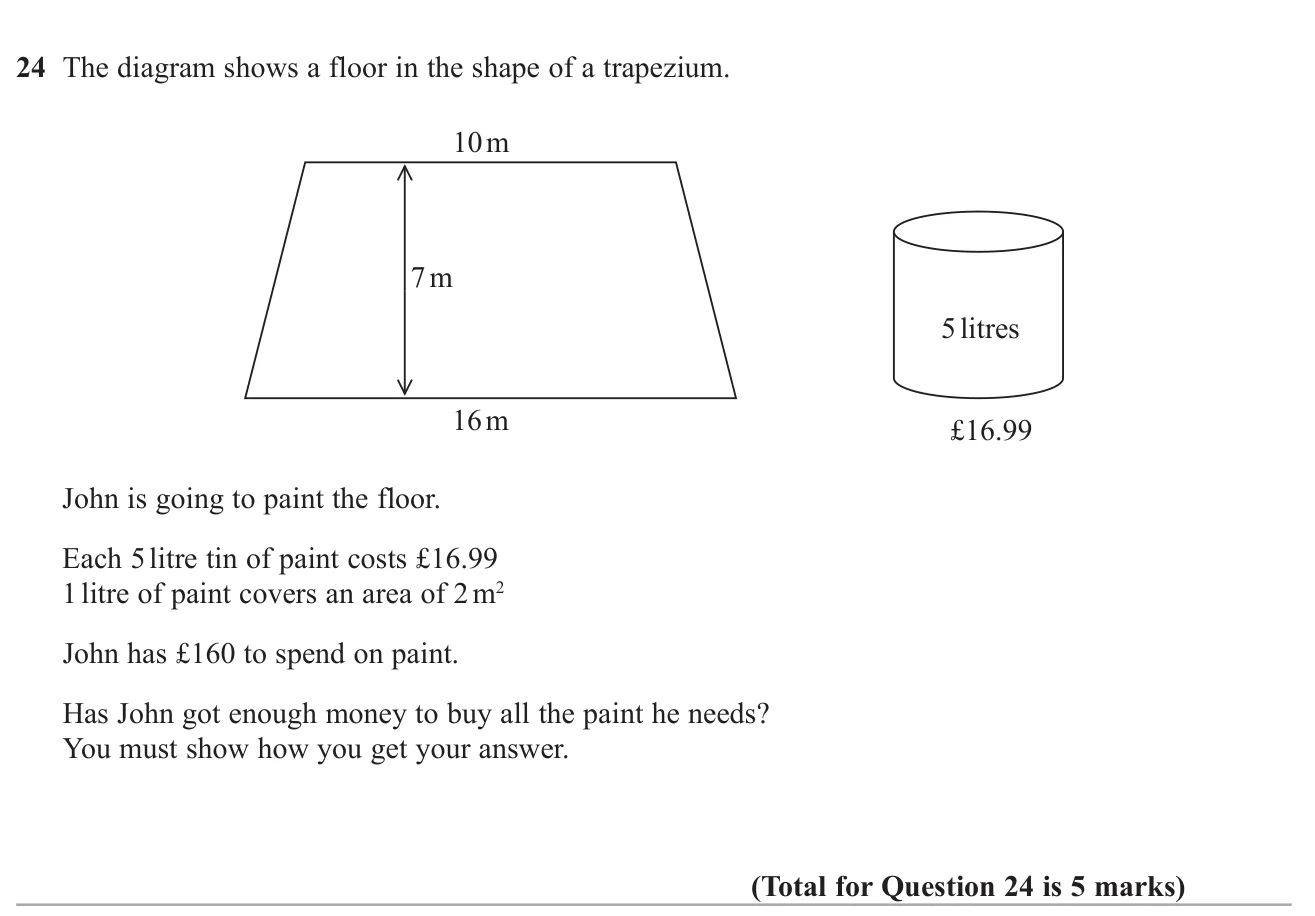
© Pearson Education Ltd. November 2018 Paper 2 (Foundation, calculator), question 24.
Show answer
| Answer | No: he needs 10 tins costing £169.90 | 5 marks |
|---|
Worked solution Checked against the mark scheme
Area =21(10+16)×7=91 m²
Paint =91÷2=45.5 litres
Tins =45.5÷5=9.1, so 10 tins
Cost =10×16.99=£169.90>£160, so No.
Watch out: Rounding 9.1 down to 9 tins.
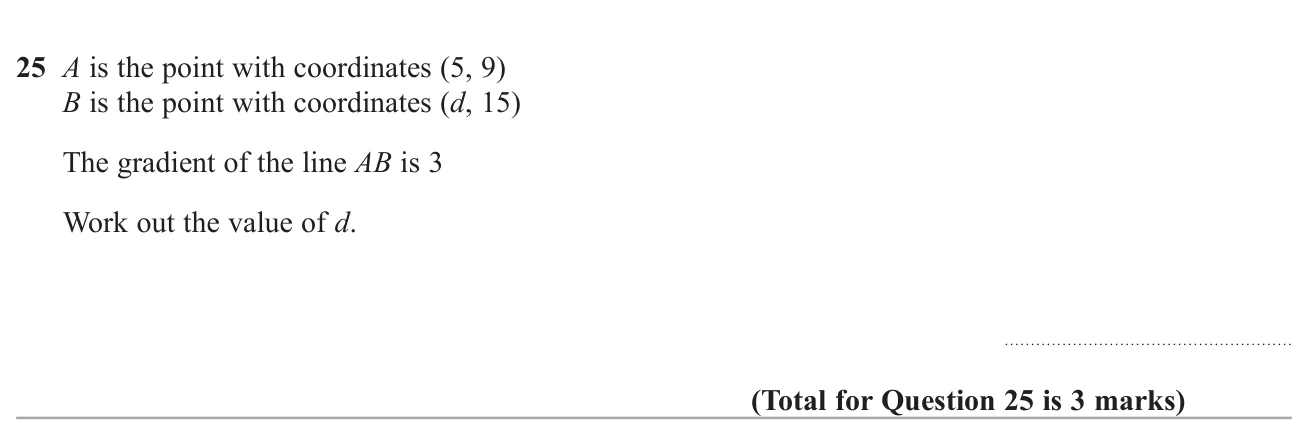
© Pearson Education Ltd. November 2018 Paper 2 (Foundation, calculator), question 25.
Show answer
Worked solution Checked against the mark scheme
Gradient =change in xchange in y
Change in y=15−9=6, so change in x=6÷3=2
d=5+2=7
Watch out: Using change in x over change in y, giving 23.
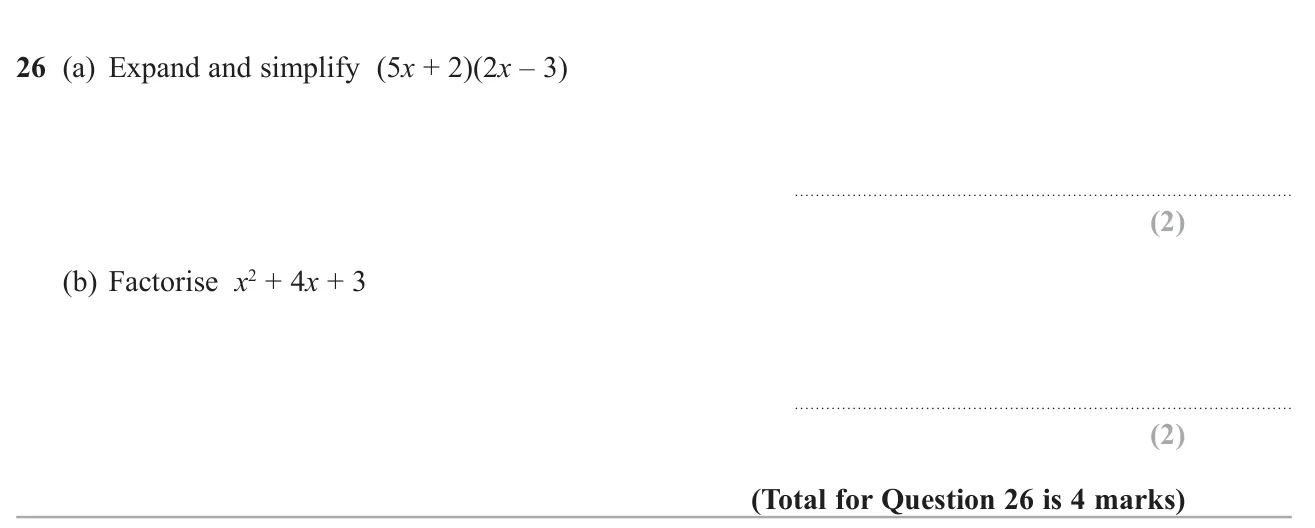
© Pearson Education Ltd. November 2018 Paper 2 (Foundation, calculator), question 26.
Show answer
| (a) | 10x2−11x−6 | 2 marks |
|---|
| (b) | (x+1)(x+3) | 2 marks |
|---|
Worked solution Checked against the mark scheme
(a) (5x+2)(2x−3)=10x2−15x+4x−6=10x2−11x−6
(b) Two numbers that multiply to 3 and add to 4: 1 and 3.
x2+4x+3=(x+1)(x+3)
Watch out: In (a), getting +11x from a sign error.
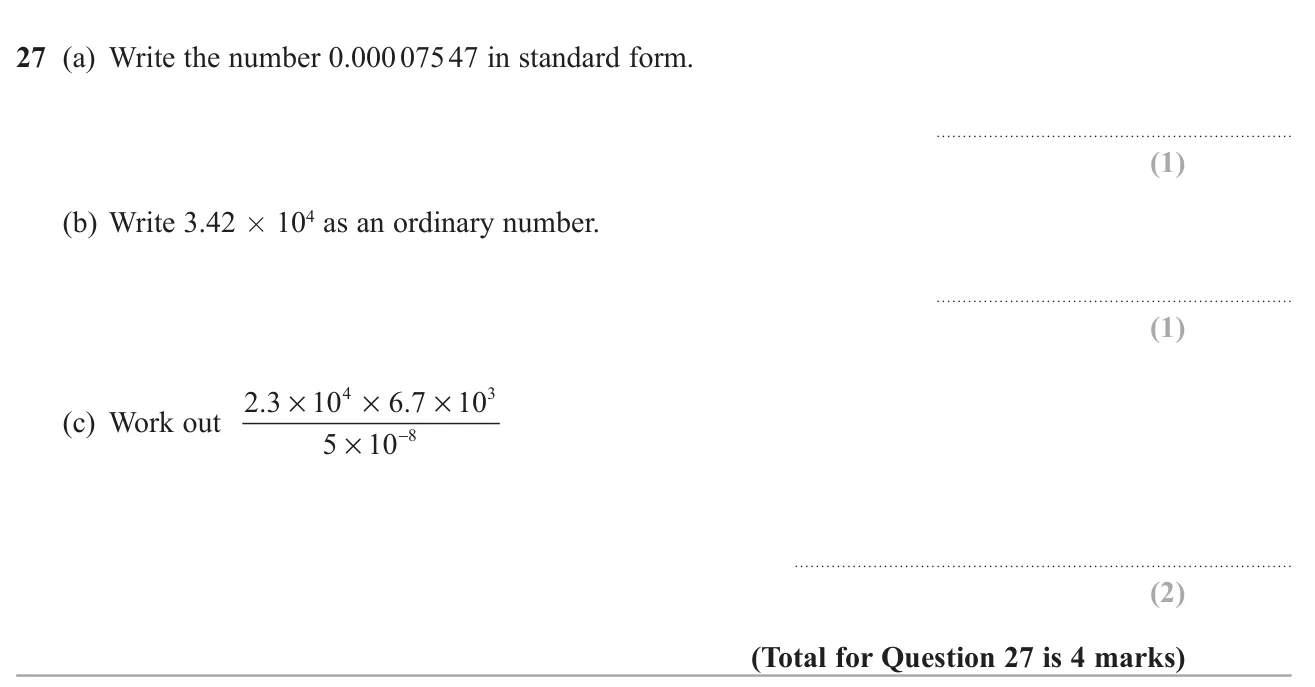
© Pearson Education Ltd. November 2018 Paper 2 (Foundation, calculator), question 27.
Show answer
| (a) | 7.547×10⁻⁵ | 1 mark |
|---|
| (b) | 34200 | 1 mark |
|---|
| (c) | 3.082×10¹⁵ | 2 marks |
|---|
Worked solution Checked against the mark scheme
(a) Move the decimal point 5 places right: 7.547×10⁻⁵
(b) 3.42×104=34200
(c) Top: 2.3×104×6.7×103=1.541×10⁸
5×10−81.541×108=0.3082×1016=3.082×10¹⁵
Watch out: In (a), using a positive power of 10.
Finished the paper?
Add up your marks for all three papers and see what grade that would have been.