Edexcel GCSE Maths · 1MA1

June 2018 Paper 2 Higher

Calculator · 21 questions · 80 marks · 1 hour 30 minutes. Try each question on paper, then press "Show answer".

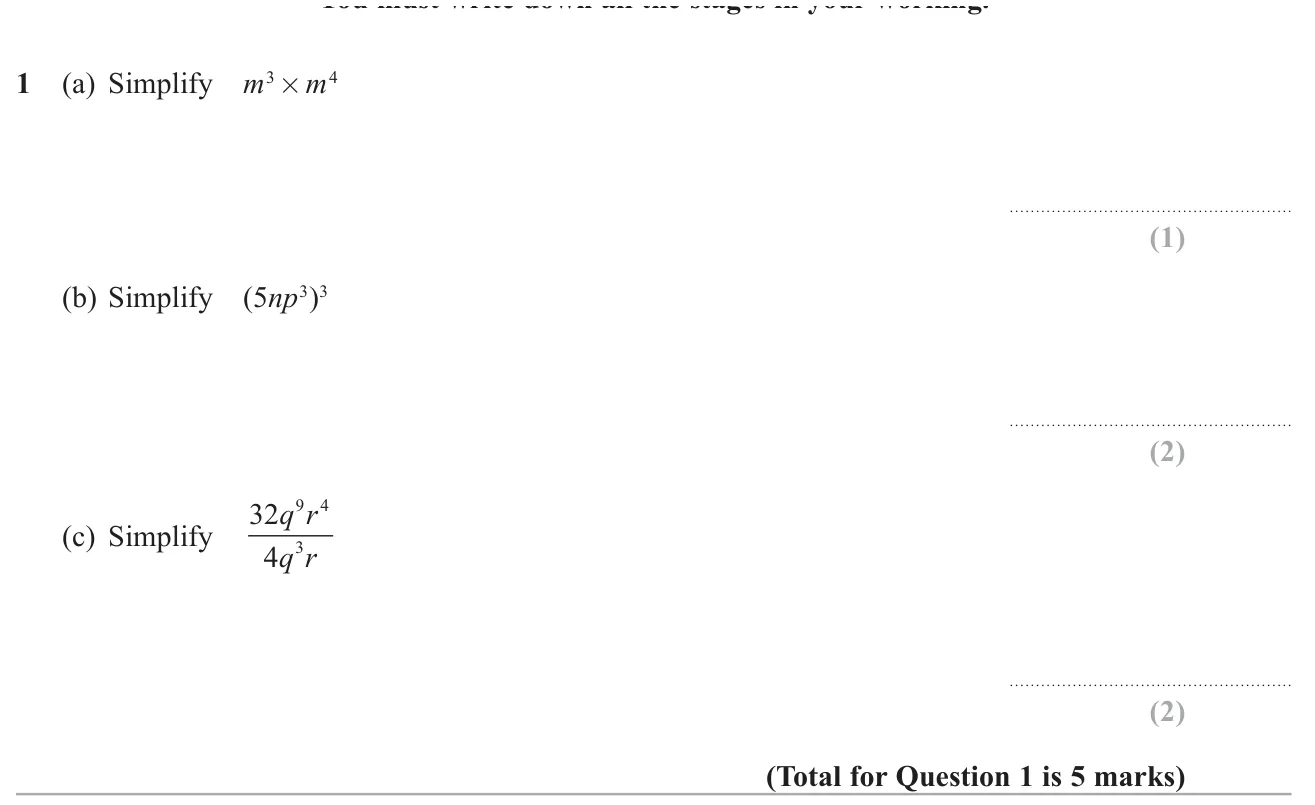
Question 1

Powers, roots and indices5 marksGrade 4CalculatorOn both tiers
Simplify expressions using the laws of indices.

© Pearson Education Ltd. June 2018 Paper 2 (Higher, calculator), question 1.

Show answer
(a)m7m^71 mark
(b)125n3p9125n^3p^92 marks
(c)8q6r38q^6r^32 marks

Worked solution Checked against the mark scheme

(a) Add the powers: m3+4=m7m^{3+4} = m^7

(b) Cube each part: 53×n3×(p3)3=125n3p95^3 \times n^3 \times (p^3)^3 = 125n^3p^9

(c) Divide the numbers and subtract the powers: 324=8\frac{32}{4} = 8, q9−3=q6q^{9-3} = q^6, r4−1=r3r^{4-1} = r^3, giving 8q6r38q^6r^3

Watch out: In (b), writing 15np915np^9 or p6p^6.

Question 2

Factors, multiples and primes3 marksGrade 4CalculatorOn both tiers
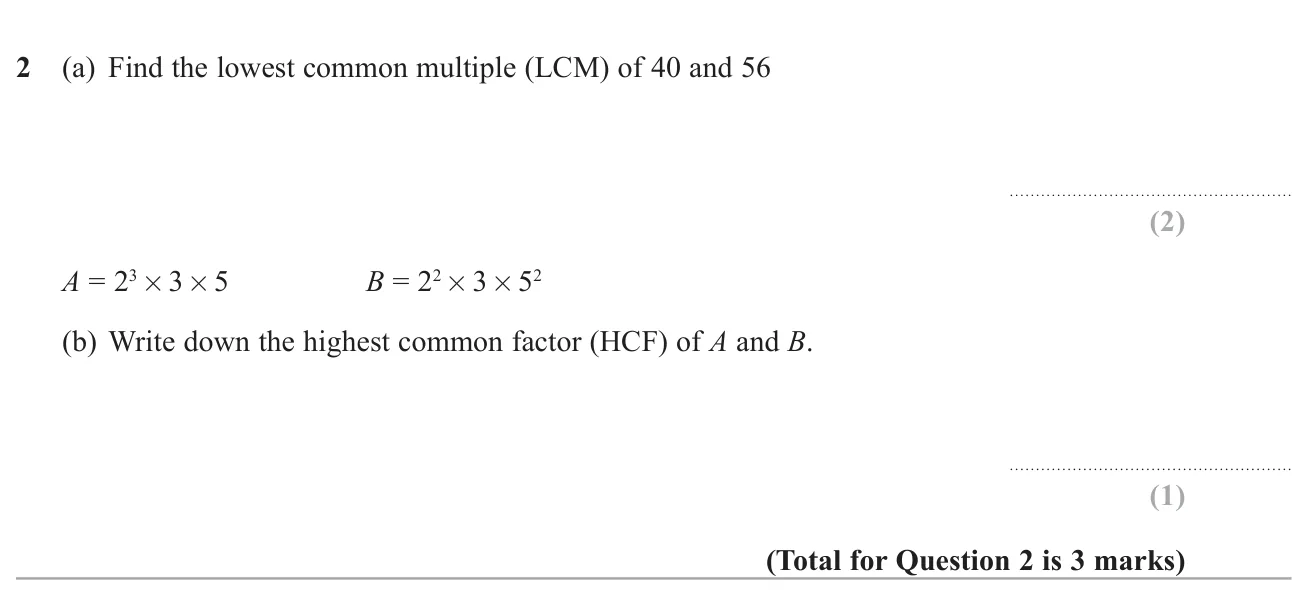
Find the LCM of two numbers and the HCF of two numbers given as prime factor products.

© Pearson Education Ltd. June 2018 Paper 2 (Higher, calculator), question 2.

Show answer
(a)2802802 marks
(b)60601 mark

Worked solution Checked against the mark scheme

(a) 40=23×540 = 2^3 \times 5 and 56=23×756 = 2^3 \times 7

LCM =23×5×7=280= 2^3 \times 5 \times 7 = 280

(b) Take the lowest power of each shared prime: 22×3×5=602^2 \times 3 \times 5 = 60

Watch out: Multiplying 40 by 56 for the LCM.

Question 3

Coordinates and straight-line graphs3 marksGrade 5CalculatorOn both tiers
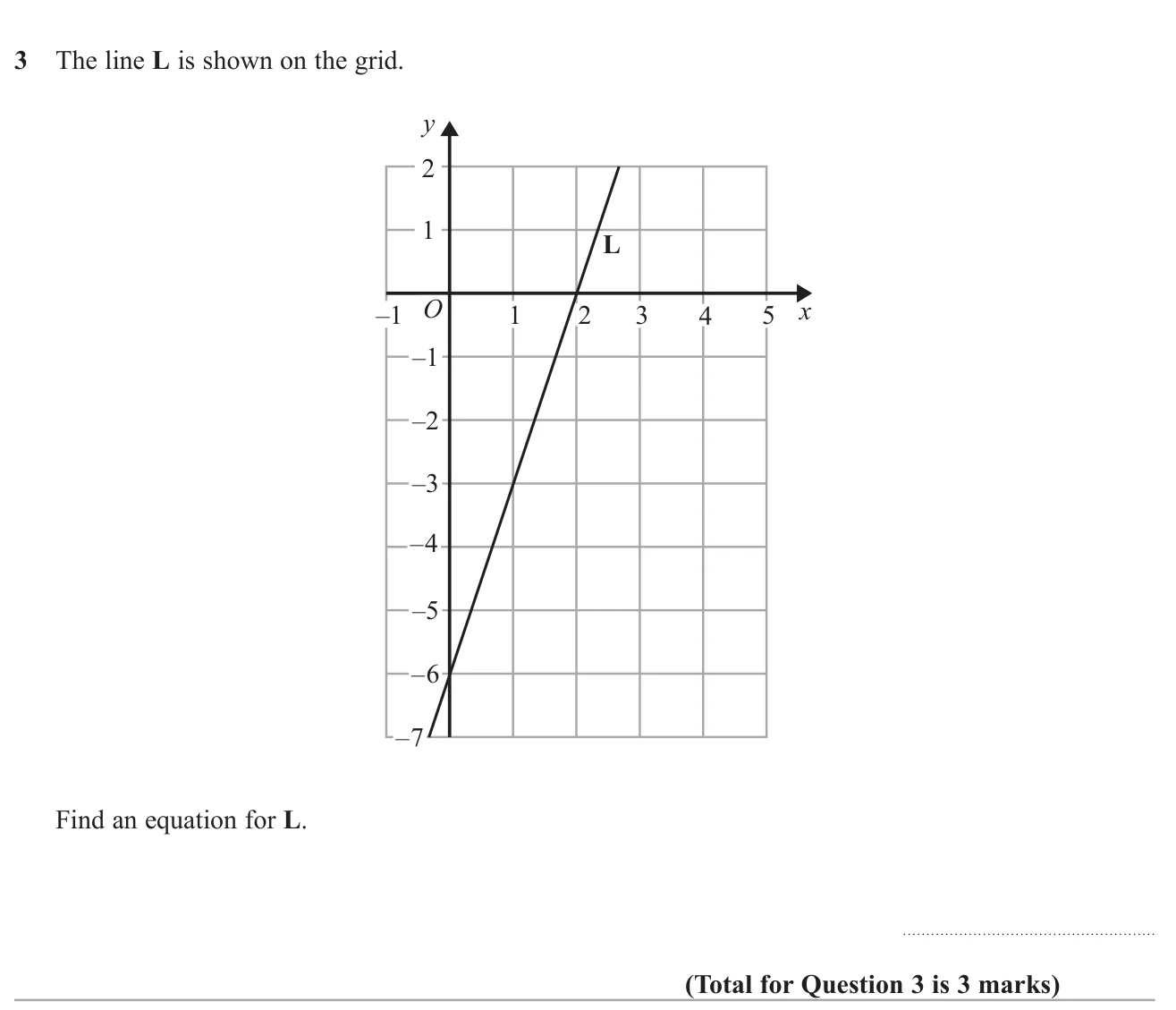
Find the equation of a straight line drawn on a grid.

© Pearson Education Ltd. June 2018 Paper 2 (Higher, calculator), question 3.

Show answer
Answery=3x−6y = 3x - 63 marks

Worked solution Checked against the mark scheme

The line crosses the yy-axis at −6-6, so c=−6c = -6.

From (0,−6)(0, -6) to (2,0)(2, 0): up 6, across 2, so gradient =6÷2=3= 6 \div 2 = 3.

y=3x−6y = 3x - 6

Watch out: Working out the gradient as across over up, giving 1/3.

Question 4

Ratio5 marksGrade 5CalculatorOn both tiers
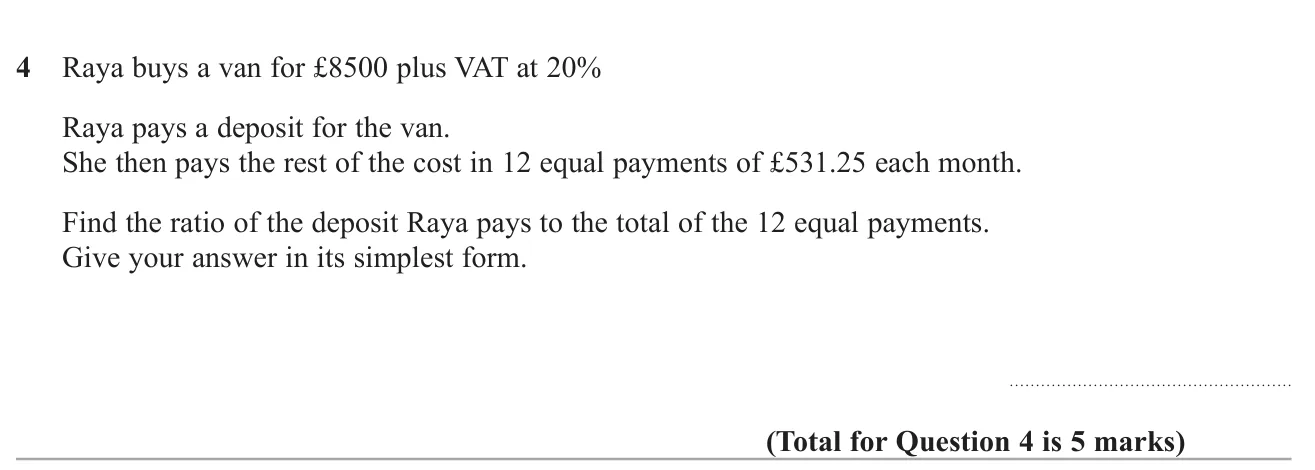
Find a deposit after VAT and monthly payments, then write it as a simplified ratio to the payments.

© Pearson Education Ltd. June 2018 Paper 2 (Higher, calculator), question 4.

Show answer
Answer3:53 : 55 marks

Worked solution Checked against the mark scheme

Price with VAT: 8500×1.2=£10 2008500 \times 1.2 = £10\,200

Monthly payments: 12×531.25=£637512 \times 531.25 = £6375

Deposit: 10 200−6375=£382510\,200 - 6375 = £3825

Ratio: 3825:63753825 : 6375. Divide both by 1275: 3:53 : 5

Watch out: Giving the ratio the wrong way round (5 : 3).

Question 5

Quadratic graphs6 marksGrade 4CalculatorOn both tiers
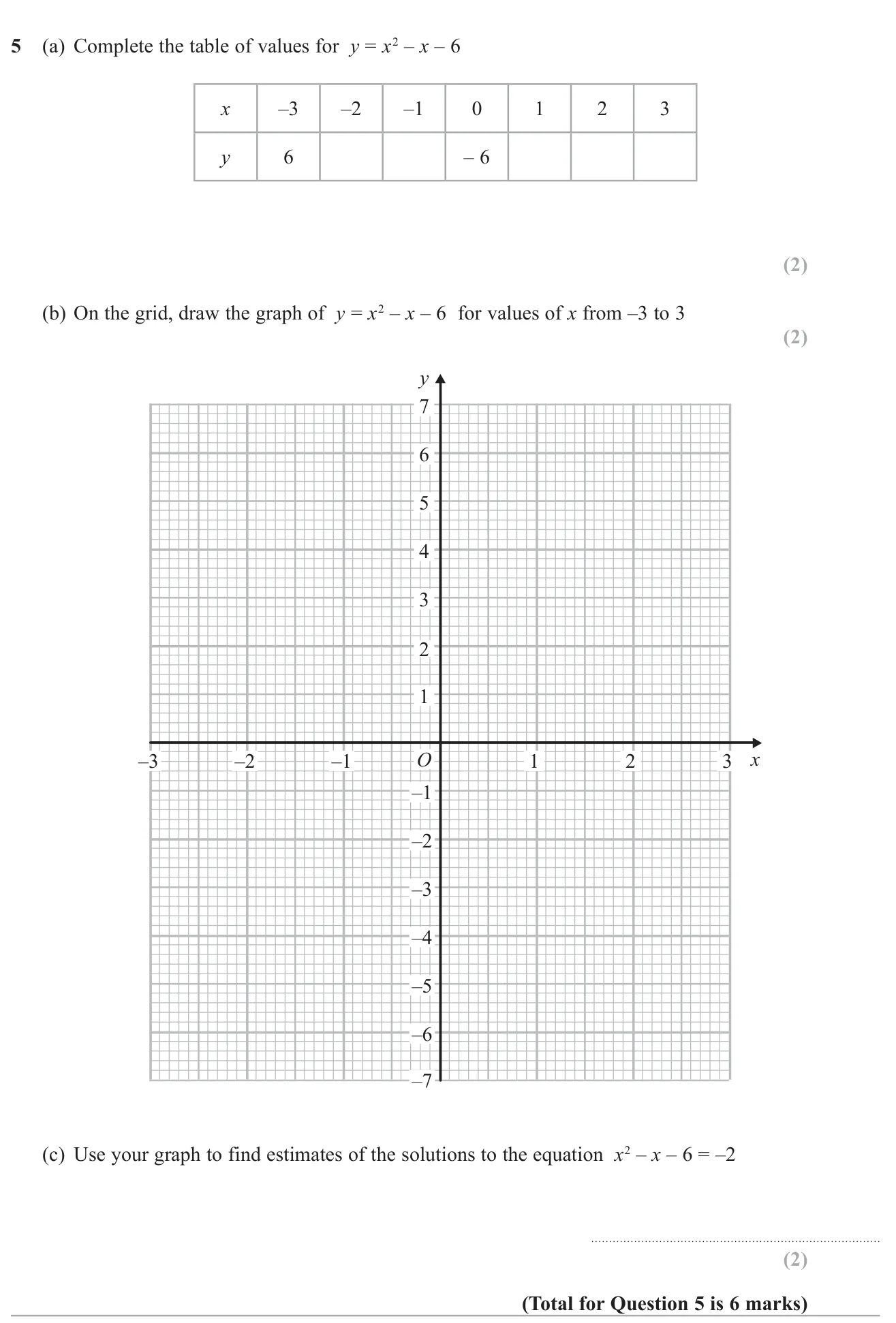
Complete a table for a quadratic, plot its graph and use it to estimate solutions of an equation.

© Pearson Education Ltd. June 2018 Paper 2 (Higher, calculator), question 5.

Show answer
(a)0,−4,−6,−4,00, -4, -6, -4, 0 (for x=−2,−1,1,2,3x = -2, -1, 1, 2, 3)2 marks
(b)Smooth U-shaped curve through the points2 marks
(c)x≈2.6x \approx 2.6 and x≈−1.6x \approx -1.62 marks

Worked solution Checked against the mark scheme

(a) e.g. x=−2x = -2: 4+2−6=04 + 2 - 6 = 0; x=1x = 1: 1−1−6=−61 - 1 - 6 = -6; x=2x = 2: 4−2−6=−44 - 2 - 6 = -4

(b) Plot (−3,6),(−2,0),(−1,−4),(0,−6),(1,−6),(2,−4),(3,0)(-3, 6), (-2, 0), (-1, -4), (0, -6), (1, -6), (2, -4), (3, 0) and join with a smooth curve.

(c) Draw the line y=−2y = -2 and read off where it crosses the curve: x≈2.6x \approx 2.6 and x≈−1.6x \approx -1.6

Watch out: In (a), working out −x-x wrongly for negative xx, e.g. (−2)2−(−2)=2(-2)^2 - (-2) = 2.

Question 6

Percentage change and reverse percentages3 marksGrade 5CalculatorOn both tiers
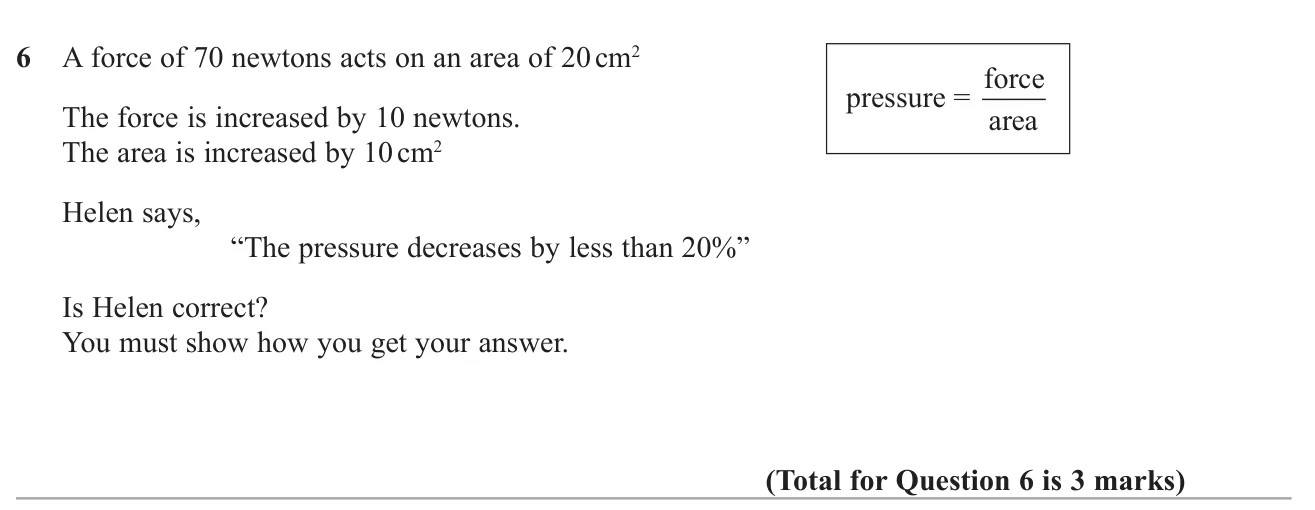
Decide whether a pressure falls by less than 20% when force and area both increase.

© Pearson Education Ltd. June 2018 Paper 2 (Higher, calculator), question 6.

Show answer
AnswerNo: pressure falls from 3.53.5 to 2.672.67 N/cm², a decrease of about 24%3 marks

Worked solution Checked against the mark scheme

Original pressure: 70÷20=3.570 \div 20 = 3.5 N/cm²

New pressure: 80÷30=2.6780 \div 30 = 2.67 N/cm²

Decrease: 3.5−2.67=0.833.5 - 2.67 = 0.83

Percentage decrease: 0.833.5×100≈24%\frac{0.83}{3.5} \times 100 \approx 24\%

This is more than 20%, so Helen is wrong.

Watch out: Comparing the 10 N and 10 cm² increases directly without working out pressures.

Question 7

Transformations2 marksGrade 6Calculator
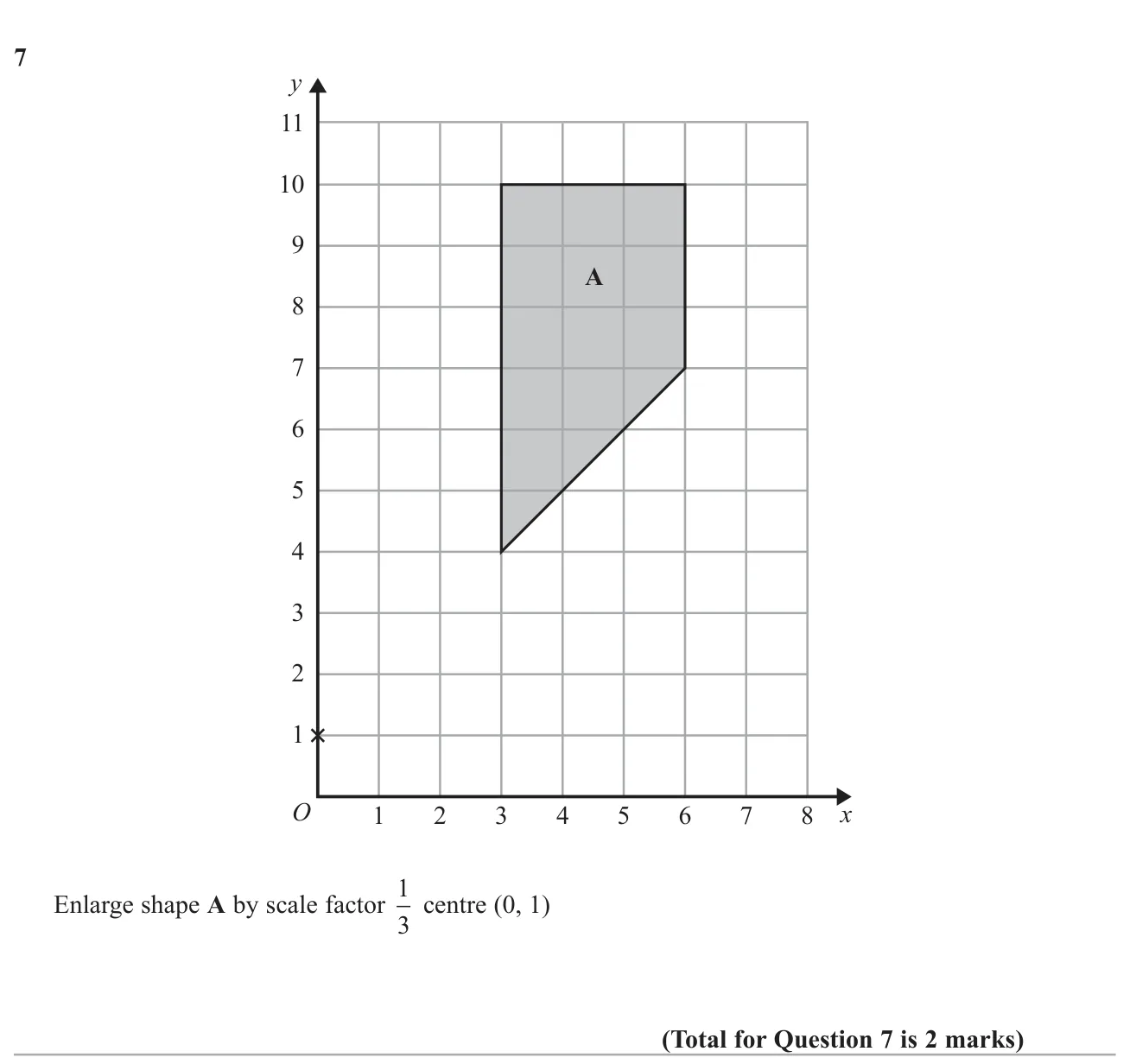
Enlarge a shape on a grid by a fractional scale factor about a given centre.

© Pearson Education Ltd. June 2018 Paper 2 (Higher, calculator), question 7.

Show answer
AnswerVertices at (1,2)(1, 2), (1,4)(1, 4), (2,4)(2, 4), (2,3)(2, 3)2 marks

Worked solution Checked against the mark scheme

Measure each vertex from the centre (0,1)(0, 1) and multiply by 13\frac{1}{3}.

(3,4)(3, 4) is (3,3)(3, 3) from the centre → (1,1)(1, 1) → image (1,2)(1, 2)

(3,10)(3, 10) → (1,3)(1, 3) → (1,4)(1, 4); (6,10)(6, 10) → (2,3)(2, 3) → (2,4)(2, 4); (6,7)(6, 7) → (2,2)(2, 2) → (2,3)(2, 3)

Watch out: Making the shape three times bigger instead of a third of the size.

Question 8

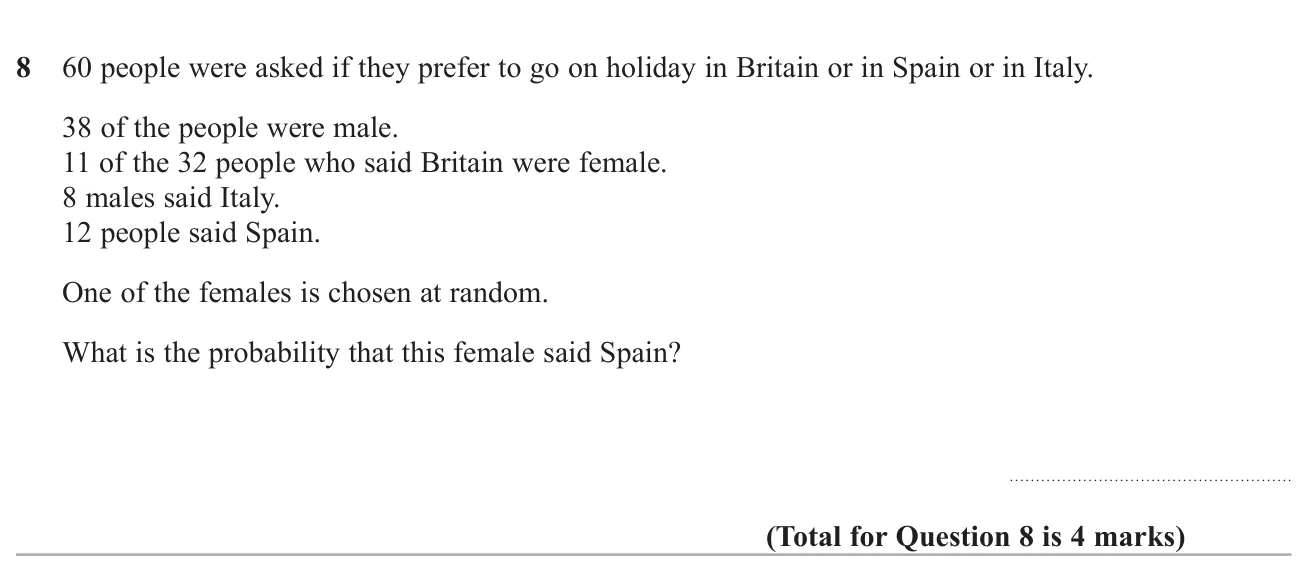
Use given facts about gender and holiday preference to find the probability that a chosen female prefers Spain.

© Pearson Education Ltd. June 2018 Paper 2 (Higher, calculator), question 8.

Show answer
Answer322\frac{3}{22}4 marks

Worked solution Checked against the mark scheme

Females: 60−38=2260 - 38 = 22

Males choosing Britain: 32−11=2132 - 11 = 21

Males choosing Spain: 38−21−8=938 - 21 - 8 = 9, so females choosing Spain: 12−9=312 - 9 = 3

Probability =322= \frac{3}{22}

Watch out: Dividing by 60 instead of 22, giving 360\frac{3}{60}.

Question 9

Compound interest, growth and decay4 marksGrade 6Calculator
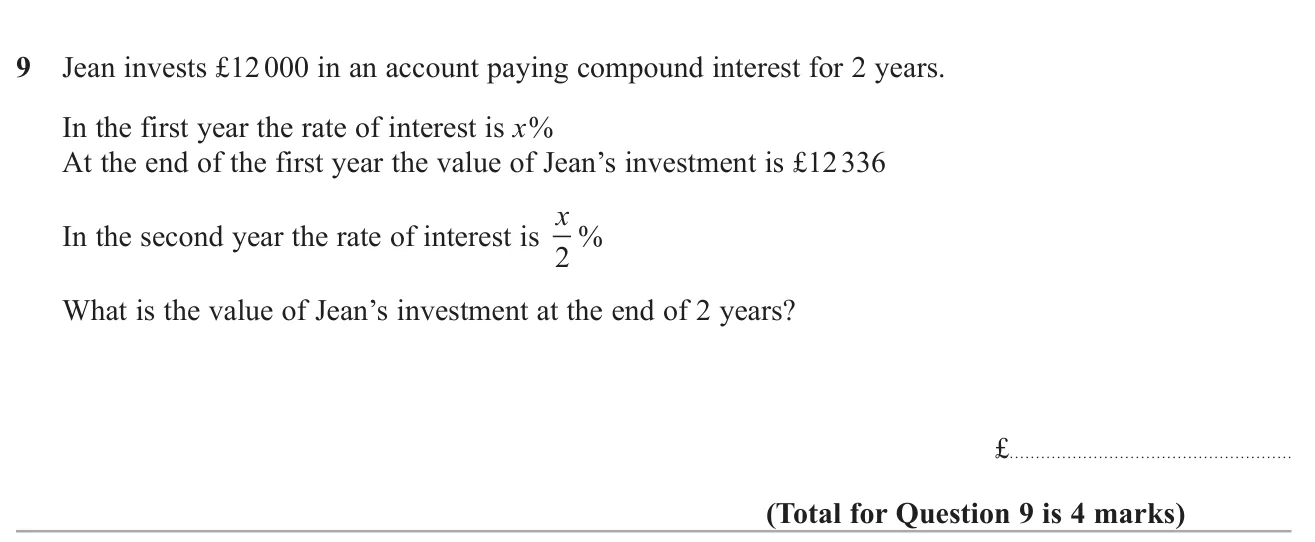
Find a first-year compound interest rate from the new balance, then apply half that rate for the second year.

© Pearson Education Ltd. June 2018 Paper 2 (Higher, calculator), question 9.

Show answer
Answer£12 508.70£12\,508.704 marks

Worked solution Checked against the mark scheme

Multiplier for year 1: 12 336÷12 000=1.02812\,336 \div 12\,000 = 1.028, so x=2.8x = 2.8

Year 2 rate: 2.8÷2=1.4%2.8 \div 2 = 1.4\%

12 336×1.014=£12 508.7012\,336 \times 1.014 = £12\,508.70

Watch out: Applying 1.4% to the original £12 000 instead of £12 336.

Question 10

Vectors3 marksGrade 5Calculator
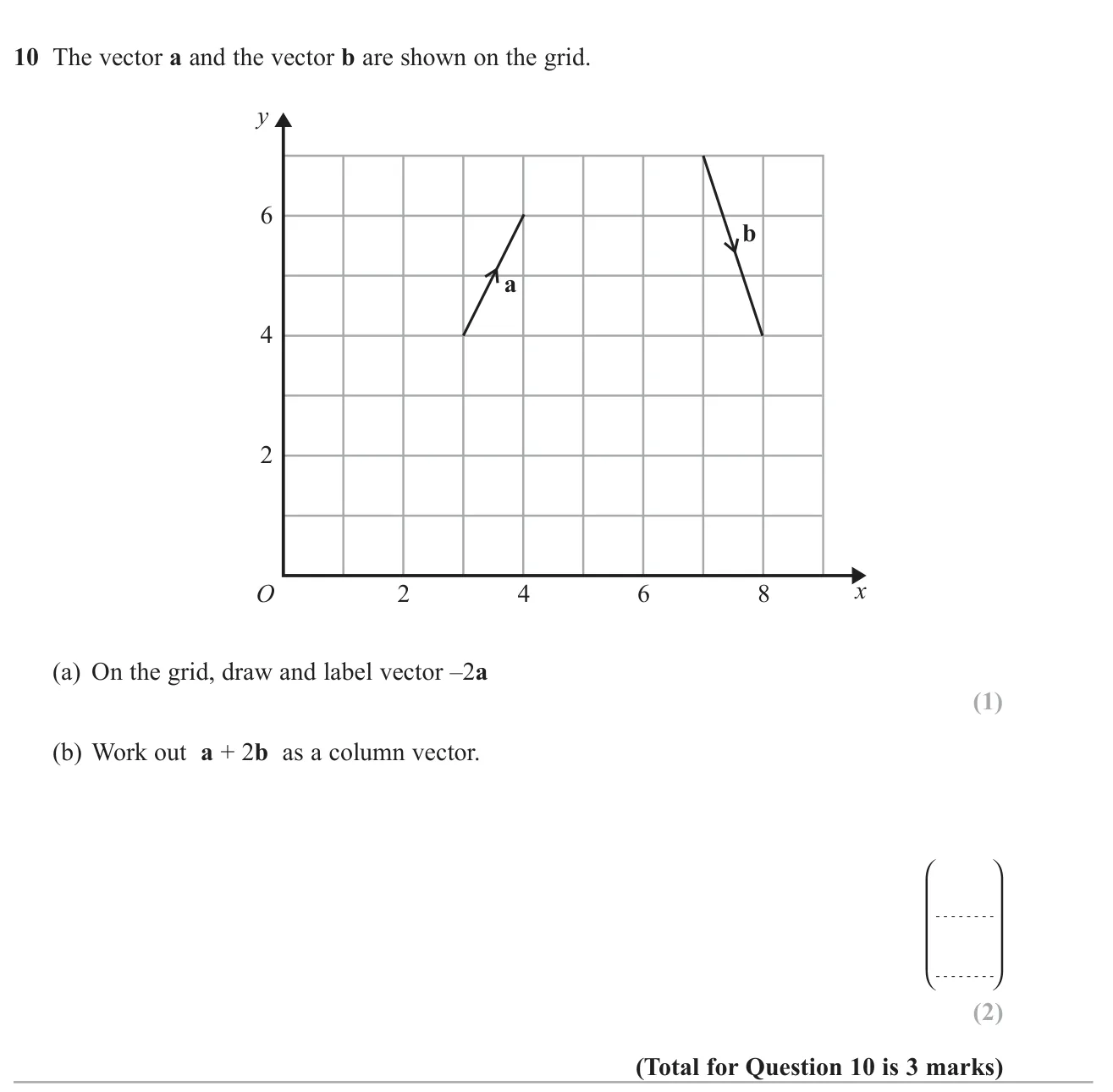
Draw a multiple of a vector on a grid and add vectors as column vectors.

© Pearson Education Ltd. June 2018 Paper 2 (Higher, calculator), question 10.

Show answer
(a)An arrow 2 left and 4 down, labelled −2a-2\mathbf{a}1 mark
(b)(3−4)\begin{pmatrix} 3 \\ -4 \end{pmatrix}2 marks

Worked solution Checked against the mark scheme

From the grid, a=(12)\mathbf{a} = \begin{pmatrix} 1 \\ 2 \end{pmatrix} and b=(1−3)\mathbf{b} = \begin{pmatrix} 1 \\ -3 \end{pmatrix}

(a) −2a=(−2−4)-2\mathbf{a} = \begin{pmatrix} -2 \\ -4 \end{pmatrix}: draw 2 left, 4 down.

(b) a+2b=(1+22−6)=(3−4)\mathbf{a} + 2\mathbf{b} = \begin{pmatrix} 1 + 2 \\ 2 - 6 \end{pmatrix} = \begin{pmatrix} 3 \\ -4 \end{pmatrix}

Watch out: Reading b as going up rather than down, so its y-component is +3.

Question 11

Functions3 marksGrade 6Calculator
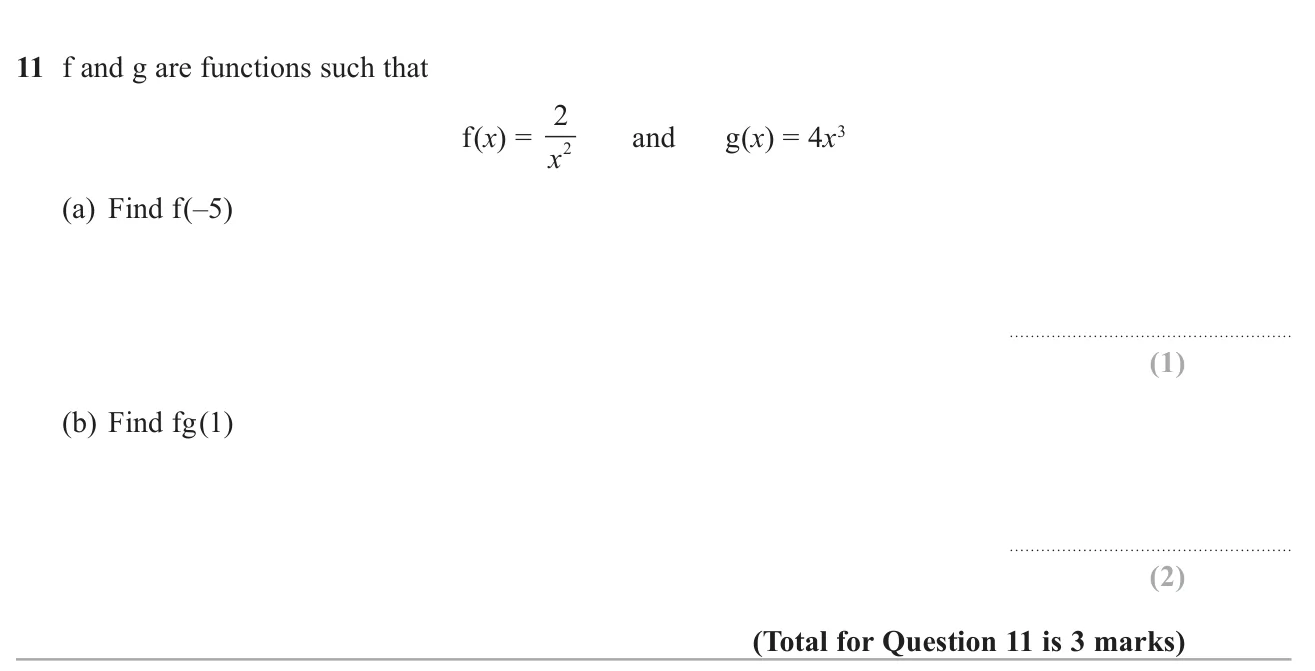
Evaluate a function at a negative input and find a composite function value.

© Pearson Education Ltd. June 2018 Paper 2 (Higher, calculator), question 11.

Show answer
(a)225\frac{2}{25}1 mark
(b)18\frac{1}{8}2 marks

Worked solution Checked against the mark scheme

f(x)=2x2f(x) = \frac{2}{x^2} and g(x)=4x3g(x) = 4x^3

(a) f(−5)=2(−5)2=225f(-5) = \frac{2}{(-5)^2} = \frac{2}{25}

(b) g(1)=4g(1) = 4, then f(4)=216=18f(4) = \frac{2}{16} = \frac{1}{8}

Watch out: In (b), working out f first and then g, i.e. doing gf(1).

Question 12

Direct and inverse proportion2 marksGrade 6Calculator
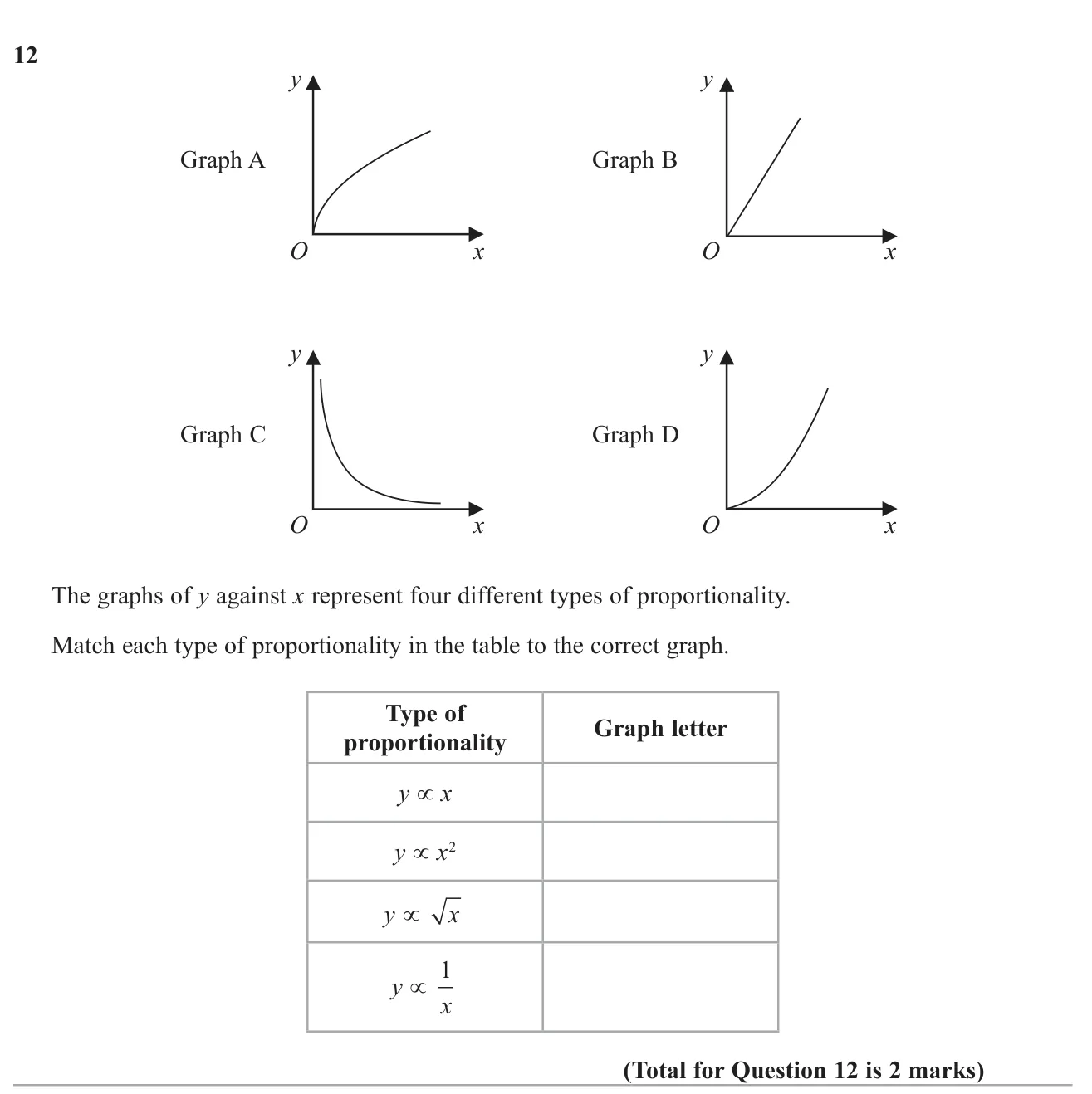
Match four proportionality statements to the shapes of their graphs.

© Pearson Education Ltd. June 2018 Paper 2 (Higher, calculator), question 12.

Show answer
Answery∝xy \propto x: B; y∝x2y \propto x^2: D; y∝xy \propto \sqrt{x}: A; y∝1xy \propto \frac{1}{x}: C2 marks

Worked solution Checked against the mark scheme

y∝xy \propto x is a straight line through the origin: B

y∝x2y \propto x^2 curves upwards more and more steeply: D

y∝xy \propto \sqrt{x} rises quickly then levels off: A

y∝1xy \propto \frac{1}{x} falls towards the axes: C

Watch out: Swapping the x2x^2 and x\sqrt{x} curves.

Question 13

Circle theorems4 marksGrade 7Calculator
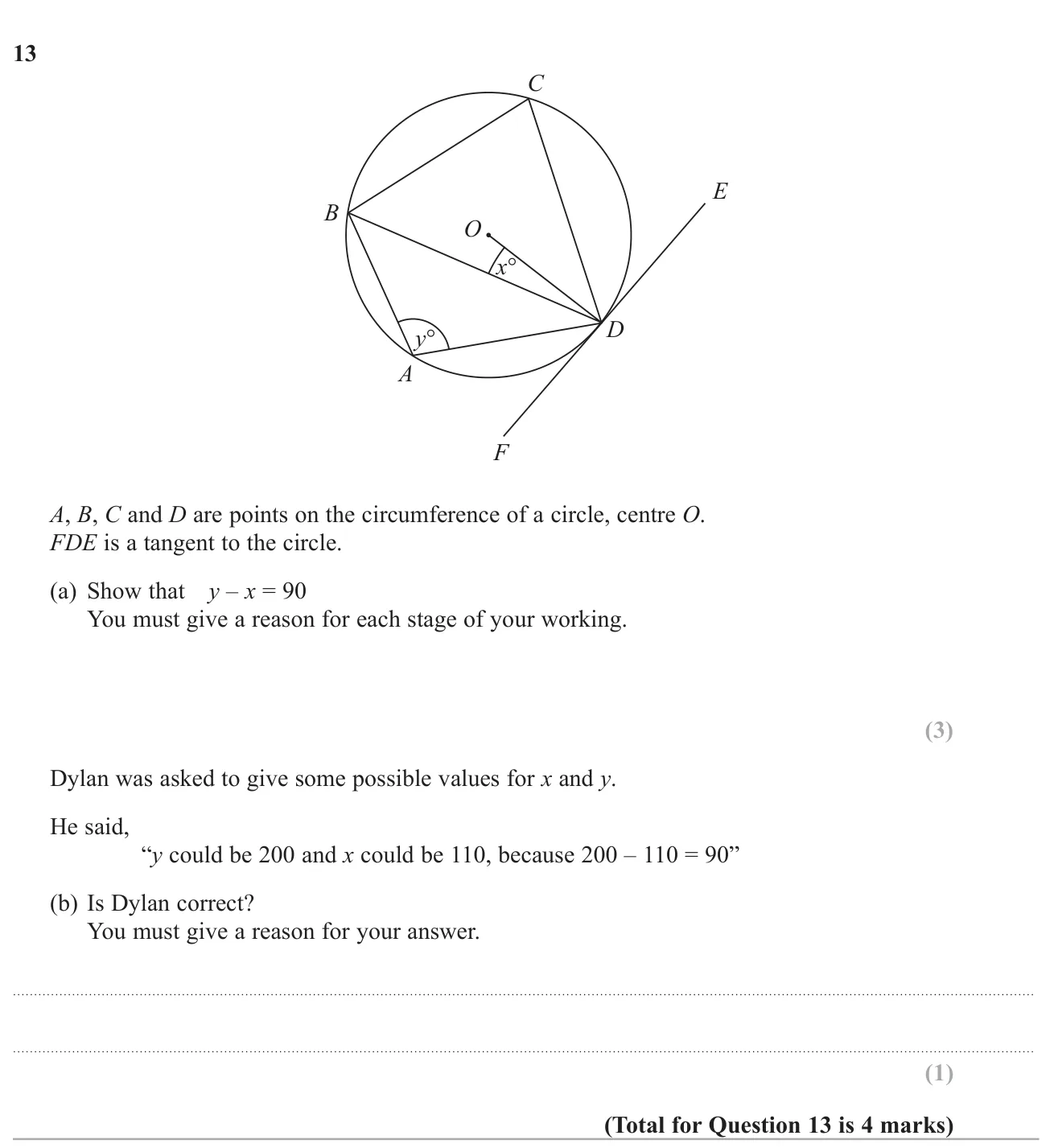
Use circle theorems with a tangent to prove a relationship between two angles, then judge whether suggested values are possible.

© Pearson Education Ltd. June 2018 Paper 2 (Higher, calculator), question 13.

Show answer
(a)Shown, with circle theorem reasons3 marks
(b)No: yy is an angle in triangle ABD, so it must be less than 180°1 mark

Worked solution Checked against the mark scheme

(a) Angle ODE=90°ODE = 90° (tangent meets radius at right angles), so angle BDE=90+xBDE = 90 + x.

By the alternate segment theorem, angle BAD=BAD = angle BDEBDE, so y=90+xy = 90 + x.

Therefore y−x=90y - x = 90.

(b) No. yy is an angle of triangle ABDABD, so it is less than 180°; it cannot be 200.

Watch out: Stating the angle facts without naming the circle theorems.

Question 14

Gradients and rates of change3 marksGrade 7Calculator
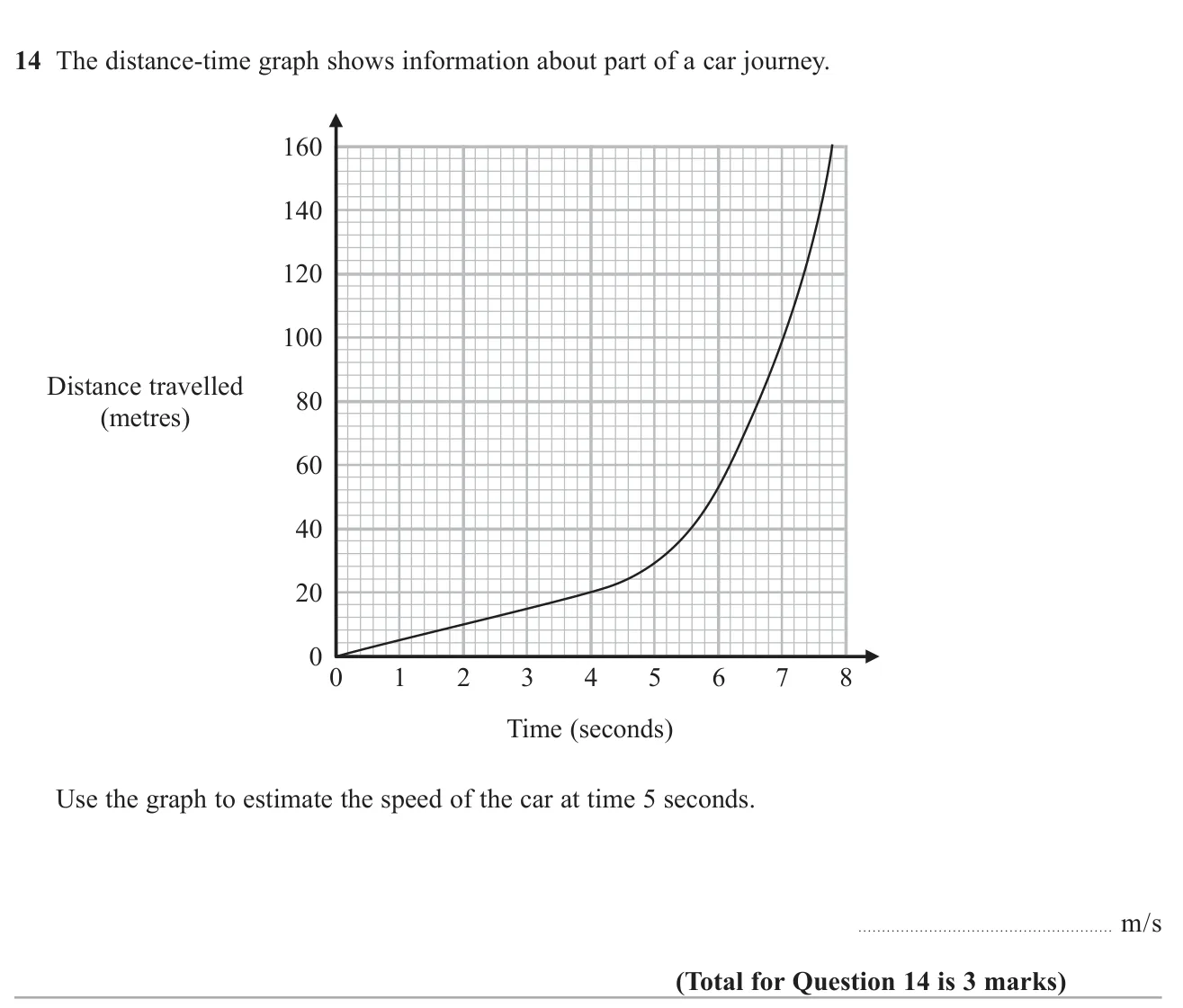
Estimate the speed at a given time by drawing a tangent to a distance-time curve.

© Pearson Education Ltd. June 2018 Paper 2 (Higher, calculator), question 14.

Show answer
AnswerAbout 1515 m/s (11 to 19 accepted)3 marks

Worked solution Checked against the mark scheme

Draw a tangent to the curve at t=5t = 5.

Pick two points far apart on the tangent and find rise ÷ run, e.g. a rise of about 60 m over 4 s.

Speed ≈60÷4=15\approx 60 \div 4 = 15 m/s

Watch out: Dividing distance by time at t=5t = 5 (about 30 ÷ 5) instead of using a tangent.

Question 15

Tree diagrams and combined events5 marksGrade 5Calculator
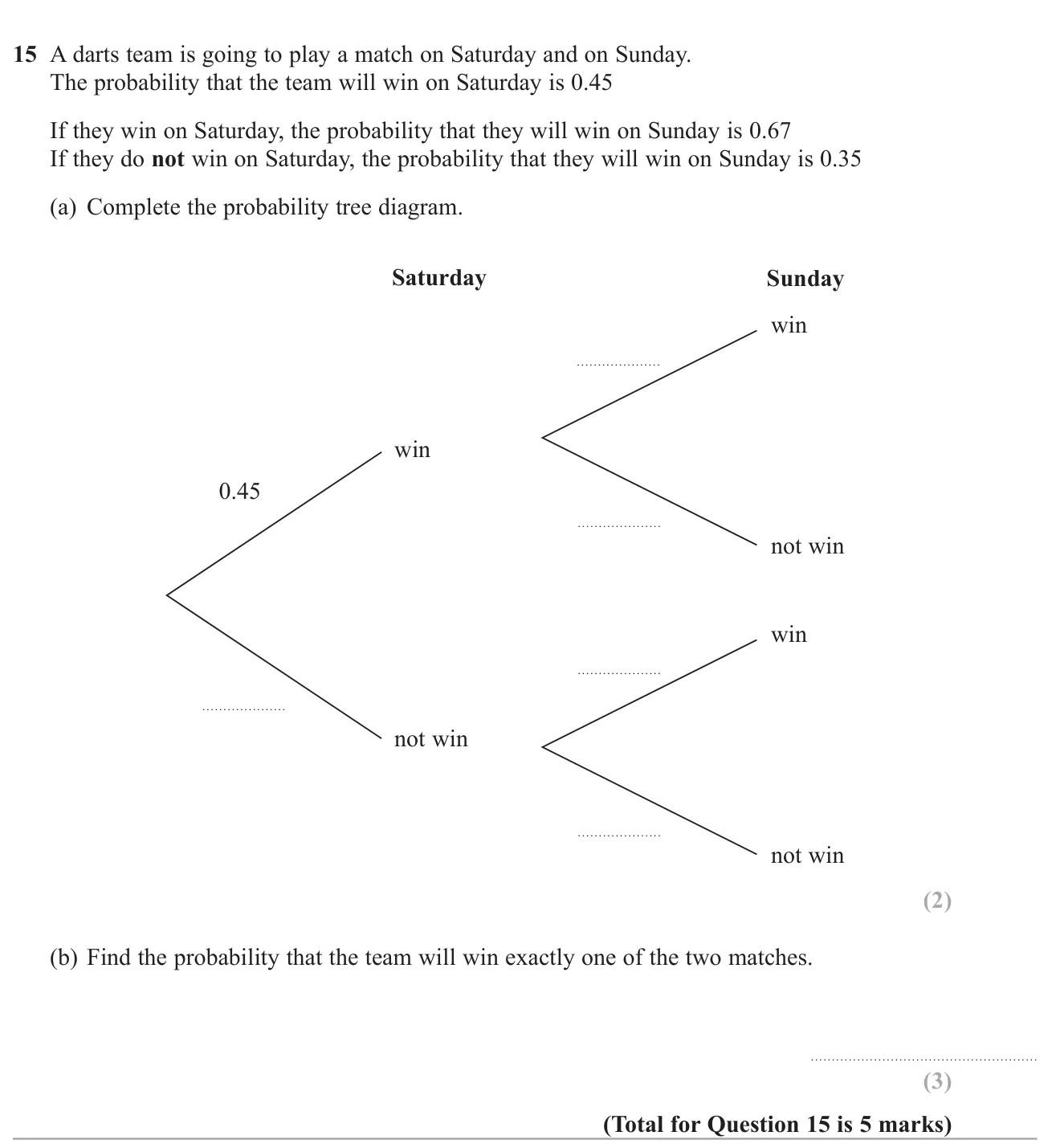
Fill in a tree diagram for two matches and find the probability of exactly one win.

© Pearson Education Ltd. June 2018 Paper 2 (Higher, calculator), question 15.

Show answer
(a)Saturday not win 0.550.55; after a win: 0.670.67, 0.330.33; after not winning: 0.350.35, 0.650.652 marks
(b)0.3410.3413 marks

Worked solution Checked against the mark scheme

(a) 1−0.45=0.551 - 0.45 = 0.55, 1−0.67=0.331 - 0.67 = 0.33, 1−0.35=0.651 - 0.35 = 0.65

(b) Win then lose: 0.45×0.33=0.14850.45 \times 0.33 = 0.1485

Lose then win: 0.55×0.35=0.19250.55 \times 0.35 = 0.1925

Total: 0.1485+0.1925=0.3410.1485 + 0.1925 = 0.341

Watch out: Only including one of the two ways to win exactly one match.

Question 16

Simultaneous equations5 marksGrade 8Calculator
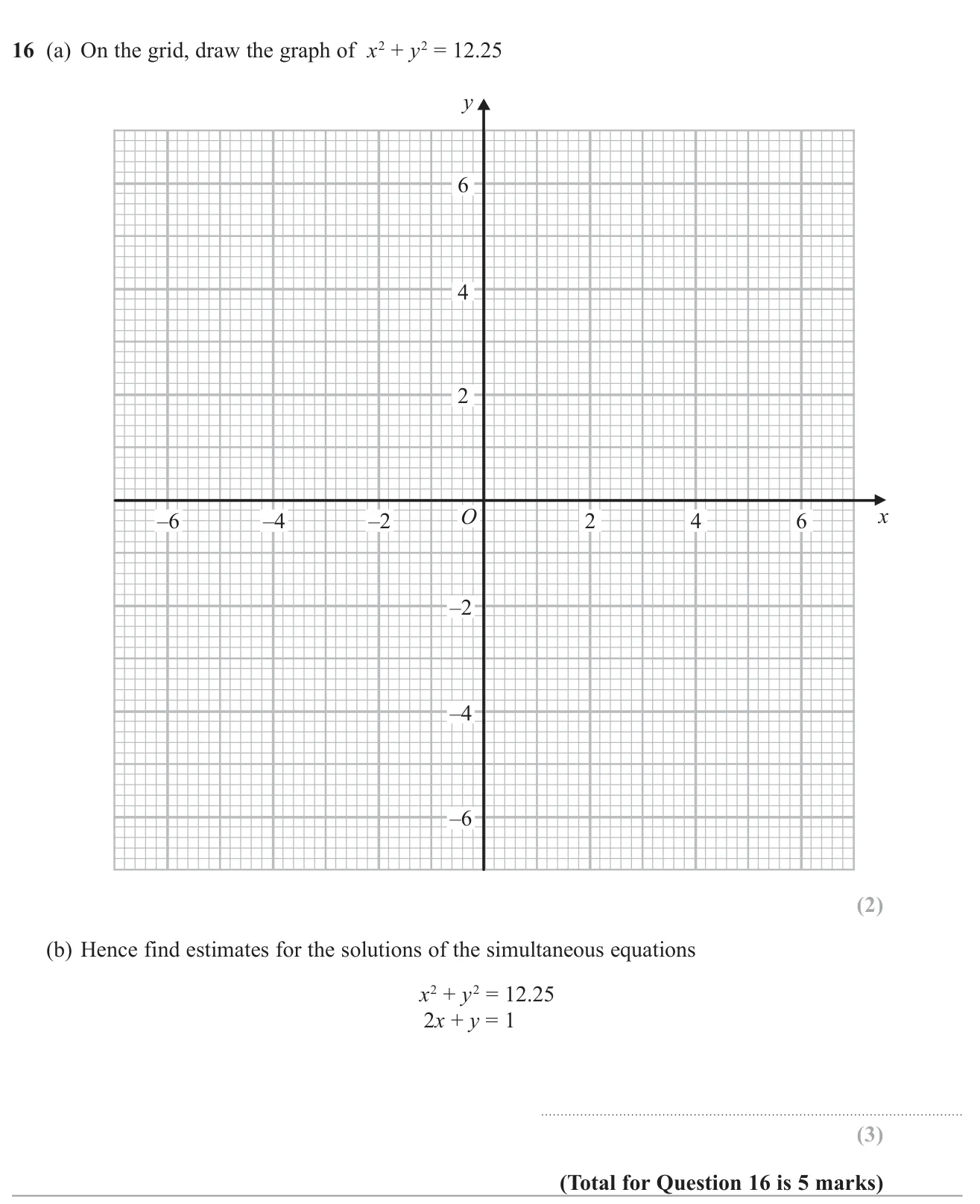
Draw a circle from its equation and use it with a straight line to estimate solutions of simultaneous equations.

© Pearson Education Ltd. June 2018 Paper 2 (Higher, calculator), question 16.

Show answer
(a)Circle centre (0,0)(0, 0), radius 3.53.52 marks
(b)x=2.0,y=−2.9x = 2.0, y = -2.9 and x=−1.2,y=3.3x = -1.2, y = 3.33 marks

Worked solution Checked against the mark scheme

(a) x2+y2=12.25x^2 + y^2 = 12.25 is a circle centre OO with radius 12.25=3.5\sqrt{12.25} = 3.5

(b) Draw y=1−2xy = 1 - 2x (through (0,1)(0, 1) and (2,−3)(2, -3)).

Read off the crossing points: about (2.0,−2.9)(2.0, -2.9) and (−1.2,3.3)(-1.2, 3.3)

(Check: 5x2−4x−11.25=05x^2 - 4x - 11.25 = 0 gives x=1.95x = 1.95 or −1.15-1.15.)

Watch out: Using 12.25 as the radius instead of its square root.

Question 17

Histograms4 marksGrade 6Calculator
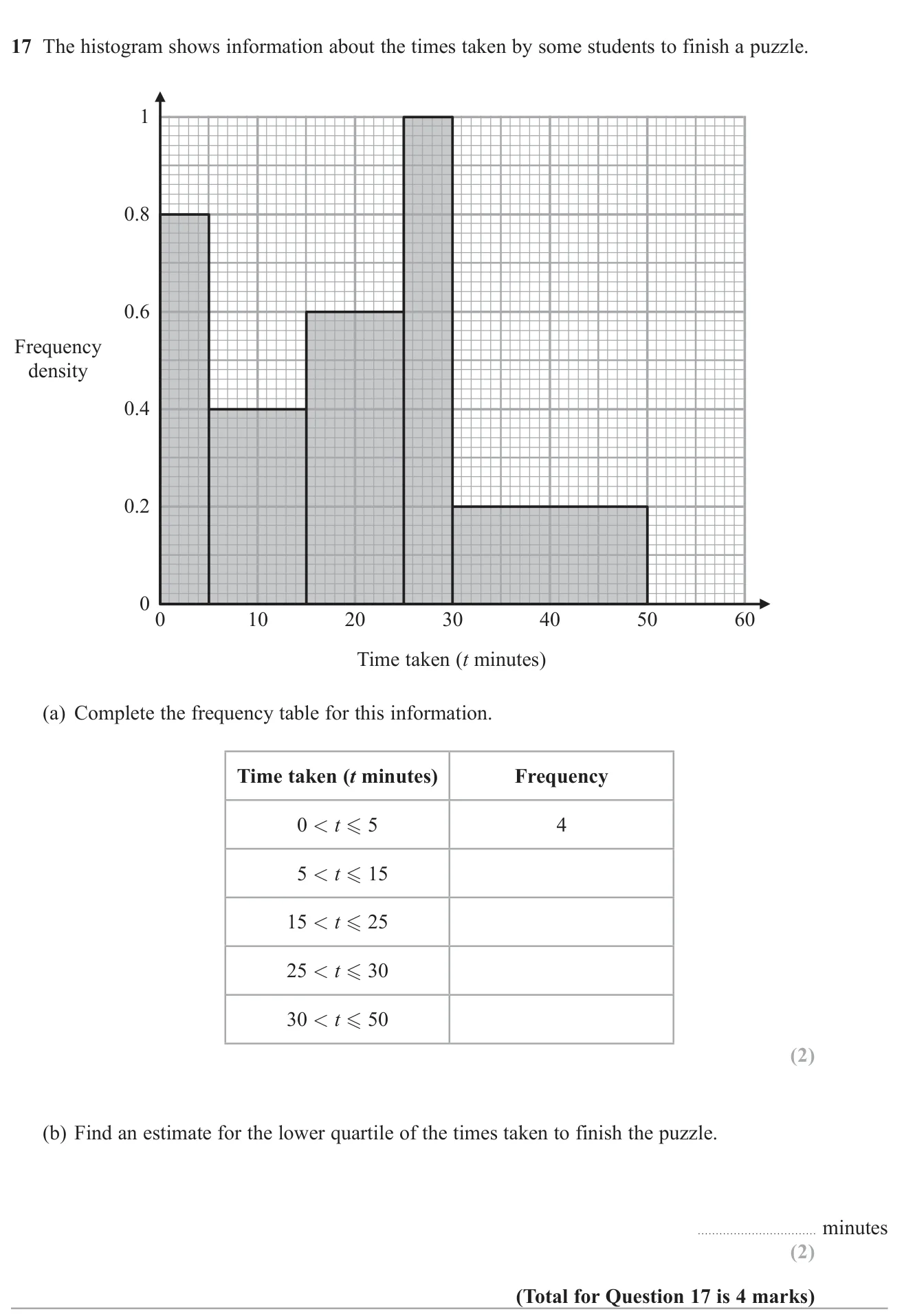
Read frequencies from a histogram with unequal class widths and estimate the lower quartile.

© Pearson Education Ltd. June 2018 Paper 2 (Higher, calculator), question 17.

Show answer
(a)4,6,5,44, 6, 5, 4 (for 5<t≤155<t\le15, 15<t≤2515<t\le25, 25<t≤3025<t\le30, 30<t≤5030<t\le50)2 marks
(b)1010 minutes2 marks

Worked solution Checked against the mark scheme

(a) Frequency = class width × frequency density:

10×0.4=410 \times 0.4 = 4, 10×0.6=610 \times 0.6 = 6, 5×1=55 \times 1 = 5, 20×0.2=420 \times 0.2 = 4

(b) Total =4+4+6+5+4=23= 4 + 4 + 6 + 5 + 4 = 23, so the lower quartile is the 23+14=6\frac{23+1}{4} = 6th value.

The first class holds 4 values, so we need 2 more from the 5<t≤155 < t \le 15 class, which holds 4 values over 10 minutes.

Lower quartile =5+24×10=10= 5 + \frac{2}{4} \times 10 = 10 minutes

Watch out: Reading the bar height as the frequency.

Question 18

Pythagoras and trigonometry4 marksGrade 8Calculator
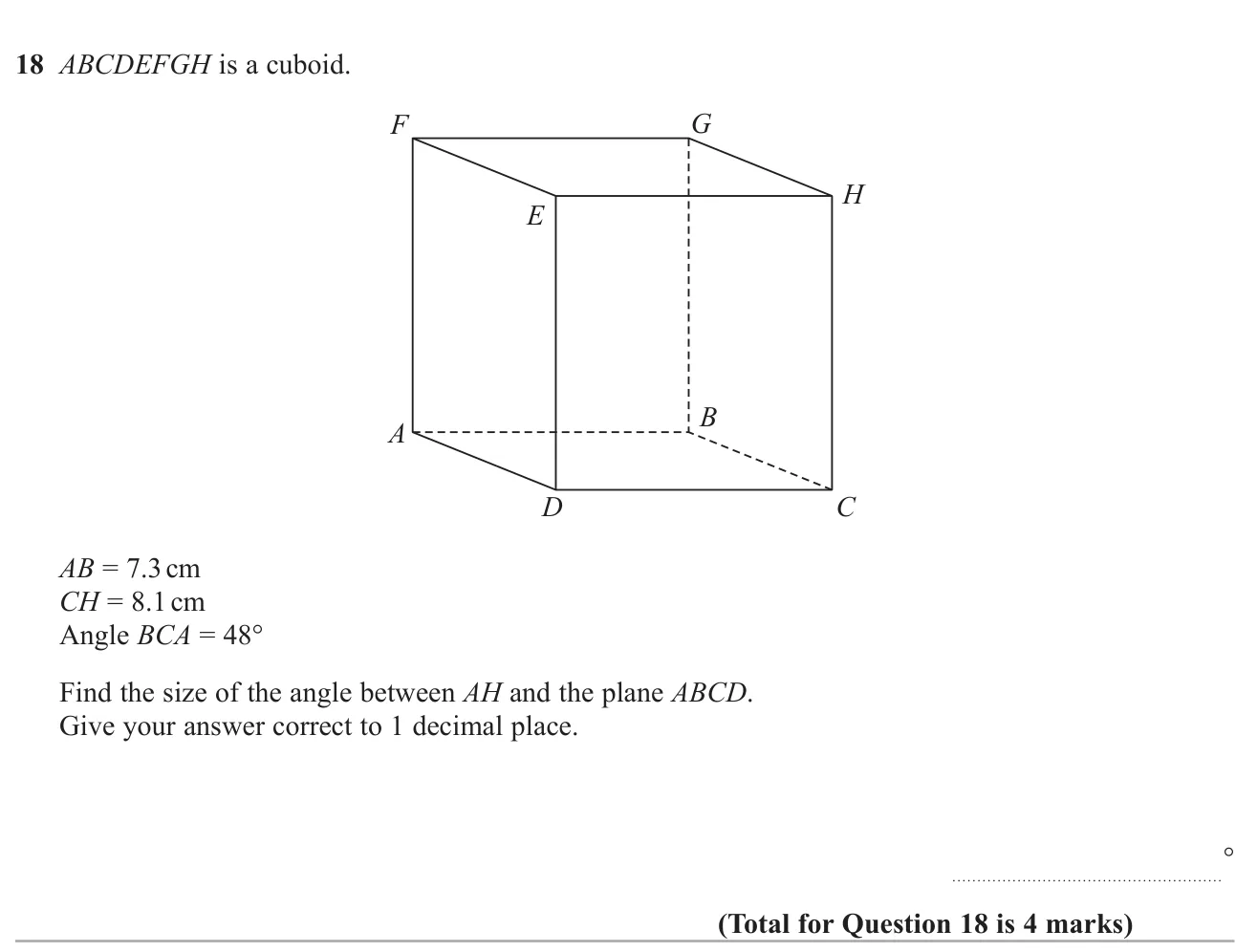
Use trigonometry in a cuboid to find the angle between a diagonal and the base.

© Pearson Education Ltd. June 2018 Paper 2 (Higher, calculator), question 18.

Show answer
Answer39.5°39.5°4 marks

Worked solution Checked against the mark scheme

In right-angled triangle ABCABC: AC=7.3sin⁡48°=9.823AC = \frac{7.3}{\sin 48°} = 9.823 cm

In right-angled triangle ACHACH: tan⁡(CAH)=8.19.823\tan(CAH) = \frac{8.1}{9.823}

Angle =tan⁡−1(0.8246)=39.5°= \tan^{-1}(0.8246) = 39.5°

Watch out: Using ABAB as the base of triangle ACHACH instead of the diagonal ACAC.

Question 19

Volume and surface area5 marksGrade 7Calculator
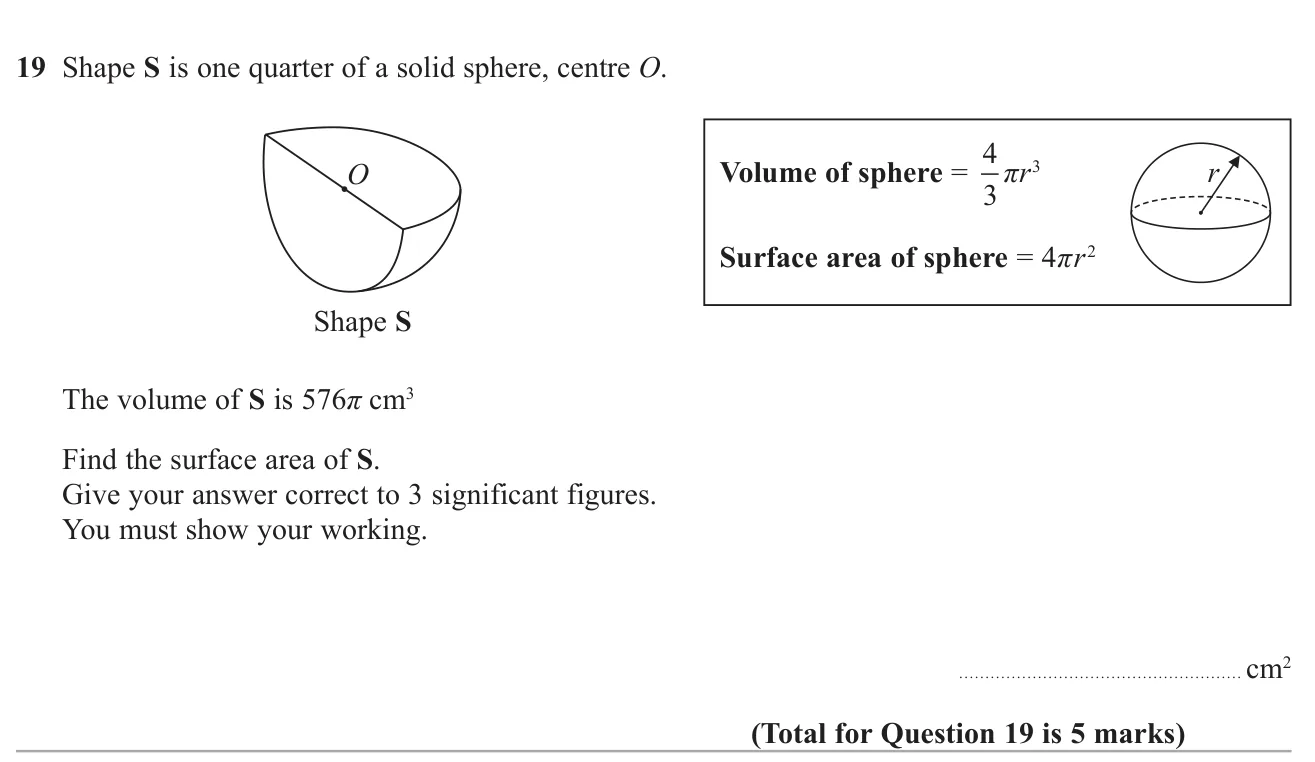
Find the radius of a quarter-sphere from its volume, then its total surface area including the flat faces.

© Pearson Education Ltd. June 2018 Paper 2 (Higher, calculator), question 19.

Show answer
Answer905 cm2905\text{ cm}^2 (or 288π288\pi)5 marks

Worked solution Checked against the mark scheme

14×43πr3=576π\frac{1}{4} \times \frac{4}{3}\pi r^3 = 576\pi, so r3=1728r^3 = 1728 and r=12r = 12

Curved part: 14×4π×122=144π\frac{1}{4} \times 4\pi \times 12^2 = 144\pi

Two flat semicircles: 2×12π×122=144π2 \times \frac{1}{2}\pi \times 12^2 = 144\pi

Total =288π=904.8≈905 cm2= 288\pi = 904.8 \approx 905\text{ cm}^2 (3 s.f.)

Watch out: Forgetting the two flat semicircular faces, giving 452 cm².

Question 20

Surds2 marksGrade 7Calculator
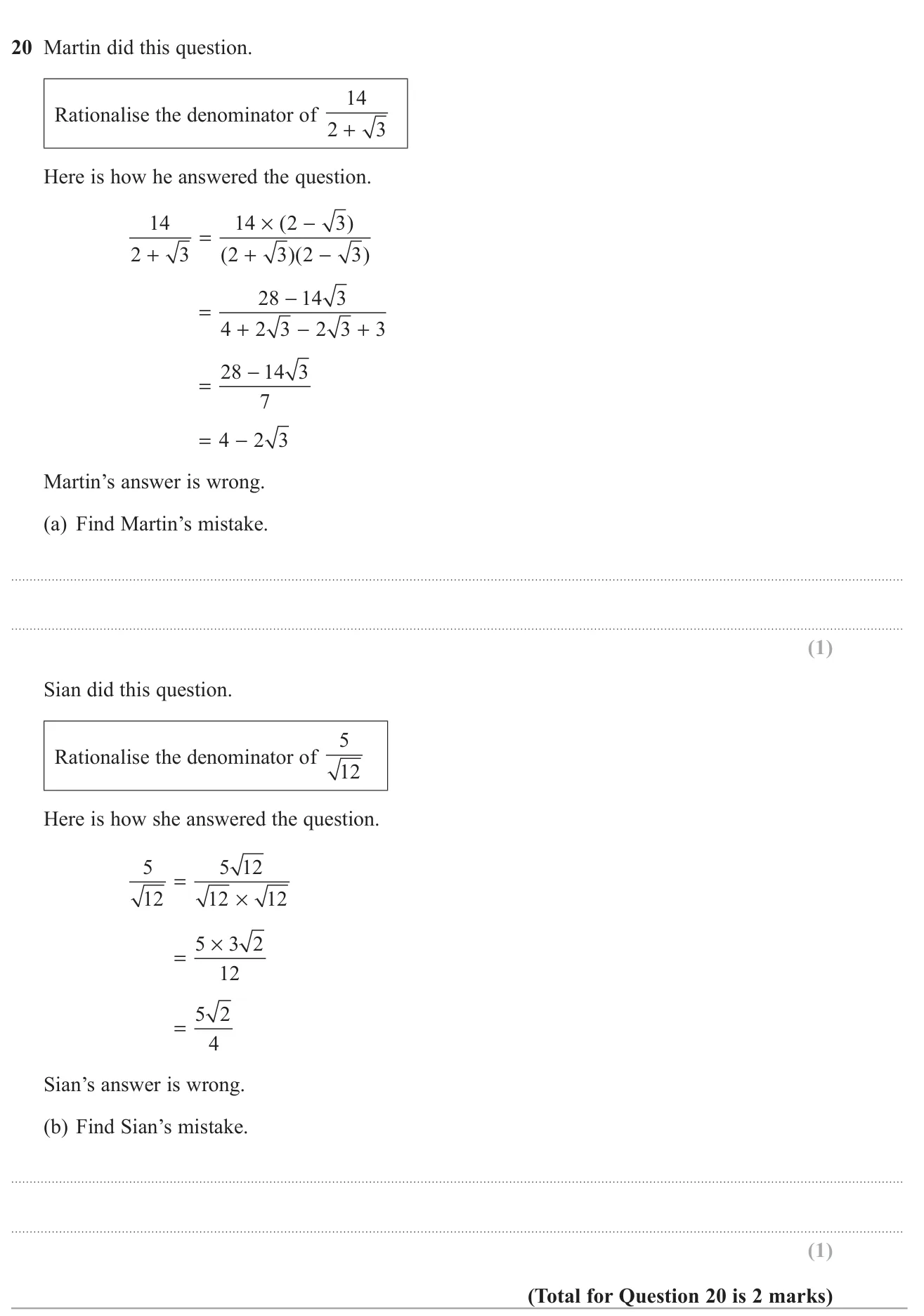
Spot the errors in two worked attempts at rationalising a denominator.

© Pearson Education Ltd. June 2018 Paper 2 (Higher, calculator), question 20.

Show answer
(a)3×−3\sqrt{3} \times -\sqrt{3} is −3-3, not +3+3, so the denominator should be 11 mark
(b)12=23\sqrt{12} = 2\sqrt{3}, not 323\sqrt{2}1 mark

Worked solution Checked against the mark scheme

(a) (2+3)(2−3)=4−3=1(2 + \sqrt{3})(2 - \sqrt{3}) = 4 - 3 = 1. Martin wrote +3+3 for 3×−3\sqrt{3} \times -\sqrt{3}. The answer should be 28−14328 - 14\sqrt{3}.

(b) 12=4×3=23\sqrt{12} = \sqrt{4 \times 3} = 2\sqrt{3}. Sian wrote 323\sqrt{2}. The answer should be 10312=536\frac{10\sqrt{3}}{12} = \frac{5\sqrt{3}}{6}.

Watch out: Describing the general method instead of pointing to the exact wrong step.

Question 21

Error intervals and bounds5 marksGrade 8Calculator
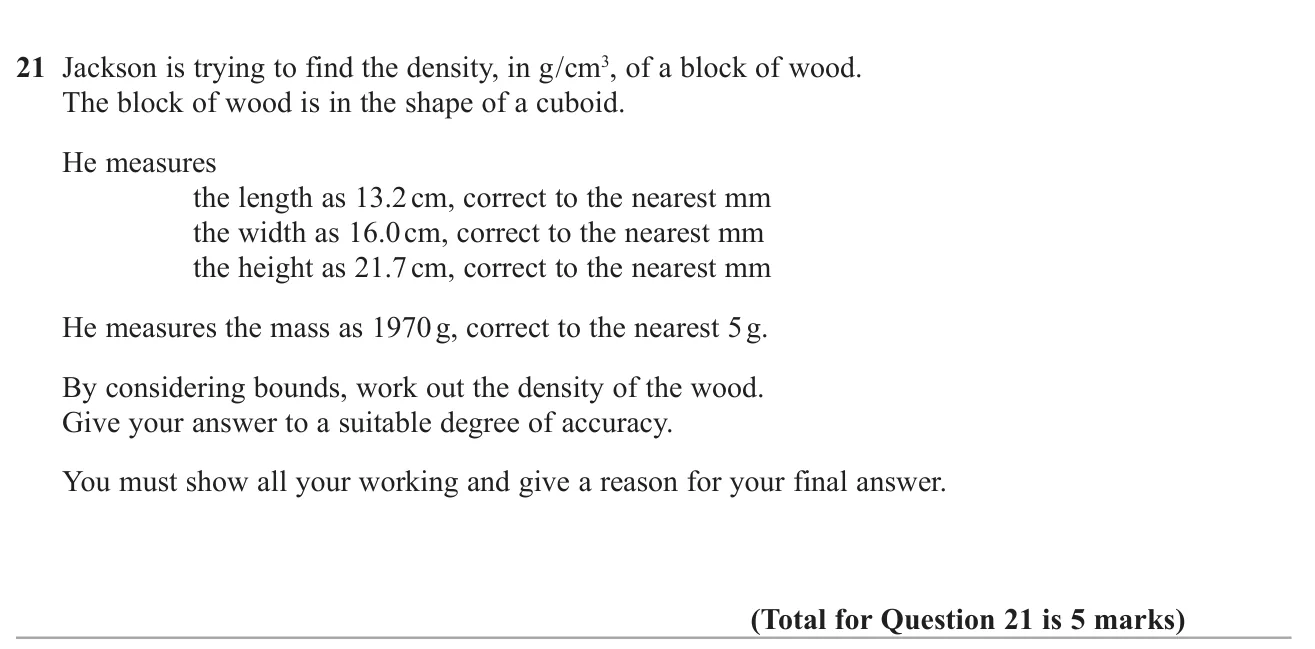
Use upper and lower bounds of measurements to find the density of a cuboid to a justified degree of accuracy.

© Pearson Education Ltd. June 2018 Paper 2 (Higher, calculator), question 21.

Show answer
Answer0.43 g/cm30.43\text{ g/cm}^3, because both bounds round to 0.435 marks

Worked solution Checked against the mark scheme

Lengths are to the nearest mm, mass to the nearest 5 g.

Lower bound: 1967.513.25×16.05×21.75=0.4254\frac{1967.5}{13.25 \times 16.05 \times 21.75} = 0.4254

Upper bound: 1972.513.15×15.95×21.65=0.4344\frac{1972.5}{13.15 \times 15.95 \times 21.65} = 0.4344

Both round to 0.430.43 (2 d.p.), so the density is 0.43 g/cm30.43\text{ g/cm}^3.

Watch out: Pairing upper bounds of mass with upper bounds of volume for the maximum density.

Finished the paper?

Add up your marks for all three papers and see what grade that would have been.