© Pearson Education Ltd. November 2022 Paper 3 (Foundation, calculator), question 1.
Show answer
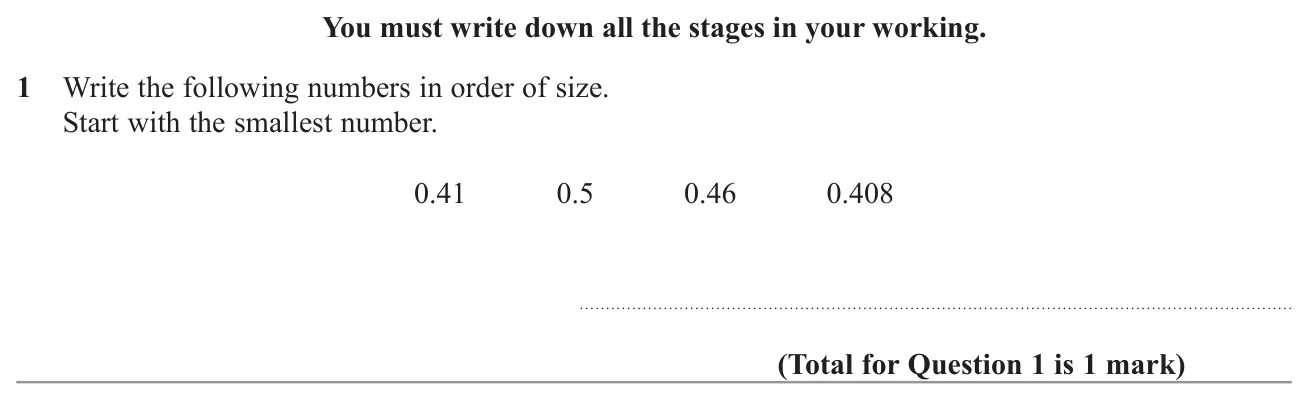
| Answer | 0.408, 0.41, 0.46, 0.5 | 1 mark |
|---|
Worked solution Checked against the mark scheme
Give each number three decimal places: 0.410, 0.500, 0.460, 0.408.
Now compare: 0.408 < 0.410 < 0.460 < 0.500, so the order is 0.408, 0.41, 0.46, 0.5
Watch out: Thinking 0.408 is bigger than 0.41 because it has more digits.
© Pearson Education Ltd. November 2022 Paper 3 (Foundation, calculator), question 2.
Show answer
Worked solution Checked against the mark scheme
In 12 345 the digits are: 1 ten-thousand, 2 thousands, 3 hundreds, 4 tens, 5 ones.
So the 2 is worth 2000.
Watch out: Writing just 2 or 'hundreds'.
© Pearson Education Ltd. November 2022 Paper 3 (Foundation, calculator), question 3.
Show answer
Worked solution Checked against the mark scheme
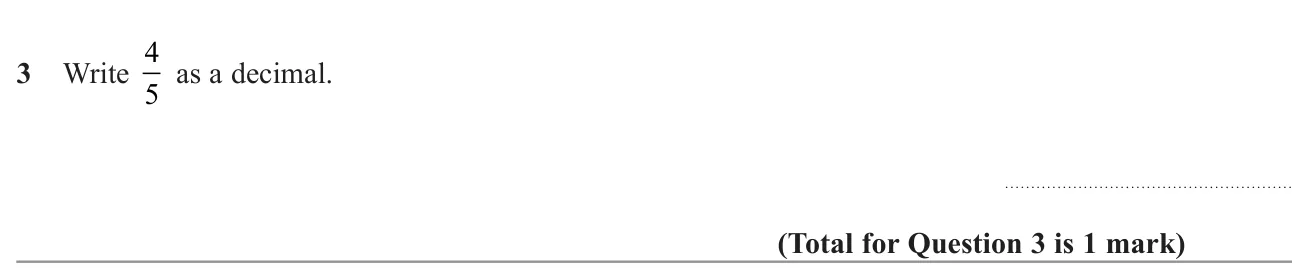
54=108=0.8
Watch out: Writing 0.45 by putting the digits after the point.
© Pearson Education Ltd. November 2022 Paper 3 (Foundation, calculator), question 4.
Show answer
Worked solution Checked against the mark scheme
Look at the first decimal place: 19.4949. It is 4, which is less than 5, so round down.
Answer: 19
Watch out: Rounding each digit in turn from the right and getting 20.
© Pearson Education Ltd. November 2022 Paper 3 (Foundation, calculator), question 5.
Show answer
Worked solution Checked against the mark scheme
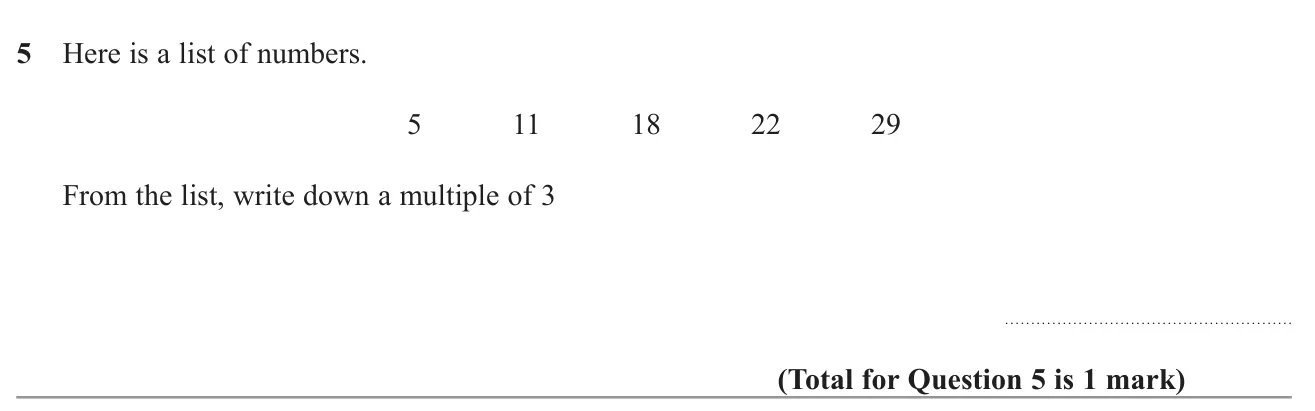
Check each number: 18=3×6, and none of 5, 11, 22 or 29 divides exactly by 3.
Answer: 18
Watch out: Choosing 11 or 29 because they are odd.
© Pearson Education Ltd. November 2022 Paper 3 (Foundation, calculator), question 6.
Show answer
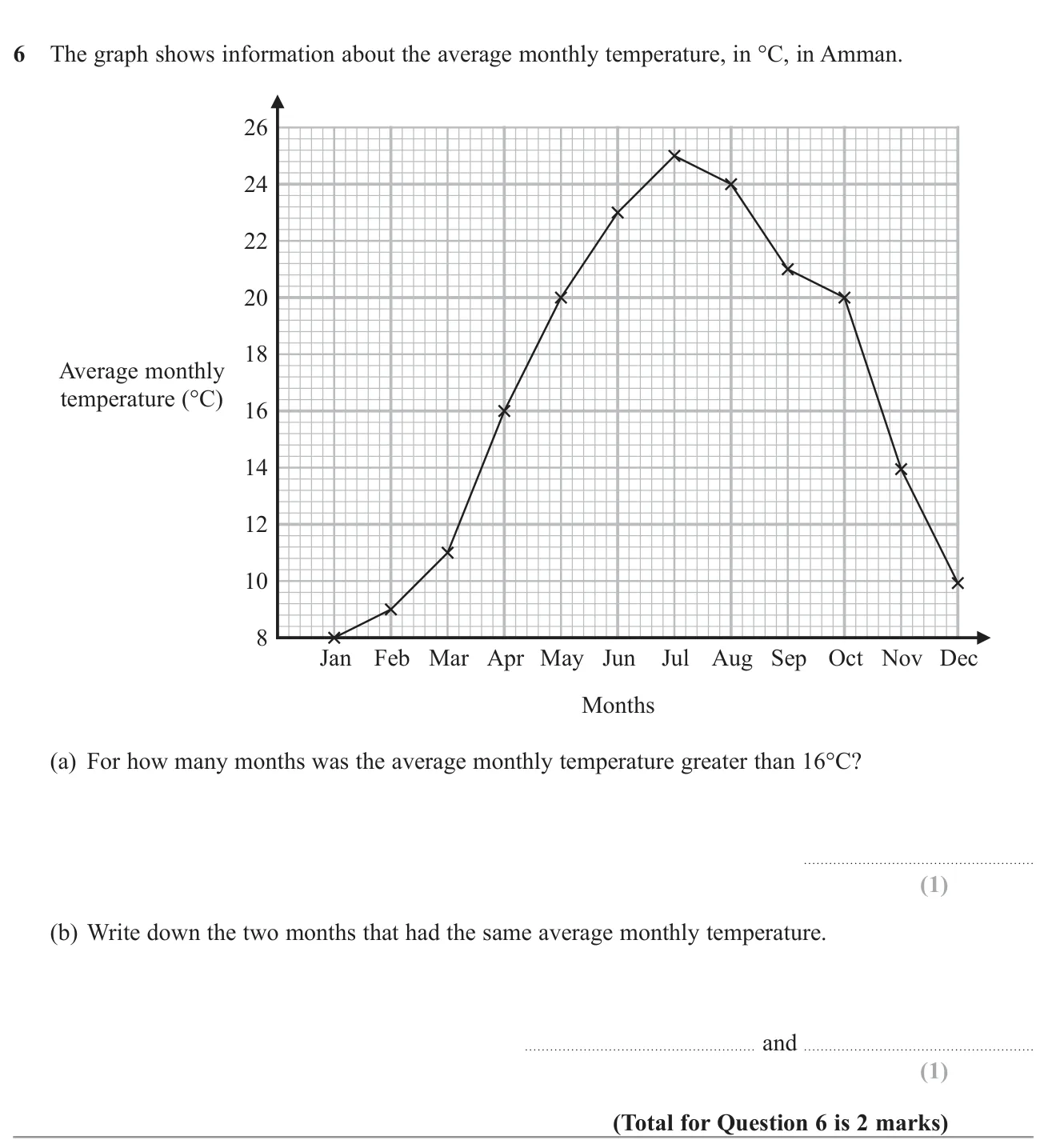
| (a) | 6 | 1 mark |
|---|
| (b) | May and October | 1 mark |
|---|
Worked solution Checked against the mark scheme
(a) Months above 16°C: May, Jun, Jul, Aug, Sep, Oct, so 6 months (April is exactly 16°C, not above).
(b) May and October are both at 20°C.
Watch out: Counting April, which is exactly 16°C, not greater than it.
© Pearson Education Ltd. November 2022 Paper 3 (Foundation, calculator), question 7.
Show answer
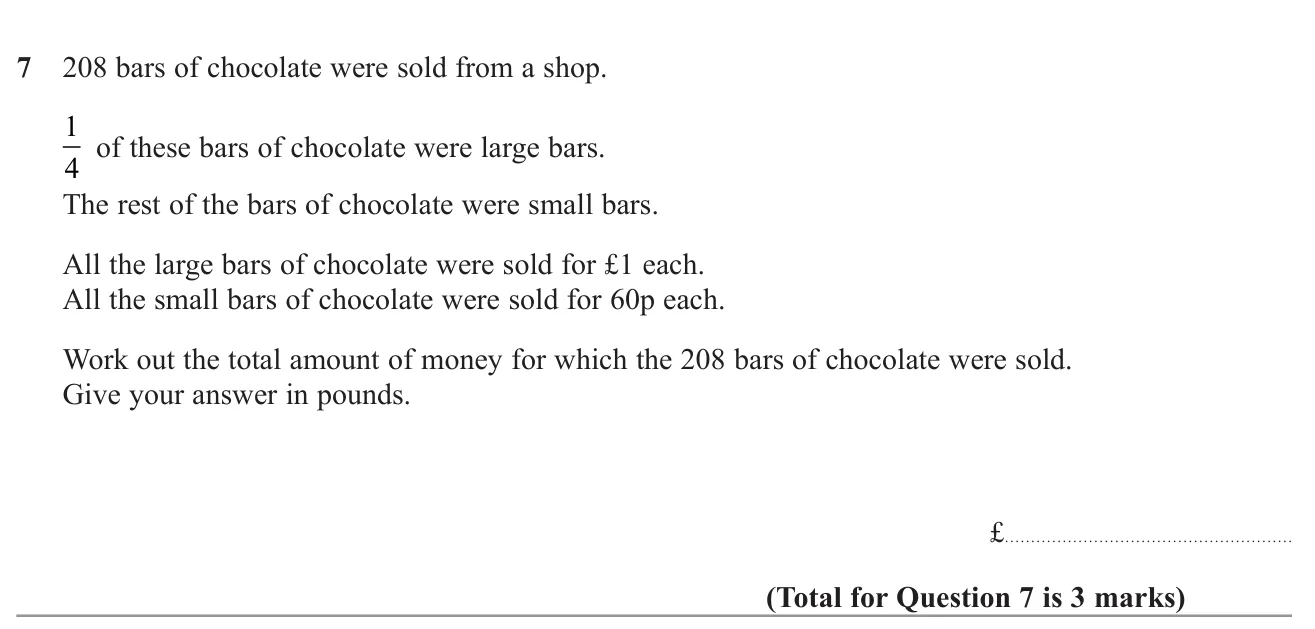
Worked solution Checked against the mark scheme
Large bars: 208÷4=52, worth 52×£1=£52
Small bars: 208−52=156, worth 156×£0.60=£93.60
Total: £52+£93.60=£145.60
Watch out: Mixing pence and pounds and writing £9412 or £145.6.
© Pearson Education Ltd. November 2022 Paper 3 (Foundation, calculator), question 8.
Show answer
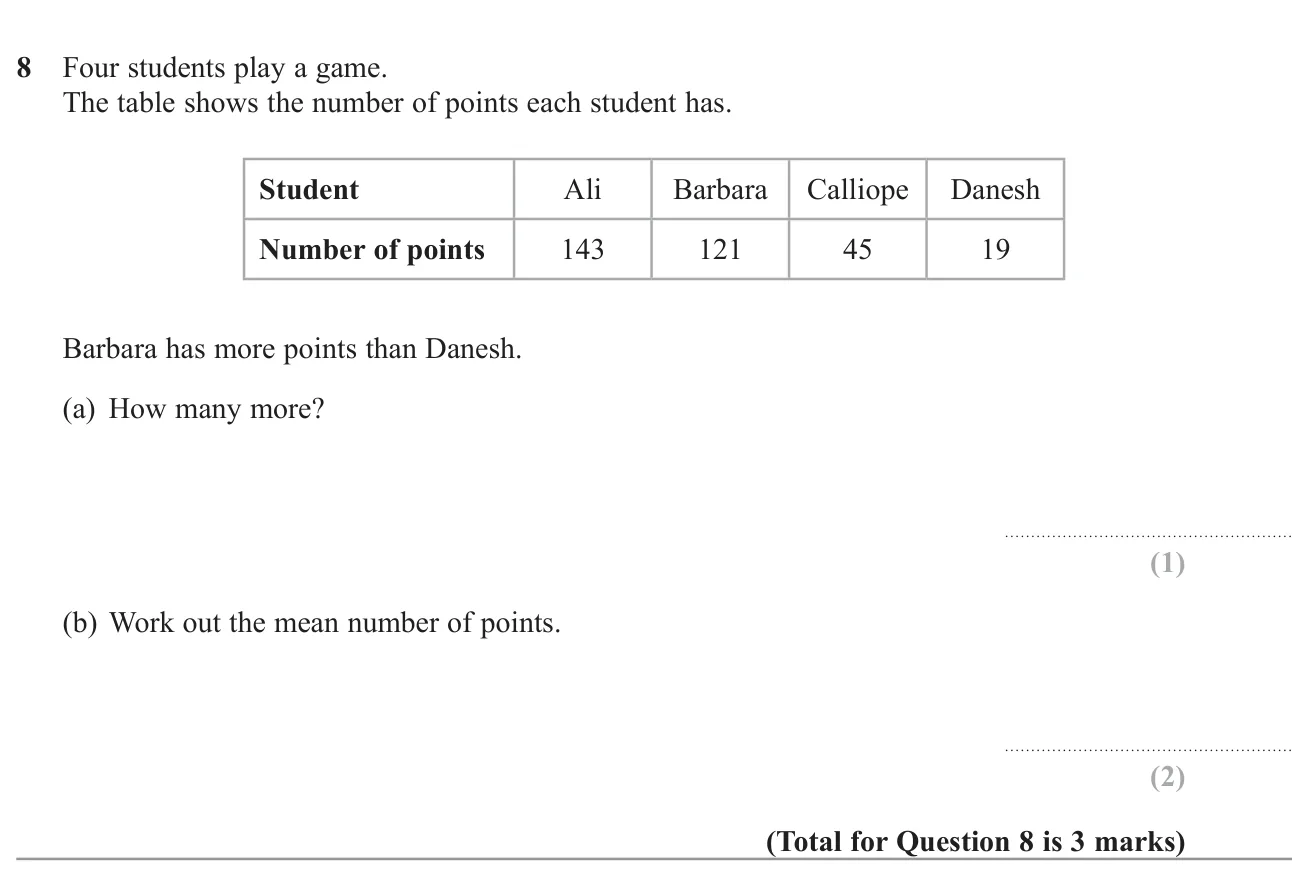
Worked solution Checked against the mark scheme
(a) 121−19=102
(b) Total =143+121+45+19=328
Mean =328÷4=82
Watch out: Dividing the total by a number other than 4.
© Pearson Education Ltd. November 2022 Paper 3 (Foundation, calculator), question 9.
Show answer
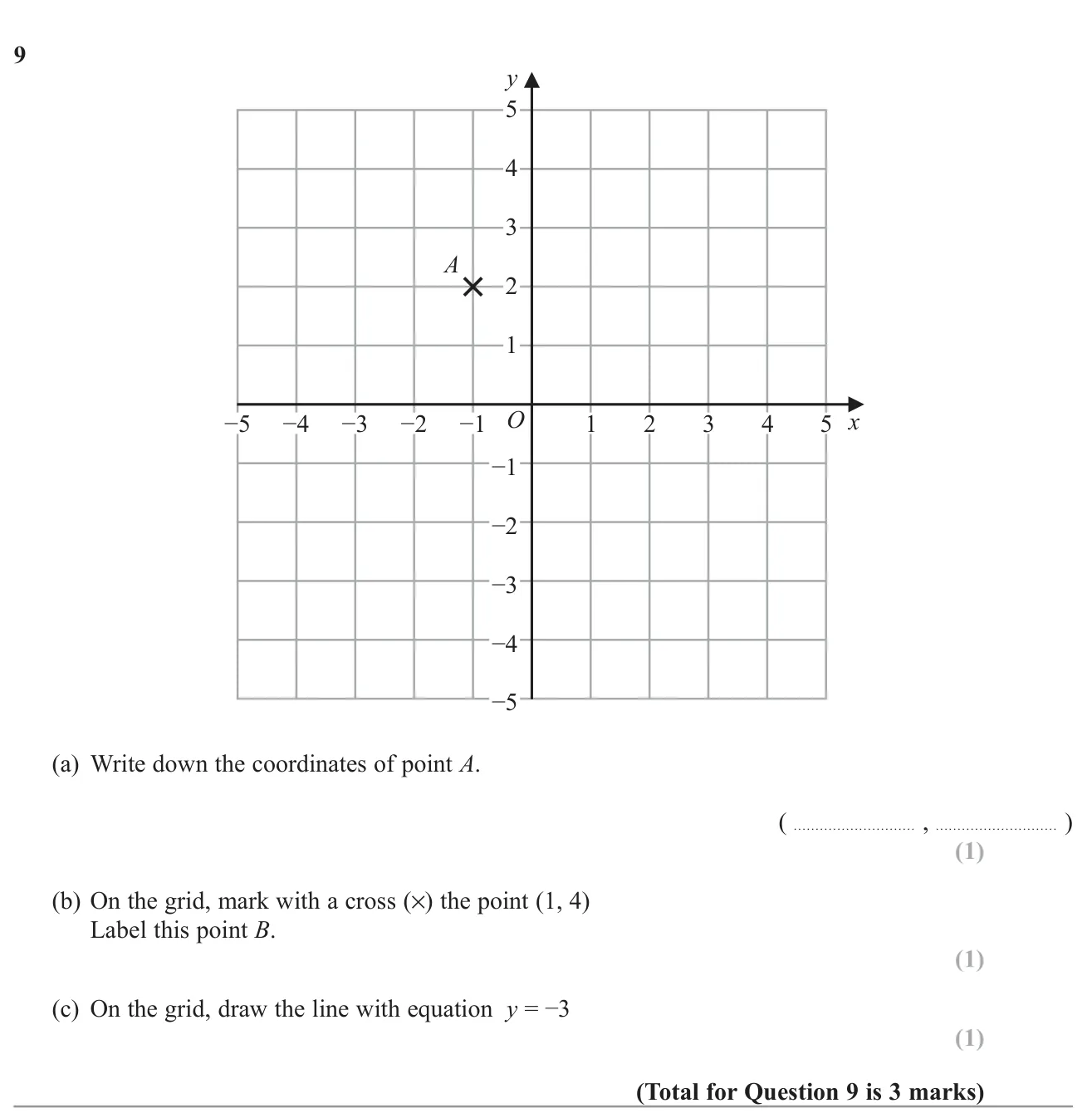
| (a) | (−1,2) | 1 mark |
|---|
| (b) | Point B plotted at (1,4) | 1 mark |
|---|
| (c) | Horizontal line through y=−3 | 1 mark |
|---|
Worked solution Checked against the mark scheme
(a) A is 1 left of O and 2 up, so A is (−1,2).
(b) Go 1 right, then 4 up, and mark B.
(c) y=−3 is the horizontal line where every point has y-coordinate −3.
Watch out: Drawing a vertical line through x = −3 for y = −3.
© Pearson Education Ltd. November 2022 Paper 3 (Foundation, calculator), question 10.
Show answer
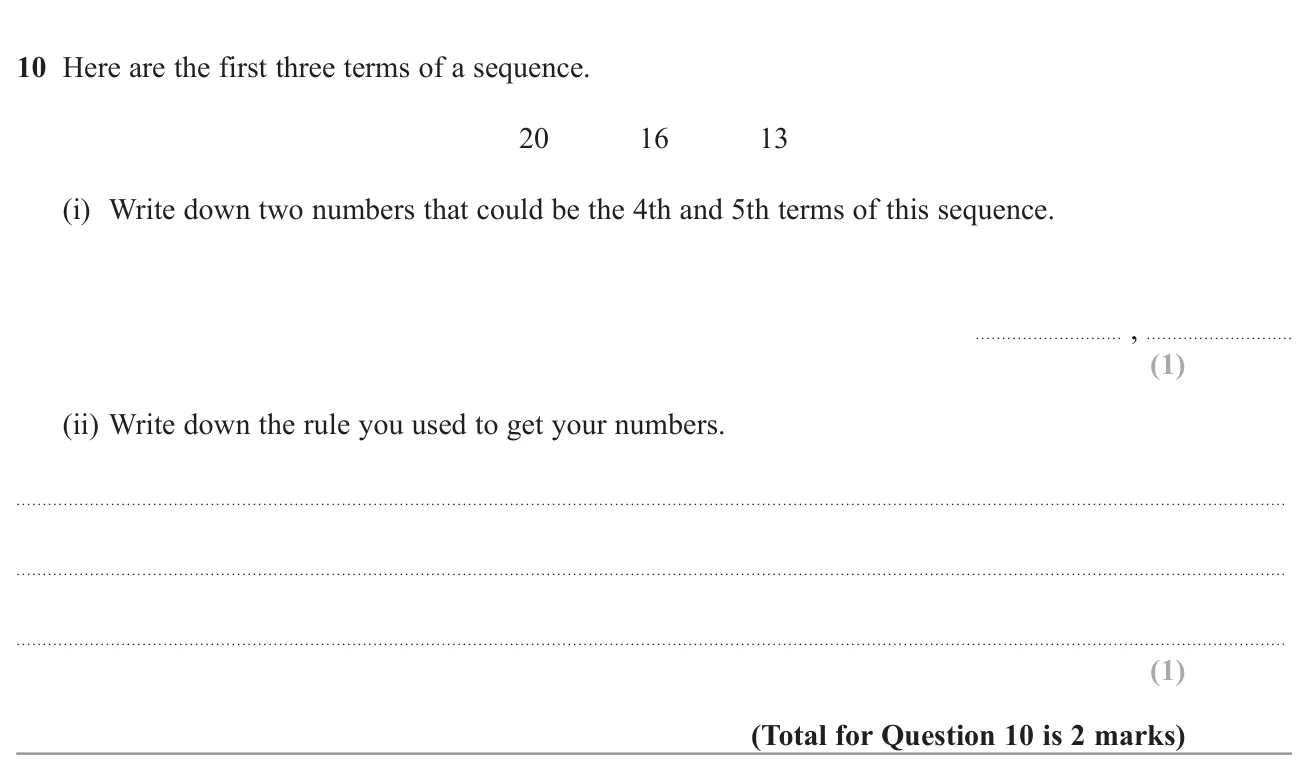
| (i) | e.g. 11, 10 (differences 4, 3, 2, 1) or 9, 6 | 1 mark |
|---|
| (ii) | e.g. the amount subtracted goes down by 1 each time | 1 mark |
|---|
Worked solution Checked against the mark scheme
The differences are 20−16=4 and 16−13=3.
If the differences keep falling by 1, next subtract 2 then 1: 13−2=11, 11−1=10.
Rule: the number you take away goes down by 1 each time.
Watch out: Saying 'it goes down by 1 each time', which does not describe the terms.
© Pearson Education Ltd. November 2022 Paper 3 (Foundation, calculator), question 11.
Show answer
Worked solution Checked against the mark scheme
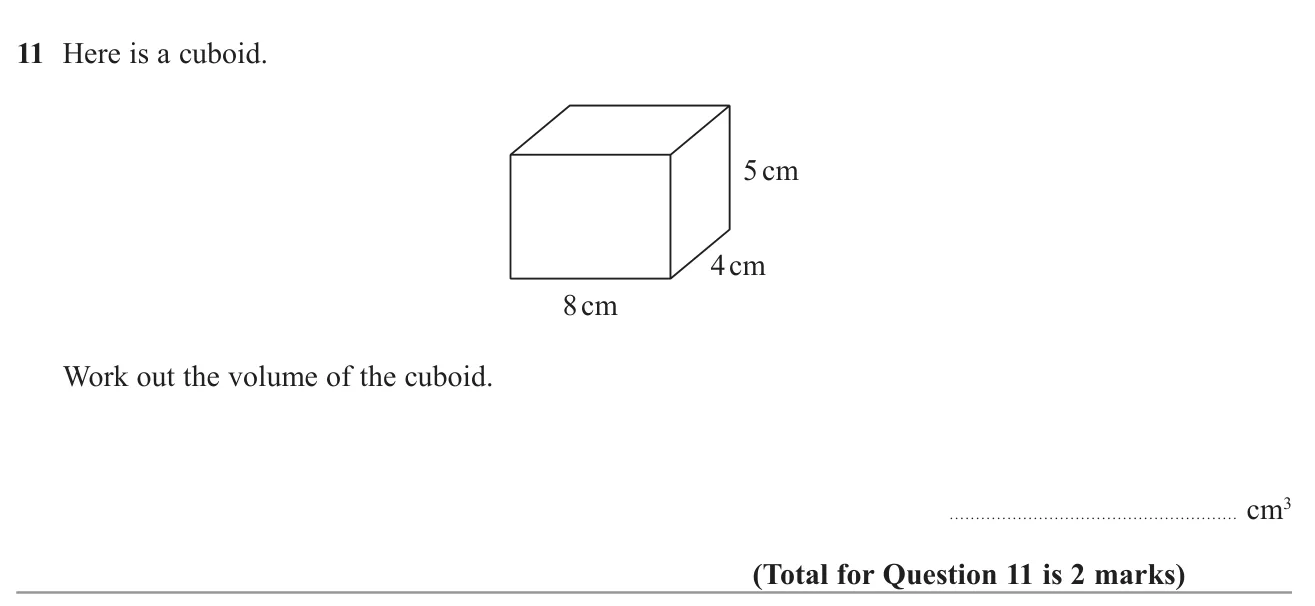
Volume =8×5×4=160 cm3
Watch out: Adding the lengths or finding surface area instead.
Question 12
Ratio2 marksGrade 3Calculator © Pearson Education Ltd. November 2022 Paper 3 (Foundation, calculator), question 12.
Show answer
| Answer | 1:6:3 | 2 marks |
|---|
Worked solution Checked against the mark scheme
Let Amol have 1 sweet. Gemma has 6×1=6. Harry has 6÷2=3.
Ratio: 1:6:3
Watch out: Writing 1 : 6 : 12 by doubling instead of halving.
© Pearson Education Ltd. November 2022 Paper 3 (Foundation, calculator), question 13.
Show answer
| (a(i)) | 40° | 1 mark |
|---|
| (a(ii)) | Angles in a quadrilateral add up to 360° | 1 mark |
|---|
| (b) | 80+60+50=190, but angles in a triangle add up to 180° | 1 mark |
|---|
Worked solution Checked against the mark scheme
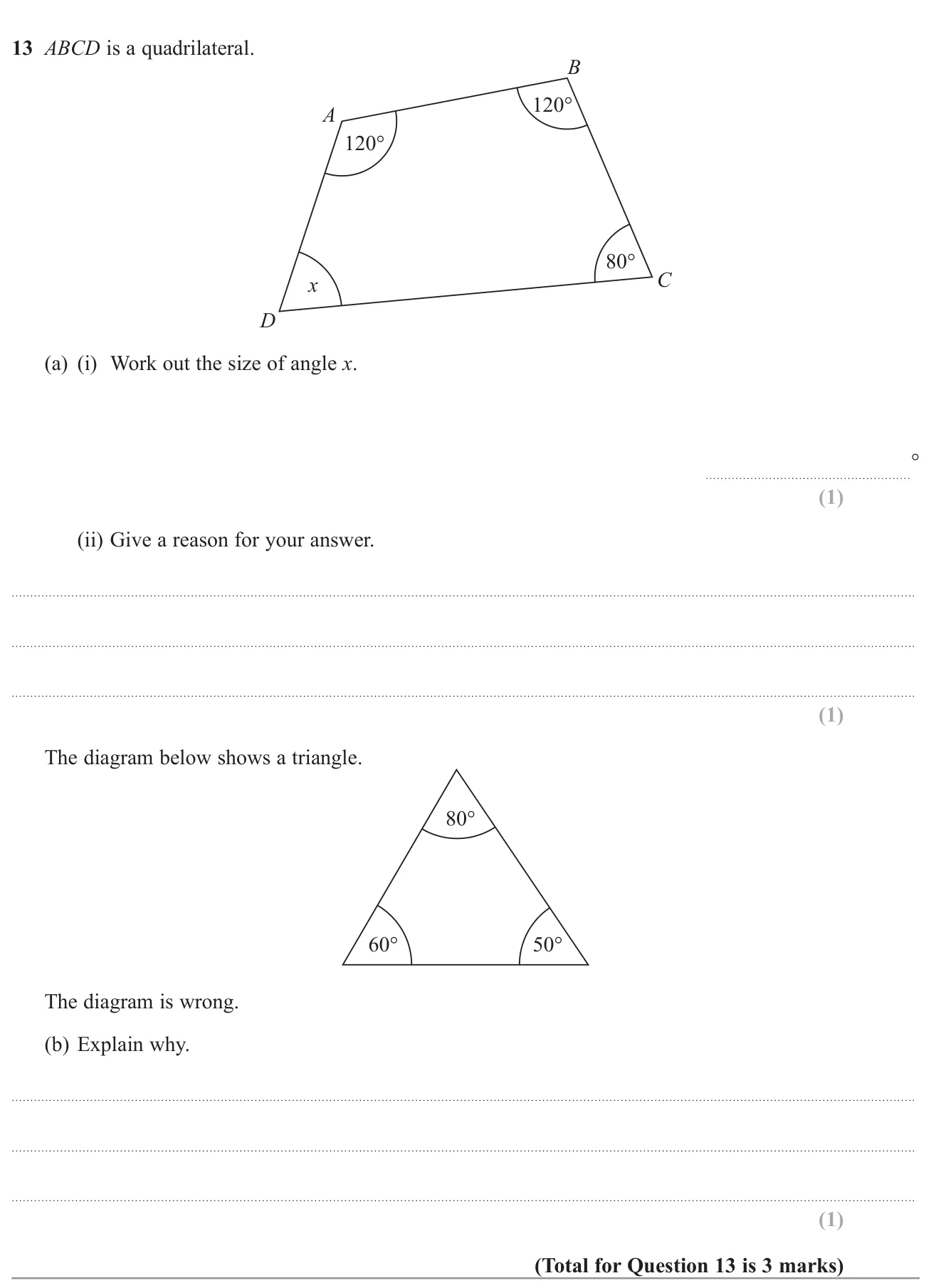
(a) x=360−120−120−80=40° because the angles in a quadrilateral add up to 360°.
(b) 80+60+50=190°. Angles in a triangle must add up to 180°, so the diagram cannot be right.
Watch out: Using 180° for the quadrilateral.
© Pearson Education Ltd. November 2022 Paper 3 (Foundation, calculator), question 14.
Show answer
| (a) | 30 ounces | 1 mark |
|---|
| (b) | About 2270 grams (2238–2296) | 2 marks |
|---|
Worked solution Checked against the mark scheme
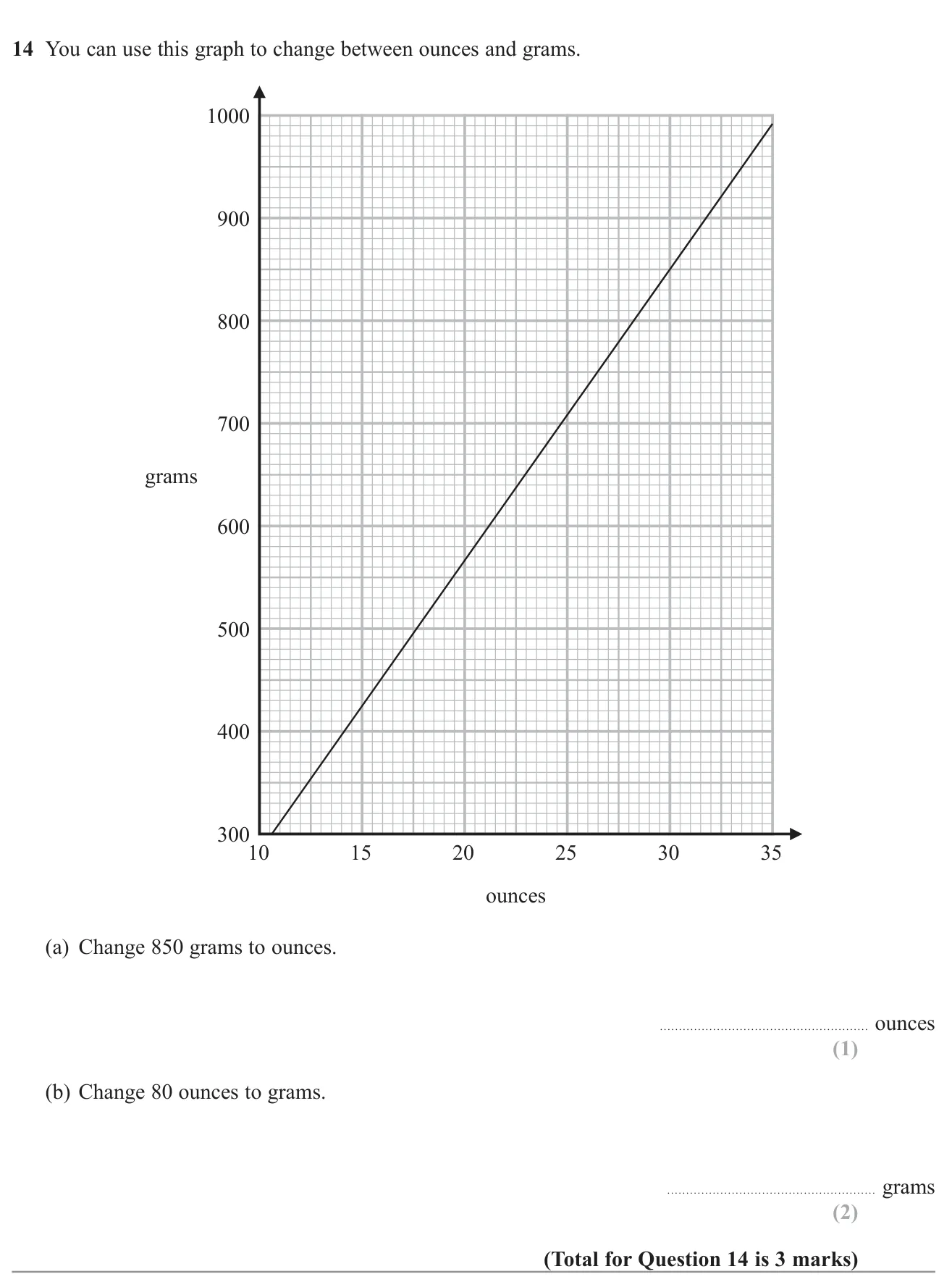
(a) Across from 850 g to the line, then down: 30 ounces.
(b) 80 is off the graph, so use 20 ounces: 20 ounces ≈ 567 g.
80=4×20, so 4×567≈2268 g.
Watch out: Reading 80 ounces as if it were on the graph, or adding instead of multiplying.
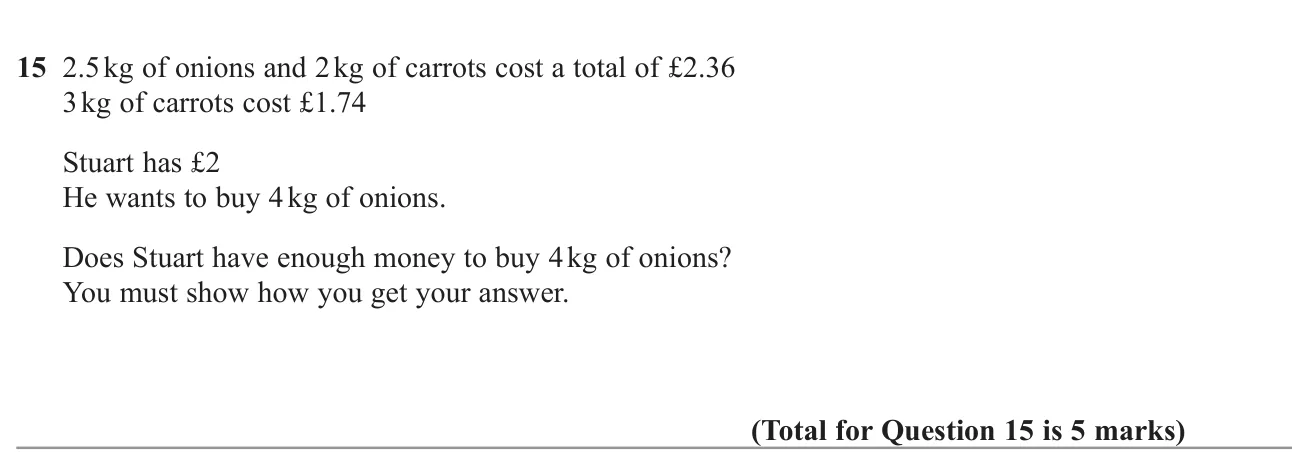
© Pearson Education Ltd. November 2022 Paper 3 (Foundation, calculator), question 15.
Show answer
| Answer | Yes: 4 kg of onions cost £1.92 | 5 marks |
|---|
Worked solution Checked against the mark scheme
Carrots: 1.74÷3=£0.58 per kg, so 2 kg cost £1.16
Onions: 2.36−1.16=£1.20 for 2.5 kg, so 1.20÷2.5=£0.48 per kg
4 kg: 4×0.48=£1.92, which is less than £2, so yes.
Watch out: Dividing £2.36 by 4.5 kg as if onions and carrots cost the same.
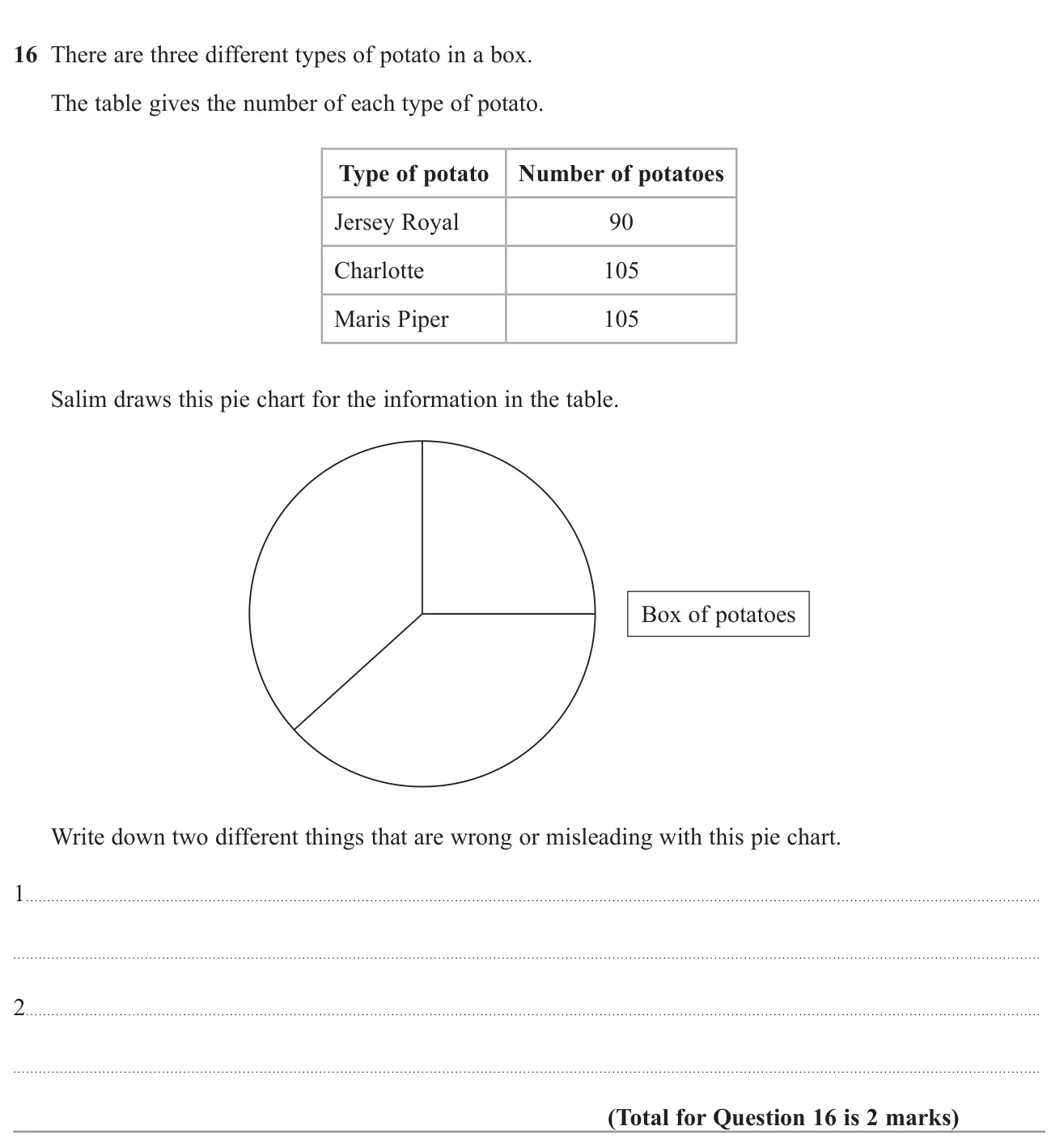
© Pearson Education Ltd. November 2022 Paper 3 (Foundation, calculator), question 16.
Show answer
| Answer | The sectors have no labels (or no key); the angles are wrong (should be 108°, 126°, 126°) | 2 marks |
|---|
Worked solution Checked against the mark scheme
Total =90+105+105=300 potatoes, so each potato is 360÷300=1.2°.
Correct angles: 90×1.2=108°, 105×1.2=126° twice. Salim's sectors are clearly not these sizes (one is a right angle), so they are wrong.
Also, the sectors are not labelled with the types of potato.
Watch out: Only saying 'the sectors are the wrong size' without a reason.
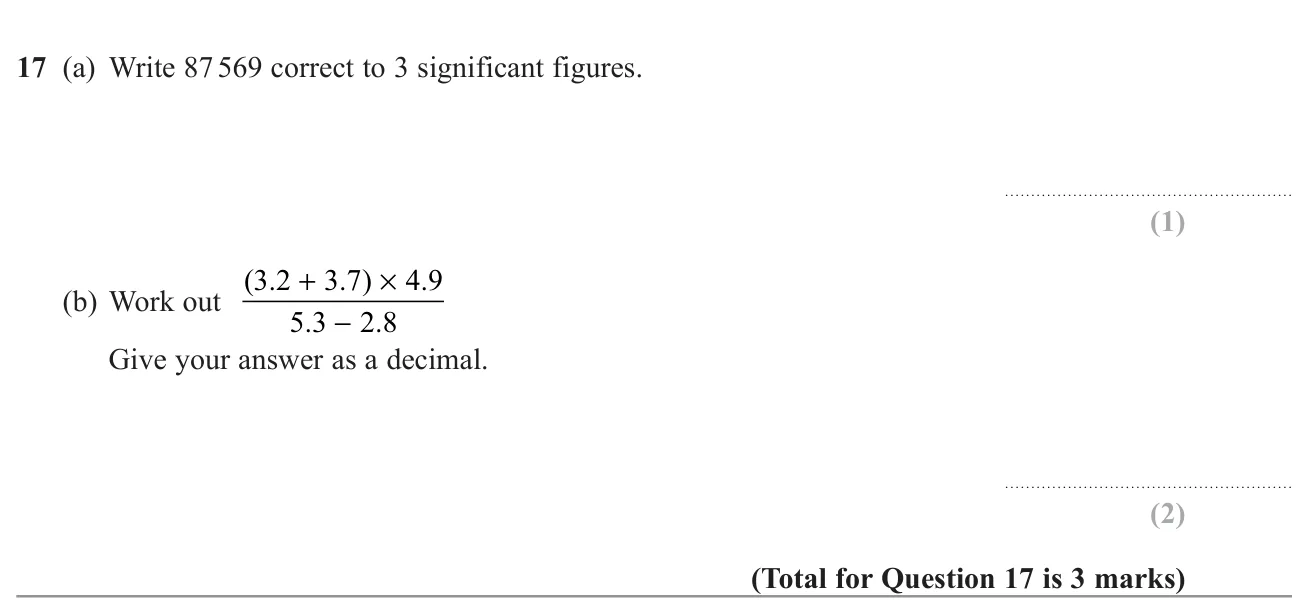
© Pearson Education Ltd. November 2022 Paper 3 (Foundation, calculator), question 17.
Show answer
| (a) | 87 600 | 1 mark |
|---|
| (b) | 13.524 | 2 marks |
|---|
Worked solution Checked against the mark scheme
(a) The 4th figure is 6, so round the 5 up: 87 600
(b) Top: (3.2+3.7)×4.9=6.9×4.9=33.81
Bottom: 5.3−2.8=2.5
33.81÷2.5=13.524
Watch out: In (a) writing 876 without the zeros to keep place value.
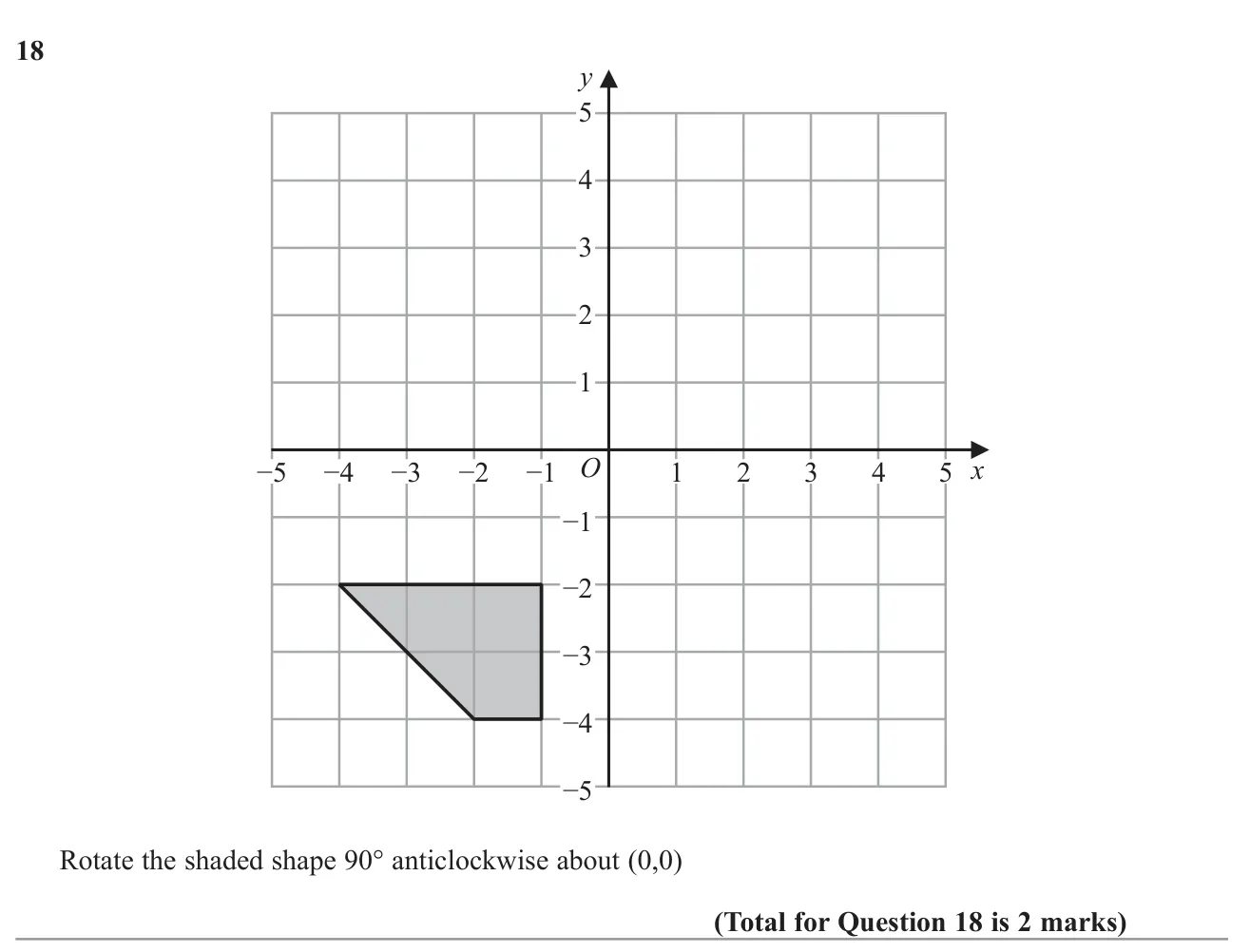
© Pearson Education Ltd. November 2022 Paper 3 (Foundation, calculator), question 18.
Show answer
| Answer | Vertices at (2,−1), (2,−4), (4,−2), (4,−1) | 2 marks |
|---|
Worked solution Checked against the mark scheme
The shape has vertices (−4,−2), (−1,−2), (−1,−4), (−2,−4).
A 90° anticlockwise turn about O sends (x,y) to (−y,x).
New vertices: (2,−4), (2,−1), (4,−1), (4,−2).
Watch out: Rotating clockwise instead of anticlockwise.
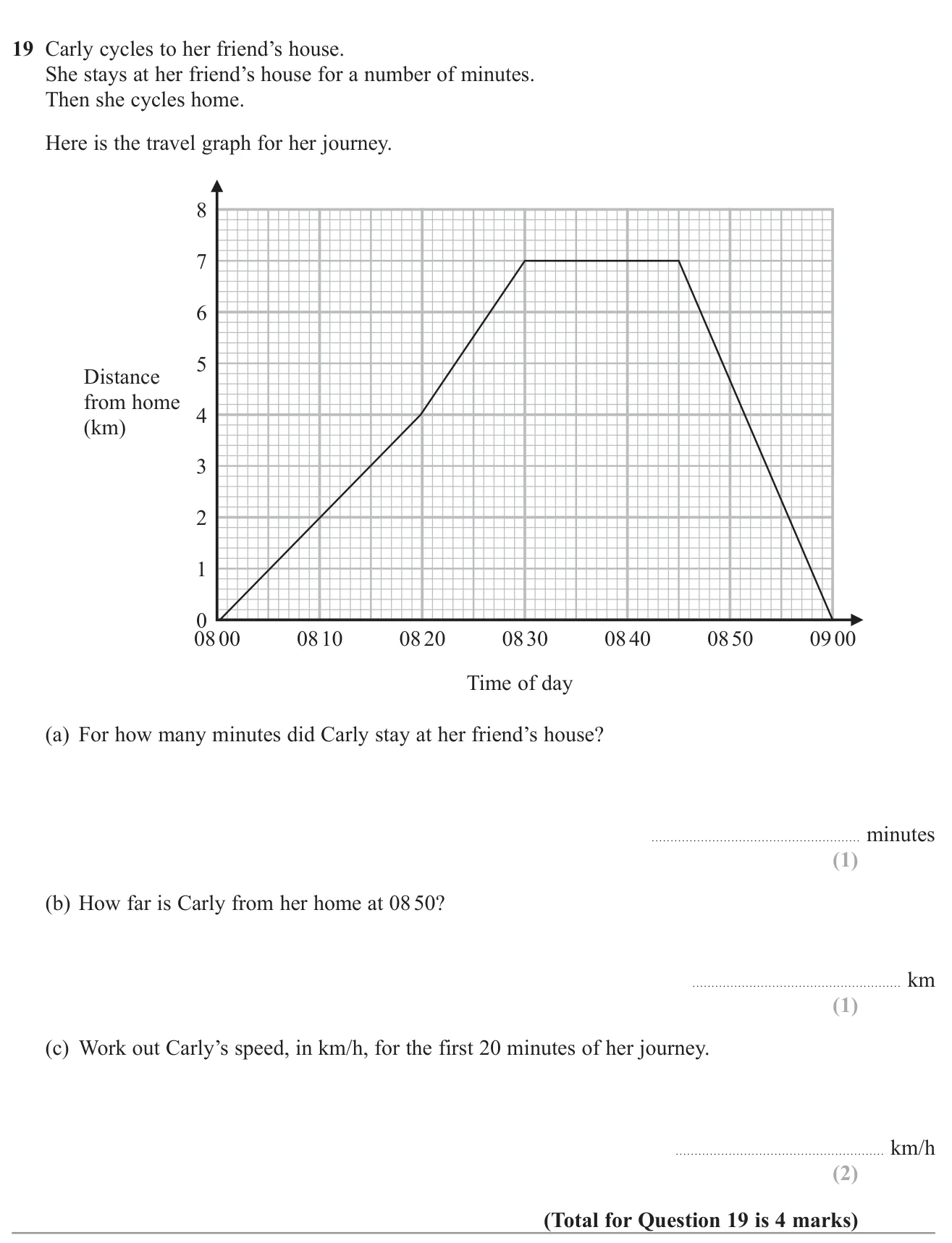
© Pearson Education Ltd. November 2022 Paper 3 (Foundation, calculator), question 19.
Show answer
| (a) | 15 minutes | 1 mark |
|---|
| (b) | 4.6 km (4.4–4.8) | 1 mark |
|---|
| (c) | 12 km/h | 2 marks |
|---|
Worked solution Checked against the mark scheme
(a) The line is flat from 08 30 to 08 45: 15 minutes.
(b) At 08 50 the graph is at about 4.6 km.
(c) She travels 4 km in 20 minutes. 20 minutes =31 hour.
Speed =4÷31=12 km/h
Watch out: Giving 0.2 (km per minute) instead of converting to km/h.
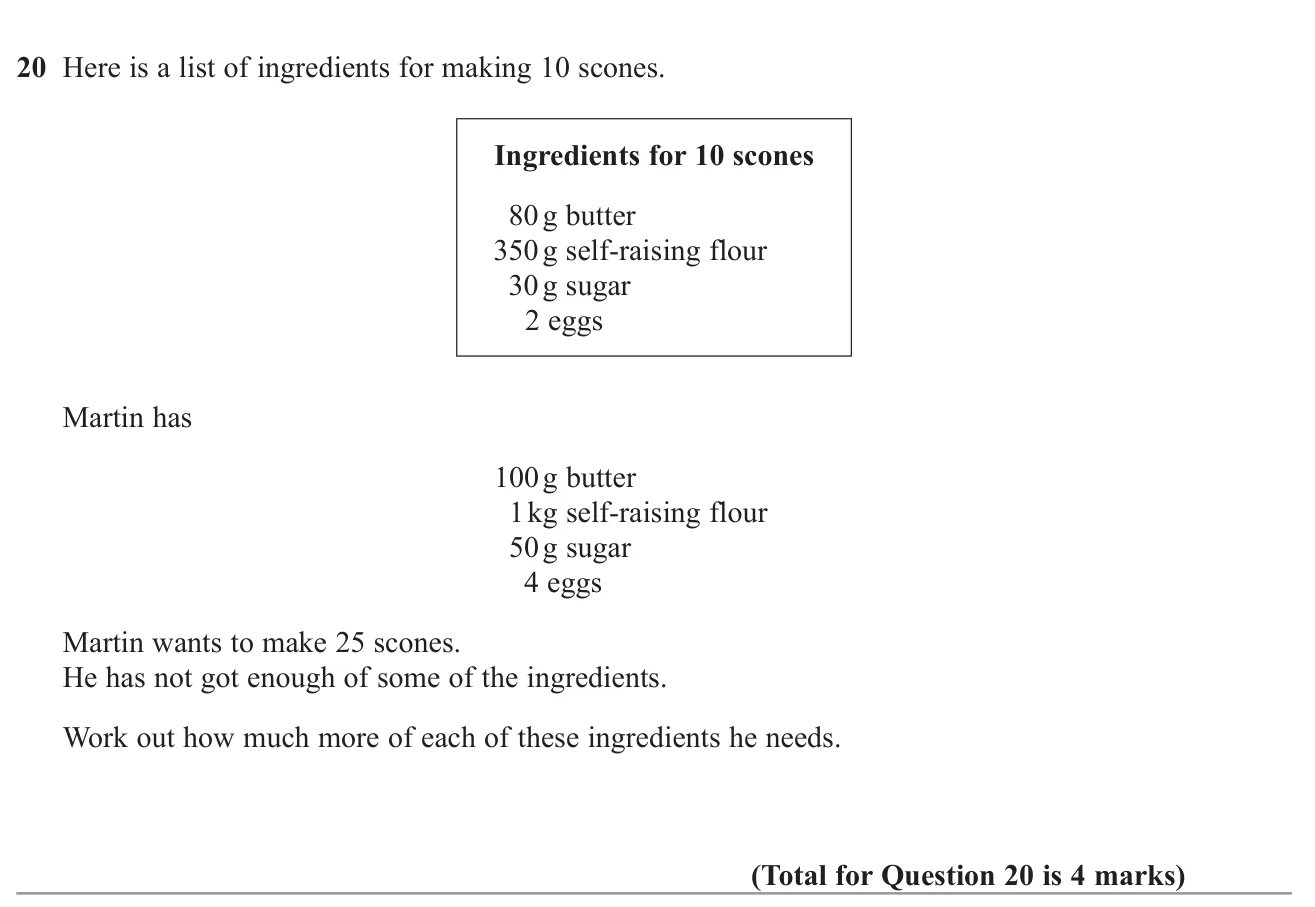
© Pearson Education Ltd. November 2022 Paper 3 (Foundation, calculator), question 20.
Show answer
| Answer | 100 g more butter, 25 g more sugar, 1 more egg | 4 marks |
|---|
Worked solution Checked against the mark scheme
Scale factor: 25÷10=2.5
Butter 80×2.5=200 g, flour 350×2.5=875 g, sugar 30×2.5=75 g, eggs 2×2.5=5
Compare: butter 200−100=100 g more, sugar 75−50=25 g more, eggs 5−4=1 more. Flour is fine (875 g < 1 kg).
Watch out: Working out the full amounts needed instead of how much more.
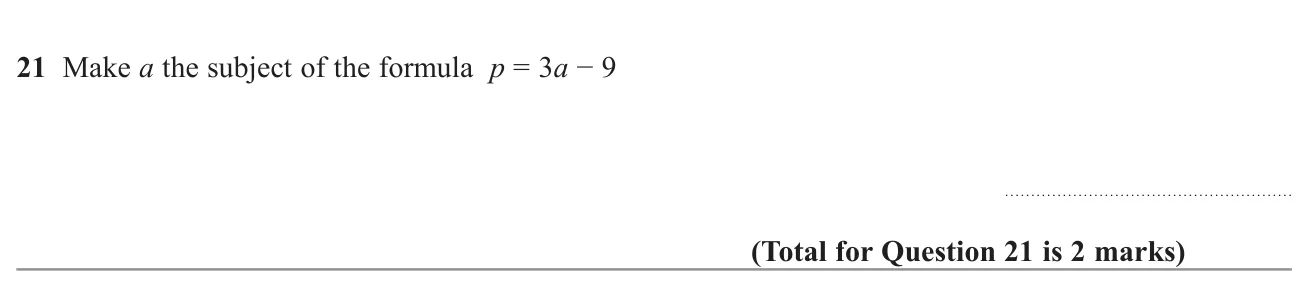
© Pearson Education Ltd. November 2022 Paper 3 (Foundation, calculator), question 21.
Show answer
| Answer | a=3p+9 | 2 marks |
|---|
Worked solution Checked against the mark scheme
p=3a−9
Add 9: p+9=3a
Divide by 3: a=3p+9
Watch out: Writing a=p+9÷3 without brackets.
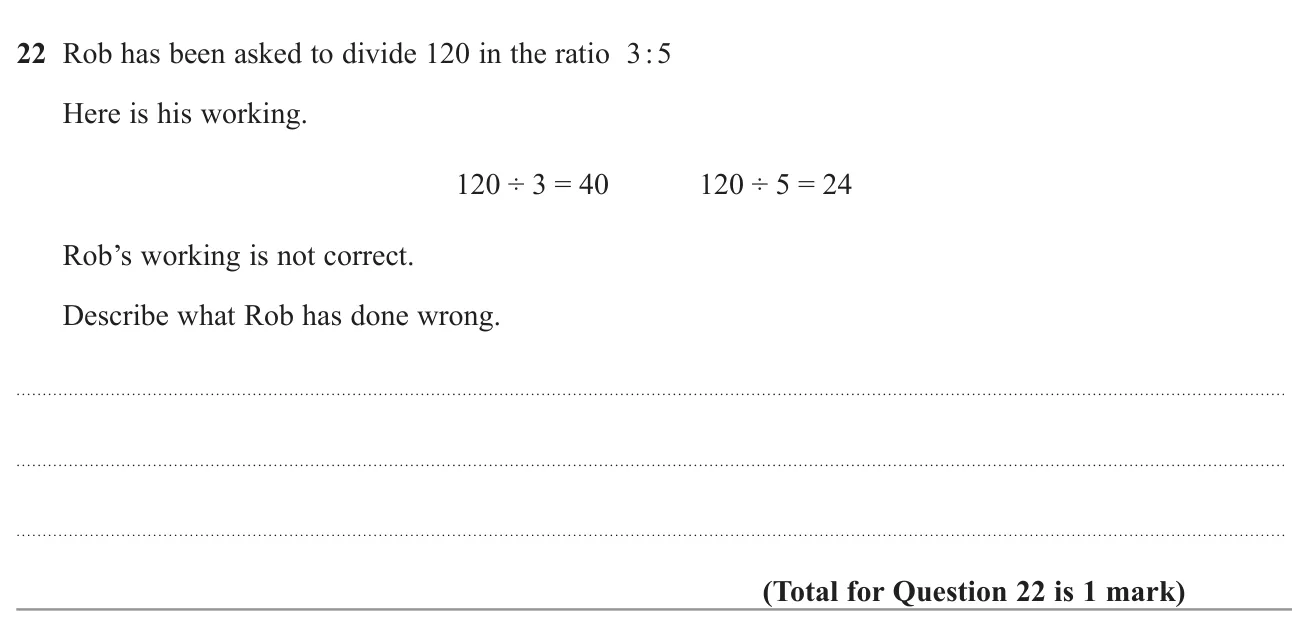
© Pearson Education Ltd. November 2022 Paper 3 (Foundation, calculator), question 22.
Show answer
| Answer | He should add the parts (3 + 5 = 8) and divide 120 by 8, not by 3 and by 5 | 1 mark |
|---|
Worked solution Checked against the mark scheme
The ratio 3 : 5 has 3+5=8 parts.
One part =120÷8=15, giving 45 and 75.
Rob divided by 3 and by 5 separately instead of by 8.
Watch out: Just giving the correct answer (45 : 75) without saying what went wrong.
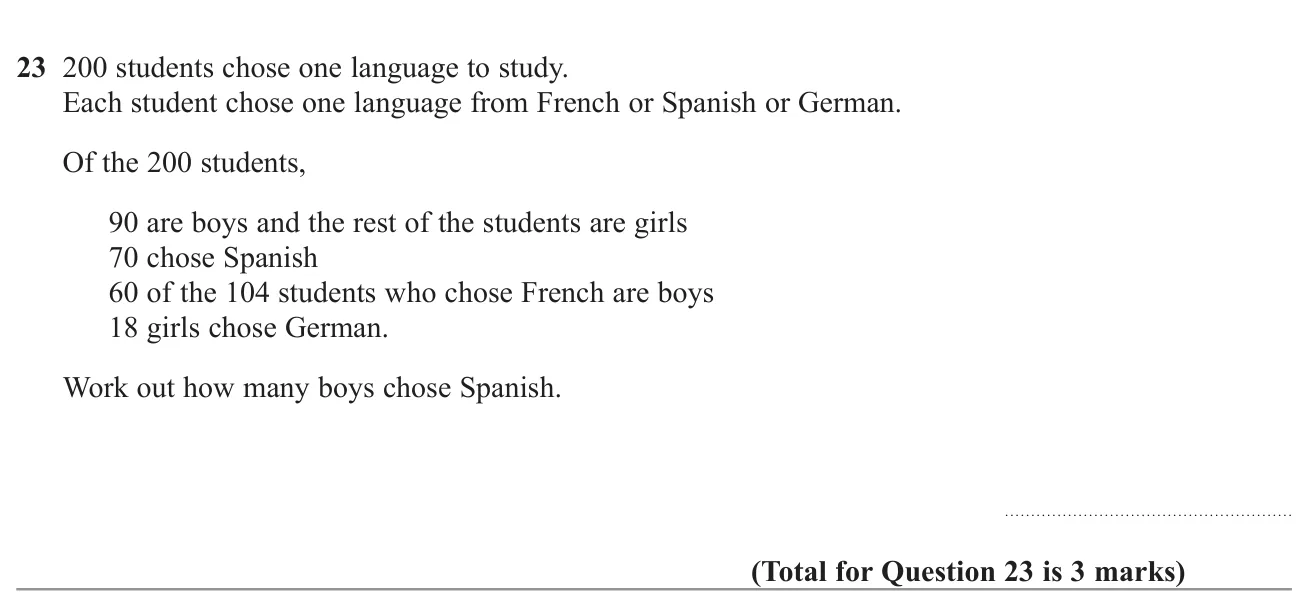
© Pearson Education Ltd. November 2022 Paper 3 (Foundation, calculator), question 23.
Show answer
Worked solution Checked against the mark scheme
German: 200−104−70=26, so boys choosing German =26−18=8
Boys: 90, of which 60 chose French and 8 chose German.
Boys choosing Spanish =90−60−8=22
Watch out: Forgetting to subtract the girls who chose German from the German total.
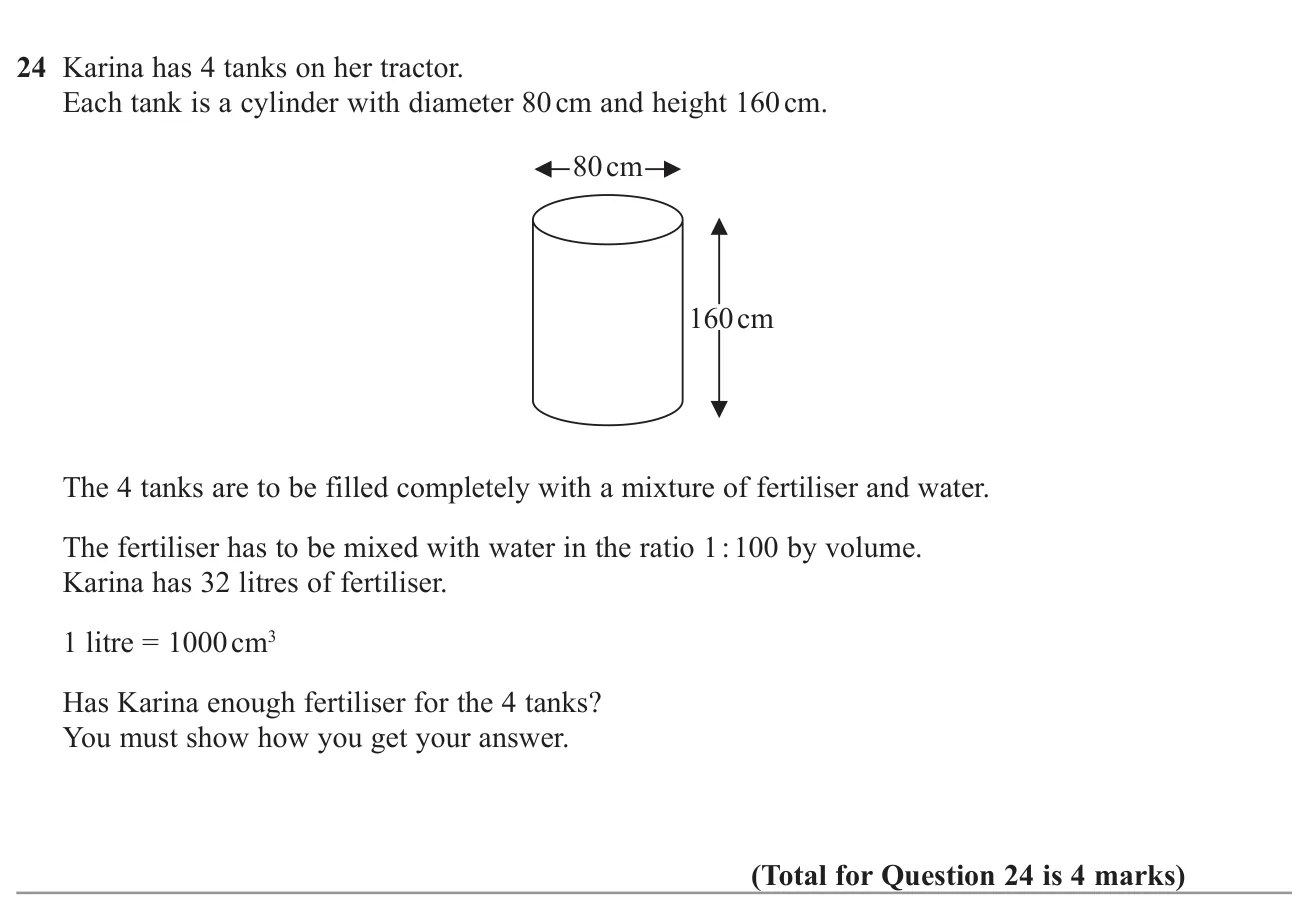
© Pearson Education Ltd. November 2022 Paper 3 (Foundation, calculator), question 24.
Show answer
| Answer | Yes: about 31.85 litres of fertiliser are needed and she has 32 | 4 marks |
|---|
Worked solution Checked against the mark scheme
One tank: π×402×160≈804248 cm3
Four tanks: ≈3216991 cm3≈3217 litres
Fertiliser is 1 part in 101: 3217÷101≈31.85 litres
31.85<32, so yes, she has enough.
Watch out: Dividing by 100 instead of 101, or using the diameter as the radius.
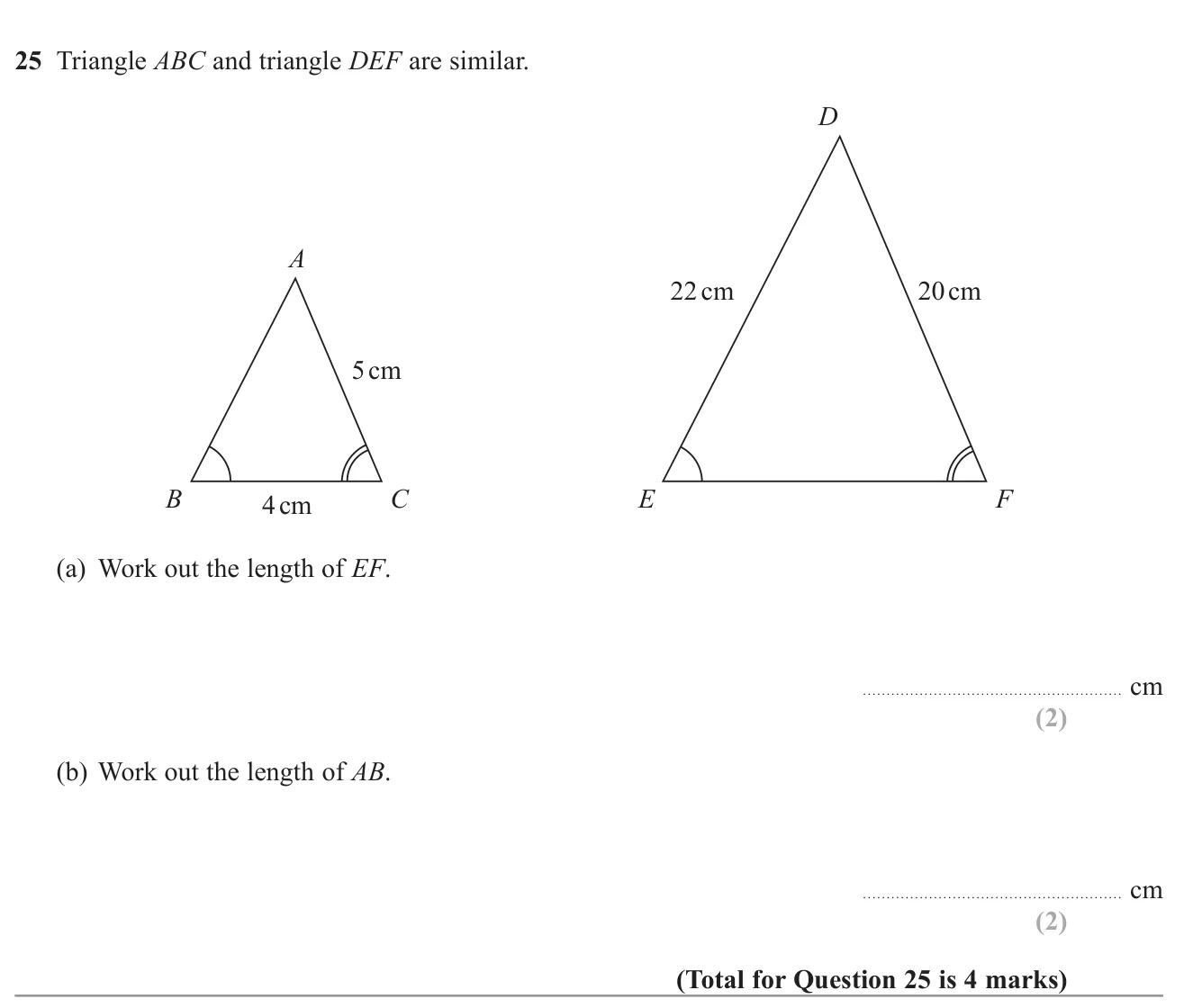
© Pearson Education Ltd. November 2022 Paper 3 (Foundation, calculator), question 25.
Show answer
| (a) | 16 cm | 2 marks |
|---|
| (b) | 5.5 cm | 2 marks |
|---|
Worked solution Checked against the mark scheme
AC = 5 matches DF = 20, so the scale factor is 20÷5=4.
(a) EF matches BC: 4×4=16 cm
(b) AB matches DE: 22÷4=5.5 cm
Watch out: Matching the wrong sides, e.g. pairing 5 cm with 22 cm.
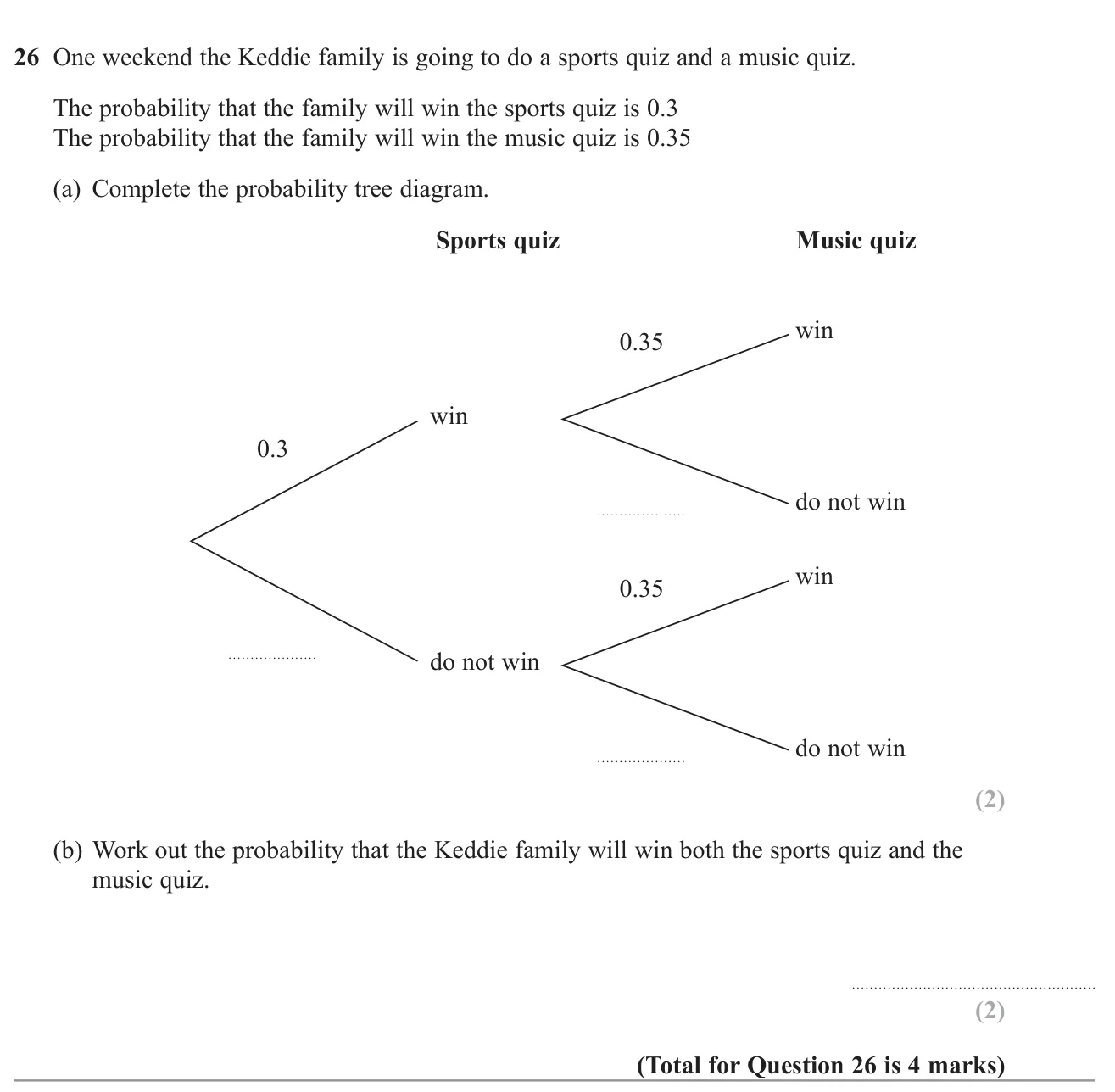
© Pearson Education Ltd. November 2022 Paper 3 (Foundation, calculator), question 26.
Show answer
| (a) | 0.7 on the first branch; 0.65 on both second 'do not win' branches | 2 marks |
|---|
| (b) | 0.105 | 2 marks |
|---|
Worked solution Checked against the mark scheme
(a) Not winning the sports quiz: 1−0.3=0.7. Not winning the music quiz: 1−0.35=0.65 on both pairs of branches.
(b) P(both)=0.3×0.35=0.105
Watch out: Adding the probabilities (0.65) instead of multiplying.
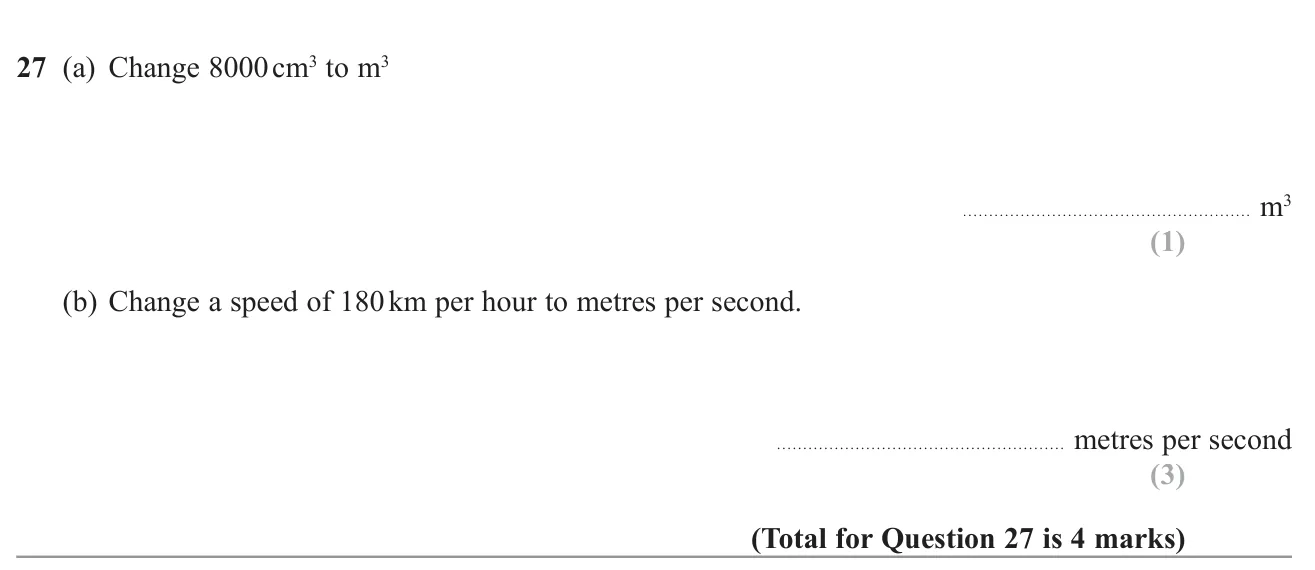
© Pearson Education Ltd. November 2022 Paper 3 (Foundation, calculator), question 27.
Show answer
| (a) | 0.008 m³ | 1 mark |
|---|
| (b) | 50 m/s | 3 marks |
|---|
Worked solution Checked against the mark scheme
(a) 1 m3=1003=1000000 cm3, so 8000÷1000000=0.008 m3
(b) 180 km =180000 m, and 1 hour =3600 s
180000÷3600=50 m/s
Watch out: Dividing by 100 in (a) instead of by 1 000 000.
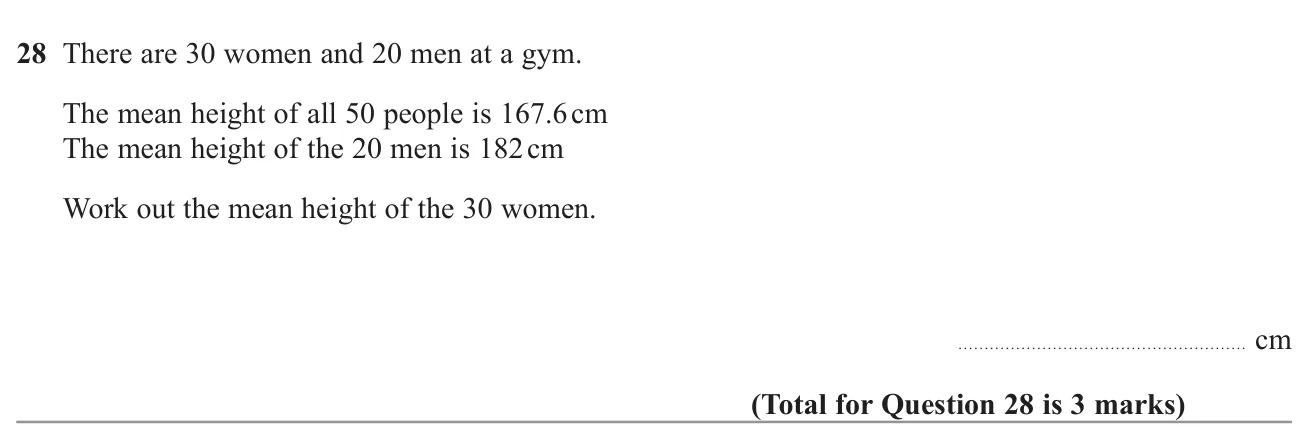
© Pearson Education Ltd. November 2022 Paper 3 (Foundation, calculator), question 28.
Show answer
Worked solution Checked against the mark scheme
Total for everyone: 50×167.6=8380 cm
Total for men: 20×182=3640 cm
Women: (8380−3640)÷30=4740÷30=158 cm
Watch out: Averaging the two means, e.g. working out 2×167.6−182.
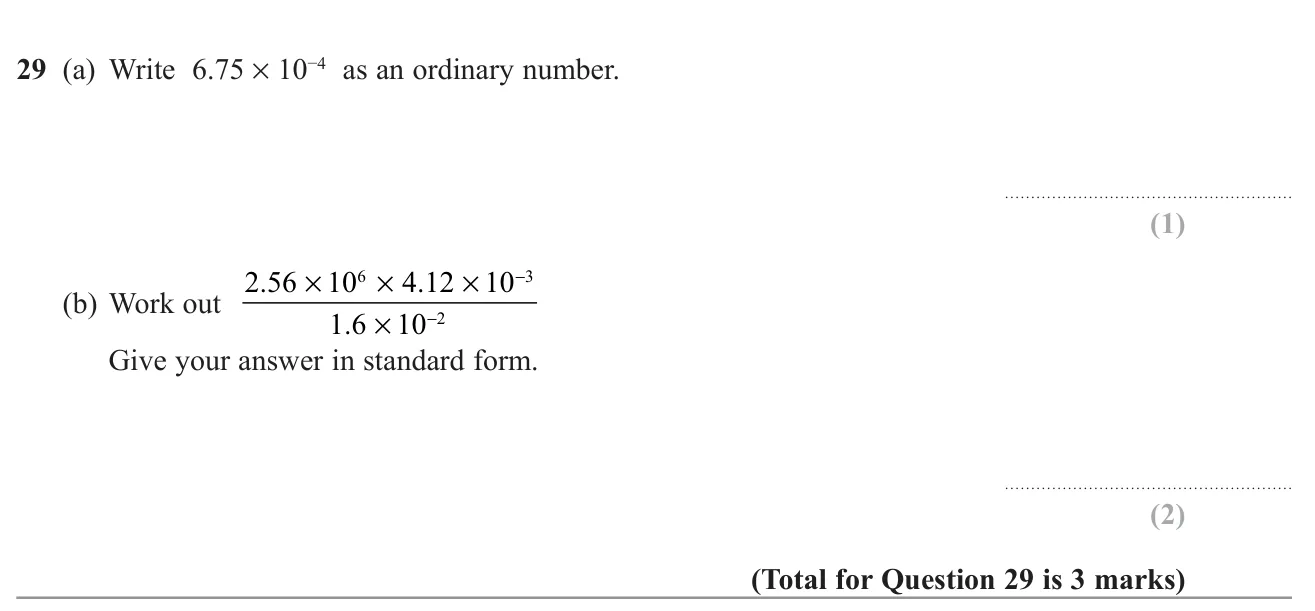
© Pearson Education Ltd. November 2022 Paper 3 (Foundation, calculator), question 29.
Show answer
| (a) | 0.000675 | 1 mark |
|---|
| (b) | 6.592×10⁵ | 2 marks |
|---|
Worked solution Checked against the mark scheme
(a) Move the decimal point 4 places left: 0.000675
(b) 2.56×106×4.12×10−3=10547.2
10547.2÷(1.6×10⁻²)=659200=6.592×10⁵
Watch out: Leaving the answer as 659 200 or as 65.92×10⁴.
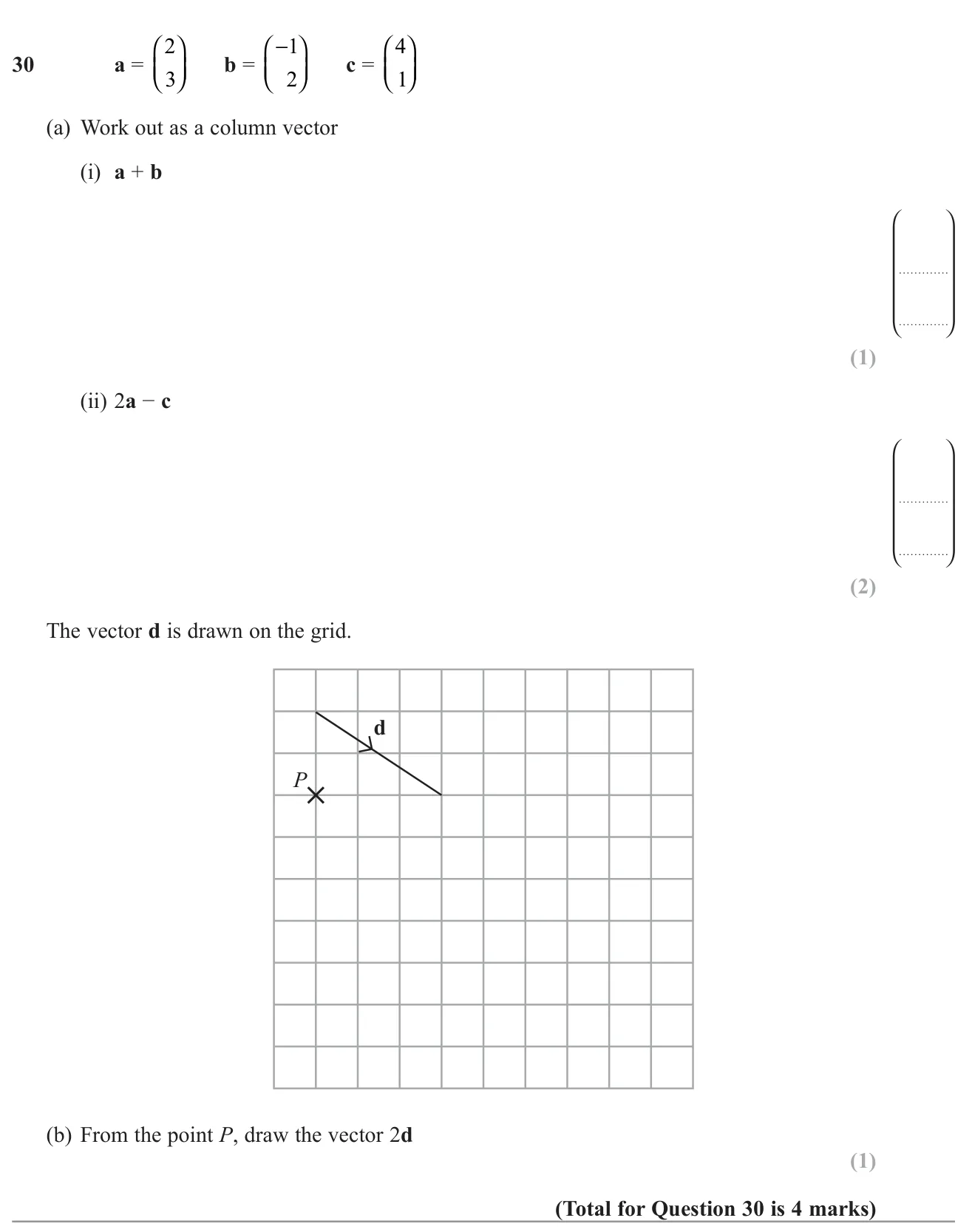
© Pearson Education Ltd. November 2022 Paper 3 (Foundation, calculator), question 30.
Show answer
| (a(i)) | (15) | 1 mark |
|---|
| (a(ii)) | (05) | 2 marks |
|---|
| (b) | A line from P, 6 right and 4 down | 1 mark |
|---|
Worked solution Checked against the mark scheme
(a)(i) (23)+(−12)=(15)
(ii) 2a=(46), so 2a−c=(4−46−1)=(05)
(b) d goes 3 right and 2 down, so 2d goes 6 right and 4 down from P.
Watch out: Forgetting to double both components of a in (ii).
Finished the paper?
Add up your marks for all three papers and see what grade that would have been.