© Pearson Education Ltd. June 2022 Paper 2 (Foundation, calculator), question 1.
Show answer
Worked solution Checked against the mark scheme
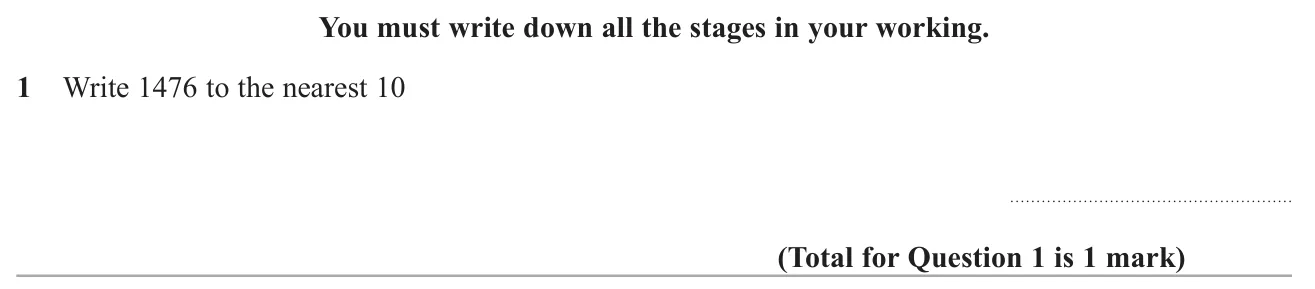
Look at the units digit: it is 6, which is 5 or more, so round up.
1476→1480
Watch out: Rounding down to 1470.
© Pearson Education Ltd. June 2022 Paper 2 (Foundation, calculator), question 2.
Show answer
| Answer | 107 | 1 mark |
|---|
Worked solution Checked against the mark scheme
One whole is 1010.
1010−103=107
Watch out: Writing 103 or 92.
© Pearson Education Ltd. June 2022 Paper 2 (Foundation, calculator), question 3.
Show answer
Worked solution Checked against the mark scheme
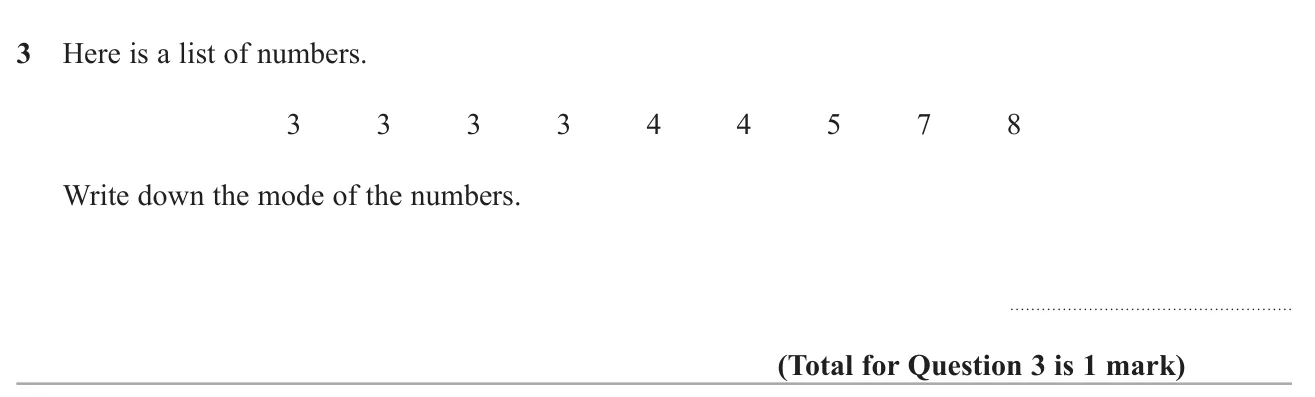
The mode is the value that appears most often.
3 appears four times, more than any other number, so the mode is 3.
Watch out: Giving the frequency 4 instead of the value 3.
© Pearson Education Ltd. June 2022 Paper 2 (Foundation, calculator), question 4.
Show answer
| Answer | Any 3-digit number ending in 0 or 5, e.g. 725 | 1 mark |
|---|
Worked solution Checked against the mark scheme
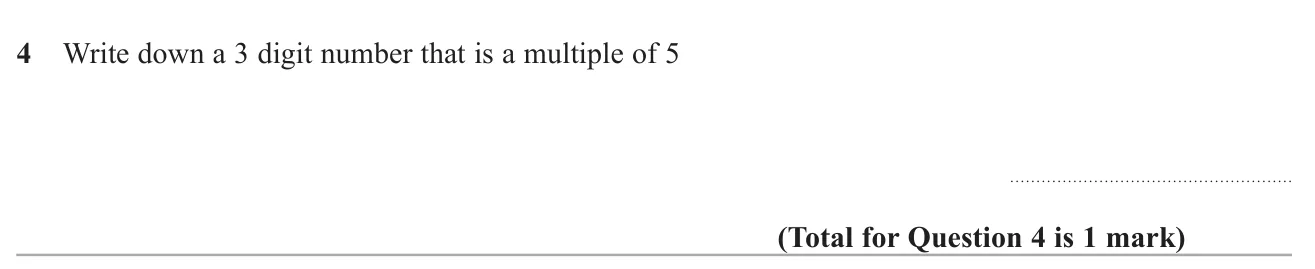
Multiples of 5 always end in 0 or 5.
So any number from 100 to 995 ending in 0 or 5 works, for example 725.
Watch out: Giving a number with the wrong number of digits, such as 50.
© Pearson Education Ltd. June 2022 Paper 2 (Foundation, calculator), question 5.
Show answer
Worked solution Checked against the mark scheme
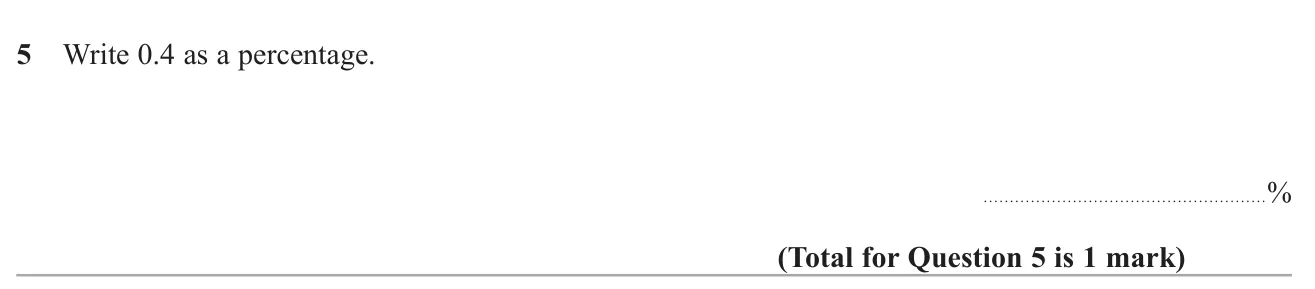
To change a decimal to a percentage, multiply by 100.
0.4×100=40%
Watch out: Writing 4%.
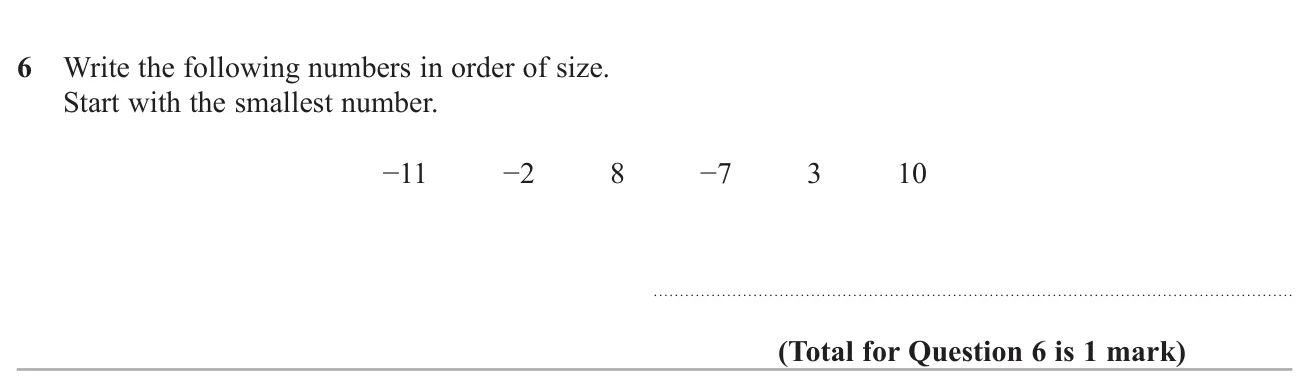
© Pearson Education Ltd. June 2022 Paper 2 (Foundation, calculator), question 6.
Show answer
| Answer | −11,−7,−2,3,8,10 | 1 mark |
|---|
Worked solution Checked against the mark scheme
The most negative number is the smallest.
Negatives: −11<−7<−2, then positives: 3<8<10.
Order: −11,−7,−2,3,8,10
Watch out: Putting −2 before −7 because 2 is smaller than 7.
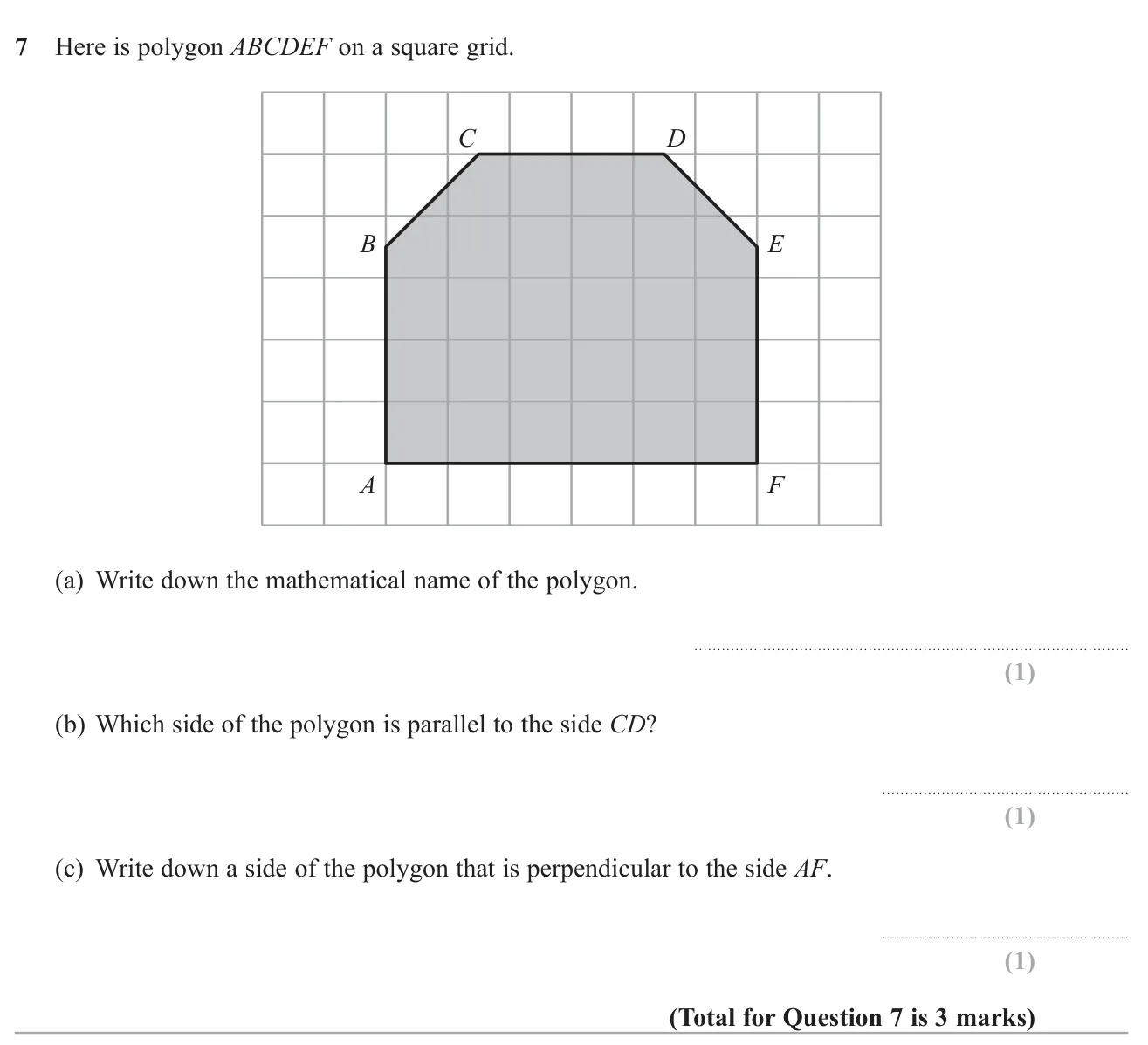
© Pearson Education Ltd. June 2022 Paper 2 (Foundation, calculator), question 7.
Show answer
| (a) | Hexagon | 1 mark |
|---|
| (b) | AF | 1 mark |
|---|
| (c) | AB or EF | 1 mark |
|---|
Worked solution Checked against the mark scheme
(a) The shape has 6 sides, so it is a hexagon.
(b) CD is horizontal. The other horizontal side is AF.
(c) AF is horizontal, so a perpendicular side is vertical: AB or EF.
Watch out: Mixing up parallel and perpendicular.
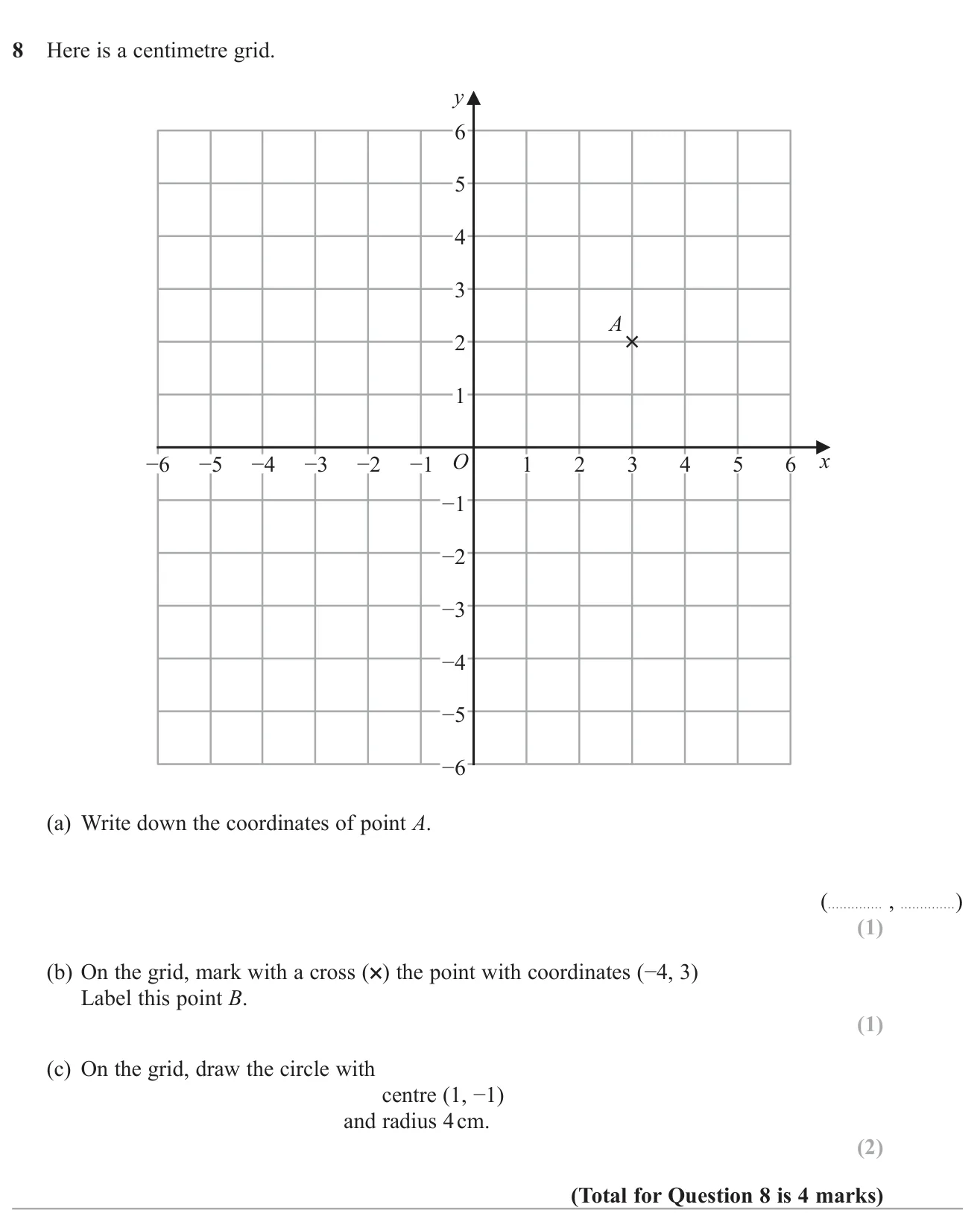
© Pearson Education Ltd. June 2022 Paper 2 (Foundation, calculator), question 8.
Show answer
| (a) | (3,2) | 1 mark |
|---|
| (b) | Cross at (−4,3) labelled B | 1 mark |
|---|
| (c) | Circle with centre (1,−1) and radius 4 cm | 2 marks |
|---|
Worked solution Checked against the mark scheme
(a) Go across 3, then up 2: A=(3,2).
(b) Go 4 left from O, then 3 up, and mark a cross labelled B.
(c) Set compasses to 4 cm (4 squares). Put the point on (1,−1) and draw the circle; it passes through (5,−1), (−3,−1), (1,3) and (1,−5).
Watch out: Writing coordinates the wrong way round, as (2, 3).
Question 9
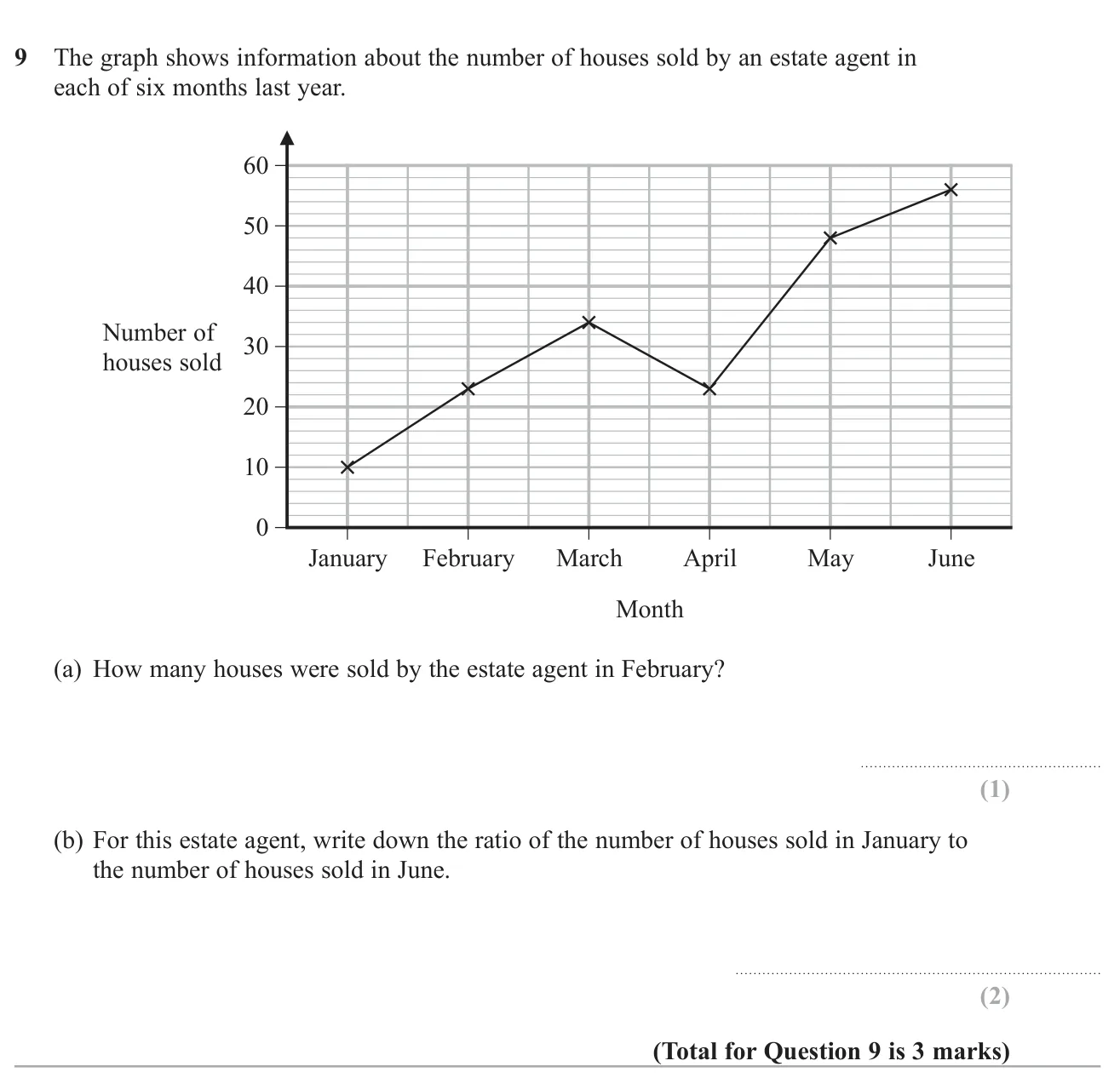
Ratio3 marksGrade 2Calculator © Pearson Education Ltd. June 2022 Paper 2 (Foundation, calculator), question 9.
Show answer
| (a) | 23 | 1 mark |
|---|
| (b) | 10:56 | 2 marks |
|---|
Worked solution Checked against the mark scheme
(a) The February cross is at 23.
(b) January: 10 houses. June: 56 houses.
Ratio January : June =10:56=5:28
Watch out: Writing the ratio the wrong way round, as 56 : 10.
© Pearson Education Ltd. June 2022 Paper 2 (Foundation, calculator), question 10.
Show answer
Worked solution Checked against the mark scheme
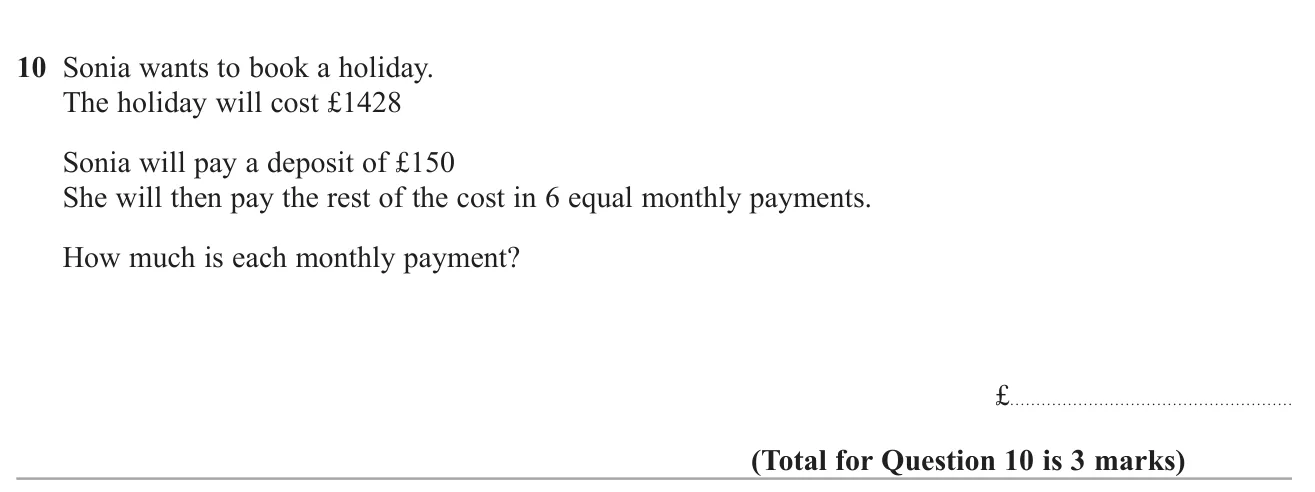
Amount left after the deposit: 1428−150=1278
Each payment: 1278÷6=213
Each monthly payment is £213.
Watch out: Dividing 1428 by 6 without taking off the deposit (238).
© Pearson Education Ltd. June 2022 Paper 2 (Foundation, calculator), question 11.
Show answer
| Answer | x=39∘ with reasons | 3 marks |
|---|
Worked solution Checked against the mark scheme
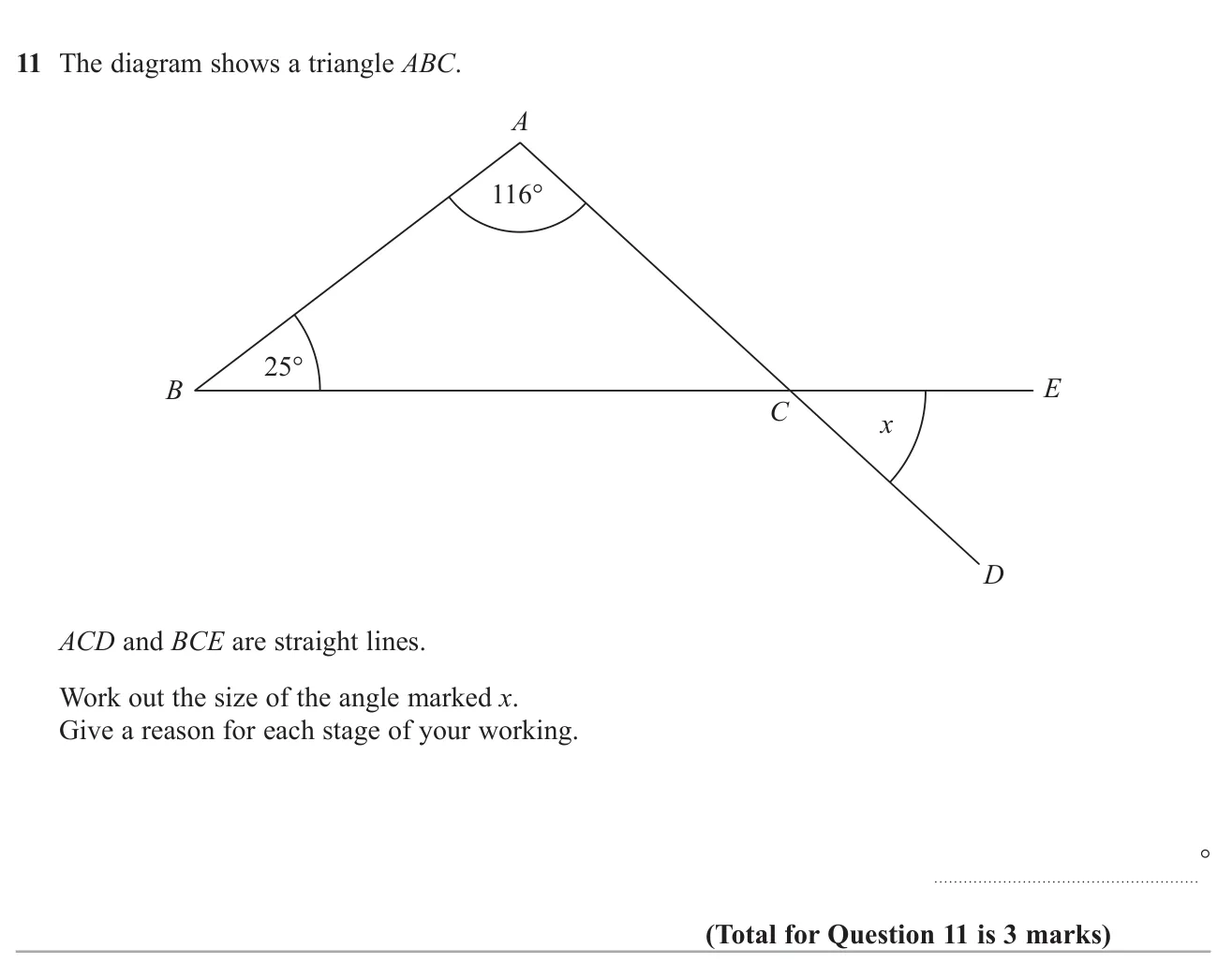
Angle ACB=180−116−25=39∘ (angles in a triangle add up to 180∘).
x and angle ACB are vertically opposite, so x=39∘ (vertically opposite angles are equal).
Watch out: Getting 39 but leaving out the reasons, or naming the wrong angle fact.
© Pearson Education Ltd. June 2022 Paper 2 (Foundation, calculator), question 12.
Show answer
| (a) | 9 | 1 mark |
|---|
| (b) | +6 | 2 marks |
|---|
Worked solution Checked against the mark scheme
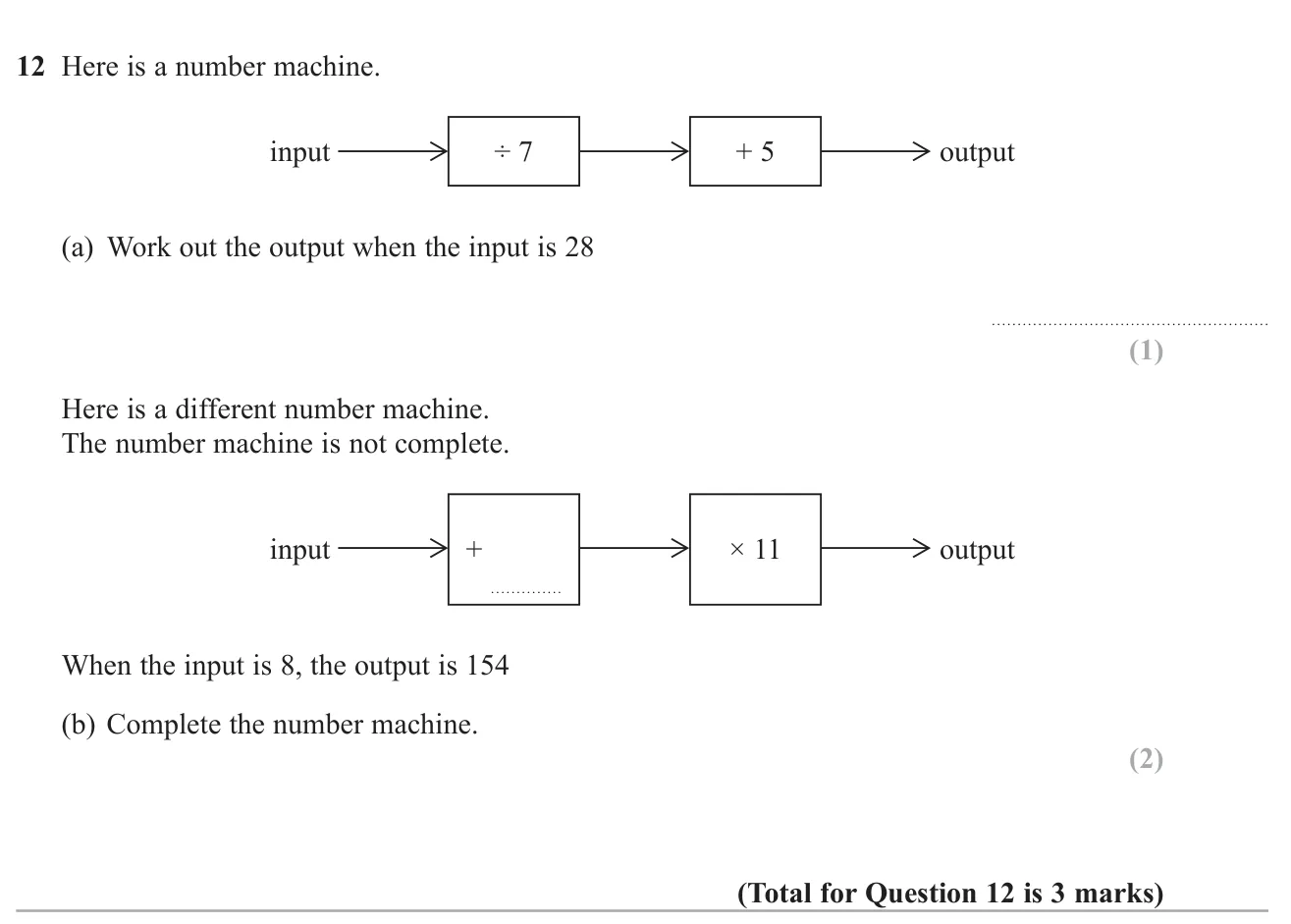
(a) 28÷7=4, then 4+5=9.
(b) Work backwards from 154: 154÷11=14.
The missing step turns 8 into 14, so it is +6.
Watch out: In (b), doing 154−8 before dividing.
© Pearson Education Ltd. June 2022 Paper 2 (Foundation, calculator), question 13.
Show answer
| Answer | With mattress: 53, 19, 67, 139; without: 17, 26, 16, 59; totals: 70, 45, 83, 198 | 3 marks |
|---|
Worked solution Checked against the mark scheme
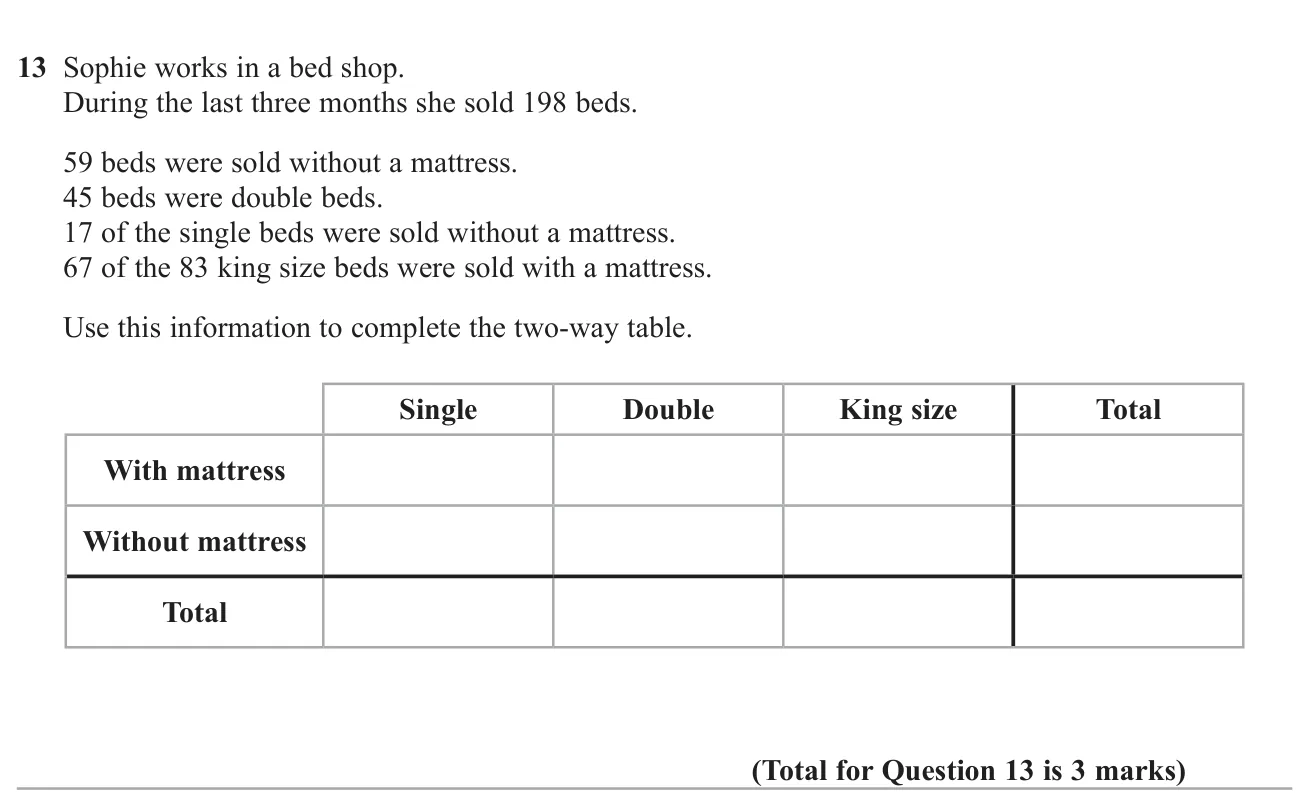
Put in the given values: total 198, without mattress 59, double total 45, single without 17, king total 83, king with 67.
King without: 83−67=16. Single total: 198−45−83=70, so single with =70−17=53.
Double without: 59−17−16=26, so double with =45−26=19.
With mattress total: 198−59=139 (check: 53+19+67=139).
Watch out: Placing 67 as the king size total instead of 83.
© Pearson Education Ltd. June 2022 Paper 2 (Foundation, calculator), question 14.
Show answer
| ((i)) | > | 1 mark |
|---|
| ((ii)) | = | 1 mark |
|---|
Worked solution Checked against the mark scheme
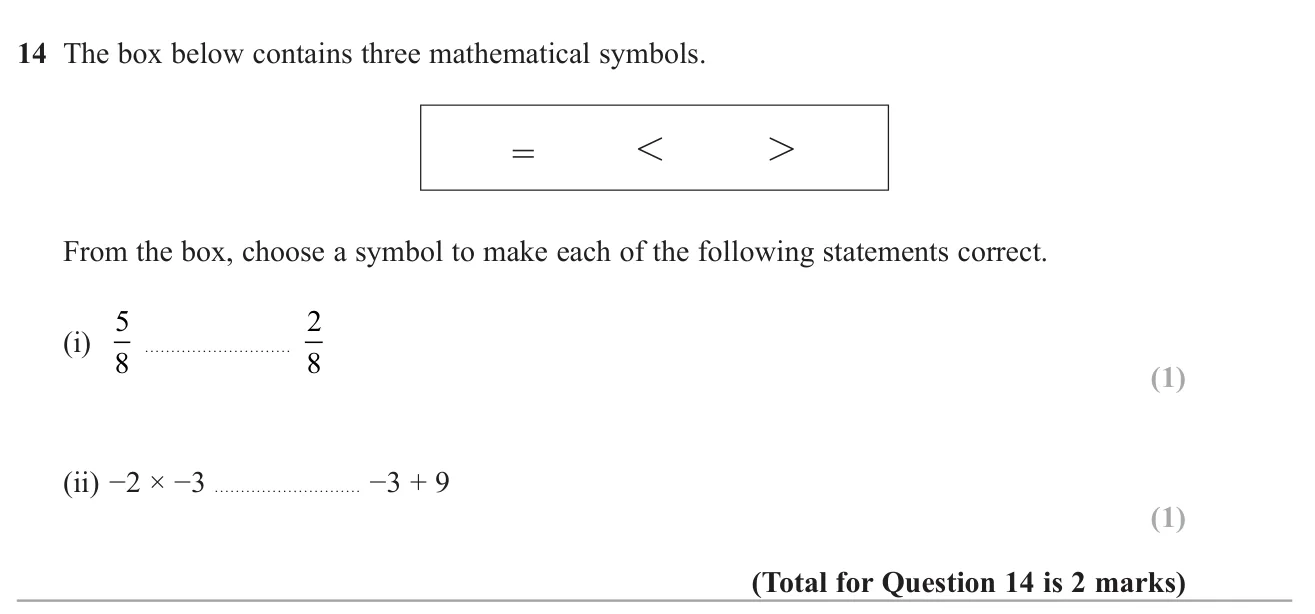
(i) Same denominator, and 5>2, so 85>82.
(ii) −2×−3=6 and −3+9=6, so they are equal.
Watch out: In (ii), thinking a negative times a negative is negative.
© Pearson Education Ltd. June 2022 Paper 2 (Foundation, calculator), question 15.
Show answer
Worked solution Checked against the mark scheme
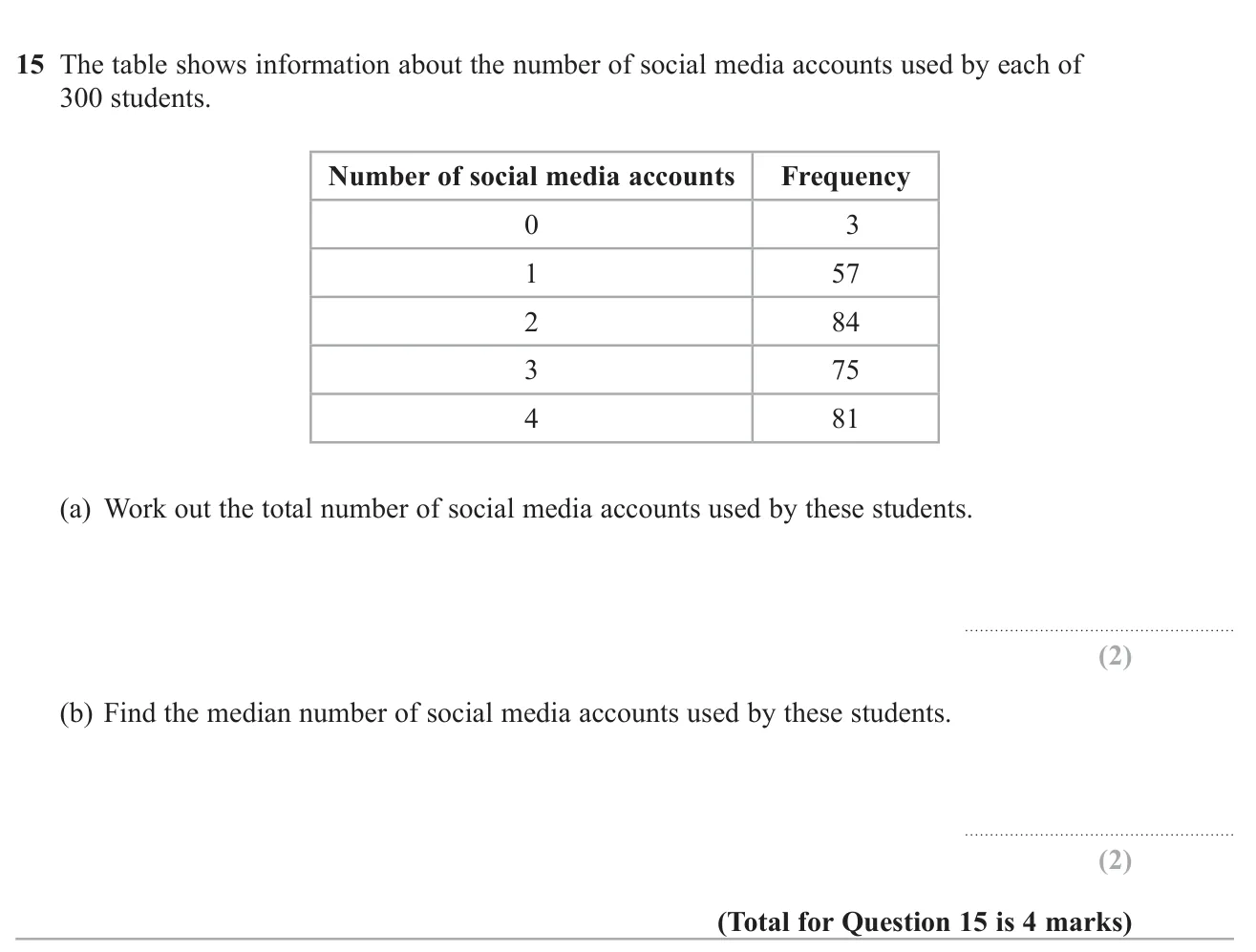
(a) 0×3+1×57+2×84+3×75+4×81=0+57+168+225+324=774
(b) There are 300 students, so the median is between the 150th and 151st values.
Running totals: 3, 60, 144, 219. The 150th and 151st are both in the '3' row, so the median is 3.
Watch out: Giving the middle frequency (75) or the middle row (2) as the median.
© Pearson Education Ltd. June 2022 Paper 2 (Foundation, calculator), question 16.
Show answer
Worked solution Checked against the mark scheme
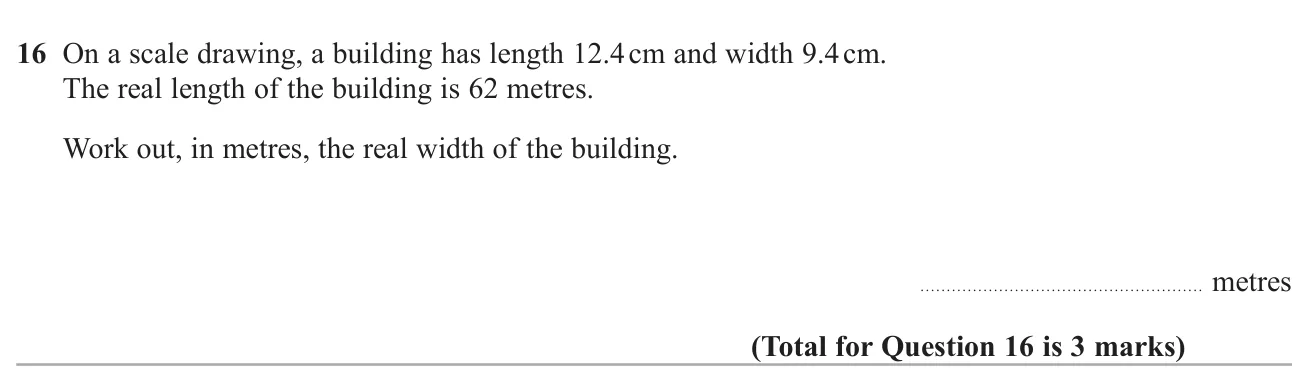
Scale: 62÷12.4=5, so 1 cm on the drawing is 5 m in real life.
Real width: 9.4×5=47 m.
Watch out: Mixing units, e.g. treating 62 m as 62 cm with the wrong scale factor.
© Pearson Education Ltd. June 2022 Paper 2 (Foundation, calculator), question 17.
Show answer
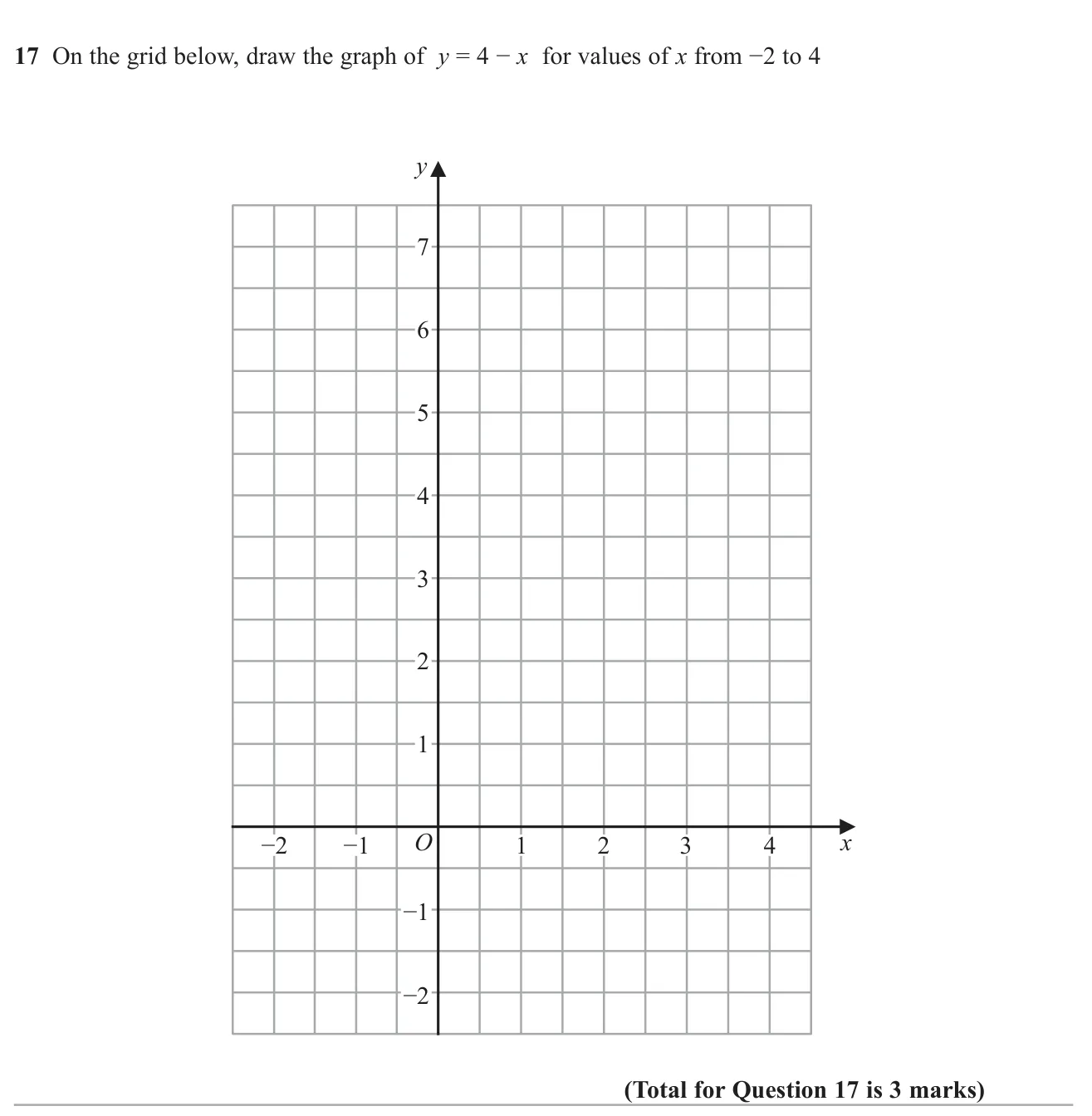
| Answer | Straight line from (−2,6) to (4,0) | 3 marks |
|---|
Worked solution Checked against the mark scheme
Make a table of values using y=4−x:
x: −2,−1,0,1,2,3,4
y: 6,5,4,3,2,1,0
Plot the points and join them with a ruler from (−2,6) to (4,0).
Watch out: Getting y wrong for negative x, e.g. 4−(−2)=2.
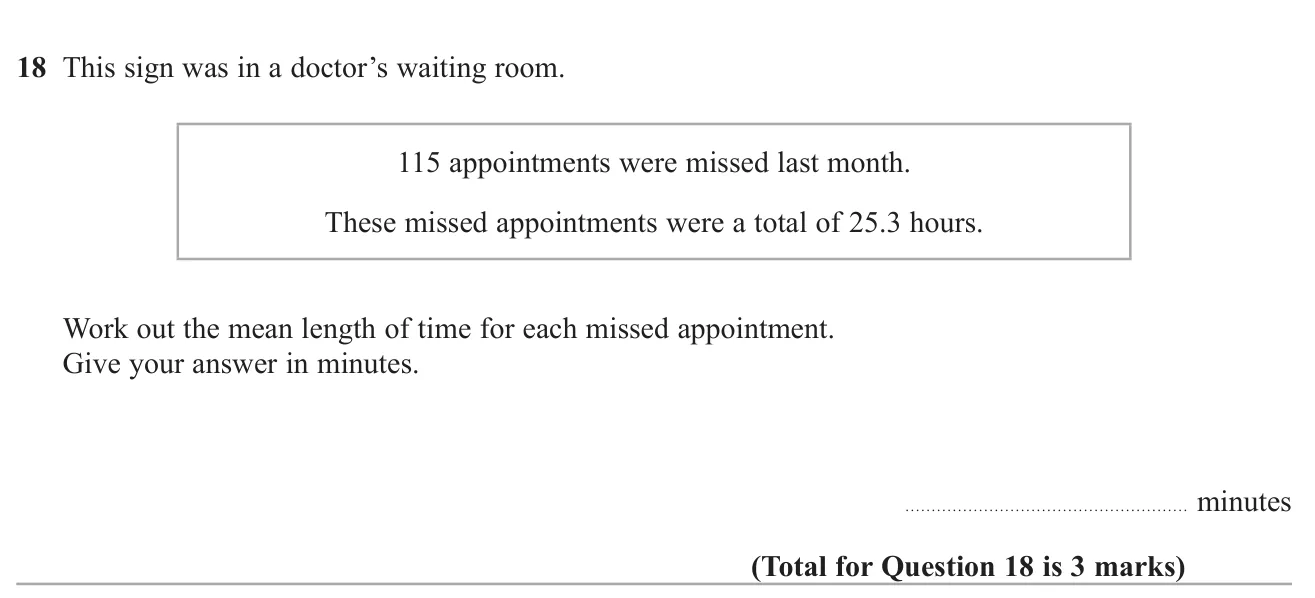
© Pearson Education Ltd. June 2022 Paper 2 (Foundation, calculator), question 18.
Show answer
| Answer | 13.2 minutes | 3 marks |
|---|
Worked solution Checked against the mark scheme
Change hours to minutes: 25.3×60=1518 minutes.
Mean: 1518÷115=13.2 minutes.
Watch out: Treating 25.3 hours as 25 hours 30 minutes.
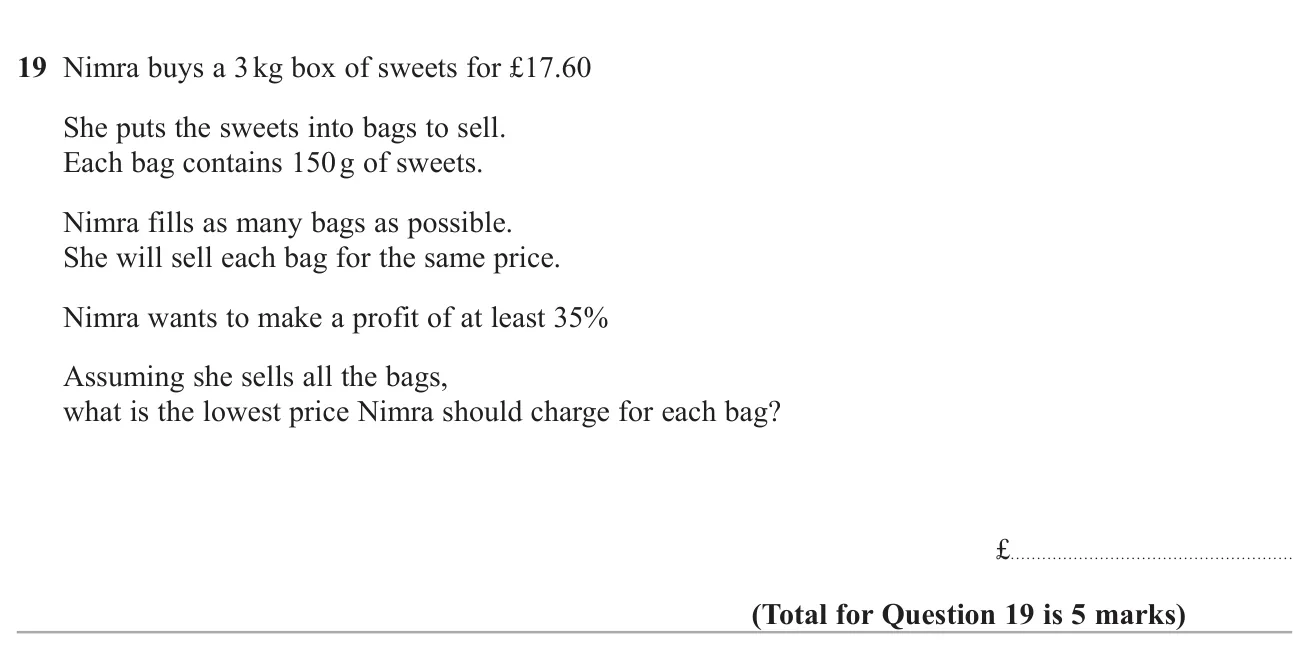
© Pearson Education Ltd. June 2022 Paper 2 (Foundation, calculator), question 19.
Show answer
Worked solution Checked against the mark scheme
Number of bags: 3000÷150=20
Total needed with 35% profit: 17.60×1.35=23.76
Price per bag: 23.76÷20=1.188
Round up so the profit is at least 35%: £1.19
Watch out: Rounding 1.188 down to 1.18, or forgetting to convert kg to g.
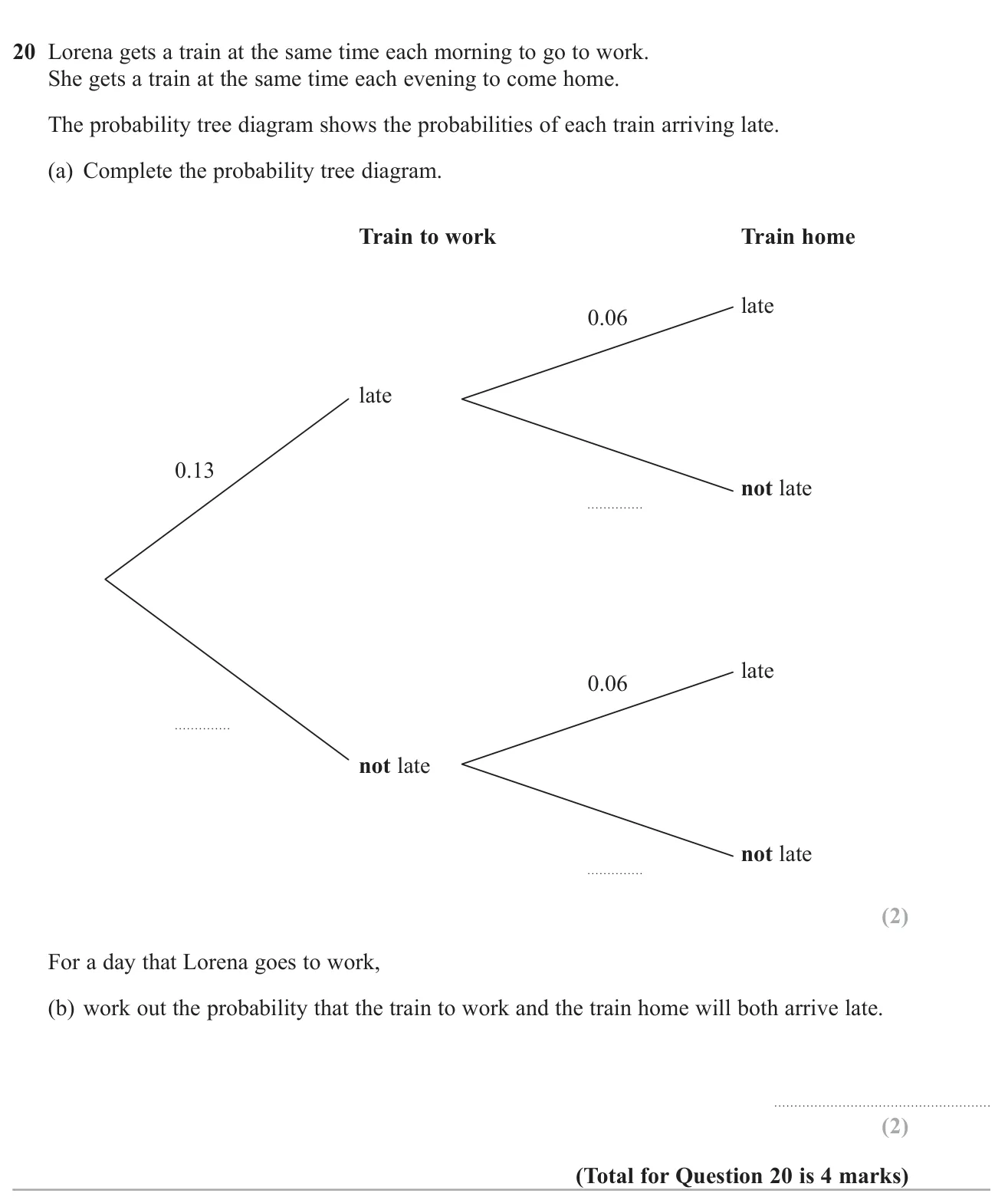
© Pearson Education Ltd. June 2022 Paper 2 (Foundation, calculator), question 20.
Show answer
| (a) | 0.87 (work, not late), 0.94 (home, not late) on both pairs | 2 marks |
|---|
| (b) | 0.0078 | 2 marks |
|---|
Worked solution Checked against the mark scheme
(a) Each pair of branches adds to 1.
Work not late: 1−0.13=0.87. Home not late: 1−0.06=0.94 on both pairs.
(b) Late and late: multiply along the branches.
0.13×0.06=0.0078
Watch out: Adding the probabilities (0.19) instead of multiplying.
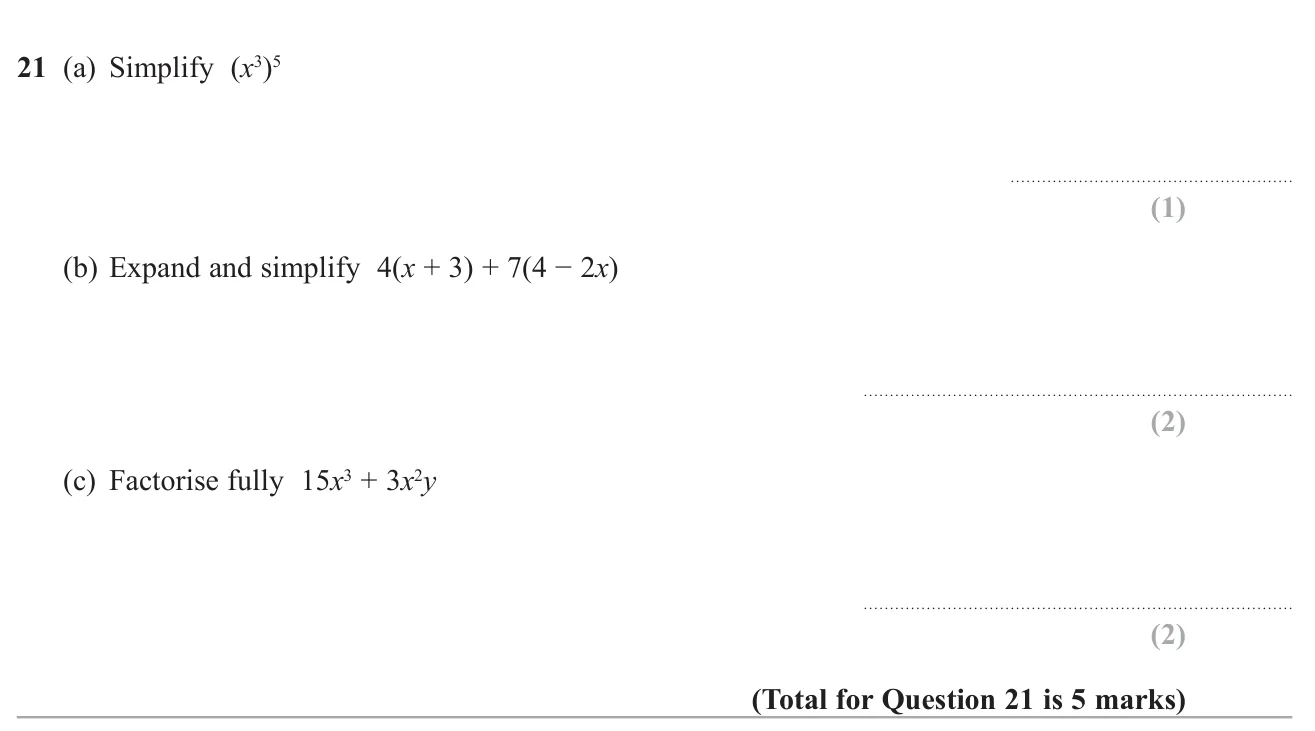
© Pearson Education Ltd. June 2022 Paper 2 (Foundation, calculator), question 21.
Show answer
| (a) | x15 | 1 mark |
|---|
| (b) | 40−10x | 2 marks |
|---|
| (c) | 3x2(5x+y) | 2 marks |
|---|
Worked solution Checked against the mark scheme
(a) Multiply the powers: (x3)5=x15
(b) 4x+12+28−14x=40−10x
(c) The HCF of 15x3 and 3x2y is 3x2.
15x3+3x2y=3x2(5x+y)
Watch out: In (a), adding the powers to get x8.
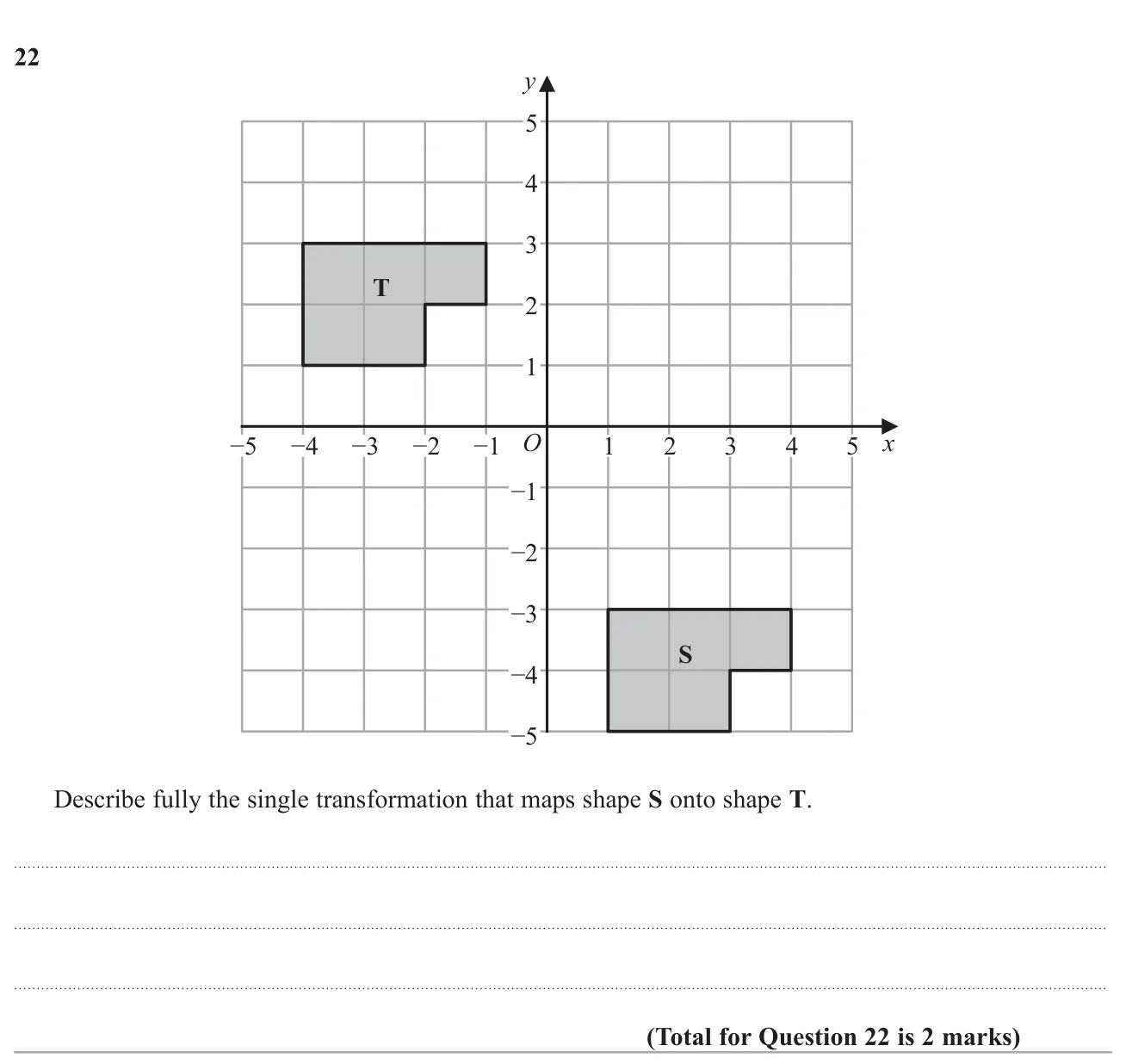
© Pearson Education Ltd. June 2022 Paper 2 (Foundation, calculator), question 22.
Show answer
| Answer | Translation by (−56) | 2 marks |
|---|
Worked solution Checked against the mark scheme
The shape is the same size and way round, so it is a translation.
Pick a corner: (1,−5) on S moves to (−4,1) on T.
That is 5 left and 6 up: translation by (−56).
Watch out: Writing the vector as a coordinate (−5, 6), or giving two transformations.
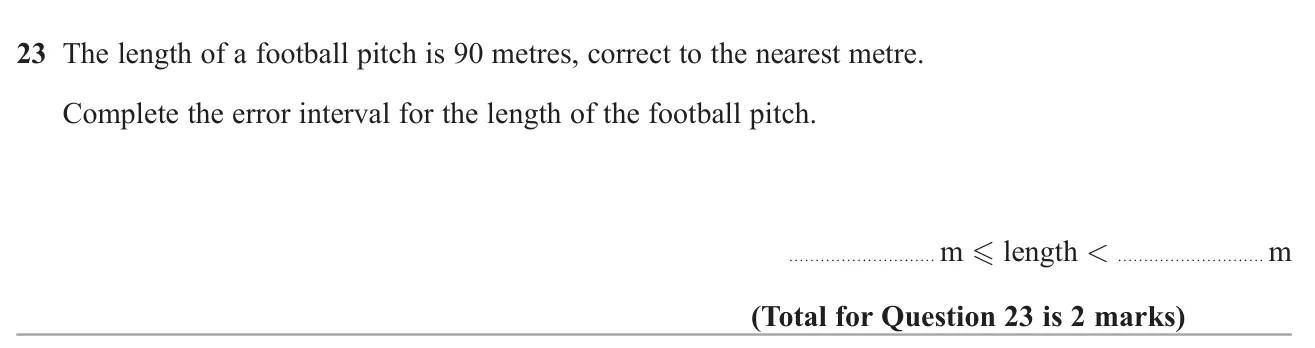
© Pearson Education Ltd. June 2022 Paper 2 (Foundation, calculator), question 23.
Show answer
| Answer | 89.5≤length<90.5 | 2 marks |
|---|
Worked solution Checked against the mark scheme
Rounded to the nearest metre, so go half a metre either side.
Lower bound: 90−0.5=89.5
Upper bound: 90+0.5=90.5
89.5≤length<90.5
Watch out: Using 89 and 91, or 89.9 and 90.9.
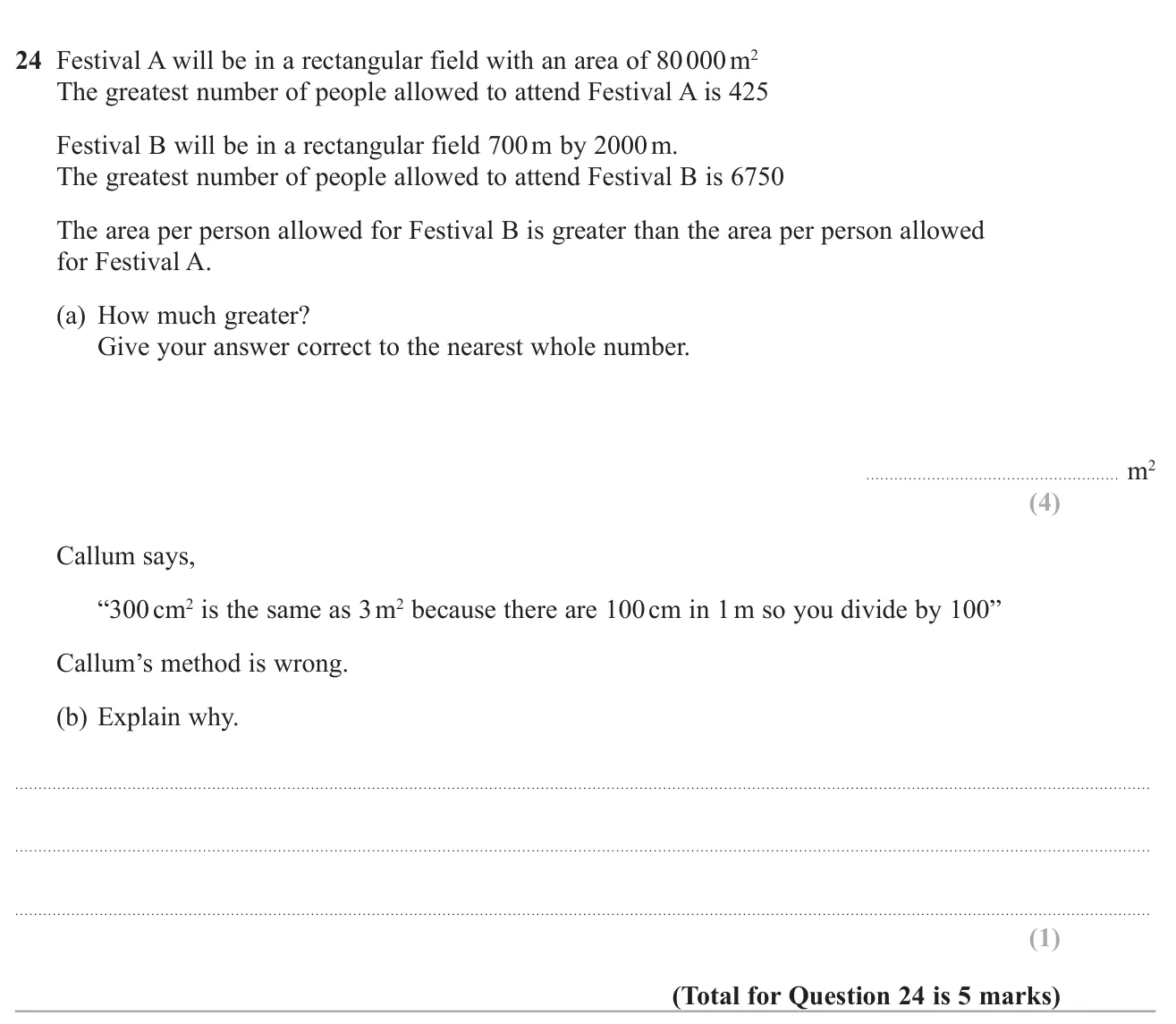
© Pearson Education Ltd. June 2022 Paper 2 (Foundation, calculator), question 24.
Show answer
| (a) | 19 m2 | 4 marks |
|---|
| (b) | 1 m² is 100 × 100 = 10 000 cm², so he should divide by 10 000, not 100 | 1 mark |
|---|
Worked solution Checked against the mark scheme
(a) Field B: 700×2000=1400000 m2
B per person: 1400000÷6750=207.4...
A per person: 80000÷425=188.2...
Difference: 207.4−188.2=19.17...≈19 m2
(b) A square metre is 100 cm×100 cm=10000 cm2, so 300 cm2=0.03 m2.
Watch out: Dividing people by area instead of area by people.
Question 25
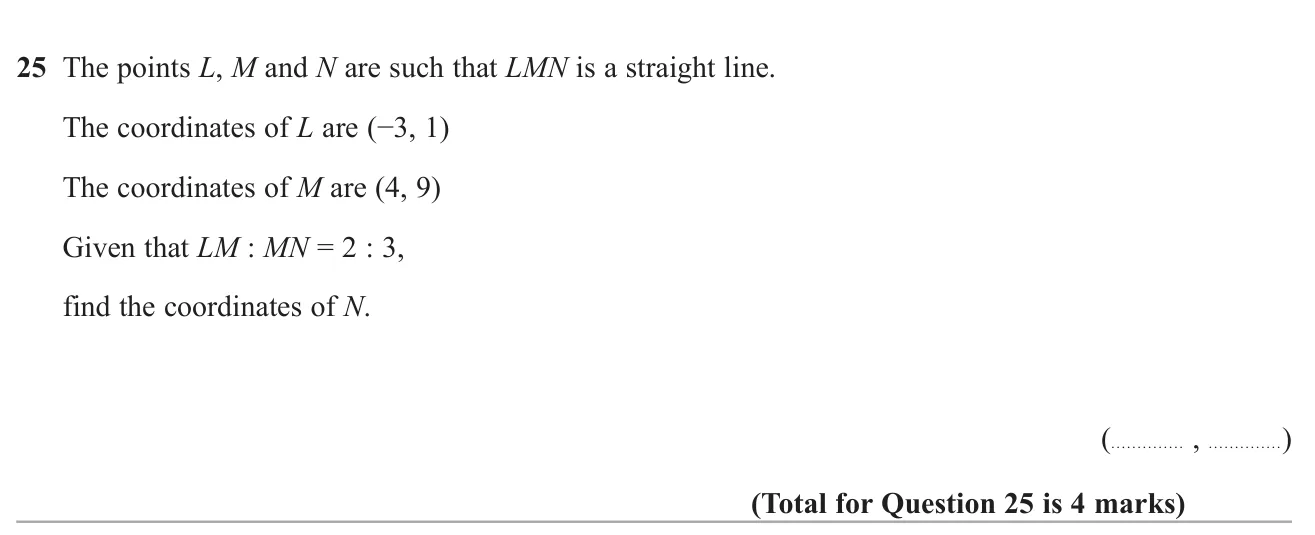
Ratio4 marksGrade 5CalculatorOn both tiers © Pearson Education Ltd. June 2022 Paper 2 (Foundation, calculator), question 25.
Show answer
| Answer | (14.5,21) | 4 marks |
|---|
Worked solution Checked against the mark scheme
From L to M: x goes up 4−(−3)=7, y goes up 9−1=8. This is 2 parts.
One part: x up 3.5, y up 4.
MN is 3 parts: x up 10.5, y up 12.
N=(4+10.5, 9+12)=(14.5,21)
Watch out: Adding the three-part distance to L instead of to M.
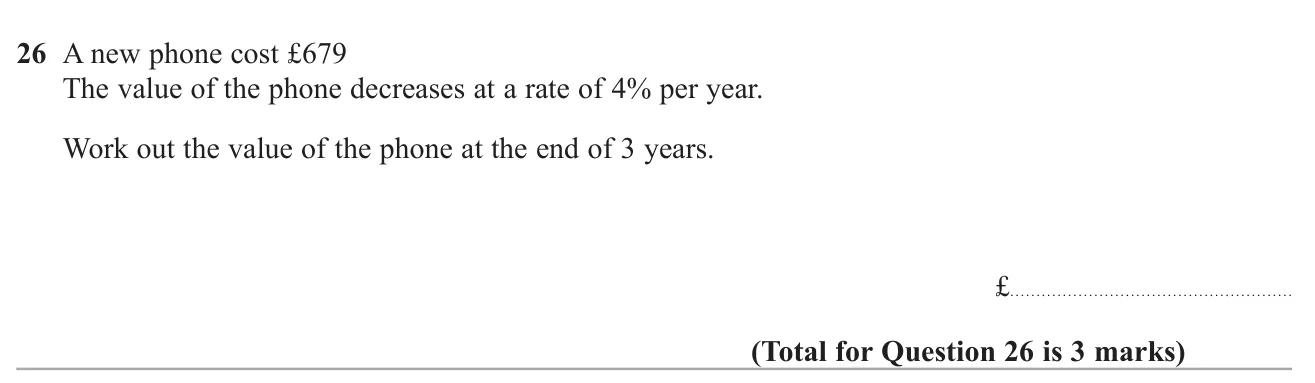
© Pearson Education Ltd. June 2022 Paper 2 (Foundation, calculator), question 26.
Show answer
Worked solution Checked against the mark scheme
The multiplier for a 4% decrease is 0.96.
679×0.963=600.7357...
Value after 3 years: £600.74
Watch out: Using simple depreciation: 679−3×27.16=597.52.
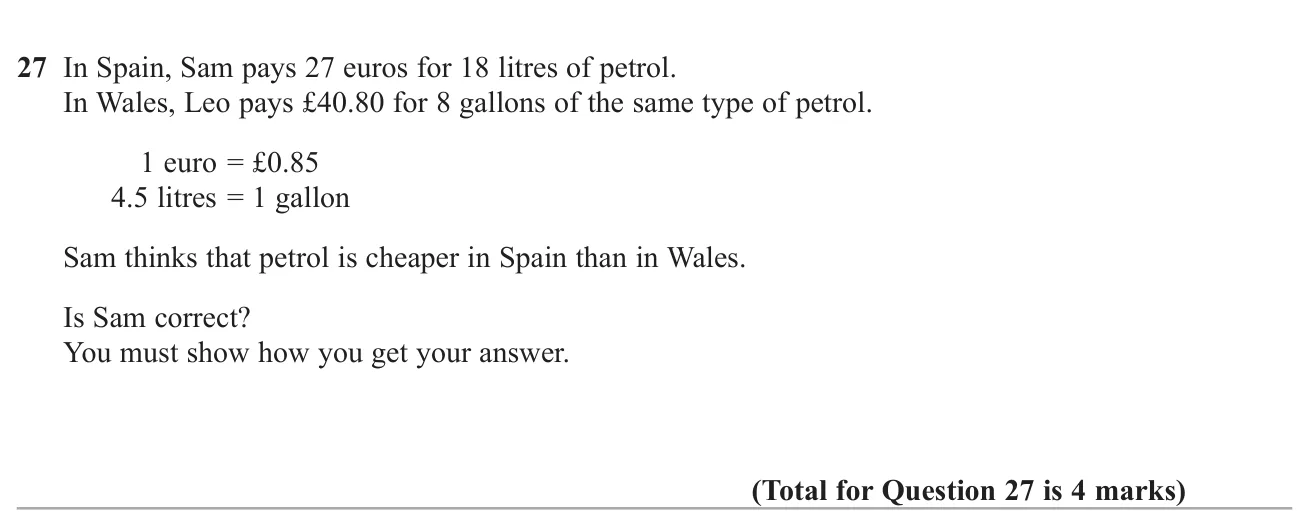
© Pearson Education Ltd. June 2022 Paper 2 (Foundation, calculator), question 27.
Show answer
| Answer | No: Spain £1.275 per litre, Wales about £1.13 per litre | 4 marks |
|---|
Worked solution Checked against the mark scheme
Spain in £: 27×0.85=22.95, so per litre 22.95÷18=1.275.
Wales: 8×4.5=36 litres, so per litre 40.80÷36=1.133...
£1.13 < £1.275, so petrol is cheaper in Wales. Sam is not correct.
Watch out: Converting euros to pounds by dividing by 0.85 instead of multiplying.
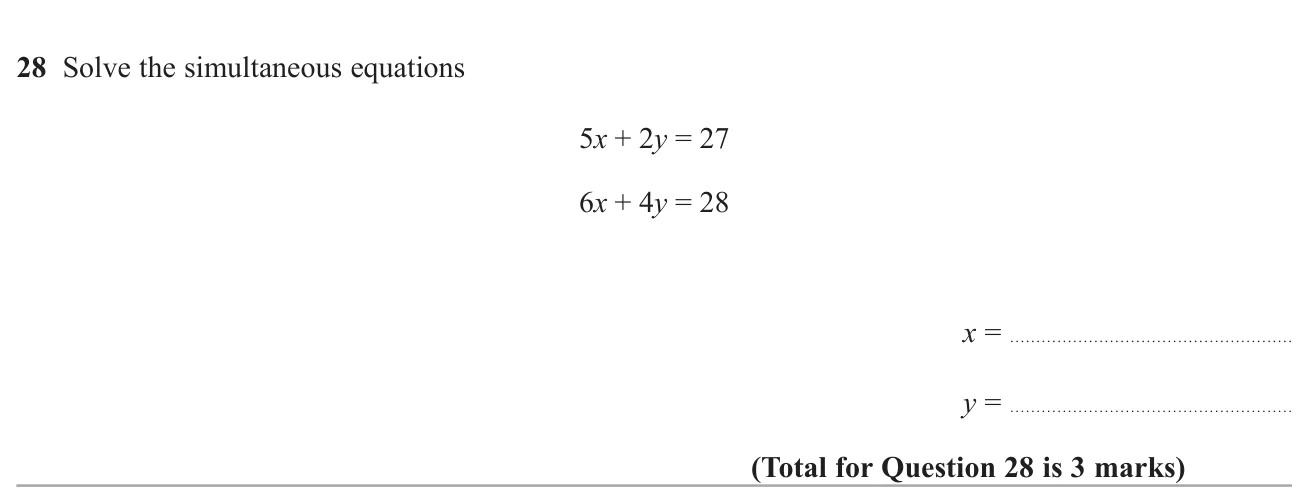
© Pearson Education Ltd. June 2022 Paper 2 (Foundation, calculator), question 28.
Show answer
| Answer | x=6.5, y=−2.75 | 3 marks |
|---|
Worked solution Checked against the mark scheme
Double the first equation: 10x+4y=54
Subtract the second: (10x+4y)−(6x+4y)=54−28, so 4x=26 and x=6.5
Substitute: 5(6.5)+2y=27, so 2y=−5.5 and y=−2.75
Watch out: Adding the equations instead of subtracting when the signs are the same.
Finished the paper?
Add up your marks for all three papers and see what grade that would have been.