Ratio, proportion and rates of change

Gradients and rates of change

9 past-paper questions, easiest first. Try each one, then reveal the answer.

Foundation & Higher1 of 9 from Foundation papers

Revision guide by The Full Marks

Gradients and rates of change: what you need to know

The gradient of a graph tells you how fast one quantity changes compared with another, such as speed on a distance–time graph. Foundation students read gradients from straight lines; Higher students also estimate them on curves.

Foundation students interpret gradients of straight lines; chords, tangents and instantaneous rates on curves are Higher only.

Key facts

  • Gradient =change in ychange in x= \dfrac{\text{change in } y}{\text{change in } x}, with the units 'yy units per xx unit'.
  • On a distance–time graph the gradient is speed; on a speed–time graph it is acceleration.
  • A negative gradient means the quantity is decreasing.
  • Higher: a chord between two points on a curve gives the average rate of change.
  • Higher: a tangent at a point gives the instantaneous rate of change at that moment.

Gradient of a straight line

  1. Pick two points on the line far apart.
  2. Work out the change in yy and the change in xx.
  3. Divide, then say what it means in context with units.

Rate of change on a curve (Higher only)

  1. Draw a tangent that just touches the curve at the point, with a ruler.
  2. Pick two points far apart on your tangent.
  3. Find its gradient; state the answer as an estimate with units.

Worked examples

Example 1 Foundation · grade 5

A straight-line graph shows the water in a tank falling from 600600 litres at 00 minutes to 150150 litres at 1515 minutes. Find the gradient and explain what it means.

Show the solution

Change in volume =150−600=−450= 150 - 600 = -450 litres
Change in time =15= 15 minutes
Gradient =−450÷15=−30= -450 \div 15 = -30
The water flows out of the tank at 3030 litres per minute.

Example 2 Higher · grade 7

A distance–time curve starts at (0,0)(0, 0) and passes through (4,20)(4, 20), where distance is in metres and time in seconds. A tangent drawn at t=4t = 4 passes through (1,2)(1, 2) and (7,38)(7, 38). (a) Estimate the speed at t=4t = 4. (b) Find the average speed over the first 44 seconds.

Show the solution

(a) Gradient of tangent =38−27−1=366=6= \frac{38 - 2}{7 - 1} = \frac{36}{6} = 6
Speed at t=4t = 4 is about 66 m/s
(b) Chord from (0,0)(0, 0) to (4,20)(4, 20): 20÷4=520 \div 4 = 5 m/s

Common mistakes

  • Dividing a single reading by the time (e.g. 20÷420 \div 4) when the question wants a tangent. That's an average, not the instantaneous rate.
  • Describing a gradient vaguely ('it goes down'). Give the rate with units.
  • Drawing a tangent that cuts through the curve. It should just touch at that point.

Exam tips

  • Draw your tangent long and pick far-apart points; answers within a range get the marks.
  • For 'what does the gradient represent', answer in context: 'the rate the water flows out, in litres per minute'.

Questions people ask

What does the gradient of a distance–time graph show?

The speed. A steeper line means faster, and a flat line means stopped.

How do you find the rate of change on a curved graph?

Draw a tangent at the point you want and work out its gradient. This is Higher tier.

Exam questions: Gradients and rates of change (9, easiest first)

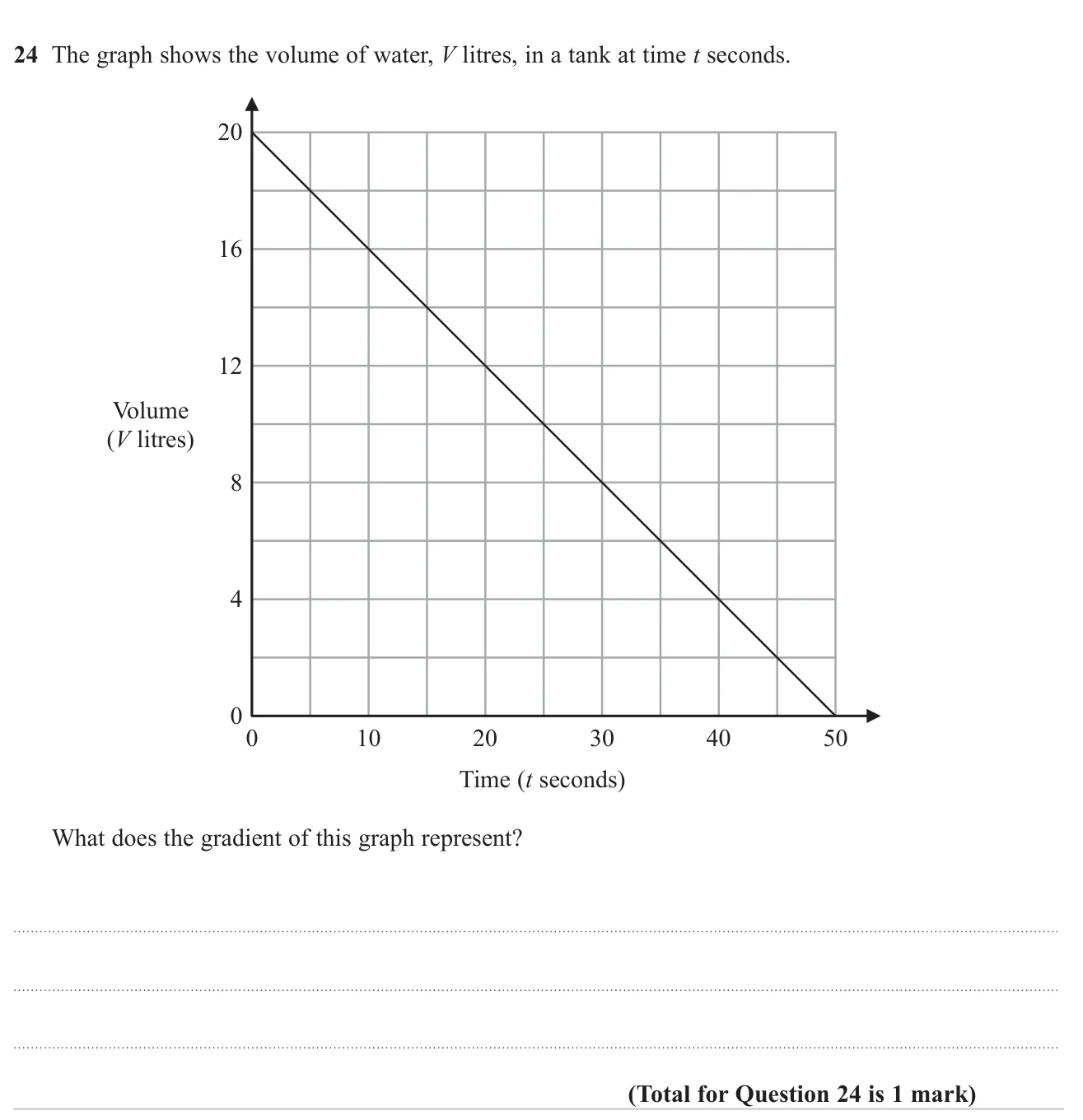
Gradients and rates of change1 markGrade 5No calculatorOn both tiers
November 2024 · Paper 1 Foundation · Q24
Interpret the gradient of a volume–time graph in context.

© Pearson Education Ltd. November 2024 Paper 1 (Foundation, non-calculator), question 24.

Show answer
AnswerThe rate at which the volume of water changes (litres leaving per second)1 mark

Worked solution Checked against the mark scheme

The gradient is change in volume ÷ change in time.

Here −20÷50=−0.4-20 \div 50 = -0.4, so water leaves the tank at 0.4 litres per second: the rate of change of volume.

Watch out: Saying 'negative correlation' or just 'the volume goes down'.
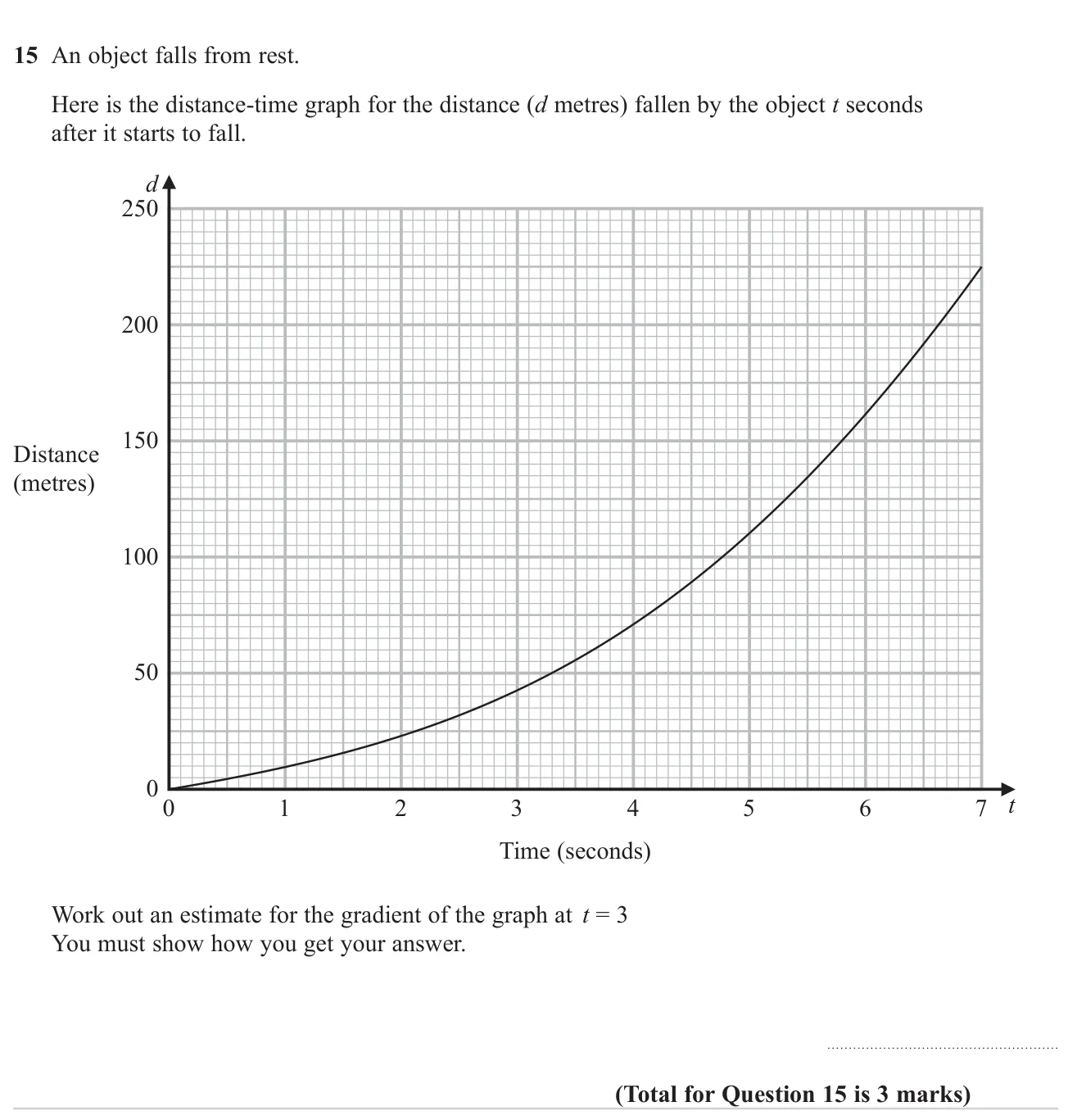
Gradients and rates of change3 marksGrade 7No calculatorHigher
November 2023 · Paper 1 Higher · Q15
Estimate the gradient of a curved distance-time graph at a given time by drawing a tangent.

© Pearson Education Ltd. November 2023 Paper 1 (Higher, non-calculator), question 15.

Show answer
Answer2525 (accept 22 to 28)3 marks

Worked solution Checked against the mark scheme

Draw a tangent touching the curve at t=3t = 3 (where d≈42d \approx 42).

Pick two points on the tangent, for example (2,17)(2, 17) and (4,67)(4, 67).

Gradient ≈67−174−2=502=25\approx \frac{67 - 17}{4 - 2} = \frac{50}{2} = 25 (metres per second)

Watch out: Using a chord from the origin (42 ÷ 3) instead of a tangent.

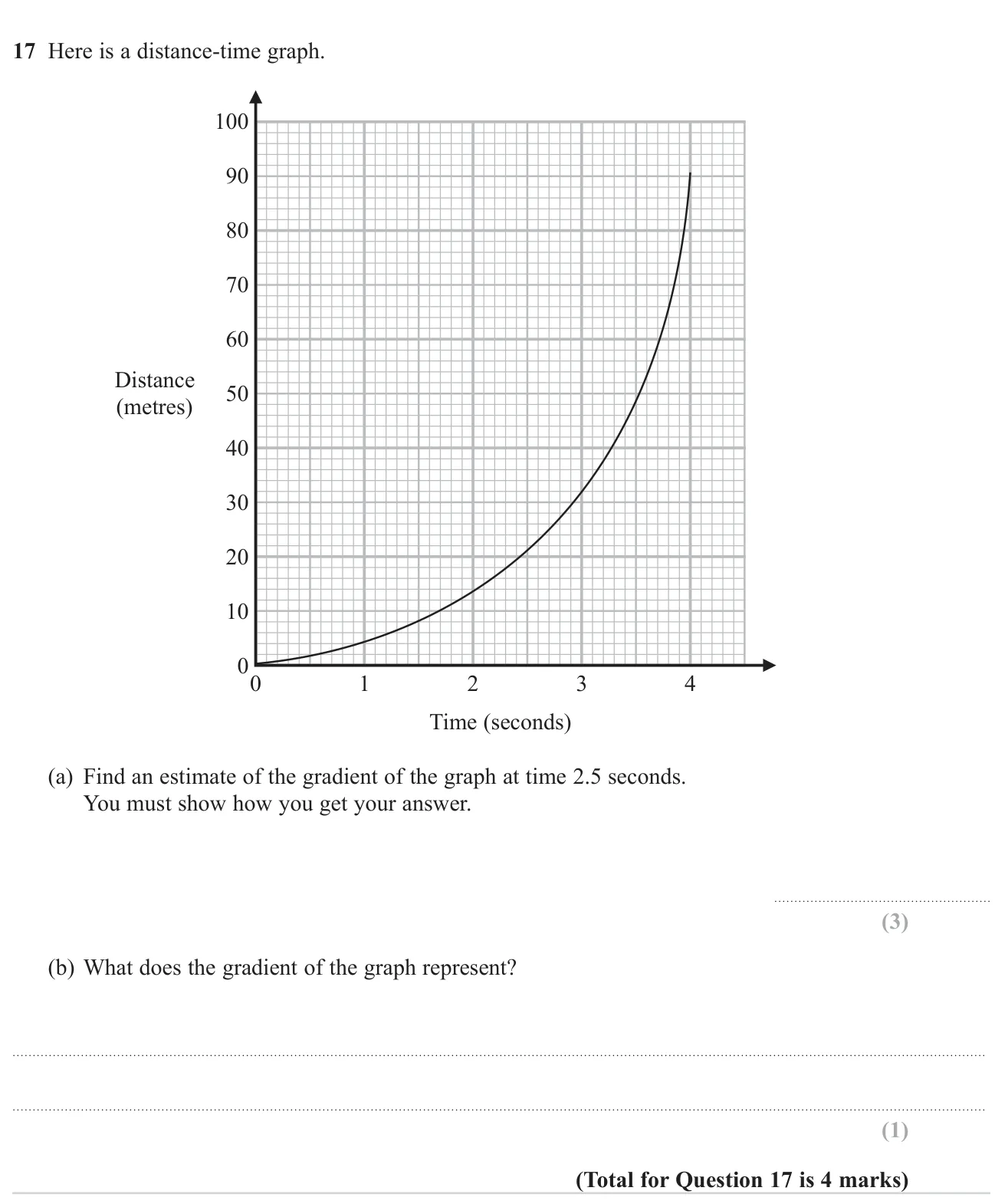
Gradients and rates of change4 marksGrade 7CalculatorHigher
June 2023 · Paper 3 Higher · Q17
Draw a tangent to a distance-time curve to estimate its gradient, and say what the gradient means.

© Pearson Education Ltd. June 2023 Paper 3 (Higher, calculator), question 17.

Show answer
(a)About 18 (accept 16.5 to 19.5)3 marks
(b)The speed (in m/s) at that time1 mark

Worked solution Checked against the mark scheme

(a) Draw a straight line touching the curve at t=2.5t = 2.5 (where the distance is about 21 m).

Pick two points on the tangent, e.g. (1.4,0)(1.4, 0) and (4,48)(4, 48).

Gradient =48−04−1.4≈18= \dfrac{48 - 0}{4 - 1.4} \approx 18

(b) Distance ÷ time is speed, so the gradient is the speed at 2.5 seconds, about 18 m/s.

Watch out: Using a chord between two points on the curve instead of a tangent, or reading the distance at 2.5 s.

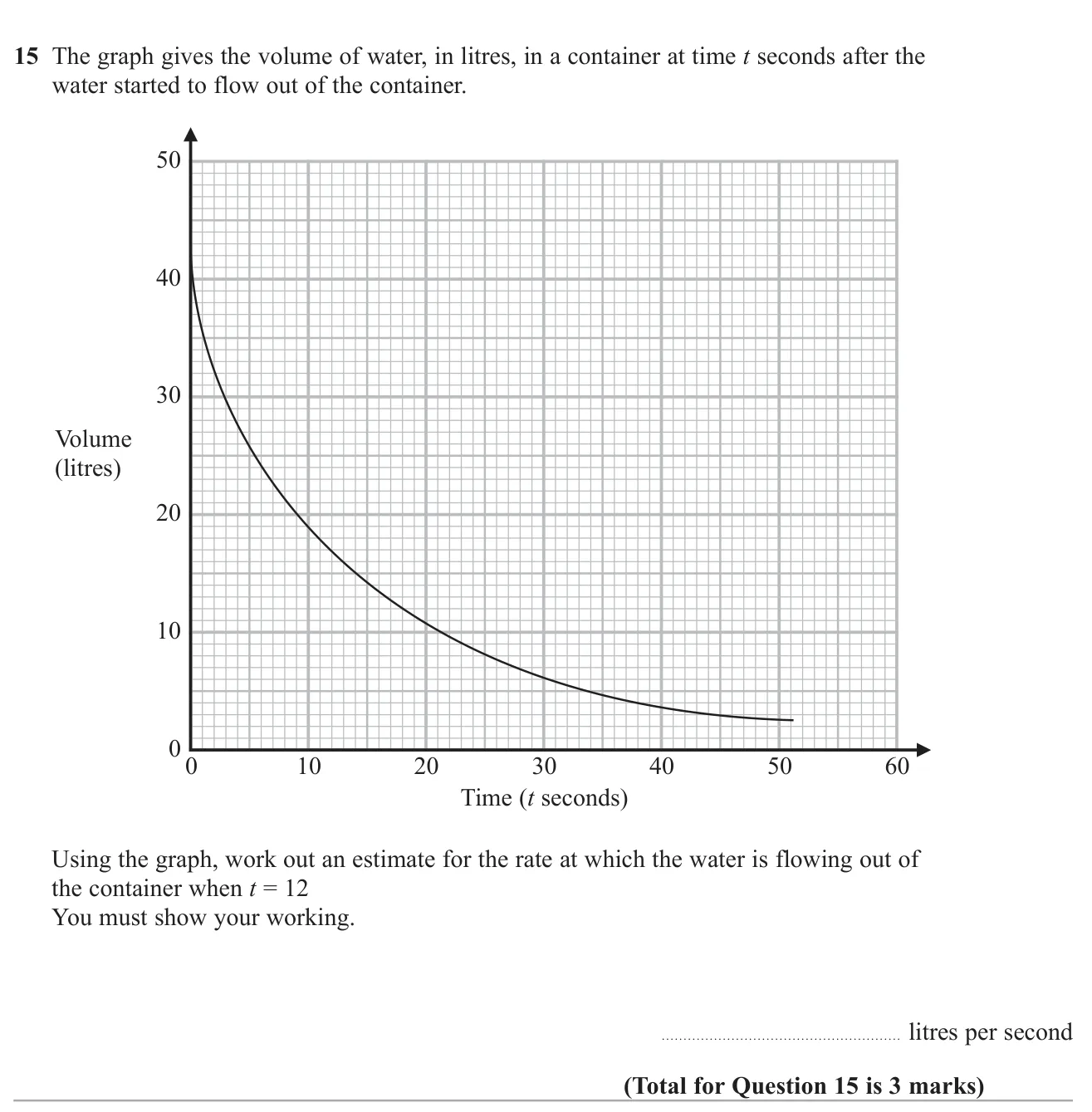
Gradients and rates of change3 marksGrade 7CalculatorHigher
November 2021 · Paper 3 Higher · Q15
Estimate the instantaneous rate of flow from a volume–time curve by drawing a tangent and finding its gradient.

© Pearson Education Ltd. November 2021 Paper 3 (Higher, calculator), question 15.

Show answer
AnswerAbout 0.90.9 litres per second (accept 0.70.7 to 1.11.1)3 marks

Worked solution Checked against the mark scheme

Draw a tangent to the curve at t=12t = 12 (where the volume is about 17 litres).

Pick two points far apart on the tangent, e.g. the tangent drops about 28 litres over 30 seconds.

Gradient ≈28÷30≈0.93\approx 28 \div 30 \approx 0.93, so water flows out at about 0.90.9 litres per second.

Watch out: Dividing the volume at t = 12 by 12 (an average rate) instead of drawing a tangent.

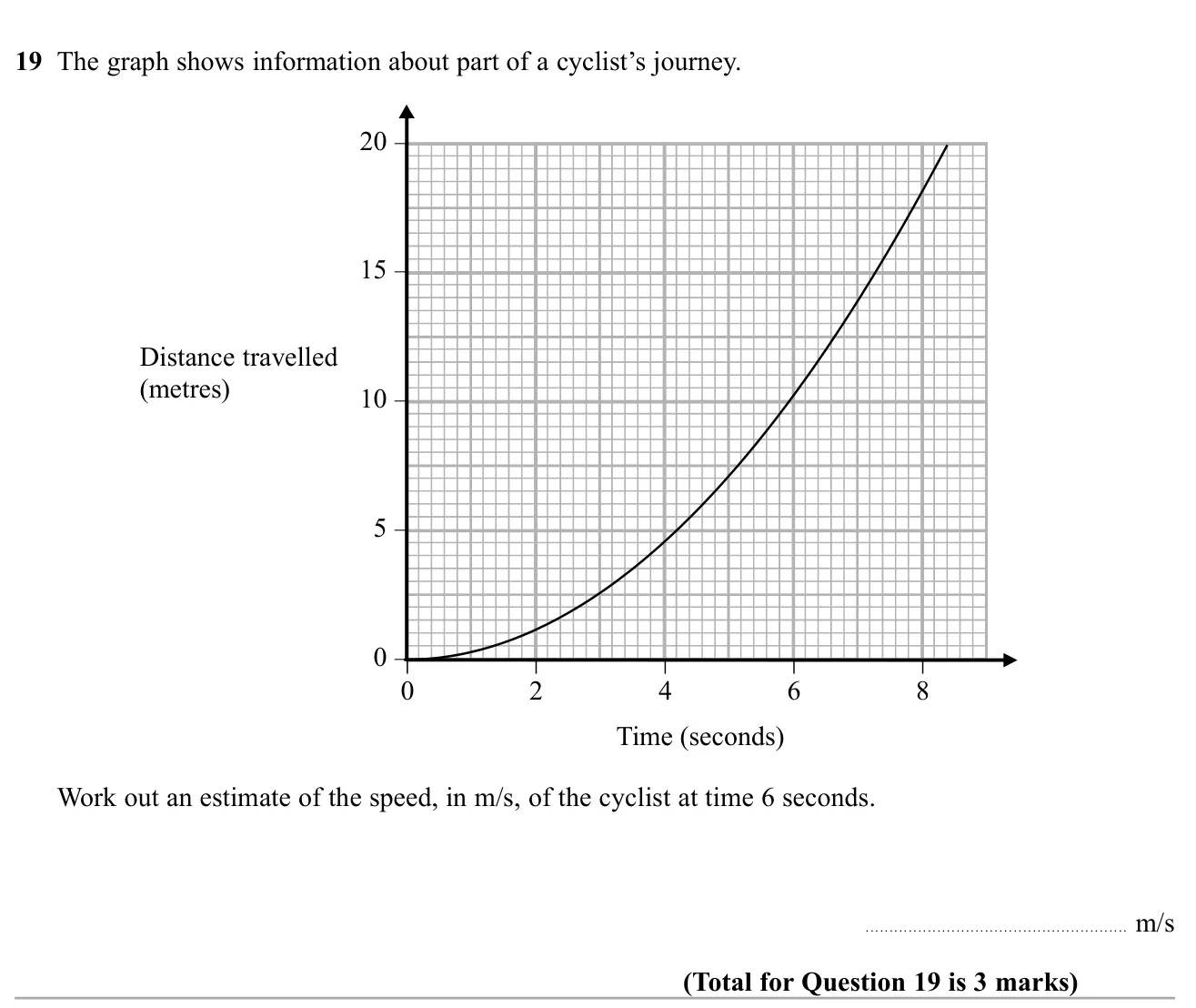
Gradients and rates of change3 marksGrade 7CalculatorHigher
November 2019 · Paper 3 Higher · Q19
Draw a tangent to a distance–time curve to estimate the speed at a given time.

© Pearson Education Ltd. November 2019 Paper 3 (Higher, calculator), question 19.

Show answer
AnswerAbout 3.43.4 m/s (3.05 to 3.7)3 marks

Worked solution Checked against the mark scheme

Draw a tangent touching the curve at t=6t = 6 (where the distance is about 10 m).

Pick two points on the tangent, e.g. it rises about 20 m over about 5.8 s.

Speed =20÷5.8≈3.4= 20 \div 5.8 \approx 3.4 m/s

Watch out: Dividing 10 by 6 (average speed from the start) instead of using a tangent.

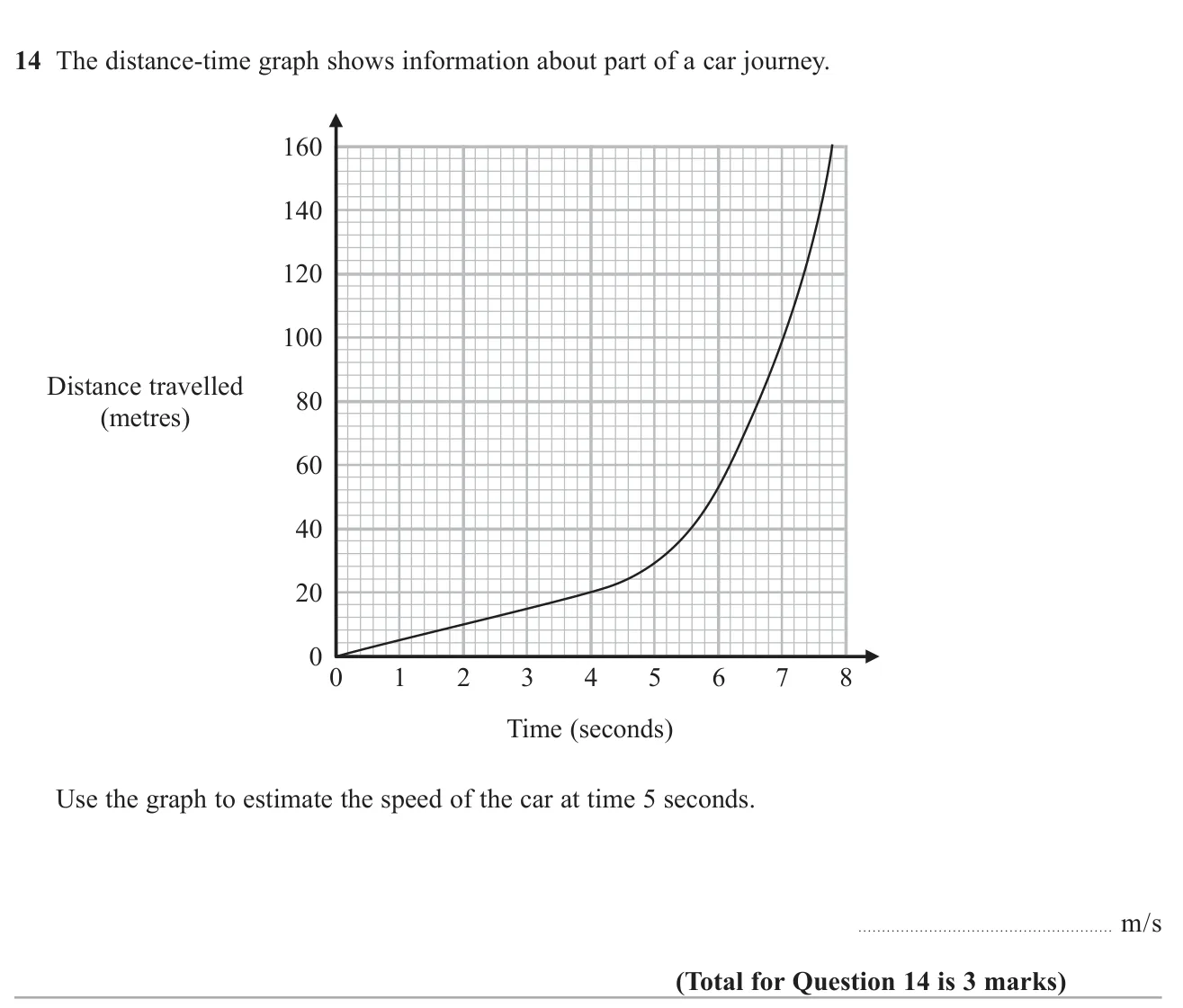
Gradients and rates of change3 marksGrade 7CalculatorHigher
June 2018 · Paper 2 Higher · Q14
Estimate the speed at a given time by drawing a tangent to a distance-time curve.

© Pearson Education Ltd. June 2018 Paper 2 (Higher, calculator), question 14.

Show answer
AnswerAbout 1515 m/s (11 to 19 accepted)3 marks

Worked solution Checked against the mark scheme

Draw a tangent to the curve at t=5t = 5.

Pick two points far apart on the tangent and find rise ÷ run, e.g. a rise of about 60 m over 4 s.

Speed ≈60÷4=15\approx 60 \div 4 = 15 m/s

Watch out: Dividing distance by time at t=5t = 5 (about 30 ÷ 5) instead of using a tangent.

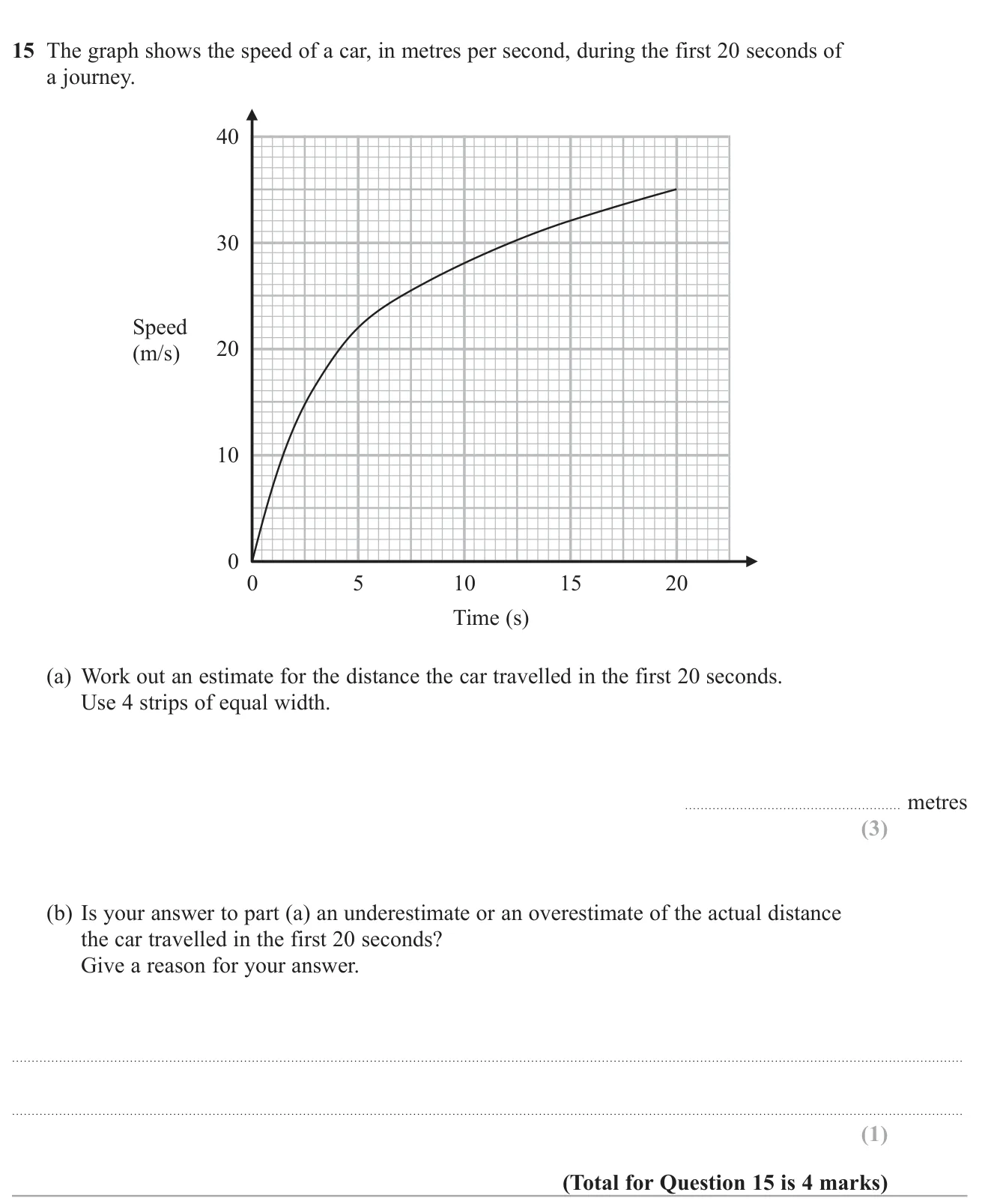
Gradients and rates of change4 marksGrade 7CalculatorHigher
June 2018 · Paper 3 Higher · Q15
Estimate the distance travelled from a speed–time curve using four strips, and say whether the estimate is too high or too low.

© Pearson Education Ltd. June 2018 Paper 3 (Higher, calculator), question 15.

Show answer
(a)About 498 m (488 to 507)3 marks
(b)Underestimate: the curve bends above the straight tops of the trapezia, so area under the curve is missed1 mark

Worked solution Checked against the mark scheme

(a) Read speeds at 0, 5, 10, 15, 20 s: 0, 22, 28, 32, 35 m/s.

Each strip is a trapezium of width 5:

2.5(0+22)+2.5(22+28)+2.5(28+32)+2.5(32+35)2.5(0+22) + 2.5(22+28) + 2.5(28+32) + 2.5(32+35)

=55+125+150+167.5=497.5= 55 + 125 + 150 + 167.5 = 497.5 m

(b) The curve bulges above the straight lines joining the points, so the trapezia leave out some area. It is an underestimate.

Watch out: Forgetting that the first strip starts at a speed of 0, or using a strip width of 4 instead of 5.

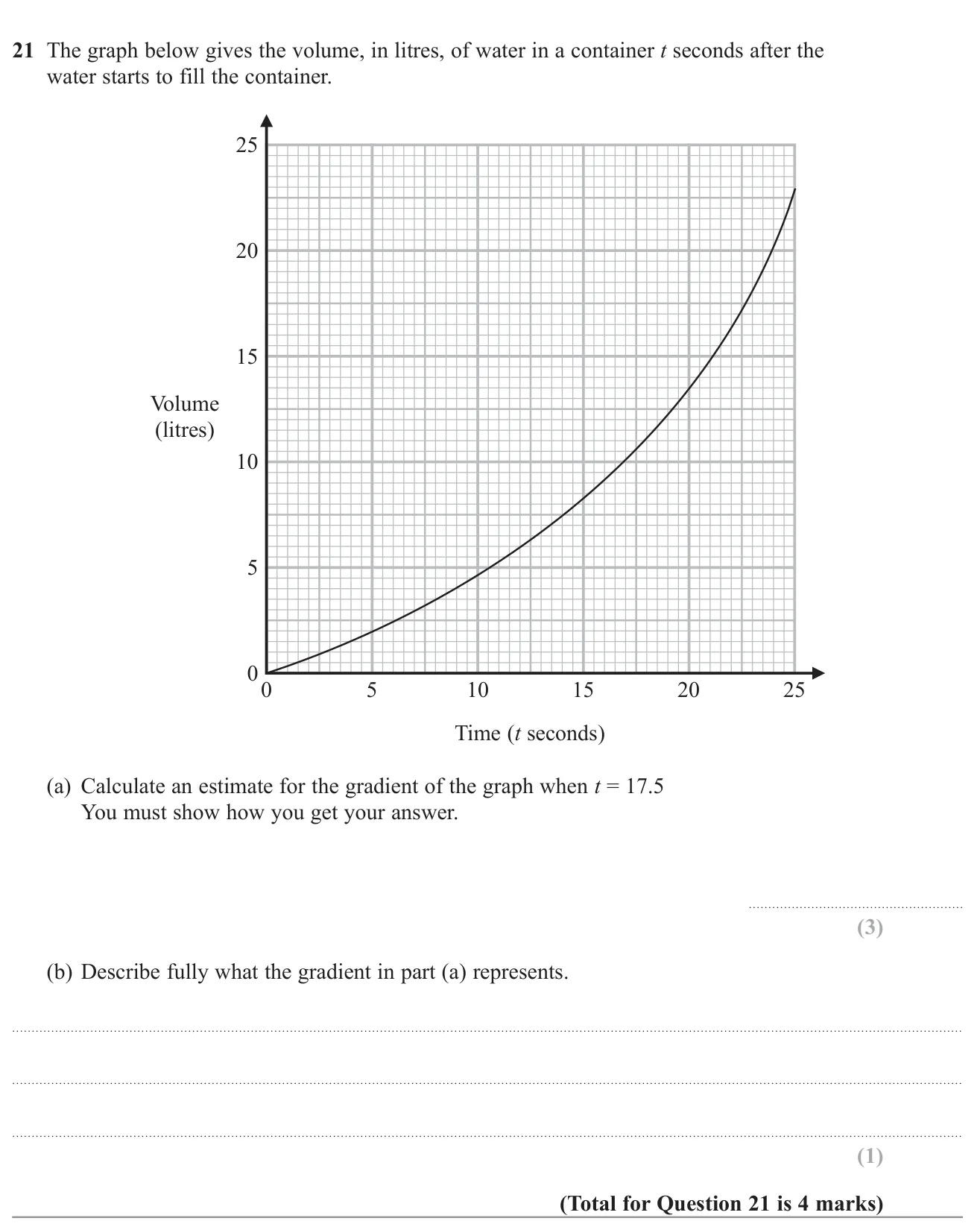
Gradients and rates of change4 marksGrade 8CalculatorHigher
November 2022 · Paper 2 Higher · Q21
Draw a tangent to a curved volume–time graph to estimate its gradient, then interpret what the gradient means.

© Pearson Education Ltd. November 2022 Paper 2 (Higher, calculator), question 21.

Show answer
(a)About 1.061.063 marks
(b)The rate at which the volume of water increases, in litres per second, at 17.5 seconds1 mark

Worked solution Checked against the mark scheme

(a) Draw a tangent touching the curve at t=17.5t = 17.5.

Pick two points on it far apart and work out rise ÷ run, e.g. 18.517.5≈1.06\frac{18.5}{17.5} \approx 1.06

(b) It is the rate the container fills: about 1.06 litres per second at t=17.5t = 17.5.

Watch out: Using a chord from the origin, 10.5 ÷ 17.5, which scores nothing.

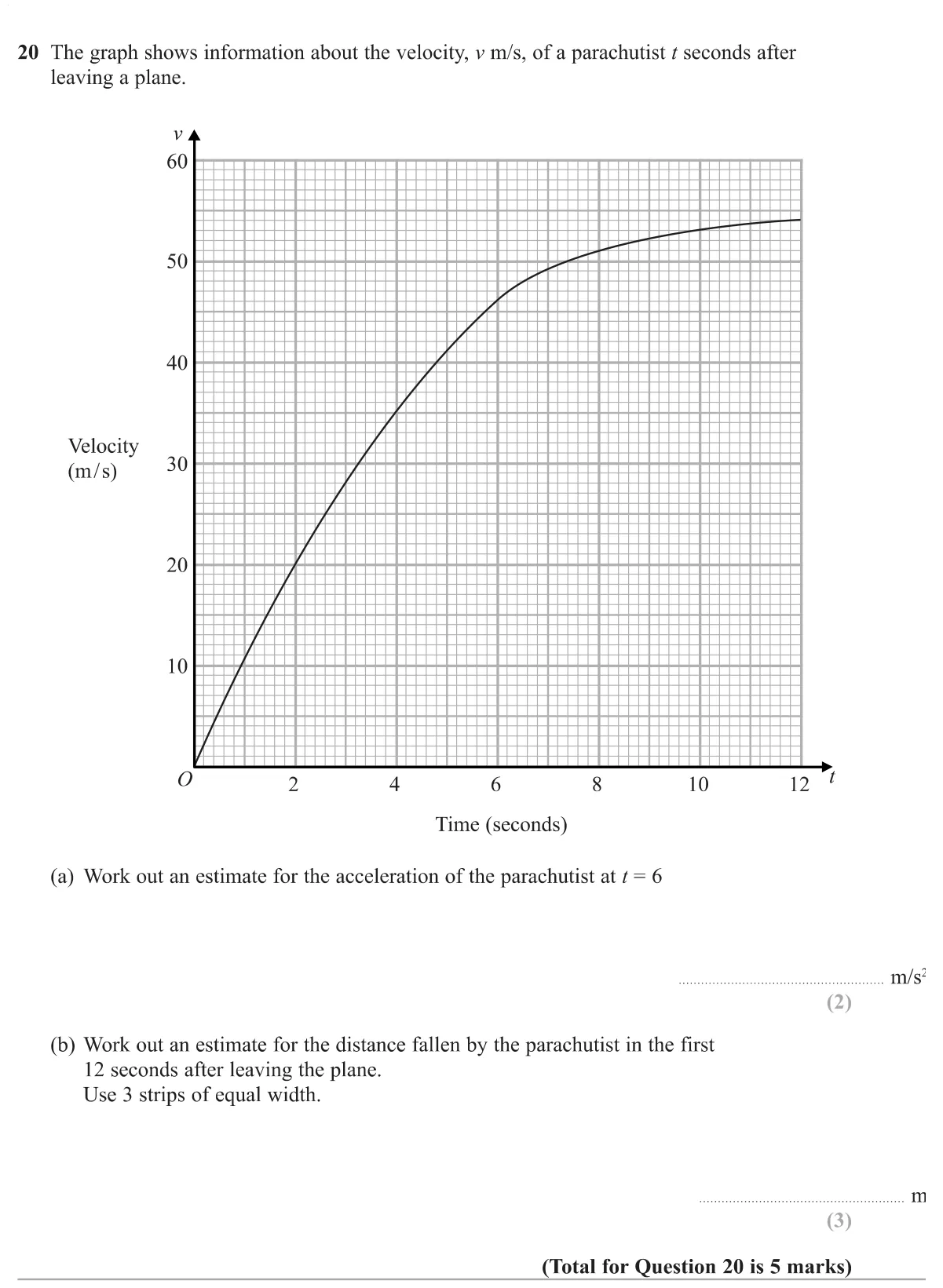
Gradients and rates of change5 marksGrade 8CalculatorHigher
Specimen · Paper 2 Higher · Q20
Estimate an acceleration from a tangent to a velocity-time curve and the distance fallen using three trapezium strips.

© Pearson Education Ltd. Specimen Paper 2 (Higher, calculator), question 20.

Show answer
(a)Between 3 and 4 m/s²2 marks
(b)452 m3 marks

Worked solution Checked against the mark scheme

(a) Draw a tangent at t=6t = 6 and find rise ÷ run, e.g. from about (2, 32) to (10, 60): 28÷8=3.528 \div 8 = 3.5 m/s².

(b) Strips of width 4: v(0)=0, v(4)=35, v(8)=51, v(12)=54v(0) = 0,\ v(4) = 35,\ v(8) = 51,\ v(12) = 54

42(0+35)=70\frac{4}{2}(0 + 35) = 70

42(35+51)=172\frac{4}{2}(35 + 51) = 172

42(51+54)=210\frac{4}{2}(51 + 54) = 210

Total =70+172+210=452= 70 + 172 + 210 = 452 m

Watch out: In (a), using a chord from the origin to (6, 46) instead of a tangent.

Also tested in these questions

Their main topic is different, but part of each one tests this topic.