Revision guide by The Full Marks
Direct and inverse proportion: what you need to know Two quantities are in direct proportion when one doubles as the other doubles, like cost and number of items. In inverse proportion one halves as the other doubles, like workers and time taken. Recipes, best buys and 'how long will it take' questions all use it.
Everyone needs the unitary method, the graph shapes and using a proportion formula you are given; forming equations with k k k
Key facts Direct: y ∝ x y \propto x y ∝ x y = k x y = kx y = k x Inverse: y ∝ 1 x y \propto \frac{1}{x} y ∝ x 1 y = k x y = \frac{k}{x} y = x k Higher: proportion can involve powers or roots, e.g. y = k x 2 y = kx^2 y = k x 2 y = k x 2 y = \frac{k}{x^2} y = x 2 k y = k x y = k\sqrt{x} y = k x Higher: if y = k x 2 y = kx^2 y = k x 2 x x x y y y 2 2 = 4 2^2 = 4 2 2 = 4 y = k x y = k\sqrt{x} y = k x x x x y y y 1.44 = 1.2 \sqrt{1.44} = 1.2 1.44 = 1.2 k k k Unitary method (Foundation and Higher) Direct: divide to find the value for 1, then multiply. Inverse: multiply to find the total amount of work (e.g. worker-days), then divide. Forming an equation (Higher only) Write the relationship with k k k y = k x 2 y = \frac{k}{x^2} y = x 2 k Substitute the known pair to find k k k Write the full equation, then use it to find the unknown. If two proportion statements are linked, find each equation separately, then substitute one into the other. Worked examples Example 1 Foundation · grade 4
(a) 5 5 5 8 8 8 6 6 6 10 10 10 4 4 4
Show the solution (a) One notebook = 7.40 ÷ 5 = £ 1.48 = 7.40 \div 5 = £1.48 = 7.40 ÷ 5 = £1.48 8 × 1.48 = £ 11.84 8 \times 1.48 = £11.84 8 × 1.48 = £11.84 = 6 × 10 = 60 = 6 \times 10 = 60 = 6 × 10 = 60 60 ÷ 4 = 15 60 \div 4 = 15 60 ÷ 4 = 15
Example 2 Higher · grade 7
y y y x 2 x^2 x 2 x = 4 x = 4 x = 4 y = 5 y = 5 y = 5 y y y x = 10 x = 10 x = 10 x x x y = 20 y = 20 y = 20 x > 0 x > 0 x > 0
Show the solution y = k x 2 y = \frac{k}{x^2} y = x 2 k 5 = k 16 5 = \frac{k}{16} 5 = 16 k k = 80 k = 80 k = 80 y = 80 100 = 0.8 y = \frac{80}{100} = 0.8 y = 100 80 = 0.8 20 = 80 x 2 20 = \frac{80}{x^2} 20 = x 2 80 x 2 = 4 x^2 = 4 x 2 = 4 x = 2 x = 2 x = 2
Common mistakes Treating inverse proportion as direct: fewer workers means more time, not less. Forgetting the square or root when forming the equation, e.g. using k x \frac{k}{x} x k k x 2 \frac{k}{x^2} x 2 k Sketching direct proportion as a line that misses the origin. Squaring only the letter: if x x x 2 a 2a 2 a x 3 = ( 2 a ) 3 = 8 a 3 x^3 = (2a)^3 = 8a^3 x 3 = ( 2 a ) 3 = 8 a 3 2 a 3 2a^3 2 a 3 Exam tips Finding k k k k k k Some questions ask for an assumption, e.g. 'all painters work at the same rate'. Questions people ask What is the difference between direct and inverse proportion? In direct proportion both quantities go up together in the same ratio, so their quotient stays the same. In inverse proportion, as one goes up the other goes down so that their product stays the same.
What does the graph of direct proportion look like? A straight line through the origin. Inverse proportion gives a curve that never touches either axis.
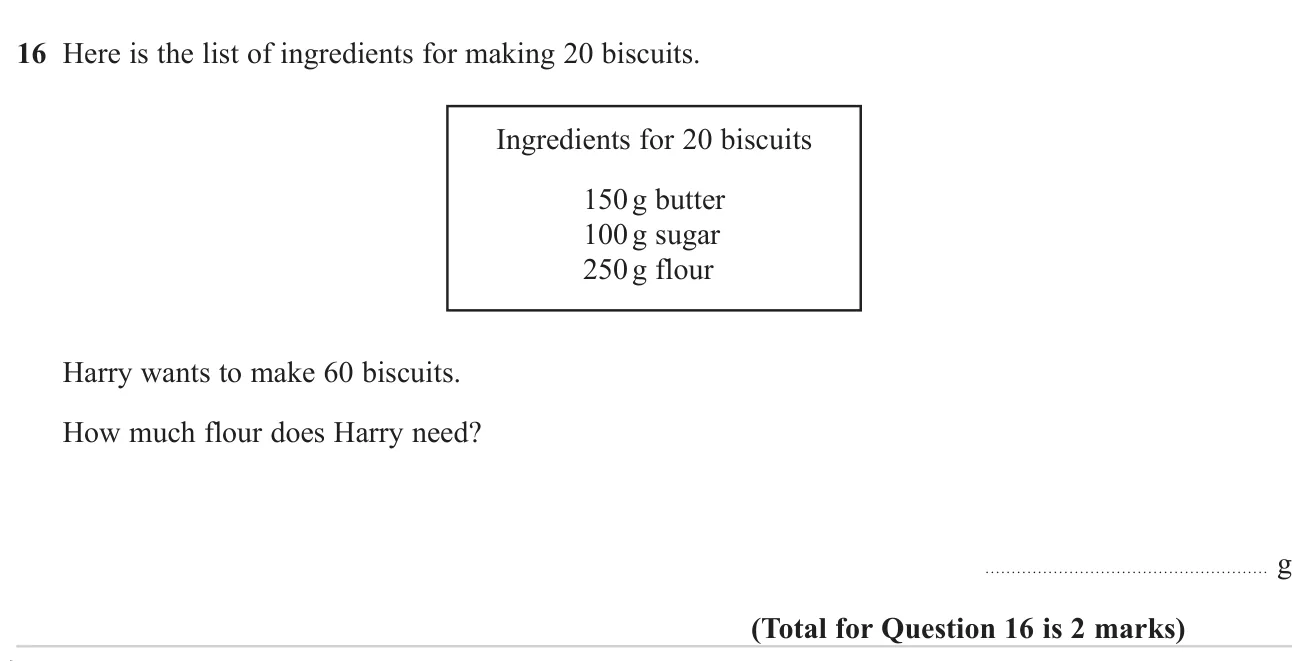
Exam questions: Direct and inverse proportion (47, easiest first) © Pearson Education Ltd. June 2023 Paper 1 (Foundation, non-calculator), question 16.
Worked solution Checked against the mark scheme
60 biscuits is 60 ÷ 20 = 3 60 \div 20 = 3 60 ÷ 20 = 3
Flour: 250 × 3 = 750 250 \times 3 = 750 250 × 3 = 750
Watch out: Using the butter amount instead of the flour, getting 450.
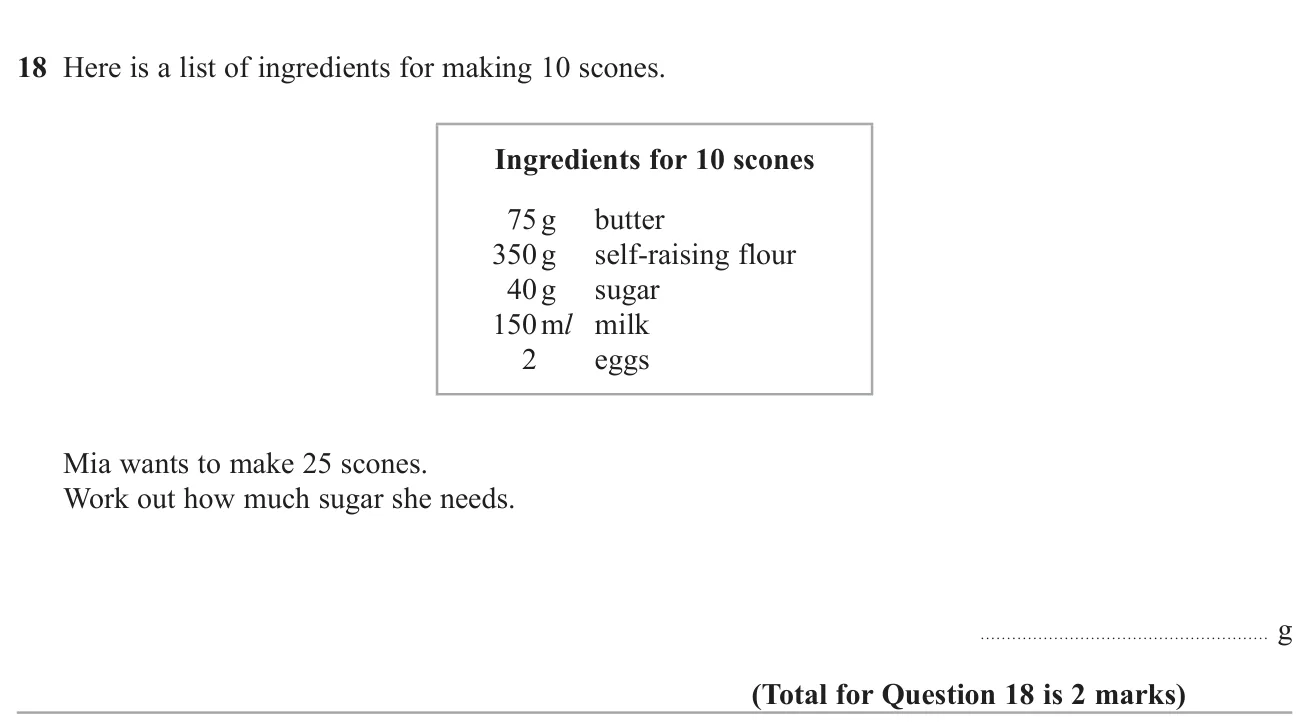
© Pearson Education Ltd. June 2022 Paper 1 (Foundation, non-calculator), question 18.
Worked solution Checked against the mark scheme
25 scones is 25 ÷ 10 = 2.5 25 \div 10 = 2.5 25 ÷ 10 = 2.5
40 × 2.5 = 100 40 \times 2.5 = 100 40 × 2.5 = 100
Watch out: Adding 15 g because 25 is 15 more than 10.
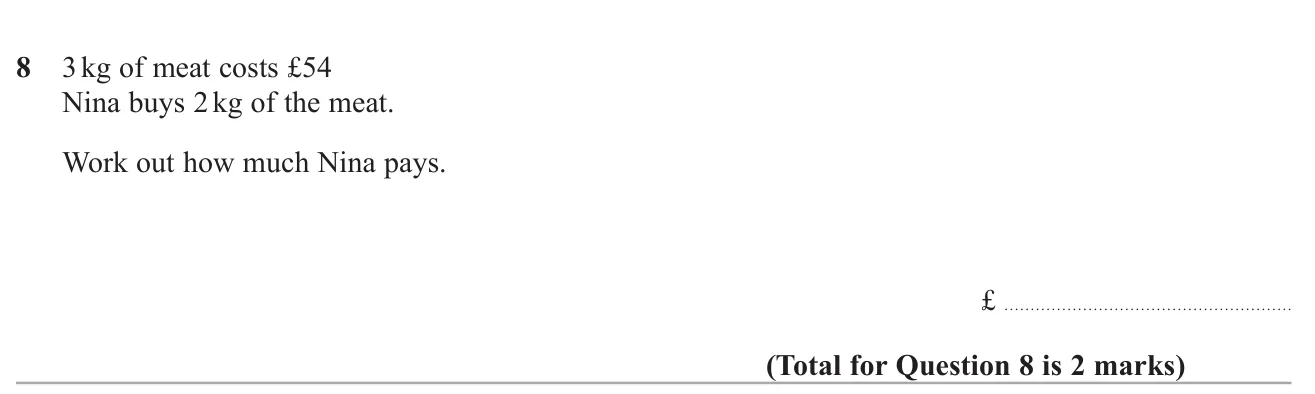
© Pearson Education Ltd. June 2018 Paper 1 (Foundation, non-calculator), question 8.
Worked solution Checked against the mark scheme
1 kg costs 54 ÷ 3 = £ 18 54 \div 3 = £18 54 ÷ 3 = £18
2 kg cost 2 × 18 = £ 36 2 \times 18 = £36 2 × 18 = £36
Watch out: Working out 54 ÷ 2 = 27 54 \div 2 = 27 54 ÷ 2 = 27
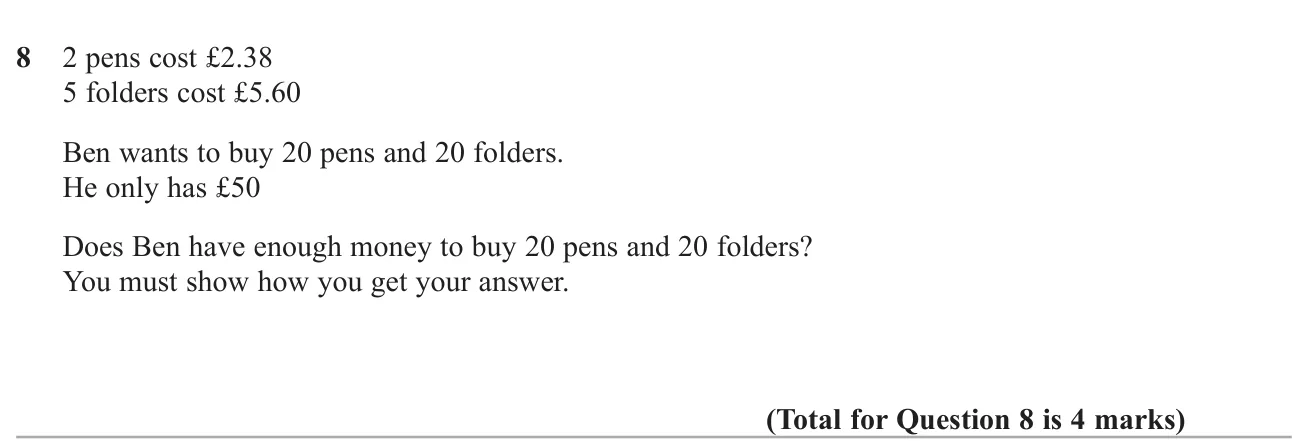
© Pearson Education Ltd. November 2018 Paper 3 (Foundation, calculator), question 8.
Answer Yes: the total is £46.20 (£3.80 left) 4 marks
Worked solution Checked against the mark scheme
One pen: 2.38 ÷ 2 = £ 1.19 2.38 \div 2 = £1.19 2.38 ÷ 2 = £1.19 20 × 1.19 = £ 23.80 20 \times 1.19 = £23.80 20 × 1.19 = £23.80
One folder: 5.60 ÷ 5 = £ 1.12 5.60 \div 5 = £1.12 5.60 ÷ 5 = £1.12 20 × 1.12 = £ 22.40 20 \times 1.12 = £22.40 20 × 1.12 = £22.40
Total: 23.80 + 22.40 = £ 46.20 23.80 + 22.40 = £46.20 23.80 + 22.40 = £46.20
£ 46.20 < £ 50 £46.20 < £50 £46.20 < £50
Watch out: Multiplying £2.38 by 20 instead of by 10.
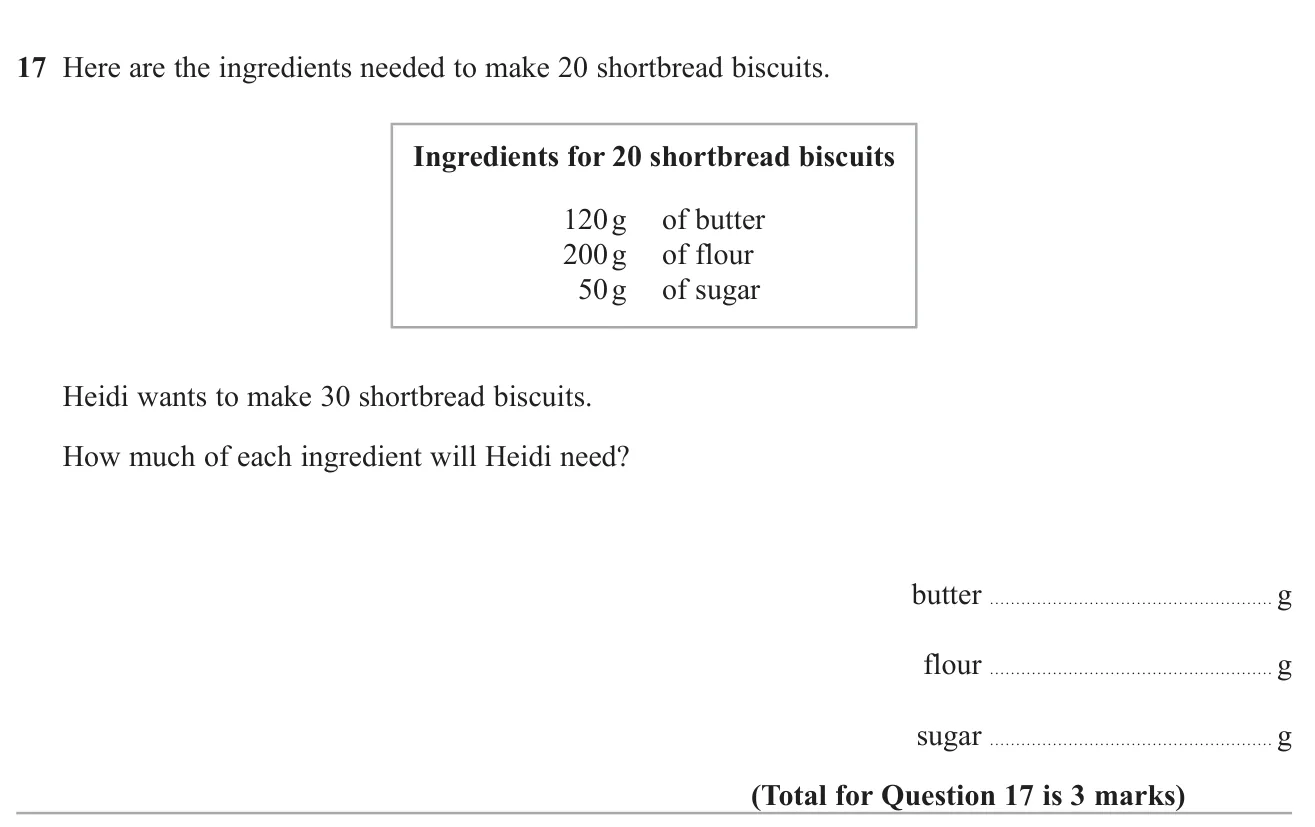
© Pearson Education Ltd. June 2024 Paper 3 (Foundation, calculator), question 17.
Answer butter 180 180 180 300 300 300 75 75 75 3 marks
Worked solution Checked against the mark scheme
Scale factor: 30 ÷ 20 = 1.5 30 \div 20 = 1.5 30 ÷ 20 = 1.5
Butter: 120 × 1.5 = 180 120 \times 1.5 = 180 120 × 1.5 = 180
Flour: 200 × 1.5 = 300 200 \times 1.5 = 300 200 × 1.5 = 300
Sugar: 50 × 1.5 = 75 50 \times 1.5 = 75 50 × 1.5 = 75
Watch out: Adding 10 g to each amount instead of multiplying.
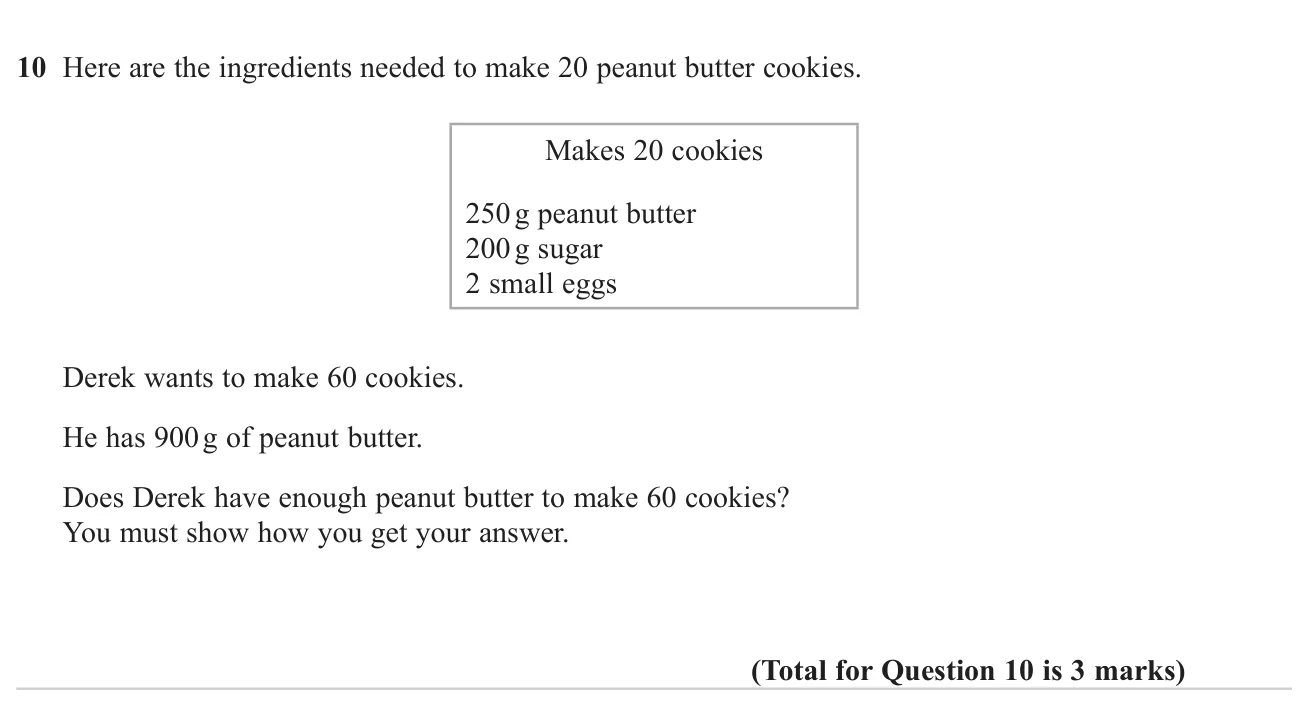
© Pearson Education Ltd. November 2023 Paper 1 (Foundation, non-calculator), question 10.
Answer Yes: 750 g is needed and he has 900 g 3 marks
Worked solution Checked against the mark scheme
60 cookies is 60 ÷ 20 = 3 60 \div 20 = 3 60 ÷ 20 = 3
Peanut butter needed: 3 × 250 = 750 3 \times 250 = 750 3 × 250 = 750
750 < 900 750 < 900 750 < 900 yes , he has enough (150 g spare).
Watch out: Comparing 900 g with 250 g without scaling up.
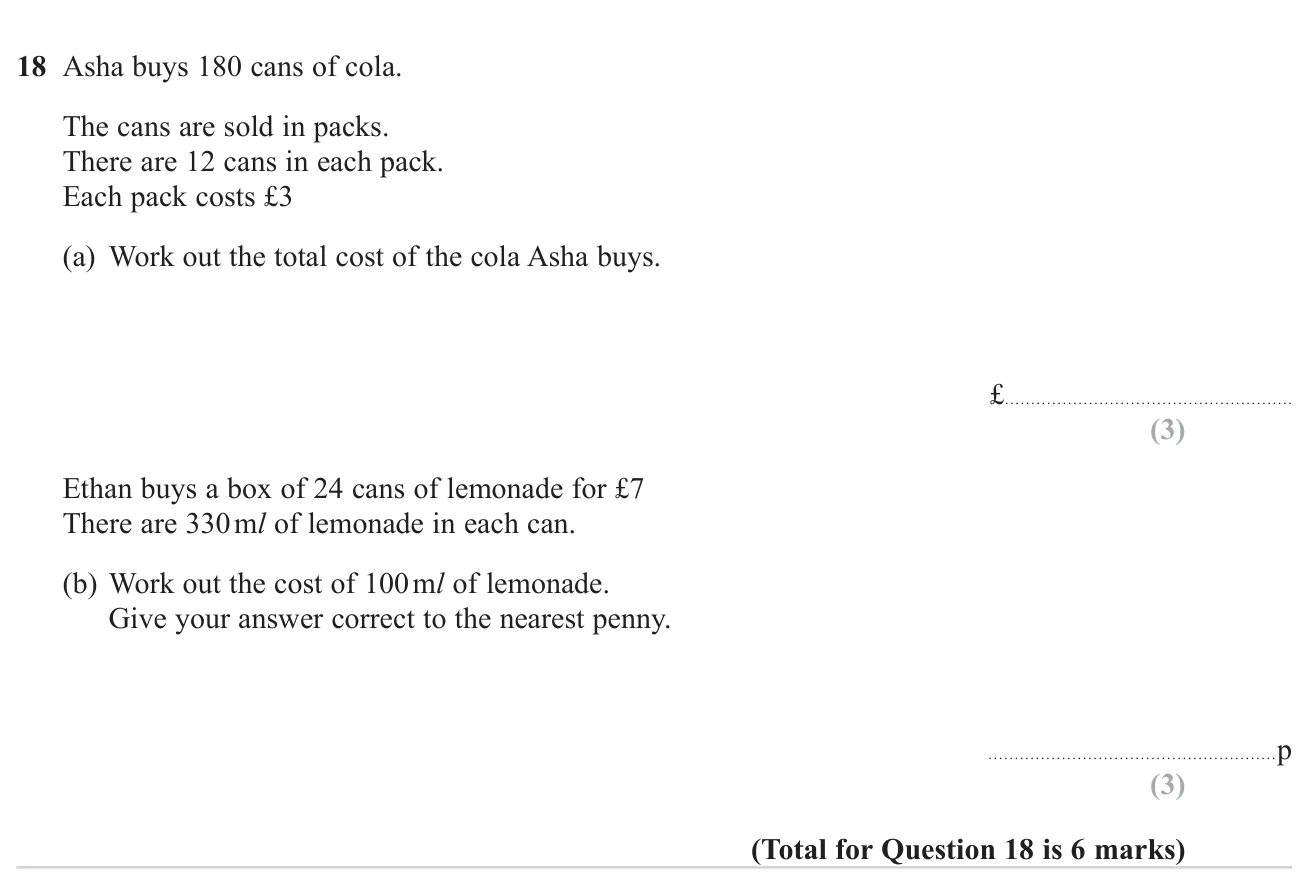
© Pearson Education Ltd. June 2023 Paper 2 (Foundation, calculator), question 18.
(a) £45 3 marks (b) 9p 3 marks
Worked solution Checked against the mark scheme
(a) Packs: 180 ÷ 12 = 15 180 \div 12 = 15 180 ÷ 12 = 15 15 × £ 3 = £ 45 15 \times £3 = £45 15 × £3 = £45
(b) Total volume: 24 × 330 = 7920 24 \times 330 = 7920 24 × 330 = 7920
Cost of 1 ml: 700 ÷ 7920 = 0.0884 700 \div 7920 = 0.0884 700 ÷ 7920 = 0.0884 8.84 8.84 8.84
To the nearest penny: 9p
Watch out: In (a), multiplying 180 by £3.
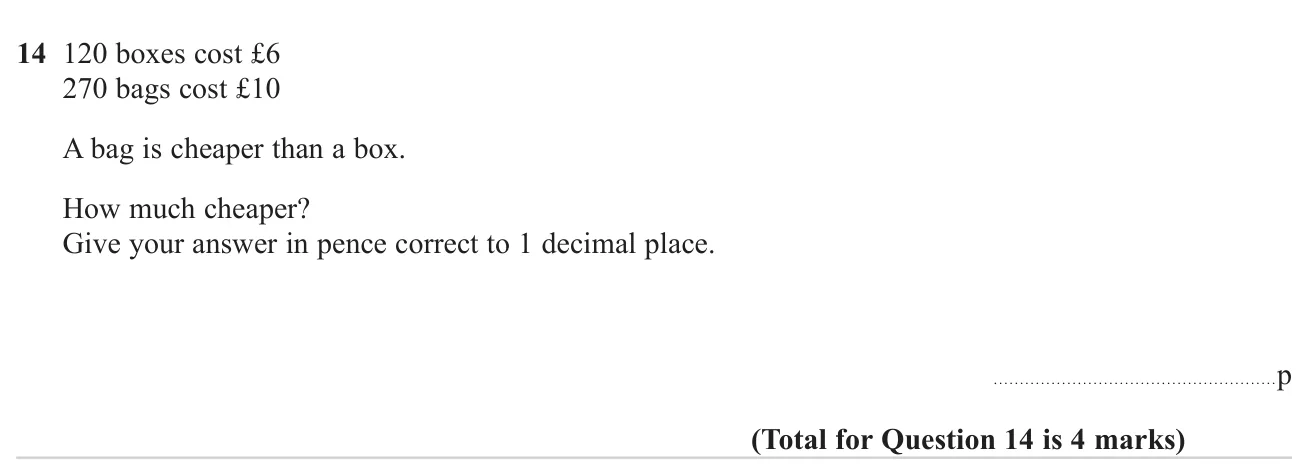
© Pearson Education Ltd. June 2023 Paper 3 (Foundation, calculator), question 14.
Worked solution Checked against the mark scheme
One box: 600 ÷ 120 = 5 600 \div 120 = 5 600 ÷ 120 = 5
One bag: 1000 ÷ 270 = 3.7037... 1000 \div 270 = 3.7037... 1000 ÷ 270 = 3.7037...
Difference: 5 − 3.7037... = 1.296... 5 - 3.7037... = 1.296... 5 − 3.7037... = 1.296... 1.3 1.3 1.3
Watch out: Mixing pounds and pence, e.g. giving 0.013.
© Pearson Education Ltd. June 2019 Paper 2 (Foundation, calculator), question 17.
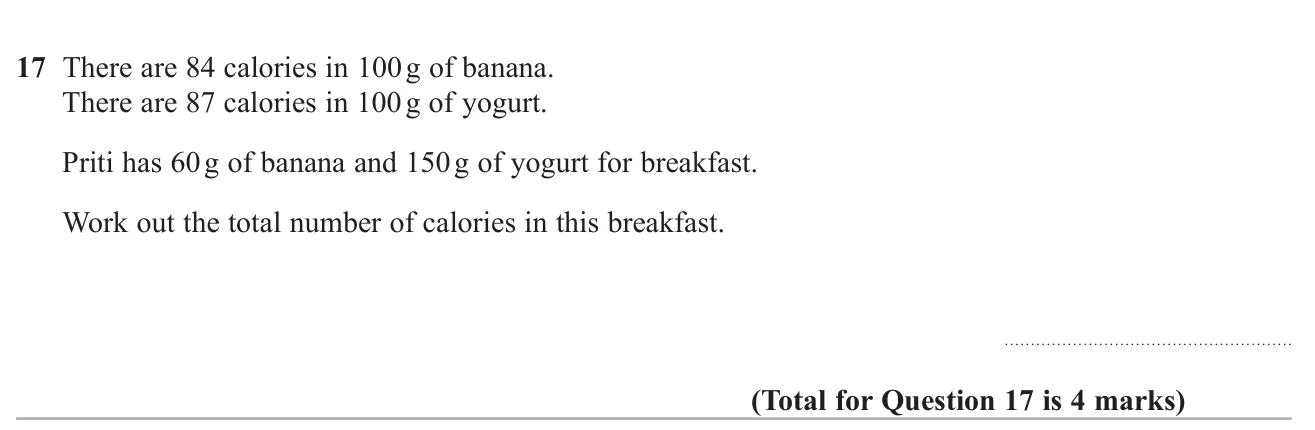
Worked solution Checked against the mark scheme
Banana: 60 100 × 84 = 50.4 \frac{60}{100} \times 84 = 50.4 100 60 × 84 = 50.4
Yogurt: 150 100 × 87 = 130.5 \frac{150}{100} \times 87 = 130.5 100 150 × 87 = 130.5
Total: 50.4 + 130.5 = 180.9 50.4 + 130.5 = 180.9 50.4 + 130.5 = 180.9
Watch out: Adding 84 and 87 without scaling for the masses.
© Pearson Education Ltd. Specimen Paper 2 (Foundation, calculator), question 18.
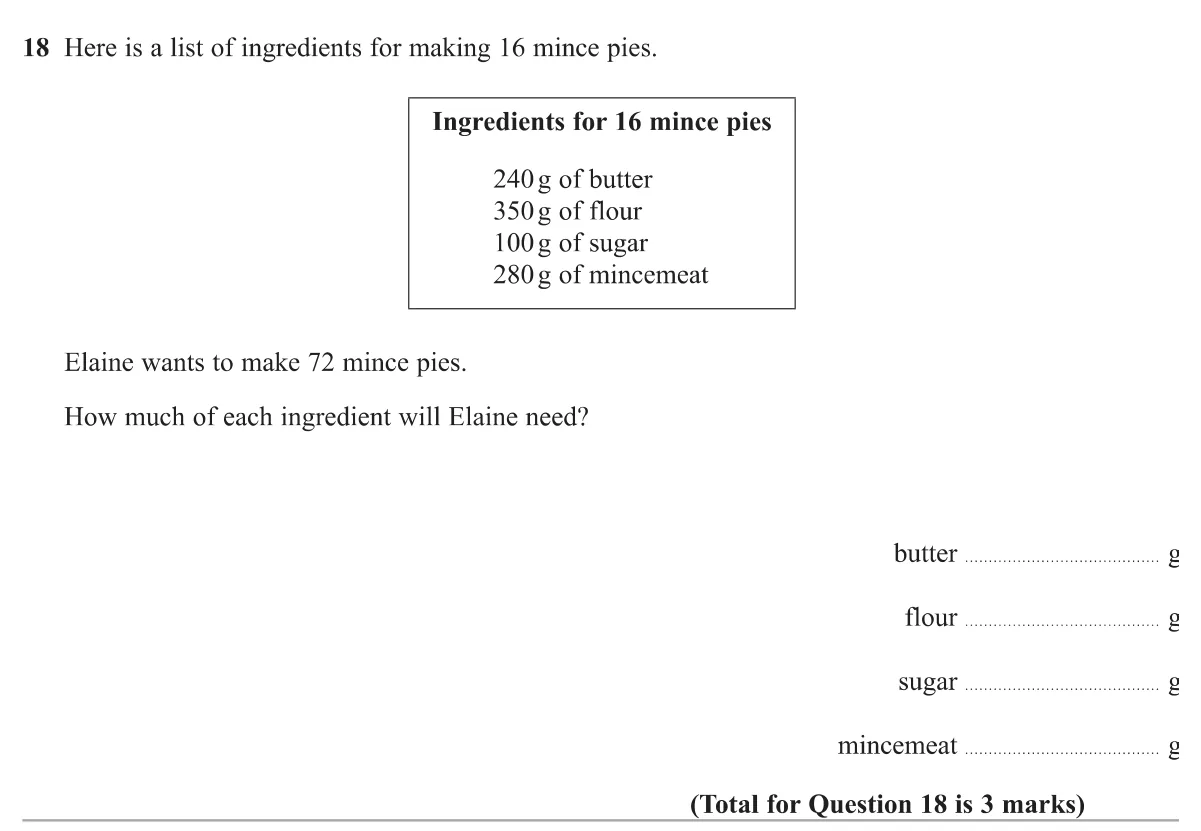
Answer Butter 1080 g, flour 1575 g, sugar 450 g, mincemeat 1260 g 3 marks
Worked solution Checked against the mark scheme
Scale factor: 72 ÷ 16 = 4.5 72 \div 16 = 4.5 72 ÷ 16 = 4.5
Butter: 240 × 4.5 = 1080 240 \times 4.5 = 1080 240 × 4.5 = 1080
Flour: 350 × 4.5 = 1575 350 \times 4.5 = 1575 350 × 4.5 = 1575
Sugar: 100 × 4.5 = 450 100 \times 4.5 = 450 100 × 4.5 = 450
Mincemeat: 280 × 4.5 = 1260 280 \times 4.5 = 1260 280 × 4.5 = 1260
Watch out: Adding 56 to each amount instead of multiplying.
© Pearson Education Ltd. June 2024 Paper 2 (Foundation, calculator), question 22.
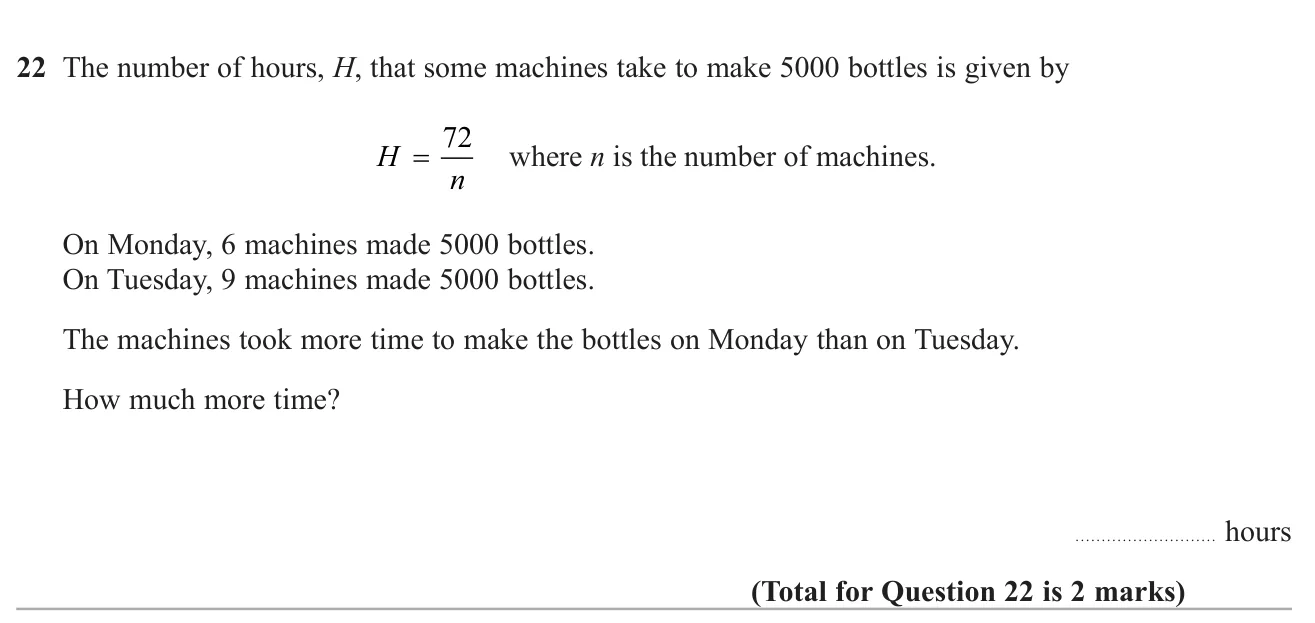
Worked solution Checked against the mark scheme
The formula is H = 72 n H = \dfrac{72}{n} H = n 72
Monday: 72 ÷ 6 = 12 72 \div 6 = 12 72 ÷ 6 = 12
Tuesday: 72 ÷ 9 = 8 72 \div 9 = 8 72 ÷ 9 = 8
Difference = 12 − 8 = 4 = 12 - 8 = 4 = 12 − 8 = 4
Watch out: Working out 72 ÷ ( 9 − 6 ) = 24 72 \div (9 - 6) = 24 72 ÷ ( 9 − 6 ) = 24
© Pearson Education Ltd. June 2024 Paper 1 (Foundation, non-calculator), question 16.
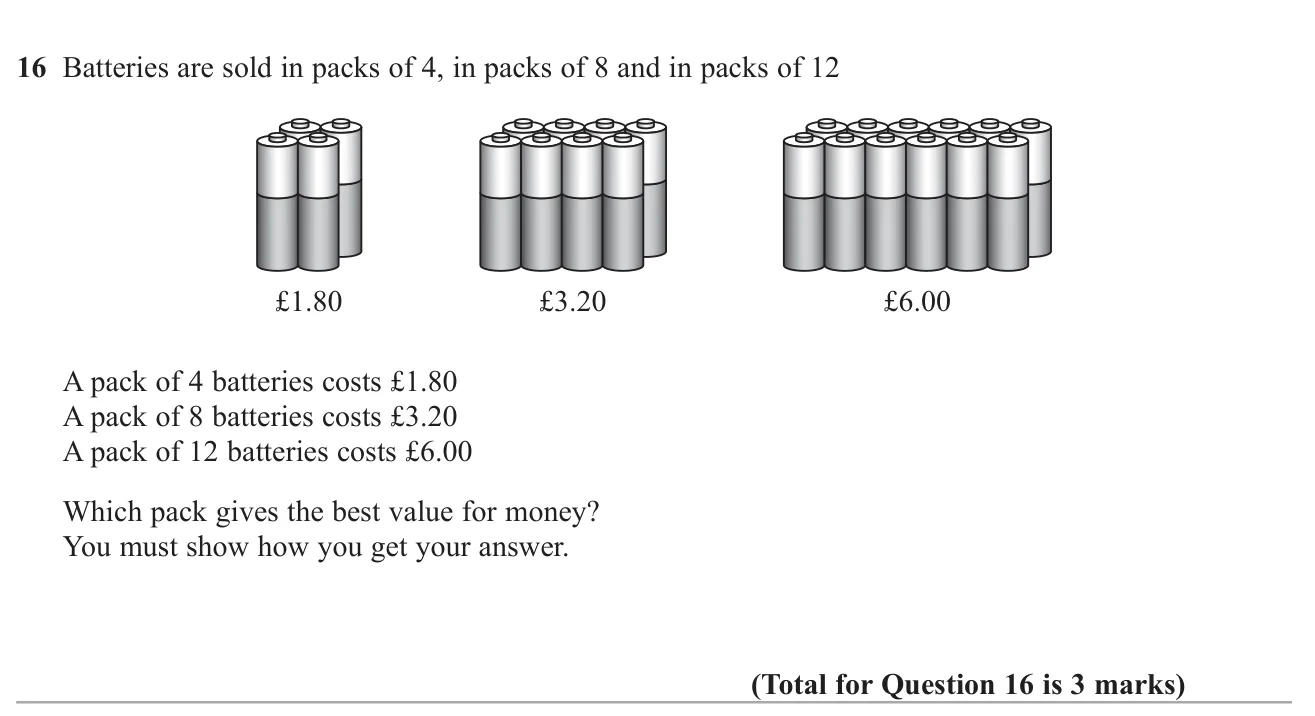
Answer Pack of 8 (40p per battery, compared with 45p and 50p) 3 marks
Worked solution Checked against the mark scheme
Cost per battery:
4-pack: 180 ÷ 4 = 45 180 \div 4 = 45 180 ÷ 4 = 45
8-pack: 320 ÷ 8 = 40 320 \div 8 = 40 320 ÷ 8 = 40
12-pack: 600 ÷ 12 = 50 600 \div 12 = 50 600 ÷ 12 = 50
The pack of 8 is best value.
Watch out: Assuming the biggest pack is always best value.
© Pearson Education Ltd. November 2023 Paper 3 (Foundation, calculator), question 25.
Worked solution Checked against the mark scheme
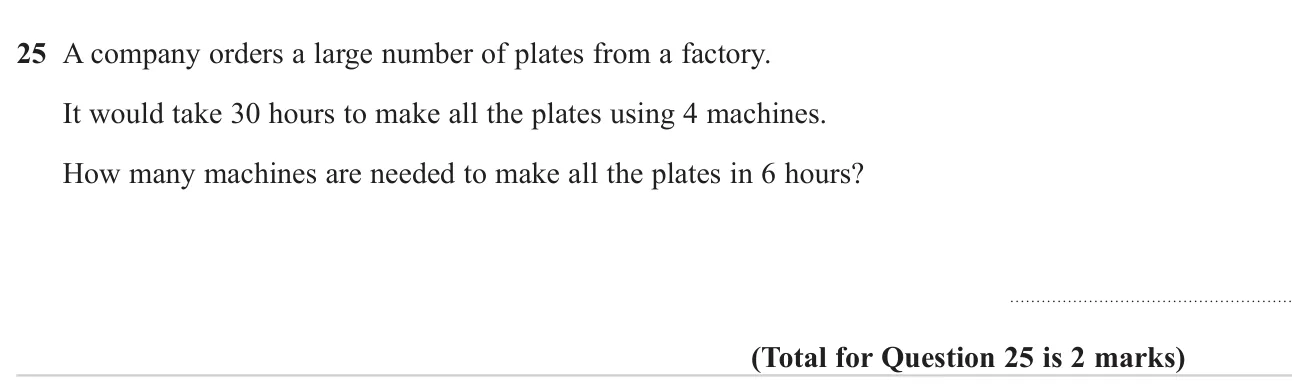
Total work = 30 × 4 = 120 = 30 \times 4 = 120 = 30 × 4 = 120
In 6 hours: 120 ÷ 6 = 20 120 \div 6 = 20 120 ÷ 6 = 20
Watch out: Treating it as direct proportion and getting 0.8.
© Pearson Education Ltd. June 2023 Paper 3 (Foundation, calculator), question 23.
Worked solution Checked against the mark scheme
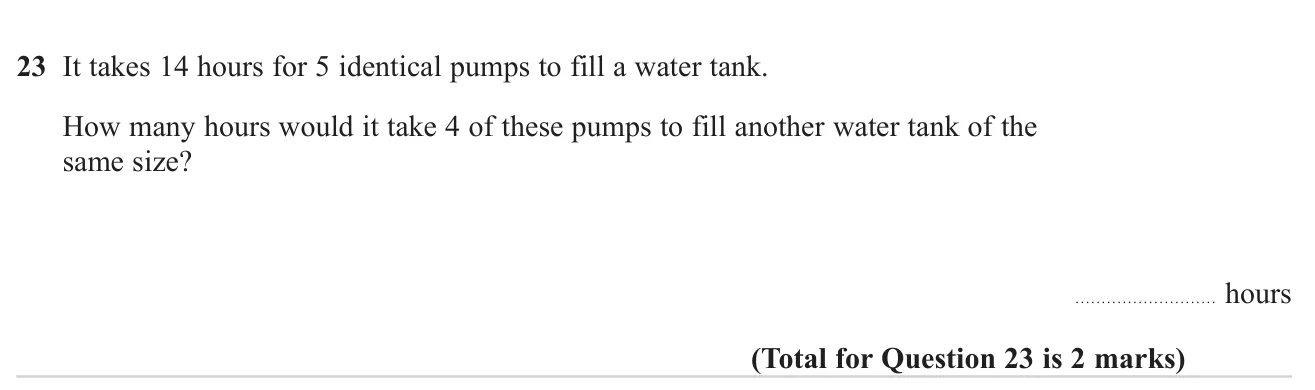
Total work: 5 × 14 = 70 5 \times 14 = 70 5 × 14 = 70
With 4 pumps: 70 ÷ 4 = 17.5 70 \div 4 = 17.5 70 ÷ 4 = 17.5
Watch out: Treating it as direct proportion and getting 11.2 hours.
© Pearson Education Ltd. November 2022 Paper 2 (Foundation, calculator), question 13.
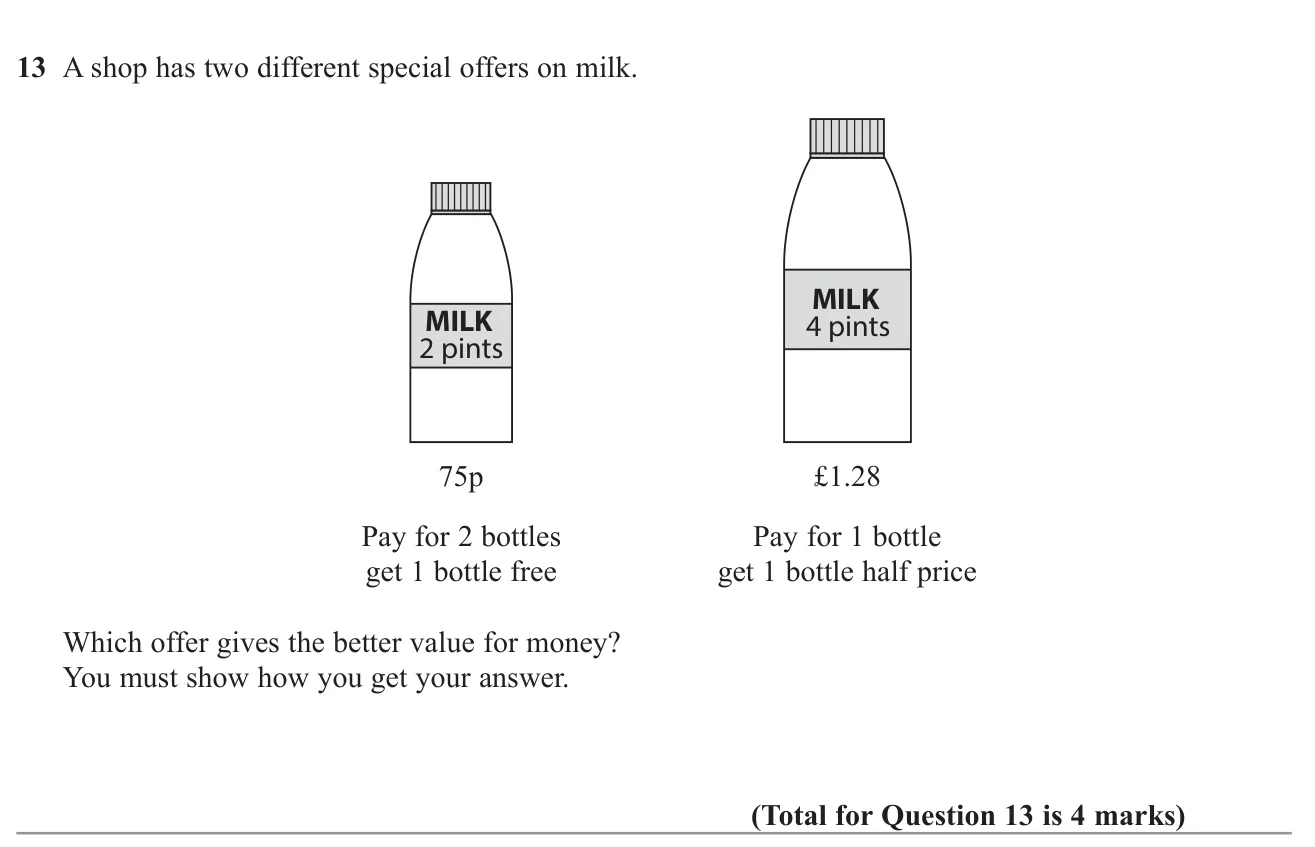
Answer The 4-pint offer: 24p per pint compared with 25p per pint 4 marks
Worked solution Checked against the mark scheme
Offer 1: pay 2 × 75 = 150 2 \times 75 = 150 2 × 75 = 150 150 ÷ 6 = 25 150 \div 6 = 25 150 ÷ 6 = 25
Offer 2: pay 128 + 64 = 192 128 + 64 = 192 128 + 64 = 192 192 ÷ 8 = 24 192 \div 8 = 24 192 ÷ 8 = 24
The 4-pint offer is better value.
Watch out: Comparing the price per bottle without allowing for the different sizes.
© Pearson Education Ltd. November 2022 Paper 2 (Foundation, calculator), question 16.
Worked solution Checked against the mark scheme
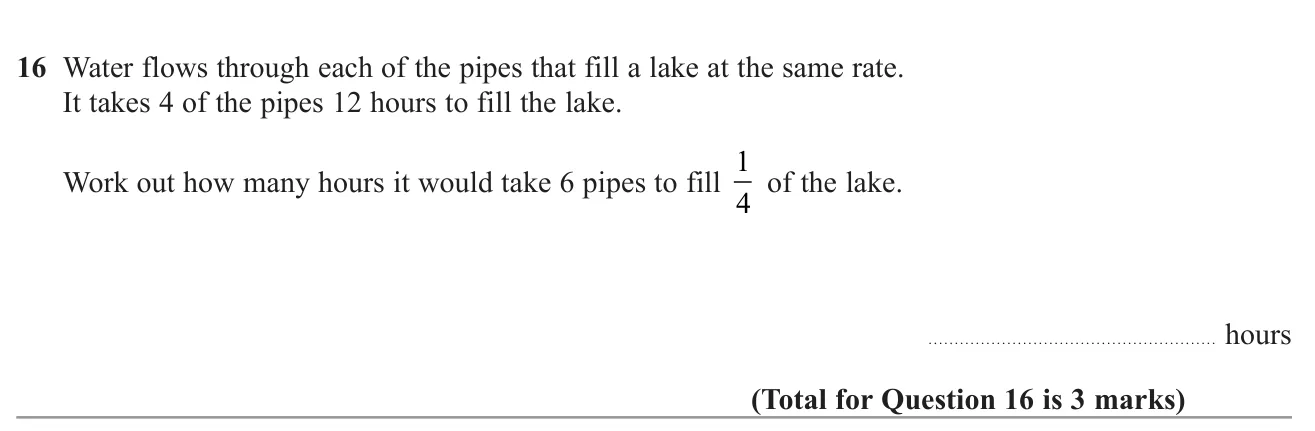
One pipe would take 4 × 12 = 48 4 \times 12 = 48 4 × 12 = 48
Six pipes take 48 ÷ 6 = 8 48 \div 6 = 8 48 ÷ 6 = 8
A quarter of the lake: 8 ÷ 4 = 2 8 \div 4 = 2 8 ÷ 4 = 2
Watch out: Assuming more pipes take longer and multiplying by 6.
© Pearson Education Ltd. November 2022 Paper 3 (Foundation, calculator), question 15.
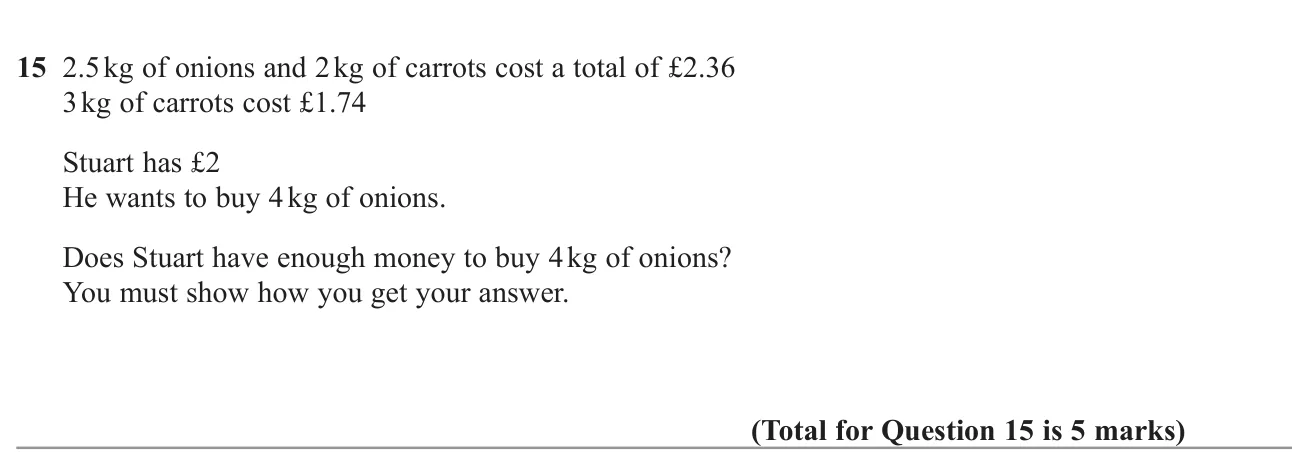
Answer Yes: 4 kg of onions cost £1.92 5 marks
Worked solution Checked against the mark scheme
Carrots: 1.74 ÷ 3 = £ 0.58 1.74 \div 3 = £0.58 1.74 ÷ 3 = £0.58 £ 1.16 £1.16 £1.16
Onions: 2.36 − 1.16 = £ 1.20 2.36 - 1.16 = £1.20 2.36 − 1.16 = £1.20 1.20 ÷ 2.5 = £ 0.48 1.20 \div 2.5 = £0.48 1.20 ÷ 2.5 = £0.48
4 kg: 4 × 0.48 = £ 1.92 4 \times 0.48 = £1.92 4 × 0.48 = £1.92 yes .
Watch out: Dividing £2.36 by 4.5 kg as if onions and carrots cost the same.
© Pearson Education Ltd. November 2022 Paper 3 (Foundation, calculator), question 20.
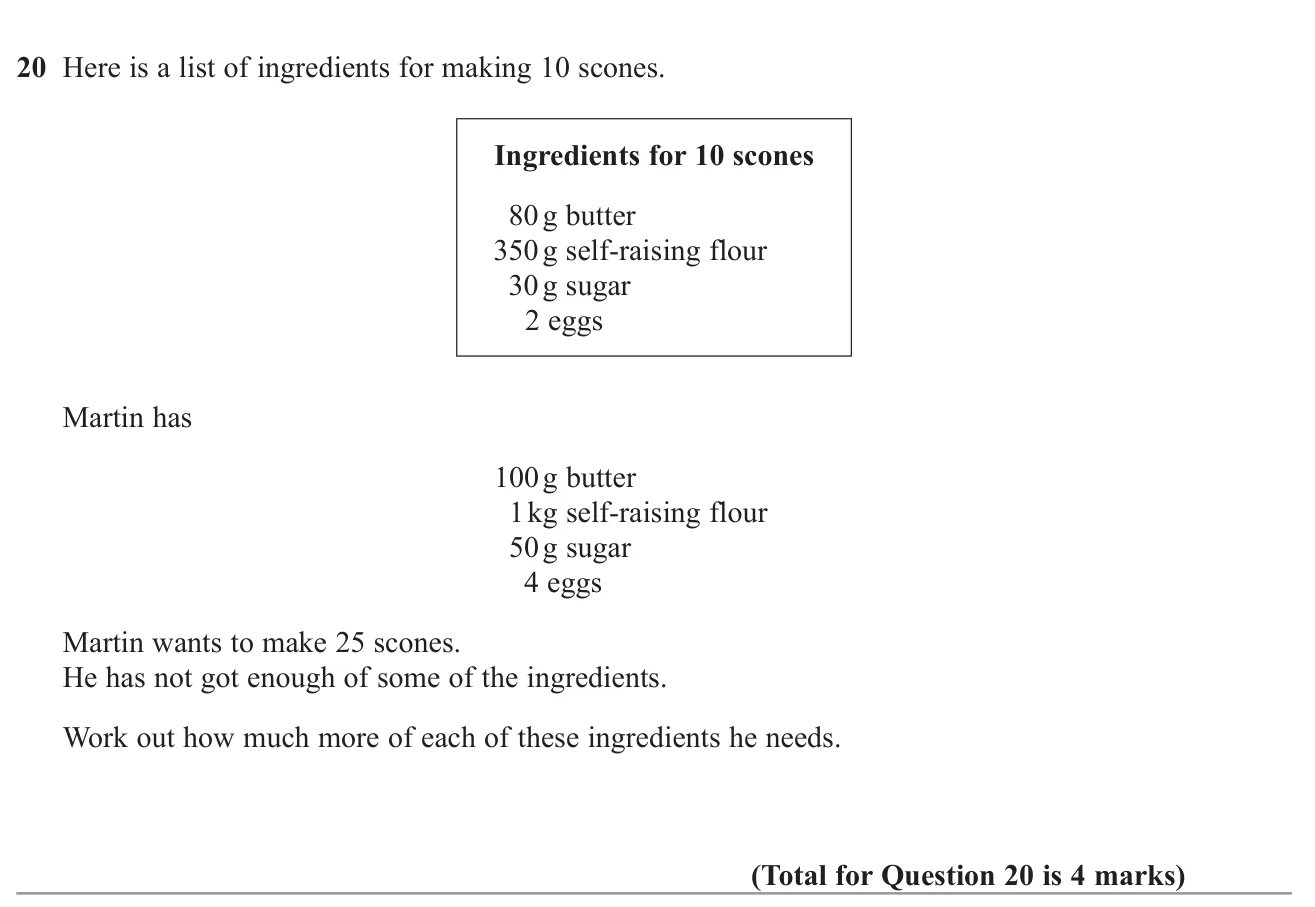
Answer 100 g more butter, 25 g more sugar, 1 more egg 4 marks
Worked solution Checked against the mark scheme
Scale factor: 25 ÷ 10 = 2.5 25 \div 10 = 2.5 25 ÷ 10 = 2.5
Butter 80 × 2.5 = 200 80 \times 2.5 = 200 80 × 2.5 = 200 350 × 2.5 = 875 350 \times 2.5 = 875 350 × 2.5 = 875 30 × 2.5 = 75 30 \times 2.5 = 75 30 × 2.5 = 75 2 × 2.5 = 5 2 \times 2.5 = 5 2 × 2.5 = 5
Compare: butter 200 − 100 = 100 200 - 100 = 100 200 − 100 = 100 75 − 50 = 25 75 - 50 = 25 75 − 50 = 25 5 − 4 = 1 5 - 4 = 1 5 − 4 = 1
Watch out: Working out the full amounts needed instead of how much more.
© Pearson Education Ltd. November 2021 Paper 1 (Foundation, non-calculator), question 14.
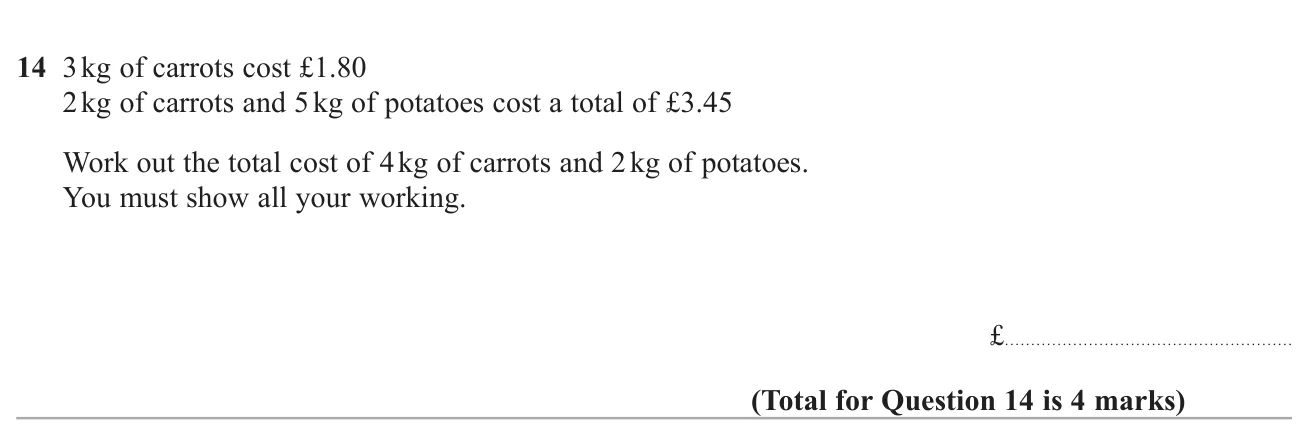
Answer £ 3.30 £3.30 £3.30 4 marks
Worked solution Checked against the mark scheme
Carrots: £ 1.80 ÷ 3 = £ 0.60 £1.80 \div 3 = £0.60 £1.80 ÷ 3 = £0.60
2 kg carrots cost £ 1.20 £1.20 £1.20 £ 3.45 − £ 1.20 = £ 2.25 £3.45 - £1.20 = £2.25 £3.45 − £1.20 = £2.25
Potatoes: £ 2.25 ÷ 5 = £ 0.45 £2.25 \div 5 = £0.45 £2.25 ÷ 5 = £0.45
Total: 4 × £ 0.60 + 2 × £ 0.45 = £ 2.40 + £ 0.90 = £ 3.30 4 \times £0.60 + 2 \times £0.45 = £2.40 + £0.90 = £3.30 4 × £0.60 + 2 × £0.45 = £2.40 + £0.90 = £3.30
Watch out: Forgetting to subtract the carrots before dividing £3.45 by 5.
© Pearson Education Ltd. November 2021 Paper 1 (Foundation, non-calculator), question 17.
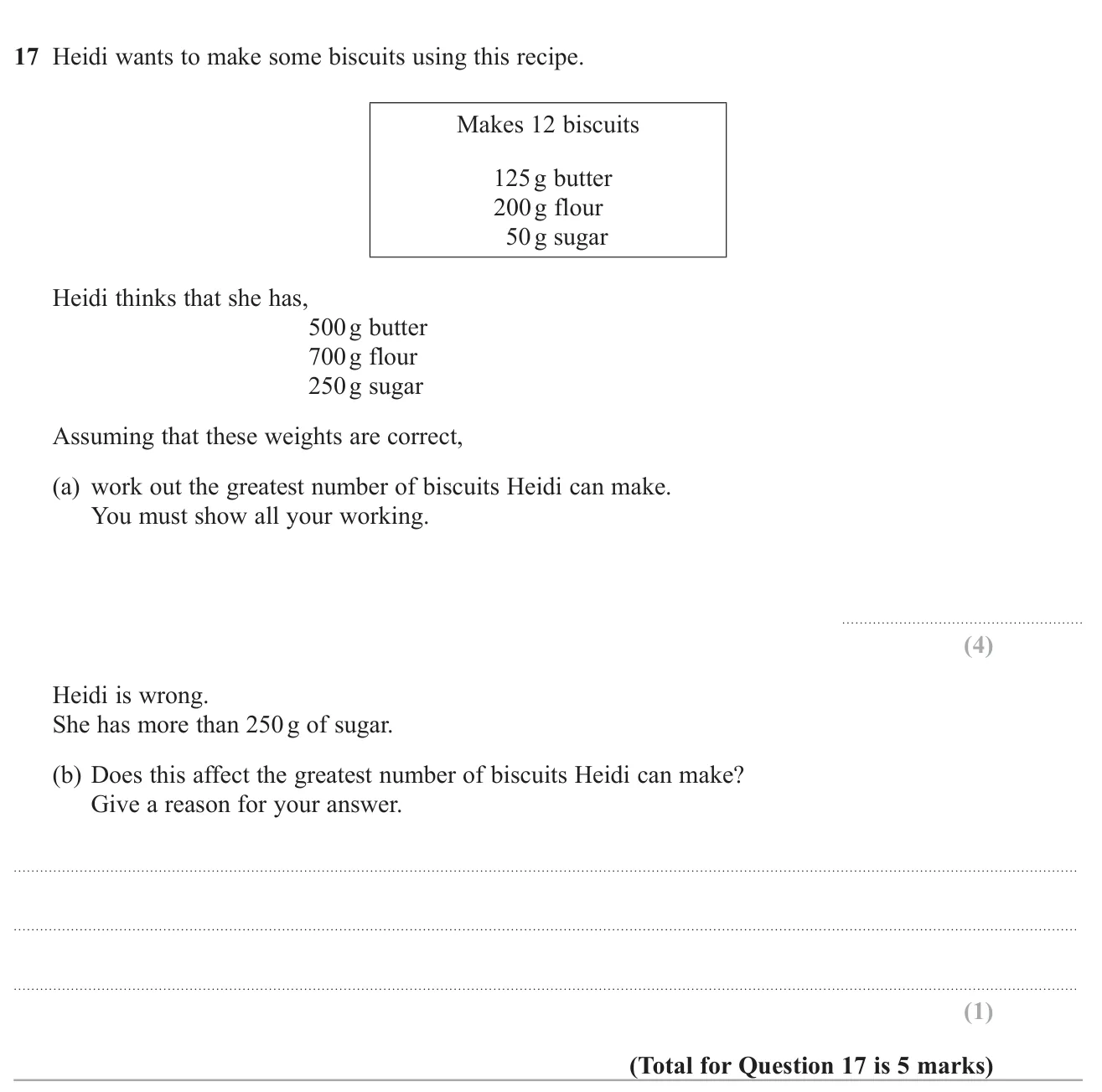
(a) 42 42 42 4 marks (b) No, because flour is the ingredient that limits how many can be made 1 mark
Worked solution Checked against the mark scheme
(a) Batches each ingredient allows (12 biscuits per batch):
Butter: 500 ÷ 125 = 4 500 \div 125 = 4 500 ÷ 125 = 4 700 ÷ 200 = 3.5 700 \div 200 = 3.5 700 ÷ 200 = 3.5 250 ÷ 50 = 5 250 \div 50 = 5 250 ÷ 50 = 5
Flour runs out first: 3.5 × 12 = 42 3.5 \times 12 = 42 3.5 × 12 = 42
(b) No. Flour is the limit, so extra sugar makes no difference.
Watch out: Rounding 3.5 batches down to 3 and answering 36.
© Pearson Education Ltd. November 2021 Paper 3 (Higher, calculator), question 9.
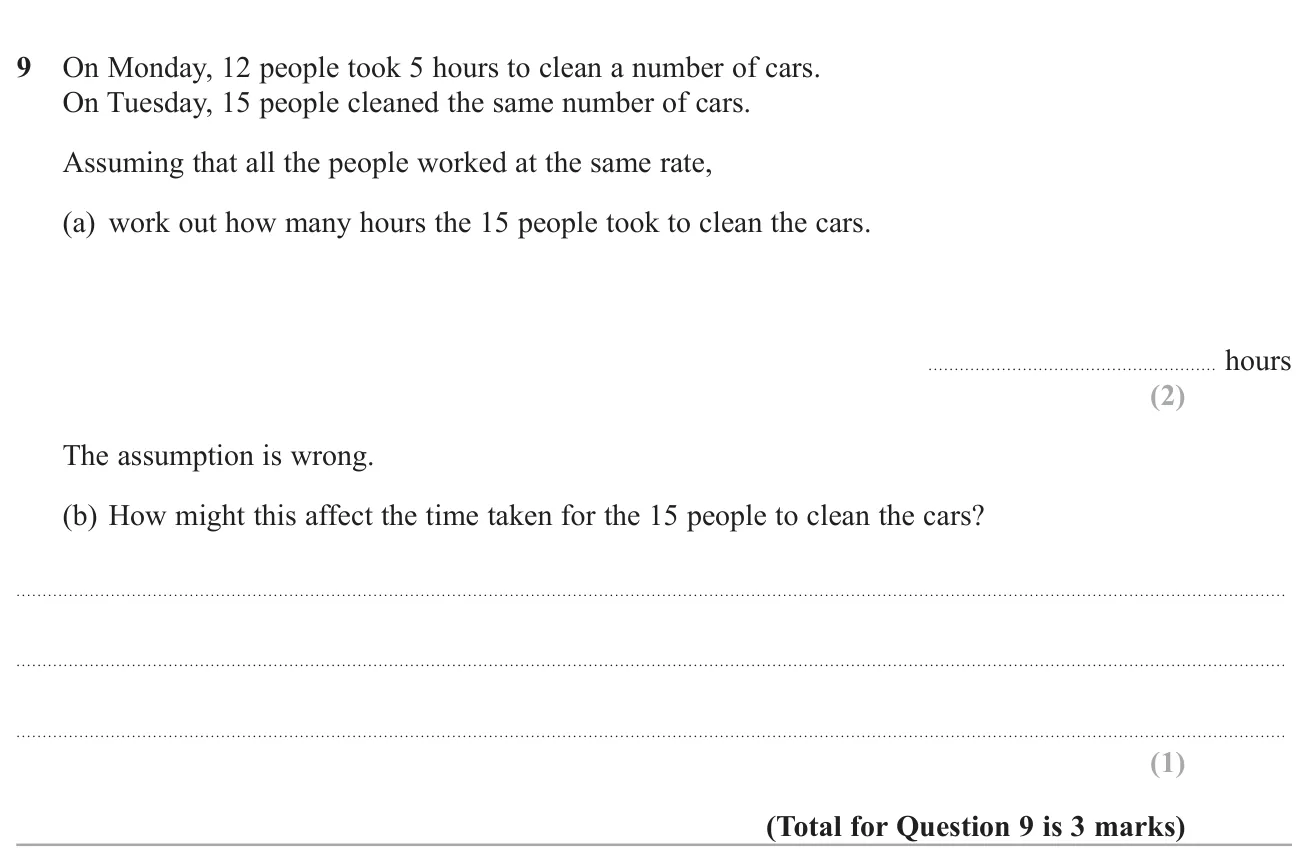
(a) 4 4 4 2 marks (b) The time could be longer or shorter, depending on whether they work slower or faster 1 mark
Worked solution Checked against the mark scheme
(a) Total work = 12 × 5 = 60 = 12 \times 5 = 60 = 12 × 5 = 60 60 ÷ 15 = 4 60 \div 15 = 4 60 ÷ 15 = 4
(b) If the people work at different rates, it could take longer (if some are slower) or less time (if some are faster).
Watch out: In (a), using direct proportion: 5 × 15 ÷ 12 = 6.25 5 \times 15 \div 12 = 6.25 5 × 15 ÷ 12 = 6.25
© Pearson Education Ltd. June 2019 Paper 1 (Foundation, non-calculator), question 23.
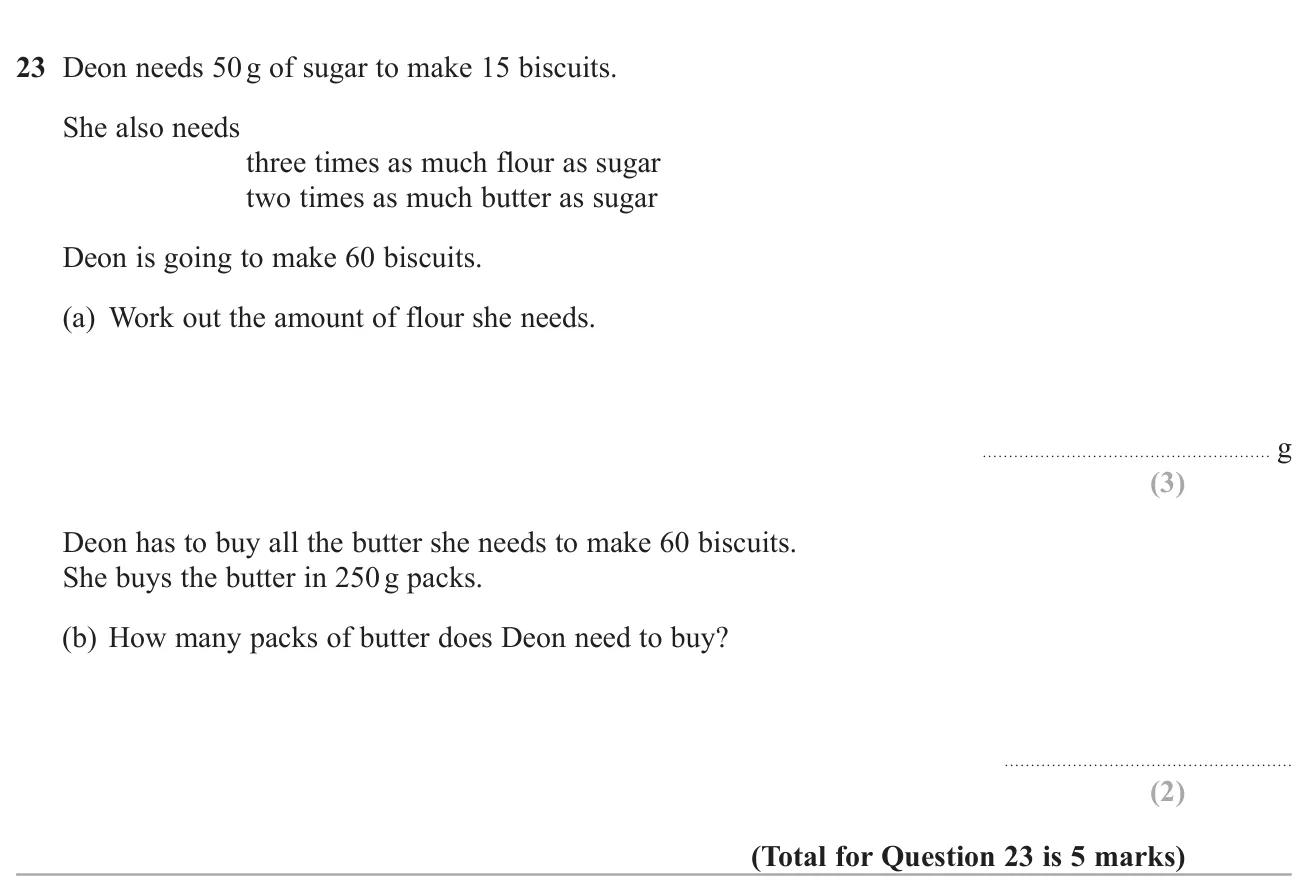
(a) 600 g 3 marks (b) 2 packs 2 marks
Worked solution Checked against the mark scheme
(a) 60 ÷ 15 = 4 60 \div 15 = 4 60 ÷ 15 = 4 4 × 50 = 200 4 \times 50 = 200 4 × 50 = 200
Flour: 3 × 200 = 600 3 \times 200 = 600 3 × 200 = 600
(b) Butter: 2 × 200 = 400 2 \times 200 = 400 2 × 200 = 400
400 ÷ 250 = 1.6 400 \div 250 = 1.6 400 ÷ 250 = 1.6
Watch out: In (b), rounding 1.6 down to 1 pack.
© Pearson Education Ltd. June 2019 Paper 2 (Foundation, calculator), question 18.
Worked solution Checked against the mark scheme
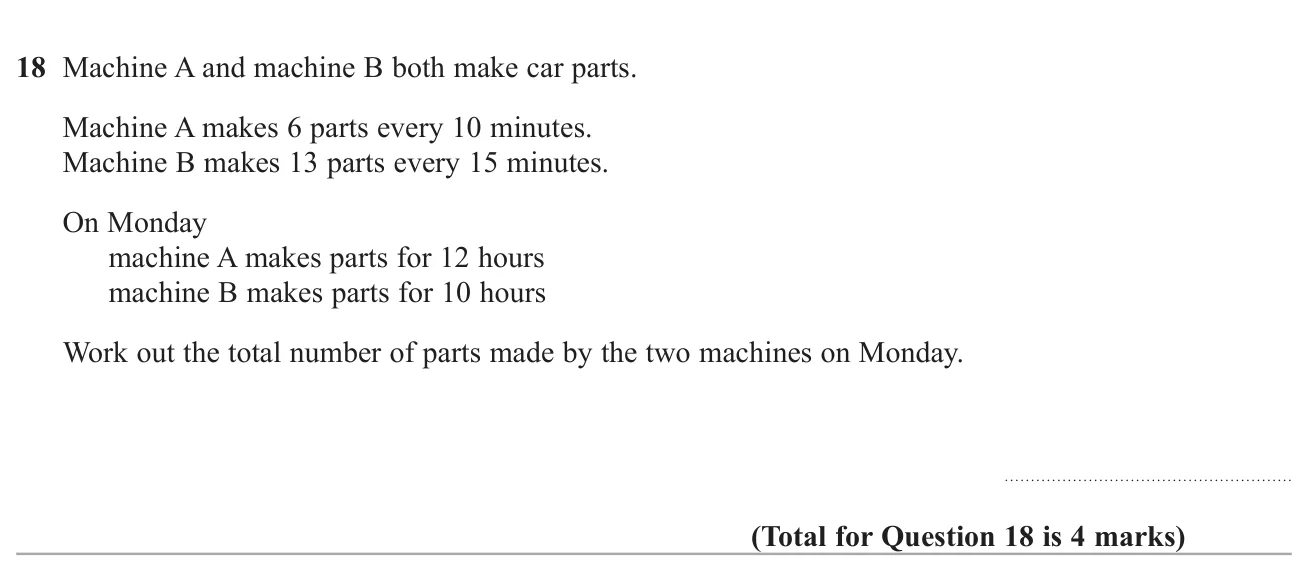
Machine A: 6 parts per 10 min is 6 × 6 = 36 6 \times 6 = 36 6 × 6 = 36
36 × 12 = 432 36 \times 12 = 432 36 × 12 = 432
Machine B: 13 parts per 15 min is 13 × 4 = 52 13 \times 4 = 52 13 × 4 = 52
52 × 10 = 520 52 \times 10 = 520 52 × 10 = 520
Total: 432 + 520 = 952 432 + 520 = 952 432 + 520 = 952
Watch out: Treating 12 hours as 12 lots of 10 minutes.
© Pearson Education Ltd. June 2018 Paper 2 (Foundation, calculator), question 17.
Worked solution Checked against the mark scheme
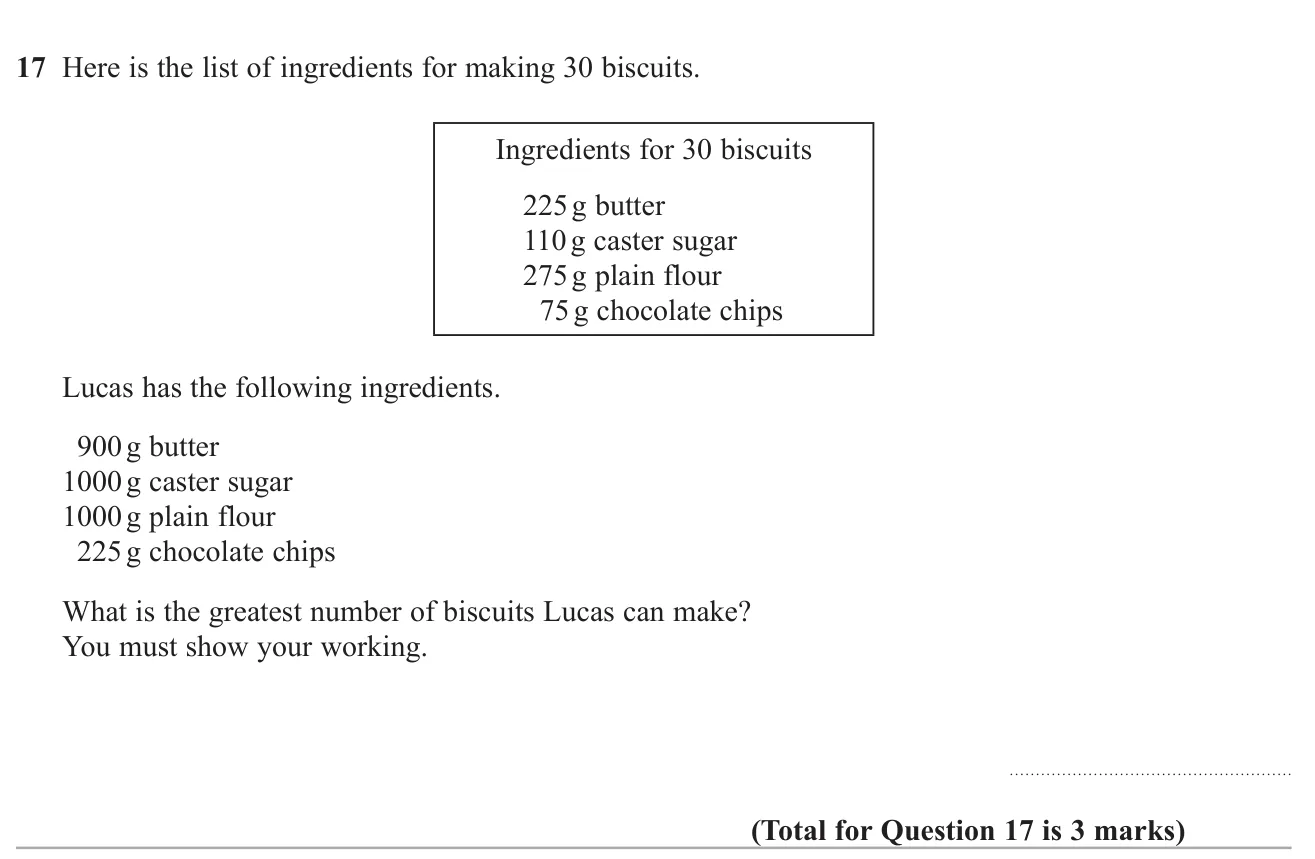
Batches each ingredient allows:
Butter 900 ÷ 225 = 4 900 \div 225 = 4 900 ÷ 225 = 4 1000 ÷ 110 ≈ 9.1 1000 \div 110 \approx 9.1 1000 ÷ 110 ≈ 9.1 1000 ÷ 275 ≈ 3.6 1000 \div 275 \approx 3.6 1000 ÷ 275 ≈ 3.6 225 ÷ 75 = 3 225 \div 75 = 3 225 ÷ 75 = 3
Chocolate runs out first, after 3 batches.
3 × 30 = 90 3 \times 30 = 90 3 × 30 = 90
Watch out: Using the ingredient with the most batches, or forgetting to multiply by 30.
© Pearson Education Ltd. June 2022 Paper 2 (Higher, calculator), question 11.
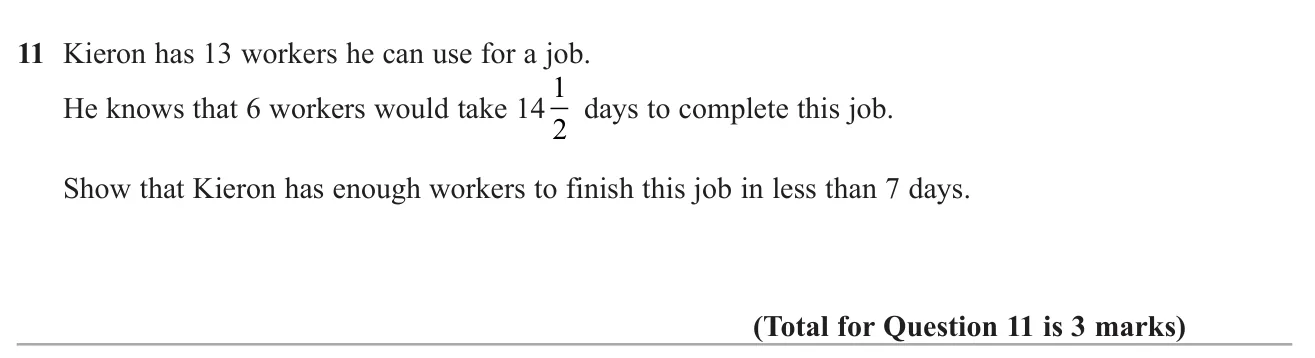
Answer 13 workers take about 6.69 days, which is less than 7 3 marks
Worked solution Checked against the mark scheme
Total work = 6 × 14.5 = 87 = 6 \times 14.5 = 87 = 6 × 14.5 = 87
With 13 workers: 87 ÷ 13 = 6.69... 87 \div 13 = 6.69... 87 ÷ 13 = 6.69...
6.69 < 7 6.69 < 7 6.69 < 7
Watch out: Treating it as direct proportion, so more workers give more days.
© Pearson Education Ltd. November 2020 Paper 3 (Foundation, calculator), question 26.
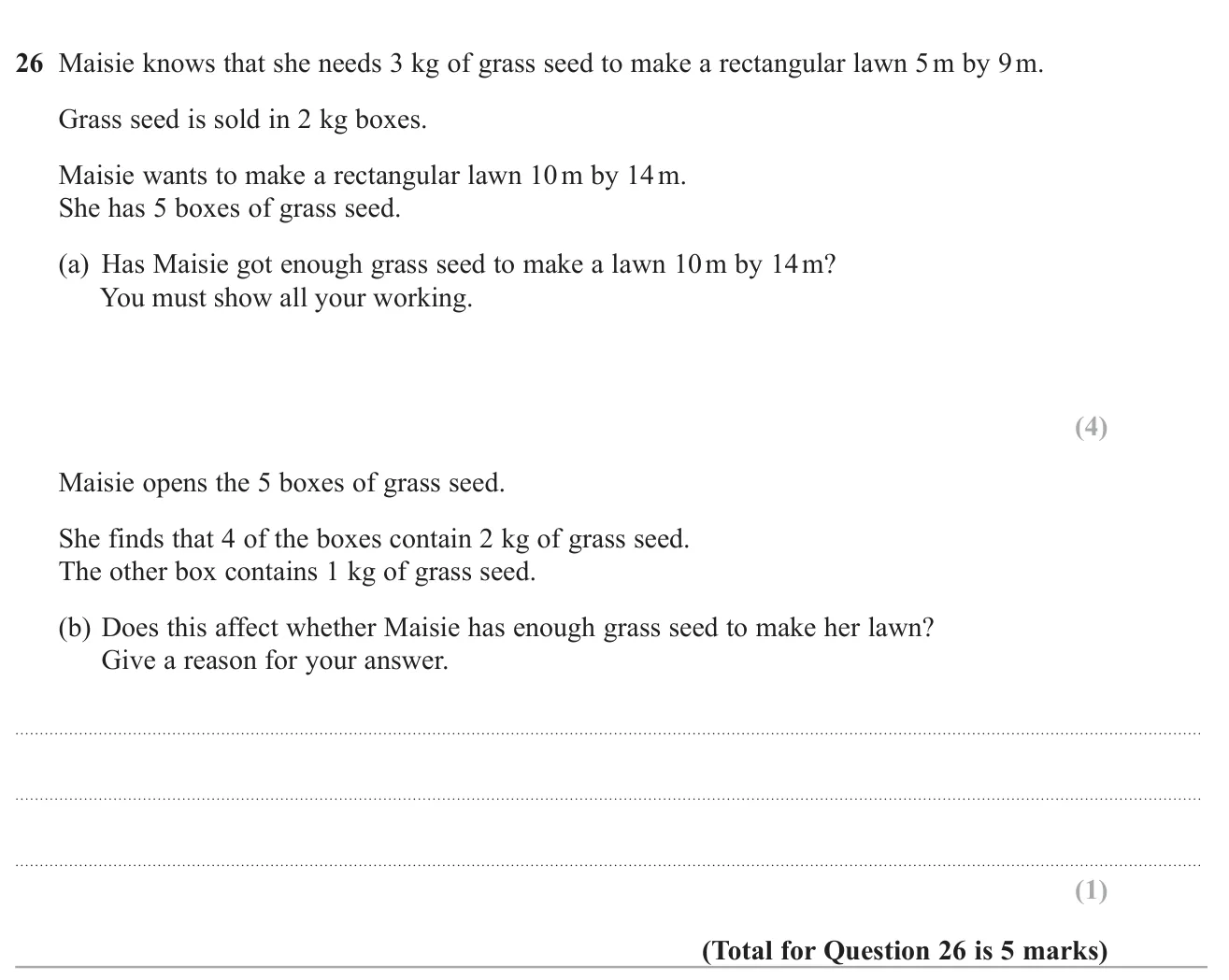
(a) Yes: she needs about 9.3 kg and has 10 kg 4 marks (b) Yes, it now matters: she has 9 kg but needs about 9.3 kg 1 mark
Worked solution Checked against the mark scheme
(a) 3 kg covers 5 × 9 = 45 5 \times 9 = 45 5 × 9 = 45 15 15 15
New lawn: 10 × 14 = 140 10 \times 14 = 140 10 × 14 = 140 140 ÷ 15 = 9.33 140 \div 15 = 9.33 140 ÷ 15 = 9.33
She has 5 × 2 = 10 5 \times 2 = 10 5 × 2 = 10 yes .
(b) Now she has 4 × 2 + 1 = 9 4 \times 2 + 1 = 9 4 × 2 + 1 = 9 does not have enough.
Watch out: Doubling the seed because the lengths roughly double, ignoring that area scales differently.
© Pearson Education Ltd. November 2019 Paper 2 (Foundation, calculator), question 28.
Worked solution Checked against the mark scheme
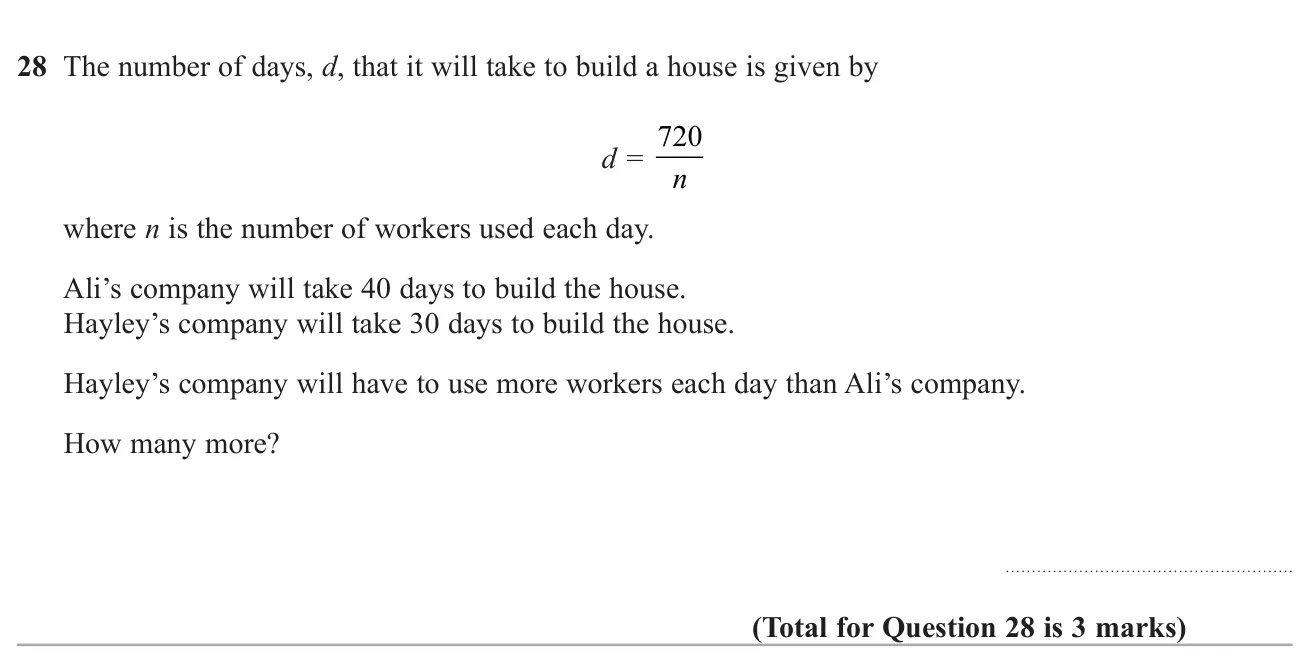
Rearrange: n = 720 d n = \frac{720}{d} n = d 720
Ali: 720 ÷ 40 = 18 720 \div 40 = 18 720 ÷ 40 = 18
Hayley: 720 ÷ 30 = 24 720 \div 30 = 24 720 ÷ 30 = 24
24 − 18 = 6 24 - 18 = 6 24 − 18 = 6
Watch out: Subtracting days (40 − 30 = 10).
© Pearson Education Ltd. November 2019 Paper 2 (Higher, calculator), question 8.
Worked solution Checked against the mark scheme
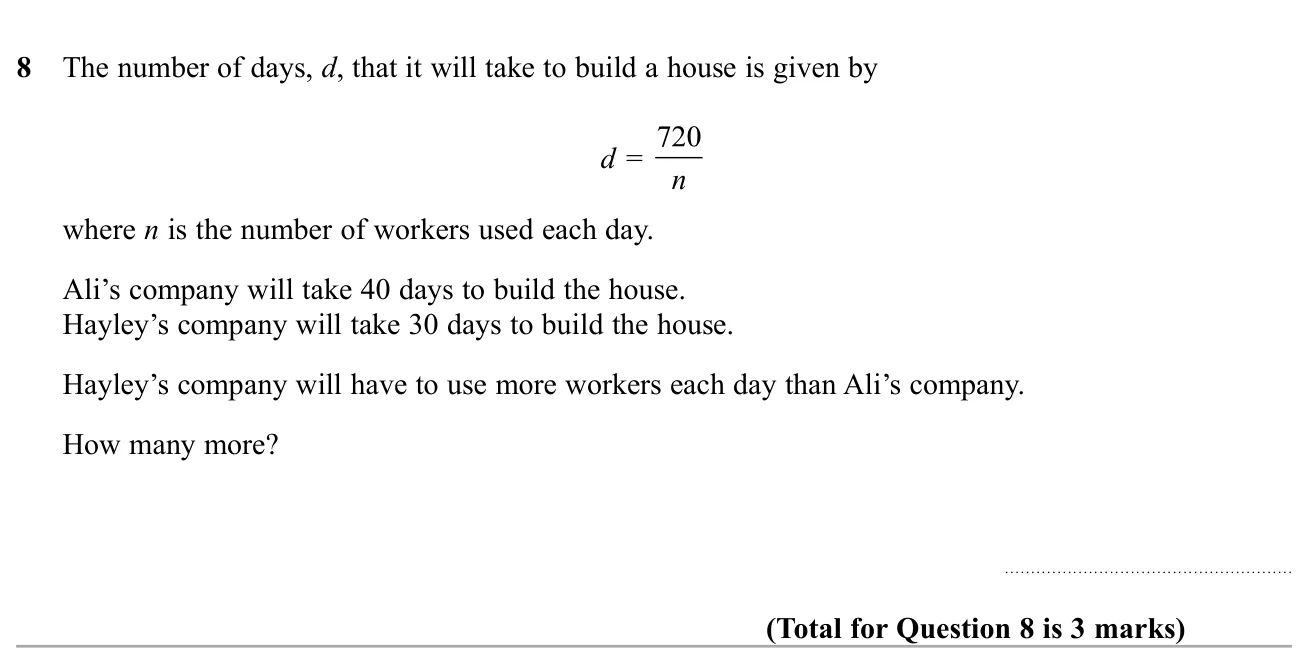
Rearrange: n = 720 d n = \frac{720}{d} n = d 720
Ali: 720 ÷ 40 = 18 720 \div 40 = 18 720 ÷ 40 = 18
Hayley: 720 ÷ 30 = 24 720 \div 30 = 24 720 ÷ 30 = 24
Difference: 24 − 18 = 6 24 - 18 = 6 24 − 18 = 6
Watch out: Working out 720 ÷ 10 720 \div 10 720 ÷ 10
© Pearson Education Ltd. June 2019 Paper 3 (Higher, calculator), question 9.
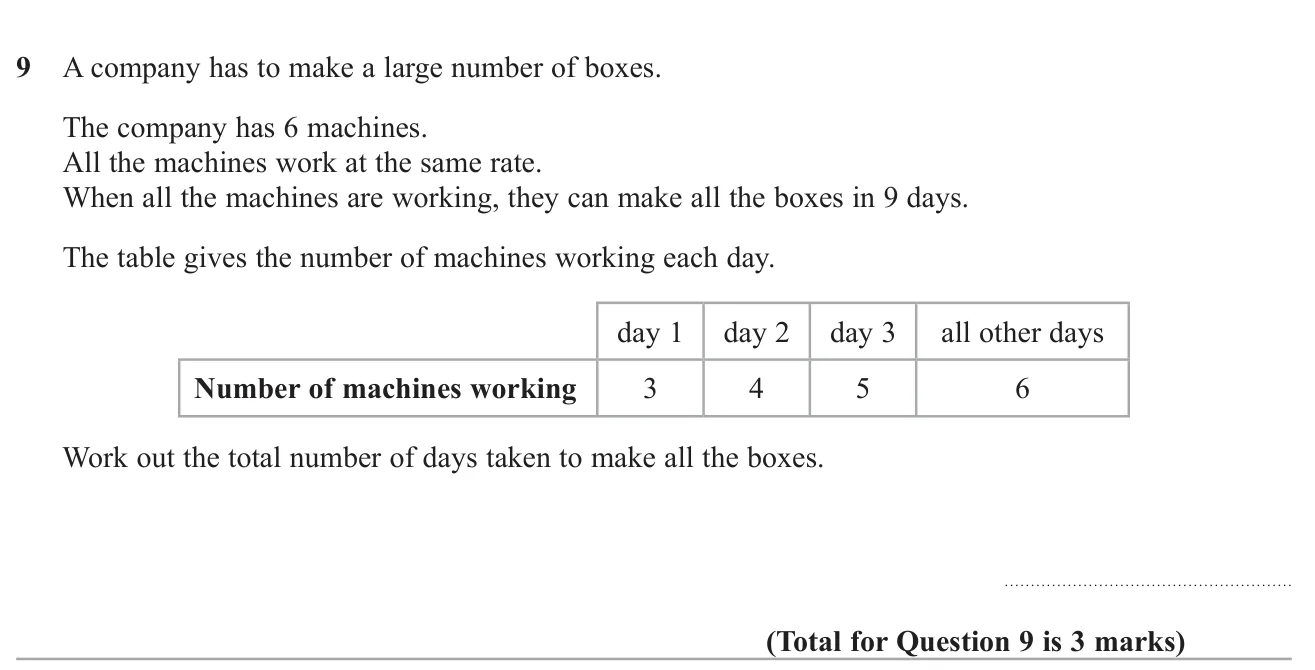
Worked solution Checked against the mark scheme
Total work: 6 × 9 = 54 6 \times 9 = 54 6 × 9 = 54
First 3 days: 3 + 4 + 5 = 12 3 + 4 + 5 = 12 3 + 4 + 5 = 12
Left: 54 − 12 = 42 54 - 12 = 42 54 − 12 = 42 42 ÷ 6 = 7 42 \div 6 = 7 42 ÷ 6 = 7
Total: 3 + 7 = 10 3 + 7 = 10 3 + 7 = 10
Watch out: Answering 7, forgetting to add the first 3 days.
© Pearson Education Ltd. November 2018 Paper 1 (Foundation, non-calculator), question 23.
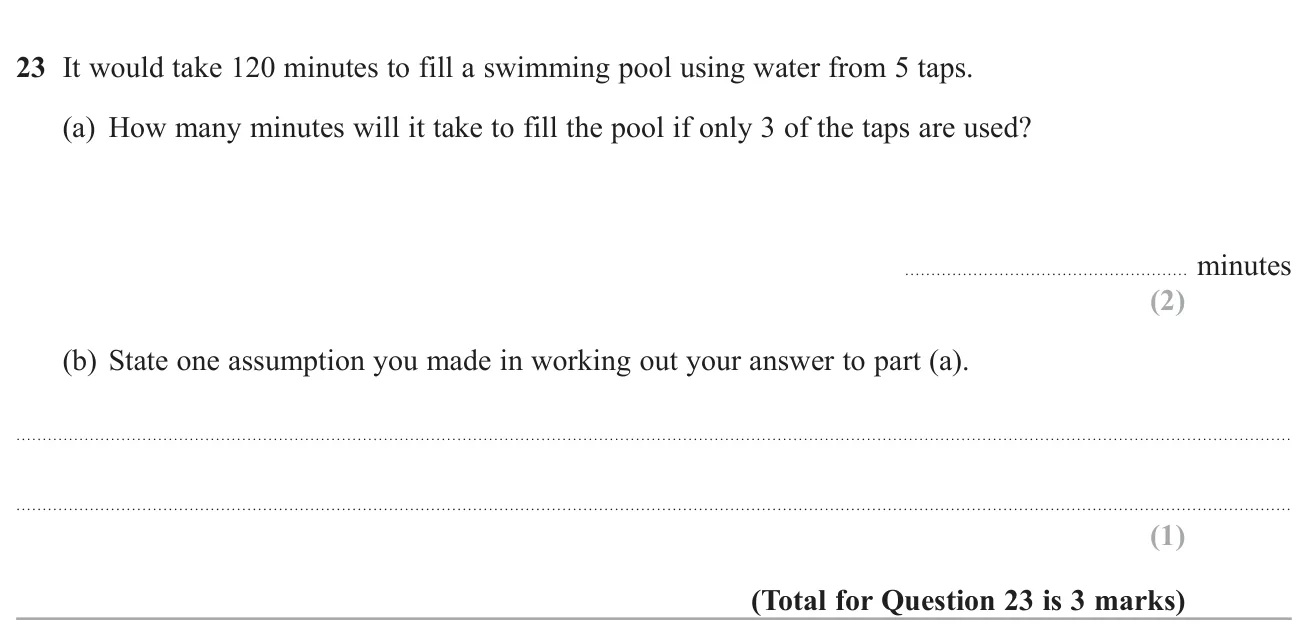
(a) 200 minutes 2 marks (b) Every tap lets water out at the same, constant rate 1 mark
Worked solution Checked against the mark scheme
(a) One tap alone would take 120 × 5 = 600 120 \times 5 = 600 120 × 5 = 600
Three taps: 600 ÷ 3 = 200 600 \div 3 = 200 600 ÷ 3 = 200
(b) Assume each tap gives water at the same rate, and that rate stays constant.
Watch out: Treating it as direct proportion and getting 72 minutes.
© Pearson Education Ltd. June 2024 Paper 2 (Higher, calculator), question 12.
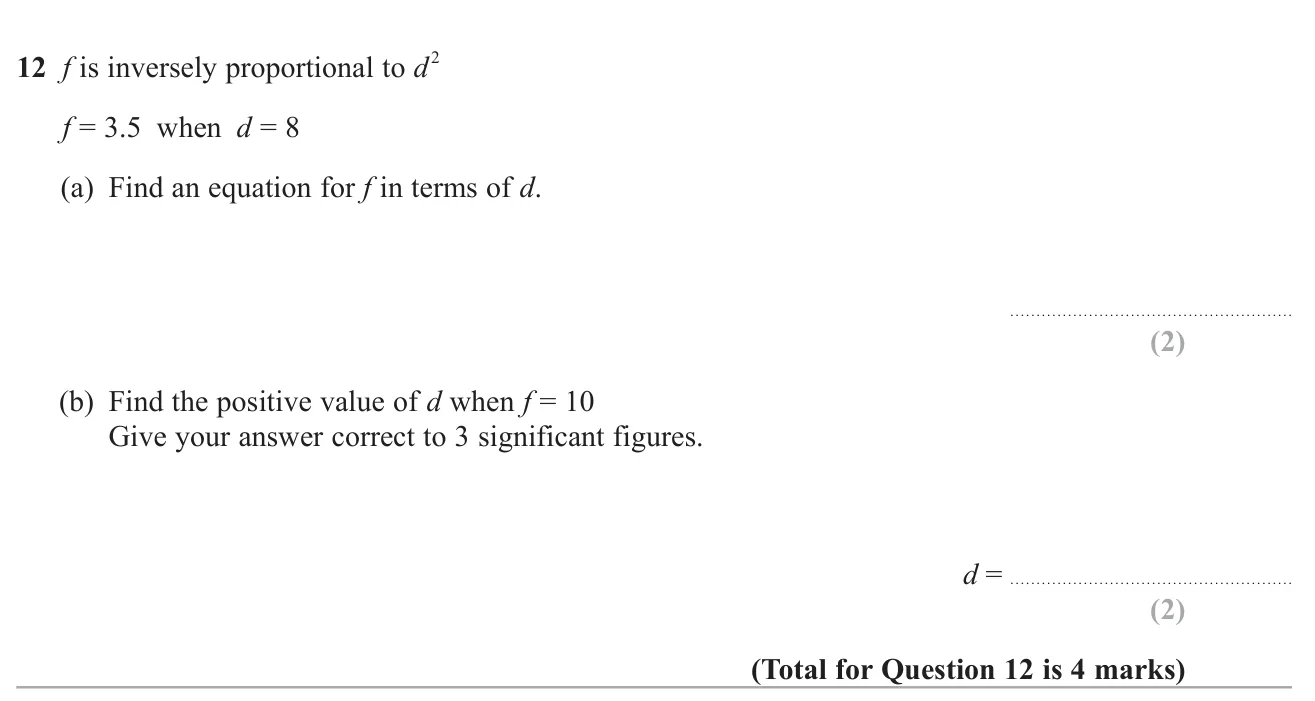
(a) f = 224 d 2 f = \dfrac{224}{d^2} f = d 2 224 2 marks (b) d = 4.73 d = 4.73 d = 4.73 2 marks
Worked solution Checked against the mark scheme
(a) f = k d 2 f = \dfrac{k}{d^2} f = d 2 k f = 3.5 , d = 8 f = 3.5, d = 8 f = 3.5 , d = 8 k = 3.5 × 64 = 224 k = 3.5 \times 64 = 224 k = 3.5 × 64 = 224 f = 224 d 2 f = \dfrac{224}{d^2} f = d 2 224
(b) 10 = 224 d 2 ⇒ d 2 = 22.4 ⇒ d = 22.4 = 4.73 10 = \dfrac{224}{d^2} \Rightarrow d^2 = 22.4 \Rightarrow d = \sqrt{22.4} = 4.73 10 = d 2 224 ⇒ d 2 = 22.4 ⇒ d = 22.4 = 4.73
Watch out: Using f = k d f = \frac{k}{d} f = d k k = 28 k = 28 k = 28
© Pearson Education Ltd. June 2023 Paper 1 (Higher, non-calculator), question 13.
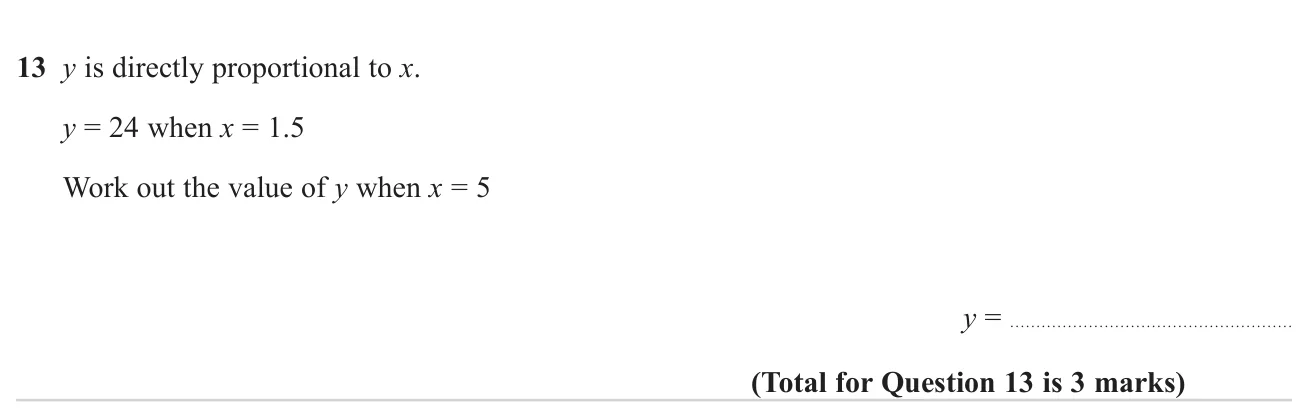
Answer y = 80 y = 80 y = 80 3 marks
Worked solution Checked against the mark scheme
y = k x y = kx y = k x 24 = k × 1.5 24 = k \times 1.5 24 = k × 1.5 k = 16 k = 16 k = 16
When x = 5 x = 5 x = 5 y = 16 × 5 = 80 y = 16 \times 5 = 80 y = 16 × 5 = 80
Watch out: Treating it as inverse proportion and dividing instead of multiplying.
© Pearson Education Ltd. November 2022 Paper 1 (Higher, non-calculator), question 13.
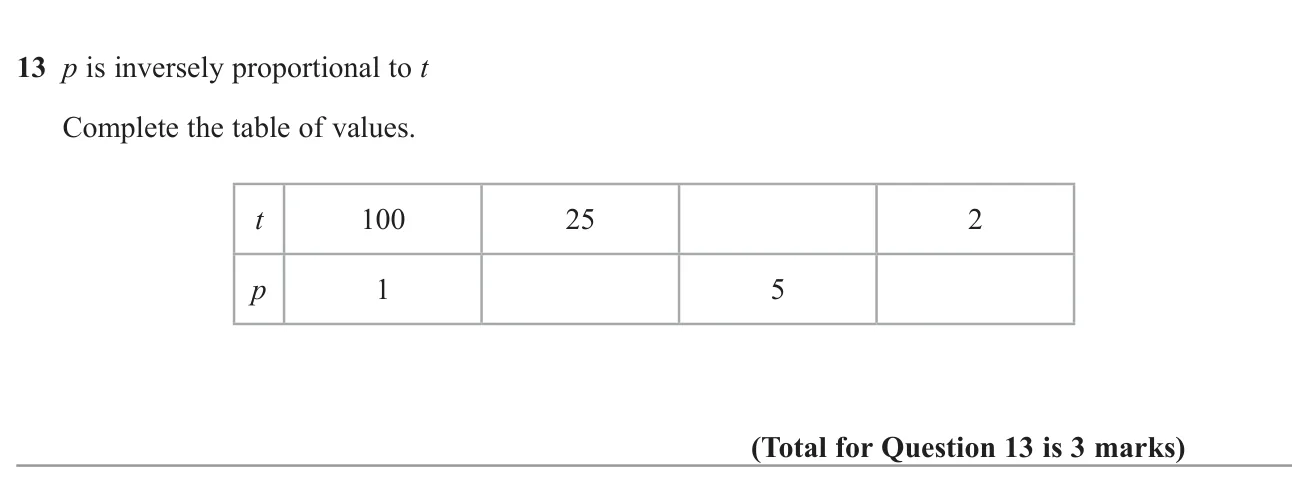
Answer p = 4 p = 4 p = 4 t = 25 t = 25 t = 25 t = 20 t = 20 t = 20 p = 5 p = 5 p = 5 p = 50 p = 50 p = 50 t = 2 t = 2 t = 2 3 marks
Worked solution Checked against the mark scheme
p ∝ 1 t p \propto \frac{1}{t} p ∝ t 1 p × t p \times t p × t 1 × 100 = 100 1 \times 100 = 100 1 × 100 = 100
t = 25 t = 25 t = 25 p = 100 25 = 4 p = \frac{100}{25} = 4 p = 25 100 = 4
p = 5 p = 5 p = 5 t = 100 5 = 20 t = \frac{100}{5} = 20 t = 5 100 = 20
t = 2 t = 2 t = 2 p = 100 2 = 50 p = \frac{100}{2} = 50 p = 2 100 = 50
Watch out: Treating it as direct proportion, e.g. giving p = 0.25 when t = 25.
© Pearson Education Ltd. November 2021 Paper 3 (Higher, calculator), question 8.
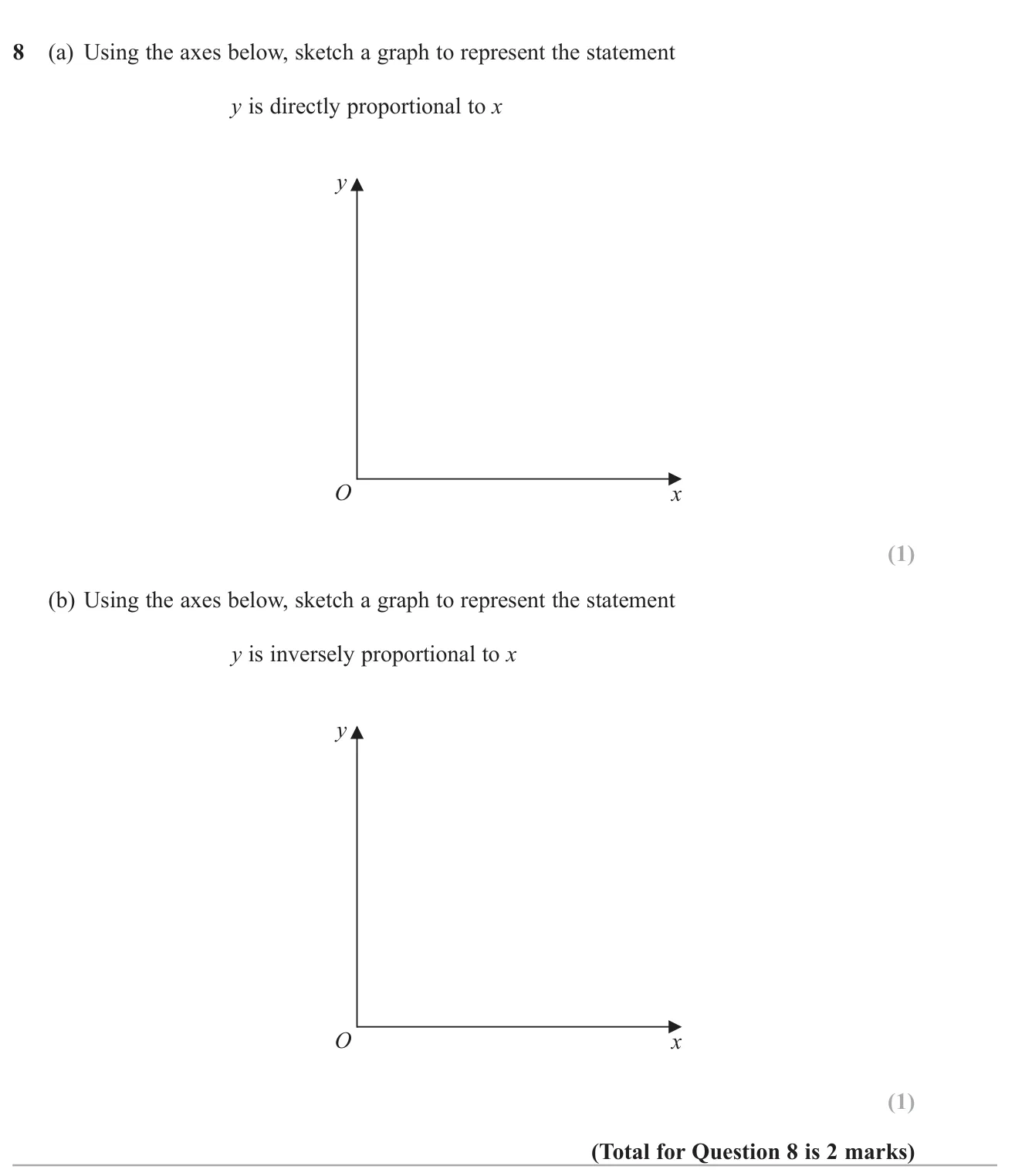
(a) A straight line through the origin with positive gradient 1 mark (b) A curve in the first quadrant that falls as x x x 1 mark
Worked solution Checked against the mark scheme
(a) y = k x y = kx y = k x
(b) y = k x y = \frac{k}{x} y = x k y y y x x x x x x
Watch out: In (a), drawing a line that does not pass through the origin; in (b), drawing a straight line sloping down.
© Pearson Education Ltd. June 2018 Paper 2 (Higher, calculator), question 12.
Answer y ∝ x y \propto x y ∝ x y ∝ x 2 y \propto x^2 y ∝ x 2 y ∝ x y \propto \sqrt{x} y ∝ x y ∝ 1 x y \propto \frac{1}{x} y ∝ x 1 2 marks
Worked solution Checked against the mark scheme
y ∝ x y \propto x y ∝ x
y ∝ x 2 y \propto x^2 y ∝ x 2
y ∝ x y \propto \sqrt{x} y ∝ x
y ∝ 1 x y \propto \frac{1}{x} y ∝ x 1
Watch out: Swapping the x 2 x^2 x 2 x \sqrt{x} x
© Pearson Education Ltd. November 2024 Paper 2 (Higher, calculator), question 13.
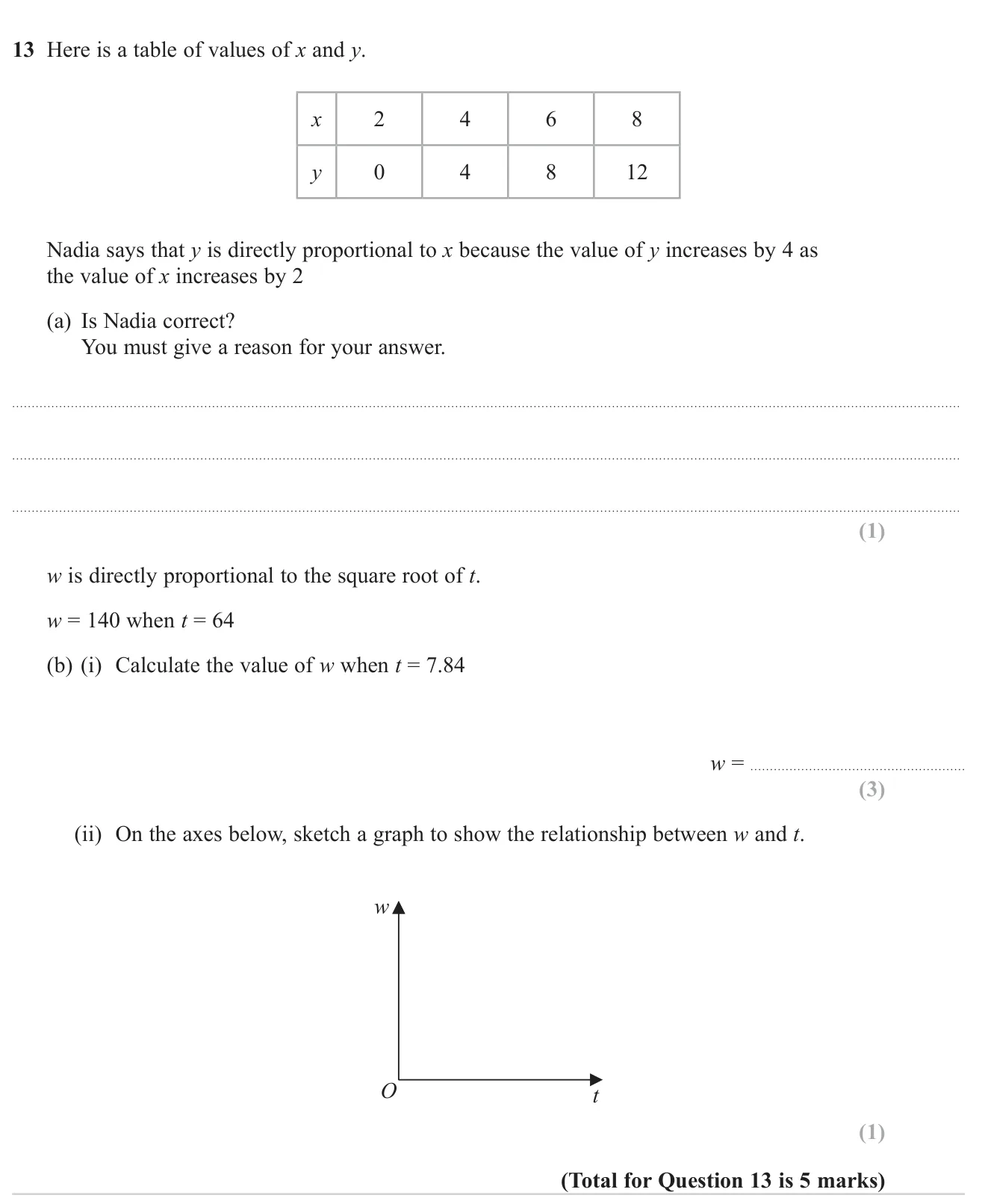
(a) No: y ÷ x y \div x y ÷ x 4 ÷ 4 = 1 4 \div 4 = 1 4 ÷ 4 = 1 8 ÷ 6 ≠ 1 8 \div 6 \neq 1 8 ÷ 6 = 1 1 mark (b(i)) 49 49 49 3 marks (b(ii)) Curve starting at the origin, increasing and getting less steep (shape of w = k t w = k\sqrt{t} w = k t 1 mark
Worked solution Checked against the mark scheme
(a) In direct proportion y ÷ x y \div x y ÷ x 0 ÷ 2 = 0 0 \div 2 = 0 0 ÷ 2 = 0 4 ÷ 4 = 1 4 \div 4 = 1 4 ÷ 4 = 1
(b)(i) w = k t w = k\sqrt{t} w = k t 140 = k × 8 140 = k \times 8 140 = k × 8 k = 17.5 k = 17.5 k = 17.5
w = 17.5 × 7.84 = 17.5 × 2.8 = 49 w = 17.5 \times \sqrt{7.84} = 17.5 \times 2.8 = 49 w = 17.5 × 7.84 = 17.5 × 2.8 = 49
(ii) Start at O and rise, curving so it gets less steep.
Watch out: Using t t t t \sqrt{t} t k = 140 ÷ 64 k = 140 \div 64 k = 140 ÷ 64
© Pearson Education Ltd. November 2023 Paper 2 (Higher, calculator), question 11.
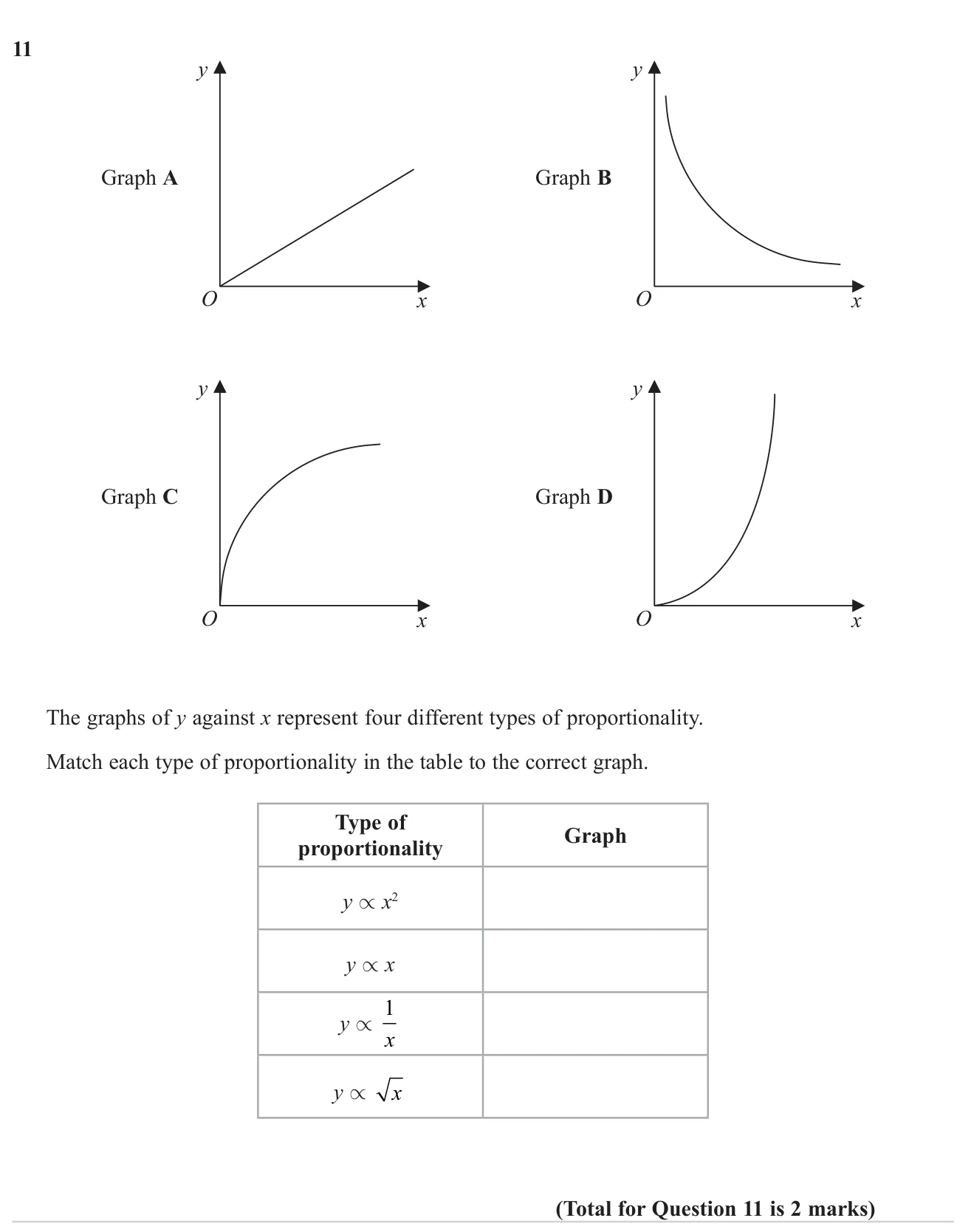
Answer y ∝ x 2 y \propto x^2 y ∝ x 2 y ∝ x y \propto x y ∝ x y ∝ 1 x y \propto \frac{1}{x} y ∝ x 1 y ∝ x y \propto \sqrt{x} y ∝ x 2 marks
Worked solution Checked against the mark scheme
y ∝ x y \propto x y ∝ x
y ∝ x 2 y \propto x^2 y ∝ x 2
y ∝ 1 x y \propto \frac{1}{x} y ∝ x 1 x x x
y ∝ x y \propto \sqrt{x} y ∝ x
Watch out: Mixing up the square and square-root graphs (C and D).
© Pearson Education Ltd. June 2019 Paper 1 (Higher, non-calculator), question 20.
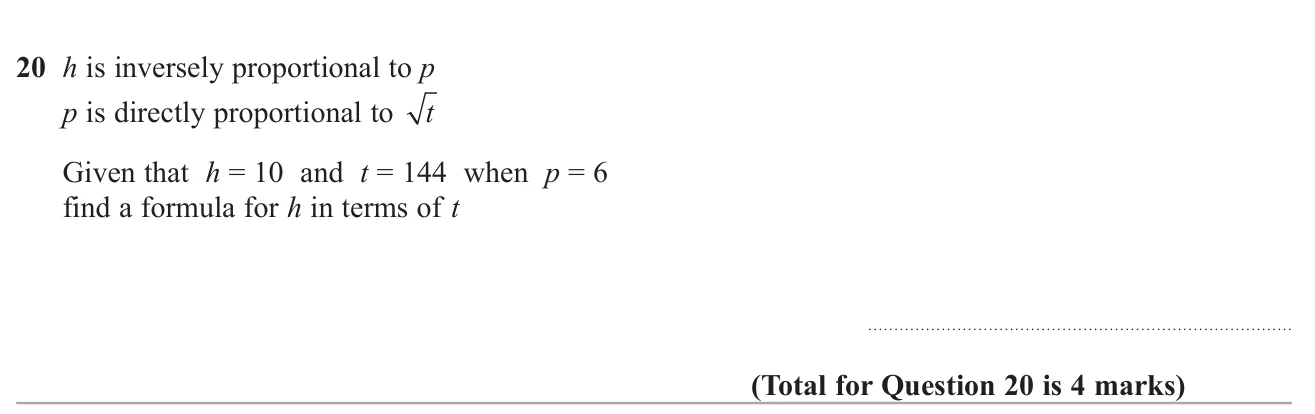
Answer h = 120 t h = \frac{120}{\sqrt{t}} h = t 120 4 marks
Worked solution Checked against the mark scheme
h = k p h = \frac{k}{p} h = p k 10 = k 6 10 = \frac{k}{6} 10 = 6 k k = 60 k = 60 k = 60
p = K t p = K\sqrt{t} p = K t 6 = K × 12 6 = K \times 12 6 = K × 12 K = 1 2 K = \frac{1}{2} K = 2 1
h = 60 1 2 t = 120 t h = \frac{60}{\frac{1}{2}\sqrt{t}} = \frac{120}{\sqrt{t}} h = 2 1 t 60 = t 120
Watch out: Using t t t t \sqrt{t} t
© Pearson Education Ltd. November 2019 Paper 3 (Higher, calculator), question 16.
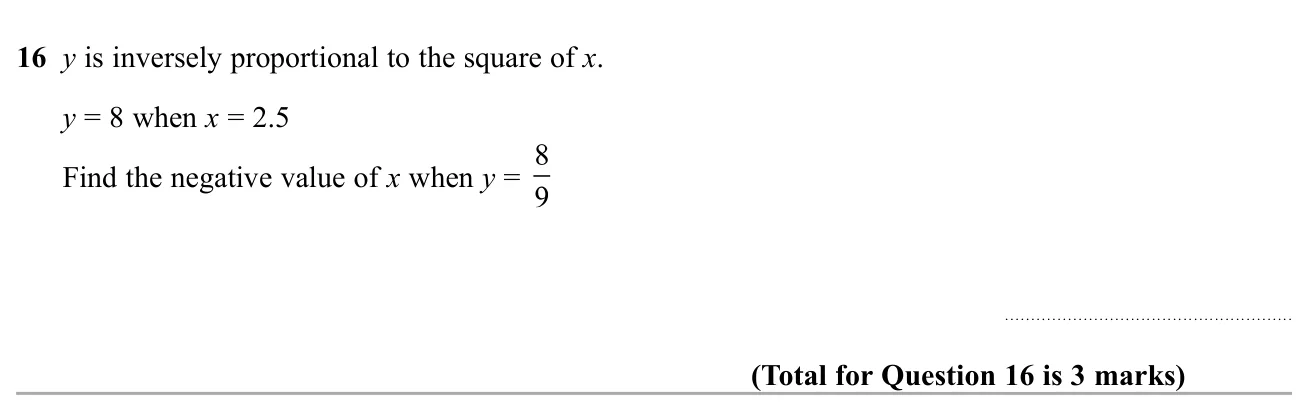
Answer x = − 7.5 x = -7.5 x = − 7.5 3 marks
Worked solution Checked against the mark scheme
y = k x 2 y = \dfrac{k}{x^2} y = x 2 k 8 = k 2.5 2 8 = \dfrac{k}{2.5^2} 8 = 2. 5 2 k k = 8 × 6.25 = 50 k = 8 \times 6.25 = 50 k = 8 × 6.25 = 50
When y = 8 9 y = \frac{8}{9} y = 9 8 x 2 = 50 ÷ 8 9 = 56.25 x^2 = 50 \div \frac{8}{9} = 56.25 x 2 = 50 ÷ 9 8 = 56.25
x = ± 7.5 x = \pm 7.5 x = ± 7.5 − 7.5 -7.5 − 7.5
Watch out: Using y = k / x y = k/x y = k / x k / x 2 k/x^2 k / x 2
© Pearson Education Ltd. November 2018 Paper 3 (Higher, calculator), question 14.
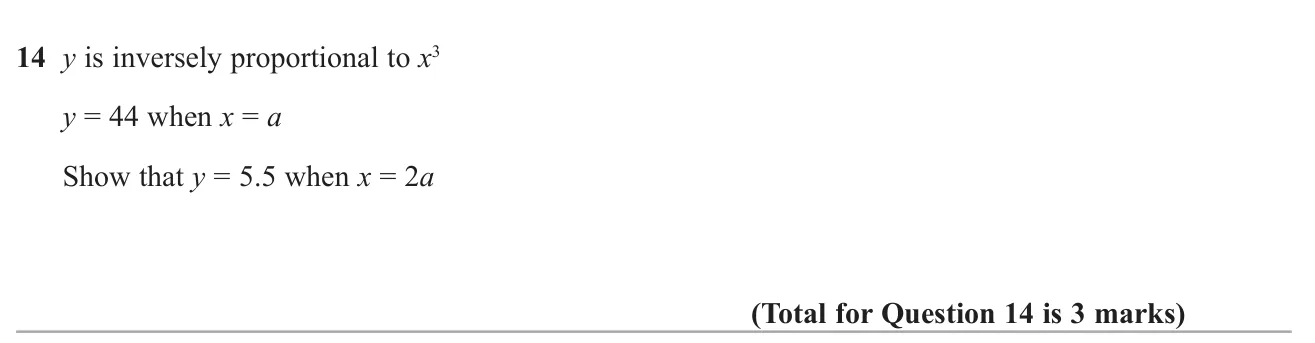
Answer y = 44 a 3 8 a 3 = 5.5 y = \frac{44a^3}{8a^3} = 5.5 y = 8 a 3 44 a 3 = 5.5 3 marks
Worked solution Checked against the mark scheme
y = k x 3 y = \frac{k}{x^3} y = x 3 k
44 = k a 3 44 = \frac{k}{a^3} 44 = a 3 k k = 44 a 3 k = 44a^3 k = 44 a 3
When x = 2 a x = 2a x = 2 a y = 44 a 3 ( 2 a ) 3 = 44 a 3 8 a 3 = 5.5 y = \frac{44a^3}{(2a)^3} = \frac{44a^3}{8a^3} = 5.5 y = ( 2 a ) 3 44 a 3 = 8 a 3 44 a 3 = 5.5
Watch out: Writing ( 2 a ) 3 = 2 a 3 (2a)^3 = 2a^3 ( 2 a ) 3 = 2 a 3 8 a 3 8a^3 8 a 3
© Pearson Education Ltd. Specimen Paper 1 (Higher, non-calculator), question 16.
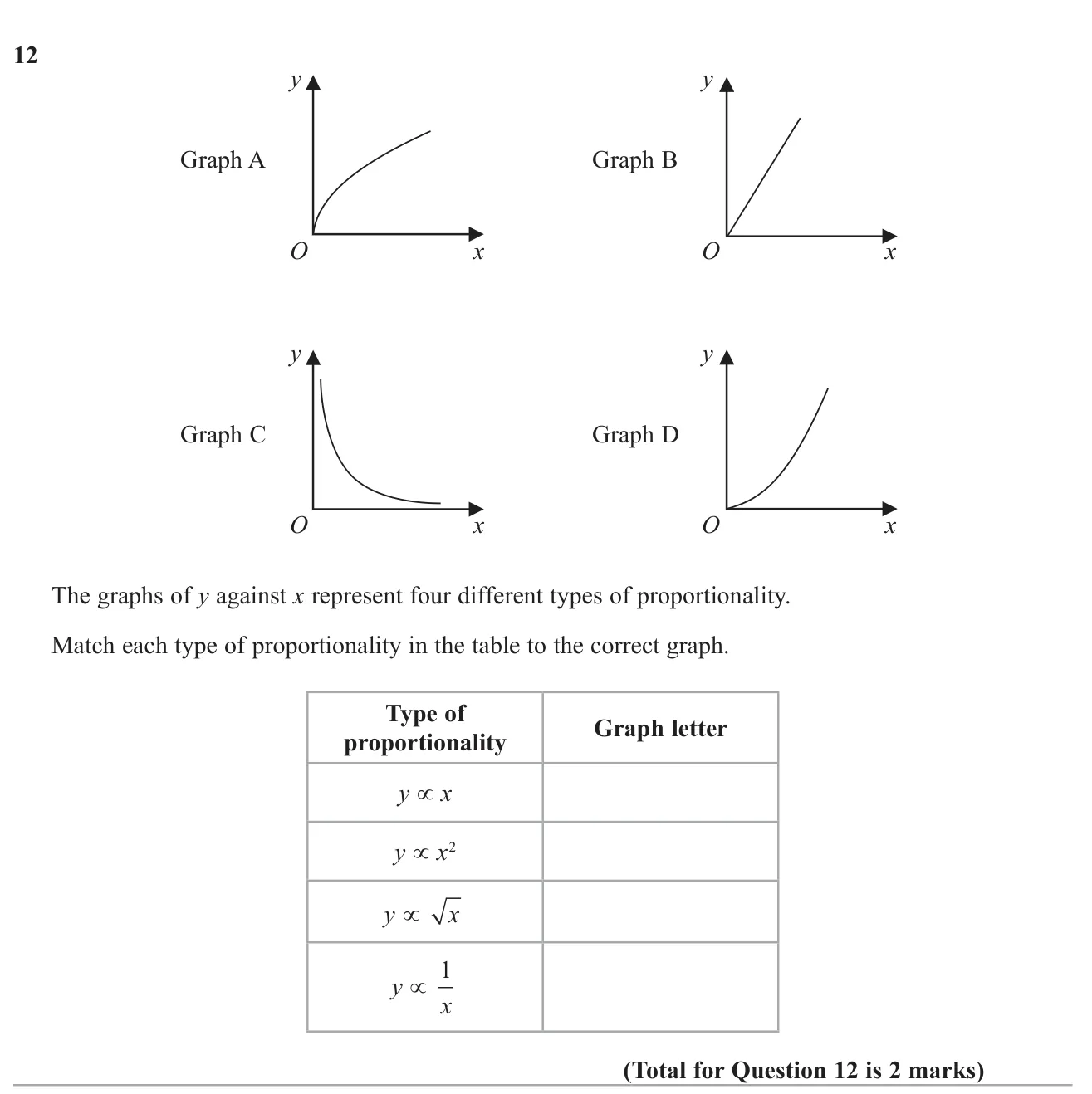
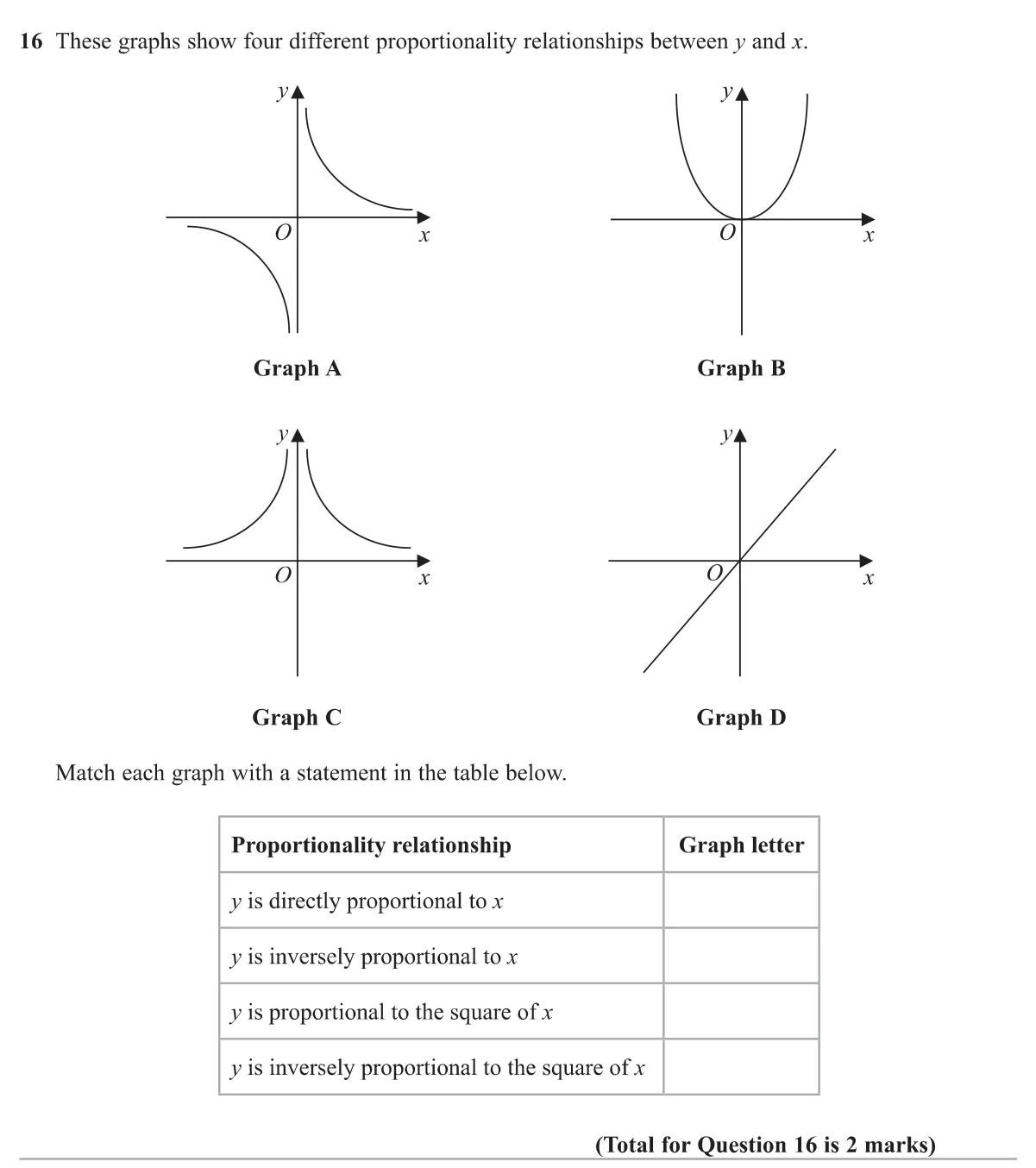
Answer Direct: D; inverse: A; square: B; inverse square: C 2 marks
Worked solution Checked against the mark scheme
Direct proportion is a straight line through the origin: D .
Inverse proportion y = k x y = \frac{k}{x} y = x k A .
y = k x 2 y = kx^2 y = k x 2 B .
y = k x 2 y = \frac{k}{x^2} y = x 2 k x x x C .
Watch out: Mixing up graphs A and C.
© Pearson Education Ltd. Specimen Paper 2 (Higher, calculator), question 15.
Worked solution Checked against the mark scheme
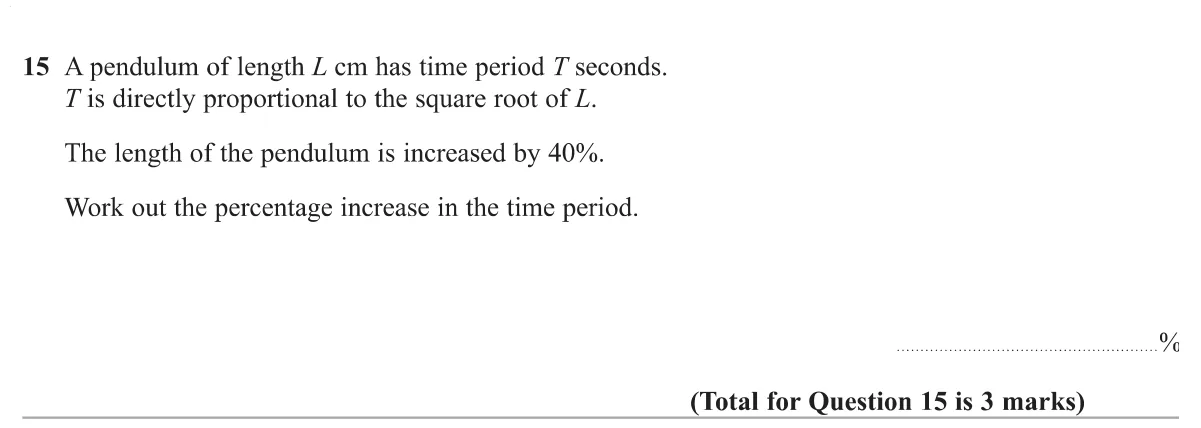
T = k L T = k\sqrt{L} T = k L
New length = 1.4 L = 1.4L = 1.4 L T = k 1.4 L = 1.4 × k L T = k\sqrt{1.4L} = \sqrt{1.4} \times k\sqrt{L} T = k 1.4 L = 1.4 × k L
1.4 = 1.1832 \sqrt{1.4} = 1.1832 1.4 = 1.1832
Increase = 18.3 % = 18.3\% = 18.3%
Watch out: Answering 40% or 20% (halving the percentage instead of using a square root).
© Pearson Education Ltd. November 2023 Paper 2 (Higher, calculator), question 14.
Answer y = 0.48 y = 0.48 y = 0.48 5 marks
Worked solution Checked against the mark scheme
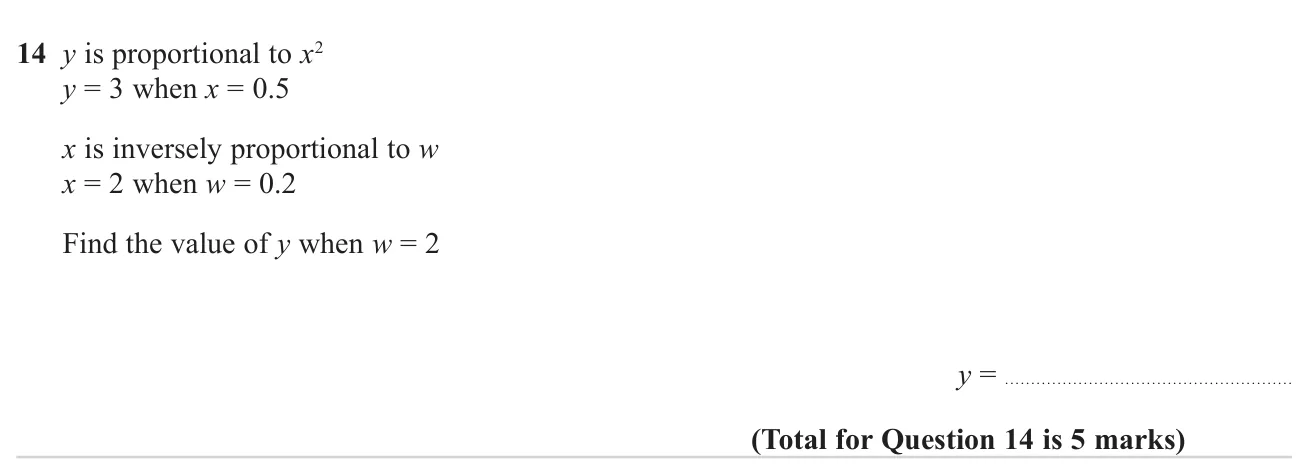
y = k x 2 y = kx^2 y = k x 2 3 = k × 0.5 2 3 = k \times 0.5^2 3 = k × 0. 5 2 k = 12 k = 12 k = 12
x = j w x = \frac{j}{w} x = w j 2 = j 0.2 2 = \frac{j}{0.2} 2 = 0.2 j j = 0.4 j = 0.4 j = 0.4
When w = 2 w = 2 w = 2 x = 0.4 2 = 0.2 x = \frac{0.4}{2} = 0.2 x = 2 0.4 = 0.2
y = 12 × 0.2 2 = 0.48 y = 12 \times 0.2^2 = 0.48 y = 12 × 0. 2 2 = 0.48
Watch out: Treating the inverse proportion as x = jw.
© Pearson Education Ltd. June 2022 Paper 1 (Higher, non-calculator), question 17.
Answer y = 40 x 3 / 2 y = \frac{40}{x^{3/2}} y = x 3/2 40 4 marks
Worked solution Checked against the mark scheme
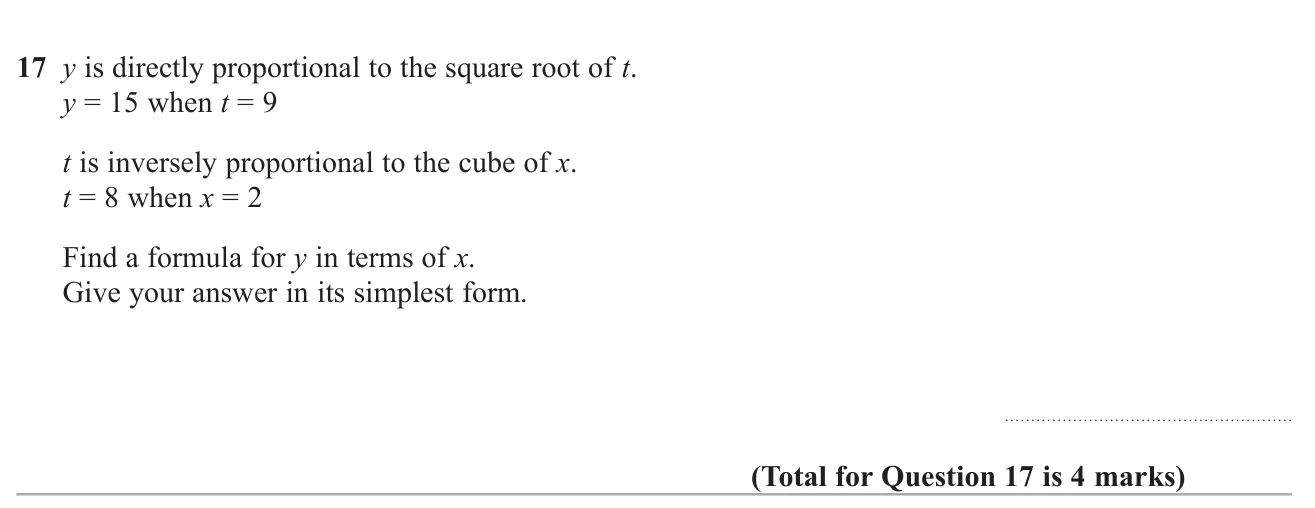
y = k t y = k\sqrt{t} y = k t 15 = k × 3 15 = k \times 3 15 = k × 3 k = 5 k = 5 k = 5
t = K x 3 t = \frac{K}{x^3} t = x 3 K 8 = K 8 8 = \frac{K}{8} 8 = 8 K K = 64 K = 64 K = 64
y = 5 64 x 3 = 5 × 8 x 3 / 2 = 40 x 3 / 2 y = 5\sqrt{\frac{64}{x^3}} = \frac{5 \times 8}{x^{3/2}} = \frac{40}{x^{3/2}} y = 5 x 3 64 = x 3/2 5 × 8 = x 3/2 40
Watch out: Leaving the answer as 5 64 / x 3 5\sqrt{64/x^3} 5 64/ x 3
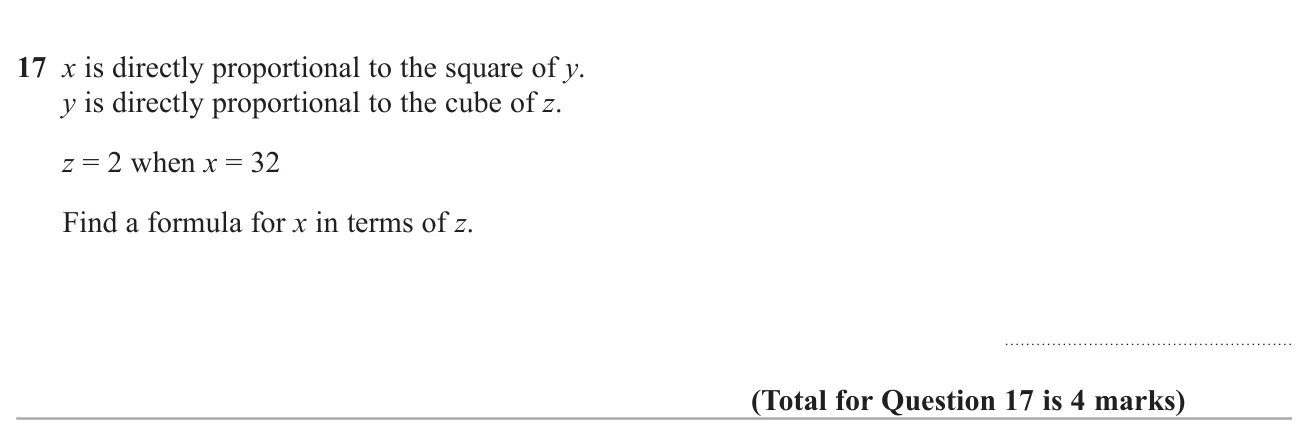
© Pearson Education Ltd. November 2021 Paper 3 (Higher, calculator), question 17.
Answer x = 1 2 z 6 x = \frac{1}{2}z^6 x = 2 1 z 6 4 marks
Worked solution Checked against the mark scheme
x = k y 2 x = ky^2 x = k y 2 y = c z 3 y = cz^3 y = c z 3 x = k ( c z 3 ) 2 = m z 6 x = k(cz^3)^2 = mz^6 x = k ( c z 3 ) 2 = m z 6
Substitute z = 2 z = 2 z = 2 x = 32 x = 32 x = 32 32 = m × 64 32 = m \times 64 32 = m × 64 m = 1 2 m = \frac{1}{2} m = 2 1
x = 1 2 z 6 x = \frac{1}{2}z^6 x = 2 1 z 6
Watch out: Writing x = m z 5 x = mz^5 x = m z 5
© Pearson Education Ltd. November 2020 Paper 1 (Higher, non-calculator), question 18.
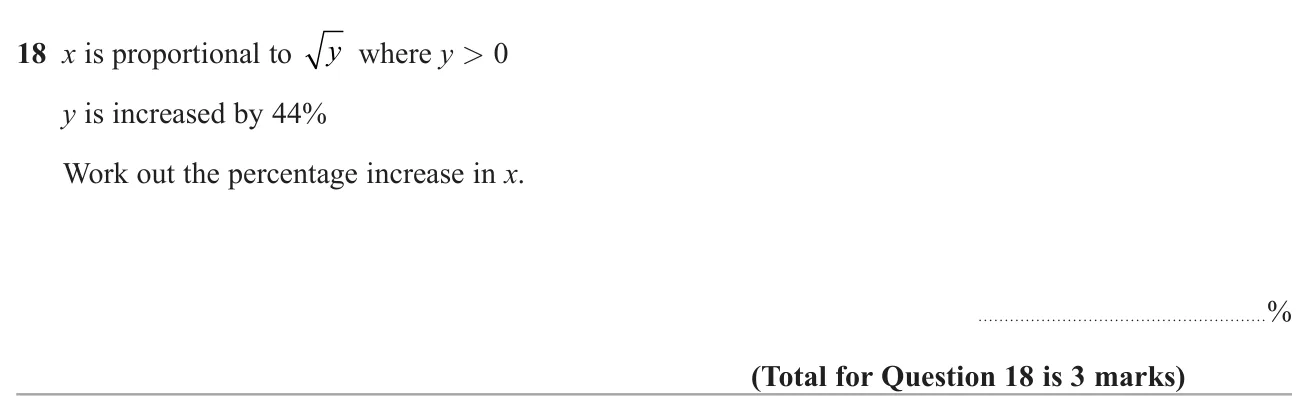
Worked solution Checked against the mark scheme
x = k y x = k\sqrt{y} x = k y
New y y y 1.44 y 1.44y 1.44 y x = k 1.44 y = 1.2 k y = 1.2 x x = k\sqrt{1.44y} = 1.2k\sqrt{y} = 1.2x x = k 1.44 y = 1.2 k y = 1.2 x
So x x x 20 % 20\% 20%
Watch out: Halving 44% to get 22%.
© Pearson Education Ltd. June 2018 Paper 1 (Higher, non-calculator), question 14.
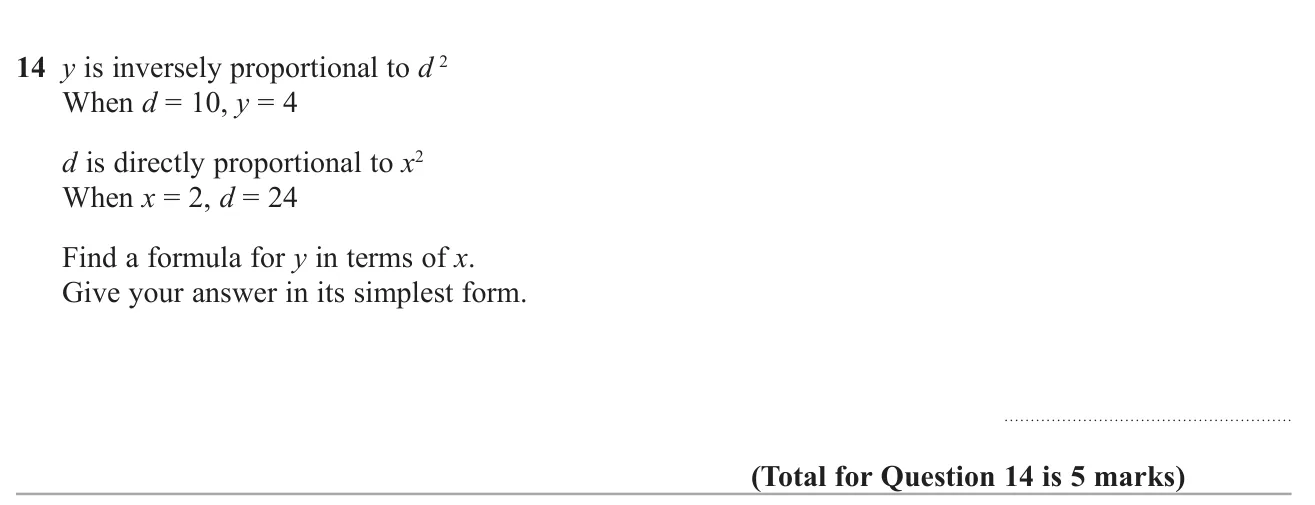
Answer y = 100 9 x 4 y = \frac{100}{9x^4} y = 9 x 4 100 5 marks
Worked solution Checked against the mark scheme
y = K d 2 y = \frac{K}{d^2} y = d 2 K 4 = K 100 4 = \frac{K}{100} 4 = 100 K K = 400 K = 400 K = 400
d = k x 2 d = kx^2 d = k x 2 24 = k × 4 24 = k \times 4 24 = k × 4 k = 6 k = 6 k = 6 d = 6 x 2 d = 6x^2 d = 6 x 2
y = 400 ( 6 x 2 ) 2 = 400 36 x 4 = 100 9 x 4 y = \frac{400}{(6x^2)^2} = \frac{400}{36x^4} = \frac{100}{9x^4} y = ( 6 x 2 ) 2 400 = 36 x 4 400 = 9 x 4 100
Watch out: Squaring 6 x 2 6x^2 6 x 2 6 x 4 6x^4 6 x 4 36 x 4 36x^4 36 x 4
Also tested in these questions Their main topic is different, but part of each one tests this topic.