© Pearson Education Ltd. June 2019 Paper 2 (Higher, calculator), question 1.
Show answer
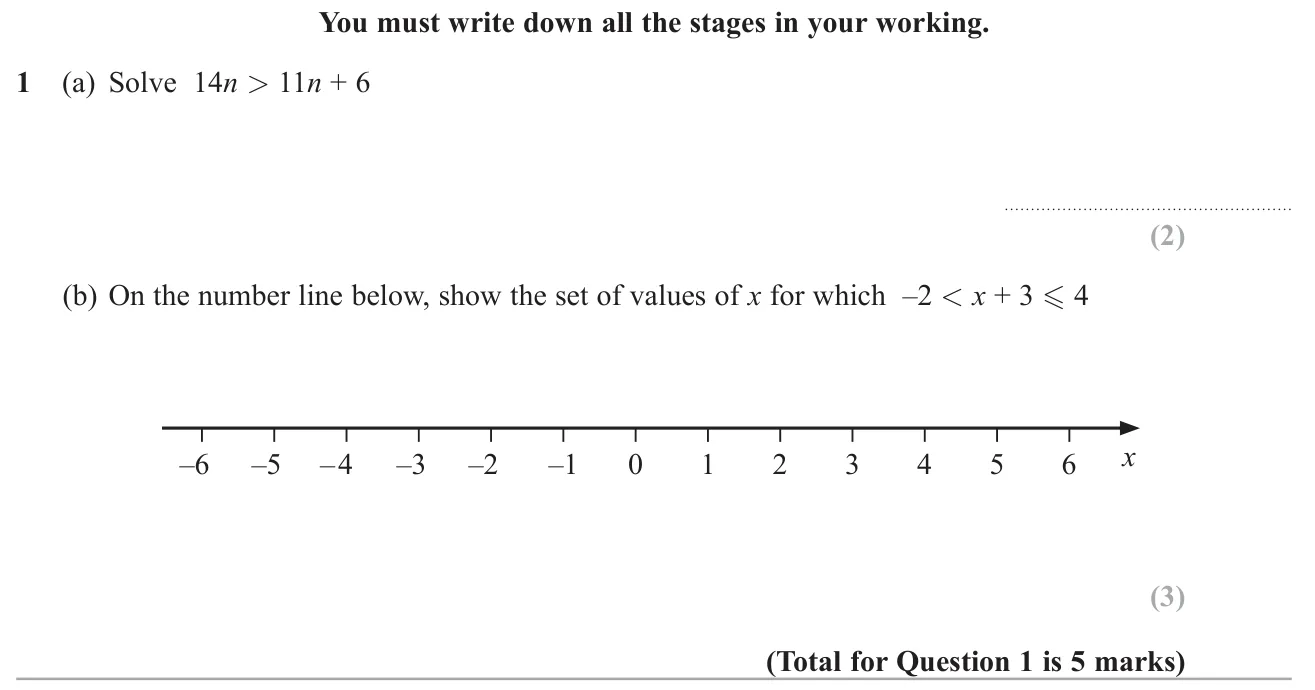
| (a) | n>2 | 2 marks |
|---|
| (b) | −5<x≤1: open circle at −5, closed circle at 1, joined by a line | 3 marks |
|---|
Worked solution Checked against the mark scheme
(a) 14n−11n>6, so 3n>6 and n>2.
(b) Subtract 3 from every part: −2−3<x≤4−3, so −5<x≤1.
Draw an open circle at −5 (not included), a filled circle at 1 (included) and join them.
Watch out: Using a filled circle at −5 for a strict inequality.
© Pearson Education Ltd. June 2019 Paper 2 (Higher, calculator), question 2.
Show answer
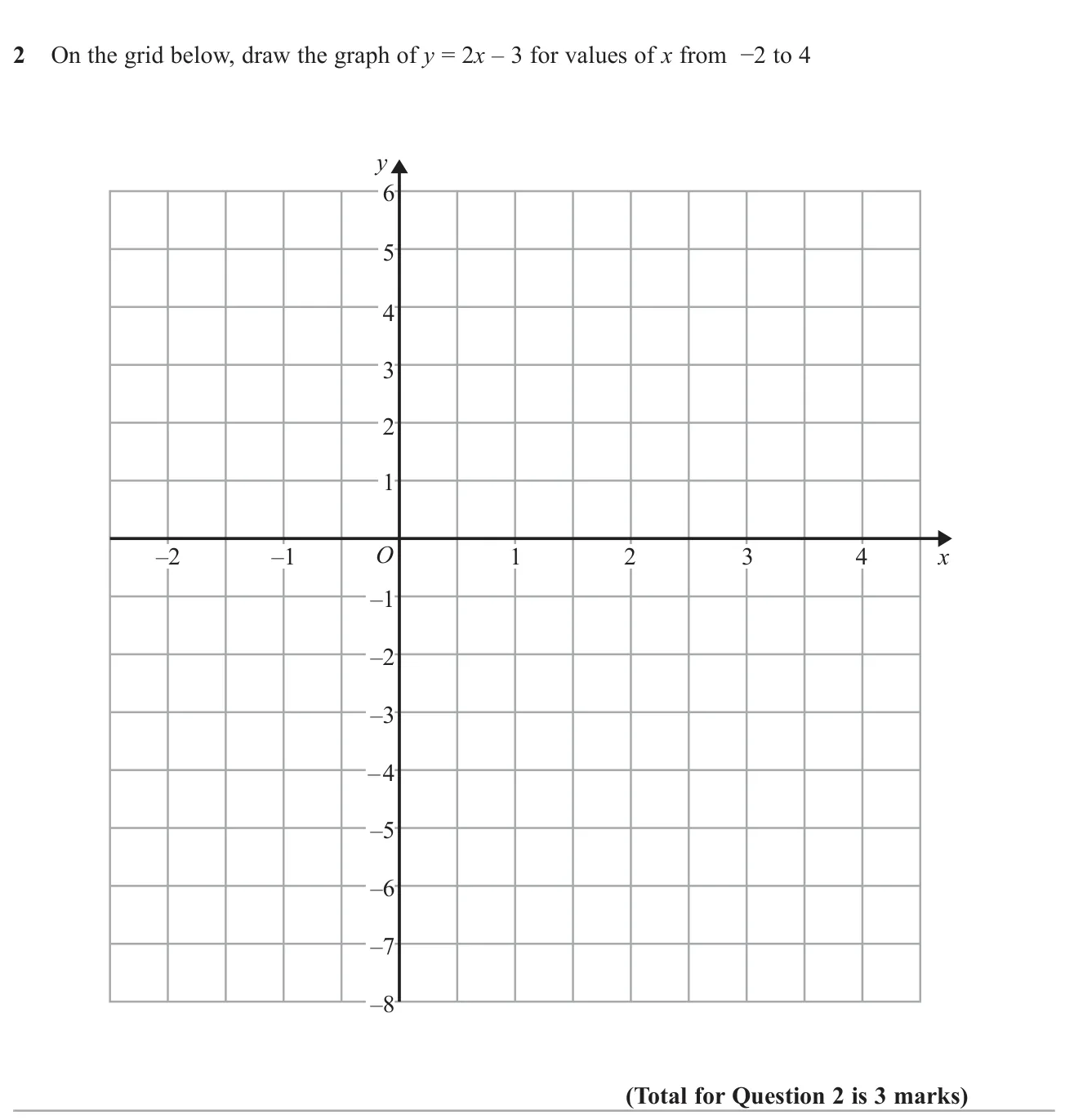
| Answer | Straight line through (−2,−7) and (4,5) | 3 marks |
|---|
Worked solution Checked against the mark scheme
Make a table of values using y=2x−3:
| x | −2 | −1 | 0 | 1 | 2 | 3 | 4 |
|---|---|---|---|---|---|---|---|
| y | −7 | −5 | −3 | −1 | 1 | 3 | 5 |
Plot the points and join them with a single ruled line from (−2,−7) to (4,5).
Watch out: Stopping the line short of x = −2 or x = 4.
© Pearson Education Ltd. June 2019 Paper 2 (Higher, calculator), question 3.
Show answer
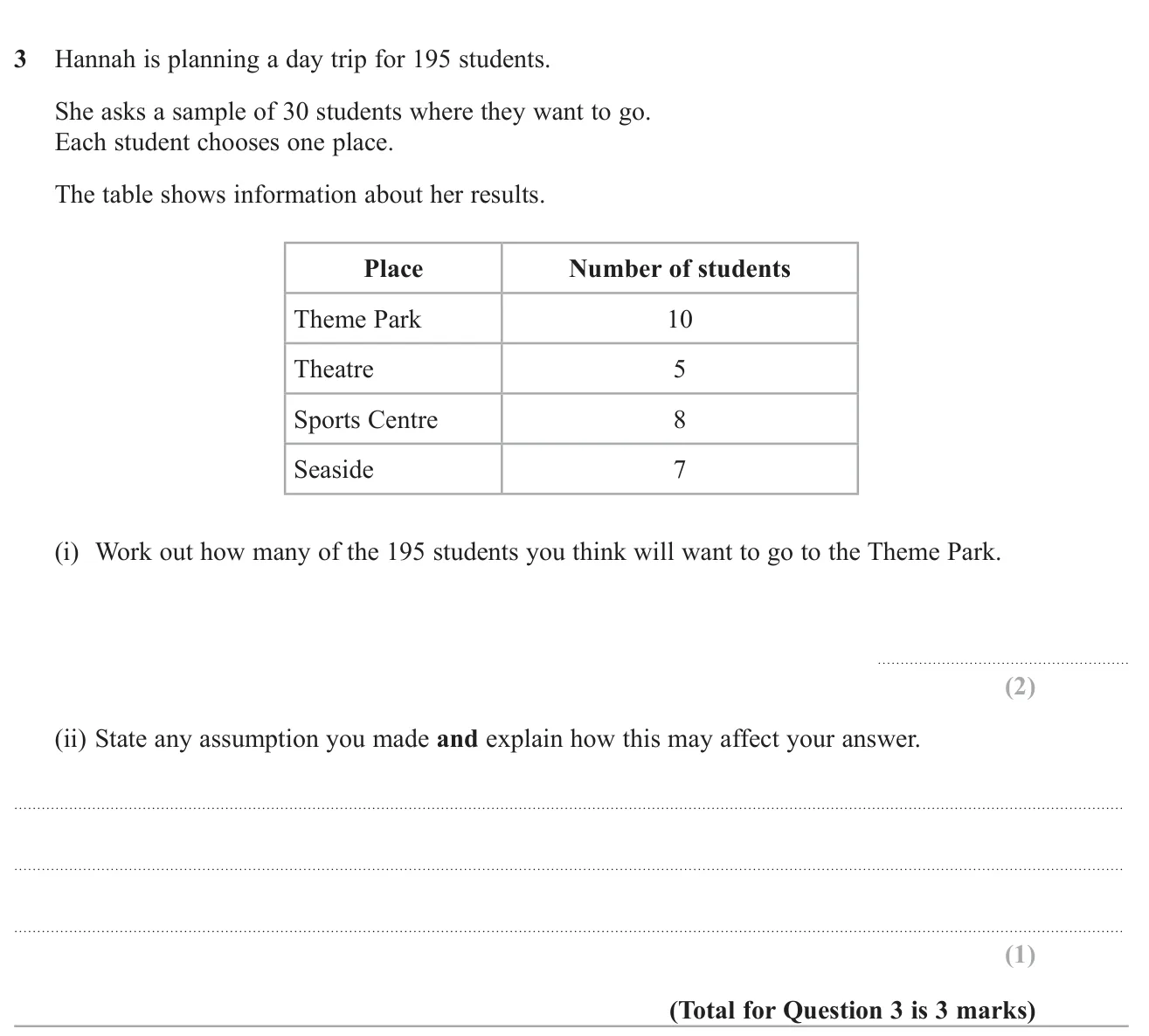
| ((i)) | 65 | 2 marks |
|---|
| ((ii)) | e.g. The sample is representative of all 195 students; if not, the estimate could be wrong | 1 mark |
|---|
Worked solution Checked against the mark scheme
(i) 3010=31 of the sample chose the theme park.
31×195=65
(ii) Assume the 30 students represent the whole group fairly. If they do not, the true number could be quite different from 65.
Watch out: Saying only 'I rounded my answer' as the assumption.
© Pearson Education Ltd. June 2019 Paper 2 (Higher, calculator), question 4.
Show answer
Worked solution Checked against the mark scheme
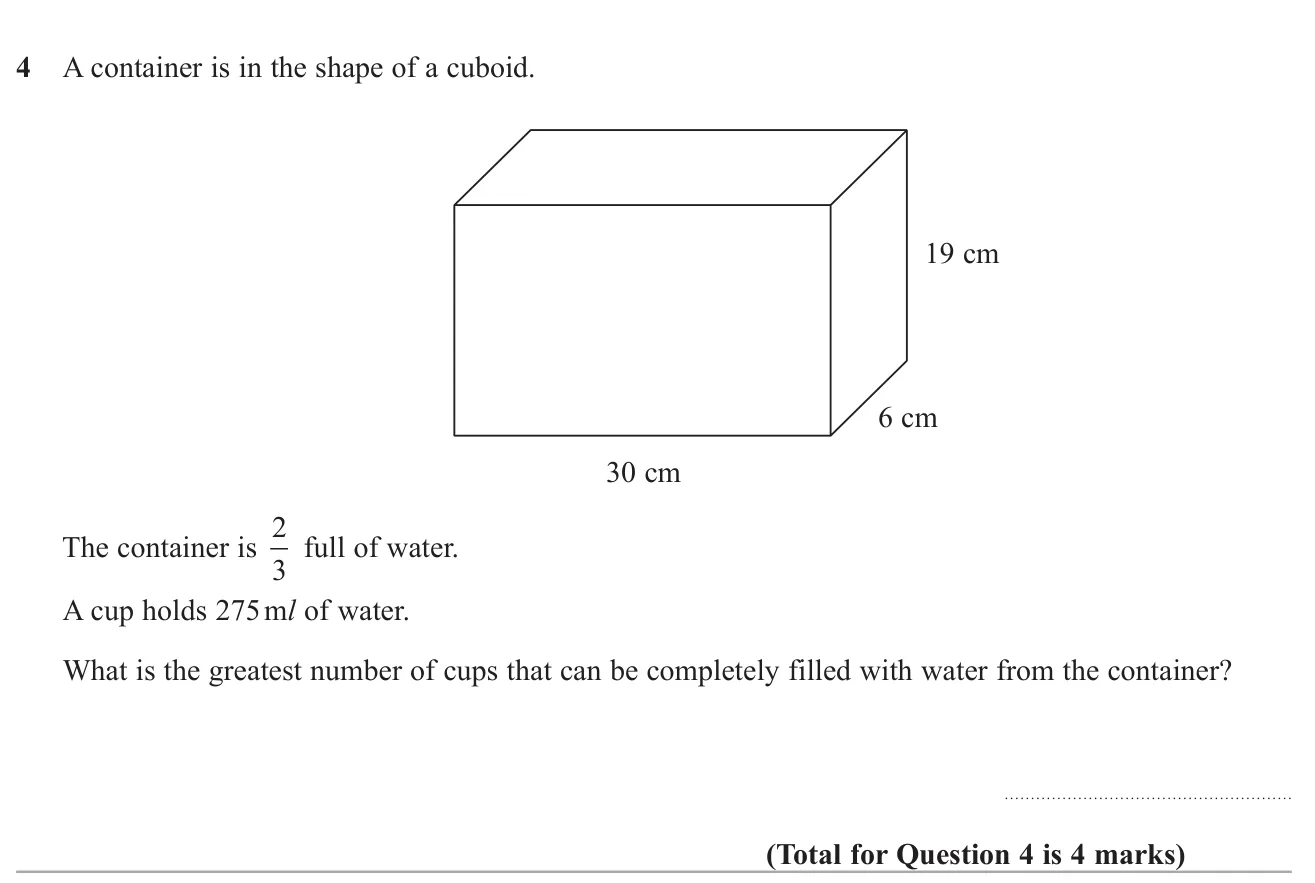
Volume =30×19×6=3420 cm3
Water =32×3420=2280 cm3=2280 ml
2280÷275=8.29...
Only 8 cups can be completely filled.
Watch out: Rounding 8.29 up to 9 cups.
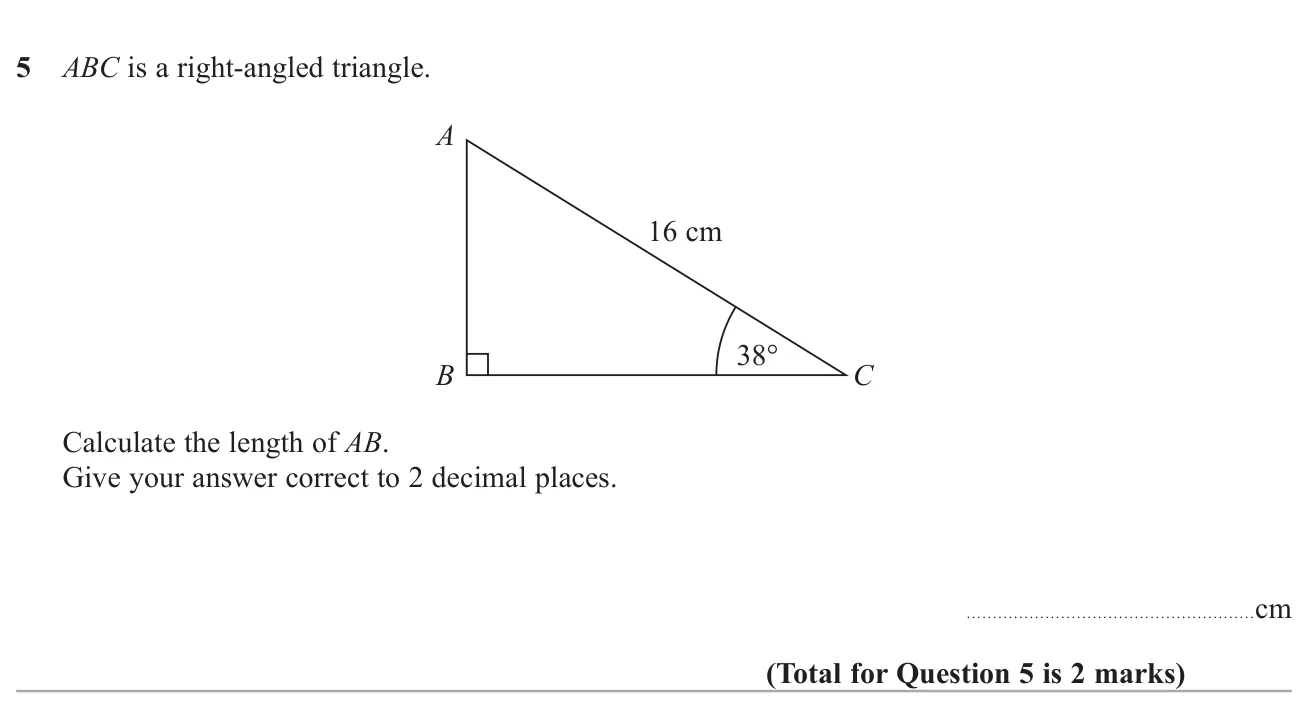
© Pearson Education Ltd. June 2019 Paper 2 (Higher, calculator), question 5.
Show answer
| Answer | 9.85 cm | 2 marks |
|---|
Worked solution Checked against the mark scheme
AC is the hypotenuse (16 cm) and AB is opposite the 38° angle.
sin38∘=16AB
AB=16sin38∘=9.850...=9.85 cm
Watch out: Using cos instead of sin.
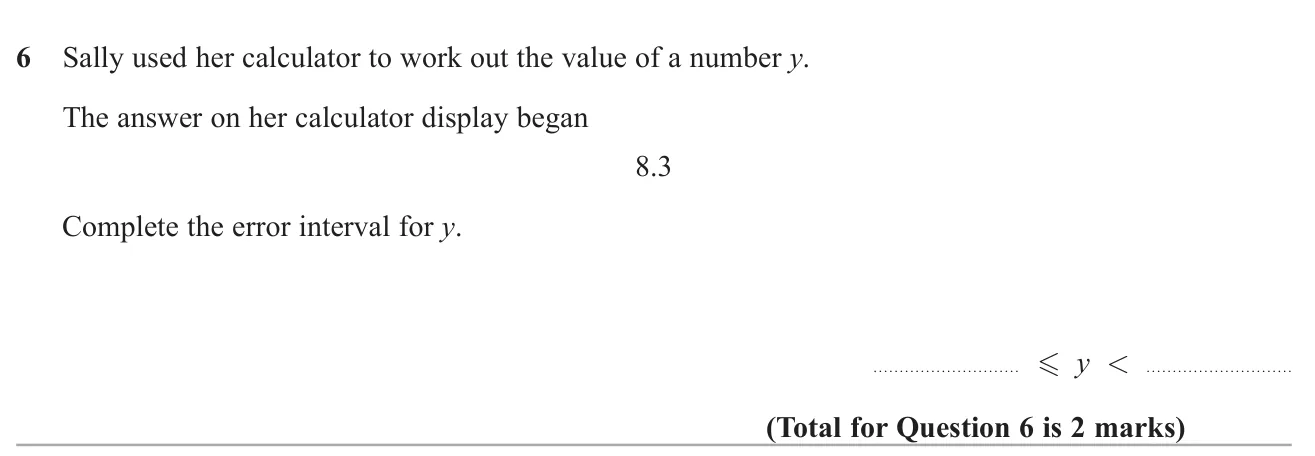
© Pearson Education Ltd. June 2019 Paper 2 (Higher, calculator), question 6.
Show answer
| Answer | 8.3≤y<8.4 | 2 marks |
|---|
Worked solution Checked against the mark scheme
The display began 8.3, so the digits after 8.3 have been cut off (truncated), not rounded.
The smallest value is 8.3 and y can get as close as you like to 8.4 without reaching it.
8.3≤y<8.4
Watch out: Treating it as rounding and giving 8.25 ≤ y < 8.35.
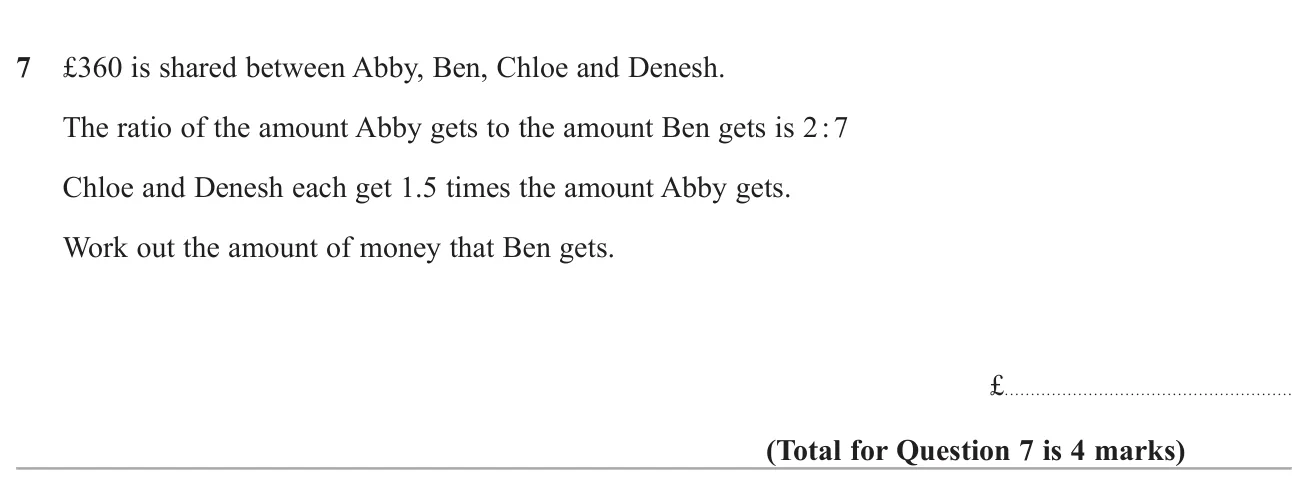
© Pearson Education Ltd. June 2019 Paper 2 (Higher, calculator), question 7.
Show answer
Worked solution Checked against the mark scheme
Abby : Ben = 2 : 7. Chloe and Denesh each get 1.5×2=3 parts.
Total parts =2+7+3+3=15
One part =360÷15=£24
Ben gets 7×24=£168
Watch out: Giving Chloe and Denesh 1.5 parts each instead of 3.
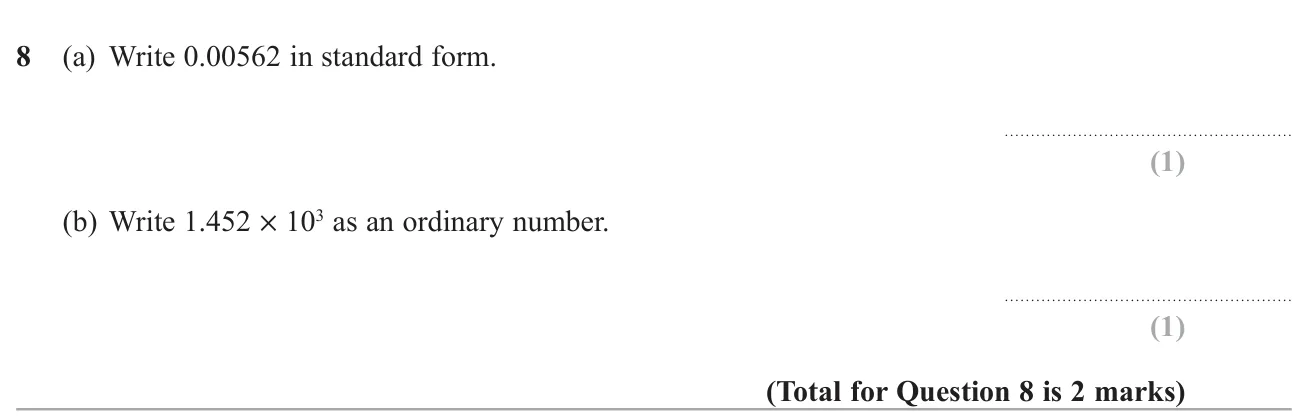
© Pearson Education Ltd. June 2019 Paper 2 (Higher, calculator), question 8.
Show answer
| (a) | 5.62×10⁻³ | 1 mark |
|---|
| (b) | 1452 | 1 mark |
|---|
Worked solution Checked against the mark scheme
(a) Move the decimal point 3 places right to get 5.62, so 0.00562=5.62×10⁻³.
(b) 1.452×10³: move the point 3 places right to get 1452.
Watch out: Using a positive power in (a).
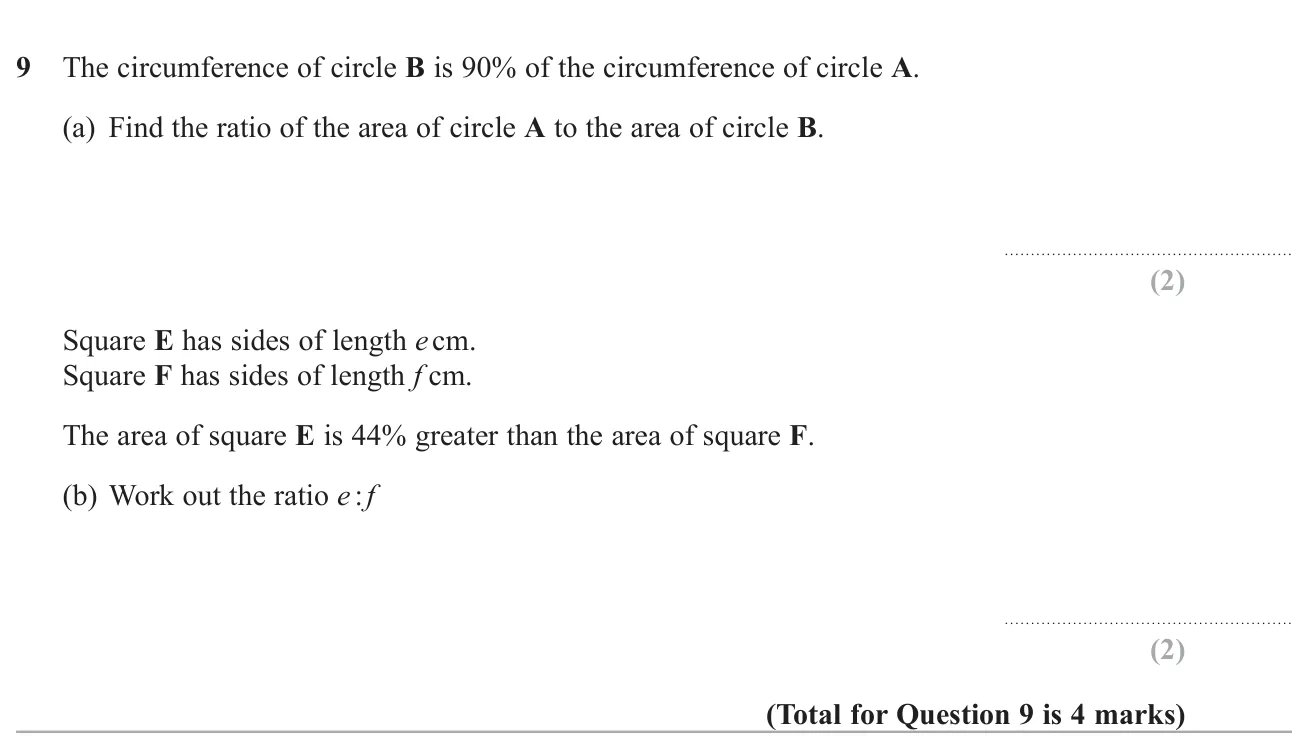
© Pearson Education Ltd. June 2019 Paper 2 (Higher, calculator), question 9.
Show answer
| (a) | 100:81 | 2 marks |
|---|
| (b) | 6:5 | 2 marks |
|---|
Worked solution Checked against the mark scheme
(a) Radius of B is 0.9× radius of A, so area of B is 0.92=0.81 times area of A.
Area A : area B =1:0.81=100:81
(b) e2=1.44f2, so e=1.44f=1.2f.
e:f=1.2:1=6:5
Watch out: Squaring 90% for (a) but forgetting to square-root 1.44 in (b).
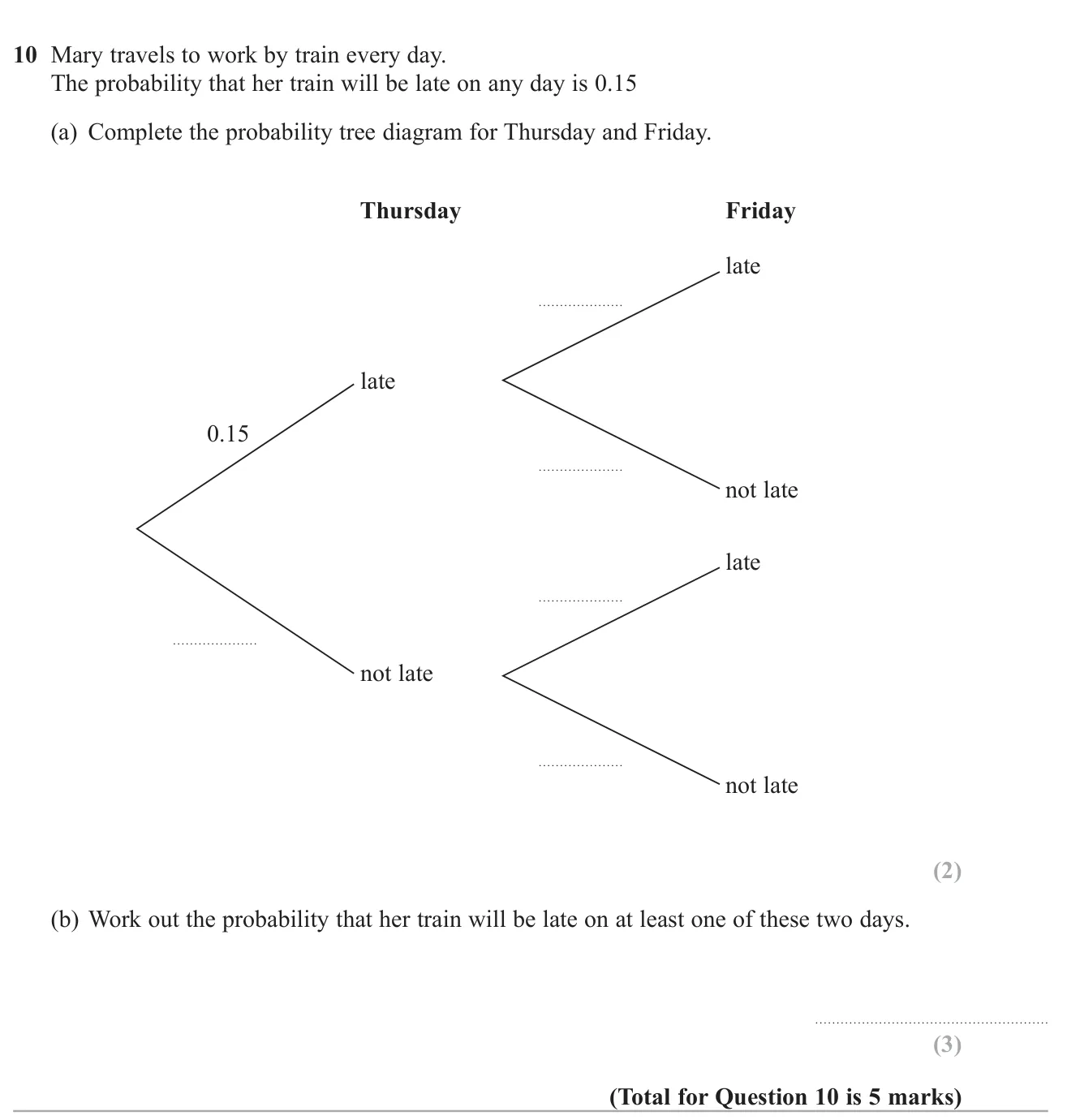
© Pearson Education Ltd. June 2019 Paper 2 (Higher, calculator), question 10.
Show answer
| (a) | Not late: 0.85 on Thursday; Friday branches 0.15,0.85,0.15,0.85 | 2 marks |
|---|
| (b) | 0.2775 | 3 marks |
|---|
Worked solution Checked against the mark scheme
(a) Not late =1−0.15=0.85. Each Friday pair of branches is late 0.15, not late 0.85.
(b) P(not late on both days) =0.85×0.85=0.7225
P(late at least once) =1−0.7225=0.2775
Watch out: Adding 0.15 + 0.15 instead of using the complement.
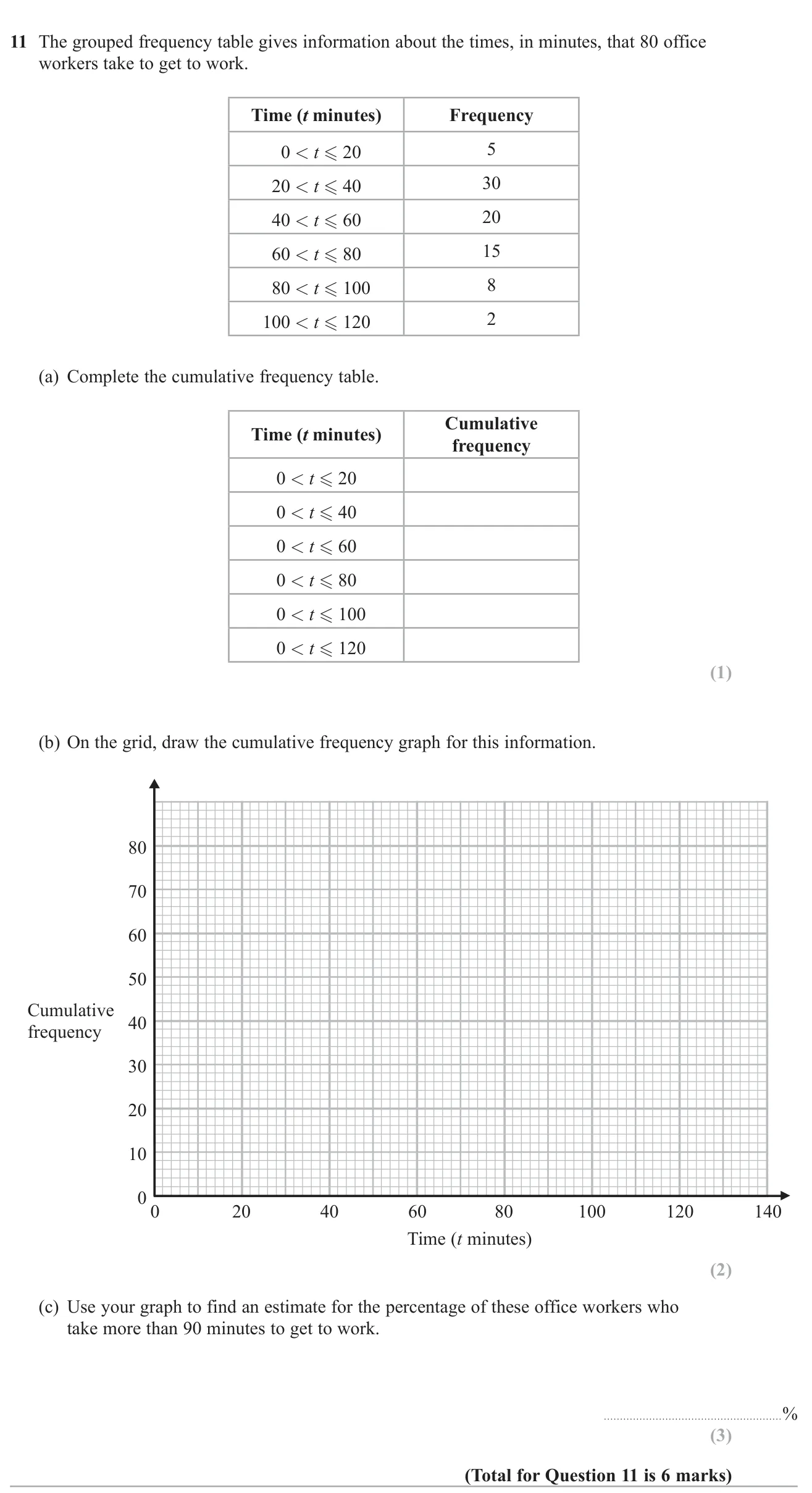
© Pearson Education Ltd. June 2019 Paper 2 (Higher, calculator), question 11.
Show answer
| (a) | 5,35,55,70,78,80 | 1 mark |
|---|
| (b) | Cumulative frequency graph through (20,5),(40,35),(60,55),(80,70),(100,78),(120,80) | 2 marks |
|---|
| (c) | 7.5% (5% to 10% from the reading) | 3 marks |
|---|
Worked solution Checked against the mark scheme
(a) Add the frequencies as you go: 5,5+30=35,55,70,78,80.
(b) Plot each total at the top of its interval, e.g. (40,35), and join with a smooth curve.
(c) At t=90 the graph reads about 74, so 80−74=6 workers take longer.
806×100=7.5%
Watch out: Plotting points at the middle of each interval instead of the upper end.
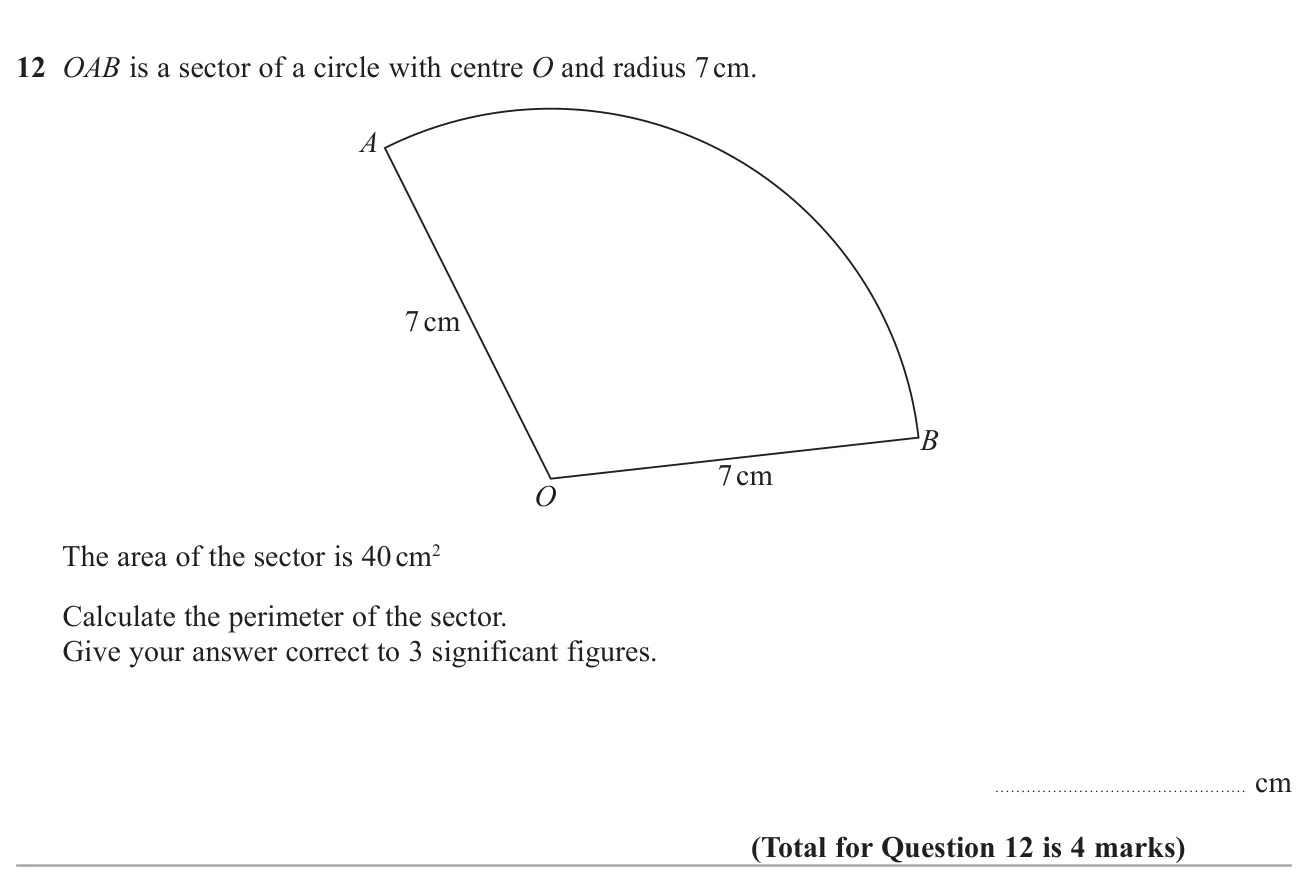
© Pearson Education Ltd. June 2019 Paper 2 (Higher, calculator), question 12.
Show answer
| Answer | 25.4 cm | 4 marks |
|---|
Worked solution Checked against the mark scheme
Sector angle: 360θ×π×72=40, so θ=49π40×360=93.54...∘
Arc =36093.54...×2π×7=11.43 cm
Perimeter =7+7+11.43=25.43=25.4 cm (3 s.f.)
Watch out: Forgetting to add the two radii to the arc length.
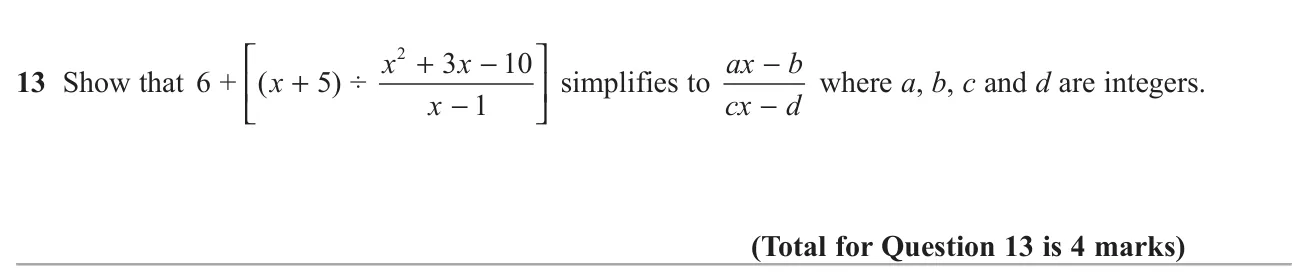
© Pearson Education Ltd. June 2019 Paper 2 (Higher, calculator), question 13.
Show answer
| Answer | x−27x−13 | 4 marks |
|---|
Worked solution Checked against the mark scheme
x2+3x−10=(x+5)(x−2)
(x+5)÷x−1(x+5)(x−2)=(x+5)×(x+5)(x−2)x−1=x−2x−1
6+x−2x−1=x−26(x−2)+x−1=x−27x−13
Watch out: Multiplying by the fraction instead of by its reciprocal.
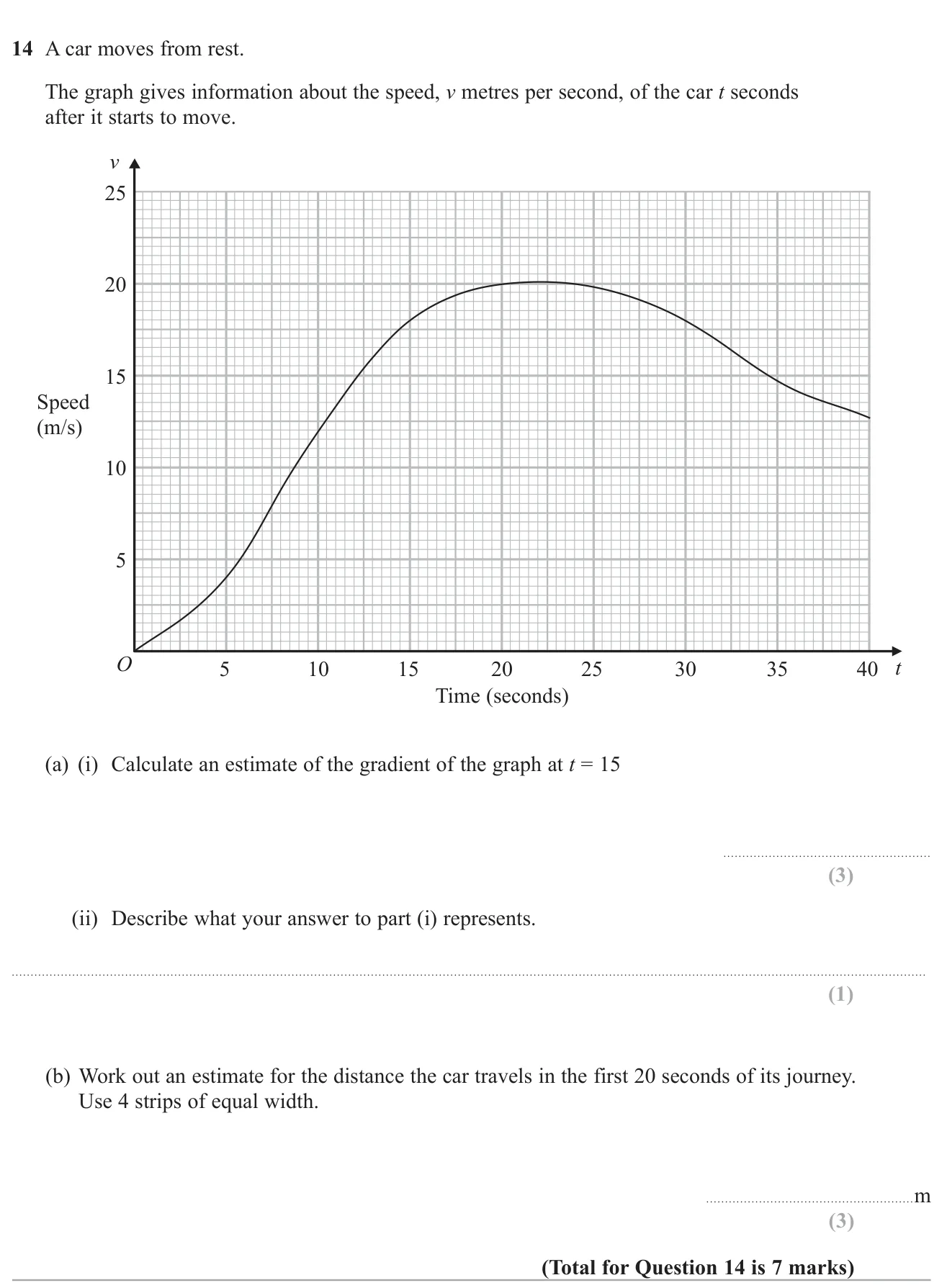
© Pearson Education Ltd. June 2019 Paper 2 (Higher, calculator), question 14.
Show answer
| (a(i)) | About 0.83 (0.6 to 1.0) | 3 marks |
|---|
| (a(ii)) | The acceleration of the car at 15 seconds (m/s²) | 1 mark |
|---|
| (b) | 220 m (215 to 225) | 3 marks |
|---|
Worked solution Checked against the mark scheme
(a)(i) Draw a tangent at t=15. Reading two points on it, e.g. it rises 7.5 over 9 s:
gradient ≈7.5÷9=0.83
(ii) This is the car's acceleration in m/s² at 15 seconds.
(b) Speeds at t=0,5,10,15,20: 0,4,12,18,20.
Area =25(0+4)+25(4+12)+25(12+18)+25(18+20)=10+40+75+95=220 m
Watch out: Saying the gradient is just 'rate of change' without naming speed.
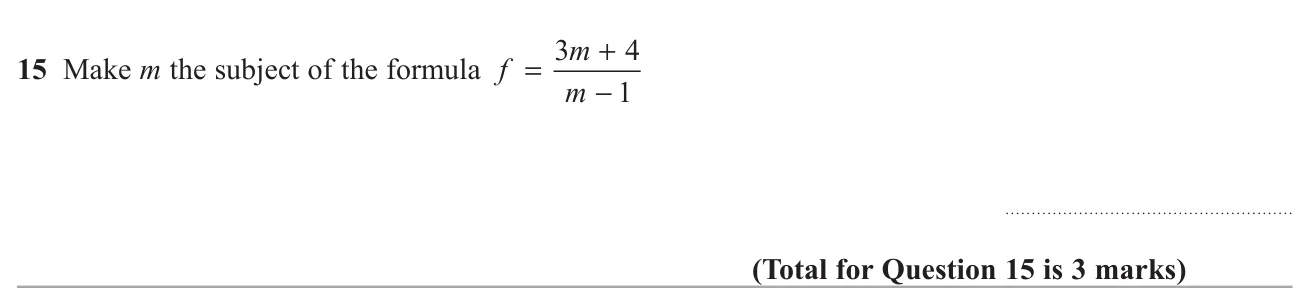
© Pearson Education Ltd. June 2019 Paper 2 (Higher, calculator), question 15.
Show answer
| Answer | m=f−3f+4 | 3 marks |
|---|
Worked solution Checked against the mark scheme
f(m−1)=3m+4
fm−f=3m+4
fm−3m=f+4
m(f−3)=f+4
m=f−3f+4
Watch out: Forgetting to factorise out m after collecting terms.
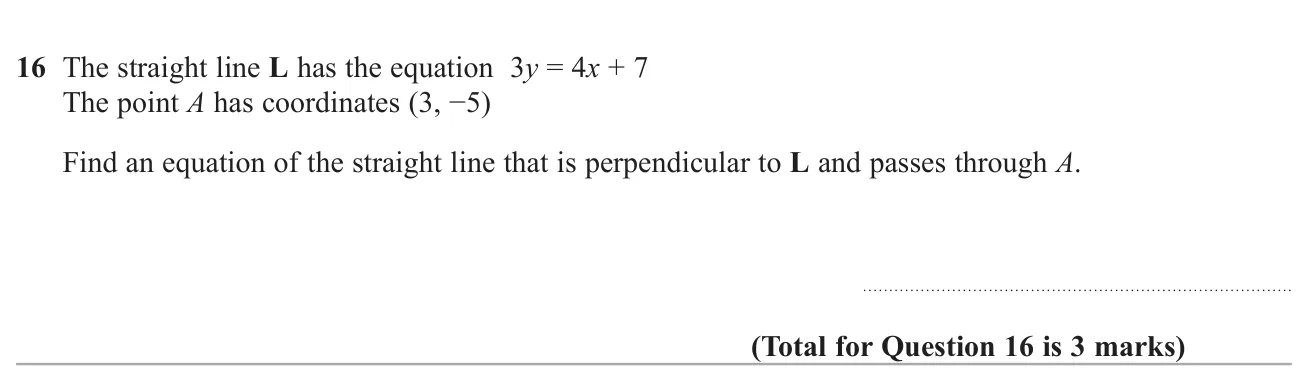
© Pearson Education Ltd. June 2019 Paper 2 (Higher, calculator), question 16.
Show answer
| Answer | y=−43x−411 | 3 marks |
|---|
Worked solution Checked against the mark scheme
3y=4x+7 gives y=34x+37, gradient 34.
Perpendicular gradient =−43.
Through (3,−5): −5=−43(3)+c, so c=−5+49=−411.
y=−43x−411
Watch out: Using 4 as the gradient without dividing by 3 first.
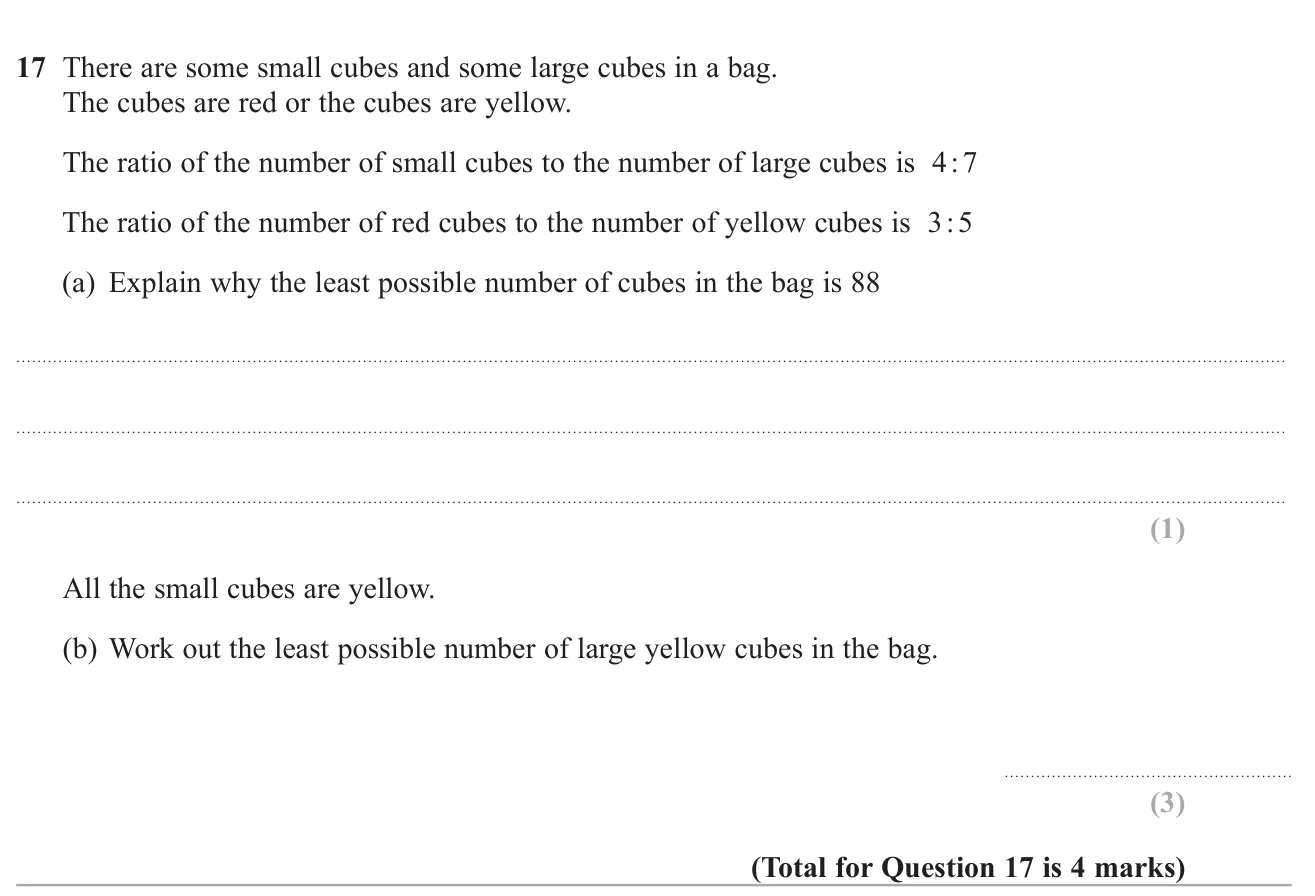
Question 17
Ratio4 marksGrade 8Calculator © Pearson Education Ltd. June 2019 Paper 2 (Higher, calculator), question 17.
Show answer
| (a) | The total must be a multiple of both 11 and 8, and the lowest common multiple is 88 | 1 mark |
|---|
| (b) | 23 | 3 marks |
|---|
Worked solution Checked against the mark scheme
(a) Small : large =4:7 has 11 parts; red : yellow =3:5 has 8 parts. The total must divide by both 11 and 8, and LCM(11, 8) =88.
(b) With 88 cubes: small =4×8=32, yellow =5×11=55.
All small cubes are yellow, so large yellow =55−32=23.
Watch out: Multiplying 11 by 8 without explaining it is the lowest common multiple.
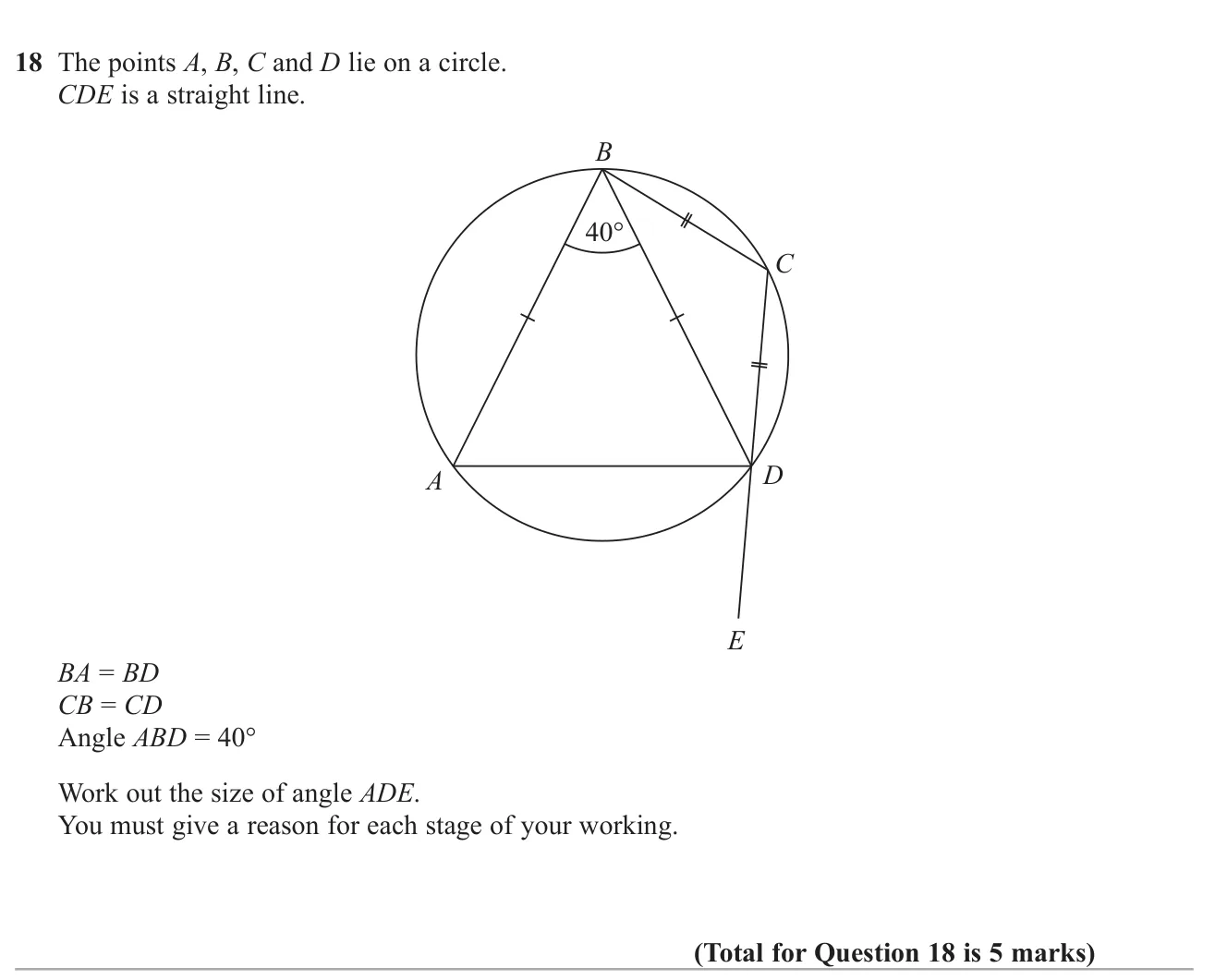
© Pearson Education Ltd. June 2019 Paper 2 (Higher, calculator), question 18.
Show answer
| Answer | 75∘ | 5 marks |
|---|
Worked solution Checked against the mark scheme
Triangle ABD is isosceles, so ∠BAD=∠BDA=2180−40=70∘ (base angles of an isosceles triangle are equal; angles in a triangle sum to 180°).
∠BCD=180−70=110∘ (opposite angles of a cyclic quadrilateral sum to 180°).
Triangle BCD is isosceles: ∠CDB=2180−110=35∘.
∠ADE=180−70−35=75∘ (angles on a straight line sum to 180°).
Watch out: Giving the angle without stating the circle theorem used.
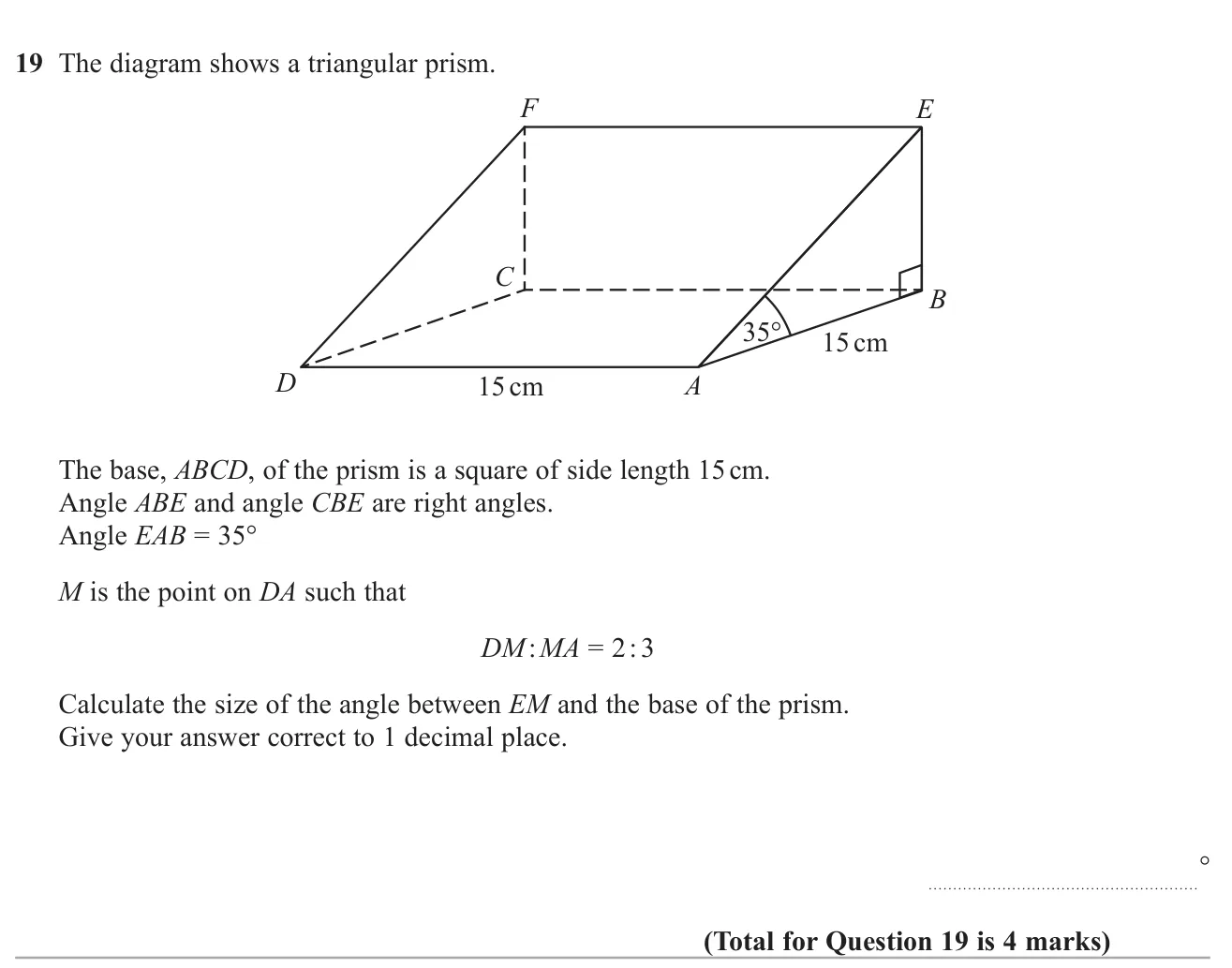
© Pearson Education Ltd. June 2019 Paper 2 (Higher, calculator), question 19.
Show answer
| Answer | 31.0∘ | 4 marks |
|---|
Worked solution Checked against the mark scheme
BE=15tan35∘=10.50 cm
MA=53×15=9 cm, so MB=92+152=306=17.49 cm
The angle is at M in triangle EMB, right-angled at B:
tanθ=17.4910.50, so θ=30.98...=31.0∘
Watch out: Using MA = 6 instead of 9.
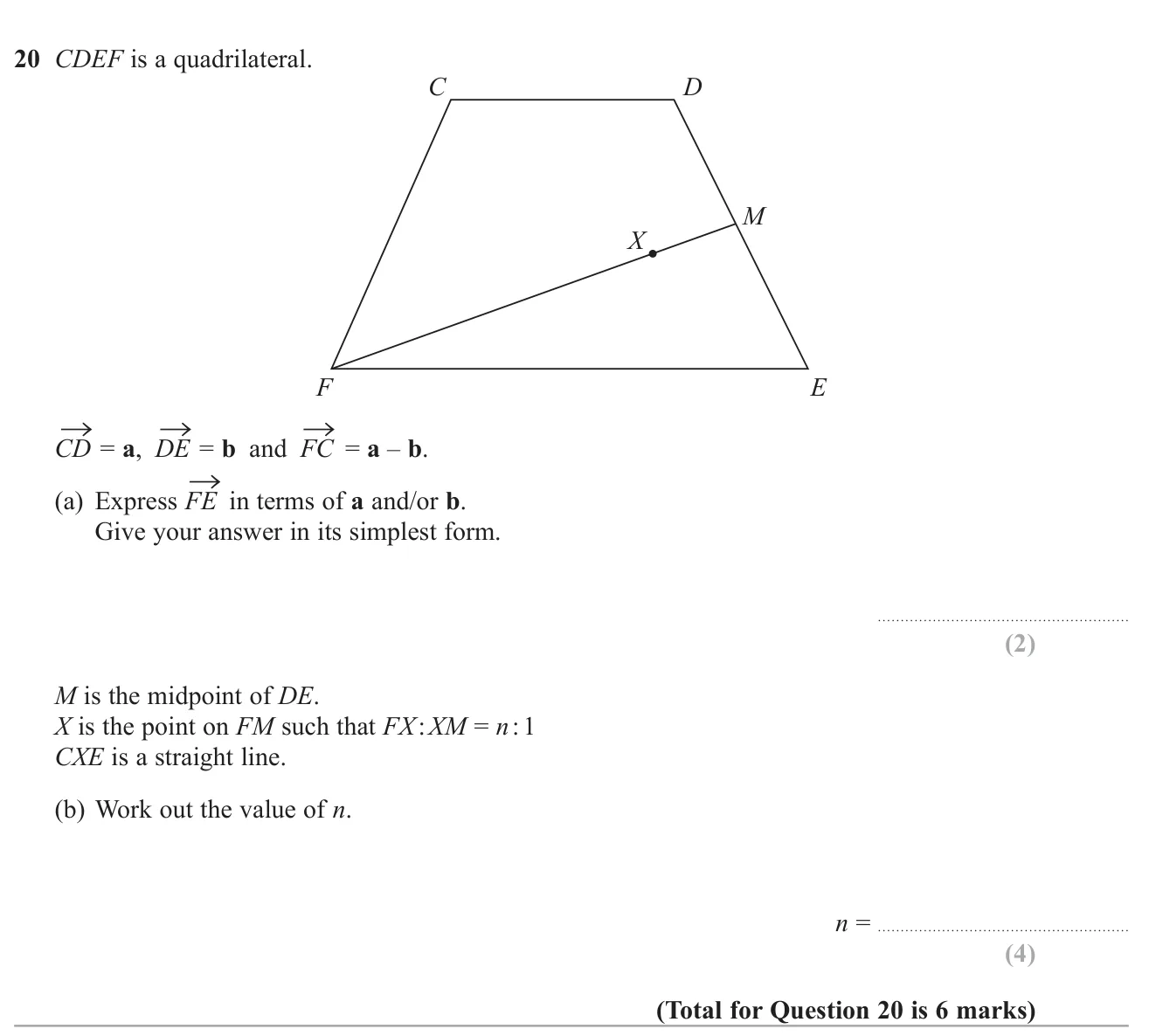
© Pearson Education Ltd. June 2019 Paper 2 (Higher, calculator), question 20.
Show answer
| (a) | 2a | 2 marks |
|---|
| (b) | n=4 | 4 marks |
|---|
Worked solution Checked against the mark scheme
(a) FE=FC+CD+DE=a−b+a+b=2a
(b) FM=2a−21b, so FX=n+1n(2a−21b).
Also FX=FC+kCE=a−b+k(a+b).
Compare coefficients: 1+k=n+12n and 1−k=2(n+1)n.
Add them: 2=2(n+1)5n, so 4n+4=5n and n=4.
Watch out: Taking M to be the midpoint of FE instead of DE.
Finished the paper?
Add up your marks for all three papers and see what grade that would have been.