Ratio, proportion and rates of change

Compound interest, growth and decay

24 past-paper questions, easiest first. Try each one, then reveal the answer.

Foundation & Higher9 of 24 from Foundation papers

Revision guide by The Full Marks

Compound interest, growth and decay: what you need to know

Compound interest, population growth and depreciation all change by the same percentage each time period, so you apply a multiplier again and again. These questions are common on calculator papers.

Compound interest, growth and decay are on both tiers; general iterative rules are Higher only.

Key facts

  • Growth by r%r\%: multiplier 1+r1001 + \frac{r}{100}; decay by r%r\%: multiplier 1−r1001 - \frac{r}{100}.
  • Value after nn periods == start value ×\times multipliern^n.
  • Different rates in different years: multiply by each multiplier in turn, e.g. start ×1.03×1.022\times 1.03 \times 1.02^2.
  • Working backwards to the original amount: divide by the multiplier(s).
  • Finding a yearly rate: final ÷\div start gives the overall multiplier; for nn years at the same rate, take the nnth root.
  • Compound interest is earned on the interest too; simple interest is not.
  • Interest earned == final amount −- starting amount.
  • Higher: an iterative rule like un+1=1.2un−100u_{n+1} = 1.2u_n - 100 is applied one step at a time.

Compound growth or decay

  1. Write the multiplier.
  2. Raise it to the number of years: start ×\times multipliern^n.
  3. Round money to 2 decimal places at the end only.

How long until…? (trial and improvement)

  1. Try values of nn in start ×\times multipliern^n.
  2. Find the first nn that passes the target.
  3. Show the values either side.

Iterative processes (Higher only)

  1. Substitute the starting value into the rule to get the next value.
  2. Feed each answer back in; use your calculator's ANS key.
  3. Count the steps carefully.

Worked examples

Example 1 Foundation · grade 5

Grace invests £4000 at 2.5%2.5\% compound interest per year. How much is in the account after 33 years?

Show the solution

Multiplier =1.025= 1.025
4000×1.0253=4307.56254000 \times 1.025^3 = 4307.5625
Answer: £4307.56

Example 2 Higher · grade 6

A car worth £18 000 loses 12%12\% of its value each year. After how many whole years is it first worth less than £10 000?

Show the solution

Multiplier =0.88= 0.88
n=4n = 4: 18 000×0.884=£10 794.5218\,000 \times 0.88^4 = £10\,794.52
n=5n = 5: 18 000×0.885=£9499.1718\,000 \times 0.88^5 = £9499.17
Answer: 55 years

Example 3 Higher · grade 6

A van loses 15%15\% of its value in the first year and 10%10\% of its value in each year after that. After 3 years it is worth £8262. How much was it worth when new?

Show the solution

Multipliers: 0.850.85 for year 1, then 0.90.9 for years 2 and 3
Overall multiplier =0.85×0.92=0.6885= 0.85 \times 0.9^2 = 0.6885
Original value ×0.6885=8262\times 0.6885 = 8262
Original value =8262÷0.6885=12 000= 8262 \div 0.6885 = 12\,000
Answer: £12 000

Common mistakes

  • Using simple interest (adding the same amount each year) when the question says compound.
  • Giving the final amount when the question asks for the interest, or the other way round.
  • Working back after depreciation by adding the percentage on. Divide by the multiplier instead.
  • Sharing a total change equally between years, e.g. calling a 45%45\% fall over 2 years 22.5%22.5\% a year. Use 0.55=0.7416…\sqrt{0.55} = 0.7416\ldots, which is about 25.8%25.8\% a year.

Exam tips

  • Writing the multiplier and power, e.g. 4000×1.02534000 \times 1.025^3, usually earns the method marks.
  • Read whether the question wants the total or just the interest.

Questions people ask

How do you calculate compound interest?

Multiply the amount by (1+r100)n(1 + \frac{r}{100})^n, where rr is the rate and nn the number of years. Subtract the original if you want just the interest.

What is depreciation?

A loss in value over time, like a car getting cheaper each year. Use a multiplier below 1, such as 0.88 for 12% a year.

Exam questions: Compound interest, growth and decay (24, easiest first)

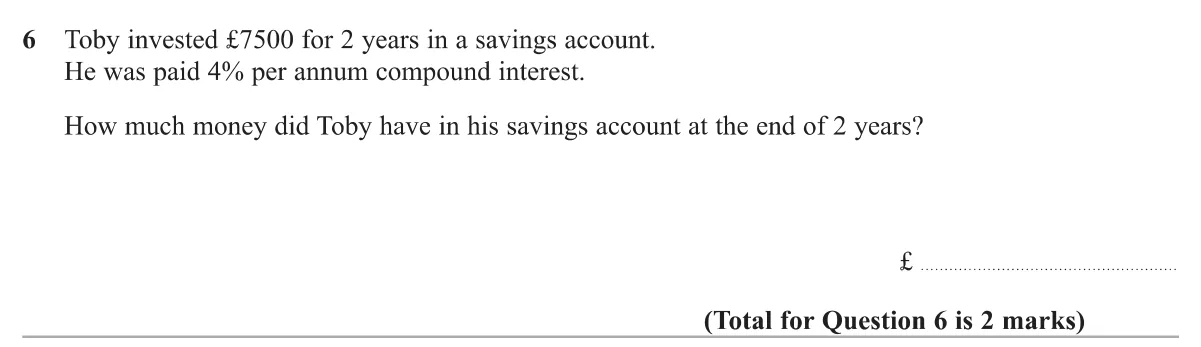
Compound interest, growth and decay2 marksGrade 4CalculatorHigher
Specimen · Paper 2 Higher · Q6
Find the value of an investment after two years of compound interest.

© Pearson Education Ltd. Specimen Paper 2 (Higher, calculator), question 6.

Show answer
Answer£81122 marks

Worked solution Checked against the mark scheme

Multiplier for 4% growth: 1.041.04

7500×1.042=7500×1.0816=£81127500 \times 1.04^2 = 7500 \times 1.0816 = £8112

Watch out: Using simple interest to get £8100.
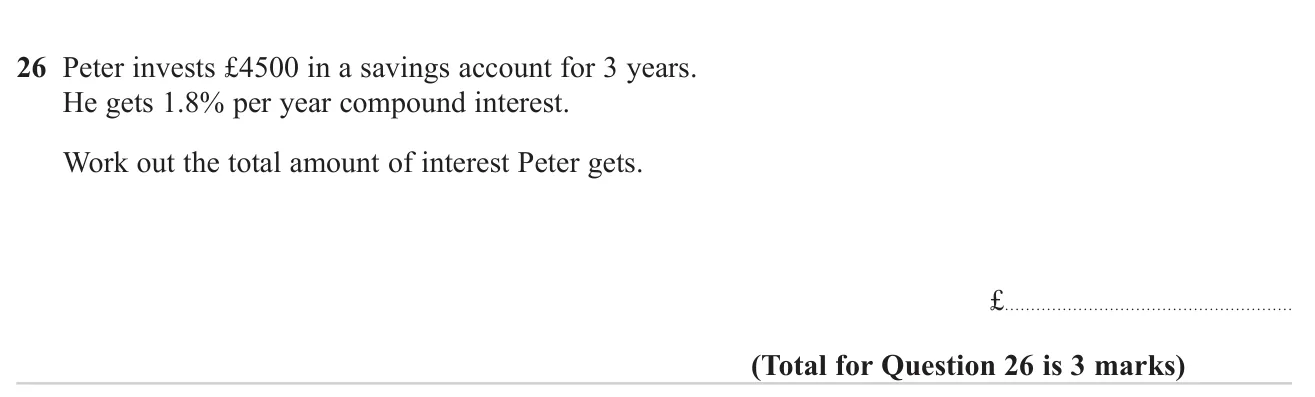
Compound interest, growth and decay3 marksGrade 5CalculatorFoundation
November 2024 · Paper 3 Foundation · Q26
Find the interest earned on a savings account with compound interest over three years.

© Pearson Education Ltd. November 2024 Paper 3 (Foundation, calculator), question 26.

Show answer
Answer£247.403 marks

Worked solution Checked against the mark scheme

Multiplier: 1+0.018=1.0181 + 0.018 = 1.018

After 3 years: 4500×1.0183=4747.40...4500 \times 1.018^3 = 4747.40...

Interest: 4747.40−4500=£247.404747.40 - 4500 = £247.40

Watch out: Using simple interest to get £243.
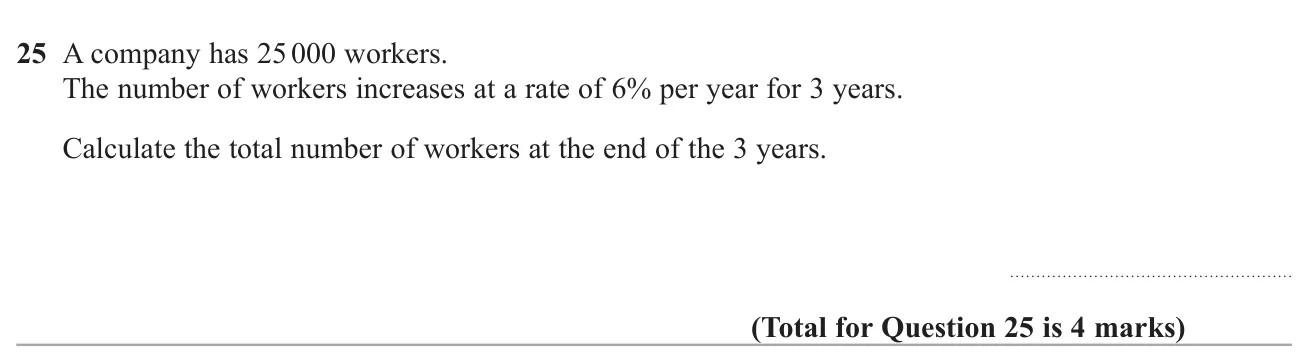
Compound interest, growth and decay4 marksGrade 5CalculatorOn both tiers
June 2024 · Paper 3 Foundation · Q25
Work out the number of workers after 3 years of 6% compound growth.

© Pearson Education Ltd. June 2024 Paper 3 (Foundation, calculator), question 25.

Show answer
Answer29 77529\,775 (accept 29 77629\,776, 29 78029\,780, 29 80029\,800)4 marks

Worked solution Checked against the mark scheme

Multiplier for a 6% increase: 1.061.06

25 000×1.063=29 775.425\,000 \times 1.06^3 = 29\,775.4

So about 29 77529\,775 workers.

Watch out: Using simple interest: 25 000+3×1500=29 50025\,000 + 3 \times 1500 = 29\,500.

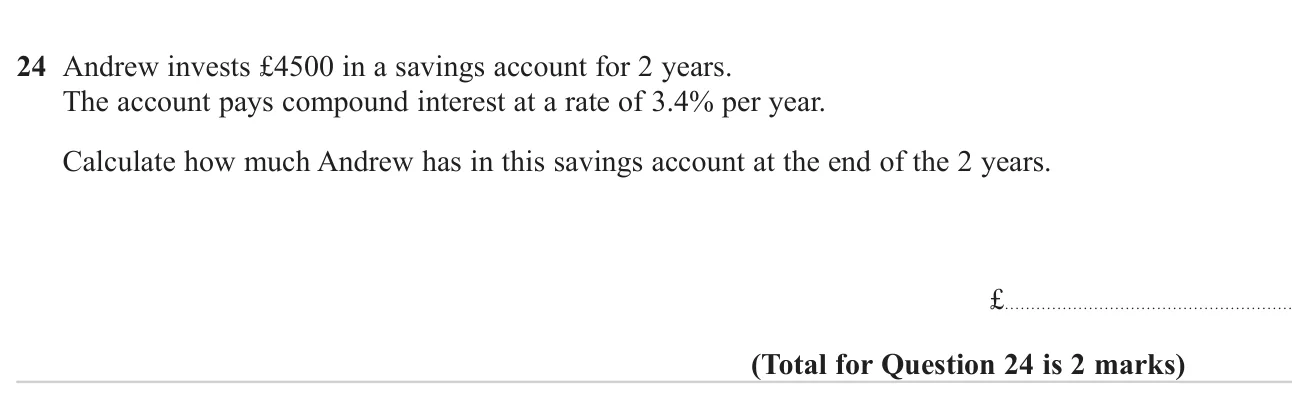
Compound interest, growth and decay2 marksGrade 5CalculatorOn both tiers
November 2023 · Paper 2 Foundation · Q24
Find the value of an investment after two years of compound interest.

© Pearson Education Ltd. November 2023 Paper 2 (Foundation, calculator), question 24.

Show answer
Answer£4811.202 marks

Worked solution Checked against the mark scheme

Multiplier for 3.4% interest: 1.0341.034

4500×1.0342=4811.2024500 \times 1.034^2 = 4811.202, so £4811.20

Watch out: Using simple interest to get £4806.
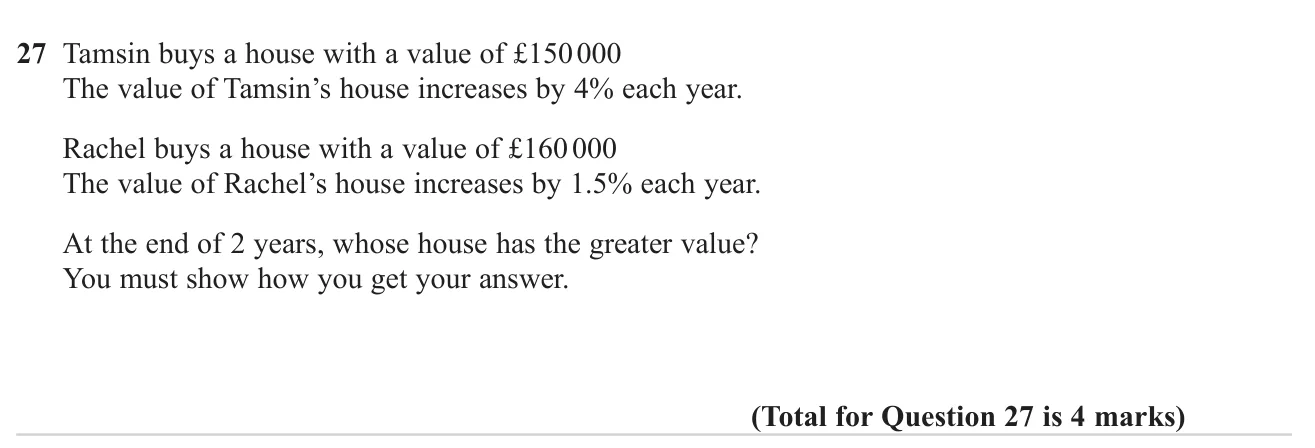
Compound interest, growth and decay4 marksGrade 5CalculatorOn both tiers
June 2023 · Paper 2 Foundation · Q27
Compare two house values after two years of compound percentage growth at different rates.

© Pearson Education Ltd. June 2023 Paper 2 (Foundation, calculator), question 27.

Show answer
AnswerRachel's: £164 836 compared with Tamsin's £162 2404 marks

Worked solution Checked against the mark scheme

Tamsin: 150 000×1.042=£162 240150\,000 \times 1.04^2 = £162\,240

Rachel: 160 000×1.0152=£164 836160\,000 \times 1.015^2 = £164\,836

164 836>162 240164\,836 > 162\,240, so Rachel's house is worth more.

Watch out: Using simple interest (adding the same increase twice).
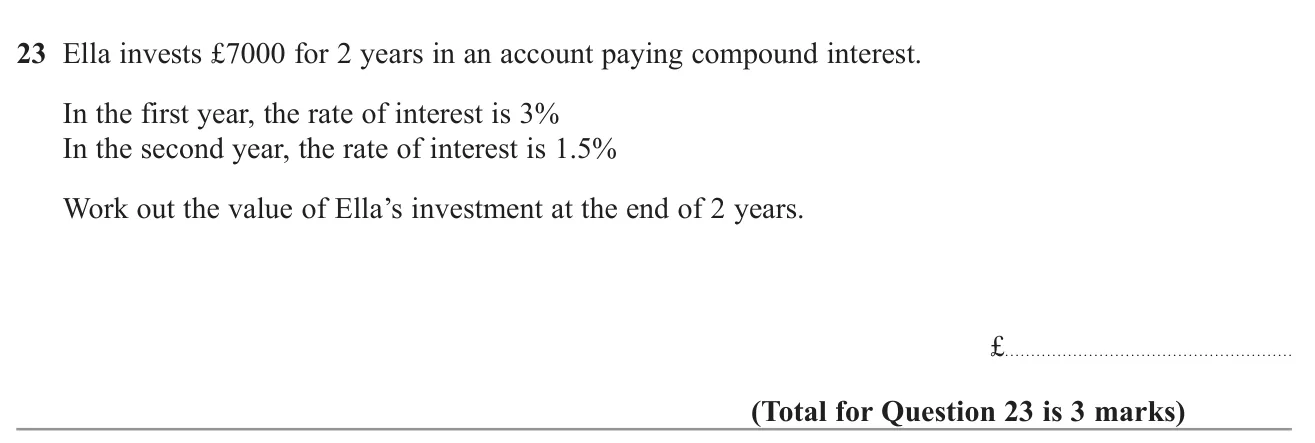
Compound interest, growth and decay3 marksGrade 5CalculatorOn both tiers
November 2022 · Paper 2 Foundation · Q23
Find the value of an investment after two years of compound interest at different rates.

© Pearson Education Ltd. November 2022 Paper 2 (Foundation, calculator), question 23.

Show answer
Answer£7318.153 marks

Worked solution Checked against the mark scheme

After year 1: 7000×1.03=72107000 \times 1.03 = 7210

After year 2: 7210×1.015=£7318.157210 \times 1.015 = £7318.15

Watch out: Adding 4.5% simple interest to get £7315.
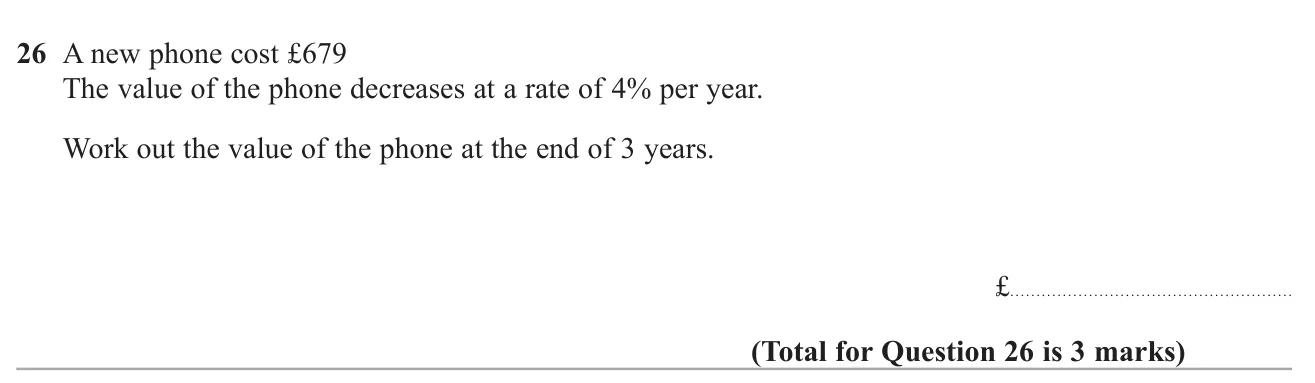
Compound interest, growth and decay3 marksGrade 5CalculatorOn both tiers
June 2022 · Paper 2 Foundation · Q26
Work out the value of a phone after three years of 4% yearly depreciation.

© Pearson Education Ltd. June 2022 Paper 2 (Foundation, calculator), question 26.

Show answer
Answer£600.743 marks

Worked solution Checked against the mark scheme

The multiplier for a 4% decrease is 0.960.96.

679×0.963=600.7357...679 \times 0.96^3 = 600.7357...

Value after 3 years: £600.74

Watch out: Using simple depreciation: 679−3×27.16=597.52679 - 3 \times 27.16 = 597.52.

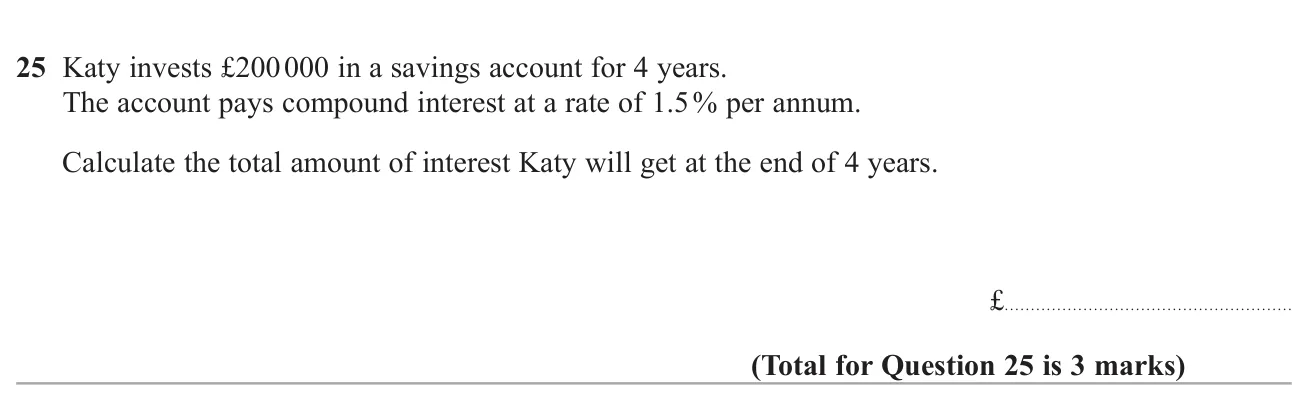
Compound interest, growth and decay3 marksGrade 5CalculatorOn both tiers
June 2019 · Paper 3 Foundation · Q25
Work out the total compound interest earned on savings over 4 years.

© Pearson Education Ltd. June 2019 Paper 3 (Foundation, calculator), question 25.

Show answer
Answer£12 272.713 marks

Worked solution Checked against the mark scheme

Multiplier for 1.5% interest: 1.015

200 000×1.0154=212 272.71200\,000 \times 1.015^4 = 212\,272.71

Interest: 212 272.71−200 000=£12 272.71212\,272.71 - 200\,000 = £12\,272.71

Watch out: Using simple interest: 4 × 3000 = £12 000.
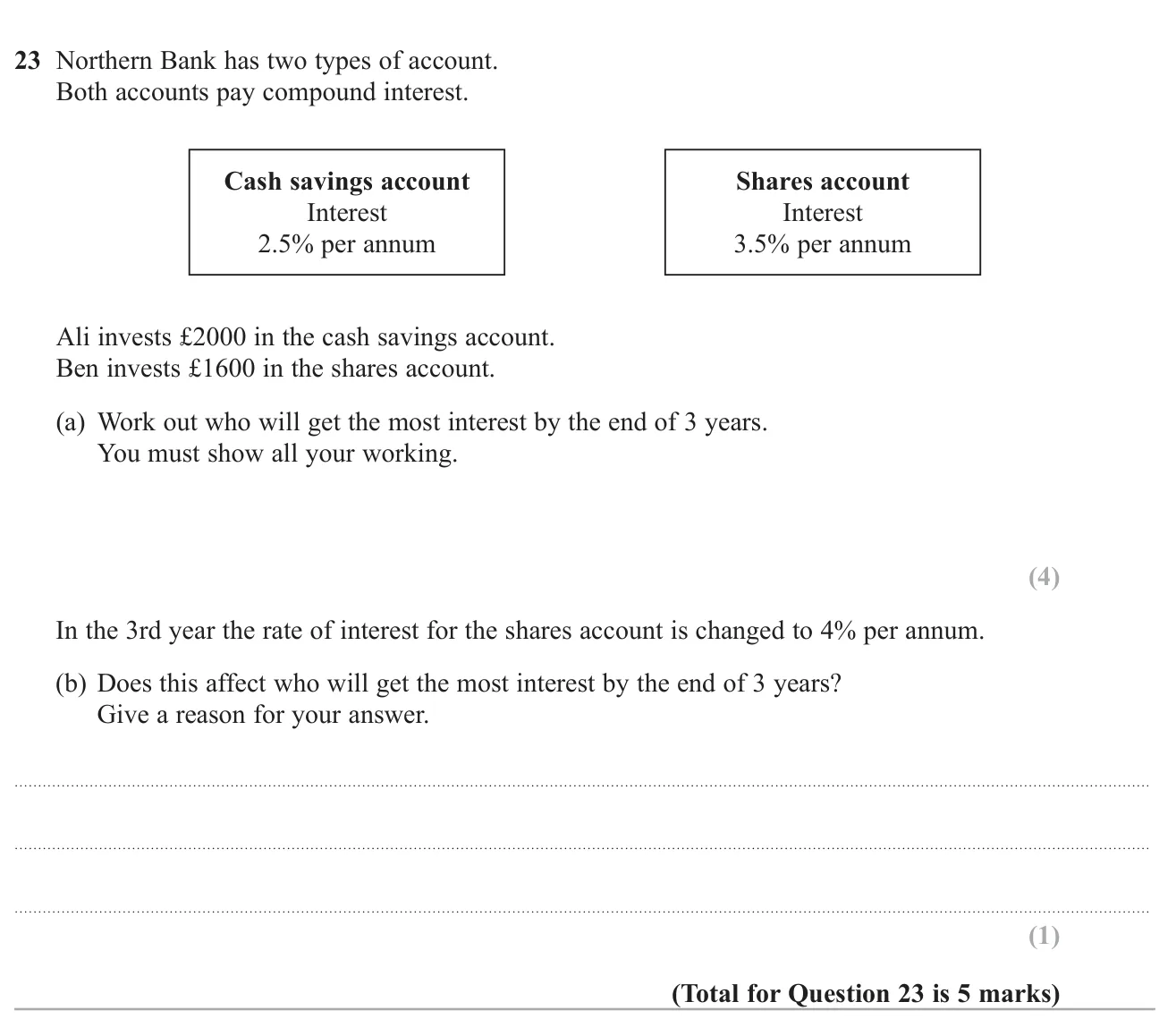
Compound interest, growth and decay5 marksGrade 5CalculatorOn both tiers
November 2018 · Paper 2 Foundation · Q23
Compare compound interest on two accounts over 3 years, then decide if a rate change in year 3 alters the result.

© Pearson Education Ltd. November 2018 Paper 2 (Foundation, calculator), question 23.

Show answer
(a)Ben: £173.95 interest against Ali's £153.784 marks
(b)No: Ben now gets about £182.52, still more than Ali1 mark

Worked solution Checked against the mark scheme

(a) Ali: 2000×1.0253=£2153.782000 \times 1.025^3 = £2153.78, interest £153.78£153.78

Ben: 1600×1.0353=£1773.951600 \times 1.035^3 = £1773.95, interest £173.95£173.95

Ben gets more.

(b) Ben: 1600×1.0352×1.04=£1782.521600 \times 1.035^2 \times 1.04 = £1782.52, interest £182.52£182.52. Still Ben, so no change.

Watch out: Using simple interest, or comparing final totals instead of interest.
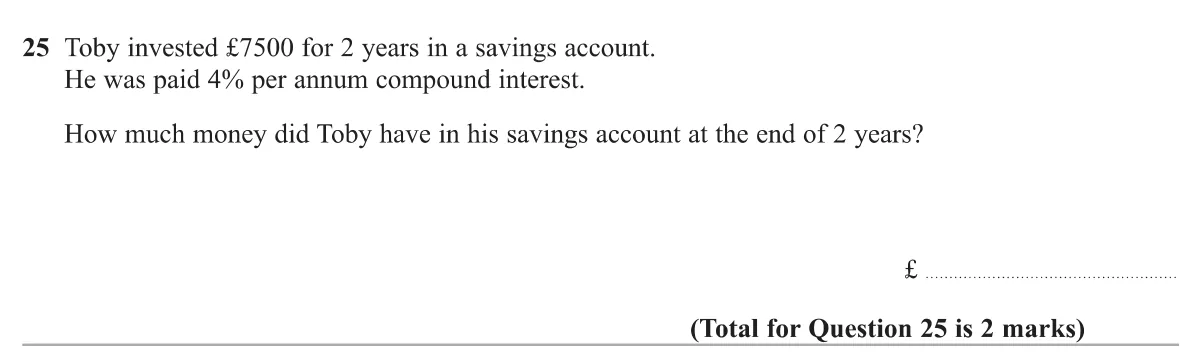
Compound interest, growth and decay2 marksGrade 5CalculatorFoundation
Specimen · Paper 2 Foundation · Q25
Work out the value of savings after two years of compound interest.

© Pearson Education Ltd. Specimen Paper 2 (Foundation, calculator), question 25.

Show answer
Answer£81122 marks

Worked solution Checked against the mark scheme

Multiplier for 4% growth is 1.04

7500×1.042=7500×1.0816=£81127500 \times 1.04^2 = 7500 \times 1.0816 = £8112

Watch out: Using simple interest to get £8100.
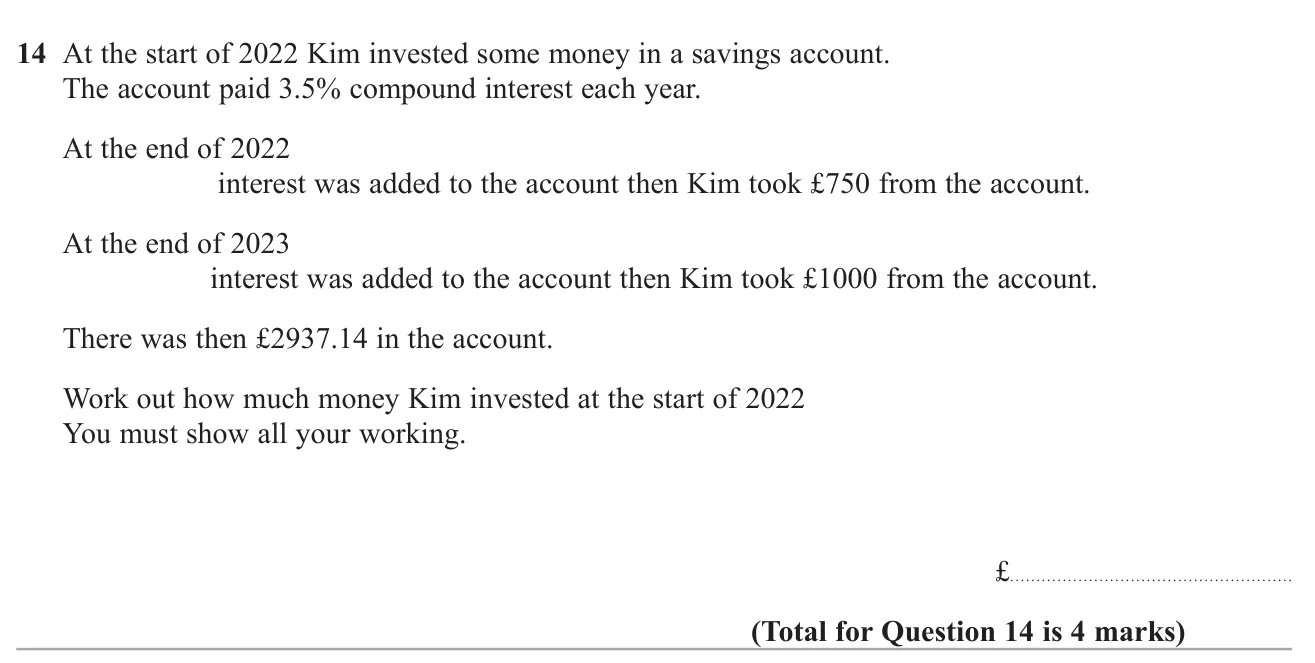
Compound interest, growth and decay4 marksGrade 6CalculatorHigher
June 2024 · Paper 3 Higher · Q14
Work backwards through compound interest and withdrawals to find an original investment.

© Pearson Education Ltd. June 2024 Paper 3 (Higher, calculator), question 14.

Show answer
Answer£440044004 marks

Worked solution Checked against the mark scheme

Before the 2023 withdrawal: 2937.14+1000=3937.142937.14 + 1000 = 3937.14

Start of 2023: 3937.14÷1.035=38043937.14 \div 1.035 = 3804

Before the 2022 withdrawal: 3804+750=45543804 + 750 = 4554

Start of 2022: 4554÷1.035=£44004554 \div 1.035 = £4400

Watch out: Subtracting the withdrawals instead of adding them back, or multiplying by 0.965 instead of dividing by 1.035.
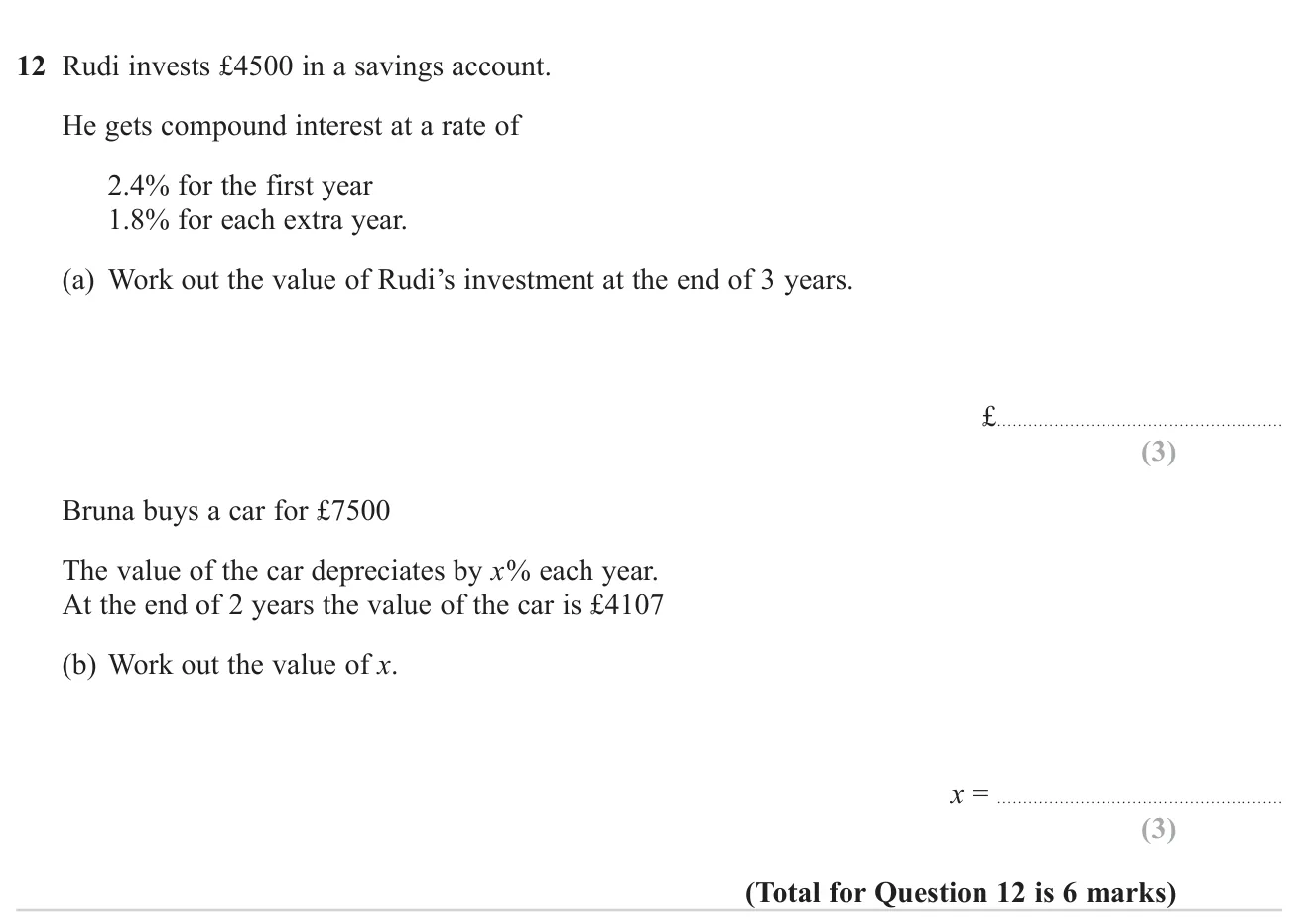
Compound interest, growth and decay6 marksGrade 6CalculatorHigher
November 2024 · Paper 3 Higher · Q12
Find a compound-interest total with different rates across years, then find a yearly depreciation rate from a start and end value.

© Pearson Education Ltd. November 2024 Paper 3 (Higher, calculator), question 12.

Show answer
(a)£4775.383 marks
(b)x=26x = 263 marks

Worked solution Checked against the mark scheme

(a) 4500×1.024=46084500 \times 1.024 = 4608

4608×1.0182=4775.38...4608 \times 1.018^2 = 4775.38..., so £4775.38

(b) Multiplier over 2 years =4107÷7500=0.5476= 4107 \div 7500 = 0.5476

Yearly multiplier =0.5476=0.74= \sqrt{0.5476} = 0.74

1−0.74=0.261 - 0.74 = 0.26, so x=26x = 26

Watch out: In (b), halving the total percentage loss instead of square-rooting the multiplier.
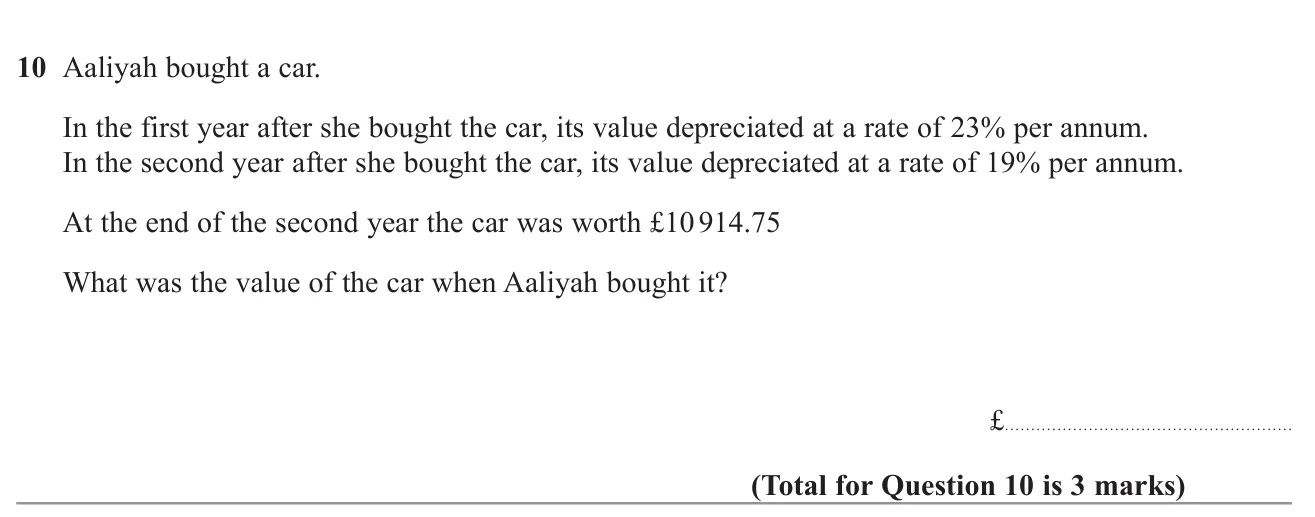
Compound interest, growth and decay3 marksGrade 6CalculatorHigher
November 2022 · Paper 2 Higher · Q10
Work backwards from a car's value after two years of depreciation at different rates to find its original price.

© Pearson Education Ltd. November 2022 Paper 2 (Higher, calculator), question 10.

Show answer
Answer£17 5003 marks

Worked solution Checked against the mark scheme

Multipliers: 1−0.23=0.771 - 0.23 = 0.77 and 1−0.19=0.811 - 0.19 = 0.81

Original ×0.77×0.81=10 914.75\times 0.77 \times 0.81 = 10\,914.75

Original =10 914.75÷0.6237=£17 500= 10\,914.75 \div 0.6237 = £17\,500

Watch out: Adding 42% back on to £10 914.75.
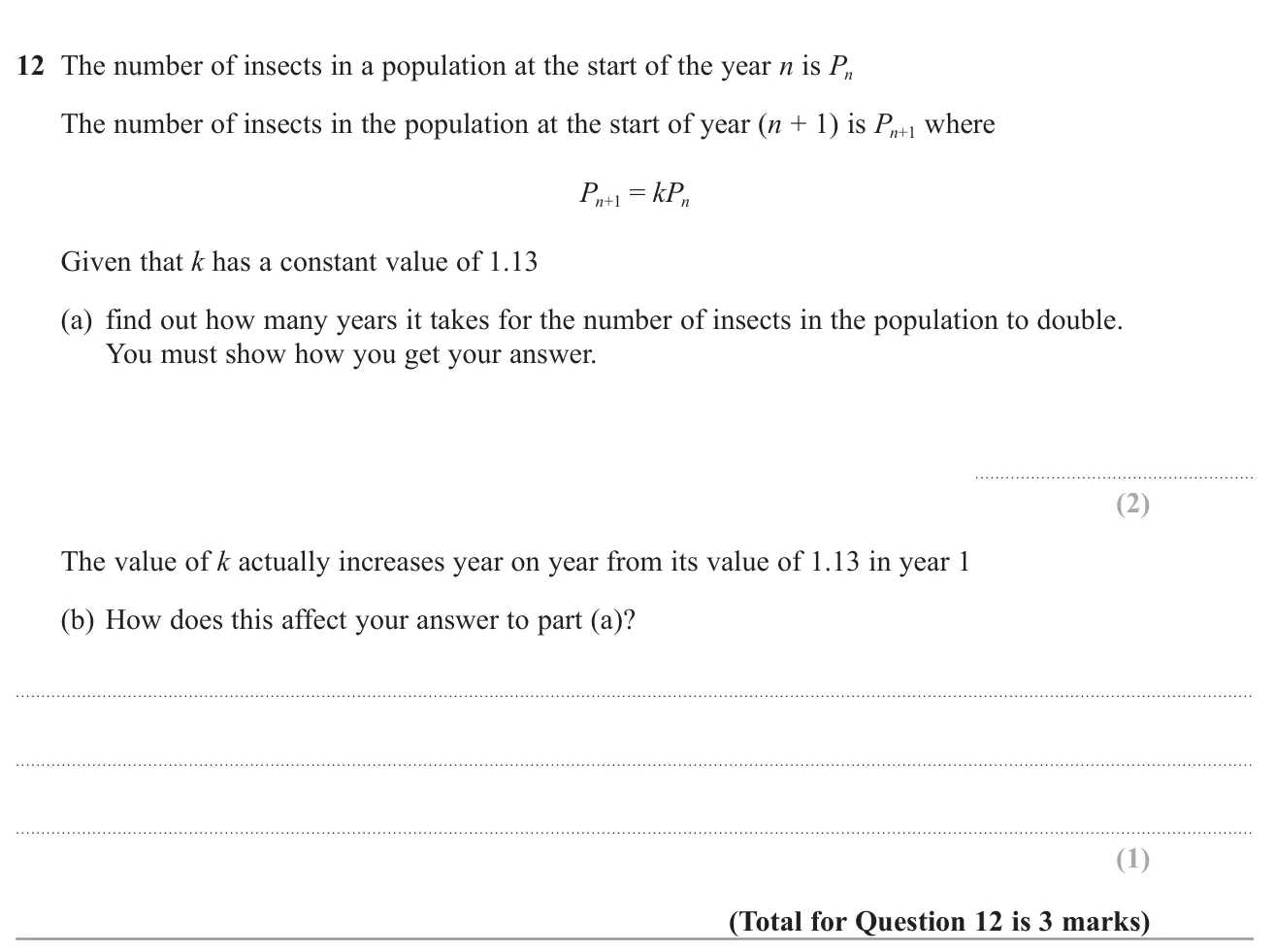
Compound interest, growth and decay3 marksGrade 6CalculatorHigher
November 2022 · Paper 2 Higher · Q12
Use a growth multiplier of 1.13 per year to find how long a population takes to double, then say how an increasing multiplier changes this.

© Pearson Education Ltd. November 2022 Paper 2 (Higher, calculator), question 12.

Show answer
(a)6 years2 marks
(b)It would take fewer years (or it can't be known exactly)1 mark

Worked solution Checked against the mark scheme

(a) Try powers of 1.13:

1.135=1.84...1.13^5 = 1.84... (not yet doubled)

1.136=2.08...1.13^6 = 2.08... (more than 2)

So it takes 6 years.

(b) If kk keeps growing, the population grows faster, so it would double in fewer years.

Watch out: In (b), saying it would take longer.
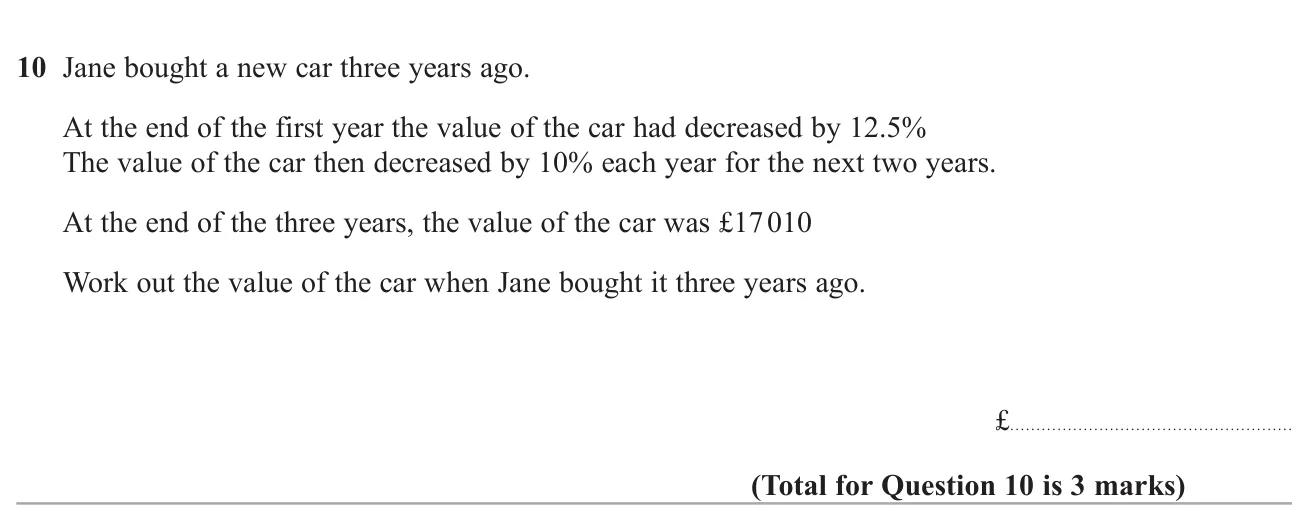
Compound interest, growth and decay3 marksGrade 6CalculatorHigher
June 2022 · Paper 3 Higher · Q10
Work backwards from a car's value after one percentage fall and two further equal percentage falls to find the original price.

© Pearson Education Ltd. June 2022 Paper 3 (Higher, calculator), question 10.

Show answer
Answer£24 000£24\,0003 marks

Worked solution Checked against the mark scheme

Multiplier after 3 years: 0.875×0.9×0.9=0.708750.875 \times 0.9 \times 0.9 = 0.70875

Original value =17 010÷0.70875=£24 000= 17\,010 \div 0.70875 = £24\,000

Watch out: Adding the percentages (12.5 + 10 + 10 = 32.5%) or increasing £17 010 by those percentages.
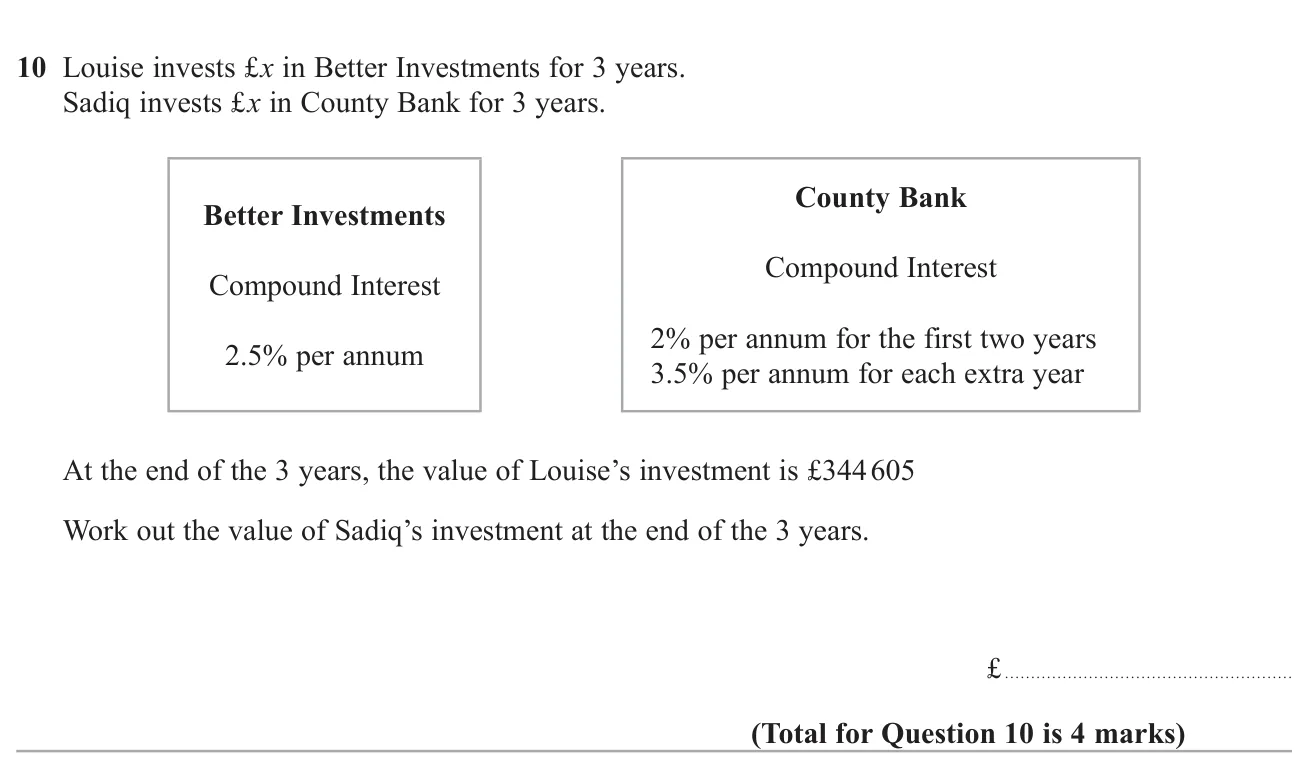
Compound interest, growth and decay4 marksGrade 6CalculatorHigher
November 2021 · Paper 2 Higher · Q10
Work backwards from a compound interest total to find the amount invested, then apply different interest rates to it.

© Pearson Education Ltd. November 2021 Paper 2 (Higher, calculator), question 10.

Show answer
Answer£344 580.484 marks

Worked solution Checked against the mark scheme

Louise: x×1.0253=344 605x \times 1.025^3 = 344\,605, so x=344 605÷1.0253=320 000x = 344\,605 \div 1.025^3 = 320\,000.

Sadiq: 320 000×1.022×1.035=344 580.48320\,000 \times 1.02^2 \times 1.035 = 344\,580.48.

Sadiq's investment is worth £344 580.48.

Watch out: Using simple interest, or dividing by 1.075 instead of 1.025³.
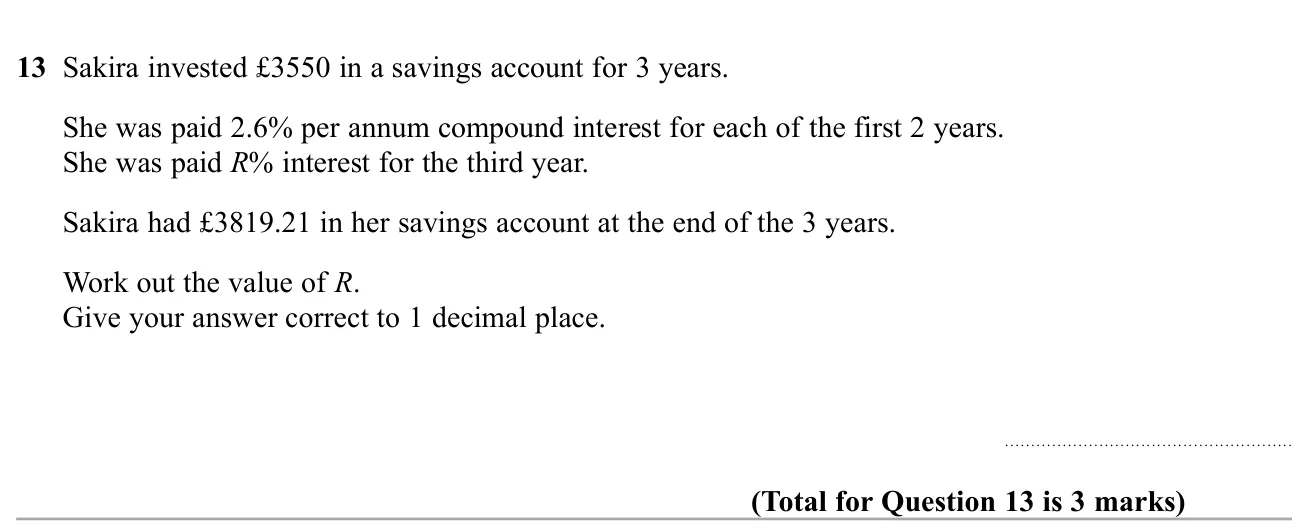
Compound interest, growth and decay3 marksGrade 6CalculatorHigher
November 2019 · Paper 2 Higher · Q13
Work back from a final savings balance to find an unknown interest rate for the third year.

© Pearson Education Ltd. November 2019 Paper 2 (Higher, calculator), question 13.

Show answer
Answer2.23 marks

Worked solution Checked against the mark scheme

After 2 years: 3550×1.0262=£3736.99983550 \times 1.026^2 = £3736.9998

Multiplier for year 3: 3819.21÷3736.9998=1.02199...3819.21 \div 3736.9998 = 1.02199...

So R=2.199...≈2.2R = 2.199... \approx 2.2

Watch out: Using simple interest for the first two years.
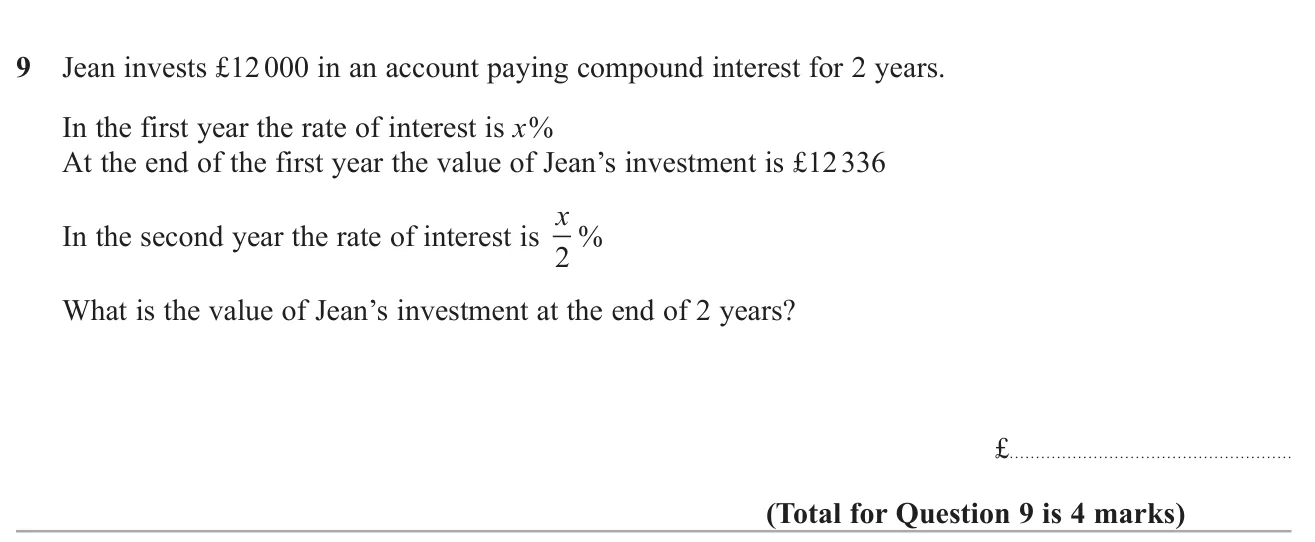
Compound interest, growth and decay4 marksGrade 6CalculatorHigher
June 2018 · Paper 2 Higher · Q9
Find a first-year compound interest rate from the new balance, then apply half that rate for the second year.

© Pearson Education Ltd. June 2018 Paper 2 (Higher, calculator), question 9.

Show answer
Answer£12 508.70£12\,508.704 marks

Worked solution Checked against the mark scheme

Multiplier for year 1: 12 336÷12 000=1.02812\,336 \div 12\,000 = 1.028, so x=2.8x = 2.8

Year 2 rate: 2.8÷2=1.4%2.8 \div 2 = 1.4\%

12 336×1.014=£12 508.7012\,336 \times 1.014 = £12\,508.70

Watch out: Applying 1.4% to the original £12 000 instead of £12 336.
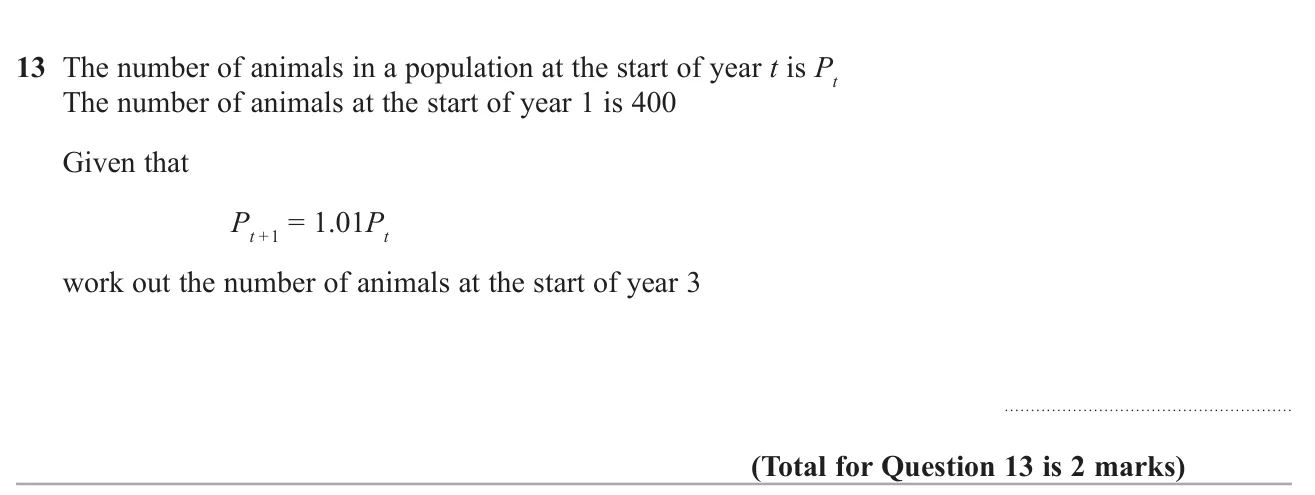
Compound interest, growth and decay2 marksGrade 6CalculatorHigher
November 2018 · Paper 3 Higher · Q13
Use a recurrence rule for a population to find the number of animals two years later.

© Pearson Education Ltd. November 2018 Paper 3 (Higher, calculator), question 13.

Show answer
Answer4084082 marks

Worked solution Checked against the mark scheme

P1=400P_1 = 400

P2=1.01×400=404P_2 = 1.01 \times 400 = 404

P3=1.01×404=408.04P_3 = 1.01 \times 404 = 408.04, so about 408408 animals.

Watch out: Applying the multiplier three times and getting 412.
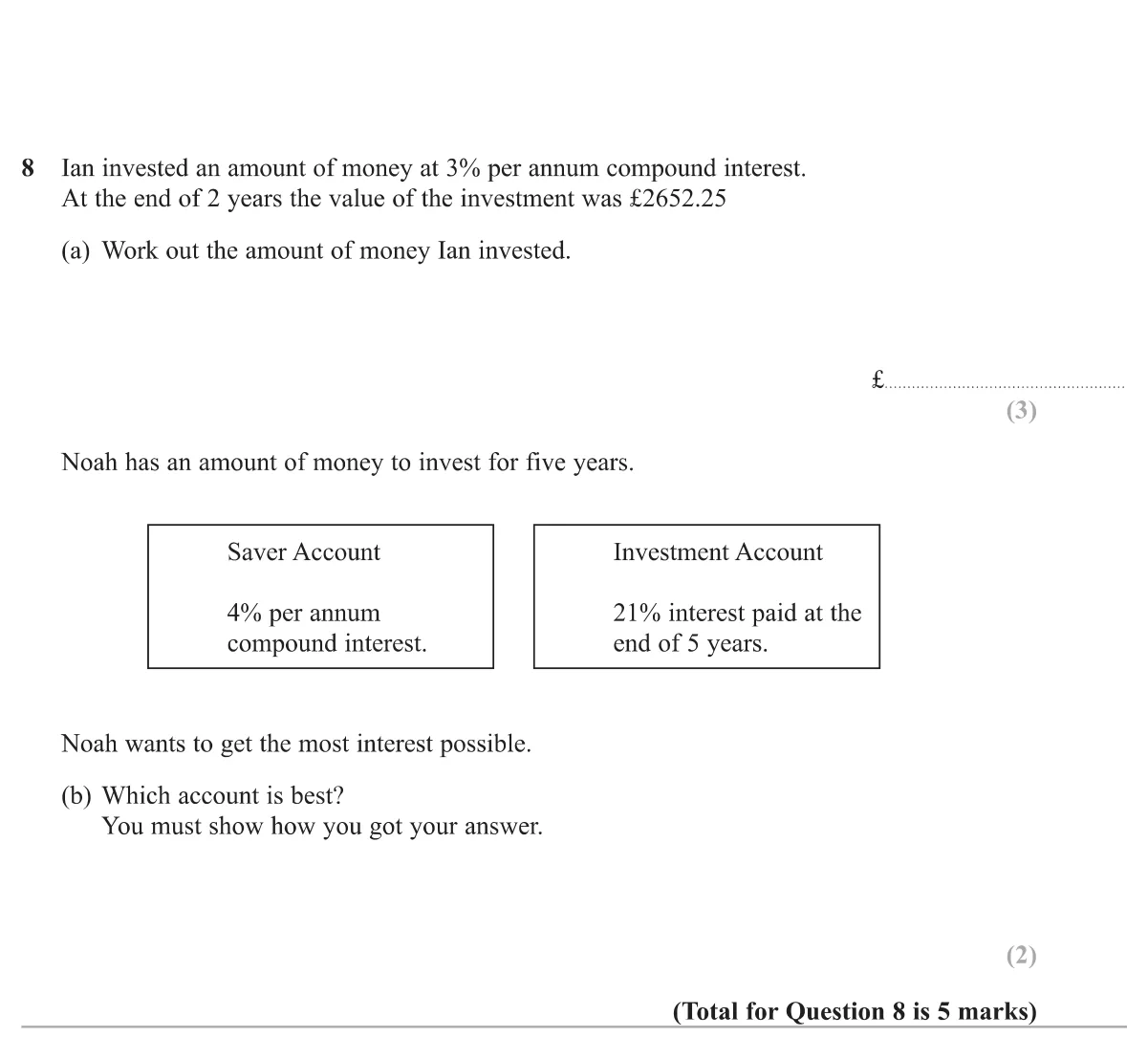
Compound interest, growth and decay5 marksGrade 6CalculatorHigher
Specimen · Paper 3 Higher · Q8
Work backwards from a compound-interest total to the original sum, then compare compound interest with a flat interest payment over five years.

© Pearson Education Ltd. Specimen Paper 3 (Higher, calculator), question 8.

Show answer
(a)£25003 marks
(b)The Saver Account: 4% compound for 5 years gives about 21.67% interest, which is more than 21%2 marks

Worked solution Checked against the mark scheme

(a) Each year multiplies the amount by 1.031.03, so after 2 years it is multiplied by 1.032=1.06091.03^2 = 1.0609.

Original =2652.25÷1.0609=£2500= 2652.25 \div 1.0609 = £2500

(b) Saver Account: 1.045=1.21671.04^5 = 1.2167, so the interest is about 21.67%21.67\%.

Investment Account: 21%21\%.

21.67%>21%21.67\% > 21\%, so the Saver Account is best.

Watch out: Taking off 6% (or dividing by 1.06) instead of dividing by 1.03².
Compound interest, growth and decay4 marksGrade 7No calculatorHigher
November 2023 · Paper 1 Higher · Q16
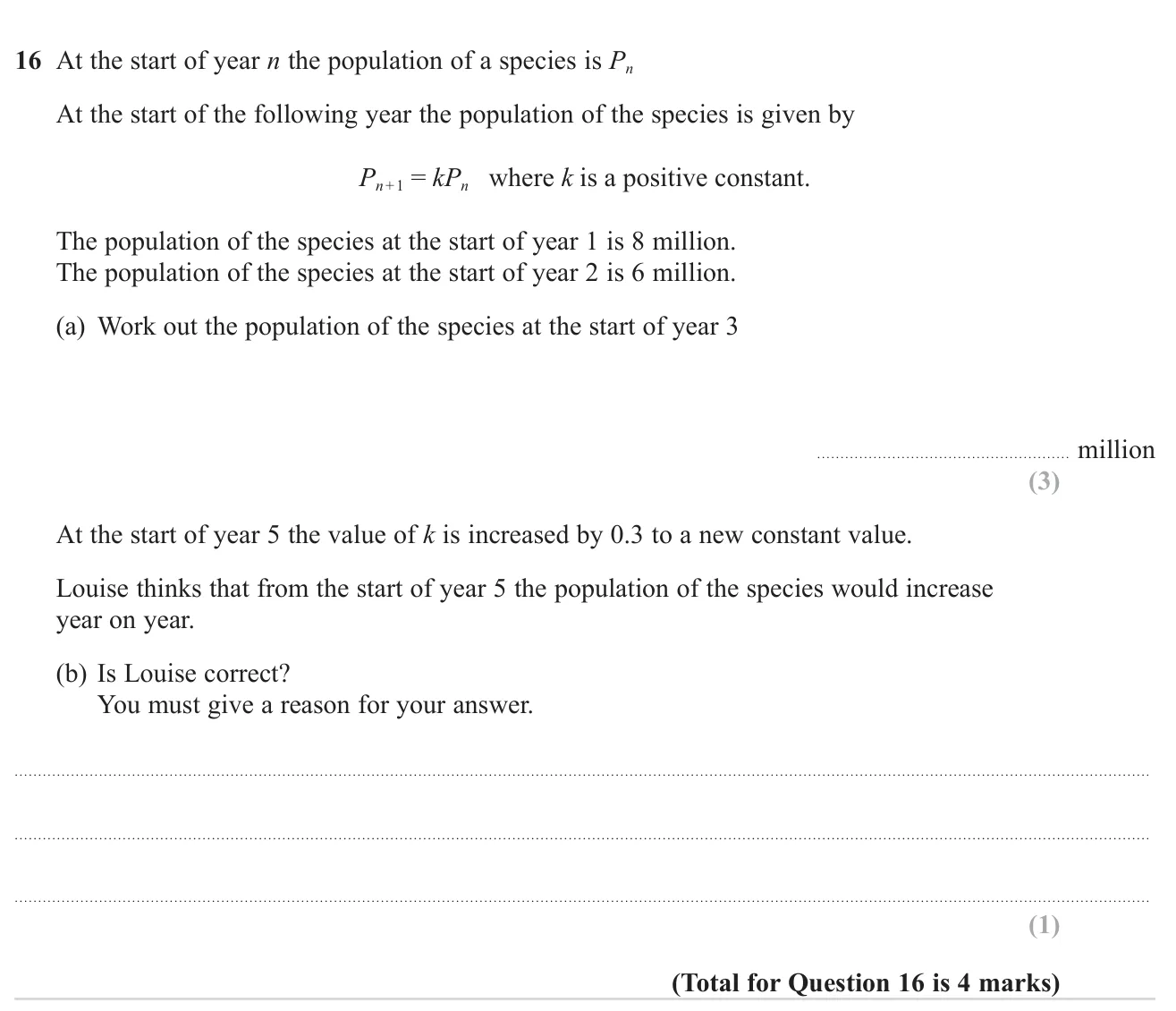
Use a population recurrence to find a later value, then decide whether increasing the multiplier makes the population grow.

© Pearson Education Ltd. November 2023 Paper 1 (Higher, non-calculator), question 16.

Show answer
(a)4.54.5 million3 marks
(b)Yes: the new value of kk is 1.051.05, which is greater than 11 mark

Worked solution Checked against the mark scheme

(a) P2=kP1P_2 = kP_1: 6=8k6 = 8k, so k=0.75k = 0.75

P3=0.75×6=4.5P_3 = 0.75 \times 6 = 4.5 million

(b) New k=0.75+0.3=1.05k = 0.75 + 0.3 = 1.05. Multiplying by a number greater than 1 each year makes the population grow, so Louise is correct.

Watch out: In (b), just saying 'yes because k increased' without noting it is now above 1.
Compound interest, growth and decay4 marksGrade 7CalculatorHigher
November 2020 · Paper 2 Higher · Q19
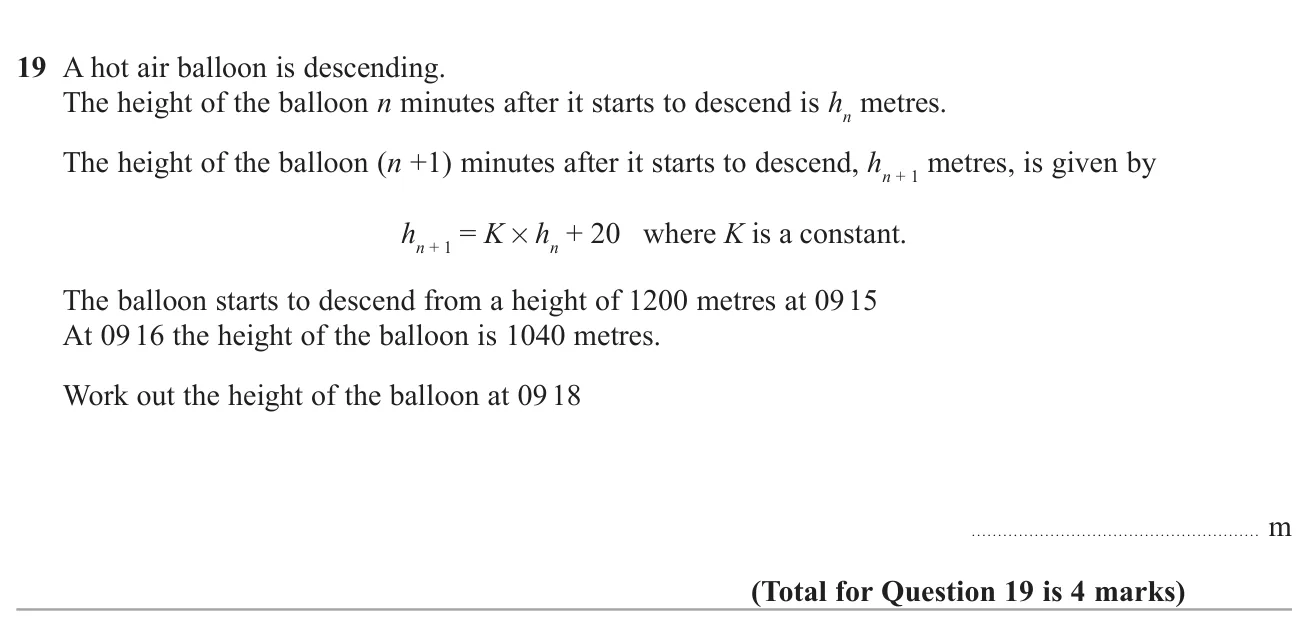
Use a recurrence relation to find an unknown constant from two heights, then find the height two minutes later.

© Pearson Education Ltd. November 2020 Paper 2 (Higher, calculator), question 19.

Show answer
Answer788.4 m4 marks

Worked solution Checked against the mark scheme

1040=K×1200+201040 = K \times 1200 + 20, so K=10201200=0.85K = \frac{1020}{1200} = 0.85.

At 09 17: 0.85×1040+20=9040.85 \times 1040 + 20 = 904.

At 09 18: 0.85×904+20=788.40.85 \times 904 + 20 = 788.4 m.

Watch out: Applying the rule only once, or three times, by miscounting the minutes.
Compound interest, growth and decay3 marksGrade 7CalculatorHigher
Specimen · Paper 3 Higher · Q15
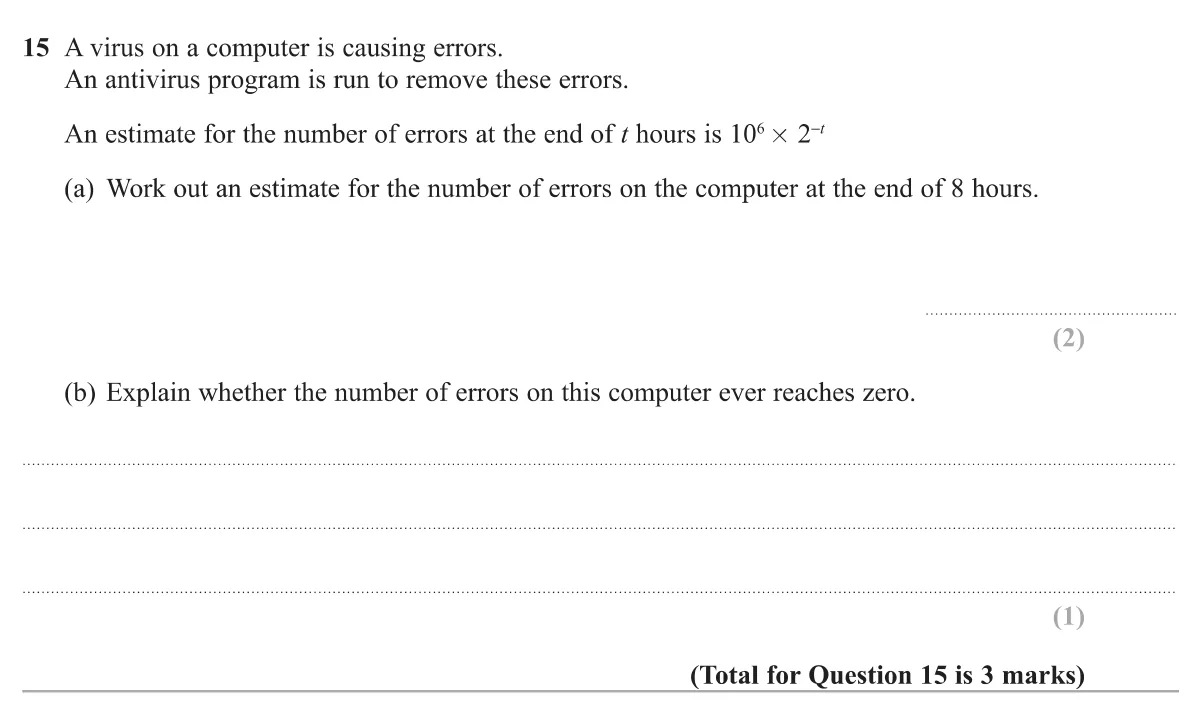
Evaluate an exponential decay model for the number of computer errors after 8 hours and explain whether it ever reaches zero.

© Pearson Education Ltd. Specimen Paper 3 (Higher, calculator), question 15.

Show answer
(a)3906 (3906 or 3907 accepted; 3900, 3910 or 4000 from correct working)2 marks
(b)Either: no, the model halves each hour so it never reaches 0; or yes, in practice, since you can't have part of an error1 mark

Worked solution Checked against the mark scheme

(a) 106×2−8=1 000 000256=3906.2510^6 \times 2^{-8} = \frac{1\,000\,000}{256} = 3906.25, so about 3906 errors.

(b) In the model the number halves every hour, and halving a positive number never gives 0, so the model never reaches zero. (You could also argue that in reality the count must eventually drop below 1, and there can't be a fraction of an error.)

Watch out: Treating 2⁻⁸ as −16 or as −256.
Compound interest, growth and decay3 marksGrade 8CalculatorHigher
November 2021 · Paper 3 Higher · Q19
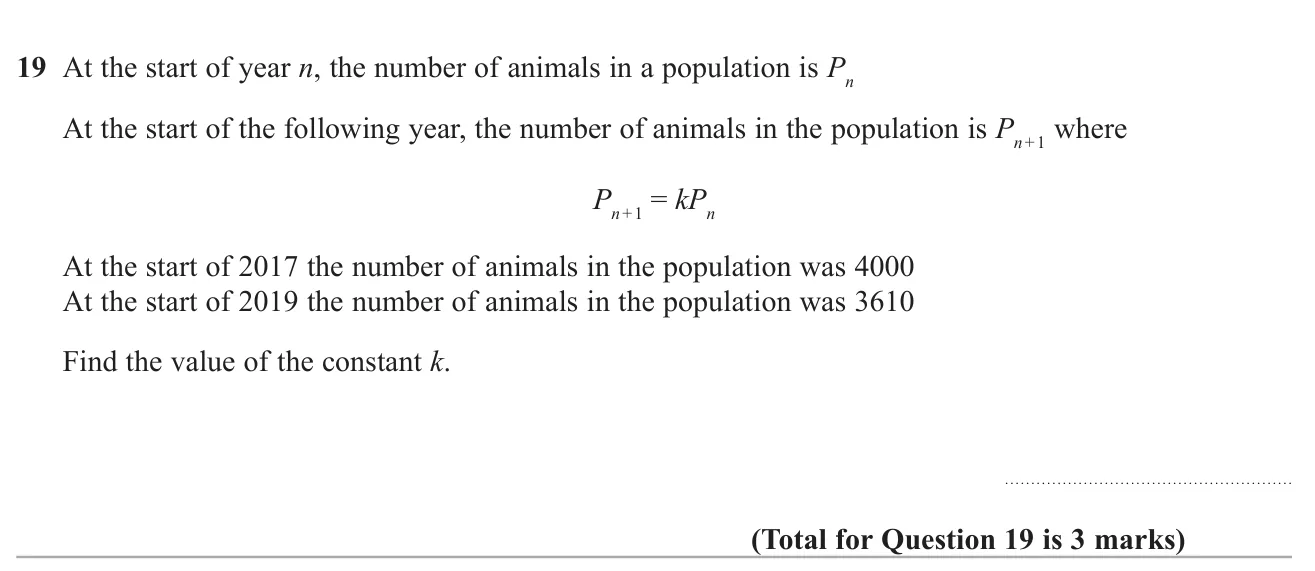
Use a multiplicative year-on-year population rule and values two years apart to find the multiplier.

© Pearson Education Ltd. November 2021 Paper 3 (Higher, calculator), question 19.

Show answer
Answerk=0.95k = 0.953 marks

Worked solution Checked against the mark scheme

2017 to 2019 is two years, so P2019=k2P2017P_{2019} = k^2 P_{2017}.

3610=4000k23610 = 4000k^2

k2=0.9025k^2 = 0.9025, so k=0.9025=0.95k = \sqrt{0.9025} = 0.95

Watch out: Using k=3610÷4000=0.9025k = 3610 \div 4000 = 0.9025 (only one year of change).

Also tested in these questions

Their main topic is different, but part of each one tests this topic.