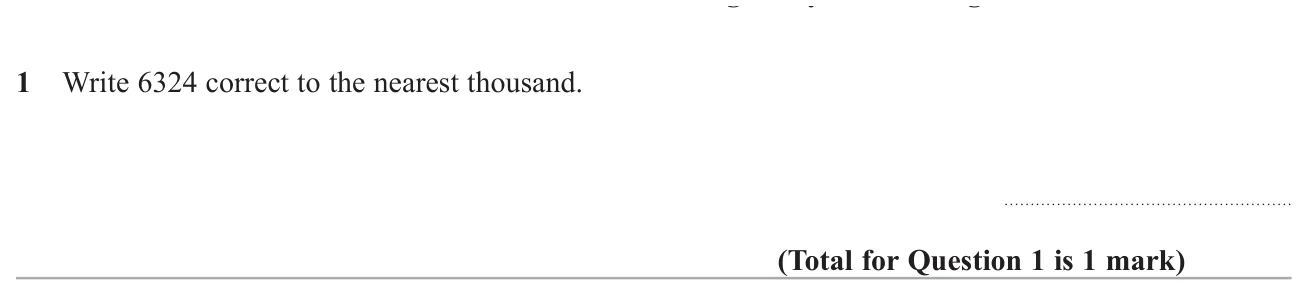
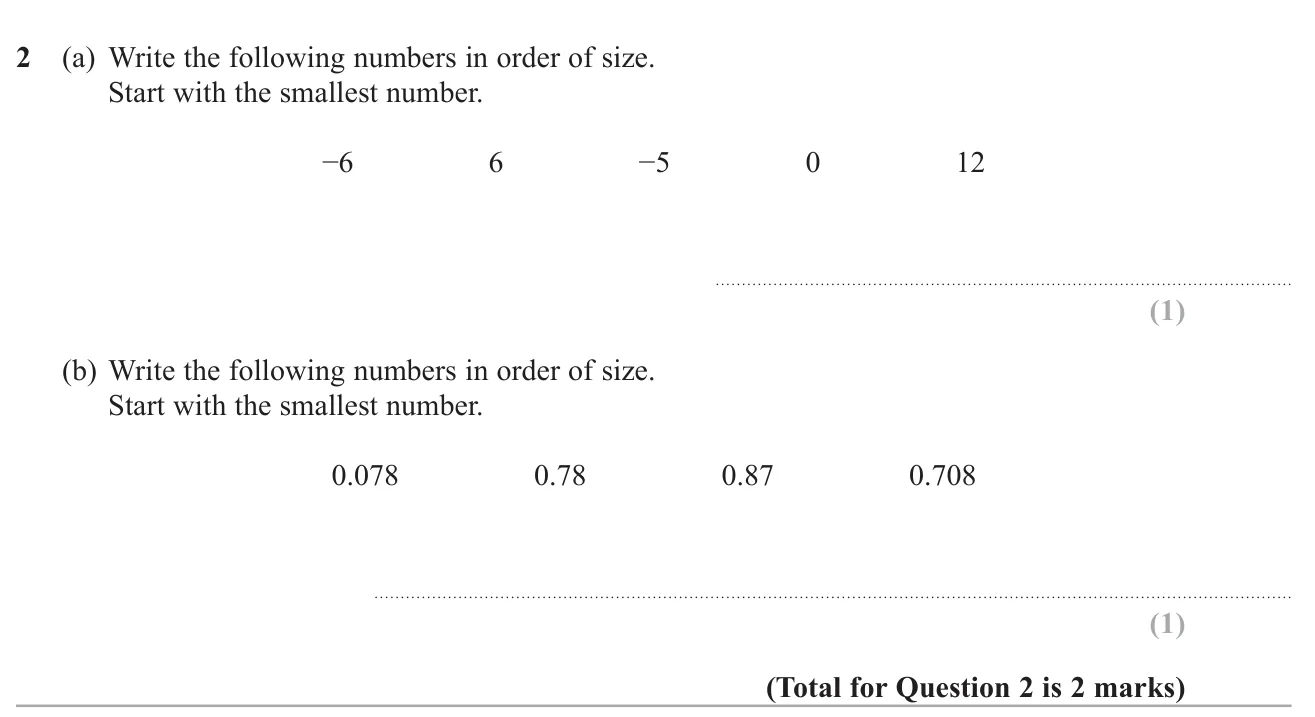
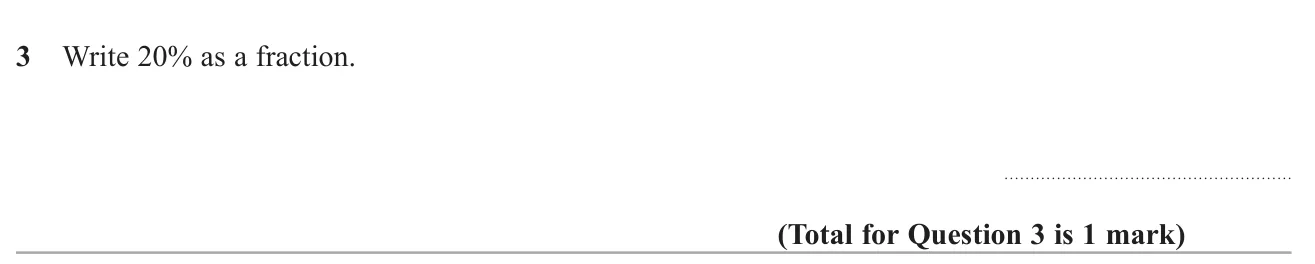
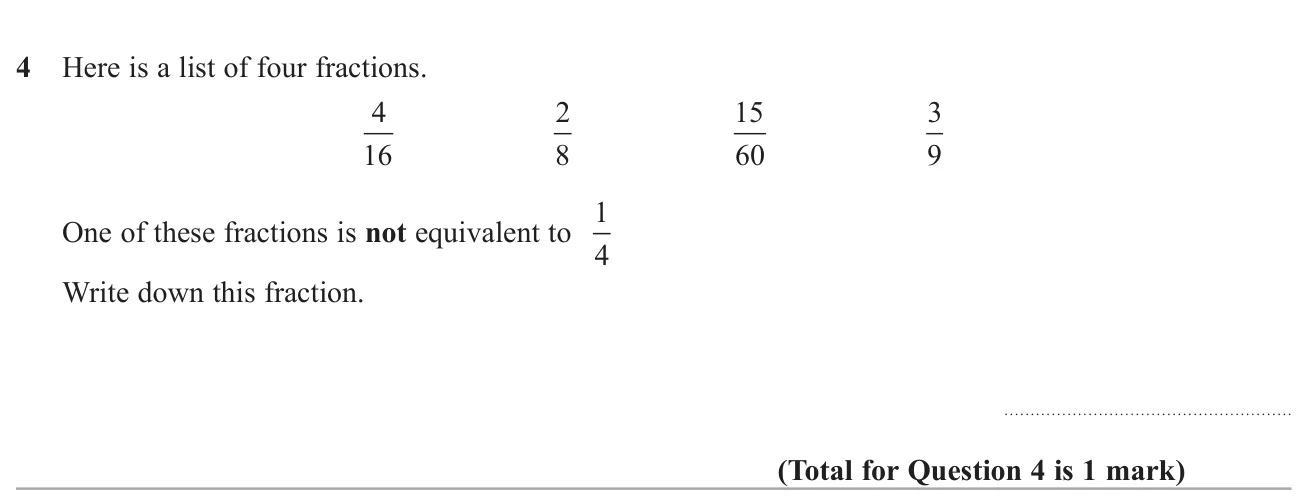
© Pearson Education Ltd. June 2018 Paper 1 (Foundation, non-calculator), question 1.
Show answer
Worked solution Checked against the mark scheme
Look at the hundreds digit of 6324: it is 3, which is less than 5.
So round down to 6000.
Watch out: Rounding up to 7000 or giving 6300.
© Pearson Education Ltd. June 2018 Paper 1 (Foundation, non-calculator), question 2.
Show answer
| (a) | −6,−5,0,6,12 | 1 mark |
|---|
| (b) | 0.078,0.708,0.78,0.87 | 1 mark |
|---|
Worked solution Checked against the mark scheme
(a) Negatives come first, and −6 is smaller than −5: −6,−5,0,6,12
(b) Write each with three decimal places: 0.078, 0.780, 0.870, 0.708.
Order: 0.078,0.708,0.78,0.87
Watch out: Thinking −5 is smaller than −6.
© Pearson Education Ltd. June 2018 Paper 1 (Foundation, non-calculator), question 3.
Show answer
| Answer | 10020 or 51 | 1 mark |
|---|
Worked solution Checked against the mark scheme
Per cent means out of 100, so 20%=10020.
This simplifies to 51.
Watch out: Writing 20/10 or 1/20.
© Pearson Education Ltd. June 2018 Paper 1 (Foundation, non-calculator), question 4.
Show answer
| Answer | 93 | 1 mark |
|---|
Worked solution Checked against the mark scheme
Simplify each: 164=41, 82=41, 6015=41, but 93=31.
So the odd one out is 93.
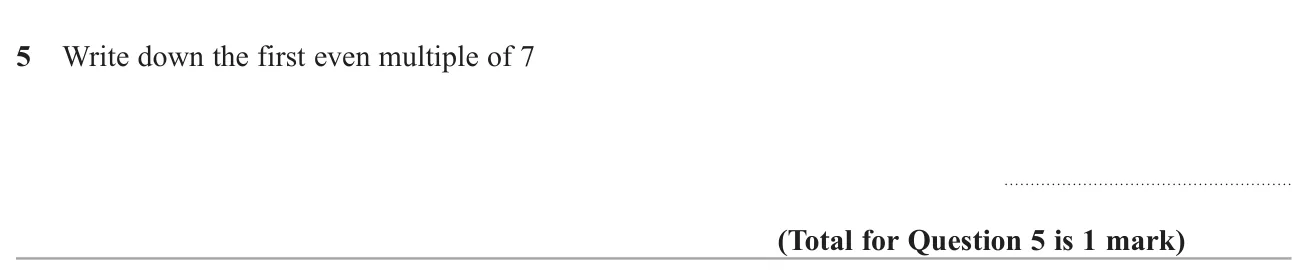
© Pearson Education Ltd. June 2018 Paper 1 (Foundation, non-calculator), question 5.
Show answer
Worked solution Checked against the mark scheme
Multiples of 7: 7, 14, 21, ...
7 is odd, so the first even one is 14.
Watch out: Giving 7, which is odd.
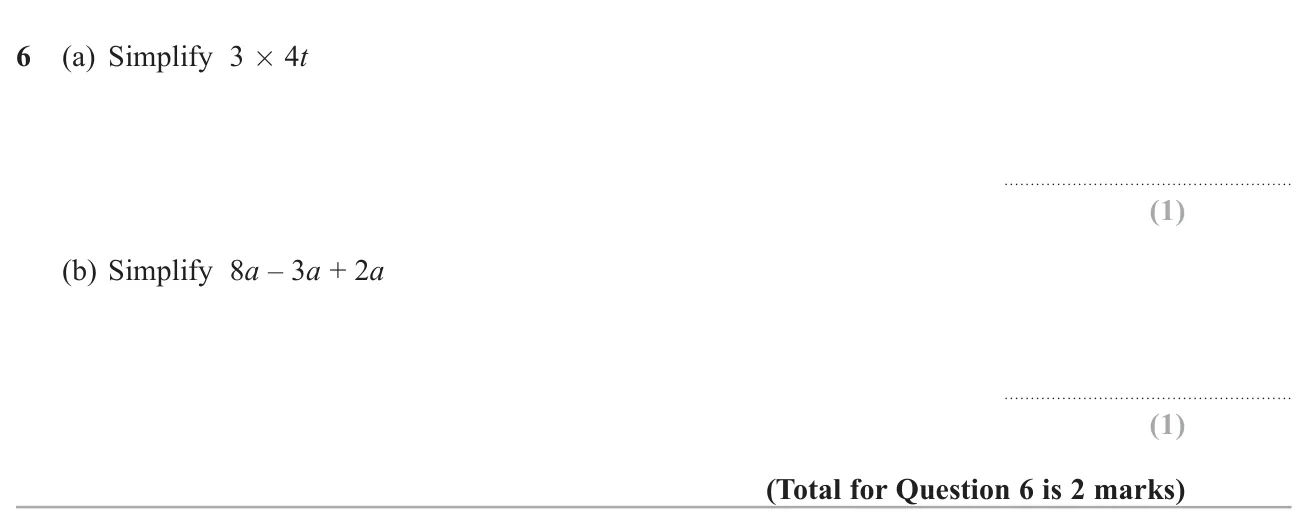
© Pearson Education Ltd. June 2018 Paper 1 (Foundation, non-calculator), question 6.
Show answer
| (a) | 12t | 1 mark |
|---|
| (b) | 7a | 1 mark |
|---|
Worked solution Checked against the mark scheme
(a) 3×4t=12t
(b) 8a−3a=5a, then 5a+2a=7a
Watch out: In (b), working out 3a+2a first and getting 3a.
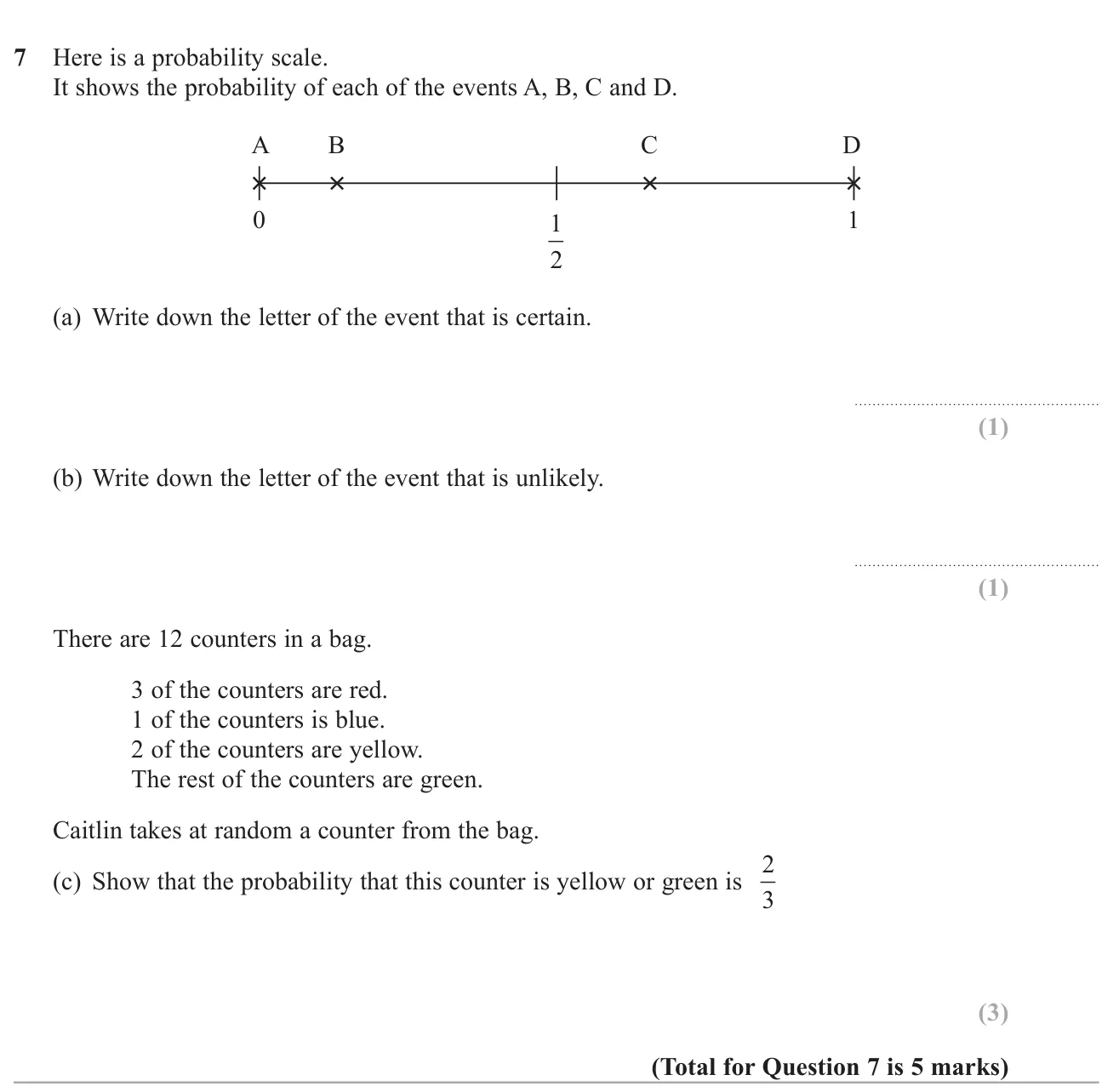
© Pearson Education Ltd. June 2018 Paper 1 (Foundation, non-calculator), question 7.
Show answer
| (a) | D | 1 mark |
|---|
| (b) | B | 1 mark |
|---|
| (c) | Green =6, so P=122+6=128=32 | 3 marks |
|---|
Worked solution Checked against the mark scheme
(a) Certain means probability 1, which is D.
(b) Unlikely means between 0 and a half, which is B.
(c) Green =12−(3+1+2)=6
Yellow or green =2+6=8 counters
P=128=32
Watch out: Forgetting the blue counter when working out the number of green ones.
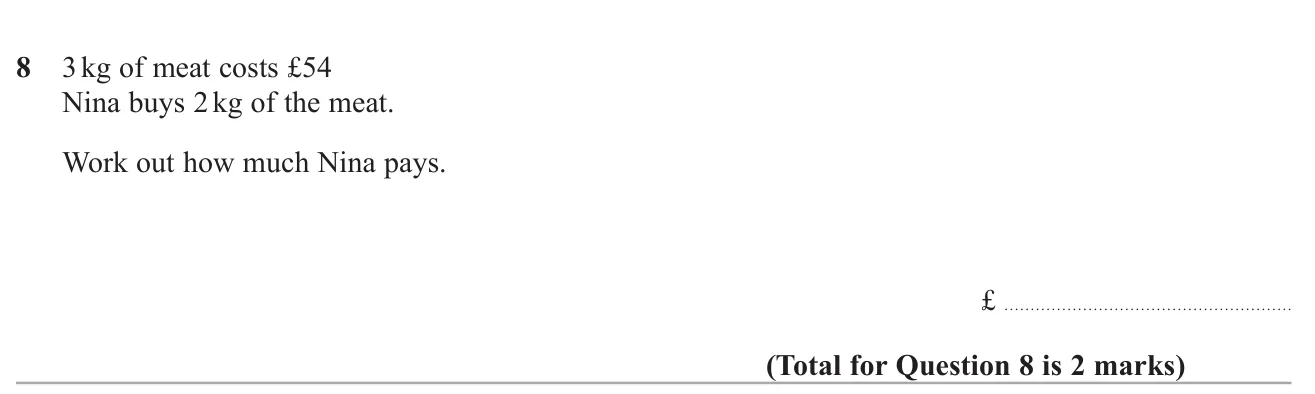
© Pearson Education Ltd. June 2018 Paper 1 (Foundation, non-calculator), question 8.
Show answer
Worked solution Checked against the mark scheme
1 kg costs 54÷3=£18
2 kg cost 2×18=£36
Watch out: Working out 54÷2=27.
© Pearson Education Ltd. June 2018 Paper 1 (Foundation, non-calculator), question 9.
Show answer
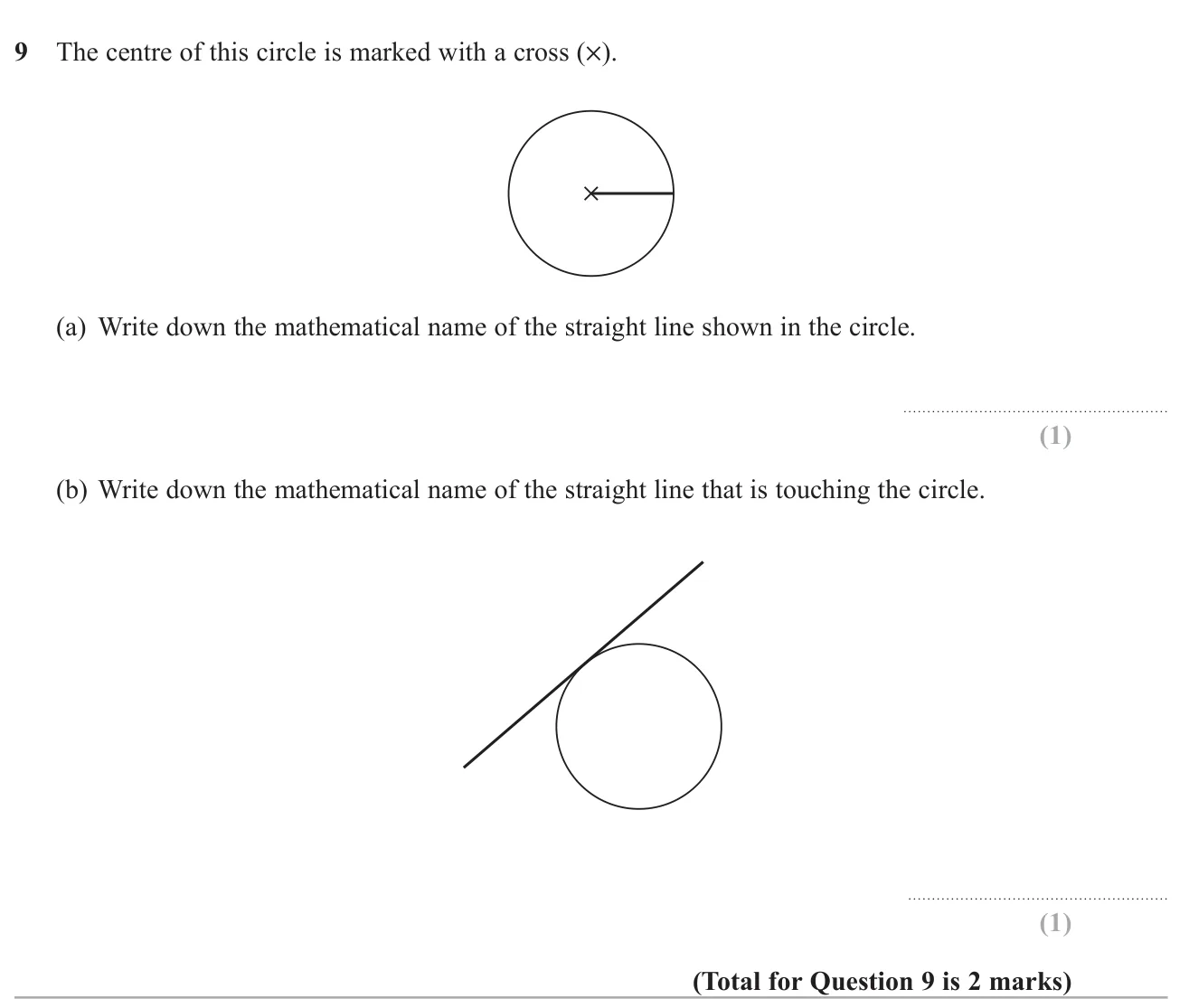
| (a) | Radius | 1 mark |
|---|
| (b) | Tangent | 1 mark |
|---|
Worked solution Checked against the mark scheme
(a) A line from the centre to the edge is a radius.
(b) A line that touches the circle at just one point is a tangent.
Watch out: Calling the radius a diameter.
© Pearson Education Ltd. June 2018 Paper 1 (Foundation, non-calculator), question 10.
Show answer
| Answer | £535 | 3 marks |
|---|
Worked solution Checked against the mark scheme
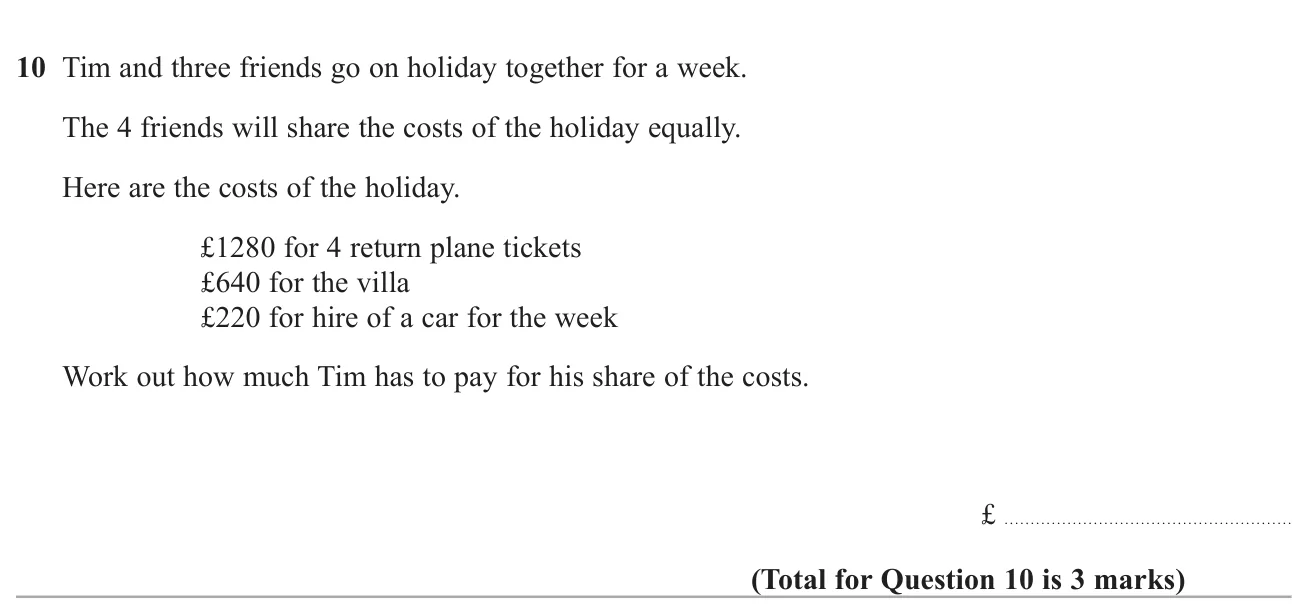
Total =1280+640+220=£2140
Each share =2140÷4=£535
Watch out: Adding the costs but not dividing by 4 (or dividing only the plane tickets).
© Pearson Education Ltd. June 2018 Paper 1 (Foundation, non-calculator), question 11.
Show answer
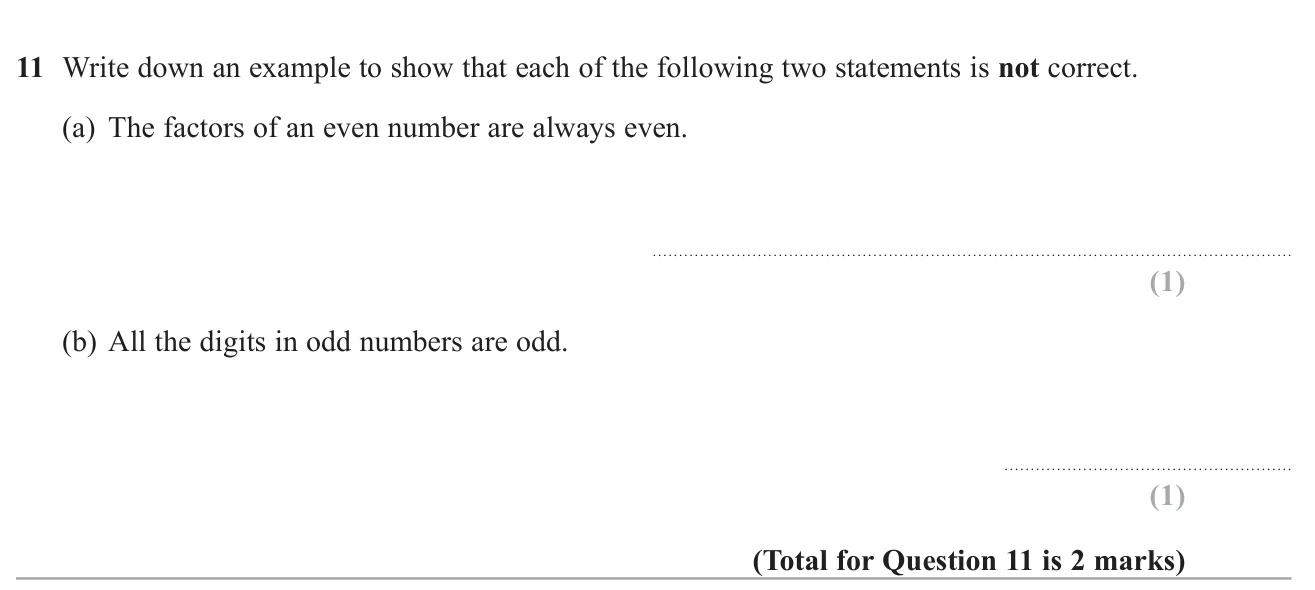
| (a) | e.g. 3 is a factor of 12 | 1 mark |
|---|
| (b) | e.g. 23 | 1 mark |
|---|
Worked solution Checked against the mark scheme
(a) 12 is even, but 3×4=12, so 3 is an odd factor of 12.
(b) 23 is odd, but its digit 2 is even.
Watch out: Giving an example that agrees with the statement instead of one that breaks it.
© Pearson Education Ltd. June 2018 Paper 1 (Foundation, non-calculator), question 12.
Show answer
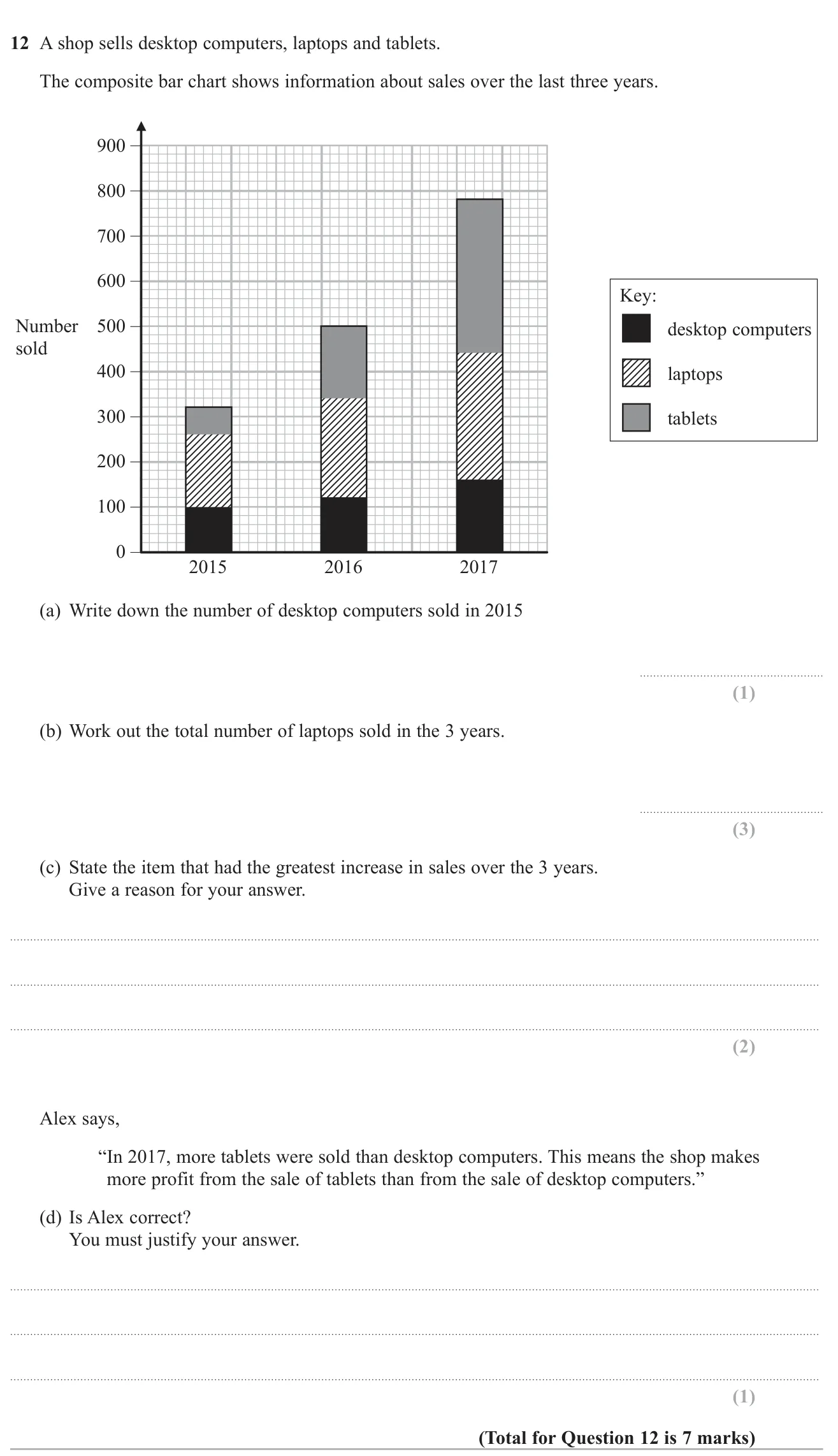
| (a) | 100 | 1 mark |
|---|
| (b) | 660 | 3 marks |
|---|
| (c) | Tablets: they rose from 60 to 340, an increase of 280 | 2 marks |
|---|
| (d) | No: the chart gives numbers sold, not prices or profit | 1 mark |
|---|
Worked solution Checked against the mark scheme
(a) The desktop section in 2015 reaches 100.
(b) Laptops: 260−100=160, 340−120=220, 440−160=280
Total =160+220+280=660
(c) Tablets: 320−260=60 in 2015 up to 780−440=340 in 2017, a rise of 280. Tablets grew most.
(d) No: we know how many were sold, not the profit on each item.
Watch out: Reading the top of the laptop section (260) as the number of laptops instead of subtracting the desktop part.
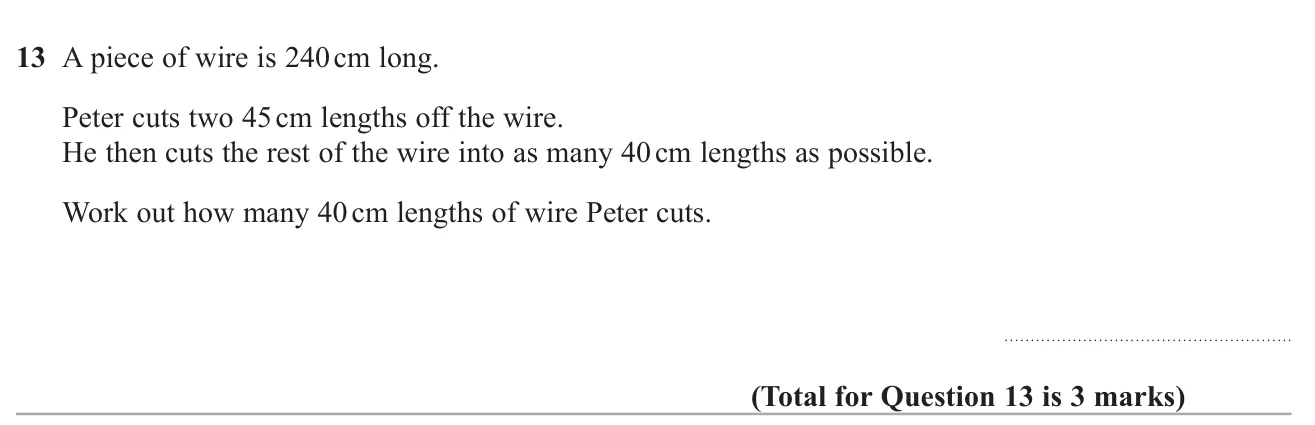
© Pearson Education Ltd. June 2018 Paper 1 (Foundation, non-calculator), question 13.
Show answer
Worked solution Checked against the mark scheme
Left after two pieces: 240−2×45=150 cm
150÷40=3.75
Only whole pieces count, so 3.
Watch out: Rounding 3.75 up to 4.
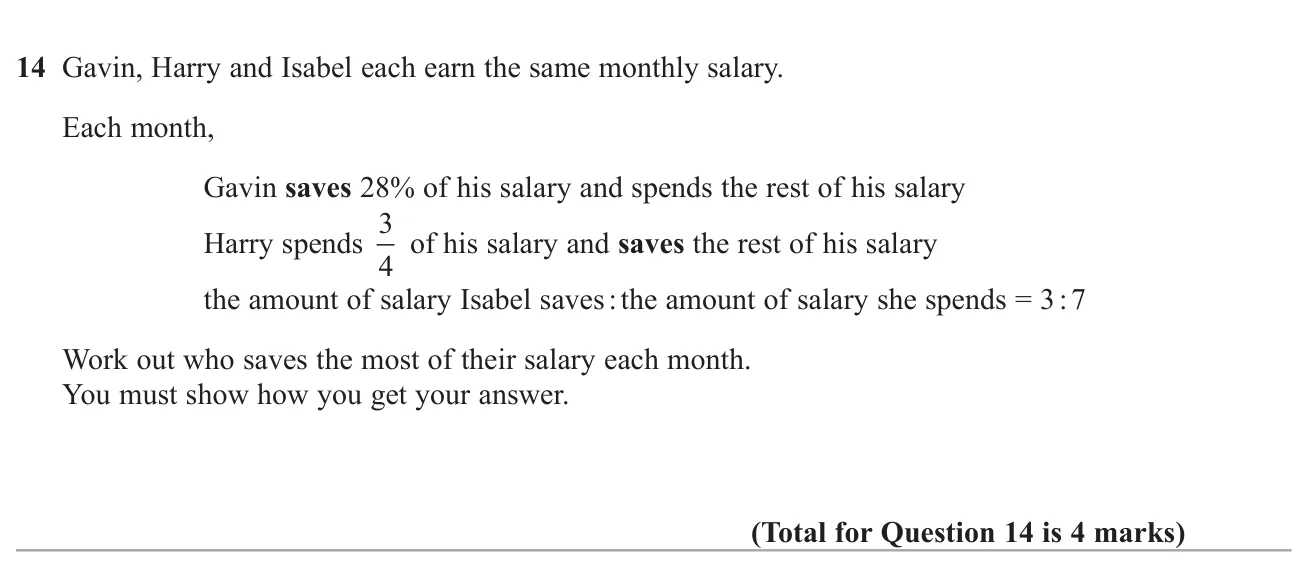
© Pearson Education Ltd. June 2018 Paper 1 (Foundation, non-calculator), question 14.
Show answer
| Answer | Isabel (saves 30%, against 28% and 25%) | 4 marks |
|---|
Worked solution Checked against the mark scheme
Gavin saves 28%.
Harry spends 43, so saves 41=25%.
Isabel saves 3+73=103=30%.
30% is the biggest, so Isabel saves the most.
Watch out: Taking Isabel's share as 3/7 instead of 3/10.
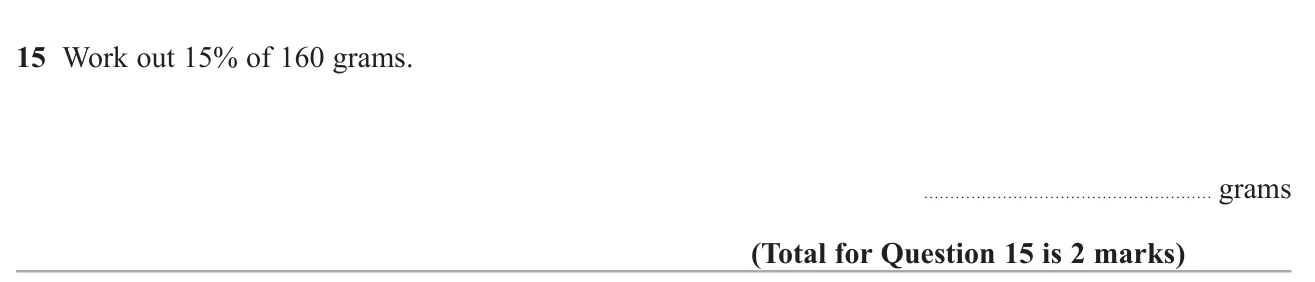
© Pearson Education Ltd. June 2018 Paper 1 (Foundation, non-calculator), question 15.
Show answer
| Answer | 24 grams | 2 marks |
|---|
Worked solution Checked against the mark scheme
10% of 160 =16
5% =16÷2=8
15% =16+8=24 g
Watch out: Finding 15% then subtracting it from 160 (giving 136).
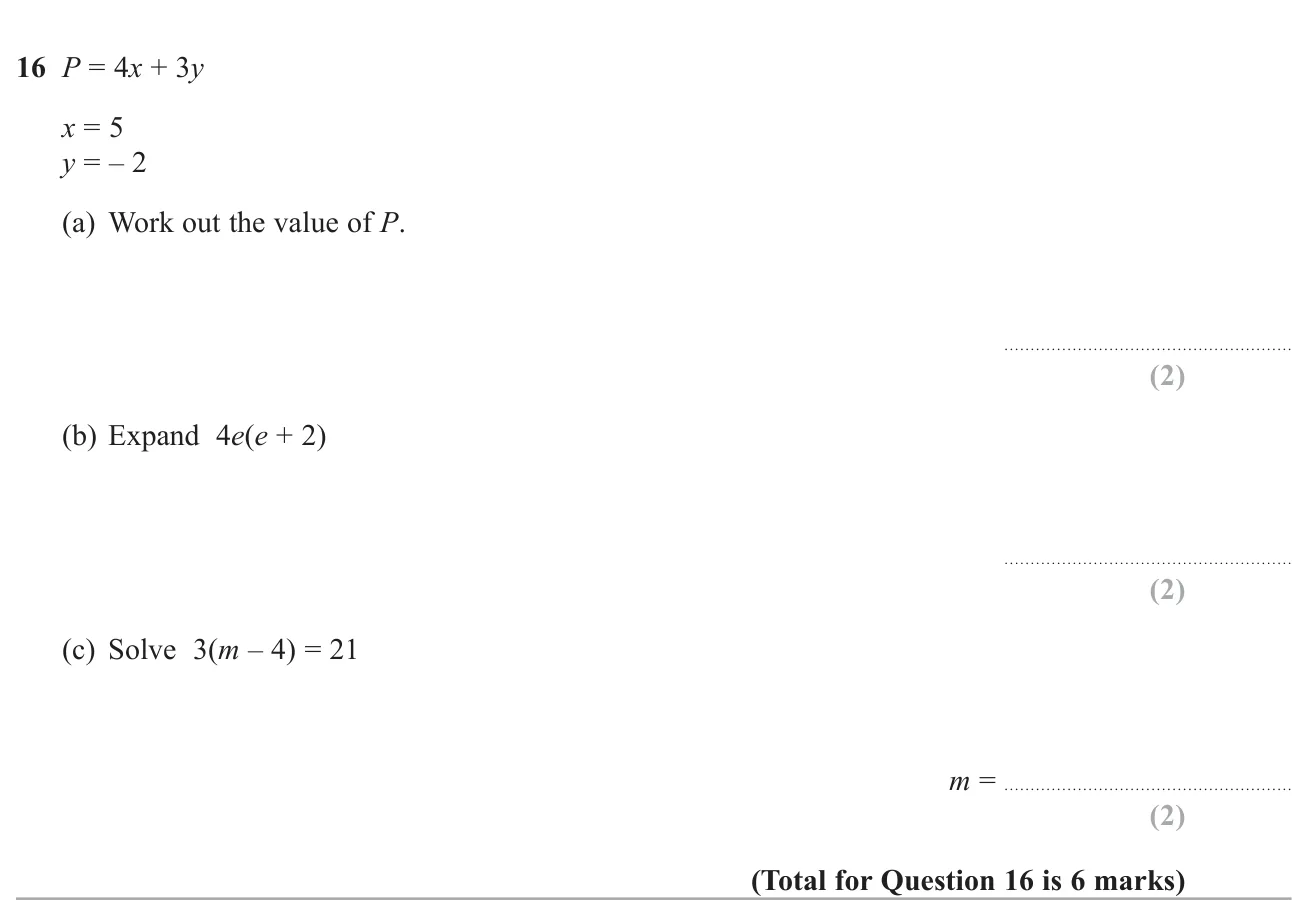
© Pearson Education Ltd. June 2018 Paper 1 (Foundation, non-calculator), question 16.
Show answer
| (a) | 14 | 2 marks |
|---|
| (b) | 4e2+8e | 2 marks |
|---|
| (c) | m=11 | 2 marks |
|---|
Worked solution Checked against the mark scheme
(a) P=4×5+3×(−2)=20−6=14
(b) 4e×e=4e2 and 4e×2=8e, so 4e2+8e
(c) Divide by 3: m−4=7, so m=11
Watch out: In (a), treating 3×−2 as +6 to get 26.
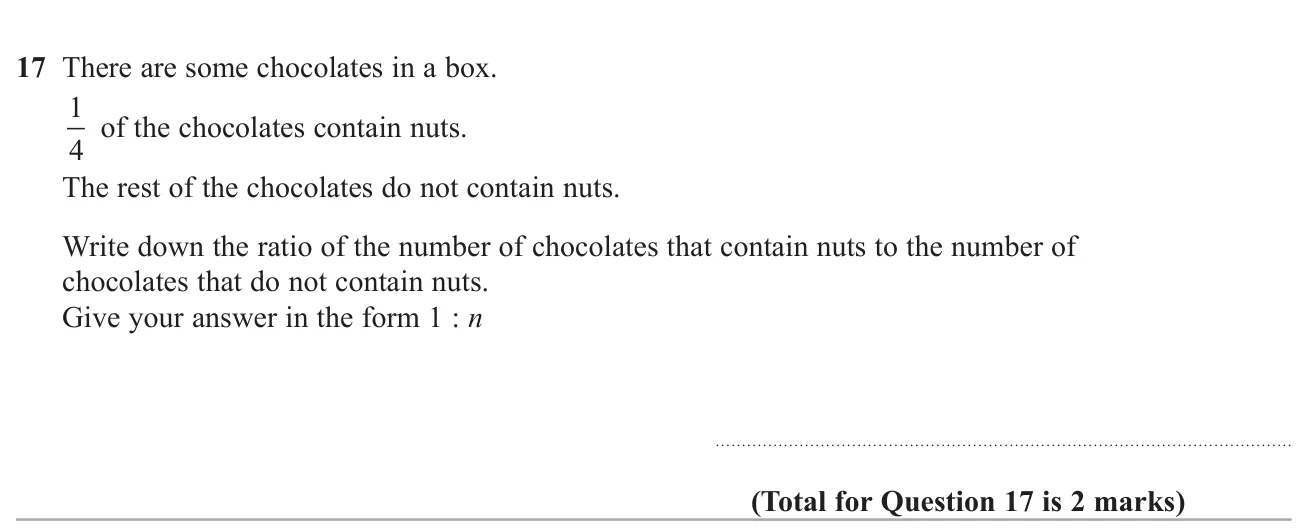
Question 17
Ratio2 marksGrade 4No calculator © Pearson Education Ltd. June 2018 Paper 1 (Foundation, non-calculator), question 17.
Show answer
Worked solution Checked against the mark scheme
Nuts: 41, no nuts: 1−41=43
Ratio 41:43=1:3
Watch out: Writing 1 : 4 (part to whole instead of part to part).
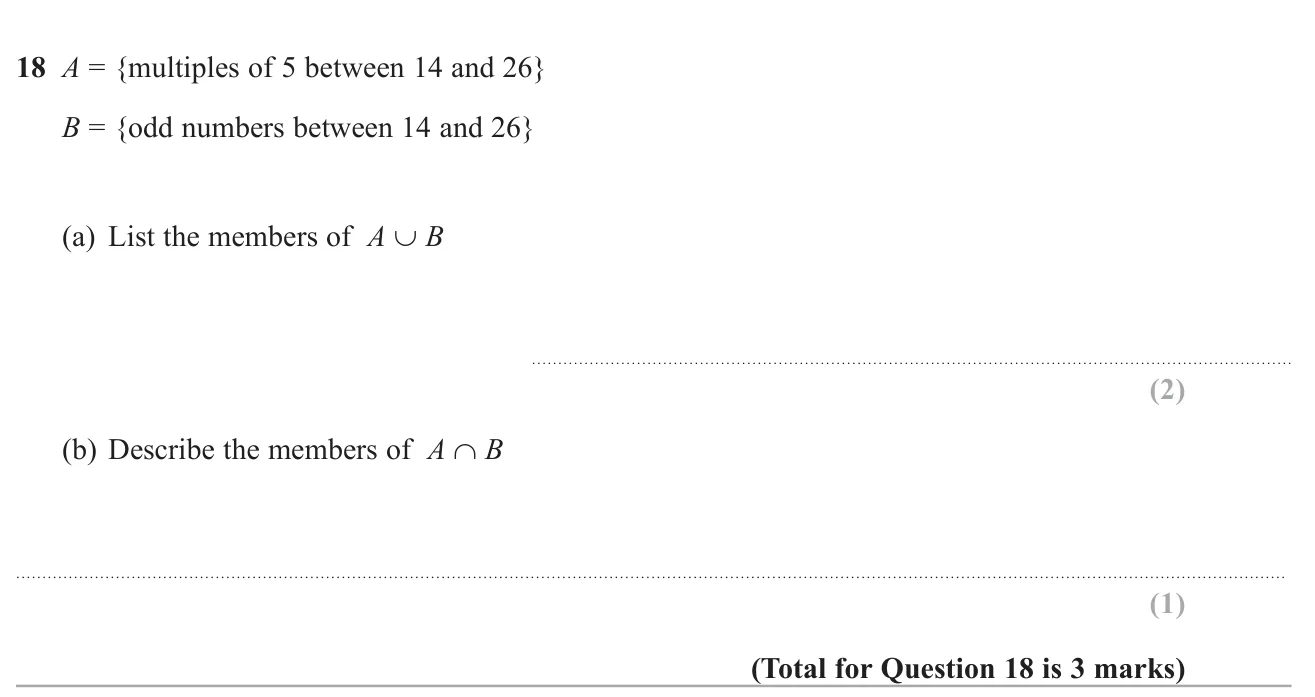
© Pearson Education Ltd. June 2018 Paper 1 (Foundation, non-calculator), question 18.
Show answer
| (a) | 15,17,19,20,21,23,25 | 2 marks |
|---|
| (b) | Odd multiples of 5 (15 and 25) | 1 mark |
|---|
Worked solution Checked against the mark scheme
A={15,20,25}, B={15,17,19,21,23,25}
(a) Union is everything in either: 15, 17, 19, 20, 21, 23, 25
(b) Intersection is in both: 15 and 25, the odd multiples of 5.
Watch out: Mixing up union and intersection.
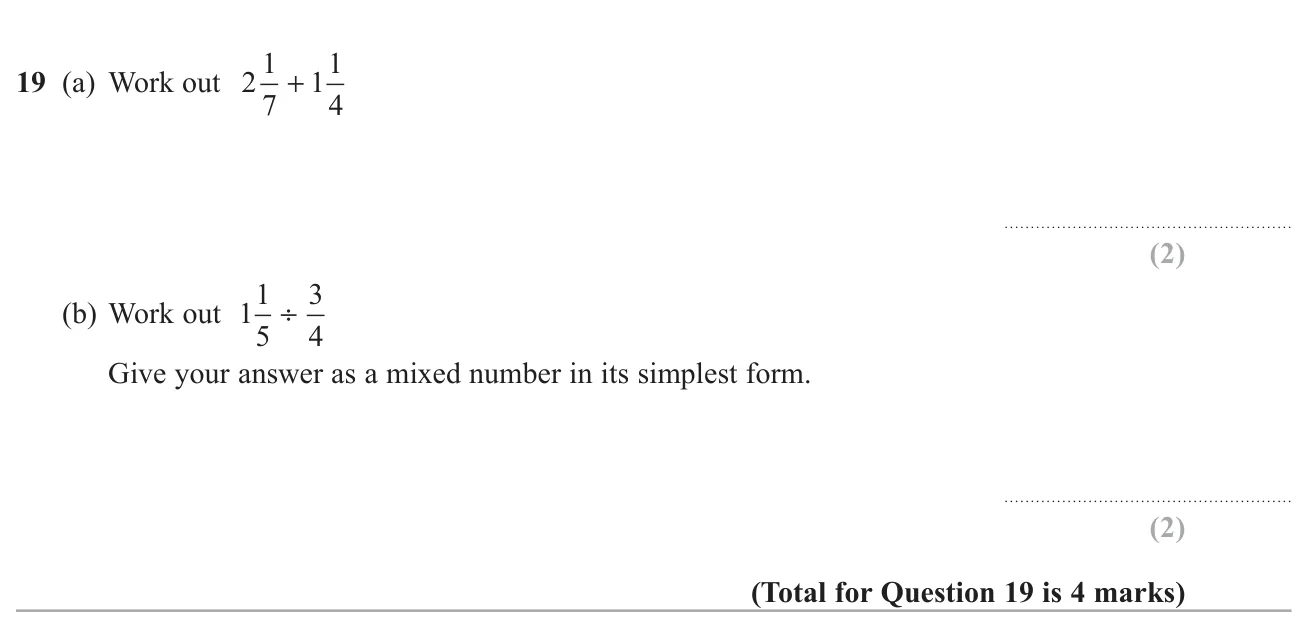
Question 19
Fractions4 marksGrade 4No calculatorOn both tiers © Pearson Education Ltd. June 2018 Paper 1 (Foundation, non-calculator), question 19.
Show answer
| (a) | 32811 | 2 marks |
|---|
| (b) | 153 | 2 marks |
|---|
Worked solution Checked against the mark scheme
(a) Whole numbers: 2+1=3. Fractions: 71+41=284+287=2811
Answer 32811
(b) 151=56, then 56×34=1524=58=153
Watch out: In (b), dividing without flipping the second fraction.
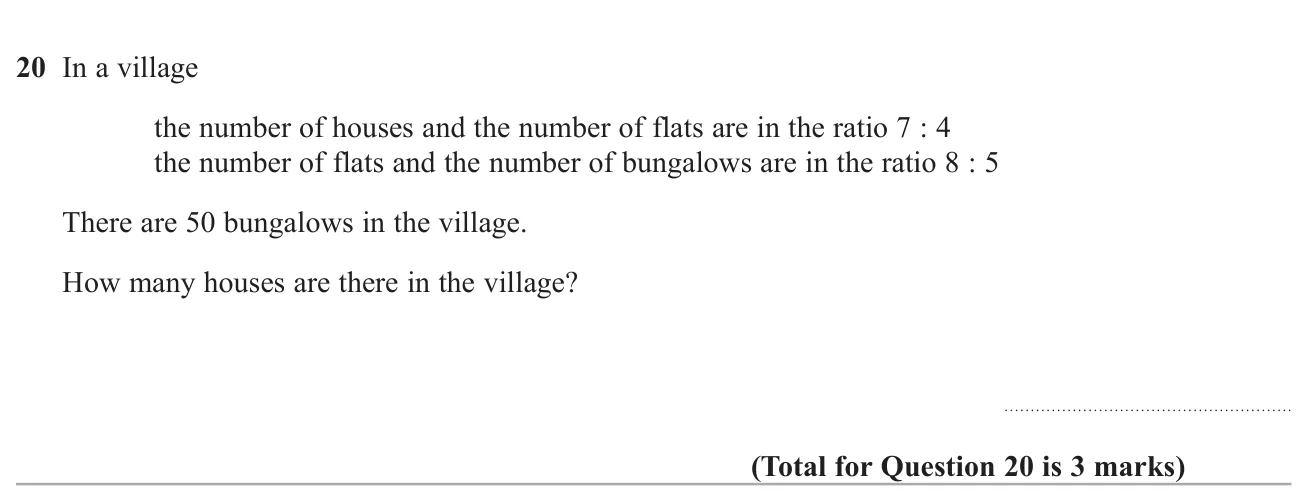
Question 20
Ratio3 marksGrade 5No calculator © Pearson Education Ltd. June 2018 Paper 1 (Foundation, non-calculator), question 20.
Show answer
Worked solution Checked against the mark scheme
Flats : bungalows =8:5, and 50÷5=10, so flats =8×10=80
Houses : flats =7:4, and 80÷4=20, so houses =7×20=140
Watch out: Using the 4 in the first ratio as if it matched the 8 in the second.
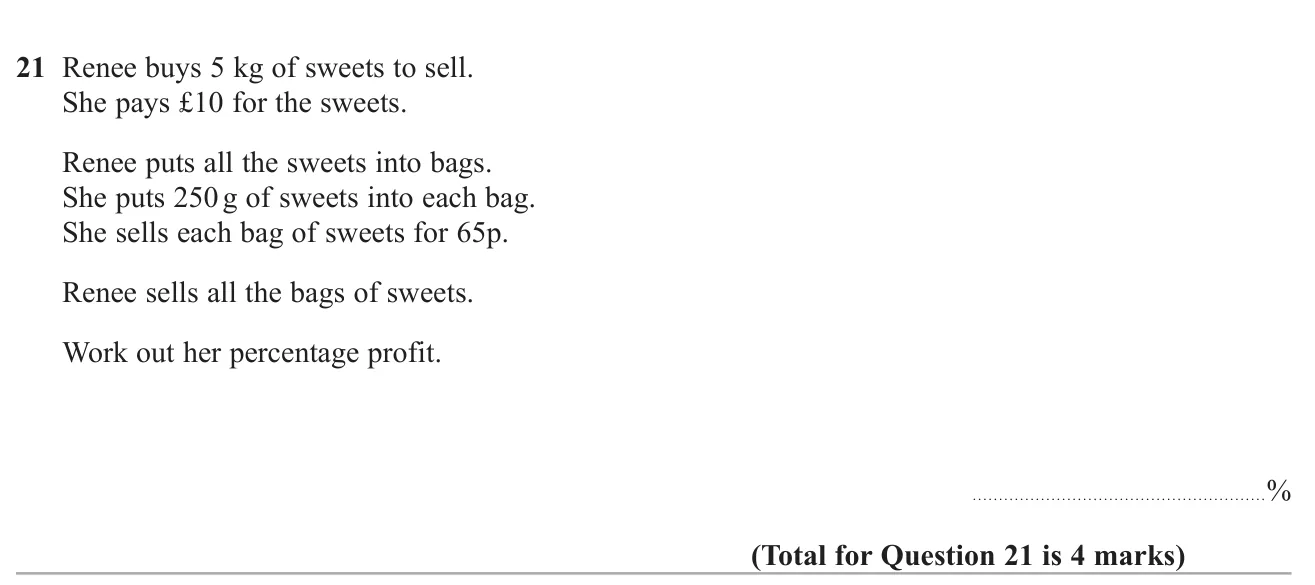
© Pearson Education Ltd. June 2018 Paper 1 (Foundation, non-calculator), question 21.
Show answer
Worked solution Checked against the mark scheme
5 kg =5000 g, so 5000÷250=20 bags
Takings =20×65p=£13
Profit =13−10=£3
Percentage profit =103×100=30%
Watch out: Giving 130% (takings as a percentage of cost).
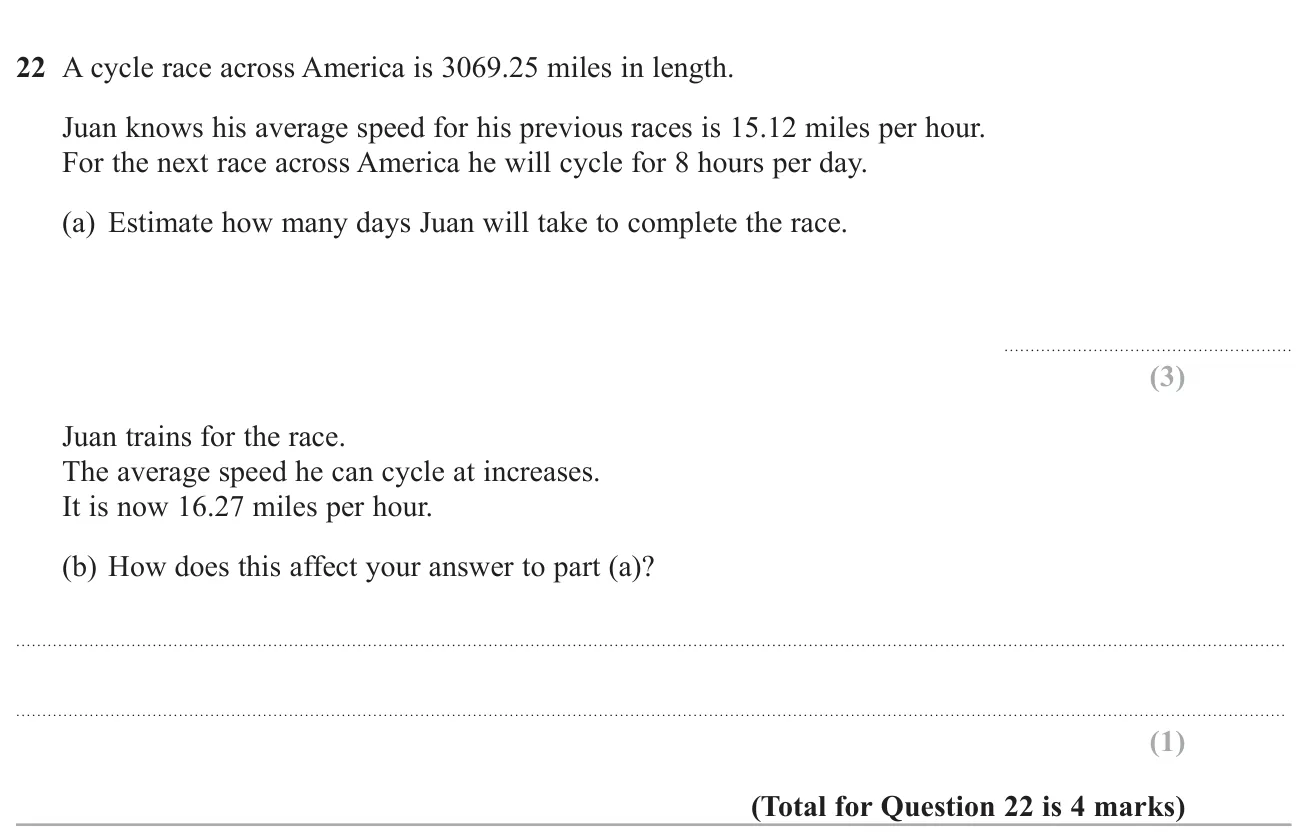
© Pearson Education Ltd. June 2018 Paper 1 (Foundation, non-calculator), question 22.
Show answer
| (a) | about 25 days (e.g. 3000÷15÷8); any answer that follows correctly from sensible rounding | 3 marks |
|---|
| (b) | Fewer days would be needed (or no change if 16.27 still rounds to 15) | 1 mark |
|---|
Worked solution Checked against the mark scheme
(a) Round: 3000 miles, 15 mph
Hours =3000÷15=200
Days =200÷8=25
(b) A higher speed means fewer hours, so he would need fewer days.
Watch out: Not rounding, and trying to divide by 15.12 exactly.
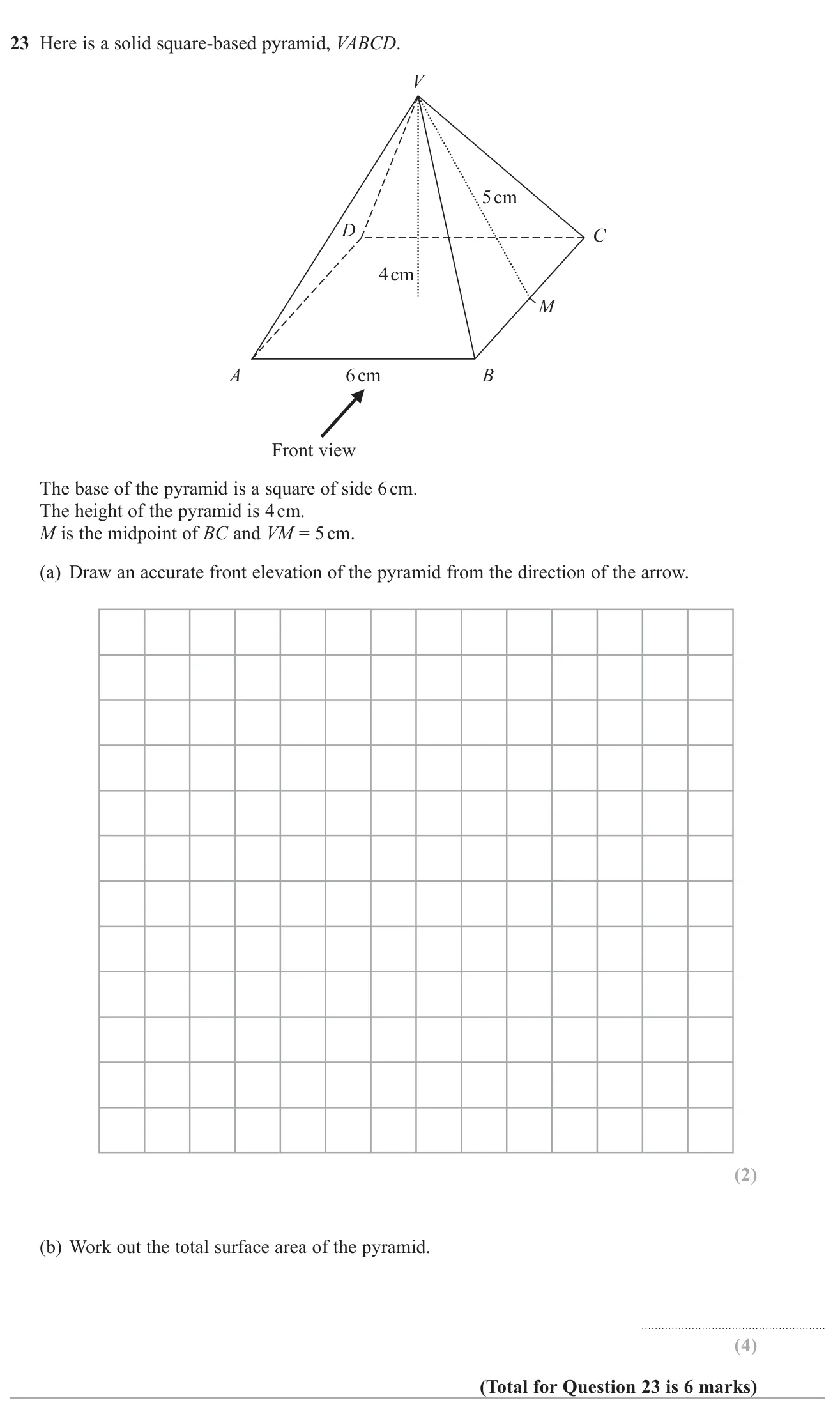
© Pearson Education Ltd. June 2018 Paper 1 (Foundation, non-calculator), question 23.
Show answer
| (a) | Isosceles triangle, base 6 cm, height 4 cm | 2 marks |
|---|
| (b) | 96 cm2 | 4 marks |
|---|
Worked solution Checked against the mark scheme
(a) From the front you see a triangle: base 6 cm, height 4 cm, apex above the middle of the base.
(b) Each sloping face: 21×6×5=15 cm2
Four faces: 4×15=60. Base: 6×6=36
Total =60+36=96 cm2
Watch out: Using the vertical height 4 cm instead of the slant height 5 cm for the triangles (giving 84).
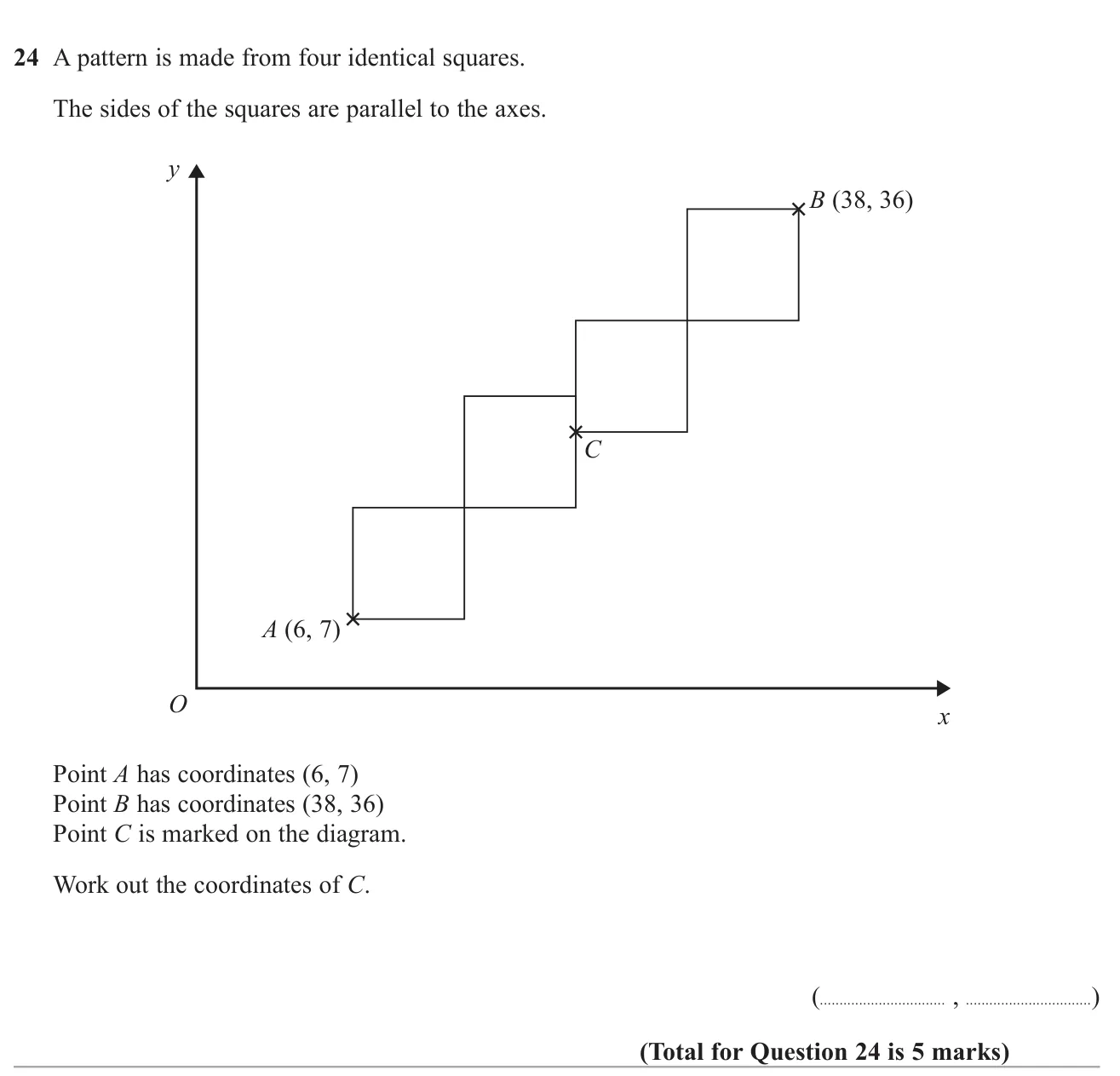
© Pearson Education Ltd. June 2018 Paper 1 (Foundation, non-calculator), question 24.
Show answer
| Answer | (22,20) | 5 marks |
|---|
Worked solution Checked against the mark scheme
Width =38−6=32, covering four square widths, so each side is 32÷4=8.
C is two sides right of A: x=6+2×8=22
C is two sides below B: y=36−2×8=20
So C=(22,20)
Watch out: Assuming the height 29 is also four sides, because the squares overlap vertically.
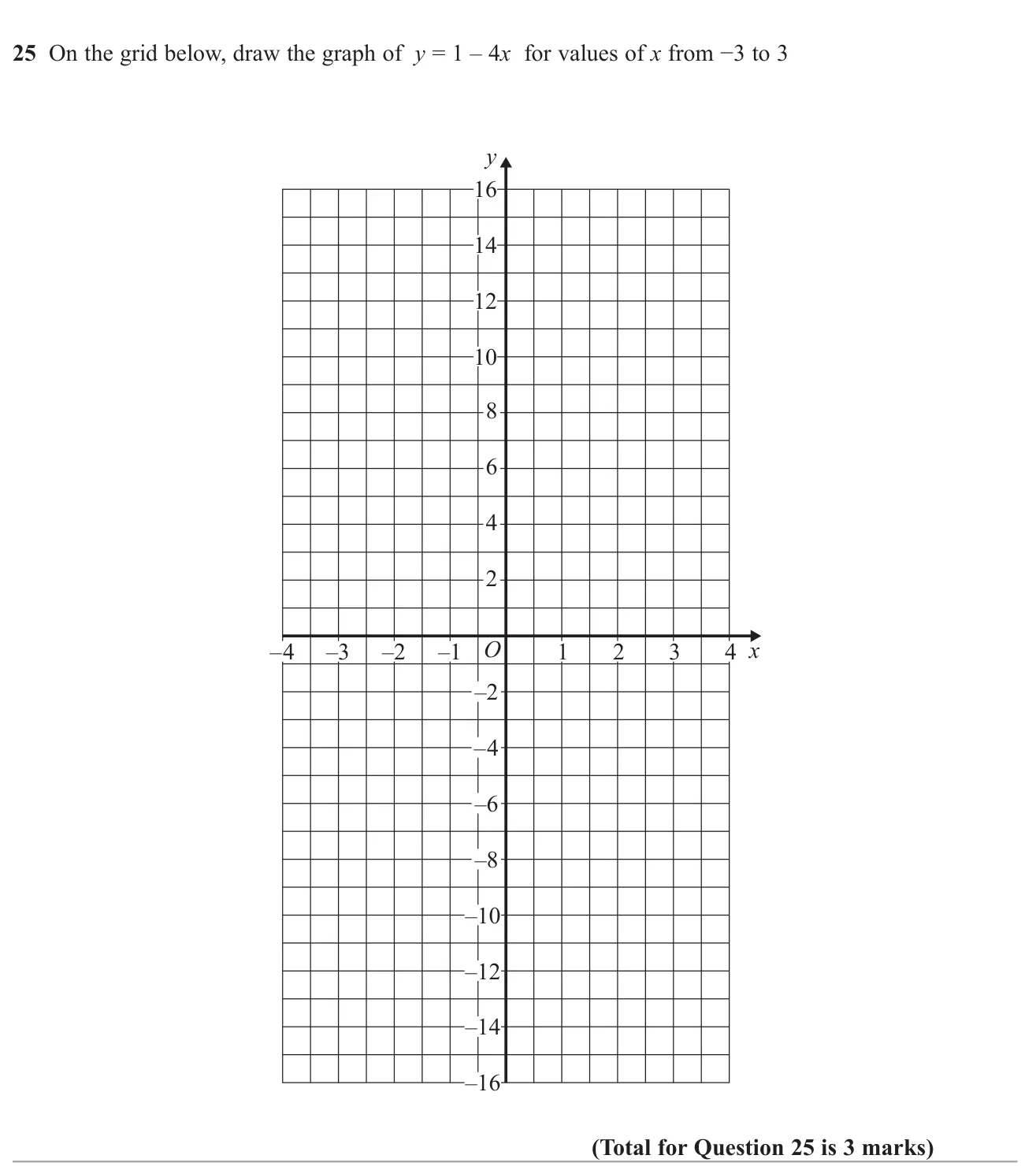
© Pearson Education Ltd. June 2018 Paper 1 (Foundation, non-calculator), question 25.
Show answer
| Answer | Straight line from (−3,13) to (3,−11) | 3 marks |
|---|
Worked solution Checked against the mark scheme
Make a table with y=1−4x:
x: −3, −2, −1, 0, 1, 2, 3
y: 13, 9, 5, 1, −3, −7, −11
Plot the points and join them with a ruler.
Watch out: Working out 1−4×(−3) as −11 instead of 13.
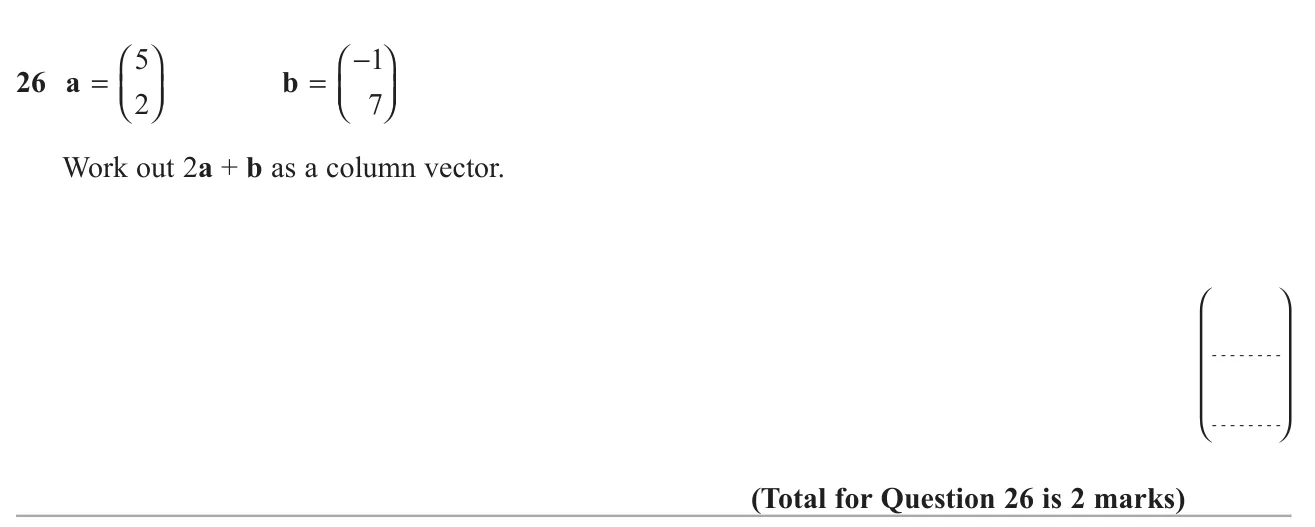
© Pearson Education Ltd. June 2018 Paper 1 (Foundation, non-calculator), question 26.
Show answer
| Answer | (911) | 2 marks |
|---|
Worked solution Checked against the mark scheme
2a=(104)
2a+b=(10+(−1)4+7)=(911)
Watch out: Doubling b as well as a.
Finished the paper?
Add up your marks for all three papers and see what grade that would have been.