Revision guide by The Full Marks
Fractions: what you need to know Fractions come up across the whole paper: adding, subtracting, multiplying and dividing them, and finding a fraction of an amount. Non-calculator papers often include a mixed-number calculation.
Key facts To add or subtract, the denominators (bottoms) must be the same. To multiply, multiply the tops and multiply the bottoms. To divide, keep the first fraction, change ÷ \div ÷ × \times × To find 3 5 \frac{3}{5} 5 3 To write one amount as a fraction of another, put the first over the second and simplify: a £40 rise on £600 is 40 600 = 1 15 \frac{40}{600} = \frac{1}{15} 600 40 = 15 1 Calculate exactly by leaving fractions and π \pi π 9 π 9\pi 9 π 2 ^2 2 Adding and subtracting mixed numbers Change each mixed number into an improper fraction. Rewrite with a common denominator (the LCM of the bottoms). Add or subtract the tops, then simplify and change back to a mixed number. Multiplying and dividing mixed numbers Change each mixed number into an improper fraction. For division, flip the second fraction and multiply. Cancel common factors first to keep numbers small, multiply, then write as a simplified mixed number. Worked examples Example 1 Foundation · grade 3
Ellie has £84. She spends 3 7 \frac{3}{7} 7 3 1 4 \frac{1}{4} 4 1
Show the solution Coat: 84 ÷ 7 = 12 84 \div 7 = 12 84 ÷ 7 = 12 12 × 3 = 36 12 \times 3 = 36 12 × 3 = 36 84 − 36 = 48 84 - 36 = 48 84 − 36 = 48 48 ÷ 4 = 12 48 \div 4 = 12 48 ÷ 4 = 12 48 − 12 = 36 48 - 12 = 36 48 − 12 = 36
Example 2 Foundation · grade 5
Work out 2 1 4 ÷ 1 1 5 2\frac{1}{4} \div 1\frac{1}{5} 2 4 1 ÷ 1 5 1
Show the solution Improper fractions: 9 4 ÷ 6 5 \frac{9}{4} \div \frac{6}{5} 4 9 ÷ 5 6 9 4 × 5 6 = 45 24 \frac{9}{4} \times \frac{5}{6} = \frac{45}{24} 4 9 × 6 5 = 24 45 15 8 \frac{15}{8} 8 15 1 7 8 1\frac{7}{8} 1 8 7
Common mistakes Adding the tops and the bottoms: 1 3 + 1 4 \frac{1}{3} + \frac{1}{4} 3 1 + 4 1 7 12 \frac{7}{12} 12 7 2 7 \frac{2}{7} 7 2 Multiplying mixed numbers by doing the whole numbers and fractions separately. Convert to improper fractions first. Thinking dividing by 1 2 \frac{1}{2} 2 1 6 ÷ 1 2 = 12 6 \div \frac{1}{2} = 12 6 ÷ 2 1 = 12 In multi-step problems, taking the second fraction of the original amount instead of what is left, or giving the fraction used when the question asks for the fraction left. Exam tips "Show that" questions need every step written, including the improper fractions and the common denominator, ending with the answer you were given. If the question asks for a mixed number or simplest form, give it that way. Always simplify fully. To order fractions, write them over a common denominator or change them to decimals. A bigger denominator does not mean a bigger fraction. Questions people ask How do you add fractions with different denominators? Find a common denominator, change both fractions to equivalent fractions with that denominator, then add the numerators.
How do you divide fractions? Keep the first fraction, change the divide to a multiply, and flip the second fraction. Then multiply as normal.
How do you find a fraction of an amount? Divide by the denominator, then multiply by the numerator. For example, 2 5 \frac{2}{5} 5 2 40 ÷ 5 × 2 = 16 40 \div 5 \times 2 = 16 40 ÷ 5 × 2 = 16
Exam questions: Fractions (50, easiest first) © Pearson Education Ltd. November 2024 Paper 3 (Foundation, calculator), question 2.
Worked solution Checked against the mark scheme
To find 1 6 \frac{1}{6} 6 1
96 ÷ 6 = 16 96 \div 6 = 16 96 ÷ 6 = 16
Watch out: Multiplying by 6 instead of dividing.
© Pearson Education Ltd. November 2023 Paper 1 (Foundation, non-calculator), question 5.
Worked solution Checked against the mark scheme
To find 1 5 \frac{1}{5} 5 1
300 ÷ 5 = 60 300 \div 5 = 60 300 ÷ 5 = 60
Watch out: Multiplying by 5 to get 1500.
© Pearson Education Ltd. June 2023 Paper 1 (Foundation, non-calculator), question 2.
Answer 3 10 \frac{3}{10} 10 3 1 mark
Worked solution Checked against the mark scheme
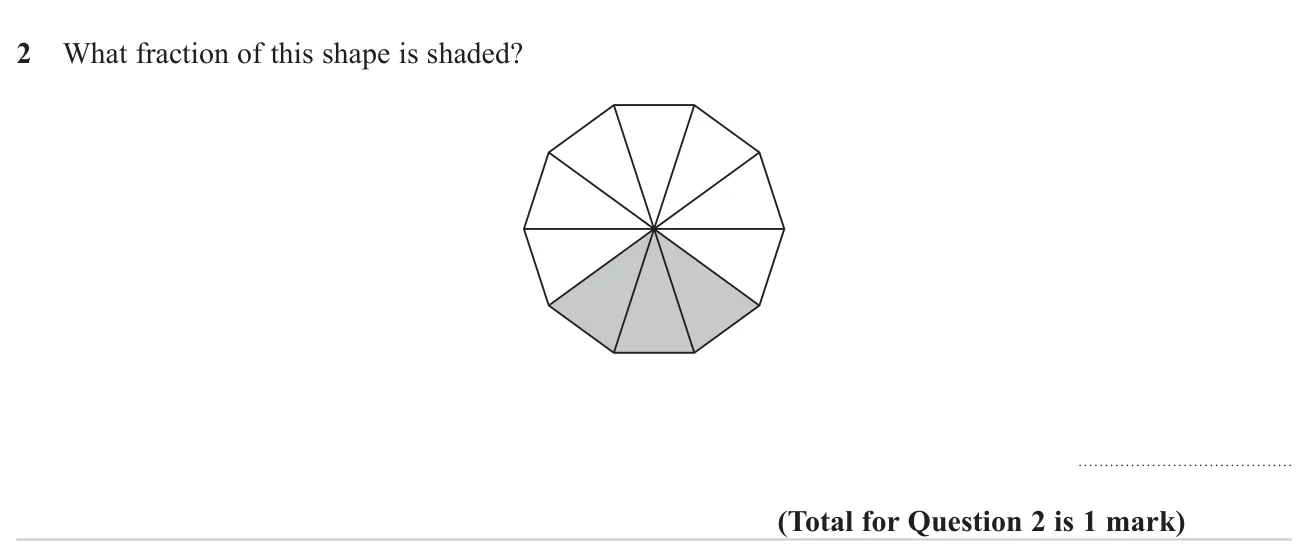
The shape is split into 10 equal triangles and 3 of them are shaded.
So the fraction shaded is 3 10 \frac{3}{10} 10 3
Watch out: Writing the ratio 3 : 10 or 3 : 7 instead of a fraction.
© Pearson Education Ltd. November 2023 Paper 3 (Foundation, calculator), question 4.
Answer 6 21 \frac{6}{21} 21 6 2 7 \frac{2}{7} 7 2 1 mark
Worked solution Checked against the mark scheme
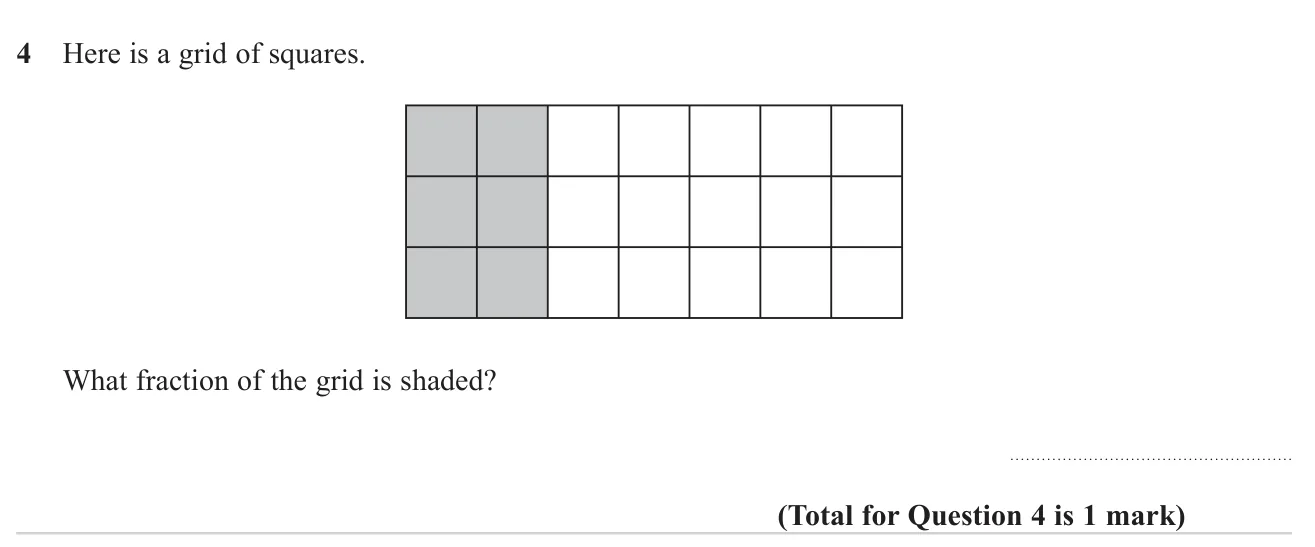
The grid has 3 × 7 = 21 3 \times 7 = 21 3 × 7 = 21
Fraction shaded = 6 21 = 2 7 = \frac{6}{21} = \frac{2}{7} = 21 6 = 7 2
Watch out: Writing shaded over unshaded, 6/15.
© Pearson Education Ltd. June 2022 Paper 2 (Foundation, calculator), question 2.
Answer 7 10 \frac{7}{10} 10 7 1 mark
Worked solution Checked against the mark scheme
One whole is 10 10 \frac{10}{10} 10 10
10 10 − 3 10 = 7 10 \frac{10}{10} - \frac{3}{10} = \frac{7}{10} 10 10 − 10 3 = 10 7
Watch out: Writing 3 10 \frac{3}{10} 10 3 2 9 \frac{2}{9} 9 2
© Pearson Education Ltd. June 2022 Paper 3 (Foundation, calculator), question 2.
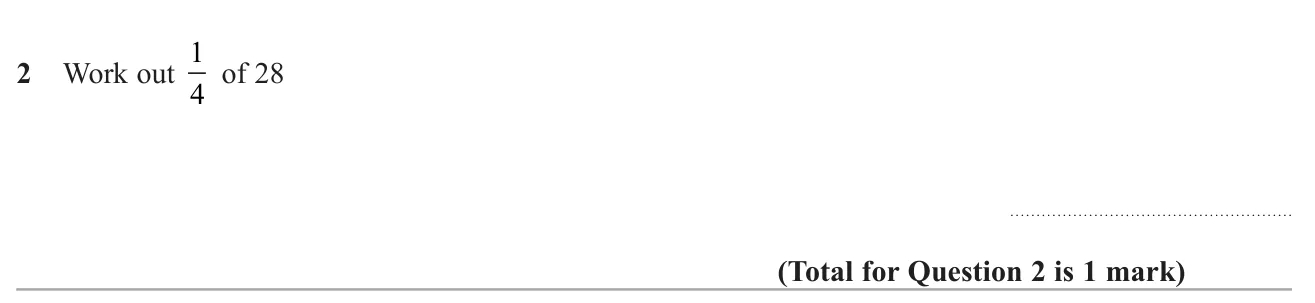
Worked solution Checked against the mark scheme
To find 1 4 \frac{1}{4} 4 1
28 ÷ 4 = 7 28 \div 4 = 7 28 ÷ 4 = 7
Watch out: Multiplying 28 by 4 instead of dividing.
© Pearson Education Ltd. November 2021 Paper 2 (Foundation, calculator), question 10.
Answer 17 30 \frac{17}{30} 30 17 1 mark
Worked solution Checked against the mark scheme
The part goes on top and the whole on the bottom: 17 30 \frac{17}{30} 30 17
Watch out: Writing 30 17 \frac{30}{17} 17 30
© Pearson Education Ltd. November 2021 Paper 3 (Foundation, calculator), question 4.
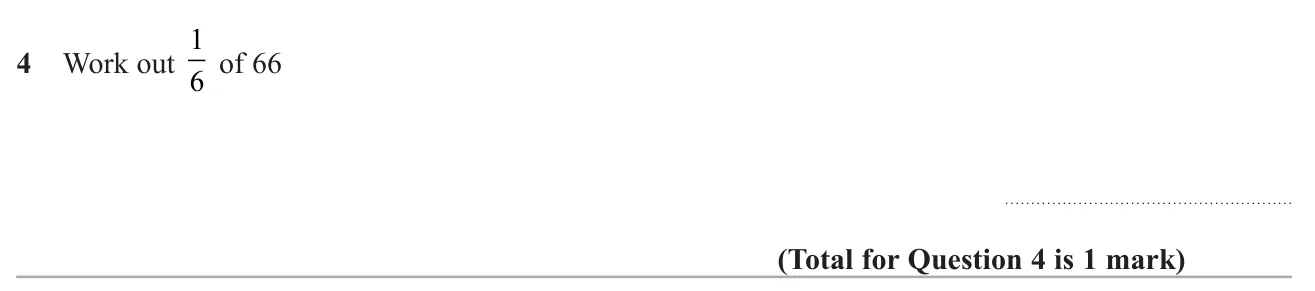
Worked solution Checked against the mark scheme
To find 1 6 \frac{1}{6} 6 1
66 ÷ 6 = 11 66 \div 6 = 11 66 ÷ 6 = 11
Watch out: Multiplying by 6 instead of dividing.
© Pearson Education Ltd. November 2020 Paper 3 (Foundation, calculator), question 2.
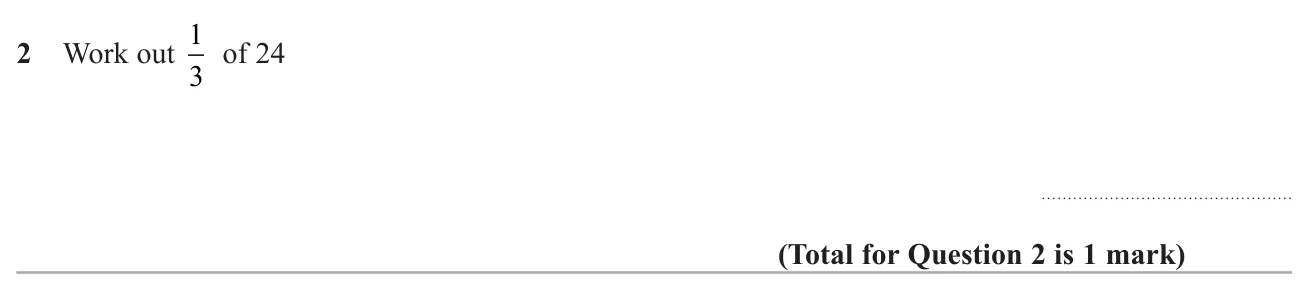
Worked solution Checked against the mark scheme
One third means divide by 3.
24 ÷ 3 = 8 24 \div 3 = 8 24 ÷ 3 = 8
Watch out: Dividing by the wrong number or multiplying by 3.
© Pearson Education Ltd. November 2019 Paper 1 (Foundation, non-calculator), question 4.
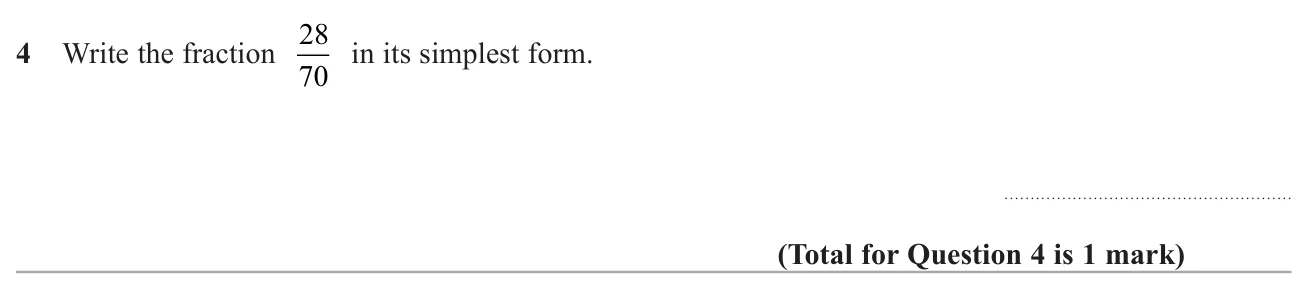
Answer 2 5 \frac{2}{5} 5 2 1 mark
Worked solution Checked against the mark scheme
The highest common factor of 28 and 70 is 14.
28 70 = 28 ÷ 14 70 ÷ 14 = 2 5 \frac{28}{70} = \frac{28 \div 14}{70 \div 14} = \frac{2}{5} 70 28 = 70 ÷ 14 28 ÷ 14 = 5 2
Watch out: Stopping at a partly simplified fraction such as 14/35.
© Pearson Education Ltd. November 2019 Paper 3 (Foundation, calculator), question 2.
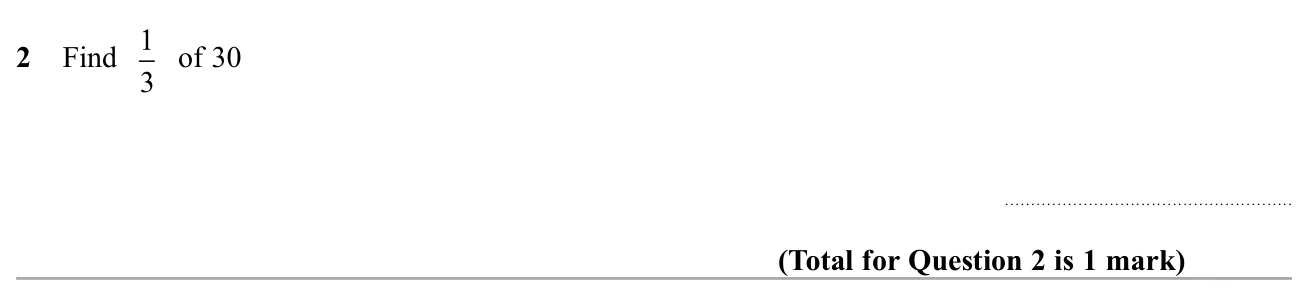
Worked solution Checked against the mark scheme
To find 1 3 \frac{1}{3} 3 1
30 ÷ 3 = 10 30 \div 3 = 10 30 ÷ 3 = 10
Watch out: Multiplying by 3 to get 90.
© Pearson Education Ltd. June 2018 Paper 1 (Foundation, non-calculator), question 4.
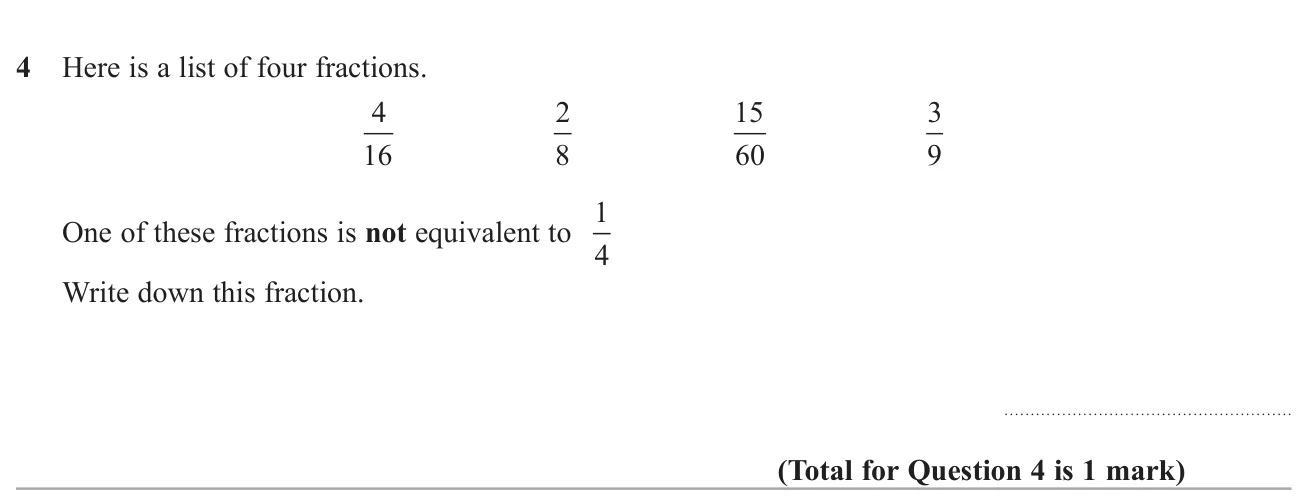
Answer 3 9 \frac{3}{9} 9 3 1 mark
Worked solution Checked against the mark scheme
Simplify each: 4 16 = 1 4 \frac{4}{16} = \frac{1}{4} 16 4 = 4 1 2 8 = 1 4 \frac{2}{8} = \frac{1}{4} 8 2 = 4 1 15 60 = 1 4 \frac{15}{60} = \frac{1}{4} 60 15 = 4 1 3 9 = 1 3 \frac{3}{9} = \frac{1}{3} 9 3 = 3 1
So the odd one out is 3 9 \frac{3}{9} 9 3
© Pearson Education Ltd. November 2018 Paper 3 (Foundation, calculator), question 4.
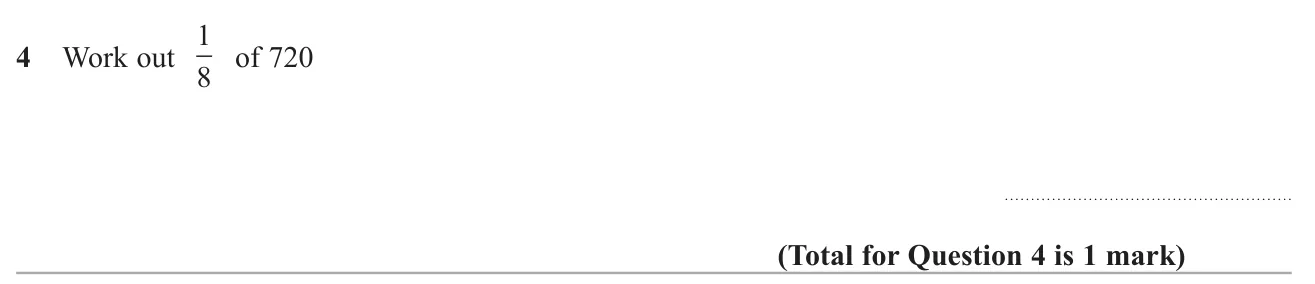
Worked solution Checked against the mark scheme
1 8 \frac{1}{8} 8 1 720 ÷ 8 = 90 720 \div 8 = 90 720 ÷ 8 = 90
Watch out: Multiplying by 8 instead of dividing.
© Pearson Education Ltd. June 2023 Paper 2 (Foundation, calculator), question 13.
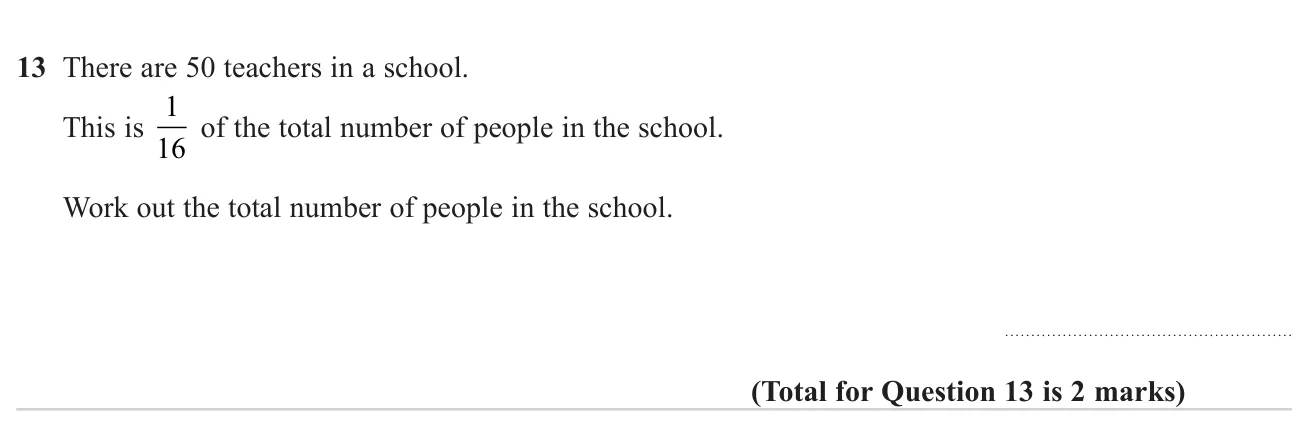
Worked solution Checked against the mark scheme
50 is 1 16 \frac{1}{16} 16 1
16 × 50 = 800 16 \times 50 = 800 16 × 50 = 800
Watch out: Dividing 50 by 16 to get 3.125.
© Pearson Education Ltd. November 2020 Paper 1 (Foundation, non-calculator), question 10.
Worked solution Checked against the mark scheme
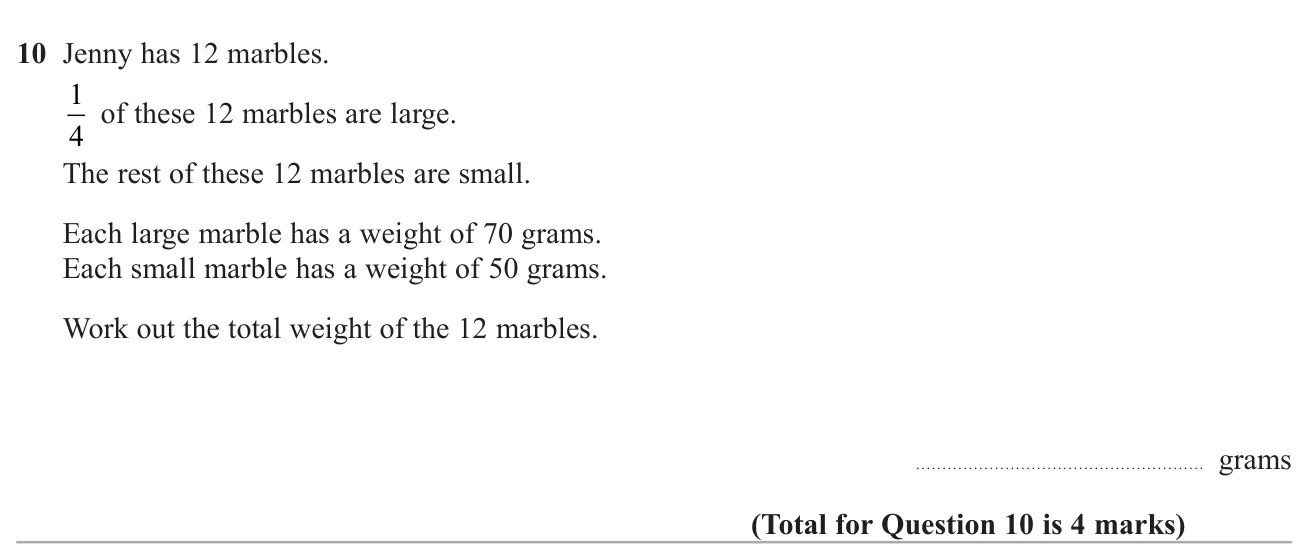
Large: 1 4 \frac{1}{4} 4 1 12 − 3 = 9 12 - 3 = 9 12 − 3 = 9
Large weight: 3 × 70 = 210 3 \times 70 = 210 3 × 70 = 210 9 × 50 = 450 9 \times 50 = 450 9 × 50 = 450
Total: 210 + 450 = 660 210 + 450 = 660 210 + 450 = 660
Watch out: Treating all 12 marbles as one weight, or stopping at 210 or 450.
© Pearson Education Ltd. November 2020 Paper 3 (Foundation, calculator), question 7.
Answer 3 4 \frac{3}{4} 4 3 2 marks
Worked solution Checked against the mark scheme
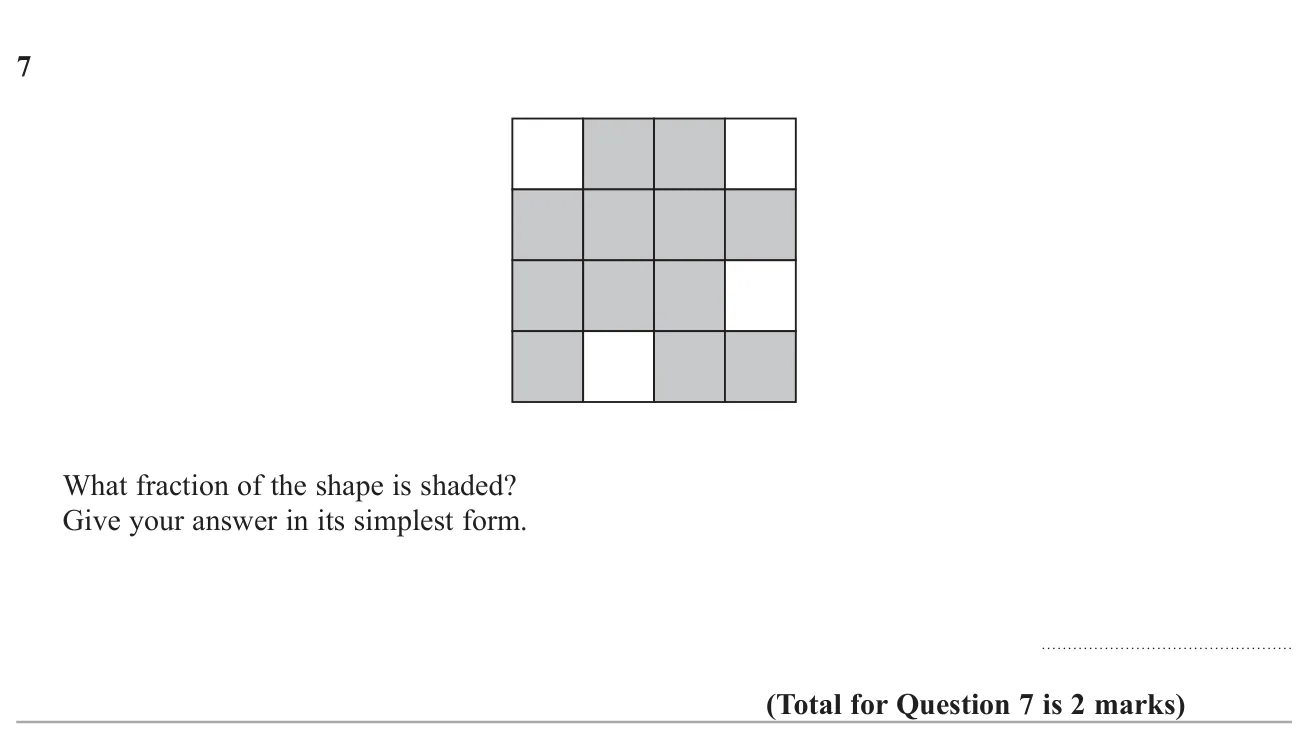
Count the squares: 16 in total, 4 unshaded, so 12 shaded.
12 16 = 3 4 \frac{12}{16} = \frac{3}{4} 16 12 = 4 3
Watch out: Giving 1 4 \frac{1}{4} 4 1
© Pearson Education Ltd. November 2019 Paper 2 (Foundation, calculator), question 7.
Answer 13 20 \frac{13}{20} 20 13 2 marks
Worked solution Checked against the mark scheme
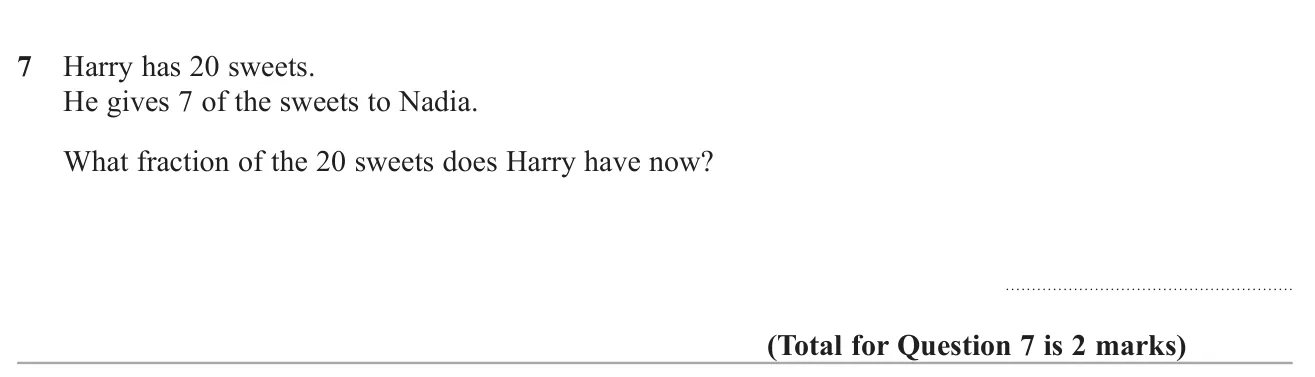
Harry has 20 − 7 = 13 20 - 7 = 13 20 − 7 = 13
As a fraction of 20: 13 20 \frac{13}{20} 20 13
Watch out: Giving 7 20 \frac{7}{20} 20 7
© Pearson Education Ltd. November 2019 Paper 3 (Foundation, calculator), question 11.
(a) £2.50 3 marks (b) £96 2 marks
Worked solution Checked against the mark scheme
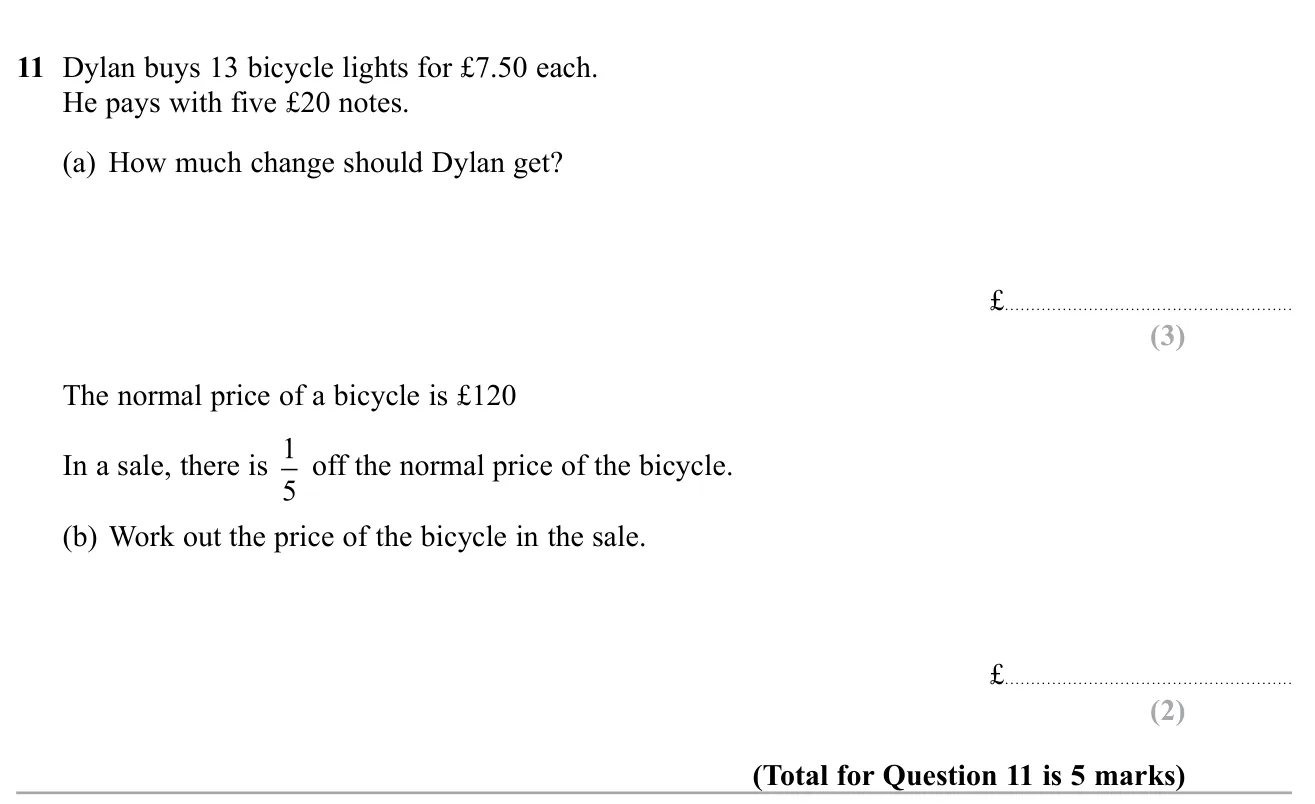
(a) Cost: 13 × 7.50 = £ 97.50 13 \times 7.50 = £97.50 13 × 7.50 = £97.50 5 × 20 = £ 100 5 \times 20 = £100 5 × 20 = £100
Change = 100 − 97.50 = £ 2.50 = 100 - 97.50 = £2.50 = 100 − 97.50 = £2.50
(b) 1 5 \frac{1}{5} 5 1 = 24 = 24 = 24 120 − 24 = £ 96 120 - 24 = £96 120 − 24 = £96
Watch out: In (b), giving the reduction £24 as the sale price.
© Pearson Education Ltd. June 2019 Paper 3 (Foundation, calculator), question 8.
Worked solution Checked against the mark scheme
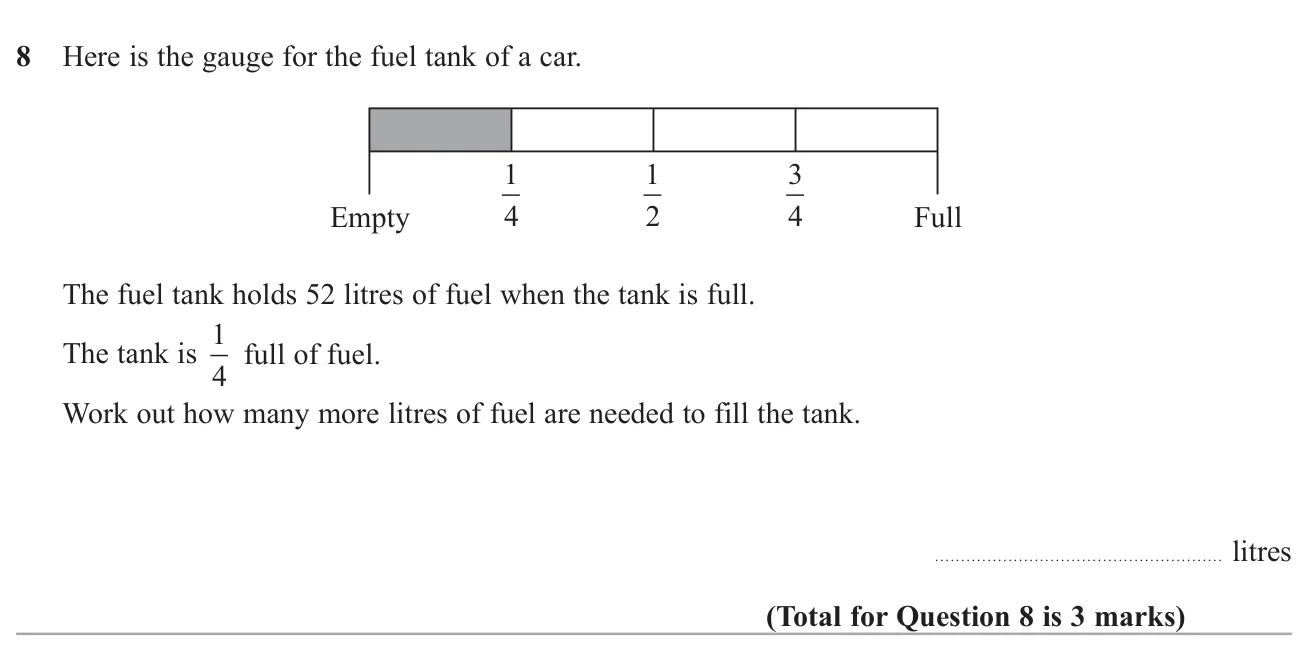
A quarter of 52 is 52 ÷ 4 = 13 52 \div 4 = 13 52 ÷ 4 = 13
Fuel needed: 52 − 13 = 39 52 - 13 = 39 52 − 13 = 39 3 4 × 52 = 39 \frac{3}{4} \times 52 = 39 4 3 × 52 = 39
Watch out: Giving 13, the fuel already in the tank.
© Pearson Education Ltd. June 2024 Paper 2 (Foundation, calculator), question 12.
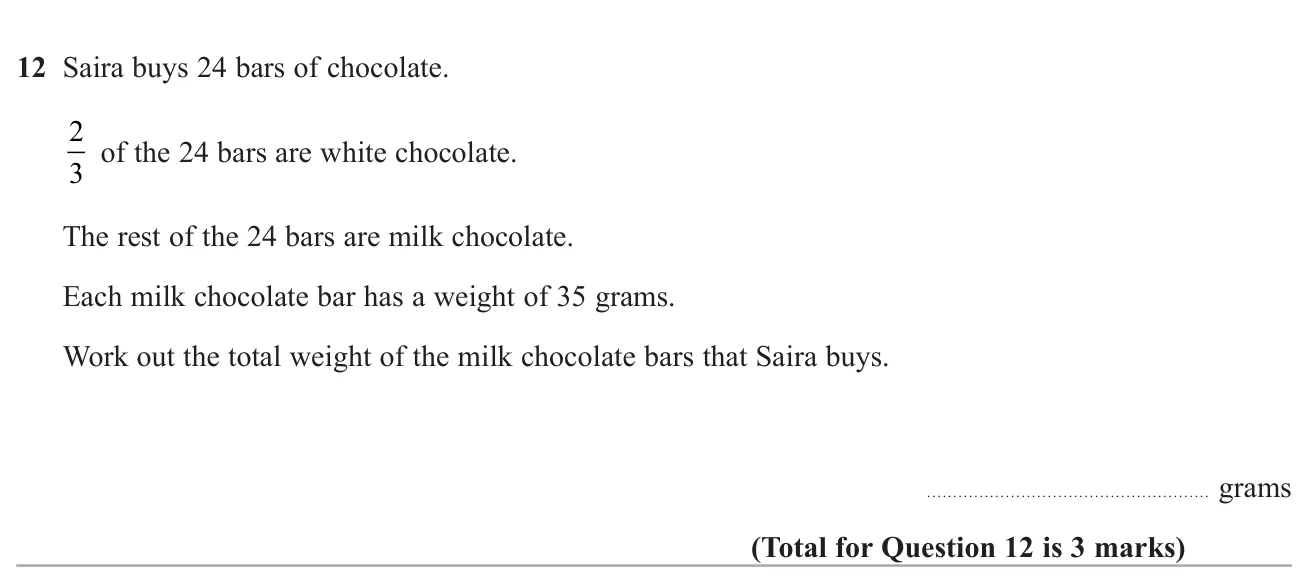
Answer 280 280 280 3 marks
Worked solution Checked against the mark scheme
White bars = 2 3 × 24 = 16 = \frac{2}{3} \times 24 = 16 = 3 2 × 24 = 16
Milk bars = 24 − 16 = 8 = 24 - 16 = 8 = 24 − 16 = 8
Weight = 8 × 35 = 280 = 8 \times 35 = 280 = 8 × 35 = 280
Watch out: Using the white chocolate bars and getting 16 × 35 = 560 16 \times 35 = 560 16 × 35 = 560
© Pearson Education Ltd. June 2023 Paper 1 (Foundation, non-calculator), question 15.
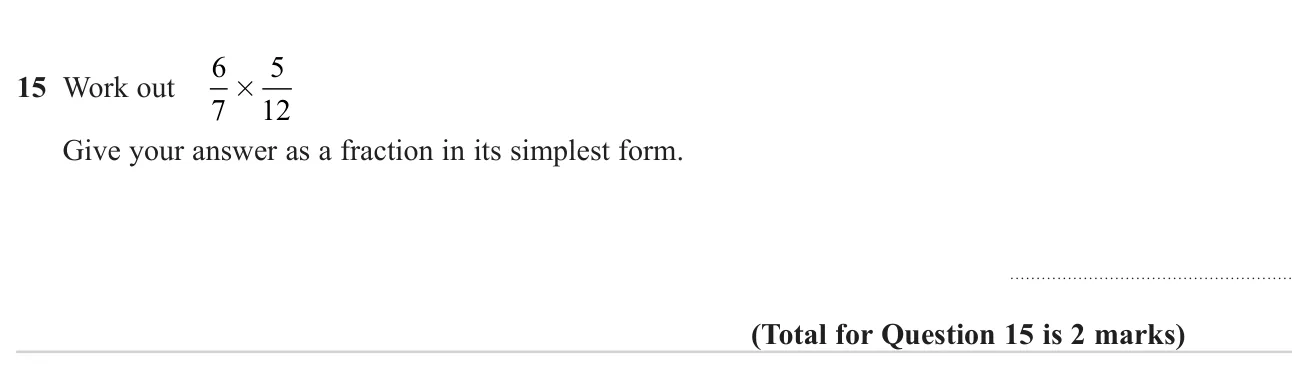
Answer 5 14 \frac{5}{14} 14 5 2 marks
Worked solution Checked against the mark scheme
Multiply tops and bottoms: 6 × 5 7 × 12 = 30 84 \frac{6 \times 5}{7 \times 12} = \frac{30}{84} 7 × 12 6 × 5 = 84 30
Divide top and bottom by 6: 5 14 \frac{5}{14} 14 5
Watch out: Stopping at 30/84 without simplifying.
© Pearson Education Ltd. June 2022 Paper 1 (Foundation, non-calculator), question 12.
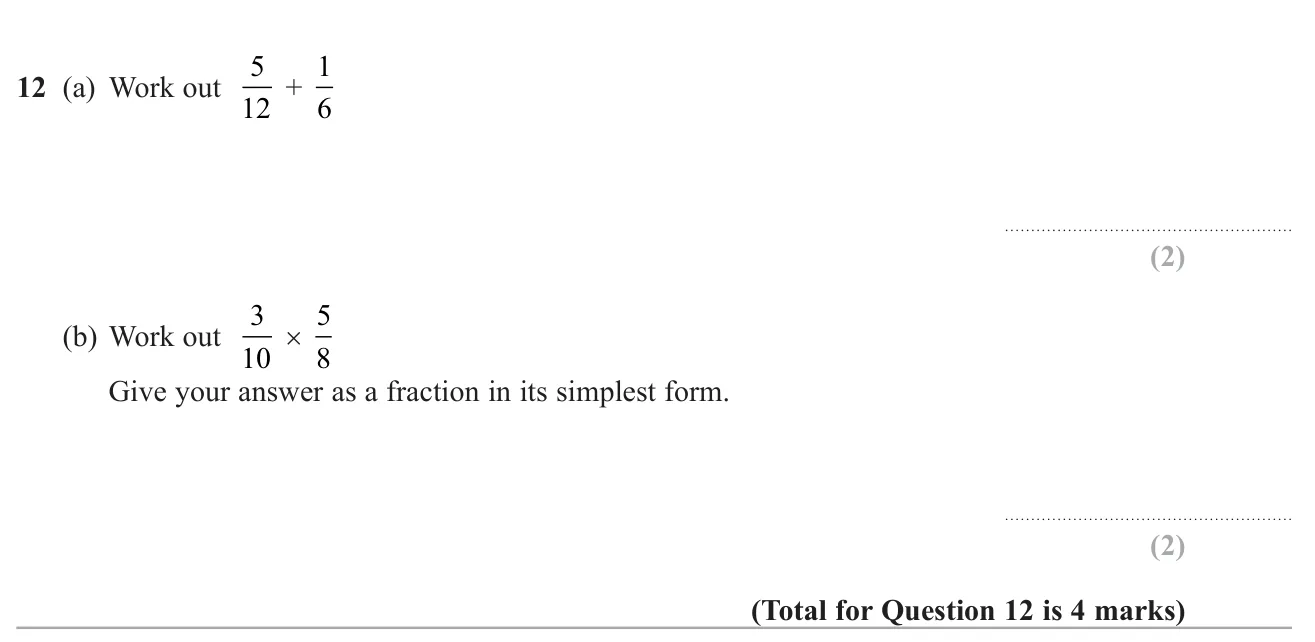
(a) 7 12 \frac{7}{12} 12 7 2 marks (b) 3 16 \frac{3}{16} 16 3 2 marks
Worked solution Checked against the mark scheme
(a) 1 6 = 2 12 \frac{1}{6} = \frac{2}{12} 6 1 = 12 2 5 12 + 2 12 = 7 12 \frac{5}{12} + \frac{2}{12} = \frac{7}{12} 12 5 + 12 2 = 12 7
(b) 3 10 × 5 8 = 15 80 \frac{3}{10} \times \frac{5}{8} = \frac{15}{80} 10 3 × 8 5 = 80 15
Divide top and bottom by 5: 3 16 \frac{3}{16} 16 3
Watch out: Adding the denominators in (a) to get 6/18.
© Pearson Education Ltd. November 2022 Paper 2 (Foundation, calculator), question 12.
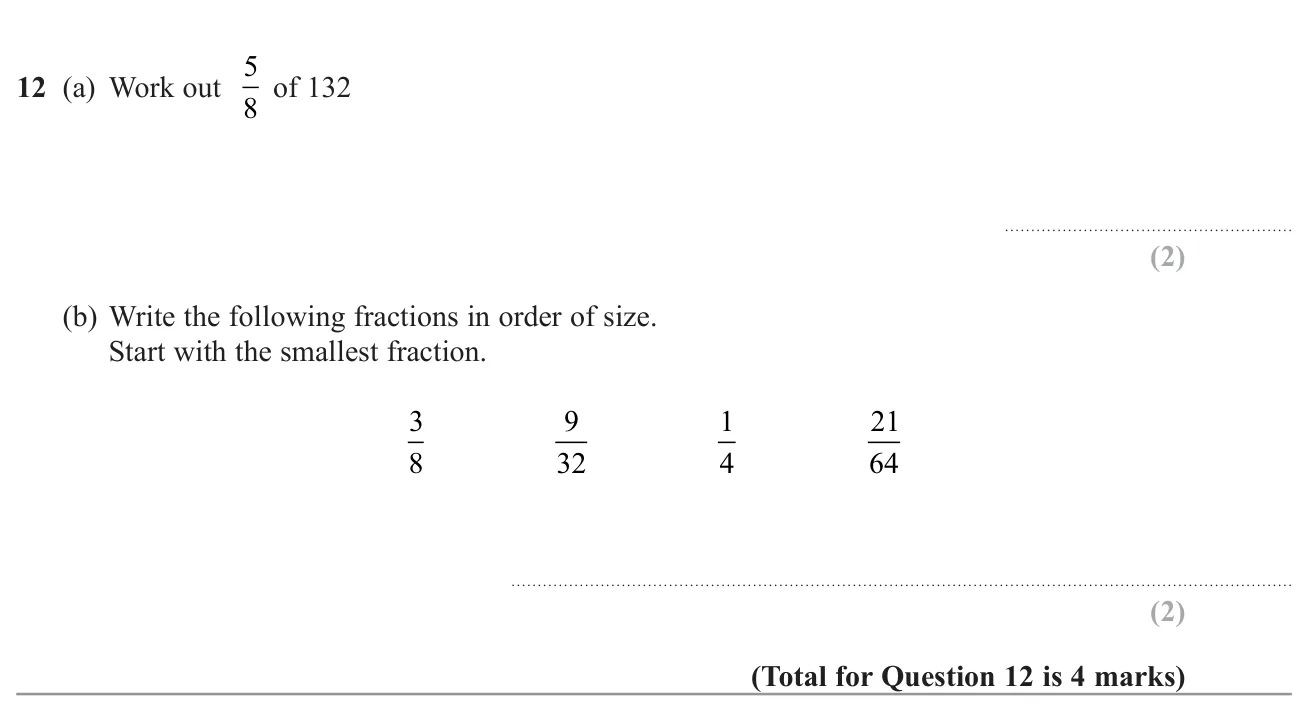
(a) 82.5 2 marks (b) 1 4 , 9 32 , 21 64 , 3 8 \frac14, \frac{9}{32}, \frac{21}{64}, \frac38 4 1 , 32 9 , 64 21 , 8 3 2 marks
Worked solution Checked against the mark scheme
(a) 132 ÷ 8 = 16.5 132 \div 8 = 16.5 132 ÷ 8 = 16.5 16.5 × 5 = 82.5 16.5 \times 5 = 82.5 16.5 × 5 = 82.5
(b) Use denominator 64: 3 8 = 24 64 \frac38 = \frac{24}{64} 8 3 = 64 24 9 32 = 18 64 \frac{9}{32} = \frac{18}{64} 32 9 = 64 18 1 4 = 16 64 \frac14 = \frac{16}{64} 4 1 = 64 16 21 64 \frac{21}{64} 64 21
Order: 1 4 , 9 32 , 21 64 , 3 8 \frac14, \frac{9}{32}, \frac{21}{64}, \frac38 4 1 , 32 9 , 64 21 , 8 3
Watch out: Ordering by the size of the denominator alone.
© Pearson Education Ltd. November 2022 Paper 3 (Foundation, calculator), question 7.
Worked solution Checked against the mark scheme
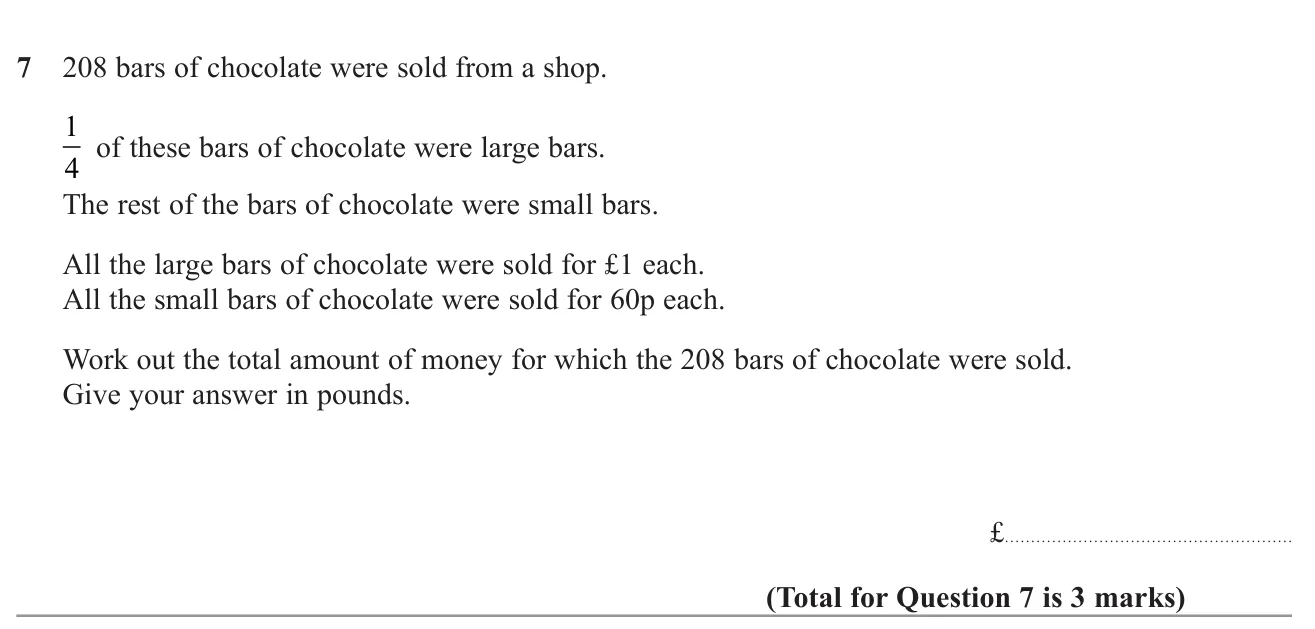
Large bars: 208 ÷ 4 = 52 208 \div 4 = 52 208 ÷ 4 = 52 52 × £ 1 = £ 52 52 \times £1 = £52 52 × £1 = £52
Small bars: 208 − 52 = 156 208 - 52 = 156 208 − 52 = 156 156 × £ 0.60 = £ 93.60 156 \times £0.60 = £93.60 156 × £0.60 = £93.60
Total: £ 52 + £ 93.60 = £ 145.60 £52 + £93.60 = £145.60 £52 + £93.60 = £145.60
Watch out: Mixing pence and pounds and writing £9412 or £145.6.
© Pearson Education Ltd. June 2022 Paper 3 (Foundation, calculator), question 12.
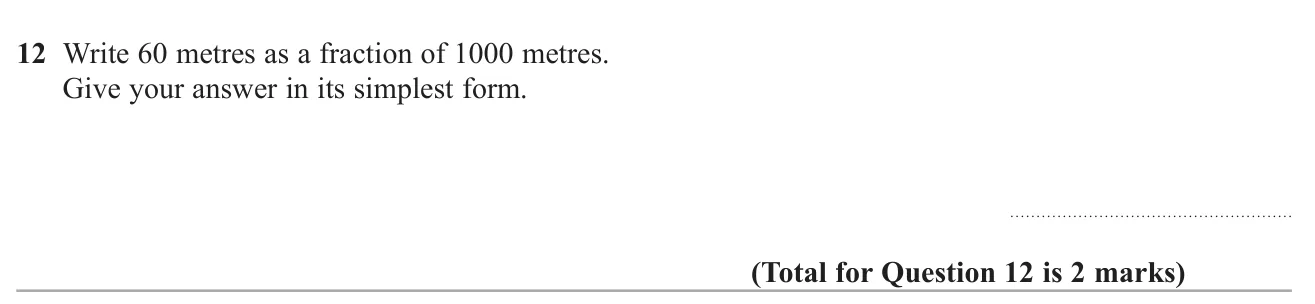
Answer 3 50 \frac{3}{50} 50 3 2 marks
Worked solution Checked against the mark scheme
Write it as a fraction: 60 1000 \frac{60}{1000} 1000 60
Divide top and bottom by 20: 3 50 \frac{3}{50} 50 3
Watch out: Stopping at 6 100 \frac{6}{100} 100 6
© Pearson Education Ltd. November 2021 Paper 2 (Foundation, calculator), question 15.
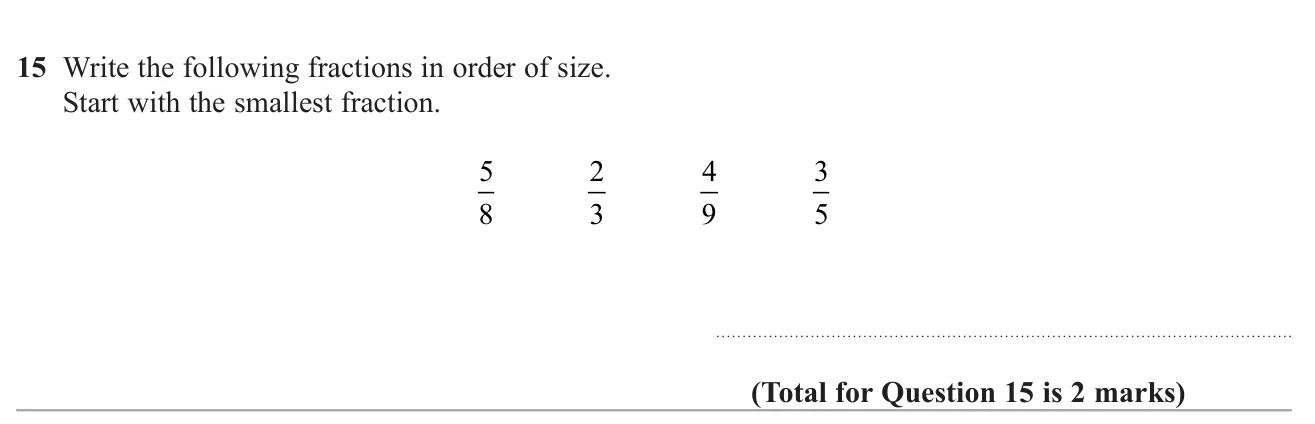
Answer 4 9 , 3 5 , 5 8 , 2 3 \frac{4}{9}, \frac{3}{5}, \frac{5}{8}, \frac{2}{3} 9 4 , 5 3 , 8 5 , 3 2 2 marks
Worked solution Checked against the mark scheme
Convert to decimals:
5 8 = 0.625 \frac{5}{8} = 0.625 8 5 = 0.625 2 3 = 0.667 \frac{2}{3} = 0.667 3 2 = 0.667 4 9 = 0.444 \frac{4}{9} = 0.444 9 4 = 0.444 3 5 = 0.6 \frac{3}{5} = 0.6 5 3 = 0.6
Order: 4 9 , 3 5 , 5 8 , 2 3 \frac{4}{9}, \frac{3}{5}, \frac{5}{8}, \frac{2}{3} 9 4 , 5 3 , 8 5 , 3 2
Watch out: Ordering by the size of the denominators.
© Pearson Education Ltd. November 2021 Paper 3 (Foundation, calculator), question 14.
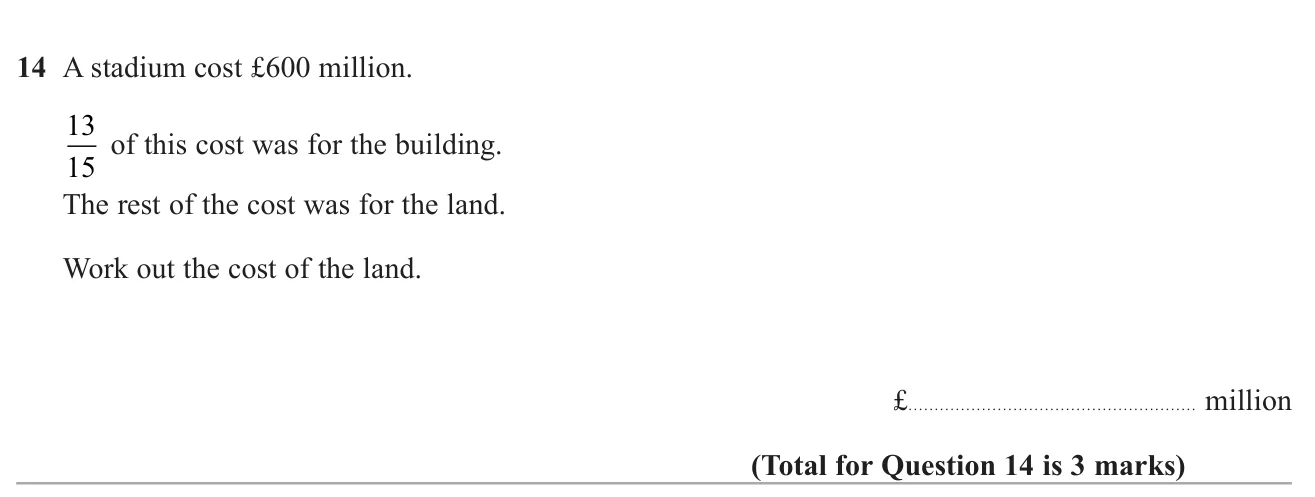
Worked solution Checked against the mark scheme
The land is 1 − 13 15 = 2 15 1 - \frac{13}{15} = \frac{2}{15} 1 − 15 13 = 15 2
600 ÷ 15 = 40 600 \div 15 = 40 600 ÷ 15 = 40
40 × 2 = 80 40 \times 2 = 80 40 × 2 = 80
Watch out: Giving the building cost (£520 million) instead of the land cost.
© Pearson Education Ltd. June 2019 Paper 1 (Foundation, non-calculator), question 14.
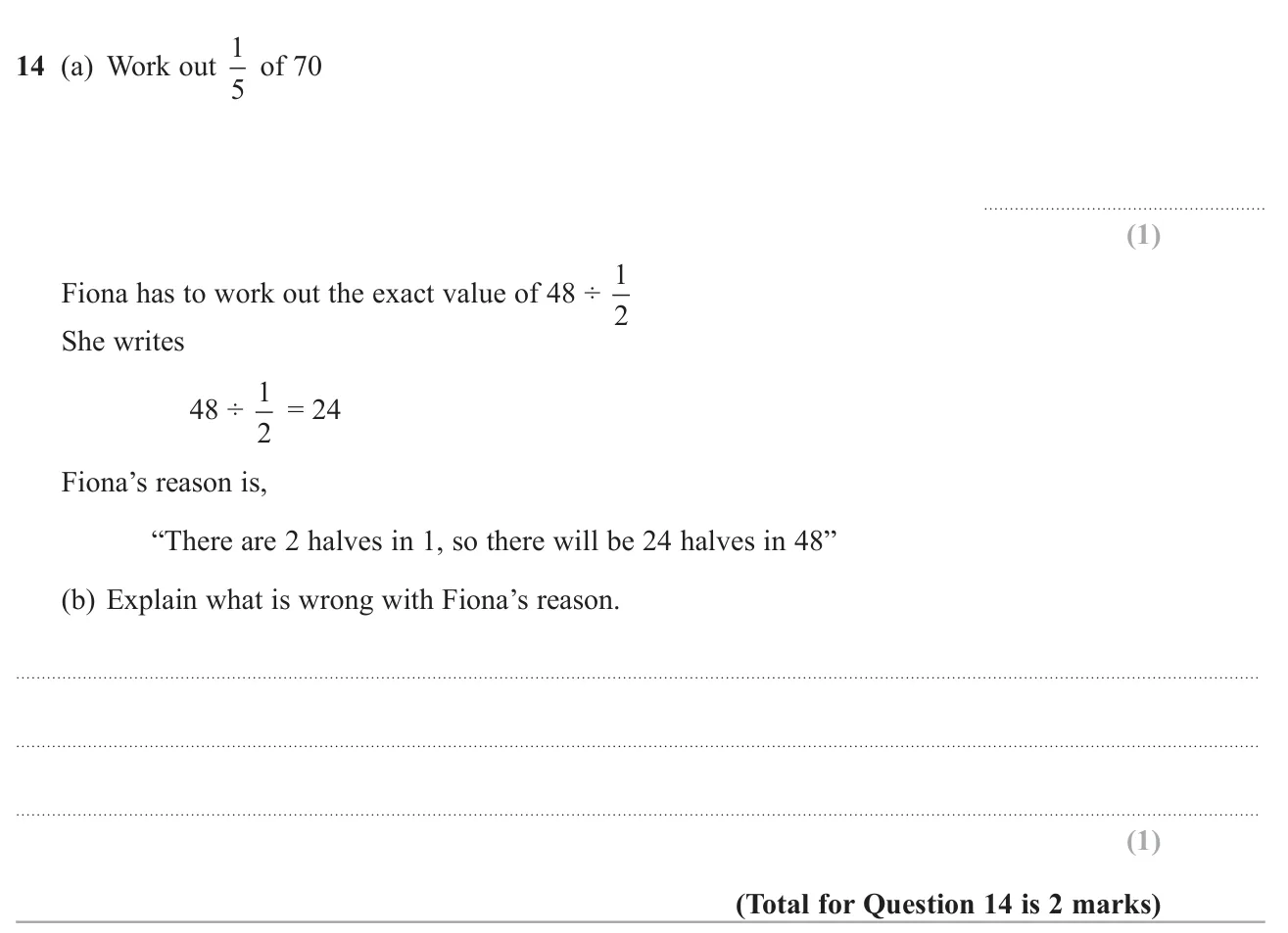
(a) 14 1 mark (b) She halved 48 instead of multiplying by 2; there are 96 halves in 48 1 mark
Worked solution Checked against the mark scheme
(a) 70 ÷ 5 = 14 70 \div 5 = 14 70 ÷ 5 = 14
(b) Each whole contains 2 halves, so 48 wholes contain 48 × 2 = 96 48 \times 2 = 96 48 × 2 = 96 1 2 \frac{1}{2} 2 1
Watch out: Thinking that dividing by a half means halving.
© Pearson Education Ltd. November 2019 Paper 2 (Foundation, calculator), question 12.
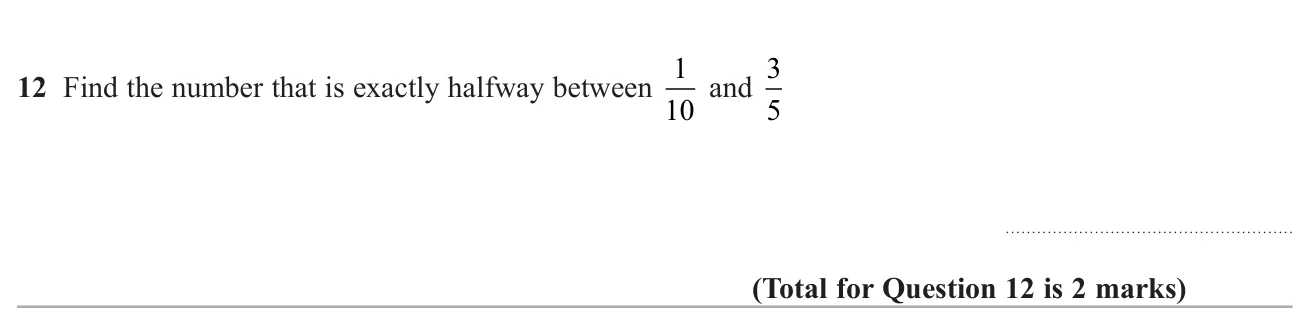
Answer 0.35 0.35 0.35 7 20 \frac{7}{20} 20 7 2 marks
Worked solution Checked against the mark scheme
1 10 = 0.1 \frac{1}{10} = 0.1 10 1 = 0.1 3 5 = 0.6 \frac{3}{5} = 0.6 5 3 = 0.6
Halfway: 0.1 + 0.6 2 = 0.35 \frac{0.1 + 0.6}{2} = 0.35 2 0.1 + 0.6 = 0.35 7 20 \frac{7}{20} 20 7
Watch out: Just adding the fractions without halving.
© Pearson Education Ltd. June 2019 Paper 3 (Foundation, calculator), question 10.
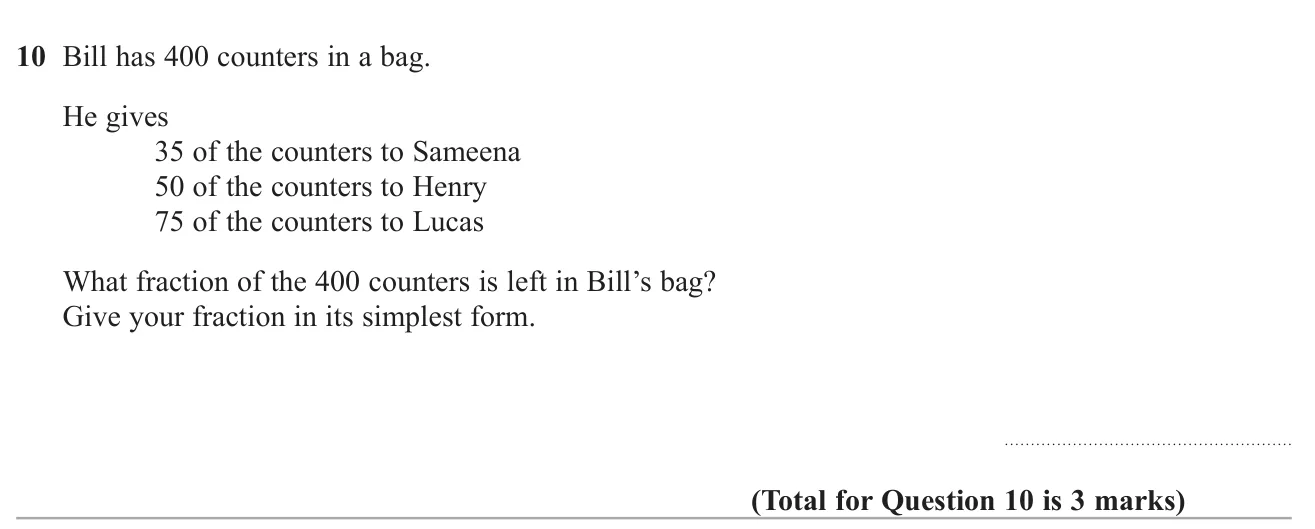
Answer 3 5 \frac{3}{5} 5 3 3 marks
Worked solution Checked against the mark scheme
Given away: 35 + 50 + 75 = 160 35 + 50 + 75 = 160 35 + 50 + 75 = 160
Left: 400 − 160 = 240 400 - 160 = 240 400 − 160 = 240
240 400 = 3 5 \frac{240}{400} = \frac{3}{5} 400 240 = 5 3
Watch out: Giving the fraction given away (2/5) instead of the fraction left.
© Pearson Education Ltd. November 2018 Paper 1 (Foundation, non-calculator), question 6.
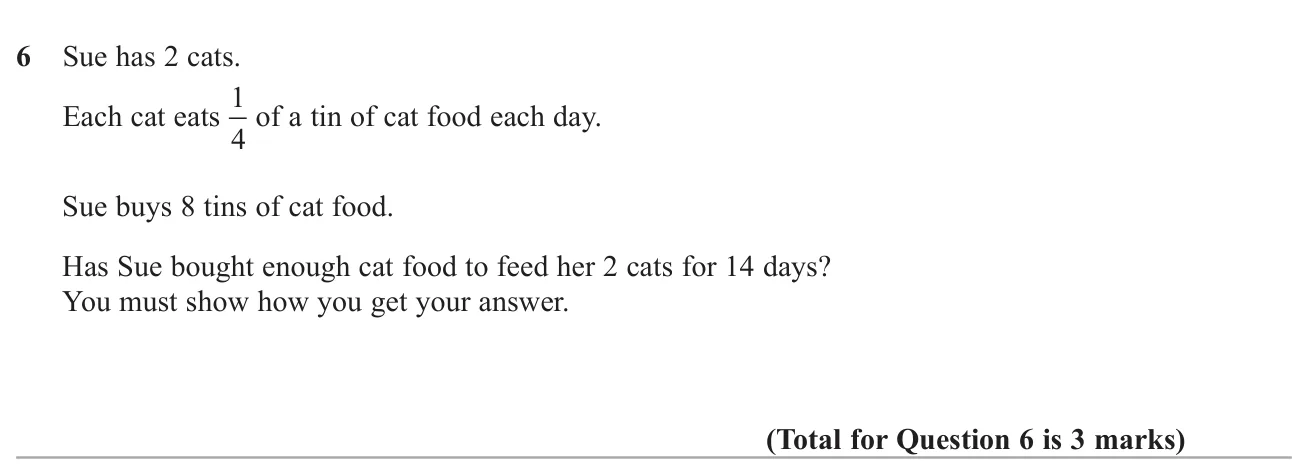
Answer Yes: only 7 tins are needed 3 marks
Worked solution Checked against the mark scheme
Both cats together eat 2 × 1 4 = 1 2 2 \times \frac{1}{4} = \frac{1}{2} 2 × 4 1 = 2 1
For 14 days: 14 × 1 2 = 7 14 \times \frac{1}{2} = 7 14 × 2 1 = 7
7 < 8 7 < 8 7 < 8
Watch out: Forgetting there are two cats and working out 14 × 1 4 14 \times \frac{1}{4} 14 × 4 1
© Pearson Education Ltd. November 2018 Paper 1 (Foundation, non-calculator), question 11.
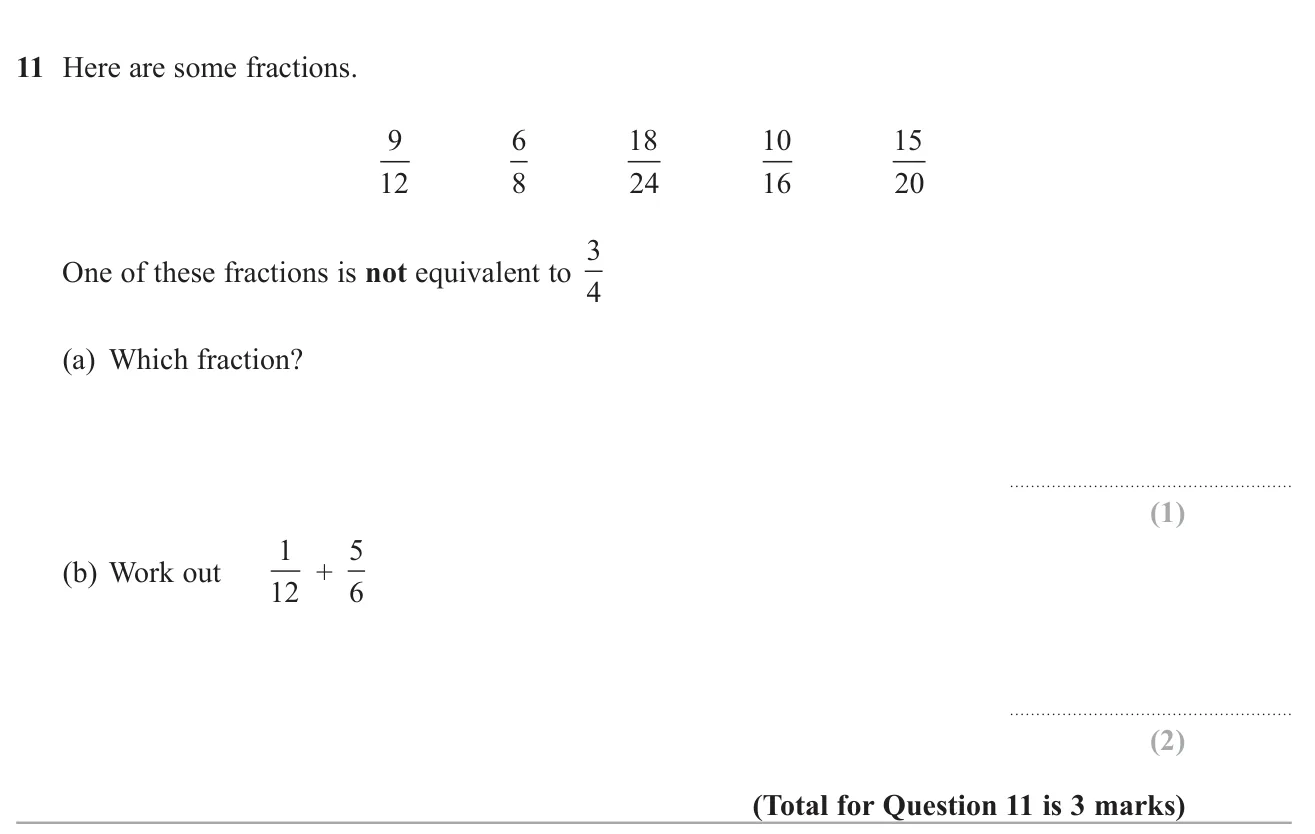
(a) 10 16 \frac{10}{16} 16 10 1 mark (b) 11 12 \frac{11}{12} 12 11 2 marks
Worked solution Checked against the mark scheme
(a) 10 16 = 5 8 \frac{10}{16} = \frac{5}{8} 16 10 = 8 5 3 4 \frac{3}{4} 4 3 3 4 \frac{3}{4} 4 3
(b) 5 6 = 10 12 \frac{5}{6} = \frac{10}{12} 6 5 = 12 10
1 12 + 10 12 = 11 12 \frac{1}{12} + \frac{10}{12} = \frac{11}{12} 12 1 + 12 10 = 12 11
Watch out: Adding tops and bottoms to get 6 18 \frac{6}{18} 18 6
© Pearson Education Ltd. June 2018 Paper 3 (Foundation, calculator), question 11.
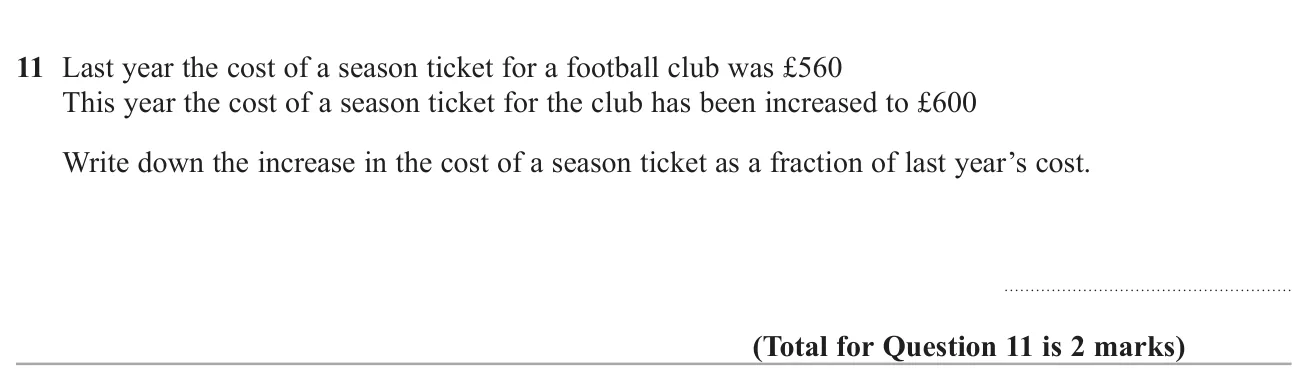
Answer 40 560 = 1 14 \frac{40}{560} = \frac{1}{14} 560 40 = 14 1 2 marks
Worked solution Checked against the mark scheme
Increase: 600 − 560 = 40 600 - 560 = 40 600 − 560 = 40
As a fraction of last year's cost: 40 560 = 1 14 \frac{40}{560} = \frac{1}{14} 560 40 = 14 1
Watch out: Dividing by the new price, giving 40/600.
© Pearson Education Ltd. Specimen Paper 1 (Foundation, non-calculator), question 18.
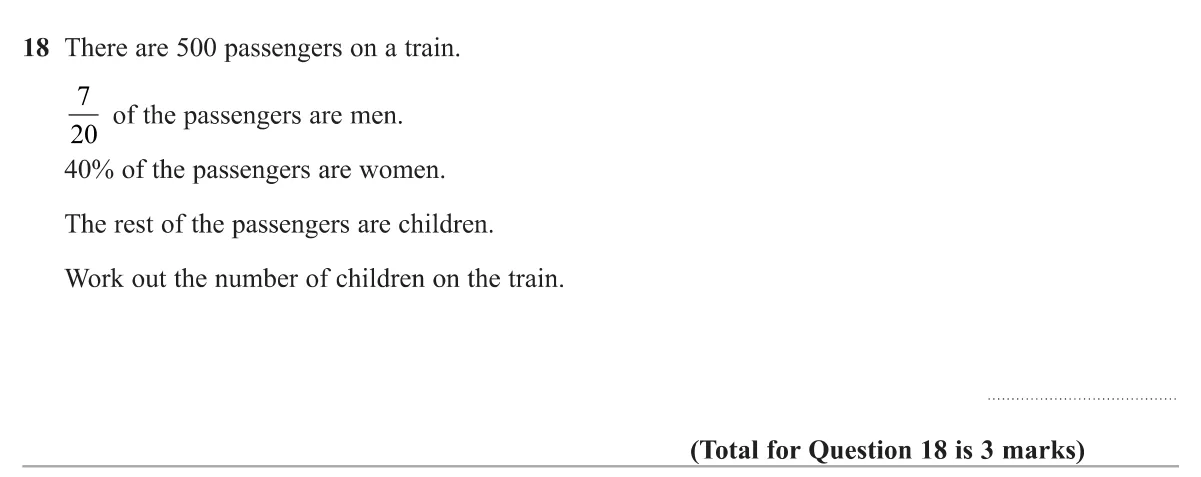
Worked solution Checked against the mark scheme
Men: 7 20 × 500 = 175 \frac{7}{20} \times 500 = 175 20 7 × 500 = 175
Women: 40 % × 500 = 200 40\% \times 500 = 200 40% × 500 = 200
Children: 500 − 175 − 200 = 125 500 - 175 - 200 = 125 500 − 175 − 200 = 125
Watch out: Stopping after one step and giving 175 or 200.
© Pearson Education Ltd. Specimen Paper 2 (Foundation, calculator), question 8.
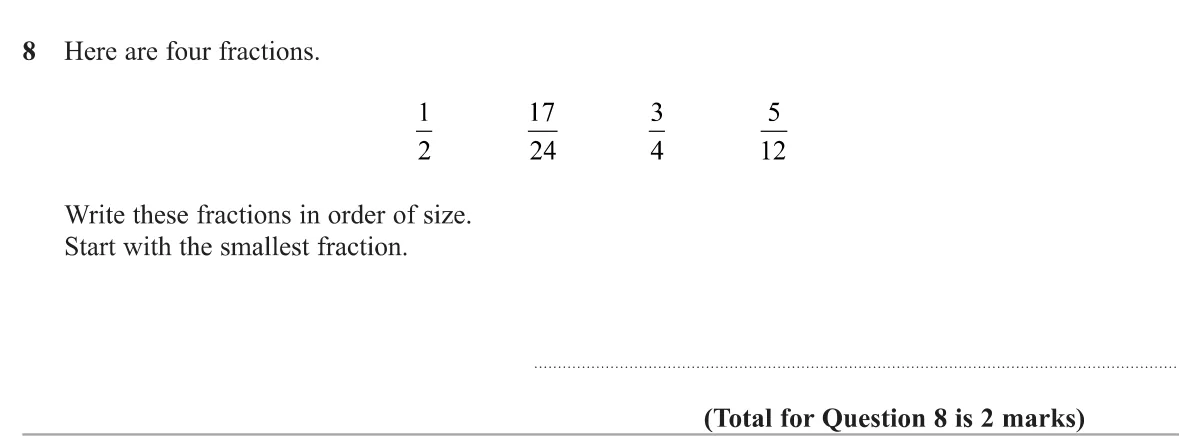
Answer 5 12 , 1 2 , 17 24 , 3 4 \frac{5}{12}, \frac{1}{2}, \frac{17}{24}, \frac{3}{4} 12 5 , 2 1 , 24 17 , 4 3 2 marks
Worked solution Checked against the mark scheme
Use a denominator of 24:
1 2 = 12 24 \frac{1}{2} = \frac{12}{24} 2 1 = 24 12 3 4 = 18 24 \frac{3}{4} = \frac{18}{24} 4 3 = 24 18 5 12 = 10 24 \frac{5}{12} = \frac{10}{24} 12 5 = 24 10
Order: 10 24 , 12 24 , 17 24 , 18 24 \frac{10}{24}, \frac{12}{24}, \frac{17}{24}, \frac{18}{24} 24 10 , 24 12 , 24 17 , 24 18 5 12 , 1 2 , 17 24 , 3 4 \frac{5}{12}, \frac{1}{2}, \frac{17}{24}, \frac{3}{4} 12 5 , 2 1 , 24 17 , 4 3
Watch out: Ordering by the size of the denominator.
© Pearson Education Ltd. Specimen Paper 2 (Foundation, calculator), question 19.
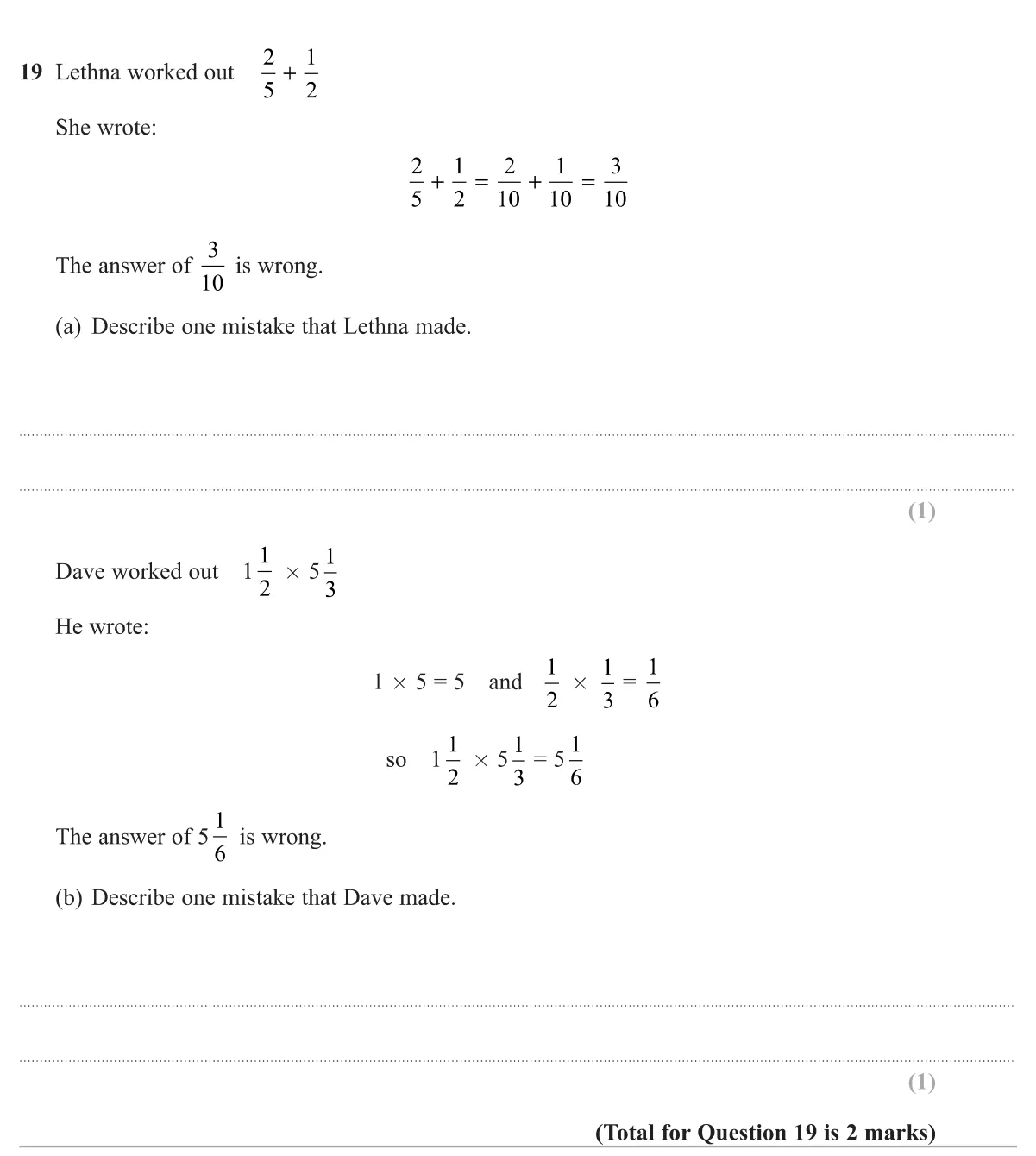
(a) She did not multiply the numerators when changing to tenths (2 5 \frac{2}{5} 5 2 4 10 \frac{4}{10} 10 4 1 2 \frac{1}{2} 2 1 5 10 \frac{5}{10} 10 5 1 mark (b) You cannot multiply the whole numbers and fractions separately; change to improper fractions first 1 mark
Worked solution Checked against the mark scheme
(a) 2 5 = 4 10 \frac{2}{5} = \frac{4}{10} 5 2 = 10 4 1 2 = 5 10 \frac{1}{2} = \frac{5}{10} 2 1 = 10 5 9 10 \frac{9}{10} 10 9
(b) 1 1 2 × 5 1 3 = 3 2 × 16 3 = 48 6 = 8 1\frac{1}{2} \times 5\frac{1}{3} = \frac{3}{2} \times \frac{16}{3} = \frac{48}{6} = 8 1 2 1 × 5 3 1 = 2 3 × 3 16 = 6 48 = 8
Watch out: Describing the wrong answer rather than the mistake in the method.
© Pearson Education Ltd. November 2024 Paper 1 (Foundation, non-calculator), question 20.
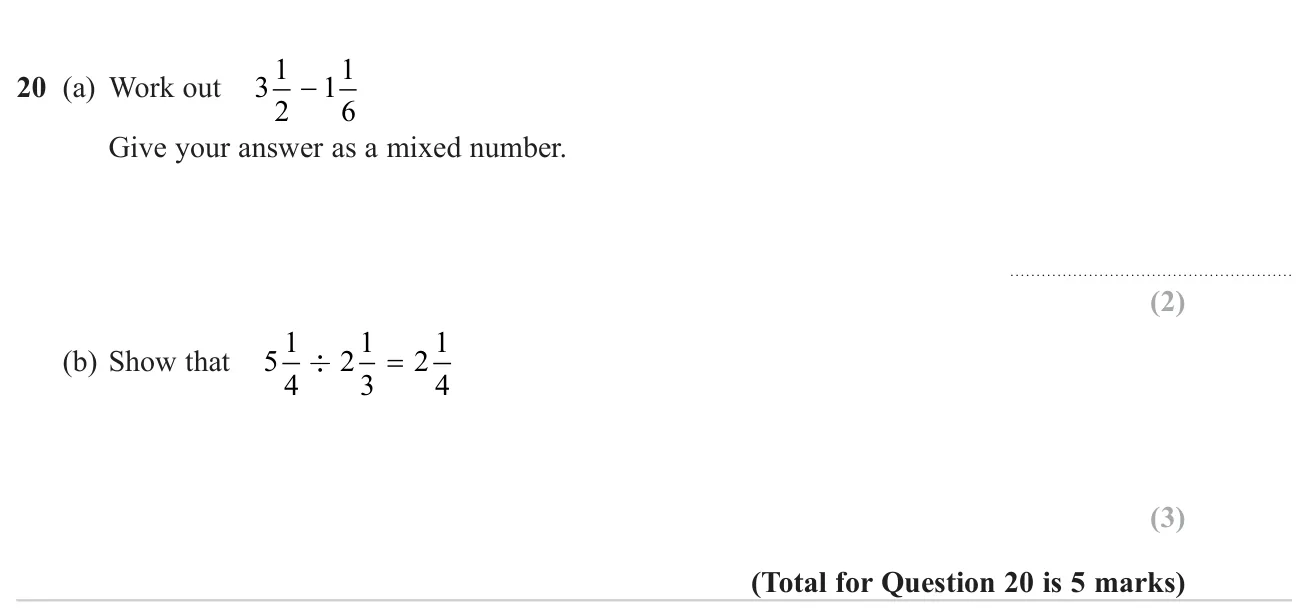
(a) 2 1 3 2\frac{1}{3} 2 3 1 2 marks (b) Shown: 21 4 × 3 7 = 63 28 = 9 4 = 2 1 4 \frac{21}{4} \times \frac{3}{7} = \frac{63}{28} = \frac{9}{4} = 2\frac{1}{4} 4 21 × 7 3 = 28 63 = 4 9 = 2 4 1 3 marks
Worked solution Checked against the mark scheme
(a) 3 1 2 − 1 1 6 = 3 3 6 − 1 1 6 = 2 2 6 = 2 1 3 3\frac{1}{2} - 1\frac{1}{6} = 3\frac{3}{6} - 1\frac{1}{6} = 2\frac{2}{6} = 2\frac{1}{3} 3 2 1 − 1 6 1 = 3 6 3 − 1 6 1 = 2 6 2 = 2 3 1
(b) 5 1 4 = 21 4 5\frac{1}{4} = \frac{21}{4} 5 4 1 = 4 21 2 1 3 = 7 3 2\frac{1}{3} = \frac{7}{3} 2 3 1 = 3 7
21 4 ÷ 7 3 = 21 4 × 3 7 = 63 28 = 9 4 = 2 1 4 \frac{21}{4} \div \frac{7}{3} = \frac{21}{4} \times \frac{3}{7} = \frac{63}{28} = \frac{9}{4} = 2\frac{1}{4} 4 21 ÷ 3 7 = 4 21 × 7 3 = 28 63 = 4 9 = 2 4 1
Watch out: In (b), dividing the whole numbers and fractions separately.
© Pearson Education Ltd. June 2024 Paper 1 (Foundation, non-calculator), question 21.
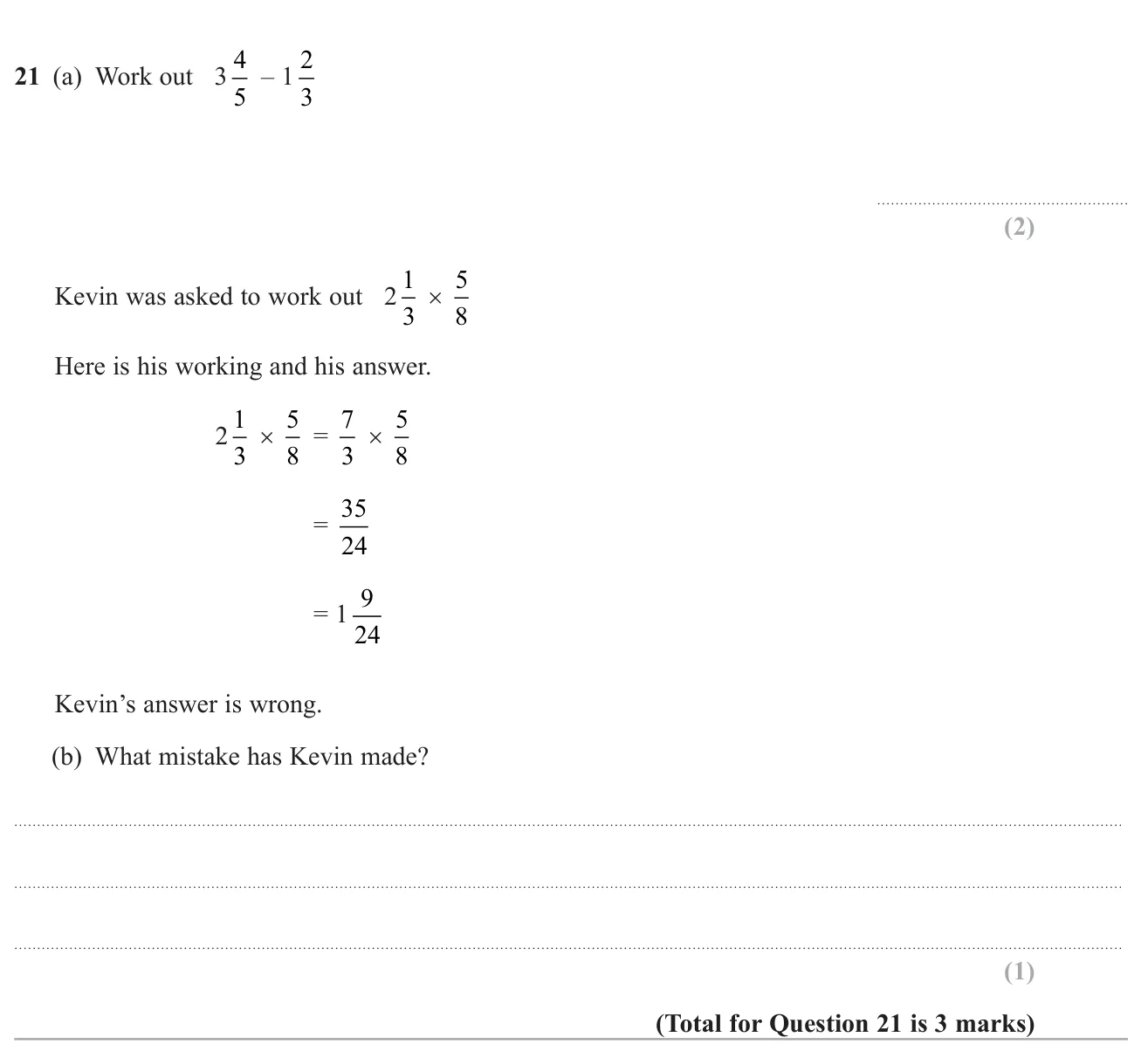
(a) 2 2 15 2\frac{2}{15} 2 15 2 2 marks (b) He converted 35 24 \frac{35}{24} 24 35 1 11 24 1\frac{11}{24} 1 24 11 1 9 24 1\frac{9}{24} 1 24 9 1 mark
Worked solution Checked against the mark scheme
(a) 3 4 5 − 1 2 3 = 57 15 − 25 15 = 32 15 = 2 2 15 3\frac{4}{5} - 1\frac{2}{3} = \frac{57}{15} - \frac{25}{15} = \frac{32}{15} = 2\frac{2}{15} 3 5 4 − 1 3 2 = 15 57 − 15 25 = 15 32 = 2 15 2
(b) 35 − 24 = 11 35 - 24 = 11 35 − 24 = 11 35 24 = 1 11 24 \frac{35}{24} = 1\frac{11}{24} 24 35 = 1 24 11
Watch out: In (a), subtracting numerators and denominators separately.
© Pearson Education Ltd. November 2023 Paper 1 (Foundation, non-calculator), question 17.
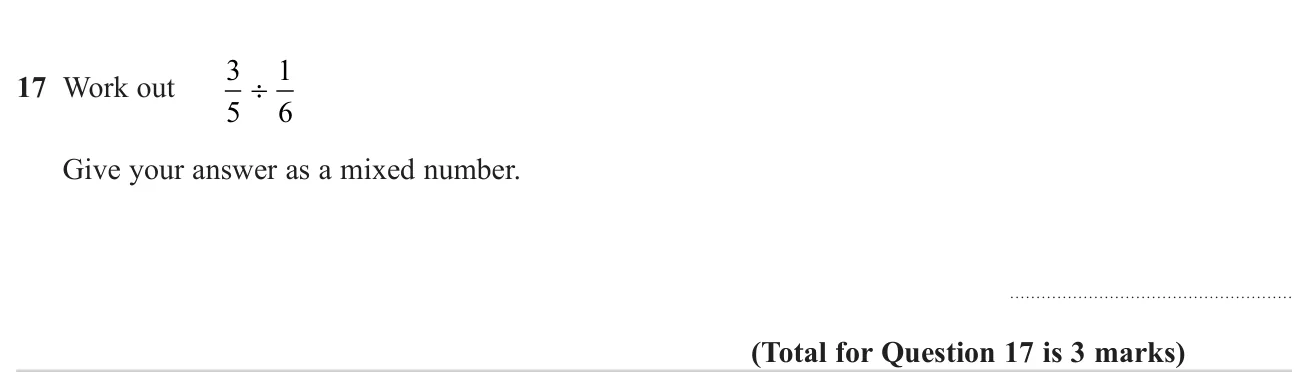
Answer 3 3 5 3\frac{3}{5} 3 5 3 3 marks
Worked solution Checked against the mark scheme
Keep, change, flip: 3 5 ÷ 1 6 = 3 5 × 6 1 = 18 5 \frac{3}{5} \div \frac{1}{6} = \frac{3}{5} \times \frac{6}{1} = \frac{18}{5} 5 3 ÷ 6 1 = 5 3 × 1 6 = 5 18
18 ÷ 5 = 3 18 \div 5 = 3 18 ÷ 5 = 3 18 5 = 3 3 5 \frac{18}{5} = 3\frac{3}{5} 5 18 = 3 5 3
Watch out: Flipping the first fraction instead of the second.
© Pearson Education Ltd. June 2023 Paper 1 (Foundation, non-calculator), question 21.
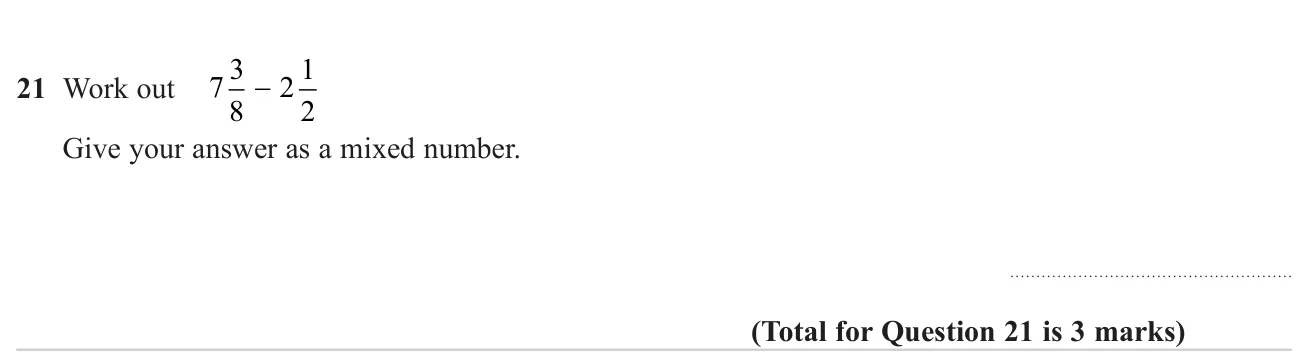
Answer 4 7 8 4\frac{7}{8} 4 8 7 3 marks
Worked solution Checked against the mark scheme
Make improper fractions: 7 3 8 = 59 8 7\frac{3}{8} = \frac{59}{8} 7 8 3 = 8 59 2 1 2 = 20 8 2\frac{1}{2} = \frac{20}{8} 2 2 1 = 8 20
59 8 − 20 8 = 39 8 = 4 7 8 \frac{59}{8} - \frac{20}{8} = \frac{39}{8} = 4\frac{7}{8} 8 59 − 8 20 = 8 39 = 4 8 7
Watch out: Doing 3 8 − 1 2 \frac{3}{8} - \frac{1}{2} 8 3 − 2 1 5 1 8 5\frac{1}{8} 5 8 1
© Pearson Education Ltd. June 2023 Paper 1 (Higher, non-calculator), question 2.
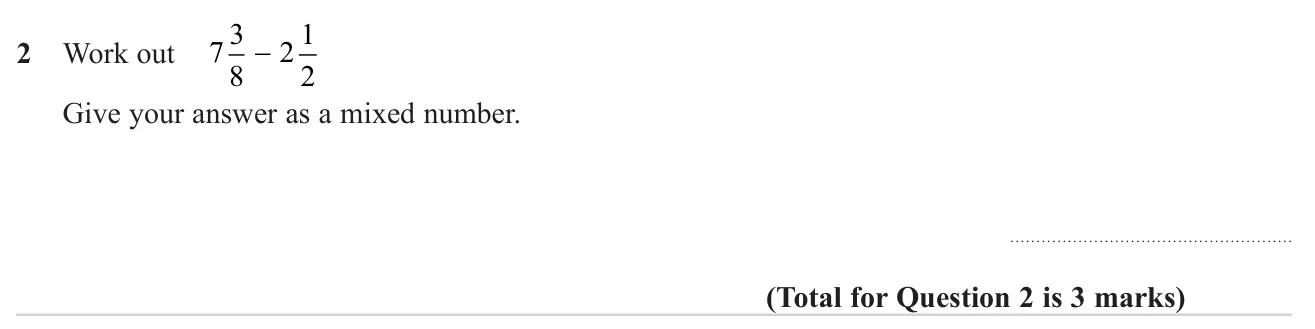
Answer 4 7 8 4\frac{7}{8} 4 8 7 3 marks
Worked solution Checked against the mark scheme
Make improper fractions: 7 3 8 = 59 8 7\frac{3}{8} = \frac{59}{8} 7 8 3 = 8 59 2 1 2 = 20 8 2\frac{1}{2} = \frac{20}{8} 2 2 1 = 8 20
59 8 − 20 8 = 39 8 = 4 7 8 \frac{59}{8} - \frac{20}{8} = \frac{39}{8} = 4\frac{7}{8} 8 59 − 8 20 = 8 39 = 4 8 7
Watch out: Doing 3 8 − 1 2 \frac{3}{8} - \frac{1}{2} 8 3 − 2 1 5 1 8 5\frac{1}{8} 5 8 1
© Pearson Education Ltd. November 2022 Paper 1 (Foundation, non-calculator), question 20.
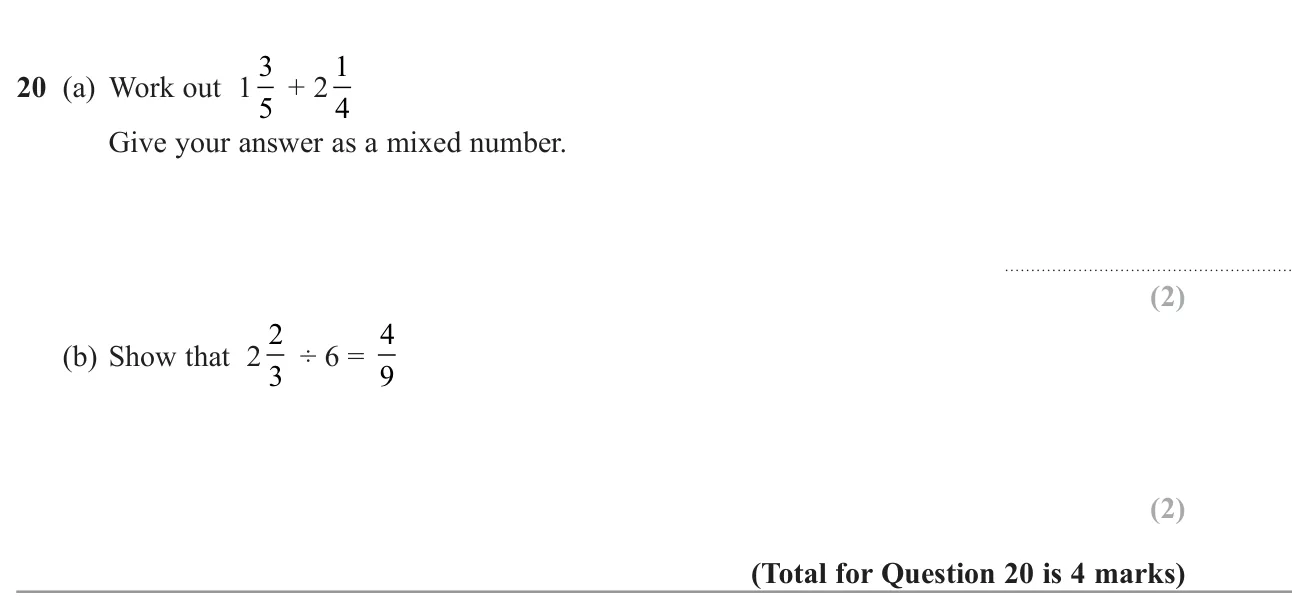
(a) 3 17 20 3\frac{17}{20} 3 20 17 2 marks (b) Shown: 8 3 × 1 6 = 8 18 = 4 9 \frac{8}{3} \times \frac{1}{6} = \frac{8}{18} = \frac{4}{9} 3 8 × 6 1 = 18 8 = 9 4 2 marks
Worked solution Checked against the mark scheme
(a) 1 + 2 = 3 1 + 2 = 3 1 + 2 = 3 3 5 + 1 4 = 12 20 + 5 20 = 17 20 \frac{3}{5} + \frac{1}{4} = \frac{12}{20} + \frac{5}{20} = \frac{17}{20} 5 3 + 4 1 = 20 12 + 20 5 = 20 17
Answer 3 17 20 3\frac{17}{20} 3 20 17
(b) 2 2 3 = 8 3 2\frac{2}{3} = \frac{8}{3} 2 3 2 = 3 8
8 3 ÷ 6 = 8 3 × 1 6 = 8 18 = 4 9 \frac{8}{3} \div 6 = \frac{8}{3} \times \frac{1}{6} = \frac{8}{18} = \frac{4}{9} 3 8 ÷ 6 = 3 8 × 6 1 = 18 8 = 9 4
Watch out: In (a), adding denominators to get 4 9 \frac{4}{9} 9 4
© Pearson Education Ltd. November 2021 Paper 1 (Foundation, non-calculator), question 22.
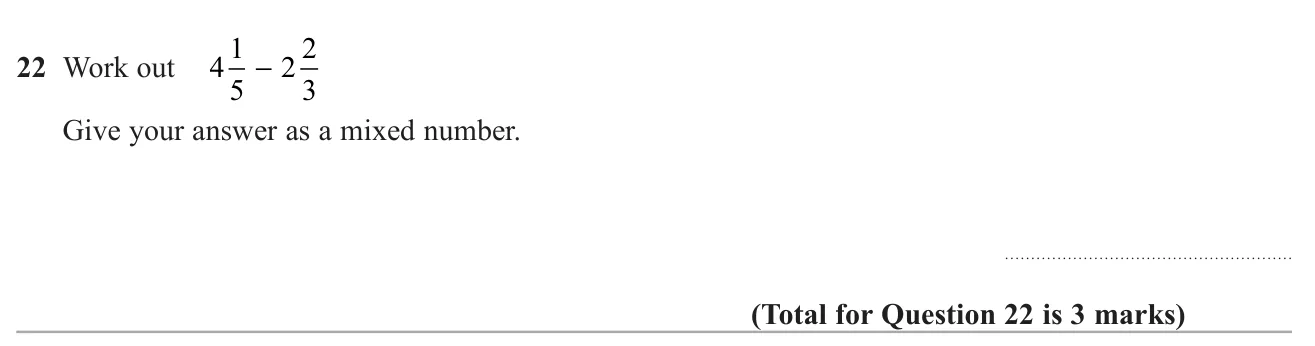
Answer 1 8 15 1\frac{8}{15} 1 15 8 3 marks
Worked solution Checked against the mark scheme
4 1 5 = 21 5 = 63 15 4\frac{1}{5} = \frac{21}{5} = \frac{63}{15} 4 5 1 = 5 21 = 15 63 2 2 3 = 8 3 = 40 15 2\frac{2}{3} = \frac{8}{3} = \frac{40}{15} 2 3 2 = 3 8 = 15 40
63 15 − 40 15 = 23 15 = 1 8 15 \frac{63}{15} - \frac{40}{15} = \frac{23}{15} = 1\frac{8}{15} 15 63 − 15 40 = 15 23 = 1 15 8
Watch out: Subtracting whole numbers and fractions separately and getting 2 − 7 15 2 - \frac{7}{15} 2 − 15 7
© Pearson Education Ltd. November 2021 Paper 2 (Foundation, calculator), question 19.
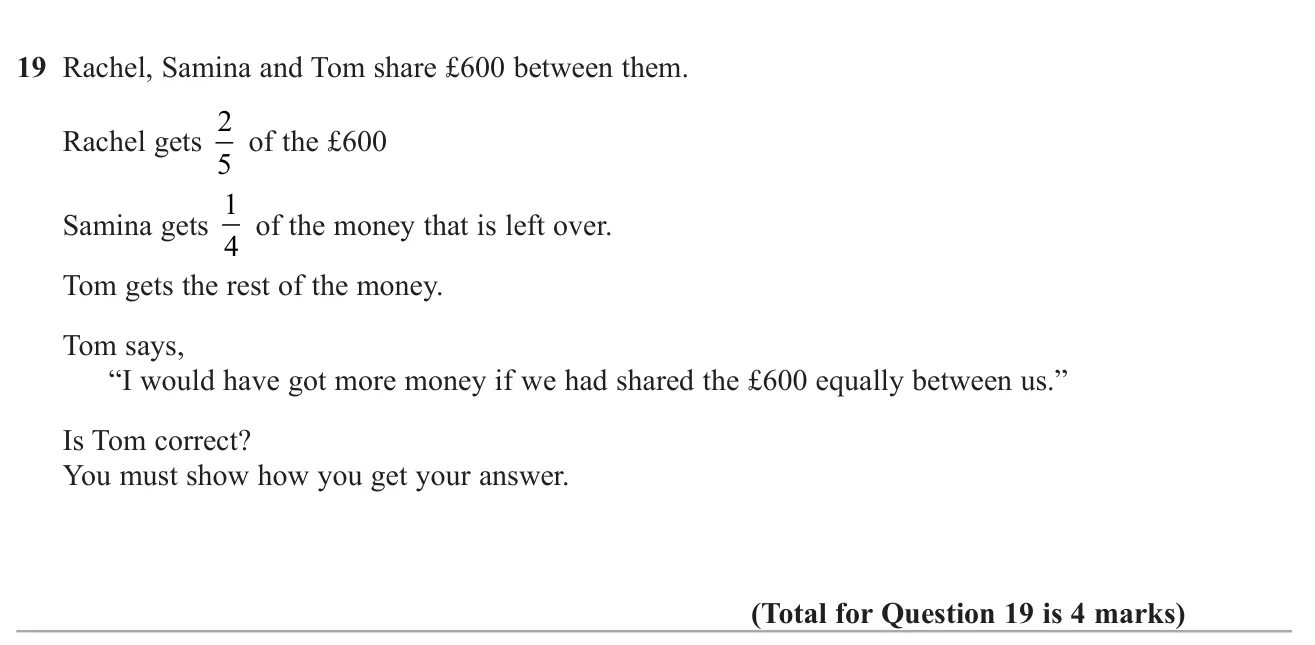
Answer No: Tom gets £270, which is more than the £200 from an equal share 4 marks
Worked solution Checked against the mark scheme
Rachel: 2 5 × 600 = £ 240 \frac{2}{5} \times 600 = £240 5 2 × 600 = £240 600 − 240 = £ 360 600 - 240 = £360 600 − 240 = £360
Samina: 1 4 × 360 = £ 90 \frac{1}{4} \times 360 = £90 4 1 × 360 = £90
Tom: 360 − 90 = £ 270 360 - 90 = £270 360 − 90 = £270
Equal share: 600 ÷ 3 = £ 200 600 \div 3 = £200 600 ÷ 3 = £200
Watch out: Finding Samina's share as a quarter of £600 rather than of the amount left.
© Pearson Education Ltd. November 2020 Paper 1 (Foundation, non-calculator), question 21.
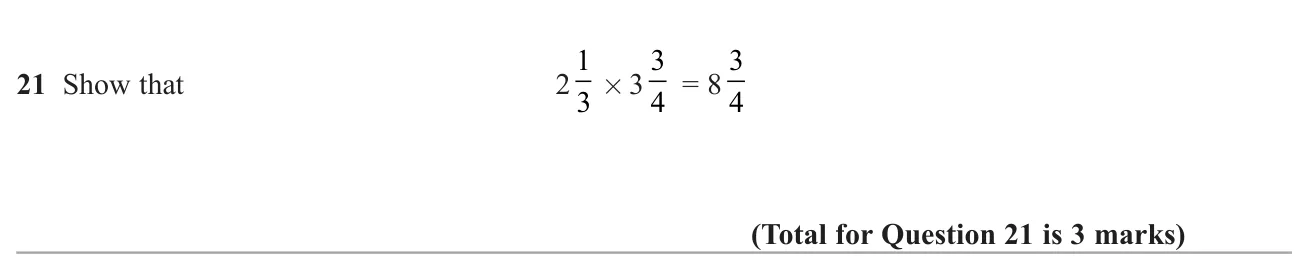
Answer 7 3 × 15 4 = 105 12 = 35 4 = 8 3 4 \frac{7}{3} \times \frac{15}{4} = \frac{105}{12} = \frac{35}{4} = 8\frac{3}{4} 3 7 × 4 15 = 12 105 = 4 35 = 8 4 3 3 marks
Worked solution Checked against the mark scheme
Change to improper fractions: 2 1 3 = 7 3 2\frac{1}{3} = \frac{7}{3} 2 3 1 = 3 7 3 3 4 = 15 4 3\frac{3}{4} = \frac{15}{4} 3 4 3 = 4 15
Multiply: 7 × 15 3 × 4 = 105 12 = 35 4 \frac{7 \times 15}{3 \times 4} = \frac{105}{12} = \frac{35}{4} 3 × 4 7 × 15 = 12 105 = 4 35
35 ÷ 4 = 8 35 \div 4 = 8 35 ÷ 4 = 8 35 4 = 8 3 4 \frac{35}{4} = 8\frac{3}{4} 4 35 = 8 4 3
Watch out: Multiplying whole numbers and fractions separately: 2 × 3 + 1 3 × 3 4 2 \times 3 + \frac{1}{3} \times \frac{3}{4} 2 × 3 + 3 1 × 4 3
© Pearson Education Ltd. June 2019 Paper 1 (Foundation, non-calculator), question 19.
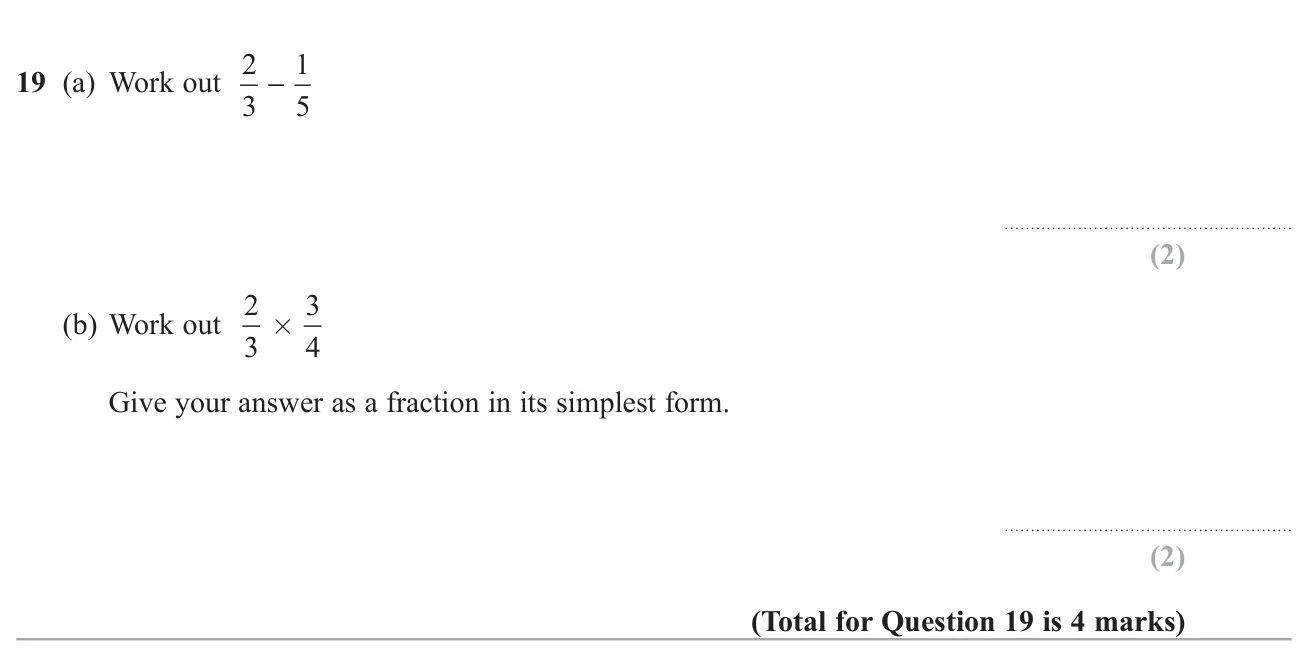
(a) 7 15 \frac{7}{15} 15 7 2 marks (b) 1 2 \frac{1}{2} 2 1 2 marks
Worked solution Checked against the mark scheme
(a) 2 3 − 1 5 = 10 15 − 3 15 = 7 15 \frac{2}{3} - \frac{1}{5} = \frac{10}{15} - \frac{3}{15} = \frac{7}{15} 3 2 − 5 1 = 15 10 − 15 3 = 15 7
(b) 2 3 × 3 4 = 6 12 = 1 2 \frac{2}{3} \times \frac{3}{4} = \frac{6}{12} = \frac{1}{2} 3 2 × 4 3 = 12 6 = 2 1
Watch out: In (a), subtracting tops and bottoms separately to get 1 − 2 \frac{1}{-2} − 2 1
© Pearson Education Ltd. June 2019 Paper 1 (Higher, non-calculator), question 9.
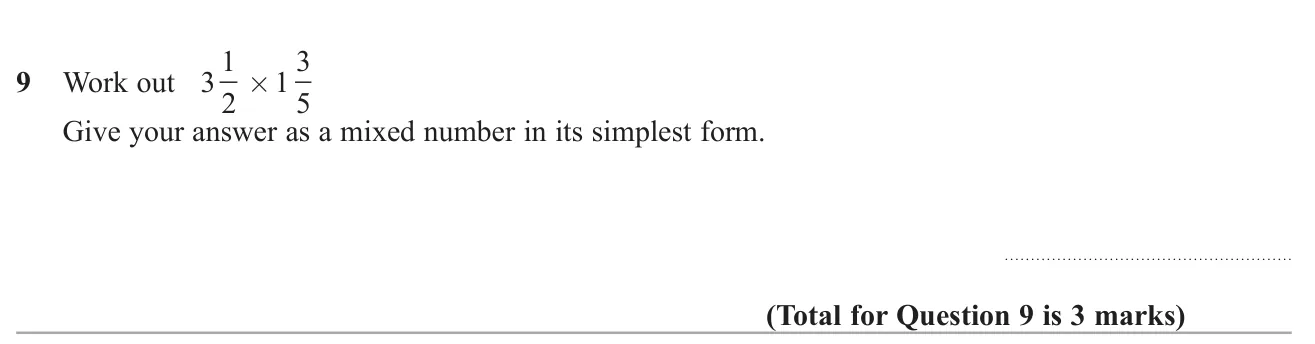
Answer 5 3 5 5\frac{3}{5} 5 5 3 3 marks
Worked solution Checked against the mark scheme
3 1 2 = 7 2 3\frac{1}{2} = \frac{7}{2} 3 2 1 = 2 7 1 3 5 = 8 5 1\frac{3}{5} = \frac{8}{5} 1 5 3 = 5 8
7 2 × 8 5 = 56 10 = 28 5 = 5 3 5 \frac{7}{2} \times \frac{8}{5} = \frac{56}{10} = \frac{28}{5} = 5\frac{3}{5} 2 7 × 5 8 = 10 56 = 5 28 = 5 5 3
Watch out: Multiplying the whole numbers and fractions separately to get 3 3 10 3\frac{3}{10} 3 10 3
© Pearson Education Ltd. June 2018 Paper 1 (Foundation, non-calculator), question 19.
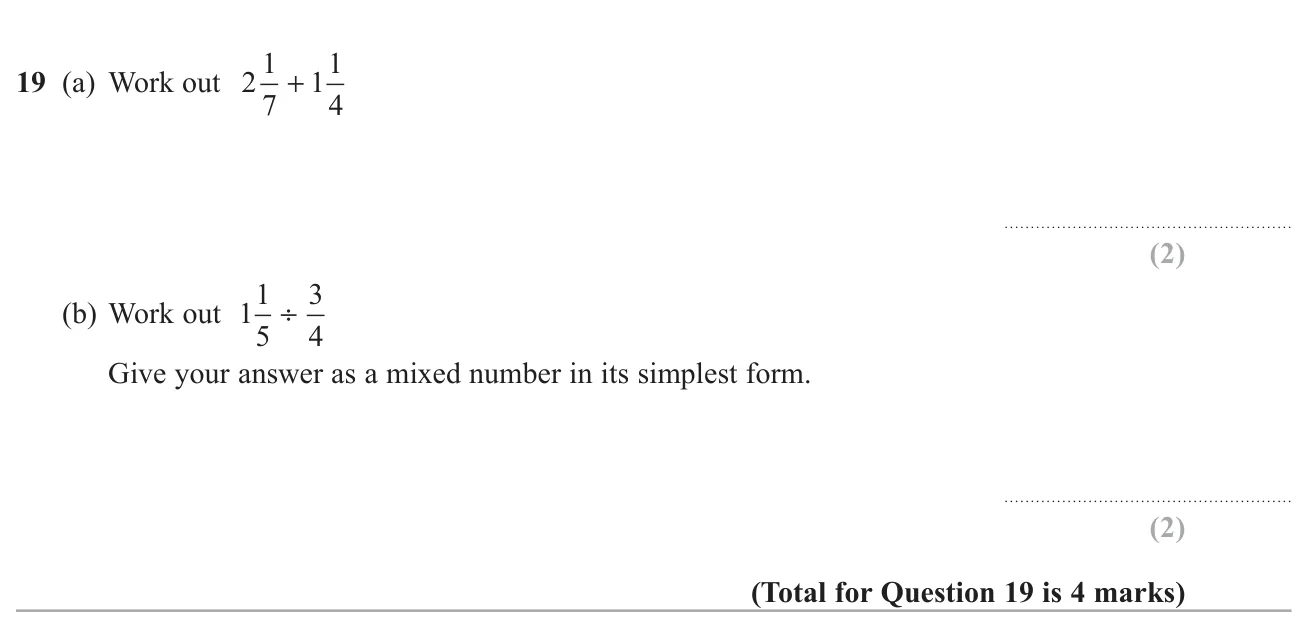
(a) 3 11 28 3\frac{11}{28} 3 28 11 2 marks (b) 1 3 5 1\frac{3}{5} 1 5 3 2 marks
Worked solution Checked against the mark scheme
(a) Whole numbers: 2 + 1 = 3 2 + 1 = 3 2 + 1 = 3 1 7 + 1 4 = 4 28 + 7 28 = 11 28 \frac{1}{7} + \frac{1}{4} = \frac{4}{28} + \frac{7}{28} = \frac{11}{28} 7 1 + 4 1 = 28 4 + 28 7 = 28 11
Answer 3 11 28 3\frac{11}{28} 3 28 11
(b) 1 1 5 = 6 5 1\frac{1}{5} = \frac{6}{5} 1 5 1 = 5 6 6 5 × 4 3 = 24 15 = 8 5 = 1 3 5 \frac{6}{5} \times \frac{4}{3} = \frac{24}{15} = \frac{8}{5} = 1\frac{3}{5} 5 6 × 3 4 = 15 24 = 5 8 = 1 5 3
Watch out: In (b), dividing without flipping the second fraction.
© Pearson Education Ltd. June 2022 Paper 1 (Foundation, non-calculator), question 20.
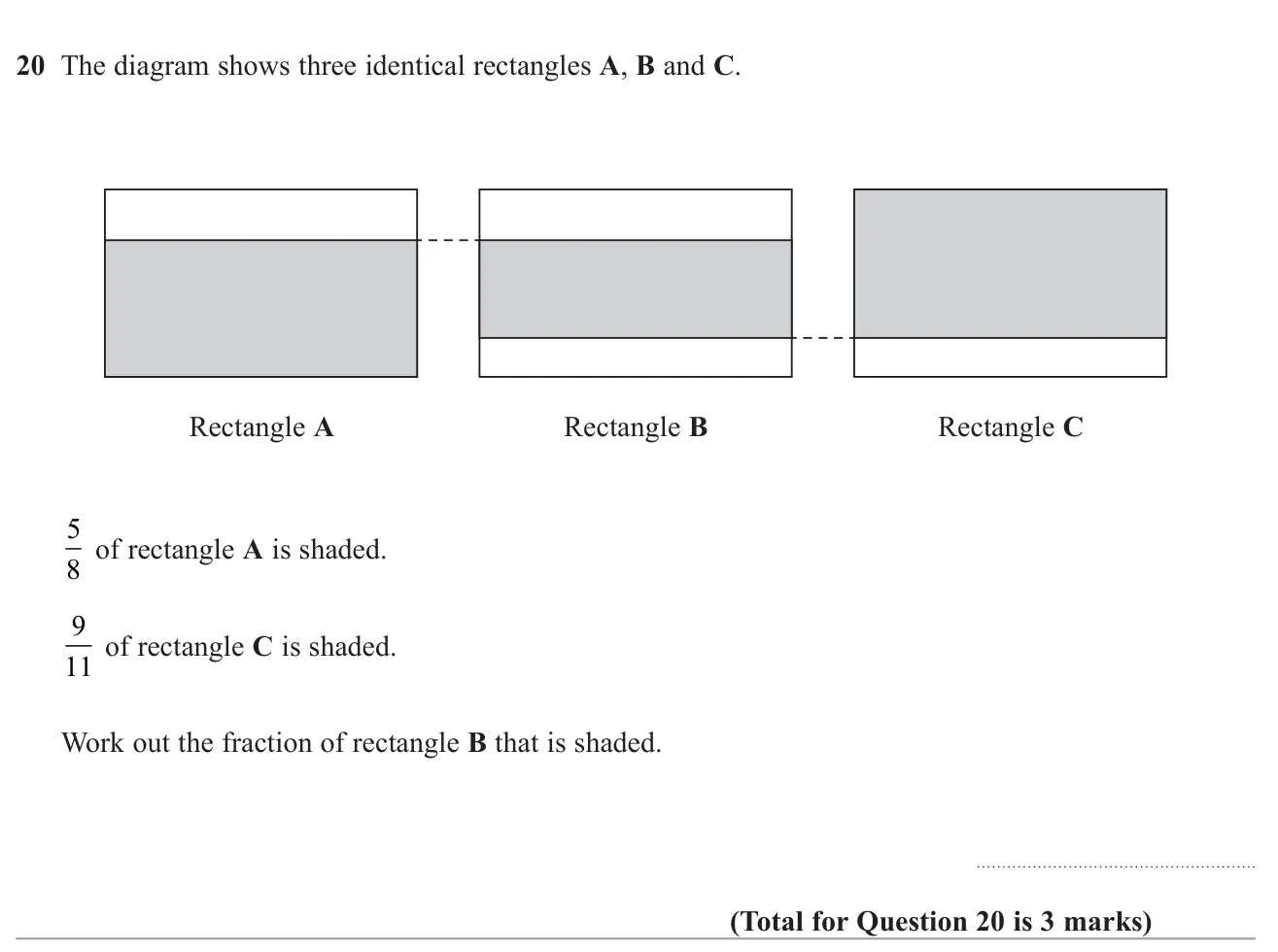
Answer 39 88 \frac{39}{88} 88 39 3 marks
Worked solution Checked against the mark scheme
The top strip of B matches the unshaded part of A: 1 − 5 8 = 3 8 1 - \frac{5}{8} = \frac{3}{8} 1 − 8 5 = 8 3
The bottom strip of B matches the unshaded part of C: 1 − 9 11 = 2 11 1 - \frac{9}{11} = \frac{2}{11} 1 − 11 9 = 11 2
Shaded part of B: 1 − 3 8 − 2 11 = 88 − 33 − 16 88 = 39 88 1 - \frac{3}{8} - \frac{2}{11} = \frac{88 - 33 - 16}{88} = \frac{39}{88} 1 − 8 3 − 11 2 = 88 88 − 33 − 16 = 88 39
Watch out: Subtracting 5/8 from 9/11 without thinking about which strips match.
© Pearson Education Ltd. November 2019 Paper 1 (Foundation, non-calculator), question 22.
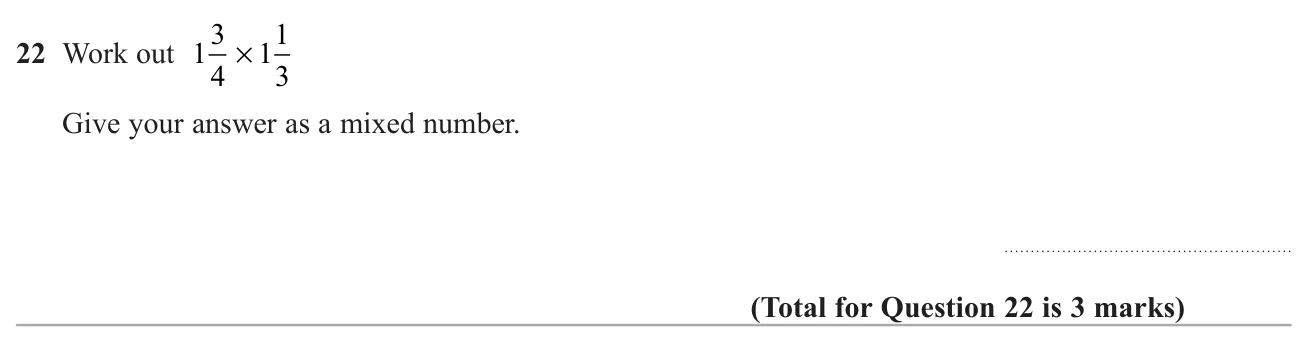
Answer 2 1 3 2\frac{1}{3} 2 3 1 3 marks
Worked solution Checked against the mark scheme
1 3 4 = 7 4 1\frac{3}{4} = \frac{7}{4} 1 4 3 = 4 7 1 1 3 = 4 3 1\frac{1}{3} = \frac{4}{3} 1 3 1 = 3 4
7 4 × 4 3 = 28 12 = 7 3 = 2 1 3 \frac{7}{4} \times \frac{4}{3} = \frac{28}{12} = \frac{7}{3} = 2\frac{1}{3} 4 7 × 3 4 = 12 28 = 3 7 = 2 3 1
Watch out: Multiplying the whole numbers and fractions separately to get 1 1/4.
Also tested in these questions Their main topic is different, but part of each one tests this topic.
November 2024 · Paper 3 Foundation · Q9 : Use a fraction and two percentages to find how many people at a party are not vegetarian.June 2024 · Paper 2 Foundation · Q25 : Share sweets in a ratio, apply a fraction and a percentage transfer, and check if everyone ends up equal.June 2024 · Paper 3 Higher · Q21 : Compare the perimeters of inscribed and circumscribed regular hexagons with a circle's circumference to show bounds for pi.November 2023 · Paper 1 Higher · Q20 : Use the cosine rule with a surd side length to find an angle in a triangle without a calculator.June 2023 · Paper 1 Foundation · Q14 : Find a percentage complement, turn a ratio into a fraction, and compare numbers of children on two days.June 2023 · Paper 1 Foundation · Q17 : Find what percentage of a bag of counters are one colour when two colours share the remainder equally.June 2023 · Paper 2 Higher · Q24 : Find the exact area of a star-shaped region enclosed by eight regular octagons, in surd form.November 2022 · Paper 1 Foundation · Q12 : Work out time left after spending a fraction and a percentage of two hours on activities, then decide whether someone was on time.November 2022 · Paper 1 Foundation · Q18 : Share a total in a three-part ratio, remove fractions of two groups, and give one group as a percentage of what remains.November 2022 · Paper 1 Higher · Q19 : Solve an equation involving two algebraic fractions, giving the solutions in surd form.November 2022 · Paper 1 Higher · Q23 : Find the next term of a geometric sequence with surds, then find the first term of another from its 4th and 6th terms.November 2022 · Paper 1 Higher · Q24 : Find the ratio of radius to height when a sphere and cone have equal volumes, then when a sphere's surface area equals a cone's total surface area.June 2022 · Paper 1 Higher · Q18 : Evaluate an expression with a negative fractional power of a mixed number, a mixed-number product and a negative power of 2.June 2022 · Paper 1 Higher · Q21 : Find the exact area of the two shaded regions formed inside the middle of three overlapping equal circles.June 2022 · Paper 1 Foundation · Q25 : Share a total in a ratio, then take a fraction and a percentage away to find the remaining group.June 2022 · Paper 3 Foundation · Q19 : Given the fraction of red counters and the number of yellow ones, find the percentage that are green.November 2021 · Paper 1 Foundation · Q11 : Read values from a pictogram with a key and complete it for two more days using a fraction of a total.November 2020 · Paper 1 Foundation · Q17 : Apply a fractional reduction and then a percentage reduction to a price and compare with a budget.November 2020 · Paper 2 Foundation · Q16 : Find how many marks are needed on a second paper to reach a pass mark of two-thirds of the total.November 2019 · Paper 3 Higher · Q14 : Combine three ratios about starter and main-course choices to find the fraction who chose curry.June 2019 · Paper 3 Foundation · Q23 : Combine percentage, fraction and ratio information to find the total number of medium packets bought by three people.June 2018 · Paper 1 Foundation · Q3 : Convert a percentage into a fraction.June 2018 · Paper 1 Foundation · Q14 : Compare savings given as a percentage, a fraction spent and a ratio, to see who saves most.June 2018 · Paper 3 Foundation · Q16 : Use one person's fractional share to find another share, then write a ratio of two shares in simplest form.Specimen · Paper 1 Foundation · Q19 : Find the cheapest combination of milk bottles to cover a week, then explain how using more milk would affect the cost.Specimen · Paper 2 Foundation · Q9 : Count full and half squares on a grid to give the shaded fraction as a percentage.Specimen · Paper 2 Foundation · Q15 : Find a fraction of a length and evaluate a calculation with a square and a square root.Specimen · Paper 3 Foundation · Q15 : Find the mass of fibre in one slice of bread given the fibre per 100 g, the loaf mass and number of slices.