Revision guide by The Full Marks
Vectors: what you need to know A vector has size and direction. Foundation questions use column vectors to describe movements and do simple sums; Higher questions also use vectors in diagrams to prove lines are parallel or points lie on a straight line.
Foundation students need column vectors, translations and simple vector sums; geometric proofs with vectors are Higher only.
Key facts A column vector ( 3 − 2 ) \begin{pmatrix} 3 \\ -2 \end{pmatrix} ( 3 − 2 ) 3 3 3 2 2 2 Add or subtract column vectors one row at a time. Multiplying by a number multiplies both rows. B A → = − A B → \overrightarrow{BA} = -\overrightarrow{AB} B A = − A B Two vectors are parallel if one is a multiple of the other, e.g. 2 a + b 2\mathbf{a} + \mathbf{b} 2 a + b 6 a + 3 b 6\mathbf{a} + 3\mathbf{b} 6 a + 3 b Points are collinear if two vectors between them are parallel and share a point. Column vectors Multiply each vector by its number, row by row. Add or subtract the top rows, then the bottom rows, taking care with negatives. Vector proofs (Higher) Find a route from start to end along lines you already know as vectors. Use ratios carefully: if A P : P B = 1 : 2 AP : PB = 1 : 2 A P : P B = 1 : 2 A P → = 1 3 A B → \overrightarrow{AP} = \frac{1}{3}\overrightarrow{AB} A P = 3 1 A B A P : P B = 2 : 3 AP : PB = 2 : 3 A P : P B = 2 : 3 A P → = 2 5 A B → \overrightarrow{AP} = \frac{2}{5}\overrightarrow{AB} A P = 5 2 A B 1 2 \frac{1}{2} 2 1 Simplify, then show one vector is a multiple of the other. Write a conclusion: 'so they are parallel' or 'parallel with a common point, so collinear'. Worked examples Example 1 Foundation · grade 5
a = ( 3 − 2 ) \mathbf{a} = \begin{pmatrix} 3 \\ -2 \end{pmatrix} a = ( 3 − 2 ) b = ( − 1 4 ) \mathbf{b} = \begin{pmatrix} -1 \\ 4 \end{pmatrix} b = ( − 1 4 ) 2 a − b 2\mathbf{a} - \mathbf{b} 2 a − b
Show the solution 2 a = ( 6 − 4 ) 2\mathbf{a} = \begin{pmatrix} 6 \\ -4 \end{pmatrix} 2 a = ( 6 − 4 ) 2 a − b = ( 6 − ( − 1 ) − 4 − 4 ) = ( 7 − 8 ) 2\mathbf{a} - \mathbf{b} = \begin{pmatrix} 6 - (-1) \\ -4 - 4 \end{pmatrix} = \begin{pmatrix} 7 \\ -8 \end{pmatrix} 2 a − b = ( 6 − ( − 1 ) − 4 − 4 ) = ( 7 − 8 )
Example 2 Higher · grade 8
O A → = 3 a \overrightarrow{OA} = 3\mathbf{a} O A = 3 a O B → = 3 b \overrightarrow{OB} = 3\mathbf{b} O B = 3 b P P P A B AB A B A P : P B = 1 : 2 AP : PB = 1 : 2 A P : P B = 1 : 2 O Q → = 4 a + 2 b \overrightarrow{OQ} = 4\mathbf{a} + 2\mathbf{b} O Q = 4 a + 2 b O O O P P P Q Q Q
Show the solution A B → = − 3 a + 3 b \overrightarrow{AB} = -3\mathbf{a} + 3\mathbf{b} A B = − 3 a + 3 b A P → = 1 3 A B → = − a + b \overrightarrow{AP} = \frac{1}{3}\overrightarrow{AB} = -\mathbf{a} + \mathbf{b} A P = 3 1 A B = − a + b O P → = 3 a − a + b = 2 a + b \overrightarrow{OP} = 3\mathbf{a} - \mathbf{a} + \mathbf{b} = 2\mathbf{a} + \mathbf{b} O P = 3 a − a + b = 2 a + b O Q → = 4 a + 2 b = 2 ( 2 a + b ) = 2 O P → \overrightarrow{OQ} = 4\mathbf{a} + 2\mathbf{b} = 2(2\mathbf{a} + \mathbf{b}) = 2\overrightarrow{OP} O Q = 4 a + 2 b = 2 ( 2 a + b ) = 2 O P O Q → \overrightarrow{OQ} O Q O P → \overrightarrow{OP} O P O O O O O O P P P Q Q Q
Common mistakes Getting the sign wrong when travelling against an arrow: B A → = − A B → \overrightarrow{BA} = -\overrightarrow{AB} B A = − A B Turning a ratio into the wrong fraction: 1 : 2 1 : 2 1 : 2 1 3 \frac{1}{3} 3 1 1 2 \frac{1}{2} 2 1 Showing vectors are parallel but not saying they share a point, which loses the final mark in a collinear proof. Exam tips In proofs the final mark usually needs a written conclusion, so always finish with a sentence. Underline vector letters (a ‾ \underline{a} a When you draw a vector on a grid, count squares from the start point and put an arrow on the line to show its direction. Questions people ask How do you show two vectors are parallel? Write one as a number times the other, for example 6 a + 9 b = 3 ( 2 a + 3 b ) 6\mathbf{a} + 9\mathbf{b} = 3(2\mathbf{a} + 3\mathbf{b}) 6 a + 9 b = 3 ( 2 a + 3 b )
What does collinear mean in vectors? Collinear means the points lie on the same straight line. You prove it by showing two vectors are parallel and share a common point.
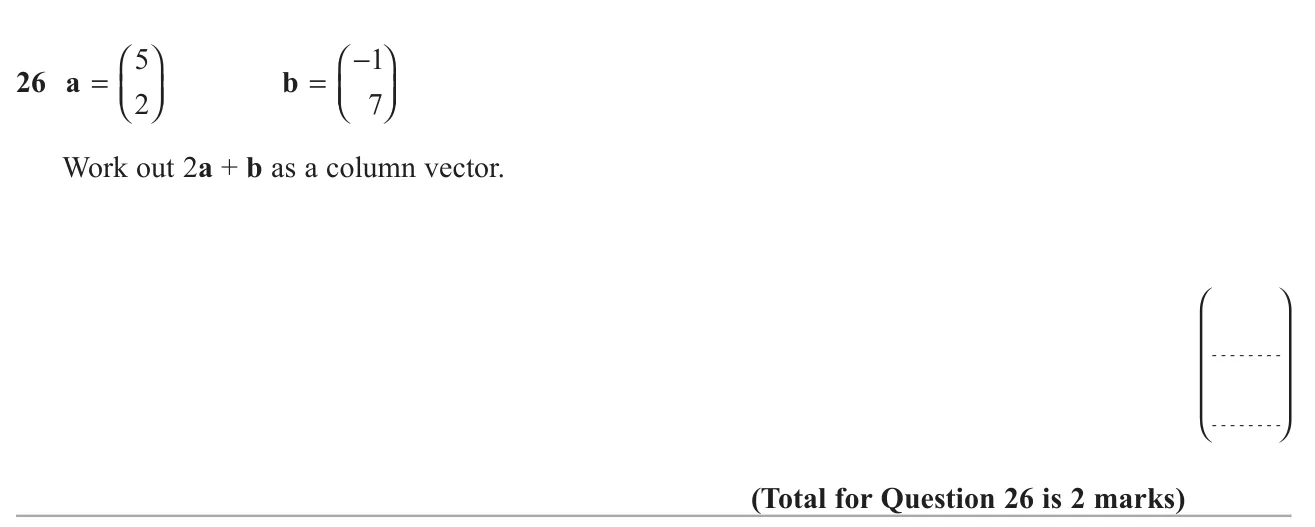
Exam questions: Vectors (21, easiest first) © Pearson Education Ltd. June 2018 Paper 1 (Foundation, non-calculator), question 26.
Answer ( 9 11 ) \begin{pmatrix} 9 \\ 11 \end{pmatrix} ( 9 11 ) 2 marks
Worked solution Checked against the mark scheme
2 a = ( 10 4 ) 2\mathbf{a} = \begin{pmatrix} 10 \\ 4 \end{pmatrix} 2 a = ( 10 4 )
2 a + b = ( 10 + ( − 1 ) 4 + 7 ) = ( 9 11 ) 2\mathbf{a} + \mathbf{b} = \begin{pmatrix} 10 + (-1) \\ 4 + 7 \end{pmatrix} = \begin{pmatrix} 9 \\ 11 \end{pmatrix} 2 a + b = ( 10 + ( − 1 ) 4 + 7 ) = ( 9 11 )
Watch out: Doubling b as well as a.
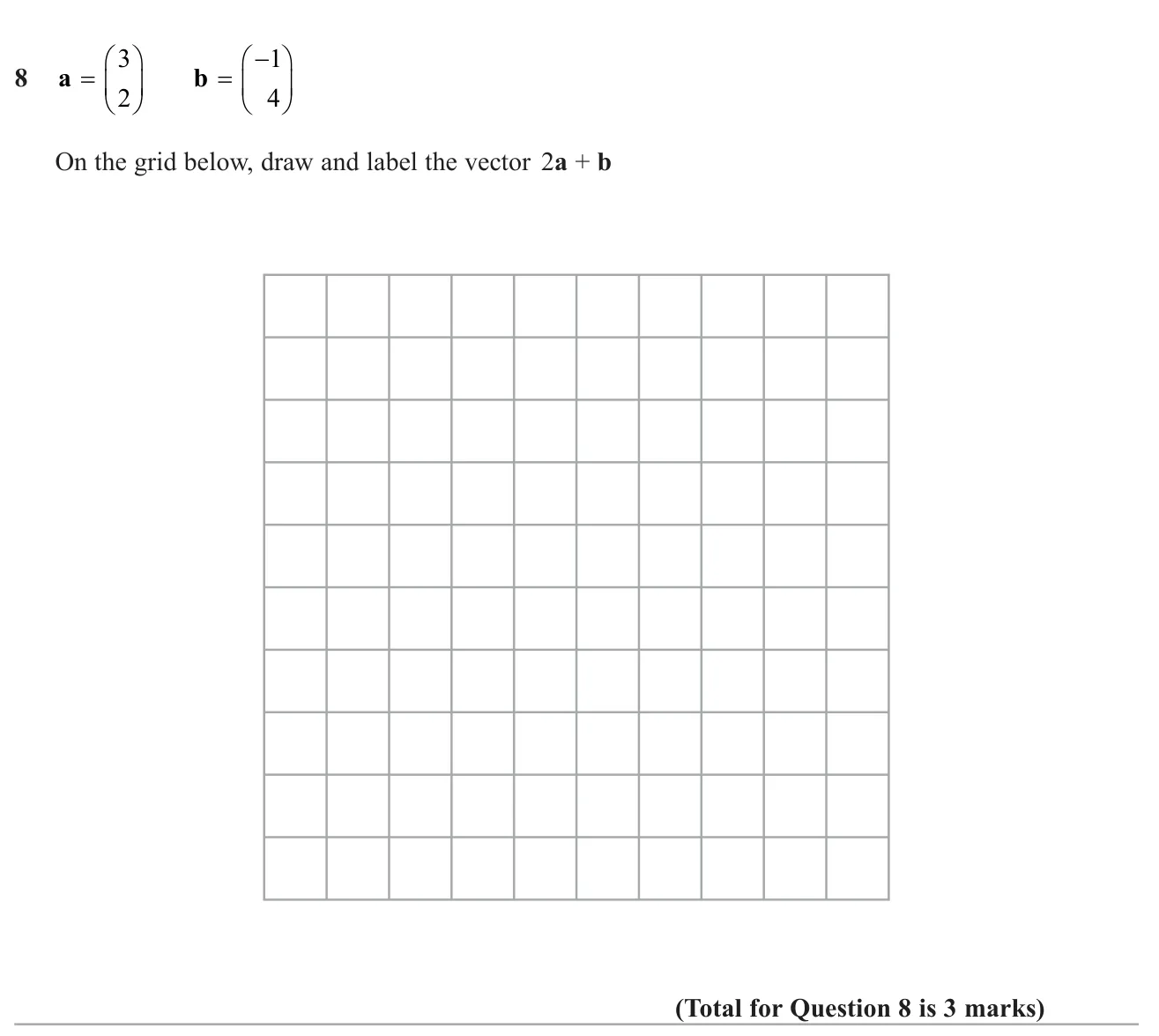
© Pearson Education Ltd. June 2024 Paper 3 (Higher, calculator), question 8.
Answer Vector ( 5 8 ) \begin{pmatrix}5\\8\end{pmatrix} ( 5 8 ) 3 marks
Worked solution Checked against the mark scheme
2 a = ( 6 4 ) 2\mathbf{a} = \begin{pmatrix}6\\4\end{pmatrix} 2 a = ( 6 4 )
2 a + b = ( 6 + ( − 1 ) 4 + 4 ) = ( 5 8 ) 2\mathbf{a} + \mathbf{b} = \begin{pmatrix}6 + (-1)\\4 + 4\end{pmatrix} = \begin{pmatrix}5\\8\end{pmatrix} 2 a + b = ( 6 + ( − 1 ) 4 + 4 ) = ( 5 8 )
Draw a line 5 squares right and 8 squares up, with an arrow at the end, and label it 2 a + b 2\mathbf{a} + \mathbf{b} 2 a + b
Watch out: Forgetting to double both components of a, or leaving off the arrow.
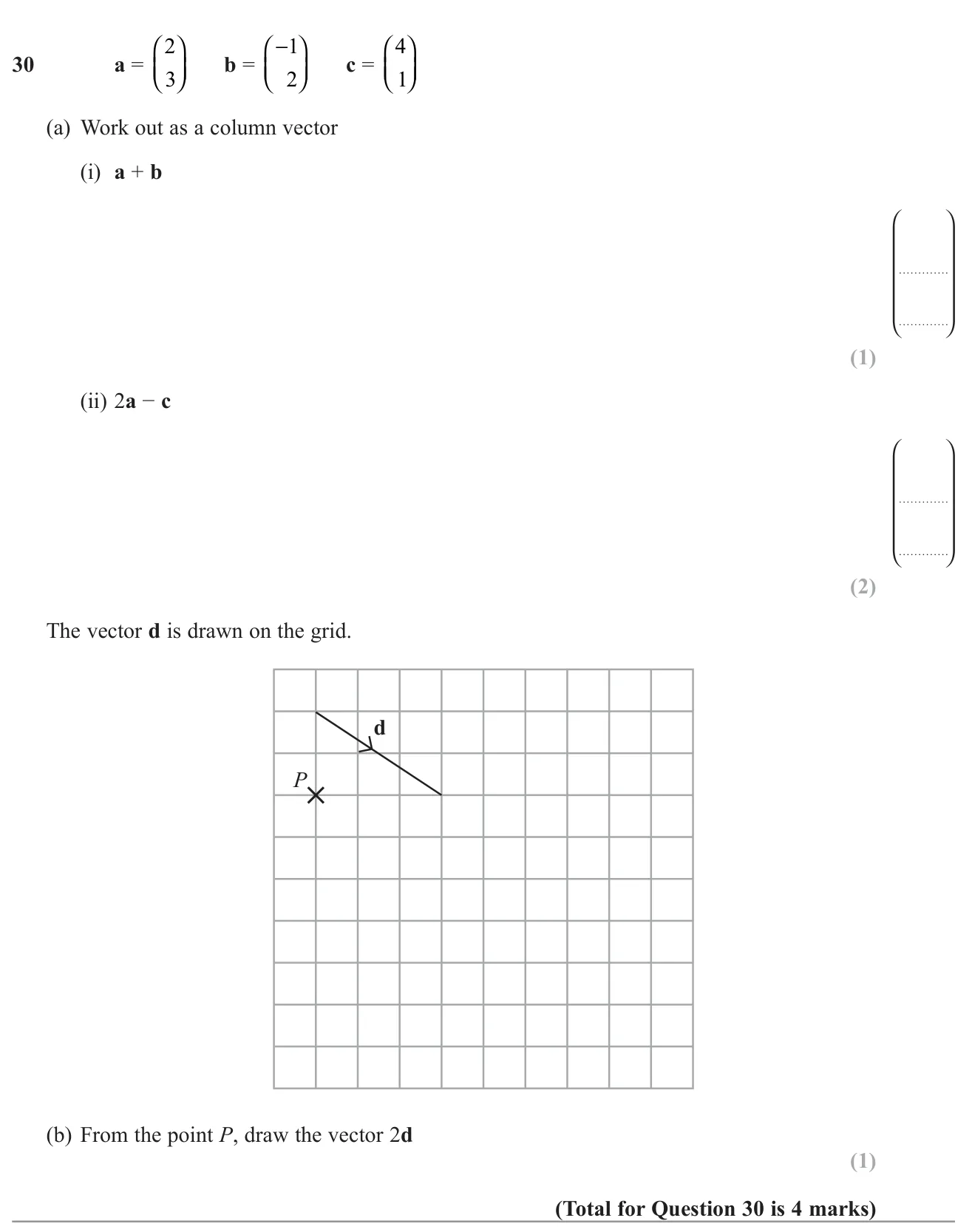
© Pearson Education Ltd. November 2022 Paper 3 (Foundation, calculator), question 30.
(a(i)) ( 1 5 ) \begin{pmatrix}1\\5\end{pmatrix} ( 1 5 ) 1 mark (a(ii)) ( 0 5 ) \begin{pmatrix}0\\5\end{pmatrix} ( 0 5 ) 2 marks (b) A line from P, 6 right and 4 down 1 mark
Worked solution Checked against the mark scheme
(a)(i) ( 2 3 ) + ( − 1 2 ) = ( 1 5 ) \begin{pmatrix}2\\3\end{pmatrix} + \begin{pmatrix}-1\\2\end{pmatrix} = \begin{pmatrix}1\\5\end{pmatrix} ( 2 3 ) + ( − 1 2 ) = ( 1 5 )
(ii) 2 a = ( 4 6 ) 2\mathbf{a} = \begin{pmatrix}4\\6\end{pmatrix} 2 a = ( 4 6 ) 2 a − c = ( 4 − 4 6 − 1 ) = ( 0 5 ) 2\mathbf{a} - \mathbf{c} = \begin{pmatrix}4-4\\6-1\end{pmatrix} = \begin{pmatrix}0\\5\end{pmatrix} 2 a − c = ( 4 − 4 6 − 1 ) = ( 0 5 )
(b) d \mathbf{d} d 2 d 2\mathbf{d} 2 d
Watch out: Forgetting to double both components of a in (ii).
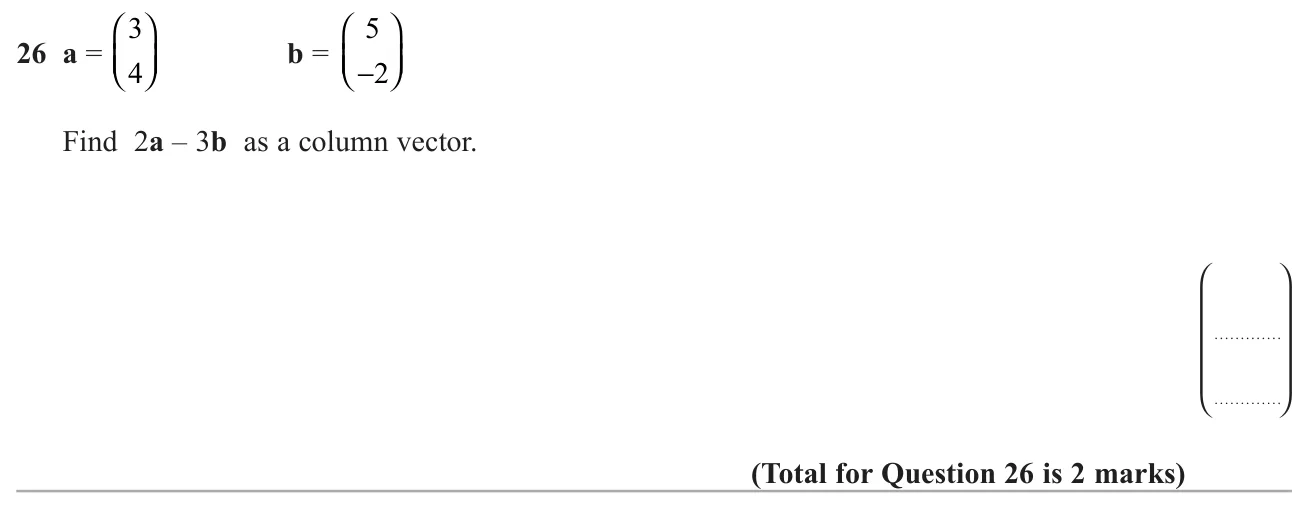
© Pearson Education Ltd. November 2020 Paper 2 (Foundation, calculator), question 26.
Answer ( − 9 14 ) \begin{pmatrix} -9 \\ 14 \end{pmatrix} ( − 9 14 ) 2 marks
Worked solution Checked against the mark scheme
2 a = ( 6 8 ) 2\mathbf{a} = \begin{pmatrix} 6 \\ 8 \end{pmatrix} 2 a = ( 6 8 ) 3 b = ( 15 − 6 ) 3\mathbf{b} = \begin{pmatrix} 15 \\ -6 \end{pmatrix} 3 b = ( 15 − 6 )
2 a − 3 b = ( 6 − 15 8 − ( − 6 ) ) = ( − 9 14 ) 2\mathbf{a} - 3\mathbf{b} = \begin{pmatrix} 6 - 15 \\ 8 - (-6) \end{pmatrix} = \begin{pmatrix} -9 \\ 14 \end{pmatrix} 2 a − 3 b = ( 6 − 15 8 − ( − 6 ) ) = ( − 9 14 )
Watch out: Getting 2 for the bottom entry by subtracting − 6 -6 − 6
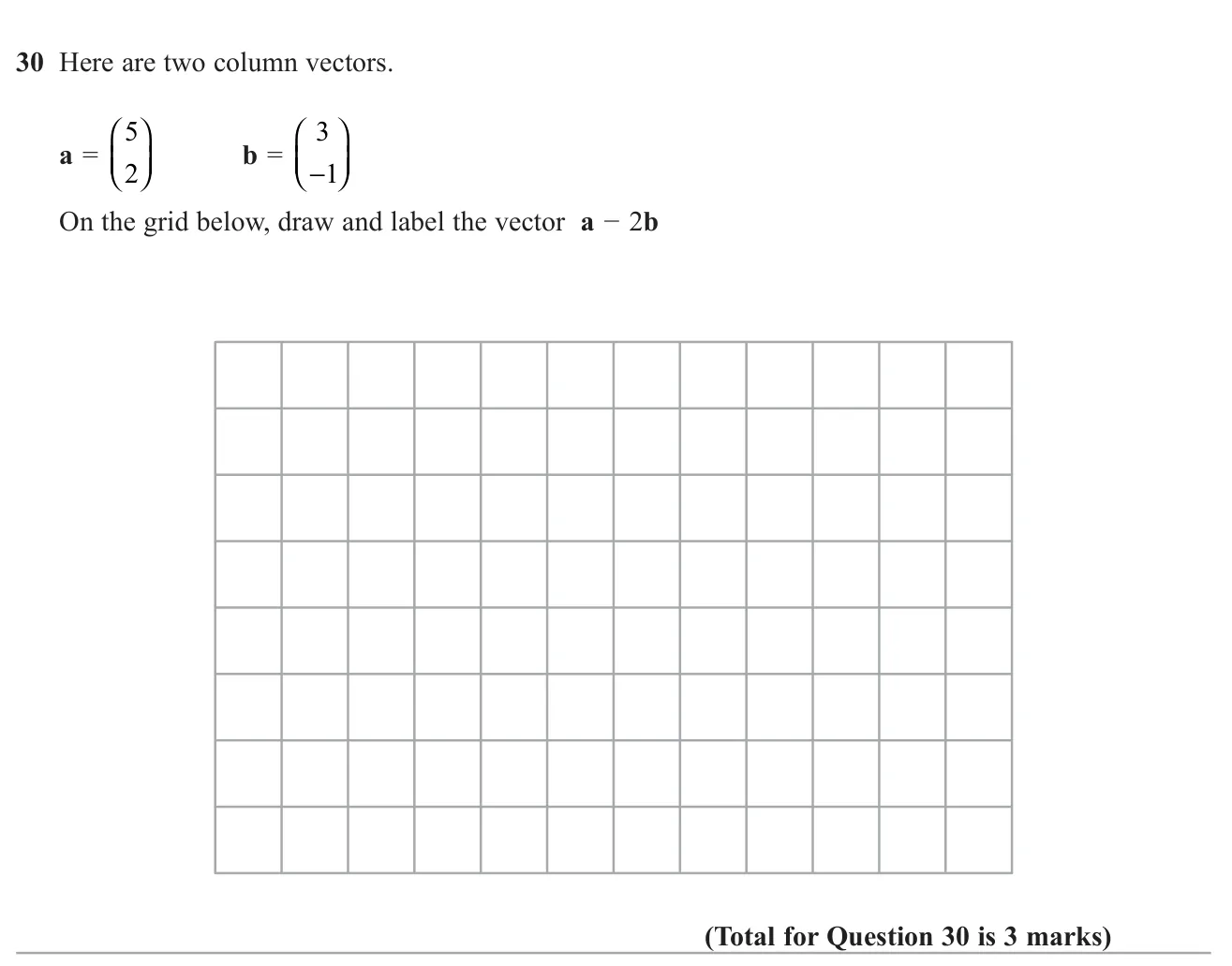
© Pearson Education Ltd. November 2019 Paper 2 (Foundation, calculator), question 30.
Answer ( − 1 4 ) \begin{pmatrix}-1\\4\end{pmatrix} ( − 1 4 ) 3 marks
Worked solution Checked against the mark scheme
2 b = ( 6 − 2 ) 2\mathbf{b} = \begin{pmatrix}6\\-2\end{pmatrix} 2 b = ( 6 − 2 )
a − 2 b = ( 5 − 6 2 − ( − 2 ) ) = ( − 1 4 ) \mathbf{a} - 2\mathbf{b} = \begin{pmatrix}5-6\\2-(-2)\end{pmatrix} = \begin{pmatrix}-1\\4\end{pmatrix} a − 2 b = ( 5 − 6 2 − ( − 2 ) ) = ( − 1 4 )
Draw an arrow going 1 square left and 4 squares up, and label it.
Watch out: Getting 2 − 2 = 0 2 - 2 = 0 2 − 2 = 0 b \mathbf{b} b
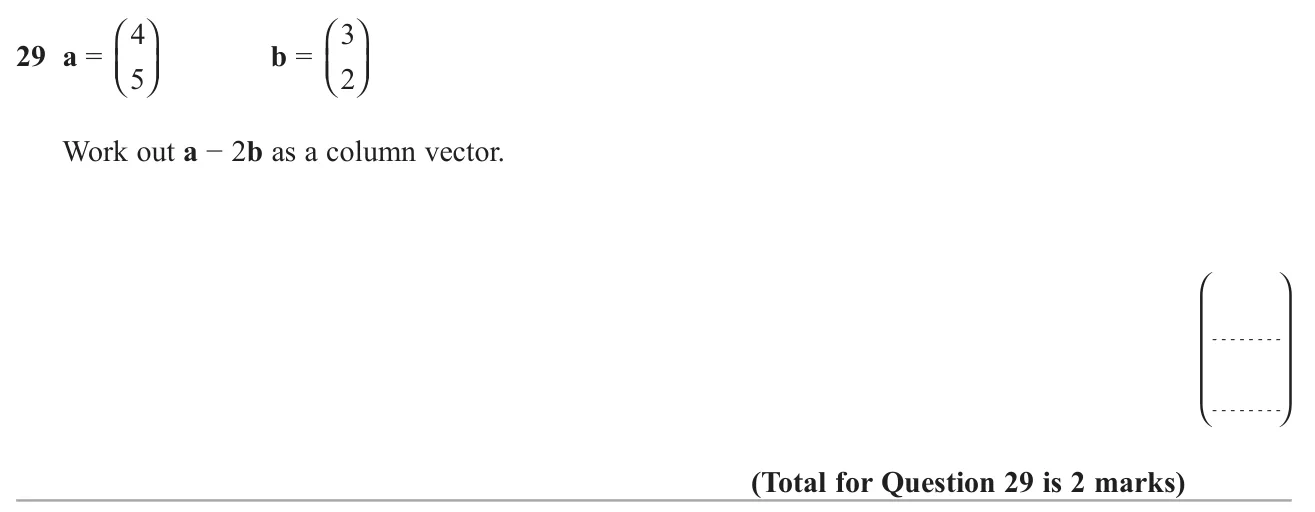
© Pearson Education Ltd. June 2019 Paper 2 (Foundation, calculator), question 29.
Answer ( − 2 1 ) \begin{pmatrix}-2\\1\end{pmatrix} ( − 2 1 ) 2 marks
Worked solution Checked against the mark scheme
2 b = ( 6 4 ) 2\mathbf{b} = \begin{pmatrix}6\\4\end{pmatrix} 2 b = ( 6 4 )
a − 2 b = ( 4 − 6 5 − 4 ) = ( − 2 1 ) \mathbf{a} - 2\mathbf{b} = \begin{pmatrix}4 - 6\\5 - 4\end{pmatrix} = \begin{pmatrix}-2\\1\end{pmatrix} a − 2 b = ( 4 − 6 5 − 4 ) = ( − 2 1 )
Watch out: Subtracting b \mathbf{b} b ( 1 3 ) \begin{pmatrix}1\\3\end{pmatrix} ( 1 3 )
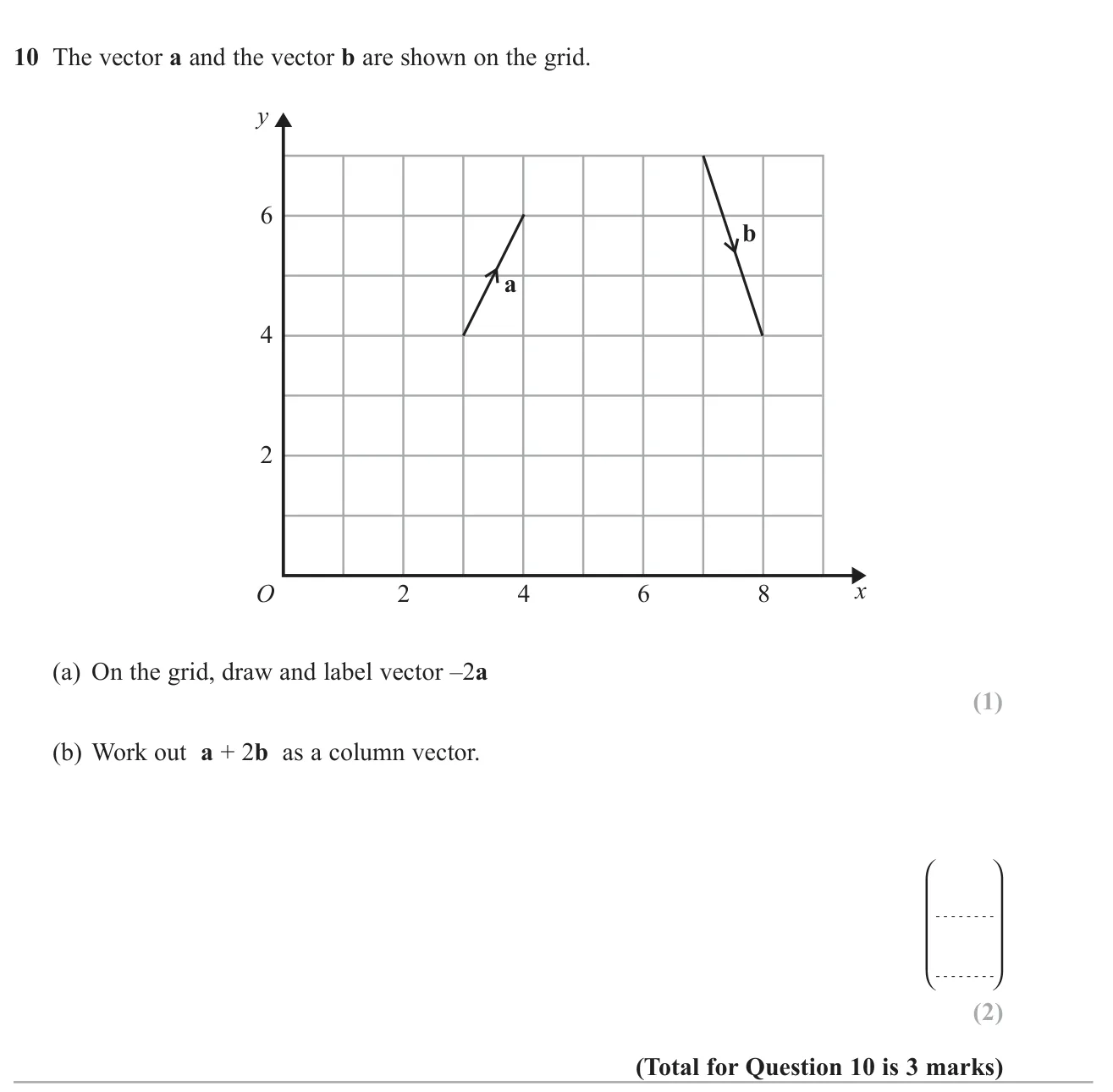
© Pearson Education Ltd. June 2018 Paper 2 (Higher, calculator), question 10.
(a) An arrow 2 left and 4 down, labelled − 2 a -2\mathbf{a} − 2 a 1 mark (b) ( 3 − 4 ) \begin{pmatrix} 3 \\ -4 \end{pmatrix} ( 3 − 4 ) 2 marks
Worked solution Checked against the mark scheme
From the grid, a = ( 1 2 ) \mathbf{a} = \begin{pmatrix} 1 \\ 2 \end{pmatrix} a = ( 1 2 ) b = ( 1 − 3 ) \mathbf{b} = \begin{pmatrix} 1 \\ -3 \end{pmatrix} b = ( 1 − 3 )
(a) − 2 a = ( − 2 − 4 ) -2\mathbf{a} = \begin{pmatrix} -2 \\ -4 \end{pmatrix} − 2 a = ( − 2 − 4 )
(b) a + 2 b = ( 1 + 2 2 − 6 ) = ( 3 − 4 ) \mathbf{a} + 2\mathbf{b} = \begin{pmatrix} 1 + 2 \\ 2 - 6 \end{pmatrix} = \begin{pmatrix} 3 \\ -4 \end{pmatrix} a + 2 b = ( 1 + 2 2 − 6 ) = ( 3 − 4 )
Watch out: Reading b as going up rather than down, so its y-component is +3.
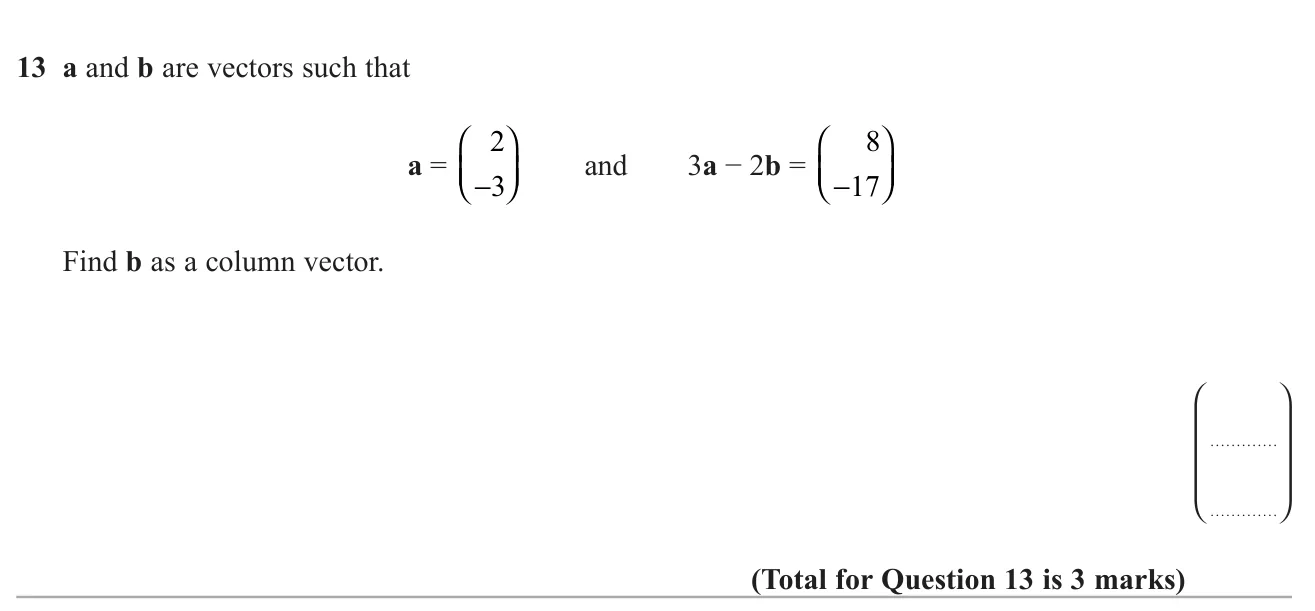
© Pearson Education Ltd. June 2022 Paper 3 (Higher, calculator), question 13.
Answer ( − 1 4 ) \begin{pmatrix}-1\\4\end{pmatrix} ( − 1 4 ) 3 marks
Worked solution Checked against the mark scheme
3 a = ( 6 − 9 ) 3\mathbf{a} = \begin{pmatrix}6\\-9\end{pmatrix} 3 a = ( 6 − 9 )
2 b = 3 a − ( 8 − 17 ) = ( − 2 8 ) 2\mathbf{b} = 3\mathbf{a} - \begin{pmatrix}8\\-17\end{pmatrix} = \begin{pmatrix}-2\\8\end{pmatrix} 2 b = 3 a − ( 8 − 17 ) = ( − 2 8 )
b = ( − 1 4 ) \mathbf{b} = \begin{pmatrix}-1\\4\end{pmatrix} b = ( − 1 4 )
Watch out: Sign error when rearranging, giving (1, −4).
© Pearson Education Ltd. June 2023 Paper 2 (Higher, calculator), question 20.
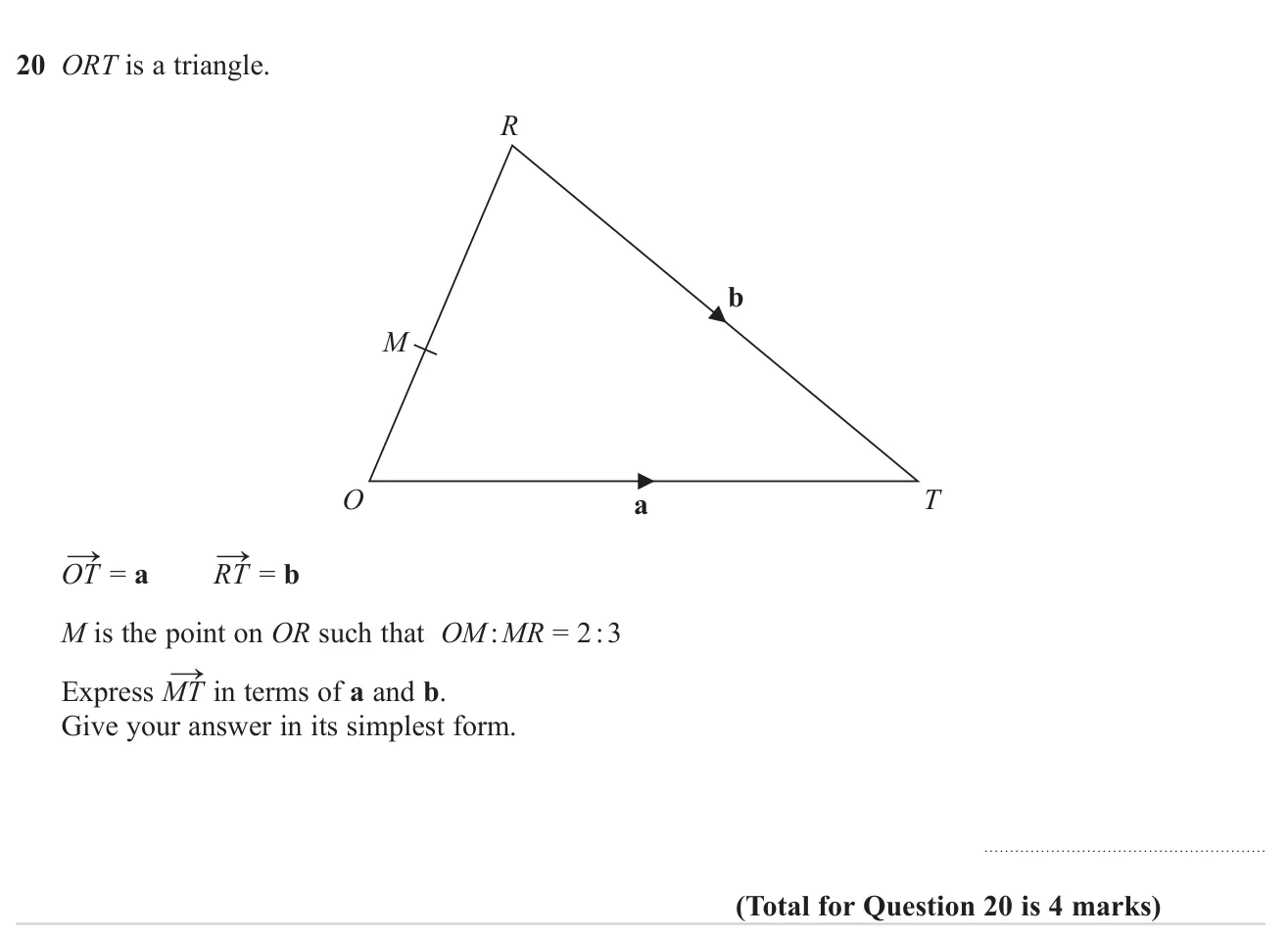
Answer 3 5 a + 2 5 b \frac{3}{5}\mathbf{a} + \frac{2}{5}\mathbf{b} 5 3 a + 5 2 b 4 marks
Worked solution Checked against the mark scheme
O R ⃗ = O T ⃗ + T R ⃗ = a − b \vec{OR} = \vec{OT} + \vec{TR} = \mathbf{a} - \mathbf{b} O R = O T + T R = a − b
O M ⃗ = 2 5 ( a − b ) \vec{OM} = \frac{2}{5}(\mathbf{a} - \mathbf{b}) O M = 5 2 ( a − b )
M T ⃗ = − O M ⃗ + O T ⃗ = − 2 5 a + 2 5 b + a = 3 5 a + 2 5 b \vec{MT} = -\vec{OM} + \vec{OT} = -\frac{2}{5}\mathbf{a} + \frac{2}{5}\mathbf{b} + \mathbf{a} = \frac{3}{5}\mathbf{a} + \frac{2}{5}\mathbf{b} M T = − O M + O T = − 5 2 a + 5 2 b + a = 5 3 a + 5 2 b
Watch out: Taking T R ⃗ \vec{TR} T R b \mathbf{b} b R T ⃗ = b \vec{RT} = \mathbf{b} R T = b
© Pearson Education Ltd. June 2022 Paper 1 (Higher, non-calculator), question 15.
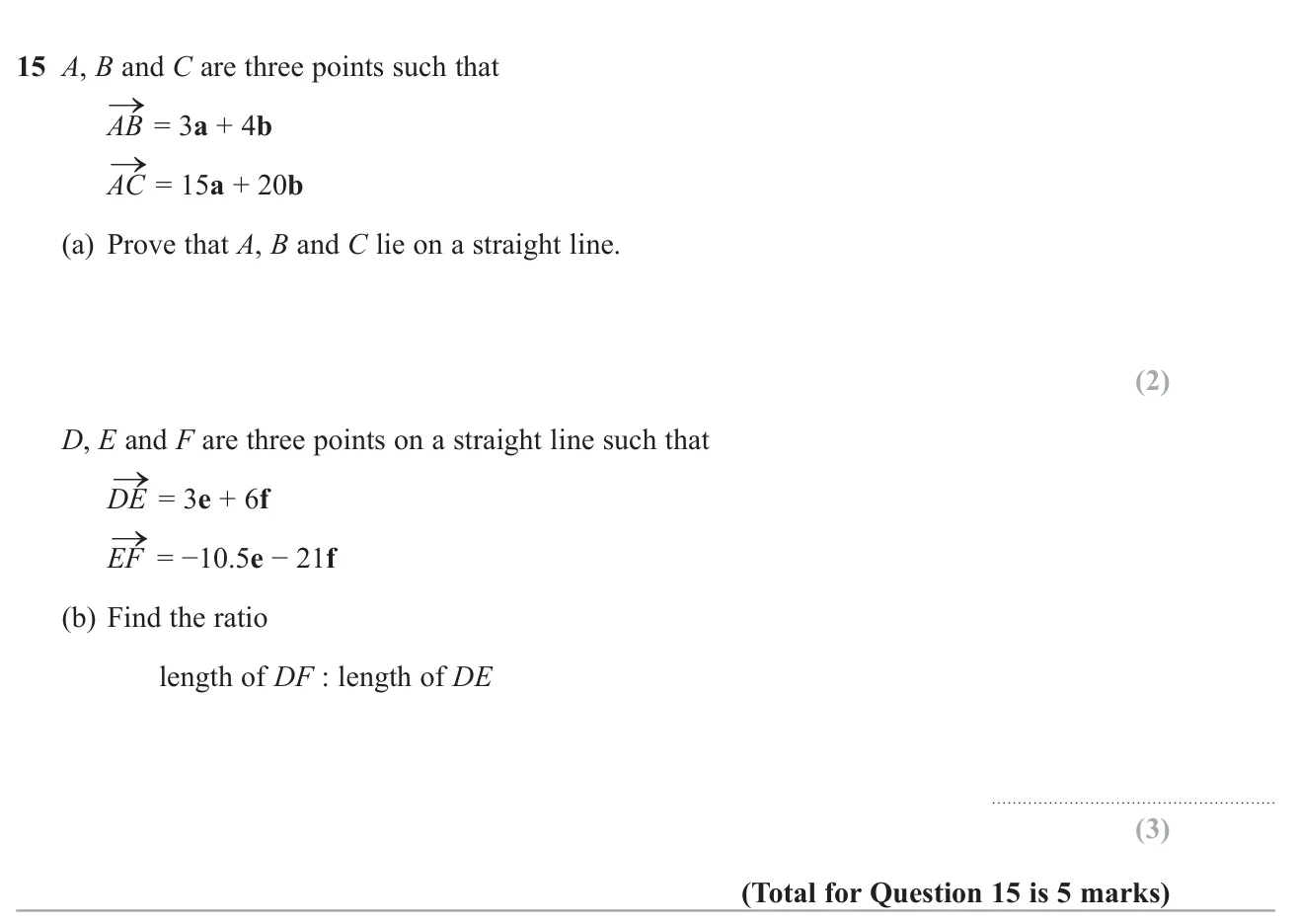
(a) A C → = 5 A B → \overrightarrow{AC} = 5\overrightarrow{AB} A C = 5 A B 2 marks (b) 5 : 2 5 : 2 5 : 2 3 marks
Worked solution Checked against the mark scheme
(a) A C → = 15 a + 20 b = 5 ( 3 a + 4 b ) = 5 A B → \overrightarrow{AC} = 15\mathbf{a} + 20\mathbf{b} = 5(3\mathbf{a} + 4\mathbf{b}) = 5\overrightarrow{AB} A C = 15 a + 20 b = 5 ( 3 a + 4 b ) = 5 A B
So AC is parallel to AB, and both pass through A, so A, B, C are on one line.
(b) D F → = ( 3 e + 6 f ) + ( − 10.5 e − 21 f ) = − 7.5 e − 15 f = − 2.5 D E → \overrightarrow{DF} = (3\mathbf{e} + 6\mathbf{f}) + (-10.5\mathbf{e} - 21\mathbf{f}) = -7.5\mathbf{e} - 15\mathbf{f} = -2.5\overrightarrow{DE} D F = ( 3 e + 6 f ) + ( − 10.5 e − 21 f ) = − 7.5 e − 15 f = − 2.5 D E
Length DF : length DE = 2.5 : 1 = 5 : 2 = 2.5 : 1 = 5 : 2 = 2.5 : 1 = 5 : 2
Watch out: In (a), showing the vectors are parallel but not mentioning the common point.
© Pearson Education Ltd. November 2024 Paper 1 (Higher, non-calculator), question 15.
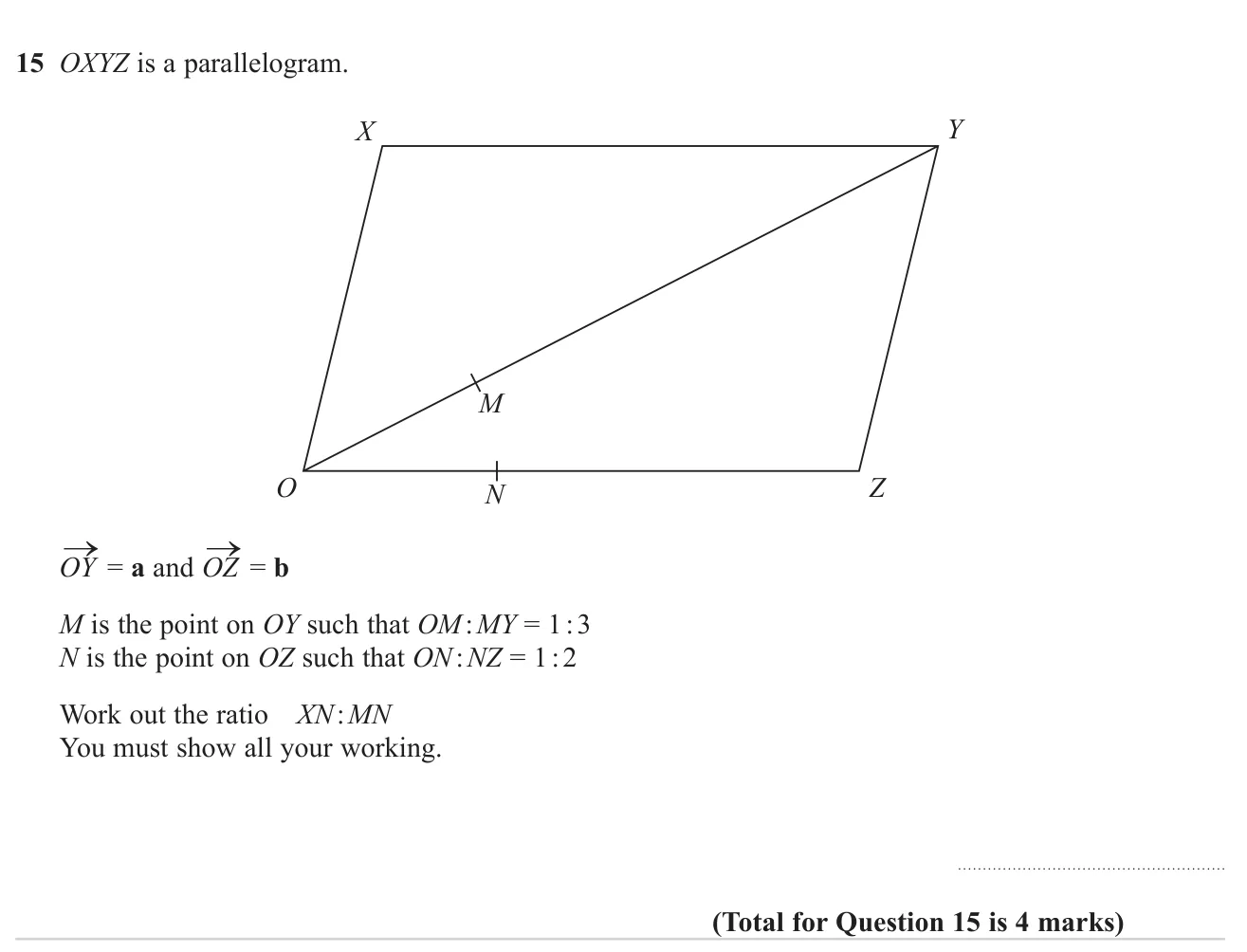
Worked solution Checked against the mark scheme
O M → = 1 4 a \overrightarrow{OM} = \frac{1}{4}\mathbf{a} O M = 4 1 a O N → = 1 3 b \overrightarrow{ON} = \frac{1}{3}\mathbf{b} O N = 3 1 b O X → = Z Y → = a − b \overrightarrow{OX} = \overrightarrow{ZY} = \mathbf{a} - \mathbf{b} O X = Z Y = a − b
X N → = − ( a − b ) + 1 3 b = 4 3 b − a = 1 3 ( 4 b − 3 a ) \overrightarrow{XN} = -(\mathbf{a} - \mathbf{b}) + \frac{1}{3}\mathbf{b} = \frac{4}{3}\mathbf{b} - \mathbf{a} = \frac{1}{3}(4\mathbf{b} - 3\mathbf{a}) X N = − ( a − b ) + 3 1 b = 3 4 b − a = 3 1 ( 4 b − 3 a )
M N → = − 1 4 a + 1 3 b = 1 12 ( 4 b − 3 a ) \overrightarrow{MN} = -\frac{1}{4}\mathbf{a} + \frac{1}{3}\mathbf{b} = \frac{1}{12}(4\mathbf{b} - 3\mathbf{a}) M N = − 4 1 a + 3 1 b = 12 1 ( 4 b − 3 a )
X N : M N = 1 3 : 1 12 = 4 : 1 XN : MN = \frac{1}{3} : \frac{1}{12} = 4 : 1 X N : M N = 3 1 : 12 1 = 4 : 1
Watch out: Taking OX as b − a (wrong direction).
© Pearson Education Ltd. June 2023 Paper 3 (Higher, calculator), question 22.
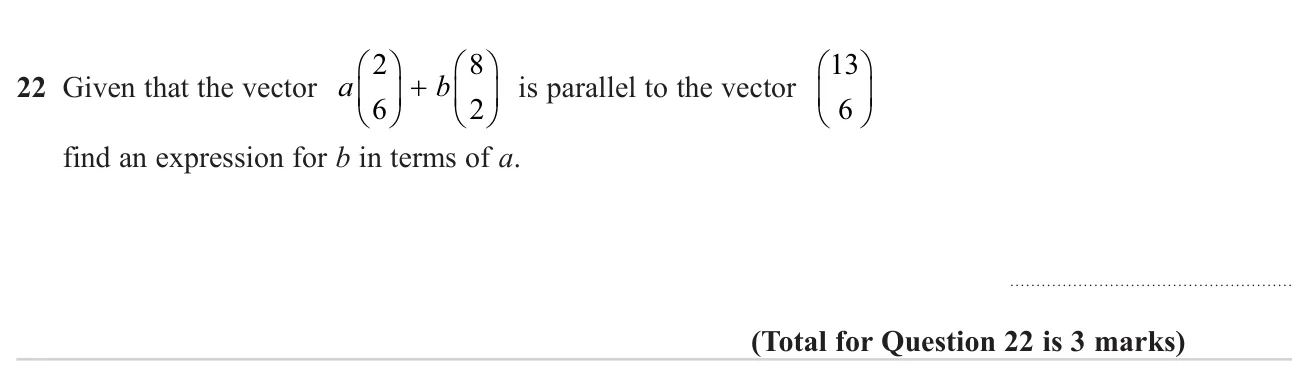
Answer b = 3 a b = 3a b = 3 a 3 marks
Worked solution Checked against the mark scheme
Parallel means a ( 2 6 ) + b ( 8 2 ) = k ( 13 6 ) a\begin{pmatrix}2\\6\end{pmatrix} + b\begin{pmatrix}8\\2\end{pmatrix} = k\begin{pmatrix}13\\6\end{pmatrix} a ( 2 6 ) + b ( 8 2 ) = k ( 13 6 )
2 a + 8 b = 13 k 2a + 8b = 13k 2 a + 8 b = 13 k 6 a + 2 b = 6 k 6a + 2b = 6k 6 a + 2 b = 6 k k = a + b 3 k = a + \frac{b}{3} k = a + 3 b
2 a + 8 b = 13 a + 13 b 3 2a + 8b = 13a + \frac{13b}{3} 2 a + 8 b = 13 a + 3 13 b
11 b 3 = 11 a \frac{11b}{3} = 11a 3 11 b = 11 a b = 3 a b = 3a b = 3 a
Watch out: Setting the combined vector equal to ( 13 6 ) \begin{pmatrix}13\\6\end{pmatrix} ( 13 6 )
© Pearson Education Ltd. November 2022 Paper 3 (Higher, calculator), question 24.
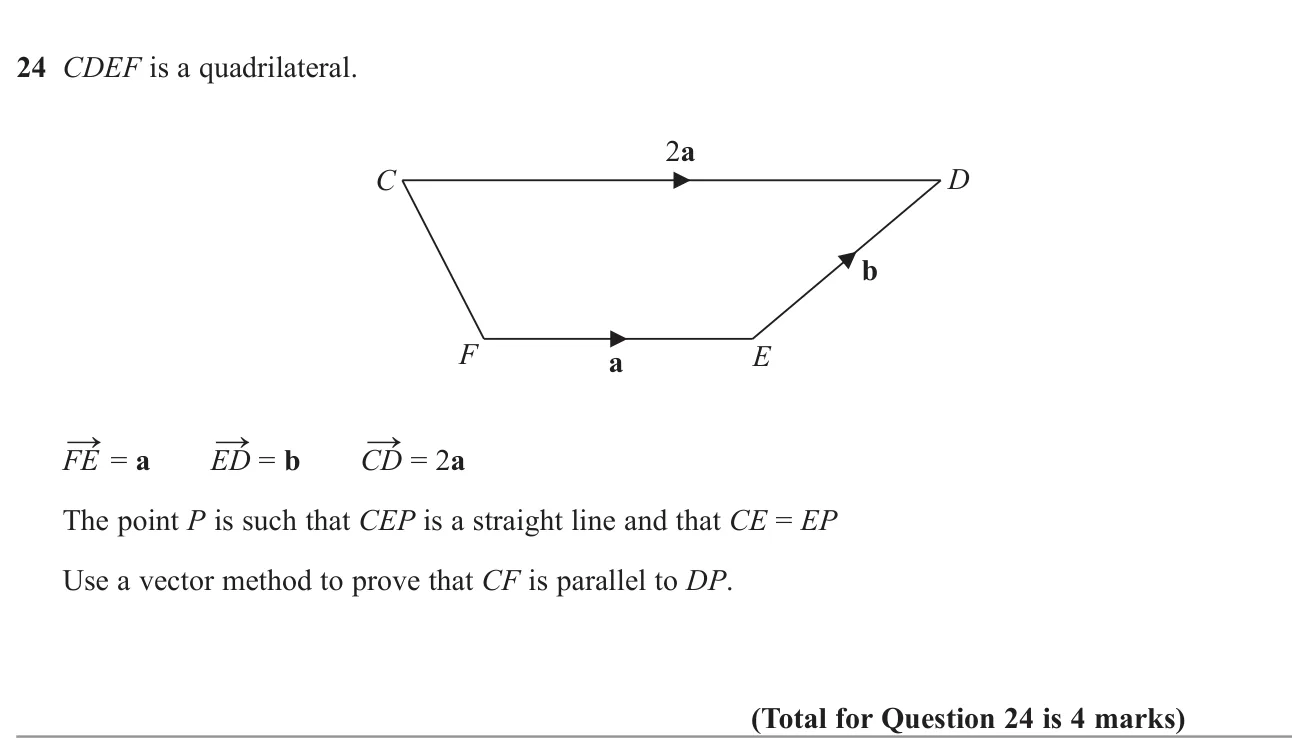
Answer C F → = a − b \overrightarrow{CF} = \mathbf{a} - \mathbf{b} C F = a − b D P → = 2 a − 2 b = 2 ( a − b ) \overrightarrow{DP} = 2\mathbf{a} - 2\mathbf{b} = 2(\mathbf{a} - \mathbf{b}) D P = 2 a − 2 b = 2 ( a − b ) 4 marks
Worked solution Checked against the mark scheme
C E → = C D → + D E → = 2 a − b \overrightarrow{CE} = \overrightarrow{CD} + \overrightarrow{DE} = 2\mathbf{a} - \mathbf{b} C E = C D + D E = 2 a − b E P → = 2 a − b \overrightarrow{EP} = 2\mathbf{a} - \mathbf{b} E P = 2 a − b
C F → = C E → + E F → = 2 a − b − a = a − b \overrightarrow{CF} = \overrightarrow{CE} + \overrightarrow{EF} = 2\mathbf{a} - \mathbf{b} - \mathbf{a} = \mathbf{a} - \mathbf{b} C F = C E + E F = 2 a − b − a = a − b
D P → = D E → + E P → = − b + 2 a − b = 2 a − 2 b \overrightarrow{DP} = \overrightarrow{DE} + \overrightarrow{EP} = -\mathbf{b} + 2\mathbf{a} - \mathbf{b} = 2\mathbf{a} - 2\mathbf{b} D P = D E + E P = − b + 2 a − b = 2 a − 2 b
D P → = 2 ( a − b ) = 2 C F → \overrightarrow{DP} = 2(\mathbf{a} - \mathbf{b}) = 2\overrightarrow{CF} D P = 2 ( a − b ) = 2 C F
Watch out: Getting the sign wrong on D E → \overrightarrow{DE} D E − b -\mathbf{b} − b
© Pearson Education Ltd. November 2021 Paper 3 (Higher, calculator), question 18.
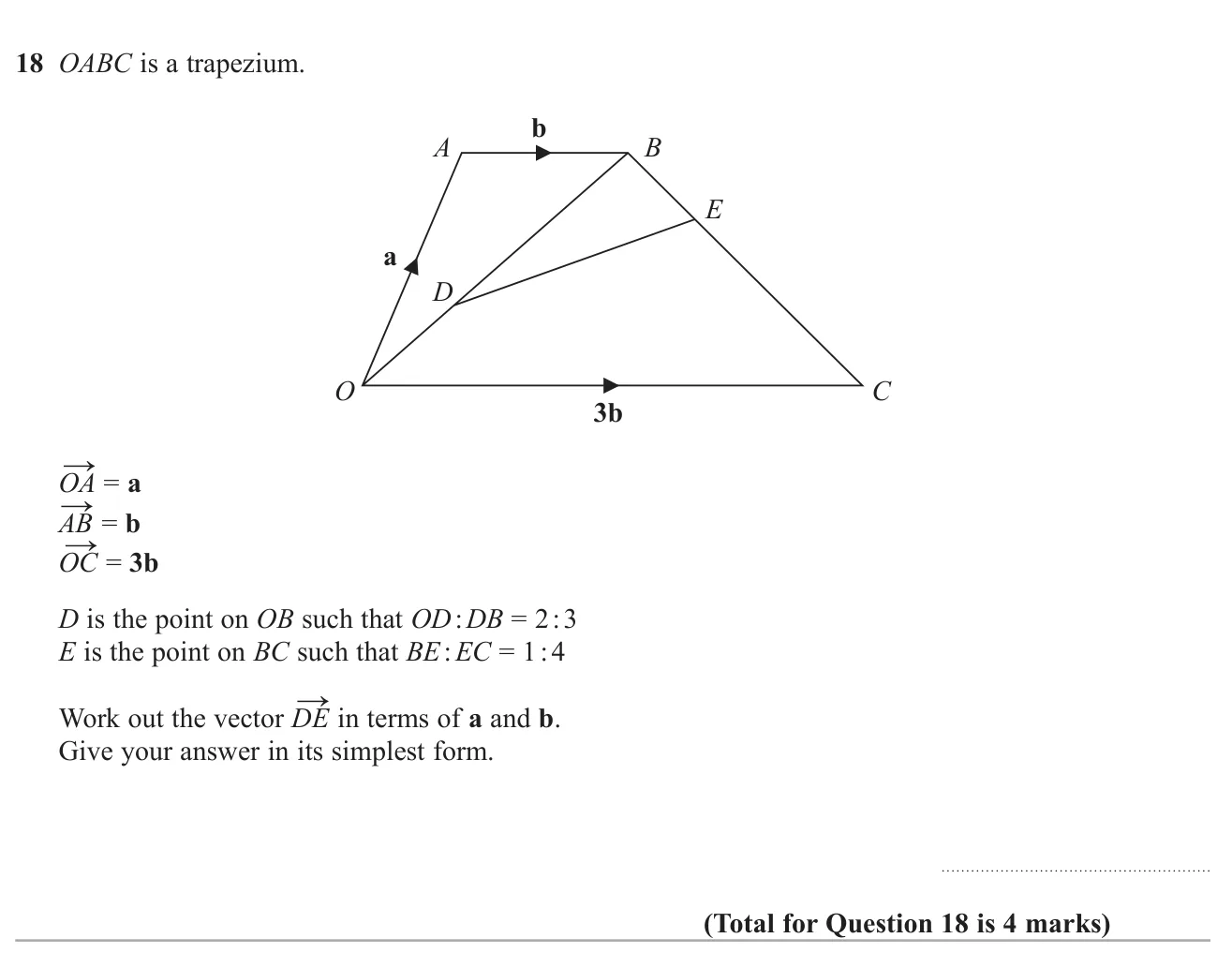
Answer 2 5 a + b \frac{2}{5}\mathbf{a} + \mathbf{b} 5 2 a + b 4 marks
Worked solution Checked against the mark scheme
O B ⃗ = a + b \vec{OB} = \mathbf{a} + \mathbf{b} O B = a + b D B ⃗ = 3 5 ( a + b ) \vec{DB} = \frac{3}{5}(\mathbf{a} + \mathbf{b}) D B = 5 3 ( a + b )
B C ⃗ = − b − a + 3 b = 2 b − a \vec{BC} = -\mathbf{b} - \mathbf{a} + 3\mathbf{b} = 2\mathbf{b} - \mathbf{a} B C = − b − a + 3 b = 2 b − a B E ⃗ = 1 5 ( 2 b − a ) \vec{BE} = \frac{1}{5}(2\mathbf{b} - \mathbf{a}) B E = 5 1 ( 2 b − a )
D E ⃗ = 3 5 a + 3 5 b + 2 5 b − 1 5 a = 2 5 a + b \vec{DE} = \frac{3}{5}\mathbf{a} + \frac{3}{5}\mathbf{b} + \frac{2}{5}\mathbf{b} - \frac{1}{5}\mathbf{a} = \frac{2}{5}\mathbf{a} + \mathbf{b} D E = 5 3 a + 5 3 b + 5 2 b − 5 1 a = 5 2 a + b
Watch out: Using 2 3 \frac{2}{3} 3 2 3 5 \frac{3}{5} 5 3
© Pearson Education Ltd. November 2020 Paper 1 (Higher, non-calculator), question 21.
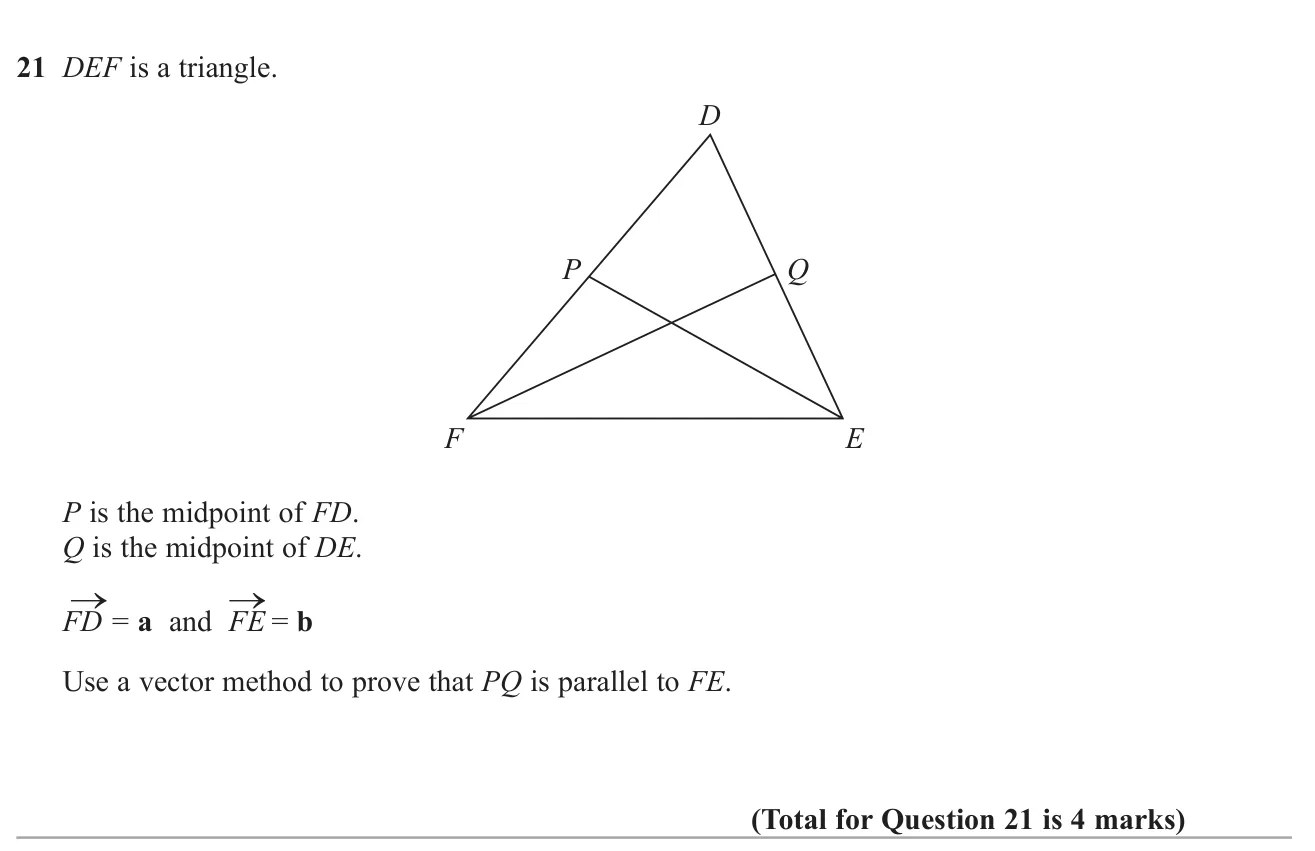
Answer P Q → = 1 2 b \overrightarrow{PQ} = \frac{1}{2}\mathbf{b} P Q = 2 1 b F E → = b \overrightarrow{FE} = \mathbf{b} F E = b 4 marks
Worked solution Checked against the mark scheme
D E → = − a + b \overrightarrow{DE} = -\mathbf{a} + \mathbf{b} D E = − a + b D Q → = 1 2 ( b − a ) \overrightarrow{DQ} = \frac{1}{2}(\mathbf{b} - \mathbf{a}) D Q = 2 1 ( b − a )
P D → = 1 2 a \overrightarrow{PD} = \frac{1}{2}\mathbf{a} P D = 2 1 a
P Q → = 1 2 a + 1 2 ( b − a ) = 1 2 b \overrightarrow{PQ} = \frac{1}{2}\mathbf{a} + \frac{1}{2}(\mathbf{b} - \mathbf{a}) = \frac{1}{2}\mathbf{b} P Q = 2 1 a + 2 1 ( b − a ) = 2 1 b
F E → = b = 2 P Q → \overrightarrow{FE} = \mathbf{b} = 2\overrightarrow{PQ} F E = b = 2 P Q
Watch out: Finding PQ = ½b but not stating that it is a multiple of FE.
© Pearson Education Ltd. June 2024 Paper 2 (Higher, calculator), question 19.
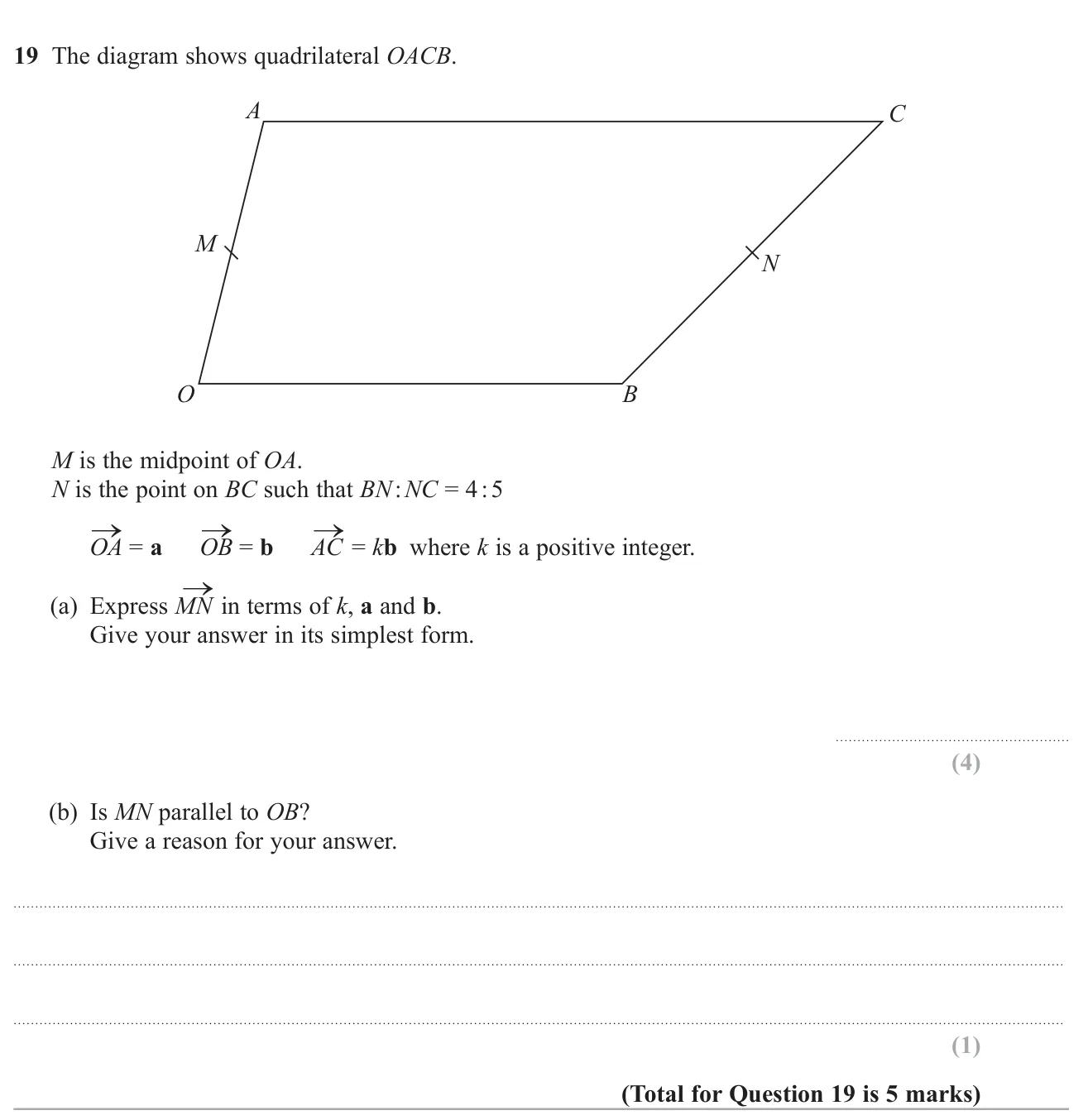
(a) M N → = 1 18 ( 8 k b + 10 b − a ) \overrightarrow{MN} = \dfrac{1}{18}\left(8k\mathbf b + 10\mathbf b - \mathbf a\right) M N = 18 1 ( 8 k b + 10 b − a ) 4 marks (b) No, because M N → \overrightarrow{MN} M N a \mathbf a a b \mathbf b b 1 mark
Worked solution Checked against the mark scheme
(a) B C → = − b + a + k b \overrightarrow{BC} = -\mathbf b + \mathbf a + k\mathbf b B C = − b + a + k b C N → = 5 9 C B → = 5 9 ( b − a − k b ) \overrightarrow{CN} = \frac59\overrightarrow{CB} = \frac59(\mathbf b - \mathbf a - k\mathbf b) C N = 9 5 C B = 9 5 ( b − a − k b )
M N → = 1 2 a + k b + 5 9 ( b − a − k b ) = − 1 18 a + 4 k + 5 9 b = 1 18 ( 8 k b + 10 b − a ) \overrightarrow{MN} = \frac12\mathbf a + k\mathbf b + \frac59(\mathbf b - \mathbf a - k\mathbf b) = -\frac1{18}\mathbf a + \frac{4k+5}{9}\mathbf b = \frac1{18}(8k\mathbf b + 10\mathbf b - \mathbf a) M N = 2 1 a + k b + 9 5 ( b − a − k b ) = − 18 1 a + 9 4 k + 5 b = 18 1 ( 8 k b + 10 b − a )
(b) No: M N → \overrightarrow{MN} M N − 1 18 a -\frac1{18}\mathbf a − 18 1 a b = O B → \mathbf b = \overrightarrow{OB} b = O B
Watch out: Using 4 9 \frac49 9 4 C B → \overrightarrow{CB} C B C N → \overrightarrow{CN} C N
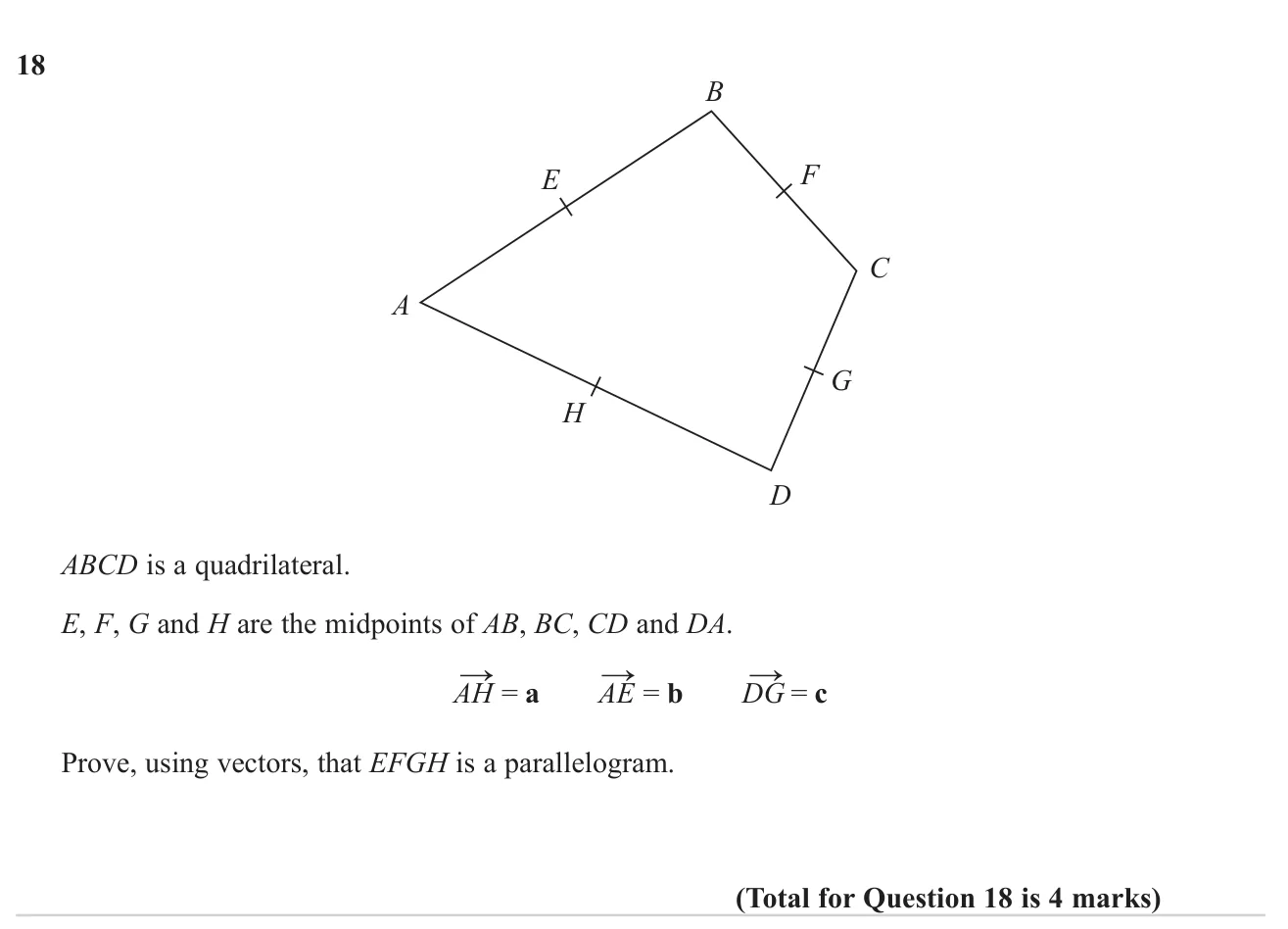
© Pearson Education Ltd. November 2023 Paper 2 (Higher, calculator), question 18.
Answer Proof: E H → = F G → = a − b \overrightarrow{EH} = \overrightarrow{FG} = \mathbf{a} - \mathbf{b} E H = F G = a − b 4 marks
Worked solution Checked against the mark scheme
E H → = − b + a \overrightarrow{EH} = -\mathbf{b} + \mathbf{a} E H = − b + a
B C → = B A → + A D → + D C → = − 2 b + 2 a + 2 c \overrightarrow{BC} = \overrightarrow{BA} + \overrightarrow{AD} + \overrightarrow{DC} = -2\mathbf{b} + 2\mathbf{a} + 2\mathbf{c} B C = B A + A D + D C = − 2 b + 2 a + 2 c
F G → = 1 2 B C → + C G → = ( − b + a + c ) − c = a − b \overrightarrow{FG} = \frac{1}{2}\overrightarrow{BC} + \overrightarrow{CG} = (-\mathbf{b} + \mathbf{a} + \mathbf{c}) - \mathbf{c} = \mathbf{a} - \mathbf{b} F G = 2 1 B C + C G = ( − b + a + c ) − c = a − b
E H → = F G → \overrightarrow{EH} = \overrightarrow{FG} E H = F G
Watch out: Forgetting that the full side vectors are twice a, b and c.
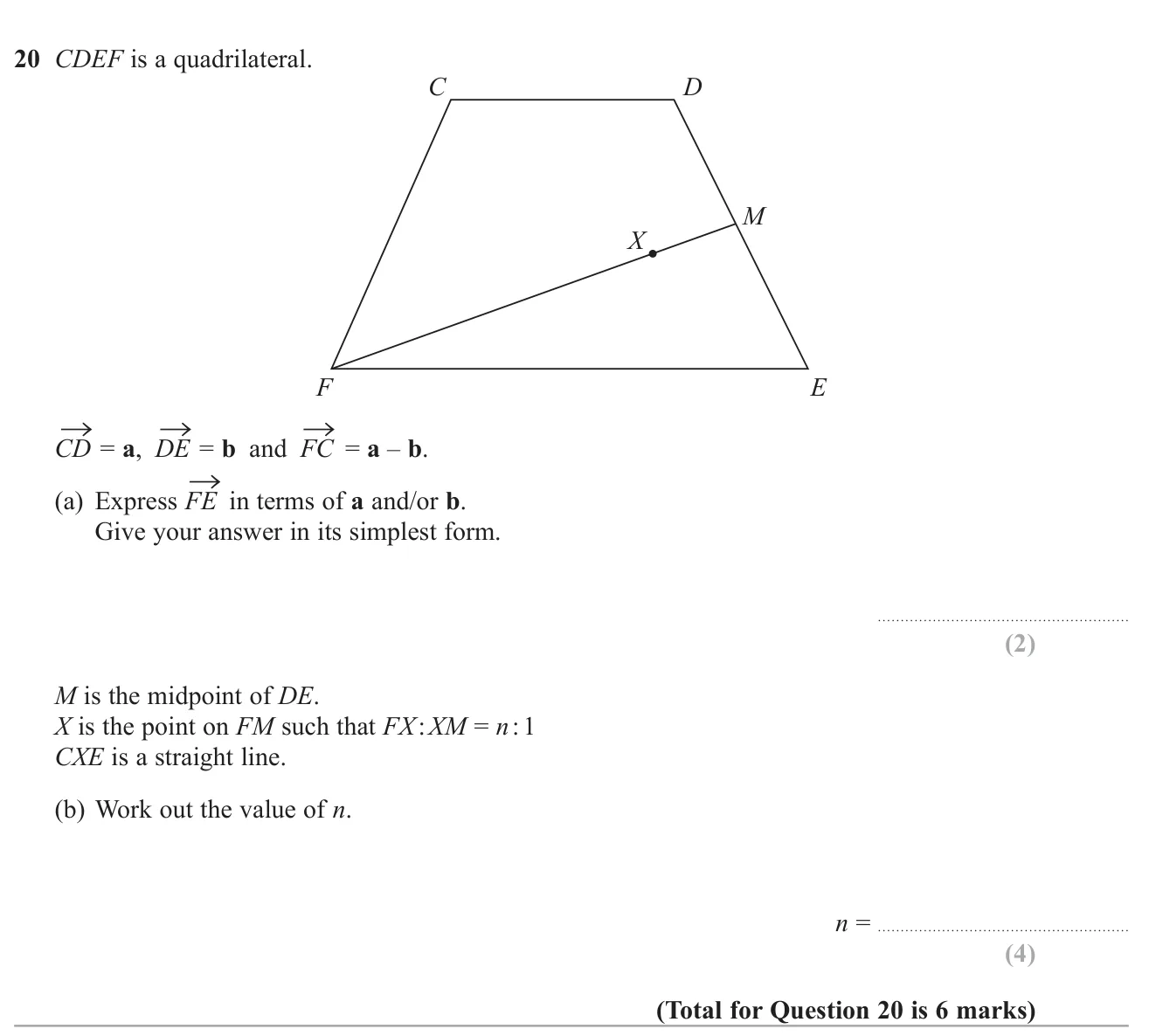
© Pearson Education Ltd. June 2019 Paper 2 (Higher, calculator), question 20.
(a) 2 a 2\mathbf{a} 2 a 2 marks (b) n = 4 n = 4 n = 4 4 marks
Worked solution Checked against the mark scheme
(a) F E ⃗ = F C ⃗ + C D ⃗ + D E ⃗ = a − b + a + b = 2 a \vec{FE} = \vec{FC} + \vec{CD} + \vec{DE} = \mathbf{a} - \mathbf{b} + \mathbf{a} + \mathbf{b} = 2\mathbf{a} F E = F C + C D + D E = a − b + a + b = 2 a
(b) F M ⃗ = 2 a − 1 2 b \vec{FM} = 2\mathbf{a} - \frac{1}{2}\mathbf{b} F M = 2 a − 2 1 b F X ⃗ = n n + 1 ( 2 a − 1 2 b ) \vec{FX} = \frac{n}{n+1}(2\mathbf{a} - \frac{1}{2}\mathbf{b}) F X = n + 1 n ( 2 a − 2 1 b )
Also F X ⃗ = F C ⃗ + k C E ⃗ = a − b + k ( a + b ) \vec{FX} = \vec{FC} + k\vec{CE} = \mathbf{a} - \mathbf{b} + k(\mathbf{a} + \mathbf{b}) F X = F C + k C E = a − b + k ( a + b )
Compare coefficients: 1 + k = 2 n n + 1 1 + k = \frac{2n}{n+1} 1 + k = n + 1 2 n 1 − k = n 2 ( n + 1 ) 1 - k = \frac{n}{2(n+1)} 1 − k = 2 ( n + 1 ) n
Add them: 2 = 5 n 2 ( n + 1 ) 2 = \frac{5n}{2(n+1)} 2 = 2 ( n + 1 ) 5 n 4 n + 4 = 5 n 4n + 4 = 5n 4 n + 4 = 5 n n = 4 n = 4 n = 4
Watch out: Taking M to be the midpoint of FE instead of DE.
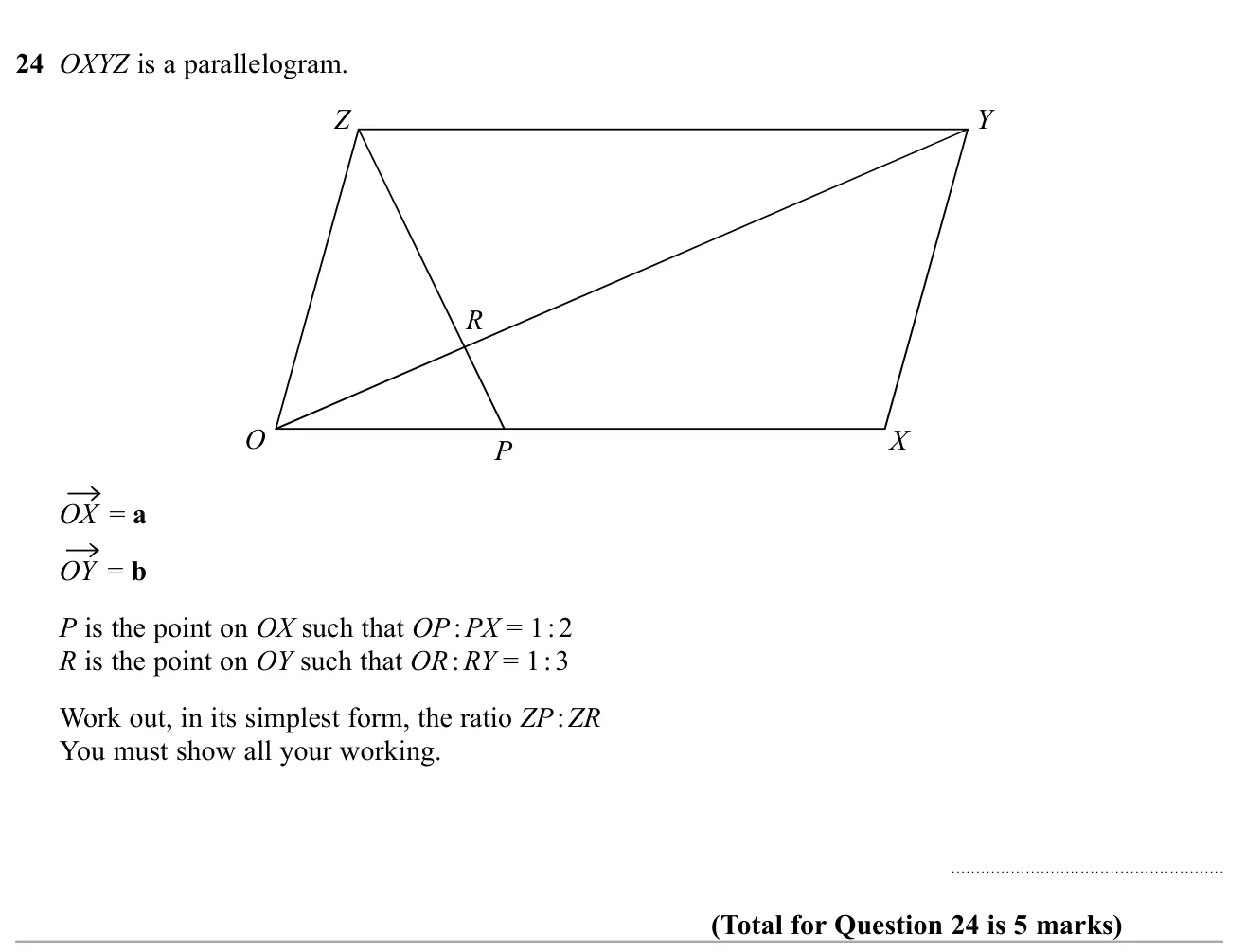
© Pearson Education Ltd. November 2019 Paper 3 (Higher, calculator), question 24.
Worked solution Checked against the mark scheme
O Z → = X Y → = b − a \overrightarrow{OZ} = \overrightarrow{XY} = \mathbf{b} - \mathbf{a} O Z = X Y = b − a
Z P → = 1 3 a − ( b − a ) = 4 3 a − b = 4 3 ( a − 3 4 b ) \overrightarrow{ZP} = \frac{1}{3}\mathbf{a} - (\mathbf{b} - \mathbf{a}) = \frac{4}{3}\mathbf{a} - \mathbf{b} = \frac{4}{3}(\mathbf{a} - \frac{3}{4}\mathbf{b}) Z P = 3 1 a − ( b − a ) = 3 4 a − b = 3 4 ( a − 4 3 b )
Z R → = 1 4 b − ( b − a ) = a − 3 4 b \overrightarrow{ZR} = \frac{1}{4}\mathbf{b} - (\mathbf{b} - \mathbf{a}) = \mathbf{a} - \frac{3}{4}\mathbf{b} Z R = 4 1 b − ( b − a ) = a − 4 3 b
So Z P = 4 3 Z R ZP = \frac{4}{3}ZR Z P = 3 4 Z R Z P : Z R = 4 : 3 ZP : ZR = 4 : 3 Z P : Z R = 4 : 3
Watch out: Taking O Z → = b \overrightarrow{OZ} = \mathbf{b} O Z = b b − a \mathbf{b} - \mathbf{a} b − a
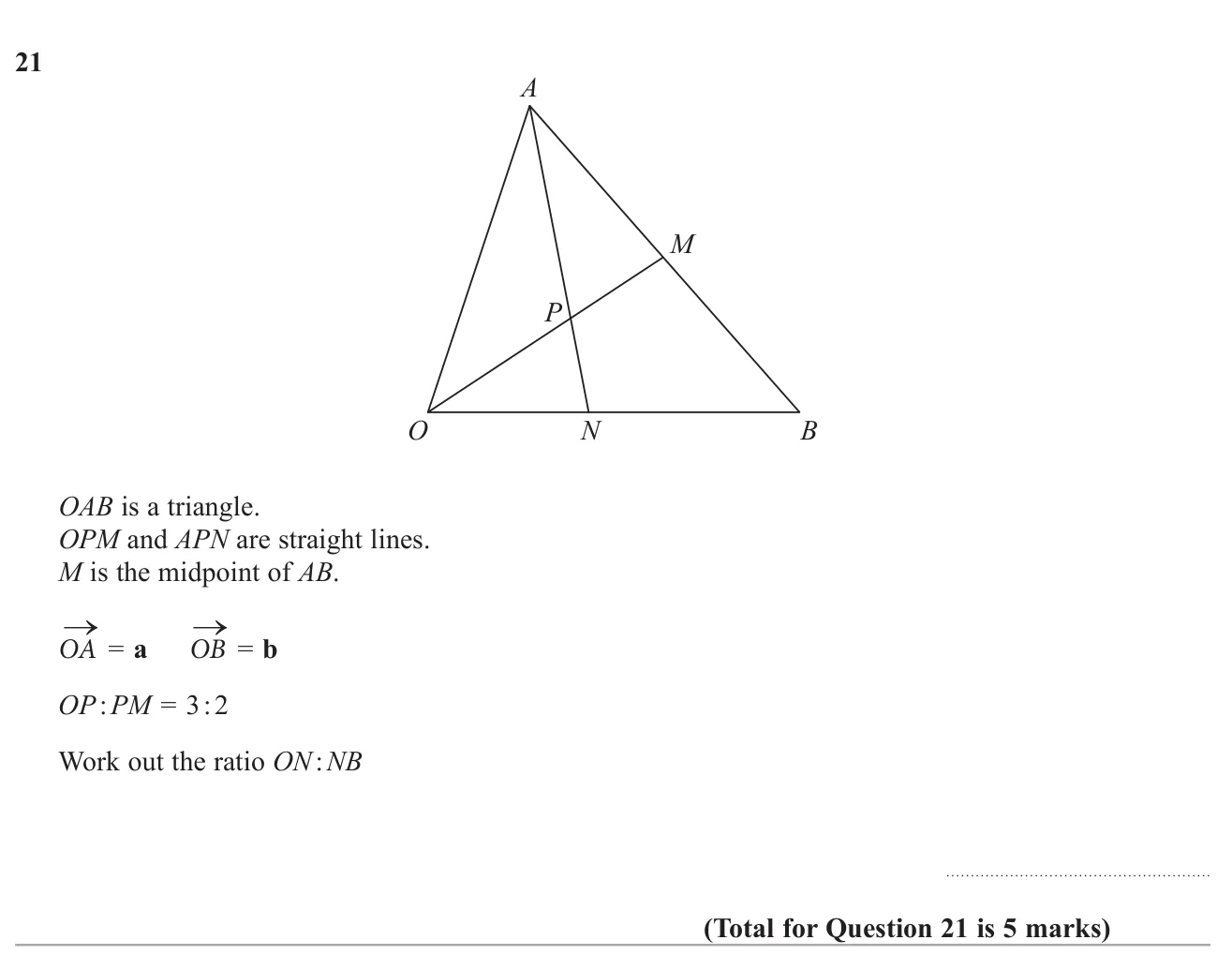
© Pearson Education Ltd. November 2018 Paper 1 (Higher, non-calculator), question 21.
Worked solution Checked against the mark scheme
O M → = 1 2 ( a + b ) \overrightarrow{OM} = \frac{1}{2}(\mathbf{a} + \mathbf{b}) O M = 2 1 ( a + b ) O P → = 3 5 × 1 2 ( a + b ) = 3 10 ( a + b ) \overrightarrow{OP} = \frac{3}{5} \times \frac{1}{2}(\mathbf{a} + \mathbf{b}) = \frac{3}{10}(\mathbf{a} + \mathbf{b}) O P = 5 3 × 2 1 ( a + b ) = 10 3 ( a + b )
A P → = − a + 3 10 ( a + b ) = 1 10 ( − 7 a + 3 b ) \overrightarrow{AP} = -\mathbf{a} + \frac{3}{10}(\mathbf{a} + \mathbf{b}) = \frac{1}{10}(-7\mathbf{a} + 3\mathbf{b}) A P = − a + 10 3 ( a + b ) = 10 1 ( − 7 a + 3 b )
N is on OB, so A N → = − a + k b \overrightarrow{AN} = -\mathbf{a} + k\mathbf{b} A N = − a + k b − 7 a + 3 b -7\mathbf{a} + 3\mathbf{b} − 7 a + 3 b k = 3 7 k = \frac{3}{7} k = 7 3
O N = 3 7 O B ON = \frac{3}{7}OB O N = 7 3 O B O N : N B = 3 : 4 ON : NB = 3 : 4 O N : N B = 3 : 4
Watch out: Taking O P → \overrightarrow{OP} O P 3 2 O M → \frac{3}{2}\overrightarrow{OM} 2 3 O M
© Pearson Education Ltd. Specimen Paper 1 (Higher, non-calculator), question 22.
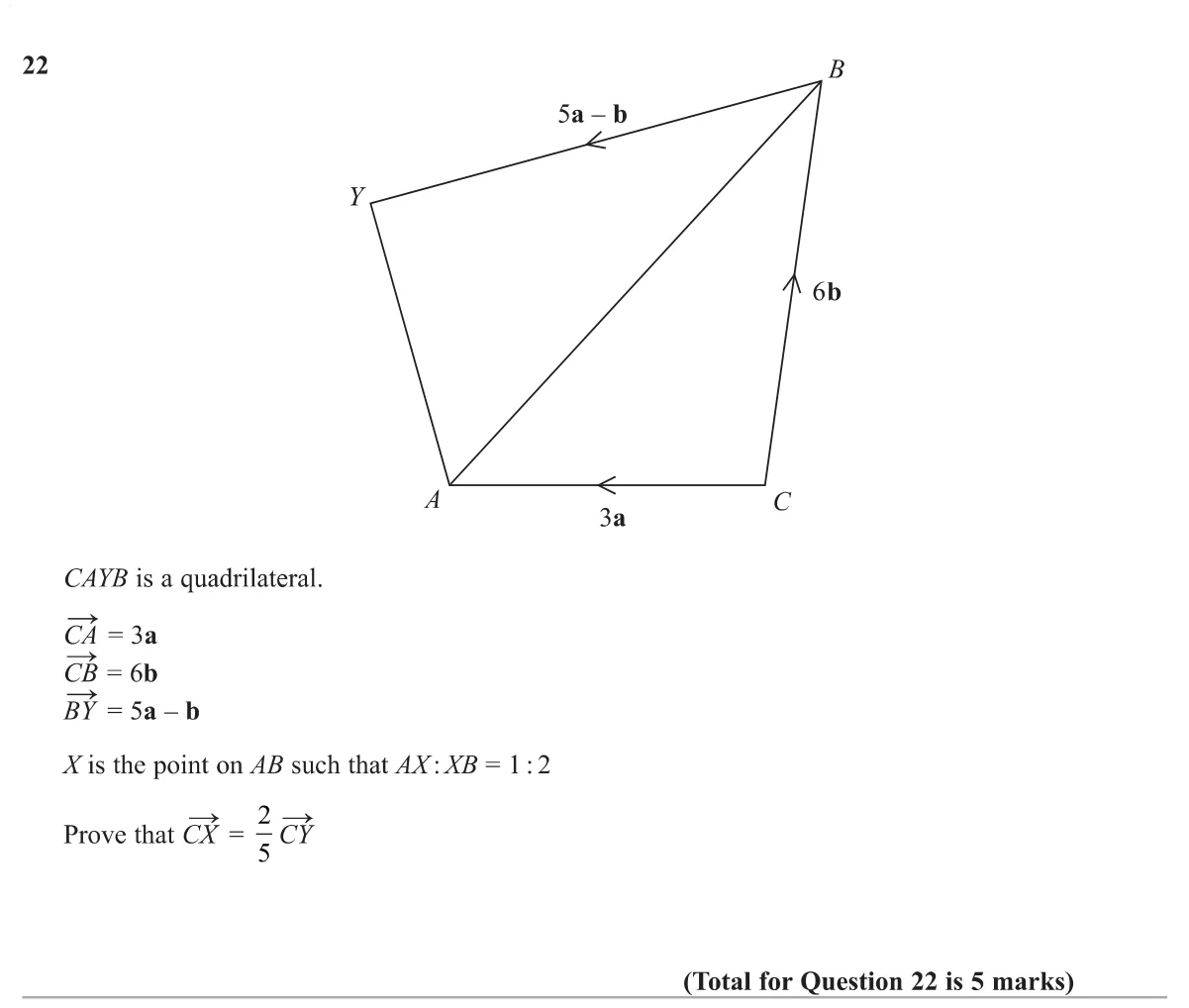
Answer C X → = 2 a + 2 b = 2 5 ( 5 a + 5 b ) = 2 5 C Y → \overrightarrow{CX} = 2\mathbf{a} + 2\mathbf{b} = \frac{2}{5}(5\mathbf{a} + 5\mathbf{b}) = \frac{2}{5}\overrightarrow{CY} C X = 2 a + 2 b = 5 2 ( 5 a + 5 b ) = 5 2 C Y 5 marks
Worked solution Checked against the mark scheme
A B → = − 3 a + 6 b \overrightarrow{AB} = -3\mathbf{a} + 6\mathbf{b} A B = − 3 a + 6 b
A X → = 1 3 A B → = − a + 2 b \overrightarrow{AX} = \frac{1}{3}\overrightarrow{AB} = -\mathbf{a} + 2\mathbf{b} A X = 3 1 A B = − a + 2 b
C X → = 3 a + ( − a + 2 b ) = 2 a + 2 b \overrightarrow{CX} = 3\mathbf{a} + (-\mathbf{a} + 2\mathbf{b}) = 2\mathbf{a} + 2\mathbf{b} C X = 3 a + ( − a + 2 b ) = 2 a + 2 b
C Y → = 6 b + 5 a − b = 5 a + 5 b \overrightarrow{CY} = 6\mathbf{b} + 5\mathbf{a} - \mathbf{b} = 5\mathbf{a} + 5\mathbf{b} C Y = 6 b + 5 a − b = 5 a + 5 b
2 5 C Y → = 2 a + 2 b = C X → \frac{2}{5}\overrightarrow{CY} = 2\mathbf{a} + 2\mathbf{b} = \overrightarrow{CX} 5 2 C Y = 2 a + 2 b = C X
Watch out: Taking A X → \overrightarrow{AX} A X A B → \overrightarrow{AB} A B
Also tested in these questions Their main topic is different, but part of each one tests this topic.