Revision guide by The Full Marks
Rounding and estimation: what you need to know Rounding makes numbers simpler, and estimating uses rounded numbers to get a quick answer or check a calculation. Estimation questions are common on non-calculator papers, and rounding to decimal places or significant figures is needed on almost every calculator question.
Key facts Look at the next digit: 5 or more rounds up, 4 or less leaves the digit the same. Nearest 10, 100 or 1000: look at the digit to the right of that place, e.g. 18 472 18\,472 18 472 18 000 18\,000 18 000 The first significant figure is the first non-zero digit: in 0.0407 0.0407 0.0407 Keep the place value: 36 482 36\,482 36 482 36 000 36\,000 36 000 To estimate, round every number to 1 significant figure, then calculate. Over- or underestimate: rounding numbers you multiply or add up makes the estimate bigger; rounding the number you divide by up makes it smaller. Rounding to significant figures Count significant figures from the first non-zero digit. Look at the next digit to decide whether to round up. Fill in zeros up to the decimal point so the number keeps its size. Estimating a calculation Round each number to 1 significant figure. Work out the easier calculation, showing the rounded numbers. If asked, say whether rounding up or down makes it an over- or underestimate. Worked examples Example 1 Foundation · grade 3
Round (a) 18 472 18\,472 18 472 36 482 36\,482 36 482 0.040 739 0.040\,739 0.040 739 7.8963 7.8963 7.8963
Show the solution (a) The hundreds digit is 4, so do not round up: 18 000 18\,000 18 000 36 000 36\,000 36 000 0.041 0.041 0.041 7.89 ∣ 63 7.89|63 7.89∣63 7.90 7.90 7.90
Example 2 Foundation · grade 5
Estimate the value of 61.8 × 4.13 0.192 \frac{61.8 \times 4.13}{0.192} 0.192 61.8 × 4.13
Show the solution Round each number to 1 significant figure: 60 × 4 0.2 \frac{60 \times 4}{0.2} 0.2 60 × 4 60 × 4 = 240 60 \times 4 = 240 60 × 4 = 240 240 ÷ 0.2 = 2400 ÷ 2 = 1200 240 \div 0.2 = 2400 \div 2 = 1200 240 ÷ 0.2 = 2400 ÷ 2 = 1200 1200 1200 1200
Common mistakes Truncating (chopping off) instead of rounding: 1.58 1.58 1.58 1.6 1.6 1.6 1.5 1.5 1.5 Losing place value: writing 36 instead of 36 000 36\,000 36 000 Working out the exact answer on an estimate question. You must show the rounded numbers. Dropping a final zero: 7.90 7.90 7.90 7.9 7.9 7.9 Exam tips On estimate questions, a method mark is usually given for writing the numbers rounded, normally to 1 significant figure, so always show them. Write down the full calculator display before you round; if your rounding slips, you can still get a mark. Questions people ask How do you round to significant figures? Start counting from the first non-zero digit, look at the next digit to decide whether to round up, and fill with zeros so the number stays the same size.
How do you estimate an answer in GCSE maths? Round every number to 1 significant figure and work out the simpler calculation, showing the rounded values.
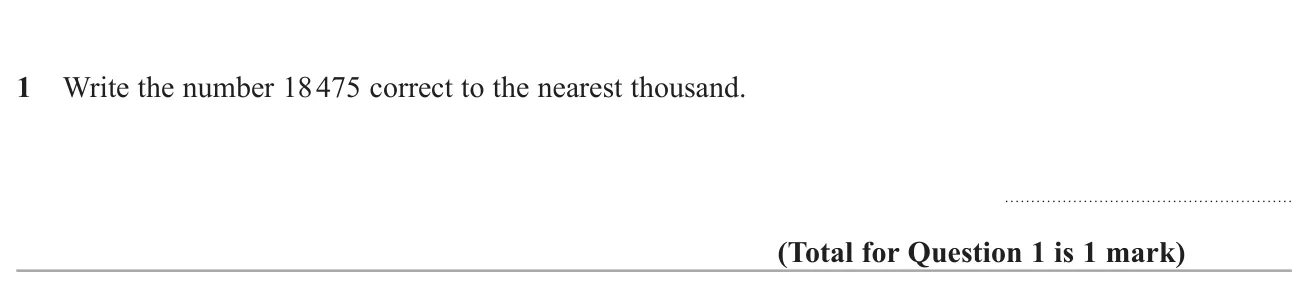
Exam questions: Rounding and estimation (36, easiest first) © Pearson Education Ltd. June 2024 Paper 1 (Foundation, non-calculator), question 1.
Answer 18 000 18\,000 18 000 1 mark
Worked solution Checked against the mark scheme
The thousands digit is 8 and the next digit is 4.
Since 4 < 5 4 < 5 4 < 5 18 475 ≈ 18 000 18\,475 \approx 18\,000 18 475 ≈ 18 000
Watch out: Rounding up to 19 000 or writing 18.
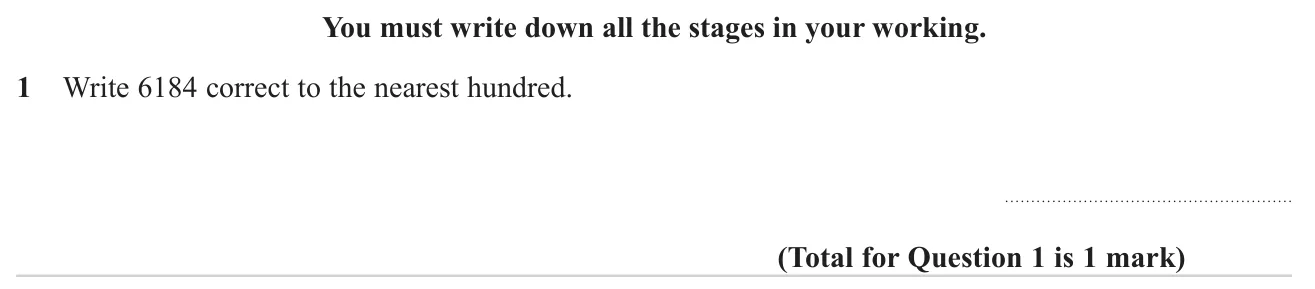
© Pearson Education Ltd. June 2023 Paper 2 (Foundation, calculator), question 1.
Worked solution Checked against the mark scheme
The hundreds digit is 1 and the next digit is 8, which is 5 or more, so round up.
6184 → 6200 6184 \to 6200 6184 → 6200
Watch out: Writing 6100 by rounding down.
© Pearson Education Ltd. November 2023 Paper 3 (Foundation, calculator), question 2.
Worked solution Checked against the mark scheme
8061 lies between 8000 and 8100.
The tens digit is 6, which is 5 or more, so round up: 8100 .
Watch out: Rounding down to 8000, or writing 8060.
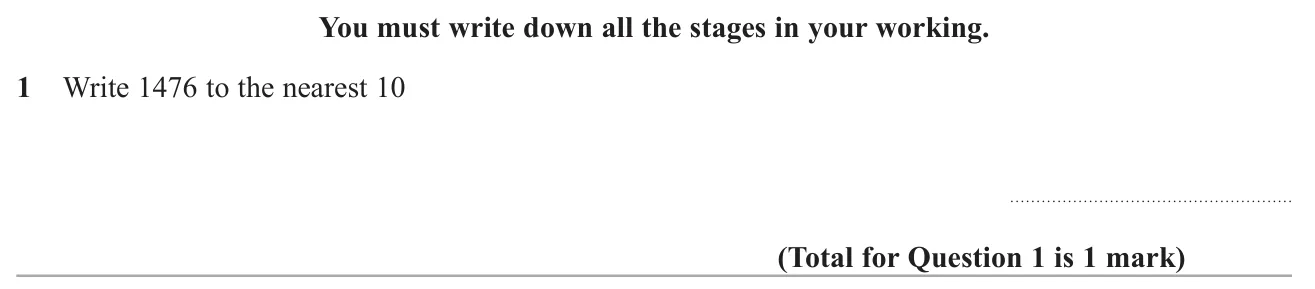
© Pearson Education Ltd. June 2022 Paper 2 (Foundation, calculator), question 1.
Worked solution Checked against the mark scheme
Look at the units digit: it is 6, which is 5 or more, so round up.
1476 → 1480 1476 \to 1480 1476 → 1480
Watch out: Rounding down to 1470.
© Pearson Education Ltd. November 2022 Paper 3 (Foundation, calculator), question 4.
Worked solution Checked against the mark scheme
Look at the first decimal place: 19.4 949. It is 4, which is less than 5, so round down.
Answer: 19
Watch out: Rounding each digit in turn from the right and getting 20.
© Pearson Education Ltd. November 2021 Paper 1 (Foundation, non-calculator), question 4.
Worked solution Checked against the mark scheme
327 lies between 320 and 330.
The units digit is 7, which is 5 or more, so round up: 330 330 330
Watch out: Rounding down to 320.
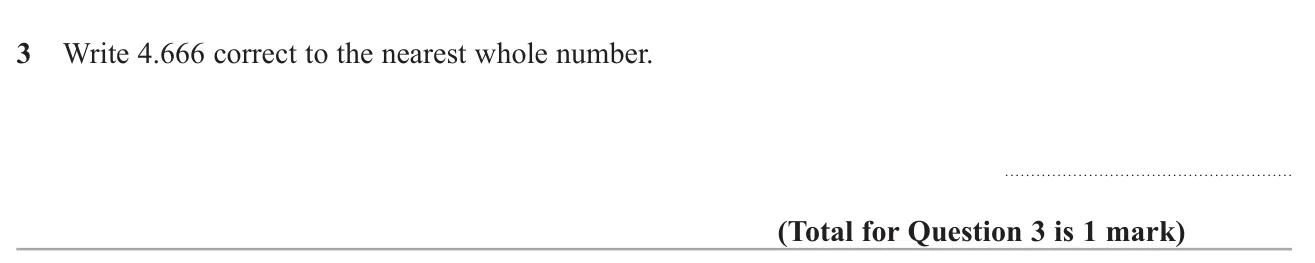
© Pearson Education Ltd. November 2020 Paper 1 (Foundation, non-calculator), question 3.
Worked solution Checked against the mark scheme
Look at the first decimal digit: 6, which is 5 or more.
So round up: 4.666 becomes 5.
Watch out: Truncating to 4.
© Pearson Education Ltd. November 2020 Paper 2 (Foundation, calculator), question 2.
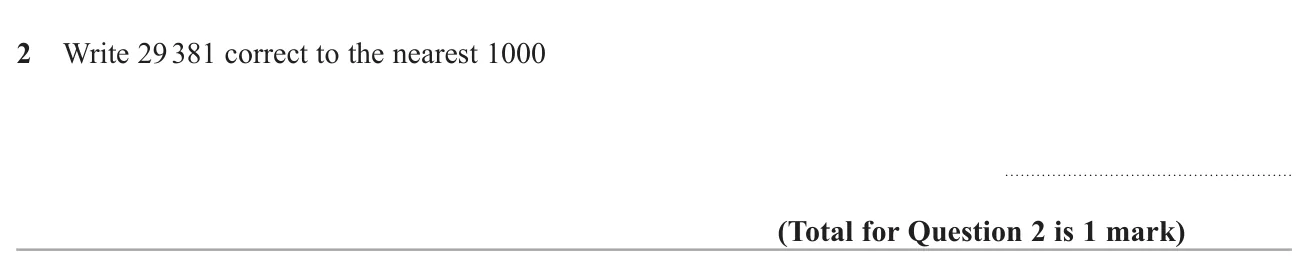
Worked solution Checked against the mark scheme
Look at the hundreds digit: 29 3 81. It is 3, which is less than 5, so round down.
29 381 ≈ 29 000 29\,381 \approx 29\,000 29 381 ≈ 29 000
Watch out: Rounding up to 30 000.
© Pearson Education Ltd. November 2019 Paper 1 (Foundation, non-calculator), question 2.
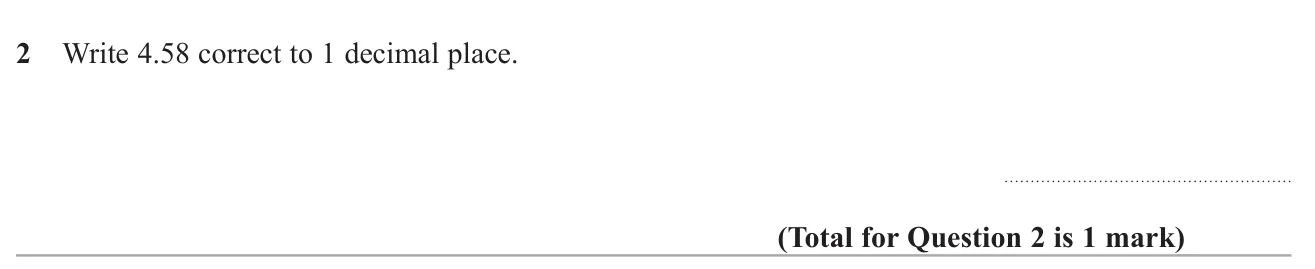
Worked solution Checked against the mark scheme
Look at the second decimal place: it is 8.
8 is 5 or more, so round the 5 up: 4.58 ≈ 4.6 4.58 \approx 4.6 4.58 ≈ 4.6
Watch out: Truncating to 4.5.
© Pearson Education Ltd. November 2019 Paper 2 (Foundation, calculator), question 2.
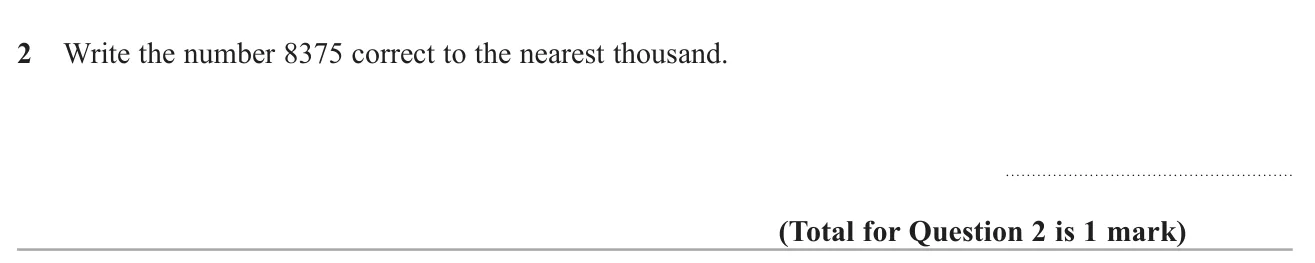
Worked solution Checked against the mark scheme
8375 lies between 8000 and 9000.
The hundreds digit is 3, which is less than 5, so round down to 8000 .
Watch out: Writing 8400 (rounding to the nearest hundred).
© Pearson Education Ltd. June 2019 Paper 3 (Foundation, calculator), question 1.
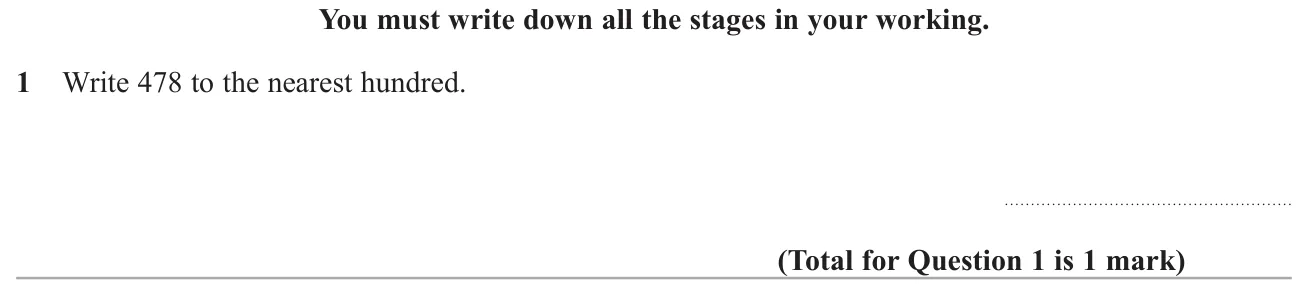
Worked solution Checked against the mark scheme
478 lies between 400 and 500.
The tens digit is 7, which is 5 or more, so round up: 500 .
Watch out: Writing 480 (rounding to the nearest ten).
© Pearson Education Ltd. November 2018 Paper 1 (Foundation, non-calculator), question 4.
Worked solution Checked against the mark scheme
7829 lies between 7000 and 8000.
The hundreds digit is 8, which is 5 or more, so round up to 8000.
Watch out: Writing 7000 or 7800.
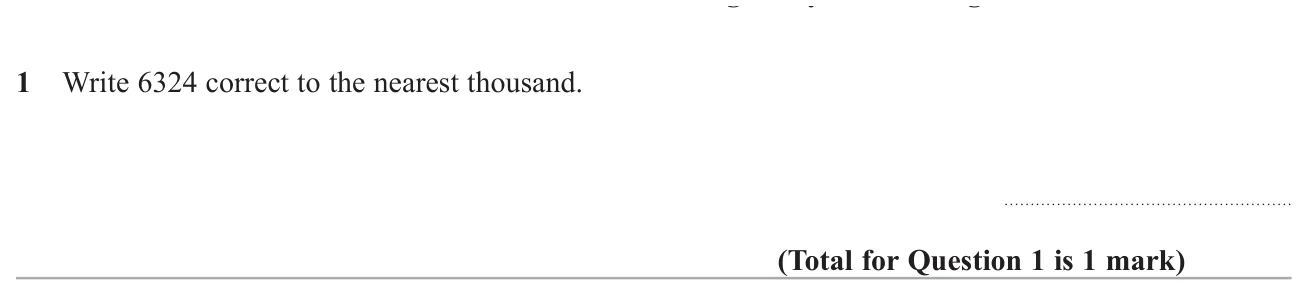
© Pearson Education Ltd. June 2018 Paper 1 (Foundation, non-calculator), question 1.
Worked solution Checked against the mark scheme
Look at the hundreds digit of 6324: it is 3, which is less than 5.
So round down to 6000 .
Watch out: Rounding up to 7000 or giving 6300.
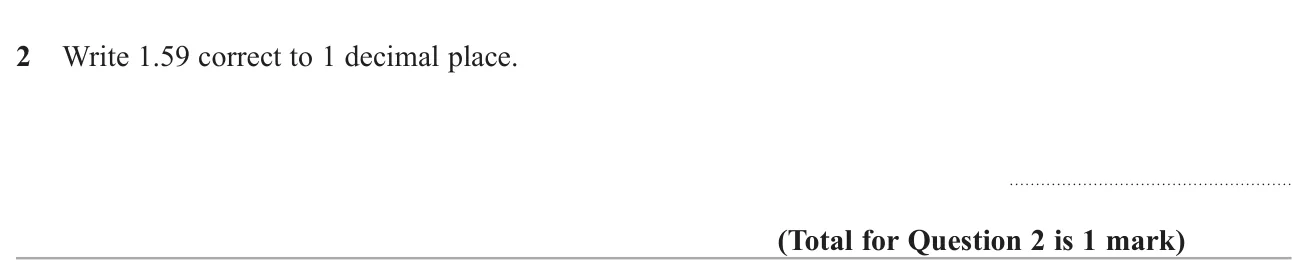
© Pearson Education Ltd. June 2018 Paper 2 (Foundation, calculator), question 2.
Worked solution Checked against the mark scheme
Look at the second decimal place: it is 9, which is 5 or more, so round the 5 up.
1.59 ≈ 1.6 1.59 \approx 1.6 1.59 ≈ 1.6
Watch out: Truncating to 1.5.
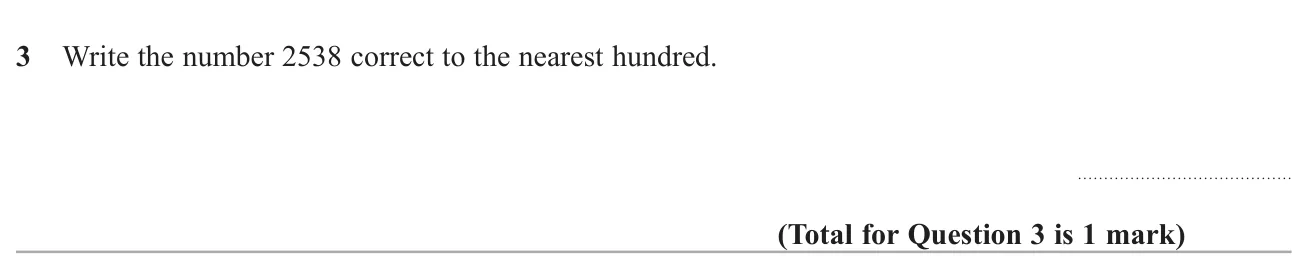
© Pearson Education Ltd. June 2018 Paper 3 (Foundation, calculator), question 3.
Worked solution Checked against the mark scheme
2538 lies between 2500 and 2600.
The tens digit is 3, which is less than 5, so round down to 2500 2500 2500
Watch out: Writing 25 or rounding up to 2600.
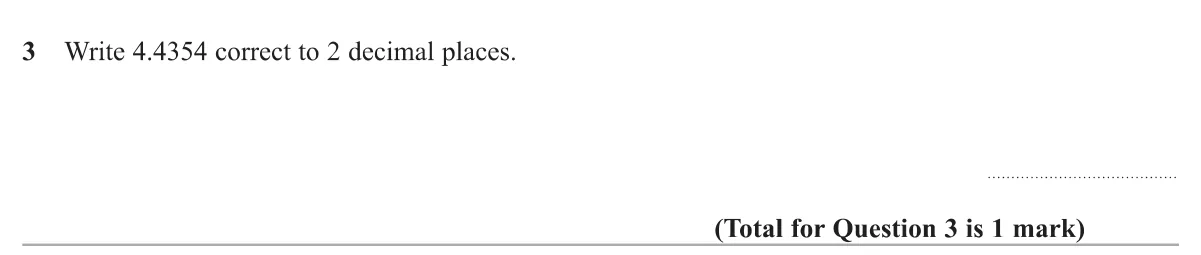
© Pearson Education Ltd. Specimen Paper 1 (Foundation, non-calculator), question 3.
Worked solution Checked against the mark scheme
Look at the third decimal place: it is 5.
5 or more rounds up, so 4.43 ∣ 54 4.43|54 4.43∣54 4.44 4.44 4.44
Watch out: Truncating to 4.43.
© Pearson Education Ltd. Specimen Paper 3 (Foundation, calculator), question 1.
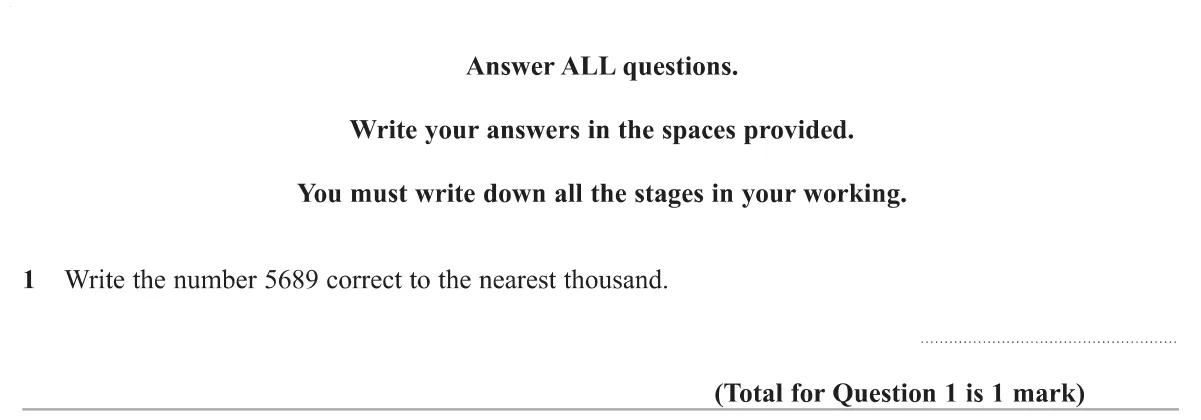
Worked solution Checked against the mark scheme
The thousands either side are 5000 and 6000.
5689 is past the halfway point of 5500, so it rounds up to 6000 .
Watch out: Writing 5700 (rounding to the nearest hundred) or 5000.
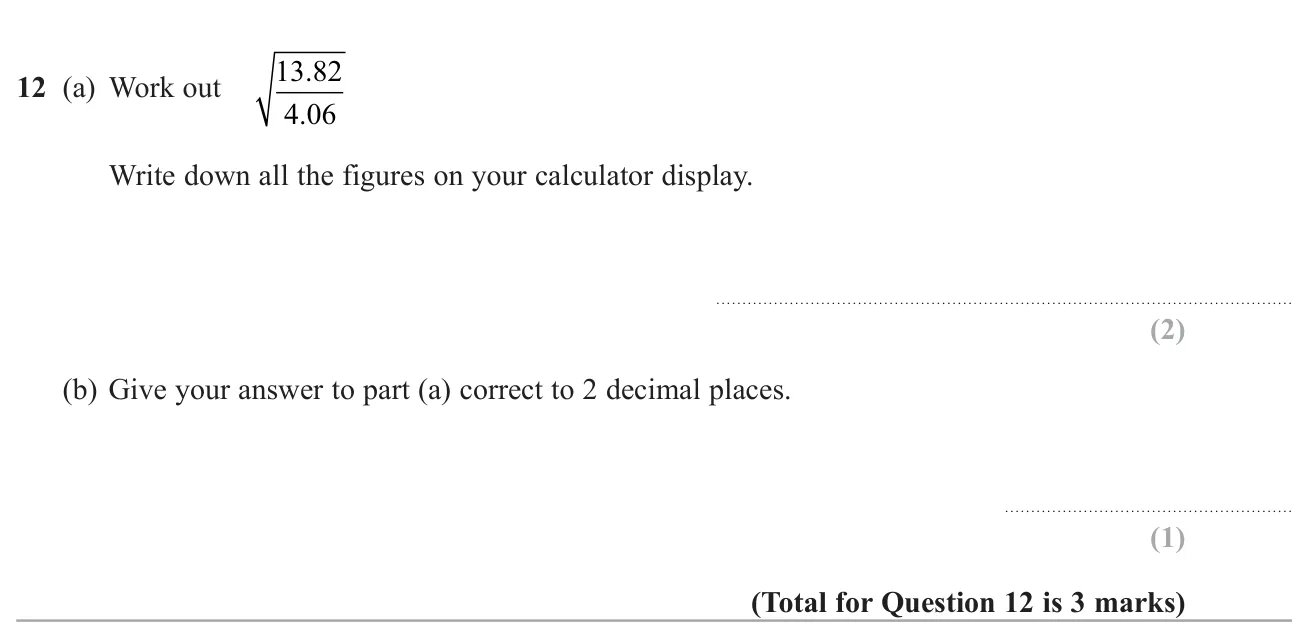
© Pearson Education Ltd. November 2021 Paper 2 (Foundation, calculator), question 12.
(a) 1.844977205 … 1.844977205\ldots 1.844977205 … 2 marks (b) 1.84 1 mark
Worked solution Checked against the mark scheme
(a) 13.82 ÷ 4.06 = 3.40394 … 13.82 \div 4.06 = 3.40394\ldots 13.82 ÷ 4.06 = 3.40394 …
3.40394 … = 1.844977205 … \sqrt{3.40394\ldots} = 1.844977205\ldots 3.40394 … = 1.844977205 …
(b) The third decimal is 4, so round down: 1.84
Watch out: Square-rooting only the top number before dividing.
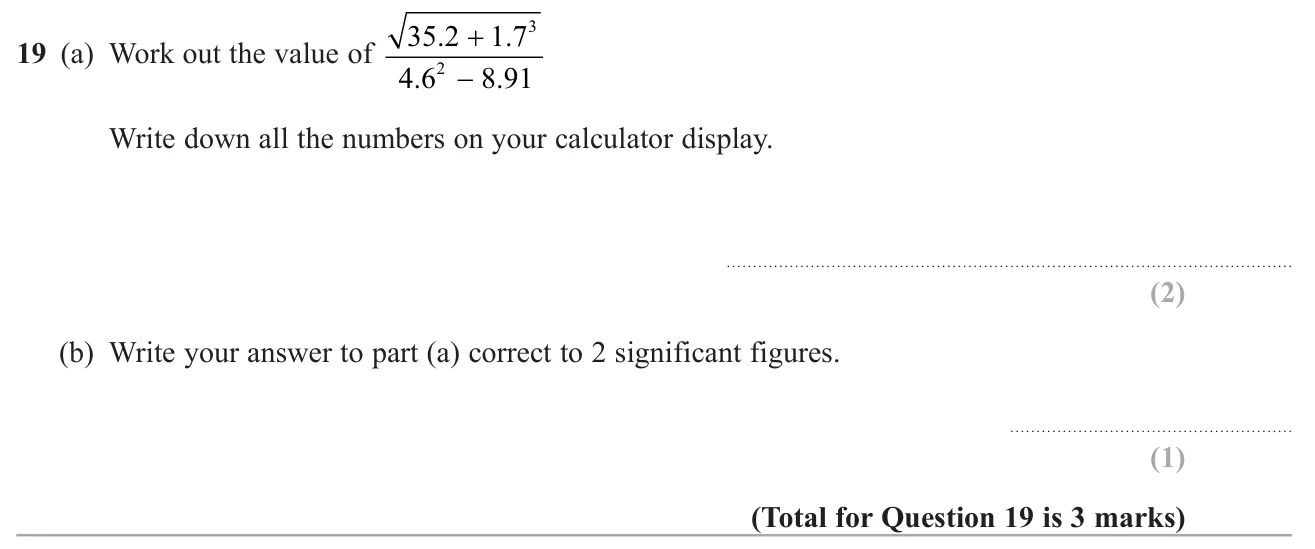
© Pearson Education Ltd. June 2024 Paper 2 (Foundation, calculator), question 19.
(a) 0.5170189759 … 0.5170189759\ldots 0.5170189759 … 2 marks (b) 0.52 0.52 0.52 1 mark
Worked solution Checked against the mark scheme
The expression is 35.2 + 1.7 3 4.6 2 − 8.91 \dfrac{\sqrt{35.2 + 1.7^3}}{4.6^2 - 8.91} 4. 6 2 − 8.91 35.2 + 1. 7 3
Numerator: 35.2 + 4.913 = 40.113 = 6.33348 … \sqrt{35.2 + 4.913} = \sqrt{40.113} = 6.33348\ldots 35.2 + 4.913 = 40.113 = 6.33348 …
Denominator: 21.16 − 8.91 = 12.25 21.16 - 8.91 = 12.25 21.16 − 8.91 = 12.25
(a) 6.33348 … ÷ 12.25 = 0.5170189759 … 6.33348\ldots \div 12.25 = 0.5170189759\ldots 6.33348 … ÷ 12.25 = 0.5170189759 …
(b) 0.52 0.52 0.52
Watch out: Not using brackets on the calculator, so only 35.2 goes under the root or only part of the denominator is used.
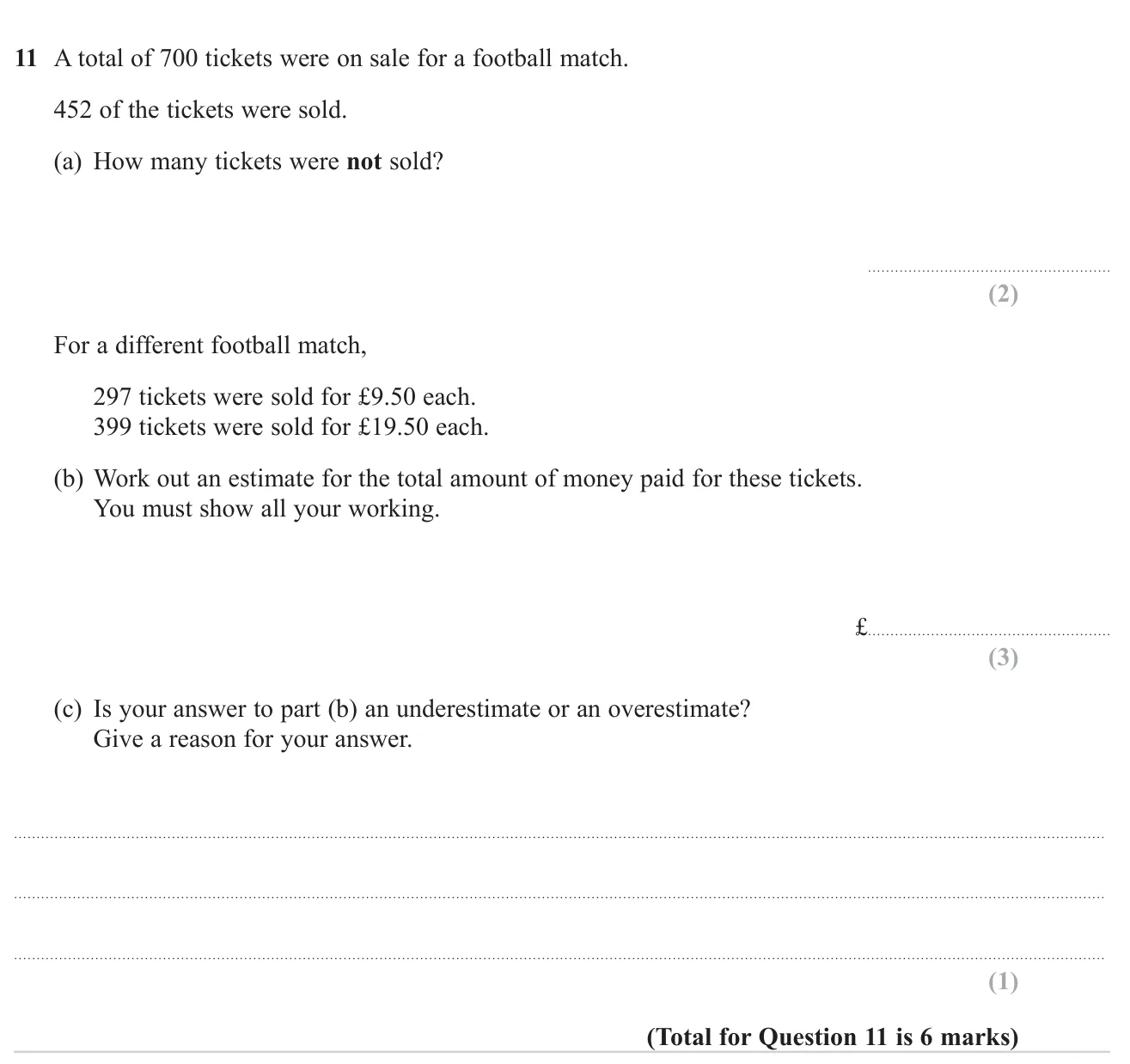
© Pearson Education Ltd. June 2023 Paper 1 (Foundation, non-calculator), question 11.
(a) 248 248 248 2 marks (b) £11 000 3 marks (c) Overestimate, because every value was rounded up 1 mark
Worked solution Checked against the mark scheme
(a) 700 − 452 = 248 700 - 452 = 248 700 − 452 = 248
(b) Round to 1 s.f.: 300 × £ 10 = £ 3000 300 \times £10 = £3000 300 × £10 = £3000 400 × £ 20 = £ 8000 400 \times £20 = £8000 400 × £20 = £8000
Estimate = £ 3000 + £ 8000 = £ 11 000 = £3000 + £8000 = £11\,000 = £3000 + £8000 = £11 000
(c) Overestimate: all four numbers were rounded up, so the true total is smaller.
Watch out: In (c), saying underestimate or talking about rounding the final answer.
© Pearson Education Ltd. June 2022 Paper 1 (Foundation, non-calculator), question 15.
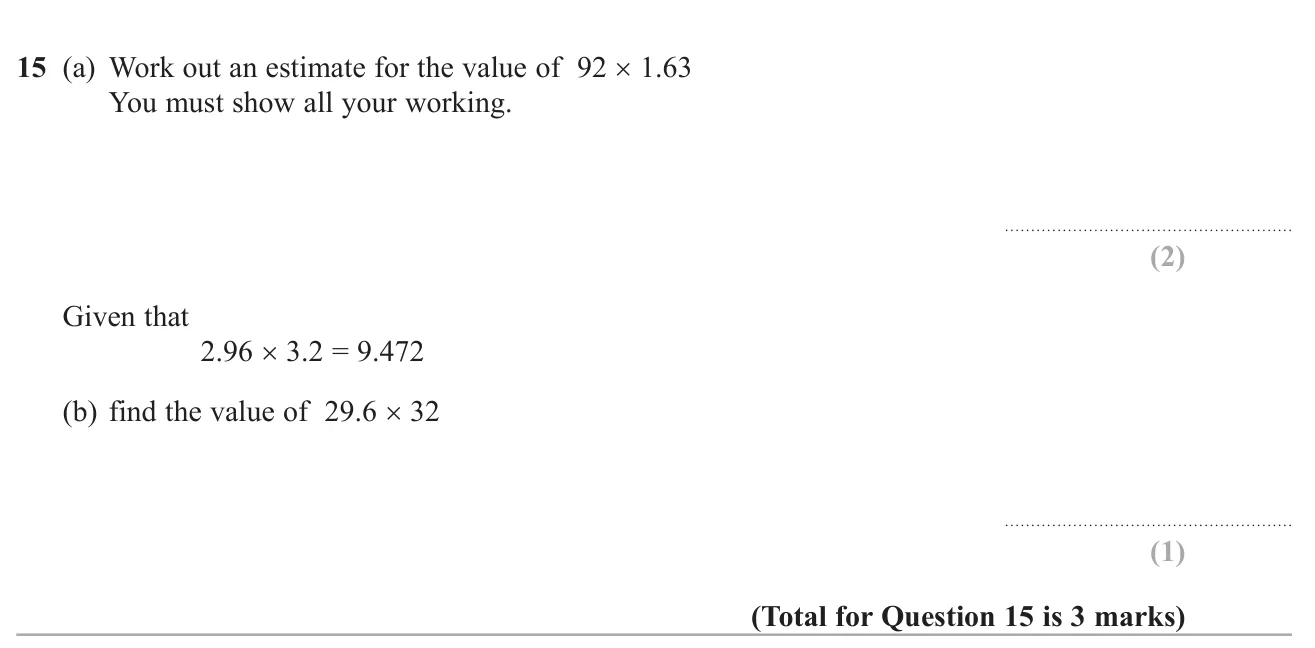
(a) 180 (from 90 × 2 90 \times 2 90 × 2 2 marks (b) 947.2 1 mark
Worked solution Checked against the mark scheme
(a) Round each number: 92 ≈ 90 92 \approx 90 92 ≈ 90 1.63 ≈ 2 1.63 \approx 2 1.63 ≈ 2
90 × 2 = 180 90 \times 2 = 180 90 × 2 = 180
(b) 29.6 29.6 29.6 2.96 × 10 2.96 \times 10 2.96 × 10 32 32 32 3.2 × 10 3.2 \times 10 3.2 × 10 9.472 × 100 = 947.2 9.472 \times 100 = 947.2 9.472 × 100 = 947.2
Watch out: Working out the exact answer (149.96) instead of estimating.
© Pearson Education Ltd. November 2022 Paper 3 (Foundation, calculator), question 17.
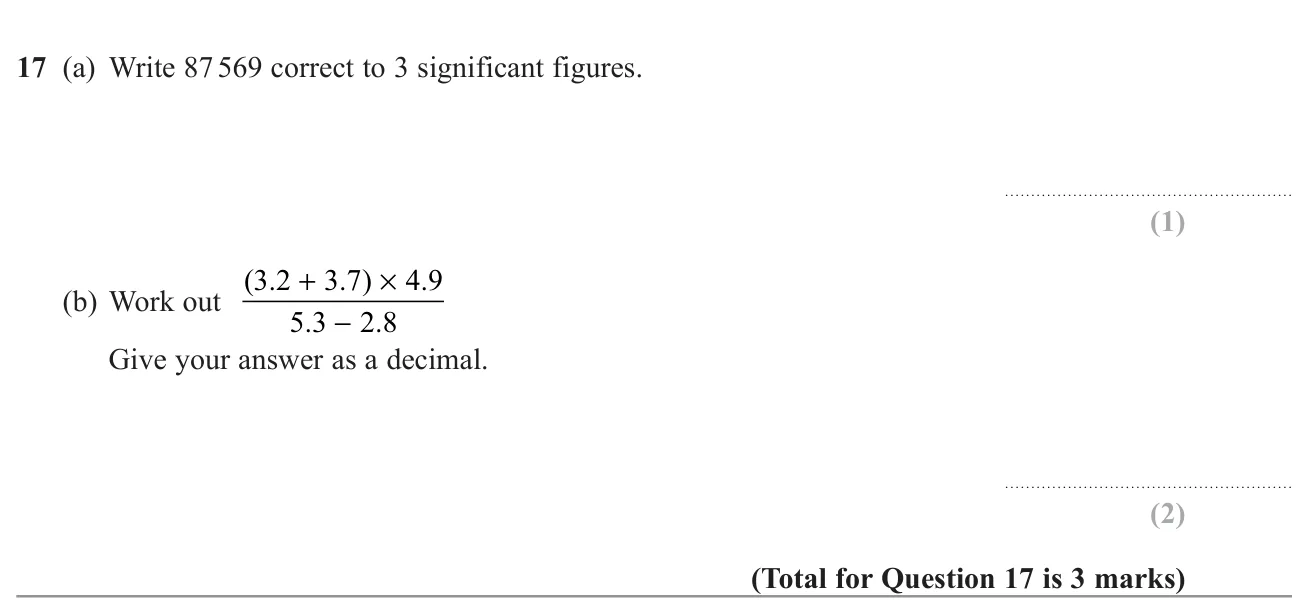
(a) 87 600 1 mark (b) 13.524 2 marks
Worked solution Checked against the mark scheme
(a) The 4th figure is 6, so round the 5 up: 87 600
(b) Top: ( 3.2 + 3.7 ) × 4.9 = 6.9 × 4.9 = 33.81 (3.2 + 3.7) \times 4.9 = 6.9 \times 4.9 = 33.81 ( 3.2 + 3.7 ) × 4.9 = 6.9 × 4.9 = 33.81
Bottom: 5.3 − 2.8 = 2.5 5.3 - 2.8 = 2.5 5.3 − 2.8 = 2.5
33.81 ÷ 2.5 = 13.524 33.81 \div 2.5 = 13.524 33.81 ÷ 2.5 = 13.524
Watch out: In (a) writing 876 without the zeros to keep place value.
© Pearson Education Ltd. June 2022 Paper 3 (Foundation, calculator), question 18.
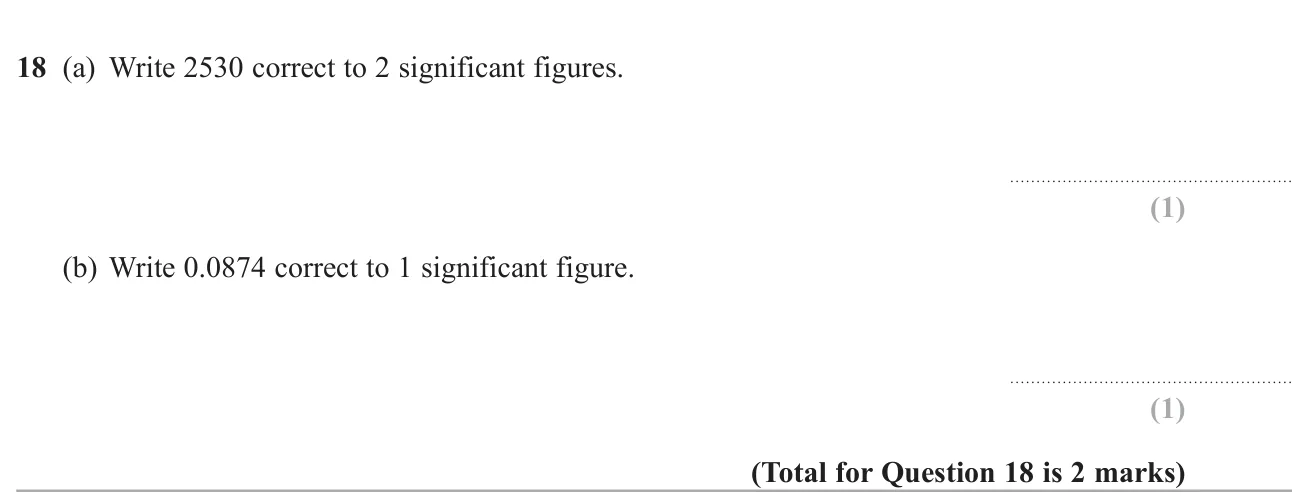
(a) 2500 1 mark (b) 0.09 1 mark
Worked solution Checked against the mark scheme
(a) The first two significant figures are 2 and 5; the next digit 3 rounds down: 2500
(b) The first significant figure is 8 (hundredths); the next digit 7 rounds up: 0.09
Watch out: Writing 25 instead of 2500, or 0.1 for part (b).
© Pearson Education Ltd. November 2020 Paper 1 (Foundation, non-calculator), question 18.
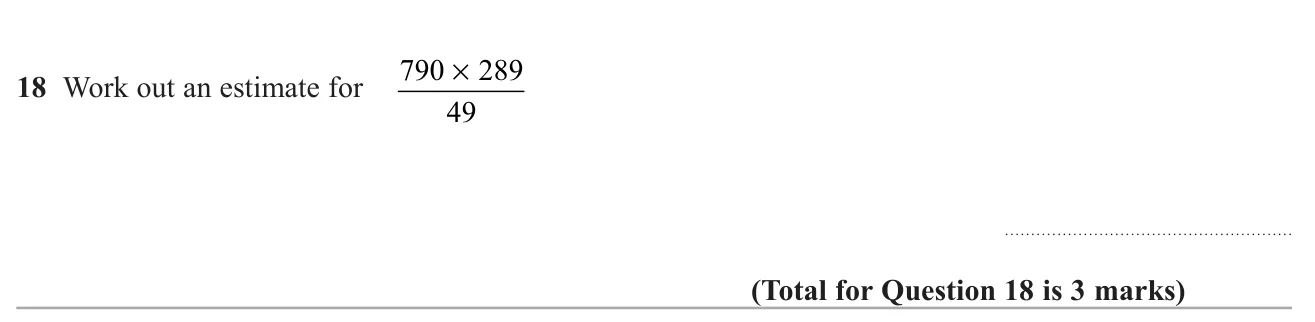
Answer About 4800 (accept 4550 to 4800) 3 marks
Worked solution Checked against the mark scheme
Round to 1 significant figure: 790 ≈ 800 790 \approx 800 790 ≈ 800 289 ≈ 300 289 \approx 300 289 ≈ 300 49 ≈ 50 49 \approx 50 49 ≈ 50
800 × 300 50 = 240 000 50 = 4800 \frac{800 \times 300}{50} = \frac{240\,000}{50} = 4800 50 800 × 300 = 50 240 000 = 4800
Watch out: Working out the exact value first, which earns nothing.
© Pearson Education Ltd. November 2019 Paper 3 (Foundation, calculator), question 23.
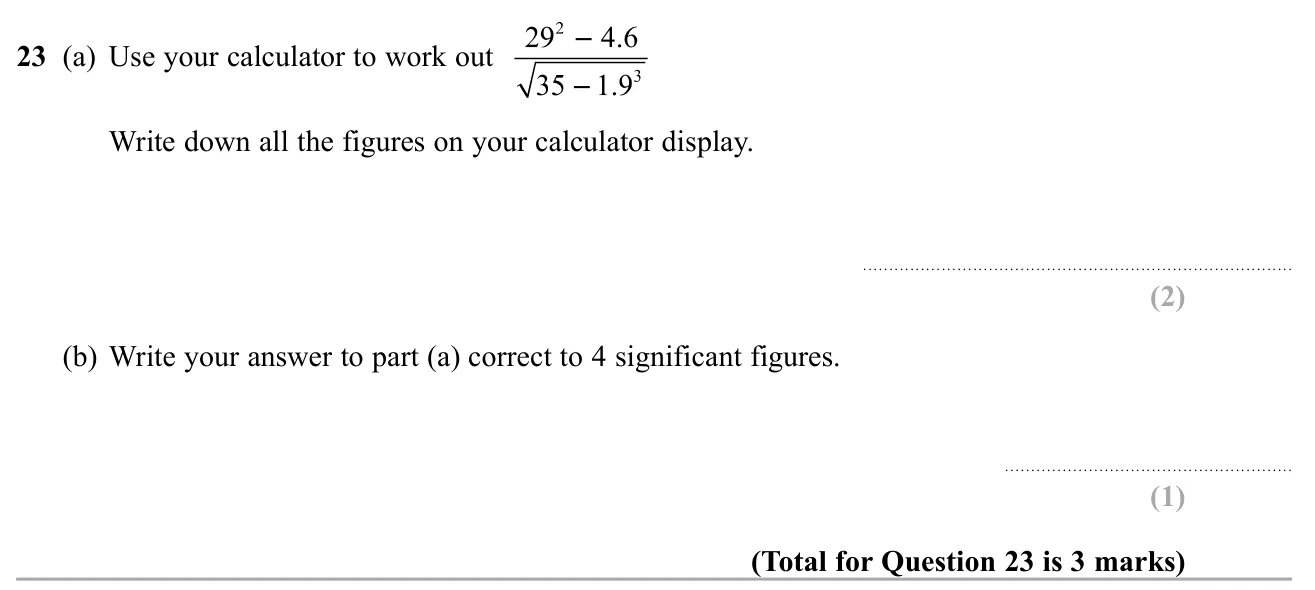
(a) 157.668255... 2 marks (b) 157.7 1 mark
Worked solution Checked against the mark scheme
(a) Top: 29 2 − 4.6 = 836.4 29^2 - 4.6 = 836.4 2 9 2 − 4.6 = 836.4 35 − 6.859 = 28.141 = 5.30481... \sqrt{35 - 6.859} = \sqrt{28.141} = 5.30481... 35 − 6.859 = 28.141 = 5.30481...
836.4 ÷ 5.30481... = 157.668255... 836.4 \div 5.30481... = 157.668255... 836.4 ÷ 5.30481... = 157.668255...
(b) The 4th significant figure is 6 and the next digit is 6, so round up: 157.7 157.7 157.7
Watch out: Typing it in without brackets so the calculator only divides 4.6 by the root.
© Pearson Education Ltd. November 2018 Paper 3 (Foundation, calculator), question 20.
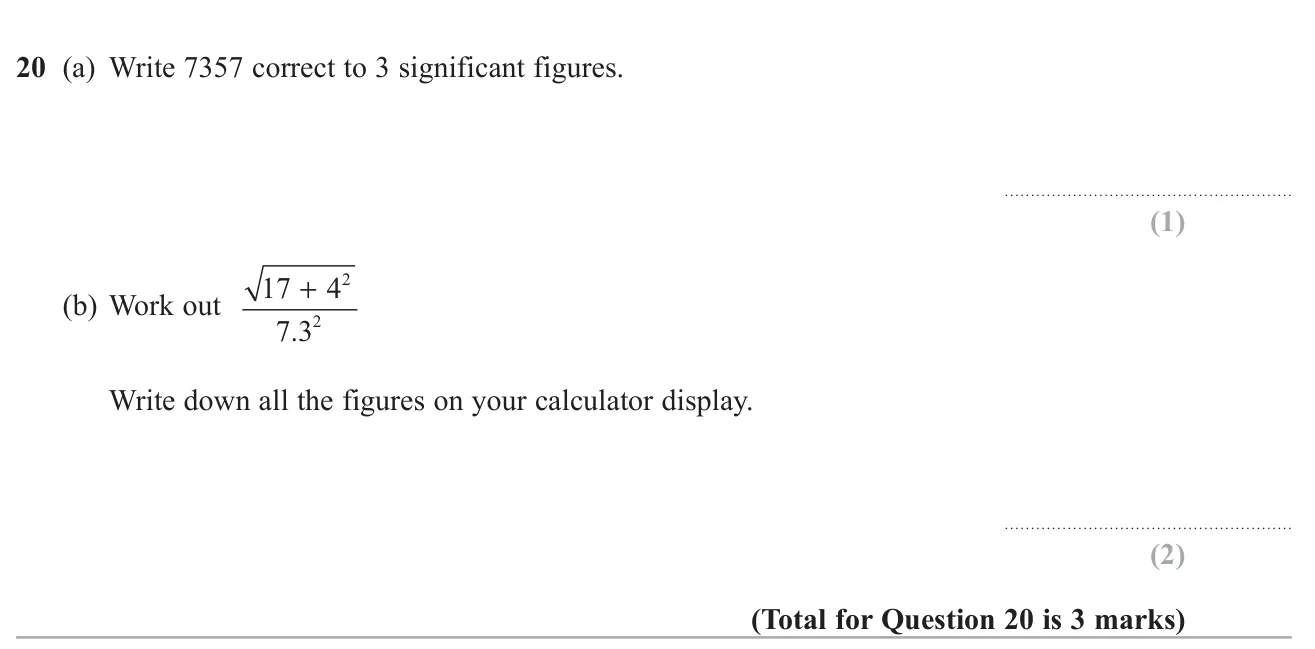
(a) 7360 7360 7360 1 mark (b) 0.1077981356 0.1077981356 0.1077981356 2 marks
Worked solution Checked against the mark scheme
(a) The 4th figure is 7, so round up: 7357 → 7360 7357 \to 7360 7357 → 7360
(b) Top: 17 + 16 = 33 = 5.7445 … \sqrt{17 + 16} = \sqrt{33} = 5.7445\ldots 17 + 16 = 33 = 5.7445 …
Bottom: 7.3 2 = 53.29 7.3^2 = 53.29 7. 3 2 = 53.29
5.7445 … ÷ 53.29 = 0.1077981356 5.7445\ldots \div 53.29 = 0.1077981356 5.7445 … ÷ 53.29 = 0.1077981356
Watch out: In (a), writing 736 and losing the place value.
© Pearson Education Ltd. Specimen Paper 3 (Foundation, calculator), question 8.
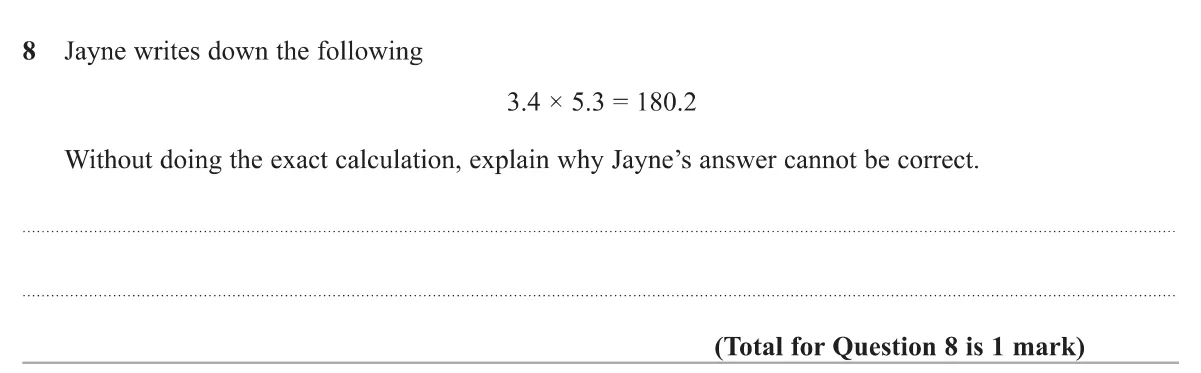
Answer Estimate 3 × 5 = 15 3 \times 5 = 15 3 × 5 = 15 4 × 6 = 24 4 \times 6 = 24 4 × 6 = 24 1 mark
Worked solution Checked against the mark scheme
Round each number: 3.4 ≈ 3 3.4 \approx 3 3.4 ≈ 3 5.3 ≈ 5 5.3 \approx 5 5.3 ≈ 5
3 × 5 = 15 3 \times 5 = 15 3 × 5 = 15 4 × 6 = 24 4 \times 6 = 24 4 × 6 = 24
Watch out: Just saying 'it is too big' without an estimate to back it up.
© Pearson Education Ltd. June 2024 Paper 1 (Foundation, non-calculator), question 24.
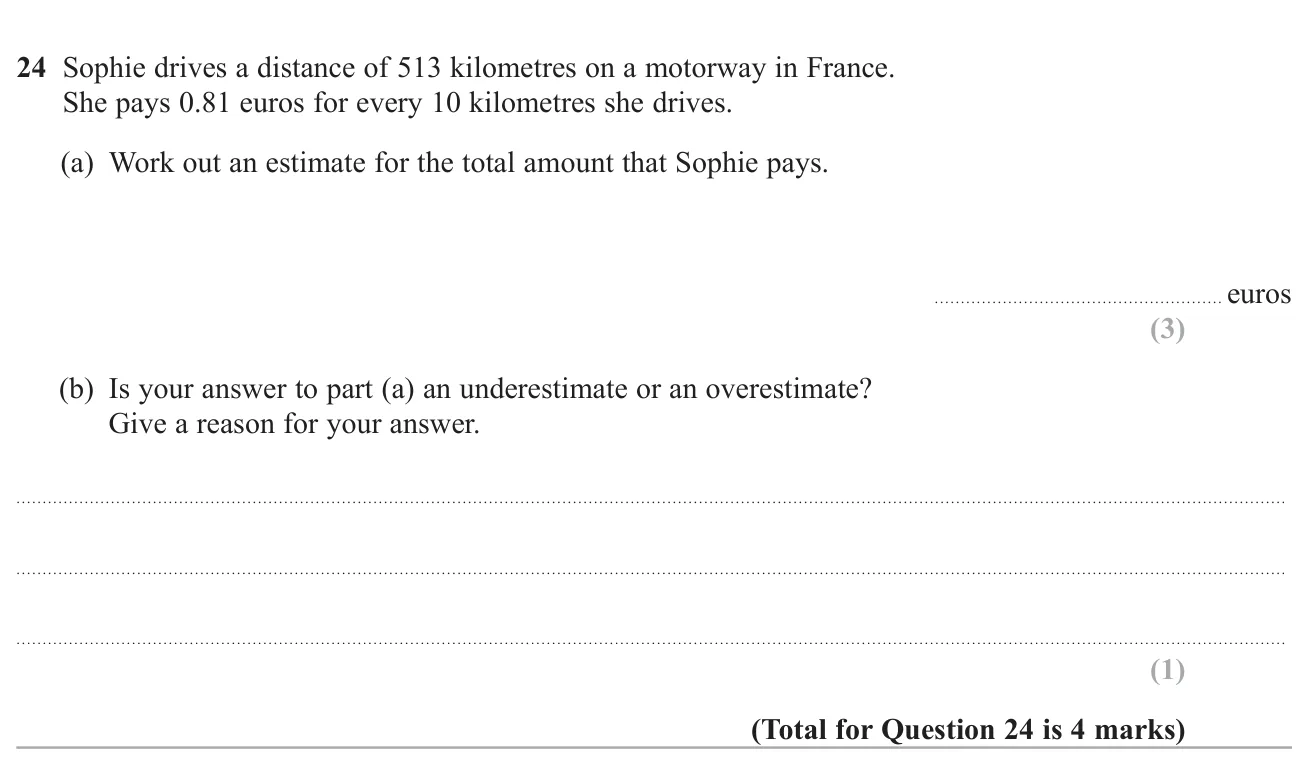
(a) About 40 40 40 500 ÷ 10 × 0.8 500 \div 10 \times 0.8 500 ÷ 10 × 0.8 3 marks (b) Underestimate, because both numbers were rounded down 1 mark
Worked solution Checked against the mark scheme
(a) Round: 513 ≈ 500 513 \approx 500 513 ≈ 500 0.81 ≈ 0.8 0.81 \approx 0.8 0.81 ≈ 0.8
500 ÷ 10 = 50 500 \div 10 = 50 500 ÷ 10 = 50 50 × 0.8 = 40 50 \times 0.8 = 40 50 × 0.8 = 40
(b) Underestimate : both values were rounded down.
Watch out: Rounding 0.81 to 1, which the mark scheme does not accept for the accuracy mark.
© Pearson Education Ltd. June 2018 Paper 1 (Foundation, non-calculator), question 22.
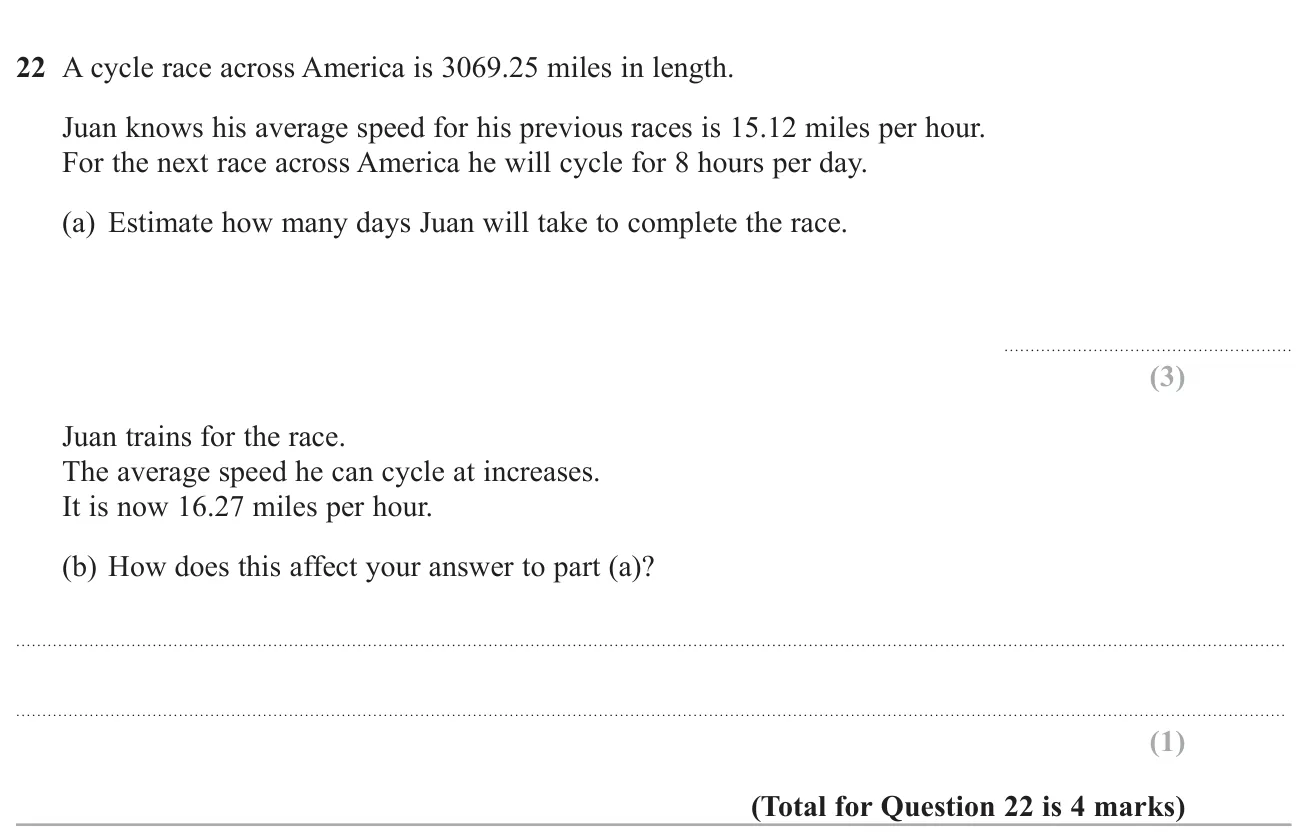
(a) about 25 days (e.g. 3000 ÷ 15 ÷ 8 3000 \div 15 \div 8 3000 ÷ 15 ÷ 8 3 marks (b) Fewer days would be needed (or no change if 16.27 still rounds to 15) 1 mark
Worked solution Checked against the mark scheme
(a) Round: 3000 3000 3000 15 15 15
Hours = 3000 ÷ 15 = 200 = 3000 \div 15 = 200 = 3000 ÷ 15 = 200
Days = 200 ÷ 8 = 25 = 200 \div 8 = 25 = 200 ÷ 8 = 25
(b) A higher speed means fewer hours, so he would need fewer days .
Watch out: Not rounding, and trying to divide by 15.12 exactly.
© Pearson Education Ltd. June 2018 Paper 1 (Higher, non-calculator), question 4.
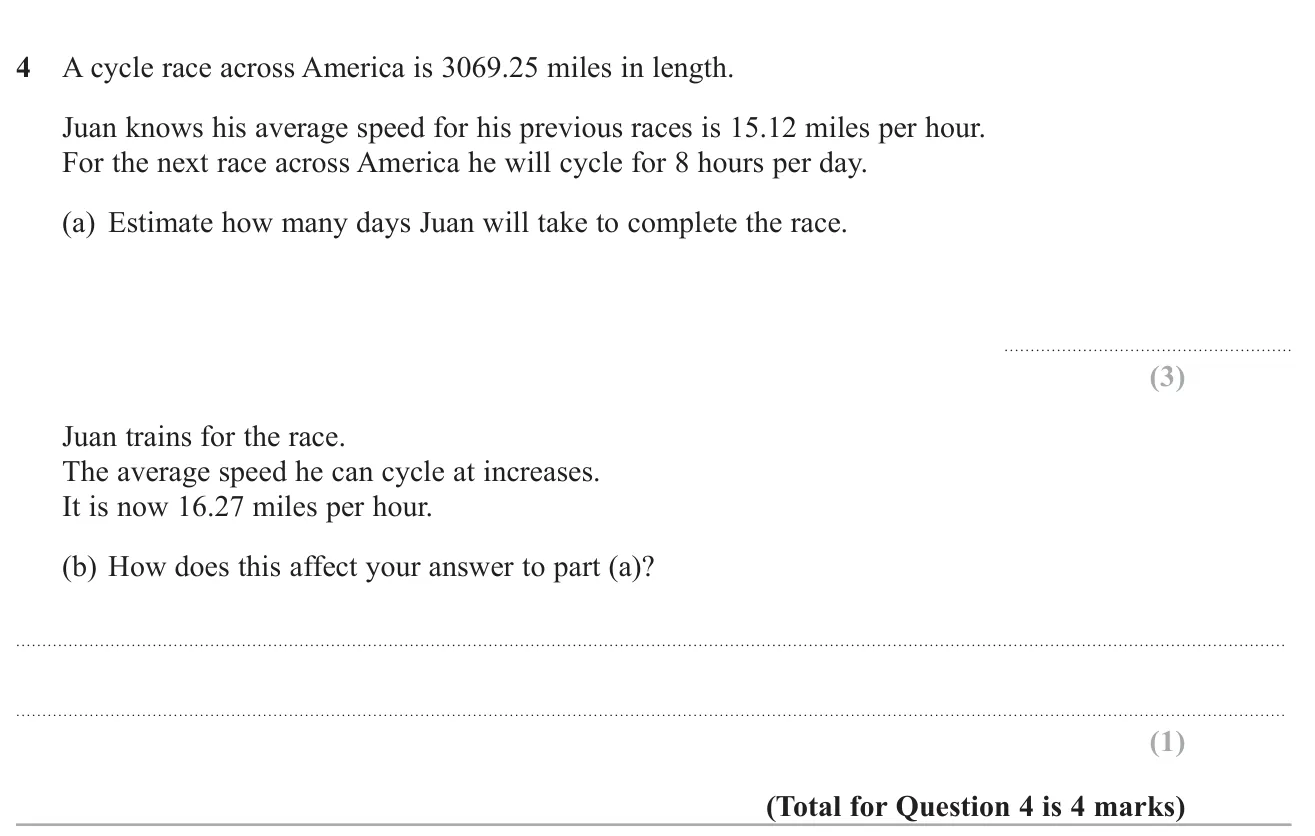
(a) about 25 days (e.g. 3000 ÷ 15 ÷ 8 3000 \div 15 \div 8 3000 ÷ 15 ÷ 8 3 marks (b) Fewer days would be needed (or no change if the speed still rounds to the same value) 1 mark
Worked solution Checked against the mark scheme
(a) Round: distance ≈ 3000 \approx 3000 ≈ 3000 ≈ 15 \approx 15 ≈ 15
Hours ≈ 3000 ÷ 15 = 200 \approx 3000 \div 15 = 200 ≈ 3000 ÷ 15 = 200
Days ≈ 200 ÷ 8 = 25 \approx 200 \div 8 = 25 ≈ 200 ÷ 8 = 25
(b) He rides faster, so each day covers more miles and the race takes fewer days.
Watch out: Using the exact figures instead of rounding, so no estimate is shown.
© Pearson Education Ltd. Specimen Paper 1 (Foundation, non-calculator), question 14.
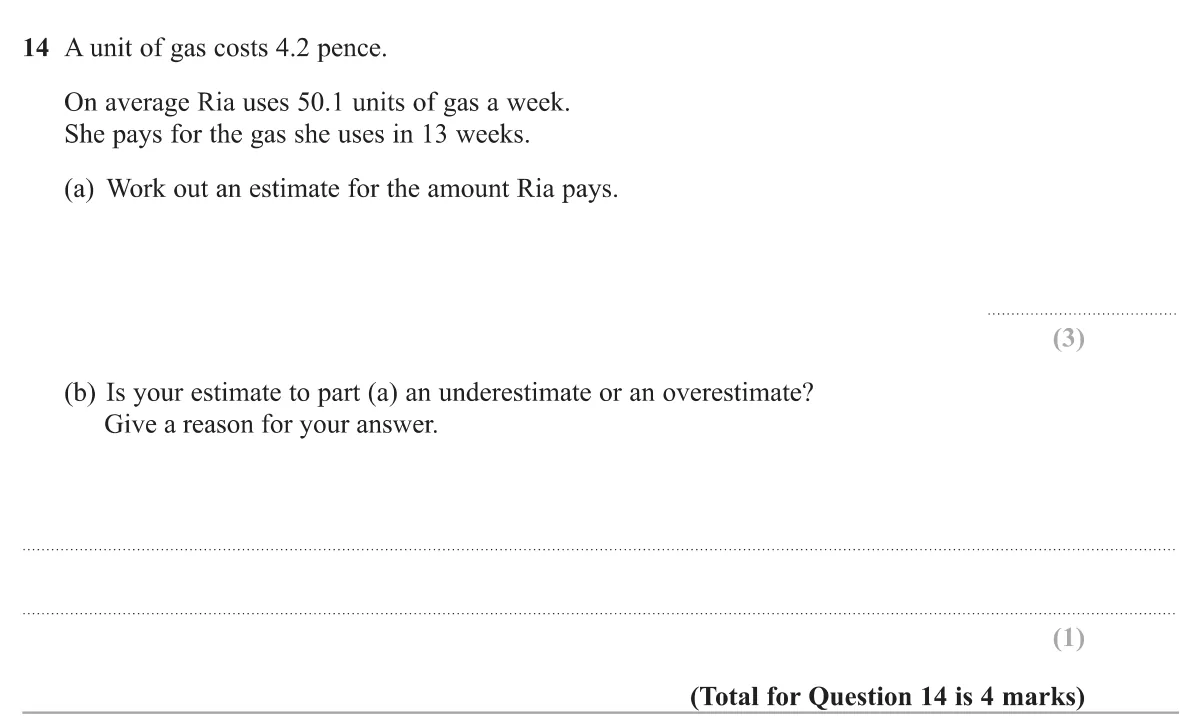
(a) Between 2000p and 2600p (£20 to £26), e.g. 4 × 50 × 13 = 2600 4 \times 50 \times 13 = 2600 4 × 50 × 13 = 2600 3 marks (b) Underestimate, because the values were rounded down 1 mark
Worked solution Checked against the mark scheme
(a) Round: 4.2 → 4 4.2 \to 4 4.2 → 4 50.1 → 50 50.1 \to 50 50.1 → 50
4 × 50 = 200 4 \times 50 = 200 4 × 50 = 200 200 × 13 = 2600 200 \times 13 = 2600 200 × 13 = 2600 = £ 26 = £26 = £26
(b) Both 4.2 and 50.1 were rounded down, so the estimate is an underestimate. (The exact cost is about £27.35.)
Watch out: Rounding 13 to 10 and then calling the estimate an overestimate.
© Pearson Education Ltd. November 2023 Paper 1 (Foundation, non-calculator), question 26.
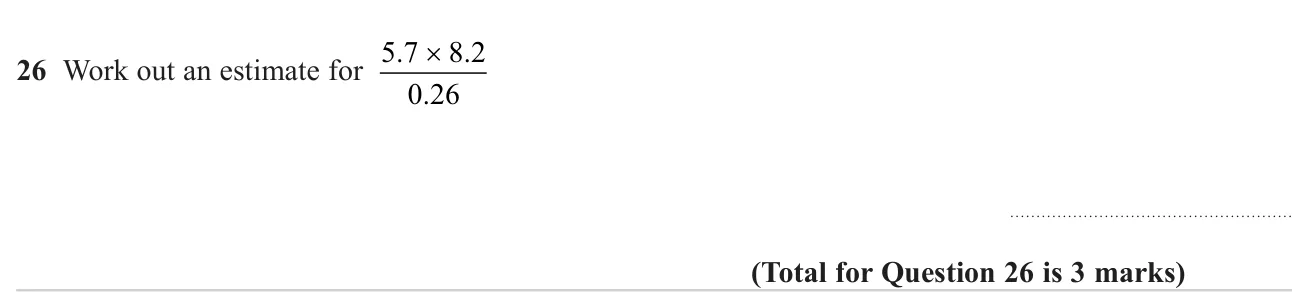
Answer Between 160 and 200 (e.g. 160 or 192) 3 marks
Worked solution Checked against the mark scheme
Round: 5.7 ≈ 6 5.7 \approx 6 5.7 ≈ 6 8.2 ≈ 8 8.2 \approx 8 8.2 ≈ 8 0.26 ≈ 0.3 0.26 \approx 0.3 0.26 ≈ 0.3
6 × 8 = 48 6 \times 8 = 48 6 × 8 = 48
48 ÷ 0.3 = 480 ÷ 3 = 160 48 \div 0.3 = 480 \div 3 = 160 48 ÷ 0.3 = 480 ÷ 3 = 160
Watch out: Rounding 0.26 to 0 or to 1.
© Pearson Education Ltd. November 2021 Paper 1 (Higher, non-calculator), question 10.
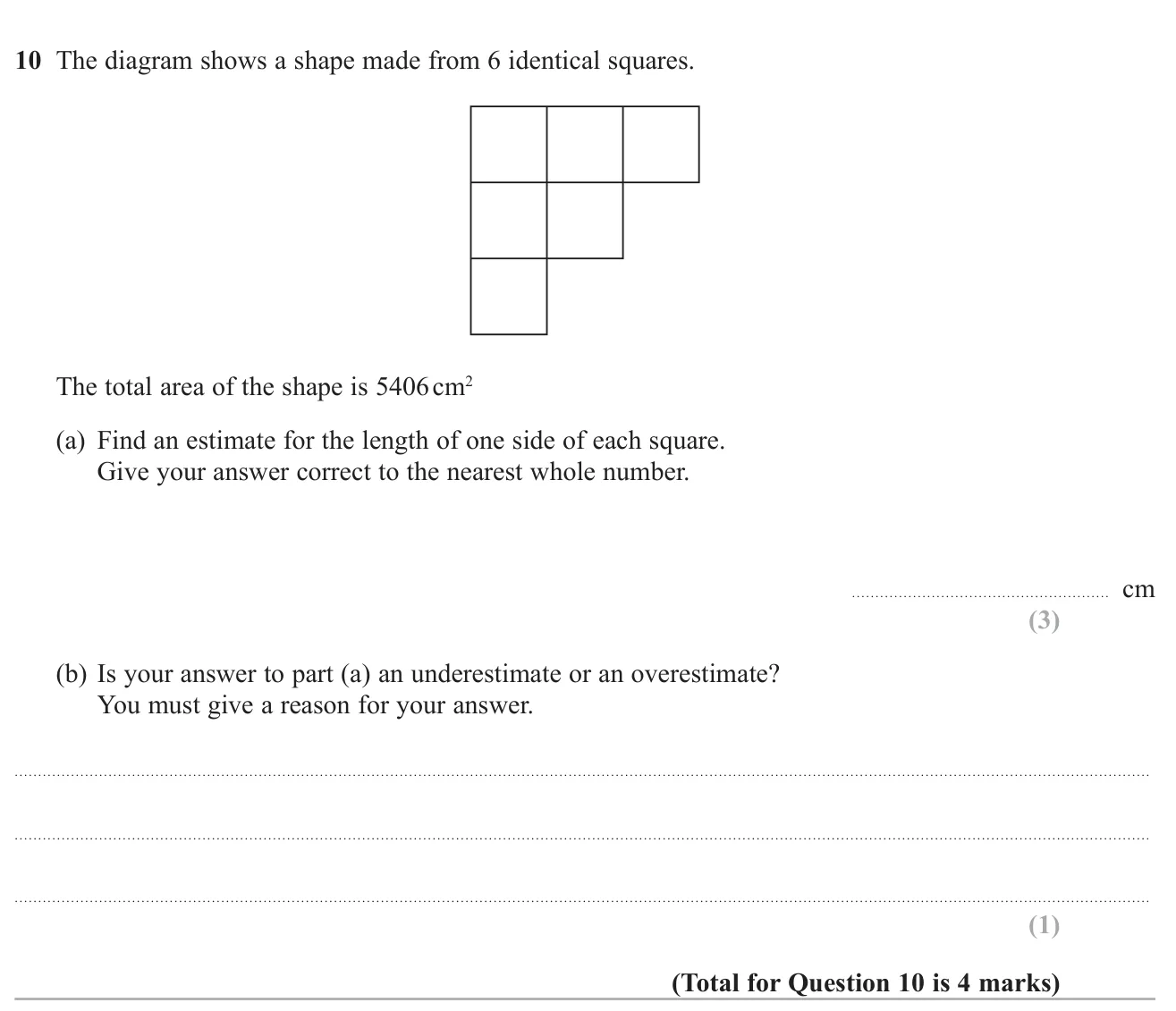
(a) 30 30 30 3 marks (b) Underestimate, because the total area was rounded down (5406 to 5400) 1 mark
Worked solution Checked against the mark scheme
(a) Round 5406 to 5400. One square: 5400 ÷ 6 = 900 cm 2 5400 \div 6 = 900\text{ cm}^2 5400 ÷ 6 = 900 cm 2
Side = 900 = 30 = \sqrt{900} = 30 = 900 = 30
(b) Underestimate : 5406 was rounded down to 5400, so each square's area and side were made slightly smaller than they really are.
Watch out: Forgetting to square root and giving 900 as the side length.
© Pearson Education Ltd. June 2019 Paper 1 (Higher, non-calculator), question 8.
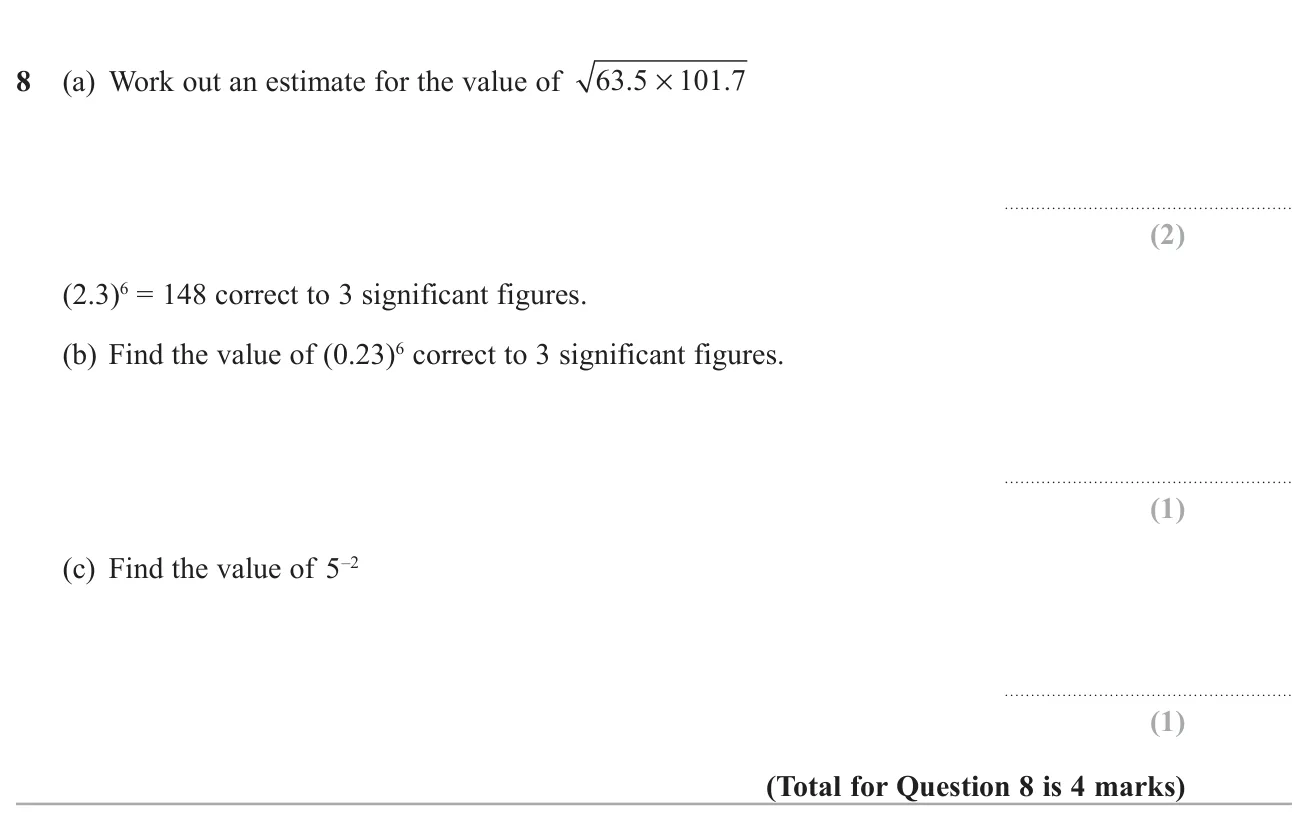
(a) 80 80 80 2 marks (b) 0.000148 0.000148 0.000148 1 mark (c) 1 25 \frac{1}{25} 25 1 1 mark
Worked solution Checked against the mark scheme
(a) 63.5 × 101.7 ≈ 64 × 100 = 6400 = 80 \sqrt{63.5 \times 101.7} \approx \sqrt{64 \times 100} = \sqrt{6400} = 80 63.5 × 101.7 ≈ 64 × 100 = 6400 = 80
(b) 0.23 = 2.3 ÷ 10 0.23 = 2.3 \div 10 0.23 = 2.3 ÷ 10 ( 0.23 ) 6 = 148 ÷ 10 6 = 0.000148 (0.23)^6 = 148 \div 10^6 = 0.000148 ( 0.23 ) 6 = 148 ÷ 1 0 6 = 0.000148
(c) 5 − 2 = 1 5 2 = 1 25 5^{-2} = \frac{1}{5^2} = \frac{1}{25} 5 − 2 = 5 2 1 = 25 1
Watch out: In (c), giving − 25 -25 − 25 − 10 -10 − 10 5 − 2 5^{-2} 5 − 2
© Pearson Education Ltd. November 2018 Paper 1 (Foundation, non-calculator), question 24.
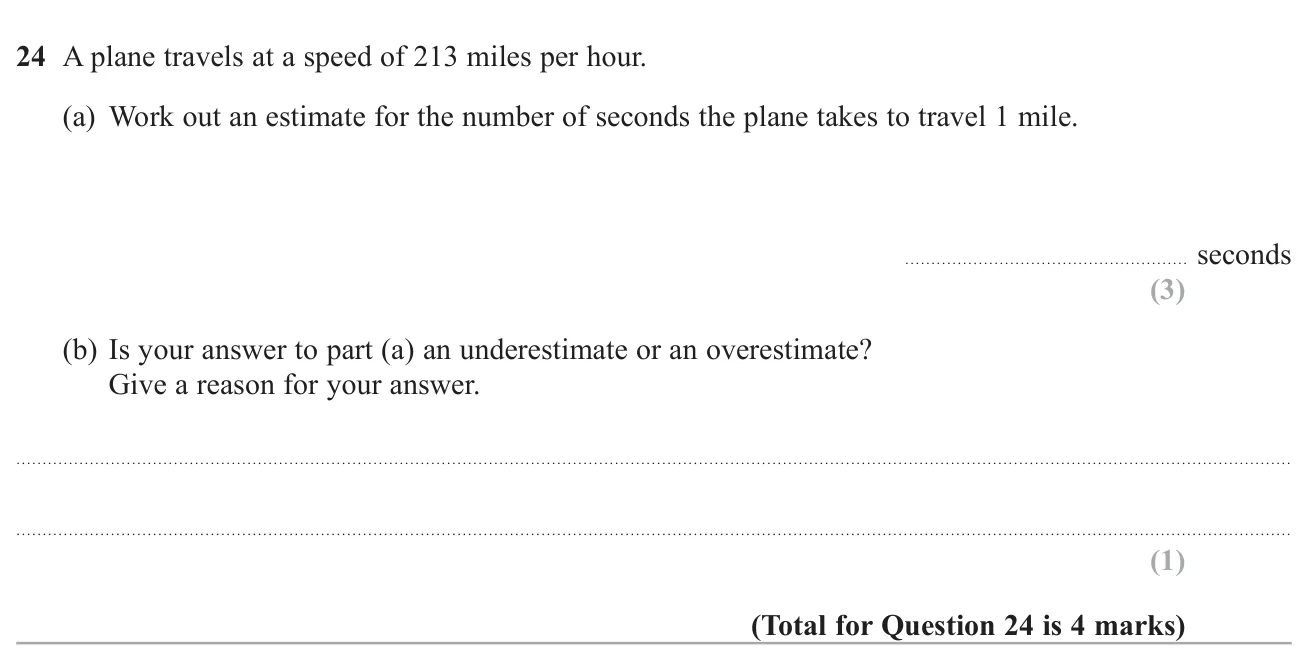
(a) 18 seconds (accept 16 to 20) 3 marks (b) Overestimate: the speed was rounded down, so the time comes out longer 1 mark
Worked solution Checked against the mark scheme
(a) Round 213 to 200 mph.
1 hour = 60 × 60 = 3600 = 60 \times 60 = 3600 = 60 × 60 = 3600
Time for 1 mile = 3600 ÷ 200 = 18 = 3600 \div 200 = 18 = 3600 ÷ 200 = 18
(b) Overestimate: 200 is slower than the real speed, so the real time is shorter.
Watch out: Dividing 200 by 3600 instead of 3600 by 200.
© Pearson Education Ltd. Specimen Paper 1 (Higher, non-calculator), question 8.
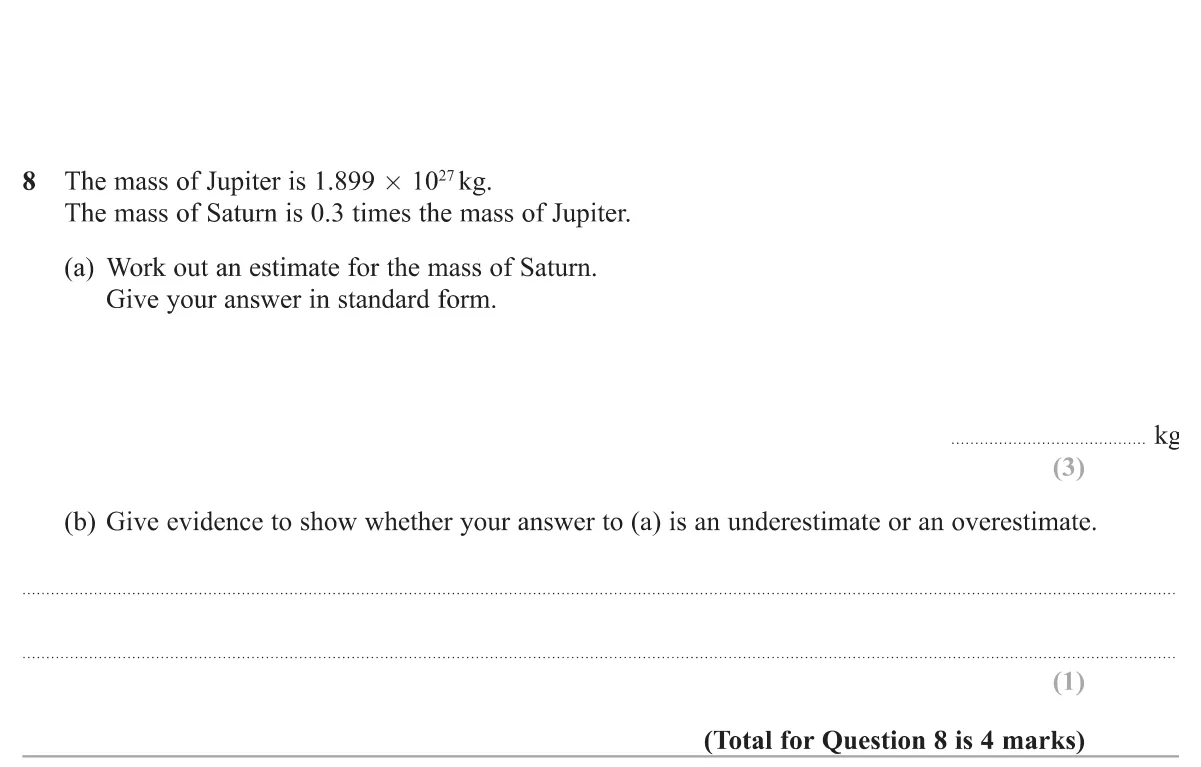
(a) Between 5.7 × 10 26 5.7 \times 10^{26} 5.7 × 1 0 26 6 × 10 26 6 \times 10^{26} 6 × 1 0 26 3 marks (b) Overestimate, because 1.899 was rounded up 1 mark
Worked solution Checked against the mark scheme
(a) Round 1.899 1.899 1.899 2 2 2 2 × 10 27 × 0.3 = 0.6 × 10 27 = 6 × 10 26 2 \times 10^{27} \times 0.3 = 0.6 \times 10^{27} = 6 \times 10^{26} 2 × 1 0 27 × 0.3 = 0.6 × 1 0 27 = 6 × 1 0 26
(b) 1.899 1.899 1.899 2 2 2
Watch out: Writing 0.6 × 10 27 0.6 \times 10^{27} 0.6 × 1 0 27
Also tested in these questions Their main topic is different, but part of each one tests this topic.
November 2024 · Paper 1 Foundation · Q22 : Estimate a journey time in minutes by rounding distance and speed, and say whether it is an over- or underestimate.November 2023 · Paper 2 Foundation · Q18 : Use a calculator to evaluate a fraction with sums and products, then round the result to 2 decimal places.June 2023 · Paper 2 Foundation · Q18 : Find the cost of buying cans in packs, then the cost of 100 ml of a drink bought in a box.June 2023 · Paper 3 Foundation · Q14 : Compare unit costs of two items bought in bulk and give the difference in pence to 1 d.p.June 2023 · Paper 3 Foundation · Q21 : Use a percentage of people and amounts per cup to find the coffee needed, then say how a higher percentage changes it.November 2022 · Paper 2 Foundation · Q25 : Find the reciprocal of a decimal and write the error interval for a number rounded to 2 significant figures.June 2022 · Paper 2 Higher · Q8 : Use a calculator to evaluate an expression with a cube root, a power, tan 60° and a fractional index, to 3 significant figures.November 2019 · Paper 1 Foundation · Q12 : Decide whether a budget in dollars covers a list of purchases, and use an approximate exchange rate to show a claim about a pound price is wrong.June 2019 · Paper 3 Higher · Q7 : Evaluate a square root of a fraction involving a sine and a square on a calculator, to 3 significant figures.June 2019 · Paper 3 Foundation · Q11 : Compare the cost of sending 12 parcels by two services, then explain why an estimate is an underestimate.Specimen · Paper 2 Higher · Q12 : Find a reciprocal and use a calculator to evaluate a cube root of a fraction involving tan.