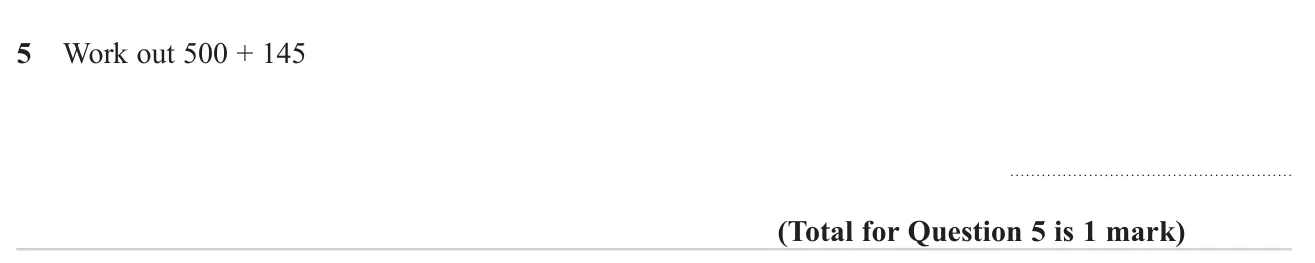
© Pearson Education Ltd. November 2024 Paper 1 (Foundation, non-calculator), question 5.
Show answer
| Answer | 1 mark |
|---|
Worked solution Checked against the mark scheme
Watch out: Lining up digits wrongly.
Number
125 past-paper questions, easiest first. Try each one, then reveal the answer.
Revision guide by The Full Marks
This topic is the everyday arithmetic behind the whole paper: ordering numbers, working with negatives and decimals, and doing calculations in the right order. It turns up in almost every non-calculator paper, often in the first few questions.
Example 1 Foundation · grade 2
Work out
Brackets first:
Then the power:
Then multiply and divide from left to right: , and
Finally subtract:
Example 2 Foundation · grade 4
(a) You are told that . Use this to work out (b) Work out without a calculator.
(a) has 1 decimal place and has 2, so the answer has 3 decimal places.
Check: , which is close.
(b) Multiply both numbers by 10:
Short division:
Check: , which is close.
BIDMAS is the order you do operations in: Brackets, Indices, Division and Multiplication, then Addition and Subtraction. Division and multiplication have equal priority, so do them from left to right; the same goes for addition and subtraction.
A positive. For example, .
Multiply both numbers by 10, 100 or 1000 until you are dividing by a whole number, then divide as normal. For example, .
© Pearson Education Ltd. November 2024 Paper 1 (Foundation, non-calculator), question 5.
| Answer | 1 mark |
|---|
Worked solution Checked against the mark scheme
Watch out: Lining up digits wrongly.
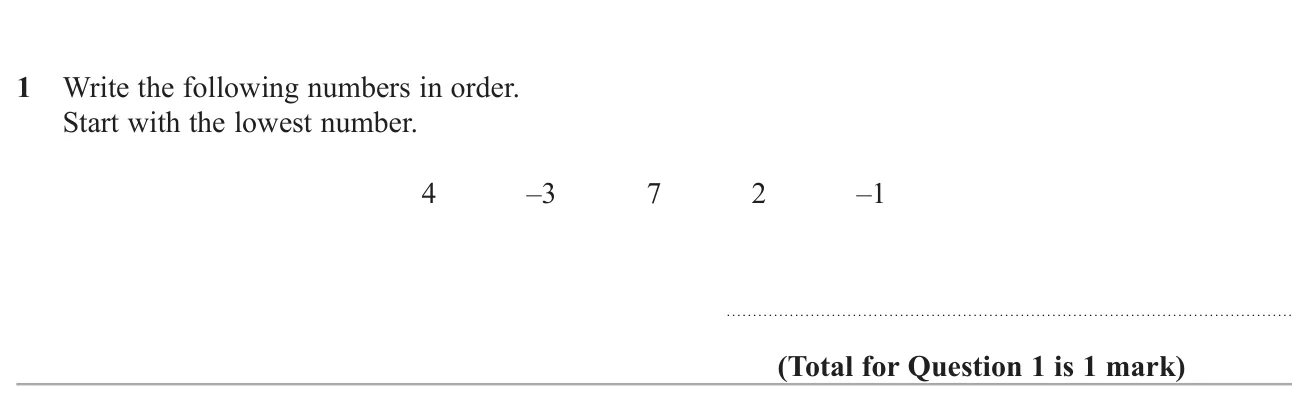
© Pearson Education Ltd. June 2024 Paper 2 (Foundation, calculator), question 1.
| Answer | (the reverse order is also accepted) | 1 mark |
|---|
Worked solution Checked against the mark scheme
Negative numbers are smaller than positive ones, and is further below zero than .
So the order is .
Watch out: Putting before because 1 is smaller than 3.
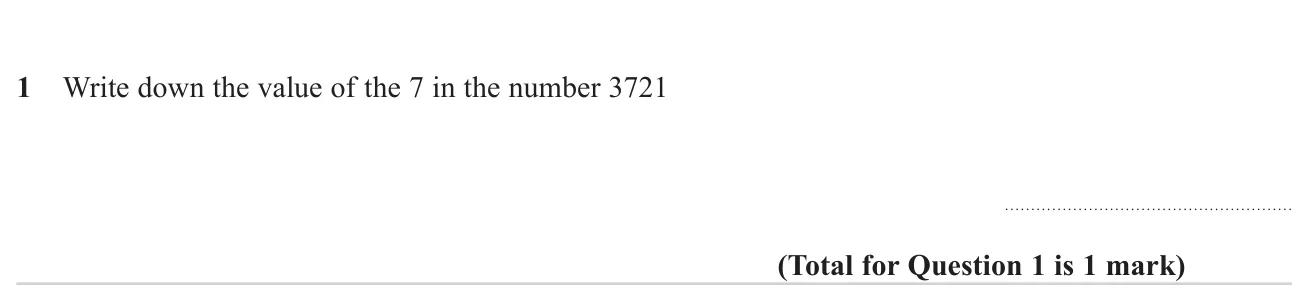
© Pearson Education Ltd. November 2024 Paper 3 (Foundation, calculator), question 1.
| Answer | 1 mark |
|---|
Worked solution Checked against the mark scheme
In 3721 the 7 is in the hundreds column.
So it is worth .
Watch out: Writing 7 or 70 instead of 700.
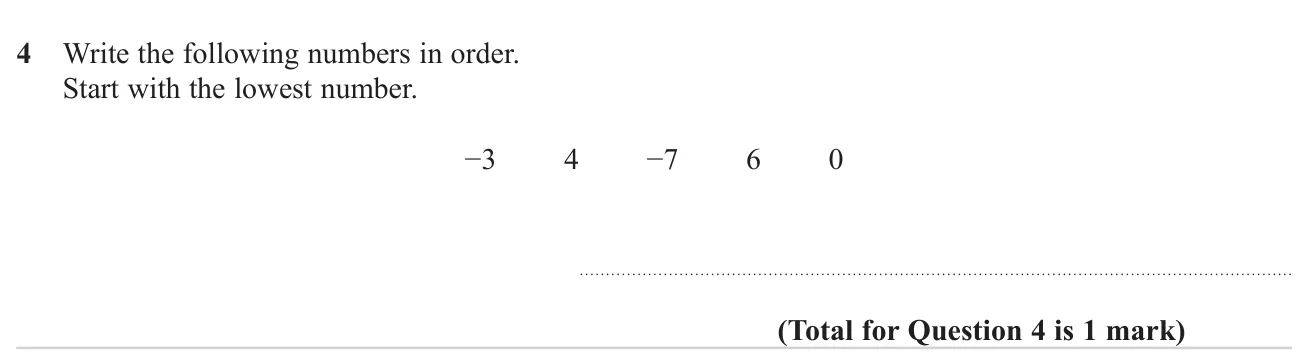
© Pearson Education Ltd. November 2024 Paper 3 (Foundation, calculator), question 4.
| Answer | 1 mark |
|---|
Worked solution Checked against the mark scheme
The most negative number is the smallest.
Watch out: Putting before because 3 is smaller than 7.

© Pearson Education Ltd. June 2024 Paper 3 (Foundation, calculator), question 3.
| Answer | tens (or ) | 1 mark |
|---|
Worked solution Checked against the mark scheme
In 62 837 the digits are: 6 ten-thousands, 2 thousands, 8 hundreds, 3 tens, 7 units.
So the 3 is worth 3 tens, i.e. .
Watch out: Answering 3, or saying hundreds.
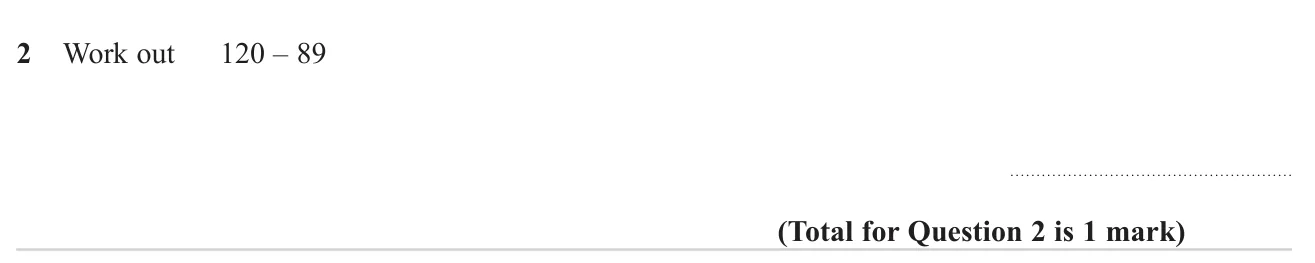
© Pearson Education Ltd. November 2023 Paper 1 (Foundation, non-calculator), question 2.
| Answer | 31 | 1 mark |
|---|
Worked solution Checked against the mark scheme
: take away 90 to get 30, then add back 1.
Watch out: Getting 41 by borrowing incorrectly.
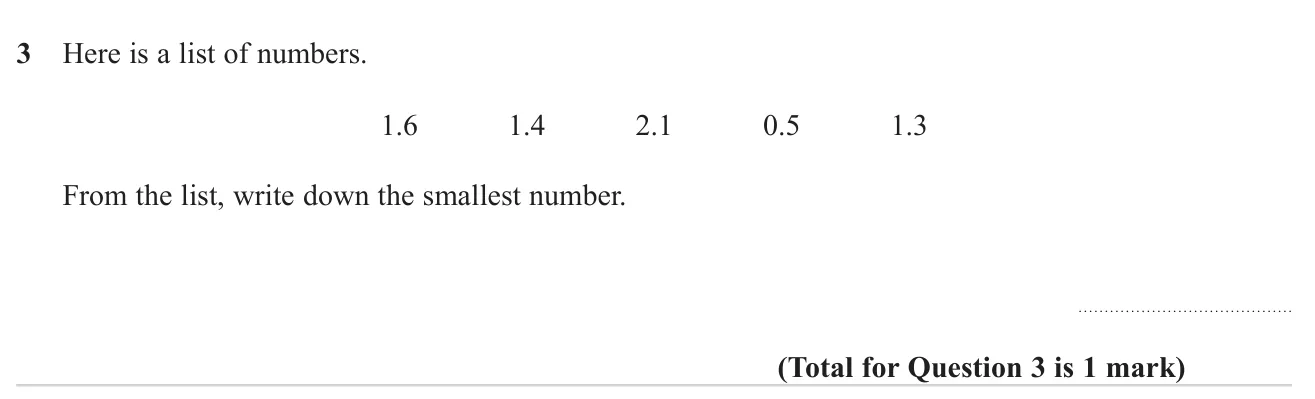
© Pearson Education Ltd. June 2023 Paper 1 (Foundation, non-calculator), question 3.
| Answer | 1 mark |
|---|
Worked solution Checked against the mark scheme
Compare the whole-number parts first: only 0.5 starts with 0.
So the smallest is .
Watch out: Choosing 1.3 by looking only at the digits after the point.

© Pearson Education Ltd. June 2023 Paper 1 (Foundation, non-calculator), question 4.
| Answer | 1 mark |
|---|
Worked solution Checked against the mark scheme
Start at on a number line and move 5 to the right.
Watch out: Giving 4 or −14.
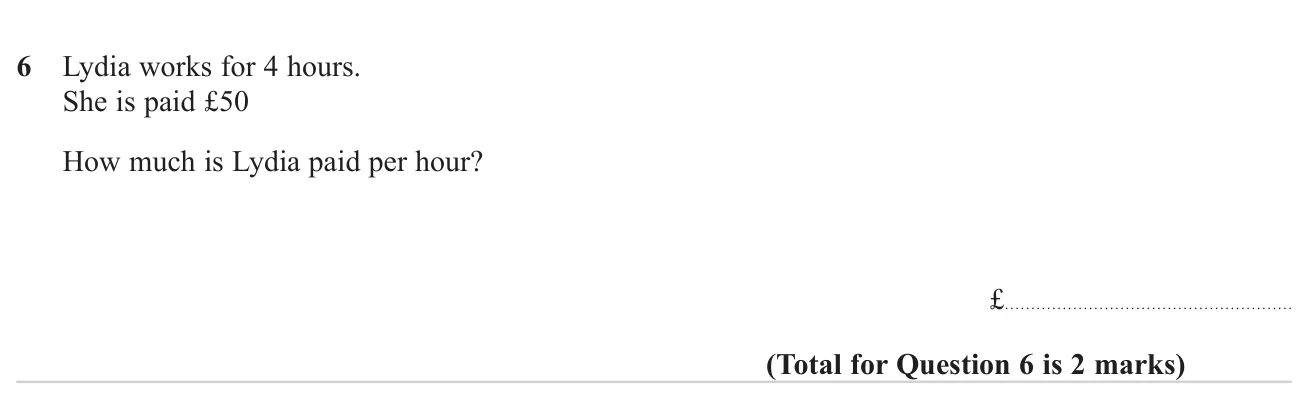
© Pearson Education Ltd. November 2023 Paper 2 (Foundation, calculator), question 6.
| Answer | £12.50 | 2 marks |
|---|
Worked solution Checked against the mark scheme
Pay per hour total pay hours
, so £12.50 per hour.
Watch out: Writing £12.5 is fine, but multiplying 50 by 4 to get 200 is not.
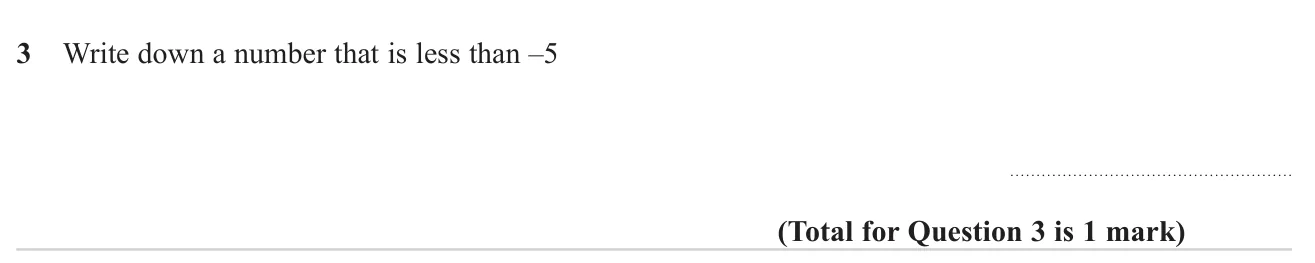
© Pearson Education Ltd. November 2023 Paper 3 (Foundation, calculator), question 3.
| Answer | Any number less than , e.g. | 1 mark |
|---|
Worked solution Checked against the mark scheme
On a number line, numbers less than are further to the left.
So , or all work.
Watch out: Giving −4, thinking it is smaller because 4 is less than 5.

© Pearson Education Ltd. November 2023 Paper 3 (Foundation, calculator), question 5.
| Answer | 9 tenths ( or 0.9) | 1 mark |
|---|
Worked solution Checked against the mark scheme
In 27.963 the first digit after the decimal point is the tenths digit.
So the 9 is worth .
Watch out: Saying hundredths, or 900.

© Pearson Education Ltd. June 2023 Paper 3 (Foundation, calculator), question 1.
| Answer | 3107 | 1 mark |
|---|
Worked solution Checked against the mark scheme
Three thousand = 3 in the thousands column, one hundred = 1 in the hundreds, no tens so 0, and 7 units.
So the number is .
Watch out: Writing 300107 or 31007 by missing the zero in the tens column.
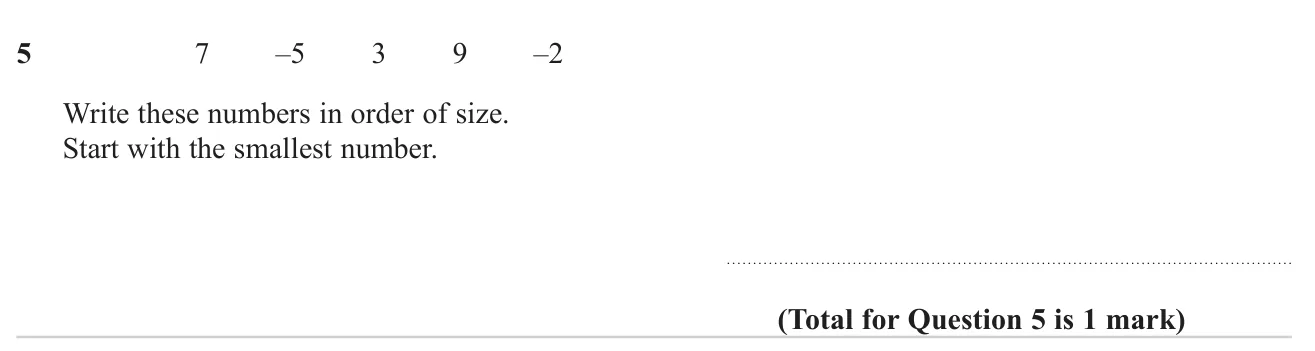
© Pearson Education Ltd. June 2023 Paper 3 (Foundation, calculator), question 5.
| Answer | 1 mark |
|---|
Worked solution Checked against the mark scheme
The negatives are smallest, and is further below zero than .
Then the positives in order:
Watch out: Putting before .
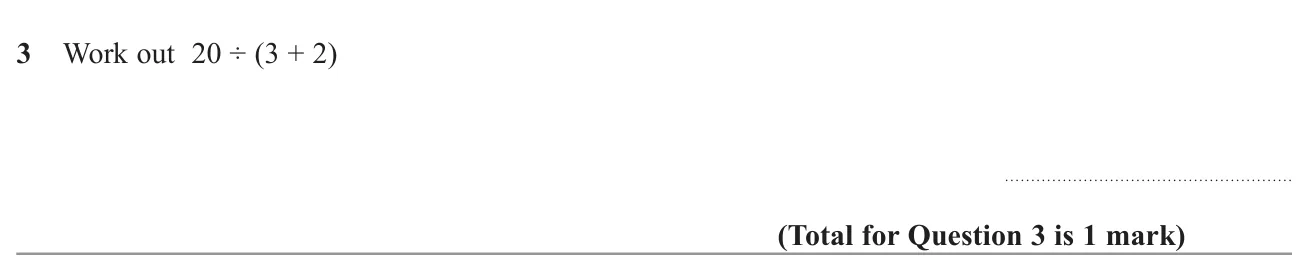
© Pearson Education Ltd. November 2022 Paper 1 (Foundation, non-calculator), question 3.
| Answer | 1 mark |
|---|
Worked solution Checked against the mark scheme
Brackets first: .
Then .
Watch out: Working left to right: .
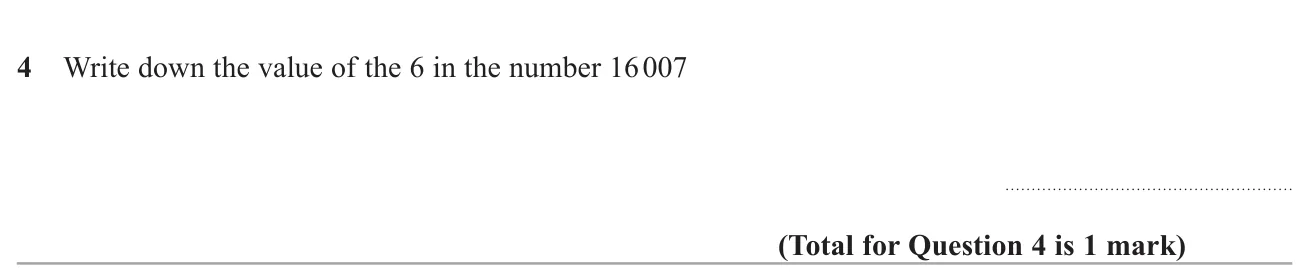
© Pearson Education Ltd. June 2022 Paper 1 (Foundation, non-calculator), question 4.
| Answer | 6000 | 1 mark |
|---|
Worked solution Checked against the mark scheme
16 007 has 1 ten-thousand, 6 thousands, 0 hundreds, 0 tens and 7 ones.
So the 6 is worth .
Watch out: Writing just 6, the digit, instead of the value it stands for.
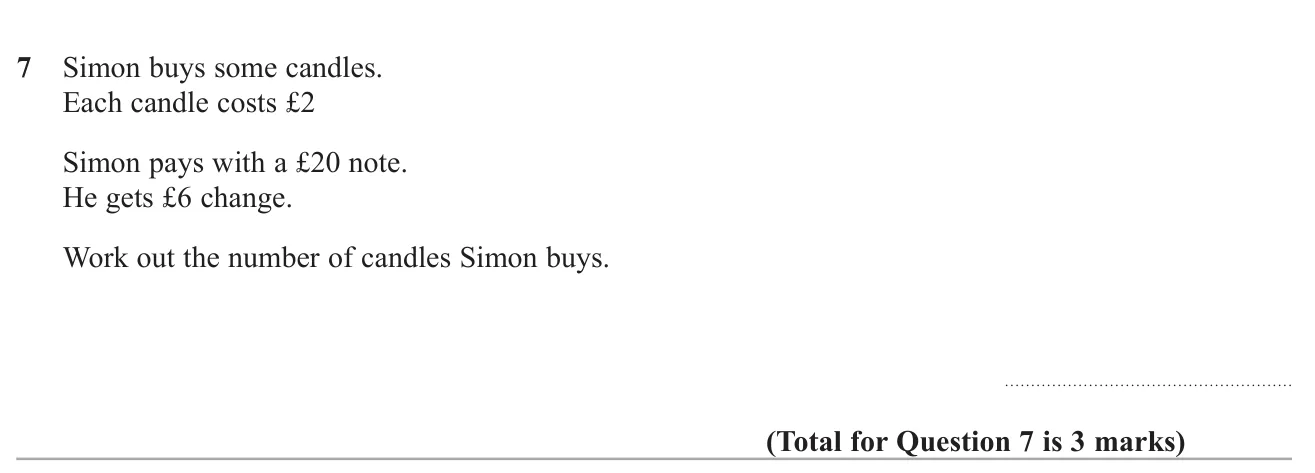
© Pearson Education Ltd. June 2022 Paper 1 (Foundation, non-calculator), question 7.
| Answer | 7 | 3 marks |
|---|
Worked solution Checked against the mark scheme
Amount spent: pounds
Each candle costs £2:
Simon buys 7 candles.
Watch out: Dividing 20 by 2 and forgetting to take off the change.
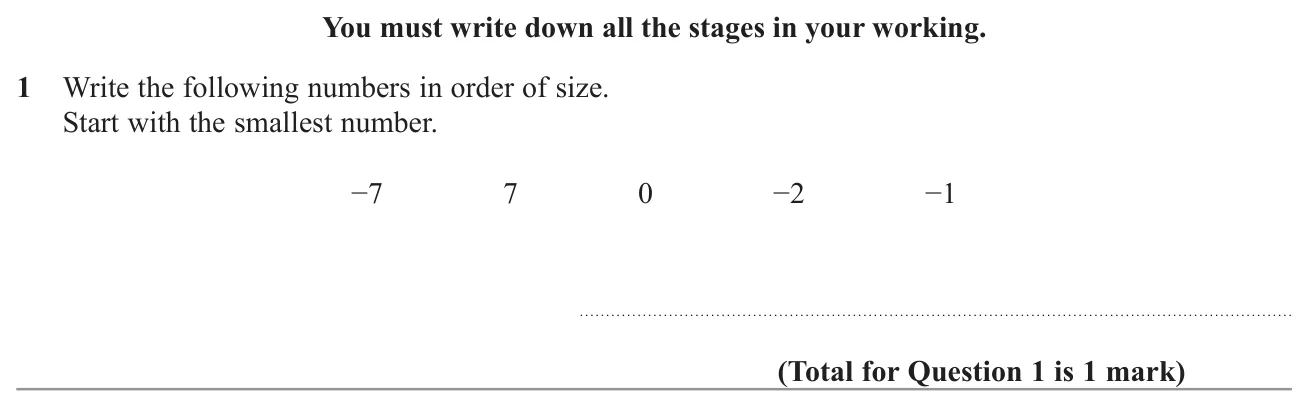
© Pearson Education Ltd. November 2022 Paper 2 (Foundation, calculator), question 1.
| Answer | 1 mark |
|---|
Worked solution Checked against the mark scheme
Negative numbers get smaller the further they are from zero, so is the smallest.
Order:
Watch out: Putting before because 1 is smaller than 7.
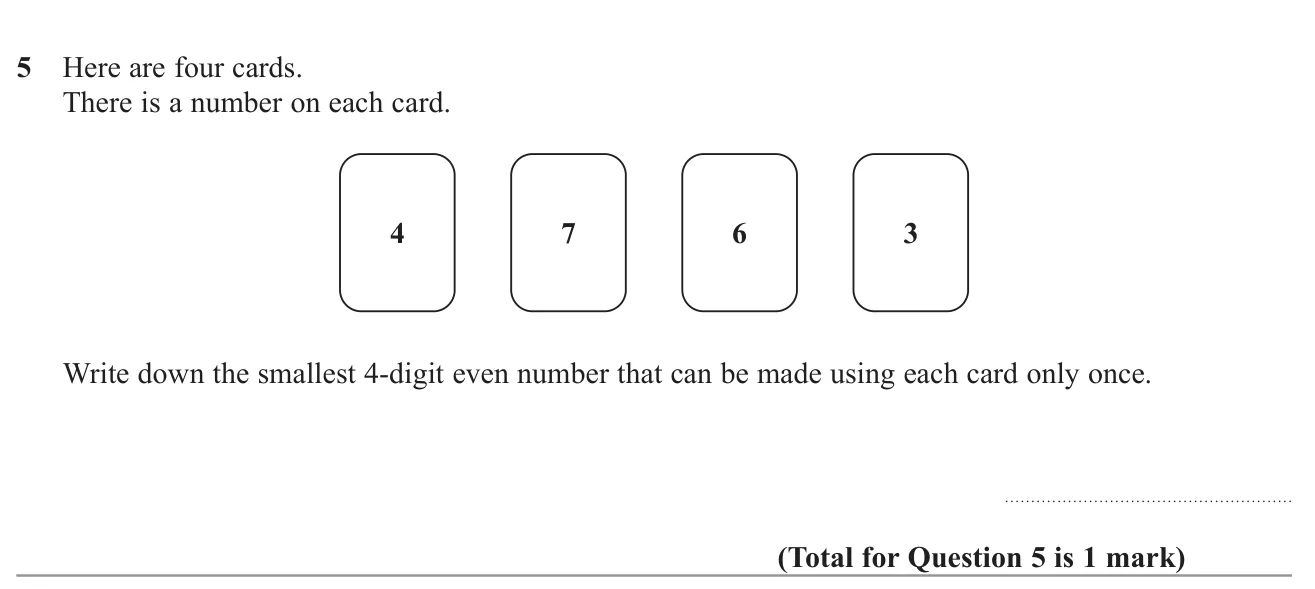
© Pearson Education Ltd. November 2022 Paper 2 (Foundation, calculator), question 5.
| Answer | 3476 | 1 mark |
|---|
Worked solution Checked against the mark scheme
To be even, the last digit must be 4 or 6.
The smallest start uses 3 first. Ending in 6 leaves 3, 4, 7: 3476. Ending in 4 leaves 3, 6, 7: 3674.
Smallest is 3476.
Watch out: Giving 3467, which is odd.
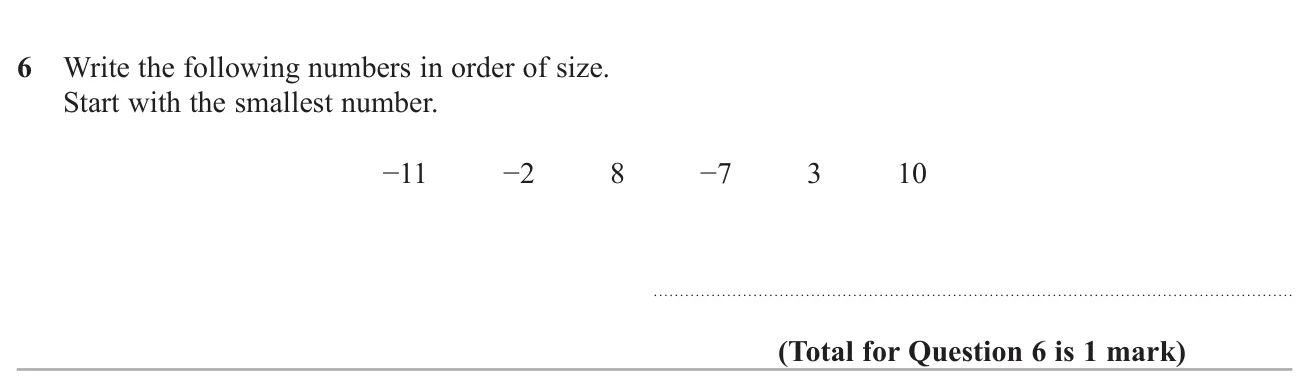
© Pearson Education Ltd. June 2022 Paper 2 (Foundation, calculator), question 6.
| Answer | 1 mark |
|---|
Worked solution Checked against the mark scheme
The most negative number is the smallest.
Negatives: , then positives: .
Order:
Watch out: Putting before because 2 is smaller than 7.

© Pearson Education Ltd. November 2022 Paper 3 (Foundation, calculator), question 2.
| Answer | 2000 | 1 mark |
|---|
Worked solution Checked against the mark scheme
In 12 345 the digits are: 1 ten-thousand, 2 thousands, 3 hundreds, 4 tens, 5 ones.
So the 2 is worth 2000.
Watch out: Writing just 2 or 'hundreds'.
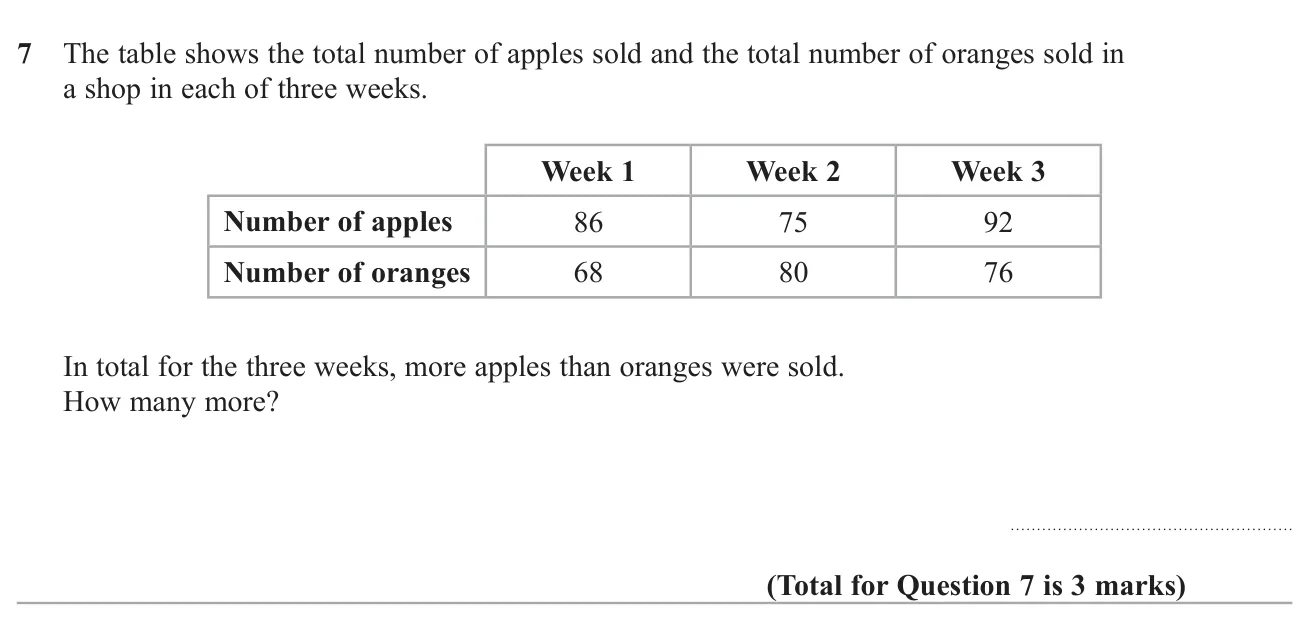
© Pearson Education Ltd. June 2022 Paper 3 (Foundation, calculator), question 7.
| Answer | 29 | 3 marks |
|---|
Worked solution Checked against the mark scheme
Apples:
Oranges:
Difference:
Watch out: Adding the numbers wrongly, or subtracting only one week.
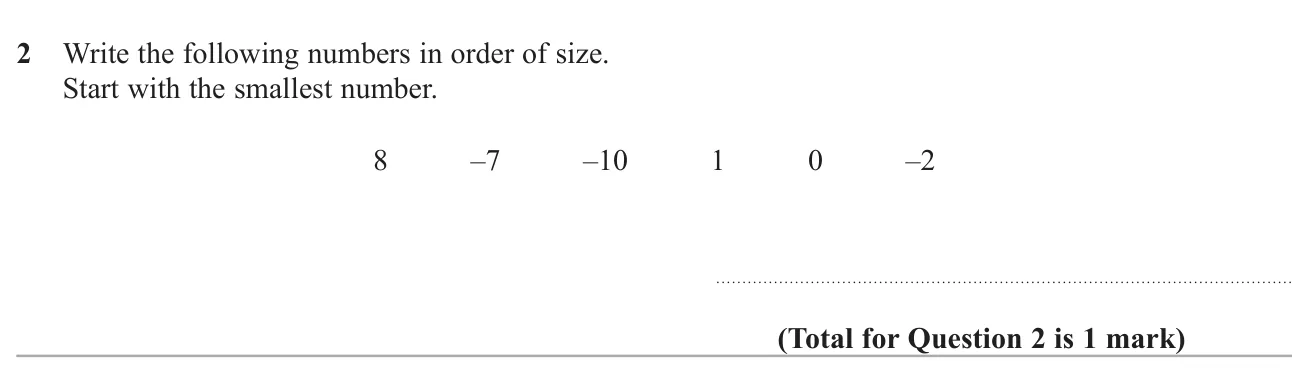
© Pearson Education Ltd. November 2021 Paper 1 (Foundation, non-calculator), question 2.
| Answer | 1 mark |
|---|
Worked solution Checked against the mark scheme
The most negative number is the smallest.
Negatives: , then , then .
Order:
Watch out: Treating as smaller than because 2 is less than 7.
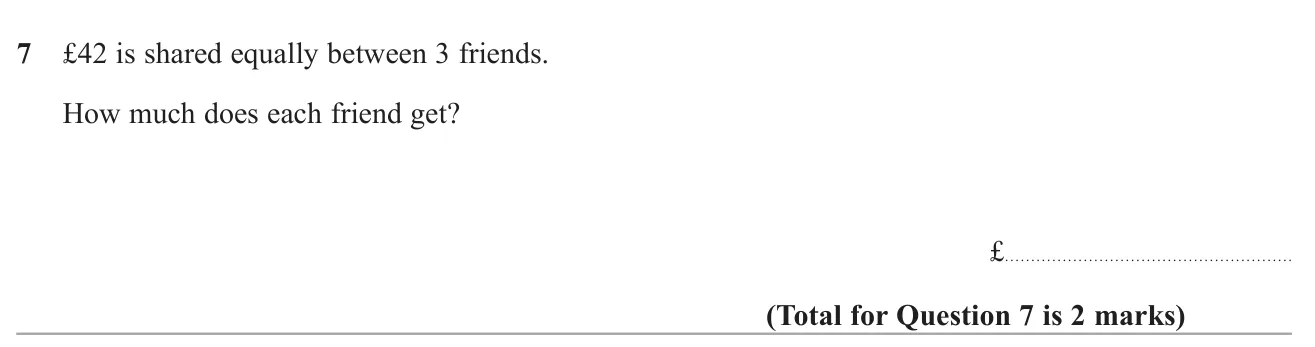
© Pearson Education Ltd. November 2021 Paper 1 (Foundation, non-calculator), question 7.
| Answer | 2 marks |
|---|
Worked solution Checked against the mark scheme
Share equally means divide.
Watch out: Multiplying by 3 instead of dividing.
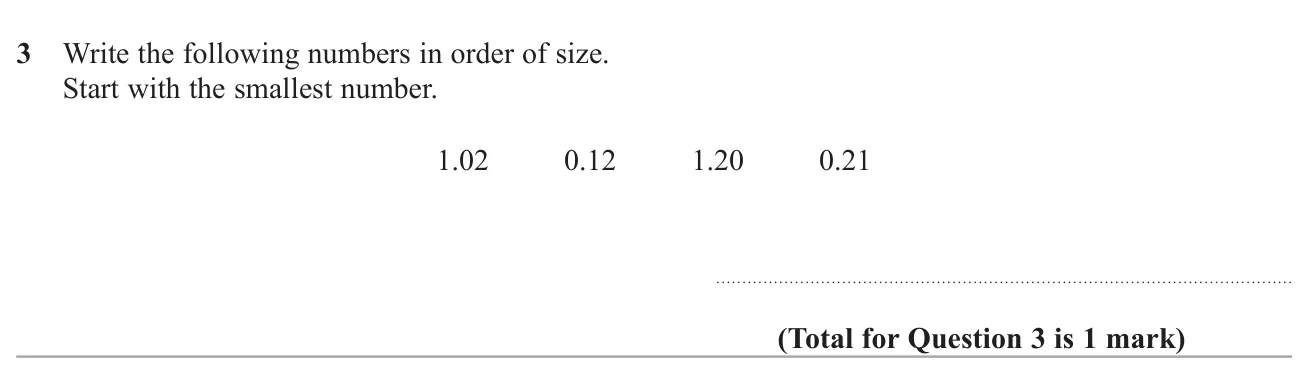
© Pearson Education Ltd. November 2021 Paper 2 (Foundation, calculator), question 3.
| Answer | 0.12, 0.21, 1.02, 1.20 | 1 mark |
|---|
Worked solution Checked against the mark scheme
Compare whole-number parts first: 0.12 and 0.21 are less than 1.
Then compare tenths: and .
Order: 0.12, 0.21, 1.02, 1.20
Watch out: Thinking 1.02 is bigger than 1.20 because 2 is in a later place.
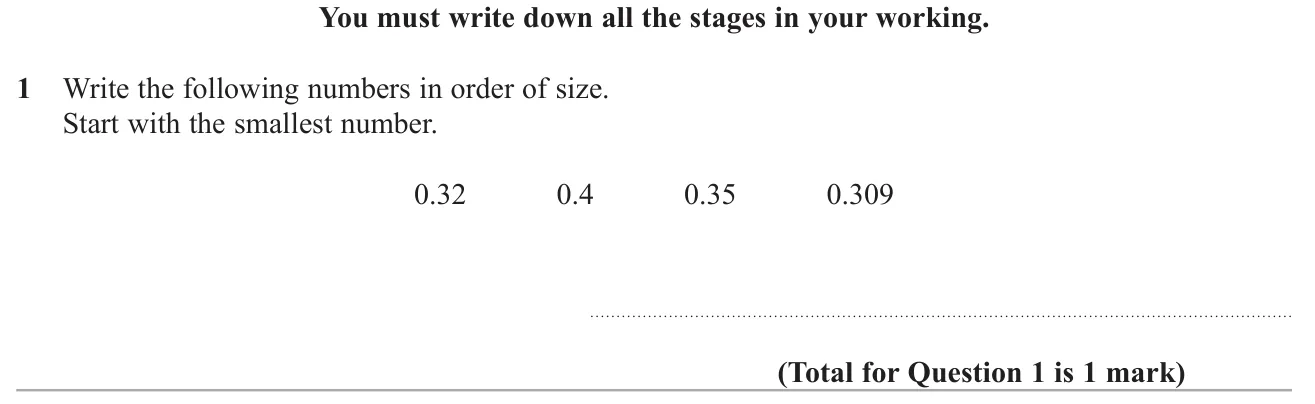
© Pearson Education Ltd. November 2020 Paper 1 (Foundation, non-calculator), question 1.
| Answer | 0.309, 0.32, 0.35, 0.4 | 1 mark |
|---|
Worked solution Checked against the mark scheme
Give every number three decimal places: 0.320, 0.400, 0.350, 0.309.
Now compare: 0.309 < 0.320 < 0.350 < 0.400, so the order is 0.309, 0.32, 0.35, 0.4.
Watch out: Thinking 0.309 is biggest because it has the most digits.
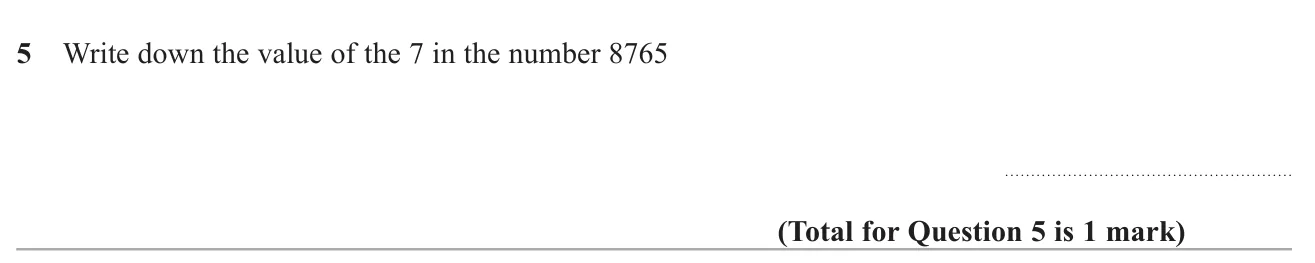
© Pearson Education Ltd. November 2020 Paper 1 (Foundation, non-calculator), question 5.
| Answer | 700 | 1 mark |
|---|
Worked solution Checked against the mark scheme
In 8765 the digits are 8 thousands, 7 hundreds, 6 tens and 5 ones.
So the 7 is worth 700.
Watch out: Answering 7 or 70.
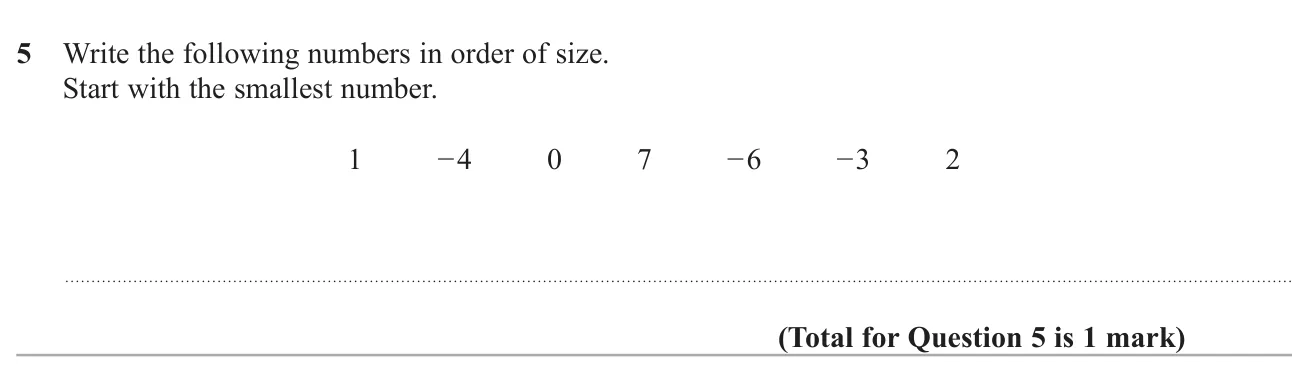
© Pearson Education Ltd. November 2020 Paper 3 (Foundation, calculator), question 5.
| Answer | 1 mark |
|---|
Worked solution Checked against the mark scheme
The negative number furthest from zero is smallest.
Watch out: Putting before because 3 is smaller than 6.
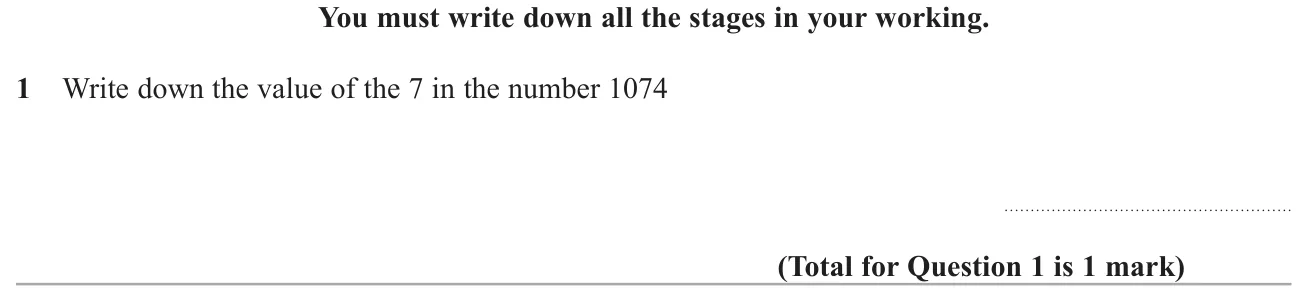
© Pearson Education Ltd. November 2019 Paper 1 (Foundation, non-calculator), question 1.
| Answer | (7 tens) | 1 mark |
|---|
Worked solution Checked against the mark scheme
The digits of 1074 are thousands, hundreds, tens, ones: 1, 0, 7, 4.
The 7 is in the tens column, so it is worth .
Watch out: Writing 7 instead of its value 70.
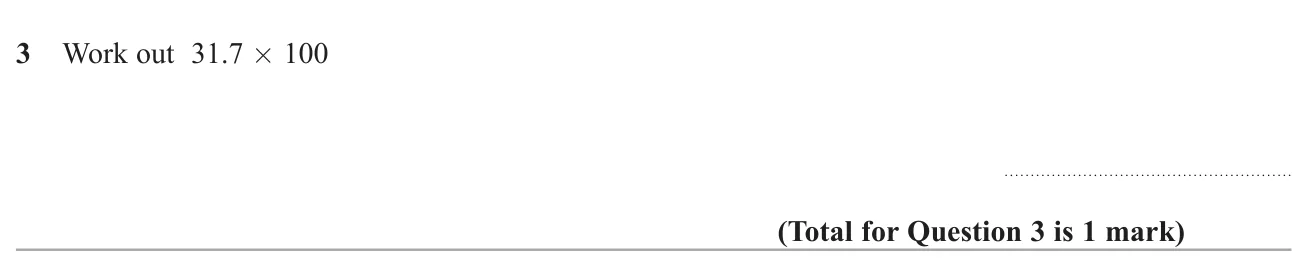
© Pearson Education Ltd. November 2019 Paper 1 (Foundation, non-calculator), question 3.
| Answer | 1 mark |
|---|
Worked solution Checked against the mark scheme
Multiplying by 100 moves every digit two places to the left.
Watch out: Writing 317 or 31.700.
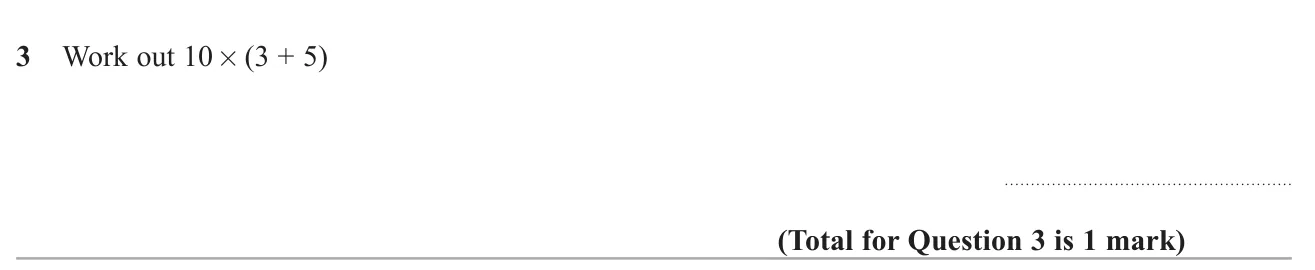
© Pearson Education Ltd. June 2019 Paper 1 (Foundation, non-calculator), question 3.
| Answer | 80 | 1 mark |
|---|
Worked solution Checked against the mark scheme
Work out the bracket first:
Then
Watch out: Doing first and getting 35.
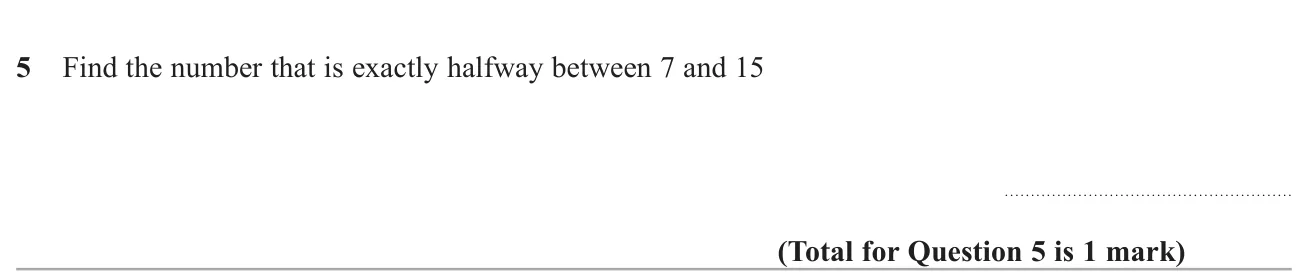
© Pearson Education Ltd. June 2019 Paper 1 (Foundation, non-calculator), question 5.
| Answer | 11 | 1 mark |
|---|
Worked solution Checked against the mark scheme
Add the numbers and halve:
Watch out: Halving the difference (4) and giving that as the answer.
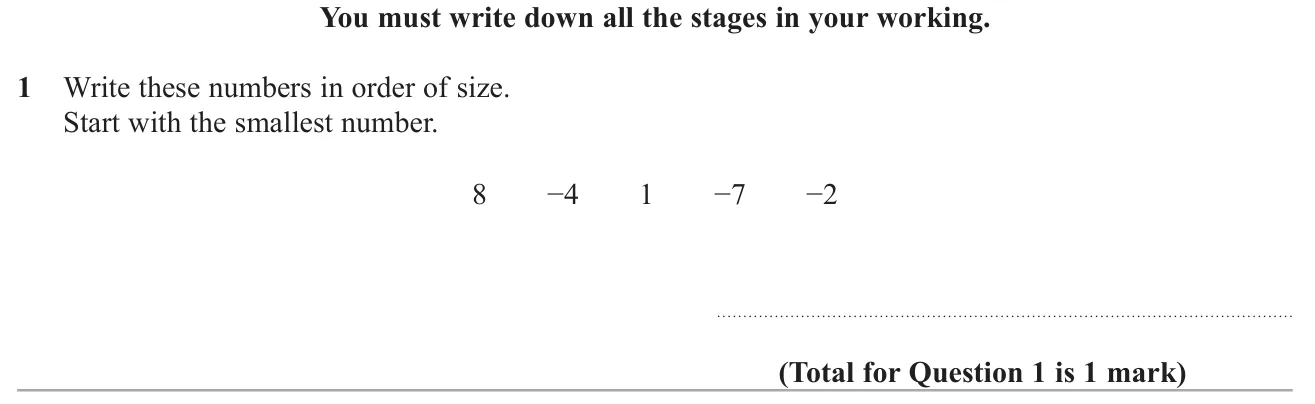
© Pearson Education Ltd. November 2019 Paper 2 (Foundation, calculator), question 1.
| Answer | 1 mark |
|---|
Worked solution Checked against the mark scheme
The most negative number is the smallest.
Order:
Watch out: Putting before because 2 is smaller than 7.
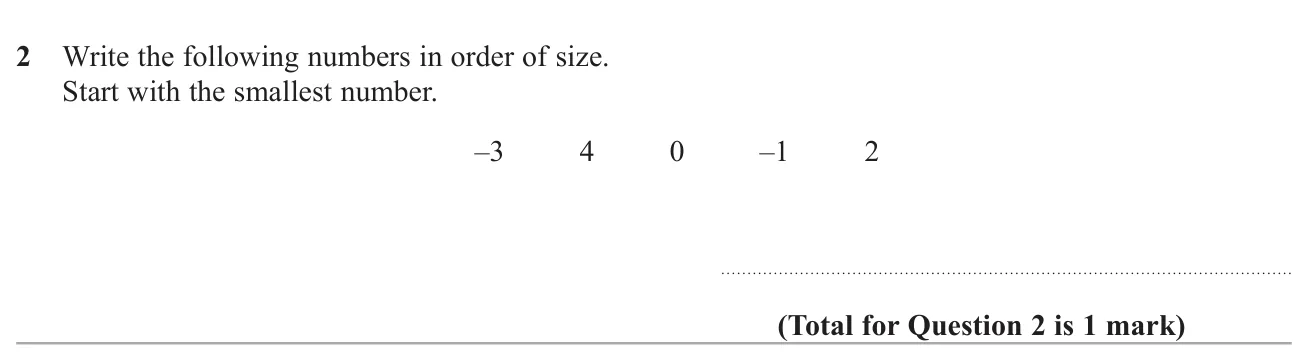
© Pearson Education Ltd. June 2019 Paper 2 (Foundation, calculator), question 2.
| Answer | 1 mark |
|---|
Worked solution Checked against the mark scheme
Negative numbers are smaller than zero, and is further below zero than .
So the order is
Watch out: Putting before .
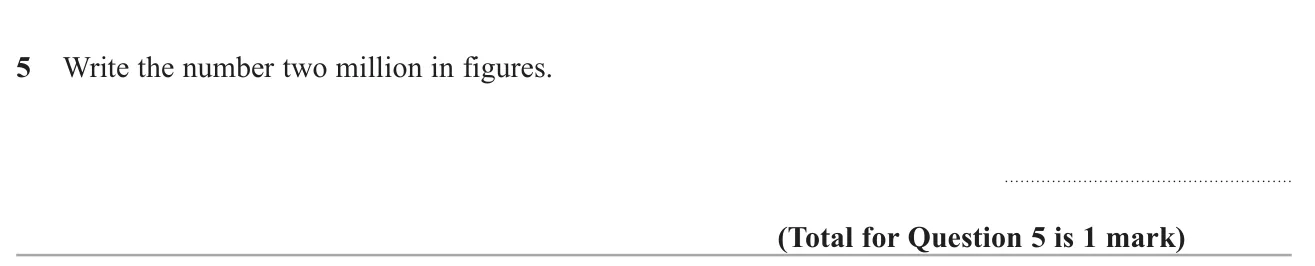
© Pearson Education Ltd. June 2019 Paper 2 (Foundation, calculator), question 5.
| Answer | 1 mark |
|---|
Worked solution Checked against the mark scheme
One million is (six zeros).
Two million is
Watch out: Writing 200 000 or 20 000 000.
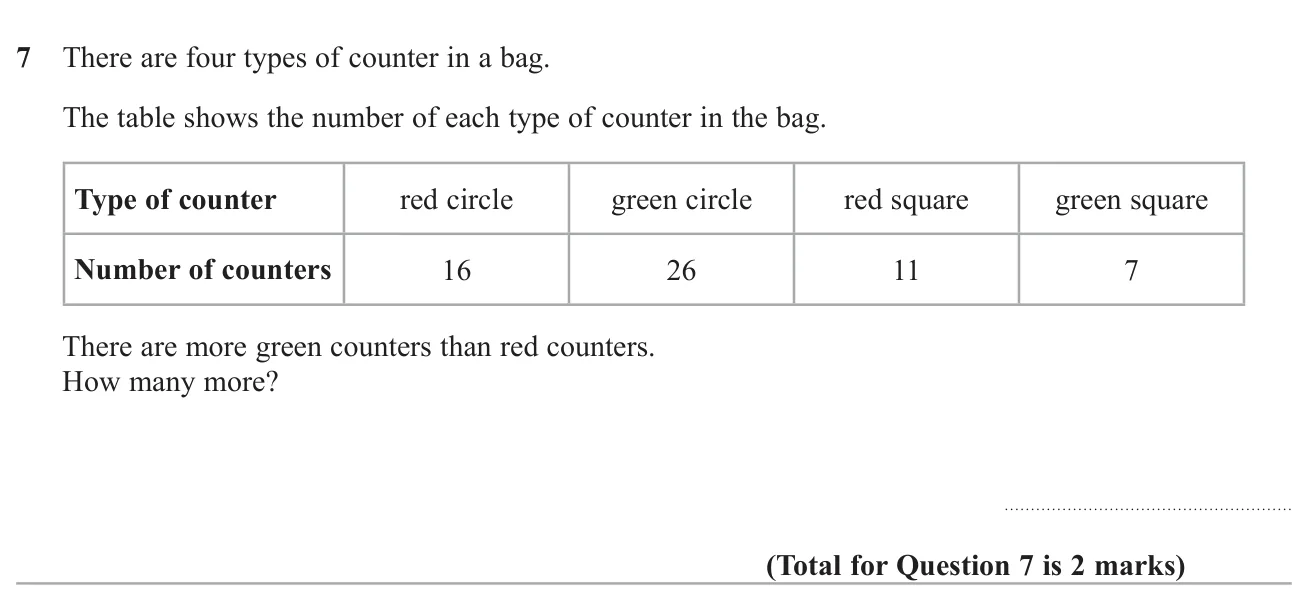
© Pearson Education Ltd. June 2019 Paper 3 (Foundation, calculator), question 7.
| Answer | 6 | 2 marks |
|---|
Worked solution Checked against the mark scheme
Green:
Red:
Difference:
Watch out: Only comparing the circles and getting 10.
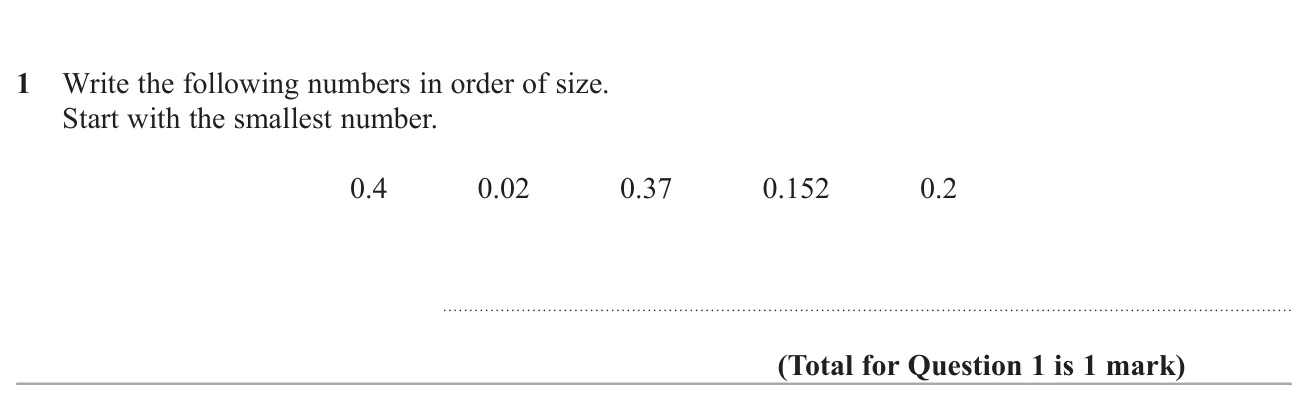
© Pearson Education Ltd. November 2018 Paper 1 (Foundation, non-calculator), question 1.
| Answer | 0.02, 0.152, 0.2, 0.37, 0.4 | 1 mark |
|---|
Worked solution Checked against the mark scheme
Compare the tenths digit first: 0.02, 0.152, 0.2, 0.37, 0.4
So the order is 0.02, 0.152, 0.2, 0.37, 0.4
Watch out: Thinking 0.152 is biggest because it has the most digits.
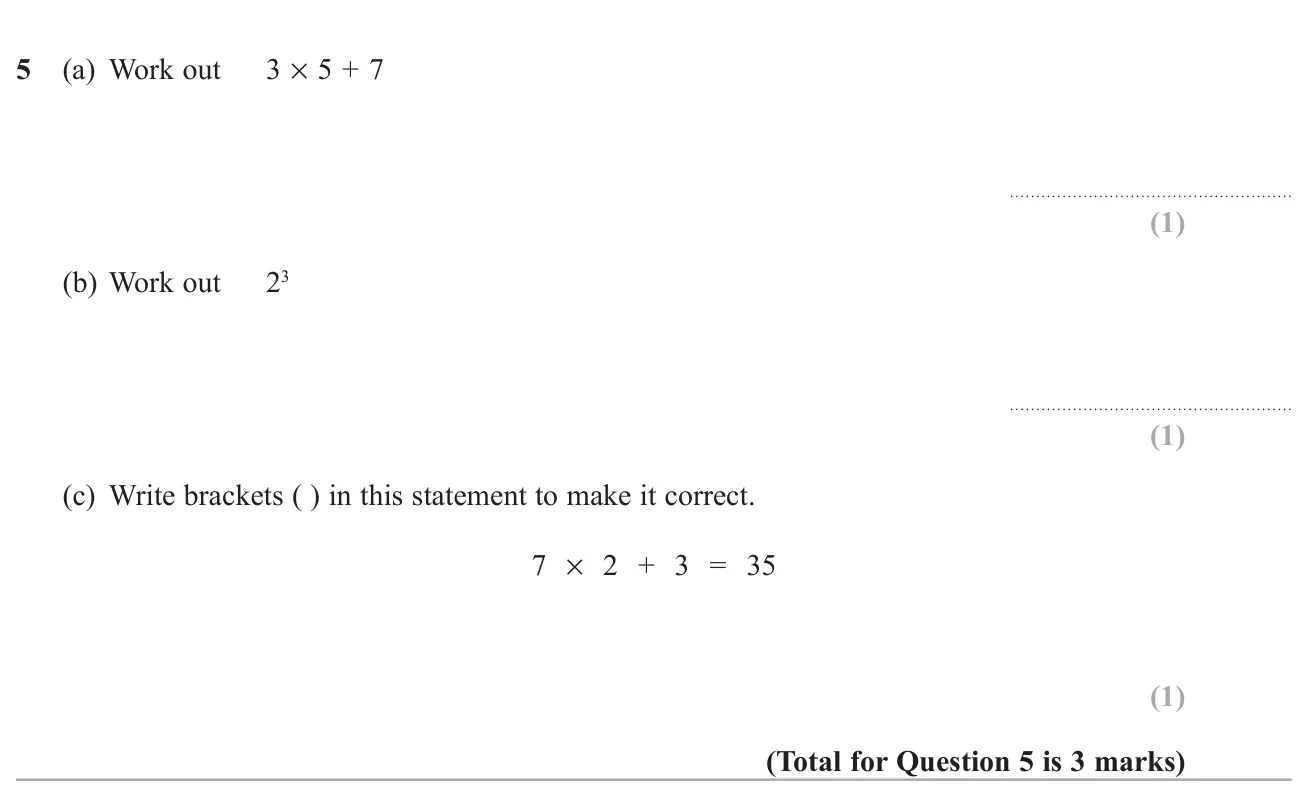
© Pearson Education Ltd. November 2018 Paper 1 (Foundation, non-calculator), question 5.
| (a) | 22 | 1 mark |
|---|---|---|
| (b) | 8 | 1 mark |
| (c) | 1 mark |
Worked solution Checked against the mark scheme
(a) Multiply first: , then
(b)
(c) and , so
Watch out: In (b), working out .
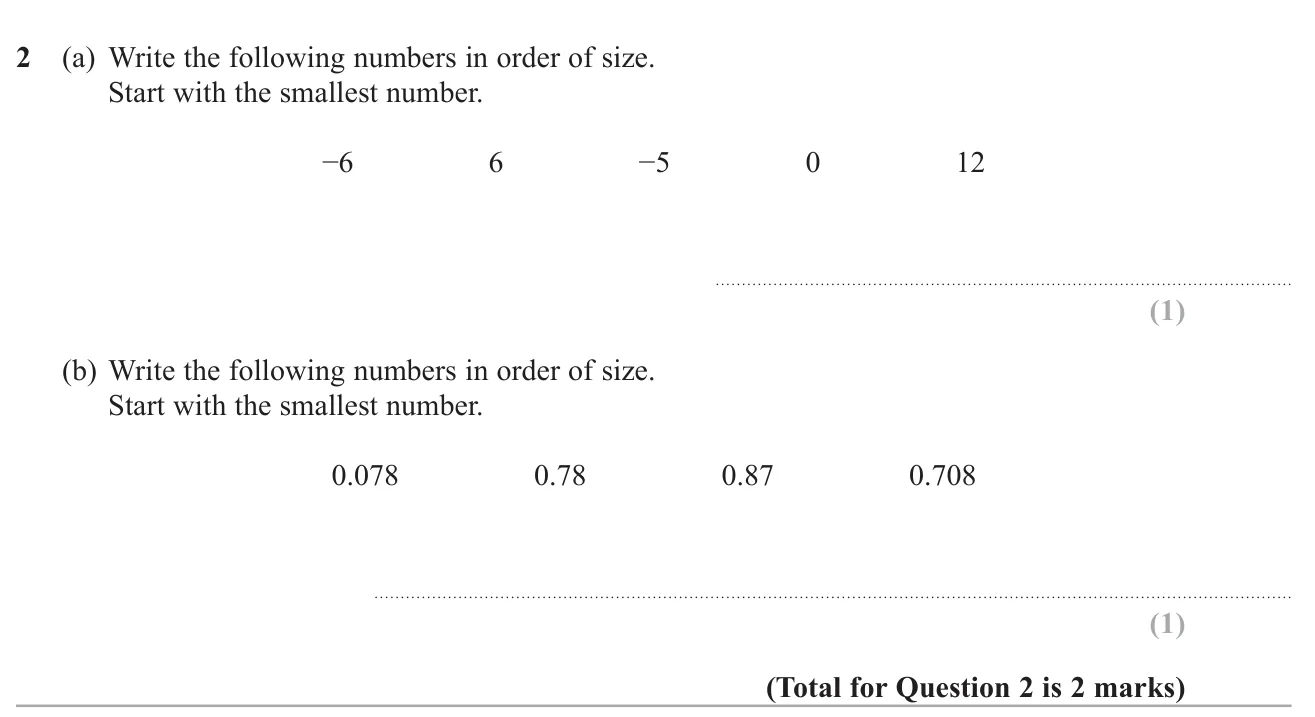
© Pearson Education Ltd. June 2018 Paper 1 (Foundation, non-calculator), question 2.
| (a) | 1 mark | |
|---|---|---|
| (b) | 1 mark |
Worked solution Checked against the mark scheme
(a) Negatives come first, and is smaller than :
(b) Write each with three decimal places: 0.078, 0.780, 0.870, 0.708.
Order:
Watch out: Thinking is smaller than .
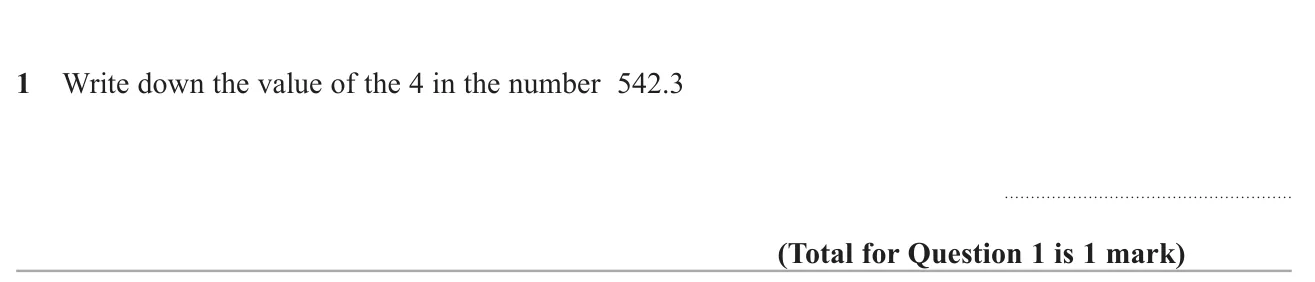
© Pearson Education Ltd. November 2018 Paper 2 (Foundation, calculator), question 1.
| Answer | 40 (4 tens) | 1 mark |
|---|
Worked solution Checked against the mark scheme
In 542.3 the digits are 5 hundreds, 4 tens, 2 ones and 3 tenths.
So the 4 is worth 40.
Watch out: Writing 4 instead of 40.
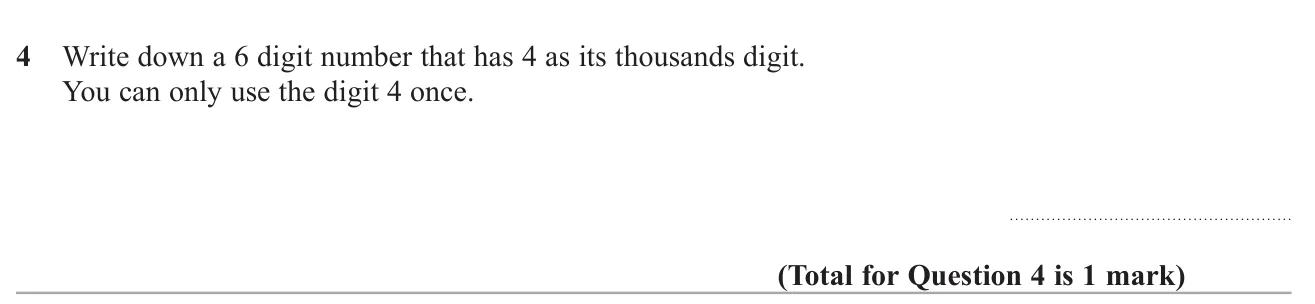
© Pearson Education Ltd. June 2018 Paper 2 (Foundation, calculator), question 4.
| Answer | Any suitable number, e.g. | 1 mark |
|---|
Worked solution Checked against the mark scheme
The thousands digit is the fourth digit from the right in a whole number.
For example, : the digits are 5 (hundred thousands), 6 (ten thousands), 4 (thousands), then zeros.
Watch out: Putting the 4 in the ten thousands or hundreds place.
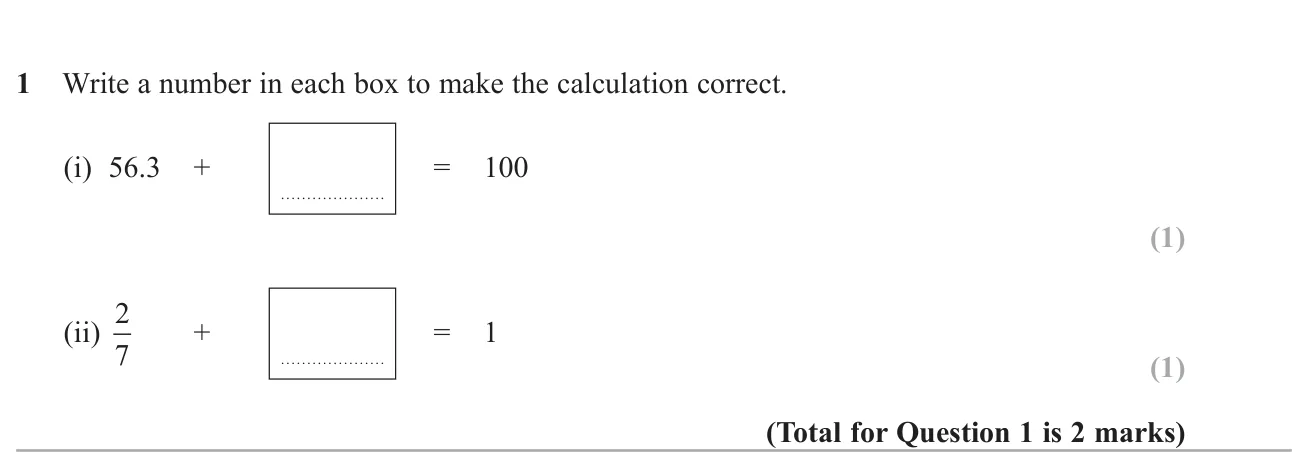
© Pearson Education Ltd. November 2018 Paper 3 (Foundation, calculator), question 1.
| (i) | 1 mark | |
|---|---|---|
| (ii) | 1 mark |
Worked solution Checked against the mark scheme
(i)
(ii) One whole is , so
Watch out: In (i), getting 44.7 or 43.3 by mis-handling the decimal when subtracting from 100.
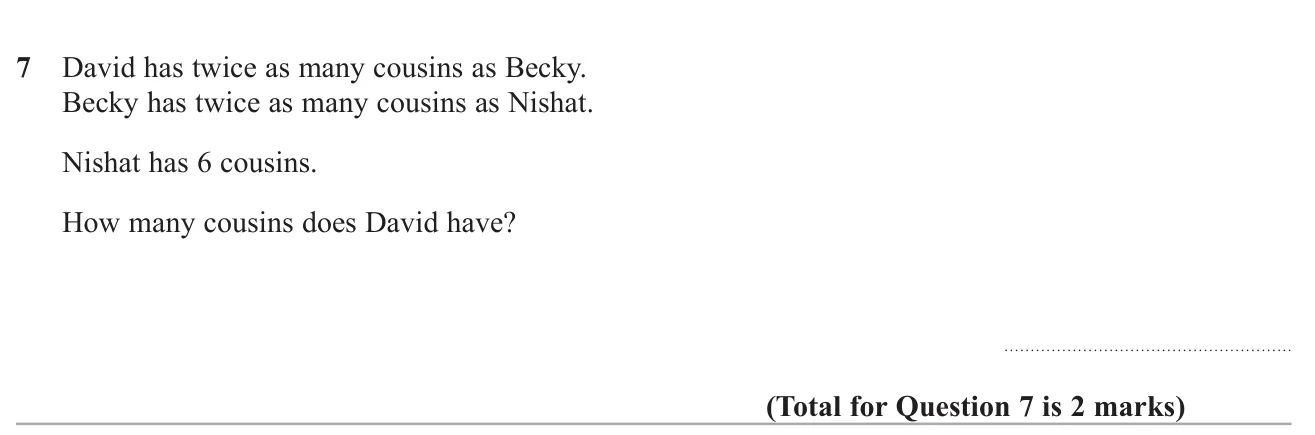
© Pearson Education Ltd. June 2018 Paper 3 (Foundation, calculator), question 7.
| Answer | 2 marks |
|---|
Worked solution Checked against the mark scheme
Becky has cousins.
David has cousins.
Watch out: Halving instead of doubling, giving 1.5.
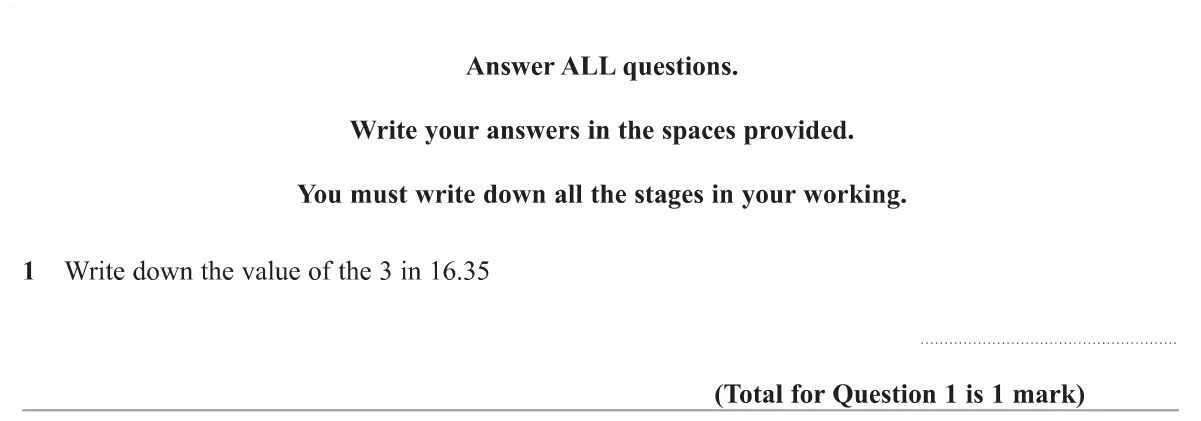
© Pearson Education Ltd. Specimen Paper 2 (Foundation, calculator), question 1.
| Answer | 3 tenths ( or 0.3) | 1 mark |
|---|
Worked solution Checked against the mark scheme
In 16.35 the digit after the decimal point is the tenths digit.
So the 3 is worth 3 tenths, which is
Watch out: Saying 3 hundredths or just '3'.
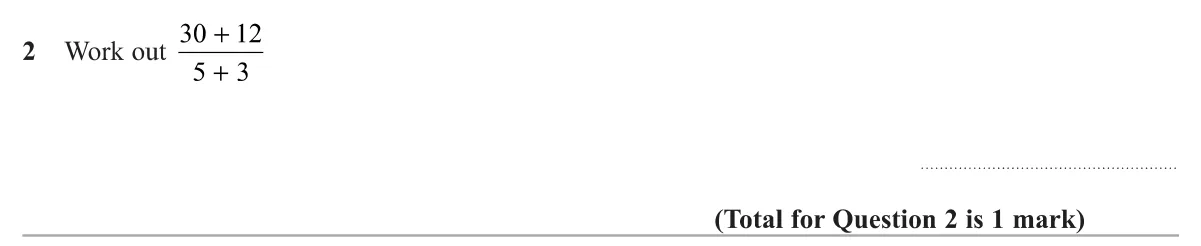
© Pearson Education Ltd. Specimen Paper 3 (Foundation, calculator), question 2.
| Answer | 5.25 | 1 mark |
|---|
Worked solution Checked against the mark scheme
Work out the top and bottom first: and .
Watch out: Typing 30 + 12 ÷ 5 + 3 into the calculator without brackets.
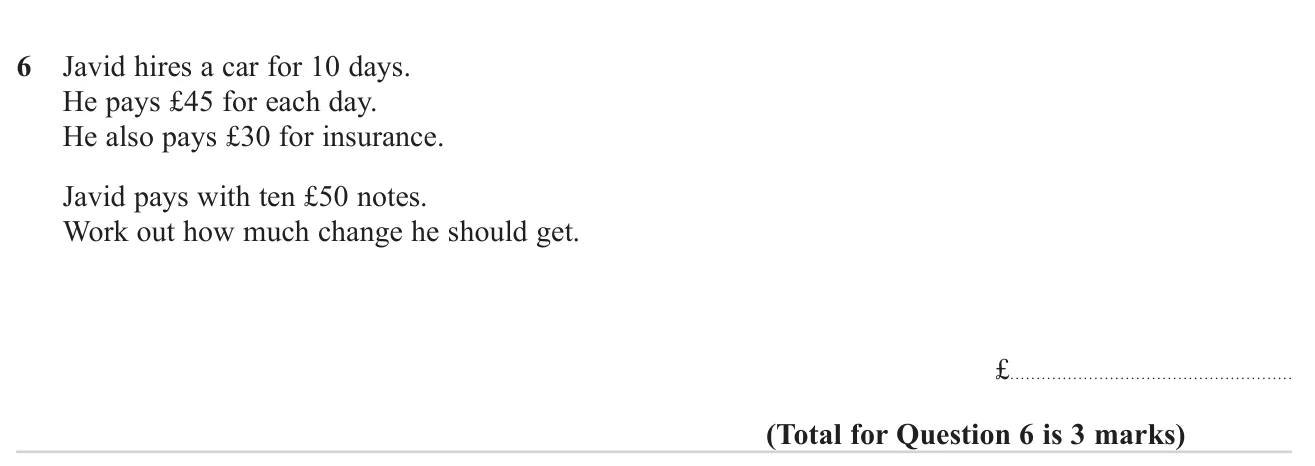
© Pearson Education Ltd. November 2024 Paper 1 (Foundation, non-calculator), question 6.
| Answer | 3 marks |
|---|
Worked solution Checked against the mark scheme
Hire:
Total cost:
Paid:
Change:
Watch out: Forgetting the insurance and getting £50.
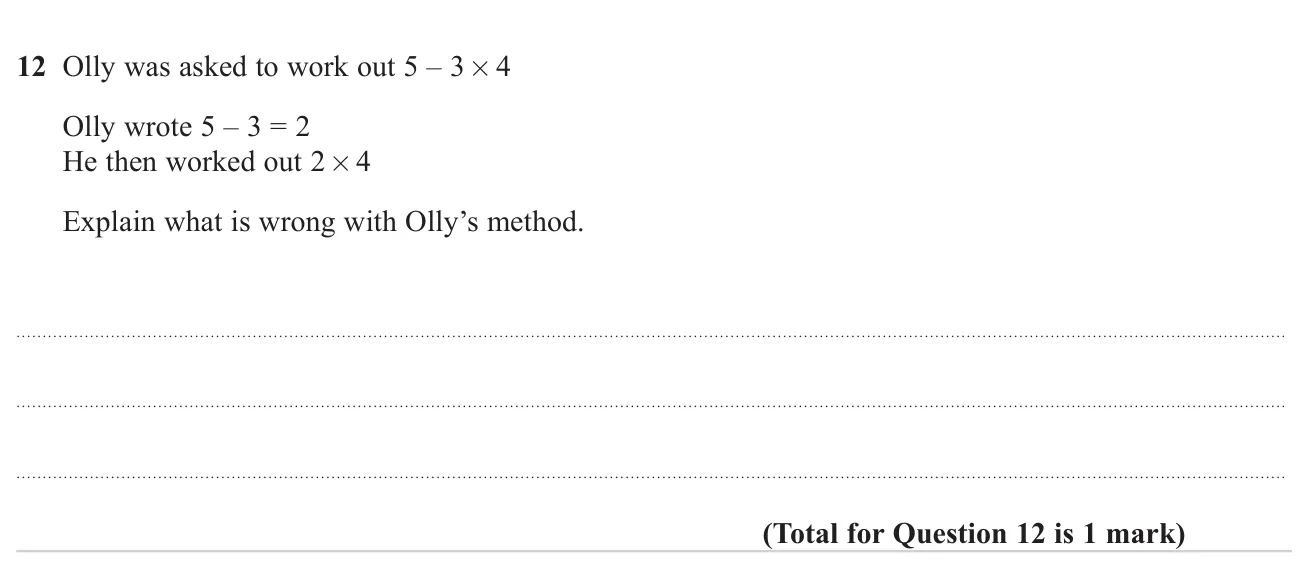
© Pearson Education Ltd. November 2024 Paper 1 (Foundation, non-calculator), question 12.
| Answer | He should multiply before subtracting | 1 mark |
|---|
Worked solution Checked against the mark scheme
Multiplication comes before subtraction (BIDMAS).
So , not .
Watch out: Just saying the answer is wrong without explaining why.
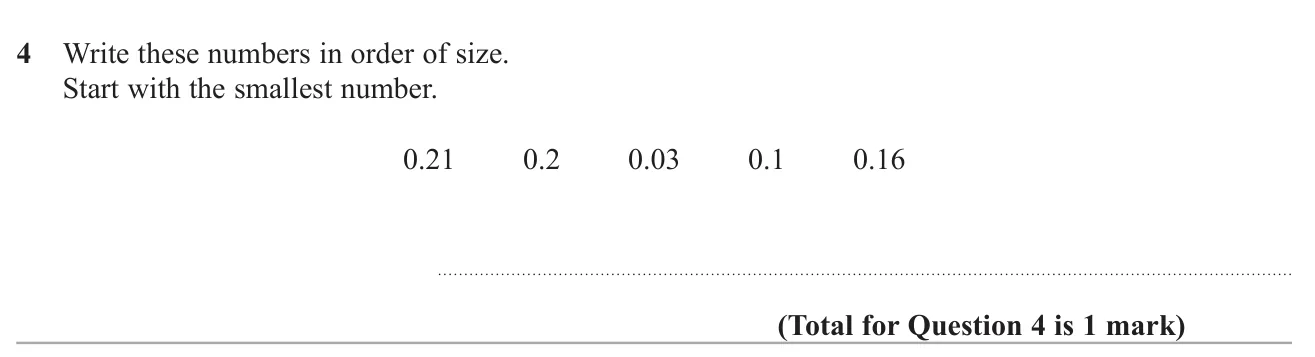
© Pearson Education Ltd. June 2024 Paper 1 (Foundation, non-calculator), question 4.
| Answer | 1 mark |
|---|
Worked solution Checked against the mark scheme
Write each with two decimal places: 0.21, 0.20, 0.03, 0.10, 0.16.
Order: .
Watch out: Thinking 0.16 is bigger than 0.2 because 16 > 2.
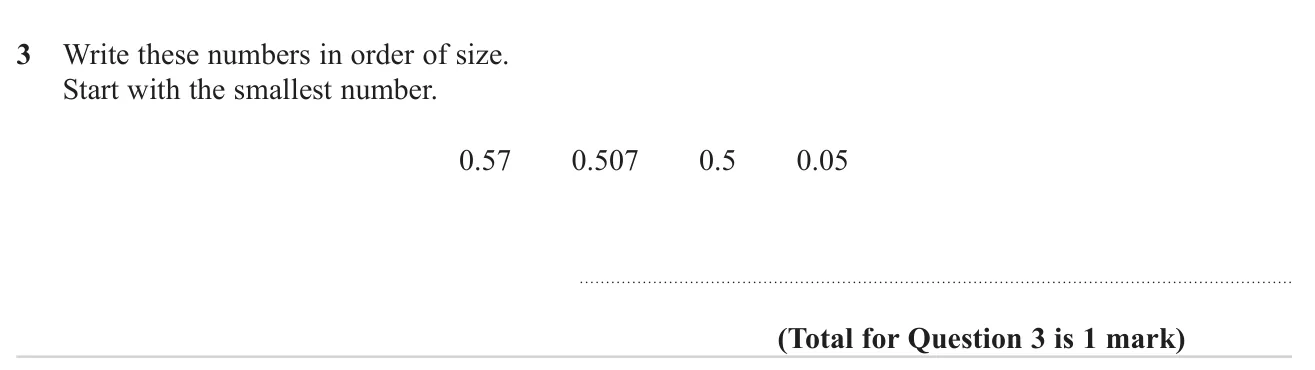
© Pearson Education Ltd. November 2024 Paper 2 (Foundation, calculator), question 3.
| Answer | 0.05, 0.5, 0.507, 0.57 | 1 mark |
|---|
Worked solution Checked against the mark scheme
Give each number three decimal places: 0.570, 0.507, 0.500, 0.050.
Smallest first: 0.05, 0.5, 0.507, 0.57
Watch out: Thinking 0.507 is bigger than 0.57 because it has more digits.
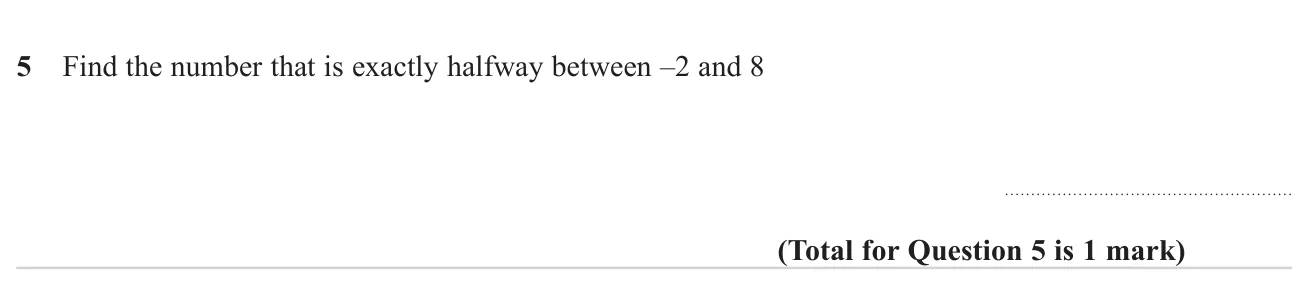
© Pearson Education Ltd. November 2024 Paper 2 (Foundation, calculator), question 5.
| Answer | 3 | 1 mark |
|---|
Worked solution Checked against the mark scheme
Add the two numbers and halve:
Watch out: Giving 5 by halving 10, the distance between them, and not adding to .
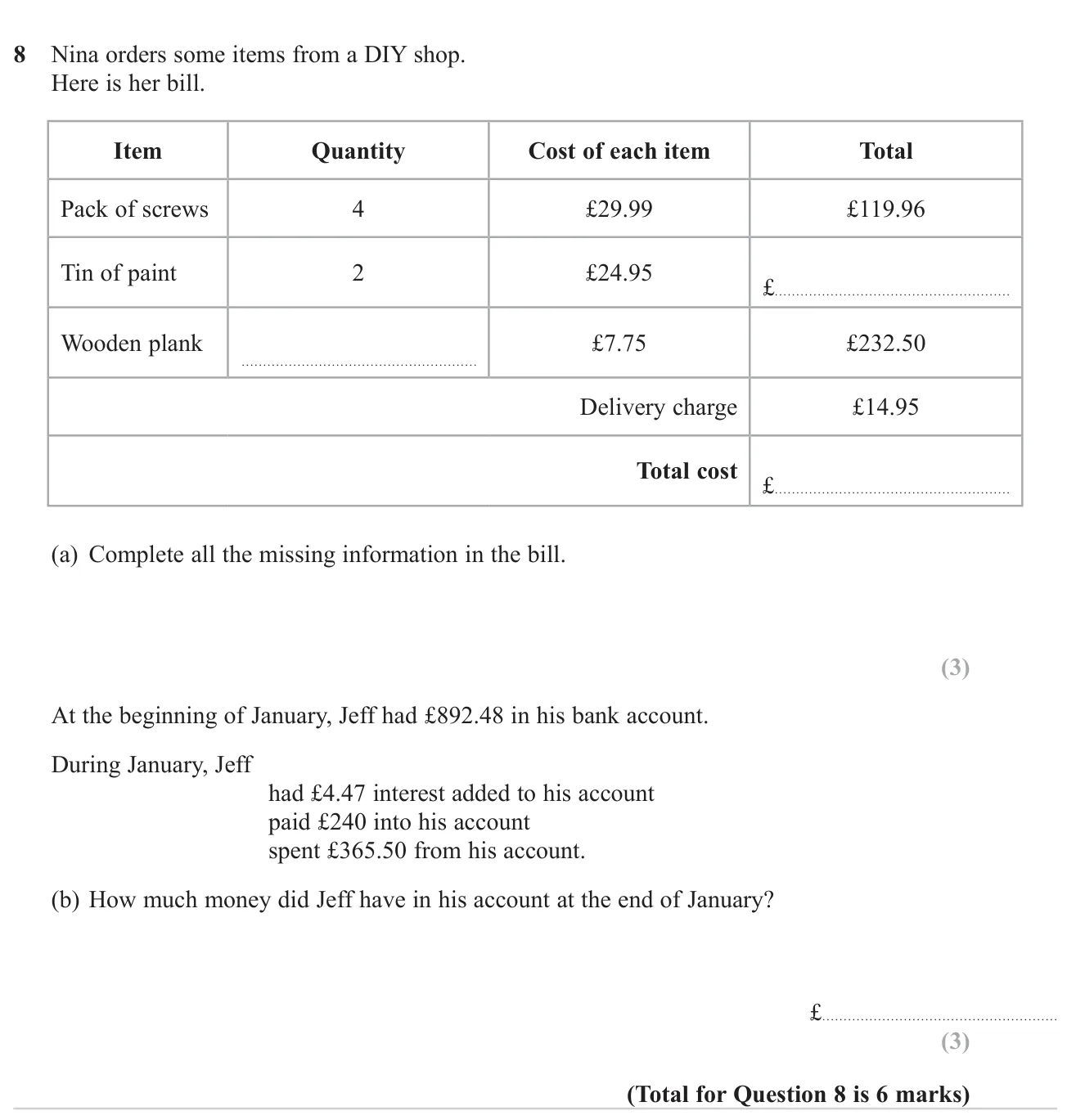
© Pearson Education Ltd. November 2024 Paper 3 (Foundation, calculator), question 8.
| (a) | Paint total £49.90; 30 planks; total cost £417.31 | 3 marks |
|---|---|---|
| (b) | £771.45 | 3 marks |
Worked solution Checked against the mark scheme
(a) Paint:
Planks:
Total:
(b)
Watch out: Forgetting to include the delivery charge in the total cost.
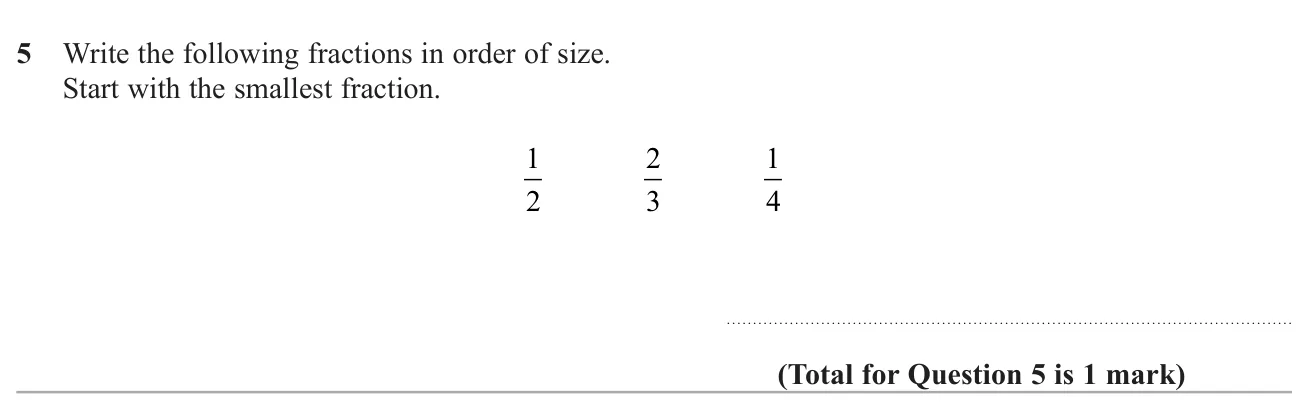
© Pearson Education Ltd. June 2024 Paper 3 (Foundation, calculator), question 5.
| Answer | 1 mark |
|---|
Worked solution Checked against the mark scheme
Convert to decimals: , , .
Smallest first:
Watch out: Thinking a bigger denominator means a bigger fraction, so putting last.
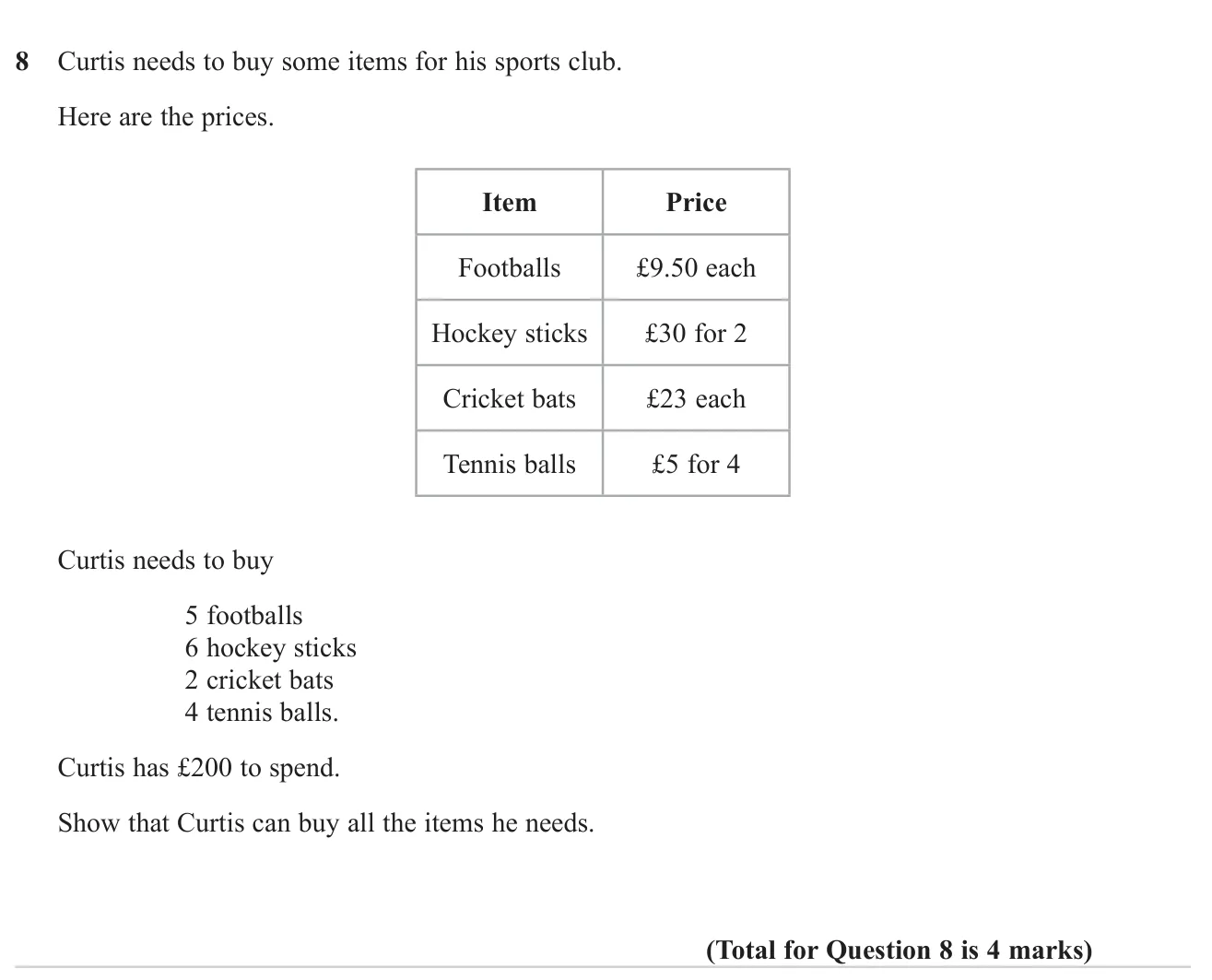
© Pearson Education Ltd. November 2023 Paper 2 (Foundation, calculator), question 8.
| Answer | Total cost £188.50, which is less than £200 (or £11.50 left) | 4 marks |
|---|
Worked solution Checked against the mark scheme
Footballs:
Hockey sticks: 6 sticks is 3 lots of 2, so
Cricket bats:
Tennis balls: 4 balls cost
Total , which is less than £200, so he can buy everything.
Watch out: Paying £30 for each hockey stick instead of £30 for every two.
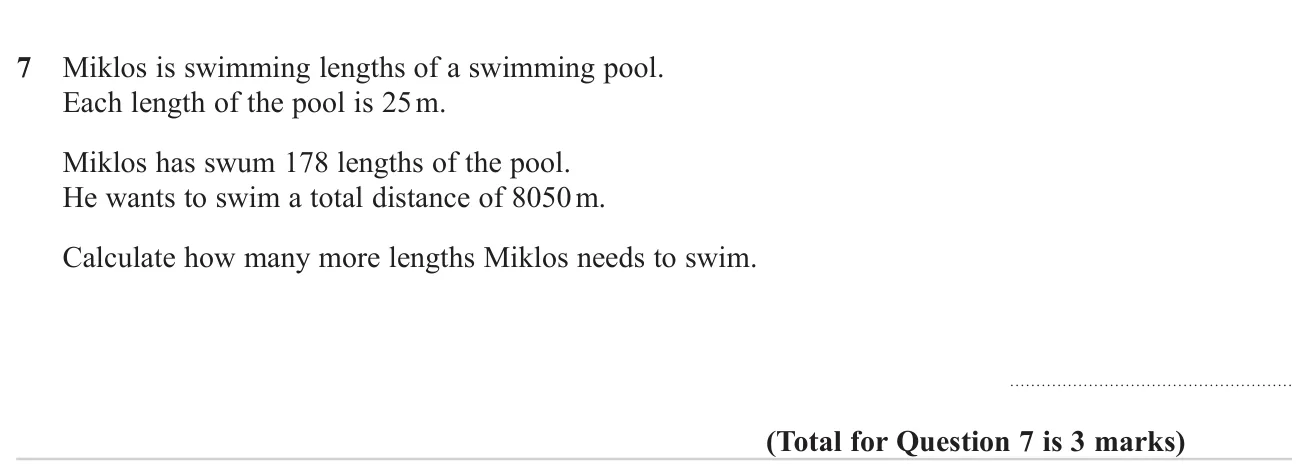
© Pearson Education Ltd. November 2023 Paper 3 (Foundation, calculator), question 7.
| Answer | 144 | 3 marks |
|---|
Worked solution Checked against the mark scheme
Total lengths needed:
Lengths still to swim:
Watch out: Giving the remaining distance 3600 m instead of the number of lengths.
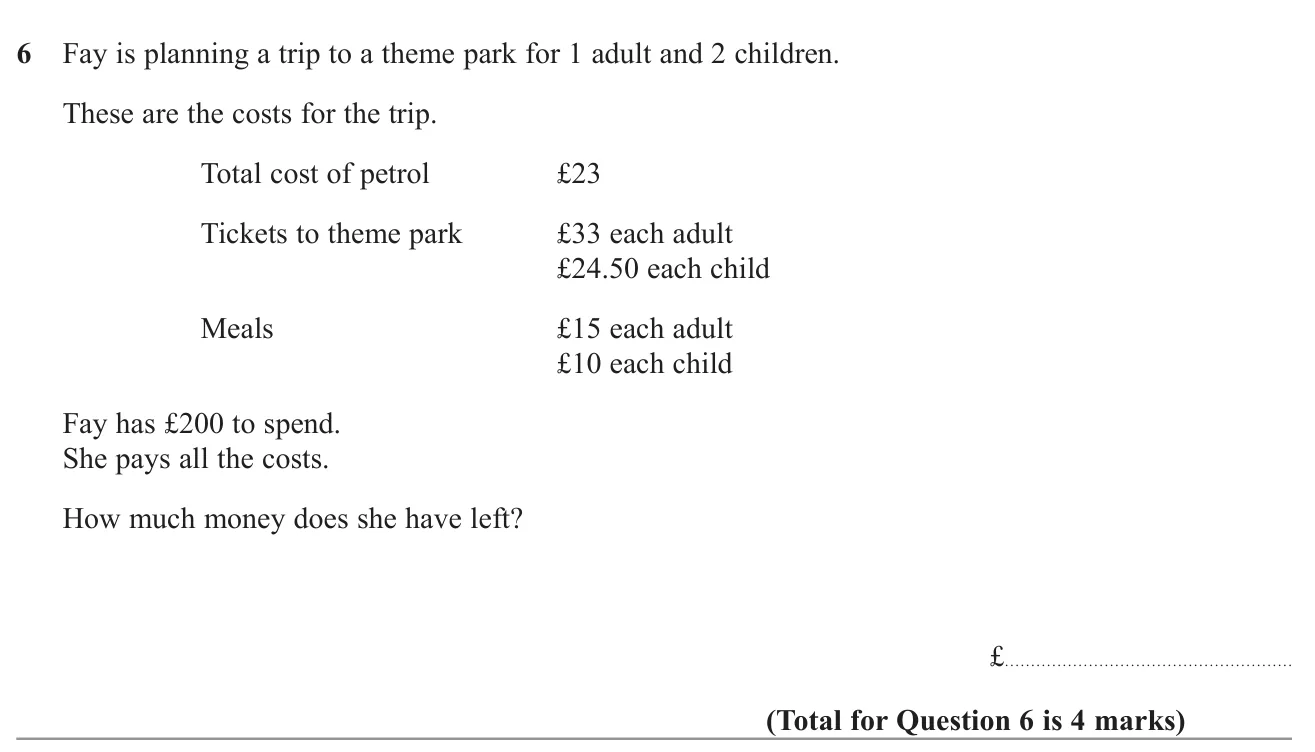
© Pearson Education Ltd. November 2022 Paper 1 (Foundation, non-calculator), question 6.
| Answer | £60 | 4 marks |
|---|
Worked solution Checked against the mark scheme
Tickets:
Meals:
Total:
Left:
Watch out: Paying for only one child, or forgetting the petrol.
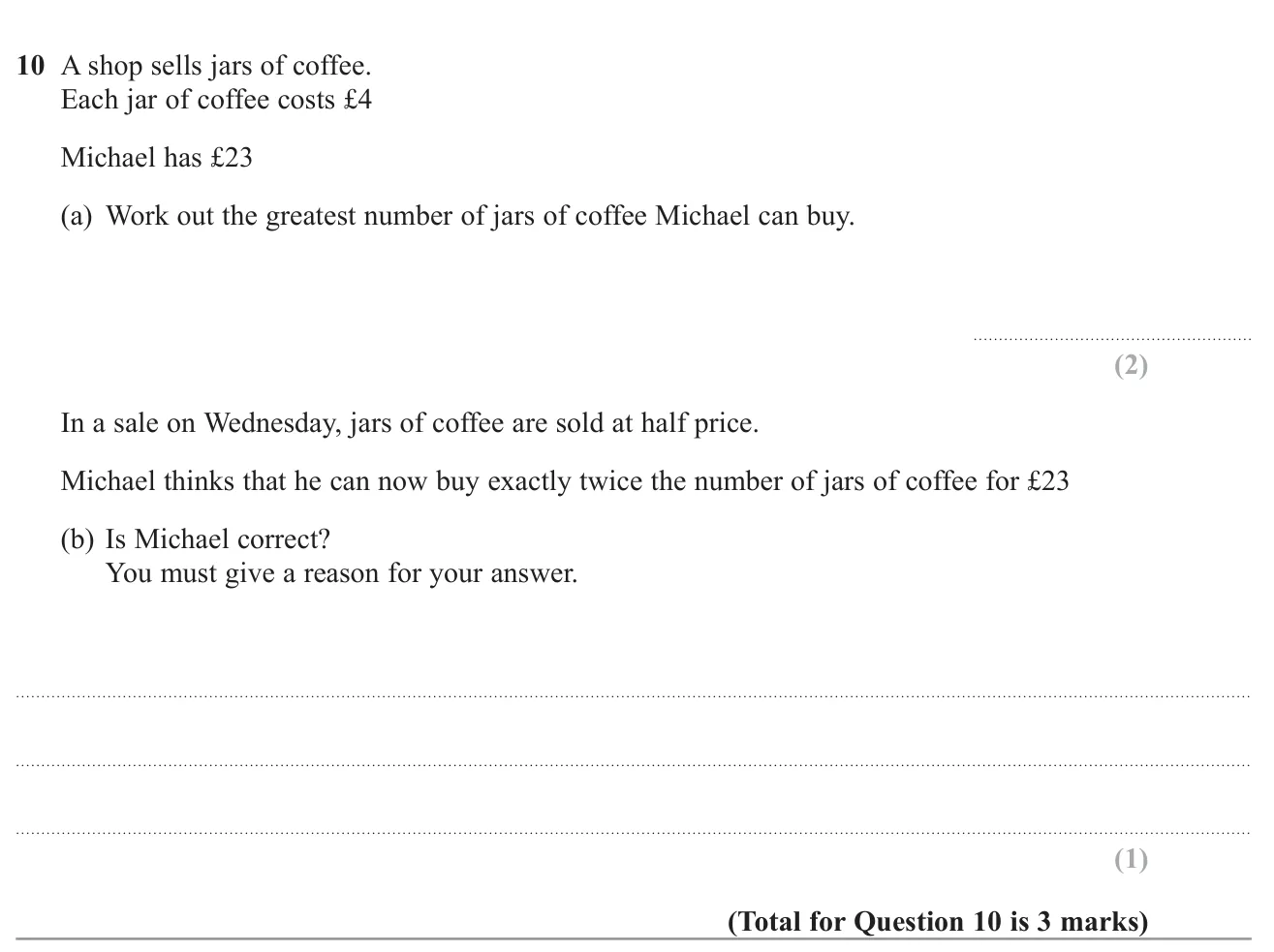
© Pearson Education Ltd. November 2022 Paper 1 (Foundation, non-calculator), question 10.
| (a) | 2 marks | |
|---|---|---|
| (b) | No: at £2 each he can buy 11 jars, not 10 | 1 mark |
Worked solution Checked against the mark scheme
(a) , so he can afford 5 whole jars (costing £20).
(b) At half price each jar is £2. , so he can buy 11 jars.
Twice 5 is 10, so he is not correct: he can buy 11.
Watch out: In (a), rounding 5.75 up to 6.
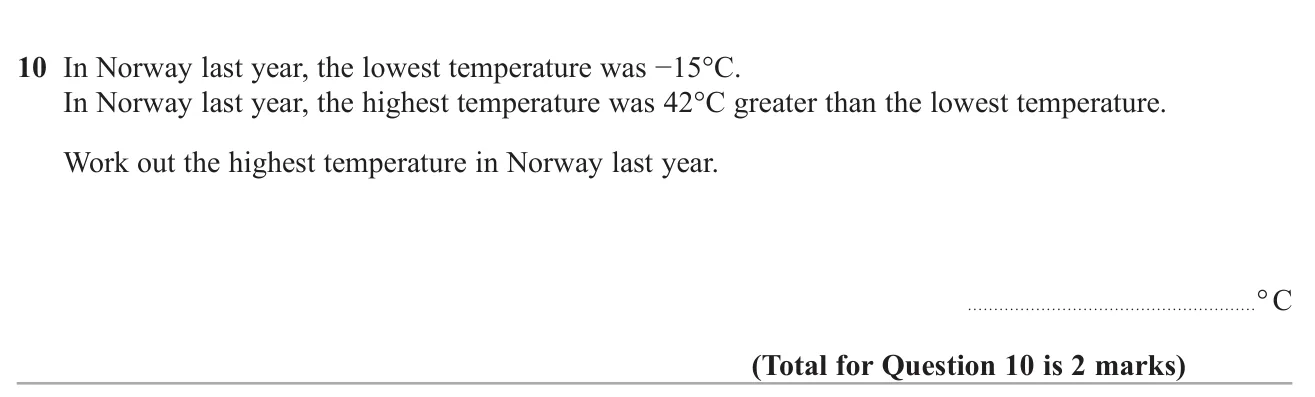
© Pearson Education Ltd. June 2022 Paper 1 (Foundation, non-calculator), question 10.
| Answer | 27 | 2 marks |
|---|
Worked solution Checked against the mark scheme
Start at and go up 42 degrees.
Highest temperature: C
Watch out: Getting 57 by adding 15 and 42.
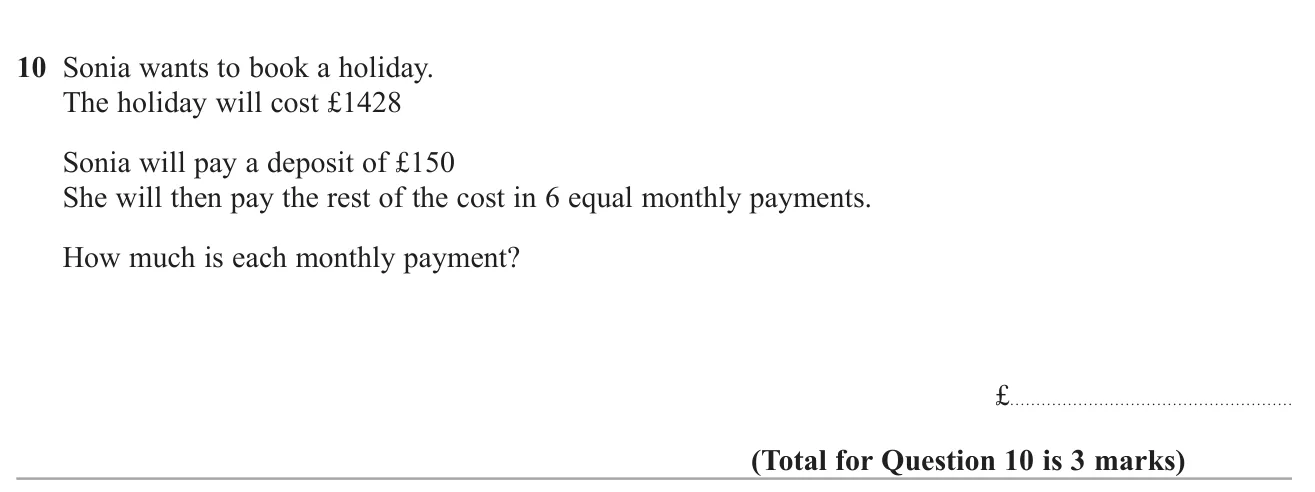
© Pearson Education Ltd. June 2022 Paper 2 (Foundation, calculator), question 10.
| Answer | £213 | 3 marks |
|---|
Worked solution Checked against the mark scheme
Amount left after the deposit:
Each payment:
Each monthly payment is £213.
Watch out: Dividing 1428 by 6 without taking off the deposit (238).
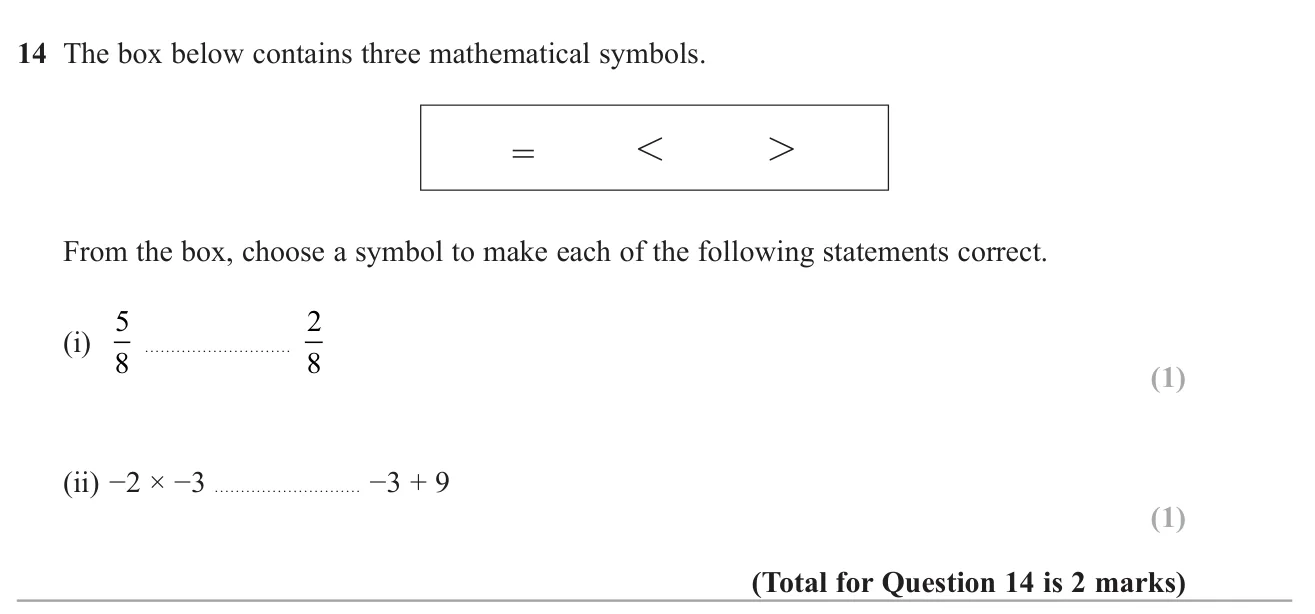
© Pearson Education Ltd. June 2022 Paper 2 (Foundation, calculator), question 14.
| ((i)) | 1 mark | |
|---|---|---|
| ((ii)) | 1 mark |
Worked solution Checked against the mark scheme
(i) Same denominator, and , so .
(ii) and , so they are equal.
Watch out: In (ii), thinking a negative times a negative is negative.
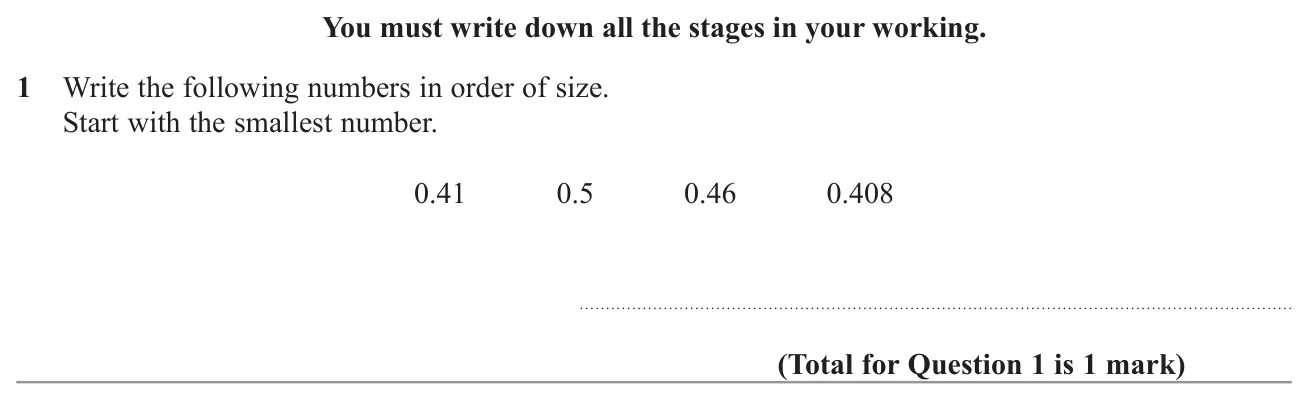
© Pearson Education Ltd. November 2022 Paper 3 (Foundation, calculator), question 1.
| Answer | 0.408, 0.41, 0.46, 0.5 | 1 mark |
|---|
Worked solution Checked against the mark scheme
Give each number three decimal places: 0.410, 0.500, 0.460, 0.408.
Now compare: 0.408 < 0.410 < 0.460 < 0.500, so the order is 0.408, 0.41, 0.46, 0.5
Watch out: Thinking 0.408 is bigger than 0.41 because it has more digits.
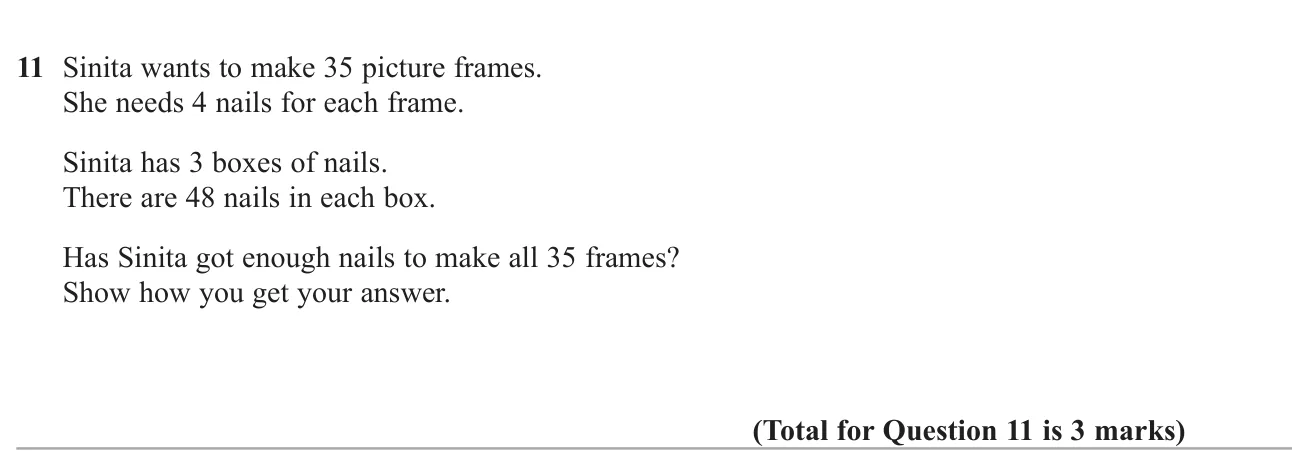
© Pearson Education Ltd. June 2022 Paper 3 (Foundation, calculator), question 11.
| Answer | Yes: 144 nails available and 140 needed | 3 marks |
|---|
Worked solution Checked against the mark scheme
Nails needed:
Nails available:
, so yes, she has enough (4 to spare).
Watch out: Saying yes without showing both totals.
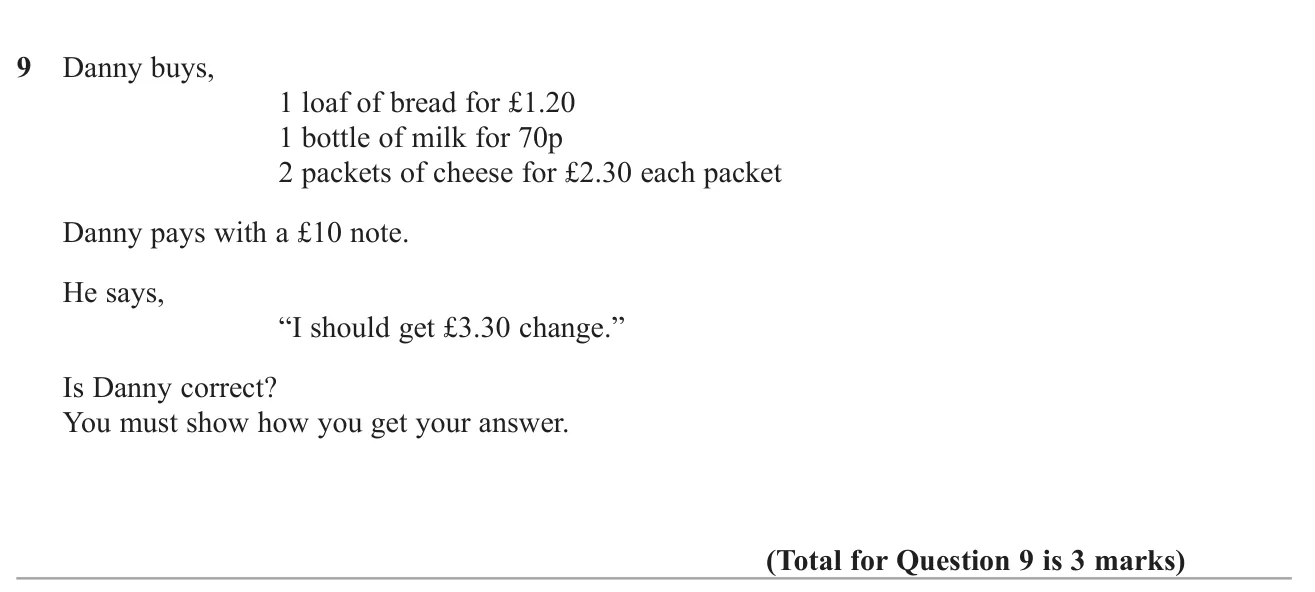
© Pearson Education Ltd. November 2021 Paper 1 (Foundation, non-calculator), question 9.
| Answer | No: the change should be £3.50 (total £6.50) | 3 marks |
|---|
Worked solution Checked against the mark scheme
Cheese:
Total:
Change:
Danny should get £3.50, so he is not correct.
Watch out: Counting only one packet of cheese.
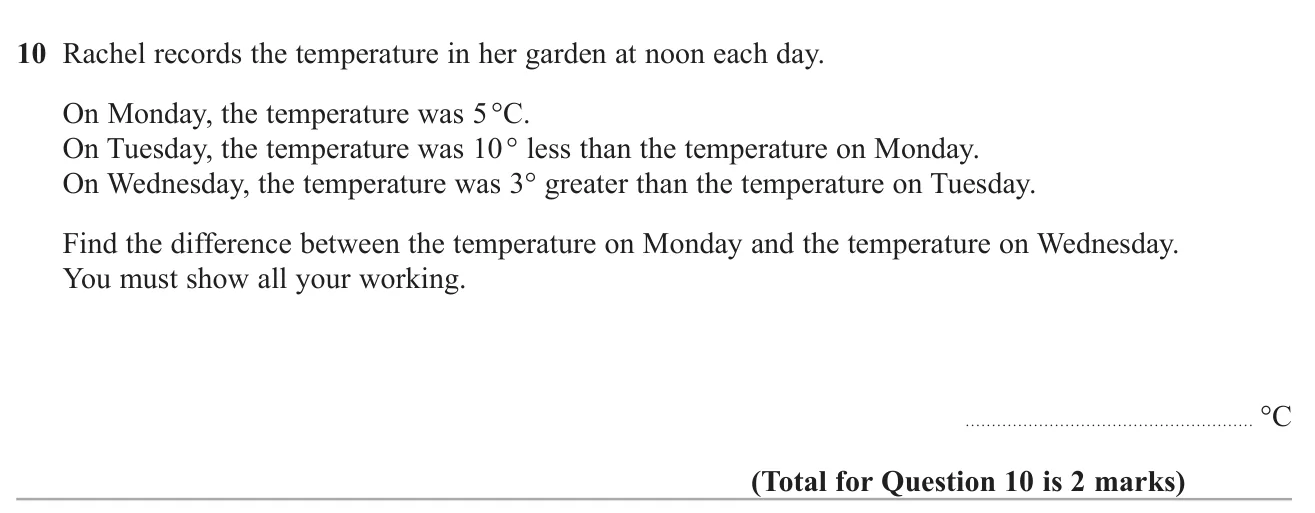
© Pearson Education Ltd. November 2021 Paper 1 (Foundation, non-calculator), question 10.
| Answer | °C | 2 marks |
|---|
Worked solution Checked against the mark scheme
Monday: °C
Tuesday: °C
Wednesday: °C
Difference: °C
Watch out: Giving the Wednesday temperature, −2, as the answer.
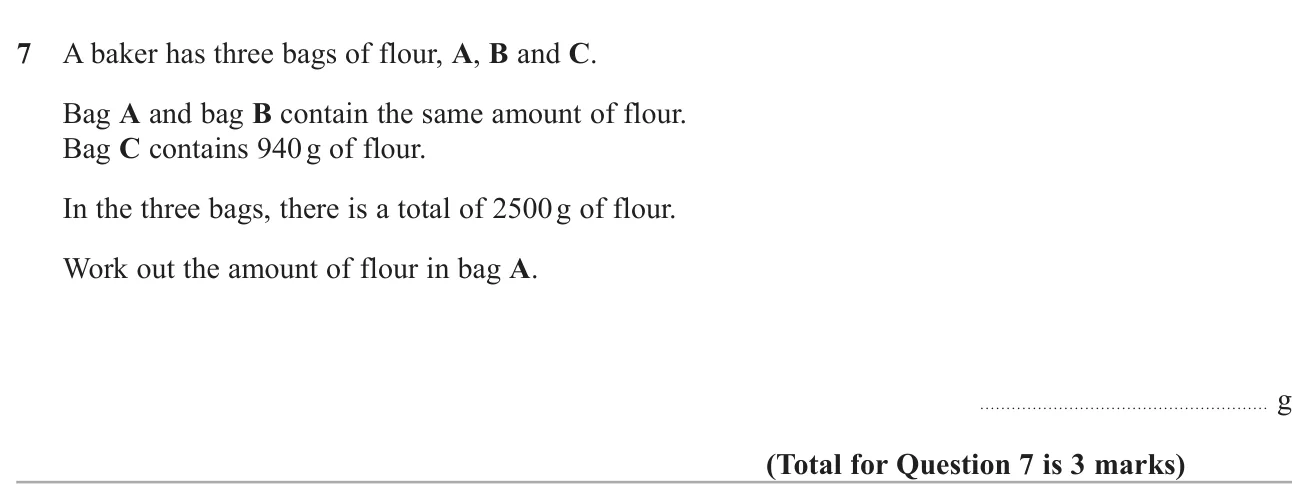
© Pearson Education Ltd. November 2021 Paper 2 (Foundation, calculator), question 7.
| Answer | 780 | 3 marks |
|---|
Worked solution Checked against the mark scheme
Flour in A and B together: g.
They are equal, so bag A has g.
Watch out: Dividing 2500 by 3.
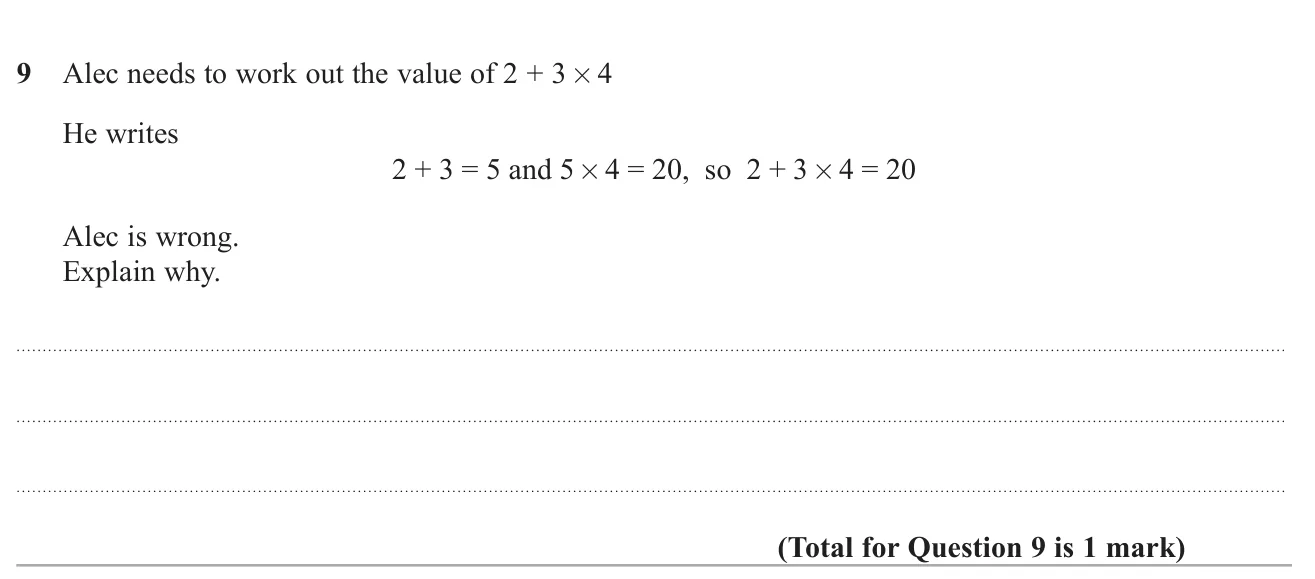
© Pearson Education Ltd. November 2021 Paper 2 (Foundation, calculator), question 9.
| Answer | Multiplication must be done before addition, so the answer is 14 | 1 mark |
|---|
Worked solution Checked against the mark scheme
Multiplication comes before addition (BIDMAS).
, then , not 20.
Watch out: Saying only that the answer is wrong without giving a reason.
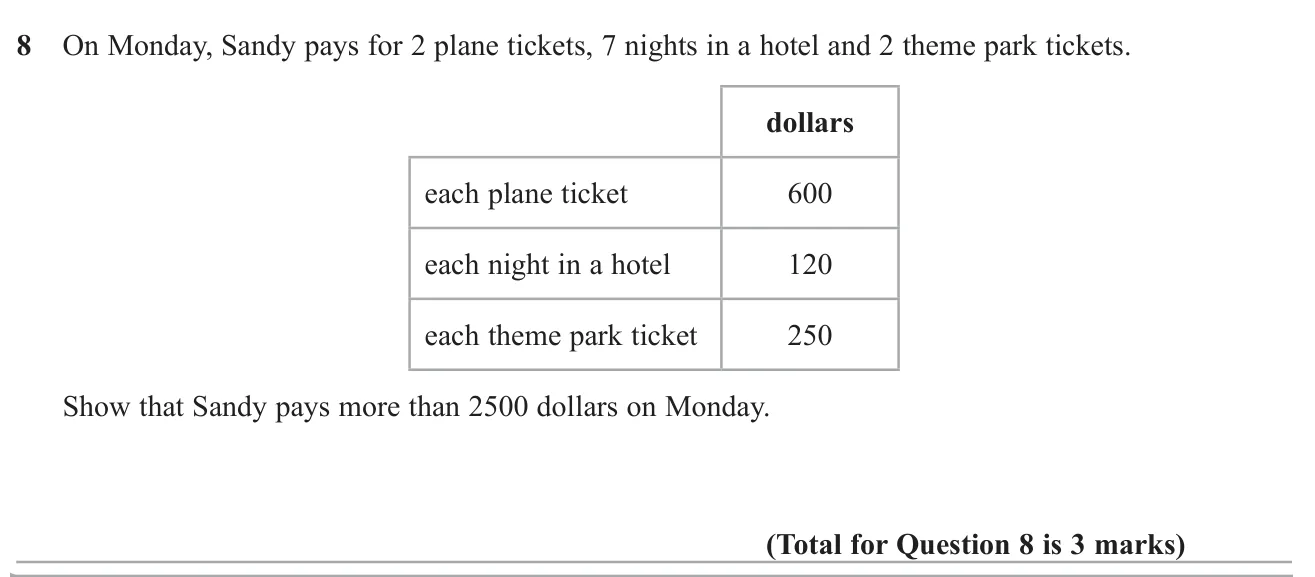
© Pearson Education Ltd. November 2021 Paper 3 (Foundation, calculator), question 8.
| Answer | Total is 2540 dollars, which is more than 2500 | 3 marks |
|---|
Worked solution Checked against the mark scheme
Planes:
Hotel:
Theme park:
Total: dollars, and .
Watch out: Forgetting to multiply the hotel cost by the number of nights.
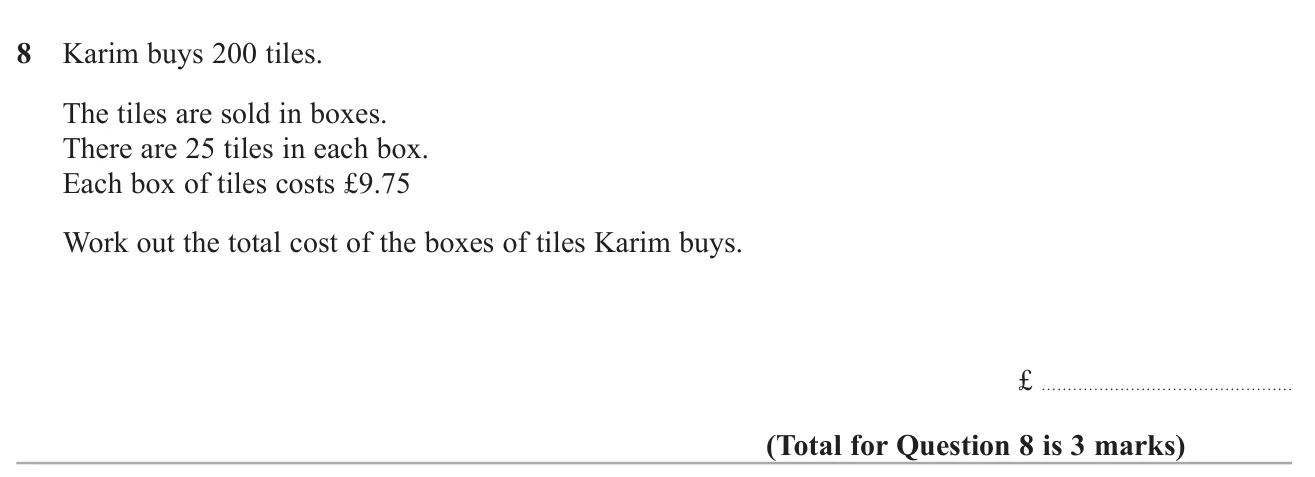
© Pearson Education Ltd. November 2020 Paper 3 (Foundation, calculator), question 8.
| Answer | £78 | 3 marks |
|---|
Worked solution Checked against the mark scheme
Boxes needed:
Cost:
Watch out: Multiplying 200 by £9.75.
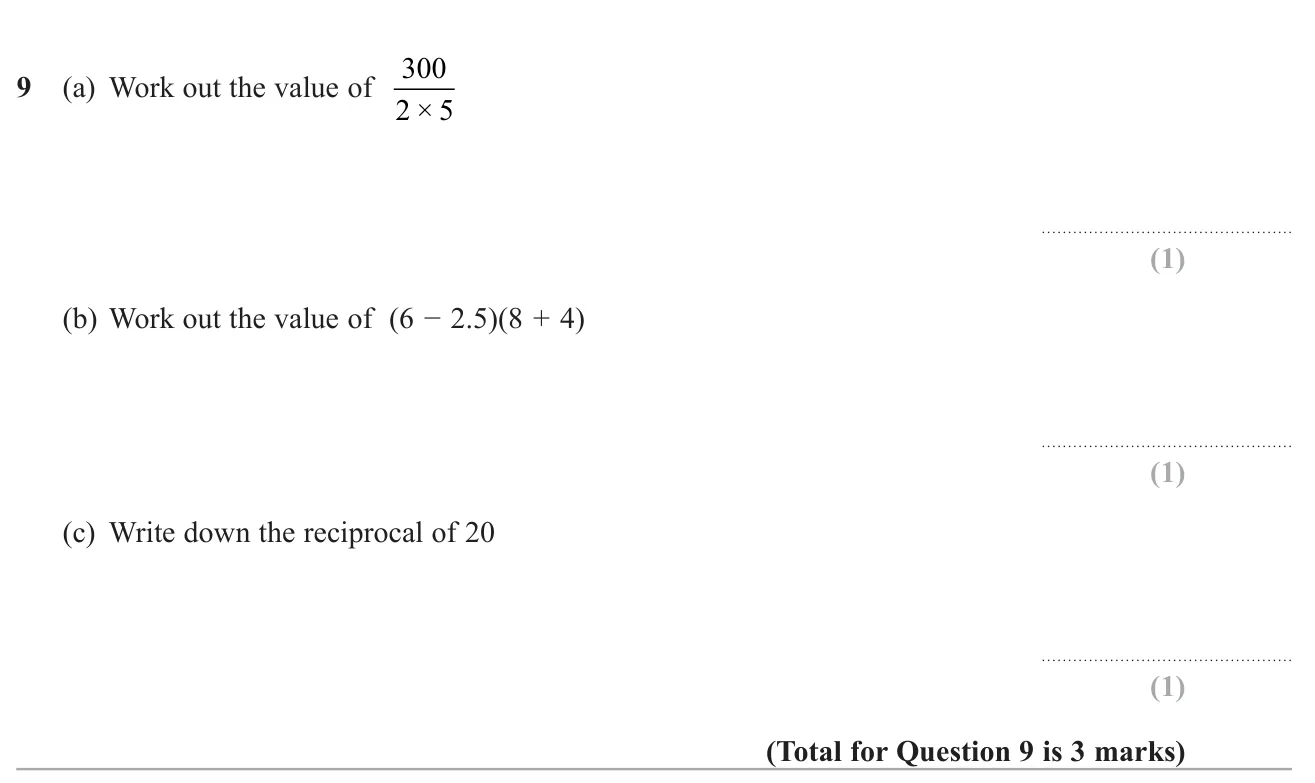
© Pearson Education Ltd. November 2020 Paper 3 (Foundation, calculator), question 9.
| (a) | 30 | 1 mark |
|---|---|---|
| (b) | 42 | 1 mark |
| (c) | or 0.05 | 1 mark |
Worked solution Checked against the mark scheme
(a) , and
(b)
(c) The reciprocal of 20 is
Watch out: In (a), working out .
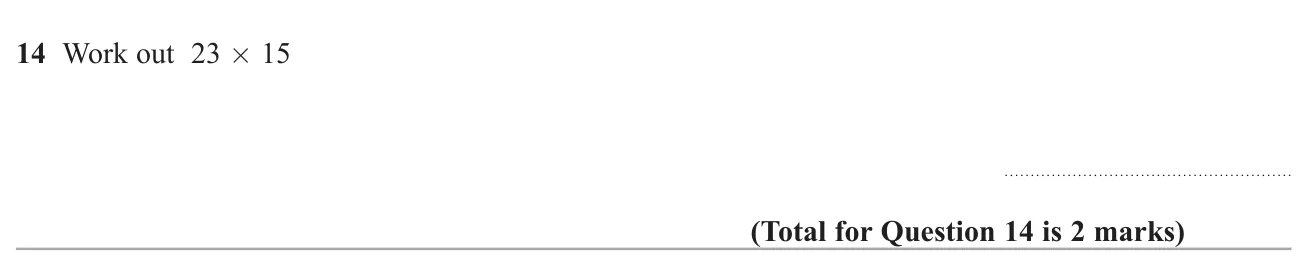
© Pearson Education Ltd. November 2019 Paper 1 (Foundation, non-calculator), question 14.
| Answer | 2 marks |
|---|
Worked solution Checked against the mark scheme
Split 15 into 10 and 5:
Watch out: Forgetting the place-value zero when multiplying by the tens digit.
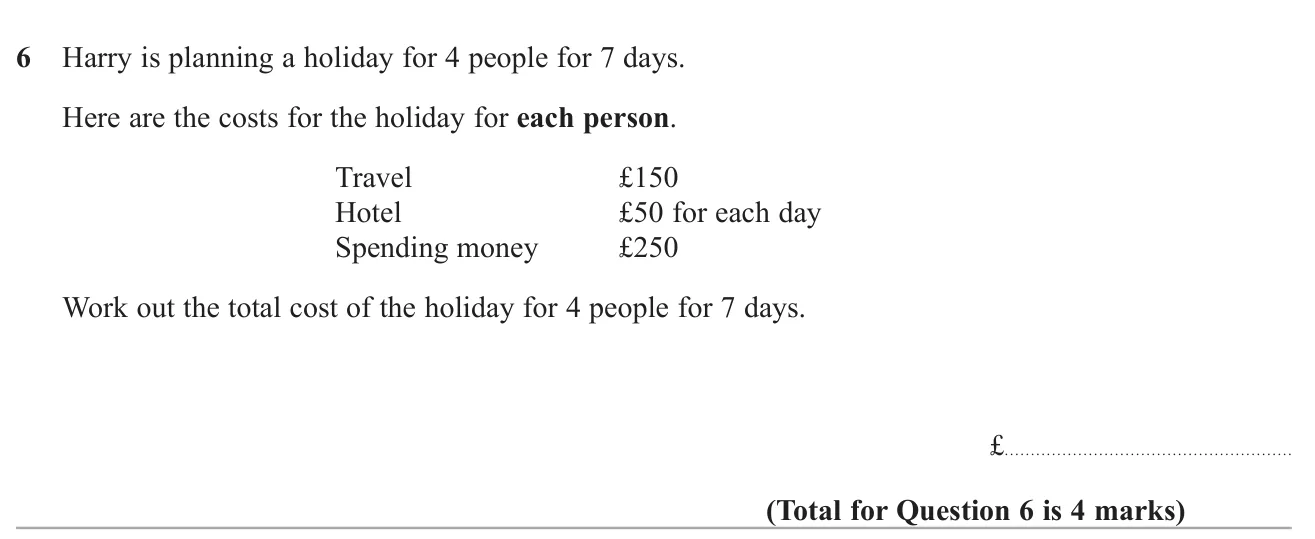
© Pearson Education Ltd. June 2019 Paper 1 (Foundation, non-calculator), question 6.
| Answer | £3000 | 4 marks |
|---|
Worked solution Checked against the mark scheme
Hotel for one person:
Cost for one person:
For 4 people:
Watch out: Charging the hotel for one day only, or forgetting to multiply by 4 people.
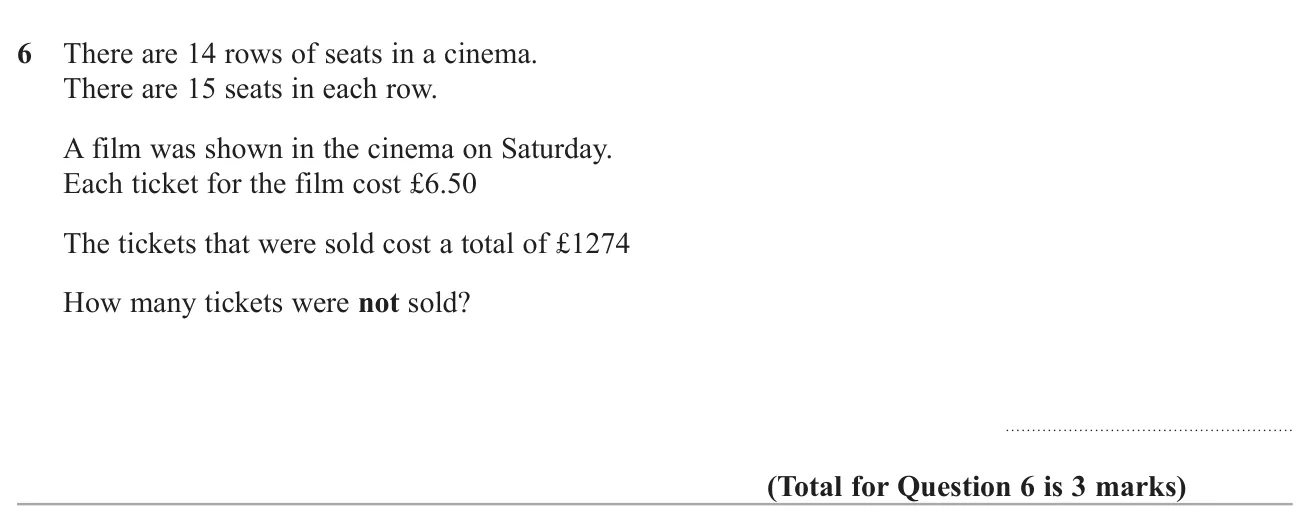
© Pearson Education Ltd. November 2019 Paper 2 (Foundation, calculator), question 6.
| Answer | 14 | 3 marks |
|---|
Worked solution Checked against the mark scheme
Seats:
Tickets sold:
Not sold:
Watch out: Stopping at 196, the number sold.
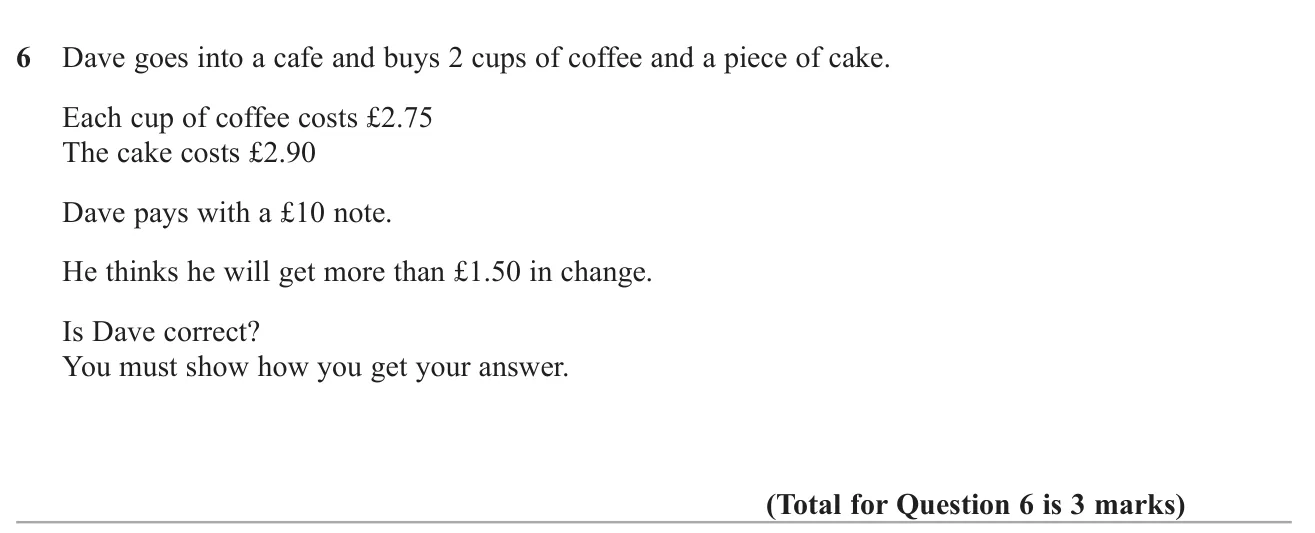
© Pearson Education Ltd. June 2019 Paper 2 (Foundation, calculator), question 6.
| Answer | Yes, he gets £1.60 change | 3 marks |
|---|
Worked solution Checked against the mark scheme
Two coffees:
Total spent: , so £8.40
Change: , so £1.60
£1.60 is more than £1.50, so Dave is correct.
Watch out: Forgetting to double the cost of the coffee.
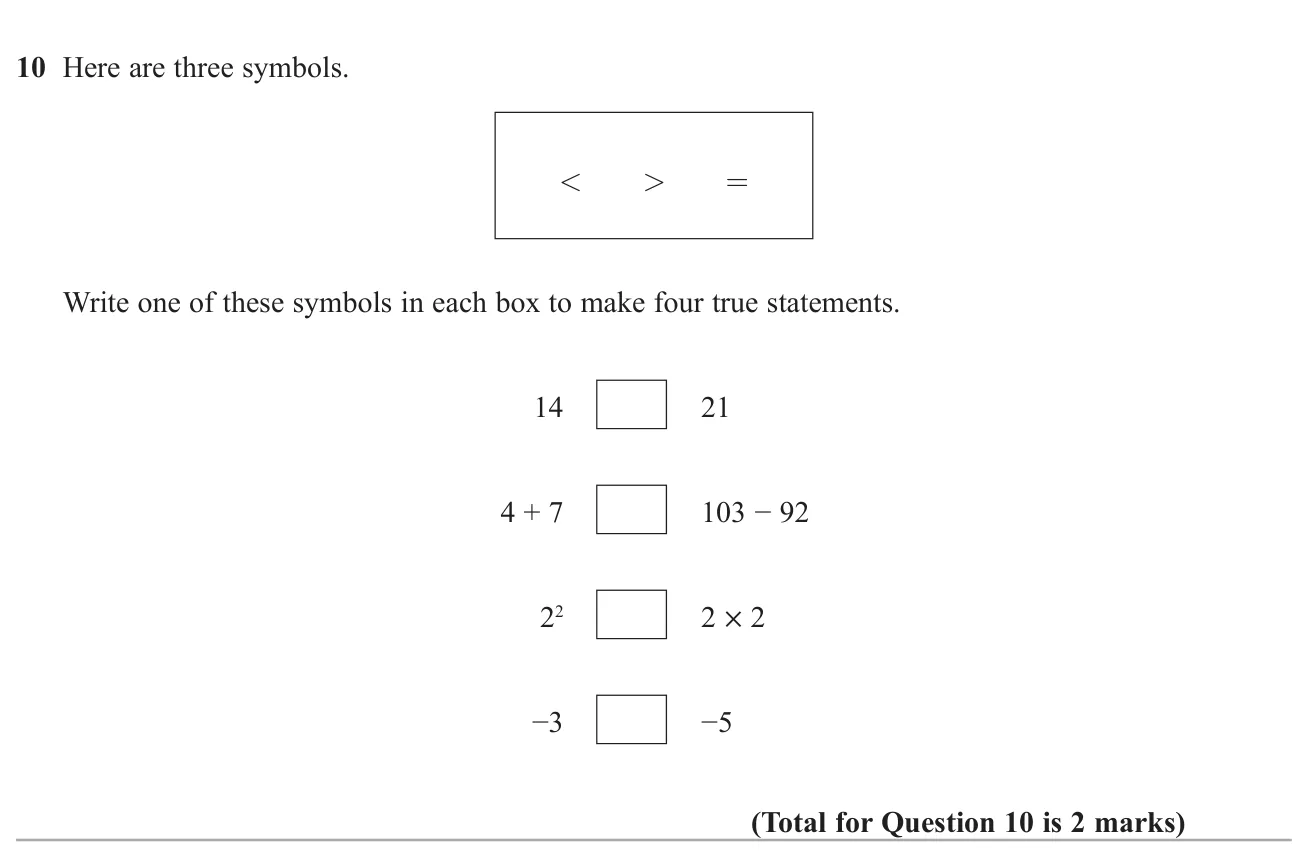
© Pearson Education Ltd. June 2019 Paper 2 (Foundation, calculator), question 10.
| Answer | , , , | 2 marks |
|---|
Worked solution Checked against the mark scheme
and , so they are equal.
and , so they are equal.
is nearer zero than , so
Watch out: Thinking because 3 is less than 5.
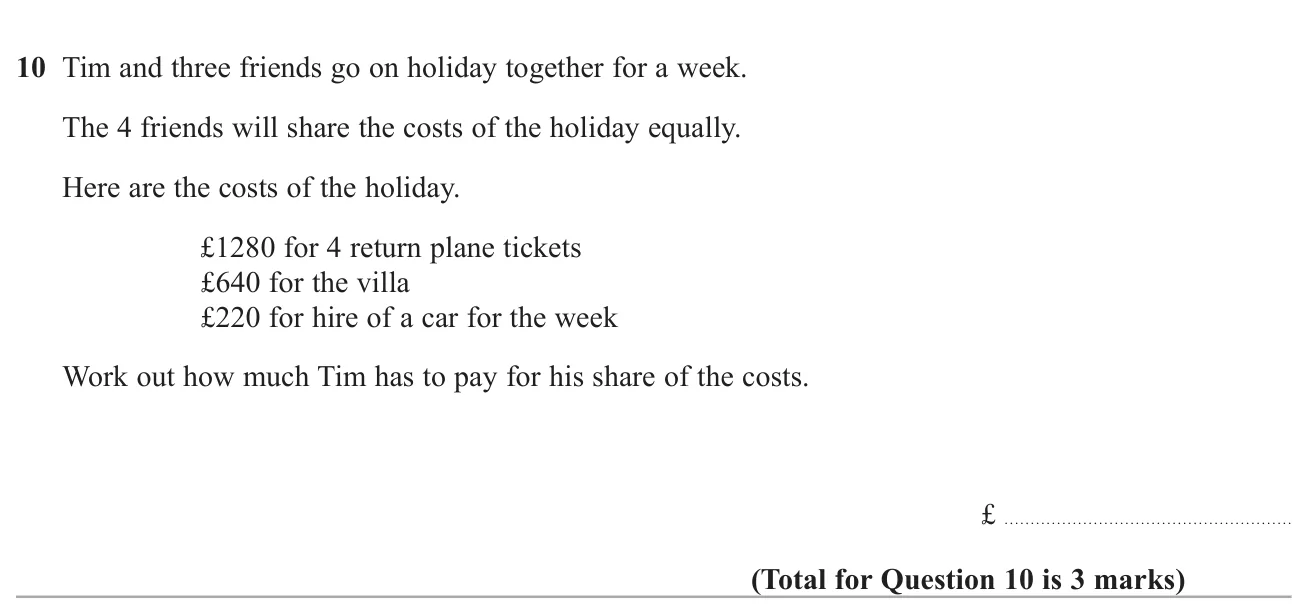
© Pearson Education Ltd. June 2018 Paper 1 (Foundation, non-calculator), question 10.
| Answer | 3 marks |
|---|
Worked solution Checked against the mark scheme
Total
Each share
Watch out: Adding the costs but not dividing by 4 (or dividing only the plane tickets).
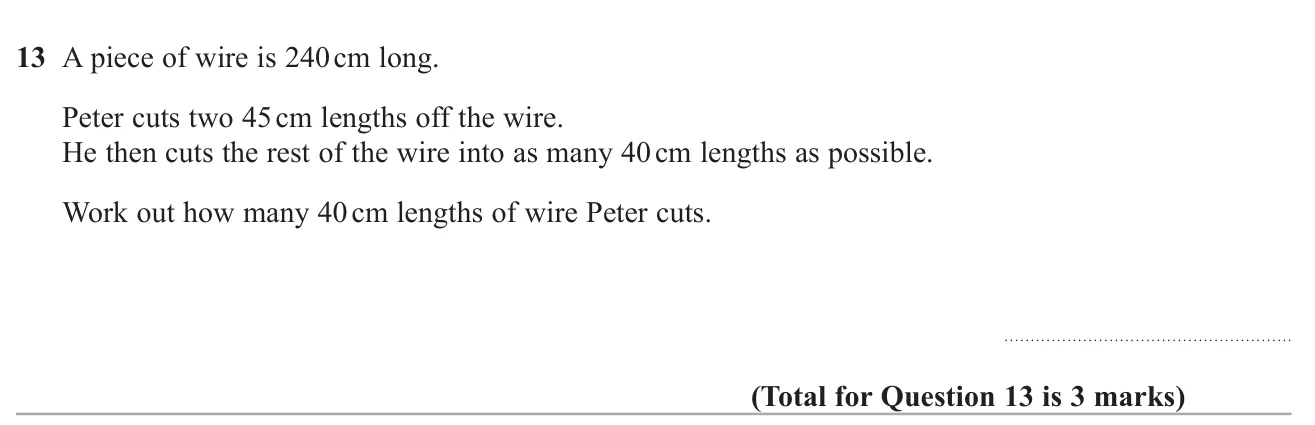
© Pearson Education Ltd. June 2018 Paper 1 (Foundation, non-calculator), question 13.
| Answer | 3 marks |
|---|
Worked solution Checked against the mark scheme
Left after two pieces: cm
Only whole pieces count, so 3.
Watch out: Rounding 3.75 up to 4.
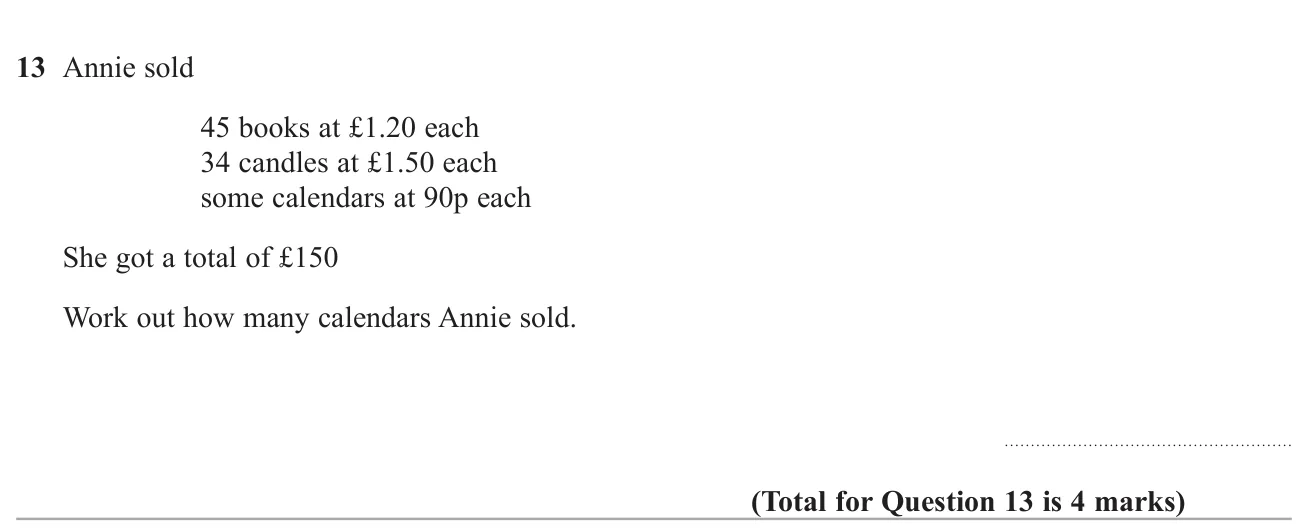
© Pearson Education Ltd. November 2018 Paper 3 (Foundation, calculator), question 13.
| Answer | 4 marks |
|---|
Worked solution Checked against the mark scheme
Books:
Candles:
Left for calendars:
90p is £0.90, so calendars.
Watch out: Dividing £45 by 90 without changing pence to pounds.
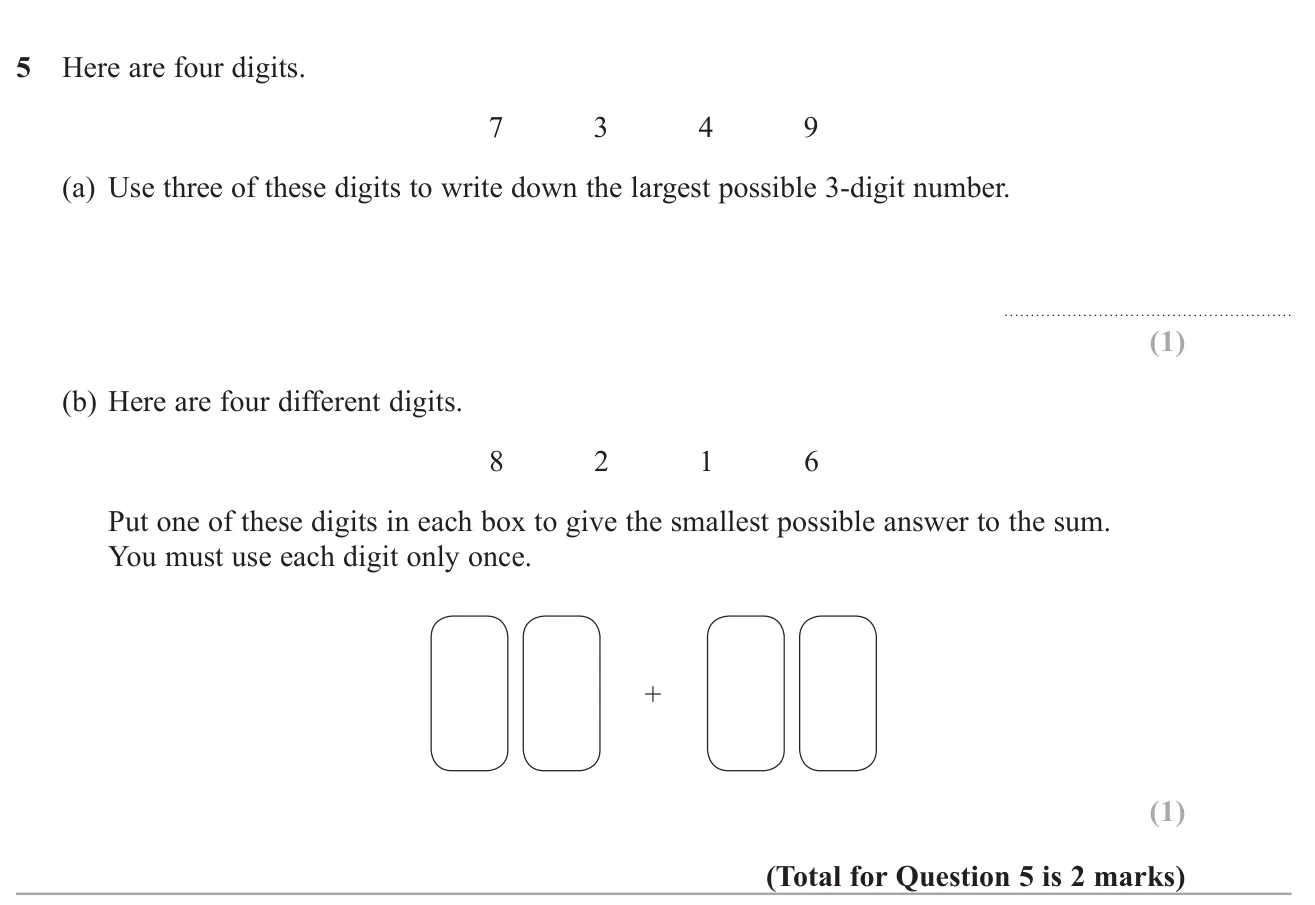
© Pearson Education Ltd. June 2018 Paper 3 (Foundation, calculator), question 5.
| (a) | 1 mark | |
|---|---|---|
| (b) | or (total 44) | 1 mark |
Worked solution Checked against the mark scheme
(a) Use the three largest digits, biggest first: .
(b) Put the two smallest digits, 1 and 2, in the tens places. Put 6 and 8 in the units places.
(or ), the smallest possible total.
Watch out: Putting the small digits in the units places instead of the tens places.
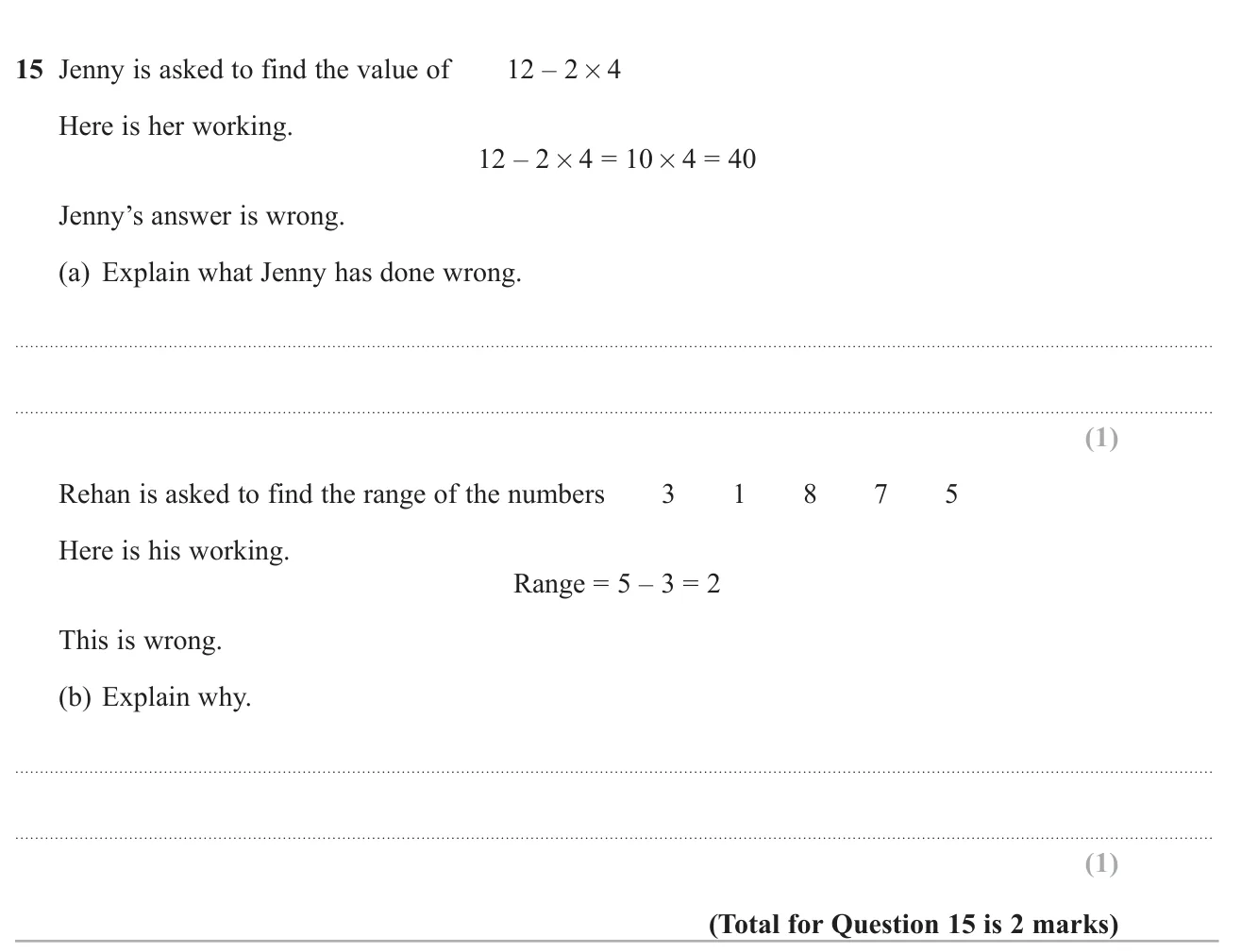
© Pearson Education Ltd. June 2018 Paper 3 (Foundation, calculator), question 15.
| (a) | She subtracted before multiplying; multiplication should be done first | 1 mark |
|---|---|---|
| (b) | The range is largest minus smallest: | 1 mark |
Worked solution Checked against the mark scheme
(a) Multiplication comes before subtraction: . Jenny subtracted first.
(b) The range is the largest value minus the smallest: . Rehan used the last and first numbers in the list.
Watch out: Just giving the correct answer to (a) without saying what went wrong.
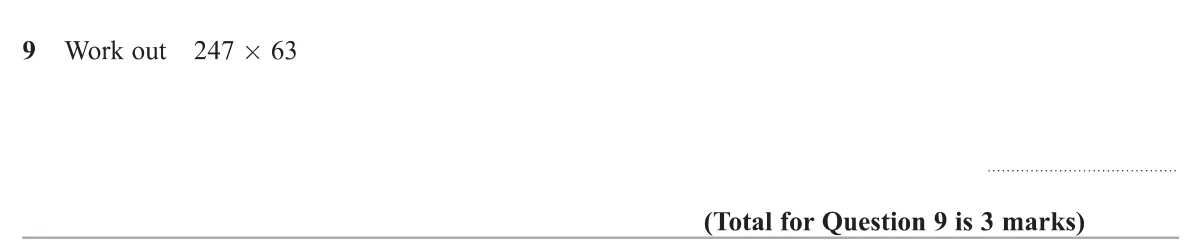
© Pearson Education Ltd. Specimen Paper 1 (Foundation, non-calculator), question 9.
| Answer | 3 marks |
|---|
Worked solution Checked against the mark scheme
Split 63 into 60 and 3.
Watch out: Forgetting the place-value zero when multiplying by the 6 tens.
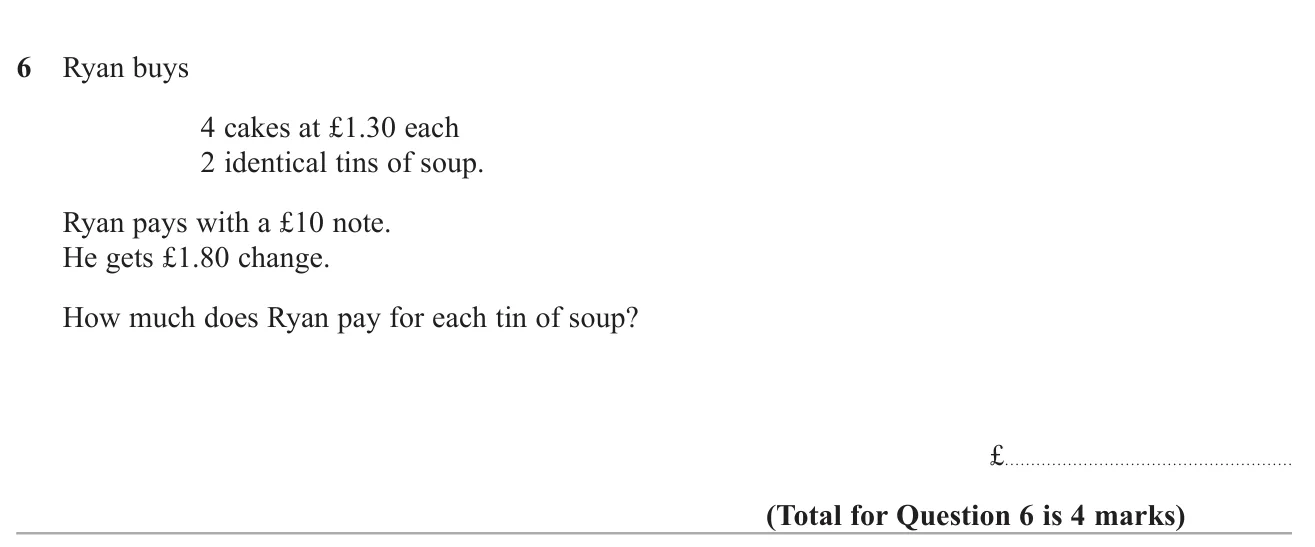
© Pearson Education Ltd. June 2024 Paper 1 (Foundation, non-calculator), question 6.
| Answer | £1.50 | 4 marks |
|---|
Worked solution Checked against the mark scheme
Cakes:
Spent:
Two tins:
One tin:
Watch out: Forgetting to divide by 2 at the end (giving £3).
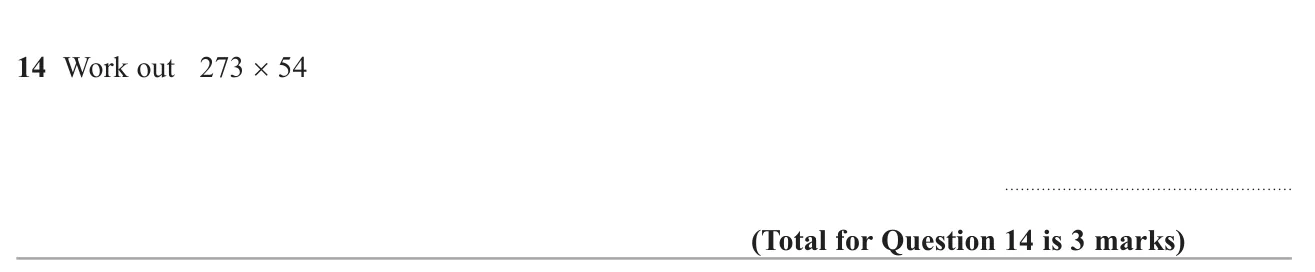
© Pearson Education Ltd. June 2024 Paper 1 (Foundation, non-calculator), question 14.
| Answer | 3 marks |
|---|
Worked solution Checked against the mark scheme
Watch out: Forgetting the place-value zero when multiplying by 50.
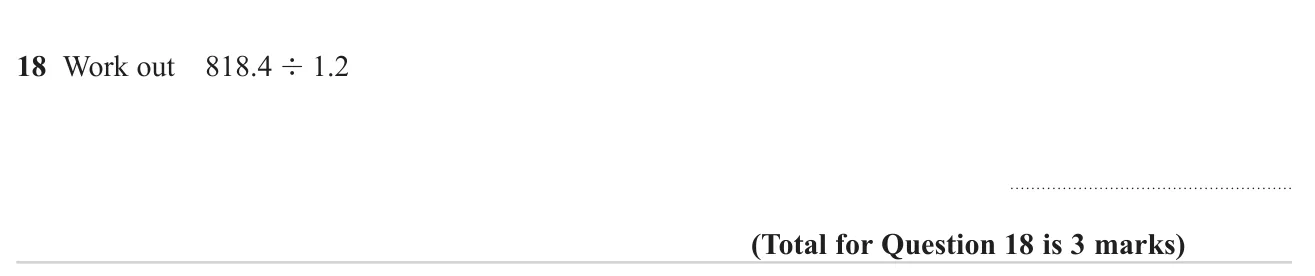
© Pearson Education Ltd. November 2024 Paper 1 (Foundation, non-calculator), question 18.
| Answer | 3 marks |
|---|
Worked solution Checked against the mark scheme
Multiply both numbers by 10:
r 9, r 2,
So the answer is .
Watch out: Giving 68.2 after misplacing the decimal point.
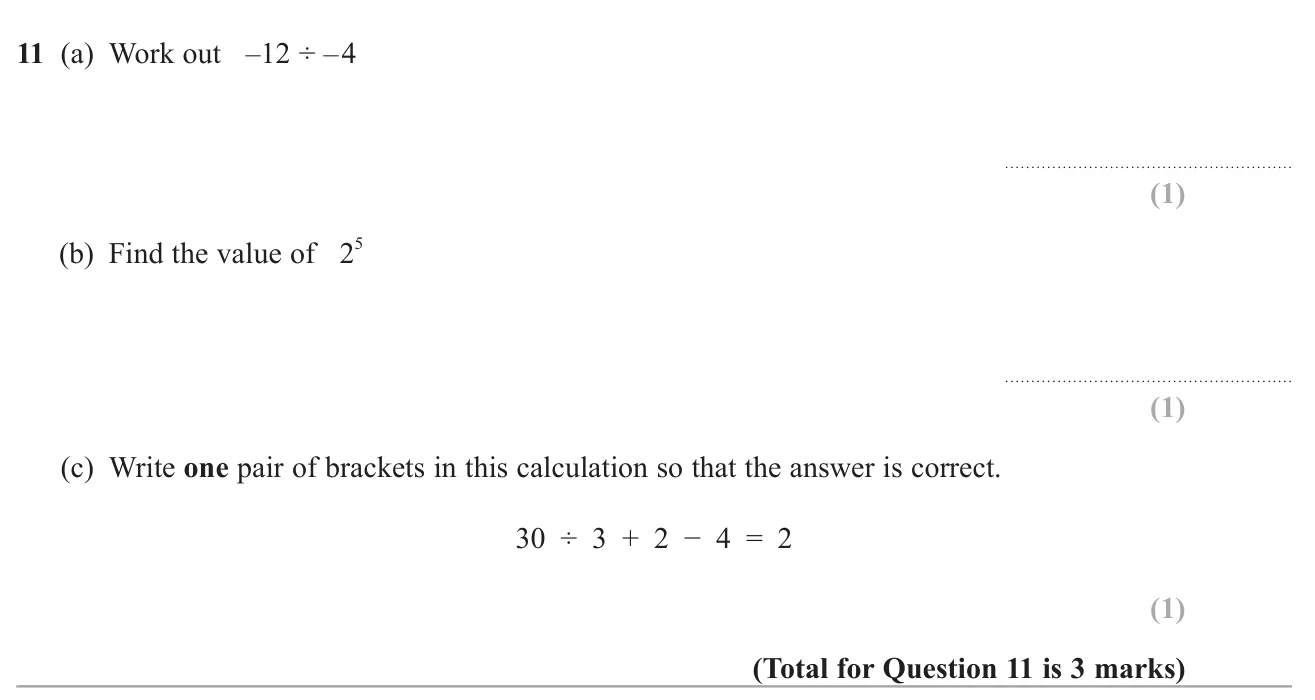
© Pearson Education Ltd. June 2024 Paper 1 (Foundation, non-calculator), question 11.
| (a) | 1 mark | |
|---|---|---|
| (b) | 1 mark | |
| (c) | 1 mark |
Worked solution Checked against the mark scheme
(a) Negative ÷ negative is positive:
(b)
(c)
Watch out: In (b), working out 2 × 5 = 10.
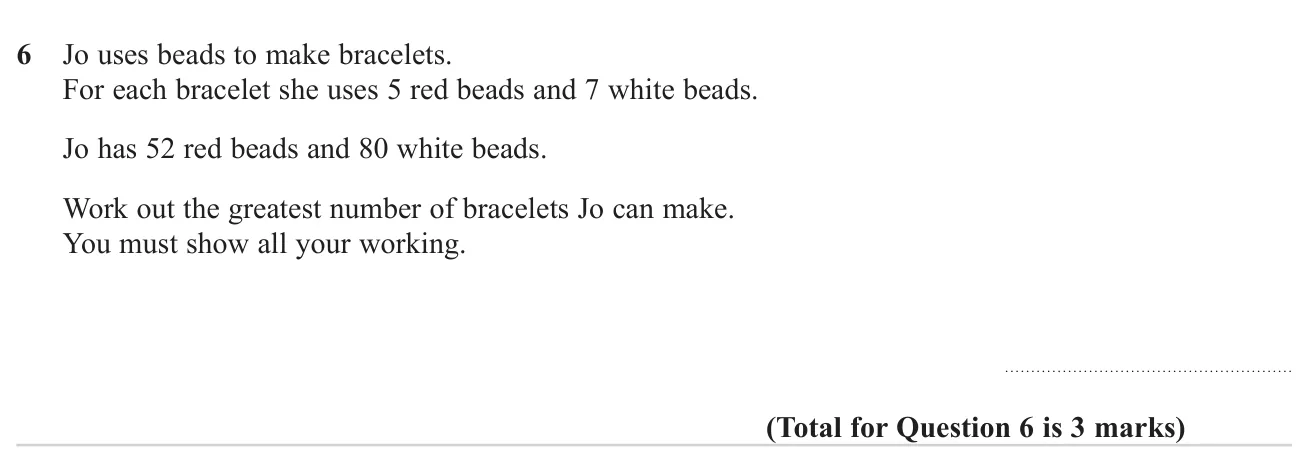
© Pearson Education Ltd. November 2024 Paper 2 (Foundation, calculator), question 6.
| Answer | 10 | 3 marks |
|---|
Worked solution Checked against the mark scheme
Red: , so enough for 10 bracelets.
White: , so enough for 11.
The red beads run out first, so the greatest number is 10.
Watch out: Rounding 10.4 or 11.4 up, or choosing the larger number 11.
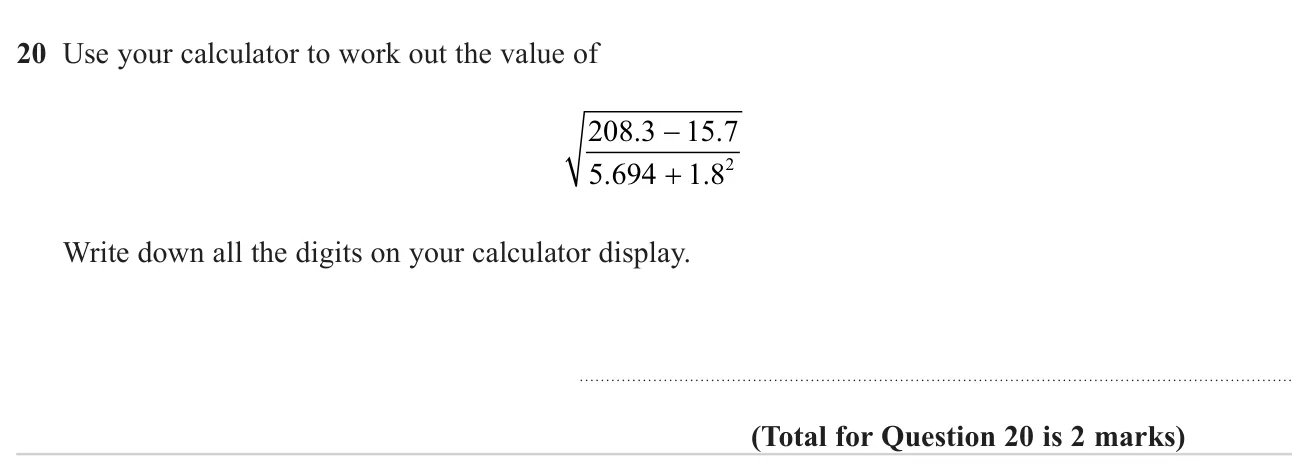
© Pearson Education Ltd. November 2024 Paper 2 (Foundation, calculator), question 20.
| Answer | 4.643069317 | 2 marks |
|---|
Worked solution Checked against the mark scheme
Top:
Bottom:
Watch out: Only square-rooting the top of the fraction, or not using brackets on the calculator.
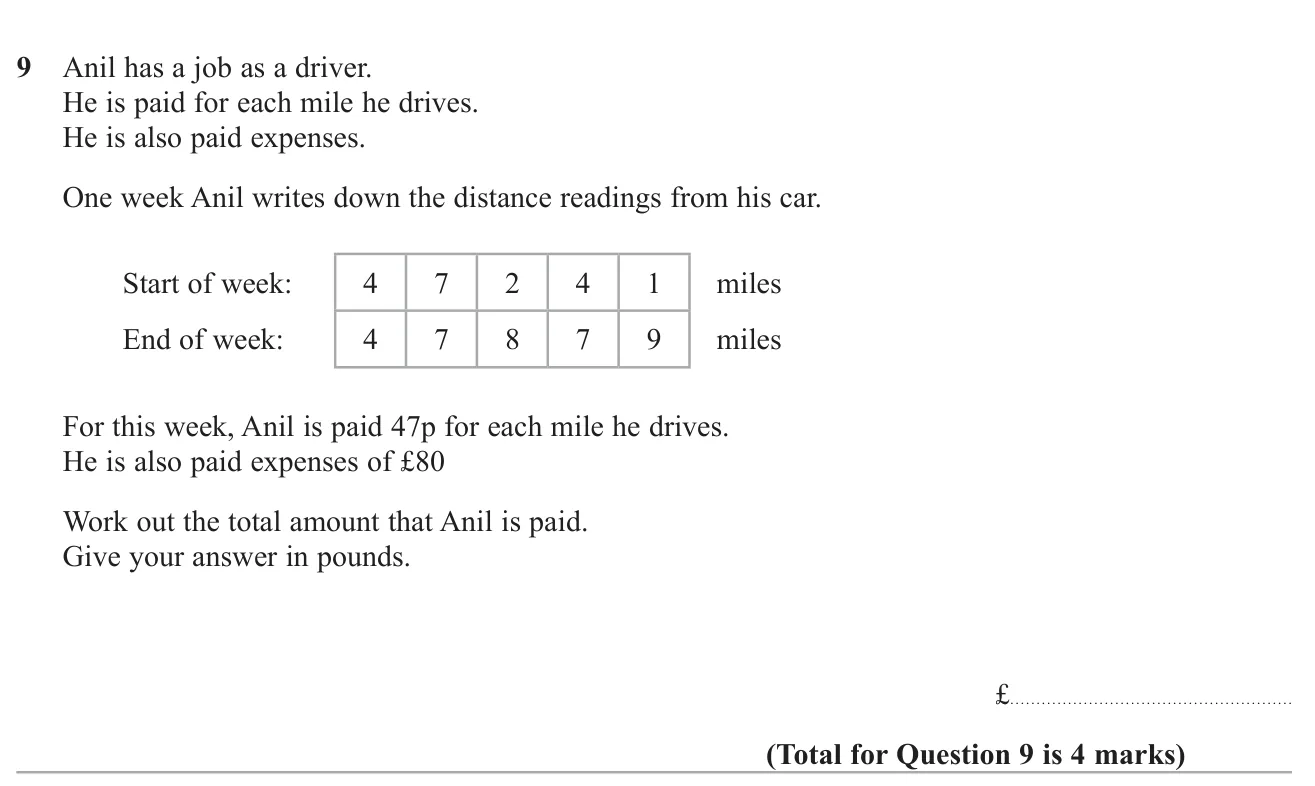
© Pearson Education Ltd. June 2024 Paper 2 (Foundation, calculator), question 9.
| Answer | 4 marks |
|---|
Worked solution Checked against the mark scheme
Miles driven
Mileage pay
Total
Watch out: Adding £80 to a pence value, or forgetting to convert 47p to £0.47.
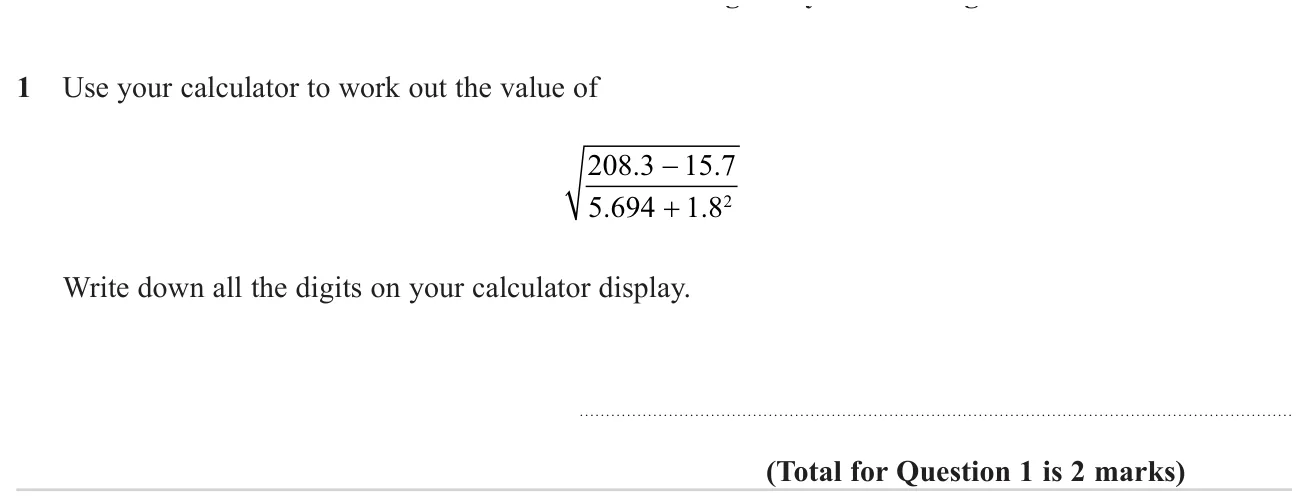
© Pearson Education Ltd. November 2024 Paper 2 (Higher, calculator), question 1.
| Answer | 2 marks |
|---|
Worked solution Checked against the mark scheme
Top:
Bottom:
Watch out: Not using brackets on the calculator, so only part of the numerator is divided.
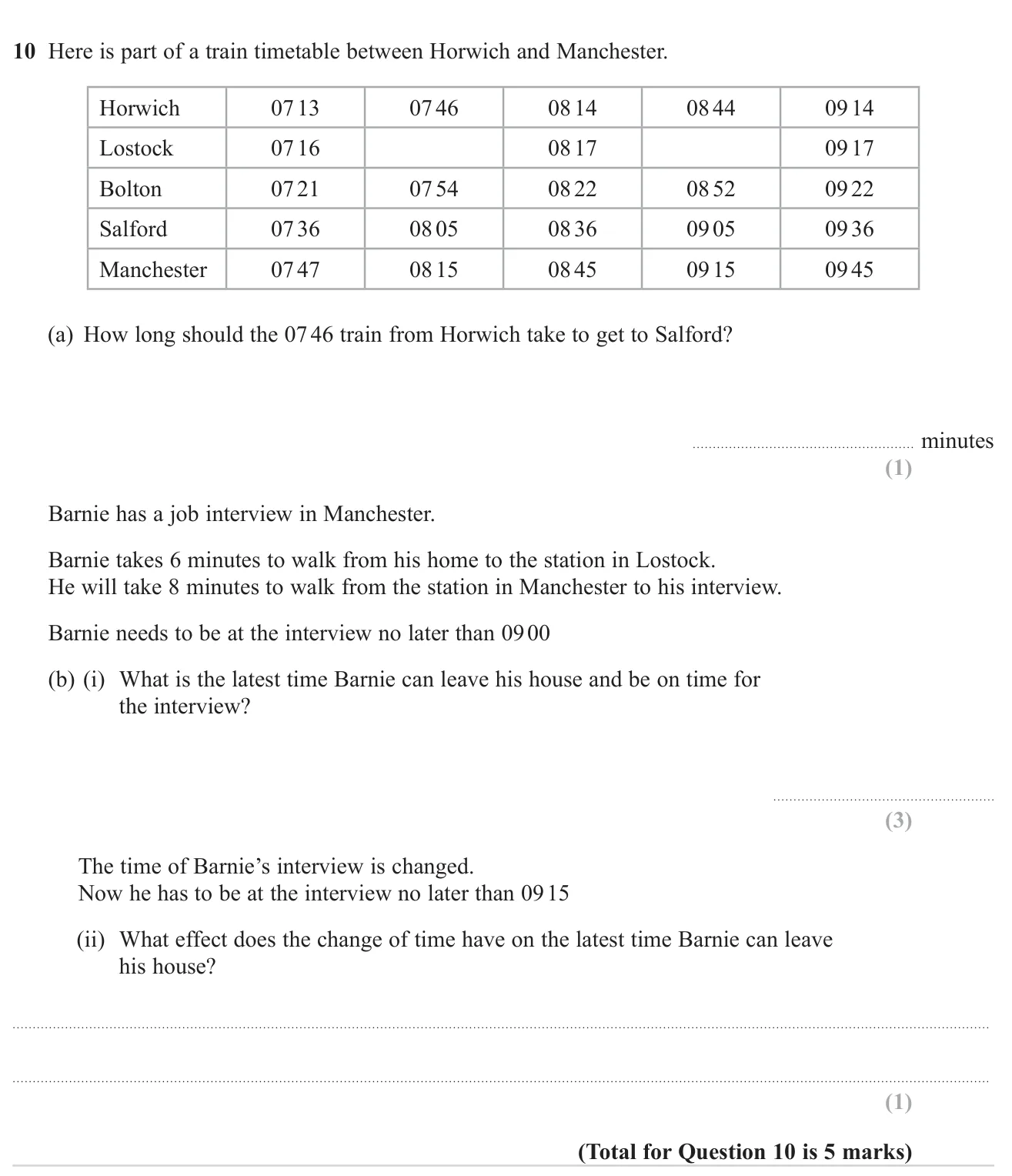
© Pearson Education Ltd. November 2024 Paper 3 (Foundation, calculator), question 10.
| (a) | minutes | 1 mark |
|---|---|---|
| (b(i)) | 08 11 | 3 marks |
| (b(ii)) | No effect, because the next train would get him there too late | 1 mark |
Worked solution Checked against the mark scheme
(a) The 07 46 reaches Salford at 08 05: that is 14 + 5 = 19 minutes.
(b)(i) He must reach Manchester by min . The 08 17 from Lostock arrives at 08 45. Leave home 6 minutes earlier: 08 11.
(ii) The next Lostock train (09 17) reaches Manchester at 09 45, after 09 15, so he still needs the 08 17. No effect.
Watch out: Choosing a train that does not stop at Lostock.
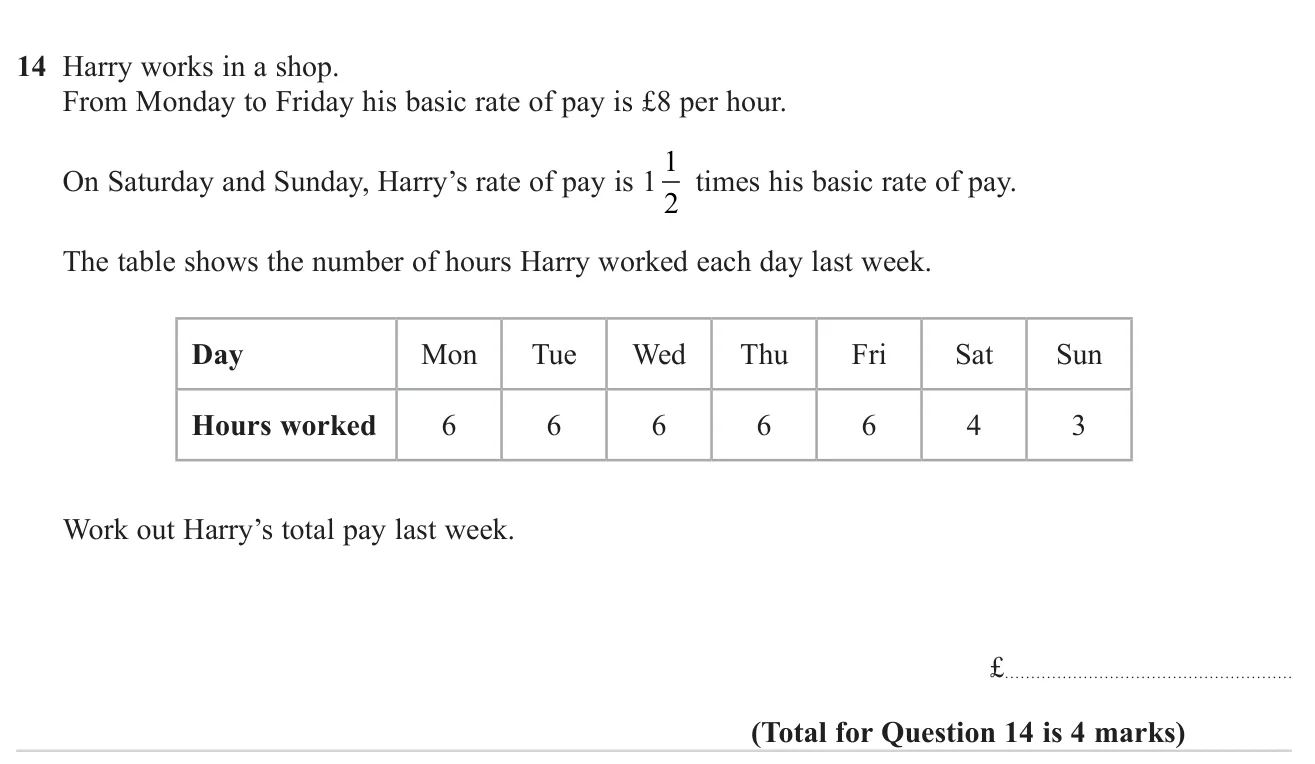
© Pearson Education Ltd. November 2024 Paper 3 (Foundation, calculator), question 14.
| Answer | £324 | 4 marks |
|---|
Worked solution Checked against the mark scheme
Weekdays: hours,
Weekend rate: per hour
Weekend:
Total:
Watch out: Paying all hours at the basic £8 rate.
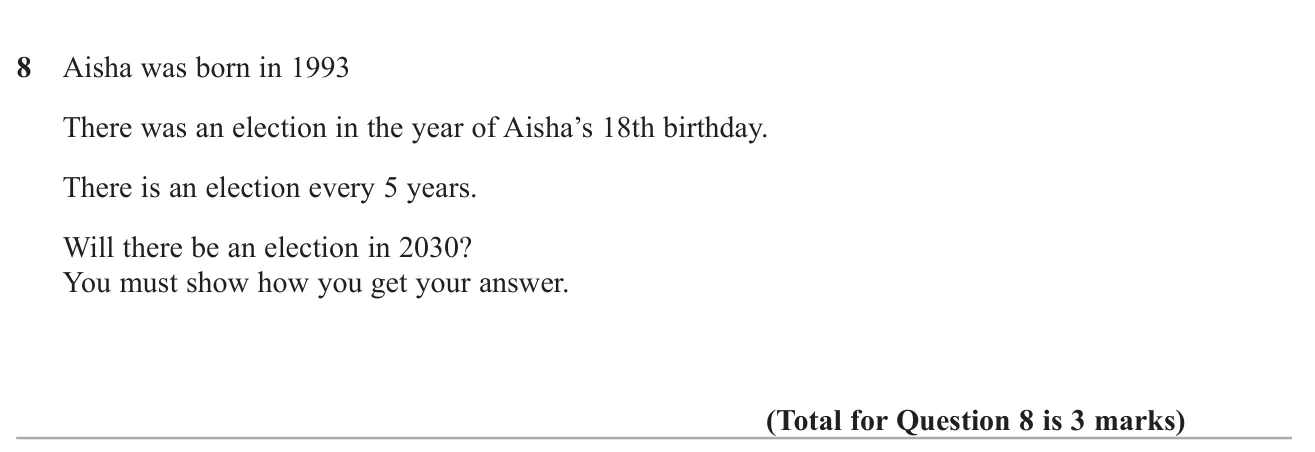
© Pearson Education Ltd. June 2024 Paper 3 (Foundation, calculator), question 8.
| Answer | No, with correct figures (elections in 2011, 2016, 2021, 2026, 2031) | 3 marks |
|---|
Worked solution Checked against the mark scheme
Aisha's 18th birthday: .
Elections every 5 years: 2011, 2016, 2021, 2026, 2031.
2030 is not in the list, so No, there will not be an election in 2030.
Watch out: Counting 5-year steps from 1993 instead of from 2011.
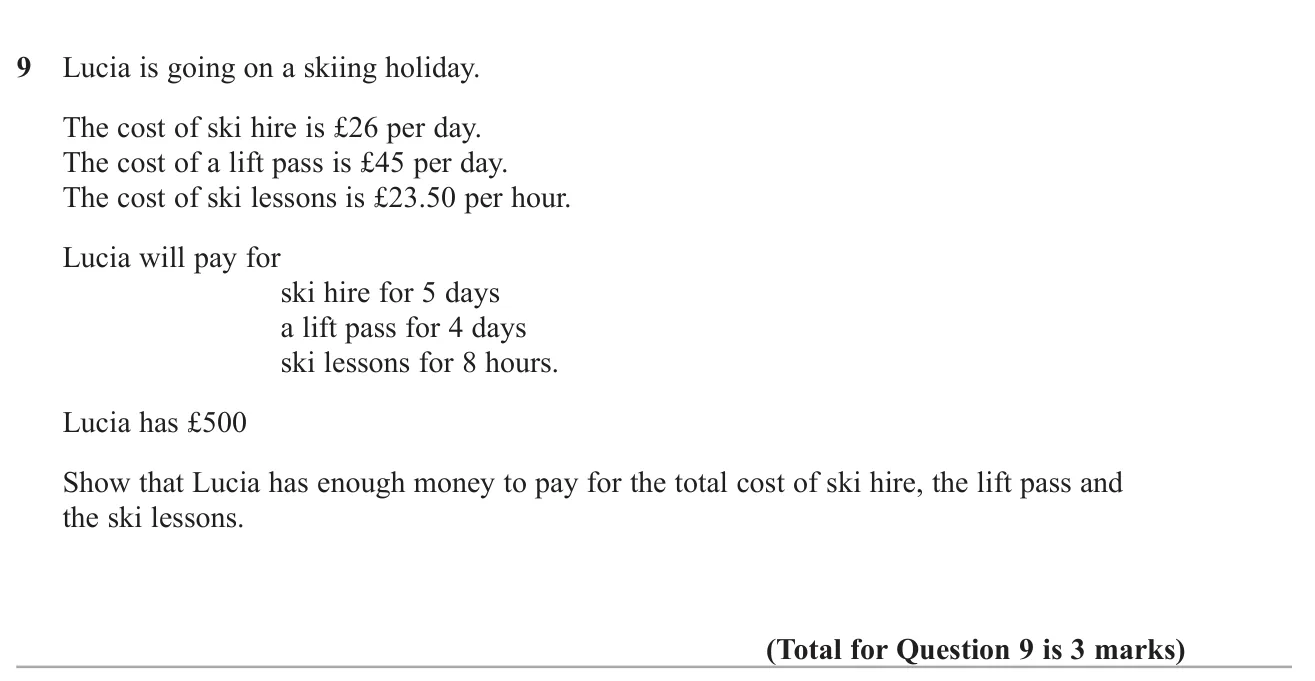
© Pearson Education Ltd. June 2024 Paper 3 (Foundation, calculator), question 9.
| Answer | Total is £498, which is less than £500, so she has enough | 3 marks |
|---|
Worked solution Checked against the mark scheme
Ski hire:
Lift pass:
Lessons:
Total: , and , so Lucia has enough money.
Watch out: Using the same number of days for every item.
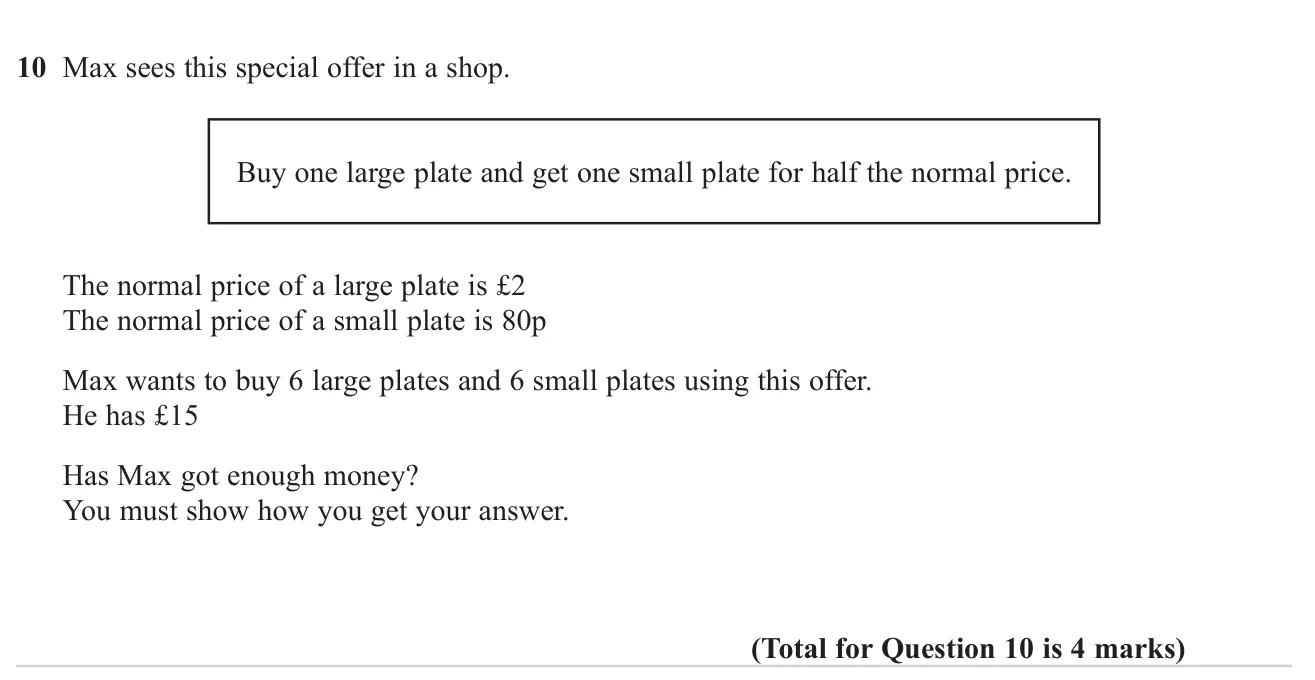
© Pearson Education Ltd. June 2023 Paper 1 (Foundation, non-calculator), question 10.
| Answer | Yes: the plates cost £14.40, which is less than £15 | 4 marks |
|---|
Worked solution Checked against the mark scheme
Large plates:
Each small plate is half price: , so
Total
, so yes, he has enough (with 60p left over).
Watch out: Forgetting to halve the small plate price, getting £16.80.
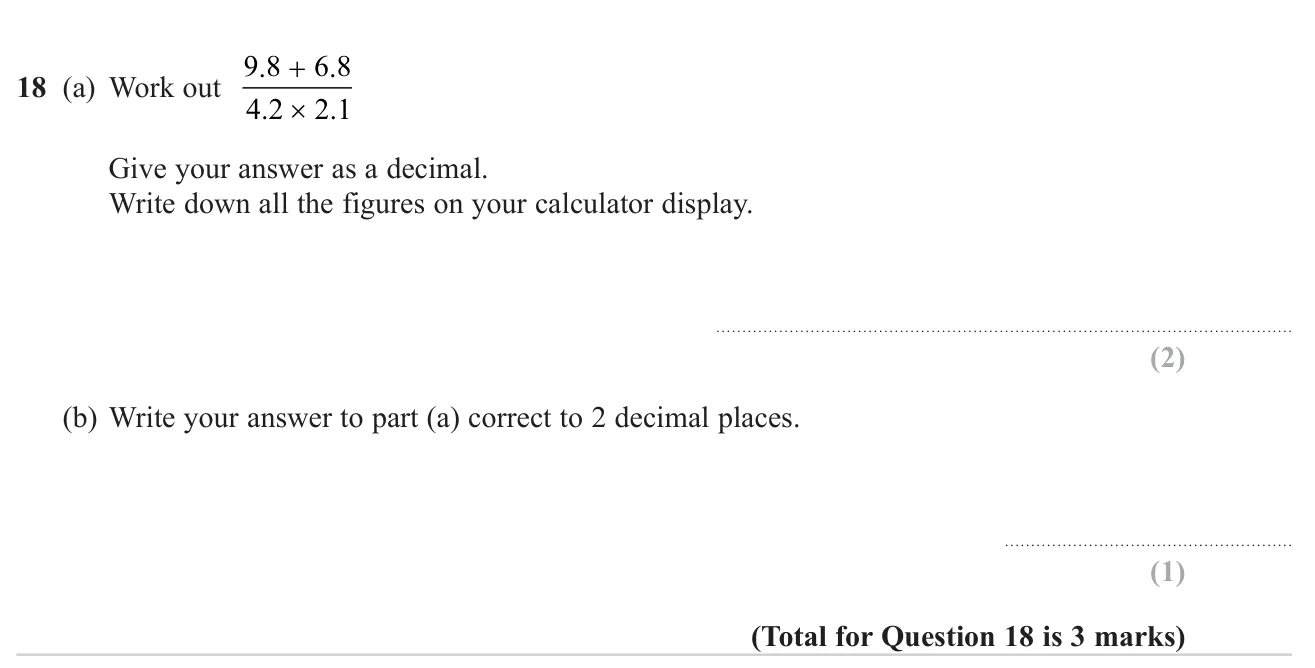
© Pearson Education Ltd. November 2023 Paper 2 (Foundation, calculator), question 18.
| (a) | 2 marks | |
|---|---|---|
| (b) | 1.88 | 1 mark |
Worked solution Checked against the mark scheme
(a) Top: . Bottom:
(b) The third decimal place is 2, so round down:
Watch out: Typing it in without brackets, so only 6.8 is divided by 4.2 × 2.1.
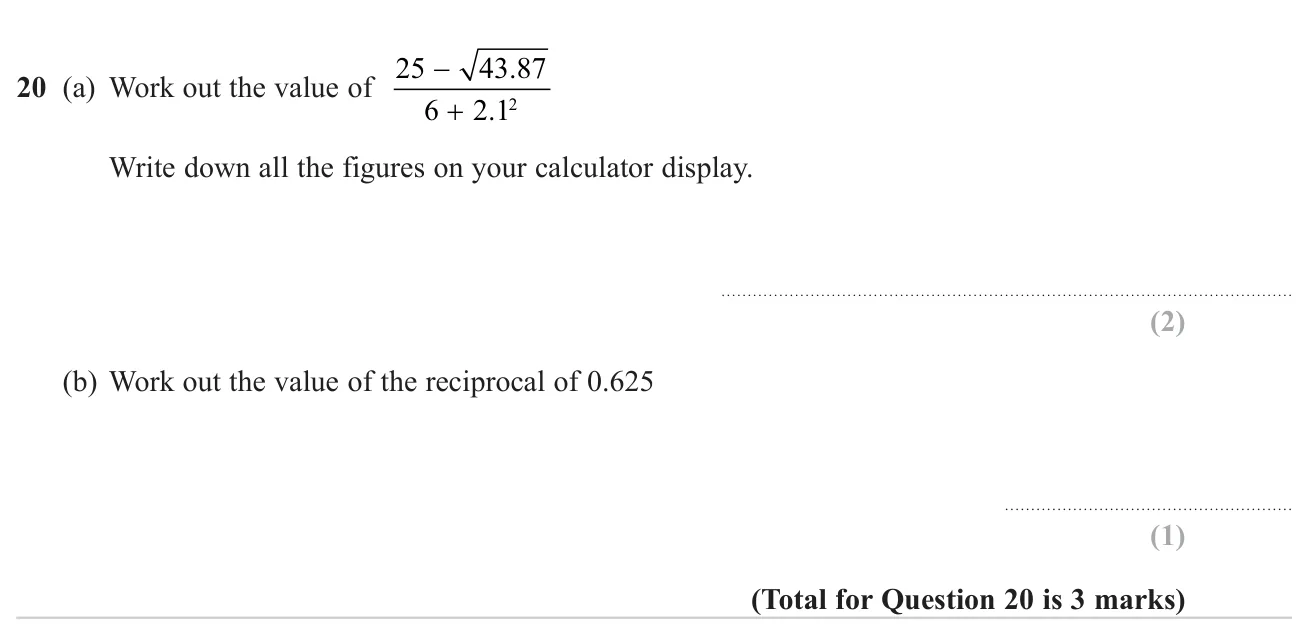
© Pearson Education Ltd. June 2023 Paper 2 (Foundation, calculator), question 20.
| (a) | 1.765279230... | 2 marks |
|---|---|---|
| (b) | 1.6 | 1 mark |
Worked solution Checked against the mark scheme
(a) Top:
Bottom:
(b) Reciprocal
Watch out: Typing it without brackets so only part of the top is divided.
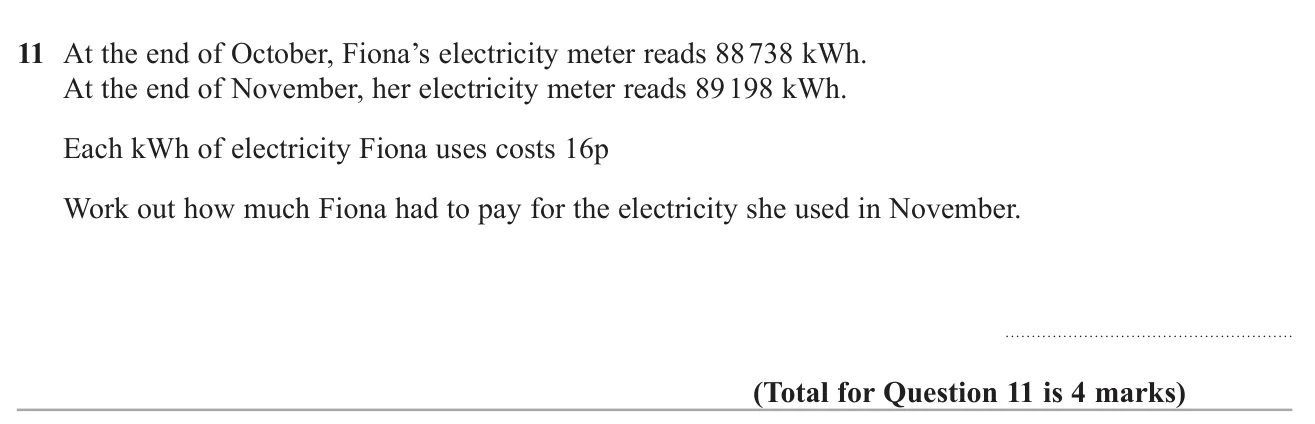
© Pearson Education Ltd. June 2022 Paper 1 (Foundation, non-calculator), question 11.
| Answer | £73.60 (or 7360p) | 4 marks |
|---|
Worked solution Checked against the mark scheme
Units used: kWh
Cost: p
Watch out: Leaving the answer as £7360 by forgetting to convert pence to pounds.
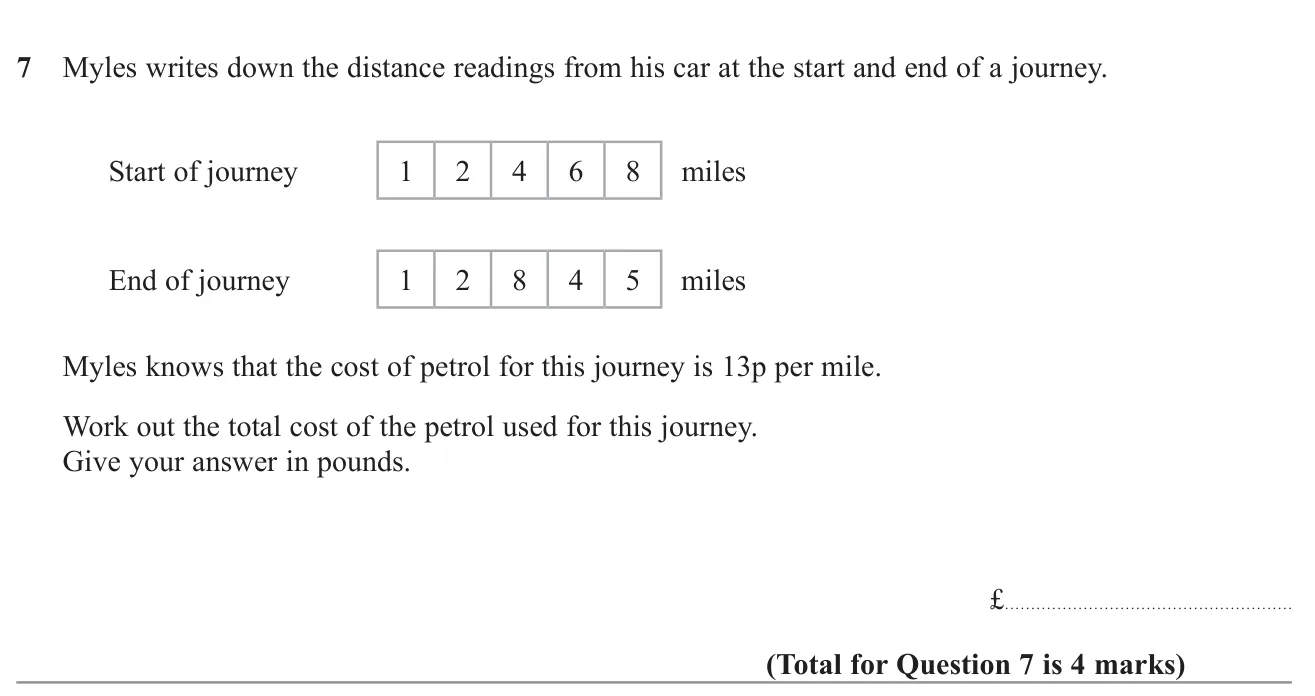
© Pearson Education Ltd. November 2022 Paper 2 (Foundation, calculator), question 7.
| Answer | £49.01 | 4 marks |
|---|
Worked solution Checked against the mark scheme
Distance: miles
Cost: p
Watch out: Leaving the answer as 4901 in pounds.
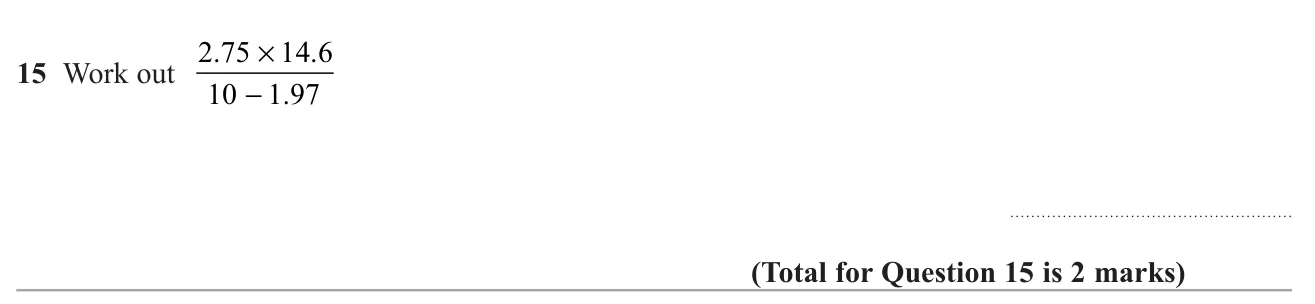
© Pearson Education Ltd. June 2022 Paper 3 (Foundation, calculator), question 15.
| Answer | 5 | 2 marks |
|---|
Worked solution Checked against the mark scheme
Top:
Bottom:
Watch out: Typing it in without brackets, so only 14.6 is divided by 10.
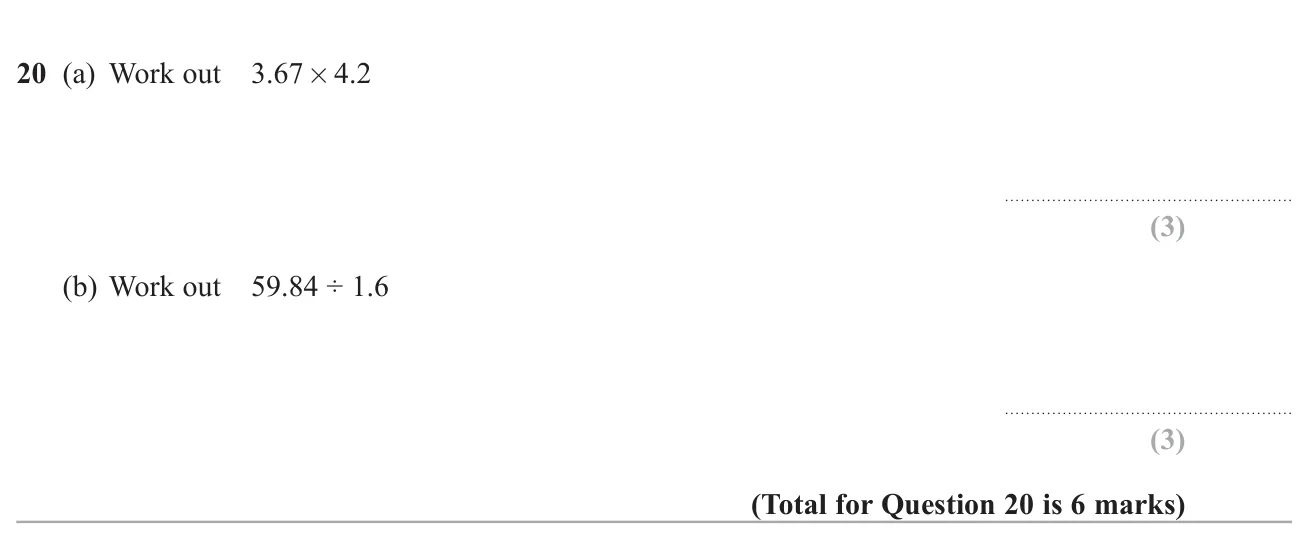
© Pearson Education Ltd. November 2021 Paper 1 (Foundation, non-calculator), question 20.
| (a) | 3 marks | |
|---|---|---|
| (b) | 3 marks |
Worked solution Checked against the mark scheme
(a) . There are 3 decimal places in total, so
(b) Multiply both by 10:
(since and )
Watch out: Placing the decimal point wrongly, e.g. 154.14.
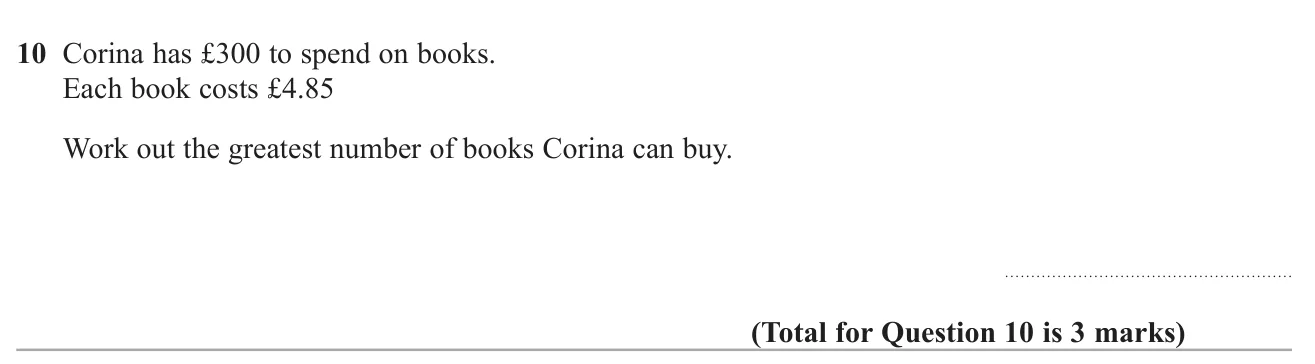
© Pearson Education Ltd. November 2021 Paper 3 (Foundation, calculator), question 10.
| Answer | 61 | 3 marks |
|---|
Worked solution Checked against the mark scheme
She cannot buy part of a book, and 62 books would cost more than £300, so round down.
She can buy 61 books.
Watch out: Rounding 61.85 up to 62.
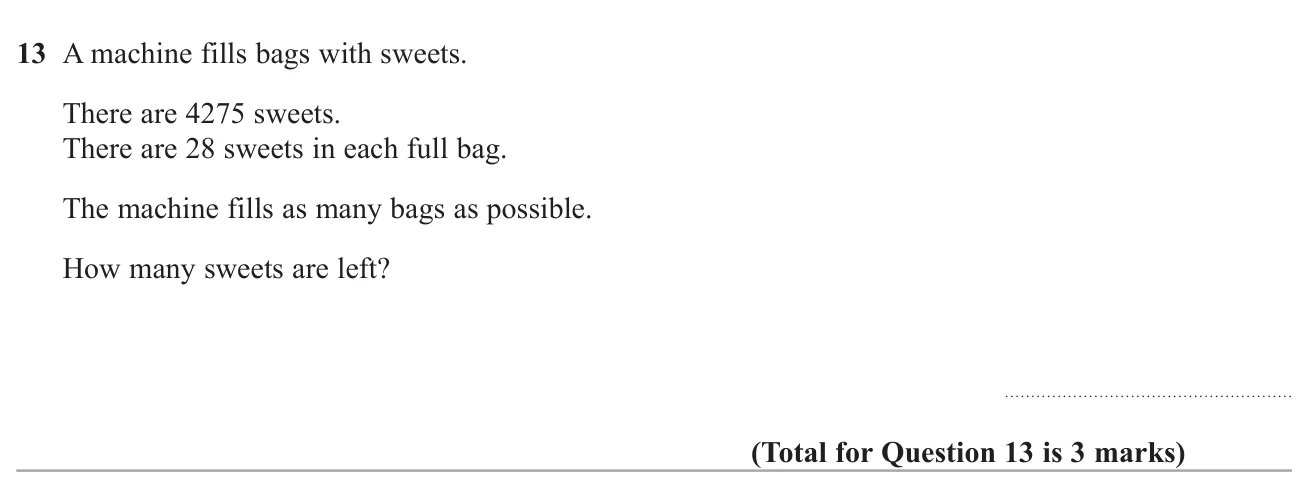
© Pearson Education Ltd. November 2020 Paper 2 (Foundation, calculator), question 13.
| Answer | 19 | 3 marks |
|---|
Worked solution Checked against the mark scheme
, so 152 full bags.
sweets used.
sweets left.
Watch out: Giving the decimal remainder 0.67 or 152 bags as the answer.
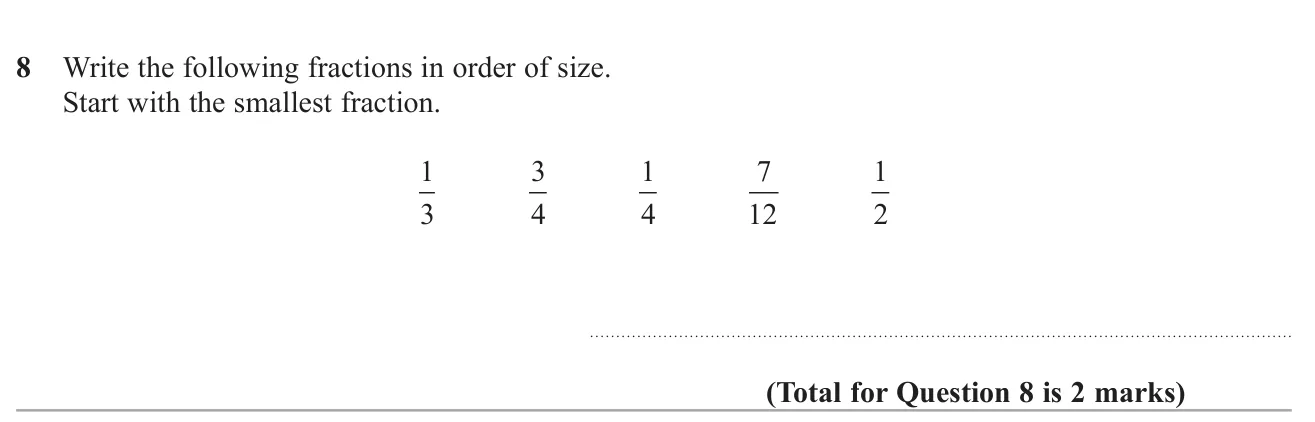
© Pearson Education Ltd. June 2019 Paper 1 (Foundation, non-calculator), question 8.
| Answer | 2 marks |
|---|
Worked solution Checked against the mark scheme
Write each with denominator 12:
, , , ,
Order: , i.e.
Watch out: Thinking a bigger denominator means a bigger fraction.
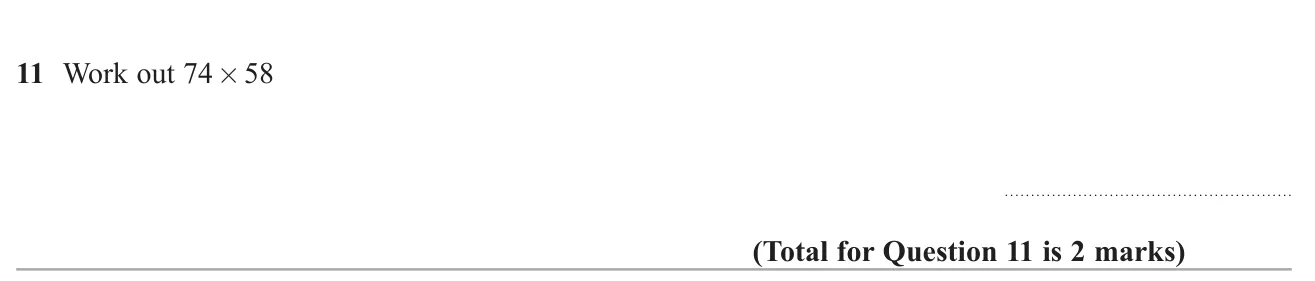
© Pearson Education Ltd. June 2019 Paper 1 (Foundation, non-calculator), question 11.
| Answer | 4292 | 2 marks |
|---|
Worked solution Checked against the mark scheme
Grid method:
, , ,
Watch out: Forgetting the place-value zero in the second row of long multiplication.
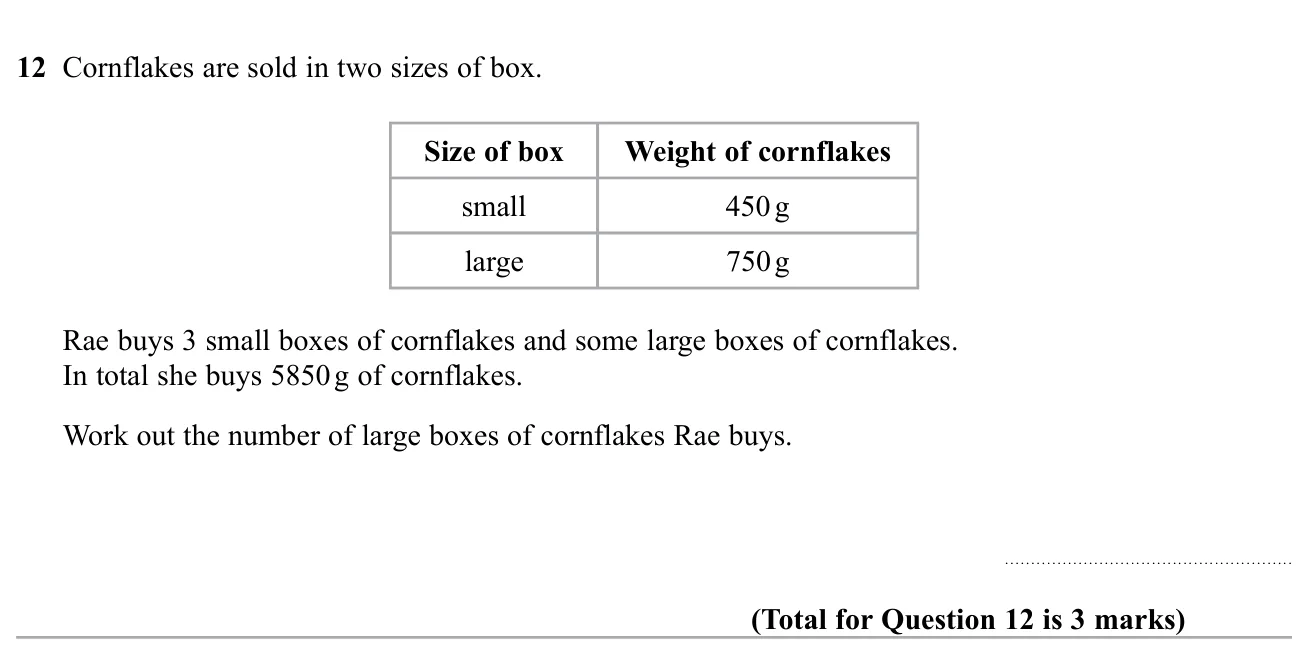
© Pearson Education Ltd. November 2019 Paper 3 (Foundation, calculator), question 12.
| Answer | 6 | 3 marks |
|---|
Worked solution Checked against the mark scheme
Small boxes: g
Left for large boxes: g
large boxes
Watch out: Dividing 5850 by 750 without removing the small boxes first.
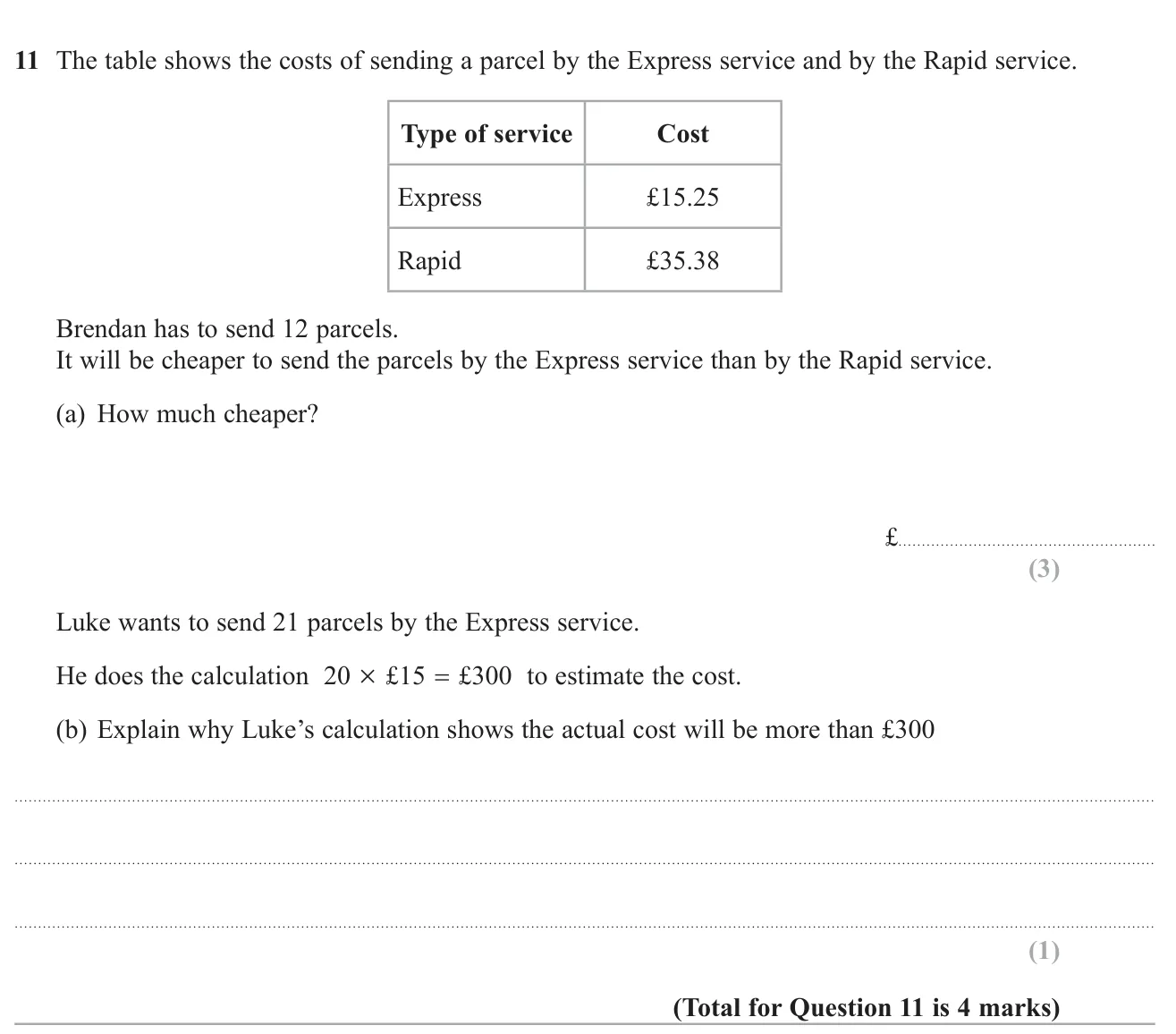
© Pearson Education Ltd. June 2019 Paper 3 (Foundation, calculator), question 11.
| (a) | £241.56 | 3 marks |
|---|---|---|
| (b) | Both numbers were rounded down: 20 is less than 21 and £15 is less than £15.25 | 1 mark |
Worked solution Checked against the mark scheme
(a) Difference per parcel:
(b) He used 20 parcels instead of 21 and £15 instead of £15.25. Both are smaller than the real values, so the real cost is more than £300.
Watch out: In (b), mentioning only one of the two rounded numbers.
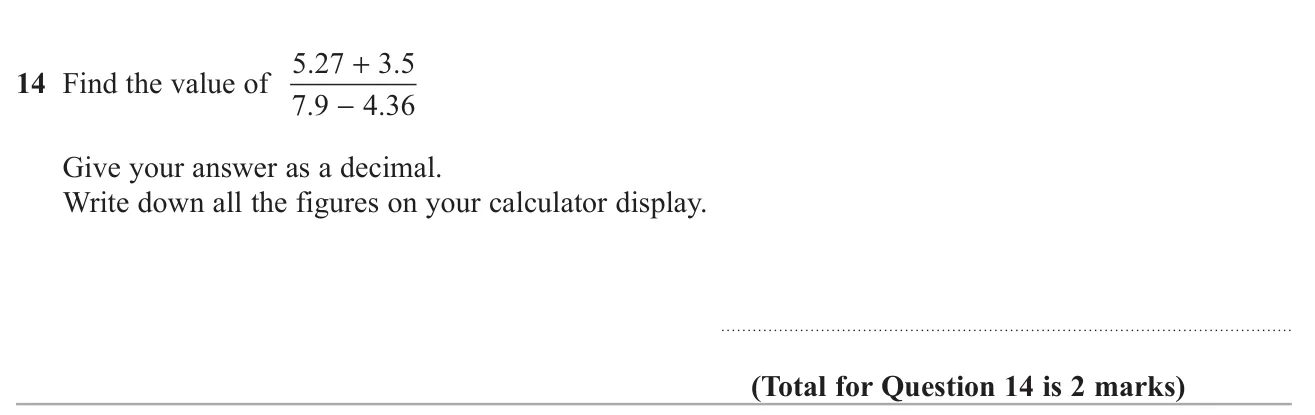
© Pearson Education Ltd. June 2019 Paper 3 (Foundation, calculator), question 14.
| Answer | 2.4774011... | 2 marks |
|---|
Worked solution Checked against the mark scheme
Top:
Bottom:
Watch out: Typing it in without brackets, so only 3.5 is divided by 7.9.
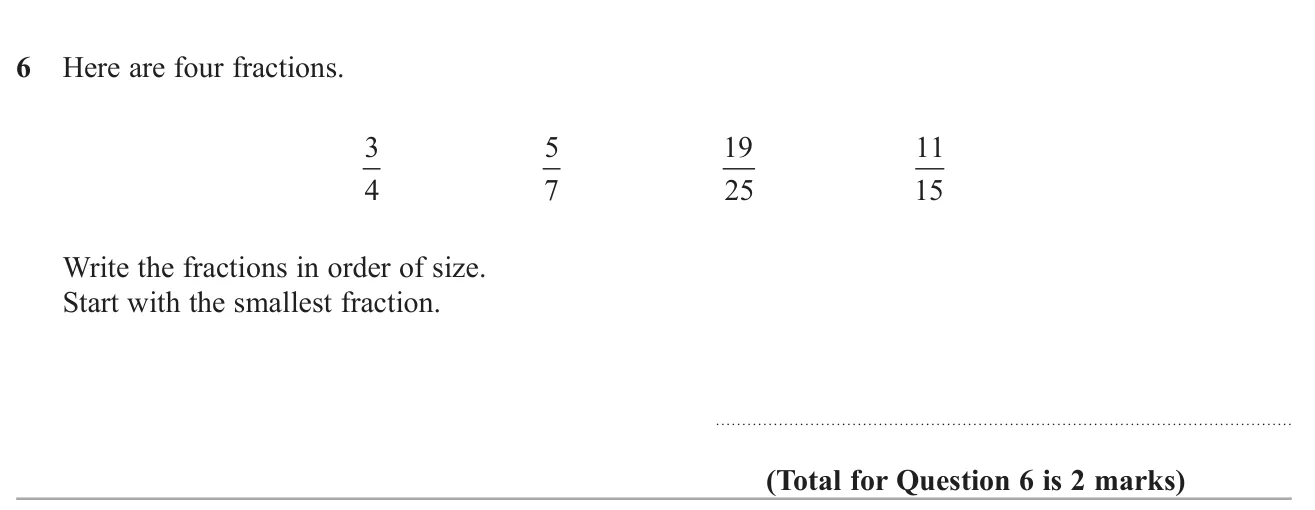
© Pearson Education Ltd. November 2018 Paper 2 (Foundation, calculator), question 6.
| Answer | 2 marks |
|---|
Worked solution Checked against the mark scheme
Change each to a decimal:
, , ,
Smallest first:
Watch out: Ordering by the size of the denominators.
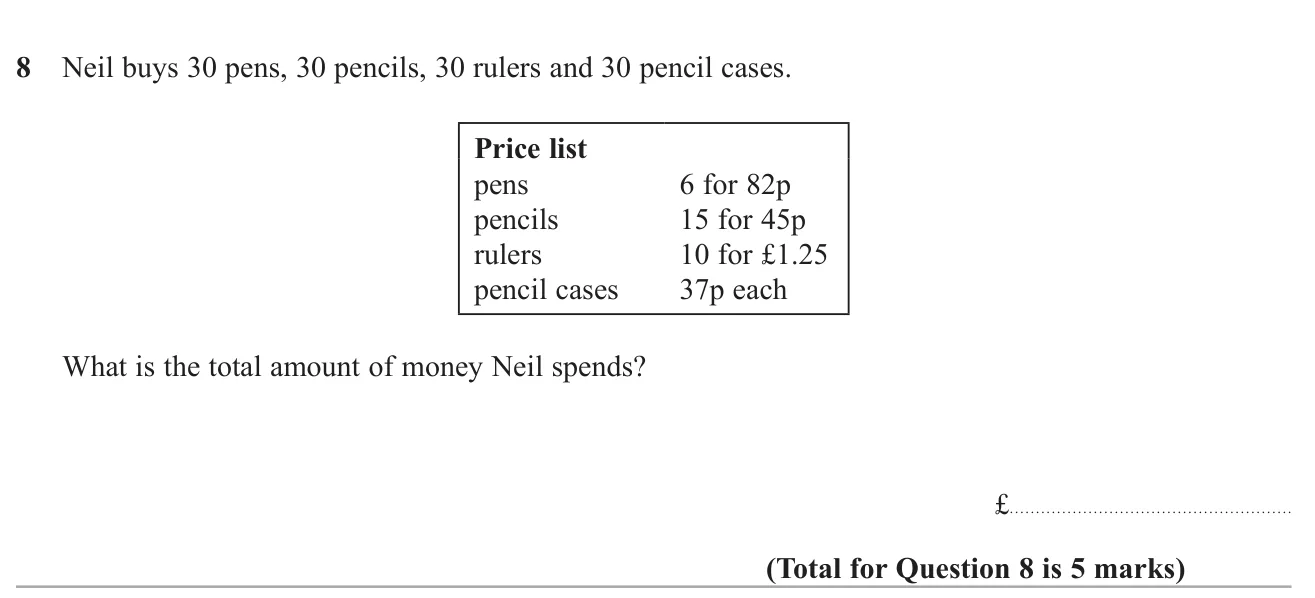
© Pearson Education Ltd. June 2018 Paper 2 (Foundation, calculator), question 8.
| Answer | 5 marks |
|---|
Worked solution Checked against the mark scheme
Pens: packs, p
Pencils: packs, p
Rulers: packs,
Pencil cases: p
Total:
Watch out: Mixing pence and pounds when adding.
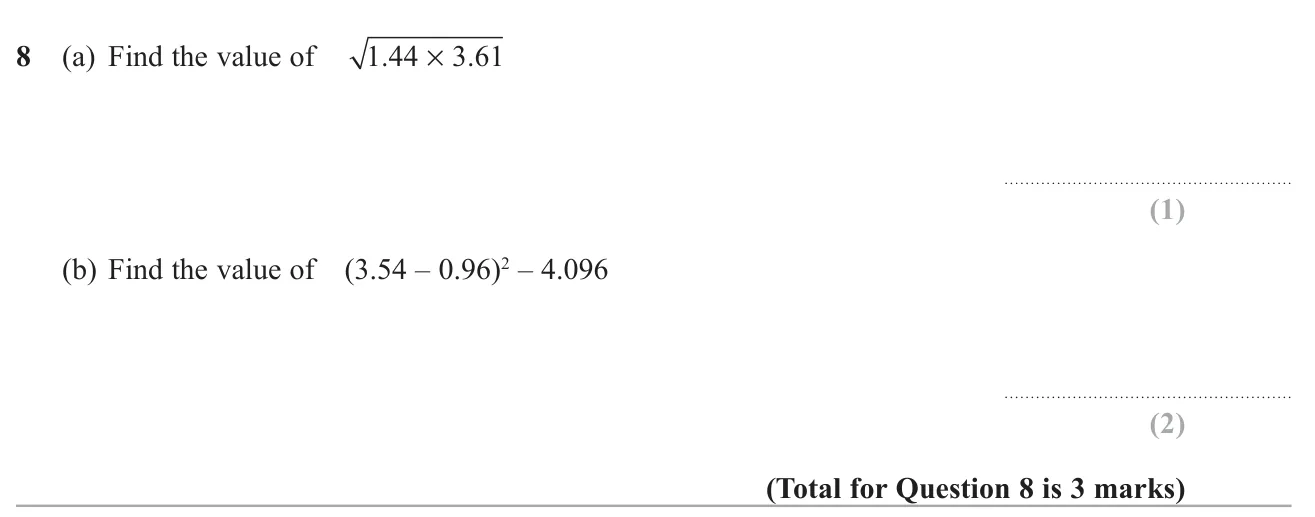
© Pearson Education Ltd. June 2018 Paper 3 (Foundation, calculator), question 8.
| (a) | 1 mark | |
|---|---|---|
| (b) | 2 marks |
Worked solution Checked against the mark scheme
(a) and .
(b)
Watch out: Forgetting to square the bracket before subtracting.
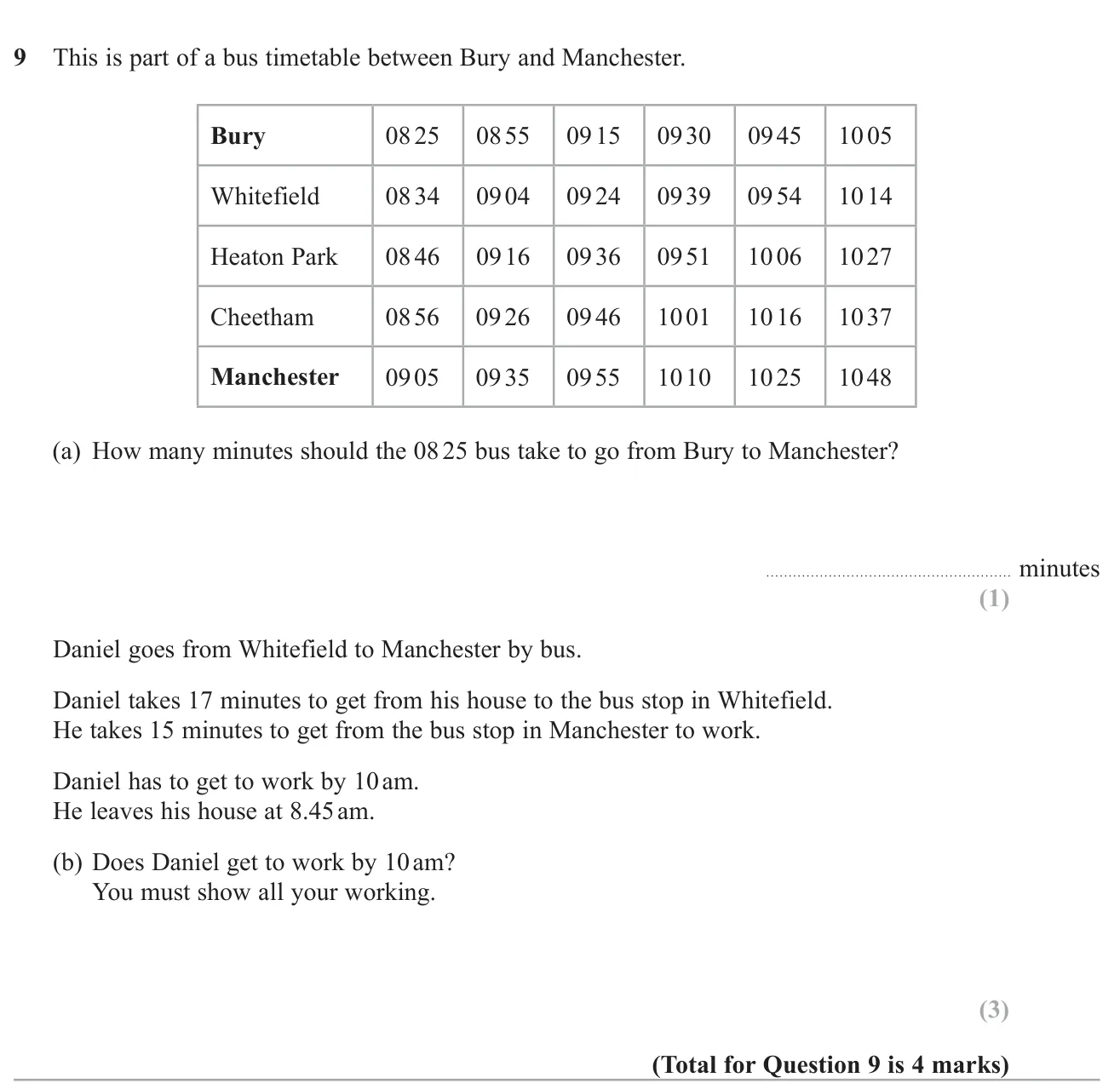
© Pearson Education Ltd. June 2018 Paper 3 (Foundation, calculator), question 9.
| (a) | minutes | 1 mark |
|---|---|---|
| (b) | Yes: he arrives at about 9:50 am | 3 marks |
Worked solution Checked against the mark scheme
(a) 08 25 to 09 05 is minutes.
(b) He reaches the Whitefield stop at 8:45 + 17 min = 9:02.
The next bus leaves Whitefield at 09 04 and reaches Manchester at 09 35.
9:35 + 15 min = 9:50, which is before 10 am, so yes.
Watch out: Treating times as decimals, e.g. 8.45 + 0.17 = 8.62.
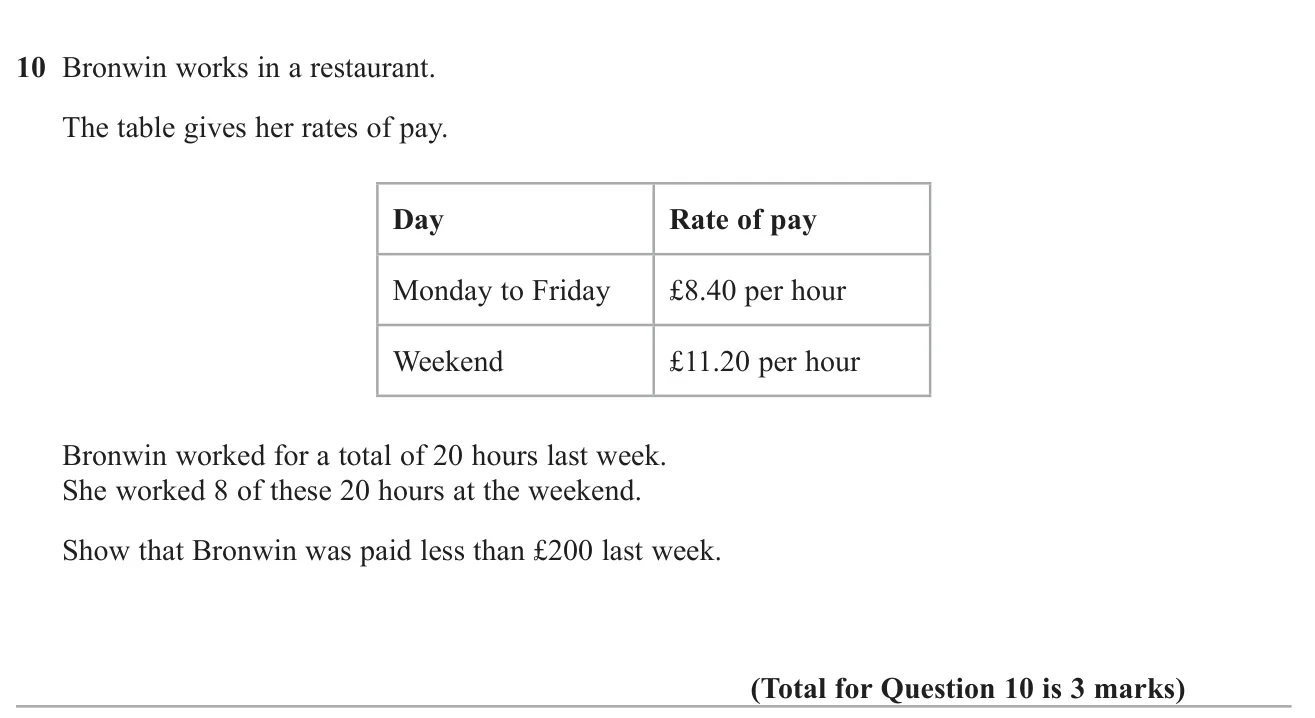
© Pearson Education Ltd. June 2018 Paper 3 (Foundation, calculator), question 10.
| Answer | , which is less than | 3 marks |
|---|
Worked solution Checked against the mark scheme
Weekday hours: .
Weekday pay: .
Weekend pay: .
Total: , which is less than £200.
Watch out: Paying all 20 hours at one rate.
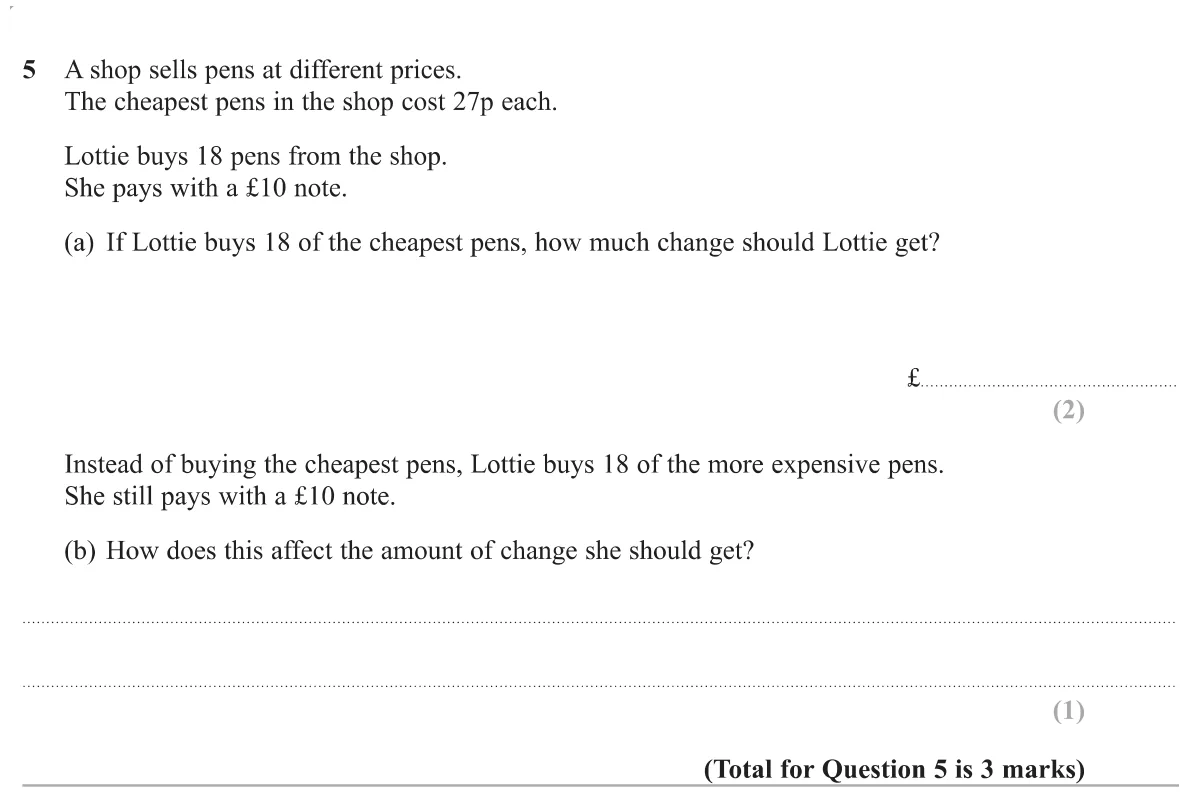
© Pearson Education Ltd. Specimen Paper 2 (Foundation, calculator), question 5.
| (a) | £5.14 | 2 marks |
|---|---|---|
| (b) | She gets less change | 1 mark |
Worked solution Checked against the mark scheme
(a) p
(b) The pens cost more, so she spends more and gets less change.
Watch out: Mixing pence and pounds, e.g. .
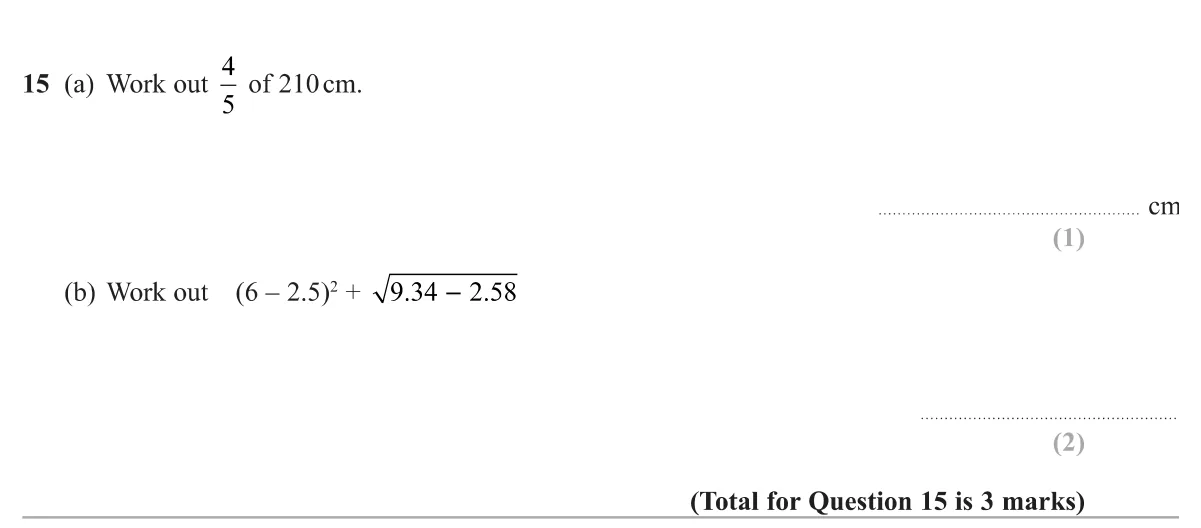
© Pearson Education Ltd. Specimen Paper 2 (Foundation, calculator), question 15.
| (a) | 168 cm | 1 mark |
|---|---|---|
| (b) | 14.85 | 2 marks |
Worked solution Checked against the mark scheme
(a) cm
(b)
Watch out: Typing it in one go without brackets round the subtraction under the root.
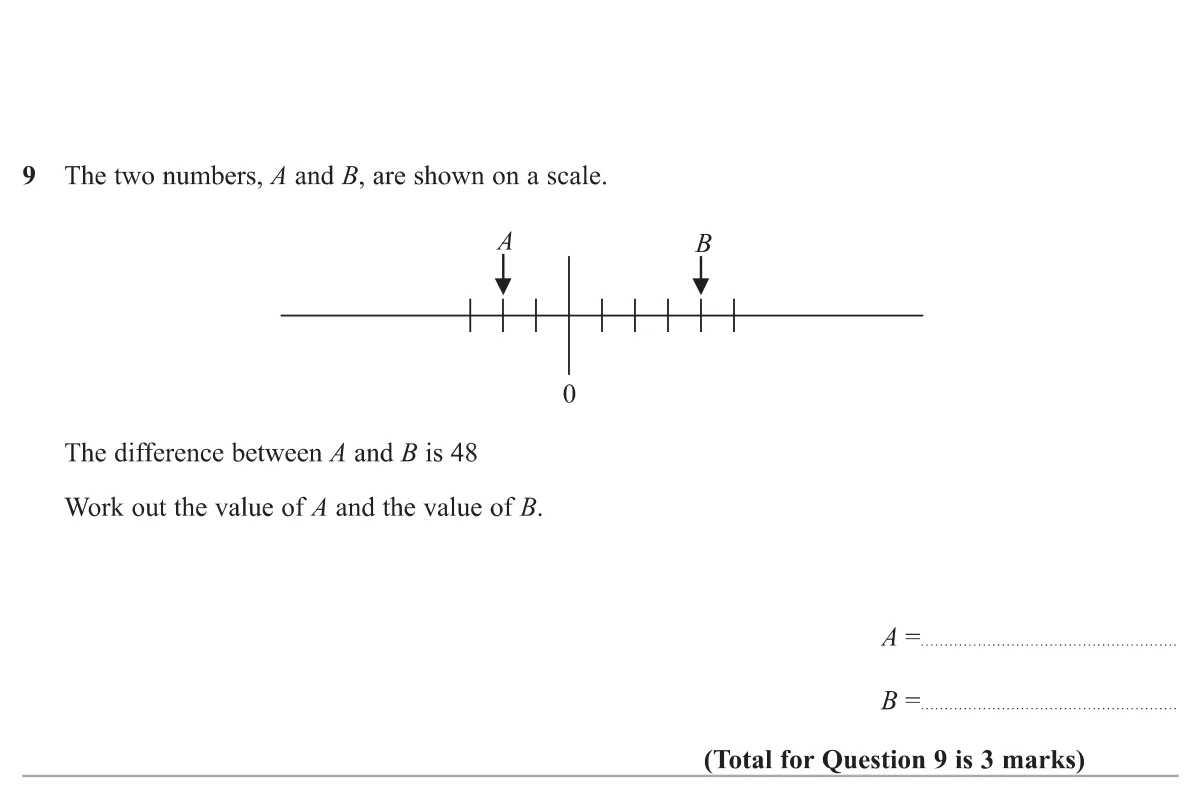
© Pearson Education Ltd. Specimen Paper 3 (Foundation, calculator), question 9.
| Answer | , | 3 marks |
|---|
Worked solution Checked against the mark scheme
From A to B there are 6 equal gaps, so each gap is .
A is 2 gaps left of 0: .
B is 4 gaps right of 0: .
Watch out: Forgetting that A is negative, or counting tick marks instead of gaps.
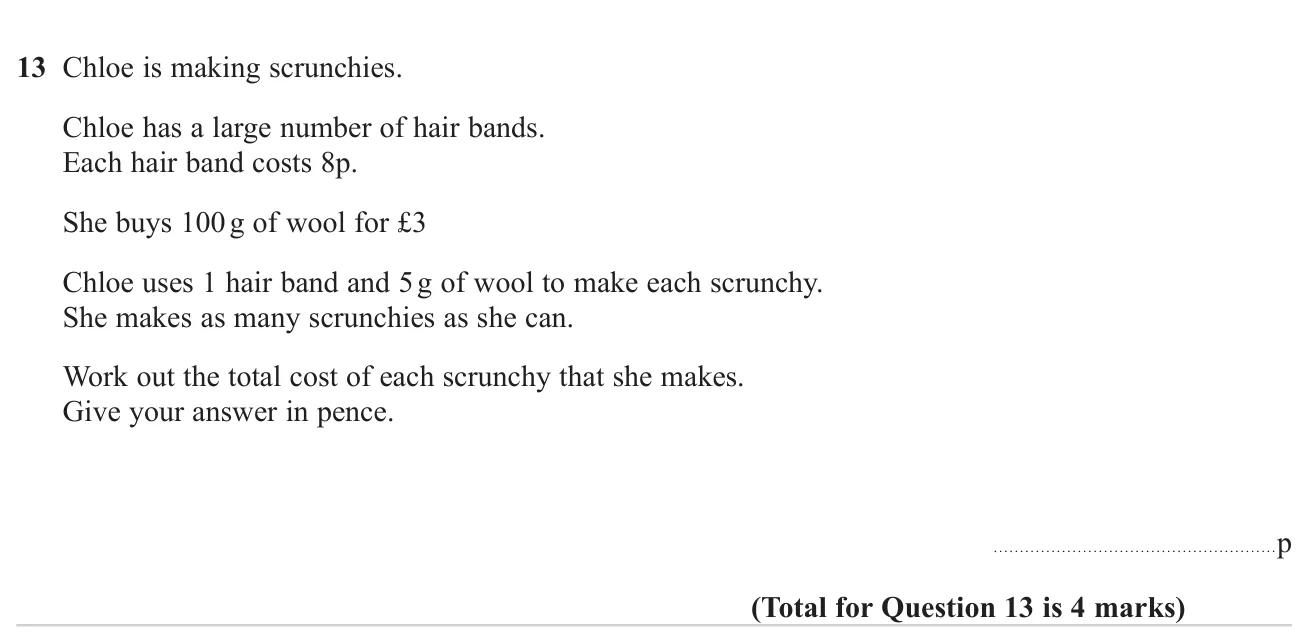
© Pearson Education Ltd. November 2023 Paper 1 (Foundation, non-calculator), question 13.
| Answer | 23p | 4 marks |
|---|
Worked solution Checked against the mark scheme
Number of scrunchies:
Wool per scrunchy: p
Total cost each: p
Watch out: Forgetting to add the 8p hair band and giving 15p.
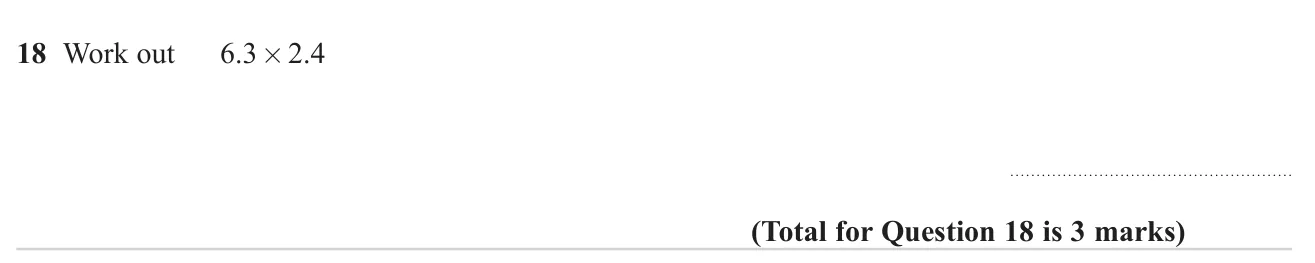
© Pearson Education Ltd. November 2023 Paper 1 (Foundation, non-calculator), question 18.
| Answer | 15.12 | 3 marks |
|---|
Worked solution Checked against the mark scheme
Work out : and , so .
There are two decimal places in the question, so
Watch out: Putting the decimal point in the wrong place, e.g. 151.2.
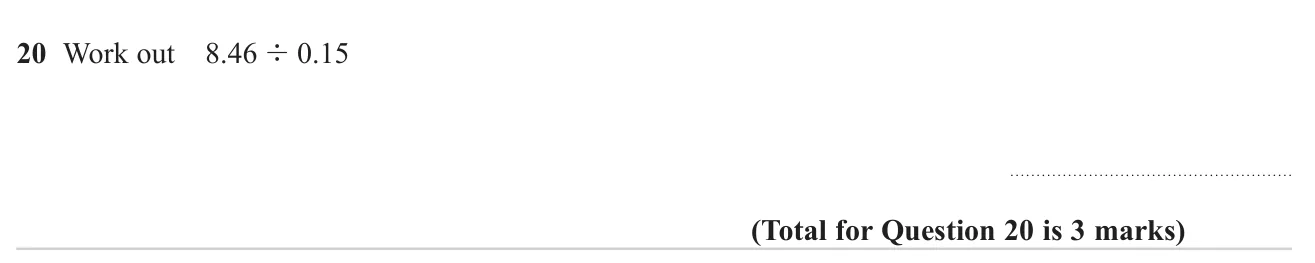
© Pearson Education Ltd. June 2023 Paper 1 (Foundation, non-calculator), question 20.
| Answer | 3 marks |
|---|
Worked solution Checked against the mark scheme
Multiply both numbers by 100:
, remainder 6, and
So the answer is
Watch out: Misplacing the decimal point, giving 5.64 or 564.
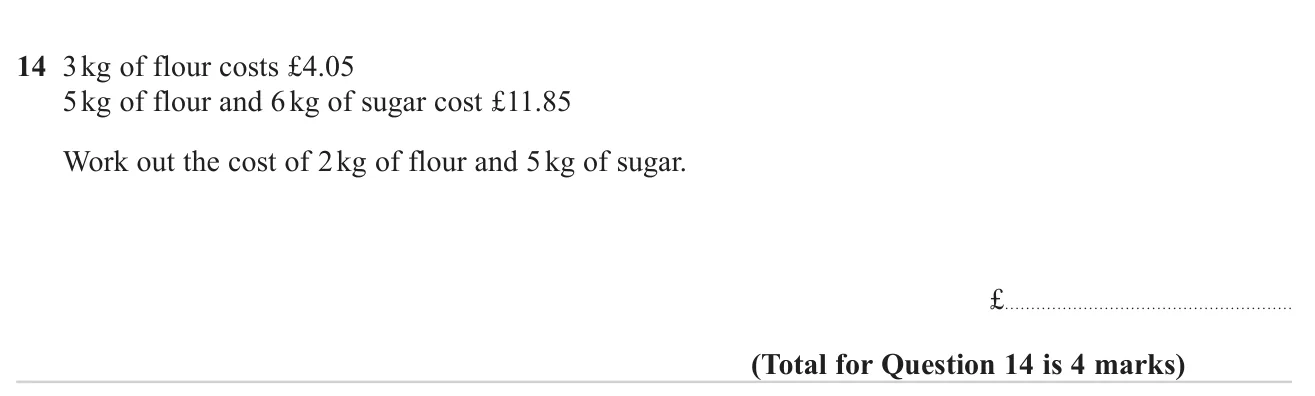
© Pearson Education Ltd. November 2023 Paper 2 (Foundation, calculator), question 14.
| Answer | £6.95 | 4 marks |
|---|
Worked solution Checked against the mark scheme
1 kg flour:
5 kg flour: , so 6 kg sugar costs
1 kg sugar:
2 kg flour + 5 kg sugar
Watch out: Dividing £11.85 by 11 as if flour and sugar cost the same per kilogram.
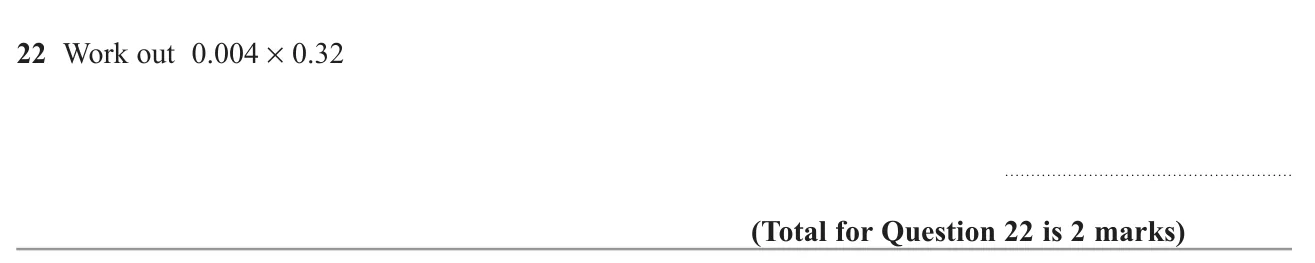
© Pearson Education Ltd. November 2022 Paper 1 (Foundation, non-calculator), question 22.
| Answer | 2 marks |
|---|
Worked solution Checked against the mark scheme
There are decimal places in the question, so the answer is .
Watch out: Putting the decimal point in the wrong place, e.g. 0.0128.
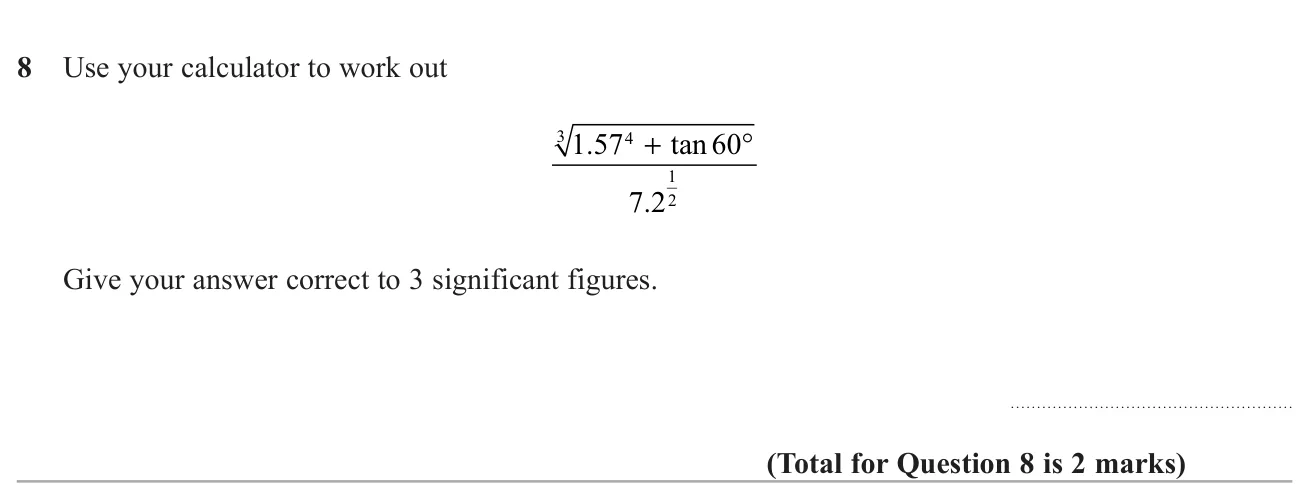
© Pearson Education Ltd. June 2022 Paper 2 (Higher, calculator), question 8.
| Answer | 2 marks |
|---|
Worked solution Checked against the mark scheme
Top: , then
Bottom:
, so to 3 s.f.
Watch out: Calculator in radians mode, giving the wrong value of tan 60.
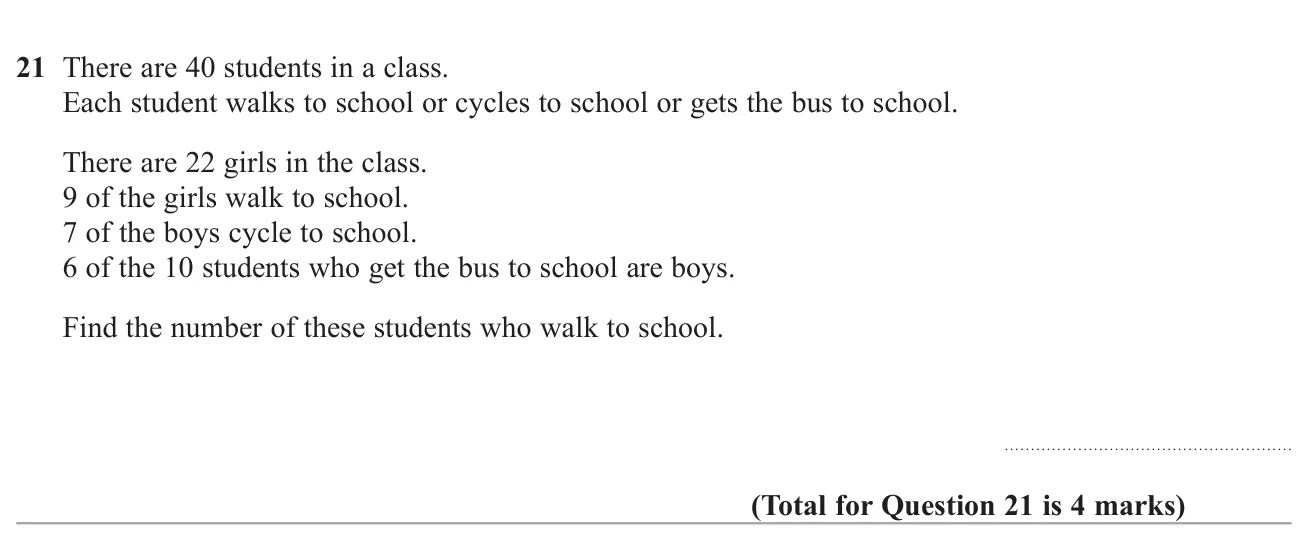
© Pearson Education Ltd. June 2019 Paper 1 (Foundation, non-calculator), question 21.
| Answer | 14 | 4 marks |
|---|
Worked solution Checked against the mark scheme
Boys:
Girls on the bus:
Boys who walk:
Students who walk:
Watch out: Forgetting to find the boys who walk and giving 9.
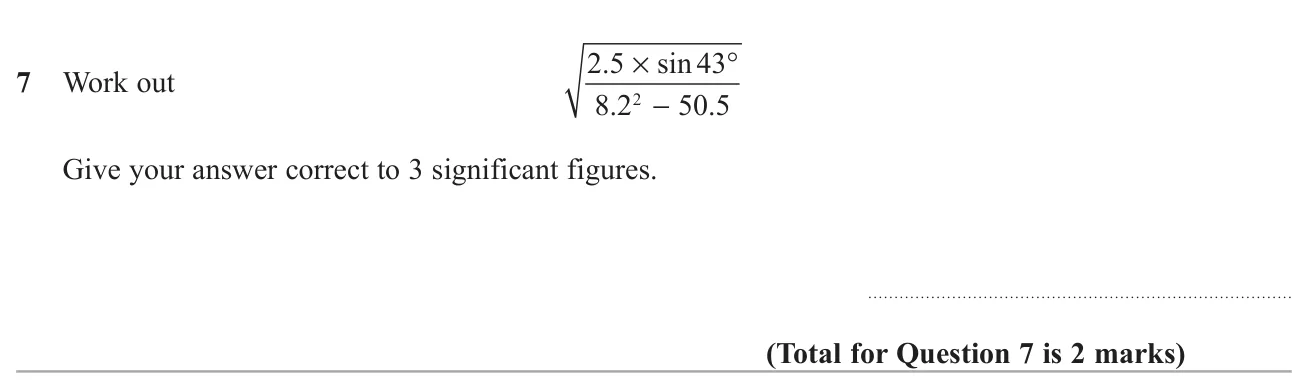
© Pearson Education Ltd. June 2019 Paper 3 (Higher, calculator), question 7.
| Answer | 2 marks |
|---|
Worked solution Checked against the mark scheme
Numerator:
Denominator:
Answer:
Watch out: Calculator in radians mode, or not putting brackets round the denominator.
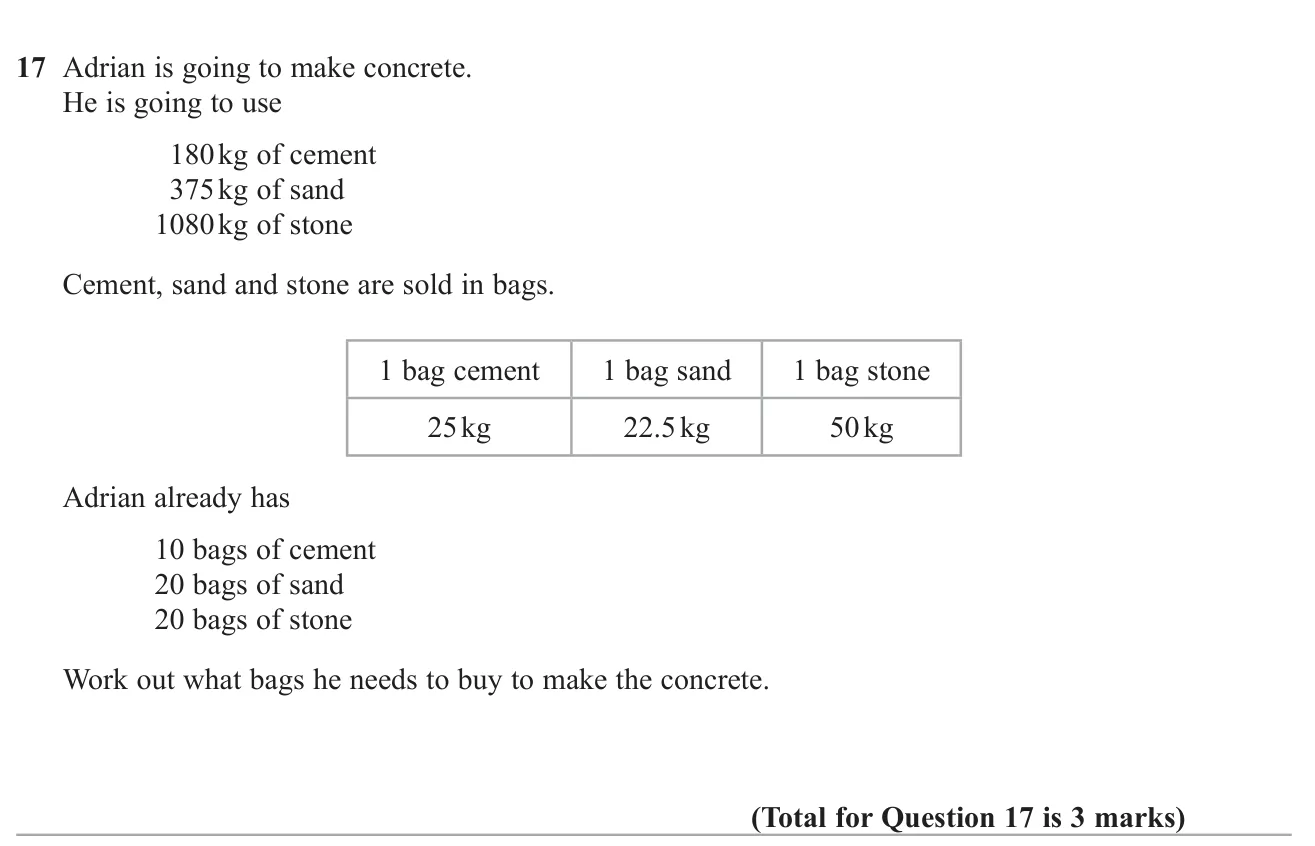
© Pearson Education Ltd. November 2018 Paper 2 (Foundation, calculator), question 17.
| Answer | 2 bags of stone | 3 marks |
|---|
Worked solution Checked against the mark scheme
Bags needed (round up):
Cement: (has 10)
Sand: (has 20)
Stone: (has 20)
He only needs to buy 2 bags of stone.
Watch out: Rounding down, so thinking 21 bags of stone is enough.
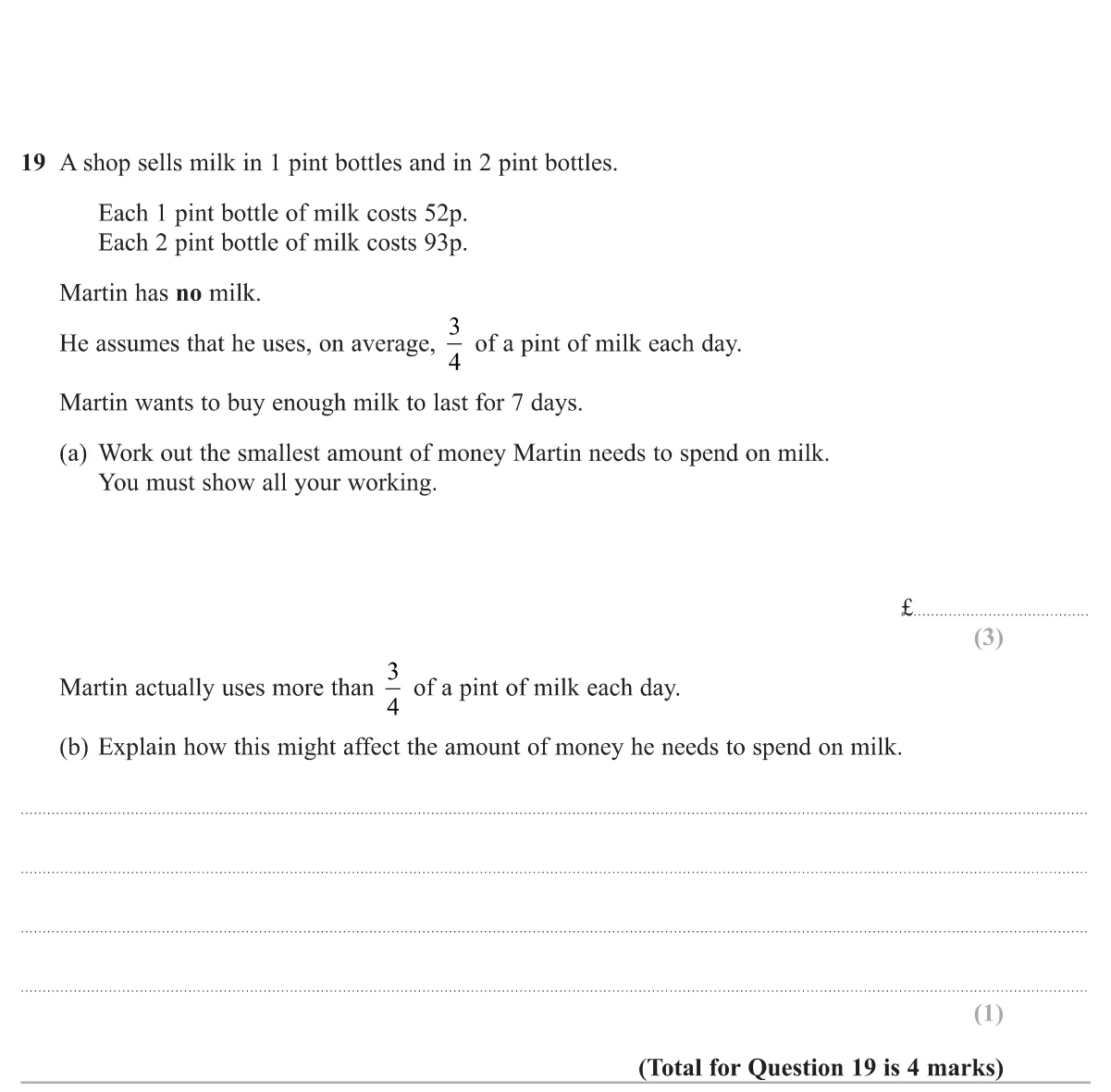
© Pearson Education Ltd. Specimen Paper 1 (Foundation, non-calculator), question 19.
| (a) | 3 marks | |
|---|---|---|
| (b) | He might have to spend more (if he uses more than 6 pints in the week) | 1 mark |
Worked solution Checked against the mark scheme
(a) Milk needed: pints, so he must buy at least 6 pints.
3 two-pint bottles: p
(2 two-pint + 2 one-pint p costs more, and 5 pints is not enough.)
(b) 6 pints lasts 7 days only if he uses up to pints a day. If he uses more than that he will need more bottles and pay more.
Watch out: Buying exactly 5 pints (2 × 2 pint + 1 pint = £2.38), which is not enough.
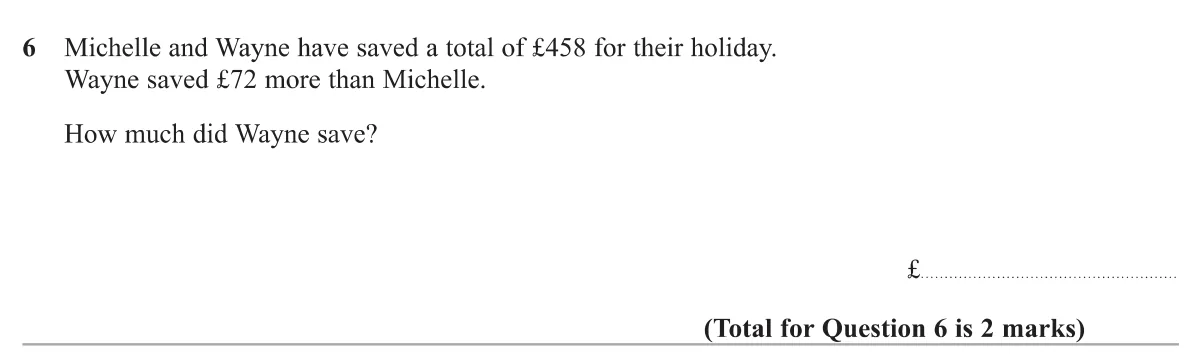
© Pearson Education Ltd. Specimen Paper 2 (Foundation, calculator), question 6.
| Answer | £265 | 2 marks |
|---|
Worked solution Checked against the mark scheme
Take off the extra £72:
Split equally: (Michelle)
Wayne:
Watch out: Giving Michelle's amount (£193) instead of Wayne's.
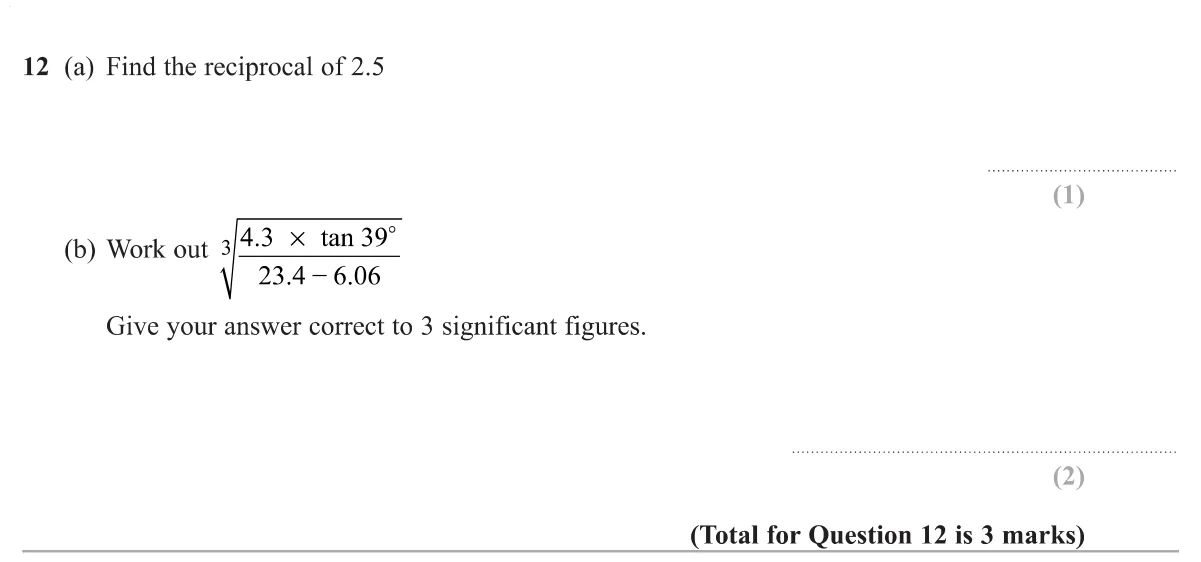
© Pearson Education Ltd. Specimen Paper 2 (Higher, calculator), question 12.
| (a) | 0.4 | 1 mark |
|---|---|---|
| (b) | 0.586 | 2 marks |
Worked solution Checked against the mark scheme
(a)
(b) Top:
Bottom:
(3 s.f.)
Watch out: Calculator in radians mode, giving the wrong value for tan 39°.
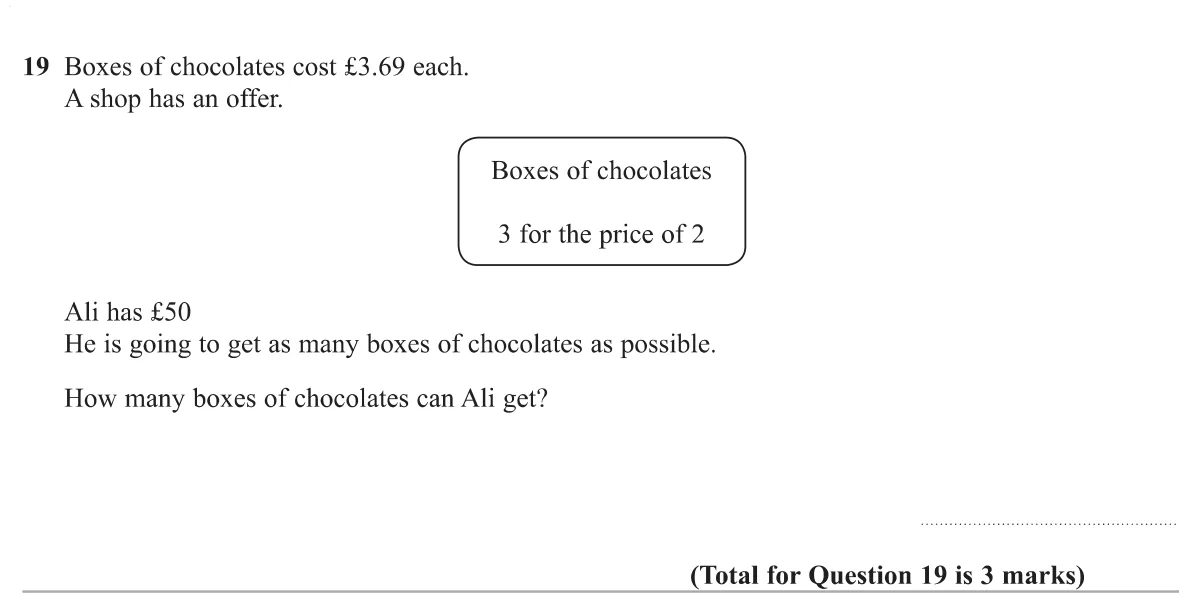
© Pearson Education Ltd. Specimen Paper 3 (Foundation, calculator), question 19.
| Answer | 19 | 3 marks |
|---|
Worked solution Checked against the mark scheme
Each deal of 3 boxes costs .
, so 6 deals = 18 boxes, costing .
Left over: , enough for 1 more box at £3.69.
Total: boxes.
Watch out: Stopping at 18 and forgetting the leftover money buys one more box.
Their main topic is different, but part of each one tests this topic.