Revision guide by The Full Marks
Factors, multiples and primes: what you need to know Factors divide into a number exactly; multiples are in its times table; primes have exactly two factors. At GCSE you need to write numbers as a product of primes and use that to find the HCF and LCM, which often appear in word problems about things happening at the same time.
Key facts A prime number has exactly two factors, 1 and itself. 1 is not prime. 2 is the only even prime. Primes under 50: 2, 3, 5, 7, 11, 13, 17, 19, 23, 29, 31, 37, 41, 43, 47. HCF (highest common factor) is the biggest number that divides into both numbers. LCM (lowest common multiple) is the smallest number both numbers divide into. Every whole number above 1 has exactly one prime factorisation, e.g. 360 = 2 3 × 3 2 × 5 360 = 2^3 \times 3^2 \times 5 360 = 2 3 × 3 2 × 5 Product of prime factors Draw a factor tree: split the number into any two factors. Keep splitting until every branch ends in a prime. Circle the primes. Write the primes multiplied together in order, using powers for repeats. Check by multiplying your answer back out. HCF and LCM from prime factors Write both numbers as products of primes (a Venn diagram helps). HCF: multiply the primes the numbers share (the middle of the Venn diagram). LCM: multiply every prime in the Venn diagram, counting shared ones once. If the numbers are given in index form, e.g. 2 3 × 3 2^3 \times 3 2 3 × 3 2 × 3 2 2 \times 3^2 2 × 3 2 2 × 3 = 6 2 \times 3 = 6 2 × 3 = 6 2 3 × 3 2 = 72 2^3 \times 3^2 = 72 2 3 × 3 2 = 72 Worked examples Example 1 Foundation · grade 2
(a) List all the factors of 30. (b) Which of these factors are prime?
Show the solution (a) Find factor pairs: 1 × 30 1 \times 30 1 × 30 2 × 15 2 \times 15 2 × 15 3 × 10 3 \times 10 3 × 10 5 × 6 5 \times 6 5 × 6
Example 2 Foundation · grade 5
(a) Write 90 and 84 as products of their prime factors. (b) Find the HCF and LCM of 90 and 84.
Show the solution (a) 90 = 2 × 3 2 × 5 90 = 2 \times 3^2 \times 5 90 = 2 × 3 2 × 5 84 = 2 2 × 3 × 7 84 = 2^2 \times 3 \times 7 84 = 2 2 × 3 × 7 = 2 × 3 = 6 = 2 \times 3 = 6 = 2 × 3 = 6 2 2 × 3 2 × 5 × 7 = 1260 2^2 \times 3^2 \times 5 \times 7 = 1260 2 2 × 3 2 × 5 × 7 = 1260
Common mistakes Mixing up factors and multiples: 20 is a multiple of 10, not a factor. Calling 1 a prime number. It only has one factor. Finding the LCM by just multiplying the two numbers. That gives a common multiple, but usually not the lowest. Writing a prime factorisation as a list like 2, 2, 3. It must be a product: 2 × 2 × 3 2 \times 2 \times 3 2 × 2 × 3 2 2 × 3 2^2 \times 3 2 2 × 3 Exam tips "Write as a product of prime factors" needs the multiplication signs: 2 2 × 3 × 7 2^2 \times 3 \times 7 2 2 × 3 × 7 Word problems about buses, lights or bells that line up again are LCM questions. Buses leave every 12 and 20 minutes, both at 9am: LCM = 60 = 60 = 60 Questions people ask What is the difference between HCF and LCM? The HCF is the biggest number that divides into both numbers. The LCM is the smallest number that both numbers divide into.
Is 1 a prime number? No. A prime has exactly two factors, and 1 only has one.
Exam questions: Factors, multiples and primes (50, easiest first) © Pearson Education Ltd. November 2024 Paper 1 (Foundation, non-calculator), question 4.
Worked solution Checked against the mark scheme
Multiples of 9: 9, 18, 27, 36, …
The only one between 20 and 30 is 27 27 27
Watch out: Confusing multiples with factors.
© Pearson Education Ltd. June 2024 Paper 2 (Foundation, calculator), question 4.
Worked solution Checked against the mark scheme
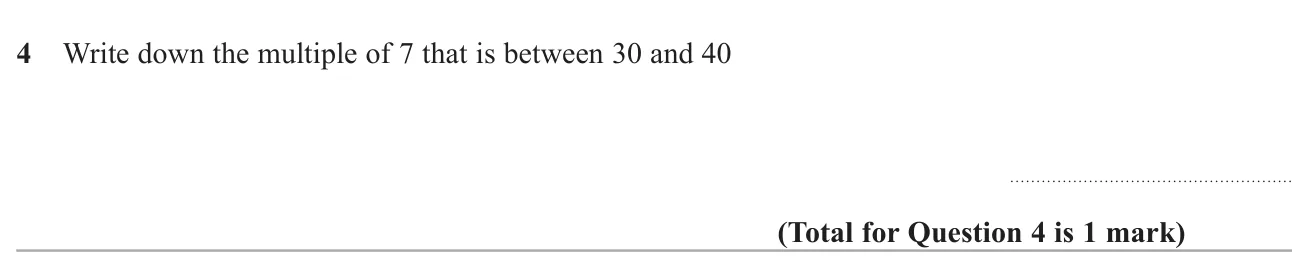
Multiples of 7: 28 , 35 , 42 , … 28, 35, 42, \dots 28 , 35 , 42 , …
The only one between 30 and 40 is 35 35 35
Watch out: Giving a factor rather than a multiple.
© Pearson Education Ltd. November 2024 Paper 3 (Foundation, calculator), question 3.
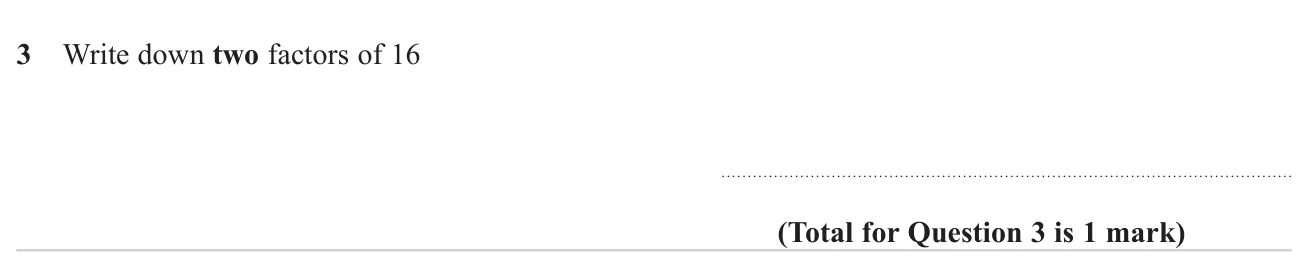
Answer Any two of 1 , 2 , 4 , 8 , 16 1, 2, 4, 8, 16 1 , 2 , 4 , 8 , 16 1 mark
Worked solution Checked against the mark scheme
Factor pairs of 16: 1 × 16 1 \times 16 1 × 16 2 × 8 2 \times 8 2 × 8 4 × 4 4 \times 4 4 × 4
So the factors are 1, 2, 4, 8 and 16. Any two of these, e.g. 2 and 8.
Watch out: Giving multiples such as 32 instead of factors.
© Pearson Education Ltd. June 2023 Paper 1 (Foundation, non-calculator), question 7.
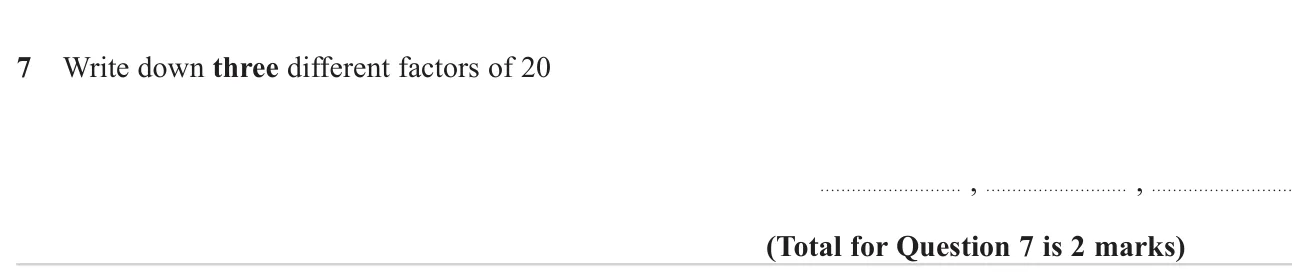
Answer Any three of 1 , 2 , 4 , 5 , 10 , 20 1, 2, 4, 5, 10, 20 1 , 2 , 4 , 5 , 10 , 20 2 marks
Worked solution Checked against the mark scheme
Find the factor pairs of 20: 1 × 20 1 \times 20 1 × 20 2 × 10 2 \times 10 2 × 10 4 × 5 4 \times 5 4 × 5
So the factors are 1, 2, 4, 5, 10, 20. Any three of these will do, e.g. 2, 4, 5.
Watch out: Writing multiples of 20 such as 40 or 60.
© Pearson Education Ltd. November 2023 Paper 2 (Foundation, calculator), question 1.
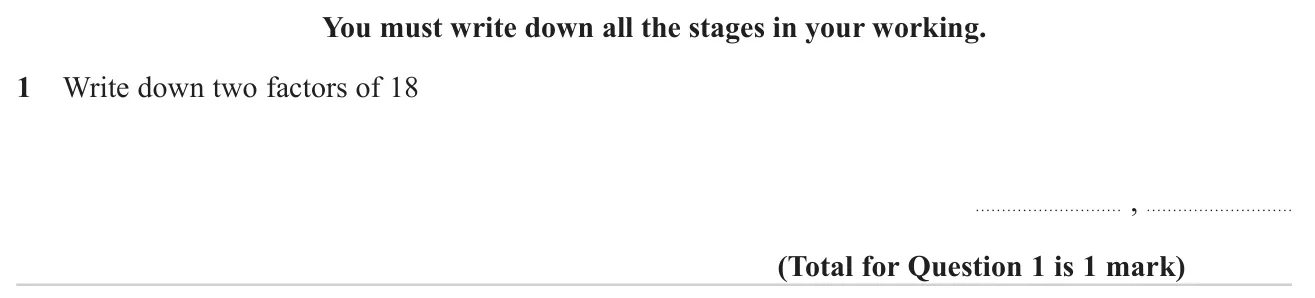
Answer Any two of 1, 2, 3, 6, 9, 18 1 mark
Worked solution Checked against the mark scheme
Factor pairs of 18: 1 × 18 1 \times 18 1 × 18 2 × 9 2 \times 9 2 × 9 3 × 6 3 \times 6 3 × 6
So the factors are 1, 2, 3, 6, 9 and 18. Any two of these, e.g. 2 and 9 .
Watch out: Giving multiples of 18 such as 36 instead of factors.
© Pearson Education Ltd. June 2023 Paper 2 (Foundation, calculator), question 5.
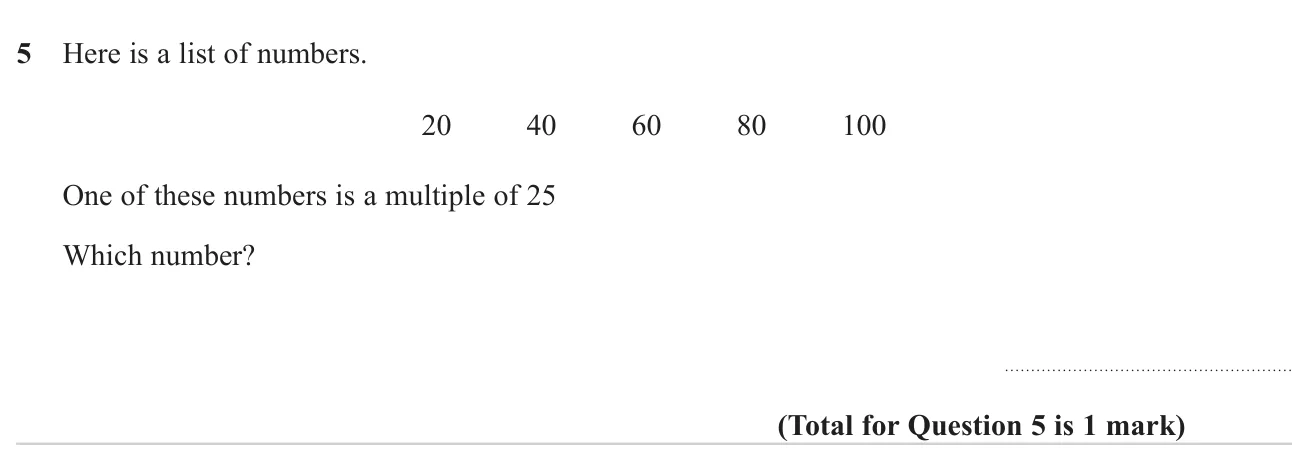
Worked solution Checked against the mark scheme
Multiples of 25 are 25, 50, 75, 100, ...
Only 100 is in the list (25 × 4 = 100 25 \times 4 = 100 25 × 4 = 100
Watch out: Choosing 20 or 40 because they are multiples of 5 or 10.
© Pearson Education Ltd. November 2022 Paper 1 (Foundation, non-calculator), question 4.
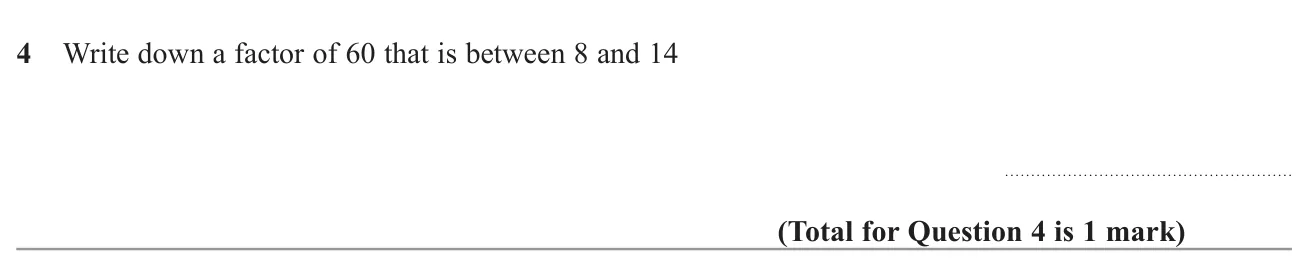
Answer 10 10 10 12 12 12 1 mark
Worked solution Checked against the mark scheme
Factors of 60: 1, 2, 3, 4, 5, 6, 10, 12, 15, 20, 30, 60.
The ones between 8 and 14 are 10 and 12, so either answer works.
Watch out: Giving a multiple of 60 or a number such as 9 that does not divide 60.
© Pearson Education Ltd. June 2022 Paper 2 (Foundation, calculator), question 4.
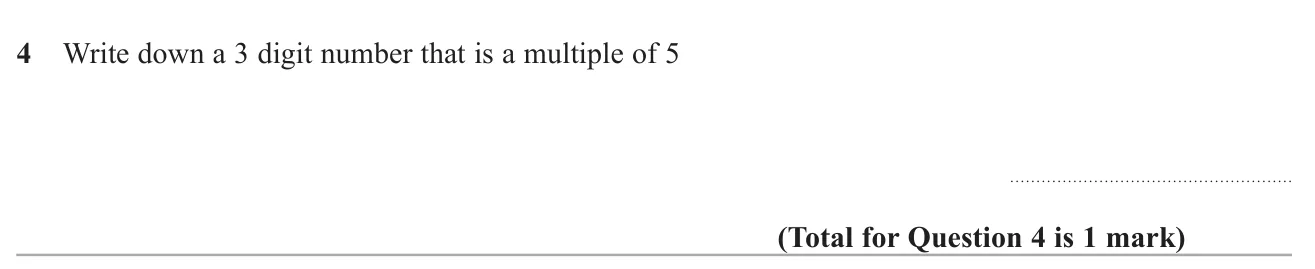
Answer Any 3-digit number ending in 0 or 5, e.g. 725 1 mark
Worked solution Checked against the mark scheme
Multiples of 5 always end in 0 or 5.
So any number from 100 to 995 ending in 0 or 5 works, for example 725 725 725
Watch out: Giving a number with the wrong number of digits, such as 50.
© Pearson Education Ltd. November 2022 Paper 3 (Foundation, calculator), question 5.
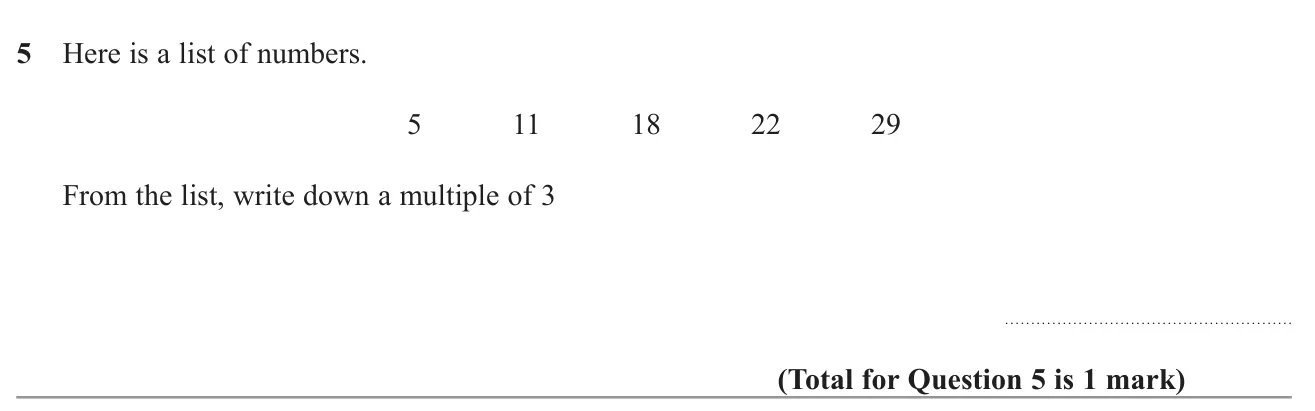
Worked solution Checked against the mark scheme
Check each number: 18 = 3 × 6 18 = 3 \times 6 18 = 3 × 6
Answer: 18
Watch out: Choosing 11 or 29 because they are odd.
© Pearson Education Ltd. June 2022 Paper 3 (Foundation, calculator), question 3.
Answer Any two of 1, 2, 3, 4, 6, 12 1 mark
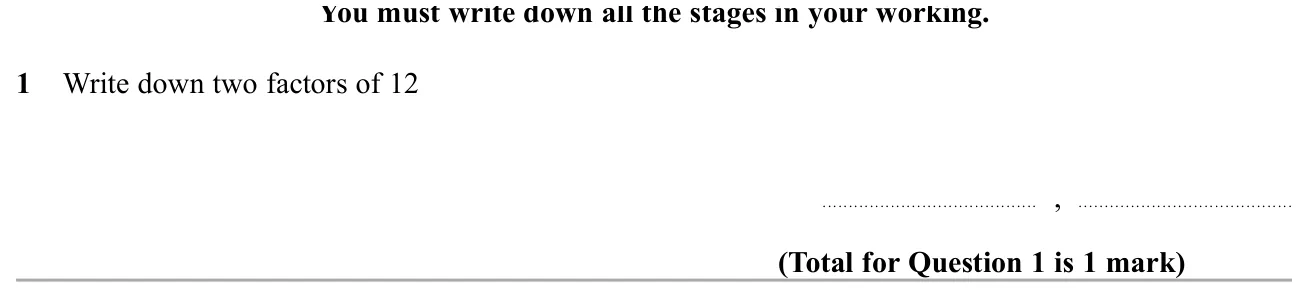
Worked solution Checked against the mark scheme
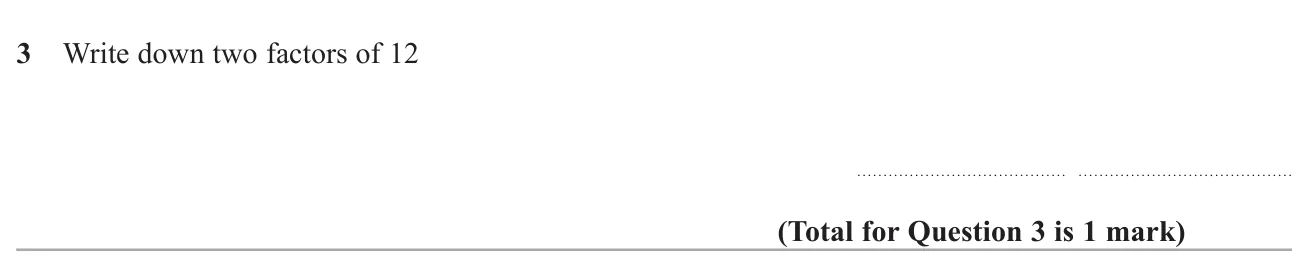
Factors of 12 are the numbers that divide into it with no remainder: 1, 2, 3, 4, 6 and 12.
Any two of these, for example 3 and 4, are correct.
Watch out: Giving multiples of 12, such as 24.
© Pearson Education Ltd. November 2021 Paper 2 (Foundation, calculator), question 6.
Worked solution Checked against the mark scheme
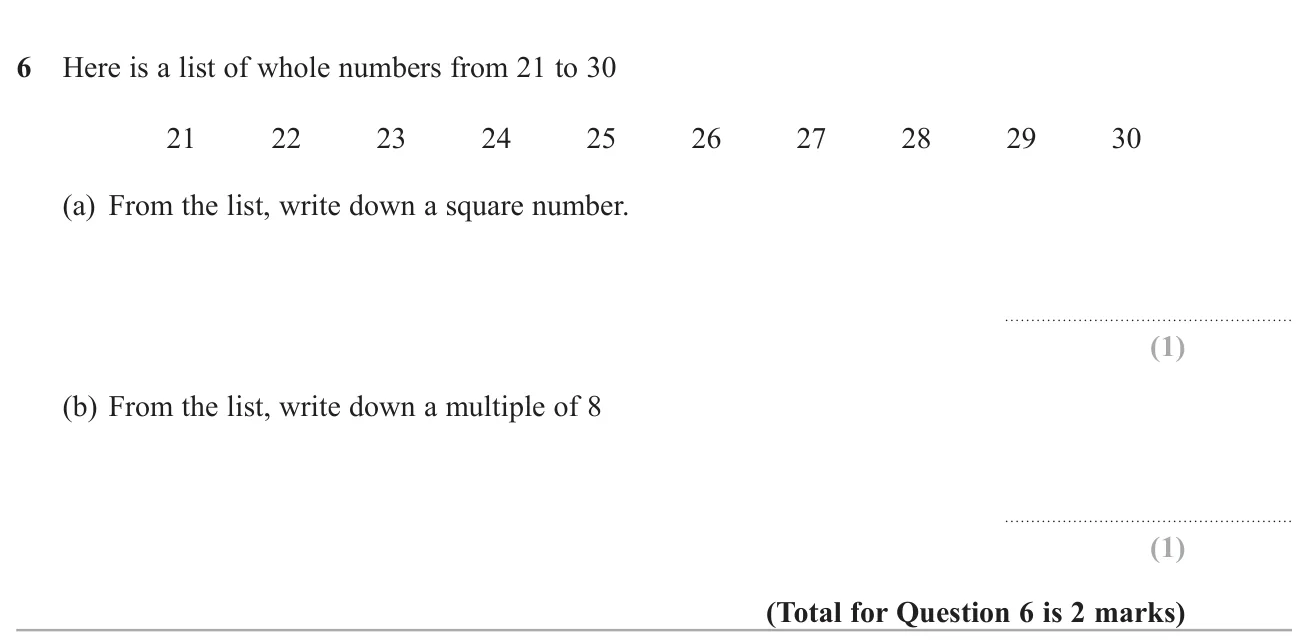
(a) 5 × 5 = 25 5 \times 5 = 25 5 × 5 = 25
(b) 8 × 3 = 24 8 \times 3 = 24 8 × 3 = 24
Watch out: Choosing 28 in part (b), which is a multiple of 4 but not 8.
© Pearson Education Ltd. November 2021 Paper 3 (Foundation, calculator), question 2.
Answer Any two of 1, 5, 7, 35 1 mark
Worked solution Checked against the mark scheme
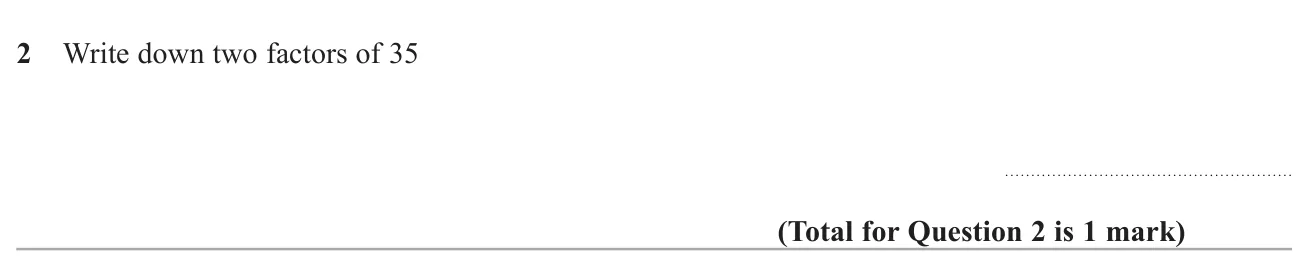
Find pairs that multiply to 35: 1 × 35 1 \times 35 1 × 35 5 × 7 5 \times 7 5 × 7
So the factors are 1, 5, 7 and 35. Any two of these will do, e.g. 5 and 7.
Watch out: Giving multiples of 35 (such as 70) instead of factors.
© Pearson Education Ltd. November 2020 Paper 1 (Foundation, non-calculator), question 2.
Worked solution Checked against the mark scheme
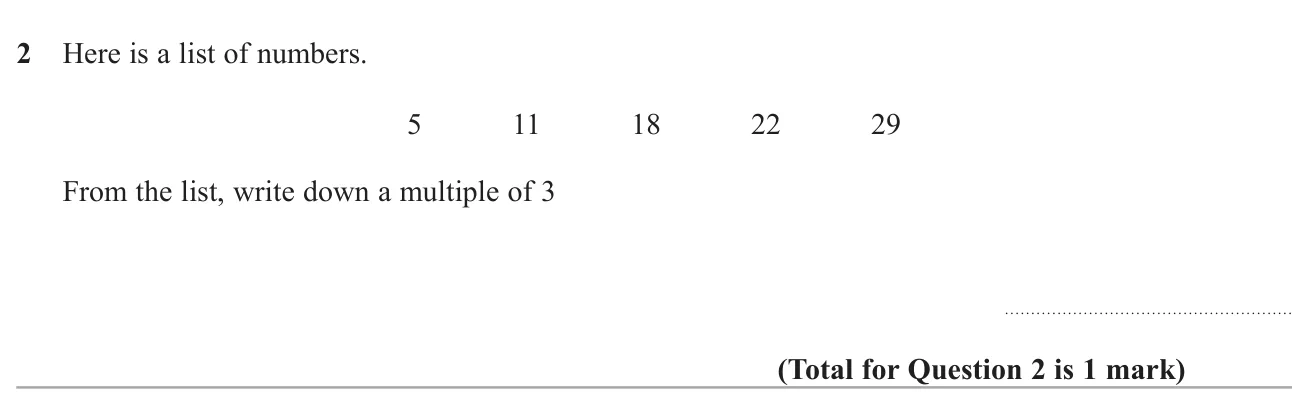
Check each number: 18 = 3 × 6 18 = 3 \times 6 18 = 3 × 6
So the multiple of 3 is 18.
Watch out: Choosing 29 or 22 by mistaking digit patterns for divisibility.
© Pearson Education Ltd. June 2019 Paper 1 (Foundation, non-calculator), question 4.
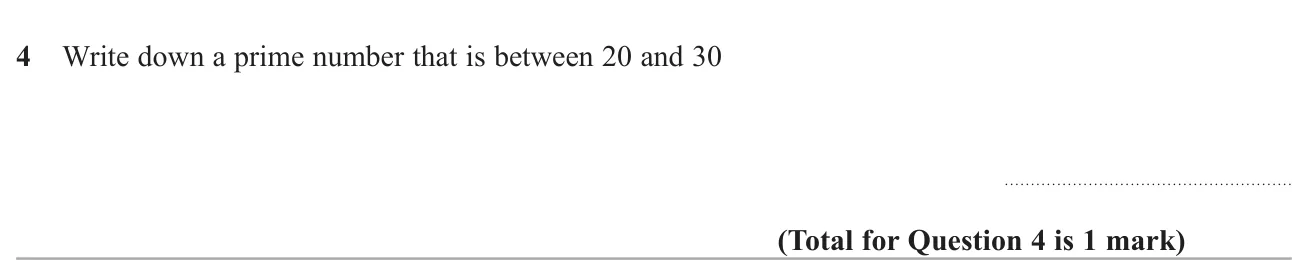
Worked solution Checked against the mark scheme
Check each odd number from 21 to 29.
21 = 3 × 7, 25 = 5 × 5, 27 = 3 × 9, so these are not prime.
23 and 29 have no factors other than 1 and themselves, so either is correct.
Watch out: Choosing 21 or 27, which are odd but not prime.
© Pearson Education Ltd. June 2019 Paper 2 (Foundation, calculator), question 3.
Answer Any two of 1 , 3 , 5 , 15 1, 3, 5, 15 1 , 3 , 5 , 15 1 mark
Worked solution Checked against the mark scheme
Factor pairs of 15: 1 × 15 1 \times 15 1 × 15 3 × 5 3 \times 5 3 × 5
So the factors are 1, 3, 5 and 15; any two of these will do, e.g. 3 and 5.
Watch out: Giving multiples of 15 such as 30.
© Pearson Education Ltd. November 2019 Paper 3 (Foundation, calculator), question 1.
Answer Any two of 1, 2, 3, 4, 6, 12 1 mark
Worked solution Checked against the mark scheme
The factor pairs of 12 are 1 × 12 1\times12 1 × 12 2 × 6 2\times6 2 × 6 3 × 4 3\times4 3 × 4
So any two of 1, 2, 3, 4, 6, 12 will do, for example 3 and 4.
Watch out: Giving multiples of 12 such as 24 instead of factors.
© Pearson Education Ltd. November 2019 Paper 3 (Foundation, calculator), question 4.
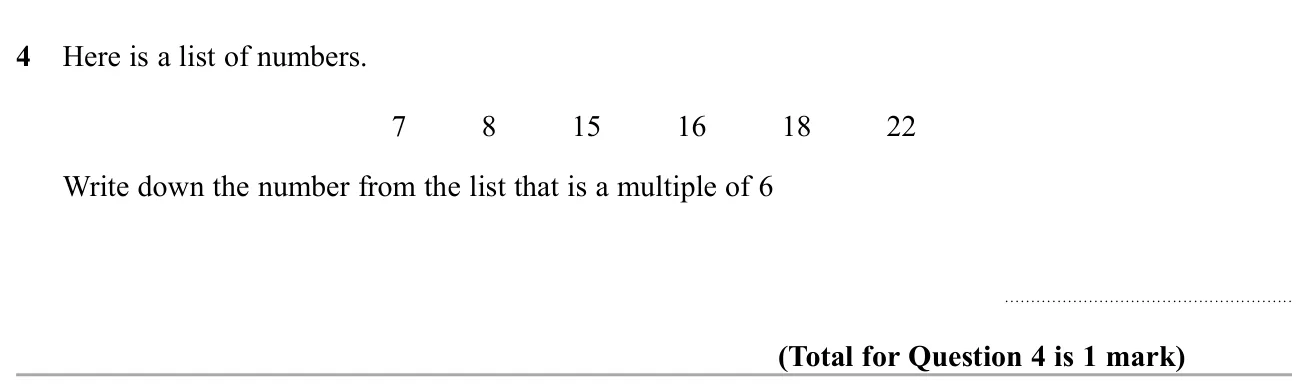
Worked solution Checked against the mark scheme
The 6 times table goes 6, 12, 18, 24, ...
The only one in the list is 18.
Watch out: Choosing 16 or 22 because they are even.
© Pearson Education Ltd. June 2019 Paper 3 (Foundation, calculator), question 2.
Worked solution Checked against the mark scheme
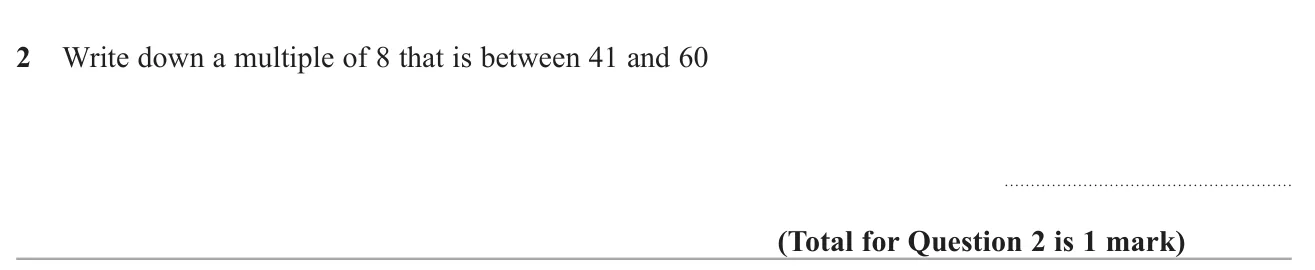
The 8 times table: 40, 48, 56, 64, ...
The ones between 41 and 60 are 48 and 56 ; either will do.
Watch out: Giving 40 or 64, which are outside the range.
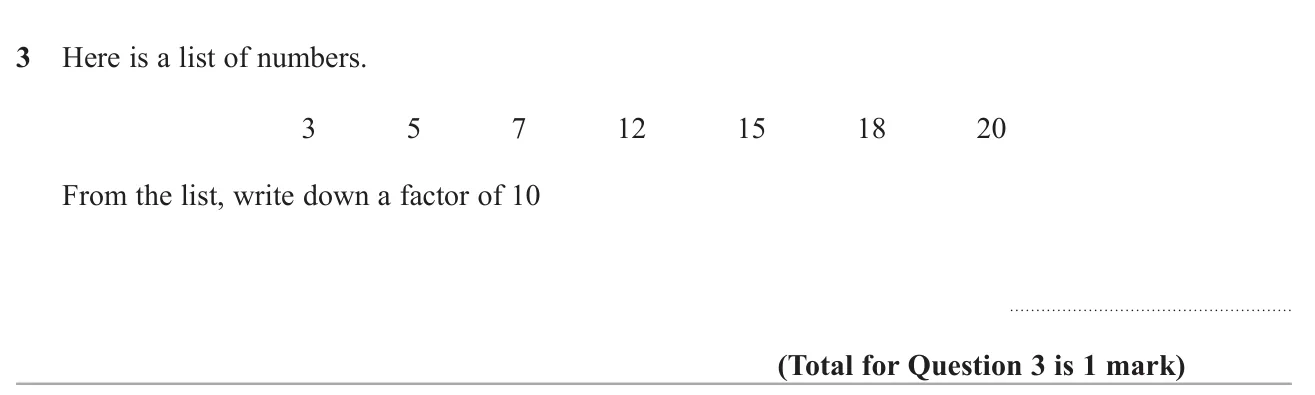
© Pearson Education Ltd. November 2018 Paper 1 (Foundation, non-calculator), question 3.
Worked solution Checked against the mark scheme
The factors of 10 are 1, 2, 5 and 10.
The only one in the list is 5.
Watch out: Choosing 20, which is a multiple of 10, not a factor.
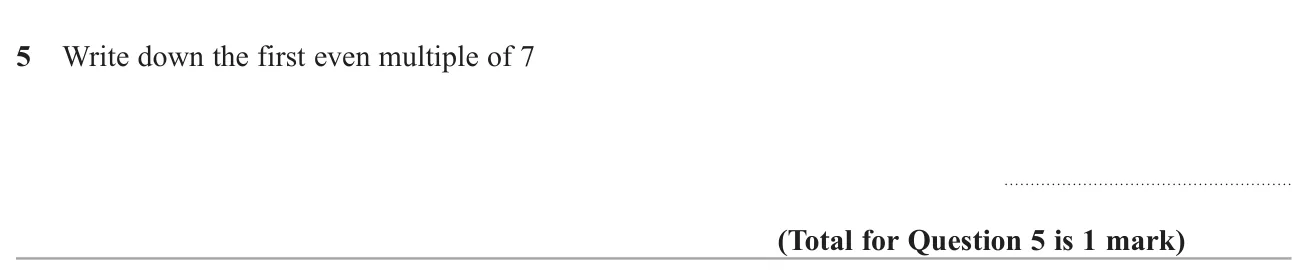
© Pearson Education Ltd. June 2018 Paper 1 (Foundation, non-calculator), question 5.
Worked solution Checked against the mark scheme
Multiples of 7: 7, 14, 21, ...
7 is odd, so the first even one is 14 .
Watch out: Giving 7, which is odd.
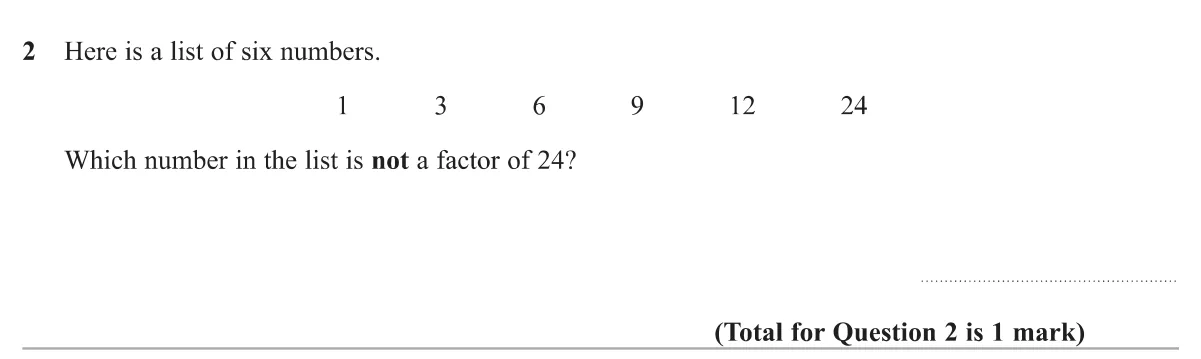
© Pearson Education Ltd. Specimen Paper 2 (Foundation, calculator), question 2.
Worked solution Checked against the mark scheme
Check each number: 24 ÷ 1 , 24 ÷ 3 , 24 ÷ 6 , 24 ÷ 12 , 24 ÷ 24 24 \div 1, 24 \div 3, 24 \div 6, 24 \div 12, 24 \div 24 24 ÷ 1 , 24 ÷ 3 , 24 ÷ 6 , 24 ÷ 12 , 24 ÷ 24
24 ÷ 9 = 2.66... 24 \div 9 = 2.66... 24 ÷ 9 = 2.66...
Watch out: Choosing 24 because it is the number itself.
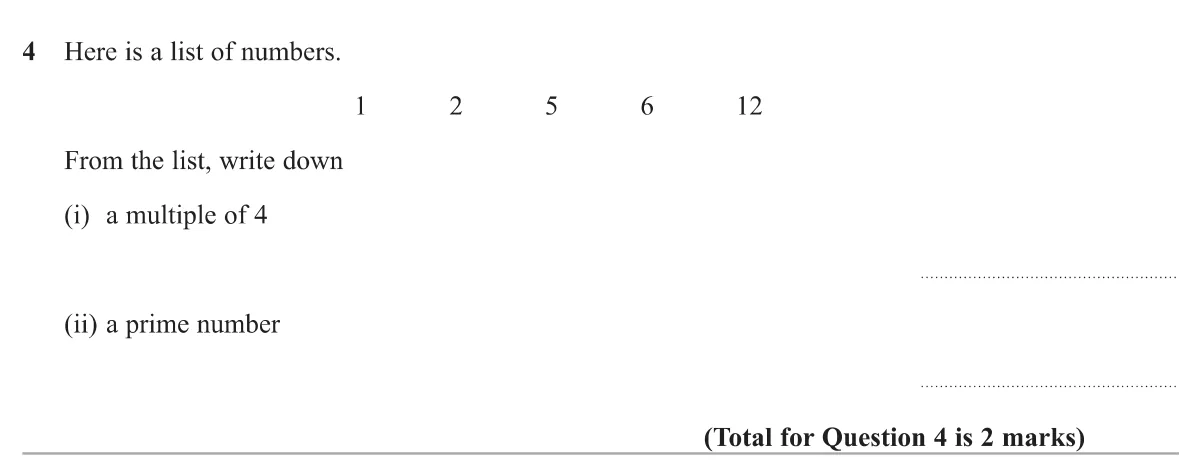
© Pearson Education Ltd. Specimen Paper 3 (Foundation, calculator), question 4.
((i)) 12 1 mark ((ii)) 2 or 5 1 mark
Worked solution Checked against the mark scheme
(i) 12 = 4 × 3 12 = 4 \times 3 12 = 4 × 3
(ii) 2 and 5 each have exactly two factors, so either is prime. (1 is not prime.)
Watch out: Choosing 1 as a prime number.
© Pearson Education Ltd. November 2024 Paper 2 (Foundation, calculator), question 8.
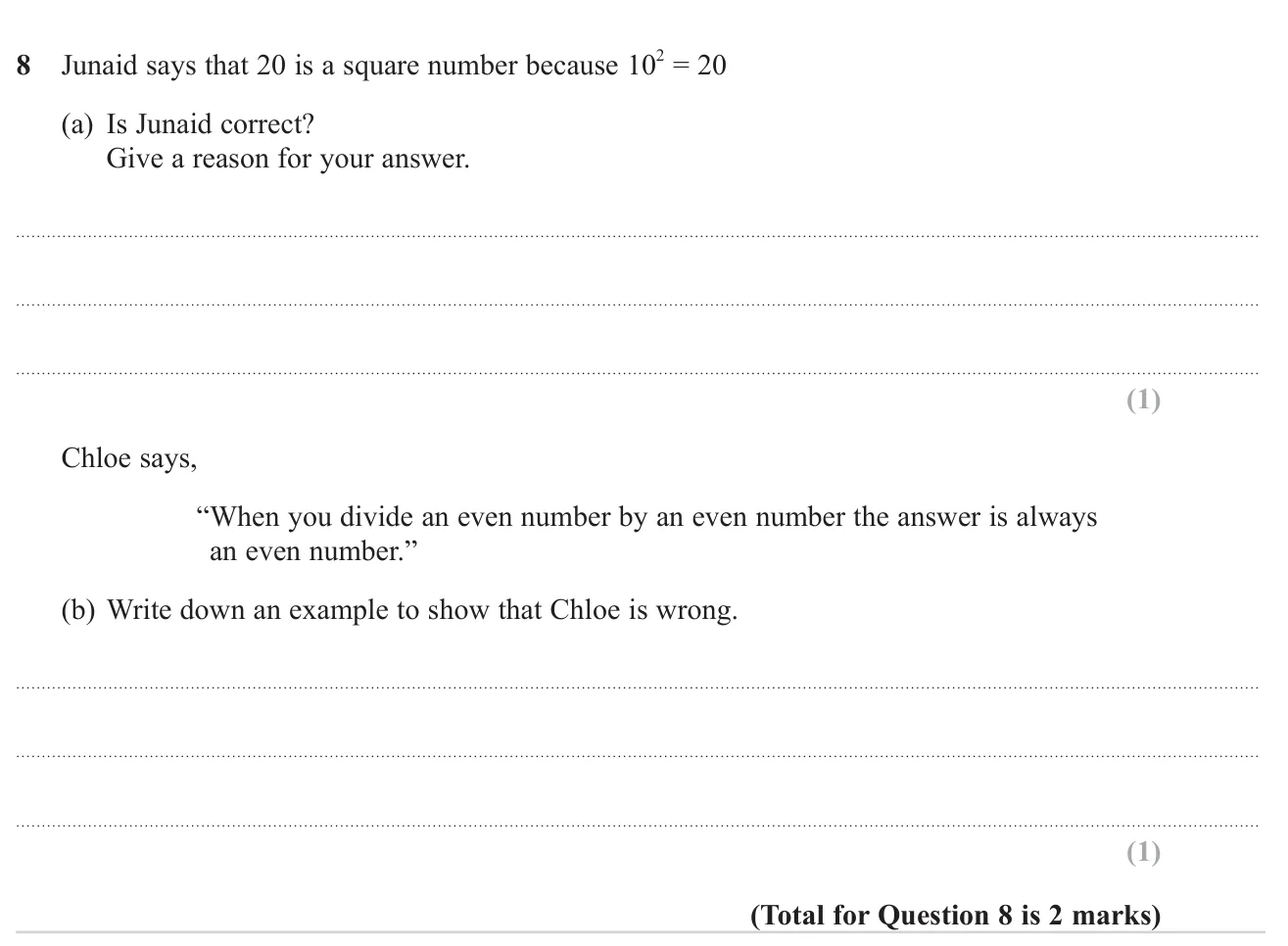
(a) No, because 10 2 = 100 10^2 = 100 1 0 2 = 100 1 mark (b) e.g. 12 ÷ 4 = 3 12 \div 4 = 3 12 ÷ 4 = 3 1 mark
Worked solution Checked against the mark scheme
(a) No. 10 2 = 10 × 10 = 100 10^2 = 10 \times 10 = 100 1 0 2 = 10 × 10 = 100 10 × 2 10 \times 2 10 × 2
(b) 12 ÷ 4 = 3 12 \div 4 = 3 12 ÷ 4 = 3
Watch out: In (a), just saying '20 is not a square number' without a reason.
© Pearson Education Ltd. June 2024 Paper 3 (Foundation, calculator), question 12.
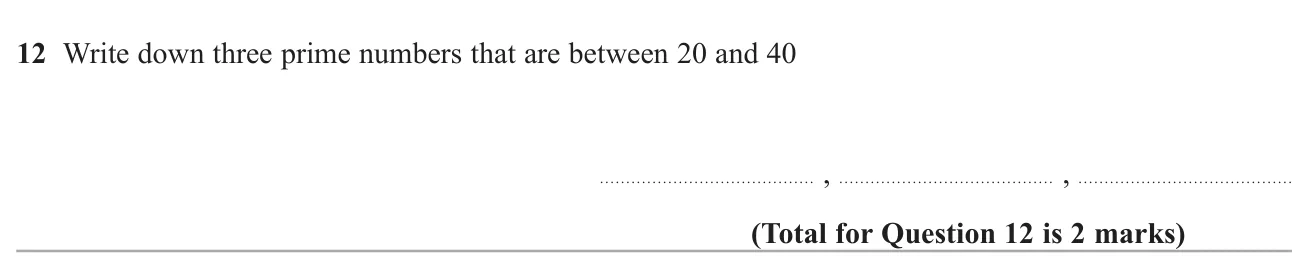
Answer Any three of 23 , 29 , 31 , 37 23, 29, 31, 37 23 , 29 , 31 , 37 2 marks
Worked solution Checked against the mark scheme
Check each odd number from 21 to 39 for factors:
21, 25, 27, 33, 35, 39 all have factors other than 1 and themselves.
The primes are 23 , 29 , 31 , 37 23, 29, 31, 37 23 , 29 , 31 , 37
Watch out: Including 27 or 39, which are multiples of 3.
© Pearson Education Ltd. June 2018 Paper 2 (Foundation, calculator), question 6.
Worked solution Checked against the mark scheme
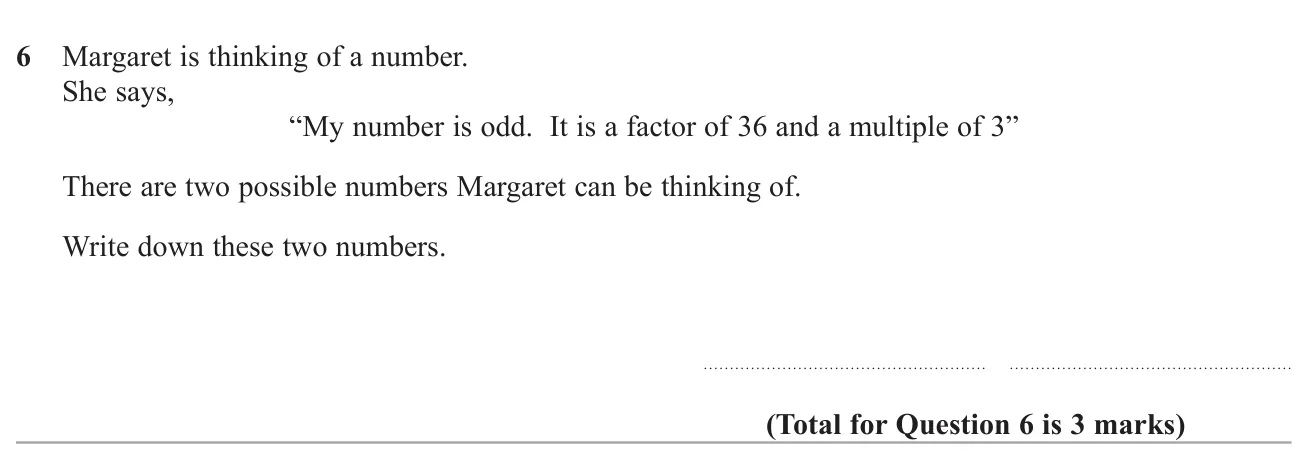
Factors of 36: 1, 2, 3, 4, 6, 9, 12, 18, 36
The odd ones are 1, 3 and 9. Of these, 3 and 9 are multiples of 3.
So the numbers are 3 and 9.
Watch out: Including 1, which is not a multiple of 3.
© Pearson Education Ltd. June 2018 Paper 2 (Foundation, calculator), question 10.
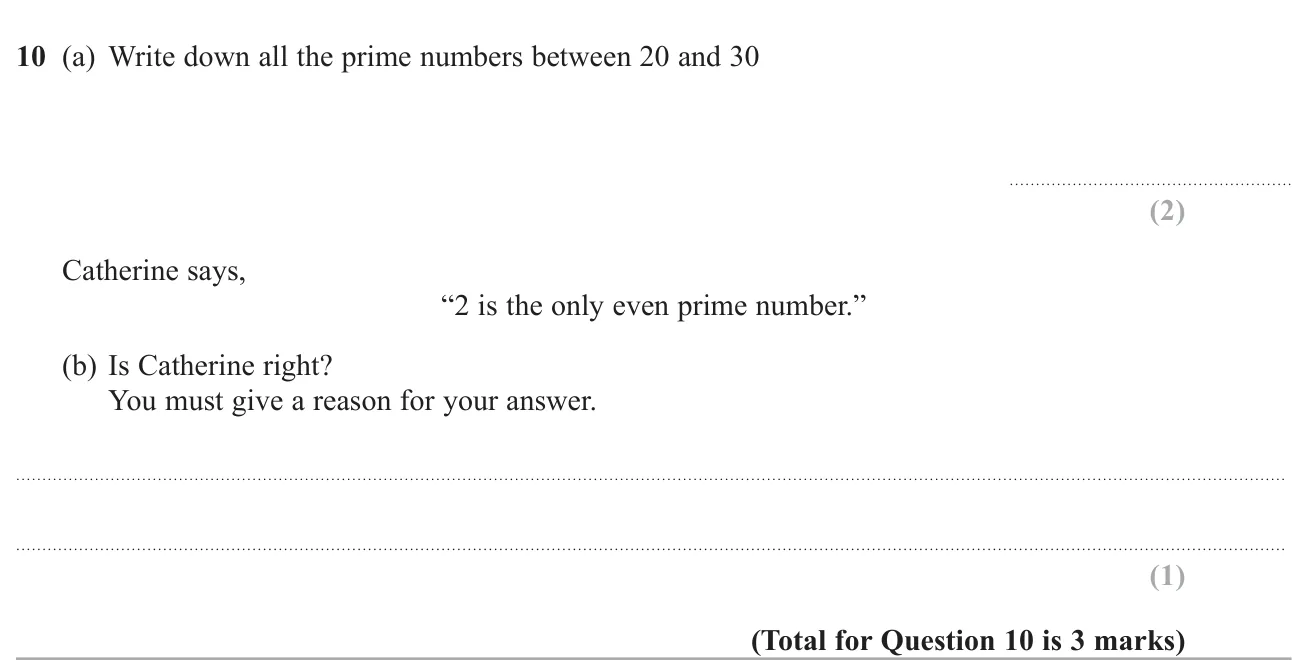
(a) 23 , 29 23, 29 23 , 29 2 marks (b) Yes: every other even number has 2 as a factor, so it has more than two factors 1 mark
Worked solution Checked against the mark scheme
(a) Check 21 to 29: 21 = 3 × 7 21 = 3 \times 7 21 = 3 × 7 25 = 5 × 5 25 = 5 \times 5 25 = 5 × 5 27 = 3 × 9 27 = 3 \times 9 27 = 3 × 9
(b) Yes. Any even number bigger than 2 can be divided by 2, so it has at least three factors and cannot be prime.
Watch out: Including 21 or 27 as primes.
© Pearson Education Ltd. June 2018 Paper 3 (Foundation, calculator), question 6.
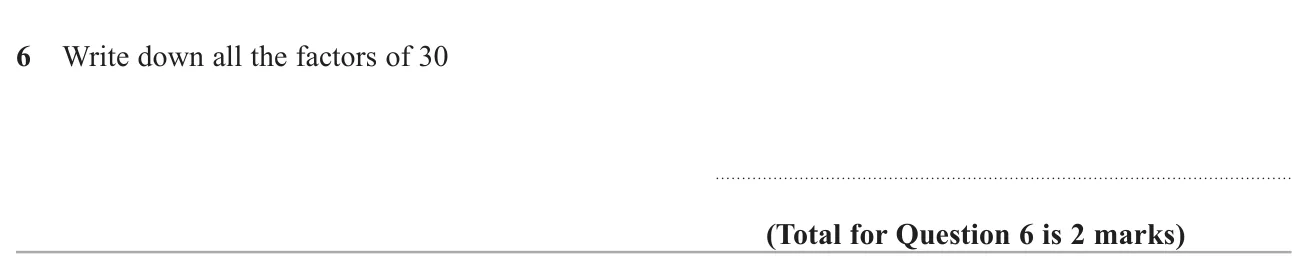
Answer 1 , 2 , 3 , 5 , 6 , 10 , 15 , 30 1, 2, 3, 5, 6, 10, 15, 30 1 , 2 , 3 , 5 , 6 , 10 , 15 , 30 2 marks
Worked solution Checked against the mark scheme
Find the factor pairs of 30:
1 × 30 1 \times 30 1 × 30 2 × 15 2 \times 15 2 × 15 3 × 10 3 \times 10 3 × 10 5 × 6 5 \times 6 5 × 6
So the factors are 1 , 2 , 3 , 5 , 6 , 10 , 15 , 30 1, 2, 3, 5, 6, 10, 15, 30 1 , 2 , 3 , 5 , 6 , 10 , 15 , 30
Watch out: Missing 1 and 30, or including multiples such as 60.
© Pearson Education Ltd. June 2024 Paper 3 (Foundation, calculator), question 22.
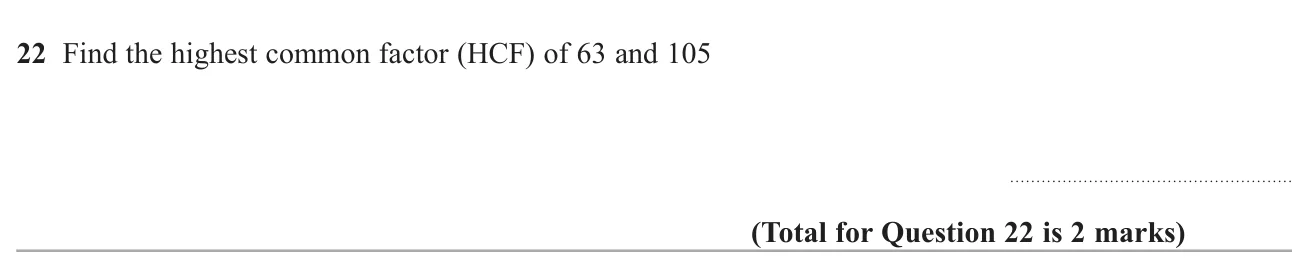
Worked solution Checked against the mark scheme
63 = 3 × 3 × 7 63 = 3 \times 3 \times 7 63 = 3 × 3 × 7
105 = 3 × 5 × 7 105 = 3 \times 5 \times 7 105 = 3 × 5 × 7
Common prime factors: 3 × 7 = 21 3 \times 7 = 21 3 × 7 = 21
Watch out: Giving just one common prime factor (3 or 7), or finding the LCM.
© Pearson Education Ltd. June 2023 Paper 2 (Foundation, calculator), question 21.
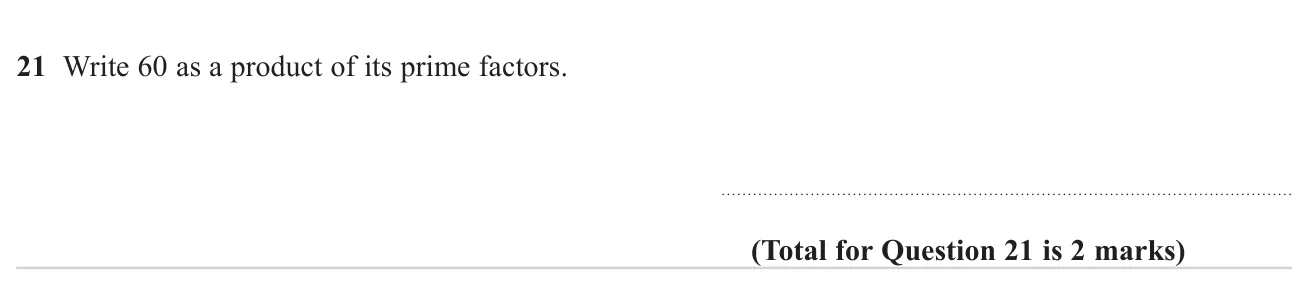
Answer 2 × 2 × 3 × 5 2 \times 2 \times 3 \times 5 2 × 2 × 3 × 5 2 marks
Worked solution Checked against the mark scheme
60 = 2 × 30 = 2 × 2 × 15 = 2 × 2 × 3 × 5 60 = 2 \times 30 = 2 \times 2 \times 15 = 2 \times 2 \times 3 \times 5 60 = 2 × 30 = 2 × 2 × 15 = 2 × 2 × 3 × 5
So 60 = 2 2 × 3 × 5 60 = 2^2 \times 3 \times 5 60 = 2 2 × 3 × 5
Watch out: Listing the factors 2, 2, 3, 5 without multiplication signs, or including 1.
© Pearson Education Ltd. November 2018 Paper 1 (Foundation, non-calculator), question 10.
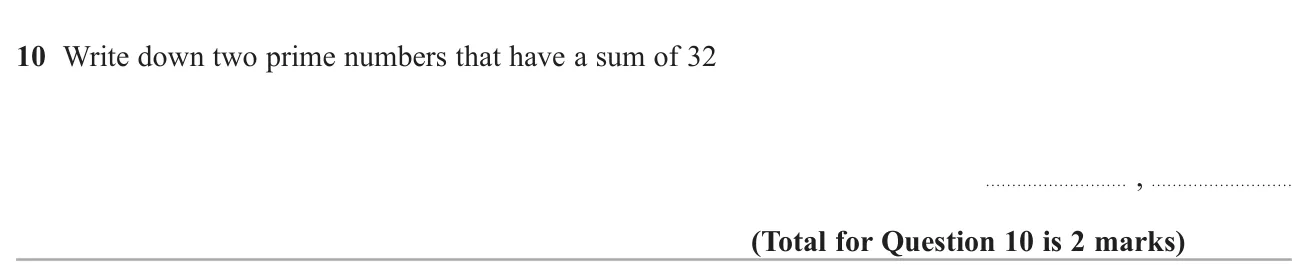
Answer 3 and 29, or 13 and 19 2 marks
Worked solution Checked against the mark scheme
Try primes p p p 32 − p 32 - p 32 − p
32 − 3 = 29 32 - 3 = 29 32 − 3 = 29
32 − 13 = 19 32 - 13 = 19 32 − 13 = 19
So 3 and 29 (or 13 and 19).
Watch out: Using 1 and 31, but 1 is not prime.
© Pearson Education Ltd. June 2018 Paper 1 (Foundation, non-calculator), question 11.
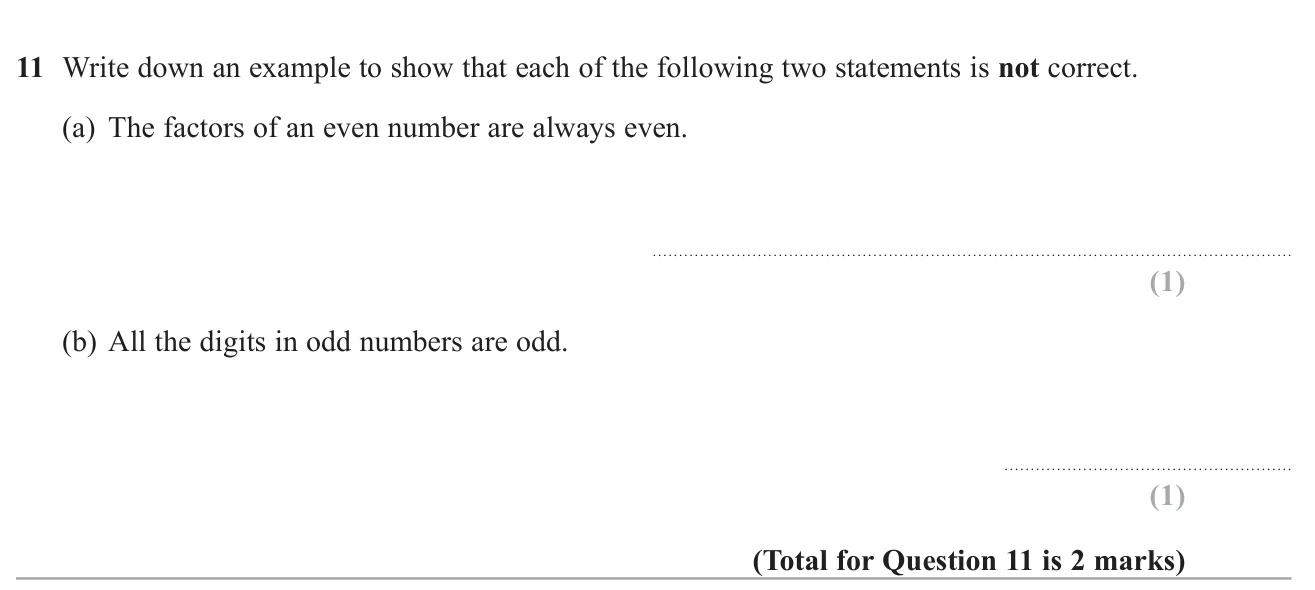
(a) e.g. 3 is a factor of 12 1 mark (b) e.g. 23 1 mark
Worked solution Checked against the mark scheme
(a) 12 is even, but 3 × 4 = 12 3 \times 4 = 12 3 × 4 = 12
(b) 23 is odd, but its digit 2 is even.
Watch out: Giving an example that agrees with the statement instead of one that breaks it.
© Pearson Education Ltd. November 2018 Paper 3 (Foundation, calculator), question 15.
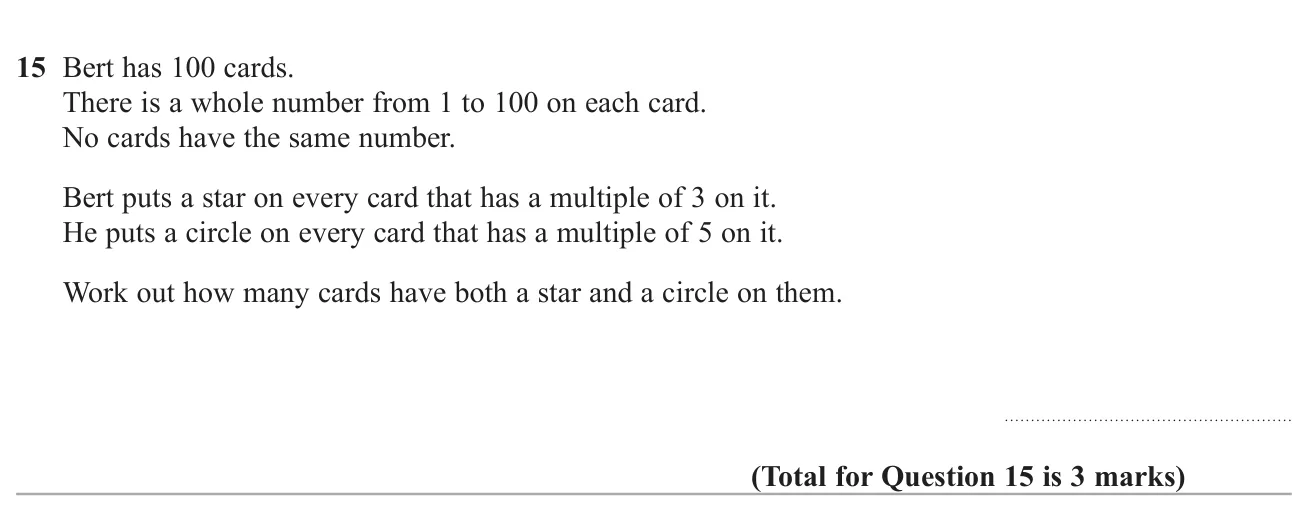
Worked solution Checked against the mark scheme
A card with both marks is a multiple of 3 and of 5, so a multiple of 15.
Multiples of 15 up to 100: 15, 30, 45, 60, 75, 90.
That is 6 cards.
Watch out: Rounding 100 ÷ 15 = 6.67 100 \div 15 = 6.67 100 ÷ 15 = 6.67
© Pearson Education Ltd. Specimen Paper 1 (Foundation, non-calculator), question 8.
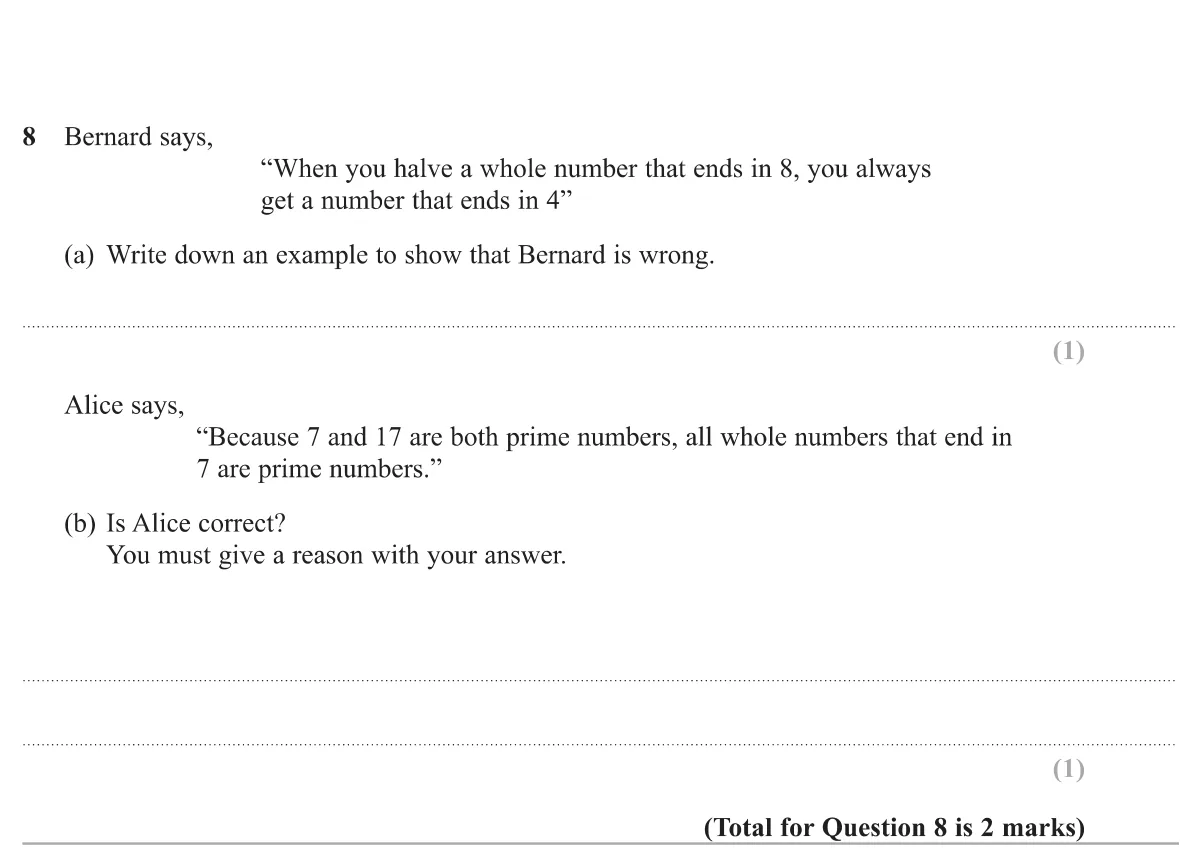
(a) e.g. 18 ÷ 2 = 9 18 \div 2 = 9 18 ÷ 2 = 9 1 mark (b) No: e.g. 27 = 3 × 9 27 = 3 \times 9 27 = 3 × 9 1 mark
Worked solution Checked against the mark scheme
(a) Try 18: 18 ÷ 2 = 9 18 \div 2 = 9 18 ÷ 2 = 9
(b) Alice is wrong. 27 ends in 7 but 27 = 3 × 9 27 = 3 \times 9 27 = 3 × 9
Watch out: In (b), saying 'no' without giving a non-prime example.
© Pearson Education Ltd. Specimen Paper 3 (Foundation, calculator), question 12.
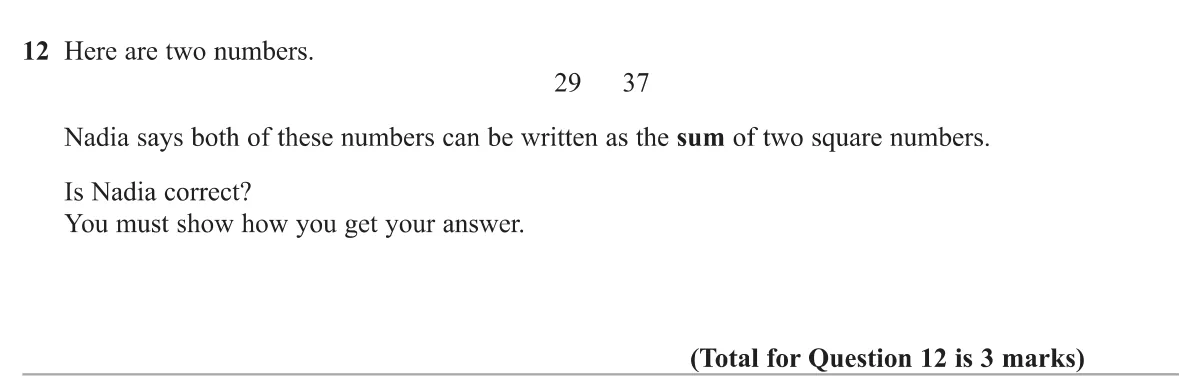
Answer Yes: 29 = 25 + 4 29 = 25 + 4 29 = 25 + 4 37 = 36 + 1 37 = 36 + 1 37 = 36 + 1 3 marks
Worked solution Checked against the mark scheme
Square numbers: 1, 4, 9, 16, 25, 36.
29 = 25 + 4 = 5 2 + 2 2 29 = 25 + 4 = 5^2 + 2^2 29 = 25 + 4 = 5 2 + 2 2
37 = 36 + 1 = 6 2 + 1 2 37 = 36 + 1 = 6^2 + 1^2 37 = 36 + 1 = 6 2 + 1 2
So yes , Nadia is correct.
Watch out: Using doubles (e.g. 2 × 5 2 \times 5 2 × 5
© Pearson Education Ltd. June 2024 Paper 2 (Foundation, calculator), question 21.
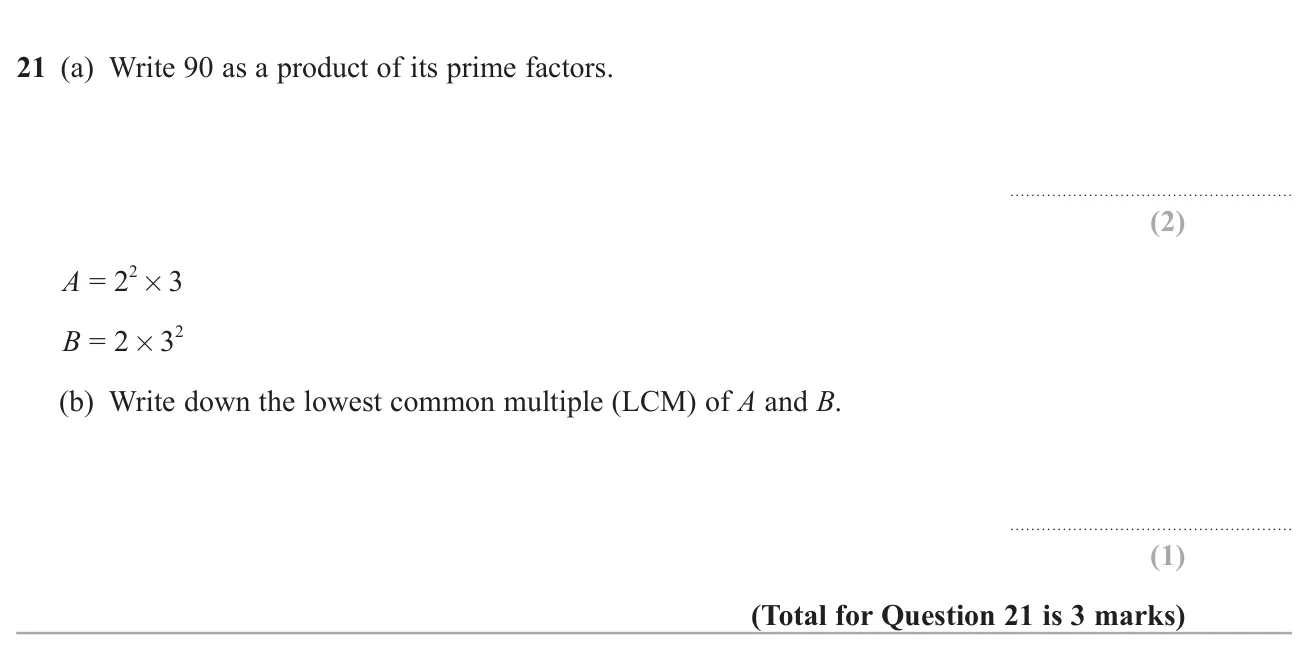
(a) 2 × 3 2 × 5 2 \times 3^2 \times 5 2 × 3 2 × 5 2 marks (b) 36 36 36 1 mark
Worked solution Checked against the mark scheme
(a) 90 = 2 × 45 = 2 × 3 × 15 = 2 × 3 × 3 × 5 = 2 × 3 2 × 5 90 = 2 \times 45 = 2 \times 3 \times 15 = 2 \times 3 \times 3 \times 5 = 2 \times 3^2 \times 5 90 = 2 × 45 = 2 × 3 × 15 = 2 × 3 × 3 × 5 = 2 × 3 2 × 5
(b) A = 2 2 × 3 = 12 A = 2^2 \times 3 = 12 A = 2 2 × 3 = 12 B = 2 × 3 2 = 18 B = 2 \times 3^2 = 18 B = 2 × 3 2 = 18
LCM uses the highest power of each prime: 2 2 × 3 2 = 36 2^2 \times 3^2 = 36 2 2 × 3 2 = 36
Watch out: Listing the primes 2, 3, 5 without repeats, or giving the HCF (6) in part (b).
© Pearson Education Ltd. November 2024 Paper 3 (Foundation, calculator), question 16.
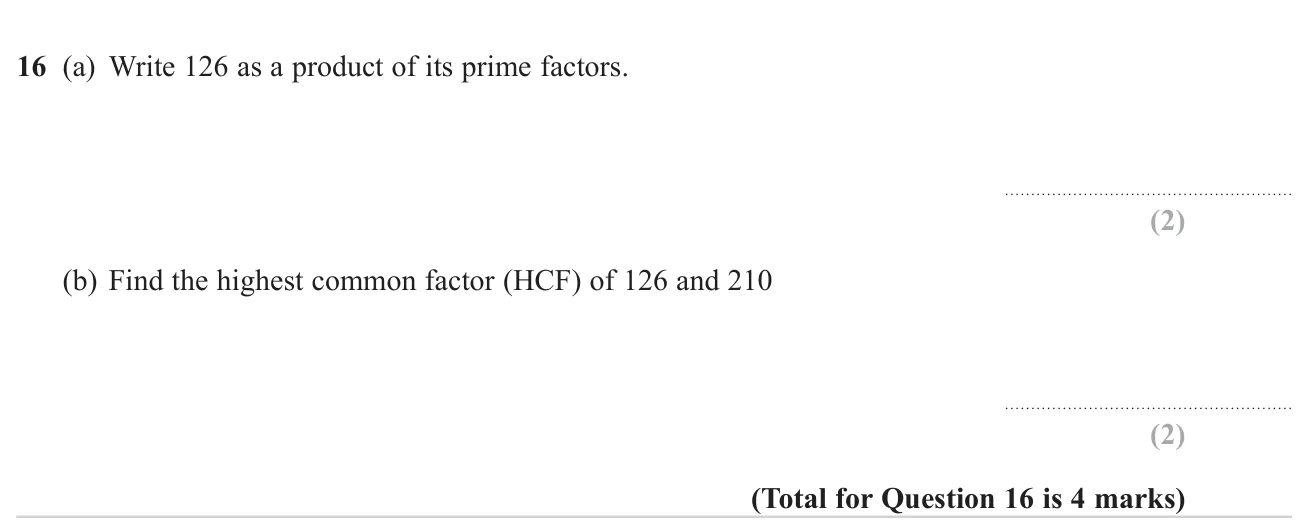
(a) 2 × 3 2 × 7 2 \times 3^2 \times 7 2 × 3 2 × 7 2 marks (b) 42 42 42 2 marks
Worked solution Checked against the mark scheme
(a) 126 = 2 × 63 = 2 × 7 × 9 = 2 × 3 2 × 7 126 = 2 \times 63 = 2 \times 7 \times 9 = 2 \times 3^2 \times 7 126 = 2 × 63 = 2 × 7 × 9 = 2 × 3 2 × 7
(b) 210 = 2 × 3 × 5 × 7 210 = 2 \times 3 \times 5 \times 7 210 = 2 × 3 × 5 × 7
Common primes: 2 × 3 × 7 = 42 2 \times 3 \times 7 = 42 2 × 3 × 7 = 42
Watch out: Listing the prime factors with commas instead of as a product.
© Pearson Education Ltd. November 2023 Paper 1 (Foundation, non-calculator), question 20.
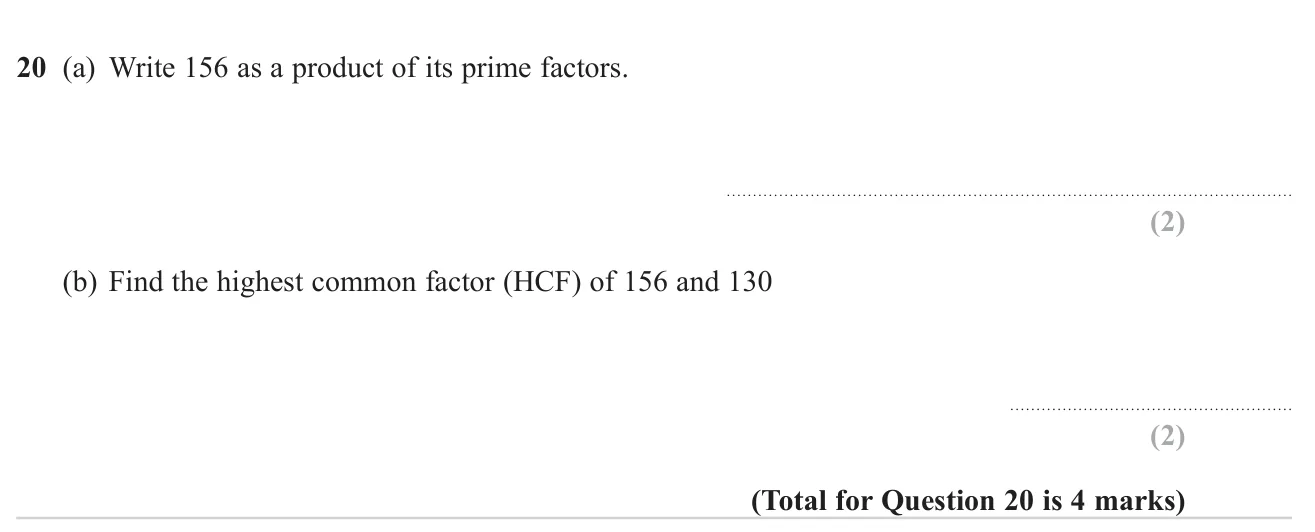
(a) 2 2 × 3 × 13 2^2 \times 3 \times 13 2 2 × 3 × 13 2 marks (b) 26 2 marks
Worked solution Checked against the mark scheme
(a) 156 = 2 × 78 = 2 × 2 × 39 = 2 × 2 × 3 × 13 156 = 2 \times 78 = 2 \times 2 \times 39 = 2 \times 2 \times 3 \times 13 156 = 2 × 78 = 2 × 2 × 39 = 2 × 2 × 3 × 13 156 = 2 2 × 3 × 13 156 = 2^2 \times 3 \times 13 156 = 2 2 × 3 × 13
(b) 130 = 2 × 5 × 13 130 = 2 \times 5 \times 13 130 = 2 × 5 × 13
Shared primes: 2 × 13 = 26 2 \times 13 = 26 2 × 13 = 26
Watch out: Giving a list of the prime factors (2, 2, 3, 13) instead of a product.
© Pearson Education Ltd. November 2023 Paper 3 (Foundation, calculator), question 24.
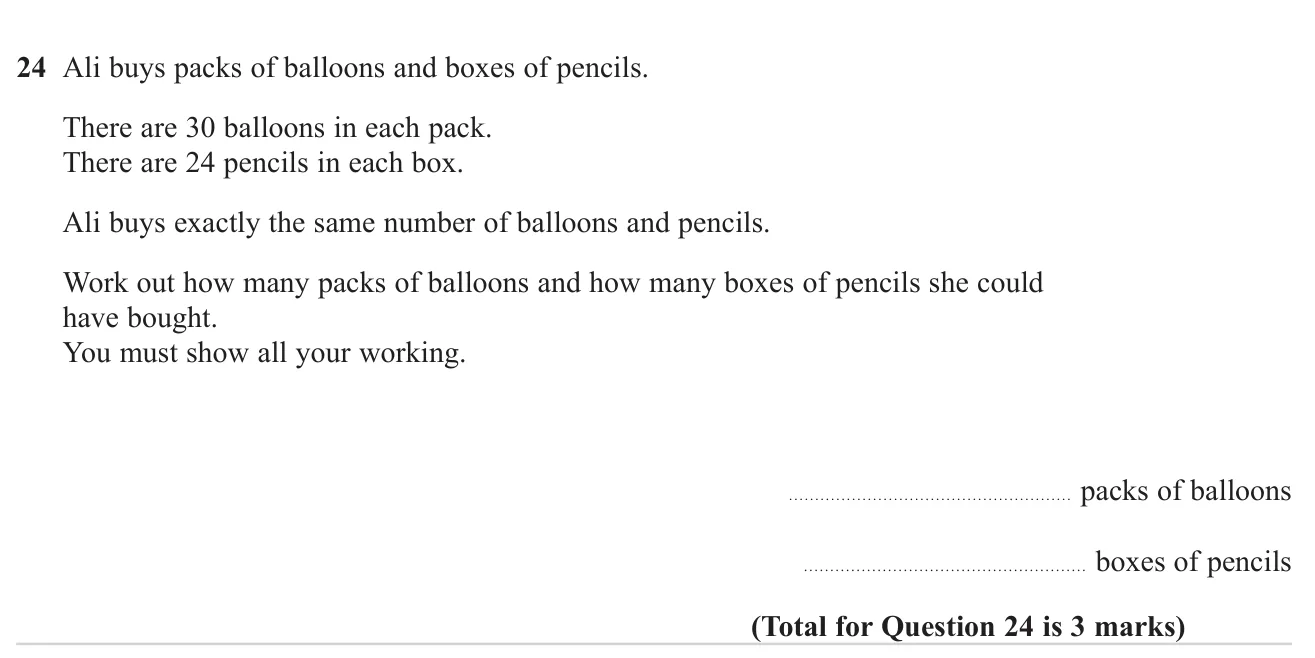
Answer 4 packs of balloons and 5 boxes of pencils (or any multiple, e.g. 8 and 10) 3 marks
Worked solution Checked against the mark scheme
Multiples of 30: 30, 60, 90, 120
Multiples of 24: 24, 48, 72, 96, 120
LCM = 120 = 120 = 120 120 ÷ 30 = 4 120 \div 30 = 4 120 ÷ 30 = 4 120 ÷ 24 = 5 120 \div 24 = 5 120 ÷ 24 = 5
Watch out: Swapping the answers round, 5 packs and 4 boxes.
© Pearson Education Ltd. November 2022 Paper 1 (Foundation, non-calculator), question 19.
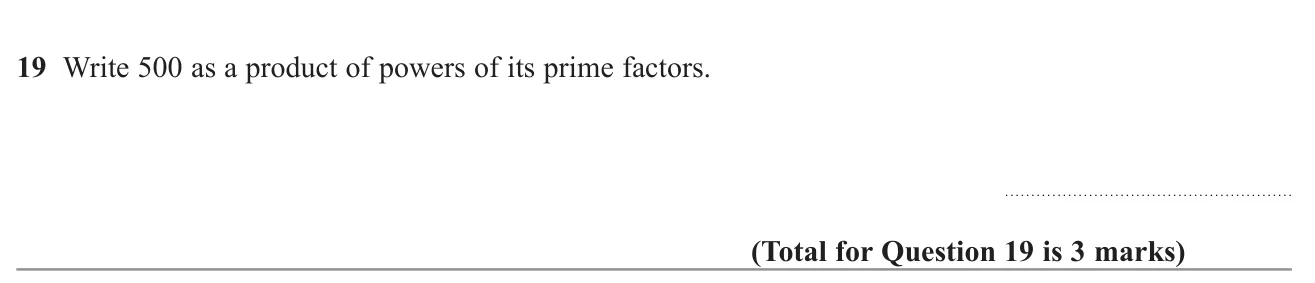
Answer 2 2 × 5 3 2^2 \times 5^3 2 2 × 5 3 3 marks
Worked solution Checked against the mark scheme
500 = 2 × 250 = 2 × 2 × 125 500 = 2 \times 250 = 2 \times 2 \times 125 500 = 2 × 250 = 2 × 2 × 125
125 = 5 × 5 × 5 125 = 5 \times 5 \times 5 125 = 5 × 5 × 5
So 500 = 2 2 × 5 3 500 = 2^2 \times 5^3 500 = 2 2 × 5 3
Watch out: Leaving the answer as 2 × 2 × 5 × 5 × 5 2 \times 2 \times 5 \times 5 \times 5 2 × 2 × 5 × 5 × 5
© Pearson Education Ltd. June 2022 Paper 1 (Foundation, non-calculator), question 24.
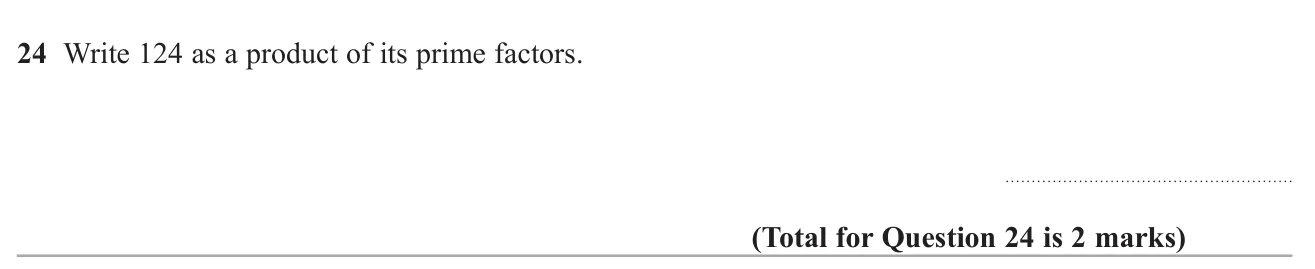
Answer 2 × 2 × 31 2 \times 2 \times 31 2 × 2 × 31 2 marks
Worked solution Checked against the mark scheme
124 = 2 × 62 124 = 2 \times 62 124 = 2 × 62
62 = 2 × 31 62 = 2 \times 31 62 = 2 × 31
So 124 = 2 × 2 × 31 = 2 2 × 31 124 = 2 \times 2 \times 31 = 2^2 \times 31 124 = 2 × 2 × 31 = 2 2 × 31
Watch out: Stopping at 2 × 62 or 4 × 31.
© Pearson Education Ltd. June 2022 Paper 3 (Foundation, calculator), question 21.
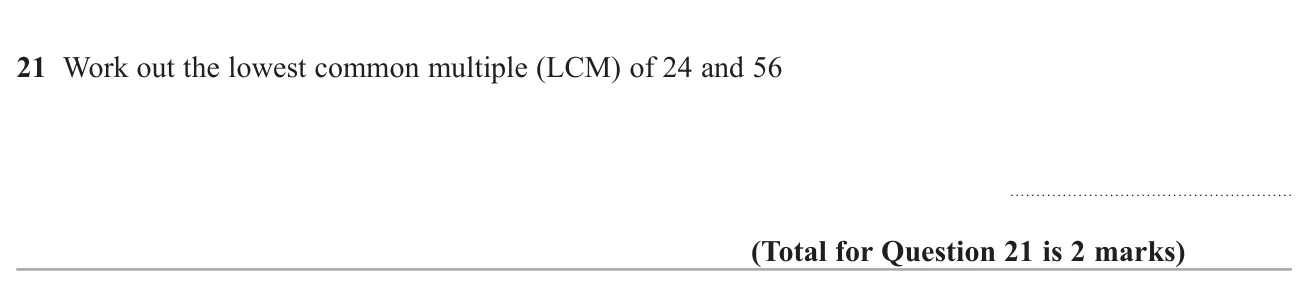
Worked solution Checked against the mark scheme
24 = 2 3 × 3 24 = 2^3 \times 3 24 = 2 3 × 3 56 = 2 3 × 7 56 = 2^3 \times 7 56 = 2 3 × 7
LCM = 2 3 × 3 × 7 = 168 = 2^3 \times 3 \times 7 = 168 = 2 3 × 3 × 7 = 168
(Check: multiples of 56 are 56, 112, 168, and 168 = 7 × 24 168 = 7 \times 24 168 = 7 × 24
Watch out: Multiplying the numbers to get 1344, or giving the HCF (8).
© Pearson Education Ltd. November 2021 Paper 2 (Foundation, calculator), question 22.
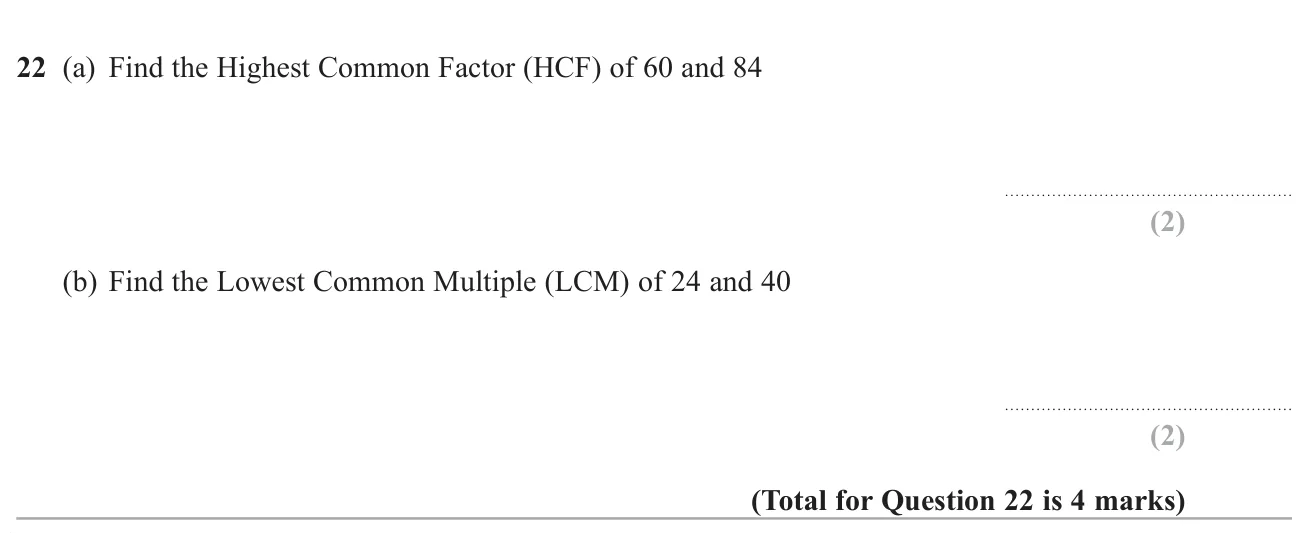
(a) 12 2 marks (b) 120 2 marks
Worked solution Checked against the mark scheme
(a) 60 = 2 2 × 3 × 5 60 = 2^2 \times 3 \times 5 60 = 2 2 × 3 × 5 84 = 2 2 × 3 × 7 84 = 2^2 \times 3 \times 7 84 = 2 2 × 3 × 7
HCF = 2 2 × 3 = 12 = 2^2 \times 3 = 12 = 2 2 × 3 = 12
(b) 24 = 2 3 × 3 24 = 2^3 \times 3 24 = 2 3 × 3 40 = 2 3 × 5 40 = 2^3 \times 5 40 = 2 3 × 5
LCM = 2 3 × 3 × 5 = 120 = 2^3 \times 3 \times 5 = 120 = 2 3 × 3 × 5 = 120
Watch out: Mixing up HCF and LCM.
© Pearson Education Ltd. November 2020 Paper 2 (Foundation, calculator), question 21.
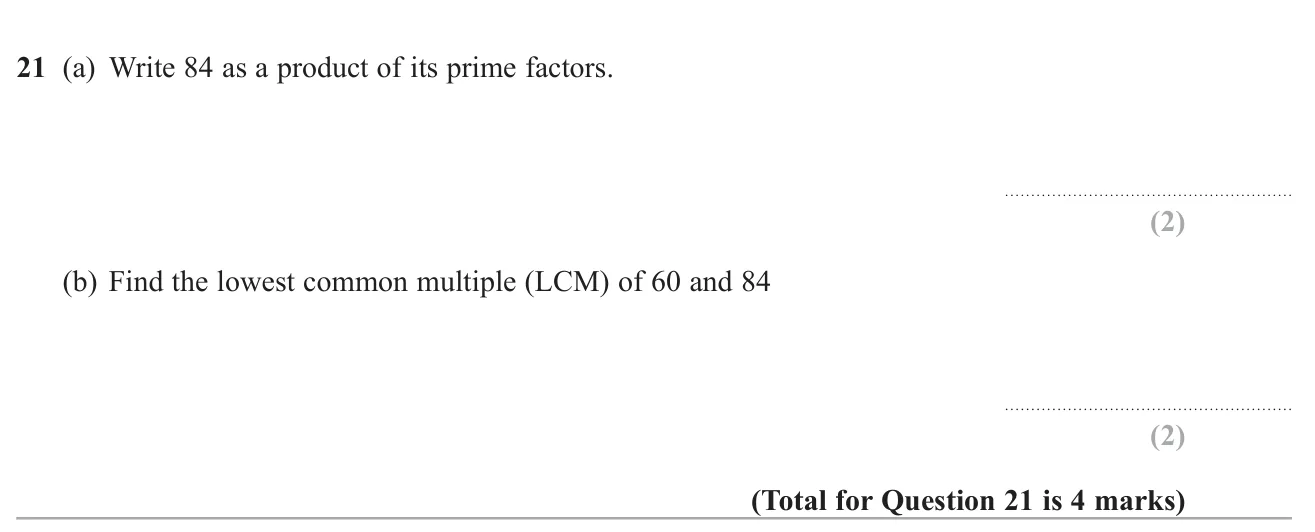
(a) 2 × 2 × 3 × 7 2 \times 2 \times 3 \times 7 2 × 2 × 3 × 7 2 marks (b) 420 2 marks
Worked solution Checked against the mark scheme
(a) 84 = 2 × 42 = 2 × 2 × 21 = 2 × 2 × 3 × 7 84 = 2 \times 42 = 2 \times 2 \times 21 = 2 \times 2 \times 3 \times 7 84 = 2 × 42 = 2 × 2 × 21 = 2 × 2 × 3 × 7
(b) 60 = 2 2 × 3 × 5 60 = 2^2 \times 3 \times 5 60 = 2 2 × 3 × 5 84 = 2 2 × 3 × 7 84 = 2^2 \times 3 \times 7 84 = 2 2 × 3 × 7
LCM = 2 2 × 3 × 5 × 7 = 420 = 2^2 \times 3 \times 5 \times 7 = 420 = 2 2 × 3 × 5 × 7 = 420
Watch out: In (b), multiplying 60 × 84 = 5040.
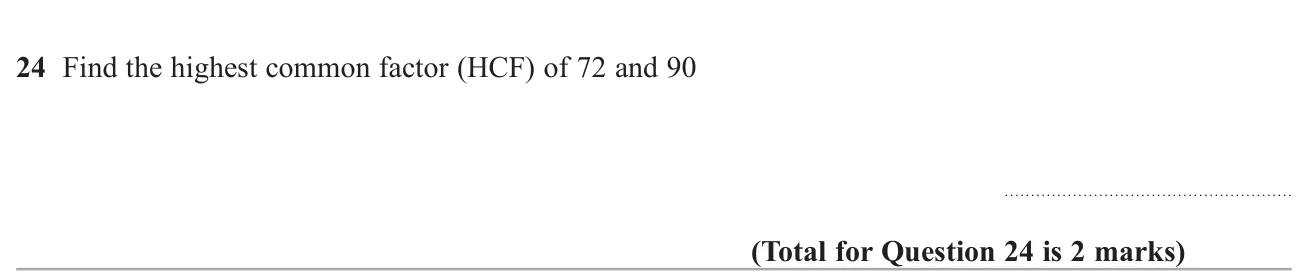
© Pearson Education Ltd. June 2019 Paper 1 (Foundation, non-calculator), question 24.
Worked solution Checked against the mark scheme
72 = 2 3 × 3 2 72 = 2^3 \times 3^2 72 = 2 3 × 3 2 90 = 2 × 3 2 × 5 90 = 2 \times 3^2 \times 5 90 = 2 × 3 2 × 5
Shared primes: 2 × 3 2 = 18 2 \times 3^2 = 18 2 × 3 2 = 18
Watch out: Giving a common factor that is not the highest, such as 6 or 9.
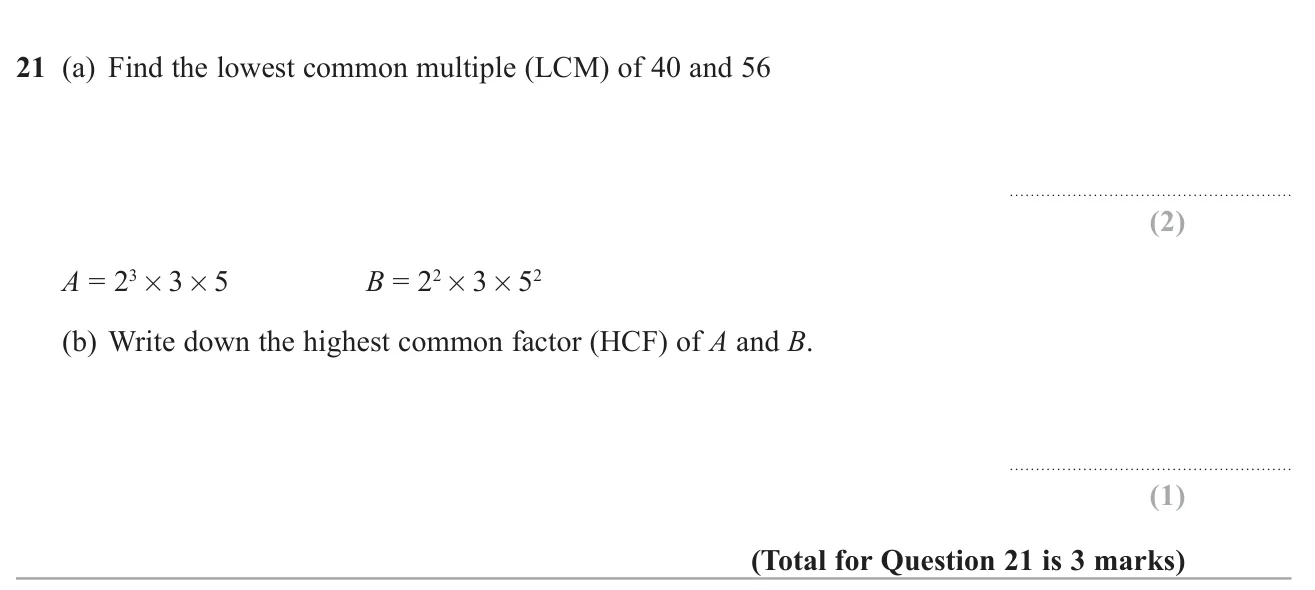
© Pearson Education Ltd. June 2018 Paper 2 (Foundation, calculator), question 21.
(a) 280 280 280 2 marks (b) 60 60 60 1 mark
Worked solution Checked against the mark scheme
(a) 40 = 2 3 × 5 40 = 2^3 \times 5 40 = 2 3 × 5 56 = 2 3 × 7 56 = 2^3 \times 7 56 = 2 3 × 7
LCM = 2 3 × 5 × 7 = 280 = 2^3 \times 5 \times 7 = 280 = 2 3 × 5 × 7 = 280
(b) Take the lowest power of each shared prime: 2 2 × 3 × 5 = 60 2^2 \times 3 \times 5 = 60 2 2 × 3 × 5 = 60
Watch out: Multiplying 40 by 56 for the LCM.
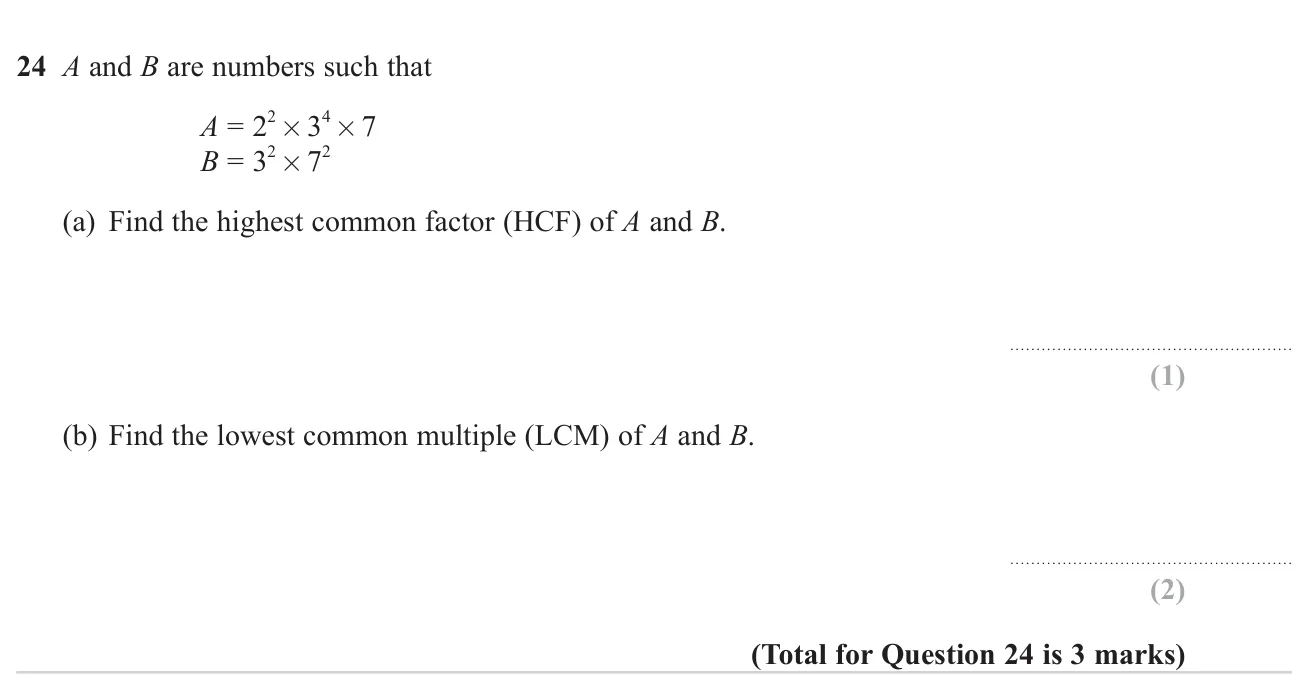
© Pearson Education Ltd. June 2023 Paper 3 (Foundation, calculator), question 24.
(a) 63 1 mark (b) 15876 2 marks
Worked solution Checked against the mark scheme
(a) Take the lowest power of each shared prime: 3 2 × 7 = 63 3^2 \times 7 = 63 3 2 × 7 = 63
(b) Take the highest power of every prime: 2 2 × 3 4 × 7 2 = 4 × 81 × 49 = 15876 2^2 \times 3^4 \times 7^2 = 4 \times 81 \times 49 = 15876 2 2 × 3 4 × 7 2 = 4 × 81 × 49 = 15876
Watch out: Using the lower powers for the LCM, or giving A × B A \times B A × B
© Pearson Education Ltd. November 2022 Paper 1 (Higher, non-calculator), question 8.
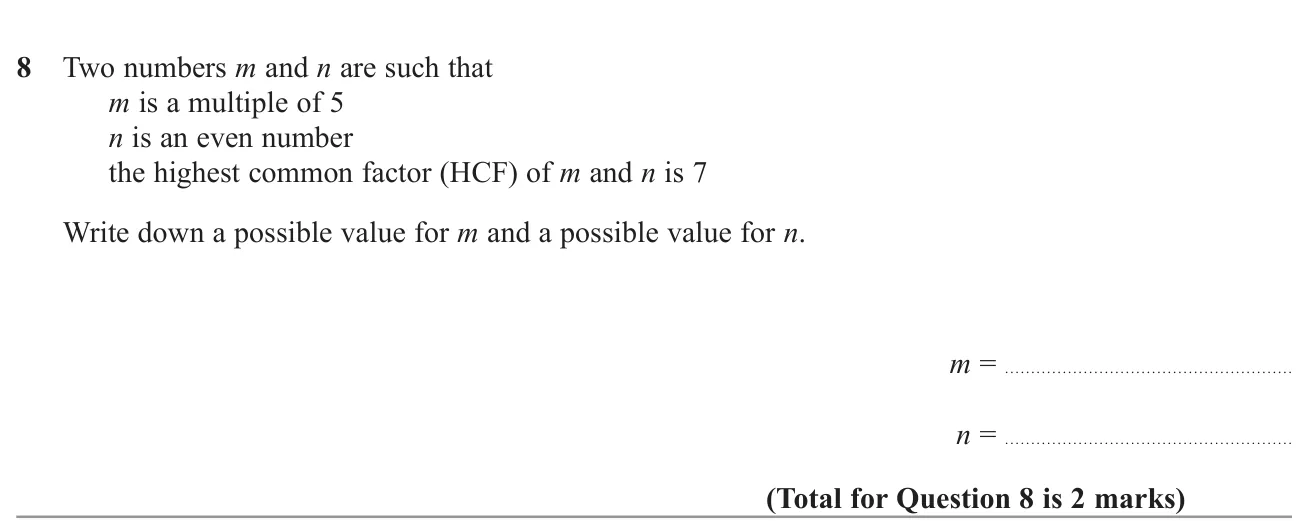
Answer e.g. m = 35 m = 35 m = 35 n = 14 n = 14 n = 14 2 marks
Worked solution Checked against the mark scheme
m must be a multiple of both 5 and 7, so try m = 35 m = 35 m = 35
n must be a multiple of both 2 and 7, so try n = 14 n = 14 n = 14
35 = 5 × 7 35 = 5 \times 7 35 = 5 × 7 14 = 2 × 7 14 = 2 \times 7 14 = 2 × 7
Watch out: Choosing m = 35 and n = 70, whose HCF is 35 not 7.
© Pearson Education Ltd. November 2019 Paper 1 (Foundation, non-calculator), question 20.
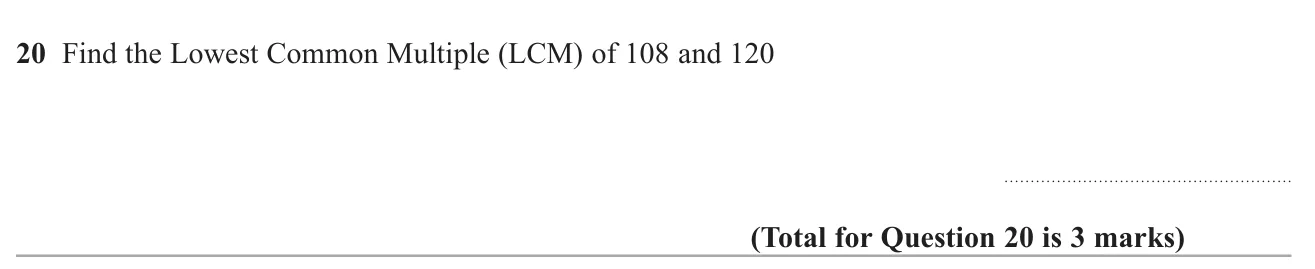
Answer 1080 1080 1080 3 marks
Worked solution Checked against the mark scheme
108 = 2 2 × 3 3 108 = 2^2 \times 3^3 108 = 2 2 × 3 3
120 = 2 3 × 3 × 5 120 = 2^3 \times 3 \times 5 120 = 2 3 × 3 × 5
Take the highest power of each prime:
LCM = 2 3 × 3 3 × 5 = 8 × 27 × 5 = 1080 = 2^3 \times 3^3 \times 5 = 8 \times 27 \times 5 = 1080 = 2 3 × 3 3 × 5 = 8 × 27 × 5 = 1080
Watch out: Multiplying the numbers (12960), which is a common multiple but not the lowest.
© Pearson Education Ltd. June 2018 Paper 3 (Higher, calculator), question 10.
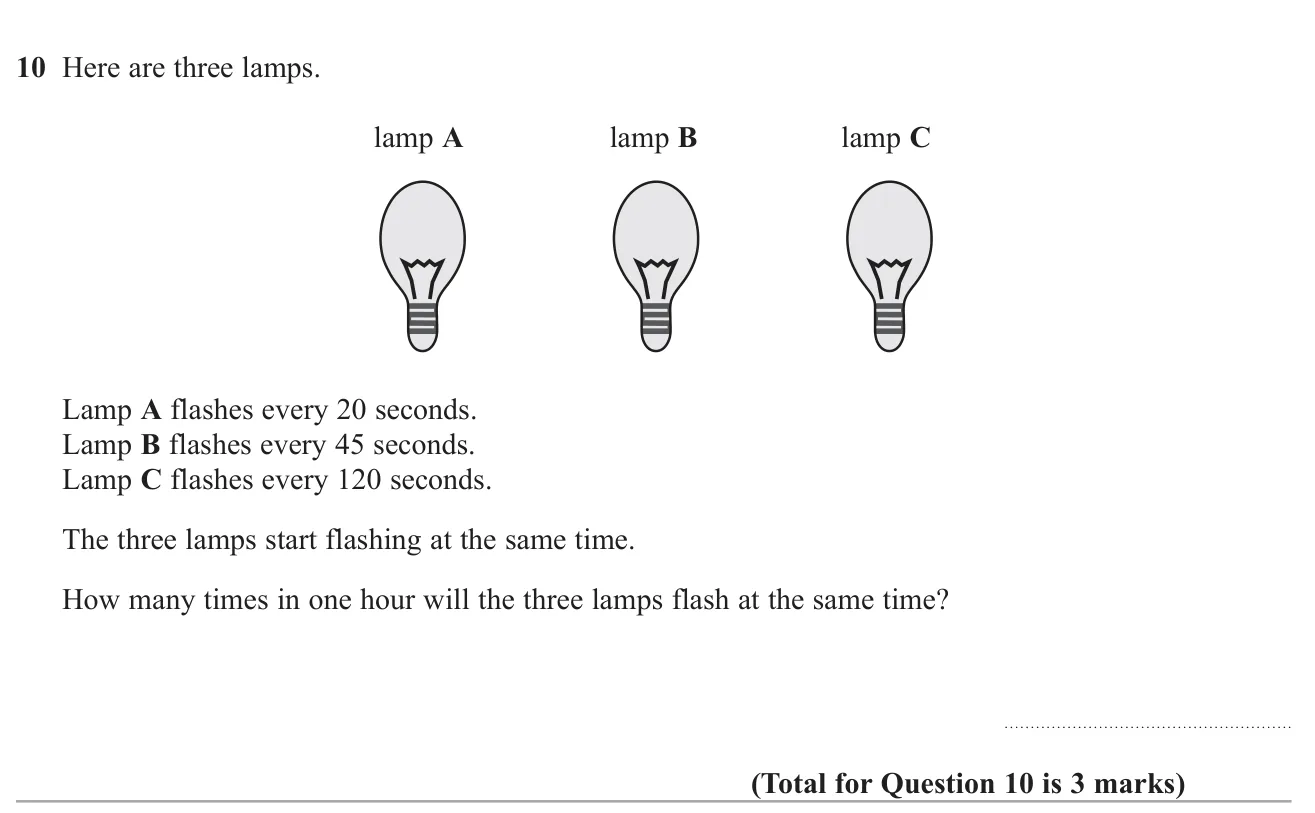
Worked solution Checked against the mark scheme
20 = 2 2 × 5 20 = 2^2 \times 5 20 = 2 2 × 5 45 = 3 2 × 5 45 = 3^2 \times 5 45 = 3 2 × 5 120 = 2 3 × 3 × 5 120 = 2^3 \times 3 \times 5 120 = 2 3 × 3 × 5
LCM = 2 3 × 3 2 × 5 = 360 = 2^3 \times 3^2 \times 5 = 360 = 2 3 × 3 2 × 5 = 360
One hour = 3600 = 3600 = 3600 3600 ÷ 360 = 10 3600 \div 360 = 10 3600 ÷ 360 = 10
So they flash together 10 times (11 if you count the start as well).
Watch out: Using the highest common factor, or multiplying all three numbers together.
© Pearson Education Ltd. November 2020 Paper 3 (Higher, calculator), question 20.
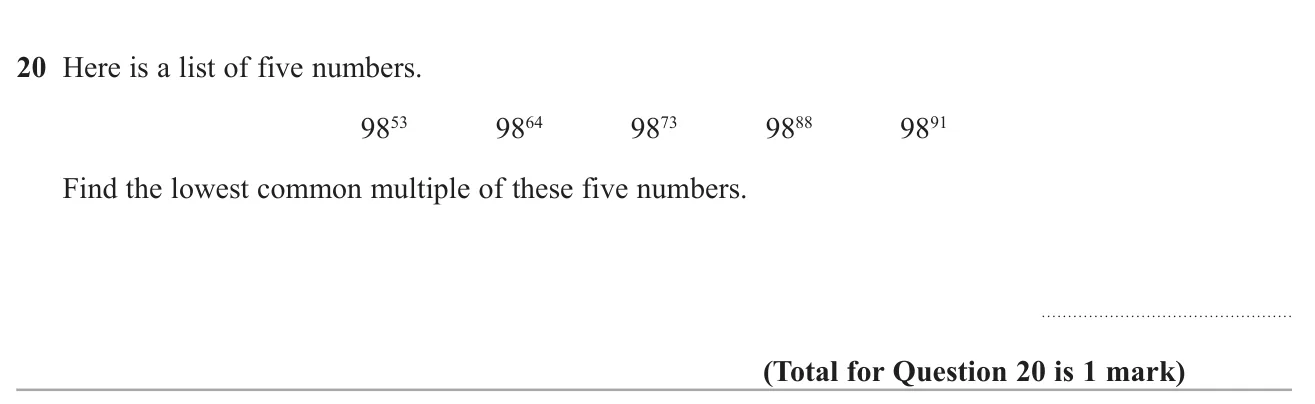
Answer 98 91 98^{91} 9 8 91 1 mark
Worked solution Checked against the mark scheme
Every number in the list is a power of 98.
Each one divides the largest, 98 91 98^{91} 9 8 91 98 91 98^{91} 9 8 91
Watch out: Choosing the smallest power, which is the highest common factor.
Also tested in these questions Their main topic is different, but part of each one tests this topic.