Revision guide by The Full Marks
Percentage change and reverse percentages: what you need to know Percentage change covers increases, decreases, profit and loss, simple interest and working back to an original amount. Multipliers make all of these quicker and more reliable.
Key facts Increase by x % x\% x % 1 + x 100 1 + \frac{x}{100} 1 + 100 x + 20 % → × 1.2 +20\% \to \times 1.2 + 20% → × 1.2 Decrease by x % x\% x % 1 − x 100 1 - \frac{x}{100} 1 − 100 x − 15 % → × 0.85 -15\% \to \times 0.85 − 15% → × 0.85 − 3 % → × 0.97 -3\% \to \times 0.97 − 3% → × 0.97 0.7 0.7 0.7 Percentage change = change original × 100 = \dfrac{\text{change}}{\text{original}} \times 100 = original change × 100 Original value = = = ÷ \div ÷ Simple interest is the same amount each year: interest = = = × \times × × \times × Increase or decrease by a percentage Write the multiplier. Multiply the original amount by it. Reverse percentage (finding the original) Write the multiplier that was used. Divide the new amount by the multiplier. Don't take a percentage of the new amount. Worked examples Example 1 Foundation · grade 4
(a) A TV costing £450 is reduced by 15 % 15\% 15%
Show the solution (a) Multiplier = 1 − 0.15 = 0.85 = 1 - 0.15 = 0.85 = 1 − 0.15 = 0.85 450 × 0.85 = £ 382.50 450 \times 0.85 = £382.50 450 × 0.85 = £382.50 = 52 − 40 = £ 12 = 52 - 40 = £12 = 52 − 40 = £12 12 40 × 100 = 30 % \frac{12}{40} \times 100 = 30\% 40 12 × 100 = 30%
Example 2 Foundation · grade 5
After a 20 % 20\% 20%
Show the solution New price = 120 % = 120\% = 120% 1.2 1.2 1.2 = 54 ÷ 1.2 = £ 45 = 54 \div 1.2 = £45 = 54 ÷ 1.2 = £45 45 × 1.2 = 54 45 \times 1.2 = 54 45 × 1.2 = 54
Common mistakes Reverse percentages: taking 20% off £54 gives £43.20, which is wrong. Divide by 1.2. Dividing the change by the new value (or by the selling price, for profit) instead of the original value or cost price. Adding successive changes: + 10 % +10\% + 10% + 10 % +10\% + 10% × 1.21 \times 1.21 × 1.21 + 20 % +20\% + 20% Simple interest: using compound interest, or giving the final amount when the question asks for the interest (or the other way round). Exam tips Write money answers with 2 decimal places, e.g. £382.50 rather than £382.5. Check a reverse percentage by applying the change to your answer. Questions people ask How do you calculate percentage increase? Find the increase, divide by the original amount and multiply by 100.
How do you find the original price before a discount? Divide the sale price by the multiplier. After 25% off, divide by 0.75.
What is simple interest? Interest worked out on the original amount only, so you earn the same each year. £2000 at 3% for 4 years earns 2000 × 0.03 × 4 = £ 240 2000 \times 0.03 \times 4 = £240 2000 × 0.03 × 4 = £240
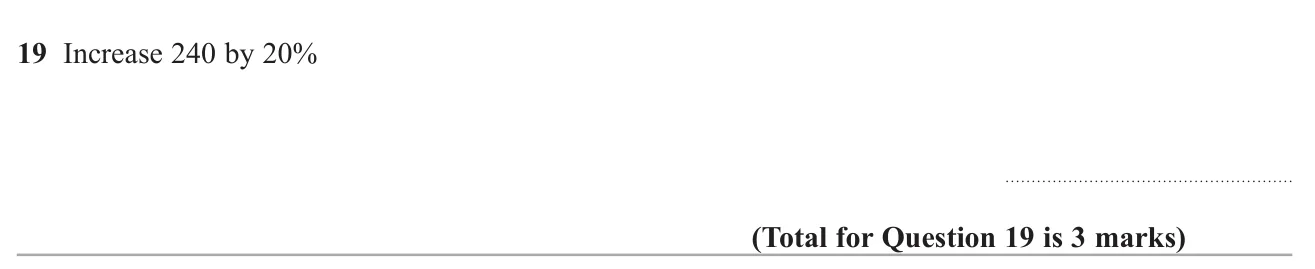
Exam questions: Percentage change and reverse percentages (33, easiest first) © Pearson Education Ltd. June 2022 Paper 1 (Foundation, non-calculator), question 19.
Worked solution Checked against the mark scheme
10 % 10\% 10% 20 % 20\% 20% 48 48 48
240 + 48 = 288 240 + 48 = 288 240 + 48 = 288
Watch out: Giving just 48, the increase, as the answer.
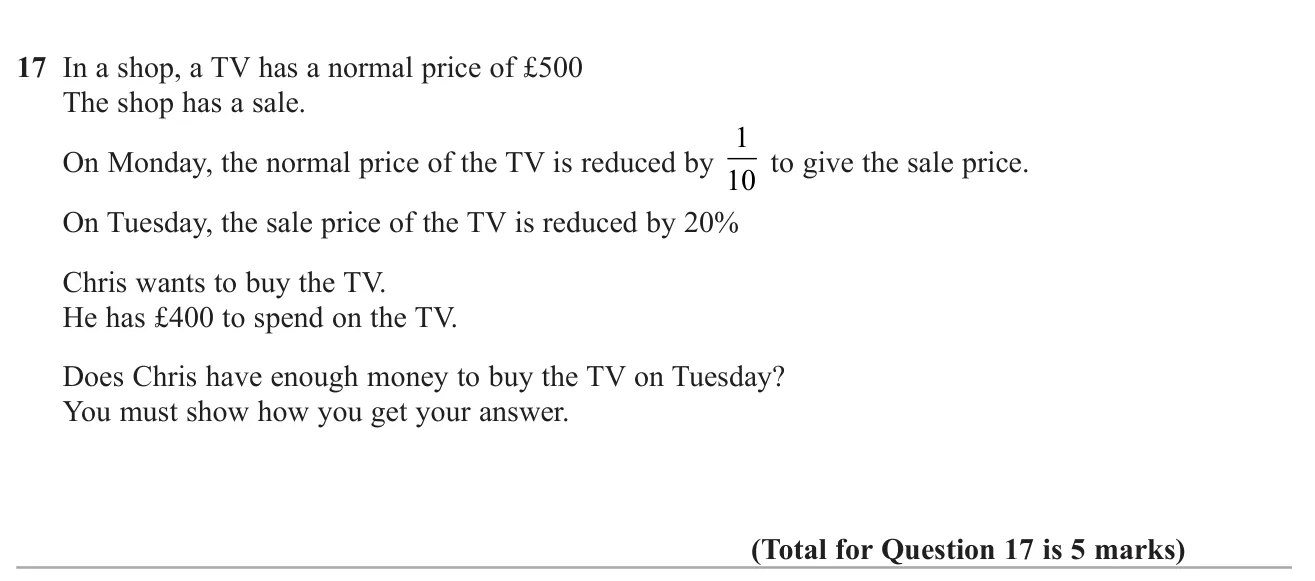
© Pearson Education Ltd. November 2020 Paper 1 (Foundation, non-calculator), question 17.
Answer Yes: the Tuesday price is £360 5 marks
Worked solution Checked against the mark scheme
Monday: 1 10 \frac{1}{10} 10 1 500 − 50 = £ 450 500 - 50 = £450 500 − 50 = £450
Tuesday: 20% of £450 is 0.2 × 450 = £ 90 0.2 \times 450 = £90 0.2 × 450 = £90 450 − 90 = £ 360 450 - 90 = £360 450 − 90 = £360
£360 is less than £400, so yes, Chris can buy it.
Watch out: Taking 20% off the original £500 instead of off the Monday sale price.
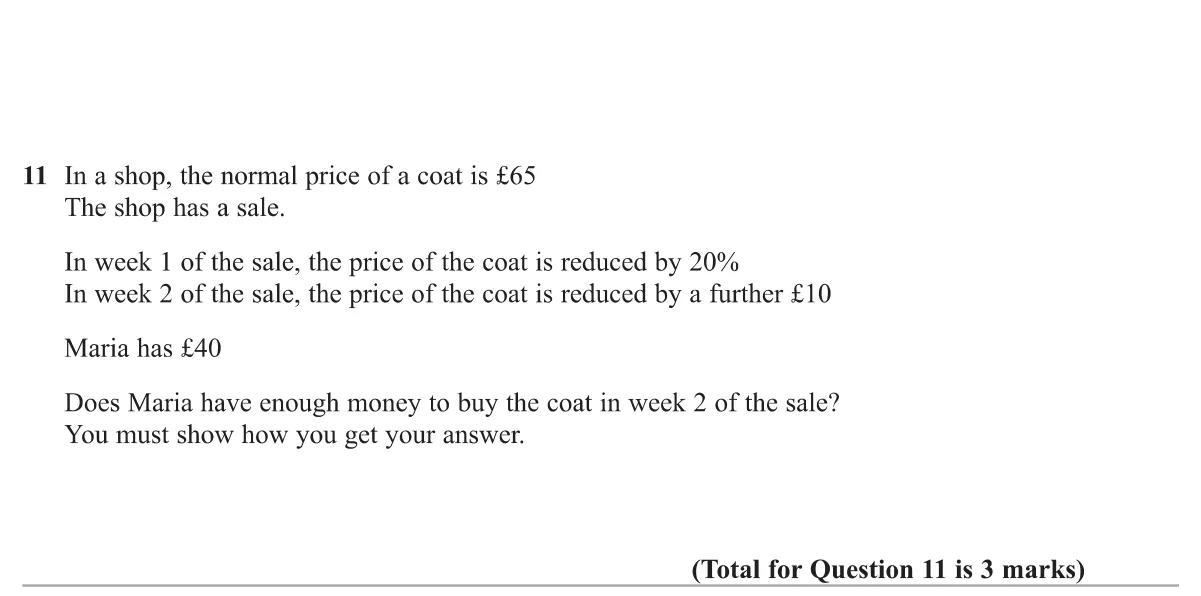
© Pearson Education Ltd. Specimen Paper 2 (Foundation, calculator), question 11.
Answer No: the week 2 price is £42 3 marks
Worked solution Checked against the mark scheme
Week 1: 65 × 0.8 = £ 52 65 \times 0.8 = £52 65 × 0.8 = £52
Week 2: 52 − 10 = £ 42 52 - 10 = £42 52 − 10 = £42
£42 is more than £40, so Maria does not have enough.
Watch out: Taking 20% and £10 off together from £65 as 30%.
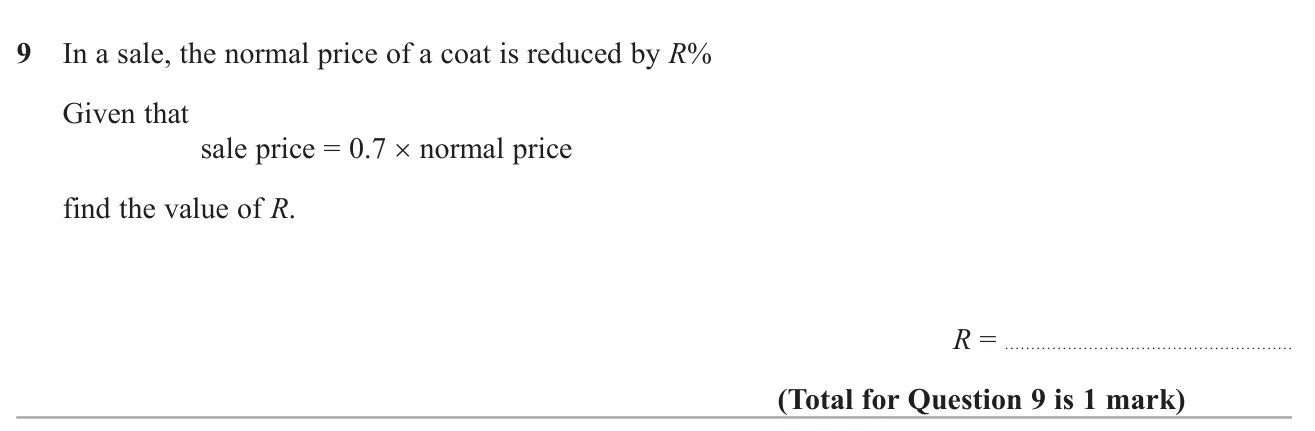
© Pearson Education Ltd. June 2024 Paper 1 (Higher, non-calculator), question 9.
Answer R = 30 R = 30 R = 30 1 mark
Worked solution Checked against the mark scheme
A multiplier of 0.7 means the sale price is 70% of the normal price.
The reduction is 100 % − 70 % = 30 % 100\% - 70\% = 30\% 100% − 70% = 30% R = 30 R = 30 R = 30
Watch out: Giving R = 70 R = 70 R = 70
© Pearson Education Ltd. November 2024 Paper 2 (Foundation, calculator), question 17.
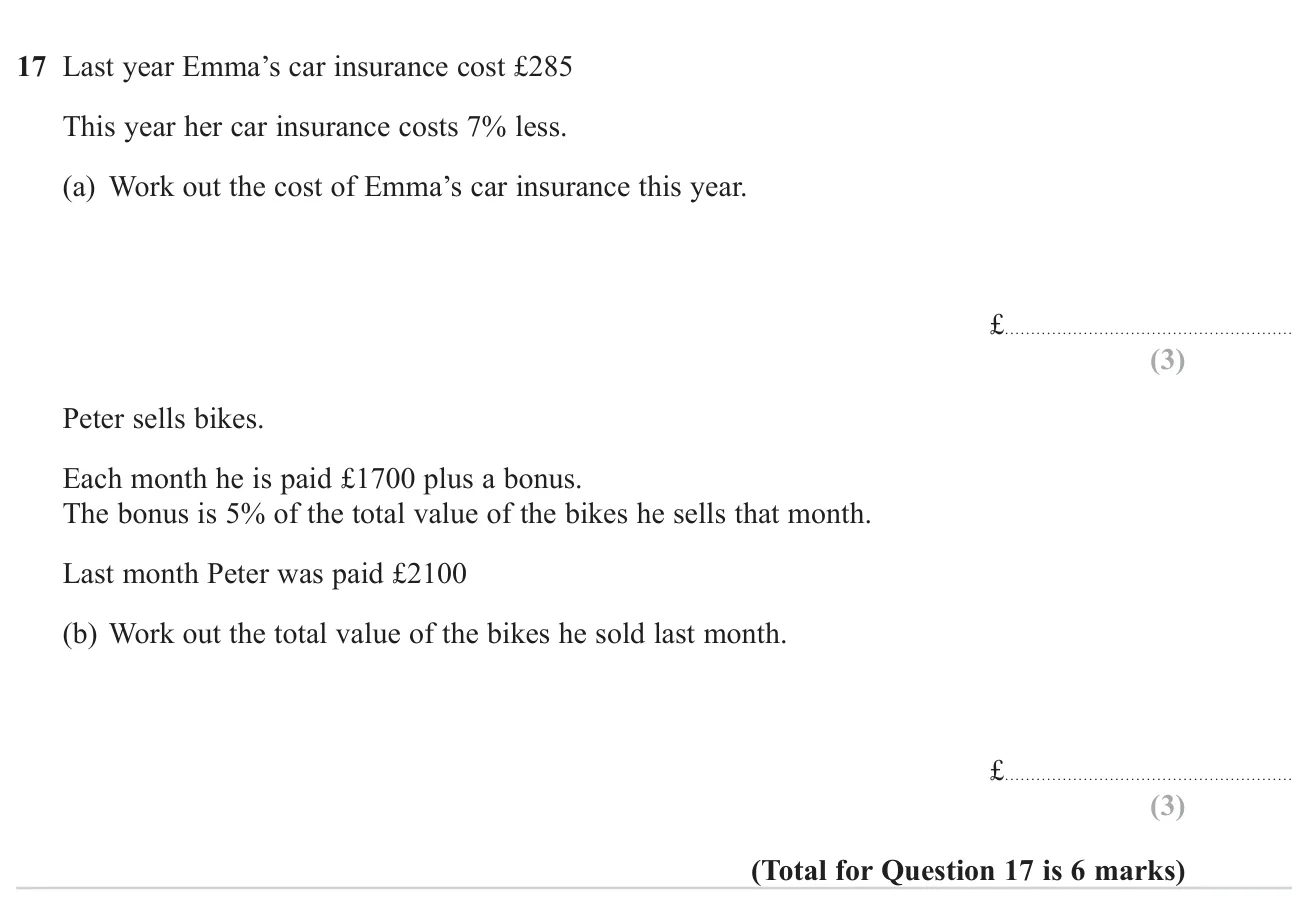
(a) £265.05 3 marks (b) £8000 3 marks
Worked solution Checked against the mark scheme
(a) 285 × 0.93 = £ 265.05 285 \times 0.93 = £265.05 285 × 0.93 = £265.05
(b) The bonus is 2100 − 1700 = £ 400 2100 - 1700 = £400 2100 − 1700 = £400
5 % = 400 5\% = 400 5% = 400 1 % = 80 1\% = 80 1% = 80 100 % = 80 × 100 = £ 8000 100\% = 80 \times 100 = £8000 100% = 80 × 100 = £8000
Watch out: In (b), finding 5% of 2100 instead of treating £400 as the 5%.
© Pearson Education Ltd. June 2023 Paper 1 (Foundation, non-calculator), question 26.
Worked solution Checked against the mark scheme
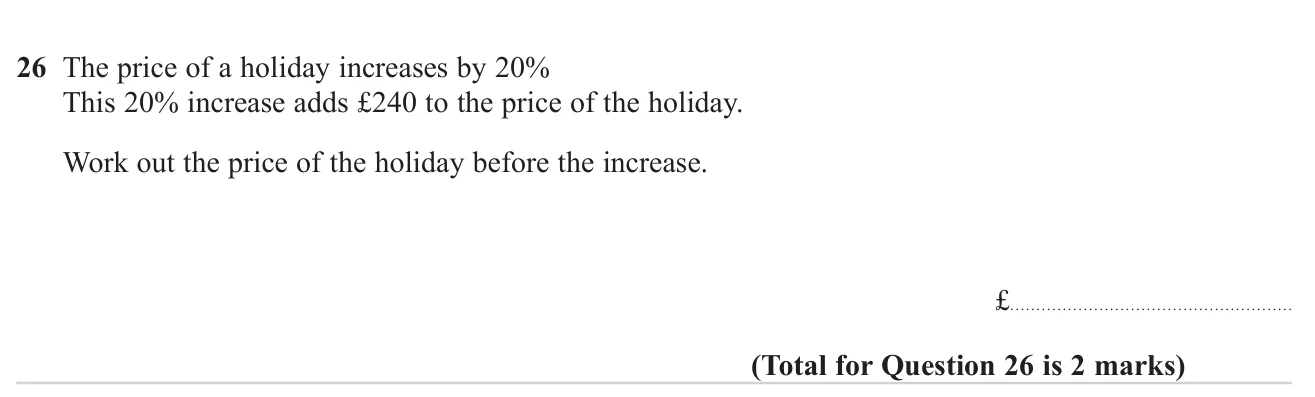
20% of the price is £240.
10% is £120, so 100% is 120 × 10 = £ 1200 120 \times 10 = £1200 120 × 10 = £1200
Watch out: Adding 20% to 240 or finding 20% of 240.
© Pearson Education Ltd. June 2022 Paper 2 (Foundation, calculator), question 19.
Worked solution Checked against the mark scheme
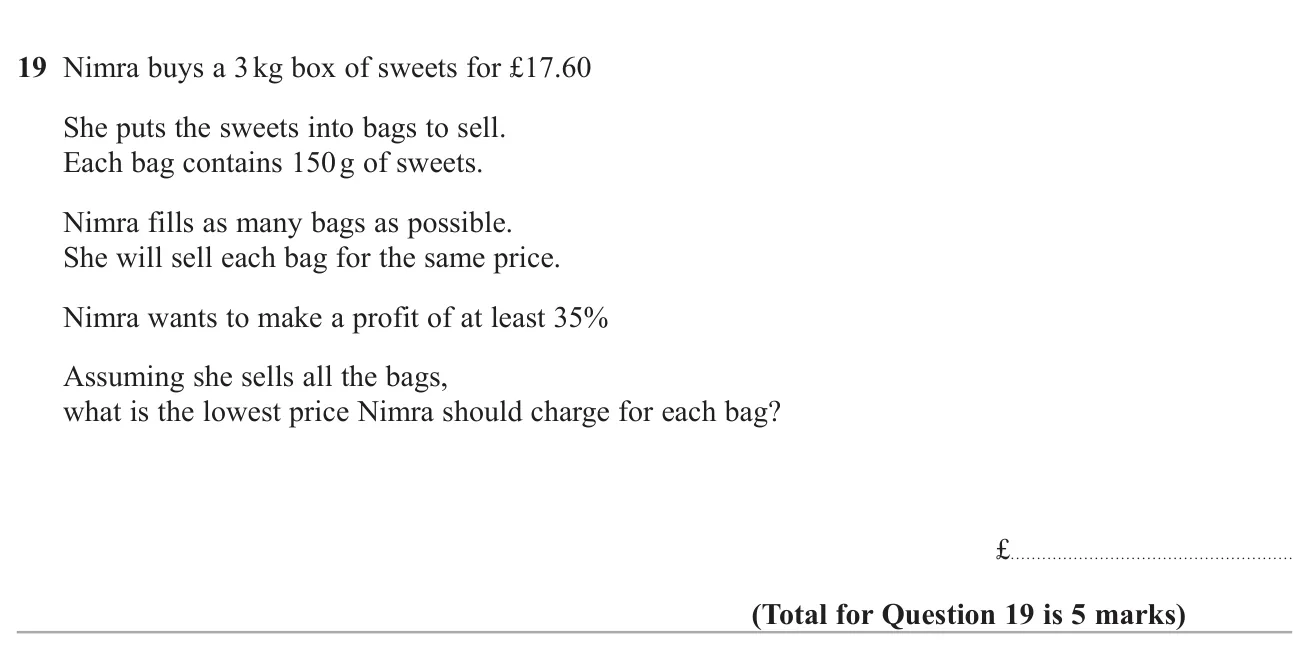
Number of bags: 3000 ÷ 150 = 20 3000 \div 150 = 20 3000 ÷ 150 = 20
Total needed with 35% profit: 17.60 × 1.35 = 23.76 17.60 \times 1.35 = 23.76 17.60 × 1.35 = 23.76
Price per bag: 23.76 ÷ 20 = 1.188 23.76 \div 20 = 1.188 23.76 ÷ 20 = 1.188
Round up so the profit is at least 35%: £1.19
Watch out: Rounding 1.188 down to 1.18, or forgetting to convert kg to g.
© Pearson Education Ltd. June 2022 Paper 3 (Foundation, calculator), question 25.
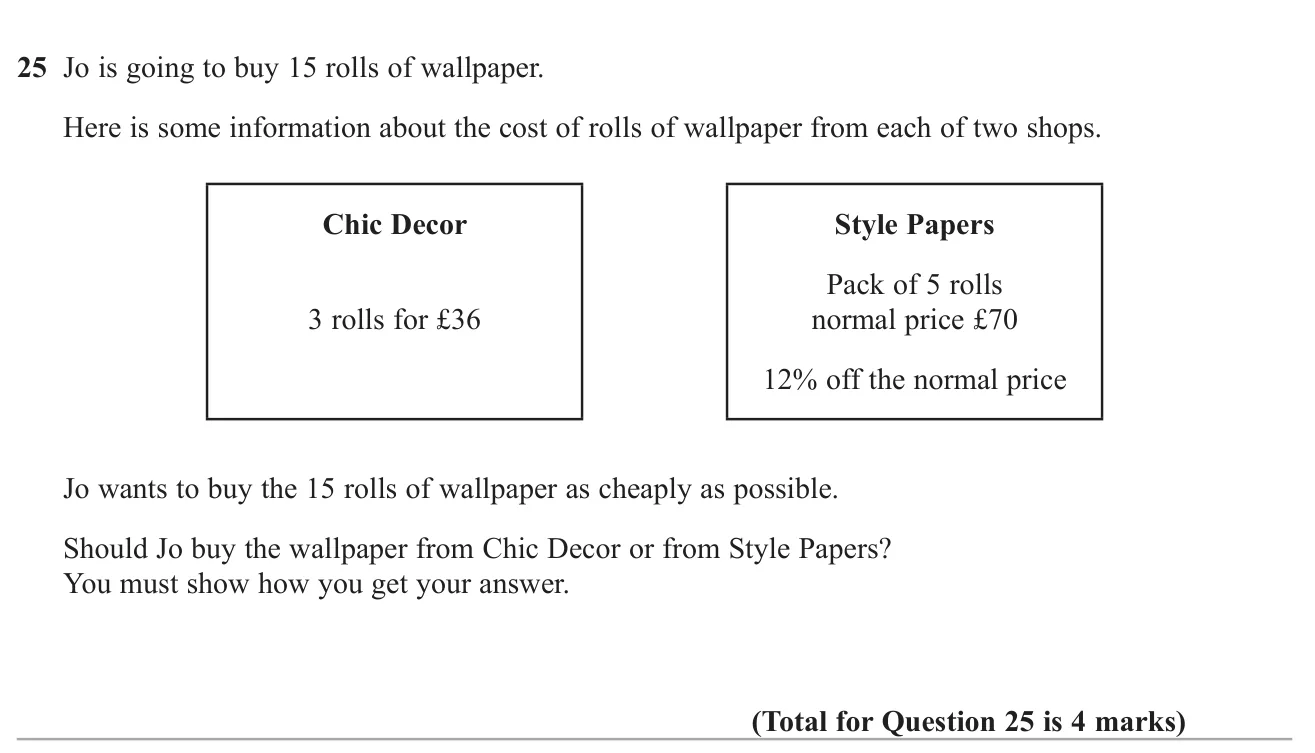
Answer Chic Decor (£180 compared with £184.80) 4 marks
Worked solution Checked against the mark scheme
Chic Decor: 15 ÷ 3 = 5 15 \div 3 = 5 15 ÷ 3 = 5 5 × 36 = £ 180 5 \times 36 = £180 5 × 36 = £180
Style Papers: 3 × 70 = £ 210 3 \times 70 = £210 3 × 70 = £210 210 × 0.88 = £ 184.80 210 \times 0.88 = £184.80 210 × 0.88 = £184.80
£180 < £184.80, so buy from Chic Decor.
Watch out: Taking 12% off only one pack, or finding 12% but not subtracting it.
© Pearson Education Ltd. November 2021 Paper 1 (Foundation, non-calculator), question 19.
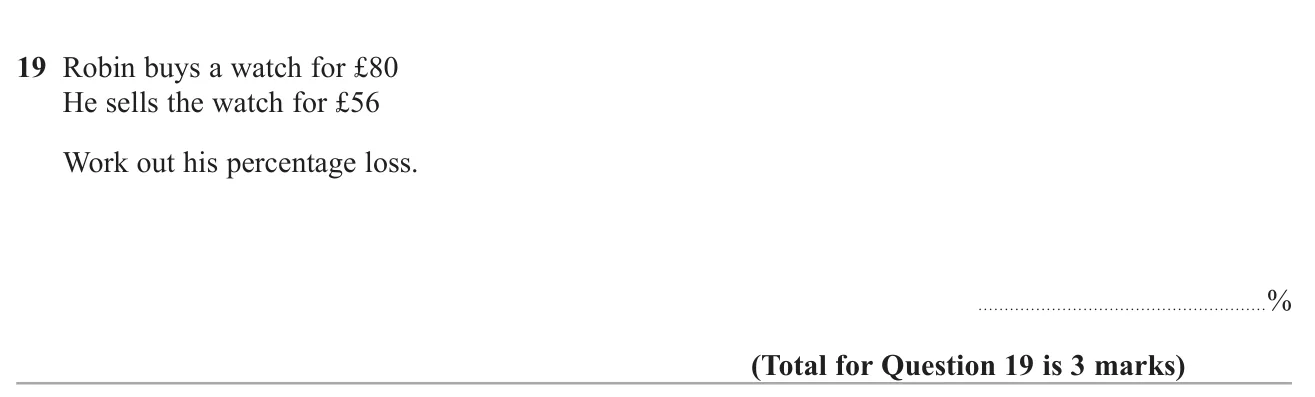
Worked solution Checked against the mark scheme
Loss: £ 80 − £ 56 = £ 24 £80 - £56 = £24 £80 − £56 = £24
Percentage loss: 24 80 × 100 = 30 % \frac{24}{80} \times 100 = 30\% 80 24 × 100 = 30%
Watch out: Dividing by 56 instead of the original price, 80.
© Pearson Education Ltd. November 2021 Paper 1 (Foundation, non-calculator), question 23.
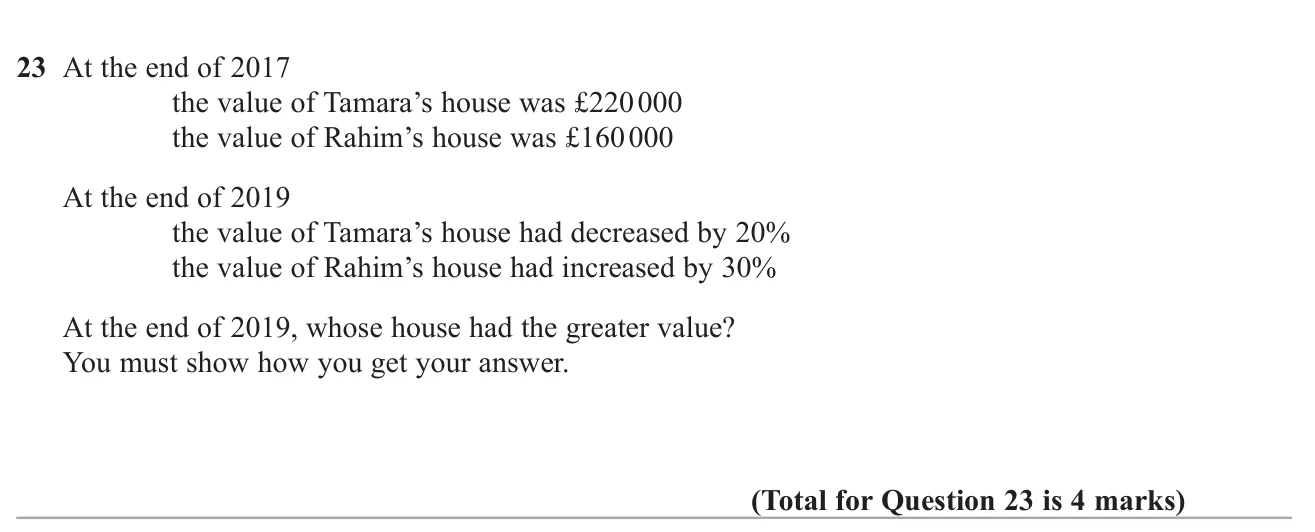
Answer Rahim's: £208 000 compared with Tamara's £176 000 4 marks
Worked solution Checked against the mark scheme
Tamara: 220 000 × 0.8 = £ 176 000 220\,000 \times 0.8 = £176\,000 220 000 × 0.8 = £176 000
Rahim: 160 000 × 1.3 = £ 208 000 160\,000 \times 1.3 = £208\,000 160 000 × 1.3 = £208 000
208 000 > 176 000 208\,000 > 176\,000 208 000 > 176 000 Rahim's house has the greater value.
Watch out: Finding only the change (44 000 and 48 000) and comparing those.
© Pearson Education Ltd. November 2019 Paper 2 (Foundation, calculator), question 20.
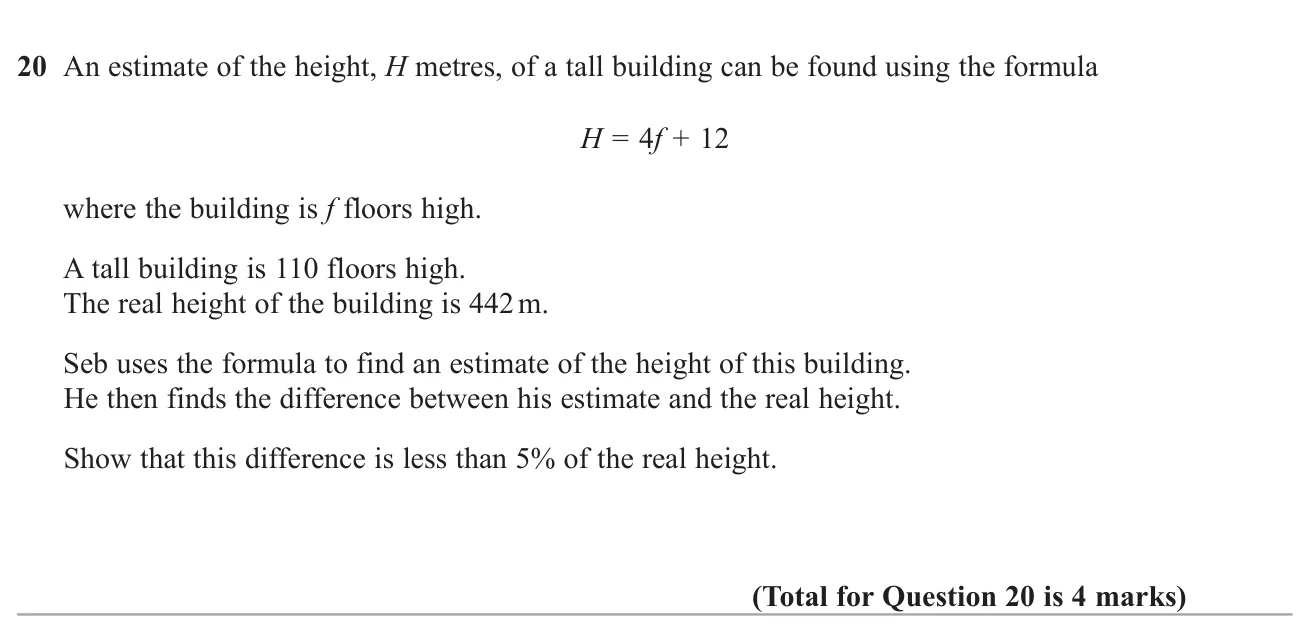
Answer Estimate 452 m, difference 10 m, which is about 2.26% (under 5%) 4 marks
Worked solution Checked against the mark scheme
Estimate: H = 4 × 110 + 12 = 452 H = 4 \times 110 + 12 = 452 H = 4 × 110 + 12 = 452
Difference: 452 − 442 = 10 452 - 442 = 10 452 − 442 = 10
5 % 5\% 5% = 22.1 = 22.1 = 22.1
10 < 22.1 10 < 22.1 10 < 22.1 10 442 × 100 = 2.26 % \frac{10}{442} \times 100 = 2.26\% 442 10 × 100 = 2.26%
Watch out: Finding 5% of the estimate (452) instead of the real height.
© Pearson Education Ltd. November 2019 Paper 3 (Foundation, calculator), question 21.
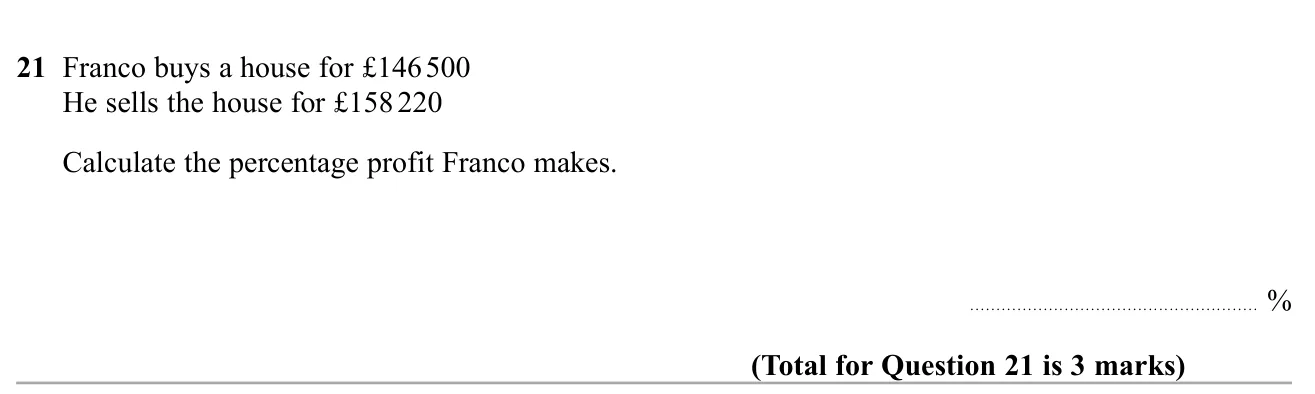
Worked solution Checked against the mark scheme
Profit: 158 220 − 146 500 = 11 720 158\,220 - 146\,500 = 11\,720 158 220 − 146 500 = 11 720
Percentage profit = 11 720 146 500 × 100 = 8 % = \frac{11\,720}{146\,500} \times 100 = 8\% = 146 500 11 720 × 100 = 8%
Watch out: Dividing by the selling price instead of the buying price.
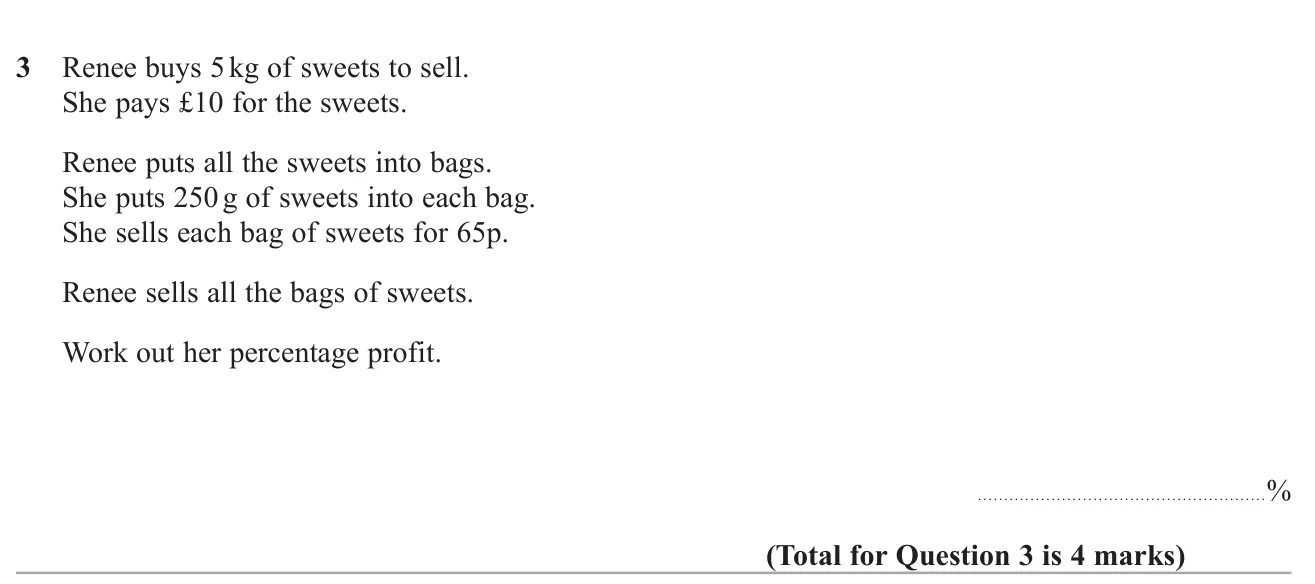
© Pearson Education Ltd. June 2018 Paper 1 (Higher, non-calculator), question 3.
Worked solution Checked against the mark scheme
5 kg = 5000 g 5\text{ kg} = 5000\text{ g} 5 kg = 5000 g 5000 ÷ 250 = 20 5000 \div 250 = 20 5000 ÷ 250 = 20
Takings: 20 × £ 0.65 = £ 13 20 \times £0.65 = £13 20 × £0.65 = £13
Profit = £ 13 − £ 10 = £ 3 = £13 - £10 = £3 = £13 − £10 = £3
Percentage profit = 3 10 × 100 = 30 % = \frac{3}{10} \times 100 = 30\% = 10 3 × 100 = 30%
Watch out: Giving 130%, the takings as a percentage of the cost, rather than the profit.
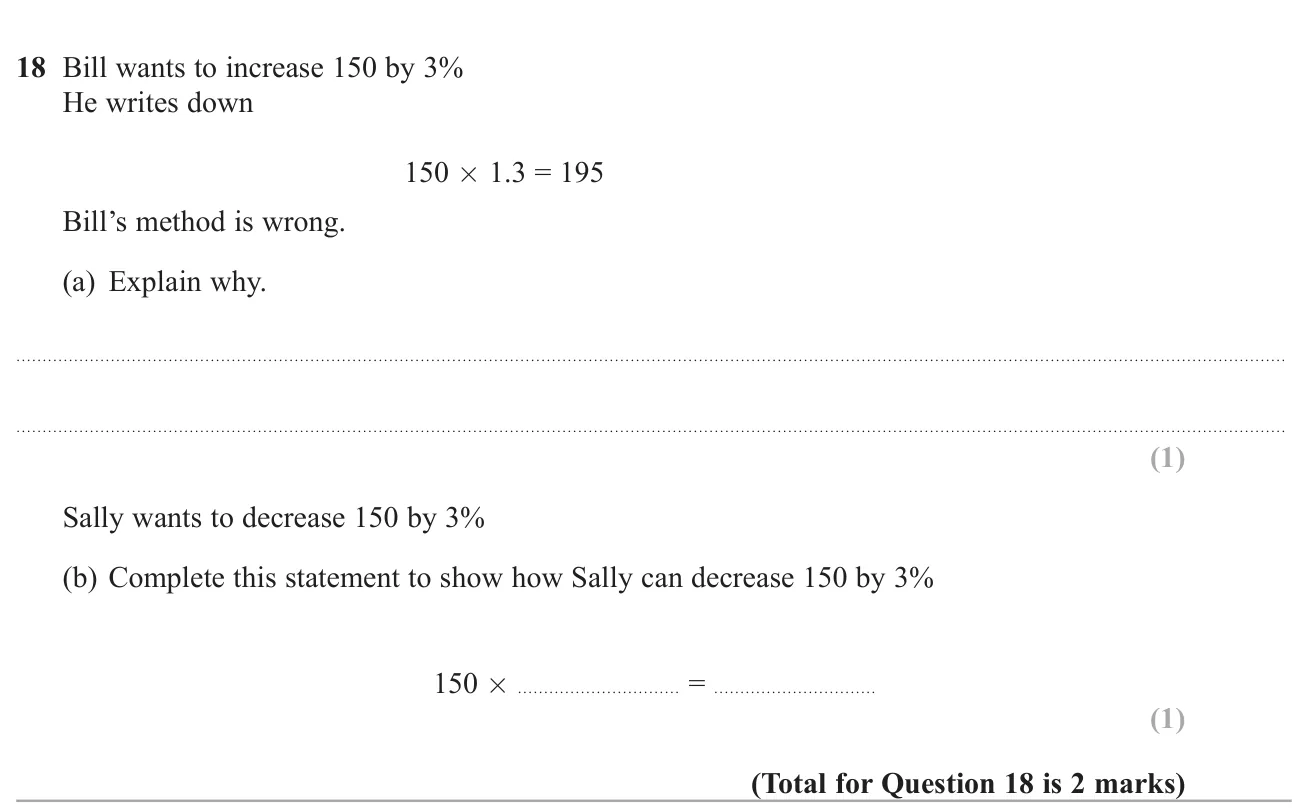
© Pearson Education Ltd. November 2018 Paper 2 (Foundation, calculator), question 18.
(a) 1.3 is a 30% increase; for 3% he needs 1.03 1 mark (b) 150 × 0.97 = 145.5 150 \times 0.97 = 145.5 150 × 0.97 = 145.5 1 mark
Worked solution Checked against the mark scheme
(a) 1.3 = 130 % 1.3 = 130\% 1.3 = 130% 1.03 1.03 1.03 150 × 1.03 = 154.5 150 \times 1.03 = 154.5 150 × 1.03 = 154.5
(b) Decrease by 3%: 100 % − 3 % = 97 % = 0.97 100\% - 3\% = 97\% = 0.97 100% − 3% = 97% = 0.97
150 × 0.97 = 145.5 150 \times 0.97 = 145.5 150 × 0.97 = 145.5
Watch out: Using 0.7 for a 3% decrease.
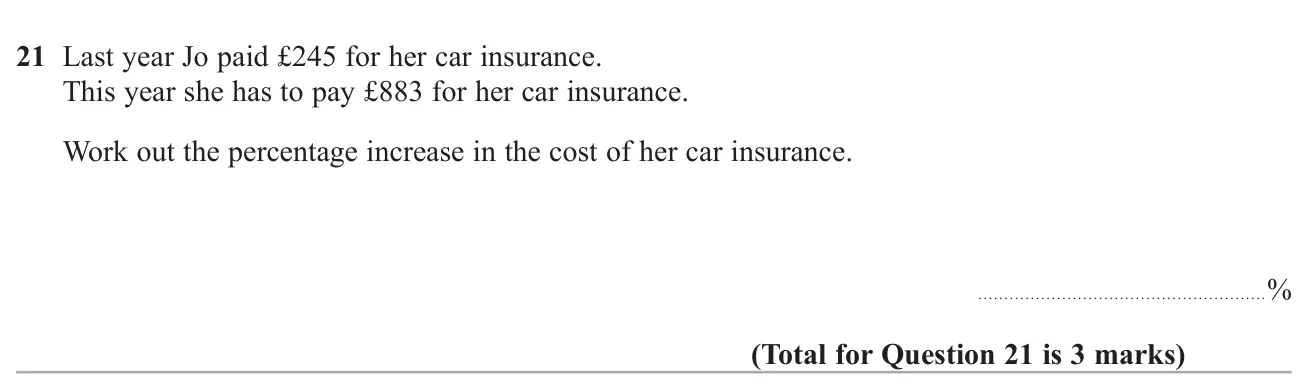
© Pearson Education Ltd. November 2018 Paper 3 (Foundation, calculator), question 21.
Answer 260.4 % 260.4\% 260.4% 3 marks
Worked solution Checked against the mark scheme
Increase: 883 − 245 = 638 883 - 245 = 638 883 − 245 = 638
Percentage increase: 638 245 × 100 = 260.4 % \frac{638}{245} \times 100 = 260.4\% 245 638 × 100 = 260.4%
Watch out: Dividing by the new price (883) instead of the original.
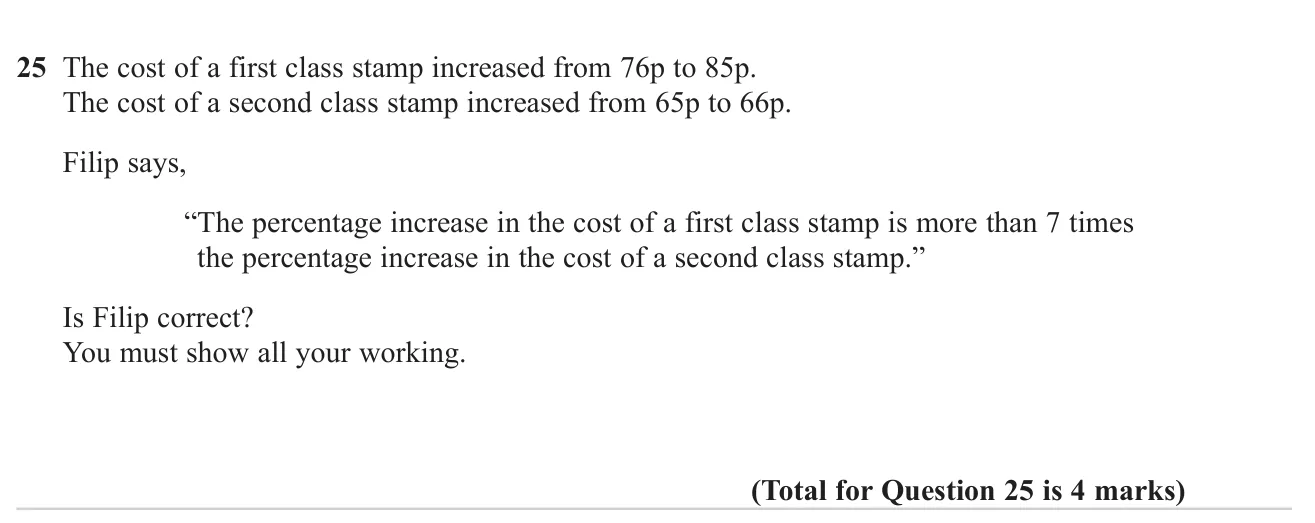
© Pearson Education Ltd. November 2024 Paper 2 (Foundation, calculator), question 25.
Answer Yes: 11.8 % 11.8\% 11.8% 7 × 1.54 % = 10.8 % 7 \times 1.54\% = 10.8\% 7 × 1.54% = 10.8% 4 marks
Worked solution Checked against the mark scheme
First class: 85 − 76 76 × 100 = 11.84 % \frac{85 - 76}{76} \times 100 = 11.84\% 76 85 − 76 × 100 = 11.84%
Second class: 66 − 65 65 × 100 = 1.54 % \frac{66 - 65}{65} \times 100 = 1.54\% 65 66 − 65 × 100 = 1.54%
7 × 1.54 = 10.77 % 7 \times 1.54 = 10.77\% 7 × 1.54 = 10.77% 11.84 > 10.77 11.84 > 10.77 11.84 > 10.77
Watch out: Comparing the actual increases (9p and 1p) instead of percentages.
© Pearson Education Ltd. November 2024 Paper 3 (Foundation, calculator), question 21.
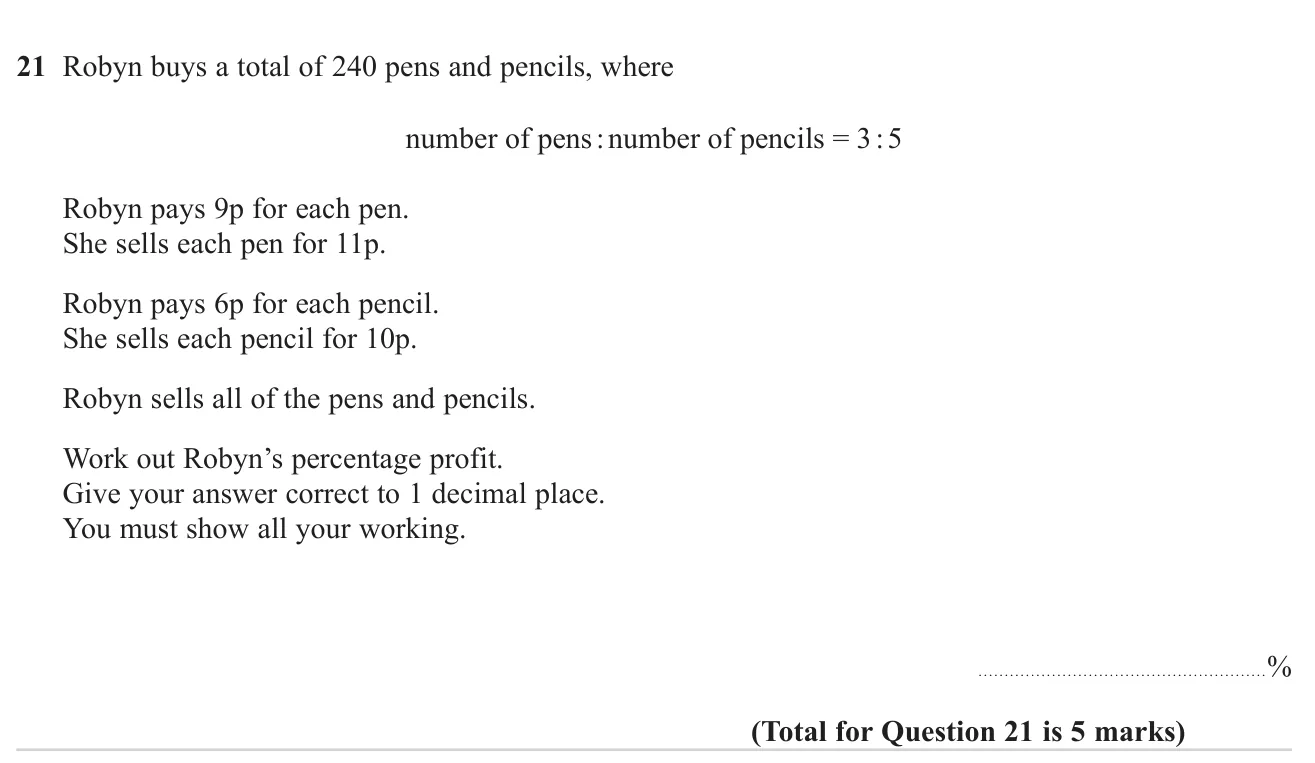
Answer 45.6 % 45.6\% 45.6% 5 marks
Worked solution Checked against the mark scheme
One part: 240 ÷ 8 = 30 240 \div 8 = 30 240 ÷ 8 = 30
Cost: 90 × 9 + 150 × 6 = 1710 90 \times 9 + 150 \times 6 = 1710 90 × 9 + 150 × 6 = 1710
Income: 90 × 11 + 150 × 10 = 2490 90 \times 11 + 150 \times 10 = 2490 90 × 11 + 150 × 10 = 2490
Profit: 2490 − 1710 = 780 2490 - 1710 = 780 2490 − 1710 = 780
780 1710 × 100 = 45.6 % \frac{780}{1710} \times 100 = 45.6\% 1710 780 × 100 = 45.6%
Watch out: Dividing the profit by the selling total instead of the cost.
© Pearson Education Ltd. November 2024 Paper 3 (Higher, calculator), question 10.
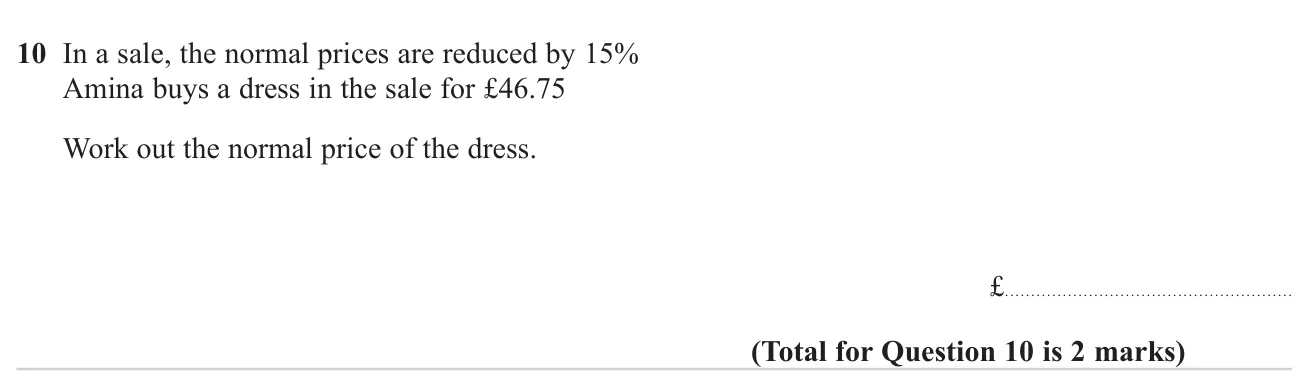
Worked solution Checked against the mark scheme
After a 15% reduction the sale price is 85% of the normal price.
Normal price = 46.75 ÷ 0.85 = £ 55 = 46.75 \div 0.85 = £55 = 46.75 ÷ 0.85 = £55
Watch out: Adding 15% to £46.75 to get £53.76.
© Pearson Education Ltd. November 2023 Paper 1 (Higher, non-calculator), question 8.
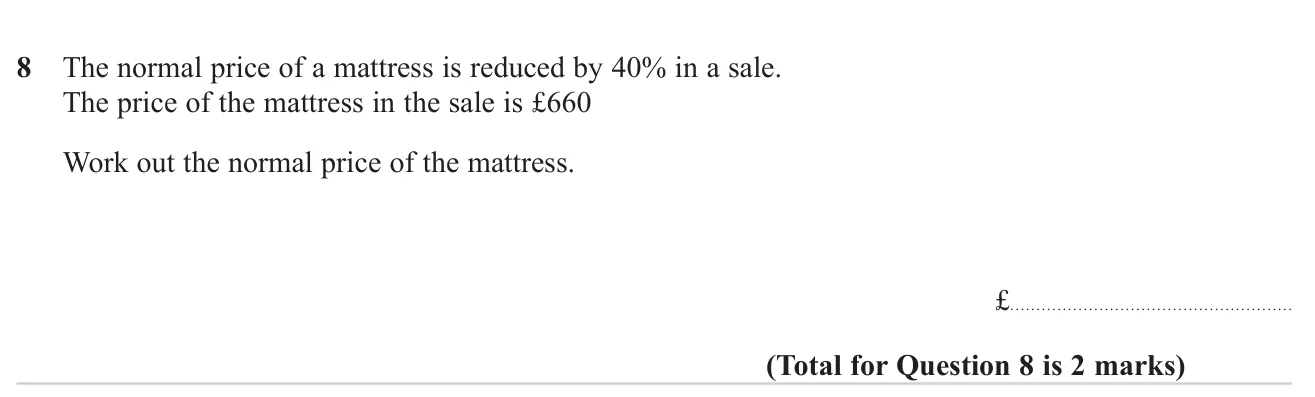
Worked solution Checked against the mark scheme
The sale price is 100 % − 40 % = 60 % 100\% - 40\% = 60\% 100% − 40% = 60%
60 % 60\% 60% 1 % 1\% 1% 100 % 100\% 100%
Watch out: Adding 40% of 660 to get £924.
© Pearson Education Ltd. November 2023 Paper 2 (Foundation, calculator), question 23.
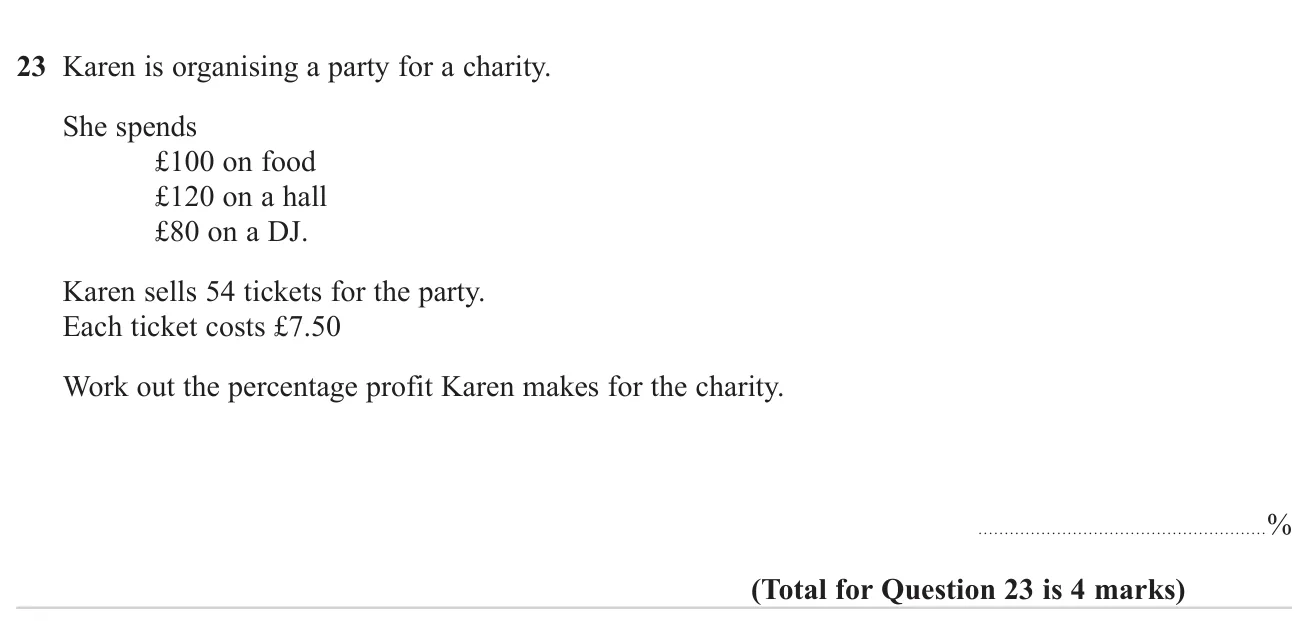
Worked solution Checked against the mark scheme
Income: 54 × 7.50 = £ 405 54 \times 7.50 = £405 54 × 7.50 = £405
Costs: 100 + 120 + 80 = £ 300 100 + 120 + 80 = £300 100 + 120 + 80 = £300
Profit: 405 − 300 = £ 105 405 - 300 = £105 405 − 300 = £105
Percentage profit = 105 300 × 100 = 35 % = \frac{105}{300} \times 100 = 35\% = 300 105 × 100 = 35%
Watch out: Dividing the profit by the income (405) instead of the costs.
© Pearson Education Ltd. November 2022 Paper 2 (Foundation, calculator), question 26.
Worked solution Checked against the mark scheme
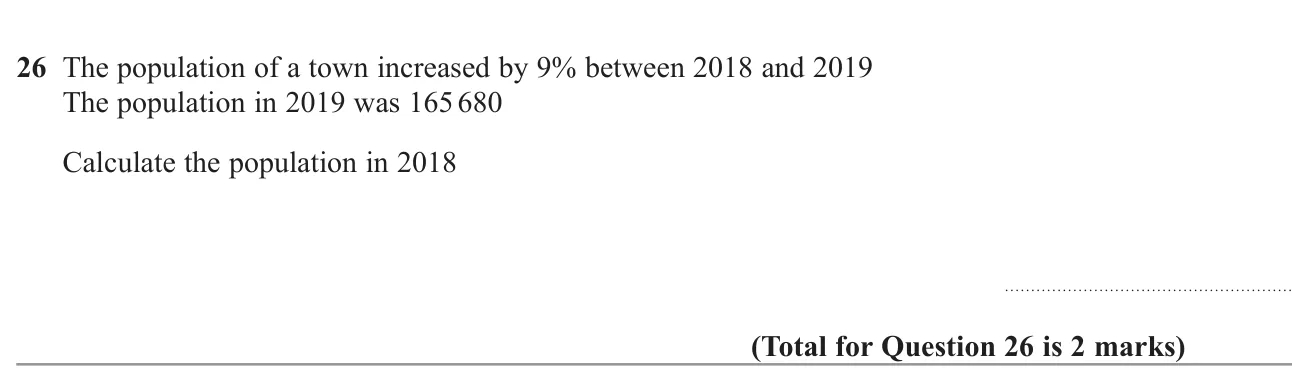
After the increase the population is 109% of the 2018 figure.
165680 ÷ 1.09 = 152000 165680 \div 1.09 = 152000 165680 ÷ 1.09 = 152000
Watch out: Taking 9% off 165 680 to get 150 768.8.
© Pearson Education Ltd. November 2022 Paper 2 (Higher, calculator), question 8.
Answer 12.5 % 12.5\% 12.5% 3 marks
Worked solution Checked against the mark scheme
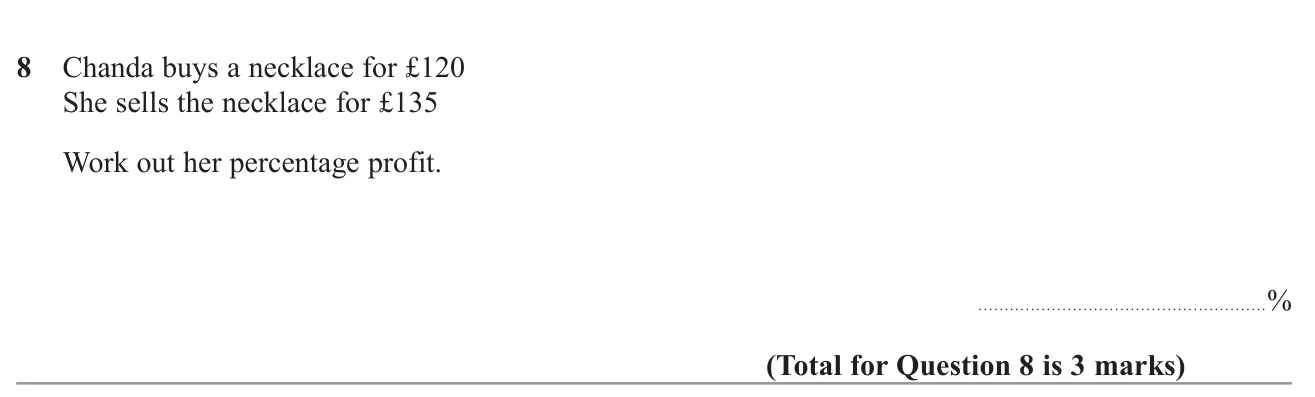
Profit = 135 − 120 = £ 15 = 135 - 120 = £15 = 135 − 120 = £15
Percentage profit = 15 120 × 100 = 12.5 % = \frac{15}{120} \times 100 = 12.5\% = 120 15 × 100 = 12.5%
Watch out: Dividing by the selling price, 15 ÷ 135, giving 11.1%.
© Pearson Education Ltd. June 2022 Paper 3 (Foundation, calculator), question 30.
Worked solution Checked against the mark scheme
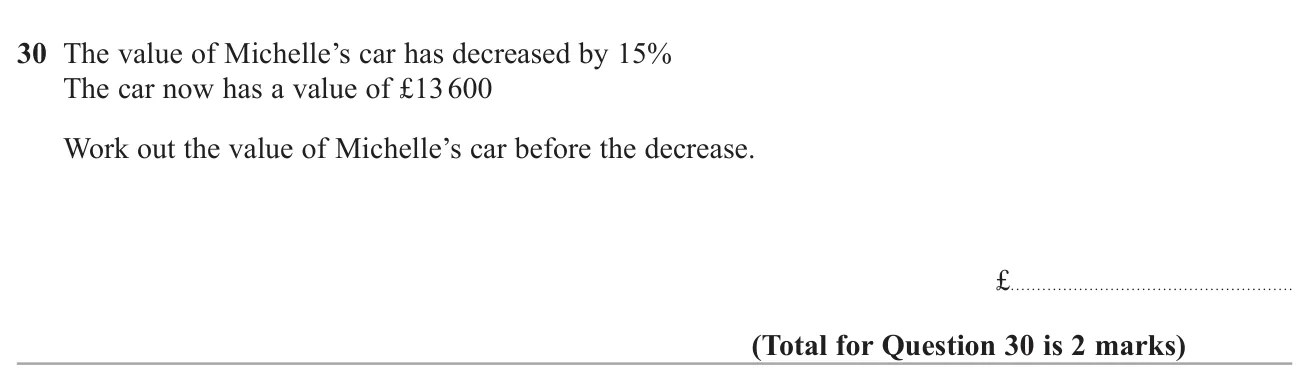
After a 15% decrease the car is worth 85% of the original.
0.85 × original = 13 600 0.85 \times \text{original} = 13\,600 0.85 × original = 13 600
Original = 13 600 ÷ 0.85 = £ 16 000 = 13\,600 \div 0.85 = £16\,000 = 13 600 ÷ 0.85 = £16 000
Watch out: Adding 15% of £13 600 to get £15 640.
© Pearson Education Ltd. November 2021 Paper 2 (Foundation, calculator), question 28.
Worked solution Checked against the mark scheme
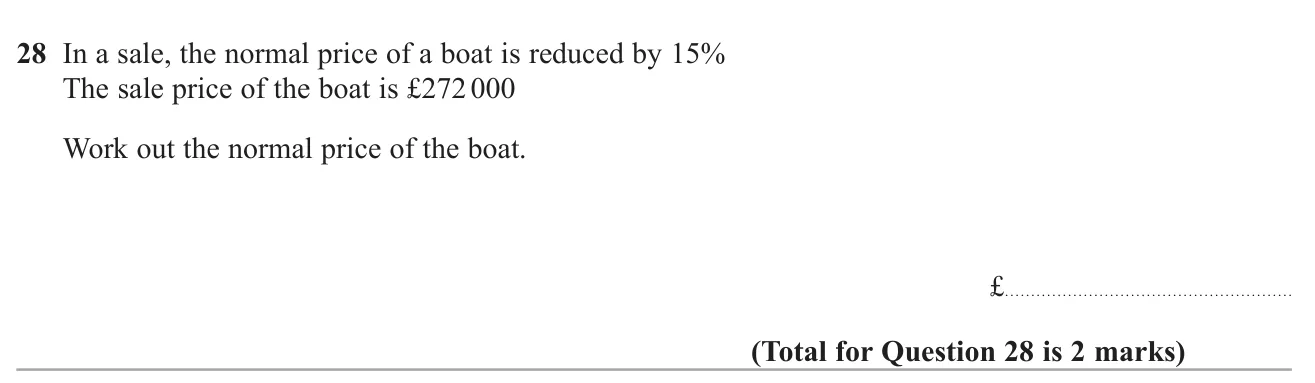
The sale price is 100 % − 15 % = 85 % 100\% - 15\% = 85\% 100% − 15% = 85%
272 000 ÷ 0.85 = £ 320 000 272\,000 \div 0.85 = £320\,000 272 000 ÷ 0.85 = £320 000
Watch out: Adding 15% of £272 000 to get £312 800.
© Pearson Education Ltd. November 2020 Paper 2 (Higher, calculator), question 8.
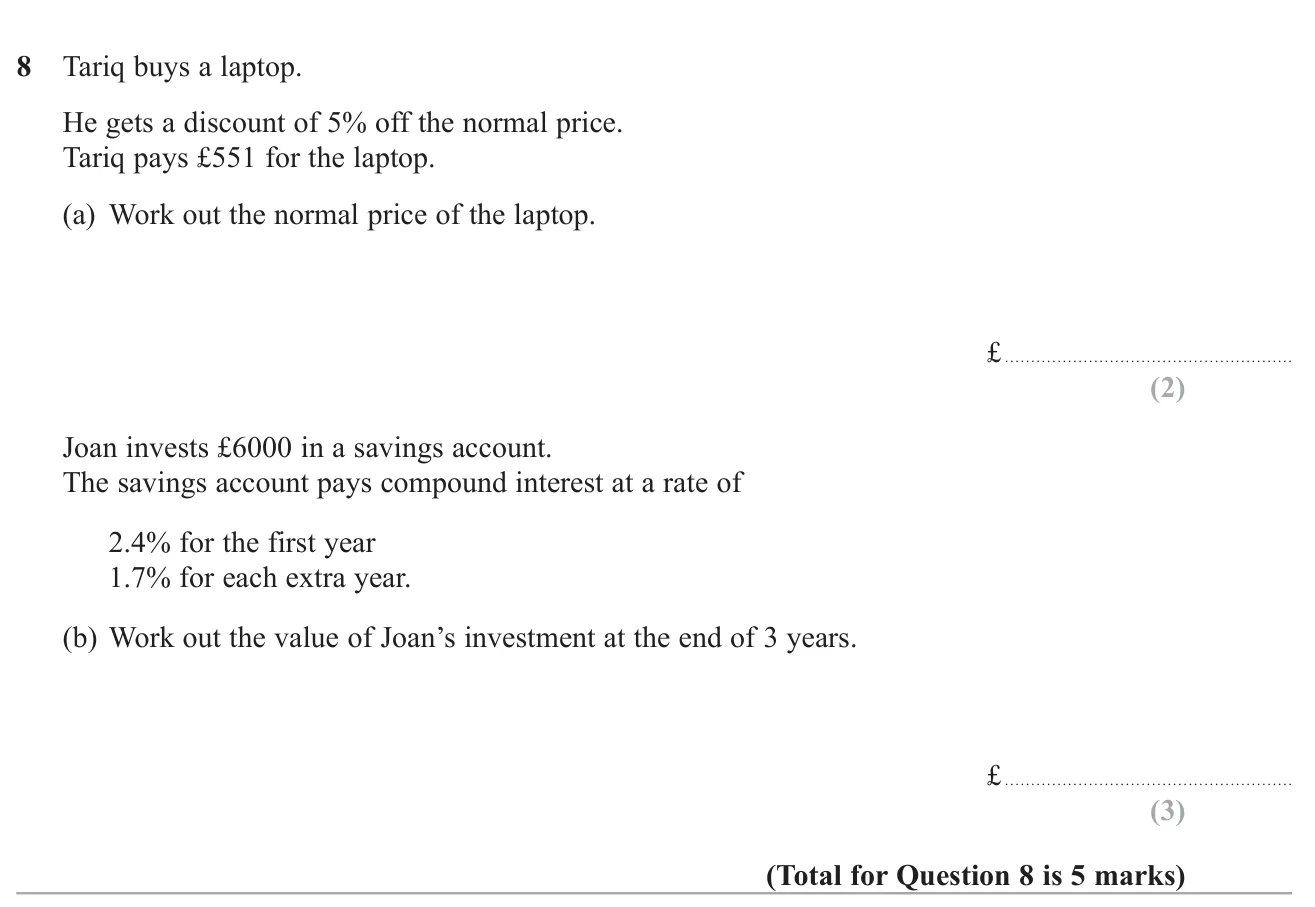
(a) £580 2 marks (b) £6354.67 3 marks
Worked solution Checked against the mark scheme
(a) £551 is 95% of the normal price: 551 ÷ 0.95 = 580 551 \div 0.95 = 580 551 ÷ 0.95 = 580
(b) After year 1: 6000 × 1.024 = 6144 6000 \times 1.024 = 6144 6000 × 1.024 = 6144
Years 2 and 3: 6144 × 1.017 2 = 6354.67 6144 \times 1.017^2 = 6354.67 6144 × 1.01 7 2 = 6354.67
The investment is worth £6354.67.
Watch out: In (a), finding 5% of £551 and adding it on, giving £578.55.
© Pearson Education Ltd. November 2018 Paper 1 (Foundation, non-calculator), question 22.
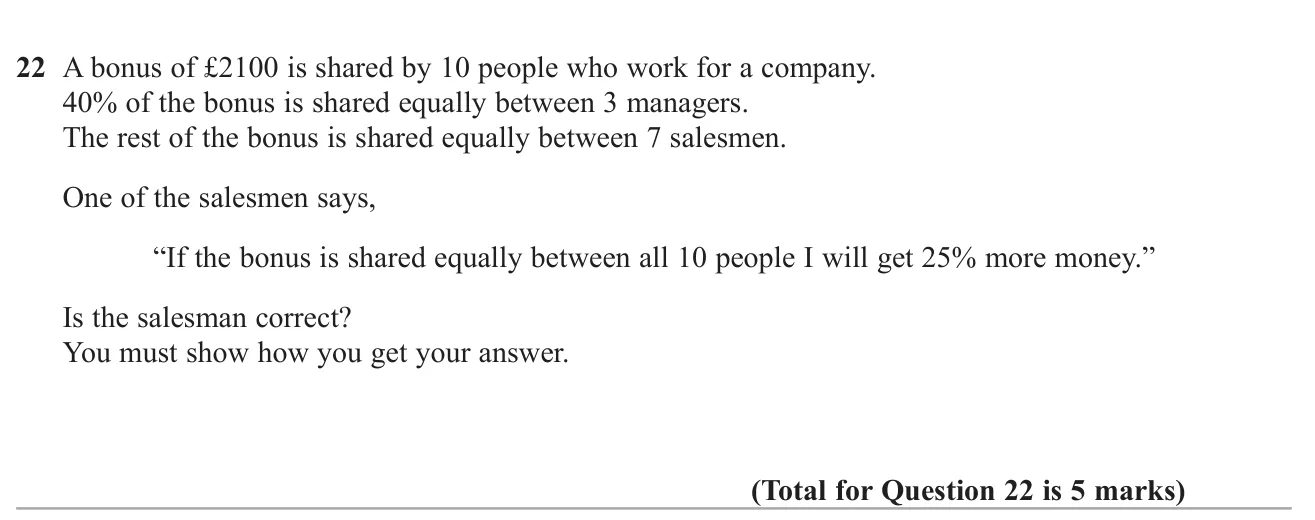
Answer No: he would get £210 instead of £180, only about 16.7% more (25% more would be £225) 5 marks
Worked solution Checked against the mark scheme
Managers get 0.4 × 2100 = £ 840 0.4 \times 2100 = £840 0.4 × 2100 = £840 2100 − 840 = £ 1260 2100 - 840 = £1260 2100 − 840 = £1260
Each salesman: 1260 ÷ 7 = £ 180 1260 \div 7 = £180 1260 ÷ 7 = £180
Shared equally: 2100 ÷ 10 = £ 210 2100 \div 10 = £210 2100 ÷ 10 = £210
25% more than £180 is 180 × 1.25 = £ 225 180 \times 1.25 = £225 180 × 1.25 = £225
£ 210 ≠ £ 225 £210 \ne £225 £210 = £225
Watch out: Working out 25% of the whole bonus rather than of one salesman's share.
© Pearson Education Ltd. June 2018 Paper 1 (Foundation, non-calculator), question 21.
Worked solution Checked against the mark scheme
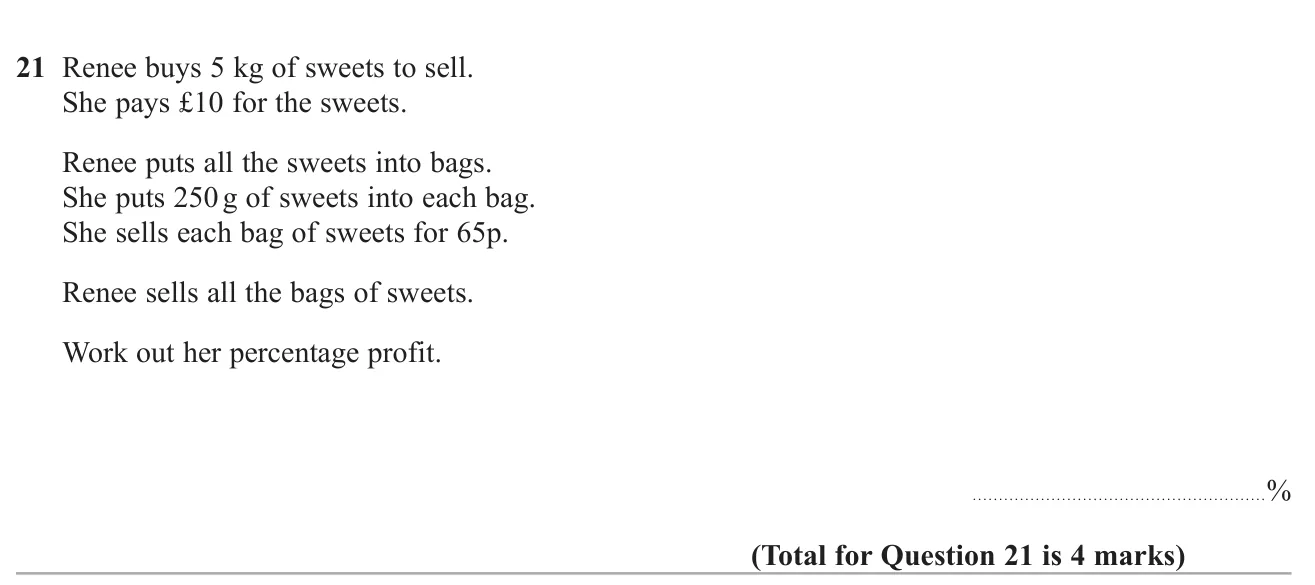
5 kg = 5000 = 5000 = 5000 5000 ÷ 250 = 20 5000 \div 250 = 20 5000 ÷ 250 = 20
Takings = 20 × 65 p = £ 13 = 20 \times 65\text{p} = £13 = 20 × 65 p = £13
Profit = 13 − 10 = £ 3 = 13 - 10 = £3 = 13 − 10 = £3
Percentage profit = 3 10 × 100 = 30 % = \frac{3}{10} \times 100 = 30\% = 10 3 × 100 = 30%
Watch out: Giving 130% (takings as a percentage of cost).
© Pearson Education Ltd. June 2018 Paper 2 (Foundation, calculator), question 25.
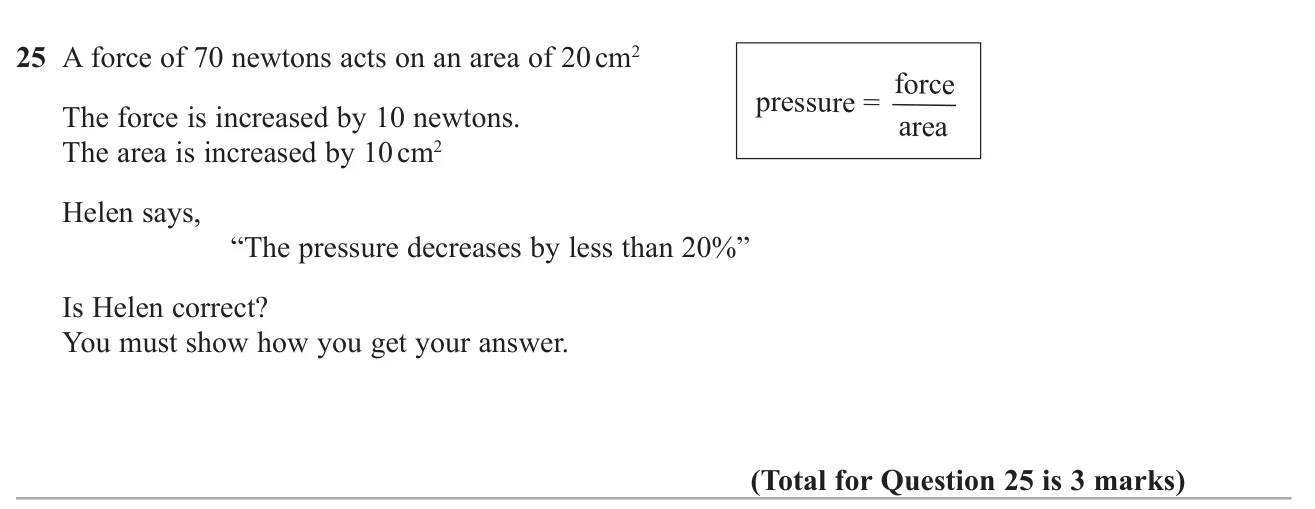
Answer No: pressure falls from 3.5 3.5 3.5 2.67 2.67 2.67 3 marks
Worked solution Checked against the mark scheme
Original pressure: 70 ÷ 20 = 3.5 70 \div 20 = 3.5 70 ÷ 20 = 3.5
New pressure: 80 ÷ 30 = 2.67 80 \div 30 = 2.67 80 ÷ 30 = 2.67
Decrease: 3.5 − 2.67 = 0.83 3.5 - 2.67 = 0.83 3.5 − 2.67 = 0.83
Percentage decrease: 0.83 3.5 × 100 ≈ 24 % \frac{0.83}{3.5} \times 100 \approx 24\% 3.5 0.83 × 100 ≈ 24%
This is more than 20%, so Helen is wrong.
Watch out: Comparing the 10 N and 10 cm² increases directly without working out pressures.
© Pearson Education Ltd. June 2018 Paper 3 (Higher, calculator), question 11.
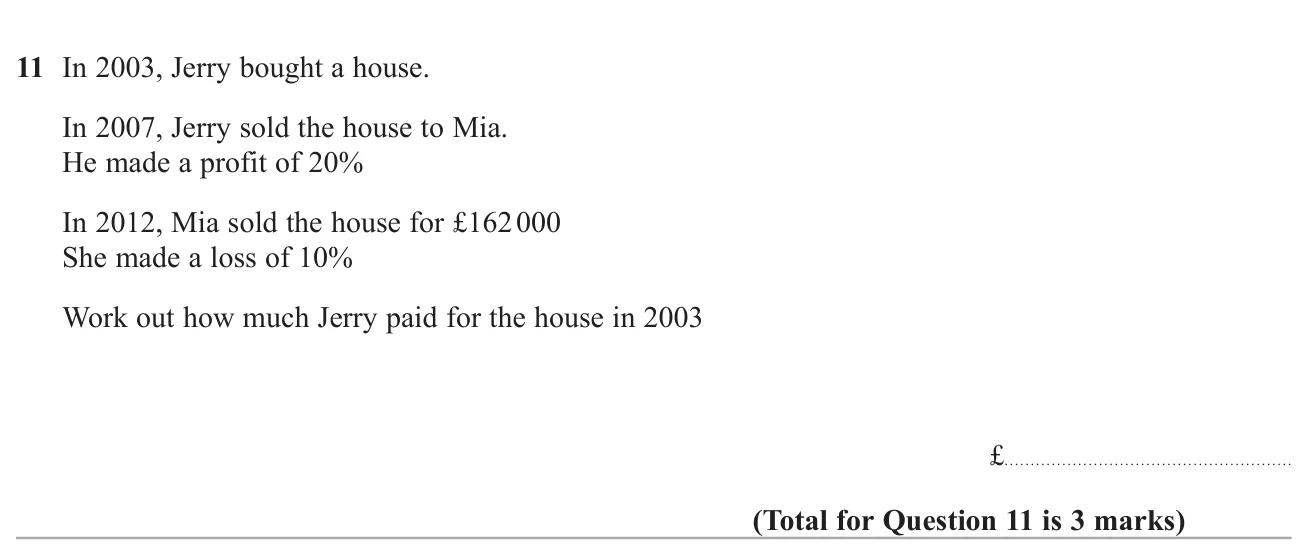
Worked solution Checked against the mark scheme
Mia's sale was 90% of her price: 162 000 ÷ 0.9 = 180 000 162\,000 \div 0.9 = 180\,000 162 000 ÷ 0.9 = 180 000
Jerry's sale was 120% of his price: 180 000 ÷ 1.2 = 150 000 180\,000 \div 1.2 = 150\,000 180 000 ÷ 1.2 = 150 000
Jerry paid £150 000 .
Watch out: Adding 10% then subtracting 20% instead of dividing by the multipliers.
© Pearson Education Ltd. June 2024 Paper 1 (Foundation, non-calculator), question 27.
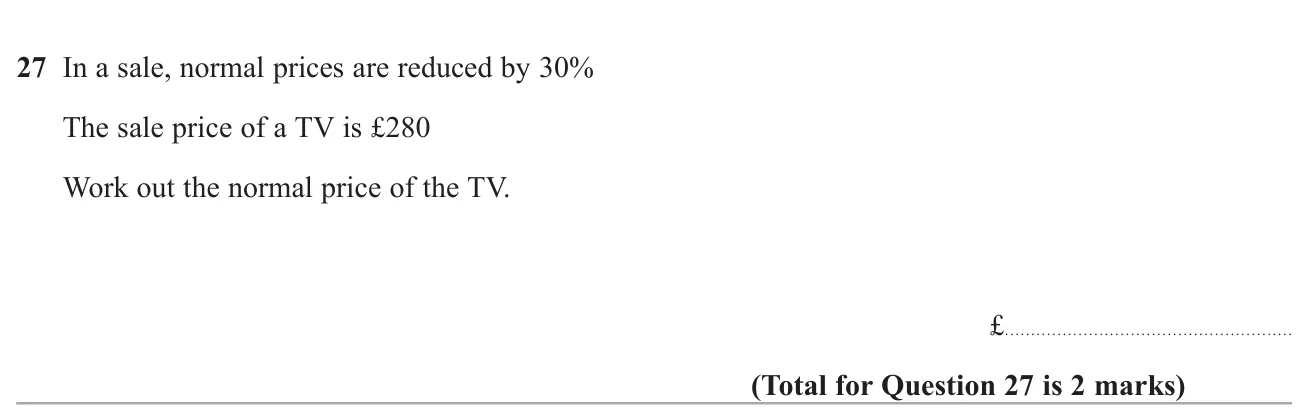
Worked solution Checked against the mark scheme
After a 30% reduction the sale price is 70% of the normal price.
70 % = £ 280 70\% = £280 70% = £280 10 % = £ 40 10\% = £40 10% = £40 100 % = £ 400 100\% = £400 100% = £400
Watch out: Adding 30% of £280 to get £364.
© Pearson Education Ltd. June 2019 Paper 1 (Higher, non-calculator), question 12.
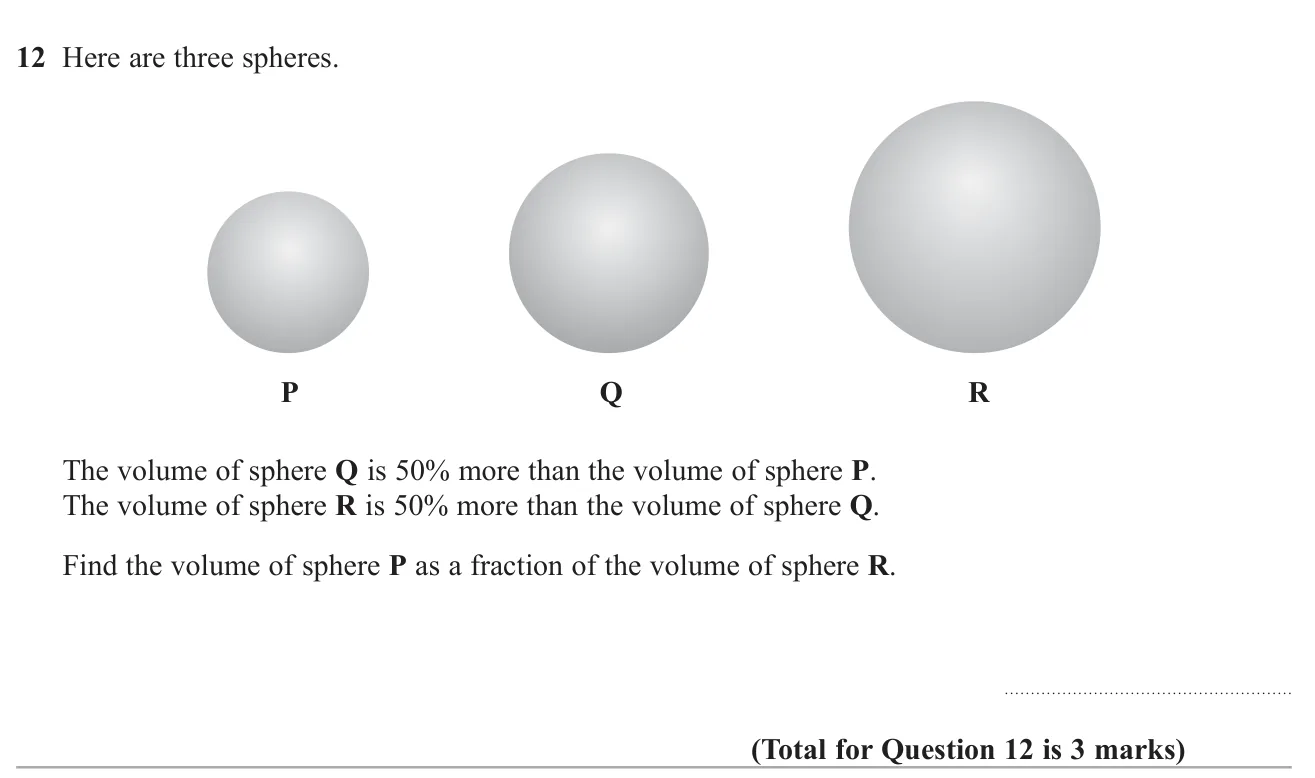
Answer 4 9 \frac{4}{9} 9 4 3 marks
Worked solution Checked against the mark scheme
Q = 1.5 P Q = 1.5P Q = 1.5 P R = 1.5 Q = 1.5 2 P = 2.25 P R = 1.5Q = 1.5^2 P = 2.25P R = 1.5 Q = 1. 5 2 P = 2.25 P
P R = 1 2.25 = 4 9 \frac{P}{R} = \frac{1}{2.25} = \frac{4}{9} R P = 2.25 1 = 9 4
Watch out: Adding the percentages to get a 100% increase and answering 1 2 \frac{1}{2} 2 1
© Pearson Education Ltd. November 2018 Paper 2 (Higher, calculator), question 10.
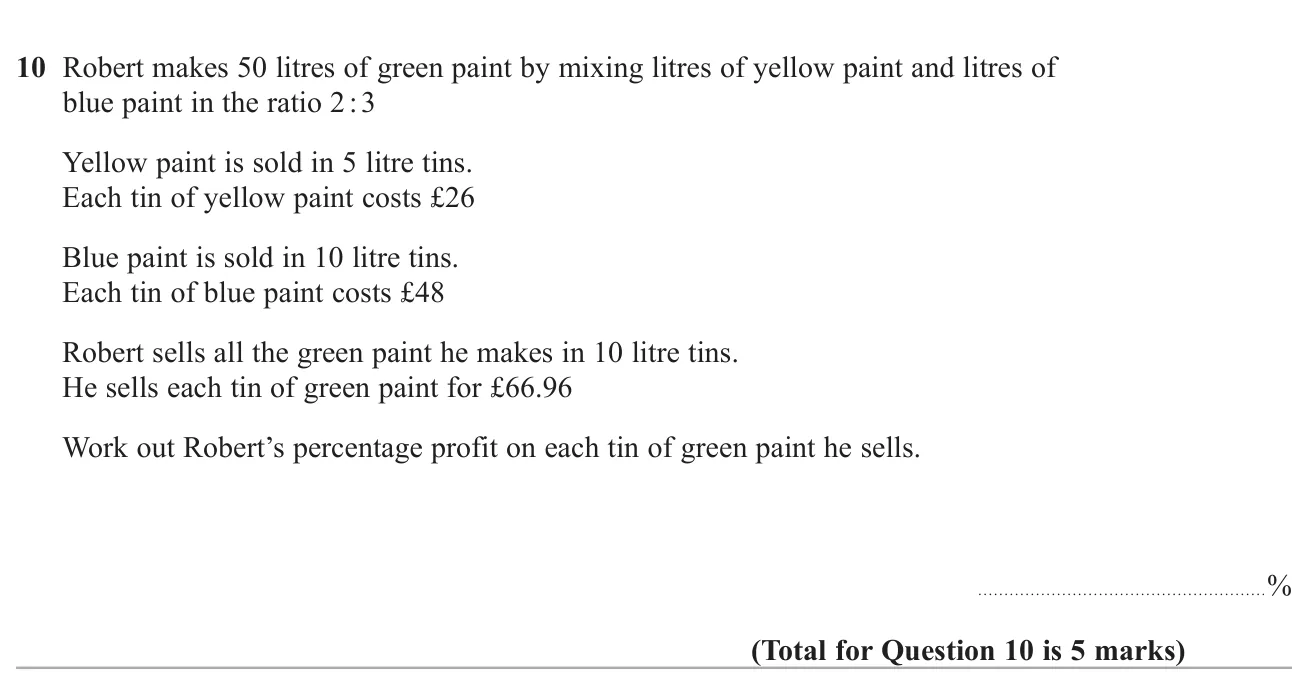
Worked solution Checked against the mark scheme
Yellow = 2 5 × 50 = 20 = \frac{2}{5} \times 50 = 20 = 5 2 × 50 = 20 = 30 = 30 = 30
Cost = 4 × 26 + 3 × 48 = 104 + 144 = £ 248 = 4 \times 26 + 3 \times 48 = 104 + 144 = £248 = 4 × 26 + 3 × 48 = 104 + 144 = £248
Cost per 10 litre tin = 248 ÷ 5 = £ 49.60 = 248 \div 5 = £49.60 = 248 ÷ 5 = £49.60
Profit = 66.96 − 49.60 = £ 17.36 = 66.96 - 49.60 = £17.36 = 66.96 − 49.60 = £17.36
17.36 49.60 × 100 = 35 % \frac{17.36}{49.60} \times 100 = 35\% 49.60 17.36 × 100 = 35%
Watch out: Dividing the profit by the selling price (66.96) instead of the cost.
© Pearson Education Ltd. November 2018 Paper 1 (Higher, non-calculator), question 11.
Worked solution Checked against the mark scheme
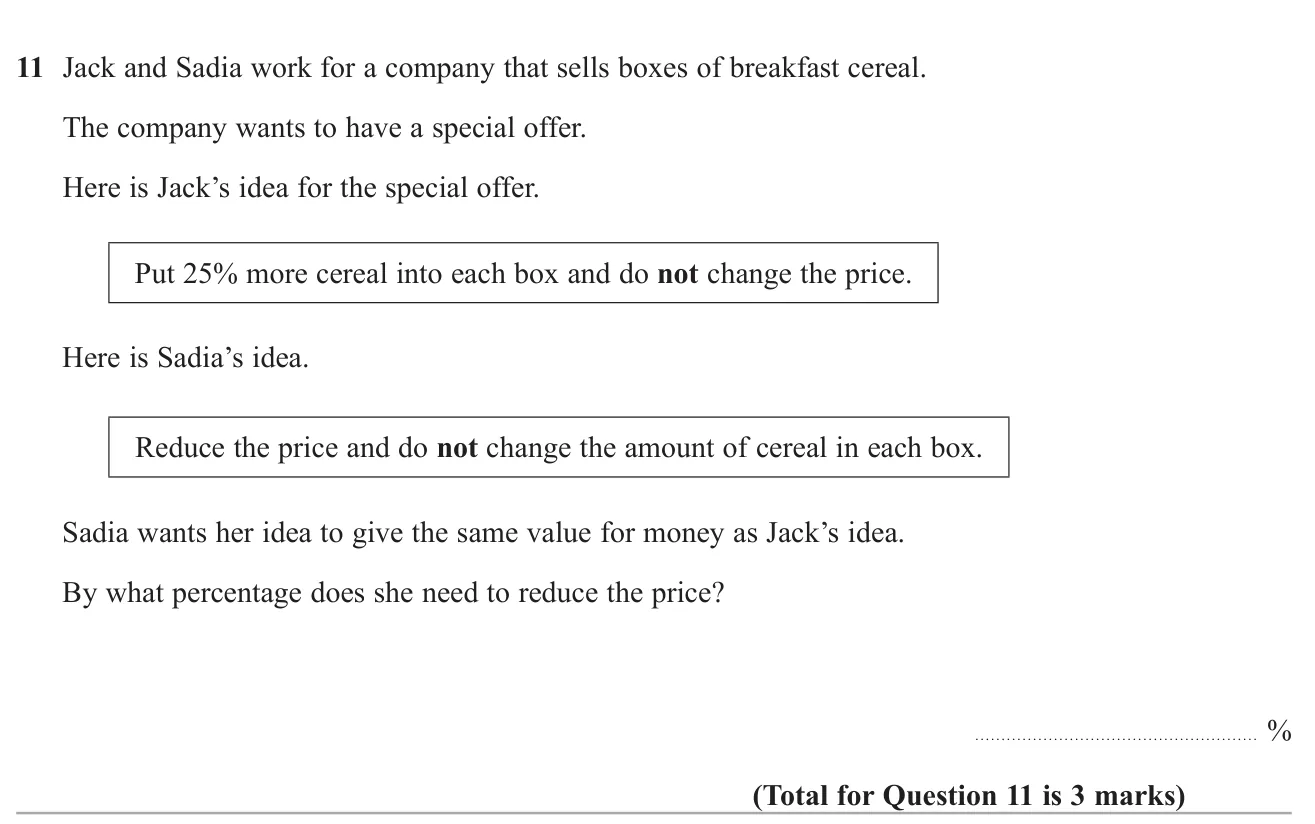
Jack: 125 g for the price of 100 g, so 1 g costs 100 125 = 0.8 \frac{100}{125} = 0.8 125 100 = 0.8
Sadia needs the price of the normal box to be 80% of the original.
Reduction = 100 % − 80 % = 20 % = 100\% - 80\% = 20\% = 100% − 80% = 20%
Watch out: Answering 25%.
Also tested in these questions Their main topic is different, but part of each one tests this topic.
November 2024 · Paper 2 Foundation · Q1 : Convert a percentage into a fraction.June 2024 · Paper 1 Foundation · Q2 : Convert a decimal into a percentage.June 2024 · Paper 1 Foundation · Q26 : Use a fraction and two linked ratios to find what percentage of all jars are empty small jars.June 2024 · Paper 2 Foundation · Q25 : Share sweets in a ratio, apply a fraction and a percentage transfer, and check if everyone ends up equal.June 2024 · Paper 3 Foundation · Q1 : Convert a percentage into a fraction.June 2024 · Paper 3 Higher · Q14 : Work backwards through compound interest and withdrawals to find an original investment.June 2024 · Paper 3 Foundation · Q25 : Work out the number of workers after 3 years of 6% compound growth.June 2023 · Paper 2 Foundation · Q19 : Complete a frequency tree about car and bicycle ownership, then find a percentage from it.June 2023 · Paper 2 Foundation · Q25 : Find a percentage of an amount and then share it in a given ratio to find one part.June 2023 · Paper 2 Foundation · Q27 : Compare two house values after two years of compound percentage growth at different rates.June 2023 · Paper 3 Foundation · Q2 : Convert a fraction in tenths into a percentage.November 2022 · Paper 1 Foundation · Q18 : Share a total in a three-part ratio, remove fractions of two groups, and give one group as a percentage of what remains.November 2022 · Paper 1 Foundation · Q23 : Use survey results to estimate how many of one car model a factory should build.November 2022 · Paper 2 Higher · Q10 : Work backwards from a car's value after two years of depreciation at different rates to find its original price.November 2022 · Paper 3 Higher · Q17 : Combine three weight relationships to write the ratio of four boxes' weights in whole numbers.November 2022 · Paper 3 Higher · Q25 : Use masses and densities of two parts of a solid to find one part's share of the total volume as a percentage.June 2022 · Paper 1 Foundation · Q5 : Order a fraction, a decimal and a percentage from smallest to largest.June 2022 · Paper 1 Foundation · Q25 : Share a total in a ratio, then take a fraction and a percentage away to find the remaining group.June 2022 · Paper 3 Foundation · Q1 : Convert a percentage into a fraction.June 2022 · Paper 3 Higher · Q10 : Work backwards from a car's value after one percentage fall and two further equal percentage falls to find the original price.November 2021 · Paper 1 Foundation · Q1 : Convert a fraction in tenths into a percentage.November 2021 · Paper 3 Foundation · Q13 : Turn a land-to-water ratio into a percentage, then turn a percentage into a land-to-water ratio.November 2020 · Paper 2 Foundation · Q4 : Change one quarter into a percentage.November 2020 · Paper 2 Foundation · Q23 : Split a number of tins in a ratio, convert to numbers of small and large boxes, and test a claim about the percentage of large boxes.November 2019 · Paper 2 Foundation · Q3 : Convert a decimal into a percentage.June 2019 · Paper 3 Foundation · Q23 : Combine percentage, fraction and ratio information to find the total number of medium packets bought by three people.November 2018 · Paper 1 Foundation · Q2 : Convert a decimal to a percentage.November 2018 · Paper 3 Foundation · Q2 : Convert a percentage into a fraction.November 2018 · Paper 3 Foundation · Q23 : Read a grouped bar chart to find a percentage, then show an estimate of the mean from grouped data.June 2018 · Paper 2 Foundation · Q1 : Convert a fraction with denominator 50 into a percentage.June 2018 · Paper 2 Higher · Q9 : Find a first-year compound interest rate from the new balance, then apply half that rate for the second year.June 2018 · Paper 2 Foundation · Q23 : Find a deposit after VAT and monthly payments, then write it as a simplified ratio to the payments.Specimen · Paper 1 Foundation · Q18 : Use a fraction and a percentage of a total to find how many passengers are left over.Specimen · Paper 2 Higher · Q6 : Find the value of an investment after two years of compound interest.Specimen · Paper 2 Higher · Q8 : Work out what percentage of a rectangle is shaded when a semicircle is cut out of it.Specimen · Paper 2 Higher · Q15 : Find the percentage increase in a pendulum's period when its length goes up by 40% and the period varies as the square root of length.Specimen · Paper 2 Foundation · Q27 : Find what percentage of a rectangle is shaded when a semicircle is cut from it.Specimen · Paper 3 Higher · Q8 : Work backwards from a compound-interest total to the original sum, then compare compound interest with a flat interest payment over five years.Specimen · Paper 3 Foundation · Q25 : Estimate the packs of tiles needed to cover a trapezium-shaped wall, then test whether 10% more tiles means 10% more packs.