Revision guide by The Full Marks
Ratio: what you need to know A ratio compares amounts, such as 2 : 3 2 : 3 2 : 3
Key facts Simplify a ratio by dividing every part by the same number, like fractions: 12 : 18 = 2 : 3 12 : 18 = 2 : 3 12 : 18 = 2 : 3 Order matters: boys to girls 2 : 3 2 : 3 2 : 3 If a ratio is a : b a : b a : b a a + b \frac{a}{a+b} a + b a The ratio a : b a : b a : b a b \frac{a}{b} b a In 1 : n 1 : n 1 : n Fraction to ratio: if 1 4 \frac{1}{4} 4 1 = 1 : 3 = 1 : 3 = 1 : 3 1 : 4 1 : 4 1 : 4 One quantity as a fraction of another can be more than 1: 18 18 18 12 12 12 18 12 = 3 2 \frac{18}{12} = \frac{3}{2} 12 18 = 2 3 Simplifying and comparing Put both amounts in the same units. Divide all parts by their highest common factor. For 1 : n 1 : n 1 : n n n n Combining two ratios Find the quantity that appears in both ratios. Scale each ratio so that shared part is the same number (use the LCM). Write the three-part ratio. Worked examples Example 1 Foundation · grade 3
A club has 12 12 12 18 18 18
Show the solution (a) 12 : 18 12 : 18 12 : 18 6 6 6 2 : 3 2 : 3 2 : 3 = 2 + 3 = 5 = 2 + 3 = 5 = 2 + 3 = 5 2 5 \frac{2}{5} 5 2
Example 2 Foundation · grade 5
a : b = 3 : 4 a : b = 3 : 4 a : b = 3 : 4 b : c = 6 : 5 b : c = 6 : 5 b : c = 6 : 5 a : b : c a : b : c a : b : c c c c
Show the solution b b b 4 4 4 6 6 6 4 4 4 6 6 6 12 12 12 a : b = 9 : 12 a : b = 9 : 12 a : b = 9 : 12 b : c = 12 : 10 b : c = 12 : 10 b : c = 12 : 10 a : b : c = 9 : 12 : 10 a : b : c = 9 : 12 : 10 a : b : c = 9 : 12 : 10 = 31 = 31 = 31 c c c 10 31 \frac{10}{31} 31 10
Example 3 Higher · grade 7
The ratio of Amira's savings to Josh's savings is 3 : 5 3 : 5 3 : 5 2 : 3 2 : 3 2 : 3
Show the solution Let Amira have 3 k 3k 3 k 5 k 5k 5 k ( 3 k + 6 ) : ( 5 k + 6 ) = 2 : 3 (3k + 6) : (5k + 6) = 2 : 3 ( 3 k + 6 ) : ( 5 k + 6 ) = 2 : 3 3 ( 3 k + 6 ) = 2 ( 5 k + 6 ) 3(3k + 6) = 2(5k + 6) 3 ( 3 k + 6 ) = 2 ( 5 k + 6 ) 9 k + 18 = 10 k + 12 9k + 18 = 10k + 12 9 k + 18 = 10 k + 12 k = 6 k = 6 k = 6 24 : 36 = 2 : 3 24 : 36 = 2 : 3 24 : 36 = 2 : 3
Common mistakes Writing the ratio the wrong way round. Match the order of the words in the question. Turning 2 : 3 2 : 3 2 : 3 2 3 \frac{2}{3} 3 2 2 5 \frac{2}{5} 5 2 Combining ratios without matching the shared part first. Adding a number to the ratio numbers instead of to the amounts. Write the amounts as 3 k 3k 3 k 5 k 5k 5 k Exam tips 'Simplest form' means whole numbers with no common factor; the accuracy mark needs it fully simplified. Label your parts (e.g. B : G) so you don't lose track of the order. Questions people ask How do you simplify a ratio? Divide every part by the highest number that goes into all of them, for example 15 : 25 = 3 : 5 15 : 25 = 3 : 5 15 : 25 = 3 : 5
How do you turn a ratio into a fraction? Add the parts to get the total, then put the part you want over it. In 3 : 7 3 : 7 3 : 7 3 10 \frac{3}{10} 10 3
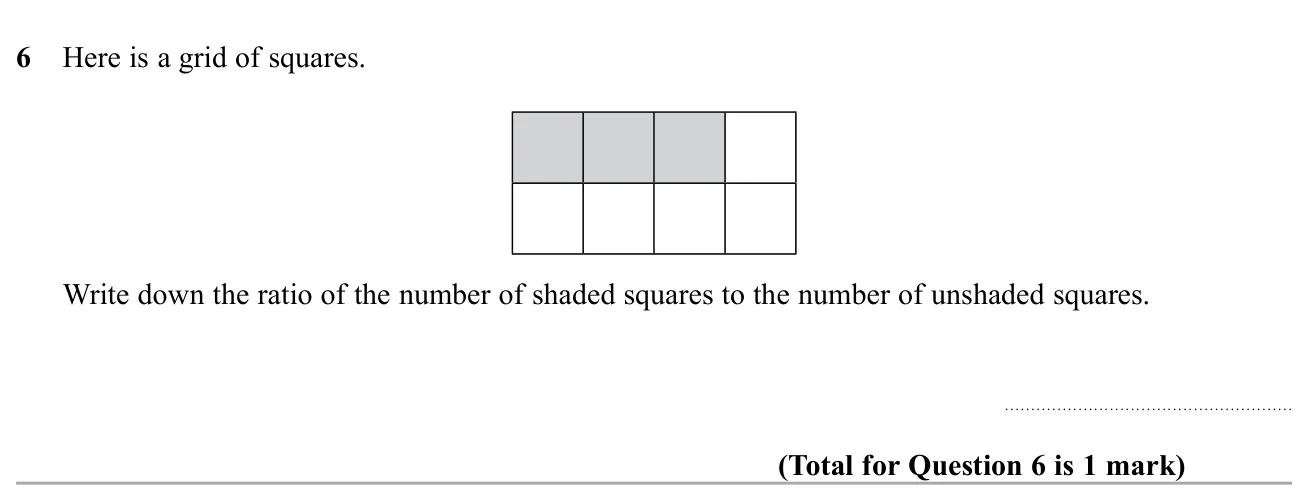
Exam questions: Ratio (55, easiest first) © Pearson Education Ltd. November 2019 Paper 3 (Foundation, calculator), question 6.
Worked solution Checked against the mark scheme
Count: 3 squares are shaded and 8 − 3 = 5 8 - 3 = 5 8 − 3 = 5
Shaded : unshaded = 3 : 5 = 3 : 5 = 3 : 5
Watch out: Writing 3 : 8, which compares shaded with the total.
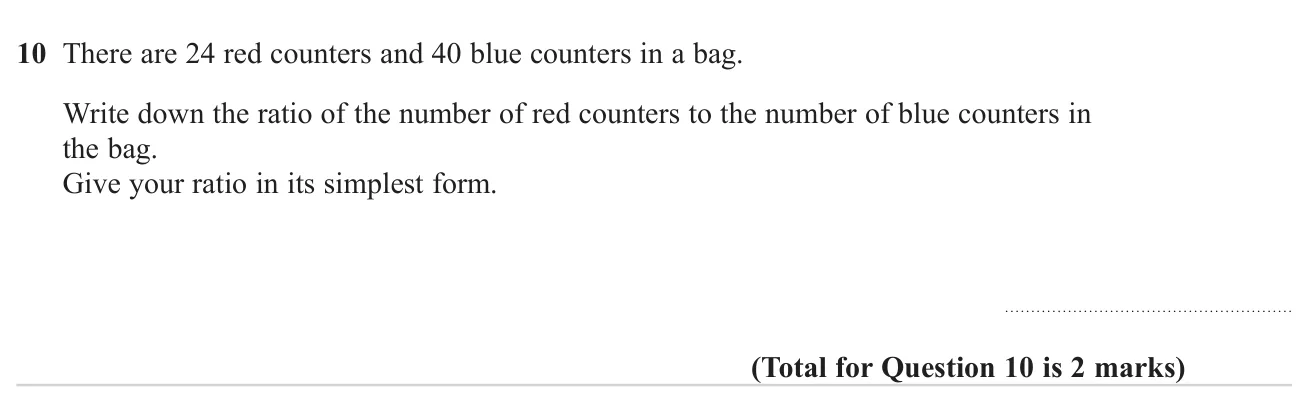
© Pearson Education Ltd. November 2023 Paper 2 (Foundation, calculator), question 10.
Worked solution Checked against the mark scheme
Red : blue = 24 : 40 = 24 : 40 = 24 : 40
The highest common factor of 24 and 40 is 8.
24 ÷ 8 = 3 24 \div 8 = 3 24 ÷ 8 = 3 40 ÷ 8 = 5 40 \div 8 = 5 40 ÷ 8 = 5 3 : 5 3 : 5 3 : 5
Watch out: Writing the ratio the wrong way round as 5 : 3.
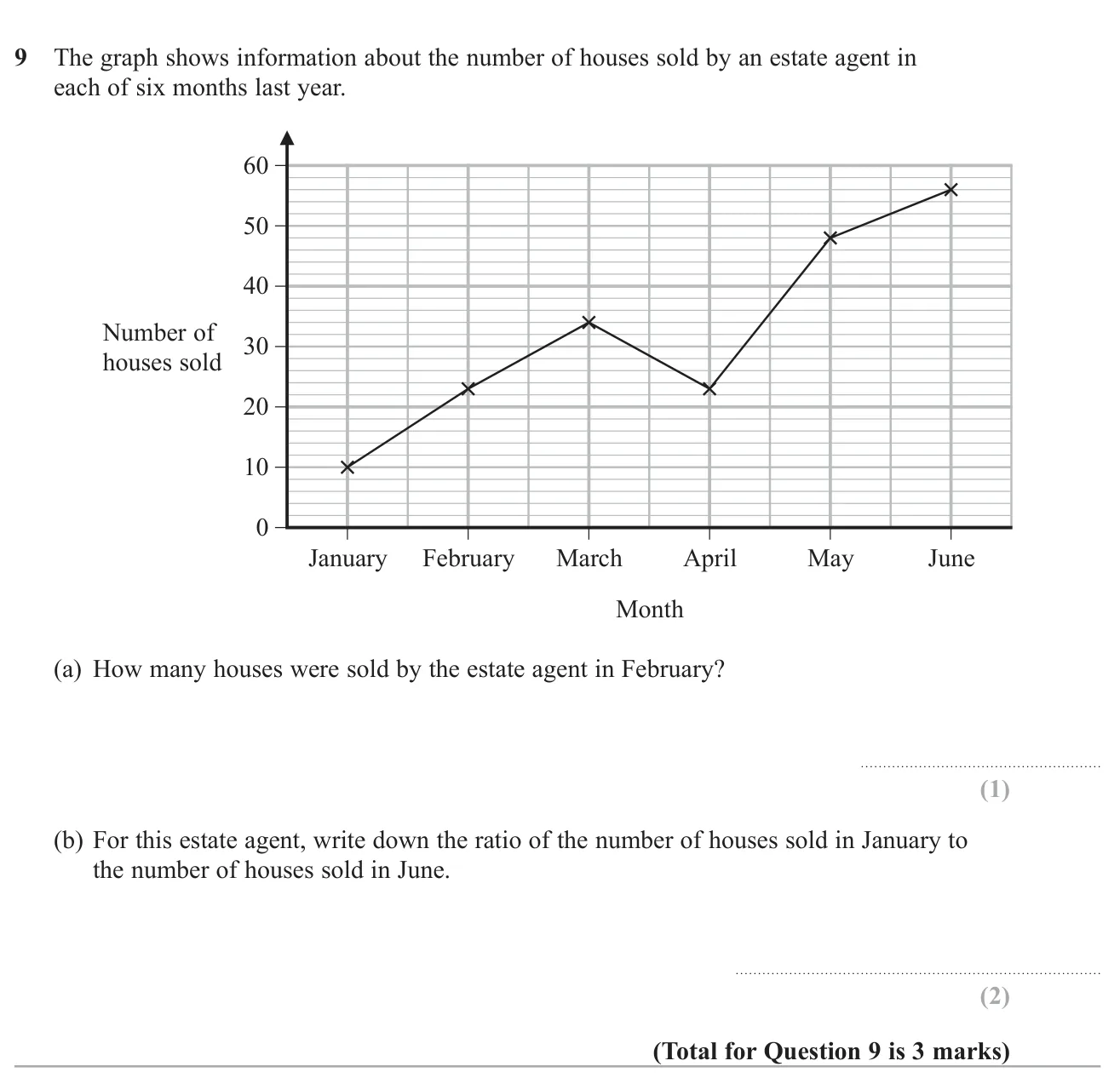
© Pearson Education Ltd. June 2022 Paper 2 (Foundation, calculator), question 9.
(a) 23 1 mark (b) 10 : 56 10 : 56 10 : 56 2 marks
Worked solution Checked against the mark scheme
(a) The February cross is at 23.
(b) January: 10 houses. June: 56 houses.
Ratio January : June = 10 : 56 = 5 : 28 = 10 : 56 = 5 : 28 = 10 : 56 = 5 : 28
Watch out: Writing the ratio the wrong way round, as 56 : 10.
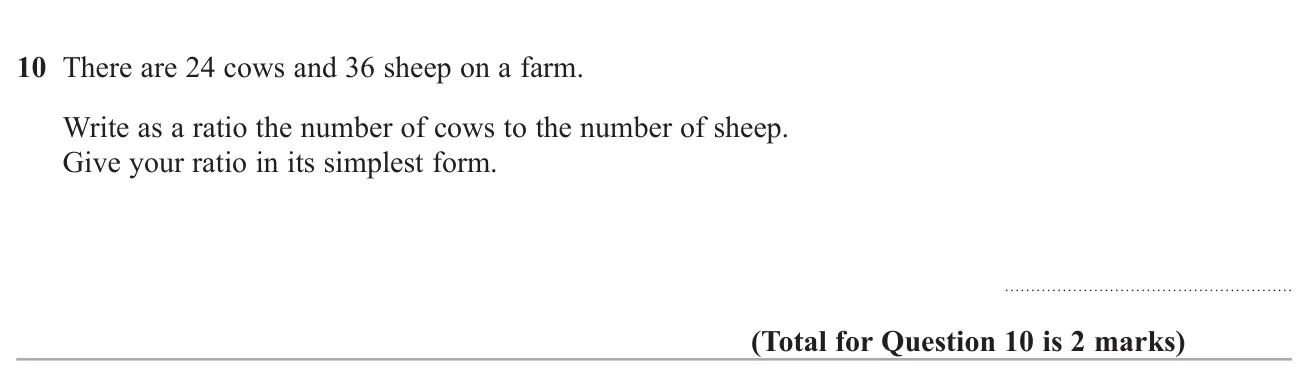
© Pearson Education Ltd. June 2024 Paper 1 (Foundation, non-calculator), question 10.
Worked solution Checked against the mark scheme
Cows : sheep = 24 : 36 = 24 : 36 = 24 : 36
Divide both by the HCF, 12: 2 : 3 2 : 3 2 : 3
Watch out: Writing the ratio the wrong way round (3 : 2).
© Pearson Education Ltd. November 2024 Paper 2 (Foundation, calculator), question 9.
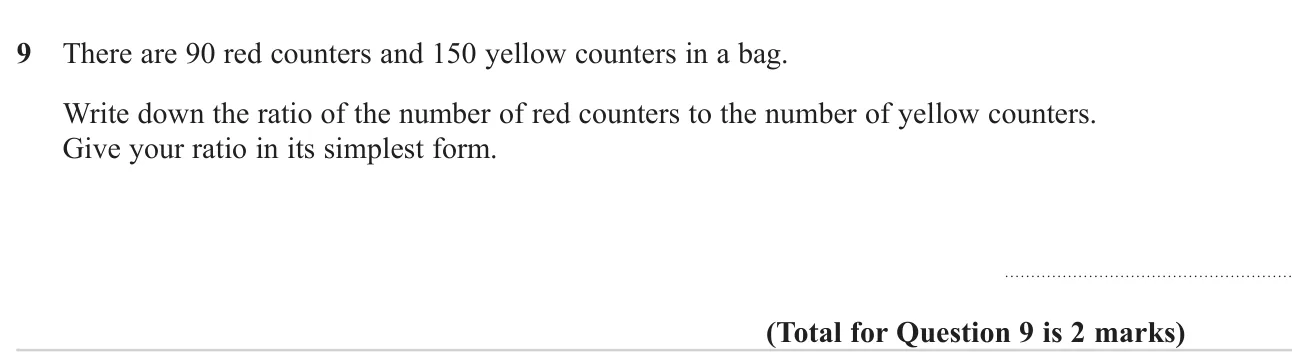
Worked solution Checked against the mark scheme
Red : yellow = 90 : 150 = 90 : 150 = 90 : 150
Divide both by 30 (their HCF): 3 : 5 3 : 5 3 : 5
Watch out: Writing the ratio the wrong way round as 5 : 3.
© Pearson Education Ltd. June 2023 Paper 1 (Foundation, non-calculator), question 14.
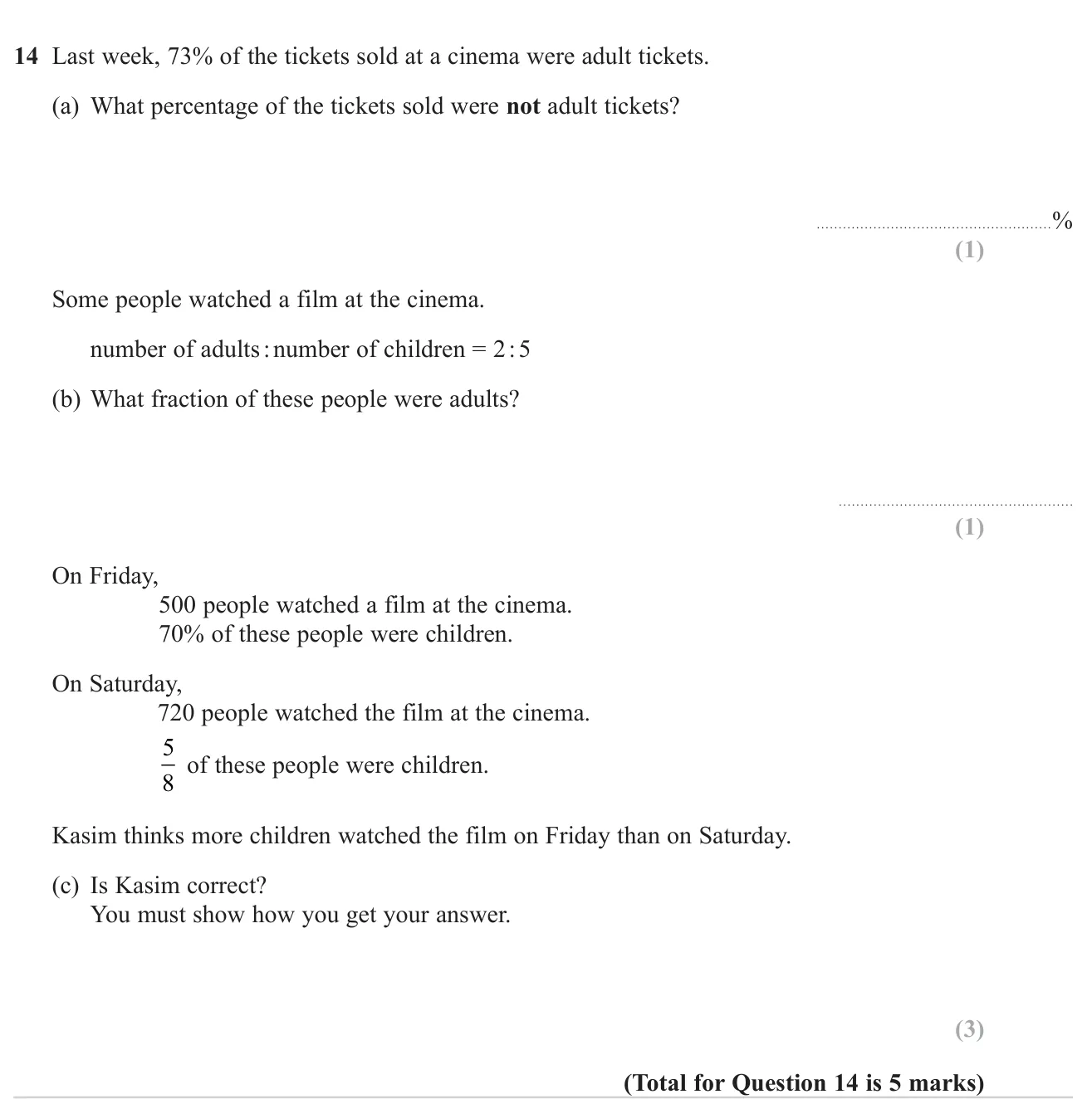
(a) 27 % 27\% 27% 1 mark (b) 2 7 \frac{2}{7} 7 2 1 mark (c) No: 350 children on Friday, 450 on Saturday 3 marks
Worked solution Checked against the mark scheme
(a) 100 − 73 = 27 % 100 - 73 = 27\% 100 − 73 = 27%
(b) Total parts = 2 + 5 = 7 = 2 + 5 = 7 = 2 + 5 = 7 2 7 \frac{2}{7} 7 2
(c) Friday: 0.7 × 500 = 350 0.7 \times 500 = 350 0.7 × 500 = 350
Saturday: 720 ÷ 8 × 5 = 450 720 \div 8 \times 5 = 450 720 ÷ 8 × 5 = 450
450 > 350 450 > 350 450 > 350 no , Kasim is wrong.
Watch out: In (b), writing 2/5 instead of 2/7.
© Pearson Education Ltd. November 2023 Paper 3 (Foundation, calculator), question 11.
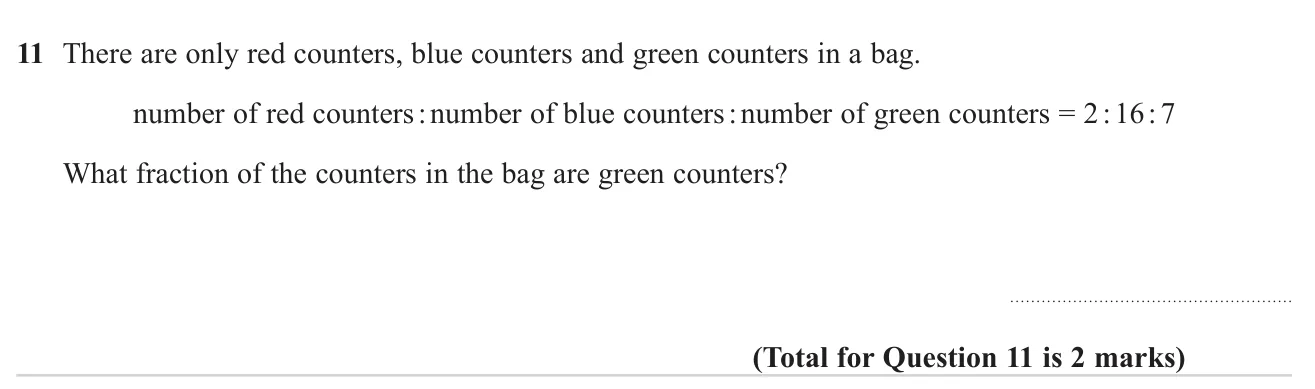
Answer 7 25 \frac{7}{25} 25 7 2 marks
Worked solution Checked against the mark scheme
Total parts = 2 + 16 + 7 = 25 = 2 + 16 + 7 = 25 = 2 + 16 + 7 = 25
Green is 7 of these parts, so the fraction is 7 25 \frac{7}{25} 25 7
Watch out: Writing 7/18, comparing green with the other colours instead of the total.
© Pearson Education Ltd. June 2023 Paper 3 (Foundation, calculator), question 15.
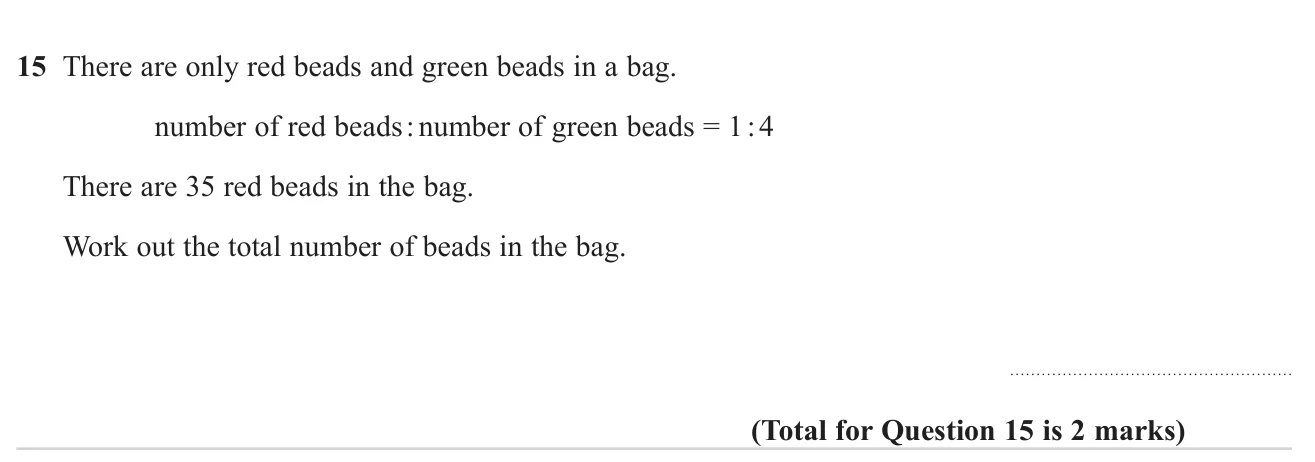
Worked solution Checked against the mark scheme
1 part is 35 beads, and there are 1 + 4 = 5 1 + 4 = 5 1 + 4 = 5
35 × 5 = 175 35 \times 5 = 175 35 × 5 = 175
Watch out: Giving 140, the number of green beads only.
© Pearson Education Ltd. November 2022 Paper 3 (Foundation, calculator), question 12.
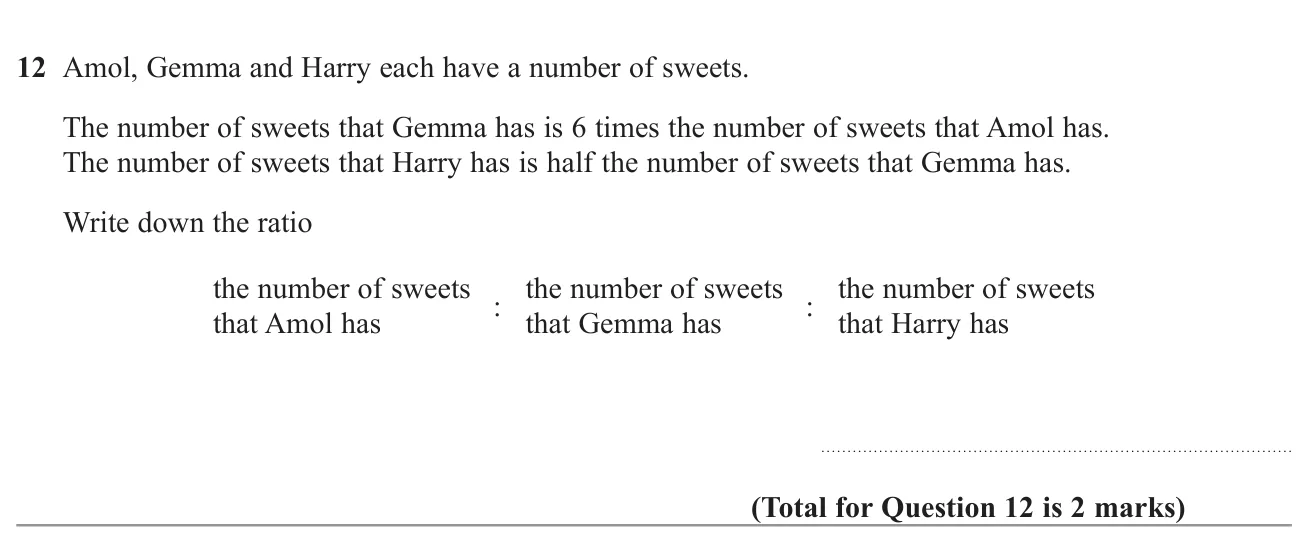
Answer 1 : 6 : 3 1 : 6 : 3 1 : 6 : 3 2 marks
Worked solution Checked against the mark scheme
Let Amol have 1 sweet. Gemma has 6 × 1 = 6 6 \times 1 = 6 6 × 1 = 6 6 ÷ 2 = 3 6 \div 2 = 3 6 ÷ 2 = 3
Ratio: 1 : 6 : 3 1 : 6 : 3 1 : 6 : 3
Watch out: Writing 1 : 6 : 12 by doubling instead of halving.
© Pearson Education Ltd. November 2021 Paper 3 (Foundation, calculator), question 13.
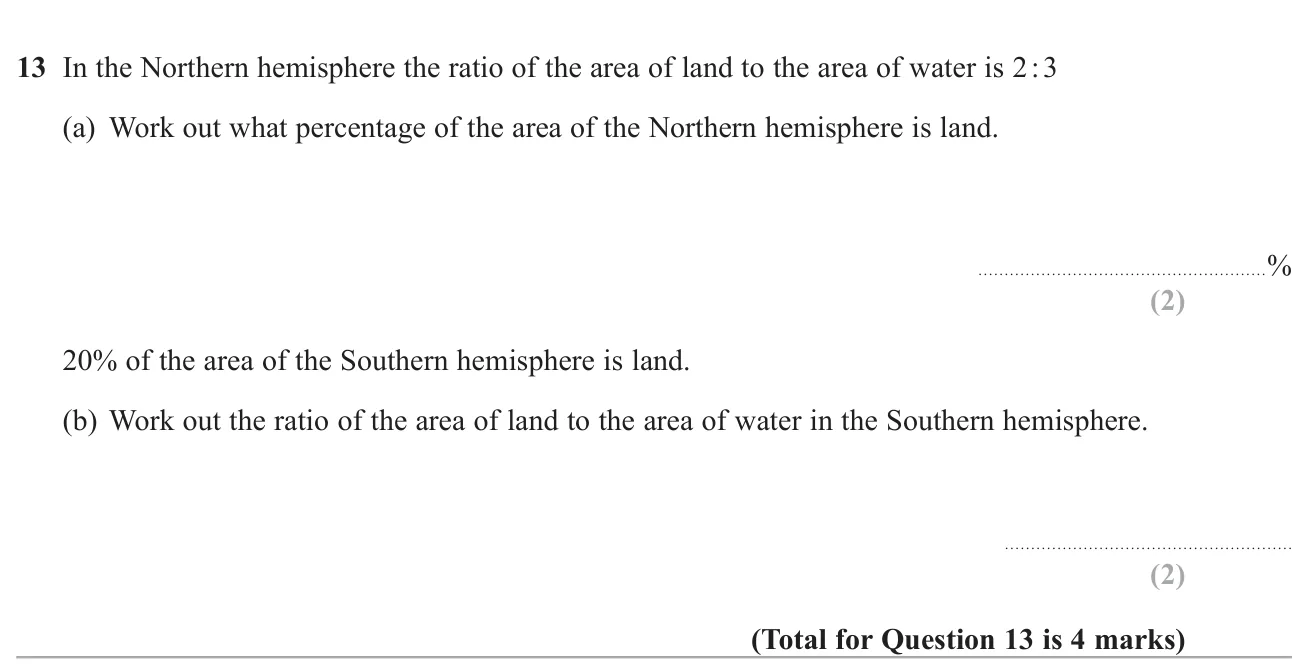
(a) 40% 2 marks (b) 20 : 80 2 marks
Worked solution Checked against the mark scheme
(a) There are 2 + 3 = 5 2 + 3 = 5 2 + 3 = 5
2 5 × 100 = 40 % \frac{2}{5} \times 100 = 40\% 5 2 × 100 = 40%
(b) Water is 100 − 20 = 80 % 100 - 20 = 80\% 100 − 20 = 80%
Land : water = 20 : 80 = 1 : 4 = 20 : 80 = 1 : 4 = 20 : 80 = 1 : 4
Watch out: In (a), using 2 3 \frac{2}{3} 3 2 2 5 \frac{2}{5} 5 2
© Pearson Education Ltd. November 2020 Paper 1 (Foundation, non-calculator), question 9.
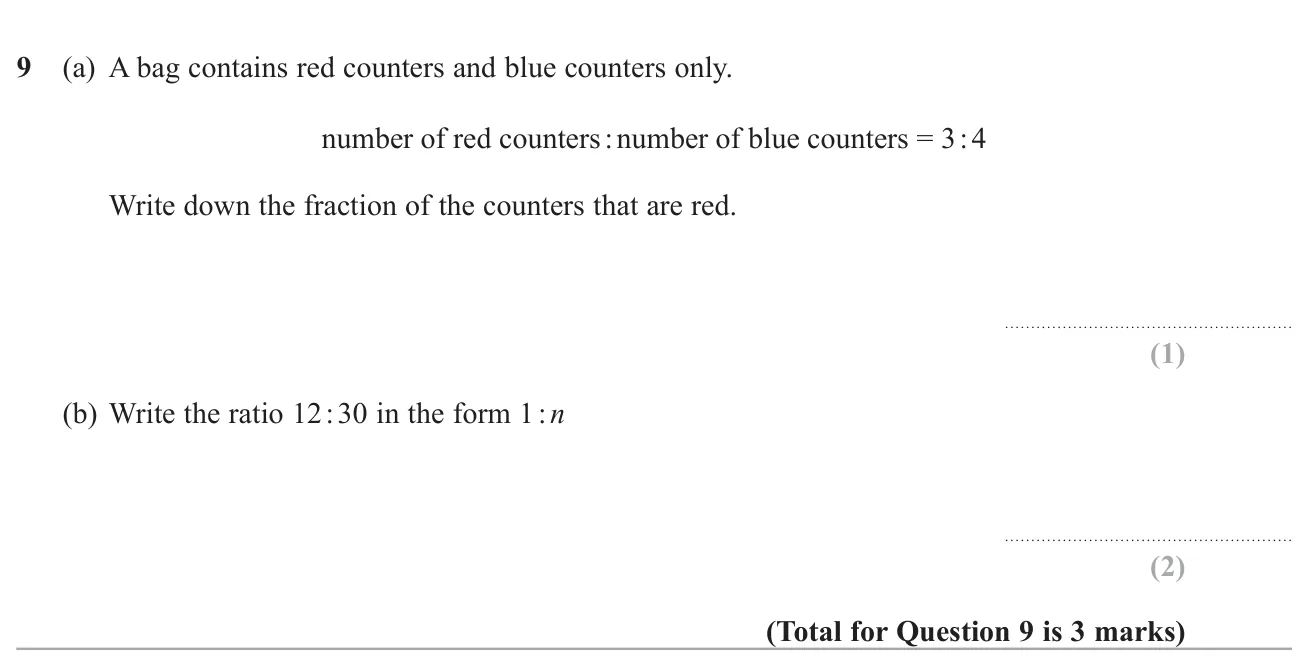
(a) 3 7 \frac{3}{7} 7 3 1 mark (b) 1 : 2.5 1 : 2.5 1 : 2.5 2 marks
Worked solution Checked against the mark scheme
(a) There are 3 + 4 = 7 3 + 4 = 7 3 + 4 = 7 3 7 \frac{3}{7} 7 3
(b) Divide both sides by 12: 12 ÷ 12 = 1 12 \div 12 = 1 12 ÷ 12 = 1 30 ÷ 12 = 2.5 30 \div 12 = 2.5 30 ÷ 12 = 2.5
So the ratio is 1 : 2.5 1 : 2.5 1 : 2.5
Watch out: In (a) writing 3 4 \frac{3}{4} 4 3
© Pearson Education Ltd. November 2020 Paper 2 (Foundation, calculator), question 17.
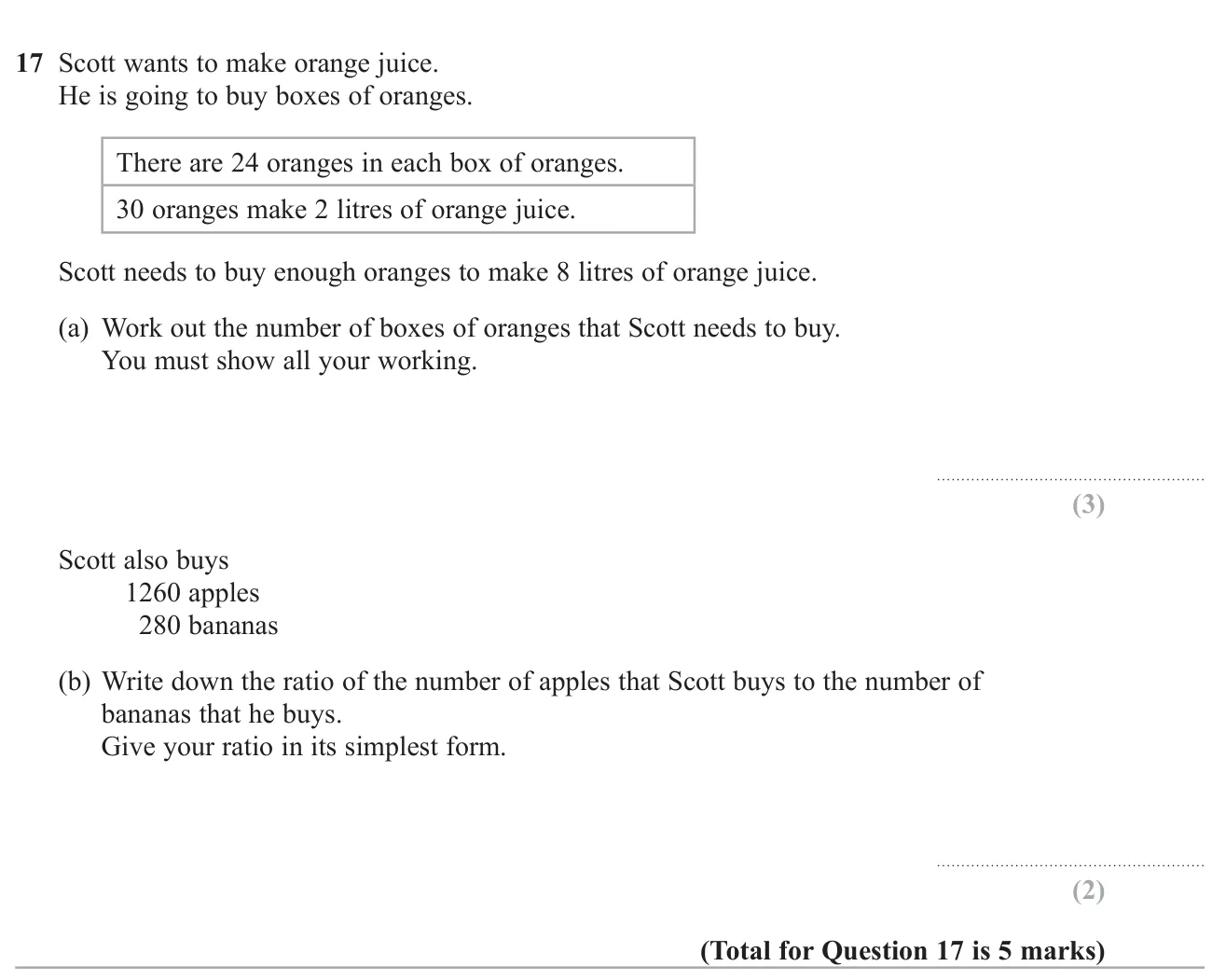
(a) 5 boxes 3 marks (b) 9 : 2 9 : 2 9 : 2 2 marks
Worked solution Checked against the mark scheme
(a) 8 litres is 8 ÷ 2 = 4 8 \div 2 = 4 8 ÷ 2 = 4
Oranges needed: 4 × 30 = 120 4 \times 30 = 120 4 × 30 = 120
Boxes: 120 ÷ 24 = 5 120 \div 24 = 5 120 ÷ 24 = 5
(b) 1260 : 280 1260 : 280 1260 : 280 9 : 2 9 : 2 9 : 2
Watch out: In (b), writing the ratio the wrong way round as 2 : 9.
© Pearson Education Ltd. November 2020 Paper 3 (Foundation, calculator), question 15.
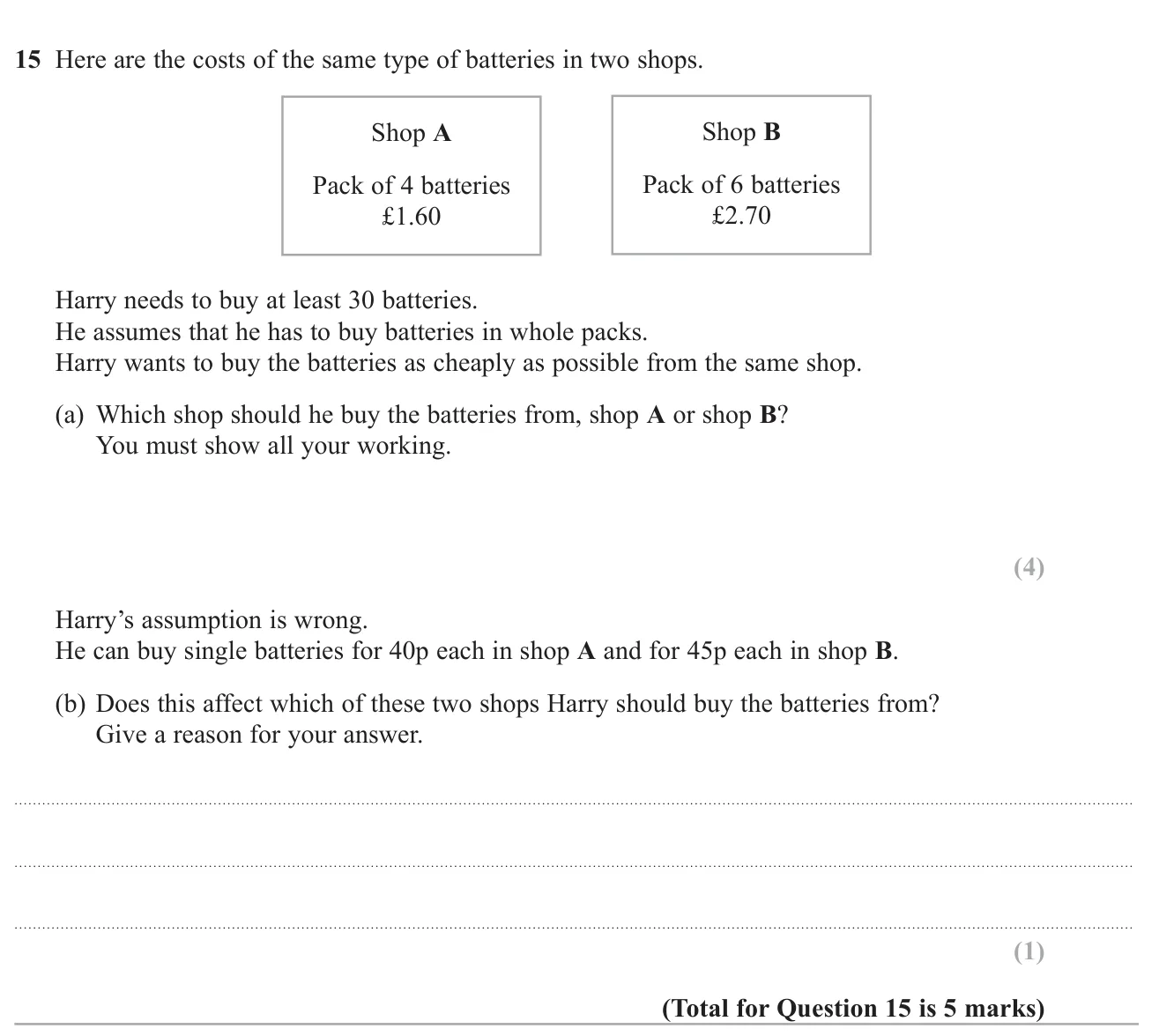
(a) Shop A (£12.80 compared with £13.50) 4 marks (b) No: shop A is still cheaper (e.g. 7 packs and 2 singles cost £12, shop B still £13.50) 1 mark
Worked solution Checked against the mark scheme
(a) Shop A: 30 ÷ 4 = 7.5 30 \div 4 = 7.5 30 ÷ 4 = 7.5 8 × £ 1.60 = £ 12.80 8 \times £1.60 = £12.80 8 × £1.60 = £12.80
Shop B: 30 ÷ 6 = 5 30 \div 6 = 5 30 ÷ 6 = 5 5 × £ 2.70 = £ 13.50 5 \times £2.70 = £13.50 5 × £2.70 = £13.50
Shop A is cheaper.
(b) Shop A: 7 packs + 2 singles = £ 11.20 + £ 0.80 = £ 12 = £11.20 + £0.80 = £12 = £11.20 + £0.80 = £12 no change : shop A.
Watch out: Using 7.5 packs instead of rounding up to 8.
© Pearson Education Ltd. November 2019 Paper 2 (Foundation, calculator), question 14.
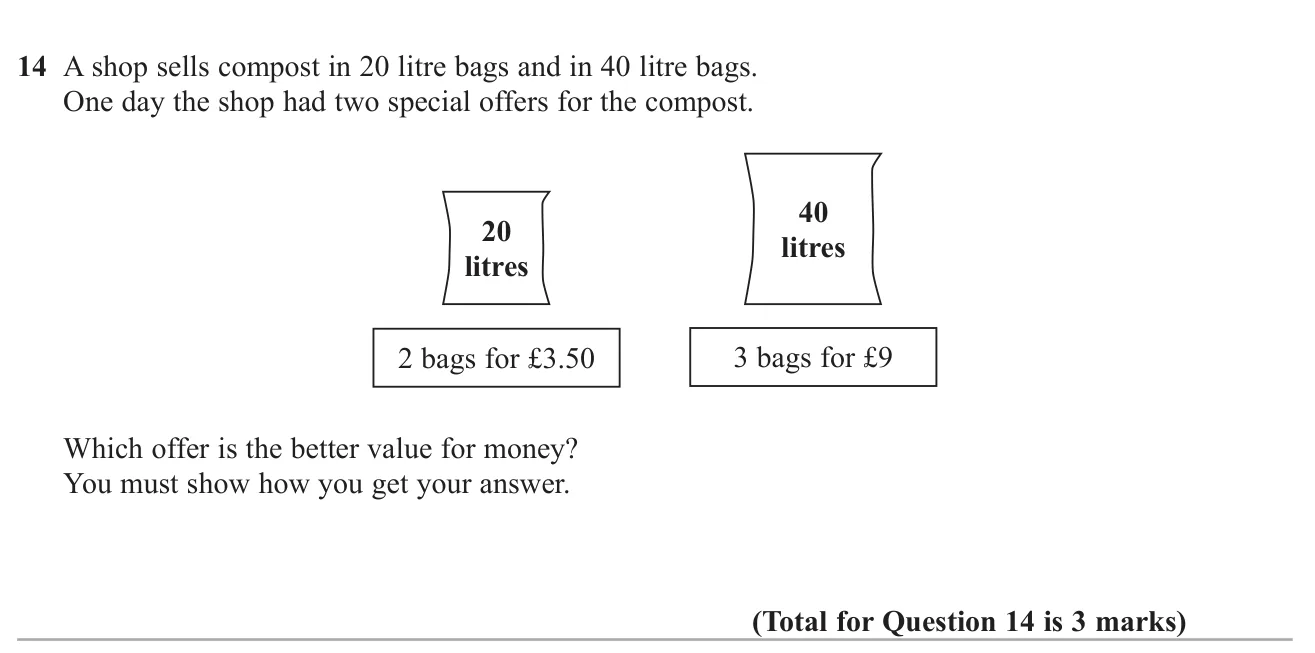
Answer The 40 litre offer (e.g. £0.075 per litre against £0.0875 per litre) 3 marks
Worked solution Checked against the mark scheme
20 litre offer: 2 bags = 40 litres for £3.50, so 3.50 ÷ 40 = £ 0.0875 3.50 \div 40 = £0.0875 3.50 ÷ 40 = £0.0875
40 litre offer: 3 bags = 120 litres for £9, so 9 ÷ 120 = £ 0.075 9 \div 120 = £0.075 9 ÷ 120 = £0.075
The 40 litre bags are cheaper per litre, so they are better value.
Watch out: Comparing the price per bag without allowing for the different bag sizes.
© Pearson Education Ltd. November 2019 Paper 2 (Foundation, calculator), question 15.
Worked solution Checked against the mark scheme
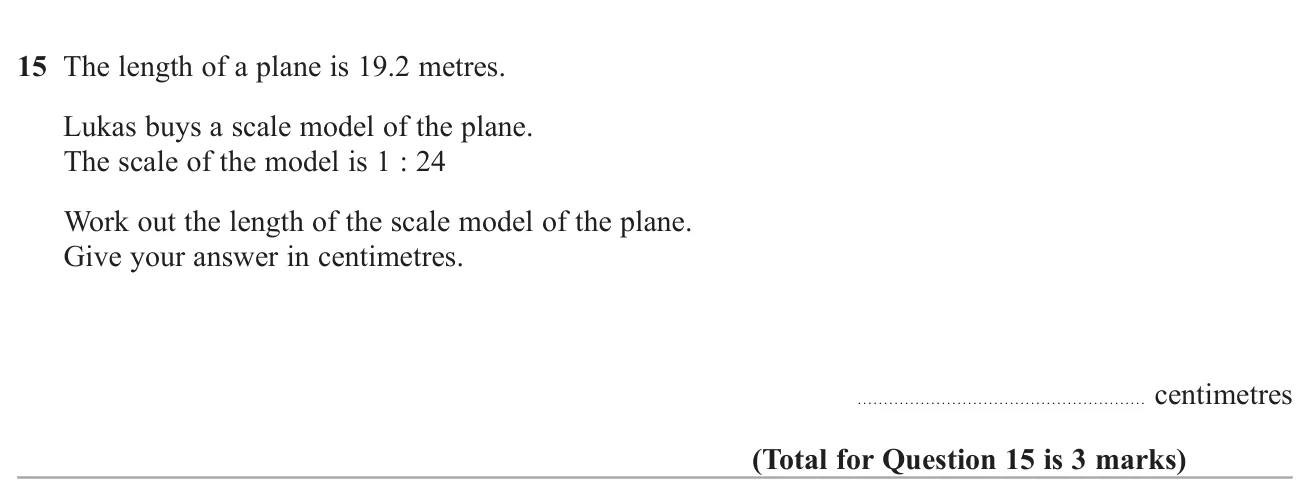
19.2 m = 1920 cm 19.2\text{ m} = 1920\text{ cm} 19.2 m = 1920 cm
Model length: 1920 ÷ 24 = 80 cm 1920 \div 24 = 80\text{ cm} 1920 ÷ 24 = 80 cm
Watch out: Leaving the answer as 0.8 (metres).
© Pearson Education Ltd. June 2019 Paper 2 (Foundation, calculator), question 14.
Worked solution Checked against the mark scheme
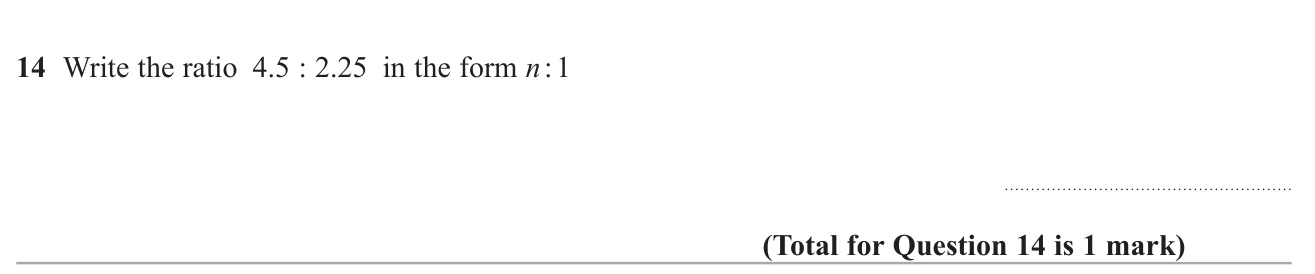
Divide both sides by 2.25:
4.5 ÷ 2.25 = 2 4.5 \div 2.25 = 2 4.5 ÷ 2.25 = 2 2.25 ÷ 2.25 = 1 2.25 \div 2.25 = 1 2.25 ÷ 2.25 = 1
So the ratio is 2 : 1 2 : 1 2 : 1
Watch out: Writing 1 : 2 1 : 2 1 : 2
© Pearson Education Ltd. June 2019 Paper 3 (Foundation, calculator), question 12.
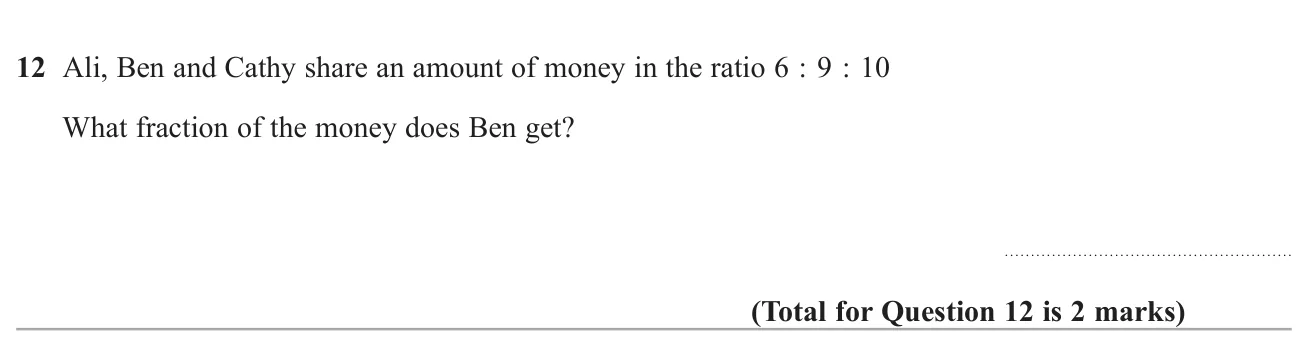
Answer 9 25 \frac{9}{25} 25 9 2 marks
Worked solution Checked against the mark scheme
Total parts: 6 + 9 + 10 = 25 6 + 9 + 10 = 25 6 + 9 + 10 = 25
Ben gets 9 of the 25 parts, so 9 25 \frac{9}{25} 25 9
Watch out: Writing 9/16 (Ben over the other two) or 9/10.
© Pearson Education Ltd. November 2018 Paper 1 (Foundation, non-calculator), question 13.
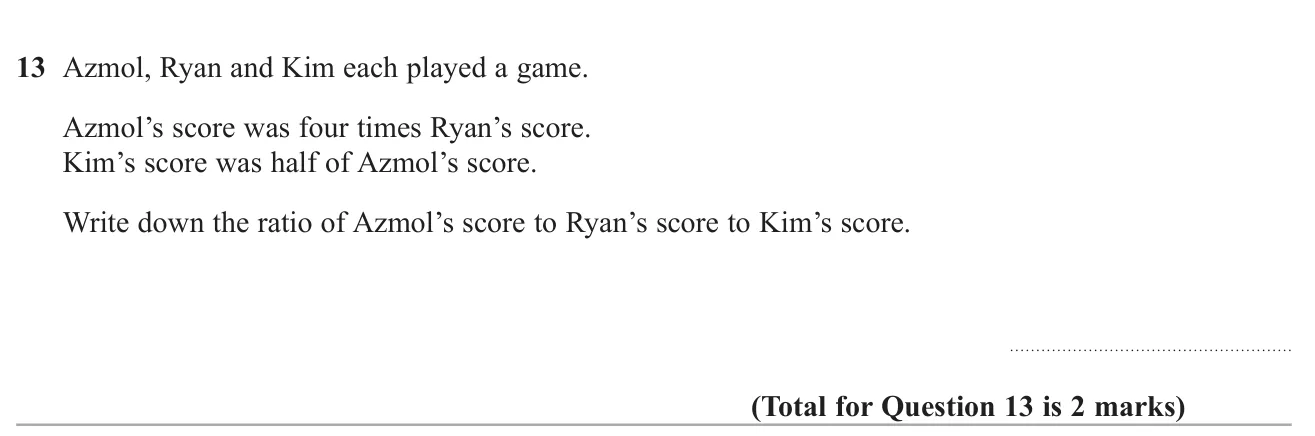
Answer 4 : 1 : 2 4 : 1 : 2 4 : 1 : 2 2 marks
Worked solution Checked against the mark scheme
Let Ryan's score be 1.
Azmol = 4 × 1 = 4 = 4 \times 1 = 4 = 4 × 1 = 4 = 4 ÷ 2 = 2 = 4 \div 2 = 2 = 4 ÷ 2 = 2
Azmol : Ryan : Kim = 4 : 1 : 2 = 4 : 1 : 2 = 4 : 1 : 2
Watch out: Writing the ratio in the wrong order, e.g. 1 : 4 : 2.
© Pearson Education Ltd. November 2018 Paper 3 (Foundation, calculator), question 16.
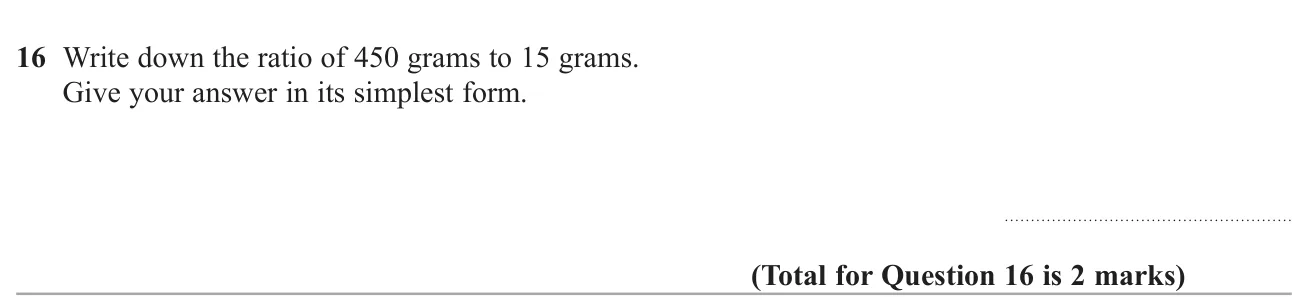
Answer 30 : 1 30:1 30 : 1 2 marks
Worked solution Checked against the mark scheme
450 : 15 450 : 15 450 : 15
Divide both sides by 15: 30 : 1 30 : 1 30 : 1
Watch out: Writing the ratio the wrong way round as 1 : 30.
© Pearson Education Ltd. Specimen Paper 1 (Foundation, non-calculator), question 12.
Worked solution Checked against the mark scheme
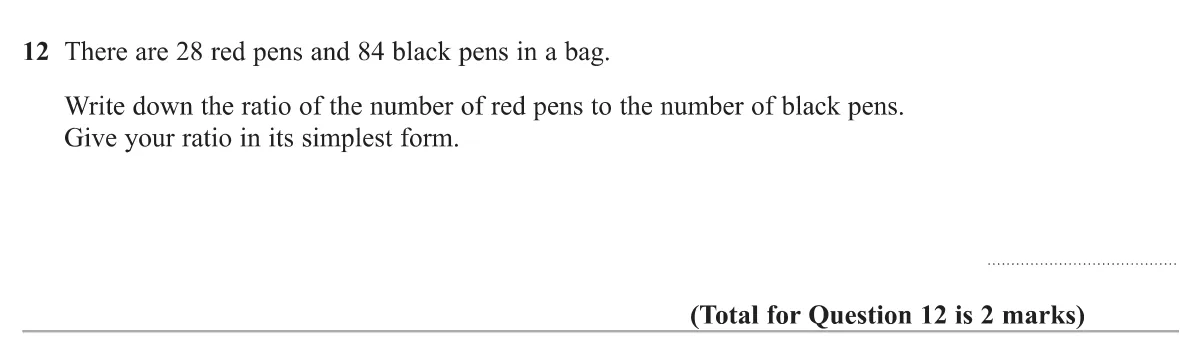
Red : black = 28 : 84 = 28 : 84 = 28 : 84
The HCF of 28 and 84 is 28, so divide both by 28:
28 : 84 = 1 : 3 28 : 84 = 1 : 3 28 : 84 = 1 : 3
Watch out: Writing the ratio the wrong way round, 3 : 1.
© Pearson Education Ltd. November 2021 Paper 1 (Foundation, non-calculator), question 12.
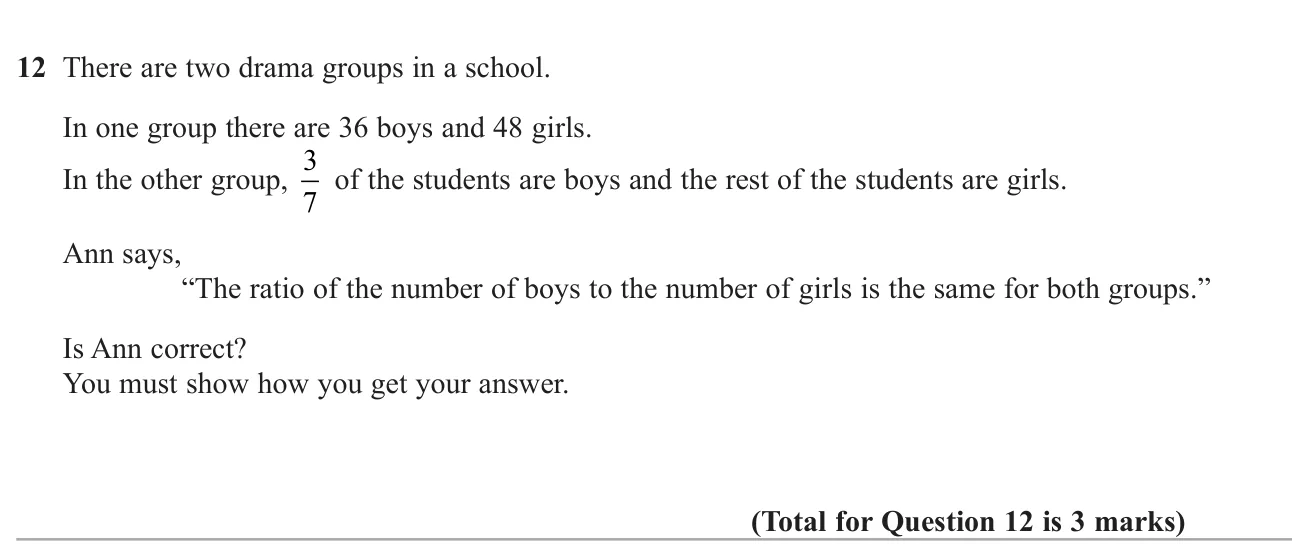
Answer Yes: both ratios simplify to 3 : 4 3 : 4 3 : 4 3 marks
Worked solution Checked against the mark scheme
Group 1: 36 : 48 36 : 48 36 : 48 3 : 4 3 : 4 3 : 4
Group 2: 3 7 \frac{3}{7} 7 3 4 7 \frac{4}{7} 7 4 = 3 : 4 = 3 : 4 = 3 : 4
Both are 3 : 4 3 : 4 3 : 4 correct .
Watch out: Comparing 3 : 7 with 3 : 4, confusing a part-to-whole fraction with a part-to-part ratio.
© Pearson Education Ltd. November 2020 Paper 2 (Foundation, calculator), question 20.
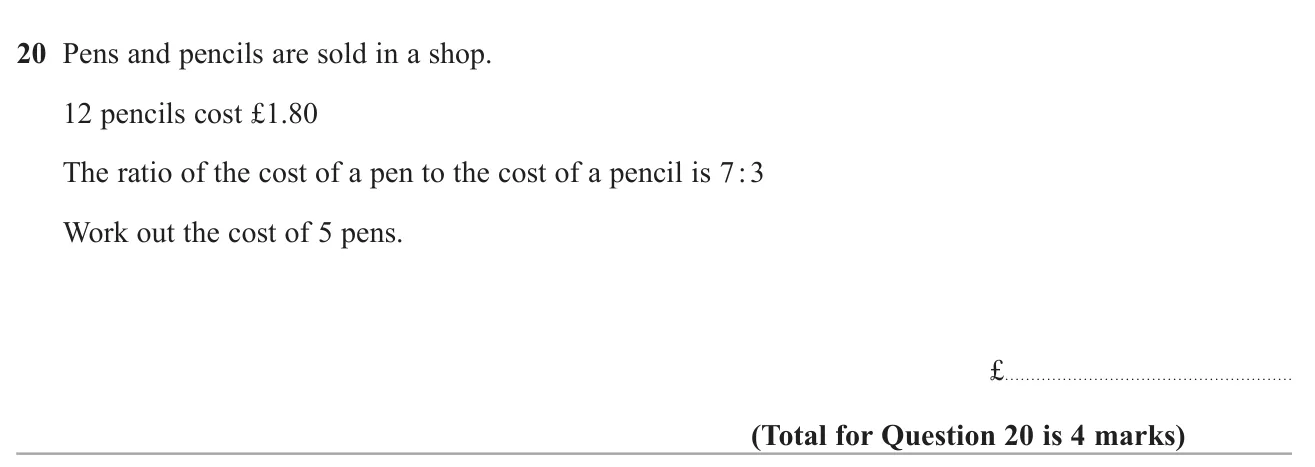
Worked solution Checked against the mark scheme
One pencil: £ 1.80 ÷ 12 = £ 0.15 £1.80 \div 12 = £0.15 £1.80 ÷ 12 = £0.15
One ratio part: £ 0.15 ÷ 3 = £ 0.05 £0.15 \div 3 = £0.05 £0.15 ÷ 3 = £0.05
One pen: 7 × £ 0.05 = £ 0.35 7 \times £0.05 = £0.35 7 × £0.05 = £0.35
Five pens: 5 × £ 0.35 = £ 1.75 5 \times £0.35 = £1.75 5 × £0.35 = £1.75
Watch out: Treating 7 : 3 as the split of £1.80.
© Pearson Education Ltd. November 2019 Paper 2 (Foundation, calculator), question 19.
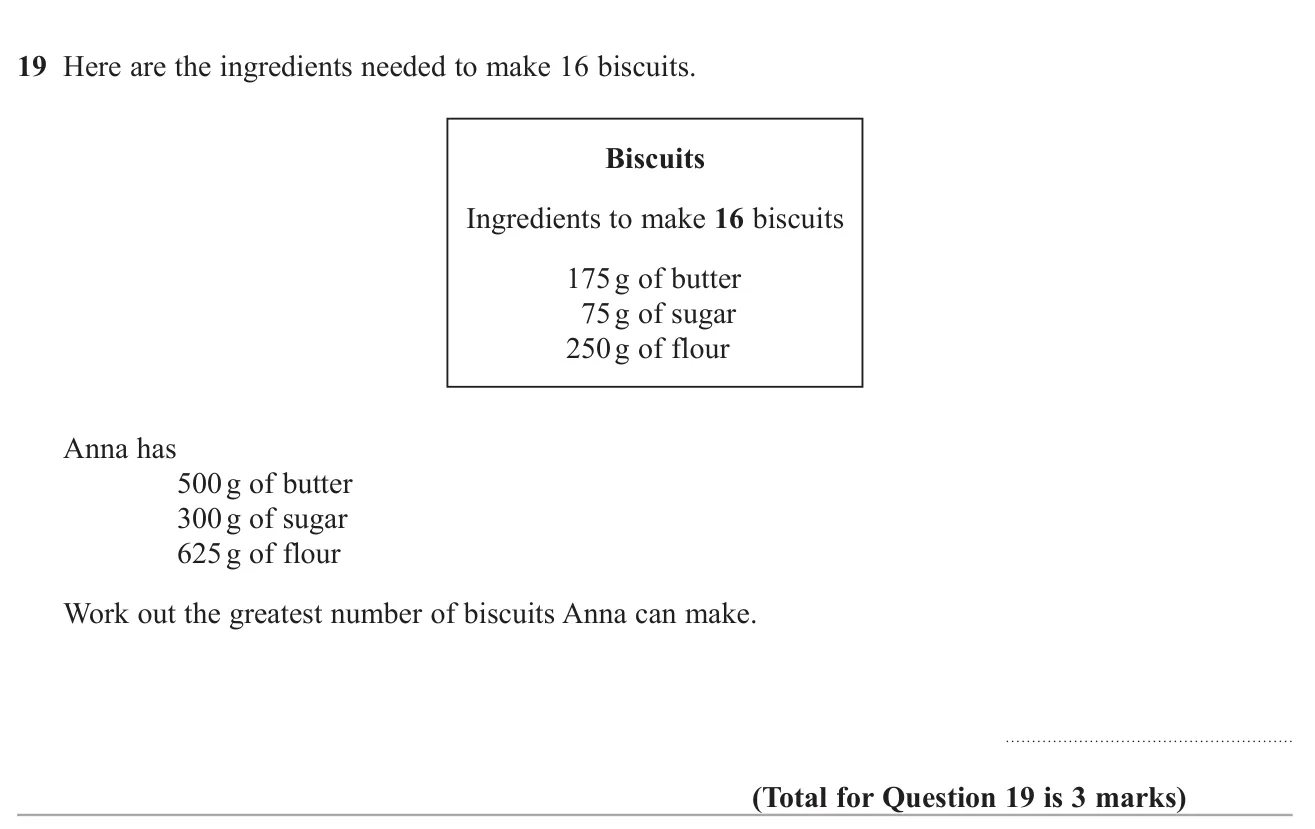
Worked solution Checked against the mark scheme
Batches of 16 each ingredient allows:
Butter 500 ÷ 175 = 2.86 500 \div 175 = 2.86 500 ÷ 175 = 2.86 300 ÷ 75 = 4 300 \div 75 = 4 300 ÷ 75 = 4 625 ÷ 250 = 2.5 625 \div 250 = 2.5 625 ÷ 250 = 2.5
Flour runs out first: 2.5 × 16 = 40 2.5 \times 16 = 40 2.5 × 16 = 40
Watch out: Rounding 2.5 batches down to 2 and getting 32.
© Pearson Education Ltd. June 2019 Paper 3 (Foundation, calculator), question 23.
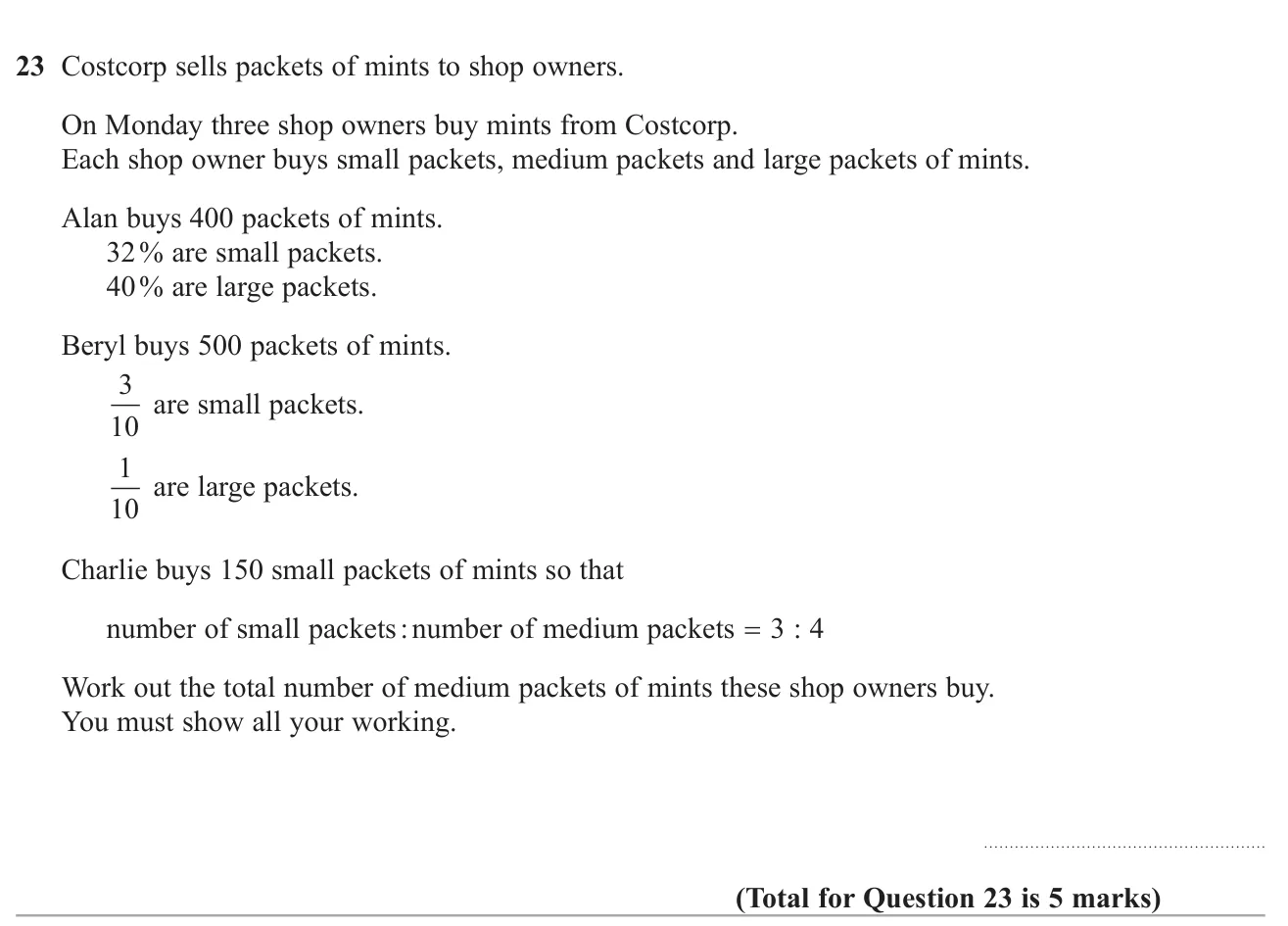
Worked solution Checked against the mark scheme
Alan: 100 − 32 − 40 = 28 % 100 - 32 - 40 = 28\% 100 − 32 − 40 = 28% 0.28 × 400 = 112 0.28 \times 400 = 112 0.28 × 400 = 112
Beryl: 1 − 3 10 − 1 10 = 6 10 1 - \frac{3}{10} - \frac{1}{10} = \frac{6}{10} 1 − 10 3 − 10 1 = 10 6 6 10 × 500 = 300 \frac{6}{10} \times 500 = 300 10 6 × 500 = 300
Charlie: 150 ÷ 3 = 50 150 \div 3 = 50 150 ÷ 3 = 50 = 4 × 50 = 200 = 4 \times 50 = 200 = 4 × 50 = 200
Total: 112 + 300 + 200 = 612 112 + 300 + 200 = 612 112 + 300 + 200 = 612
Watch out: For Charlie, sharing 150 in the ratio 3 : 4 instead of scaling it up.
© Pearson Education Ltd. November 2018 Paper 1 (Foundation, non-calculator), question 15.
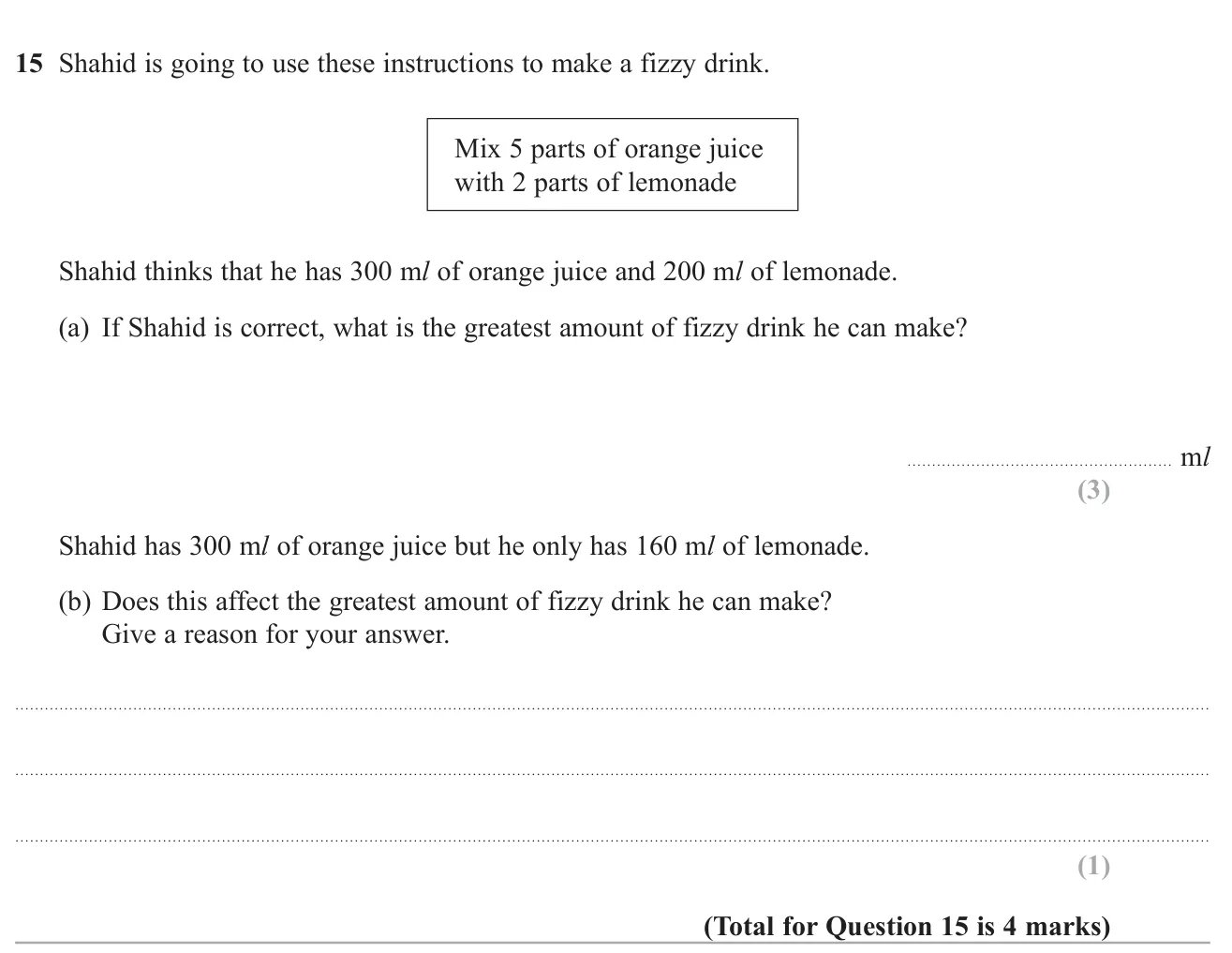
(a) 420 ml 3 marks (b) No effect: he only needs 120 ml of lemonade 1 mark
Worked solution Checked against the mark scheme
(a) Orange juice limits it: 300 ÷ 5 = 60 300 \div 5 = 60 300 ÷ 5 = 60
Lemonade needed = 2 × 60 = 120 = 2 \times 60 = 120 = 2 × 60 = 120
Total = 7 × 60 = 420 = 7 \times 60 = 420 = 7 × 60 = 420
(b) No: he still only needs 120 ml of lemonade, and 160 ml is enough.
Watch out: Using all 500 ml of liquid and ignoring the ratio.
© Pearson Education Ltd. June 2018 Paper 1 (Foundation, non-calculator), question 17.
Worked solution Checked against the mark scheme
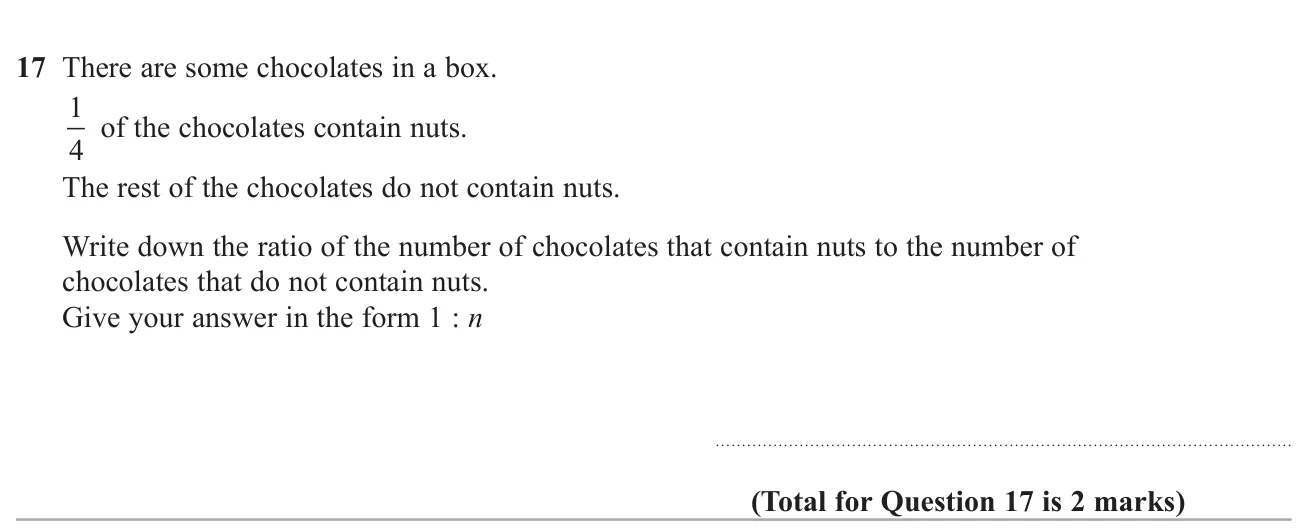
Nuts: 1 4 \frac{1}{4} 4 1 1 − 1 4 = 3 4 1 - \frac{1}{4} = \frac{3}{4} 1 − 4 1 = 4 3
Ratio 1 4 : 3 4 = 1 : 3 \frac{1}{4} : \frac{3}{4} = 1 : 3 4 1 : 4 3 = 1 : 3
Watch out: Writing 1 : 4 (part to whole instead of part to part).
© Pearson Education Ltd. June 2018 Paper 3 (Foundation, calculator), question 16.
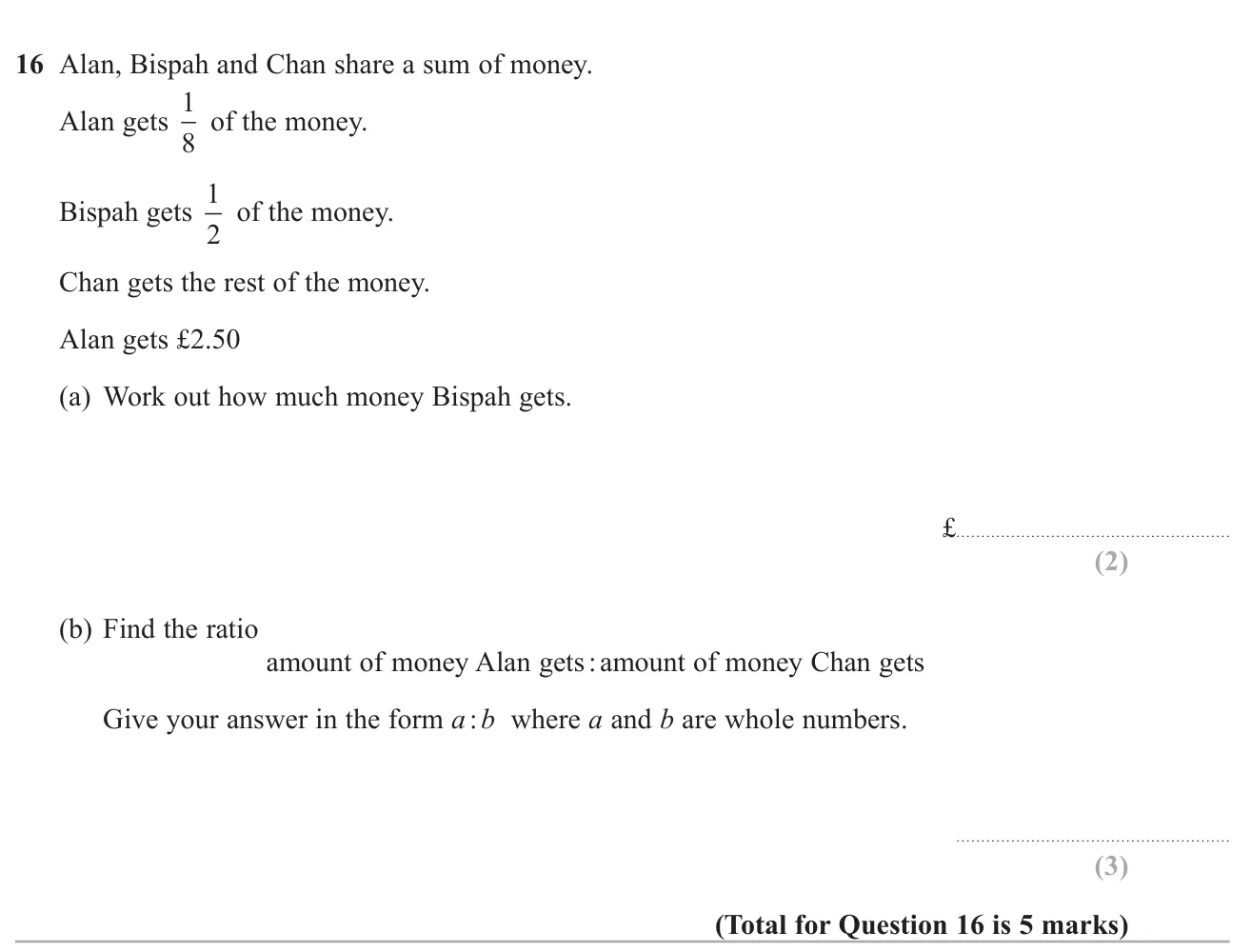
(a) £ 10 £10 £10 2 marks (b) 1 : 3 1 : 3 1 : 3 3 marks
Worked solution Checked against the mark scheme
(a) Alan's £2.50 is 1 8 \frac{1}{8} 8 1 2.50 × 8 = £ 20 2.50 \times 8 = £20 2.50 × 8 = £20
Bispah gets 1 2 × 20 = £ 10 \frac{1}{2} \times 20 = £10 2 1 × 20 = £10
(b) Chan gets 20 − 2.50 − 10 = £ 7.50 20 - 2.50 - 10 = £7.50 20 − 2.50 − 10 = £7.50
Alan : Chan = 2.5 : 7.5 = 1 : 3 = 2.5 : 7.5 = 1 : 3 = 2.5 : 7.5 = 1 : 3
Watch out: Writing the ratio the wrong way round as 3 : 1.
© Pearson Education Ltd. Specimen Paper 1 (Higher, non-calculator), question 10.
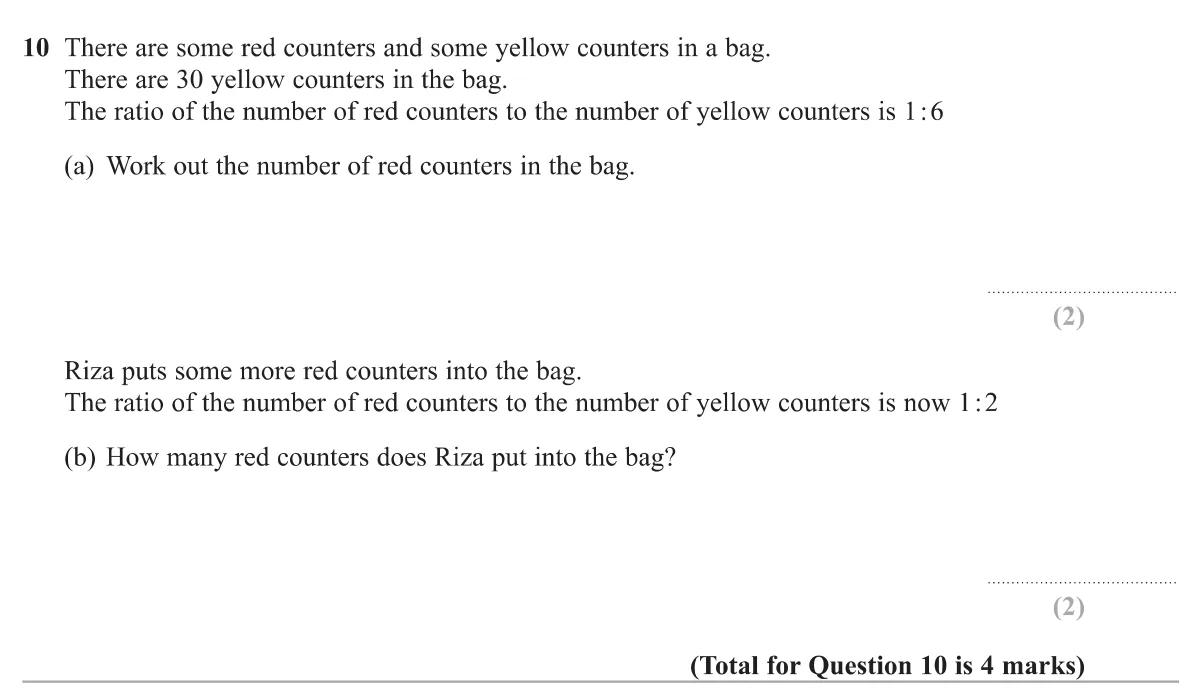
(a) 5 5 5 2 marks (b) 10 10 10 2 marks
Worked solution Checked against the mark scheme
(a) 30 ÷ 6 = 5 30 \div 6 = 5 30 ÷ 6 = 5
(b) For 1 : 2 with 30 yellow, there must be 30 ÷ 2 = 15 30 \div 2 = 15 30 ÷ 2 = 15
15 − 5 = 10 15 - 5 = 10 15 − 5 = 10
Watch out: In (b), giving 15 (the new total) instead of the number added.
© Pearson Education Ltd. Specimen Paper 3 (Foundation, calculator), question 18.
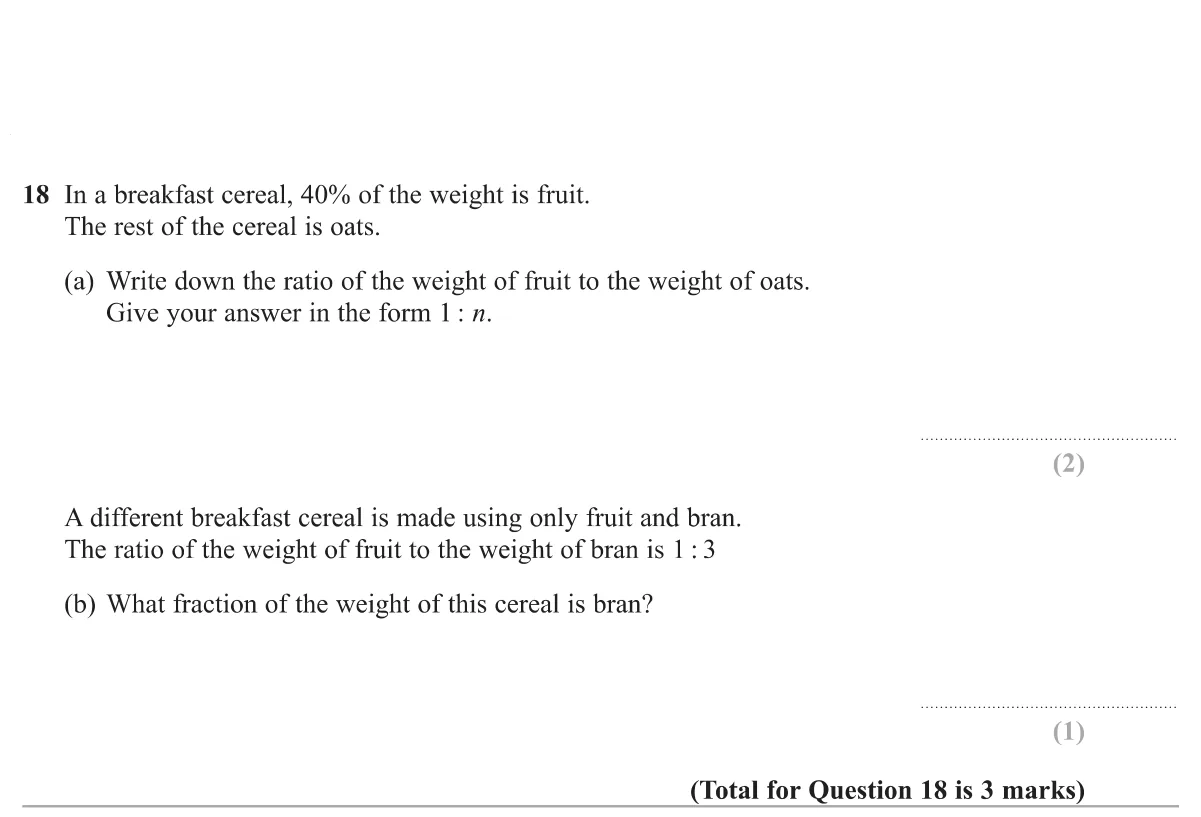
(a) 1 : 1.5 2 marks (b) 3 4 \frac{3}{4} 4 3 1 mark
Worked solution Checked against the mark scheme
(a) Fruit is 40%, so oats are 100 − 40 = 60 % 100 - 40 = 60\% 100 − 40 = 60%
40 : 60 40 : 60 40 : 60 1 : 1.5 1 : 1.5 1 : 1.5
(b) 1 + 3 = 4 1 + 3 = 4 1 + 3 = 4 3 4 \frac{3}{4} 4 3
Watch out: In (b), giving 1 3 \frac{1}{3} 3 1 3 1 \frac{3}{1} 1 3
© Pearson Education Ltd. November 2022 Paper 1 (Foundation, non-calculator), question 24.
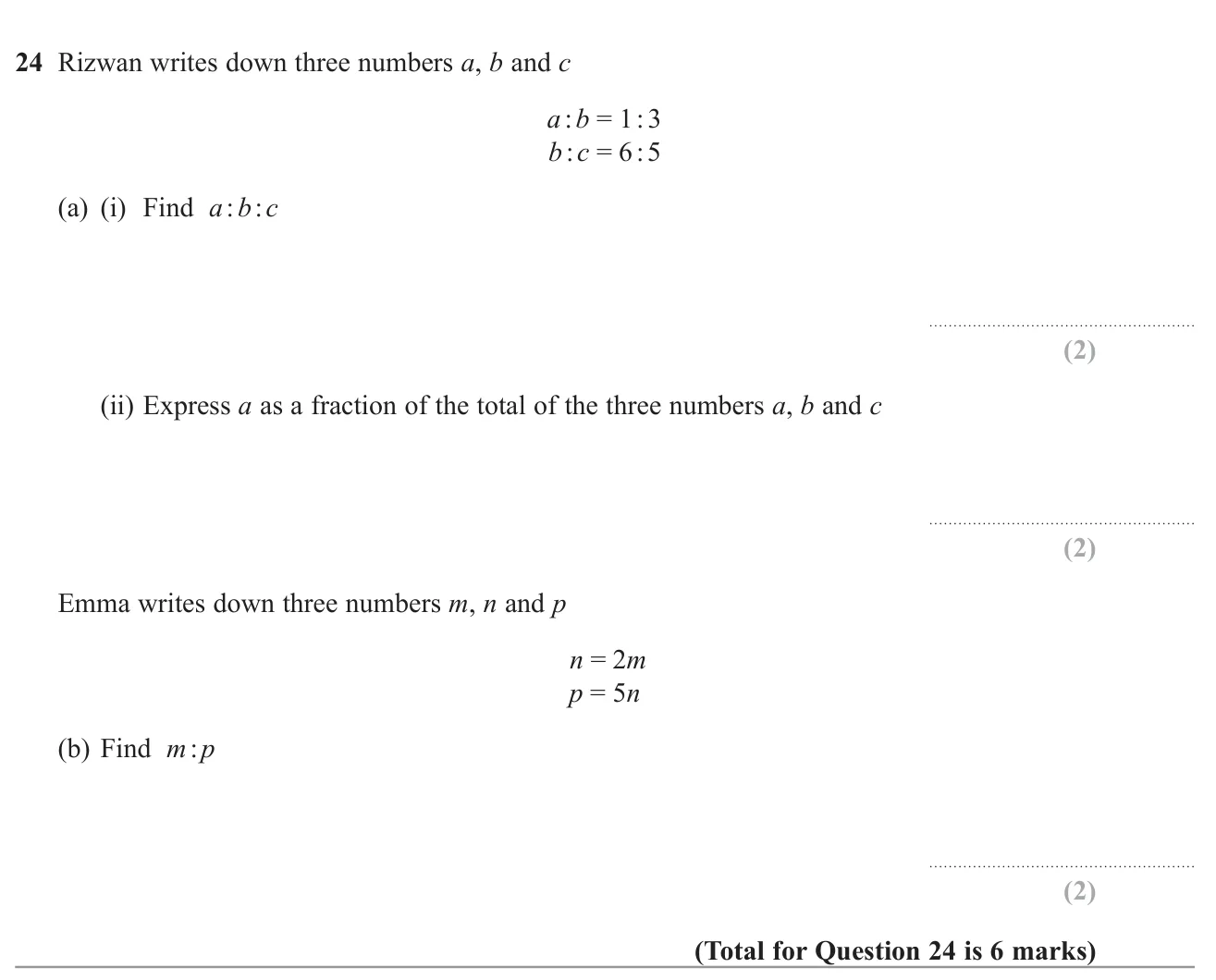
(a(i)) 2 : 6 : 5 2 : 6 : 5 2 : 6 : 5 2 marks (a(ii)) 2 13 \frac{2}{13} 13 2 2 marks (b) 1 : 10 1 : 10 1 : 10 2 marks
Worked solution Checked against the mark scheme
(a)(i) Double 1 : 3 1 : 3 1 : 3 2 : 6 2 : 6 2 : 6 b b b a : b : c = 2 : 6 : 5 a : b : c = 2 : 6 : 5 a : b : c = 2 : 6 : 5
(a)(ii) Total parts 2 + 6 + 5 = 13 2 + 6 + 5 = 13 2 + 6 + 5 = 13 a a a 2 13 \frac{2}{13} 13 2
(b) p = 5 n = 5 × 2 m = 10 m p = 5n = 5 \times 2m = 10m p = 5 n = 5 × 2 m = 10 m m : p = 1 : 10 m : p = 1 : 10 m : p = 1 : 10
Watch out: In (b), giving 10 : 1 10 : 1 10 : 1
© Pearson Education Ltd. June 2022 Paper 1 (Foundation, non-calculator), question 25.
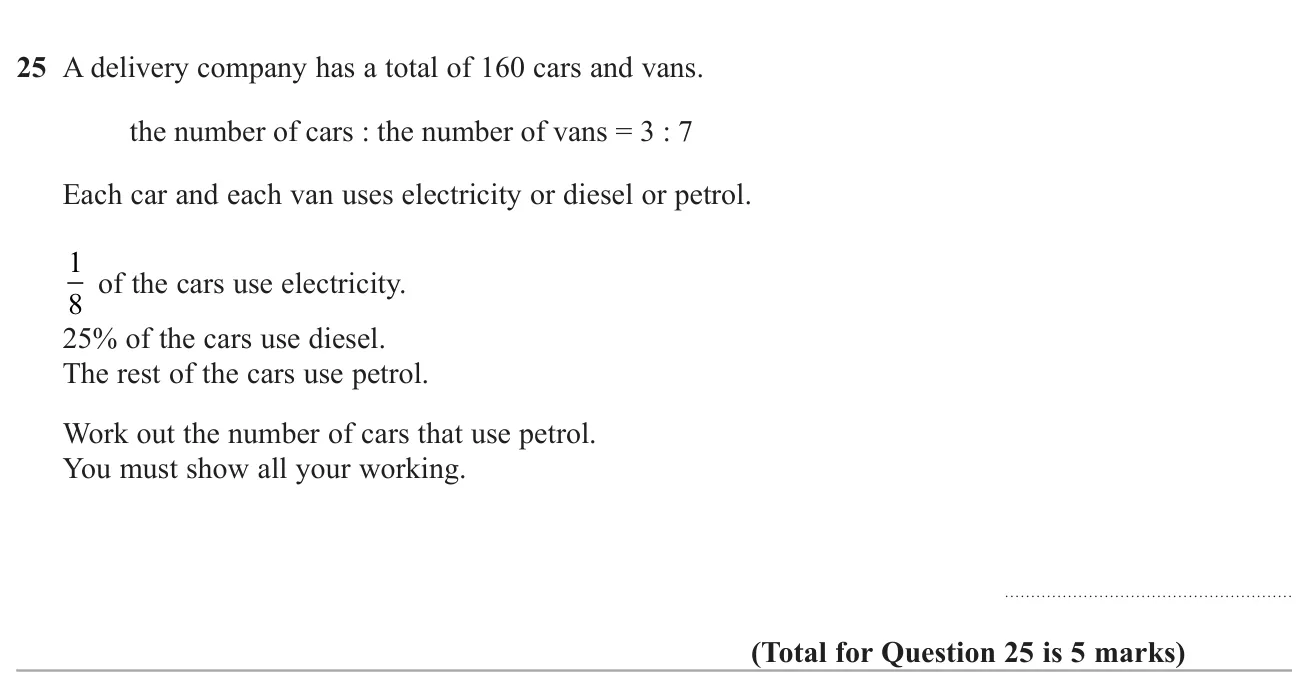
Worked solution Checked against the mark scheme
Cars: 160 ÷ 10 = 16 160 \div 10 = 16 160 ÷ 10 = 16 16 × 3 = 48 16 \times 3 = 48 16 × 3 = 48
Electric: 48 ÷ 8 = 6 48 \div 8 = 6 48 ÷ 8 = 6
Diesel: 25 % 25\% 25% = 12 = 12 = 12
Petrol: 48 − 6 − 12 = 30 48 - 6 - 12 = 30 48 − 6 − 12 = 30
Watch out: Using all 160 vehicles instead of just the 48 cars (giving 100).
© Pearson Education Ltd. June 2022 Paper 2 (Foundation, calculator), question 25.
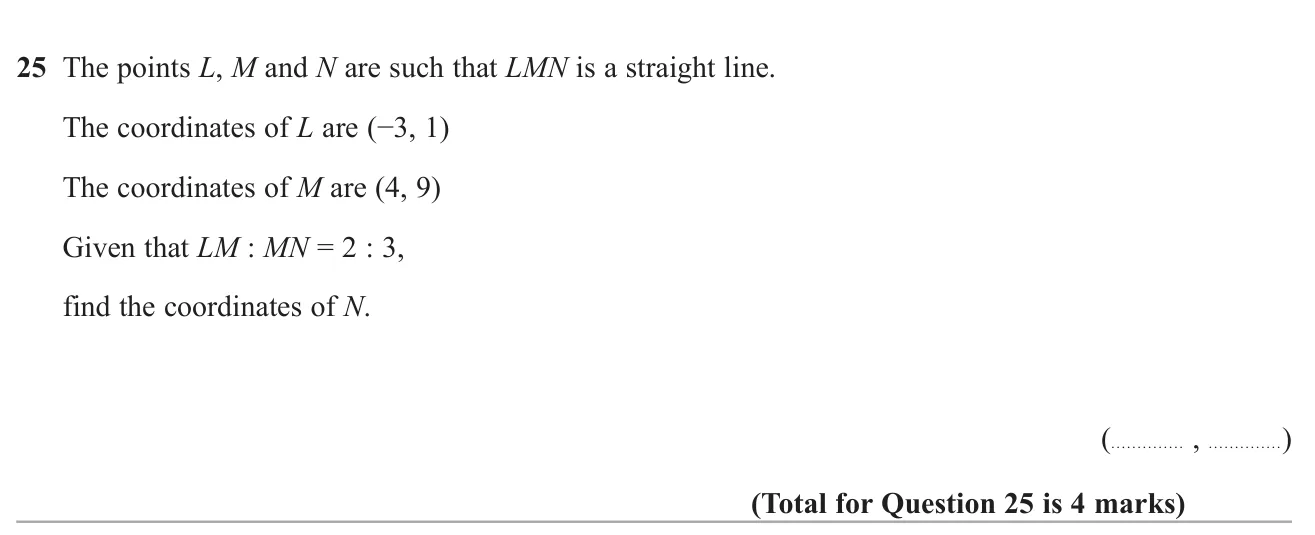
Answer ( 14.5 , 21 ) (14.5, 21) ( 14.5 , 21 ) 4 marks
Worked solution Checked against the mark scheme
From L to M: x x x 4 − ( − 3 ) = 7 4 - (-3) = 7 4 − ( − 3 ) = 7 y y y 9 − 1 = 8 9 - 1 = 8 9 − 1 = 8
One part: x x x y y y
MN is 3 parts: x x x y y y
N = ( 4 + 10.5 , 9 + 12 ) = ( 14.5 , 21 ) N = (4 + 10.5,\ 9 + 12) = (14.5, 21) N = ( 4 + 10.5 , 9 + 12 ) = ( 14.5 , 21 )
Watch out: Adding the three-part distance to L instead of to M.
© Pearson Education Ltd. June 2022 Paper 3 (Foundation, calculator), question 24.
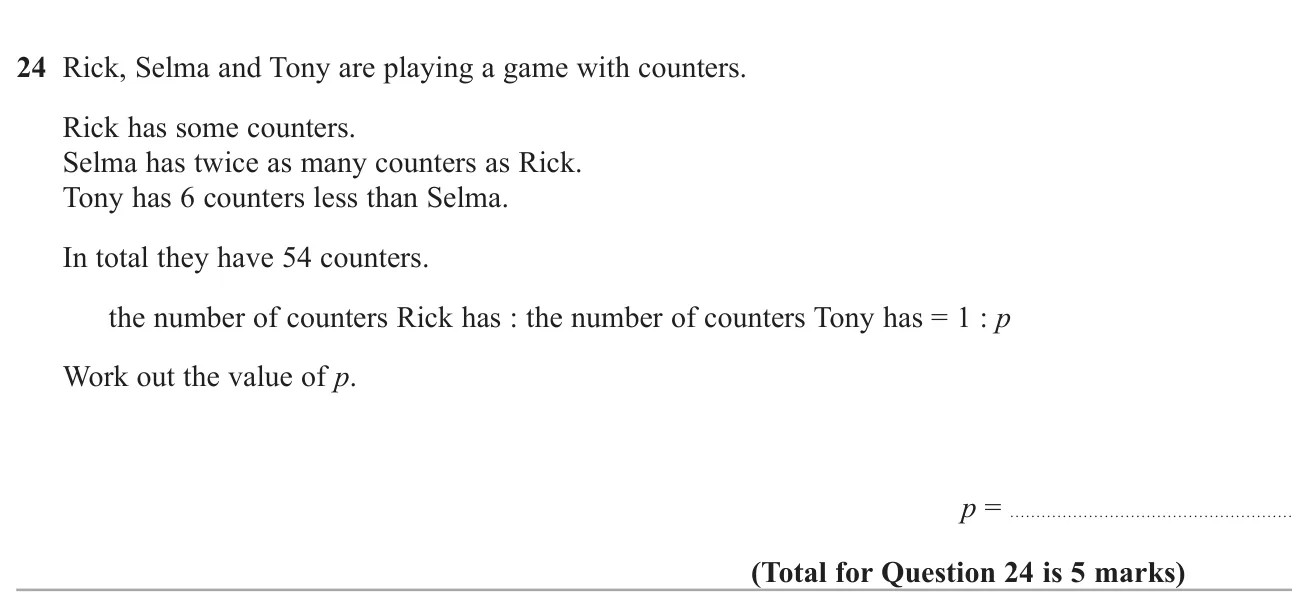
Worked solution Checked against the mark scheme
Let Rick have n n n 2 n 2n 2 n 2 n − 6 2n - 6 2 n − 6
n + 2 n + 2 n − 6 = 54 ⇒ 5 n = 60 ⇒ n = 12 n + 2n + 2n - 6 = 54 \Rightarrow 5n = 60 \Rightarrow n = 12 n + 2 n + 2 n − 6 = 54 ⇒ 5 n = 60 ⇒ n = 12
Tony has 24 − 6 = 18 24 - 6 = 18 24 − 6 = 18
12 : 18 = 1 : 1.5 12 : 18 = 1 : 1.5 12 : 18 = 1 : 1.5 p = 1.5 p = 1.5 p = 1.5
Watch out: Using Selma's counters instead of Tony's in the ratio.
© Pearson Education Ltd. November 2020 Paper 1 (Foundation, non-calculator), question 29.
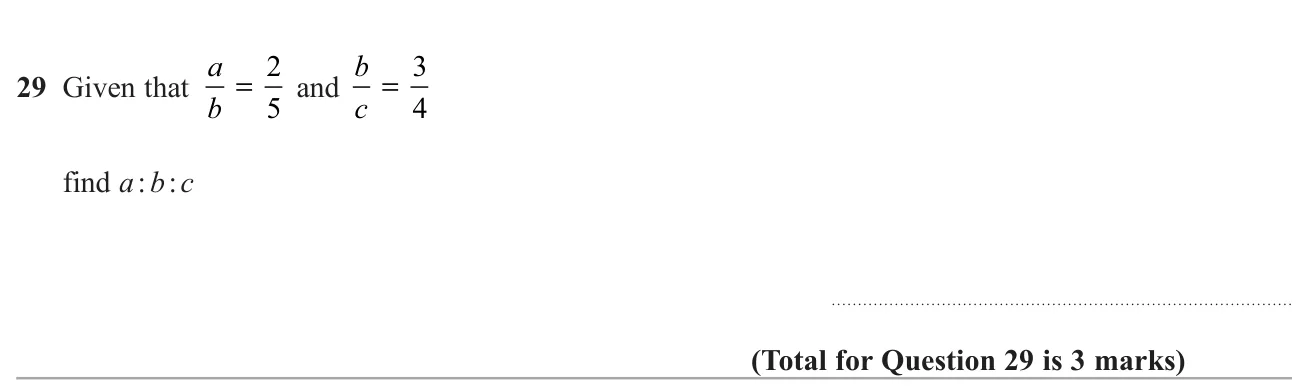
Answer 6 : 15 : 20 6 : 15 : 20 6 : 15 : 20 3 marks
Worked solution Checked against the mark scheme
a b = 2 5 \frac{a}{b} = \frac{2}{5} b a = 5 2 a : b = 2 : 5 a : b = 2 : 5 a : b = 2 : 5 b c = 3 4 \frac{b}{c} = \frac{3}{4} c b = 4 3 b : c = 3 : 4 b : c = 3 : 4 b : c = 3 : 4
Make b the same in both (15): a : b = 6 : 15 a : b = 6 : 15 a : b = 6 : 15 b : c = 15 : 20 b : c = 15 : 20 b : c = 15 : 20
So a : b : c = 6 : 15 : 20 a : b : c = 6 : 15 : 20 a : b : c = 6 : 15 : 20
Watch out: Joining them directly as 2 : 5 : 4 2 : 5 : 4 2 : 5 : 4
© Pearson Education Ltd. November 2020 Paper 2 (Foundation, calculator), question 19.
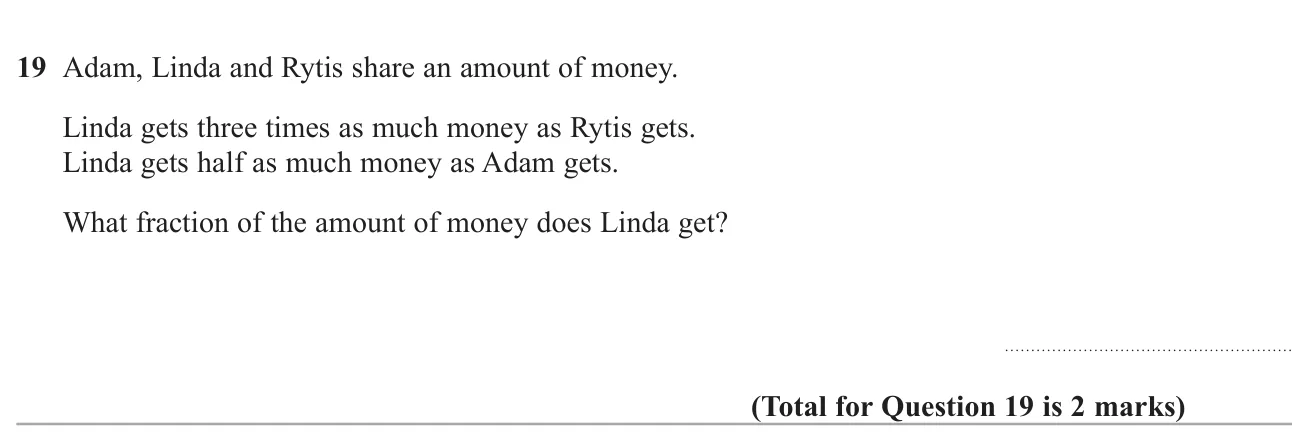
Answer 3 10 \frac{3}{10} 10 3 2 marks
Worked solution Checked against the mark scheme
Let Rytis get 1 part. Linda gets 3 × 1 = 3 3 \times 1 = 3 3 × 1 = 3
Total: 1 + 3 + 6 = 10 1 + 3 + 6 = 10 1 + 3 + 6 = 10
Linda gets 3 10 \frac{3}{10} 10 3
Watch out: Halving Linda's share to find Adam's instead of doubling it.
© Pearson Education Ltd. November 2020 Paper 2 (Foundation, calculator), question 23.
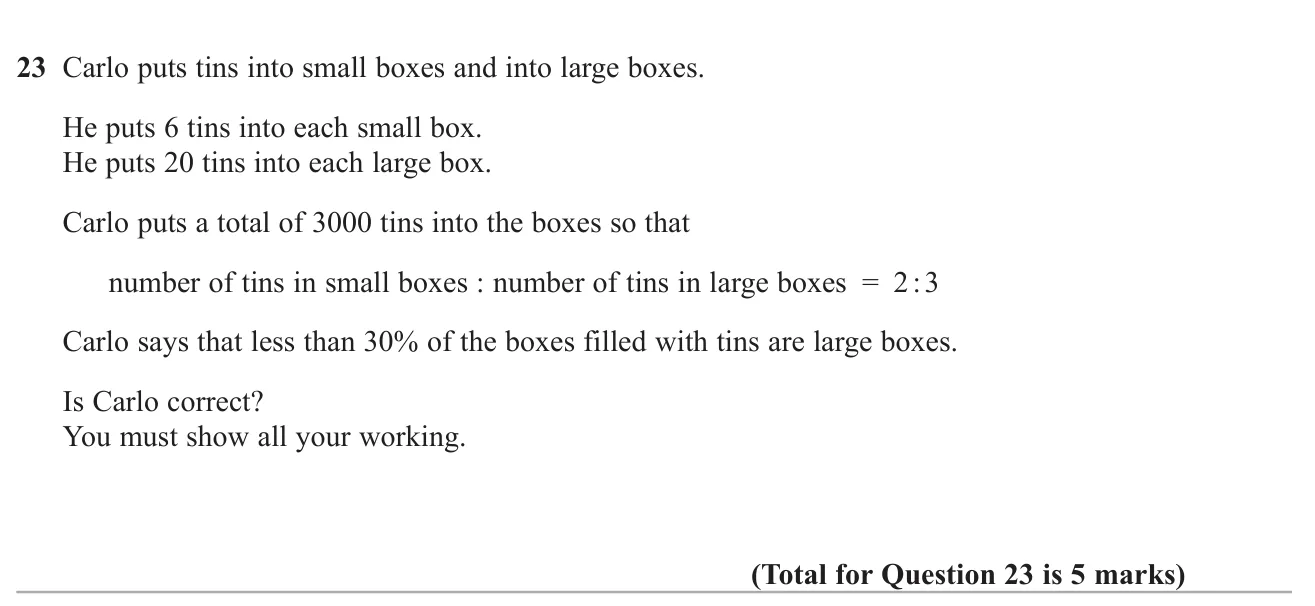
Answer No: 90 of 290 boxes are large, which is about 31% 5 marks
Worked solution Checked against the mark scheme
One part: 3000 ÷ 5 = 600 3000 \div 5 = 600 3000 ÷ 5 = 600
Small boxes: 2 × 600 = 1200 2 \times 600 = 1200 2 × 600 = 1200 1200 ÷ 6 = 200 1200 \div 6 = 200 1200 ÷ 6 = 200
Large boxes: 3 × 600 = 1800 3 \times 600 = 1800 3 × 600 = 1800 1800 ÷ 20 = 90 1800 \div 20 = 90 1800 ÷ 20 = 90
90 290 × 100 = 31.0 % \frac{90}{290} \times 100 = 31.0\% 290 90 × 100 = 31.0% not correct.
Watch out: Using the tin ratio (60% large) instead of the number of boxes.
© Pearson Education Ltd. November 2019 Paper 1 (Foundation, non-calculator), question 21.
Worked solution Checked against the mark scheme
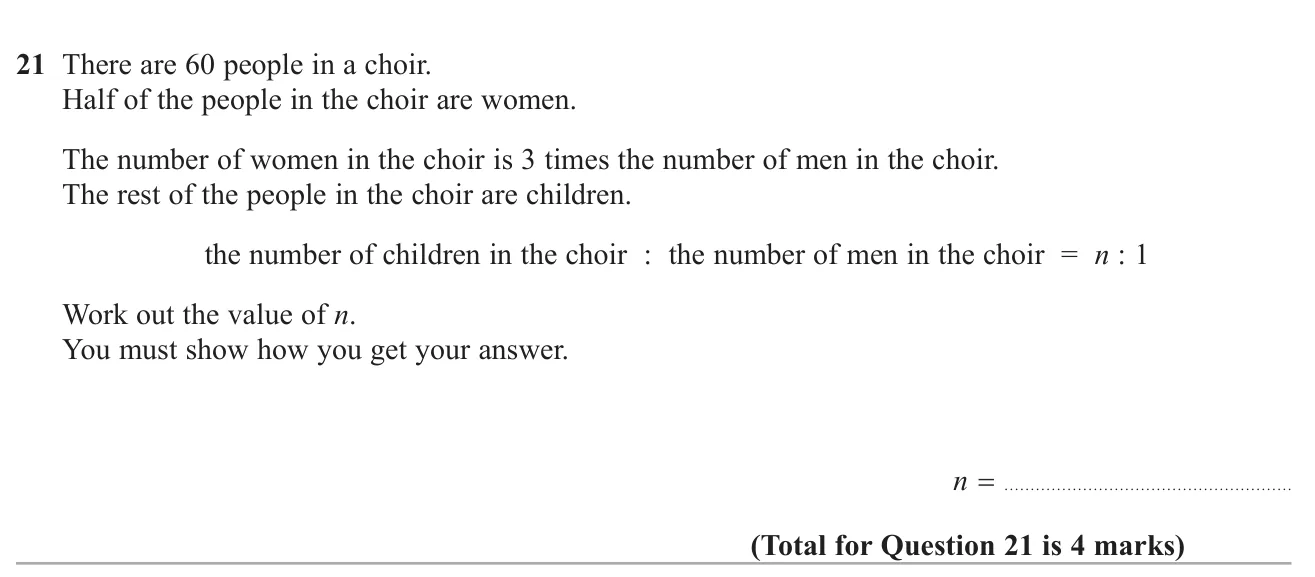
Women: 60 ÷ 2 = 30 60 \div 2 = 30 60 ÷ 2 = 30
Men: 30 ÷ 3 = 10 30 \div 3 = 10 30 ÷ 3 = 10
Children: 60 − 30 − 10 = 20 60 - 30 - 10 = 20 60 − 30 − 10 = 20
Children : men = 20 : 10 = 2 : 1 = 20 : 10 = 2 : 1 = 20 : 10 = 2 : 1 n = 2 n = 2 n = 2
Watch out: Taking children as a third of 60 without working out the men first.
© Pearson Education Ltd. November 2019 Paper 1 (Higher, non-calculator), question 11.
Worked solution Checked against the mark scheme
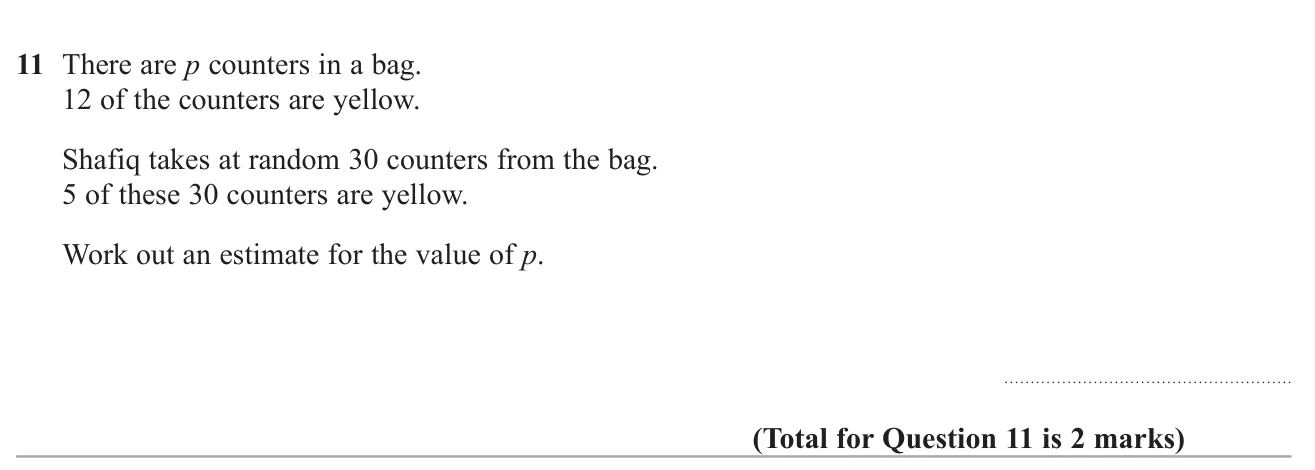
In the sample, 5 30 = 1 6 \frac{5}{30} = \frac{1}{6} 30 5 = 6 1
So 12 yellow counters is about 1 6 \frac{1}{6} 6 1
p ≈ 12 × 6 = 72 p \approx 12 \times 6 = 72 p ≈ 12 × 6 = 72
Watch out: Working out 30 ÷ 5 × 5 or adding 12 to 30.
© Pearson Education Ltd. June 2018 Paper 1 (Foundation, non-calculator), question 20.
Worked solution Checked against the mark scheme
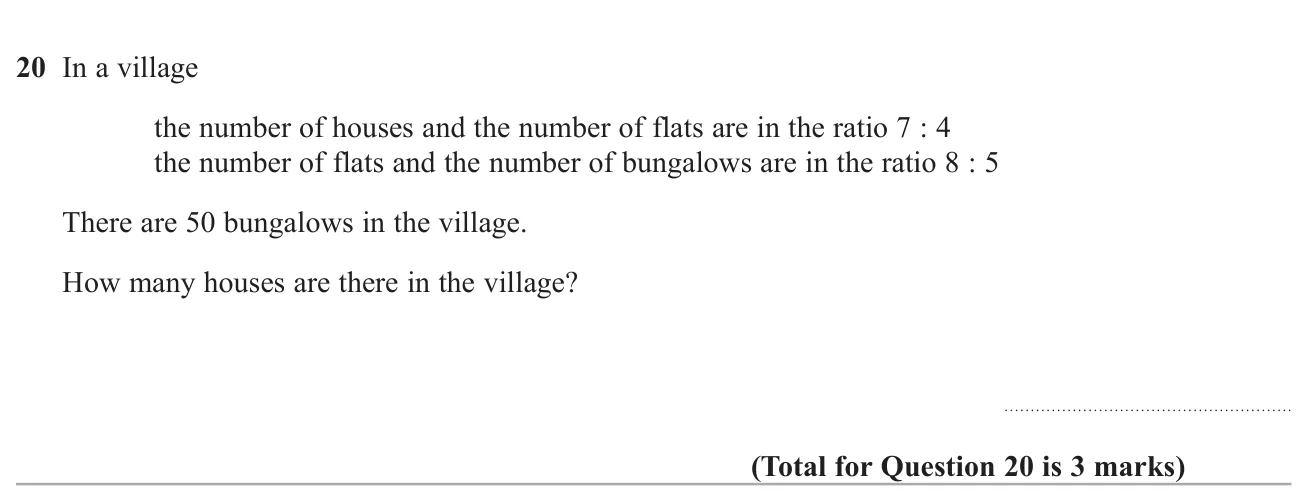
Flats : bungalows = 8 : 5 = 8 : 5 = 8 : 5 50 ÷ 5 = 10 50 \div 5 = 10 50 ÷ 5 = 10 = 8 × 10 = 80 = 8 \times 10 = 80 = 8 × 10 = 80
Houses : flats = 7 : 4 = 7 : 4 = 7 : 4 80 ÷ 4 = 20 80 \div 4 = 20 80 ÷ 4 = 20 = 7 × 20 = 140 = 7 \times 20 = 140 = 7 × 20 = 140
Watch out: Using the 4 in the first ratio as if it matched the 8 in the second.
© Pearson Education Ltd. June 2018 Paper 1 (Higher, non-calculator), question 2.
Worked solution Checked against the mark scheme
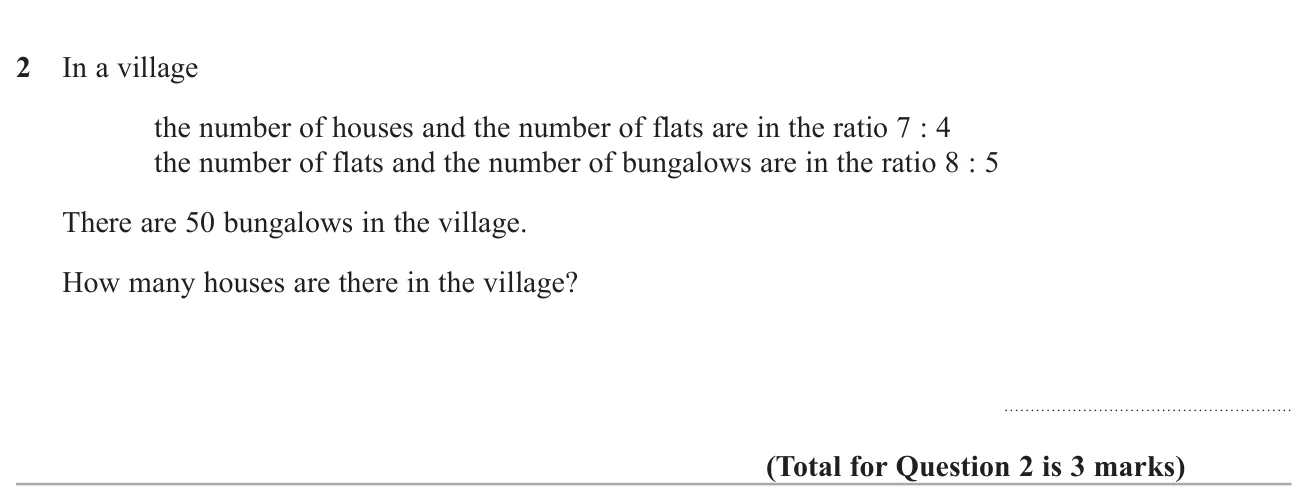
Make the flats match: houses : flats = 7 : 4 = 14 : 8 = 7 : 4 = 14 : 8 = 7 : 4 = 14 : 8 = 14 : 8 : 5 = 14 : 8 : 5 = 14 : 8 : 5
5 parts = 50 = 50 = 50 = 10 = 10 = 10
Houses = 14 × 10 = 140 = 14 \times 10 = 140 = 14 × 10 = 140
Watch out: Adding the ratios without matching the flats term.
© Pearson Education Ltd. June 2018 Paper 2 (Foundation, calculator), question 23.
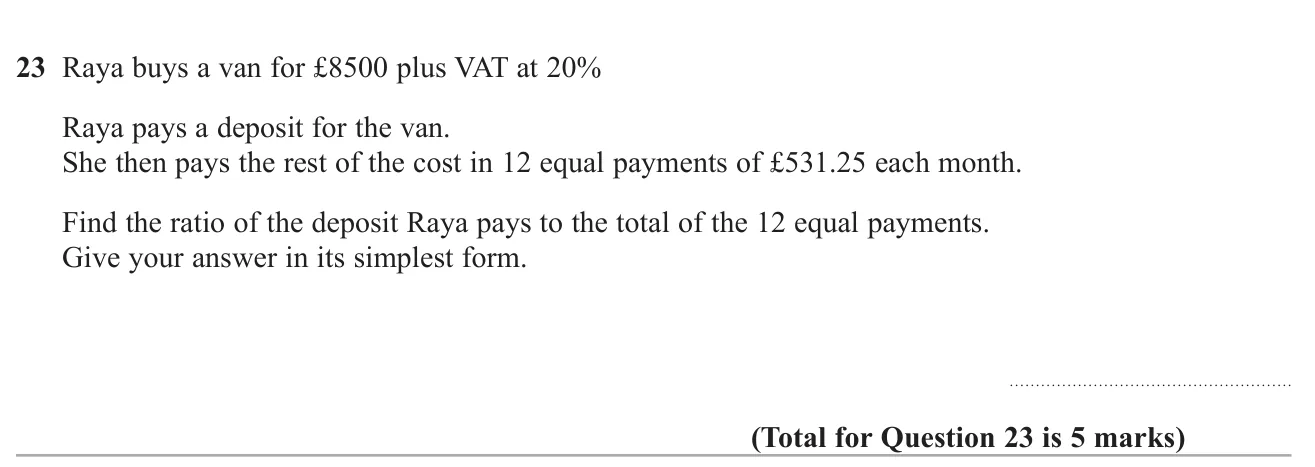
Worked solution Checked against the mark scheme
Price with VAT: 8500 × 1.2 = £ 10 200 8500 \times 1.2 = £10\,200 8500 × 1.2 = £10 200
Monthly payments: 12 × 531.25 = £ 6375 12 \times 531.25 = £6375 12 × 531.25 = £6375
Deposit: 10 200 − 6375 = £ 3825 10\,200 - 6375 = £3825 10 200 − 6375 = £3825
Ratio: 3825 : 6375 3825 : 6375 3825 : 6375 3 : 5 3 : 5 3 : 5
Watch out: Giving the ratio the wrong way round (5 : 3).
© Pearson Education Ltd. June 2024 Paper 1 (Foundation, non-calculator), question 26.
Answer 7.5 % 7.5\% 7.5% 5 marks
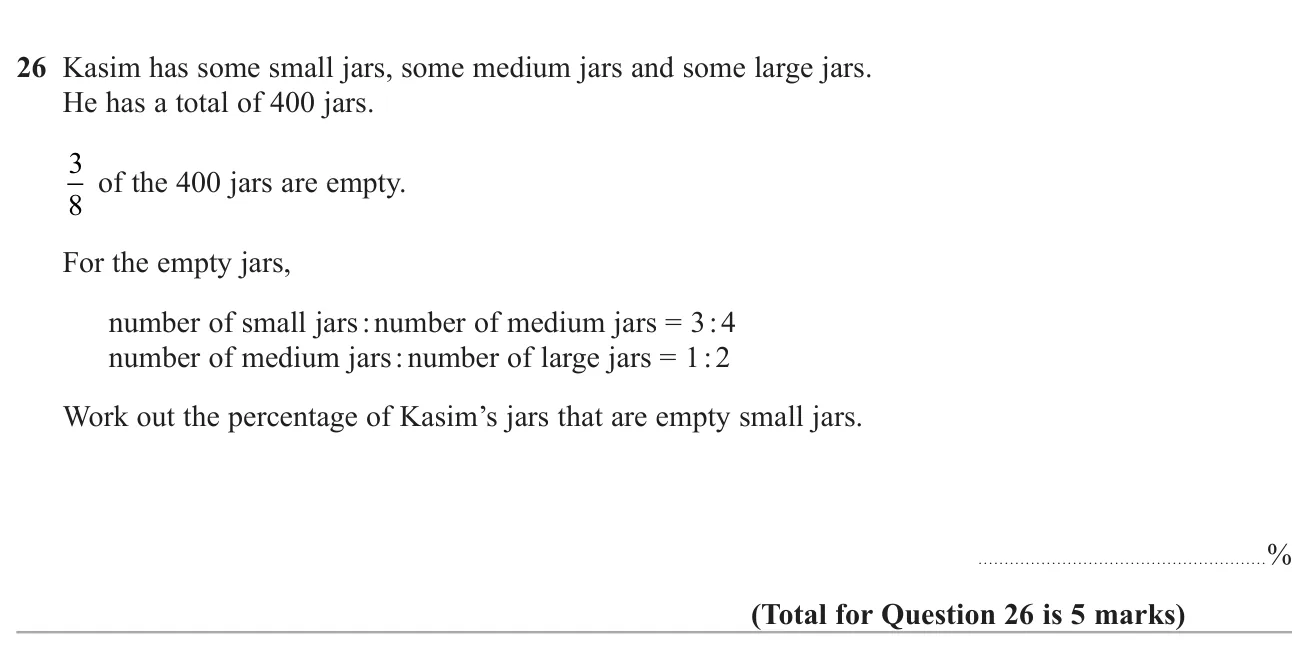
Worked solution Checked against the mark scheme
Empty jars: 3 8 × 400 = 150 \frac{3}{8} \times 400 = 150 8 3 × 400 = 150
S : M = 3 : 4 = 3 : 4 = 3 : 4 = 1 : 2 = 4 : 8 = 1 : 2 = 4 : 8 = 1 : 2 = 4 : 8 = 3 : 4 : 8 = 3 : 4 : 8 = 3 : 4 : 8
Small empty: 3 15 × 150 = 30 \frac{3}{15} \times 150 = 30 15 3 × 150 = 30
Percentage: 30 400 × 100 = 7.5 % \frac{30}{400} \times 100 = 7.5\% 400 30 × 100 = 7.5%
Watch out: Giving the percentage of the empty jars (20%) instead of all 400 jars.
© Pearson Education Ltd. June 2024 Paper 3 (Higher, calculator), question 10.
Answer Shown: total = 8 x 3 + 4 x 3 = 4 x = \frac{8x}{3} + \frac{4x}{3} = 4x = 3 8 x + 3 4 x = 4 x 3 marks
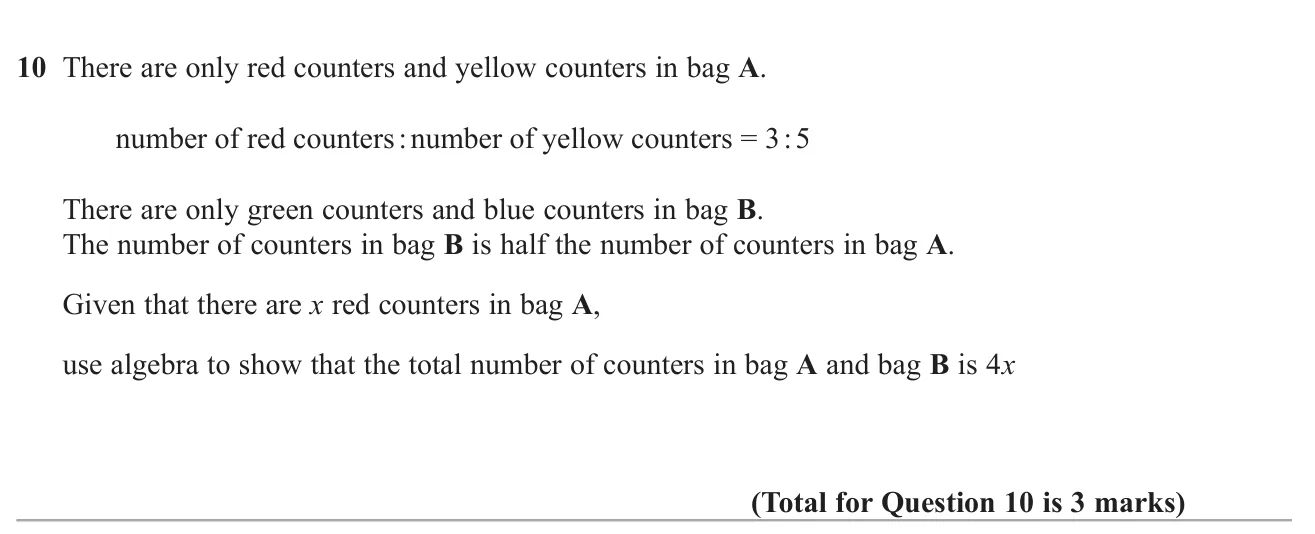
Worked solution Checked against the mark scheme
Red : yellow = 3 : 5 = 3 : 5 = 3 : 5 = 5 3 x = \frac{5}{3}x = 3 5 x
Bag A = x + 5 3 x = 8 3 x = x + \frac{5}{3}x = \frac{8}{3}x = x + 3 5 x = 3 8 x
Bag B = 1 2 × 8 3 x = 4 3 x = \frac12 \times \frac{8}{3}x = \frac{4}{3}x = 2 1 × 3 8 x = 3 4 x
Total = 8 3 x + 4 3 x = 12 3 x = 4 x = \frac{8}{3}x + \frac{4}{3}x = \frac{12}{3}x = 4x = 3 8 x + 3 4 x = 3 12 x = 4 x
Watch out: Taking yellow as 5 x 5x 5 x
© Pearson Education Ltd. June 2023 Paper 1 (Higher, non-calculator), question 18.
Answer Carrots 30 30 30 54 54 54 4 marks
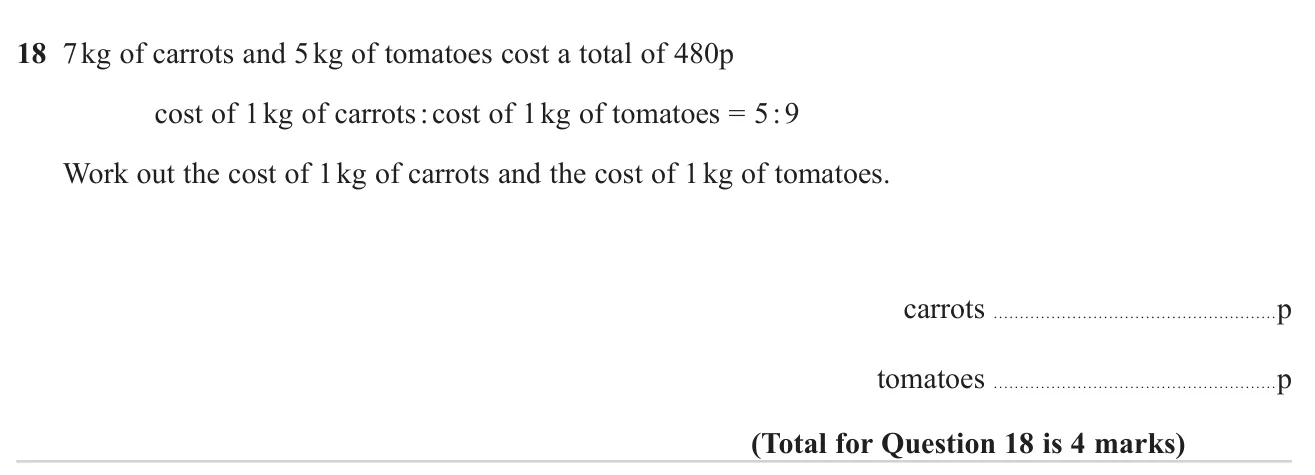
Worked solution Checked against the mark scheme
Let 1 kg of carrots cost 5 k 5k 5 k 9 k 9k 9 k
7 ( 5 k ) + 5 ( 9 k ) = 480 7(5k) + 5(9k) = 480 7 ( 5 k ) + 5 ( 9 k ) = 480 35 k + 45 k = 80 k = 480 35k + 45k = 80k = 480 35 k + 45 k = 80 k = 480 k = 6 k = 6 k = 6
Carrots: 5 × 6 = 30 5 \times 6 = 30 5 × 6 = 30 9 × 6 = 54 9 \times 6 = 54 9 × 6 = 54
Watch out: Sharing 480 in the ratio 5 : 9 without allowing for the different weights.
© Pearson Education Ltd. June 2022 Paper 1 (Higher, non-calculator), question 11.
Worked solution Checked against the mark scheme
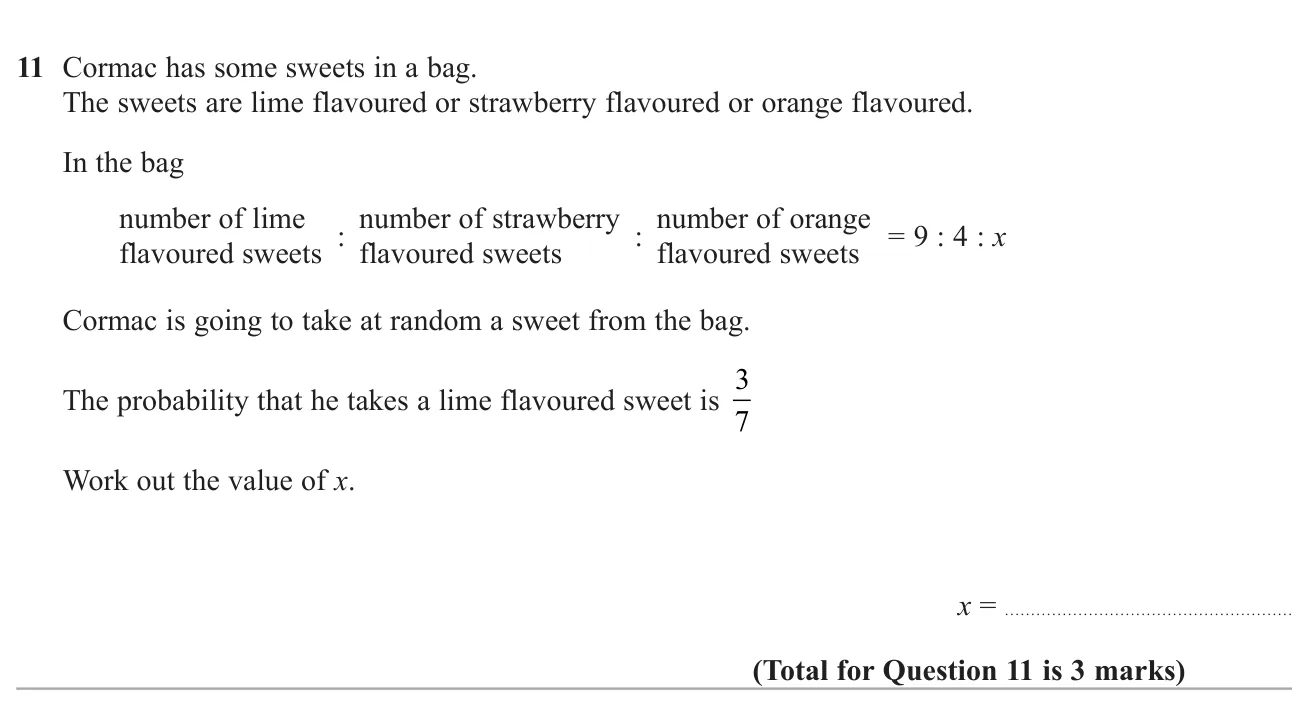
3 7 = 9 21 \frac{3}{7} = \frac{9}{21} 7 3 = 21 9
9 + 4 + x = 21 9 + 4 + x = 21 9 + 4 + x = 21
x = 8 x = 8 x = 8
Watch out: Setting 9 + 4 + x = 7 9 + 4 + x = 7 9 + 4 + x = 7
© Pearson Education Ltd. November 2021 Paper 3 (Higher, calculator), question 14.
Answer 8 : 12 : 9 : 1 8 : 12 : 9 : 1 8 : 12 : 9 : 1 4 marks
Worked solution Checked against the mark scheme
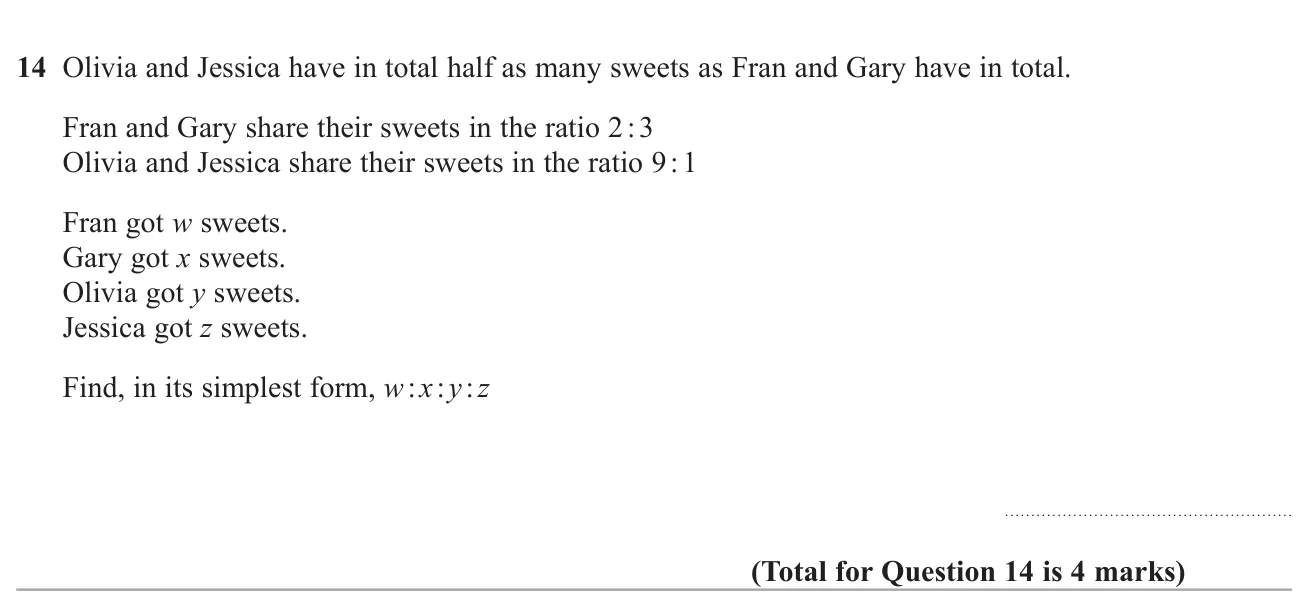
Fran and Gary share 5 parts; Olivia and Jessica share 10 parts.
Olivia and Jessica have half as many, so Fran and Gary's total must be 20 parts: multiply 2 : 3 2 : 3 2 : 3 8 : 12 8 : 12 8 : 12
Olivia and Jessica: 9 : 1 9 : 1 9 : 1
w : x : y : z = 8 : 12 : 9 : 1 w : x : y : z = 8 : 12 : 9 : 1 w : x : y : z = 8 : 12 : 9 : 1
Watch out: Writing 2 : 3 : 9 : 1 without matching the totals.
© Pearson Education Ltd. June 2022 Paper 2 (Higher, calculator), question 15.
Answer Marta £18, Khalid £15 4 marks
Worked solution Checked against the mark scheme
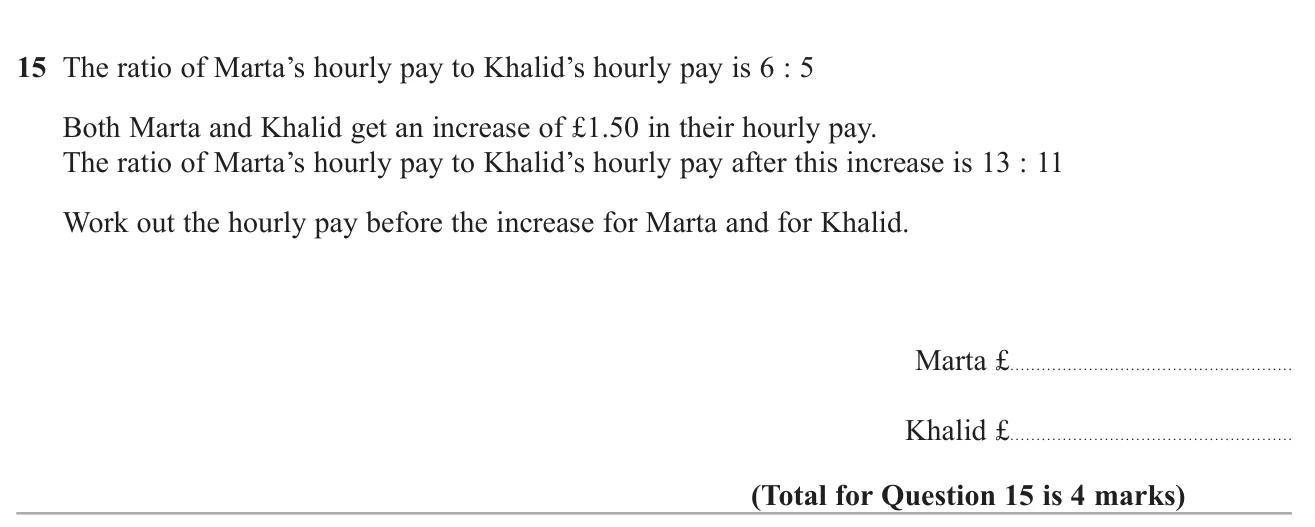
Let the pay be 6 x 6x 6 x 5 x 5x 5 x 6 x + 1.5 5 x + 1.5 = 13 11 \frac{6x + 1.5}{5x + 1.5} = \frac{13}{11} 5 x + 1.5 6 x + 1.5 = 11 13
11 ( 6 x + 1.5 ) = 13 ( 5 x + 1.5 ) 11(6x + 1.5) = 13(5x + 1.5) 11 ( 6 x + 1.5 ) = 13 ( 5 x + 1.5 )
66 x + 16.5 = 65 x + 19.5 66x + 16.5 = 65x + 19.5 66 x + 16.5 = 65 x + 19.5 x = 3 x = 3 x = 3
Marta: 6 × 3 = £ 18 6 \times 3 = £18 6 × 3 = £18 5 × 3 = £ 15 5 \times 3 = £15 5 × 3 = £15
Watch out: Adding 1.5 to the ratio numbers themselves rather than to the amounts.
© Pearson Education Ltd. November 2022 Paper 3 (Higher, calculator), question 17.
Answer 42 : 63 : 15 : 20 4 marks
Worked solution Checked against the mark scheme
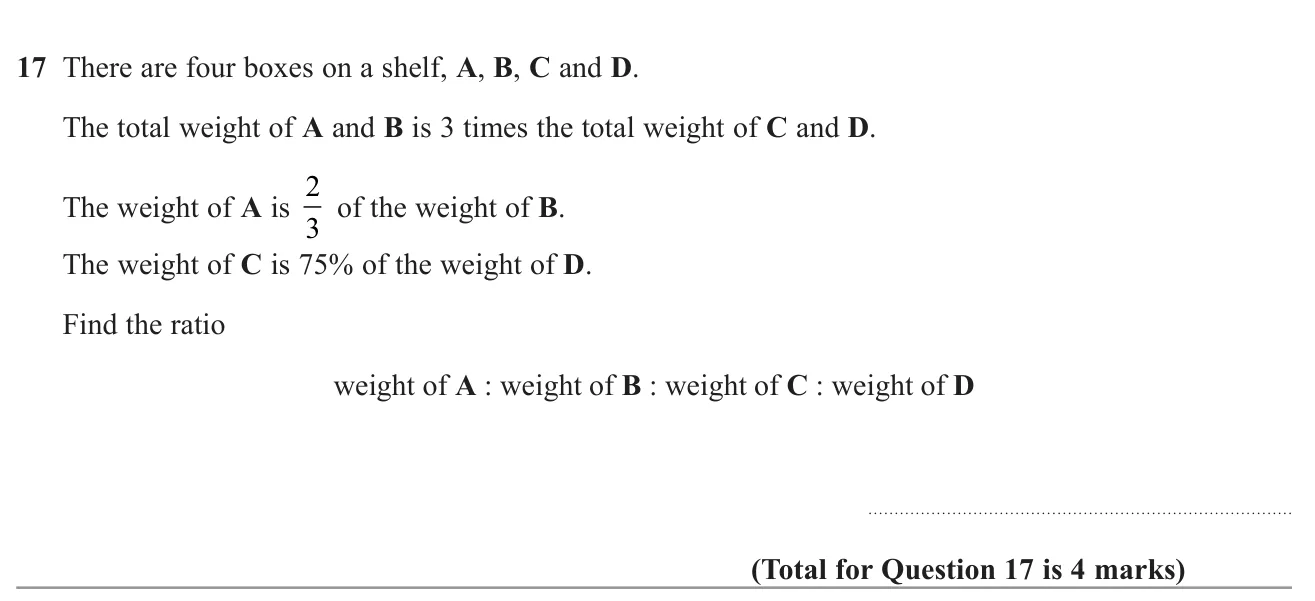
A : B = 2 : 3 A : B = 2 : 3 A : B = 2 : 3 C : D = 3 : 4 C : D = 3 : 4 C : D = 3 : 4 3 4 \frac{3}{4} 4 3
Let A = 2 k A = 2k A = 2 k B = 3 k B = 3k B = 3 k C = 3 m C = 3m C = 3 m D = 4 m D = 4m D = 4 m 5 k = 3 × 7 m 5k = 3 \times 7m 5 k = 3 × 7 m 5 k = 21 m 5k = 21m 5 k = 21 m k = 21 k = 21 k = 21 m = 5 m = 5 m = 5
A : B : C : D = 42 : 63 : 15 : 20 A : B : C : D = 42 : 63 : 15 : 20 A : B : C : D = 42 : 63 : 15 : 20
Check: 105 = 3 × 35 105 = 3 \times 35 105 = 3 × 35
Watch out: Writing C : D as 75 : 100 and not scaling both pairs so the 3-times rule holds.
© Pearson Education Ltd. November 2019 Paper 3 (Higher, calculator), question 14.
Answer 13 20 \frac{13}{20} 20 13 4 marks
Worked solution Checked against the mark scheme
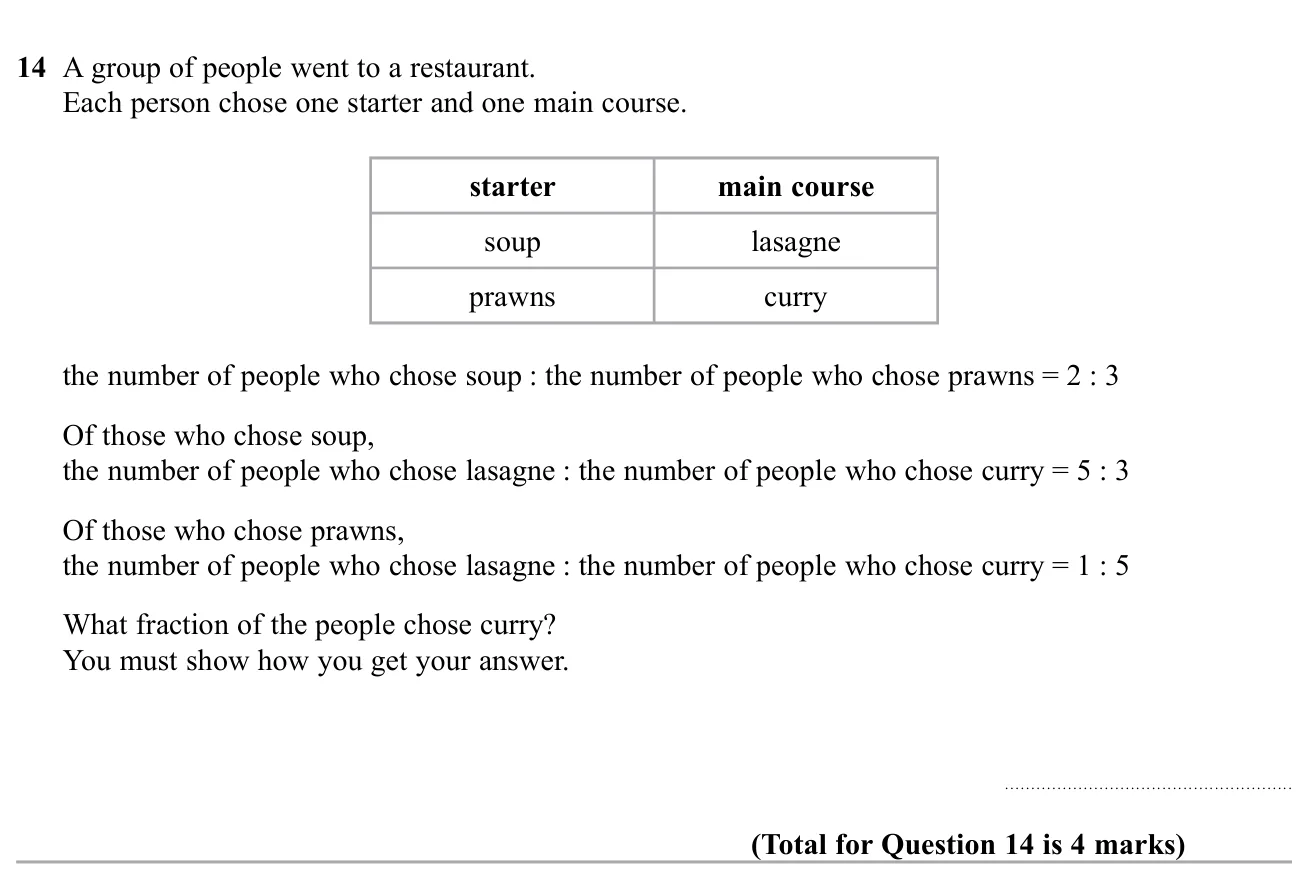
Soup = 2 5 = \frac{2}{5} = 5 2 = 3 5 = \frac{3}{5} = 5 3
Soup then curry: 2 5 × 3 8 = 3 20 \frac{2}{5} \times \frac{3}{8} = \frac{3}{20} 5 2 × 8 3 = 20 3
Prawns then curry: 3 5 × 5 6 = 1 2 \frac{3}{5} \times \frac{5}{6} = \frac{1}{2} 5 3 × 6 5 = 2 1
Curry total = 3 20 + 10 20 = 13 20 = \frac{3}{20} + \frac{10}{20} = \frac{13}{20} = 20 3 + 20 10 = 20 13
Watch out: Using 3 5 \frac{3}{5} 5 3 3 8 \frac{3}{8} 8 3
© Pearson Education Ltd. June 2023 Paper 2 (Higher, calculator), question 18.
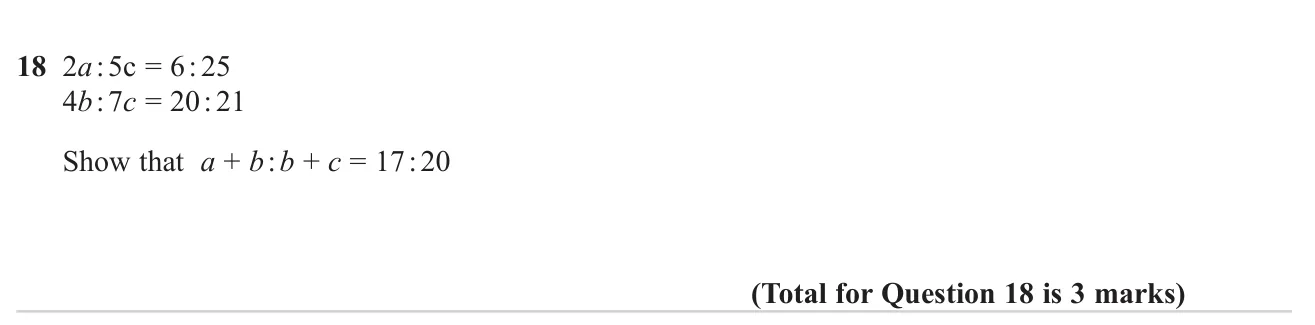
Answer a : b : c = 9 : 25 : 15 a : b : c = 9 : 25 : 15 a : b : c = 9 : 25 : 15 a + b : b + c = 34 : 40 = 17 : 20 a + b : b + c = 34 : 40 = 17 : 20 a + b : b + c = 34 : 40 = 17 : 20 3 marks
Worked solution Checked against the mark scheme
2 a : 5 c = 6 : 25 ⇒ 50 a = 30 c ⇒ a = 3 c 5 2a : 5c = 6 : 25 \Rightarrow 50a = 30c \Rightarrow a = \frac{3c}{5} 2 a : 5 c = 6 : 25 ⇒ 50 a = 30 c ⇒ a = 5 3 c
4 b : 7 c = 20 : 21 ⇒ 84 b = 140 c ⇒ b = 5 c 3 4b : 7c = 20 : 21 \Rightarrow 84b = 140c \Rightarrow b = \frac{5c}{3} 4 b : 7 c = 20 : 21 ⇒ 84 b = 140 c ⇒ b = 3 5 c
Take c = 15 c = 15 c = 15 a = 9 a = 9 a = 9 b = 25 b = 25 b = 25
a + b : b + c = 34 : 40 = 17 : 20 a + b : b + c = 34 : 40 = 17 : 20 a + b : b + c = 34 : 40 = 17 : 20
Watch out: Reading 2a : 5c = 6 : 25 as a : c = 6 : 25.
© Pearson Education Ltd. November 2023 Paper 3 (Higher, calculator), question 23.
Worked solution Checked against the mark scheme
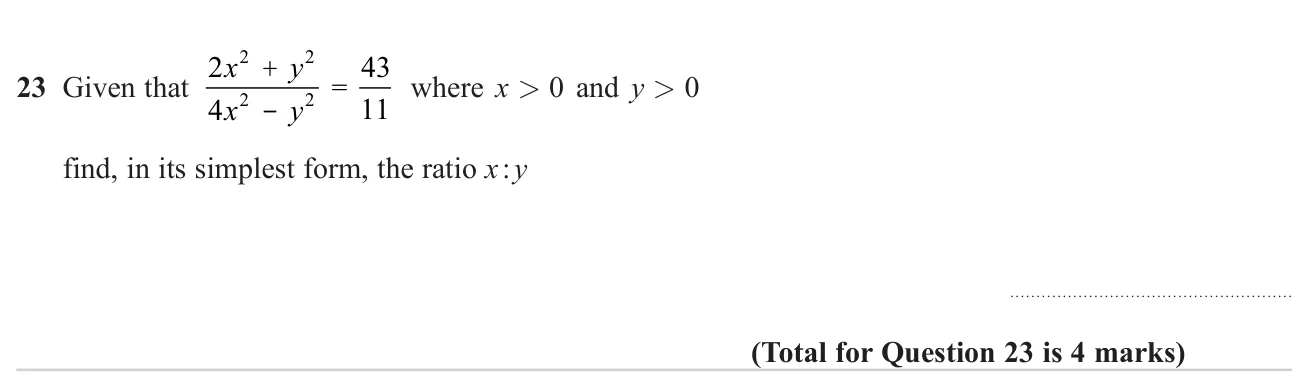
11 ( 2 x 2 + y 2 ) = 43 ( 4 x 2 − y 2 ) 11(2x^2 + y^2) = 43(4x^2 - y^2) 11 ( 2 x 2 + y 2 ) = 43 ( 4 x 2 − y 2 )
22 x 2 + 11 y 2 = 172 x 2 − 43 y 2 22x^2 + 11y^2 = 172x^2 - 43y^2 22 x 2 + 11 y 2 = 172 x 2 − 43 y 2
54 y 2 = 150 x 2 54y^2 = 150x^2 54 y 2 = 150 x 2 x 2 y 2 = 54 150 = 9 25 \dfrac{x^2}{y^2} = \dfrac{54}{150} = \dfrac{9}{25} y 2 x 2 = 150 54 = 25 9
x x x y y y x y = 3 5 \dfrac{x}{y} = \dfrac{3}{5} y x = 5 3 x : y = 3 : 5 x : y = 3 : 5 x : y = 3 : 5
Watch out: Giving the ratio upside down as 5 : 3, or leaving it as 9 : 25.
© Pearson Education Ltd. November 2020 Paper 1 (Higher, non-calculator), question 23.
Answer 27 56 \frac{27}{56} 56 27 3 marks
Worked solution Checked against the mark scheme
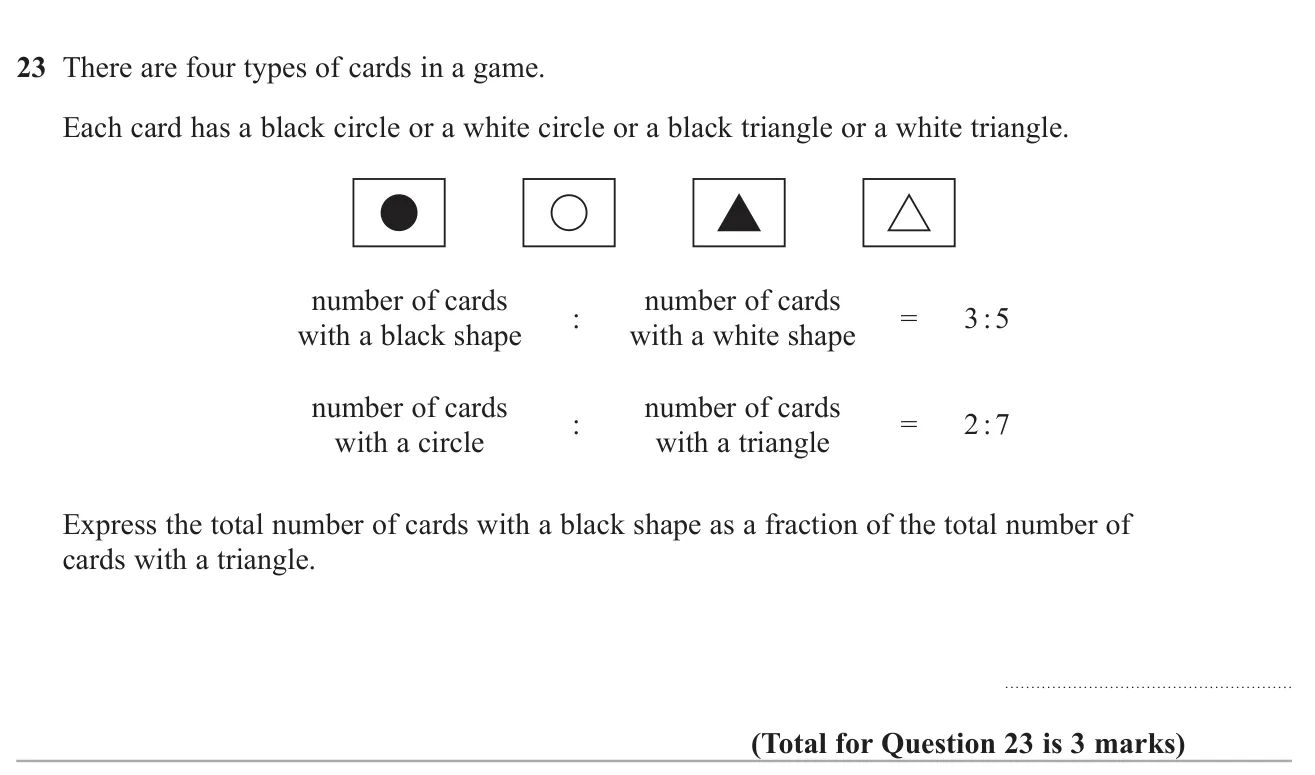
Black cards are 3 8 \frac{3}{8} 8 3 7 9 \frac{7}{9} 9 7
Use a total of 72 (LCM of 8 and 9): black = 27 = 27 = 27 = 56 = 56 = 56
So black as a fraction of triangles = 27 56 = \frac{27}{56} = 56 27
Watch out: Giving the ratio 27 : 56 instead of a fraction.
© Pearson Education Ltd. November 2020 Paper 3 (Higher, calculator), question 21.
(a) 3 : 4 3 : 4 3 : 4 2 marks (b) 5 : 2 5 : 2 5 : 2 3 marks
Worked solution Checked against the mark scheme
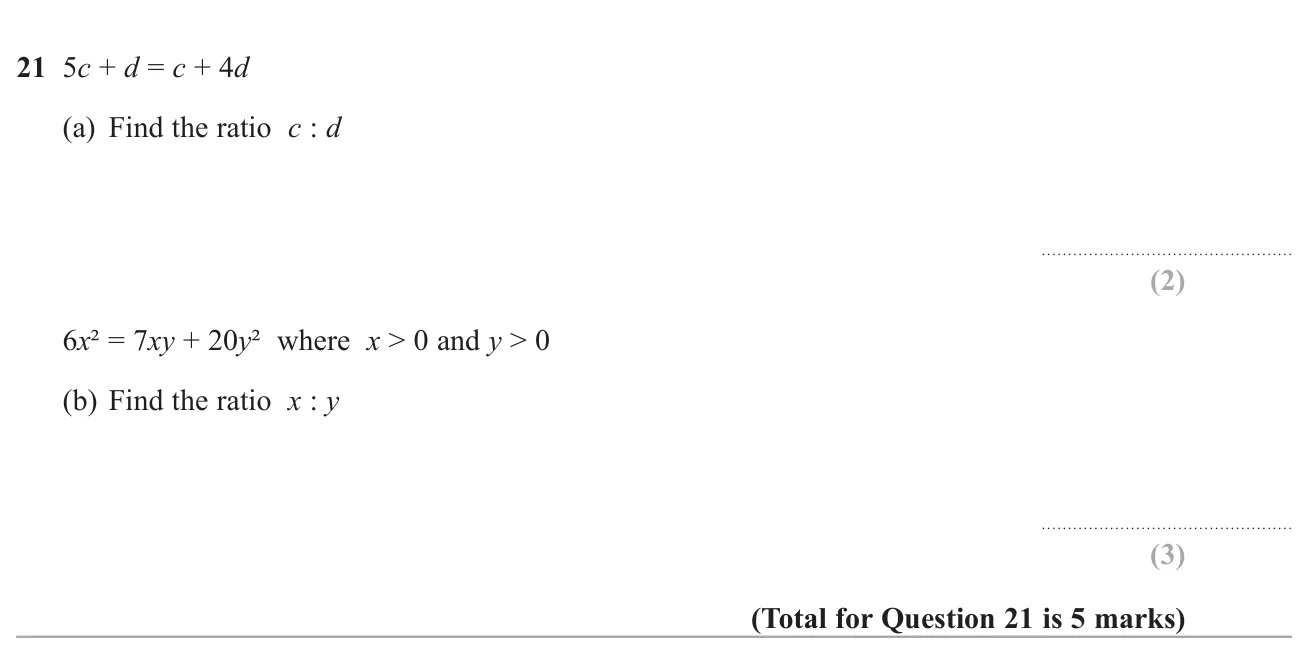
(a) 5 c − c = 4 d − d 5c - c = 4d - d 5 c − c = 4 d − d 4 c = 3 d 4c = 3d 4 c = 3 d c : d = 3 : 4 c : d = 3 : 4 c : d = 3 : 4
(b) 6 x 2 − 7 x y − 20 y 2 = 0 6x^2 - 7xy - 20y^2 = 0 6 x 2 − 7 x y − 20 y 2 = 0
( 2 x − 5 y ) ( 3 x + 4 y ) = 0 (2x - 5y)(3x + 4y) = 0 ( 2 x − 5 y ) ( 3 x + 4 y ) = 0
Since x , y > 0 x, y > 0 x , y > 0 3 x + 4 y ≠ 0 3x + 4y \ne 0 3 x + 4 y = 0 2 x = 5 y 2x = 5y 2 x = 5 y x : y = 5 : 2 x : y = 5 : 2 x : y = 5 : 2
Watch out: Writing the ratio the wrong way round, e.g. 4 : 3 in (a).
© Pearson Education Ltd. June 2019 Paper 2 (Higher, calculator), question 17.
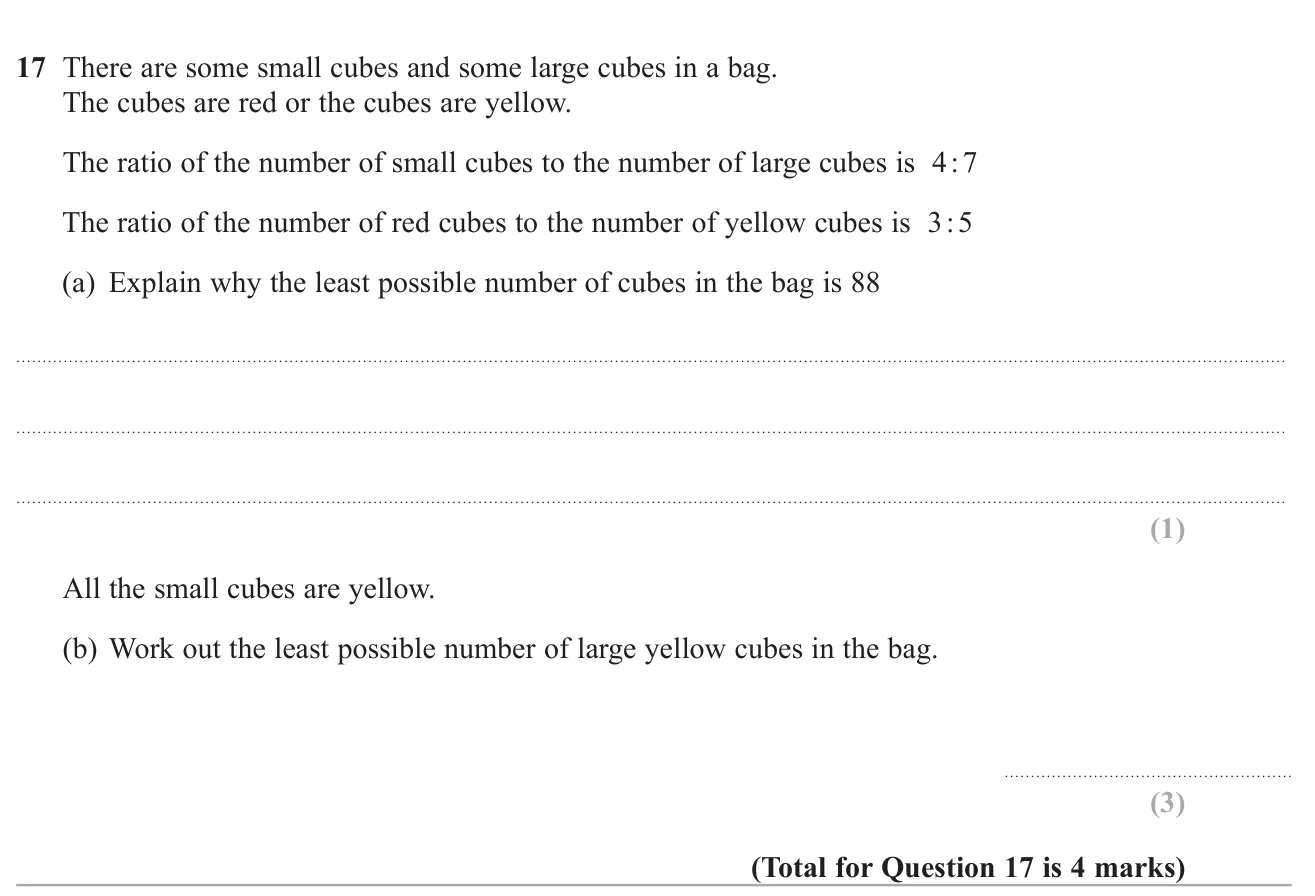
(a) The total must be a multiple of both 11 and 8, and the lowest common multiple is 88 1 mark (b) 23 23 23 3 marks
Worked solution Checked against the mark scheme
(a) Small : large = 4 : 7 = 4 : 7 = 4 : 7 = 3 : 5 = 3 : 5 = 3 : 5 = 88 = 88 = 88
(b) With 88 cubes: small = 4 × 8 = 32 = 4 \times 8 = 32 = 4 × 8 = 32 = 5 × 11 = 55 = 5 \times 11 = 55 = 5 × 11 = 55
All small cubes are yellow, so large yellow = 55 − 32 = 23 = 55 - 32 = 23 = 55 − 32 = 23
Watch out: Multiplying 11 by 8 without explaining it is the lowest common multiple.
© Pearson Education Ltd. November 2018 Paper 2 (Higher, calculator), question 17.
Worked solution Checked against the mark scheme
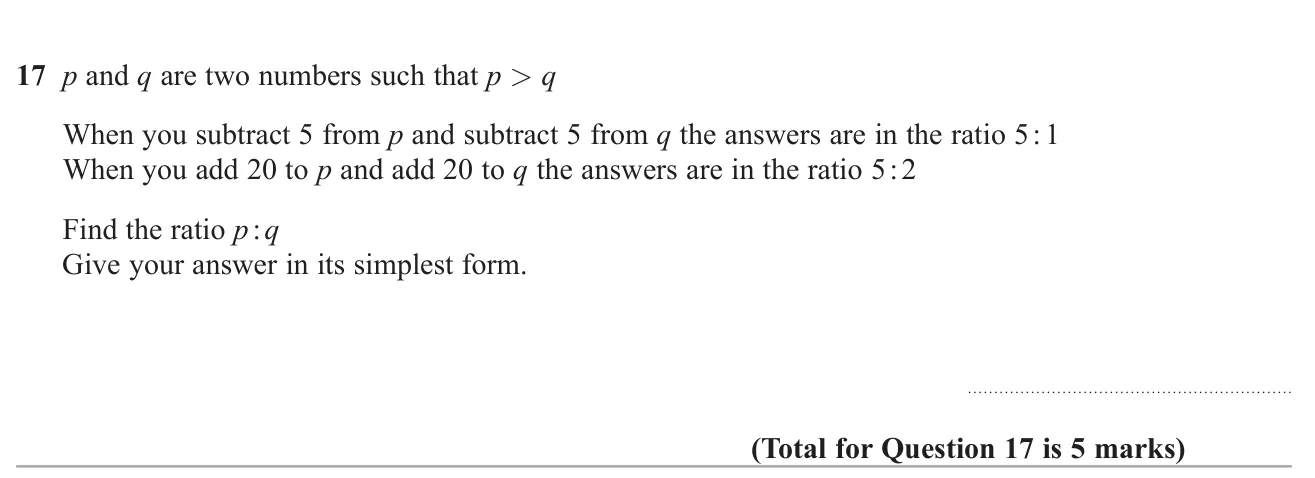
p − 5 q − 5 = 5 \frac{p-5}{q-5} = 5 q − 5 p − 5 = 5 p = 5 q − 20 p = 5q - 20 p = 5 q − 20
p + 20 q + 20 = 5 2 \frac{p+20}{q+20} = \frac{5}{2} q + 20 p + 20 = 2 5 2 p + 40 = 5 q + 100 2p + 40 = 5q + 100 2 p + 40 = 5 q + 100
Substitute: 10 q − 40 + 40 = 5 q + 100 10q - 40 + 40 = 5q + 100 10 q − 40 + 40 = 5 q + 100 q = 20 q = 20 q = 20 p = 80 p = 80 p = 80
p : q = 80 : 20 = 4 : 1 p : q = 80 : 20 = 4 : 1 p : q = 80 : 20 = 4 : 1
Watch out: Giving the ratio the wrong way round as 1 : 4 1 : 4 1 : 4
Also tested in these questions Their main topic is different, but part of each one tests this topic.
November 2024 · Paper 1 Foundation · Q9 : Complete a bar chart from a total, find a fraction of the total, and convert a ratio into a fraction and into n : 1 form.November 2024 · Paper 3 Higher · Q18 : Estimate a population using capture-recapture data and state an assumption behind the estimate.June 2024 · Paper 3 Foundation · Q20 : Use isosceles triangle angle facts to find two angles and write them as a ratio 1 : n.November 2023 · Paper 1 Higher · Q9 : Draw a straight-line graph from a rice-to-water ratio, find its gradient and interpret it.June 2023 · Paper 2 Foundation · Q9 : Give the next term of a linear sequence, then write the ratio of two of its terms in simplest form.June 2023 · Paper 3 Higher · Q24 : Find an algebraic probability of picking two counters of the same colour without replacement, using a ratio to write everything in one variable.June 2023 · Paper 3 Foundation · Q28 : Write a ratio of standard-form numbers as 1 : n and order numbers written in different forms.November 2022 · Paper 1 Foundation · Q13 : Read values from a composite bar chart and write a ratio of children to adults.June 2022 · Paper 1 Foundation · Q29 : Find the densities of two cubes from their side lengths and masses and write them as a simplified ratio.June 2022 · Paper 2 Higher · Q14 : Estimate a fish population using a capture-recapture method.June 2022 · Paper 3 Foundation · Q12 : Write one length as a fraction of another in its simplest form.November 2021 · Paper 2 Higher · Q11 : Extend a line segment in a given ratio to find a point, then find the equation of a perpendicular line.November 2021 · Paper 2 Higher · Q14 : Use a ratio of angles in a cyclic quadrilateral and the alternate segment theorem to find an angle next to a tangent, with reasons.November 2019 · Paper 2 Foundation · Q23 : Use two ratios with the same total to find how many items changed hands.November 2019 · Paper 2 Foundation · Q24 : Scale up a sample result to a whole club and state an assumption made.June 2019 · Paper 1 Higher · Q17 : Turn a ratio of two algebraic expressions into a quadratic equation and solve it.June 2019 · Paper 1 Foundation · Q27 : Use a ratio of packs sold and pens per pack to find how many green pens were sold.June 2019 · Paper 2 Foundation · Q26 : Share £360 between four people using a ratio and a multiplier, then find one person's share.November 2018 · Paper 2 Higher · Q10 : Find the cost of mixing paint from tins in a given ratio and work out the percentage profit on each tin sold.June 2018 · Paper 1 Foundation · Q14 : Compare savings given as a percentage, a fraction spent and a ratio, to see who saves most.June 2018 · Paper 1 Higher · Q16 : Use a red-to-blue ratio and the probability of purple to find the probability of taking a red counter.Specimen · Paper 3 Higher · Q9 : Use a height ratio and an angle of elevation between the tops of two posts to find the distance between them.