Revision guide by The Full Marks
Probability scale and basic probability: what you need to know Probability measures how likely something is, on a scale from 0 (impossible) to 1 (certain). It turns up on almost every paper, often as the first part of a longer question, so these are marks you should bank.
Key facts Probability = number of ways it can happen total number of outcomes \frac{\text{number of ways it can happen}}{\text{total number of outcomes}} total number of outcomes number of ways it can happen All probabilities lie between 0 and 1. Write them as fractions, decimals or percentages, never as ratios like 1 : 4. The probabilities of all the possible outcomes add up to 1. P ( not A ) = 1 − P ( A ) P(\text{not } A) = 1 - P(A) P ( not A ) = 1 − P ( A ) Mutually exclusive events cannot happen at the same time, so you can add their probabilities. Expected number of times = = = × \times × = = = ÷ \div ÷ Finding a simple probability Count the total number of equally likely outcomes. Count the outcomes you want. Write it as a fraction and simplify if you can. Finding a missing probability in a table Add up the probabilities you know. Take that total away from 1. If several outcomes share the rest equally, divide by how many there are. If they are in a ratio (e.g. green is twice as likely as yellow), share the rest in that ratio. Worked examples Example 1 Foundation · grade 2
A bag holds 5 red, 3 blue and 2 green counters. One counter is taken at random. Find (a) P ( blue ) P(\text{blue}) P ( blue ) P ( not green ) P(\text{not green}) P ( not green )
Show the solution (a) Total counters = 5 + 3 + 2 = 10, and 3 are blue.P ( blue ) = 3 10 P(\text{blue}) = \frac{3}{10} P ( blue ) = 10 3 P ( green ) = 2 10 P(\text{green}) = \frac{2}{10} P ( green ) = 10 2 P ( not green ) = 1 − 2 10 = 8 10 = 4 5 P(\text{not green}) = 1 - \frac{2}{10} = \frac{8}{10} = \frac{4}{5} P ( not green ) = 1 − 10 2 = 10 8 = 5 4
Example 2 Foundation · grade 4
A spinner lands on red with probability 0.25 and blue with probability 0.3. It can also land on green or yellow, which are equally likely. (a) Find the probability it lands on yellow. (b) The spinner is spun 200 times. Estimate how many times it lands on yellow.
Show the solution (a) Known probabilities: 0.25 + 0.3 = 0.55P ( yellow ) = 0.225 P(\text{yellow}) = 0.225 P ( yellow ) = 0.225 = 0.225 × 200 = 45 = 0.225 \times 200 = 45 = 0.225 × 200 = 45
Common mistakes Writing a probability as a ratio or as '3 out of 10' in words. Use a fraction, decimal or percentage. Giving the probability that something happens when the question asks for 'does not happen'. Reread the question before you finish. Forgetting to count every item when finding the total, for example missing one colour of counter. Multiplying when you should divide: if 12 counters are red and P ( red ) = 0.2 P(\text{red}) = 0.2 P ( red ) = 0.2 12 ÷ 0.2 = 60 12 \div 0.2 = 60 12 ÷ 0.2 = 60 12 × 0.2 12 \times 0.2 12 × 0.2 Exam tips An unsimplified fraction such as 8 10 \frac{8}{10} 10 8 Probability words ('likely', 'evens', 'impossible') match points on the 0 to 1 scale: evens is 0.5. Questions people ask How do you work out probability in GCSE Maths? Divide the number of outcomes you want by the total number of equally likely outcomes. The answer is always between 0 and 1.
Why do probabilities add up to 1? Something must happen, and the outcomes together cover everything, so their probabilities total 1 (certain). That is why P ( not A ) = 1 − P ( A ) P(\text{not } A) = 1 - P(A) P ( not A ) = 1 − P ( A )
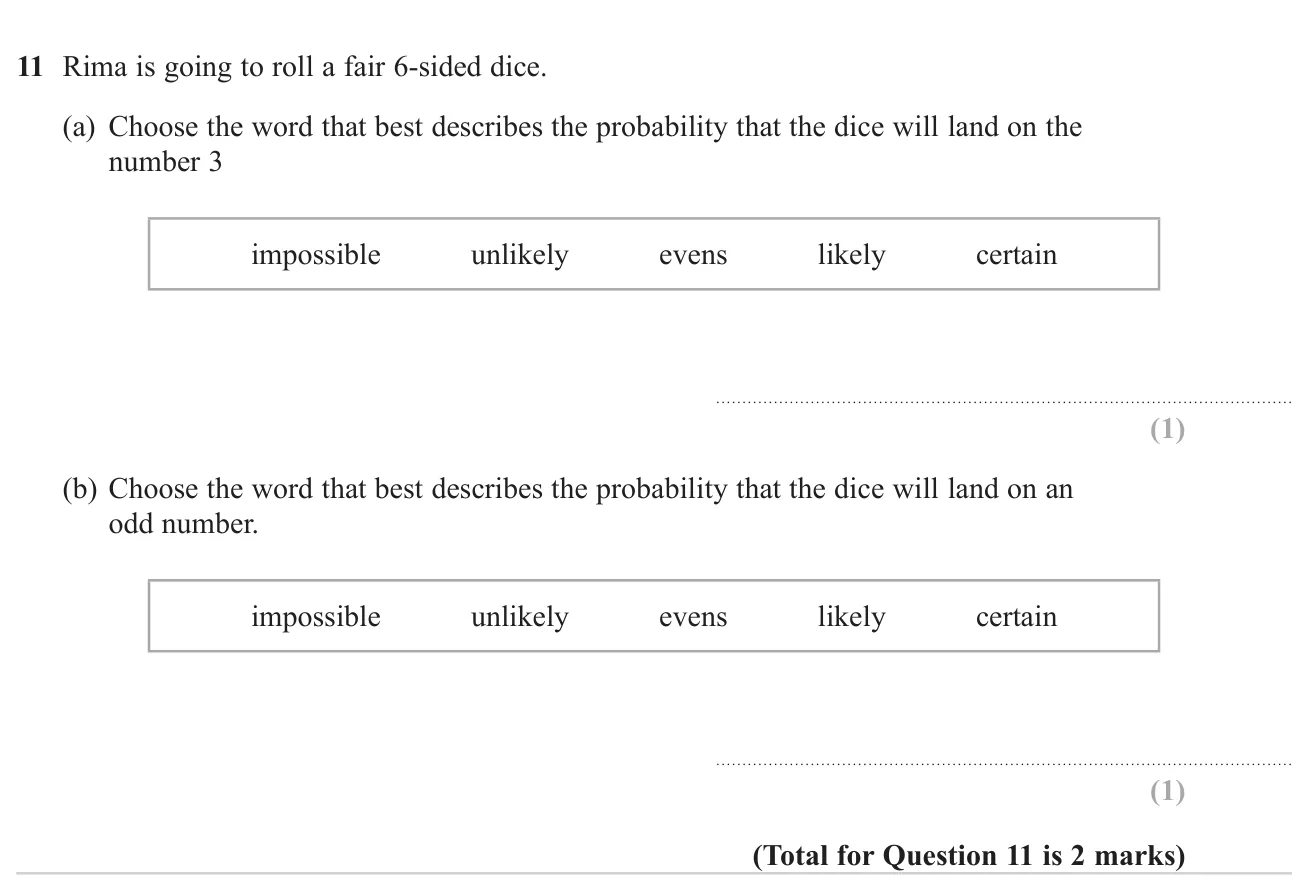
Exam questions: Probability scale and basic probability (36, easiest first) © Pearson Education Ltd. November 2023 Paper 2 (Foundation, calculator), question 11.
(a) Unlikely 1 mark (b) Evens 1 mark
Worked solution Checked against the mark scheme
(a) Only 1 of the 6 faces is a 3, so the probability is 1 6 \frac{1}{6} 6 1 unlikely .
(b) The odd numbers are 1, 3 and 5, so 3 out of 6, which is 1 2 \frac{1}{2} 2 1 evens .
Watch out: Calling a 1 in 6 chance impossible.
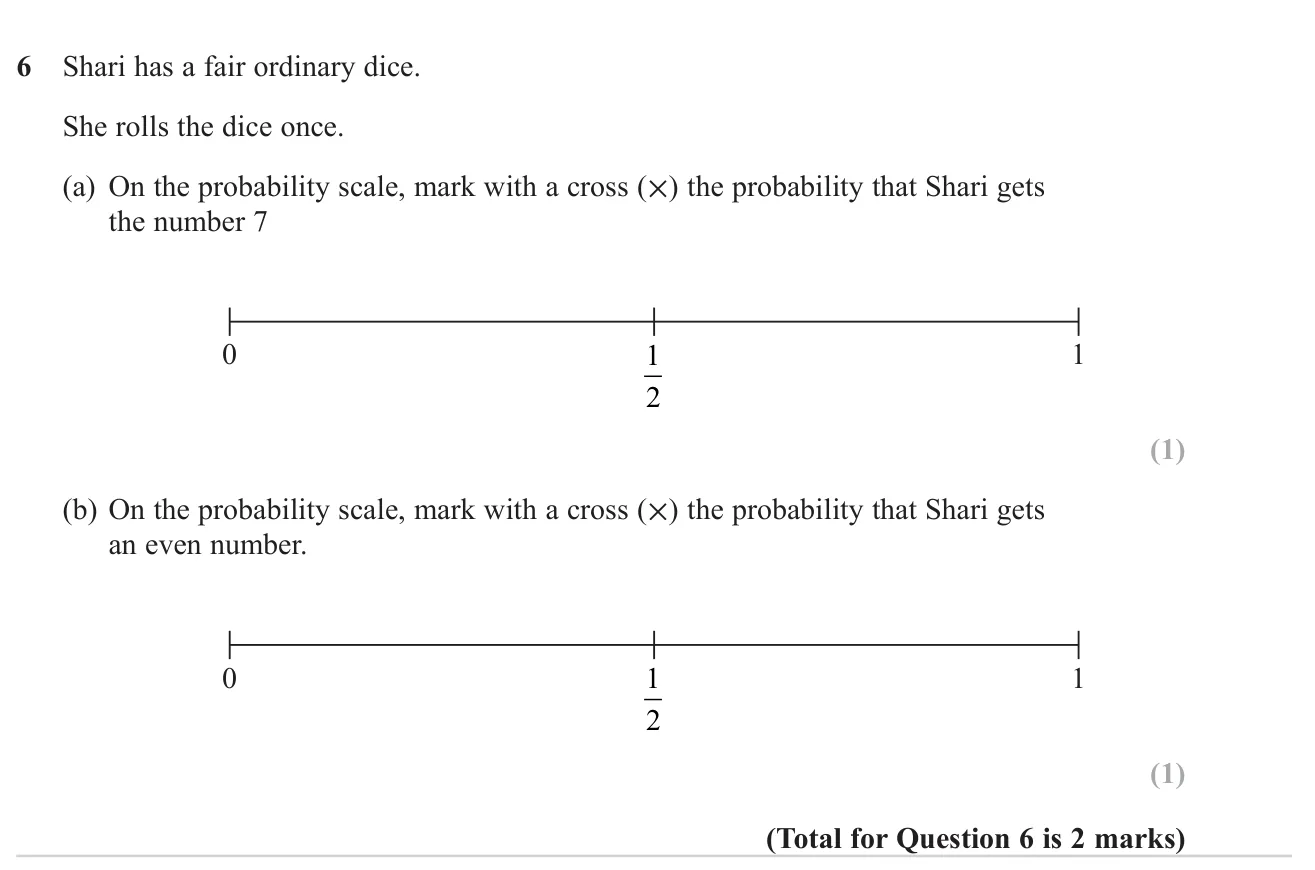
© Pearson Education Ltd. June 2023 Paper 2 (Foundation, calculator), question 6.
(a) Cross at 0 1 mark (b) Cross at 1 2 \frac{1}{2} 2 1 1 mark
Worked solution Checked against the mark scheme
(a) A normal dice has no 7, so rolling a 7 is impossible: probability 0 0 0
(b) Even numbers are 2, 4 and 6, so the probability is 3 6 = 1 2 \frac{3}{6} = \frac{1}{2} 6 3 = 2 1
Watch out: Marking 'even number' at 1 6 \frac{1}{6} 6 1 3 6 \frac{3}{6} 6 3
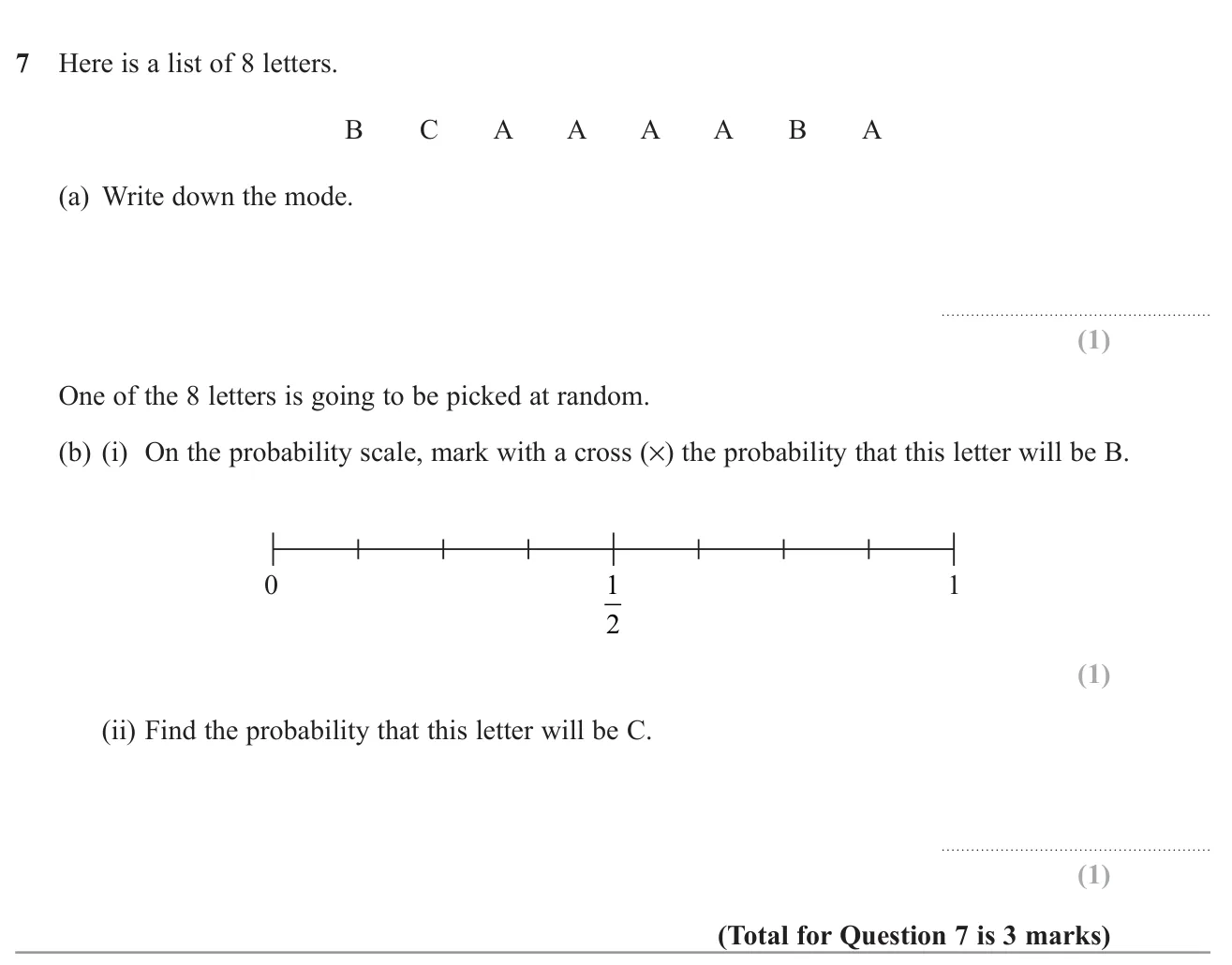
© Pearson Education Ltd. November 2022 Paper 1 (Foundation, non-calculator), question 7.
(a) A 1 mark (b(i)) Cross at 1 4 \frac{1}{4} 4 1 1 mark (b(ii)) 1 8 \frac{1}{8} 8 1 1 mark
Worked solution Checked against the mark scheme
(a) A appears 5 times, more than any other letter, so the mode is A.
(b)(i) B appears 2 times out of 8: 2 8 = 1 4 \frac{2}{8} = \frac{1}{4} 8 2 = 4 1 1 2 \frac{1}{2} 2 1
(b)(ii) C appears once: 1 8 \frac{1}{8} 8 1
Watch out: Writing the probability as '1 : 8' or '1 out of 8'.
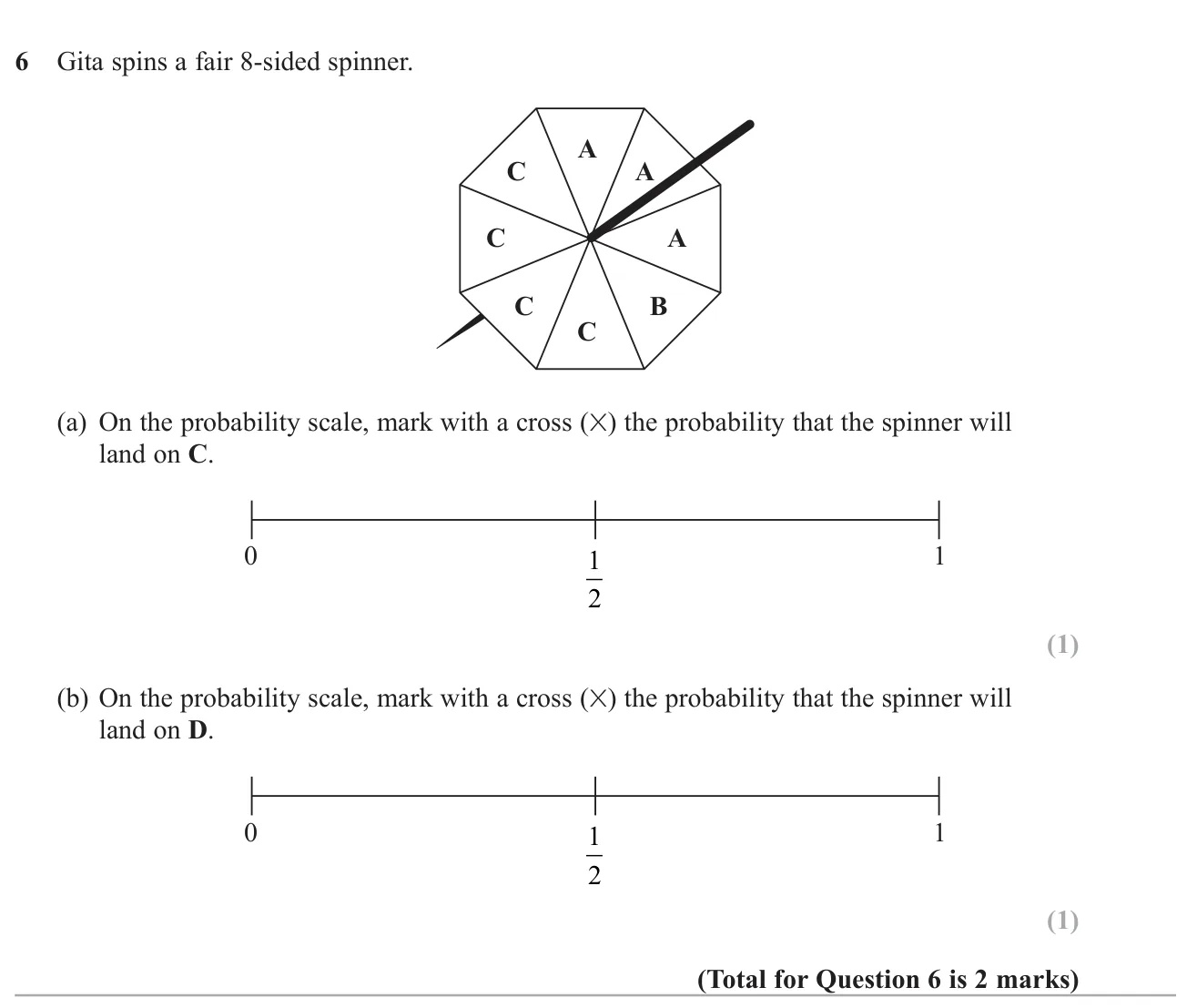
© Pearson Education Ltd. November 2020 Paper 1 (Foundation, non-calculator), question 6.
(a) Cross at 1 2 \frac{1}{2} 2 1 1 mark (b) Cross at 0 0 0 1 mark
Worked solution Checked against the mark scheme
(a) 4 of the 8 equal sections are C, so P ( C ) = 4 8 = 1 2 P(C) = \frac{4}{8} = \frac{1}{2} P ( C ) = 8 4 = 2 1
(b) No section shows D, so it is impossible: put the cross at 0.
Watch out: Putting the cross for D at 1 or leaving it off the scale.
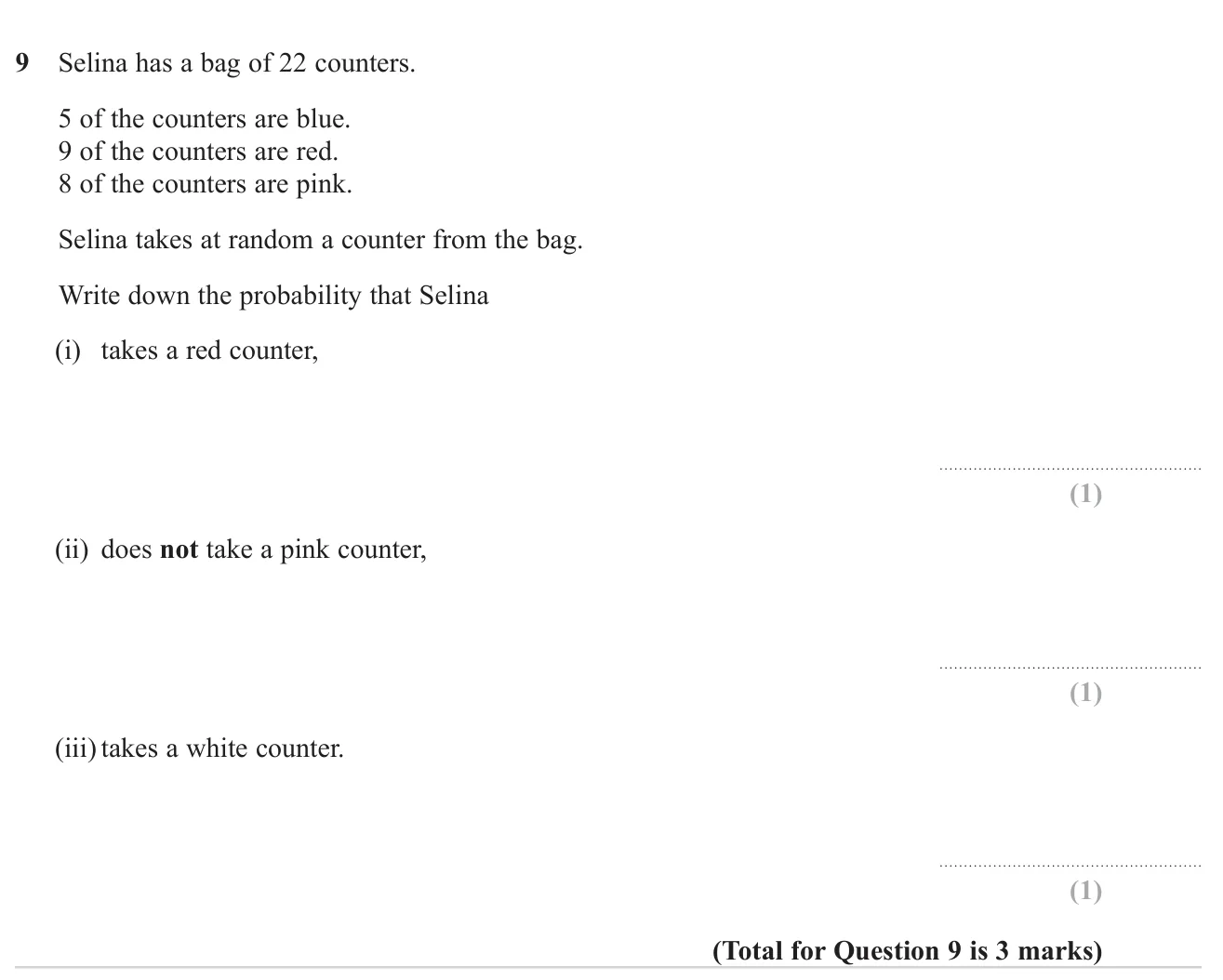
© Pearson Education Ltd. November 2023 Paper 1 (Foundation, non-calculator), question 9.
(i) 9 22 \frac{9}{22} 22 9 1 mark (ii) 14 22 = 7 11 \frac{14}{22} = \frac{7}{11} 22 14 = 11 7 1 mark (iii) 0 1 mark
Worked solution Checked against the mark scheme
(i) 9 red out of 22: 9 22 \frac{9}{22} 22 9
(ii) Not pink: 22 − 8 = 14 22 - 8 = 14 22 − 8 = 14 14 22 = 7 11 \frac{14}{22} = \frac{7}{11} 22 14 = 11 7
(iii) There are no white counters, so the probability is 0.
Watch out: Writing probabilities as ratios such as 9 : 22.
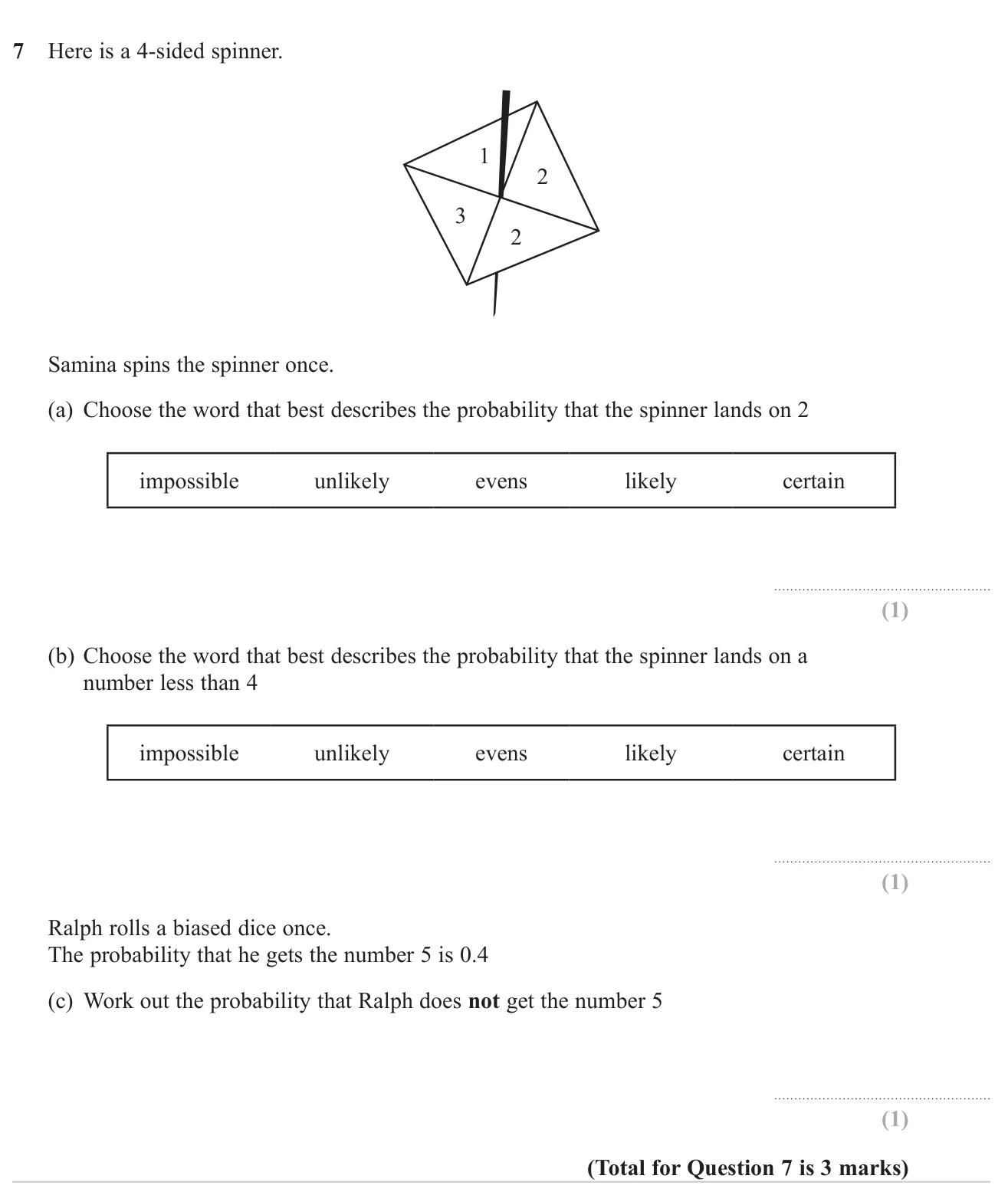
© Pearson Education Ltd. June 2023 Paper 3 (Foundation, calculator), question 7.
(a) evens 1 mark (b) certain 1 mark (c) 0.6 1 mark
Worked solution Checked against the mark scheme
(a) Two of the four sections show 2, so the chance is 2 4 = 1 2 \frac{2}{4} = \frac{1}{2} 4 2 = 2 1
(b) Every number on the spinner is less than 4, so it is certain.
(c) 1 − 0.4 = 0.6 1 - 0.4 = 0.6 1 − 0.4 = 0.6
Watch out: In (c), writing 0.4 or 1 − 0.4 as 0.5.
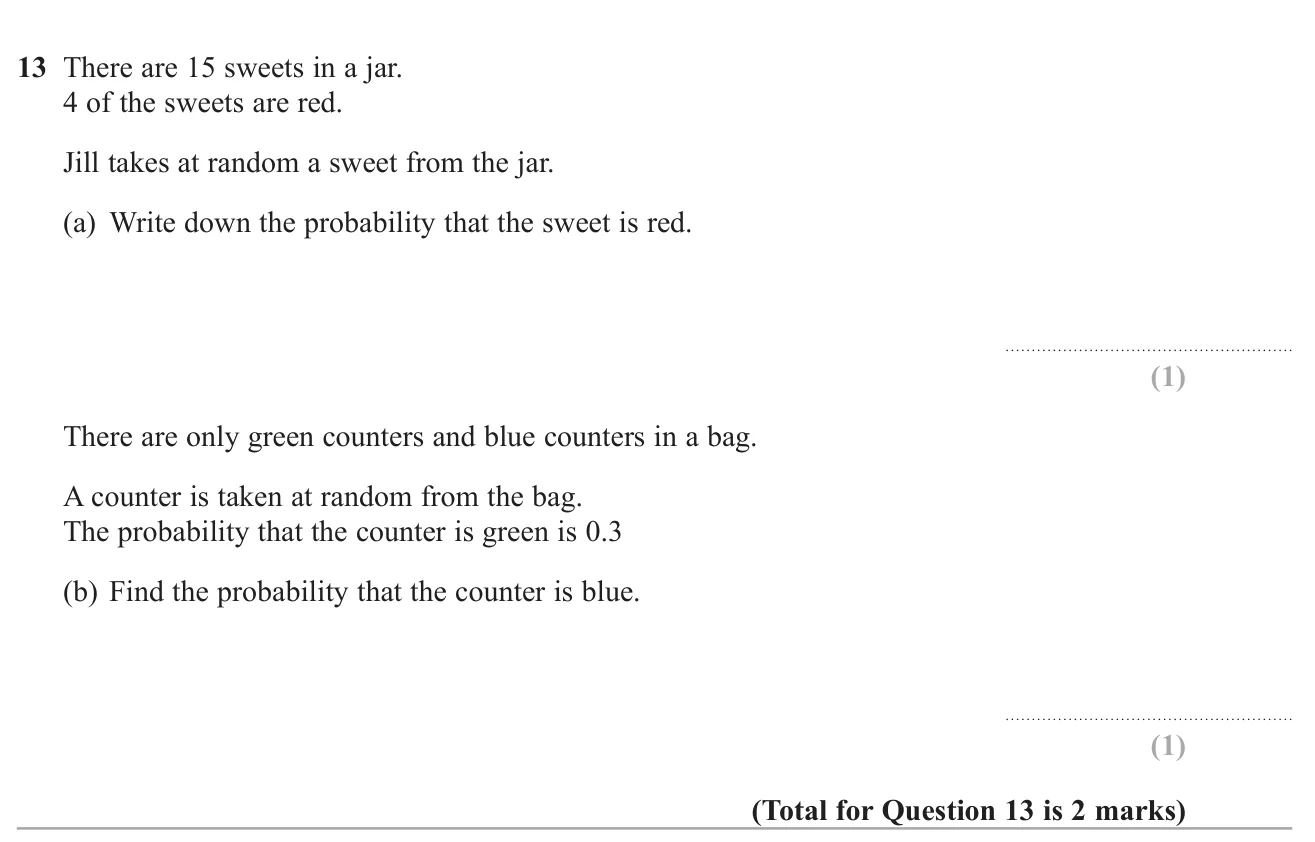
© Pearson Education Ltd. June 2022 Paper 1 (Foundation, non-calculator), question 13.
(a) 4 15 \frac{4}{15} 15 4 1 mark (b) 0.7 1 mark
Worked solution Checked against the mark scheme
(a) 4 red out of 15 sweets: P ( red ) = 4 15 P(\text{red}) = \frac{4}{15} P ( red ) = 15 4
(b) Probabilities add to 1: 1 − 0.3 = 0.7 1 - 0.3 = 0.7 1 − 0.3 = 0.7
Watch out: Writing the probability as a ratio, 4 : 15.
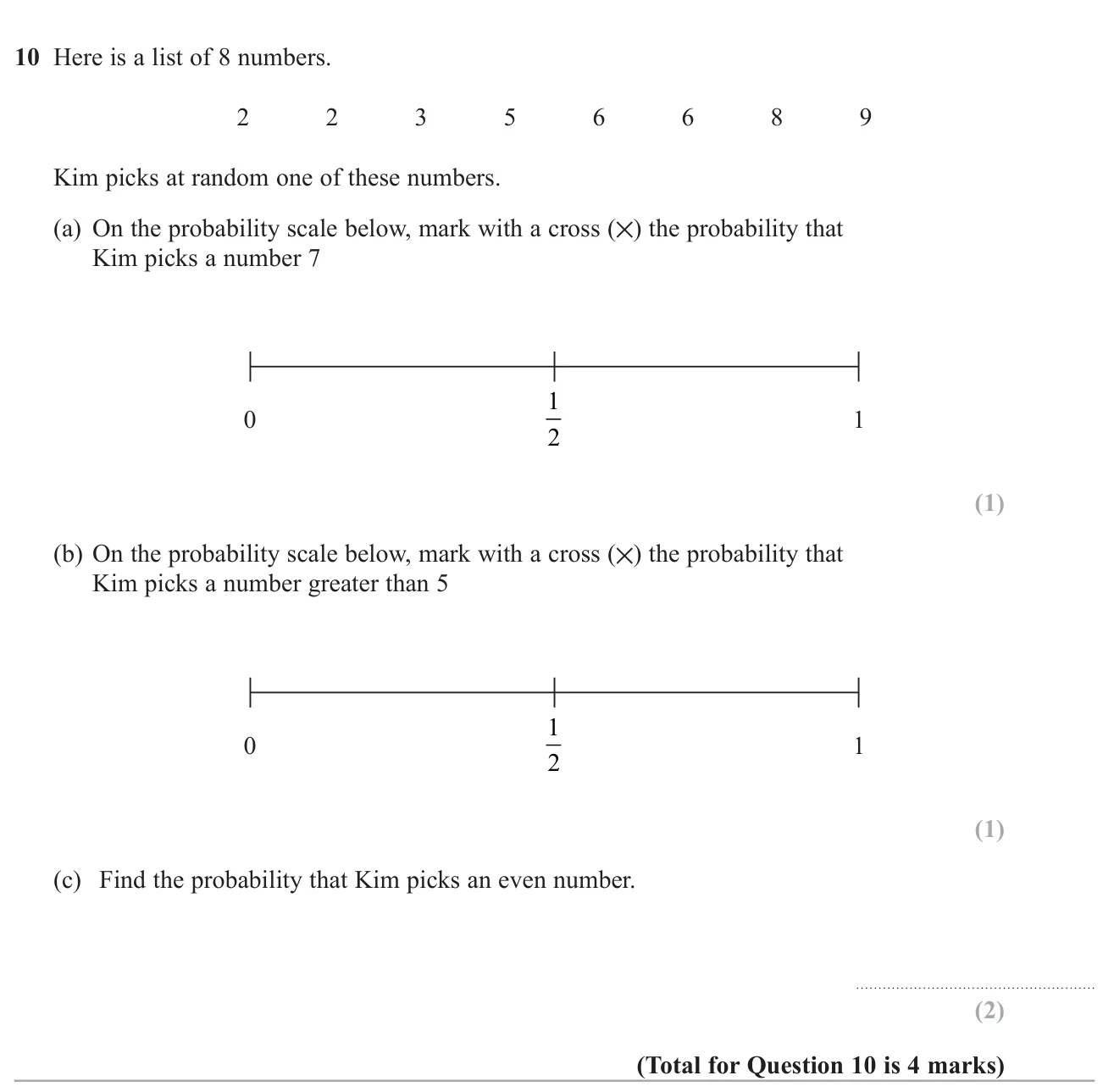
© Pearson Education Ltd. June 2022 Paper 3 (Foundation, calculator), question 10.
(a) Cross at 0 1 mark (b) Cross at 1 2 \frac{1}{2} 2 1 1 mark (c) 5 8 \frac{5}{8} 8 5 2 marks
Worked solution Checked against the mark scheme
(a) There is no 7 in the list, so it is impossible: probability 0.
(b) 6, 6, 8, 9 are greater than 5: 4 8 = 1 2 \frac{4}{8} = \frac{1}{2} 8 4 = 2 1
(c) Even numbers: 2, 2, 6, 6, 8, which is 5 out of 8, so 5 8 \frac{5}{8} 8 5
Watch out: In (c) counting 2 and 6 only once each and getting 3 8 \frac{3}{8} 8 3
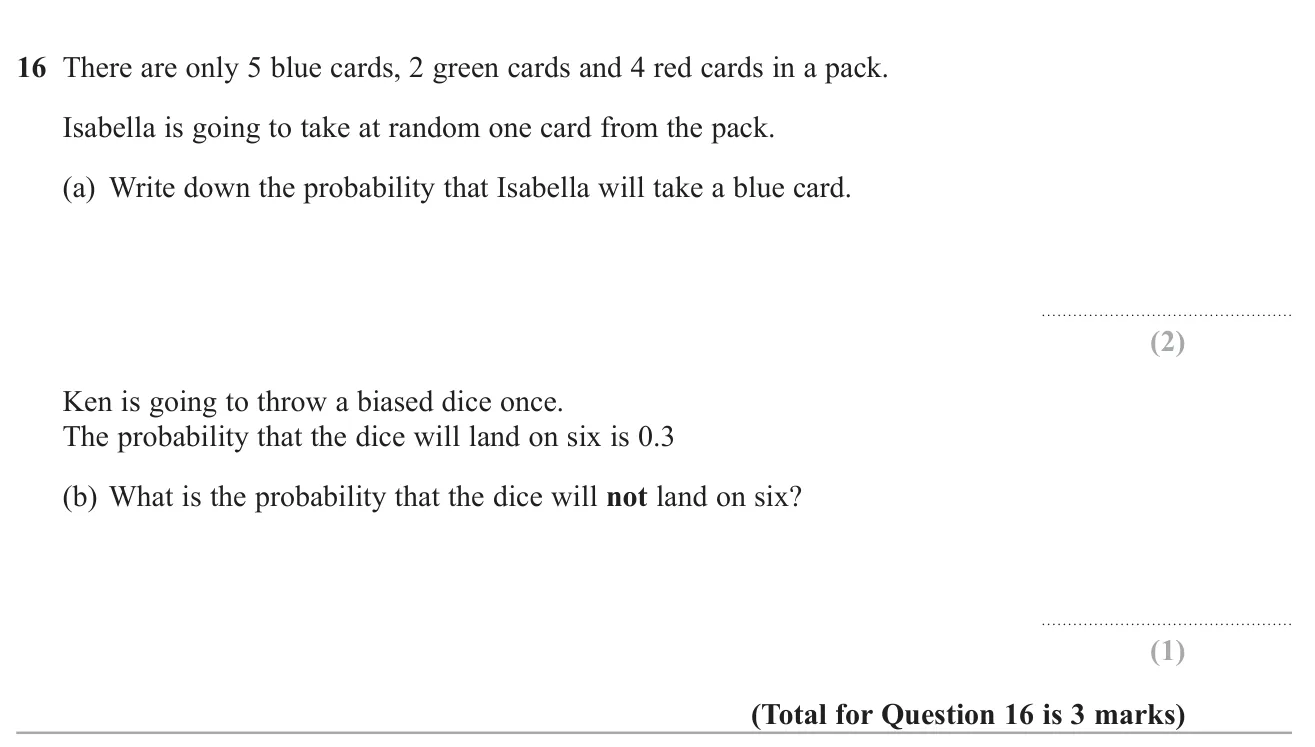
© Pearson Education Ltd. November 2020 Paper 3 (Foundation, calculator), question 16.
(a) 5 11 \frac{5}{11} 11 5 2 marks (b) 0.7 1 mark
Worked solution Checked against the mark scheme
(a) Total cards: 5 + 2 + 4 = 11 5 + 2 + 4 = 11 5 + 2 + 4 = 11 P ( blue ) = 5 11 P(\text{blue}) = \frac{5}{11} P ( blue ) = 11 5
(b) 1 − 0.3 = 0.7 1 - 0.3 = 0.7 1 − 0.3 = 0.7
Watch out: Writing the answer as a ratio 5:11 or using 5/6.
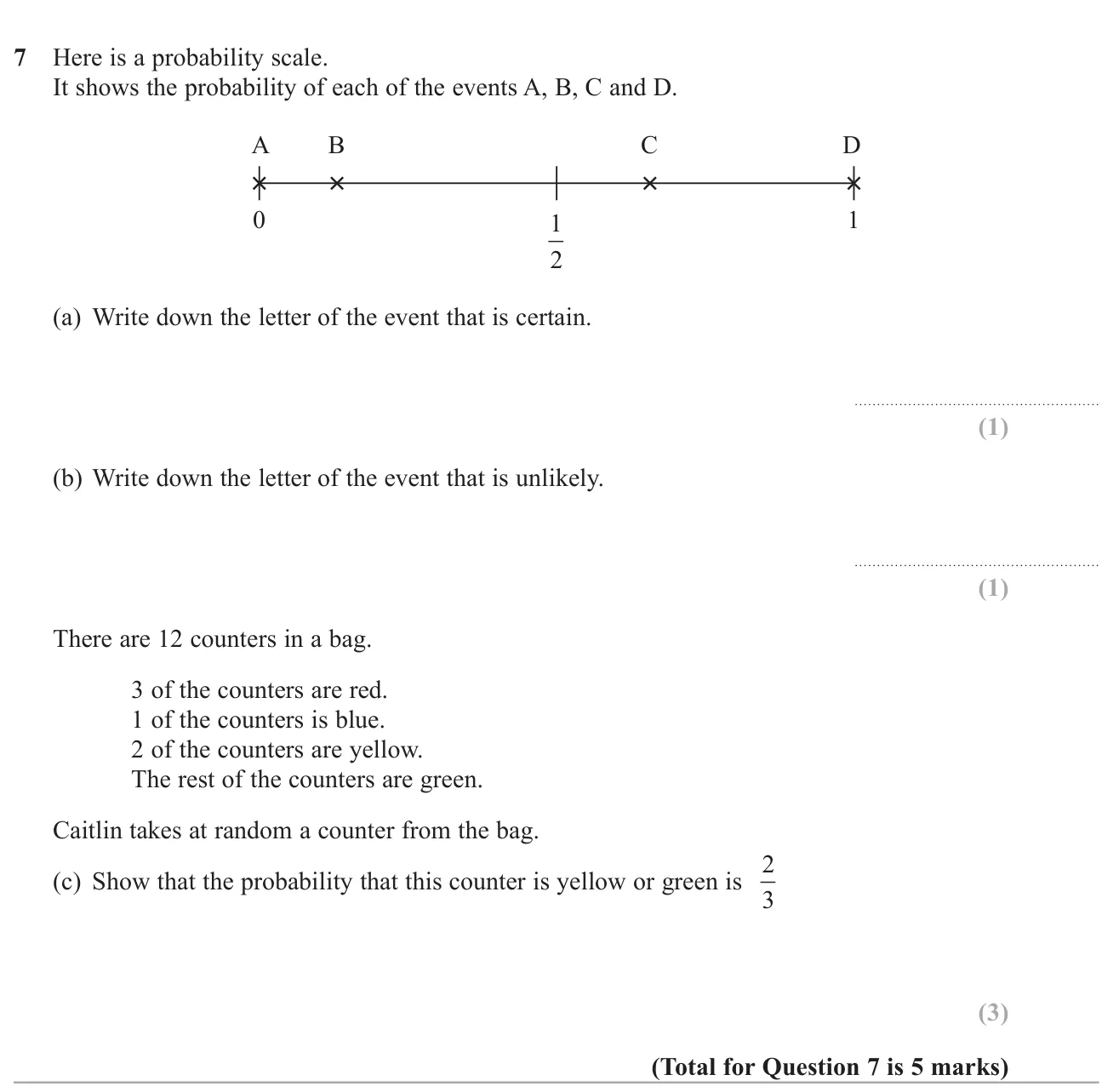
© Pearson Education Ltd. June 2018 Paper 1 (Foundation, non-calculator), question 7.
(a) D 1 mark (b) B 1 mark (c) Green = 6 = 6 = 6 P = 2 + 6 12 = 8 12 = 2 3 P = \frac{2+6}{12} = \frac{8}{12} = \frac{2}{3} P = 12 2 + 6 = 12 8 = 3 2 3 marks
Worked solution Checked against the mark scheme
(a) Certain means probability 1, which is D .
(b) Unlikely means between 0 and a half, which is B .
(c) Green = 12 − ( 3 + 1 + 2 ) = 6 = 12 - (3 + 1 + 2) = 6 = 12 − ( 3 + 1 + 2 ) = 6
Yellow or green = 2 + 6 = 8 = 2 + 6 = 8 = 2 + 6 = 8
P = 8 12 = 2 3 P = \frac{8}{12} = \frac{2}{3} P = 12 8 = 3 2
Watch out: Forgetting the blue counter when working out the number of green ones.
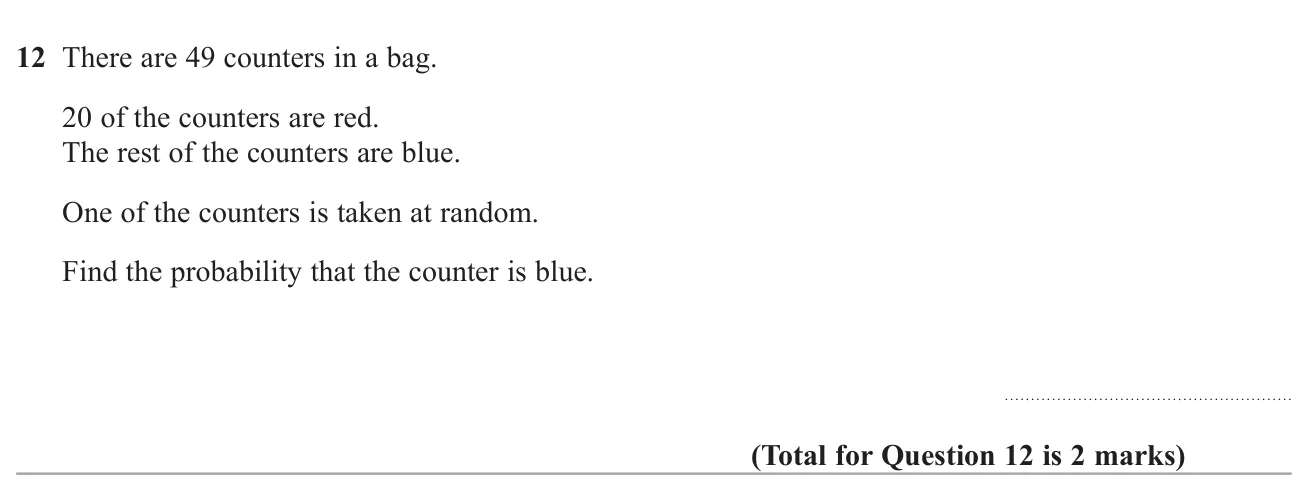
© Pearson Education Ltd. November 2018 Paper 2 (Foundation, calculator), question 12.
Answer 29 49 \frac{29}{49} 49 29 2 marks
Worked solution Checked against the mark scheme
Blue counters: 49 − 20 = 29 49 - 20 = 29 49 − 20 = 29
P(blue) = 29 49 = \frac{29}{49} = 49 29
Watch out: Giving the probability of red, 20 49 \frac{20}{49} 49 20
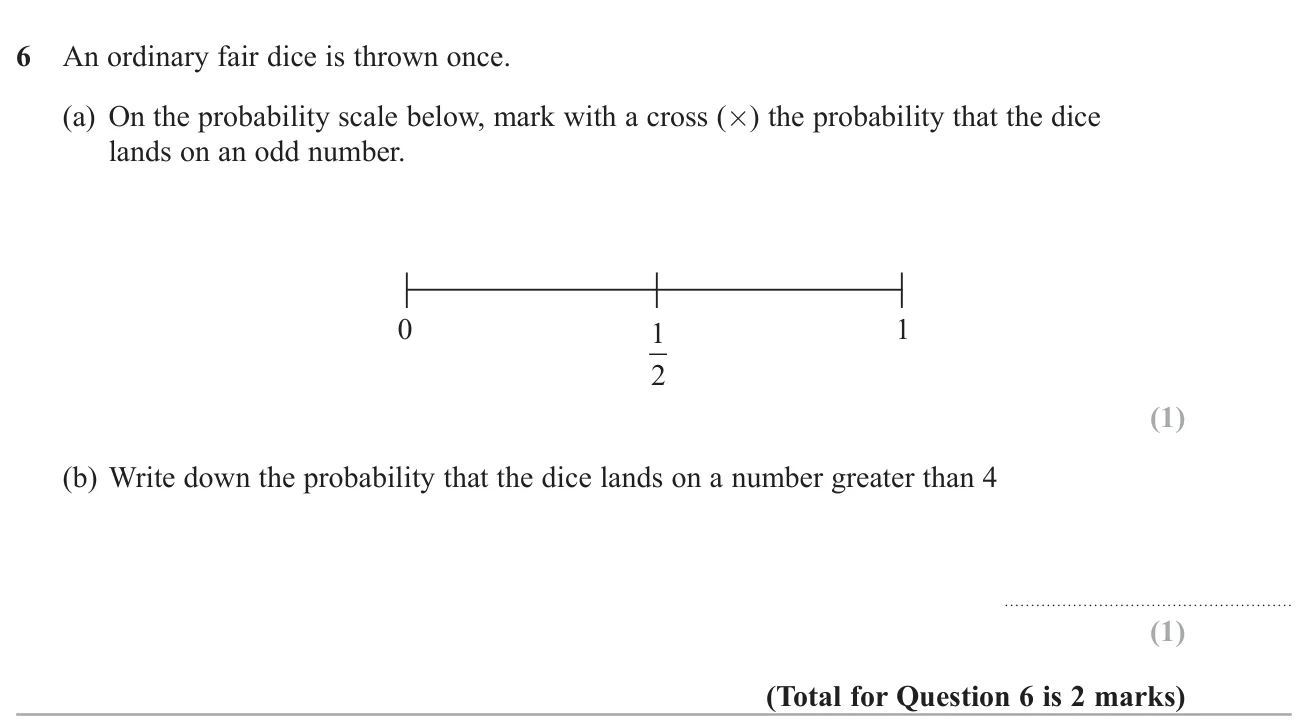
© Pearson Education Ltd. November 2018 Paper 3 (Foundation, calculator), question 6.
(a) Cross at 1 2 \frac{1}{2} 2 1 1 mark (b) 2 6 \frac{2}{6} 6 2 1 mark
Worked solution Checked against the mark scheme
(a) Odd numbers are 1, 3, 5: that is 3 out of 6, so 3 6 = 1 2 \frac{3}{6} = \frac{1}{2} 6 3 = 2 1
(b) Numbers greater than 4 are 5 and 6, so the probability is 2 6 = 1 3 \frac{2}{6} = \frac{1}{3} 6 2 = 3 1
Watch out: In (b), including 4 and giving 3 6 \frac{3}{6} 6 3
© Pearson Education Ltd. June 2024 Paper 2 (Foundation, calculator), question 11.
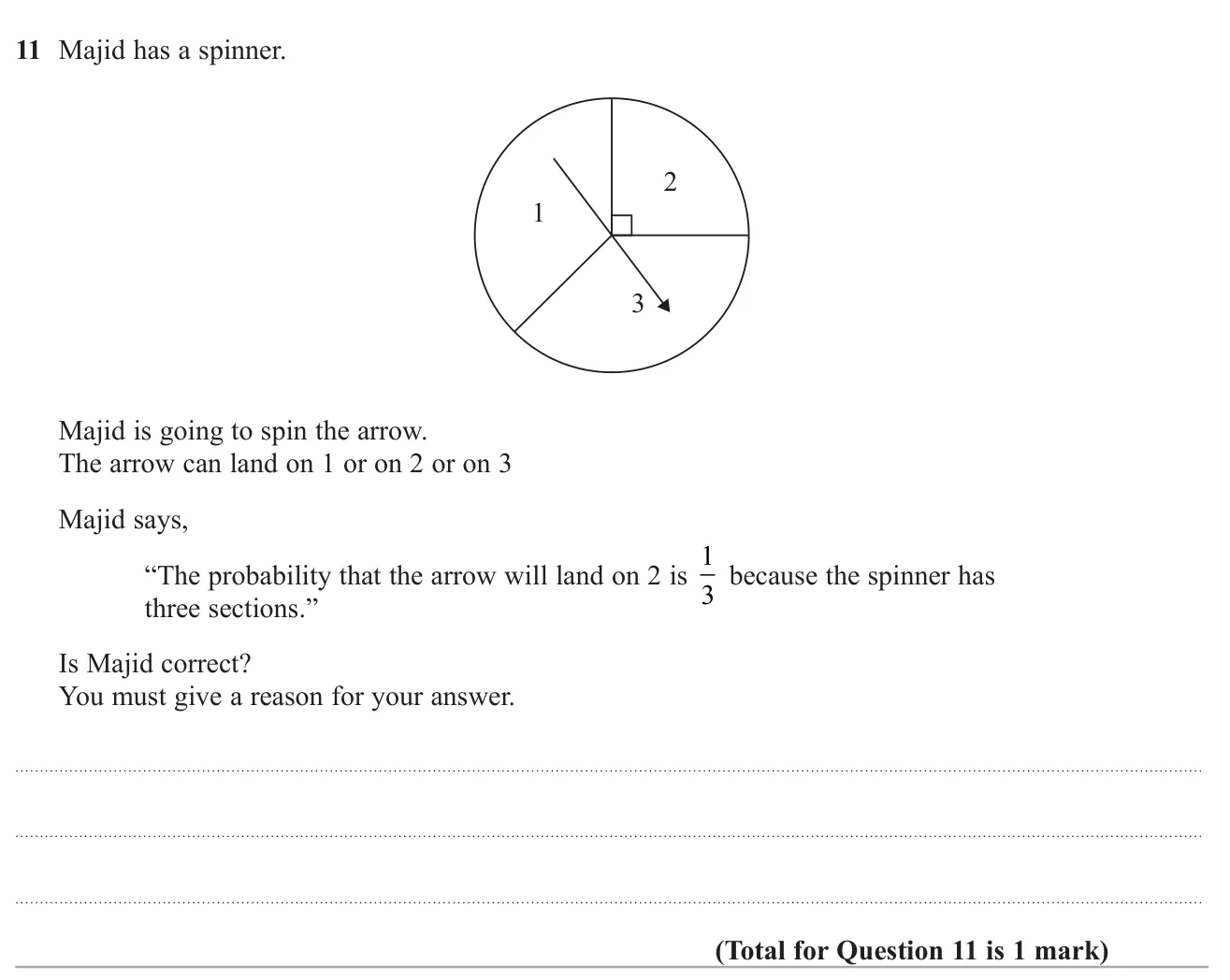
Answer No, because the sections are not the same size (2 is a 90° section, so its probability is 1 4 \frac{1}{4} 4 1 1 mark
Worked solution Checked against the mark scheme
The three sections are not equal: section 2 is a right angle (90 ∘ 90^\circ 9 0 ∘
So the outcomes are not equally likely.
Majid is not correct: P ( 2 ) = 90 360 = 1 4 P(2) = \frac{90}{360} = \frac{1}{4} P ( 2 ) = 360 90 = 4 1 1 3 \frac{1}{3} 3 1
Watch out: Saying 'No' with no reason, or saying 'Yes, there are 3 numbers'.
© Pearson Education Ltd. June 2023 Paper 2 (Foundation, calculator), question 15.
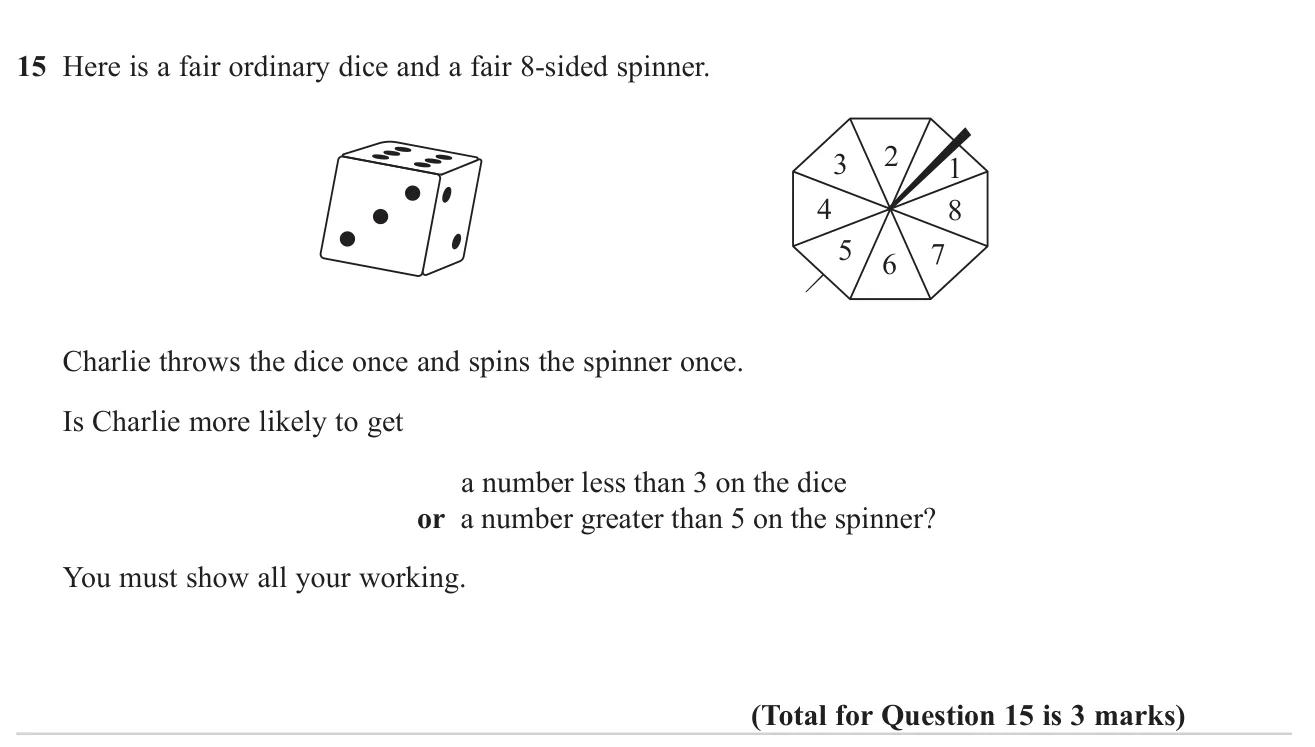
Answer The spinner: 3 8 = 0.375 \frac{3}{8} = 0.375 8 3 = 0.375 2 6 ≈ 0.333 \frac{2}{6} \approx 0.333 6 2 ≈ 0.333 3 marks
Worked solution Checked against the mark scheme
Dice, less than 3: scores 1 and 2, so 2 6 = 8 24 \frac{2}{6} = \frac{8}{24} 6 2 = 24 8
Spinner, greater than 5: 6, 7 and 8, so 3 8 = 9 24 \frac{3}{8} = \frac{9}{24} 8 3 = 24 9
9 24 > 8 24 \frac{9}{24} > \frac{8}{24} 24 9 > 24 8
Watch out: Counting 3 as less than 3, or 5 as greater than 5.
© Pearson Education Ltd. November 2022 Paper 1 (Foundation, non-calculator), question 17.
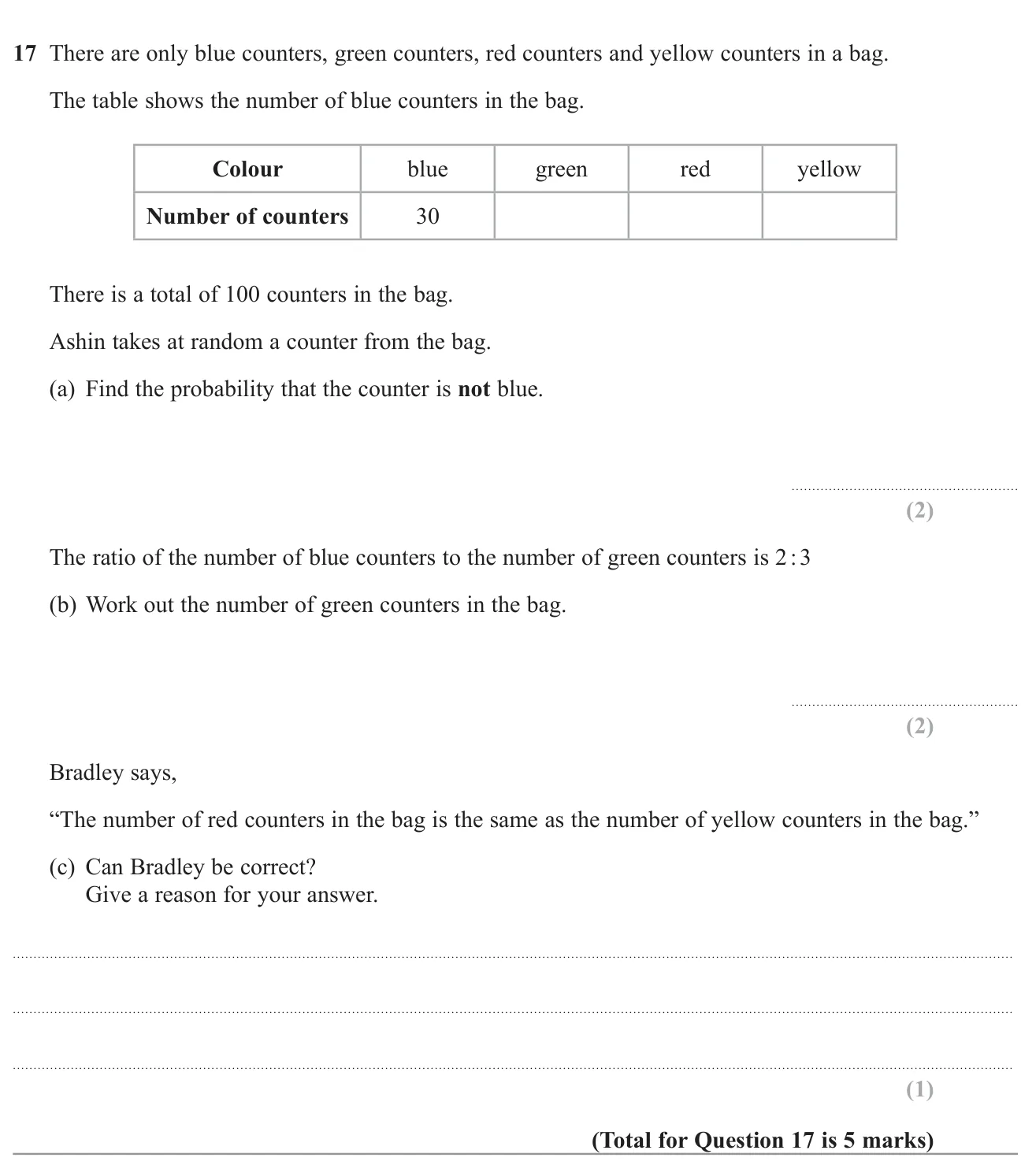
(a) 70 100 \frac{70}{100} 100 70 2 marks (b) 45 45 45 2 marks (c) No: 25 counters are left, which is odd, so they cannot split equally 1 mark
Worked solution Checked against the mark scheme
(a) 100 − 30 = 70 100 - 30 = 70 100 − 30 = 70 P = 70 100 P = \frac{70}{100} P = 100 70
(b) 2 parts = 30, so 1 part = 15. Green = 3 × 15 = 45 3 \times 15 = 45 3 × 15 = 45
(c) Red + yellow = 100 − 30 − 45 = 25 = 100 - 30 - 45 = 25 = 100 − 30 − 45 = 25
Watch out: In (b), sharing 30 in the ratio 2 : 3 to get 18.
© Pearson Education Ltd. June 2019 Paper 2 (Foundation, calculator), question 16.
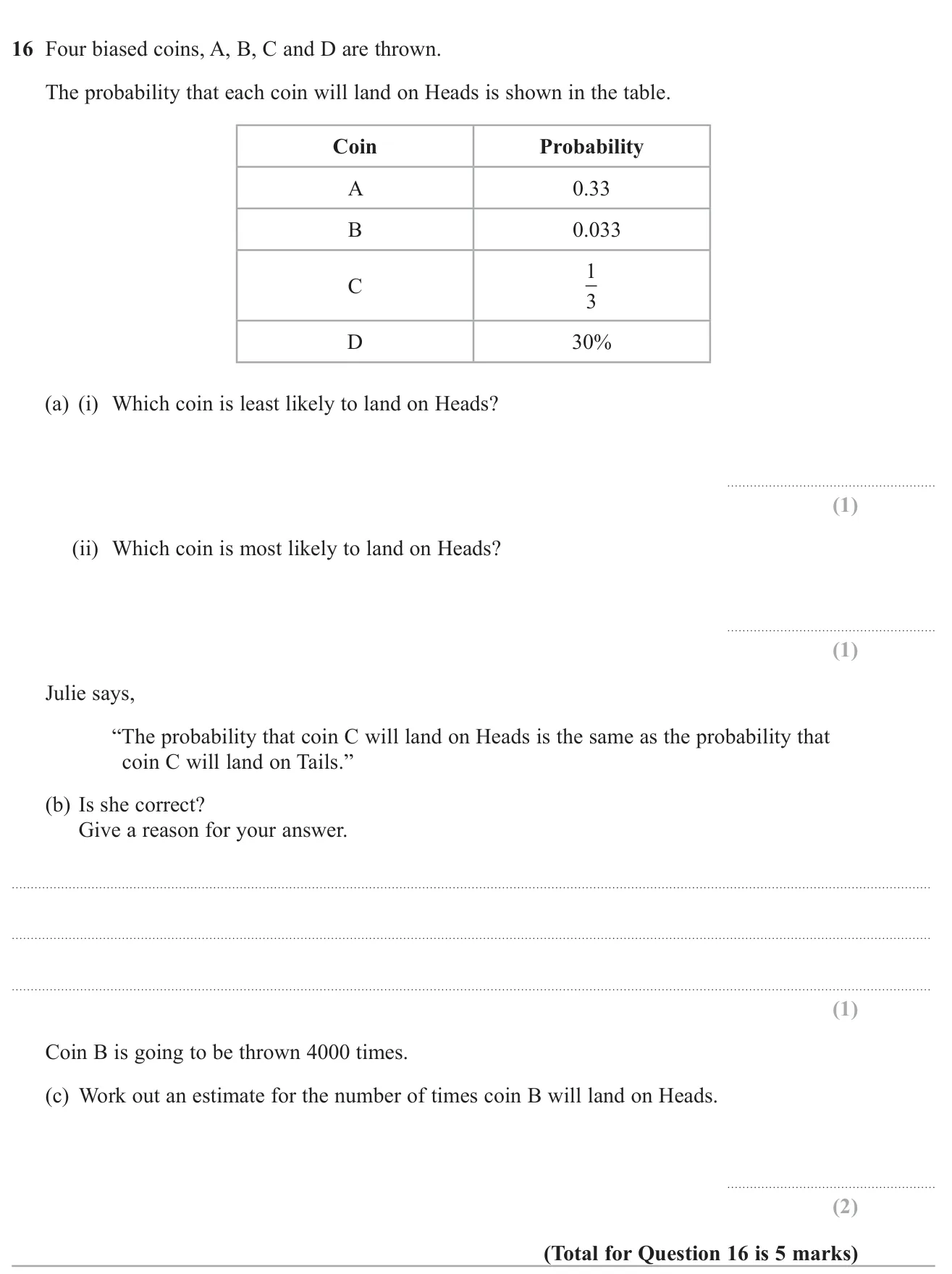
(a(i)) B 1 mark (a(ii)) C 1 mark (b) No: P(Tails) for C is 2 3 \frac{2}{3} 3 2 1 3 \frac{1}{3} 3 1 1 mark (c) 132 2 marks
Worked solution Checked against the mark scheme
(a) As decimals: A 0.33, B 0.033, C 0.333... 0.333... 0.333...
Least likely is B; most likely is C.
(b) P(Tails) = 1 − 1 3 = 2 3 = 1 - \frac{1}{3} = \frac{2}{3} = 1 − 3 1 = 3 2 1 3 \frac{1}{3} 3 1
(c) 4000 × 0.033 = 132 4000 \times 0.033 = 132 4000 × 0.033 = 132
Watch out: Thinking 0.33 is bigger than 1 3 \frac{1}{3} 3 1
© Pearson Education Ltd. June 2018 Paper 2 (Foundation, calculator), question 13.
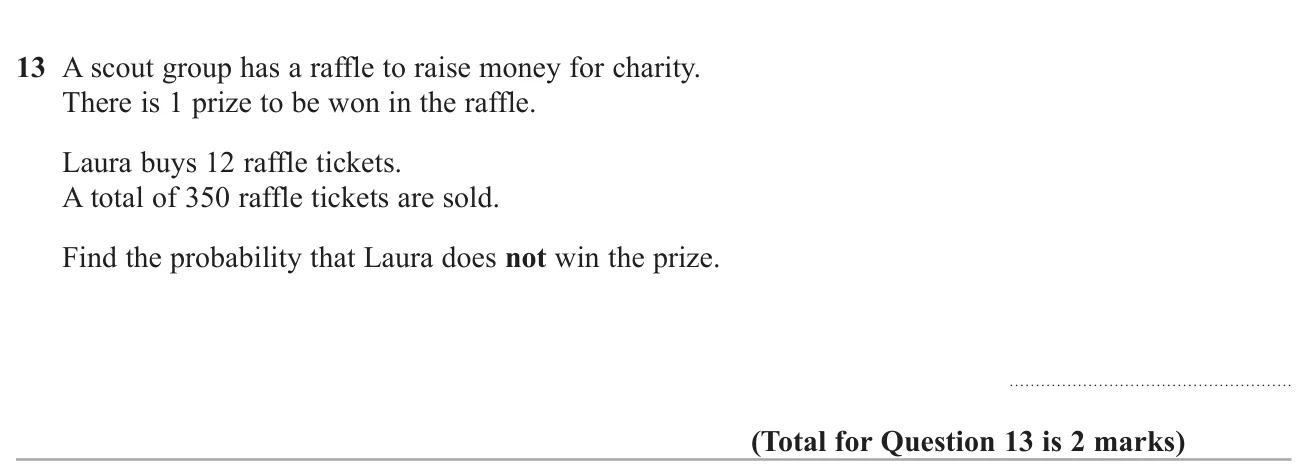
Answer 338 350 \frac{338}{350} 350 338 2 marks
Worked solution Checked against the mark scheme
Tickets that are not Laura's: 350 − 12 = 338 350 - 12 = 338 350 − 12 = 338
P ( not win ) = 338 350 = 169 175 P(\text{not win}) = \frac{338}{350} = \frac{169}{175} P ( not win ) = 350 338 = 175 169
Watch out: Giving 12/350, the probability that she does win.
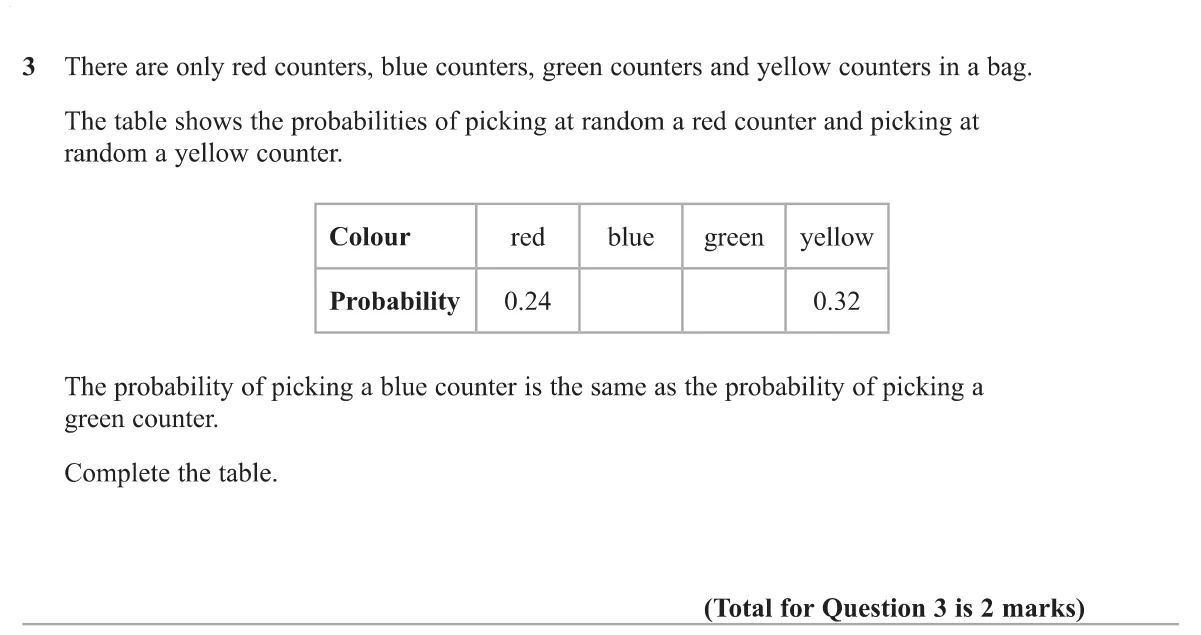
© Pearson Education Ltd. Specimen Paper 1 (Foundation, non-calculator), question 22.
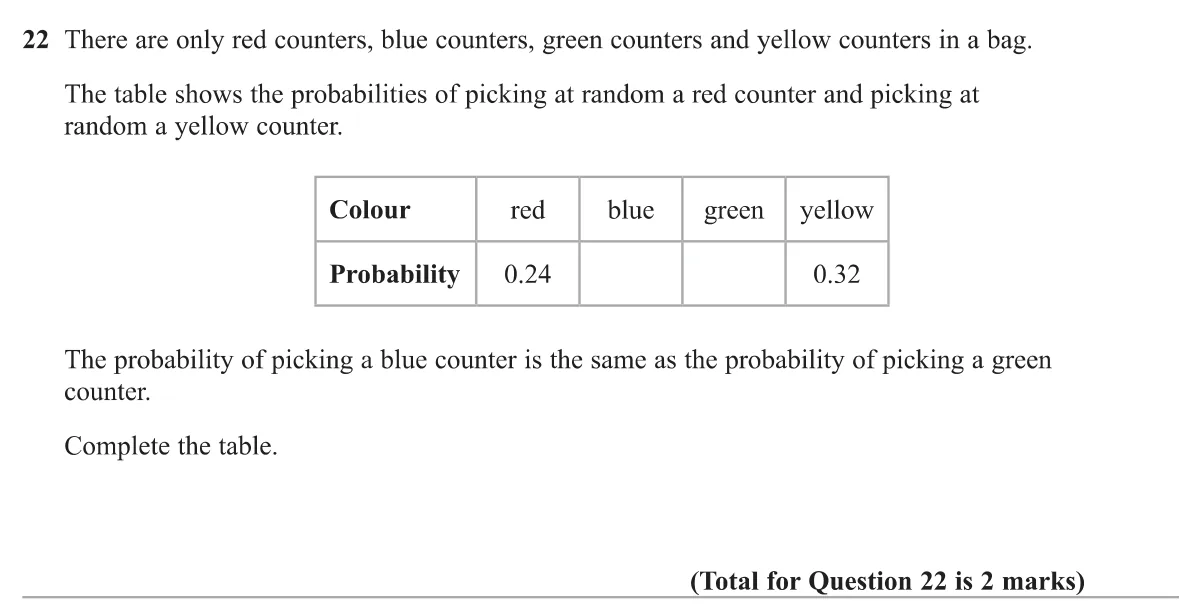
Answer blue 0.22 0.22 0.22 0.22 0.22 0.22 2 marks
Worked solution Checked against the mark scheme
The probabilities add up to 1.
1 − 0.24 − 0.32 = 0.44 1 - 0.24 - 0.32 = 0.44 1 − 0.24 − 0.32 = 0.44
Blue and green are equal, so each is 0.44 ÷ 2 = 0.22 0.44 \div 2 = 0.22 0.44 ÷ 2 = 0.22
Watch out: Putting 0.44 in each box instead of sharing it between them.
© Pearson Education Ltd. November 2024 Paper 1 (Foundation, non-calculator), question 19.
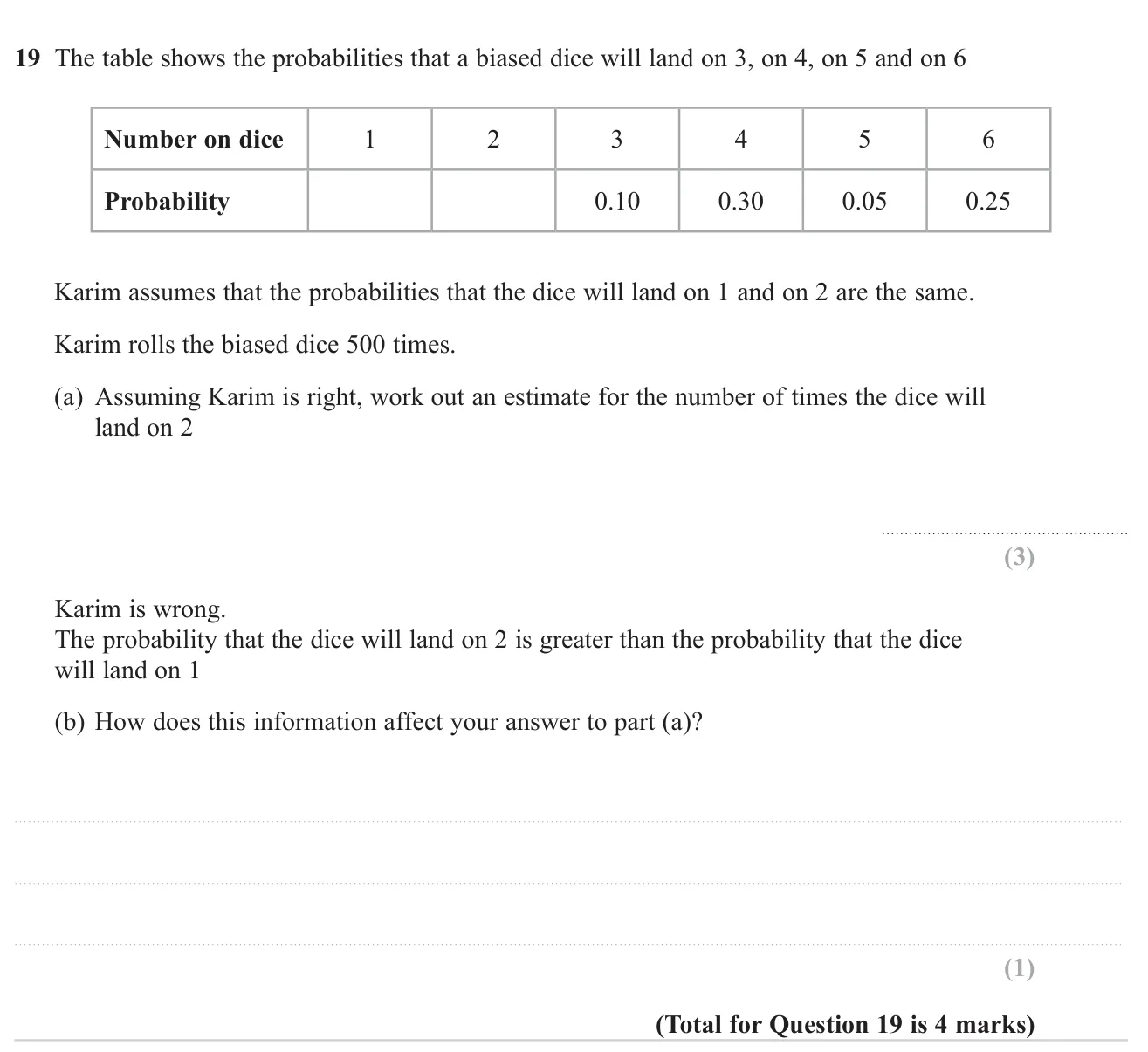
(a) 75 75 75 3 marks (b) The estimate would be greater than 75 1 mark
Worked solution Checked against the mark scheme
(a) 0.10 + 0.30 + 0.05 + 0.25 = 0.70 0.10 + 0.30 + 0.05 + 0.25 = 0.70 0.10 + 0.30 + 0.05 + 0.25 = 0.70 P ( 1 ) + P ( 2 ) = 0.30 P(1) + P(2) = 0.30 P ( 1 ) + P ( 2 ) = 0.30
P ( 2 ) = 0.30 ÷ 2 = 0.15 P(2) = 0.30 \div 2 = 0.15 P ( 2 ) = 0.30 ÷ 2 = 0.15
Estimate = 0.15 × 500 = 75 = 0.15 \times 500 = 75 = 0.15 × 500 = 75
(b) P(2) is really more than 0.15, so the number of 2s would be more than 75.
Watch out: In (a), forgetting to halve 0.3 and getting 150.
© Pearson Education Ltd. June 2024 Paper 1 (Foundation, non-calculator), question 13.
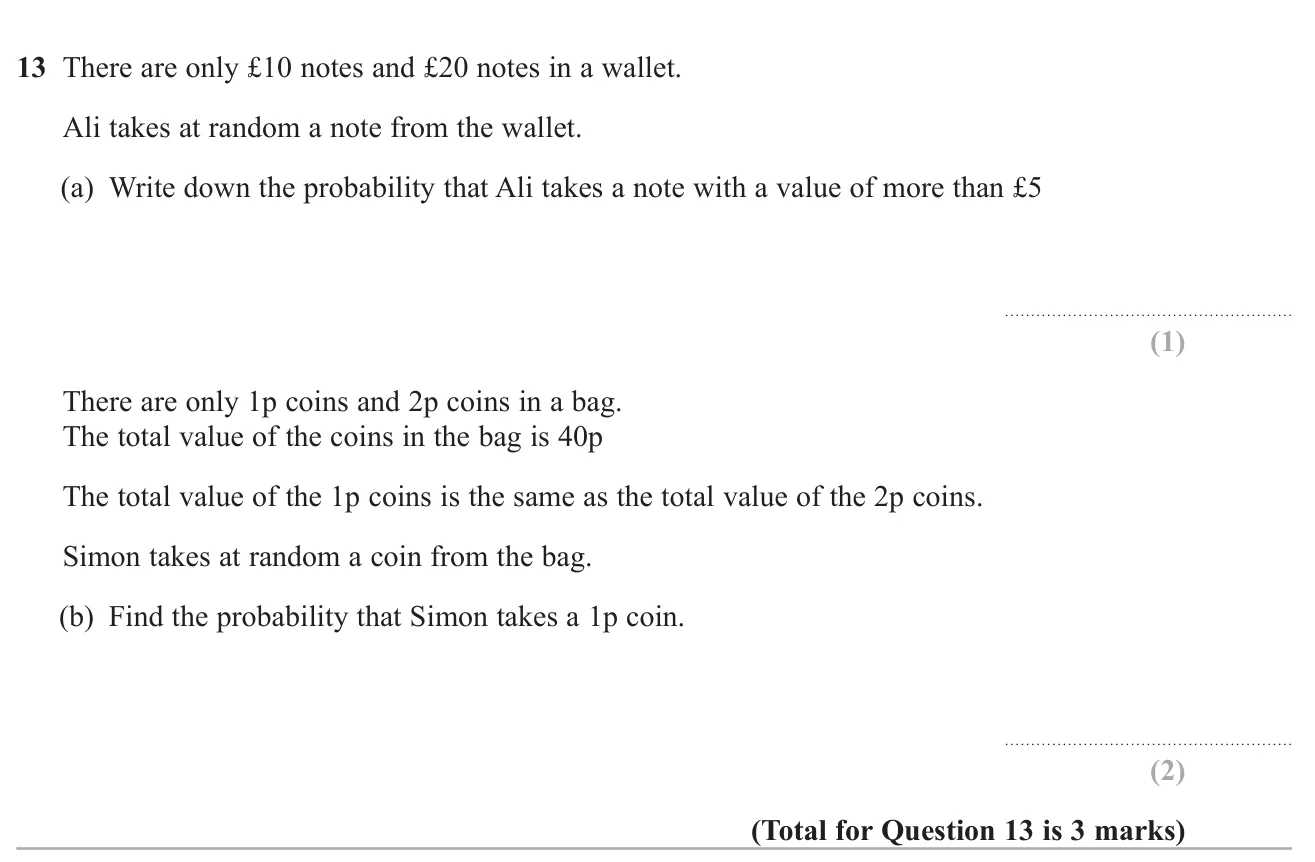
(a) 1 1 1 1 mark (b) 2 3 \frac{2}{3} 3 2 2 marks
Worked solution Checked against the mark scheme
(a) Every note is worth more than £5, so the probability is 1 1 1
(b) Each type is worth 20p: twenty 1p coins and ten 2p coins, so 30 coins.
P ( 1 p ) = 20 30 = 2 3 P(1\text{p}) = \frac{20}{30} = \frac{2}{3} P ( 1 p ) = 30 20 = 3 2
Watch out: In (b), assuming equal numbers of each coin and giving 1/2.
© Pearson Education Ltd. November 2024 Paper 2 (Foundation, calculator), question 16.
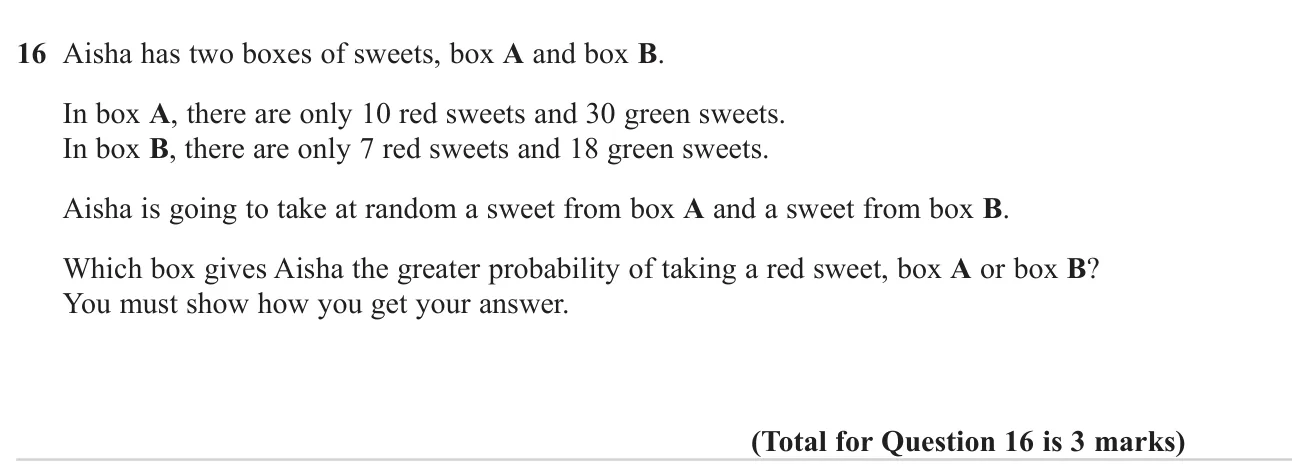
Answer Box B (0.28 > 0.25 0.28 > 0.25 0.28 > 0.25 3 marks
Worked solution Checked against the mark scheme
Box A: P ( red ) = 10 40 = 0.25 P(\text{red}) = \frac{10}{40} = 0.25 P ( red ) = 40 10 = 0.25
Box B: P ( red ) = 7 25 = 0.28 P(\text{red}) = \frac{7}{25} = 0.28 P ( red ) = 25 7 = 0.28
0.28 > 0.25 0.28 > 0.25 0.28 > 0.25
Watch out: Using red : green (10 30 \frac{10}{30} 30 10
© Pearson Education Ltd. November 2021 Paper 3 (Foundation, calculator), question 26.
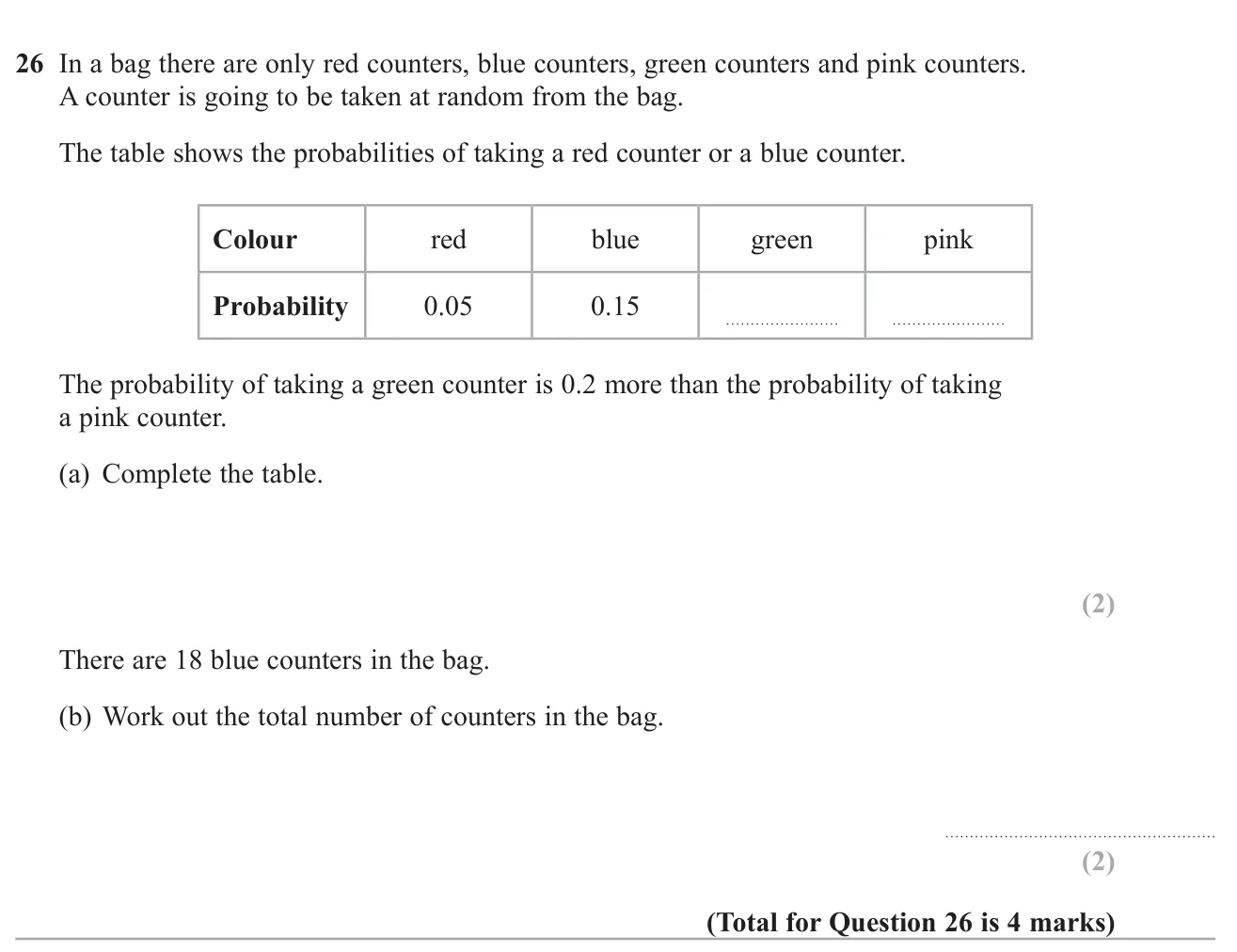
(a) green 0.5, pink 0.3 2 marks (b) 120 2 marks
Worked solution Checked against the mark scheme
(a) The probabilities add to 1: 1 − 0.05 − 0.15 = 0.8 1 - 0.05 - 0.15 = 0.8 1 − 0.05 − 0.15 = 0.8
Green is 0.2 more than pink: 2 p + 0.2 = 0.8 2p + 0.2 = 0.8 2 p + 0.2 = 0.8 = 0.3 = 0.3 = 0.3 = 0.5 = 0.5 = 0.5
(b) 0.15 0.15 0.15 18 ÷ 0.15 = 120 18 \div 0.15 = 120 18 ÷ 0.15 = 120
Watch out: In (a), splitting 0.8 equally as 0.4 and 0.4.
© Pearson Education Ltd. June 2019 Paper 1 (Foundation, non-calculator), question 22.
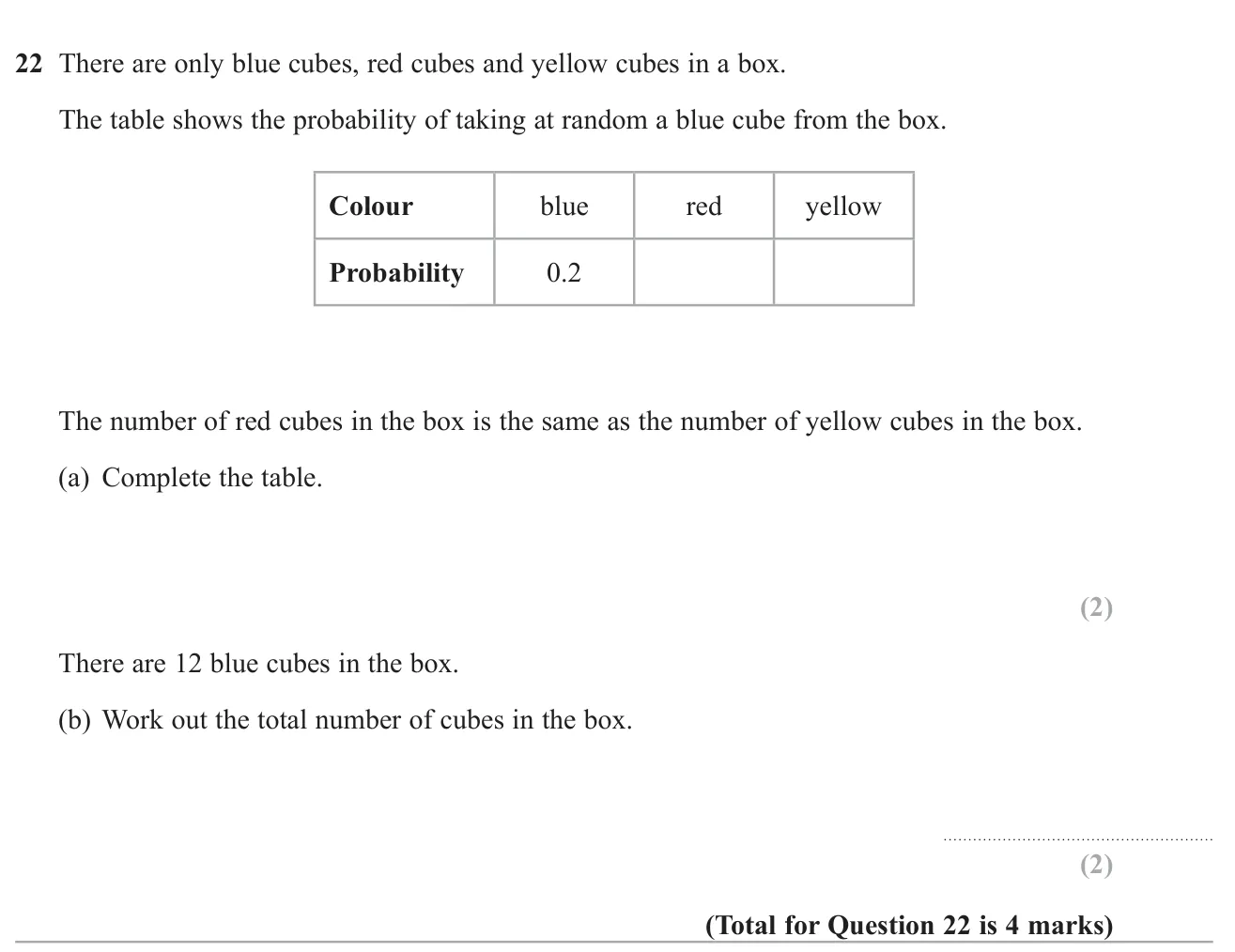
(a) red 0.4, yellow 0.4 2 marks (b) 60 2 marks
Worked solution Checked against the mark scheme
(a) Probabilities add to 1: 1 − 0.2 = 0.8 1 - 0.2 = 0.8 1 − 0.2 = 0.8
Red and yellow are equal: 0.8 ÷ 2 = 0.4 0.8 \div 2 = 0.4 0.8 ÷ 2 = 0.4
(b) 0.2 of the cubes are blue, so 12 ÷ 0.2 = 60 12 \div 0.2 = 60 12 ÷ 0.2 = 60
Watch out: In (b), multiplying 12 × 0.2 12 \times 0.2 12 × 0.2
© Pearson Education Ltd. November 2019 Paper 3 (Foundation, calculator), question 16.
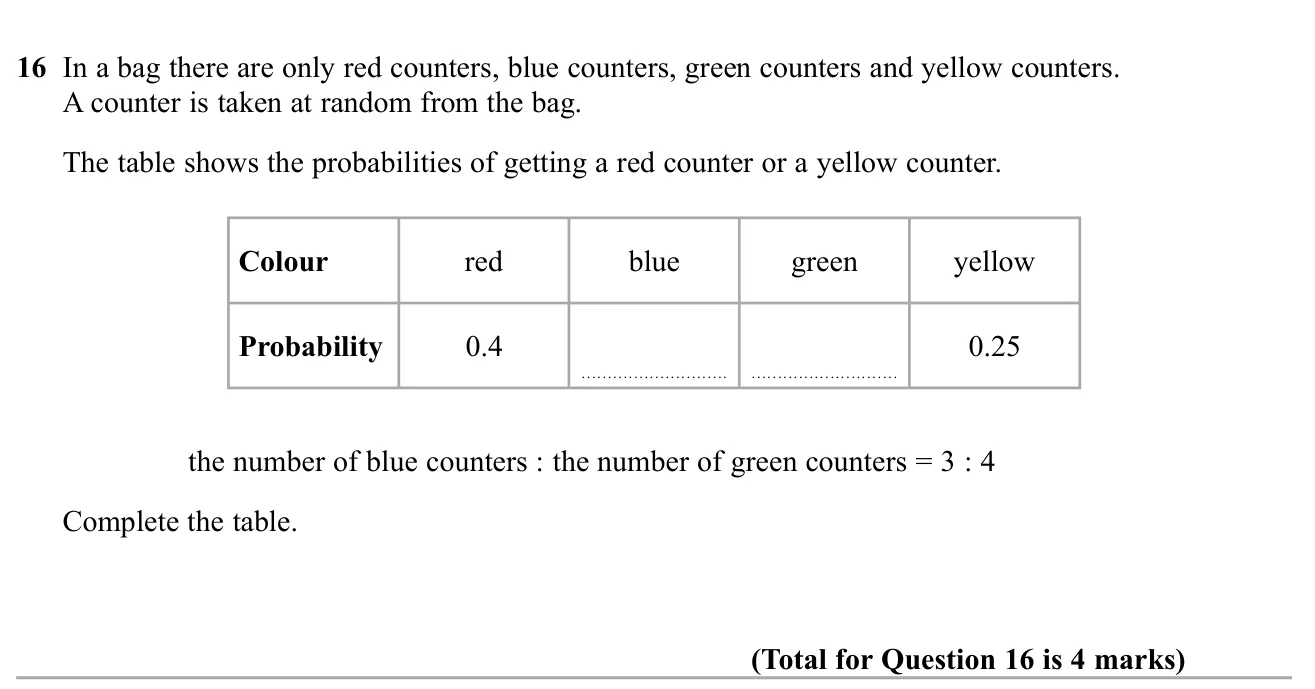
Answer blue 0.15 0.15 0.15 0.2 0.2 0.2 4 marks
Worked solution Checked against the mark scheme
Probabilities add to 1: 1 − 0.4 − 0.25 = 0.35 1 - 0.4 - 0.25 = 0.35 1 − 0.4 − 0.25 = 0.35
Share 0.35 in the ratio 3 : 4 3 : 4 3 : 4 = 0.35 ÷ 7 = 0.05 = 0.35 \div 7 = 0.05 = 0.35 ÷ 7 = 0.05
Blue = 3 × 0.05 = 0.15 = 3 \times 0.05 = 0.15 = 3 × 0.05 = 0.15 = 4 × 0.05 = 0.2 = 4 \times 0.05 = 0.2 = 4 × 0.05 = 0.2
Watch out: Swapping the values so blue is 0.2 and green is 0.15.
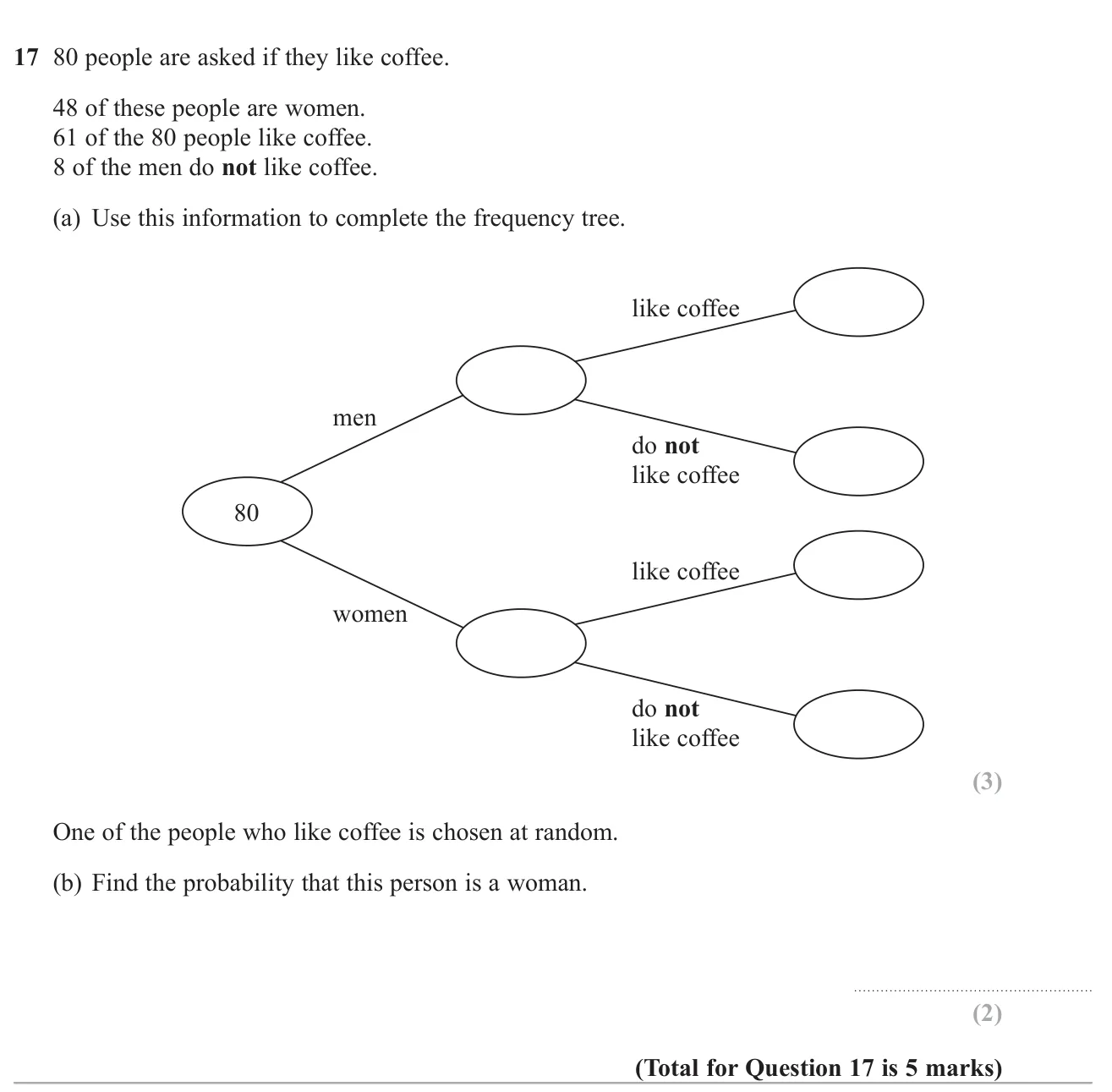
© Pearson Education Ltd. November 2018 Paper 1 (Foundation, non-calculator), question 17.
(a) Men 32, women 48; men like 24, men do not 8; women like 37, women do not 11 3 marks (b) 37 61 \frac{37}{61} 61 37 2 marks
Worked solution Checked against the mark scheme
(a) Men = 80 − 48 = 32 = 80 - 48 = 32 = 80 − 48 = 32 = 32 − 8 = 24 = 32 - 8 = 24 = 32 − 8 = 24
Women who like coffee = 61 − 24 = 37 = 61 - 24 = 37 = 61 − 24 = 37 = 48 − 37 = 11 = 48 - 37 = 11 = 48 − 37 = 11
(b) 61 people like coffee and 37 of them are women: 37 61 \frac{37}{61} 61 37
Watch out: In (b), dividing by 80 instead of 61.
© Pearson Education Ltd. Specimen Paper 1 (Higher, non-calculator), question 3.
Answer blue 0.22 0.22 0.22 0.22 0.22 0.22 2 marks
Worked solution Checked against the mark scheme
The probabilities add up to 1.
1 − 0.24 − 0.32 = 0.44 1 - 0.24 - 0.32 = 0.44 1 − 0.24 − 0.32 = 0.44
Blue and green share this equally: 0.44 ÷ 2 = 0.22 0.44 \div 2 = 0.22 0.44 ÷ 2 = 0.22
Watch out: Writing 0.44 in both boxes without halving it.
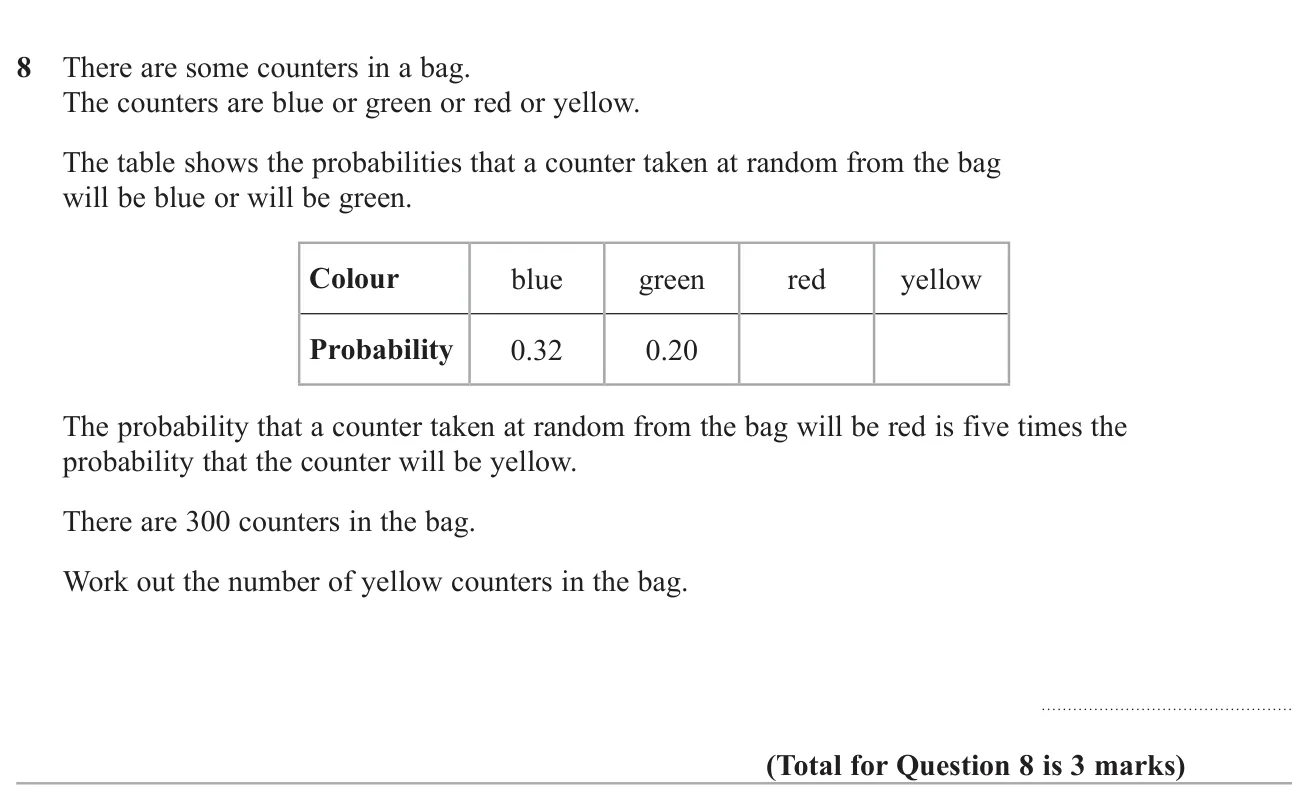
© Pearson Education Ltd. November 2020 Paper 3 (Higher, calculator), question 8.
Worked solution Checked against the mark scheme
Red and yellow together: 1 − 0.32 − 0.20 = 0.48 1 - 0.32 - 0.20 = 0.48 1 − 0.32 − 0.20 = 0.48
Red = 5 × = 5 \times = 5 × 6 × 6 \times 6 × = 0.48 = 0.48 = 0.48 = 0.08 = 0.08 = 0.08
Yellow counters = 0.08 × 300 = 24 = 0.08 \times 300 = 24 = 0.08 × 300 = 24
Watch out: Dividing 0.48 by 5 instead of 6.
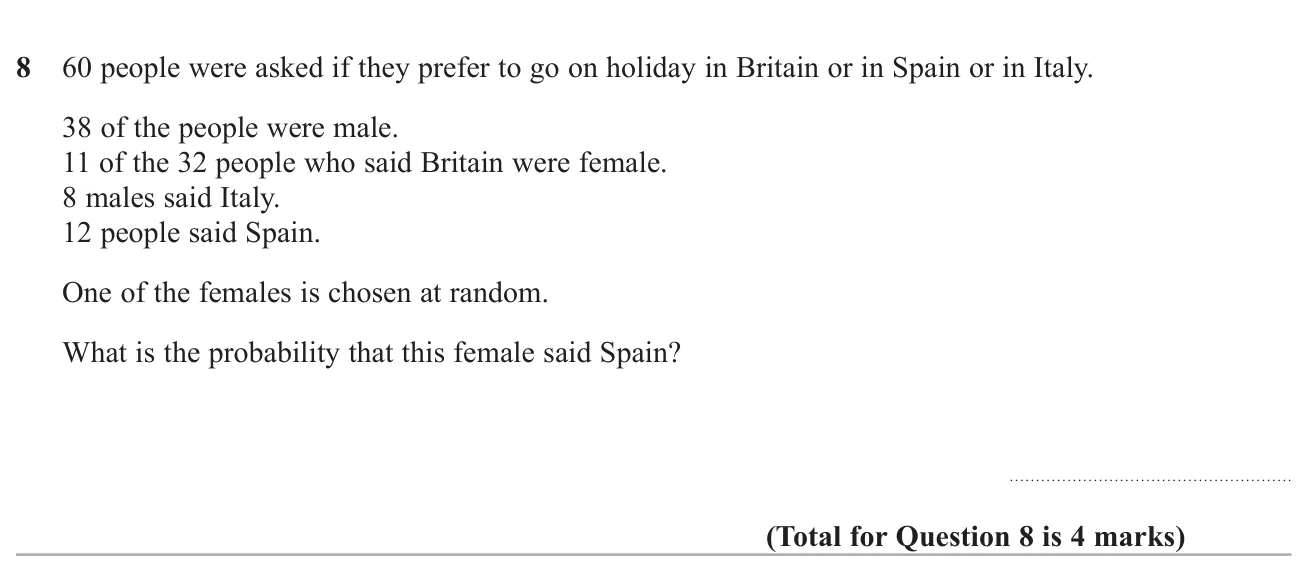
© Pearson Education Ltd. June 2018 Paper 2 (Higher, calculator), question 8.
Answer 3 22 \frac{3}{22} 22 3 4 marks
Worked solution Checked against the mark scheme
Females: 60 − 38 = 22 60 - 38 = 22 60 − 38 = 22
Males choosing Britain: 32 − 11 = 21 32 - 11 = 21 32 − 11 = 21
Males choosing Spain: 38 − 21 − 8 = 9 38 - 21 - 8 = 9 38 − 21 − 8 = 9 12 − 9 = 3 12 - 9 = 3 12 − 9 = 3
Probability = 3 22 = \frac{3}{22} = 22 3
Watch out: Dividing by 60 instead of 22, giving 3 60 \frac{3}{60} 60 3
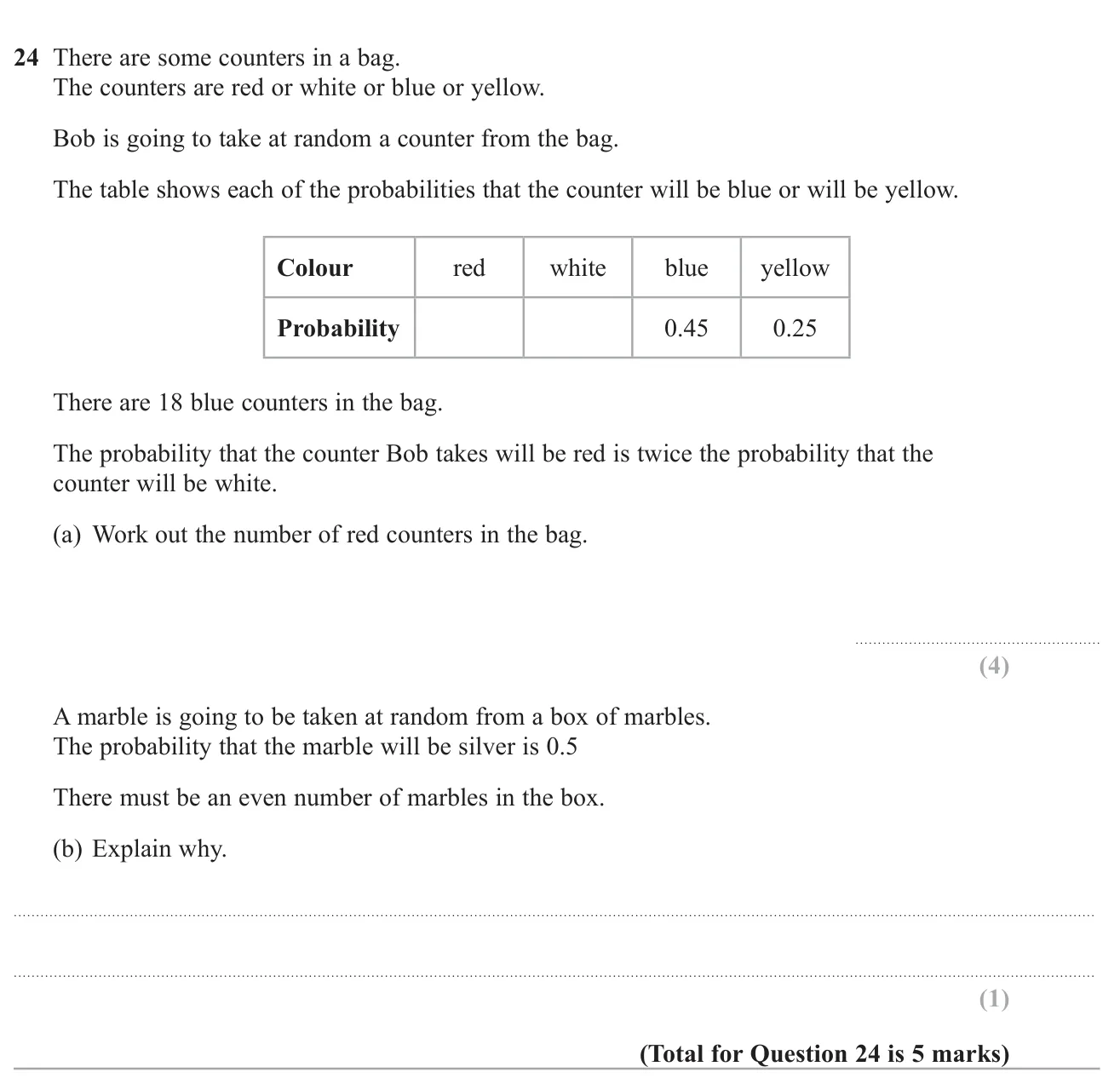
© Pearson Education Ltd. June 2018 Paper 3 (Foundation, calculator), question 24.
(a) 8 8 8 4 marks (b) Half the marbles are silver, and half of an odd number is not a whole number 1 mark
Worked solution Checked against the mark scheme
(a) Total counters: 18 ÷ 0.45 = 40 18 \div 0.45 = 40 18 ÷ 0.45 = 40
Red and white together: 1 − 0.45 − 0.25 = 0.3 1 - 0.45 - 0.25 = 0.3 1 − 0.45 − 0.25 = 0.3
Red is twice white, so P ( white ) = 0.1 P(\text{white}) = 0.1 P ( white ) = 0.1 P ( red ) = 0.2 P(\text{red}) = 0.2 P ( red ) = 0.2
Red counters: 0.2 × 40 = 8 0.2 \times 40 = 8 0.2 × 40 = 8
(b) The number of silver marbles is 0.5 × 0.5 \times 0.5 ×
Watch out: Splitting 0.3 equally between red and white.
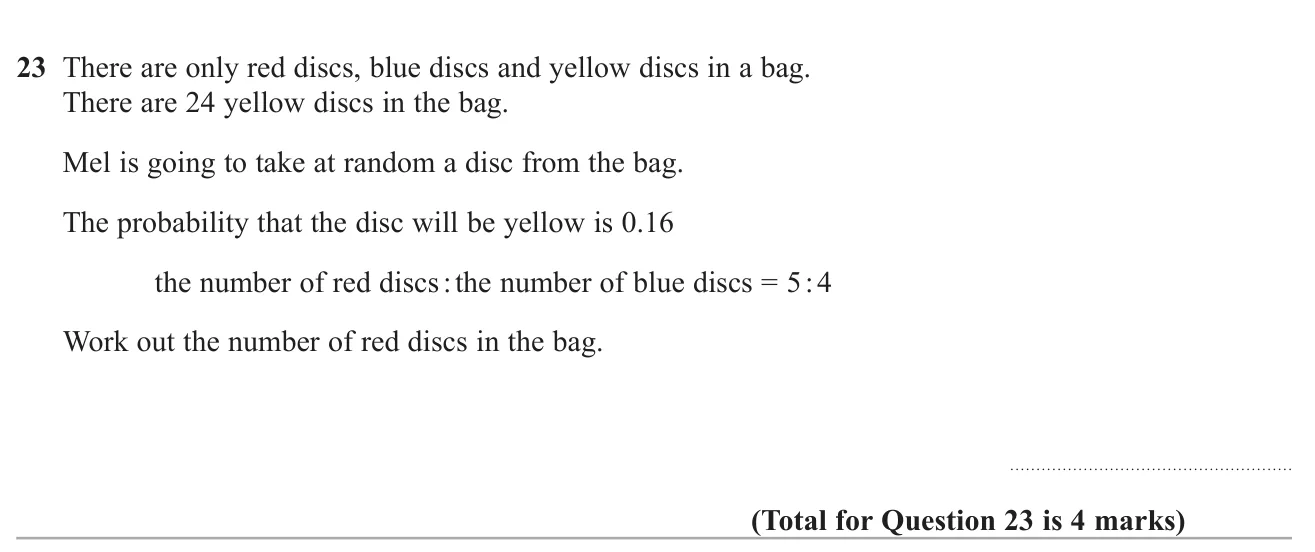
© Pearson Education Ltd. June 2024 Paper 2 (Foundation, calculator), question 23.
Worked solution Checked against the mark scheme
Total discs = 24 ÷ 0.16 = 150 = 24 \div 0.16 = 150 = 24 ÷ 0.16 = 150
Red and blue = 150 − 24 = 126 = 150 - 24 = 126 = 150 − 24 = 126
One part = 126 ÷ ( 5 + 4 ) = 14 = 126 \div (5 + 4) = 14 = 126 ÷ ( 5 + 4 ) = 14
Red = 5 × 14 = 70 = 5 \times 14 = 70 = 5 × 14 = 70
Watch out: Sharing 150 (instead of 126) in the ratio 5 : 4.
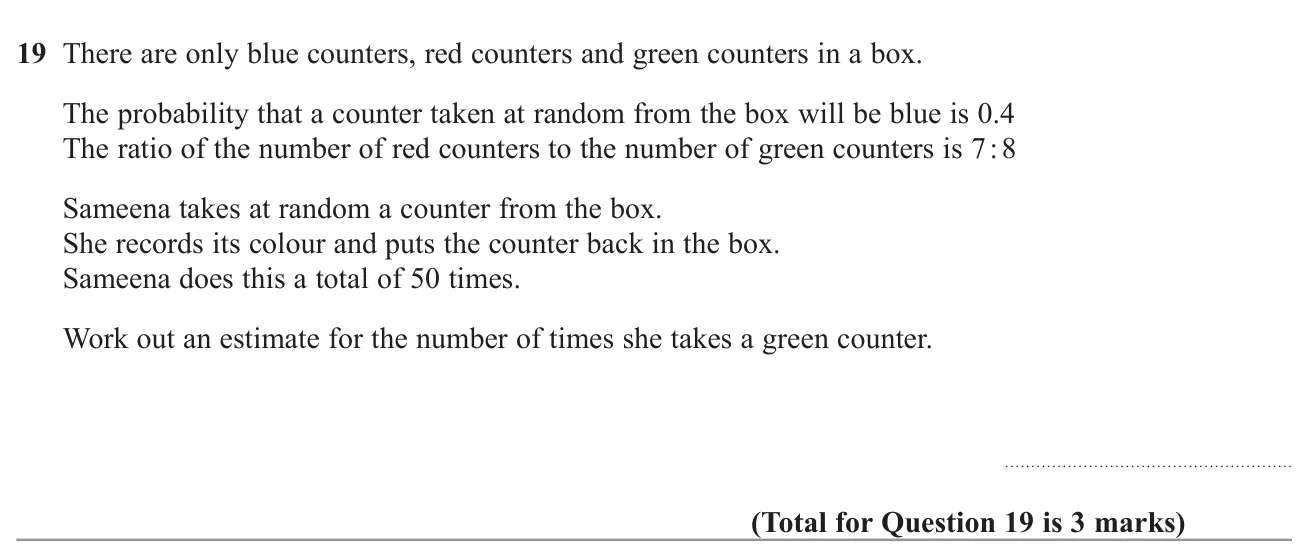
© Pearson Education Ltd. November 2022 Paper 3 (Higher, calculator), question 19.
Worked solution Checked against the mark scheme
P(red or green) = 1 − 0.4 = 0.6 = 1 - 0.4 = 0.6 = 1 − 0.4 = 0.6
Green is 8 15 \frac{8}{15} 15 8 0.6 × 8 15 = 0.32 0.6 \times \frac{8}{15} = 0.32 0.6 × 15 8 = 0.32
Expected greens: 0.32 × 50 = 16 0.32 \times 50 = 16 0.32 × 50 = 16
Watch out: Using 8 7 \frac{8}{7} 7 8 8 15 \frac{8}{15} 15 8
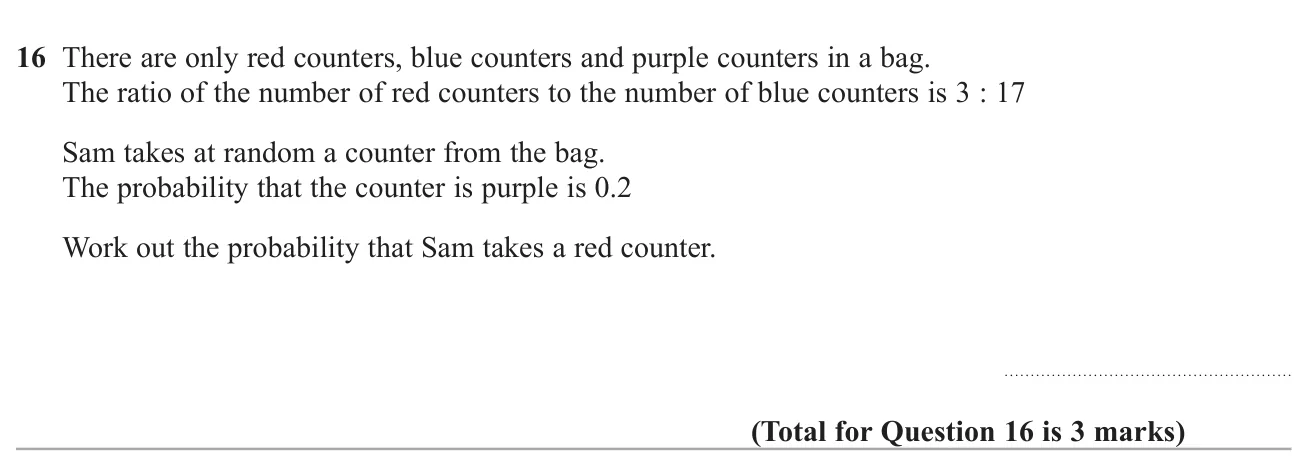
© Pearson Education Ltd. June 2018 Paper 1 (Higher, non-calculator), question 16.
Worked solution Checked against the mark scheme
Red or blue: 1 − 0.2 = 0.8 1 - 0.2 = 0.8 1 − 0.2 = 0.8
Red : blue = 3 : 17 = 3 : 17 = 3 : 17 = 0.8 ÷ 20 = 0.04 = 0.8 \div 20 = 0.04 = 0.8 ÷ 20 = 0.04
P(red) = 3 × 0.04 = 0.12 = 3 \times 0.04 = 0.12 = 3 × 0.04 = 0.12
Watch out: Giving 3 20 \frac{3}{20} 20 3
© Pearson Education Ltd. June 2024 Paper 1 (Higher, non-calculator), question 16.
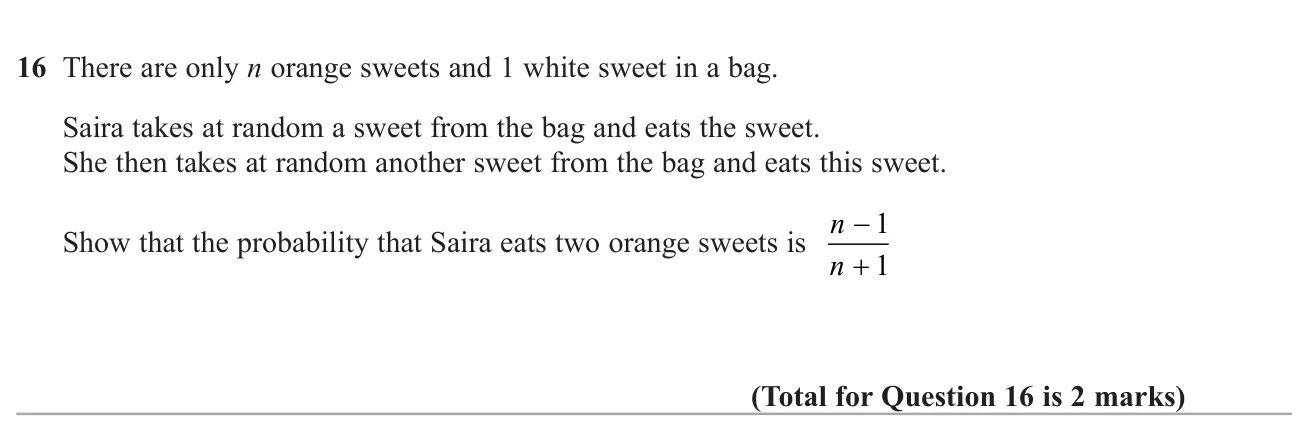
Answer Shown: n n + 1 × n − 1 n = n − 1 n + 1 \frac{n}{n+1} \times \frac{n-1}{n} = \frac{n-1}{n+1} n + 1 n × n n − 1 = n + 1 n − 1 2 marks
Worked solution Checked against the mark scheme
There are n + 1 n + 1 n + 1 n n n
P(first orange) = n n + 1 = \frac{n}{n+1} = n + 1 n
After eating one, there are n n n n − 1 n - 1 n − 1 = n − 1 n = \frac{n-1}{n} = n n − 1
P(both orange) = n n + 1 × n − 1 n = n − 1 n + 1 = \frac{n}{n+1} \times \frac{n-1}{n} = \frac{n-1}{n+1} = n + 1 n × n n − 1 = n + 1 n − 1
Watch out: Forgetting the sweet is eaten, so using n n + 1 \frac{n}{n+1} n + 1 n
© Pearson Education Ltd. November 2019 Paper 3 (Higher, calculator), question 21.
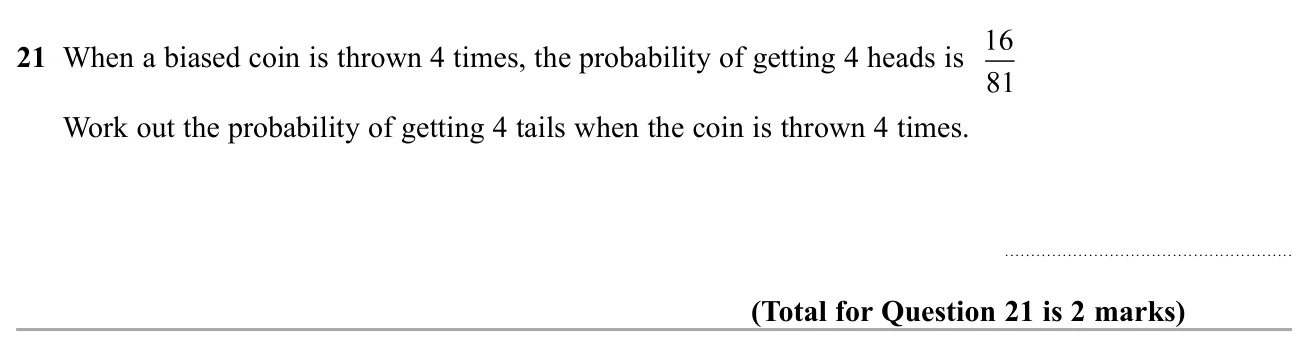
Answer 1 81 \frac{1}{81} 81 1 2 marks
Worked solution Checked against the mark scheme
P(head)4 = 16 81 ^4 = \frac{16}{81} 4 = 81 16 = 16 81 4 = 2 3 = \sqrt[4]{\frac{16}{81}} = \frac{2}{3} = 4 81 16 = 3 2
P(tail) = 1 − 2 3 = 1 3 = 1 - \frac{2}{3} = \frac{1}{3} = 1 − 3 2 = 3 1
P(4 tails) = ( 1 3 ) 4 = 1 81 = \left(\frac{1}{3}\right)^4 = \frac{1}{81} = ( 3 1 ) 4 = 81 1
Watch out: Working out 1 − 16 81 = 65 81 1 - \frac{16}{81} = \frac{65}{81} 1 − 81 16 = 81 65
© Pearson Education Ltd. June 2023 Paper 2 (Higher, calculator), question 22.
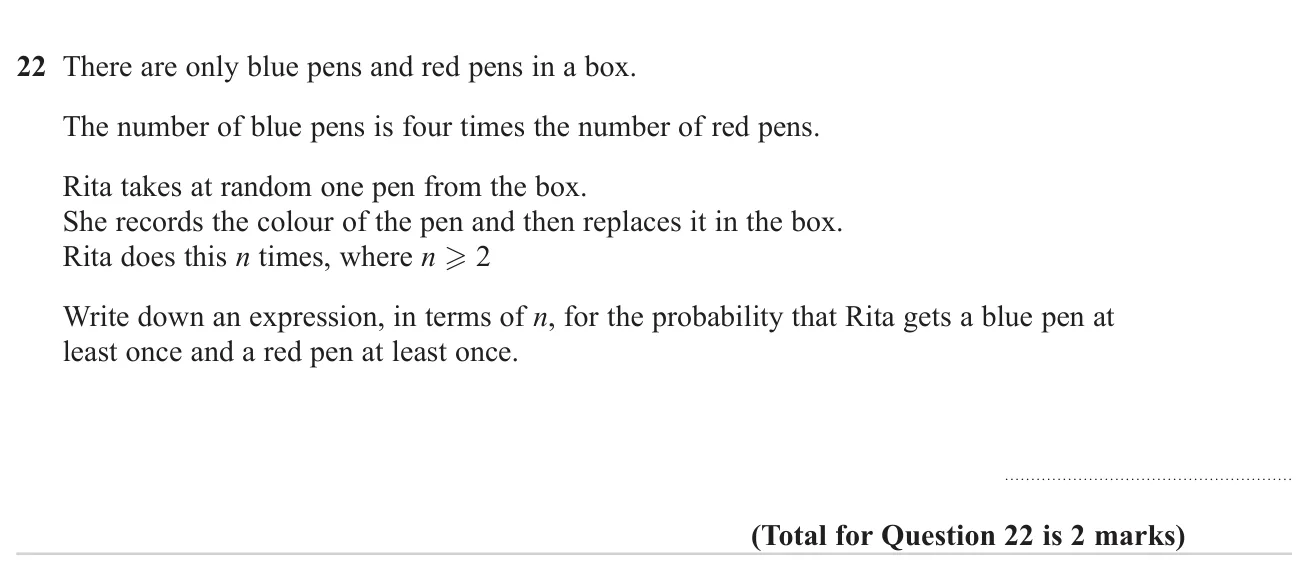
Answer 1 − ( 4 5 ) n − ( 1 5 ) n 1 - \left(\frac{4}{5}\right)^n - \left(\frac{1}{5}\right)^n 1 − ( 5 4 ) n − ( 5 1 ) n 2 marks
Worked solution Checked against the mark scheme
Blue : red = 4 : 1, so P(blue) = 4 5 = \frac{4}{5} = 5 4 = 1 5 = \frac{1}{5} = 5 1
The only ways to fail are all blue or all red.
P(both colours) = 1 − ( 4 5 ) n − ( 1 5 ) n = 1 - \left(\frac{4}{5}\right)^n - \left(\frac{1}{5}\right)^n = 1 − ( 5 4 ) n − ( 5 1 ) n
Watch out: Subtracting only one of the two failing cases, e.g. 1 − ( 4 5 ) n 1 - \left(\frac{4}{5}\right)^n 1 − ( 5 4 ) n
© Pearson Education Ltd. November 2021 Paper 3 (Higher, calculator), question 20.
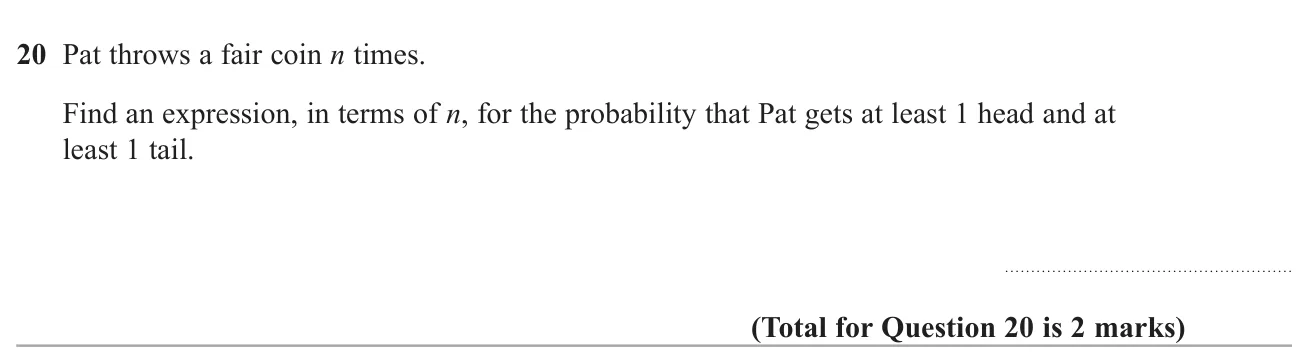
Answer 1 − 2 ( 1 2 ) n = 1 − ( 1 2 ) n − 1 1 - 2\left(\frac{1}{2}\right)^n = 1 - \left(\frac{1}{2}\right)^{n-1} 1 − 2 ( 2 1 ) n = 1 − ( 2 1 ) n − 1 2 marks
Worked solution Checked against the mark scheme
The only outcomes that fail are all heads or all tails.
P ( all heads ) = ( 1 2 ) n P(\text{all heads}) = \left(\frac{1}{2}\right)^n P ( all heads ) = ( 2 1 ) n P ( all tails ) = ( 1 2 ) n P(\text{all tails}) = \left(\frac{1}{2}\right)^n P ( all tails ) = ( 2 1 ) n
So the probability = 1 − 2 ( 1 2 ) n = 1 − ( 1 2 ) n − 1 = 1 - 2\left(\frac{1}{2}\right)^n = 1 - \left(\frac{1}{2}\right)^{n-1} = 1 − 2 ( 2 1 ) n = 1 − ( 2 1 ) n − 1
Watch out: Subtracting only one of the all-heads or all-tails cases.
Also tested in these questions Their main topic is different, but part of each one tests this topic.
November 2024 · Paper 1 Foundation · Q11 : Fill in a two-way table about favourite film types and find a probability from it.November 2024 · Paper 2 Foundation · Q7 : Find the mean and range of a small set of ages and mark a probability on a scale.November 2023 · Paper 3 Foundation · Q15 : Complete a frequency tree for holiday sales and find a probability from it.November 2023 · Paper 3 Higher · Q16 : Count the possible four-digit passcodes meeting conditions on each digit and find the probability of guessing it first time.November 2023 · Paper 3 Foundation · Q21 : Estimate how often a biased spinner lands on one letter over many spins.June 2023 · Paper 1 Higher · Q12 : Use a probability tree for two games to find the chance of losing at least once.June 2023 · Paper 1 Foundation · Q24 : Fill in a Venn diagram for odd and square numbers up to 10, then find the probability of not being square.June 2022 · Paper 1 Higher · Q11 : Use a three-part ratio and the probability of picking one flavour to find the missing ratio term.June 2022 · Paper 1 Higher · Q16 : Given the chance of passing one test and the chance of passing exactly one of two independent tests, find the chance of passing the other.November 2021 · Paper 2 Foundation · Q16 : Use a pie chart with one known frequency to find another frequency, then find a probability from the total.November 2020 · Paper 2 Foundation · Q22 : Sort the numbers 1 to 10 into a Venn diagram of even numbers and factors of 10, then find a probability for the intersection.November 2019 · Paper 1 Higher · Q10 : Draw a cumulative frequency graph, then use it to estimate the interquartile range and a probability.November 2019 · Paper 1 Foundation · Q15 : Fill in a frequency tree from given facts about males, females, sitting and standing, then find a probability from it.November 2019 · Paper 2 Foundation · Q9 : Find the median and a probability from a list, then find two hidden card values from the mode and mean.June 2019 · Paper 1 Higher · Q22 : Use two probabilities, before and after adding counters to a bag, to find how many red and green counters there were at the start.November 2018 · Paper 2 Higher · Q16 : Find the probability two people with replacement pick different colours, and use a probability to find the number of blue counters.November 2018 · Paper 3 Foundation · Q14 : Complete a probability table for a spinner, find the least likely outcome and estimate a frequency from 60 spins.June 2018 · Paper 3 Foundation · Q14 : Draw an ordered stem-and-leaf diagram for test marks and explain why a stated probability of failing is wrong.Specimen · Paper 1 Higher · Q6 : Choose the most reliable set of coin results, test a claim about heads being twice as likely, and estimate the probability of two heads.Specimen · Paper 2 Foundation · Q13 : Draw an ordered stem-and-leaf diagram for 15 heights and find a probability from it.