Revision guide by The Full Marks
Expanding brackets and simplifying: what you need to know Expanding means multiplying out brackets; simplifying means collecting like terms and using the laws of indices. These skills turn up in almost every algebra question, so accuracy here saves marks everywhere else.
Foundation students need single brackets, two binomials and the index laws; expanding three binomials is Higher only.
Key facts Like terms have exactly the same letters and powers: 3 x 3x 3 x − 5 x -5x − 5 x 3 x 3x 3 x 3 x 2 3x^2 3 x 2 a m × a n = a m + n a^m \times a^n = a^{m+n} a m × a n = a m + n a m ÷ a n = a m − n a^m \div a^n = a^{m-n} a m ÷ a n = a m − n ( a m ) n = a m n (a^m)^n = a^{mn} ( a m ) n = a mn a 0 = 1 a^0 = 1 a 0 = 1 3 x 2 × 4 x 5 = 12 x 7 3x^2 \times 4x^5 = 12x^7 3 x 2 × 4 x 5 = 12 x 7 ( x + a ) ( x + b ) = x 2 + ( a + b ) x + a b (x + a)(x + b) = x^2 + (a + b)x + ab ( x + a ) ( x + b ) = x 2 + ( a + b ) x + ab A minus sign in front of a bracket changes the sign of every term inside. Expanding a single bracket Multiply the term outside by every term inside. Watch the signs: a negative times a negative is positive. Collect like terms. Expanding two or three brackets Multiply each term in the first bracket by each term in the second (a grid helps). Collect like terms to get a quadratic. Higher: for three brackets, expand two first, then multiply the result by the third bracket. Worked examples Example 1 Foundation · grade 3
Expand and simplify 4 ( 2 x + 3 ) − 3 ( x − 5 ) 4(2x + 3) - 3(x - 5) 4 ( 2 x + 3 ) − 3 ( x − 5 )
Show the solution 4 ( 2 x + 3 ) = 8 x + 12 4(2x + 3) = 8x + 12 4 ( 2 x + 3 ) = 8 x + 12 − 3 ( x − 5 ) = − 3 x + 15 -3(x - 5) = -3x + 15 − 3 ( x − 5 ) = − 3 x + 15 + 15 +15 + 15 8 x + 12 − 3 x + 15 = 5 x + 27 8x + 12 - 3x + 15 = 5x + 27 8 x + 12 − 3 x + 15 = 5 x + 27
Example 2 Higher · grade 6
Expand and simplify ( x + 2 ) ( x − 3 ) ( 2 x + 1 ) (x + 2)(x - 3)(2x + 1) ( x + 2 ) ( x − 3 ) ( 2 x + 1 )
Show the solution First two brackets: ( x + 2 ) ( x − 3 ) = x 2 − 3 x + 2 x − 6 = x 2 − x − 6 (x + 2)(x - 3) = x^2 - 3x + 2x - 6 = x^2 - x - 6 ( x + 2 ) ( x − 3 ) = x 2 − 3 x + 2 x − 6 = x 2 − x − 6 ( 2 x + 1 ) (2x + 1) ( 2 x + 1 ) 2 x ( x 2 − x − 6 ) = 2 x 3 − 2 x 2 − 12 x 2x(x^2 - x - 6) = 2x^3 - 2x^2 - 12x 2 x ( x 2 − x − 6 ) = 2 x 3 − 2 x 2 − 12 x 1 ( x 2 − x − 6 ) = x 2 − x − 6 1(x^2 - x - 6) = x^2 - x - 6 1 ( x 2 − x − 6 ) = x 2 − x − 6 2 x 3 − x 2 − 13 x − 6 2x^3 - x^2 - 13x - 6 2 x 3 − x 2 − 13 x − 6
Common mistakes Only multiplying the first term: 3 ( 4 − x ) 3(4 - x) 3 ( 4 − x ) 12 − 3 x 12 - 3x 12 − 3 x 12 − x 12 - x 12 − x Sign errors with a negative multiplier: − 2 ( p − 2 ) = − 2 p + 4 -2(p - 2) = -2p + 4 − 2 ( p − 2 ) = − 2 p + 4 − 2 p − 4 -2p - 4 − 2 p − 4 Adding powers in a power of a power: ( x 2 ) 4 = x 8 (x^2)^4 = x^8 ( x 2 ) 4 = x 8 x 6 x^6 x 6 ( 3 x 4 ) 2 = 9 x 8 (3x^4)^2 = 9x^8 ( 3 x 4 ) 2 = 9 x 8 3 x 8 3x^8 3 x 8 Squaring a bracket term by term: ( x + 3 ) 2 = ( x + 3 ) ( x + 3 ) = x 2 + 6 x + 9 (x + 3)^2 = (x + 3)(x + 3) = x^2 + 6x + 9 ( x + 3 ) 2 = ( x + 3 ) ( x + 3 ) = x 2 + 6 x + 9 x 2 + 9 x^2 + 9 x 2 + 9 Forgetting that a a a 1 a 1a 1 a Exam tips For three brackets there is usually a mark for correctly expanding the first pair, so write that line down. Check an expansion by substituting a small number such as x = 1 x = 1 x = 1 Questions people ask How do you expand double brackets? Multiply every term in the first bracket by every term in the second, then collect like terms. A grid or the FOIL order (firsts, outers, inners, lasts) helps you not miss any.
What does simplify mean in algebra? It means writing an expression in its shortest form, usually by collecting like terms and using the laws of indices.
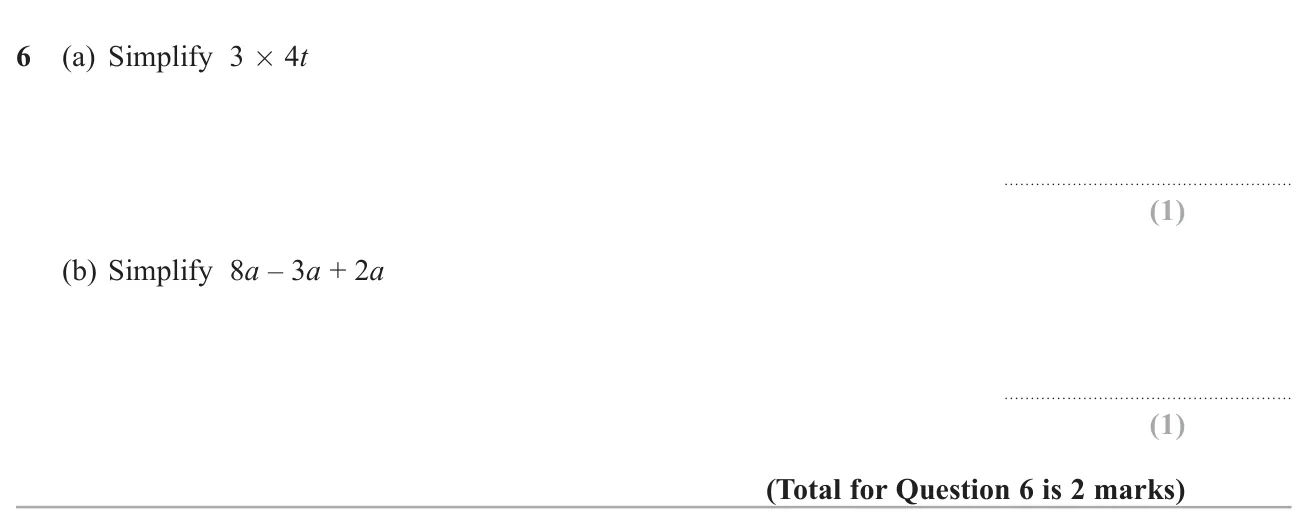
Exam questions: Expanding brackets and simplifying (33, easiest first) © Pearson Education Ltd. June 2018 Paper 1 (Foundation, non-calculator), question 6.
(a) 12 t 12t 12 t 1 mark (b) 7 a 7a 7 a 1 mark
Worked solution Checked against the mark scheme
(a) 3 × 4 t = 12 t 3 \times 4t = 12t 3 × 4 t = 12 t
(b) 8 a − 3 a = 5 a 8a - 3a = 5a 8 a − 3 a = 5 a 5 a + 2 a = 7 a 5a + 2a = 7a 5 a + 2 a = 7 a
Watch out: In (b), working out 3 a + 2 a 3a + 2a 3 a + 2 a 3 a 3a 3 a
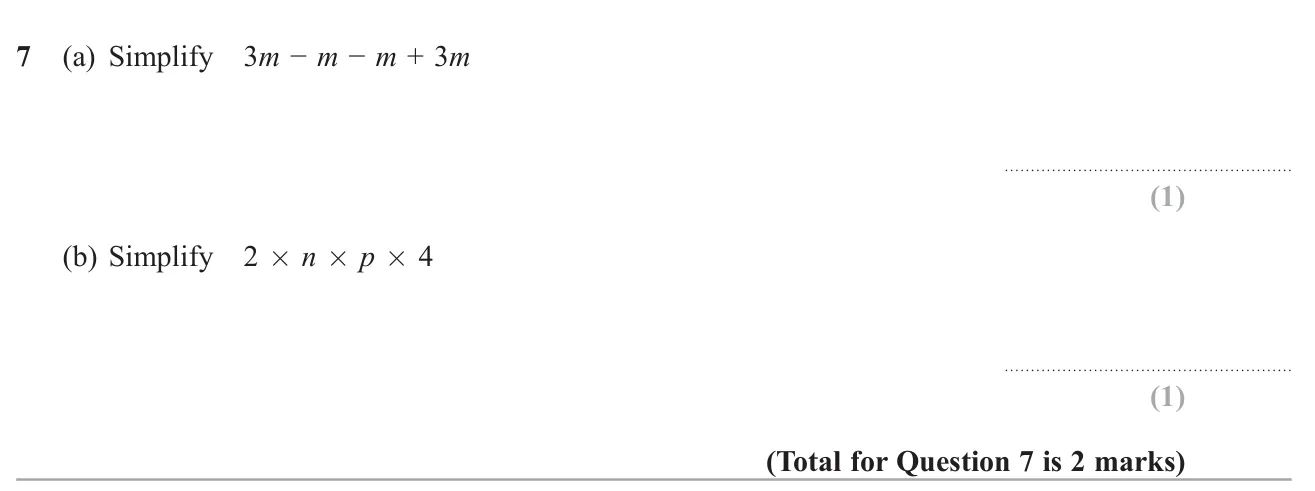
© Pearson Education Ltd. November 2018 Paper 2 (Foundation, calculator), question 7.
(a) 4 m 4m 4 m 1 mark (b) 8 n p 8np 8 n p 1 mark
Worked solution Checked against the mark scheme
(a) 3 m − m − m + 3 m = ( 3 − 1 − 1 + 3 ) m = 4 m 3m - m - m + 3m = (3 - 1 - 1 + 3)m = 4m 3 m − m − m + 3 m = ( 3 − 1 − 1 + 3 ) m = 4 m
(b) Multiply the numbers: 2 × 4 = 8 2 \times 4 = 8 2 × 4 = 8 8 n p 8np 8 n p
Watch out: In (a), getting 2m by treating the signs wrongly; in (b), writing 6np.
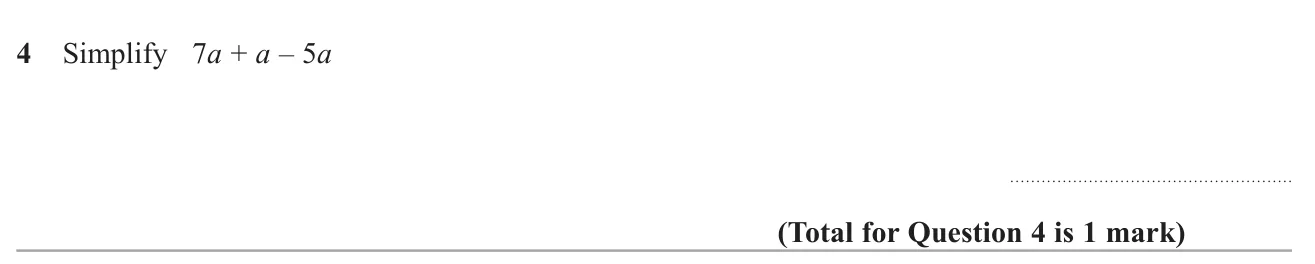
© Pearson Education Ltd. June 2024 Paper 3 (Foundation, calculator), question 4.
Worked solution Checked against the mark scheme
7 a + a = 8 a 7a + a = 8a 7 a + a = 8 a
8 a − 5 a = 3 a 8a - 5a = 3a 8 a − 5 a = 3 a
Watch out: Forgetting that a a a 1 a 1a 1 a 2 a 2a 2 a
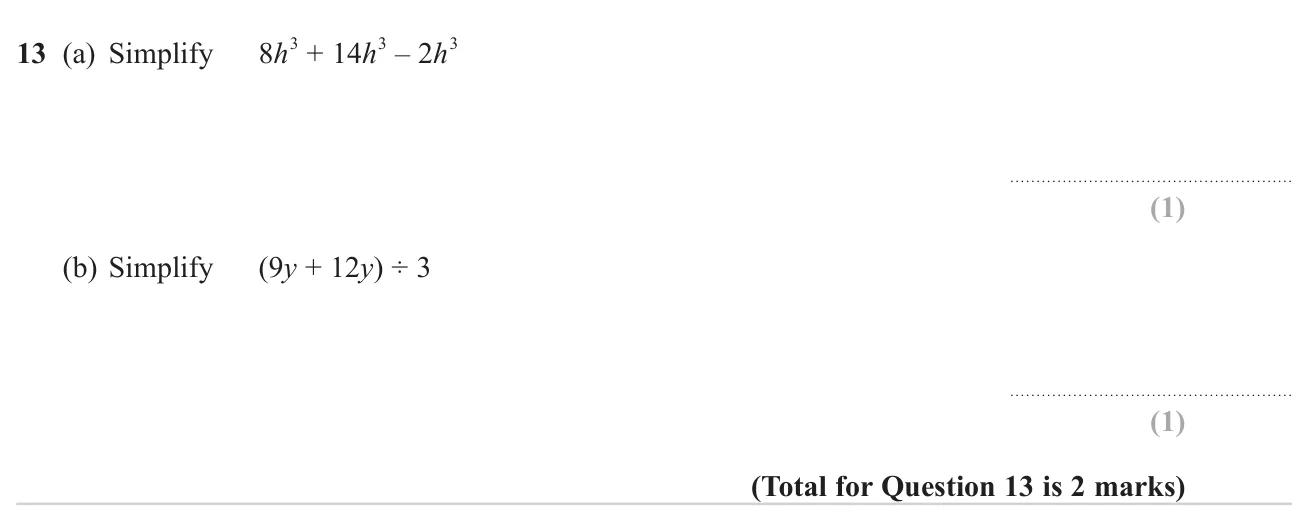
© Pearson Education Ltd. November 2023 Paper 3 (Foundation, calculator), question 13.
(a) 20 h 3 20h^3 20 h 3 1 mark (b) 7 y 7y 7 y 1 mark
Worked solution Checked against the mark scheme
(a) The terms are all h 3 h^3 h 3 8 + 14 − 2 = 20 8 + 14 - 2 = 20 8 + 14 − 2 = 20 20 h 3 20h^3 20 h 3
(b) 9 y + 12 y = 21 y 9y + 12y = 21y 9 y + 12 y = 21 y 21 y ÷ 3 = 7 y 21y \div 3 = 7y 21 y ÷ 3 = 7 y
Watch out: In (a), changing the power to give 20h⁹.
© Pearson Education Ltd. November 2019 Paper 1 (Foundation, non-calculator), question 13.
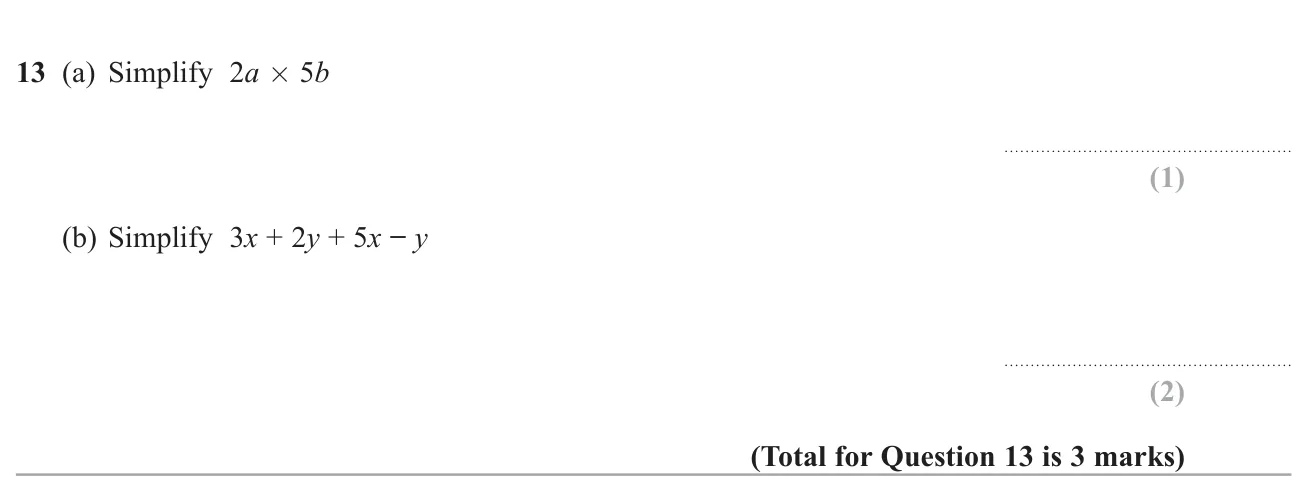
(a) 10 a b 10ab 10 ab 1 mark (b) 8 x + y 8x + y 8 x + y 2 marks
Worked solution Checked against the mark scheme
(a) Multiply the numbers and write the letters together: 2 × 5 = 10 2 \times 5 = 10 2 × 5 = 10 10 a b 10ab 10 ab
(b) x x x 3 x + 5 x = 8 x 3x + 5x = 8x 3 x + 5 x = 8 x
y y y 2 y − y = y 2y - y = y 2 y − y = y
Answer: 8 x + y 8x + y 8 x + y
Watch out: Writing 7ab in (a) by adding the numbers.
© Pearson Education Ltd. June 2023 Paper 1 (Foundation, non-calculator), question 13.
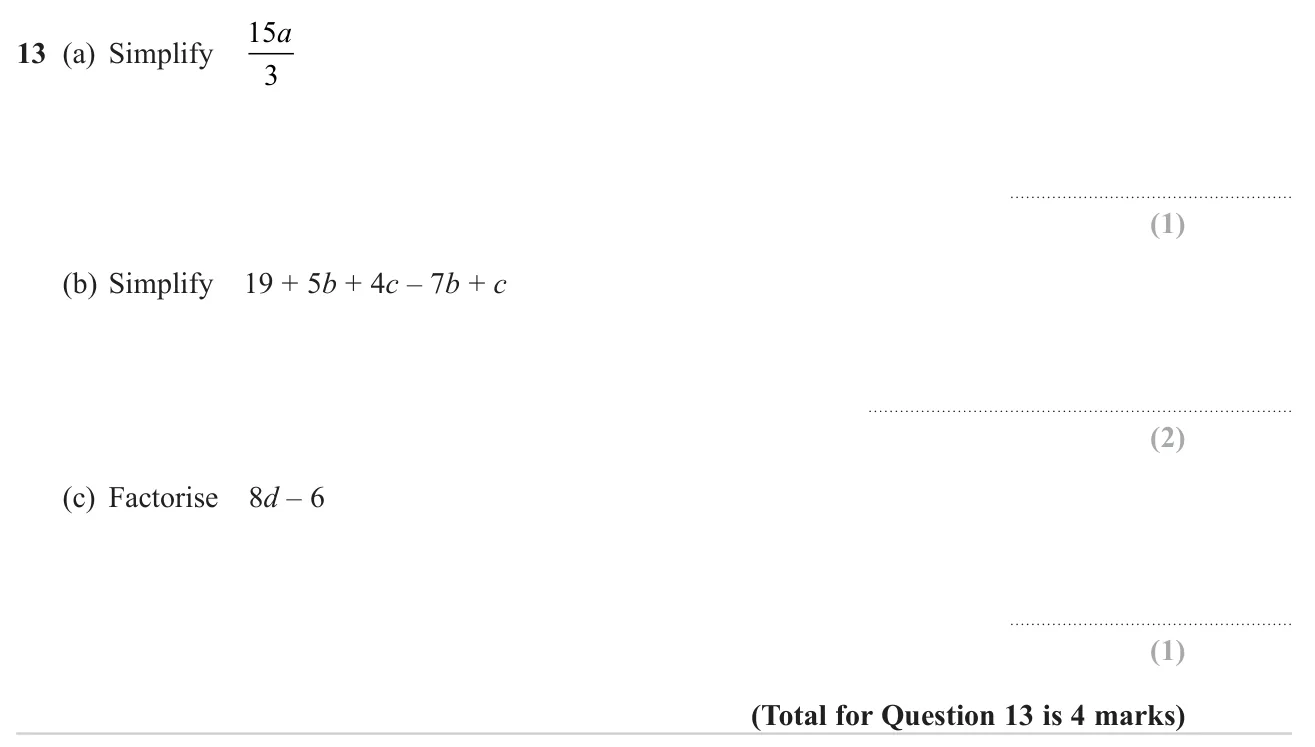
(a) 5 a 5a 5 a 1 mark (b) 19 − 2 b + 5 c 19 - 2b + 5c 19 − 2 b + 5 c 2 marks (c) 2 ( 4 d − 3 ) 2(4d - 3) 2 ( 4 d − 3 ) 1 mark
Worked solution Checked against the mark scheme
(a) 15 a 3 = 5 a \frac{15a}{3} = 5a 3 15 a = 5 a
(b) b b b 5 b − 7 b = − 2 b 5b - 7b = -2b 5 b − 7 b = − 2 b c c c 4 c + c = 5 c 4c + c = 5c 4 c + c = 5 c
So 19 − 2 b + 5 c 19 - 2b + 5c 19 − 2 b + 5 c
(c) The highest common factor of 8 and 6 is 2: 8 d − 6 = 2 ( 4 d − 3 ) 8d - 6 = 2(4d - 3) 8 d − 6 = 2 ( 4 d − 3 )
Watch out: In (b), writing +2b instead of −2b, or treating c as 0c.
© Pearson Education Ltd. June 2022 Paper 3 (Foundation, calculator), question 17.
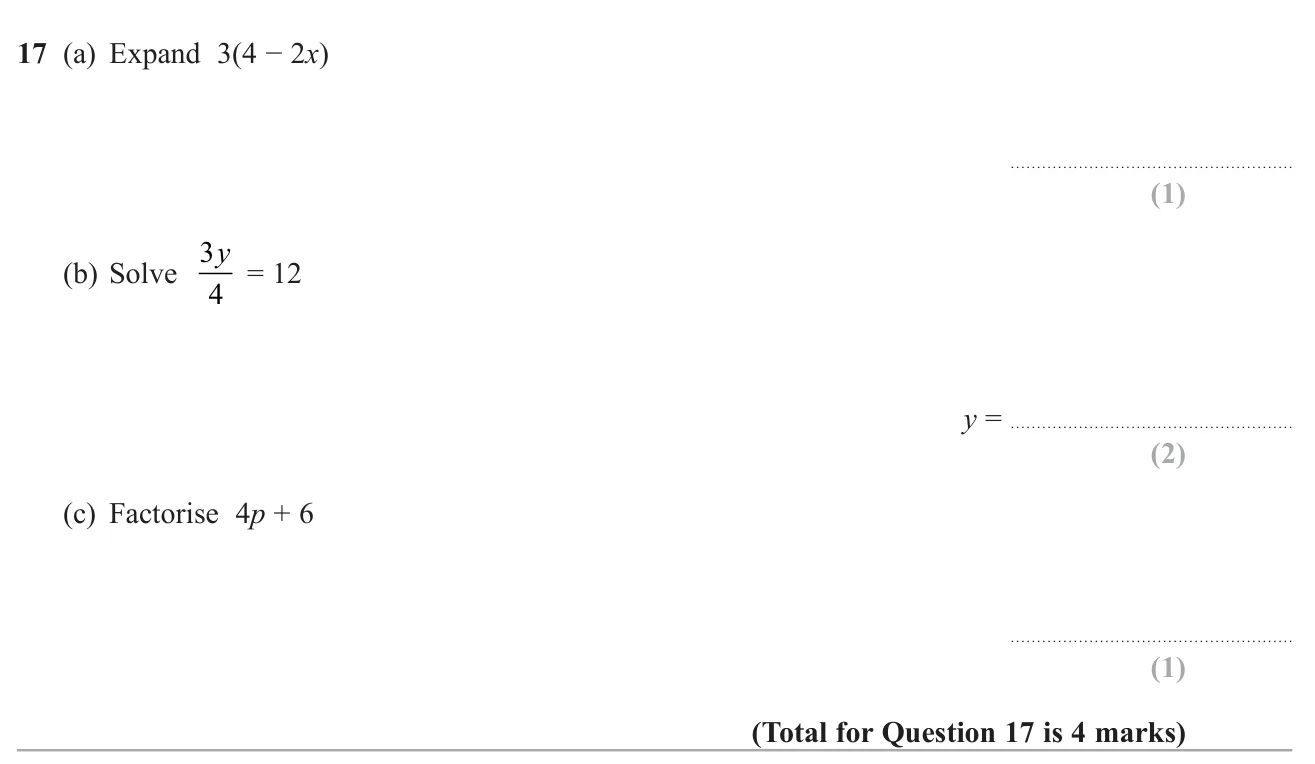
(a) 12 − 6 x 12 - 6x 12 − 6 x 1 mark (b) y = 16 y = 16 y = 16 2 marks (c) 2 ( 2 p + 3 ) 2(2p + 3) 2 ( 2 p + 3 ) 1 mark
Worked solution Checked against the mark scheme
(a) 3 × 4 = 12 3 \times 4 = 12 3 × 4 = 12 3 × − 2 x = − 6 x 3 \times -2x = -6x 3 × − 2 x = − 6 x 12 − 6 x 12 - 6x 12 − 6 x
(b) 3 y 4 = 12 \frac{3y}{4} = 12 4 3 y = 12 3 y = 48 3y = 48 3 y = 48 y = 16 y = 16 y = 16
(c) The highest common factor of 4 and 6 is 2: 4 p + 6 = 2 ( 2 p + 3 ) 4p + 6 = 2(2p + 3) 4 p + 6 = 2 ( 2 p + 3 )
Watch out: In (a) writing 12 − 2 x 12 - 2x 12 − 2 x
© Pearson Education Ltd. November 2021 Paper 3 (Foundation, calculator), question 17.
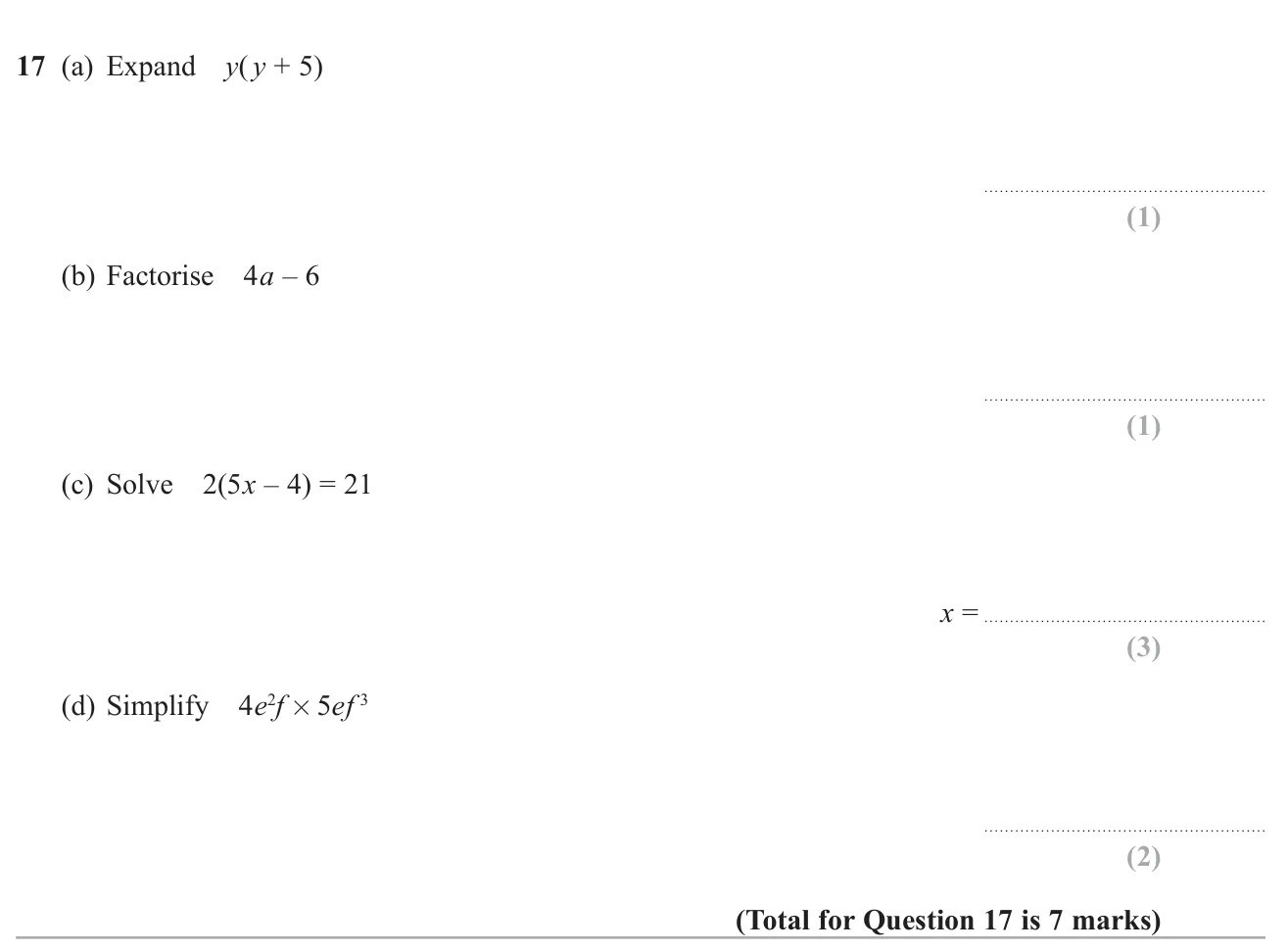
(a) y 2 + 5 y y^2 + 5y y 2 + 5 y 1 mark (b) 2 ( 2 a − 3 ) 2(2a - 3) 2 ( 2 a − 3 ) 1 mark (c) x = 2.9 x = 2.9 x = 2.9 3 marks (d) 20 e 3 f 4 20e^3f^4 20 e 3 f 4 2 marks
Worked solution Checked against the mark scheme
(a) y × y + y × 5 = y 2 + 5 y y \times y + y \times 5 = y^2 + 5y y × y + y × 5 = y 2 + 5 y
(b) The highest common factor of 4 and 6 is 2: 2 ( 2 a − 3 ) 2(2a - 3) 2 ( 2 a − 3 )
(c) 10 x − 8 = 21 10x - 8 = 21 10 x − 8 = 21 10 x = 29 10x = 29 10 x = 29 x = 2.9 x = 2.9 x = 2.9
(d) 4 × 5 = 20 4 \times 5 = 20 4 × 5 = 20 e 2 × e = e 3 e^2 \times e = e^3 e 2 × e = e 3 f × f 3 = f 4 f \times f^3 = f^4 f × f 3 = f 4 20 e 3 f 4 20e^3f^4 20 e 3 f 4
Watch out: In (d), multiplying the powers instead of adding them, e.g. e 2 e^2 e 2
© Pearson Education Ltd. June 2019 Paper 1 (Foundation, non-calculator), question 16.
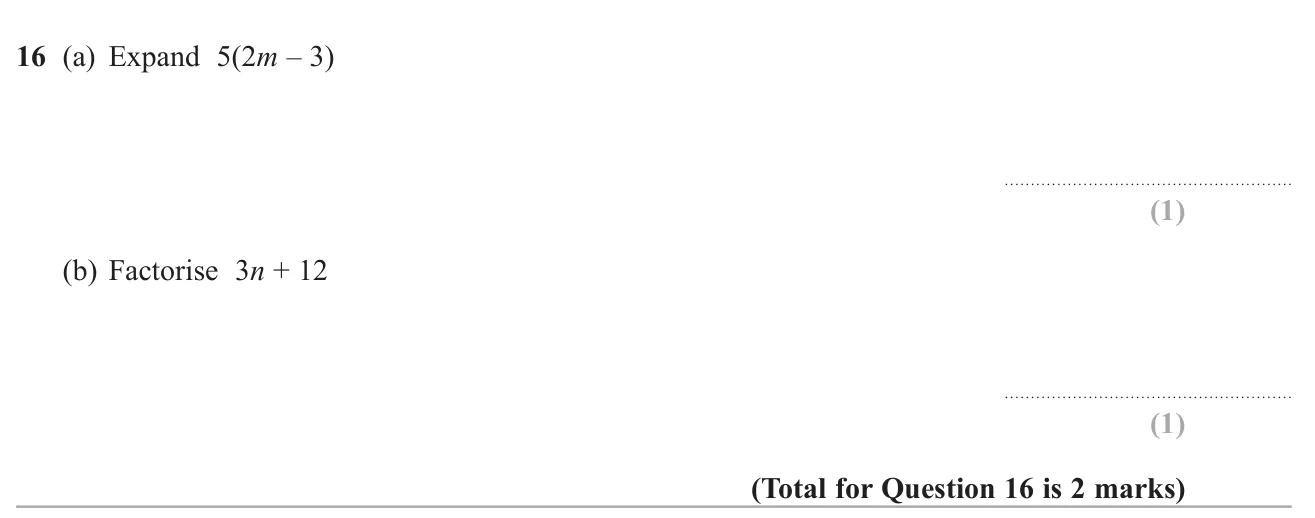
(a) 10 m − 15 10m - 15 10 m − 15 1 mark (b) 3 ( n + 4 ) 3(n + 4) 3 ( n + 4 ) 1 mark
Worked solution Checked against the mark scheme
(a) 5 × 2 m = 10 m 5 \times 2m = 10m 5 × 2 m = 10 m 5 × ( − 3 ) = − 15 5 \times (-3) = -15 5 × ( − 3 ) = − 15 10 m − 15 10m - 15 10 m − 15
(b) 3 is a factor of both terms: 3 n + 12 = 3 ( n + 4 ) 3n + 12 = 3(n + 4) 3 n + 12 = 3 ( n + 4 )
Watch out: In (a), multiplying only the first term: 10 m − 3 10m - 3 10 m − 3
© Pearson Education Ltd. June 2019 Paper 2 (Foundation, calculator), question 8.
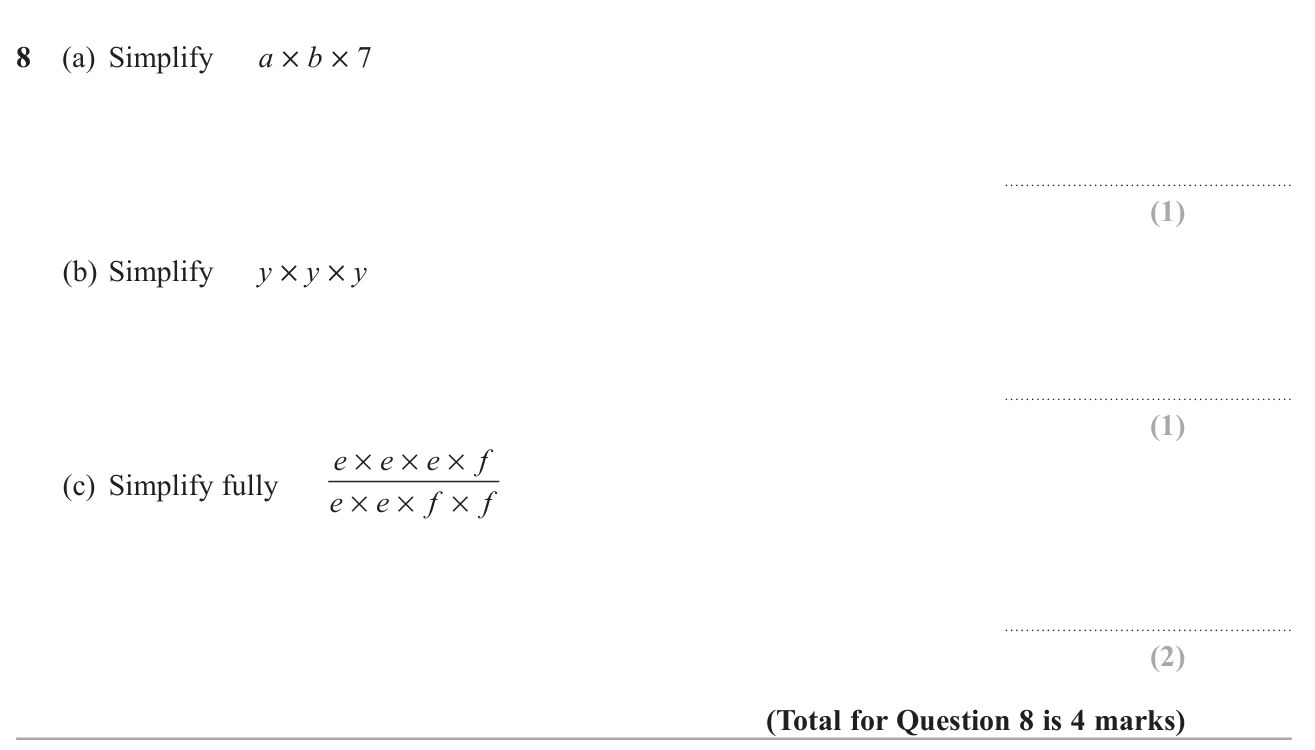
(a) 7 a b 7ab 7 ab 1 mark (b) y 3 y^3 y 3 1 mark (c) e f \frac{e}{f} f e 2 marks
Worked solution Checked against the mark scheme
(a) Write the number first, then the letters: 7 a b 7ab 7 ab
(b) y y y y 3 y^3 y 3
(c) Top: e × e × e × f = e 3 f e \times e \times e \times f = e^3 f e × e × e × f = e 3 f e × e × f × f = e 2 f 2 e \times e \times f \times f = e^2 f^2 e × e × f × f = e 2 f 2
Cancel two e e e f f f e 3 f e 2 f 2 = e f \frac{e^3 f}{e^2 f^2} = \frac{e}{f} e 2 f 2 e 3 f = f e
Watch out: In (b), writing 3 y 3y 3 y y 3 y^3 y 3
© Pearson Education Ltd. November 2023 Paper 2 (Foundation, calculator), question 22.
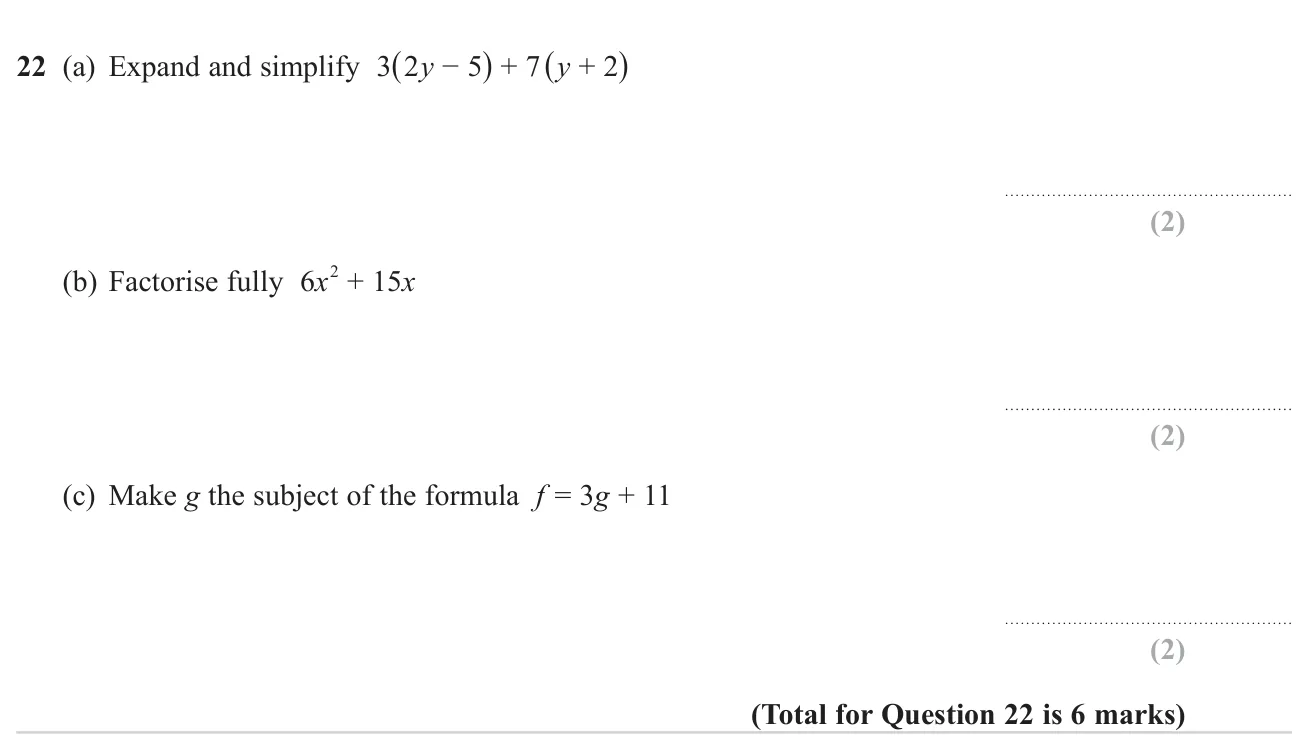
(a) 13 y − 1 13y - 1 13 y − 1 2 marks (b) 3 x ( 2 x + 5 ) 3x(2x + 5) 3 x ( 2 x + 5 ) 2 marks (c) g = f − 11 3 g = \frac{f - 11}{3} g = 3 f − 11 2 marks
Worked solution Checked against the mark scheme
(a) 6 y − 15 + 7 y + 14 = 13 y − 1 6y - 15 + 7y + 14 = 13y - 1 6 y − 15 + 7 y + 14 = 13 y − 1
(b) The HCF of 6 x 2 6x^2 6 x 2 15 x 15x 15 x 3 x 3x 3 x 6 x 2 + 15 x = 3 x ( 2 x + 5 ) 6x^2 + 15x = 3x(2x + 5) 6 x 2 + 15 x = 3 x ( 2 x + 5 )
(c) f − 11 = 3 g f - 11 = 3g f − 11 = 3 g g = f − 11 3 g = \frac{f - 11}{3} g = 3 f − 11
Watch out: In (b), taking out only 3 or only x, so the answer is not fully factorised.
© Pearson Education Ltd. November 2023 Paper 2 (Higher, calculator), question 1.
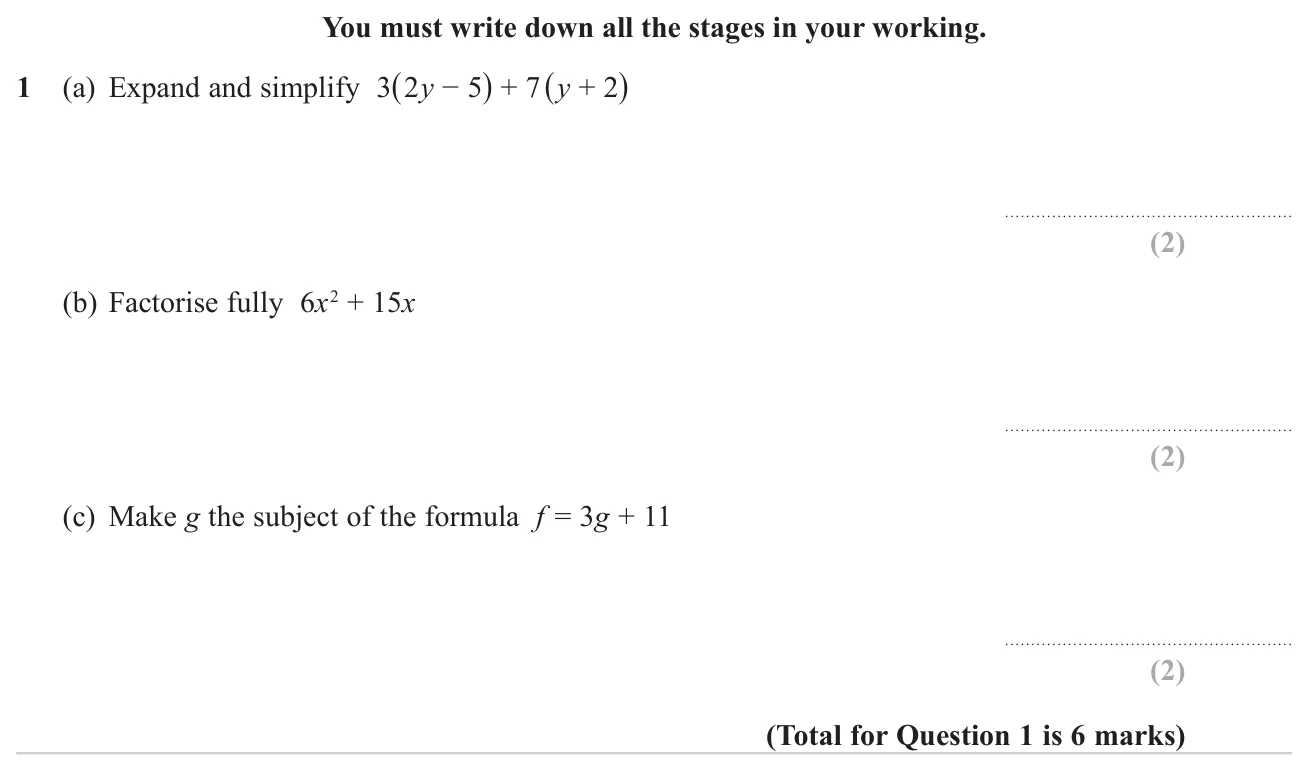
(a) 13 y − 1 13y - 1 13 y − 1 2 marks (b) 3 x ( 2 x + 5 ) 3x(2x + 5) 3 x ( 2 x + 5 ) 2 marks (c) g = f − 11 3 g = \frac{f - 11}{3} g = 3 f − 11 2 marks
Worked solution Checked against the mark scheme
(a) 6 y − 15 + 7 y + 14 = 13 y − 1 6y - 15 + 7y + 14 = 13y - 1 6 y − 15 + 7 y + 14 = 13 y − 1
(b) The highest common factor of 6 x 2 6x^2 6 x 2 15 x 15x 15 x 3 x 3x 3 x 6 x 2 + 15 x = 3 x ( 2 x + 5 ) 6x^2 + 15x = 3x(2x + 5) 6 x 2 + 15 x = 3 x ( 2 x + 5 )
(c) f − 11 = 3 g f - 11 = 3g f − 11 = 3 g g = f − 11 3 g = \frac{f - 11}{3} g = 3 f − 11
Watch out: In (b), taking out only 3 or only x, so the answer is not fully factorised.
© Pearson Education Ltd. June 2023 Paper 3 (Foundation, calculator), question 20.
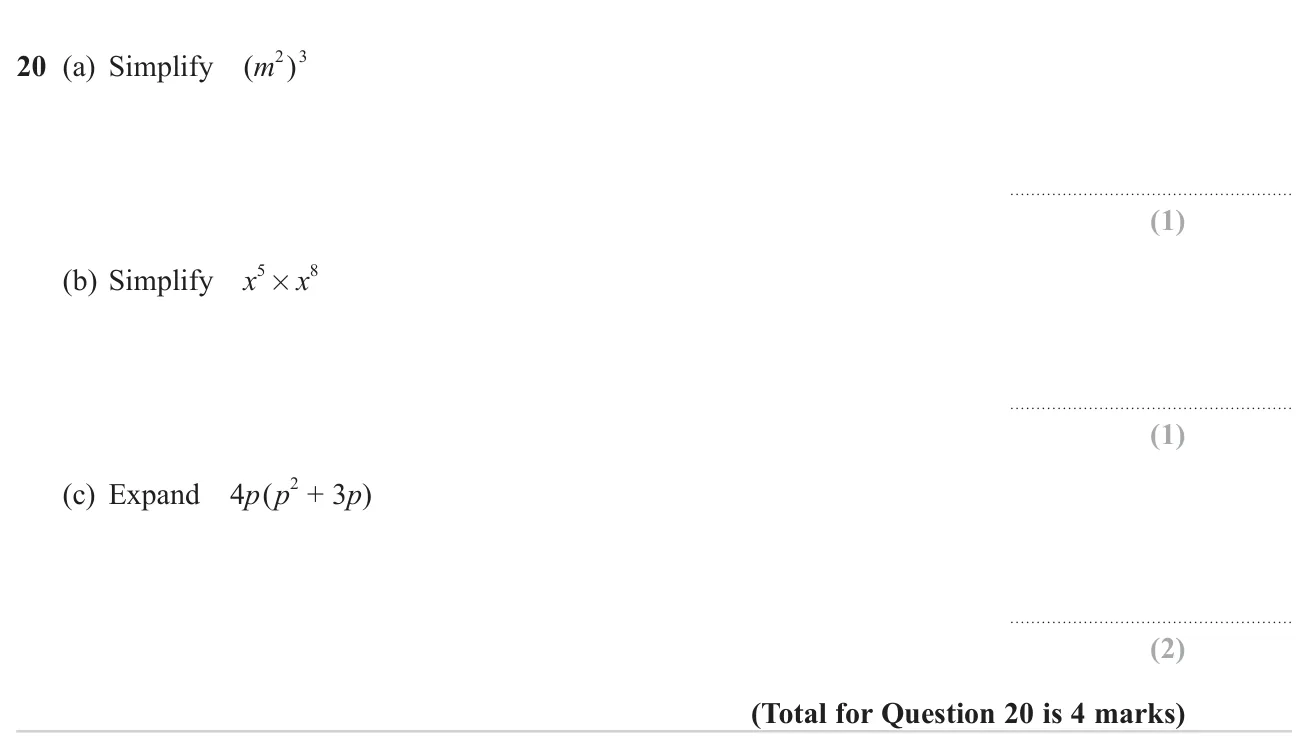
(a) m 6 m^6 m 6 1 mark (b) x 13 x^{13} x 13 1 mark (c) 4 p 3 + 12 p 2 4p^3 + 12p^2 4 p 3 + 12 p 2 2 marks
Worked solution Checked against the mark scheme
(a) Multiply the powers: ( m 2 ) 3 = m 2 × 3 = m 6 (m^2)^3 = m^{2 \times 3} = m^6 ( m 2 ) 3 = m 2 × 3 = m 6
(b) Add the powers: x 5 + 8 = x 13 x^{5+8} = x^{13} x 5 + 8 = x 13
(c) 4 p × p 2 = 4 p 3 4p \times p^2 = 4p^3 4 p × p 2 = 4 p 3 4 p × 3 p = 12 p 2 4p \times 3p = 12p^2 4 p × 3 p = 12 p 2 4 p 3 + 12 p 2 4p^3 + 12p^2 4 p 3 + 12 p 2
Watch out: In (a), adding the powers to get m 5 m^5 m 5
© Pearson Education Ltd. June 2022 Paper 2 (Foundation, calculator), question 21.
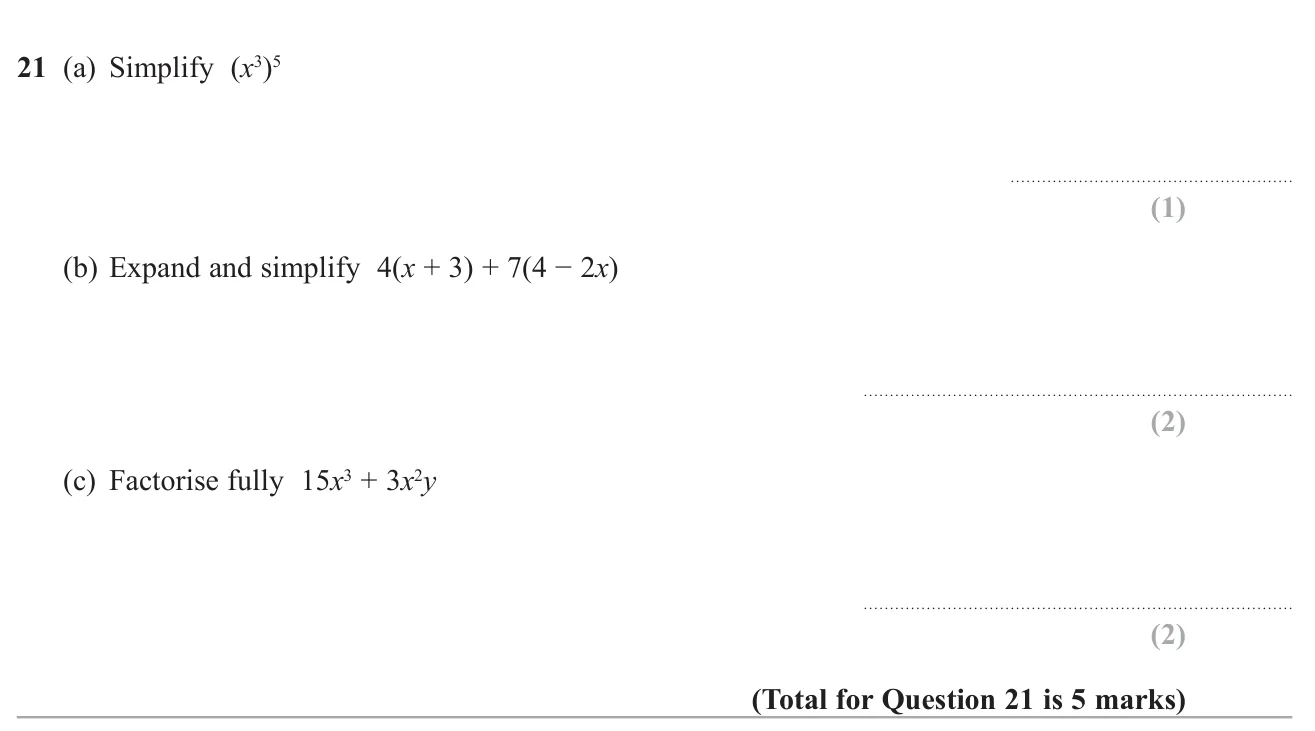
(a) x 15 x^{15} x 15 1 mark (b) 40 − 10 x 40 - 10x 40 − 10 x 2 marks (c) 3 x 2 ( 5 x + y ) 3x^2(5x + y) 3 x 2 ( 5 x + y ) 2 marks
Worked solution Checked against the mark scheme
(a) Multiply the powers: ( x 3 ) 5 = x 15 (x^3)^5 = x^{15} ( x 3 ) 5 = x 15
(b) 4 x + 12 + 28 − 14 x = 40 − 10 x 4x + 12 + 28 - 14x = 40 - 10x 4 x + 12 + 28 − 14 x = 40 − 10 x
(c) The HCF of 15 x 3 15x^3 15 x 3 3 x 2 y 3x^2y 3 x 2 y 3 x 2 3x^2 3 x 2
15 x 3 + 3 x 2 y = 3 x 2 ( 5 x + y ) 15x^3 + 3x^2y = 3x^2(5x + y) 15 x 3 + 3 x 2 y = 3 x 2 ( 5 x + y )
Watch out: In (a), adding the powers to get x 8 x^8 x 8
© Pearson Education Ltd. November 2022 Paper 3 (Higher, calculator), question 10.
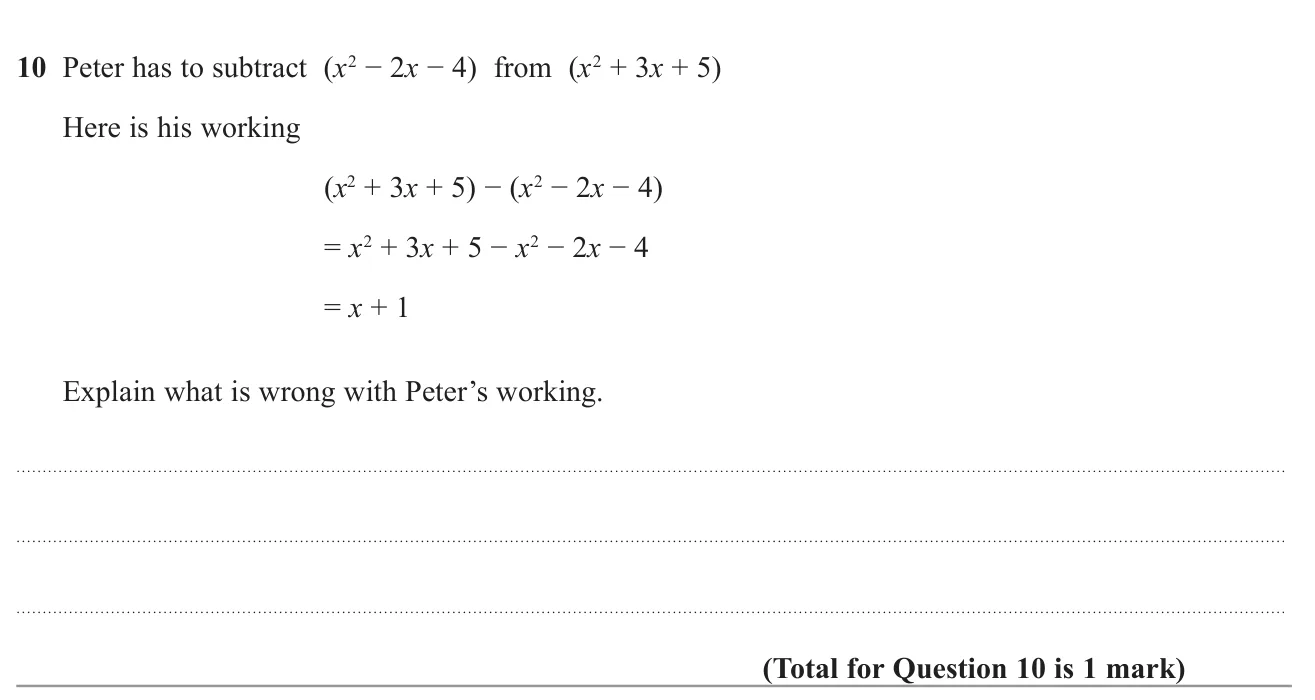
Answer When removing the second bracket the signs should change: it should be + 2 x + 4 +2x + 4 + 2 x + 4 5 x + 9 5x + 9 5 x + 9 1 mark
Worked solution Checked against the mark scheme
Subtracting a bracket changes the sign of every term inside it:
− ( x 2 − 2 x − 4 ) = − x 2 + 2 x + 4 -(x^2 - 2x - 4) = -x^2 + 2x + 4 − ( x 2 − 2 x − 4 ) = − x 2 + 2 x + 4
So the answer should be x 2 + 3 x + 5 − x 2 + 2 x + 4 = 5 x + 9 x^2 + 3x + 5 - x^2 + 2x + 4 = 5x + 9 x 2 + 3 x + 5 − x 2 + 2 x + 4 = 5 x + 9 − 2 x − 4 -2x - 4 − 2 x − 4
Watch out: Only changing the sign of the first term inside the bracket.
© Pearson Education Ltd. November 2019 Paper 3 (Foundation, calculator), question 22.
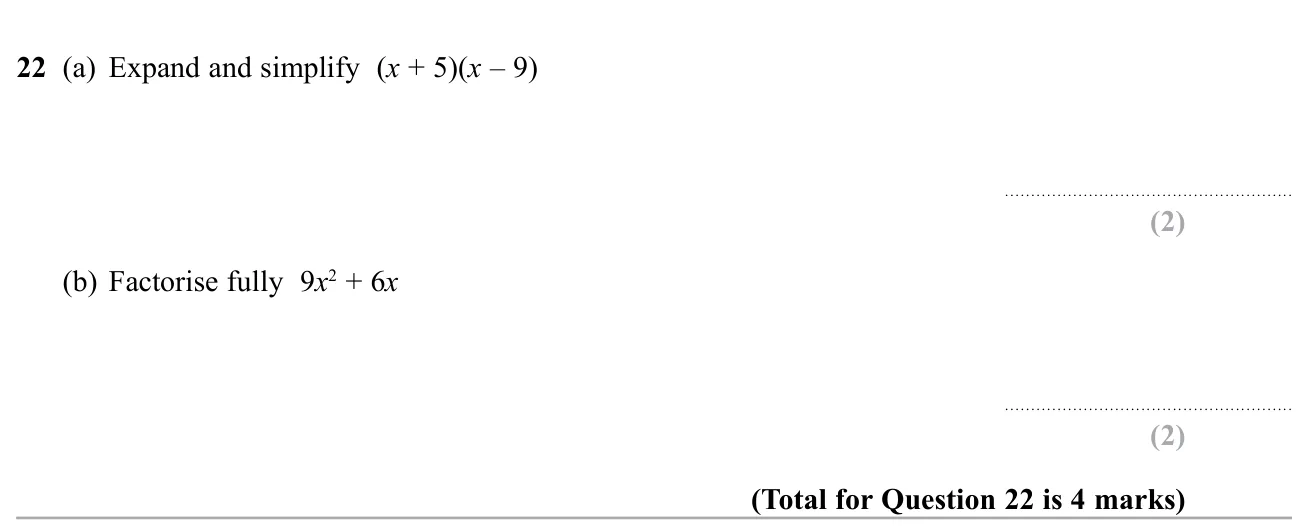
(a) x 2 − 4 x − 45 x^2 - 4x - 45 x 2 − 4 x − 45 2 marks (b) 3 x ( 3 x + 2 ) 3x(3x + 2) 3 x ( 3 x + 2 ) 2 marks
Worked solution Checked against the mark scheme
(a) x × x = x 2 x \times x = x^2 x × x = x 2 x × ( − 9 ) = − 9 x x \times (-9) = -9x x × ( − 9 ) = − 9 x 5 × x = 5 x 5 \times x = 5x 5 × x = 5 x 5 × ( − 9 ) = − 45 5 \times (-9) = -45 5 × ( − 9 ) = − 45
x 2 − 9 x + 5 x − 45 = x 2 − 4 x − 45 x^2 - 9x + 5x - 45 = x^2 - 4x - 45 x 2 − 9 x + 5 x − 45 = x 2 − 4 x − 45
(b) The highest common factor of 9 x 2 9x^2 9 x 2 6 x 6x 6 x 3 x 3x 3 x 3 x ( 3 x + 2 ) 3x(3x + 2) 3 x ( 3 x + 2 )
Watch out: In (b), only taking out 3 to get 3 ( 3 x 2 + 2 x ) 3(3x^2 + 2x) 3 ( 3 x 2 + 2 x )
© Pearson Education Ltd. June 2018 Paper 3 (Foundation, calculator), question 20.
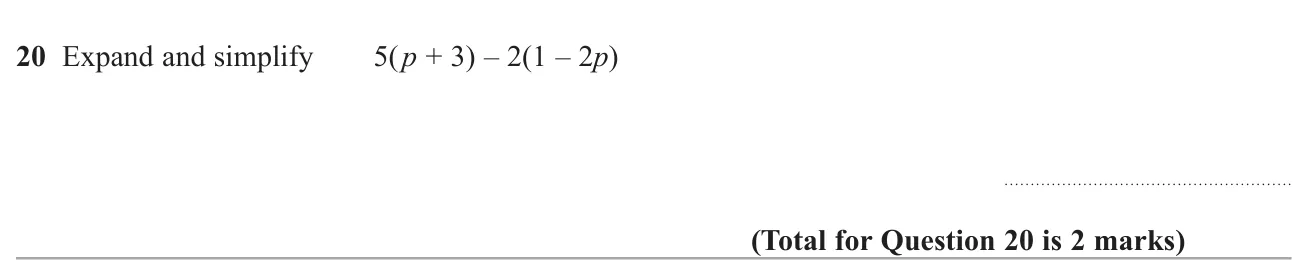
Answer 9 p + 13 9p + 13 9 p + 13 2 marks
Worked solution Checked against the mark scheme
5 ( p + 3 ) = 5 p + 15 5(p + 3) = 5p + 15 5 ( p + 3 ) = 5 p + 15
− 2 ( 1 − 2 p ) = − 2 + 4 p -2(1 - 2p) = -2 + 4p − 2 ( 1 − 2 p ) = − 2 + 4 p
5 p + 15 − 2 + 4 p = 9 p + 13 5p + 15 - 2 + 4p = 9p + 13 5 p + 15 − 2 + 4 p = 9 p + 13
Watch out: Writing −2 × −2p as −4p, giving p + 13.
© Pearson Education Ltd. Specimen Paper 1 (Foundation, non-calculator), question 27.
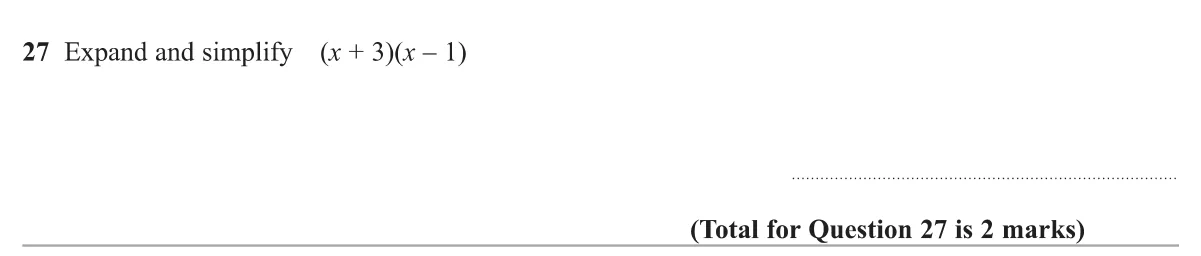
Answer x 2 + 2 x − 3 x^2 + 2x - 3 x 2 + 2 x − 3 2 marks
Worked solution Checked against the mark scheme
Multiply each term in the first bracket by each term in the second:
x × x = x 2 x \times x = x^2 x × x = x 2 x × ( − 1 ) = − x x \times (-1) = -x x × ( − 1 ) = − x 3 × x = 3 x 3 \times x = 3x 3 × x = 3 x 3 × ( − 1 ) = − 3 3 \times (-1) = -3 3 × ( − 1 ) = − 3
x 2 − x + 3 x − 3 = x 2 + 2 x − 3 x^2 - x + 3x - 3 = x^2 + 2x - 3 x 2 − x + 3 x − 3 = x 2 + 2 x − 3
Watch out: Getting the sign of the constant wrong (+3).
© Pearson Education Ltd. November 2023 Paper 1 (Foundation, non-calculator), question 27.
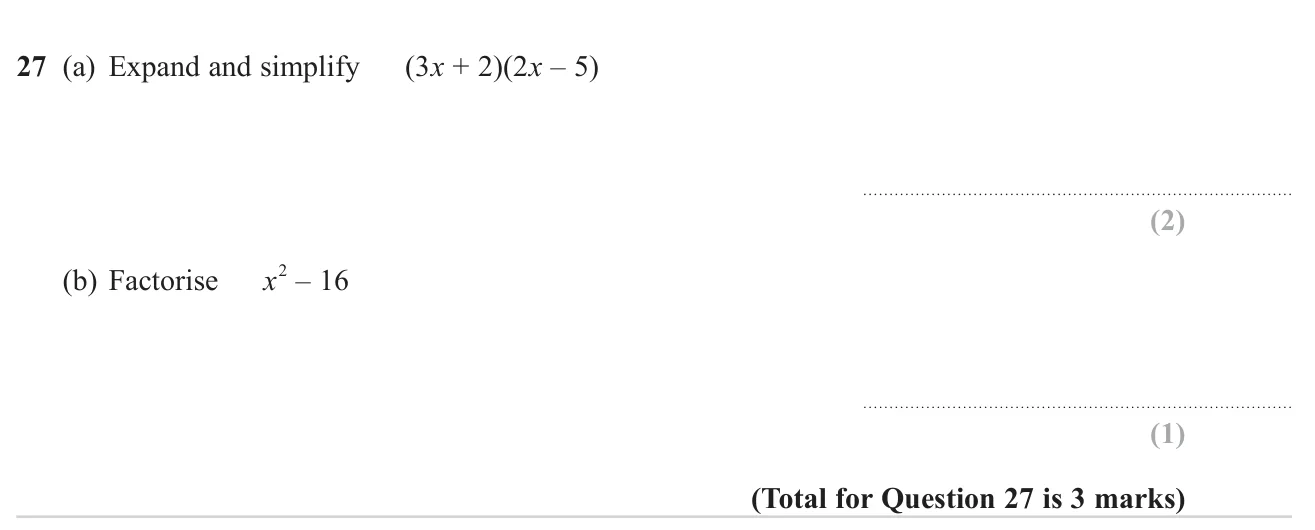
(a) 6 x 2 − 11 x − 10 6x^2 - 11x - 10 6 x 2 − 11 x − 10 2 marks (b) ( x − 4 ) ( x + 4 ) (x - 4)(x + 4) ( x − 4 ) ( x + 4 ) 1 mark
Worked solution Checked against the mark scheme
(a) ( 3 x + 2 ) ( 2 x − 5 ) = 6 x 2 − 15 x + 4 x − 10 = 6 x 2 − 11 x − 10 (3x + 2)(2x - 5) = 6x^2 - 15x + 4x - 10 = 6x^2 - 11x - 10 ( 3 x + 2 ) ( 2 x − 5 ) = 6 x 2 − 15 x + 4 x − 10 = 6 x 2 − 11 x − 10
(b) x 2 − 16 = x 2 − 4 2 = ( x − 4 ) ( x + 4 ) x^2 - 16 = x^2 - 4^2 = (x - 4)(x + 4) x 2 − 16 = x 2 − 4 2 = ( x − 4 ) ( x + 4 )
Watch out: In (a), getting +11x or −19x by mishandling signs.
© Pearson Education Ltd. November 2020 Paper 2 (Higher, calculator), question 10.
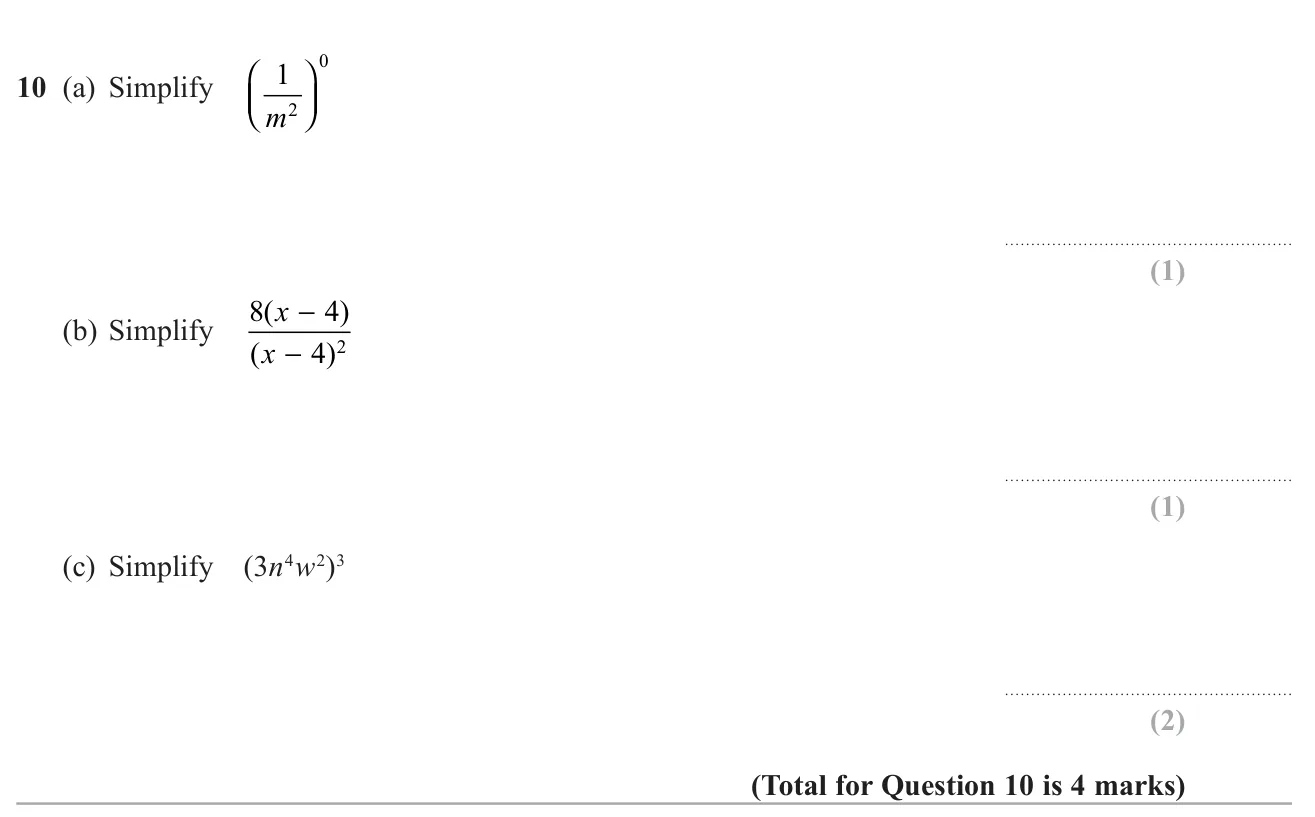
(a) 1 1 mark (b) 8 x − 4 \frac{8}{x - 4} x − 4 8 1 mark (c) 27 n 12 w 6 27n^{12}w^6 27 n 12 w 6 2 marks
Worked solution Checked against the mark scheme
(a) Anything (non-zero) to the power 0 is 1.
(b) Cancel one factor of ( x − 4 ) (x - 4) ( x − 4 ) 8 ( x − 4 ) ( x − 4 ) 2 = 8 x − 4 \frac{8(x-4)}{(x-4)^2} = \frac{8}{x-4} ( x − 4 ) 2 8 ( x − 4 ) = x − 4 8
(c) Cube each part: 3 3 = 27 3^3 = 27 3 3 = 27 ( n 4 ) 3 = n 12 (n^4)^3 = n^{12} ( n 4 ) 3 = n 12 ( w 2 ) 3 = w 6 (w^2)^3 = w^6 ( w 2 ) 3 = w 6 27 n 12 w 6 27n^{12}w^6 27 n 12 w 6
Watch out: In (c), writing 9 9 9 27 27 27 n 7 n^7 n 7
© Pearson Education Ltd. November 2019 Paper 1 (Foundation, non-calculator), question 26.
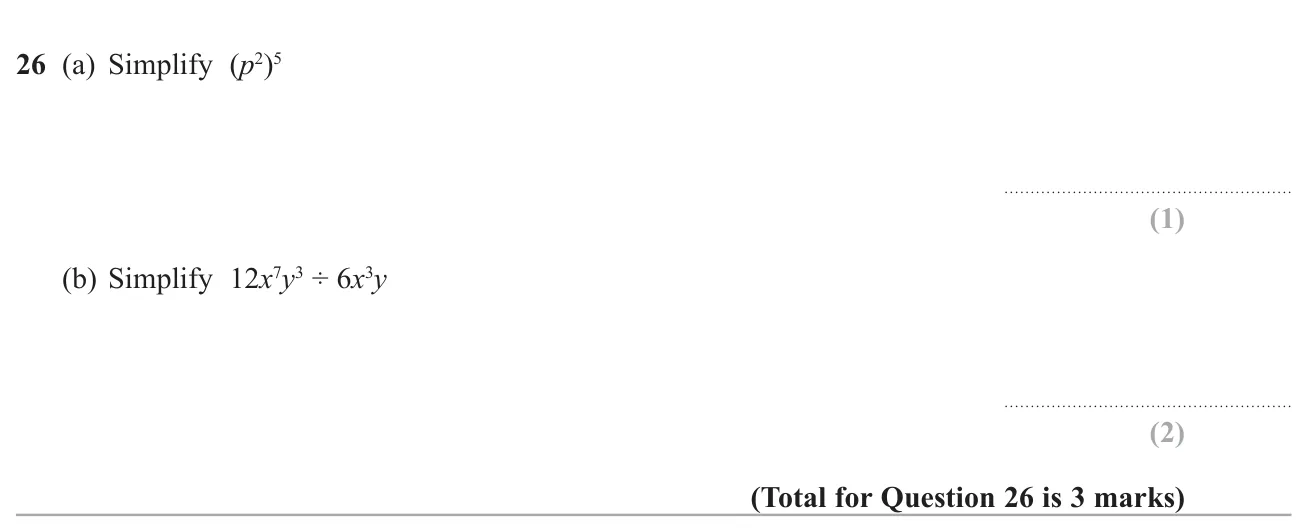
(a) p 10 p^{10} p 10 1 mark (b) 2 x 4 y 2 2x^4y^2 2 x 4 y 2 2 marks
Worked solution Checked against the mark scheme
(a) Multiply the powers: ( p 2 ) 5 = p 2 × 5 = p 10 (p^2)^5 = p^{2 \times 5} = p^{10} ( p 2 ) 5 = p 2 × 5 = p 10
(b) Divide the numbers and subtract the powers:
12 ÷ 6 = 2 12 \div 6 = 2 12 ÷ 6 = 2 x 7 − 3 = x 4 x^{7-3} = x^4 x 7 − 3 = x 4 y 3 − 1 = y 2 y^{3-1} = y^2 y 3 − 1 = y 2
Answer: 2 x 4 y 2 2x^4y^2 2 x 4 y 2
Watch out: Adding the powers in (a) to get p 7 p^7 p 7
© Pearson Education Ltd. November 2018 Paper 2 (Foundation, calculator), question 26.
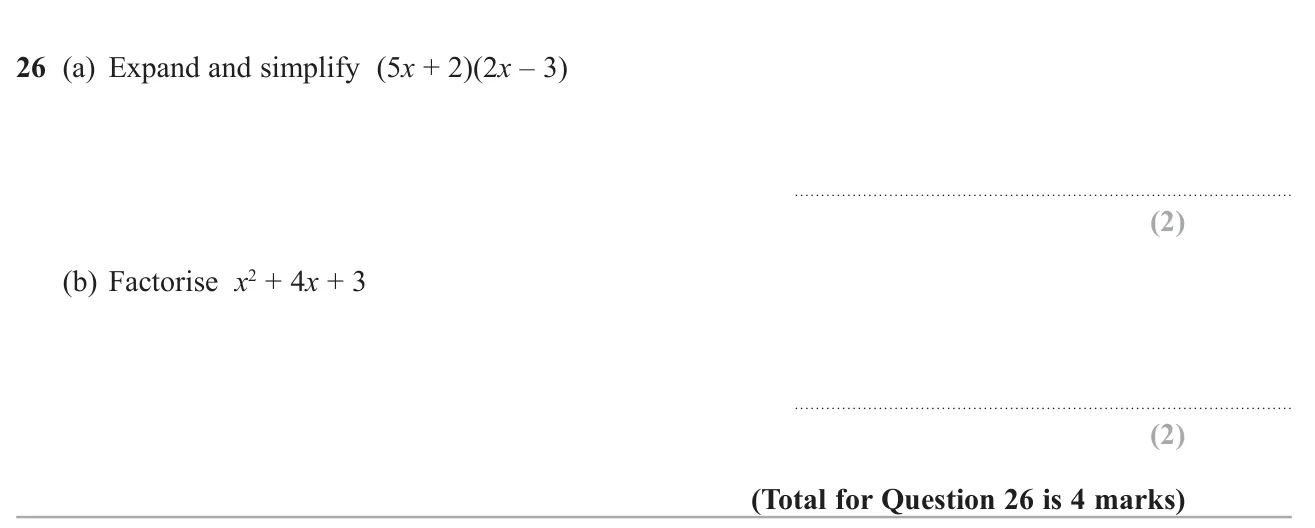
(a) 10 x 2 − 11 x − 6 10x^2 - 11x - 6 10 x 2 − 11 x − 6 2 marks (b) ( x + 1 ) ( x + 3 ) (x + 1)(x + 3) ( x + 1 ) ( x + 3 ) 2 marks
Worked solution Checked against the mark scheme
(a) ( 5 x + 2 ) ( 2 x − 3 ) = 10 x 2 − 15 x + 4 x − 6 = 10 x 2 − 11 x − 6 (5x + 2)(2x - 3) = 10x^2 - 15x + 4x - 6 = 10x^2 - 11x - 6 ( 5 x + 2 ) ( 2 x − 3 ) = 10 x 2 − 15 x + 4 x − 6 = 10 x 2 − 11 x − 6
(b) Two numbers that multiply to 3 and add to 4: 1 and 3.
x 2 + 4 x + 3 = ( x + 1 ) ( x + 3 ) x^2 + 4x + 3 = (x + 1)(x + 3) x 2 + 4 x + 3 = ( x + 1 ) ( x + 3 )
Watch out: In (a), getting +11x from a sign error.
© Pearson Education Ltd. June 2024 Paper 1 (Higher, non-calculator), question 14.
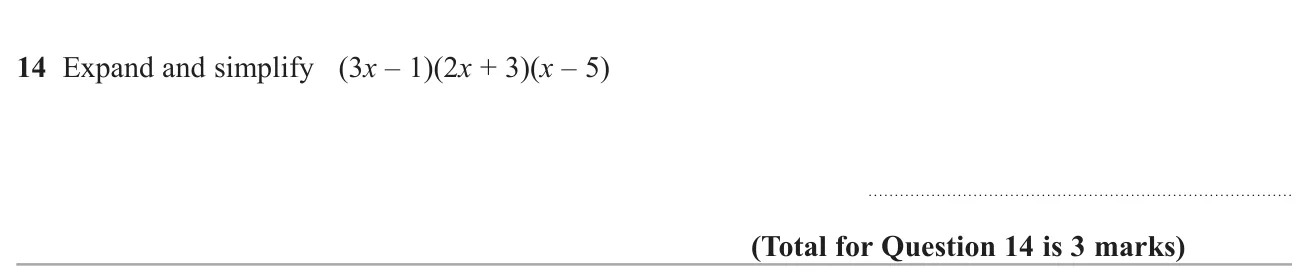
Answer 6 x 3 − 23 x 2 − 38 x + 15 6x^3 - 23x^2 - 38x + 15 6 x 3 − 23 x 2 − 38 x + 15 3 marks
Worked solution Checked against the mark scheme
( 3 x − 1 ) ( 2 x + 3 ) = 6 x 2 + 9 x − 2 x − 3 = 6 x 2 + 7 x − 3 (3x - 1)(2x + 3) = 6x^2 + 9x - 2x - 3 = 6x^2 + 7x - 3 ( 3 x − 1 ) ( 2 x + 3 ) = 6 x 2 + 9 x − 2 x − 3 = 6 x 2 + 7 x − 3
( 6 x 2 + 7 x − 3 ) ( x − 5 ) = 6 x 3 − 30 x 2 + 7 x 2 − 35 x − 3 x + 15 (6x^2 + 7x - 3)(x - 5) = 6x^3 - 30x^2 + 7x^2 - 35x - 3x + 15 ( 6 x 2 + 7 x − 3 ) ( x − 5 ) = 6 x 3 − 30 x 2 + 7 x 2 − 35 x − 3 x + 15
= 6 x 3 − 23 x 2 − 38 x + 15 = 6x^3 - 23x^2 - 38x + 15 = 6 x 3 − 23 x 2 − 38 x + 15
Watch out: Sign errors when multiplying by − 5 -5 − 5 − 3 × − 5 = + 15 -3 \times -5 = +15 − 3 × − 5 = + 15
© Pearson Education Ltd. June 2023 Paper 1 (Higher, non-calculator), question 11.
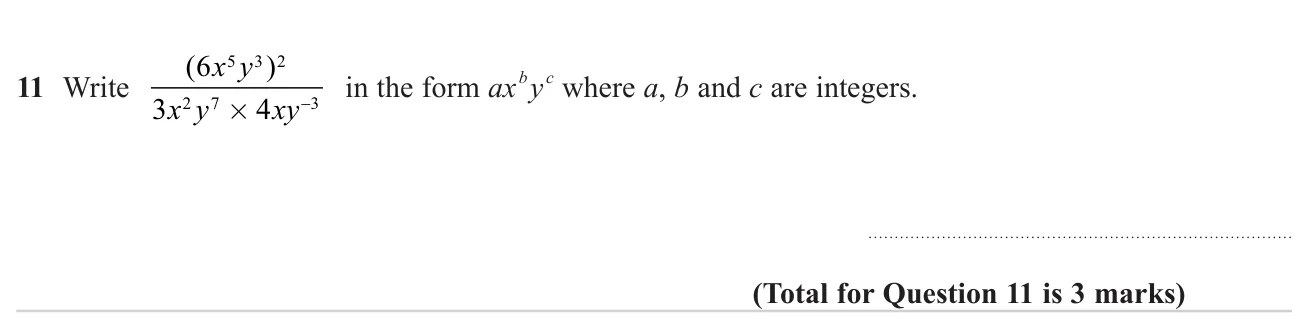
Answer 3 x 7 y 2 3x^7y^2 3 x 7 y 2 3 marks
Worked solution Checked against the mark scheme
Numerator: ( 6 x 5 y 3 ) 2 = 36 x 10 y 6 (6x^5y^3)^2 = 36x^{10}y^6 ( 6 x 5 y 3 ) 2 = 36 x 10 y 6
Denominator: 3 x 2 y 7 × 4 x y − 3 = 12 x 3 y 4 3x^2y^7 \times 4xy^{-3} = 12x^3y^4 3 x 2 y 7 × 4 x y − 3 = 12 x 3 y 4
Divide: 36 12 = 3 \frac{36}{12} = 3 12 36 = 3 x 10 − 3 = x 7 x^{10-3} = x^7 x 10 − 3 = x 7 y 6 − 4 = y 2 y^{6-4} = y^2 y 6 − 4 = y 2
Answer: 3 x 7 y 2 3x^7y^2 3 x 7 y 2
Watch out: Squaring only the 6 or only the powers in the bracket, e.g. 6 x 10 y 6 6x^{10}y^6 6 x 10 y 6
© Pearson Education Ltd. November 2023 Paper 2 (Higher, calculator), question 9.
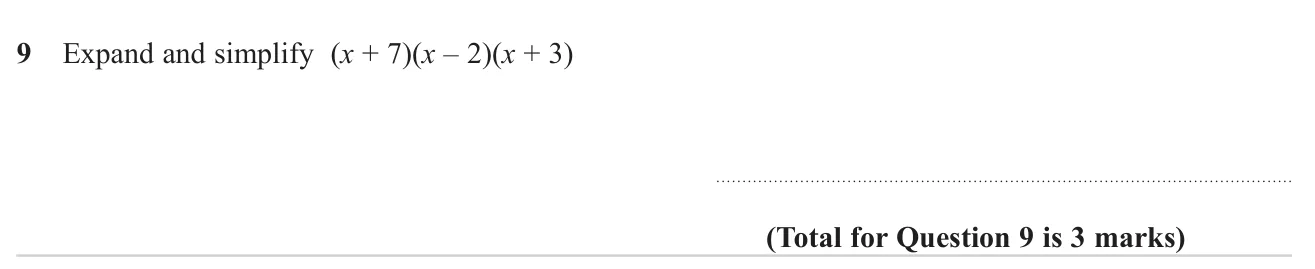
Answer x 3 + 8 x 2 + x − 42 x^3 + 8x^2 + x - 42 x 3 + 8 x 2 + x − 42 3 marks
Worked solution Checked against the mark scheme
( x + 7 ) ( x − 2 ) = x 2 + 5 x − 14 (x + 7)(x - 2) = x^2 + 5x - 14 ( x + 7 ) ( x − 2 ) = x 2 + 5 x − 14
( x 2 + 5 x − 14 ) ( x + 3 ) = x 3 + 3 x 2 + 5 x 2 + 15 x − 14 x − 42 (x^2 + 5x - 14)(x + 3) = x^3 + 3x^2 + 5x^2 + 15x - 14x - 42 ( x 2 + 5 x − 14 ) ( x + 3 ) = x 3 + 3 x 2 + 5 x 2 + 15 x − 14 x − 42
= x 3 + 8 x 2 + x − 42 = x^3 + 8x^2 + x - 42 = x 3 + 8 x 2 + x − 42
Watch out: Sign errors with the −2 and −14 terms.
© Pearson Education Ltd. June 2023 Paper 3 (Higher, calculator), question 12.
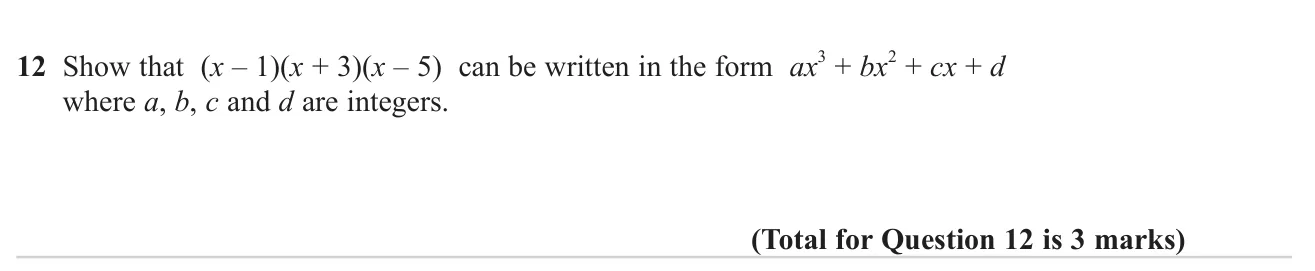
Answer x 3 − 3 x 2 − 13 x + 15 x^3 - 3x^2 - 13x + 15 x 3 − 3 x 2 − 13 x + 15 3 marks
Worked solution Checked against the mark scheme
( x − 1 ) ( x + 3 ) = x 2 + 3 x − x − 3 = x 2 + 2 x − 3 (x-1)(x+3) = x^2 + 3x - x - 3 = x^2 + 2x - 3 ( x − 1 ) ( x + 3 ) = x 2 + 3 x − x − 3 = x 2 + 2 x − 3
( x 2 + 2 x − 3 ) ( x − 5 ) = x 3 − 5 x 2 + 2 x 2 − 10 x − 3 x + 15 (x^2 + 2x - 3)(x - 5) = x^3 - 5x^2 + 2x^2 - 10x - 3x + 15 ( x 2 + 2 x − 3 ) ( x − 5 ) = x 3 − 5 x 2 + 2 x 2 − 10 x − 3 x + 15
= x 3 − 3 x 2 − 13 x + 15 = x^3 - 3x^2 - 13x + 15 = x 3 − 3 x 2 − 13 x + 15 a = 1 a = 1 a = 1 b = − 3 b = -3 b = − 3 c = − 13 c = -13 c = − 13 d = 15 d = 15 d = 15
Watch out: Sign errors when multiplying the negative terms, such as − 3 × − 5 -3 \times -5 − 3 × − 5
© Pearson Education Ltd. November 2022 Paper 3 (Higher, calculator), question 14.
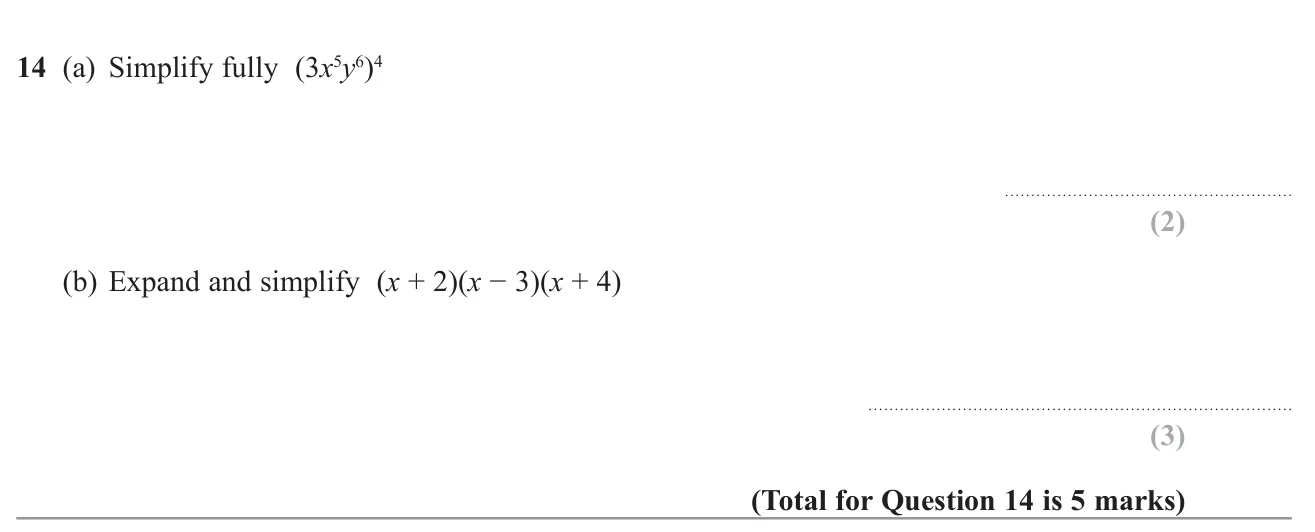
(a) 81 x 20 y 24 81x^{20}y^{24} 81 x 20 y 24 2 marks (b) x 3 + 3 x 2 − 10 x − 24 x^3 + 3x^2 - 10x - 24 x 3 + 3 x 2 − 10 x − 24 3 marks
Worked solution Checked against the mark scheme
(a) 3 4 = 81 3^4 = 81 3 4 = 81 ( x 5 ) 4 = x 20 (x^5)^4 = x^{20} ( x 5 ) 4 = x 20 ( y 6 ) 4 = y 24 (y^6)^4 = y^{24} ( y 6 ) 4 = y 24 81 x 20 y 24 81x^{20}y^{24} 81 x 20 y 24
(b) ( x + 2 ) ( x − 3 ) = x 2 − x − 6 (x+2)(x-3) = x^2 - x - 6 ( x + 2 ) ( x − 3 ) = x 2 − x − 6
( x 2 − x − 6 ) ( x + 4 ) = x 3 + 4 x 2 − x 2 − 4 x − 6 x − 24 = x 3 + 3 x 2 − 10 x − 24 (x^2 - x - 6)(x + 4) = x^3 + 4x^2 - x^2 - 4x - 6x - 24 = x^3 + 3x^2 - 10x - 24 ( x 2 − x − 6 ) ( x + 4 ) = x 3 + 4 x 2 − x 2 − 4 x − 6 x − 24 = x 3 + 3 x 2 − 10 x − 24
Watch out: In (a), adding the powers (x 9 x^9 x 9 3 × 4 = 12 3 \times 4 = 12 3 × 4 = 12
© Pearson Education Ltd. November 2021 Paper 1 (Higher, non-calculator), question 14.
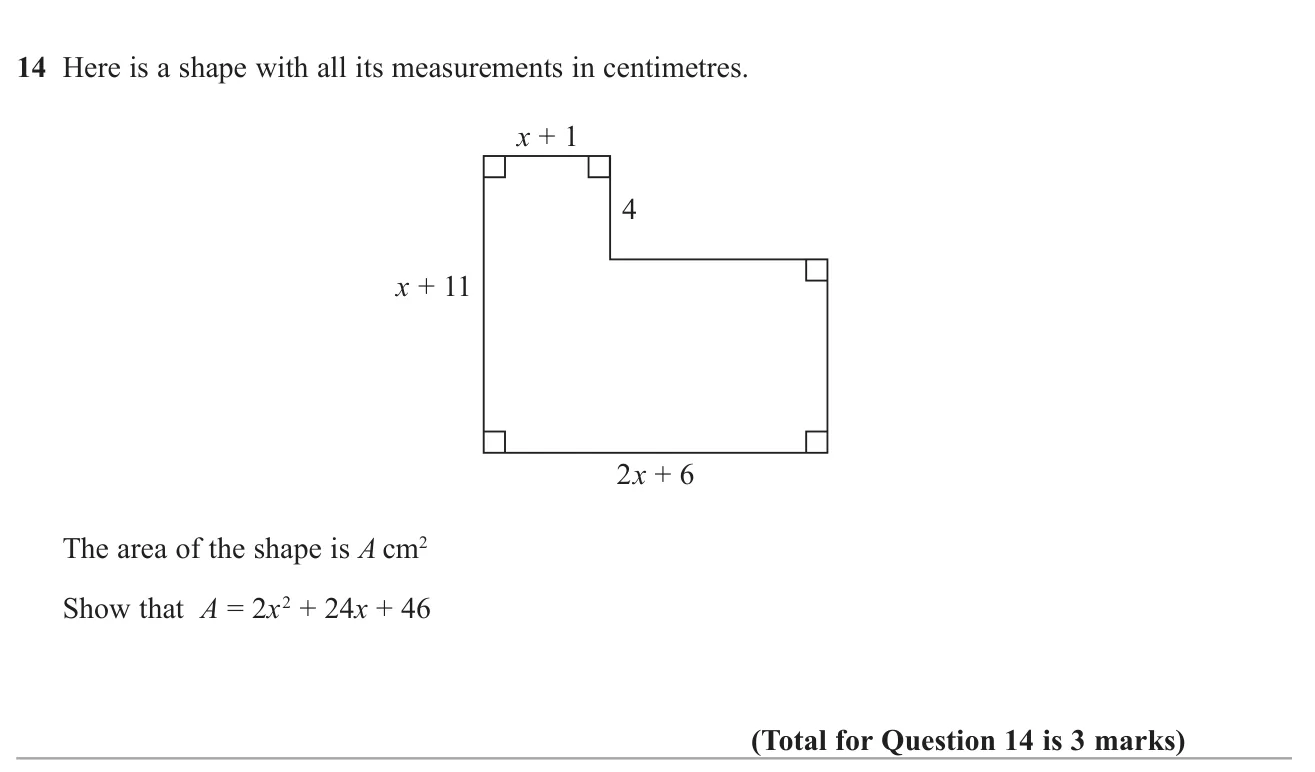
Answer A = 2 x 2 + 24 x + 46 A = 2x^2 + 24x + 46 A = 2 x 2 + 24 x + 46 3 marks
Worked solution Checked against the mark scheme
Split into a top rectangle ( x + 1 ) (x + 1) ( x + 1 ) 4 4 4 ( 2 x + 6 ) (2x + 6) ( 2 x + 6 ) ( x + 11 ) − 4 = x + 7 (x + 11) - 4 = x + 7 ( x + 11 ) − 4 = x + 7
Top: 4 ( x + 1 ) = 4 x + 4 4(x + 1) = 4x + 4 4 ( x + 1 ) = 4 x + 4
Bottom: ( 2 x + 6 ) ( x + 7 ) = 2 x 2 + 14 x + 6 x + 42 = 2 x 2 + 20 x + 42 (2x + 6)(x + 7) = 2x^2 + 14x + 6x + 42 = 2x^2 + 20x + 42 ( 2 x + 6 ) ( x + 7 ) = 2 x 2 + 14 x + 6 x + 42 = 2 x 2 + 20 x + 42
A = 2 x 2 + 24 x + 46 A = 2x^2 + 24x + 46 A = 2 x 2 + 24 x + 46
Watch out: Using x + 11 x + 11 x + 11
© Pearson Education Ltd. November 2021 Paper 2 (Higher, calculator), question 12.
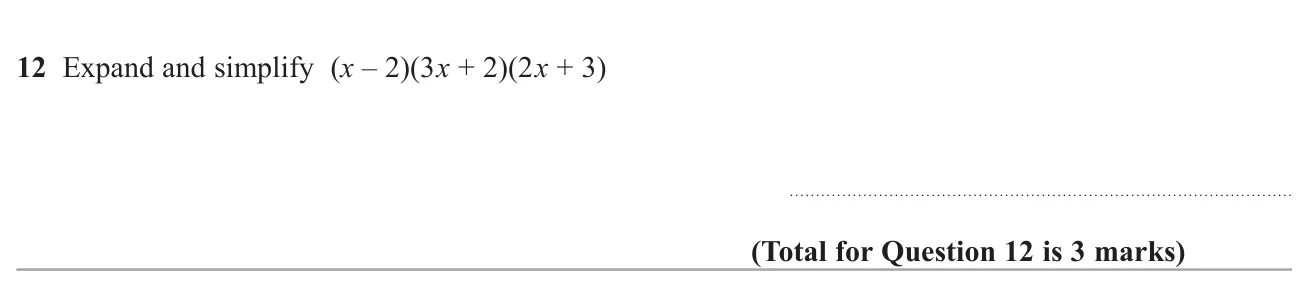
Answer 6 x 3 + x 2 − 20 x − 12 6x^3 + x^2 - 20x - 12 6 x 3 + x 2 − 20 x − 12 3 marks
Worked solution Checked against the mark scheme
( x − 2 ) ( 3 x + 2 ) = 3 x 2 + 2 x − 6 x − 4 = 3 x 2 − 4 x − 4 (x - 2)(3x + 2) = 3x^2 + 2x - 6x - 4 = 3x^2 - 4x - 4 ( x − 2 ) ( 3 x + 2 ) = 3 x 2 + 2 x − 6 x − 4 = 3 x 2 − 4 x − 4
( 3 x 2 − 4 x − 4 ) ( 2 x + 3 ) = 6 x 3 + 9 x 2 − 8 x 2 − 12 x − 8 x − 12 (3x^2 - 4x - 4)(2x + 3) = 6x^3 + 9x^2 - 8x^2 - 12x - 8x - 12 ( 3 x 2 − 4 x − 4 ) ( 2 x + 3 ) = 6 x 3 + 9 x 2 − 8 x 2 − 12 x − 8 x − 12
= 6 x 3 + x 2 − 20 x − 12 = 6x^3 + x^2 - 20x - 12 = 6 x 3 + x 2 − 20 x − 12
Watch out: Sign errors when multiplying the negative terms.
© Pearson Education Ltd. November 2019 Paper 2 (Higher, calculator), question 15.
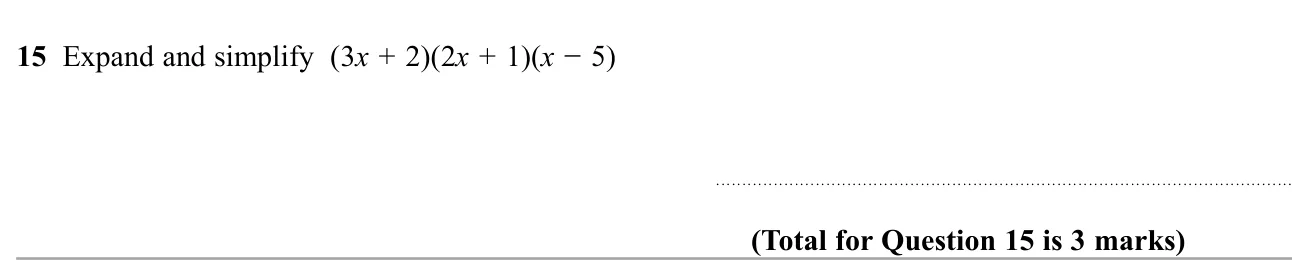
Answer 6 x 3 − 23 x 2 − 33 x − 10 6x^3 - 23x^2 - 33x - 10 6 x 3 − 23 x 2 − 33 x − 10 3 marks
Worked solution Checked against the mark scheme
( 3 x + 2 ) ( 2 x + 1 ) = 6 x 2 + 7 x + 2 (3x + 2)(2x + 1) = 6x^2 + 7x + 2 ( 3 x + 2 ) ( 2 x + 1 ) = 6 x 2 + 7 x + 2
( 6 x 2 + 7 x + 2 ) ( x − 5 ) = 6 x 3 − 30 x 2 + 7 x 2 − 35 x + 2 x − 10 (6x^2 + 7x + 2)(x - 5) = 6x^3 - 30x^2 + 7x^2 - 35x + 2x - 10 ( 6 x 2 + 7 x + 2 ) ( x − 5 ) = 6 x 3 − 30 x 2 + 7 x 2 − 35 x + 2 x − 10
= 6 x 3 − 23 x 2 − 33 x − 10 = 6x^3 - 23x^2 - 33x - 10 = 6 x 3 − 23 x 2 − 33 x − 10
Watch out: Sign errors when multiplying by −5.
© Pearson Education Ltd. Specimen Paper 2 (Higher, calculator), question 13.
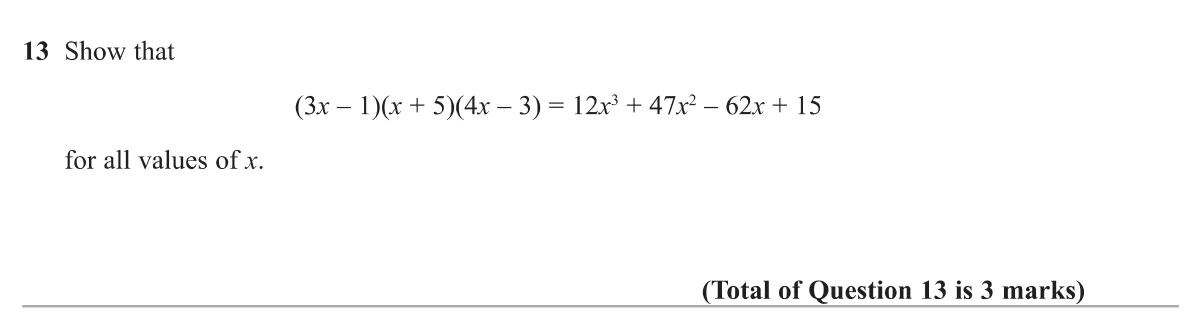
Answer Expansion gives 12 x 3 + 47 x 2 − 62 x + 15 12x^3 + 47x^2 - 62x + 15 12 x 3 + 47 x 2 − 62 x + 15 3 marks
Worked solution Checked against the mark scheme
( 3 x − 1 ) ( x + 5 ) = 3 x 2 + 15 x − x − 5 = 3 x 2 + 14 x − 5 (3x - 1)(x + 5) = 3x^2 + 15x - x - 5 = 3x^2 + 14x - 5 ( 3 x − 1 ) ( x + 5 ) = 3 x 2 + 15 x − x − 5 = 3 x 2 + 14 x − 5
( 3 x 2 + 14 x − 5 ) ( 4 x − 3 ) (3x^2 + 14x - 5)(4x - 3) ( 3 x 2 + 14 x − 5 ) ( 4 x − 3 )
= 12 x 3 − 9 x 2 + 56 x 2 − 42 x − 20 x + 15 = 12x^3 - 9x^2 + 56x^2 - 42x - 20x + 15 = 12 x 3 − 9 x 2 + 56 x 2 − 42 x − 20 x + 15
= 12 x 3 + 47 x 2 − 62 x + 15 = 12x^3 + 47x^2 - 62x + 15 = 12 x 3 + 47 x 2 − 62 x + 15
Watch out: Sign slip on − 5 × − 3 -5 \times -3 − 5 × − 3 − 15 -15 − 15
© Pearson Education Ltd. June 2019 Paper 3 (Higher, calculator), question 18.
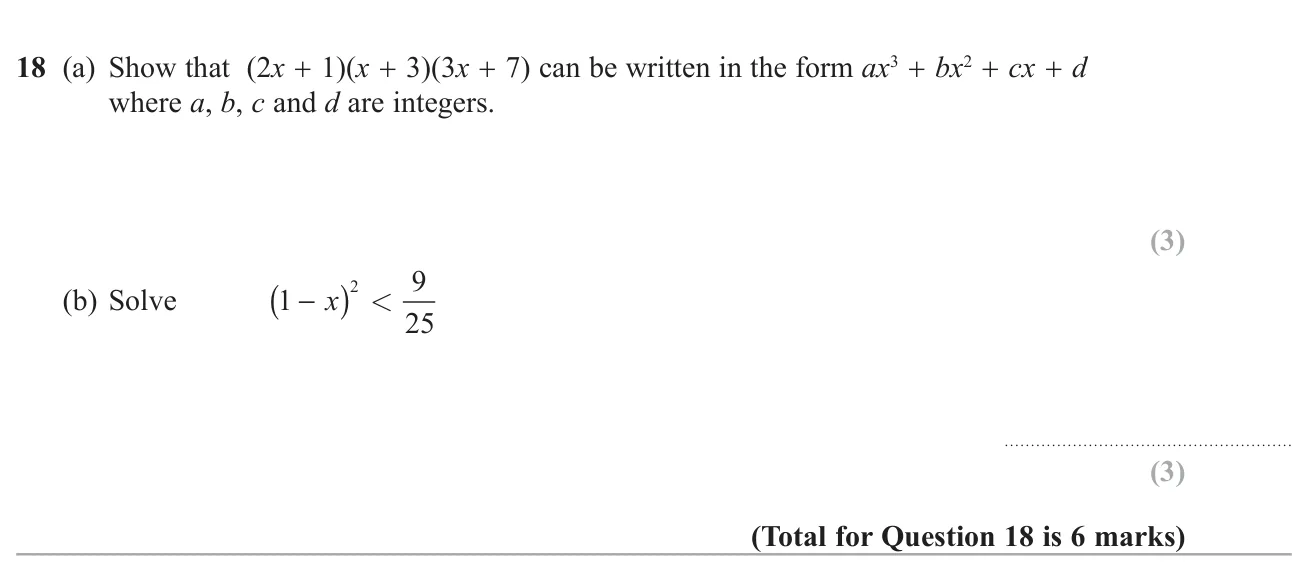
(a) 6 x 3 + 35 x 2 + 58 x + 21 6x^3 + 35x^2 + 58x + 21 6 x 3 + 35 x 2 + 58 x + 21 3 marks (b) 2 5 < x < 8 5 \frac{2}{5} < x < \frac{8}{5} 5 2 < x < 5 8 3 marks
Worked solution Checked against the mark scheme
(a) ( 2 x + 1 ) ( x + 3 ) = 2 x 2 + 7 x + 3 (2x+1)(x+3) = 2x^2 + 7x + 3 ( 2 x + 1 ) ( x + 3 ) = 2 x 2 + 7 x + 3
( 2 x 2 + 7 x + 3 ) ( 3 x + 7 ) = 6 x 3 + 14 x 2 + 21 x 2 + 49 x + 9 x + 21 = 6 x 3 + 35 x 2 + 58 x + 21 (2x^2 + 7x + 3)(3x + 7) = 6x^3 + 14x^2 + 21x^2 + 49x + 9x + 21 = 6x^3 + 35x^2 + 58x + 21 ( 2 x 2 + 7 x + 3 ) ( 3 x + 7 ) = 6 x 3 + 14 x 2 + 21 x 2 + 49 x + 9 x + 21 = 6 x 3 + 35 x 2 + 58 x + 21
So a = 6 , b = 35 , c = 58 , d = 21 a = 6, b = 35, c = 58, d = 21 a = 6 , b = 35 , c = 58 , d = 21
(b) − 3 5 < 1 − x < 3 5 -\frac{3}{5} < 1 - x < \frac{3}{5} − 5 3 < 1 − x < 5 3
2 5 < x < 8 5 \frac{2}{5} < x < \frac{8}{5} 5 2 < x < 5 8
Watch out: In (b), only taking the positive square root and giving x > 2/5.
© Pearson Education Ltd. November 2018 Paper 3 (Higher, calculator), question 9.
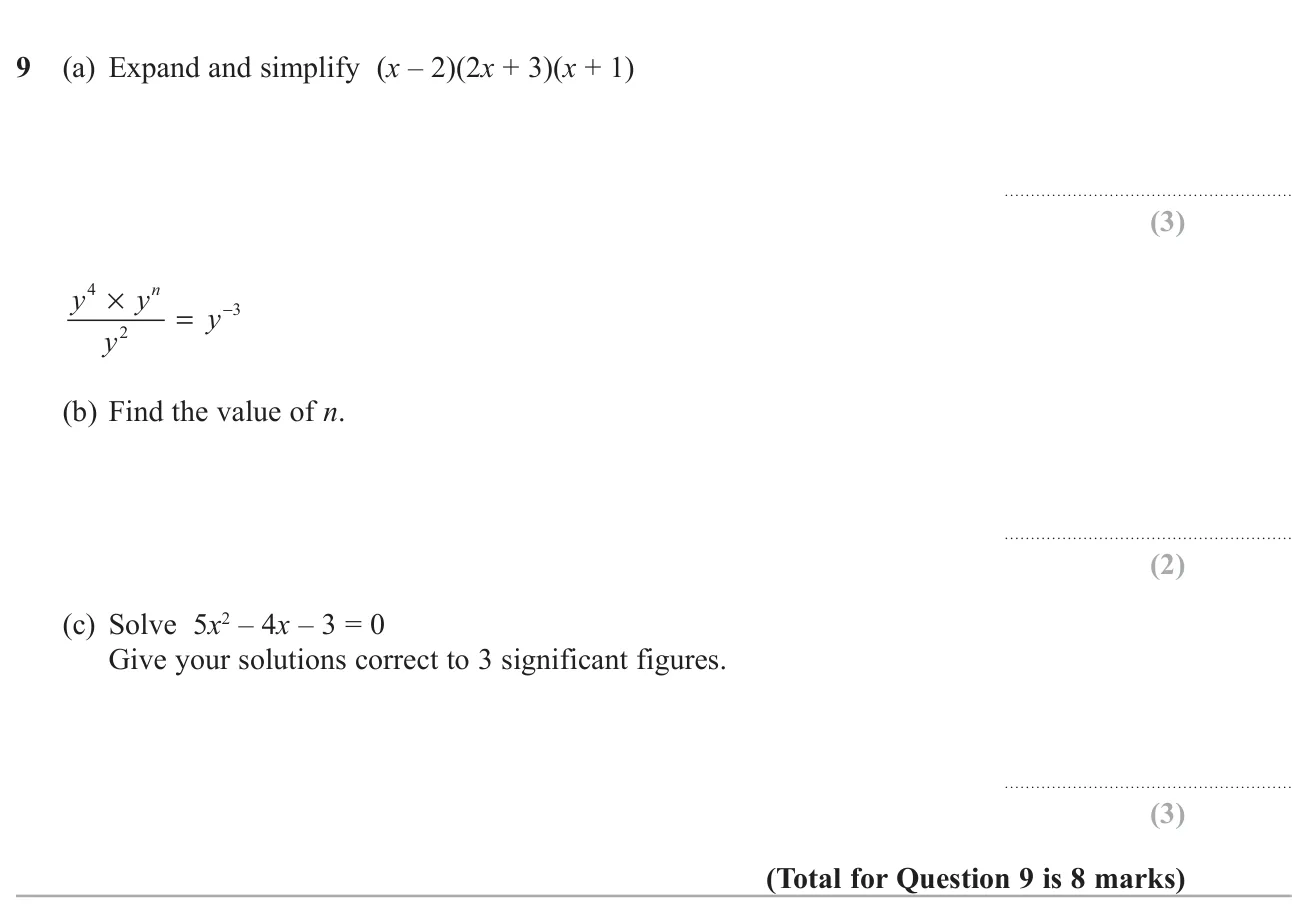
(a) 2 x 3 + x 2 − 7 x − 6 2x^3 + x^2 - 7x - 6 2 x 3 + x 2 − 7 x − 6 3 marks (b) n = − 5 n = -5 n = − 5 2 marks (c) x = 1.27 x = 1.27 x = 1.27 x = − 0.472 x = -0.472 x = − 0.472 3 marks
Worked solution Checked against the mark scheme
(a) ( x − 2 ) ( 2 x + 3 ) = 2 x 2 − x − 6 (x - 2)(2x + 3) = 2x^2 - x - 6 ( x − 2 ) ( 2 x + 3 ) = 2 x 2 − x − 6
( 2 x 2 − x − 6 ) ( x + 1 ) = 2 x 3 + 2 x 2 − x 2 − x − 6 x − 6 = 2 x 3 + x 2 − 7 x − 6 (2x^2 - x - 6)(x + 1) = 2x^3 + 2x^2 - x^2 - x - 6x - 6 = 2x^3 + x^2 - 7x - 6 ( 2 x 2 − x − 6 ) ( x + 1 ) = 2 x 3 + 2 x 2 − x 2 − x − 6 x − 6 = 2 x 3 + x 2 − 7 x − 6
(b) 4 + n − 2 = − 3 4 + n - 2 = -3 4 + n − 2 = − 3 n = − 5 n = -5 n = − 5
(c) x = 4 ± 16 + 60 10 = 4 ± 76 10 x = \frac{4 \pm \sqrt{16 + 60}}{10} = \frac{4 \pm \sqrt{76}}{10} x = 10 4 ± 16 + 60 = 10 4 ± 76 x = 1.27 x = 1.27 x = 1.27 x = − 0.472 x = -0.472 x = − 0.472
Watch out: In (c), using − 4 2 = − 16 -4^2 = -16 − 4 2 = − 16
Also tested in these questions Their main topic is different, but part of each one tests this topic.
November 2024 · Paper 1 Higher · Q11 : Correct a mix-up about the sum and product when factorising a quadratic, then factorise a difference of two squares and an expression by grouping.November 2024 · Paper 1 Higher · Q13 : Form and solve an equation from the difference in volume of two cuboids with algebraic side lengths.November 2024 · Paper 2 Foundation · Q11 : Simplify a product of two terms and collect like terms in an expression.June 2024 · Paper 1 Foundation · Q17 : Solve a linear equation with brackets.June 2024 · Paper 1 Higher · Q20 : Use index laws with a cube root and a power of root 2 to find an unknown power.June 2024 · Paper 3 Higher · Q15 : Simplify an algebraic fraction, factorise a quadratic with a non-unit coefficient, and divide algebraic fractions.November 2023 · Paper 3 Higher · Q23 : Solve an equation of algebraic fractions in x squared and y squared to find the ratio x to y in its simplest form.June 2023 · Paper 2 Foundation · Q4 : Simplify a product of a number and an algebraic term.June 2023 · Paper 3 Higher · Q24 : Find an algebraic probability of picking two counters of the same colour without replacement, using a ratio to write everything in one variable.November 2022 · Paper 1 Higher · Q16 : Prove an algebraic identity for the difference of two squared expressions, then judge a claim about odd numbers that follows from it.November 2022 · Paper 1 Foundation · Q21 : Simplify a squared product of powers of 2 and give the answer as a single power.November 2022 · Paper 1 Foundation · Q26 : Solve a linear inequality with a fraction, then factorise a quadratic.June 2022 · Paper 1 Foundation · Q2 : Collect four identical letter terms into a single term.June 2022 · Paper 3 Foundation · Q28 : Show that the area of a shaded trapezium in a rectangle is a given quadratic expression in x.November 2021 · Paper 3 Foundation · Q6 : Simplify a product of letters and a number, then collect like terms in an expression.November 2020 · Paper 1 Foundation · Q30 : Rearrange a linear formula to change the subject, and simplify a negative power raised to a negative power.November 2020 · Paper 2 Higher · Q14 : Set up and solve an equation for two squares whose sides differ by 4 cm and areas differ by 70 cm², then find the larger area.November 2020 · Paper 3 Higher · Q12 : Add two algebraic fractions into one simplified fraction, and expand a product of three brackets.November 2019 · Paper 1 Higher · Q13 : Add two algebraic fractions, then factorise an expression with a repeated bracket.November 2019 · Paper 3 Higher · Q10 : Solve a linear equation with a fraction, and simplify an algebraic fraction with a repeated bracket.June 2019 · Paper 1 Higher · Q21 : Find an inverse function, then use composite functions to show that a given quadratic equation holds.November 2018 · Paper 2 Foundation · Q19 : Solve a linear equation with a bracket and factorise an expression fully.June 2018 · Paper 1 Foundation · Q16 : Substitute values into a formula, expand a single bracket and solve a linear equation with brackets.Specimen · Paper 1 Higher · Q14 : Solve an equation with two algebraic fractions that have x in the denominators.Specimen · Paper 1 Higher · Q21 : Find an algebraic expression for the probability of picking one pen of each colour without replacement.Specimen · Paper 2 Foundation · Q4 : Simplify three short algebraic expressions by collecting like terms and multiplying.Specimen · Paper 2 Foundation · Q16 : Solve two linear equations and simplify a power raised to a power.Specimen · Paper 2 Higher · Q18 : Substitute x + 2 into a quadratic function and simplify to the form ax² + bx.Specimen · Paper 2 Higher · Q19 : Form and solve a quadratic from the area of a right-angled triangle, then use Pythagoras to find its perimeter.Specimen · Paper 3 Foundation · Q7 : Solve two simple linear equations and simplify a product of powers of d.