Revision guide by The Full Marks
Standard form: what you need to know Standard form is a neat way to write very large or very small numbers, like the mass of a planet or the size of a cell. You need to convert in and out of it and calculate with it, both with and without a calculator.
Key facts A number in standard form looks like A × 10 n A \times 10^n A × 1 0 n 1 ≤ A < 10 1 \le A < 10 1 ≤ A < 10 n n n Large numbers have a positive power: 52 000 = 5.2 × 10 4 52\,000 = 5.2 \times 10^4 52 000 = 5.2 × 1 0 4 Small numbers have a negative power: 0.0031 = 3.1 × 10 − 3 0.0031 = 3.1 \times 10^{-3} 0.0031 = 3.1 × 1 0 − 3 Back to an ordinary number: a positive power moves the point right, a negative power moves it left: 4.96 × 10 − 3 = 0.00496 4.96 \times 10^{-3} = 0.00496 4.96 × 1 0 − 3 = 0.00496 Multiplying: multiply the A A A A A A Multiplying and dividing Multiply or divide the number parts. Add (multiply) or subtract (divide) the powers of 10. If the number part is not between 1 and 10, adjust it and change the power to match. Adding and subtracting Write both numbers as ordinary numbers (or with the same power of 10). Add or subtract. Convert the answer back to standard form. Worked examples Example 1 Foundation · grade 4
Write in standard form: (a) 36 000 000 36\,000\,000 36 000 000 0.00052 0.00052 0.00052
Show the solution (a) Place the point after the first non-zero digit: 3.6 3.6 3.6 3.6 × 10 7 3.6 \times 10^7 3.6 × 1 0 7 5.2 5.2 5.2 5.2 × 10 − 4 5.2 \times 10^{-4} 5.2 × 1 0 − 4
Example 2 Foundation · grade 5
Without a calculator, work out (a) ( 6 × 10 5 ) × ( 4 × 10 − 2 ) (6 \times 10^5) \times (4 \times 10^{-2}) ( 6 × 1 0 5 ) × ( 4 × 1 0 − 2 ) 4.2 × 10 5 + 3.1 × 10 4 4.2 \times 10^5 + 3.1 \times 10^4 4.2 × 1 0 5 + 3.1 × 1 0 4
Show the solution (a) 6 × 4 = 24 6 \times 4 = 24 6 × 4 = 24 10 5 × 10 − 2 = 10 3 10^5 \times 10^{-2} = 10^3 1 0 5 × 1 0 − 2 = 1 0 3 24 × 10 3 24 \times 10^3 24 × 1 0 3 24 × 10 3 = 2.4 × 10 4 24 \times 10^3 = 2.4 \times 10^4 24 × 1 0 3 = 2.4 × 1 0 4 420 000 + 31 000 = 451 000 420\,000 + 31\,000 = 451\,000 420 000 + 31 000 = 451 000 = 4.51 × 10 5 = 4.51 \times 10^5 = 4.51 × 1 0 5
Common mistakes Leaving answers like 24 × 10 3 24 \times 10^3 24 × 1 0 3 0.8 × 10 − 2 0.8 \times 10^{-2} 0.8 × 1 0 − 2 Adding the number parts and the powers separately: 4 × 10 5 + 3 × 10 4 4 \times 10^5 + 3 \times 10^4 4 × 1 0 5 + 3 × 1 0 4 7 × 10 9 7 \times 10^9 7 × 1 0 9 Using a positive power for a small number, or moving the point the wrong way. Ordering numbers by their powers alone when some, like 67 × 10 3 67 \times 10^3 67 × 1 0 3 Exam tips On a calculator, put brackets around each standard form number, or use the × 10 x \times 10^x × 1 0 x If the question says "give your answer in standard form", an ordinary number loses the last mark. Questions people ask What is standard form in maths? It is a way of writing a number as A × 10 n A \times 10^n A × 1 0 n A A A n n n 4.7 × 10 6 4.7 \times 10^6 4.7 × 1 0 6
How do you write a small number in standard form? Move the decimal point so there is one non-zero digit in front of it, then count how many places it moved. That number, made negative, is the power: 0.0072 = 7.2 × 10 − 3 0.0072 = 7.2 \times 10^{-3} 0.0072 = 7.2 × 1 0 − 3
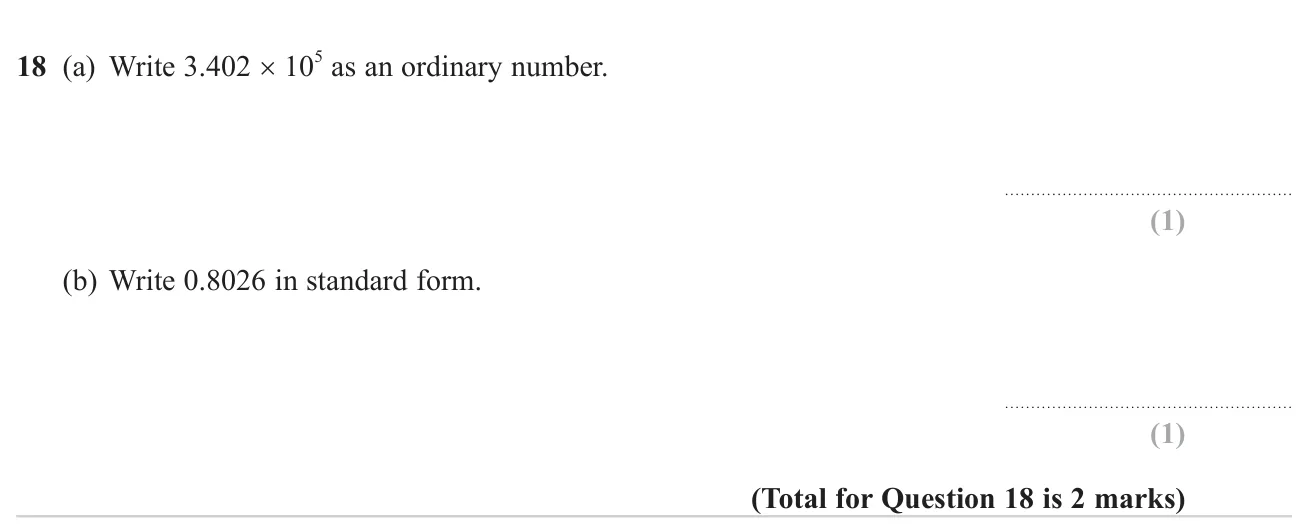
Exam questions: Standard form (20, easiest first) © Pearson Education Ltd. November 2024 Paper 3 (Foundation, calculator), question 18.
(a) 340 200 340\,200 340 200 1 mark (b) 8.026 × 10 − 1 8.026 \times 10^{-1} 8.026 × 1 0 − 1 1 mark
Worked solution Checked against the mark scheme
(a) Move the decimal point 5 places right: 3.402 × 10 5 = 340 200 3.402 \times 10^5 = 340\,200 3.402 × 1 0 5 = 340 200
(b) Move the point 1 place right to get 8.026, so the power is − 1 -1 − 1 8.026 × 10 − 1 8.026 \times 10^{-1} 8.026 × 1 0 − 1
Watch out: In (b), writing 0.8026 × 10 0 0.8026 \times 10^0 0.8026 × 1 0 0
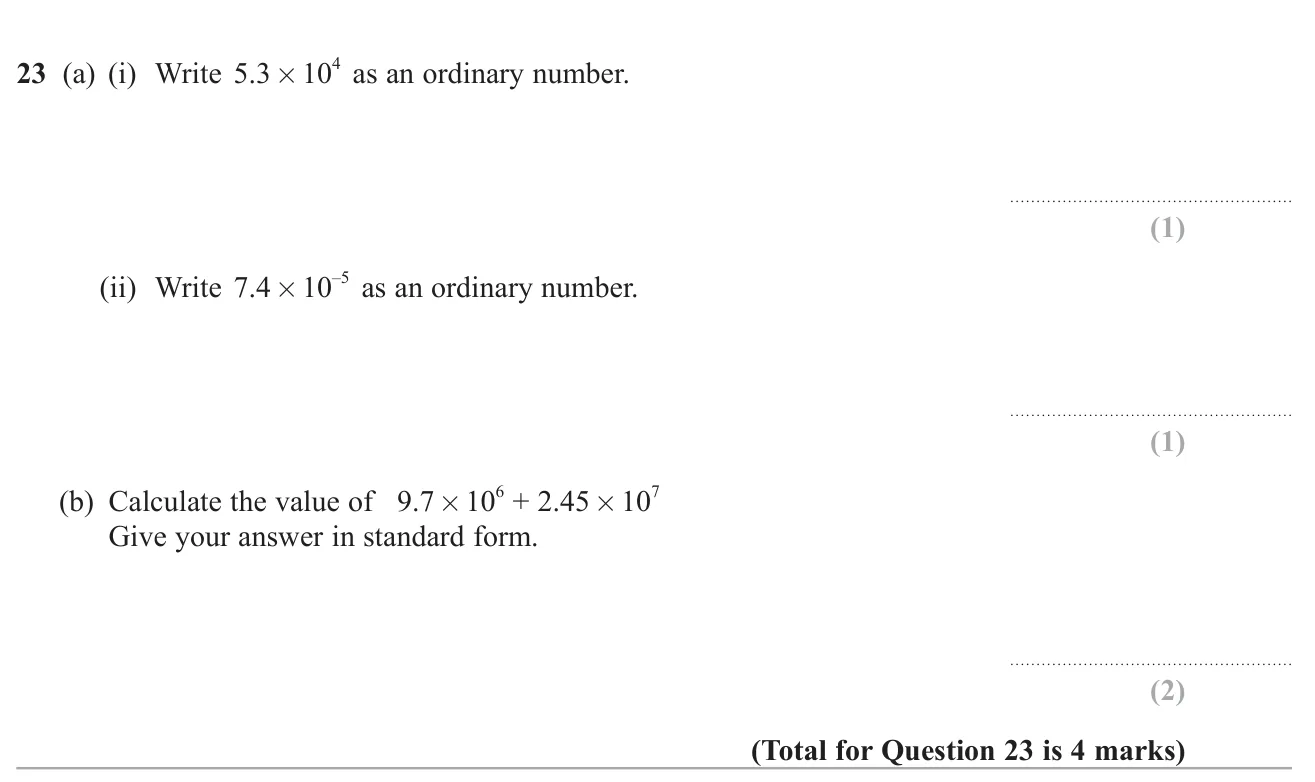
© Pearson Education Ltd. June 2024 Paper 3 (Foundation, calculator), question 23.
(a(i)) 53 000 53\,000 53 000 1 mark (a(ii)) 0.000 074 0.000\,074 0.000 074 1 mark (b) 3.42 × 10 7 3.42 \times 10^7 3.42 × 1 0 7 2 marks
Worked solution Checked against the mark scheme
(a)(i) Move the decimal point 4 places right: 53 000 53\,000 53 000
(a)(ii) Move the decimal point 5 places left: 0.000 074 0.000\,074 0.000 074
(b) 9 700 000 + 24 500 000 = 34 200 000 = 3.42 × 10 7 9\,700\,000 + 24\,500\,000 = 34\,200\,000 = 3.42 \times 10^7 9 700 000 + 24 500 000 = 34 200 000 = 3.42 × 1 0 7
Watch out: Adding the numbers in front and the powers separately, e.g. 12.15 × 10 13 12.15 \times 10^{13} 12.15 × 1 0 13
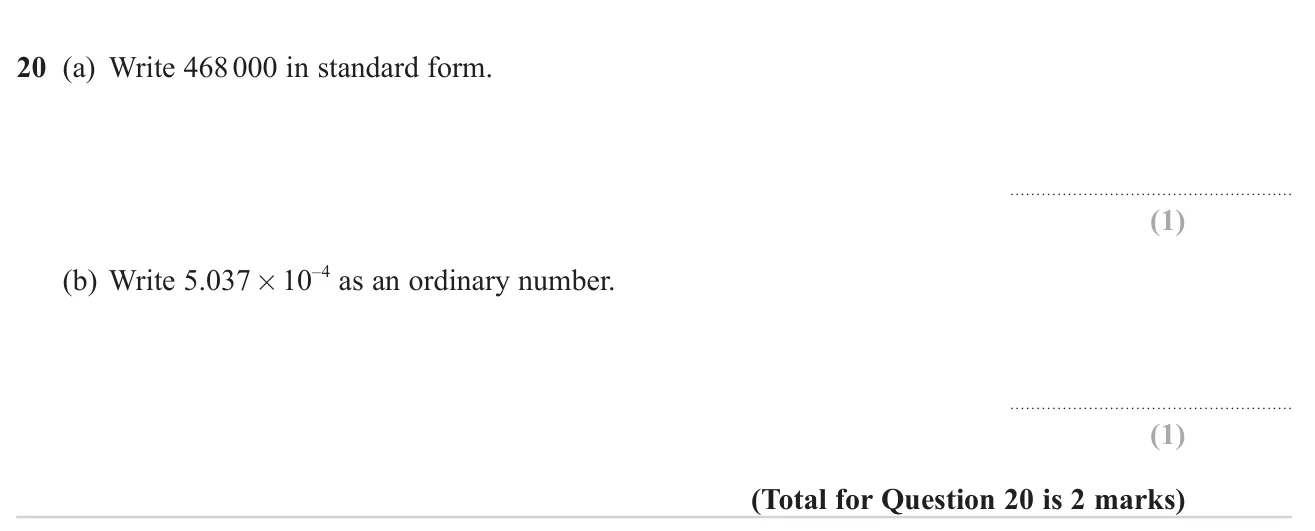
© Pearson Education Ltd. November 2023 Paper 3 (Foundation, calculator), question 20.
(a) 4.68 × 10 5 4.68 \times 10^5 4.68 × 1 0 5 1 mark (b) 0.000 503 7 1 mark
Worked solution Checked against the mark scheme
(a) Put the decimal point after the first digit: 4.68. The point moves 5 places, so 4.68 × 10 5 4.68 \times 10^5 4.68 × 1 0 5
(b) A power of − 4 -4 − 4 0.0005037 0.0005037 0.0005037
Watch out: In (b), moving the point the wrong way, giving 50 370.
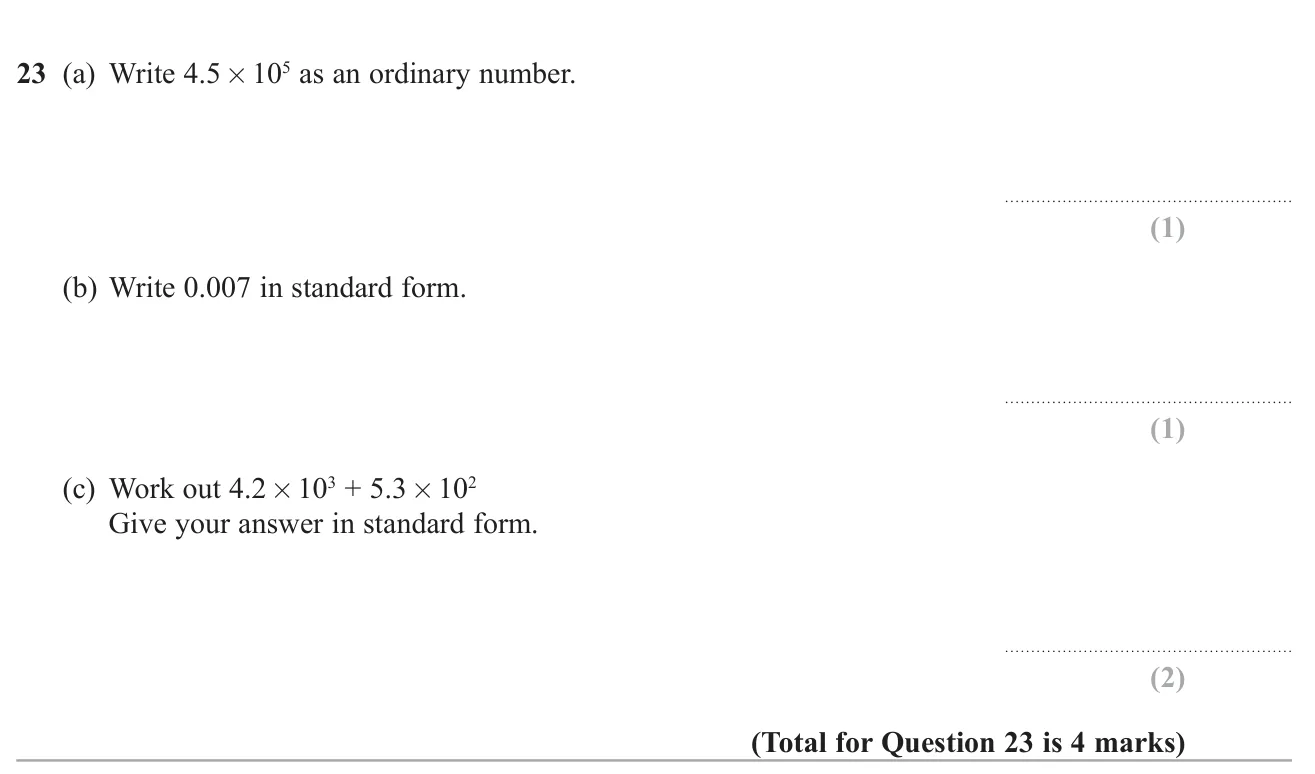
© Pearson Education Ltd. November 2021 Paper 3 (Foundation, calculator), question 23.
(a) 450 000 1 mark (b) 7 × 10 − 3 7 \times 10^{-3} 7 × 1 0 − 3 1 mark (c) 4.73 × 10 3 4.73 \times 10^3 4.73 × 1 0 3 2 marks
Worked solution Checked against the mark scheme
(a) Move the digits 5 places: 4.5 × 10 5 = 450 000 4.5 \times 10^5 = 450\,000 4.5 × 1 0 5 = 450 000
(b) 0.007 = 7 × 10 − 3 0.007 = 7 \times 10^{-3} 0.007 = 7 × 1 0 − 3
(c) 4200 + 530 = 4730 = 4.73 × 10 3 4200 + 530 = 4730 = 4.73 \times 10^3 4200 + 530 = 4730 = 4.73 × 1 0 3
Watch out: In (c), adding the numbers and powers separately to get 9.5 × 10 5 9.5 \times 10^5 9.5 × 1 0 5
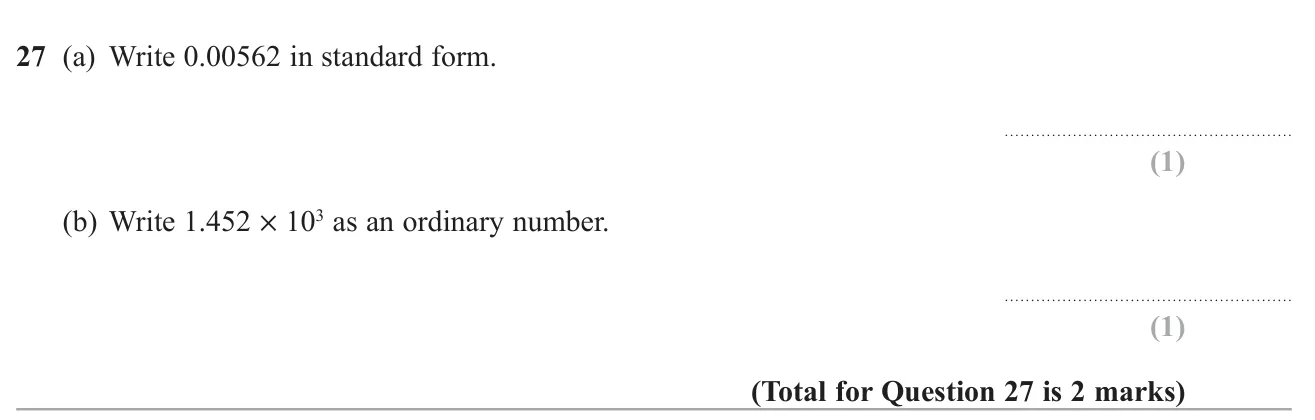
© Pearson Education Ltd. June 2019 Paper 2 (Foundation, calculator), question 27.
(a) 5.62 × 10 − 3 5.62 \times 10^{-3} 5.62 × 1 0 − 3 1 mark (b) 1452 1452 1452 1 mark
Worked solution Checked against the mark scheme
(a) Move the decimal point 3 places right to get 5.62, so 0.00562 = 5.62 × 10 − 3 0.00562 = 5.62 \times 10^{-3} 0.00562 = 5.62 × 1 0 − 3
(b) 1.452 × 10 3 1.452 \times 10^3 1.452 × 1 0 3 1452 1452 1452
Watch out: Using a positive power in (a).
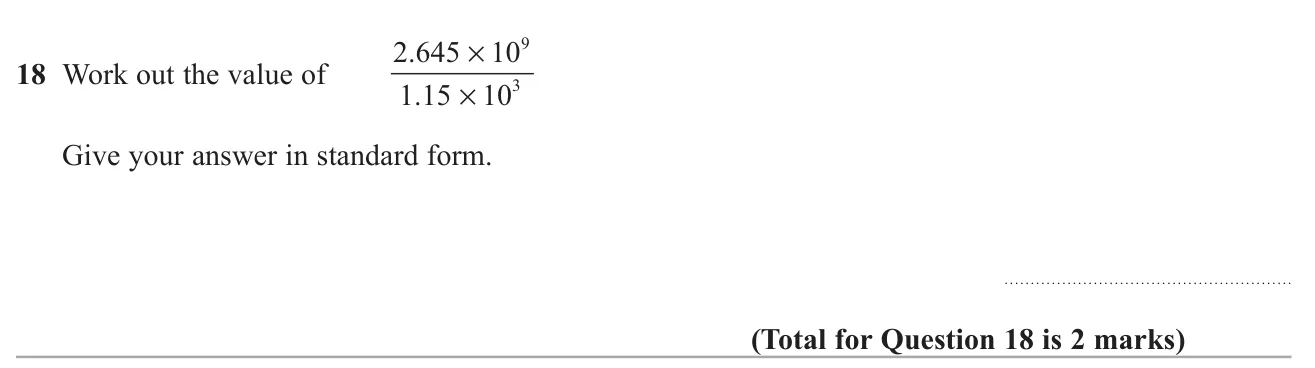
© Pearson Education Ltd. June 2018 Paper 3 (Foundation, calculator), question 18.
Answer 2.3 × 10 6 2.3 \times 10^6 2.3 × 1 0 6 2 marks
Worked solution Checked against the mark scheme
Divide the numbers: 2.645 ÷ 1.15 = 2.3 2.645 \div 1.15 = 2.3 2.645 ÷ 1.15 = 2.3
Subtract the powers: 10 9 ÷ 10 3 = 10 6 10^9 \div 10^3 = 10^6 1 0 9 ÷ 1 0 3 = 1 0 6
Answer: 2.3 × 10 6 2.3 \times 10^6 2.3 × 1 0 6
Watch out: Leaving the answer as 2 300 000, not in standard form.
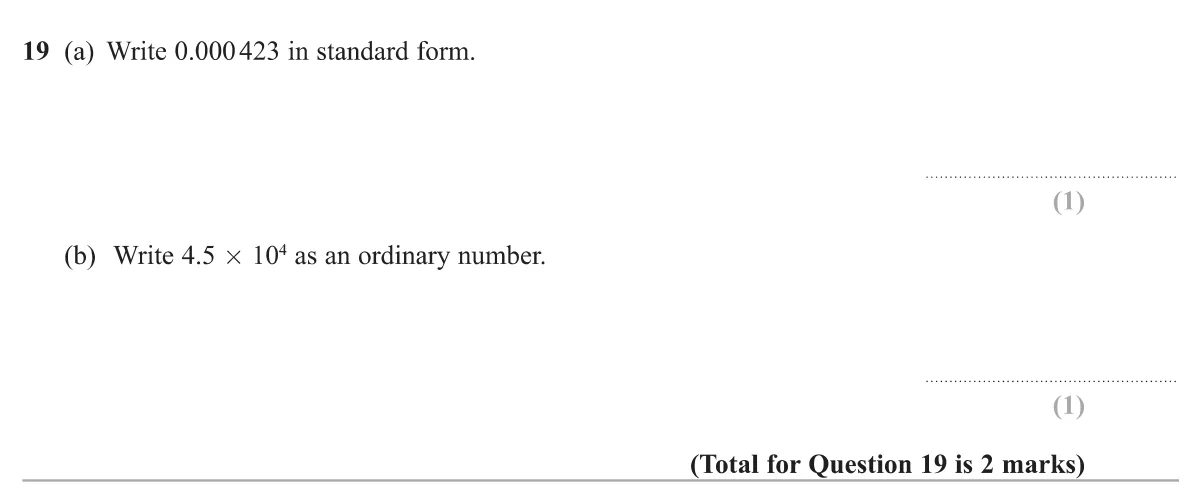
© Pearson Education Ltd. Specimen Paper 3 (Higher, calculator), question 19.
(a) 4.23 × 10 − 4 4.23 \times 10^{-4} 4.23 × 1 0 − 4 1 mark (b) 45 000 1 mark
Worked solution Checked against the mark scheme
(a) Move the decimal point 4 places right to get 4.23, so 0.000423 = 4.23 × 10 − 4 0.000423 = 4.23 \times 10^{-4} 0.000423 = 4.23 × 1 0 − 4
(b) 4.5 × 10 4 = 4.5 × 10 000 = 45 000 4.5 \times 10^4 = 4.5 \times 10\,000 = 45\,000 4.5 × 1 0 4 = 4.5 × 10 000 = 45 000
Watch out: Using a positive power in (a): 4.23 × 10⁴.
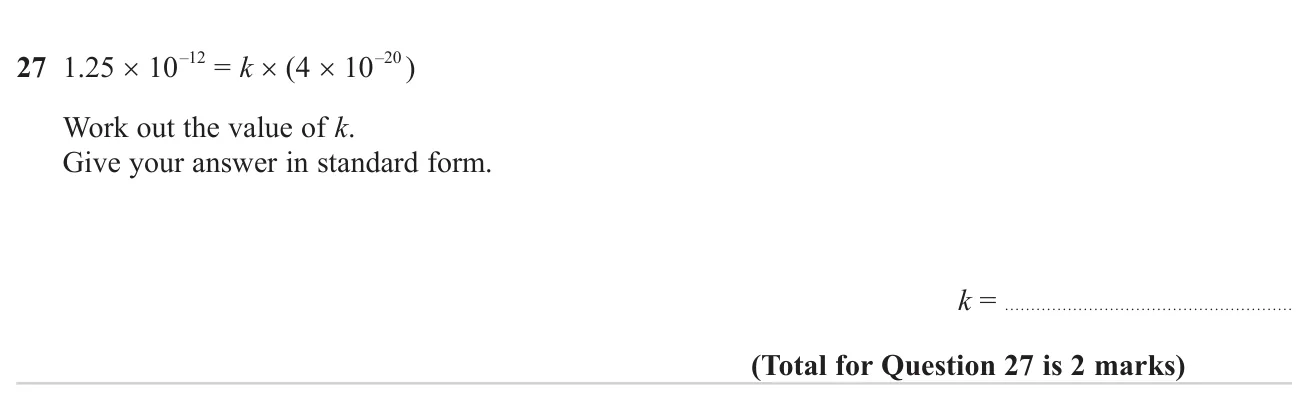
© Pearson Education Ltd. November 2024 Paper 2 (Foundation, calculator), question 27.
Answer 3.125 × 10 7 3.125 \times 10^{7} 3.125 × 1 0 7 2 marks
Worked solution Checked against the mark scheme
k = 1.25 × 10 − 12 4 × 10 − 20 k = \frac{1.25 \times 10^{-12}}{4 \times 10^{-20}} k = 4 × 1 0 − 20 1.25 × 1 0 − 12
1.25 ÷ 4 = 0.3125 1.25 \div 4 = 0.3125 1.25 ÷ 4 = 0.3125 10 − 12 ÷ 10 − 20 = 10 8 10^{-12} \div 10^{-20} = 10^{8} 1 0 − 12 ÷ 1 0 − 20 = 1 0 8
k = 0.3125 × 10 8 = 3.125 × 10 7 k = 0.3125 \times 10^{8} = 3.125 \times 10^{7} k = 0.3125 × 1 0 8 = 3.125 × 1 0 7
Watch out: Subtracting the powers the wrong way to get 10 − 32 10^{-32} 1 0 − 32 10 − 8 10^{-8} 1 0 − 8
© Pearson Education Ltd. June 2023 Paper 3 (Foundation, calculator), question 28.
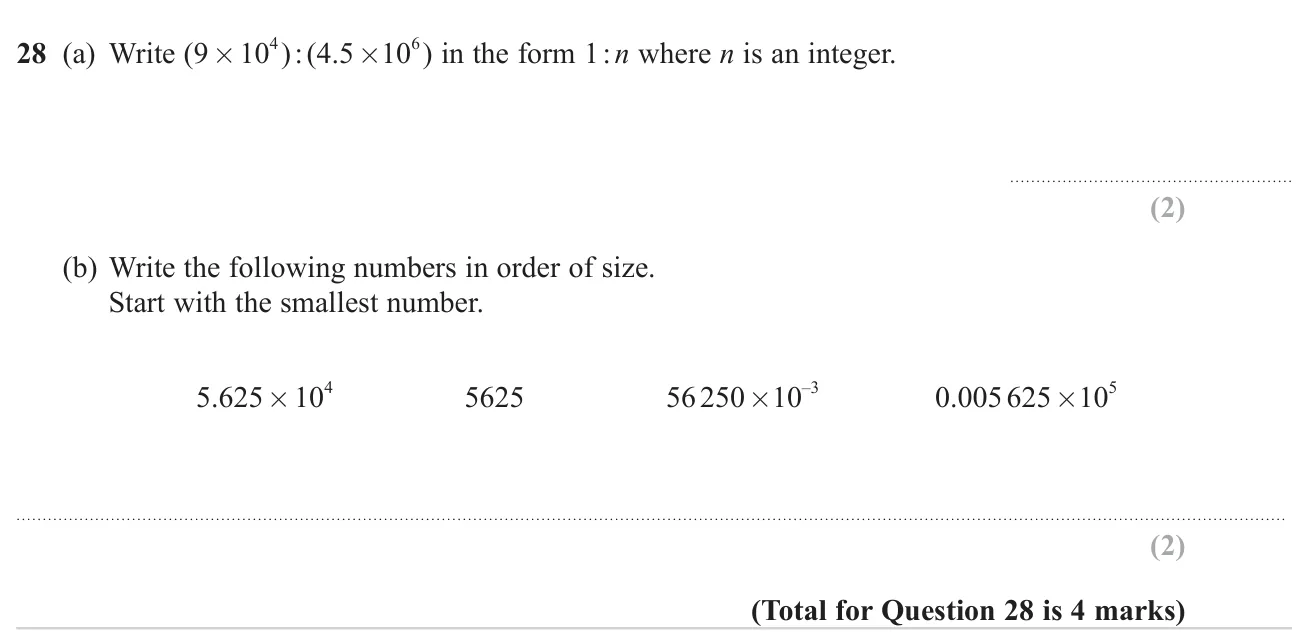
(a) 1 : 50 1 : 50 1 : 50 2 marks (b) 56250 × 10 − 3 56250 \times 10^{-3} 56250 × 1 0 − 3 0.005625 × 10 5 0.005625 \times 10^{5} 0.005625 × 1 0 5 5625 5625 5625 5.625 × 10 4 5.625 \times 10^{4} 5.625 × 1 0 4 2 marks
Worked solution Checked against the mark scheme
(a) 90 000 : 4 500 000 90\,000 : 4\,500\,000 90 000 : 4 500 000 1 : 50 1 : 50 1 : 50
(b) As ordinary numbers: 56 250 56\,250 56 250 5625 5625 5625 56.25 56.25 56.25 562.5 562.5 562.5
Smallest first: 56250 × 10 − 3 56250 \times 10^{-3} 56250 × 1 0 − 3 0.005625 × 10 5 0.005625 \times 10^{5} 0.005625 × 1 0 5 5625 5625 5625 5.625 × 10 4 5.625 \times 10^{4} 5.625 × 1 0 4
Watch out: In (b), moving the decimal point the wrong way for a negative power.
© Pearson Education Ltd. June 2022 Paper 1 (Foundation, non-calculator), question 26.
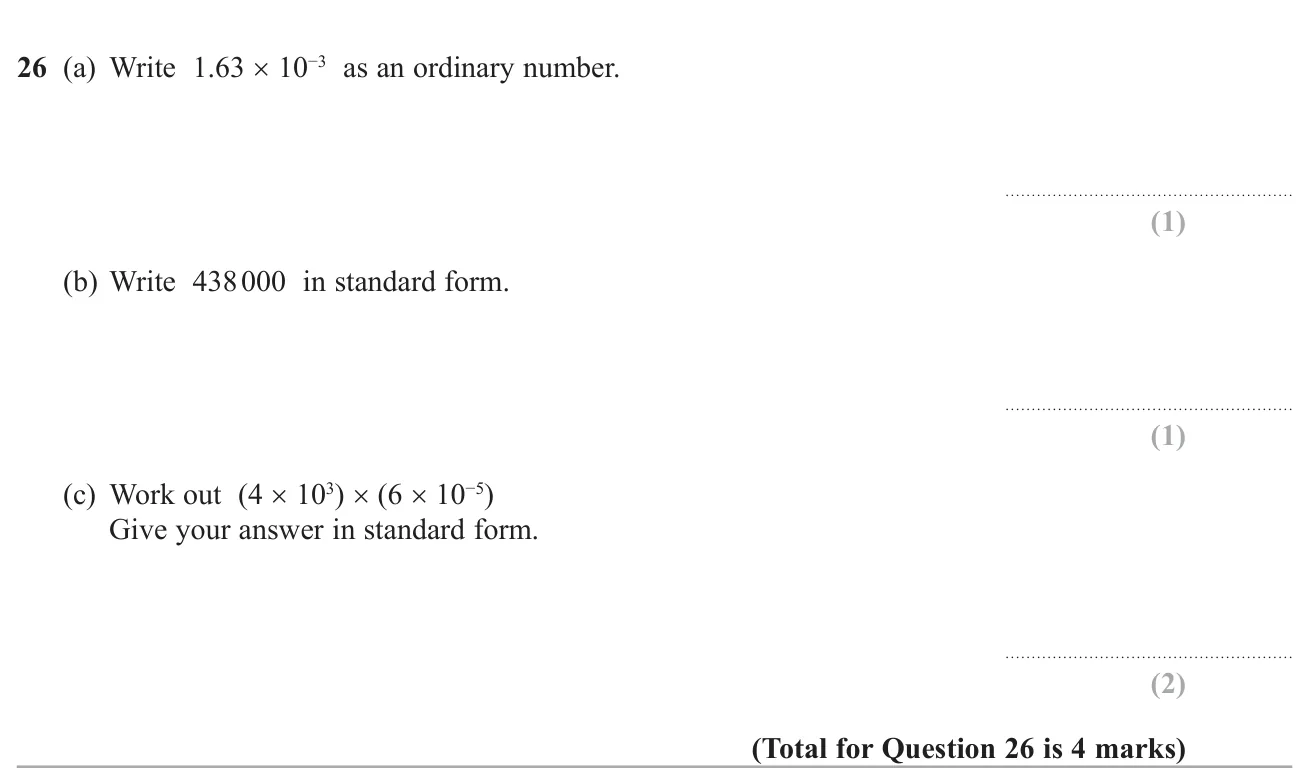
(a) 0.00163 1 mark (b) 4.38 × 10 5 4.38 \times 10^5 4.38 × 1 0 5 1 mark (c) 2.4 × 10 − 1 2.4 \times 10^{-1} 2.4 × 1 0 − 1 2 marks
Worked solution Checked against the mark scheme
(a) Move the decimal point 3 places left: 0.00163 0.00163 0.00163
(b) 438 000 = 4.38 × 100 000 = 4.38 × 10 5 438\,000 = 4.38 \times 100\,000 = 4.38 \times 10^5 438 000 = 4.38 × 100 000 = 4.38 × 1 0 5
(c) 4 × 6 = 24 4 \times 6 = 24 4 × 6 = 24 10 3 × 10 − 5 = 10 − 2 10^3 \times 10^{-5} = 10^{-2} 1 0 3 × 1 0 − 5 = 1 0 − 2
24 × 10 − 2 = 2.4 × 10 − 1 24 \times 10^{-2} = 2.4 \times 10^{-1} 24 × 1 0 − 2 = 2.4 × 1 0 − 1
Watch out: Leaving (c) as 24 × 10⁻², which is not in standard form.
© Pearson Education Ltd. November 2022 Paper 3 (Foundation, calculator), question 29.
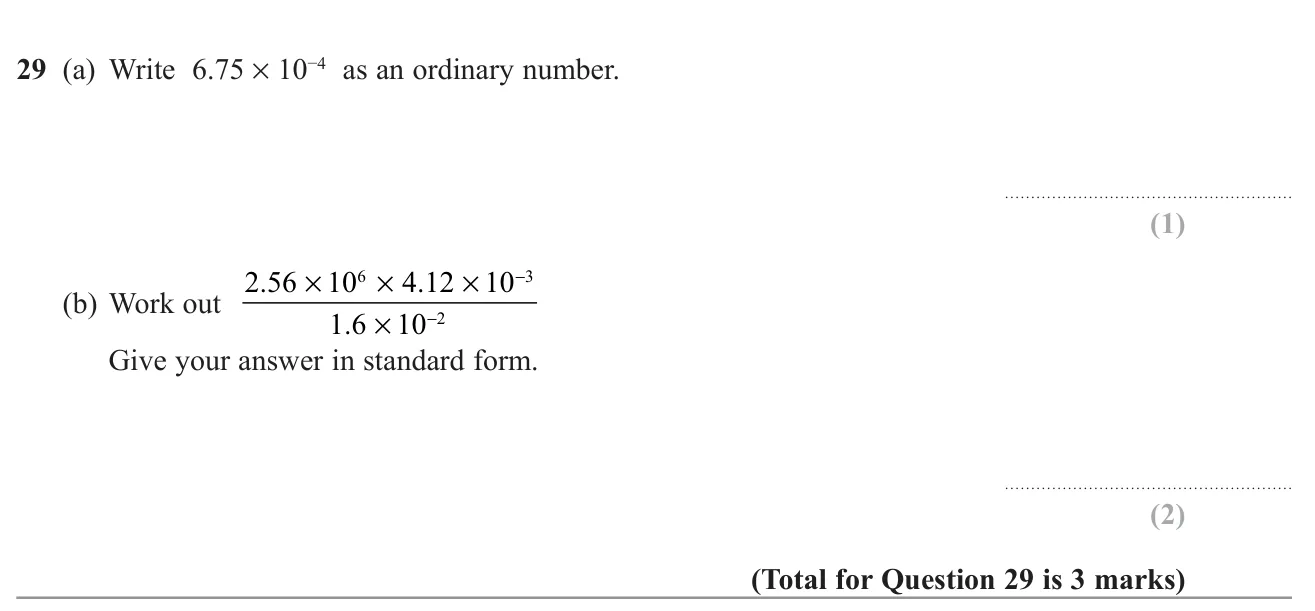
(a) 0.000675 1 mark (b) 6.592 × 10 5 6.592 \times 10^5 6.592 × 1 0 5 2 marks
Worked solution Checked against the mark scheme
(a) Move the decimal point 4 places left: 0.000675
(b) 2.56 × 10 6 × 4.12 × 10 − 3 = 10 547.2 2.56 \times 10^6 \times 4.12 \times 10^{-3} = 10\,547.2 2.56 × 1 0 6 × 4.12 × 1 0 − 3 = 10 547.2
10 547.2 ÷ ( 1.6 × 10 − 2 ) = 659 200 = 6.592 × 10 5 10\,547.2 \div (1.6 \times 10^{-2}) = 659\,200 = 6.592 \times 10^5 10 547.2 ÷ ( 1.6 × 1 0 − 2 ) = 659 200 = 6.592 × 1 0 5
Watch out: Leaving the answer as 659 200 or as 65.92 × 10 4 65.92 \times 10^4 65.92 × 1 0 4
© Pearson Education Ltd. November 2020 Paper 1 (Foundation, non-calculator), question 28.
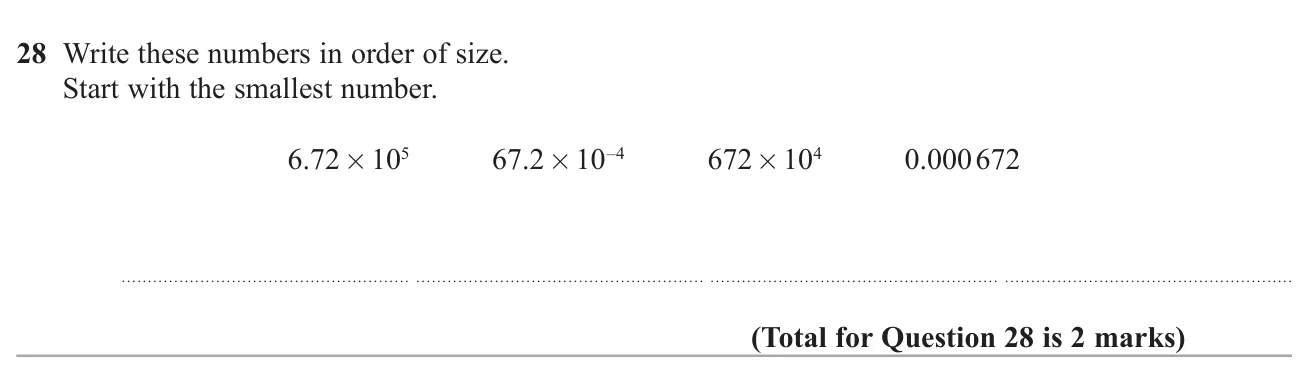
Answer 0.000 672 0.000\,672 0.000 672 67.2 × 10 − 4 67.2 \times 10^{-4} 67.2 × 1 0 − 4 6.72 × 10 5 6.72 \times 10^5 6.72 × 1 0 5 672 × 10 4 672 \times 10^4 672 × 1 0 4 2 marks
Worked solution Checked against the mark scheme
Write each as an ordinary number:
67.2 × 10 − 4 = 0.00672 67.2 \times 10^{-4} = 0.00672 67.2 × 1 0 − 4 = 0.00672 6.72 × 10 5 = 672 000 6.72 \times 10^5 = 672\,000 6.72 × 1 0 5 = 672 000 672 × 10 4 = 6 720 000 672 \times 10^4 = 6\,720\,000 672 × 1 0 4 = 6 720 000
So: 0.000672, 67.2 × 10 − 4 67.2 \times 10^{-4} 67.2 × 1 0 − 4 6.72 × 10 5 6.72 \times 10^5 6.72 × 1 0 5 672 × 10 4 672 \times 10^4 672 × 1 0 4
Watch out: Ordering by the powers of 10 alone and ignoring that 67.2 and 672 are not in standard form.
© Pearson Education Ltd. November 2020 Paper 3 (Higher, calculator), question 10.
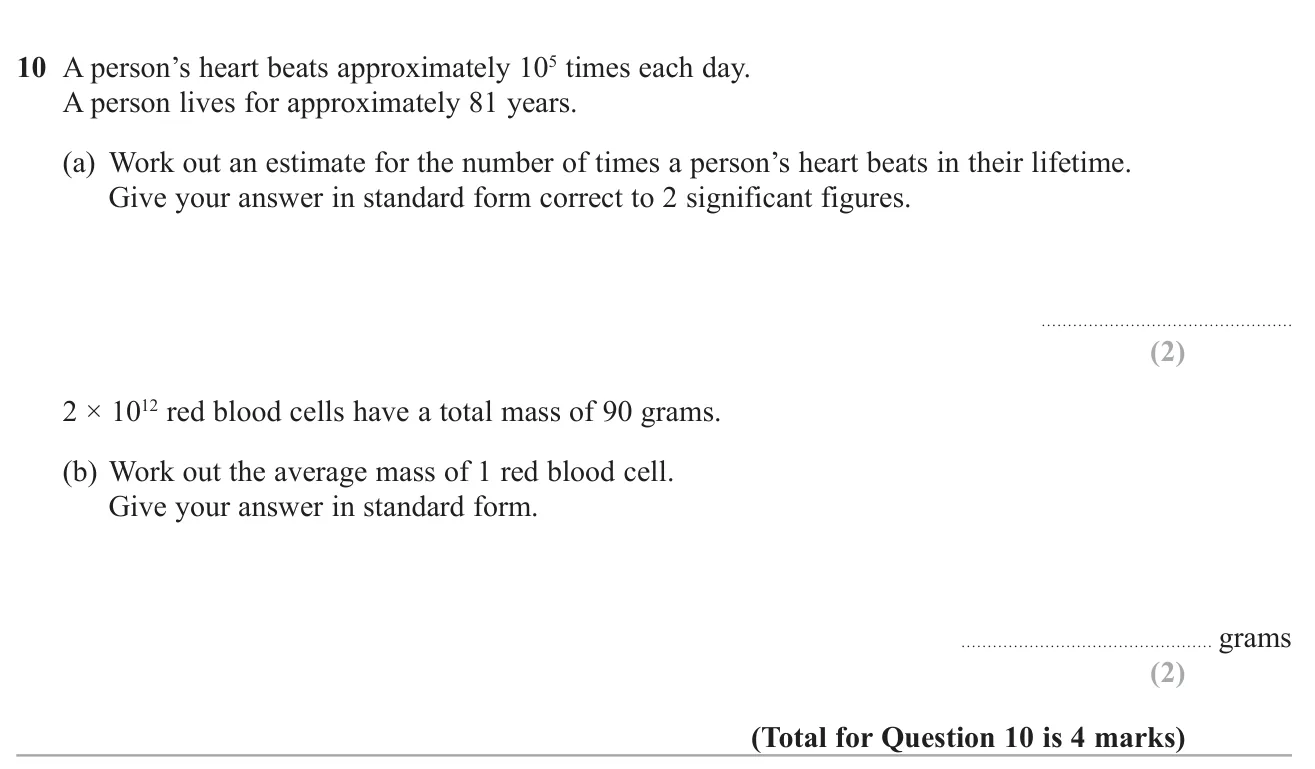
(a) 3.0 × 10 9 3.0 \times 10^9 3.0 × 1 0 9 2.8 × 10 9 2.8 \times 10^9 2.8 × 1 0 9 4.0 × 10 9 4.0 \times 10^9 4.0 × 1 0 9 2 marks (b) 4.5 × 10 − 11 4.5 \times 10^{-11} 4.5 × 1 0 − 11 2 marks
Worked solution Checked against the mark scheme
(a) 10 5 × 365 × 81 = 2 956 500 000 ≈ 3.0 × 10 9 10^5 \times 365 \times 81 = 2\,956\,500\,000 \approx 3.0 \times 10^9 1 0 5 × 365 × 81 = 2 956 500 000 ≈ 3.0 × 1 0 9
(b) 90 ÷ ( 2 × 10 12 ) = 45 × 10 − 12 = 4.5 × 10 − 11 90 \div (2 \times 10^{12}) = 45 \times 10^{-12} = 4.5 \times 10^{-11} 90 ÷ ( 2 × 1 0 12 ) = 45 × 1 0 − 12 = 4.5 × 1 0 − 11
Watch out: In (b) writing 45 × 10-12 and not converting to standard form.
© Pearson Education Ltd. November 2019 Paper 2 (Foundation, calculator), question 27.
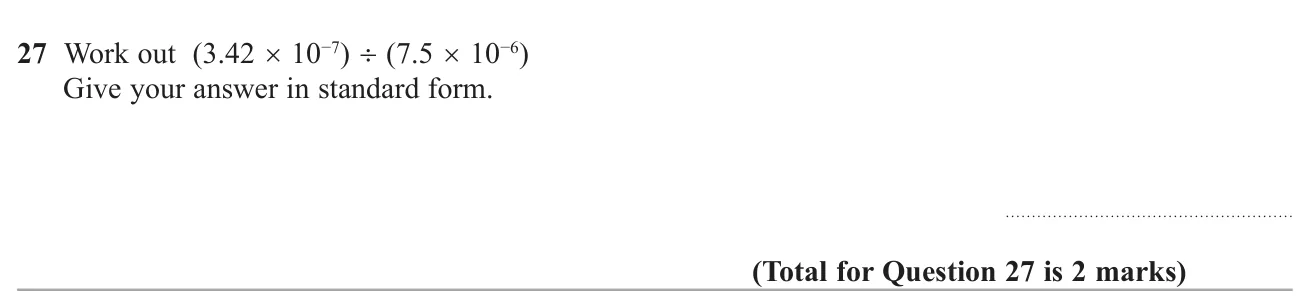
Answer 4.56 × 10 − 2 4.56 \times 10^{-2} 4.56 × 1 0 − 2 2 marks
Worked solution Checked against the mark scheme
3.42 7.5 = 0.456 \frac{3.42}{7.5} = 0.456 7.5 3.42 = 0.456 10 − 7 ÷ 10 − 6 = 10 − 1 10^{-7} \div 10^{-6} = 10^{-1} 1 0 − 7 ÷ 1 0 − 6 = 1 0 − 1
0.456 × 10 − 1 = 0.0456 = 4.56 × 10 − 2 0.456 \times 10^{-1} = 0.0456 = 4.56 \times 10^{-2} 0.456 × 1 0 − 1 = 0.0456 = 4.56 × 1 0 − 2
Watch out: Leaving the answer as 0.456 × 10 − 1 0.456 \times 10^{-1} 0.456 × 1 0 − 1
© Pearson Education Ltd. November 2019 Paper 2 (Higher, calculator), question 7.
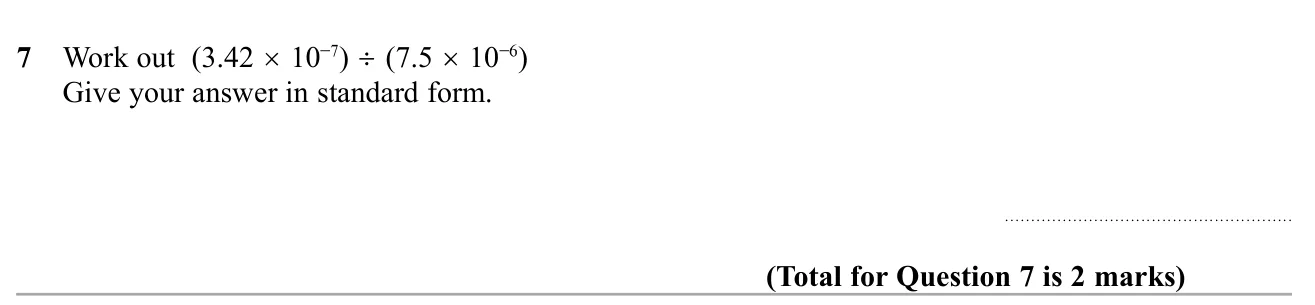
Answer 4.56 × 10 − 2 4.56 \times 10^{-2} 4.56 × 1 0 − 2 2 marks
Worked solution Checked against the mark scheme
3.42 ÷ 7.5 = 0.456 3.42 \div 7.5 = 0.456 3.42 ÷ 7.5 = 0.456
10 − 7 ÷ 10 − 6 = 10 − 1 10^{-7} \div 10^{-6} = 10^{-1} 1 0 − 7 ÷ 1 0 − 6 = 1 0 − 1
0.456 × 10 − 1 = 0.0456 = 4.56 × 10 − 2 0.456 \times 10^{-1} = 0.0456 = 4.56 \times 10^{-2} 0.456 × 1 0 − 1 = 0.0456 = 4.56 × 1 0 − 2
Watch out: Leaving the answer as 0.456 × 10 − 1 0.456 \times 10^{-1} 0.456 × 1 0 − 1
© Pearson Education Ltd. November 2019 Paper 3 (Foundation, calculator), question 28.
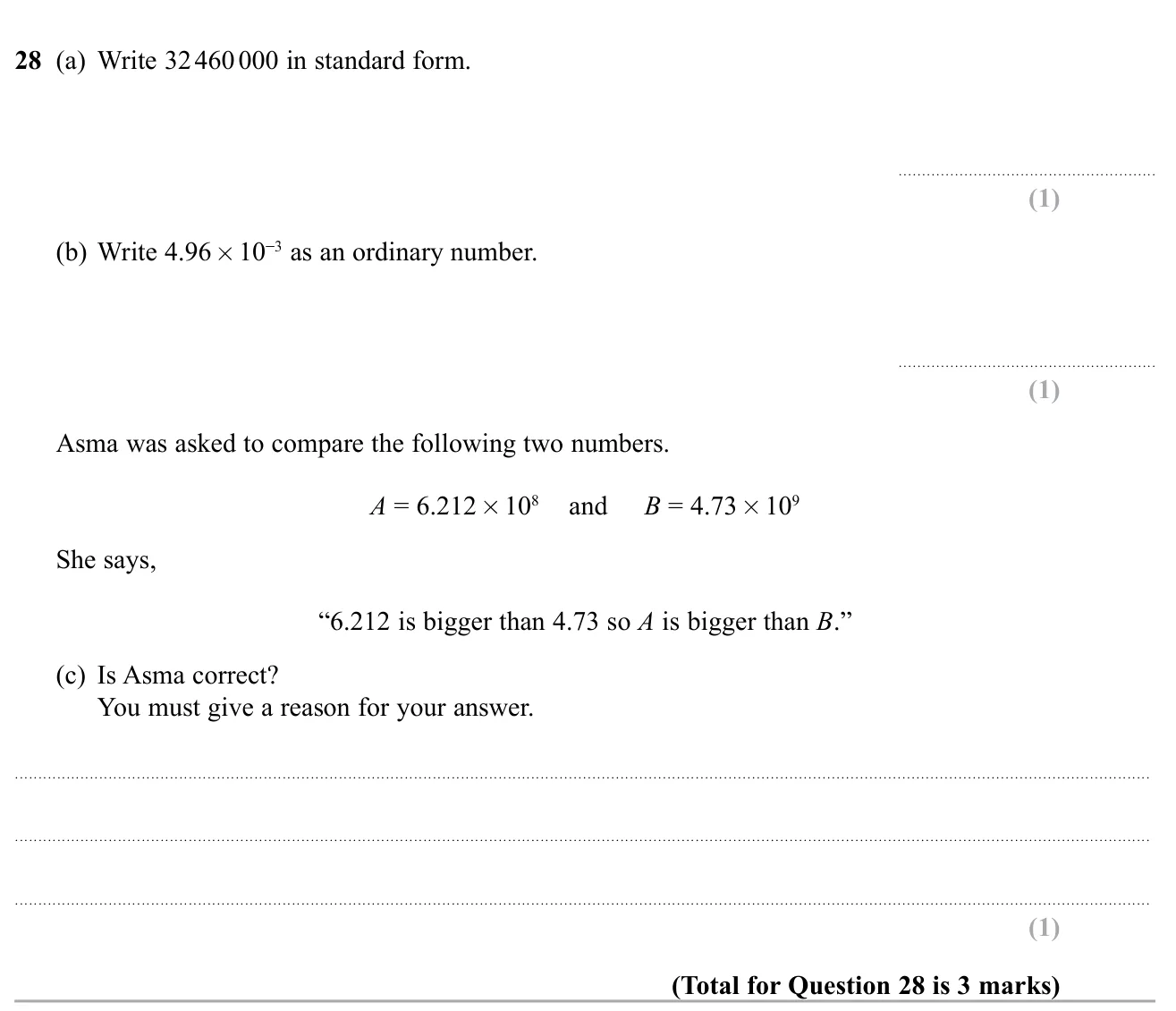
(a) 3.246 × 10 7 3.246 \times 10^7 3.246 × 1 0 7 1 mark (b) 0.00496 1 mark (c) No: 10 9 10^9 1 0 9 10 8 10^8 1 0 8 B B B 1 mark
Worked solution Checked against the mark scheme
(a) Put the decimal point after the first digit: 3.246 3.246 3.246 3.246 × 10 7 3.246 \times 10^7 3.246 × 1 0 7
(b) Move the point 3 places left: 0.00496 0.00496 0.00496
(c) No. A = 621 200 000 A = 621\,200\,000 A = 621 200 000 B = 4 730 000 000 B = 4\,730\,000\,000 B = 4 730 000 000 B B B
Watch out: In (b), moving the point the wrong way to get 4960.
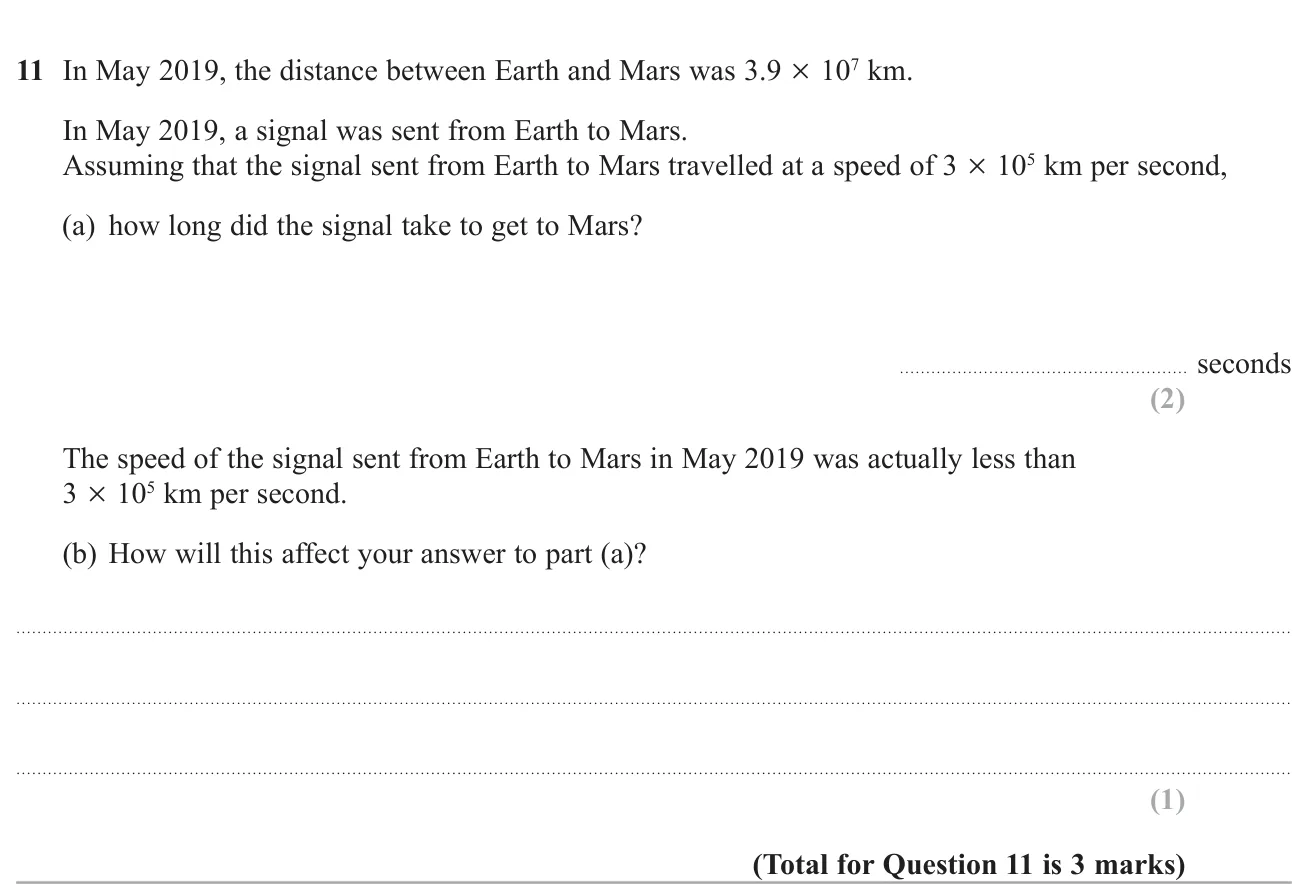
© Pearson Education Ltd. June 2019 Paper 3 (Higher, calculator), question 11.
(a) 130 seconds 2 marks (b) The signal would take longer, so the time is an underestimate 1 mark
Worked solution Checked against the mark scheme
(a) Time = 3.9 × 10 7 3 × 10 5 = 1.3 × 10 2 = 130 = \frac{3.9 \times 10^7}{3 \times 10^5} = 1.3 \times 10^2 = 130 = 3 × 1 0 5 3.9 × 1 0 7 = 1.3 × 1 0 2 = 130
(b) A lower speed over the same distance means more time, so the real time is longer than 130 s.
Watch out: In (b), saying only that the answer would be 'wrong' or 'different'.
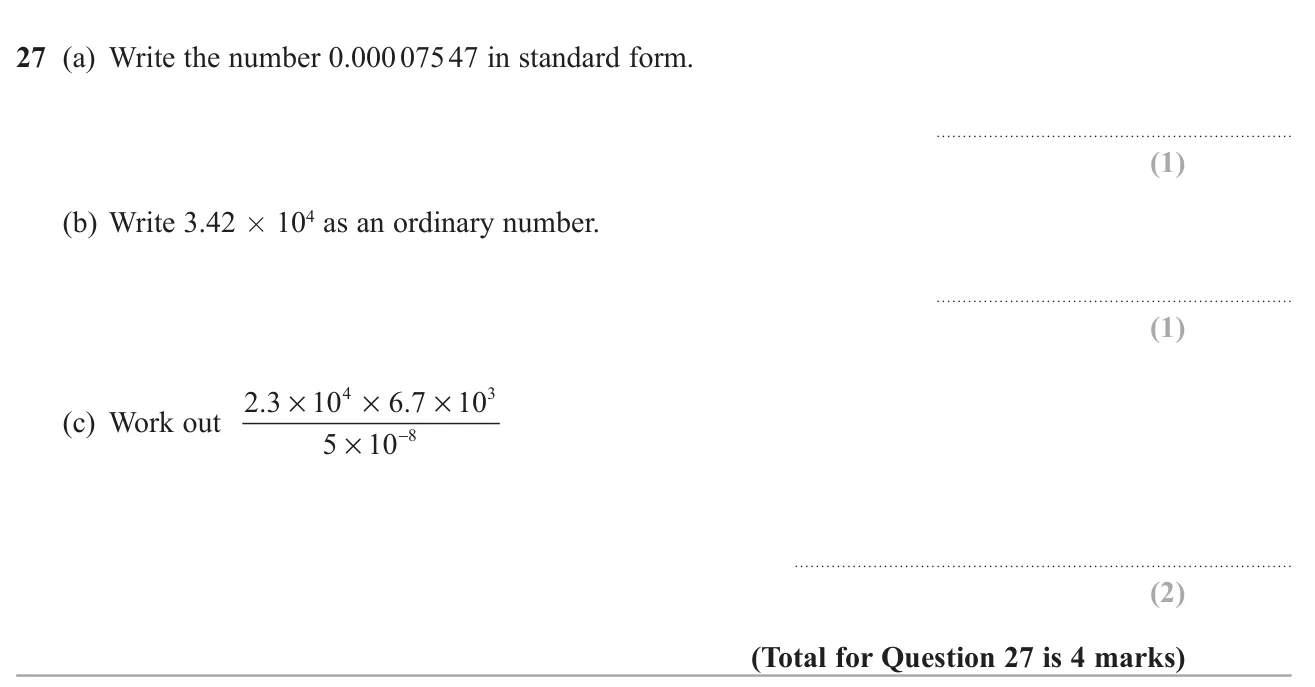
© Pearson Education Ltd. November 2018 Paper 2 (Foundation, calculator), question 27.
(a) 7.547 × 10 − 5 7.547 \times 10^{-5} 7.547 × 1 0 − 5 1 mark (b) 34200 1 mark (c) 3.082 × 10 15 3.082 \times 10^{15} 3.082 × 1 0 15 2 marks
Worked solution Checked against the mark scheme
(a) Move the decimal point 5 places right: 7.547 × 10 − 5 7.547 \times 10^{-5} 7.547 × 1 0 − 5
(b) 3.42 × 10 4 = 34 200 3.42 \times 10^4 = 34\,200 3.42 × 1 0 4 = 34 200
(c) Top: 2.3 × 10 4 × 6.7 × 10 3 = 1.541 × 10 8 2.3 \times 10^4 \times 6.7 \times 10^3 = 1.541 \times 10^8 2.3 × 1 0 4 × 6.7 × 1 0 3 = 1.541 × 1 0 8
1.541 × 10 8 5 × 10 − 8 = 0.3082 × 10 16 = 3.082 × 10 15 \frac{1.541 \times 10^8}{5 \times 10^{-8}} = 0.3082 \times 10^{16} = 3.082 \times 10^{15} 5 × 1 0 − 8 1.541 × 1 0 8 = 0.3082 × 1 0 16 = 3.082 × 1 0 15
Watch out: In (a), using a positive power of 10.
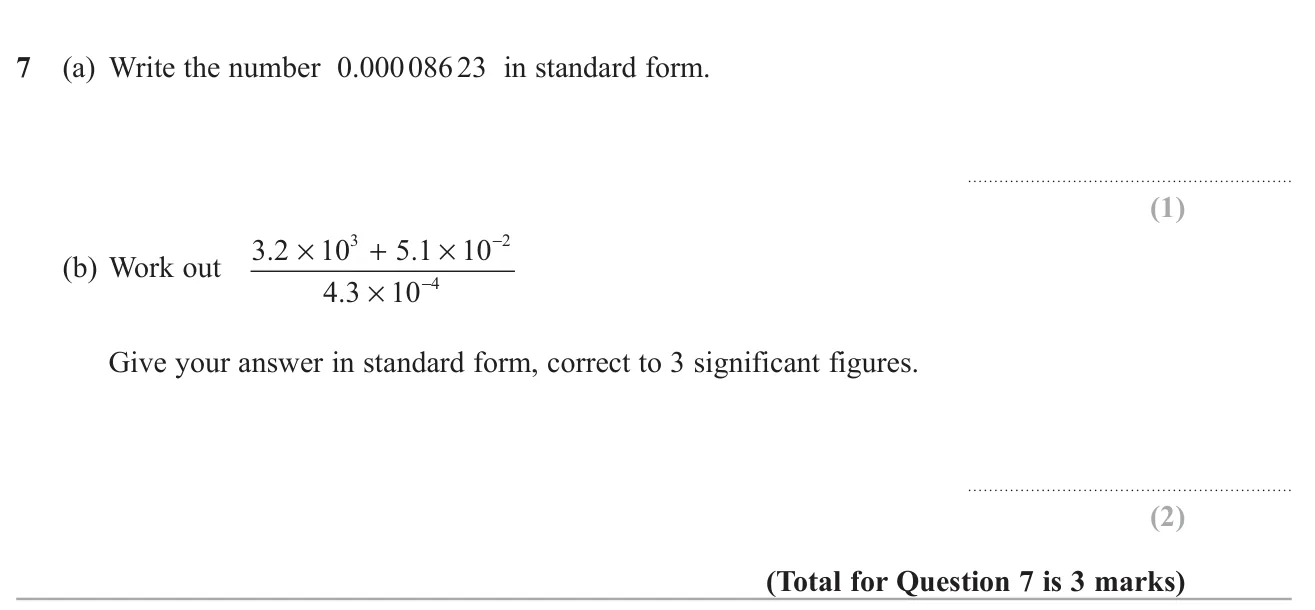
© Pearson Education Ltd. November 2018 Paper 2 (Higher, calculator), question 7.
(a) 8.623 × 10 − 5 8.623 \times 10^{-5} 8.623 × 1 0 − 5 1 mark (b) 7.44 × 10 6 7.44 \times 10^{6} 7.44 × 1 0 6 2 marks
Worked solution Checked against the mark scheme
(a) Move the decimal point 5 places: 8.623 × 10 − 5 8.623 \times 10^{-5} 8.623 × 1 0 − 5
(b) 3200 + 0.051 0.00043 = 3200.051 0.00043 = 7 441 979.07... \frac{3200 + 0.051}{0.00043} = \frac{3200.051}{0.00043} = 7\,441\,979.07... 0.00043 3200 + 0.051 = 0.00043 3200.051 = 7 441 979.07...
To 3 s.f. in standard form: 7.44 × 10 6 7.44 \times 10^6 7.44 × 1 0 6
Watch out: Only dividing the second term of the numerator by the denominator (no brackets on the calculator).
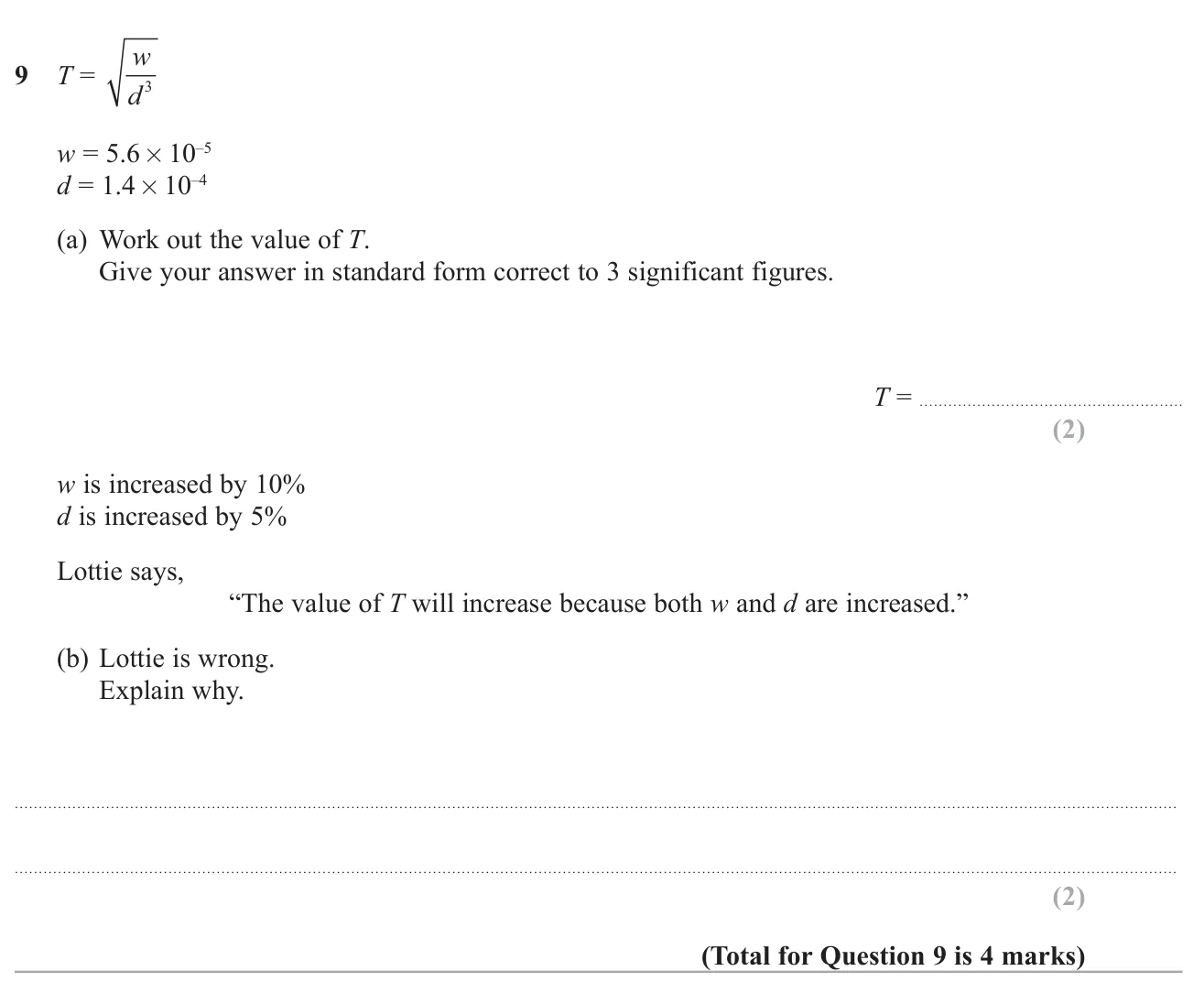
© Pearson Education Ltd. June 2018 Paper 3 (Higher, calculator), question 9.
(a) 4.52 × 10 3 4.52 \times 10^3 4.52 × 1 0 3 2 marks (b) The multiplier for T T T 1.1 ÷ 1.05 3 = 0.975 < 1 \sqrt{1.1 \div 1.05^3} = 0.975 < 1 1.1 ÷ 1.0 5 3 = 0.975 < 1 T T T 2 marks
Worked solution Checked against the mark scheme
(a) d 3 = ( 1.4 × 10 − 4 ) 3 = 2.744 × 10 − 12 d^3 = (1.4 \times 10^{-4})^3 = 2.744 \times 10^{-12} d 3 = ( 1.4 × 1 0 − 4 ) 3 = 2.744 × 1 0 − 12
w d 3 = 5.6 × 10 − 5 2.744 × 10 − 12 = 2.0408 × 10 7 \frac{w}{d^3} = \frac{5.6 \times 10^{-5}}{2.744 \times 10^{-12}} = 2.0408 \times 10^{7} d 3 w = 2.744 × 1 0 − 12 5.6 × 1 0 − 5 = 2.0408 × 1 0 7
T = 2.0408 × 10 7 = 4517.5... = 4.52 × 10 3 T = \sqrt{2.0408 \times 10^7} = 4517.5... = 4.52 \times 10^3 T = 2.0408 × 1 0 7 = 4517.5... = 4.52 × 1 0 3
(b) w w w d 3 d^3 d 3 1.05 3 = 1.1576 1.05^3 = 1.1576 1.0 5 3 = 1.1576 T T T 1.1 ÷ 1.1576 = 0.975 \sqrt{1.1 \div 1.1576} = 0.975 1.1 ÷ 1.1576 = 0.975 T T T 4.40 × 10 3 4.40 \times 10^3 4.40 × 1 0 3
Watch out: Forgetting that d d d w w w
Also tested in these questions Their main topic is different, but part of each one tests this topic.