© Pearson Education Ltd. June 2019 Paper 3 (Foundation, calculator), question 1.
Show answer
Worked solution Checked against the mark scheme
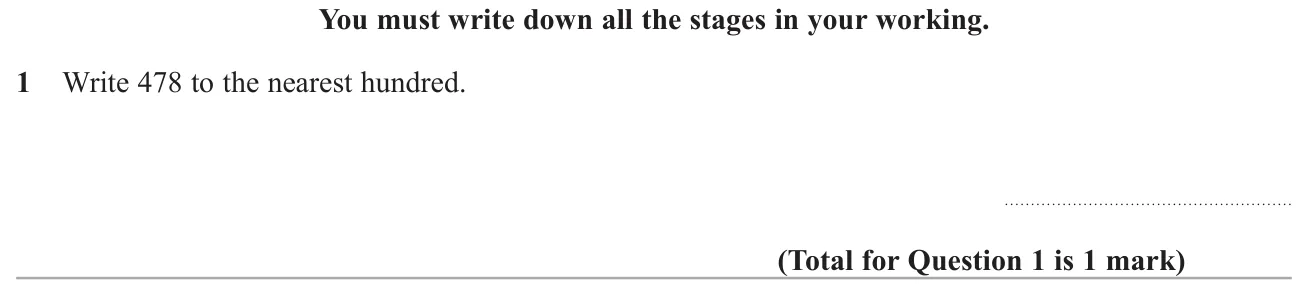
478 lies between 400 and 500.
The tens digit is 7, which is 5 or more, so round up: 500.
Watch out: Writing 480 (rounding to the nearest ten).
© Pearson Education Ltd. June 2019 Paper 3 (Foundation, calculator), question 2.
Show answer
Worked solution Checked against the mark scheme
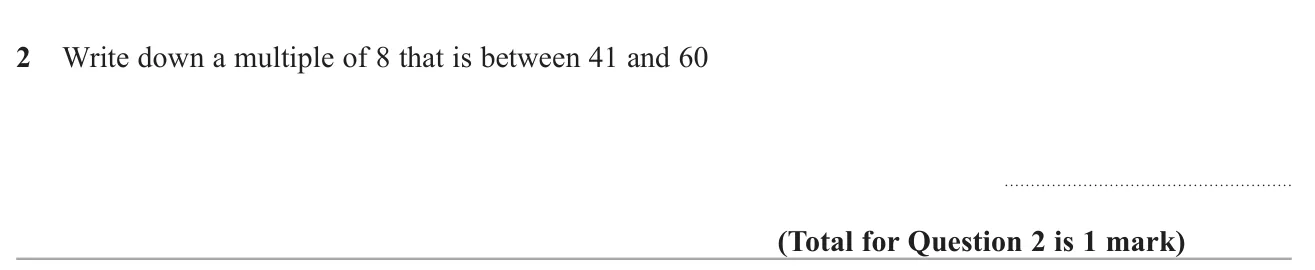
The 8 times table: 40, 48, 56, 64, ...
The ones between 41 and 60 are 48 and 56; either will do.
Watch out: Giving 40 or 64, which are outside the range.
© Pearson Education Ltd. June 2019 Paper 3 (Foundation, calculator), question 3.
Show answer
Worked solution Checked against the mark scheme
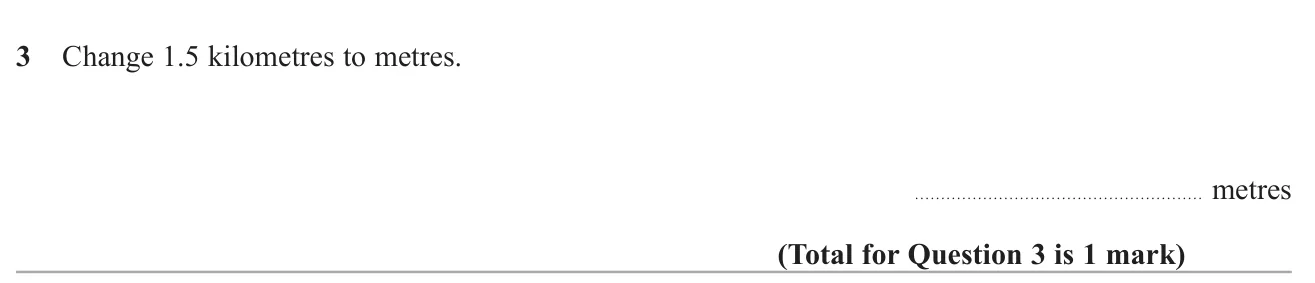
1 km = 1000 m
1.5×1000=1500 metres.
Watch out: Multiplying by 100 instead of 1000.
© Pearson Education Ltd. June 2019 Paper 3 (Foundation, calculator), question 4.
Show answer
Worked solution Checked against the mark scheme
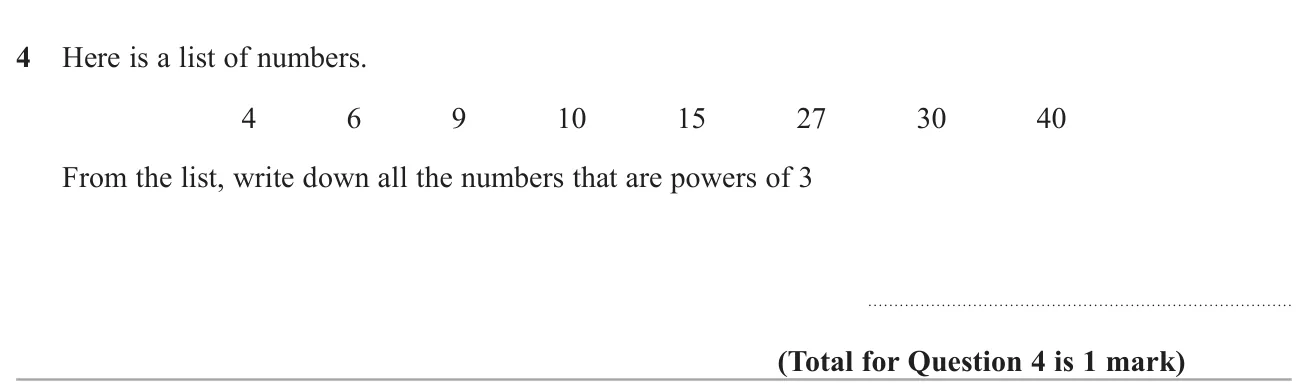
Powers of 3: 31=3, 32=9, 33=27, 34=81
From the list, the powers of 3 are 9 and 27.
Watch out: Including 6, 15 or 30 because they are multiples of 3.
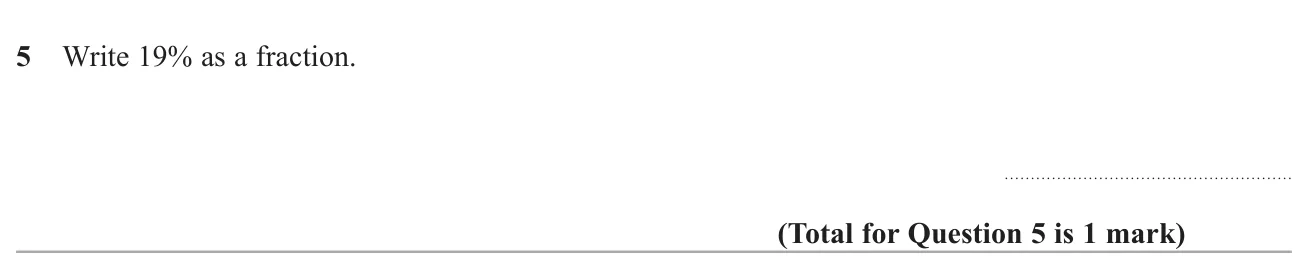
© Pearson Education Ltd. June 2019 Paper 3 (Foundation, calculator), question 5.
Show answer
| Answer | 10019 | 1 mark |
|---|
Worked solution Checked against the mark scheme
Per cent means out of 100, so 19%=10019.
Watch out: Writing 1/19 or 0.19 (a decimal, not a fraction).
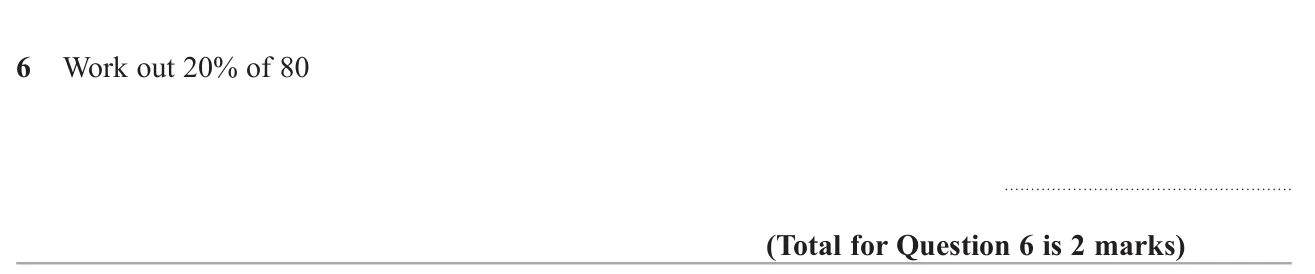
© Pearson Education Ltd. June 2019 Paper 3 (Foundation, calculator), question 6.
Show answer
Worked solution Checked against the mark scheme
10% of 80 is 8, so 20% is 2×8=16.
Or: 80×0.2=16.
Watch out: Subtracting 20% to get 64.
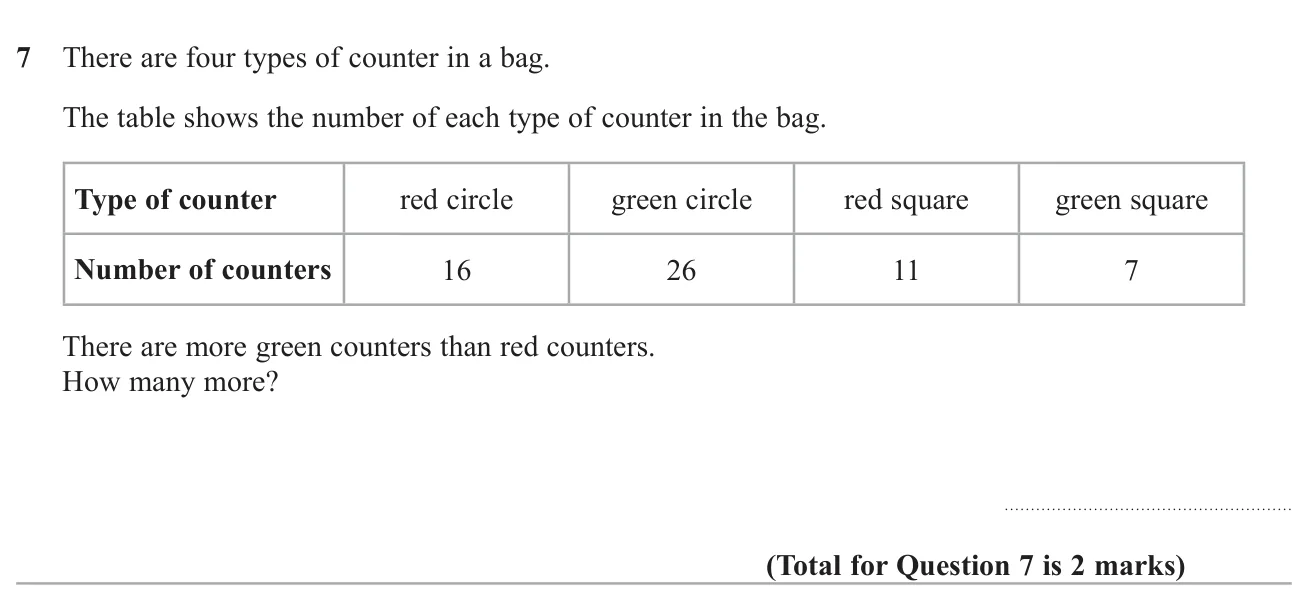
© Pearson Education Ltd. June 2019 Paper 3 (Foundation, calculator), question 7.
Show answer
Worked solution Checked against the mark scheme
Green: 26+7=33
Red: 16+11=27
Difference: 33−27=6
Watch out: Only comparing the circles and getting 10.
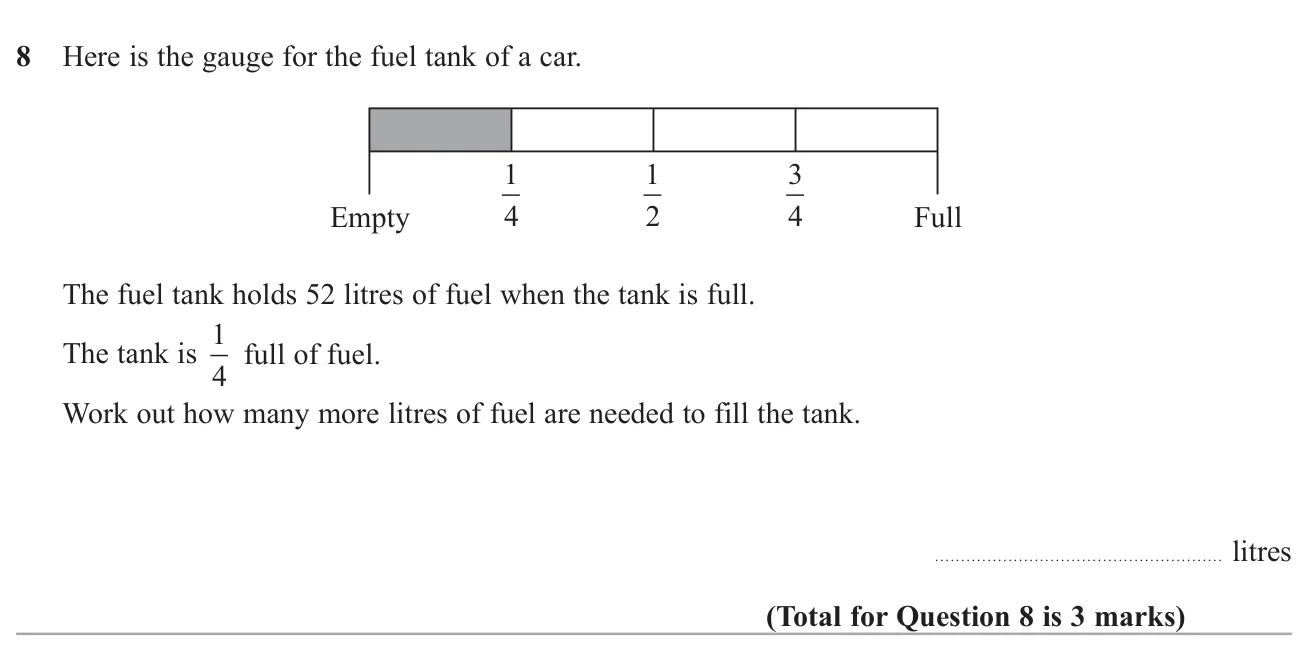
© Pearson Education Ltd. June 2019 Paper 3 (Foundation, calculator), question 8.
Show answer
Worked solution Checked against the mark scheme
A quarter of 52 is 52÷4=13 litres already in the tank.
Fuel needed: 52−13=39 litres (or 43×52=39).
Watch out: Giving 13, the fuel already in the tank.
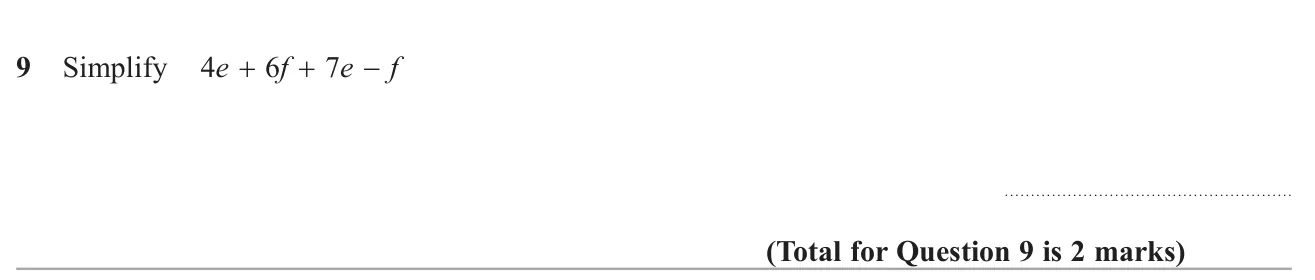
© Pearson Education Ltd. June 2019 Paper 3 (Foundation, calculator), question 9.
Show answer
| Answer | 11e+5f | 2 marks |
|---|
Worked solution Checked against the mark scheme
4e+6f+7e−f
e terms: 4e+7e=11e
f terms: 6f−f=5f
Answer: 11e+5f
Watch out: Writing 7f by treating −f as +f.
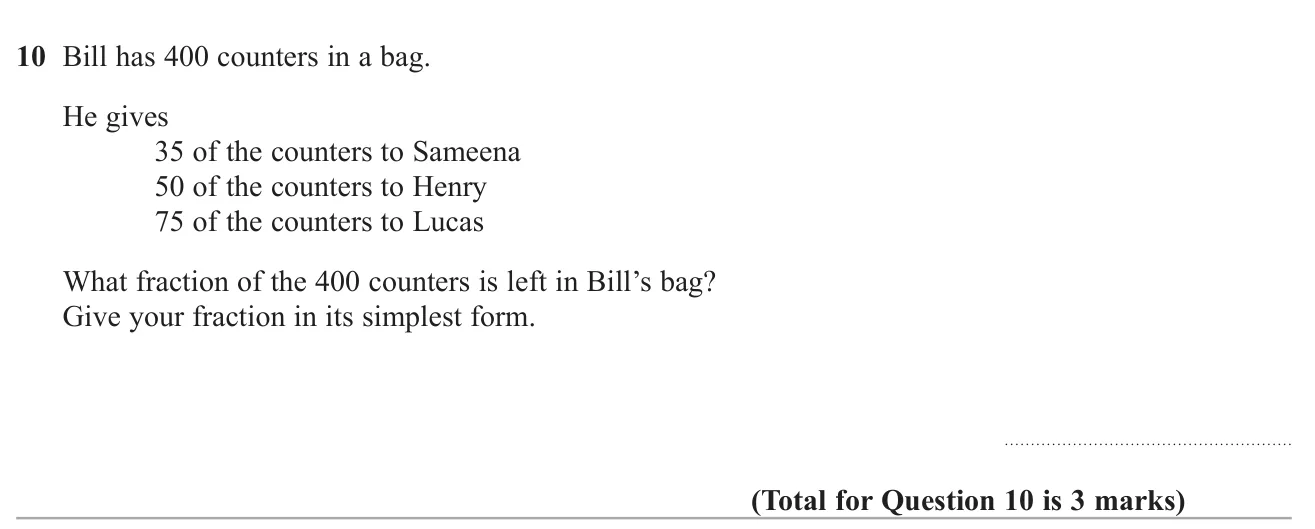
© Pearson Education Ltd. June 2019 Paper 3 (Foundation, calculator), question 10.
Show answer
| Answer | 53 | 3 marks |
|---|
Worked solution Checked against the mark scheme
Given away: 35+50+75=160
Left: 400−160=240
400240=53
Watch out: Giving the fraction given away (2/5) instead of the fraction left.
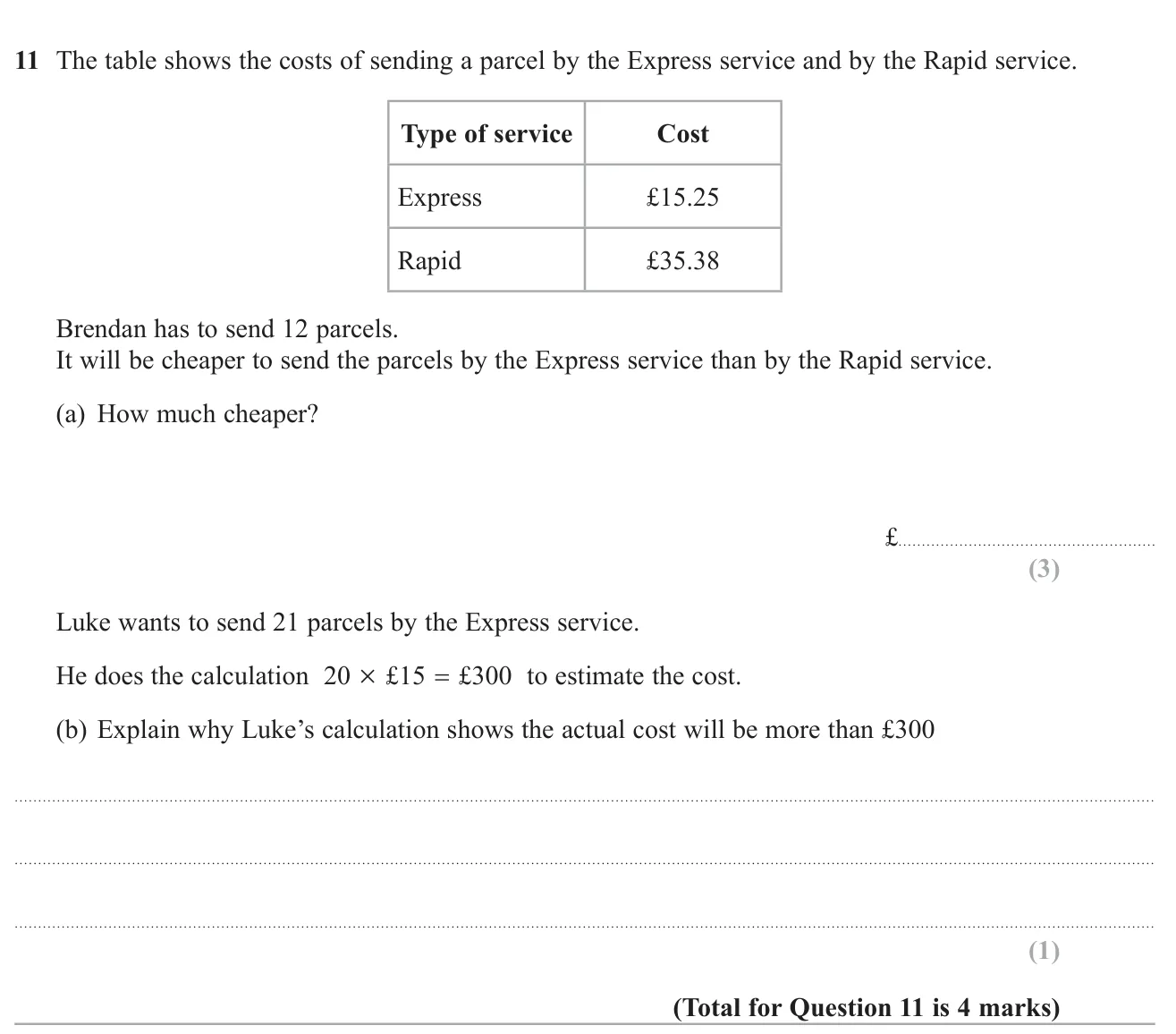
© Pearson Education Ltd. June 2019 Paper 3 (Foundation, calculator), question 11.
Show answer
| (a) | £241.56 | 3 marks |
|---|
| (b) | Both numbers were rounded down: 20 is less than 21 and £15 is less than £15.25 | 1 mark |
|---|
Worked solution Checked against the mark scheme
(a) Difference per parcel: 35.38−15.25=20.13
12×20.13=£241.56
(b) He used 20 parcels instead of 21 and £15 instead of £15.25. Both are smaller than the real values, so the real cost is more than £300.
Watch out: In (b), mentioning only one of the two rounded numbers.
Question 12
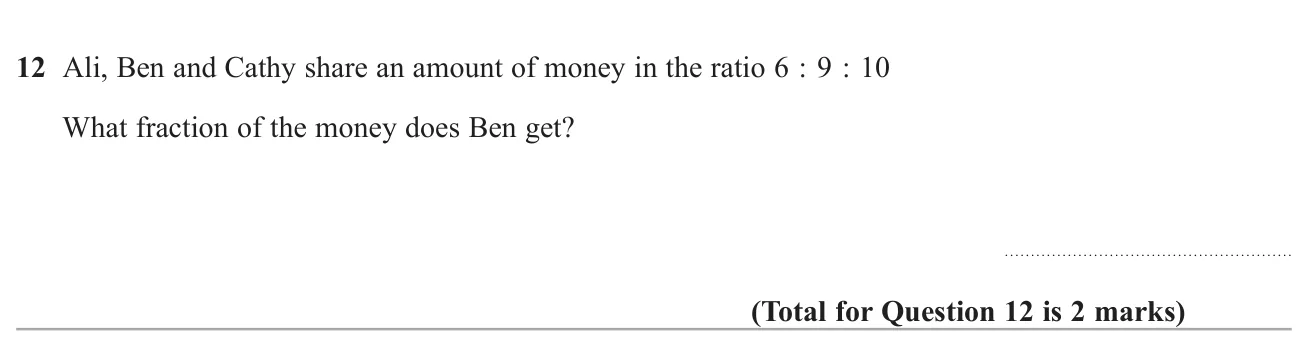
Ratio2 marksGrade 3Calculator © Pearson Education Ltd. June 2019 Paper 3 (Foundation, calculator), question 12.
Show answer
| Answer | 259 | 2 marks |
|---|
Worked solution Checked against the mark scheme
Total parts: 6+9+10=25
Ben gets 9 of the 25 parts, so 259.
Watch out: Writing 9/16 (Ben over the other two) or 9/10.
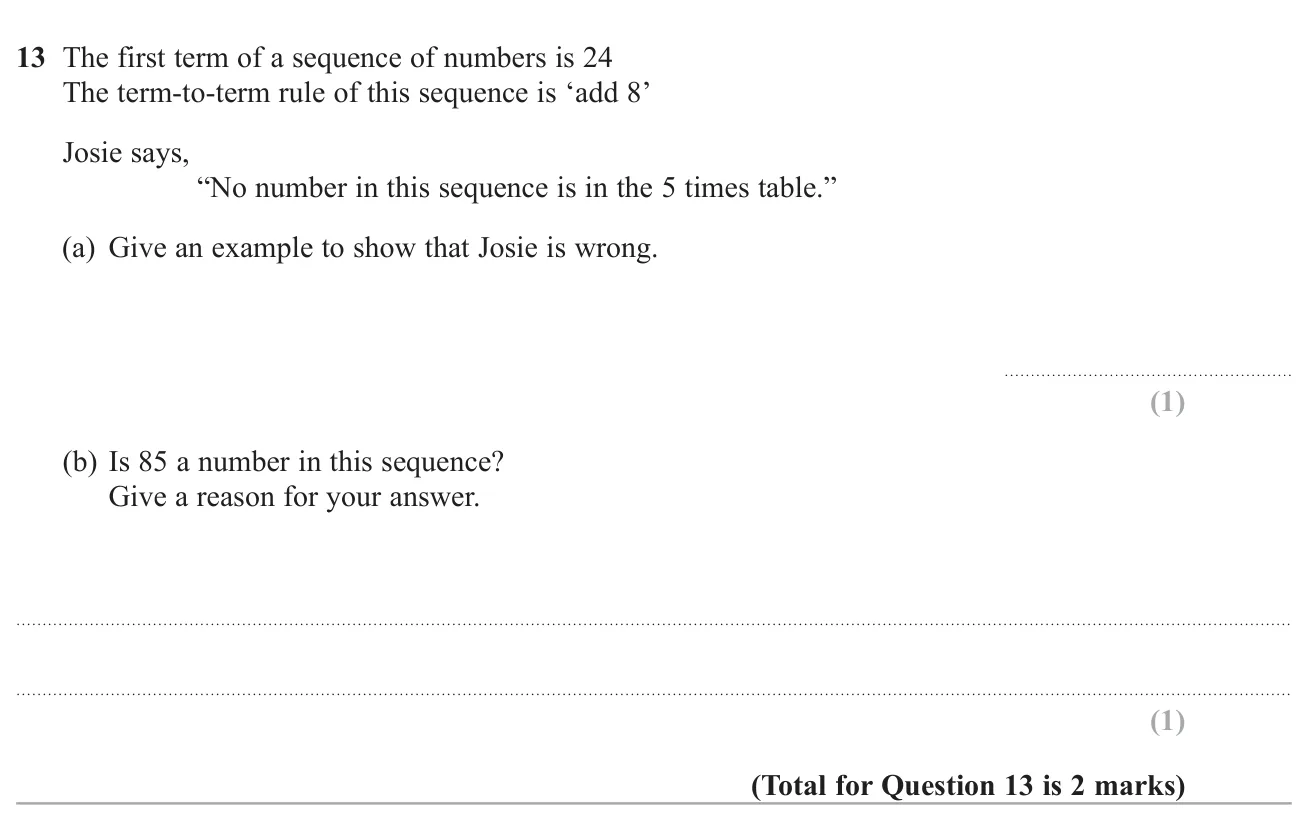
© Pearson Education Ltd. June 2019 Paper 3 (Foundation, calculator), question 13.
Show answer
| (a) | 40 (or 80, 120, ...) | 1 mark |
|---|
| (b) | No: every term is even (or 80 is in the sequence and the next term is 88) | 1 mark |
|---|
Worked solution Checked against the mark scheme
Terms: 24, 32, 40, 48, 56, 64, 72, 80, 88, ...
(a) 40 is in the sequence and is in the 5 times table.
(b) No. 80 and 88 are terms, so 85 is skipped. Also, every term is even and 85 is odd.
Watch out: In (b), just saying 'it goes past 85' without a reason.
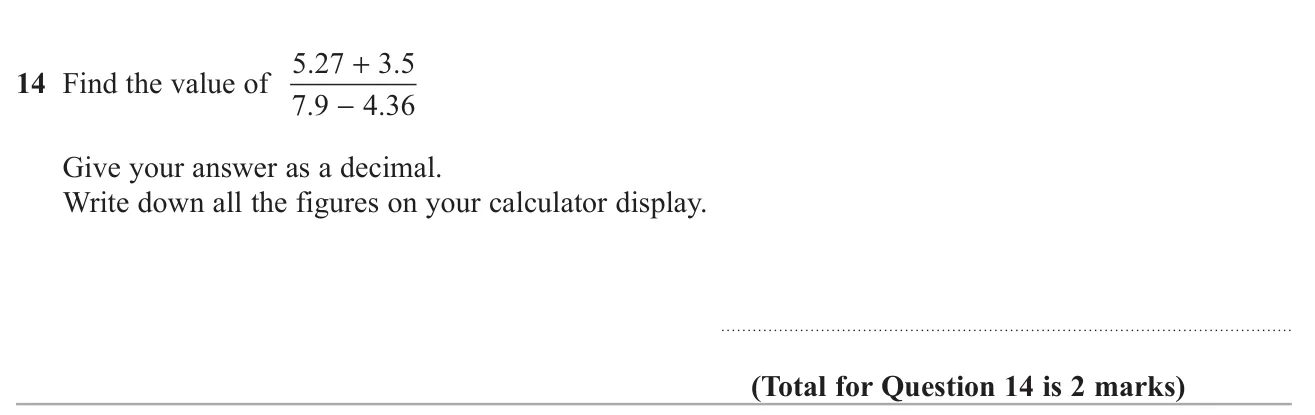
© Pearson Education Ltd. June 2019 Paper 3 (Foundation, calculator), question 14.
Show answer
| Answer | 2.4774011... | 2 marks |
|---|
Worked solution Checked against the mark scheme
Top: 5.27+3.5=8.77
Bottom: 7.9−4.36=3.54
8.77÷3.54=2.477401129...
Watch out: Typing it in without brackets, so only 3.5 is divided by 7.9.
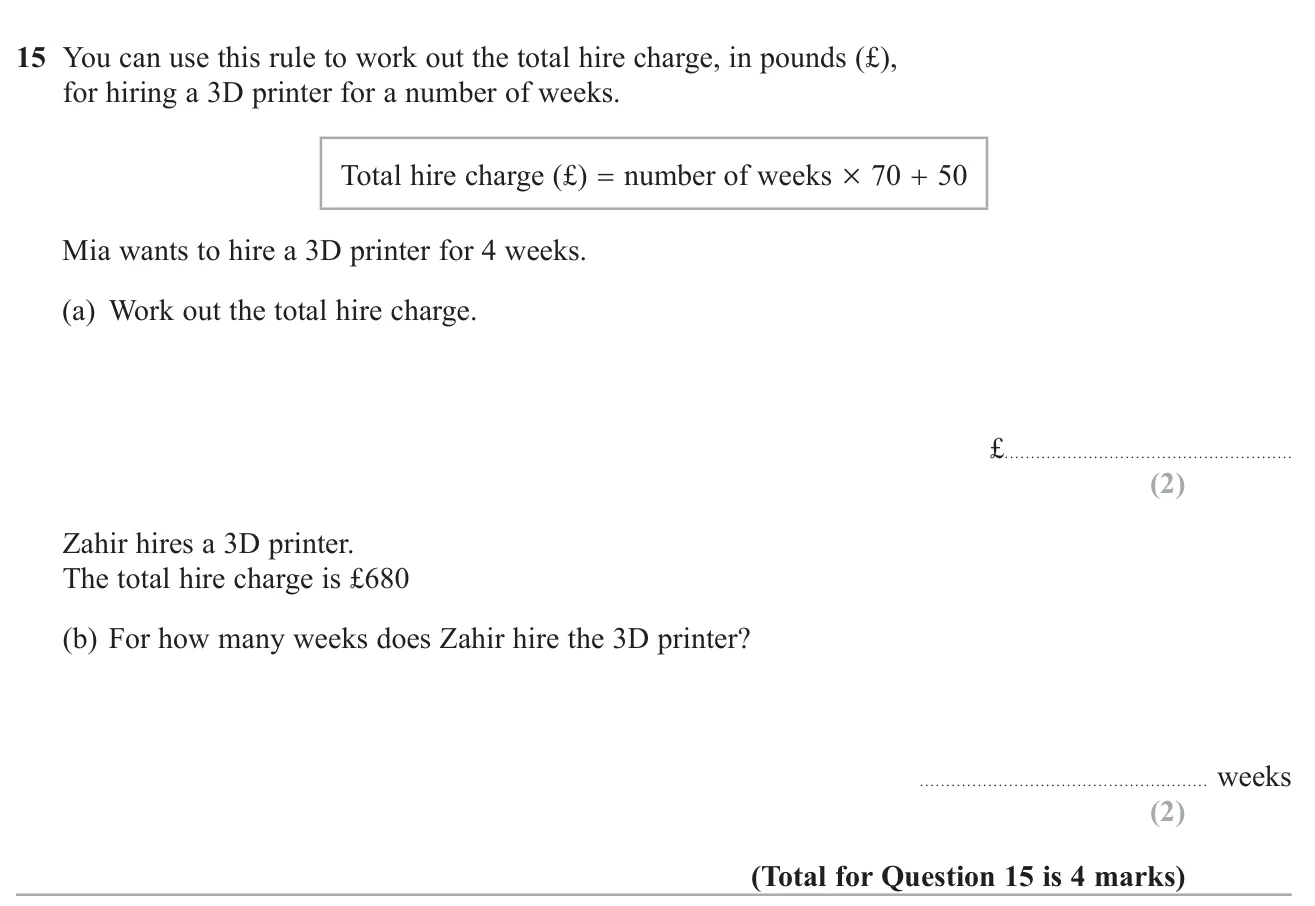
© Pearson Education Ltd. June 2019 Paper 3 (Foundation, calculator), question 15.
Show answer
| (a) | £330 | 2 marks |
|---|
| (b) | 9 | 2 marks |
|---|
Worked solution Checked against the mark scheme
(a) 4×70+50=280+50=£330
(b) Undo the rule: 680−50=630, then 630÷70=9 weeks.
Watch out: In (a), working out 4 × (70 + 50) = 480.
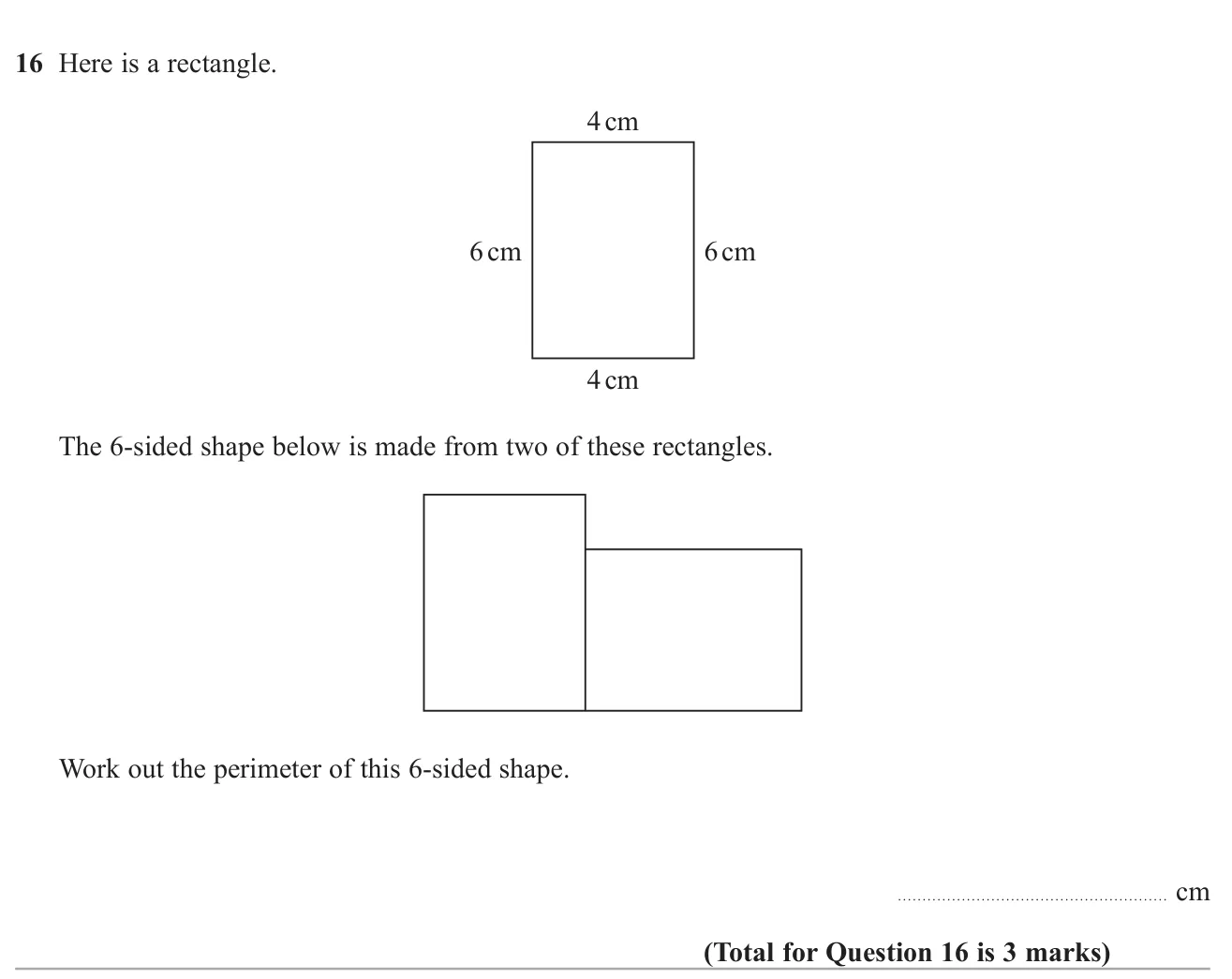
© Pearson Education Ltd. June 2019 Paper 3 (Foundation, calculator), question 16.
Show answer
Worked solution Checked against the mark scheme
One rectangle stands upright (4 by 6), the other lies flat (6 by 4) beside it.
The step on top is 6−4=2 cm.
Perimeter: 4+2+6+4+6+4+6=32 cm
Or: 20+20−2×4=32 cm (the joined 4 cm edge is lost from both).
Watch out: Adding both perimeters to get 40, forgetting the shared edge.
© Pearson Education Ltd. June 2019 Paper 3 (Foundation, calculator), question 17.
Show answer
| Answer | 9 (accept 8 to 10) | 2 marks |
|---|
Worked solution Checked against the mark scheme
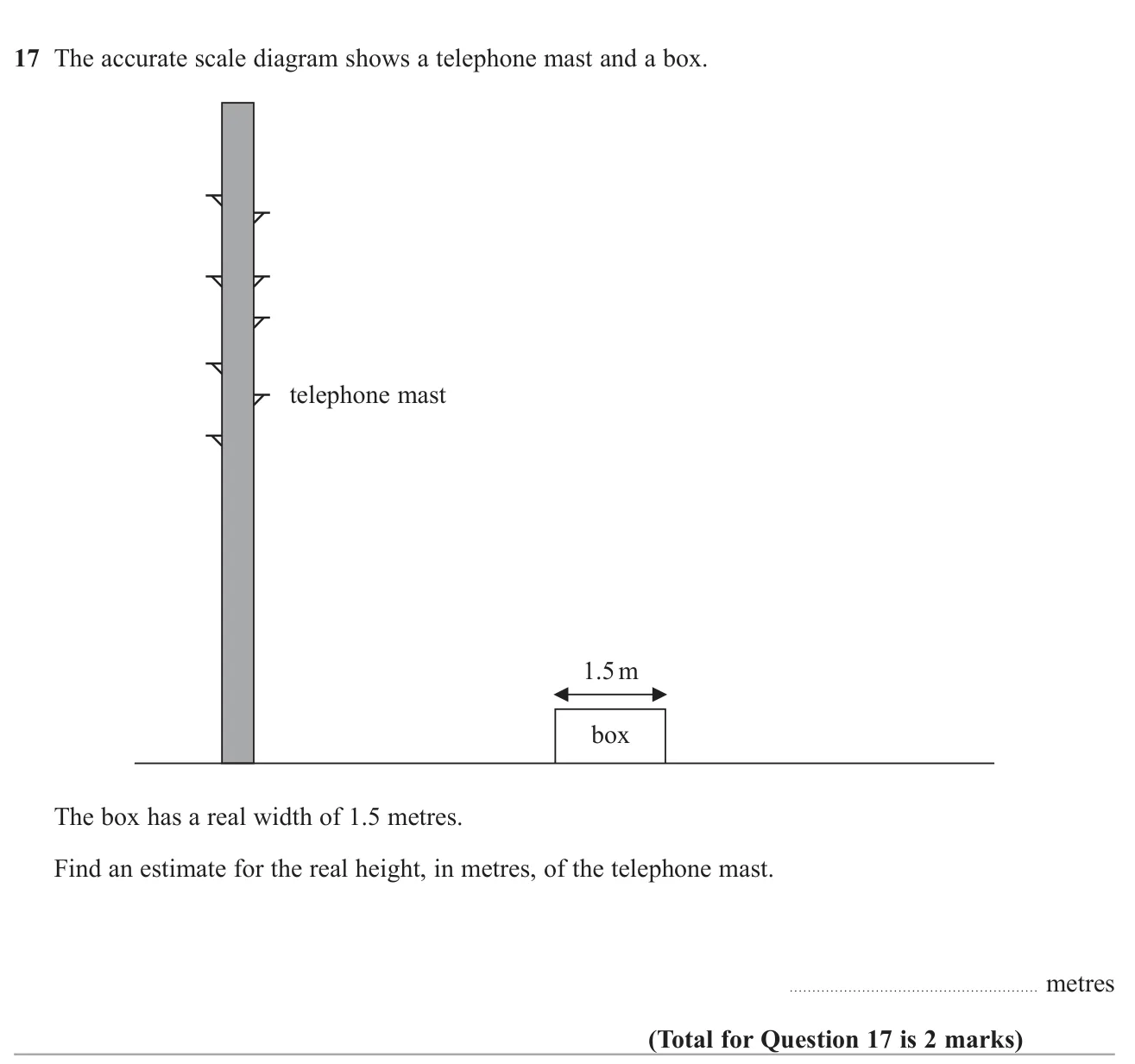
Measure: the box is about 1.8 cm wide and the mast about 10.8 cm tall.
The mast is about 10.8÷1.8=6 times the box width.
Height ≈6×1.5=9 m
Watch out: Measuring the box's height instead of its width.
© Pearson Education Ltd. June 2019 Paper 3 (Foundation, calculator), question 18.
Show answer
Worked solution Checked against the mark scheme
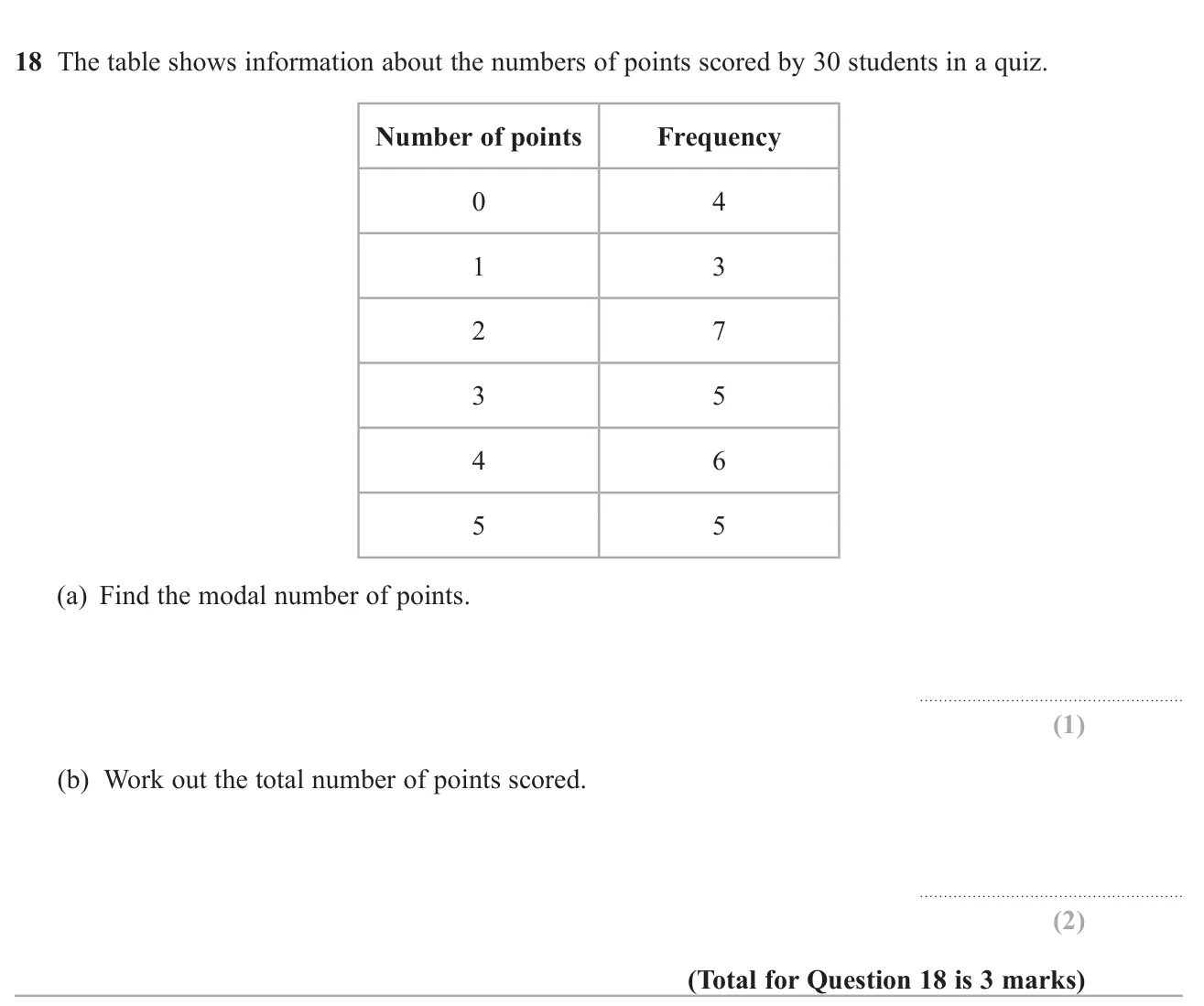
(a) The highest frequency is 7, for 2 points, so the mode is 2.
(b) 0×4+1×3+2×7+3×5+4×6+5×5
=0+3+14+15+24+25=81
Watch out: In (a), giving 7 (the frequency) instead of 2.
© Pearson Education Ltd. June 2019 Paper 3 (Foundation, calculator), question 19.
Show answer
| Answer | x=2y−4 | 2 marks |
|---|
Worked solution Checked against the mark scheme
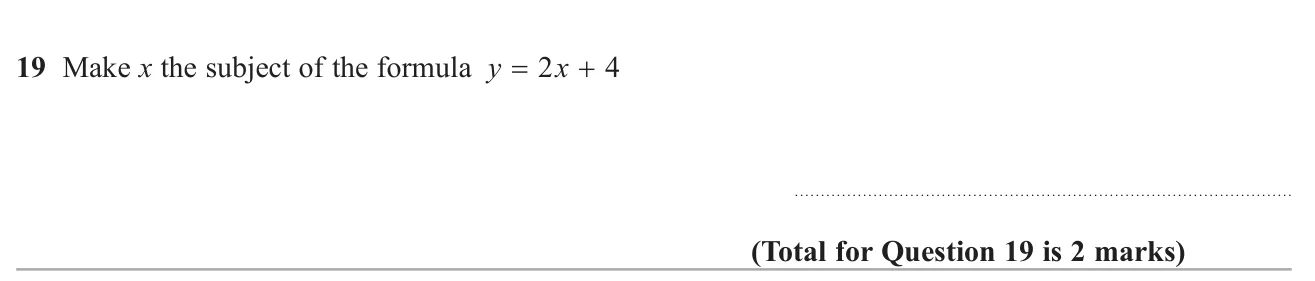
y=2x+4
Subtract 4: y−4=2x
Divide by 2: x=2y−4
Watch out: Dividing only y by 2, giving y/2 − 4.
© Pearson Education Ltd. June 2019 Paper 3 (Foundation, calculator), question 20.
Show answer
Worked solution Checked against the mark scheme
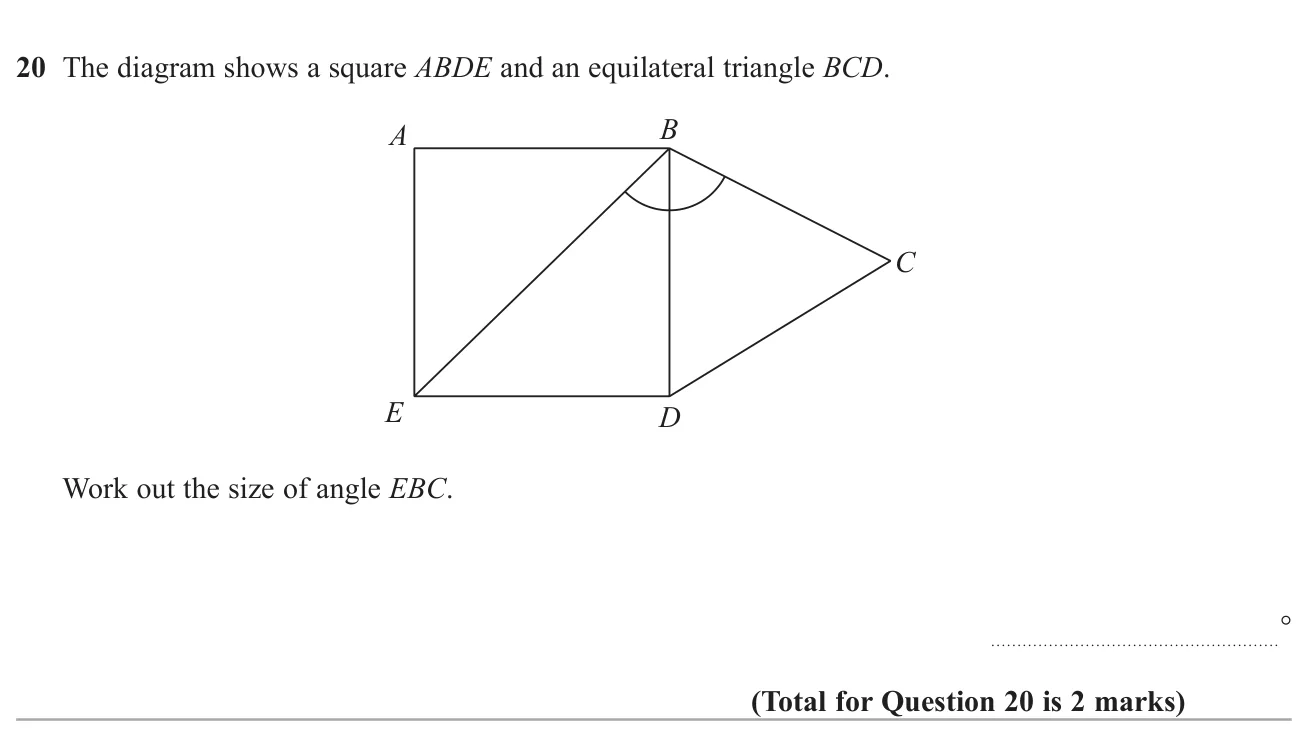
EB is a diagonal of the square, so it cuts the right angle at B in half: angle EBD=45∘.
The triangle is equilateral, so angle DBC=60∘.
Angle EBC=45+60=105∘
Watch out: Using 90° for angle EBD.
© Pearson Education Ltd. June 2019 Paper 3 (Foundation, calculator), question 21.
Show answer
Worked solution Checked against the mark scheme
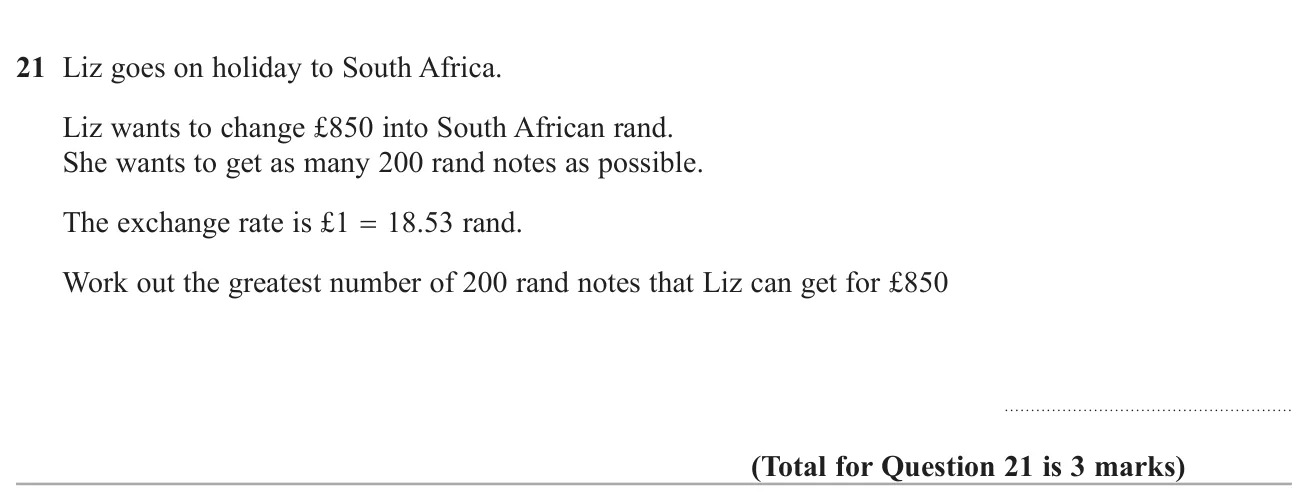
850×18.53=15750.5 rand
15750.5÷200=78.7525
Only whole notes count, so 78 notes.
Watch out: Rounding 78.75 up to 79.
© Pearson Education Ltd. June 2019 Paper 3 (Foundation, calculator), question 22.
Show answer
Worked solution Checked against the mark scheme
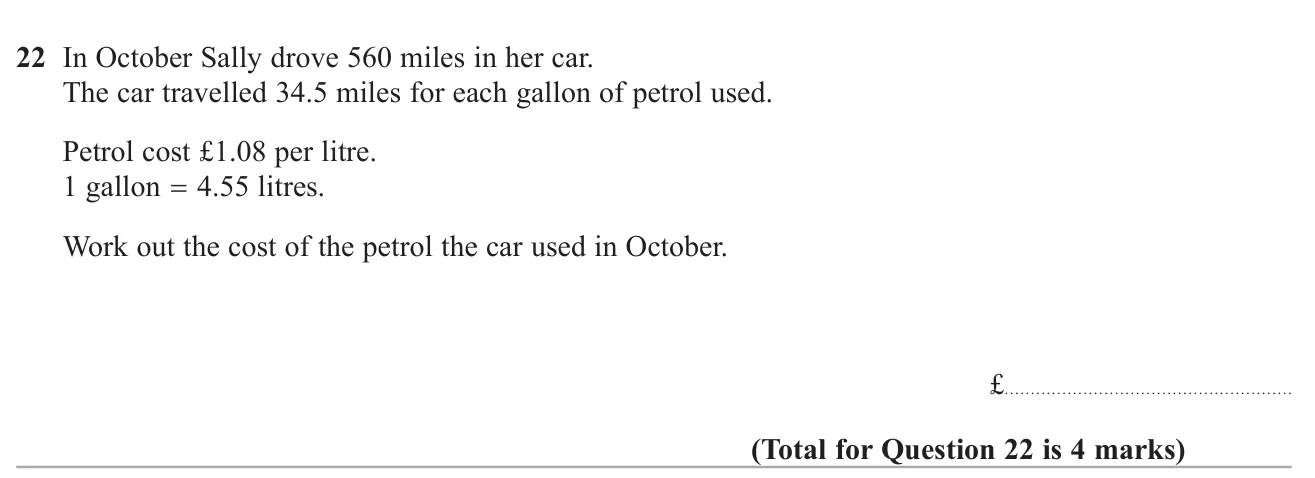
Gallons: 560÷34.5=16.231...
Litres: 16.231...×4.55=73.855...
Cost: 73.855...×1.08=£79.76
Watch out: Multiplying by 4.55 in the wrong place, e.g. dividing gallons by 4.55.
Question 23
Ratio5 marksGrade 4Calculator © Pearson Education Ltd. June 2019 Paper 3 (Foundation, calculator), question 23.
Show answer
Worked solution Checked against the mark scheme
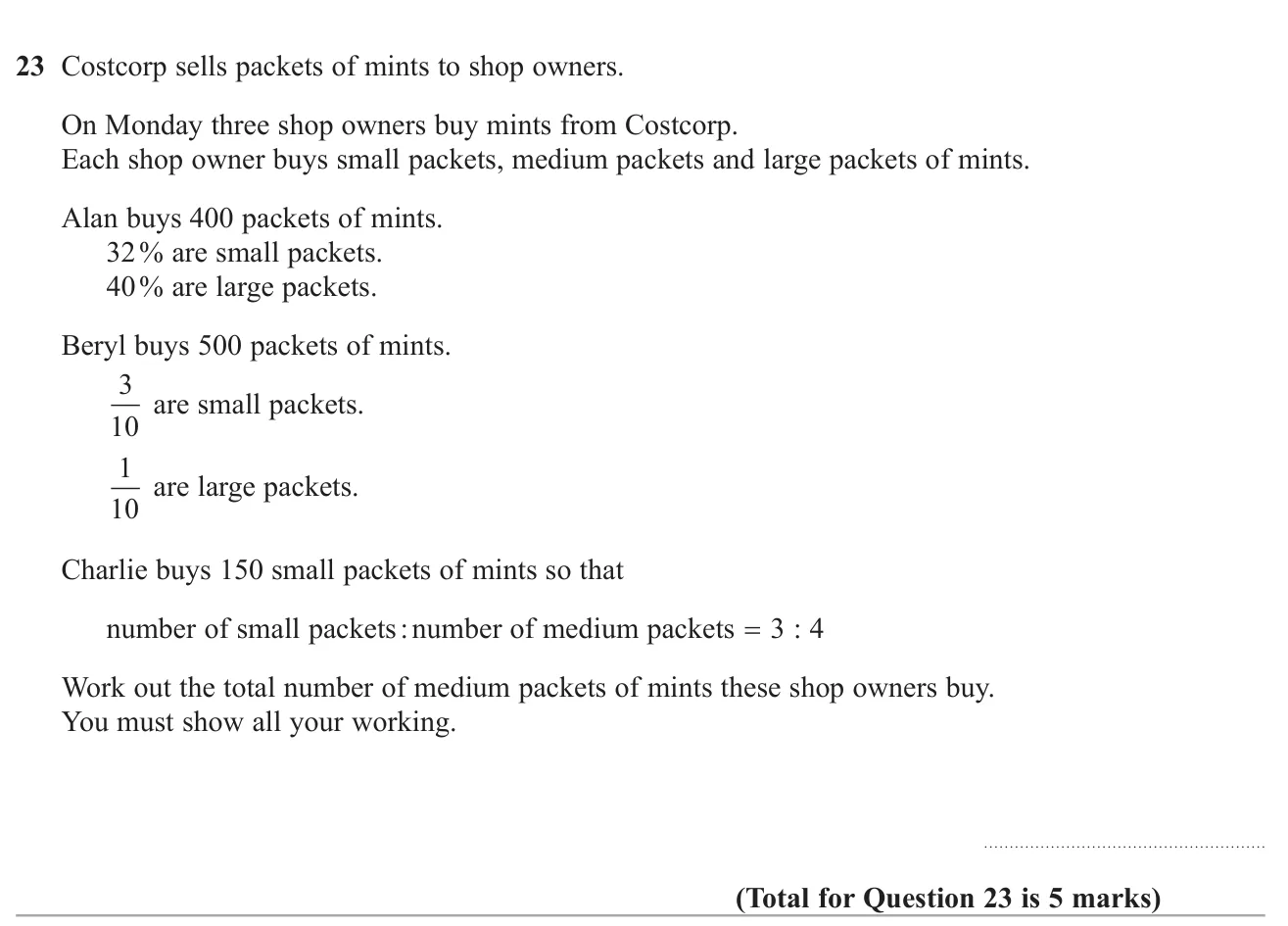
Alan: 100−32−40=28%, and 0.28×400=112
Beryl: 1−103−101=106, and 106×500=300
Charlie: 150÷3=50, so medium =4×50=200
Total: 112+300+200=612
Watch out: For Charlie, sharing 150 in the ratio 3 : 4 instead of scaling it up.
© Pearson Education Ltd. June 2019 Paper 3 (Foundation, calculator), question 24.
Show answer
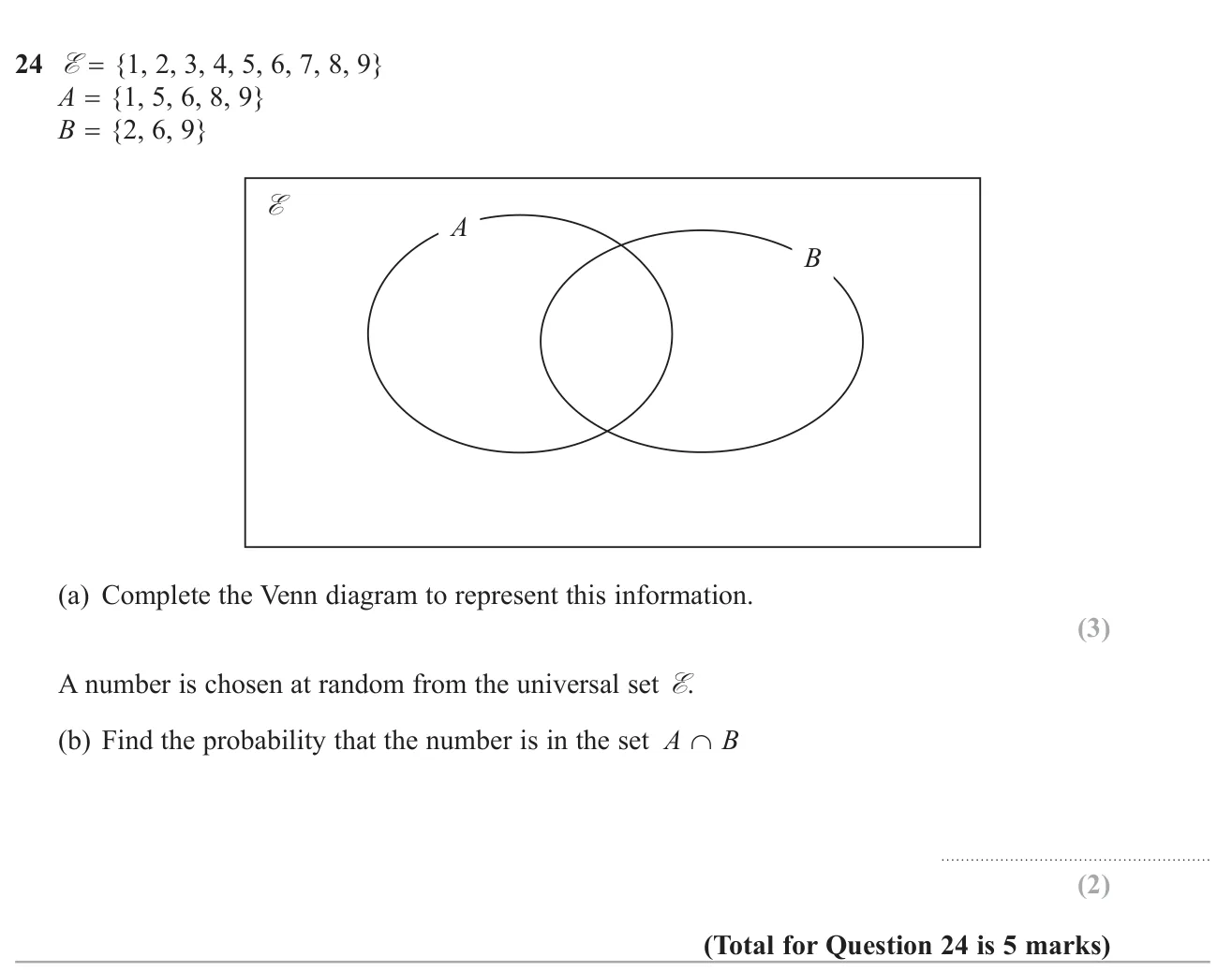
| (a) | Intersection: 6, 9; A only: 1, 5, 8; B only: 2; outside: 3, 4, 7 | 3 marks |
|---|
| (b) | 92 | 2 marks |
|---|
Worked solution Checked against the mark scheme
(a) In both A and B: 6, 9
A only: 1, 5, 8. B only: 2. Neither: 3, 4, 7.
(b) A∩B={6,9}, 2 numbers out of 9.
P=92
Watch out: Forgetting to place 3, 4 and 7 outside both circles.
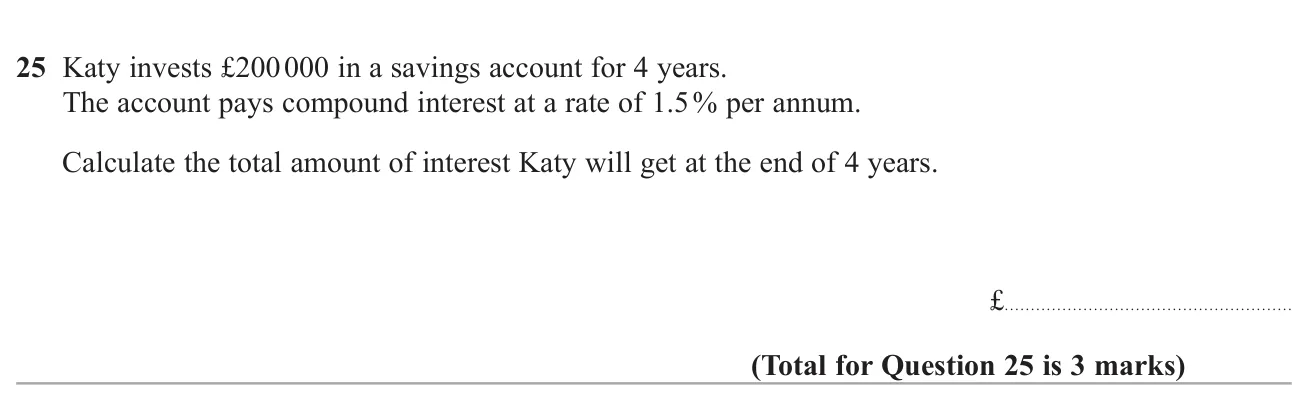
© Pearson Education Ltd. June 2019 Paper 3 (Foundation, calculator), question 25.
Show answer
Worked solution Checked against the mark scheme
Multiplier for 1.5% interest: 1.015
200000×1.0154=212272.71
Interest: 212272.71−200000=£12272.71
Watch out: Using simple interest: 4 × 3000 = £12 000.
© Pearson Education Ltd. June 2019 Paper 3 (Foundation, calculator), question 26.
Show answer
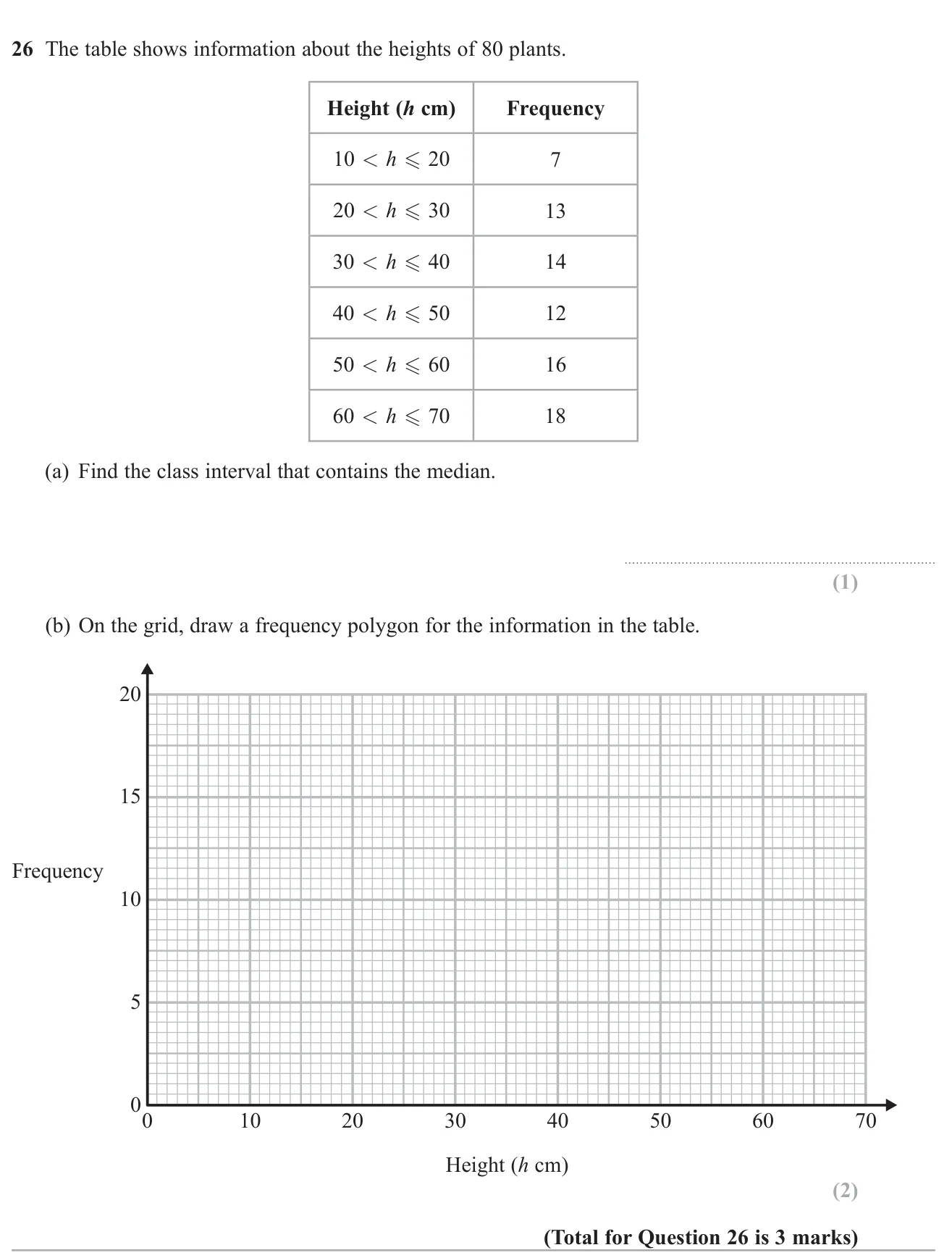
| (a) | 40<h≤50 | 1 mark |
|---|
| (b) | Points at (15, 7), (25, 13), (35, 14), (45, 12), (55, 16), (65, 18) joined with straight lines | 2 marks |
|---|
Worked solution Checked against the mark scheme
(a) 80 plants, so the median is about the 40th–41st value.
Running totals: 7, 20, 34, 46, ... The 40th value is in 40<h≤50.
(b) Plot each frequency at the middle of its class: (15, 7), (25, 13), (35, 14), (45, 12), (55, 16), (65, 18). Join with straight lines.
Watch out: In (b), plotting at the class ends (10, 20, ...) instead of the midpoints.
© Pearson Education Ltd. June 2019 Paper 3 (Foundation, calculator), question 27.
Show answer
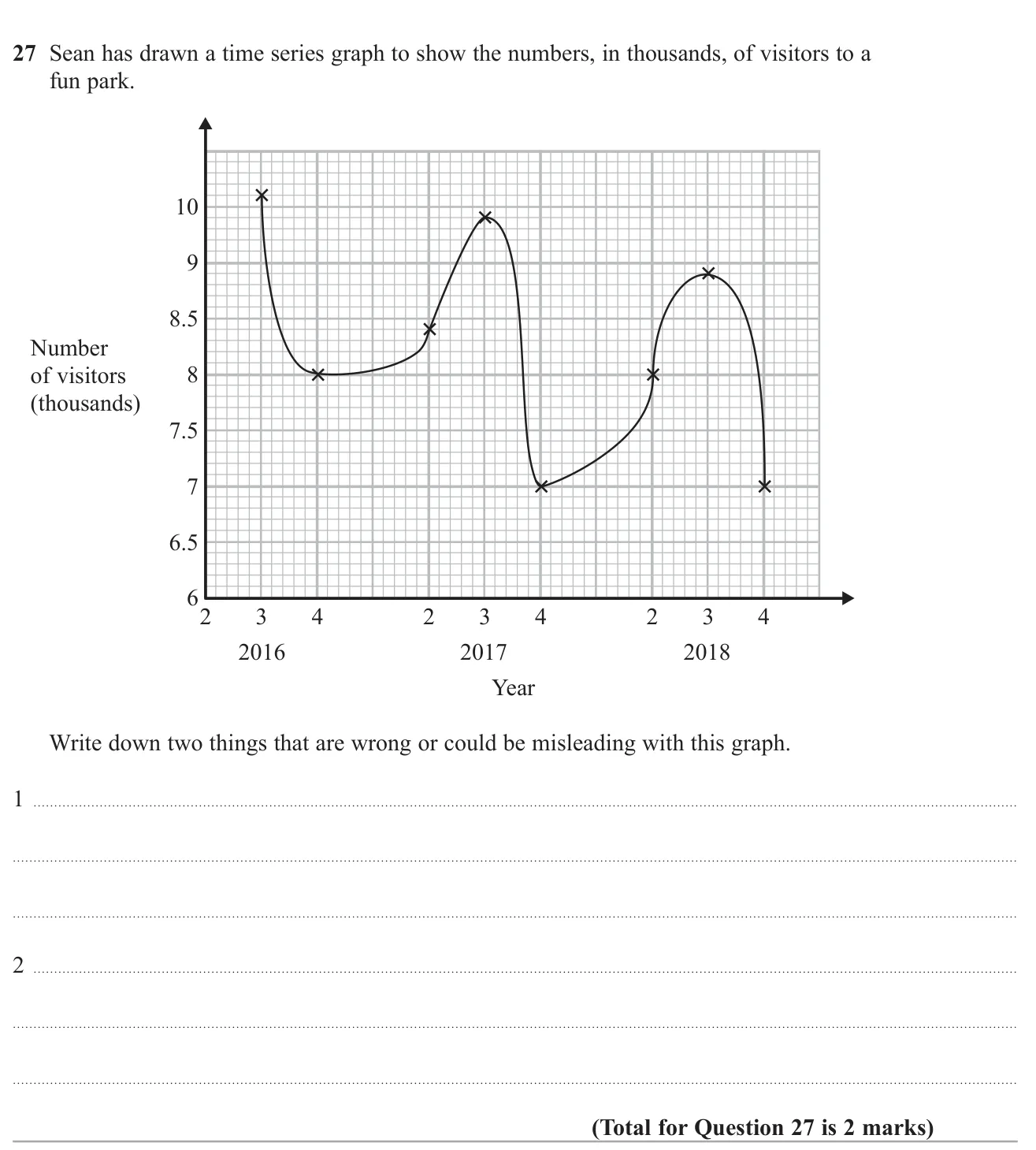
| Answer | Any two, e.g. points joined with curves not straight lines; the vertical axis starts at 6 not 0; quarter 1 is missing; the 2, 3, 4 labels are unclear | 2 marks |
|---|
Worked solution Checked against the mark scheme
Things wrong with the graph:
1. The points are joined with curves; a time series should use straight lines.
2. The vertical axis starts at 6, which exaggerates the changes.
Other valid points: the first quarter of each year is missing, and it is not clear what 2, 3, 4 on the horizontal axis mean.
Watch out: Saying 'there is no title', which does not score.
© Pearson Education Ltd. June 2019 Paper 3 (Foundation, calculator), question 28.
Show answer
Worked solution Checked against the mark scheme
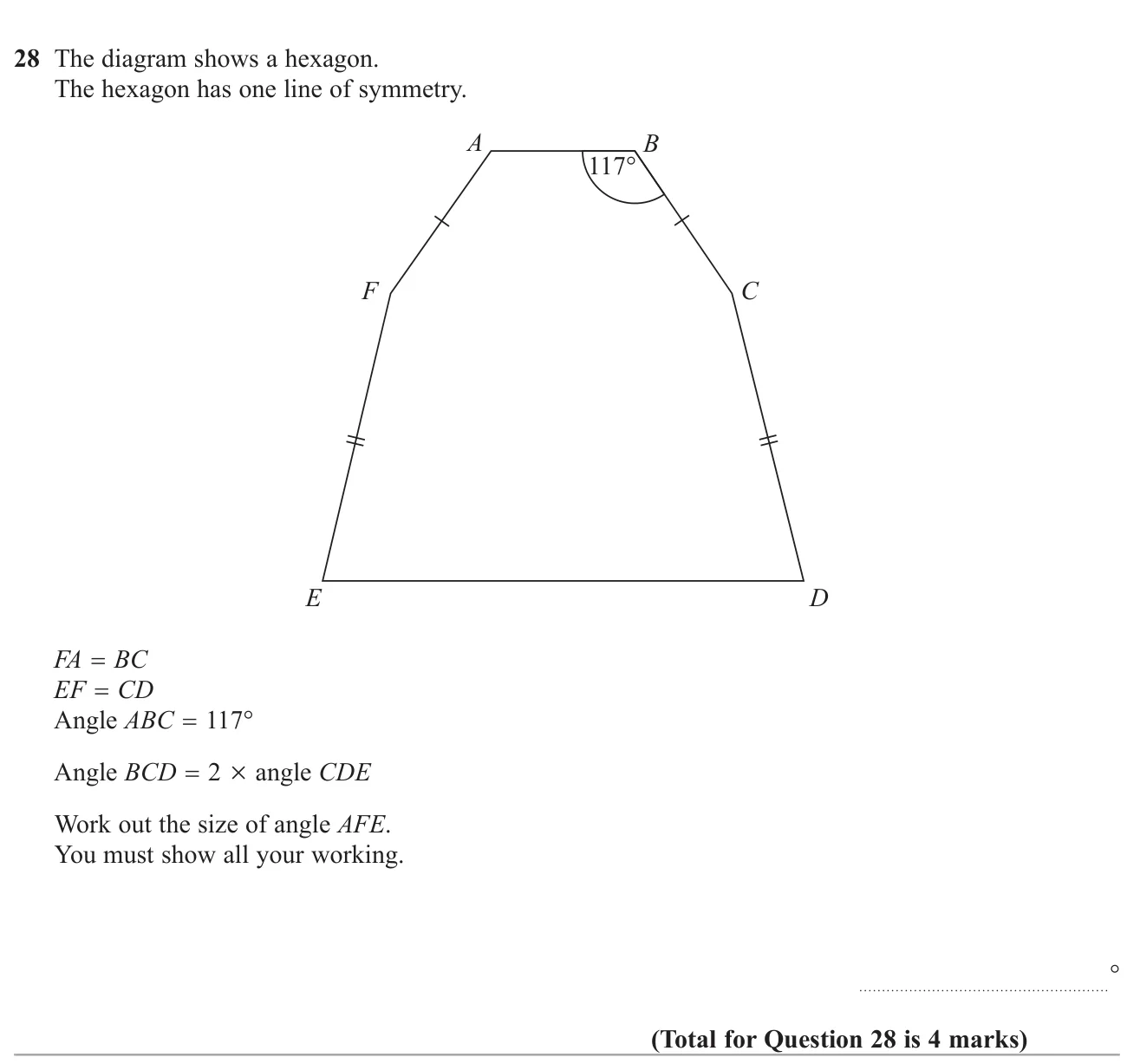
Interior angles of a hexagon: (6−2)×180=720∘
By symmetry A=B=117∘; let D=E=x and C=F=2x.
117+117+2x+2x+x+x=720, so 6x=486 and x=81
Angle AFE=2×81=162∘
Watch out: Giving 81°, the value of angle CDE, as the answer.
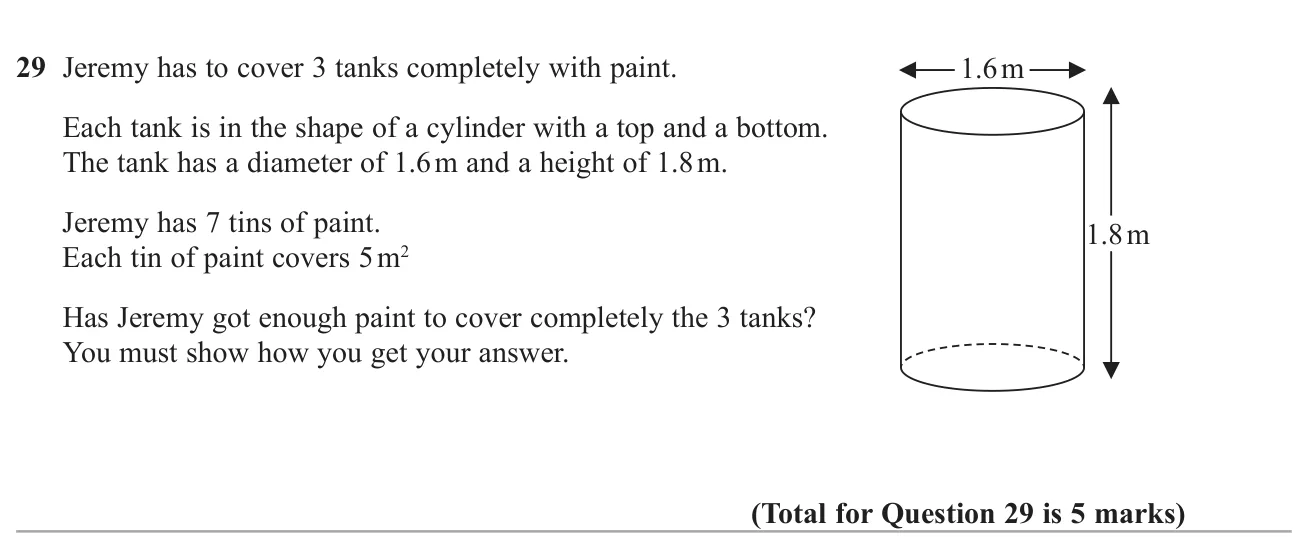
© Pearson Education Ltd. June 2019 Paper 3 (Foundation, calculator), question 29.
Show answer
| Answer | No: total area about 39.2 m2 needs about 7.84 tins (8), but the 7 tins cover only 35 m2 | 5 marks |
|---|
Worked solution Checked against the mark scheme
Radius =0.8 m
Top and bottom: 2×π×0.82=4.021...
Curved surface: 2×π×0.8×1.8=9.047...
One tank: 13.069... m²; three tanks: 39.21 m²
Paint covers 7×5=35 m² <39.21, so No, he does not have enough.
Watch out: Using the diameter 1.6 as the radius, or leaving out the top or bottom.
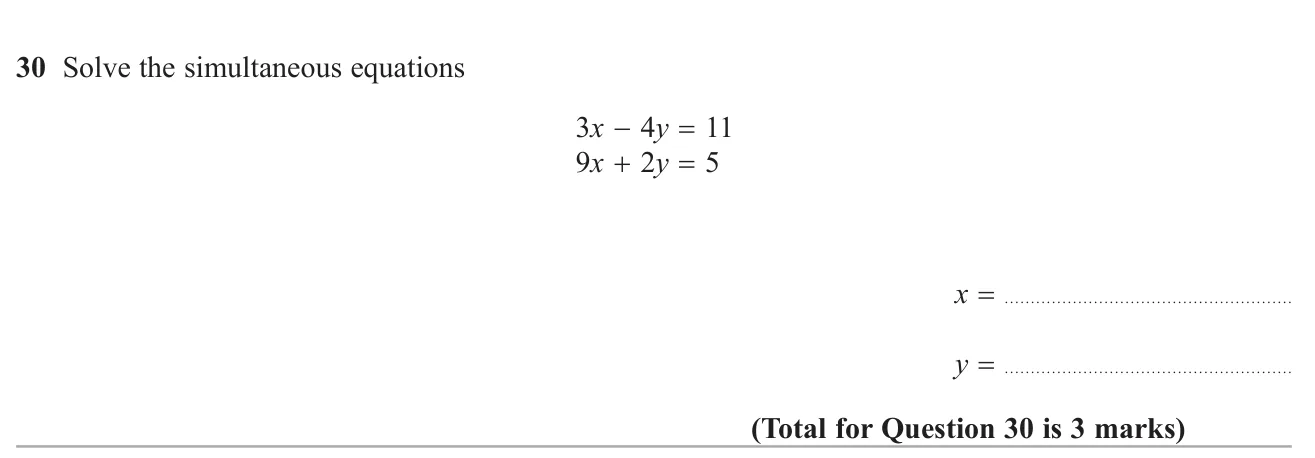
© Pearson Education Ltd. June 2019 Paper 3 (Foundation, calculator), question 30.
Show answer
| Answer | x=1, y=−2 | 3 marks |
|---|
Worked solution Checked against the mark scheme
3x−4y=11 and 9x+2y=5
Double the second: 18x+4y=10
Add to the first: 21x=21, so x=1
9(1)+2y=5, so 2y=−4 and y=−2
Watch out: Sign errors when eliminating, e.g. subtracting instead of adding.
Finished the paper?
Add up your marks for all three papers and see what grade that would have been.