Circle theorems are rules about the angles you get when chords, radii and tangents meet a circle. They are Higher only, and questions usually ask for a reason at each stage, so the theorem wording earns marks too.
Key facts
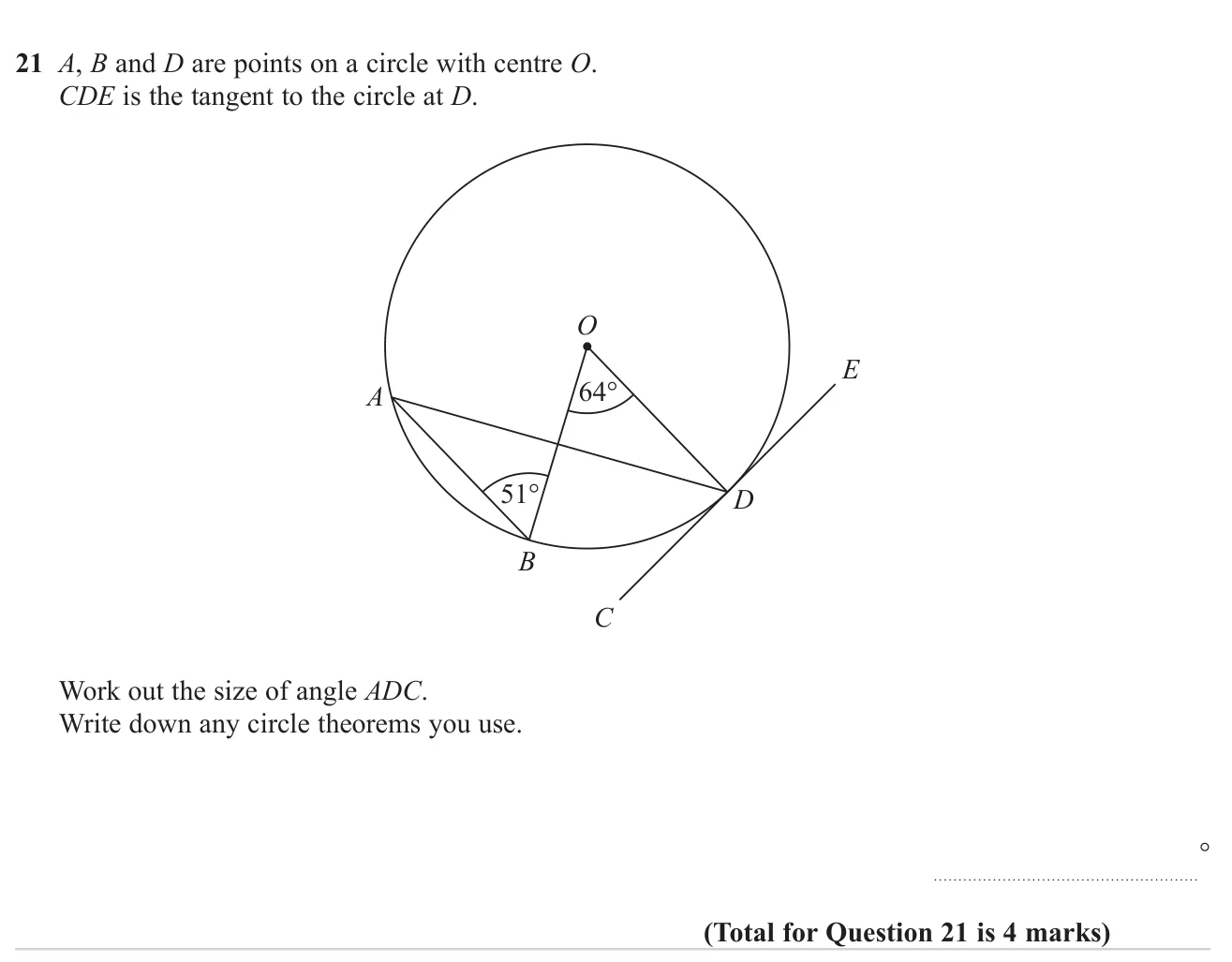
The angle at the centre is twice the angle at the circumference from the same arc.
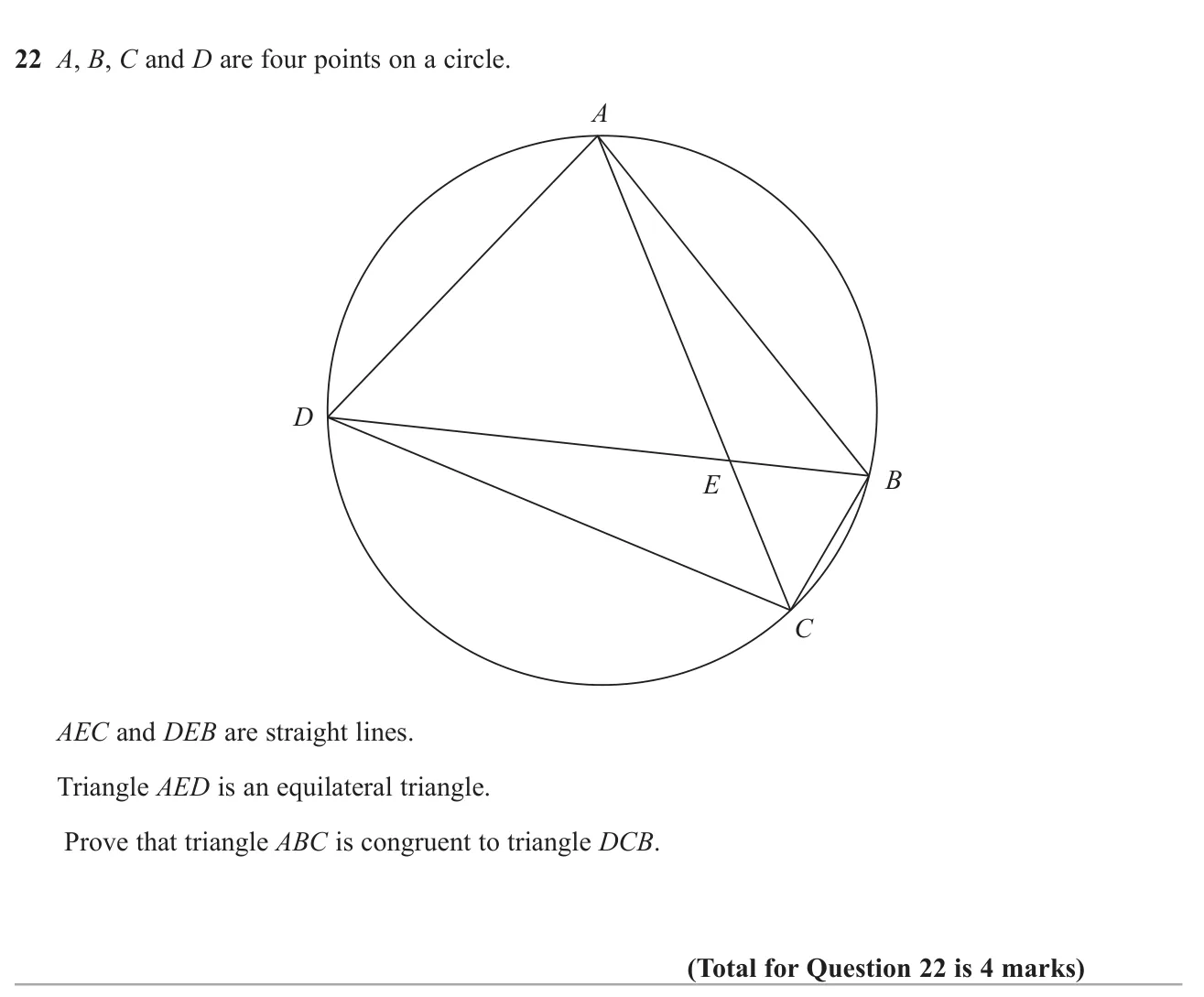
The angle in a semicircle is 90∘. Angles in the same segment are equal.
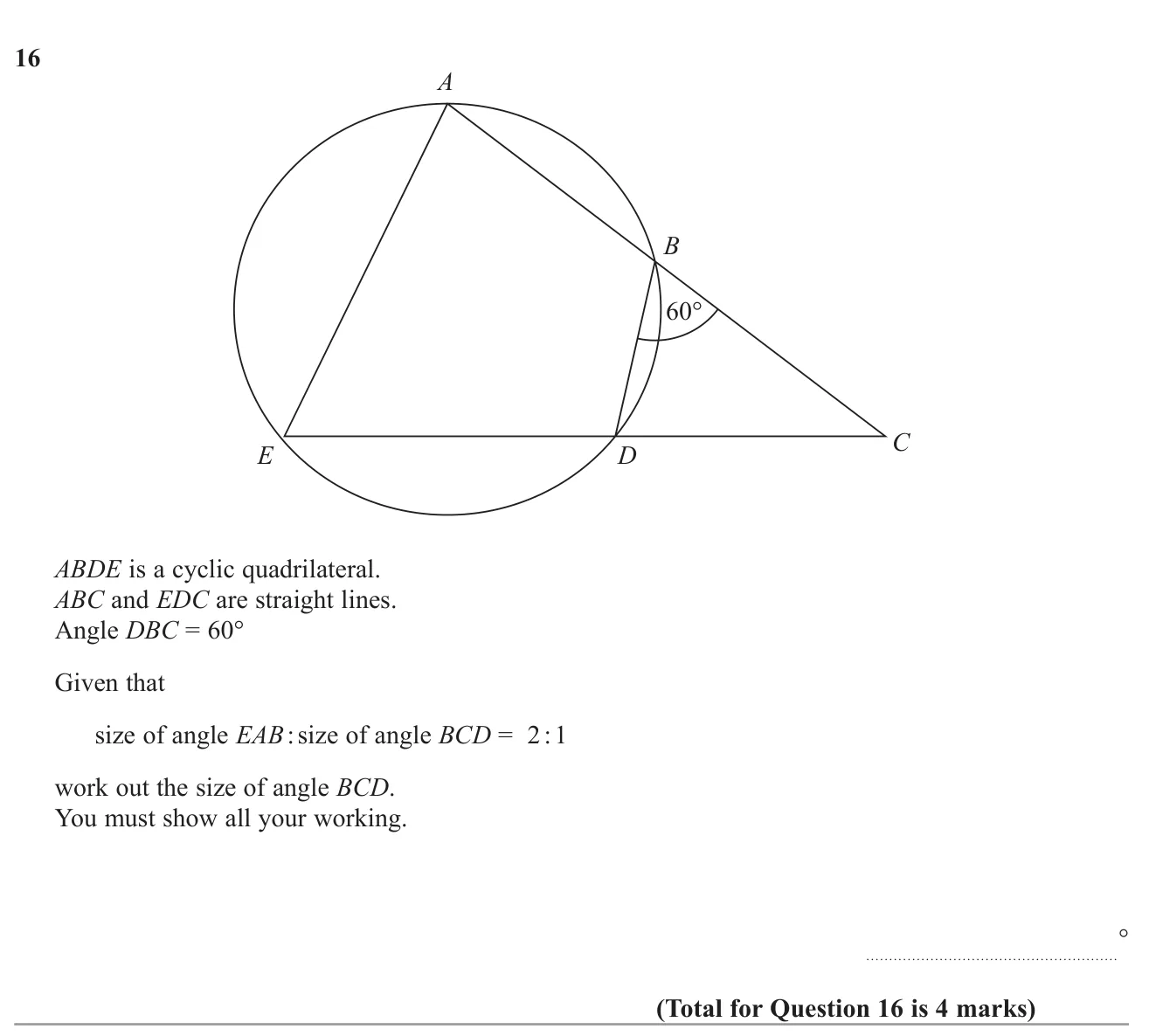
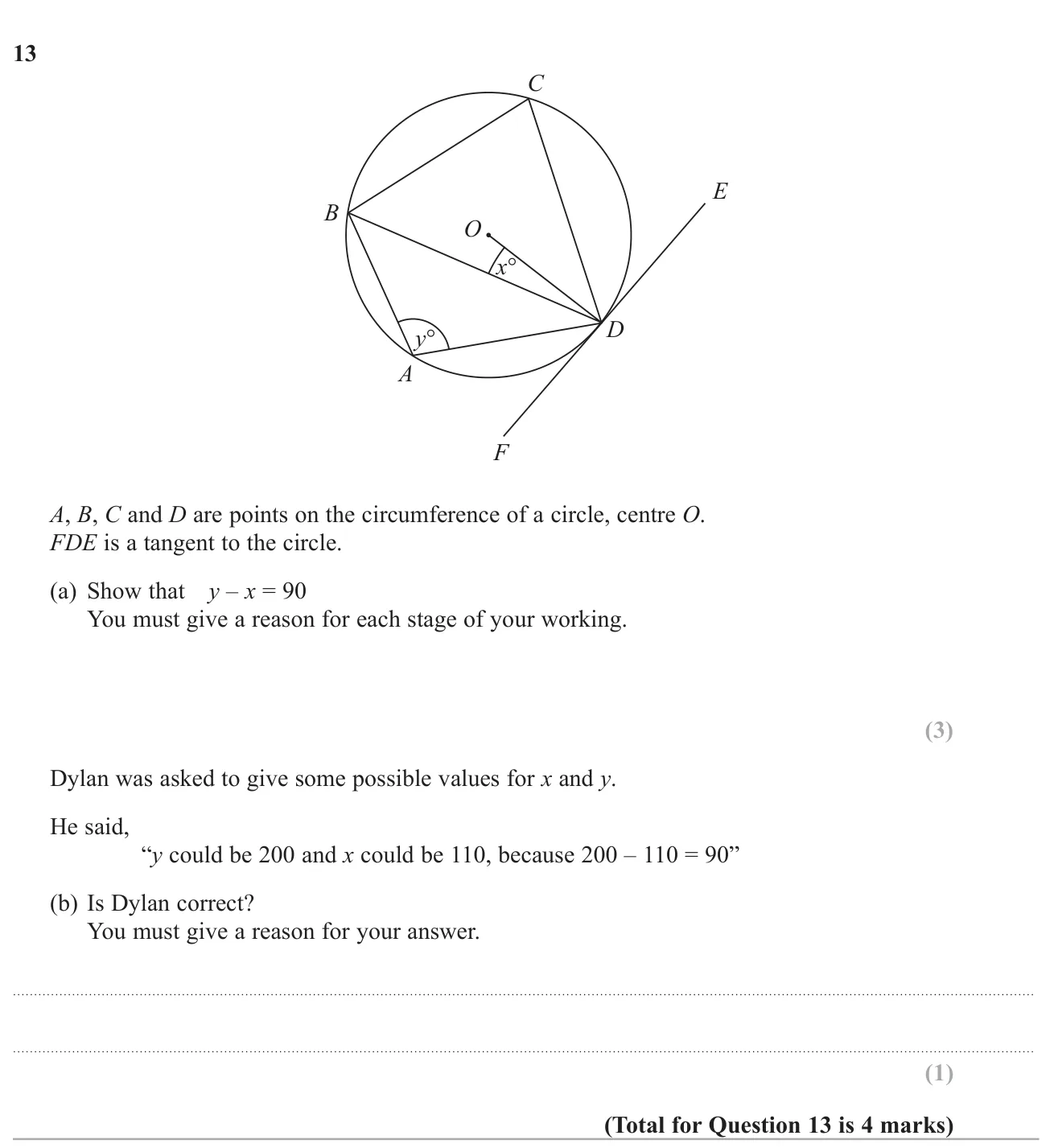
Opposite angles in a cyclic quadrilateral add up to 180∘.
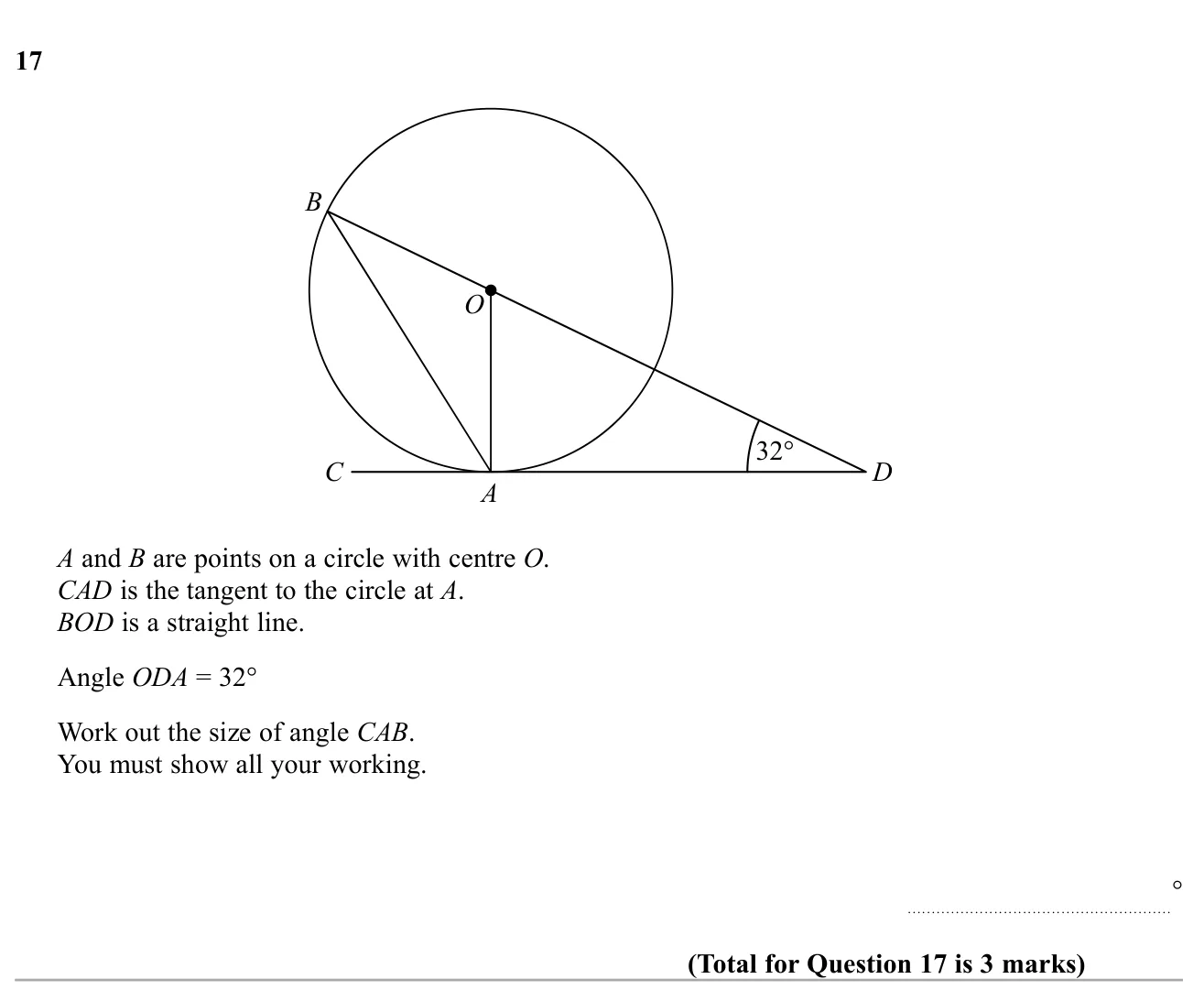
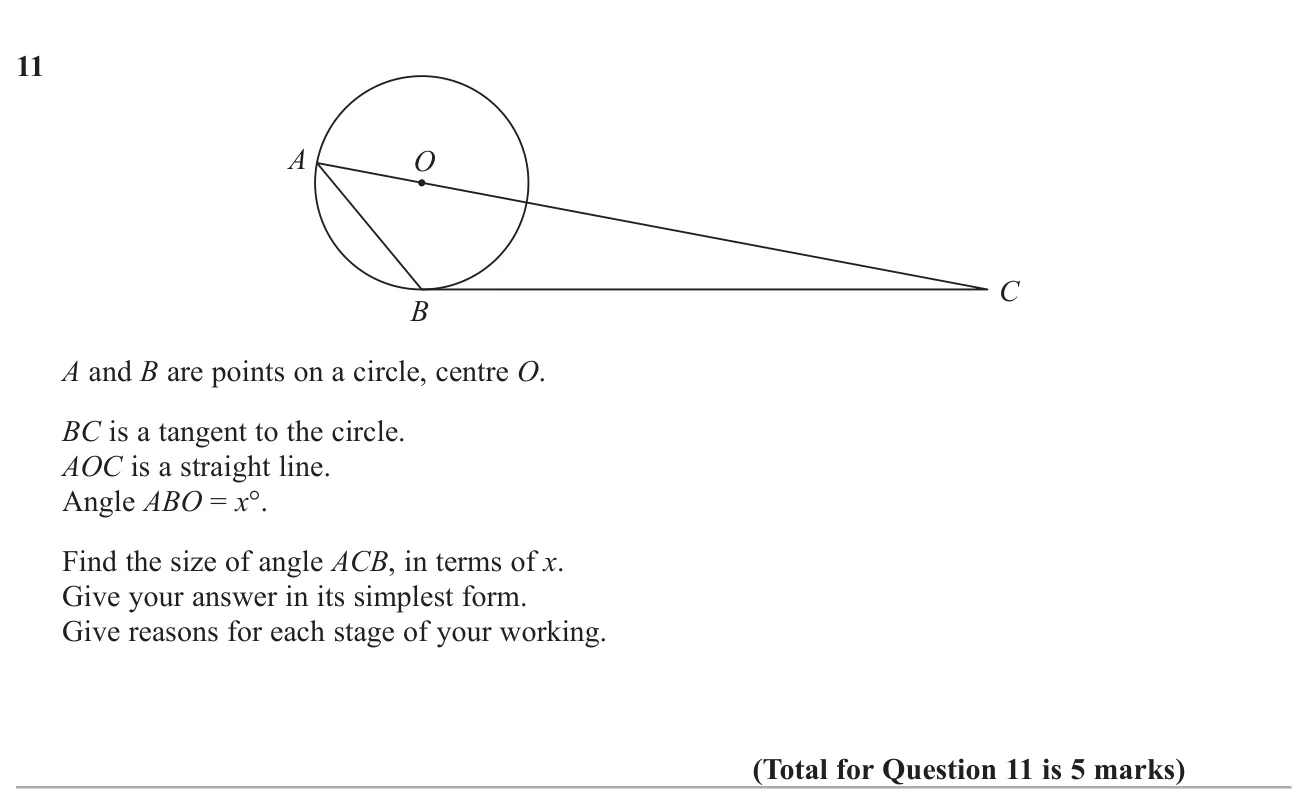
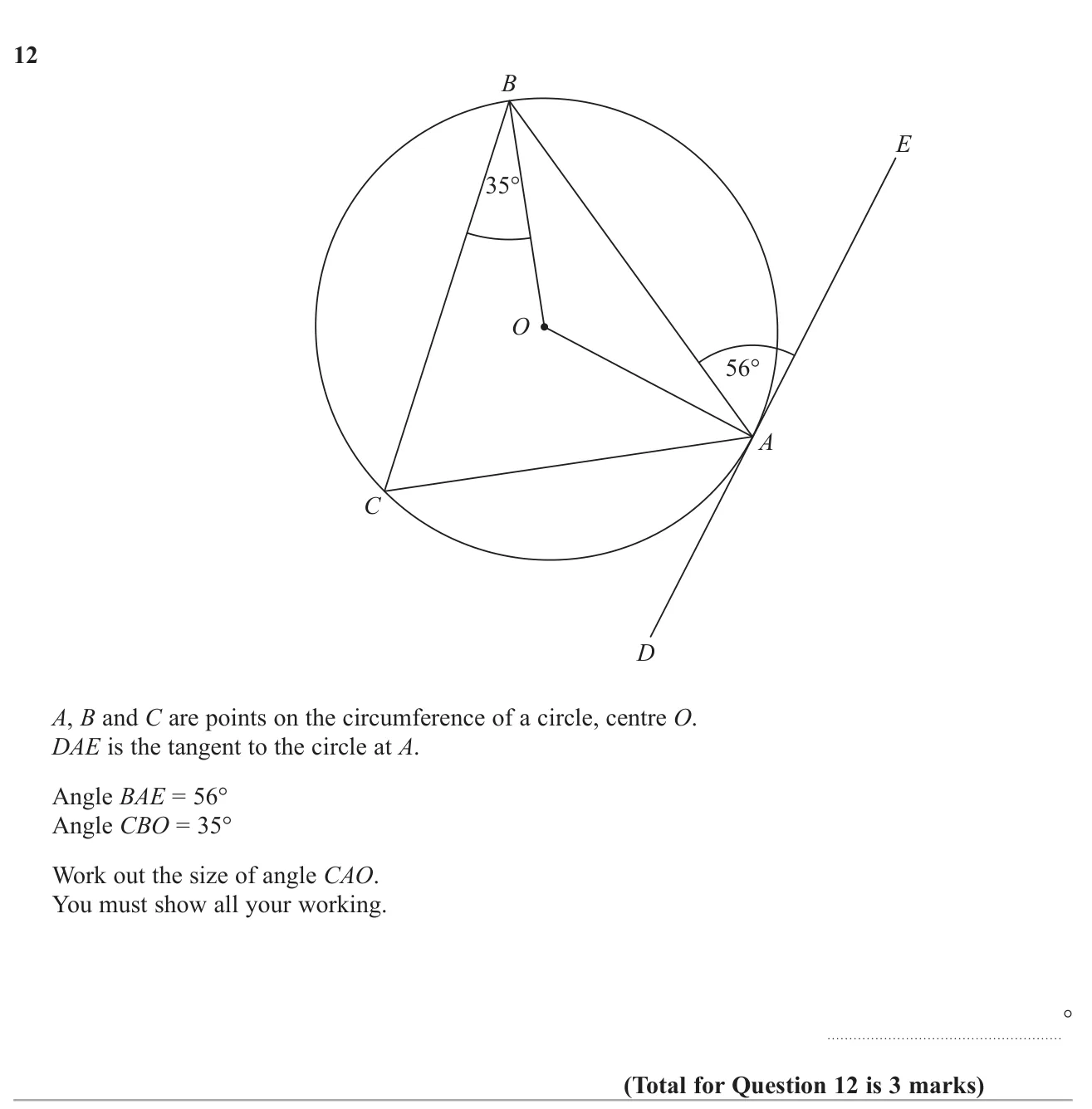
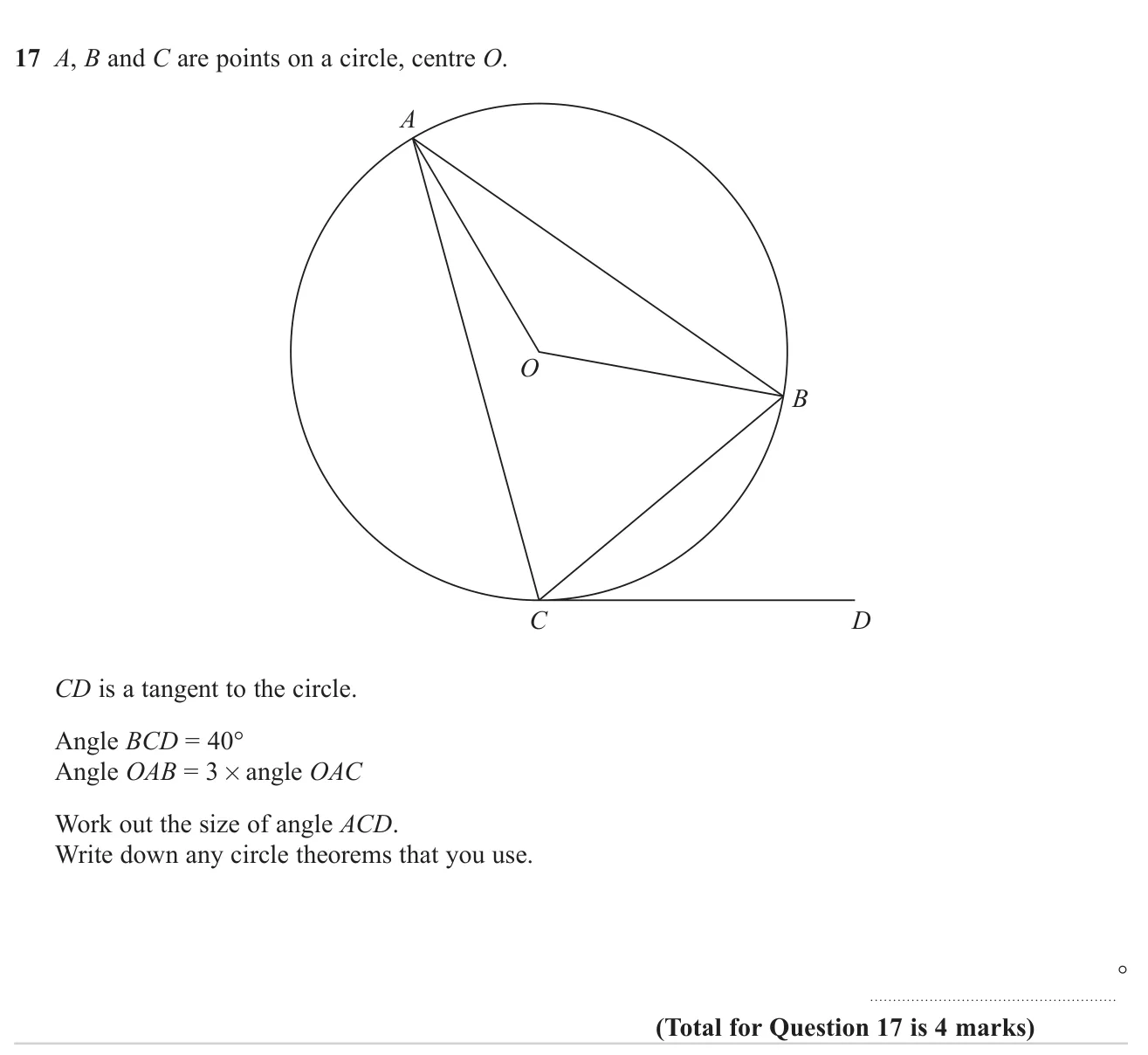
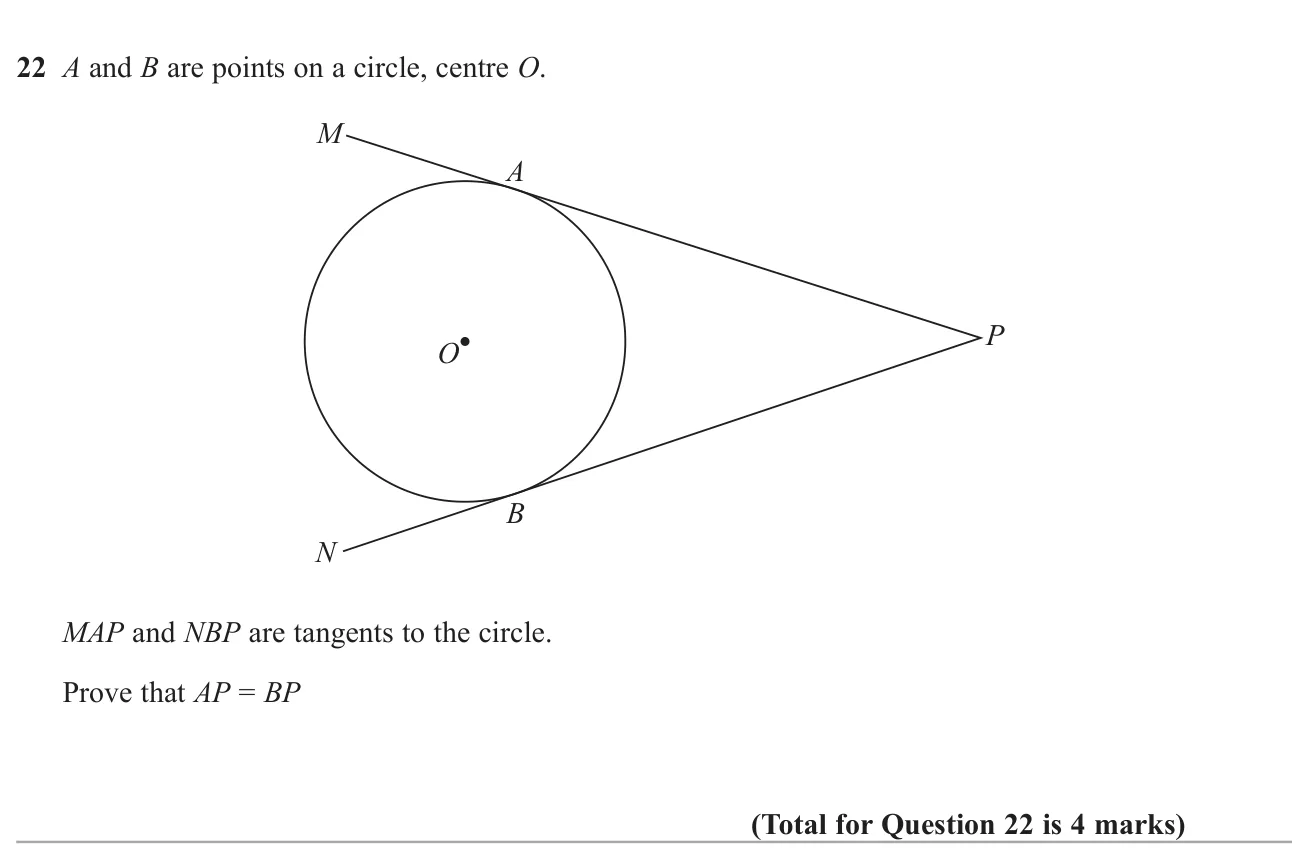
A tangent meets a radius at 90∘. Two tangents from the same point outside the circle are equal in length.
The perpendicular from the centre to a chord bisects the chord.
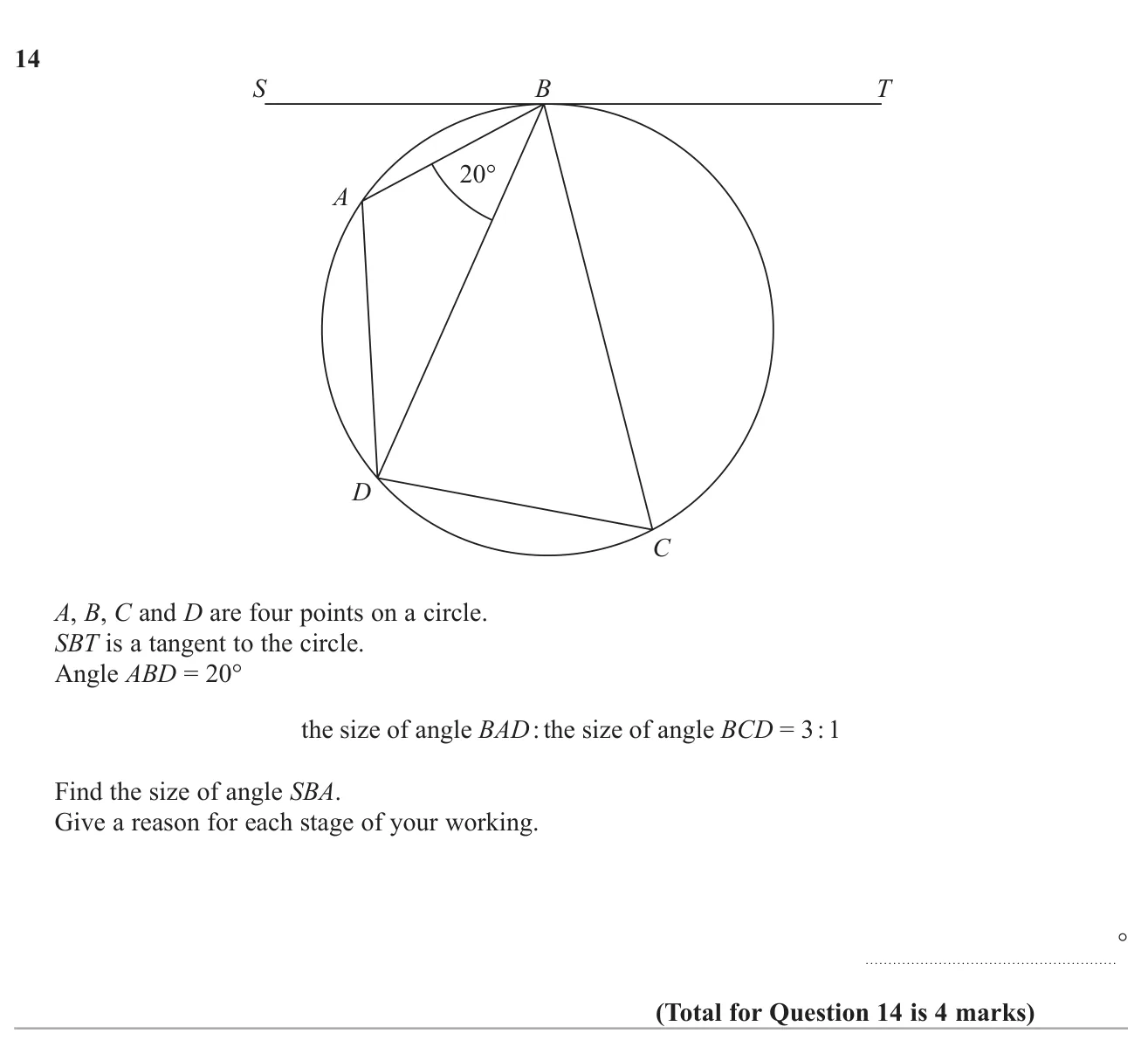
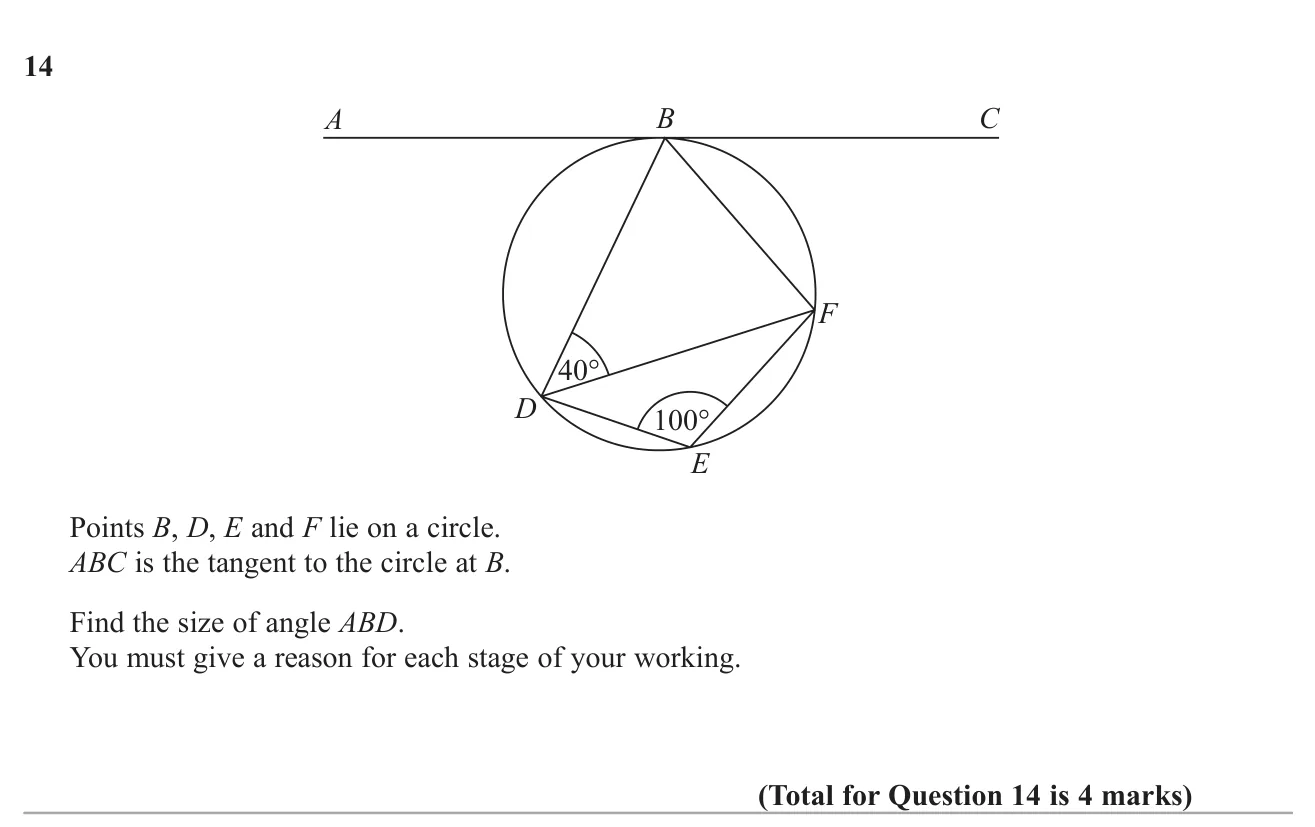
Alternate segment theorem: the angle between a tangent and a chord equals the angle in the alternate segment.
Finding an angle with reasons
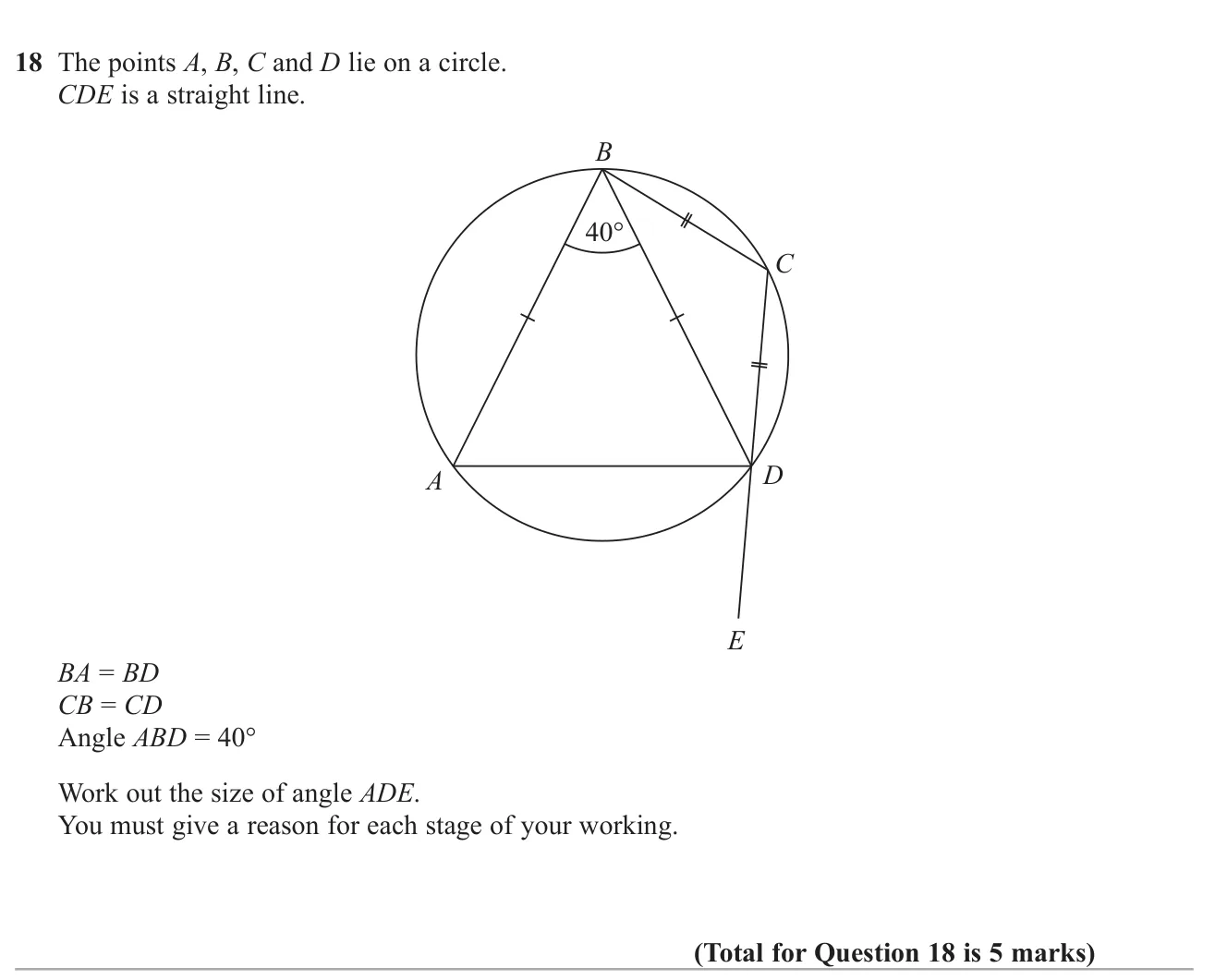
Mark the given angles on the diagram. Two radii make an isosceles triangle.
Look for a tangent, a diameter, a cyclic quadrilateral or angles on the same arc.
Find one angle at a time, with a reason on each line, using ordinary angle facts too.
Writing a proof
Call a starting angle x and write each new angle in terms of x, with a reason.
To prove a theorem itself, join the centre to the points on the circle: equal radii give isosceles triangles. For two tangents from a point, use congruent triangles (RHS).
End with a sentence stating what you proved. Never use that result as a reason.
Worked examples
Example 1Higher · grade 6
A, B, C and D lie on a circle with centre O, in that order, so ABCD is a cyclic quadrilateral. C is on the minor arc BD and A is on the major arc BD. The angle at the centre standing on the minor arc BD is 140∘. Find angle BAD and angle BCD, giving reasons.
Show the solution
Angle BAD stands on the minor arc BD, the same arc as the 140∘ angle at the centre. Angle BAD=140÷2=70∘ (the angle at the centre is twice the angle at the circumference). Angle BCD=180−70=110∘ (opposite angles in a cyclic quadrilateral add up to 180∘). Check: angle BCD stands on the major arc, and the reflex angle at the centre is 360−140=220∘, half of which is 110∘.
Example 2Higher · grade 7
A and B are points on a circle with centre O. TA is a tangent at A, with T on the same side of OA as B. Angle OBA=28∘. Find angle TAB, the angle between the tangent and the chord AB. Give reasons.
Show the solution
OA=OB (both radii), so triangle OAB is isosceles. Angle OAB=28∘ (base angles of an isosceles triangle are equal). Angle OAT=90∘ (a tangent meets a radius at 90∘). Angle TAB=90−28=62∘.
Common mistakes
Vague reasons like 'isosceles'. Say which sides are equal and quote the theorem in full.
Using the 90∘ between a tangent and a chord. The right angle is only between a tangent and a radius.
Halving the wrong centre angle: check which arc you need; it may be the reflex angle.
Exam tips
Reasons usually earn marks of their own: a correct angle with no reasons may not get full marks.
Write reasons as full sentences using the standard wording, e.g. 'opposite angles in a cyclic quadrilateral add up to 180∘', not just 'cyclic quad'.
Questions people ask
How many circle theorems are there for GCSE Maths?
About seven or eight: the ones in the key facts above. Learn each with its exact wording.
Are circle theorems on the Foundation paper?
No. Circle theorems are Higher tier only in Edexcel GCSE Maths.
Exam questions: Circle theorems (18, easiest first)
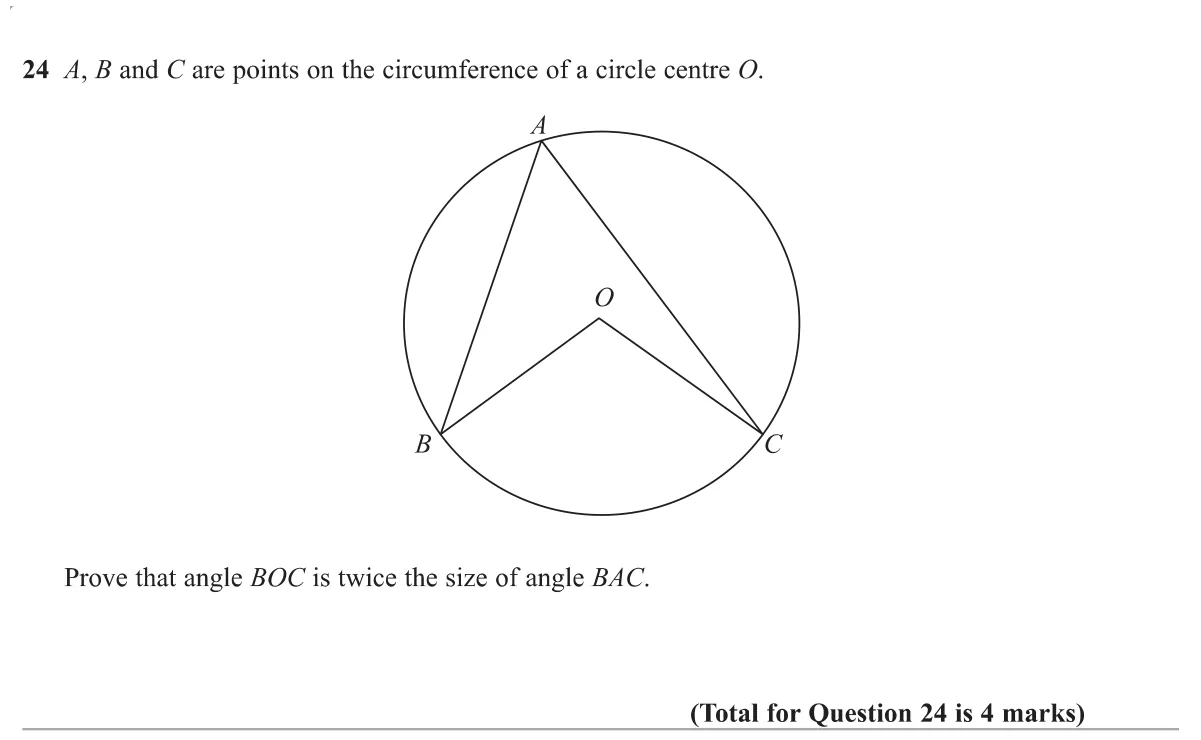
Proof using the two isosceles triangles AOB and AOC
4 marks
Worked solution Checked against the mark scheme
Join AO and extend it to D. Let ∠OAB=x and ∠OAC=y.
OA=OB (radii), so ∠OBA=x (base angles of an isosceles triangle).
Exterior angle of triangle AOB: ∠BOD=x+x=2x
Similarly ∠COD=2y
∠BOC=2x+2y=2(x+y)=2×∠BAC
Watch out: Giving no reasons (radii equal, isosceles base angles) for each step.
Also tested in these questions
Their main topic is different, but part of each one tests this topic.
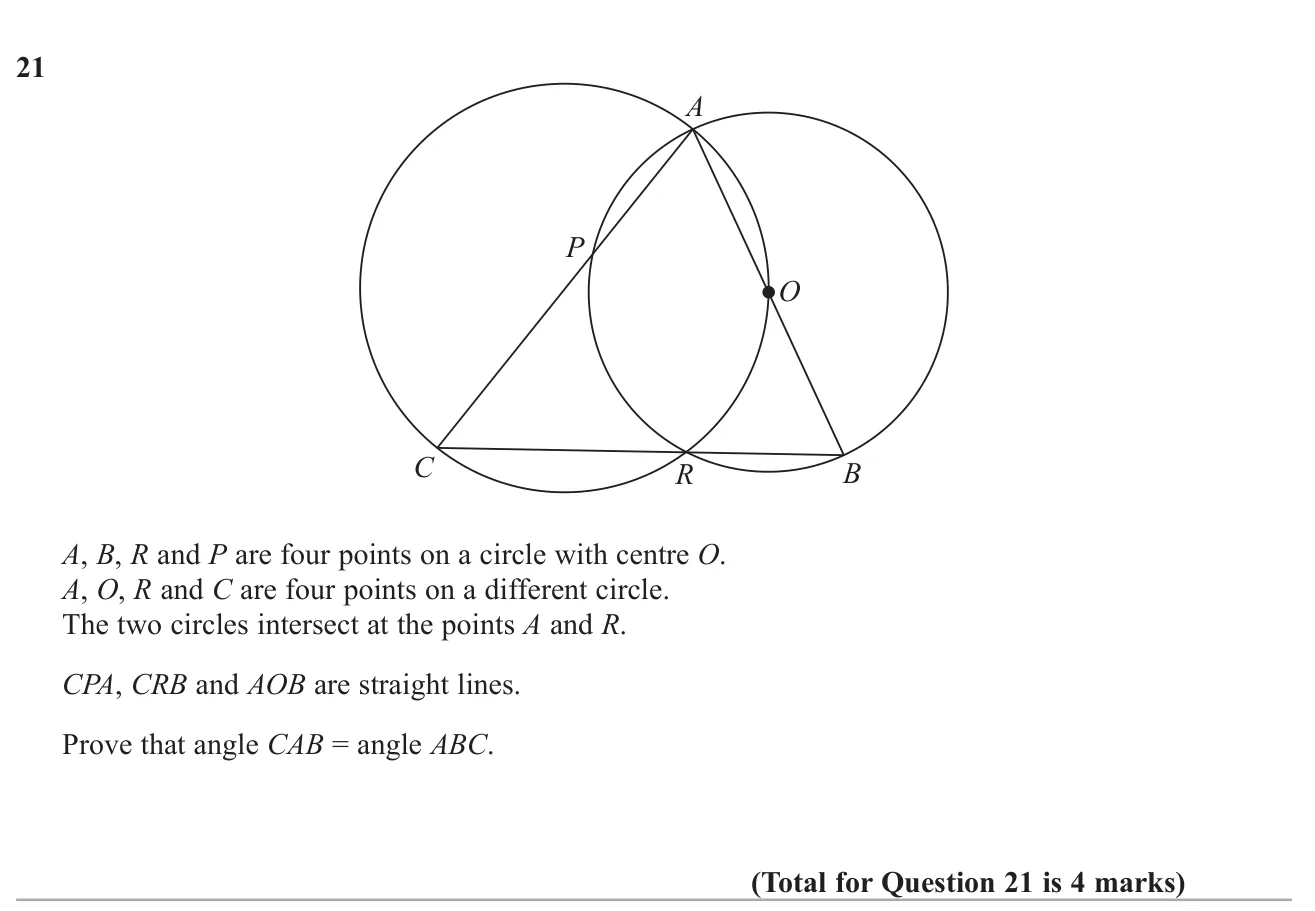
November 2024 · Paper 2 Higher · Q18: Prove that the line from the centre of a circle to a point equidistant from two others on the circle bisects the angle there.
June 2019 · Paper 3 Higher · Q22: Use a tangent and a 30° angle to find a circle's radius, then find p for a point (3p, p) on the circle.