Revision guide by The Full Marks
Similar shapes: what you need to know Similar shapes have the same angles, and one is an enlargement of the other. Finding the scale factor lets you work out missing lengths, and at Higher tier, areas and volumes too.
Foundation needs lengths in similar shapes; using area and volume scale factors is Higher only.
Key facts Length scale factor k = new length original length k = \frac{\text{new length}}{\text{original length}} k = original length new length All matching angles in similar shapes are equal. Higher: area scale factor = k 2 = k^2 = k 2 Higher: volume scale factor = k 3 = k^3 = k 3 Higher: ratio of lengths a : b a : b a : b a 2 : b 2 a^2 : b^2 a 2 : b 2 a 3 : b 3 a^3 : b^3 a 3 : b 3 Finding a missing length Match the corresponding sides using the equal angles. If one triangle sits inside the other, draw them separately and use whole lengths. Divide a pair of matching lengths to find k k k Multiply to go from small to big; divide to go from big to small. Areas and volumes (Higher) Get back to the length scale factor first: square root an area ratio, cube root a volume ratio. Then square k k k k k k Worked examples Example 1 Foundation · grade 5
In triangle A D E ADE A D E B B B A D AD A D C C C A E AE A E B C BC B C D E DE D E A B = 6 AB = 6 A B = 6 B D = 4 BD = 4 B D = 4 B C = 9 BC = 9 B C = 9 D E DE D E
Show the solution Angle A A A B C BC B C D E DE D E A B C ABC A B C A D E ADE A D E A B AB A B A D = 6 + 4 = 10 AD = 6 + 4 = 10 A D = 6 + 4 = 10 B D BD B D k = 10 6 = 5 3 k = \frac{10}{6} = \frac{5}{3} k = 6 10 = 3 5 D E = 9 × 5 3 = 15 DE = 9 \times \frac{5}{3} = 15 D E = 9 × 3 5 = 15
Example 2 Higher · grade 8
Two similar tins have surface areas 80 80 80 180 180 180 240 240 240
Show the solution Area scale factor = 180 ÷ 80 = 2.25 = 180 \div 80 = 2.25 = 180 ÷ 80 = 2.25 k = 2.25 = 1.5 k = \sqrt{2.25} = 1.5 k = 2.25 = 1.5 = 1.5 3 = 3.375 = 1.5^3 = 3.375 = 1. 5 3 = 3.375 = 240 × 3.375 = 810 = 240 \times 3.375 = 810 = 240 × 3.375 = 810
Common mistakes Matching the wrong sides. Use the equal angles to pair them up. Using the area or volume ratio as if it were the length scale factor. Thinking adding the same amount to every side keeps a shape similar. You must multiply. Exam tips Write the scale factor down clearly; it usually earns the first mark. Keep the exact scale factor (e.g. as a fraction) until the final answer to avoid rounding errors. Questions people ask How do you know if two shapes are similar? All matching angles are equal and every pair of matching sides is in the same ratio. For triangles, equal angles alone are enough.
How do you find the volume scale factor? Cube the length scale factor. If lengths double, volumes are 2 3 = 8 2^3 = 8 2 3 = 8
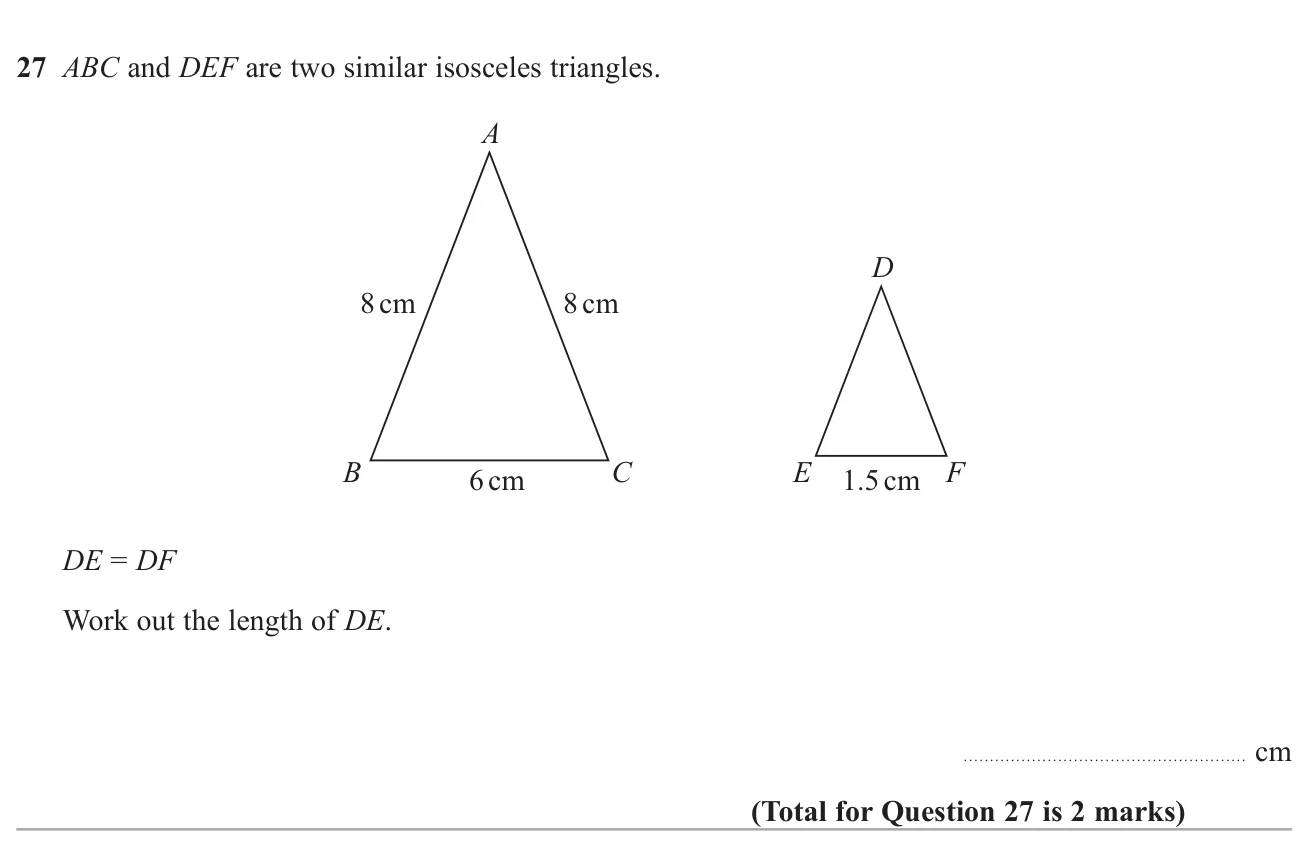
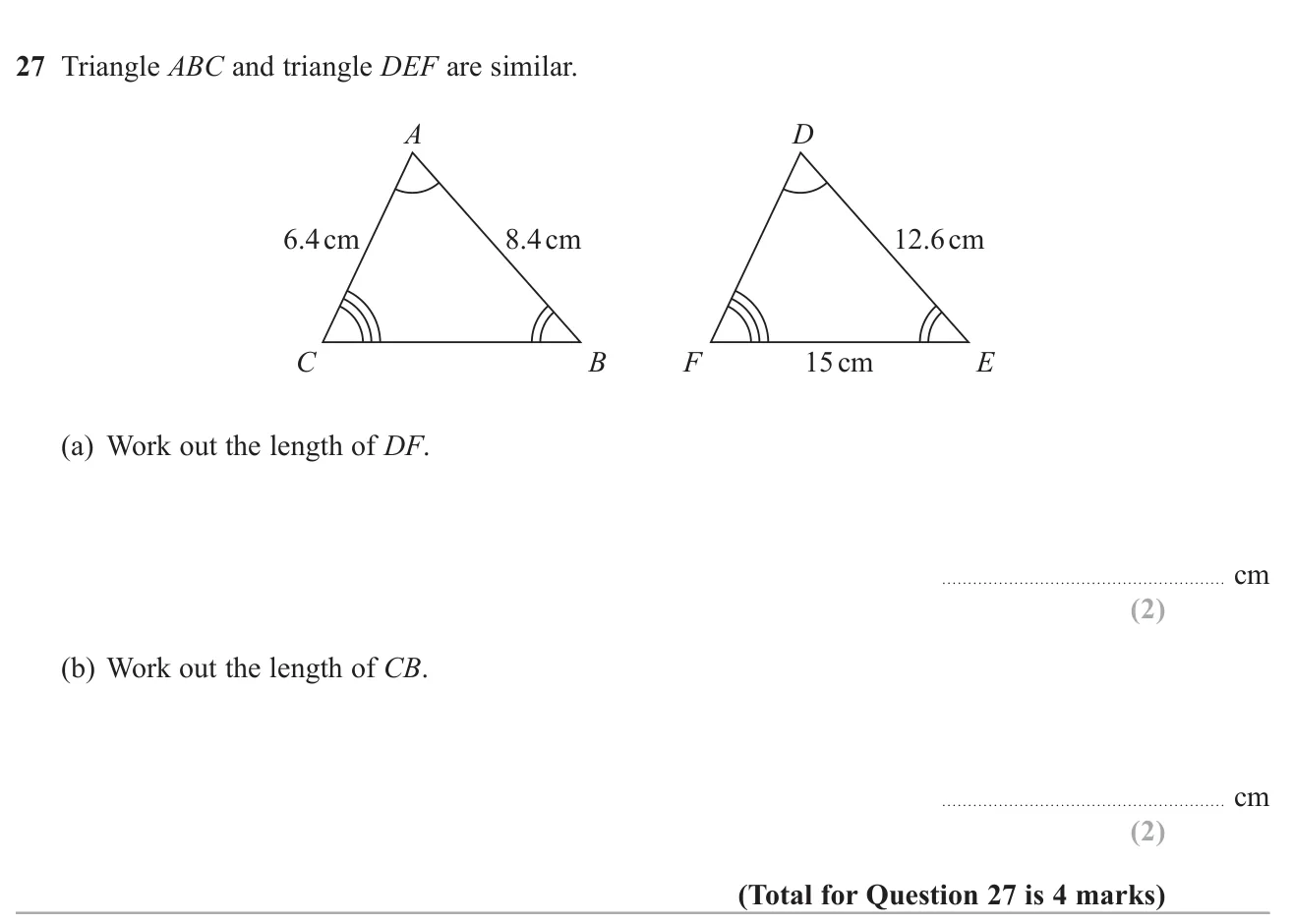
Exam questions: Similar shapes (22, easiest first) © Pearson Education Ltd. June 2024 Paper 2 (Foundation, calculator), question 27.
Worked solution Checked against the mark scheme
The bases are B C = 6 BC = 6 B C = 6 E F = 1.5 EF = 1.5 E F = 1.5 1.5 ÷ 6 = 1 4 1.5 \div 6 = \frac{1}{4} 1.5 ÷ 6 = 4 1
D E = 8 × 1 4 = 2 DE = 8 \times \frac{1}{4} = 2 D E = 8 × 4 1 = 2
Watch out: Subtracting (8 − 4.5 = 3.5 8 - 4.5 = 3.5 8 − 4.5 = 3.5
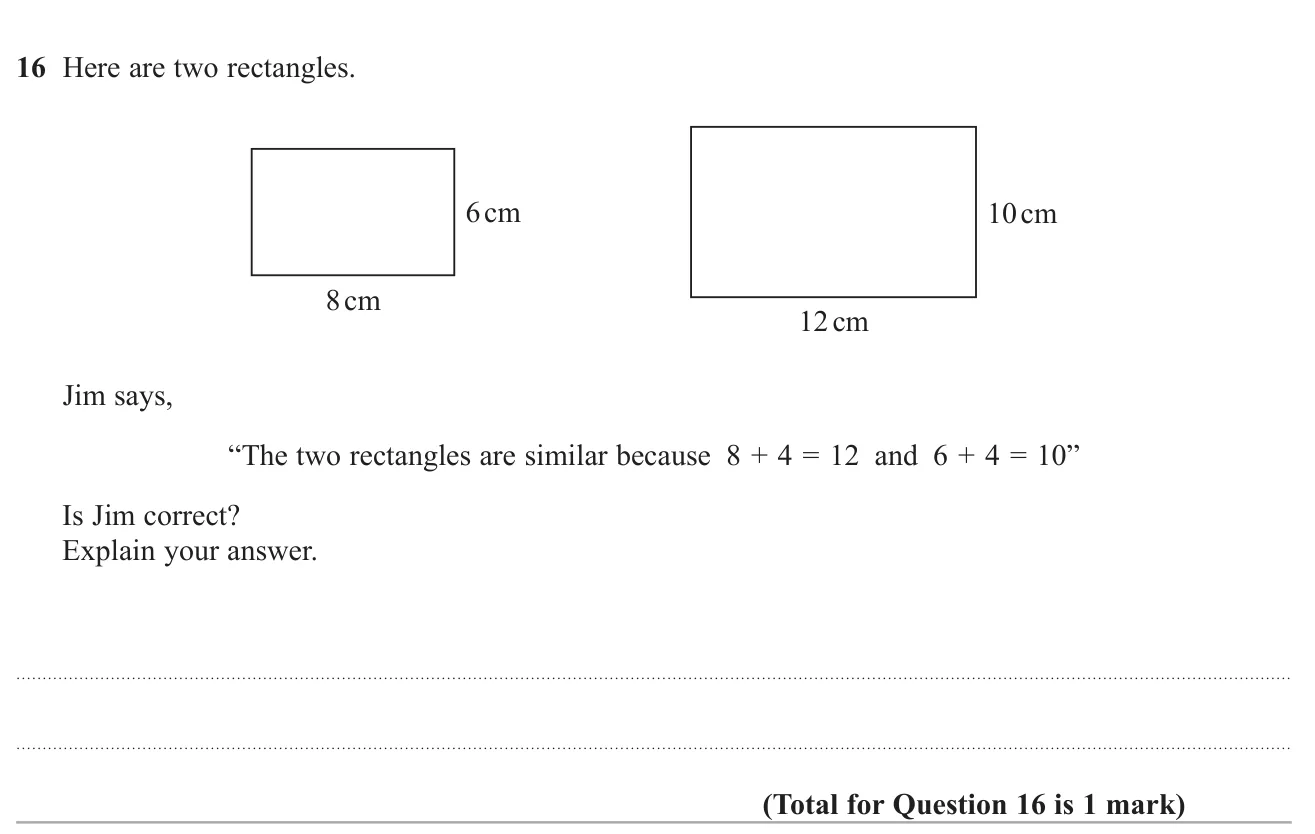
© Pearson Education Ltd. November 2018 Paper 1 (Foundation, non-calculator), question 16.
Answer No: similar shapes need sides multiplied by the same scale factor, not added to 1 mark
Worked solution Checked against the mark scheme
For similar shapes every length is multiplied by the same scale factor.
12 ÷ 8 = 1.5 12 \div 8 = 1.5 12 ÷ 8 = 1.5 10 ÷ 6 = 1.67 10 \div 6 = 1.67 10 ÷ 6 = 1.67
Watch out: Agreeing with Jim because both sides grow by 4.
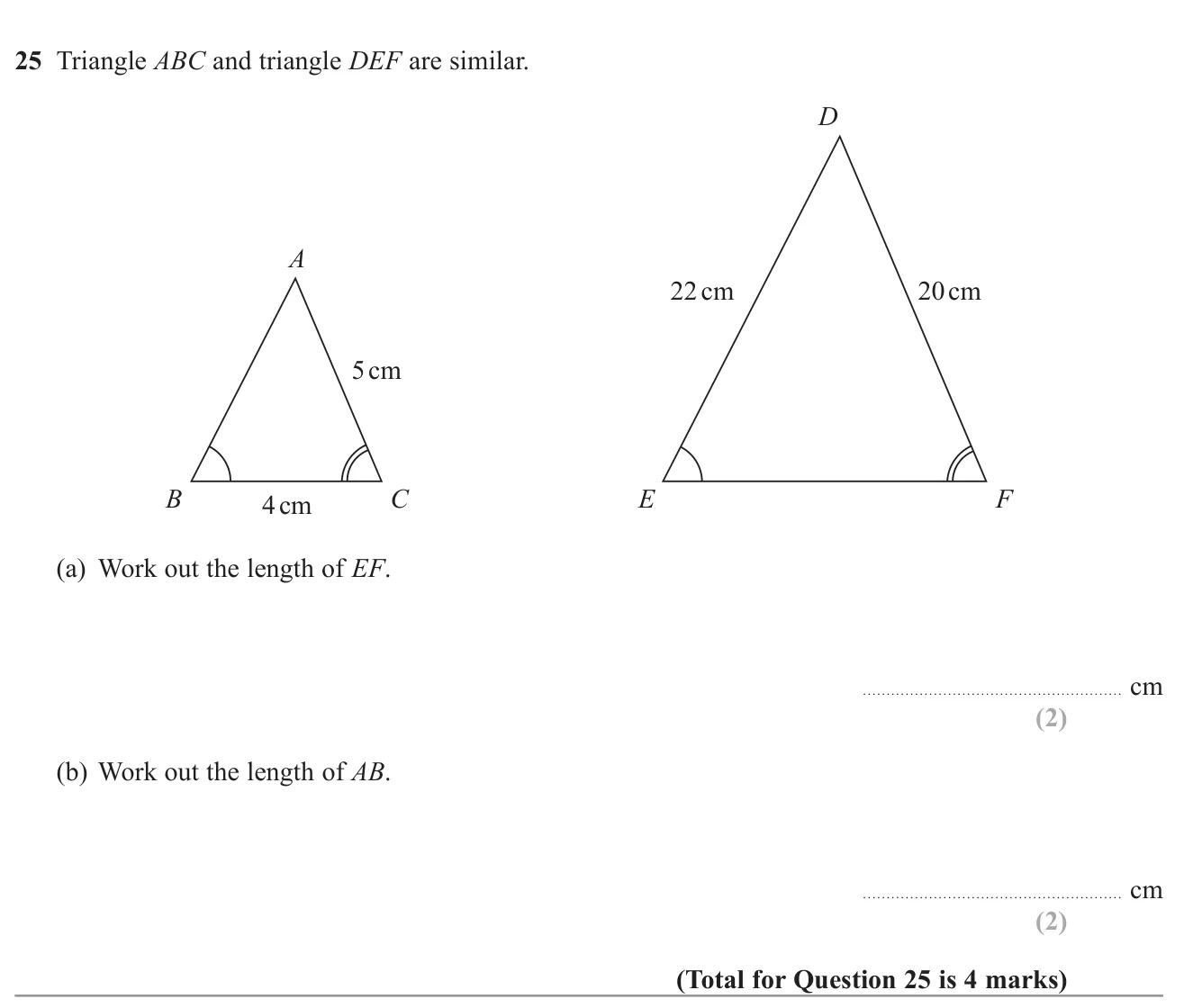
© Pearson Education Ltd. November 2022 Paper 3 (Foundation, calculator), question 25.
(a) 16 cm 2 marks (b) 5.5 cm 2 marks
Worked solution Checked against the mark scheme
AC = 5 matches DF = 20, so the scale factor is 20 ÷ 5 = 4 20 \div 5 = 4 20 ÷ 5 = 4
(a) EF matches BC: 4 × 4 = 16 4 \times 4 = 16 4 × 4 = 16
(b) AB matches DE: 22 ÷ 4 = 5.5 22 \div 4 = 5.5 22 ÷ 4 = 5.5
Watch out: Matching the wrong sides, e.g. pairing 5 cm with 22 cm.
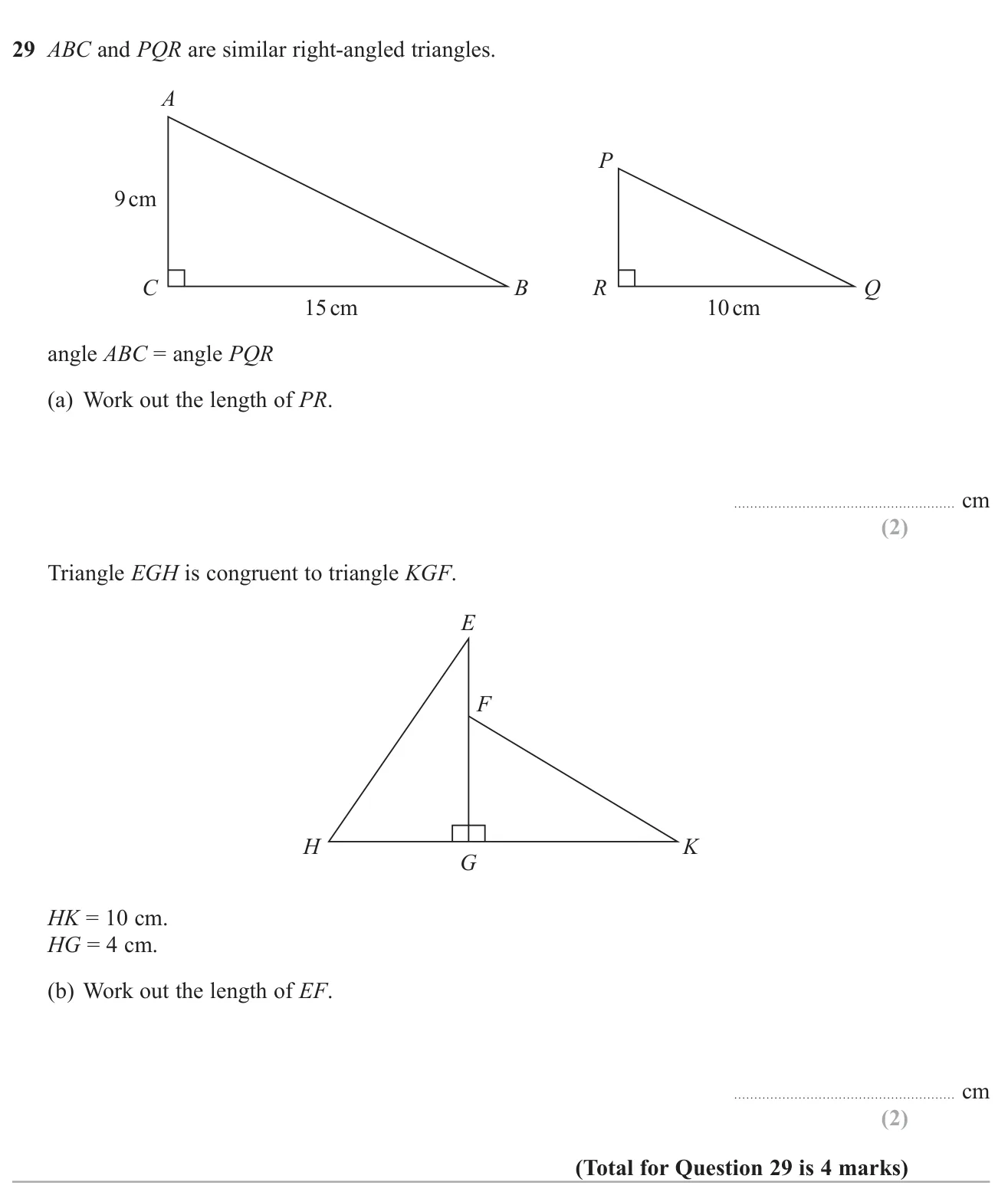
© Pearson Education Ltd. November 2019 Paper 1 (Foundation, non-calculator), question 29.
(a) 6 6 6 2 marks (b) 2 2 2 2 marks
Worked solution Checked against the mark scheme
(a) B C = 15 BC = 15 B C = 15 Q R = 10 QR = 10 QR = 10 10 15 = 2 3 \frac{10}{15} = \frac{2}{3} 15 10 = 3 2
P R = 9 × 2 3 = 6 PR = 9 \times \frac{2}{3} = 6 P R = 9 × 3 2 = 6
(b) G K = 10 − 4 = 6 GK = 10 - 4 = 6 G K = 10 − 4 = 6
The triangles are congruent, so E G = G K = 6 EG = GK = 6 E G = G K = 6 G F = H G = 4 GF = HG = 4 GF = H G = 4
E F = 6 − 4 = 2 EF = 6 - 4 = 2 E F = 6 − 4 = 2
Watch out: In (a), subtracting 5 from 9 instead of scaling, giving 4.
© Pearson Education Ltd. June 2018 Paper 3 (Foundation, calculator), question 27.
(a) 9.6 9.6 9.6 2 marks (b) 10 10 10 2 marks
Worked solution Checked against the mark scheme
A B = 8.4 AB = 8.4 A B = 8.4 D E = 12.6 DE = 12.6 D E = 12.6
Scale factor: 12.6 ÷ 8.4 = 1.5 12.6 \div 8.4 = 1.5 12.6 ÷ 8.4 = 1.5
(a) D F = 6.4 × 1.5 = 9.6 DF = 6.4 \times 1.5 = 9.6 D F = 6.4 × 1.5 = 9.6
(b) C B = 15 ÷ 1.5 = 10 CB = 15 \div 1.5 = 10 C B = 15 ÷ 1.5 = 10
Watch out: Adding 4.2 instead of multiplying by the scale factor.
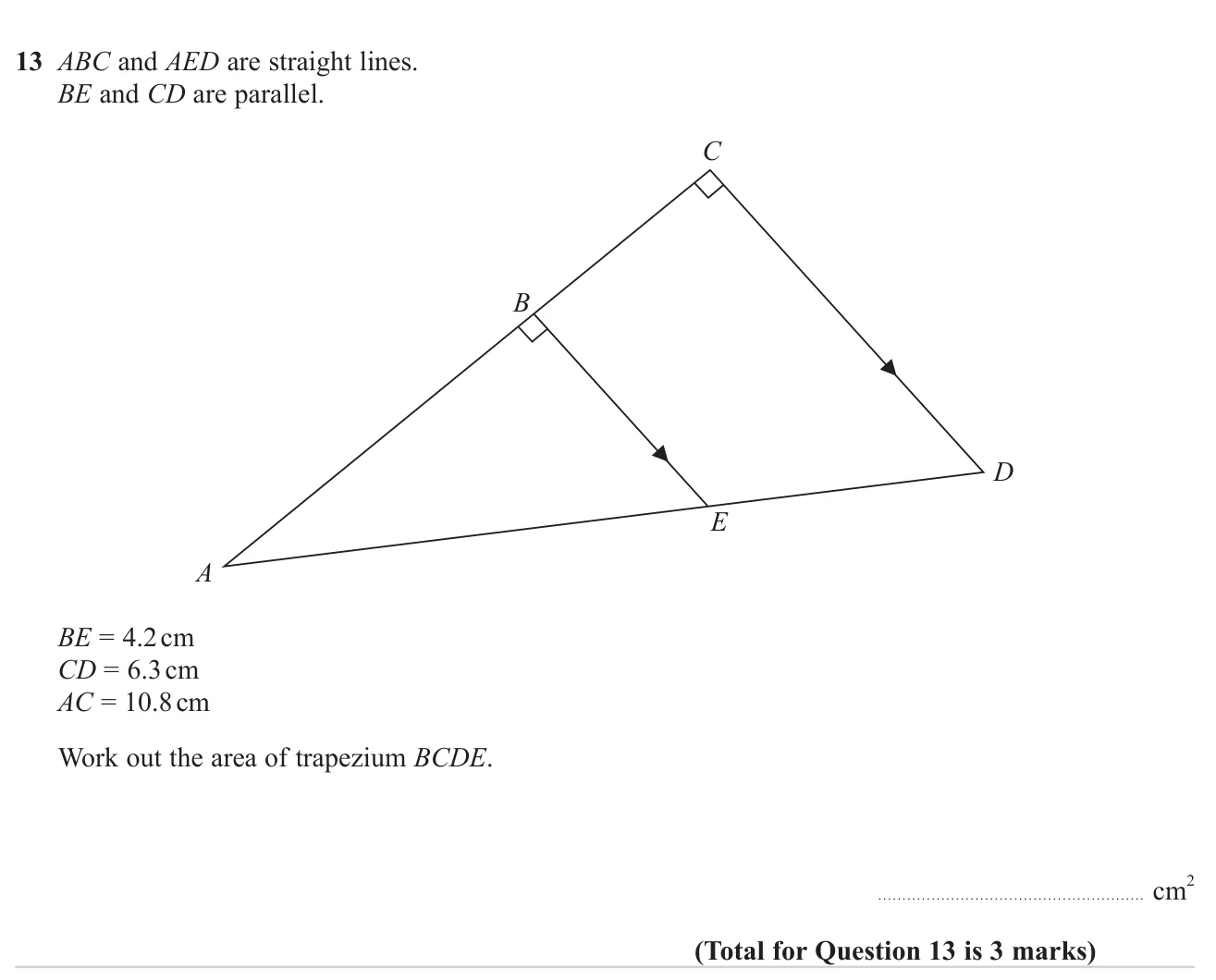
© Pearson Education Ltd. November 2024 Paper 3 (Higher, calculator), question 13.
Answer 18.9 18.9 18.9 3 marks
Worked solution Checked against the mark scheme
Triangles ABE and ACD are similar with scale factor 4.2 6.3 = 2 3 \frac{4.2}{6.3} = \frac{2}{3} 6.3 4.2 = 3 2
A B = 2 3 × 10.8 = 7.2 AB = \frac{2}{3} \times 10.8 = 7.2 A B = 3 2 × 10.8 = 7.2 B C = 10.8 − 7.2 = 3.6 BC = 10.8 - 7.2 = 3.6 B C = 10.8 − 7.2 = 3.6
Area = 4.2 + 6.3 2 × 3.6 = 18.9 = \frac{4.2 + 6.3}{2} \times 3.6 = 18.9 = 2 4.2 + 6.3 × 3.6 = 18.9
Watch out: Using AC (10.8) as the height of the trapezium instead of BC.
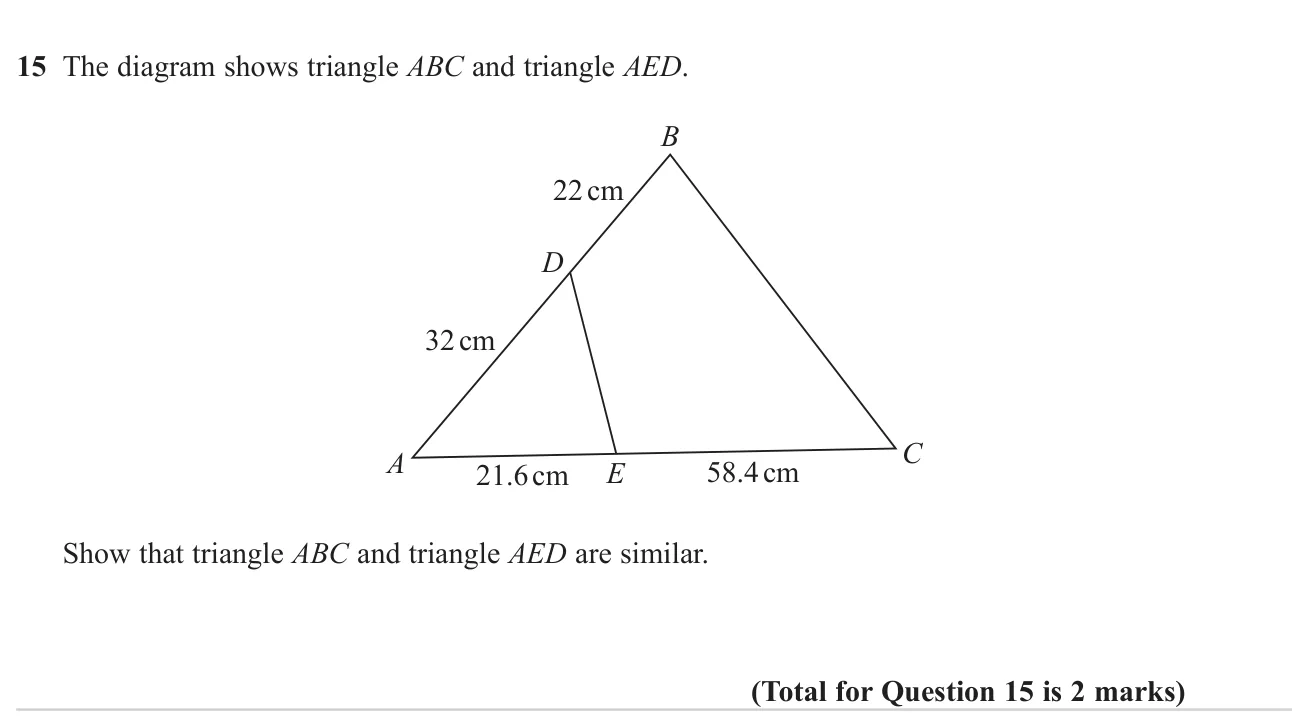
© Pearson Education Ltd. November 2023 Paper 3 (Higher, calculator), question 15.
Answer A C A D = 80 32 = 2.5 \frac{AC}{AD} = \frac{80}{32} = 2.5 A D A C = 32 80 = 2.5 A B A E = 54 21.6 = 2.5 \frac{AB}{AE} = \frac{54}{21.6} = 2.5 A E A B = 21.6 54 = 2.5 A A A 2 marks
Worked solution Checked against the mark scheme
A C = 21.6 + 58.4 = 80 AC = 21.6 + 58.4 = 80 A C = 21.6 + 58.4 = 80 A B = 32 + 22 = 54 AB = 32 + 22 = 54 A B = 32 + 22 = 54
In triangle A E D AED A E D A D = 32 AD = 32 A D = 32 A C = 80 AC = 80 A C = 80 A E = 21.6 AE = 21.6 A E = 21.6 A B = 54 AB = 54 A B = 54
80 ÷ 32 = 2.5 80 \div 32 = 2.5 80 ÷ 32 = 2.5 54 ÷ 21.6 = 2.5 54 \div 21.6 = 2.5 54 ÷ 21.6 = 2.5
The ratios are equal and angle A A A
Watch out: Matching AD with AB and AE with AC, which gives different ratios.
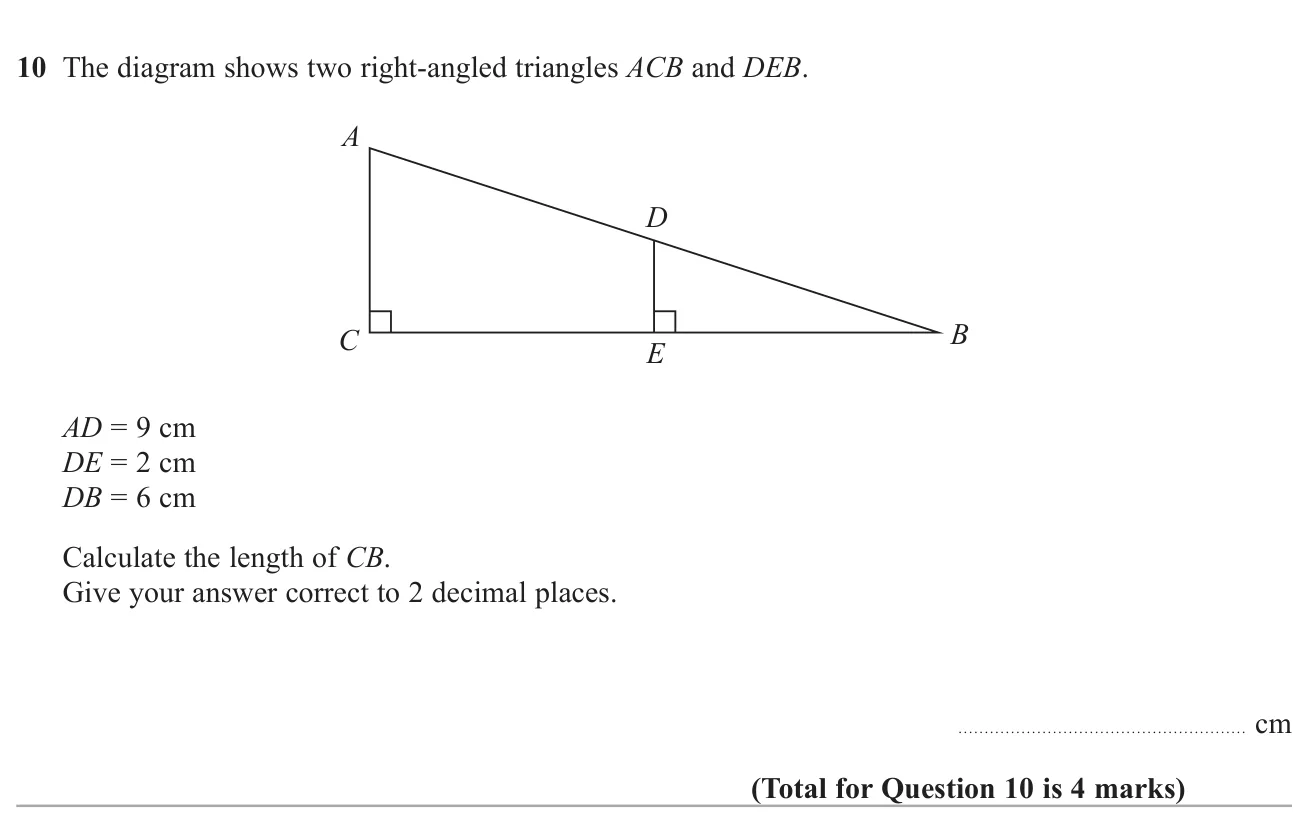
© Pearson Education Ltd. November 2021 Paper 3 (Higher, calculator), question 10.
Answer 14.14 14.14 14.14 4 marks
Worked solution Checked against the mark scheme
E B = 6 2 − 2 2 = 32 = 5.656... EB = \sqrt{6^2 - 2^2} = \sqrt{32} = 5.656... E B = 6 2 − 2 2 = 32 = 5.656...
Triangles D E B DEB D E B A C B ACB A C B A B D B = 9 + 6 6 = 2.5 \frac{AB}{DB} = \frac{9 + 6}{6} = 2.5 D B A B = 6 9 + 6 = 2.5
C B = 2.5 × 32 = 14.142... CB = 2.5 \times \sqrt{32} = 14.142... C B = 2.5 × 32 = 14.142... 14.14 14.14 14.14
Watch out: Using 9 ÷ 6 = 1.5 as the scale factor instead of 15 ÷ 6.
© Pearson Education Ltd. November 2024 Paper 1 (Higher, non-calculator), question 12.
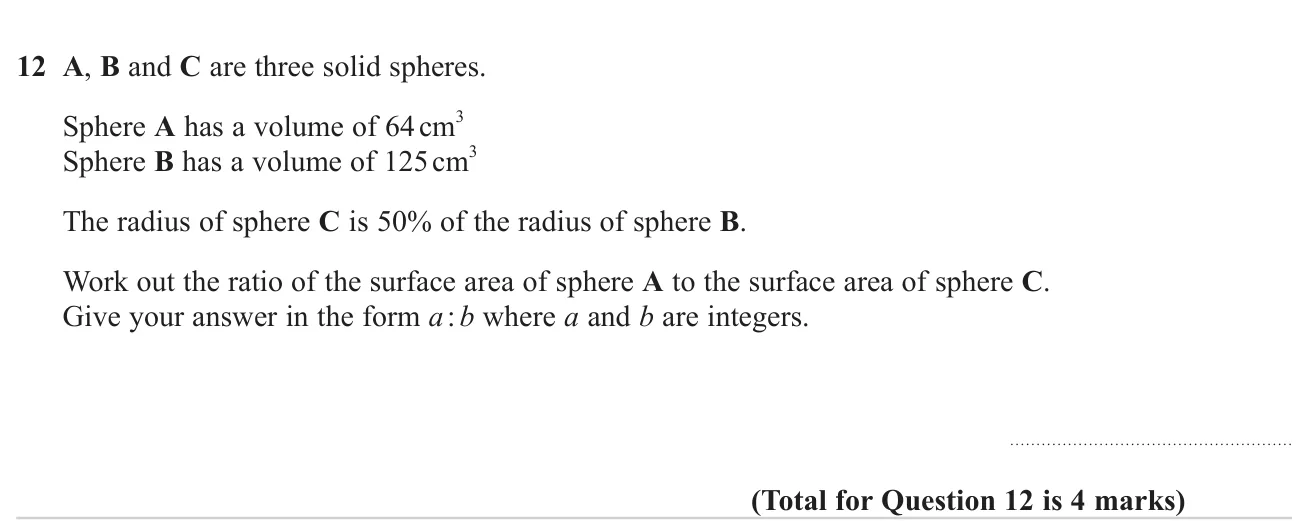
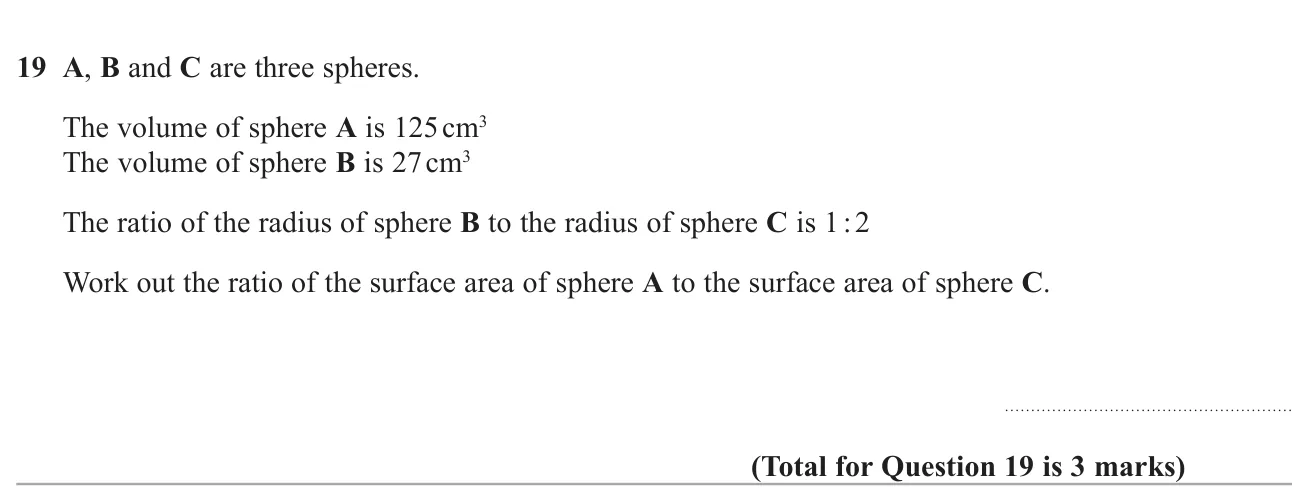
Answer 64 : 25 64 : 25 64 : 25 4 marks
Worked solution Checked against the mark scheme
Spheres are similar. Volume ratio A : B = 64 : 125 A : B = 64 : 125 A : B = 64 : 125 = 64 3 : 125 3 = 4 : 5 = \sqrt[3]{64} : \sqrt[3]{125} = 4 : 5 = 3 64 : 3 125 = 4 : 5
Radius of C is half of B's: 4 : 2.5 4 : 2.5 4 : 2.5
Area ratio = 4 2 : 2.5 2 = 16 : 6.25 = 64 : 25 = 4^2 : 2.5^2 = 16 : 6.25 = 64 : 25 = 4 2 : 2. 5 2 = 16 : 6.25 = 64 : 25
Watch out: Using the volume ratio directly instead of cube-rooting first.
© Pearson Education Ltd. November 2023 Paper 1 (Higher, non-calculator), question 13.
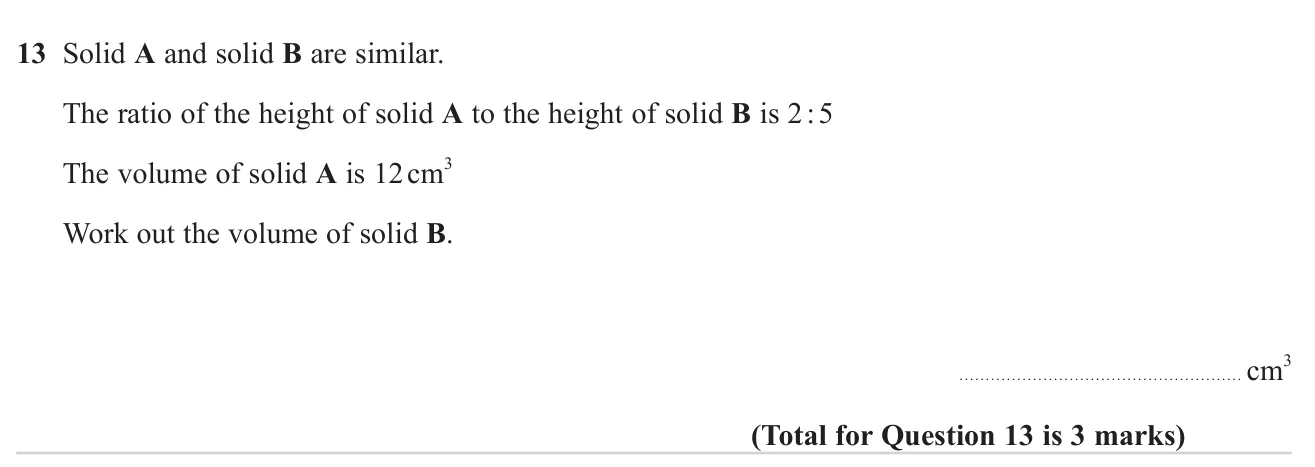
Answer 187.5 187.5 187.5 3 marks
Worked solution Checked against the mark scheme
Length scale factor = 5 2 = 2.5 = \frac{5}{2} = 2.5 = 2 5 = 2.5 2.5 3 = 125 8 2.5^3 = \frac{125}{8} 2. 5 3 = 8 125
Volume of B = 12 × 125 8 = 1.5 × 125 = 187.5 = 12 \times \frac{125}{8} = 1.5 \times 125 = 187.5 = 12 × 8 125 = 1.5 × 125 = 187.5
Watch out: Multiplying by 2.5 (the length scale factor) instead of 2.5³.
© Pearson Education Ltd. June 2019 Paper 2 (Higher, calculator), question 9.
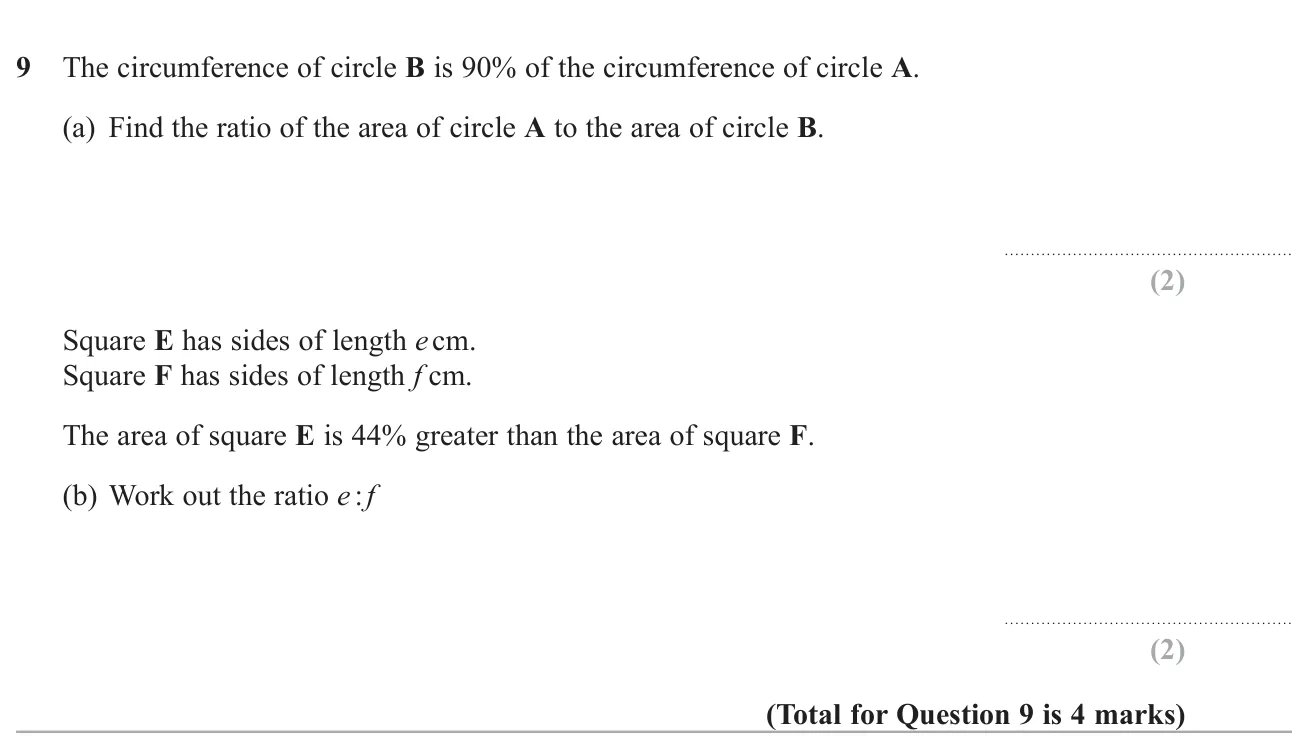
(a) 100 : 81 100 : 81 100 : 81 2 marks (b) 6 : 5 6 : 5 6 : 5 2 marks
Worked solution Checked against the mark scheme
(a) Radius of B is 0.9 × 0.9 \times 0.9 × 0.9 2 = 0.81 0.9^2 = 0.81 0. 9 2 = 0.81
Area A : area B = 1 : 0.81 = 100 : 81 = 1 : 0.81 = 100 : 81 = 1 : 0.81 = 100 : 81
(b) e 2 = 1.44 f 2 e^2 = 1.44 f^2 e 2 = 1.44 f 2 e = 1.44 f = 1.2 f e = \sqrt{1.44} f = 1.2 f e = 1.44 f = 1.2 f
e : f = 1.2 : 1 = 6 : 5 e : f = 1.2 : 1 = 6 : 5 e : f = 1.2 : 1 = 6 : 5
Watch out: Squaring 90% for (a) but forgetting to square-root 1.44 in (b).
© Pearson Education Ltd. Specimen Paper 2 (Higher, calculator), question 14.
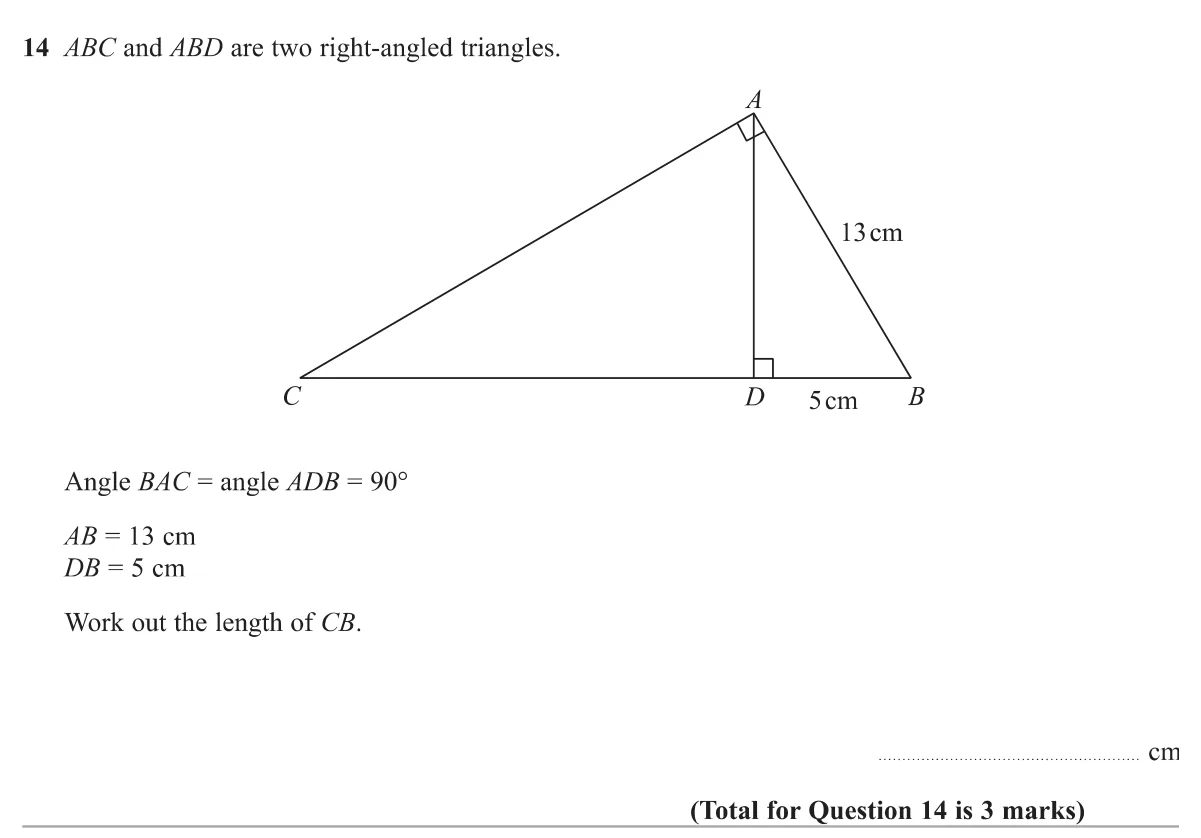
Worked solution Checked against the mark scheme
Triangles A B D ABD A B D C B A CBA C B A B B B
So C B A B = A B D B \frac{CB}{AB} = \frac{AB}{DB} A B C B = D B A B
C B = 13 × 13 5 = 169 5 = 33.8 CB = \frac{13 \times 13}{5} = \frac{169}{5} = 33.8 C B = 5 13 × 13 = 5 169 = 33.8
Watch out: Matching the wrong sides in the ratio, e.g. C B 13 = 5 13 \frac{CB}{13} = \frac{5}{13} 13 C B = 13 5
© Pearson Education Ltd. Specimen Paper 3 (Higher, calculator), question 20.
Worked solution Checked against the mark scheme
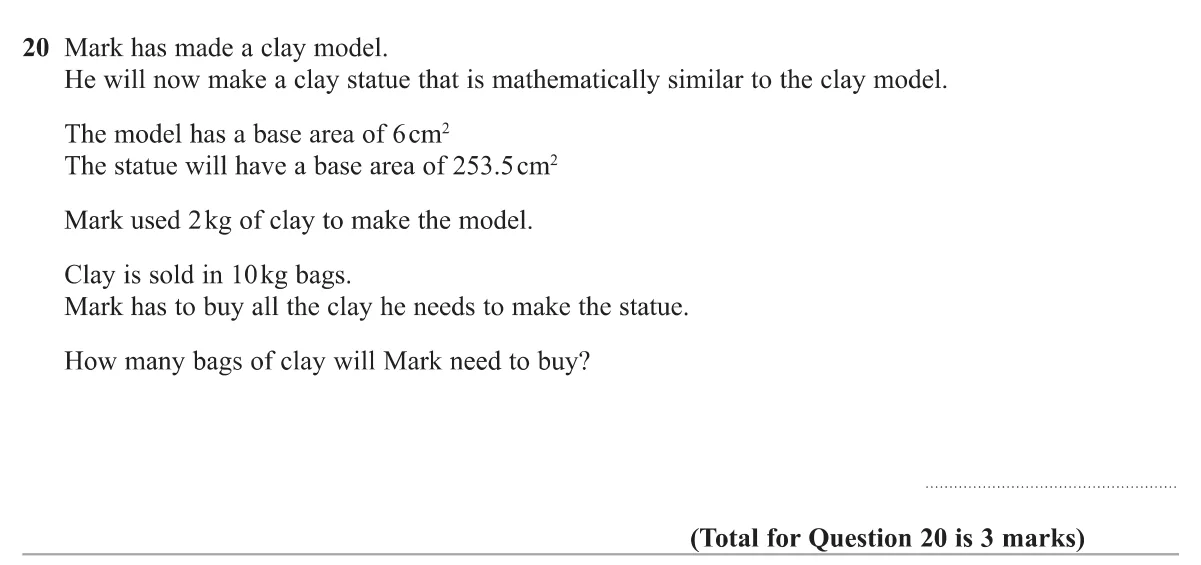
Area scale factor = 253.5 ÷ 6 = 42.25 = 253.5 \div 6 = 42.25 = 253.5 ÷ 6 = 42.25
Length scale factor = 42.25 = 6.5 = \sqrt{42.25} = 6.5 = 42.25 = 6.5
Volume scale factor = 6.5 3 = 274.625 = 6.5^3 = 274.625 = 6. 5 3 = 274.625
Clay needed = 2 × 274.625 = 549.25 = 2 \times 274.625 = 549.25 = 2 × 274.625 = 549.25
549.25 ÷ 10 = 54.925 549.25 \div 10 = 54.925 549.25 ÷ 10 = 54.925 55 bags .
Watch out: Multiplying the clay by the area scale factor (42.25) instead of the volume scale factor.
© Pearson Education Ltd. June 2024 Paper 2 (Higher, calculator), question 17.
Answer 12 : 15 : 5 12 : 15 : 5 12 : 15 : 5 4 marks
Worked solution Checked against the mark scheme
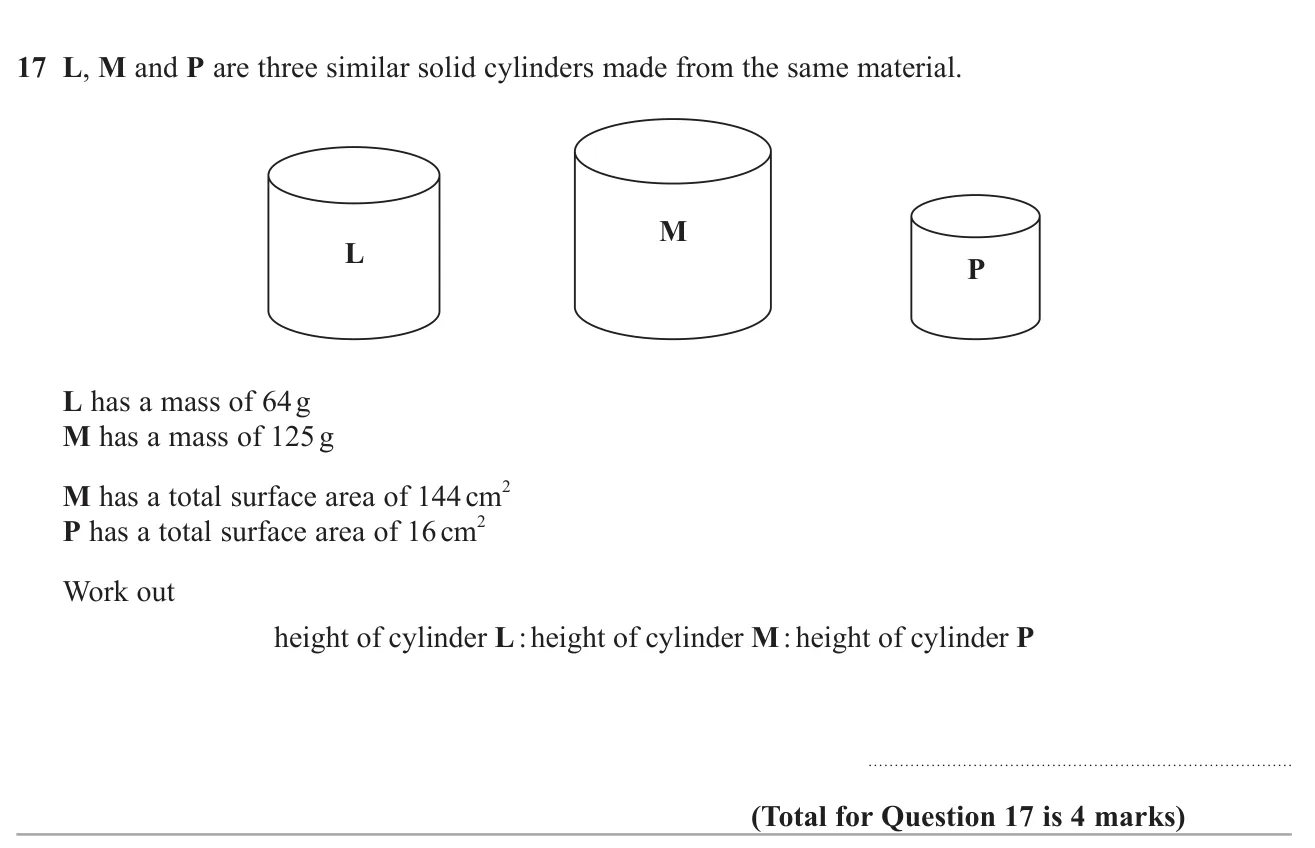
Mass is proportional to volume, so height ratio L : M = 64 3 : 125 3 = 4 : 5 = \sqrt[3]{64} : \sqrt[3]{125} = 4 : 5 = 3 64 : 3 125 = 4 : 5
Area ratio M : P = 144 : 16 = 144 : 16 = 144 : 16 = 144 : 16 = 12 : 4 = 3 : 1 = \sqrt{144} : \sqrt{16} = 12 : 4 = 3 : 1 = 144 : 16 = 12 : 4 = 3 : 1
Make M the same: 4 : 5 = 12 : 15 4:5 = 12:15 4 : 5 = 12 : 15 3 : 1 = 15 : 5 3:1 = 15:5 3 : 1 = 15 : 5
So L : M : P = 12 : 15 : 5 = 12 : 15 : 5 = 12 : 15 : 5
Watch out: Using the mass or area ratios directly as length ratios without taking cube or square roots.
© Pearson Education Ltd. June 2023 Paper 2 (Higher, calculator), question 23.
Answer Lengths 1 : 3 : 6 1 : 3 : 6 1 : 3 : 6 1 : 9 : 36 1 : 9 : 36 1 : 9 : 36 1 : 8 : 27 1 : 8 : 27 1 : 8 : 27 3 marks
Worked solution Checked against the mark scheme
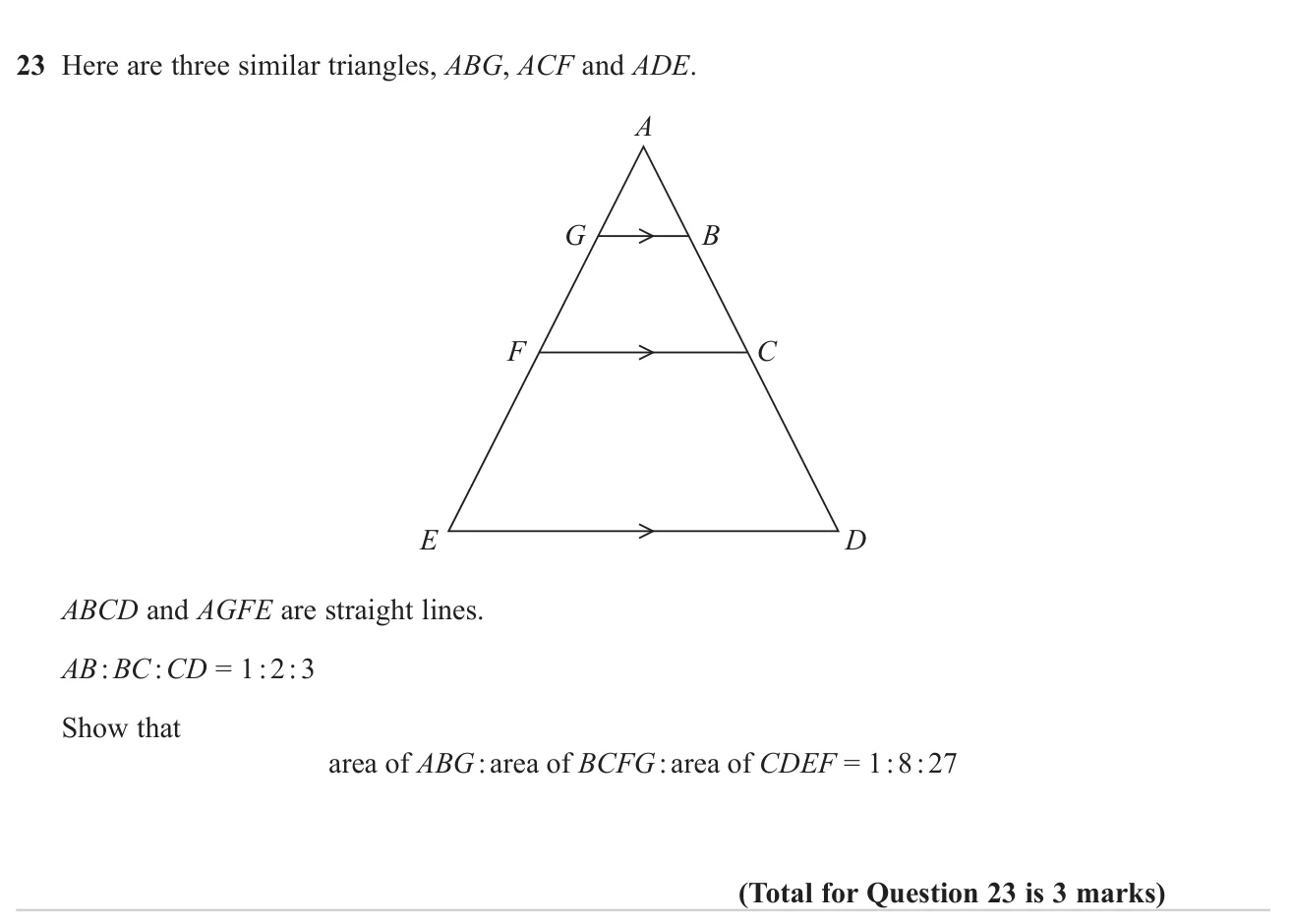
A B : A C : A D = 1 : ( 1 + 2 ) : ( 1 + 2 + 3 ) = 1 : 3 : 6 AB : AC : AD = 1 : (1+2) : (1+2+3) = 1 : 3 : 6 A B : A C : A D = 1 : ( 1 + 2 ) : ( 1 + 2 + 3 ) = 1 : 3 : 6
Similar triangles, so areas are in the ratio of the squares: 1 : 9 : 36 1 : 9 : 36 1 : 9 : 36
BCFG = 9 − 1 = 8 = 9 - 1 = 8 = 9 − 1 = 8 = 36 − 9 = 27 = 36 - 9 = 27 = 36 − 9 = 27
So the ratio is 1 : 8 : 27 1 : 8 : 27 1 : 8 : 27
Watch out: Using 1 : 2 : 3 as the lengths of the whole triangles instead of adding them up.
© Pearson Education Ltd. November 2022 Paper 2 (Higher, calculator), question 17.
Answer h = 3.6 h = 3.6 h = 3.6 4 marks
Worked solution Checked against the mark scheme
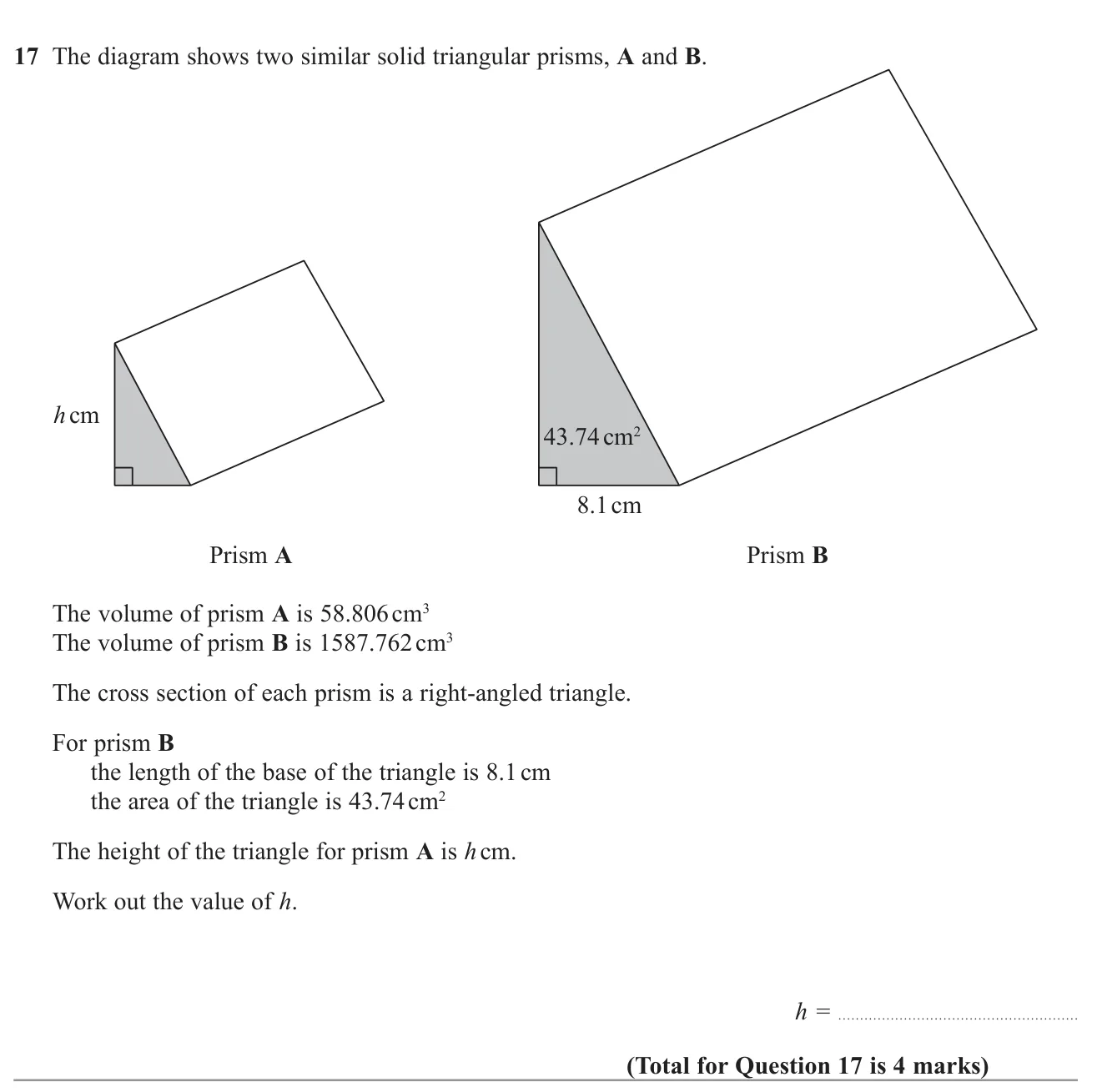
Volume scale factor = 1587.762 ÷ 58.806 = 27 = 1587.762 \div 58.806 = 27 = 1587.762 ÷ 58.806 = 27
Length scale factor = 27 3 = 3 = \sqrt[3]{27} = 3 = 3 27 = 3
Height of B's triangle: 2 × 43.74 8.1 = 10.8 \frac{2 \times 43.74}{8.1} = 10.8 8.1 2 × 43.74 = 10.8
h = 10.8 ÷ 3 = 3.6 h = 10.8 \div 3 = 3.6 h = 10.8 ÷ 3 = 3.6
Watch out: Dividing by the volume scale factor 27 instead of its cube root.
© Pearson Education Ltd. November 2021 Paper 2 (Higher, calculator), question 19.
Answer 25 : 36 25 : 36 25 : 36 3 marks
Worked solution Checked against the mark scheme
Volume ratio A : B = 125 : 27 = 125 : 27 = 125 : 27 = 125 3 : 27 3 = 5 : 3 = \sqrt[3]{125} : \sqrt[3]{27} = 5 : 3 = 3 125 : 3 27 = 5 : 3
B : C = 1 : 2 = 3 : 6 = 1 : 2 = 3 : 6 = 1 : 2 = 3 : 6 = 5 : 6 = 5 : 6 = 5 : 6
Surface areas go with the square: 25 : 36 25 : 36 25 : 36
Watch out: Squaring the volume ratio instead of cube-rooting it first.
© Pearson Education Ltd. November 2020 Paper 3 (Higher, calculator), question 19.
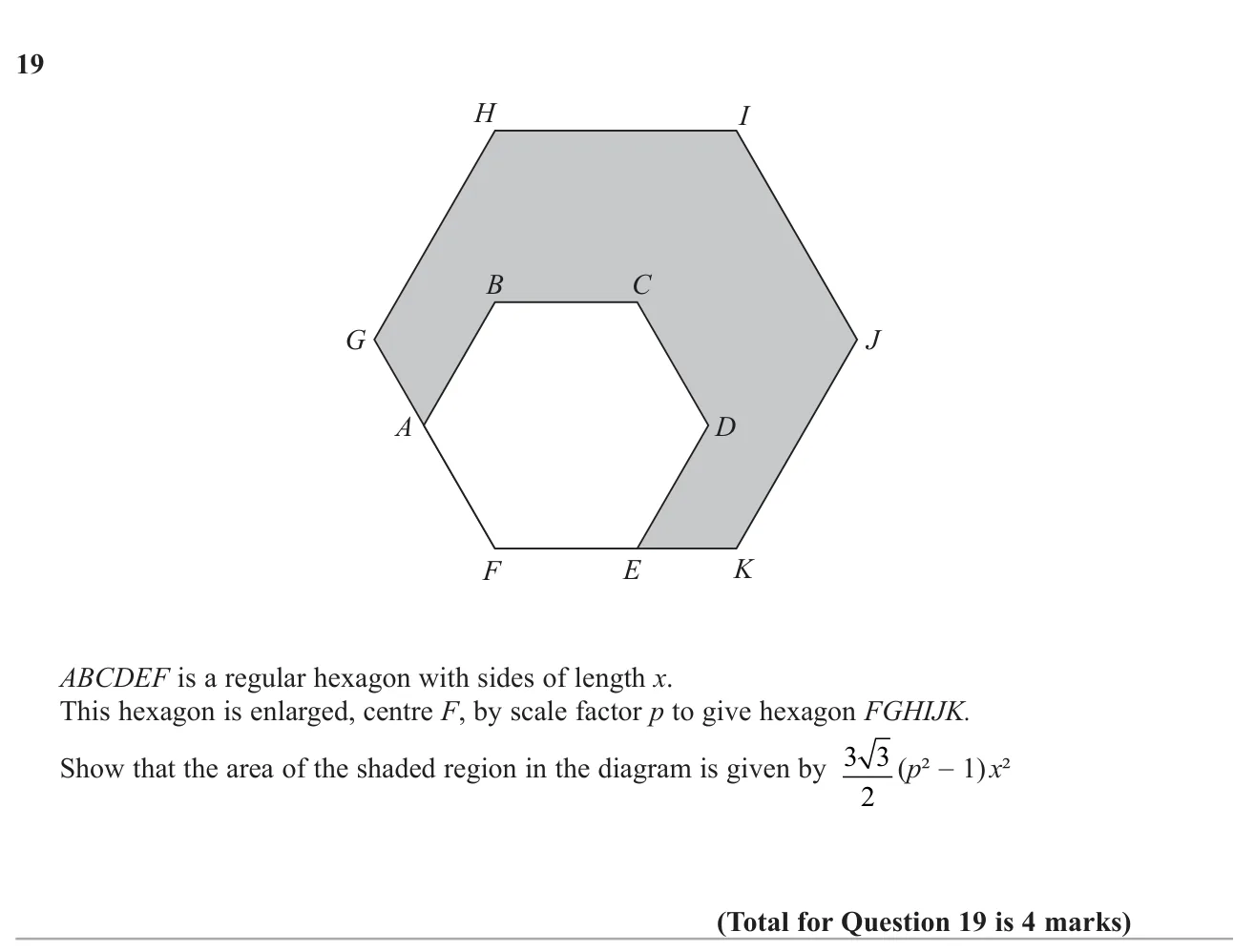
Answer Shown: 3 3 2 ( p 2 − 1 ) x 2 \frac{3\sqrt{3}}{2}(p^2 - 1)x^2 2 3 3 ( p 2 − 1 ) x 2 4 marks
Worked solution Checked against the mark scheme
A regular hexagon of side x x x
One triangle = 1 2 x 2 sin 60 ∘ = 3 4 x 2 = \frac{1}{2}x^2\sin 60^\circ = \frac{\sqrt{3}}{4}x^2 = 2 1 x 2 sin 6 0 ∘ = 4 3 x 2 = 3 3 2 x 2 = \frac{3\sqrt{3}}{2}x^2 = 2 3 3 x 2
The enlarged hexagon has side p x px p x 3 3 2 p 2 x 2 \frac{3\sqrt{3}}{2}p^2x^2 2 3 3 p 2 x 2
Shaded = 3 3 2 p 2 x 2 − 3 3 2 x 2 = 3 3 2 ( p 2 − 1 ) x 2 = \frac{3\sqrt{3}}{2}p^2x^2 - \frac{3\sqrt{3}}{2}x^2 = \frac{3\sqrt{3}}{2}(p^2 - 1)x^2 = 2 3 3 p 2 x 2 − 2 3 3 x 2 = 2 3 3 ( p 2 − 1 ) x 2
Watch out: Multiplying the area by p instead of p².
© Pearson Education Ltd. November 2019 Paper 1 (Higher, non-calculator), question 17.
Worked solution Checked against the mark scheme
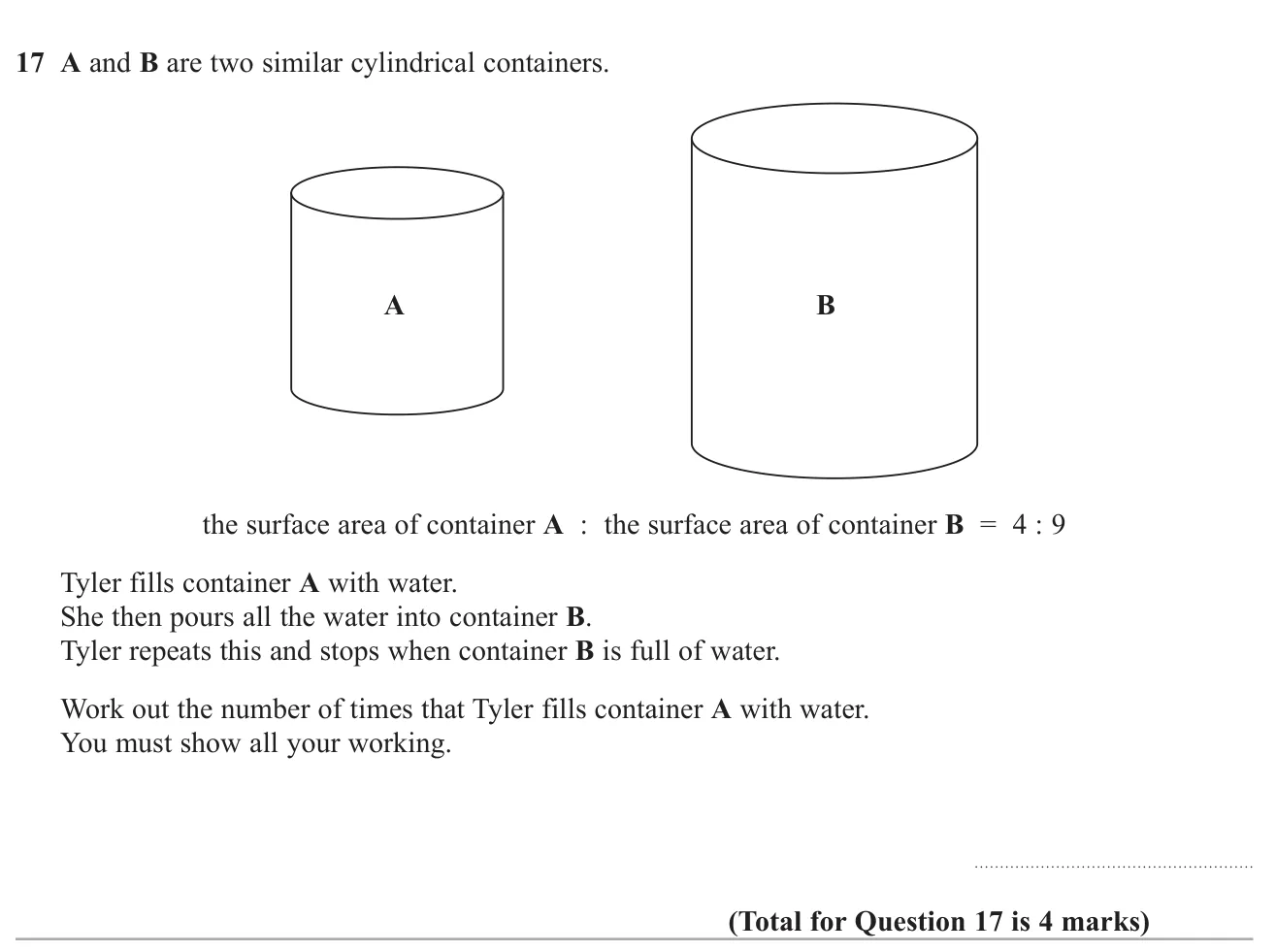
Area ratio 4 : 9 4 : 9 4 : 9 4 : 9 = 2 : 3 \sqrt{4} : \sqrt{9} = 2 : 3 4 : 9 = 2 : 3
Volume ratio 2 3 : 3 3 = 8 : 27 2^3 : 3^3 = 8 : 27 2 3 : 3 3 = 8 : 27
27 ÷ 8 = 3.375 27 \div 8 = 3.375 27 ÷ 8 = 3.375
Three fills are not enough, so Tyler fills A 4 times.
Watch out: Using the area ratio for volume (9 ÷ 4 = 2.25, so 3 fills).
© Pearson Education Ltd. November 2018 Paper 1 (Higher, non-calculator), question 15.
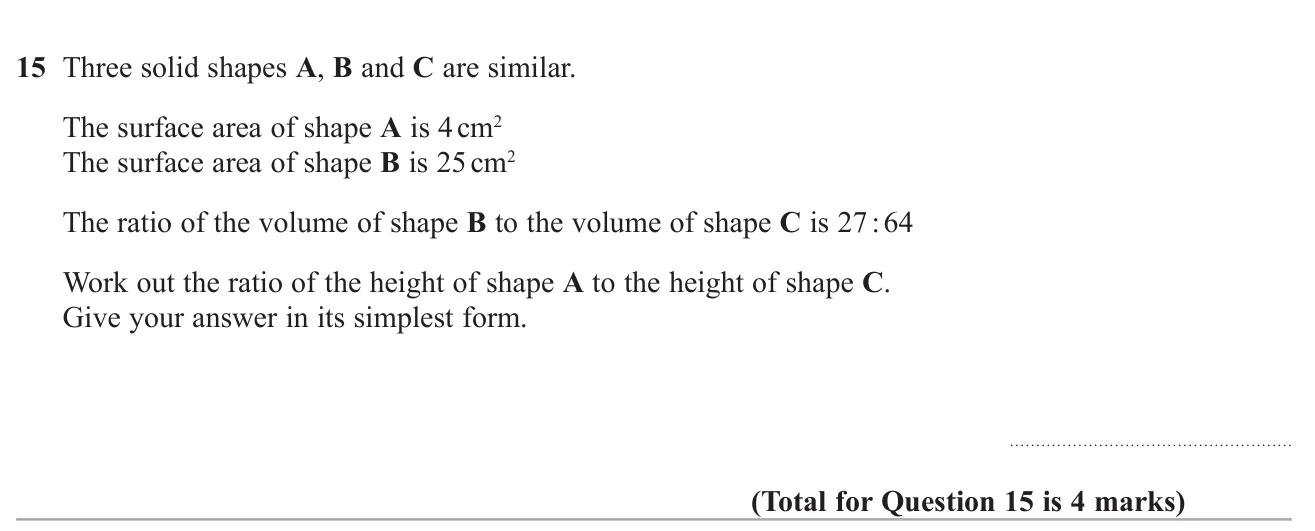
Answer 3 : 10 3 : 10 3 : 10 4 marks
Worked solution Checked against the mark scheme
Area ratio A:B = 4:25, so length ratio A:B = 4 : 25 = 2 : 5 = \sqrt{4}:\sqrt{25} = 2:5 = 4 : 25 = 2 : 5
Volume ratio B:C = 27:64, so length ratio B:C = 27 3 : 64 3 = 3 : 4 = \sqrt[3]{27}:\sqrt[3]{64} = 3:4 = 3 27 : 3 64 = 3 : 4
Make B match: A:B = 6:15 and B:C = 15:20, so A:B:C = 6:15:20
A:C = 6:20 = 3:10
Watch out: Using the area or volume ratios directly as length ratios.
© Pearson Education Ltd. June 2018 Paper 3 (Higher, calculator), question 13.
Answer 6.50 6.50 6.50 3 marks
Worked solution Checked against the mark scheme
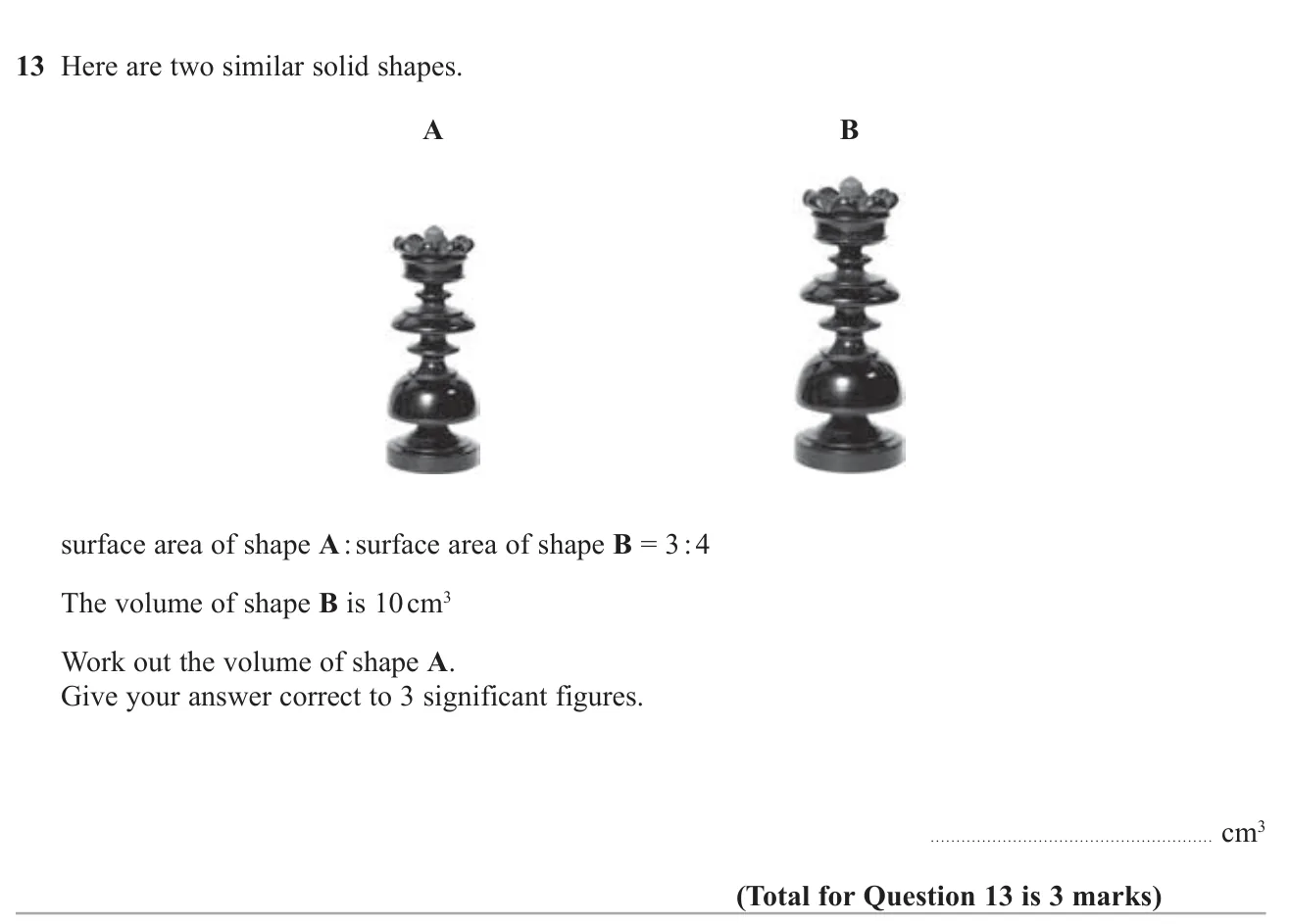
Area ratio 3 : 4 3 : 4 3 : 4 3 : 4 = 3 : 2 \sqrt{3} : \sqrt{4} = \sqrt{3} : 2 3 : 4 = 3 : 2
Length scale factor from B to A: 3 2 = 0.8660 \frac{\sqrt{3}}{2} = 0.8660 2 3 = 0.8660
Volume scale factor: 0.8660 3 = 0.6495 0.8660^3 = 0.6495 0.866 0 3 = 0.6495
Volume of A = 10 × 0.6495 = 6.50 = 10 \times 0.6495 = 6.50 = 10 × 0.6495 = 6.50
Watch out: Using the area ratio directly on the volume: 10 × 3 4 = 7.5 10 \times \frac{3}{4} = 7.5 10 × 4 3 = 7.5
© Pearson Education Ltd. June 2024 Paper 1 (Higher, non-calculator), question 19.
Worked solution Checked against the mark scheme
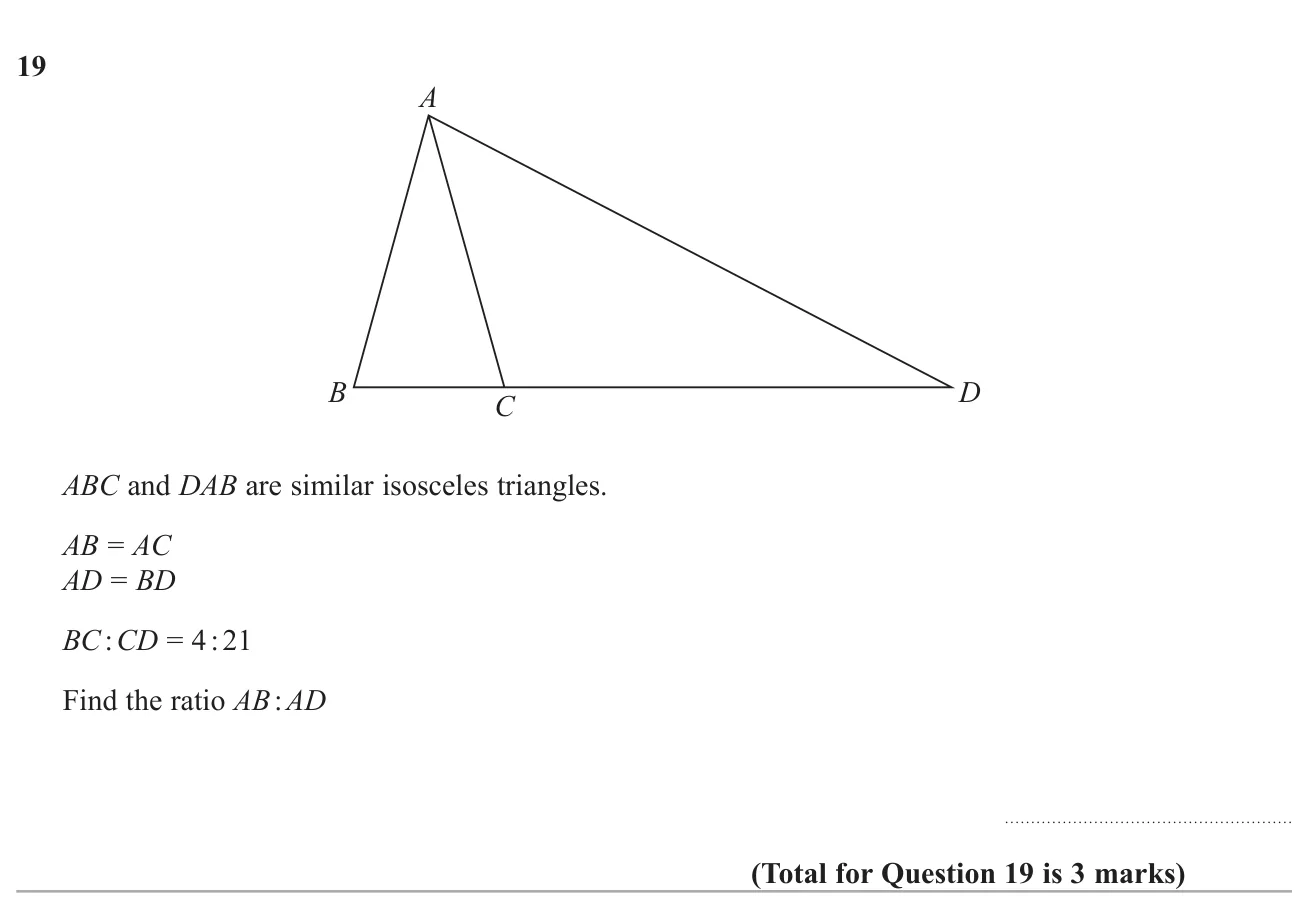
Let B C = 4 BC = 4 B C = 4 C D = 21 CD = 21 C D = 21 B D = 25 BD = 25 B D = 25 A D = B D = 25 AD = BD = 25 A D = B D = 25
Triangles ABC and DAB are similar, so A B B C = D B A B \frac{AB}{BC} = \frac{DB}{AB} B C A B = A B D B
A B 2 = 4 × 25 = 100 AB^2 = 4 \times 25 = 100 A B 2 = 4 × 25 = 100 A B = 10 AB = 10 A B = 10
A B : A D = 10 : 25 = 2 : 5 AB : AD = 10 : 25 = 2 : 5 A B : A D = 10 : 25 = 2 : 5
Watch out: Matching the wrong sides of the similar triangles, e.g. setting A B A D = 4 21 \frac{AB}{AD} = \frac{4}{21} A D A B = 21 4
Also tested in these questions Their main topic is different, but part of each one tests this topic.