Revision guide by The Full Marks
Error intervals and bounds: what you need to know When a number is rounded or truncated, its real value lies in a range called the error interval. Higher students also calculate with upper and lower bounds, often in speed or area problems.
Foundation students need error intervals for rounding and truncation; using upper and lower bounds in calculations is Higher only.
Key facts Rounding: the bounds are half a unit either side. 8.4 8.4 8.4 8.35 ≤ x < 8.45 8.35 \le x < 8.45 8.35 ≤ x < 8.45 Significant figures work the same way: 4700 4700 4700 4650 ≤ x < 4750 4650 \le x < 4750 4650 ≤ x < 4750 Truncating: the value is at least the number shown, but less than one unit more. 8.4 8.4 8.4 8.4 ≤ x < 8.5 8.4 \le x < 8.5 8.4 ≤ x < 8.5 Use ≤ \le ≤ < < < Higher: to make a division as big as possible, use upper ÷ \div ÷ ÷ \div ÷ Writing an error interval Find the unit it was rounded to: 0.1 for 1 decimal place, 10 for the nearest 10, 100 for 4700 4700 4700 Rounding: subtract and add half a unit. Truncating: add one whole unit. Write lower ≤ x < \le x < ≤ x < Calculating with bounds (Higher) Write down the bounds of every measurement. For a + b a + b a + b a × b a \times b a × b a − b a - b a − b a ÷ b a \div b a ÷ b b b b For a longer formula, ask of each value: does making it bigger make the answer bigger or smaller? Choose its bound to match. For a suitable accuracy, round both answers until they agree. Worked examples Example 1 Foundation · grade 5
A pencil has length l l l l l l l = 8.4 l = 8.4 l = 8.4 l l l 8.4 8.4 8.4
Show the solution (a) Half of 0.1 is 0.05. 8.4 − 0.05 = 8.35 8.4 - 0.05 = 8.35 8.4 − 0.05 = 8.35 8.4 + 0.05 = 8.45 8.4 + 0.05 = 8.45 8.4 + 0.05 = 8.45 8.35 ≤ l < 8.45 8.35 \le l < 8.45 8.35 ≤ l < 8.45 l l l 8.4 ≤ l < 8.5 8.4 \le l < 8.5 8.4 ≤ l < 8.5
Example 2 Higher · grade 8
Jess runs 240 m, correct to the nearest metre, in 32.6 seconds, correct to 1 decimal place. Work out her average speed to a suitable degree of accuracy, giving a reason.
Show the solution Distance: 239.5 ≤ d < 240.5 239.5 \le d < 240.5 239.5 ≤ d < 240.5 32.55 ≤ t < 32.65 32.55 \le t < 32.65 32.55 ≤ t < 32.65 = 240.5 32.55 = 7.388 … = \frac{240.5}{32.55} = 7.388\ldots = 32.55 240.5 = 7.388 … = 239.5 32.65 = 7.335 … = \frac{239.5}{32.65} = 7.335\ldots = 32.65 239.5 = 7.335 … = 7 = 7 = 7
Common mistakes Writing the upper bound as 8.449 8.449 8.449 8.45 8.45 8.45 < < < Treating truncation like rounding. Dividing upper by upper for the upper bound of a division. Use upper ÷ \div ÷ Exam tips Write down the bounds before calculating; that usually earns the first marks. For "suitable degree of accuracy", you must show both bounds rounded and say they agree. Questions people ask What is an error interval? It is the range of values a number could have been before it was rounded or truncated, written with inequalities, e.g. 6.5 ≤ x < 7.5 6.5 \le x < 7.5 6.5 ≤ x < 7.5
What is the difference between rounding and truncating? Rounding goes to the nearest value, so the real number could be above or below it. Truncating cuts digits off, so the real number is never below the value shown.
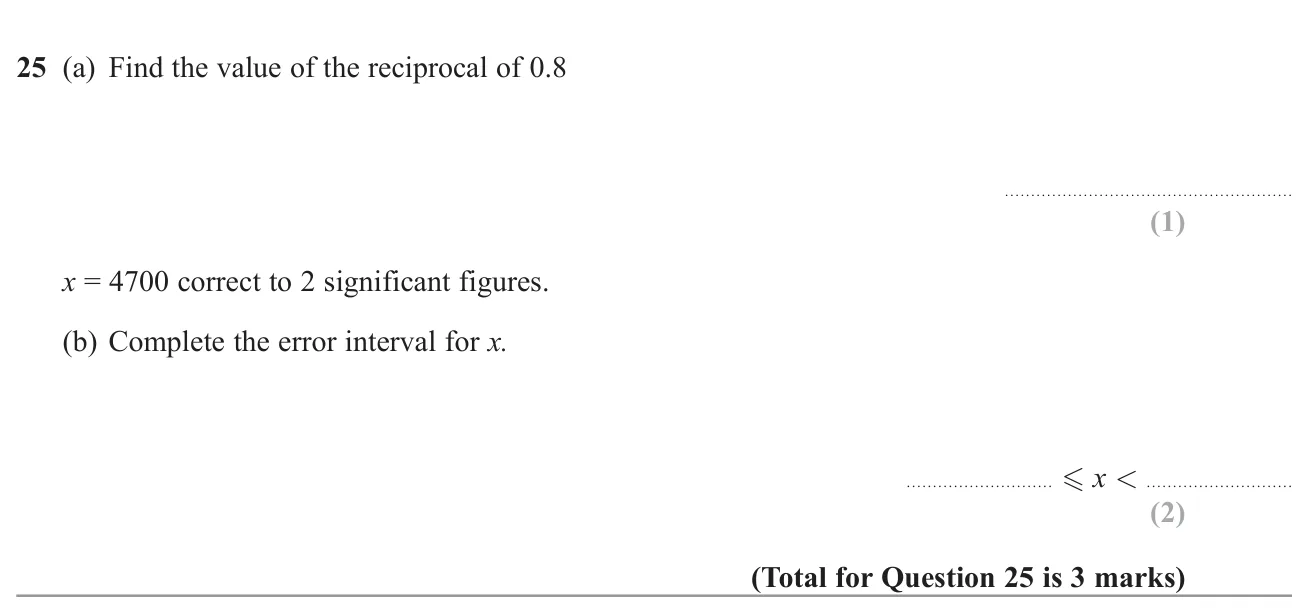
Exam questions: Error intervals and bounds (27, easiest first) © Pearson Education Ltd. November 2022 Paper 2 (Foundation, calculator), question 25.
(a) 1.25 1 mark (b) 4650 ≤ x < 4750 4650 \le x < 4750 4650 ≤ x < 4750 2 marks
Worked solution Checked against the mark scheme
(a) 1 ÷ 0.8 = 1.25 1 \div 0.8 = 1.25 1 ÷ 0.8 = 1.25
(b) 2 s.f. here means to the nearest 100, so half of 100 is 50 either side.
4700 − 50 = 4650 4700 - 50 = 4650 4700 − 50 = 4650 4700 + 50 = 4750 4700 + 50 = 4750 4700 + 50 = 4750
4650 ≤ x < 4750 4650 \le x < 4750 4650 ≤ x < 4750
Watch out: Using 4699 or 4749 as the upper bound.
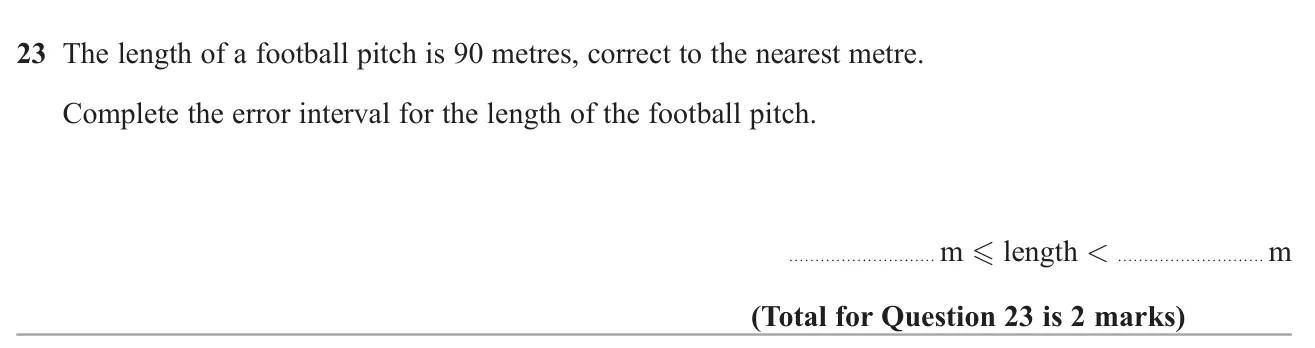
© Pearson Education Ltd. June 2022 Paper 2 (Foundation, calculator), question 23.
Answer 89.5 ≤ length < 90.5 89.5 \le \text{length} < 90.5 89.5 ≤ length < 90.5 2 marks
Worked solution Checked against the mark scheme
Rounded to the nearest metre, so go half a metre either side.
Lower bound: 90 − 0.5 = 89.5 90 - 0.5 = 89.5 90 − 0.5 = 89.5
Upper bound: 90 + 0.5 = 90.5 90 + 0.5 = 90.5 90 + 0.5 = 90.5
89.5 ≤ length < 90.5 89.5 \le \text{length} < 90.5 89.5 ≤ length < 90.5
Watch out: Using 89 and 91, or 89.9 and 90.9.
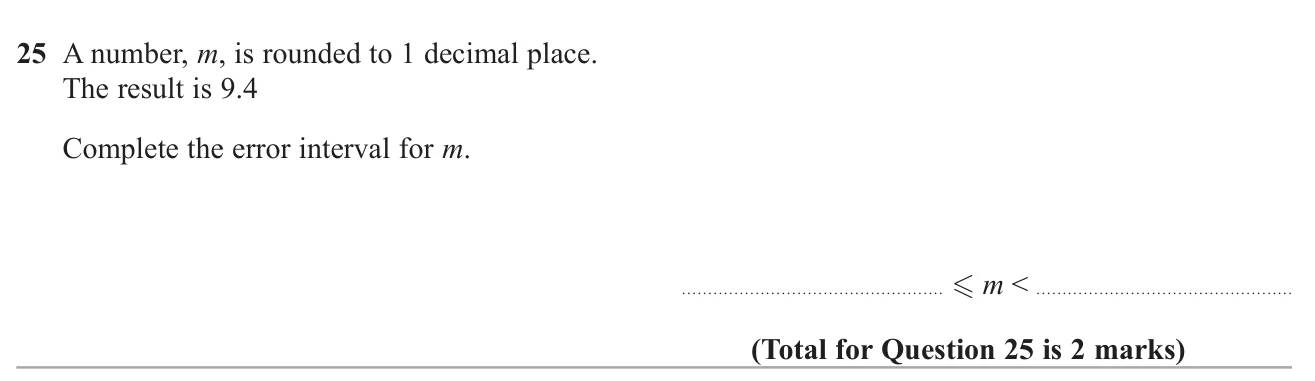
© Pearson Education Ltd. November 2020 Paper 3 (Foundation, calculator), question 25.
Answer 9.35 ≤ m < 9.45 9.35 \le m < 9.45 9.35 ≤ m < 9.45 2 marks
Worked solution Checked against the mark scheme
Half of 0.1 is 0.05.
Lower bound 9.4 − 0.05 = 9.35 9.4 - 0.05 = 9.35 9.4 − 0.05 = 9.35 9.4 + 0.05 = 9.45 9.4 + 0.05 = 9.45 9.4 + 0.05 = 9.45
9.35 ≤ m < 9.45 9.35 \le m < 9.45 9.35 ≤ m < 9.45
Watch out: Using 9.3 and 9.5 as the limits.
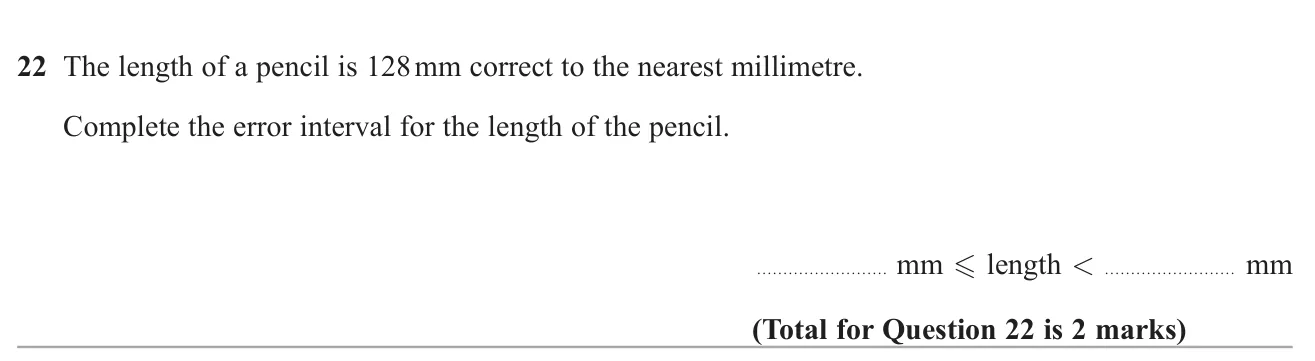
© Pearson Education Ltd. November 2019 Paper 2 (Foundation, calculator), question 22.
Answer 127.5 ≤ length < 128.5 127.5 \le \text{length} < 128.5 127.5 ≤ length < 128.5 2 marks
Worked solution Checked against the mark scheme
Nearest millimetre means half a millimetre either side.
Lower bound: 128 − 0.5 = 127.5 128 - 0.5 = 127.5 128 − 0.5 = 127.5
Upper bound: 128 + 0.5 = 128.5 128 + 0.5 = 128.5 128 + 0.5 = 128.5
127.5 ≤ length < 128.5 127.5 \le \text{length} < 128.5 127.5 ≤ length < 128.5
Watch out: Using 127 and 129.
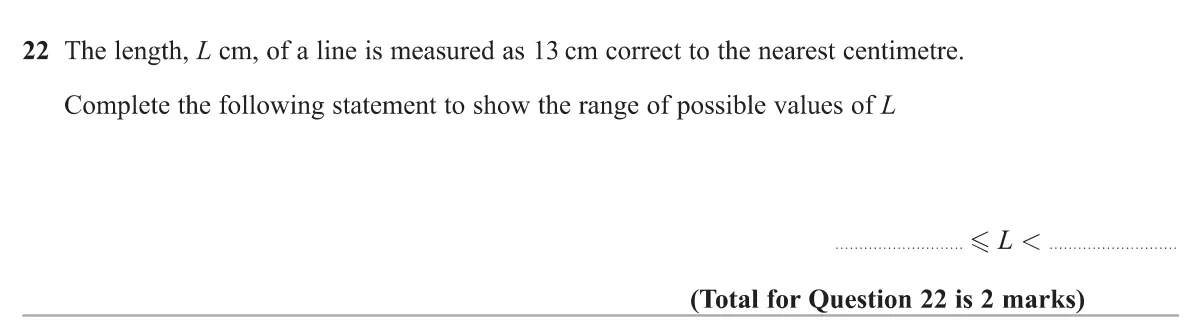
© Pearson Education Ltd. Specimen Paper 3 (Foundation, calculator), question 22.
Answer 12.5 ≤ L < 13.5 12.5 \le L < 13.5 12.5 ≤ L < 13.5 2 marks
Worked solution Checked against the mark scheme
To the nearest cm, the true length is within half a centimetre either side of 13.
13 − 0.5 = 12.5 13 - 0.5 = 12.5 13 − 0.5 = 12.5 13 + 0.5 = 13.5 13 + 0.5 = 13.5 13 + 0.5 = 13.5
So 12.5 ≤ L < 13.5 12.5 \le L < 13.5 12.5 ≤ L < 13.5
Watch out: Writing 12 and 14, or using 13.4 or 13.49 for the upper bound.
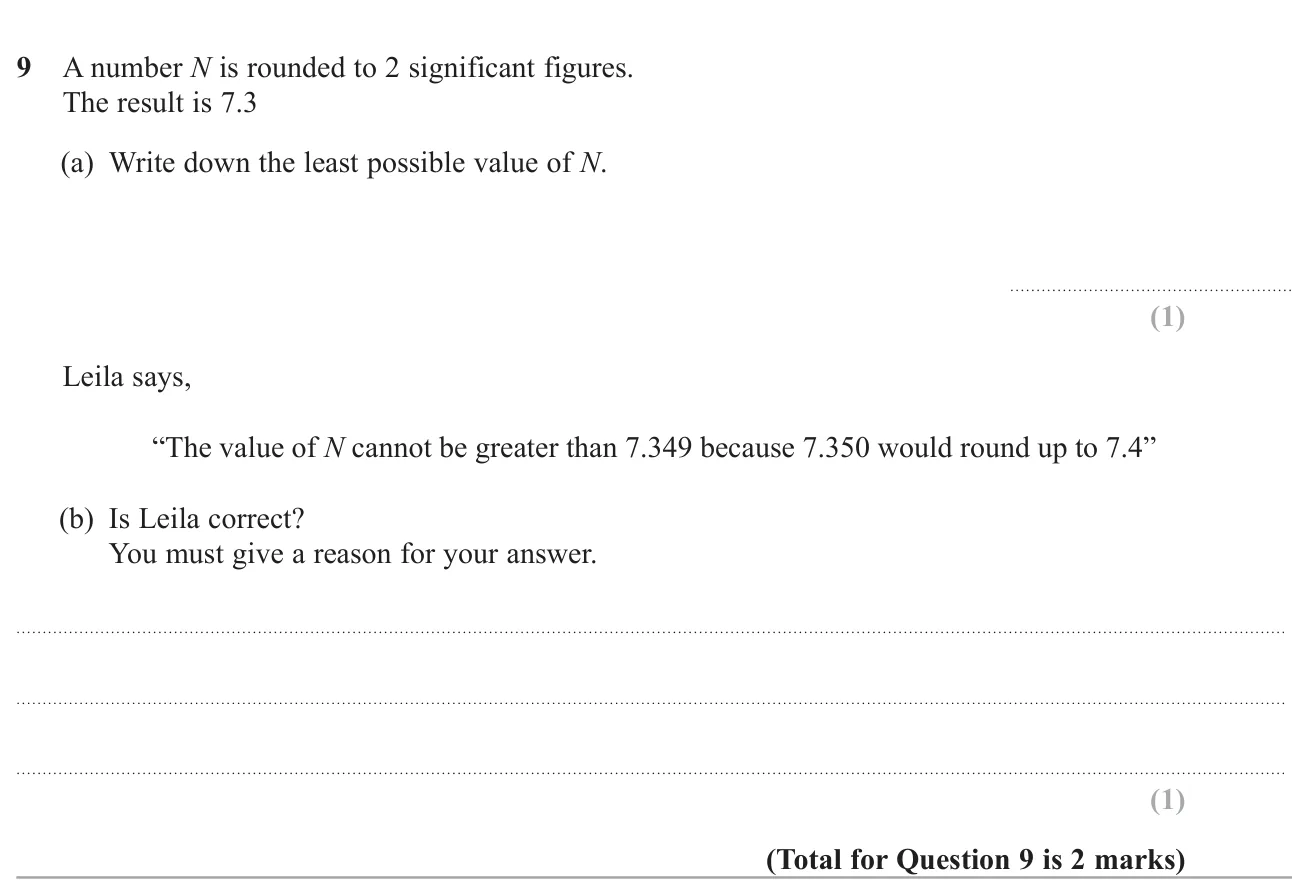
© Pearson Education Ltd. June 2024 Paper 2 (Higher, calculator), question 9.
(a) 7.25 7.25 7.25 1 mark (b) No, e.g. N N N 1 mark
Worked solution Checked against the mark scheme
(a) Numbers that round to 7.3 (2 s.f.) are from 7.25 up to (not including) 7.35, so the least value is 7.25 7.25 7.25
(b) No. Values such as 7.3495 are bigger than 7.349 but still round to 7.3; N N N
Watch out: Giving 7.2 or 7.29 as the least value.
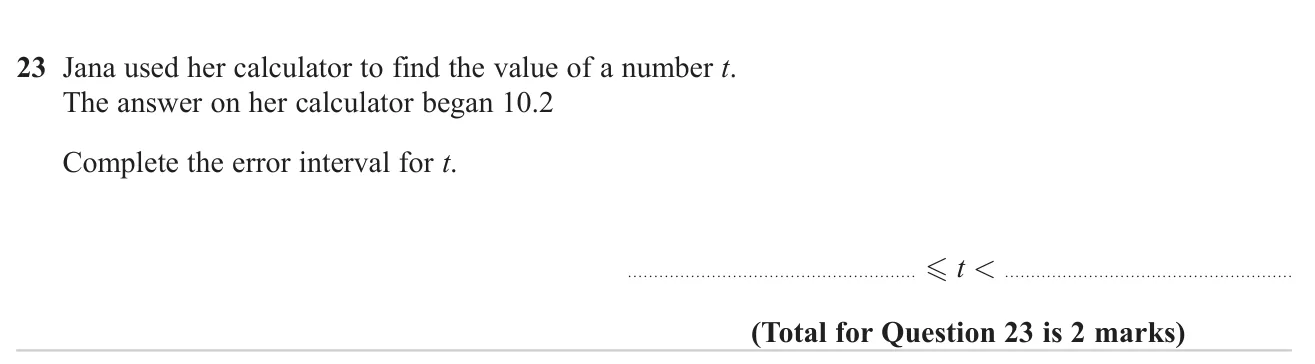
© Pearson Education Ltd. November 2024 Paper 3 (Foundation, calculator), question 23.
Answer 10.2 ≤ t < 10.3 10.2 \le t < 10.3 10.2 ≤ t < 10.3 2 marks
Worked solution Checked against the mark scheme
The calculator display began 10.2, so the number was cut off (truncated), not rounded.
It could be anything from 10.2 up to but not including 10.3:
10.2 ≤ t < 10.3 10.2 \le t < 10.3 10.2 ≤ t < 10.3
Watch out: Treating it as rounding and writing 10.15 ≤ t < 10.25 10.15 \le t < 10.25 10.15 ≤ t < 10.25
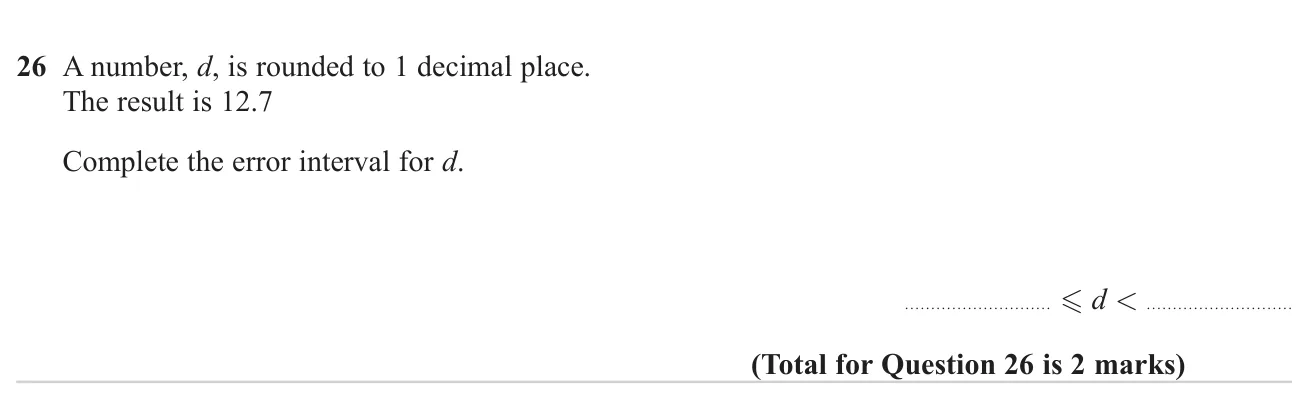
© Pearson Education Ltd. June 2023 Paper 2 (Foundation, calculator), question 26.
Answer 12.65 ≤ d < 12.75 12.65 \le d < 12.75 12.65 ≤ d < 12.75 2 marks
Worked solution Checked against the mark scheme
Rounding to 1 d.p. means the value is within 0.05 0.05 0.05 12.7 12.7 12.7
Lower bound: 12.7 − 0.05 = 12.65 12.7 - 0.05 = 12.65 12.7 − 0.05 = 12.65
Upper bound: 12.7 + 0.05 = 12.75 12.7 + 0.05 = 12.75 12.7 + 0.05 = 12.75
12.65 ≤ d < 12.75 12.65 \le d < 12.75 12.65 ≤ d < 12.75
Watch out: Using 12.6 and 12.8, or 12.749 as the upper bound.
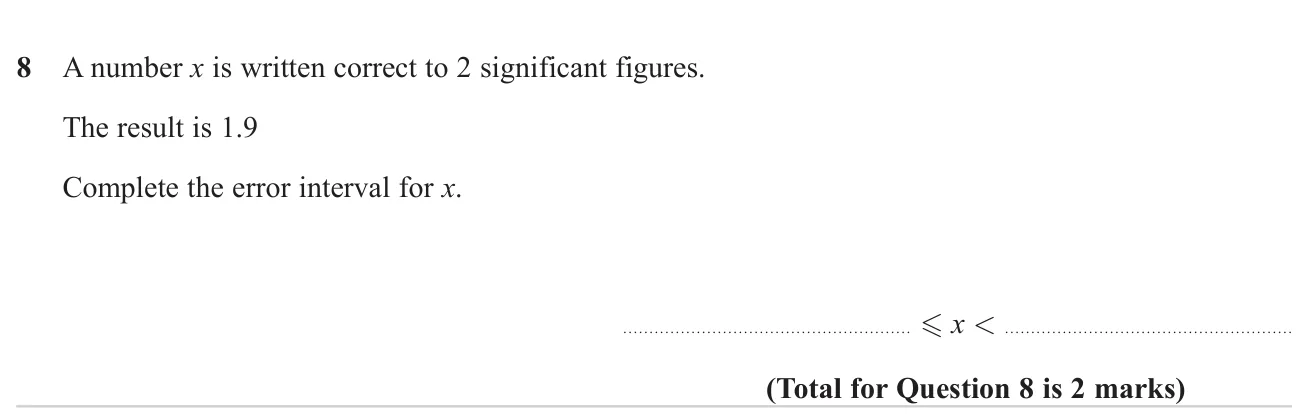
© Pearson Education Ltd. November 2023 Paper 2 (Higher, calculator), question 8.
Answer 1.85 ≤ x < 1.95 1.85 \le x < 1.95 1.85 ≤ x < 1.95 2 marks
Worked solution Checked against the mark scheme
Rounding to 2 significant figures here means to the nearest 0.1, so half of that is 0.05.
Lower bound: 1.9 − 0.05 = 1.85 1.9 - 0.05 = 1.85 1.9 − 0.05 = 1.85
Upper bound: 1.9 + 0.05 = 1.95 1.9 + 0.05 = 1.95 1.9 + 0.05 = 1.95
1.85 ≤ x < 1.95 1.85 \le x < 1.95 1.85 ≤ x < 1.95
Watch out: Using 1.94 or 1.949 as the upper bound with ≤.
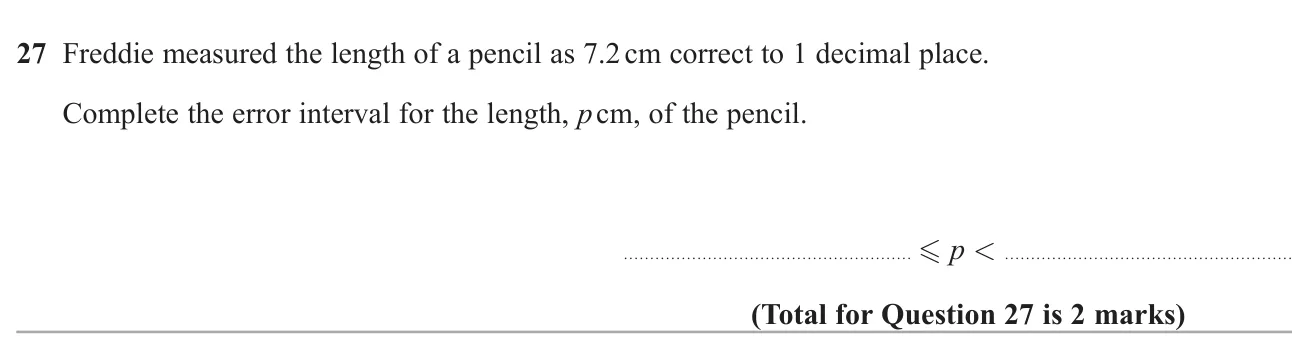
© Pearson Education Ltd. November 2021 Paper 1 (Foundation, non-calculator), question 27.
Answer 7.15 ≤ p < 7.25 7.15 \le p < 7.25 7.15 ≤ p < 7.25 2 marks
Worked solution Checked against the mark scheme
To 1 decimal place, the length could be up to half of 0.1 either side.
7.2 − 0.05 = 7.15 7.2 - 0.05 = 7.15 7.2 − 0.05 = 7.15 7.2 + 0.05 = 7.25 7.2 + 0.05 = 7.25 7.2 + 0.05 = 7.25
7.15 ≤ p < 7.25 7.15 \le p < 7.25 7.15 ≤ p < 7.25
Watch out: Using 7.1 and 7.3 as the bounds.
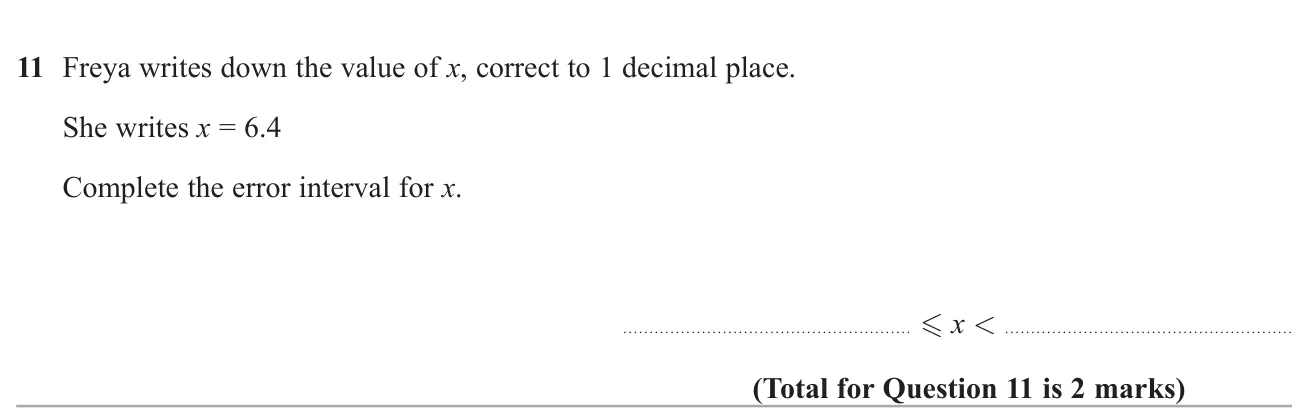
© Pearson Education Ltd. November 2021 Paper 3 (Higher, calculator), question 11.
Answer 6.35 ≤ x < 6.45 6.35 \le x < 6.45 6.35 ≤ x < 6.45 2 marks
Worked solution Checked against the mark scheme
Rounding to 1 decimal place means x x x 0.05 0.05 0.05 6.4 6.4 6.4
Lower bound = 6.4 − 0.05 = 6.35 = 6.4 - 0.05 = 6.35 = 6.4 − 0.05 = 6.35 = 6.4 + 0.05 = 6.45 = 6.4 + 0.05 = 6.45 = 6.4 + 0.05 = 6.45
6.35 ≤ x < 6.45 6.35 \le x < 6.45 6.35 ≤ x < 6.45
Watch out: Using 6.44 or 6.449 as the upper limit.
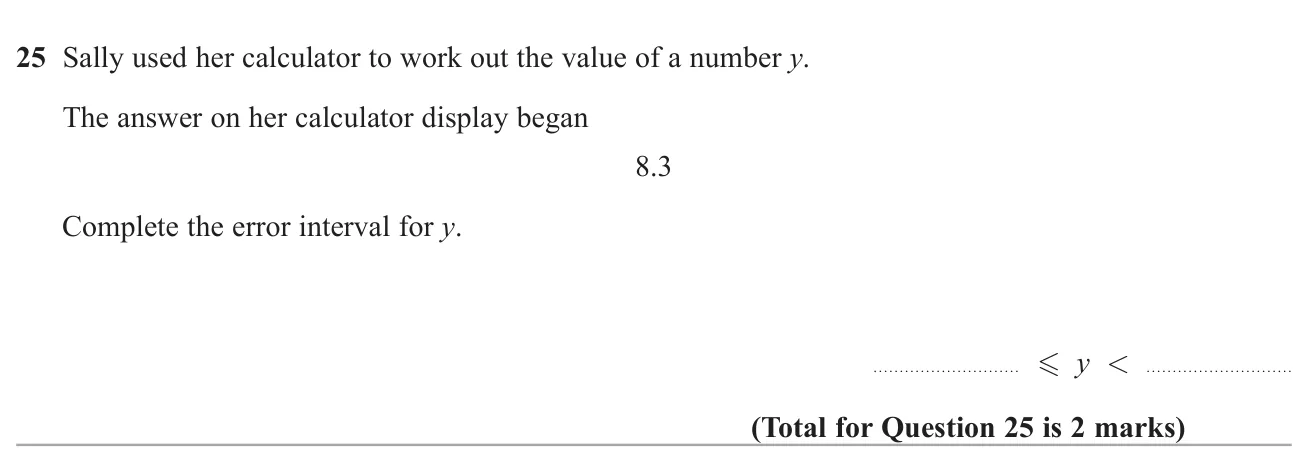
© Pearson Education Ltd. June 2019 Paper 2 (Foundation, calculator), question 25.
Answer 8.3 ≤ y < 8.4 8.3 \le y < 8.4 8.3 ≤ y < 8.4 2 marks
Worked solution Checked against the mark scheme
The display began 8.3, so the digits after 8.3 have been cut off (truncated), not rounded.
The smallest value is 8.3 and y y y
8.3 ≤ y < 8.4 8.3 \le y < 8.4 8.3 ≤ y < 8.4
Watch out: Treating it as rounding and giving 8.25 ≤ y < 8.35.
© Pearson Education Ltd. November 2022 Paper 3 (Higher, calculator), question 12.
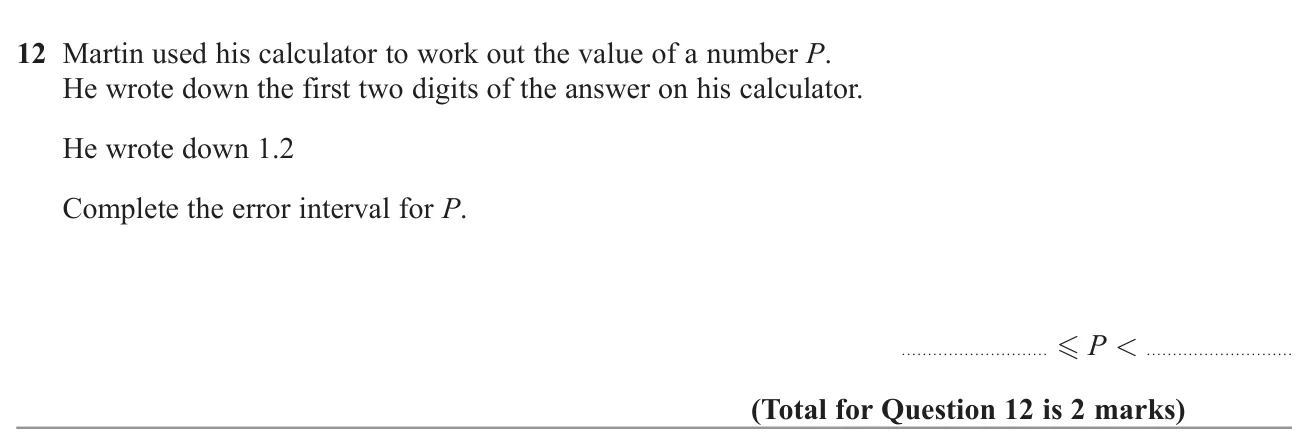
Answer 1.2 ≤ P < 1.3 1.2 \le P < 1.3 1.2 ≤ P < 1.3 2 marks
Worked solution Checked against the mark scheme
Martin wrote down the first two digits, so he truncated rather than rounded.
Any number from 1.2 up to (but not including) 1.3 would show as 1.2
1.2 ≤ P < 1.3 1.2 \le P < 1.3 1.2 ≤ P < 1.3
Watch out: Treating it as rounding and giving 1.15 ≤ P < 1.25 1.15 \le P < 1.25 1.15 ≤ P < 1.25
© Pearson Education Ltd. November 2018 Paper 2 (Higher, calculator), question 9.
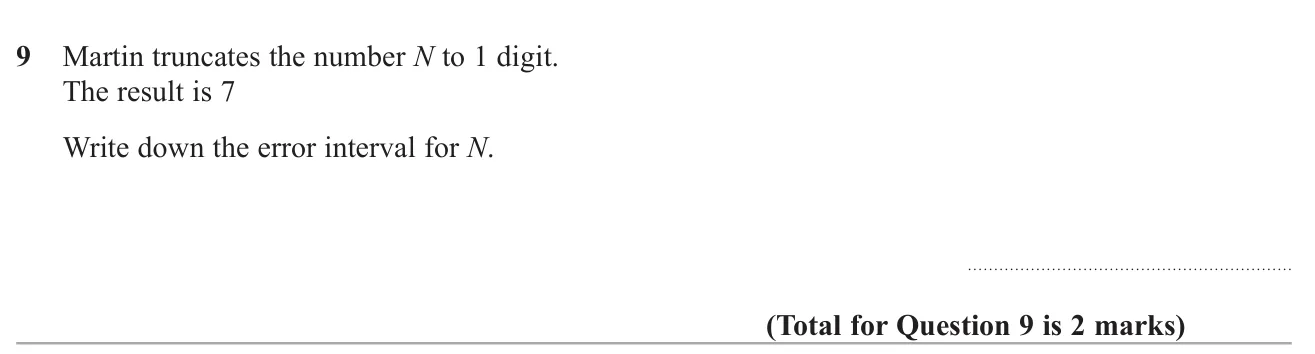
Answer 7 ≤ N < 8 7 \le N < 8 7 ≤ N < 8 2 marks
Worked solution Checked against the mark scheme
Truncating chops off the digits after the first one, so N can be 7 itself or anything up to (but not including) 8.
7 ≤ N < 8 7 \le N < 8 7 ≤ N < 8
Watch out: Treating it as rounding and writing 6.5 ≤ N < 7.5 6.5 \le N < 7.5 6.5 ≤ N < 7.5
© Pearson Education Ltd. June 2024 Paper 3 (Higher, calculator), question 19.
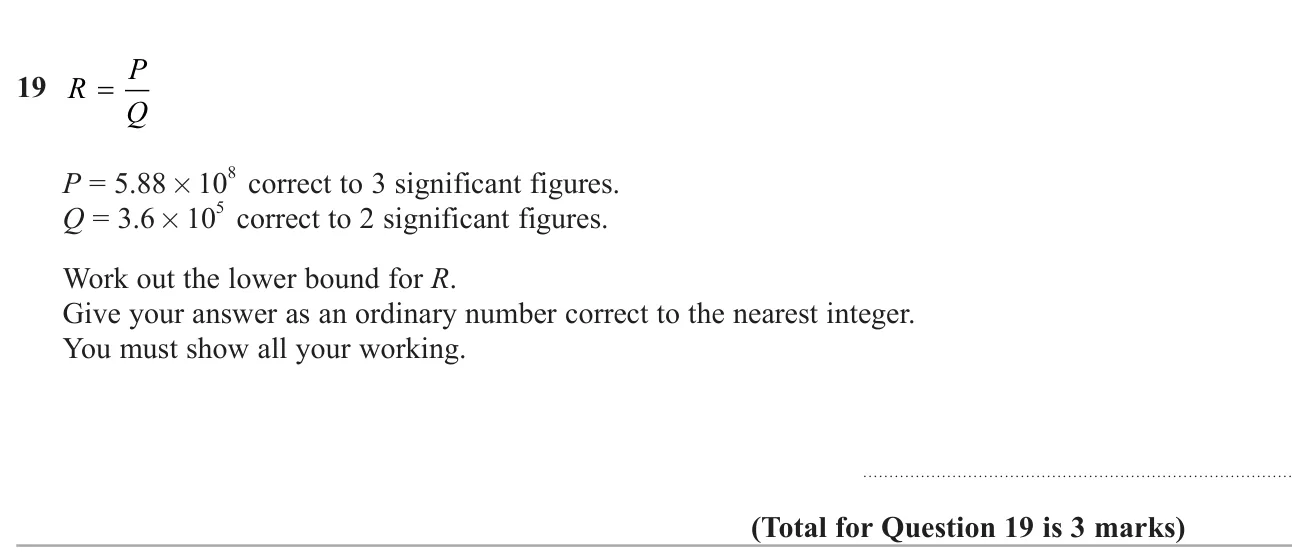
Answer 1610 1610 1610 3 marks
Worked solution Checked against the mark scheme
P P P = 5.875 × 10 8 = 5.875 \times 10^8 = 5.875 × 1 0 8
Q Q Q = 3.65 × 10 5 = 3.65 \times 10^5 = 3.65 × 1 0 5
Lower bound of R = 5.875 × 10 8 3.65 × 10 5 = 1609.6 ≈ 1610 R = \dfrac{5.875 \times 10^8}{3.65 \times 10^5} = 1609.6 \approx 1610 R = 3.65 × 1 0 5 5.875 × 1 0 8 = 1609.6 ≈ 1610
Watch out: Dividing lower bound by lower bound.
© Pearson Education Ltd. June 2022 Paper 3 (Higher, calculator), question 16.
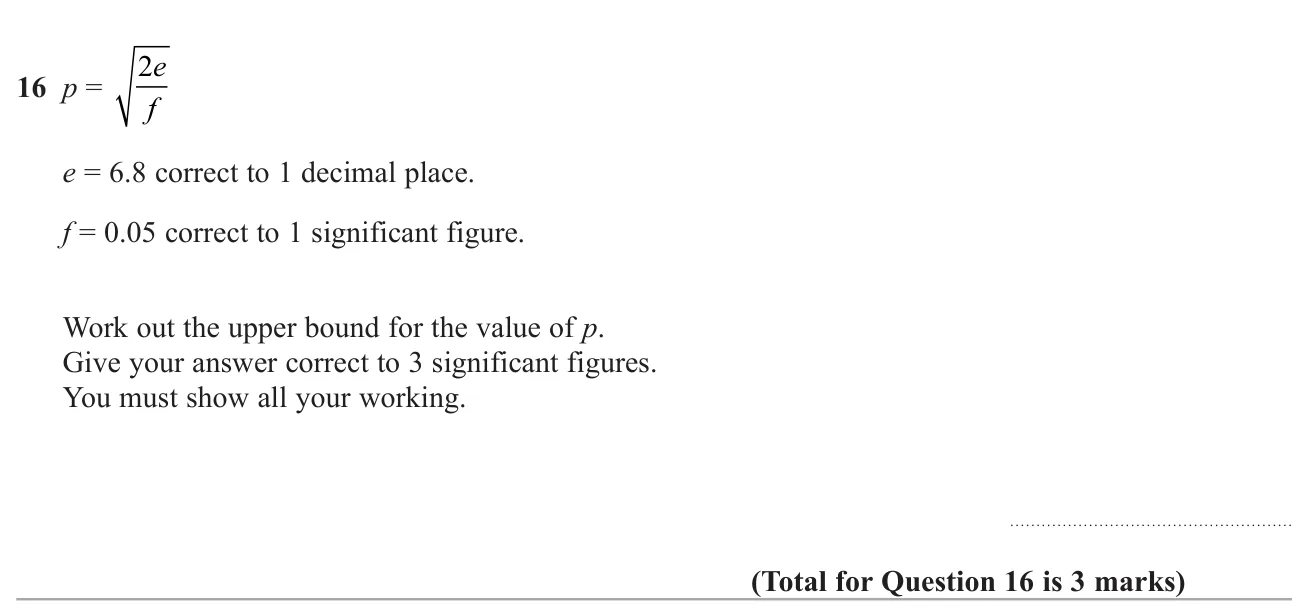
Answer 17.4 17.4 17.4 3 marks
Worked solution Checked against the mark scheme
Bounds: 6.75 ≤ e < 6.85 6.75 \le e < 6.85 6.75 ≤ e < 6.85 0.045 ≤ f < 0.055 0.045 \le f < 0.055 0.045 ≤ f < 0.055
For the largest p p p
p = 2 × 6.85 0.045 = 304.44 … = 17.448 … ≈ 17.4 p = \sqrt{\frac{2 \times 6.85}{0.045}} = \sqrt{304.44\ldots} = 17.448\ldots \approx 17.4 p = 0.045 2 × 6.85 = 304.44 … = 17.448 … ≈ 17.4
Watch out: Dividing by the upper bound of f, which gives the smaller value.
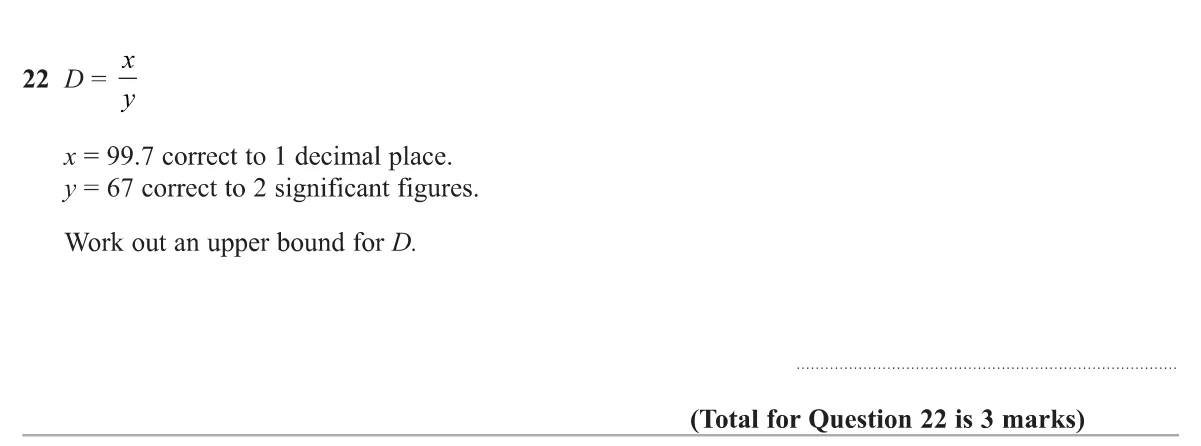
© Pearson Education Ltd. Specimen Paper 2 (Higher, calculator), question 22.
Worked solution Checked against the mark scheme
x x x
y = 67 y = 67 y = 67
Upper bound of D = 99.75 66.5 = 1.5 D = \frac{99.75}{66.5} = 1.5 D = 66.5 99.75 = 1.5
Watch out: Dividing the upper bound of x by the upper bound of y.
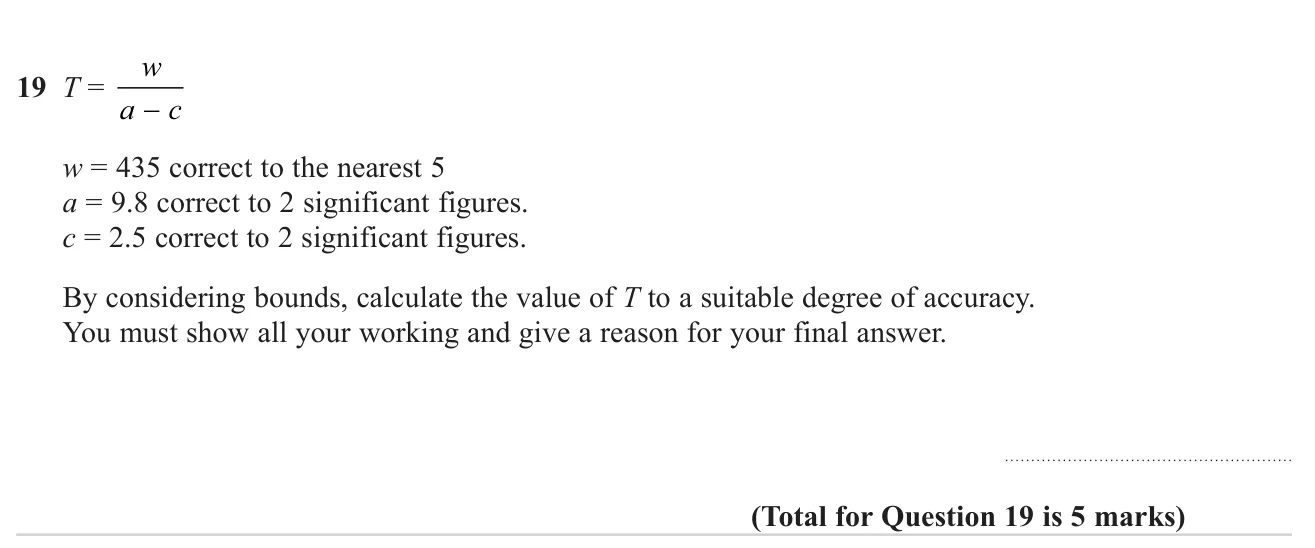
© Pearson Education Ltd. November 2024 Paper 2 (Higher, calculator), question 19.
Answer 60 60 60 5 marks
Worked solution Checked against the mark scheme
Bounds: w w w a a a c c c
Lower bound of T = 432.5 9.85 − 2.45 = 58.44 … T = \frac{432.5}{9.85 - 2.45} = 58.44… T = 9.85 − 2.45 432.5 = 58.44 …
Upper bound of T = 437.5 9.75 − 2.55 = 60.76 … T = \frac{437.5}{9.75 - 2.55} = 60.76… T = 9.75 − 2.55 437.5 = 60.76 …
Both round to 60 (1 sf), so T = 60 T = 60 T = 60
Watch out: Using the upper bound of c in the lower bound of T, forgetting that subtracting reverses which bound is needed.
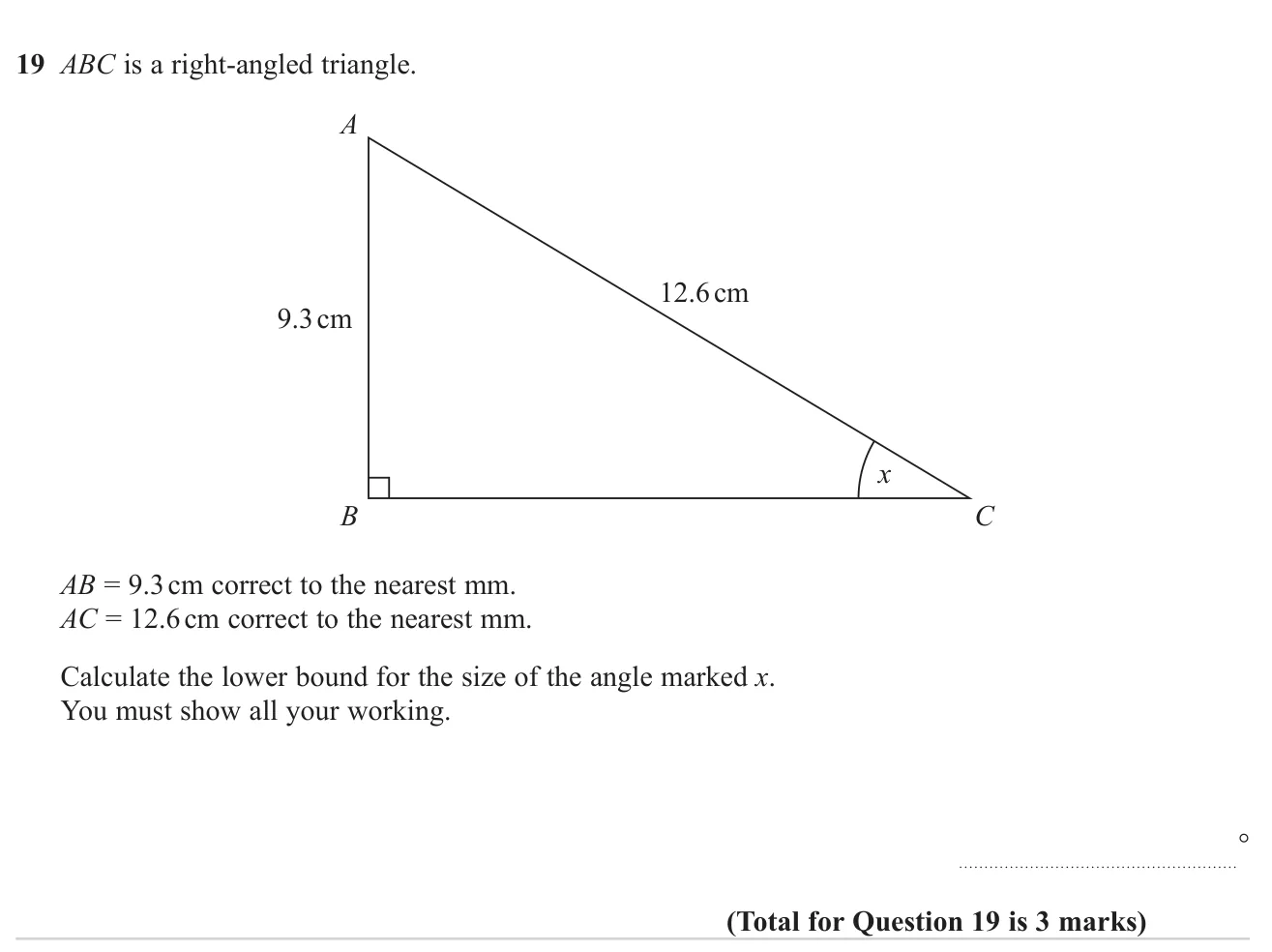
© Pearson Education Ltd. June 2023 Paper 2 (Higher, calculator), question 19.
Answer 46.98... ° 46.98...° 46.98...° 3 marks
Worked solution Checked against the mark scheme
Bounds: A B AB A B A C AC A C
sin x = A B A C \sin x = \frac{AB}{AC} sin x = A C A B A B AB A B A C AC A C
sin x = 9.25 12.65 = 0.7312... \sin x = \frac{9.25}{12.65} = 0.7312... sin x = 12.65 9.25 = 0.7312...
x = 46.989... ° x = 46.989...° x = 46.989...°
Watch out: Using both lower bounds, which does not give the smallest angle.
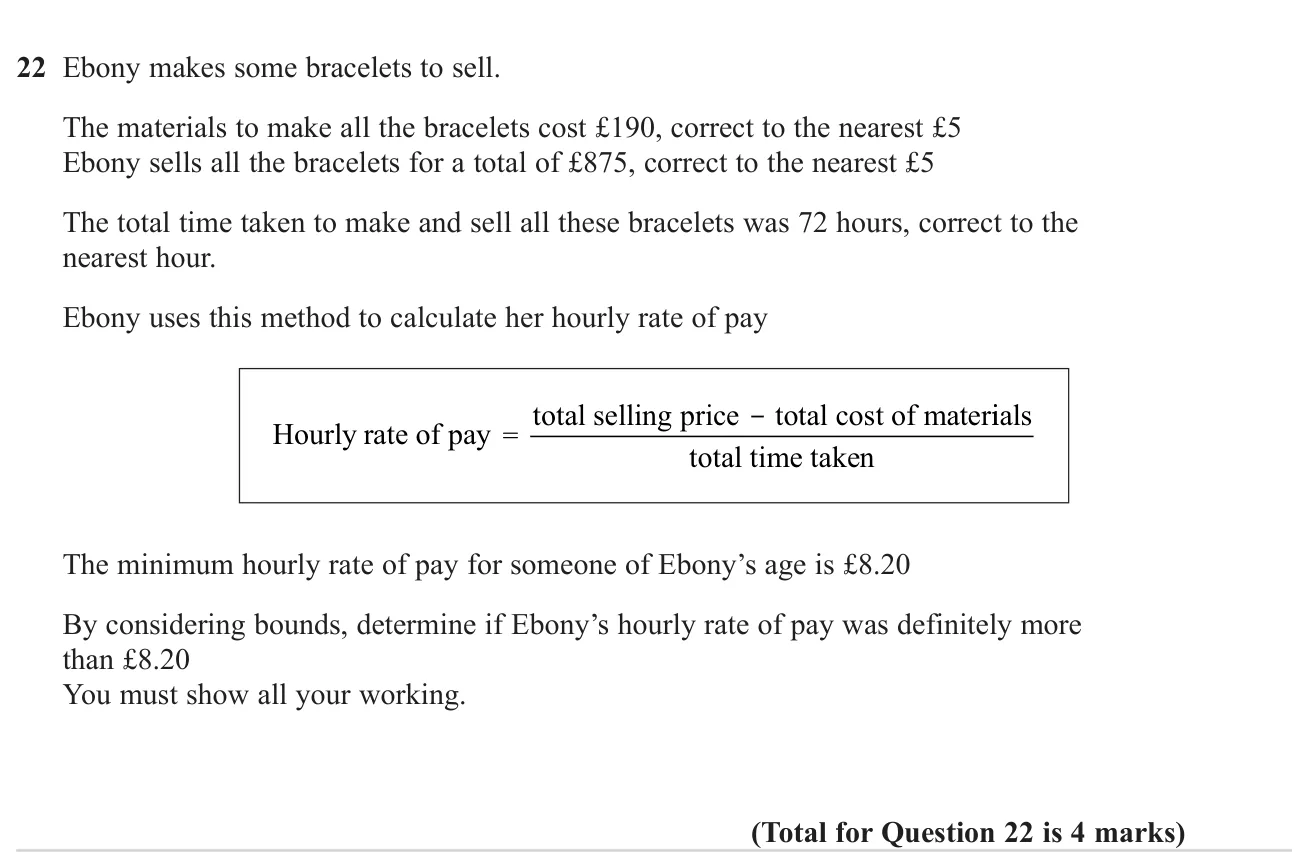
© Pearson Education Ltd. November 2023 Paper 3 (Higher, calculator), question 22.
Answer Lower bound of the rate = 872.5 − 192.5 72.5 = £ 9.379... = \frac{872.5 - 192.5}{72.5} = £9.379... = 72.5 872.5 − 192.5 = £9.379... 4 marks
Worked solution Checked against the mark scheme
To find the least possible rate, use the smallest takings, the largest costs and the longest time.
Takings LB = 872.5 = 872.5 = 872.5 = 192.5 = 192.5 = 192.5 = 72.5 = 72.5 = 72.5
LB of rate = 872.5 − 192.5 72.5 = 680 72.5 = 9.379... = \dfrac{872.5 - 192.5}{72.5} = \dfrac{680}{72.5} = 9.379... = 72.5 872.5 − 192.5 = 72.5 680 = 9.379...
Even the lowest possible rate, £9.379..., is more than £8.20, so her hourly rate was definitely more than £8.20.
Watch out: Using the lower bound of the cost or of the time, which makes the rate too high.
© Pearson Education Ltd. November 2021 Paper 2 (Higher, calculator), question 21.
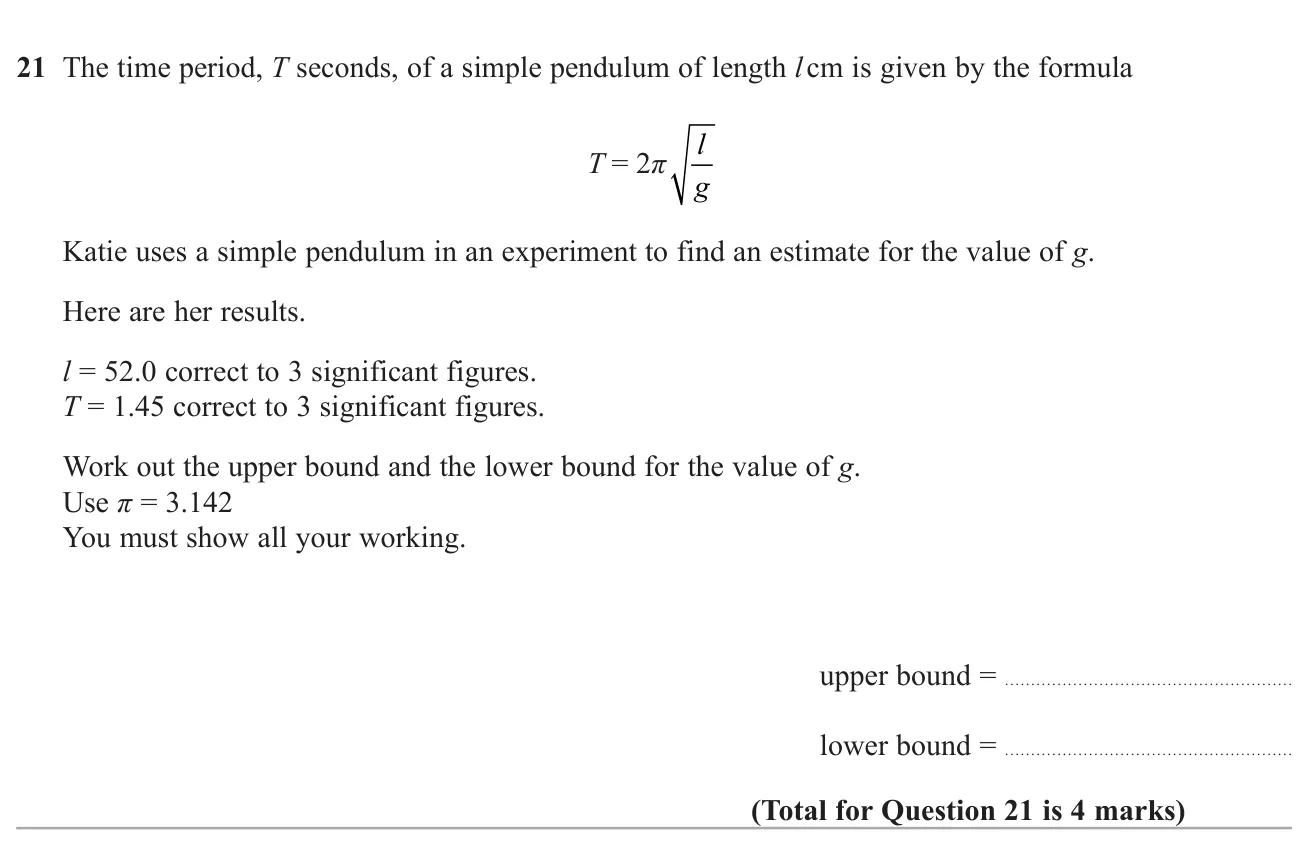
Answer Upper bound 984.4 984.4 984.4 969.0 969.0 969.0 4 marks
Worked solution Checked against the mark scheme
Rearranging: g = 4 π 2 l T 2 g = \frac{4\pi^2 l}{T^2} g = T 2 4 π 2 l
Bounds: 51.95 ≤ l < 52.05 51.95 \le l < 52.05 51.95 ≤ l < 52.05 1.445 ≤ T < 1.455 1.445 \le T < 1.455 1.445 ≤ T < 1.455
Upper bound: g = 4 × 3.142 2 × 52.05 1.445 2 = 984.4 g = \frac{4 \times 3.142^2 \times 52.05}{1.445^2} = 984.4 g = 1.44 5 2 4 × 3.14 2 2 × 52.05 = 984.4
Lower bound: g = 4 × 3.142 2 × 51.95 1.455 2 = 969.0 g = \frac{4 \times 3.142^2 \times 51.95}{1.455^2} = 969.0 g = 1.45 5 2 4 × 3.14 2 2 × 51.95 = 969.0
Watch out: Using the upper bound of T to get the upper bound of g; T is in the denominator, so it needs the lower bound.
© Pearson Education Ltd. November 2020 Paper 3 (Higher, calculator), question 18.
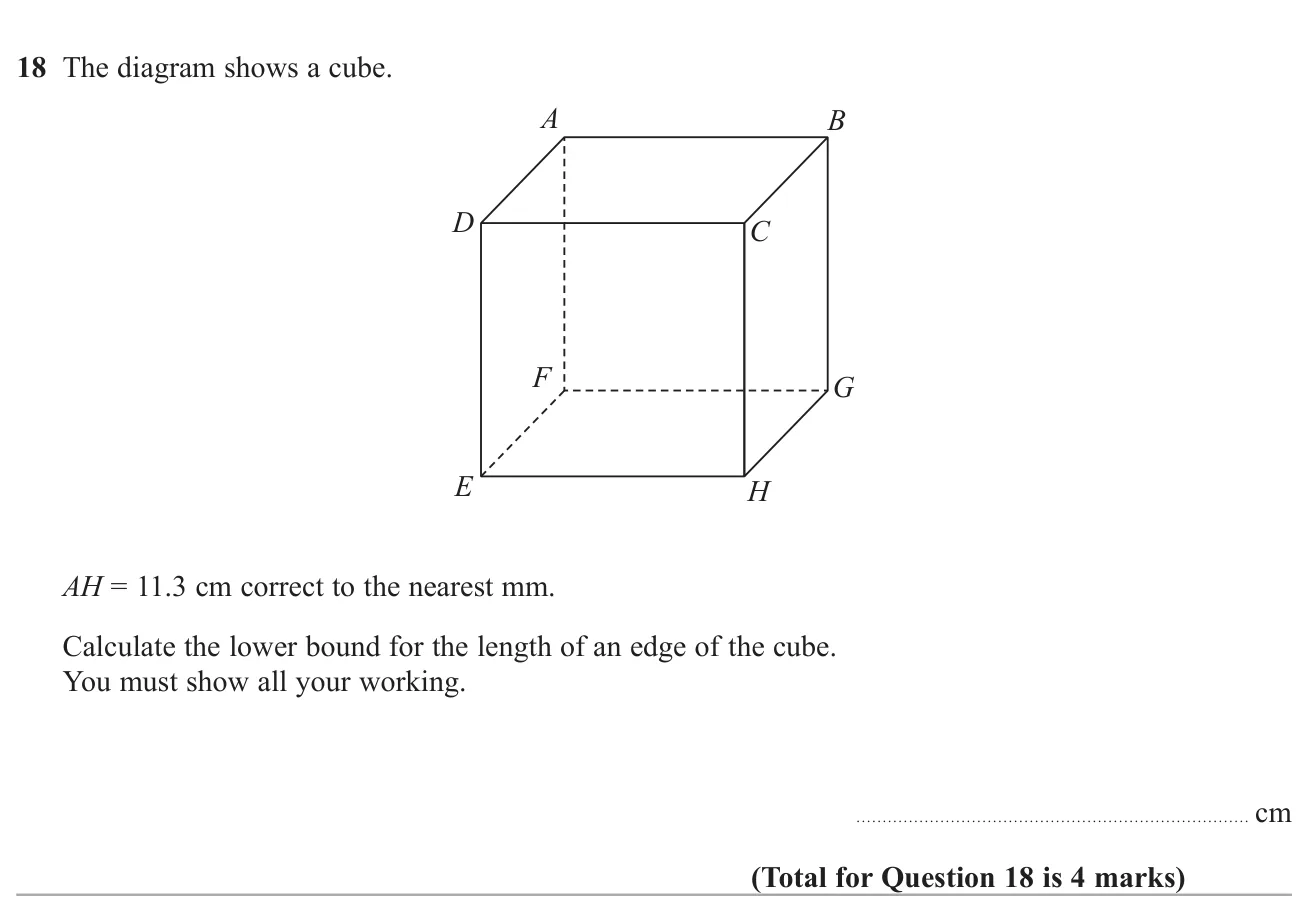
Answer 6.495 6.495 6.495 4 marks
Worked solution Checked against the mark scheme
Lower bound of A H = 11.25 AH = 11.25 A H = 11.25
For a cube of edge a a a a 2 + a 2 + a 2 = A H 2 a^2 + a^2 + a^2 = AH^2 a 2 + a 2 + a 2 = A H 2
3 a 2 = 11.25 2 3a^2 = 11.25^2 3 a 2 = 11.2 5 2 a = 11.25 3 ≈ 6.495 a = \frac{11.25}{\sqrt{3}} \approx 6.495 a = 3 11.25 ≈ 6.495
Watch out: Using 2D Pythagoras for a face diagonal only.
© Pearson Education Ltd. November 2019 Paper 2 (Higher, calculator), question 20.
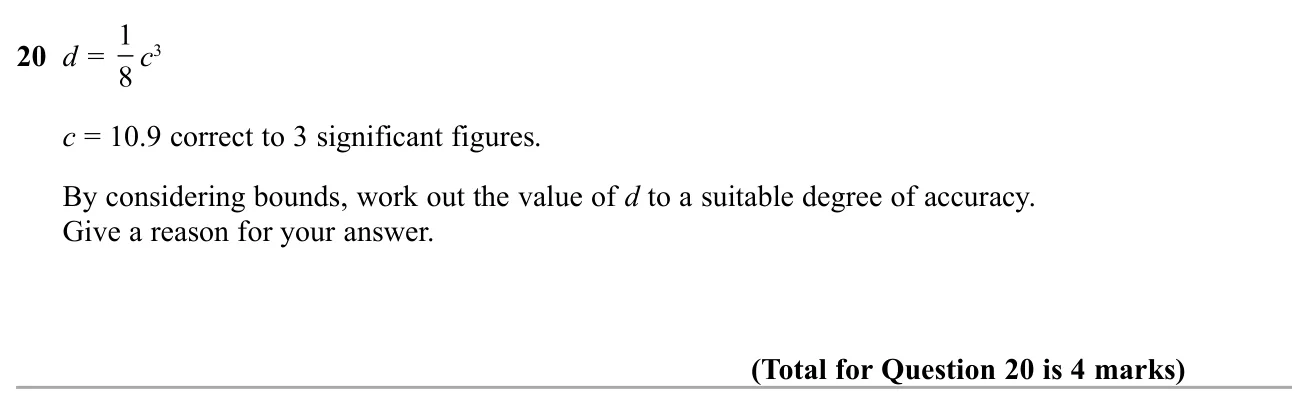
Answer d = 160 d = 160 d = 160 4 marks
Worked solution Checked against the mark scheme
Bounds of c c c 10.85 ≤ c < 10.95 10.85 \le c < 10.95 10.85 ≤ c < 10.95
Lower bound of d = 1 8 × 10.85 3 = 159.66... d = \frac{1}{8} \times 10.85^3 = 159.66... d = 8 1 × 10.8 5 3 = 159.66...
Upper bound of d = 1 8 × 10.95 3 = 164.11... d = \frac{1}{8} \times 10.95^3 = 164.11... d = 8 1 × 10.9 5 3 = 164.11...
Both round to 160 to 2 significant figures, so d = 160 d = 160 d = 160
Watch out: Giving 162 (3 s.f.) even though the bounds disagree at that accuracy.
© Pearson Education Ltd. June 2019 Paper 3 (Higher, calculator), question 19.
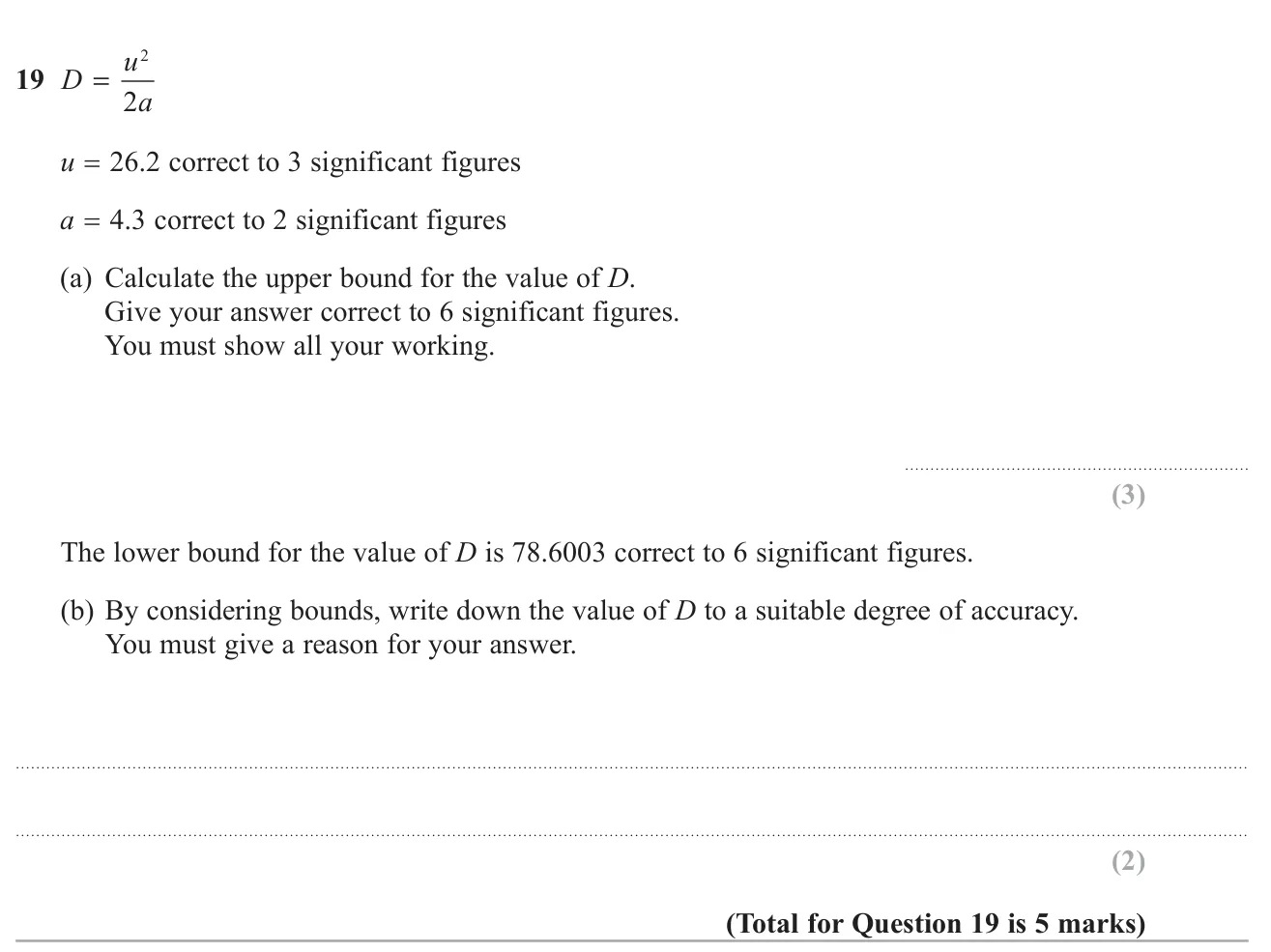
(a) 81.0662 81.0662 81.0662 3 marks (b) 80, because both bounds round to 80 to the nearest 10 2 marks
Worked solution Checked against the mark scheme
(a) u u u a a a
Largest D D D
D m a x = 26.25 2 2 × 4.25 = 689.0625 8.5 = 81.0662 D_{max} = \frac{26.25^2}{2 \times 4.25} = \frac{689.0625}{8.5} = 81.0662 D ma x = 2 × 4.25 26.2 5 2 = 8.5 689.0625 = 81.0662
(b) Lower bound 78.6003, upper bound 81.0662. They differ at 1 s.f. in the units but both round to 80 to the nearest 10, so D = 80 D = 80 D = 80
Watch out: Using the upper bound of a in the denominator.
© Pearson Education Ltd. June 2018 Paper 2 (Higher, calculator), question 21.
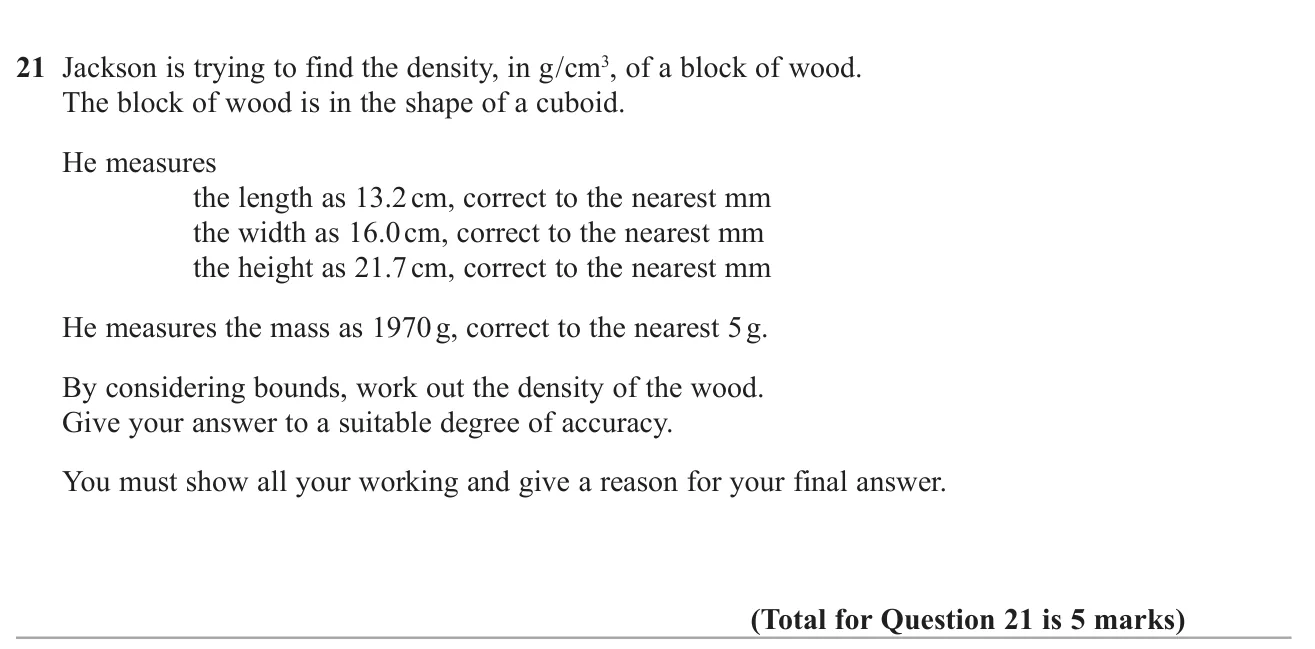
Answer 0.43 g/cm 3 0.43\text{ g/cm}^3 0.43 g/cm 3 5 marks
Worked solution Checked against the mark scheme
Lengths are to the nearest mm, mass to the nearest 5 g.
Lower bound: 1967.5 13.25 × 16.05 × 21.75 = 0.4254 \frac{1967.5}{13.25 \times 16.05 \times 21.75} = 0.4254 13.25 × 16.05 × 21.75 1967.5 = 0.4254
Upper bound: 1972.5 13.15 × 15.95 × 21.65 = 0.4344 \frac{1972.5}{13.15 \times 15.95 \times 21.65} = 0.4344 13.15 × 15.95 × 21.65 1972.5 = 0.4344
Both round to 0.43 0.43 0.43 0.43 g/cm 3 0.43\text{ g/cm}^3 0.43 g/cm 3
Watch out: Pairing upper bounds of mass with upper bounds of volume for the maximum density.
© Pearson Education Ltd. November 2018 Paper 3 (Higher, calculator), question 18.
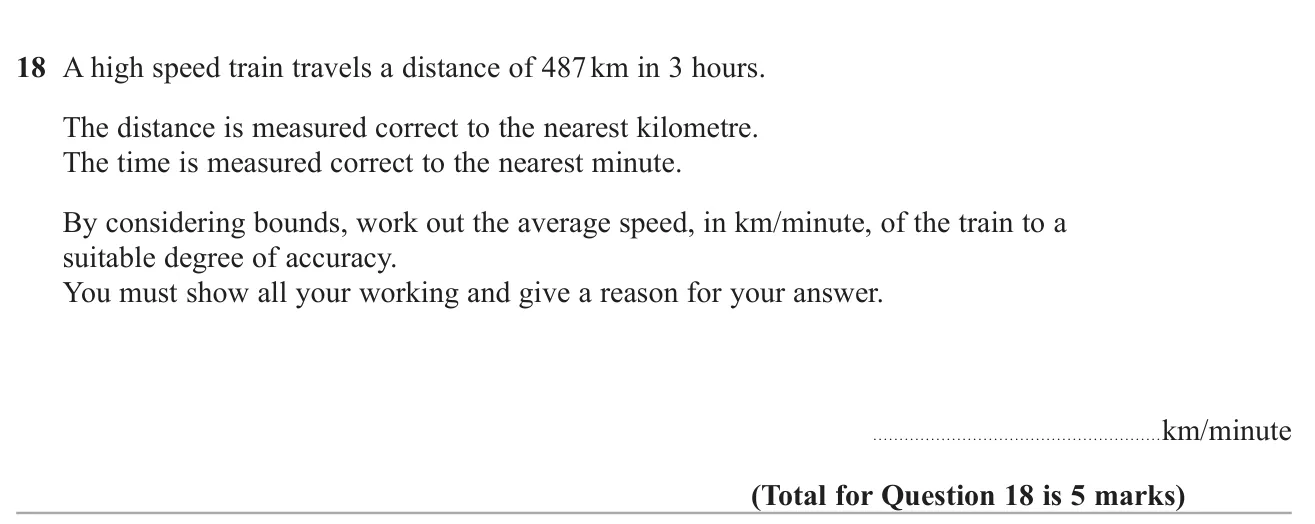
Answer 2.7 2.7 2.7 5 marks
Worked solution Checked against the mark scheme
Time: 3 hours = 180 = 180 = 180 179.5 179.5 179.5 180.5 180.5 180.5
Distance bounds: 486.5 486.5 486.5 487.5 487.5 487.5
Upper bound of speed = 487.5 179.5 = 2.7158 … = \frac{487.5}{179.5} = 2.7158\ldots = 179.5 487.5 = 2.7158 …
Lower bound of speed = 486.5 180.5 = 2.6953 … = \frac{486.5}{180.5} = 2.6953\ldots = 180.5 486.5 = 2.6953 …
Both round to 2.7 2.7 2.7 2.7 2.7 2.7
Watch out: Dividing upper distance by upper time for the upper bound.
© Pearson Education Ltd. November 2022 Paper 2 (Higher, calculator), question 23.
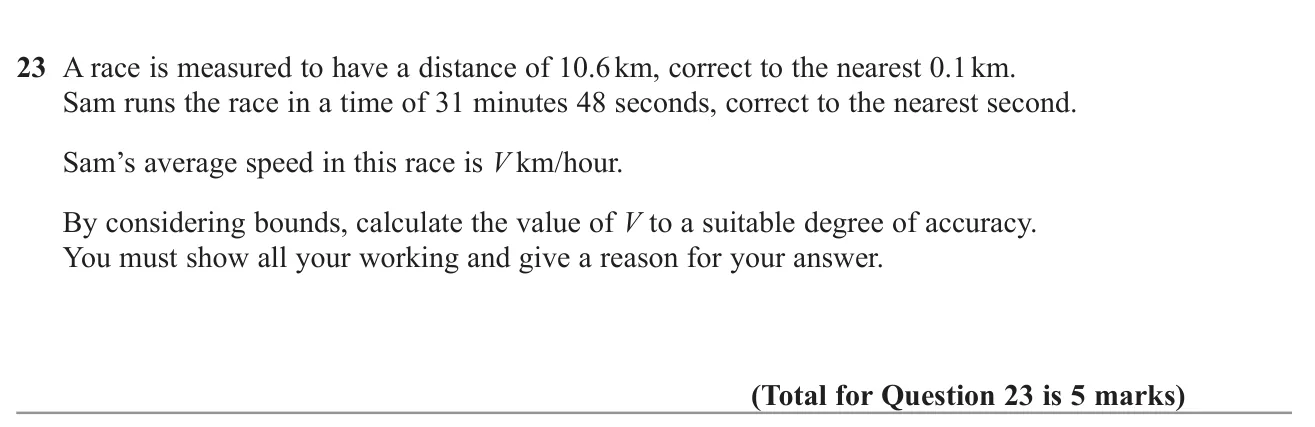
Worked solution Checked against the mark scheme
Distance: 10.55 ≤ d < 10.65 10.55 \le d < 10.65 10.55 ≤ d < 10.65
Time: 1907.5 ≤ t < 1908.5 1907.5 \le t < 1908.5 1907.5 ≤ t < 1908.5
Upper bound = 10.65 ÷ 1907.5 3600 = 20.099... = 10.65 \div \frac{1907.5}{3600} = 20.099... = 10.65 ÷ 3600 1907.5 = 20.099...
Lower bound = 10.55 ÷ 1908.5 3600 = 19.900... = 10.55 \div \frac{1908.5}{3600} = 19.900... = 10.55 ÷ 3600 1908.5 = 19.900...
Both round to 20 (2 s.f.), so V = 20 V = 20 V = 20
Watch out: Dividing the upper distance by the upper time for the upper bound.
Also tested in these questions Their main topic is different, but part of each one tests this topic.
June 2024 · Paper 1 Foundation · Q24 : Estimate the cost of a motorway journey by rounding, then say if it is an under- or overestimate.June 2024 · Paper 2 Foundation · Q19 : Use a calculator on an expression with a root, powers and a fraction, then round to 2 significant figures.June 2023 · Paper 1 Foundation · Q11 : Subtract to find unsold tickets, estimate ticket income by rounding, and say if the estimate is too high or low.June 2023 · Paper 2 Foundation · Q18 : Find the cost of buying cans in packs, then the cost of 100 ml of a drink bought in a box.November 2021 · Paper 2 Foundation · Q12 : Use a calculator to find the square root of a fraction, then round it to 2 decimal places.November 2019 · Paper 3 Foundation · Q23 : Use a calculator to evaluate a fraction with powers and a square root, then round to 4 significant figures.June 2019 · Paper 3 Foundation · Q11 : Compare the cost of sending 12 parcels by two services, then explain why an estimate is an underestimate.Specimen · Paper 1 Foundation · Q14 : Estimate the cost of gas over several weeks by rounding, then say whether the estimate is too high or too low.Specimen · Paper 2 Higher · Q12 : Find a reciprocal and use a calculator to evaluate a cube root of a fraction involving tan.