
© Pearson Education Ltd. November 2024 Paper 1 (Foundation, non-calculator), question 1.
Show answer
| Answer | 1 mark |
|---|
Worked solution Checked against the mark scheme
Per cent means out of 100, so divide by 100.
Watch out: Writing 2.5 or 25.0.
Number
42 past-paper questions, easiest first. Try each one, then reveal the answer.
Revision guide by The Full Marks
This topic is about switching between fractions, decimals and percentages so you can compare and calculate with them. Higher students also convert recurring decimals into fractions, usually as a short algebraic proof.
Foundation students convert between terminating decimals, fractions and percentages; converting recurring decimals to fractions is Higher only.
Example 1 Foundation · grade 3
(a) Write as a fraction in its simplest form. (b) Write as a decimal.
(a)
Divide top and bottom by 125:
(b) , so
Example 2 Higher · grade 7
Prove that
Let
Subtract:
Call the decimal , multiply by powers of 10 so the recurring parts line up, subtract to cancel them, then solve for .
Divide the numerator by the denominator, or make the denominator 10, 100 or 1000 using equivalent fractions.
© Pearson Education Ltd. November 2024 Paper 1 (Foundation, non-calculator), question 1.
| Answer | 1 mark |
|---|
Worked solution Checked against the mark scheme
Per cent means out of 100, so divide by 100.
Watch out: Writing 2.5 or 25.0.

© Pearson Education Ltd. June 2024 Paper 1 (Foundation, non-calculator), question 2.
| Answer | 1 mark |
|---|
Worked solution Checked against the mark scheme
Multiply by 100: , so .
Watch out: Writing 3%.
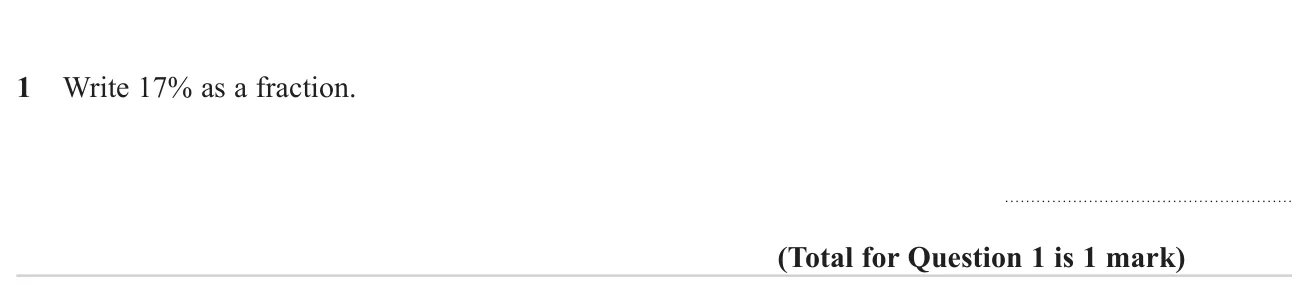
© Pearson Education Ltd. November 2024 Paper 2 (Foundation, calculator), question 1.
| Answer | 1 mark |
|---|
Worked solution Checked against the mark scheme
Per cent means out of 100, so .
Watch out: Writing or 0.17 instead of a fraction.
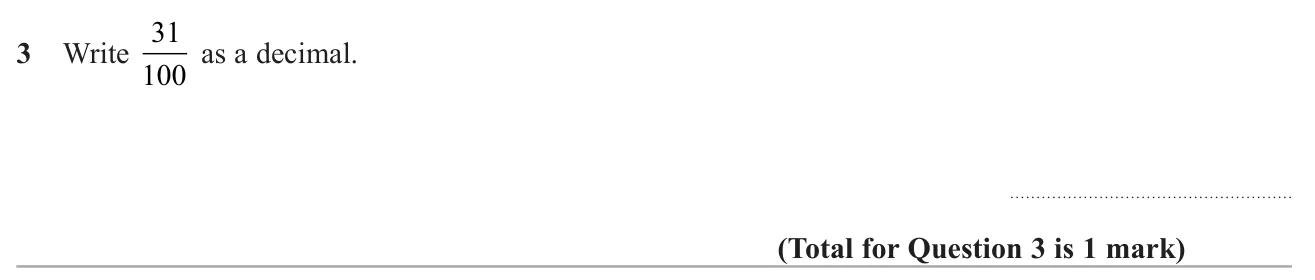
© Pearson Education Ltd. June 2024 Paper 2 (Foundation, calculator), question 3.
| Answer | 1 mark |
|---|
Worked solution Checked against the mark scheme
means 31 hundredths.
Watch out: Writing 3.1 or 0.031.
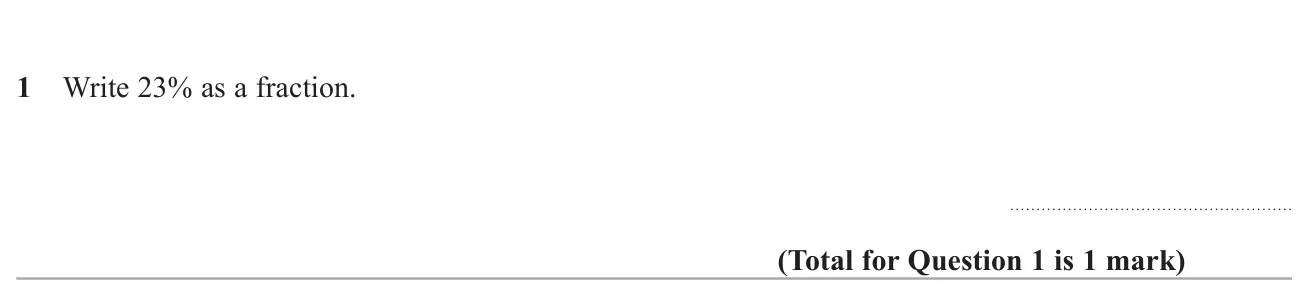
© Pearson Education Ltd. June 2024 Paper 3 (Foundation, calculator), question 1.
| Answer | 1 mark |
|---|
Worked solution Checked against the mark scheme
Per cent means 'out of 100', so .
Watch out: Writing 0.23 or 23/10 instead of a fraction out of 100.
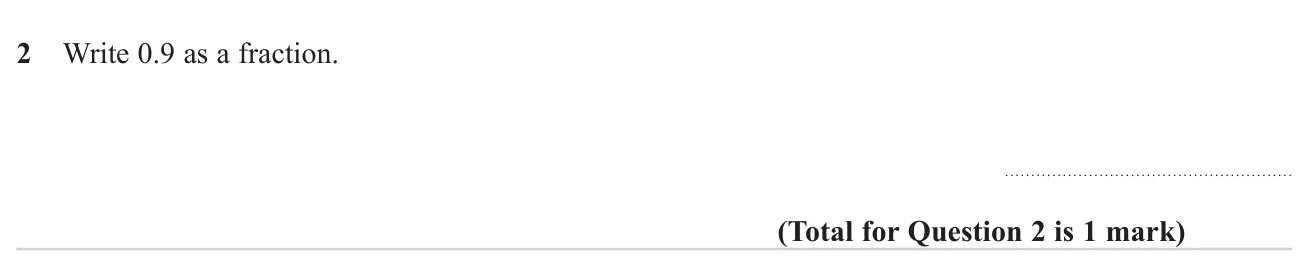
© Pearson Education Ltd. November 2023 Paper 2 (Foundation, calculator), question 2.
| Answer | 1 mark |
|---|
Worked solution Checked against the mark scheme
The 9 is in the tenths column, so .
Watch out: Writing or .

© Pearson Education Ltd. June 2023 Paper 2 (Foundation, calculator), question 2.
| Answer | 1 mark |
|---|
Worked solution Checked against the mark scheme
The 7 is in the tenths column, so .
Watch out: Writing or .
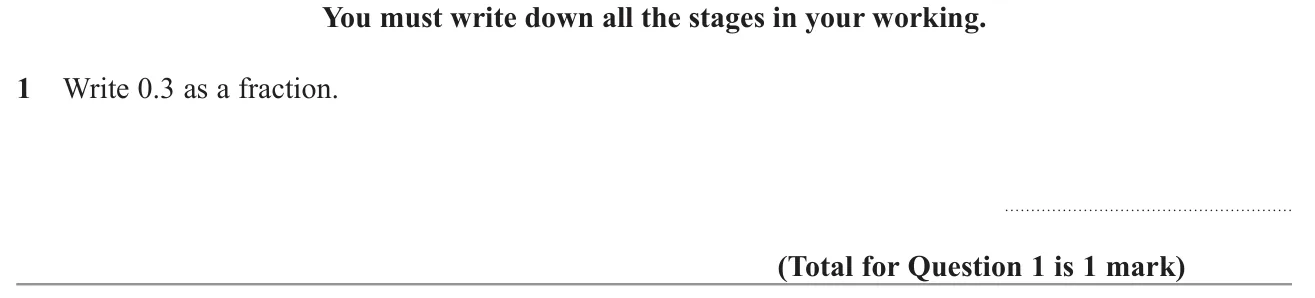
© Pearson Education Ltd. November 2022 Paper 1 (Foundation, non-calculator), question 1.
| Answer | 1 mark |
|---|
Worked solution Checked against the mark scheme
The 3 is in the tenths column, so .
Watch out: Writing .
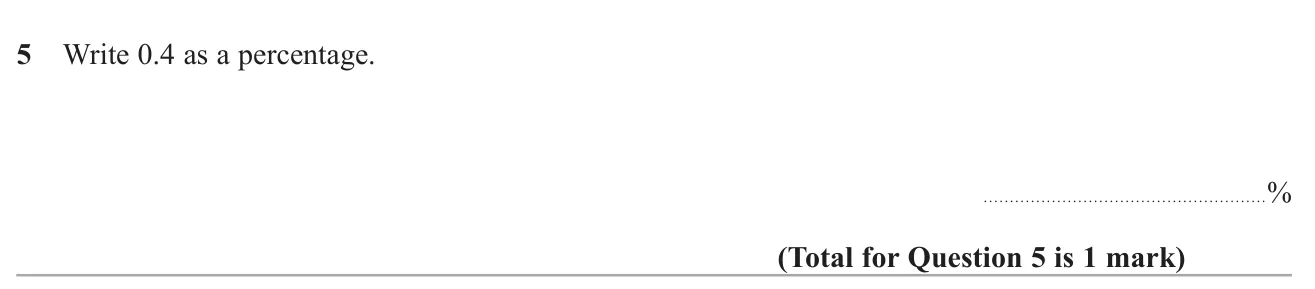
© Pearson Education Ltd. June 2022 Paper 2 (Foundation, calculator), question 5.
| Answer | 1 mark |
|---|
Worked solution Checked against the mark scheme
To change a decimal to a percentage, multiply by 100.
Watch out: Writing 4%.
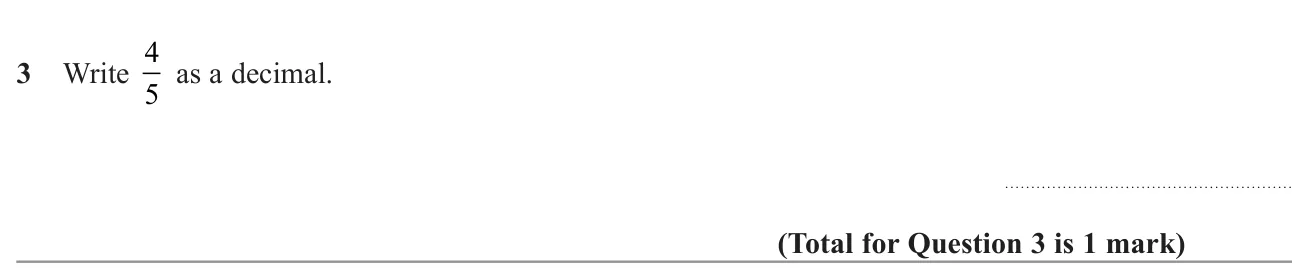
© Pearson Education Ltd. November 2022 Paper 3 (Foundation, calculator), question 3.
| Answer | 1 mark |
|---|
Worked solution Checked against the mark scheme
Watch out: Writing 0.45 by putting the digits after the point.
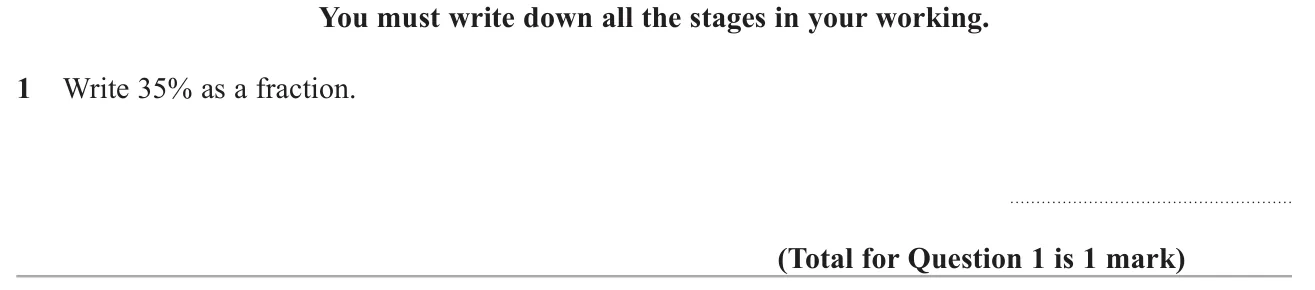
© Pearson Education Ltd. June 2022 Paper 3 (Foundation, calculator), question 1.
| Answer | (or ) | 1 mark |
|---|
Worked solution Checked against the mark scheme
Per cent means out of 100, so .
This simplifies to by dividing top and bottom by 5.
Watch out: Writing or .
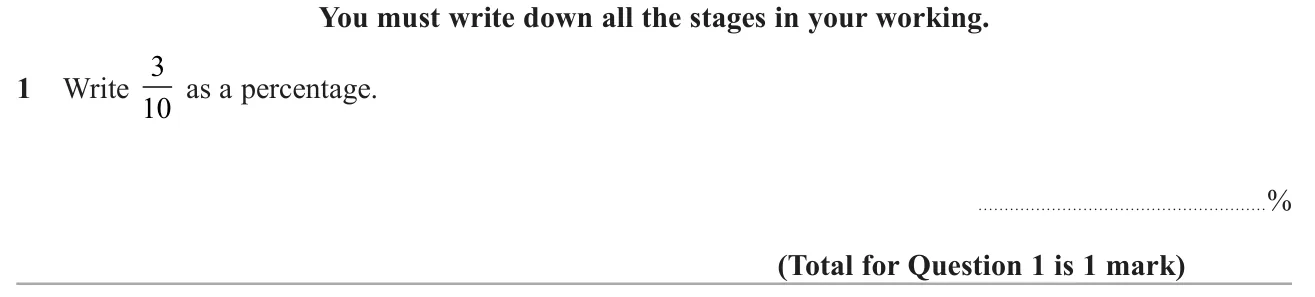
© Pearson Education Ltd. November 2021 Paper 1 (Foundation, non-calculator), question 1.
| Answer | 1 mark |
|---|
Worked solution Checked against the mark scheme
Percent means out of 100.
Watch out: Writing 3% or 0.3.
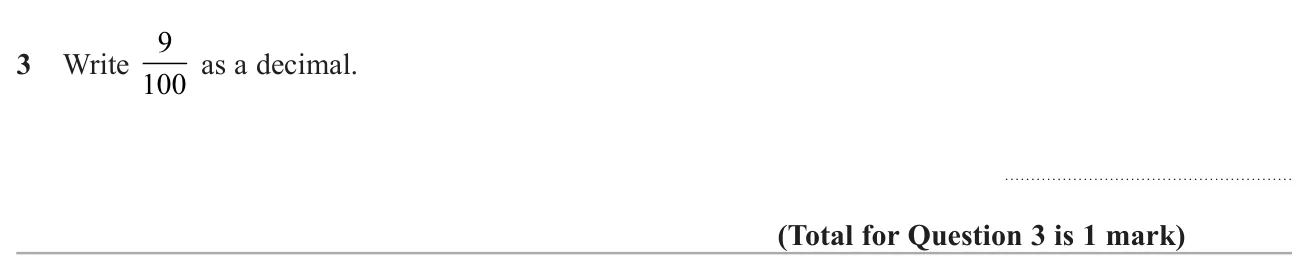
© Pearson Education Ltd. November 2021 Paper 1 (Foundation, non-calculator), question 3.
| Answer | 1 mark |
|---|
Worked solution Checked against the mark scheme
Hundredths are the second decimal place.
Watch out: Writing 0.9, which is nine tenths.
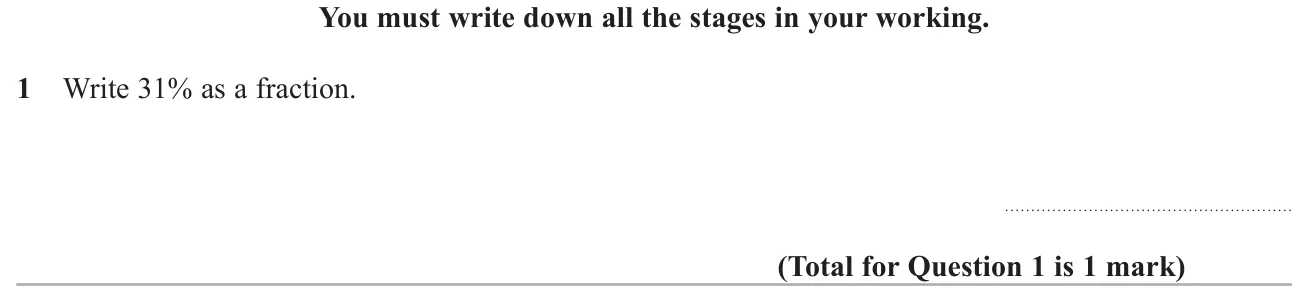
© Pearson Education Ltd. November 2021 Paper 2 (Foundation, calculator), question 1.
| Answer | 1 mark |
|---|
Worked solution Checked against the mark scheme
Per cent means out of 100, so .
Watch out: Writing 0.31 or 31/10 instead of a fraction out of 100.
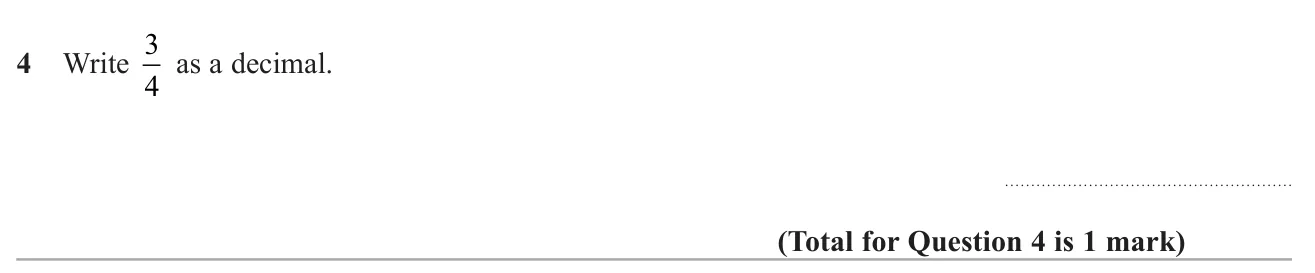
© Pearson Education Ltd. November 2020 Paper 1 (Foundation, non-calculator), question 4.
| Answer | 0.75 | 1 mark |
|---|
Worked solution Checked against the mark scheme
(One quarter is 0.25, so three quarters is .)
Watch out: Writing 3.4 or 0.34.
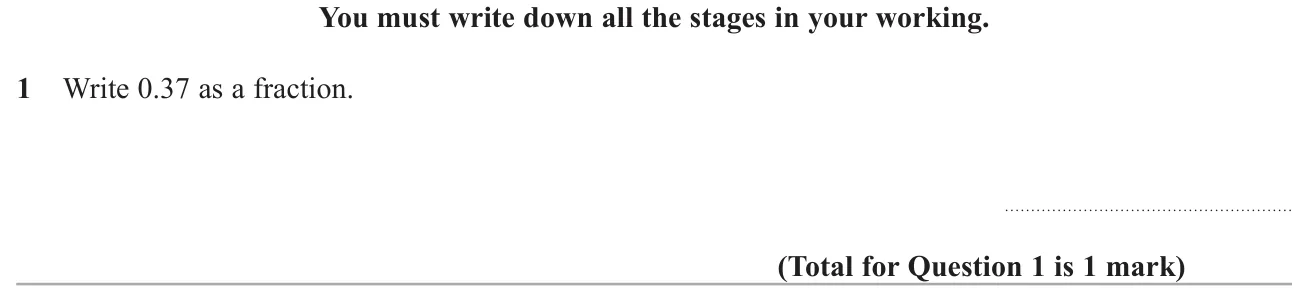
© Pearson Education Ltd. November 2020 Paper 2 (Foundation, calculator), question 1.
| Answer | 1 mark |
|---|
Worked solution Checked against the mark scheme
The 7 is in the hundredths column, so means 37 hundredths.
Watch out: Writing or .
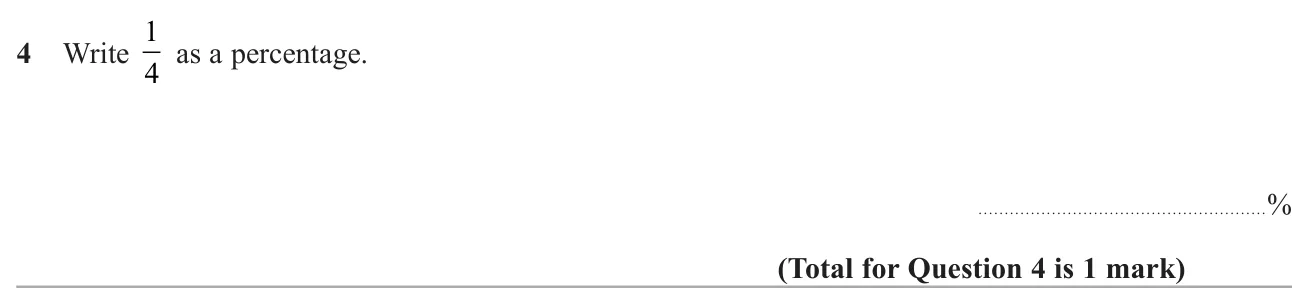
© Pearson Education Ltd. November 2020 Paper 2 (Foundation, calculator), question 4.
| Answer | 25 | 1 mark |
|---|
Worked solution Checked against the mark scheme
Watch out: Writing 14% or 4%.
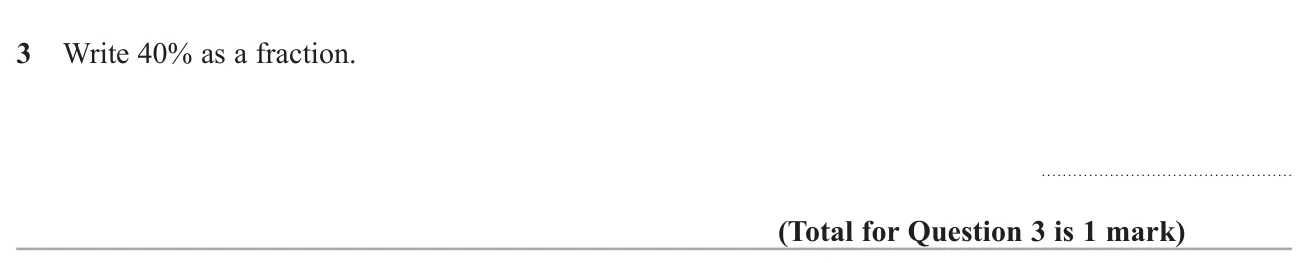
© Pearson Education Ltd. November 2020 Paper 3 (Foundation, calculator), question 3.
| Answer | or any equivalent, e.g. | 1 mark |
|---|
Worked solution Checked against the mark scheme
Per cent means out of 100.
Watch out: Writing 40/10 or 4/100 instead of 40/100.
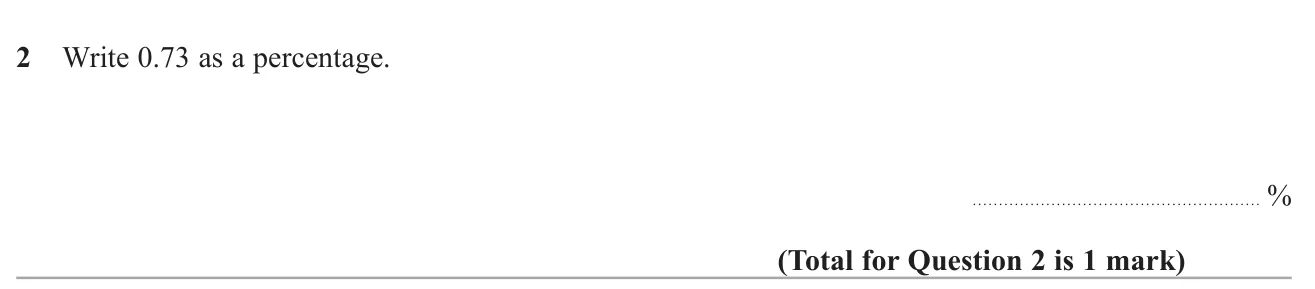
© Pearson Education Ltd. June 2019 Paper 1 (Foundation, non-calculator), question 2.
| Answer | 73% | 1 mark |
|---|
Worked solution Checked against the mark scheme
Multiply by 100 to turn a decimal into a percentage.
Watch out: Writing 0.73% or 7.3%.
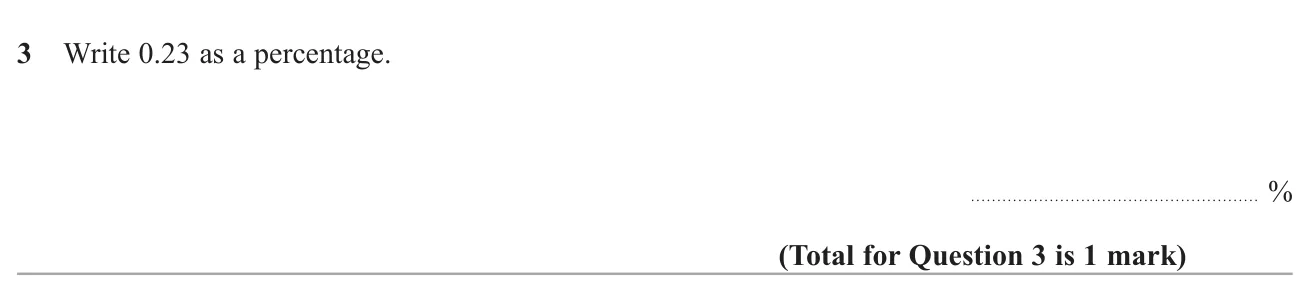
© Pearson Education Ltd. November 2019 Paper 2 (Foundation, calculator), question 3.
| Answer | 23% | 1 mark |
|---|
Worked solution Checked against the mark scheme
Multiply by 100 to turn a decimal into a percentage.
Watch out: Writing 0.23% or 2.3%.
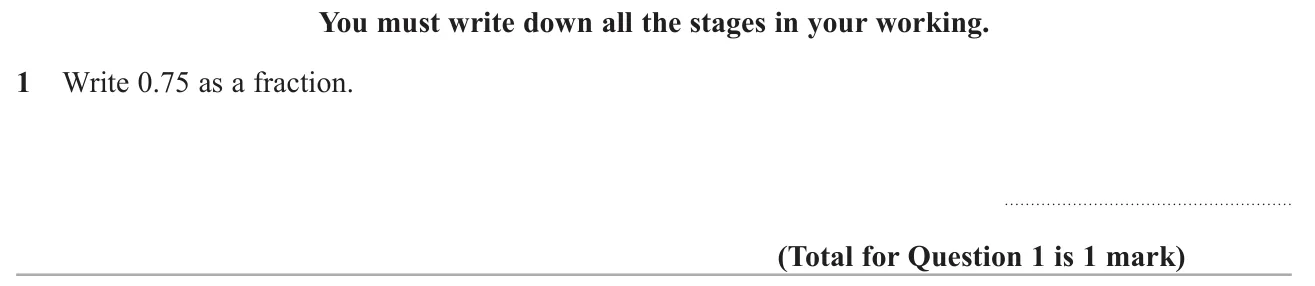
© Pearson Education Ltd. June 2019 Paper 2 (Foundation, calculator), question 1.
| Answer | 1 mark |
|---|
Worked solution Checked against the mark scheme
means 75 hundredths: .
Divide top and bottom by 25:
Watch out: Writing or .

© Pearson Education Ltd. November 2019 Paper 3 (Foundation, calculator), question 3.
| Answer | 1 mark |
|---|
Worked solution Checked against the mark scheme
The 7 is in the tenths column, so .
Watch out: Writing 7/100 or 1/7.
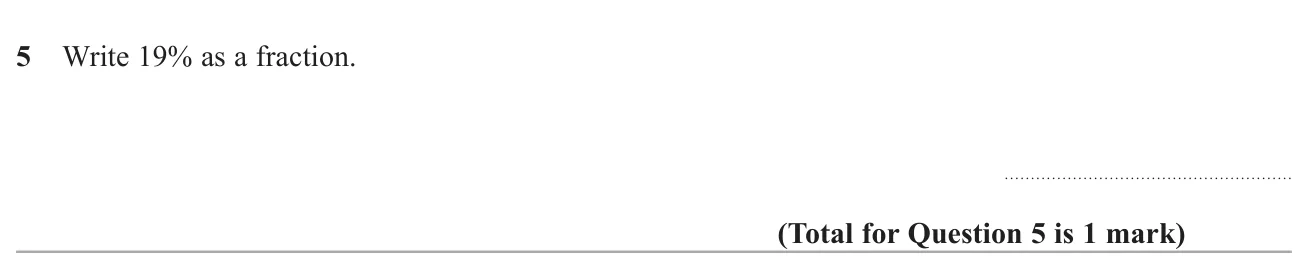
© Pearson Education Ltd. June 2019 Paper 3 (Foundation, calculator), question 5.
| Answer | 1 mark |
|---|
Worked solution Checked against the mark scheme
Per cent means out of 100, so .
Watch out: Writing 1/19 or 0.19 (a decimal, not a fraction).
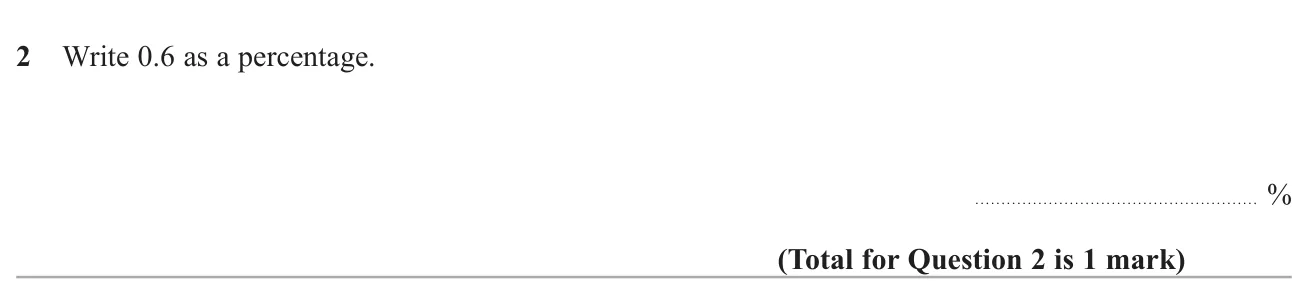
© Pearson Education Ltd. November 2018 Paper 1 (Foundation, non-calculator), question 2.
| Answer | 60% | 1 mark |
|---|
Worked solution Checked against the mark scheme
Multiply by 100: , so it is 60%.
Watch out: Writing 6%.
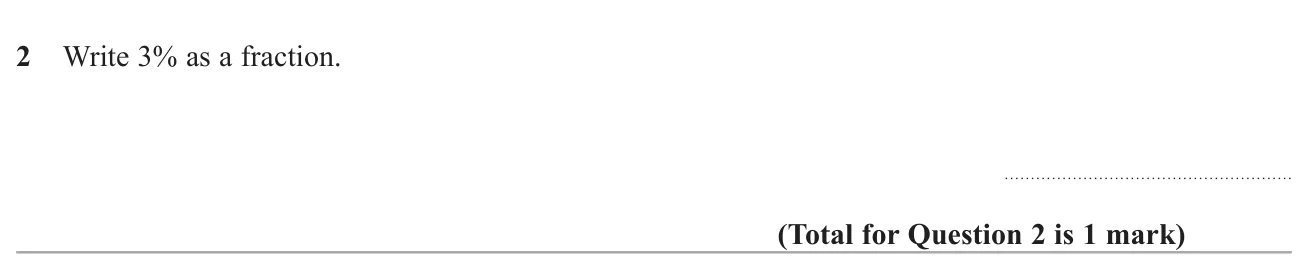
© Pearson Education Ltd. November 2018 Paper 3 (Foundation, calculator), question 2.
| Answer | 1 mark |
|---|
Worked solution Checked against the mark scheme
Per cent means out of 100, so
Watch out: Writing .
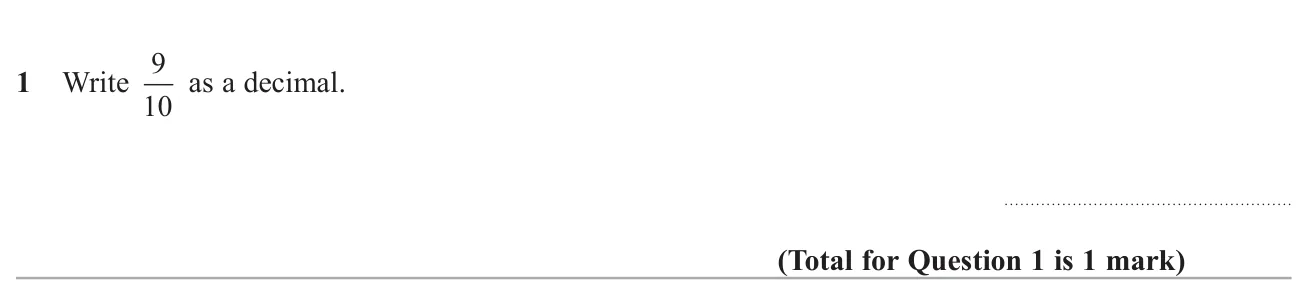
© Pearson Education Ltd. June 2018 Paper 3 (Foundation, calculator), question 1.
| Answer | 1 mark |
|---|
Worked solution Checked against the mark scheme
means 9 tenths.
Nine tenths is written .
Watch out: Writing 9.10 or 0.09.
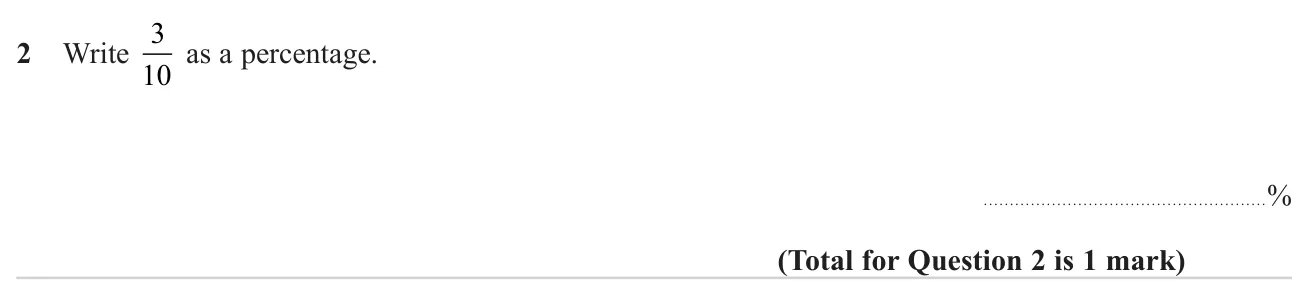
© Pearson Education Ltd. June 2023 Paper 3 (Foundation, calculator), question 2.
| Answer | 30 | 1 mark |
|---|
Worked solution Checked against the mark scheme
So it is .
Watch out: Writing 3% or 0.3.
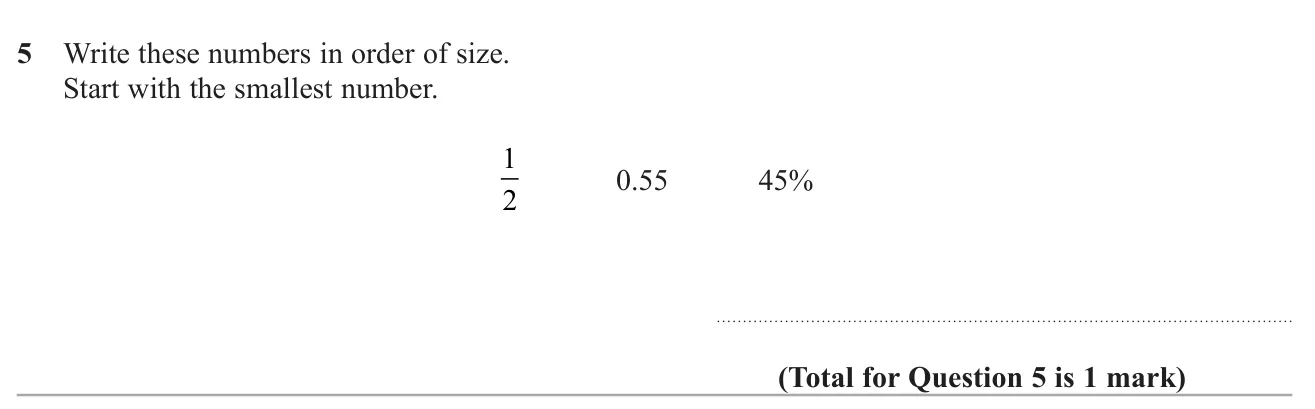
© Pearson Education Ltd. June 2022 Paper 1 (Foundation, non-calculator), question 5.
| Answer | 45%, , 0.55 | 1 mark |
|---|
Worked solution Checked against the mark scheme
Write each as a decimal: , ,
Smallest to largest:
So: 45%, , 0.55
Watch out: Thinking 45% is bigger than 0.55 because 45 > 0.55.
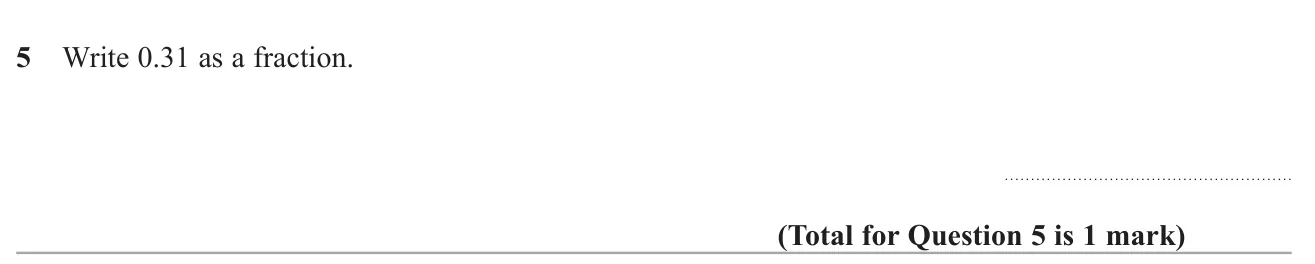
© Pearson Education Ltd. November 2018 Paper 2 (Foundation, calculator), question 5.
| Answer | 1 mark |
|---|
Worked solution Checked against the mark scheme
0.31 is 31 hundredths, so .
Watch out: Writing .
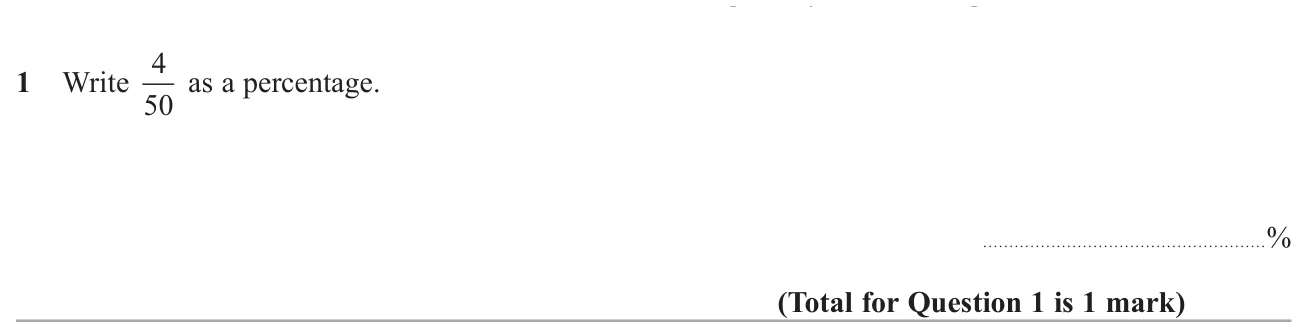
© Pearson Education Ltd. June 2018 Paper 2 (Foundation, calculator), question 1.
| Answer | 1 mark |
|---|
Worked solution Checked against the mark scheme
Multiply top and bottom by 2 to get a denominator of 100:
Watch out: Writing 4% or 0.08.
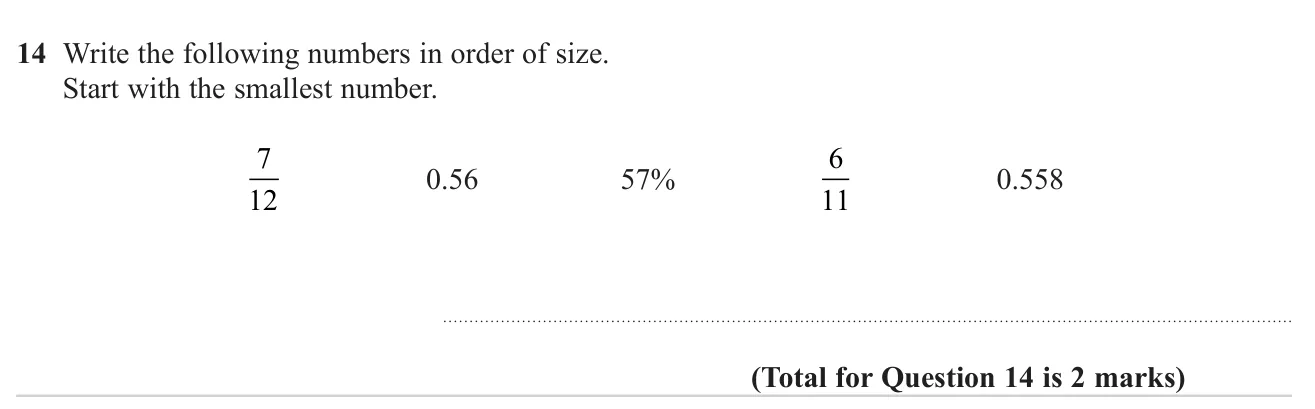
© Pearson Education Ltd. November 2023 Paper 3 (Foundation, calculator), question 14.
| Answer | , 0.558, 0.56, 57%, | 2 marks |
|---|
Worked solution Checked against the mark scheme
Change each to a decimal:
, ,
Smallest first: (0.545), 0.558, 0.56, 57% (0.57), (0.583)
Watch out: Thinking 0.558 is bigger than 0.56 because it has more digits.
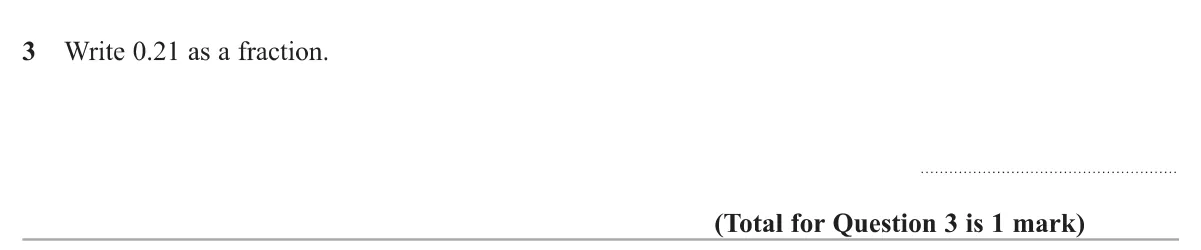
© Pearson Education Ltd. Specimen Paper 2 (Foundation, calculator), question 3.
| Answer | 1 mark |
|---|
Worked solution Checked against the mark scheme
The last digit, 1, is in the hundredths column.
So
Watch out: Writing .
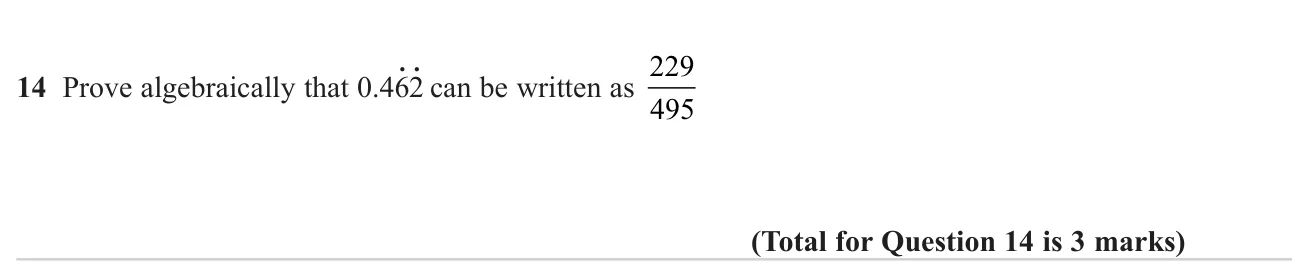
© Pearson Education Ltd. November 2024 Paper 3 (Higher, calculator), question 14.
| Answer | , , so | 3 marks |
|---|
Worked solution Checked against the mark scheme
Let
Subtract:
Watch out: Using 100x − x, which does not cancel the recurring part because the 4 does not repeat.
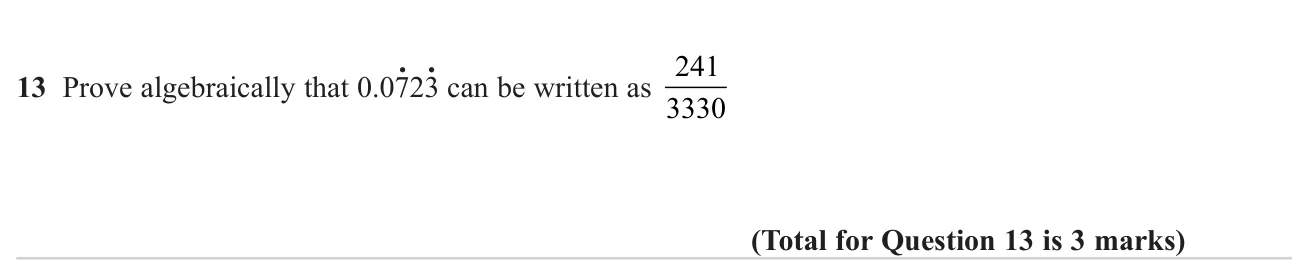
© Pearson Education Ltd. November 2023 Paper 2 (Higher, calculator), question 13.
| Answer | Proof that | 3 marks |
|---|
Worked solution Checked against the mark scheme
Let
Then and
Subtract:
(dividing top and bottom by 3)
Watch out: Subtracting multiples whose recurring parts do not line up, so the decimals do not cancel.
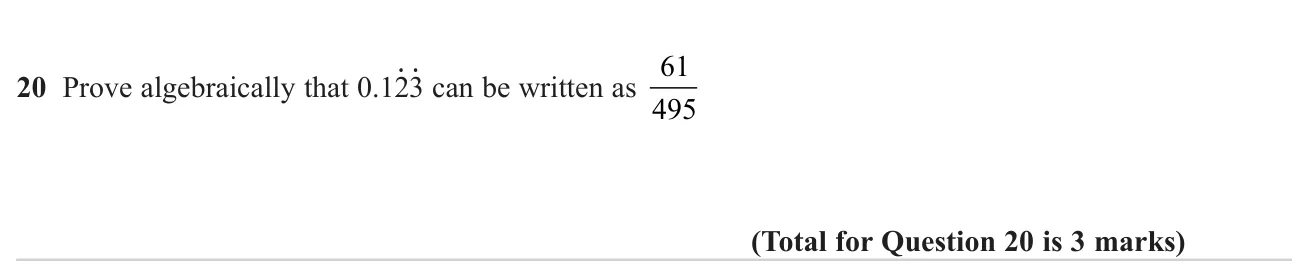
© Pearson Education Ltd. June 2023 Paper 3 (Higher, calculator), question 20.
| Answer | 3 marks |
|---|
Worked solution Checked against the mark scheme
Let
and
, so
Watch out: Subtracting multiples that don't cancel the recurring part, e.g. without handling the non-recurring 1.
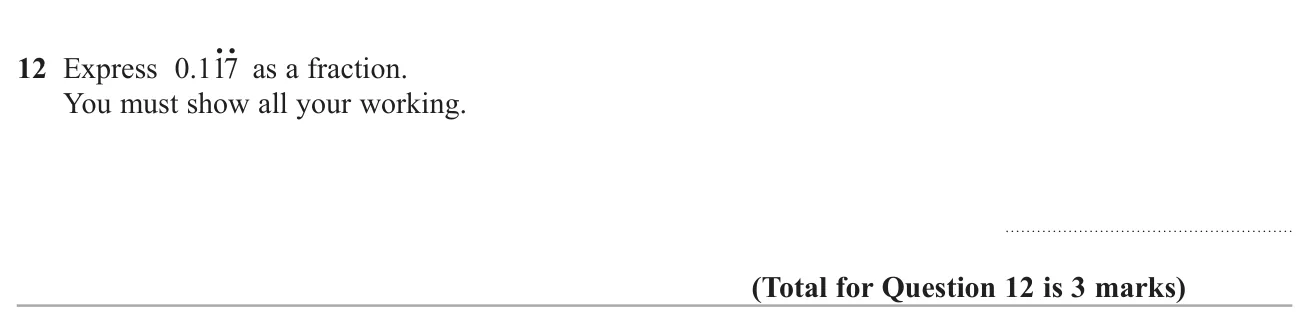
© Pearson Education Ltd. June 2022 Paper 1 (Higher, non-calculator), question 12.
| Answer | (or ) | 3 marks |
|---|
Worked solution Checked against the mark scheme
Let
and
Watch out: Treating all three digits as recurring and writing .

© Pearson Education Ltd. November 2022 Paper 2 (Higher, calculator), question 14.
| Answer | Shown: | 3 marks |
|---|
Worked solution Checked against the mark scheme
Let
Subtract:
Watch out: Using 10x and x, which does not remove the recurring part.
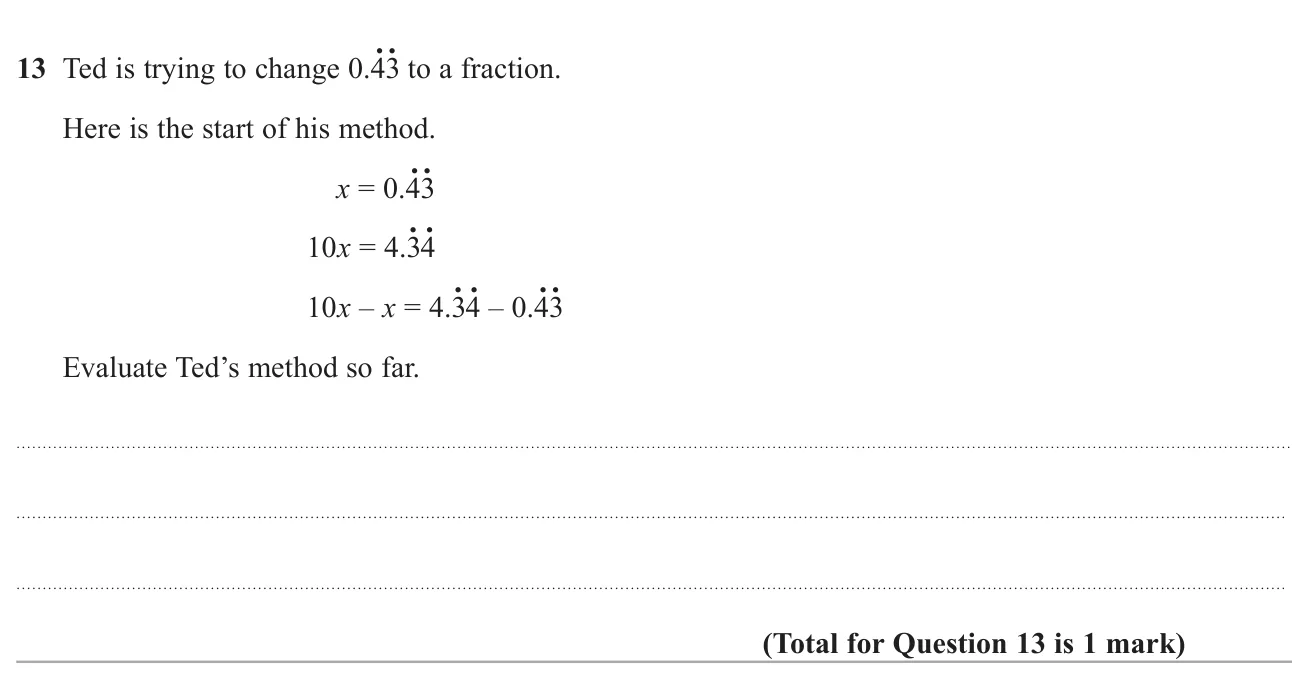
© Pearson Education Ltd. November 2021 Paper 1 (Higher, non-calculator), question 13.
| Answer | He should have used , not : two digits recur, so the recurring parts do not line up and cancel | 1 mark |
|---|
Worked solution Checked against the mark scheme
In the two digits 4 and 3 both repeat.
and have different digits after the point, so subtracting them does not get rid of the recurring part.
He should use , then , so .
Watch out: Just saying 'it is wrong' without explaining why.
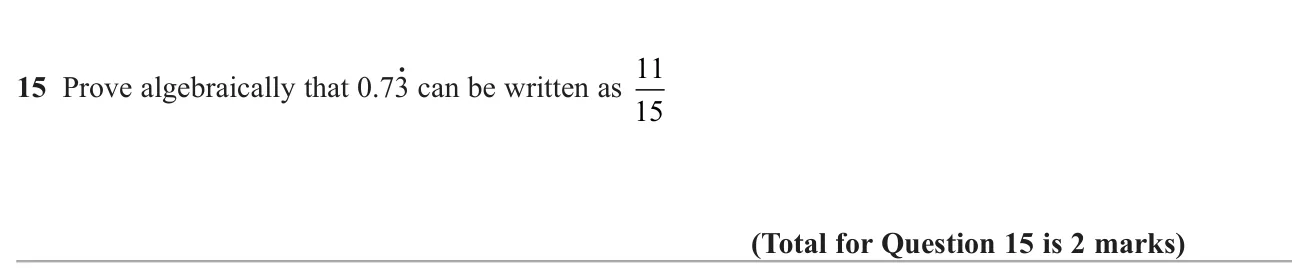
© Pearson Education Ltd. November 2020 Paper 3 (Higher, calculator), question 15.
| Answer | Proof that | 2 marks |
|---|
Worked solution Checked against the mark scheme
Let
and
Watch out: Using x and 10x, which do not cancel the recurring part because the 7 does not repeat.
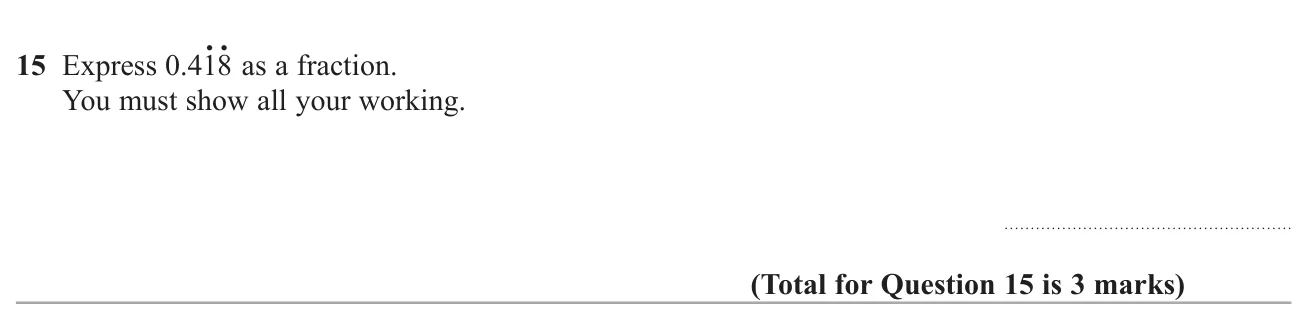
© Pearson Education Ltd. November 2019 Paper 1 (Higher, non-calculator), question 15.
| Answer | 3 marks |
|---|
Worked solution Checked against the mark scheme
Let
and
Watch out: Multiplying by 100 once and subtracting from x in a way that leaves a recurring remainder.

© Pearson Education Ltd. November 2018 Paper 1 (Higher, non-calculator), question 16.
| Answer | Let ; , so | 3 marks |
|---|
Worked solution Checked against the mark scheme
Let
and
Subtract:
Watch out: Multiplying by 100 and subtracting , which does not cancel the recurring part because the repeat starts after the 2.
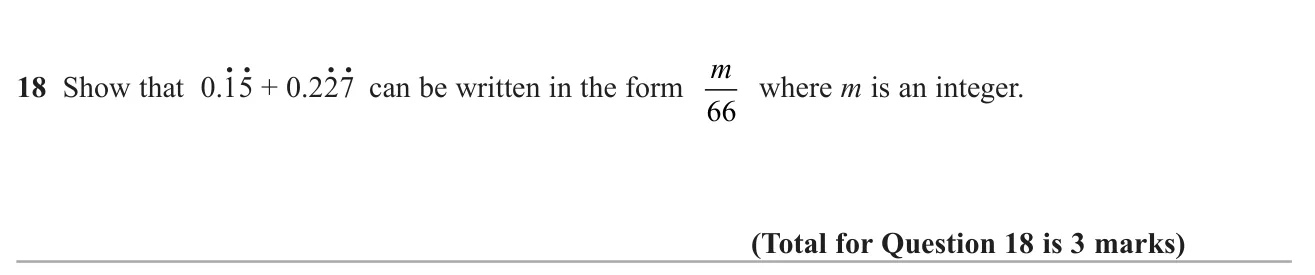
© Pearson Education Ltd. June 2024 Paper 1 (Higher, non-calculator), question 18.
| Answer | Shown: | 3 marks |
|---|
Worked solution Checked against the mark scheme
Let : , so
Let : , so
, so
Watch out: Treating as and using .
Their main topic is different, but part of each one tests this topic.