Number

Powers, roots and indices

44 past-paper questions, easiest first. Try each one, then reveal the answer.

Foundation & Higher28 of 44 from Foundation papers

Revision guide by The Full Marks

Powers, roots and indices: what you need to know

Powers (indices) are a short way to write repeated multiplication, and roots undo them. You need to know common powers, use the laws of indices, and at Higher work with negative and fractional indices.

Foundation students need powers, roots, the index laws and negative integer indices; fractional indices and estimating powers and roots are Higher only.

Key facts

  • Learn the squares to 152=22515^2 = 225, the cubes 23=82^3 = 8, 33=273^3 = 27, 43=644^3 = 64, 53=1255^3 = 125, 103=100010^3 = 1000, and recognise powers of 2, 3, 4 and 5, e.g. 210=10242^{10} = 1024, 35=2433^5 = 243, 44=2564^4 = 256, 54=6255^4 = 625.
  • A positive number has two square roots, e.g. 77 and −7-7 for 49; the symbol  \sqrt{\ } means the positive one. To estimate a root, use the square numbers either side: 50\sqrt{50} is just over 7, because 49<50<6449 < 50 < 64.
  • Laws of indices: am×an=am+na^m \times a^n = a^{m+n}, am÷an=am−na^m \div a^n = a^{m-n}, (am)n=amn(a^m)^n = a^{mn}.
  • a0=1a^0 = 1 for any non-zero aa, and a1=aa^1 = a.
  • a−n=1ana^{-n} = \frac{1}{a^n}. Higher only: a1n=ana^{\frac{1}{n}} = \sqrt[n]{a} and amn=(an)ma^{\frac{m}{n}} = (\sqrt[n]{a})^m.

Simplifying with the laws of indices

  1. Check the base numbers are the same.
  2. Multiplying: add the powers. Dividing: subtract them. Power of a power: multiply them.
  3. With letters, multiply the numbers in front as normal and use the index laws on the letters: 3x2×5x4=15x63x^2 \times 5x^4 = 15x^6 and (2x3)2=4x6(2x^3)^2 = 4x^6.
  4. Work out the final power if the question asks for a value.

Negative and fractional powers

  1. Negative power: flip the number (take the reciprocal) and make the power positive.
  2. Fractional power (Higher): the bottom of the fraction is the root to take.
  3. The top of the fraction is the power to raise it to.

Worked examples

Example 1 Foundation · grade 4

Write 36×3437\frac{3^6 \times 3^4}{3^7} as a single power of 3, then work out its value.

Show the solution

Top: 36×34=36+4=3103^6 \times 3^4 = 3^{6+4} = 3^{10}
Divide: 310÷37=310−7=333^{10} \div 3^7 = 3^{10-7} = 3^3
33=3×3×3=273^3 = 3 \times 3 \times 3 = 27

Example 2 Higher · grade 7

Work out the exact value of (278)−23\left(\frac{27}{8}\right)^{-\frac{2}{3}}

Show the solution

Negative power: flip the fraction. (827)23\left(\frac{8}{27}\right)^{\frac{2}{3}}
Cube root: 83=2\sqrt[3]{8} = 2 and 273=3\sqrt[3]{27} = 3, giving 23\frac{2}{3}
Square: (23)2=49\left(\frac{2}{3}\right)^2 = \frac{4}{9}

Common mistakes

  • Halving instead of square rooting, or doubling instead of squaring: 2.25=1.5\sqrt{2.25} = 1.5 (not 1.125) and 72=497^2 = 49 (not 14).
  • Multiplying the base by the power: 353^5 is 243243, not 1515.
  • Multiplying indices when you should add them: 23×22=252^3 \times 2^2 = 2^5, not 262^6.
  • Thinking a0=0a^0 = 0. Anything (except 0) to the power 0 is 1.
  • Making a negative power give a negative answer: 5−2=1255^{-2} = \frac{1}{25}, not −25-25.

Exam tips

  • If the question says "write as a single power", leave it as a power, e.g. 757^5, not a big number.
  • With fractional powers, take the root first: the numbers stay small and you can do it without a calculator.

Questions people ask

What are the laws of indices?

When multiplying powers of the same base, add the indices; when dividing, subtract them; for a power of a power, multiply them.

What does a negative power mean?

It means one over the positive power. For example, 2−3=123=182^{-3} = \frac{1}{2^3} = \frac{1}{8}.

What does a power of a half mean?

A power of 12\frac{1}{2} is a square root, so 4912=749^{\frac{1}{2}} = 7. Fractional powers are Higher tier only.

Exam questions: Powers, roots and indices (44, easiest first)

Powers, roots and indices1 markGrade 1No calculatorFoundation
June 2024 · Paper 1 Foundation · Q5
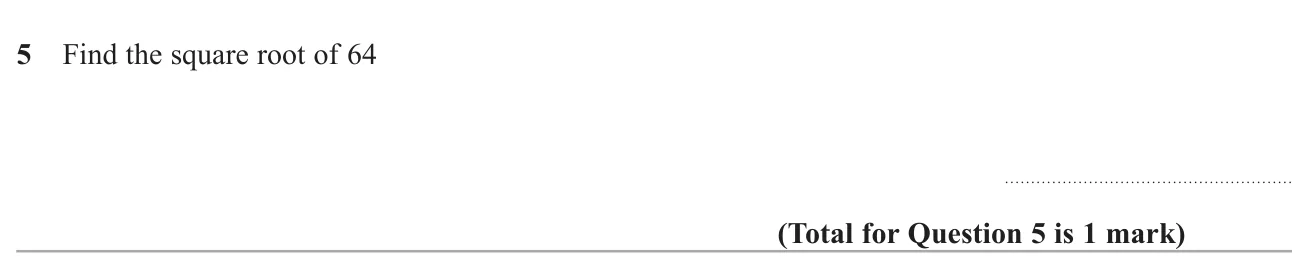
Find the square root of a square number.

© Pearson Education Ltd. June 2024 Paper 1 (Foundation, non-calculator), question 5.

Show answer
Answer881 mark

Worked solution Checked against the mark scheme

8×8=648 \times 8 = 64, so 64=8\sqrt{64} = 8.

Watch out: Halving to get 32.

Powers, roots and indices1 markGrade 1CalculatorFoundation
November 2023 · Paper 2 Foundation · Q4
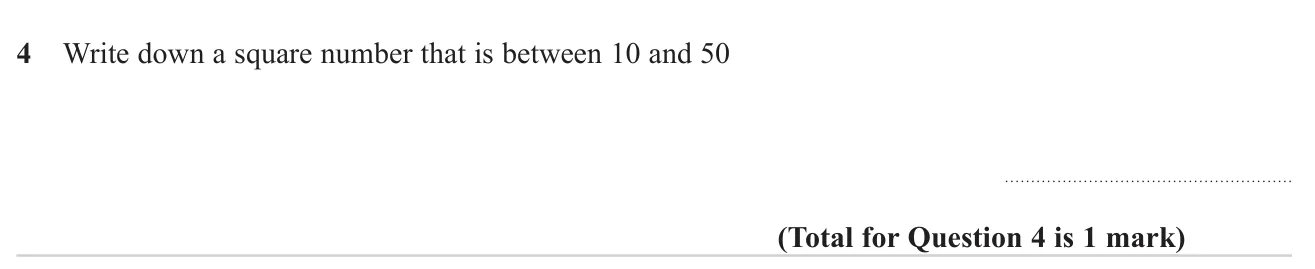
Give a square number lying between 10 and 50.

© Pearson Education Ltd. November 2023 Paper 2 (Foundation, calculator), question 4.

Show answer
AnswerAny one of 16, 25, 36, 491 mark

Worked solution Checked against the mark scheme

Square the whole numbers: 42=164^2 = 16, 52=255^2 = 25, 62=366^2 = 36, 72=497^2 = 49.

Any of these works, e.g. 25.

Watch out: Giving 4 or 5, the square roots, rather than the squares.
Powers, roots and indices1 markGrade 1No calculatorFoundation
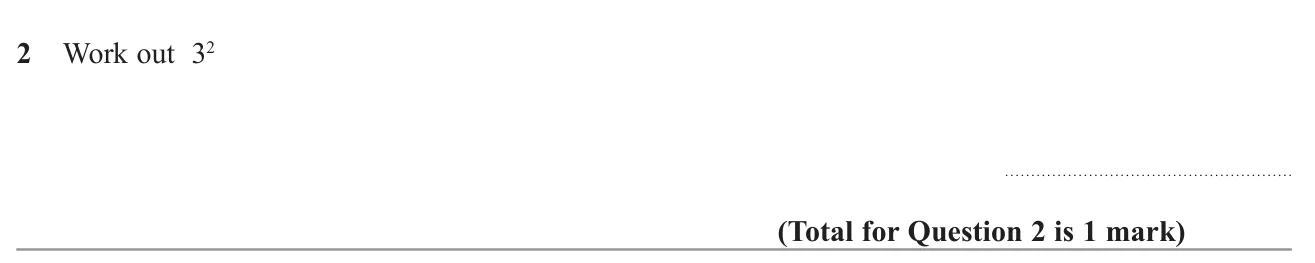
November 2022 · Paper 1 Foundation · Q2
Square a single-digit number.

© Pearson Education Ltd. November 2022 Paper 1 (Foundation, non-calculator), question 2.

Show answer
Answer991 mark

Worked solution Checked against the mark scheme

32=3×3=93^2 = 3 \times 3 = 9

Watch out: Doubling instead of squaring to get 6.
Powers, roots and indices1 markGrade 1No calculatorFoundation
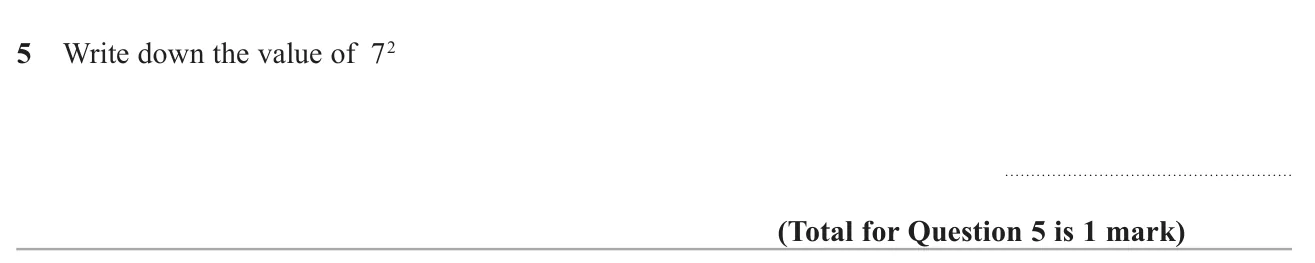
November 2021 · Paper 1 Foundation · Q5
Evaluate seven squared.

© Pearson Education Ltd. November 2021 Paper 1 (Foundation, non-calculator), question 5.

Show answer
Answer49491 mark

Worked solution Checked against the mark scheme

72=7×7=497^2 = 7 \times 7 = 49

Watch out: Doubling instead of squaring to get 14.
Powers, roots and indices1 markGrade 1CalculatorFoundation
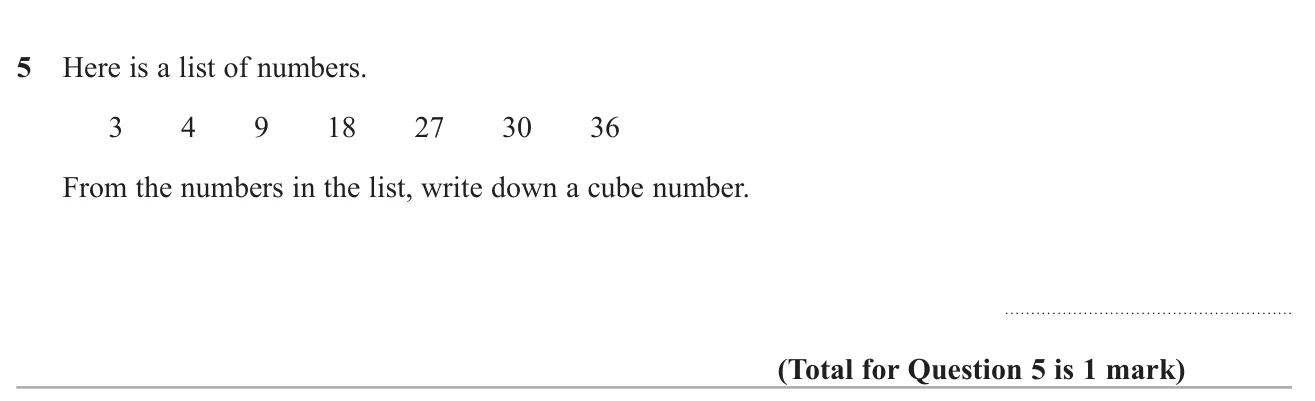
November 2020 · Paper 2 Foundation · Q5
Pick out the cube number from a list of whole numbers.

© Pearson Education Ltd. November 2020 Paper 2 (Foundation, calculator), question 5.

Show answer
Answer271 mark

Worked solution Checked against the mark scheme

Cube numbers are 1,8,27,64,…1, 8, 27, 64, \ldots

33=3×3×3=273^3 = 3 \times 3 \times 3 = 27, which is in the list.

Watch out: Choosing 9 (a square number) or 3.
Powers, roots and indices1 markGrade 1CalculatorFoundation
November 2020 · Paper 3 Foundation · Q4
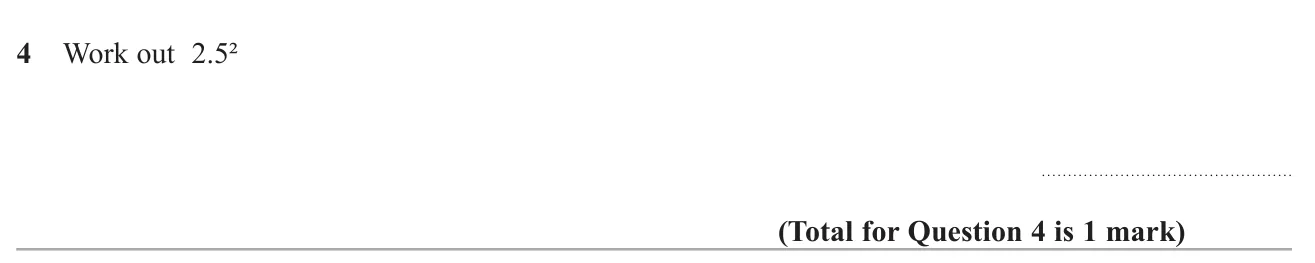
Square a decimal number.

© Pearson Education Ltd. November 2020 Paper 3 (Foundation, calculator), question 4.

Show answer
Answer6.251 mark

Worked solution Checked against the mark scheme

Squaring means multiplying the number by itself.

2.5×2.5=6.252.5 \times 2.5 = 6.25

Watch out: Doubling instead of squaring, giving 5.
Powers, roots and indices1 markGrade 1CalculatorFoundation
November 2019 · Paper 2 Foundation · Q4
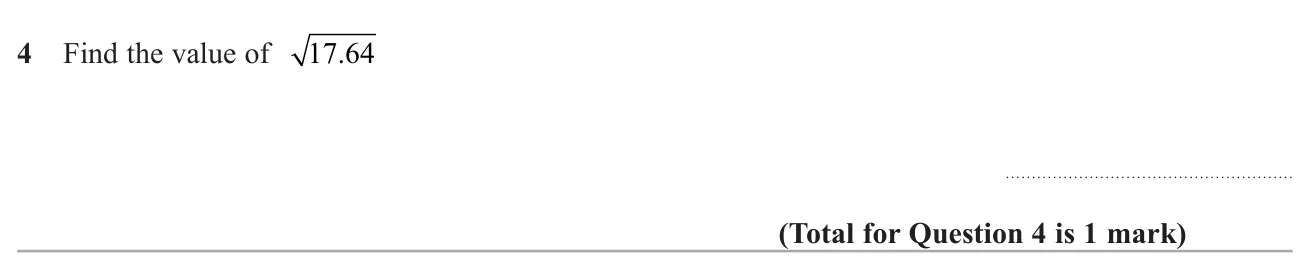
Work out the square root of a decimal using a calculator.

© Pearson Education Ltd. November 2019 Paper 2 (Foundation, calculator), question 4.

Show answer
Answer4.24.21 mark

Worked solution Checked against the mark scheme

Use the square root key: 17.64=4.2\sqrt{17.64} = 4.2

Check: 4.2×4.2=17.644.2 \times 4.2 = 17.64

Watch out: Halving 17.64 instead of square rooting.
Powers, roots and indices1 markGrade 1CalculatorFoundation
November 2019 · Paper 2 Foundation · Q5
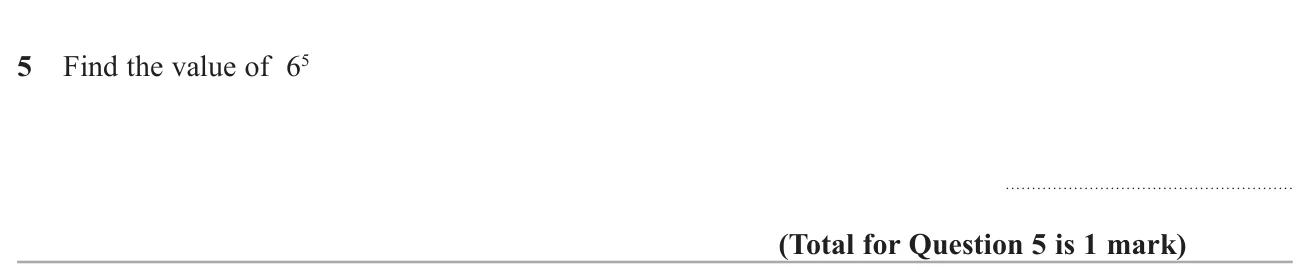
Work out a whole number raised to the fifth power.

© Pearson Education Ltd. November 2019 Paper 2 (Foundation, calculator), question 5.

Show answer
Answer77761 mark

Worked solution Checked against the mark scheme

65=6×6×6×6×66^5 = 6 \times 6 \times 6 \times 6 \times 6

=7776= 7776

Watch out: Working out 6×5=306 \times 5 = 30.

Powers, roots and indices1 markGrade 1CalculatorFoundation
November 2018 · Paper 2 Foundation · Q2
Give any number that is both odd and a perfect square.

© Pearson Education Ltd. November 2018 Paper 2 (Foundation, calculator), question 2.

Show answer
AnswerAny odd square number, e.g. 91 mark

Worked solution Checked against the mark scheme

Square numbers: 1, 4, 9, 16, 25, ...

The odd ones are 1, 9, 25, 49, ... so, for example, 9 works (32=93^2 = 9).

Watch out: Giving an odd number that is not square, such as 3.
Powers, roots and indices1 markGrade 1CalculatorFoundation
November 2018 · Paper 2 Foundation · Q4
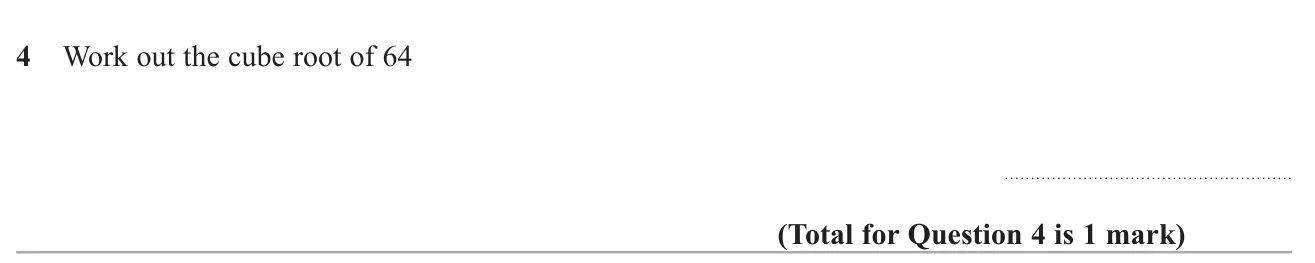
Find the cube root of a number.

© Pearson Education Ltd. November 2018 Paper 2 (Foundation, calculator), question 4.

Show answer
Answer41 mark

Worked solution Checked against the mark scheme

4×4×4=644 \times 4 \times 4 = 64, so 643=4\sqrt[3]{64} = 4.

Watch out: Dividing by 3 instead of finding the cube root.
Powers, roots and indices1 markGrade 1No calculatorFoundation
Specimen · Paper 1 Foundation · Q5
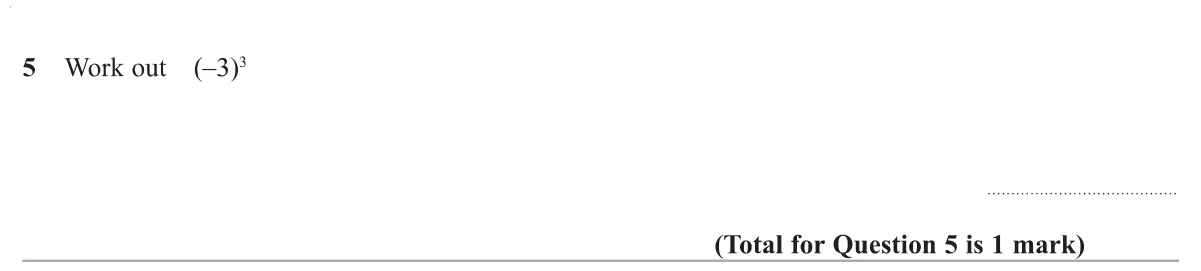
Cube a negative integer.

© Pearson Education Ltd. Specimen Paper 1 (Foundation, non-calculator), question 5.

Show answer
Answer−27-271 mark

Worked solution Checked against the mark scheme

(−3)3=(−3)×(−3)×(−3)(-3)^3 = (-3) \times (-3) \times (-3)

(−3)×(−3)=9(-3) \times (-3) = 9, then 9×(−3)=−279 \times (-3) = -27

Watch out: Giving 27 (losing the sign) or −9 (multiplying by 3).
Powers, roots and indices1 markGrade 1CalculatorFoundation
Specimen · Paper 3 Foundation · Q3
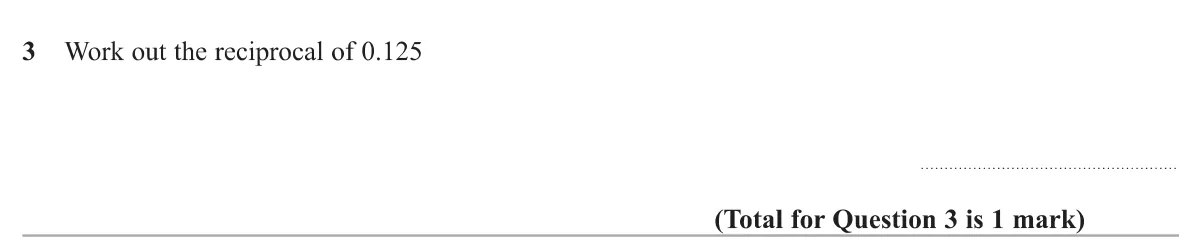
Find the reciprocal of a decimal.

© Pearson Education Ltd. Specimen Paper 3 (Foundation, calculator), question 3.

Show answer
Answer81 mark

Worked solution Checked against the mark scheme

The reciprocal of a number is 1 divided by it.

1÷0.125=81 \div 0.125 = 8 (because 0.125=180.125 = \frac{1}{8}).

Watch out: Giving 0.125 as a fraction or writing −0.125.
Powers, roots and indices1 markGrade 2CalculatorFoundation
November 2024 · Paper 3 Foundation · Q5
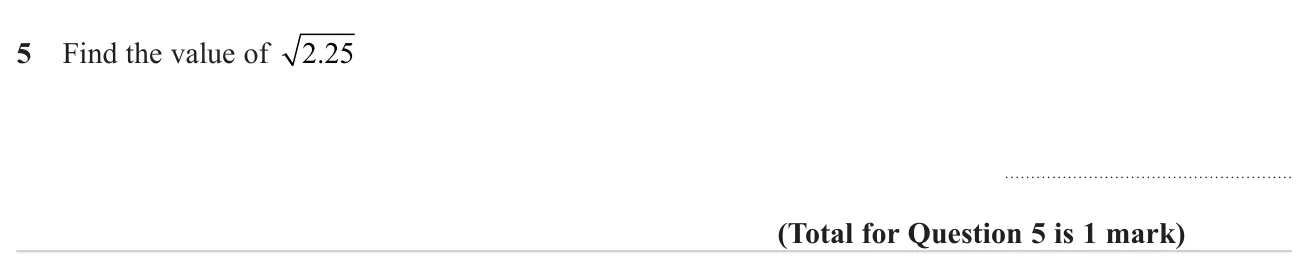
Find the square root of a decimal.

© Pearson Education Ltd. November 2024 Paper 3 (Foundation, calculator), question 5.

Show answer
Answer1.51.51 mark

Worked solution Checked against the mark scheme

1.5×1.5=2.251.5 \times 1.5 = 2.25

So 2.25=1.5\sqrt{2.25} = 1.5

Watch out: Halving 2.25 to get 1.125.

Powers, roots and indices1 markGrade 2CalculatorFoundation
June 2022 · Paper 3 Foundation · Q5
Find the square root of a decimal.

© Pearson Education Ltd. June 2022 Paper 3 (Foundation, calculator), question 5.

Show answer
Answer1.31 mark

Worked solution Checked against the mark scheme

Look for a number that multiplies by itself to give 1.69.

1.3×1.3=1.691.3 \times 1.3 = 1.69, so 1.69=1.3\sqrt{1.69} = 1.3

Watch out: Halving 1.69 instead of square rooting.
Powers, roots and indices2 marksGrade 2No calculatorFoundation
June 2019 · Paper 1 Foundation · Q15
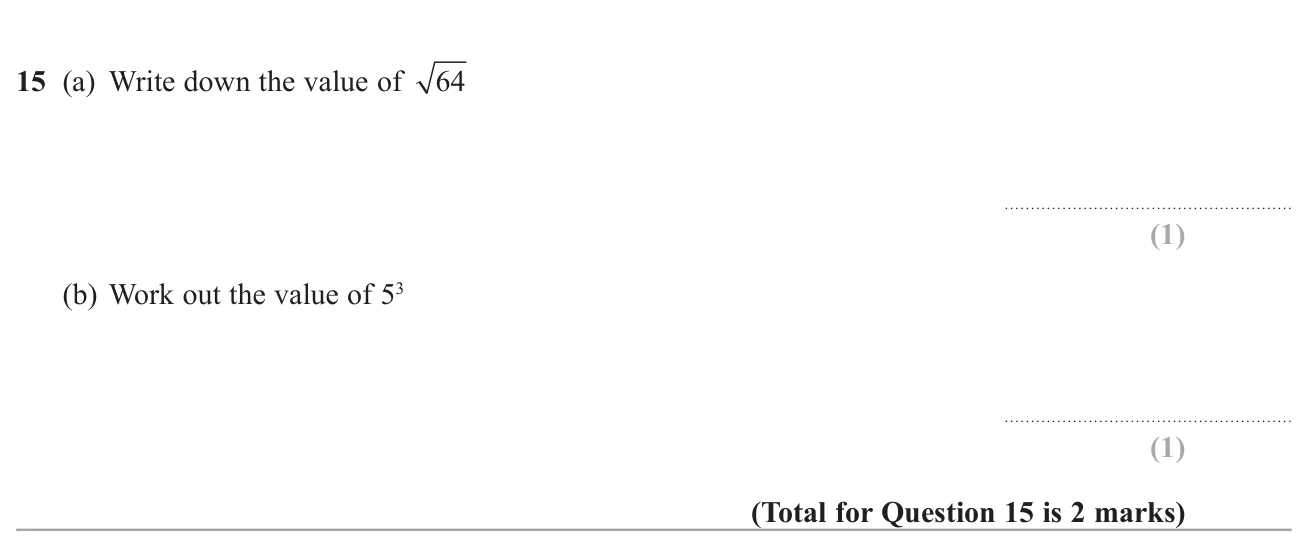
Find a square root and a cube of small whole numbers.

© Pearson Education Ltd. June 2019 Paper 1 (Foundation, non-calculator), question 15.

Show answer
(a)81 mark
(b)1251 mark

Worked solution Checked against the mark scheme

(a) 8×8=648 \times 8 = 64, so 64=8\sqrt{64} = 8

(b) 53=5×5×5=25×5=1255^3 = 5 \times 5 \times 5 = 25 \times 5 = 125

Watch out: In (b), working out 5×3=155 \times 3 = 15.

Powers, roots and indices1 markGrade 2CalculatorFoundation
June 2019 · Paper 3 Foundation · Q4
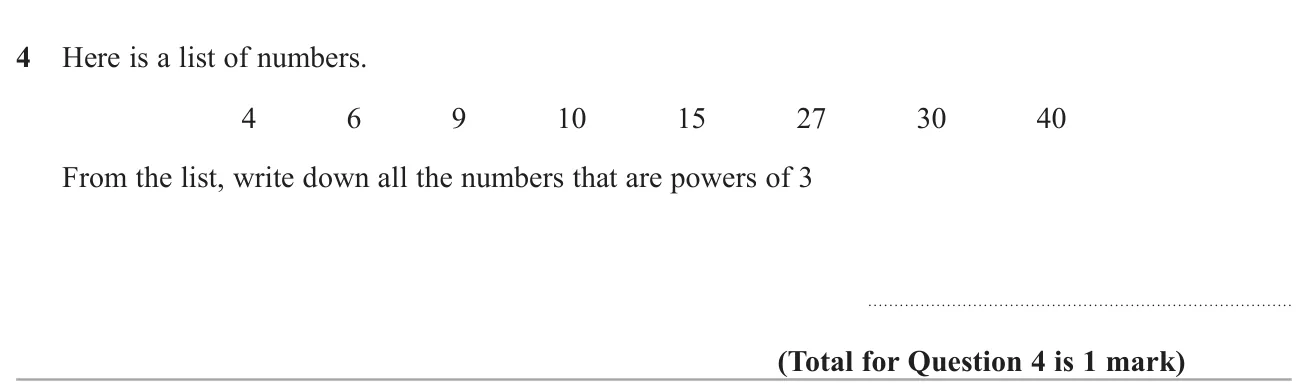
Pick out every number in a list that is a power of 3.

© Pearson Education Ltd. June 2019 Paper 3 (Foundation, calculator), question 4.

Show answer
Answer9, 271 mark

Worked solution Checked against the mark scheme

Powers of 3: 31=33^1 = 3, 32=93^2 = 9, 33=273^3 = 27, 34=813^4 = 81

From the list, the powers of 3 are 9 and 27.

Watch out: Including 6, 15 or 30 because they are multiples of 3.
Powers, roots and indices1 markGrade 2CalculatorFoundation
June 2018 · Paper 2 Foundation · Q3
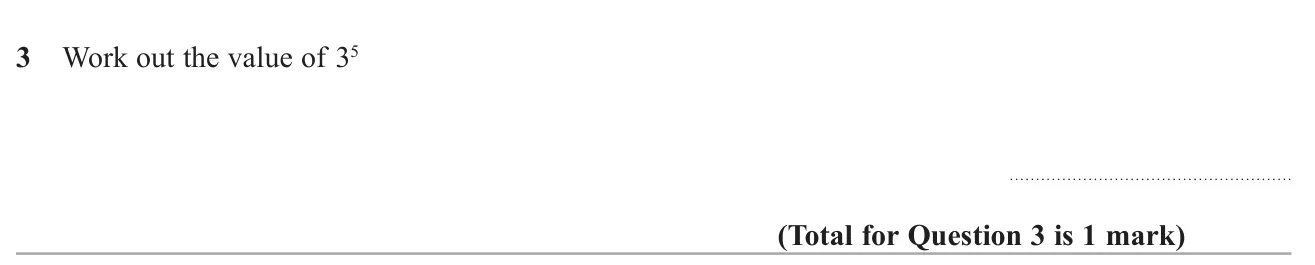
Evaluate a power of 3.

© Pearson Education Ltd. June 2018 Paper 2 (Foundation, calculator), question 3.

Show answer
Answer2432431 mark

Worked solution Checked against the mark scheme

35=3×3×3×3×3=2433^5 = 3 \times 3 \times 3 \times 3 \times 3 = 243

Watch out: Working out 3×5=153 \times 5 = 15.

Powers, roots and indices1 markGrade 2CalculatorFoundation
November 2018 · Paper 3 Foundation · Q3
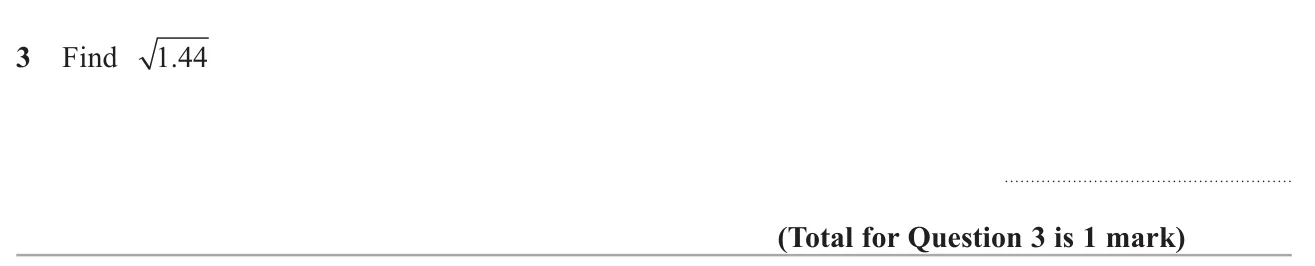
Find the square root of a decimal.

© Pearson Education Ltd. November 2018 Paper 3 (Foundation, calculator), question 3.

Show answer
Answer1.21.21 mark

Worked solution Checked against the mark scheme

1.2×1.2=1.441.2 \times 1.2 = 1.44, so 1.44=1.2\sqrt{1.44} = 1.2

Watch out: Halving the number instead of square rooting it (0.72).
Powers, roots and indices2 marksGrade 3CalculatorFoundation
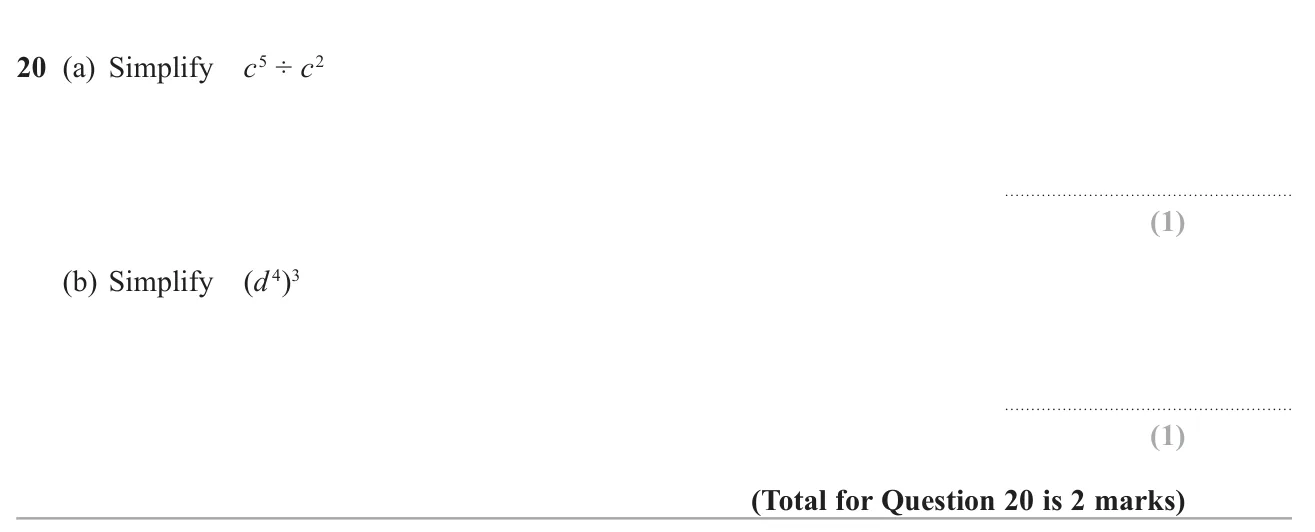
November 2021 · Paper 2 Foundation · Q20
Simplify expressions using index laws for division and a power of a power.

© Pearson Education Ltd. November 2021 Paper 2 (Foundation, calculator), question 20.

Show answer
(a)c3c^31 mark
(b)d12d^{12}1 mark

Worked solution Checked against the mark scheme

(a) Dividing: subtract the powers, 5−2=35 - 2 = 3, giving c3c^3.

(b) Power of a power: multiply, 4×3=124 \times 3 = 12, giving d12d^{12}.

Watch out: Adding the powers in part (b) to get d7d^7.

Powers, roots and indices2 marksGrade 3CalculatorFoundation
Specimen · Paper 3 Foundation · Q11
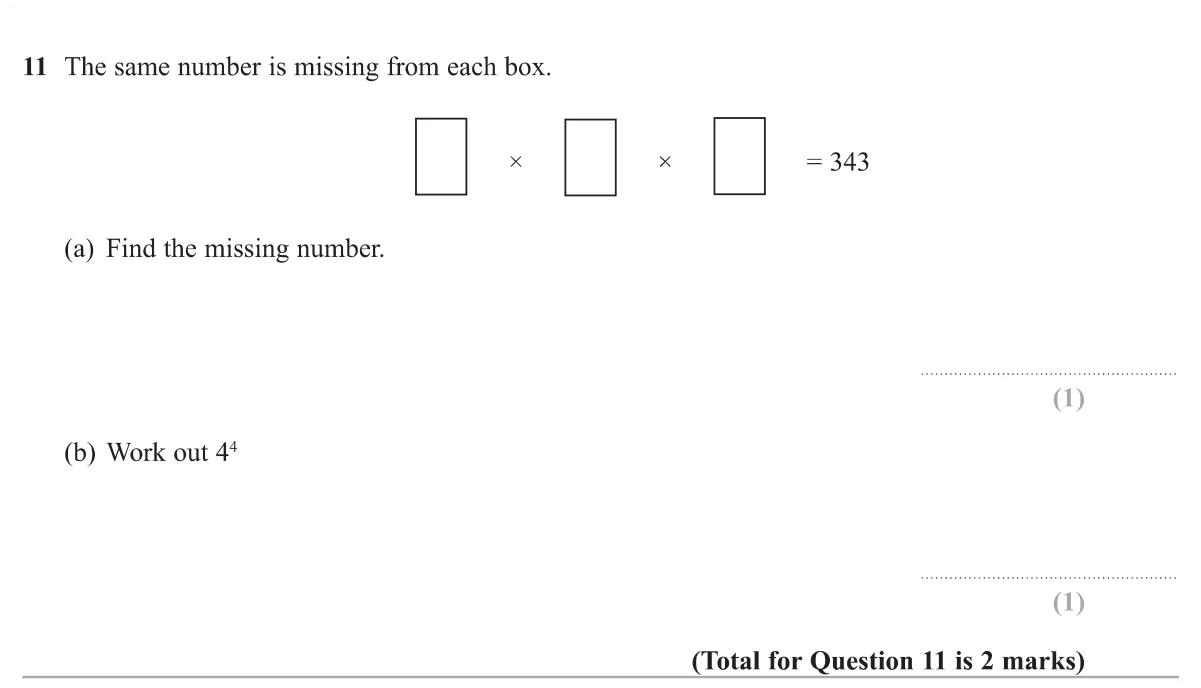
Find the number that multiplied by itself three times gives 343, then evaluate a fourth power.

© Pearson Education Ltd. Specimen Paper 3 (Foundation, calculator), question 11.

Show answer
(a)71 mark
(b)2561 mark

Worked solution Checked against the mark scheme

(a) We need the cube root of 343: 7×7×7=3437 \times 7 \times 7 = 343, so the number is 7.

(b) 44=4×4×4×4=2564^4 = 4 \times 4 \times 4 \times 4 = 256

Watch out: In (b), working out 4×4=164 \times 4 = 16.

Powers, roots and indices1 markGrade 4No calculatorFoundation
June 2024 · Paper 1 Foundation · Q18
Evaluate a number raised to the power zero.

© Pearson Education Ltd. June 2024 Paper 1 (Foundation, non-calculator), question 18.

Show answer
Answer111 mark

Worked solution Checked against the mark scheme

Any non-zero number to the power 0 equals 1, so 100=110^0 = 1.

Watch out: Answering 0 or 10.

Powers, roots and indices3 marksGrade 4CalculatorOn both tiers
November 2024 · Paper 3 Foundation · Q25
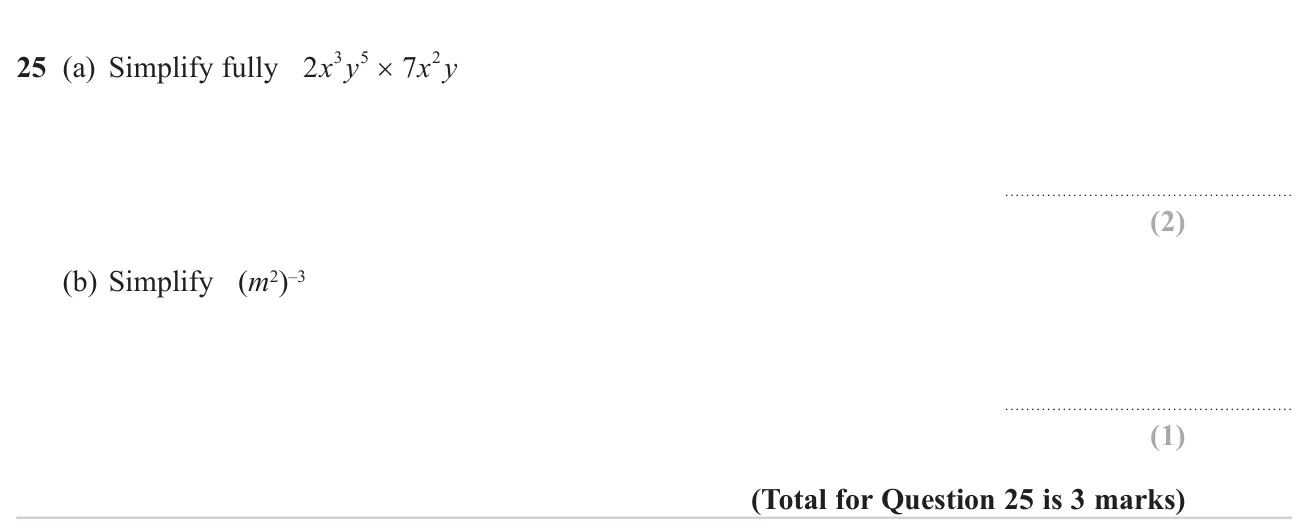
Simplify a product of algebraic terms with powers, and a power of a power.

© Pearson Education Ltd. November 2024 Paper 3 (Foundation, calculator), question 25.

Show answer
(a)14x5y614x^5y^62 marks
(b)m−6m^{-6}1 mark

Worked solution Checked against the mark scheme

(a) Multiply the numbers: 2×7=142 \times 7 = 14. Add the powers: x3+2=x5x^{3+2} = x^5, y5+1=y6y^{5+1} = y^6.

So 14x5y614x^5y^6

(b) Multiply the powers: 2×−3=−62 \times -3 = -6, so m−6m^{-6}

Watch out: Multiplying the powers in (a) to get x6x^6.

Powers, roots and indices4 marksGrade 4No calculatorHigher
November 2023 · Paper 1 Higher · Q2
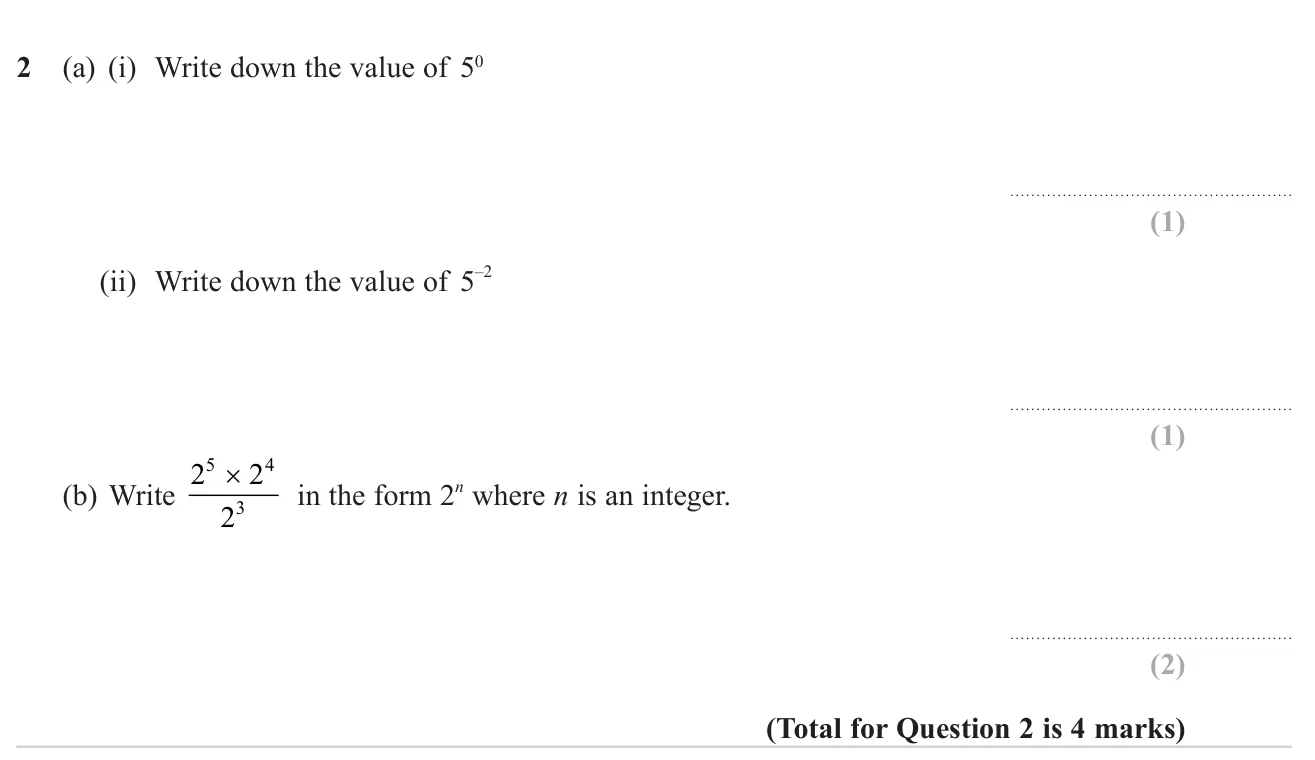
Evaluate a zero power and a negative power of 5, then simplify a product and quotient of powers of 2.

© Pearson Education Ltd. November 2023 Paper 1 (Higher, non-calculator), question 2.

Show answer
(a(i))111 mark
(a(ii))125\frac{1}{25}1 mark
(b)262^62 marks

Worked solution Checked against the mark scheme

(a)(i) Any non-zero number to the power 0 is 1.

(a)(ii) 5−2=152=1255^{-2} = \frac{1}{5^2} = \frac{1}{25}

(b) Add powers when multiplying, subtract when dividing: 25+4−3=262^{5+4-3} = 2^6

Watch out: Thinking 50=05^0 = 0 or 5−2=−255^{-2} = -25.

Powers, roots and indices2 marksGrade 4No calculatorOn both tiers
November 2022 · Paper 1 Foundation · Q21
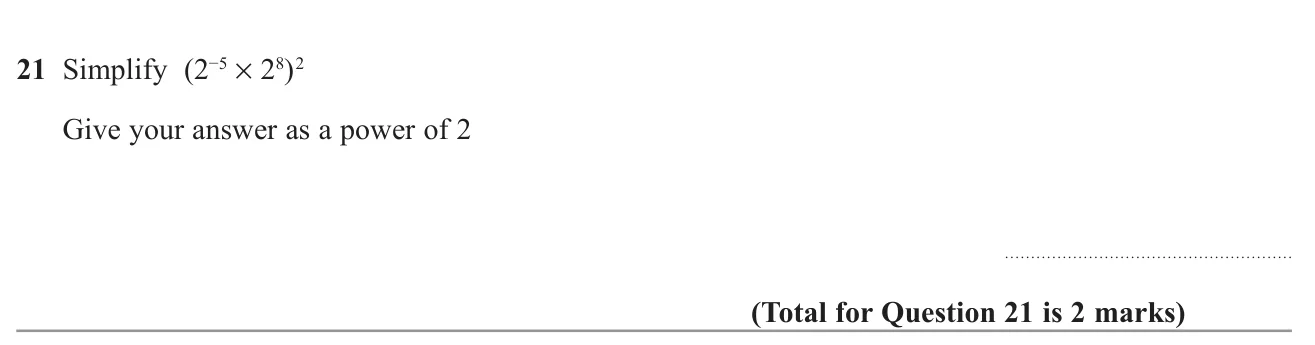
Simplify a squared product of powers of 2 and give the answer as a single power.

© Pearson Education Ltd. November 2022 Paper 1 (Foundation, non-calculator), question 21.

Show answer
Answer262^62 marks

Worked solution Checked against the mark scheme

Inside the bracket add the powers: 2−5×28=232^{-5} \times 2^8 = 2^{3}

Square by multiplying the power: (23)2=26(2^3)^2 = 2^6

Watch out: Adding 3 and 2 to get 252^5.

Powers, roots and indices5 marksGrade 4CalculatorOn both tiers
November 2020 · Paper 3 Foundation · Q23
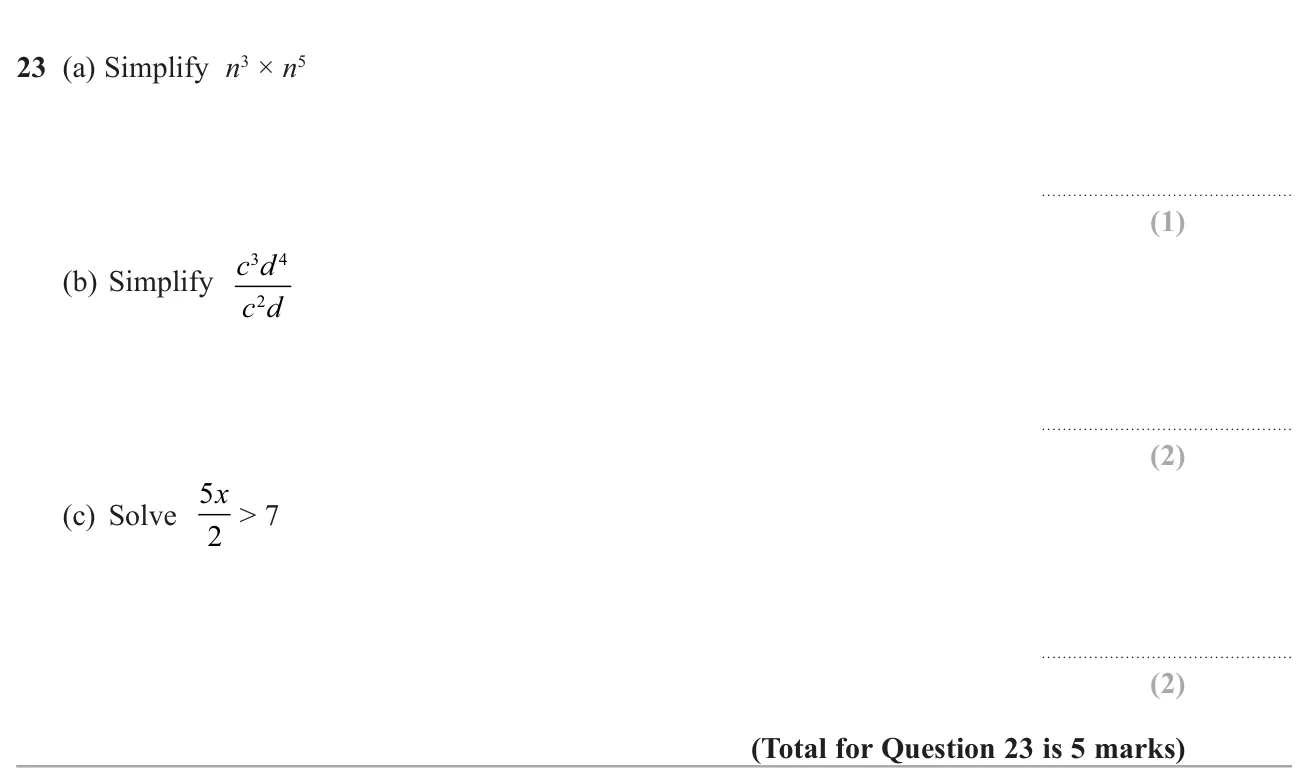
Simplify using index laws and solve a linear inequality with a fraction.

© Pearson Education Ltd. November 2020 Paper 3 (Foundation, calculator), question 23.

Show answer
(a)n8n^81 mark
(b)cd3cd^32 marks
(c)x>145x > \frac{14}{5}2 marks

Worked solution Checked against the mark scheme

(a) Add the powers: n3+5=n8n^{3+5} = n^8

(b) Subtract the powers: c3−2d4−1=cd3c^{3-2}d^{4-1} = cd^3

(c) 5x>145x > 14, so x>145=2.8x > \frac{14}{5} = 2.8

Watch out: In (a), multiplying powers to get n15n^{15}.

Powers, roots and indices5 marksGrade 4CalculatorOn both tiers
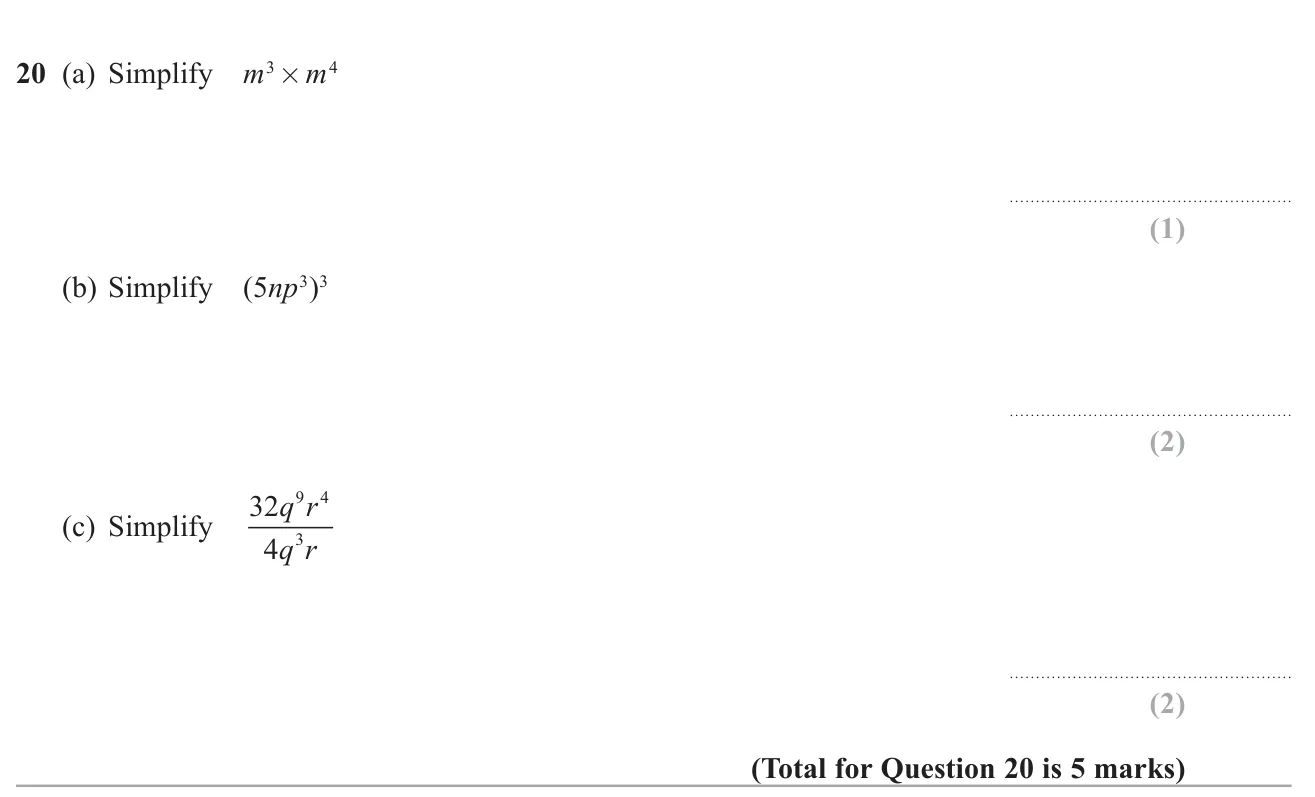
June 2018 · Paper 2 Foundation · Q20
Simplify expressions using the laws of indices.

© Pearson Education Ltd. June 2018 Paper 2 (Foundation, calculator), question 20.

Show answer
(a)m7m^71 mark
(b)125n3p9125n^3p^92 marks
(c)8q6r38q^6r^32 marks

Worked solution Checked against the mark scheme

(a) Add the powers: m3+4=m7m^{3+4} = m^7

(b) Cube each part: 53×n3×(p3)3=125n3p95^3 \times n^3 \times (p^3)^3 = 125n^3p^9

(c) Divide the numbers and subtract the powers: 324=8\frac{32}{4} = 8, q9−3=q6q^{9-3} = q^6, r4−1=r3r^{4-1} = r^3, giving 8q6r38q^6r^3

Watch out: In (b), writing 15np915np^9 or p6p^6.

Powers, roots and indices4 marksGrade 5No calculatorFoundation
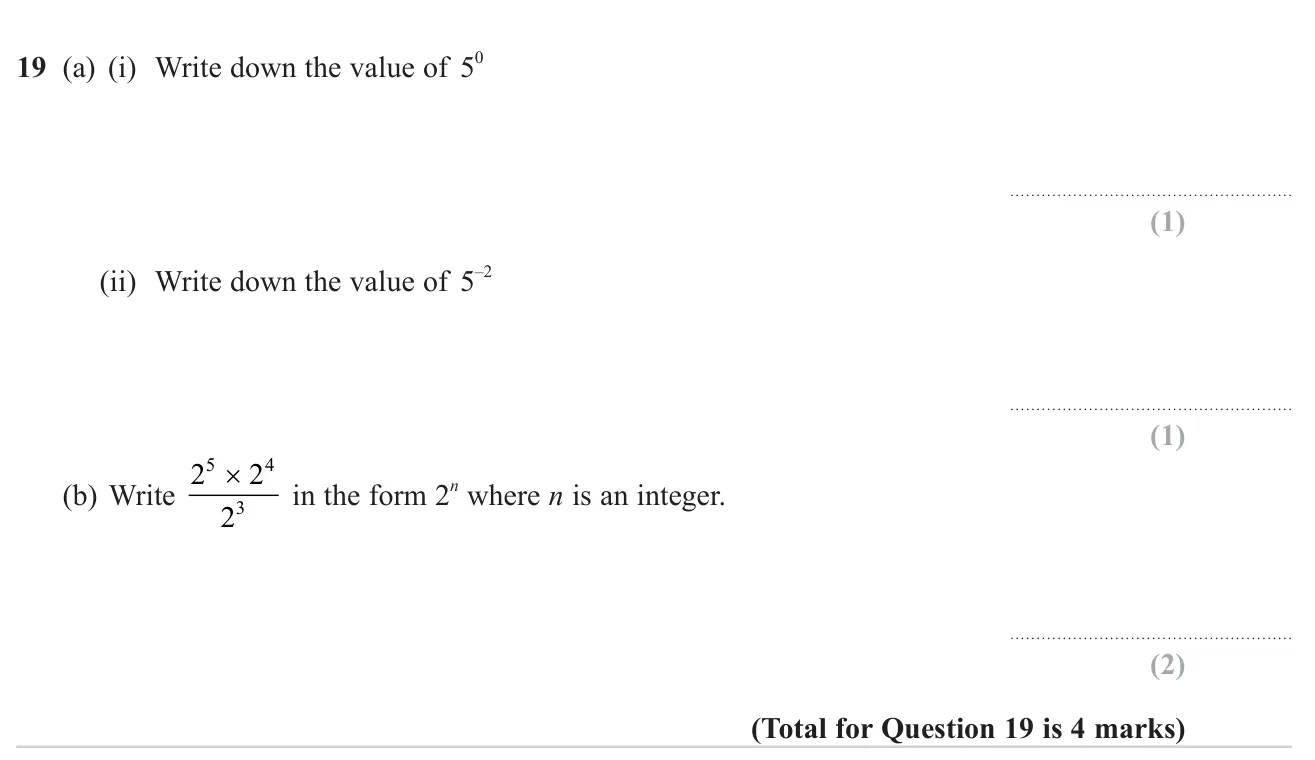
November 2023 · Paper 1 Foundation · Q19
Evaluate a zero and a negative power, and simplify a calculation with powers of 2 using index laws.

© Pearson Education Ltd. November 2023 Paper 1 (Foundation, non-calculator), question 19.

Show answer
(a(i))11 mark
(a(ii))125\frac{1}{25}1 mark
(b)262^62 marks

Worked solution Checked against the mark scheme

(a)(i) Any non-zero number to the power 0 is 1.

(ii) 5−2=152=1255^{-2} = \frac{1}{5^2} = \frac{1}{25}

(b) Add the powers when multiplying: 25×24=292^5 \times 2^4 = 2^9. Subtract when dividing: 29÷23=262^9 \div 2^3 = 2^6.

Watch out: Giving 50=05^0 = 0 or 5−2=−255^{-2} = -25.

Powers, roots and indices2 marksGrade 5No calculatorFoundation
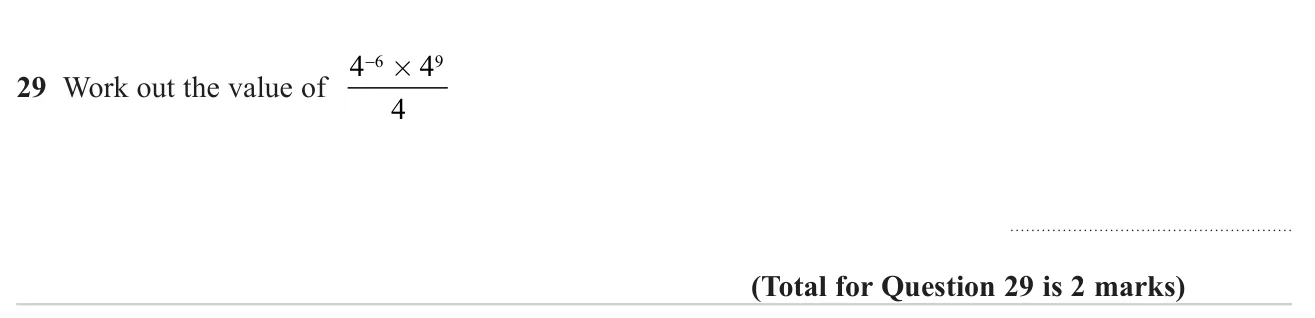
June 2023 · Paper 1 Foundation · Q29
Use index laws to evaluate a product and quotient of powers of 4.

© Pearson Education Ltd. June 2023 Paper 1 (Foundation, non-calculator), question 29.

Show answer
Answer16162 marks

Worked solution Checked against the mark scheme

Multiplying: add the powers, −6+9=3-6 + 9 = 3, so the top is 434^3.

Dividing by 414^1: subtract the powers, 43−1=42=164^{3-1} = 4^2 = 16

Watch out: Stopping at 424^2 or writing 8.

Powers, roots and indices1 markGrade 5CalculatorHigher
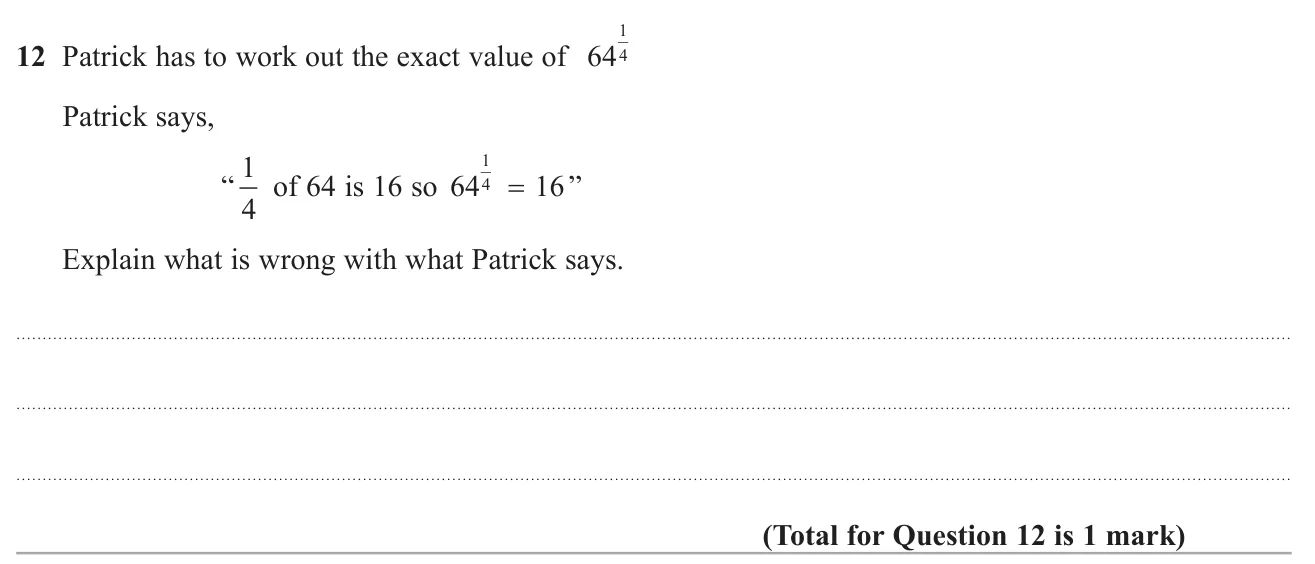
June 2019 · Paper 3 Higher · Q12
Explain the error in treating a fractional power as multiplying by the fraction.

© Pearson Education Ltd. June 2019 Paper 3 (Higher, calculator), question 12.

Show answer
Answer641/464^{1/4} means the fourth root of 64 (about 2.83), not a quarter of 641 mark

Worked solution Checked against the mark scheme

A power of 14\frac{1}{4} means the fourth root, not dividing by 4.

6414=644=64=8=22≈2.8364^{\frac{1}{4}} = \sqrt[4]{64} = \sqrt{\sqrt{64}} = \sqrt{8} = 2\sqrt{2} \approx 2.83

Watch out: Thinking the answer is 2, or 4.
Powers, roots and indices2 marksGrade 5No calculatorOn both tiers
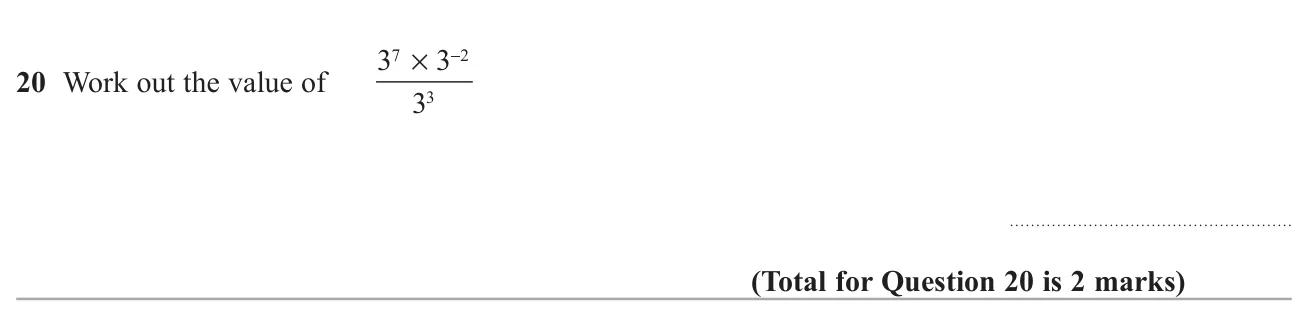
November 2018 · Paper 1 Foundation · Q20
Simplify and evaluate a quotient of powers of 3 with a negative index.

© Pearson Education Ltd. November 2018 Paper 1 (Foundation, non-calculator), question 20.

Show answer
Answer92 marks

Worked solution Checked against the mark scheme

37×3−2=37+(−2)=353^7 \times 3^{-2} = 3^{7 + (-2)} = 3^5

35÷33=35−3=32=93^5 \div 3^3 = 3^{5 - 3} = 3^2 = 9

Watch out: Stopping at 323^2, or multiplying indices instead of adding.
Powers, roots and indices4 marksGrade 6No calculatorHigher
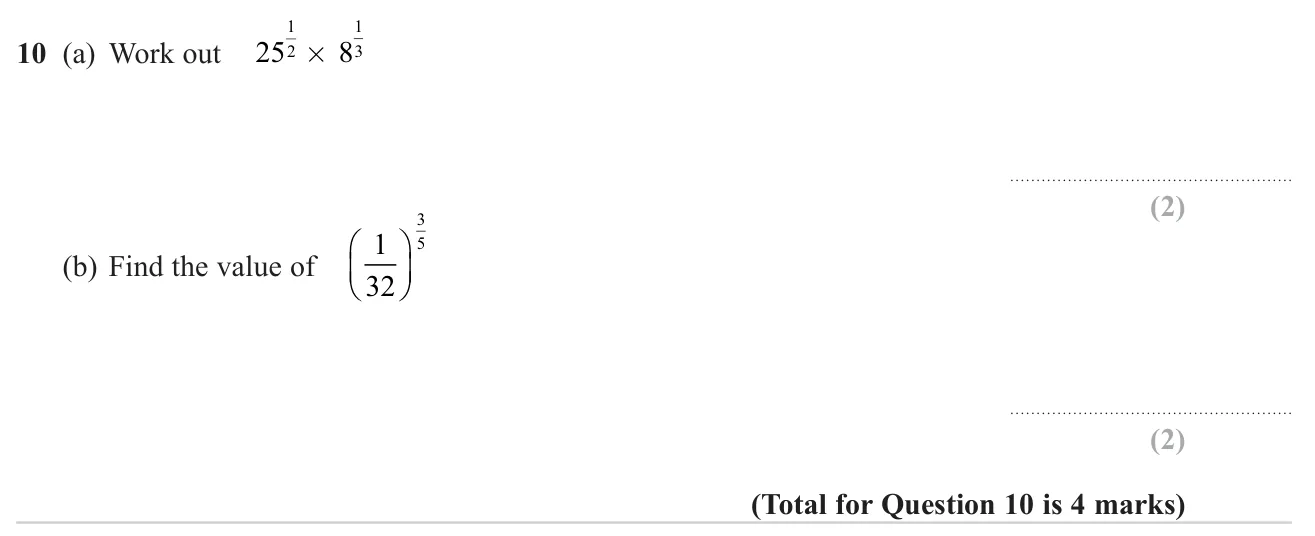
November 2024 · Paper 1 Higher · Q10
Evaluate products and powers with fractional indices.

© Pearson Education Ltd. November 2024 Paper 1 (Higher, non-calculator), question 10.

Show answer
(a)10102 marks
(b)18\frac{1}{8}2 marks

Worked solution Checked against the mark scheme

(a) 2512=25=525^{\frac{1}{2}} = \sqrt{25} = 5 and 813=83=28^{\frac{1}{3}} = \sqrt[3]{8} = 2, so the product is 1010.

(b) (132)15=12\left(\frac{1}{32}\right)^{\frac{1}{5}} = \frac{1}{2}, then (12)3=18\left(\frac{1}{2}\right)^3 = \frac{1}{8}

Watch out: Treating the power 1/2 as 'divide by 2', giving 12.5.
Powers, roots and indices4 marksGrade 6CalculatorHigher
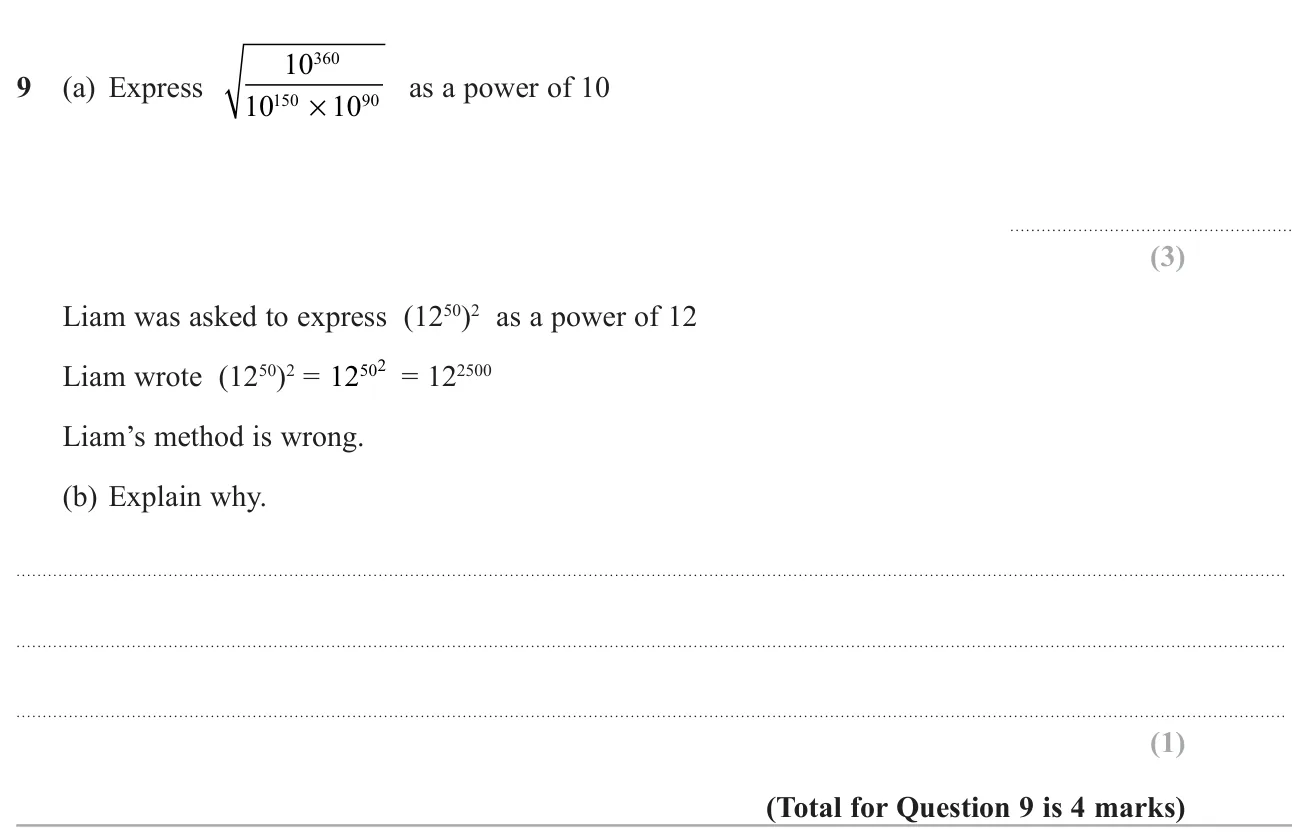
June 2022 · Paper 3 Higher · Q9
Simplify a square root of a quotient of powers of 10, and explain the error in raising a power to a power.

© Pearson Education Ltd. June 2022 Paper 3 (Higher, calculator), question 9.

Show answer
(a)106010^{60}3 marks
(b)He should multiply the powers, 50×2=10050\times2 = 100, giving 1210012^{100}, not square the 501 mark

Worked solution Checked against the mark scheme

(a) 10150×1090=1024010^{150} \times 10^{90} = 10^{240}

10360÷10240=1012010^{360} \div 10^{240} = 10^{120}

10120=1060\sqrt{10^{120}} = 10^{60}

(b) For a power of a power you multiply the indices: (1250)2=12100(12^{50})^2 = 12^{100}. Liam squared 50 instead.

Watch out: In (a), halving only the numerator's power before dividing, or taking the square root of 120 instead of halving it.
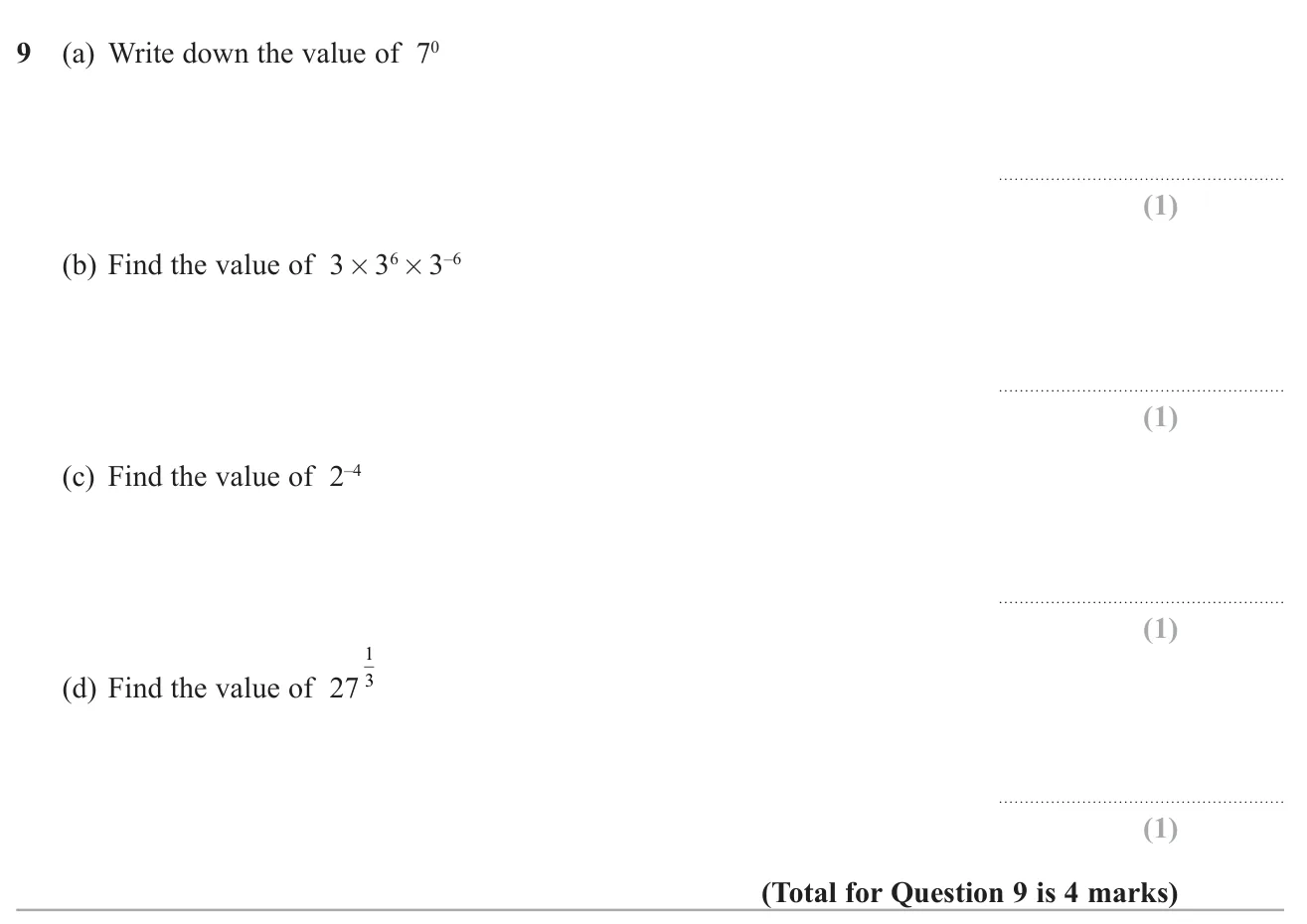
Powers, roots and indices4 marksGrade 6No calculatorHigher
November 2021 · Paper 1 Higher · Q9
Evaluate a zero power, a product of powers of 3, a negative power of 2 and a fractional power of 27.

© Pearson Education Ltd. November 2021 Paper 1 (Higher, non-calculator), question 9.

Show answer
(a)111 mark
(b)331 mark
(c)116\frac{1}{16}1 mark
(d)331 mark

Worked solution Checked against the mark scheme

(a) Anything (except 0) to the power 0 is 1, so 70=17^0 = 1

(b) 36×3−6=30=13^6 \times 3^{-6} = 3^0 = 1, so the value is 3×1=33 \times 1 = 3

(c) 2−4=124=1162^{-4} = \frac{1}{2^4} = \frac{1}{16}

(d) 2713=273=327^{\frac{1}{3}} = \sqrt[3]{27} = 3

Watch out: Writing 70=07^0 = 0 or 2−4=−162^{-4} = -16.

Powers, roots and indices6 marksGrade 6No calculatorHigher
November 2020 · Paper 1 Higher · Q11
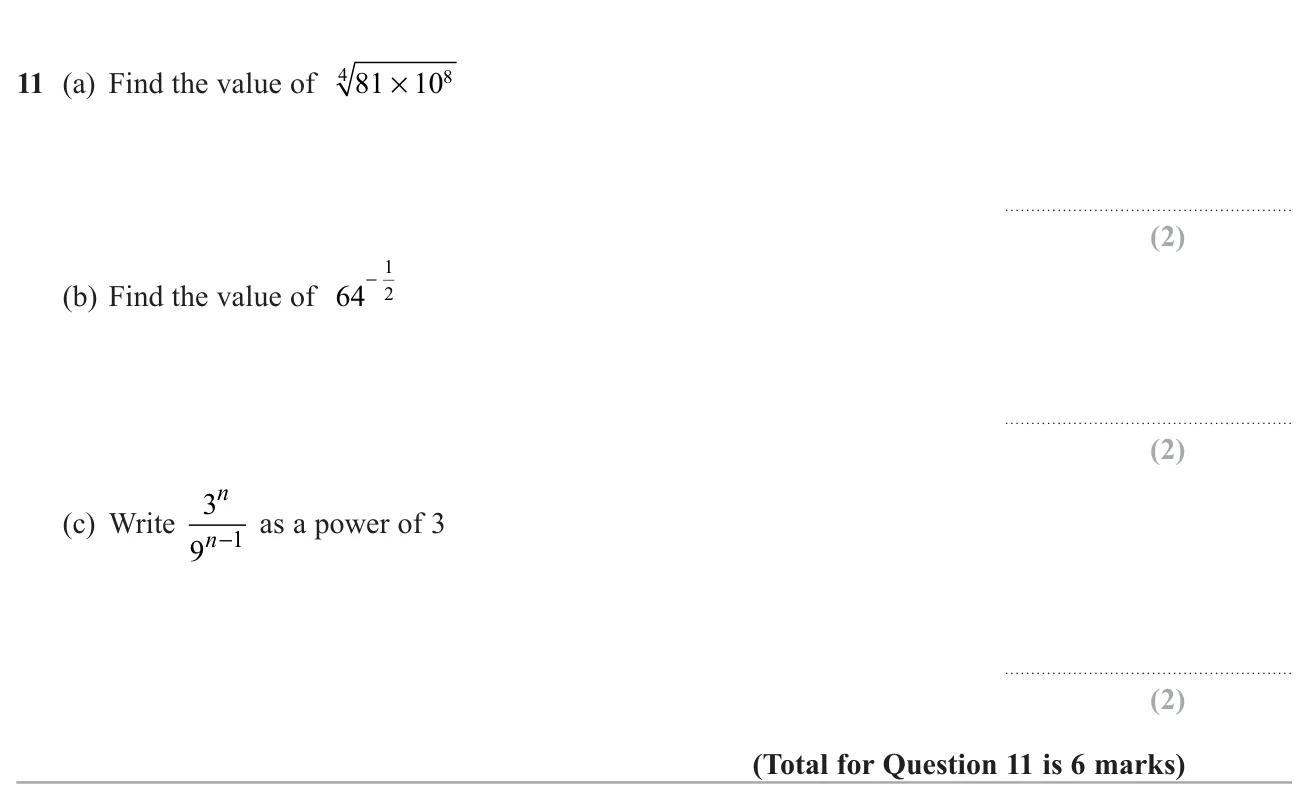
Evaluate a fourth root and a negative fractional power, then write a quotient of powers as a single power of 3.

© Pearson Education Ltd. November 2020 Paper 1 (Higher, non-calculator), question 11.

Show answer
(a)3002 marks
(b)18\frac{1}{8}2 marks
(c)32−n3^{2-n}2 marks

Worked solution Checked against the mark scheme

(a) 814=3\sqrt[4]{81} = 3 and 1084=102\sqrt[4]{10^8} = 10^2, so the answer is 3×100=3003 \times 100 = 300

(b) 6412=864^{\frac{1}{2}} = 8, and the negative power means the reciprocal: 18\frac{1}{8}

(c) 9n−1=32(n−1)=32n−29^{n-1} = 3^{2(n-1)} = 3^{2n-2}, so 3n32n−2=3n−(2n−2)=32−n\frac{3^n}{3^{2n-2}} = 3^{n-(2n-2)} = 3^{2-n}

Watch out: In (b), treating the negative power as a negative number and answering −8.
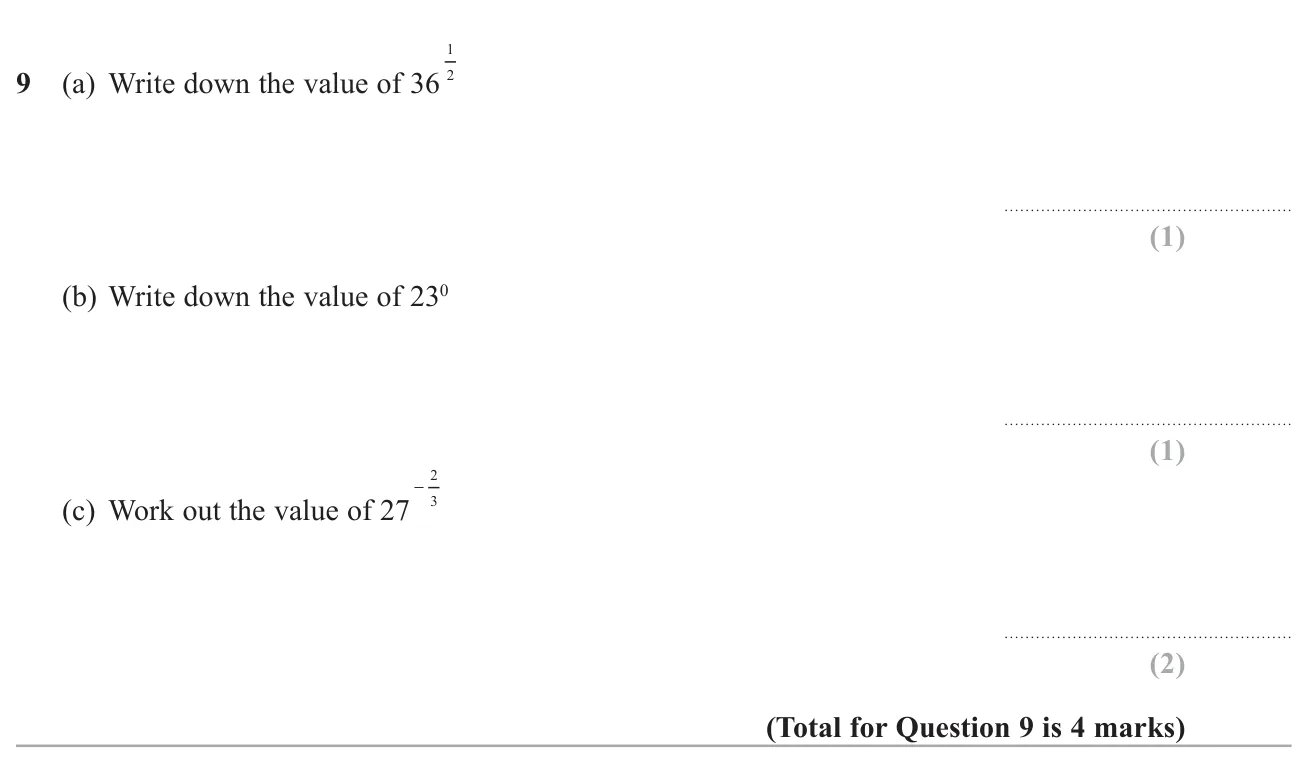
Powers, roots and indices4 marksGrade 6No calculatorHigher
June 2018 · Paper 1 Higher · Q9
Evaluate a number to a half power, a number to the power zero and a number to a negative fractional power.

© Pearson Education Ltd. June 2018 Paper 1 (Higher, non-calculator), question 9.

Show answer
(a)61 mark
(b)11 mark
(c)19\frac{1}{9}2 marks

Worked solution Checked against the mark scheme

(a) 3612=36=636^{\frac{1}{2}} = \sqrt{36} = 6

(b) Any non-zero number to the power 0 is 1, so 20=12^0 = 1

(c) 27−23=12723=1(273)2=132=1927^{-\frac{2}{3}} = \frac{1}{27^{\frac{2}{3}}} = \frac{1}{(\sqrt[3]{27})^2} = \frac{1}{3^2} = \frac{1}{9}

Watch out: Writing 20=02^0 = 0 or 20=22^0 = 2.

Powers, roots and indices4 marksGrade 7No calculatorHigher
June 2023 · Paper 1 Higher · Q14
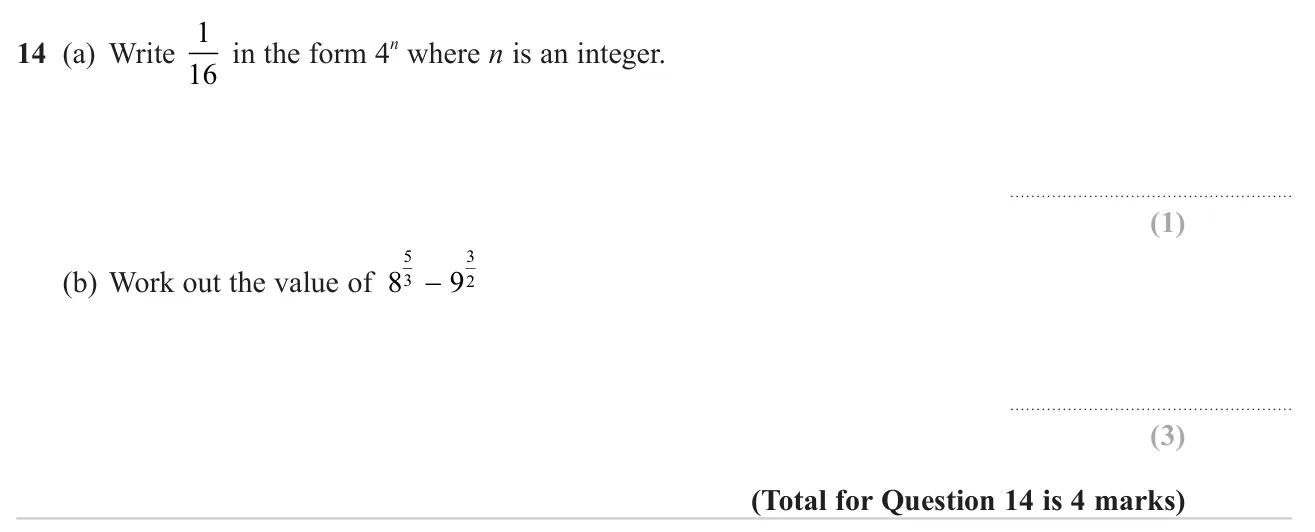
Write a unit fraction as a negative power of 4, and evaluate the difference of two numbers raised to fractional powers.

© Pearson Education Ltd. June 2023 Paper 1 (Higher, non-calculator), question 14.

Show answer
(a)4−24^{-2}1 mark
(b)553 marks

Worked solution Checked against the mark scheme

(a) 16=4216 = 4^2, so 116=4−2\frac{1}{16} = 4^{-2}

(b) 853=(83)5=25=328^{\frac{5}{3}} = (\sqrt[3]{8})^5 = 2^5 = 32

932=(9)3=33=279^{\frac{3}{2}} = (\sqrt{9})^3 = 3^3 = 27

32−27=532 - 27 = 5

Watch out: Multiplying the base by the fraction, e.g. treating 8538^{\frac{5}{3}} as 8×538 \times \frac{5}{3}.

Powers, roots and indices3 marksGrade 7No calculatorHigher
November 2023 · Paper 1 Higher · Q14
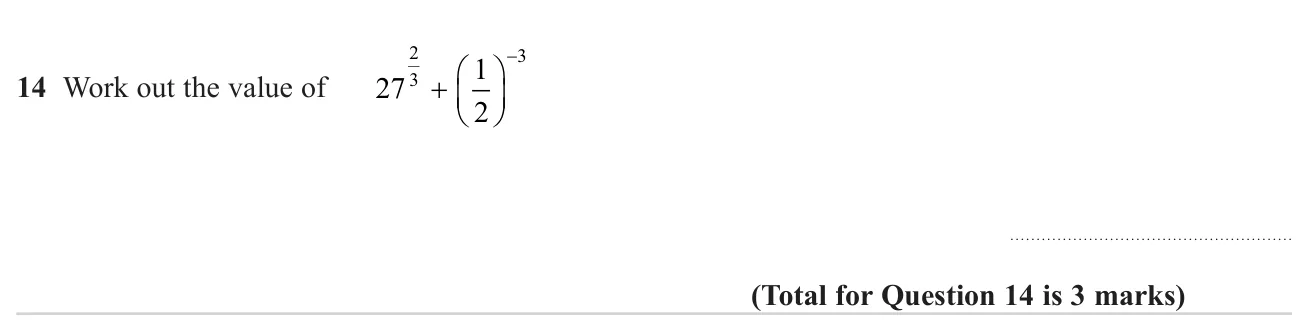
Evaluate a sum of a fractional power and a negative power of a fraction.

© Pearson Education Ltd. November 2023 Paper 1 (Higher, non-calculator), question 14.

Show answer
Answer17173 marks

Worked solution Checked against the mark scheme

2723=(273)2=32=927^{\frac{2}{3}} = (\sqrt[3]{27})^2 = 3^2 = 9

(12)−3=23=8\left(\frac{1}{2}\right)^{-3} = 2^3 = 8

9+8=179 + 8 = 17

Watch out: Treating the negative power as making the answer negative, e.g. −8.
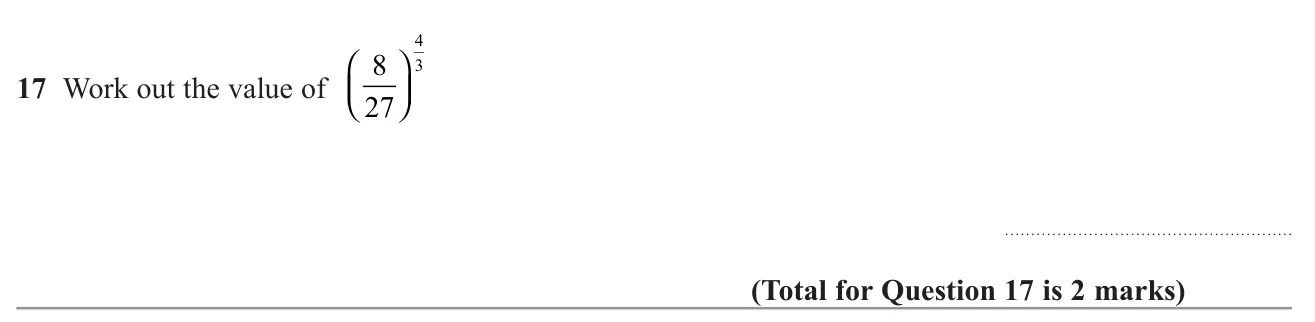
Powers, roots and indices2 marksGrade 7No calculatorHigher
November 2022 · Paper 1 Higher · Q17
Evaluate a fraction raised to a fractional power without a calculator.

© Pearson Education Ltd. November 2022 Paper 1 (Higher, non-calculator), question 17.

Show answer
Answer1681\frac{16}{81}2 marks

Worked solution Checked against the mark scheme

The denominator 3 means cube root: 8273=23\sqrt[3]{\frac{8}{27}} = \frac{2}{3}

The numerator 4 means raise to the power 4: (23)4=1681\left(\frac{2}{3}\right)^4 = \frac{16}{81}

Watch out: Multiplying by 43\frac{4}{3} instead of treating it as a power.

Powers, roots and indices2 marksGrade 7CalculatorHigher
November 2021 · Paper 3 Higher · Q12
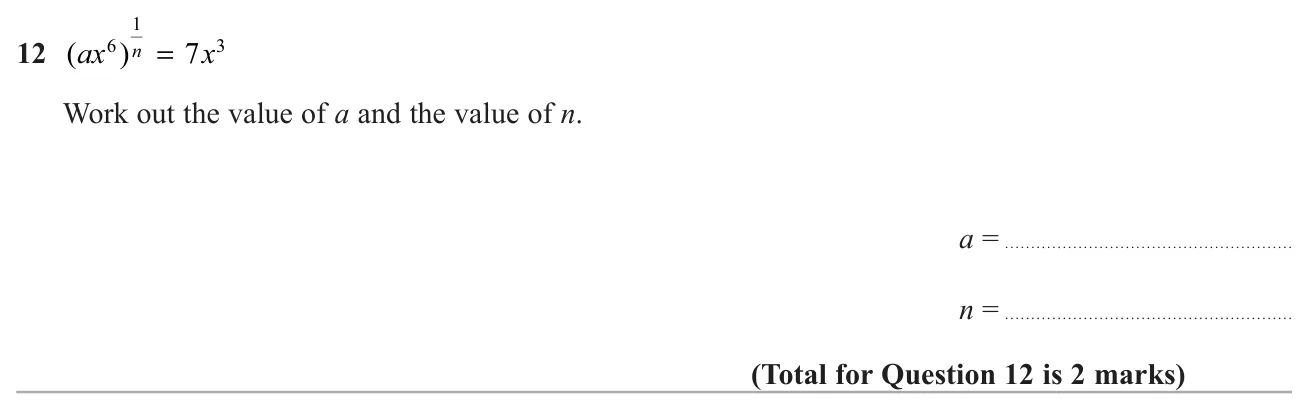
Find the unknown coefficient and root index in an equation involving a fractional power of an algebraic term.

© Pearson Education Ltd. November 2021 Paper 3 (Higher, calculator), question 12.

Show answer
Answera=49a = 49, n=2n = 22 marks

Worked solution Checked against the mark scheme

Powers of xx: x6×1n=x3x^{6 \times \frac{1}{n}} = x^3, so 6n=3\frac{6}{n} = 3 and n=2n = 2.

Numbers: a12=7a^{\frac{1}{2}} = 7, so a=72=49a = 7^2 = 49.

Watch out: Giving a=7a = 7 or a=7a = \sqrt{7}.

Powers, roots and indices4 marksGrade 7No calculatorHigher
November 2018 · Paper 1 Higher · Q14
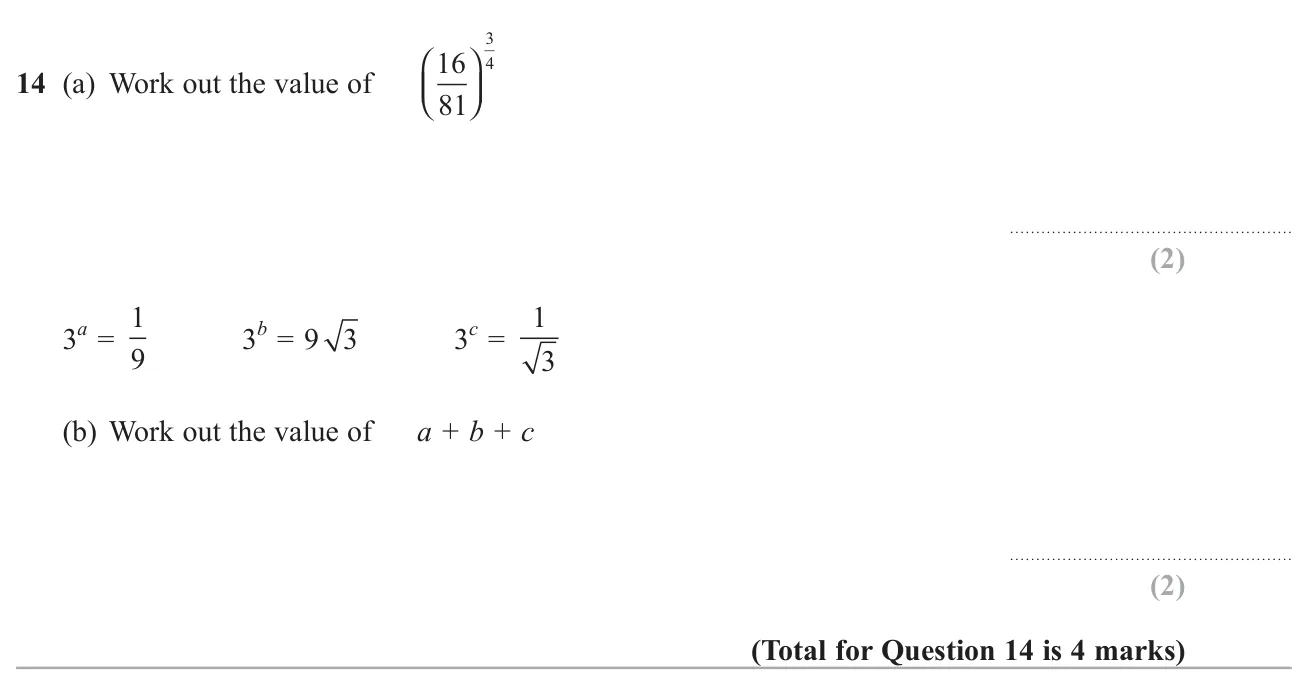
Evaluate a fraction raised to a fractional power and find three unknown powers of 3 whose sum is required.

© Pearson Education Ltd. November 2018 Paper 1 (Higher, non-calculator), question 14.

Show answer
(a)827\dfrac{8}{27}2 marks
(b)002 marks

Worked solution Checked against the mark scheme

(a) (1681)34\left(\frac{16}{81}\right)^{\frac{3}{4}}: fourth root first gives 23\frac{2}{3}, then cube: 827\frac{8}{27}

(b) 19=3−2\frac{1}{9} = 3^{-2}, so a=−2a = -2

93=32×312=32.59\sqrt{3} = 3^2 \times 3^{\frac{1}{2}} = 3^{2.5}, so b=2.5b = 2.5

13=3−0.5\frac{1}{\sqrt{3}} = 3^{-0.5}, so c=−0.5c = -0.5

a+b+c=−2+2.5−0.5=0a + b + c = -2 + 2.5 - 0.5 = 0

Watch out: Cubing before taking the fourth root and getting stuck with large numbers, or treating the power as 4.
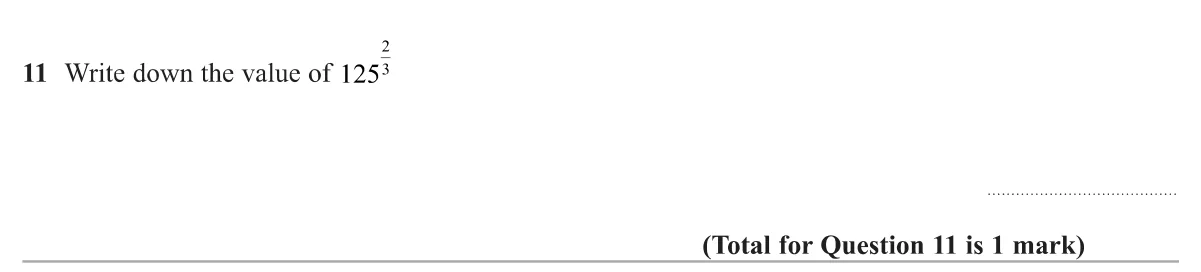
Powers, roots and indices1 markGrade 7No calculatorHigher
Specimen · Paper 1 Higher · Q11
Evaluate a number raised to a fractional power.

© Pearson Education Ltd. Specimen Paper 1 (Higher, non-calculator), question 11.

Show answer
Answer25251 mark

Worked solution Checked against the mark scheme

The denominator 3 means cube root: 1253=5\sqrt[3]{125} = 5.

The numerator 2 means square: 52=255^2 = 25.

Watch out: Multiplying 125 by 23\frac{2}{3}.

Powers, roots and indices3 marksGrade 8No calculatorHigher
June 2024 · Paper 1 Higher · Q20
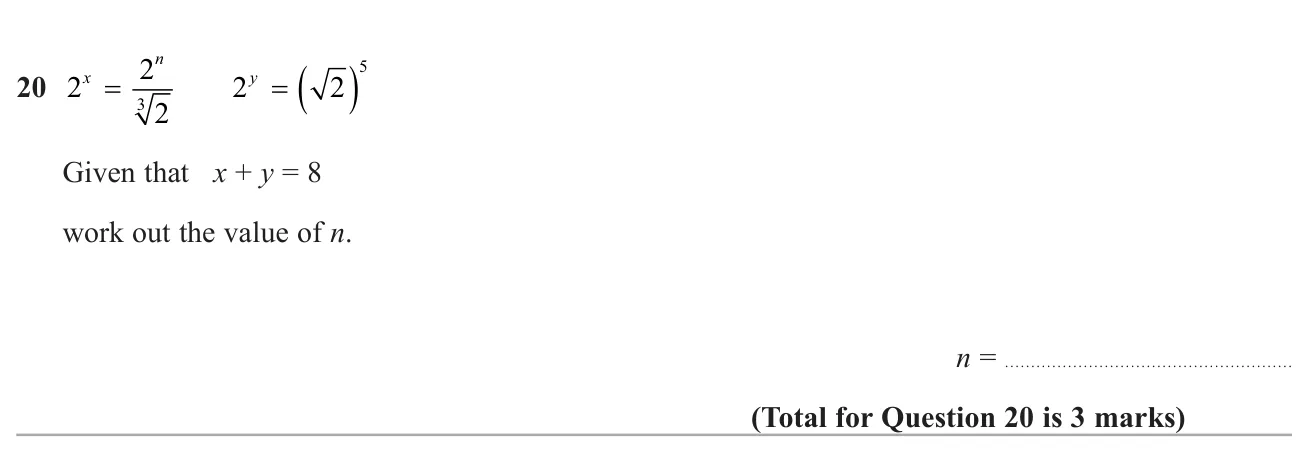
Use index laws with a cube root and a power of root 2 to find an unknown power.

© Pearson Education Ltd. June 2024 Paper 1 (Higher, non-calculator), question 20.

Show answer
Answern=356n = \frac{35}{6} (or 5565\frac{5}{6})3 marks

Worked solution Checked against the mark scheme

23=213\sqrt[3]{2} = 2^{\frac{1}{3}}, so 2x=2n−132^x = 2^{n - \frac{1}{3}} and x=n−13x = n - \frac{1}{3}

(2)5=(212)5=252(\sqrt{2})^5 = (2^{\frac{1}{2}})^5 = 2^{\frac{5}{2}}, so y=52y = \frac{5}{2}

n−13+52=8n - \frac{1}{3} + \frac{5}{2} = 8

n=8+13−52=356n = 8 + \frac{1}{3} - \frac{5}{2} = \frac{35}{6}

Watch out: Treating (2)5(\sqrt{2})^5 as 2152^{\frac{1}{5}} or 2102^{10}.

Powers, roots and indices4 marksGrade 8No calculatorHigher
June 2022 · Paper 1 Higher · Q18
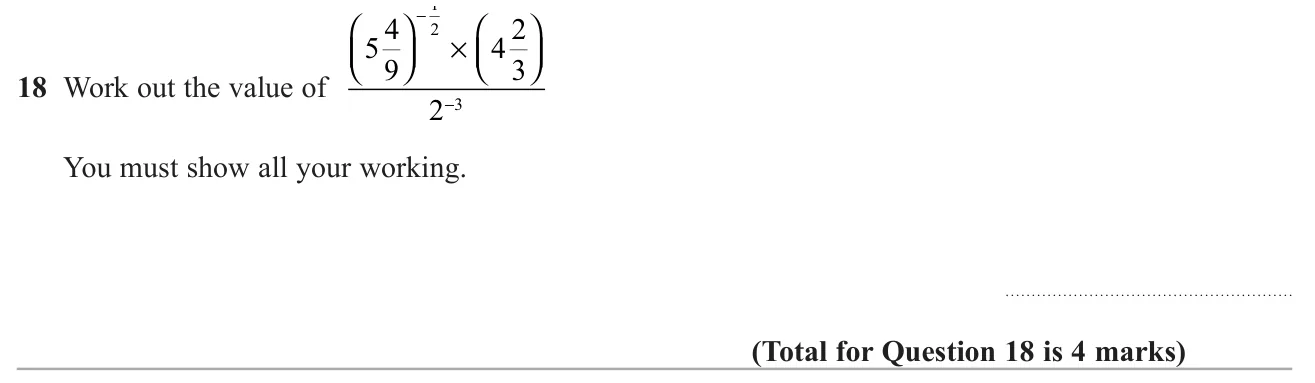
Evaluate an expression with a negative fractional power of a mixed number, a mixed-number product and a negative power of 2.

© Pearson Education Ltd. June 2022 Paper 1 (Higher, non-calculator), question 18.

Show answer
Answer164 marks

Worked solution Checked against the mark scheme

(549)−12=(499)−12=37\left(5\frac{4}{9}\right)^{-\frac{1}{2}} = \left(\frac{49}{9}\right)^{-\frac{1}{2}} = \frac{3}{7}

Numerator: 37×423=37×143=2\frac{3}{7} \times 4\frac{2}{3} = \frac{3}{7} \times \frac{14}{3} = 2

2−3=182^{-3} = \frac{1}{8}, so the value is 2÷18=162 \div \frac{1}{8} = 16

Watch out: Treating the power −12-\frac{1}{2} as halving, or making the answer negative.
Powers, roots and indices3 marksGrade 8No calculatorHigher
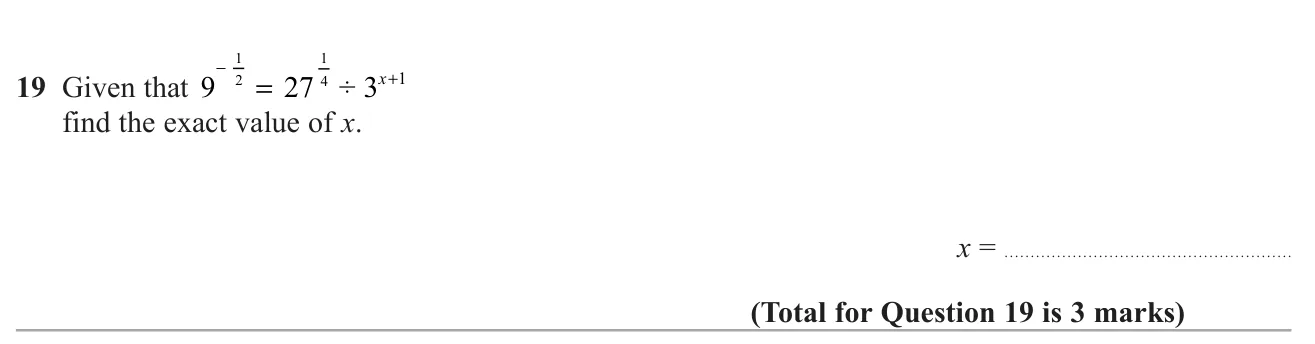
November 2019 · Paper 1 Higher · Q19
Solve an equation with fractional and negative indices by writing everything as a power of 3.

© Pearson Education Ltd. November 2019 Paper 1 (Higher, non-calculator), question 19.

Show answer
Answerx=34x = \frac{3}{4}3 marks

Worked solution Checked against the mark scheme

9−12=3−19^{-\frac{1}{2}} = 3^{-1} and 2714=33427^{\frac{1}{4}} = 3^{\frac{3}{4}}

3−1=334−(x+1)3^{-1} = 3^{\frac{3}{4} - (x+1)}

−1=34−x−1-1 = \frac{3}{4} - x - 1

x=34x = \frac{3}{4}

Watch out: Treating 9−½ as −3.

Also tested in these questions

Their main topic is different, but part of each one tests this topic.