Revision guide by The Full Marks
Forming and solving linear equations: what you need to know Solving linear equations means finding the value of the letter that makes both sides equal. It turns up on almost every paper, often inside a wordy problem where you first have to form the equation yourself.
Key facts Whatever you do to one side, do to the other. Undo operations in reverse order: add or subtract first, then multiply or divide. Letters on both sides: collect them on the side with more of them. Brackets: expand first, multiplying every term inside. Fractions: multiply every term on both sides by the denominator. On a graph, the solution of 2 x + 1 = 7 2x + 1 = 7 2 x + 1 = 7 x x x y = 2 x + 1 y = 2x + 1 y = 2 x + 1 y = 7 y = 7 y = 7 Solving an equation Expand any brackets and clear any fractions. Collect the letter terms on one side and numbers on the other. Divide by the number in front of the letter. Check by substituting back. Forming an equation from words Let x x x x x x Use the fact you are given (a total, perimeter or angle sum) to write an equation. Solve it, then answer the actual question asked. Worked examples Example 1 Foundation · grade 4
(a) Solve 3 ( 2 x − 5 ) = 2 x + 7 3(2x - 5) = 2x + 7 3 ( 2 x − 5 ) = 2 x + 7 4 x + 2 3 = x + 5 \frac{4x + 2}{3} = x + 5 3 4 x + 2 = x + 5
Show the solution (a) Expand: 6 x − 15 = 2 x + 7 6x - 15 = 2x + 7 6 x − 15 = 2 x + 7 2 x 2x 2 x 4 x − 15 = 7 4x - 15 = 7 4 x − 15 = 7 4 x = 22 4x = 22 4 x = 22 x = 5.5 x = 5.5 x = 5.5 4 x + 2 = 3 ( x + 5 ) = 3 x + 15 4x + 2 = 3(x + 5) = 3x + 15 4 x + 2 = 3 ( x + 5 ) = 3 x + 15 3 x 3x 3 x x + 2 = 15 x + 2 = 15 x + 2 = 15 x = 13 x = 13 x = 13 4 ( 13 ) + 2 3 = 18 \frac{4(13) + 2}{3} = 18 3 4 ( 13 ) + 2 = 18 13 + 5 = 18 13 + 5 = 18 13 + 5 = 18
Example 2 Foundation · grade 5
Amelia is x x x
Show the solution Ages: x x x x + 4 x + 4 x + 4 3 x 3x 3 x x + x + 4 + 3 x = 79 x + x + 4 + 3x = 79 x + x + 4 + 3 x = 79 5 x + 4 = 79 5x + 4 = 79 5 x + 4 = 79 5 x = 75 5x = 75 5 x = 75 x = 15 x = 15 x = 15 3 × 15 = 45 3 \times 15 = 45 3 × 15 = 45
Common mistakes Multiplying only the first term when clearing a fraction or expanding a bracket, e.g. 3 ( x − 2 ) = 3 x − 2 3(x - 2) = 3x - 2 3 ( x − 2 ) = 3 x − 2 3 x − 6 3x - 6 3 x − 6 − 2 ( x − 3 ) = − 2 x + 6 -2(x - 3) = -2x + 6 − 2 ( x − 3 ) = − 2 x + 6 Stopping at x = … x = \ldots x = … Sign slips when moving terms: subtracting 2 x 2x 2 x − 2 x -2x − 2 x − 4 x -4x − 4 x Exam tips In 'form and solve' questions the first mark is for writing a correct equation, so write it down clearly before you start solving. Give an exact answer such as x = 5.5 x = 5.5 x = 5.5 x = 11 2 x = \frac{11}{2} x = 2 11 Questions people ask How do you solve equations with x on both sides? Subtract the smaller x x x
How do you solve an equation with a fraction? Multiply every term on both sides by the denominator to clear the fraction, then solve.
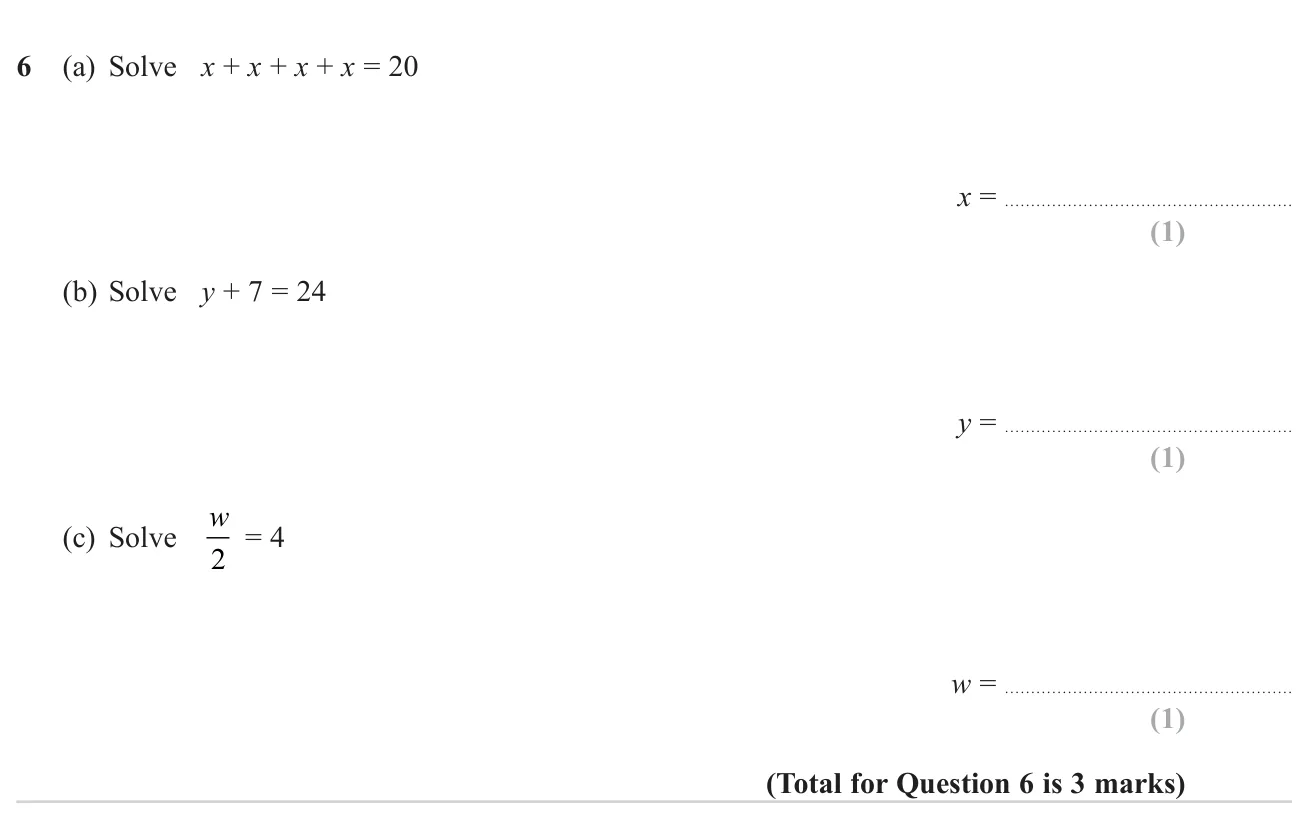
Exam questions: Forming and solving linear equations (32, easiest first) © Pearson Education Ltd. November 2024 Paper 3 (Foundation, calculator), question 6.
(a) x = 5 x = 5 x = 5 1 mark (b) y = 17 y = 17 y = 17 1 mark (c) w = 8 w = 8 w = 8 1 mark
Worked solution Checked against the mark scheme
(a) 4 x = 20 4x = 20 4 x = 20 x = 20 ÷ 4 = 5 x = 20 \div 4 = 5 x = 20 ÷ 4 = 5
(b) y = 24 − 7 = 17 y = 24 - 7 = 17 y = 24 − 7 = 17
(c) w = 4 × 2 = 8 w = 4 \times 2 = 8 w = 4 × 2 = 8
Watch out: In (c), dividing 4 by 2 to get 2.
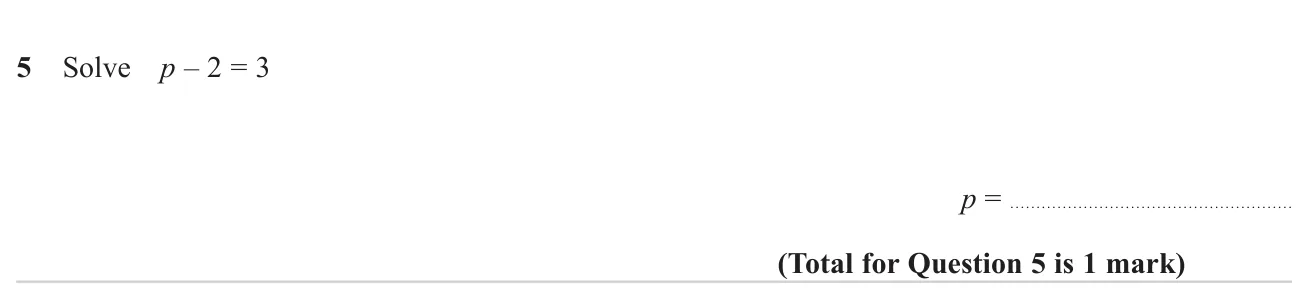
© Pearson Education Ltd. June 2023 Paper 1 (Foundation, non-calculator), question 5.
Worked solution Checked against the mark scheme
Add 2 to both sides.
p = 3 + 2 = 5 p = 3 + 2 = 5 p = 3 + 2 = 5
Watch out: Subtracting instead of adding, giving 1.
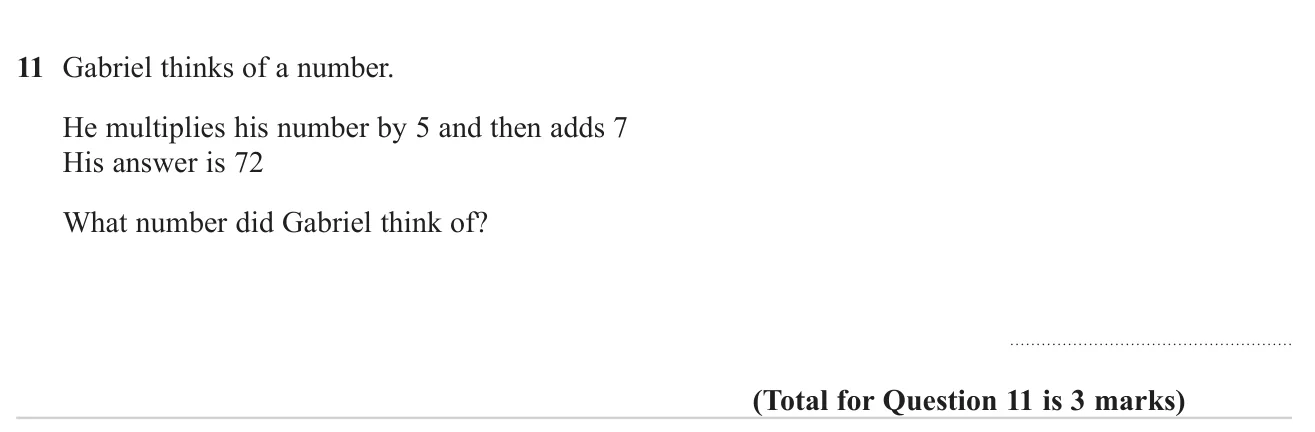
© Pearson Education Ltd. June 2023 Paper 3 (Foundation, calculator), question 11.
Worked solution Checked against the mark scheme
Work backwards: 72 − 7 = 65 72 - 7 = 65 72 − 7 = 65
65 ÷ 5 = 13 65 \div 5 = 13 65 ÷ 5 = 13
Watch out: Doing the inverse operations in the wrong order: 72 ÷ 5 − 7 72 \div 5 - 7 72 ÷ 5 − 7
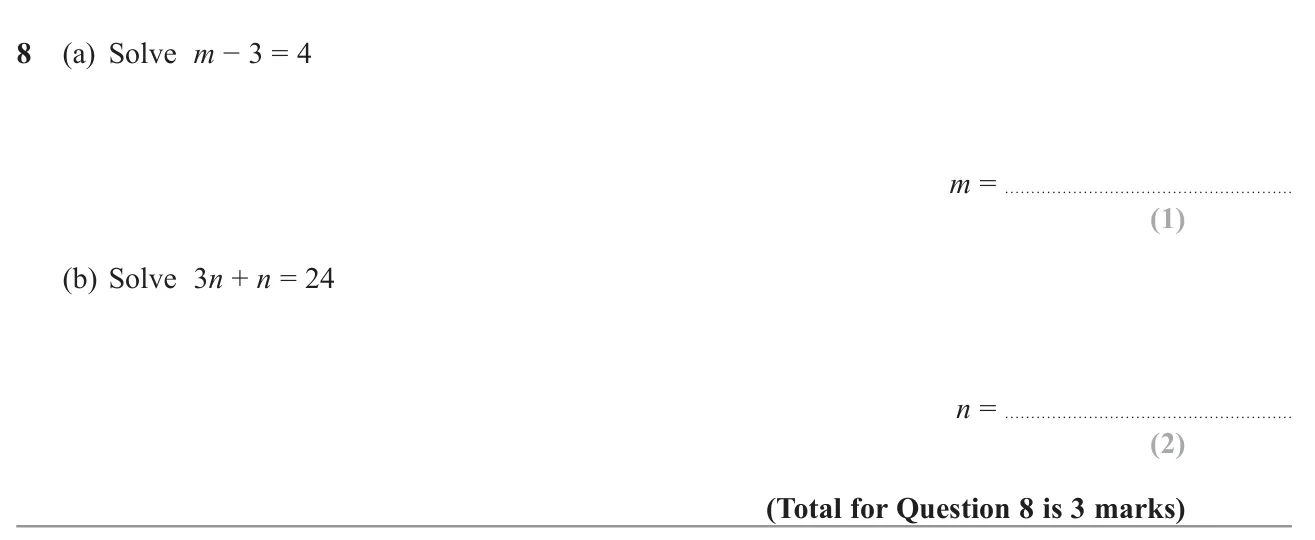
© Pearson Education Ltd. November 2022 Paper 1 (Foundation, non-calculator), question 8.
(a) m = 7 m = 7 m = 7 1 mark (b) n = 6 n = 6 n = 6 2 marks
Worked solution Checked against the mark scheme
(a) m − 3 = 4 m - 3 = 4 m − 3 = 4 m = 4 + 3 = 7 m = 4 + 3 = 7 m = 4 + 3 = 7
(b) 3 n + n = 4 n 3n + n = 4n 3 n + n = 4 n 4 n = 24 4n = 24 4 n = 24 n = 24 ÷ 4 = 6 n = 24 \div 4 = 6 n = 24 ÷ 4 = 6
Watch out: In (b), treating 3 n + n 3n + n 3 n + n 3 n 2 3n^2 3 n 2 4 4 4
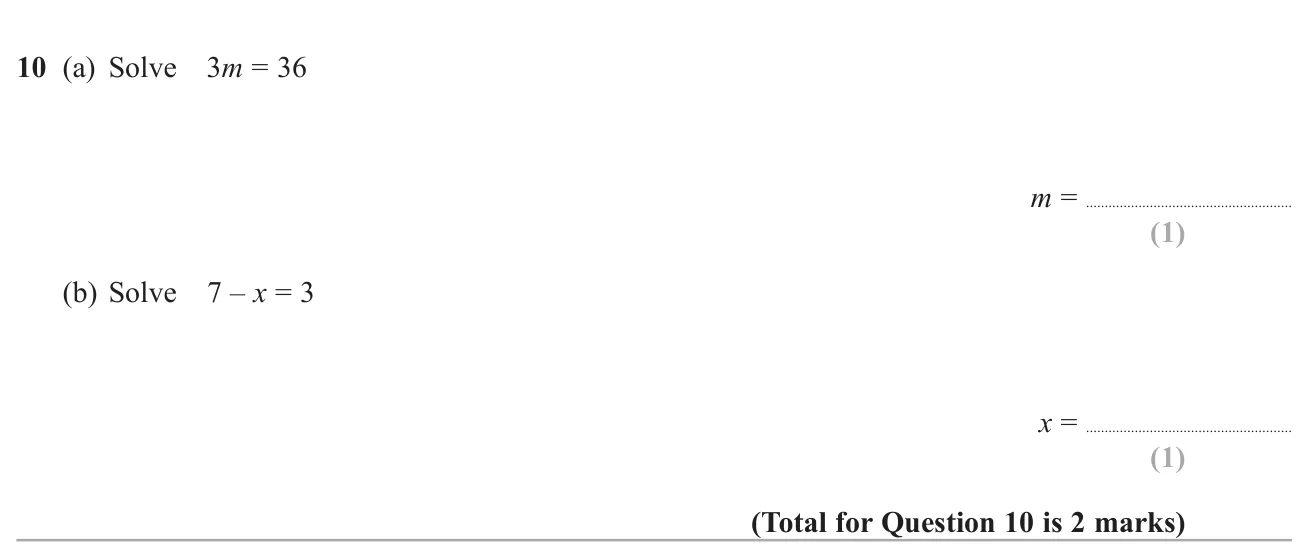
© Pearson Education Ltd. November 2020 Paper 2 (Foundation, calculator), question 10.
(a) m = 12 m = 12 m = 12 1 mark (b) x = 4 x = 4 x = 4 1 mark
Worked solution Checked against the mark scheme
(a) Divide both sides by 3: m = 36 ÷ 3 = 12 m = 36 \div 3 = 12 m = 36 ÷ 3 = 12
(b) 7 − x = 3 7 - x = 3 7 − x = 3 x = 7 − 3 = 4 x = 7 - 3 = 4 x = 7 − 3 = 4
Watch out: In (b), giving x = − 4 x = -4 x = − 4 x = 10 x = 10 x = 10
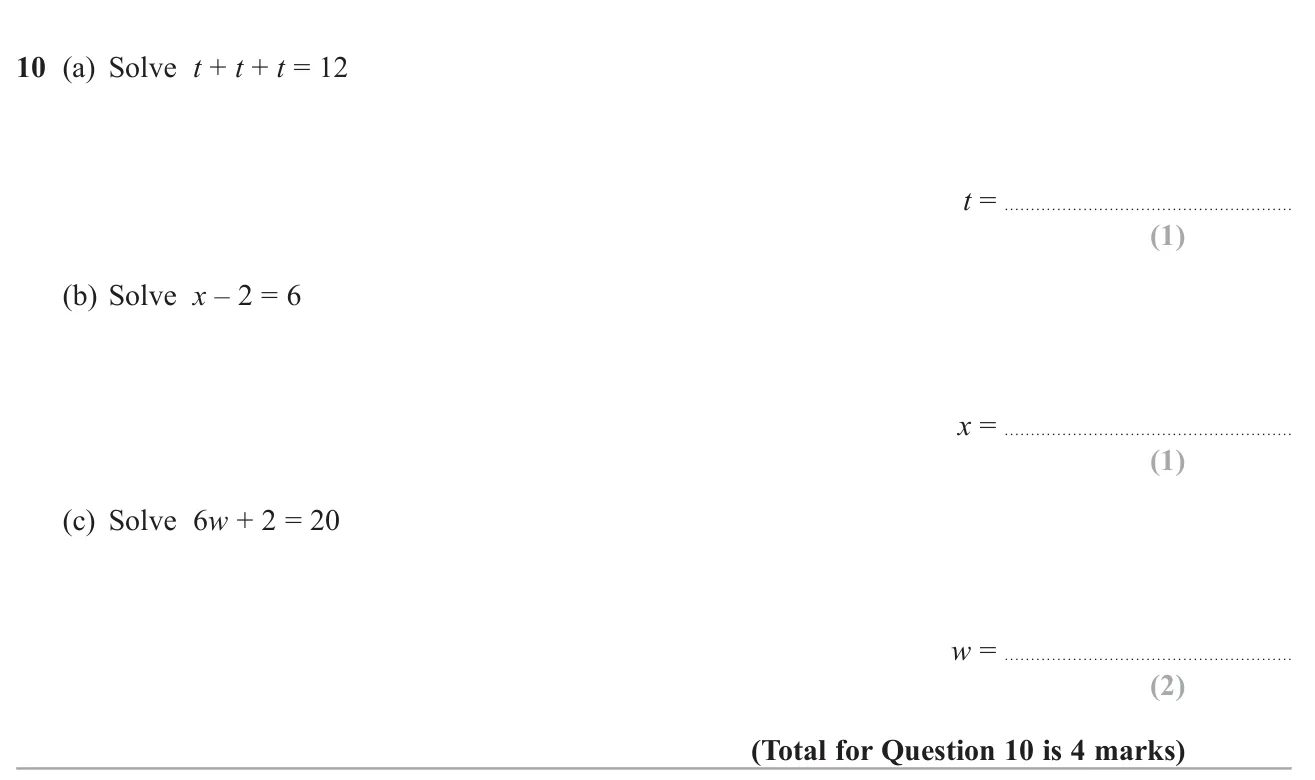
© Pearson Education Ltd. June 2019 Paper 1 (Foundation, non-calculator), question 10.
(a) t = 4 t = 4 t = 4 1 mark (b) x = 8 x = 8 x = 8 1 mark (c) w = 3 w = 3 w = 3 2 marks
Worked solution Checked against the mark scheme
(a) 3 t = 12 3t = 12 3 t = 12 t = 4 t = 4 t = 4
(b) Add 2 to both sides: x = 8 x = 8 x = 8
(c) 6 w + 2 = 20 6w + 2 = 20 6 w + 2 = 20
6 w = 18 6w = 18 6 w = 18
w = 3 w = 3 w = 3
Watch out: In (b), subtracting 2 instead of adding and getting 4.
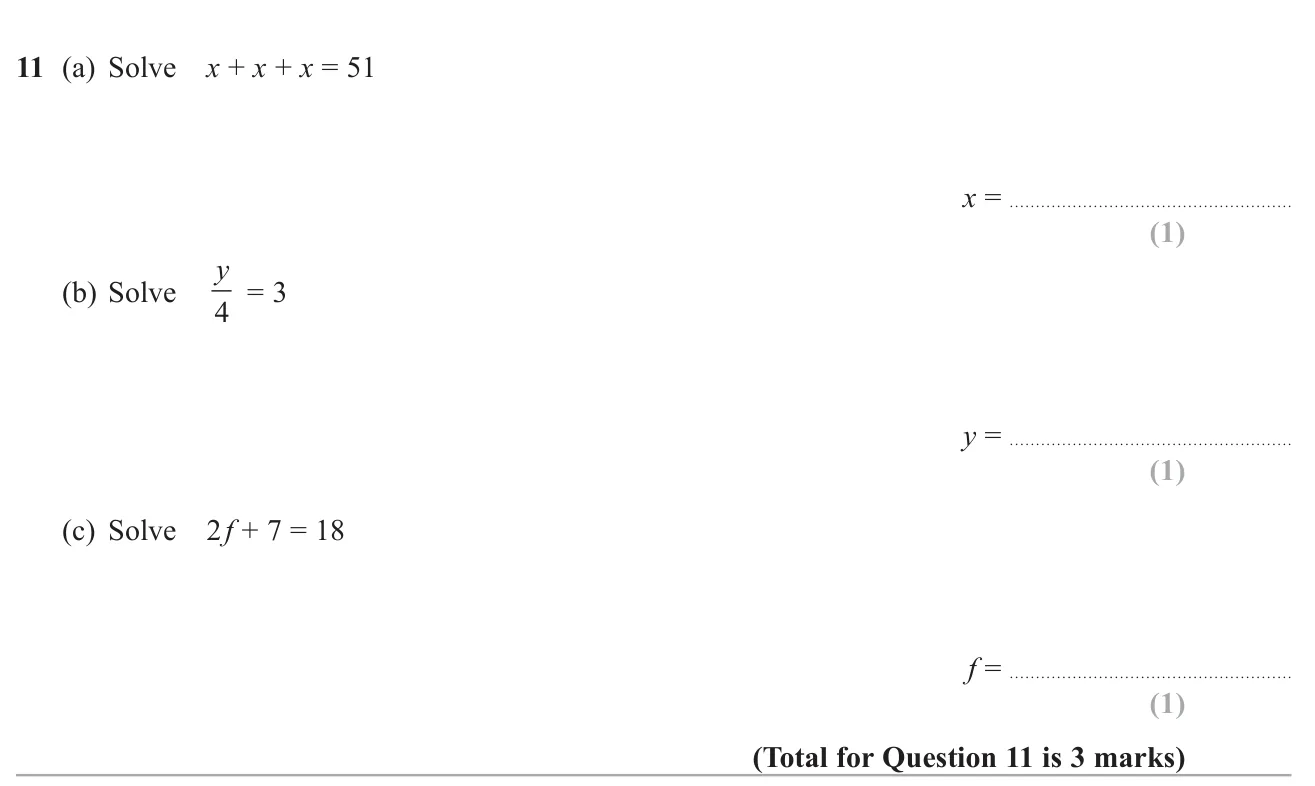
© Pearson Education Ltd. June 2018 Paper 2 (Foundation, calculator), question 11.
(a) x = 17 x = 17 x = 17 1 mark (b) y = 12 y = 12 y = 12 1 mark (c) f = 5.5 f = 5.5 f = 5.5 1 mark
Worked solution Checked against the mark scheme
(a) 3 x = 51 3x = 51 3 x = 51 x = 51 ÷ 3 = 17 x = 51 \div 3 = 17 x = 51 ÷ 3 = 17
(b) y 4 = 3 \frac{y}{4} = 3 4 y = 3 y = 3 × 4 = 12 y = 3 \times 4 = 12 y = 3 × 4 = 12
(c) 2 f + 7 = 18 ⇒ 2 f = 11 ⇒ f = 5.5 2f + 7 = 18 \Rightarrow 2f = 11 \Rightarrow f = 5.5 2 f + 7 = 18 ⇒ 2 f = 11 ⇒ f = 5.5
Watch out: In (b), dividing 3 by 4 instead of multiplying.
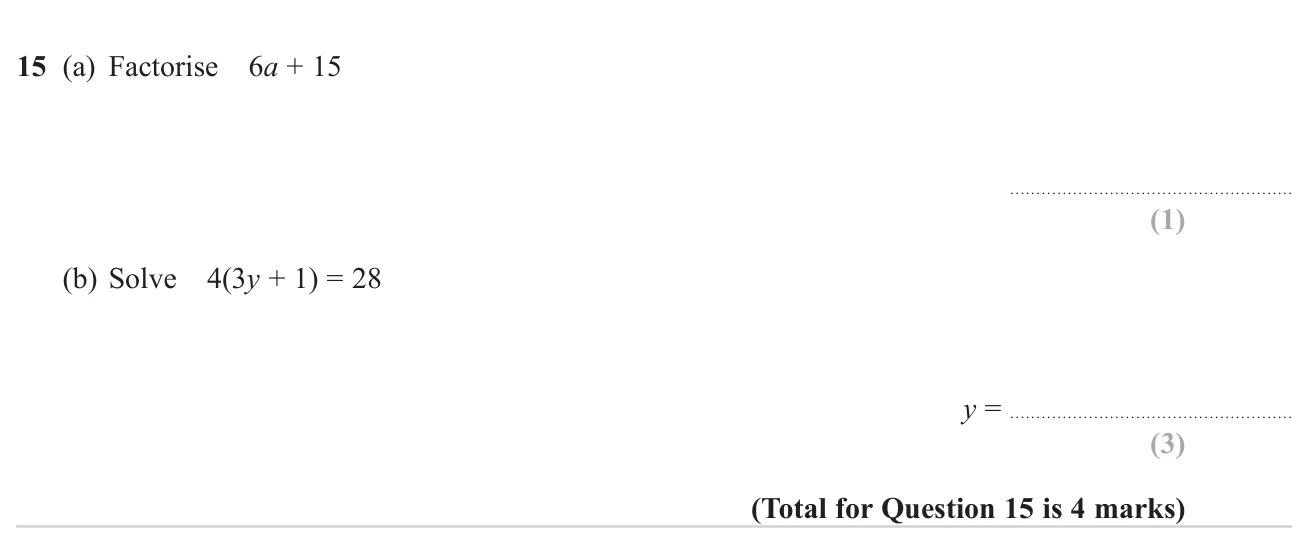
© Pearson Education Ltd. November 2024 Paper 1 (Foundation, non-calculator), question 15.
(a) 3 ( 2 a + 5 ) 3(2a + 5) 3 ( 2 a + 5 ) 1 mark (b) y = 2 y = 2 y = 2 3 marks
Worked solution Checked against the mark scheme
(a) The highest common factor of 6 and 15 is 3: 3 ( 2 a + 5 ) 3(2a + 5) 3 ( 2 a + 5 )
(b) 4 ( 3 y + 1 ) = 28 4(3y + 1) = 28 4 ( 3 y + 1 ) = 28
3 y + 1 = 7 3y + 1 = 7 3 y + 1 = 7
3 y = 6 3y = 6 3 y = 6 y = 2 y = 2 y = 2
Watch out: In (b), expanding as 12y + 1.
© Pearson Education Ltd. June 2024 Paper 1 (Foundation, non-calculator), question 17.
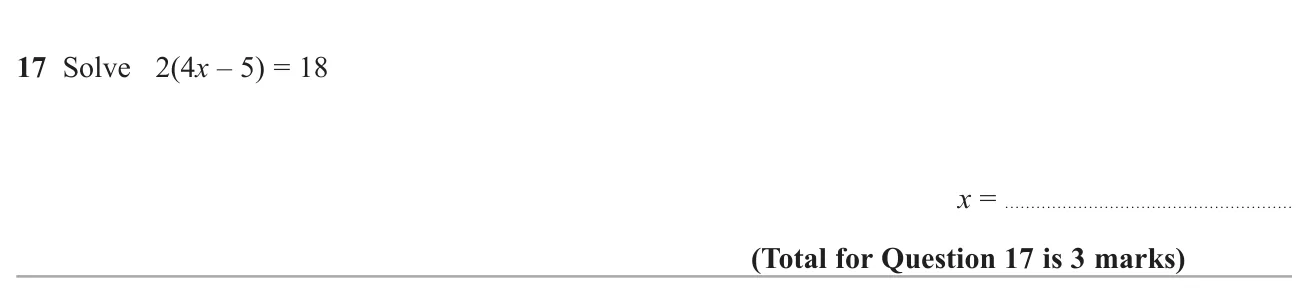
Answer x = 3.5 x = 3.5 x = 3.5 3 marks
Worked solution Checked against the mark scheme
2 ( 4 x − 5 ) = 18 2(4x - 5) = 18 2 ( 4 x − 5 ) = 18
4 x − 5 = 9 4x - 5 = 9 4 x − 5 = 9
4 x = 14 4x = 14 4 x = 14
x = 3.5 x = 3.5 x = 3.5
Watch out: Expanding as 8x − 5.
© Pearson Education Ltd. November 2023 Paper 3 (Foundation, calculator), question 16.
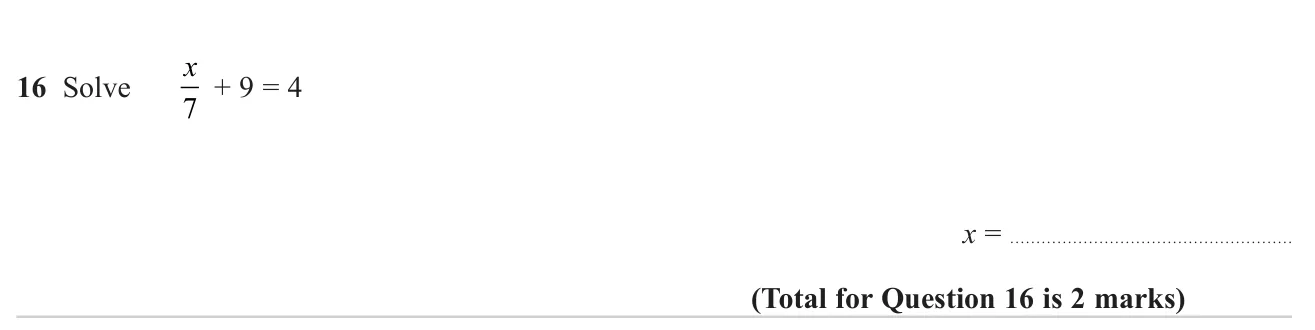
Answer x = − 35 x = -35 x = − 35 2 marks
Worked solution Checked against the mark scheme
x 7 + 9 = 4 \frac{x}{7} + 9 = 4 7 x + 9 = 4
Subtract 9: x 7 = − 5 \frac{x}{7} = -5 7 x = − 5
Multiply by 7: x = − 35 x = -35 x = − 35
Watch out: Adding 9 instead of subtracting, giving x = 91.
© Pearson Education Ltd. June 2023 Paper 3 (Foundation, calculator), question 18.
Worked solution Checked against the mark scheme
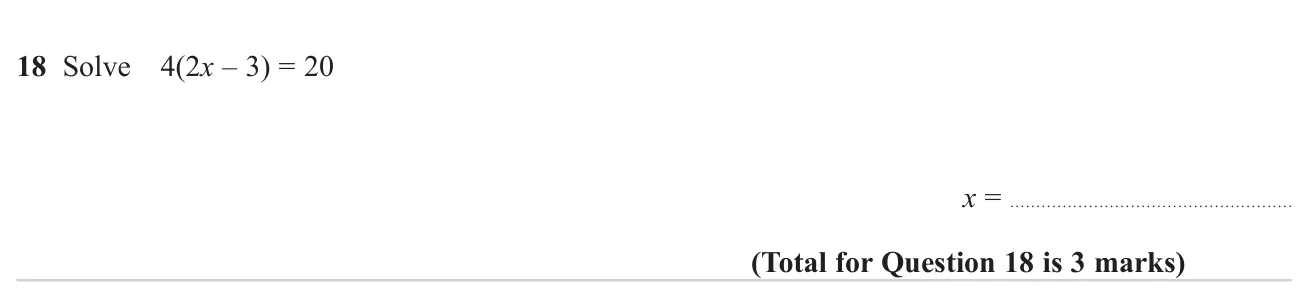
8 x − 12 = 20 8x - 12 = 20 8 x − 12 = 20
8 x = 32 8x = 32 8 x = 32
x = 4 x = 4 x = 4
Watch out: Expanding as 8 x − 3 8x - 3 8 x − 3
© Pearson Education Ltd. November 2022 Paper 2 (Foundation, calculator), question 14.
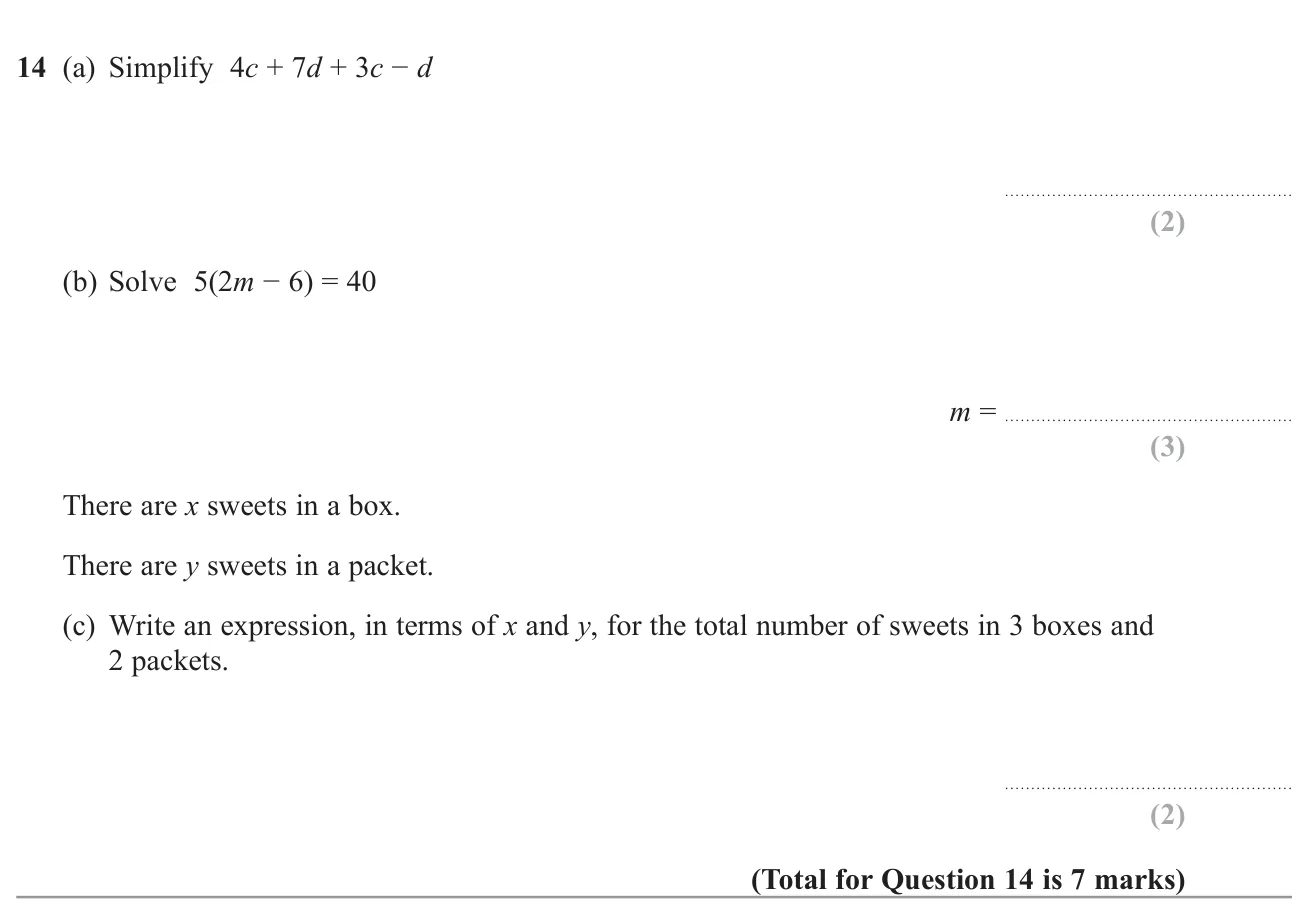
(a) 7 c + 6 d 7c + 6d 7 c + 6 d 2 marks (b) m = 7 m = 7 m = 7 3 marks (c) 3 x + 2 y 3x + 2y 3 x + 2 y 2 marks
Worked solution Checked against the mark scheme
(a) 4 c + 3 c = 7 c 4c + 3c = 7c 4 c + 3 c = 7 c 7 d − d = 6 d 7d - d = 6d 7 d − d = 6 d 7 c + 6 d 7c + 6d 7 c + 6 d
(b) Divide by 5: 2 m − 6 = 8 2m - 6 = 8 2 m − 6 = 8 2 m = 14 2m = 14 2 m = 14 m = 7 m = 7 m = 7
(c) 3 boxes give 3 x 3x 3 x 2 y 2y 2 y 3 x + 2 y 3x + 2y 3 x + 2 y
Watch out: In (a), treating − d -d − d − 0 -0 − 0 7 c + 7 d 7c + 7d 7 c + 7 d
© Pearson Education Ltd. November 2021 Paper 1 (Foundation, non-calculator), question 15.
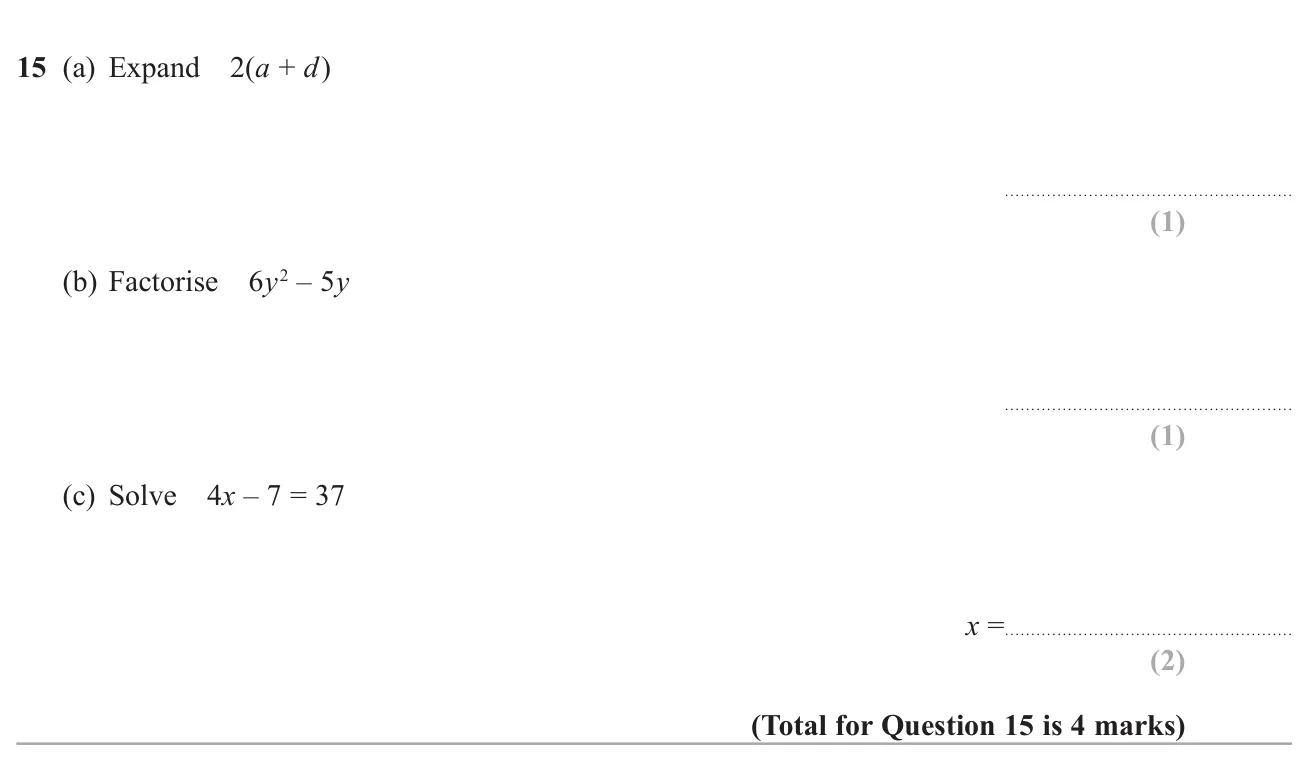
(a) 2 a + 2 d 2a + 2d 2 a + 2 d 1 mark (b) y ( 6 y − 5 ) y(6y - 5) y ( 6 y − 5 ) 1 mark (c) x = 11 x = 11 x = 11 2 marks
Worked solution Checked against the mark scheme
(a) Multiply each term by 2: 2 ( a + d ) = 2 a + 2 d 2(a + d) = 2a + 2d 2 ( a + d ) = 2 a + 2 d
(b) Both terms contain y y y 6 y 2 − 5 y = y ( 6 y − 5 ) 6y^2 - 5y = y(6y - 5) 6 y 2 − 5 y = y ( 6 y − 5 )
(c) 4 x − 7 = 37 4x - 7 = 37 4 x − 7 = 37
4 x = 44 4x = 44 4 x = 44
x = 11 x = 11 x = 11
Watch out: In (c), subtracting 7 instead of adding it, giving x = 7.5 x = 7.5 x = 7.5
© Pearson Education Ltd. November 2020 Paper 1 (Foundation, non-calculator), question 19.
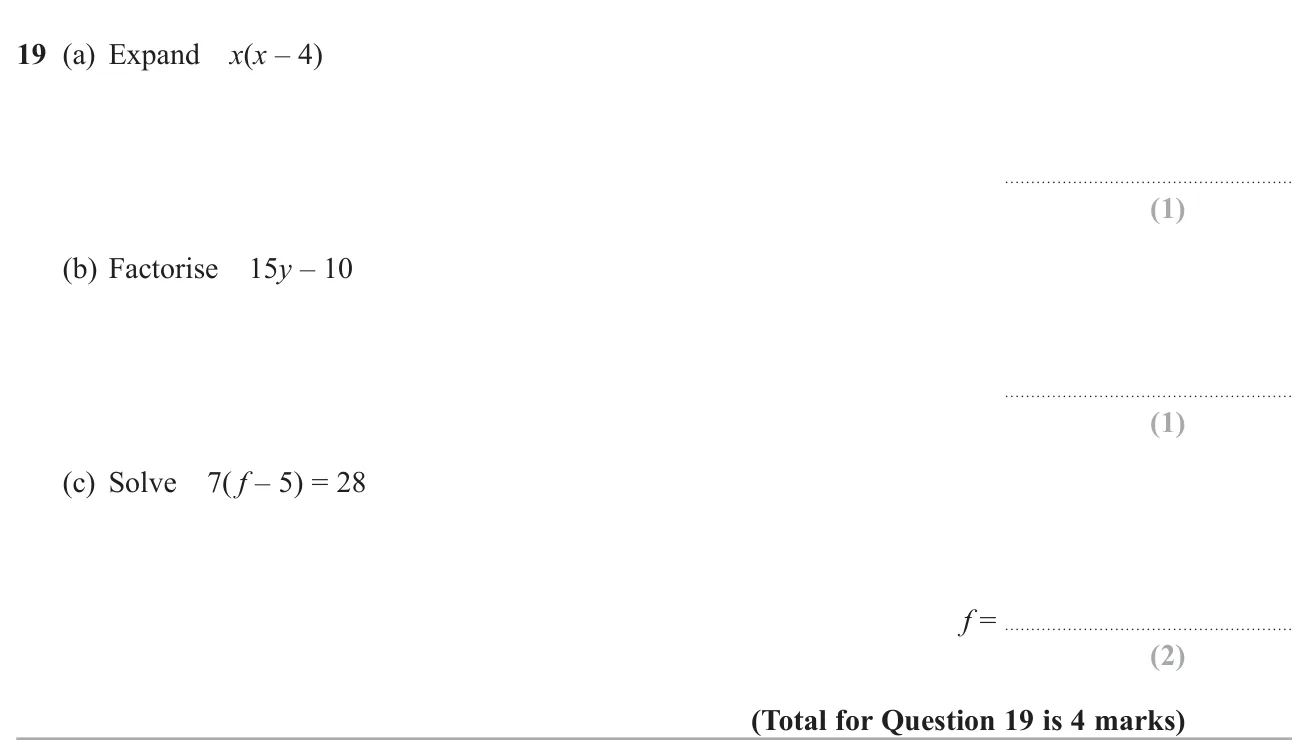
(a) x 2 − 4 x x^2 - 4x x 2 − 4 x 1 mark (b) 5 ( 3 y − 2 ) 5(3y - 2) 5 ( 3 y − 2 ) 1 mark (c) f = 9 f = 9 f = 9 2 marks
Worked solution Checked against the mark scheme
(a) x × x − x × 4 = x 2 − 4 x x \times x - x \times 4 = x^2 - 4x x × x − x × 4 = x 2 − 4 x
(b) The highest common factor of 15 and 10 is 5: 5 ( 3 y − 2 ) 5(3y - 2) 5 ( 3 y − 2 )
(c) Divide by 7: f − 5 = 4 f - 5 = 4 f − 5 = 4 f = 9 f = 9 f = 9
Watch out: In (c) expanding to 7 f − 5 = 28 7f - 5 = 28 7 f − 5 = 28
© Pearson Education Ltd. November 2020 Paper 3 (Foundation, calculator), question 14.
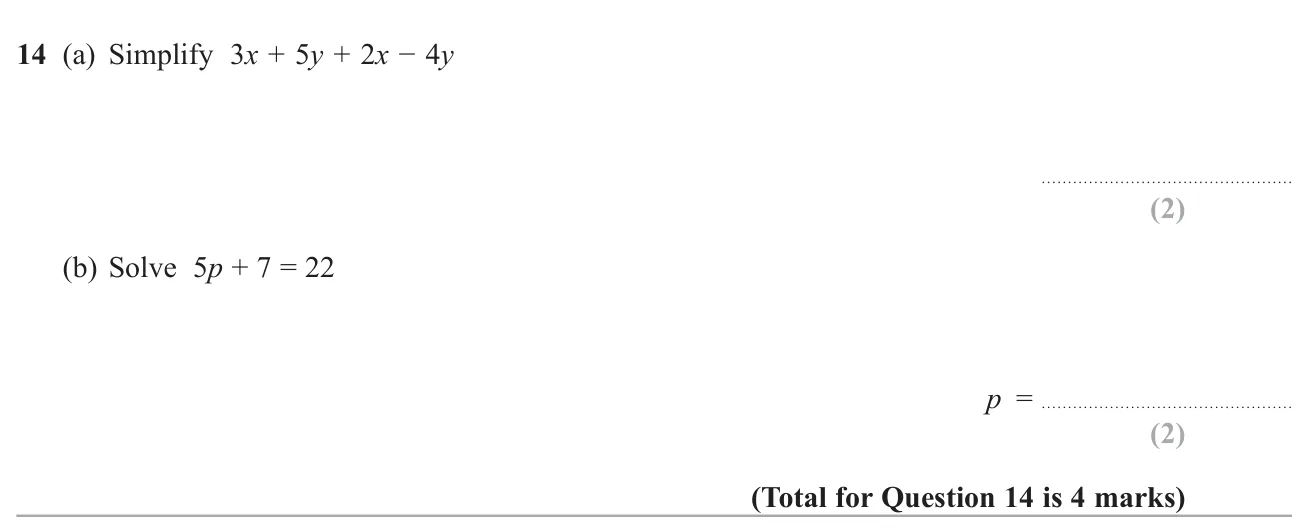
(a) 5 x + y 5x + y 5 x + y 2 marks (b) p = 3 p = 3 p = 3 2 marks
Worked solution Checked against the mark scheme
(a) 3 x + 2 x = 5 x 3x + 2x = 5x 3 x + 2 x = 5 x 5 y − 4 y = y 5y - 4y = y 5 y − 4 y = y 5 x + y 5x + y 5 x + y
(b) 5 p = 22 − 7 = 15 5p = 22 - 7 = 15 5 p = 22 − 7 = 15 p = 15 ÷ 5 = 3 p = 15 \div 5 = 3 p = 15 ÷ 5 = 3
Watch out: In (b), adding 7 to 22 instead of subtracting.
© Pearson Education Ltd. November 2019 Paper 3 (Foundation, calculator), question 19.
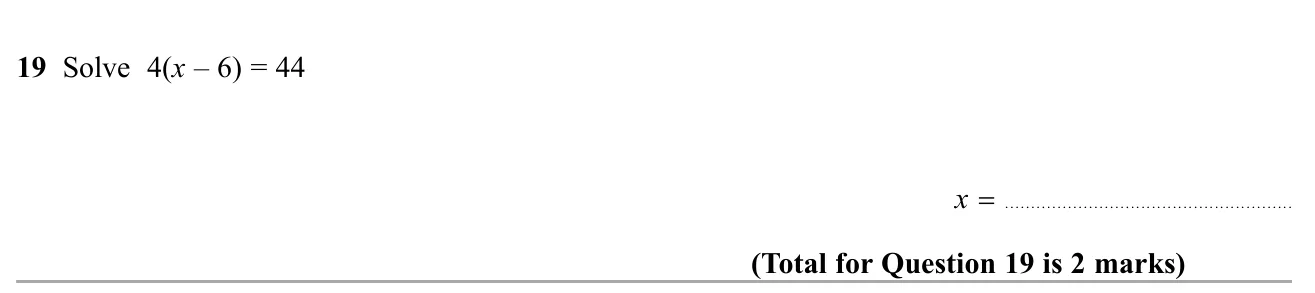
Answer x = 17 x = 17 x = 17 2 marks
Worked solution Checked against the mark scheme
Divide both sides by 4: x − 6 = 11 x - 6 = 11 x − 6 = 11
Add 6: x = 17 x = 17 x = 17
Watch out: Expanding as 4 x − 6 = 44 4x - 6 = 44 4 x − 6 = 44
© Pearson Education Ltd. Specimen Paper 2 (Foundation, calculator), question 16.
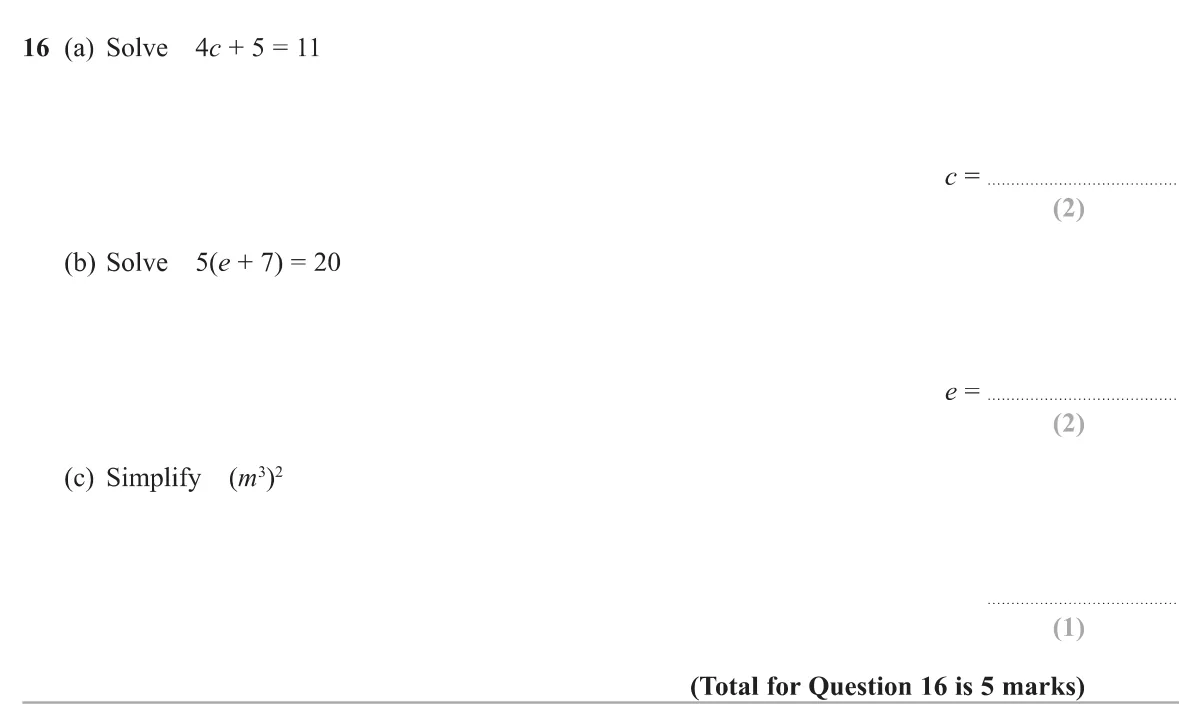
(a) c = 1.5 c = 1.5 c = 1.5 2 marks (b) e = − 3 e = -3 e = − 3 2 marks (c) m 6 m^6 m 6 1 mark
Worked solution Checked against the mark scheme
(a) 4 c = 11 − 5 = 6 4c = 11 - 5 = 6 4 c = 11 − 5 = 6 c = 6 ÷ 4 = 1.5 c = 6 \div 4 = 1.5 c = 6 ÷ 4 = 1.5
(b) e + 7 = 20 ÷ 5 = 4 e + 7 = 20 \div 5 = 4 e + 7 = 20 ÷ 5 = 4 e = 4 − 7 = − 3 e = 4 - 7 = -3 e = 4 − 7 = − 3
(c) Multiply the powers: ( m 3 ) 2 = m 3 × 2 = m 6 (m^3)^2 = m^{3 \times 2} = m^6 ( m 3 ) 2 = m 3 × 2 = m 6
Watch out: In (c), adding the powers to get m 5 m^5 m 5
© Pearson Education Ltd. Specimen Paper 3 (Foundation, calculator), question 7.
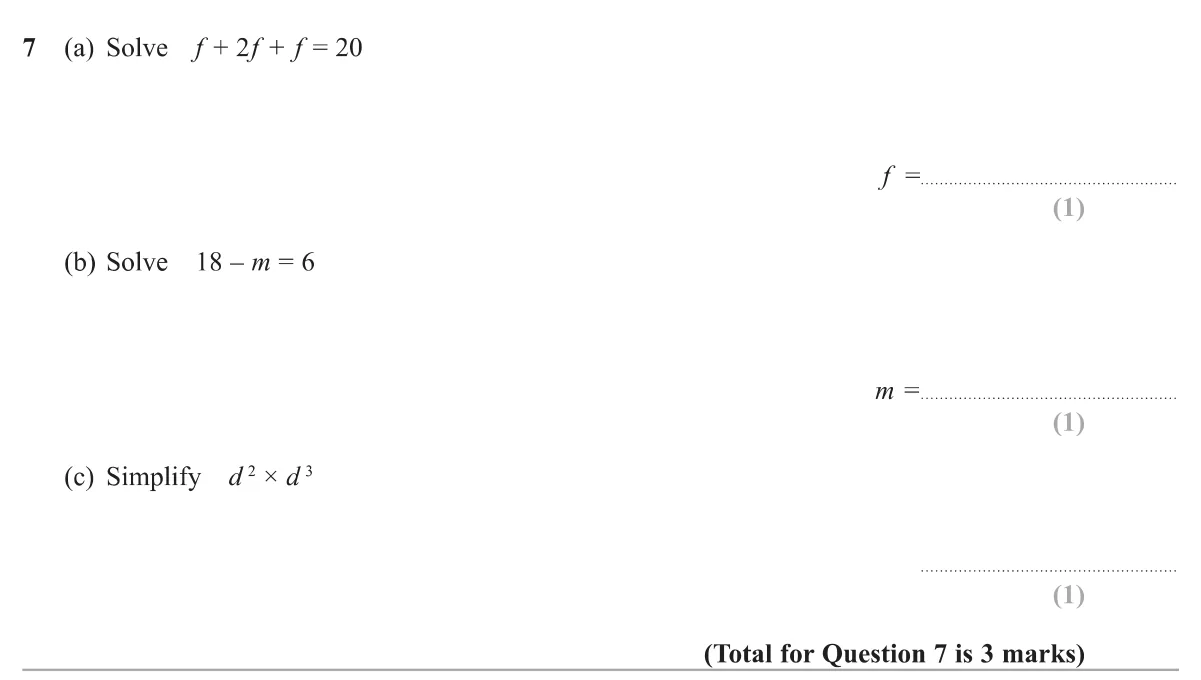
(a) f = 5 f = 5 f = 5 1 mark (b) m = 12 m = 12 m = 12 1 mark (c) d 5 d^5 d 5 1 mark
Worked solution Checked against the mark scheme
(a) f + 2 f + f = 4 f f + 2f + f = 4f f + 2 f + f = 4 f 4 f = 20 4f = 20 4 f = 20 f = 5 f = 5 f = 5
(b) 18 − m = 6 18 - m = 6 18 − m = 6 m = 18 − 6 = 12 m = 18 - 6 = 12 m = 18 − 6 = 12
(c) Add the powers: d 2 × d 3 = d 2 + 3 = d 5 d^2 \times d^3 = d^{2+3} = d^5 d 2 × d 3 = d 2 + 3 = d 5
Watch out: In (c), multiplying the powers to get d 6 d^6 d 6
© Pearson Education Ltd. November 2023 Paper 2 (Foundation, calculator), question 25.
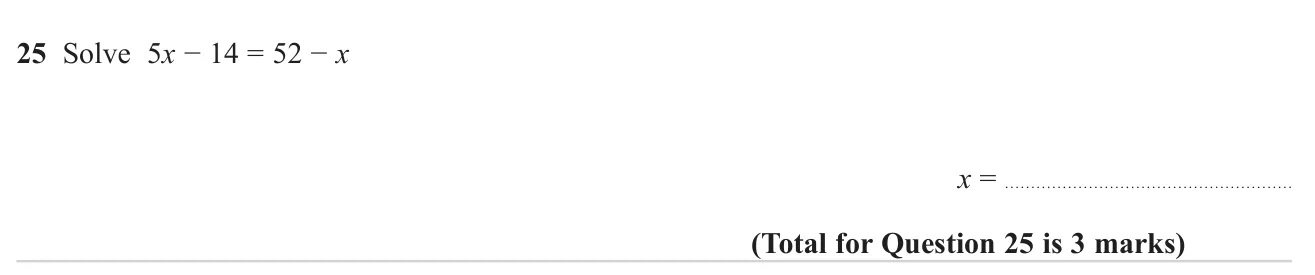
Answer x = 11 x = 11 x = 11 3 marks
Worked solution Checked against the mark scheme
Add x x x 6 x − 14 = 52 6x - 14 = 52 6 x − 14 = 52
Add 14 to both sides: 6 x = 66 6x = 66 6 x = 66
x = 11 x = 11 x = 11
Watch out: Subtracting x instead of adding it, giving 4x.
© Pearson Education Ltd. November 2022 Paper 1 (Foundation, non-calculator), question 16.
Worked solution Checked against the mark scheme
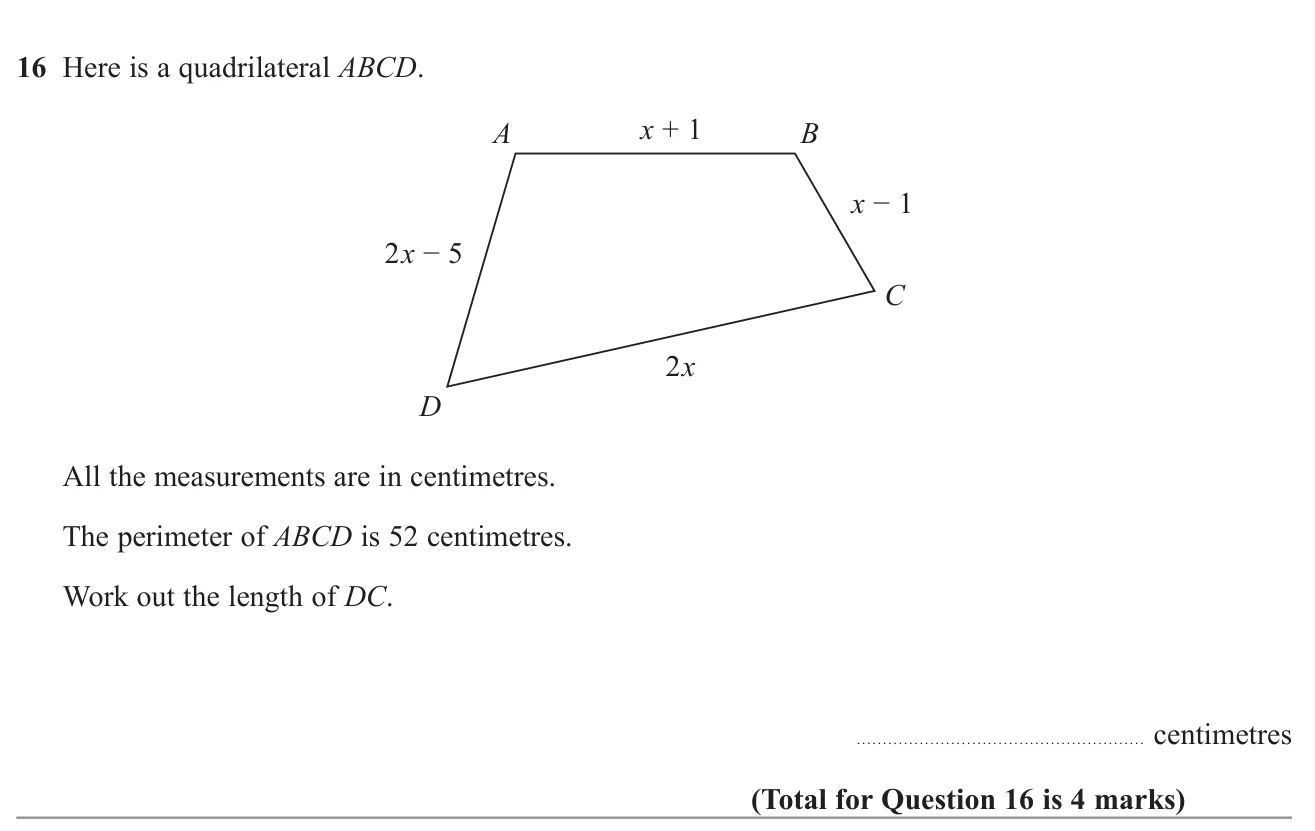
Perimeter: ( x + 1 ) + ( x − 1 ) + 2 x + ( 2 x − 5 ) = 6 x − 5 (x + 1) + (x - 1) + 2x + (2x - 5) = 6x - 5 ( x + 1 ) + ( x − 1 ) + 2 x + ( 2 x − 5 ) = 6 x − 5
6 x − 5 = 52 6x - 5 = 52 6 x − 5 = 52 6 x = 57 6x = 57 6 x = 57 x = 9.5 x = 9.5 x = 9.5
D C = 2 x = 2 × 9.5 = 19 DC = 2x = 2 \times 9.5 = 19 D C = 2 x = 2 × 9.5 = 19
Watch out: Stopping at x = 9.5 x = 9.5 x = 9.5 D C DC D C
© Pearson Education Ltd. November 2021 Paper 1 (Foundation, non-calculator), question 16.
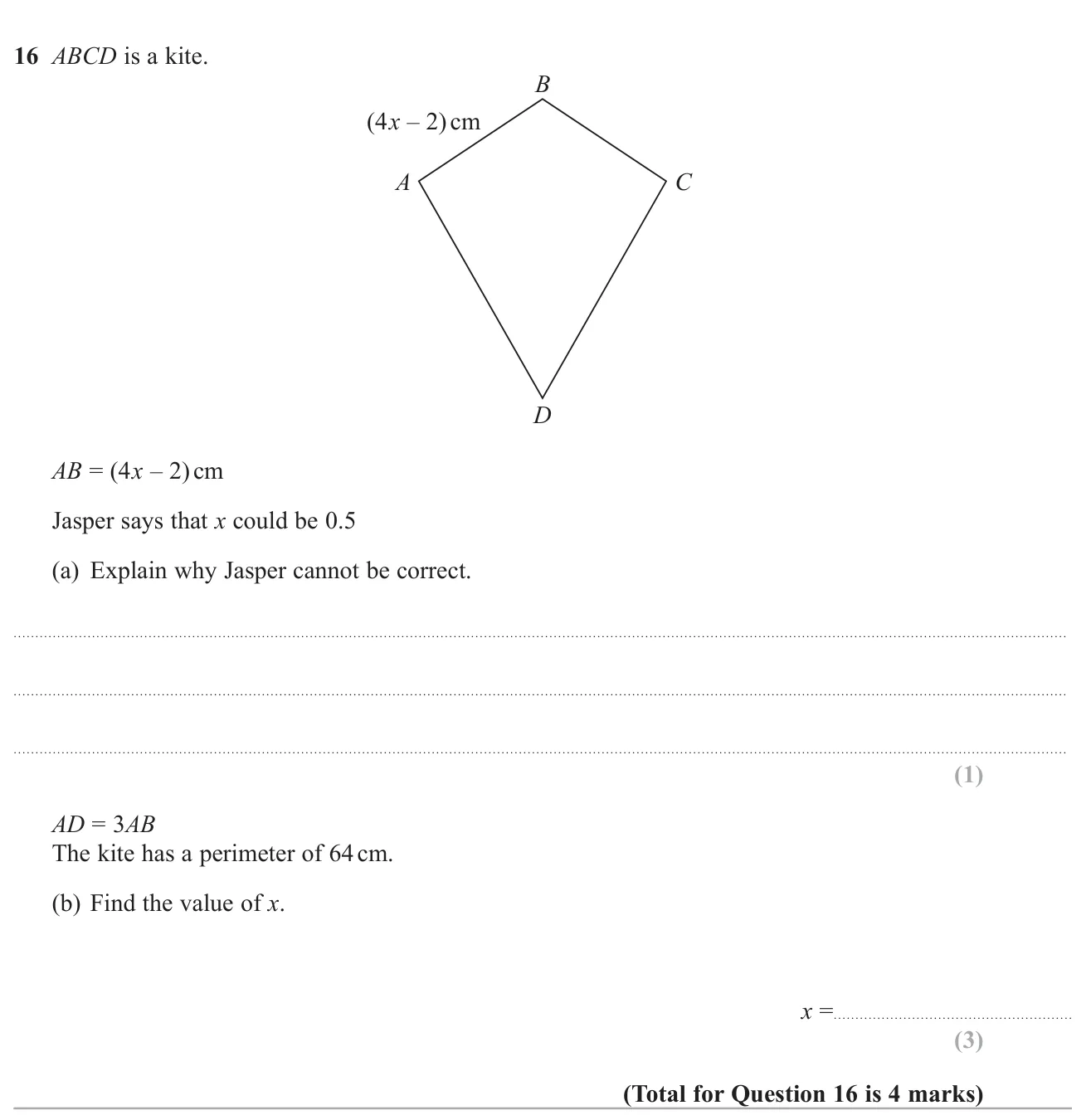
(a) If x = 0.5 x = 0.5 x = 0.5 A B = 4 ( 0.5 ) − 2 = 0 AB = 4(0.5) - 2 = 0 A B = 4 ( 0.5 ) − 2 = 0 1 mark (b) x = 2.5 x = 2.5 x = 2.5 3 marks
Worked solution Checked against the mark scheme
(a) 4 × 0.5 − 2 = 0 4 \times 0.5 - 2 = 0 4 × 0.5 − 2 = 0
(b) A kite has two pairs of equal sides, so the perimeter is 2 ( A B + A D ) = 2 ( A B + 3 A B ) = 8 A B 2(AB + AD) = 2(AB + 3AB) = 8AB 2 ( A B + A D ) = 2 ( A B + 3 A B ) = 8 A B
8 A B = 64 8AB = 64 8 A B = 64 A B = 8 AB = 8 A B = 8
4 x − 2 = 8 4x - 2 = 8 4 x − 2 = 8 4 x = 10 4x = 10 4 x = 10 x = 2.5 x = 2.5 x = 2.5
Watch out: In (b), using only one AB and one AD (4AB = 64).
© Pearson Education Ltd. November 2018 Paper 2 (Foundation, calculator), question 19.
(a) x = 8 x = 8 x = 8 2 marks (b) 3 b ( 3 − b ) 3b(3 - b) 3 b ( 3 − b ) 2 marks
Worked solution Checked against the mark scheme
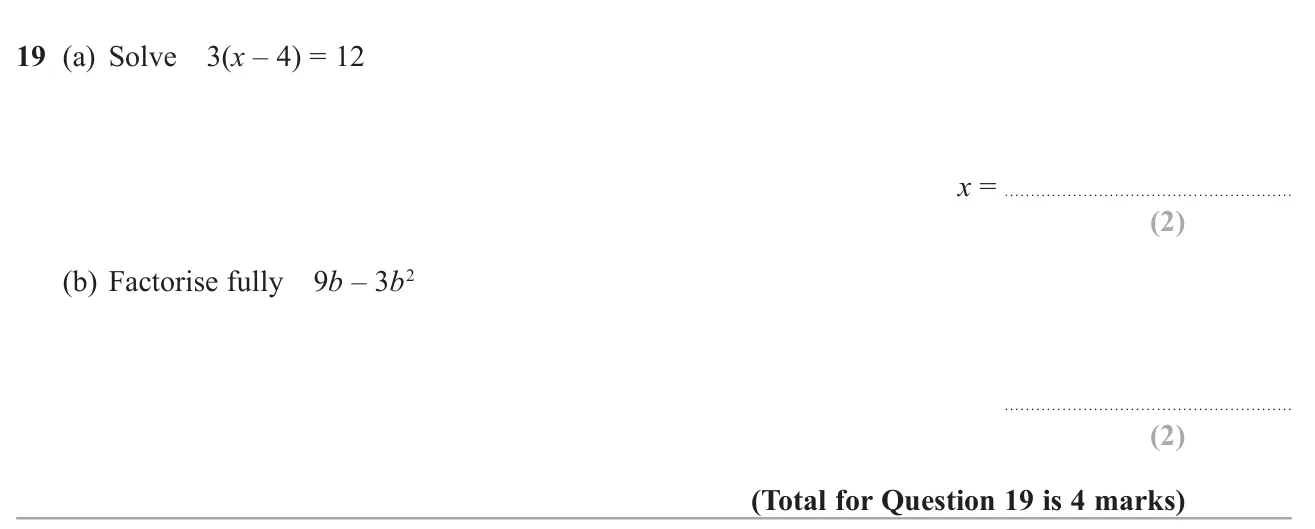
(a) 3 ( x − 4 ) = 12 ⇒ x − 4 = 4 ⇒ x = 8 3(x - 4) = 12 \Rightarrow x - 4 = 4 \Rightarrow x = 8 3 ( x − 4 ) = 12 ⇒ x − 4 = 4 ⇒ x = 8
(b) The highest common factor of 9 b 9b 9 b 3 b 2 3b^2 3 b 2 3 b 3b 3 b
9 b − 3 b 2 = 3 b ( 3 − b ) 9b - 3b^2 = 3b(3 - b) 9 b − 3 b 2 = 3 b ( 3 − b )
Watch out: In (b), taking out only 3 or only b.
© Pearson Education Ltd. November 2018 Paper 3 (Foundation, calculator), question 17.
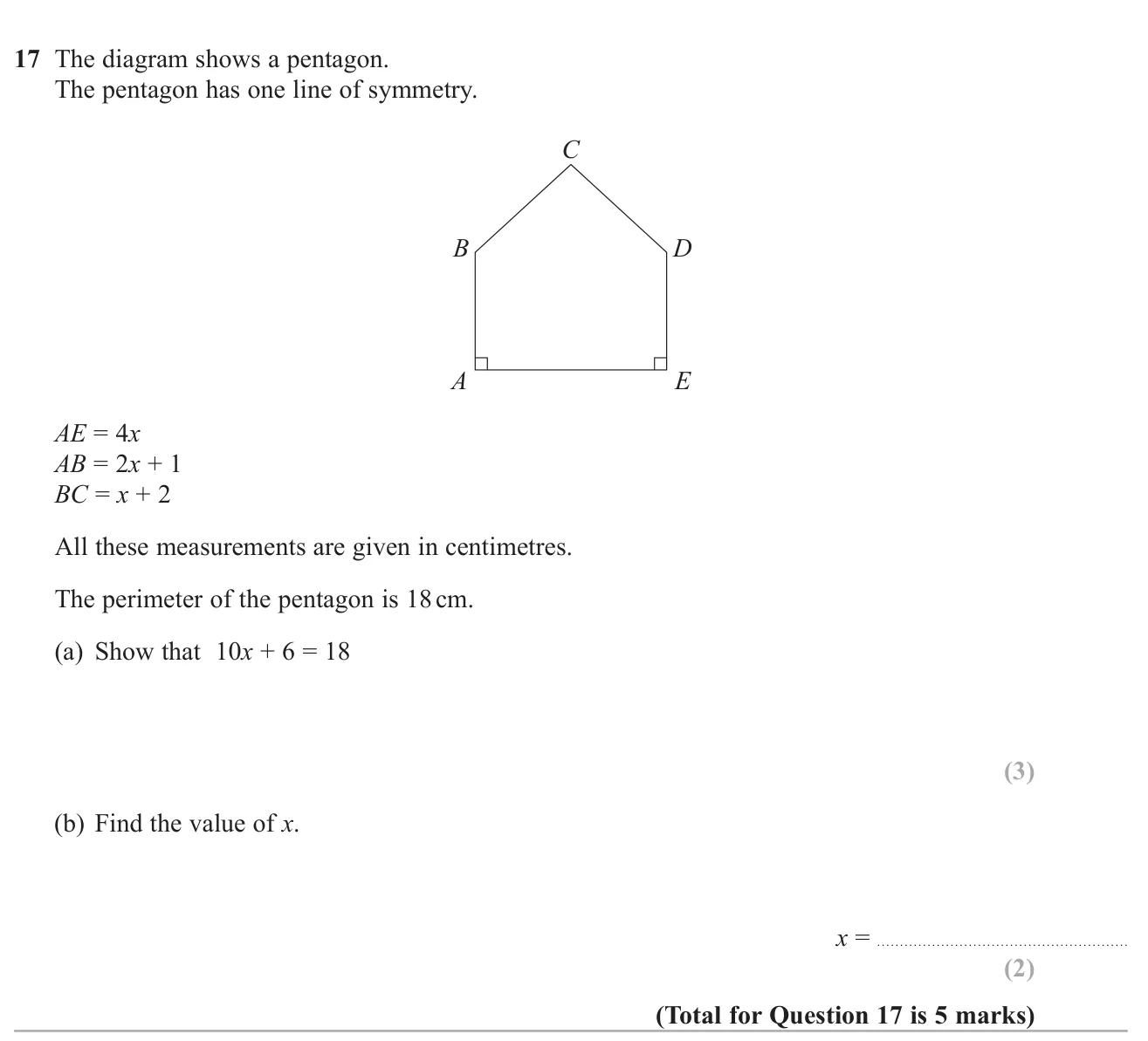
(a) 4 x + 2 ( 2 x + 1 ) + 2 ( x + 2 ) = 10 x + 6 = 18 4x + 2(2x+1) + 2(x+2) = 10x + 6 = 18 4 x + 2 ( 2 x + 1 ) + 2 ( x + 2 ) = 10 x + 6 = 18 3 marks (b) x = 1.2 x = 1.2 x = 1.2 2 marks
Worked solution Checked against the mark scheme
(a) By symmetry D E = A B = 2 x + 1 DE = AB = 2x + 1 D E = A B = 2 x + 1 C D = B C = x + 2 CD = BC = x + 2 C D = B C = x + 2
Perimeter = 4 x + 2 ( 2 x + 1 ) + 2 ( x + 2 ) = 4 x + 4 x + 2 + 2 x + 4 = 10 x + 6 = 4x + 2(2x + 1) + 2(x + 2) = 4x + 4x + 2 + 2x + 4 = 10x + 6 = 4 x + 2 ( 2 x + 1 ) + 2 ( x + 2 ) = 4 x + 4 x + 2 + 2 x + 4 = 10 x + 6
The perimeter is 18, so 10 x + 6 = 18 10x + 6 = 18 10 x + 6 = 18
(b) 10 x = 12 10x = 12 10 x = 12 x = 1.2 x = 1.2 x = 1.2
Watch out: In (a), adding only the three given sides and forgetting the two matching sides.
© Pearson Education Ltd. Specimen Paper 1 (Foundation, non-calculator), question 20.
Worked solution Checked against the mark scheme
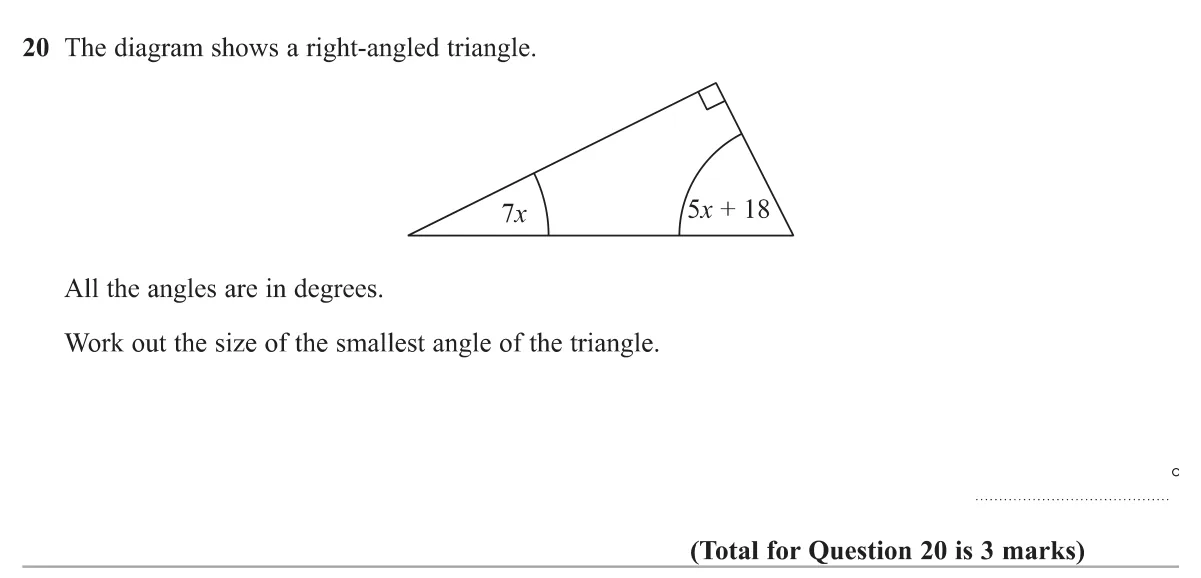
The two unknown angles add to 90 ° 90° 90°
7 x + 5 x + 18 = 90 7x + 5x + 18 = 90 7 x + 5 x + 18 = 90
12 x = 72 12x = 72 12 x = 72 x = 6 x = 6 x = 6
Angles: 7 × 6 = 42 ° 7 \times 6 = 42° 7 × 6 = 42° 5 × 6 + 18 = 48 ° 5 \times 6 + 18 = 48° 5 × 6 + 18 = 48° 42 ° 42° 42°
Watch out: Stopping at x = 6 and giving that as the angle.
© Pearson Education Ltd. November 2023 Paper 1 (Foundation, non-calculator), question 24.
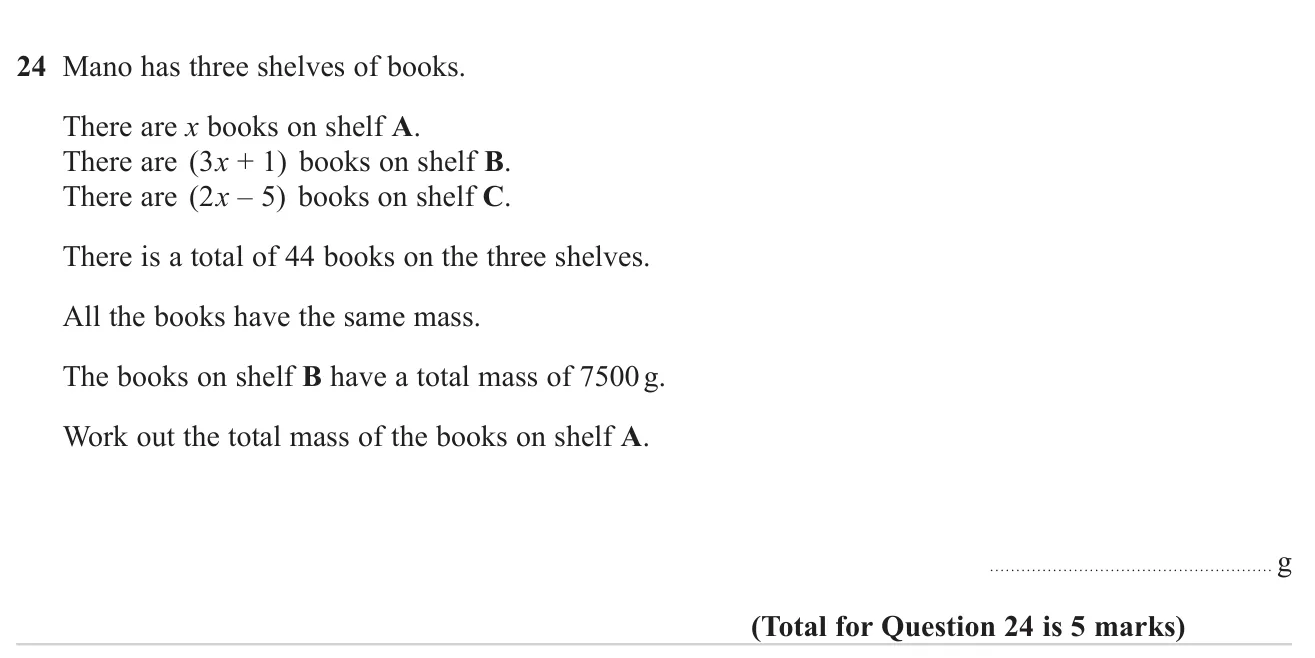
Worked solution Checked against the mark scheme
x + 3 x + 1 + 2 x − 5 = 44 x + 3x + 1 + 2x - 5 = 44 x + 3 x + 1 + 2 x − 5 = 44 6 x − 4 = 44 6x - 4 = 44 6 x − 4 = 44 6 x = 48 6x = 48 6 x = 48 x = 8 x = 8 x = 8
Shelf B: 3 × 8 + 1 = 25 3 \times 8 + 1 = 25 3 × 8 + 1 = 25 7500 ÷ 25 = 300 7500 \div 25 = 300 7500 ÷ 25 = 300
Shelf A: 8 × 300 = 2400 8 \times 300 = 2400 8 × 300 = 2400
Watch out: Dividing 7500 by 8 (shelf A) instead of by the number on shelf B.
© Pearson Education Ltd. June 2023 Paper 2 (Foundation, calculator), question 24.
Answer x = 1.25 x = 1.25 x = 1.25 4 marks
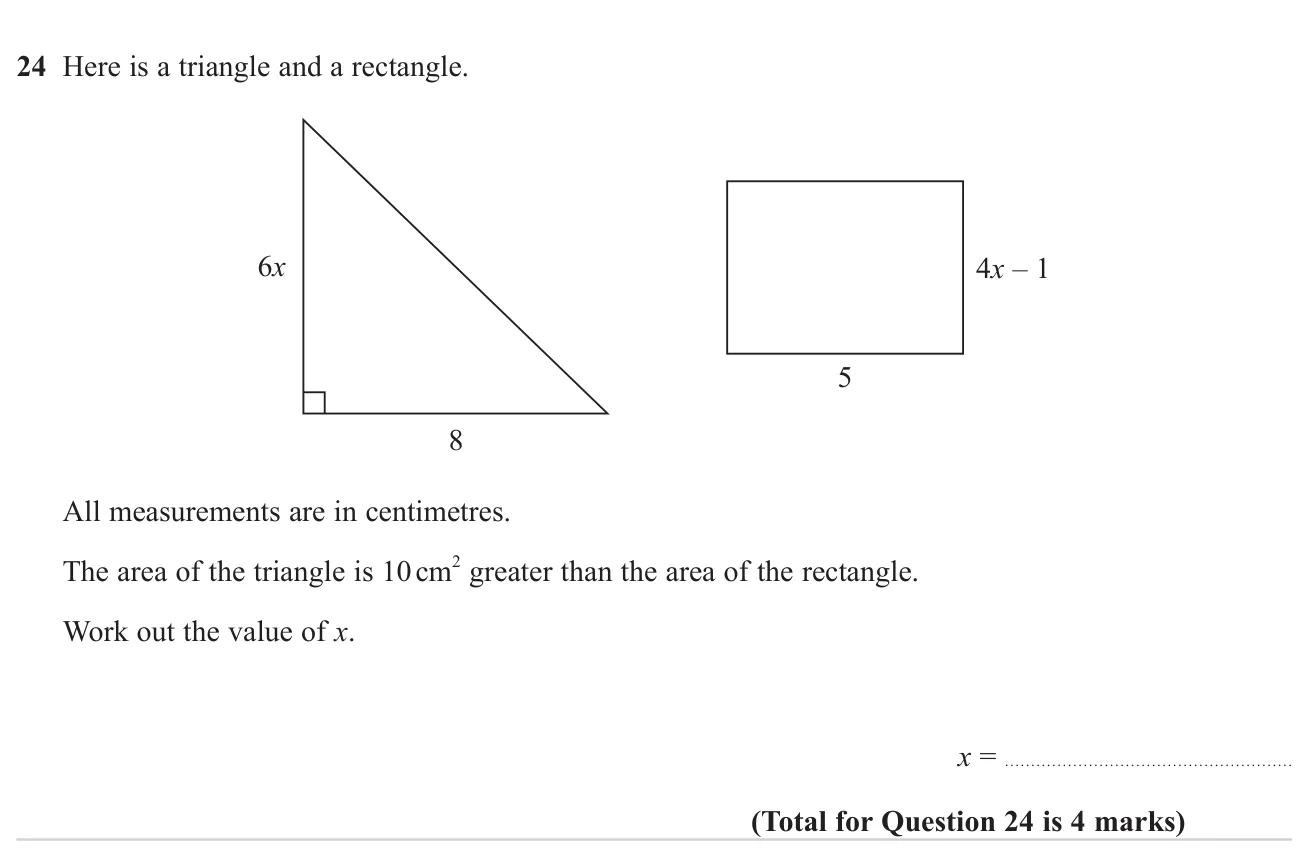
Worked solution Checked against the mark scheme
Triangle: 1 2 × 8 × 6 x = 24 x \frac{1}{2} \times 8 \times 6x = 24x 2 1 × 8 × 6 x = 24 x
Rectangle: 5 ( 4 x − 1 ) = 20 x − 5 5(4x - 1) = 20x - 5 5 ( 4 x − 1 ) = 20 x − 5
24 x = 20 x − 5 + 10 24x = 20x - 5 + 10 24 x = 20 x − 5 + 10
4 x = 5 4x = 5 4 x = 5 x = 1.25 x = 1.25 x = 1.25
(Check: triangle 30, rectangle 20.)
Watch out: Forgetting to halve for the triangle, or adding the 10 to the wrong side.
© Pearson Education Ltd. November 2019 Paper 3 (Higher, calculator), question 10.
(a) x = 8.5 x = 8.5 x = 8.5 3 marks (b) 4 ( y + 3 ) 4(y + 3) 4 ( y + 3 ) 1 mark
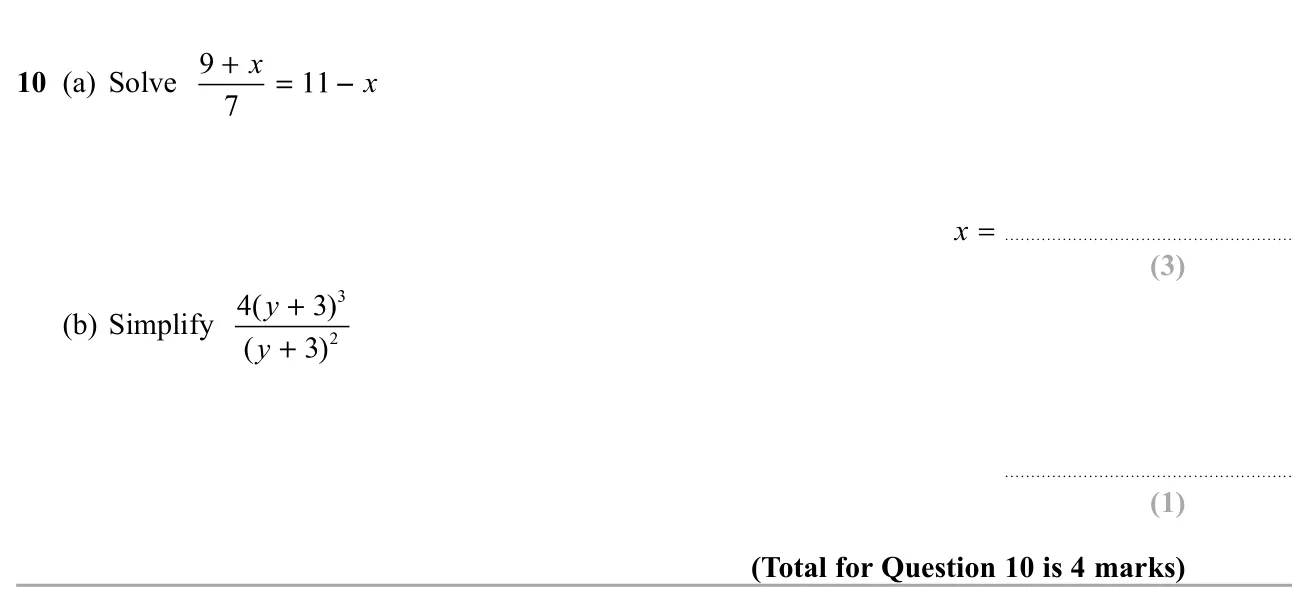
Worked solution Checked against the mark scheme
(a) 9 + x = 7 ( 11 − x ) = 77 − 7 x 9 + x = 7(11 - x) = 77 - 7x 9 + x = 7 ( 11 − x ) = 77 − 7 x
8 x = 68 8x = 68 8 x = 68 x = 8.5 x = 8.5 x = 8.5
(b) Cancel ( y + 3 ) 2 (y + 3)^2 ( y + 3 ) 2 4 ( y + 3 ) 3 ( y + 3 ) 2 = 4 ( y + 3 ) \dfrac{4(y+3)^3}{(y+3)^2} = 4(y + 3) ( y + 3 ) 2 4 ( y + 3 ) 3 = 4 ( y + 3 )
Watch out: In (a), multiplying only the 11 by 7 and not the x x x
© Pearson Education Ltd. June 2018 Paper 3 (Foundation, calculator), question 17.
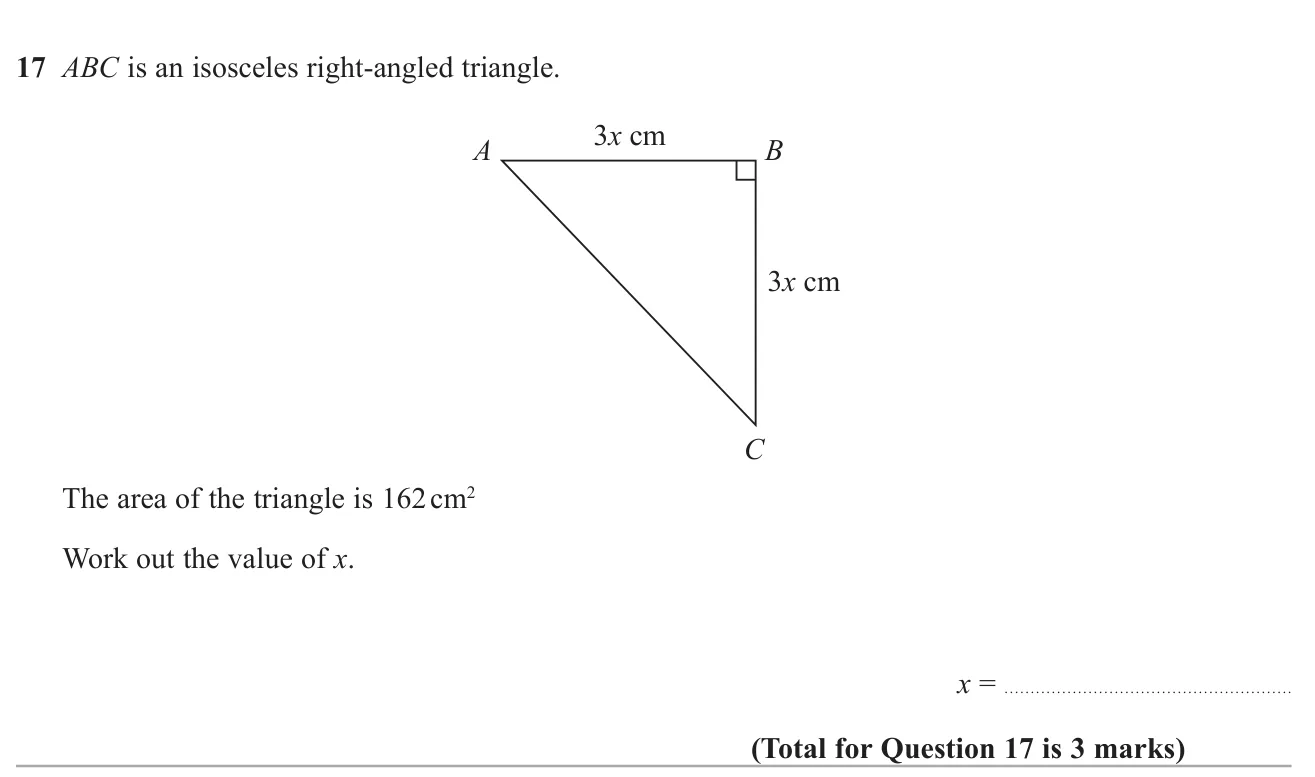
Worked solution Checked against the mark scheme
Area = 1 2 × 3 x × 3 x = 9 x 2 2 = \frac{1}{2} \times 3x \times 3x = \frac{9x^2}{2} = 2 1 × 3 x × 3 x = 2 9 x 2
9 x 2 2 = 162 \frac{9x^2}{2} = 162 2 9 x 2 = 162 9 x 2 = 324 9x^2 = 324 9 x 2 = 324 x 2 = 36 x^2 = 36 x 2 = 36
x = 6 x = 6 x = 6
Watch out: Forgetting the half, giving x² = 18.
© Pearson Education Ltd. June 2018 Paper 3 (Foundation, calculator), question 25.
Answer x = 3.8 x = 3.8 x = 3.8 3 marks
Worked solution Checked against the mark scheme
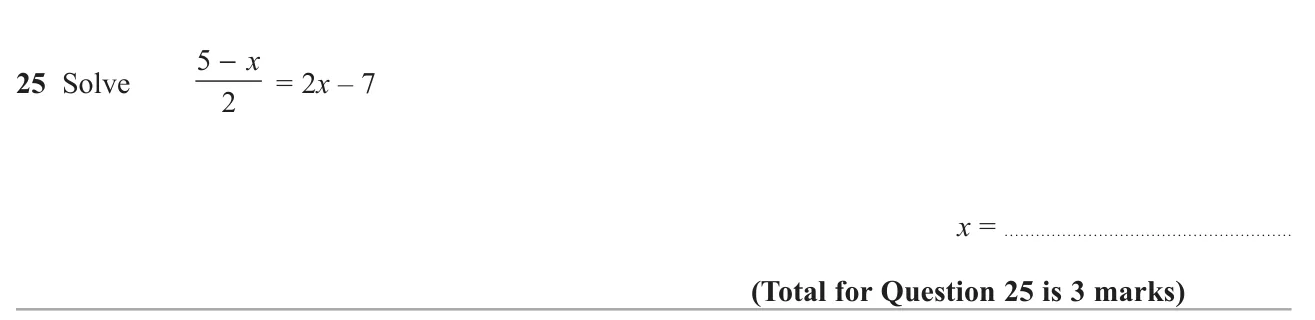
Multiply both sides by 2: 5 − x = 4 x − 14 5 - x = 4x - 14 5 − x = 4 x − 14
Add x x x 19 = 5 x 19 = 5x 19 = 5 x
x = 19 5 = 3.8 x = \frac{19}{5} = 3.8 x = 5 19 = 3.8
Watch out: Multiplying only 2x by 2, not the −7.
© Pearson Education Ltd. Specimen Paper 2 (Foundation, calculator), question 26.
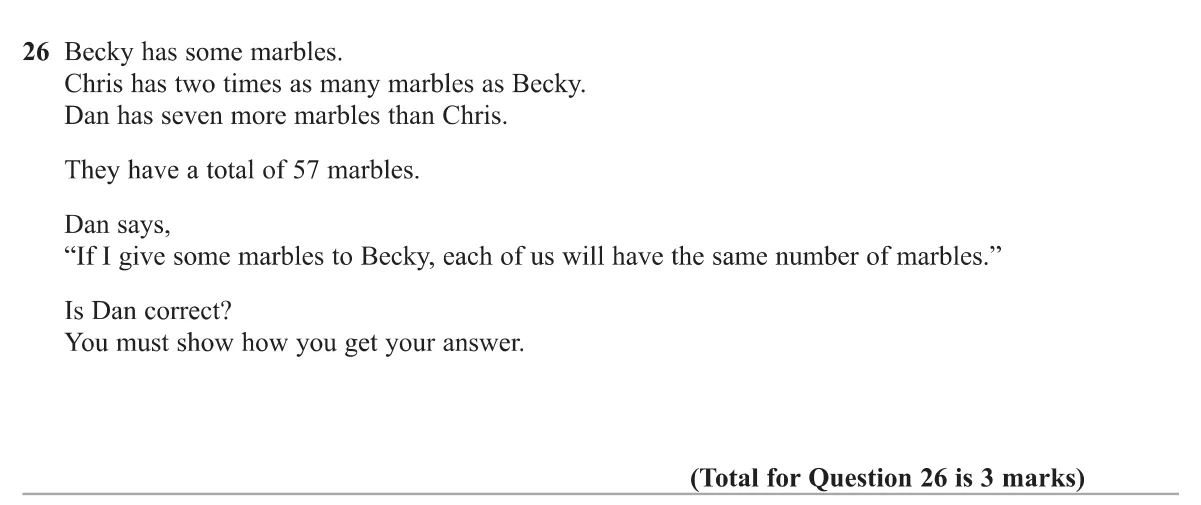
Answer No: Becky 10, Chris 20, Dan 27; Chris already has more than a third (19) 3 marks
Worked solution Checked against the mark scheme
Let Becky have x x x 2 x 2x 2 x 2 x + 7 2x + 7 2 x + 7
x + 2 x + 2 x + 7 = 57 x + 2x + 2x + 7 = 57 x + 2 x + 2 x + 7 = 57 5 x = 50 5x = 50 5 x = 50 x = 10 x = 10 x = 10
Becky 10, Chris 20, Dan 27
Equal shares would be 57 ÷ 3 = 19 57 \div 3 = 19 57 ÷ 3 = 19
Watch out: Forgetting that only Dan gives marbles away.
© Pearson Education Ltd. November 2020 Paper 2 (Higher, calculator), question 14.
Worked solution Checked against the mark scheme
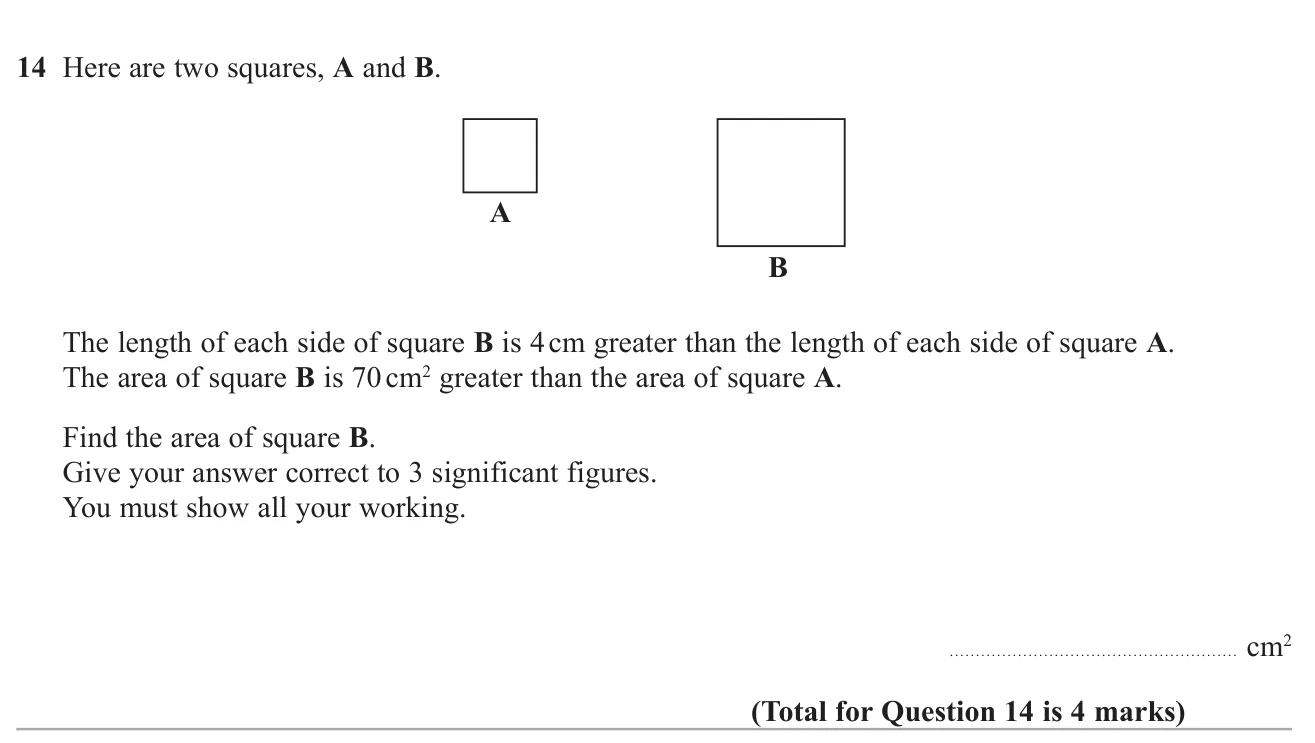
Let square A have side x x x x + 4 x + 4 x + 4
( x + 4 ) 2 = x 2 + 70 (x + 4)^2 = x^2 + 70 ( x + 4 ) 2 = x 2 + 70
x 2 + 8 x + 16 = x 2 + 70 x^2 + 8x + 16 = x^2 + 70 x 2 + 8 x + 16 = x 2 + 70 8 x = 54 8x = 54 8 x = 54 x = 6.75 x = 6.75 x = 6.75
Side of B = 10.75 = 10.75 = 10.75 = 10.75 2 = 115.5625 = 10.75^2 = 115.5625 = 10.7 5 2 = 115.5625
Area of B = 116 = 116 = 116
Watch out: Expanding ( x + 4 ) 2 (x + 4)^2 ( x + 4 ) 2 x 2 + 16 x^2 + 16 x 2 + 16
© Pearson Education Ltd. Specimen Paper 1 (Higher, non-calculator), question 14.
Answer x = − 2 13 x = -\frac{2}{13} x = − 13 2 3 marks
Worked solution Checked against the mark scheme
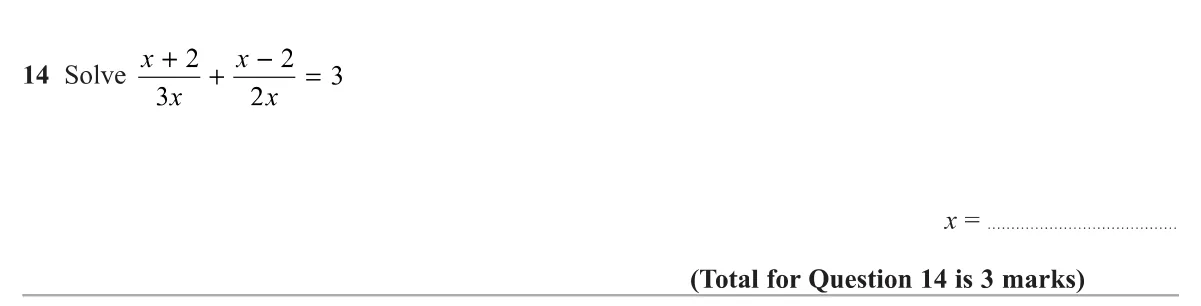
Multiply every term by 6 x 6x 6 x
2 ( x + 2 ) + 3 ( x − 2 ) = 18 x 2(x + 2) + 3(x - 2) = 18x 2 ( x + 2 ) + 3 ( x − 2 ) = 18 x
2 x + 4 + 3 x − 6 = 18 x 2x + 4 + 3x - 6 = 18x 2 x + 4 + 3 x − 6 = 18 x
5 x − 2 = 18 x 5x - 2 = 18x 5 x − 2 = 18 x − 2 = 13 x -2 = 13x − 2 = 13 x x = − 2 13 x = -\frac{2}{13} x = − 13 2
Watch out: Forgetting to multiply the 3 on the right by 6 x 6x 6 x
Also tested in these questions Their main topic is different, but part of each one tests this topic.
November 2024 · Paper 1 Higher · Q13 : Form and solve an equation from the difference in volume of two cuboids with algebraic side lengths.November 2024 · Paper 1 Foundation · Q16 : Use two combined prices of tea and coffee to find the cost of a different order.November 2024 · Paper 1 Foundation · Q23 : Use the angle sum of a pentagon with angles given in terms of one unknown to find that angle.November 2024 · Paper 2 Higher · Q22 : Given the fraction of red counters and the chance two picked without replacement match in colour, find how many yellow counters there are.June 2024 · Paper 1 Foundation · Q9 : Use a two-step number machine forwards and backwards, and show a number maps to itself.June 2024 · Paper 2 Higher · Q10 : Set sine of one angle equal to tangent of another in two right-angled triangles with algebraic sides and solve for x.June 2024 · Paper 2 Foundation · Q26 : Use the angle sum of a quadrilateral with algebraic angles to show one pair of sides is parallel.June 2024 · Paper 3 Higher · Q9 : Find the height of a square-based pyramid whose volume equals that of a given cube.November 2023 · Paper 1 Foundation · Q12 : Substitute values into linear formulae, including finding an unknown and using a negative number.November 2023 · Paper 2 Higher · Q21 : Use a conditional probability from a Venn diagram to form an equation and find the total number of items.June 2023 · Paper 1 Higher · Q10 : Use the angle sum of a pentagon and a given multiple between two unknown angles to find one of them.June 2023 · Paper 1 Higher · Q18 : Use a ratio of unit prices and a total cost to find the price per kilogram of two vegetables.June 2022 · Paper 2 Higher · Q15 : Two people's pay is in one ratio and, after an equal rise, in another ratio; find their original pay.June 2022 · Paper 2 Higher · Q17 : Find the total height of a cone on top of a hemisphere from its total volume, then say how widening both would change the height.June 2022 · Paper 3 Foundation · Q17 : Expand a bracket, solve an equation involving a fraction, and factorise an expression.June 2022 · Paper 3 Foundation · Q24 : Form and solve an equation for the counters three people hold, then write a ratio in the form 1 : p.November 2021 · Paper 1 Higher · Q11 : Equate the areas of two rectangles with algebraic sides and make y the subject.November 2021 · Paper 1 Foundation · Q26 : Set a cube's surface area equal to a sphere's surface area and show the edge is the square root of an integer times π.November 2021 · Paper 3 Higher · Q13 : Use the coordinates of two corners of a pattern of identical rectangles to form and solve equations for the rectangle's sides, then find a third point.November 2021 · Paper 3 Foundation · Q17 : Expand a bracket, factorise an expression, solve a linear equation with a bracket, and simplify a product using index laws.November 2021 · Paper 3 Foundation · Q25 : Find the fifth term of an algebraic Fibonacci-type sequence and use the total of five terms to find the unknown.November 2020 · Paper 2 Foundation · Q15 : Substitute into a two-variable formula, including a negative value, then find an unknown by working backwards.November 2019 · Paper 1 Foundation · Q17 : Solve a simple linear equation, then substitute the result into an expression with a square.November 2019 · Paper 2 Foundation · Q18 : Write a formula for the total of three ages in terms of n and pick out the identity from a list.June 2019 · Paper 1 Higher · Q22 : Use two probabilities, before and after adding counters to a bag, to find how many red and green counters there were at the start.June 2019 · Paper 1 Foundation · Q28 : Use the area of one rectangle and the perimeter of another, which share a side length, to find a missing side.November 2018 · Paper 3 Higher · Q14 : Show a value using inverse proportion to the cube of a variable.June 2018 · Paper 1 Foundation · Q16 : Substitute values into a formula, expand a single bracket and solve a linear equation with brackets.Specimen · Paper 1 Higher · Q1 : Use the angle sum of a right-angled triangle with two algebraic angles to find its smallest angle.Specimen · Paper 1 Higher · Q4 : Work out the size of identical rectangular tiles from the overall dimensions of a pattern and find the total area.Specimen · Paper 1 Foundation · Q23 : Work out the size of identical rectangular tiles from the pattern's overall lengths, then find the total area.Specimen · Paper 3 Foundation · Q10 : Complete a table for an expression in n: substitute a value and work backwards from an output.