Revision guide by The Full Marks
Sequences and the nth term: what you need to know A sequence is a list of numbers that follows a rule. You need to continue sequences, recognise the special ones, and find a formula for the nth term so you can work out any term without listing them all.
Foundation needs term-to-term rules, special sequences and linear nth terms; quadratic nth terms and surd geometric sequences are Higher.
Key facts Arithmetic (linear): same difference each time. nth term = d n + ( first term − d ) = dn + (\text{first term} - d) = d n + ( first term − d ) Special sequences: square 1 , 4 , 9 , 16 1, 4, 9, 16 1 , 4 , 9 , 16 1 , 8 , 27 , 64 1, 8, 27, 64 1 , 8 , 27 , 64 1 , 3 , 6 , 10 1, 3, 6, 10 1 , 3 , 6 , 10 Fibonacci-type: add the two previous terms to get the next. Geometric: multiply by the same number r r r 3 , 6 , 12 , 24 3, 6, 12, 24 3 , 6 , 12 , 24 r r r r r r 2 , 2 3 , 6 , 6 3 2, 2\sqrt{3}, 6, 6\sqrt{3} 2 , 2 3 , 6 , 6 3 Quadratic: the second differences are the same. The n 2 n^2 n 2 Higher: a rule like u n + 1 = 2 u n − 3 u_{n+1} = 2u_n - 3 u n + 1 = 2 u n − 3 Consecutive terms: in an arithmetic sequence the differences are equal; in a geometric sequence the ratios are equal (b a = c b \frac{b}{a} = \frac{c}{b} a b = b c nth term of a linear sequence Find the common difference d d d d n dn d n Compare d n dn d n Check with the second term. Higher: nth term of a quadratic sequence Find the first and second differences. Halve the second difference to get a a a a n 2 an^2 a n 2 Subtract a n 2 an^2 a n 2 Find the nth term of what is left (a linear sequence) and add it on. Worked examples Example 1 Foundation · grade 4
A sequence starts 7 , 11 , 15 , 19 7, 11, 15, 19 7 , 11 , 15 , 19
Show the solution The difference is 4, so start with 4 n 4n 4 n 4 n 4n 4 n 4 , 8 , 12 , 16 4, 8, 12, 16 4 , 8 , 12 , 16 = 4 n + 3 = 4n + 3 = 4 n + 3 4 n + 3 = 100 4n + 3 = 100 4 n + 3 = 100 n = 24.25 n = 24.25 n = 24.25
Example 2 Higher · grade 7
Find the nth term of 4 , 11 , 22 , 37 , 56 4, 11, 22, 37, 56 4 , 11 , 22 , 37 , 56
Show the solution First differences: 7 , 11 , 15 , 19 7, 11, 15, 19 7 , 11 , 15 , 19 4 4 4 2 n 2 2n^2 2 n 2 2 n 2 2n^2 2 n 2 2 , 8 , 18 , 32 , 50 2, 8, 18, 32, 50 2 , 8 , 18 , 32 , 50 2 n 2 2n^2 2 n 2 2 , 3 , 4 , 5 , 6 2, 3, 4, 5, 6 2 , 3 , 4 , 5 , 6 n + 1 n + 1 n + 1 = 2 n 2 + n + 1 = 2n^2 + n + 1 = 2 n 2 + n + 1
Common mistakes Writing n + 4 n + 4 n + 4 n n n 4 n + … 4n + \ldots 4 n + … Using the second difference as the n 2 n^2 n 2 Saying a number isn't in a sequence 'because it goes past it'. Show that n n n Treating 2 n 2 2n^2 2 n 2 ( 2 n ) 2 (2n)^2 ( 2 n ) 2 n n n n = 3 n = 3 n = 3 2 n 2 = 18 2n^2 = 18 2 n 2 = 18 36 36 36 Exam tips 'Explain' questions need a reason with numbers, such as solving for n n n Questions people ask How do you find the nth term of a sequence? Find the difference between terms and write it in front of n n n
How do you find the nth term of a quadratic sequence? Halve the second difference to get the n 2 n^2 n 2
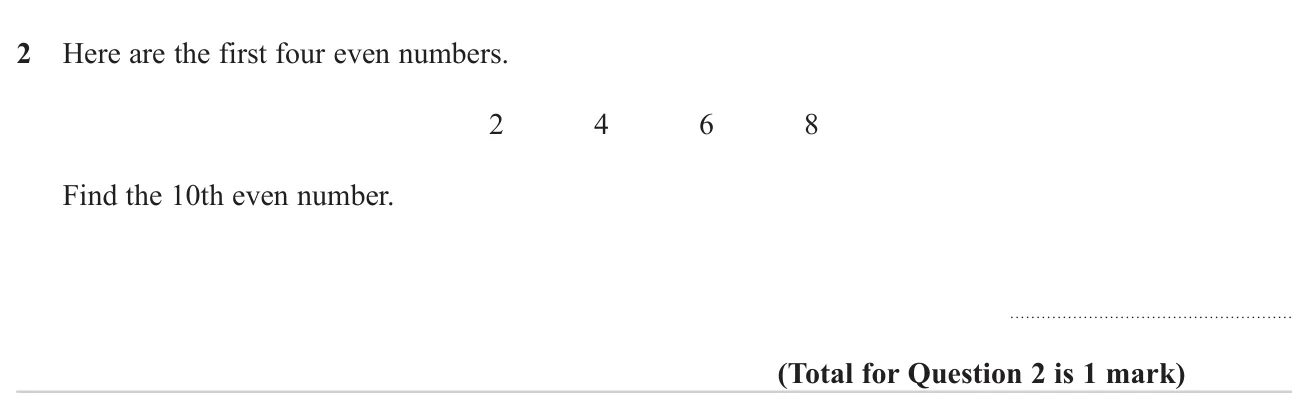
Exam questions: Sequences and the nth term (36, easiest first) © Pearson Education Ltd. November 2024 Paper 1 (Foundation, non-calculator), question 2.
Worked solution Checked against the mark scheme
The even numbers are the 2 times table.
The 10th one is 2 × 10 = 20 2 \times 10 = 20 2 × 10 = 20
Watch out: Giving 18 by counting from the wrong starting term.
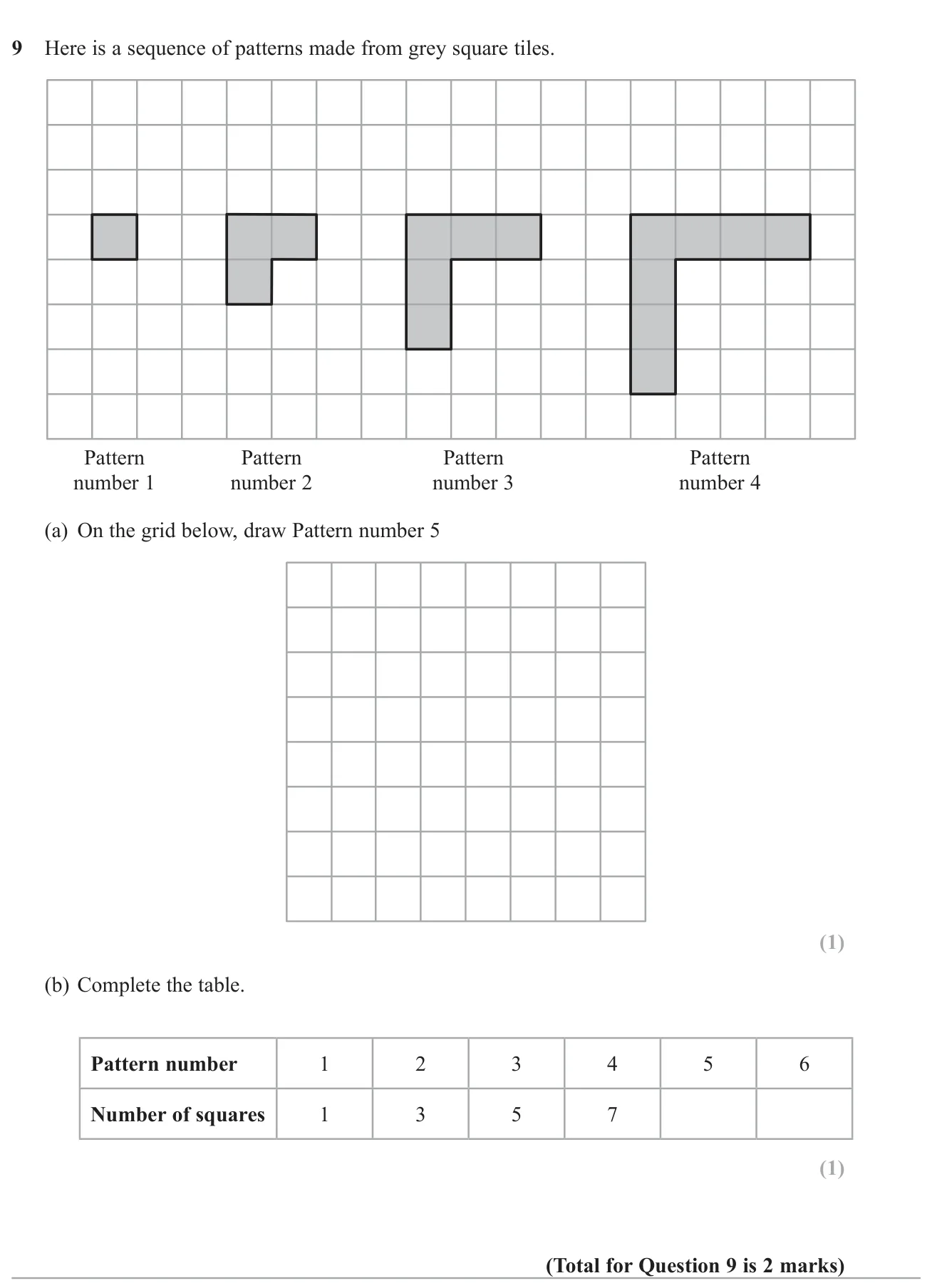
© Pearson Education Ltd. June 2022 Paper 1 (Foundation, non-calculator), question 9.
(a) L-shape with 5 squares down and 5 across sharing a corner (9 squares) 1 mark (b) 9 and 11 1 mark
Worked solution Checked against the mark scheme
(a) Each new pattern adds one square to each arm. Pattern 5 has arms 5 squares long, sharing the corner square: 9 squares.
(b) The numbers go up by 2 each time: 1, 3, 5, 7, 9 , 11
Watch out: Drawing arms of 4 squares, copying Pattern 4.
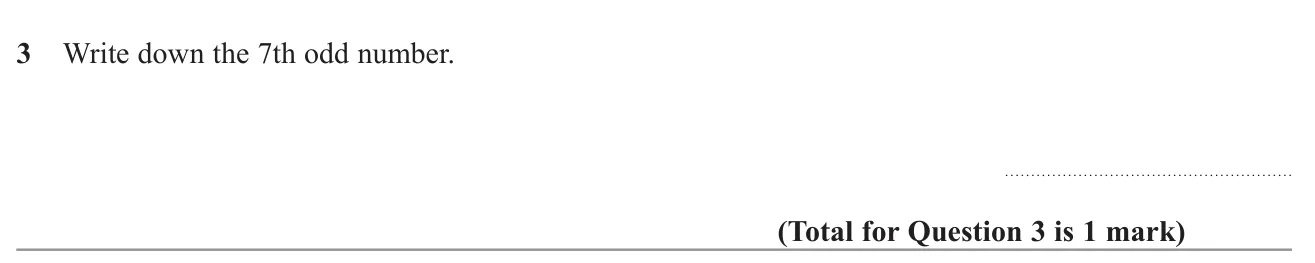
© Pearson Education Ltd. November 2022 Paper 2 (Foundation, calculator), question 3.
Worked solution Checked against the mark scheme
Odd numbers: 1, 3, 5, 7, 9, 11, 13
The 7th one is 13 .
Watch out: Starting the count at 3 and giving 15.
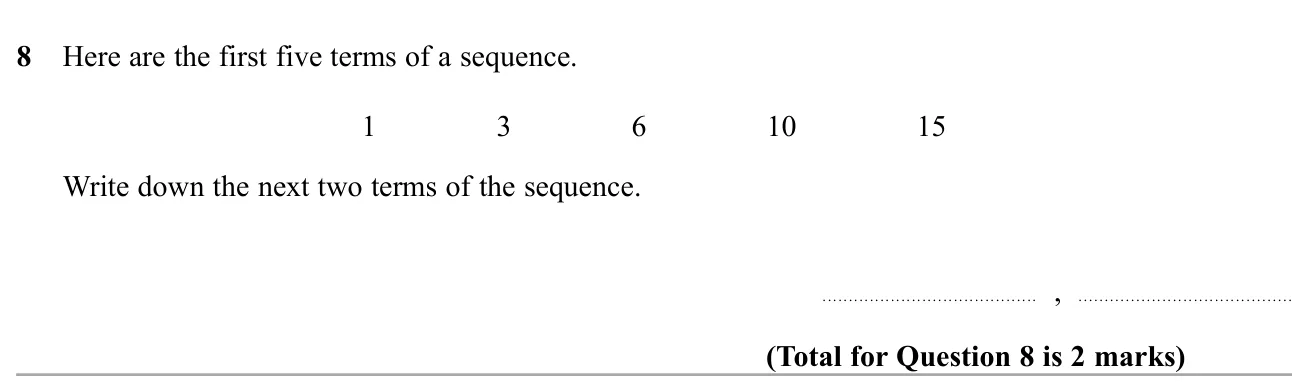
© Pearson Education Ltd. November 2019 Paper 3 (Foundation, calculator), question 8.
Worked solution Checked against the mark scheme
The gaps go up by one each time: + 2 , + 3 , + 4 , + 5 +2, +3, +4, +5 + 2 , + 3 , + 4 , + 5
Next gaps are + 6 +6 + 6 + 7 +7 + 7 15 + 6 = 21 15 + 6 = 21 15 + 6 = 21 21 + 7 = 28 21 + 7 = 28 21 + 7 = 28
Watch out: Adding 5 each time to get 20 and 25.
© Pearson Education Ltd. June 2023 Paper 2 (Foundation, calculator), question 9.
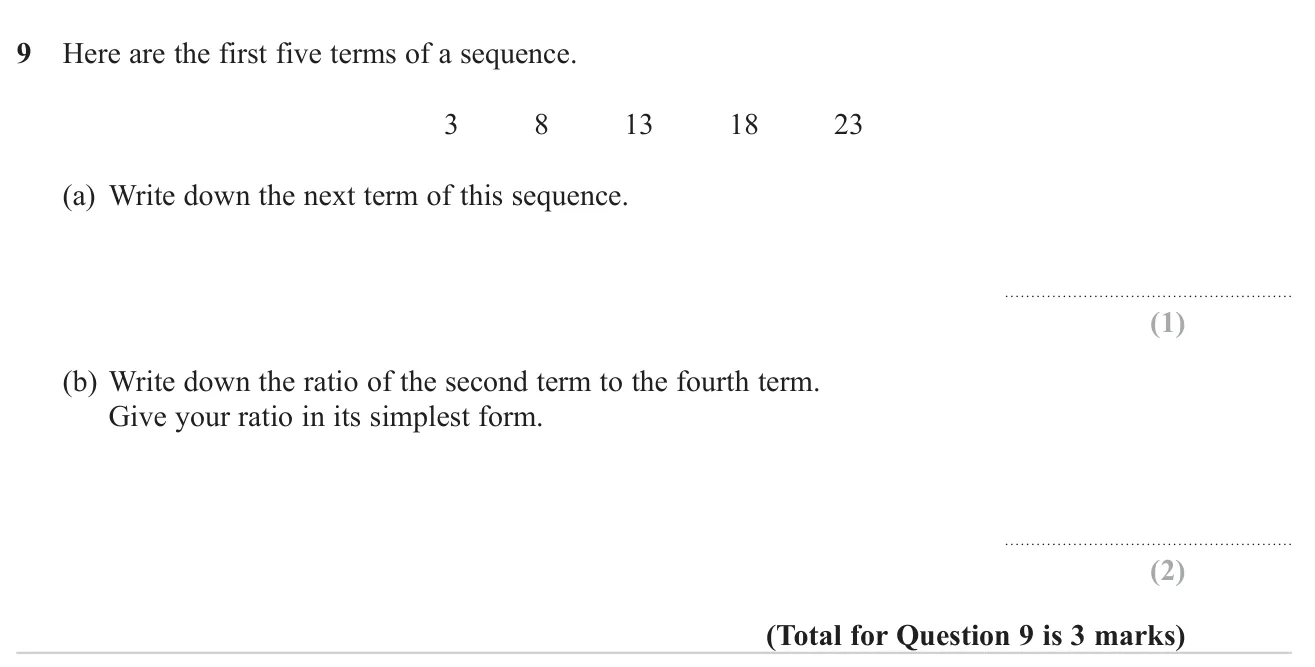
(a) 28 1 mark (b) 4 : 9 4 : 9 4 : 9 2 marks
Worked solution Checked against the mark scheme
(a) The terms go up by 5, so the next term is 23 + 5 = 28 23 + 5 = 28 23 + 5 = 28
(b) The second term is 8 and the fourth is 18.
8 : 18 8 : 18 8 : 18 4 : 9 4 : 9 4 : 9
Watch out: Writing the ratio the wrong way round as 9 : 4 9 : 4 9 : 4
© Pearson Education Ltd. November 2023 Paper 3 (Foundation, calculator), question 8.
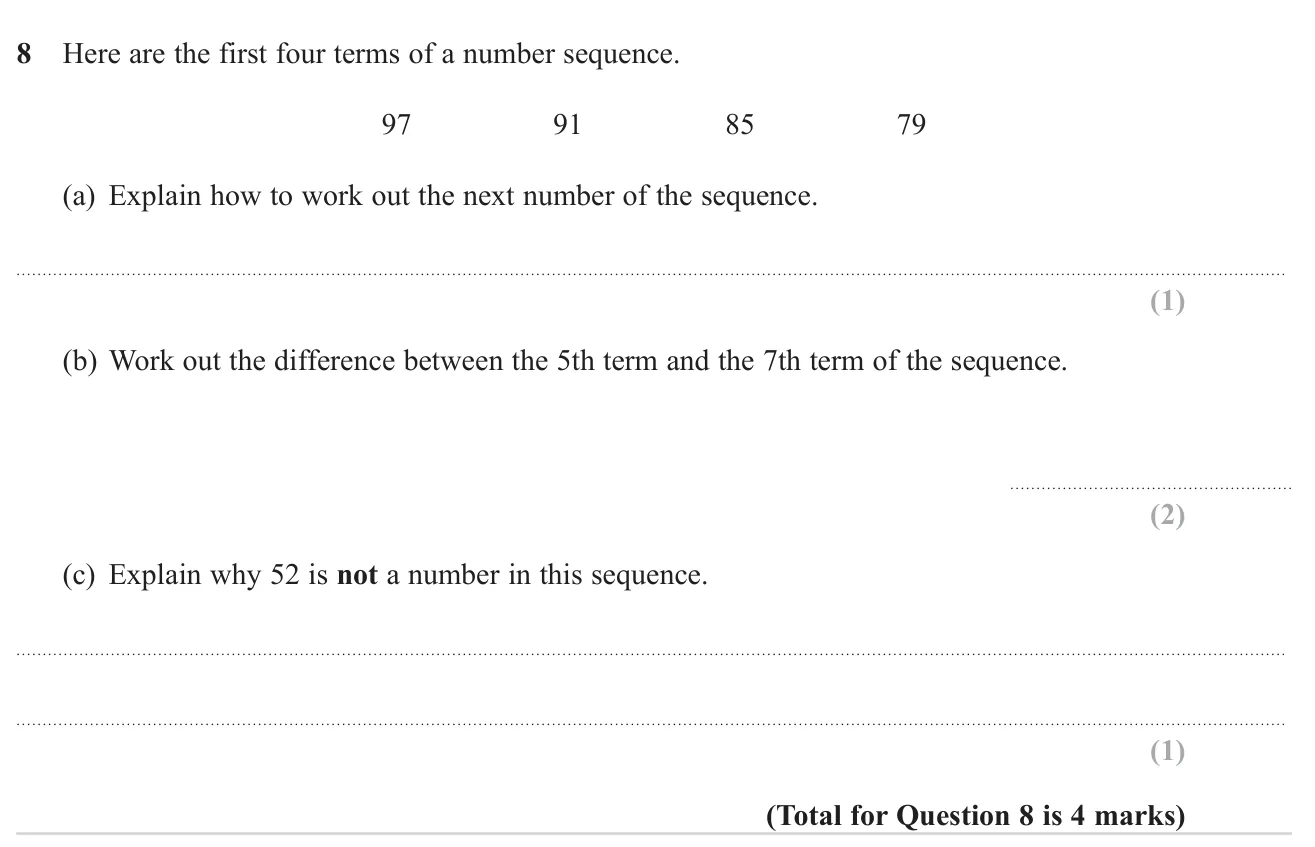
(a) Subtract 6 each time 1 mark (b) 12 2 marks (c) All the terms are odd, but 52 is even 1 mark
Worked solution Checked against the mark scheme
(a) 97 − 91 = 6 97 - 91 = 6 97 − 91 = 6
(b) 5th term = 73 = 73 = 73 = 67 = 67 = 67 = 61 = 61 = 61 = 73 − 61 = 12 = 73 - 61 = 12 = 73 − 61 = 12
(c) Every term is odd (odd minus 6 stays odd). 52 is even, so it cannot appear. The terms go 55, 49, missing 52.
Watch out: In (c), just saying 'it goes past 52' without a reason.
© Pearson Education Ltd. November 2022 Paper 3 (Foundation, calculator), question 10.
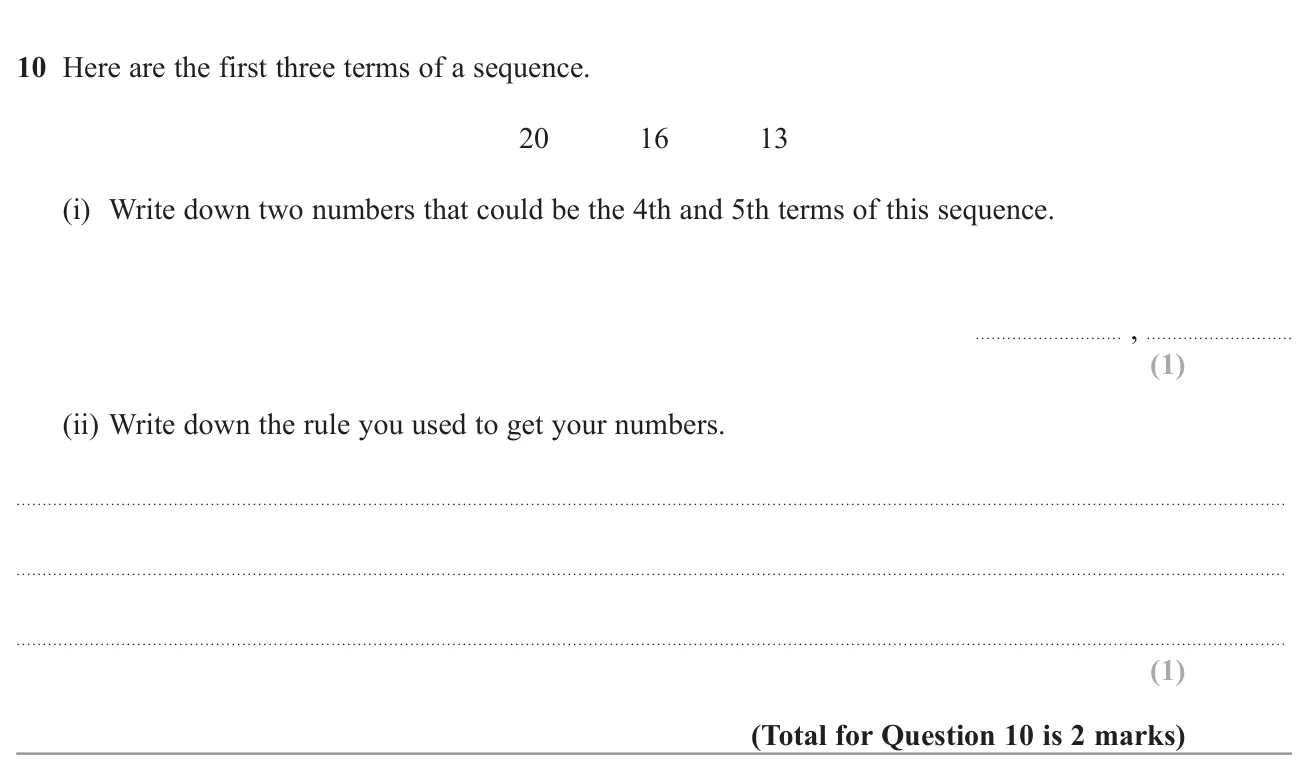
(i) e.g. 11, 10 (differences 4, 3, 2, 1) or 9, 6 1 mark (ii) e.g. the amount subtracted goes down by 1 each time 1 mark
Worked solution Checked against the mark scheme
The differences are 20 − 16 = 4 20 - 16 = 4 20 − 16 = 4 16 − 13 = 3 16 - 13 = 3 16 − 13 = 3
If the differences keep falling by 1, next subtract 2 then 1: 13 − 2 = 11 13 - 2 = 11 13 − 2 = 11 11 − 1 = 10 11 - 1 = 10 11 − 1 = 10
Rule: the number you take away goes down by 1 each time.
Watch out: Saying 'it goes down by 1 each time', which does not describe the terms.
© Pearson Education Ltd. June 2022 Paper 3 (Foundation, calculator), question 8.
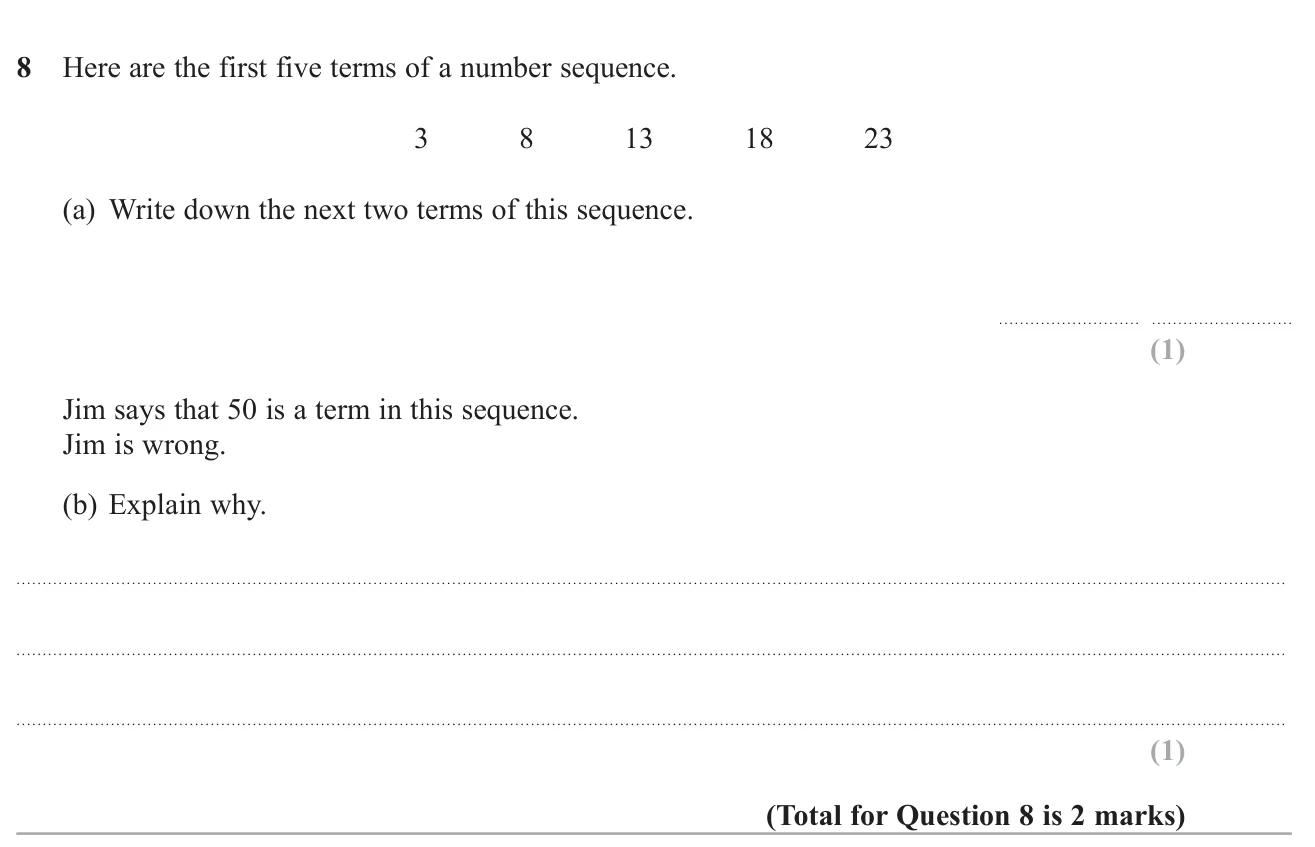
(a) 28 and 33 1 mark (b) All terms end in 3 or 8, so 50 cannot be a term 1 mark
Worked solution Checked against the mark scheme
(a) The terms go up by 5: 23 + 5 = 28 23 + 5 = 28 23 + 5 = 28 28 + 5 = 33 28 + 5 = 33 28 + 5 = 33
(b) The terms go 3, 8, 13, 18, ... so every term ends in 3 or 8.
50 ends in 0, so it is not a term (48 and 53 are consecutive terms).
Watch out: Saying only that the sequence goes past 50, which is not a reason.
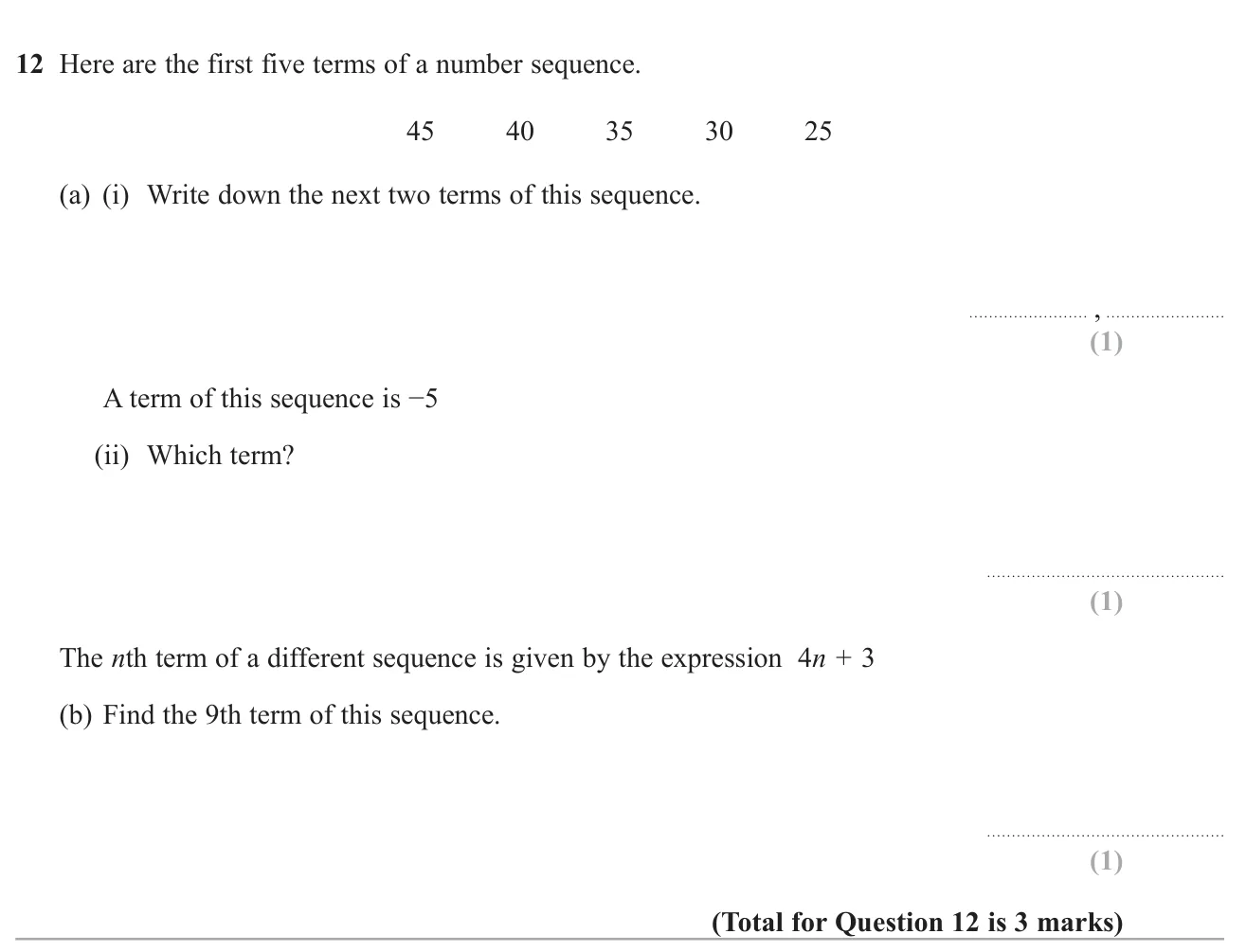
© Pearson Education Ltd. November 2020 Paper 3 (Foundation, calculator), question 12.
(a(i)) 20, 15 1 mark (a(ii)) 11th term 1 mark (b) 39 1 mark
Worked solution Checked against the mark scheme
(a)(i) Subtract 5 each time: 20, 15
(ii) Keep going: 10, 5, 0, −5 are terms 8 to 11, so − 5 -5 − 5 11th term.
(b) 4 × 9 + 3 = 39 4 \times 9 + 3 = 39 4 × 9 + 3 = 39
Watch out: In (b), writing 49 by treating 4 n 4n 4 n
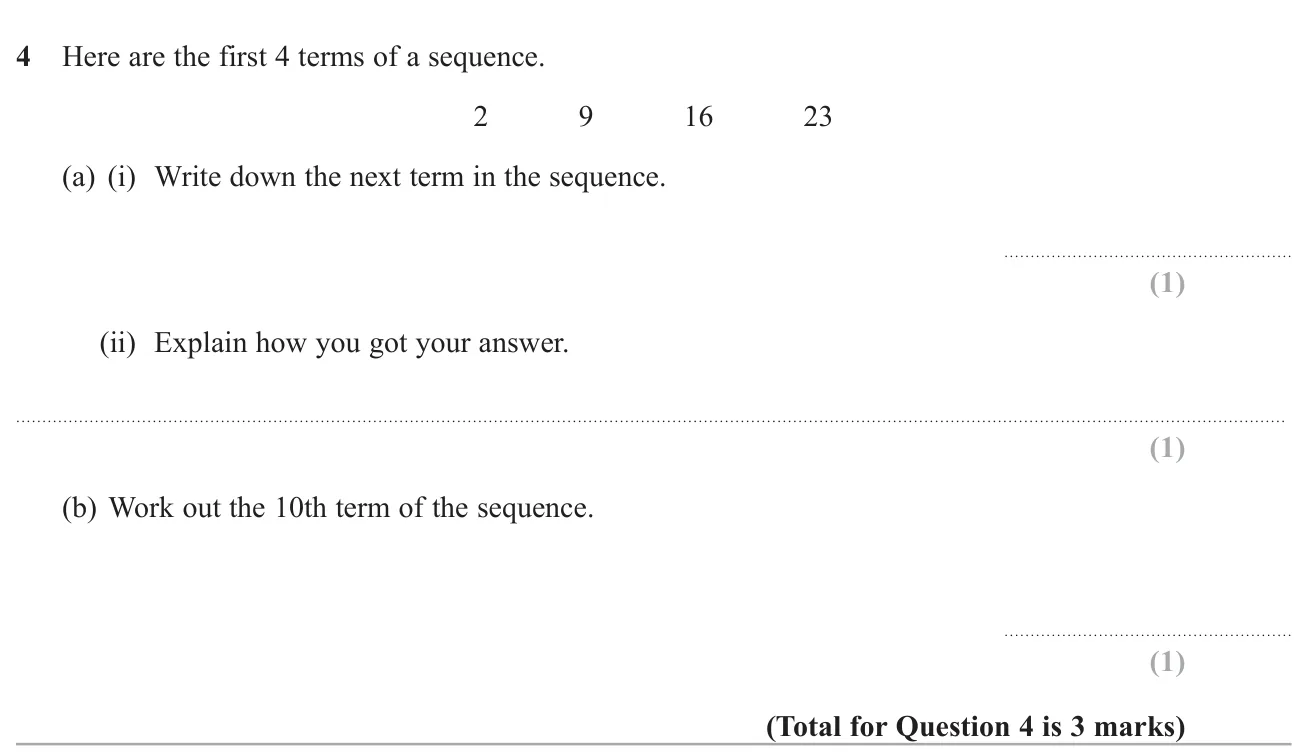
© Pearson Education Ltd. June 2018 Paper 3 (Foundation, calculator), question 4.
(a(i)) 30 30 30 1 mark (a(ii)) The terms go up by 7 each time 1 mark (b) 65 65 65 1 mark
Worked solution Checked against the mark scheme
Each term is 7 more than the one before, so the next term is 23 + 7 = 30 23 + 7 = 30 23 + 7 = 30
The nth term is 7 n − 5 7n - 5 7 n − 5
10th term: 7 × 10 − 5 = 65 7 \times 10 - 5 = 65 7 × 10 − 5 = 65
Watch out: Adding 7 six times from 23 but miscounting the terms.
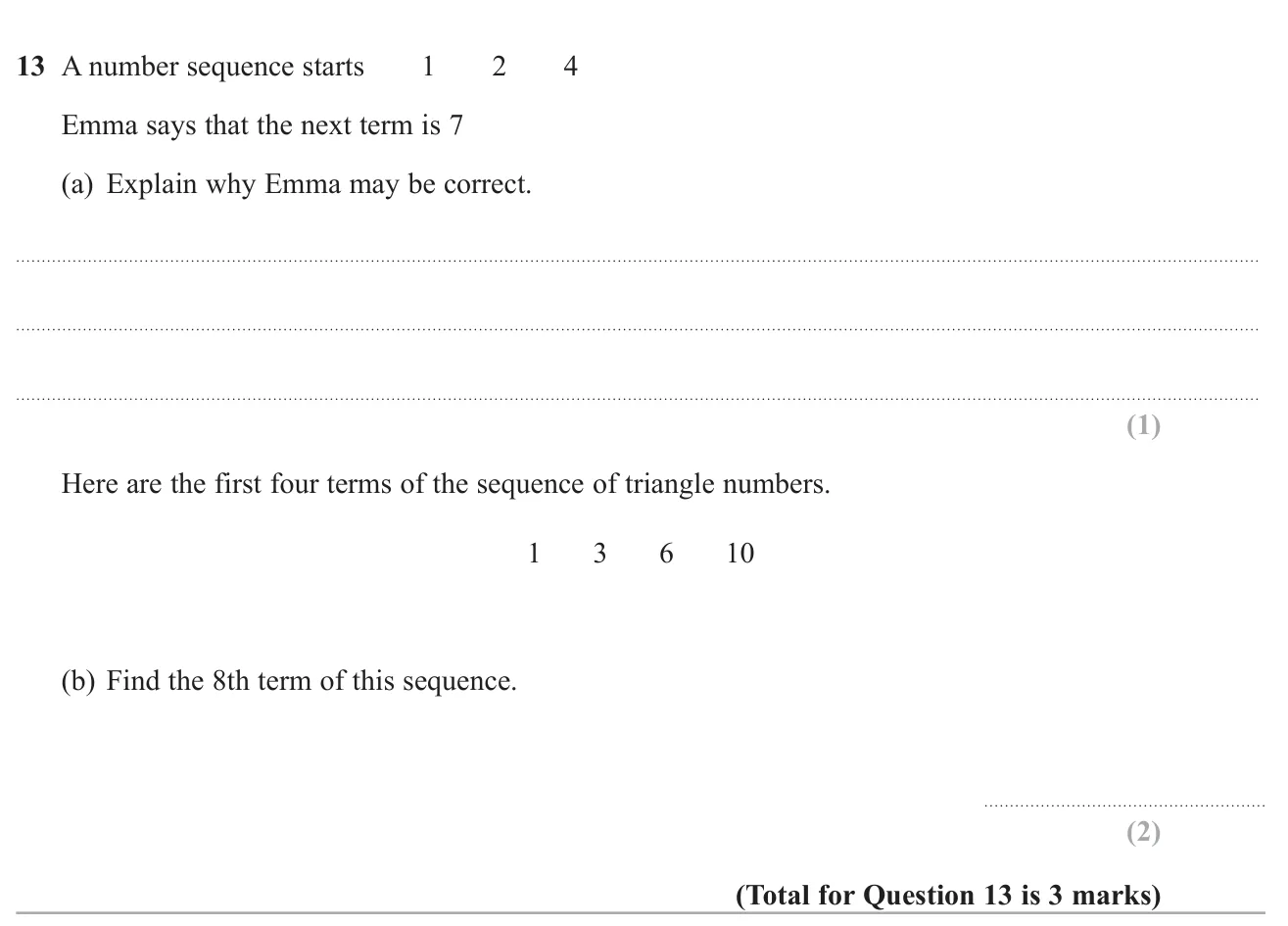
© Pearson Education Ltd. November 2021 Paper 1 (Foundation, non-calculator), question 13.
(a) The differences go up by one each time: + 1 , + 2 , + 3 +1, +2, +3 + 1 , + 2 , + 3 4 + 3 = 7 4 + 3 = 7 4 + 3 = 7 1 mark (b) 36 36 36 2 marks
Worked solution Checked against the mark scheme
(a) 1 → 2 1 \to 2 1 → 2 + 1 +1 + 1 2 → 4 2 \to 4 2 → 4 + 2 +2 + 2 + 3 +3 + 3 4 + 3 = 7 4 + 3 = 7 4 + 3 = 7
(b) The gaps grow by 1: 10 + 5 = 15 10 + 5 = 15 10 + 5 = 15 15 + 6 = 21 15 + 6 = 21 15 + 6 = 21 21 + 7 = 28 21 + 7 = 28 21 + 7 = 28 28 + 8 = 36 28 + 8 = 36 28 + 8 = 36
The 8th term is 36 36 36
Watch out: In (b), stopping at the 7th term, 28.
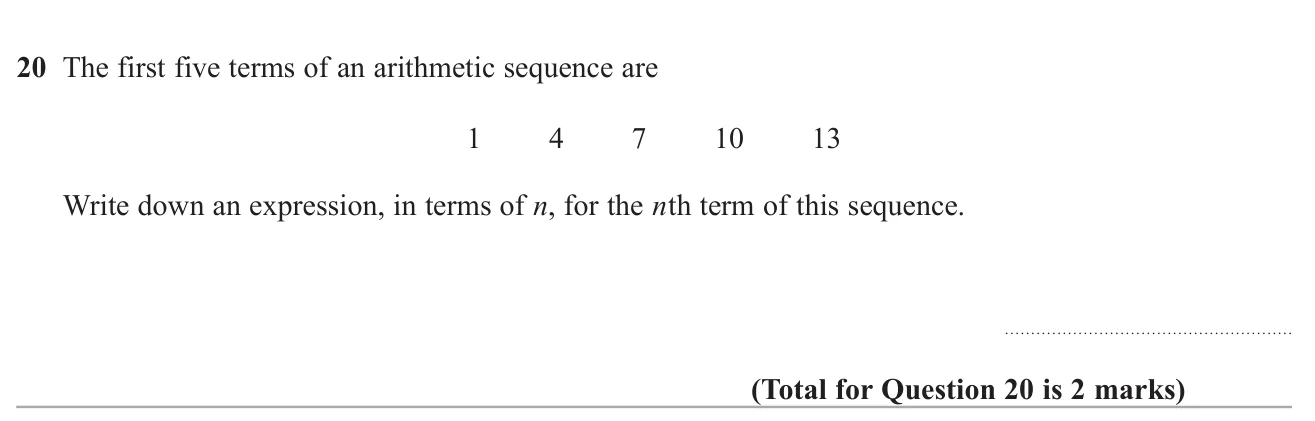
© Pearson Education Ltd. November 2020 Paper 1 (Foundation, non-calculator), question 20.
Answer 3 n − 2 3n - 2 3 n − 2 2 marks
Worked solution Checked against the mark scheme
The terms go up by 3, so start with 3 n 3n 3 n
Each term is 2 less than that, so the nth term is 3 n − 2 3n - 2 3 n − 2
Watch out: Writing n + 3 n + 3 n + 3
© Pearson Education Ltd. June 2019 Paper 3 (Foundation, calculator), question 13.
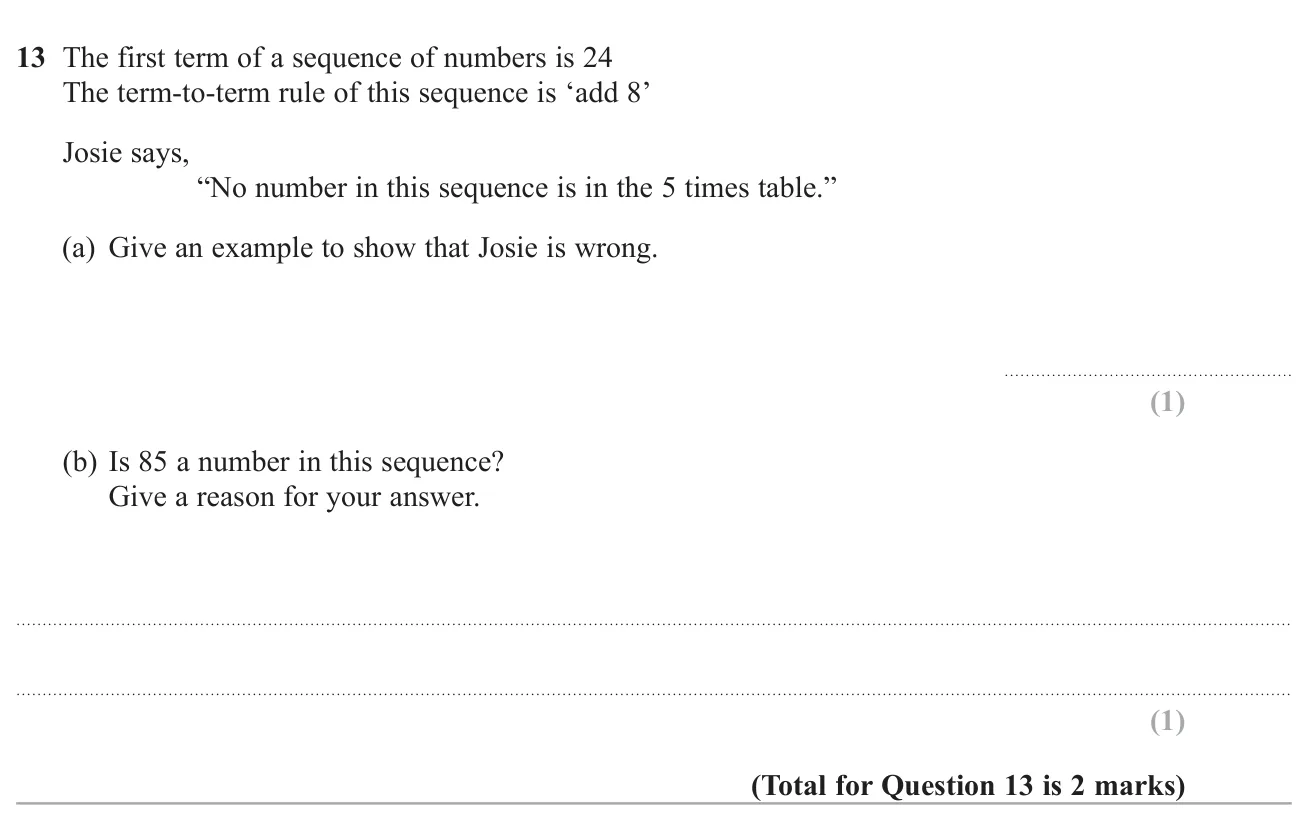
(a) 40 (or 80, 120, ...) 1 mark (b) No: every term is even (or 80 is in the sequence and the next term is 88) 1 mark
Worked solution Checked against the mark scheme
Terms: 24, 32, 40, 48, 56, 64, 72, 80, 88, ...
(a) 40 is in the sequence and is in the 5 times table.
(b) No. 80 and 88 are terms, so 85 is skipped. Also, every term is even and 85 is odd.
Watch out: In (b), just saying 'it goes past 85' without a reason.
© Pearson Education Ltd. November 2018 Paper 2 (Foundation, calculator), question 9.
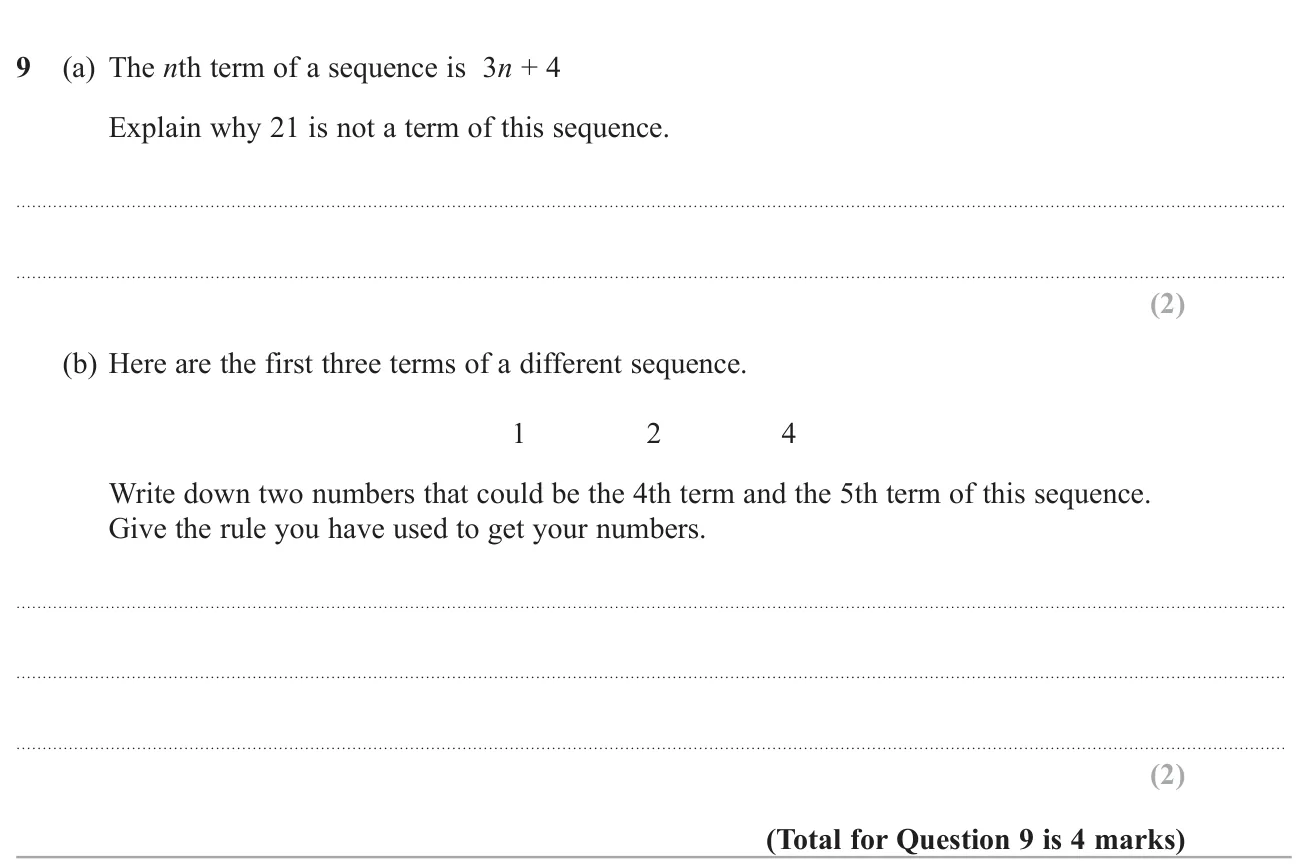
(a) 3 n + 4 = 21 3n + 4 = 21 3 n + 4 = 21 n = 17 3 n = \frac{17}{3} n = 3 17 2 marks (b) e.g. 7, 11 (add 1, 2, 3, 4, ...) or 8, 16 (double each time) 2 marks
Worked solution Checked against the mark scheme
(a) Terms: 7, 10, 13, 16, 19, 22, ... It jumps from 19 to 22, so 21 is missed.
Or: 3 n + 4 = 21 ⇒ 3 n = 17 ⇒ n = 5.67 3n + 4 = 21 \Rightarrow 3n = 17 \Rightarrow n = 5.67 3 n + 4 = 21 ⇒ 3 n = 17 ⇒ n = 5.67
(b) Doubling: 1, 2, 4, 8, 16 . Or the gaps grow by 1: 1, 2, 4, 7, 11 .
Watch out: In (b), saying 'goes up by 1 each time', which does not fit the terms.
© Pearson Education Ltd. Specimen Paper 1 (Foundation, non-calculator), question 13.
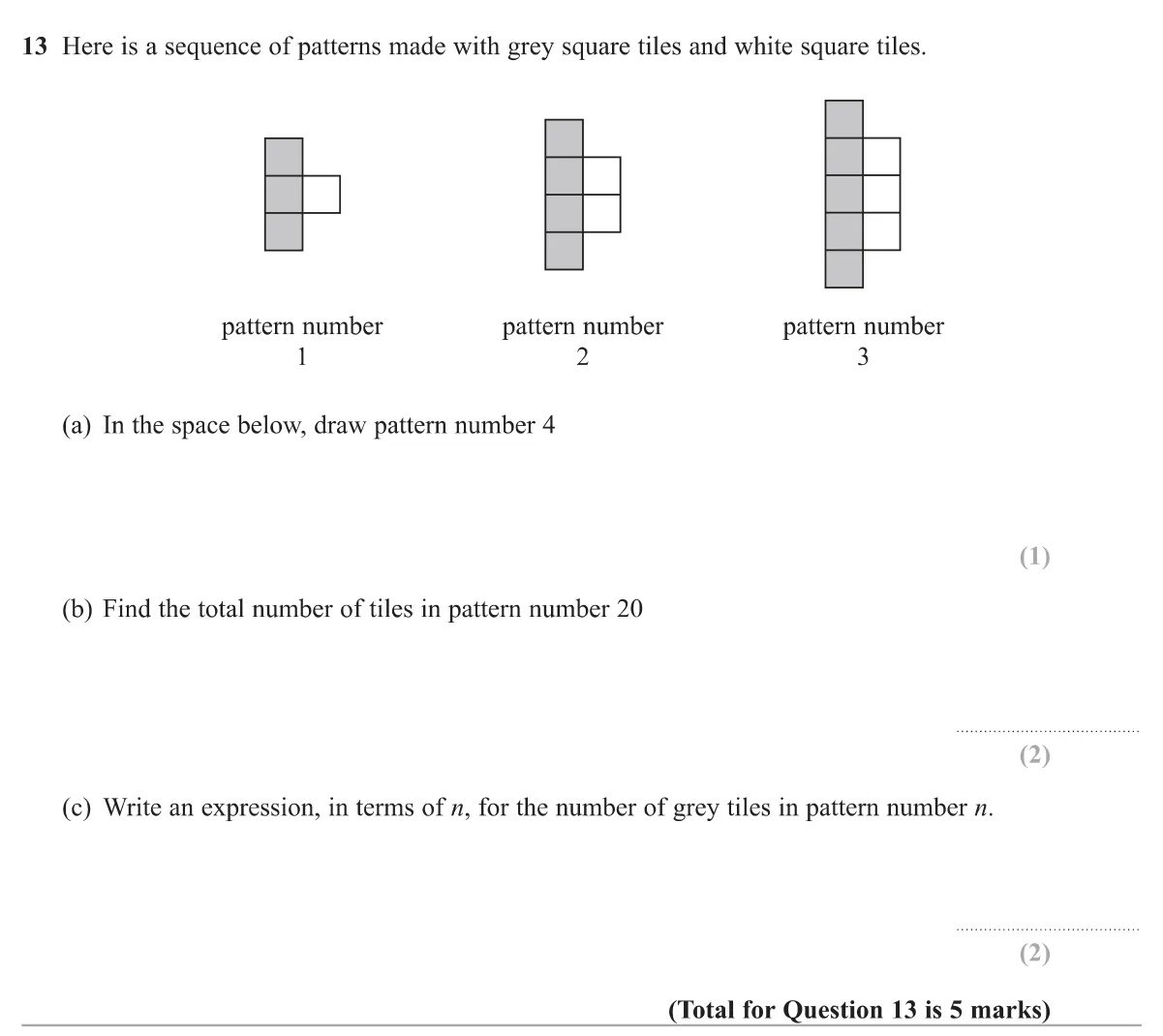
(a) A column of 6 grey tiles with 4 white tiles beside the middle four 1 mark (b) 42 42 42 2 marks (c) n + 2 n + 2 n + 2 2 marks
Worked solution Checked against the mark scheme
Pattern n n n n + 2 n + 2 n + 2 n n n
(a) Pattern 4: 6 grey tiles in a column, 4 white tiles next to the middle ones.
(b) Total tiles = ( n + 2 ) + n = 2 n + 2 = (n + 2) + n = 2n + 2 = ( n + 2 ) + n = 2 n + 2 n = 20 n = 20 n = 20 2 × 20 + 2 = 42 2 \times 20 + 2 = 42 2 × 20 + 2 = 42
(c) Grey tiles go 3, 4, 5, ... so the expression is n + 2 n + 2 n + 2
Watch out: In (c), writing n + 1 because the sequence goes up by 1.
© Pearson Education Ltd. Specimen Paper 3 (Foundation, calculator), question 13.
Worked solution Checked against the mark scheme
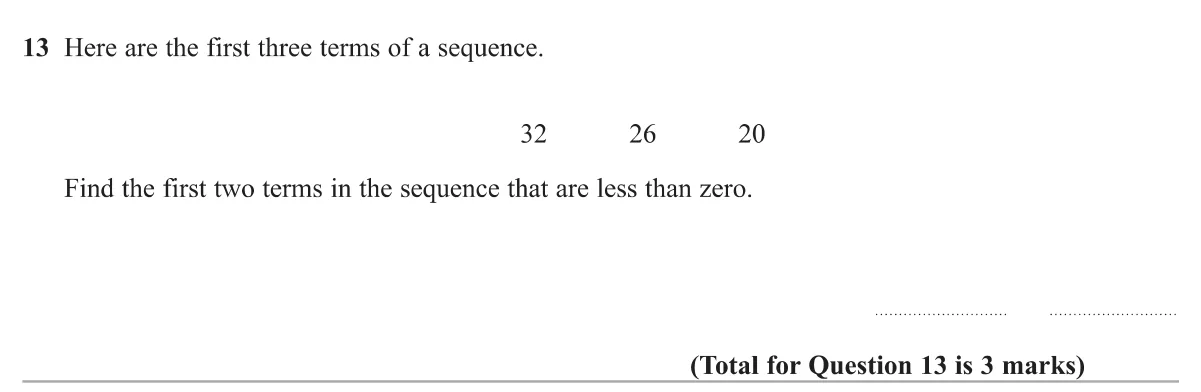
The terms go down by 6 each time.
32, 26, 20, 14, 8, 2, −4, −10
The first two terms below zero are −4 and −10 .
Watch out: Stopping at 2 or 0, or getting −2 by miscounting.
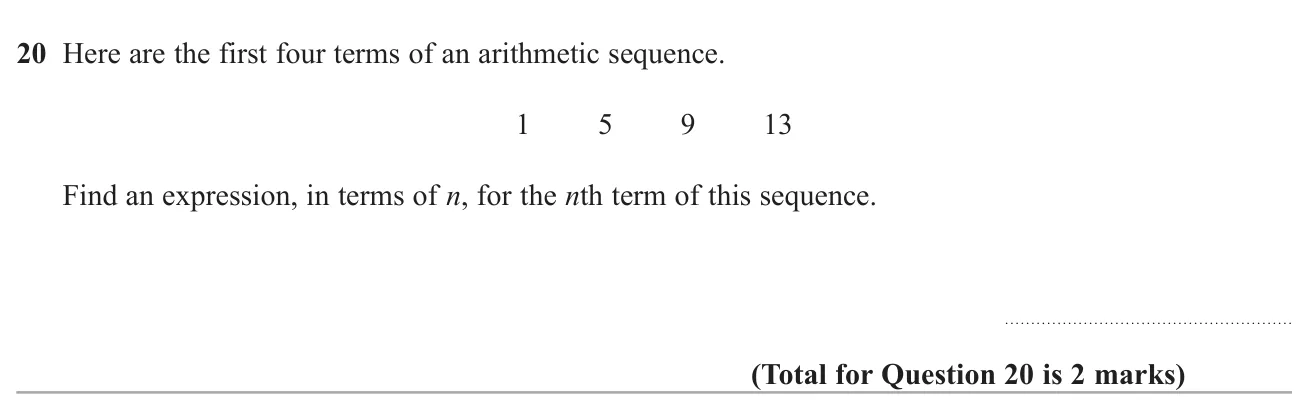
© Pearson Education Ltd. June 2024 Paper 1 (Foundation, non-calculator), question 20.
Answer 4 n − 3 4n - 3 4 n − 3 2 marks
Worked solution Checked against the mark scheme
The terms go up by 4, so start with 4 n 4n 4 n
4 n 4n 4 n 4 n − 3 4n - 3 4 n − 3
Watch out: Writing n + 4.
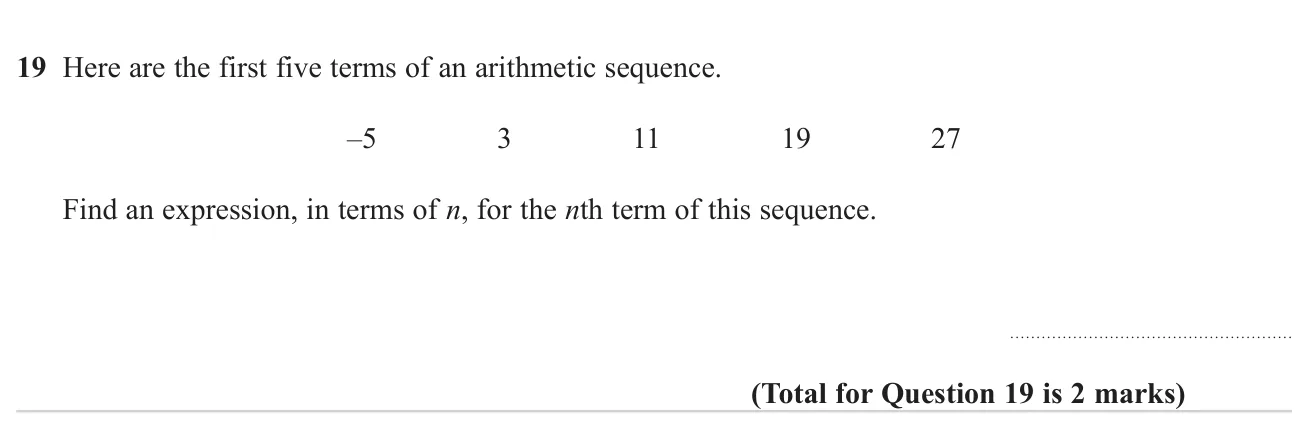
© Pearson Education Ltd. June 2023 Paper 1 (Foundation, non-calculator), question 19.
Answer 8 n − 13 8n - 13 8 n − 13 2 marks
Worked solution Checked against the mark scheme
The terms go up by 8, so start with 8 n 8n 8 n
Each term of the sequence is 13 less: 8 − 13 = − 5 8 - 13 = -5 8 − 13 = − 5
nth term = 8 n − 13 = 8n - 13 = 8 n − 13
Watch out: Writing 8n − 5 by using the first term as the constant.
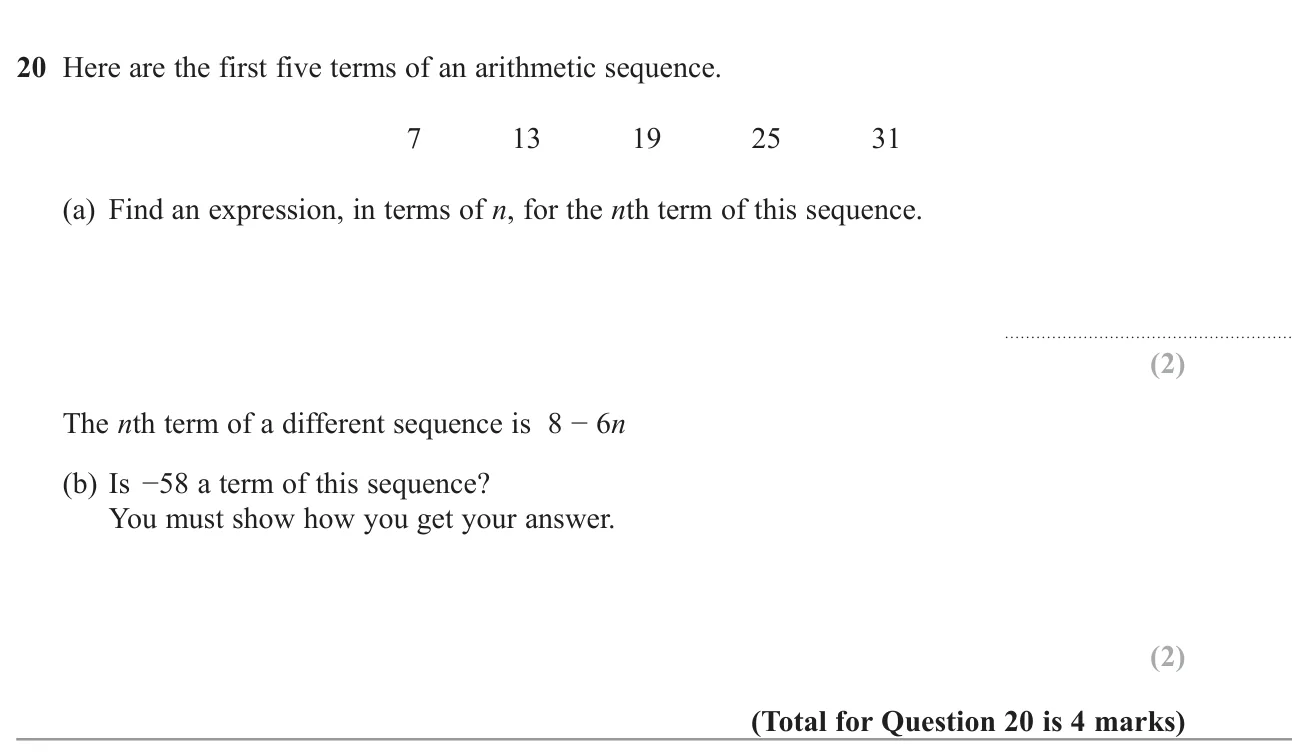
© Pearson Education Ltd. November 2022 Paper 2 (Foundation, calculator), question 20.
(a) 6 n + 1 6n + 1 6 n + 1 2 marks (b) Yes: 8 − 6 n = − 58 8 - 6n = -58 8 − 6 n = − 58 n = 11 n = 11 n = 11 2 marks
Worked solution Checked against the mark scheme
(a) The terms go up by 6, so start with 6 n 6n 6 n 6 n + 1 6n + 1 6 n + 1
(b) 8 − 6 n = − 58 8 - 6n = -58 8 − 6 n = − 58
6 n = 66 6n = 66 6 n = 66 n = 11 n = 11 n = 11
11 is a whole number, so yes , − 58 -58 − 58
Watch out: Writing n + 6 n + 6 n + 6
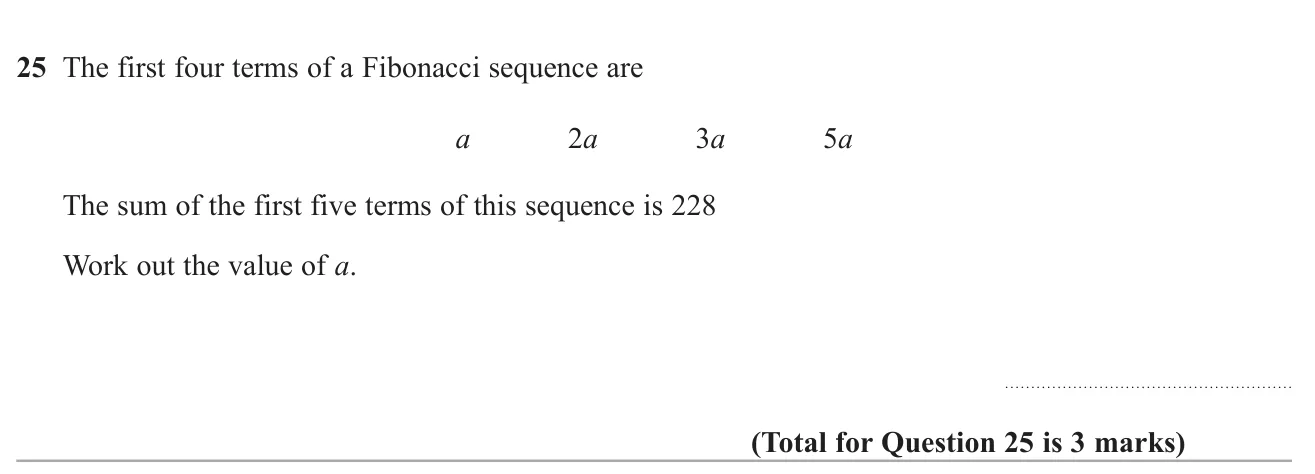
© Pearson Education Ltd. November 2021 Paper 3 (Foundation, calculator), question 25.
Worked solution Checked against the mark scheme
Each term is the sum of the two before, so the fifth term is 3 a + 5 a = 8 a 3a + 5a = 8a 3 a + 5 a = 8 a
a + 2 a + 3 a + 5 a + 8 a = 19 a a + 2a + 3a + 5a + 8a = 19a a + 2 a + 3 a + 5 a + 8 a = 19 a
19 a = 228 19a = 228 19 a = 228 a = 12 a = 12 a = 12
Watch out: Summing only the four given terms, giving 11 a = 228 11a = 228 11 a = 228
© Pearson Education Ltd. November 2018 Paper 3 (Foundation, calculator), question 26.
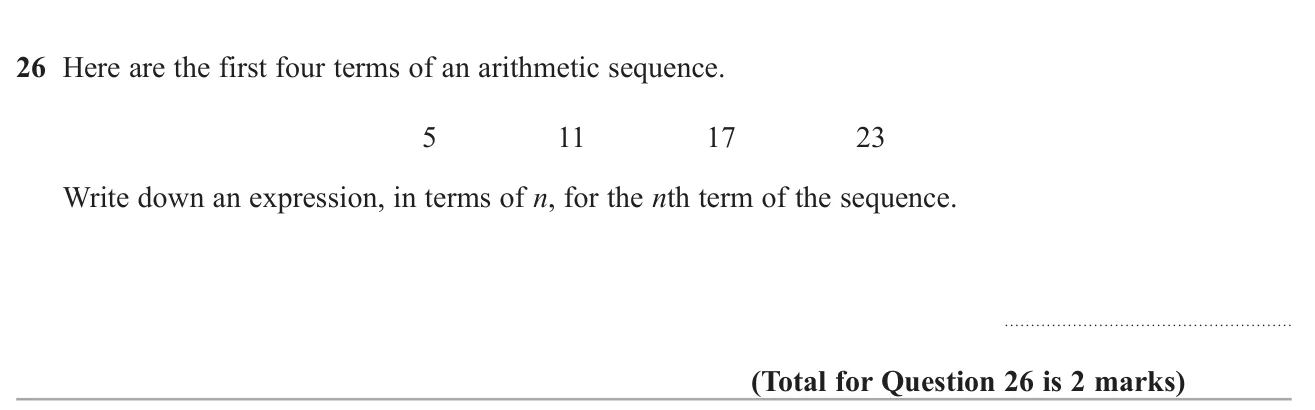
Answer 6 n − 1 6n - 1 6 n − 1 2 marks
Worked solution Checked against the mark scheme
The terms go up by 6, so start with 6 n 6n 6 n
6 n 6n 6 n 6 n − 1 6n - 1 6 n − 1
Watch out: Writing n + 6.
© Pearson Education Ltd. November 2019 Paper 2 (Foundation, calculator), question 26.
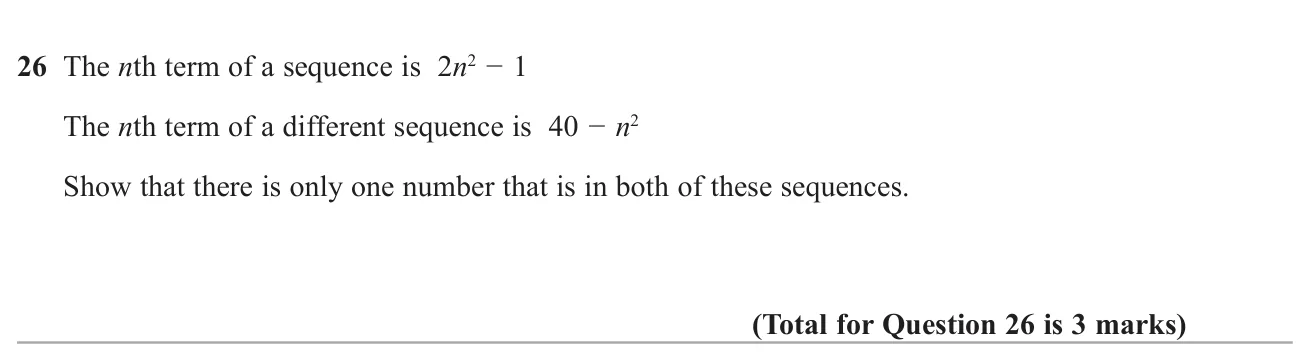
Answer 31 is the only common term 3 marks
Worked solution Checked against the mark scheme
First sequence 2 n 2 − 1 2n^2 - 1 2 n 2 − 1
Second sequence 40 − n 2 40 - n^2 40 − n 2
The only number in both is 31 . After this the first keeps rising above 31 and the second keeps falling below it, so there can be no other.
Watch out: Treating 2 n 2 2n^2 2 n 2 ( 2 n ) 2 (2n)^2 ( 2 n ) 2
© Pearson Education Ltd. June 2019 Paper 2 (Foundation, calculator), question 28.
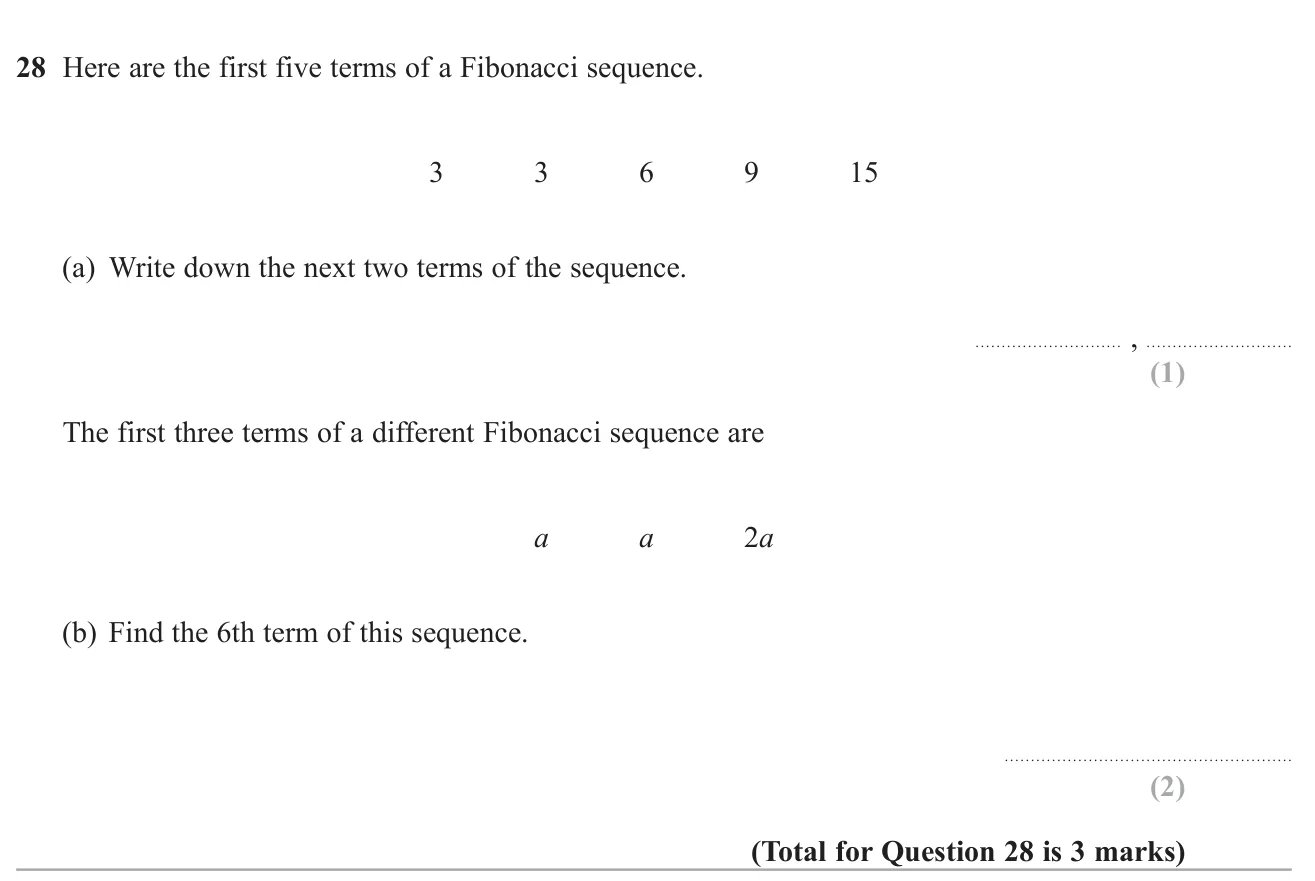
(a) 24, 39 1 mark (b) 8 a 8a 8 a 2 marks
Worked solution Checked against the mark scheme
(a) Add the two previous terms: 9 + 15 = 24 9 + 15 = 24 9 + 15 = 24 15 + 24 = 39 15 + 24 = 39 15 + 24 = 39
(b) a , a , 2 a a,\ a,\ 2a a , a , 2 a a + 2 a = 3 a a + 2a = 3a a + 2 a = 3 a 2 a + 3 a = 5 a 2a + 3a = 5a 2 a + 3 a = 5 a 3 a + 5 a = 8 a 3a + 5a = 8a 3 a + 5 a = 8 a
The 6th term is 8 a 8a 8 a
Watch out: In (b), giving the 5th term, 5 a 5a 5 a
© Pearson Education Ltd. November 2019 Paper 2 (Higher, calculator), question 6.
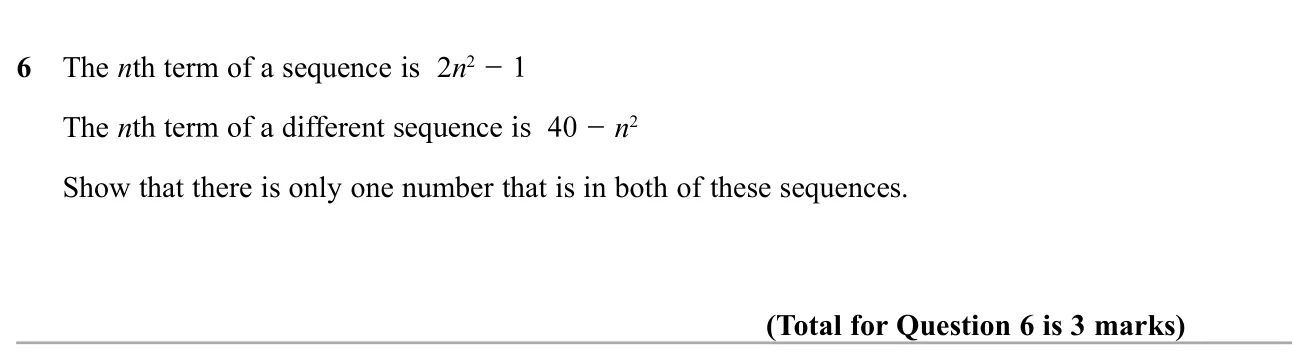
Answer 31 is the only common term 3 marks
Worked solution Checked against the mark scheme
First sequence 2 n 2 − 1 2n^2 - 1 2 n 2 − 1
Second sequence 40 − n 2 40 - n^2 40 − n 2
31 appears in both. After that the first sequence keeps rising above 31 and the second keeps falling below it, so no other number can be in both.
Watch out: Stopping at 31 without explaining why no later terms can match.
© Pearson Education Ltd. Specimen Paper 2 (Higher, calculator), question 21.
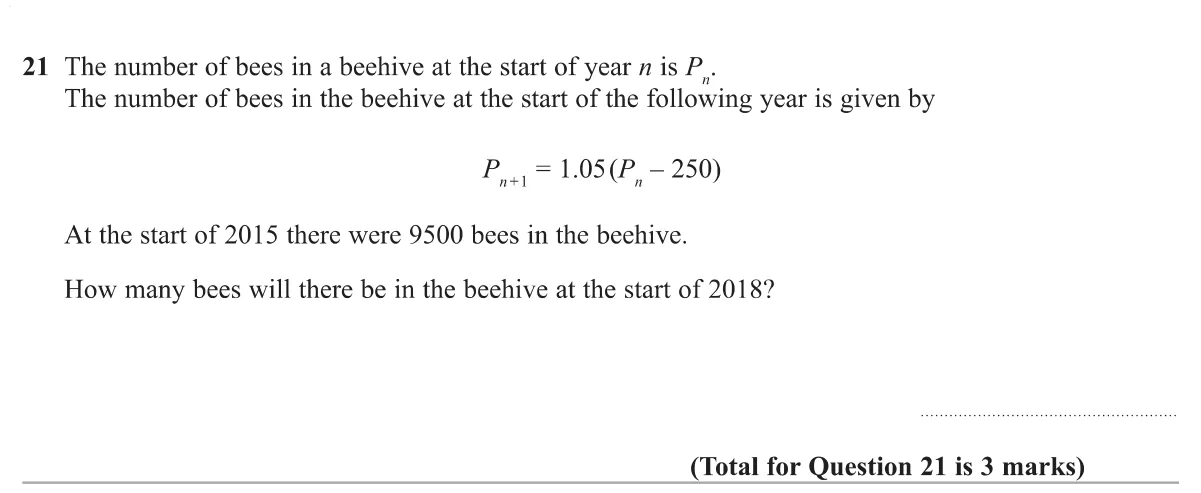
Answer 10170 (10169.9…, rounded or truncated) 3 marks
Worked solution Checked against the mark scheme
2016: 1.05 ( 9500 − 250 ) = 9712.5 1.05(9500 - 250) = 9712.5 1.05 ( 9500 − 250 ) = 9712.5
2017: 1.05 ( 9712.5 − 250 ) = 9935.625 1.05(9712.5 - 250) = 9935.625 1.05 ( 9712.5 − 250 ) = 9935.625
2018: 1.05 ( 9935.625 − 250 ) = 10169.90 … 1.05(9935.625 - 250) = 10169.90… 1.05 ( 9935.625 − 250 ) = 10169.90 …
About 10170 bees.
Watch out: Stopping after two steps (2017) instead of three.
© Pearson Education Ltd. November 2024 Paper 2 (Higher, calculator), question 15.
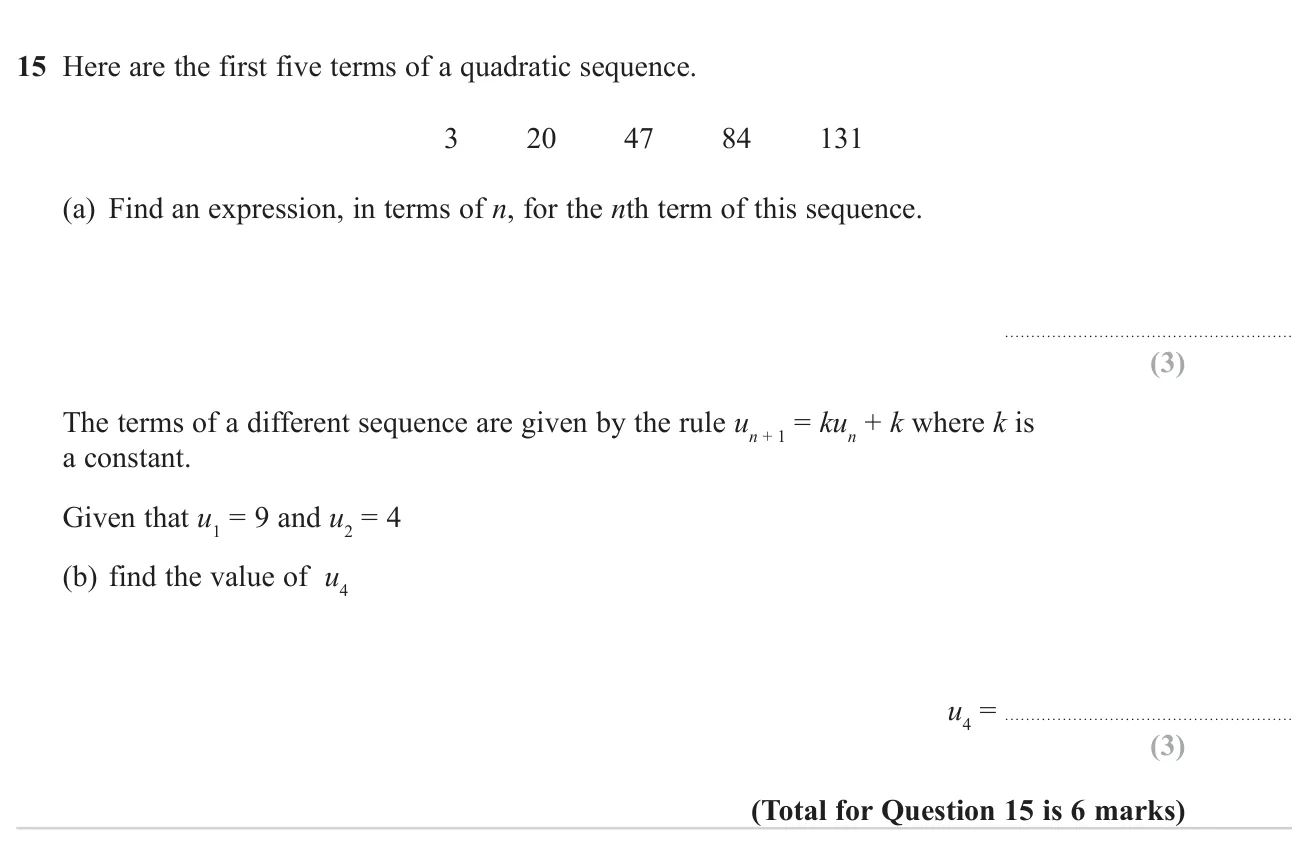
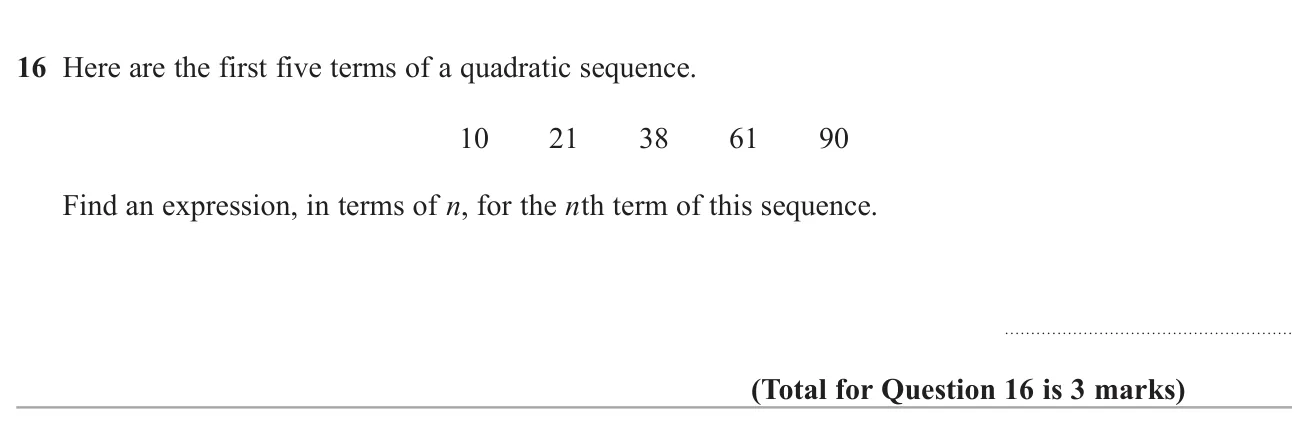
(a) 5 n 2 + 2 n − 4 5n^2 + 2n - 4 5 n 2 + 2 n − 4 3 marks (b) 1.2 1.2 1.2 3 marks
Worked solution Checked against the mark scheme
(a) Differences: 17, 27, 37, 47; second difference 10, so 5 n 2 5n^2 5 n 2
Sequence − 5 n 2 5n^2 5 n 2 − 2 , 0 , 2 , 4 , 6 -2, 0, 2, 4, 6 − 2 , 0 , 2 , 4 , 6 2 n − 4 2n - 4 2 n − 4
nth term = 5 n 2 + 2 n − 4 = 5n^2 + 2n - 4 = 5 n 2 + 2 n − 4
(b) u 2 = 9 k + k = 10 k = 4 u_2 = 9k + k = 10k = 4 u 2 = 9 k + k = 10 k = 4 k = 0.4 k = 0.4 k = 0.4
u 3 = 0.4 × 4 + 0.4 = 2 u_3 = 0.4 \times 4 + 0.4 = 2 u 3 = 0.4 × 4 + 0.4 = 2 u 4 = 0.4 × 2 + 0.4 = 1.2 u_4 = 0.4 \times 2 + 0.4 = 1.2 u 4 = 0.4 × 2 + 0.4 = 1.2
Watch out: Using the second difference 10 as the coefficient of n 2 n^2 n 2
© Pearson Education Ltd. June 2023 Paper 2 (Higher, calculator), question 15.
Answer n 2 + 3 n − 1 n^2 + 3n - 1 n 2 + 3 n − 1 3 marks
Worked solution Checked against the mark scheme
Differences: 6, 8, 10; second difference 2, so start with n 2 n^2 n 2
Subtract n 2 n^2 n 2 3 n − 1 3n - 1 3 n − 1
nth term = n 2 + 3 n − 1 = n^2 + 3n - 1 = n 2 + 3 n − 1
Watch out: Using 2 n 2 2n^2 2 n 2
© Pearson Education Ltd. November 2023 Paper 3 (Higher, calculator), question 14.
Answer 2 n 2 + 3 2n^2 + 3 2 n 2 + 3 2 marks
Worked solution Checked against the mark scheme
First differences: 6, 10, 14, 18, 22. Second difference: 4, so the sequence starts 2 n 2 2n^2 2 n 2
2 n 2 2n^2 2 n 2
Sequence minus 2 n 2 2n^2 2 n 2 2 n 2 + 3 2n^2 + 3 2 n 2 + 3
Watch out: Using the second difference itself and writing 4n².
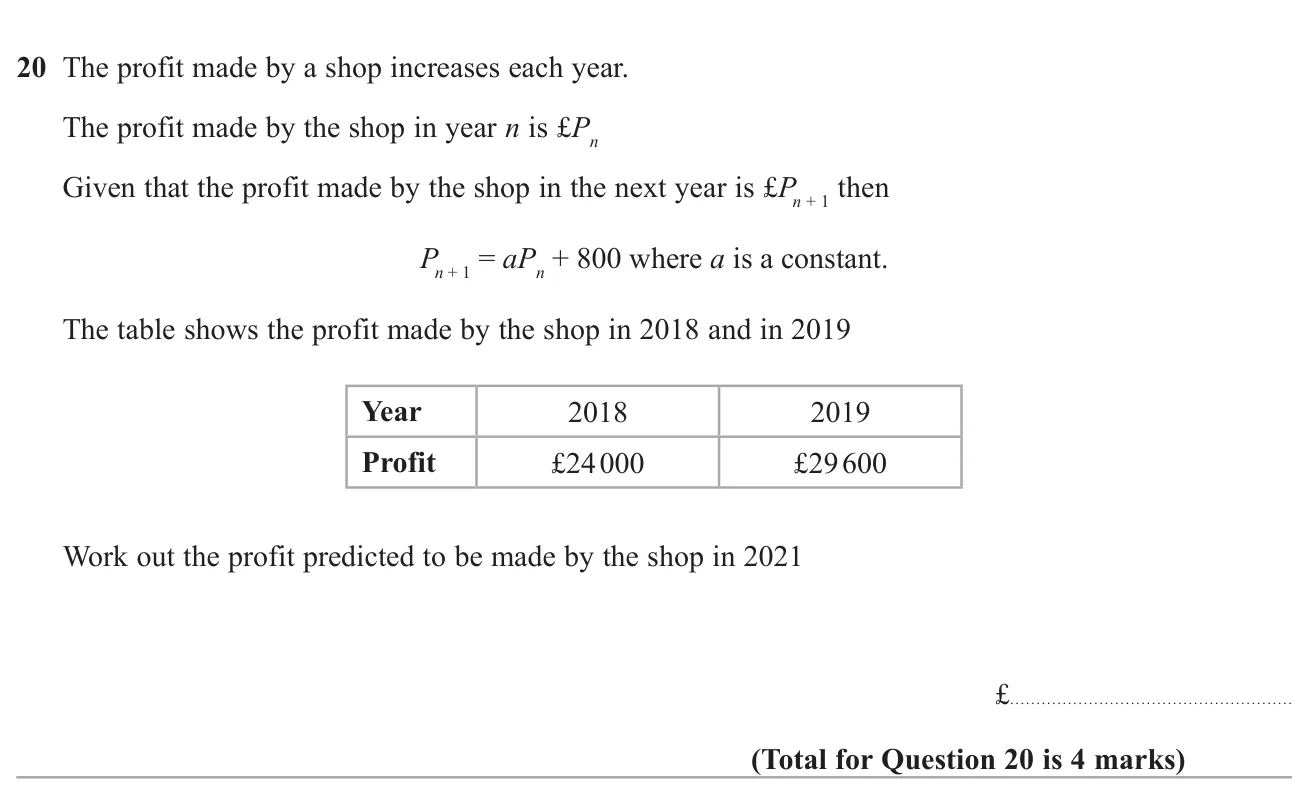
© Pearson Education Ltd. June 2022 Paper 3 (Higher, calculator), question 20.
Answer £ 44 384 £44\,384 £44 384 4 marks
Worked solution Checked against the mark scheme
29 600 = 24 000 a + 800 ⇒ a = 28 800 24 000 = 1.2 29\,600 = 24\,000a + 800 \Rightarrow a = \frac{28\,800}{24\,000} = 1.2 29 600 = 24 000 a + 800 ⇒ a = 24 000 28 800 = 1.2
2020: 1.2 × 29 600 + 800 = 36 320 1.2 \times 29\,600 + 800 = 36\,320 1.2 × 29 600 + 800 = 36 320
2021: 1.2 × 36 320 + 800 = £ 44 384 1.2 \times 36\,320 + 800 = £44\,384 1.2 × 36 320 + 800 = £44 384
Watch out: Stopping at 2020 (£36 320).
© Pearson Education Ltd. November 2020 Paper 2 (Higher, calculator), question 16.
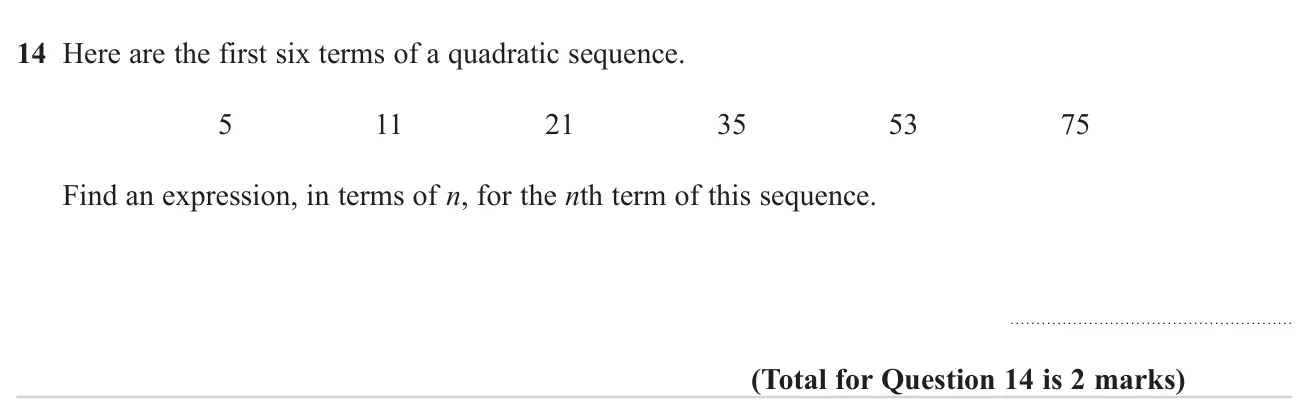
Answer 3 n 2 + 2 n + 5 3n^2 + 2n + 5 3 n 2 + 2 n + 5 3 marks
Worked solution Checked against the mark scheme
First differences: 11, 17, 23, 29. Second differences: 6, so the n 2 n^2 n 2 6 2 n 2 = 3 n 2 \frac{6}{2}n^2 = 3n^2 2 6 n 2 = 3 n 2
Subtract 3 n 2 3n^2 3 n 2 2 n + 5 2n + 5 2 n + 5
nth term = 3 n 2 + 2 n + 5 = 3n^2 + 2n + 5 = 3 n 2 + 2 n + 5
Watch out: Using 6n² from the second difference without halving it.
© Pearson Education Ltd. June 2019 Paper 3 (Higher, calculator), question 16.
Answer 2 n 2 − 3 2n^2 - 3 2 n 2 − 3 3 marks
Worked solution Checked against the mark scheme
First differences: 6, 10, 14, 18, 22. Second differences: 4, so the sequence starts 2 n 2 2n^2 2 n 2
2 n 2 2n^2 2 n 2
Sequence minus 2 n 2 2n^2 2 n 2 2 n 2 − 3 2n^2 - 3 2 n 2 − 3
Watch out: Using the second difference (4) as the coefficient, giving 4n².
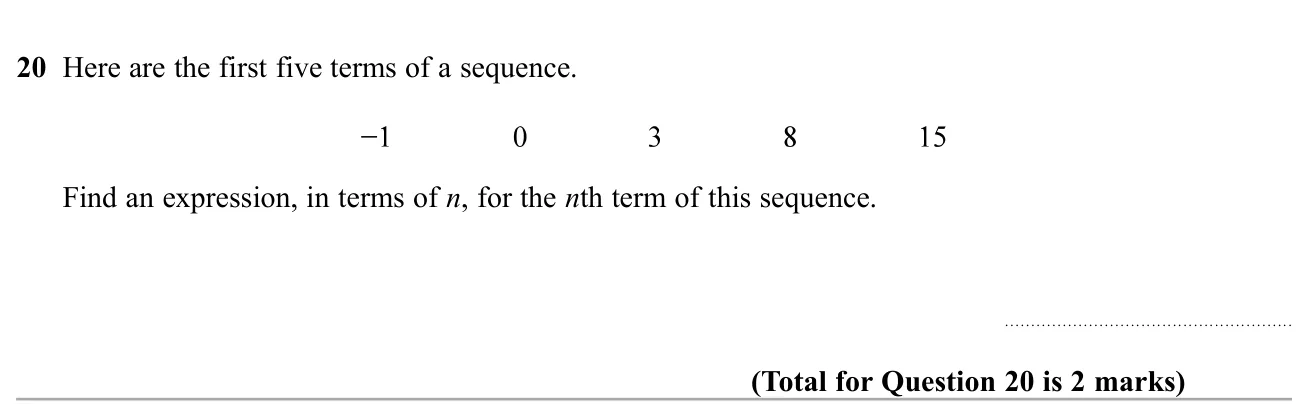
© Pearson Education Ltd. November 2019 Paper 3 (Higher, calculator), question 20.
Answer n 2 − 2 n n^2 - 2n n 2 − 2 n 2 marks
Worked solution Checked against the mark scheme
First differences: 1, 3, 5, 7. Second difference 2, so start with n 2 n^2 n 2
Sequence minus n 2 n^2 n 2 − 2 n -2n − 2 n
nth term = n 2 − 2 n = n^2 - 2n = n 2 − 2 n
Watch out: Giving 2 n 2 2n^2 2 n 2
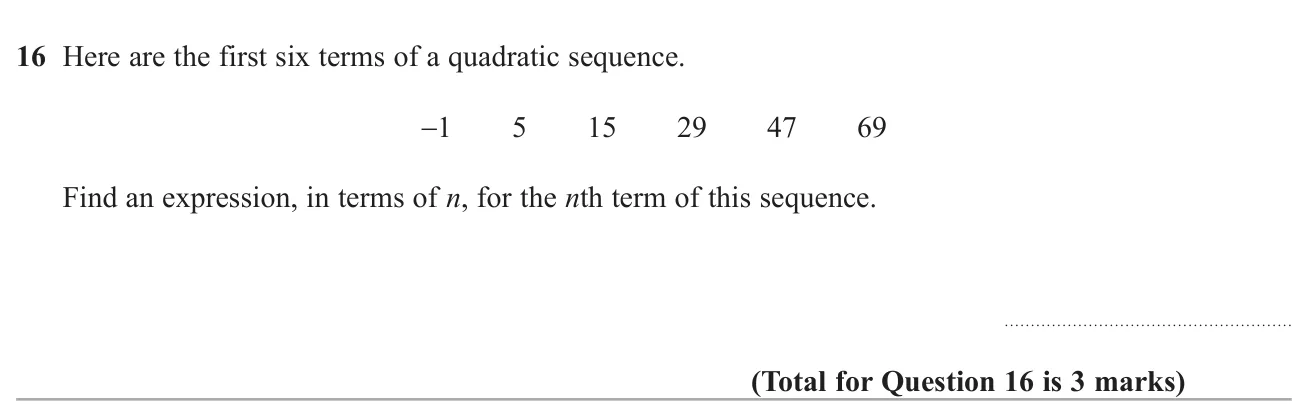
© Pearson Education Ltd. June 2018 Paper 3 (Higher, calculator), question 16.
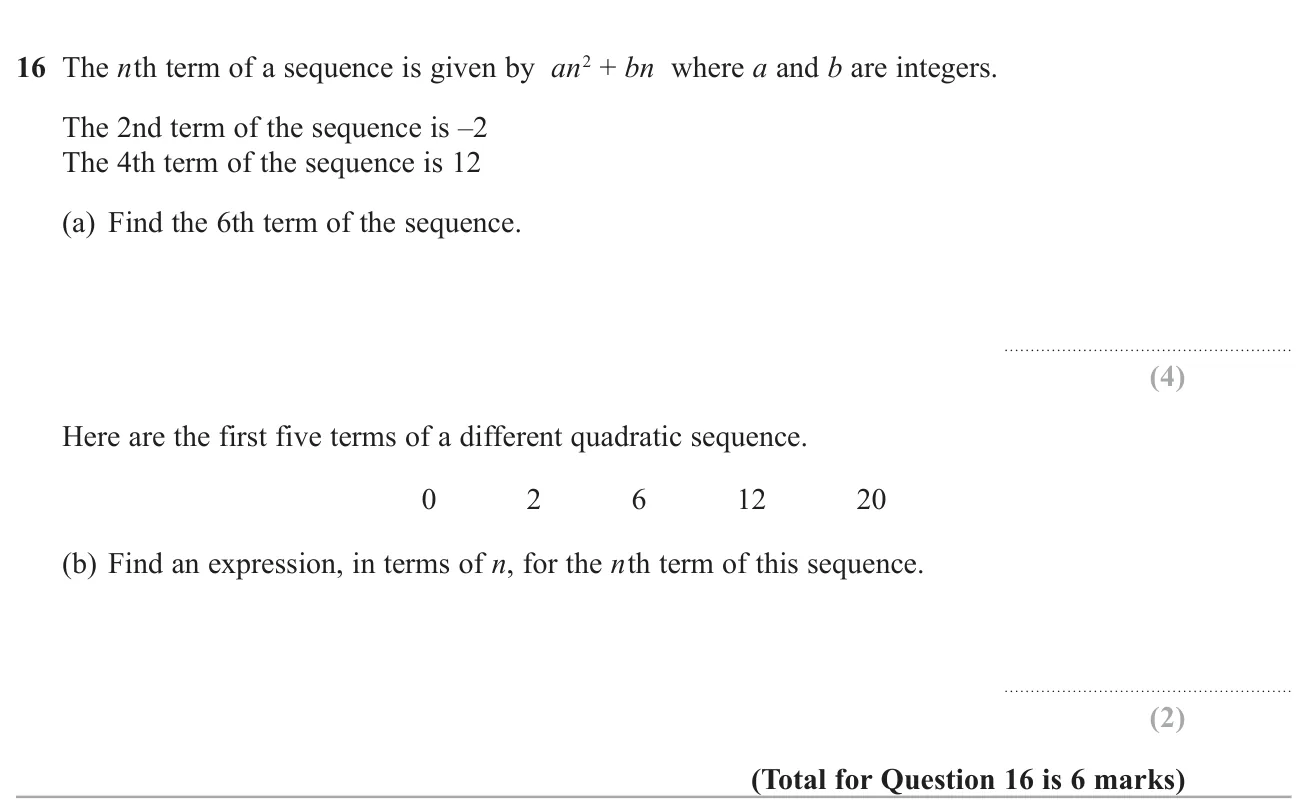
(a) 42 4 marks (b) n 2 − n n^2 - n n 2 − n 2 marks
Worked solution Checked against the mark scheme
(a) n = 2 n = 2 n = 2 4 a + 2 b = − 2 4a + 2b = -2 4 a + 2 b = − 2
n = 4 n = 4 n = 4 16 a + 4 b = 12 16a + 4b = 12 16 a + 4 b = 12
Double the first: 8 a + 4 b = − 4 8a + 4b = -4 8 a + 4 b = − 4 8 a = 16 8a = 16 8 a = 16 a = 2 a = 2 a = 2 b = − 5 b = -5 b = − 5
6th term: 2 ( 36 ) − 5 ( 6 ) = 72 − 30 = 42 2(36) - 5(6) = 72 - 30 = 42 2 ( 36 ) − 5 ( 6 ) = 72 − 30 = 42
(b) Second differences are 2, so start with n 2 n^2 n 2
Sequence minus n 2 n^2 n 2 − 1 , − 2 , − 3 , − 4 , − 5 -1, -2, -3, -4, -5 − 1 , − 2 , − 3 , − 4 , − 5 − n -n − n
nth term = n 2 − n = n^2 - n = n 2 − n
Watch out: In (b), using 2 n 2 2n^2 2 n 2
© Pearson Education Ltd. Specimen Paper 2 (Higher, calculator), question 17.
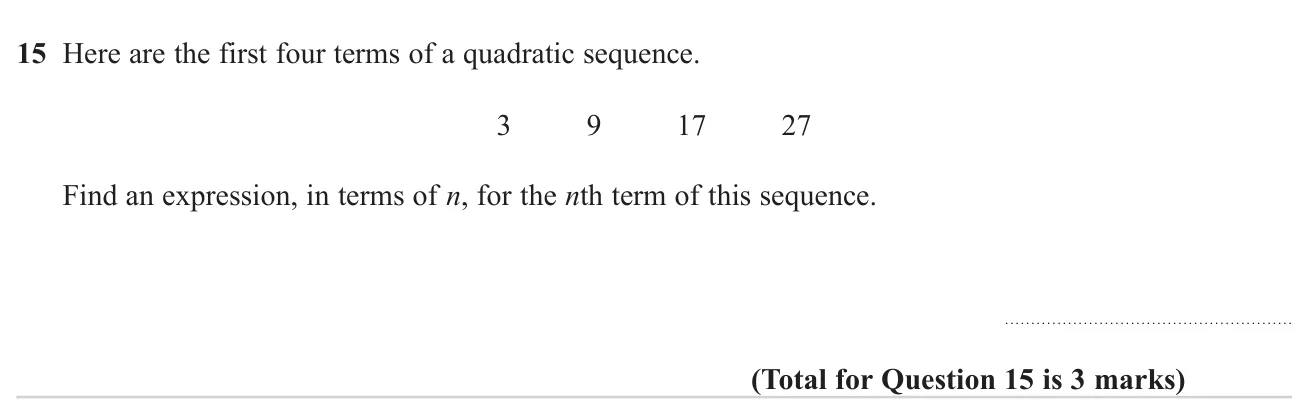
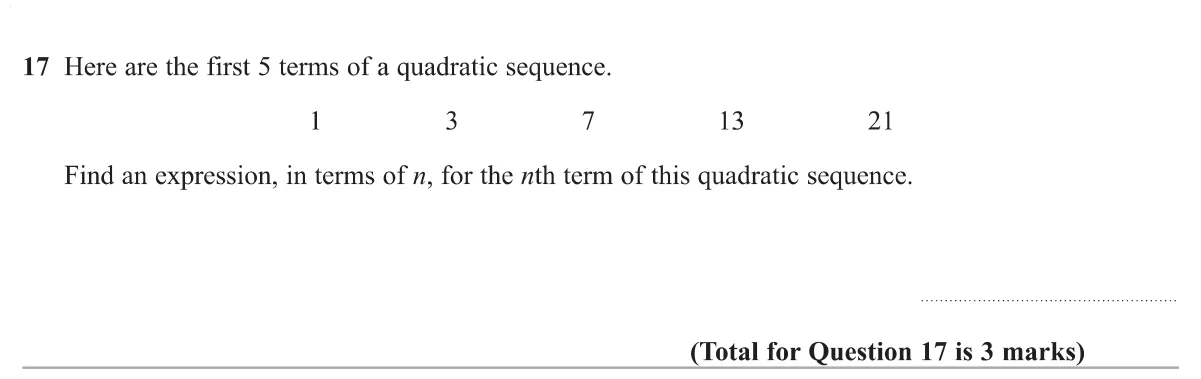
Answer n 2 − n + 1 n^2 - n + 1 n 2 − n + 1 3 marks
Worked solution Checked against the mark scheme
First differences: 2, 4, 6, 8; second difference 2, so start with n 2 n^2 n 2
n 2 n^2 n 2
Sequence minus n 2 n^2 n 2 − n + 1 -n + 1 − n + 1
nth term = n 2 − n + 1 = n^2 - n + 1 = n 2 − n + 1
Watch out: Using 2 n 2 2n^2 2 n 2
© Pearson Education Ltd. June 2024 Paper 3 (Higher, calculator), question 20.
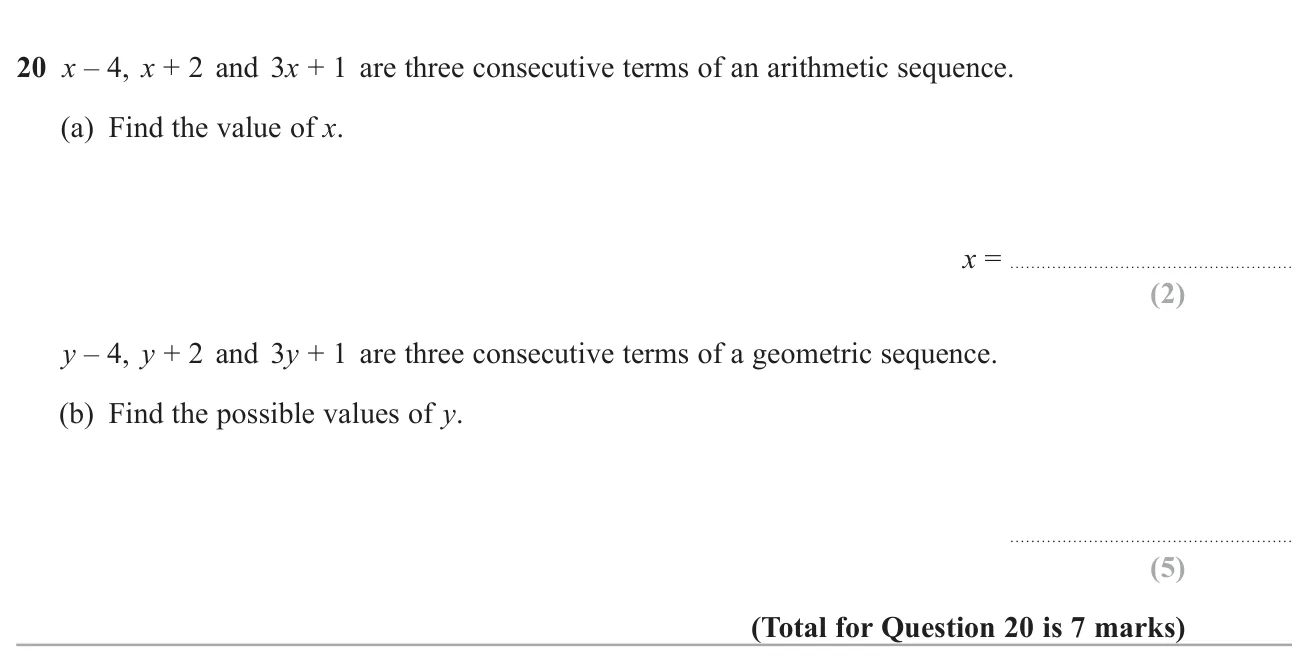
(a) x = 3.5 x = 3.5 x = 3.5 2 marks (b) y = − 0.5 y = -0.5 y = − 0.5 y = 8 y = 8 y = 8 5 marks
Worked solution Checked against the mark scheme
(a) ( x + 2 ) − ( x − 4 ) = 6 (x+2)-(x-4) = 6 ( x + 2 ) − ( x − 4 ) = 6 ( 3 x + 1 ) − ( x + 2 ) = 2 x − 1 (3x+1)-(x+2) = 2x-1 ( 3 x + 1 ) − ( x + 2 ) = 2 x − 1 2 x − 1 = 6 2x - 1 = 6 2 x − 1 = 6 x = 3.5 x = 3.5 x = 3.5
(b) y + 2 y − 4 = 3 y + 1 y + 2 \dfrac{y+2}{y-4} = \dfrac{3y+1}{y+2} y − 4 y + 2 = y + 2 3 y + 1
( y + 2 ) 2 = ( 3 y + 1 ) ( y − 4 ) ⇒ y 2 + 4 y + 4 = 3 y 2 − 11 y − 4 (y+2)^2 = (3y+1)(y-4) \Rightarrow y^2 + 4y + 4 = 3y^2 - 11y - 4 ( y + 2 ) 2 = ( 3 y + 1 ) ( y − 4 ) ⇒ y 2 + 4 y + 4 = 3 y 2 − 11 y − 4
2 y 2 − 15 y − 8 = 0 ⇒ ( 2 y + 1 ) ( y − 8 ) = 0 2y^2 - 15y - 8 = 0 \Rightarrow (2y+1)(y-8) = 0 2 y 2 − 15 y − 8 = 0 ⇒ ( 2 y + 1 ) ( y − 8 ) = 0 y = − 0.5 y = -0.5 y = − 0.5 y = 8 y = 8 y = 8
Watch out: In (b), using equal differences instead of equal ratios.
© Pearson Education Ltd. November 2022 Paper 1 (Higher, non-calculator), question 23.
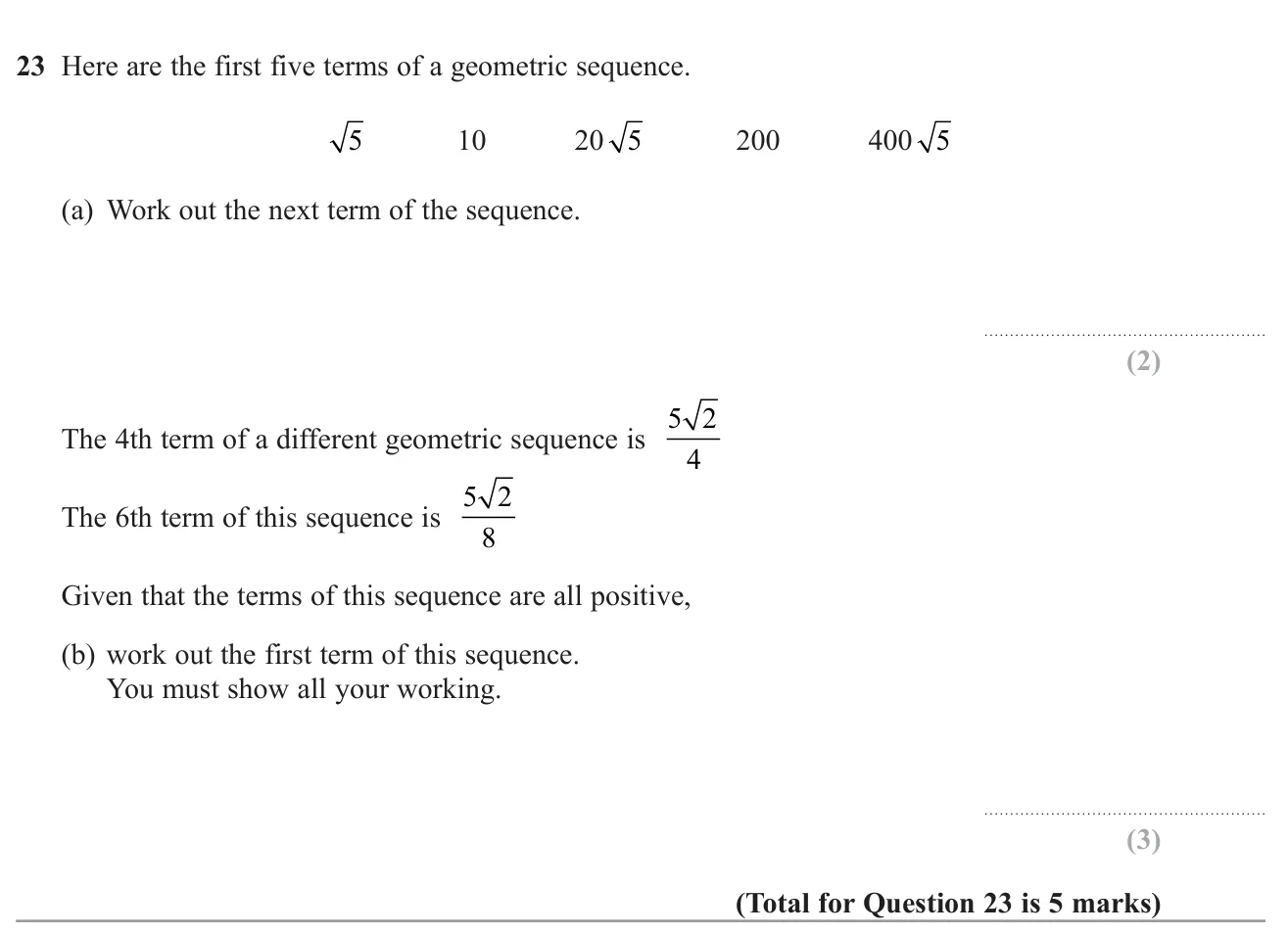
(a) 4000 4000 4000 2 marks (b) 5 5 5 3 marks
Worked solution Checked against the mark scheme
(a) Ratio: 10 ÷ 5 = 2 5 10 \div \sqrt{5} = 2\sqrt{5} 10 ÷ 5 = 2 5
Next term: 400 5 × 2 5 = 800 × 5 = 4000 400\sqrt{5} \times 2\sqrt{5} = 800 \times 5 = 4000 400 5 × 2 5 = 800 × 5 = 4000
(b) r 2 = 5 2 8 ÷ 5 2 4 = 1 2 r^2 = \frac{5\sqrt{2}}{8} \div \frac{5\sqrt{2}}{4} = \frac{1}{2} r 2 = 8 5 2 ÷ 4 5 2 = 2 1 r = 1 2 r = \frac{1}{\sqrt{2}} r = 2 1
a = 5 2 4 ÷ r 3 = 5 2 4 × 2 2 = 20 4 = 5 a = \frac{5\sqrt{2}}{4} \div r^3 = \frac{5\sqrt{2}}{4} \times 2\sqrt{2} = \frac{20}{4} = 5 a = 4 5 2 ÷ r 3 = 4 5 2 × 2 2 = 4 20 = 5
Watch out: In (b), dividing the 4th term by r 4 r^4 r 4 r 3 r^3 r 3
Also tested in these questions Their main topic is different, but part of each one tests this topic.