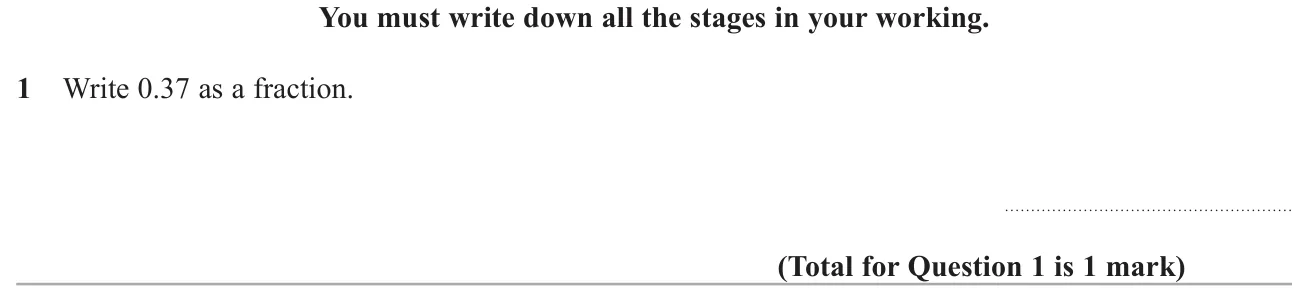
© Pearson Education Ltd. November 2020 Paper 2 (Foundation, calculator), question 1.
Answer 37 100 \frac{37}{100} 100 37 1 mark
Worked solution Checked against the mark scheme
The 7 is in the hundredths column, so 0.37 0.37 0.37
0.37 = 37 100 0.37 = \frac{37}{100} 0.37 = 100 37
Watch out: Writing 37 10 \frac{37}{10} 10 37 3 7 \frac{3}{7} 7 3
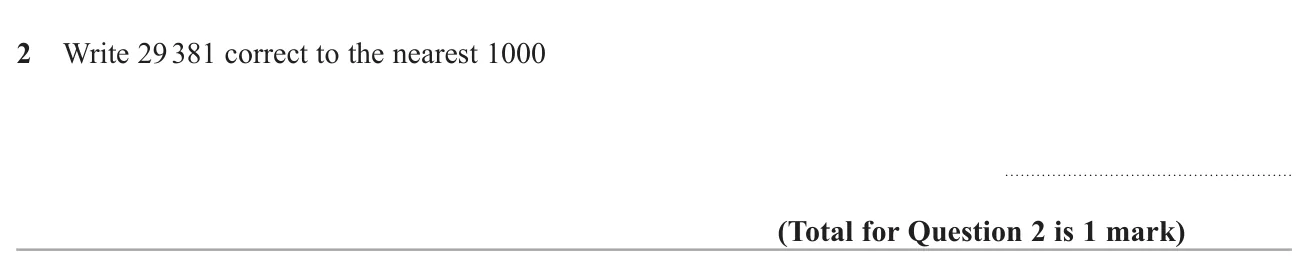
© Pearson Education Ltd. November 2020 Paper 2 (Foundation, calculator), question 2.
Worked solution Checked against the mark scheme
Look at the hundreds digit: 29 3 81. It is 3, which is less than 5, so round down.
29 381 ≈ 29 000 29\,381 \approx 29\,000 29 381 ≈ 29 000
Watch out: Rounding up to 30 000.
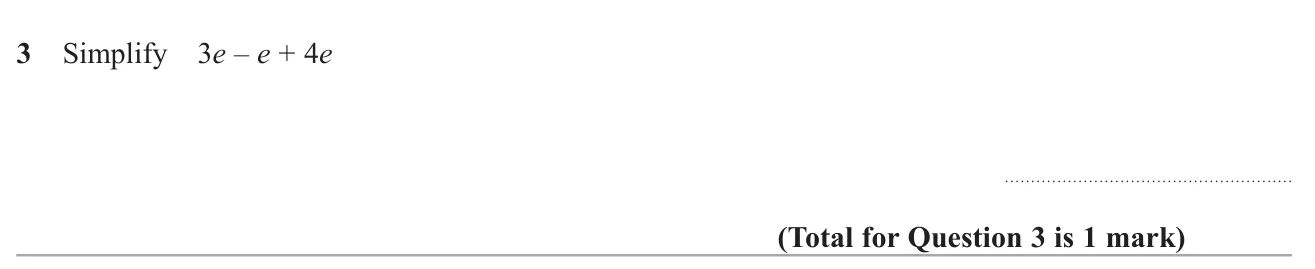
© Pearson Education Ltd. November 2020 Paper 2 (Foundation, calculator), question 3.
Worked solution Checked against the mark scheme
Combine the numbers in front of e e e 3 − 1 + 4 = 6 3 - 1 + 4 = 6 3 − 1 + 4 = 6
So the expression simplifies to 6 e 6e 6 e
Watch out: Treating e e e 0 e 0e 0 e 7 e 7e 7 e
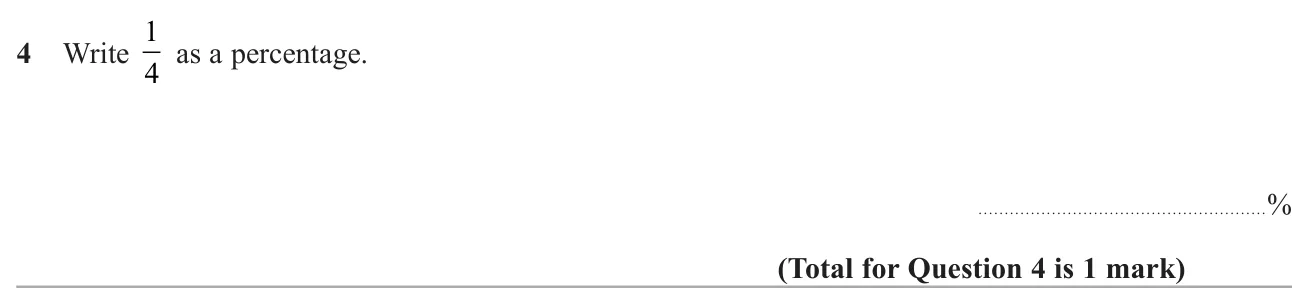
© Pearson Education Ltd. November 2020 Paper 2 (Foundation, calculator), question 4.
Worked solution Checked against the mark scheme
1 4 = 1 ÷ 4 = 0.25 \frac{1}{4} = 1 \div 4 = 0.25 4 1 = 1 ÷ 4 = 0.25
0.25 × 100 = 25 % 0.25 \times 100 = 25\% 0.25 × 100 = 25%
Watch out: Writing 14% or 4%.
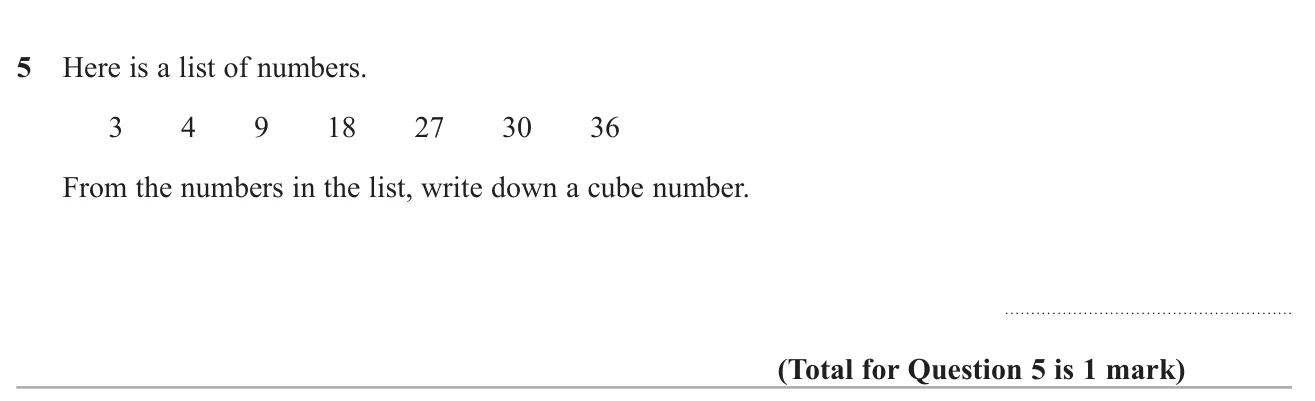
© Pearson Education Ltd. November 2020 Paper 2 (Foundation, calculator), question 5.
Worked solution Checked against the mark scheme
Cube numbers are 1 , 8 , 27 , 64 , … 1, 8, 27, 64, \ldots 1 , 8 , 27 , 64 , …
3 3 = 3 × 3 × 3 = 27 3^3 = 3 \times 3 \times 3 = 27 3 3 = 3 × 3 × 3 = 27
Watch out: Choosing 9 (a square number) or 3.
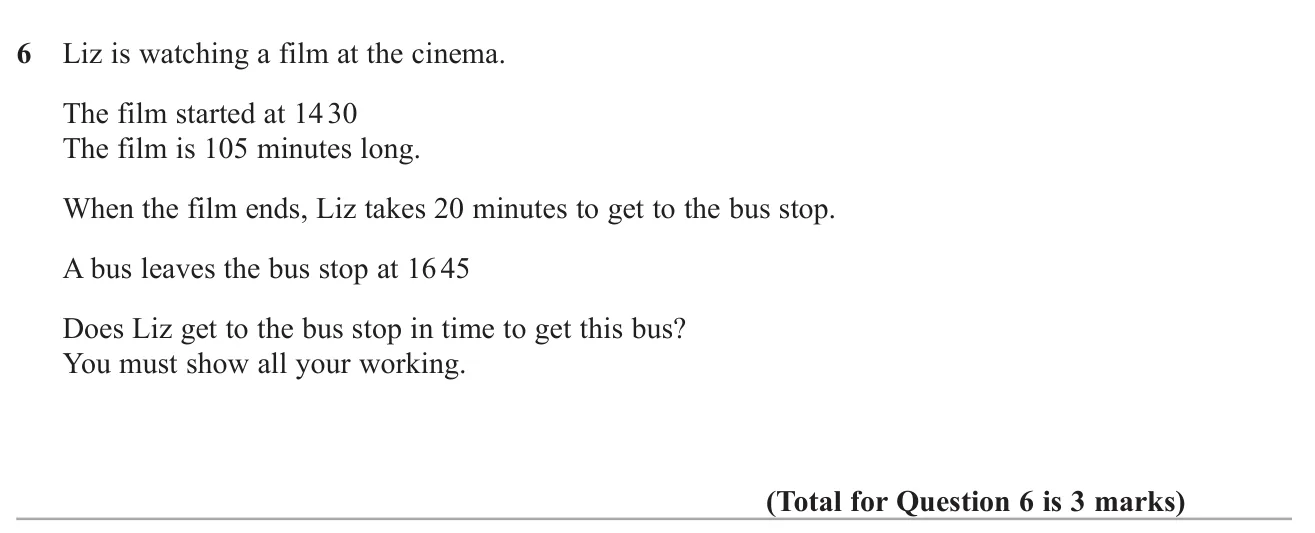
© Pearson Education Ltd. November 2020 Paper 2 (Foundation, calculator), question 6.
Answer Yes: she reaches the stop at 16 35, 10 minutes before the bus 3 marks
Worked solution Checked against the mark scheme
105 minutes = 1 hour 45 minutes.
Film ends: 14 30 + 1 h 45 min = 16 15
At the bus stop: 16 15 + 20 min = 16 35
16 35 is before 16 45, so yes , with 10 minutes to spare.
Watch out: Treating 105 minutes as 1 hour 5 minutes, or adding times as decimals.
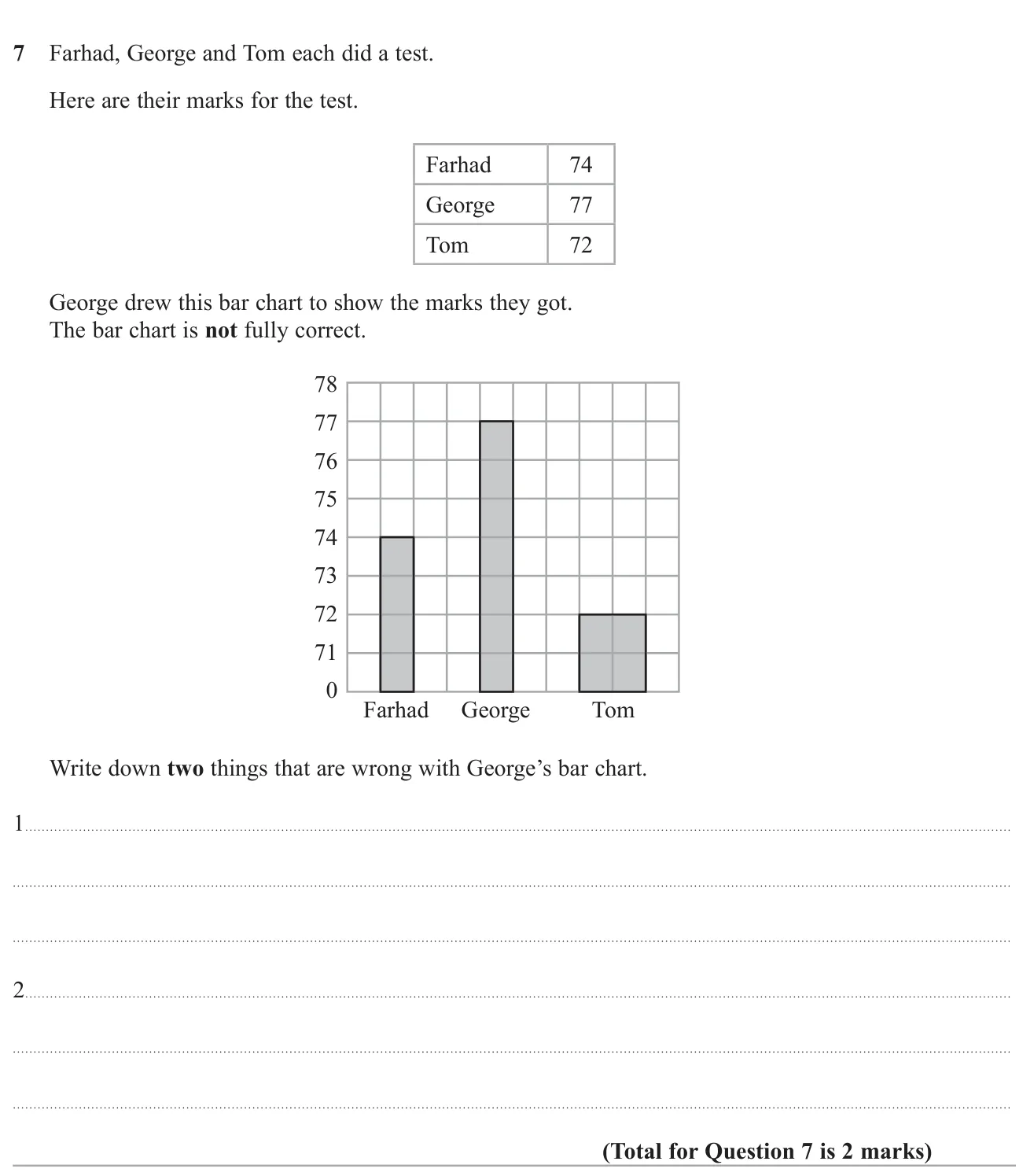
© Pearson Education Ltd. November 2020 Paper 2 (Foundation, calculator), question 7.
Answer Any two of: the vertical axis has no label; the scale jumps from 0 to 71; Tom's bar is wider than the others 2 marks
Worked solution Checked against the mark scheme
Check the chart against good practice:
- The vertical axis has no label (e.g. 'Mark').
Any two of these earn the marks.
Watch out: Saying the chart has no title, which is not accepted.
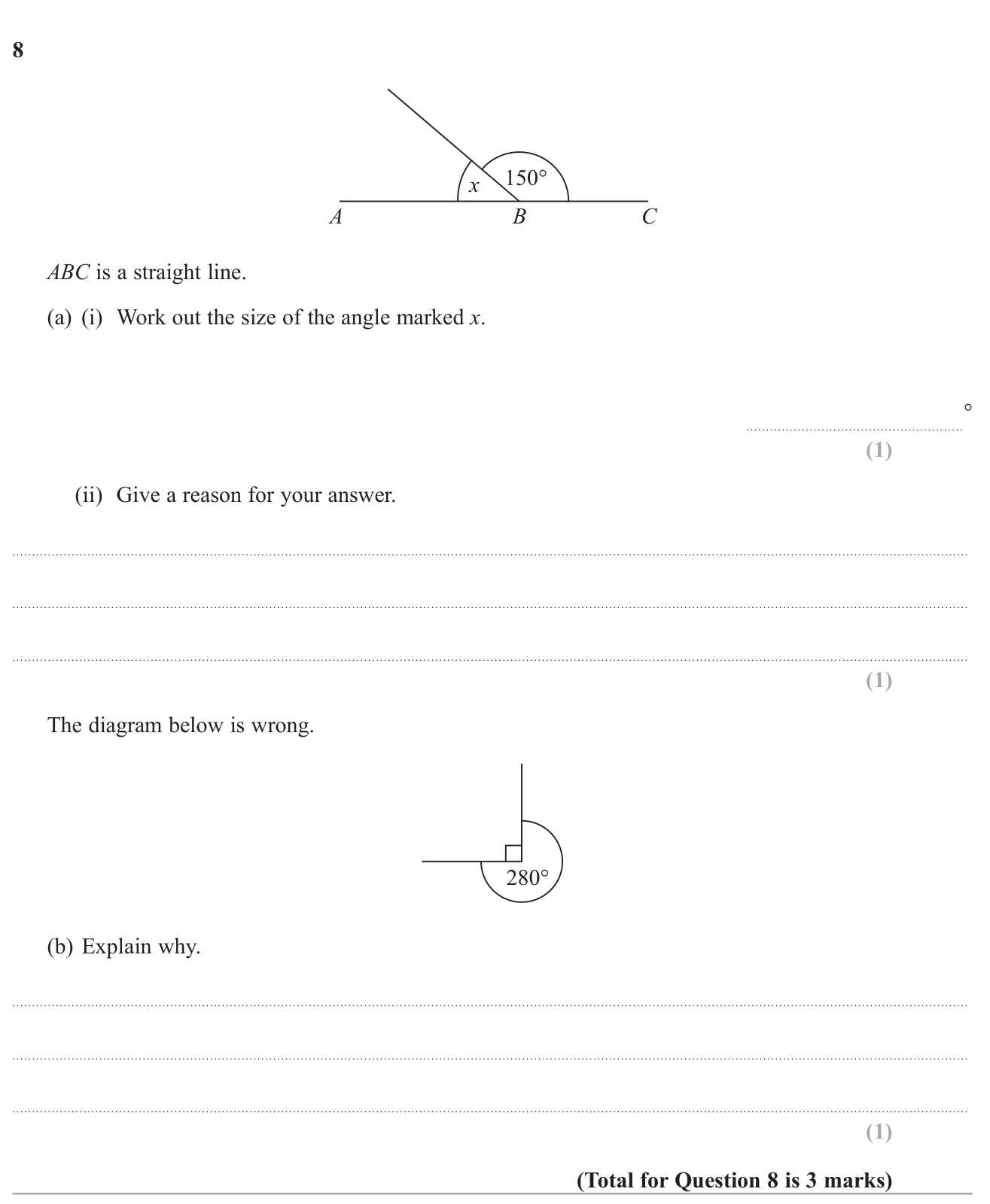
© Pearson Education Ltd. November 2020 Paper 2 (Foundation, calculator), question 8.
(a(i)) 30 1 mark (a(ii)) Angles on a straight line add up to 180 ∘ 180^\circ 18 0 ∘ 1 mark (b) 90 + 280 = 370 90 + 280 = 370 90 + 280 = 370 360 ∘ 360^\circ 36 0 ∘ 1 mark
Worked solution Checked against the mark scheme
(a) Angles on a straight line add up to 180 ∘ 180^\circ 18 0 ∘ x = 180 − 150 = 30 ∘ x = 180 - 150 = 30^\circ x = 180 − 150 = 3 0 ∘
(b) Angles around a point make 360 ∘ 360^\circ 36 0 ∘ 90 + 280 = 370 ∘ 90 + 280 = 370^\circ 90 + 280 = 37 0 ∘ 270 ∘ 270^\circ 27 0 ∘
Watch out: In (b), saying the angles should add up to 180°.
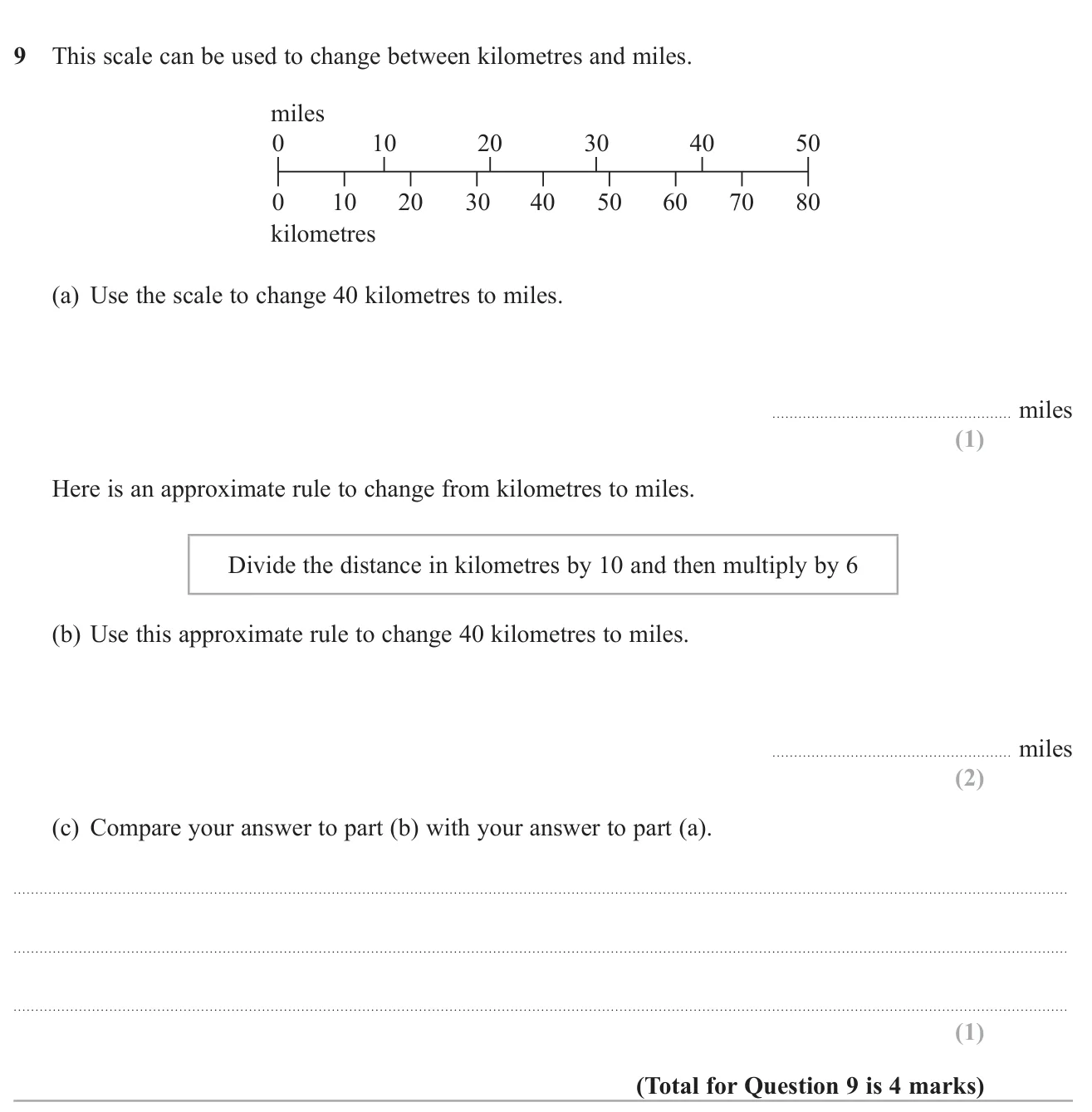
© Pearson Education Ltd. November 2020 Paper 2 (Foundation, calculator), question 9.
(a) 25 miles (24 to 26) 1 mark (b) 24 miles 2 marks (c) The two answers are close; the rule gives a slightly smaller value 1 mark
Worked solution Checked against the mark scheme
(a) Read across from 40 km on the scale: about 25 miles.
(b) 40 ÷ 10 = 4 40 \div 10 = 4 40 ÷ 10 = 4 4 × 6 = 24 4 \times 6 = 24 4 × 6 = 24
(c) 24 is close to 25, but the rule gives a slightly smaller answer.
Watch out: In (a), misreading the scale's intervals.
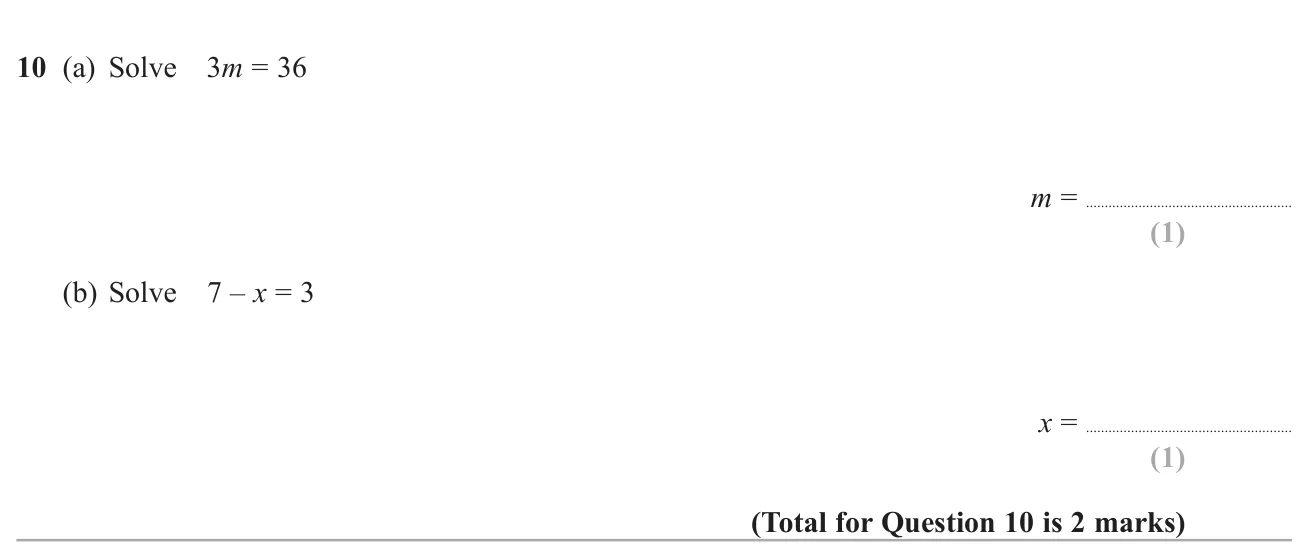
© Pearson Education Ltd. November 2020 Paper 2 (Foundation, calculator), question 10.
(a) m = 12 m = 12 m = 12 1 mark (b) x = 4 x = 4 x = 4 1 mark
Worked solution Checked against the mark scheme
(a) Divide both sides by 3: m = 36 ÷ 3 = 12 m = 36 \div 3 = 12 m = 36 ÷ 3 = 12
(b) 7 − x = 3 7 - x = 3 7 − x = 3 x = 7 − 3 = 4 x = 7 - 3 = 4 x = 7 − 3 = 4
Watch out: In (b), giving x = − 4 x = -4 x = − 4 x = 10 x = 10 x = 10
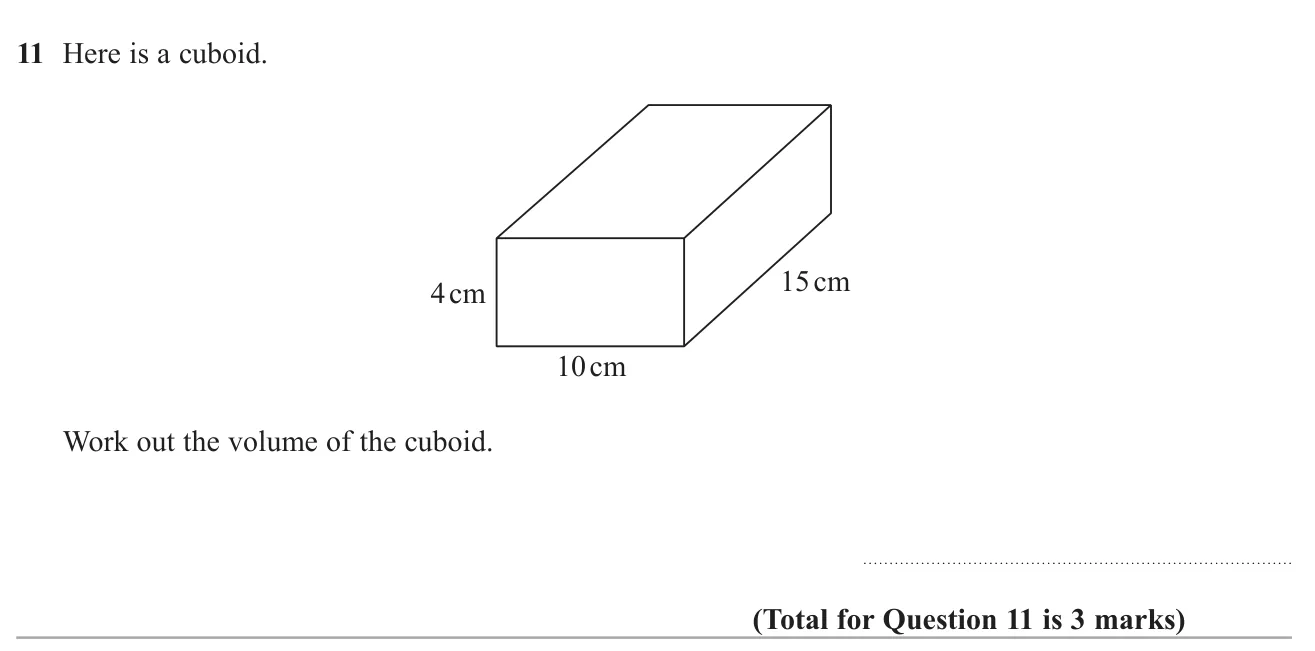
© Pearson Education Ltd. November 2020 Paper 2 (Foundation, calculator), question 11.
Answer 600 cm 3 600\text{ cm}^3 600 cm 3 3 marks
Worked solution Checked against the mark scheme
Volume = length × width × height
= 15 × 10 × 4 = 600 = 15 \times 10 \times 4 = 600 = 15 × 10 × 4 = 600
Answer: 600 cm 3 600\text{ cm}^3 600 cm 3
Watch out: Adding the lengths, or giving the units as cm².
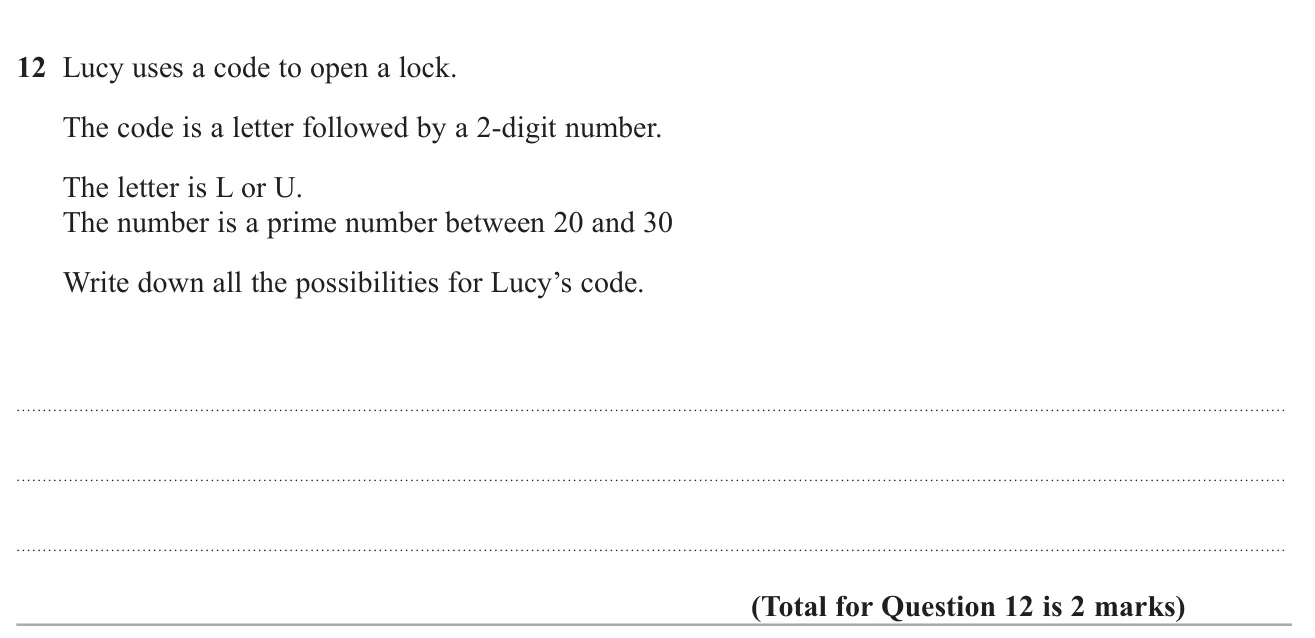
© Pearson Education Ltd. November 2020 Paper 2 (Foundation, calculator), question 12.
Answer L23, L29, U23, U29 2 marks
Worked solution Checked against the mark scheme
Primes between 20 and 30: 23 and 29 (21, 25, 27 are odd but not prime).
Pair each letter with each prime:
L23, L29, U23, U29
Watch out: Including 21 or 27 as primes.
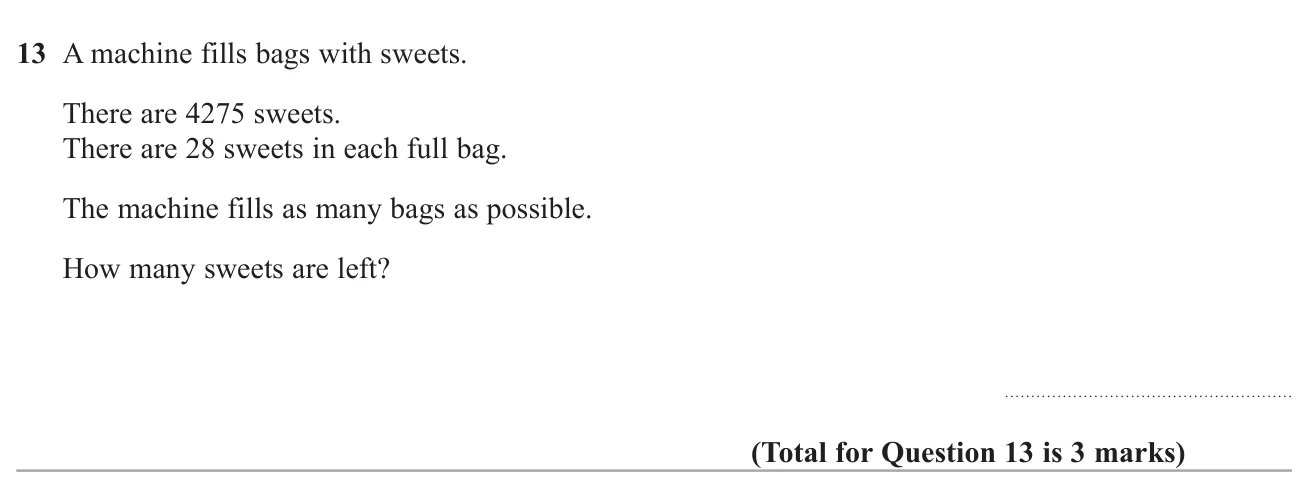
© Pearson Education Ltd. November 2020 Paper 2 (Foundation, calculator), question 13.
Worked solution Checked against the mark scheme
4275 ÷ 28 = 152.67 … 4275 \div 28 = 152.67\ldots 4275 ÷ 28 = 152.67 …
152 × 28 = 4256 152 \times 28 = 4256 152 × 28 = 4256
4275 − 4256 = 19 4275 - 4256 = 19 4275 − 4256 = 19
Watch out: Giving the decimal remainder 0.67 or 152 bags as the answer.
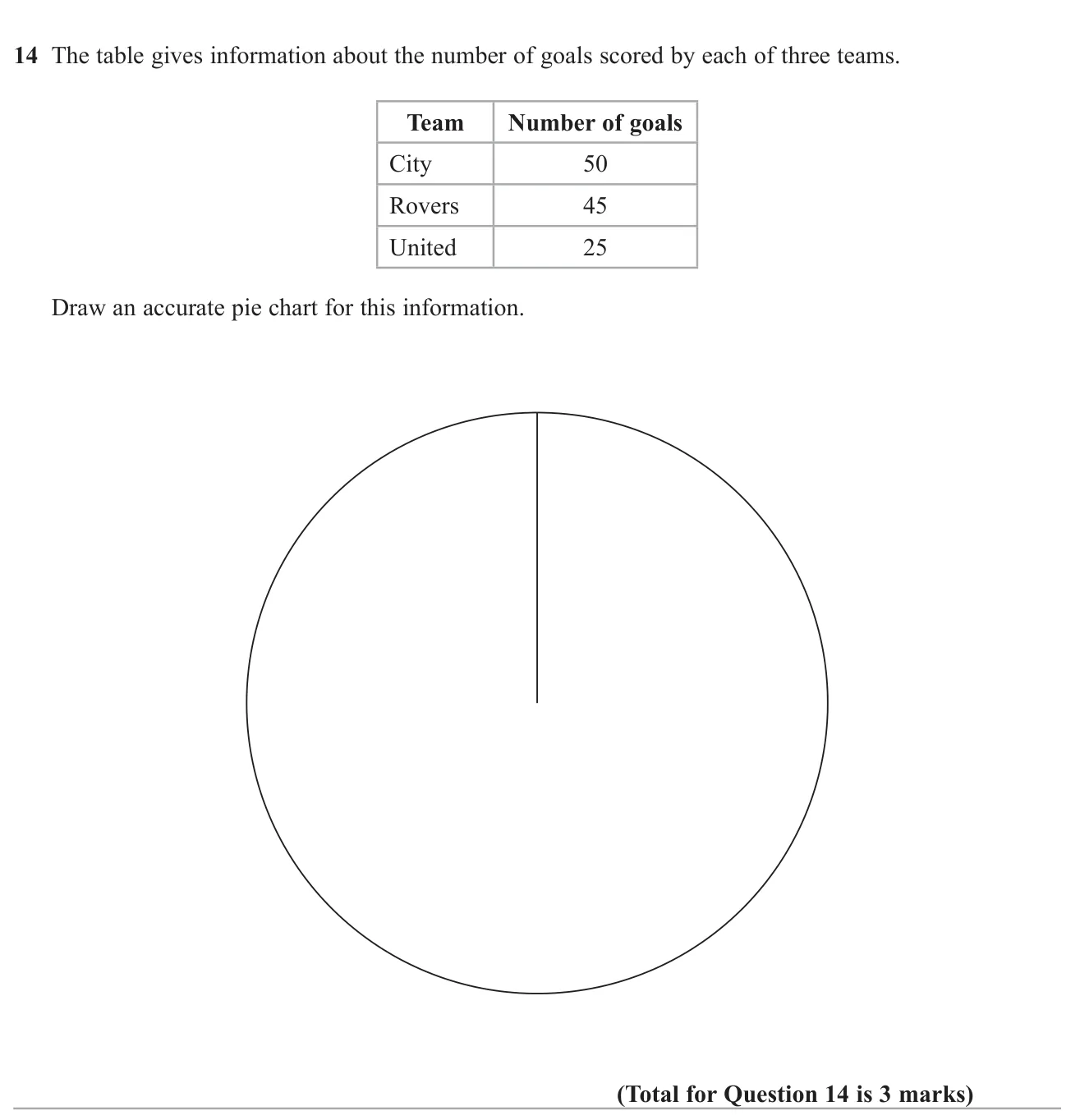
© Pearson Education Ltd. November 2020 Paper 2 (Foundation, calculator), question 14.
Answer Sectors of 150 ∘ 150^\circ 15 0 ∘ 135 ∘ 135^\circ 13 5 ∘ 75 ∘ 75^\circ 7 5 ∘ 3 marks
Worked solution Checked against the mark scheme
Total goals: 50 + 45 + 25 = 120 50 + 45 + 25 = 120 50 + 45 + 25 = 120
Each goal is 360 ÷ 120 = 3 ∘ 360 \div 120 = 3^\circ 360 ÷ 120 = 3 ∘
City 50 × 3 = 150 ∘ 50 \times 3 = 150^\circ 50 × 3 = 15 0 ∘ 45 × 3 = 135 ∘ 45 \times 3 = 135^\circ 45 × 3 = 13 5 ∘ 25 × 3 = 75 ∘ 25 \times 3 = 75^\circ 25 × 3 = 7 5 ∘
Draw and label each sector with a protractor.
Watch out: Using the goal numbers as the angles.
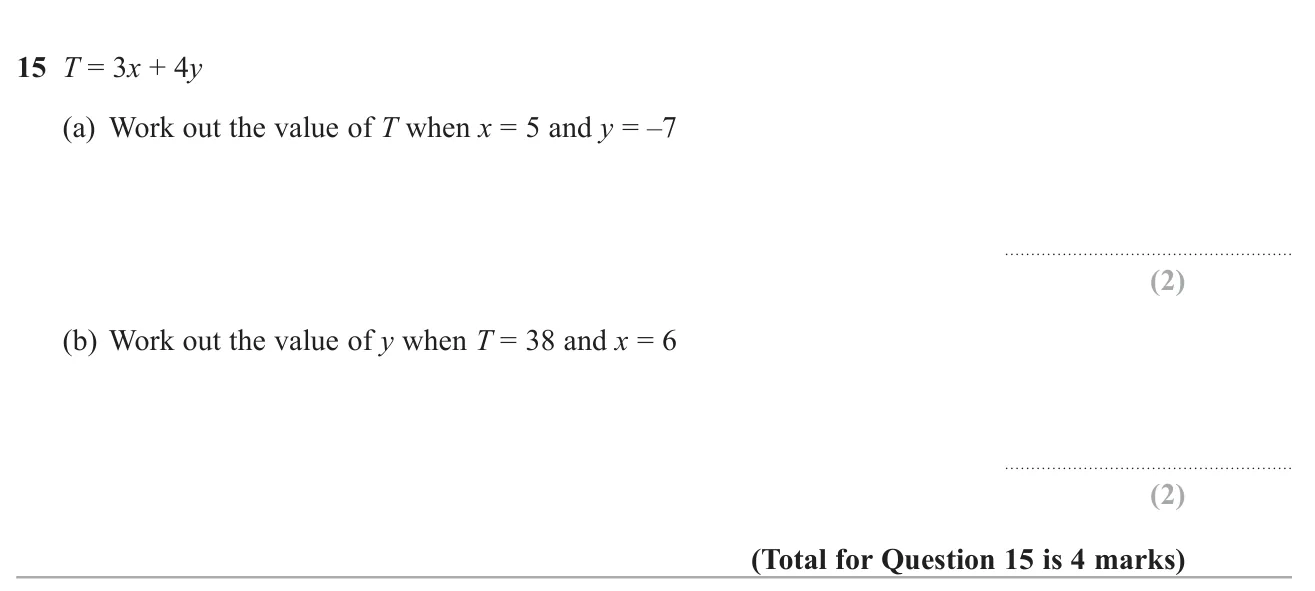
© Pearson Education Ltd. November 2020 Paper 2 (Foundation, calculator), question 15.
(a) − 13 -13 − 13 2 marks (b) y = 5 y = 5 y = 5 2 marks
Worked solution Checked against the mark scheme
(a) T = 3 ( 5 ) + 4 ( − 7 ) = 15 − 28 = − 13 T = 3(5) + 4(-7) = 15 - 28 = -13 T = 3 ( 5 ) + 4 ( − 7 ) = 15 − 28 = − 13
(b) 38 = 3 ( 6 ) + 4 y = 18 + 4 y 38 = 3(6) + 4y = 18 + 4y 38 = 3 ( 6 ) + 4 y = 18 + 4 y
4 y = 20 4y = 20 4 y = 20 y = 5 y = 5 y = 5
Watch out: In (a), getting 43 by ignoring the negative sign.
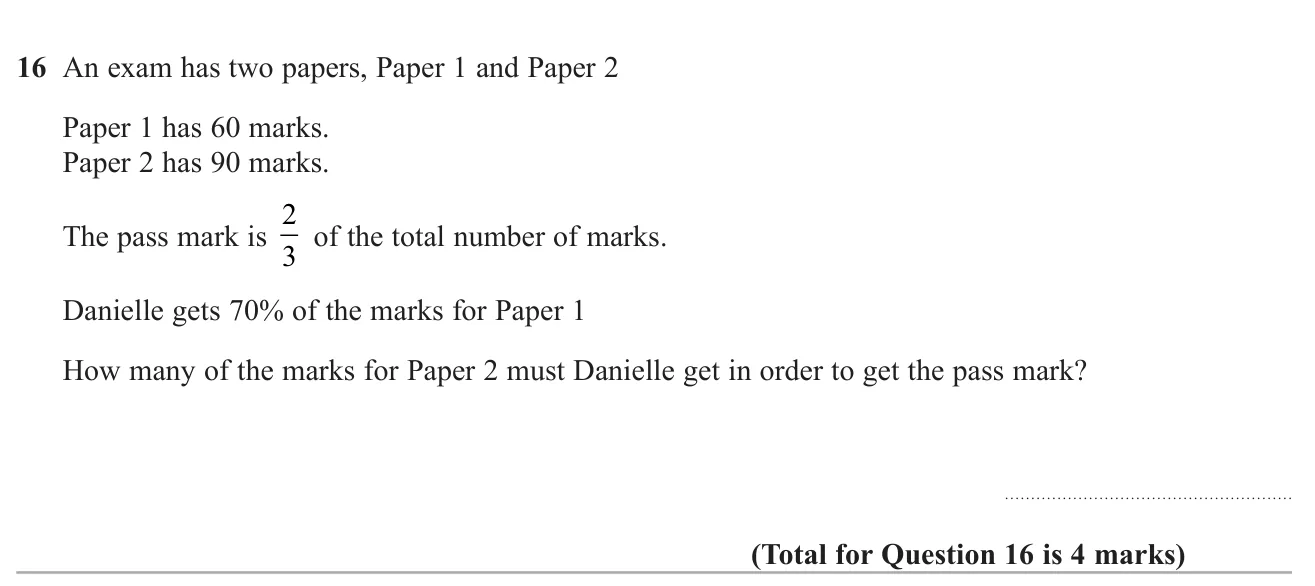
© Pearson Education Ltd. November 2020 Paper 2 (Foundation, calculator), question 16.
Worked solution Checked against the mark scheme
Total marks: 60 + 90 = 150 60 + 90 = 150 60 + 90 = 150
Pass mark: 2 3 × 150 = 100 \frac{2}{3} \times 150 = 100 3 2 × 150 = 100
Paper 1: 70 % × 60 = 42 70\% \times 60 = 42 70% × 60 = 42
Needed on Paper 2: 100 − 42 = 58 100 - 42 = 58 100 − 42 = 58
Watch out: Finding two-thirds of Paper 2 only (60) and forgetting Paper 1.
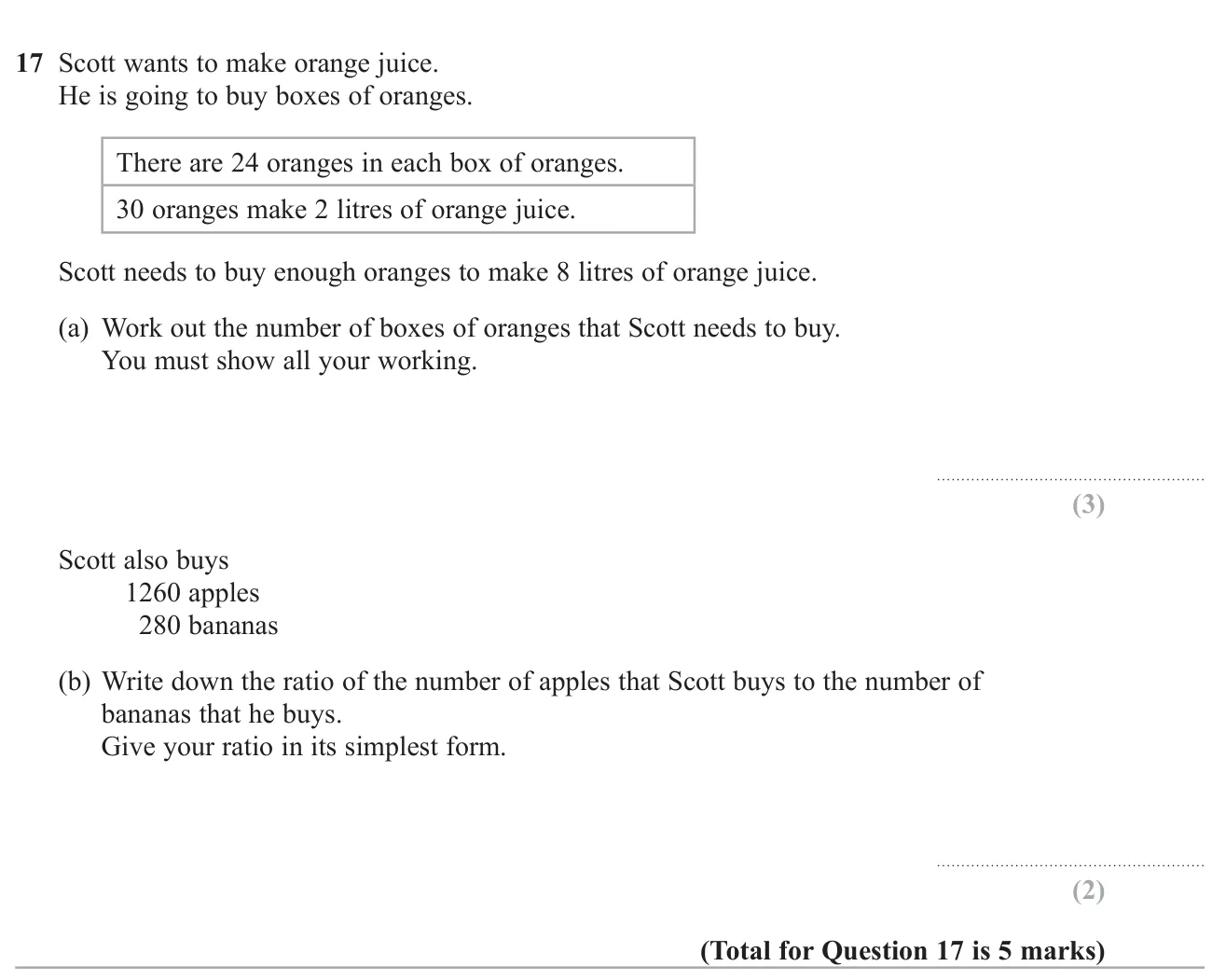
Question 17 Ratio 5 marks Grade 3 Calculator © Pearson Education Ltd. November 2020 Paper 2 (Foundation, calculator), question 17.
(a) 5 boxes 3 marks (b) 9 : 2 9 : 2 9 : 2 2 marks
Worked solution Checked against the mark scheme
(a) 8 litres is 8 ÷ 2 = 4 8 \div 2 = 4 8 ÷ 2 = 4
Oranges needed: 4 × 30 = 120 4 \times 30 = 120 4 × 30 = 120
Boxes: 120 ÷ 24 = 5 120 \div 24 = 5 120 ÷ 24 = 5
(b) 1260 : 280 1260 : 280 1260 : 280 9 : 2 9 : 2 9 : 2
Watch out: In (b), writing the ratio the wrong way round as 2 : 9.
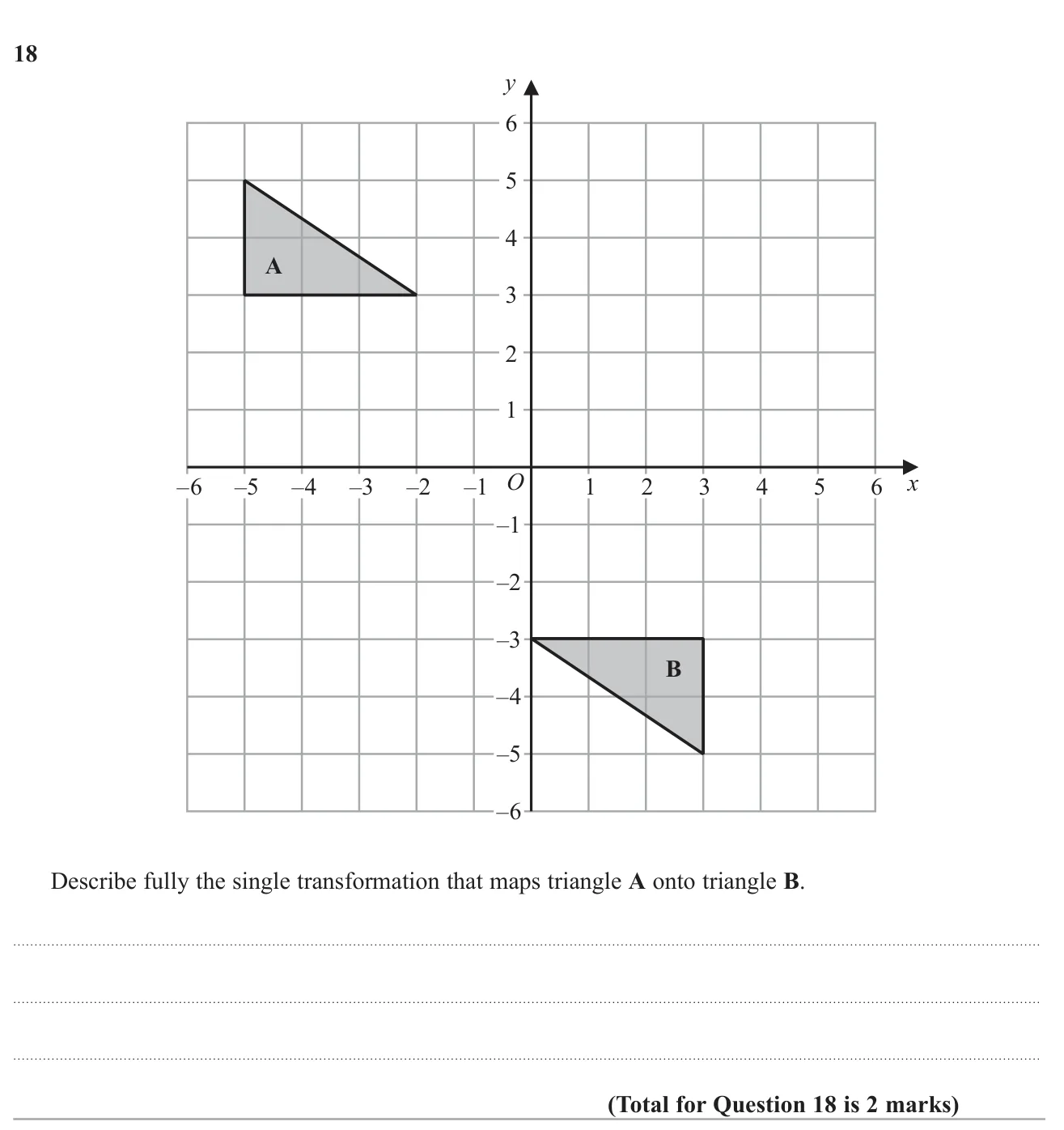
© Pearson Education Ltd. November 2020 Paper 2 (Foundation, calculator), question 18.
Answer Rotation 180 ∘ 180^\circ 18 0 ∘ ( − 1 , 0 ) (-1, 0) ( − 1 , 0 ) 2 marks
Worked solution Checked against the mark scheme
Triangle B is triangle A turned upside down, so it is a half-turn.
A vertex at ( − 5 , 5 ) (-5, 5) ( − 5 , 5 ) ( 3 , − 5 ) (3, -5) ( 3 , − 5 ) ( − 5 + 3 2 , 5 − 5 2 ) = ( − 1 , 0 ) \left(\frac{-5+3}{2}, \frac{5-5}{2}\right) = (-1, 0) ( 2 − 5 + 3 , 2 5 − 5 ) = ( − 1 , 0 )
Rotation 180 ∘ 180^\circ 18 0 ∘ ( − 1 , 0 ) (-1, 0) ( − 1 , 0 )
Watch out: Giving two transformations, such as a reflection and a translation.
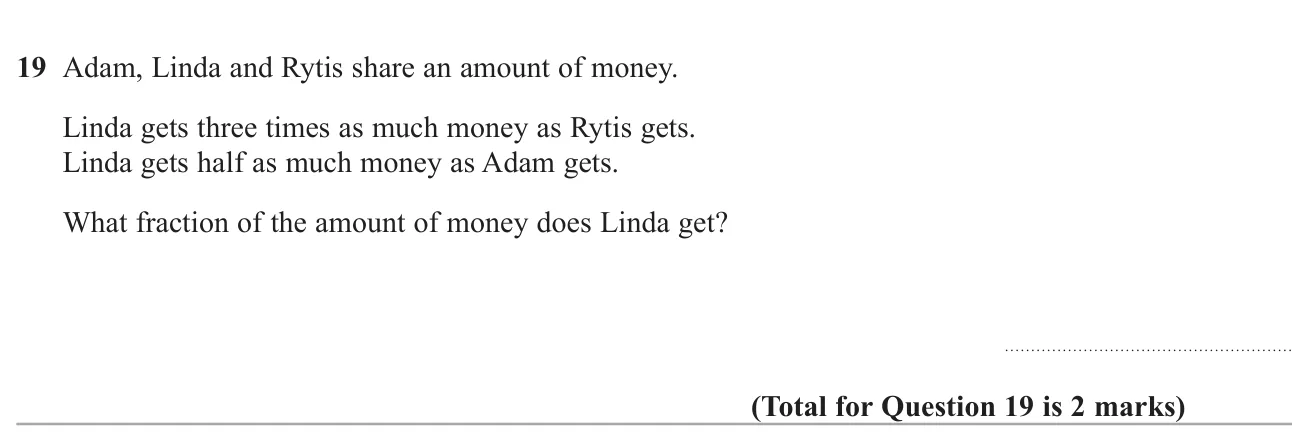
Question 19 Ratio 2 marks Grade 5 Calculator © Pearson Education Ltd. November 2020 Paper 2 (Foundation, calculator), question 19.
Answer 3 10 \frac{3}{10} 10 3 2 marks
Worked solution Checked against the mark scheme
Let Rytis get 1 part. Linda gets 3 × 1 = 3 3 \times 1 = 3 3 × 1 = 3
Total: 1 + 3 + 6 = 10 1 + 3 + 6 = 10 1 + 3 + 6 = 10
Linda gets 3 10 \frac{3}{10} 10 3
Watch out: Halving Linda's share to find Adam's instead of doubling it.
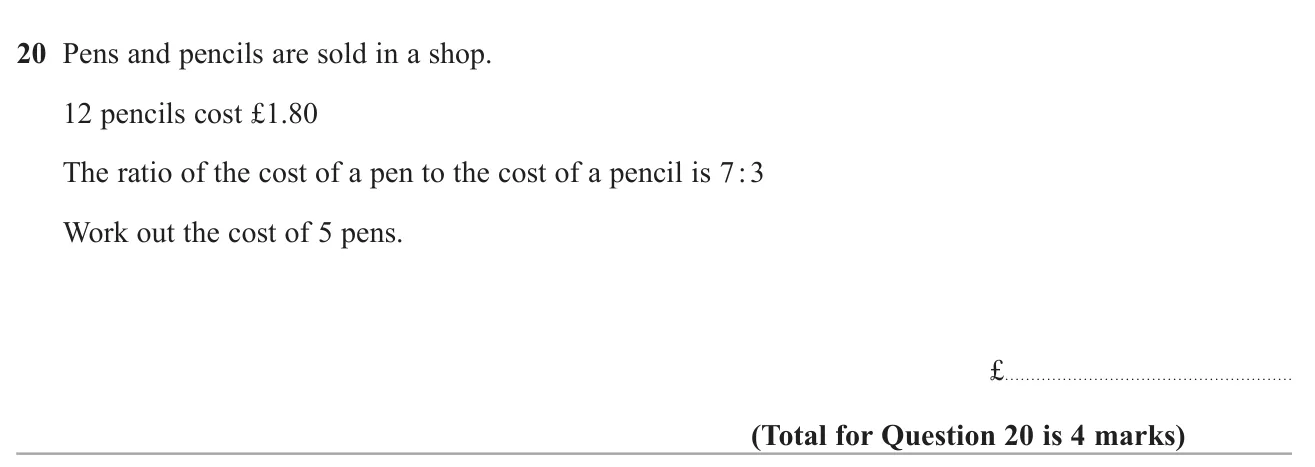
Question 20 Ratio 4 marks Grade 4 Calculator © Pearson Education Ltd. November 2020 Paper 2 (Foundation, calculator), question 20.
Worked solution Checked against the mark scheme
One pencil: £ 1.80 ÷ 12 = £ 0.15 £1.80 \div 12 = £0.15 £1.80 ÷ 12 = £0.15
One ratio part: £ 0.15 ÷ 3 = £ 0.05 £0.15 \div 3 = £0.05 £0.15 ÷ 3 = £0.05
One pen: 7 × £ 0.05 = £ 0.35 7 \times £0.05 = £0.35 7 × £0.05 = £0.35
Five pens: 5 × £ 0.35 = £ 1.75 5 \times £0.35 = £1.75 5 × £0.35 = £1.75
Watch out: Treating 7 : 3 as the split of £1.80.
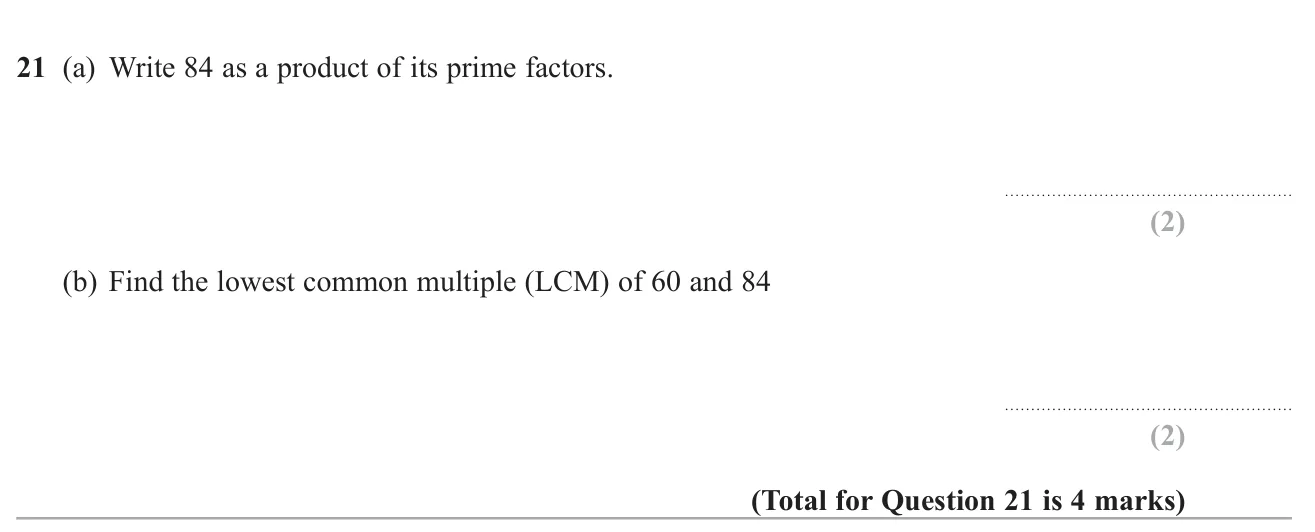
© Pearson Education Ltd. November 2020 Paper 2 (Foundation, calculator), question 21.
(a) 2 × 2 × 3 × 7 2 \times 2 \times 3 \times 7 2 × 2 × 3 × 7 2 marks (b) 420 2 marks
Worked solution Checked against the mark scheme
(a) 84 = 2 × 42 = 2 × 2 × 21 = 2 × 2 × 3 × 7 84 = 2 \times 42 = 2 \times 2 \times 21 = 2 \times 2 \times 3 \times 7 84 = 2 × 42 = 2 × 2 × 21 = 2 × 2 × 3 × 7
(b) 60 = 2 2 × 3 × 5 60 = 2^2 \times 3 \times 5 60 = 2 2 × 3 × 5 84 = 2 2 × 3 × 7 84 = 2^2 \times 3 \times 7 84 = 2 2 × 3 × 7
LCM = 2 2 × 3 × 5 × 7 = 420 = 2^2 \times 3 \times 5 \times 7 = 420 = 2 2 × 3 × 5 × 7 = 420
Watch out: In (b), multiplying 60 × 84 = 5040.
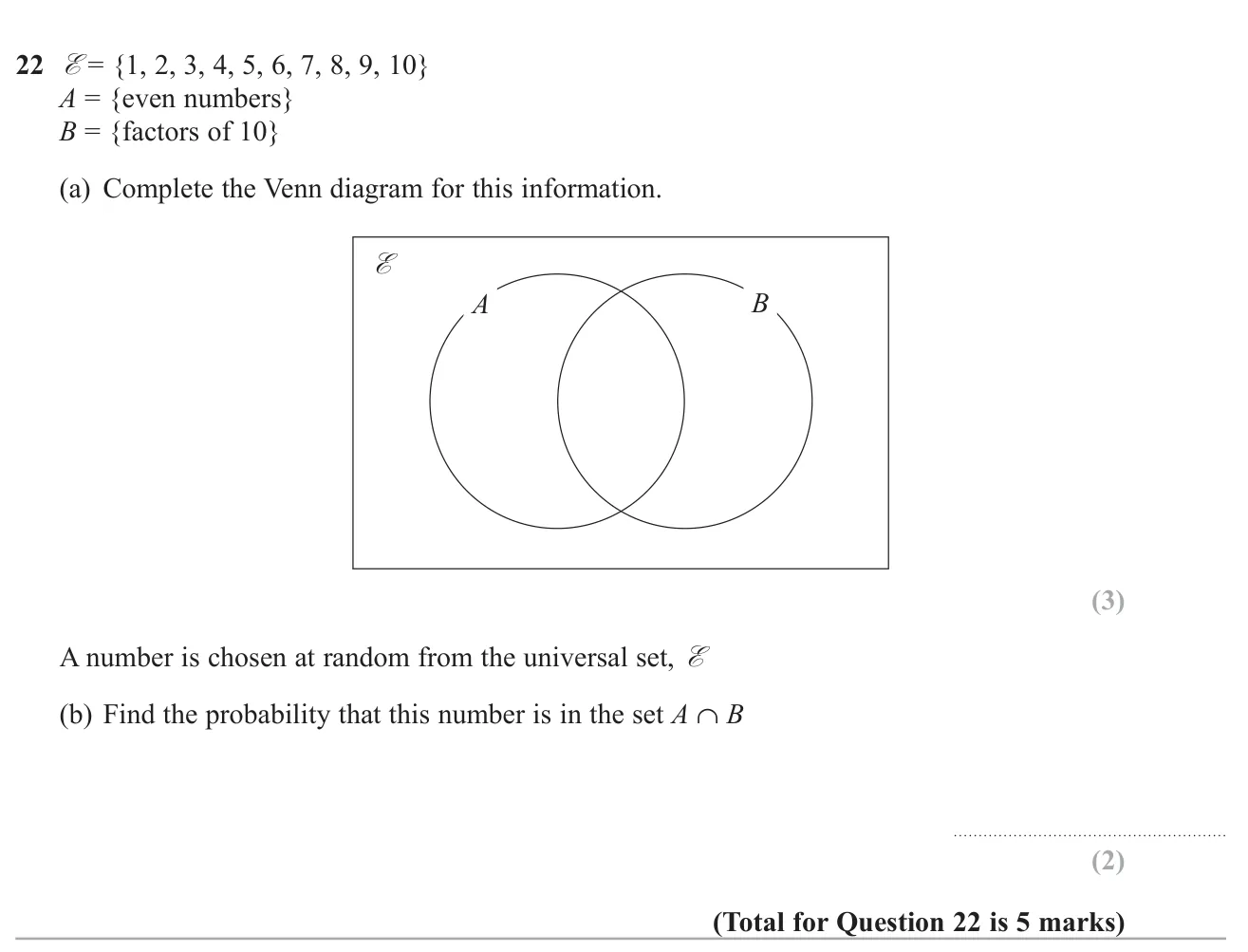
© Pearson Education Ltd. November 2020 Paper 2 (Foundation, calculator), question 22.
(a) A A A A ∩ B A \cap B A ∩ B B B B 3 marks (b) 2 10 \frac{2}{10} 10 2 2 marks
Worked solution Checked against the mark scheme
(a) Even: 2, 4, 6, 8, 10. Factors of 10: 1, 2, 5, 10.
Both: 2, 10. Only A A A B B B
(b) A ∩ B A \cap B A ∩ B 2 10 = 1 5 \frac{2}{10} = \frac{1}{5} 10 2 = 5 1
Watch out: Forgetting that 1 and 10 are factors of 10.
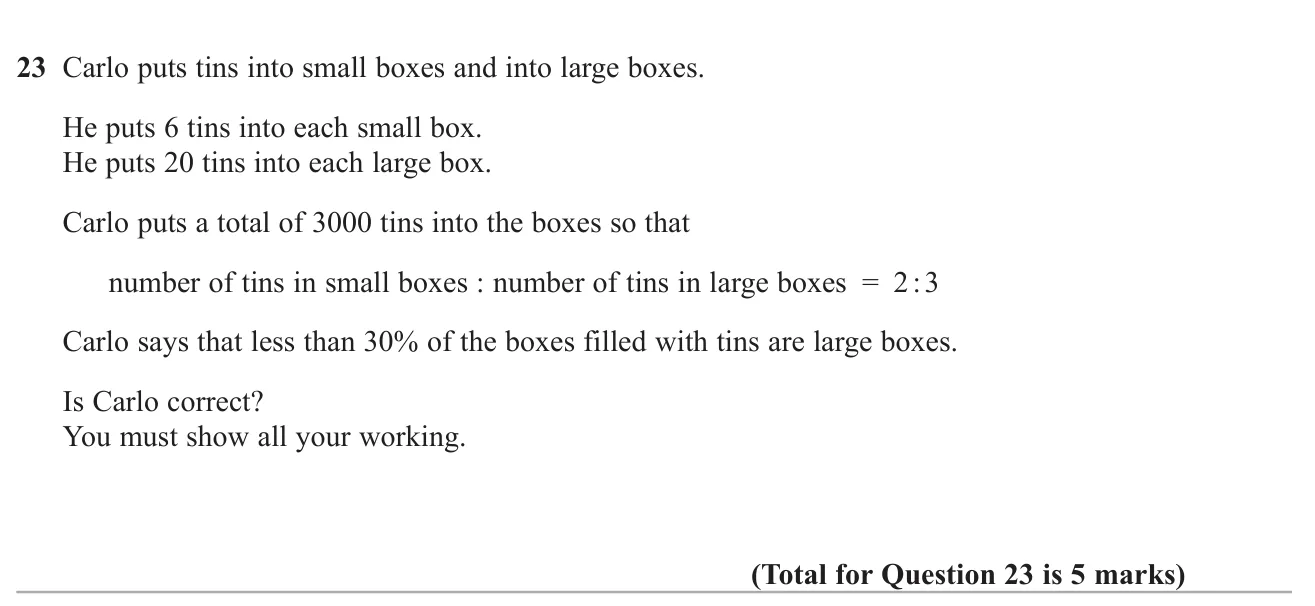
Question 23 Ratio 5 marks Grade 5 Calculator On both tiers © Pearson Education Ltd. November 2020 Paper 2 (Foundation, calculator), question 23.
Answer No: 90 of 290 boxes are large, which is about 31% 5 marks
Worked solution Checked against the mark scheme
One part: 3000 ÷ 5 = 600 3000 \div 5 = 600 3000 ÷ 5 = 600
Small boxes: 2 × 600 = 1200 2 \times 600 = 1200 2 × 600 = 1200 1200 ÷ 6 = 200 1200 \div 6 = 200 1200 ÷ 6 = 200
Large boxes: 3 × 600 = 1800 3 \times 600 = 1800 3 × 600 = 1800 1800 ÷ 20 = 90 1800 \div 20 = 90 1800 ÷ 20 = 90
90 290 × 100 = 31.0 % \frac{90}{290} \times 100 = 31.0\% 290 90 × 100 = 31.0% not correct.
Watch out: Using the tin ratio (60% large) instead of the number of boxes.
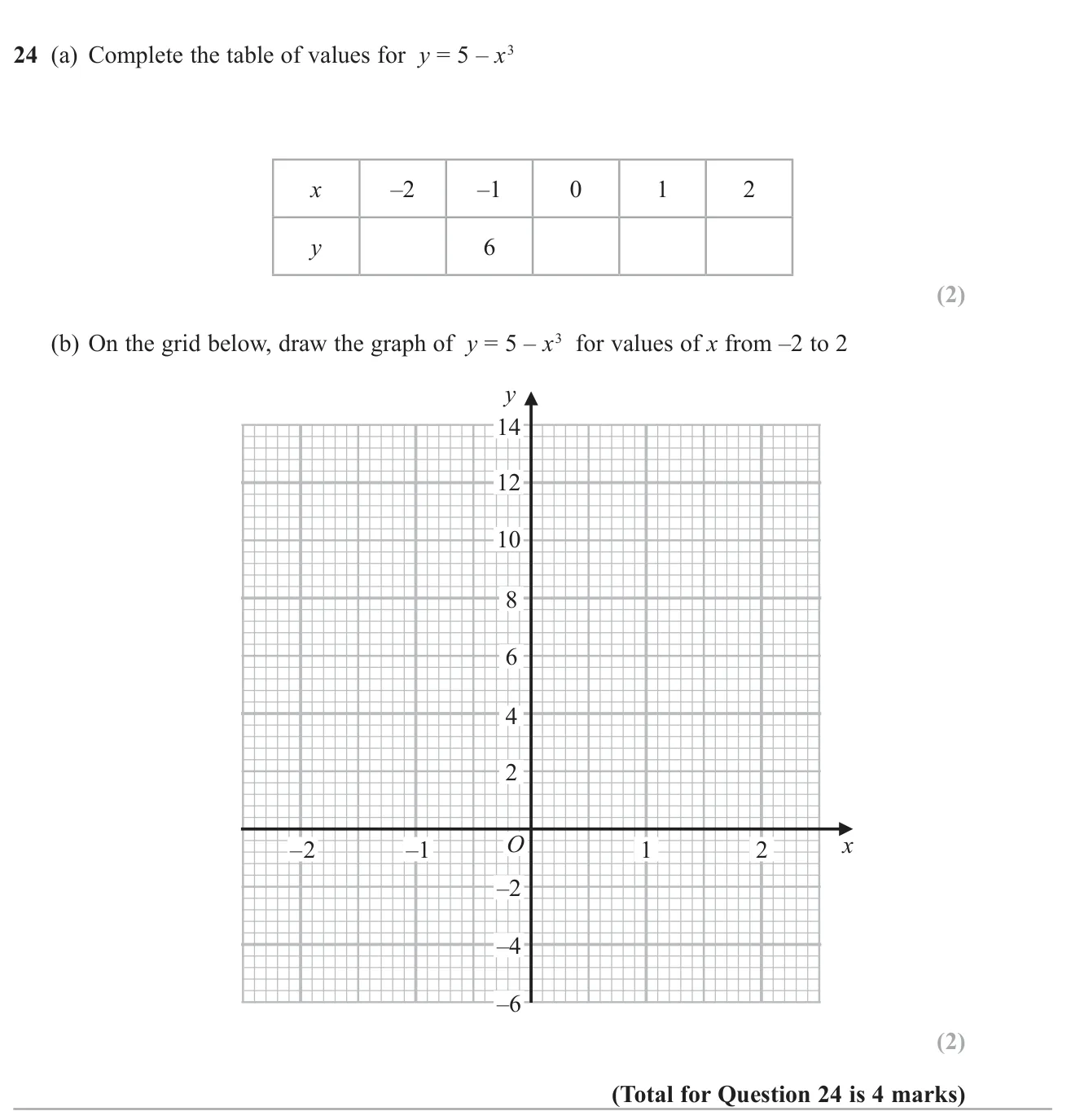
© Pearson Education Ltd. November 2020 Paper 2 (Foundation, calculator), question 24.
(a) 13, 5, 4, − 3 -3 − 3 x = − 2 , 0 , 1 , 2 x = -2, 0, 1, 2 x = − 2 , 0 , 1 , 2 2 marks (b) Smooth curve through ( − 2 , 13 ) (-2, 13) ( − 2 , 13 ) ( − 1 , 6 ) (-1, 6) ( − 1 , 6 ) ( 0 , 5 ) (0, 5) ( 0 , 5 ) ( 1 , 4 ) (1, 4) ( 1 , 4 ) ( 2 , − 3 ) (2, -3) ( 2 , − 3 ) 2 marks
Worked solution Checked against the mark scheme
(a) x = − 2 x = -2 x = − 2 5 − ( − 8 ) = 13 5 - (-8) = 13 5 − ( − 8 ) = 13 x = 0 x = 0 x = 0 5 5 5 x = 1 x = 1 x = 1 5 − 1 = 4 5 - 1 = 4 5 − 1 = 4 x = 2 x = 2 x = 2 5 − 8 = − 3 5 - 8 = -3 5 − 8 = − 3
(b) Plot the five points and join them with a smooth curve, not straight lines.
Watch out: Working out ( − 2 ) 3 (-2)^3 ( − 2 ) 3 + 8 +8 + 8 − 3 -3 − 3
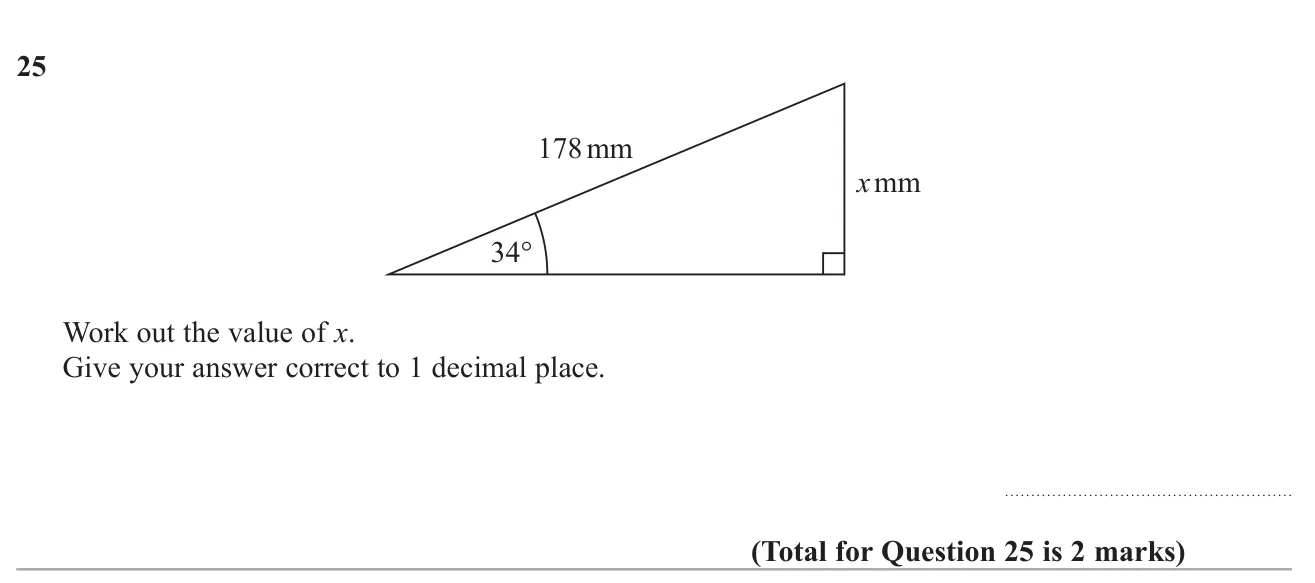
© Pearson Education Ltd. November 2020 Paper 2 (Foundation, calculator), question 25.
Worked solution Checked against the mark scheme
x x x 34 ∘ 34^\circ 3 4 ∘
x = 178 × sin 34 ∘ = 99.536 … x = 178 \times \sin 34^\circ = 99.536\ldots x = 178 × sin 3 4 ∘ = 99.536 …
x = 99.5 x = 99.5 x = 99.5
Watch out: Using cosine and getting 147.6.
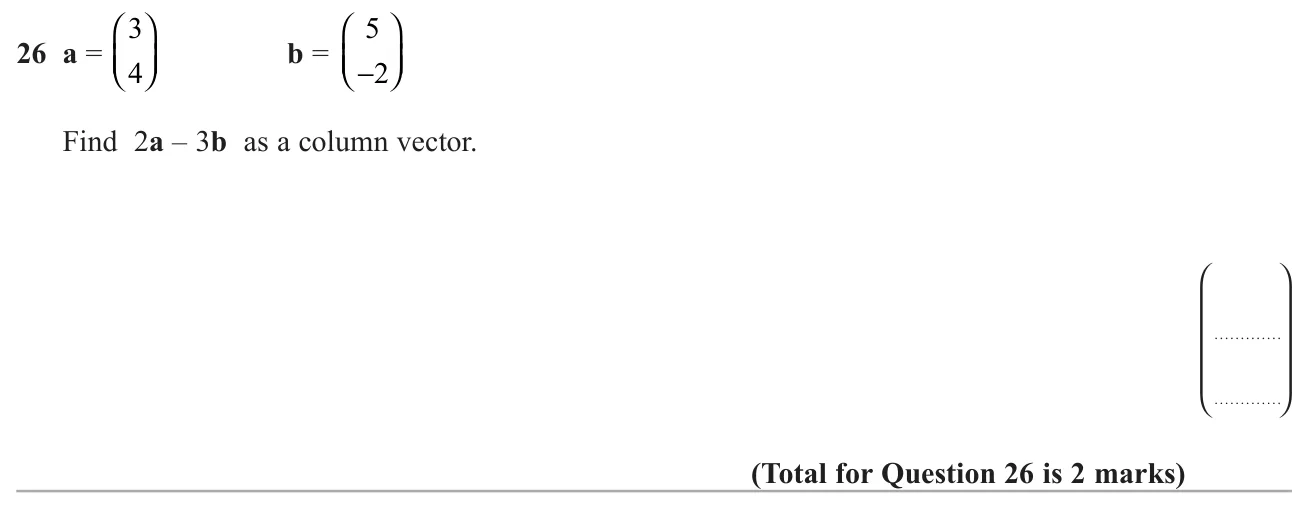
Question 26 Vectors 2 marks Grade 5 Calculator On both tiers © Pearson Education Ltd. November 2020 Paper 2 (Foundation, calculator), question 26.
Answer ( − 9 14 ) \begin{pmatrix} -9 \\ 14 \end{pmatrix} ( − 9 14 ) 2 marks
Worked solution Checked against the mark scheme
2 a = ( 6 8 ) 2\mathbf{a} = \begin{pmatrix} 6 \\ 8 \end{pmatrix} 2 a = ( 6 8 ) 3 b = ( 15 − 6 ) 3\mathbf{b} = \begin{pmatrix} 15 \\ -6 \end{pmatrix} 3 b = ( 15 − 6 )
2 a − 3 b = ( 6 − 15 8 − ( − 6 ) ) = ( − 9 14 ) 2\mathbf{a} - 3\mathbf{b} = \begin{pmatrix} 6 - 15 \\ 8 - (-6) \end{pmatrix} = \begin{pmatrix} -9 \\ 14 \end{pmatrix} 2 a − 3 b = ( 6 − 15 8 − ( − 6 ) ) = ( − 9 14 )
Watch out: Getting 2 for the bottom entry by subtracting − 6 -6 − 6
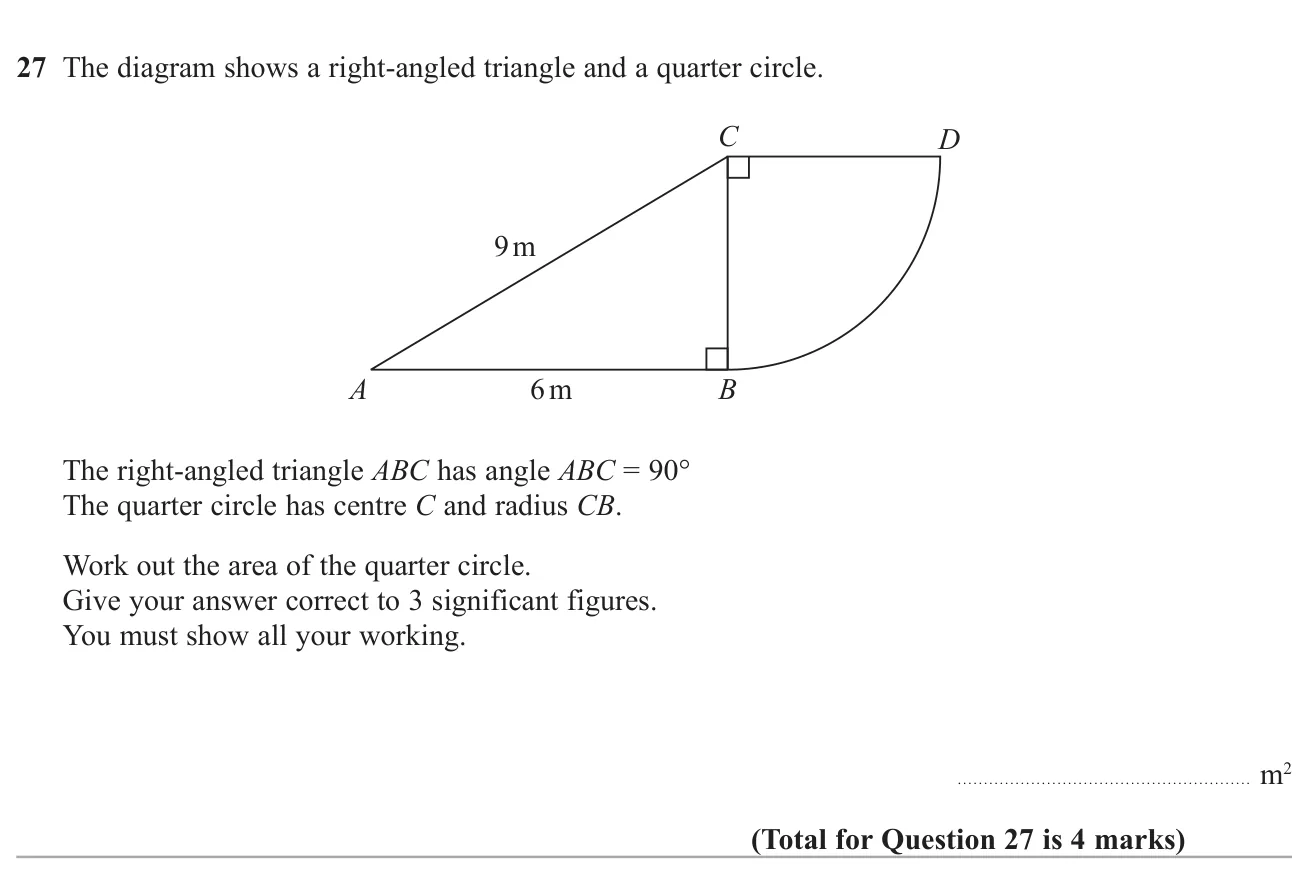
© Pearson Education Ltd. November 2020 Paper 2 (Foundation, calculator), question 27.
Worked solution Checked against the mark scheme
C B 2 = 9 2 − 6 2 = 81 − 36 = 45 CB^2 = 9^2 - 6^2 = 81 - 36 = 45 C B 2 = 9 2 − 6 2 = 81 − 36 = 45 C B = 45 CB = \sqrt{45} C B = 45
Quarter circle area = 1 4 π r 2 = 1 4 × π × 45 = 35.34 … = \frac{1}{4} \pi r^2 = \frac{1}{4} \times \pi \times 45 = 35.34\ldots = 4 1 π r 2 = 4 1 × π × 45 = 35.34 …
= 35.3 m 2 = 35.3\text{ m}^2 = 35.3 m 2
Watch out: Adding the squares (9 2 + 6 2 9^2 + 6^2 9 2 + 6 2
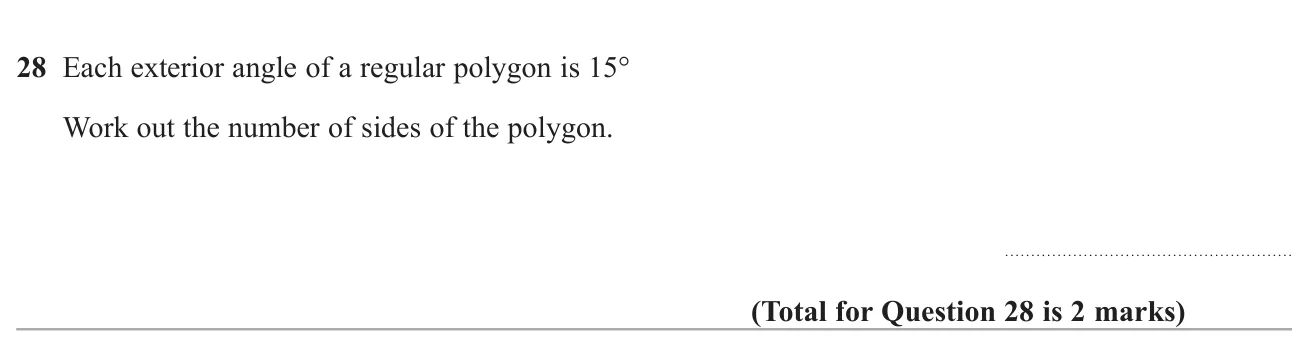
© Pearson Education Ltd. November 2020 Paper 2 (Foundation, calculator), question 28.
Worked solution Checked against the mark scheme
Exterior angles of any polygon add up to 360 ∘ 360^\circ 36 0 ∘
360 ÷ 15 = 24 360 \div 15 = 24 360 ÷ 15 = 24
Watch out: Dividing 180 by 15 to get 12.
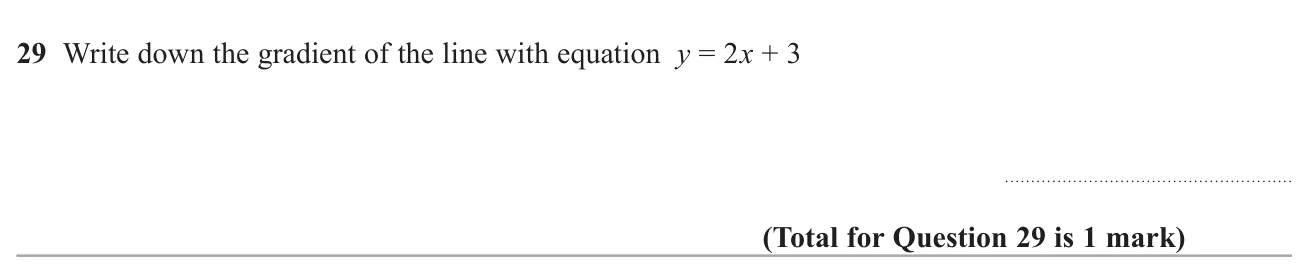
© Pearson Education Ltd. November 2020 Paper 2 (Foundation, calculator), question 29.
Worked solution Checked against the mark scheme
In y = m x + c y = mx + c y = m x + c m m m
For y = 2 x + 3 y = 2x + 3 y = 2 x + 3
Watch out: Giving 3, the y-intercept.
Finished the paper? Add up your marks for all three papers and see what grade that would have been.